
All Topics  
Byzantine art

 
Byzantine Art

   Email Print
   Bookmark   Link


Byzantine art


Byzantine art is the term commonly used to describe the artistic products of the Byzantine Empire
Byzantine Empire

Byzantine Empire and Eastern Roman Empire are conventional names used to describe the Roman Empire during the Middle Ages, centered on its capital of Constantinople....
 from about the 4th century until the Fall of Constantinople
Fall of Constantinople

The Fall of Constantinople was a siege in which the Ottoman Empire under the command of Sultan Mehmed II attempted to capture the capital of the Byzantine Empire, Constantinople which was defended by the army of Emperor Constantine XI....
 in 1453.

The term can also be used for the art of Eastern Orthodox states which were contemporary with the Byzantine Empire
Byzantine Empire

Byzantine Empire and Eastern Roman Empire are conventional names used to describe the Roman Empire during the Middle Ages, centered on its capital of Constantinople....
 and were culturally influenced by it, without actually being part of it (the "Byzantine commonwealth
Byzantine commonwealth

Byzantine Commonwealth is a term coined by 20th century historians to refer to the area where Byzantine Rite was spread during the Middle Ages by Byzantine Empire missionaries....
"), such as Bulgaria
First Bulgarian Empire

The First Bulgarian Empire was a medieval Bulgarian state founded in AD 632 in the lands near the Danube Delta and disintegrated in AD 1018 after its annexation to the Byzantine Empire....
, Serbia
History of Medieval Serbia

?he medieval history of Serbia begins in the 5th century AD with the arrival of the Slavs in the Balkans, and ends with the occupation of Serbia by the Ottoman Empire in 1459 with the fall of the Serbian capital Smederevo....
, or Rus
Kievan Rus'

Kievan Rus' , also written as Kyivan Rus', was a medieval state which existed from approximately 880 to the middle of the 12th century. Founded by the Scandinavian traders called "Rus' " and centered in the city of Kiev , Rus' polity is considered an early predecessor of three modern East Slavs nations: Belarusians, Russians, and Ukrai...
; and also for the art of the Republic of Venice
Republic of Venice

The Most Serene Republic of Venice or Venetian Republic was a state originating from the city of Venice . It existed for over a millennium, from the late 7th century AD until the year 1797....
 and Kingdom of Sicily
Kingdom of Sicily

The Kingdom of Sicily was a state that existed in the south of Italy from its founding by Roger II of Sicily in 1130 until 1816. The Kingdom of Sicily covered not only the island of Sicily itself, but also the whole Mezzogiorno region of southern Italy and, until 1530, the islands of Malta and Gozo....
, which had close ties to the Byzantine Empire despite being in other respects part of western European culture.


Discussion
Ask a question about 'Byzantine art'
Start a new discussion about 'Byzantine art'
Answer questions from other users
Full Discussion Forum


Encyclopedia


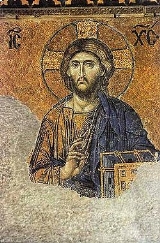
Hagiasophia Christ
Byzantine art is the term commonly used to describe the artistic products of the Byzantine Empire
Byzantine Empire

Byzantine Empire and Eastern Roman Empire are conventional names used to describe the Roman Empire during the Middle Ages, centered on its capital of Constantinople....
 from about the 4th century until the Fall of Constantinople
Fall of Constantinople

The Fall of Constantinople was a siege in which the Ottoman Empire under the command of Sultan Mehmed II attempted to capture the capital of the Byzantine Empire, Constantinople which was defended by the army of Emperor Constantine XI....
 in 1453.

The term can also be used for the art of Eastern Orthodox states which were contemporary with the Byzantine Empire
Byzantine Empire

Byzantine Empire and Eastern Roman Empire are conventional names used to describe the Roman Empire during the Middle Ages, centered on its capital of Constantinople....
 and were culturally influenced by it, without actually being part of it (the "Byzantine commonwealth
Byzantine commonwealth

Byzantine Commonwealth is a term coined by 20th century historians to refer to the area where Byzantine Rite was spread during the Middle Ages by Byzantine Empire missionaries....
"), such as Bulgaria
First Bulgarian Empire

The First Bulgarian Empire was a medieval Bulgarian state founded in AD 632 in the lands near the Danube Delta and disintegrated in AD 1018 after its annexation to the Byzantine Empire....
, Serbia
History of Medieval Serbia

?he medieval history of Serbia begins in the 5th century AD with the arrival of the Slavs in the Balkans, and ends with the occupation of Serbia by the Ottoman Empire in 1459 with the fall of the Serbian capital Smederevo....
, or Rus
Kievan Rus'

Kievan Rus' , also written as Kyivan Rus', was a medieval state which existed from approximately 880 to the middle of the 12th century. Founded by the Scandinavian traders called "Rus' " and centered in the city of Kiev , Rus' polity is considered an early predecessor of three modern East Slavs nations: Belarusians, Russians, and Ukrai...
; and also for the art of the Republic of Venice
Republic of Venice

The Most Serene Republic of Venice or Venetian Republic was a state originating from the city of Venice . It existed for over a millennium, from the late 7th century AD until the year 1797....
 and Kingdom of Sicily
Kingdom of Sicily

The Kingdom of Sicily was a state that existed in the south of Italy from its founding by Roger II of Sicily in 1130 until 1816. The Kingdom of Sicily covered not only the island of Sicily itself, but also the whole Mezzogiorno region of southern Italy and, until 1530, the islands of Malta and Gozo....
, which had close ties to the Byzantine Empire despite being in other respects part of western European culture. Art produced by Eastern Orthodox Christians living in the Ottoman Empire
Ottoman Empire

The Ottoman Empire , also known by its contemporaries as the Turkish Empire or Turkey , was an empire that lasted from 1299?1923. It was Treaty of Lausanne by the Republic of Turkey, which was officially proclaimed on October 29, 1923....
 is often called "post-Byzantine." Certain artistic traditions that originated in the Byzantine Empire, particularly in regard to icon painting and church architecture, are maintained in Greece
Greece

Greece , officially the Hellenic Republic , is a country in southeastern Europe, situated on the southern end of the Balkans. It has borders with Albania, Bulgaria and the former Yugoslav Republic of Macedonia to the north, and Turkey to the east....
, Bulgaria
Bulgaria

The state of Bulgaria , Scientific transliteration Balgarija, officially the Republic of Bulgaria has played a significant role in the Balkans in south-eastern Europe for over fourteen centuries....
, Russia
Russia

Russia , or the Russian Federation , is a list of countries spanning more than one continent country extending over much of northern Eurasia....
 and other Eastern Orthodox countries to the present day.

Introduction

Just as the Byzantine empire represented the political continuation of the Roman Empire
Roman Empire

The Roman Empire was the Roman Republic phase of the Ancient Rome, characterised by an autocracy form of government and large territorial holdings in Europe and around the Mediterranean....
, Byzantine art developed out of the art of the Roman empire
Roman art

Roman art includes the visual arts produced in Ancient Rome, and in the territories of the Roman empire. Major forms of Roman art are Roman architecture, painting, sculpture and mosaic work....
, which was itself profoundly influenced by ancient Greek art
Art in Ancient Greece

The arts of ancient Greece has exercised an enormous influence on the culture of many countries from ancient times until the present, particularly in the areas of sculpture and architecture....
. Byzantine art never lost sight of this classical heritage. The Byzantine capital, Constantinople
Constantinople

Constantinople was the empire capital of the Roman Empire , the Byzantine Empire , the Latin Empire , and the Ottoman Empire . Strategically located between the Golden Horn and the Sea of Marmara at the point where Europe meets Asia, Byzantine Constantinople had been the capital of a Christendom empire, successor to ancient ancient Greece...
, was adorned with a large number of classical sculptures, although they eventually became an object of some puzzlement for its inhabitants. And indeed, the art produced during the Byzantine empire, although marked by periodic revivals of a classical aesthetic, was above all marked by the development of a new aesthetic.

The most salient feature of this new aesthetic was its “abstract,” or anti-naturalistic character. If classical art was marked by the attempt to create representations that mimicked reality as closely as possible, Byzantine art seems to have abandoned this attempt in favor of a more symbolic approach.

Rabulagospelsfol13vascension
The nature and causes of this transformation, which largely took place during late antiquity
Late Antiquity

Late Antiquity is a periodization used by historians to describe the transitional centuries from Classical antiquity to the Middle Ages, in both mainland Europe and the Mediterranean world: generally from the end of the Roman Empire's Crisis of the Third Century to the Islamic conquests and the re-organization of the Byzantine Empire under...
, have been a subject of scholarly debate for centuries. Giorgio Vasari
Giorgio Vasari

Giorgio Vasari was an Italy Painting and architect, who is today famous for his biography of Italian artists, considered the ideological foundation of art history writing....
 attributed it to a decline in artistic skills and standards, which had in turn been revived by his contemporaries in the Italian Renaissance
Italian Renaissance

The Italian Renaissance began the opening phase of the Renaissance, a period of great cultural change and achievement in Europe that spanned the period from the end of the 13th century to about 1600, marking the transition between Medieval and Early Modern Europe....
. Although this point of view has been occasionally revived, most notably by Bernard Berenson
Bernard Berenson

Bernard Berenson was an USA art historian specializing in the Renaissance. He was a major figure in establishing the market for paintings by the "Old Masters"....
, modern scholars tend to take a more positive view of the Byzantine aesthetic. Alois Riegl
Alois Riegl

Alois Riegl was an Austrian art historian, and is considered a member of the Vienna School of Art History. He was one of the major figures in the establishment of art history as a self-sufficient academic discipline, and one of the most influential practitioners of formalism ....
 and Josef Strzygowski
Josef Strzygowski

Josef Strzygowski was an art history best known for his racism ideology and his advocacy of a comparative method. He is considered a member of the Vienna School of Art History....
, writing in the early 20th century, were above all responsible for the revaluation of late antique art. Riegl saw it as a natural development of pre-existing tendencies in Roman art, whereas Strzygowski viewed it as a product of “oriental” influences. Notable recent contributions to the debate include those of Ernst Kitzinger
Ernst Kitzinger

File:Bundesarchiv B 145 Bild-F078398-0007, Ernst Kitzinger.jpgErnst Kitzinger was a Germany-United States historian of late antiquity, Medieval art, and Byzantine art....
, who traced a “dialectic” between “abstract" and "Hellenistic” tendencies in late antiquity, and John Onians, who saw an “increase in visual response” in late antiquity, through which a viewer “could look at something which was in twentieth-century terms purely abstract and find it representational.”

In any case, the debate is purely modern: it is clear that most Byzantine viewers did not consider their art to be abstract or unnaturalistic. As Cyril Mango
Cyril Mango

Cyril Alexander Mango is a United Kingdom scholar in the history, Byzantine art, and Byzantine architecture of the Byzantine Empire. He is a former King's College London and University of Oxford professor of Byzantine and Modern Greek Language and Literature....
 has observed, “our own appreciation of Byzantine art stems largely from the fact that this art is not naturalistic; yet the Byzantines themselves, judging by their extant statements, regarded it as being highly naturalistic and as being directly in the tradition of Phidias
Phidias

Phidias or Pheidias; ; circa 480 BC 430 BC), was a Hellenic civilization sculptor, painter and architect, who lived in the Classical Greece, in the 5th century BC, and is commonly regarded as one of the greatest of all Classical sculptors....
, Apelles
Apelles

Apelles of Kos was a renowned Painting of ancient Greece. Pliny the Elder, to whom we owe much of our knowledge of this artist rated him superior to preceding and subsequent artists....
, and Zeuxis.”

The subject matter of monumental Byzantine art was primarily religious and imperial: the two themes are often combined, as in the portraits of later Byzantine emperors that decorated the interior of the sixth-century church of Hagia Sophia
Hagia Sophia

Hagia Sophia is a former Patriarchate basilica, later a mosque, now a museum in Istanbul, Turkey. Famous in particular for its massive dome, it is considered the epitome of Byzantine architecture....
 in Constantinople. These preoccupations are partly a result of the pious and autocratic nature of Byzantine society, and partly a result of its economic structure: the wealth of the empire was concentrated in the hands of the church and the imperial office, which therefore had the greatest opportunity to undertake monumental artistic commissions.

Religious art was not, however, limited to the monumental decoration of church interiors. One of the most important genres of Byzantine art was the icon
Icon

An 'icon' is a religious work of art, most commonly a painting, from Eastern Christianity. More broadly the term is used in a wide number of contexts for an image, picture, or representation; it is a sign or likeness that stands for an object by signifying or representing it either concretely or by analogy, as in semiotics; by extension, ...
, an image of Christ, the Virgin, or a saint, used as an object of veneration in Orthodox churches and private homes alike. Icons were more religious than aesthetic in nature: especially after the end of iconoclasm, they were understood to manifest the unique “presence” of the figure depicted by means of a “likeness” to that figure maintained through carefully maintained canons of representation.

The illumination of manuscripts was another major genre of Byzantine art. The most commonly illustrated texts were religious, both scripture itself (particularly the Psalms) and devotional or theological texts (such as the Ladder of Divine Ascent of John Climacus
John Climacus

Saint John Climacus , also known as John of the Ladder, John Scholasticus and John Sinaites, was a 6th century Christianity monasticism at the monastery on Mount Sinai....
 or the homilies of Gregory of Nazianzus
Gregory of Nazianzus

Gregory of Nazianzus was a 4th-century Archbishop of Constantinople. He is widely considered the most accomplished rhetorical stylist of the Church Fathers....
). Secular texts were also illuminated: important examples include the Alexander Romance
Alexander Romance

Alexander romance is any of several collections of legends concerning the mythical exploits of Alexander the Great. The earliest version is in Greek language, dating to the 3rd century....
 and the history of John Skylitzes
John Skylitzes

John Scylitzes or Ioannes Skylitzes was a Byzantine Greeks historian of the late 11th century....
.

“Minor” or “luxury” arts (i.e. ivories, steatites
Soapstone

Soapstone is a metamorphic rock, a talc-schist. It is largely composed of the mineral talc and is rich in magnesium. It is produced by dynamothermal metamorphism and metasomatism, which occurs at the areas where tectonic plates are subduction, changing rocks by heat and pressure, with influx of fluids, but without melting....
, enamels, jewelry, metalwork, ceramics, etc.) were produced in large number throughout the Byzantine era. Many of these were also religious in nature, although a large number of objects with secular or non-representational decoration were produced: for example, ivories representing themes from classical mythology, and ceramics decorated with figures that may derive from the Akritic epics
Digenis Acritas

Digenis Acritis , known in folksongs as ???e??? ????ta? , is the most famous of the Acritic songs. The epic details the life of its eponymous hero, Digenes, a hero of mixed Roman and Syrian blood....
.

Periods


Early Byzantine art


Two events were of fundamental importance to the development of a unique, Byzantine art. First, the Edict of Milan
Edict of Milan

The Edict of Milan was a letter signed by emperors Constantine I and Licinius that proclaimed religious toleration in the Roman Empire. The letter was issued in 313 AD, shortly after the conclusion of the Diocletian Persecution....
, issued by the emperors Constantine I
Constantine I

Flavius Valerius Aurelius Constantinus , commonly known in English_language as Constantine I, Constantine the Great, or Saint Constantine , was Roman Emperor from 306, and the undisputed holder of that office from 324 until his death in 337....
 and Licinius
Licinius

Valerius Licinianus Licinius was Roman emperor from 308 to 324.Of Dacian peasant origin, born in Moesia Superior, Licinius accompanied his close childhood friend, the Emperor Galerius, on the Persian expedition in 297....
 in 313, allowed for public Christian worship, and led to the development of a monumental, Christian art. Second, the dedication of Constantinople
Constantinople

Constantinople was the empire capital of the Roman Empire , the Byzantine Empire , the Latin Empire , and the Ottoman Empire . Strategically located between the Golden Horn and the Sea of Marmara at the point where Europe meets Asia, Byzantine Constantinople had been the capital of a Christendom empire, successor to ancient ancient Greece...
 in 330 created a great new artistic centre for the eastern half of the Empire, and a specifically Christian one. Other artistic traditions flourished in rival cities such as Alexandria
Alexandria

Alexandria , with a population of 4.1 million, is the second-largest city in Egypt, and is the country's largest seaport, serving about 80% of Egypt's imports and exports....
, Antioch
Antioch

Antioch on the Orontes was an ancient city on the eastern side of the Orontes River. It is near the modern city of Antakya, Turkey.Founded near the end of the 4th century BC by Seleucus I Nicator, one of Alexander the Great's generals, Antioch eventually rivaled Alexandria as the chief city of the nearer East and was a cradle of gentile hi...
, and Rome
Rome

Rome is the capital city of Italy and Lazio, and is Italy's largest and most populous city, with 2,724,347 residents in an urban area of some ....
, but it was not until all of these cities had fallen - the first two to the Arabs and Rome to the Goths
Goths

The Goths were East Germanic tribes who, in the 3rd and 4th centuries, invasion the Roman Empire and later adopted Arian Christianity. In the 5th and 6th centuries, divided as the Visigoths and the Ostrogoths, they established powerful successor-states of the Roman Empire in the Iberian peninsula and Italy....
 - that Constantinople established its supremacy.

Constantine devoted great effort to the decoration of Constantinople, adorning its public spaces with ancient statuary, and building a forum
Forum of Constantine

The Forum of Constantine was built at the foundation of Constantinople immediately outside of the Walls of Constantinople#Walls of Byzantium and Constantine....
 dominated by a porphyry column that carried a statue of himself. Major Constantinopolitan churches built under Constantine and his son, Constantius II
Constantius II

Flavius Iulius Constantius, known in English as Constantius II was a Roman Emperor of the Constantinian dynasty....
, included the original foundations of Hagia Sophia
Hagia Sophia

Hagia Sophia is a former Patriarchate basilica, later a mosque, now a museum in Istanbul, Turkey. Famous in particular for its massive dome, it is considered the epitome of Byzantine architecture....
 and the Church of the Holy Apostles
Church of the Holy Apostles

The Church of the Holy Apostles , also known as the Imperial Polyandreion, was a Christian basilica built in Constantinople in 550. It was second only to the Hagia Sophia among the great churches of the Eastern Empire....
.

The next major building campaign in Constantinople was sponsored by Theodosius I
Theodosius I

Flavius Theodosius , also called Theodosius I and Theodosius the Great , was Roman Emperor from 379 to 395. Reuniting the eastern and western portions of the empire, Theodosius was the last emperor of both the Eastern Roman Empire and Western Roman Empire....
. The most important surviving monument of this period is the obelisk and base erected by Theodosius in the Hippodrome
Hippodrome of Constantinople

The Hippodrome of Constantinople was a Race track that was the sporting and social centre of Constantinople, capital of the Byzantine Empire and the largest city in Europe....
. The earliest surviving church in Constantinople is the Basilica of St. John at the Stoudios
Stoudios

Hagios Ioannes Prodromos en tois Stoudiou , often shortened to Stoudios or Stoudion , was historically the most important monastery of Constantinople , the capital of the Eastern Roman Empire....
 Monastery, built in the fifth century.

Due to subsequent rebuilding and destruction, relatively few Constantinopolitan monuments of this early period survive. However, the development of monumental early Byzantine art can still be traced through surviving structures in other cities. For example, important early churches are found in Rome (including Santa Sabina
Santa Sabina

The Basilica of Saint Sabina at the Aventine is a titular minor basilica and mother church of the Roman Catholic Dominican order in Rome, Italy....
 and Santa Maria Maggiore
Basilica di Santa Maria Maggiore

The Basilica of Saint Mary Major , is an Ancient Rome Roman Catholic Church basilica of Rome. It is one of the Basilica#The major basilicas or Basilica#Papal and patriarchal basilicas in Rome, which, together with Basilica di San Lorenzo fuori le Mura, were formerly referred to as the five "patriarchal basilicas" of Rome, associated with the...
), and in Thessaloniki
Thessaloniki

Thessaloniki , Thessalonica, or Salonica is the List of largest cities and second largest cities by country in Greece and the capital of Macedonia , the nation's largest Regions of Greece....
 (the Rotunda
Arch and Tomb of Galerius

The Arch of Galerius and the Tomb of Galerius are neighboring monuments in the city of Thessaloniki, in the province of Central Macedonia in northern Greece....
 and the Acheiropoietos Basilica).

A number of important illuminated manuscripts, both sacred and secular, survive from this early period. Classical authors, including Virgil
Virgil

Publius Vergilius Maro was a classical Roman poet, best known for three major works?the Bucolics , the Georgics and the Aeneid?although several Appendix Vergiliana are also attributed to him....
 (represented by the Vergilius Vaticanus
Vergilius Vaticanus

The Vergilius Vaticanus is an illuminated manuscript containing fragments of Virgil's Aeneid and Georgics made in Rome in about 400. It is one of the oldest surviving sources for the text of the Aeneid and is the oldest and one of only three illustrated manuscript of classical literature....
 and the Vergilius Romanus
Vergilius Romanus

The Vergilius Romanus , also known as the Roman Vergil, is a 5th century illuminated manuscript of the works of Virgil. It contains the Aeneid, the Georgics, and some of the Eclogues....
) and Homer
Homer

Homer is traditionally held to be the author of the ancient Greek language epic poems the Iliad and the Odyssey, as well as of the Homeric Hymns....
 (represented by the Ambrosian Iliad
Ambrosian Iliad

The Ambrosian Iliad is a 5th century Illuminated manuscript manuscript of the Iliad of Homer. It is thought to have been produced in Constantinople during the late 5th or early 6th century, specifically between 493 and 508, on vellum....
), were illustrated with narrative paintings. Illuminated biblical manuscripts of this period survive only in fragments: for example, the Quedlinburg Itala fragment
Quedlinburg Itala fragment

The Quedlinburg Itala fragment is a fragment of six folios from a large 5th century illuminated manuscript of an Vetus Latina translation of the Bible....
 is a small portion of what must have been a lavishly illustrated copy of 1 Kings.

Early Byzantine art was also marked by the cultivation of ivory carving
Ivory carving

Ivory carving is the ornamentation of ivory by using sharp cutting tools, either mechanically or manually.Humans have ornamentally carved ivory since prehistoric times, and much of the prehistoric work reveals information about the use of tools during the carving's time period....
. Ivory diptych
Diptych

A diptych is any object with two flat plates attached at a hinge. Devices of this form were quite popular in the ancient world, types existing for recording notes and for measuring time and direction....
s, often elaborately decorated, were issued as gifts by newly appointed consul
Consul

Consul was the highest elected office of the Roman Republic and an appointive office under the Roman Empire. The title was also used in other city states, and revived in modern states, notably French Republic before the Napoleon I of Franceic counter-revolution....
s. Silver plates were another important form of luxury art: among the most lavish from this period is the Missorium of Theodosius I
Missorium of Theodosius I

The missorium of Theodosius I is a large ceremonial silver dish preserved in the Real Academia de Historia, in Madrid, Spain. It was probably made in Constantinople for the tenth anniversary in 388 of the reign of the Emperor Theodosius I, the last Emperor to rule both the Eastern and Western Empires....
. Sarcophagi continued to be produced in great numbers.

The Age of Justinian


Significant changes in Byzantine art coincided with the reign of Justinian I
Justinian I

Flavius Petrus Sabbatius Iustinianus , AD 482 or 483 ? 13 or 14 November 565, was the second member of the Justinian Dynasty and List of Roman Emperors from 527 until his death....
 (527-565). Justinian devoted much of his reign to reconquering Italy, North Africa and Spain. He also laid the foundations of the imperial absolutism of the Byzantine state, codifying its laws and imposing his religious views on all his subjects by law.

Meister Von San Vitale in Ravenna 003
A significant component of Justinian's project of imperial renovation was a massive building program, which was described in a book, the Buildings, written by Justinian's court historian, Procopius
Procopius

Procopius of Caesarea was a prominent Byzantine Empire scholar of the family Procopius . A participant himself in the wars of the Emperor Justinian I, he was the major historian of the 6th century, writing the Wars of Justinian, the Buildings of Justinian and the celebrated Secret History....
. Justinian renovated, rebuilt, or founded anew countless churches within Constantinople, including Hagia Sophia
Hagia Sophia

Hagia Sophia is a former Patriarchate basilica, later a mosque, now a museum in Istanbul, Turkey. Famous in particular for its massive dome, it is considered the epitome of Byzantine architecture....
, which had been destroyed during the Nika riots
Nika riots

The Nika riots , or Nika revolt, took place over the course of a week in Constantinople in 532. It was the most violent riot that Constantinople had ever seen to that point, with nearly half the city being burned or destroyed and tens of thousands of people killed....
, the Church of the Holy Apostles
Church of the Holy Apostles

The Church of the Holy Apostles , also known as the Imperial Polyandreion, was a Christian basilica built in Constantinople in 550. It was second only to the Hagia Sophia among the great churches of the Eastern Empire....
, and the Church of Saints Sergius and Bacchus
Little Hagia Sophia

Little Hagia Sophia , formerly the Church of the Saints Sergius and Bacchus , is a former Eastern Orthodox Church dedicated to Saints Sergius and Bacchus in Constantinople, later converted into a mosque during the Ottoman Empire....
. Justinian also built a number of churches and fortifications outside of the imperial capital, including the Monastery of St. Catherine
Saint Catherine's Monastery, Mount Sinai

Saint Catherine's Monastery on the Sinai Peninsula, at the mouth of an inaccessible gorge at the foot of Mount Sinai in Egypt. The monastery is Greek Orthodox Church and is a UNESCO World Heritage Site....
 on the Sinai Peninsula
Sinai Peninsula

The Sinai Peninsula or Sinai is a triangular peninsula in Egypt. It lies between the Mediterranean Sea to the north and the Red Sea to the south, forming a land bridge between Africa and Southwest Asia....
, and the Basilica of St. John in Ephesus
Ephesus

Ephesus was an ancient Greek city on the west coast of Anatolia, in the region known as Ionia during the period known as Classical Greece. It was one of the twelve cities of the Ionian League....
.

Several major churches of this period were built in the provinces by local bishops in imitation of the new Constantinopolitan foundations. The Basilica of San Vitale
Basilica of San Vitale

The Church or Basilica of San Vitale? styled an "Basilica" in the Roman Catholic Church, though it is not of Basilica form? is the most famous monument of Ravenna, Italy and is one of the most important examples of Byzantine Art and architecture in western Europe....
 in Ravenna
Ravenna

Ravenna is a city and comune in the Emilia-Romagna region of Italy. The city is inland, but is connected to the Adriatic Sea by a canal. Ravenna once served as the seat of the Western Roman Empire and later the Ostrogoths and the Exarchate of Ravenna....
, was built by Bishop Maximianus
Maximianus of Ravenna

Maximianus of Ravenna was bishop of Ravenna.Born in Pula, Italy, Maximianus was consecrated bishop of Ravenna in 546 by Pope Vigilius. His flock refused his leadership for a long time because he was too humble....
. The decoration of San Vitale includes important mosaics of Justinian and his empress, Theodora
Theodora (6th century)

Theodora , was empress of the Byzantine Empire and the wife of Emperor Justinian I. Like her husband, she is a saint in the Eastern Orthodoxy, commemorated on November 14....
, although neither ever visited the church. Also of note is the Euphrasian Basilica
Euphrasian Basilica

The Euphrasian Basilica is a basilica in Porec, Croatia. The episcopal complex, including, apart the basilica itself, a sacristy, a baptistery and the bell tower of the nearby archbishop's palace, is one of the best examples of early Byzantine art in the region....
 in Porec
Porec

Porec is a town and municipality on the western coast of the Istria, in Istria County, Croatia. Its major landmark is the 6th century Euphrasian Basilica, a UNESCO World Heritage Site since 1997....
.

19-20th century archeological discoveries unearthed a large group of Early Byzantine mosaics in the Middle East
Early Byzantine mosaics in the Middle East

Early Byzantine mosaics in the Middle East are a group of Christian mosaics created between the 4th and the 8th centuries in ancient Syria, Palestine and Egypt when the area belonged to the Byzantine Empire....
. The eastern provinces of the Eastern Roman and later the Byzantine Empires
Byzantine Empire

Byzantine Empire and Eastern Roman Empire are conventional names used to describe the Roman Empire during the Middle Ages, centered on its capital of Constantinople....
 inherited a strong artistic tradition from the Late Antiquity
Late Antiquity

Late Antiquity is a periodization used by historians to describe the transitional centuries from Classical antiquity to the Middle Ages, in both mainland Europe and the Mediterranean world: generally from the end of the Roman Empire's Crisis of the Third Century to the Islamic conquests and the re-organization of the Byzantine Empire under...
. Christian mosaic art flourished in this area from the 4th century onwards. The tradition of making mosaics was carried on in the Umayyad era until the end of the 8th century. The most important surviving examples are the Madaba Map
Madaba Map

The Madaba Map is part of a floor mosaic in the Byzantine architecture church of Saint George at Madaba, Jordan. The Madaba Map is the oldest surviving original cartography depiction of the Holy Land and especially Jerusalem....
, the mosaics of Mount Nebo
Mount Nebo

Mount Nebo may refer to:Australia* Mount Nebo , part of the D'Aguilar Range, Queensland, Australia* Mount Nebo , a tall hill near the city of Wollongong, New South Wales, Australia and part of the foothills of Mount Keira...
, Saint Catherine's Monastery
Saint Catherine's Monastery, Mount Sinai

Saint Catherine's Monastery on the Sinai Peninsula, at the mouth of an inaccessible gorge at the foot of Mount Sinai in Egypt. The monastery is Greek Orthodox Church and is a UNESCO World Heritage Site....
 on Mount Sinai
Mount Sinai

Mount Sinai , also known as Mount Horeb, Mount Musa, Gebel Musa or Jabal Musa by the Bedouin, is the name of a mountain in the Sinai Peninsula....
 and the Church of St Stephen in ancient Kastron Mefaa (now Umm ar-Rasas).

The first fully-preserved illuminated biblical manuscripts date to the first half of the sixth century, most notably the Vienna Genesis
Vienna Genesis

The Vienna Genesis is an illuminated manuscript, probably produced in Syria in the first half of the 6th Century. It is the oldest well-preserved, surviving, illustrated biblical codex....
, the Rossano Gospels
Rossano Gospels

The Rossano Gospels, designed by 042 or S , e 18 , located at the Cathedral of Rossano in Italy, are a 6th century Gospel Book written following the reconquest of Italian peninsula by Byzantine Empire....
, and the Sinope Gospels
Sinope Gospels

The Sinope Gospels, designed by O or 023 , e 21 , also known as the Codex Sinopensis, is a fragment of a 6th century illuminated manuscript Greek language Gospel Book....
. The Vienna Dioscurides
Vienna Dioscurides

The Vienna Dioscurides is an early 6th-century copy of De Materia Medica by Dioscurides. It is an important and rare example of a late antique scientific text....
 is a lavishly illustrated botanical treatise, presented as a gift to the Byzantine aristocrat Julia Anicia.

Important ivory sculptures of this period include the Barberini ivory
Barberini ivory

The Barberini ivory is one half of a Byzantine Empire ivory imperial diptych dating from Late Antiquity, now in the Louvre. It is carved in the classical antiquity style known as late Theodosian, representing the emperor as triumphant victor....
, which probably depicts Justinian himself, and the Archangel ivory
Archangel ivory

The Archangel ivory is the largest surviving Byzantine art ivory panel, now in the British Museum. Dated to the early 6th century, it depicts an archangel holding a sceptre and Globus cruciger....
 in the British Museum. Silver plate continued to be decorated with scenes drawn from classical mythology; for example, a preserved in the Cabinet des Médailles, Paris, depicts Hercules
Hercules

Hercules is the Ancient Rome name for the mythical Ancient Greece hero Heracles, son of Zeus and the mortal Alcmene. Early Roman sources suggest that the imported Greek hero supplanted a mythic Italian shepherd called "Recaranus" or "Garanus", famous for his strength....
 wrestling the Nemean lion
Nemean Lion

The Nemean lion was a vicious monster in Greek mythology that lived in Nemea. He was eventually killed by Heracles. The lion was usually considered the offspring of Typhon and Echidna , but it was also said to have fallen from the moon, offspring of Zeus and Selene....
.

The seventh-century crisis


The Age of Justinian was followed by a political decline, since most of Justinian's conquests were lost and the Empire faced acute crisis with the invasions of the Avars
Eurasian Avars

The 'Avars' were a highly organized and powerful Turkic confederation. They were ruled by a khagan, who was surrounded by a tight-knit retinue of nomad warriors, an organization characteristic of Turkic peoples groups....
, Slavs, Persians and Arabs in the 7th century. Constantinople was also wracked by religious and political conflict.

The most significant surviving monumental projects of this period were undertaken outside of the imperial capital. The church of Hagios Demetrios in Thessaloniki was rebuilt after a fire in the mid-seventh century. The new sections include mosaics executed in a remarkably abstract style. The church of the Koimesis in Nicaea (present-day Iznik
Iznik

Iznik is a city in Turkey which is known primarily as the site of the First Council of Nicaea and Second Council of Nicaea Councils of Nicaea, the first and seventh Ecumenical councils in the early history of the Christianity church, the Nicene Creed, and as the capital city of the Empire of Nicaea....
), destroyed in the early 20th century but documented through photographs, demonstrates the simultaneous survival of a more classical style of church decoration. The churches of Rome, still a Byzantine territory in this period, also include important surviving decorative programs, especially Santa Maria Antiqua
Santa Maria Antiqua

Santa Maria Antiqua is a churches of Rome Rome, built in the 5th century in the Forum Romanum, and for long time the monumental access to the Palatine Hill imperial palaces....
, Sant'Agnese fuori le mura
Sant'Agnese fuori le mura

Sant'Agnese fuori le mura is a churches of Rome Rome, in which Saint Agnes's bones are reputed to rest. The underground area and built a large private mausoleum over it which is now known as the "mausoleo di Santa Costanza" , while the church of Saint Agnes was then built aside....
, and the Chapel of San Venanzio in San Giovanni in Laterano. Byzantine mosaicists probably also contributed to the decoration of the early Umayyad monuments, including the Dome of the Rock
Dome of the Rock

The Dome of the Rock is an Islamic shrine and a major landmark located on the Temple Mount in Jerusalem. It was completed in 691, making it the oldest extant Islamic building in the world....
 in Jerusalem
Jerusalem

Jerusalem is the capital of Israel and its List of Israeli cities in both population and area, with a population of 747,600 residents over an area of if Positions on Jerusalem East Jerusalem is included....
 and the Great Mosque of Damascus.

Important works of luxury art from this period include the silver , produced during the reign of Heraclius
Heraclius

Flavius Heraclius was a Byzantine Emperor, who ruled the Byzantine Empire for over thirty years, from October 5, 610 to February 11, 641. His rise to power began in 608, when he and his Heraclius the Elder, the viceregal Exarchate of Africa, successfully led a revolt against the unpopular usurper Phocas....
, and depicting scenes from the life of the Hebrew king David
David

David , was the second king of the united Kingdom of Israel according to the Hebrew Bible/Old Testament. He is depicted as a righteous king, although not without fault, as well as an acclaimed warrior, musician and poet ....
. The most notable surviving manuscripts are Syriac gospel books, such as the so-called Syriac Bible of Paris
Syriac Bible of Paris

The Syriac Bible of Paris is an illuminated manuscript Bible written in Syriac language. It dates to 6th or 7th century. It is believed to have been made in northern Mesopotamia....
. However, the London Canon Tables
London Canon Tables

The London Canon Tables is a Byzantine Empire Illuminated manuscript Gospel Book fragment on vellum from the 6th or 7th century. It was possibly made in Constantinople....
 bear witness to the continuing production of lavish gospel books in Greek.

The period between Justinian and iconoclasm saw major changes in the social and religious roles of images within Byzantium. The veneration of acheiropoieta
Acheiropoieta

Acheiropoieta , literally "not-handmade"; singular acheiropoieton), or Icons Not Made by Hand , are a particular kind of icon, ones that are alleged to have come into existence miraculously, not by a human painter....
, or holy images "not made by human hands," became a significant phenomenon, and in some instances these images were credited with saving cities from military assault. By the end of the seventh century, certain images of saints had come to be viewed as "windows" through which one could communicate with the figure depicted. Proskynesis
Proskynesis

Proskynesis, formed from the Ancient Greek words pros and kuneo literally means "kissing towards", and refers to the traditional Persian Empire act of prostrating oneself before a person of higher social rank....
 before images is also attested in texts from the late seventh century. These developments mark the beginnings of a theology of icon
Icon

An 'icon' is a religious work of art, most commonly a painting, from Eastern Christianity. More broadly the term is used in a wide number of contexts for an image, picture, or representation; it is a sign or likeness that stands for an object by signifying or representing it either concretely or by analogy, as in semiotics; by extension, ...
s.

At the same time, the debate over the proper role of art in the decoration of churches intensified. of the Quinisext Council
Quinisext Council

The Quinisext Council was a church council held in 692 at Constantinople under Justinian II. It is often known as the Council in Trullo, because it was held in the same domed hall where the Third Council of Constantinople had met....
 of 692 addressed controversies in this area: prohibition of the representation of the cross on church pavements (Canon 73), prohibition of the representation of Christ as a lamb (Canon 82), and a general injunction against "pictures, whether they are in paintings or in what way so ever, which attract the eye and corrupt the mind, and incite it to the enkindling of base pleasures" (Canon 100).

Iconoclasm


Intense debate over the role of art in worship led eventually to the period of "Byzantine iconoclasm
Iconoclasm

Iconoclasm, Greek for "image-breaking," is the deliberate destruction of important symbolic images recognized within a culture, religion, or society....
." Sporadic outbreaks of iconoclasm on the part of local bishops are attested in Asia Minor during the 720s. In 726, an underwater earthquake between the islands of Thera and Therasia was interpreted by Emperor Leo III
Leo III the Isaurian

Leo III the Isaurian or the Syrian , was List of Byzantine Emperors from 717 until his death in 741. He put an end to a period of instability, successfully defended the empire against the invading Umayyads, and forbade the veneration of icons ....
 as a sign of God's anger, and may have led Leo to remove a famous icon of Christ from the Chalke Gate outside the imperial palace. However, iconoclasm probably did not become imperial policy until the reign of Leo's son, Constantine V
Constantine V

Constantine V was List of Byzantine Emperors from 741 to 775; ); ....
. The Council of Hieria
Council of Hieria

The iconoclast Council of Hieria was a Christianity council which viewed itself as ecumenical councils, but was later rejected by the Eastern Orthodox Church and Roman Catholic Church Churches....
, convened under Constantine in 754, proscribed the manufacture of icons of Christ. This inaugurated the Iconoclastic period
Iconoclasm

Iconoclasm, Greek for "image-breaking," is the deliberate destruction of important symbolic images recognized within a culture, religion, or society....
, which lasted, with interruptions, until 843.

While iconoclasm severely restricted the role of religious art, and led to the removal of some earlier apse mosaics and (possibly) the sporadic destruction of portable icons, it never constituted a total ban on the production of figural art. Ample literary sources indicate that secular art (i.e. hunting scenes and depictions of the games in the hippodrome) continued to be produced, and the few monuments that can be securely dated to the period (most notably the manuscript of Ptolemy's "Handy Tables" today held by the Vatican) demonstrate that metropolitan artists maintained a high quality of production.

Major churches dating to this period include Hagia Eirene
Hagia Irene

Hagia Irene or Hagia Eirene is a former Eastern Orthodox church located in the outer courtyard of Topkapi Palace in Istanbul, Turkey....
 in Constantinople, which was rebuilt in the 760s following its destruction by an earthquake in 740. The interior of Hagia Eirene, which is dominated by a large mosaic cross in the apse, is one of the best-preserved examples of iconoclastic church decoration. The church of Hagia Sophia in Thessaloniki was also rebuilt in the late 8th century.

Certain churches built outside of the empire during this period, but decorated in a figural, "Byzantine," style, may also bear witness to the continuing activities of Byzantine artists. Particularly important in this regard are the original mosaics of the Palatine Chapel in Aachen
Palatine Chapel in Aachen

The Palatine Chapel in Aachen is the chapel of Charlemagne's Charlemagne's Palace in Aachen, now part of Aachen Cathedral in Aachen, Germany. It is Aachen's major landmark, the central monument of the so-called Carolingian Renaissance, and the reason the French call the city Aix-la-Chapelle....
 (since either destroyed or heavily restored) and the frescoes in the Church of Maria foris portas in Castelseprio
Castelseprio

Castelseprio was the site of a Roman Empire fort in antiquity, and a significant Lombard League town in the early Middle Ages, before being destroyed and abandoned in 1287....
.

Macedonian Art


The rulings of the Council of Hieria were reversed by a new church council in 843, celebrated to this day in the Eastern Orthodox Church as the "Triumph of Orthodoxy." In 867, the installation of a new apse mosaic in Hagia Sophia depicting the Virgin and Child was celebrated by the Patriarch Photios in a famous homily as a victory over the evils of iconoclasm. Later in the same year, the Emperor Basil I
Basil I

Basil I, called the Macedonian was a Byzantine Empire. He was perceived by Byzantines as one of their greatest emperors, the founder of one the most splendid imperial dynasties of Byzantium, the Macedonian dynasty , and the initiator of a Macedonian Renaissance of Byzantine art....
, called "the Macedonian," acceded to the throne; as a result the following period of Byzantine art has sometimes been called the "Macedonian Renaissance
Macedonian Renaissance

Macedonian Renaissance is a label sometimes used to describe the period of the Macedonian dynasty of the Byzantine Empire , especially the 10th century, which some scholars have seen as a time of increased interest in classical scholarship and the assimilation of classical motifs into Christian themes....
," although the term is doubly problematic (it was neither "Macedonian
Macedonia (terminology)

The definition of Macedonia is a major source of confusion and debate due to the overlapping use of the term to describe geographical, political and historical areas, languages and peoples....
," nor, strictly speaking, a "Renaissance
Renaissance

The Renaissance was a cultural movement that spanned roughly the 14th to the 17th century, beginning in Italy in the late Middle Ages and later spreading to the rest of Europe....
").

In the 9th and 10th centuries the Empire's military situation improved, and patronage of art and architecture increased. New churches were commissioned, and the standard architectural form (the "cross-in-square
Cross-in-square

The term cross-in-square denotes the dominant architectural form of middle and late Byzantine Empire churches. The first cross-in-square churches were probably built in the late 8th century, and the form has remained in use throughout the Eastern Orthodox Church world until the present day....
") and decorative scheme of the Middle Byzantine church were standardised. Major surviving examples include Hosios Loukas
Hosios Loukas

Hosios Loukas is an historic walled monastery situated near the town of Distomo, in Boeotia Prefecture, Greece. It is one of the most important monuments of Middle Byzantine architecture and art, and has been listed on UNESCO's World Heritage Sites, along with the monasteries of Nea Moni and Daphnion....
 in Boeotia
Boeotia

Boeotia, Beotia, or B?otia , formerly Cadmeis, was a region of ancient Greece, north of the eastern part of the Gulf of Corinth. It was bounded on the south by Megaris and the Kithairon mountain range that forms a natural barrier with Attica, on the north by Opuntian Locris and the Euripus Strait at the Gulf of Euboea, and on the...
, the Daphni Monastery
Daphni Monastery

Dafni or Daphni is a monastery 11 km north-west of downtown Athens in Chaidari, south of Athinon Avenue . It is situated near the forest of the same name, on the Sacred Way that led to Eleusis....
 near Athens
Athens

Athens , the Capital and largest city of Greece, dominates the Attica periphery; as one of the List of cities by time of continuous habitation, its recorded history spans around 3,400 years....
 and Nea Moni on Chios
Chios

Chios is the fifth largest of the Greece list of islands of Greece, situated in the Aegean Sea seven kilometres off the Turkey coast. The island is noted for its strong merchant shipping community, its unique mastic gum and its medieval villages....
.

There was a revival of interest in the depiction of subjects from classical mythology (as on the Veroli Casket) and in the use of a "classical" style to depict religious, and particularly Old Testament, subjects (of which the Paris Psalter
Paris Psalter

The Paris Psalter is a Byzantine art illuminated manuscript containing 449 folios and 14 full-page miniatures "in a grand, almost classical style", as the Encyclopaedia Britannica put it....
 and the Joshua Roll
Joshua Roll

The Joshua Roll is a Byzantine art illuminated manuscript of highly unusual format, probably of the 10th century Macedonian Renaissance, believed to have been created by artists of the Imperial workshops in Constantinople, and now in the Vatican Library....
 are important examples)

The Macedonian period also saw a revival of the late antique technique of ivory
Ivory

File:Ivory decoration.jpgIvory is formed from dentine and constitutes the bulk of the teeth and tusks of animals such as the elephant, hippopotamus, walrus, mammoth and narwhal....
 carving. Many ornate ivory triptych
Triptych

A triptych is a work of art which is divided into three sections, or three Wood carving panels which are hinged together and folded. It is therefore a type of polyptych, the term for all multi-panel works; the diptych has two panels....
s and diptych
Diptych

A diptych is any object with two flat plates attached at a hinge. Devices of this form were quite popular in the ancient world, types existing for recording notes and for measuring time and direction....
s survive, such as the Harbaville Triptych
Harbaville Triptych

The Harbaville Triptych is a Byzantine art ivory triptych of the middle of the 10th century AD with a Deesis and other saints, now in the Louvre....
 and a triptych at Luton Hoo
Luton Hoo

Luton Hoo is a country house hotel in Bedfordshire, England, on the edge of the town of Luton. It is a Grade I listed building. The unusual name "Hoo" is a Old English language word meaning the spur of a hill, and is more commonly found in East Anglia....
, dating from the reign of Nicephorus Phocas).

Comnenian Age

The Macedonian emperors were followed by the Komnenian dynasty, beginning with the reign of Alexios I Komnenos
Alexios I Komnenos

Alexios I Komnenos, or Comnenus , Byzantine Empire List of Byzantine Emperors , was the son of Ioannis Komnenos and Anna Dalassena, and the nephew of Isaac I Komnenos ....
 in 1081. Byzantium had recently suffered a period of severe dislocation following the battle of Manzikert
Battle of Manzikert

The Battle of Manzikert, or Malazgirt, was fought between the Byzantine Empire and Great Seljuq Empire forces led by Alp Arslan on August 26, 1071 near Manzikert ....
 in 1071 and the subsequent loss of Asia Minor to the Turks. However, the Komnenoi brought stability to the empire, (1081-1185), and during the course of the twelfth century their energetic campaigning did much to restore the fortunes of the empire. The Komnenoi were great patrons of the arts, and with their support Byzantine artists continued to move in the direction of greater humanism and emotion, of which the Theotokos of Vladimir
Theotokos of Vladimir

The Theotokos of Vladimir, also known as Our Lady of Vladimir, the Virgin of Vladimir or Vladimirskaya , is one of the most venerated Eastern Orthodoxy icons and a typical example of Byzantine hagiography....
, the cycle of mosaics at Daphni, and the murals at Nerezi
Nerezi

Gorno Nerezi is a small village in the Republic of Macedonia, located in the Karpo? municipality, near Skopje, and at an altitude of 771 meters ....
 yield important examples. Ivory sculpture and other expensive mediums of art gradually gave way to frescoes and icons, which for the first time gained widespread popularity across the Empire. Apart from painted icons, there were other varieties - notably the mosaic and ceramic
Ceramic

File:Bridge from dental porcelain.jpgFile:Qing vase p1070256.jpgA ceramic is an inorganic, nonmetal solid prepared by the action of heat and subsequent cooling....
 ones. Some of the finest Byzantine work of this period may be found outside the Empire: in the mosaics of Gelati
Gelati

Gelati may refer to:* Gelati Monastery, a medieval monastery in Georgia* Gelato, an Italian ice cream...
, Kiev
Kiev

Kiev, also known as Kyiv , is the Capital and the largest city of Ukraine, located in the north central part of the country on the Dnieper River....
, Torcello
Torcello

Torcello is a quiet and sparsely populated island at the northern end of the Venetian Lagoon. It is considered the oldest continuously populated region of Venice, and once held the largest population of the Republic of Venice....
, Venice
Venice

Venice is a city in northern Italy, the capital city of the Italian regions Veneto, a population of 271,251 . Together with Padua, Italy, the city is included in the Padua-Venice Metropolitan Area ....
, Monreale
Monreale

Monreale is a town and comune in the province of Palermo, in Sicily, Italy, on the slope of Monte Caputo, overlooking the very fertile valley called "La Conca d'oro" , famed for its Orange , olive and almond trees, the produce of which is exported in large quantities....
, Cefalù
Cefalù

Cefal? is a city and comune in the province of Palermo, located on the northern coast of Sicily, Italy on the Tyrrhenian Sea about 75 km east from the provincial capital and 185 km west of Messina, Italy....
 and Palermo
Palermo

Palermo is a historic city in southern Italy, the Capital of the autonomous region Sicily and the province of Palermo. The city is noted for its rich history, culture, architecture and gastronomy, playing an important role throughout much of its existence; it is over 2,700 years old....
. For instance, Venice's Basilica of St Mark, begun in 1063, was based on the great Church of the Holy Apostles
Church of the Holy Apostles

The Church of the Holy Apostles , also known as the Imperial Polyandreion, was a Christian basilica built in Constantinople in 550. It was second only to the Hagia Sophia among the great churches of the Eastern Empire....
 in Constantinople, now destroyed, and is thus an echo of the age of Justinian. The acquisitive habits of the Venetians mean that the basilica is also a great museum of Byzantine artworks of all kinds (e.g., Pala d'Oro
Pala d'Oro

Pala d?Oro is the high altar retable of the Basilica di San Marco in Venice. It is universally recognized as one of the most refined and accomplished works of Byzantine art, with both front and rear sides decorated....
).

Palaeologan Age

Eight hundred years of continuous Byzantine culture were brought to an abrupt end in 1204 with the sacking of Constantinople by the knights of the Fourth Crusade
Fourth Crusade

The Fourth Crusade was originally designed to conquer Islam Jerusalem by means of an invasion through Egypt. Instead, in April 1204, the Crusaders of Western Europe invaded and conquered the Christianity city of Constantinople, capital of the Byzantine Empire....
, a disaster from which the Empire never recovered. Although the Byzantines regained the city in 1261, the Empire was thereafter a small and weak state confined to the Greek peninsula and the islands of the Aegean
Aegean Sea

The Aegean Sea is an elongated embayment of the Mediterranean Sea located between the southern Balkans and Anatolian peninsulas, i.e., between the mainlands of Greece and Turkey respectively....
.

Nevertheless the Palaeologan Dynasty, beginning with Michael VIII Palaeologus in 1259, was a last golden age of Byzantine art, partly because of the increasing cultural exchange between Byzantine and Italian artists. Byzantine artists developed a new interest in landscapes and pastoral scenes, and the traditional mosaic-work (of which the Chora Church
Chora Church

The Chora Church is considered to be one of the most beautiful examples of a Byzantine architecture church . The church is situated in the western, Edirnekapi district of Istanbul....
 in Constantinople
Constantinople

Constantinople was the empire capital of the Roman Empire , the Byzantine Empire , the Latin Empire , and the Ottoman Empire . Strategically located between the Golden Horn and the Sea of Marmara at the point where Europe meets Asia, Byzantine Constantinople had been the capital of a Christendom empire, successor to ancient ancient Greece...
 is the finest extant example) gradually gave way to detailed cycles of narrative frescoes (as evidenced in a large group of Mystras
Mystras

Mystras was a fortified town in Morea , on Mt. Taygetos, near ancient Sparta. It lies approximately eight kilometres west of the modern town of Sparti ....
 churches). The icons, which became a favoured medium for artistic expression, were characterized by a less austere attitude, new appreciation for purely decorative qualities of painting and meticulous attention to details, earning the popular name of the Paleologan Mannerism for the period in general.

Crete
Crete

Crete is the largest of the Greek islands and the List of islands in the Mediterranean largest island in the Mediterranean Sea at 8,336 km? ....
 had been ruled by the Venetians since 1211, and the Cretan school
Cretan School

The term Cretan School describes an important school of icon painting, also known as Post-Byzantine art, which flourished while Crete was under Republic of Venice rule during the late Middle Ages, reaching its climax after the Fall of Constantinople, becoming the central force in Greek painting during the 15th, 16th and 17th centuries....
 of icon-painting gradually introduced Western elements into its style, and exported large numbers of icons to the West. After the fall of the Empire, Crete became the centre of Greek art, until it too fell to the Turks in 1669.

Legacy

The Byzantine era properly defined came to an end with the fall of Constantinople
Fall of Constantinople

The Fall of Constantinople was a siege in which the Ottoman Empire under the command of Sultan Mehmed II attempted to capture the capital of the Byzantine Empire, Constantinople which was defended by the army of Emperor Constantine XI....
 to the Ottoman Turks
Ottoman Empire

The Ottoman Empire , also known by its contemporaries as the Turkish Empire or Turkey , was an empire that lasted from 1299?1923. It was Treaty of Lausanne by the Republic of Turkey, which was officially proclaimed on October 29, 1923....
 in 1453, but by this time the Byzantine cultural heritage had been widely diffused, carried by the spread of Orthodox Christianity, to Bulgaria
Bulgaria

The state of Bulgaria , Scientific transliteration Balgarija, officially the Republic of Bulgaria has played a significant role in the Balkans in south-eastern Europe for over fourteen centuries....
, Serbia
Serbia

Serbia , officially the Republic of Serbia , is a country in Central Europe and Balkans Europe, covering the southern part of the Pannonian Plain and the central part of the Balkans....
, Romania
Romania

Romania is a country located in Southeastern Europe Central Europe, North of the Balkan Peninsula, on the Lower Danube, within and outside the Carpathian Mountains, bordering on the Black Sea....
 and, most importantly, to Russia
Russia

Russia , or the Russian Federation , is a list of countries spanning more than one continent country extending over much of northern Eurasia....
, which became the centre of the Orthodox world following the Ottoman conquest of the Balkans. Even under Ottoman rule, Byzantine traditions in icon-painting and other small-scale arts survived, especially in the Venetian-ruled Crete and Rhodes
Rhodes

Rhodes is a Greece List of islands of Greece approximately southwest of Turkey in eastern Aegean Sea. It is the largest of the Dodecanese islands in terms of both land area and population, with a population of 117,007 of which 53,709 resided in the Rhodes capital city of the island....
, where a "post-Byzantine" style under increasing Western influence survived for a further two centuries, producing El Greco
El Greco

El Greco was a painting, sculpture, and architecture of the Spanish Renaissance. "El Greco" was a nickname, a reference to his Greek origin, and the artist normally signed his paintings with his full birth name in Greek alphabet, ????????? Te?t???p????? ....
 and other significant artists.

The influence of Byzantine art in western Europe, particularly Italy was seen in ecclesiastical architecture, through the development of the Romanesque style in the 10th century and 11th centuries. This influence was transmitted through the Frankish and Salic emperors, primarily Charlemagne
Charlemagne

Charlemagne was List of Frankish kings from 768 to his death. He expanded the Franks kingdoms into a Carolingian Empire that incorporated much of Western Europe and Central Europe....
, who had close relations with Byzantium. The contribution of the migrated Byzantine scholars in Renaissance is also very important.

See also

  • Icon
    Icon

    An 'icon' is a religious work of art, most commonly a painting, from Eastern Christianity. More broadly the term is used in a wide number of contexts for an image, picture, or representation; it is a sign or likeness that stands for an object by signifying or representing it either concretely or by analogy, as in semiotics; by extension, ...
  • Sacred art
    Sacred art

    Sacred art is intended to uplift the mind to the spirituality. It can be an object to be venerated not for what it is but for what it represents; Catholic Church are taught that such venerated objects are more properly called sacramentals....


Further reading

  • J. Beckwith, Early Christian and Byzantine art (New Haven, 1993).
  • R. Cormack, Byzantine art (Oxford, 2000).
  • H.C. Evans, ed., Byzantium: faith and power (1261-1557) (New York, 2004).
  • H.C. Evans, ed., The glory of Byzantium (New York, 1997).
  • Sharon E. J. Gerstel and Julie A. Lauffenburger, ed., A Lost Art Rediscovered (Penn State, 2001) ISBN 0-271-02139-X
  • C. Mango, ed., The art of the Byzantine Empire, 312-1453: sources and documents (Englewood Cliffs, 1972).
  • K. Weitzmann, ed., Age of spirituality (New York, 1979).

External links

  • , from Istanbul Guiding Team Online.
  • . Exhibition at the Metropolitan Museum of Art
    Metropolitan Museum of Art

    The Metropolitan Museum of Art is an art museum located on the eastern edge of Central Park, along what is known as Museum Mile, New York City in New York City, USA....
     (2004).
  • . Exhibition at the Metropolitan Museum of Art
    Metropolitan Museum of Art

    The Metropolitan Museum of Art is an art museum located on the eastern edge of Central Park, along what is known as Museum Mile, New York City in New York City, USA....
     (1997).
  • , from Encyclopædia Britannica
    Encyclopædia Britannica

    The Encyclop?dia Britannica is a general English language encyclopedia published by Encyclop?dia Britannica, Inc., a privately held company....
     Online.
  • , from the 1911 Encyclopædia Britannica.