


Ecclesia (ancient Athens)

Encyclopedia
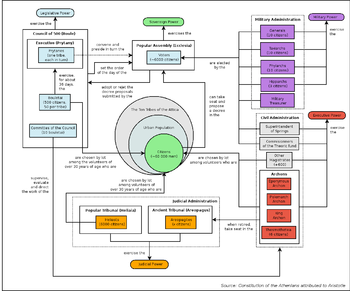
Athenian democracy
Athenian democracy developed in the Greek city-state of Athens, comprising the central city-state of Athens and the surrounding territory of Attica, around 508 BC. Athens is one of the first known democracies. Other Greek cities set up democracies, and even though most followed an Athenian model,...
of ancient Athens during its "Golden Age
Age of Pericles
Fifth-century Athens refers to the Greek city-state of Athens in the period of roughly 480 BC-404 BC. This was a period of Athenian political hegemony, economic growth and cultural flourishing formerly known as the Golden Age of Athens or The Age of Pericles. The period began in 480 BC when an...
" (480
480 BC
Year 480 BC was a year of the pre-Julian Roman calendar. At the time, it was known as the Year of the Consulship of Vibulanus and Cincinnatus...
–404
404 BC
Year 404 BC was a year of the pre-Julian Roman calendar. At the time, it was known as the Year of the Tribunate of Volusus, Cossus, Fidenas, Ambustus, Maluginensis and Rutilus...
BCE). It was the popular assembly, opened to all male citizens over the age of 30 with 2 years of military service by Solon
Solon
Solon was an Athenian statesman, lawmaker, and poet. He is remembered particularly for his efforts to legislate against political, economic and moral decline in archaic Athens...
in 594 BC meaning that all classes of citizens in Athens were able to participate, even the thetes. The ekklesia opened the doors for all citizens, regardless of class, to nominate and vote for magistrates—indirectly voting for the Areopagus
Areopagus
The Areopagus or Areios Pagos is the "Rock of Ares", north-west of the Acropolis, which in classical times functioned as the high Court of Appeal for criminal and civil cases in Athens. Ares was supposed to have been tried here by the gods for the murder of Poseidon's son Alirrothios .The origin...
—have the final decision on legislation, war and peace, and have the right to call magistrates to account after their year of office. In the 5th century BC their numbers amounted to about 43,000 people. However, only those wealthy enough to spend much of their time away from home would have been able to participate until Pericles
Pericles
Pericles was a prominent and influential statesman, orator, and general of Athens during the city's Golden Age—specifically, the time between the Persian and Peloponnesian wars...
' reforms in early 451-2 BCE allowing payment for jurors. The assembly was responsible for declaring war, military strategy, and electing strategoi
Strategos
Strategos, plural strategoi, is used in Greek to mean "general". In the Hellenistic and Byzantine Empires the term was also used to describe a military governor...
and other officials. It originally met once every month, but later it met three or four times per month. The agenda for the ekklesia was established by the Boule
Boule (Ancient Greece)
In cities of ancient Greece, the boule meaning to will ) was a council of citizens appointed to run daily affairs of the city...
, the popular council. Votes were taken by a show of hands.
A quorum of 6,000 was required sometimes to do business. The ekklesia elected by lot annually the Boule or council. Some of their power under Solon
Solon
Solon was an Athenian statesman, lawmaker, and poet. He is remembered particularly for his efforts to legislate against political, economic and moral decline in archaic Athens...
was delegated to the Court by Pericles
Pericles
Pericles was a prominent and influential statesman, orator, and general of Athens during the city's Golden Age—specifically, the time between the Persian and Peloponnesian wars...
in his reforms.
A gang of Scythian slaves, carrying ropes dipped in red ochre (miltos, hence Miltiades
Miltiades
Miltiades or Miltiadis is a Greek name. Several historic persons have been called Miltiades .* Miltiades the Elder wealthy Athenian, and step-uncle of Miltiades the Younger...
, i.e. the Red-Haired) would go through the city on the days the Ekklesia was to meet, and use their ropes to lash latecomers to the meeting. With garments thus stained, shamed citizens could legally carry out no business until they visited the meeting grounds of the Ekklesia on the hill called the Pnyx
Pnyx
The Pnyx is a hill in central Athens, the capital of Greece. It is located less than west of the Acropolis and 1.6 km south-west of the centre of modern Athens, Syntagma Square.-The site:...
.
See also
- ApellaApellaThe Apella was the popular deliberative assembly in the Ancient Greek city-state of Sparta, corresponding to the ecclesia in most other Greek states...
- Athenian DemocracyAthenian democracyAthenian democracy developed in the Greek city-state of Athens, comprising the central city-state of Athens and the surrounding territory of Attica, around 508 BC. Athens is one of the first known democracies. Other Greek cities set up democracies, and even though most followed an Athenian model,...
- HeliaiaHeliaiaHeliaia or Heliaea was the supreme court of ancient Athens. Τhe view generally held among scholars is that the court drew its name from the ancient Greek verb , which means , namely congregate. Another version is that the court took its name from the fact that the hearings were taking place...
- AreopagusAreopagusThe Areopagus or Areios Pagos is the "Rock of Ares", north-west of the Acropolis, which in classical times functioned as the high Court of Appeal for criminal and civil cases in Athens. Ares was supposed to have been tried here by the gods for the murder of Poseidon's son Alirrothios .The origin...
- Constitution of Athenians