

Morean War

Encyclopedia
The Morean War is the better known name for the Sixth Ottoman–Venetian War. The war was fought between 1684–1699, as part of the wider conflict known as the "Great Turkish War
", between the Republic of Venice
and the Ottoman Empire
. Military operations ranged from Dalmatia
to the Aegean Sea
, but the war's major campaign was the Venetian conquest of the Morea
(Peloponnese
) peninsula in southern Greece. On the Venetian side, the war was fought to avenge the loss of Crete
in the Cretan War (1645–1669)
, while the Ottomans were entangled in their northern frontier against the Habsburgs
and were unable to concentrate their forces against the Republic. As such, the Morean War holds the distinction of being the only Ottoman–Venetian conflict from which Venice emerged victorious, gaining significant territory. Venice's expansionist revival would be short-lived however, as their gains were reversed by the Ottomans in 1715.
after the Fourth Crusade
. However, with the rise of the Ottomans
, during the 16th and early 17th centuries, they lost most of these, such as Cyprus
and Euboea
(Negropont
) to the Turks. Between 1645 and 1669, the Venetians and the Ottomans fought a long and costly war over the last major Venetian possession in the Aegean, Crete
. During this war, the Venetian commander, Francesco Morosini
, came into contact with the rebellious Maniots
, for a joint campaign in the Morea. In 1659, Morosini landed in the Morea, and together with the Maniots, he took Kalamata
. However, he was soon after forced to return to Crete, and the Peloponnesian venture failed.
In 1683, a new war
broke out between Austria and the Ottomans, with a large Ottoman army advancing towards Vienna
. In response to this, a Holy League
was formed. After the Ottoman army was defeated in the Battle of Vienna
, the Venetians decided to use the opportunity of the weakening of Ottoman power and its distraction in the Danubian front so as to reconquer its lost territories in the Aegean and Dalmatia. On 25 April 1684, the Most Serene Republic declared war on the Ottomans.
Aware that she would have to rely on her own strength for success, Venice prepared for the war by securing financial and military aid in men and ships from the Knights of Malta
, the Duchy of Savoy
, the Papal States
and the Knights of St. Stephen. In addition, the Venetians enrolled large numbers of mercenaries from Italy and the German states, especially Saxony
and Brunswick, and raised levies from their own territories in Italy and Dalmatia. Morosini, having had a distinguished record and great experience in of operations in Greece, was chosen to command the fleet.
. The first target was the island of Lefkada
(Santa Maura), which fell, after a brief siege of 16 days, on 6 August 1684. The Venetians, aided by Greek irregulars, then crossed into the mainland and started raiding the opposite shore of Acarnania
. Most of the area was soon under Venetian control, and the fall of the forts of Preveza
and Vonitsa
in late September removed the last Ottoman bastions. These early successes were important for the Venetians not only for reasons of morale, but because they secured their communications with Venice, denied to the Ottomans the possibility of threatening the Ionian Islands or of ferrying troops via western Greece to the Peloponnese, and because these successes encouraged the Greeks to cooperate with them against the Ottomans.
and laid siege to it. The castle surrendered after 49 days, on 11 August, and the garrison was massacred. After this success, Morosini embarked his troops towards the town of Kalamata
, in order to encourage the Maniots to revolt. The Venetian army, reinforced by 3,300 Saxons and under the command of General Degenfeld, defeated a Turkish force of ca. 10,000 outside Kalamata on 14 September, and by the end of the month, all of Mani and much of Messenia
were under Venetian control.
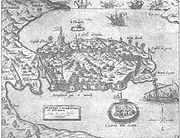 In October 1685, the Venetian army retreated to the Ionian Islands for winter quarters, where a plague broke out, something which would occur regularly in the next years, and take a great toll on the Venetian army, especially among the German contingents. In April next year, the Venetians helped repulse an Ottoman attack which threatened to overrun Mani, and were reinforced from the Papal States and Tuscany. The Swedish marshal Otto Wilhelm Königsmarck
was appointed head of the land forces, while Morosini retained command of the fleet. On 3 June Königsmarck took Pylos
, and proceeded to lay siege the fortress of Navarino
. A relief force under Ismail Pasha was defeated on June 16, and the next day the fort surrendered. The garrison and the Muslim population were transported to Tripoli
. Methoni
(Modon) followed on 7 July, after an effective bombardment destroyed the fort's walls, and its inhabitants were also transferred to Tripoli. The Venetians then advanced towards Argos
and Nafplion
, which was then the most important town in the Peloponnese. The Venetian army, ca. 12,000 strong, landed around Nafplion between 30 July and August 4. Königsmarck immediately led an assault upon the hill of Palamidi
, then unfortified, which overlooked the town. Despite the Venetians' success in capturing Palamidi, the arrival of a 7,000 Ottoman army under Ismail Pasha at Argos
rendered their position difficult. The Venetians' initial assault against the relief army succeeded in taking Argos and forcing the pasha to retreat to Corinth, but for two weeks, from 16 August, Königsmarck's forces were forced to continuously repulse attacks from Ismail Pasha's forces, fight off the sorties of the besieged Ottoman garrison and cope with a new outbreak of plague. On 29 August 1686 Ismail Pasha attacked the Venetian camp, but was heavily defeated. With the defeat of the relief army, Nafplion was forced to surrender the on September 3. News of this major victory were greeted in Venice with joy and celebration. Nafplion became the Venetians' major base, while Ismail Pasha withdrew to Achaea
after strengthening the garrisons at Corinth
, which controlled the passage to Central Greece
.
Despite losses to the plague during the autumn and winter of 1686, Morosini's forces were replenished by the arrival of new German mercenary corps form Hannover in spring 1687. Thus strengthened, he was able to move against the last major Ottoman bastion in the Peloponnese, the town of Patras
and the fort
of Rion, which along with its twin at Antirrion controlled the entrance to the Corinthian Gulf (the "Little Dardanelles
"). On 22 July 1687, Morosini, with a force of 14,000, landed outside Patras
, where the new Ottoman commander, Mehmed Pasha, had established himself. Mehmed, with an army of roughly equal size, attacked the Venetian force immediately after it landed, but was defeated and forced to retreat. At this point panic spread among the Ottoman forces, and the Venetians were able, within a few days, to capture the citadel of Patras, and the forts of Rion, Antirrion, and Nafpaktos (Lepanto) without any opposition, as their garrisons abandoned them. This new success caused great joy in Venice, and honours were heaped on Morosini and his officers. Morosini received the victory title
"Peloponnesiacus", and a bronze bust of his was displayed in the Great Hall, something never before done for a living citizen. The Venetians followed up this success with the reduction of the last Ottoman bastions in the Peloponnese, including Corinth, which was occupied on 7 August, and Mystra
, which surrendered later in the month. The Peloponnese was under complete Venetian control, and only the fort of Monemvasia
(Malvasia) in the southeast continued to resist, holding out until 1690.
 After these victories had cleared the Peloponnese of Turkish forces, Morosini decided to campaign in Central Greece, especially against the Ottoman strongholds of Thebes
and Chalkis (Negropont). Thus, on 21 September 1687, Königsmarck's army, 10,750 men strong, landed at Eleusis, while the Venetian fleet entered Piraeus
. The Turks quickly evacuated the town of Athens
, but the garrison and much of the population withdrew to the ancient Acropolis
. The Venetian army began now a siege of the Acropolis, which would last six days (September 23–29) and would cause much destruction to the ancient monuments. The Ottomans first demolished the temple of Athena Nike
to erect a cannon battery, but the most important damage caused was the destruction of the Parthenon
. The Turks used the temple for ammunition storage, and when, on the evening of on 26 September 1687, a mortar shell hit the building, the resulting explosion led to the complete destruction of the temple's roof and most of the walls. Despite the enormous destruction caused by the explosion and the loss of ca. 200 men, the Turks continued to defend the fort until a relief attempt from the Ottoman army of Thebes was repulsed on September 28. The garrison then capitulated, on condition of being transported to Smyrna
.
Despite the fall of Athens, Morosini's position was not secure. The Ottomans were amassing an army at Thebes, and their cavalry effectively controlled Attica
, limiting the Venetians to the environs of Athens. In December, the 1,400-strong Hannoverian contingent departed, and a new outbreak of the plague during the winter further weakened his forces. Thus the Venetians were forced to retreat to the Peloponnese in April. The Venetians took with them several looted architectural monuments such as the Piraeus Lion
, which today stands at the entrance of the Venetian Arsenal
. Morosini's withdrawal prompted several thousand Greeks, who feared Turkish retributions, to flee to the Peloponnese and to neighbouring islands.
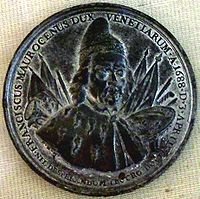 In July 1688, however, Morosini, by now having been elected as the new Doge of Venice
, landed at Chalkis (Negroponte) and laid siege to it. The Venetians had assembled a substantial force, 13,000 troops and further 10,000 men in the fleet, against the Ottoman garrison of 6,000 men, which offered determined resistance. The Venetian fleet was unable to fully blockade the city, which allowed Ismail Pasha's forces, across the Euripus Strait
, to ferry supplies to the besieged castle. The Venetians and their allies suffered great losses, especially from another outbreak of the plague, including General Königsmarck, who succumbed to the plague on September 15. After a last assault on October 12 proved a costly failure, Morosini had to accept defeat. On October 20, the Venetian army, having lost in total ca. 9,000 men, left Euboea and headed for Argos. The failure at Negropont had severe repercussions on the Venetian camp. The remaining German mercenaries left in early November. Morosini attempted an unsuccessful attack on Monemvasia in 1689, but his failing health forced him to return to Venice soon after. This marked the end of Venetian ascendancy, and the beginning of a number of successful, although in the end not decisive, Ottoman counteroffensives.
was deposed in 1687 in favour of his brother, Suleiman II
. Although initially desiring a peace settlement, the outbreak of the War of the League of Augsburg in 1688, and the following diversion of Austrian resources towards France, encouraged the Ottoman leadership to continue the war. Under the capable leadership of the new Grand Vizier
, Köprülü Fazıl Mustafa Pasha
, the Ottomans went over to the counteroffensive. However, as the main effort was directed against Austria, the Ottomans were never able to spare enough men to reverse the Venetian gains completely.
, whom they held in prison at Constantinople. He was released, invested as "Bey
of Mani", allowed to recruit a force of a few hundreds, and joined the Ottoman army at Thebes. Gerakaris was to play a major role in the latter stages of the war, since his daring and destructive raids into Venetian-held territory were a major threat and a continuous drain on the Republic's resources.
By that time, a large swathe of no man's land
extended across Central Greece
, between the Ottoman strongholds in the east and the Venetian-held territories in the west. Much of the mountainous interior of Phocis
and Evrytania
was in the hands of warbands composed of Greeks, Albanians and Dalmatian deserters of the Venetian army. Gerakaris initially attempted to persuade these groups to enter Ottoman service, but without success. In 1689, he conducted his first raid against Missolonghi, with a mixed force of 2,000 Turks, Albanians and Greeks. In the next year, the Ottoman forces swept through central Greece, and although they were repulsed at Nafpaktos (Lepanto), they re-established Ottoman control over the interior. However, at the same time, the Venetians took Monemvasia, thus removing the last Ottoman bastion in the Morea.
In 1692, Gerakaris spearheaded an Ottoman invasion of the Peloponnese. He took Corinth, and unsuccessfully besieged the Acrocorinth
and Argos
, before being forced to withdraw by the arrival of Venetian reinforcements. However, after renewed invasions into the Peloponnese in 1694 and 1695, Gerakaris went over to the Venetian camp. However, his brutal and savage treatment of the civilian population and his intriguing for the position of Bey of Mani could not be tolerated for long by Venice, and after the brutal sack of Arta
in August 1696, Gerakaris was arrested and imprisoned at Brescia
.
and Montenegro
, the Venetian fleet launched an attack against the Adriatic
Ottoman port and fortress of Valona
. The siege, lasting from 11–18 September, was successful, and led to the spreading of the revolt in the area. In 1691 however, the resurgent Ottomans were able to launch a massive counteroffensive in the area, and by March 14, the area had been subdued.
In 1692, a Venetian fleet under Domenico Mocenigo attacked Crete and laid siege to its capital Candia, while at the same time the Christians of the island rose up against the Ottomans. Despite this, the attempt to retake Crete failed. The Ottomans even managed to take the Venetian fortress on the island of Gramvousa
by treason.
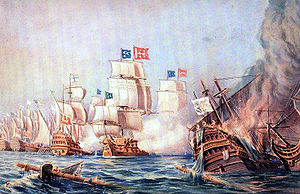 Hoping to reinvigorate the Venetian cause, Morosini himself returned to the Morea in 1693. His advanced age denied him the chance to prove his abilities again, however, and on 16 January 1694, he died at Nafplion. His successor Zeno, against the advice of his officers, led an expedition against the rich island of Chios
, off the coast of Asia Minor
. The island was taken easily, but the Turkish response was swift and massive. A double naval battle near the Oinousses Islands in February 1695 resulted in a Venetian defeat, and forced a humiliating Venetian withdrawal from Chios.
The Ottomans were encouraged to invade the Morea again, but were defeated by General Steinau and driven back to their base at Thebes. At the same time, Steinau succeeded in bringing Gerakaris to come over to the Venetian side (see above).
, at the , at Andros in 1696
, at Lemnos in July 1697
, and at Samothrace in 1698, but they were generally indecisive and failed to shift the balance of forces.
, signed in January 1699, confirmed the Venetian possession of Kephalonia, and the Morea with the island of Aigina, which became organized as the "Kingdom of the Morea" , divided into four provinces: Romania, with seat at Nafplion (Napoli di Romania), Laconia, with seat at Monemvasia (Malvasia), Messenia, with seat at Navarino, and Achaea, with seat at Patras (Patrasso). The war however had created a demographic and economic crisis in the Peloponnese. According to the first census conducted by the Venetians, there were 86,468 people in the peninsula compared to a pre-war population of around 200,000. Although the Venetians managed to restore some prosperity – the population allegedly rose to some 250,000 by 1708, probably driven by immigration – they failed to win the trust of their Greek Orthodox subjects, who were used to a relative autonomy under the Turks and resented the Venetian bureaucracy. The Venetians also launched a great fortification project throughout the Morea, whose results can still be seen today. Nevertheless, Venice itself was too weakened to effectively assert its authority, and in 1715 a swift Ottoman campaign reclaimed the Morea.
Great Turkish War
The Great Turkish War refers to a series of conflicts between the Ottoman Empire and contemporary European powers, then joined into a Holy League, during the second half of the 17th century.-1667–1683:...
", between the Republic of Venice
Republic of Venice
The Republic of Venice or Venetian Republic was a state originating from the city of Venice in Northeastern Italy. It existed for over a millennium, from the late 7th century until 1797. It was formally known as the Most Serene Republic of Venice and is often referred to as La Serenissima, in...
and the Ottoman Empire
Ottoman Empire
The Ottoman EmpireIt was usually referred to as the "Ottoman Empire", the "Turkish Empire", the "Ottoman Caliphate" or more commonly "Turkey" by its contemporaries...
. Military operations ranged from Dalmatia
Dalmatia
Dalmatia is a historical region on the eastern coast of the Adriatic Sea. It stretches from the island of Rab in the northwest to the Bay of Kotor in the southeast. The hinterland, the Dalmatian Zagora, ranges from fifty kilometers in width in the north to just a few kilometers in the south....
to the Aegean Sea
Aegean Sea
The Aegean Sea[p] is an elongated embayment of the Mediterranean Sea located between the southern Balkan and Anatolian peninsulas, i.e., between the mainlands of Greece and Turkey. In the north, it is connected to the Marmara Sea and Black Sea by the Dardanelles and Bosporus...
, but the war's major campaign was the Venetian conquest of the Morea
Morea
The Morea was the name of the Peloponnese peninsula in southern Greece during the Middle Ages and the early modern period. It also referred to a Byzantine province in the region, known as the Despotate of Morea.-Origins of the name:...
(Peloponnese
Peloponnese
The Peloponnese, Peloponnesos or Peloponnesus , is a large peninsula , located in a region of southern Greece, forming the part of the country south of the Gulf of Corinth...
) peninsula in southern Greece. On the Venetian side, the war was fought to avenge the loss of Crete
Crete
Crete is the largest and most populous of the Greek islands, the fifth largest island in the Mediterranean Sea, and one of the thirteen administrative regions of Greece. It forms a significant part of the economy and cultural heritage of Greece while retaining its own local cultural traits...
in the Cretan War (1645–1669)
Cretan War (1645–1669)
The Cretan War or War of Candia , as the Fifth Ottoman–Venetian War is better known, was a conflict between the Republic of Venice and her allies against the Ottoman Empire and the Barbary States, fought over the island of Crete, Venice's largest and richest overseas possession...
, while the Ottomans were entangled in their northern frontier against the Habsburgs
Habsburg Monarchy
The Habsburg Monarchy covered the territories ruled by the junior Austrian branch of the House of Habsburg , and then by the successor House of Habsburg-Lorraine , between 1526 and 1867/1918. The Imperial capital was Vienna, except from 1583 to 1611, when it was moved to Prague...
and were unable to concentrate their forces against the Republic. As such, the Morean War holds the distinction of being the only Ottoman–Venetian conflict from which Venice emerged victorious, gaining significant territory. Venice's expansionist revival would be short-lived however, as their gains were reversed by the Ottomans in 1715.
Background
Venice had held several islands in the Aegean and the Ionian seas, together with strategically positioned forts along the coast of the Greek mainland since the carving up of the Byzantine EmpireByzantine Empire
The Byzantine Empire was the Eastern Roman Empire during the periods of Late Antiquity and the Middle Ages, centred on the capital of Constantinople. Known simply as the Roman Empire or Romania to its inhabitants and neighbours, the Empire was the direct continuation of the Ancient Roman State...
after the Fourth Crusade
Fourth Crusade
The Fourth Crusade was originally intended to conquer Muslim-controlled Jerusalem by means of an invasion through Egypt. Instead, in April 1204, the Crusaders of Western Europe invaded and conquered the Christian city of Constantinople, capital of the Eastern Roman Empire...
. However, with the rise of the Ottomans
Ottoman Empire
The Ottoman EmpireIt was usually referred to as the "Ottoman Empire", the "Turkish Empire", the "Ottoman Caliphate" or more commonly "Turkey" by its contemporaries...
, during the 16th and early 17th centuries, they lost most of these, such as Cyprus
Cyprus
Cyprus , officially the Republic of Cyprus , is a Eurasian island country, member of the European Union, in the Eastern Mediterranean, east of Greece, south of Turkey, west of Syria and north of Egypt. It is the third largest island in the Mediterranean Sea.The earliest known human activity on the...
and Euboea
Euboea
Euboea is the second largest Greek island in area and population, after Crete. The narrow Euripus Strait separates it from Boeotia in mainland Greece. In general outline it is a long and narrow, seahorse-shaped island; it is about long, and varies in breadth from to...
(Negropont
Lordship of Negroponte
The Lordship of Negroponte was a crusader state established on the island of Euboea after the partition of the Byzantine Empire following the Fourth Crusade. Partitioned into three baronies run by a few interrelated Lombard families, the island soon fell under the influence of the Republic of...
) to the Turks. Between 1645 and 1669, the Venetians and the Ottomans fought a long and costly war over the last major Venetian possession in the Aegean, Crete
Crete
Crete is the largest and most populous of the Greek islands, the fifth largest island in the Mediterranean Sea, and one of the thirteen administrative regions of Greece. It forms a significant part of the economy and cultural heritage of Greece while retaining its own local cultural traits...
. During this war, the Venetian commander, Francesco Morosini
Francesco Morosini
Francesco Morosini was the Doge of Venice from 1688 to 1694, at the height of the Great Turkish War...
, came into contact with the rebellious Maniots
Maniots
The Maniots or Maniates are the Greek inhabitants of the Mani Peninsula located in the southern Peloponnese in the Greek prefecture of Laconia and prefecture of Messinia. They were also formerly known as Mainotes and the peninsula as Maina. The Maniots are the direct descendants of the Spartans...
, for a joint campaign in the Morea. In 1659, Morosini landed in the Morea, and together with the Maniots, he took Kalamata
Kalamata
Kalamata is the second-largest city of the Peloponnese in southern Greece. The capital and chief port of the Messenia prefecture, it lies along the Nedon River at the head of the Messenian Gulf...
. However, he was soon after forced to return to Crete, and the Peloponnesian venture failed.
In 1683, a new war
Great Turkish War
The Great Turkish War refers to a series of conflicts between the Ottoman Empire and contemporary European powers, then joined into a Holy League, during the second half of the 17th century.-1667–1683:...
broke out between Austria and the Ottomans, with a large Ottoman army advancing towards Vienna
Vienna
Vienna is the capital and largest city of the Republic of Austria and one of the nine states of Austria. Vienna is Austria's primary city, with a population of about 1.723 million , and is by far the largest city in Austria, as well as its cultural, economic, and political centre...
. In response to this, a Holy League
Holy League (1684)
Holy League of 1684 was initiated in by Pope Innocent XI, and composed of the Holy Roman Empire, the Polish-Lithuanian Commonwealth and the Venetian Republic. Tsardom of Russia joined the League in 1686. This alliance opposed the Ottoman Empire in the Great Turkish War and lasted until the Treaty...
was formed. After the Ottoman army was defeated in the Battle of Vienna
Battle of Vienna
The Battle of Vienna took place on 11 and 12 September 1683 after Vienna had been besieged by the Ottoman Empire for two months...
, the Venetians decided to use the opportunity of the weakening of Ottoman power and its distraction in the Danubian front so as to reconquer its lost territories in the Aegean and Dalmatia. On 25 April 1684, the Most Serene Republic declared war on the Ottomans.
Aware that she would have to rely on her own strength for success, Venice prepared for the war by securing financial and military aid in men and ships from the Knights of Malta
Knights Hospitaller
The Sovereign Military Hospitaller Order of Saint John of Jerusalem of Rhodes and of Malta , also known as the Sovereign Military Order of Malta , Order of Malta or Knights of Malta, is a Roman Catholic lay religious order, traditionally of military, chivalrous, noble nature. It is the world's...
, the Duchy of Savoy
Duchy of Savoy
From 1416 to 1847, the House of Savoy ruled the eponymous Duchy of Savoy . The Duchy was a state in the northern part of the Italian Peninsula, with some territories that are now in France. It was a continuation of the County of Savoy...
, the Papal States
Papal States
The Papal State, State of the Church, or Pontifical States were among the major historical states of Italy from roughly the 6th century until the Italian peninsula was unified in 1861 by the Kingdom of Piedmont-Sardinia .The Papal States comprised territories under...
and the Knights of St. Stephen. In addition, the Venetians enrolled large numbers of mercenaries from Italy and the German states, especially Saxony
Saxony
The Free State of Saxony is a landlocked state of Germany, contingent with Brandenburg, Saxony Anhalt, Thuringia, Bavaria, the Czech Republic and Poland. It is the tenth-largest German state in area, with of Germany's sixteen states....
and Brunswick, and raised levies from their own territories in Italy and Dalmatia. Morosini, having had a distinguished record and great experience in of operations in Greece, was chosen to command the fleet.
Operations in the Ionian Sea
In mid-June, the Venetian fleet moved from the Adriatic towards the Venetian-held Ionian IslandsIonian Islands
The Ionian Islands are a group of islands in Greece. They are traditionally called the Heptanese, i.e...
. The first target was the island of Lefkada
Lefkada
Lefkada, or Leucas or Leucadia , is a Greek island in the Ionian Sea on the west coast of Greece, connected to the mainland by a long causeway and floating bridge. The principal town of the island and seat of the municipality is Lefkada . It is situated on the northern part of the island,...
(Santa Maura), which fell, after a brief siege of 16 days, on 6 August 1684. The Venetians, aided by Greek irregulars, then crossed into the mainland and started raiding the opposite shore of Acarnania
Acarnania
Acarnania is a region of west-central Greece that lies along the Ionian Sea, west of Aetolia, with the Achelous River for a boundary, and north of the gulf of Calydon, which is the entrance to the Gulf of Corinth. Today it forms the western part of the prefecture of Aetolia-Acarnania. The capital...
. Most of the area was soon under Venetian control, and the fall of the forts of Preveza
Preveza
Preveza is a town in the region of Epirus, northwestern Greece, located at the mouth of the Ambracian Gulf. It is the capital of the regional unit of Preveza, which is part of the region of Epirus. An immersed tunnel, completed in 2002 which runs between Preveza and Actium, connects the town...
and Vonitsa
Vonitsa
Vonitsa is a town in the northwestern part of Aetolia-Acarnania in Greece, seat of the municipality of Aktio-Vonitsa. Population 4,081 . The town is situated in the bay overlooking the Ambracian Gulf and has a small forested peninsula, the peninsula and its narrow strait is in the northwest of...
in late September removed the last Ottoman bastions. These early successes were important for the Venetians not only for reasons of morale, but because they secured their communications with Venice, denied to the Ottomans the possibility of threatening the Ionian Islands or of ferrying troops via western Greece to the Peloponnese, and because these successes encouraged the Greeks to cooperate with them against the Ottomans.
The Conquest of the Morea
Having secured his rear during the previous year, Morosini set his sights upon the Peloponnese, where the Greeks, especially the Maniots, had begun showing signs of revolt and communicated with Morosini, promising to rise up in his aid. Ismail Pasha, the new military commander of the Morea, learned of this and invaded the Mani peninsula with 10,000 men, reinforcing the three forts that the Ottomans already garrisoned, and compelled the Maniots to give up hostages to secure their loyalty. As a result, the Maniots remained uncommitted when, on 25 June 1685, the Venetian army, 8,100 men strong, landed outside the former Venetian fort of KoroniKoroni
Koroni or Coroni is a town and a former municipality in Messenia, Peloponnese, Greece. Since the 2011 local government reform it is part of the municipality Pylos-Nestoras, of which it is a municipal unit. Known as Corone by the Venetians and Ottomans, the town of Koroni Koroni or Coroni is a...
and laid siege to it. The castle surrendered after 49 days, on 11 August, and the garrison was massacred. After this success, Morosini embarked his troops towards the town of Kalamata
Kalamata
Kalamata is the second-largest city of the Peloponnese in southern Greece. The capital and chief port of the Messenia prefecture, it lies along the Nedon River at the head of the Messenian Gulf...
, in order to encourage the Maniots to revolt. The Venetian army, reinforced by 3,300 Saxons and under the command of General Degenfeld, defeated a Turkish force of ca. 10,000 outside Kalamata on 14 September, and by the end of the month, all of Mani and much of Messenia
Messenia
Messenia is a regional unit in the southwestern part of the Peloponnese region, one of 13 regions into which Greece has been divided by the Kallikratis plan, implemented 1 January 2011...
were under Venetian control.
Otto Wilhelm Königsmarck
Count Otto Wilhelm Königsmarck was a Swedish military officer from Minden. He attained the rank of field marshal in 1676, commanded the Battle of Stralsund , and became Governor General for Swedish Pomerania in 1679. He was the son of Hans Christoff Königsmarck and the brother of Conrad Christoff...
was appointed head of the land forces, while Morosini retained command of the fleet. On 3 June Königsmarck took Pylos
Pylos
Pylos , historically known under its Italian name Navarino, is a town and a former municipality in Messenia, Peloponnese, Greece. Since the 2011 local government reform it is part of the municipality Pylos-Nestoras, of which it is the seat and a municipal unit. It was the capital of the former...
, and proceeded to lay siege the fortress of Navarino
Navarino
Navarino or Navarin may refer to:*Pylos , a Greek town, on the Ionian Sea**Battle of Navarino, 1827 naval battle off Navarino*Navarino, Wisconsin, a town, United States...
. A relief force under Ismail Pasha was defeated on June 16, and the next day the fort surrendered. The garrison and the Muslim population were transported to Tripoli
Tripoli
Tripoli is the capital and largest city in Libya. It is also known as Western Tripoli , to distinguish it from Tripoli, Lebanon. It is affectionately called The Mermaid of the Mediterranean , describing its turquoise waters and its whitewashed buildings. Tripoli is a Greek name that means "Three...
. Methoni
Methoni, Messenia
Methoni is a village and a former municipality in Messenia, Peloponnese, Greece. Since the 2011 local government reform it is part of the municipality Pylos-Nestoras, of which it is a municipal unit. Its name may be derived from Mothona, a mythical rock. It is located 11 km south of Pylos and...
(Modon) followed on 7 July, after an effective bombardment destroyed the fort's walls, and its inhabitants were also transferred to Tripoli. The Venetians then advanced towards Argos
Argos
Argos is a city and a former municipality in Argolis, Peloponnese, Greece. Since the 2011 local government reform it is part of the municipality Argos-Mykines, of which it is a municipal unit. It is 11 kilometres from Nafplion, which was its historic harbour...
and Nafplion
Nafplion
Nafplio is a seaport town in the Peloponnese in Greece that has expanded up the hillsides near the north end of the Argolic Gulf. The town was the first capital of modern Greece, from the start of the Greek Revolution in 1821 until 1834. Nafplio is now the capital of the peripheral unit of...
, which was then the most important town in the Peloponnese. The Venetian army, ca. 12,000 strong, landed around Nafplion between 30 July and August 4. Königsmarck immediately led an assault upon the hill of Palamidi
Palamidi
Palamidi is a military fortress to the east of the Acronauplia in the town of Nafplion in the Peloponnese region of southern Greece. Nestled on the crest of a 216-metre high hill, the fortress was built by the Venetians during their second occupation of the area .The fortress was a very large and...
, then unfortified, which overlooked the town. Despite the Venetians' success in capturing Palamidi, the arrival of a 7,000 Ottoman army under Ismail Pasha at Argos
Argos
Argos is a city and a former municipality in Argolis, Peloponnese, Greece. Since the 2011 local government reform it is part of the municipality Argos-Mykines, of which it is a municipal unit. It is 11 kilometres from Nafplion, which was its historic harbour...
rendered their position difficult. The Venetians' initial assault against the relief army succeeded in taking Argos and forcing the pasha to retreat to Corinth, but for two weeks, from 16 August, Königsmarck's forces were forced to continuously repulse attacks from Ismail Pasha's forces, fight off the sorties of the besieged Ottoman garrison and cope with a new outbreak of plague. On 29 August 1686 Ismail Pasha attacked the Venetian camp, but was heavily defeated. With the defeat of the relief army, Nafplion was forced to surrender the on September 3. News of this major victory were greeted in Venice with joy and celebration. Nafplion became the Venetians' major base, while Ismail Pasha withdrew to Achaea
Achaea
Achaea is one of the regional units of Greece. It is part of the region of West Greece. It is situated in the northwestern part of the Peloponnese peninsula. The capital is Patras. The population exceeds 300,000 since 2001.-Geography:...
after strengthening the garrisons at Corinth
Corinth
Corinth is a city and former municipality in Corinthia, Peloponnese, Greece. Since the 2011 local government reform it is part of the municipality Corinth, of which it is the seat and a municipal unit...
, which controlled the passage to Central Greece
Central Greece
Continental Greece or Central Greece , colloquially known as Roúmeli , is a geographical region of Greece. Its territory is divided into the administrative regions of Central Greece, Attica, and part of West Greece...
.
Despite losses to the plague during the autumn and winter of 1686, Morosini's forces were replenished by the arrival of new German mercenary corps form Hannover in spring 1687. Thus strengthened, he was able to move against the last major Ottoman bastion in the Peloponnese, the town of Patras
Patras
Patras , ) is Greece's third largest urban area and the regional capital of West Greece, located in northern Peloponnese, 215 kilometers west of Athens...
and the fort
Rio Castle
The Rio Castle is located at the north tip of the Rio peninsula in the Achaia prefecture, Greece, at the entrance of the Corinthian Gulf. The Rio-Antirio Bridge is located next to it, and the local ferry docks lie on either side...
of Rion, which along with its twin at Antirrion controlled the entrance to the Corinthian Gulf (the "Little Dardanelles
Dardanelles
The Dardanelles , formerly known as the Hellespont, is a narrow strait in northwestern Turkey connecting the Aegean Sea to the Sea of Marmara. It is one of the Turkish Straits, along with its counterpart the Bosphorus. It is located at approximately...
"). On 22 July 1687, Morosini, with a force of 14,000, landed outside Patras
Patras
Patras , ) is Greece's third largest urban area and the regional capital of West Greece, located in northern Peloponnese, 215 kilometers west of Athens...
, where the new Ottoman commander, Mehmed Pasha, had established himself. Mehmed, with an army of roughly equal size, attacked the Venetian force immediately after it landed, but was defeated and forced to retreat. At this point panic spread among the Ottoman forces, and the Venetians were able, within a few days, to capture the citadel of Patras, and the forts of Rion, Antirrion, and Nafpaktos (Lepanto) without any opposition, as their garrisons abandoned them. This new success caused great joy in Venice, and honours were heaped on Morosini and his officers. Morosini received the victory title
Victory title
A victory title is an honorific title adopted by a successful military commander to commemorate his defeat of an enemy nation. This practice was first used by Ancient Rome and is still most commonly associated with the Romans, but it has also been adopted as a practice by many modern empires,...
"Peloponnesiacus", and a bronze bust of his was displayed in the Great Hall, something never before done for a living citizen. The Venetians followed up this success with the reduction of the last Ottoman bastions in the Peloponnese, including Corinth, which was occupied on 7 August, and Mystra
Mystra
Mystra is either* Mystras, an archaeological site and Byzantine city in the Peloponnese in modern Greece* or Mystra , a deity in the fictional Forgotten Realms universe....
, which surrendered later in the month. The Peloponnese was under complete Venetian control, and only the fort of Monemvasia
Monemvasia
Monemvasia is a town and a municipality in Laconia, Greece. The town is located on a small peninsula off the east coast of the Peloponnese. The peninsula is linked to the mainland by a short causeway 200m in length. Its area consists mostly of a large plateau some 100 metres above sea level, up to...
(Malvasia) in the southeast continued to resist, holding out until 1690.
The Campaign against Athens and Negropont
Thebes, Greece
Thebes is a city in Greece, situated to the north of the Cithaeron range, which divides Boeotia from Attica, and on the southern edge of the Boeotian plain. It played an important role in Greek myth, as the site of the stories of Cadmus, Oedipus, Dionysus and others...
and Chalkis (Negropont). Thus, on 21 September 1687, Königsmarck's army, 10,750 men strong, landed at Eleusis, while the Venetian fleet entered Piraeus
Piraeus
Piraeus is a city in the region of Attica, Greece. Piraeus is located within the Athens Urban Area, 12 km southwest from its city center , and lies along the east coast of the Saronic Gulf....
. The Turks quickly evacuated the town of Athens
Athens
Athens , is the capital and largest city of Greece. Athens dominates the Attica region and is one of the world's oldest cities, as its recorded history spans around 3,400 years. Classical Athens was a powerful city-state...
, but the garrison and much of the population withdrew to the ancient Acropolis
Acropolis
Acropolis means "high city" in Greek, literally city on the extremity and is usually translated into English as Citadel . For purposes of defense, early people naturally chose elevated ground to build a new settlement, frequently a hill with precipitous sides...
. The Venetian army began now a siege of the Acropolis, which would last six days (September 23–29) and would cause much destruction to the ancient monuments. The Ottomans first demolished the temple of Athena Nike
Athena Nike
Nike means "victory" in Greek, and Athena was worshiped in this form, as goddess of victory in war and wisdom, on the Acropolis in Athens, Greece. Her temple was the earliest fully ionic temple on the Acropolis, compensated by its prominent position on a steep bastion at the south west corner of...
to erect a cannon battery, but the most important damage caused was the destruction of the Parthenon
Parthenon
The Parthenon is a temple on the Athenian Acropolis, Greece, dedicated to the Greek goddess Athena, whom the people of Athens considered their virgin patron. Its construction began in 447 BC when the Athenian Empire was at the height of its power. It was completed in 438 BC, although...
. The Turks used the temple for ammunition storage, and when, on the evening of on 26 September 1687, a mortar shell hit the building, the resulting explosion led to the complete destruction of the temple's roof and most of the walls. Despite the enormous destruction caused by the explosion and the loss of ca. 200 men, the Turks continued to defend the fort until a relief attempt from the Ottoman army of Thebes was repulsed on September 28. The garrison then capitulated, on condition of being transported to Smyrna
Smyrna
Smyrna was an ancient city located at a central and strategic point on the Aegean coast of Anatolia. Thanks to its advantageous port conditions, its ease of defence and its good inland connections, Smyrna rose to prominence. The ancient city is located at two sites within modern İzmir, Turkey...
.
Despite the fall of Athens, Morosini's position was not secure. The Ottomans were amassing an army at Thebes, and their cavalry effectively controlled Attica
Attica
Attica is a historical region of Greece, containing Athens, the current capital of Greece. The historical region is centered on the Attic peninsula, which projects into the Aegean Sea...
, limiting the Venetians to the environs of Athens. In December, the 1,400-strong Hannoverian contingent departed, and a new outbreak of the plague during the winter further weakened his forces. Thus the Venetians were forced to retreat to the Peloponnese in April. The Venetians took with them several looted architectural monuments such as the Piraeus Lion
Piraeus Lion
The Piraeus Lion is one of four lion statues on display at the Venetian Arsenal, where it was displayed as a symbol of Venice's patron saint, Saint Mark. It was originally located in Piraeus, the ancient harbour of Athens...
, which today stands at the entrance of the Venetian Arsenal
Venetian Arsenal
The Venetian Arsenal was a complex of state-owned shipyards and armories clustered together in Venice in northern Italy. It was responsible for the bulk of Venice's naval power during the middle part of the second millennium AD...
. Morosini's withdrawal prompted several thousand Greeks, who feared Turkish retributions, to flee to the Peloponnese and to neighbouring islands.
Doge of Venice
The Doge of Venice , often mistranslated Duke was the chief magistrate and leader of the Most Serene Republic of Venice for over a thousand years. Doges of Venice were elected for life by the city-state's aristocracy. Commonly the person selected as Doge was the shrewdest elder in the city...
, landed at Chalkis (Negroponte) and laid siege to it. The Venetians had assembled a substantial force, 13,000 troops and further 10,000 men in the fleet, against the Ottoman garrison of 6,000 men, which offered determined resistance. The Venetian fleet was unable to fully blockade the city, which allowed Ismail Pasha's forces, across the Euripus Strait
Euripus Strait
The Euripus Strait , is a narrow channel of water separating the Greek island of Euboea in the Aegean Sea from Boeotia in mainland Greece. The strait's principal port is Chalcis on Euboea, located at the strait's narrowest point....
, to ferry supplies to the besieged castle. The Venetians and their allies suffered great losses, especially from another outbreak of the plague, including General Königsmarck, who succumbed to the plague on September 15. After a last assault on October 12 proved a costly failure, Morosini had to accept defeat. On October 20, the Venetian army, having lost in total ca. 9,000 men, left Euboea and headed for Argos. The failure at Negropont had severe repercussions on the Venetian camp. The remaining German mercenaries left in early November. Morosini attempted an unsuccessful attack on Monemvasia in 1689, but his failing health forced him to return to Venice soon after. This marked the end of Venetian ascendancy, and the beginning of a number of successful, although in the end not decisive, Ottoman counteroffensives.
Ottoman resurgence
The successive defeats in Hungary and the Peloponnese had severe repercussions in Constantinople. Sultan Mehmed IVMehmed IV
Mehmed IV Modern Turkish Mehmet was the Sultan of the Ottoman Empire from 1648 to 1687...
was deposed in 1687 in favour of his brother, Suleiman II
Suleiman II
Suleiman II was the Sultan of the Ottoman Empire from 1687 to 1691...
. Although initially desiring a peace settlement, the outbreak of the War of the League of Augsburg in 1688, and the following diversion of Austrian resources towards France, encouraged the Ottoman leadership to continue the war. Under the capable leadership of the new Grand Vizier
Grand Vizier
Grand Vizier, in Turkish Vezir-i Azam or Sadr-ı Azam , deriving from the Arabic word vizier , was the greatest minister of the Sultan, with absolute power of attorney and, in principle, dismissable only by the Sultan himself...
, Köprülü Fazıl Mustafa Pasha
Köprülü Fazil Mustafa Pasha
Fazıl Mustafa Köprülü, Ghazi Fazıl Mustafa Köprülü was an Ottoman grand vizier in the 17th century when the Ottoman Empire was engaged in a war against Holy Alliance countries in the Great Turkish War. He was a member of the Köprülü family of Albanian origin...
, the Ottomans went over to the counteroffensive. However, as the main effort was directed against Austria, the Ottomans were never able to spare enough men to reverse the Venetian gains completely.
The actions of Limberakis Gerakaris
In 1688, the Turks turned for help to the infamous Maniot pirate, Limberakis GerakarisLimberakis Gerakaris
Limberakis Gerakaris was a Maniot pirate who later became Bey of Mani.Limberakis Gerakaris was born in Mani in around 1644. He served as a rower in a Venetian galley before becoming a pirate. After several years, he was captured by the Ottomans and imprisoned...
, whom they held in prison at Constantinople. He was released, invested as "Bey
Bey
Bey is a title for chieftain, traditionally applied to the leaders of small tribal groups. Accoding to some sources, the word "Bey" is of Turkish language In historical accounts, many Turkish, other Turkic and Persian leaders are titled Bey, Beg, Bek, Bay, Baig or Beigh. They are all the same word...
of Mani", allowed to recruit a force of a few hundreds, and joined the Ottoman army at Thebes. Gerakaris was to play a major role in the latter stages of the war, since his daring and destructive raids into Venetian-held territory were a major threat and a continuous drain on the Republic's resources.
By that time, a large swathe of no man's land
No man's land
No man's land is a term for land that is unoccupied or is under dispute between parties that leave it unoccupied due to fear or uncertainty. The term was originally used to define a contested territory or a dumping ground for refuse between fiefdoms...
extended across Central Greece
Central Greece
Continental Greece or Central Greece , colloquially known as Roúmeli , is a geographical region of Greece. Its territory is divided into the administrative regions of Central Greece, Attica, and part of West Greece...
, between the Ottoman strongholds in the east and the Venetian-held territories in the west. Much of the mountainous interior of Phocis
Phocis
Phocis is one of the regional units of Greece. It is part of the administrative region of Central Greece. It stretches from the western mountainsides of Parnassus on the east to the mountain range of Vardousia on the west, upon the Gulf of Corinth...
and Evrytania
Evrytania
Evrytania is one of the regional units of Greece. It is part of the region of Central Greece. Its capital is Karpenisi .-Geography:...
was in the hands of warbands composed of Greeks, Albanians and Dalmatian deserters of the Venetian army. Gerakaris initially attempted to persuade these groups to enter Ottoman service, but without success. In 1689, he conducted his first raid against Missolonghi, with a mixed force of 2,000 Turks, Albanians and Greeks. In the next year, the Ottoman forces swept through central Greece, and although they were repulsed at Nafpaktos (Lepanto), they re-established Ottoman control over the interior. However, at the same time, the Venetians took Monemvasia, thus removing the last Ottoman bastion in the Morea.
In 1692, Gerakaris spearheaded an Ottoman invasion of the Peloponnese. He took Corinth, and unsuccessfully besieged the Acrocorinth
Acrocorinth
Acrocorinth , "Upper Corinth", the acropolis of ancient Corinth, is a monolithic rock overseeing the ancient city of Corinth, Greece. "It is the most impressive of the acropoleis of mainland Greece," in the estimation of George Forrest. Acrocorinth was continuously occupied from archaic times to...
and Argos
Argos
Argos is a city and a former municipality in Argolis, Peloponnese, Greece. Since the 2011 local government reform it is part of the municipality Argos-Mykines, of which it is a municipal unit. It is 11 kilometres from Nafplion, which was its historic harbour...
, before being forced to withdraw by the arrival of Venetian reinforcements. However, after renewed invasions into the Peloponnese in 1694 and 1695, Gerakaris went over to the Venetian camp. However, his brutal and savage treatment of the civilian population and his intriguing for the position of Bey of Mani could not be tolerated for long by Venice, and after the brutal sack of Arta
Arta, Greece
Arta is a city with a rich history in northwestern Greece, capital of the peripheral unit of Arta, which is part of Epirus region. The city was known in ancient times as Ambracia . Arta is famous for its old bridge located over the Arachthos River, situated west of downtown...
in August 1696, Gerakaris was arrested and imprisoned at Brescia
Brescia
Brescia is a city and comune in the region of Lombardy in northern Italy. It is situated at the foot of the Alps, between the Mella and the Naviglio, with a population of around 197,000. It is the second largest city in Lombardy, after the capital, Milan...
.
Operations in Epirus and Venetian attack on Crete
In an effort to aid the Greeks of Himara, who had rebelled against the Turks, and after some successes in northern AlbaniaAlbania
Albania , officially known as the Republic of Albania , is a country in Southeastern Europe, in the Balkans region. It is bordered by Montenegro to the northwest, Kosovo to the northeast, the Republic of Macedonia to the east and Greece to the south and southeast. It has a coast on the Adriatic Sea...
and Montenegro
Montenegro
Montenegro Montenegrin: Crna Gora Црна Гора , meaning "Black Mountain") is a country located in Southeastern Europe. It has a coast on the Adriatic Sea to the south-west and is bordered by Croatia to the west, Bosnia and Herzegovina to the northwest, Serbia to the northeast and Albania to the...
, the Venetian fleet launched an attack against the Adriatic
Adriatic Sea
The Adriatic Sea is a body of water separating the Italian Peninsula from the Balkan peninsula, and the system of the Apennine Mountains from that of the Dinaric Alps and adjacent ranges...
Ottoman port and fortress of Valona
Vlorë
Vlorë is one of the biggest towns and the second largest port city of Albania, after Durrës, with a population of about 94,000 . It is the city where the Albanian Declaration of Independence was proclaimed on November 28, 1912...
. The siege, lasting from 11–18 September, was successful, and led to the spreading of the revolt in the area. In 1691 however, the resurgent Ottomans were able to launch a massive counteroffensive in the area, and by March 14, the area had been subdued.
In 1692, a Venetian fleet under Domenico Mocenigo attacked Crete and laid siege to its capital Candia, while at the same time the Christians of the island rose up against the Ottomans. Despite this, the attempt to retake Crete failed. The Ottomans even managed to take the Venetian fortress on the island of Gramvousa
Gramvousa
Gramvousa, also Grambousa, Grampousa or Krampouza , further names include Akra, Cavo Buso, Cavo Bouza, Garabusa and Grabusa, are names used for two small uninhabited islands off the coast of north-western Crete in the prefecture of Chania...
by treason.
The last years of the war
Chios
Chios is the fifth largest of the Greek islands, situated in the Aegean Sea, seven kilometres off the Asia Minor coast. The island is separated from Turkey by the Chios Strait. The island is noted for its strong merchant shipping community, its unique mastic gum and its medieval villages...
, off the coast of Asia Minor
Asia Minor
Asia Minor is a geographical location at the westernmost protrusion of Asia, also called Anatolia, and corresponds to the western two thirds of the Asian part of Turkey...
. The island was taken easily, but the Turkish response was swift and massive. A double naval battle near the Oinousses Islands in February 1695 resulted in a Venetian defeat, and forced a humiliating Venetian withdrawal from Chios.
The Ottomans were encouraged to invade the Morea again, but were defeated by General Steinau and driven back to their base at Thebes. At the same time, Steinau succeeded in bringing Gerakaris to come over to the Venetian side (see above).
Naval operations in the Aegean
There were several naval clashes between the opposing fleets, such as at Lesbos in 1690Action of 8 September 1690
This inconclusive naval battle took place on 8 September 1690 at Mitylene between a Venetian fleet under Daniele Dolphin and a combined Muslim fleet.-Venice :* Redentore del Mundo 70 * San Domenico 60...
, at the , at Andros in 1696
Action of 22 August 1696
The Battle of Andros took place on 22 August 1696 southeast of the Greek island of Andros between the fleets of the Republic of Venice and the Papal States under Bartolomeo Contarini on the one side and the Ottoman Navy, under Mezzo Morto Hüseyin Pasha, and allied Barbary forces on the other...
, at Lemnos in July 1697
Action of 6 July 1697
This series of battles took place in 1697 when the Venetian fleet, under Bartolomeo Contarini, hunted down the Turkish fleet in the Aegean Sea. These battles are known as "Bozcaada Sea Battles" by Turkish historians....
, and at Samothrace in 1698, but they were generally indecisive and failed to shift the balance of forces.
Aftermath
The Treaty of KarlowitzTreaty of Karlowitz
The Treaty of Karlowitz was signed on 26 January 1699 in Sremski Karlovci , concluding the Austro-Ottoman War of 1683–1697 in which the Ottoman side had been defeated at the Battle of Zenta...
, signed in January 1699, confirmed the Venetian possession of Kephalonia, and the Morea with the island of Aigina, which became organized as the "Kingdom of the Morea" , divided into four provinces: Romania, with seat at Nafplion (Napoli di Romania), Laconia, with seat at Monemvasia (Malvasia), Messenia, with seat at Navarino, and Achaea, with seat at Patras (Patrasso). The war however had created a demographic and economic crisis in the Peloponnese. According to the first census conducted by the Venetians, there were 86,468 people in the peninsula compared to a pre-war population of around 200,000. Although the Venetians managed to restore some prosperity – the population allegedly rose to some 250,000 by 1708, probably driven by immigration – they failed to win the trust of their Greek Orthodox subjects, who were used to a relative autonomy under the Turks and resented the Venetian bureaucracy. The Venetians also launched a great fortification project throughout the Morea, whose results can still be seen today. Nevertheless, Venice itself was too weakened to effectively assert its authority, and in 1715 a swift Ottoman campaign reclaimed the Morea.
Sources
- History of the Hellenic Nation, Vol. XI, Ekdotiki Athinon 1975