

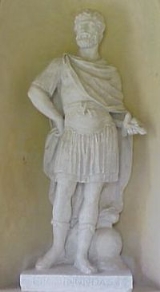
Epaminondas

Encyclopedia
Epaminondas or Epameinondas, was a Theban
general and statesman of the 4th century BC who transformed the Ancient Greek
city-state
of Thebes, leading it out of Sparta
n subjugation into a preeminent position in Greek politics. In the process he broke Spartan military power with his victory at Leuctra
and liberated the Messenia
n helots
, a group of Peloponnesian Greeks who had been enslaved under Spartan rule for some 230 years, having been defeated in the Messenian War ending in 600 BC. Epaminondas reshaped the political map of Greece, fragmented old alliances, created new ones, and supervised the construction of entire cities. He was militarily influential as well, inventing and implementing several major battlefield tactics.
The Roman
orator Cicero
called him "the first man of Greece", but Epaminondas has fallen into relative obscurity in modern times. The changes Epaminondas wrought on the Greek political order did not long outlive him, as the cycle of shifting hegemonies and alliances continued unabated. A mere twenty-seven years after his death, a recalcitrant Thebes was obliterated by Alexander the Great. Thus Epaminondas—who had been praised in his time as an idealist and liberator—is today largely remembered for a decade (371 BC to 362 BC) of campaigning that sapped the strength of the great land powers of Greece and paved the way for the Macedon
ian conquest.
, one of the last major Pythagorean philosophers. Epaminondas evidently excelled as a student, and was devoted to Lysis. Nepos also tells us that the young Epaminondas worked hard to increase his physical prowess, and specifically his agility, since "he thought that strength suited the purposes of wrestlers, but that agility conduced to excellence in war." He also trained in running and wrestling, but most of all, he undertook "martial exercises" (presumably training with weapons).
Epaminondas evidently began serving as a soldier after adolescence; Plutarch refers to an incident involving Epaminondas that occurred during a battle at Mantinea. Though not explicitly stated, this was probably the Spartan attack on Mantinea in 385 BC, as described by Xenophon; Plutarch tells us that Epaminondas was there as part of a Theban force aiding the Spartans, so this battle fits the description. Epaminondas was certainly not old enough have served at the First Battle of Mantinea
.
It was at this battle, regardless of exactly when and where this occurred, that a defining moment of Epaminondas's early life would occur. Epaminondas saved the life of his fellow Theban Pelopidas
;
in 404 BC, Sparta had embarked upon an aggressively unilateralist policy towards the rest of Greece and quickly alienated many of its former allies. Thebes, meanwhile, had greatly increased its own power during the war and sought to gain control of the other cities of Boeotia
(the region of ancient Greece northwest of Attica). This policy, along with other disputes, brought Thebes into conflict with Sparta. By 395 BC, Thebes, alongside Athens
, Corinth
, and Argos
, found itself arrayed against Sparta (a former ally) in the Corinthian War
. That war, which dragged on inconclusively for eight years, saw several bloody Theban defeats at Spartan hands. By the time of its conclusion, Thebes had been forced to check its expansionist ambitions and return to its old alliance with Sparta.
In 382 BC, however, the Spartan commander Phoebidas
committed an act that would ultimately turn Thebes against Sparta for good and pave the way for Epaminondas's rise to power. Passing through Boeotia on campaign, Phoebidas took advantage of civil strife within Thebes to secure entrance to the city for his troops. Once inside, he seized the Cadmeia (the Theban acropolis
), and forced the anti-Spartan party to flee the city. Epaminondas, although associated with that faction, was allowed to remain; since "his philosophy made him to be looked down upon as a recluse, and his poverty as impotent". The Spartans installed a puppet government in Thebes, and garrisoned the Cadmeia to ensure the behaviour of the Thebans.
, who led a group of young men, and a force of Athenian hoplite
s, they surrounded the Spartans on the Cadmeia. The following day, Epaminondas and Gorgidas brought Pelopidas and his men before the Theban assembly and exhorted the Thebans to fight for their freedom; the assembly responded by acclaiming Pelopidas and his men as liberators. The Cadmeia was surrounded, and the Spartans attacked; Pelopidas realised that they must be expelled before an army came from Sparta to relieve them. The Spartan garrison eventually surrendered on the condition that they were allowed to march away unharmed. The narrow margin of the conspirators' success is demonstrated by the fact that the Spartan garrison met a Spartan force on the way to rescue them as they marched back to Sparta. Plutarch portrays the Theban coup as an immensely significant event:
was then dispatched to attack the Thebans. However, the Thebans refused to meet the Spartan army in battle, instead building a trench and stockade outside Thebes, which they occupied, preventing the Spartans advancing on the city. The Spartans ravaged the countryside but eventually departed, leaving Thebes independent. This victory so heartened the Thebans that they undertook operations against other neighboring cities as well. In short order the Thebans were able to reconstitute their old Boeotian confederacy in a new, democratic form. The cities of Boeotia united as a federation with an executive body composed of seven generals, or Boeotarch
s, elected from seven districts throughout Boeotia.* Beck, Politics of Power, 97–98 This political fusion was so successful that henceforth the names Theban and Boeotian were used interchangeably in a nod to the newfound solidarity of the region.
Seeking to crush the Thebans, the Spartans would invade Boeotia three times over the next few years. At first the Thebans feared facing the Spartans head on, but the conflict gave them much practice and training, and they "had their spirits roused and their bodies thoroughly inured to hardships, and gained experience and courage from their constant struggles". Although Sparta remained the dominant land power in Greece, the Boeotians had demonstrated that they, too, were a martial threat and a politically cohesive power. At the same time, Pelopidas, an advocate of an aggressive policy against Sparta, had established himself as a major political leader in Thebes.
Epaminondas's role in the years to 371 BC is difficult to piece together. Certainly, he served with the Theban armies in the defence of Boeotia in the 370s, and, by 371 BC, he had become a Boeotarch.* Cawkwell, Epaminondas and Thebes, 257–258 It seems safe to assume, given their close friendship, and their close collaboration after 371 BC, that Epaminondas and Pelopidas also collaborated closely on Theban policy in the period 378–371 BC.* Clawkwell, Epaminondas and Thebes, 263–264
Epaminondas was serving as a Boeotarch for 371 BC, and led the Boeotian delegation to the peace conference. Peace terms were agreed at the outset of the conference, and the Thebans presumably signed the treaty in their own name alone. However, on the following day, Epaminondas caused a drastic break with Sparta when he insisted on signing not for the Thebans alone, but for all the Boeotians. Agesilaus refused to allow the change of the Theban envoys' signature, insisting that the cities of Boeotia should be independent; Epaminondas countered that if this were to be the case, the cities of Laconia
should be as well. Irate, Agesilaus struck the Thebans from the document. The delegation returned to Thebes, and both sides mobilized for war.* Beck, Politics of Power, 41–42; Buck, Boiotia and the Boiotian League, 112–113; Fine, The ancient Greeks, 575
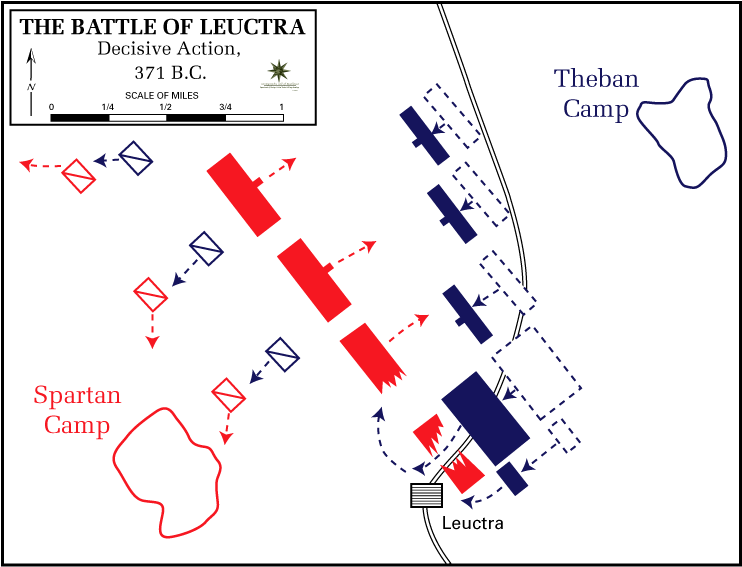 Immediately following the failure of the peace talks, orders were sent out from Sparta to the Spartan king Cleombrotus, who was at the head of an army in Phocis
, commanding him to march directly to Boeotia. Skirting north to avoid mountain passes where the Boeotians were prepared to ambush him, Cleombrotus entered Boeotian territory from an unexpected direction and quickly seized a fort and captured 10 or 12 trireme
s. Then marching towards Thebes, he camped at Leuctra
, in the territory of Thespiae
. Here, the Boeotian army came to meet him. The Spartan army contained some 10,000 hoplite
s, 700 of whom were the elite warriors known as Spartiate
s. The Boeotians opposite them numbered about 6,000, but were bolstered by a cavalry superior to that of the Peloponnesians.* Buck, Boiotia and the Boiotian League, 113–114; Gabriel, Great Captains of Antiquity, 90
Epaminondas was given charge of the Boeotian army, with the other six Boeotarchs in an advisory capacity. Pelopidas, meanwhile, was captain of the Sacred Band
, the elite Theban troops. Before the battle, there was evidently much debate amongst the Boeotarchs about whether to fight or not. As a consistent advocate of an aggressive policy, Epaminondas wished to fight, and supported by Pelopidas, he managed to swing the vote in favour of battle.* Sage, Warfare in Ancient Greece, 138; Seager, The King's Peace, 183 During the course of the battle, Epaminondas was to display a grasp of tactics hitherto unseen in Greek warfare.
The phalanx formation
used by Greek armies had a distinct tendency to veer to the right during battle, "because fear makes each man do his best to shelter his unarmed side with the shield of the man next him on the right". Traditionally, a phalanx therefore lined up for battle with the elite troops on the right flank to counter this tendency. Thus, in the Spartan phalanx at Leuctra, Cleombrotus and the elite 'Spartiate
s' were on the right, while the less experienced Peloponnesian allies were on the left. However, needing to counter the Spartans' numerical advantage, Epaminondas implemented two tactical innovations. Firstly, he took the best troops in the army, and arranged them 50 ranks deep (as opposed to the normal 8–12 ranks) on the left wing, opposite Cleombrotus and the Spartans, with Pelopidas and the Sacred Band on the extreme left flank.* Davis, 100 Decisive Battles, 24; Gabriel, The Great Armies of Antiquity, 182–183 Secondly, recognizing, that he could not have matched the width of the Peloponnesian phalanx (even before the deepening the left flank), he abandoned all attempts to do so. Instead, placing the weaker troops on the right flank, he "instructed them to avoid battle and withdraw gradually during the enemy's attack". The tactic of the deep phalanx had been anticipated by Pagondas
, another Theban general, who used a 25 man deep formation at the Battle of Delium
. However, the reversing of the position of the elite troops, and an oblique line of attack were innovations; it seems that Epaminondas was therefore responsible for the military tactic of refusing one's flank.* Davis, 100 Decisive Battles, 24; Gabriel, The Great Armies of Antiquity, 182; Hanson, The Soul of Battle
The fighting at Leuctra opened with a clash between the cavalry, in which the Thebans were victorious over the inferior Spartan cavalry, driving them back into the ranks of the infantry, and thereby disrupting the phalanx. The battle then became general, with the strengthened Theban left flank marching to attack at double speed, while the right flank retreated. After intense fighting, the Spartan right flank began to give way under the impetus of the mass of Thebans, and Cleombrotus was killed. Although the Spartans held on for long enough to rescue the body of the king, their line was soon broken by the sheer force of the Theban assault. The Peloponnesian allies on the left wing, seeing the Spartans put to flight, also broke and ran, and the entire army retreated in disarray.* Davis, 100 Decisive Battles, 26; Jones, The Art of War in the Western World, 5–6 One thousand Peloponnesians were killed, while the Boeotians lost only 300 men. Most importantly, since it constituted a significant proportion of the entire Spartan manpower, 400 of the 700 Spartiates present were killed, a loss that posed a serious threat to Sparta's future war-making abilities.* Cartledge, Sparta and Lakonia, 295; Sealey, A History of the Greek City States, 420 When, after the battle, the Spartans asked if they and the Peloponnesians could collect the dead, Epaminondas suspected that the Spartans would try to cover-up the scale of their losses. He therefore allowed the Peloponnesians to remove their dead first, so that those remaining would be shown to be Spartiates, and emphasise the scale of the Theban victory.* Tritle, The Greek World in the Fourth Century, 84
The victory at Leuctra shook the foundations of the Spartan dominance
of Greece to the core. Since the number of Spartiates was always relatively small, Sparta had relied on her allies in order to field substantial armies. However, with the defeat at Leuctra, the Peloponnesian allies were less inclined to bow to Spartan demands. Furthermore, with the loss of men at Leuctra and other battles, the Spartans were not in a strong position to reassert their dominance over their erstwhile allies.* Joint Association of Classical Teachers, The World of Athens, 48; Roy, "Thebes in the 360s BC", 187; Smith, A Smaller History of Greece, 116
dissuaded them from shattering what remained of the Spartan army.* Hornblower, The Greek World, 224 Instead, Epaminondas occupied himself with consolidating the Boeotian confederacy, compelling the previously Spartan-aligned polis of Orchomenus to join the league.* Roy, "Thebes in the 360s BC", 188
The following year the Thebans invaded the Peloponnesus, aiming to break Spartan power for good. It is not clear exactly when the Thebans started to think not just of ending the Spartan hegemony, but of replacing it with one of their own
, but it is clear that eventually this became their aim. Hans Beck asserts that, unlike Sparta in the Peloponnesian League and Athens in the Delian League
, Thebes made no effort either to create an empire or to bind its allies in any sort of permanent and stable organization. Indeed, after Leuctra Thebes devoted its attention to diplomatic efforts in Central Greece rather than schemes of domination further afield. By late 370 Thebes' network of alliances in central Greece made her secure in the area—as she had not been before Leuctra—and offered scope for further expansion of Theban influence.
); and this time, the treaty explicitly made the Peloponnesian cities, formerly under Spartan dominance, independent.* Tirtle, The Greek World in the Fourth Century, 24 Taking advantage of this, the Mantineans decided to unify their settlements into a single city, and to fortify it; a decision which greatly angered Agesilaus. Furthermore, Tegea
, supported by Mantinea, instigated the formation of an Arcadia
n alliance. This led to the Spartans declaring war on Mantinea, whereupon the majority of Arcadian cities grouped together to oppose the Spartans (thus forming the confederation that the Spartans were trying to prevent), and requested assistance from the Thebans. The Theban force arrived late in 370 BC, and it was led by Epaminondas and Pelopidas, both at this time Boeotarchs.* Roy, "Thebes in the 360s BC", 189–190; Tirtle, The Greek World in the Fourth Century, 24 As they journeyed into Arcadia, the Thebans were joined by armed contingents from many of Sparta's former allies, swelling their forces to some 50–70,000 men.* Stylianou, Diodorus Siculus, 428 In Arcadia Epaminondas encouraged the Arcadians to form their proposed league, and to build the new city of Megalopolis
(as a center of power opposed to Sparta).
 Epaminondas, supported by Pelopidas and the Arcadians, then persuaded the other Boeotarchs to invade Laconia
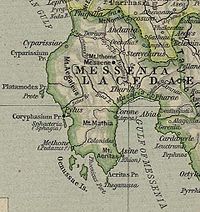
itself. Moving south, they crossed the Evrotas River, the frontier of Sparta, which no hostile army had breached in memory. The Spartans, unwilling to engage the massive army in battle, simply defended their city, which the Thebans did not attempt to capture. The Thebans and their allies ravaged Laconia, down to the port of Gythium, freeing some of the Lacedaemonian perioeci from their allegiance to Sparta.* Ober, Fortress Attica, 41; Smith, Smaller History of Greece, 163 Epaminondas briefly returned to Arcadia, before marching south again, this time to Messenia
, a region which the Spartans had conquered some 200 years before. Epaminondas freed the helots of Messenia, and rebuilt the ancient city of Messene
on Mount Ithome
, with fortifications that were among the strongest in Greece. He then issued a call to Messenian exiles all over Greece to return and rebuild their homeland.* Luraqhi, The Ancient Messenians, 4; Ober, Fortress Attica, 41 The loss of Messenia was particularly damaging to the Spartans, since the territory comprised one-third of Sparta's territory and contained half of their helot
population. The helots' labor allowed the Spartans to become a "full-time" army.
Epaminondas' campaign of 370/369 has been described as an example of "the grand strategy of indirect approach", which was aimed at severing "the economic roots of her [Sparta's] military supremacy." In mere months, Epaminondas had created two new enemy states that opposed Sparta, shaken the foundations of Sparta's economy, and all but devastated Sparta's prestige. This accomplished, he led his army back home, victorious.
ians, Megara
ns and Pellenians
). Epaminondas decided to attack the weakest spot, guarded by the Lacedaemonians; in a dawn attack he forced his way through the Spartan position, and joined his Peloponnesian allies. The Thebans thus won an easy victory and crossed the Isthmus. Diodorus stresses that this was "a feat no whit inferior to his former mighty deeds".* Tirtle, The Greek World in the Fourth Century, 88
However, the rest of the expedition achieved little: Sicyon and Pellene became allied to Thebes, and the countryside of Troezen
and Epidaurus
was ravaged, but the cities could not be taken. After an abortive attack on Corinth and the arrival of a task force sent by Dionysius of Syracuse
to aid Sparta, the Thebans decided to march home.* Cawkwell, Epaminondas and Thebes, 267; Stylianou, Diodorus Siculus, 452; Tirtle, The Greek World in the Fourth Century, 88–89
while serving as ambassadors. The Theban force not only failed to overcome Alexander and his allies, but got into serious difficulties, when it tried to withdraw; Epaminondas, serving as a private soldier, succeeded in extricating it. In early 367, Epaminondas led a second Theban expedition to free Pelopidas, and Ismenias. He finally outmaneuvered the Thessalians, and secured the release of the two Theban ambassadors without a fight.* Roy, "Thebes in the 360 BC", 195
, seeking to secure their allegiance to Thebes. No army dared to challenge him in the field, and the Achaean oligarchies therefore acquiesced to the request that they to be allied to Thebes. Epaminondas' acceptance of the Achaean oligarchies roused protests by both the Arcadians and his political rivals, and his settlement was thus shortly reversed: democracies were set up, and the oligarchs exiled. These democratic governments were short-lived, since the pro-Spartan aristocrats from all the cities banded together and attacked each city in turn, re-establishing the oligarchies. According to G.L. Cawkwell, "the sequel perhaps showed the good sense of Epaminondas. When these exiles recovered the cities, they 'no longer took a middle course'." In the light of their treatment by Thebes, they abandoned their previously neutral stance, and thereafter "fought zealously in support of the Lacedaemonians".* Cawkwell, Epaminondas and Thebes, 269; Roy, "Thebes in the 360s BC", 197–198
Throughout the decade after the Battle of Leuctra, numerous former allies of Thebes defected to the Spartan alliance or even to alliances with other hostile states. By the middle of the next decade, even some Arcadians (whose league Epaminondas had helped establish in 369 BC) had turned against them. At the same time, however, Epaminondas managed through a series of diplomatic efforts to dismantle the Peloponnesian league: the remaining members of the league finally abandoned Sparta (in 365 Corinth, Epidaurus
, and Phlius
made peace with Thebes and Argos), and Messenia remained independent and firmly loyal to Thebes.* Cawkwell, Epaminondas and Thebes, 269; Roy, "Thebes in the 360s BC", 200
Boeotian armies campaigned across Greece as opponents rose up on all sides; Epaminondas even led his state in a challenge to Athens at sea. The Theban demos voted him a fleet of a hundred triremes to win over the Rhodes
, Chios
, and Byzantium
. The fleet finally sailed in 364, but modern scholars believe that Epaminondas achieved no lasting gains for Thebes on this voyage.* Beck, Politics of Power, 174; Roy, "Thebes in the 360s BC", 201–202 In that same year, Pelopidas was killed while campaigning against Alexander of Pherae
in Thessaly. His loss deprived Epaminondas of his greatest Theban political ally.* Hanson, The Soul of Battle; Roy, "Thebes in the 360s BC", 202
, which was the center of local opposition to Mantinea, Argos, Messenia, and some of the Arcadians. Mantinea, on the other hand, had requested assistance from Sparta, Athens, Achaea and the rest of Arcadia, so that almost all of Greece was represented on one side or the other.* Tritle, The Greek World in the Fourth Century, 26–27
This time the mere presence of the Theban army was not enough to cow the opposition. Since time was passing and the Mantinean alliance showed no signs of capsizing, Epaminondas decided that he would have to break the stalemate. Hearing that a large Lacedaemonian force was marching to Mantinea, and that Sparta was practically undefended, he planned an audacious night-time march on Sparta itself. However, the Spartan king Archidamus
was alerted to this move by an informant, probably a Cretan runner, and Epaminondas arrived to find the city well-defended.* Stylianou, Diodorus Siculus, 508–510 Although he did attack the city, he seems to have drawn off relatively quickly on discovering that he had not, after all, surprised the Spartans. Furthermore, the Lacedaemonian and Mantinean troops which had been stationed at Mantinea had marched to Sparta during the course of the day, and dissuaded Epaminondas from attacking again. Now hoping that his adversaries had left Mantinea defenseless in their haste to protect Sparta, Epaminondas counter marched his troops back to his base at Tegea, and then dispatched his cavalry to Mantinea. However, a clash outside the walls of Mantinea with Athenian cavalry foiled this strategy as well.* Stylianou, Diodorus Siculus, 510–512 Realising that the time alloted for the campaign was drawing to a close, and reasoning that if he departed without defeating the enemies of Tegea, Theban influence in the Peloponnesus would be destroyed, he decided to stake everything on a pitched battle.
What followed on the plain in front of Mantinea was the largest hoplite battle in Greek history. Epaminondas had the larger army, 30,000 strong infantry and 3,000 cavalry, whilst his opponents numbered 20,000 infantry and 2,000 cavalry.* Tritle, The Greek World in the Fourth Century, 93–94 Xenophon says that, having decided to fight, Epaminondas arranged the army into battle order, and then marched it in a column parallel to the Mantinean lines, so that it appeared that the army was marching elsewhere, and would not fight that day. Having reached a certain point in the march, he then had the army down arms, so it appeared they getting ready to camp. Xenophon suggests that "by so doing he caused among most of the enemy a relaxation of their mental readiness for fighting, and likewise a relaxation of their readiness as regards their array for battle". The whole column, which had been marching right-to-left past the front of the Mantinean army then 'right-faced', so that they were now in a battle line, facing the Mantineans. Epaminondas, who had been at the head of the column (now the left wing), brought some companies of infantry from the extreme right wing, behind the battle line, to reinforce the left wing. By this, he recreated the strengthened left-wing that the Thebes had fielded at Leuctra (this time probably made up by all the Boeotians, and not just the Thebans as at Leuctra). On the wings he placed strong forces of cavalry strengthened by light-infantry.* Stylianou, Diodorus Siculus, 514–516
Epaminondas then gave the order to advance, catching the enemy off guard, and causing a furious scramble in the Mantinean camp to prepare for battle. The battle unfolded as Epaminondas had planned.* Stylianou, Diodorus Siculus, 516–518 The cavalry forces on the wings drove back the Athenian and Mantinean cavalry opposite them. Diodorus says that the Athenian cavalry on the Mantinean right wing, although not inferior in quality, could not withstand the missiles from the light-troops that Epaminondas had placed among the Theban cavalry. Meanwhile, the Theban infantry advanced. Xenophon evocatively describes Epaminondas's thinking: "[he] led forward his army prow on, like a trireme, believing that if he could strike and cut through anywhere, he would destroy the entire army of his adversaries." As at Leuctra, the weakened right wing was ordered to hold back and avoid fighting. In the clash of infantry, the issue briefly hung in the balance, but then the Theban left-wing broke through the Spartans line, and the entire enemy phalanx was put to flight. However, at the height of the battle, Epaminondas was mortally wounded by a Spartan, and died shortly thereafter. Following his death, the Thebes and allies made no effort to pursue the fleeing enemy; a testament to Epaminondas's centrality to the war effort.* Hanson, Hoplites, 146; Stylianou, Diodorus Siculus, 518–519; Tritle, The Greek World in the Fourth Century, 94
Xenophon, who ends his history with the battle of Mantinea, says of the battle's results:
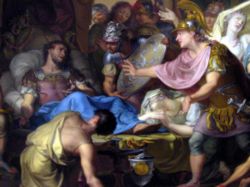 In matters of character, Epaminondas was above reproach in the eyes of the ancient historians who recorded his deeds. Contemporaries praised him for disdaining material wealth, sharing what he had with his friends, and refusing bribes. One of the last heirs of the Pythagorean tradition, he appears to have lived a simple and ascetic lifestyle even when his leadership had raised him to a position at the head of all Greece. Cornelius Nepos notes his incorruptibility, describing his rejection of a Persian ambassador who came to him with a bribe. These aspects of his character contributed greatly to his renown after his death.
Epaminondas never married and as such was subject to criticism from countrymen who believed he was duty-bound to provide the country with the benefit of sons as great as himself. In response, Epaminondas said that his victory at Leuctra was a daughter destined to live forever.
As a tactician, Epaminondas stands above every other general in Greek history (unless the Macedonian kings Philip II
and Alexander the Great are included), although modern historians have questioned his larger strategic vision. According to Richard A. Gabriel, his tactics "marked the beginning of the end of traditional Greek methods of war". His innovative strategy at Leuctra allowed him to defeat the vaunted Spartan phalanx with a smaller force, and his decision to refuse his left flank was the first recorded instance of such a tactic.* Gabriel, Great Captains of Antiquity, 90–91 Many of the tactical innovations that Epaminondas implemented would also be used by Philip of Macedon
, who in his youth spent time as a hostage in Thebes and may have learned directly from Epaminondas himself.Plutarch, Pelopidas, 26
* Bose, Art of Strategy, 8. Luraghi (The Ancient Messenians, 18) also notes that Philip also "revived Epaminondas' strategy of mobilizing Sparta's neighbors".
At Mantinea, Thebes had faced down the combined forces of the greatest states of Greece, but the victory brought it no spoils. With Epaminondas removed from the scene, the Thebans returned to their more traditional defensive policy, and within a few years, Athens had replaced them at the pinnacle of the Greek political system. No Greek state ever again reduced Boeotia to the subjection it had known during the Spartan hegemony
, but Theban influence faded quickly in the rest of Greece. Finally, at Chaeronea
in 338 BC, the combined forces of Thebes and Athens, driven into each others' arms for a desperate last stand against Philip of Macedon, were crushingly defeated, and Theban independence was put to an end. Three years later, heartened by a false rumor that Alexander the Great had been assassinated, the Thebans revolted; Alexander squashed the revolt, then destroyed the city, slaughtering or enslaving all its citizens. A mere 27 years after the death of the man who had made it preeminent throughout Greece, Thebes was wiped from the face of the Earth, its 1,000-year history ended in the space of a few days.
Epaminondas, therefore, is remembered both as a liberator and a destroyer. He was celebrated throughout the ancient Greek and Roman worlds as one of the greatest men of history. Cicero
eulogized him as "the first man, in my judgement, of Greece," and Pausanias records an honorary poem from his tomb:
Epaminondas's actions were certainly welcomed by the Messenians and others whom he assisted in his campaigns against the Spartans. Those same Spartans, however, had been at the center of resistance to the Persian invasions of the 5th century BC, and their absence was sorely felt at Chaeronea; the endless warfare in which Epaminondas played a central role weakened the cities of Greece until they could no longer hold their own against their neighbors to the north. As Epaminondas campaigned to secure freedom for the Boeotians and others throughout Greece, he brought closer the day when all of Greece would be subjugated by an invader. Victor Davis Hanson
has suggested that Epaminondas may have planned for a united Greece composed of regional democratic federations, but even if this assertion is correct, no such plan was ever implemented. Simon Hornblower
asserts that Thebes' great legacy to fourth century and Hellenistic Greece was federalism, "a kind of alternative to imperialism, a way of achieving unity without force", which "embodies a representative principle".
For all his noble qualities, Epaminondas was unable to transcend the Greek city-state system, with its endemic rivalry and warfare, and thus left Greece more war-ravaged but no less divided than he found it. Hornblower asserts that "it is a sign of Epaminondas political failure, even before the battle of Mantinea, that his Peloponnesian allies fought to reject Sparta rather than because of the positive attractions of Thebes". On the other hand, Cawkwell concludes that "Epaminondas must be judged not in relation to these inevitable limitations of Boeotian power. To have established the power of Boeotia and ended the Spartan domination of the Peloponnese was the most and the best that a Boeotian could have done."
Thebes, Greece
Thebes is a city in Greece, situated to the north of the Cithaeron range, which divides Boeotia from Attica, and on the southern edge of the Boeotian plain. It played an important role in Greek myth, as the site of the stories of Cadmus, Oedipus, Dionysus and others...
general and statesman of the 4th century BC who transformed the Ancient Greek
Ancient Greece
Ancient Greece is a civilization belonging to a period of Greek history that lasted from the Archaic period of the 8th to 6th centuries BC to the end of antiquity. Immediately following this period was the beginning of the Early Middle Ages and the Byzantine era. Included in Ancient Greece is the...
city-state
Polis
Polis , plural poleis , literally means city in Greek. It could also mean citizenship and body of citizens. In modern historiography "polis" is normally used to indicate the ancient Greek city-states, like Classical Athens and its contemporaries, so polis is often translated as "city-state."The...
of Thebes, leading it out of Sparta
Sparta
Sparta or Lacedaemon, was a prominent city-state in ancient Greece, situated on the banks of the River Eurotas in Laconia, in south-eastern Peloponnese. It emerged as a political entity around the 10th century BC, when the invading Dorians subjugated the local, non-Dorian population. From c...
n subjugation into a preeminent position in Greek politics. In the process he broke Spartan military power with his victory at Leuctra
Battle of Leuctra
The Battle of Leuctra was a battle fought on July 6, 371 BC, between the Boeotians led by Thebans and the Spartans along with their allies amidst the post-Corinthian War conflict. The battle took place in the neighbourhood of Leuctra, a village in Boeotia in the territory of Thespiae...
and liberated the Messenia
Messenia
Messenia is a regional unit in the southwestern part of the Peloponnese region, one of 13 regions into which Greece has been divided by the Kallikratis plan, implemented 1 January 2011...
n helots
Helots
The helots: / Heílôtes) were an unfree population group that formed the main population of Laconia and the whole of Messenia . Their exact status was already disputed in antiquity: according to Critias, they were "especially slaves" whereas to Pollux, they occupied a status "between free men and...
, a group of Peloponnesian Greeks who had been enslaved under Spartan rule for some 230 years, having been defeated in the Messenian War ending in 600 BC. Epaminondas reshaped the political map of Greece, fragmented old alliances, created new ones, and supervised the construction of entire cities. He was militarily influential as well, inventing and implementing several major battlefield tactics.
The Roman
Ancient Rome
Ancient Rome was a thriving civilization that grew on the Italian Peninsula as early as the 8th century BC. Located along the Mediterranean Sea and centered on the city of Rome, it expanded to one of the largest empires in the ancient world....
orator Cicero
Cicero
Marcus Tullius Cicero , was a Roman philosopher, statesman, lawyer, political theorist, and Roman constitutionalist. He came from a wealthy municipal family of the equestrian order, and is widely considered one of Rome's greatest orators and prose stylists.He introduced the Romans to the chief...
called him "the first man of Greece", but Epaminondas has fallen into relative obscurity in modern times. The changes Epaminondas wrought on the Greek political order did not long outlive him, as the cycle of shifting hegemonies and alliances continued unabated. A mere twenty-seven years after his death, a recalcitrant Thebes was obliterated by Alexander the Great. Thus Epaminondas—who had been praised in his time as an idealist and liberator—is today largely remembered for a decade (371 BC to 362 BC) of campaigning that sapped the strength of the great land powers of Greece and paved the way for the Macedon
Macedon
Macedonia or Macedon was an ancient kingdom, centered in the northeastern part of the Greek peninsula, bordered by Epirus to the west, Paeonia to the north, the region of Thrace to the east and Thessaly to the south....
ian conquest.
Early life
Epaminondas was born into the Theban aristocracy in the late 5th century BC; estimates for the year of his birth vary widely. Cornelius Nepos claims that his father, Polymnis, had been left impoverished by his ancestors. He was educated in his childhood by Lysis of TarentumLysis of Tarentum
Lysis of Taras was a Greek philosopher. His life is obscure. He was said to have been a friend and disciple of Pythagoras. After the persecution of the Pythagoreans at Croton and Metapontum he escaped and went to Thebes, where he became the teacher of Epaminondas, by whom he was held in the...
, one of the last major Pythagorean philosophers. Epaminondas evidently excelled as a student, and was devoted to Lysis. Nepos also tells us that the young Epaminondas worked hard to increase his physical prowess, and specifically his agility, since "he thought that strength suited the purposes of wrestlers, but that agility conduced to excellence in war." He also trained in running and wrestling, but most of all, he undertook "martial exercises" (presumably training with weapons).
Epaminondas evidently began serving as a soldier after adolescence; Plutarch refers to an incident involving Epaminondas that occurred during a battle at Mantinea. Though not explicitly stated, this was probably the Spartan attack on Mantinea in 385 BC, as described by Xenophon; Plutarch tells us that Epaminondas was there as part of a Theban force aiding the Spartans, so this battle fits the description. Epaminondas was certainly not old enough have served at the First Battle of Mantinea
Battle of Mantinea (418 BC)
The Battle of Mantinea of 418 BC was a significant engagement in the Peloponnesian War. Sparta and its allies defeated an army led by Argos and Athens.-Prelude to the battle:...
.
It was at this battle, regardless of exactly when and where this occurred, that a defining moment of Epaminondas's early life would occur. Epaminondas saved the life of his fellow Theban Pelopidas
Pelopidas
Pelopidas was an important Theban statesman and general in Greece.-Athlete and warrior:He was a member of a distinguished family, and possessed great wealth which he expended on his friends, while content to lead the life of an athlete...
;
Pelopidas, after receiving seven wounds in front, sank down upon a great heap of friends and enemies who lay dead together; but Epaminondas, although he thought him lifeless, stood forth to defend his body and his arms, and fought desperately, single-handed against many, determined to die rather than leave Pelopidas lying there. And now he too was in a sorry plight, having been wounded in the breast with a spear and in the arm with a sword, when Agesipolis the Spartan king came to his aid from the other wing, and when all hope was lost, saved them both.Plutarch says that this incident firmly cemented their friendship, and Pelopidas would be Epaminondas's partner in politics for the next twenty years.
Background
Epaminondas lived at a particularly turbulent point in Greek history. Following the end of the Peloponnesian WarPeloponnesian War
The Peloponnesian War, 431 to 404 BC, was an ancient Greek war fought by Athens and its empire against the Peloponnesian League led by Sparta. Historians have traditionally divided the war into three phases...
in 404 BC, Sparta had embarked upon an aggressively unilateralist policy towards the rest of Greece and quickly alienated many of its former allies. Thebes, meanwhile, had greatly increased its own power during the war and sought to gain control of the other cities of Boeotia
Boeotia
Boeotia, also spelled Beotia and Bœotia , is one of the regional units of Greece. It is part of the region of Central Greece. It was also a region of ancient Greece. Its capital is Livadeia, the second largest city being Thebes.-Geography:...
(the region of ancient Greece northwest of Attica). This policy, along with other disputes, brought Thebes into conflict with Sparta. By 395 BC, Thebes, alongside Athens
Athens
Athens , is the capital and largest city of Greece. Athens dominates the Attica region and is one of the world's oldest cities, as its recorded history spans around 3,400 years. Classical Athens was a powerful city-state...
, Corinth
Corinth
Corinth is a city and former municipality in Corinthia, Peloponnese, Greece. Since the 2011 local government reform it is part of the municipality Corinth, of which it is the seat and a municipal unit...
, and Argos
Argos
Argos is a city and a former municipality in Argolis, Peloponnese, Greece. Since the 2011 local government reform it is part of the municipality Argos-Mykines, of which it is a municipal unit. It is 11 kilometres from Nafplion, which was its historic harbour...
, found itself arrayed against Sparta (a former ally) in the Corinthian War
Corinthian War
The Corinthian War was an ancient Greek conflict lasting from 395 BC until 387 BC, pitting Sparta against a coalition of four allied states; Thebes, Athens, Corinth, and Argos; which were initially backed by Persia. The immediate cause of the war was a local conflict in northwest Greece in which...
. That war, which dragged on inconclusively for eight years, saw several bloody Theban defeats at Spartan hands. By the time of its conclusion, Thebes had been forced to check its expansionist ambitions and return to its old alliance with Sparta.
In 382 BC, however, the Spartan commander Phoebidas
Phoebidas
Phoebidas was a Spartan general who, in 382 BC, seized the Theban acropolis, thus giving Sparta control over Thebes. To punish his unauthorized action, Phoebidas was relieved of command. Nevertheless, the Spartans continued to hold Thebes...
committed an act that would ultimately turn Thebes against Sparta for good and pave the way for Epaminondas's rise to power. Passing through Boeotia on campaign, Phoebidas took advantage of civil strife within Thebes to secure entrance to the city for his troops. Once inside, he seized the Cadmeia (the Theban acropolis
Acropolis
Acropolis means "high city" in Greek, literally city on the extremity and is usually translated into English as Citadel . For purposes of defense, early people naturally chose elevated ground to build a new settlement, frequently a hill with precipitous sides...
), and forced the anti-Spartan party to flee the city. Epaminondas, although associated with that faction, was allowed to remain; since "his philosophy made him to be looked down upon as a recluse, and his poverty as impotent". The Spartans installed a puppet government in Thebes, and garrisoned the Cadmeia to ensure the behaviour of the Thebans.
378 BC – Theban coup
In the years following the Spartan takeover, the exiled Thebans regrouped in Athens and, at the instigation of Pelopidas, prepared to liberate their city. Meanwhile, in Thebes, Epaminondas began preparing the young men of the city to fight the Spartans. In the winter of 379 BC, a small group of the exiles, led by Pelopidas, infiltrated the city. They then assassinated the leaders of the pro-Spartan government, and supported by Epaminondas and GorgidasGorgidas
Gorgidas was the first known Theban military leader of the Sacred Band of Thebes.Plutarch chronicled their exploits. Gorgidas, around 378 BC, first established the Sacred Band by choosing couples from his army...
, who led a group of young men, and a force of Athenian hoplite
Hoplite
A hoplite was a citizen-soldier of the Ancient Greek city-states. Hoplites were primarily armed as spearmen and fought in a phalanx formation. The word "hoplite" derives from "hoplon" , the type of the shield used by the soldiers, although, as a word, "hopla" could also denote weapons held or even...
s, they surrounded the Spartans on the Cadmeia. The following day, Epaminondas and Gorgidas brought Pelopidas and his men before the Theban assembly and exhorted the Thebans to fight for their freedom; the assembly responded by acclaiming Pelopidas and his men as liberators. The Cadmeia was surrounded, and the Spartans attacked; Pelopidas realised that they must be expelled before an army came from Sparta to relieve them. The Spartan garrison eventually surrendered on the condition that they were allowed to march away unharmed. The narrow margin of the conspirators' success is demonstrated by the fact that the Spartan garrison met a Spartan force on the way to rescue them as they marched back to Sparta. Plutarch portrays the Theban coup as an immensely significant event:
...the subsequent change in the political situation made this exploit the more glorious. For the war which broke down the pretensions of Sparta and put an end to her supremacy by land and sea, began from that night, in which people, not by surprising any fort or castle or citadel, but by coming into a private house with eleven others, loosed and broke in pieces, if the truth may be expressed in a metaphor, the fetters of the Lacedaemonian supremacy, which were thought indissoluble and not to be broken.
378–371 BC – Aftermath
When news of the uprising at Thebes reached Sparta, an army under Cleombrotus had been dispatched to subdue the city, but turned back without engaging the Thebans. Another army under Agesilaus IIAgesilaus II
Agesilaus II, or Agesilaos II was a king of Sparta, of the Eurypontid dynasty, ruling from approximately 400 BC to 360 BC, during most of which time he was, in Plutarch's words, "as good as thought commander and king of all Greece," and was for the whole of it greatly identified with his...
was then dispatched to attack the Thebans. However, the Thebans refused to meet the Spartan army in battle, instead building a trench and stockade outside Thebes, which they occupied, preventing the Spartans advancing on the city. The Spartans ravaged the countryside but eventually departed, leaving Thebes independent. This victory so heartened the Thebans that they undertook operations against other neighboring cities as well. In short order the Thebans were able to reconstitute their old Boeotian confederacy in a new, democratic form. The cities of Boeotia united as a federation with an executive body composed of seven generals, or Boeotarch
Boeotarch
Boeotarch was the title of the chief officers of the Boeotian Confederacy, founded in 379 BC after a rebellion freed the cities of Boeotia from Spartan dominance. There were seven Boeotarchs, democratically elected from seven electoral districts throughout Boeotia...
s, elected from seven districts throughout Boeotia.* Beck, Politics of Power, 97–98 This political fusion was so successful that henceforth the names Theban and Boeotian were used interchangeably in a nod to the newfound solidarity of the region.
Seeking to crush the Thebans, the Spartans would invade Boeotia three times over the next few years. At first the Thebans feared facing the Spartans head on, but the conflict gave them much practice and training, and they "had their spirits roused and their bodies thoroughly inured to hardships, and gained experience and courage from their constant struggles". Although Sparta remained the dominant land power in Greece, the Boeotians had demonstrated that they, too, were a martial threat and a politically cohesive power. At the same time, Pelopidas, an advocate of an aggressive policy against Sparta, had established himself as a major political leader in Thebes.
Epaminondas's role in the years to 371 BC is difficult to piece together. Certainly, he served with the Theban armies in the defence of Boeotia in the 370s, and, by 371 BC, he had become a Boeotarch.* Cawkwell, Epaminondas and Thebes, 257–258 It seems safe to assume, given their close friendship, and their close collaboration after 371 BC, that Epaminondas and Pelopidas also collaborated closely on Theban policy in the period 378–371 BC.* Clawkwell, Epaminondas and Thebes, 263–264
Peace conference of 371 BC
The years following the Theban coup had seen desultory fighting between Sparta and Thebes, with Athens also drawn into the conflict. A feeble attempt at a common peace had been made in 375 BC, but desultory fighting between Athens and Sparta had resumed by 373 BC (at the latest). By 371 BC, Athens and Sparta were again war-weary, and in 371 BC a conference was held at Sparta to discuss another attempt at a common peace.Epaminondas was serving as a Boeotarch for 371 BC, and led the Boeotian delegation to the peace conference. Peace terms were agreed at the outset of the conference, and the Thebans presumably signed the treaty in their own name alone. However, on the following day, Epaminondas caused a drastic break with Sparta when he insisted on signing not for the Thebans alone, but for all the Boeotians. Agesilaus refused to allow the change of the Theban envoys' signature, insisting that the cities of Boeotia should be independent; Epaminondas countered that if this were to be the case, the cities of Laconia
Laconia
Laconia , also known as Lacedaemonia, is one of the regional units of Greece. It is part of the region of Peloponnese. It is situated in the southeastern part of the Peloponnese peninsula. Its administrative capital is Sparti...
should be as well. Irate, Agesilaus struck the Thebans from the document. The delegation returned to Thebes, and both sides mobilized for war.* Beck, Politics of Power, 41–42; Buck, Boiotia and the Boiotian League, 112–113; Fine, The ancient Greeks, 575
Battle of Leuctra (371 BC)
Phocis
Phocis is one of the regional units of Greece. It is part of the administrative region of Central Greece. It stretches from the western mountainsides of Parnassus on the east to the mountain range of Vardousia on the west, upon the Gulf of Corinth...
, commanding him to march directly to Boeotia. Skirting north to avoid mountain passes where the Boeotians were prepared to ambush him, Cleombrotus entered Boeotian territory from an unexpected direction and quickly seized a fort and captured 10 or 12 trireme
Trireme
A trireme was a type of galley, a Hellenistic-era warship that was used by the ancient maritime civilizations of the Mediterranean, especially the Phoenicians, ancient Greeks and Romans.The trireme derives its name from its three rows of oars on each side, manned with one man per oar...
s. Then marching towards Thebes, he camped at Leuctra
Leuctra
Leuctra was a village in ancient Greece, in Boeotia, seven miles southwest of Thebes. It is primarily known today as the site of the important 371 BC Battle of Leuctra in which the Thebans, under Epaminondas, defeated the Spartans...
, in the territory of Thespiae
Thespiae
Thespiae was an ancient Greek city in Boeotia. It stood on level ground commanded by the low range of hills which runs eastward from the foot of Mount Helicon to Thebes, near modern Thespies.-History:...
. Here, the Boeotian army came to meet him. The Spartan army contained some 10,000 hoplite
Hoplite
A hoplite was a citizen-soldier of the Ancient Greek city-states. Hoplites were primarily armed as spearmen and fought in a phalanx formation. The word "hoplite" derives from "hoplon" , the type of the shield used by the soldiers, although, as a word, "hopla" could also denote weapons held or even...
s, 700 of whom were the elite warriors known as Spartiate
Spartiate
The Spartiates or Homoioi were the males of Sparta known to the Spartans as "peers" or "men of equal status". From a young age, male Spartiates were trained for battle and put through grueling challenges intended to craft them into fearless warriors...
s. The Boeotians opposite them numbered about 6,000, but were bolstered by a cavalry superior to that of the Peloponnesians.* Buck, Boiotia and the Boiotian League, 113–114; Gabriel, Great Captains of Antiquity, 90
Epaminondas was given charge of the Boeotian army, with the other six Boeotarchs in an advisory capacity. Pelopidas, meanwhile, was captain of the Sacred Band
Sacred Band of Thebes
The Sacred Band of Thebes was a troop of picked soldiers, consisting of 150 male couples which formed the elite force of the Theban army in the 4th century BC. It was organised by the Theban commander Gorgidas in 378 BC and played a crucial role in the Battle of Leuctra...
, the elite Theban troops. Before the battle, there was evidently much debate amongst the Boeotarchs about whether to fight or not. As a consistent advocate of an aggressive policy, Epaminondas wished to fight, and supported by Pelopidas, he managed to swing the vote in favour of battle.* Sage, Warfare in Ancient Greece, 138; Seager, The King's Peace, 183 During the course of the battle, Epaminondas was to display a grasp of tactics hitherto unseen in Greek warfare.
The phalanx formation
Phalanx formation
The phalanx is a rectangular mass military formation, usually composed entirely of heavy infantry armed with spears, pikes, sarissas, or similar weapons...
used by Greek armies had a distinct tendency to veer to the right during battle, "because fear makes each man do his best to shelter his unarmed side with the shield of the man next him on the right". Traditionally, a phalanx therefore lined up for battle with the elite troops on the right flank to counter this tendency. Thus, in the Spartan phalanx at Leuctra, Cleombrotus and the elite 'Spartiate
Spartiate
The Spartiates or Homoioi were the males of Sparta known to the Spartans as "peers" or "men of equal status". From a young age, male Spartiates were trained for battle and put through grueling challenges intended to craft them into fearless warriors...
s' were on the right, while the less experienced Peloponnesian allies were on the left. However, needing to counter the Spartans' numerical advantage, Epaminondas implemented two tactical innovations. Firstly, he took the best troops in the army, and arranged them 50 ranks deep (as opposed to the normal 8–12 ranks) on the left wing, opposite Cleombrotus and the Spartans, with Pelopidas and the Sacred Band on the extreme left flank.* Davis, 100 Decisive Battles, 24; Gabriel, The Great Armies of Antiquity, 182–183 Secondly, recognizing, that he could not have matched the width of the Peloponnesian phalanx (even before the deepening the left flank), he abandoned all attempts to do so. Instead, placing the weaker troops on the right flank, he "instructed them to avoid battle and withdraw gradually during the enemy's attack". The tactic of the deep phalanx had been anticipated by Pagondas
Pagondas
- Biographical information :Little is known of Pagondas's life. He is mentioned by Pindar as having been born to a noble Theban family, and we know that he was in his early sixties at Delium. He was evidently a fiery and persuasive speaker, purportedly moving the disparate Boeotian contingents to...
, another Theban general, who used a 25 man deep formation at the Battle of Delium
Battle of Delium
The Battle of Delium or of Delion took place in 424 BC between the Athenians and the Boeotians, and ended with the siege of Delium in the following weeks.-Prelude:...
. However, the reversing of the position of the elite troops, and an oblique line of attack were innovations; it seems that Epaminondas was therefore responsible for the military tactic of refusing one's flank.* Davis, 100 Decisive Battles, 24; Gabriel, The Great Armies of Antiquity, 182; Hanson, The Soul of Battle
The fighting at Leuctra opened with a clash between the cavalry, in which the Thebans were victorious over the inferior Spartan cavalry, driving them back into the ranks of the infantry, and thereby disrupting the phalanx. The battle then became general, with the strengthened Theban left flank marching to attack at double speed, while the right flank retreated. After intense fighting, the Spartan right flank began to give way under the impetus of the mass of Thebans, and Cleombrotus was killed. Although the Spartans held on for long enough to rescue the body of the king, their line was soon broken by the sheer force of the Theban assault. The Peloponnesian allies on the left wing, seeing the Spartans put to flight, also broke and ran, and the entire army retreated in disarray.* Davis, 100 Decisive Battles, 26; Jones, The Art of War in the Western World, 5–6 One thousand Peloponnesians were killed, while the Boeotians lost only 300 men. Most importantly, since it constituted a significant proportion of the entire Spartan manpower, 400 of the 700 Spartiates present were killed, a loss that posed a serious threat to Sparta's future war-making abilities.* Cartledge, Sparta and Lakonia, 295; Sealey, A History of the Greek City States, 420 When, after the battle, the Spartans asked if they and the Peloponnesians could collect the dead, Epaminondas suspected that the Spartans would try to cover-up the scale of their losses. He therefore allowed the Peloponnesians to remove their dead first, so that those remaining would be shown to be Spartiates, and emphasise the scale of the Theban victory.* Tritle, The Greek World in the Fourth Century, 84
The victory at Leuctra shook the foundations of the Spartan dominance
Spartan hegemony
The city-state of Sparta was the greatest military land power of classical Greek antiquity. During the classical period, Sparta owned, dominated or influenced the entire Peloponnese. Additionally, the defeat of the Athenians and the Delian League in the Peloponnesian War in 431-404 BCE resulted in...
of Greece to the core. Since the number of Spartiates was always relatively small, Sparta had relied on her allies in order to field substantial armies. However, with the defeat at Leuctra, the Peloponnesian allies were less inclined to bow to Spartan demands. Furthermore, with the loss of men at Leuctra and other battles, the Spartans were not in a strong position to reassert their dominance over their erstwhile allies.* Joint Association of Classical Teachers, The World of Athens, 48; Roy, "Thebes in the 360s BC", 187; Smith, A Smaller History of Greece, 116
Theban hegemony
In the immediate aftermath of Leuctra, the Thebans considered following up their victory by taking their vengeance on Sparta; they also invited Athens to join them in doing so. However, their Thessalian allies under Jason of PheraeJason of Pherae
Jason of Pherae was the ruler of Thessaly during the period just before Philip II of Macedon came to power. He had succeeded his father Lycophron I of Pherae as tyrant of Pherae and was appointed tagus, or king, of Thessaly in the 370s BC and soon extended his control to much of the surrounding...
dissuaded them from shattering what remained of the Spartan army.* Hornblower, The Greek World, 224 Instead, Epaminondas occupied himself with consolidating the Boeotian confederacy, compelling the previously Spartan-aligned polis of Orchomenus to join the league.* Roy, "Thebes in the 360s BC", 188
The following year the Thebans invaded the Peloponnesus, aiming to break Spartan power for good. It is not clear exactly when the Thebans started to think not just of ending the Spartan hegemony, but of replacing it with one of their own
Theban hegemony
The Theban Hegemony lasted from the Theban victory over the Spartans at Leuctra in 371 BC to their defeat of a coalition of Peloponnesian armies at Mantinea in 362 BC, though Thebes sought to maintain its position until finally eclipsed by the rising power of Macedon in 346 BC.Externally, the way...
, but it is clear that eventually this became their aim. Hans Beck asserts that, unlike Sparta in the Peloponnesian League and Athens in the Delian League
Delian League
The Delian League, founded in circa 477 BC, was an association of Greek city-states, members numbering between 150 to 173, under the leadership of Athens, whose purpose was to continue fighting the Persian Empire after the Greek victory in the Battle of Plataea at the end of the Greco–Persian Wars...
, Thebes made no effort either to create an empire or to bind its allies in any sort of permanent and stable organization. Indeed, after Leuctra Thebes devoted its attention to diplomatic efforts in Central Greece rather than schemes of domination further afield. By late 370 Thebes' network of alliances in central Greece made her secure in the area—as she had not been before Leuctra—and offered scope for further expansion of Theban influence.
First Invasion of the Peloponnese (370 BC)
When, in the immediate aftermath of Leuctra, the Thebans had sent a herald to Athens with news of their victory, the messenger was met with stony silence. The Athenians then decided to take advantage of the Spartan discomfiture, holding a conference in Athens, in which the peace terms proposed earlier in 371 BC were ratified by all cities (except ElisElis
Elis, or Eleia is an ancient district that corresponds with the modern Elis peripheral unit...
); and this time, the treaty explicitly made the Peloponnesian cities, formerly under Spartan dominance, independent.* Tirtle, The Greek World in the Fourth Century, 24 Taking advantage of this, the Mantineans decided to unify their settlements into a single city, and to fortify it; a decision which greatly angered Agesilaus. Furthermore, Tegea
Tegea
Tegea was a settlement in ancient Greece, and it is also a former municipality in Arcadia, Peloponnese, Greece. Since the 2011 local government reform it is part of the municipality Tripoli, of which it is a municipal unit. Its seat was the village Stadio....
, supported by Mantinea, instigated the formation of an Arcadia
Arcadia
Arcadia is one of the regional units of Greece. It is part of the administrative region of Peloponnese. It is situated in the central and eastern part of the Peloponnese peninsula. It takes its name from the mythological character Arcas. In Greek mythology, it was the home of the god Pan...
n alliance. This led to the Spartans declaring war on Mantinea, whereupon the majority of Arcadian cities grouped together to oppose the Spartans (thus forming the confederation that the Spartans were trying to prevent), and requested assistance from the Thebans. The Theban force arrived late in 370 BC, and it was led by Epaminondas and Pelopidas, both at this time Boeotarchs.* Roy, "Thebes in the 360s BC", 189–190; Tirtle, The Greek World in the Fourth Century, 24 As they journeyed into Arcadia, the Thebans were joined by armed contingents from many of Sparta's former allies, swelling their forces to some 50–70,000 men.* Stylianou, Diodorus Siculus, 428 In Arcadia Epaminondas encouraged the Arcadians to form their proposed league, and to build the new city of Megalopolis
Megalopolis, Greece
Megalópoli is a town in the western part of the peripheral unit of Arcadia, southern Greece. It is located in the same site as ancient Megalopolis . "Megalopolis" is a Greek word for Great city. When it was founded, in 371 BC, it was the first urbanization in rustic and primitive Arcadia. In...
(as a center of power opposed to Sparta).
Laconia
Laconia , also known as Lacedaemonia, is one of the regional units of Greece. It is part of the region of Peloponnese. It is situated in the southeastern part of the Peloponnese peninsula. Its administrative capital is Sparti...
itself. Moving south, they crossed the Evrotas River, the frontier of Sparta, which no hostile army had breached in memory. The Spartans, unwilling to engage the massive army in battle, simply defended their city, which the Thebans did not attempt to capture. The Thebans and their allies ravaged Laconia, down to the port of Gythium, freeing some of the Lacedaemonian perioeci from their allegiance to Sparta.* Ober, Fortress Attica, 41; Smith, Smaller History of Greece, 163 Epaminondas briefly returned to Arcadia, before marching south again, this time to Messenia
Messenia
Messenia is a regional unit in the southwestern part of the Peloponnese region, one of 13 regions into which Greece has been divided by the Kallikratis plan, implemented 1 January 2011...
, a region which the Spartans had conquered some 200 years before. Epaminondas freed the helots of Messenia, and rebuilt the ancient city of Messene
Messene
Messene , officially Ancient Messene, is a Local Community of the Municipal Unit , Ithomi, of the municipality of Messini within the Regional Unit of Messenia in the Region of Peloponnēsos, one of 7 Regions into which the Hellenic Republic has been divided by the Kallikratis...
on Mount Ithome
Ithome
Mount Ithome or Ithomi, previously Vourkano or Vurcano before being changed back to Ithome, is the northernmost of twin peaks in Messenia, Greece. Mount Ithome rises to about , about over Valyra, the seat of Ithomi, the former municipality...
, with fortifications that were among the strongest in Greece. He then issued a call to Messenian exiles all over Greece to return and rebuild their homeland.* Luraqhi, The Ancient Messenians, 4; Ober, Fortress Attica, 41 The loss of Messenia was particularly damaging to the Spartans, since the territory comprised one-third of Sparta's territory and contained half of their helot
Helots
The helots: / Heílôtes) were an unfree population group that formed the main population of Laconia and the whole of Messenia . Their exact status was already disputed in antiquity: according to Critias, they were "especially slaves" whereas to Pollux, they occupied a status "between free men and...
population. The helots' labor allowed the Spartans to become a "full-time" army.
Epaminondas' campaign of 370/369 has been described as an example of "the grand strategy of indirect approach", which was aimed at severing "the economic roots of her [Sparta's] military supremacy." In mere months, Epaminondas had created two new enemy states that opposed Sparta, shaken the foundations of Sparta's economy, and all but devastated Sparta's prestige. This accomplished, he led his army back home, victorious.
Trial
In order to accomplish all that he wished in the Peloponnesus, Epaminondas had persuaded his fellow Boeotarchs to remain in the field for several months after their term of office had expired. Upon his return home, Epaminondas was therefore greeted not with a hero's welcome but with a trial arranged by his political enemies. According to Cornelius Nepos, in his defense Epaminondas merely requested that, if he be executed, the inscription regarding the verdict read:Epaminondas was punished by the Thebans with death, because he obliged them to overthrow the Lacedaemonians at Leuctra, whom, before he was general, none of the Boeotians durst look upon in the field, and because he not only, by one battle, rescued Thebes from destruction, but also secured liberty for all Greece, and brought the power of both people to such a condition, that the Thebans attacked Sparta, and the Lacedaemonians were content if they could save their lives; nor did he cease to prosecute the war, till, after settling Messene, he shut up Sparta with a close siege.The jury broke into laughter, the charges were dropped, and Epaminondas was re-elected as Boeotarch for the next year.
Second invasion of the Peloponnesus (369 BC)
In 369 BC the Argives, Eleans and the Arcadians, eager to continue their war against Sparta, recalled the Thebans to their support. Epaminondas, at the height of his prestige, again commanded an allied invasion force. Arriving at the Isthmus of Corinth, the Thebans found it heavily guarded by the Spartans and Athenians (along with the CorinthCorinth
Corinth is a city and former municipality in Corinthia, Peloponnese, Greece. Since the 2011 local government reform it is part of the municipality Corinth, of which it is the seat and a municipal unit...
ians, Megara
Megara
Megara is an ancient city in Attica, Greece. It lies in the northern section of the Isthmus of Corinth opposite the island of Salamis, which belonged to Megara in archaic times, before being taken by Athens. Megara was one of the four districts of Attica, embodied in the four mythic sons of King...
ns and Pellenians
Pellene
Pellene was the easternmost ancient Greek city-state in Achaea. The ruins are southwest of Xylokastro. The city sided with Sparta throughout the Peloponnesian War. It was a member of the Achaean League until that League was dissolved by Alexander the Great. In the fourth century it was ruled for...
). Epaminondas decided to attack the weakest spot, guarded by the Lacedaemonians; in a dawn attack he forced his way through the Spartan position, and joined his Peloponnesian allies. The Thebans thus won an easy victory and crossed the Isthmus. Diodorus stresses that this was "a feat no whit inferior to his former mighty deeds".* Tirtle, The Greek World in the Fourth Century, 88
However, the rest of the expedition achieved little: Sicyon and Pellene became allied to Thebes, and the countryside of Troezen
Troezen
Troezen is a small town and a former municipality in the northeastern Peloponnese, Greece. Since the 2011 local government reform it is part of the municipality Troizinia, of which it is a municipal unit....
and Epidaurus
Epidaurus
Epidaurus was a small city in ancient Greece, at the Saronic Gulf. Two modern towns bear the name Epidavros : Palaia Epidavros and Nea Epidavros. Since 2010 they belong to the new municipality of Epidavros, part of the peripheral unit of Argolis...
was ravaged, but the cities could not be taken. After an abortive attack on Corinth and the arrival of a task force sent by Dionysius of Syracuse
Dionysius I of Syracuse
Dionysius I or Dionysius the Elder was a Greek tyrant of Syracuse, in what is now Sicily, southern Italy. He conquered several cities in Sicily and southern Italy, opposed Carthage's influence in Sicily and made Syracuse the most powerful of the Western Greek colonies...
to aid Sparta, the Thebans decided to march home.* Cawkwell, Epaminondas and Thebes, 267; Stylianou, Diodorus Siculus, 452; Tirtle, The Greek World in the Fourth Century, 88–89
Thessaly (368 BC)
When Epaminondas returned to Thebes, he continued to be dogged by his political enemies who prosecuted him for the second time. They actually succeeded in excluding him from the office of Boeotarch for the year 368 BC. This was the only time from the Battle of Leuctra until his death that he did not serve as Boeotarch. In 368, the Theban army marched into Thessaly to rescue Pelopidas and Ismenias, who had been imprisoned by Alexander of PheraeAlexander of Pherae
Alexander was tagus or despot of Pherae in Thessaly, and ruled from 369 BC to 358 BC.-Reign:The accounts of how he came to power vary somewhat in minor points. Diodorus Siculus tells us that upon the assassination of the tyrant Jason of Pherae, in 370 BC, his brother Polydorus ruled for a year,...
while serving as ambassadors. The Theban force not only failed to overcome Alexander and his allies, but got into serious difficulties, when it tried to withdraw; Epaminondas, serving as a private soldier, succeeded in extricating it. In early 367, Epaminondas led a second Theban expedition to free Pelopidas, and Ismenias. He finally outmaneuvered the Thessalians, and secured the release of the two Theban ambassadors without a fight.* Roy, "Thebes in the 360 BC", 195
Third invasion of the Peloponnesus (367 BC)
In the spring of 367 BC, Epaminondas again invaded the Peloponnesus. This time an Argive army captured part of the Isthmus on Epaminondas's request, allowing the Theban army to enter the Peloponnesus unhindered. On this occasion, Epaminondas marched to AchaeaAchaea (ancient region)
Geographically, Achaea was the northernmost region of the Peloponnese, occupying the coastal strip north of Arcadia. Its approximate boundaries were to the south the mountain range of Erymanthus, to the south-east the range of Cyllene, to the east Sicyon, and to the west the Larissos river...
, seeking to secure their allegiance to Thebes. No army dared to challenge him in the field, and the Achaean oligarchies therefore acquiesced to the request that they to be allied to Thebes. Epaminondas' acceptance of the Achaean oligarchies roused protests by both the Arcadians and his political rivals, and his settlement was thus shortly reversed: democracies were set up, and the oligarchs exiled. These democratic governments were short-lived, since the pro-Spartan aristocrats from all the cities banded together and attacked each city in turn, re-establishing the oligarchies. According to G.L. Cawkwell, "the sequel perhaps showed the good sense of Epaminondas. When these exiles recovered the cities, they 'no longer took a middle course'." In the light of their treatment by Thebes, they abandoned their previously neutral stance, and thereafter "fought zealously in support of the Lacedaemonians".* Cawkwell, Epaminondas and Thebes, 269; Roy, "Thebes in the 360s BC", 197–198
Resistance to Thebes
In 366/365 BC an attempt was made to make a common peace, with the Persian King Artaxerxes II as arbiter and guarantor. Thebes organized a conference to have the terms of the peace accepted, but their diplomatic initiative failed: the negotiations could not resolve the hostility between Thebes and other states that resented its influence (such as the Arcadian leader Lycomedes who challenged the right of the Thebans to hold the congress in Thebes); the peace was never fully accepted, and fighting soon resumed.* Roy, "Thebes in the 360s BC", 197. Cawkwell (Epaminondas and Thebes, 269) believes that Thebes had concrete gains from the congress: "The peace of 366/5 set the seal on Epaminondas' Peloponnesian policy. Under it the remaining members of the Peloponnesian league finally abandoned Sparta, and recognized the independence of Messenia and, presumably, the unification of Boeotia."Throughout the decade after the Battle of Leuctra, numerous former allies of Thebes defected to the Spartan alliance or even to alliances with other hostile states. By the middle of the next decade, even some Arcadians (whose league Epaminondas had helped establish in 369 BC) had turned against them. At the same time, however, Epaminondas managed through a series of diplomatic efforts to dismantle the Peloponnesian league: the remaining members of the league finally abandoned Sparta (in 365 Corinth, Epidaurus
Epidaurus
Epidaurus was a small city in ancient Greece, at the Saronic Gulf. Two modern towns bear the name Epidavros : Palaia Epidavros and Nea Epidavros. Since 2010 they belong to the new municipality of Epidavros, part of the peripheral unit of Argolis...
, and Phlius
Phlius
Phlius was a Greek city in the northwestern Argolid, in the Peloponnese, said to be named after the Greek hero, Phlias. Although geographically close to Argos, the city became a Spartan ally and a member of the Peloponnesian League....
made peace with Thebes and Argos), and Messenia remained independent and firmly loyal to Thebes.* Cawkwell, Epaminondas and Thebes, 269; Roy, "Thebes in the 360s BC", 200
Boeotian armies campaigned across Greece as opponents rose up on all sides; Epaminondas even led his state in a challenge to Athens at sea. The Theban demos voted him a fleet of a hundred triremes to win over the Rhodes
Rhodes
Rhodes is an island in Greece, located in the eastern Aegean Sea. It is the largest of the Dodecanese islands in terms of both land area and population, with a population of 117,007, and also the island group's historical capital. Administratively the island forms a separate municipality within...
, Chios
Chios
Chios is the fifth largest of the Greek islands, situated in the Aegean Sea, seven kilometres off the Asia Minor coast. The island is separated from Turkey by the Chios Strait. The island is noted for its strong merchant shipping community, its unique mastic gum and its medieval villages...
, and Byzantium
Byzantium
Byzantium was an ancient Greek city, founded by Greek colonists from Megara in 667 BC and named after their king Byzas . The name Byzantium is a Latinization of the original name Byzantion...
. The fleet finally sailed in 364, but modern scholars believe that Epaminondas achieved no lasting gains for Thebes on this voyage.* Beck, Politics of Power, 174; Roy, "Thebes in the 360s BC", 201–202 In that same year, Pelopidas was killed while campaigning against Alexander of Pherae
Alexander of Pherae
Alexander was tagus or despot of Pherae in Thessaly, and ruled from 369 BC to 358 BC.-Reign:The accounts of how he came to power vary somewhat in minor points. Diodorus Siculus tells us that upon the assassination of the tyrant Jason of Pherae, in 370 BC, his brother Polydorus ruled for a year,...
in Thessaly. His loss deprived Epaminondas of his greatest Theban political ally.* Hanson, The Soul of Battle; Roy, "Thebes in the 360s BC", 202
Fourth invasion of the Peloponnesus (362 BC)
In the face of this increasing opposition to Theban dominance, Epaminondas launched his final expedition into the Peloponnese in 362 BC. The immediate goal of the expedition was to subdue Mantinea, which had been opposing Theban influence in the region. Epaminondas brought an army drawn from Boeotia, Thessaly and Euboea. He was joined by TegeaTegea
Tegea was a settlement in ancient Greece, and it is also a former municipality in Arcadia, Peloponnese, Greece. Since the 2011 local government reform it is part of the municipality Tripoli, of which it is a municipal unit. Its seat was the village Stadio....
, which was the center of local opposition to Mantinea, Argos, Messenia, and some of the Arcadians. Mantinea, on the other hand, had requested assistance from Sparta, Athens, Achaea and the rest of Arcadia, so that almost all of Greece was represented on one side or the other.* Tritle, The Greek World in the Fourth Century, 26–27
This time the mere presence of the Theban army was not enough to cow the opposition. Since time was passing and the Mantinean alliance showed no signs of capsizing, Epaminondas decided that he would have to break the stalemate. Hearing that a large Lacedaemonian force was marching to Mantinea, and that Sparta was practically undefended, he planned an audacious night-time march on Sparta itself. However, the Spartan king Archidamus
Archidamus III
Archidamus III , the son of Agesilaus II, was king of Sparta from 360 BC to 338 BC.While still a prince, he was the eispnelas of Cleonymus, son of Sphodrias. He interceded with his own father to spare his aites' father's life in a legal matter, an action which further intensified friction between...
was alerted to this move by an informant, probably a Cretan runner, and Epaminondas arrived to find the city well-defended.* Stylianou, Diodorus Siculus, 508–510 Although he did attack the city, he seems to have drawn off relatively quickly on discovering that he had not, after all, surprised the Spartans. Furthermore, the Lacedaemonian and Mantinean troops which had been stationed at Mantinea had marched to Sparta during the course of the day, and dissuaded Epaminondas from attacking again. Now hoping that his adversaries had left Mantinea defenseless in their haste to protect Sparta, Epaminondas counter marched his troops back to his base at Tegea, and then dispatched his cavalry to Mantinea. However, a clash outside the walls of Mantinea with Athenian cavalry foiled this strategy as well.* Stylianou, Diodorus Siculus, 510–512 Realising that the time alloted for the campaign was drawing to a close, and reasoning that if he departed without defeating the enemies of Tegea, Theban influence in the Peloponnesus would be destroyed, he decided to stake everything on a pitched battle.
What followed on the plain in front of Mantinea was the largest hoplite battle in Greek history. Epaminondas had the larger army, 30,000 strong infantry and 3,000 cavalry, whilst his opponents numbered 20,000 infantry and 2,000 cavalry.* Tritle, The Greek World in the Fourth Century, 93–94 Xenophon says that, having decided to fight, Epaminondas arranged the army into battle order, and then marched it in a column parallel to the Mantinean lines, so that it appeared that the army was marching elsewhere, and would not fight that day. Having reached a certain point in the march, he then had the army down arms, so it appeared they getting ready to camp. Xenophon suggests that "by so doing he caused among most of the enemy a relaxation of their mental readiness for fighting, and likewise a relaxation of their readiness as regards their array for battle". The whole column, which had been marching right-to-left past the front of the Mantinean army then 'right-faced', so that they were now in a battle line, facing the Mantineans. Epaminondas, who had been at the head of the column (now the left wing), brought some companies of infantry from the extreme right wing, behind the battle line, to reinforce the left wing. By this, he recreated the strengthened left-wing that the Thebes had fielded at Leuctra (this time probably made up by all the Boeotians, and not just the Thebans as at Leuctra). On the wings he placed strong forces of cavalry strengthened by light-infantry.* Stylianou, Diodorus Siculus, 514–516
Epaminondas then gave the order to advance, catching the enemy off guard, and causing a furious scramble in the Mantinean camp to prepare for battle. The battle unfolded as Epaminondas had planned.* Stylianou, Diodorus Siculus, 516–518 The cavalry forces on the wings drove back the Athenian and Mantinean cavalry opposite them. Diodorus says that the Athenian cavalry on the Mantinean right wing, although not inferior in quality, could not withstand the missiles from the light-troops that Epaminondas had placed among the Theban cavalry. Meanwhile, the Theban infantry advanced. Xenophon evocatively describes Epaminondas's thinking: "[he] led forward his army prow on, like a trireme, believing that if he could strike and cut through anywhere, he would destroy the entire army of his adversaries." As at Leuctra, the weakened right wing was ordered to hold back and avoid fighting. In the clash of infantry, the issue briefly hung in the balance, but then the Theban left-wing broke through the Spartans line, and the entire enemy phalanx was put to flight. However, at the height of the battle, Epaminondas was mortally wounded by a Spartan, and died shortly thereafter. Following his death, the Thebes and allies made no effort to pursue the fleeing enemy; a testament to Epaminondas's centrality to the war effort.* Hanson, Hoplites, 146; Stylianou, Diodorus Siculus, 518–519; Tritle, The Greek World in the Fourth Century, 94
Xenophon, who ends his history with the battle of Mantinea, says of the battle's results:
When these things had taken place, the opposite of what all men believed would happen was brought to pass. For since well-nigh all the people of Greece had come together and formed themselves in opposing lines, there was no one who did not suppose that if a battle were fought, those who proved victorious would be the rulers and those who were defeated would be their subjects; but the deity so ordered it that both parties set up a trophy as though victorious and neither tried to hinder those who set them up, that both gave back the dead under a truce as though victorious, and both received back their dead under a truce as though defeated, and that while each party claimed to be victorious, neither was found to be any better off, as regards either additional territory, or city, or sway, than before the battle took place; but there was even more confusion and disorder in Greece after the battle than before.
Death
While pressing forward with the troops at Mantinea, Epaminondas was hit in the chest by a spear. Cornelius Nepos suggests the Spartans were deliberately aiming at Epaminondas in the hope of killing him, and thereby demoralizing the Thebans. The spear broke, leaving the iron point in his body, and Epaminondas collapsed. The Thebans around him fought desperately to stop the Spartans taking possession of his body. When he was carried back to camp still living, he asked which side was victorious. When he was told that the Boeotians had won, he said "It is time to die." Diodorus suggests that one of his friends exclaimed "You die childless, Epaminondas" and then burst into tears. To this Epaminondas is supposed to have replied "No, by Zeus, on the contrary I leave behind two daughters, Leuctra and Mantinea, my victories." Cornelius Nepos, whose story is otherwise similar has the last words of Epaminondas as "I have lived long enough; for I die unconquered." When the spear point was withdrawn, Epaminondas quickly expired.* Tritle, The Greek World in the Fourth Century, 94 In accordance with Greek custom, he was buried on the battlefield.Character
Epaminondas never married and as such was subject to criticism from countrymen who believed he was duty-bound to provide the country with the benefit of sons as great as himself. In response, Epaminondas said that his victory at Leuctra was a daughter destined to live forever.
Military record
Extant biographies of Epaminondas universally describe him as one of the most talented generals ever produced by the Greek city-states. Even Xenophon, who fails to note his presence at Leuctra, says of his Mantinean campaign: "Now I for my part could not say that his campaign proved fortunate; yet of all possible deeds of forethought and daring the man seems to me to have left not one undone." Diodorus is effusive in his praise for Epaminondas's military record:"For it seems to me that he surpassed his contemporaries...in skill and experience in the art of war. For among the generation of Epaminondas were famous men: Pelopidas the Theban, Timotheus and Conon, also Chabrias and Iphicrates...Agesilaus the Spartan, who belonged to a slightly older generation. Still earlier than these, in the times of the Medes and Persians, there were Solon, Themistocles, Miltiades, and Cimon, Myronides, and Pericles and certain others in Athens, and in Sicily Gelon, son of Deinomenes, and still others. All the same, if you should compare the qualities of these with the generalship and reputation of Epaminondas, you would find the qualities possessed by Epaminondas far superior".
As a tactician, Epaminondas stands above every other general in Greek history (unless the Macedonian kings Philip II
Philip II of Macedon
Philip II of Macedon "friend" + ἵππος "horse" — transliterated ; 382 – 336 BC), was a king of Macedon from 359 BC until his assassination in 336 BC. He was the father of Alexander the Great and Philip III.-Biography:...
and Alexander the Great are included), although modern historians have questioned his larger strategic vision. According to Richard A. Gabriel, his tactics "marked the beginning of the end of traditional Greek methods of war". His innovative strategy at Leuctra allowed him to defeat the vaunted Spartan phalanx with a smaller force, and his decision to refuse his left flank was the first recorded instance of such a tactic.* Gabriel, Great Captains of Antiquity, 90–91 Many of the tactical innovations that Epaminondas implemented would also be used by Philip of Macedon
Philip II of Macedon
Philip II of Macedon "friend" + ἵππος "horse" — transliterated ; 382 – 336 BC), was a king of Macedon from 359 BC until his assassination in 336 BC. He was the father of Alexander the Great and Philip III.-Biography:...
, who in his youth spent time as a hostage in Thebes and may have learned directly from Epaminondas himself.Plutarch, Pelopidas, 26
* Bose, Art of Strategy, 8. Luraghi (The Ancient Messenians, 18) also notes that Philip also "revived Epaminondas' strategy of mobilizing Sparta's neighbors".
Legacy
In some ways Epaminondas dramatically altered the face of Greece during the 10 years in which he was the central figure of Greek politics. By the time of his death, Sparta had been humbled, Messenia freed, and the Peloponnese completely reorganized. In another respect, however, he left behind a Greece no different than that which he had found; the bitter divides and animosities that had poisoned international relations in Greece for over a century remained as deep as or deeper than they had been before Leuctra. The brutal internecine warfare that had characterized the years from 432 BC onwards continued unabated until all the states involved were subjugated by Macedon.At Mantinea, Thebes had faced down the combined forces of the greatest states of Greece, but the victory brought it no spoils. With Epaminondas removed from the scene, the Thebans returned to their more traditional defensive policy, and within a few years, Athens had replaced them at the pinnacle of the Greek political system. No Greek state ever again reduced Boeotia to the subjection it had known during the Spartan hegemony
Spartan hegemony
The city-state of Sparta was the greatest military land power of classical Greek antiquity. During the classical period, Sparta owned, dominated or influenced the entire Peloponnese. Additionally, the defeat of the Athenians and the Delian League in the Peloponnesian War in 431-404 BCE resulted in...
, but Theban influence faded quickly in the rest of Greece. Finally, at Chaeronea
Battle of Chaeronea (338 BC)
The Battle of Chaeronea was fought in 338 BC, near the city of Chaeronea in Boeotia, between the forces of Philip II of Macedon and an alliance of Greek city-states...
in 338 BC, the combined forces of Thebes and Athens, driven into each others' arms for a desperate last stand against Philip of Macedon, were crushingly defeated, and Theban independence was put to an end. Three years later, heartened by a false rumor that Alexander the Great had been assassinated, the Thebans revolted; Alexander squashed the revolt, then destroyed the city, slaughtering or enslaving all its citizens. A mere 27 years after the death of the man who had made it preeminent throughout Greece, Thebes was wiped from the face of the Earth, its 1,000-year history ended in the space of a few days.
Epaminondas, therefore, is remembered both as a liberator and a destroyer. He was celebrated throughout the ancient Greek and Roman worlds as one of the greatest men of history. Cicero
Cicero
Marcus Tullius Cicero , was a Roman philosopher, statesman, lawyer, political theorist, and Roman constitutionalist. He came from a wealthy municipal family of the equestrian order, and is widely considered one of Rome's greatest orators and prose stylists.He introduced the Romans to the chief...
eulogized him as "the first man, in my judgement, of Greece," and Pausanias records an honorary poem from his tomb:
By my counsels was Sparta shorn of her glory,
And holy Messene received at last her children.
By the arms of Thebes was Megalopolis encircled with walls,
And all Greece won independence and freedom.
Epaminondas's actions were certainly welcomed by the Messenians and others whom he assisted in his campaigns against the Spartans. Those same Spartans, however, had been at the center of resistance to the Persian invasions of the 5th century BC, and their absence was sorely felt at Chaeronea; the endless warfare in which Epaminondas played a central role weakened the cities of Greece until they could no longer hold their own against their neighbors to the north. As Epaminondas campaigned to secure freedom for the Boeotians and others throughout Greece, he brought closer the day when all of Greece would be subjugated by an invader. Victor Davis Hanson
Victor Davis Hanson
Victor Davis Hanson is an American military historian, columnist, political essayist and former classics professor, notable as a scholar of ancient warfare. He has been a commentator on modern warfare and contemporary politics for National Review and other media outlets...
has suggested that Epaminondas may have planned for a united Greece composed of regional democratic federations, but even if this assertion is correct, no such plan was ever implemented. Simon Hornblower
Simon Hornblower
Simon Hornblower is Professor of Classics and Ancient History in the University of Oxford and Senior Research Fellow of All Souls College, Oxford.-Biography:...
asserts that Thebes' great legacy to fourth century and Hellenistic Greece was federalism, "a kind of alternative to imperialism, a way of achieving unity without force", which "embodies a representative principle".
For all his noble qualities, Epaminondas was unable to transcend the Greek city-state system, with its endemic rivalry and warfare, and thus left Greece more war-ravaged but no less divided than he found it. Hornblower asserts that "it is a sign of Epaminondas political failure, even before the battle of Mantinea, that his Peloponnesian allies fought to reject Sparta rather than because of the positive attractions of Thebes". On the other hand, Cawkwell concludes that "Epaminondas must be judged not in relation to these inevitable limitations of Boeotian power. To have established the power of Boeotia and ended the Spartan domination of the Peloponnese was the most and the best that a Boeotian could have done."
Primary sources
- Atheneus, DeipnosophistaeDeipnosophistaeThe Deipnosophistae may be translated as The Banquet of the Learned or Philosophers at Dinner or The Gastronomers...
- Cornelius NeposCornelius NeposCornelius Nepos was a Roman biographer. He was born at Hostilia, a village in Cisalpine Gaul not far from Verona. His Gallic origin is attested by Ausonius, and Pliny the Elder calls him Padi accola...
, Epaminondas - Diodorus SiculusDiodorus SiculusDiodorus Siculus was a Greek historian who flourished between 60 and 30 BC. According to Diodorus' own work, he was born at Agyrium in Sicily . With one exception, antiquity affords no further information about Diodorus' life and doings beyond what is to be found in his own work, Bibliotheca...
, Bibliotheca Historica - PausaniasPausanias (geographer)Pausanias was a Greek traveler and geographer of the 2nd century AD, who lived in the times of Hadrian, Antoninus Pius and Marcus Aurelius. He is famous for his Description of Greece , a lengthy work that describes ancient Greece from firsthand observations, and is a crucial link between classical...
, Description of Greece - PlutarchPlutarchPlutarch then named, on his becoming a Roman citizen, Lucius Mestrius Plutarchus , c. 46 – 120 AD, was a Greek historian, biographer, essayist, and Middle Platonist known primarily for his Parallel Lives and Moralia...
, Parallel Lives - Plutarch, Moralia
External links
- "Man against History: Epaminondas and Thebes" by Alexander G. Rubio, BitsofNews.com, 30 January 2006.