


Olive branch

Encyclopedia
The olive branch in Western culture
, derived from the customs of Ancient Greece
, symbolizes peace or victory and was worn by brides.
 In Greek mythology
, Athene competed with Poseidon
for possession of Athens
. Poseidon claimed possession by thrusting his trident into the Acropolis
, where a well of sea-water gushed out. Athene took possession by planting the first olive tree beside the well. The court of gods and goddesses ruled that Athene had the better right to the land because she had given it the better gift. Olive wreath
s were worn by brides and awarded to olympic victors.
The use of the olive as a symbol of peace dates at least to the fifth century BCE. It was mentioned by the Greek playwright Aristophanes
in Peace
(Eirene), where he refers to "greatest of all goddesses, Eirene
, goddess of peace, her to whom the olive is so dear". The olive branch was one of the attributes of Eirene on Roman Imperial coins. For example, the reverse of a tetradrachm
of Vespasian
from Alexandria
, 70-71 CE, shows Eirene standing holding a branch upward in her right hand.
The Roman
poet Virgil
(70-10 BCE) associated "the plump olive" with the goddess Pax
(the Roman Eirene) and he used the olive branch as a symbol of peace in his Aeneid
:
For the Romans, there was an intimate relationship between war and peace, and Mars
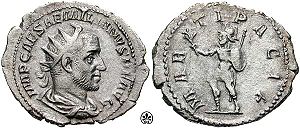
, the god of war, had another aspect, Mars Pacifer, Mars the bringer of Peace, who is shown on coins of the later Roman Empire bearing an olive branch. Appian
describes the use of the olive-branch as a gesture of peace by the enemies of the Roman general Scipio Aemilianus in the Numantine War
and by Hasdrubal the Boeotarch
of Carthage
.
art. The dove derives from the simile of the Holy Spirit
in the Gospels and the olive branch from classical symbolism. The early Christians, according to Winckelmann
, often allegorised peace on their sepulchres by the figure of a dove bearing an olive branch in its beak. For example, in the Catacomb of Priscilla
in Rome (2nd – 5th centuries CE) there is a depiction of three men (traditionally taken to be Shadrach, Meshach, and Abednego
of the Book of Daniel
) over whom hovers a dove with a branch; and in another of the Roman catacombs there is a shallow relief sculpture showing a dove with a branch flying to a figure marked in Greek ΕΙΡΗΝΗ (Eirene, or Peace).
Tertullian
(c.160 - c.220) compared Noah
's dove in the Hebrew Bible, who "announced to the world the assaugement of divine wrath, when she had been sent out of the ark and returned with the olive branch". with the Holy Spirit in baptism "bringing us the peace of God, sent out from the heavens". In his 4th century Latin translation
of the story of Noah, St Jerome rendered "leaf of olive" (Hebrew alay zayit) in Genesis 8:11 as "branch of olive" (Latin ramum olivae). In the 5th century, by which time a dove with an olive branch had become established as a Christian symbol of peace, St Augustine
wrote in On Christian Doctrine
that, "perpetual peace is indicated by the olive branch (oleae ramusculo) which the dove brought with it when it returned to the ark." However, in Jewish tradition there is no reference to an olive branch in the story of the Flood and no association of the olive leaf with peace.
in July 1775 in the hope of avoiding a full-blown war with Great Britain was called the Olive Branch Petition
.
The eagle
on the Great Seal of the United States
grasps with its right talon an olive branch bearing thirteen olives and leaves. The flags of many nations and the seal of the United Nations
feature olive branches in their designs.
The flag of Cyprus
and coat of arms of Cyprus
both use olive branches as symbols of peace and reflections of the country's ancient Greek
heritage. Olive branches also appear in many police patches and badges across the world to signify peace.
Western culture
Western culture, sometimes equated with Western civilization or European civilization, refers to cultures of European origin and is used very broadly to refer to a heritage of social norms, ethical values, traditional customs, religious beliefs, political systems, and specific artifacts and...
, derived from the customs of Ancient Greece
Ancient Greece
Ancient Greece is a civilization belonging to a period of Greek history that lasted from the Archaic period of the 8th to 6th centuries BC to the end of antiquity. Immediately following this period was the beginning of the Early Middle Ages and the Byzantine era. Included in Ancient Greece is the...
, symbolizes peace or victory and was worn by brides.
Ancient Greece and Rome
Greek mythology
Greek mythology is the body of myths and legends belonging to the ancient Greeks, concerning their gods and heroes, the nature of the world, and the origins and significance of their own cult and ritual practices. They were a part of religion in ancient Greece...
, Athene competed with Poseidon
Poseidon
Poseidon was the god of the sea, and, as "Earth-Shaker," of the earthquakes in Greek mythology. The name of the sea-god Nethuns in Etruscan was adopted in Latin for Neptune in Roman mythology: both were sea gods analogous to Poseidon...
for possession of Athens
Athens
Athens , is the capital and largest city of Greece. Athens dominates the Attica region and is one of the world's oldest cities, as its recorded history spans around 3,400 years. Classical Athens was a powerful city-state...
. Poseidon claimed possession by thrusting his trident into the Acropolis
Acropolis
Acropolis means "high city" in Greek, literally city on the extremity and is usually translated into English as Citadel . For purposes of defense, early people naturally chose elevated ground to build a new settlement, frequently a hill with precipitous sides...
, where a well of sea-water gushed out. Athene took possession by planting the first olive tree beside the well. The court of gods and goddesses ruled that Athene had the better right to the land because she had given it the better gift. Olive wreath
Olive wreath
The olive wreath also known as kotinos , was the prize for the winner at the ancient Olympic Games. It was an olive branch, of the wild- olive tree that grew at Olympia, intertwined to form a circle or a horse-shoe. According to Pausanias it was introduced by Heracles as a prize for the running...
s were worn by brides and awarded to olympic victors.
The use of the olive as a symbol of peace dates at least to the fifth century BCE. It was mentioned by the Greek playwright Aristophanes
Aristophanes
Aristophanes , son of Philippus, of the deme Cydathenaus, was a comic playwright of ancient Athens. Eleven of his forty plays survive virtually complete...
in Peace
Peace (play)
Peace is an Athenian Old Comedy written and produced by the Greek playwright Aristophanes. It won second prize at the City Dionysia where it was staged just a few days before the ratification of the Peace of Nicias , which promised to end the ten year old Peloponnesian War...
(Eirene), where he refers to "greatest of all goddesses, Eirene
Eirene (Greek goddess)
Eirene, or Irene |Pax]]), one of the Horae, was the personification of peace, and was depicted in art as a beautiful young woman carrying a cornucopia, sceptre and a torch or rhyton. She is said sometimes to be the daughter of Zeus and Themis....
, goddess of peace, her to whom the olive is so dear". The olive branch was one of the attributes of Eirene on Roman Imperial coins. For example, the reverse of a tetradrachm
Tetradrachm
The tetradrachm was an Ancient Greek silver coin equivalent to four drachmae. It was in wide circulation from 510 to 38 BC.-History:Many surviving tetradrachms were minted by the polis of Athens from around the middle of the 5th century BC onwards; the popular coin was widely used in transactions...
of Vespasian
Vespasian
Vespasian , was Roman Emperor from 69 AD to 79 AD. Vespasian was the founder of the Flavian dynasty, which ruled the Empire for a quarter century. Vespasian was descended from a family of equestrians, who rose into the senatorial rank under the Emperors of the Julio-Claudian dynasty...
from Alexandria
Alexandria
Alexandria is the second-largest city of Egypt, with a population of 4.1 million, extending about along the coast of the Mediterranean Sea in the north central part of the country; it is also the largest city lying directly on the Mediterranean coast. It is Egypt's largest seaport, serving...
, 70-71 CE, shows Eirene standing holding a branch upward in her right hand.
The Roman
Rome
Rome is the capital of Italy and the country's largest and most populated city and comune, with over 2.7 million residents in . The city is located in the central-western portion of the Italian Peninsula, on the Tiber River within the Lazio region of Italy.Rome's history spans two and a half...
poet Virgil
Virgil
Publius Vergilius Maro, usually called Virgil or Vergil in English , was an ancient Roman poet of the Augustan period. He is known for three major works of Latin literature, the Eclogues , the Georgics, and the epic Aeneid...
(70-10 BCE) associated "the plump olive" with the goddess Pax
Pax (mythology)
In Roman mythology, Pax [paqs] was recognized as a goddess during the rule of Augustus. On the Campus Martius, she had a temple called the Ara Pacis, and another temple on the Forum Pacis. She was depicted in art with olive branches, a cornucopia and a scepter...
(the Roman Eirene) and he used the olive branch as a symbol of peace in his Aeneid
Aeneid
The Aeneid is a Latin epic poem, written by Virgil between 29 and 19 BC, that tells the legendary story of Aeneas, a Trojan who travelled to Italy, where he became the ancestor of the Romans. It is composed of roughly 10,000 lines in dactylic hexameter...
:
- "High on the stern Aeneas his stand,
- And held a branch of olive in his hand,
- While thus he spoke: "The Phrygians' arms you see,
- Expelled from Troy, provoked in Italy
- By Latian foes, with war unjustly made;
- At first affianced, and at last betrayed.
- This message bear: The Trojans and their chief
- Bring holy peace, and beg the king's relief."
For the Romans, there was an intimate relationship between war and peace, and Mars
Mars (mythology)
Mars was the Roman god of war and also an agricultural guardian, a combination characteristic of early Rome. He was second in importance only to Jupiter, and he was the most prominent of the military gods worshipped by the Roman legions...
, the god of war, had another aspect, Mars Pacifer, Mars the bringer of Peace, who is shown on coins of the later Roman Empire bearing an olive branch. Appian
Appian
Appian of Alexandria was a Roman historian of Greek ethnicity who flourished during the reigns of Trajan, Hadrian, and Antoninus Pius.He was born ca. 95 in Alexandria. He tells us that, after having filled the chief offices in the province of Egypt, he went to Rome ca. 120, where he practised as...
describes the use of the olive-branch as a gesture of peace by the enemies of the Roman general Scipio Aemilianus in the Numantine War
Numantine War
The Numantine War was the last conflict of the Celtiberian Wars fought by the Romans to subdue those people along the Ebro. It was a twenty year long conflict between the Celtiberian tribes of Hispania Citerior and the Roman government. It began in 154 BC as a revolt of the Celtiberians of...
and by Hasdrubal the Boeotarch
Hasdrubal the Boeotarch
-Biography:Little is known about Hasdrubal the Boeotarch, the general who lost the Third Punic War to Scipio Aemilianus, Consul of the Roman Republic at the Siege of Carthage in 146 BC...
of Carthage
Carthage
Carthage , implying it was a 'new Tyre') is a major urban centre that has existed for nearly 3,000 years on the Gulf of Tunis, developing from a Phoenician colony of the 1st millennium BC...
.
Early Christianity
The olive branch appears with a dove in early ChristianChristian
A Christian is a person who adheres to Christianity, an Abrahamic, monotheistic religion based on the life and teachings of Jesus of Nazareth as recorded in the Canonical gospels and the letters of the New Testament...
art. The dove derives from the simile of the Holy Spirit
Holy Spirit
Holy Spirit is a term introduced in English translations of the Hebrew Bible, but understood differently in the main Abrahamic religions.While the general concept of a "Spirit" that permeates the cosmos has been used in various religions Holy Spirit is a term introduced in English translations of...
in the Gospels and the olive branch from classical symbolism. The early Christians, according to Winckelmann
Johann Joachim Winckelmann
Johann Joachim Winckelmann was a German art historian and archaeologist. He was a pioneering Hellenist who first articulated the difference between Greek, Greco-Roman and Roman art...
, often allegorised peace on their sepulchres by the figure of a dove bearing an olive branch in its beak. For example, in the Catacomb of Priscilla
Catacomb of Priscilla
The Catacomb of Priscilla on the Via Salaria in Rome, Italy, is situated in what was a quarry in Roman times. This quarry was used for Christian burials from the late 2nd century through the 4th century. Some of the walls and ceilings display fine decorations illustrating Biblical scenes...
in Rome (2nd – 5th centuries CE) there is a depiction of three men (traditionally taken to be Shadrach, Meshach, and Abednego
Shadrach, Meshach, and Abednego
Shadrach, Meshach and Abednego are characters in the biblical Hebrew book of Daniel Chapters 1 – 3, known for their exclusive devotion to God. In particular, they are known for being saved by divine intervention from the Babylonian execution of being burned alive in a fiery furnace...
of the Book of Daniel
Book of Daniel
The Book of Daniel is a book in the Hebrew Bible. The book tells of how Daniel, and his Judean companions, were inducted into Babylon during Jewish exile, and how their positions elevated in the court of Nebuchadnezzar. The court tales span events that occur during the reigns of Nebuchadnezzar,...
) over whom hovers a dove with a branch; and in another of the Roman catacombs there is a shallow relief sculpture showing a dove with a branch flying to a figure marked in Greek ΕΙΡΗΝΗ (Eirene, or Peace).
Tertullian
Tertullian
Quintus Septimius Florens Tertullianus, anglicised as Tertullian , was a prolific early Christian author from Carthage in the Roman province of Africa. He is the first Christian author to produce an extensive corpus of Latin Christian literature. He also was a notable early Christian apologist and...
(c.160 - c.220) compared Noah
Noah
Noah was, according to the Hebrew Bible, the tenth and last of the antediluvian Patriarchs. The biblical story of Noah is contained in chapters 6–9 of the book of Genesis, where he saves his family and representatives of all animals from the flood by constructing an ark...
's dove in the Hebrew Bible, who "announced to the world the assaugement of divine wrath, when she had been sent out of the ark and returned with the olive branch". with the Holy Spirit in baptism "bringing us the peace of God, sent out from the heavens". In his 4th century Latin translation
Vulgate
The Vulgate is a late 4th-century Latin translation of the Bible. It was largely the work of St. Jerome, who was commissioned by Pope Damasus I in 382 to make a revision of the old Latin translations...
of the story of Noah, St Jerome rendered "leaf of olive" (Hebrew alay zayit) in Genesis 8:11 as "branch of olive" (Latin ramum olivae). In the 5th century, by which time a dove with an olive branch had become established as a Christian symbol of peace, St Augustine
Augustine of Hippo
Augustine of Hippo , also known as Augustine, St. Augustine, St. Austin, St. Augoustinos, Blessed Augustine, or St. Augustine the Blessed, was Bishop of Hippo Regius . He was a Latin-speaking philosopher and theologian who lived in the Roman Africa Province...
wrote in On Christian Doctrine
On Christian Doctrine
De doctrina christiana is a theological text written by St. Augustine of Hippo. It consists of four books that describe how to interpret and teach the Scriptures. The first three of these books were published in 397 and the fourth added in 426. By writing this text, St...
that, "perpetual peace is indicated by the olive branch (oleae ramusculo) which the dove brought with it when it returned to the ark." However, in Jewish tradition there is no reference to an olive branch in the story of the Flood and no association of the olive leaf with peace.
Modern usage
An olive branch held by a dove was used as a peace symbol in 18th century Britain and America. A £2 note of North Carolina (1771) depicted the dove and olive with a motto meaning: "Peace restored". Georgia's $40 note of 1778 portrayed the dove and olive and a hand holding a dagger, with a motto meaning "Either war or peace, prepared for both." The olive branch appeared as a peace symbol in other 18th century prints. In January 1775, the frontispiece of the London Magazine published an engraving: "Peace descends on a cloud from the Temple of Commerce," in which the Goddess of Peace brings an olive branch to America and Britannia. A petition adopted by the American Continental CongressContinental Congress
The Continental Congress was a convention of delegates called together from the Thirteen Colonies that became the governing body of the United States during the American Revolution....
in July 1775 in the hope of avoiding a full-blown war with Great Britain was called the Olive Branch Petition
Olive Branch Petition
The Olive Branch Petition was adopted by the Continental Congress in July 1775 in an attempt to avoid a full-blown war with Great Britain. The petition affirmed American loyalty to Great Britain and entreated the king to prevent further conflict...
.
The eagle
Eagle
Eagles are members of the bird family Accipitridae, and belong to several genera which are not necessarily closely related to each other. Most of the more than 60 species occur in Eurasia and Africa. Outside this area, just two species can be found in the United States and Canada, nine more in...
on the Great Seal of the United States
Great Seal of the United States
The Great Seal of the United States is used to authenticate certain documents issued by the United States federal government. The phrase is used both for the physical seal itself , and more generally for the design impressed upon it...
grasps with its right talon an olive branch bearing thirteen olives and leaves. The flags of many nations and the seal of the United Nations
United Nations
The United Nations is an international organization whose stated aims are facilitating cooperation in international law, international security, economic development, social progress, human rights, and achievement of world peace...
feature olive branches in their designs.
The flag of Cyprus
Flag of Cyprus
The flag of Cyprus came into use on August 16, 1960, under the Zürich and London Agreements, whereby a constitution was drafted and Cyprus was proclaimed an independent state. The flag was designed by Turkish Cypriot art teacher İsmet Güney....
and coat of arms of Cyprus
Coat of arms of Cyprus
The coat of arms of Cyprus depicts a dove carrying an olive branch over “1960”, the year of Cypriot independence from British rule...
both use olive branches as symbols of peace and reflections of the country's ancient Greek
Ancient Greece
Ancient Greece is a civilization belonging to a period of Greek history that lasted from the Archaic period of the 8th to 6th centuries BC to the end of antiquity. Immediately following this period was the beginning of the Early Middle Ages and the Byzantine era. Included in Ancient Greece is the...
heritage. Olive branches also appear in many police patches and badges across the world to signify peace.
Other uses
- Several towns have been named Olive Branch as a symbol of peaceful living, such as Olive Branch, MississippiOlive Branch, MississippiOlive Branch is a city in DeSoto County, Mississippi, United States. The population was 21,054 at the 2000 census. A July 1, 2008 United States Census Bureau estimate placed the population at 31,830, making it the ninth-largest city in the state of Mississippi...
.