

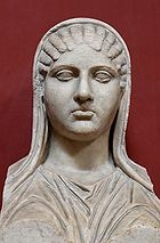
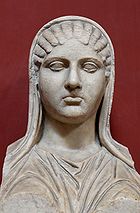
Aspasia

Encyclopedia
Miletus
Miletus was an ancient Greek city on the western coast of Anatolia , near the mouth of the Maeander River in ancient Caria...
woman who was famous
Celebrity
A celebrity, also referred to as a celeb in popular culture, is a person who has a prominent profile and commands a great degree of public fascination and influence in day-to-day media...
for her involvement with the Athenian
Athens
Athens , is the capital and largest city of Greece. Athens dominates the Attica region and is one of the world's oldest cities, as its recorded history spans around 3,400 years. Classical Athens was a powerful city-state...
statesman Pericles
Pericles
Pericles was a prominent and influential statesman, orator, and general of Athens during the city's Golden Age—specifically, the time between the Persian and Peloponnesian wars...
. Very little is known about the details of her life. She spent most of her adult life in Athens, and she may have influenced Pericles and Athenian politics. She is mentioned in the writings of Plato
Plato
Plato , was a Classical Greek philosopher, mathematician, student of Socrates, writer of philosophical dialogues, and founder of the Academy in Athens, the first institution of higher learning in the Western world. Along with his mentor, Socrates, and his student, Aristotle, Plato helped to lay the...
, Aristophanes
Aristophanes
Aristophanes , son of Philippus, of the deme Cydathenaus, was a comic playwright of ancient Athens. Eleven of his forty plays survive virtually complete...
, Xenophon
Xenophon
Xenophon , son of Gryllus, of the deme Erchia of Athens, also known as Xenophon of Athens, was a Greek historian, soldier, mercenary, philosopher and a contemporary and admirer of Socrates...
, and other authors of the day.
Ancient writers also reported that Aspasia was a brothel keeper and a harlot, although these accounts are disputed by modern scholars, on the grounds that many of the writers were comic poets concerned with defaming Pericles. Some researchers question even the historical tradition that she was a hetaera
Hetaera
In ancient Greece, hetaerae were courtesans, that is to say, highly educated, sophisticated companions...
, or courtesan
Courtesan
A courtesan was originally a female courtier, which means a person who attends the court of a monarch or other powerful person.In feudal society, the court was the centre of government as well as the residence of the monarch, and social and political life were often completely mixed together...
, and have suggested that she may actually have been married to Pericles. Aspasia had a son by Pericles, Pericles the Younger
Pericles the Younger
Pericles the Younger was an ancient Athenian strategos , the illegitimate son of famous Athenian leader Pericles by Aspasia....
, who later became a general in the Athenian military and was executed after the Battle of Arginusae
Battle of Arginusae
The naval Battle of Arginusae took place in 406 BC during the Peloponnesian War near the Arginusae islands east of the island of Lesbos. In the battle, an Athenian fleet commanded by eight strategoi defeated a Spartan fleet under Callicratidas...
. She is believed to have become the courtesan of Lysicles, another Athenian statesman and general, following the death of Pericles the Elder.
Origin and early years
Aspasia was born in the IoniaIonia
Ionia is an ancient region of central coastal Anatolia in present-day Turkey, the region nearest İzmir, which was historically Smyrna. It consisted of the northernmost territories of the Ionian League of Greek settlements...
n Greek city of Miletus (in the modern province of Aydın
Aydin
Aydın is a city in and the seat of Aydın Province in Turkey's Aegean Region. The city is located at the heart of the lower valley of Büyük Menderes River at a commanding position for the region extending from the uplands of the valley down to the seacoast...
, Turkey
Turkey
Turkey , known officially as the Republic of Turkey , is a Eurasian country located in Western Asia and in East Thrace in Southeastern Europe...
). Little is known about her family except that her father's name was Axiochus, although it is evident that she must have belonged to a wealthy family, for only the well-to-do could have afforded the excellent education that she received. Some ancient sources claim that she was a Caria
Caria
Caria was a region of western Anatolia extending along the coast from mid-Ionia south to Lycia and east to Phrygia. The Ionian and Dorian Greeks colonized the west of it and joined the Carian population in forming Greek-dominated states there...
n prisoner-of-war turned slave; these statements are generally regarded as false.
It is not known under what circumstances she first traveled to Athens. The discovery of a 4th-century grave inscription that mentions the names of Axiochus and Aspasius has led historian Peter K. Bicknell to attempt a reconstruction of Aspasia's family background and Athenian connections. His theory connects her to Alcibiades II of Scambonidae (grandfather of the famous Alcibiades
Alcibiades
Alcibiades, son of Clinias, from the deme of Scambonidae , was a prominent Athenian statesman, orator, and general. He was the last famous member of his mother's aristocratic family, the Alcmaeonidae, which fell from prominence after the Peloponnesian War...
), who was ostracized from Athens in 460 BC and may have spent his exile in Miletus. Bicknell conjectures that, following his exile, the elder Alcibiades went to Miletus, where he married the daughter of a certain Axiochus. Alcibiades apparently returned to Athens with his new wife and her younger sister, Aspasia. Bicknell argues that the first child of this marriage was named Axiochus (uncle of the famous Alcibiades) and the second Aspasios. He also maintains that Pericles met Aspasia through his close connections with Alcibiades's household.
Life in Athens

Hetaera
In ancient Greece, hetaerae were courtesans, that is to say, highly educated, sophisticated companions...
and probably ran a brothel
Brothel
Brothels are business establishments where patrons can engage in sexual activities with prostitutes. Brothels are known under a variety of names, including bordello, cathouse, knocking shop, whorehouse, strumpet house, sporting house, house of ill repute, house of prostitution, and bawdy house...
. Hetaerae were professional high-class entertainers, as well as courtesans. Besides developing physical beauty, they differed from most Athenian women in being educated (often to a high standard, as in Aspasia's case), having independence, and paying taxes. They were the nearest thing perhaps to liberated women; and Aspasia, who became a vivid figure in Athenian society, was probably an obvious example. According to Plutarch
Plutarch
Plutarch then named, on his becoming a Roman citizen, Lucius Mestrius Plutarchus , c. 46 – 120 AD, was a Greek historian, biographer, essayist, and Middle Platonist known primarily for his Parallel Lives and Moralia...
, Aspasia was compared to the famous Thargelia
Thargelia (person)
Thargelia was a renowned hetaera in ancient Greece.According to Plutarch, she was born in Ionia and "made her onslaughts upon the most influential men" of her times. Thargelia was noted for her physical beauty and was endowed with grace of manners as well as clever wits...
, another renowned Ionian hetaera of ancient times.
Being a foreigner and possibly a hetaera, Aspasia was free of the legal restraints that traditionally confined married women to their homes, and thereby was allowed to participate in the public life of the city. She became the mistress of the statesman Pericles in the early 440s. After he divorced his first wife (c. 445 BC), Aspasia began to live with him, although her marital status remains disputed. Their son, Pericles the Younger
Pericles the Younger
Pericles the Younger was an ancient Athenian strategos , the illegitimate son of famous Athenian leader Pericles by Aspasia....
, must have been born by 440 BC. Aspasia would have to have been quite young, if she were able to bear a child to Lysicles c. 428 BC.
In social circles, Aspasia was noted for her ability as a conversationalist and adviser rather than merely an object of physical beauty. According to Plutarch, their house became an intellectual centre in Athens, attracting the most prominent writers and thinkers, including the philosopher Socrates
Socrates
Socrates was a classical Greek Athenian philosopher. Credited as one of the founders of Western philosophy, he is an enigmatic figure known chiefly through the accounts of later classical writers, especially the writings of his students Plato and Xenophon, and the plays of his contemporary ...
. The biographer writes that, despite her immoral life, Athenian men would bring their wives to hear her converse.
Personal and judicial attacks
Pericles, Aspasia and their friends were not immune from attack, as preeminence in democratic AthensAthenian democracy
Athenian democracy developed in the Greek city-state of Athens, comprising the central city-state of Athens and the surrounding territory of Attica, around 508 BC. Athens is one of the first known democracies. Other Greek cities set up democracies, and even though most followed an Athenian model,...
was not equivalent to absolute rule. Her relationship with Pericles and her subsequent political influence aroused many reactions. Donald Kagan
Donald Kagan
Donald Kagan is an American historian at Yale University specializing in ancient Greece, notable for his four-volume history of the Peloponnesian War. 1987-1988 Acting Director of Athletics, Yale University. He was Dean of Yale College from 1989–1992. He formerly taught in the Department of...
, a Yale
Yale University
Yale University is a private, Ivy League university located in New Haven, Connecticut, United States. Founded in 1701 in the Colony of Connecticut, the university is the third-oldest institution of higher education in the United States...
historian, believes that Aspasia was particularly unpopular in the years immediately following the Samian War
Samian War
The Samian War was an Ancient Greek military conflict between Athens and Samos. The war was initiated by Athens' intervention in a dispute between Samos and Miletus...
. In 440 BC, Samos
Samos Island
Samos is a Greek island in the eastern Aegean Sea, south of Chios, north of Patmos and the Dodecanese, and off the coast of Asia Minor, from which it is separated by the -wide Mycale Strait. It is also a separate regional unit of the North Aegean region, and the only municipality of the regional...
was at war with Miletus over Priene
Priene
Priene was an ancient Greek city of Ionia at the base of an escarpment of Mycale, about north of the then course of the Maeander River, from today's Aydin, from today's Söke and from ancient Miletus...
, an ancient city of Ionia
Ionia
Ionia is an ancient region of central coastal Anatolia in present-day Turkey, the region nearest İzmir, which was historically Smyrna. It consisted of the northernmost territories of the Ionian League of Greek settlements...
in the foot-hills of Mycale
Mycale
Mycale, also Mykale and Mycali , called Samsun Daği and Dilek Daği in modern Turkey, is a mountain on the west coast of central Anatolia in Turkey, north of the mouth of the Maeander and divided from the Greek island of Samos by the 1300 metre wide Samos Strait...
. Worsted in the war, the Milesians came to Athens to plead their case against the Samians. When the Athenians ordered the two sides to stop fighting and submit the case to arbitration at Athens, the Samians refused. In response, Pericles passed a decree dispatching an expedition to Samos. The campaign proved to be difficult and the Athenians had to endure heavy casualties before Samos was defeated. According to Plutarch, it was thought that Aspasia, who came from Miletus, was responsible for the Samian War, and that Pericles had decided against and attacked Samos to gratify her.
| "Thus far the evil was not serious and we were the only sufferers. But now some young drunkards go to Megara and carry off the courtesan Simaetha; the Megarians, hurt to the quick, run off in turn with two harlots of the house of Aspasia; and so for three whores Greece is set ablaze. Then Pericles, aflame with ire on his Olympian height, let loose the lightning, caused the thunder to roll, upset Greece and passed an edict, which ran like the song, That the Megarians be banished both from our land and from our markets and from the sea and from the continent." |
| From Aristophanes Aristophanes Aristophanes , son of Philippus, of the deme Cydathenaus, was a comic playwright of ancient Athens. Eleven of his forty plays survive virtually complete... ' comedic play, The Acharnians (523–533) |
Before the eruption of the Peloponnesian War
Peloponnesian War
The Peloponnesian War, 431 to 404 BC, was an ancient Greek war fought by Athens and its empire against the Peloponnesian League led by Sparta. Historians have traditionally divided the war into three phases...
(431 BC–404 BC), Pericles, some of his closest associates and Aspasia faced a series of personal and legal attacks. Aspasia, in particular, was accused of corrupting the women of Athens in order to satisfy Pericles' perversions. According to Plutarch, she was put on trial for impiety, with the comic poet Hermippus
Hermippus
Hermippus was the one-eyed Athenian writer of the Old Comedy who flourished during the Peloponnesian War. He was the son of Lysis, and the brother of the comic poet Myrtilus. He was younger than Telecleides and older than Eupolis and Aristophanes. According to the Suda, he wrote forty plays, and...
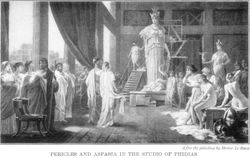
as prosecutor. All these accusations were probably nothing more than unproven slanders, but the whole experience was bitter for the Athenian leader. Although Aspasia was acquitted thanks to a rare emotional outburst of Pericles, his friend, Phidias
Phidias
Phidias or the great Pheidias , was a Greek sculptor, painter and architect, who lived in the 5th century BC, and is commonly regarded as one of the greatest of all sculptors of Classical Greece: Phidias' Statue of Zeus at Olympia was one of the Seven Wonders of the Ancient World...
, died in prison. Another friend of his, Anaxagoras
Anaxagoras
Anaxagoras was a Pre-Socratic Greek philosopher. Born in Clazomenae in Asia Minor, Anaxagoras was the first philosopher to bring philosophy from Ionia to Athens. He attempted to give a scientific account of eclipses, meteors, rainbows, and the sun, which he described as a fiery mass larger than...
, was attacked by the ecclesia
Ecclesia (ancient Athens)
The ecclesia or ekklesia was the principal assembly of the democracy of ancient Athens during its "Golden Age" . It was the popular assembly, opened to all male citizens over the age of 30 with 2 years of military service by Solon in 594 BC meaning that all classes of citizens in Athens were able...
(the Athenian Assembly) for his religious beliefs. According to Kagan it is possible that Aspasia's trial and acquittal were late inventions, "in which real slanders, suspicions and ribald jokes were converted into an imaginary lawsuit". Anthony J. Podlecki, Professor of Classics
Classics
Classics is the branch of the Humanities comprising the languages, literature, philosophy, history, art, archaeology and other culture of the ancient Mediterranean world ; especially Ancient Greece and Ancient Rome during Classical Antiquity Classics (sometimes encompassing Classical Studies or...
at the University of British Columbia
University of British Columbia
The University of British Columbia is a public research university. UBC’s two main campuses are situated in Vancouver and in Kelowna in the Okanagan Valley...
, asserts that Plutarch or his source possibly misunderstood a scene in some comedy. Kagan argues that even if we believe these stories, Aspasia was unharmed with or without the help of Pericles.
In The Acharnians
The Acharnians
The Acharnians is the third play - and the earliest of the eleven surviving plays - by the great Athenian playwright Aristophanes. It was produced in 425 BCE on behalf of the young dramatist by an associate, Callistratus, and it won first place at the Lenaia festival...
, Aristophanes
Aristophanes
Aristophanes , son of Philippus, of the deme Cydathenaus, was a comic playwright of ancient Athens. Eleven of his forty plays survive virtually complete...
blames Aspasia for the Peloponnesian War. He claims that the Megarian decree
Megarian decree
The Megarian Decree was a set of economic sanctions levied upon Megara circa 432 BC by the Athenian Empire shortly before the outbreak of the Peloponnesian War. The ostensible reason for the Decree was the Megarians' supposed trespass on land sacred to Demeter and the killing of the Athenian herald...
of Pericles, which excluded Megara
Megara
Megara is an ancient city in Attica, Greece. It lies in the northern section of the Isthmus of Corinth opposite the island of Salamis, which belonged to Megara in archaic times, before being taken by Athens. Megara was one of the four districts of Attica, embodied in the four mythic sons of King...
from trade with Athens or its allies, was retaliation for prostitutes being kidnapped from the house of Aspasia by Megarians. Aristophanes' portrayal of Aspasia as responsible, from personal motives, for the outbreak of the war with Sparta
Sparta
Sparta or Lacedaemon, was a prominent city-state in ancient Greece, situated on the banks of the River Eurotas in Laconia, in south-eastern Peloponnese. It emerged as a political entity around the 10th century BC, when the invading Dorians subjugated the local, non-Dorian population. From c...
may reflect memory of the earlier episode involving Miletus and Samos. Plutarch reports also the taunting comments of other comic poets, such as Eupolis
Eupolis
Eupolis was an Athenian poet of the Old Comedy, who flourished during the time of the Peloponnesian War.-Biography:Nothing whatsoever is known of his personal history. There are few sources on when he first appeared on the stage...
and Cratinus
Cratinus
Cratinus , Athenian comic poet of the Old Comedy.-Life:Cratinus was victorious six times at the City Dionysia, first probably in the mid- to late 450s BCE , and three times at the Lenaia, first probably in the early 430s...
. According to Podlecki, Douris appears to have propounded the view that Aspasia instigated both the Samian and Peloponnesian Wars.
Aspasia was labeled the "New Omphale
Omphale
In Greek mythology, Omphale was a daughter of Iardanus, either a king of Lydia, or a river-god. Omphale was queen of the kingdom of Lydia in Asia Minor; according to Bibliotheke she was the wife of Tmolus, the oak-clad mountain king of Lydia; after he was gored to death by a bull, she continued...
", "Deianira
Deianira
Deïanira or Dejanira is a figure in Greek mythology, best-known for being Heracles' third wife and, in the late Classical story, unwittingly killing him with the Shirt of Nessus...
", "Hera
Hera
Hera was the wife and one of three sisters of Zeus in the Olympian pantheon of Greek mythology and religion. Her chief function was as the goddess of women and marriage. Her counterpart in the religion of ancient Rome was Juno. The cow and the peacock were sacred to her...
" and "Helen". Further attacks on Pericles' relationship with Aspasia are reported by Athenaeus
Athenaeus
Athenaeus , of Naucratis in Egypt, Greek rhetorician and grammarian, flourished about the end of the 2nd and beginning of the 3rd century AD...
. Even Pericles' own son, Xanthippus
Xanthippus
Xanthippus was a Greek mercenary general hired by the Carthaginians to aid in their war against the Romans during the First Punic War...
, who had political ambitions, did not hesitate to slander his father about his domestic affairs.
Later years and death
In 429 BC during the Plague of AthensPlague of Athens
The Plague of Athens was a devastating epidemic which hit the city-state of Athens in ancient Greece during the second year of the Peloponnesian War , when an Athenian victory still seemed within reach. It is believed to have entered Athens through Piraeus, the city's port and sole source of food...
, Pericles witnessed the death of his sister and of both his legitimate sons, Paralus and Xanthippus
Paralus and Xanthippus
Paralus and Xanthippus were the two legitimate sons of Pericles, Xanthippus being the older one and Paralus the younger, and hence members of the Alcmaeonid family...
, from his first wife. With his morale undermined, he burst into tears, and not even Aspasia's companionship could console him. Just before his death, the Athenians allowed a change in the citizenship law of 451 BC that made his half-Athenian son with Aspasia, Pericles the Younger, a citizen and legitimate heir, a decision all the more striking in considering that Pericles himself had proposed the law confining citizenship to those of Athenian parentage on both sides. Pericles died of the plague in the autumn of 429 BC.
Plutarch cites Aeschines Socraticus
Aeschines Socraticus
Aeschines of Sphettus or Aeschines Socraticus , son of Lysanias, of the deme Sphettus of Athens was in his youth a follower of Socrates. Historians call him Aeschines Socraticus—"the Socratic Aeschines"—to distinguish him from the more historically influential Athenian orator also named...
, who wrote a dialogue on Aspasia (now lost), to the effect that after Pericles's death Aspasia lived with Lysicles, an Athenian general and democratic leader, with whom she had another son; and that she made him the first man at Athens. Lysicles was killed in action in 428 BC. With Lysicles' death the contemporaneous record ends. It is unknown, for example, if she was alive when her son, Pericles, was elected general or when he was executed after the Battle of Arginusae
Battle of Arginusae
The naval Battle of Arginusae took place in 406 BC during the Peloponnesian War near the Arginusae islands east of the island of Lesbos. In the battle, an Athenian fleet commanded by eight strategoi defeated a Spartan fleet under Callicratidas...
. The time of her death that most historians give (c. 401 BC-400 BC) is based on the assessment that Aspasia died before the execution of Socrates in 399 BC, a chronology which is implied in the structure of Aeschines' Aspasia.
Ancient philosophical works
Aspasia appears in the philosophical writings of Plato, XenophonXenophon
Xenophon , son of Gryllus, of the deme Erchia of Athens, also known as Xenophon of Athens, was a Greek historian, soldier, mercenary, philosopher and a contemporary and admirer of Socrates...
, Aeschines Socraticus and Antisthenes
Antisthenes
Antisthenes was a Greek philosopher and a pupil of Socrates. Antisthenes first learned rhetoric under Gorgias before becoming an ardent disciple of Socrates. He adopted and developed the ethical side of Socrates' teachings, advocating an ascetic life lived in accordance with virtue. Later writers...
. Some scholars argue that Plato was impressed by her intelligence and wit and based his character Diotima
Diotima of Mantinea
Diotima of Mantinea is a female seer who plays an important role in Plato's Symposium. Her ideas are the origin of the concept of Platonic love. Since the only source concerning her is Plato, it is uncertain whether she was a real historical personage or merely a fictional creation...
in the Symposium
Symposium (Plato)
The Symposium is a philosophical text by Plato dated c. 385–380 BCE. It concerns itself at one level with the genesis, purpose and nature of love....
on her, while others suggest that Diotima was in fact a historical figure. According to Charles Kahn, Professor of Philosophy at the University of Pennsylvania
University of Pennsylvania
The University of Pennsylvania is a private, Ivy League university located in Philadelphia, Pennsylvania, United States. Penn is the fourth-oldest institution of higher education in the United States,Penn is the fourth-oldest using the founding dates claimed by each institution...
, Diotima is in many respects Plato's response to Aeschines' Aspasia.
| "Now, since it is thought that he proceeded thus against the Samians to gratify Aspasia, this may be a fitting place to raise the query what great art or power this woman had, that she managed as she pleased the foremost men of the state, and afforded the philosophers occasion to discuss her in exalted terms and at great length." |
| Plutarch, Pericles, XXIV |
In Menexenus
Menexenus
The Menexenus is a Socratic dialogue of Plato, traditionally included in the seventh tetralogy along with the Greater and Lesser Hippias and the Ion. The characters are Socrates and Menexenus, who is not to be confused with Socrates' son Menexenus. The Menexenus of Plato's dialogue appears also...
, Plato satirizes Aspasia's relationship with Pericles, and quotes Socrates as claiming ironically that she was a trainer of many orators. Socrates' intention is to cast aspersions on Pericles' rhetorical fame, claiming, also ironically, that since the Athenian statesman was educated by Aspasia, he would be superior in rhetoric
Rhetoric
Rhetoric is the art of discourse, an art that aims to improve the facility of speakers or writers who attempt to inform, persuade, or motivate particular audiences in specific situations. As a subject of formal study and a productive civic practice, rhetoric has played a central role in the Western...
to someone educated by Antiphon
Antiphon (person)
Antiphon the Sophist lived in Athens probably in the last two decades of the 5th century BC. There is an ongoing controversy over whether he is one and the same with Antiphon of the Athenian deme Rhamnus in Attica , the earliest of the ten Attic orators...
. He also attributes authorship of the Funeral Oration to Aspasia and attacks his contemporaries' veneration of Pericles. Kahn maintains that Plato has taken from Aeschines the motif of Aspasia as teacher of rhetoric for Pericles and Socrates. Plato's Aspasia and Aristophanes' Lysistrata
Lysistrata
Lysistrata is one of eleven surviving plays written by Aristophanes. Originally performed in classical Athens in 411 BC, it is a comic account of one woman's extraordinary mission to end The Peloponnesian War...
are two apparent exceptions to the rule of women's incapacity as orators, though these fictional characters tell us nothing about the actual status of women in Athens. As Martha L. Rose, Professor of History at Truman State University
Truman State University
Truman State University is a public liberal arts and sciences university in Missouri, United States and a member of the Council of Public Liberal Arts Colleges. About 6,000 students attend Truman, pursuing degrees in 43 undergraduate and 9 Graduate programs. It is located in Kirksville in...
, explains, "only in comedy do dogs litigate, birds govern, or women declaim".
Xenophon mentions Aspasia twice in his Socratic writings: in Memorabilia
Memorabilia (Xenophon)
Memorabilia is a collection of Socratic dialogues by Xenophon, a student of Socrates...
and in Oeconomicus. In both cases her advice is recommended to Critobulus by Socrates. In Memorabilia Socrates quotes Aspasia as saying that the matchmaker should report truthfully on the good characteristics of the man. In Oeconomicus Socrates defers to Aspasia as more knowledgeable about household management and the economic partnership between husband and wife.
Socratic dialogue
Socratic dialogue is a genre of prose literary works developed in Greece at the turn of the fourth century BC, preserved today in the dialogues of Plato and the Socratic works of Xenophon - either dramatic or narrative - in which characters discuss moral and philosophical problems, illustrating a...
after Aspasia (though neither survives except in fragments). Our major sources for Aeschines Socraticus' Aspasia are Athenaeus, Plutarch, and Cicero
Cicero
Marcus Tullius Cicero , was a Roman philosopher, statesman, lawyer, political theorist, and Roman constitutionalist. He came from a wealthy municipal family of the equestrian order, and is widely considered one of Rome's greatest orators and prose stylists.He introduced the Romans to the chief...
. In the dialogue, Socrates recommends that Callias send his son Hipponicus to Aspasia for instructions. When Callias recoils at the notion of a female teacher, Socrates notes that Aspasia had favorably influenced Pericles and, after his death, Lysicles. In a section of the dialogue, preserved in Latin
Latin
Latin is an Italic language originally spoken in Latium and Ancient Rome. It, along with most European languages, is a descendant of the ancient Proto-Indo-European language. Although it is considered a dead language, a number of scholars and members of the Christian clergy speak it fluently, and...
by Cicero, Aspasia figures as a "female Socrates", counseling first Xenophon's wife and then Xenophon himself (the Xenophon in question is not the famous historian) about acquiring virtue through self-knowledge. Aeschines presents Aspasia as a teacher and inspirer of excellence, connecting these virtues with her status as hetaira. According to Kahn, every single episode in Aeschines' Aspasia is not only fictitious but incredible.
Of Antisthenes' Aspasia only two or three quotations are extant. This dialogue contains much slander, but also anecdotes pertaining to Pericles' biography. Antisthenes appears to have attacked not only Aspasia, but the entire family of Pericles, including his sons. The philosopher believes that the great statesman chose the life of pleasure over virtue. Thus, Aspasia is presented as the personification of the life of sexual indulgence.
Modern literature
Novel
A novel is a book of long narrative in literary prose. The genre has historical roots both in the fields of the medieval and early modern romance and in the tradition of the novella. The latter supplied the present generic term in the late 18th century....
ists and poets
Poetry
Poetry is a form of literary art in which language is used for its aesthetic and evocative qualities in addition to, or in lieu of, its apparent meaning...
of the last centuries. In particular the romanticists
Romanticism
Romanticism was an artistic, literary and intellectual movement that originated in the second half of the 18th century in Europe, and gained strength in reaction to the Industrial Revolution...
of the 19th century and the historical novel
Historical novel
According to Encyclopædia Britannica, a historical novel is-Development:An early example of historical prose fiction is Luó Guànzhōng's 14th century Romance of the Three Kingdoms, which covers one of the most important periods of Chinese history and left a lasting impact on Chinese culture.The...
ists of the 20th century found in their story an inexhaustible source of inspiration. In 1835 Lydia Maria Child, an American abolitionist
Abolitionism
Abolitionism is a movement to end slavery.In western Europe and the Americas abolitionism was a movement to end the slave trade and set slaves free. At the behest of Dominican priest Bartolomé de las Casas who was shocked at the treatment of natives in the New World, Spain enacted the first...
, novelist, and journalist, published Philothea, a classical romance set in the days of Pericles and Aspasia. This book is regarded as the most successful and elaborate of the author's productions, because the female characters, especially Aspasia, are portrayed with great beauty and delicacy.
In 1836, Walter Savage Landor
Walter Savage Landor
Walter Savage Landor was an English writer and poet. His best known works were the prose Imaginary Conversations, and the poem Rose Aylmer, but the critical acclaim he received from contemporary poets and reviewers was not matched by public popularity...
, an English writer and poet, published Pericles and Aspasia, one of his most famous books. Pericles and Aspasia is a rendering of classical Athens through a series of imaginary letters, which contain numerous poems. The letters are frequently unfaithful to actual history but attempt to capture the spirit of the Age of Pericles
Age of Pericles
Fifth-century Athens refers to the Greek city-state of Athens in the period of roughly 480 BC-404 BC. This was a period of Athenian political hegemony, economic growth and cultural flourishing formerly known as the Golden Age of Athens or The Age of Pericles. The period began in 480 BC when an...
. Robert Hamerling
Robert Hamerling
Robert Hamerling was an Austrian poet.-Biography:Hamerling was born into a poor family at Kirchberg am Walde in Lower Austria....
is another novelist and poet who was inspired by Aspasia's personality. In 1876 he published his novel Aspasia, a book about the manners and morals of the Age of Pericles and a work of cultural and historical interest. Giacomo Leopardi
Giacomo Leopardi
Giacomo Taldegardo Francesco di Sales Saverio Pietro Leopardi was an Italian poet, essayist, philosopher, and philologist...
, an Italian poet influenced by the movement of romanticism, published a group of five poems known as the circle of Aspasia. These Leopardi poems were inspired by his painful experience of desperate and unrequited love for a woman named Fanny Targioni Tozzetti. Leopardi called this person Aspasia, after the companion of Pericles.
In 1918, novelist and playwright
Playwright
A playwright, also called a dramatist, is a person who writes plays.The term is not a variant spelling of "playwrite", but something quite distinct: the word wright is an archaic English term for a craftsman or builder...
George Cram Cook produced his first full-length play
Play (theatre)
A play is a form of literature written by a playwright, usually consisting of scripted dialogue between characters, intended for theatrical performance rather than just reading. There are rare dramatists, notably George Bernard Shaw, who have had little preference whether their plays were performed...
, The Athenian Women, which portrays Aspasia leading a strike for peace. Cook combined an anti-war theme with a Greek setting. American writer Gertrude Atherton
Gertrude Atherton
Gertrude Franklin Horn Atherton was an American writer.-Early Childhood:Gertrude Franklin Horn was born on October 30, 1857 in San Francisco to Thomas Ludovich Horn and his wife, the former Gertrude Franklin...
in The Immortal Marriage (1927) treats the story of Pericles and Aspasia and illustrates the period of the Samian War, the Peloponnesian War and the Plague of Athens. Taylor Caldwell
Taylor Caldwell
Janet Miriam Holland Taylor Caldwell was an Anglo-American novelist and prolific author of popular fiction, also known by the pen names Marcus Holland and Max Reiner, and by her married name of J. Miriam Reback....
's Glory and the Lightning (1974) is another novel that portrays the historical relationship of Aspasia and Pericles.
Fame and assessments
Aspasia's name is closely connected with Pericles' glory and fame. Plutarch accepts her as a significant figure both politically and intellectually and expresses his admiration for a woman who "managed as she pleased the foremost men of the state, and afforded the philosophers occasion to discuss her in exalted terms and at great length". The biographer says that Aspasia became so renowned that even Cyrus the YoungerCyrus the Younger
Cyrus the Younger, son of Darius II of Persia and Parysatis, was a Persian prince and general. The time of his birth is unknown, but he died in 401 B.C. The history of Cyrus and of the retreat of the Greeks is told by Xenophon in his Anabasis. Another account, probably from Sophaenetus of...
, who went to war with the King Artaxerxes II of Persia
Artaxerxes II of Persia
Artaxerxes II Mnemon was king of Persia from 404 BC until his death. He was a son of Darius II of Persia and Parysatis.-Reign:...
, gave her name to one of his concubines, who before was called Milto. After Cyrus had fallen in battle, this woman was carried captive to the King and acquired a great influence with him. Lucian
Lucian
Lucian of Samosata was a rhetorician and satirist who wrote in the Greek language. He is noted for his witty and scoffing nature.His ethnicity is disputed and is attributed as Assyrian according to Frye and Parpola, and Syrian according to Joseph....
calls Aspasia a "model of wisdom", "the admired of the admirable Olympian" and lauds "her political knowledge and insight, her shrewdness and penetration". A Syriac
Syriac language
Syriac is a dialect of Middle Aramaic that was once spoken across much of the Fertile Crescent. Having first appeared as a script in the 1st century AD after being spoken as an unwritten language for five centuries, Classical Syriac became a major literary language throughout the Middle East from...
text, according to which Aspasia composed a speech and instructed a man to read it for her in the courts, confirms Aspasia's rhetorical fame. Aspasia is said by the Suda
Suda
The Suda or Souda is a massive 10th century Byzantine encyclopedia of the ancient Mediterranean world, formerly attributed to an author called Suidas. It is an encyclopedic lexicon, written in Greek, with 30,000 entries, many drawing from ancient sources that have since been lost, and often...
, a 10th-century Byzantine
Byzantine Empire
The Byzantine Empire was the Eastern Roman Empire during the periods of Late Antiquity and the Middle Ages, centred on the capital of Constantinople. Known simply as the Roman Empire or Romania to its inhabitants and neighbours, the Empire was the direct continuation of the Ancient Roman State...
encyclopedia, to have been "clever with regards to words," a sophist
Sophism
Sophism in the modern definition is a specious argument used for deceiving someone. In ancient Greece, sophists were a category of teachers who specialized in using the tools of philosophy and rhetoric for the purpose of teaching aretê — excellence, or virtue — predominantly to young statesmen and...
, and to have taught rhetoric.
| "Next I have to depict Wisdom; and here I shall have occasion for many models, most of them ancient; one comes, like the lady herself, from Ionia. The artists shall be Aeschines and Socrates his master, most realistic of painters, for their heart was in their work. We could choose no better model of wisdom than Milesian Aspasia, the admired of the admirable 'Olympian'; her political knowledge and insight, her shrewdness and penetration, shall all be transferred to our canvas in their perfect measure. Aspasia, however, is only preserved to us in miniature: our proportions must be those of a colossus." |
| Lucian Lucian Lucian of Samosata was a rhetorician and satirist who wrote in the Greek language. He is noted for his witty and scoffing nature.His ethnicity is disputed and is attributed as Assyrian according to Frye and Parpola, and Syrian according to Joseph.... , A Portrait-Study, XVII |
On the basis of such assessments, researchers such as Cheryl Glenn, Professor at the Pennsylvania State University
Pennsylvania State University
The Pennsylvania State University, commonly referred to as Penn State or PSU, is a public research university with campuses and facilities throughout the state of Pennsylvania, United States. Founded in 1855, the university has a threefold mission of teaching, research, and public service...
, argue that Aspasia seems to have been the only woman in classical Greece to have distinguished herself in the public sphere and must have influenced Pericles in the composition of his speeches. Some scholars believe that Aspasia opened an academy for young women of good families or even invented the Socratic method
Socratic method
The Socratic method , named after the classical Greek philosopher Socrates, is a form of inquiry and debate between individuals with opposing viewpoints based on asking and answering questions to stimulate critical thinking and to illuminate ideas...
. However, Robert W. Wallace, Professor of classics at Northwestern University
Northwestern University
Northwestern University is a private research university in Evanston and Chicago, Illinois, USA. Northwestern has eleven undergraduate, graduate, and professional schools offering 124 undergraduate degrees and 145 graduate and professional degrees....
, underscores that "we cannot accept as historical the joke that Aspasia taught Pericles how to speak and hence was a master rhetorician or philosopher". According to Wallace, the intellectual role Aspasia was given by Plato may have derived from comedy
Ancient Greek comedy
Ancient Greek comedy was one of the final three principal dramatic forms in the theatre of classical Greece . Athenian comedy is conventionally divided into three periods, Old Comedy, Middle Comedy, and New Comedy...
. Kagan describes Aspasia as "a beautiful, independent, brilliantly witty young woman capable of holding her own in conversation with the best minds in Greece and of discussing and illuminating any kind of question with her husband". Roger Just, a classicist
Classics
Classics is the branch of the Humanities comprising the languages, literature, philosophy, history, art, archaeology and other culture of the ancient Mediterranean world ; especially Ancient Greece and Ancient Rome during Classical Antiquity Classics (sometimes encompassing Classical Studies or...
and Professor of social anthropology
Social anthropology
Social Anthropology is one of the four or five branches of anthropology that studies how contemporary human beings behave in social groups. Practitioners of social anthropology investigate, often through long-term, intensive field studies , the social organization of a particular person: customs,...
at the University of Kent
University of Kent
The University of Kent, previously the University of Kent at Canterbury, is a public research university based in Kent, United Kingdom...
, believes that Aspasia was an exceptional figure, but her example alone is enough to underline the fact that any woman who was to become the intellectual and social equal of a man would have to be a hetaera. According to Sr. Prudence Allen, a philosopher and seminary professor, Aspasia moved the potential of women to become philosophers one step forward from the poetic inspirations of Sappho
Sappho
Sappho was an Ancient Greek poet, born on the island of Lesbos. Later Greeks included her in the list of nine lyric poets. Her birth was sometime between 630 and 612 BC, and it is said that she died around 570 BC, but little is known for certain about her life...
.
Historicity of her life
The main problem remains, as Jona LenderingJona Lendering
Jona Lendering is a Dutch historian and the author of books on antiquity, Dutch history and modern management...
points out, that most of the things we know about Aspasia are based on mere hypothesis. Thucydides
Thucydides
Thucydides was a Greek historian and author from Alimos. His History of the Peloponnesian War recounts the 5th century BC war between Sparta and Athens to the year 411 BC...
does not mention her; our only sources are the untrustworthy representations and speculations recorded by men in literature and philosophy, who did not care at all about Aspasia as a historical character. Therefore, in the figure of Aspasia, we get a range of contradictory portrayals; she is either a good wife like Theano
Theano
Theano was the priestess of Athena in Troy. She was the daughter of the Thracian king Cisseus and Telecleia, wife of Antenor, and mother of many sons and a daughter Crino. The household of Antenor and Theano advocated peace and advised Helen's return to the Greeks. Because of their support , the...
or some combination of courtesan and prostitute like Thargelia
Thargelia (person)
Thargelia was a renowned hetaera in ancient Greece.According to Plutarch, she was born in Ionia and "made her onslaughts upon the most influential men" of her times. Thargelia was noted for her physical beauty and was endowed with grace of manners as well as clever wits...
. This is the reason modern scholars express their scepticism about the historicity of Aspasia's life.
According to Wallace, "for us Aspasia herself possesses and can possess almost no historical reality". Hence, Madeleine M. Henry, Professor of Classics at Iowa State University
Iowa State University
Iowa State University of Science and Technology, more commonly known as Iowa State University , is a public land-grant and space-grant research university located in Ames, Iowa, United States. Iowa State has produced astronauts, scientists, and Nobel and Pulitzer Prize winners, along with a host of...
, maintains that "biographical anecdotes that arose in antiquity about Aspasia are wildly colorful, almost completely unverifiable, and still alive and well in the twentieth century". She finally concludes that "it is possible to map only the barest possibilities for [Aspasia's] life". According to Charles W. Fornara and Loren J. Samons II, Professors of Classics and history, "it may well be, for all we know, that the real Aspasia was more than a match for her fictional counterpart".
See also
- Ancient philosophyAncient philosophyThis page lists some links to ancient philosophy. In Western philosophy, the spread of Christianity through the Roman Empire marked the ending of Hellenistic philosophy and ushered in the beginnings of Medieval philosophy, whereas in Eastern philosophy, the spread of Islam through the Arab Empire...
- Prostitution in Ancient GreeceProstitution in Ancient GreeceProstitution was a common aspect of ancient Greece. In the more important cities, and particularly the many ports, it employed a significant number of people and represented a notable part of economic activity...
- Timeline of Ancient GreeceTimeline of Ancient GreeceThis is a timeline of Ancient Greece from 800 BC to 146 BC.For earlier times, see Greek Dark Ages, Aegean civilizations and Mycenaean Greece. For later times see Roman Greece, Byzantine Empire and Ottoman Greece....