
|
|
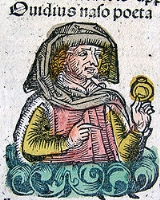
OvidPublius Ovidius Naso , a Roman poet known to the English-speaking world as Ovid, wrote on topics of love, abandoned women, and mythological transformations. Ranked alongside Virgil and Horace as one of the three ical poets of Latin literature, Ovid was generally considered the greatest master of the elegiac couplet. His poetry, much imitated during Late Antiquity and the Middle Ages, had a decisive influence on European art and literature for centuries.
R. J. Tarrant offers the following assessment for the importance of Ovid:
Discussions
|
Discussion
Features
|
|
 |
Ask a
question about 'Ovid' |
|
|
 |
|
 |
Start a new
discussion about 'Ovid' |
|
|
 |
|
 |
Answer
questions about 'Ovid' |
|
|
 |
|
 |
'Ovid' discussion
forum |
|
|
Quotations
Causa latet, vis est notissima.
Translation: The cause is hidden, but the result is well known., IV, 287
Exitus acta probat.
Translation: The result justifies the deed., Variant: The ends justifies the means., Heorides (c. 10 BC)
If any person wish to be idle, let them fall in love.
Amores, I, 1
If you want to be loved, be lovable.
Variant: To be loved, be lovable., II, 107
It is annoying to be honest to no purpose.
Ex Ponto, II, iii, 14
Many women long for what eludes them, and like not what is offered them.
More Quotes >>
Encyclopedia
Publius Ovidius Naso , a Roman poet known to the English-speaking world as Ovid, wrote on topics of love, abandoned women, and mythological transformations. Ranked alongside Virgil and Horace as one of the three ical poets of Latin literature, Ovid was generally considered the greatest master of the elegiac couplet. His poetry, much imitated during Late Antiquity and the Middle Ages, had a decisive influence on European art and literature for centuries. R. J. Tarrant offers the following assessment for the importance of Ovid: - From his own time until the end of Antiquity Ovid was among the most widely read and imitated of Latin poets; his greatest work, the Metamorphoses, also seems to have enjoyed the largest popularity. What place Ovid may have had in the curriculum of ancient schools is hard to determine: no body of antique scholia survives for any of his works, but it seems likely that the elegance of his style and his command of rhetorical technique would have commended him as a school author, perhaps at the elementary level.
Ovid wrote in elegiac couplets, with two exceptions: his lost Medea, whose two fragments are in iambic trimeter and anapests, respectively, and his great Metamorphoses , which he wrote in dactylic hexameter, the meter of Virgil's Aeneid and Homer's epics. Ovid offers an epic unlike those of his predecessors, a chronological account of the cosmos from creation to his own day, incorporating many myths and legends about supernatural transformations from the Greek and Roman traditions. Augustus banished Ovid in AD 8 to Tomis on the Black Sea for reasons that remain mysterious. Ovid himself wrote that it was because of carmen et error – "a poem and a mistake" . The error itself is uncertain. Ovid may have had an affair with a female relative of Augustus, or withheld knowledge of such an affair. The carmen, however, is probably his Ars Amatoria is a series of three books by the Roman poet Ovid [i]. ... , a didactic poem offering amatory advice to Roman men and women, which had been in circulation for several years. It was during this period of exile – more properly known as a relegation – that Ovid wrote two more collections of poems, called Tristia and Epistulae ex Ponto, which illustrate his sadness and desolation. Being far away from Rome, Ovid had no chance to research in libraries and thus was forced to abandon his work Fasti. Even though he was friendly with the natives of Tomis and even wrote poems in their language, he still pined for Rome and his beloved third wife. Many of the poems are addressed to her, but also to Augustus, whom he calls Caesar and sometimes God, to himself, and even sometimes to the poems themselves, which expresses his heart-felt solitude. The famous first two lines of the Tristia demonstrate the poet's misery from the start: - Parve – nec invideo – sine me, liber, ibis in urbem:
ei mihi, quod domino non licet ire tuo!- Little book – and I won't hinder you – go on to the city without me:
Alas for me, because your master is not allowed to go!Ovid died at Tomis after nearly ten years of banishment. WorksExisting and generally considered authentic, with approximate dates of publication- Amores , 5 books, about "Corinna", anti-marriage
- Heroides or Epistulae Heroidum , 21 letters
- Remedia Amoris , 1 book
- Medicamina Faciei Feminae , 100 lines surviving
- Ars Amatoria is a series of three books by the Roman poet Ovid [i]. ...
, 3 books - Fasti, a Latin [i] word, refers to the Roman calendar [i] and almanac [i]; and especially, to a long ...
, 6 books surviving which cover the first 6 months of the year and provide unique information on the Roman calendar - Metamorphoses , 15 books
- Ibis, a single poem
- Tristia , 5 books
- Epistulae ex Ponto , 4 books
- Fasti, a Latin [i] word, refers to the Roman calendar [i] and almanac [i]; and especially, to a long ...
, 6 books surviving which cover the first 6 months of the year and provide unique information on the Roman calendar
Lost or generally considered spurious- Medea, a lost tragedy about Medea
- a poem in Getic, the language of Dacia where Ovid was exiled, not extant
- Nux
- Consolatio ad Liviam
- Halieutica - generally considered spurious, a poem that some have identified with the otherwise lost poem of the same name written by Ovid.
Works and artists inspired by OvidSee the website for many more Renaissance examples. ... s and the medieval courtoise literature Dante mentions him twice: - in De vulgari eloquentia mentions him, along with Lucan, Virgil and Statius as one of the four regulati poetae
- in Inferno , written by Dante Alighieri [i] between 1308 [i] and his death in 1321 [i], is wi ...
ranks him side by side with Homer, Horace, Lucan and Virgil .
Retellings, adaptations and translations of his actual works- 6 Metaphorphoses After Ovid for oboe by Benjamin Britten.
- Orphée is a 1949 [i] movie [i] directed by Jean Cocteau [i] starring Jean Marais [i]. ...
A film by Jean Cocteau, a retelling of the Orpheus myth from the Metamorphoses - The Last World by Christoph Ransmayr
- An Imaginary Life by David Malouf, the story of Ovid's exile, and his relationship with a wild boy he encounters.
- "Polaroid Stories" by Naomi Iizuka, a retelling of Metamorphoses casting street kids and junkies in the roles of gods.
- edited by Michael Hofmann and James Lasdun is an anthology of contemporary poetry re-envisioning Ovid's Metamorphoses
- Tales from Ovid by Ted Hughes is a modern poetic translation of twenty four passages from Metamorphoses
- Ovid Metamorphosed edited by Phil Terry is a collection of short stories by various writers that re-tell several of Ovid's fables.
- An adaptation of Metamorphoses by Mary Zimmerman appeared on Broadway's Circle on the Square Theater, which featured an onstage pool
Trivia- Ovid's Ars Amatoria is a series of three books by the Roman poet Ovid [i]. ...
contains the first reference to the board game ludus duodecim scriptorum, a relative of modern backgammon. - Ovid's nickname was "The Nose" - indeed, his last name, Naso, means "nose" in Latin.
See also- Metamorphoses for external links specific to that work.
- Latin literature
ReferencesExternal links- * Latin and English translation
- Amores, Ars Amatoria, Heroides , Metamorphoses, Remedia Amoris. Enhanced brower. Not downloadable.
- Amores, Ars Amatoria, Medicamina Faciei Femineae, Metamorphoses, Remedia Amoris.
- ; elucidated by an analysis and explanation of the fables, together with English notes, historical, mythological and critical, and illustrated by pictorial embellishments: with a dictionary, giving the meaning of all the words with critical exactness. By Nathan Covington Brooks. Publisher: New York, A. S. Barnes & co.; Cincinnati, H. W. Derby & co., 1857 '
- Original Latin only
- Amores, Ars Amatoria, Epistulae ex Ponto, Fasti, Heroides, Ibis, Metamorphoses, Remedia Amoris, Tristia.
- With introduction and extensive notes in English by Thomas Keightley. Plain text version.
-
- English translation only
- Amores, Ars Amatoria, Epistulae ex Ponto, Fasti, Heroides, Ibis, Medicamina Faciei Femineae, Metamorphoses, Remedia Amoris, Tristia with enhanced browsing facility, downloadable in HTML, PDF, or MS Word DOC formats. Site also includes wide selection of works by other authors.
- Commentary
|