


Greco-Italian War

Encyclopedia
The Greco-Italian War was a conflict between Italy and Greece
which lasted from 28 October 1940 to 23 April 1941. It marked the beginning of the Balkans Campaign of World War II. From 6 April 1941 intervention of Nazi Germany
onwards, the conflict is known as the Battle of Greece
.
's conquests and wanted to prove to his Axis partner that he could lead Italy to similar military successes. Italy had occupied Albania
in the spring of 1939 and several British
strongholds in Africa (Italian conquest of British Somaliland
in the summer of 1940), but could not boast victories on the same scale as Nazi Germany. At the same time, Mussolini also wanted to reassert Italy's interests in the Balkans
, threatened by Germany (he was piqued that Romania
, a Balkan state in the supposed Italian influence zone, had accepted German protection for its Ploieşti
oil fields in mid-October) and secure bases from which British eastern Mediterranean outposts could be attacked.
On 28 October 1940, after Greek dictator Ioannis Metaxas
rejected an Italian ultimatum
demanding the occupation of Greek territory, Italian forces invaded Greece. The Hellenic Army
counter-attacked and forced the Italians to retreat and by mid-December, the Greeks occupied nearly a quarter of Albania, tying down 530,000 Italian troops. In March 1941, a major Italian counter-attack failed, with small gains around Himare
. In the first days of April, as the German attack
on Greece unfolded, the Italian army resumed its attacks. From 12 April, the Greek army started retreating from Albania to avoid being cut off by the rapid German advance. On 20 April, the Greek army of Epirus surrendered to the Germans, and on 23 April 1941 the armistice was repeated including the Italians, effectively ending the Greco-Italian war.
The Greek victory over the initial Italian offensive of October 1940 was the first Allied land victory of the Second World War, and helped raise morale in occupied Europe. Some historians, such as John Keegan
, argue that it may have influenced the course of the entire war by forcing Germany to postpone the invasion of the Soviet Union in order to assist Italy against Greece. This led to a delayed attack and subjected the German forces to the conditions of the harsh Russian winter, leading to their defeat at the Battle of Moscow
.
, Italy had aspired to Great Power
status and Mediterranean hegemony. Later, under the Fascist regime
, the establishment of a new Roman Empire
, which included Greece, was often proclaimed by Mussolini.
Already in the 1910s, Italian and Greek interests clashed over Albania
and the Dodecanese
. Albania, Greece's northwestern neighbour, was from its establishment effectively an Italian protectorate. Both Albania and Greece claimed Northern Epirus
, inhabited by a large Greek population. Furthermore, Italy had been occupying the predominantly Greek-inhabited Dodecanese
islands in the southeastern Aegean
since the Italo-Turkish War
of 1912, and although it promised their return in the 1919 Venizelos
–Tittoni
accords, it later reneged on the agreement. Clashes between the two countries' troops occurred during the occupation of Anatolia
, and Italy helped the Turkish nationalists in their war against Greece. In its aftermath, the new Fascist government of Mussolini used the murder of an Italian general at the Greco-Albanian border to bombard and occupy Corfu
, the most important of the Ionian Islands
. These had been under Venetian
rule until the late eighteenth century, and a target of Italian expansionism. A period of normalization followed, especially under the premiership of Eleftherios Venizelos in Greece (1928–1932) and the signing of a Friendship Agreement between the two countries on 23 September 1928.
When Metaxas
came to power in 1936 (see 4th of August Regime
), plans had been laid down for the reorganization of the country's armed forces including a fortified defensive line along the Greco-Bulgarian frontier, which would be named "Metaxas Line
". In the following years, the Army benefited from great investments aiming at its modernization; it was technologically upgraded, largely re-equipped and as a whole dramatically improved from its previous deplorable state. The Greek government purchased new arms for the three Armies. However, due to increasing threat and the eventual outbreak of war, the most significant purchases from abroad, made from 1938 to 1939, were never or only partially delivered. Also, a massive contingency plan was developed and great amounts of food and utilities were stockpiled by the Army in many parts of Greece for the eventuality of war.
, thereby gaining an immediate land border with Greece. This action led to a British and French
guarantee for the territorial integrity of Greece, but for the Greeks, this development canceled all previous plans, and hasty preparations started for the event of an Italian attack. As war exploded in Central Europe, Metaxas tried to keep Greece out of the conflict, but as the conflict progressed, Metaxas felt increasingly closer to the United Kingdom, encouraged by the ardent anglophile King George II
, who provided the main support for the regime. This was ironic for Metaxas, who had always been a Germanophile
, and had built strong economic ties with Hitler's Germany.
At the same time, the Italians, especially the governor of Albania, Francesco Jacomoni
, began agitating on the issue of the Cham Albanian minority
in Greek Epirus as a means to rally Albanian support. Although in the event, Albanian enthusiasm for the "liberation of Chameria" was muted, Jacomoni sent repeated over-optimistic reports to Rome on Albanian support. In June 1940, the headless body of Daut Hoxha, an Albanian bandit, was discovered near the village of Vrina
. Jacomoni blamed his murder on Greek secret agents, and, as the possibility of an Italian attack on Greece drew nearer, he began arming Albanian irregular bands to use against Greece.
Soon after the fall of France
, Mussolini set his sights on Greece. According to the 3 July 1940 entry in the diary of his son-in-law and foreign minister, Count Galeazzo Ciano
:
By 11 August, the decision for war had been taken:
Benito Mussolini revealed in his private comment to his son-in-law, Count Ciano:
In the meantime, the original Italian plan of attacking Yugoslavia was shelved, because of German opposition and lack of the necessary transport.
On 12 October 1940 the Germans occupied the Romanian oil fields. This action, of which he was not informed in advance, infuriated Mussolini, who regarded it as a German encroachment on south-eastern Europe, an area Italy claimed as its exclusive sphere of influence
. Three days later he ordered a meeting in Rome to discuss the invasion of Greece. Only the Chief of the General Staff, Marshal Pietro Badoglio
, voiced objections, citing the need to assemble a force of at least 20 divisions prior to invasion, but the local commander in Albania, Lt. Gen. Sebastiano Visconti Prasca
, argued that only 3 further divisions would be needed, and these only after the first phase of the offensive (the capture of Epirus) had been completed. Mussolini was reassured by his staff that the war on Greece would be a campaign of two weeks. This overconfidence explains why Mussolini felt he could let 300,000 troops and 600,000 reservists go home for the harvest just before the invasion. 1,750 lorries were supposed to be in Greece, only 107 turned up. The number of divisions was inflated because Mussolini had switched from 3 to 2 brigade divisions. Lieutenant General Visconti Prasca knew he would lose command if more than 5 divisions were sent so persuaded Mussolini that 5 was all he needed.
Foreign Minister Galeazzo Ciano
(who said that he could rely on the support of several Greek personalities, who would be easy to corrupt) was deputed to find a casus belli
. The following week Tzar Boris III of Bulgaria
was invited to take part in the coming action against Greece, but refused Mussolini's invitation.
A propaganda campaign against Greece was launched in Italy, and repeated acts of provocation were carried out, such as overflights of Greek territory and attacks by aircraft on Greek naval vessels, reaching their peak with the torpedo
ing and sinking of the Greek light cruiser Elli in Tinos
harbor on 15 August 1940 (a national religious holiday
), by an Italian submarine. Despite undeniable evidence of Italian responsibility, the Greek government announced that the attack had been carried out by a submarine of "unknown nationality". Although the facade of neutrality was thus preserved, the people were well aware of the real perpetrator (accusing Mussolini and his Foreign Minister Count Ciano).
On the eve of 28 October 1940, Italy's ambassador in Athens
, Emanuele Grazzi, handed an ultimatum from Mussolini to Metaxas. In it, the Duce demanded free passage for his troops to occupy unspecified "strategic points" inside Greek territory. Greece had been friendly towards National Socialist Germany, especially profiting from mutual trade relations, but now Germany's ally Italy was to invade Greece. Metaxas rejected the ultimatum with the words (French for "Then, it's war."). In this he echoed the will of the Greek people to resist, a will which was popularly expressed in one word: "Ochi" (Greek
for "No"). Within hours Italy began attacking Greece from Albania. The outbreak of hostilities was first announced by the Athens Radio early in the morning of the 28th, with the famous two-sentence dispatch of the General Staff: "Since 05:30 this morning, the enemy is attacking our vanguard on the Greek-Albanian border. Our forces are defending the fatherland."
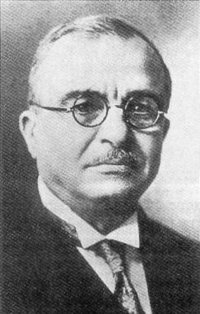 Shortly thereafter, Metaxas addressed the Greek people with these words: "The time has come for Greece to fight for her independence. Greeks, now we must prove ourselves worthy of our forefathers and the freedom they bestowed upon us. Greeks, now fight for your Fatherland, for your wives, for your children and the sacred traditions. Now, above all, the struggle!" The last sentence was a verbatim quote from The Persians, by the dramatist Aeschylus
. In response to this address, the people of Greece reportedly spontaneously went out to the streets singing Greek patriotic songs and shouting anti-Italian slogans, and hundreds of thousands of volunteers, men and women, in all parts of Greece headed to the Army recruitment offices to enlist. The whole nation was united in the face of aggression. Even the imprisoned leader of Greece's banned Communist Party, Nikolaos Zachariadis
, issued an open letter advocating resistance, despite the still existing Nazi-Soviet Pact
, thereby contravening the current Comintern
line (although in two further letters he accused Metaxas of waging an "imperialistic" war and called upon Greek soldiers to desert their ranks and overthrow the regime).
under Italian influence. This new Greek state would permit the Italian annexation of the Ionian islands, and the Aegean island groups of the Sporades
and the Cyclades
(to be administered as a part of the Italian Aegean Islands
). These islands were claimed on the basis that they had once belonged to the Venetian Republic and the Venetian client state of Naxos. In addition, the Epirus
and Acarnania
regions were to be separated from the rest of the Hellenic territory (see Principality of Pindus) and the Italian-controlled Kingdom of Albania was to annex territory between the Hellenic north-western frontier and the Florina
–Pindus
–Arta
–Prevesa line. The Italians further projected to partly compensate the Greek state for its extensive territorial losses by allowing it to annex the British Crown Colony of Cyprus
after the war had reached a victorious conclusion.
mountain range practically divided it into two distinct theatres of operations: Epirus
and Western Macedonia.
The order to invade Greece was given by Benito Mussolini
to Pietro Badoglio
and Mario Roatta
on 15 October with the expectation that the attack would commence within 12 days. Badoglio and Roatta were appalled given that, acting on his orders, they had demobilised 600,000 men three weeks prior to provide labor for the harvest. Given the expected requirement of at least 20 divisions to facilitate success, the fact that only eight divisions were currently in Albania, and considering the inadequacies of the Albanian ports and connecting infrastructure, adequate preparation would require at least three months. Nonetheless, D-day was set at dawn on 26 October.
The Italian war plan, codenamed Emergenza G ("Contingency G[reece]"), called for the occupation of the country in three phases. The first would be the occupation of Epirus and the Ionian Islands
, followed, after the arrival of reinforcements, by a thrust into Western Macedonia and towards Thessaloniki
, aimed at capturing northern Greece. Afterwards, the remainder of the country would be occupied. Subsidiary attacks were to be carried out against the Ionian Islands, while it was hoped that Bulgaria
would intervene and pin down the Greek forces in Eastern Macedonia
.
The Italian High Command had accorded an Army Corps to each theatre, formed from the existing forces occupying Albania. The stronger XXV Ciamuria Corps in Epirus (23rd Ferrara and 51st Siena Infantry Divisions, the 131st Centauro Armoured Division
, in total ca. 30,000 men and 163 tanks) intended to drive towards Ioannina
, flanked on its right by a small brigade-sized "Littoral Group" (Raggruppamento Litorale) of ca. 5,000 men along the coast, and to its left by the elite Julia Alpine Division
which would advance through the Pindus Mountains
. XXVI Corizza Corps in the Macedonian sector (29th Piemonte
, 49th Parma Infantry Divisions, with 19th Venezia Division en route from the north of the country, in total ca. 31,000 men) was initially intended to maintain a defensive stance. In total, the force facing the Greeks comprised about 85,000 men, under the command of Lt. General Sebastiano Visconti Prasca
.
After the Italian occupation of Albania, the Greek General Staff had prepared the "IB" (Italy-Bulgaria) plan, anticipating a combined offensive by Italy and Bulgaria. The plan was essentially prescribing a defensive stance in Epirus, with a gradual retreat to the Arachthos River
–Metsovo
–Aliakmon River–Mt. Vermion
line, while maintaining the possibility of a limited offensive in Western Macedonia. Two variants of the plan existed for the defence of Epirus, "IBa", calling for forward defence on the border line, and "IBb", for defence in an intermediate position. It was left to the judgment of the local commander, Maj. General Charalambos Katsimitros
, to choose which plan to follow. A significant factor in the Greeks' favour was that they had managed to obtain intelligence about the approximate date of the attack, and had just completed a limited mobilization in the areas facing the expected Italian attack.
The main Greek forces in the immediate area at the outbreak of the war were: In Epirus the 8th Infantry Division, fully mobilized and prepared for forward defence by its commander, Maj. Gen. Katsimitros. In Western Macedonia was the Corps-sized Army Section of Western Macedonia or TSDM (ΤΣΔΜ, Τμήμα Στρατιάς Δυτικής Μακεδονίας) under Lt. Gen. Ioannis Pitsikas, including the "Pindus Detachment" (Απόσπασμα Πίνδου) of regimental size under Colonel Konstantinos Davakis
, the 9th Infantry Division and the 4th Infantry Brigade. The Greek forces amounted to about 35,000 men, but could be quickly reinforced by the neighbouring formations in southern Greece and Macedonia.
The Greeks enjoyed a small advantage in that their divisions had 30% more infantry (three regiments as opposed to two) and slightly more medium artillery and machine-guns than the Italian ones, but they completely lacked tanks, while the Italians could count on complete air superiority over the small Hellenic Royal Air Force. Furthermore, the majority of Greek equipment was still of World War I issue, or else came from countries like Belgium, Austria and France, which were now under Axis occupation, with adverse effects on the supply of spare parts and suitable ammunition. However, many senior Greek officers were veterans of a decade of almost continuous warfare (from the Balkan Wars
of 1912–13 and the First World War to the Greco-Turkish War of 1919–22), and, despite its limited means, the Greek Army had actively prepared itself for the forthcoming war during the late 1930s. In addition, Greek morale, contrary to Italian expectations, was high, with many eager to "avenge Tinos".
launching an invasion of Greece from Albanian territory. The invasion force included several hundred Albanians (Chams, Kosovars etc.) in blackshirt
battalions attached to the Italian army. Their performance, however, was distinctly lackluster. The Italian commanders, including Mussolini, would later use the Albanians as scapegoats for the Italian failure. These Albanian battalions, named Tomorri and Gramshi, were formed in the Italian army three months before the invasion, and during the conflicts, the majority of them defected to the Greek Army.
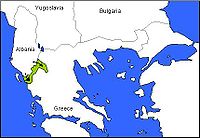 The Italians attacked on the morning of 28 October, pushing back the Greek screening forces. The Ciamuria Corps, spearheaded by the Ferrara and Centauro divisions, attacked towards Kalpaki (Elaia), while οn its right the Littoral Group advanced along the coast and was able to secure a bridgehead over the Kalamas River. The Italians faced difficulties because of the harshness of the terrain, with their light L3/35
tankettes and medium M13/40 tanks, unable to cope with the hilly terrain or the muddy tracks that served as roads.
On 31 October the Italian Supreme Command announced that "Our units continue to advance into Epirus and have reached the river Kalamas at several points. Unfavourable weather conditions and action by the retreating enemy are not slowing down the advances of our troops". But in reality, the Italian offensive was carried out without conviction and without the advantage of surprise (not even for air action which was rendered ineffective by poor weather), under a leadership uncertain and divided by personal rivalries, and was already becoming exhausted. Adverse conditions at sea made impossible to carry out a projected landing at Corfu. By 1 November, the Italians had captured Konitsa
and reached the Greek main line of defence. On that same day, the Albanian theatre was given priority over Africa by the Italian High Command. However, despite repeated attacks the Italians failed to break through the Greek defences in the Battle of Elaia–Kalamas
, and the attacks were suspended on 9 November.
A greater threat to the Greek positions was posed by the advance of the 10,800-strong 3rd Julia Alpine Division
over the Pindus
mountains towards Metsovo
, which threatened to separate the Greek forces in Epirus from those in Macedonia. Julia achieved early success, breaking through the central sector of Colonel Davakis' force. The Greek General Staff immediately ordered reinforcements into the area, which passed under the control of II Greek Army Corps. A first Greek counteroffensive was launched on 31 October, and met with little success. Having covered 25 miles of mountain terrain in icy rain, Julia managed to capture Vovousa
, 30 km north of Metsovo, on 2 November, but it had become clear that it lacked the manpower and the supplies to continue in the face of the arriving Greek reserves.
Greek counterattacks resulted in the recapture of several villages, including Vovousa, by 4 November, practically encircling "Julia". Prasca tried to reinforce it with the newly arrived 47th Bari Division (originally intended for the invasion of Corfu
), but it arrived too late to change the outcome. During the next days the Alpini
fought bravely in atrocious weather conditions and under constant attacks by the Greek Cavalry Division led by Major General Georgios Stanotas
. However, on 8 November, the commander of Julia, General Mario Girotti, was forced to order his units to begin their retreat via Mt. Smolikas
towards Konitsa. This fighting retreat lasted for several days, until by 13 November the frontier area had been cleared of Italian presence and the Julia division was effectively destroyed, ending the Battle of Pindus
in a complete Greek victory.
With the Italians inactive in Western Macedonia, the Greek High Command moved III Corps (10th and 11th Infantry Divisions and the Cavalry Brigade, under Lt. Gen. Georgios Tsolakoglou
) into the area on 31 October and ordered it to attack into Albania together with TSDM. For logistical reasons this attack was successively postponed until 14 November.
The unexpected Greek resistance caught the Italian High Command by surprise. Several divisions were hastily sent to Albania, and the plans for subsidiary attacks on Greek islands were definitively scrapped. Enraged by the lack of progress, Mussolini reshuffled the command in Albania, replacing Prasca with General Ubaldo Soddu
, his former Vice-Minister of War, on 9 November. Immediately upon arrival, Soddu ordered his forces to turn to the defensive. It was clear that the Italian invasion had failed.
, being trained and equipped for mountainous conditions. Bauer states that by 12 November General Papagos had at the front over 100 infantry battalions fighting in terrain to which they were accustomed, compared with less than 50 Italian battalions.
TSDM and III Corps, continuously reinforced with units from all over northern Greece, launched their attack on 14 November, in the direction of Korçë
. After bitter fighting on the fortified frontier line, the Greeks broke through on the 17th, entering Korçë on the 22nd. However, due to indecisiveness among the Greek High Command, the Italians were allowed to break contact and regroup, avoiding a complete collapse.
The attack from Western Macedonia was combined with a general offensive along the entire front. I and II Corps advanced in Epirus, and after hard fighting captured Sarandë
, Pogradec
and Gjirokastër
by early December, and Himarë
on Christmas' Eve, occupying practically the entire area of southern Albania known as "Northern Epirus
" to the Greeks. A final Greek success was the forcing
of the strategically important and heavily fortified Klisura pass
on 10 January by II Corps, followed by the capture
of the Trebeshinë massif
in early February. However the Greeks did not succeed in breaking through towards Berat
, and their offensive towards Vlorë
failed. In the fight for Vlorë, the Italians suffered serious losses to their Lupi di Toscana
, Julia
, Pinerolo and Pusteria
divisions, but by the end of January, due to a combination of Italy finally gaining numerical superiority and their own bad logistical situation, the Greeks' advance was finally stopped.
Meanwhile, General Soddu had been replaced in mid-December by General Ugo Cavallero
. On 4 March, the British sent their first convoy of troops and supplies to Greece, under the orders of Lieutenant-General Sir Henry Maitland Wilson. Their forces were four divisions (57,000 soldiers), two of them armoured. They did not reach the front in time to fight.
The following passage aptly summarizes the episode from the perspective of both the brilliant Greek defence of their homeland to the ill-prepared Italian debacle, but also the bravery of the Italian soldiers:
The Italians, on the other hand, wishing to achieve a success in the Albanian front before the impending German intervention, gathered their forces to launch a new offensive, codenamed "Primavera" ("Spring"). They assembled 17 divisions opposite the Greeks' 13, and, under Benito Mussolini
's personal supervision, launched a determined attack against the Klisura Pass. The assault lasted from 9 to 20 March, but failed to dislocate the Greeks and obtained only small conquests like Himarë
, the area of Mali Harza and mount Trebescini near Berat. From that moment until the German attack on 6 April, the stalemate continued, with operations on both sides scaled down.
From 6 April the Italians recommenced their offensive in Albania in connection with the German Operation Marita. The initial attacks made little progress, but on 12 April, the Greek High Command, alarmed by the rapid progress of the German invasion, ordered a withdrawal from Albania. The Italian 9th Army took Korçë on 14 April, followed by Ersekë three days later. On 19 April the Italians occupied the Greek shores of Lake Prespa
and on 22 April 4 Bersaglieri Regiment reached the bridge of the border village Perati, crossing into Greek territory the next day.
In the meantime, the Greek Army of Epirus was cut off in 18 April, when elements of the Leibstandarte SS Adolf Hitler motorized brigade
captured the Metsovo
Pass after overcoming local Greek resistance. The next day, Ioannina
fell to the Germans, completing the isolation of the Greek Army. Aware of the hopelessness of his situation, Lt. General Georgios Tsolakoglou
, in agreement with several other generals but without authorization from Papagos, relieved Army commander Lt. General Pitsikas and offered the Army's surrender to Sepp Dietrich
on 20 April, primarily to avoid the perceived dishonour of surrendering to the Italians. The terms of surrender were deemed honourable, as the Greek Army would not be taken prisoner, and officers were allowed to retain their sidearms. Mussolini, however, was enraged by this unilateral surrender, and after many protests to Hitler, the surrender ceremony was repeated on 23 April to include Italian representatives.
On 24 April the Italian troops joined up with the German forces attacking the Attica area near Athens
, while the defeated British forces started their evacuation and Bulgaria invaded northern Greek territory around Xanthi
. On 3 May, after the final conquest of Crete
, an imposing German-Italian parade in Athens celebrated the Axis
victory. It was after the victory in Greece (and Yugoslavia) that Mussolini started to talk and boast in his propaganda about the Italian Mare Nostrum.
was composed of the old cruiser Averof
, 10 destroyers (4 old Theria class
, 4 relatively modern Dardo class
and 2 new G class destroyers), several torpedo boats and 6 old submarines. Faced with the formidable Regia Marina
, its role was primarily limited to patrol and convoy escort duties in the Aegean Sea
. This was essential both for the completion of the Army's mobilization, but also for the overall resupply of the country, the convoy routes being threatened by Italian aircraft and submarines operating from the Dodecanese Islands.
Nevertheless, the Greek ships also carried out limited offensive operations against Italian shipping in the Strait of Otranto
. The destroyers carried out three bold but fruitless night-time raids (14–15 November 1940, 15–16 December 1940 and 4–5 January 1941). The main successes came from the submarines, which managed to sink some Italian transports. On the Italian side, although the Regia Marina
suffered severe losses in capital ships from the Royal Navy
during the Taranto raid
, Italian cruisers and destroyers continued to operate covering the convoys between Italy and Albania. Also, on 28 November, an Italian squadron bombarded Corfu, while on 18 December and 4 March, Italian task forces shelled Greek coastal positions in Albania.
From January 1941, the RHN's main task was the escort of convoys to and from Alexandria
, in cooperation with the British Royal Navy. As the transportation of the British Expeditionary Corps began in early March, the Italian Fleet decided to sortie against them. Well informed by Ultra intercepts, the British fleet intercepted and decisively defeated the Italians at the Battle of Cape Matapan
on 28 March.
With the start of the German offensive on 6 April, the situation changed rapidly. German control of the air caused heavy casualties to the Greek and British navies, and the occupation of the mainland and later Crete by the Wehrmacht signaled the end of Allied surface operations in Greek waters until the Dodecanese Campaign
of 1943.
in May 1941, all of Greece was under the complete control of the Axis. For the next 3 years it would endure a harsh joint occupation by Germany, Italy and Bulgaria. In the occupied country, an effective Resistance
network was established, which achieved the liberation of much of the mountainous mainland by 1944. At the same time, Greek troops and ships were continuing the fight along with the British in North Africa
and, eventually, in Italy itself. With the German withdrawal from the Balkans in October–November 1944, Greece, with the exception of some isolated German garrisons in the islands, was liberated. Soon however, the country would be engulfed by a new conflict, the Greek Civil War
.
, and caused losses, especially in aircraft and paratroopers
during the airborne invasion of Crete, which affected its outcome. Adolf Hitler, in conversation with Leni Riefenstahl
, would bitterly say that "if the Italians hadn't attacked Greece and needed our help, the war would have taken a different course. We could have anticipated the Russian cold by weeks and conquered Leningrad and Moscow. There would have been no Stalingrad
". Furthermore, the need to occupy the country, suppress the partisans and defend it against Allied actions, tied down several German and Italian divisions during the course of the war. However, some popular historians such as Antony Beevor
claim that it was not Greek resistance that delayed the Axis invasion of the Soviet Union, but instead the slow construction of airfields in Eastern Europe.
For Mussolini, the failure of the Italian forces to subdue Greece without German assistance proved damaging to his prestige both internationally and at home. Instead of asserting Italian independence as he had hoped, Mussolini instead found himself more indebted to Hitler than he had ever been. For the duration of the war Mussolini would never again be in a position to act unilaterally in the sort of manner he attempted to do against Greece.
At the same time, however, the Greek resistance ultimately necessitated an Allied intervention. The decision to send British forces into Greece was primarily motivated by political considerations, and is considered in hindsight, in the words of General Alan Brooke, "a definite strategic blunder", as it diverted forces from the Middle East, at a very critical stage, to Greece. These forces in the event proved insufficient to halt the German invasion of Greece, but could have played a decisive role in the North African Campaign
, bringing it to a victorious conclusion much sooner.
Also important was the moral example, set in a time when only the British Empire
resisted the Axis Powers
, of a small country fighting off Fascist Italy, something reflected in the exuberant praise the Greek struggle received at the time. Most prominent is the quote of Winston Churchill
:
French general Charles de Gaulle
was among those who praised the fierceness of the Greek resistance. In an official notice released to coincide with the Greek national celebration of the Day of Independence (25 March), De Gaulle expressed his admiration for the heroic Greek resistance:
Greece's siding with the Allies also contributed to its annexation of the Italian-occupied but Greek-populated Dodecanese islands at the conclusion of World War II, in 1947.
, is celebrated to this day in Greece every year. 28 October, the day of Ioannis Metaxas
' rejection of the Italian ultimatum, is a day of national celebration in Greece, named Ohi Day (Greek for "Day of No"). A military parade takes place in Thessaloniki
(to coincide with the city's anniversary of liberation during the First Balkan War
and the feast of its patron saint, St. Demetrius) and student parades in Athens
and other cities. For several days, many buildings in Greece, public and private, display the Greek flag. In the days preceding the anniversary, television and radio often feature historical films and documentaries about 1940, or broadcast Greek patriotic songs, especially those of Sofia Vembo
, a singer whose songs gained immense popularity during the war. It serves also as a day of remembrance for the "dark years" of the Axis Occupation of Greece (1941–1944).
, in his memoirs, attributes the failure of the campaign mainly to poor organization, personal agendas, corruption and lack of cooperation among the top ranks of Italy's Armed Forces. Prasca compared the stubborn Greek resistance in Epirus with that of the Turks in the Dardanelles
in World War I. At the same time, however, Prasca is considered one of those mainly responsible for underestimating the strength of the Greek Army, making inadequate plans and leading the Italian army to its blunder in the mountains of Epirus. The Italian forces certainly faced tactical problems, being weaker in infantry, with only two regiments per division. However the Italians were stronger in artillery and mortars
than the Greeks, and enjoyed absolute superiority in air forces, which they did not manage to exploit properly. Poor motivation, as opposed to the Greeks, and the rough terrain of Epirus, which favoured the Greek defence, also played a role in the outcome.
However, the Italians failed primarily at a strategic level, i.e., at the level of Mussolini and the High Command. Barely a month before the invasion of Greece, on 1 October, Mussolini ordered the demobilization of half the Italian army, a measure accepted by the General Staff, although General Mario Roatta
warned that much of the army would become unserviceable for many months. In addition, the persistent underestimation of Greek preparedness doomed the campaign to failure from the start. As the Italian historian Renzo De Felice wrote: "The military superiority (numerical and technical) was always, in the first months of the war, on the side of the Greeks. The Italians had only eight divisions in Albania (and two of these were facing the Yugoslavian Army) in October 1940, while the Greeks had initially 14 divisions well trained to the fight in their mountainous terrain. The Greek Army spent all available resources to attain their victorious defence and counterattack; as a consequence, the German attack Operation Marita
found a limited resistance from the exhausted Greeks in April 1941." Another notable failure of the Italian offense is the lack of any attack on the Ionian Islands
or Crete
, which were obvious and relatively undefended targets, and could have provided Italy with strong forward naval and air bases.
Kingdom of Greece
The Kingdom of Greece was a state established in 1832 in the Convention of London by the Great Powers...
which lasted from 28 October 1940 to 23 April 1941. It marked the beginning of the Balkans Campaign of World War II. From 6 April 1941 intervention of Nazi Germany
Nazi Germany
Nazi Germany , also known as the Third Reich , but officially called German Reich from 1933 to 1943 and Greater German Reich from 26 June 1943 onward, is the name commonly used to refer to the state of Germany from 1933 to 1945, when it was a totalitarian dictatorship ruled by...
onwards, the conflict is known as the Battle of Greece
Battle of Greece
The Battle of Greece is the common name for the invasion and conquest of Greece by Nazi Germany in April 1941. Greece was supported by British Commonwealth forces, while the Germans' Axis allies Italy and Bulgaria played secondary roles...
.
Regional politics
By mid-1940, Mussolini had grown jealous of HitlerAdolf Hitler
Adolf Hitler was an Austrian-born German politician and the leader of the National Socialist German Workers Party , commonly referred to as the Nazi Party). He was Chancellor of Germany from 1933 to 1945, and head of state from 1934 to 1945...
's conquests and wanted to prove to his Axis partner that he could lead Italy to similar military successes. Italy had occupied Albania
Italian invasion of Albania
The Italian invasion of Albania was a brief military campaign by the Kingdom of Italy against the Albanian Kingdom. The conflict was a result of the imperialist policies of Italian dictator Benito Mussolini...
in the spring of 1939 and several British
British Empire
The British Empire comprised the dominions, colonies, protectorates, mandates and other territories ruled or administered by the United Kingdom. It originated with the overseas colonies and trading posts established by England in the late 16th and early 17th centuries. At its height, it was the...
strongholds in Africa (Italian conquest of British Somaliland
Italian conquest of British Somaliland
The Italian conquest of British Somaliland was a military campaign in the Horn of Africa, which took place in August 1940 between forces of Italy and those of Great Britain and its Commonwealth...
in the summer of 1940), but could not boast victories on the same scale as Nazi Germany. At the same time, Mussolini also wanted to reassert Italy's interests in the Balkans
Balkans
The Balkans is a geopolitical and cultural region of southeastern Europe...
, threatened by Germany (he was piqued that Romania
Romania
Romania is a country located at the crossroads of Central and Southeastern Europe, on the Lower Danube, within and outside the Carpathian arch, bordering on the Black Sea...
, a Balkan state in the supposed Italian influence zone, had accepted German protection for its Ploieşti
Ploiesti
Ploiești is the county seat of Prahova County and lies in the historical region of Wallachia in Romania. The city is located north of Bucharest....
oil fields in mid-October) and secure bases from which British eastern Mediterranean outposts could be attacked.
On 28 October 1940, after Greek dictator Ioannis Metaxas
Ioannis Metaxas
Ioannis Metaxas was a Greek general, politician, and dictator, serving as Prime Minister of Greece from 1936 until his death in 1941...
rejected an Italian ultimatum
Ultimatum
An ultimatum is a demand whose fulfillment is requested in a specified period of time and which is backed up by a threat to be followed through in case of noncompliance. An ultimatum is generally the final demand in a series of requests...
demanding the occupation of Greek territory, Italian forces invaded Greece. The Hellenic Army
Hellenic Army
The Hellenic Army , formed in 1828, is the land force of Greece.The motto of the Hellenic Army is , "Freedom Stems from Valor", from Thucydides's History of the Peloponnesian War...
counter-attacked and forced the Italians to retreat and by mid-December, the Greeks occupied nearly a quarter of Albania, tying down 530,000 Italian troops. In March 1941, a major Italian counter-attack failed, with small gains around Himare
Himarë
Himarë is a bilingual region and municipality along the Albanian Riviera in southern Albania and part of the District of Vlorë. Apart from the town of Himarë, the region consists of 7 other villages: Dhërmi, Pilur, Kudhës, Qeparo, Vuno, Iljas, and Palasë....
. In the first days of April, as the German attack
Battle of Greece
The Battle of Greece is the common name for the invasion and conquest of Greece by Nazi Germany in April 1941. Greece was supported by British Commonwealth forces, while the Germans' Axis allies Italy and Bulgaria played secondary roles...
on Greece unfolded, the Italian army resumed its attacks. From 12 April, the Greek army started retreating from Albania to avoid being cut off by the rapid German advance. On 20 April, the Greek army of Epirus surrendered to the Germans, and on 23 April 1941 the armistice was repeated including the Italians, effectively ending the Greco-Italian war.
The Greek victory over the initial Italian offensive of October 1940 was the first Allied land victory of the Second World War, and helped raise morale in occupied Europe. Some historians, such as John Keegan
John Keegan
Sir John Keegan OBE FRSL is a British military historian, lecturer, writer and journalist. He has published many works on the nature of combat between the 14th and 21st centuries concerning land, air, maritime, and intelligence warfare, as well as the psychology of battle.-Life and career:John...
, argue that it may have influenced the course of the entire war by forcing Germany to postpone the invasion of the Soviet Union in order to assist Italy against Greece. This led to a delayed attack and subjected the German forces to the conditions of the harsh Russian winter, leading to their defeat at the Battle of Moscow
Battle of Moscow
The Battle of Moscow is the name given by Soviet historians to two periods of strategically significant fighting on a sector of the Eastern Front during World War II. It took place between October 1941 and January 1942. The Soviet defensive effort frustrated Hitler's attack on Moscow, capital of...
.
Greco-Italian relations in the early twentieth century
Ever since the Italian unificationItalian unification
Italian unification was the political and social movement that agglomerated different states of the Italian peninsula into the single state of Italy in the 19th century...
, Italy had aspired to Great Power
Great power
A great power is a nation or state that has the ability to exert its influence on a global scale. Great powers characteristically possess military and economic strength and diplomatic and cultural influence which may cause small powers to consider the opinions of great powers before taking actions...
status and Mediterranean hegemony. Later, under the Fascist regime
Italian Fascism
Italian Fascism also known as Fascism with a capital "F" refers to the original fascist ideology in Italy. This ideology is associated with the National Fascist Party which under Benito Mussolini ruled the Kingdom of Italy from 1922 until 1943, the Republican Fascist Party which ruled the Italian...
, the establishment of a new Roman Empire
Roman Empire
The Roman Empire was the post-Republican period of the ancient Roman civilization, characterised by an autocratic form of government and large territorial holdings in Europe and around the Mediterranean....
, which included Greece, was often proclaimed by Mussolini.
Already in the 1910s, Italian and Greek interests clashed over Albania
Albania
Albania , officially known as the Republic of Albania , is a country in Southeastern Europe, in the Balkans region. It is bordered by Montenegro to the northwest, Kosovo to the northeast, the Republic of Macedonia to the east and Greece to the south and southeast. It has a coast on the Adriatic Sea...
and the Dodecanese
Dodecanese
The Dodecanese are a group of 12 larger plus 150 smaller Greek islands in the Aegean Sea, of which 26 are inhabited. Τhis island group generally defines the eastern limit of the Sea of Crete. They belong to the Southern Sporades island group...
. Albania, Greece's northwestern neighbour, was from its establishment effectively an Italian protectorate. Both Albania and Greece claimed Northern Epirus
Northern Epirus
Northern Epirus is a term used to refer to those parts of the historical region of Epirus, in the western Balkans, that are part of the modern Albania. The term is used mostly by Greeks and is associated with the existence of a substantial ethnic Greek population in the region...
, inhabited by a large Greek population. Furthermore, Italy had been occupying the predominantly Greek-inhabited Dodecanese
Dodecanese
The Dodecanese are a group of 12 larger plus 150 smaller Greek islands in the Aegean Sea, of which 26 are inhabited. Τhis island group generally defines the eastern limit of the Sea of Crete. They belong to the Southern Sporades island group...
islands in the southeastern Aegean
Aegean Sea
The Aegean Sea[p] is an elongated embayment of the Mediterranean Sea located between the southern Balkan and Anatolian peninsulas, i.e., between the mainlands of Greece and Turkey. In the north, it is connected to the Marmara Sea and Black Sea by the Dardanelles and Bosporus...
since the Italo-Turkish War
Italo-Turkish War
The Italo-Turkish or Turco-Italian War was fought between the Ottoman Empire and the Kingdom of Italy from September 29, 1911 to October 18, 1912.As a result of this conflict, Italy was awarded the Ottoman provinces of Tripolitania, Fezzan, and...
of 1912, and although it promised their return in the 1919 Venizelos
Eleftherios Venizelos
Eleftherios Venizelos was an eminent Greek revolutionary, a prominent and illustrious statesman as well as a charismatic leader in the early 20th century. Elected several times as Prime Minister of Greece and served from 1910 to 1920 and from 1928 to 1932...
–Tittoni
Tommaso Tittoni
Tommaso Tittoni was an Italian diplomat, politician and Knight of the Annunziata.-Biography:Tommaso Tittoni was born in Rome, to which he returned in 1870, because his father, Vincenzo, a devotee of the Risorgimento, was forced in 1860 to flee the Papal States.He studied law and, after graduating,...
accords, it later reneged on the agreement. Clashes between the two countries' troops occurred during the occupation of Anatolia
Treaty of Sèvres
The Treaty of Sèvres was the peace treaty between the Ottoman Empire and Allies at the end of World War I. The Treaty of Versailles was signed with Germany before this treaty to annul the German concessions including the economic rights and enterprises. Also, France, Great Britain and Italy...
, and Italy helped the Turkish nationalists in their war against Greece. In its aftermath, the new Fascist government of Mussolini used the murder of an Italian general at the Greco-Albanian border to bombard and occupy Corfu
Corfu incident
The Corfu Incident was a 1923 diplomatic crisis between the Kingdom of Greece and the Kingdom of Italy.-Background:There was a boundary dispute between Greece and Albania. The two nations took their dispute to the Conference of Ambassadors. The Conference of Ambassadors created a commission to...
, the most important of the Ionian Islands
Ionian Islands
The Ionian Islands are a group of islands in Greece. They are traditionally called the Heptanese, i.e...
. These had been under Venetian
Republic of Venice
The Republic of Venice or Venetian Republic was a state originating from the city of Venice in Northeastern Italy. It existed for over a millennium, from the late 7th century until 1797. It was formally known as the Most Serene Republic of Venice and is often referred to as La Serenissima, in...
rule until the late eighteenth century, and a target of Italian expansionism. A period of normalization followed, especially under the premiership of Eleftherios Venizelos in Greece (1928–1932) and the signing of a Friendship Agreement between the two countries on 23 September 1928.
When Metaxas
Ioannis Metaxas
Ioannis Metaxas was a Greek general, politician, and dictator, serving as Prime Minister of Greece from 1936 until his death in 1941...
came to power in 1936 (see 4th of August Regime
4th of August Regime
The 4th of August Regime , commonly also known as the Metaxas Regime , was an authoritarian regime under the leadership of General Ioannis Metaxas that ruled Greece from 1936 to 1941...
), plans had been laid down for the reorganization of the country's armed forces including a fortified defensive line along the Greco-Bulgarian frontier, which would be named "Metaxas Line
Metaxas Line
The Metaxas Line was a chain of fortifications constructed along the line of the Greco-Bulgarian border, designed to protect Greece in case of a Bulgarian invasion after the rearmament of Bulgaria. It was named after Ioannis Metaxas, the then Prime Minister of Greece, and chiefly consists of...
". In the following years, the Army benefited from great investments aiming at its modernization; it was technologically upgraded, largely re-equipped and as a whole dramatically improved from its previous deplorable state. The Greek government purchased new arms for the three Armies. However, due to increasing threat and the eventual outbreak of war, the most significant purchases from abroad, made from 1938 to 1939, were never or only partially delivered. Also, a massive contingency plan was developed and great amounts of food and utilities were stockpiled by the Army in many parts of Greece for the eventuality of war.
Diplomatic and military developments 1939–1940
On 7 April 1939, Italian troops occupied AlbaniaItalian invasion of Albania
The Italian invasion of Albania was a brief military campaign by the Kingdom of Italy against the Albanian Kingdom. The conflict was a result of the imperialist policies of Italian dictator Benito Mussolini...
, thereby gaining an immediate land border with Greece. This action led to a British and French
French Third Republic
The French Third Republic was the republican government of France from 1870, when the Second French Empire collapsed due to the French defeat in the Franco-Prussian War, to 1940, when France was overrun by Nazi Germany during World War II, resulting in the German and Italian occupations of France...
guarantee for the territorial integrity of Greece, but for the Greeks, this development canceled all previous plans, and hasty preparations started for the event of an Italian attack. As war exploded in Central Europe, Metaxas tried to keep Greece out of the conflict, but as the conflict progressed, Metaxas felt increasingly closer to the United Kingdom, encouraged by the ardent anglophile King George II
George II of Greece
George II reigned as King of Greece from 1922 to 1924 and from 1935 to 1947.-Early life, first period of kingship and exile:George was born at the royal villa at Tatoi, near Athens, the eldest son of King Constantine I of Greece and his wife, Princess Sophia of Prussia...
, who provided the main support for the regime. This was ironic for Metaxas, who had always been a Germanophile
Germanophile
A Germanophile is a person who is fond of German culture, German people, and Germany in general, exhibiting as it were German nationalism in spite of not being an ethnic German or a German citizen. Its opposite is Germanophobia...
, and had built strong economic ties with Hitler's Germany.
At the same time, the Italians, especially the governor of Albania, Francesco Jacomoni
Francesco Jacomoni
Francesco Jacomoni di San Savino was an Italian diplomat and governor of Albania before and during World War II.He was born in Reggio di Calabria on 31 August 1893 to a banker's family. In 1914 he enlisted in the army for his national service. Named Lieutenant of Fortress Artillery in June 1915,...
, began agitating on the issue of the Cham Albanian minority
Cham Albanians
Cham Albanians, or Chams , are a sub-group of Albanians who originally resided in the coastal region of Epirus in northwestern Greece, an area known among Albanians as Chameria. The Chams have their own peculiar cultural identity, which is a mixture of Albanian and Greek influences as well as many...
in Greek Epirus as a means to rally Albanian support. Although in the event, Albanian enthusiasm for the "liberation of Chameria" was muted, Jacomoni sent repeated over-optimistic reports to Rome on Albanian support. In June 1940, the headless body of Daut Hoxha, an Albanian bandit, was discovered near the village of Vrina
Vrina, Albania
Vrinë is a village in Xarrë municipality, in Saranda District of Albania. It is the only Orthodox Cham Albanian village in Albania....
. Jacomoni blamed his murder on Greek secret agents, and, as the possibility of an Italian attack on Greece drew nearer, he began arming Albanian irregular bands to use against Greece.
Soon after the fall of France
Battle of France
In the Second World War, the Battle of France was the German invasion of France and the Low Countries, beginning on 10 May 1940, which ended the Phoney War. The battle consisted of two main operations. In the first, Fall Gelb , German armoured units pushed through the Ardennes, to cut off and...
, Mussolini set his sights on Greece. According to the 3 July 1940 entry in the diary of his son-in-law and foreign minister, Count Galeazzo Ciano
Galeazzo Ciano
Gian Galeazzo Ciano, 2nd Count of Cortellazzo and Buccari was an Italian Minister of Foreign Affairs and Benito Mussolini's son-in-law. In early 1944 Count Ciano was shot by firing squad at the behest of his father-in-law, Mussolini under pressure from Nazi Germany.-Early life:Ciano was born in...
:
...British ships, perhaps even aircraft, are sheltered and refueled in Greece. Mussolini is enraged. He has decided to act.
By 11 August, the decision for war had been taken:
Mussolini continues to talk about a lightning attack into Greece at about the end of September.
Benito Mussolini revealed in his private comment to his son-in-law, Count Ciano:
Hitler always faces me with a fait accompli. This time I am going to pay him back in his own coin. He will find out from the newspapers that I have occupied Greece.
In the meantime, the original Italian plan of attacking Yugoslavia was shelved, because of German opposition and lack of the necessary transport.
On 12 October 1940 the Germans occupied the Romanian oil fields. This action, of which he was not informed in advance, infuriated Mussolini, who regarded it as a German encroachment on south-eastern Europe, an area Italy claimed as its exclusive sphere of influence
Sphere of influence
In the field of international relations, a sphere of influence is a spatial region or conceptual division over which a state or organization has significant cultural, economic, military or political influence....
. Three days later he ordered a meeting in Rome to discuss the invasion of Greece. Only the Chief of the General Staff, Marshal Pietro Badoglio
Pietro Badoglio
Pietro Badoglio, 1st Duke of Addis Abeba, 1st Marquess of Sabotino was an Italian soldier and politician...
, voiced objections, citing the need to assemble a force of at least 20 divisions prior to invasion, but the local commander in Albania, Lt. Gen. Sebastiano Visconti Prasca
Sebastiano Visconti Prasca
Sebastiano Visconti Prasca was an Italian military officer. He led the initial offensive of the Greco-Italian War, but was relieved of his command after two weeks for incompetence and substituted by General Ubaldo Soddu. Sebastiano Visconti Prasca was a member of the noble family of the House of...
, argued that only 3 further divisions would be needed, and these only after the first phase of the offensive (the capture of Epirus) had been completed. Mussolini was reassured by his staff that the war on Greece would be a campaign of two weeks. This overconfidence explains why Mussolini felt he could let 300,000 troops and 600,000 reservists go home for the harvest just before the invasion. 1,750 lorries were supposed to be in Greece, only 107 turned up. The number of divisions was inflated because Mussolini had switched from 3 to 2 brigade divisions. Lieutenant General Visconti Prasca knew he would lose command if more than 5 divisions were sent so persuaded Mussolini that 5 was all he needed.
Foreign Minister Galeazzo Ciano
Galeazzo Ciano
Gian Galeazzo Ciano, 2nd Count of Cortellazzo and Buccari was an Italian Minister of Foreign Affairs and Benito Mussolini's son-in-law. In early 1944 Count Ciano was shot by firing squad at the behest of his father-in-law, Mussolini under pressure from Nazi Germany.-Early life:Ciano was born in...
(who said that he could rely on the support of several Greek personalities, who would be easy to corrupt) was deputed to find a casus belli
Casus belli
is a Latin expression meaning the justification for acts of war. means "incident", "rupture" or indeed "case", while means bellic...
. The following week Tzar Boris III of Bulgaria
Boris III of Bulgaria
Boris III the Unifier, Tsar of Bulgaria , originally Boris Klemens Robert Maria Pius Ludwig Stanislaus Xaver , son of Ferdinand I, came to the throne in 1918 upon the abdication of his father, following the defeat of the Kingdom of Bulgaria during World War I...
was invited to take part in the coming action against Greece, but refused Mussolini's invitation.
A propaganda campaign against Greece was launched in Italy, and repeated acts of provocation were carried out, such as overflights of Greek territory and attacks by aircraft on Greek naval vessels, reaching their peak with the torpedo
Torpedo
The modern torpedo is a self-propelled missile weapon with an explosive warhead, launched above or below the water surface, propelled underwater towards a target, and designed to detonate either on contact with it or in proximity to it.The term torpedo was originally employed for...
ing and sinking of the Greek light cruiser Elli in Tinos
Tinos
Tinos is a Greek island situated in the Aegean Sea. It is located in the Cyclades archipelago. In antiquity, Tinos was also known as Ophiussa and Hydroessa . The closest islands are Andros, Delos, and Mykonos...
harbor on 15 August 1940 (a national religious holiday
Dormition of the Theotokos
The Dormition of the Theotokos is a Great Feast of the Eastern Orthodox, Oriental Orthodox and Eastern Catholic Churches which commemorates the "falling asleep" or death of the Theotokos , and her bodily resurrection before being taken up into heaven. It is celebrated on August 15 The Dormition...
), by an Italian submarine. Despite undeniable evidence of Italian responsibility, the Greek government announced that the attack had been carried out by a submarine of "unknown nationality". Although the facade of neutrality was thus preserved, the people were well aware of the real perpetrator (accusing Mussolini and his Foreign Minister Count Ciano).
Italian ultimatum and Greek reaction
| "I said that we would crush the Negus Haile Selassie I of Ethiopia Haile Selassie I , born Tafari Makonnen, was Ethiopia's regent from 1916 to 1930 and Emperor of Ethiopia from 1930 to 1974... ' kidneys. Now, with the same, absolute certainty, I repeat, absolute, I tell you that we will crush Greece's kidneys." |
| Mussolini's speech in Palazzo Venezia Palazzo Venezia The Palazzo di Venezia is a palazzo in central Rome, Italy, just north of the Capitoline Hill. The original structure of this great architectural complex consisted of a modest medieval house intended as the residence of the cardinals appointed to the Church of San Marco... , 18 November 1940 |
On the eve of 28 October 1940, Italy's ambassador in Athens
Athens
Athens , is the capital and largest city of Greece. Athens dominates the Attica region and is one of the world's oldest cities, as its recorded history spans around 3,400 years. Classical Athens was a powerful city-state...
, Emanuele Grazzi, handed an ultimatum from Mussolini to Metaxas. In it, the Duce demanded free passage for his troops to occupy unspecified "strategic points" inside Greek territory. Greece had been friendly towards National Socialist Germany, especially profiting from mutual trade relations, but now Germany's ally Italy was to invade Greece. Metaxas rejected the ultimatum with the words (French for "Then, it's war."). In this he echoed the will of the Greek people to resist, a will which was popularly expressed in one word: "Ochi" (Greek
Greek language
Greek is an independent branch of the Indo-European family of languages. Native to the southern Balkans, it has the longest documented history of any Indo-European language, spanning 34 centuries of written records. Its writing system has been the Greek alphabet for the majority of its history;...
for "No"). Within hours Italy began attacking Greece from Albania. The outbreak of hostilities was first announced by the Athens Radio early in the morning of the 28th, with the famous two-sentence dispatch of the General Staff: "Since 05:30 this morning, the enemy is attacking our vanguard on the Greek-Albanian border. Our forces are defending the fatherland."
Aeschylus
Aeschylus was the first of the three ancient Greek tragedians whose work has survived, the others being Sophocles and Euripides, and is often described as the father of tragedy. His name derives from the Greek word aiskhos , meaning "shame"...
. In response to this address, the people of Greece reportedly spontaneously went out to the streets singing Greek patriotic songs and shouting anti-Italian slogans, and hundreds of thousands of volunteers, men and women, in all parts of Greece headed to the Army recruitment offices to enlist. The whole nation was united in the face of aggression. Even the imprisoned leader of Greece's banned Communist Party, Nikolaos Zachariadis
Nikolaos Zachariadis
Nikolaos Zachariadis was the General Secretary of the Communist Party of Greece from 1931 to 1956.-Early life:Born in Adrianopole in 1903, the son of an employee of the Ottoman tobacco monopoly. He worked as a seaman on the Black Sea, where he came under the influence of the Bolshevik Revolution...
, issued an open letter advocating resistance, despite the still existing Nazi-Soviet Pact
Molotov-Ribbentrop Pact
The Molotov–Ribbentrop Pact, named after the Soviet foreign minister Vyacheslav Molotov and the German foreign minister Joachim von Ribbentrop, was an agreement officially titled the Treaty of Non-Aggression between Germany and the Soviet Union and signed in Moscow in the late hours of 23 August 1939...
, thereby contravening the current Comintern
Comintern
The Communist International, abbreviated as Comintern, also known as the Third International, was an international communist organization initiated in Moscow during March 1919...
line (although in two further letters he accused Metaxas of waging an "imperialistic" war and called upon Greek soldiers to desert their ranks and overthrow the regime).
Mussolini's war aims
The initial Italian goal of the campaign was to establish a Greek puppet statePuppet state
A puppet state is a nominal sovereign of a state who is de facto controlled by a foreign power. The term refers to a government controlled by the government of another country like a puppeteer controls the strings of a marionette...
under Italian influence. This new Greek state would permit the Italian annexation of the Ionian islands, and the Aegean island groups of the Sporades
Sporades
The Sporades are an archipelago along the east coast of Greece, northeast of the island of Euboea, in the Aegean Sea. It consists of 24 islands, of which four are permanently inhabited: Alonnisos, Skiathos, Skopelos and Skyros.-Administration:...
and the Cyclades
Cyclades
The Cyclades is a Greek island group in the Aegean Sea, south-east of the mainland of Greece; and a former administrative prefecture of Greece. They are one of the island groups which constitute the Aegean archipelago. The name refers to the islands around the sacred island of Delos...
(to be administered as a part of the Italian Aegean Islands
Italian Aegean Islands
The Italian Dodecanese, formally known as Italian Aegean Islands , were a group of twelve major islands in the Aegean Sea, off the southwest coast of Turkey, which belonged to the Kingdom of Italy from 1912 to 1947.-Background:The Dodecanese was occupied by Italy during the Italo-Turkish War of 1912...
). These islands were claimed on the basis that they had once belonged to the Venetian Republic and the Venetian client state of Naxos. In addition, the Epirus
Epirus (region)
Epirus is a geographical and historical region in southeastern Europe, shared between Greece and Albania. It lies between the Pindus Mountains and the Ionian Sea, stretching from the Bay of Vlorë in the north to the Ambracian Gulf in the south...
and Acarnania
Acarnania
Acarnania is a region of west-central Greece that lies along the Ionian Sea, west of Aetolia, with the Achelous River for a boundary, and north of the gulf of Calydon, which is the entrance to the Gulf of Corinth. Today it forms the western part of the prefecture of Aetolia-Acarnania. The capital...
regions were to be separated from the rest of the Hellenic territory (see Principality of Pindus) and the Italian-controlled Kingdom of Albania was to annex territory between the Hellenic north-western frontier and the Florina
Florina
Florina is a town and municipality in mountainous northwestern Macedonia, Greece. Its motto is, 'Where Greece begins'. It is also the Metropolitan seat for the region. It lies in the central part of Florina peripheral unit, of which it is the capital. Florina belongs to the periphery of West...
–Pindus
Pindus
The Pindus mountain range is located in northern Greece and southern Albania. It is roughly 160 km long, with a maximum elevation of 2637 m . Because it runs along the border of Thessaly and Epirus, the Pindus range is often called the "spine of Greece"...
–Arta
Arta, Greece
Arta is a city with a rich history in northwestern Greece, capital of the peripheral unit of Arta, which is part of Epirus region. The city was known in ancient times as Ambracia . Arta is famous for its old bridge located over the Arachthos River, situated west of downtown...
–Prevesa line. The Italians further projected to partly compensate the Greek state for its extensive territorial losses by allowing it to annex the British Crown Colony of Cyprus
Cyprus
Cyprus , officially the Republic of Cyprus , is a Eurasian island country, member of the European Union, in the Eastern Mediterranean, east of Greece, south of Turkey, west of Syria and north of Egypt. It is the third largest island in the Mediterranean Sea.The earliest known human activity on the...
after the war had reached a victorious conclusion.
Order of Battle and opposing plans
The front, roughly 150 km in breadth, featured extremely mountainous terrain with very few roads. The PindusPindus
The Pindus mountain range is located in northern Greece and southern Albania. It is roughly 160 km long, with a maximum elevation of 2637 m . Because it runs along the border of Thessaly and Epirus, the Pindus range is often called the "spine of Greece"...
mountain range practically divided it into two distinct theatres of operations: Epirus
Epirus (region)
Epirus is a geographical and historical region in southeastern Europe, shared between Greece and Albania. It lies between the Pindus Mountains and the Ionian Sea, stretching from the Bay of Vlorë in the north to the Ambracian Gulf in the south...
and Western Macedonia.
The order to invade Greece was given by Benito Mussolini
Benito Mussolini
Benito Amilcare Andrea Mussolini was an Italian politician who led the National Fascist Party and is credited with being one of the key figures in the creation of Fascism....
to Pietro Badoglio
Pietro Badoglio
Pietro Badoglio, 1st Duke of Addis Abeba, 1st Marquess of Sabotino was an Italian soldier and politician...
and Mario Roatta
Mario Roatta
Mario Roatta was an Italian general, Mussolini's Chief-of-Staff, and head of the military secret service.-SIM:From 1934 to 1936, Roatta headed up the Italian Military Intelligence Service .-Spain:...
on 15 October with the expectation that the attack would commence within 12 days. Badoglio and Roatta were appalled given that, acting on his orders, they had demobilised 600,000 men three weeks prior to provide labor for the harvest. Given the expected requirement of at least 20 divisions to facilitate success, the fact that only eight divisions were currently in Albania, and considering the inadequacies of the Albanian ports and connecting infrastructure, adequate preparation would require at least three months. Nonetheless, D-day was set at dawn on 26 October.
The Italian war plan, codenamed Emergenza G ("Contingency G[reece]"), called for the occupation of the country in three phases. The first would be the occupation of Epirus and the Ionian Islands
Ionian Islands
The Ionian Islands are a group of islands in Greece. They are traditionally called the Heptanese, i.e...
, followed, after the arrival of reinforcements, by a thrust into Western Macedonia and towards Thessaloniki
Thessaloniki
Thessaloniki , historically also known as Thessalonica, Salonika or Salonica, is the second-largest city in Greece and the capital of the region of Central Macedonia as well as the capital of the Decentralized Administration of Macedonia and Thrace...
, aimed at capturing northern Greece. Afterwards, the remainder of the country would be occupied. Subsidiary attacks were to be carried out against the Ionian Islands, while it was hoped that Bulgaria
Bulgaria
Bulgaria , officially the Republic of Bulgaria , is a parliamentary democracy within a unitary constitutional republic in Southeast Europe. The country borders Romania to the north, Serbia and Macedonia to the west, Greece and Turkey to the south, as well as the Black Sea to the east...
would intervene and pin down the Greek forces in Eastern Macedonia
Macedonia (Greece)
Macedonia is a geographical and historical region of Greece in Southern Europe. Macedonia is the largest and second most populous Greek region...
.
The Italian High Command had accorded an Army Corps to each theatre, formed from the existing forces occupying Albania. The stronger XXV Ciamuria Corps in Epirus (23rd Ferrara and 51st Siena Infantry Divisions, the 131st Centauro Armoured Division
131 Armoured Division Centauro
The 131st Armoured Division Centauro was an armoured division of the Italian Army during World War II. It was formed in February 1939, by upgrading the 1st Armoured Brigade . It took part in operations in Albania, Greece and Yugoslavia before returning to Italy...
, in total ca. 30,000 men and 163 tanks) intended to drive towards Ioannina
Ioannina
Ioannina , often called Jannena within Greece, is the largest city of Epirus, north-western Greece, with a population of 70,203 . It lies at an elevation of approximately 500 meters above sea level, on the western shore of lake Pamvotis . It is located within the Ioannina municipality, and is the...
, flanked on its right by a small brigade-sized "Littoral Group" (Raggruppamento Litorale) of ca. 5,000 men along the coast, and to its left by the elite Julia Alpine Division
3 Alpine Division Julia
The 3rd Alpine Division Julia was a World War II light Infantry division of the Italian Army, specializing in Mountain Combat. The Alpini that formed the divisions are a highly decorated and elite mountain corps of the Italian Army comprising both infantry and artillery units...
which would advance through the Pindus Mountains
Pindus
The Pindus mountain range is located in northern Greece and southern Albania. It is roughly 160 km long, with a maximum elevation of 2637 m . Because it runs along the border of Thessaly and Epirus, the Pindus range is often called the "spine of Greece"...
. XXVI Corizza Corps in the Macedonian sector (29th Piemonte
Italian 29 Division Peloritana
The 29 Infantry Division Peloritana was an infantry division of the Italian Royal Army . The division fought in Ethiopia during the interwar period...
, 49th Parma Infantry Divisions, with 19th Venezia Division en route from the north of the country, in total ca. 31,000 men) was initially intended to maintain a defensive stance. In total, the force facing the Greeks comprised about 85,000 men, under the command of Lt. General Sebastiano Visconti Prasca
Sebastiano Visconti Prasca
Sebastiano Visconti Prasca was an Italian military officer. He led the initial offensive of the Greco-Italian War, but was relieved of his command after two weeks for incompetence and substituted by General Ubaldo Soddu. Sebastiano Visconti Prasca was a member of the noble family of the House of...
.
After the Italian occupation of Albania, the Greek General Staff had prepared the "IB" (Italy-Bulgaria) plan, anticipating a combined offensive by Italy and Bulgaria. The plan was essentially prescribing a defensive stance in Epirus, with a gradual retreat to the Arachthos River
Arachthos River
The Arachthos is a river in eastern Epirus in Greece that flows from the Pindus mountains and begins in the area southeast of Metsovo in the Ioannina Prefecture near the Trikala Prefecture and flows by numerous village including Elliniko...
–Metsovo
Metsovo
Metsovo is a town in Epirus on the mountains of Pindus in northern Greece, between Ioannina to the north and Meteora to the south. The largest centre of Vlach life in Greece, Metsovo is bypassed by GR-6 and also by Egnatia Odos Motorway....
–Aliakmon River–Mt. Vermion
Vermion Mountains
The Vermio Mountains is a mountain range between Imathia and Kozani Prefecture in west-central Macedonia. The range is west of the plain of Kambania. The town of Veria, which is the capital of Imathia prefecture, is built οn the foot of these mountains...
line, while maintaining the possibility of a limited offensive in Western Macedonia. Two variants of the plan existed for the defence of Epirus, "IBa", calling for forward defence on the border line, and "IBb", for defence in an intermediate position. It was left to the judgment of the local commander, Maj. General Charalambos Katsimitros
Charalambos Katsimitros
Charalambos Katsimitros was a Greek general who distinguished himself during the Italian invasion of Greece.-Early life and career:He entered the Army in 1904. He participated in the Balkan Wars as a 2nd Lieutenant in 1913 and fought in the Macedonian Front with the rank of Captain, in 1917-1918,...
, to choose which plan to follow. A significant factor in the Greeks' favour was that they had managed to obtain intelligence about the approximate date of the attack, and had just completed a limited mobilization in the areas facing the expected Italian attack.
The main Greek forces in the immediate area at the outbreak of the war were: In Epirus the 8th Infantry Division, fully mobilized and prepared for forward defence by its commander, Maj. Gen. Katsimitros. In Western Macedonia was the Corps-sized Army Section of Western Macedonia or TSDM (ΤΣΔΜ, Τμήμα Στρατιάς Δυτικής Μακεδονίας) under Lt. Gen. Ioannis Pitsikas, including the "Pindus Detachment" (Απόσπασμα Πίνδου) of regimental size under Colonel Konstantinos Davakis
Konstantinos Davakis
Konstantinos Davakis was a Greek military officer in World War II. He organized the Greek defensive lines during the Battle of Pindus that lead to Italian defeat in the first stage of the Greco-Italian War of 1940.-Early life:...
, the 9th Infantry Division and the 4th Infantry Brigade. The Greek forces amounted to about 35,000 men, but could be quickly reinforced by the neighbouring formations in southern Greece and Macedonia.
The Greeks enjoyed a small advantage in that their divisions had 30% more infantry (three regiments as opposed to two) and slightly more medium artillery and machine-guns than the Italian ones, but they completely lacked tanks, while the Italians could count on complete air superiority over the small Hellenic Royal Air Force. Furthermore, the majority of Greek equipment was still of World War I issue, or else came from countries like Belgium, Austria and France, which were now under Axis occupation, with adverse effects on the supply of spare parts and suitable ammunition. However, many senior Greek officers were veterans of a decade of almost continuous warfare (from the Balkan Wars
Balkan Wars
The Balkan Wars were two conflicts that took place in the Balkans in south-eastern Europe in 1912 and 1913.By the early 20th century, Montenegro, Bulgaria, Greece and Serbia, the countries of the Balkan League, had achieved their independence from the Ottoman Empire, but large parts of their ethnic...
of 1912–13 and the First World War to the Greco-Turkish War of 1919–22), and, despite its limited means, the Greek Army had actively prepared itself for the forthcoming war during the late 1930s. In addition, Greek morale, contrary to Italian expectations, was high, with many eager to "avenge Tinos".
Initial Italian Offensive (28 October 1940 13 November 1940)
The Greco-Italian War started with the Italian military forcesMilitary history of Italy during World War II
During World War II , the Kingdom of Italy had a varied and tumultuous military history. Defeated in Greece, France, East Africa and North Africa, the Italian invasion of British Somaliland was one of the only successful Italian campaigns of World War II accomplished without German support.In...
launching an invasion of Greece from Albanian territory. The invasion force included several hundred Albanians (Chams, Kosovars etc.) in blackshirt
Albanian Militia
The Albanian Militia was an Albanian fascist paramilitary group formed in 1939 following the Italian invasion of Albania in April 1939, part of the Italian Blackshirts . It was recruited from Italians living in Albania and later on Albanians were also recruited...
battalions attached to the Italian army. Their performance, however, was distinctly lackluster. The Italian commanders, including Mussolini, would later use the Albanians as scapegoats for the Italian failure. These Albanian battalions, named Tomorri and Gramshi, were formed in the Italian army three months before the invasion, and during the conflicts, the majority of them defected to the Greek Army.
L3/35
The L3/35 or Carro Veloce CV-35 was an Italian tank used before and during World War II. Although designated a light tank by the Italian Army, its turretless configuration, weight and firepower make it closer to contemporary tankettes....
tankettes and medium M13/40 tanks, unable to cope with the hilly terrain or the muddy tracks that served as roads.
On 31 October the Italian Supreme Command announced that "Our units continue to advance into Epirus and have reached the river Kalamas at several points. Unfavourable weather conditions and action by the retreating enemy are not slowing down the advances of our troops". But in reality, the Italian offensive was carried out without conviction and without the advantage of surprise (not even for air action which was rendered ineffective by poor weather), under a leadership uncertain and divided by personal rivalries, and was already becoming exhausted. Adverse conditions at sea made impossible to carry out a projected landing at Corfu. By 1 November, the Italians had captured Konitsa
Konitsa
Konitsa is a town in Epirus, Greece, near the Albanian border. It lies amphi-theatre shaped on a mountain slope of the Pindos mountain range, overlooking the valley where the river Aoos meets the river Voidomatis. The valley is used for farming. Konitsa is a regional centre for many small Pindos...
and reached the Greek main line of defence. On that same day, the Albanian theatre was given priority over Africa by the Italian High Command. However, despite repeated attacks the Italians failed to break through the Greek defences in the Battle of Elaia–Kalamas
Battle of Elaia–Kalamas
The Battle of Elaia–Kalamas took place in Epirus on November 2–8, 1940. The battle was fought between the Greeks and the Italians during the initial stage of the Greco-Italian War. The Italian Army, deployed on the Greek-Albanian border, launched a major offensive against Greece on October 28, 1940...
, and the attacks were suspended on 9 November.
A greater threat to the Greek positions was posed by the advance of the 10,800-strong 3rd Julia Alpine Division
3 Alpine Division Julia
The 3rd Alpine Division Julia was a World War II light Infantry division of the Italian Army, specializing in Mountain Combat. The Alpini that formed the divisions are a highly decorated and elite mountain corps of the Italian Army comprising both infantry and artillery units...
over the Pindus
Pindus
The Pindus mountain range is located in northern Greece and southern Albania. It is roughly 160 km long, with a maximum elevation of 2637 m . Because it runs along the border of Thessaly and Epirus, the Pindus range is often called the "spine of Greece"...
mountains towards Metsovo
Metsovo
Metsovo is a town in Epirus on the mountains of Pindus in northern Greece, between Ioannina to the north and Meteora to the south. The largest centre of Vlach life in Greece, Metsovo is bypassed by GR-6 and also by Egnatia Odos Motorway....
, which threatened to separate the Greek forces in Epirus from those in Macedonia. Julia achieved early success, breaking through the central sector of Colonel Davakis' force. The Greek General Staff immediately ordered reinforcements into the area, which passed under the control of II Greek Army Corps. A first Greek counteroffensive was launched on 31 October, and met with little success. Having covered 25 miles of mountain terrain in icy rain, Julia managed to capture Vovousa
Vovousa
Vovousa is a village and a former community in the Ioannina regional unit, Epirus, Greece. Since the 2011 local government reform it is part of the municipality Zagori, of which it is a municipal unit. It is one of the original Zagori villages. Population 179...
, 30 km north of Metsovo, on 2 November, but it had become clear that it lacked the manpower and the supplies to continue in the face of the arriving Greek reserves.
Greek counterattacks resulted in the recapture of several villages, including Vovousa, by 4 November, practically encircling "Julia". Prasca tried to reinforce it with the newly arrived 47th Bari Division (originally intended for the invasion of Corfu
Corfu
Corfu is a Greek island in the Ionian Sea. It is the second largest of the Ionian Islands, and, including its small satellite islands, forms the edge of the northwestern frontier of Greece. The island is part of the Corfu regional unit, and is administered as a single municipality. The...
), but it arrived too late to change the outcome. During the next days the Alpini
Alpini
The Alpini, , are the elite mountain warfare soldiers of the Italian Army. They are currently organized in two operational brigades, which are subordinated to the Alpini Corps Command. The singular is Alpino ....
fought bravely in atrocious weather conditions and under constant attacks by the Greek Cavalry Division led by Major General Georgios Stanotas
Georgios Stanotas
Georgios Stanotas was a Greek cavalry officer who rose to the rank of Lieutenant General.-Early life and career:He was born in the village of Kastanitsa, in the prefecture of Arcadia in the Peloponnese. He left his village early and went to Athens, where, in 1909, he joined the Hellenic Army as a...
. However, on 8 November, the commander of Julia, General Mario Girotti, was forced to order his units to begin their retreat via Mt. Smolikas
Smolikas
Mount Smolikas , also with the o accented , at a height of 2,637 metres above sea level, is the second highest mountain in Greece, after Mount Olympus, and the highest of the Pindus Mountains. The mountain is formed in ophiolite rocks. During the Pleistocene the northern and eastern cirques and...
towards Konitsa. This fighting retreat lasted for several days, until by 13 November the frontier area had been cleared of Italian presence and the Julia division was effectively destroyed, ending the Battle of Pindus
Battle of Pindus
The Battle of Pindus took place in the Pindus Mountains in Epirus and West Macedonia, Greece, in the autumn of 1940, between October 28 – November 13. The battle was fought between the Greek and the Italian armies during the first stages of the Greco-Italian War...
in a complete Greek victory.
With the Italians inactive in Western Macedonia, the Greek High Command moved III Corps (10th and 11th Infantry Divisions and the Cavalry Brigade, under Lt. Gen. Georgios Tsolakoglou
Georgios Tsolakoglou
Georgios Tsolakoglou was a Greek military officer who became the first Prime Minister of the Greek collaborationist government during the Axis Occupation in 1941-1942.-Military career:...
) into the area on 31 October and ordered it to attack into Albania together with TSDM. For logistical reasons this attack was successively postponed until 14 November.
The unexpected Greek resistance caught the Italian High Command by surprise. Several divisions were hastily sent to Albania, and the plans for subsidiary attacks on Greek islands were definitively scrapped. Enraged by the lack of progress, Mussolini reshuffled the command in Albania, replacing Prasca with General Ubaldo Soddu
Ubaldo Soddu
Ubaldo Soddu was an Italian military officer, who commanded the Italian Forces in the Greco-Italian War for a month.Soddu was born in Salerno. During the period of 1939-1940, Soddu was under-secretary at the Ministry of War...
, his former Vice-Minister of War, on 9 November. Immediately upon arrival, Soddu ordered his forces to turn to the defensive. It was clear that the Italian invasion had failed.
Greek counter-offensive and stalemate (14 November 1940 8 March 1941)
Greek reserves started reaching the front in early November, while Bulgarian inactivity allowed the Greek High Command to transfer the majority of its divisions from the Greco-Bulgarian border and deploy them in the Albanian front. This enabled Greek Commander-in-Chief, Lt. Gen. Alexandros Papagos, to establish numerical superiority by mid-November, prior to launching his counter-offensive. Walker cites that the Greeks had a clear superiority of 250,000 men against 150,000 Italians by the time of the Greek counterattacks, with only six of the Italian divisions, the AlpiniAlpini
The Alpini, , are the elite mountain warfare soldiers of the Italian Army. They are currently organized in two operational brigades, which are subordinated to the Alpini Corps Command. The singular is Alpino ....
, being trained and equipped for mountainous conditions. Bauer states that by 12 November General Papagos had at the front over 100 infantry battalions fighting in terrain to which they were accustomed, compared with less than 50 Italian battalions.
TSDM and III Corps, continuously reinforced with units from all over northern Greece, launched their attack on 14 November, in the direction of Korçë
Korçë
Korçë is a city in southeastern Albania and the capital of the Korçë District. It has a population of around 105,000 people , making it the sixth largest city in Albania...
. After bitter fighting on the fortified frontier line, the Greeks broke through on the 17th, entering Korçë on the 22nd. However, due to indecisiveness among the Greek High Command, the Italians were allowed to break contact and regroup, avoiding a complete collapse.
The attack from Western Macedonia was combined with a general offensive along the entire front. I and II Corps advanced in Epirus, and after hard fighting captured Sarandë
Sarandë
Sarandë or Saranda is the capital of the District of Sarandë, Albania, and is one of the most important tourist attractions of the Albanian Riviera. It is situated on an open sea gulf of the Ionian Sea in the Mediterranean 2 nautical miles from the Greek island of Corfu. The city of Saranda has a...
, Pogradec
Pogradec
Pogradec is a city in southeastern Albania, situated on the shores of Ohrid lake. It is the capital of the District of Pogradec, in the County of Korçë, located at 40.87°N and 20.70°E with a population of around 30,000 . The total area of the district is 725 km². Pogradec alone occupies about...
and Gjirokastër
Gjirokastër
Gjirokastër is a city in southern Albania with a population of 43,000. Lying in the historical region of Epirus, it is the capital of both the Gjirokastër District and the larger Gjirokastër County...
by early December, and Himarë
Himarë
Himarë is a bilingual region and municipality along the Albanian Riviera in southern Albania and part of the District of Vlorë. Apart from the town of Himarë, the region consists of 7 other villages: Dhërmi, Pilur, Kudhës, Qeparo, Vuno, Iljas, and Palasë....
on Christmas' Eve, occupying practically the entire area of southern Albania known as "Northern Epirus
Northern Epirus
Northern Epirus is a term used to refer to those parts of the historical region of Epirus, in the western Balkans, that are part of the modern Albania. The term is used mostly by Greeks and is associated with the existence of a substantial ethnic Greek population in the region...
" to the Greeks. A final Greek success was the forcing
Capture of Klisura Pass
The Capture of Klisura Pass was a military operation that took place during 6–11 January 1941 in southern Albania, and was one of the most important battles of the Greco-Italian War. The Italian Army, initially deployed on the Greek-Albanian border, launched a major offensive against Greece on...
of the strategically important and heavily fortified Klisura pass
Këlcyrë
Këlcyrë is a municipality in the Përmet District, southern Albania, located on the bank of the river Vjosë. The municipality consists of the town Këlcyrë and the villages Fshat Këlcyrë, Mbrezhdan, Maleshovë, Limar, Leskaj and Kala...
on 10 January by II Corps, followed by the capture
Battle of Trebeshina
The Battle of Trebeshina was fought between the Greek and Italian armies in southeastern Albania during the Greco-Italian War. Following the Greek capture of the strategic Këlcyrë/Klisura Pass on 10 January the Italians attempted to recover it by launching counter-attacks against the Greek II Army...
of the Trebeshinë massif
Mount Trebeshinë
Mount Trebeshinë is a mountain in southern Albania in the geographical region of Southern Mountain Range. It is part of the mountain chain Trebeshinë-Dhembel-Nemërçkë which goes parallel to the Shëndelli-Lunxhëri-Bureto chain....
in early February. However the Greeks did not succeed in breaking through towards Berat
Berat
Berat is a town located in south-central Albania. As of 2009, the town has an estimated population of around 71,000 people. It is the capital of both the District of Berat and the larger County of Berat...
, and their offensive towards Vlorë
Vlorë
Vlorë is one of the biggest towns and the second largest port city of Albania, after Durrës, with a population of about 94,000 . It is the city where the Albanian Declaration of Independence was proclaimed on November 28, 1912...
failed. In the fight for Vlorë, the Italians suffered serious losses to their Lupi di Toscana
7 Infantry Division Lupi di Toscana
The 7th Infantry Division Lupi di Toscana was a Infantry Division of the Italian Army during World War II. It was held as part of the Army reserve in June 1940, during the Italian invasion of France. The Lupi di Toscana then took part in the Greco-Italian War where it suffered heavy losses and...
, Julia
3 Alpine Division Julia
The 3rd Alpine Division Julia was a World War II light Infantry division of the Italian Army, specializing in Mountain Combat. The Alpini that formed the divisions are a highly decorated and elite mountain corps of the Italian Army comprising both infantry and artillery units...
, Pinerolo and Pusteria
5 Alpine Division Pusteria
The 5th Alpini Division Pusteria was a light Infantry division of the Italian Army, specializing in Mountain Combat. The Alpini are a mountain infantry corps of the Italian Army, that distinguished itself in combat during World War I and World War II...
divisions, but by the end of January, due to a combination of Italy finally gaining numerical superiority and their own bad logistical situation, the Greeks' advance was finally stopped.
Meanwhile, General Soddu had been replaced in mid-December by General Ugo Cavallero
Ugo Cavallero
Ugo Cavallero was an Italian military commander before and during World War II. He was also a recipient of the Knight's Cross of the Iron Cross...
. On 4 March, the British sent their first convoy of troops and supplies to Greece, under the orders of Lieutenant-General Sir Henry Maitland Wilson. Their forces were four divisions (57,000 soldiers), two of them armoured. They did not reach the front in time to fight.
The following passage aptly summarizes the episode from the perspective of both the brilliant Greek defence of their homeland to the ill-prepared Italian debacle, but also the bravery of the Italian soldiers:
Italian Spring Offensive
The stalemate continued, despite local actions, as both opponents were not strong enough to launch a major attack. Despite their gains, however, the Greeks were in a precarious position, as they had virtually stripped their northern frontier of weapons and men in order to sustain the Albanian front, and were too weak to resist a possible German attack via Bulgaria.The Italians, on the other hand, wishing to achieve a success in the Albanian front before the impending German intervention, gathered their forces to launch a new offensive, codenamed "Primavera" ("Spring"). They assembled 17 divisions opposite the Greeks' 13, and, under Benito Mussolini
Benito Mussolini
Benito Amilcare Andrea Mussolini was an Italian politician who led the National Fascist Party and is credited with being one of the key figures in the creation of Fascism....
's personal supervision, launched a determined attack against the Klisura Pass. The assault lasted from 9 to 20 March, but failed to dislocate the Greeks and obtained only small conquests like Himarë
Himarë
Himarë is a bilingual region and municipality along the Albanian Riviera in southern Albania and part of the District of Vlorë. Apart from the town of Himarë, the region consists of 7 other villages: Dhërmi, Pilur, Kudhës, Qeparo, Vuno, Iljas, and Palasë....
, the area of Mali Harza and mount Trebescini near Berat. From that moment until the German attack on 6 April, the stalemate continued, with operations on both sides scaled down.
German intervention
In anticipation of the German attack, the British and some Greeks urged a withdrawal of the Army of Epirus, so as to spare badly needed troops and equipment for the repulsion of the Germans. However, national sentiment forbade the abandoning of such hard-won positions, overriding military logic, and retreat in the face of the defeated Italians was deemed disgraceful. Therefore the bulk of the Greek Army (fifteen divisions) was left deep in Albania, while the German attack approached. General Wilson derided this reluctance as "the fetishistic doctrine that not a yard of ground should be yielded to the Italians"; only six of the twenty-one Greek divisions were left to oppose the German attack.From 6 April the Italians recommenced their offensive in Albania in connection with the German Operation Marita. The initial attacks made little progress, but on 12 April, the Greek High Command, alarmed by the rapid progress of the German invasion, ordered a withdrawal from Albania. The Italian 9th Army took Korçë on 14 April, followed by Ersekë three days later. On 19 April the Italians occupied the Greek shores of Lake Prespa
Lake Prespa
Prespa is the name of two freshwater lakes in southeast Europe, shared by Greece, Albania, and Macedonia. Of the total surface area, belongs to Macedonia, to Greece and to Albania...
and on 22 April 4 Bersaglieri Regiment reached the bridge of the border village Perati, crossing into Greek territory the next day.
In the meantime, the Greek Army of Epirus was cut off in 18 April, when elements of the Leibstandarte SS Adolf Hitler motorized brigade
Brigade
A brigade is a major tactical military formation that is typically composed of two to five battalions, plus supporting elements depending on the era and nationality of a given army and could be perceived as an enlarged/reinforced regiment...
captured the Metsovo
Metsovo
Metsovo is a town in Epirus on the mountains of Pindus in northern Greece, between Ioannina to the north and Meteora to the south. The largest centre of Vlach life in Greece, Metsovo is bypassed by GR-6 and also by Egnatia Odos Motorway....
Pass after overcoming local Greek resistance. The next day, Ioannina
Ioannina
Ioannina , often called Jannena within Greece, is the largest city of Epirus, north-western Greece, with a population of 70,203 . It lies at an elevation of approximately 500 meters above sea level, on the western shore of lake Pamvotis . It is located within the Ioannina municipality, and is the...
fell to the Germans, completing the isolation of the Greek Army. Aware of the hopelessness of his situation, Lt. General Georgios Tsolakoglou
Georgios Tsolakoglou
Georgios Tsolakoglou was a Greek military officer who became the first Prime Minister of the Greek collaborationist government during the Axis Occupation in 1941-1942.-Military career:...
, in agreement with several other generals but without authorization from Papagos, relieved Army commander Lt. General Pitsikas and offered the Army's surrender to Sepp Dietrich
Sepp Dietrich
Josef "Sepp" Dietrich was a German SS General. He was one of Nazi Germany's most decorated soldiers and commanded formations up to Army level during World War II. Prior to 1929 he was Adolf Hitler's chauffeur and bodyguard but received rapid promotion after his participation in the murder of...
on 20 April, primarily to avoid the perceived dishonour of surrendering to the Italians. The terms of surrender were deemed honourable, as the Greek Army would not be taken prisoner, and officers were allowed to retain their sidearms. Mussolini, however, was enraged by this unilateral surrender, and after many protests to Hitler, the surrender ceremony was repeated on 23 April to include Italian representatives.
On 24 April the Italian troops joined up with the German forces attacking the Attica area near Athens
Athens
Athens , is the capital and largest city of Greece. Athens dominates the Attica region and is one of the world's oldest cities, as its recorded history spans around 3,400 years. Classical Athens was a powerful city-state...
, while the defeated British forces started their evacuation and Bulgaria invaded northern Greek territory around Xanthi
Xanthi
Xanthi ; is a city in Thrace, northeastern Greece. It is the capital of the Xanthi peripheral unit of the periphery of East Macedonia and Thrace.-History:...
. On 3 May, after the final conquest of Crete
Crete
Crete is the largest and most populous of the Greek islands, the fifth largest island in the Mediterranean Sea, and one of the thirteen administrative regions of Greece. It forms a significant part of the economy and cultural heritage of Greece while retaining its own local cultural traits...
, an imposing German-Italian parade in Athens celebrated the Axis
Axis Powers
The Axis powers , also known as the Axis alliance, Axis nations, Axis countries, or just the Axis, was an alignment of great powers during the mid-20th century that fought World War II against the Allies. It began in 1936 with treaties of friendship between Germany and Italy and between Germany and...
victory. It was after the victory in Greece (and Yugoslavia) that Mussolini started to talk and boast in his propaganda about the Italian Mare Nostrum.
Naval operations
At the outbreak of hostilities, the Royal Hellenic NavyHellenic Navy
The Hellenic Navy is the naval force of Greece, part of the Greek Armed Forces. The modern Greek navy has its roots in the naval forces of various Aegean Islands, which fought in the Greek War of Independence...
was composed of the old cruiser Averof
Greek cruiser Georgios Averof
Georgios Averof is a Greek warship which served as the flagship of the Royal Hellenic Navy during most of the first half of the 20th Century...
, 10 destroyers (4 old Theria class
Wild Beast class destroyer
The Wild Beast class, or Aetos class, of destroyers were bought by the Royal Hellenic Navy before World War I when the Greek government expanded its navy after losing the Greco-Turkish War of 1897 and in anticipation of the Balkan Wars. These four ships had originally been ordered by Argentina from...
, 4 relatively modern Dardo class
Freccia class destroyer
The Freccia class destroyer was a class of destroyers built for the Regia Marina, the Italian Royal Navy, in the 1930s. It was basically an enlarged version of the earlier Turbine class destroyers...
and 2 new G class destroyers), several torpedo boats and 6 old submarines. Faced with the formidable Regia Marina
Regia Marina
The Regia Marina dates from the proclamation of the Kingdom of Italy in 1861 after Italian unification...
, its role was primarily limited to patrol and convoy escort duties in the Aegean Sea
Aegean Sea
The Aegean Sea[p] is an elongated embayment of the Mediterranean Sea located between the southern Balkan and Anatolian peninsulas, i.e., between the mainlands of Greece and Turkey. In the north, it is connected to the Marmara Sea and Black Sea by the Dardanelles and Bosporus...
. This was essential both for the completion of the Army's mobilization, but also for the overall resupply of the country, the convoy routes being threatened by Italian aircraft and submarines operating from the Dodecanese Islands.
Nevertheless, the Greek ships also carried out limited offensive operations against Italian shipping in the Strait of Otranto
Strait of Otranto
The Strait of Otranto connects the Adriatic Sea with the Ionian Sea and separates Italy from Albania. Its width at Punta Palascìa, east of Salento is less than . The strait is named after the Italian city of Otranto.- History :...
. The destroyers carried out three bold but fruitless night-time raids (14–15 November 1940, 15–16 December 1940 and 4–5 January 1941). The main successes came from the submarines, which managed to sink some Italian transports. On the Italian side, although the Regia Marina
Regia Marina
The Regia Marina dates from the proclamation of the Kingdom of Italy in 1861 after Italian unification...
suffered severe losses in capital ships from the Royal Navy
Royal Navy
The Royal Navy is the naval warfare service branch of the British Armed Forces. Founded in the 16th century, it is the oldest service branch and is known as the Senior Service...
during the Taranto raid
Battle of Taranto
The naval Battle of Taranto took place on the night of 11–12 November 1940 during the Second World War. The Royal Navy launched the first all-aircraft ship-to-ship naval attack in history, flying a small number of obsolescent biplane torpedo bombers from an aircraft carrier in the Mediterranean Sea...
, Italian cruisers and destroyers continued to operate covering the convoys between Italy and Albania. Also, on 28 November, an Italian squadron bombarded Corfu, while on 18 December and 4 March, Italian task forces shelled Greek coastal positions in Albania.
From January 1941, the RHN's main task was the escort of convoys to and from Alexandria
Alexandria
Alexandria is the second-largest city of Egypt, with a population of 4.1 million, extending about along the coast of the Mediterranean Sea in the north central part of the country; it is also the largest city lying directly on the Mediterranean coast. It is Egypt's largest seaport, serving...
, in cooperation with the British Royal Navy. As the transportation of the British Expeditionary Corps began in early March, the Italian Fleet decided to sortie against them. Well informed by Ultra intercepts, the British fleet intercepted and decisively defeated the Italians at the Battle of Cape Matapan
Battle of Cape Matapan
The Battle of Cape Matapan was a Second World War naval battle fought from 27–29 March 1941. The cape is on the southwest coast of Greece's Peloponnesian peninsula...
on 28 March.
With the start of the German offensive on 6 April, the situation changed rapidly. German control of the air caused heavy casualties to the Greek and British navies, and the occupation of the mainland and later Crete by the Wehrmacht signaled the end of Allied surface operations in Greek waters until the Dodecanese Campaign
Dodecanese Campaign
The Dodecanese Campaign of World War II was an attempt by Allied forces, mostly British, to capture the Italian-held Dodecanese islands in the Aegean Sea following the surrender of Italy in September 1943, and use them as bases against the German-controlled Balkans...
of 1943.
Aftermath
With the fall of CreteBattle of Crete
The Battle of Crete was a battle during World War II on the Greek island of Crete. It began on the morning of 20 May 1941, when Nazi Germany launched an airborne invasion of Crete under the code-name Unternehmen Merkur...
in May 1941, all of Greece was under the complete control of the Axis. For the next 3 years it would endure a harsh joint occupation by Germany, Italy and Bulgaria. In the occupied country, an effective Resistance
Greek Resistance
The Greek Resistance is the blanket term for a number of armed and unarmed groups from across the political spectrum that resisted the Axis Occupation of Greece in the period 1941–1944, during World War II.-Origins:...
network was established, which achieved the liberation of much of the mountainous mainland by 1944. At the same time, Greek troops and ships were continuing the fight along with the British in North Africa
North African campaign
During the Second World War, the North African Campaign took place in North Africa from 10 June 1940 to 13 May 1943. It included campaigns fought in the Libyan and Egyptian deserts and in Morocco and Algeria and Tunisia .The campaign was fought between the Allies and Axis powers, many of whom had...
and, eventually, in Italy itself. With the German withdrawal from the Balkans in October–November 1944, Greece, with the exception of some isolated German garrisons in the islands, was liberated. Soon however, the country would be engulfed by a new conflict, the Greek Civil War
Greek Civil War
The Greek Civil War was fought from 1946 to 1949 between the Greek governmental army, backed by the United Kingdom and United States, and the Democratic Army of Greece , the military branch of the Greek Communist Party , backed by Bulgaria, Yugoslavia and Albania...
.
Effects on World War II
Despite the ultimate triumph of the Axis powers in the Greek campaign, the Greek resistance to the Italian invasion, according to several historians, greatly affected the course of the Second World War. More specifically, it has been argued that the need for a German intervention in the Balkans delayed Operation BarbarossaOperation Barbarossa
Operation Barbarossa was the code name for Germany's invasion of the Soviet Union during World War II that began on 22 June 1941. Over 4.5 million troops of the Axis powers invaded the USSR along a front., the largest invasion in the history of warfare...
, and caused losses, especially in aircraft and paratroopers
Fallschirmjäger
are German paratroopers. Together with the Gebirgsjäger they are perceived as the elite infantry units of the German Army....
during the airborne invasion of Crete, which affected its outcome. Adolf Hitler, in conversation with Leni Riefenstahl
Leni Riefenstahl
Helene Bertha Amalie "Leni" Riefenstahl was a German film director, actress and dancer widely noted for her aesthetics and innovations as a filmmaker. Her most famous film was Triumph des Willens , a propaganda film made at the 1934 Nuremberg congress of the Nazi Party...
, would bitterly say that "if the Italians hadn't attacked Greece and needed our help, the war would have taken a different course. We could have anticipated the Russian cold by weeks and conquered Leningrad and Moscow. There would have been no Stalingrad
Battle of Stalingrad
The Battle of Stalingrad was a major battle of World War II in which Nazi Germany and its allies fought the Soviet Union for control of the city of Stalingrad in southwestern Russia. The battle took place between 23 August 1942 and 2 February 1943...
". Furthermore, the need to occupy the country, suppress the partisans and defend it against Allied actions, tied down several German and Italian divisions during the course of the war. However, some popular historians such as Antony Beevor
Antony Beevor
Antony James Beevor, FRSL is a British historian, educated at Winchester College and Sandhurst. He studied under the famous military historian John Keegan. Beevor is a former officer with the 11th Hussars who served in England and Germany for five years before resigning his commission...
claim that it was not Greek resistance that delayed the Axis invasion of the Soviet Union, but instead the slow construction of airfields in Eastern Europe.
For Mussolini, the failure of the Italian forces to subdue Greece without German assistance proved damaging to his prestige both internationally and at home. Instead of asserting Italian independence as he had hoped, Mussolini instead found himself more indebted to Hitler than he had ever been. For the duration of the war Mussolini would never again be in a position to act unilaterally in the sort of manner he attempted to do against Greece.
At the same time, however, the Greek resistance ultimately necessitated an Allied intervention. The decision to send British forces into Greece was primarily motivated by political considerations, and is considered in hindsight, in the words of General Alan Brooke, "a definite strategic blunder", as it diverted forces from the Middle East, at a very critical stage, to Greece. These forces in the event proved insufficient to halt the German invasion of Greece, but could have played a decisive role in the North African Campaign
North African campaign
During the Second World War, the North African Campaign took place in North Africa from 10 June 1940 to 13 May 1943. It included campaigns fought in the Libyan and Egyptian deserts and in Morocco and Algeria and Tunisia .The campaign was fought between the Allies and Axis powers, many of whom had...
, bringing it to a victorious conclusion much sooner.
| Hitler calls Mussolini on the phone: "Benito aren't you in Athens yet?" "I can't hear you Adolf." "I said aren't you in Athens yet?" "I can't hear you. You must be ringing from a long way off, presumably London." |
| Joke circulating in Occupied France, winter 1940–41 |
Also important was the moral example, set in a time when only the British Empire
British Empire
The British Empire comprised the dominions, colonies, protectorates, mandates and other territories ruled or administered by the United Kingdom. It originated with the overseas colonies and trading posts established by England in the late 16th and early 17th centuries. At its height, it was the...
resisted the Axis Powers
Axis Powers
The Axis powers , also known as the Axis alliance, Axis nations, Axis countries, or just the Axis, was an alignment of great powers during the mid-20th century that fought World War II against the Allies. It began in 1936 with treaties of friendship between Germany and Italy and between Germany and...
, of a small country fighting off Fascist Italy, something reflected in the exuberant praise the Greek struggle received at the time. Most prominent is the quote of Winston Churchill
Winston Churchill
Sir Winston Leonard Spencer-Churchill, was a predominantly Conservative British politician and statesman known for his leadership of the United Kingdom during the Second World War. He is widely regarded as one of the greatest wartime leaders of the century and served as Prime Minister twice...
:
"Hence we will not say that Greeks fight like heroes, but that heroes fight like Greeks."
French general Charles de Gaulle
Charles de Gaulle
Charles André Joseph Marie de Gaulle was a French general and statesman who led the Free French Forces during World War II. He later founded the French Fifth Republic in 1958 and served as its first President from 1959 to 1969....
was among those who praised the fierceness of the Greek resistance. In an official notice released to coincide with the Greek national celebration of the Day of Independence (25 March), De Gaulle expressed his admiration for the heroic Greek resistance:
In the name of the captured yet still alive French people, France wants to send her greetings to the Greek people who are fighting for their freedom. The 25 March 1941 finds Greece in the peak of their heroic struggle and in the top of their glory. Since the Battle of SalamisBattle of SalamisThe Battle of Salamis was fought between an Alliance of Greek city-states and the Persian Empire in September 480 BCE, in the straits between the mainland and Salamis, an island in the Saronic Gulf near Athens...
, Greece had not achieved the greatness and the glory which today holds.
Greece's siding with the Allies also contributed to its annexation of the Italian-occupied but Greek-populated Dodecanese islands at the conclusion of World War II, in 1947.
The Greco-Italian War remembered
The 1940 war, popularly referred to as the Épos toú Saránda in Greece, and the resistance of the Greeks to the Axis PowersAxis Powers
The Axis powers , also known as the Axis alliance, Axis nations, Axis countries, or just the Axis, was an alignment of great powers during the mid-20th century that fought World War II against the Allies. It began in 1936 with treaties of friendship between Germany and Italy and between Germany and...
, is celebrated to this day in Greece every year. 28 October, the day of Ioannis Metaxas
Ioannis Metaxas
Ioannis Metaxas was a Greek general, politician, and dictator, serving as Prime Minister of Greece from 1936 until his death in 1941...
' rejection of the Italian ultimatum, is a day of national celebration in Greece, named Ohi Day (Greek for "Day of No"). A military parade takes place in Thessaloniki
Thessaloniki
Thessaloniki , historically also known as Thessalonica, Salonika or Salonica, is the second-largest city in Greece and the capital of the region of Central Macedonia as well as the capital of the Decentralized Administration of Macedonia and Thrace...
(to coincide with the city's anniversary of liberation during the First Balkan War
First Balkan War
The First Balkan War, which lasted from October 1912 to May 1913, pitted the Balkan League against the Ottoman Empire. The combined armies of the Balkan states overcame the numerically inferior and strategically disadvantaged Ottoman armies and achieved rapid success...
and the feast of its patron saint, St. Demetrius) and student parades in Athens
Athens
Athens , is the capital and largest city of Greece. Athens dominates the Attica region and is one of the world's oldest cities, as its recorded history spans around 3,400 years. Classical Athens was a powerful city-state...
and other cities. For several days, many buildings in Greece, public and private, display the Greek flag. In the days preceding the anniversary, television and radio often feature historical films and documentaries about 1940, or broadcast Greek patriotic songs, especially those of Sofia Vembo
Sofia Vembo
Sofia Vembo was a leading Greek singer and actress active from the interwar period to the early postwar years and the 50s. She became best known for her performance of patriotic songs during the Greco-Italian War, when she was dubbed the "Songstress of Victory".Her real name was Efi Bebo...
, a singer whose songs gained immense popularity during the war. It serves also as a day of remembrance for the "dark years" of the Axis Occupation of Greece (1941–1944).
Analysis
General Sebastiano Visconti PrascaSebastiano Visconti Prasca
Sebastiano Visconti Prasca was an Italian military officer. He led the initial offensive of the Greco-Italian War, but was relieved of his command after two weeks for incompetence and substituted by General Ubaldo Soddu. Sebastiano Visconti Prasca was a member of the noble family of the House of...
, in his memoirs, attributes the failure of the campaign mainly to poor organization, personal agendas, corruption and lack of cooperation among the top ranks of Italy's Armed Forces. Prasca compared the stubborn Greek resistance in Epirus with that of the Turks in the Dardanelles
Battle of Gallipoli
The Gallipoli Campaign, also known as the Dardanelles Campaign or the Battle of Gallipoli, took place at the peninsula of Gallipoli in the Ottoman Empire between 25 April 1915 and 9 January 1916, during the First World War...
in World War I. At the same time, however, Prasca is considered one of those mainly responsible for underestimating the strength of the Greek Army, making inadequate plans and leading the Italian army to its blunder in the mountains of Epirus. The Italian forces certainly faced tactical problems, being weaker in infantry, with only two regiments per division. However the Italians were stronger in artillery and mortars
Mortar (weapon)
A mortar is an indirect fire weapon that fires explosive projectiles known as bombs at low velocities, short ranges, and high-arcing ballistic trajectories. It is typically muzzle-loading and has a barrel length less than 15 times its caliber....
than the Greeks, and enjoyed absolute superiority in air forces, which they did not manage to exploit properly. Poor motivation, as opposed to the Greeks, and the rough terrain of Epirus, which favoured the Greek defence, also played a role in the outcome.
However, the Italians failed primarily at a strategic level, i.e., at the level of Mussolini and the High Command. Barely a month before the invasion of Greece, on 1 October, Mussolini ordered the demobilization of half the Italian army, a measure accepted by the General Staff, although General Mario Roatta
Mario Roatta
Mario Roatta was an Italian general, Mussolini's Chief-of-Staff, and head of the military secret service.-SIM:From 1934 to 1936, Roatta headed up the Italian Military Intelligence Service .-Spain:...
warned that much of the army would become unserviceable for many months. In addition, the persistent underestimation of Greek preparedness doomed the campaign to failure from the start. As the Italian historian Renzo De Felice wrote: "The military superiority (numerical and technical) was always, in the first months of the war, on the side of the Greeks. The Italians had only eight divisions in Albania (and two of these were facing the Yugoslavian Army) in October 1940, while the Greeks had initially 14 divisions well trained to the fight in their mountainous terrain. The Greek Army spent all available resources to attain their victorious defence and counterattack; as a consequence, the German attack Operation Marita
Battle of Greece
The Battle of Greece is the common name for the invasion and conquest of Greece by Nazi Germany in April 1941. Greece was supported by British Commonwealth forces, while the Germans' Axis allies Italy and Bulgaria played secondary roles...
found a limited resistance from the exhausted Greeks in April 1941." Another notable failure of the Italian offense is the lack of any attack on the Ionian Islands
Ionian Islands
The Ionian Islands are a group of islands in Greece. They are traditionally called the Heptanese, i.e...
or Crete
Crete
Crete is the largest and most populous of the Greek islands, the fifth largest island in the Mediterranean Sea, and one of the thirteen administrative regions of Greece. It forms a significant part of the economy and cultural heritage of Greece while retaining its own local cultural traits...
, which were obvious and relatively undefended targets, and could have provided Italy with strong forward naval and air bases.