

Balkan Wars

Encyclopedia
The Balkan Wars were two conflicts that took place in the Balkans
in south-eastern Europe in 1912 and 1913.
By the early 20th century, Montenegro
, Bulgaria
, Greece
and Serbia
, the countries of the Balkan League
, had achieved their independence from the Ottoman Empire
, but large parts of their ethnic populations remained under ethnic sovereignty. The First Balkan War
broke out when the League attacked the Ottoman Empire on 8 October 1912 and was ended seven months later by the Treaty of London
; after five centuries, the Ottoman Empire lost virtually all of its possessions in the Balkans.
The Second Balkan War
broke out on 16 June 1913 when Bulgaria was dissatisfied over the division of the spoils in Macedonia
, made in secret by its former allies, Serbia and Greece. Their armies repulsed the Bulgarian offensive and counter-attacked penetrating into Bulgaria, while Romania
and the Ottoman Empire took the opportunity to intervene against Bulgaria and make territorial gains. In the resulting Treaty of Bucharest, Bulgaria lost most of the territories it had gained in the First Balkan War.
had gained substantial territory during the Russo-Turkish War, 1877–1878
, while Greece acquired Thessaly
in 1881 (although it lost a small area back to the Ottoman Empire in 1897) and Bulgaria (an autonomous principality
since 1878) incorporated the formerly distinct province of Eastern Rumelia
(1885). All three as well as Montenegro sought additional territories within the large Ottoman-ruled region known as Rumelia
, comprising Eastern Rumelia, Albania
, Macedonia (region)
, and Thrace
(see map).
s shared different aims over the "Eastern Question
" and the integrity of the Ottoman Empire. Russia
wished for access to the "warm waters" of the Mediterranean; it pursued a pan-Slavic
foreign policy and thereby supported Bulgaria
and Serbia
. Britain wished to deny Russia access to the "warm waters" and supported the integrity of the Ottoman Empire, although it also supported a limited expansion of Greece as a backup plan in case integrity of the empire was no longer possible. France wished to strengthen its position in the region, especially in the Levant
(today's Lebanon
, Syria, the Palestinian territories
and Israel
).
The Habsburg
-ruled Austria-Hungary
wished for a continuation of the existence of the Ottoman Empire, since both were troubled multinational entities and thus the collapse of the one might weaken the other. The Habsburgs also saw a strong Ottoman presence in the area as a counterweight to the Serbian nationalistic call to their own Serb subjects in Bosnia. Italy, it has been argued, wished to recreate the Roman empire
, though its primary aim at the time seems to have been the denial of access to the Adriatic Sea
to another major sea power. Germany, in turn, under the "Drang nach Osten
" policy, aspired to turn the Ottoman Empire into its own de facto colony, and thus supported its integrity.
Bulgaria and Greece sent armed bandits inside the Empire (in Macedonia and Thrace) in the late 19th and early 20th century to protect their own nationals from the forced "Bulgarization" of Greeks by Bulgarians or "Hellinization" of Bulgars by Greeks. Low intensity warfare had broken out inside Macedonia between the Greek and Bulgarian bands and the Ottoman army after 1904 in the Struggle for Macedonia. After the Young Turk revolution
of July 1908, the situation changed drastically.
to re-adopt the long defunct Ottoman constitution of 1877, ushering in the Second Constitutional Era
. Hopes were raised among the Balkan ethnicities of reforms and autonomy, and elections were held to form a representative, multi-ethnic, Ottoman parliament. However, following the Sultan's attempted counter-coup
, the liberal element of the Young Turks was sidelined and the nationalist element became dominant.
At the same time, in October 1908, Austria-Hungary seized the opportunity of the Ottoman political upheaval to annex the de jure Ottoman province of Bosnia-Herzegovina
, which it had occupied since 1878 (see Bosnian Crisis
), and Bulgaria declared itself a fully independent kingdom. The Greeks of the autonomous Cretan State
proclaimed unification with Greece, though the opposition of the Great Powers prevented the latter action from taking practical influence.
(and many more Serbs and Serb-sympathizers of other faiths), and forced (March 1909) to accept the annexation and restrain anti-Habsburg agitation among Serbian nationalist groups, the Serbian government looked to formerly Serb territories in the south, notably "Old Serbia" (the Sanjak of Novi Pazar
and the province of Kosovo
).
On 15 August 1909 the Military League, a group of Greek officers, took action against the government to reform their country's national government and reorganize the army. The league found itself unable to create a new political system, until the league summoned the Cretan politician Eleutherios Venizelos to Athens as its political adviser. Venizelos persuaded the king to revise the constitution and asked the league to disband in favor of a National Assembly. In March 1910 the Military League dissolved itself.
Bulgaria, which had secured Ottoman recognition of her independence in April 1909 and enjoyed the friendship of Russia, also looked to districts of Ottoman Thrace
and Macedonia. In August 1910 Montenegro followed Bulgaria's precedent by becoming a kingdom.
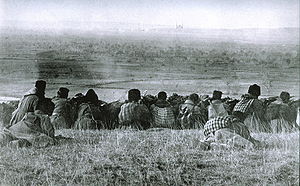
Following Italy's victory in the Italo-Turkish War
of 1911–1912 the Young Turks
fell from power after a coup. The Balkan countries saw this as an opportunity to attack and fulfill their desires of expansion.
With the initial encouragement of Russian agents, a series of agreements was concluded between Serbia and Bulgaria in March 1912. Military victory against the Ottoman empire would not be possible while it could bring reinforcements from Asia. The condition of the Ottoman railways of the time was primitive, so most reinforcement would have to come by sea through the Aegean. Greece was the only Balkan country with a navy powerful enough to deny use of the Aegean to the Ottomans, thus a treaty became necessary between Greece and Bulgaria which signed in May 1912.
Montenegro concluded agreements between Serbia and Bulgaria later that year. Bulgaria signed treaties with Serbia to divide between them the territory of northern Macedonia
, but such an agreement was clearly denied to Greece. Bulgaria's policy then was to use the agreement to limit Serbia's access to Macedonia, while at the same time denying any such agreement with Greece, believing that its army would be able to occupy the larger part of Aegean Macedonia and the important port city of Thessaloniki before the Greeks.
The resulting alliance between Greece, Serbia, Bulgaria, and Montenegro became known as the Balkan League
; its existence was undesirable for all the Great Powers. The league was loose at best, though a secret liaison officer was exchanged between the Greek and the Serbian army after the war began. Greece delayed the start of the war several times in the summer of 1912, in order to better prepare her navy, but Montenegro declared war on 8 October (25 September O.S.
). Following an ultimatum to the Ottomans, the remaining members of the alliance entered the conflict on 17 October.
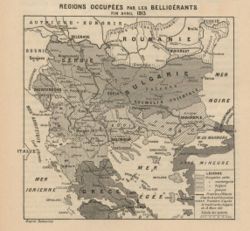 With the exception of Greece, and in continuation of their secret prewar settlements of expansion between them and under close Russian supervision, the three Slavic allies (Bulgarian, Serbs and Montenegrins) had laid out extensive plans to coordinate their war efforts: the Serbs and Montenegrins in the theater of Sandjak, the Bulgarians and Serbs in the Macedonian and Thracian theaters. The Ottoman Empire had a massive pool of manpower of about 26 million people, but it was handicapped by an army heavily dependent on reinforcements that had to come mainly from the Asian part of the Empire where 3/4 of the population and the majority of the Muslims lived. These had to be transferred to the Balkans mostly by ship, but this depended on the result of battles between the Ottoman and Greek navies in the Aegean. With the outbreak of the war the Ottoman forces activated three Army HQs, allocating there most of their available forces per front: the Thracian with its HQ in Constantinople, the Western with its HQ in Salonika and the Vardar with its HQ in Skopje, against the Bulgarians, the Greeks and the Serbians respectively. Smaller independent units had been allocated elsewhere, mostly around heavily fortified cities.
Montenegro was the first that declared war on 8 October(25 September O.S.). Its main thrust was towards Shkodra, with secondary operations in the Novi Pazar
area. The rest of the Allies, after giving a common ultimatum, declared war a week later. Bulgaria attacked towards Eastern Thrace, being stopped only at the outskirts of Constantinople
at the Çatalca
line and the isthmus of the Gallipoli peninsula, while secondary forces captured Western Thrace and Eastern Macedonia. Serbia attacked south towards Skopje
and Monastir and then turned west to present-day Albania
, reaching Adriatica
, while a second Army captured Kosovo
and linked with the Montenegrin forces. Greece's main forces attacked from Thessaly
into Macedonia through the Sarantaporo
strait and after capturing Thessaloniki
on 12 November (on 26 October 1912, O.S.
) expanded its occupied area and linked up with the Serbian army to the northwest, while its main forces turned east towards Kavala
, reaching the Bulgarians. Another Greek army attacked into Epirus
towards Ioannina
.
In the naval front the Ottoman fleet twice exited the Dardanelles
and was twice defeated by the Greek Navy, in the battles of Elli
and Lemnos
. Greek dominance on the Aegean Sea
made it impossible for the Ottomans to transfer the planned troops from the Middle East to the Thracian (against the Bulgarian) and to the Macedonian (against the Greeks and Serbians) fronts. According to the E.J.Erickson the Greek Navy also played a crucial, albeit indirect role, in the Thracian campaign by neutralizing no less than three Thracian Corps (see First Balkan War
, the Bulgarian theater of operations), a significant portion of the Ottoman Army there, in the all-important opening round of the war. After the defeating of the Ottoman fleet the Greek Navy was also free to liberate the islands of the Aegean. General Nikola Ivanov
identified the activity of the Greek Navy as the chief factor in the general success of the allies.
In January, after a successful coup by young army officers, the Ottoman Empire decided to continue the war. After a failed Ottoman counter-attack in the Western-Thracian front, Bulgarian forces with the help of the Serbian Army managed to conquer Adrianople
while Greek forces managed to take Ioannina
after defeating the Ottomans in the battle of Bizani
. In the joint Serbian-Montenegrin theater of operation the Montenegrin army besieged and captured the Shkodra, ending the Ottoman presence in Europe west of the Çatalca line after nearly 500 years. The war ended with the Treaty of London
on 30(17) May 1913.
_cholera_patients_arriving.png)
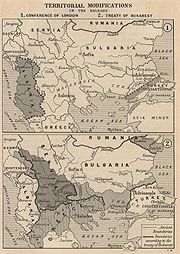 Though the Balkan allies had fought together against the common enemy, that was not enough to overcome their mutual rivalries. The Second Balkan War broke out on 29(16) June 1913 when Bulgaria attacked its erstwhile allies in the First Balkan War, Serbia and Greece, while Montenegro, Romania and the Ottoman Empire intervened later against Bulgaria. When the Greek army entered Thessaloniki
in the First Balkan War ahead of the Bulgarian 7th division by only a day, they were asked to allow a Bulgarian battalion to enter the city. Greece accepted in exchange for allowing a Greek unit to enter the city of Serres
The Bulgarian unit that entered Thessaloniki turned out to be a 48,000-strong division instead of the battalion, something which caused concern among the Greeks, who viewed it as a Bulgarian attempt to establish a condominium
over the city. In the event, due to the urgently needed reinforcements in the Thracian front, Bulgarian Headquarters was soon forced to remove its troops from the city (while the Greeks agreed by mutual treaty to remove their units based in Serres
) and transport them to Dedeağaç (modern Alexandroupolis), but still it left behind a battalion that started fortifying its positions.
Greece had also allowed the Bulgarians to control the stretch of the Thessaloniki-Constantinople railroad that lay in Greek-occupied territory, since Bulgaria controlled the largest part of this railroad towards Thrace. After the end of the operations in Thrace—and confirming Greek concerns—Bulgaria was not satisfied with the territory it controlled in Macedonia and immediately asked Greece to relinquish its control over Thessaloniki and the land north of Pieria, effectively handing over all Aegean Macedonia. These unacceptable demands together with the Bulgarian refusal to demobilize its army after the Treaty of London had ended the common war against the Ottomans and alarmed Greece, which decided also to maintain its army's mobilization.
Similarly, in northern Macedonia, the tension between Serbia and Bulgaria due to later aspirations over Vardar Macedonia
generated many incidents between the nearby armies, prompting Serbia to maintain its army's mobilization. Serbia and Greece proposed that each of the three countries reduce its army by one fourth, as a first step to facilitate a peaceful solution, but Bulgaria rejected it.
Seeing the omens, Greece and Serbia started a series of negotiations and signed a treaty on 1 June(19 May) 1913. With this treaty, a mutual border was agreed between the two countries, together with an agreement for mutual military and diplomatic support in case of a Bulgarian or/and Austro-Hungarian attack. Tsar Nicholas II of Russia
, being well informed, tried to stop the upcoming conflict on 8 June, by sending an identical personal message to the Kings of Bulgaria and Serbia, offering to act as arbitrator according to the provisions of the 1912 Serbo-Bulgarian treaty. But Bulgaria, by making the acceptance of Russian arbitration
conditional, in effect denied any discussion and caused Russia to repudiate its alliance with Bulgaria (see Russo-Bulgarian military convention signed 31 May 1902).
The Serbs and the Greeks had a military advantage on the eve of the war because their armies confronted comparatively weak Ottoman forces in the First Balkan War and suffered relatively light casualties while the Bulgarians were involved in heavy fighting in Thrace. The Serbs and the Greeks had time to fortify their positions in Macedonia. The Bulgarians also held some advantages, controlling internal communication and supply lines.
On 29(16) June 1913 General Savov, under direct orders of tsar Ferdinand I, issued attacking orders against both Greece and Serbia without consulting the Bulgarian government and without any official declaration of war. During the night of 30(17) June 1913 they attacked the Serbian army at Bregalnica river and then the Greek army in Nigrita
. The Serbian army resisted the sudden night attack, while most of soldiers did not even know who they are fighting with, as Bulgarian camps were located next to Serbs and were considered allies. Montenegro's forces were just a few kilometeres away and also rushed to the battle. The Bulgarian attack was halted.
The Greek army was also successful. It retreated according to plan for two days while Thessaloniki
was cleared of the remaining Bulgarian regiment. Then the Greek army counter-attacked and defeated the Bulgarians at Kilkis-Lahanas
, after which the mostly Bulgarian town was destroyed. However, the Greek army's pace was not quick enough to prevent the massacre
of Greek peaceable inhabitants at Nigrita
, Serres
, Drama and Doxato
. The Greek army then divided its forces and advanced in two directions. Part proceeded east and occupied Western Thrace
. The rest of the Greek army advanced up to the Struma River
valley, defeating the Bulgarian army in the battles of Doiran
and Mt. Beles, and continued its advance to the north towards Sofia
. In the Kresna straits
the Greeks were ambushed by the Bulgarian 2nd and 1st Army newly arrived from the Serbian front that had already taken defensive positions there following the Bulgarian victory at Kalimanci.
By 30 July the Greek army was outnumbered by the counter-attacking Bulgarian army, which attempted to encircle the Greeks in a Cannae-type battle, by applying pressure on their flanks. The Greek army resisted successfully however, launching local counter-attacks. The battle was continued for 11 days, between 29 July and 9 August over 20 km of a maze of forests and mountains with no conclusion. The Greek King, seeing that the units he fought were from the Serbian front, tried to convince the Serbs to renew their attack, as the front ahead them was now thinner, but the Serbs rejected it. By then, news came of the Romanian advance toward Sofia and its imminent fall. After that, Constantine, realizing the futility of continuing the counterattack, agreed to Eleftherios Venizelos
' proposal and accepted the Bulgarian request for armistice as this had been communicated through Romania.
Romania had raised an army and declared war on Bulgaria on 10 July(27 June) as it had from 28(15) June officially warned Bulgaria that it would not remain neutral in a new Balkan war, due to Bulgaria's refusal to cede the fortress of Silistra as promised before the First Balkan war in exchange for Romanian neutrality. Its forces encountered little resistance and by the time the Greeks accepted the Bulgarian request for armistice they had reached Vrazhdebna, 7 miles from the center of Sofia
.
Seeing the military position of the Bulgarian army the Ottomans
decided to intervene. They attacked and finding no opposition, managed to recover eastern Thrace
with its fortified city of Adrianople
, regaining an area in Europe which was only slightly larger than the present-day European territory of the Republic of Turkey.
, which led to a stern warning to the Balkan states, unofficially each of them took a different diplomatic approach due to their conflicting interests in the area. As a result, any possible preventive effect of the common official warning was cancelled by the mixed unofficial signals, and failed to prevent or to stop the war:
The Second Balkan war was a catastrophic blow to Russian policies in the Balkans, where Russia had focused its interests for access to the "warm seas" for centuries. First, it marked the end of the Balkan League, a vital arm of the Russian system of defense against Austria-Hungary. Second, the clearly pro-Serbian position Russia had been forced to take in the conflict, mainly due to Bulgaria's uncompromising aggressiveness, caused a permanent break-up between the two countries. Accordingly, Bulgaria reverted its policy to one closer to the Central Powers
' understanding over an anti-Serbian front, due to its new national aspirations, now expressed mainly against Serbia. As a result, Serbia was isolated militarily against its rival Austria-Hungary, a development that eventually doomed Serbia in the coming war a year later. But most damaging, the new situation effectively trapped Russian foreign policy: After 1913, Russia could not afford losing its last ally in this crucial area and thus had no alternatives but to unconditionally support Serbia when the crisis between Serbia and Austria broke out in 1914. This was a position that inevitably drew her, although unwillingly, into a World War with devastating results for her, since she was less prepared (both militarily and socially) for that event than any other Great Power.
Austria-Hungary took alarm at the great increase in Serbia's territory at the expense of its national aspirations in the region, as well as Serbia's rising status, especially to Austria-Hungary's Slavic populations. This concern was shared by Germany, which saw Serbia as a satellite of Russia. This contributed significantly to the two Central Powers' willingness to go to war as soon as possible.
Finally, when a Serbian backed organization
assassinated the heir of the Austro-Hungarian throne
, causing the 1914 July Crisis, nobody could stop the conflict and the First World War broke out.
, notable conflicts have included:
Balkans
The Balkans is a geopolitical and cultural region of southeastern Europe...
in south-eastern Europe in 1912 and 1913.
By the early 20th century, Montenegro
Kingdom of Montenegro
The Kingdom of Montenegro was a monarchy in southeastern Europe during the tumultuous years on the Balkan Peninsula leading up to and during World War I. Legally it was a constitutional monarchy, but absolutist in practice...
, Bulgaria
Kingdom of Bulgaria
The Kingdom of Bulgaria was established as an independent state when the Principality of Bulgaria, an Ottoman vassal, officially proclaimed itself independent on October 5, 1908 . This move also formalised the annexation of the Ottoman province of Eastern Rumelia, which had been under the control...
, Greece
Kingdom of Greece
The Kingdom of Greece was a state established in 1832 in the Convention of London by the Great Powers...
and Serbia
Kingdom of Serbia
The Kingdom of Serbia was created when Prince Milan Obrenović, ruler of the Principality of Serbia, was crowned King in 1882. The Principality of Serbia was ruled by the Karađorđevic dynasty from 1817 onwards . The Principality, suzerain to the Porte, had expelled all Ottoman troops by 1867, de...
, the countries of the Balkan League
Balkan League
The Balkan League was an alliance formed by a series of bilateral treaties concluded in 1912 between the Balkan states of Bulgaria, Greece, Montenegro and Serbia, and directed against the Ottoman Empire, which at the time still controlled much of the Balkan peninsula...
, had achieved their independence from the Ottoman Empire
Ottoman Empire
The Ottoman EmpireIt was usually referred to as the "Ottoman Empire", the "Turkish Empire", the "Ottoman Caliphate" or more commonly "Turkey" by its contemporaries...
, but large parts of their ethnic populations remained under ethnic sovereignty. The First Balkan War
First Balkan War
The First Balkan War, which lasted from October 1912 to May 1913, pitted the Balkan League against the Ottoman Empire. The combined armies of the Balkan states overcame the numerically inferior and strategically disadvantaged Ottoman armies and achieved rapid success...
broke out when the League attacked the Ottoman Empire on 8 October 1912 and was ended seven months later by the Treaty of London
Treaty of London, 1913
The Treaty of London was signed on 30 May during the London Conference of 1913. It dealt with the territorial adjustments arising out of the conclusion of the First Balkan War.-History:...
; after five centuries, the Ottoman Empire lost virtually all of its possessions in the Balkans.
The Second Balkan War
Second Balkan War
The Second Balkan War was a conflict which broke out when Bulgaria, dissatisfied with its share of the spoils of the First Balkan War, attacked its former allies, Serbia and Greece, on 29 June 1913. Bulgaria had a prewar agreement about the division of region of Macedonia...
broke out on 16 June 1913 when Bulgaria was dissatisfied over the division of the spoils in Macedonia
Macedonia (region)
Macedonia is a geographical and historical region of the Balkan peninsula in southeastern Europe. Its boundaries have changed considerably over time, but nowadays the region is considered to include parts of five Balkan countries: Greece, the Republic of Macedonia, Bulgaria, Albania, Serbia, as...
, made in secret by its former allies, Serbia and Greece. Their armies repulsed the Bulgarian offensive and counter-attacked penetrating into Bulgaria, while Romania
Romania
Romania is a country located at the crossroads of Central and Southeastern Europe, on the Lower Danube, within and outside the Carpathian arch, bordering on the Black Sea...
and the Ottoman Empire took the opportunity to intervene against Bulgaria and make territorial gains. In the resulting Treaty of Bucharest, Bulgaria lost most of the territories it had gained in the First Balkan War.
Background
The background to the wars lies in the incomplete emergence of nation-states on the European territory of the Ottoman Empire during the second half of the 19th century. The SerbsSerbs
The Serbs are a South Slavic ethnic group of the Balkans and southern Central Europe. Serbs are located mainly in Serbia, Montenegro and Bosnia and Herzegovina, and form a sizable minority in Croatia, the Republic of Macedonia and Slovenia. Likewise, Serbs are an officially recognized minority in...
had gained substantial territory during the Russo-Turkish War, 1877–1878
Russo-Turkish War, 1877–1878
The Russo-Turkish War of 1877–1878 was a conflict between the Ottoman Empire and the Eastern Orthodox coalition led by the Russian Empire and composed of numerous Balkan...
, while Greece acquired Thessaly
Thessaly
Thessaly is a traditional geographical region and an administrative region of Greece, comprising most of the ancient region of the same name. Before the Greek Dark Ages, Thessaly was known as Aeolia, and appears thus in Homer's Odyssey....
in 1881 (although it lost a small area back to the Ottoman Empire in 1897) and Bulgaria (an autonomous principality
Principality
A principality is a monarchical feudatory or sovereign state, ruled or reigned over by a monarch with the title of prince or princess, or by a monarch with another title within the generic use of the term prince....
since 1878) incorporated the formerly distinct province of Eastern Rumelia
Eastern Rumelia
Eastern Rumelia or Eastern Roumelia was an administratively autonomous province in the Ottoman Empire and Principality of Bulgaria from 1878 to 1908. It was under full Bulgarian control from 1885 on, when it willingly united with the tributary Principality of Bulgaria after a bloodless revolution...
(1885). All three as well as Montenegro sought additional territories within the large Ottoman-ruled region known as Rumelia
Rumelia
Rumelia was an historical region comprising the territories of the Ottoman Empire in Europe...
, comprising Eastern Rumelia, Albania
Albania
Albania , officially known as the Republic of Albania , is a country in Southeastern Europe, in the Balkans region. It is bordered by Montenegro to the northwest, Kosovo to the northeast, the Republic of Macedonia to the east and Greece to the south and southeast. It has a coast on the Adriatic Sea...
, Macedonia (region)
Macedonia (region)
Macedonia is a geographical and historical region of the Balkan peninsula in southeastern Europe. Its boundaries have changed considerably over time, but nowadays the region is considered to include parts of five Balkan countries: Greece, the Republic of Macedonia, Bulgaria, Albania, Serbia, as...
, and Thrace
Thrace
Thrace is a historical and geographic area in southeast Europe. As a geographical concept, Thrace designates a region bounded by the Balkan Mountains on the north, Rhodope Mountains and the Aegean Sea on the south, and by the Black Sea and the Sea of Marmara on the east...
(see map).
Policies of the Great Powers
Throughout the 19th century, the Great PowerGreat power
A great power is a nation or state that has the ability to exert its influence on a global scale. Great powers characteristically possess military and economic strength and diplomatic and cultural influence which may cause small powers to consider the opinions of great powers before taking actions...
s shared different aims over the "Eastern Question
Eastern Question
The "Eastern Question", in European history, encompasses the diplomatic and political problems posed by the decay of the Ottoman Empire. The expression does not apply to any one particular problem, but instead includes a variety of issues raised during the 18th, 19th, and 20th centuries, including...
" and the integrity of the Ottoman Empire. Russia
Russia
Russia or , officially known as both Russia and the Russian Federation , is a country in northern Eurasia. It is a federal semi-presidential republic, comprising 83 federal subjects...
wished for access to the "warm waters" of the Mediterranean; it pursued a pan-Slavic
Pan-Slavism
Pan-Slavism was a movement in the mid-19th century aimed at unity of all the Slavic peoples. The main focus was in the Balkans where the South Slavs had been ruled for centuries by other empires, Byzantine Empire, Austria-Hungary, the Ottoman Empire, and Venice...
foreign policy and thereby supported Bulgaria
Bulgaria
Bulgaria , officially the Republic of Bulgaria , is a parliamentary democracy within a unitary constitutional republic in Southeast Europe. The country borders Romania to the north, Serbia and Macedonia to the west, Greece and Turkey to the south, as well as the Black Sea to the east...
and Serbia
Serbia
Serbia , officially the Republic of Serbia , is a landlocked country located at the crossroads of Central and Southeast Europe, covering the southern part of the Carpathian basin and the central part of the Balkans...
. Britain wished to deny Russia access to the "warm waters" and supported the integrity of the Ottoman Empire, although it also supported a limited expansion of Greece as a backup plan in case integrity of the empire was no longer possible. France wished to strengthen its position in the region, especially in the Levant
Levant
The Levant or ) is the geographic region and culture zone of the "eastern Mediterranean littoral between Anatolia and Egypt" . The Levant includes most of modern Lebanon, Syria, Jordan, Israel, the Palestinian territories, and sometimes parts of Turkey and Iraq, and corresponds roughly to the...
(today's Lebanon
Lebanon
Lebanon , officially the Republic of LebanonRepublic of Lebanon is the most common term used by Lebanese government agencies. The term Lebanese Republic, a literal translation of the official Arabic and French names that is not used in today's world. Arabic is the most common language spoken among...
, Syria, the Palestinian territories
Palestine
Palestine is a conventional name, among others, used to describe the geographic region between the Mediterranean Sea and the Jordan River, and various adjoining lands....
and Israel
Israel
The State of Israel is a parliamentary republic located in the Middle East, along the eastern shore of the Mediterranean Sea...
).
The Habsburg
Habsburg
The House of Habsburg , also found as Hapsburg, and also known as House of Austria is one of the most important royal houses of Europe and is best known for being an origin of all of the formally elected Holy Roman Emperors between 1438 and 1740, as well as rulers of the Austrian Empire and...
-ruled Austria-Hungary
Austria-Hungary
Austria-Hungary , more formally known as the Kingdoms and Lands Represented in the Imperial Council and the Lands of the Holy Hungarian Crown of Saint Stephen, was a constitutional monarchic union between the crowns of the Austrian Empire and the Kingdom of Hungary in...
wished for a continuation of the existence of the Ottoman Empire, since both were troubled multinational entities and thus the collapse of the one might weaken the other. The Habsburgs also saw a strong Ottoman presence in the area as a counterweight to the Serbian nationalistic call to their own Serb subjects in Bosnia. Italy, it has been argued, wished to recreate the Roman empire
Roman Empire
The Roman Empire was the post-Republican period of the ancient Roman civilization, characterised by an autocratic form of government and large territorial holdings in Europe and around the Mediterranean....
, though its primary aim at the time seems to have been the denial of access to the Adriatic Sea
Adriatic Sea
The Adriatic Sea is a body of water separating the Italian Peninsula from the Balkan peninsula, and the system of the Apennine Mountains from that of the Dinaric Alps and adjacent ranges...
to another major sea power. Germany, in turn, under the "Drang nach Osten
Drang nach Osten
Drang nach Osten was a term coined in the 19th century to designate German expansion into Slavic lands. The term became a motto of the German nationalist movement in the late nineteenth century...
" policy, aspired to turn the Ottoman Empire into its own de facto colony, and thus supported its integrity.
Bulgaria and Greece sent armed bandits inside the Empire (in Macedonia and Thrace) in the late 19th and early 20th century to protect their own nationals from the forced "Bulgarization" of Greeks by Bulgarians or "Hellinization" of Bulgars by Greeks. Low intensity warfare had broken out inside Macedonia between the Greek and Bulgarian bands and the Ottoman army after 1904 in the Struggle for Macedonia. After the Young Turk revolution
Young Turks
The Young Turks , from French: Les Jeunes Turcs) were a coalition of various groups favouring reformation of the administration of the Ottoman Empire. The movement was against the absolute monarchy of the Ottoman Sultan and favoured a re-installation of the short-lived Kanûn-ı Esâsî constitution...
of July 1908, the situation changed drastically.
Young Turk revolution
It is no surprise that the "Young Turk" revolution occurred in the troubled European provinces of the Empire. There the threat to its integrity was the most pronounced, and the need for reforms was most evident. When the revolt broke out, it was supported by intellectuals, the army, and almost all the ethnic minorities of the Empire, and forced Sultan Abdul Hamid IIAbdul Hamid II
His Imperial Majesty, The Sultan Abdülhamid II, Emperor of the Ottomans, Caliph of the Faithful was the 34th sultan of the Ottoman Empire...
to re-adopt the long defunct Ottoman constitution of 1877, ushering in the Second Constitutional Era
Second Constitutional Era (Ottoman Empire)
The Second Constitutional Era of the Ottoman Empire began shortly after Sultan Abdülhamid II restored the constitutional monarchy after the 1908 Young Turk Revolution. The period established many political groups...
. Hopes were raised among the Balkan ethnicities of reforms and autonomy, and elections were held to form a representative, multi-ethnic, Ottoman parliament. However, following the Sultan's attempted counter-coup
Countercoup (1909)
The Countercoup of 1909 was an attempt to dismantle the Second Constitutional Era of the Ottoman Empire and replace it with a monarchy under Sultan Abdul Hamid II...
, the liberal element of the Young Turks was sidelined and the nationalist element became dominant.
At the same time, in October 1908, Austria-Hungary seized the opportunity of the Ottoman political upheaval to annex the de jure Ottoman province of Bosnia-Herzegovina
Bosnia and Herzegovina
Bosnia and Herzegovina , sometimes called Bosnia-Herzegovina or simply Bosnia, is a country in Southern Europe, on the Balkan Peninsula. Bordered by Croatia to the north, west and south, Serbia to the east, and Montenegro to the southeast, Bosnia and Herzegovina is almost landlocked, except for the...
, which it had occupied since 1878 (see Bosnian Crisis
Bosnian crisis
The Bosnian Crisis of 1908–1909, also known as the Annexation crisis, or the First Balkan Crisis, erupted into public view when on 6 October 1908, Austria-Hungary announced the annexation of Bosnia and Herzegovina. Russia, the Ottoman Empire, Britain, Italy, Serbia, Montenegro, Germany and France...
), and Bulgaria declared itself a fully independent kingdom. The Greeks of the autonomous Cretan State
Cretan State
The Cretan State was established in 1898, following the intervention by the Great Powers on the island of Crete. In 1897 an insurrection in Crete led the Ottoman Empire to declare war on Greece, which led the United Kingdom, France, Italy and Russia to intervene on the grounds that the Ottoman...
proclaimed unification with Greece, though the opposition of the Great Powers prevented the latter action from taking practical influence.
Reaction in the Balkan States
Frustrated in the north by Austria-Hungary's incorporation of Bosnia with its 975,000 Orthodox SerbsSerbs
The Serbs are a South Slavic ethnic group of the Balkans and southern Central Europe. Serbs are located mainly in Serbia, Montenegro and Bosnia and Herzegovina, and form a sizable minority in Croatia, the Republic of Macedonia and Slovenia. Likewise, Serbs are an officially recognized minority in...
(and many more Serbs and Serb-sympathizers of other faiths), and forced (March 1909) to accept the annexation and restrain anti-Habsburg agitation among Serbian nationalist groups, the Serbian government looked to formerly Serb territories in the south, notably "Old Serbia" (the Sanjak of Novi Pazar
Sanjak of Novi Pazar
The Sanjak of Novi Pazar was an Ottoman sanjak that existed until the Balkan Wars of 1912-1913 in the territory of present day Montenegro, Serbia and Kosovo.-History:It was part of the Bosnia Vilayet and later Kosovo Vilayet and included...
and the province of Kosovo
Kosovo
Kosovo is a region in southeastern Europe. Part of the Ottoman Empire for more than five centuries, later the Autonomous Province of Kosovo and Metohija within Serbia...
).
On 15 August 1909 the Military League, a group of Greek officers, took action against the government to reform their country's national government and reorganize the army. The league found itself unable to create a new political system, until the league summoned the Cretan politician Eleutherios Venizelos to Athens as its political adviser. Venizelos persuaded the king to revise the constitution and asked the league to disband in favor of a National Assembly. In March 1910 the Military League dissolved itself.
Bulgaria, which had secured Ottoman recognition of her independence in April 1909 and enjoyed the friendship of Russia, also looked to districts of Ottoman Thrace
Thrace
Thrace is a historical and geographic area in southeast Europe. As a geographical concept, Thrace designates a region bounded by the Balkan Mountains on the north, Rhodope Mountains and the Aegean Sea on the south, and by the Black Sea and the Sea of Marmara on the east...
and Macedonia. In August 1910 Montenegro followed Bulgaria's precedent by becoming a kingdom.
Balkan League
Following Italy's victory in the Italo-Turkish War
Italo-Turkish War
The Italo-Turkish or Turco-Italian War was fought between the Ottoman Empire and the Kingdom of Italy from September 29, 1911 to October 18, 1912.As a result of this conflict, Italy was awarded the Ottoman provinces of Tripolitania, Fezzan, and...
of 1911–1912 the Young Turks
Young Turks
The Young Turks , from French: Les Jeunes Turcs) were a coalition of various groups favouring reformation of the administration of the Ottoman Empire. The movement was against the absolute monarchy of the Ottoman Sultan and favoured a re-installation of the short-lived Kanûn-ı Esâsî constitution...
fell from power after a coup. The Balkan countries saw this as an opportunity to attack and fulfill their desires of expansion.
With the initial encouragement of Russian agents, a series of agreements was concluded between Serbia and Bulgaria in March 1912. Military victory against the Ottoman empire would not be possible while it could bring reinforcements from Asia. The condition of the Ottoman railways of the time was primitive, so most reinforcement would have to come by sea through the Aegean. Greece was the only Balkan country with a navy powerful enough to deny use of the Aegean to the Ottomans, thus a treaty became necessary between Greece and Bulgaria which signed in May 1912.
Montenegro concluded agreements between Serbia and Bulgaria later that year. Bulgaria signed treaties with Serbia to divide between them the territory of northern Macedonia
Macedonia (region)
Macedonia is a geographical and historical region of the Balkan peninsula in southeastern Europe. Its boundaries have changed considerably over time, but nowadays the region is considered to include parts of five Balkan countries: Greece, the Republic of Macedonia, Bulgaria, Albania, Serbia, as...
, but such an agreement was clearly denied to Greece. Bulgaria's policy then was to use the agreement to limit Serbia's access to Macedonia, while at the same time denying any such agreement with Greece, believing that its army would be able to occupy the larger part of Aegean Macedonia and the important port city of Thessaloniki before the Greeks.
The resulting alliance between Greece, Serbia, Bulgaria, and Montenegro became known as the Balkan League
Balkan League
The Balkan League was an alliance formed by a series of bilateral treaties concluded in 1912 between the Balkan states of Bulgaria, Greece, Montenegro and Serbia, and directed against the Ottoman Empire, which at the time still controlled much of the Balkan peninsula...
; its existence was undesirable for all the Great Powers. The league was loose at best, though a secret liaison officer was exchanged between the Greek and the Serbian army after the war began. Greece delayed the start of the war several times in the summer of 1912, in order to better prepare her navy, but Montenegro declared war on 8 October (25 September O.S.
Old Style and New Style dates
Old Style and New Style are used in English language historical studies either to indicate that the start of the Julian year has been adjusted to start on 1 January even though documents written at the time use a different start of year ; or to indicate that a date conforms to the Julian...
). Following an ultimatum to the Ottomans, the remaining members of the alliance entered the conflict on 17 October.
First Balkan War
Montenegro was the first that declared war on 8 October(25 September O.S.). Its main thrust was towards Shkodra, with secondary operations in the Novi Pazar
Novi Pazar
Novi Pazar is a city and municipality located in southwest Serbia, in the Raška District. According to the official census in 2011, number of inhabitants of municipality is 92,776, while the city itself has a population of 60,638...
area. The rest of the Allies, after giving a common ultimatum, declared war a week later. Bulgaria attacked towards Eastern Thrace, being stopped only at the outskirts of Constantinople
Constantinople
Constantinople was the capital of the Roman, Eastern Roman, Byzantine, Latin, and Ottoman Empires. Throughout most of the Middle Ages, Constantinople was Europe's largest and wealthiest city.-Names:...
at the Çatalca
Çatalca
Çatalca is a city and a rural district in Istanbul, Turkey. It is in Thrace, on the ridge between the Marmara and the Black Sea. Most people living in Çatalca are either farmers or those visiting vacation homes. Many families from Istanbul come to Çatalca during weekends to hike in the forests or...
line and the isthmus of the Gallipoli peninsula, while secondary forces captured Western Thrace and Eastern Macedonia. Serbia attacked south towards Skopje
Skopje
Skopje is the capital and largest city of the Republic of Macedonia with about a third of the total population. It is the country's political, cultural, economic, and academic centre...
and Monastir and then turned west to present-day Albania
Albania
Albania , officially known as the Republic of Albania , is a country in Southeastern Europe, in the Balkans region. It is bordered by Montenegro to the northwest, Kosovo to the northeast, the Republic of Macedonia to the east and Greece to the south and southeast. It has a coast on the Adriatic Sea...
, reaching Adriatica
Adriatica
Adria and Adriatica are parent Swiss Watch Brands specialised in making quality watches at affordable prices for the Eastern European Markets.-Origin:...
, while a second Army captured Kosovo
Kosovo
Kosovo is a region in southeastern Europe. Part of the Ottoman Empire for more than five centuries, later the Autonomous Province of Kosovo and Metohija within Serbia...
and linked with the Montenegrin forces. Greece's main forces attacked from Thessaly
Thessaly
Thessaly is a traditional geographical region and an administrative region of Greece, comprising most of the ancient region of the same name. Before the Greek Dark Ages, Thessaly was known as Aeolia, and appears thus in Homer's Odyssey....
into Macedonia through the Sarantaporo
Sarantaporo
Sarantaporo is a village and a former municipality in the Larissa regional unit, Thessaly, Greece. Since the 2011 local government reform it is part of the municipality Elassona, of which it is a municipal unit. Population 3,588 . The town is near the mountain ranges of Kamvounio to the northwest...
strait and after capturing Thessaloniki
Thessaloniki
Thessaloniki , historically also known as Thessalonica, Salonika or Salonica, is the second-largest city in Greece and the capital of the region of Central Macedonia as well as the capital of the Decentralized Administration of Macedonia and Thrace...
on 12 November (on 26 October 1912, O.S.
Old Style and New Style dates
Old Style and New Style are used in English language historical studies either to indicate that the start of the Julian year has been adjusted to start on 1 January even though documents written at the time use a different start of year ; or to indicate that a date conforms to the Julian...
) expanded its occupied area and linked up with the Serbian army to the northwest, while its main forces turned east towards Kavala
Kavala
Kavala , is the second largest city in northern Greece, the principal seaport of eastern Macedonia and the capital of Kavala peripheral unit. It is situated on the Bay of Kavala, across from the island of Thasos...
, reaching the Bulgarians. Another Greek army attacked into Epirus
Epirus
The name Epirus, from the Greek "Ήπειρος" meaning continent may refer to:-Geographical:* Epirus - a historical and geographical region of the southwestern Balkans, straddling modern Greece and Albania...
towards Ioannina
Ioannina
Ioannina , often called Jannena within Greece, is the largest city of Epirus, north-western Greece, with a population of 70,203 . It lies at an elevation of approximately 500 meters above sea level, on the western shore of lake Pamvotis . It is located within the Ioannina municipality, and is the...
.
In the naval front the Ottoman fleet twice exited the Dardanelles
Dardanelles
The Dardanelles , formerly known as the Hellespont, is a narrow strait in northwestern Turkey connecting the Aegean Sea to the Sea of Marmara. It is one of the Turkish Straits, along with its counterpart the Bosphorus. It is located at approximately...
and was twice defeated by the Greek Navy, in the battles of Elli
Naval Battle of Elli
The Battle of Elli , also known as the Battle of the Dardanelles, took place near the mouth of the Dardanelles on as part of the First Balkan War between the fleets of Greece and the Ottoman Empire...
and Lemnos
Naval Battle of Lemnos
The Battle of Lemnos , fought on , was a naval battle during the First Balkan War, which defeated the second and last attempt of the Ottoman Empire to break the Greek naval blockade of the Dardanelles and reclaim supremacy over the Aegean Sea from Greece....
. Greek dominance on the Aegean Sea
Aegean Sea
The Aegean Sea[p] is an elongated embayment of the Mediterranean Sea located between the southern Balkan and Anatolian peninsulas, i.e., between the mainlands of Greece and Turkey. In the north, it is connected to the Marmara Sea and Black Sea by the Dardanelles and Bosporus...
made it impossible for the Ottomans to transfer the planned troops from the Middle East to the Thracian (against the Bulgarian) and to the Macedonian (against the Greeks and Serbians) fronts. According to the E.J.Erickson the Greek Navy also played a crucial, albeit indirect role, in the Thracian campaign by neutralizing no less than three Thracian Corps (see First Balkan War
First Balkan War
The First Balkan War, which lasted from October 1912 to May 1913, pitted the Balkan League against the Ottoman Empire. The combined armies of the Balkan states overcame the numerically inferior and strategically disadvantaged Ottoman armies and achieved rapid success...
, the Bulgarian theater of operations), a significant portion of the Ottoman Army there, in the all-important opening round of the war. After the defeating of the Ottoman fleet the Greek Navy was also free to liberate the islands of the Aegean. General Nikola Ivanov
Nikola Ivanov
Nikola Ivanov was a Bulgarian general, Chief of the Headquarters of the Bulgarian Army between 10 May 1894 and 29 November 1896, Minister of war between 29 November 1896 - 30 January 1899...
identified the activity of the Greek Navy as the chief factor in the general success of the allies.
In January, after a successful coup by young army officers, the Ottoman Empire decided to continue the war. After a failed Ottoman counter-attack in the Western-Thracian front, Bulgarian forces with the help of the Serbian Army managed to conquer Adrianople
Battle of Adrianople (1913)
The Battle or Siege of Adrianople or Siege of Edirne was fought during the First Balkan War, beginning in mid-November 1912 and ending on 26 March 1913 with the capture of Edirne by the Bulgarian 2nd Army....
while Greek forces managed to take Ioannina
Ioannina
Ioannina , often called Jannena within Greece, is the largest city of Epirus, north-western Greece, with a population of 70,203 . It lies at an elevation of approximately 500 meters above sea level, on the western shore of lake Pamvotis . It is located within the Ioannina municipality, and is the...
after defeating the Ottomans in the battle of Bizani
Battle of Bizani
The Battle of Bizani took place in Epirus on March 4–6, 1913. The battle was fought between the Greek and the Ottoman forces during the last stages of the First Balkan War, and revolved around the forts of Bizani, which covered the approaches to Ioannina, the largest city in the region.At the...
. In the joint Serbian-Montenegrin theater of operation the Montenegrin army besieged and captured the Shkodra, ending the Ottoman presence in Europe west of the Çatalca line after nearly 500 years. The war ended with the Treaty of London
Treaty of London, 1913
The Treaty of London was signed on 30 May during the London Conference of 1913. It dealt with the territorial adjustments arising out of the conclusion of the First Balkan War.-History:...
on 30(17) May 1913.
Second Balkan War
Thessaloniki
Thessaloniki , historically also known as Thessalonica, Salonika or Salonica, is the second-largest city in Greece and the capital of the region of Central Macedonia as well as the capital of the Decentralized Administration of Macedonia and Thrace...
in the First Balkan War ahead of the Bulgarian 7th division by only a day, they were asked to allow a Bulgarian battalion to enter the city. Greece accepted in exchange for allowing a Greek unit to enter the city of Serres
Serres, Greece
Sérres is a city in Macedonia, Greece. It is situated in a fertile plain at an elevation of about 70 m, some 24 km northeast of the Strymon river and 69 km north-east of the Macedonian capital, Thessaloniki. The Rhodope Mountains rise to the north and east of the city...
The Bulgarian unit that entered Thessaloniki turned out to be a 48,000-strong division instead of the battalion, something which caused concern among the Greeks, who viewed it as a Bulgarian attempt to establish a condominium
Condominium (international law)
In international law, a condominium is a political territory in or over which two or more sovereign powers formally agree to share equally dominium and exercise their rights jointly, without dividing it up into 'national' zones.Although a condominium has always been...
over the city. In the event, due to the urgently needed reinforcements in the Thracian front, Bulgarian Headquarters was soon forced to remove its troops from the city (while the Greeks agreed by mutual treaty to remove their units based in Serres
Serres
Serres is a city in Greece, seat of the Serres prefecture.Serres may also refer to:Places:* Serres, Germany, a part of Wiernsheim in Baden-WürttembergIn France:* Serres, Aude in the Aude département...
) and transport them to Dedeağaç (modern Alexandroupolis), but still it left behind a battalion that started fortifying its positions.
Greece had also allowed the Bulgarians to control the stretch of the Thessaloniki-Constantinople railroad that lay in Greek-occupied territory, since Bulgaria controlled the largest part of this railroad towards Thrace. After the end of the operations in Thrace—and confirming Greek concerns—Bulgaria was not satisfied with the territory it controlled in Macedonia and immediately asked Greece to relinquish its control over Thessaloniki and the land north of Pieria, effectively handing over all Aegean Macedonia. These unacceptable demands together with the Bulgarian refusal to demobilize its army after the Treaty of London had ended the common war against the Ottomans and alarmed Greece, which decided also to maintain its army's mobilization.
Similarly, in northern Macedonia, the tension between Serbia and Bulgaria due to later aspirations over Vardar Macedonia
Vardar Macedonia
Vardar Macedonia is an area in the north of the Macedonia . The borders of the area are those of the Republic of Macedonia. It covers an area of...
generated many incidents between the nearby armies, prompting Serbia to maintain its army's mobilization. Serbia and Greece proposed that each of the three countries reduce its army by one fourth, as a first step to facilitate a peaceful solution, but Bulgaria rejected it.
Seeing the omens, Greece and Serbia started a series of negotiations and signed a treaty on 1 June(19 May) 1913. With this treaty, a mutual border was agreed between the two countries, together with an agreement for mutual military and diplomatic support in case of a Bulgarian or/and Austro-Hungarian attack. Tsar Nicholas II of Russia
Nicholas II of Russia
Nicholas II was the last Emperor of Russia, Grand Prince of Finland, and titular King of Poland. His official short title was Nicholas II, Emperor and Autocrat of All the Russias and he is known as Saint Nicholas the Passion-Bearer by the Russian Orthodox Church.Nicholas II ruled from 1894 until...
, being well informed, tried to stop the upcoming conflict on 8 June, by sending an identical personal message to the Kings of Bulgaria and Serbia, offering to act as arbitrator according to the provisions of the 1912 Serbo-Bulgarian treaty. But Bulgaria, by making the acceptance of Russian arbitration
Arbitration
Arbitration, a form of alternative dispute resolution , is a legal technique for the resolution of disputes outside the courts, where the parties to a dispute refer it to one or more persons , by whose decision they agree to be bound...
conditional, in effect denied any discussion and caused Russia to repudiate its alliance with Bulgaria (see Russo-Bulgarian military convention signed 31 May 1902).
The Serbs and the Greeks had a military advantage on the eve of the war because their armies confronted comparatively weak Ottoman forces in the First Balkan War and suffered relatively light casualties while the Bulgarians were involved in heavy fighting in Thrace. The Serbs and the Greeks had time to fortify their positions in Macedonia. The Bulgarians also held some advantages, controlling internal communication and supply lines.
On 29(16) June 1913 General Savov, under direct orders of tsar Ferdinand I, issued attacking orders against both Greece and Serbia without consulting the Bulgarian government and without any official declaration of war. During the night of 30(17) June 1913 they attacked the Serbian army at Bregalnica river and then the Greek army in Nigrita
Nigrita
Nigrita is a town and a former municipality in the Serres regional unit, Greece. Since the 2011 local government reform it is part of the municipality Visaltia, of which it is the seat and a municipal unit. It is situated between the Strymonian plain of the Strymon river and the Vertiskos...
. The Serbian army resisted the sudden night attack, while most of soldiers did not even know who they are fighting with, as Bulgarian camps were located next to Serbs and were considered allies. Montenegro's forces were just a few kilometeres away and also rushed to the battle. The Bulgarian attack was halted.
The Greek army was also successful. It retreated according to plan for two days while Thessaloniki
Thessaloniki
Thessaloniki , historically also known as Thessalonica, Salonika or Salonica, is the second-largest city in Greece and the capital of the region of Central Macedonia as well as the capital of the Decentralized Administration of Macedonia and Thrace...
was cleared of the remaining Bulgarian regiment. Then the Greek army counter-attacked and defeated the Bulgarians at Kilkis-Lahanas
Battle of Kilkis-Lahanas
The Battle of Kilkis–Lahanas took place during the Second Balkan War between Greece and Bulgaria for the town of Kilkis in Macedonia. The battle lasted three days from 19 to 21 June 1913 and ended with a Greek victory.-Background:...
, after which the mostly Bulgarian town was destroyed. However, the Greek army's pace was not quick enough to prevent the massacre
Massacre
A massacre is an event with a heavy death toll.Massacre may also refer to:-Entertainment:*Massacre , a DC Comics villain*Massacre , a 1932 drama film starring Richard Barthelmess*Massacre, a 1956 Western starring Dane Clark...
of Greek peaceable inhabitants at Nigrita
Nigrita
Nigrita is a town and a former municipality in the Serres regional unit, Greece. Since the 2011 local government reform it is part of the municipality Visaltia, of which it is the seat and a municipal unit. It is situated between the Strymonian plain of the Strymon river and the Vertiskos...
, Serres
Serres
Serres is a city in Greece, seat of the Serres prefecture.Serres may also refer to:Places:* Serres, Germany, a part of Wiernsheim in Baden-WürttembergIn France:* Serres, Aude in the Aude département...
, Drama and Doxato
Doxato
Doxato is a town and municipality in the Drama peripheral unit, in East Macedonia and Thrace, Greece. The seat of the municipality is the town Kalampaki.-Municipality:...
. The Greek army then divided its forces and advanced in two directions. Part proceeded east and occupied Western Thrace
Western Thrace
Western Thrace or simply Thrace is a geographic and historical region of Greece, located between the Nestos and Evros rivers in the northeast of the country. Together with the regions of Macedonia and Epirus, it is often referred to informally as northern Greece...
. The rest of the Greek army advanced up to the Struma River
Struma River
The Struma or Strymónas is a river in Bulgaria and Greece. Its ancient name was Strymōn . Its catchment area is 10,800 km²...
valley, defeating the Bulgarian army in the battles of Doiran
Battle of Doiran
The third Battle of Doiran was fought from 18 September to 19 September 1918, with the Greeks and the British assaulting the positions of the Bulgarian First Army near Dojran Lake. The battle was part of World War I and took place in the Balkan Theatre...
and Mt. Beles, and continued its advance to the north towards Sofia
Sofia
Sofia is the capital and largest city of Bulgaria and the 12th largest city in the European Union with a population of 1.27 million people. It is located in western Bulgaria, at the foot of Mount Vitosha and approximately at the centre of the Balkan Peninsula.Prehistoric settlements were excavated...
. In the Kresna straits
Battle of Kresna Gorge
The Battle of Kresna Gorge was fought in 1913 between the Greeks and the Bulgarians during the Second Balkan War.After the Serbian front became static, and seeing that the Bulgarian Army in his front had already suffered defeat, King Constantine ordered the Greek Army to march further into...
the Greeks were ambushed by the Bulgarian 2nd and 1st Army newly arrived from the Serbian front that had already taken defensive positions there following the Bulgarian victory at Kalimanci.
By 30 July the Greek army was outnumbered by the counter-attacking Bulgarian army, which attempted to encircle the Greeks in a Cannae-type battle, by applying pressure on their flanks. The Greek army resisted successfully however, launching local counter-attacks. The battle was continued for 11 days, between 29 July and 9 August over 20 km of a maze of forests and mountains with no conclusion. The Greek King, seeing that the units he fought were from the Serbian front, tried to convince the Serbs to renew their attack, as the front ahead them was now thinner, but the Serbs rejected it. By then, news came of the Romanian advance toward Sofia and its imminent fall. After that, Constantine, realizing the futility of continuing the counterattack, agreed to Eleftherios Venizelos
Eleftherios Venizelos
Eleftherios Venizelos was an eminent Greek revolutionary, a prominent and illustrious statesman as well as a charismatic leader in the early 20th century. Elected several times as Prime Minister of Greece and served from 1910 to 1920 and from 1928 to 1932...
' proposal and accepted the Bulgarian request for armistice as this had been communicated through Romania.
Romania had raised an army and declared war on Bulgaria on 10 July(27 June) as it had from 28(15) June officially warned Bulgaria that it would not remain neutral in a new Balkan war, due to Bulgaria's refusal to cede the fortress of Silistra as promised before the First Balkan war in exchange for Romanian neutrality. Its forces encountered little resistance and by the time the Greeks accepted the Bulgarian request for armistice they had reached Vrazhdebna, 7 miles from the center of Sofia
Sofia
Sofia is the capital and largest city of Bulgaria and the 12th largest city in the European Union with a population of 1.27 million people. It is located in western Bulgaria, at the foot of Mount Vitosha and approximately at the centre of the Balkan Peninsula.Prehistoric settlements were excavated...
.
Seeing the military position of the Bulgarian army the Ottomans
Ottoman Empire
The Ottoman EmpireIt was usually referred to as the "Ottoman Empire", the "Turkish Empire", the "Ottoman Caliphate" or more commonly "Turkey" by its contemporaries...
decided to intervene. They attacked and finding no opposition, managed to recover eastern Thrace
Thrace
Thrace is a historical and geographic area in southeast Europe. As a geographical concept, Thrace designates a region bounded by the Balkan Mountains on the north, Rhodope Mountains and the Aegean Sea on the south, and by the Black Sea and the Sea of Marmara on the east...
with its fortified city of Adrianople
Edirne
Edirne is a city in Eastern Thrace, the northwestern part of Turkey, close to the borders with Greece and Bulgaria. Edirne served as the capital city of the Ottoman Empire from 1365 to 1453, before Constantinople became the empire's new capital. At present, Edirne is the capital of the Edirne...
, regaining an area in Europe which was only slightly larger than the present-day European territory of the Republic of Turkey.
Reactions among the Great Powers during the wars
The developments that led to the First Balkan War did not go unnoticed by the Great Powers, but although there was an official consensus between the European Powers over the territorial integrity of the Ottoman EmpireEastern Question
The "Eastern Question", in European history, encompasses the diplomatic and political problems posed by the decay of the Ottoman Empire. The expression does not apply to any one particular problem, but instead includes a variety of issues raised during the 18th, 19th, and 20th centuries, including...
, which led to a stern warning to the Balkan states, unofficially each of them took a different diplomatic approach due to their conflicting interests in the area. As a result, any possible preventive effect of the common official warning was cancelled by the mixed unofficial signals, and failed to prevent or to stop the war:
- RussiaRussian EmpireThe Russian Empire was a state that existed from 1721 until the Russian Revolution of 1917. It was the successor to the Tsardom of Russia and the predecessor of the Soviet Union...
was a prime mover in the establishment of the Balkan League and saw it as an essential tool in case of a future war against its rival, the Austro-Hungarian Empire. But it was unaware of the Bulgarian plans over Thrace and Constantinople, territories on which it had long-held ambitions, and on which it had just secured a secret agreement of expansion from its allies France and Britain, as a reward for participating in the upcoming Great WarWorld War IWorld War I , which was predominantly called the World War or the Great War from its occurrence until 1939, and the First World War or World War I thereafter, was a major war centred in Europe that began on 28 July 1914 and lasted until 11 November 1918...
against the Central PowersCentral PowersThe Central Powers were one of the two warring factions in World War I , composed of the German Empire, the Austro-Hungarian Empire, the Ottoman Empire, and the Kingdom of Bulgaria...
.
- FranceFrench Third RepublicThe French Third Republic was the republican government of France from 1870, when the Second French Empire collapsed due to the French defeat in the Franco-Prussian War, to 1940, when France was overrun by Nazi Germany during World War II, resulting in the German and Italian occupations of France...
, not feeling ready for a war against Germany in 1912, took a totally negative position against the war, firmly informing its ally Russia that it would not take part in a potential conflict between Russia and Austria-Hungary if it resulted from the actions of the Balkan League. The French however failed to achieve British participation in a common intervention to stop the Balkan conflict.
- The British EmpireBritish EmpireThe British Empire comprised the dominions, colonies, protectorates, mandates and other territories ruled or administered by the United Kingdom. It originated with the overseas colonies and trading posts established by England in the late 16th and early 17th centuries. At its height, it was the...
, although officially a staunch supporter of the Ottoman Empire's integrity, took secret diplomatic steps encouraging Greek entry into the League in order to counteract Russian influence. At the same time it encouraged Bulgarian aspirations over Thrace, preferring a Bulgarian Thrace to a Russian one, despite the assurances the British had given to the Russians in regard to their expansion there.
- Austria-HungaryAustria-HungaryAustria-Hungary , more formally known as the Kingdoms and Lands Represented in the Imperial Council and the Lands of the Holy Hungarian Crown of Saint Stephen, was a constitutional monarchic union between the crowns of the Austrian Empire and the Kingdom of Hungary in...
, struggling for a port on the Adriatic and seeking ways for expansion in the south at the expense of the Ottoman Empire, was totally opposed to any other nation's expansion in the area. At the same time, the Habsburg empire had its own internal problems with significant Slav populations that campaigned against German-Hungarian control of the multinational state. Serbia, whose aspirations in the direction of Austrian-held Bosnia were no secret, was considered an enemy and the main tool of Russian machinations that were behind the agitation of Austria's Slav subjects. But Austria-Hungary failed to secure German backup for a firm reaction. Initially, Emperor Wilhelm II told the Archduke Franz FerdinandArchduke Franz Ferdinand of AustriaFranz Ferdinand was an Archduke of Austria-Este, Austro-Hungarian and Royal Prince of Hungary and of Bohemia, and from 1889 until his death, heir presumptive to the Austro-Hungarian throne. His assassination in Sarajevo precipitated Austria-Hungary's declaration of war against Serbia...
that Germany was ready to support Austria in all circumstances—even at the risk of a world war, but the Austro-Hungarians hesitated. Finally, in the German Imperial War Council of 8 December 1912German Imperial War Council of 8 December 1912The German Imperial War Council of 8 December 1912 was an informal conference of some of the highest military and civilian leaders of the German Empire to consider the tense military and diplomatic situation in Europe at the time...
the consensus was that Germany would not be ready for war until at least mid-1914 and passed notes about that to the Habsburgs. Consequently no actions could be taken when the Serbs acceded to the Austrian ultimatum of 18 October and withdrew from Albania.
- GermanyGerman EmpireThe German Empire refers to Germany during the "Second Reich" period from the unification of Germany and proclamation of Wilhelm I as German Emperor on 18 January 1871, to 1918, when it became a federal republic after defeat in World War I and the abdication of the Emperor, Wilhelm II.The German...
, already heavily involved in internal Ottoman politics, officially opposed a war against the Empire. But in her effort to win Bulgaria for the Central PowersCentral PowersThe Central Powers were one of the two warring factions in World War I , composed of the German Empire, the Austro-Hungarian Empire, the Ottoman Empire, and the Kingdom of Bulgaria...
, and seeing the inevitabilitySick man of Europe"Sick man of Europe" is a nickname that has been used to describe a European country experiencing a time of economic difficulty and/or impoverishment...
of Ottoman disintegration, was toying with the idea of replacing the Balkan area of the Ottomans with a friendly Greater Bulgaria in her San StefanoTreaty of San StefanoThe Preliminary Treaty of San Stefano was a treaty between Russia and the Ottoman Empire signed at the end of the Russo-Turkish War, 1877–78...
borders—an idea that was based on the German origin of the Bulgarian King and his anti-Russian sentiments.
The Second Balkan war was a catastrophic blow to Russian policies in the Balkans, where Russia had focused its interests for access to the "warm seas" for centuries. First, it marked the end of the Balkan League, a vital arm of the Russian system of defense against Austria-Hungary. Second, the clearly pro-Serbian position Russia had been forced to take in the conflict, mainly due to Bulgaria's uncompromising aggressiveness, caused a permanent break-up between the two countries. Accordingly, Bulgaria reverted its policy to one closer to the Central Powers
Central Powers
The Central Powers were one of the two warring factions in World War I , composed of the German Empire, the Austro-Hungarian Empire, the Ottoman Empire, and the Kingdom of Bulgaria...
' understanding over an anti-Serbian front, due to its new national aspirations, now expressed mainly against Serbia. As a result, Serbia was isolated militarily against its rival Austria-Hungary, a development that eventually doomed Serbia in the coming war a year later. But most damaging, the new situation effectively trapped Russian foreign policy: After 1913, Russia could not afford losing its last ally in this crucial area and thus had no alternatives but to unconditionally support Serbia when the crisis between Serbia and Austria broke out in 1914. This was a position that inevitably drew her, although unwillingly, into a World War with devastating results for her, since she was less prepared (both militarily and socially) for that event than any other Great Power.
Austria-Hungary took alarm at the great increase in Serbia's territory at the expense of its national aspirations in the region, as well as Serbia's rising status, especially to Austria-Hungary's Slavic populations. This concern was shared by Germany, which saw Serbia as a satellite of Russia. This contributed significantly to the two Central Powers' willingness to go to war as soon as possible.
Finally, when a Serbian backed organization
Black Hand
Unification or Death , unofficially known as the Black Hand , was a secret military society formed by members of the Serbian army in the Kingdom of Serbia, which was founded on September 6, 1901. It was intent on uniting all of the territories containing significant Serb populations annexed by...
assassinated the heir of the Austro-Hungarian throne
Archduke Franz Ferdinand of Austria
Franz Ferdinand was an Archduke of Austria-Este, Austro-Hungarian and Royal Prince of Hungary and of Bohemia, and from 1889 until his death, heir presumptive to the Austro-Hungarian throne. His assassination in Sarajevo precipitated Austria-Hungary's declaration of war against Serbia...
, causing the 1914 July Crisis, nobody could stop the conflict and the First World War broke out.
Aftermath
Urlanis estimated in Voini I Narodo-Nacelenie Europi (1960) that in the first and second Balkan wars there were 122,000 killed in action, 20,000 dead of wounds, and 82,000 dead of disease.See also
Since the area has been referred to as the BalkansBalkans
The Balkans is a geopolitical and cultural region of southeastern Europe...
, notable conflicts have included:
- The Ottoman wars in EuropeOttoman wars in EuropeThe wars of the Ottoman Empire in Europe are also sometimes referred to as the Ottoman Wars or as Turkish Wars, particularly in older, European texts.- Rise :...
- The Serbo-Bulgarian WarSerbo-Bulgarian WarThe Serbo-Bulgarian War was a war between Serbia and Bulgaria that erupted on 14 November 1885 and lasted until 28 November the same year. Final peace was signed on 19 February 1886 in Bucharest...
(1885) - The Albanian Revolt of 1912Albanian Revolt of 1912The Albanian Revolt of 1912 was one of many Albanian revolts in the Ottoman Empire and lasted from January until August 1912. After a series of successes, Albanian revolutionaries managed to capture the city of Skopje, the administrative centre of Kosovo vilayet within the Ottoman rule...
- The Balkans Campaign (World War I)Balkans Campaign (World War I)The Balkans Campaign of World War I was fought between Central Powers Bulgaria, Austria-Hungary, and Germany on one side and the Allies Serbia, France, Russia, the United Kingdom, Montenegro on the other side.-Overview:The prime cause of World War I being the hostility between Serbia and...
- The Balkans Campaign (World War II)
- The Yugoslav warsYugoslav warsThe Yugoslav Wars were a series of wars, fought throughout the former Yugoslavia between 1991 and 1995. The wars were complex: characterized by bitter ethnic conflicts among the peoples of the former Yugoslavia, mostly between Serbs on the one side and Croats and Bosniaks on the other; but also...
(1991–1999) - Persecution of MuslimsPersecution of MuslimsPersecution of Muslims is the religious persecution of Muslims as a consequence of professing their faith, both historically and in the current era.-Anatolia:...
External links
- WikisourceWikisourceWikisource is an online digital library of free content textual sources on a wiki, operated by the Wikimedia Foundation. Its aims are to host all forms of free text, in many languages, and translations. Originally conceived as an archive to store useful or important historical texts, it has...
: The New Student's Reference Work/The Balkans and the Peace of Europe - Project Gutenberg's The Balkan Wars: 1912–1913, by Jacob Gould Schurman
- US Library of Congress in the Balkan Wars
- The Balkan crises, 1903–1914
- Military uniforms and insignia of the Balkan Wars
- Balkan Wars: An Overview
- Facts and historical notes about Macedonia and Bulgaria, contemporary historians obejectivism issues, etc.
- Balkan Wars from a Turkish perspective