

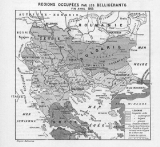
First Balkan War

Encyclopedia
The First Balkan War, which lasted from October 1912 to May 1913, pitted the Balkan League
(Serbia
, Greece
, Montenegro
and Bulgaria
) against the Ottoman Empire
. The combined armies of the Balkan states overcame the numerically inferior and strategically disadvantaged Ottoman armies and achieved rapid success. As a result of the war, almost all remaining European territories of the Ottoman Empire were captured and partitioned among the allies. Ensuing events also led to the creation of an independent Albania
n state. Despite its success, Bulgaria was dissatisfied over the division of the spoils in Macedonia, which provoked the start of the Second Balkan War
.
-controlled Rumelia
, namely Eastern Rumelia
, Thrace
and Macedonia
, subsided somewhat following intervention by the Great Powers in the mid-19th century, aimed at securing both more complete protection for the provinces' Christian
majority and protection of the status quo
. By 1867, Serbia
and Montenegro
had both secured their independence, which was confirmed by the Treaty of Berlin a decade later. But the question of the viability of Ottoman rule was revived after the Young Turk Revolution
of July 1908, which compelled the Sultan
to restore the suspended Ottoman constitution
, and the significant developments in the years 1909–11.
Serbia's aspirations towards Bosnia and Herzegovina
were thwarted by the Austrian
annexation of the province in October 1908, whereupon the Serbs focused their expansionist attentions to the south. Following the annexation, the Young Turks
tried to induce the Muslim population of Bosnia to emigrate to the Ottoman Empire. Those who took up the offer were settled by the Ottoman authorities in those districts of northern Macedonia where the Muslim population was weak. The experiment proved to be a catastrophe for the Empire since the immigrants readily united with the existing population of Albanian Muslims in the series of Albanian uprisings before and during the spring of 1912
. Some government troops who were ethnic Albanians switched sides, joining with the revolutionaries. In May 1912, after driving the Ottomans out of Skopje
, the Albanian revolutionaries pressed south towards Manastir (present day Bitola
), forcing the Ottomans to cede large regions in June 1912. For Serbia this posed a struggle against time to avoid the creation of the Albanian state.
On 18 October 1912, Peter I of Serbia issued a declaration 'To the Serbian People':
The timetable of the creation of the Balkan League indicates that the increasing prewar understanding between Serbia and Bulgaria persisted parallel to the success of the Albanian Uprising, making the uprising the triggering issue behind the Serbo-Bulgarian agreement and therefore the Balkan Wars. On the other hand, Bulgaria used the favorable timing in forcing Serbia to come to painful compromises regarding its aspirations toward Vardar Macedonia
, since the party under time pressure was Serbia. The agreement provided that, in the event of a victorious war against the Ottomans, Bulgaria would receive all of Macedonia south of the Kriva Palanka
-Ohrid
line. Serbia's expansion was to be to the north of this line, including Kosovo
, and out to the coast of the Adriatic Sea to the west. This included the northern half of modern Albania, giving Serbia access to the sea. If Serbia intended to honour the treaty, then it had sold Macedonia to buy Albania.
After the successful coup d'état
for unification
with Eastern Rumelia
, Bulgaria had orchestrated a methodical scenario of indirect expansion through the creation, in the multiethnic Ottoman-held Macedonia, of a revolutionary organization, the IMRO, allegedly without national colour. IMRO's rhetoric claimed to be speaking generally for liberation on behalf of the “Macedonian People,” declaring its anti-chauvinism
. In fact, it was a Bulgarian backed organization created with a secret agenda to facilitate the incorporation of Thrace
(Eastern and Western) and Macedonia
(Aegean
and Vardar
) into a new autonomous state, as an intermediate step before the unification with Bulgaria could take place in the same way as had taken place with Eastern Rumelia. After an initial success, Serbia
and especially Greece
realized the true purpose of IMRO and consequently a vicious guerilla war (see Macedonian Struggle
) broke out between Bulgarian- and Greek-backed groups within Macedonia, ending when the Young Turks movement, with its initially democratic and modernization agenda, came into power in the Ottoman Empire. Bulgaria then turned to the more orthodox method of expansion through winning a war, built a large army for that purpose, and started to see itself as the "Prussia
of the Balkans." But even so, it was clear that Bulgaria could not win a war against the Ottomans alone.
In Greece, Army officers had revolted
in August 1909 and secured the appointment of a progressive government under Eleftherios Venizelos
, which they hoped would resolve the Cretan issue in Greece's favour and reverse their defeat of 1897
at the hands of the Ottomans. An emergency military reorganization led by a French military mission had been started for that purpose, but its work was interrupted by the outbreak of war. In the discussions that led Greece to join the League, Bulgaria refused to commit to any agreement on the distribution of territorial gains, unlike the deal with Serbia over Macedonia. Bulgaria's diplomatic policy was to push Serbia into an agreement limiting its access to Macedonia, while at the same time refusing any such agreement with Greece, believing that its army would be able to occupy the larger part of Aegean Macedonia and the important port city of Salonica (Thessaloniki
) before the Greeks.
In 1911, Italy
had launched an invasion of Tripolitania
, which was quickly followed by the occupation of the Dodecanese
Islands. The Italians' decisive military victories over the Ottoman Empire greatly influenced the Balkan states towards the possibility of winning a war against the Ottomans. Thus in the spring and summer of 1912 these consultations between the various Christian Balkan nations had resulted in a network of military alliances which became known as the Balkan League
.
The Great Powers, most notably France
and Austria-Hungary
, reacted to this diplomatic grouping by trying to dissuade the League from going to war, but failed. In late September, both the League and the Ottoman Empire mobilized their armies. Montenegro
was the first to declare war, on September 25 (O.S.)/October 8. The other three states, after issuing an impossible ultimatum to the Porte on October 13, declared war on the Empire on October 17.
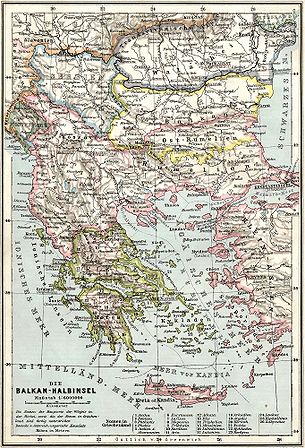 The Ottoman order of battle
when the war broke out constituted from a total of 12,024 officers 324,718 men, 47,960 animals, 2,318 artillery pieces and 388 machine guns. From these a total 920 officers and 42,607 men had been assigned in non-divisional units and services, the remained 293,206 officers and men being assigned into four Armies. Opposing them and in continuation of their secret prewar settlements of expansion between them, the three Slavic allies (Bulgarian, Serbs and Montenegrins) had led out extensive plans to coordinate their war efforts: the Serbs and Montenegrins in the theater of Sandžak
, the Bulgarians and Serbs in the Macedonia
n and Thracia
n theaters. The bulk of the Bulgarian forces (346,182 men) was targeting Thrace, pitted against the Thracian Ottoman Army of 96,273 men and about 26,000 garrison troops or about 115,000 in total, according to both Hall's, Erickson's and the Turkish Gen. Staff's study of 1993, books. The remaining Ottoman army of about 200,000 was located in Macedonia, pitted against the Serbian (234,000 Serbs and 48,000 Bulgarians under the Serbians orders) and Greek (115,000 men) armies, and divided into the Vardar and Macedonian Ottoman armies with independent static guards around the fortress cities of Yanina
(against the Greeks in Epirus) and Scutari
(against the Montenegrins in north Albania).
coast.
Bulgaria's war aims were focused on Thrace
and Macedonia
. It deployed its main force in Thrace, forming three armies. The First Army (79,370 men), under general Vasil Kutinchev
with three infantry divisions, was deployed to the south of Yambol
, with direction of operations along the Tundzha
river. The Second Army
(122,748 men), under general Nikola Ivanov
, with two infantry divisions and one infantry brigade, was deployed west of the First and was assigned to capture the strong fortress of Adrianople (Edirne
). According to the plans, the Third Army (94,884 men), under general Radko Dimitriev
, was deployed east of and behind the First, and was covered by the cavalry division hiding it from the Turkish view. The Third Army had three infantry divisions and was assigned to cross the Stranja mountain and to take the fortress of Kirk Kilisse. The 2nd (49,180) and 7th (48,523 men) divisions were assigned independent roles, operating in Western Thrace
and eastern Macedonia respectively.
. The Serbian High Command, in its pre-war wargames, had concluded that the likeliest site of the decisive battle against the Ottoman Vardar Army
would be on the Ovče Pole
plateau, before Skopje
. Hence, the main forces were formed in three armies for the advance towards Skopje, while a division and an independent brigade were to cooperate with the Montenegrins in the Sanjak of Novi Pazar
.
The First Army (132,000 men) was commanded by General Petar Bojović
, and was the strongest in number and force, forming the center of the drive towards Skopje. The Second Army (74,000 men) was commanded by General Stepa Stepanović
, and consisted of one Serbian and one Bulgarian (7th Rila) division. It formed the left wing of the Army and advanced towards Stracin. The inclusion of a Bulgarian division was according to a pre-war arrangement between Serbian and Bulgarian armies, but that division ceased to obey orders of Gen. Stepanović as soon as the war began, followed only the orders of the Bulgarian High Command. The Third Army (76,000 men) was commanded by General Božidar Janković
and, being the right-wing army, had the task to liberate Kosovo and then join the other armies in the expected battle at the Ovče Polje. There were also two other concentrations in northwestern Serbia across the Serbo-Austrohungarian borders, the Ibar Army (25,000 men) under General Mihail Zhivkovich and the Javor brigade (12,000 men) under Lt Colonel Milovoje Anđelković.
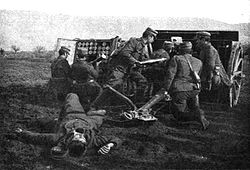 Greece, at the time a state of 2,666,000 people, was considered the weakest of the three main allies, since it fielded the smallest army and had suffered an easy defeat against the Ottomans 16 years before in the Greco-Turkish War of 1897. A British consular dispatch from 1910 illustrates the common perception of the Greek Army's capabilities at the time: "if there is war we shall probably see that the only thing Greek officers can do besides talking is to run away". However Greece was the only Balkan country to possess a substantial navy. This was vital to the League, as it could prevent Ottoman reinforcements from being rapidly transferred by ship from Asia to Europe. This fact was readily appreciated by the Serbs and Bulgarians, and was the chief factor in initiating the process of Greece's inclusion in their alliance. As the Greek ambassador to Sofia put it during the subsequent negotiations that led to Greece's entry in the League: "Greece can provide 600,000 men for the war effort. 200,000 men in the field, and the fleet will be able to stop 400,000 men being landed by Turkey between Salonica and Gallipoli
."
The Greek Army was still undergoing reorganization by a French military mission
, called in 1911, when the war began. Under its supervision, the Greeks had adopted the triangular infantry division as their main formation, but more importantly, the overhaul of the mobilization system allowed the country to field and equip a far greater number of troops than it had in 1897: while foreign observers estimated a mobilized force of approximately 50,000 men, the Greek Army fielded 125,000, with another 140,000 in the National Guard and reserves. Upon mobilization, as in 1897, this force was grouped in two field armies, reflecting the geographic division between the two operational theaters open to the Greeks: Thessaly
and Epirus
. The Army of Thessaly (Στρατιά Θεσσαλίας) was placed under Crown Prince Constantine
, with Lt Gen Panagiotis Danglis
as his chief of staff. It fielded the bulk of the Greek forces, seven infantry divisions, a cavalry regiment and four independent Evzones
battalions, roughly 100,000 men. It was expected to overcome the fortified Ottoman border positions and advance towards south and central Macedonia, aiming to take Thessaloniki
and Bitola
. Further 10,000 to 13,000 men in eight battalions were assigned to the Army of Epirus (Στρατιά Ηπείρου) under Lt Gen Konstantinos Sapountzakis
. As it had no hope of capturing the heavily fortified capital of Epirus, Ioannina
, its initial mission was simply to pin down the Ottoman forces there until sufficient reinforcements could be sent from the Army of Thessaly after its successful conclusion of operations.
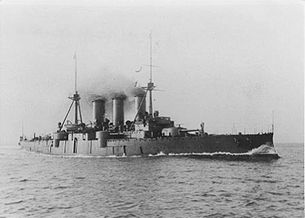 The Greek Navy was relatively modern, strengthened by the recent purchase of numerous new units and undergoing reforms under the supervision of a British mission. Invited by Prime Minister Venizelos in 1910, the mission began its work upon its arrival in May 1911. Granted extraordinary powers and under the energetic leadership of Vice Admiral Lionel Grand Tufnell, it thoroughly reorganized the Navy Ministry and dramatically improved the number and quality of exercises in gunnery and fleet maneuvers. In 1912, the core unit of the fleet was the fast armoured cruiser Averof
, completed in 1910 and at that time the fastest and most modern ship of the line in the combatant navies. It was complemented by three rather antiquated battleships of the Hydra class
. There were also eight destroyers built in 1906–1907, and six new destroyers that were hastily bought in summer 1912 as the imminence of war became apparent.
However, at the outbreak of the war, the Greek fleet was still far from ready. The Ottoman battlefleet retained a clear advantage in number of ships, speed of the main surface units and, more importantly, in the number and caliber of the ship's guns. In addition, as the war caught the fleet in the middle of its expansion and reorganization, fully a third of the fleet (the six new destroyers and the submarine Delfin
) only reached Greece after hostilities had started, necessitating a reshuffling of crews and leading to a lack of necessary familiarization and training time. Coal stockpiles and other war stores were in short supply, while the Averof herself had arrived with barely any ammunition, and would remain so until late November.
in Libya
(and by now in the Dodecanese
islands of the Aegean), which had dominated the Ottoman military effort for over a year and would last until 15 October, a few days after the outbreak of hostilities in the Balkans. They were therefore unable to significantly reinforce their positions in the Balkans as the relations with the Balkan states deteriorated over the course of the year.
and the counter-revolutionary coup several months later (see Countercoup (1909)
and 31 March Incident
). This resulted in different groups competing for influence within the military. An effort had been made to reorganize the army by a German mission, but its effects had not taken hold, and the Ottoman army was caught in the midst of reform and reorganization. In addition, several of the army's best battalions had been transferred to Yemen
to face the ongoing rebellion there, and in the summer of 1912, the Ottoman High Command took the disastrous decision to dismiss some 70,000 mobilized troops. The regular army (Nizam) was composed of well-equipped and trained active divisions, but the reserve units (Redif) that reinforced it were ill-equipped, especially in artillery, and badly trained.
The Ottomans' strategic situation was difficult, as their borders were almost impossible to defend against a co-ordinated attack by the Balkan states. Nevertheless, the Ottoman leadership decided to defend the entirety of their territory. As a result, the available forces—which could not be easily reinforced from Asia due to Greek control of the sea and the inadequacy of the Ottoman railway system—were dispersed too thinly across the region and failed to stand up to the rapidly mobilized Balkan armies. The Ottomans had three armies in Europe (the Macedonian, Vardar and Thracian Armies) with 1,203 pieces of mobile and 1,115 fixed artillery on fortified areas. The Ottoman High Command repeated the error of previous wars in neglecting the established command structure and creating new superior commands, the Eastern Army
and Western Army, reflecting the division of the operational theater between the Thracian (against the Bulgarians) and Macedonian (against Greeks, Serbs and Montenegrins) fronts.
Western Army fielded at least 200,000 men while the Eastern Army fielded 115,000 men against the Bulgarian Army.
The Eastern Army
was deployed against the Bulgarians. It was commanded by Nazim Pasa and numbered seven corps of 11 Regular Infantry, 13 Redif and 1+ Cavalry divisions:
The Western Army (Macedonian and Vardar Army
) was composed of ten corps with 32 infantry and two cavalry divisions.
Against the Serbs the Ottomans deployed the Vardar Army
(HQ in Skopje
under Halepli Zeki Pasha) with five Corps of 18 Infantry divisions, one cavalry division and two independent cavalry brigades under the:
The Macedonian Army (HQ in Thessaloniki
under Ali Rizah Pasha) was composed of 14 divisions in five corps detailed against Greece, Bulgaria and Montenegro.
Against Greece, seven-plus divisions were deployed:
Against Bulgaria in south-eastern Macedonia, two divisions forming the Struma Corps
(14th Infantry and Serez Redif divisions, plus the Nevrekop Detachment) were deployed.
Against Montenegro, four-plus divisions were deployed:
According to the organizational plan the men of the Western Group had to number 598,000. But slow mobilization procedures and the poor railroad efficiency reduced drastically the available men, so that when war began, according to the Western Army Staff there were only 200,000 men available. Although during the next period more men reached the units, due to the war casualties, the Western Group never came near its nominal strength. In time of war the Ottomans planned to bring more troops in from Syria, both Nizamiye and Redif. Greek naval supremacy however prevented those reinforcements from arriving. Instead those soldiers had to deploy via the land route, and most never made it to the Balkans.
The Ottoman General Staff, assisted by the German Military Mission, developed 12 war plans, designed to counter various combinations of opponents. Work on plan No. 5, which was against a combination of Bulgaria, Greece, Serbia and Montenegro, was very advanced, and had been sent to the Army staffs for them to develop local plans.
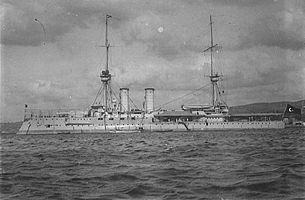 The Ottoman fleet had performed abysmally in the Greco-Turkish War of 1897, forcing the Ottoman government to begin a drastic overhaul. Older ships were retired and newer ones acquired, chiefly from France and Germany. In addition, in 1907 the Ottomans called in a British naval mission to update their training and doctrine. The mission, headed by Admiral Sir Douglas Gamble, would find its task almost impossible however. To a large extent this was due to the political upheaval in the aftermath of the Young Turk Revolution
; it is indicative that between 1908 and 1911, the office of Navy Minister changed hands nine times. Inter-departmental infighting and the entrenched interests of the bloated and over-aged officer corps, many of whom occupied their positions as a quasi-sinecure
, further obstructed drastic reform. In addition, British attempts to control the Navy's construction programme were met with suspicion by the Ottoman ministers, and funds for Gamble's ambitious plans for new ships were not available.
To counter the Greek acquisition of the Averof, the Ottomans tried to buy the new German armoured cruiser or even the battlecruiser
. When these moves failed due to the ships' exorbitant costs, the Ottomans acquired two old Brandenburg-class
pre-dreadnought battleships, which became Barbaros Hayreddin and Turgut Reis. Along with the cruisers Hamidiye
and Mecidye
, these two ships formed the core of the Ottoman fleet. By the summer of 1912 however, they were already in a poor state due to chronic neglect: the rangefinders and ammunition hoists had been removed, the telephones were not working, the pumps were corroded, and most of the watertight doors could no longer be closed.
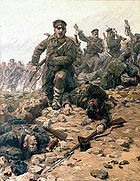 The western region of the Balkans, including Albania, Kosovo, and Macedonia was less important to the resolution of the war and the survival of the Ottoman Empire than the Thracian theater, where the Bulgarians fought major battles against the Ottoman forces. But although the geography dictated that Thrace would be the major battlefield in a war with the Ottoman Empire, the position of the Ottoman Army there was jeopardized by erroneous intelligence estimates of their opponents' order of battle. Unaware of the secret prewar political and military settlement over Macedonia between Bulgaria and Serbia, the Ottoman leadership assigned the bulk of their forces there. The German ambassador Hans Baron von Wangenheim
, one of the most influential people in the Ottoman capital, had reported to Berlin on October 21 that the Ottoman forces believed that the bulk of the Bulgarian army would be deployed in Macedonia with the Serbs. Subsequently the Ottoman HQ under Abdullah Pasha expected to meet only three Bulgarian infantry divisions, accompanied by cavalry, east of Adrianople. According to E. J. Erickson this assumption possibly resulted from their analysis of the objectives of the Balkan Pact - but it had deadly consequences for the Ottoman Army in Thrace, which would have to defend the area against the bulk of the Bulgarian army against impossible odds. This misappraisal was also the reason of the catastrophic aggressive Ottoman strategy at the start of the campaign in Thrace.
), 2nd (Lt. Gen. Nikola Ivanov
) and 3rd (Lt. Gen. Radko Dimitriev
) Bulgarian Armies of 297,002 men in the eastern part and 49,180 (33,180 regulars and 16,000 irregulars) under the 2nd Bulgarian Division (Gen. Stilian Kovachev) in the western part. The first large-scale battle occurred against the Adrianople-Kirk Kilisse defensive line, where the Bulgarian 1st and 3rd Armies (together 174,254 men) defeated the Ottoman East Army (of 96,273 combatants), near Gechkenli, Seliolu and Petra. The Ottoman XV Corps urgently left the area to defend the Gallipoli peninsula against an expected Greek amphibious assault, which in the event never materialized. The absence of this Corps created an immediate vacuum between Adrianople and Demotika, and the 11th Infantry Division from the Eastern Army's IV Corps was moved there to replace it. Thus one complete army corps was removed from the Eastern Army's order of battle. As a consequence of the insufficient intelligence on the invading forces, the Ottoman offensive plan failed completely in the face of Bulgarian superiority forcing Abdullah Pasha
to abandon Kirk Kilisse, which was taken without resistance by the Bulgarian Third Army. The fortress of Adrianople, with some 61,250 men, was isolated and besieged
by the Bulgarian Second Army
, although for the time being no assault was possible due to the lack of siege equipment in the Bulgarian inventory. Another consequence of the Greek naval supremacy in Aegean was that the Ottoman forces did not receive the reinforcements projected in the war plans, consisting of a further corps to be transferred by sea from Syria
and Palestine
. Thus the Greek Navy played a crucial albeit indirect role in the Thracian campaign, by neutralizing three corps, a significant portion of the Ottoman Army, in the all-important opening round of the war. Another, more direct role, was the emergency transportation of the Bulgarian 7th Rila Division from the Macedonian to the Thracian front after the termination of the operations there.
 After the battle of Kirk Kilisse the Bulgarian high command decided to wait a few days, a decision which allowed the Ottoman forces to occupy a new defensive position on the Luleburgaz
-Karaagach
-Bunarhisar line. Despite this, the Bulgarian attack by First and Third Army which together accounted for 107,386 rifleman, 3,115 cavalry, 116 machine guns and 360 artillery pieces defeated the reinforced Ottoman Army consisting of 126,000 riflemen, 3,500 cavalry, 96 machine guns and 342 artillery pieces and reached the Sea of Marmara
. In terms of forces engaged it was the largest battle fought in Europe
between the end of the Franco-Prussian War
and the beginning of the First World War. As a result of it the Ottoman forces were pushed to their final defensive position across the Çatalca
Line protecting the peninsula on which Constantinople
is located. There they succeeded in stabilizing the front with the help of fresh reinforcements from the Asian provinces. The line had been constructed during the Russo-Turkish War of 1877-8 under the directions of a German engineer in Ottoman service, von Bluhm Pasha, but was considered obsolete by 1912.
Meanwhile the forces of the Bulgarian 2nd Thracian division, 49,180 men divided into the Haskovo and Rhodope detachments, advanced toward the Aegean Sea. The Ottoman Kircaali detachment (Kircaali Redif and Kircaali Mustahfiz Divisions and 36th Regiment with 24,000 men), tasked with defending a 400 km front across the Thessaloniki-Dedeagach railroad, failed to offer serious resistance and on 26 November their commander Yaver Pasha was captured together with 10,131 officers and men by Macedonian-Adrianopolitan Volunteer Corps
. After the occupation of Thessaloniki by the Greek army, his surrender completed the isolation of the Ottoman forces in Macedonia from those in Thrace.
On , the offensive against the Çatalca Line began, despite clear warnings from Russia that if the Bulgarians occupied Constantinople it would attack them. The Bulgarians launched their attack
along the defensive line with 176,351 men and 462 artillery pieces against the Ottomans' 140,571 men and 316 artillery pieces, but despite Bulgarian superiority, the Ottomans succeeded to repulse them. An armistice was consequently agreed on between the Ottomans and Bulgaria, the latter also representing Serbia and Montenegro, and peace negotiations began in London
. Greece also participated in the conference, but refused to agree to a truce, continuing its operations in the Epirus sector. The negotiations were interrupted on , when a Young Turk coup d'état in Constantinople
under Enver Pasha overthrew the government of Kiamil Pasha. Upon expiration of the armistice, on , hostilities recommenced.
, at the same time as an attack of around 15,000 men supported by 36 guns (part of the 30,000-strong Ottoman army isolated in the Gallipoli peninsula) at Bulair
further south. Both attacks were supported by fire from Ottoman warships, and were intended in the long term to relieve pressure on Adrianople. Confronting them were about 10,000 men with 78 guns. The Ottomans were probably unaware of the presence in the area of the newly-formed 4th Bulgarian Army
of 92,289 men under General Stiliyan Kovachev
. The Ottoman attack in the thin isthmus
, with a front of just 1,800m, was hampered by thick fog and strong Bulgarian artillery and machine gunfire. As a result the attack stalled, and was repulsed by a Bulgarian counterattack. By the end of the day both armies had returned to their original positions. Meanwhile the Ottoman X Corps, which had landed at Şarköy
, advanced until by the reinforcements sent by General Kovachev succeeded in halting them. Casualties on both sides were light. After the failure of the frontal attack in Bulair, the Ottoman forces at Şarköy re-embarked into their ships on 11 February and were transported to Gallipoli.
The Ottoman attack at Çatalca, directed against the powerful Bulgarian First and Third Armies, was initially launched only as a diversion from the Gallipoli-Şarköy operation, pinning down the Bulgarian forces in situ
. Nevertheless, it resulted in unexpected success. In the north the Bulgarians were forced to withdraw about 15 km and to the south over 20 km to their secondary defensive positions. With the end of the attack in Gallipoli the Ottomans cancelled the operation, reluctant to leave the Çatalca Line, but several days passed before the Bulgarians realized that the offensive was over. By February 15 the front had again stabilized but the fighting along the static lines continued until the armistice. The battle, which resulted in heavy Bulgarian casualties, could be characterized as an Ottoman victory at the tactical level, but strategically it was a failure, since it did nothing to prevent the failure of the Gallipoli-Şarköy operation or relieve the pressure on Adrianople.
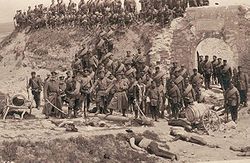 The failure of the Şarköy-Bulair operation and the deployment of the 2nd Serbian Army together with its much needed heavy siege artillery sealed Adrianople's fate. On 11 March after a two weeks bombardment that destroyed much of the fortified structures around the city, the final assault started with Allied forces enjoying a crushing superiority over the Ottoman garrison. Under the command of General Nikola Ivanov
, the Bulgarian 2nd Army with 106,425 men and two Serb divisions with 47,275 men eventually conquered the city, but at a high price: the Bulgarians suffering 8,093 and the Serbs 1,462 casualties. The Ottoman casualties for the entire Adrianople campaign reached 13,000 killed. The number of prisoners is less clear. The Ottoman Empire began the war with 61,250 men in the Adrianople fortress. Richard Hall notes that 60,000 men were captured. Adding to the 13,000 killed, the modern Turkish General Staff History notes that 28,500 man survived captivity leaving only 20,000 men unaccounted as possibly captured (including the unspecified number of wounded). Bulgarian losses for the entire Adrianople campaign amounted to 18,282. According to both R.C. Hall and E.J. Erickson, the assault was an unnecessary bloodshed, it was more of a political decision and took place only to inflate the national pride of Tsar Ferdinand and some Bulgarian politicians, since the fortress would have to surrender anyhow by the end of the month due to starvation. The most important result however was that now the Ottoman command lost all hopes of regaining the initiative, which made any further fighting pointless.
The battle had major and key results in the Serbo-Bulgarian relations putting the seeds of the countries' confrontation some months later. The Bulgarian censor rigorously cut any references about the Serbian participation in the operation in the telegrams of the foreign correspondents. The public opinion in Sofia thus failed to realise the crucial services Serbia rendered in the battle. Accordingly the Serbs claimed that their troops of the 20th Regiment were those who captured the Ottoman commander of the city, and that Colonel Gavrilović was the allied officer who accepted Shukri's official surrender of the garrison, a statement that Bulgarians disputed. Subsequently the Serbs officially protested, pointing out that although they had sent their troops to Adrianople to win for Bulgaria territory the acquisition of which had never been foreseen by their mutual treaty, the Bulgarians had never fulfilled the clause of the treaty requiring Bulgaria to send 100,000 men to help the Serbians in their Vardar front. The Bulgarians answered that their staff had informed the Serbs about that on 23 August. The friction escalated some weeks later when the Bulgarian delegates in London bluntly warned the Serbs that they must not expect Bulgarian support on their Adriatic claims. The Serbs angrily replied that that was a clear withdrawal from the prewar agreement of mutual understanding according to the Kriva Palanka-Adriatic line of expansion, but the Bulgarians insisted that in their view, the Vardar Macedonian part of the agreement remained active and that the Serbs were still obliged to surrender the area as agreed. The Serbs answered by accusing the Bulgarians of maximalism, pointing out that if they lost both northern Albania and Vardar Macedonia, their participation in the common war would had been virtually for nothing. The tension soon was expressed in a series of hostile incidents between the two armies along their common line of occupation across the Vardar valley. The developments essentially ended the Serbo-Bulgarian alliance and made a future war between the two countries inevitable.
, a fact that sealed their fate. In an unexpectedly brilliant and rapid campaign, the Army of Thessaly seized the city. In the absence of secure sea lines of communications, the retention of the Thessaloniki-Constantinople corridor was essential to the overall strategic posture of the Ottoman Empire in the Balkans. Once this was gone, the defeat of the Ottoman Army became inevitable. To be sure, the Bulgarians and the Serbs played an important role in the defeat of the main Ottoman armies. Their great victories at Kirkkilise, Luleburgaz, Kumanovo, and Monastir shattered the Eastern and Vardar Armies. However, these victories were not decisive in the sense that they ended the war. The Ottoman field armies survived, and in Thrace, they actually grew stronger day by day. In the strategic point of view these victories were enabled partially by the weakened condition of the Ottoman armies brought about by the active presence of the Greek army and fleet.
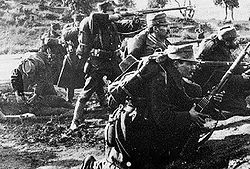 With the declaration of war, the Greek Army of Thessaly under Crown Prince Constantine
advanced to the north, successfully overcoming
Ottoman opposition in the fortified Straits of Sarantaporo. After another victory at Yenidje/Giannitsa on , the Ottoman commander Hasan Tahsin Pasha
surrendered Thessaloniki and its garrison of 26,000 men to the Greeks on . Two Corps HQs (Ustruma and VIII), two Nizamiye divisions (14th and 22nd) and four Redif divisions (Salonika, Drama, Naslic and Serez) were thus lost to the Ottoman order of battle. Additionally, the Ottoman forces lost 70 artillery pieces, 30 machine guns and 70,000 rifles (Thessaloniki was the central arms depot for the Western Armies). The Ottoman forces estimated that 15,000 officers and men had been killed during the campaign in south Macedonia, bringing total losses up to 41,000 soldiers. Another direct consequence was that the destruction of the Macedonian Army sealed the fate of the Ottoman Vardar Army, which was fighting the Serbs to the north. The fall of Thessaloniki left it strategically isolated, without logistical supply and depth to maneuver, ensuring its destruction.
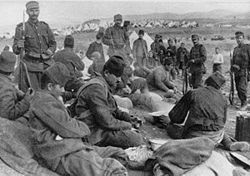 Upon learning of the outcome of the battle of Yenidje, the Bulgarian high command urgently dispatched their 7th Rila Division from the north in the direction of the city. The division arrived there a week later, the day after its surrender to the Greeks. Until November 10, the Greek-occupied zone had been expanded to the line from Lake Dojran to the Pangaion hills
west to Kavalla. In western Macedonia however, the lack of coordination between the Greek and Serbian HQs cost the Greeks a setback in the Battle of Vevi on , when the Greek 5th Infantry Division crossed its way with the VI Ottoman Corps (a part of the Vardar Army consisting of the 16th, 17th and 18th Nizamiye divisions), retreating to Albania following the battle of Prilep against the Serbs. The Greek division, surprised by the presence of the Ottoman Corps, isolated from the rest of Greek army and outnumbered by the now counterattacking Ottomans centered on Bitola
, was forced to retreat. As a result, the Serbs beat the Greeks to Bitola.
front the Greek army was initially heavily outnumbered, but due to the passive attitude of the Ottomans succeeded in conquering Preveza
(21 October 1912) and pushing north to the direction of Ioannina
. On November 5, Major Spyros Spyromilios
led a revolt
in the coastal area of Himarë
and expelled the Ottoman garrison without facing significant resistance, while on November 20 Greek troops from western Macedonia entered Korce
. However, Greek forces in the Epirote front had not the numbers to initiate an offensive against the German-designed defensive positions of Bizani
that protected the city of Ioannina, and therefore had to wait for reinforcements from the Macedonian front.
After the campaign in Macedonia was over, a large part of the Army was redeployed to Epirus, where Crown Prince Constantine himself assumed command. In the Battle of Bizani
the Ottoman positions were breached and Ioannina taken on . During the siege, on 8 February 1913, the Russian pilot N. de Sackoff, flying for the Greeks, became the first pilot ever shot down in combat, when his biplane was hit by ground fire following a bomb run on the walls of Fort Bizani
. He came down near small town of Preveza
, on the coast north of the Ionian island of Lefkas, secured local Greek assistance, repaired his plane and resumed flight back to base. The fall of Ioannina allowed the Greek army to continue its advance into northern Epirus
, the southern part of modern Albania, which it occupied. There its advance stopped, although the Serbian line of control was very close to the north.
, sailed for the island of Lemnos
, occupying it three days later (although fighting continued on the island until 27 October) and establishing an anchorage at Moudros Bay. This move was of major strategic importance, as it provided the Greeks with a forward base in close distance to the Dardanelles, the Ottoman fleet's main anchorage and refuge. In view of the Ottoman fleet's superiority in speed and broadside
weight, the Greek planners expected it to sortie from the straits early in the war. Given the Greek fleet's unpreparedness resulting from the premature outbreak of the war, such an early Ottoman attack might well have been able to achieve a crucial victory. Instead, the Ottoman Navy spent the first two months of the war in operations against the Bulgarians in the Black Sea, giving the Greeks valuable time to complete their preparations and allowing them to consolidate their control of the Aegean.
By mid-November Greek naval detachments had seized the islands of Imbros
, Thasos
, Agios Efstratios
, Samothrace
, Psara
and Ikaria, while landings were undertaken on the larger islands of Lesbos and Chios
only on 21 and 27 November respectively. Substantial Ottoman garrisons were present on the latter, and their resistance was fierce. They withdrew into the mountainous interior and were not subdued until 22 December and 3 January respectively. Samos
, officially an autonomous principality
, was not attacked until 13 March 1913, out of a desire not to upset the Italians in the nearby Dodecanese
. The clashes there were short-lived as the Ottoman forces withdrew to the Anatolian mainland, so that the island was securely in Greek hands by March 16.
At the same time, with the aid of numerous merchant ships converted to auxiliary cruisers, a loose naval blockade on the Ottoman coasts from the Dardanelles to Suez
was instituted, which disrupted the Ottomans' flow of supplies (only the Black Sea routes to Romania
remained open) and left some 250,000 Ottoman troops immobilized in Asia. In the Ionian Sea
, the Greek fleet operated without opposition, ferrying supplies for the army units in the Epirus front. Furthermore, the Greeks bombarded and then blockaded the port of Vlorë
in Albania on 3 December, and Durrës
on 27 February. A naval blockade extending from the pre-war Greek border to Vlorë was also instituted on 3 December, isolating the newly-established Provisional Government of Albania
there from any outside support.
Lieutenant Nikolaos Votsis
scored a major success for Greek morale on 31 October: he sailed his torpedo boat
No. 11, under the cover of night, into the harbor of Thessaloniki
, sank the old Ottoman ironclad battleship Feth-i Bülend and escaped unharmed. On the same day, Greek troops of the Epirus Army seized the Ottoman naval base of Preveza
. The Ottomans scuttled the four ships present there, but the Greeks were able to salvage the Italian-built torpedo-boats Antalya and Tokat, which were commissioned into the Greek Navy as Nikopolis and Tatoi respectively. On 9 November, the wooden Ottoman armed steamer Trabzon was intercepted and sunk by the Greek torpedo boat No. 14 under Lt. Periklis Argyropoulos off Ayvalık
.
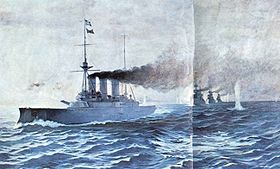 The main Ottoman fleet remained inside the Dardanelles
for the early part of the war, while the Greek destroyers continuously patrolled the straits' exit to report on a possible sortie. Kountouriotis suggested mining
the straits, but was not taken up for fear of international reactions. On 7 December, the head of the Ottoman fleet Tahir Bey was replaced by Ramiz Naman Bey, the leader of the hawkish faction among the officer corps. A new strategy was agreed, whereby the Ottomans were to take advantage of any absence of Averof to attack the other Greek ships. The Ottoman staff formulated a plan to lure a number of the Greek destroyers on patrol into a trap. A first such effort on 12 December failed due to boiler trouble, but the second try two days later resulted in an indecisive engagement between the Greek destroyers and the cruiser Mecidiye.
The war's first major fleet action, the Naval Battle of Elli
, was fought two days later, on . The Ottoman fleet, with four battleships, nine destroyers and six torpedo boats, sailed to the entrance of the straits. The lighter Ottoman vessels remained behind, but the battleship squadron moved on north under cover of the forts at Kumkale and engaged the Greek fleet, coming from Imbros, at 9:40. Leaving the older battleships behind, Kountouriotis led the Averof into independent action: utilizing its superior speed, it cut across the Ottoman fleet's bow. Under fire from two sides, the Ottomans were quickly forced to withdraw to the Dardanelles. The whole engagement lasted less than an hour, in which the Ottoman suffered heavy damage to the Barbaros Hayreddin and 18 dead and 41 wounded (most during their disorderly retreat) and the Greeks one dead and seven wounded.
In the aftermath of Elli, on 20 December the energetic Lt. Commander Rauf Bey was placed in effective command of the Ottoman fleet. Two days later he led his forces out, hoping again to trap the patrolling Greek destroyers between two divisions of the Ottoman fleet, one heading for Imbros and the other waiting at the entrance of the straits. The plan failed as the Greek ships quickly broke contact, while at the same time the Mecidiye came under attack by the Greek submarine Delfin, which launched a torpedo against it but missed; the first such attack in history. During this time, the Ottoman Army continued to press upon a reluctant Navy a plan for the re-occupation of Tenedos, which the Greek destroyers used as a base, by an amphibious operation. The operation was scheduled for 4 January. On that day, weather conditions were ideal and the fleet was ready, but the Yenihan regiment earmarked for the operation failed to arrive on time. The naval staff nevertheless ordered the fleet to sortie, and an engagement developed with the Greek fleet, without any significant results on either side. Similar sorties followed on 10 and 11 January, but the results of these "cat and mouse" operations were always the same: "the Greek destroyers always managed to remain outside the Ottoman warships' range, and each time the cruisers fired a few rounds before breaking off the chase."
In preparation for the next attempt to break the Greek blockade, the Ottoman Admiralty decided to create a diversion by sending the light cruiser Hamidiye
, captained by Rauf Bey, to raid Greek merchant shipping in the Aegean. It was hoped that the Averof, the only major Greek unit fast enough to catch the Hamidiye, would be drawn in pursuit and leave the remainder of the Greek fleet weakened. In the event, Hamidiye slipped through the Greek patrols on the night of 14–15 January and bombarded the harbor of the Greek island of Syros
, sinking the Greek auxiliary cruiser Makedonia which lay in anchor there (it was later raised and repaired). The Hamidiye then left the Aegean for the Eastern Mediterranean, making stops at Beirut
and Port Said
before entering the Red Sea
. Although providing a major morale boost for the Ottomans, the operation failed to achieve its primary objective, as Kountouriotis refused to leave his post and pursue the Hamidiye.
Four days later, on , when the Ottoman fleet again sallied from the straits towards Lemnos, it was defeated for a second time in the Naval Battle of Lemnos
. This time, the Ottoman warships concentrated their fire on the Averof, which again made use of its superior speed and tried to "cross the T" of the Ottoman fleet. Barbaros Hayreddin was again heavily damaged, and the Ottoman fleet was forced to return to the shelter of the Dardanelles and their forts. The Ottomans suffered 41 killed and 101 wounded. It was the last attempt of the Ottoman Navy to leave the Dardanelles, thereby leaving the Greeks dominant in the Aegean. On , a Greek Farman MF.7
, piloted by Lt. Moutousis
and with Ensign Moraitinis
as an observer, carried out an aerial reconnaissance of the Ottoman fleet in its anchorage at Nagara, and launched four bombs on the anchored ships. Although it scored no hits, this operation is regarded as the first naval-air operation in military history.
General Ivanov, commander of the 2nd Bulgarian Army, acknowledged the role of the Greek fleet in the overall Balkan League victory by stating that "the activity of the entire Greek fleet and above all the Averof was the chief factor in the general success of the allies".
, where the main forces of Ottoman Vardar Army were expected to concentrate. According to the plan of the Serbian Supreme Command, three Serbian armies (First, Second and Third) were supposed to encircle and destroy the Vardar Army in that area, with First Army advancing from the north (direction Vranje-Kumanovo-Ovče Pole ), Second Army advancing from the east (direction Kriva Palanka-Kratovo-Ovče Pole) and Third Army advancing from the north-west (direction Priština-Skopje-Ovče Pole). In the execution of this plan the main role was given to the First Army while Second Army was expected to cut of the Vardar Army's retreat route, and if necessary attack its rear and right flank. The main goal of Third Army was to liberate Kosovo and Metohija and if necessary give assistance to the First Army by attacking the Vardar Army's left flank and rear. Ibar Army and the Javor brigade had a minor role in the Serbian plan, they were expected to conquer and secure areas of the Sandjak of Novi Pazar and replace Third Army in Kosovo after it advanced further south.
The Serbian Army under General (later Marshal) Putnik dealt three decisive victories in Vardar Macedonia
, its primary objective in the war, effectively destroying the Ottoman forces in the region and conquering north Macedonia. They also helped the Montenegrins to take the Sandžak
and sent two divisions to help the Bulgarians at the siege of Adrianople.
The last battle for Macedonia was the battle of Monastir, in which the remains of the Ottoman Vardar Army were forced to retreat to central Albania. After the battle, Prime Minister Pasic asked Gen. Putnik to take part in the race for Thessaloniki. Putnik declined and instead turned his army to the west, towards Albania, foreseeing that a future confrontation between the Greeks and Bulgarians over Thessaloniki could greatly help Serbia's own plans over Vardar Macedonia.
After the Great Powers applied pressure on them, the Serbs started to withdraw from northern Albania and the Sandžak
, although they left behind their heavy artillery park to help the Montenegrins in the continuing siege of Scutari
. On 23 April 1913 Scutari's garrison was forced to surrender due to starvation.
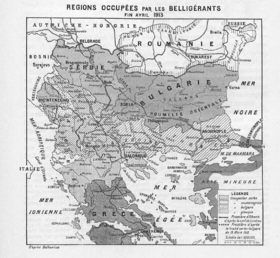 The Treaty of London
ended the First Balkan War on 30 May 1913. All Ottoman territory west of the Enez
-Kıyıköy
line was ceded to the Balkan League, according to the status quo
at the time of the armistice. The treaty also declared Albania
to be an independent state. Almost all of the territory that was designated to form the new Albanian state was currently occupied by either Greece or Serbia, which only reluctantly withdrew their troops. Having unresolved disputes with Serbia over the division of northern Macedonia
and with Greece over southern Macedonia, Bulgaria was prepared, if the need arose, to solve the problems by force, and began transferring its forces from Eastern Thrace to the disputed regions. Unwilling to yield to any pressure Greece and Serbia settled their mutual differences and signed a military alliance directed against Bulgaria on May 1, 1913, even before the Treaty of London
had been concluded. This was soon followed by a treaty of "mutual friendship and protection"
on May 19/June 1, 1913. Thus the scene for the Second Balkan War
was set.
, which led to a stern warning to the Balkan states, unofficially each of them took a different diplomatic approach due to their conflicting interests in the area. As a result, any possible preventative effect of the common official warning was cancelled by the mixed unofficial signals, and failed to prevent or to stop the war:
Finally, when Serb-Austrian tensions again grew hot in July 1914 when a Serbian backed organization
assassinated the heir of the Austro-Hungarian throne
, no one had strong reservations about the possible conflict and the First World War broke out.
Balkan League
The Balkan League was an alliance formed by a series of bilateral treaties concluded in 1912 between the Balkan states of Bulgaria, Greece, Montenegro and Serbia, and directed against the Ottoman Empire, which at the time still controlled much of the Balkan peninsula...
(Serbia
Kingdom of Serbia
The Kingdom of Serbia was created when Prince Milan Obrenović, ruler of the Principality of Serbia, was crowned King in 1882. The Principality of Serbia was ruled by the Karađorđevic dynasty from 1817 onwards . The Principality, suzerain to the Porte, had expelled all Ottoman troops by 1867, de...
, Greece
Kingdom of Greece
The Kingdom of Greece was a state established in 1832 in the Convention of London by the Great Powers...
, Montenegro
Kingdom of Montenegro
The Kingdom of Montenegro was a monarchy in southeastern Europe during the tumultuous years on the Balkan Peninsula leading up to and during World War I. Legally it was a constitutional monarchy, but absolutist in practice...
and Bulgaria
History of Independent Bulgaria
The Treaty of San Stefano of March 3, 1878 provided for a self-governing Bulgarian state, which comprised the geographical regions of Moesia, Thrace and Macedonia. Based on that date Bulgarians celebrate Bulgaria's national day each year...
) against the Ottoman Empire
Ottoman Empire
The Ottoman EmpireIt was usually referred to as the "Ottoman Empire", the "Turkish Empire", the "Ottoman Caliphate" or more commonly "Turkey" by its contemporaries...
. The combined armies of the Balkan states overcame the numerically inferior and strategically disadvantaged Ottoman armies and achieved rapid success. As a result of the war, almost all remaining European territories of the Ottoman Empire were captured and partitioned among the allies. Ensuing events also led to the creation of an independent Albania
Albania
Albania , officially known as the Republic of Albania , is a country in Southeastern Europe, in the Balkans region. It is bordered by Montenegro to the northwest, Kosovo to the northeast, the Republic of Macedonia to the east and Greece to the south and southeast. It has a coast on the Adriatic Sea...
n state. Despite its success, Bulgaria was dissatisfied over the division of the spoils in Macedonia, which provoked the start of the Second Balkan War
Second Balkan War
The Second Balkan War was a conflict which broke out when Bulgaria, dissatisfied with its share of the spoils of the First Balkan War, attacked its former allies, Serbia and Greece, on 29 June 1913. Bulgaria had a prewar agreement about the division of region of Macedonia...
.
Background
Tensions among the Balkan states over their rival aspirations to the provinces of OttomanOttoman Empire
The Ottoman EmpireIt was usually referred to as the "Ottoman Empire", the "Turkish Empire", the "Ottoman Caliphate" or more commonly "Turkey" by its contemporaries...
-controlled Rumelia
Rumelia
Rumelia was an historical region comprising the territories of the Ottoman Empire in Europe...
, namely Eastern Rumelia
Eastern Rumelia
Eastern Rumelia or Eastern Roumelia was an administratively autonomous province in the Ottoman Empire and Principality of Bulgaria from 1878 to 1908. It was under full Bulgarian control from 1885 on, when it willingly united with the tributary Principality of Bulgaria after a bloodless revolution...
, Thrace
Thrace
Thrace is a historical and geographic area in southeast Europe. As a geographical concept, Thrace designates a region bounded by the Balkan Mountains on the north, Rhodope Mountains and the Aegean Sea on the south, and by the Black Sea and the Sea of Marmara on the east...
and Macedonia
Macedonia (region)
Macedonia is a geographical and historical region of the Balkan peninsula in southeastern Europe. Its boundaries have changed considerably over time, but nowadays the region is considered to include parts of five Balkan countries: Greece, the Republic of Macedonia, Bulgaria, Albania, Serbia, as...
, subsided somewhat following intervention by the Great Powers in the mid-19th century, aimed at securing both more complete protection for the provinces' Christian
Christian
A Christian is a person who adheres to Christianity, an Abrahamic, monotheistic religion based on the life and teachings of Jesus of Nazareth as recorded in the Canonical gospels and the letters of the New Testament...
majority and protection of the status quo
Status quo
Statu quo, a commonly used form of the original Latin "statu quo" – literally "the state in which" – is a Latin term meaning the current or existing state of affairs. To maintain the status quo is to keep the things the way they presently are...
. By 1867, Serbia
Serbia
Serbia , officially the Republic of Serbia , is a landlocked country located at the crossroads of Central and Southeast Europe, covering the southern part of the Carpathian basin and the central part of the Balkans...
and Montenegro
Montenegro
Montenegro Montenegrin: Crna Gora Црна Гора , meaning "Black Mountain") is a country located in Southeastern Europe. It has a coast on the Adriatic Sea to the south-west and is bordered by Croatia to the west, Bosnia and Herzegovina to the northwest, Serbia to the northeast and Albania to the...
had both secured their independence, which was confirmed by the Treaty of Berlin a decade later. But the question of the viability of Ottoman rule was revived after the Young Turk Revolution
Young Turk Revolution
The Young Turk Revolution of 1908 reversed the suspension of the Ottoman parliament by Sultan Abdul Hamid II, marking the onset of the Second Constitutional Era...
of July 1908, which compelled the Sultan
Sultan
Sultan is a title with several historical meanings. Originally, it was an Arabic language abstract noun meaning "strength", "authority", "rulership", and "dictatorship", derived from the masdar سلطة , meaning "authority" or "power". Later, it came to be used as the title of certain rulers who...
to restore the suspended Ottoman constitution
Constitution
A constitution is a set of fundamental principles or established precedents according to which a state or other organization is governed. These rules together make up, i.e. constitute, what the entity is...
, and the significant developments in the years 1909–11.
Serbia's aspirations towards Bosnia and Herzegovina
Bosnia and Herzegovina
Bosnia and Herzegovina , sometimes called Bosnia-Herzegovina or simply Bosnia, is a country in Southern Europe, on the Balkan Peninsula. Bordered by Croatia to the north, west and south, Serbia to the east, and Montenegro to the southeast, Bosnia and Herzegovina is almost landlocked, except for the...
were thwarted by the Austrian
Austria-Hungary
Austria-Hungary , more formally known as the Kingdoms and Lands Represented in the Imperial Council and the Lands of the Holy Hungarian Crown of Saint Stephen, was a constitutional monarchic union between the crowns of the Austrian Empire and the Kingdom of Hungary in...
annexation of the province in October 1908, whereupon the Serbs focused their expansionist attentions to the south. Following the annexation, the Young Turks
Young Turks
The Young Turks , from French: Les Jeunes Turcs) were a coalition of various groups favouring reformation of the administration of the Ottoman Empire. The movement was against the absolute monarchy of the Ottoman Sultan and favoured a re-installation of the short-lived Kanûn-ı Esâsî constitution...
tried to induce the Muslim population of Bosnia to emigrate to the Ottoman Empire. Those who took up the offer were settled by the Ottoman authorities in those districts of northern Macedonia where the Muslim population was weak. The experiment proved to be a catastrophe for the Empire since the immigrants readily united with the existing population of Albanian Muslims in the series of Albanian uprisings before and during the spring of 1912
Albanian Revolt of 1912
The Albanian Revolt of 1912 was one of many Albanian revolts in the Ottoman Empire and lasted from January until August 1912. After a series of successes, Albanian revolutionaries managed to capture the city of Skopje, the administrative centre of Kosovo vilayet within the Ottoman rule...
. Some government troops who were ethnic Albanians switched sides, joining with the revolutionaries. In May 1912, after driving the Ottomans out of Skopje
Skopje
Skopje is the capital and largest city of the Republic of Macedonia with about a third of the total population. It is the country's political, cultural, economic, and academic centre...
, the Albanian revolutionaries pressed south towards Manastir (present day Bitola
Bitola
Bitola is a city in the southwestern part of the Republic of Macedonia. The city is an administrative, cultural, industrial, commercial, and educational centre. It is located in the southern part of the Pelagonia valley, surrounded by the Baba and Nidže mountains, 14 km north of the...
), forcing the Ottomans to cede large regions in June 1912. For Serbia this posed a struggle against time to avoid the creation of the Albanian state.
On 18 October 1912, Peter I of Serbia issued a declaration 'To the Serbian People':
The timetable of the creation of the Balkan League indicates that the increasing prewar understanding between Serbia and Bulgaria persisted parallel to the success of the Albanian Uprising, making the uprising the triggering issue behind the Serbo-Bulgarian agreement and therefore the Balkan Wars. On the other hand, Bulgaria used the favorable timing in forcing Serbia to come to painful compromises regarding its aspirations toward Vardar Macedonia
Vardar Macedonia
Vardar Macedonia is an area in the north of the Macedonia . The borders of the area are those of the Republic of Macedonia. It covers an area of...
, since the party under time pressure was Serbia. The agreement provided that, in the event of a victorious war against the Ottomans, Bulgaria would receive all of Macedonia south of the Kriva Palanka
Kriva Palanka
Kriva Palanka is a town located in the northeastern part of the Republic of Macedonia. It has 14.558 inhabitants. The town of Kriva Palanka is the seat of Kriva Palanka Municipality which has almost 21.000 inhabitants....
-Ohrid
Ohrid
Ohrid is a city on the eastern shore of Lake Ohrid in the Republic of Macedonia. It has about 42,000 inhabitants, making it the seventh largest city in the country. The city is the seat of Ohrid Municipality. Ohrid is notable for having once had 365 churches, one for each day of the year and has...
line. Serbia's expansion was to be to the north of this line, including Kosovo
Kosovo
Kosovo is a region in southeastern Europe. Part of the Ottoman Empire for more than five centuries, later the Autonomous Province of Kosovo and Metohija within Serbia...
, and out to the coast of the Adriatic Sea to the west. This included the northern half of modern Albania, giving Serbia access to the sea. If Serbia intended to honour the treaty, then it had sold Macedonia to buy Albania.
After the successful coup d'état
Coup d'état
A coup d'état state, literally: strike/blow of state)—also known as a coup, putsch, and overthrow—is the sudden, extrajudicial deposition of a government, usually by a small group of the existing state establishment—typically the military—to replace the deposed government with another body; either...
for unification
Bulgarian unification
The Unification of Bulgaria was the act of unification of the Principality of Bulgaria and the then-Ottoman province of Eastern Rumelia in the autumn of 1885. It was co-ordinated by the Bulgarian Secret Central Revolutionary Committee...
with Eastern Rumelia
Eastern Rumelia
Eastern Rumelia or Eastern Roumelia was an administratively autonomous province in the Ottoman Empire and Principality of Bulgaria from 1878 to 1908. It was under full Bulgarian control from 1885 on, when it willingly united with the tributary Principality of Bulgaria after a bloodless revolution...
, Bulgaria had orchestrated a methodical scenario of indirect expansion through the creation, in the multiethnic Ottoman-held Macedonia, of a revolutionary organization, the IMRO, allegedly without national colour. IMRO's rhetoric claimed to be speaking generally for liberation on behalf of the “Macedonian People,” declaring its anti-chauvinism
Chauvinism
Chauvinism, in its original and primary meaning, is an exaggerated, bellicose patriotism and a belief in national superiority and glory. It is an eponym of a possibly fictional French soldier Nicolas Chauvin who was credited with many superhuman feats in the Napoleonic wars.By extension it has come...
. In fact, it was a Bulgarian backed organization created with a secret agenda to facilitate the incorporation of Thrace
Thrace
Thrace is a historical and geographic area in southeast Europe. As a geographical concept, Thrace designates a region bounded by the Balkan Mountains on the north, Rhodope Mountains and the Aegean Sea on the south, and by the Black Sea and the Sea of Marmara on the east...
(Eastern and Western) and Macedonia
Macedonia (region)
Macedonia is a geographical and historical region of the Balkan peninsula in southeastern Europe. Its boundaries have changed considerably over time, but nowadays the region is considered to include parts of five Balkan countries: Greece, the Republic of Macedonia, Bulgaria, Albania, Serbia, as...
(Aegean
Aegean Macedonia
Aegean Macedonia is a term that refers to the Greek region of Macedonia. It is currently mainly used in the Republic of Macedonia, including in the irredentist context of a United Macedonia. The term is also used in Bulgaria as the more common synonym for Greek Macedonia, without the connotations...
and Vardar
Vardar Macedonia
Vardar Macedonia is an area in the north of the Macedonia . The borders of the area are those of the Republic of Macedonia. It covers an area of...
) into a new autonomous state, as an intermediate step before the unification with Bulgaria could take place in the same way as had taken place with Eastern Rumelia. After an initial success, Serbia
Serbia
Serbia , officially the Republic of Serbia , is a landlocked country located at the crossroads of Central and Southeast Europe, covering the southern part of the Carpathian basin and the central part of the Balkans...
and especially Greece
Greece
Greece , officially the Hellenic Republic , and historically Hellas or the Republic of Greece in English, is a country in southeastern Europe....
realized the true purpose of IMRO and consequently a vicious guerilla war (see Macedonian Struggle
Macedonian Struggle
The Macedonian Struggle was a series of social, political, cultural and military conflicts between Greeks and Bulgarians in the region of Ottoman Macedonia between 1904 and 1908...
) broke out between Bulgarian- and Greek-backed groups within Macedonia, ending when the Young Turks movement, with its initially democratic and modernization agenda, came into power in the Ottoman Empire. Bulgaria then turned to the more orthodox method of expansion through winning a war, built a large army for that purpose, and started to see itself as the "Prussia
Prussia
Prussia was a German kingdom and historic state originating out of the Duchy of Prussia and the Margraviate of Brandenburg. For centuries, the House of Hohenzollern ruled Prussia, successfully expanding its size by way of an unusually well-organized and effective army. Prussia shaped the history...
of the Balkans." But even so, it was clear that Bulgaria could not win a war against the Ottomans alone.
In Greece, Army officers had revolted
Goudi coup
The Goudi coup was a military coup d'état that took place in Greece on the night of , starting at the barracks in Goudi, a neighbourhood on the eastern outskirts of Athens. The coup was a pivotal event in modern Greek history, as it led to the arrival of Eleftherios Venizelos in Greece and his...
in August 1909 and secured the appointment of a progressive government under Eleftherios Venizelos
Eleftherios Venizelos
Eleftherios Venizelos was an eminent Greek revolutionary, a prominent and illustrious statesman as well as a charismatic leader in the early 20th century. Elected several times as Prime Minister of Greece and served from 1910 to 1920 and from 1928 to 1932...
, which they hoped would resolve the Cretan issue in Greece's favour and reverse their defeat of 1897
Greco-Turkish War (1897)
The Greco-Turkish War of 1897, also called the Thirty Days' War and known as the Black '97 in Greece, was a war fought between the Kingdom of Greece and Ottoman Empire. Its immediate cause was the question over the status of the Ottoman province of Crete, whose Greek majority long desired union...
at the hands of the Ottomans. An emergency military reorganization led by a French military mission had been started for that purpose, but its work was interrupted by the outbreak of war. In the discussions that led Greece to join the League, Bulgaria refused to commit to any agreement on the distribution of territorial gains, unlike the deal with Serbia over Macedonia. Bulgaria's diplomatic policy was to push Serbia into an agreement limiting its access to Macedonia, while at the same time refusing any such agreement with Greece, believing that its army would be able to occupy the larger part of Aegean Macedonia and the important port city of Salonica (Thessaloniki
Thessaloniki
Thessaloniki , historically also known as Thessalonica, Salonika or Salonica, is the second-largest city in Greece and the capital of the region of Central Macedonia as well as the capital of the Decentralized Administration of Macedonia and Thrace...
) before the Greeks.
In 1911, Italy
Italy
Italy , officially the Italian Republic languages]] under the European Charter for Regional or Minority Languages. In each of these, Italy's official name is as follows:;;;;;;;;), is a unitary parliamentary republic in South-Central Europe. To the north it borders France, Switzerland, Austria and...
had launched an invasion of Tripolitania
Italo-Turkish War
The Italo-Turkish or Turco-Italian War was fought between the Ottoman Empire and the Kingdom of Italy from September 29, 1911 to October 18, 1912.As a result of this conflict, Italy was awarded the Ottoman provinces of Tripolitania, Fezzan, and...
, which was quickly followed by the occupation of the Dodecanese
Dodecanese
The Dodecanese are a group of 12 larger plus 150 smaller Greek islands in the Aegean Sea, of which 26 are inhabited. Τhis island group generally defines the eastern limit of the Sea of Crete. They belong to the Southern Sporades island group...
Islands. The Italians' decisive military victories over the Ottoman Empire greatly influenced the Balkan states towards the possibility of winning a war against the Ottomans. Thus in the spring and summer of 1912 these consultations between the various Christian Balkan nations had resulted in a network of military alliances which became known as the Balkan League
Balkan League
The Balkan League was an alliance formed by a series of bilateral treaties concluded in 1912 between the Balkan states of Bulgaria, Greece, Montenegro and Serbia, and directed against the Ottoman Empire, which at the time still controlled much of the Balkan peninsula...
.
The Great Powers, most notably France
France
The French Republic , The French Republic , The French Republic , (commonly known as France , is a unitary semi-presidential republic in Western Europe with several overseas territories and islands located on other continents and in the Indian, Pacific, and Atlantic oceans. Metropolitan France...
and Austria-Hungary
Austria-Hungary
Austria-Hungary , more formally known as the Kingdoms and Lands Represented in the Imperial Council and the Lands of the Holy Hungarian Crown of Saint Stephen, was a constitutional monarchic union between the crowns of the Austrian Empire and the Kingdom of Hungary in...
, reacted to this diplomatic grouping by trying to dissuade the League from going to war, but failed. In late September, both the League and the Ottoman Empire mobilized their armies. Montenegro
Montenegro
Montenegro Montenegrin: Crna Gora Црна Гора , meaning "Black Mountain") is a country located in Southeastern Europe. It has a coast on the Adriatic Sea to the south-west and is bordered by Croatia to the west, Bosnia and Herzegovina to the northwest, Serbia to the northeast and Albania to the...
was the first to declare war, on September 25 (O.S.)/October 8. The other three states, after issuing an impossible ultimatum to the Porte on October 13, declared war on the Empire on October 17.
Order of battle and plans
Order of battle
In modern use, the order of battle is the identification, command structure, strength, and disposition of personnel, equipment, and units of an armed force participating in field operations. Various abbreviations are in use, including OOB, O/B, or OB, while ORBAT remains the most common in the...
when the war broke out constituted from a total of 12,024 officers 324,718 men, 47,960 animals, 2,318 artillery pieces and 388 machine guns. From these a total 920 officers and 42,607 men had been assigned in non-divisional units and services, the remained 293,206 officers and men being assigned into four Armies. Opposing them and in continuation of their secret prewar settlements of expansion between them, the three Slavic allies (Bulgarian, Serbs and Montenegrins) had led out extensive plans to coordinate their war efforts: the Serbs and Montenegrins in the theater of Sandžak
Sandžak
Sandžak also known as Raška is a historical region lying along the border between Serbia and Montenegro...
, the Bulgarians and Serbs in the Macedonia
Republic of Macedonia
Macedonia , officially the Republic of Macedonia , is a country located in the central Balkan peninsula in Southeast Europe. It is one of the successor states of the former Yugoslavia, from which it declared independence in 1991...
n and Thracia
Thracia
Thracia is a Web-Based computer game created and developed by an exclusively Romanian team, part of Infotrend Consulting, and launched in 2009. At the time, it was the first endeavor of its kind. All browser games were text based, made up mostly of static content...
n theaters. The bulk of the Bulgarian forces (346,182 men) was targeting Thrace, pitted against the Thracian Ottoman Army of 96,273 men and about 26,000 garrison troops or about 115,000 in total, according to both Hall's, Erickson's and the Turkish Gen. Staff's study of 1993, books. The remaining Ottoman army of about 200,000 was located in Macedonia, pitted against the Serbian (234,000 Serbs and 48,000 Bulgarians under the Serbians orders) and Greek (115,000 men) armies, and divided into the Vardar and Macedonian Ottoman armies with independent static guards around the fortress cities of Yanina
Ioannina
Ioannina , often called Jannena within Greece, is the largest city of Epirus, north-western Greece, with a population of 70,203 . It lies at an elevation of approximately 500 meters above sea level, on the western shore of lake Pamvotis . It is located within the Ioannina municipality, and is the...
(against the Greeks in Epirus) and Scutari
Shkodër
Shkodër , is a city located on Lake of Shkoder in northwestern Albania in the District of Shkodër, of which it is the capital. It is one of the oldest and most historic towns in Albania, as well as an important cultural and economic centre. Shkodër's estimated population is 90,000; if the...
(against the Montenegrins in north Albania).
Bulgaria
Bulgaria was militarily the most powerful of the four states, with a large, well-trained and well-equipped army. Bulgaria mobilized a total of 599,878 men out of a population of 4.3 million. The Bulgarian field army counted for nine infantry divisions, one cavalry division and 1,116 artillery units. Commander in Chief was Tsar Ferdinand, while the actual command was in the hands of his deputy, General Michail Savov. The Bulgarians also possessed a small navy of six torpedo boats, which were restricted to operations along the country's Black SeaBlack Sea
The Black Sea is bounded by Europe, Anatolia and the Caucasus and is ultimately connected to the Atlantic Ocean via the Mediterranean and the Aegean seas and various straits. The Bosphorus strait connects it to the Sea of Marmara, and the strait of the Dardanelles connects that sea to the Aegean...
coast.
Bulgaria's war aims were focused on Thrace
Thrace
Thrace is a historical and geographic area in southeast Europe. As a geographical concept, Thrace designates a region bounded by the Balkan Mountains on the north, Rhodope Mountains and the Aegean Sea on the south, and by the Black Sea and the Sea of Marmara on the east...
and Macedonia
Macedonia (region)
Macedonia is a geographical and historical region of the Balkan peninsula in southeastern Europe. Its boundaries have changed considerably over time, but nowadays the region is considered to include parts of five Balkan countries: Greece, the Republic of Macedonia, Bulgaria, Albania, Serbia, as...
. It deployed its main force in Thrace, forming three armies. The First Army (79,370 men), under general Vasil Kutinchev
Vasil Kutinchev
Vasil Ivanov Kutinchev was a Bulgarian officer. He began his military career in 1879 after graduating from the Military School in Sofia...
with three infantry divisions, was deployed to the south of Yambol
Yambol
Yambol is a city in southeastern Bulgaria, an administrative centre of Yambol Province. It lies on both banks of the Tundzha river in the historical region of Thrace. As of February 2011, the town has a population of 72,843 inhabitants. It is occasionally spelt 'Jambol'.The administrative centres...
, with direction of operations along the Tundzha
Tundzha
The Tundzha is a river in Bulgaria and Turkey and the most significant tributary of the Maritsa, emptying into it on Turkish territory near Edirne....
river. The Second Army
Second Army (Bulgaria)
The Bulgarian Second Army was a Bulgarian field army during the Balkan Wars, World War I, and World War II.-History:After 1907, during times of peace, the territory of Bulgaria was divided in three army inspectorates , each one comprising three divisional district. During war they formed three...
(122,748 men), under general Nikola Ivanov
Nikola Ivanov
Nikola Ivanov was a Bulgarian general, Chief of the Headquarters of the Bulgarian Army between 10 May 1894 and 29 November 1896, Minister of war between 29 November 1896 - 30 January 1899...
, with two infantry divisions and one infantry brigade, was deployed west of the First and was assigned to capture the strong fortress of Adrianople (Edirne
Edirne
Edirne is a city in Eastern Thrace, the northwestern part of Turkey, close to the borders with Greece and Bulgaria. Edirne served as the capital city of the Ottoman Empire from 1365 to 1453, before Constantinople became the empire's new capital. At present, Edirne is the capital of the Edirne...
). According to the plans, the Third Army (94,884 men), under general Radko Dimitriev
Radko Dimitriev
Radko Dimitriev was a Bulgarian General, Head of the General Staff of the Bulgarian Army from 1 January 1904 to 28 March 1907.-Biography:...
, was deployed east of and behind the First, and was covered by the cavalry division hiding it from the Turkish view. The Third Army had three infantry divisions and was assigned to cross the Stranja mountain and to take the fortress of Kirk Kilisse. The 2nd (49,180) and 7th (48,523 men) divisions were assigned independent roles, operating in Western Thrace
Western Thrace
Western Thrace or simply Thrace is a geographic and historical region of Greece, located between the Nestos and Evros rivers in the northeast of the country. Together with the regions of Macedonia and Epirus, it is often referred to informally as northern Greece...
and eastern Macedonia respectively.
Serbia
Serbia called upon about 255,000 men (out of a population of 2,912,000 people) with about 228 guns, grouped in 10 infantry divisions, two independent brigades and a cavalry division, under the effective command of former War Minister Radomir PutnikRadomir Putnik
Radomir Putnik, also known as Vojvoda Putnik, OSS OCT OKS GCMG was a Serbian Field Marshal and Chief of General Staff in the Balkan Wars and World War I, and took part in all wars that Serbia waged from 1876 to 1917.-Biography:...
. The Serbian High Command, in its pre-war wargames, had concluded that the likeliest site of the decisive battle against the Ottoman Vardar Army
Vardar Army
The Vardar Army of the Ottoman Empire was one of the field armies under the command of the Western Army. It was formed during the mobilization phase of the First Balkan War.- Order of Battle, October 19, 1912 :...
would be on the Ovče Pole
Ovce Pole
Ovče Pole is a plain situated around the flow of Sveti Nikole's River, which is a tributary to the Bregalnica river, in the east-central part of Republic of Macedonia. The climate of the plain is characterized by hot and dry summers and temperately cold winters, with occasional sharp lows...
plateau, before Skopje
Skopje
Skopje is the capital and largest city of the Republic of Macedonia with about a third of the total population. It is the country's political, cultural, economic, and academic centre...
. Hence, the main forces were formed in three armies for the advance towards Skopje, while a division and an independent brigade were to cooperate with the Montenegrins in the Sanjak of Novi Pazar
Sanjak of Novi Pazar
The Sanjak of Novi Pazar was an Ottoman sanjak that existed until the Balkan Wars of 1912-1913 in the territory of present day Montenegro, Serbia and Kosovo.-History:It was part of the Bosnia Vilayet and later Kosovo Vilayet and included...
.
The First Army (132,000 men) was commanded by General Petar Bojović
Petar Bojovic
Petar Bojović OKS GCMG was one of four Serbian vojvodas in Balkan Wars and World War I.-Early:Petar was born on July 16, 1858 in Miševići, Nova Varoš. He had distant ancestry from the Vasojevići....
, and was the strongest in number and force, forming the center of the drive towards Skopje. The Second Army (74,000 men) was commanded by General Stepa Stepanović
Stepa Stepanovic
Stepa Stepanović OSS OCT GCMG was a field marshal of the Serbian Army who distinguished himself in Serbia's wars from 1876 to 1918.Stepa Stepanović was born in the village of Kumodraž outside of Belgrade on...
, and consisted of one Serbian and one Bulgarian (7th Rila) division. It formed the left wing of the Army and advanced towards Stracin. The inclusion of a Bulgarian division was according to a pre-war arrangement between Serbian and Bulgarian armies, but that division ceased to obey orders of Gen. Stepanović as soon as the war began, followed only the orders of the Bulgarian High Command. The Third Army (76,000 men) was commanded by General Božidar Janković
Božidar Jankovic
Božidar Janković was the Commander of the Serbian Third Army during the First Balkan War between the Balkan League and the Ottoman Empire....
and, being the right-wing army, had the task to liberate Kosovo and then join the other armies in the expected battle at the Ovče Polje. There were also two other concentrations in northwestern Serbia across the Serbo-Austrohungarian borders, the Ibar Army (25,000 men) under General Mihail Zhivkovich and the Javor brigade (12,000 men) under Lt Colonel Milovoje Anđelković.
Greece
Gallipoli
The Gallipoli peninsula is located in Turkish Thrace , the European part of Turkey, with the Aegean Sea to the west and the Dardanelles straits to the east. Gallipoli derives its name from the Greek "Καλλίπολις" , meaning "Beautiful City"...
."
The Greek Army was still undergoing reorganization by a French military mission
French military mission to Greece (1911–1914)
The 1911–1914 French military mission to Greece was called to Greece by the government of Eleftherios Venizelos to reorganize the Hellenic Army, parallel to a British naval mission for the Royal Hellenic Navy...
, called in 1911, when the war began. Under its supervision, the Greeks had adopted the triangular infantry division as their main formation, but more importantly, the overhaul of the mobilization system allowed the country to field and equip a far greater number of troops than it had in 1897: while foreign observers estimated a mobilized force of approximately 50,000 men, the Greek Army fielded 125,000, with another 140,000 in the National Guard and reserves. Upon mobilization, as in 1897, this force was grouped in two field armies, reflecting the geographic division between the two operational theaters open to the Greeks: Thessaly
Thessaly
Thessaly is a traditional geographical region and an administrative region of Greece, comprising most of the ancient region of the same name. Before the Greek Dark Ages, Thessaly was known as Aeolia, and appears thus in Homer's Odyssey....
and Epirus
Epirus
The name Epirus, from the Greek "Ήπειρος" meaning continent may refer to:-Geographical:* Epirus - a historical and geographical region of the southwestern Balkans, straddling modern Greece and Albania...
. The Army of Thessaly (Στρατιά Θεσσαλίας) was placed under Crown Prince Constantine
Constantine I of Greece
Constantine I was King of Greece from 1913 to 1917 and from 1920 to 1922. He was commander-in-chief of the Hellenic Army during the unsuccessful Greco-Turkish War of 1897 and led the Greek forces during the successful Balkan Wars of 1912–1913, in which Greece won Thessaloniki and doubled in...
, with Lt Gen Panagiotis Danglis
Panagiotis Danglis
Panagiotis Danglis was a Greek general of the Hellenic Army and a politician.He was born in Agrinio in 1853, graduated from the Scholi Evelpidon Officer Academy in 1878 as a Second Lieutenant of Artillery, and later extended his studies for another year in Belgium...
as his chief of staff. It fielded the bulk of the Greek forces, seven infantry divisions, a cavalry regiment and four independent Evzones
Evzones
The Evzones, or Evzoni, is the name of several historical elite light infantry and mountain units of the Greek Army. Today, it refers to the members of the Proedriki Froura , an elite ceremonial unit that guards the Greek Tomb of the Unknown Soldier , the Hellenic Parliament and the Presidential...
battalions, roughly 100,000 men. It was expected to overcome the fortified Ottoman border positions and advance towards south and central Macedonia, aiming to take Thessaloniki
Thessaloniki
Thessaloniki , historically also known as Thessalonica, Salonika or Salonica, is the second-largest city in Greece and the capital of the region of Central Macedonia as well as the capital of the Decentralized Administration of Macedonia and Thrace...
and Bitola
Bitola
Bitola is a city in the southwestern part of the Republic of Macedonia. The city is an administrative, cultural, industrial, commercial, and educational centre. It is located in the southern part of the Pelagonia valley, surrounded by the Baba and Nidže mountains, 14 km north of the...
. Further 10,000 to 13,000 men in eight battalions were assigned to the Army of Epirus (Στρατιά Ηπείρου) under Lt Gen Konstantinos Sapountzakis
Konstantinos Sapountzakis
Konstantinos Sapountzakis was a Greek Army officer. He is notable as the first head of the Hellenic Army General Staff and as the first commander of the Army of Epirus during the First Balkan War.- Early career :...
. As it had no hope of capturing the heavily fortified capital of Epirus, Ioannina
Ioannina
Ioannina , often called Jannena within Greece, is the largest city of Epirus, north-western Greece, with a population of 70,203 . It lies at an elevation of approximately 500 meters above sea level, on the western shore of lake Pamvotis . It is located within the Ioannina municipality, and is the...
, its initial mission was simply to pin down the Ottoman forces there until sufficient reinforcements could be sent from the Army of Thessaly after its successful conclusion of operations.
Greek cruiser Georgios Averof
Georgios Averof is a Greek warship which served as the flagship of the Royal Hellenic Navy during most of the first half of the 20th Century...
, completed in 1910 and at that time the fastest and most modern ship of the line in the combatant navies. It was complemented by three rather antiquated battleships of the Hydra class
Hydra class battleship
The three Hydra-class ships, Hydra, Spetsai and Psara, were ordered from France in 1885 during the premiership of Charilaos Trikoupis, as part of a wider reorganization and modernization of the Greek armed forces, which had proved themselves inadequate during the Cretan uprising of 1866 and the...
. There were also eight destroyers built in 1906–1907, and six new destroyers that were hastily bought in summer 1912 as the imminence of war became apparent.
However, at the outbreak of the war, the Greek fleet was still far from ready. The Ottoman battlefleet retained a clear advantage in number of ships, speed of the main surface units and, more importantly, in the number and caliber of the ship's guns. In addition, as the war caught the fleet in the middle of its expansion and reorganization, fully a third of the fleet (the six new destroyers and the submarine Delfin
Greek submarine Delfin
Delfin was a Greek submarine which served during the Balkan Wars and World War I...
) only reached Greece after hostilities had started, necessitating a reshuffling of crews and leading to a lack of necessary familiarization and training time. Coal stockpiles and other war stores were in short supply, while the Averof herself had arrived with barely any ammunition, and would remain so until late November.
Ottoman Empire
In 1912, the Ottomans found themselves in a difficult position. They had a large population, 26 million, but only just over 6.1 million of them lived in the European part of the Empire, and of these only 2.3 million were Muslims, the rest being Christians, considered unfit for conscription. The very poor transport network, especially in the Asian part, dictated that the only reliable way for a mass transfer of troops to the European theater was by sea, but that was under question due to the presence of the Greek fleet in the Aegean Sea. They were also still engaging in a protracted war with the ItaliansItaly
Italy , officially the Italian Republic languages]] under the European Charter for Regional or Minority Languages. In each of these, Italy's official name is as follows:;;;;;;;;), is a unitary parliamentary republic in South-Central Europe. To the north it borders France, Switzerland, Austria and...
in Libya
Libya
Libya is an African country in the Maghreb region of North Africa bordered by the Mediterranean Sea to the north, Egypt to the east, Sudan to the southeast, Chad and Niger to the south, and Algeria and Tunisia to the west....
(and by now in the Dodecanese
Dodecanese
The Dodecanese are a group of 12 larger plus 150 smaller Greek islands in the Aegean Sea, of which 26 are inhabited. Τhis island group generally defines the eastern limit of the Sea of Crete. They belong to the Southern Sporades island group...
islands of the Aegean), which had dominated the Ottoman military effort for over a year and would last until 15 October, a few days after the outbreak of hostilities in the Balkans. They were therefore unable to significantly reinforce their positions in the Balkans as the relations with the Balkan states deteriorated over the course of the year.
Ottoman forces in the Balkans
The Ottomans' military capabilities were hampered by a number of factors, beginning with domestic strife, caused by the Young Turk RevolutionYoung Turk Revolution
The Young Turk Revolution of 1908 reversed the suspension of the Ottoman parliament by Sultan Abdul Hamid II, marking the onset of the Second Constitutional Era...
and the counter-revolutionary coup several months later (see Countercoup (1909)
Countercoup (1909)
The Countercoup of 1909 was an attempt to dismantle the Second Constitutional Era of the Ottoman Empire and replace it with a monarchy under Sultan Abdul Hamid II...
and 31 March Incident
31 March Incident
The 31 March Incident was a 1909 rebellion of reactionaries in İstanbul against the restoration of constitutional monarchy that had taken place in 1908. It took place on 13 April 1909...
). This resulted in different groups competing for influence within the military. An effort had been made to reorganize the army by a German mission, but its effects had not taken hold, and the Ottoman army was caught in the midst of reform and reorganization. In addition, several of the army's best battalions had been transferred to Yemen
Yemen
The Republic of Yemen , commonly known as Yemen , is a country located in the Middle East, occupying the southwestern to southern end of the Arabian Peninsula. It is bordered by Saudi Arabia to the north, the Red Sea to the west, and Oman to the east....
to face the ongoing rebellion there, and in the summer of 1912, the Ottoman High Command took the disastrous decision to dismiss some 70,000 mobilized troops. The regular army (Nizam) was composed of well-equipped and trained active divisions, but the reserve units (Redif) that reinforced it were ill-equipped, especially in artillery, and badly trained.
The Ottomans' strategic situation was difficult, as their borders were almost impossible to defend against a co-ordinated attack by the Balkan states. Nevertheless, the Ottoman leadership decided to defend the entirety of their territory. As a result, the available forces—which could not be easily reinforced from Asia due to Greek control of the sea and the inadequacy of the Ottoman railway system—were dispersed too thinly across the region and failed to stand up to the rapidly mobilized Balkan armies. The Ottomans had three armies in Europe (the Macedonian, Vardar and Thracian Armies) with 1,203 pieces of mobile and 1,115 fixed artillery on fortified areas. The Ottoman High Command repeated the error of previous wars in neglecting the established command structure and creating new superior commands, the Eastern Army
Eastern Army (Ottoman Empire)
The Eastern Army of the Ottoman Empire was one of the field armies of the Ottoman Army. It was formed during the mobilization phase of the First Balkan War. It confronted Bulgarian forces...
and Western Army, reflecting the division of the operational theater between the Thracian (against the Bulgarians) and Macedonian (against Greeks, Serbs and Montenegrins) fronts.
Western Army fielded at least 200,000 men while the Eastern Army fielded 115,000 men against the Bulgarian Army.
The Eastern Army
Eastern Army (Ottoman Empire)
The Eastern Army of the Ottoman Empire was one of the field armies of the Ottoman Army. It was formed during the mobilization phase of the First Balkan War. It confronted Bulgarian forces...
was deployed against the Bulgarians. It was commanded by Nazim Pasa and numbered seven corps of 11 Regular Infantry, 13 Redif and 1+ Cavalry divisions:
- I CorpsI Corps (Ottoman Empire)The I Corps of the Ottoman Empire was one of the corps of the Ottoman Army. It was formed in the early 20th century during Ottoman military reforms.- Order of Battle, 1911 :...
with three divisions (2nd Infantry (minus regiment), 3rd Infantry and 1st Provisional divisions). - II CorpsII Corps (Ottoman Empire)The II Corps of the Ottoman Empire was one of the corps of the Ottoman Army. It was formed in the early 20th century during Ottoman military reforms.- Order of Battle, 1911 :...
with three divisions (4th (minus regiment) and 5th Infantry and Uşak Redif divisions). - III CorpsIII Corps (Ottoman Empire)The III Corps of the Ottoman Empire was one of the corps of the Ottoman Army. It was formed in the early 20th century during Ottoman military reforms.- Order of Battle, 1911 :...
with four divisions (7th, 8th and 9th Infantry Divisions, all minus a regiment, and the Afyonkarahisar Redif Division). - IV CorpsIV Corps (Ottoman Empire)The IV Corps of the Ottoman Empire was one of the corps of the Ottoman Army. It was formed in the early 20th century during Ottoman military reforms...
with three divisions (12th Infantry Division (minus regiment), İzmit and Bursa Redif divisions). - XVII CorpsXVII Corps (Ottoman Empire)The XVII Corps of the Ottoman Empire was one of the corps of the Ottoman Army. It was formed during the World War I.- Order of Battle, October 17, 1912 :...
with three divisions (Samsun, Ereğli and İzmir Redif divisions). - Edirne Fortified Area with six-plus divisions (10th and 11th Infantry, Edirne, Babaeski and Gümülcine Redif and the Fortress division, 4th Rifle and 12th Cavalry regiments).
- Kırcaali DetachmentKırcaali DetachmentThe Kırcaali Detachment of the Ottoman Empire was one of the Detachments under the command of the Ottoman Eastern Army...
with two-plus divisions (Kırcaali Redif, Kırcaali Mustahfız division and 36th Infantry Regiment). - An independent cavalry division and the 5th Light Cavalry Brigade
The Western Army (Macedonian and Vardar Army
Vardar Army
The Vardar Army of the Ottoman Empire was one of the field armies under the command of the Western Army. It was formed during the mobilization phase of the First Balkan War.- Order of Battle, October 19, 1912 :...
) was composed of ten corps with 32 infantry and two cavalry divisions.
Against the Serbs the Ottomans deployed the Vardar Army
Vardar Army
The Vardar Army of the Ottoman Empire was one of the field armies under the command of the Western Army. It was formed during the mobilization phase of the First Balkan War.- Order of Battle, October 19, 1912 :...
(HQ in Skopje
Skopje
Skopje is the capital and largest city of the Republic of Macedonia with about a third of the total population. It is the country's political, cultural, economic, and academic centre...
under Halepli Zeki Pasha) with five Corps of 18 Infantry divisions, one cavalry division and two independent cavalry brigades under the:
- V CorpsV Corps (Ottoman Empire)The V Corps of the Ottoman Empire was one of the corps of the Ottoman Army. It was formed in the early 20th century during Ottoman military reforms.- Order of Battle, 1911 :...
with four divisions (13th, 15th, 16th Infantry and the İştip Redif divisions) - VI CorpsVI Corps (Ottoman Empire)The VI Corps of the Ottoman Empire was one of the corps of the Ottoman Army. It was formed in the early 20th century during Ottoman military reforms.- Order of Battle, 1911 :...
with four divisions (17th, 18th Infantry and the Manastır and Drama Redif divisions) - VII CorpsVII Corps (Ottoman Empire)The VII Corps of the Ottoman Empire was one of the corps of the Ottoman Army. It was formed in the early 20th century during Ottoman military reforms.-Order of Battle, 1911 :...
with three division (19th Infantry and Üsküp and Priştine Redif divisions) - II CorpsII Corps (Ottoman Empire)The II Corps of the Ottoman Empire was one of the corps of the Ottoman Army. It was formed in the early 20th century during Ottoman military reforms.- Order of Battle, 1911 :...
with three divisions (Uşak, Denizli and İzmir Redif divisions) - Sandžak Corps with four divisions (20th Infantry (minus regiment), 60th Infantry, Metroviça Redif Division, Taşlıca Redif Regiment, FirzovikFirzovik DetachmentThe Firzovik Detachment of the Ottoman Empire was one of the Detachments under the command of the Ottoman Vardar Army of the Western Army...
and TaslicaTaşlıca DetachmentThe Taşlıca Detachment of the Ottoman Empire was one of the Detachment under the command of the Ottoman Vardar Army of the Western Army...
detachments) - An independent Cavalry Division and the 7th and 8th Cavalry Brigades.
The Macedonian Army (HQ in Thessaloniki
Thessaloniki
Thessaloniki , historically also known as Thessalonica, Salonika or Salonica, is the second-largest city in Greece and the capital of the region of Central Macedonia as well as the capital of the Decentralized Administration of Macedonia and Thrace...
under Ali Rizah Pasha) was composed of 14 divisions in five corps detailed against Greece, Bulgaria and Montenegro.
Against Greece, seven-plus divisions were deployed:
- VIII Provisional CorpsVIII Corps (Ottoman Empire)The VIII Corps of the Ottoman Empire was one of the corps of the Ottoman Army. It was formed in the early 20th century during Ottoman military reforms.- Order of Battle, 1911 :...
with three divisions (22nd Infantry and Nasliç and Aydın Redif divisions). - Yanya CorpsYanya CorpsThe Yanya Corps or Independent Yanya Corps of the Ottoman Empire was one of the major formations under the command of the Ottoman Western Army. It was formed in Yanya area during the First Balkan War. Its commander was Esat Pasha. It fought the battles of Gribovo and Pente Pigadia against the...
with three divisions (23rd Infantry, Yanya Redif and Bizani Fortress divisions). - Selanik Redif division and Karaburun Detachment as independent units.
Against Bulgaria in south-eastern Macedonia, two divisions forming the Struma Corps
Struma Corps
The Struma Corps or Usturma Corps of the Ottoman Empire was one of the corps under the command of the Ottoman Western Army...
(14th Infantry and Serez Redif divisions, plus the Nevrekop Detachment) were deployed.
Against Montenegro, four-plus divisions were deployed:
- İşkodra Corpsİşkodra CorpsThe Scutari Corps, Işkodra Corps or Shkoder Corps of the Ottoman Empire was one of the corps under the command of the Ottoman Western Army...
with two-plus divisions (24th Infantry, Elbasan Redif, İşkodra Fortified Area) - İpek Detachmentİpek DetachmentThe İpek Detachment of the Ottoman Empire was one of the Detachment under the command of the Ottoman Western Army. It was formed in İpek area during the First Balkan War.- Order of Battle, October 19, 1912 :...
with two divisions (21st Infantry and Prizren Redif divisions)
According to the organizational plan the men of the Western Group had to number 598,000. But slow mobilization procedures and the poor railroad efficiency reduced drastically the available men, so that when war began, according to the Western Army Staff there were only 200,000 men available. Although during the next period more men reached the units, due to the war casualties, the Western Group never came near its nominal strength. In time of war the Ottomans planned to bring more troops in from Syria, both Nizamiye and Redif. Greek naval supremacy however prevented those reinforcements from arriving. Instead those soldiers had to deploy via the land route, and most never made it to the Balkans.
The Ottoman General Staff, assisted by the German Military Mission, developed 12 war plans, designed to counter various combinations of opponents. Work on plan No. 5, which was against a combination of Bulgaria, Greece, Serbia and Montenegro, was very advanced, and had been sent to the Army staffs for them to develop local plans.
State of the Ottoman Navy
Young Turk Revolution
The Young Turk Revolution of 1908 reversed the suspension of the Ottoman parliament by Sultan Abdul Hamid II, marking the onset of the Second Constitutional Era...
; it is indicative that between 1908 and 1911, the office of Navy Minister changed hands nine times. Inter-departmental infighting and the entrenched interests of the bloated and over-aged officer corps, many of whom occupied their positions as a quasi-sinecure
Sinecure
A sinecure means an office that requires or involves little or no responsibility, labour, or active service...
, further obstructed drastic reform. In addition, British attempts to control the Navy's construction programme were met with suspicion by the Ottoman ministers, and funds for Gamble's ambitious plans for new ships were not available.
To counter the Greek acquisition of the Averof, the Ottomans tried to buy the new German armoured cruiser or even the battlecruiser
Battlecruiser
Battlecruisers were large capital ships built in the first half of the 20th century. They were developed in the first decade of the century as the successor to the armoured cruiser, but their evolution was more closely linked to that of the dreadnought battleship...
. When these moves failed due to the ships' exorbitant costs, the Ottomans acquired two old Brandenburg-class
Brandenburg class battleship
The four Brandenburg-class pre-dreadnought battleships were Germany's first ocean-going battleships. They were also the first German warship, of any type, to be fitted with wireless communications. The class comprised , , , and . All were laid down in 1890 and completed by 1893, except for...
pre-dreadnought battleships, which became Barbaros Hayreddin and Turgut Reis. Along with the cruisers Hamidiye
Ottoman cruiser Hamidiye
HamidiyeThe name is also sometimes rendered as Hamidieh in English; see Gardiner and Gray, p. 389 and Halpern, p. 228. was an Ottoman cruiser that saw extensive action during the Balkan Wars and World War I...
and Mecidye
Ottoman cruiser Mecidiye
The protected cruiser Mecidiye served in the Ottoman Navy in the Balkan Wars and the First World War. Sunk by a mine, it was salvaged and commissioned by the Russian Navy, before being returned to the Ottomans in 1918...
, these two ships formed the core of the Ottoman fleet. By the summer of 1912 however, they were already in a poor state due to chronic neglect: the rangefinders and ammunition hoists had been removed, the telephones were not working, the pumps were corroded, and most of the watertight doors could no longer be closed.
Operations
Montenegro started the First Balkan War by declaring war against the Ottomans on .Bulgarian theater of operations
Hans Freiherr von Wangenheim
Baron Hans Freiherr von Wangenheim - German diplomat. Ambassador Extraordinary to Mexico. German Minister at Athens, 1909-12. During World War I, from 1912 to October 25, 1915 was ambassador to the Ottoman Empire....
, one of the most influential people in the Ottoman capital, had reported to Berlin on October 21 that the Ottoman forces believed that the bulk of the Bulgarian army would be deployed in Macedonia with the Serbs. Subsequently the Ottoman HQ under Abdullah Pasha expected to meet only three Bulgarian infantry divisions, accompanied by cavalry, east of Adrianople. According to E. J. Erickson this assumption possibly resulted from their analysis of the objectives of the Balkan Pact - but it had deadly consequences for the Ottoman Army in Thrace, which would have to defend the area against the bulk of the Bulgarian army against impossible odds. This misappraisal was also the reason of the catastrophic aggressive Ottoman strategy at the start of the campaign in Thrace.
Bulgarian offensive and advance to Çatalca
In the Thracian front the Bulgarian army had placed 346,182 men against the Ottoman 1st Army with 105,000 men in eastern Thrace and the Kircaali detachment of 24,000 men in western Thrace. The Bulgarian forces were divided into the 1st (Lt. Gen. Vasil KutinchevVasil Kutinchev
Vasil Ivanov Kutinchev was a Bulgarian officer. He began his military career in 1879 after graduating from the Military School in Sofia...
), 2nd (Lt. Gen. Nikola Ivanov
Nikola Ivanov
Nikola Ivanov was a Bulgarian general, Chief of the Headquarters of the Bulgarian Army between 10 May 1894 and 29 November 1896, Minister of war between 29 November 1896 - 30 January 1899...
) and 3rd (Lt. Gen. Radko Dimitriev
Radko Dimitriev
Radko Dimitriev was a Bulgarian General, Head of the General Staff of the Bulgarian Army from 1 January 1904 to 28 March 1907.-Biography:...
) Bulgarian Armies of 297,002 men in the eastern part and 49,180 (33,180 regulars and 16,000 irregulars) under the 2nd Bulgarian Division (Gen. Stilian Kovachev) in the western part. The first large-scale battle occurred against the Adrianople-Kirk Kilisse defensive line, where the Bulgarian 1st and 3rd Armies (together 174,254 men) defeated the Ottoman East Army (of 96,273 combatants), near Gechkenli, Seliolu and Petra. The Ottoman XV Corps urgently left the area to defend the Gallipoli peninsula against an expected Greek amphibious assault, which in the event never materialized. The absence of this Corps created an immediate vacuum between Adrianople and Demotika, and the 11th Infantry Division from the Eastern Army's IV Corps was moved there to replace it. Thus one complete army corps was removed from the Eastern Army's order of battle. As a consequence of the insufficient intelligence on the invading forces, the Ottoman offensive plan failed completely in the face of Bulgarian superiority forcing Abdullah Pasha
Abdullah Pasha
Abdullah Pasha or Abdullah Kölemen was an Ottoman general in the First Balkan War, notable as the Ottoman commander in the Battle of Kirk Kilisse in 1912, the Battle of Lule Burgas, and the Battle of Adrianople in which the Ottoman forces were defeated by the Bulgarians.-External links:* * * * *...
to abandon Kirk Kilisse, which was taken without resistance by the Bulgarian Third Army. The fortress of Adrianople, with some 61,250 men, was isolated and besieged
Battle of Adrianople (1913)
The Battle or Siege of Adrianople or Siege of Edirne was fought during the First Balkan War, beginning in mid-November 1912 and ending on 26 March 1913 with the capture of Edirne by the Bulgarian 2nd Army....
by the Bulgarian Second Army
Second Army (Bulgaria)
The Bulgarian Second Army was a Bulgarian field army during the Balkan Wars, World War I, and World War II.-History:After 1907, during times of peace, the territory of Bulgaria was divided in three army inspectorates , each one comprising three divisional district. During war they formed three...
, although for the time being no assault was possible due to the lack of siege equipment in the Bulgarian inventory. Another consequence of the Greek naval supremacy in Aegean was that the Ottoman forces did not receive the reinforcements projected in the war plans, consisting of a further corps to be transferred by sea from Syria
Syria
Syria , officially the Syrian Arab Republic , is a country in Western Asia, bordering Lebanon and the Mediterranean Sea to the West, Turkey to the north, Iraq to the east, Jordan to the south, and Israel to the southwest....
and Palestine
Palestine
Palestine is a conventional name, among others, used to describe the geographic region between the Mediterranean Sea and the Jordan River, and various adjoining lands....
. Thus the Greek Navy played a crucial albeit indirect role in the Thracian campaign, by neutralizing three corps, a significant portion of the Ottoman Army, in the all-important opening round of the war. Another, more direct role, was the emergency transportation of the Bulgarian 7th Rila Division from the Macedonian to the Thracian front after the termination of the operations there.
Lüleburgaz
Lüleburgaz, is a town and district of Kırklareli Province in the Marmara region of Turkey.-Facts:The city has a population of 100,412 and is the largest town in Kırklareli Province....
-Karaagach
Karaagach
Karaağaç is a settlement in the İpsala District of Edirne Province in northwestern Turkey. It was a part of the defensive line Lüleburgaz - Karaağaç - Bunarhisar in the First Balkan War....
-Bunarhisar line. Despite this, the Bulgarian attack by First and Third Army which together accounted for 107,386 rifleman, 3,115 cavalry, 116 machine guns and 360 artillery pieces defeated the reinforced Ottoman Army consisting of 126,000 riflemen, 3,500 cavalry, 96 machine guns and 342 artillery pieces and reached the Sea of Marmara
Sea of Marmara
The Sea of Marmara , also known as the Sea of Marmora or the Marmara Sea, and in the context of classical antiquity as the Propontis , is the inland sea that connects the Black Sea to the Aegean Sea, thus separating Turkey's Asian and European parts. The Bosphorus strait connects it to the Black...
. In terms of forces engaged it was the largest battle fought in Europe
Europe
Europe is, by convention, one of the world's seven continents. Comprising the westernmost peninsula of Eurasia, Europe is generally 'divided' from Asia to its east by the watershed divides of the Ural and Caucasus Mountains, the Ural River, the Caspian and Black Seas, and the waterways connecting...
between the end of the Franco-Prussian War
Franco-Prussian War
The Franco-Prussian War or Franco-German War, often referred to in France as the 1870 War was a conflict between the Second French Empire and the Kingdom of Prussia. Prussia was aided by the North German Confederation, of which it was a member, and the South German states of Baden, Württemberg and...
and the beginning of the First World War. As a result of it the Ottoman forces were pushed to their final defensive position across the Çatalca
Çatalca
Çatalca is a city and a rural district in Istanbul, Turkey. It is in Thrace, on the ridge between the Marmara and the Black Sea. Most people living in Çatalca are either farmers or those visiting vacation homes. Many families from Istanbul come to Çatalca during weekends to hike in the forests or...
Line protecting the peninsula on which Constantinople
Constantinople
Constantinople was the capital of the Roman, Eastern Roman, Byzantine, Latin, and Ottoman Empires. Throughout most of the Middle Ages, Constantinople was Europe's largest and wealthiest city.-Names:...
is located. There they succeeded in stabilizing the front with the help of fresh reinforcements from the Asian provinces. The line had been constructed during the Russo-Turkish War of 1877-8 under the directions of a German engineer in Ottoman service, von Bluhm Pasha, but was considered obsolete by 1912.
Meanwhile the forces of the Bulgarian 2nd Thracian division, 49,180 men divided into the Haskovo and Rhodope detachments, advanced toward the Aegean Sea. The Ottoman Kircaali detachment (Kircaali Redif and Kircaali Mustahfiz Divisions and 36th Regiment with 24,000 men), tasked with defending a 400 km front across the Thessaloniki-Dedeagach railroad, failed to offer serious resistance and on 26 November their commander Yaver Pasha was captured together with 10,131 officers and men by Macedonian-Adrianopolitan Volunteer Corps
Macedonian-Adrianopolitan Volunteer Corps
The Macedonian-Adrianopolitan Volunteer Corps was a volunteer corps of the Bulgarian Army during the Balkan Wars. It was formed on 23 September 1912 and consisted of Bulgarian volunteers from Macedonia and Thrace, regions still under Ottoman rule, and thus not subject to Bulgarian military...
. After the occupation of Thessaloniki by the Greek army, his surrender completed the isolation of the Ottoman forces in Macedonia from those in Thrace.
On , the offensive against the Çatalca Line began, despite clear warnings from Russia that if the Bulgarians occupied Constantinople it would attack them. The Bulgarians launched their attack
First Battle of Çatalca
The First Battle of Çatalca fought between was one of the heaviest battles of the First Balkan War. It was initiated as an attempt of the combined Bulgarian First and Third armies, under the overall command of lieutenant general Radko Dimitriev, to defeat the Ottoman Çatalca Army and break through...
along the defensive line with 176,351 men and 462 artillery pieces against the Ottomans' 140,571 men and 316 artillery pieces, but despite Bulgarian superiority, the Ottomans succeeded to repulse them. An armistice was consequently agreed on between the Ottomans and Bulgaria, the latter also representing Serbia and Montenegro, and peace negotiations began in London
London
London is the capital city of :England and the :United Kingdom, the largest metropolitan area in the United Kingdom, and the largest urban zone in the European Union by most measures. Located on the River Thames, London has been a major settlement for two millennia, its history going back to its...
. Greece also participated in the conference, but refused to agree to a truce, continuing its operations in the Epirus sector. The negotiations were interrupted on , when a Young Turk coup d'état in Constantinople
Constantinople
Constantinople was the capital of the Roman, Eastern Roman, Byzantine, Latin, and Ottoman Empires. Throughout most of the Middle Ages, Constantinople was Europe's largest and wealthiest city.-Names:...
under Enver Pasha overthrew the government of Kiamil Pasha. Upon expiration of the armistice, on , hostilities recommenced.
Ottoman counteroffensive
On 20 February Ottoman forces began their attack, both in Çatalca and south, at Gallipoli. There the Ottoman X Corps, with 19,858 men and 48 guns, landed at ŞarköySarköy
Şarköy is a seaside town and district of Tekirdağ Province situated on the north coast of the Marmara Sea in Thrace in Turkey. Şarköy is 86 km west of the town of Tekirdağ, and can be reached either by the inland road or by the winding coast road, which goes on to Gallipoli...
, at the same time as an attack of around 15,000 men supported by 36 guns (part of the 30,000-strong Ottoman army isolated in the Gallipoli peninsula) at Bulair
Bulair
Bolayır is a town in the Gelibolu district of Çanakkale Province, situated on the Gallipoli Peninsula in the European part of Turkey.The settlement was formerly a village. It received in 1958 the status of a town...
further south. Both attacks were supported by fire from Ottoman warships, and were intended in the long term to relieve pressure on Adrianople. Confronting them were about 10,000 men with 78 guns. The Ottomans were probably unaware of the presence in the area of the newly-formed 4th Bulgarian Army
Fourth Army (Bulgaria)
The Bulgarian Fourth Army was a Bulgarian field army during the Balkan Wars, World War I, and World War II....
of 92,289 men under General Stiliyan Kovachev
Stiliyan Kovachev
Stiliyan Kovachev was a Bulgarian General. During the First Balkan War he commanded the Rodopi Detachment and later 4th Army...
. The Ottoman attack in the thin isthmus
Isthmus
An isthmus is a narrow strip of land connecting two larger land areas usually with waterforms on either side.Canals are often built through isthmuses where they may be particularly advantageous to create a shortcut for marine transportation...
, with a front of just 1,800m, was hampered by thick fog and strong Bulgarian artillery and machine gunfire. As a result the attack stalled, and was repulsed by a Bulgarian counterattack. By the end of the day both armies had returned to their original positions. Meanwhile the Ottoman X Corps, which had landed at Şarköy
Sarköy
Şarköy is a seaside town and district of Tekirdağ Province situated on the north coast of the Marmara Sea in Thrace in Turkey. Şarköy is 86 km west of the town of Tekirdağ, and can be reached either by the inland road or by the winding coast road, which goes on to Gallipoli...
, advanced until by the reinforcements sent by General Kovachev succeeded in halting them. Casualties on both sides were light. After the failure of the frontal attack in Bulair, the Ottoman forces at Şarköy re-embarked into their ships on 11 February and were transported to Gallipoli.
The Ottoman attack at Çatalca, directed against the powerful Bulgarian First and Third Armies, was initially launched only as a diversion from the Gallipoli-Şarköy operation, pinning down the Bulgarian forces in situ
In situ
In situ is a Latin phrase which translated literally as 'In position'. It is used in many different contexts.-Aerospace:In the aerospace industry, equipment on board aircraft must be tested in situ, or in place, to confirm everything functions properly as a system. Individually, each piece may...
. Nevertheless, it resulted in unexpected success. In the north the Bulgarians were forced to withdraw about 15 km and to the south over 20 km to their secondary defensive positions. With the end of the attack in Gallipoli the Ottomans cancelled the operation, reluctant to leave the Çatalca Line, but several days passed before the Bulgarians realized that the offensive was over. By February 15 the front had again stabilized but the fighting along the static lines continued until the armistice. The battle, which resulted in heavy Bulgarian casualties, could be characterized as an Ottoman victory at the tactical level, but strategically it was a failure, since it did nothing to prevent the failure of the Gallipoli-Şarköy operation or relieve the pressure on Adrianople.
Fall of Adrianople and Serbo-Bulgarian friction
Nikola Ivanov
Nikola Ivanov was a Bulgarian general, Chief of the Headquarters of the Bulgarian Army between 10 May 1894 and 29 November 1896, Minister of war between 29 November 1896 - 30 January 1899...
, the Bulgarian 2nd Army with 106,425 men and two Serb divisions with 47,275 men eventually conquered the city, but at a high price: the Bulgarians suffering 8,093 and the Serbs 1,462 casualties. The Ottoman casualties for the entire Adrianople campaign reached 13,000 killed. The number of prisoners is less clear. The Ottoman Empire began the war with 61,250 men in the Adrianople fortress. Richard Hall notes that 60,000 men were captured. Adding to the 13,000 killed, the modern Turkish General Staff History notes that 28,500 man survived captivity leaving only 20,000 men unaccounted as possibly captured (including the unspecified number of wounded). Bulgarian losses for the entire Adrianople campaign amounted to 18,282. According to both R.C. Hall and E.J. Erickson, the assault was an unnecessary bloodshed, it was more of a political decision and took place only to inflate the national pride of Tsar Ferdinand and some Bulgarian politicians, since the fortress would have to surrender anyhow by the end of the month due to starvation. The most important result however was that now the Ottoman command lost all hopes of regaining the initiative, which made any further fighting pointless.
The battle had major and key results in the Serbo-Bulgarian relations putting the seeds of the countries' confrontation some months later. The Bulgarian censor rigorously cut any references about the Serbian participation in the operation in the telegrams of the foreign correspondents. The public opinion in Sofia thus failed to realise the crucial services Serbia rendered in the battle. Accordingly the Serbs claimed that their troops of the 20th Regiment were those who captured the Ottoman commander of the city, and that Colonel Gavrilović was the allied officer who accepted Shukri's official surrender of the garrison, a statement that Bulgarians disputed. Subsequently the Serbs officially protested, pointing out that although they had sent their troops to Adrianople to win for Bulgaria territory the acquisition of which had never been foreseen by their mutual treaty, the Bulgarians had never fulfilled the clause of the treaty requiring Bulgaria to send 100,000 men to help the Serbians in their Vardar front. The Bulgarians answered that their staff had informed the Serbs about that on 23 August. The friction escalated some weeks later when the Bulgarian delegates in London bluntly warned the Serbs that they must not expect Bulgarian support on their Adriatic claims. The Serbs angrily replied that that was a clear withdrawal from the prewar agreement of mutual understanding according to the Kriva Palanka-Adriatic line of expansion, but the Bulgarians insisted that in their view, the Vardar Macedonian part of the agreement remained active and that the Serbs were still obliged to surrender the area as agreed. The Serbs answered by accusing the Bulgarians of maximalism, pointing out that if they lost both northern Albania and Vardar Macedonia, their participation in the common war would had been virtually for nothing. The tension soon was expressed in a series of hostile incidents between the two armies along their common line of occupation across the Vardar valley. The developments essentially ended the Serbo-Bulgarian alliance and made a future war between the two countries inevitable.
Macedonian front
Ottoman intelligence had also disastrously misread Greek military intentions. In retrospect, it would appear that the Ottoman staffs believed that the Greek attack would be shared equally between the two major avenues of approach, Macedonia and Epirus. The 2nd Army staff had therefore evenly balanced the combat strength of the seven Ottoman divisions between the Yanya Corps and VIII Corps, in Epirus and southern Macedonia respectively. The Greek Army also fielded seven divisions, but, having the initiative, concentrated all seven against VIII Corps, leaving only a number of independent battalions of scarcely divisional strength in the Epirus front. This had fatal consequences for the Western Group of Armies, since it led to the early loss of the strategic center of all three Macedonian fronts, the city of ThessalonikiThessaloniki
Thessaloniki , historically also known as Thessalonica, Salonika or Salonica, is the second-largest city in Greece and the capital of the region of Central Macedonia as well as the capital of the Decentralized Administration of Macedonia and Thrace...
, a fact that sealed their fate. In an unexpectedly brilliant and rapid campaign, the Army of Thessaly seized the city. In the absence of secure sea lines of communications, the retention of the Thessaloniki-Constantinople corridor was essential to the overall strategic posture of the Ottoman Empire in the Balkans. Once this was gone, the defeat of the Ottoman Army became inevitable. To be sure, the Bulgarians and the Serbs played an important role in the defeat of the main Ottoman armies. Their great victories at Kirkkilise, Luleburgaz, Kumanovo, and Monastir shattered the Eastern and Vardar Armies. However, these victories were not decisive in the sense that they ended the war. The Ottoman field armies survived, and in Thrace, they actually grew stronger day by day. In the strategic point of view these victories were enabled partially by the weakened condition of the Ottoman armies brought about by the active presence of the Greek army and fleet.
Constantine I of Greece
Constantine I was King of Greece from 1913 to 1917 and from 1920 to 1922. He was commander-in-chief of the Hellenic Army during the unsuccessful Greco-Turkish War of 1897 and led the Greek forces during the successful Balkan Wars of 1912–1913, in which Greece won Thessaloniki and doubled in...
advanced to the north, successfully overcoming
Battle of Sarantaporo
The Battle of Sarantaporo, variously also transliterated as Sarantaporon or Sarandaporon took place on October 9-10 , 1912...
Ottoman opposition in the fortified Straits of Sarantaporo. After another victory at Yenidje/Giannitsa on , the Ottoman commander Hasan Tahsin Pasha
Hasan Tahsin Pasha
Hasan Tahsin Pasha was a senior Ottoman military officer, who served in Yemen and in the First Balkan War.Hasan Tahsin was born in Messaria . During his youth, he attended and graduated from the Greek Zosimaia School at Ioannina, and spoke Greek fluently. He began service as a gendarme ca. 1870 in...
surrendered Thessaloniki and its garrison of 26,000 men to the Greeks on . Two Corps HQs (Ustruma and VIII), two Nizamiye divisions (14th and 22nd) and four Redif divisions (Salonika, Drama, Naslic and Serez) were thus lost to the Ottoman order of battle. Additionally, the Ottoman forces lost 70 artillery pieces, 30 machine guns and 70,000 rifles (Thessaloniki was the central arms depot for the Western Armies). The Ottoman forces estimated that 15,000 officers and men had been killed during the campaign in south Macedonia, bringing total losses up to 41,000 soldiers. Another direct consequence was that the destruction of the Macedonian Army sealed the fate of the Ottoman Vardar Army, which was fighting the Serbs to the north. The fall of Thessaloniki left it strategically isolated, without logistical supply and depth to maneuver, ensuring its destruction.
Pangaion hills
The Pangaion Hills , ancient forms: Pangaeon, Pangaeum, Homeric name: Nysa are a mountain range in Greece, approximately 40 km from Kavala. The highest elevation is 1,956 m and the mountaintop name is Koutra...
west to Kavalla. In western Macedonia however, the lack of coordination between the Greek and Serbian HQs cost the Greeks a setback in the Battle of Vevi on , when the Greek 5th Infantry Division crossed its way with the VI Ottoman Corps (a part of the Vardar Army consisting of the 16th, 17th and 18th Nizamiye divisions), retreating to Albania following the battle of Prilep against the Serbs. The Greek division, surprised by the presence of the Ottoman Corps, isolated from the rest of Greek army and outnumbered by the now counterattacking Ottomans centered on Bitola
Bitola
Bitola is a city in the southwestern part of the Republic of Macedonia. The city is an administrative, cultural, industrial, commercial, and educational centre. It is located in the southern part of the Pelagonia valley, surrounded by the Baba and Nidže mountains, 14 km north of the...
, was forced to retreat. As a result, the Serbs beat the Greeks to Bitola.
Epirus front
In the EpirusEpirus
The name Epirus, from the Greek "Ήπειρος" meaning continent may refer to:-Geographical:* Epirus - a historical and geographical region of the southwestern Balkans, straddling modern Greece and Albania...
front the Greek army was initially heavily outnumbered, but due to the passive attitude of the Ottomans succeeded in conquering Preveza
Preveza
Preveza is a town in the region of Epirus, northwestern Greece, located at the mouth of the Ambracian Gulf. It is the capital of the regional unit of Preveza, which is part of the region of Epirus. An immersed tunnel, completed in 2002 which runs between Preveza and Actium, connects the town...
(21 October 1912) and pushing north to the direction of Ioannina
Ioannina
Ioannina , often called Jannena within Greece, is the largest city of Epirus, north-western Greece, with a population of 70,203 . It lies at an elevation of approximately 500 meters above sea level, on the western shore of lake Pamvotis . It is located within the Ioannina municipality, and is the...
. On November 5, Major Spyros Spyromilios
Spyros Spyromilios
Spyros Spyromilios was a Greek Gendarmerie officer who took part in the Greek struggle for Macedonia and the Balkan Wars. He was born in Himara, Ottoman Empire, modern southern Albania, or known as Northern Epirus among Greeks...
led a revolt
Himara revolt of 1912
The Himara revolt , was a Greek uprising during the First Balkan War that took place in the region of Himara , on...
in the coastal area of Himarë
Himarë
Himarë is a bilingual region and municipality along the Albanian Riviera in southern Albania and part of the District of Vlorë. Apart from the town of Himarë, the region consists of 7 other villages: Dhërmi, Pilur, Kudhës, Qeparo, Vuno, Iljas, and Palasë....
and expelled the Ottoman garrison without facing significant resistance, while on November 20 Greek troops from western Macedonia entered Korce
Korçë
Korçë is a city in southeastern Albania and the capital of the Korçë District. It has a population of around 105,000 people , making it the sixth largest city in Albania...
. However, Greek forces in the Epirote front had not the numbers to initiate an offensive against the German-designed defensive positions of Bizani
Bizani
Bizani is a village and a former municipality in the Ioannina peripheral unit, Epirus, Greece. Since the 2011 local government reform it is part of the municipality Ioannina, of which it is a municipal unit. Its 2001 municipal population was 4,241...
that protected the city of Ioannina, and therefore had to wait for reinforcements from the Macedonian front.
After the campaign in Macedonia was over, a large part of the Army was redeployed to Epirus, where Crown Prince Constantine himself assumed command. In the Battle of Bizani
Battle of Bizani
The Battle of Bizani took place in Epirus on March 4–6, 1913. The battle was fought between the Greek and the Ottoman forces during the last stages of the First Balkan War, and revolved around the forts of Bizani, which covered the approaches to Ioannina, the largest city in the region.At the...
the Ottoman positions were breached and Ioannina taken on . During the siege, on 8 February 1913, the Russian pilot N. de Sackoff, flying for the Greeks, became the first pilot ever shot down in combat, when his biplane was hit by ground fire following a bomb run on the walls of Fort Bizani
Bizani
Bizani is a village and a former municipality in the Ioannina peripheral unit, Epirus, Greece. Since the 2011 local government reform it is part of the municipality Ioannina, of which it is a municipal unit. Its 2001 municipal population was 4,241...
. He came down near small town of Preveza
Preveza
Preveza is a town in the region of Epirus, northwestern Greece, located at the mouth of the Ambracian Gulf. It is the capital of the regional unit of Preveza, which is part of the region of Epirus. An immersed tunnel, completed in 2002 which runs between Preveza and Actium, connects the town...
, on the coast north of the Ionian island of Lefkas, secured local Greek assistance, repaired his plane and resumed flight back to base. The fall of Ioannina allowed the Greek army to continue its advance into northern Epirus
Northern Epirus
Northern Epirus is a term used to refer to those parts of the historical region of Epirus, in the western Balkans, that are part of the modern Albania. The term is used mostly by Greeks and is associated with the existence of a substantial ethnic Greek population in the region...
, the southern part of modern Albania, which it occupied. There its advance stopped, although the Serbian line of control was very close to the north.
Naval operations in the Aegean and Ionian seas
On the outbreak of hostilities on 18 October, the Greek fleet, placed under the newly-promoted Rear Admiral Pavlos KountouriotisPavlos Kountouriotis
Pavlos Kountouriotis was a Greek admiral and naval hero during the Balkan Wars and the first and third President of the Second Hellenic Republic.-Family Background:The Kountouriotes was a prominent Arvanite family from the island of Hydra...
, sailed for the island of Lemnos
Lemnos
Lemnos is an island of Greece in the northern part of the Aegean Sea. Administratively the island forms a separate municipality within the Lemnos peripheral unit, which is part of the North Aegean Periphery. The principal town of the island and seat of the municipality is Myrina...
, occupying it three days later (although fighting continued on the island until 27 October) and establishing an anchorage at Moudros Bay. This move was of major strategic importance, as it provided the Greeks with a forward base in close distance to the Dardanelles, the Ottoman fleet's main anchorage and refuge. In view of the Ottoman fleet's superiority in speed and broadside
Broadside
A broadside is the side of a ship; the battery of cannon on one side of a warship; or their simultaneous fire in naval warfare.-Age of Sail:...
weight, the Greek planners expected it to sortie from the straits early in the war. Given the Greek fleet's unpreparedness resulting from the premature outbreak of the war, such an early Ottoman attack might well have been able to achieve a crucial victory. Instead, the Ottoman Navy spent the first two months of the war in operations against the Bulgarians in the Black Sea, giving the Greeks valuable time to complete their preparations and allowing them to consolidate their control of the Aegean.
By mid-November Greek naval detachments had seized the islands of Imbros
Imbros
Imbros or Imroz, officially referred to as Gökçeada since July 29, 1970 , is an island in the Aegean Sea and the largest island of Turkey, part of Çanakkale Province. It is located at the entrance of Saros Bay and is also the westernmost point of Turkey...
, Thasos
Thasos
Thasos or Thassos is a Greek island in the northern Aegean Sea, close to the coast of Thrace and the plain of the river Nestos but geographically part of Macedonia. It is the northernmost Greek island, and 12th largest by area...
, Agios Efstratios
Agios Efstratios
Agios Efstratios or Saint Eustratius is a small Greek island in the northern Aegean Sea about 30 km southwest of Lemnos and 80 km northwest of Lesbos...
, Samothrace
Samothrace
Samothrace is a Greek island in the northern Aegean Sea. It is a self-governing municipality within the Evros peripheral unit of Thrace. The island is long and is in size and has a population of 2,723 . Its main industries are fishing and tourism. Resources on the island includes granite and...
, Psara
Psara
Psara is a Greek island in the Aegean Sea. Together with the small uninhabited island of Antipsara it forms the municipality of Psara. It is part of the Chios peripheral unit, which is part of the North Aegean Periphery. The only town of the island and seat of the municipality is also called...
and Ikaria, while landings were undertaken on the larger islands of Lesbos and Chios
Chios
Chios is the fifth largest of the Greek islands, situated in the Aegean Sea, seven kilometres off the Asia Minor coast. The island is separated from Turkey by the Chios Strait. The island is noted for its strong merchant shipping community, its unique mastic gum and its medieval villages...
only on 21 and 27 November respectively. Substantial Ottoman garrisons were present on the latter, and their resistance was fierce. They withdrew into the mountainous interior and were not subdued until 22 December and 3 January respectively. Samos
Samoš
Samoš is a village in Serbia. It is situated in the Kovačica municipality, in the South Banat District, Vojvodina province. The village has a Serb ethnic majority and its population numbering 1,247 people .-See also:...
, officially an autonomous principality
Principality of Samos
The island of Samos had participated in the Greek War of Independence and had successfully resisted several Turkish and Egyptian attempts to occupy it, but it was not included with the boundaries of the newly independent Kingdom of Greece after 1832...
, was not attacked until 13 March 1913, out of a desire not to upset the Italians in the nearby Dodecanese
Dodecanese
The Dodecanese are a group of 12 larger plus 150 smaller Greek islands in the Aegean Sea, of which 26 are inhabited. Τhis island group generally defines the eastern limit of the Sea of Crete. They belong to the Southern Sporades island group...
. The clashes there were short-lived as the Ottoman forces withdrew to the Anatolian mainland, so that the island was securely in Greek hands by March 16.
At the same time, with the aid of numerous merchant ships converted to auxiliary cruisers, a loose naval blockade on the Ottoman coasts from the Dardanelles to Suez
Suez
Suez is a seaport city in north-eastern Egypt, located on the north coast of the Gulf of Suez , near the southern terminus of the Suez Canal, having the same boundaries as Suez governorate. It has three harbors, Adabya, Ain Sokhna and Port Tawfiq, and extensive port facilities...
was instituted, which disrupted the Ottomans' flow of supplies (only the Black Sea routes to Romania
Romania
Romania is a country located at the crossroads of Central and Southeastern Europe, on the Lower Danube, within and outside the Carpathian arch, bordering on the Black Sea...
remained open) and left some 250,000 Ottoman troops immobilized in Asia. In the Ionian Sea
Ionian Sea
The Ionian Sea , is an arm of the Mediterranean Sea, south of the Adriatic Sea. It is bounded by southern Italy including Calabria, Sicily and the Salento peninsula to the west, southern Albania to the north, and a large number of Greek islands, including Corfu, Zante, Kephalonia, Ithaka, and...
, the Greek fleet operated without opposition, ferrying supplies for the army units in the Epirus front. Furthermore, the Greeks bombarded and then blockaded the port of Vlorë
Vlorë
Vlorë is one of the biggest towns and the second largest port city of Albania, after Durrës, with a population of about 94,000 . It is the city where the Albanian Declaration of Independence was proclaimed on November 28, 1912...
in Albania on 3 December, and Durrës
Durrës
Durrës is the second largest city of Albania located on the central Albanian coast, about west of the capital Tirana. It is one of the most ancient and economically important cities of Albania. Durres is situated at one of the narrower points of the Adriatic Sea, opposite the Italian ports of Bari...
on 27 February. A naval blockade extending from the pre-war Greek border to Vlorë was also instituted on 3 December, isolating the newly-established Provisional Government of Albania
Provisional Government of Albania
The Provisional Government of Albania is the first Government created by Assembly of Vlorë in 4 December 1912. It was a paternal government, led by Ismail Qemali, until his resignation in 22 January 1914 and by Fejzi Bej Alizoti, until the coronation of William, Prince of Albania.- Government...
there from any outside support.
Lieutenant Nikolaos Votsis
Nikolaos Votsis
Nikolaos Votsis was a Greek naval officer who distinguished himself during the Balkan Wars and rose to the rank of Rear Admiral.- Life :Votsis was born in the island of Hydra to a family that had participated in the Greek War of Independence. His studies at the Naval Academy were followed in...
scored a major success for Greek morale on 31 October: he sailed his torpedo boat
Torpedo boat
A torpedo boat is a relatively small and fast naval vessel designed to carry torpedoes into battle. The first designs rammed enemy ships with explosive spar torpedoes, and later designs launched self-propelled Whitehead torpedoes. They were created to counter battleships and other large, slow and...
No. 11, under the cover of night, into the harbor of Thessaloniki
Thessaloniki
Thessaloniki , historically also known as Thessalonica, Salonika or Salonica, is the second-largest city in Greece and the capital of the region of Central Macedonia as well as the capital of the Decentralized Administration of Macedonia and Thrace...
, sank the old Ottoman ironclad battleship Feth-i Bülend and escaped unharmed. On the same day, Greek troops of the Epirus Army seized the Ottoman naval base of Preveza
Preveza
Preveza is a town in the region of Epirus, northwestern Greece, located at the mouth of the Ambracian Gulf. It is the capital of the regional unit of Preveza, which is part of the region of Epirus. An immersed tunnel, completed in 2002 which runs between Preveza and Actium, connects the town...
. The Ottomans scuttled the four ships present there, but the Greeks were able to salvage the Italian-built torpedo-boats Antalya and Tokat, which were commissioned into the Greek Navy as Nikopolis and Tatoi respectively. On 9 November, the wooden Ottoman armed steamer Trabzon was intercepted and sunk by the Greek torpedo boat No. 14 under Lt. Periklis Argyropoulos off Ayvalık
Ayvalik
Ayvalık is a seaside town on the northwestern Aegean coast of Turkey. It is a district of the Balıkesir Province.It was alternatively called by the town's formerly indigenous Greek population, although the use of the name Ayvalık was widespread for centuries among both the Turks and the Greeks...
.
Confrontations off the Dardanelles
Dardanelles
The Dardanelles , formerly known as the Hellespont, is a narrow strait in northwestern Turkey connecting the Aegean Sea to the Sea of Marmara. It is one of the Turkish Straits, along with its counterpart the Bosphorus. It is located at approximately...
for the early part of the war, while the Greek destroyers continuously patrolled the straits' exit to report on a possible sortie. Kountouriotis suggested mining
Naval mine
A naval mine is a self-contained explosive device placed in water to destroy surface ships or submarines. Unlike depth charges, mines are deposited and left to wait until they are triggered by the approach of, or contact with, an enemy vessel...
the straits, but was not taken up for fear of international reactions. On 7 December, the head of the Ottoman fleet Tahir Bey was replaced by Ramiz Naman Bey, the leader of the hawkish faction among the officer corps. A new strategy was agreed, whereby the Ottomans were to take advantage of any absence of Averof to attack the other Greek ships. The Ottoman staff formulated a plan to lure a number of the Greek destroyers on patrol into a trap. A first such effort on 12 December failed due to boiler trouble, but the second try two days later resulted in an indecisive engagement between the Greek destroyers and the cruiser Mecidiye.
The war's first major fleet action, the Naval Battle of Elli
Naval Battle of Elli
The Battle of Elli , also known as the Battle of the Dardanelles, took place near the mouth of the Dardanelles on as part of the First Balkan War between the fleets of Greece and the Ottoman Empire...
, was fought two days later, on . The Ottoman fleet, with four battleships, nine destroyers and six torpedo boats, sailed to the entrance of the straits. The lighter Ottoman vessels remained behind, but the battleship squadron moved on north under cover of the forts at Kumkale and engaged the Greek fleet, coming from Imbros, at 9:40. Leaving the older battleships behind, Kountouriotis led the Averof into independent action: utilizing its superior speed, it cut across the Ottoman fleet's bow. Under fire from two sides, the Ottomans were quickly forced to withdraw to the Dardanelles. The whole engagement lasted less than an hour, in which the Ottoman suffered heavy damage to the Barbaros Hayreddin and 18 dead and 41 wounded (most during their disorderly retreat) and the Greeks one dead and seven wounded.
In the aftermath of Elli, on 20 December the energetic Lt. Commander Rauf Bey was placed in effective command of the Ottoman fleet. Two days later he led his forces out, hoping again to trap the patrolling Greek destroyers between two divisions of the Ottoman fleet, one heading for Imbros and the other waiting at the entrance of the straits. The plan failed as the Greek ships quickly broke contact, while at the same time the Mecidiye came under attack by the Greek submarine Delfin, which launched a torpedo against it but missed; the first such attack in history. During this time, the Ottoman Army continued to press upon a reluctant Navy a plan for the re-occupation of Tenedos, which the Greek destroyers used as a base, by an amphibious operation. The operation was scheduled for 4 January. On that day, weather conditions were ideal and the fleet was ready, but the Yenihan regiment earmarked for the operation failed to arrive on time. The naval staff nevertheless ordered the fleet to sortie, and an engagement developed with the Greek fleet, without any significant results on either side. Similar sorties followed on 10 and 11 January, but the results of these "cat and mouse" operations were always the same: "the Greek destroyers always managed to remain outside the Ottoman warships' range, and each time the cruisers fired a few rounds before breaking off the chase."
In preparation for the next attempt to break the Greek blockade, the Ottoman Admiralty decided to create a diversion by sending the light cruiser Hamidiye
Ottoman cruiser Hamidiye
HamidiyeThe name is also sometimes rendered as Hamidieh in English; see Gardiner and Gray, p. 389 and Halpern, p. 228. was an Ottoman cruiser that saw extensive action during the Balkan Wars and World War I...
, captained by Rauf Bey, to raid Greek merchant shipping in the Aegean. It was hoped that the Averof, the only major Greek unit fast enough to catch the Hamidiye, would be drawn in pursuit and leave the remainder of the Greek fleet weakened. In the event, Hamidiye slipped through the Greek patrols on the night of 14–15 January and bombarded the harbor of the Greek island of Syros
Syros
Syros , or Siros or Syra is a Greek island in the Cyclades, in the Aegean Sea. It is located south-east of Athens. The area of the island is . The largest towns are Ermoupoli, Ano Syros, and Vari. Ermoupoli is the capital of the island and the Cyclades...
, sinking the Greek auxiliary cruiser Makedonia which lay in anchor there (it was later raised and repaired). The Hamidiye then left the Aegean for the Eastern Mediterranean, making stops at Beirut
Beirut
Beirut is the capital and largest city of Lebanon, with a population ranging from 1 million to more than 2 million . Located on a peninsula at the midpoint of Lebanon's Mediterranean coastline, it serves as the country's largest and main seaport, and also forms the Beirut Metropolitan...
and Port Said
Port Said
Port Said is a city that lies in north east Egypt extending about 30 km along the coast of the Mediterranean Sea, north of the Suez Canal, with an approximate population of 603,787...
before entering the Red Sea
Red Sea
The Red Sea is a seawater inlet of the Indian Ocean, lying between Africa and Asia. The connection to the ocean is in the south through the Bab el Mandeb strait and the Gulf of Aden. In the north, there is the Sinai Peninsula, the Gulf of Aqaba, and the Gulf of Suez...
. Although providing a major morale boost for the Ottomans, the operation failed to achieve its primary objective, as Kountouriotis refused to leave his post and pursue the Hamidiye.
Four days later, on , when the Ottoman fleet again sallied from the straits towards Lemnos, it was defeated for a second time in the Naval Battle of Lemnos
Naval Battle of Lemnos
The Battle of Lemnos , fought on , was a naval battle during the First Balkan War, which defeated the second and last attempt of the Ottoman Empire to break the Greek naval blockade of the Dardanelles and reclaim supremacy over the Aegean Sea from Greece....
. This time, the Ottoman warships concentrated their fire on the Averof, which again made use of its superior speed and tried to "cross the T" of the Ottoman fleet. Barbaros Hayreddin was again heavily damaged, and the Ottoman fleet was forced to return to the shelter of the Dardanelles and their forts. The Ottomans suffered 41 killed and 101 wounded. It was the last attempt of the Ottoman Navy to leave the Dardanelles, thereby leaving the Greeks dominant in the Aegean. On , a Greek Farman MF.7
Farman MF.7
|-See also:-External links:* Contemporary technical description of the MF.7 with photographs and drawings....
, piloted by Lt. Moutousis
Michael Moutoussis
Michael Moutoussis was one of the first military aviators in the Greek Armed Forces. During the Balkan Wars he performed together with Aristeidis Moraitinis the first naval air co-operation mission in history.-Early career:...
and with Ensign Moraitinis
Aristeidis Moraitinis (aviator)
Aristeidis Moraitinis D.S.O. was a pioneer Greek military aviator of the early 20th century. During the Balkan Wars he performed together with Michael Moutoussis the first naval air mission in history, while in the following World War I, he became Greece's only ace with nine aerial victories in...
as an observer, carried out an aerial reconnaissance of the Ottoman fleet in its anchorage at Nagara, and launched four bombs on the anchored ships. Although it scored no hits, this operation is regarded as the first naval-air operation in military history.
General Ivanov, commander of the 2nd Bulgarian Army, acknowledged the role of the Greek fleet in the overall Balkan League victory by stating that "the activity of the entire Greek fleet and above all the Averof was the chief factor in the general success of the allies".
Serb-Montenegrin theater of operations
The Serbian forces operated against major part of Ottoman Western army which were located in the areas of Novi Pazar, Kosovo and northern and eastern Macedonia. Strategically the Serbian forces were divided into four independent armies and groups: Javor brigade and Ibar Army against Ottoman forces in the area of Novi Pazar, Third Army against Ottoman forces in the areas of Kosovo and Metohija, First Army against Ottoman forces in the area of northern Macedonia and Second Army (operating from the Bulgarian territory) against Ottoman forces in the area of eastern Macedonia. The decisive battle was expected to be fought in the area of northern Macedonia, more specifically in the plains of Ovče PoleOvce Pole
Ovče Pole is a plain situated around the flow of Sveti Nikole's River, which is a tributary to the Bregalnica river, in the east-central part of Republic of Macedonia. The climate of the plain is characterized by hot and dry summers and temperately cold winters, with occasional sharp lows...
, where the main forces of Ottoman Vardar Army were expected to concentrate. According to the plan of the Serbian Supreme Command, three Serbian armies (First, Second and Third) were supposed to encircle and destroy the Vardar Army in that area, with First Army advancing from the north (direction Vranje-Kumanovo-Ovče Pole ), Second Army advancing from the east (direction Kriva Palanka-Kratovo-Ovče Pole) and Third Army advancing from the north-west (direction Priština-Skopje-Ovče Pole). In the execution of this plan the main role was given to the First Army while Second Army was expected to cut of the Vardar Army's retreat route, and if necessary attack its rear and right flank. The main goal of Third Army was to liberate Kosovo and Metohija and if necessary give assistance to the First Army by attacking the Vardar Army's left flank and rear. Ibar Army and the Javor brigade had a minor role in the Serbian plan, they were expected to conquer and secure areas of the Sandjak of Novi Pazar and replace Third Army in Kosovo after it advanced further south.
The Serbian Army under General (later Marshal) Putnik dealt three decisive victories in Vardar Macedonia
Vardar Macedonia
Vardar Macedonia is an area in the north of the Macedonia . The borders of the area are those of the Republic of Macedonia. It covers an area of...
, its primary objective in the war, effectively destroying the Ottoman forces in the region and conquering north Macedonia. They also helped the Montenegrins to take the Sandžak
Sandžak
Sandžak also known as Raška is a historical region lying along the border between Serbia and Montenegro...
and sent two divisions to help the Bulgarians at the siege of Adrianople.
The last battle for Macedonia was the battle of Monastir, in which the remains of the Ottoman Vardar Army were forced to retreat to central Albania. After the battle, Prime Minister Pasic asked Gen. Putnik to take part in the race for Thessaloniki. Putnik declined and instead turned his army to the west, towards Albania, foreseeing that a future confrontation between the Greeks and Bulgarians over Thessaloniki could greatly help Serbia's own plans over Vardar Macedonia.
After the Great Powers applied pressure on them, the Serbs started to withdraw from northern Albania and the Sandžak
Sandžak
Sandžak also known as Raška is a historical region lying along the border between Serbia and Montenegro...
, although they left behind their heavy artillery park to help the Montenegrins in the continuing siege of Scutari
Shkodër
Shkodër , is a city located on Lake of Shkoder in northwestern Albania in the District of Shkodër, of which it is the capital. It is one of the oldest and most historic towns in Albania, as well as an important cultural and economic centre. Shkodër's estimated population is 90,000; if the...
. On 23 April 1913 Scutari's garrison was forced to surrender due to starvation.
Conclusion of the war and aftermath
Treaty of London, 1913
The Treaty of London was signed on 30 May during the London Conference of 1913. It dealt with the territorial adjustments arising out of the conclusion of the First Balkan War.-History:...
ended the First Balkan War on 30 May 1913. All Ottoman territory west of the Enez
Enez
Enez is a district of Edirne Province, Turkey, as well as the name of the center-town of the district. Its ancient name was Aenus. The mayor is Ahmet Çayır . The population is 3,826 as of 2010....
-Kıyıköy
Kiyiköy
Kıyıköy, formerly Midye, ancient/medieval Medea , is a town of the district of Vize in Kırklareli Province in northwestern Turkey. It is situated on the coast of the Black Sea. It became a municipality in 1987. The population of the town is 2,443 according to the 2000 National Census.Fishing and...
line was ceded to the Balkan League, according to the status quo
Status quo
Statu quo, a commonly used form of the original Latin "statu quo" – literally "the state in which" – is a Latin term meaning the current or existing state of affairs. To maintain the status quo is to keep the things the way they presently are...
at the time of the armistice. The treaty also declared Albania
Albania
Albania , officially known as the Republic of Albania , is a country in Southeastern Europe, in the Balkans region. It is bordered by Montenegro to the northwest, Kosovo to the northeast, the Republic of Macedonia to the east and Greece to the south and southeast. It has a coast on the Adriatic Sea...
to be an independent state. Almost all of the territory that was designated to form the new Albanian state was currently occupied by either Greece or Serbia, which only reluctantly withdrew their troops. Having unresolved disputes with Serbia over the division of northern Macedonia
Macedonia (region)
Macedonia is a geographical and historical region of the Balkan peninsula in southeastern Europe. Its boundaries have changed considerably over time, but nowadays the region is considered to include parts of five Balkan countries: Greece, the Republic of Macedonia, Bulgaria, Albania, Serbia, as...
and with Greece over southern Macedonia, Bulgaria was prepared, if the need arose, to solve the problems by force, and began transferring its forces from Eastern Thrace to the disputed regions. Unwilling to yield to any pressure Greece and Serbia settled their mutual differences and signed a military alliance directed against Bulgaria on May 1, 1913, even before the Treaty of London
Treaty of London, 1913
The Treaty of London was signed on 30 May during the London Conference of 1913. It dealt with the territorial adjustments arising out of the conclusion of the First Balkan War.-History:...
had been concluded. This was soon followed by a treaty of "mutual friendship and protection"
Greek-Serbian Alliance of 1913
The Greek-Serbian Alliance of 1913 was signed at Thessaloniki on 1 June 1913, in the aftermath of the First Balkan War, when both countries wanted to preserve their gains in Macedonia from Bulgarian expansionism...
on May 19/June 1, 1913. Thus the scene for the Second Balkan War
Second Balkan War
The Second Balkan War was a conflict which broke out when Bulgaria, dissatisfied with its share of the spoils of the First Balkan War, attacked its former allies, Serbia and Greece, on 29 June 1913. Bulgaria had a prewar agreement about the division of region of Macedonia...
was set.
Reactions among the Great Powers
The developments that led to the war did not go unnoticed by the Great Powers, but although there was an official consensus between the European Powers over the territorial integrity of the Ottoman EmpireEastern Question
The "Eastern Question", in European history, encompasses the diplomatic and political problems posed by the decay of the Ottoman Empire. The expression does not apply to any one particular problem, but instead includes a variety of issues raised during the 18th, 19th, and 20th centuries, including...
, which led to a stern warning to the Balkan states, unofficially each of them took a different diplomatic approach due to their conflicting interests in the area. As a result, any possible preventative effect of the common official warning was cancelled by the mixed unofficial signals, and failed to prevent or to stop the war:
- RussiaRussian EmpireThe Russian Empire was a state that existed from 1721 until the Russian Revolution of 1917. It was the successor to the Tsardom of Russia and the predecessor of the Soviet Union...
was a prime mover in the establishment of the Balkan League and saw it as an essential tool in case of a future war against her rival, the Austro-Hungarian Empire. But she was unaware of the Bulgarian plans for Thrace and Constantinople, territories on which Russia herself had long-held ambitions.
- FranceFrench Third RepublicThe French Third Republic was the republican government of France from 1870, when the Second French Empire collapsed due to the French defeat in the Franco-Prussian War, to 1940, when France was overrun by Nazi Germany during World War II, resulting in the German and Italian occupations of France...
, not feeling ready for a war against Germany in 1912, took a totally negative position against the war, firmly informing her ally Russia that she would not take part in a potential conflict between Russia and Austro-Hungary if it resulted from the actions of the Balkan League. The French however failed to achieve British participation in a common intervention to stop the Balkan conflict.
- The British EmpireBritish EmpireThe British Empire comprised the dominions, colonies, protectorates, mandates and other territories ruled or administered by the United Kingdom. It originated with the overseas colonies and trading posts established by England in the late 16th and early 17th centuries. At its height, it was the...
, although officially a staunch supporter of the Ottoman Empire's integrity, took secret diplomatic steps encouraging the Greek entry into the League in order to counteract Russian influence. At the same time she encouraged the Bulgarian aspirations over Thrace, preferring a Bulgarian Thrace to a Russian one, despite the assurances she had given to the Russians in regard of their expansion there.
- Austria-HungaryAustria-HungaryAustria-Hungary , more formally known as the Kingdoms and Lands Represented in the Imperial Council and the Lands of the Holy Hungarian Crown of Saint Stephen, was a constitutional monarchic union between the crowns of the Austrian Empire and the Kingdom of Hungary in...
, struggling for an exit from the Adriatic and seeking ways for expansion in the south at the expense of the Ottoman Empire, was totally opposed to any other nation's expansion in the area. At the same time, the Habsburg empire had its own internal problems with the significant Slav populations that campaigned against the German-Hungarian control of the multinational state. Serbia, whose aspirations in the direction of the Austrian-held Bosnia were no secret, was considered an enemy and the main tool of Russian machinations that were behind the agitation of Austria's Slav subjects. But failed to achieve German backup for firm reaction. Initially, Emperor Wilhelm II told the Archduke Franz FerdinandArchduke Franz Ferdinand of AustriaFranz Ferdinand was an Archduke of Austria-Este, Austro-Hungarian and Royal Prince of Hungary and of Bohemia, and from 1889 until his death, heir presumptive to the Austro-Hungarian throne. His assassination in Sarajevo precipitated Austria-Hungary's declaration of war against Serbia...
that Germany was ready to support Austria in all circumstances - even at the risk of a world war, but Austro-Hungarians hesitated. Finally, in the German Imperial War Council of 8 December 1912German Imperial War Council of 8 December 1912The German Imperial War Council of 8 December 1912 was an informal conference of some of the highest military and civilian leaders of the German Empire to consider the tense military and diplomatic situation in Europe at the time...
the consensus was that Germany would not be ready for war until at least mid-1914 and notes about that passed to the Habsburgs. Consequently no actions could be taken when the Serbs acceded to the Austria ultimatum of October 18 and withdrew from Albania.
- GermanyGerman EmpireThe German Empire refers to Germany during the "Second Reich" period from the unification of Germany and proclamation of Wilhelm I as German Emperor on 18 January 1871, to 1918, when it became a federal republic after defeat in World War I and the abdication of the Emperor, Wilhelm II.The German...
, already heavily involved in the internal Ottoman politics, officially opposed a war against the Empire. But in her effort to win Bulgaria for the Central PowersCentral PowersThe Central Powers were one of the two warring factions in World War I , composed of the German Empire, the Austro-Hungarian Empire, the Ottoman Empire, and the Kingdom of Bulgaria...
, and seeing the inevitabilitySick man of Europe"Sick man of Europe" is a nickname that has been used to describe a European country experiencing a time of economic difficulty and/or impoverishment...
of Ottoman disintegration, was playing with the idea to replace the Balkan positions of the Ottomans with a friendly Greater Bulgaria in her San StefanoTreaty of San StefanoThe Preliminary Treaty of San Stefano was a treaty between Russia and the Ottoman Empire signed at the end of the Russo-Turkish War, 1877–78...
borders. An idea that was based on the German origin of the Bulgarian King and his anti-Russian sentiments.
Finally, when Serb-Austrian tensions again grew hot in July 1914 when a Serbian backed organization
Black Hand
Unification or Death , unofficially known as the Black Hand , was a secret military society formed by members of the Serbian army in the Kingdom of Serbia, which was founded on September 6, 1901. It was intent on uniting all of the territories containing significant Serb populations annexed by...
assassinated the heir of the Austro-Hungarian throne
Archduke Franz Ferdinand of Austria
Franz Ferdinand was an Archduke of Austria-Este, Austro-Hungarian and Royal Prince of Hungary and of Bohemia, and from 1889 until his death, heir presumptive to the Austro-Hungarian throne. His assassination in Sarajevo precipitated Austria-Hungary's declaration of war against Serbia...
, no one had strong reservations about the possible conflict and the First World War broke out.
| Battles of the First Balkan War | ||||||
| Name | Attacking | Commander | Defending | Commander | Date | Winner |
| Battle of Kardzhali Battle of Kardzhali The Battle of Kircaali or Battle of Kardzhali was part of the First Balkan War between the armies of Bulgaria and the Ottoman Empire. It took place on 21 October 1912, when the Bulgarian Haskovo Detachment defeated the Ottoman Kırcaali Detachment of Yaver Pasha and permanently joined Kardzhali and... |
Bulgarians | Col. Colonel Colonel , abbreviated Col or COL, is a military rank of a senior commissioned officer. It or a corresponding rank exists in most armies and in many air forces; the naval equivalent rank is generally "Captain". It is also used in some police forces and other paramilitary rank structures... Vasil Delov |
Ottomans | Mehmed Yaver Pasha | Oct 21 1912 | Bulgarians |
| Battle of Sarantaporo Battle of Sarantaporo The Battle of Sarantaporo, variously also transliterated as Sarantaporon or Sarandaporon took place on October 9-10 , 1912... |
Greeks | Crown Prince Constantine Constantine I of Greece Constantine I was King of Greece from 1913 to 1917 and from 1920 to 1922. He was commander-in-chief of the Hellenic Army during the unsuccessful Greco-Turkish War of 1897 and led the Greek forces during the successful Balkan Wars of 1912–1913, in which Greece won Thessaloniki and doubled in... |
Ottomans | Lt. Gen. Lieutenant General Lieutenant General is a military rank used in many countries. The rank traces its origins to the Middle Ages where the title of Lieutenant General was held by the second in command on the battlefield, who was normally subordinate to a Captain General.... Hasan Tahsin Pasha Hasan Tahsin Pasha Hasan Tahsin Pasha was a senior Ottoman military officer, who served in Yemen and in the First Balkan War.Hasan Tahsin was born in Messaria . During his youth, he attended and graduated from the Greek Zosimaia School at Ioannina, and spoke Greek fluently. He began service as a gendarme ca. 1870 in... |
Oct 22 1912 | Greeks |
| Battle of Yenidje | Greeks | Crown Prince Constantine Constantine I of Greece Constantine I was King of Greece from 1913 to 1917 and from 1920 to 1922. He was commander-in-chief of the Hellenic Army during the unsuccessful Greco-Turkish War of 1897 and led the Greek forces during the successful Balkan Wars of 1912–1913, in which Greece won Thessaloniki and doubled in... |
Ottomans | Lt. Gen. Hasan Tahsin Pasha Hasan Tahsin Pasha Hasan Tahsin Pasha was a senior Ottoman military officer, who served in Yemen and in the First Balkan War.Hasan Tahsin was born in Messaria . During his youth, he attended and graduated from the Greek Zosimaia School at Ioannina, and spoke Greek fluently. He began service as a gendarme ca. 1870 in... |
Nov 1 1912 | Greeks |
| Battle of Kumanovo Battle of Kumanovo The Battle of Kumanovo or Battle of Kumanova on 23 – 24 October 1912 was a major battle of the First Balkan War. It was an important Serbian victory over the Ottoman army in Vardar Macedonia, shortly after the outbreak of the war... |
Serbs | Gen. General A general officer is an officer of high military rank, usually in the army, and in some nations, the air force. The term is widely used by many nations of the world, and when a country uses a different term, there is an equivalent title given.... Radomir Putnik Radomir Putnik Radomir Putnik, also known as Vojvoda Putnik, OSS OCT OKS GCMG was a Serbian Field Marshal and Chief of General Staff in the Balkan Wars and World War I, and took part in all wars that Serbia waged from 1876 to 1917.-Biography:... |
Ottomans | Gen. Zeki Pasha | Oct 23 1912 | Serbs |
| Battle of Kirk Kilisse Battle of Kirk Kilisse The Battle of Kirk Kilisse or Battle of Kirkkilise or Battle of Lozengrad was part of the First Balkan War between the armies of Bulgaria and the Ottoman Empire. It took place on 24 October 1912, when the Bulgarian army defeated an Ottoman army in Eastern Thrace.The initial clashes were around... |
Bulgarians | Lt. Gen. Radko Dimitriev Radko Dimitriev Radko Dimitriev was a Bulgarian General, Head of the General Staff of the Bulgarian Army from 1 January 1904 to 28 March 1907.-Biography:... , Maj. Gen. Major General Major general or major-general is a military rank used in many countries. It is derived from the older rank of sergeant major general. A major general is a high-ranking officer, normally subordinate to the rank of lieutenant general and senior to the ranks of brigadier and brigadier general... Ivan Fichev Ivan Fichev Ivan Fichev was a Bulgarian General, Minister of Defense, military historian and academician.-Biography:... |
Ottomans | Mahmut Muhtar Pasha | Oct 24 1912 | Bulgarians |
| Battle of Pente Pigadia Battle of Pente Pigadia The Battle of Pente Pigadia or Battle of Beshpinar was fought during the First Balkan War between the Ottomans and the Kingdom of Greece.... |
Ottomans | Maj. Gen. Esat Pasha Mehmet Esat Bülkat Mehmed Esad Pasha , known as Mehmet Esat Bülkat after 1934, was an Ottoman general active during the First Balkan War, where he led the Yanya Corps, and in World War I, where he was the senior Ottoman commander in the Dardanelles Campaign.- Life :Mehmed Esad was born into an Albanian family in... |
Greeks | Lt. Gen. Konstantinos Sapountzakis Konstantinos Sapountzakis Konstantinos Sapountzakis was a Greek Army officer. He is notable as the first head of the Hellenic Army General Staff and as the first commander of the Army of Epirus during the First Balkan War.- Early career :... |
Nov 6-12 1912 | Greeks |
| Battle of Prilep Battle of Prilep The Battle of Prilep or Battle of Pirlepe in the First Balkan War took place on November 3, 1912. The Serbian army encountered Ottoman troops near the town of Prilep, in today's Republic of Macedonia... |
Serbs | Ottomans | Nov 3 1912 | Serbs | ||
| Battle of Lule Burgas | Bulgarians | Lt. Gen. Radko Dimitriev Radko Dimitriev Radko Dimitriev was a Bulgarian General, Head of the General Staff of the Bulgarian Army from 1 January 1904 to 28 March 1907.-Biography:... , Maj. Gen. Ivan Fichev Ivan Fichev Ivan Fichev was a Bulgarian General, Minister of Defense, military historian and academician.-Biography:... |
Ottomans | Abdullah Pasha | Oct 28-31 1912 | Bulgarians |
| Battle of Merhamli Battle of Merhamli The Battle of Merhamli was part of the First Balkan War between the armies of Bulgaria and the Ottoman Empire which took place on 14/27 November 1912. After a long chase throughout Western Thrace the Bulgarian troops led by General Nikola Genev and Colonel Aleksandar Tanev surrounded the... |
Bulgarians | Gen. Nikola Genev, Col. Aleksandar Tanev | Ottomans | Mehmed Yaver Pasha | Nov 26 1912 | Bulgarians |
| Battle of Sorovich | Greeks | Col. Dimitrios Matthaiopoulos Dimitrios Matthaiopoulos Dimitrios Matthaiopoulos was a senior Greek Army officer who participated in the Balkan Wars of 1912–1913.He was born in Piraeus in 1861, entered the Greek Army Academy and was commissioned as an Engineer officer on 24 March 1881. He participated in the Greco-Turkish War of 1897, taught at the... |
Ottomans | Nov 15 1912 | Ottomans | |
| Battle of Bitola Battle of Bitola The Battle of Monastir took place near the town of Bitola, Macedonia during the First Balkan War, from 16 to 19 November 1912. As an ongoing part of the Balkan Wars, the Ottoman Vardar Army retreated from the defeat at Kumanovo and regrouped around Bitola... |
Serbs | Gen. Petar Bojović Petar Bojovic Petar Bojović OKS GCMG was one of four Serbian vojvodas in Balkan Wars and World War I.-Early:Petar was born on July 16, 1858 in Miševići, Nova Varoš. He had distant ancestry from the Vasojevići.... |
Ottomans | Gen. Zeki Pasha | Nov 16-19 1912 | Serbs |
| First Battle of Çatalca First Battle of Çatalca The First Battle of Çatalca fought between was one of the heaviest battles of the First Balkan War. It was initiated as an attempt of the combined Bulgarian First and Third armies, under the overall command of lieutenant general Radko Dimitriev, to defeat the Ottoman Çatalca Army and break through... |
Bulgarians | Lt. Gen. Radko Dimitriev Radko Dimitriev Radko Dimitriev was a Bulgarian General, Head of the General Staff of the Bulgarian Army from 1 January 1904 to 28 March 1907.-Biography:... |
Ottomans | Nazim Pasha | 17 - 18 Nov 1912 | Ottomans |
| Naval Battle of Kaliakra Naval Battle of Kaliakra The Battle of Kaliakra, usually known as the Attack of the Drazki in Bulgaria, was a maritime action between four Bulgarian torpedo boats and the Ottoman cruiser Hamidiye in the Black Sea... |
Bulgarians | Cpt. Captain (naval) Captain is the name most often given in English-speaking navies to the rank corresponding to command of the largest ships. The NATO rank code is OF-5, equivalent to an army full colonel.... Dimitar Dobrev |
Ottomans | Cpt. Hüseyin Rauf Bey Rauf Orbay Hüseyin Rauf Orbay was a Turkish naval officer and statesman, born in Istanbul.As an officer in the Ottoman Navy, he achieved fame for his actions as the captain of the cruiser Hamidiye during the First Balkan War... |
21 Nov 1912 | Bulgarians |
| Naval Battle of Elli Naval Battle of Elli The Battle of Elli , also known as the Battle of the Dardanelles, took place near the mouth of the Dardanelles on as part of the First Balkan War between the fleets of Greece and the Ottoman Empire... |
Greeks | Rear Adm. Rear Admiral Rear admiral is a naval commissioned officer rank above that of a commodore and captain, and below that of a vice admiral. It is generally regarded as the lowest of the "admiral" ranks, which are also sometimes referred to as "flag officers" or "flag ranks"... Pavlos Kountouriotis Pavlos Kountouriotis Pavlos Kountouriotis was a Greek admiral and naval hero during the Balkan Wars and the first and third President of the Second Hellenic Republic.-Family Background:The Kountouriotes was a prominent Arvanite family from the island of Hydra... |
Ottomans | Adm. Remzi Bey | Dec 16 1912 | Greeks |
| Battle of Bulair Battle of Bulair The battle of Bulair took place on 26 January 1913 between the Bulgarian Seventh Rila Infantry Division under General Georgi Todorov and the Ottoman 27th Infantry Division. The result was a Bulgarian victory.- Origins :... |
Ottomans | Fethi Bey | Bulgarians | Gen. Georgi Todorov Georgi Todorov (general) Georgi Stoyanov Todorov was a Bulgarian General who fought in the Russo-Turkish War , Serbo-Bulgarian War , Balkan Wars and First World War .-Biography:At the age of 19 he volunteered in the Bulgarian Corps during the Russo-Turkish... |
Jan 26 1913 | Bulgarians |
| Battle of Şarköy Battle of Sarköy The Battle of Şarköy or Sarkoy operation took place between 9 and 11 February 1913 during the First Balkan War between Bulgaria and the Ottoman Empire. The Ottomans attempted a counter-attack, but were crushed by the Bulgarians at Battles of Bulair and Şarköy.- References :*... |
Ottomans | Enver Bey | Bulgarians | Gen. Stiliyan Kovachev Stiliyan Kovachev Stiliyan Kovachev was a Bulgarian General. During the First Balkan War he commanded the Rodopi Detachment and later 4th Army... |
26-28 Jan 1913 | Bulgarians |
| Naval Battle of Lemnos Naval Battle of Lemnos The Battle of Lemnos , fought on , was a naval battle during the First Balkan War, which defeated the second and last attempt of the Ottoman Empire to break the Greek naval blockade of the Dardanelles and reclaim supremacy over the Aegean Sea from Greece.... |
Greeks | Rear Adm. Pavlos Kountouriotis Pavlos Kountouriotis Pavlos Kountouriotis was a Greek admiral and naval hero during the Balkan Wars and the first and third President of the Second Hellenic Republic.-Family Background:The Kountouriotes was a prominent Arvanite family from the island of Hydra... |
Ottomans | Jan 18 1913 | Greeks | |
| Battle of Bizani Battle of Bizani The Battle of Bizani took place in Epirus on March 4–6, 1913. The battle was fought between the Greek and the Ottoman forces during the last stages of the First Balkan War, and revolved around the forts of Bizani, which covered the approaches to Ioannina, the largest city in the region.At the... |
Greeks | Crown Prince Constantine Constantine I of Greece Constantine I was King of Greece from 1913 to 1917 and from 1920 to 1922. He was commander-in-chief of the Hellenic Army during the unsuccessful Greco-Turkish War of 1897 and led the Greek forces during the successful Balkan Wars of 1912–1913, in which Greece won Thessaloniki and doubled in... |
Ottomans | Maj. Gen. Esat Pasha Mehmet Esat Bülkat Mehmed Esad Pasha , known as Mehmet Esat Bülkat after 1934, was an Ottoman general active during the First Balkan War, where he led the Yanya Corps, and in World War I, where he was the senior Ottoman commander in the Dardanelles Campaign.- Life :Mehmed Esad was born into an Albanian family in... |
Mar 5-6 1913 | Greeks |
| Siege of Adrianople Battle of Adrianople (1913) The Battle or Siege of Adrianople or Siege of Edirne was fought during the First Balkan War, beginning in mid-November 1912 and ending on 26 March 1913 with the capture of Edirne by the Bulgarian 2nd Army.... |
Bulgarians & Serbs | Gen. Georgi Vazov, Gen. Stepa Stepanovic Stepa Stepanovic Stepa Stepanović OSS OCT GCMG was a field marshal of the Serbian Army who distinguished himself in Serbia's wars from 1876 to 1918.Stepa Stepanović was born in the village of Kumodraž outside of Belgrade on... |
Ottomans | Gen. Gazi Ṣükrü Pasha | Mar 11-13 1913 | Bulgarians & Serbs |