
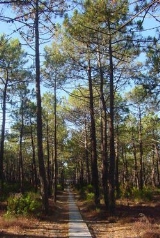
Pines are
treeA tree is a perennial woody plant. It is most often defined as a woody plant that has many secondary branches supported clear of the ground on a single main stem or trunk with clear apical dominance. A minimum height specification at maturity is cited by some authors, varying from 3 m to...
s in the
genusIn biology, a genus is a low-level taxonomic rank used in the biological classification of living and fossil organisms, which is an example of definition by genus and differentia...
Pinus (icon),
in the
familyIn biological classification, family is* a taxonomic rank. Other well-known ranks are life, domain, kingdom, phylum, class, order, genus, and species, with family fitting between order and genus. As for the other well-known ranks, there is the option of an immediately lower rank, indicated by the...
PinaceaePinaceae are trees or shrubs, including many of the well-known conifers of commercial importance such as cedars, firs, hemlocks, larches, pines and spruces. The family is included in the order Pinales, formerly known as Coniferales. Pinaceae are supported as monophyletic by its protein-type sieve...
. They make up the
monotypicIn biology, a monotypic taxon is a taxonomic group with only one biological type. The term's usage differs slightly between botany and zoology. The term monotypic has a separate use in conservation biology, monotypic habitat, regarding species habitat conversion eliminating biodiversity and...
subfamily
Pinoideae. There are about 115
speciesIn biology, a species is one of the basic units of biological classification and a taxonomic rank. A species is often defined as a group of organisms capable of interbreeding and producing fertile offspring. While in many cases this definition is adequate, more precise or differing measures are...
of pine, although different authorities accept between 105 and 125 species.
Etymology
The modern
EnglishEnglish is a West Germanic language that arose in the Anglo-Saxon kingdoms of England and spread into what was to become south-east Scotland under the influence of the Anglian medieval kingdom of Northumbria...
name
pine derives from
LatinLatin is an Italic language originally spoken in Latium and Ancient Rome. It, along with most European languages, is a descendant of the ancient Proto-Indo-European language. Although it is considered a dead language, a number of scholars and members of the Christian clergy speak it fluently, and...
pinus by way of
FrenchFrench is a Romance language spoken as a first language in France, the Romandy region in Switzerland, Wallonia and Brussels in Belgium, Monaco, the regions of Quebec and Acadia in Canada, and by various communities elsewhere. Second-language speakers of French are distributed throughout many parts...
pin; similar names are used in other
Romance languagesThe Romance languages are a branch of the Indo-European language family, more precisely of the Italic languages subfamily, comprising all the languages that descend from Vulgar Latin, the language of ancient Rome...
. In the past (pre-19th century) they were often known as
fir, from Old Norse
fyrre, by way of
Middle EnglishMiddle English is the stage in the history of the English language during the High and Late Middle Ages, or roughly during the four centuries between the late 11th and the late 15th century....
firre. The Old Norse name is still used for pines in some modern north European languages, in
DanishDanish is a North Germanic language spoken by around six million people, principally in the country of Denmark. It is also spoken by 50,000 Germans of Danish ethnicity in the northern parts of Schleswig-Holstein, Germany, where it holds the status of minority language...
,
fyr, in
NorwegianNorwegian is a North Germanic language spoken primarily in Norway, where it is the official language. Together with Swedish and Danish, Norwegian forms a continuum of more or less mutually intelligible local and regional variants .These Scandinavian languages together with the Faroese language...
fura/fure/furu,
SwedishSwedish is a North Germanic language, spoken by approximately 10 million people, predominantly in Sweden and parts of Finland, especially along its coast and on the Åland islands. It is largely mutually intelligible with Norwegian and Danish...
,
fura/furu, and
Föhre in
GermanGerman is a West Germanic language, related to and classified alongside English and Dutch. With an estimated 90 – 98 million native speakers, German is one of the world's major languages and is the most widely-spoken first language in the European Union....
, but in modern English,
fir is now restricted to
FirFirs are a genus of 48–55 species of evergreen conifers in the family Pinaceae. They are found through much of North and Central America, Europe, Asia, and North Africa, occurring in mountains over most of the range...
(
Abies) and
Douglas-firDouglas-fir is one of the English common names for evergreen coniferous trees of the genus Pseudotsuga in the family Pinaceae. Other common names include Douglas tree, and Oregon pine. There are five species, two in western North America, one in Mexico, and two in eastern Asia...
(
Pseudotsuga).
Taxonomy, nomenclature & codification
Pines are divided into three subgenera, based on cone, seed and leaf characters:
- Pinus subg. Pinus, the yellow or hard pine group
- Pinus subg. Ducampopinus, the foxtail or pinyon group
- Pinus subg. Strobus, the white or soft pine groups
Distribution
Pines are native to most of the
Northern HemisphereThe Northern Hemisphere is the half of a planet that is north of its equator—the word hemisphere literally means “half sphere”. It is also that half of the celestial sphere north of the celestial equator...
. In
EurasiaEurasia is a continent or supercontinent comprising the traditional continents of Europe and Asia ; covering about 52,990,000 km2 or about 10.6% of the Earth's surface located primarily in the eastern and northern hemispheres...
, they range from the
Canary IslandsThe Canary Islands , also known as the Canaries , is a Spanish archipelago located just off the northwest coast of mainland Africa, 100 km west of the border between Morocco and the Western Sahara. The Canaries are a Spanish autonomous community and an outermost region of the European Union...
,
Iberian PeninsulaThe Iberian Peninsula , sometimes called Iberia, is located in the extreme southwest of Europe and includes the modern-day sovereign states of Spain, Portugal and Andorra, as well as the British Overseas Territory of Gibraltar...
and
ScotlandScotland is a country that is part of the United Kingdom. Occupying the northern third of the island of Great Britain, it shares a border with England to the south and is bounded by the North Sea to the east, the Atlantic Ocean to the north and west, and the North Channel and Irish Sea to the...
east to the
Russian Far EastRussia or , officially known as both Russia and the Russian Federation , is a country in northern Eurasia. It is a federal semi-presidential republic, comprising 83 federal subjects...
, and in the
PhilippinesThe Philippines , officially known as the Republic of the Philippines , is a country in Southeast Asia in the western Pacific Ocean. To its north across the Luzon Strait lies Taiwan. West across the South China Sea sits Vietnam...
, north to just over 70°N in
NorwayNorway , officially the Kingdom of Norway, is a Nordic unitary constitutional monarchy whose territory comprises the western portion of the Scandinavian Peninsula, Jan Mayen, and the Arctic archipelago of Svalbard and Bouvet Island. Norway has a total area of and a population of about 4.9 million...
,
FinlandFinland , officially the Republic of Finland, is a Nordic country situated in the Fennoscandian region of Northern Europe. It is bordered by Sweden in the west, Norway in the north and Russia in the east, while Estonia lies to its south across the Gulf of Finland.Around 5.4 million people reside...
and
SwedenSweden , officially the Kingdom of Sweden , is a Nordic country on the Scandinavian Peninsula in Northern Europe. Sweden borders with Norway and Finland and is connected to Denmark by a bridge-tunnel across the Öresund....
(
Scots PinePinus sylvestris, commonly known as the Scots Pine, is a species of pine native to Europe and Asia, ranging from Scotland, Ireland and Portugal in the west, east to eastern Siberia, south to the Caucasus Mountains, and as far north as well inside the Arctic Circle in Scandinavia...
) and eastern
SiberiaSiberia is an extensive region constituting almost all of Northern Asia. Comprising the central and eastern portion of the Russian Federation, it was part of the Soviet Union from its beginning, as its predecessor states, the Tsardom of Russia and the Russian Empire, conquered it during the 16th...
(
Siberian Dwarf PinePinus pumila is a native to northeastern Asia, including the islands of Japan. This shrubby pine ranges from 1–3 m in height, exceptionally up to 5 m, but may have individual branches that extend farther along the ground in length...
), and south to northernmost
AfricaAfrica is the world's second largest and second most populous continent, after Asia. At about 30.2 million km² including adjacent islands, it covers 6% of the Earth's total surface area and 20.4% of the total land area...
, the Himalaya and
Southeast AsiaSoutheast Asia, South-East Asia, South East Asia or Southeastern Asia is a subregion of Asia, consisting of the countries that are geographically south of China, east of India, west of New Guinea and north of Australia. The region lies on the intersection of geological plates, with heavy seismic...
, with one species (
Sumatran PinePinus merkusii, the Sumatran Pine, is a pine native to the Malesia region of southeast Asia, mainly in Indonesia in the mountains of northern Sumatra, and with two outlying populations in central Sumatra on Mount Kerinci and Mount Talang, and in the Philippines on Mindoro and in the Zambales...
) just crossing the
EquatorAn equator is the intersection of a sphere's surface with the plane perpendicular to the sphere's axis of rotation and containing the sphere's center of mass....
in
SumatraSumatra is an island in western Indonesia, westernmost of the Sunda Islands. It is the largest island entirely in Indonesia , and the sixth largest island in the world at 473,481 km2 with a population of 50,365,538...
to 2°S. In
North AmericaNorth America is a continent wholly within the Northern Hemisphere and almost wholly within the Western Hemisphere. It is also considered a northern subcontinent of the Americas...
, they range from 66°N in
CanadaCanada is a North American country consisting of ten provinces and three territories. Located in the northern part of the continent, it extends from the Atlantic Ocean in the east to the Pacific Ocean in the west, and northward into the Arctic Ocean...
(
Jack PineJack pine is a North American pine with its native range in Canada east of the Rocky Mountains from Northwest Territories to Nova Scotia, and the northeast of the United States from Minnesota to Maine, with the southernmost part of the range just into northwest Indiana...
and
Red PinePinus resinosa, commonly known as the red pine or Norway pine, is pine native to North America. The Red Pine occurs from Newfoundland west to Manitoba, and south to Pennsylvania, with several smaller, disjunct populations occurring in the Appalachian Mountains in Virginia and West Virginia, as well...
), south to 12°N in
NicaraguaNicaragua is the largest country in the Central American American isthmus, bordered by Honduras to the north and Costa Rica to the south. The country is situated between 11 and 14 degrees north of the Equator in the Northern Hemisphere, which places it entirely within the tropics. The Pacific Ocean...
(
Caribbean PineThe Caribbean Pine, Pinus caribaea, is a hard pine native to Central America, Cuba, Jamaica, the Bahamas, and the Turks and Caicos Islands. It inhabits tropical and subtropical coniferous forests, which include both lowland savannas and montane forests...
).
Pines have been introduced in subtropical and temperate portions of the
Southern HemisphereThe Southern Hemisphere is the part of Earth that lies south of the equator. The word hemisphere literally means 'half ball' or "half sphere"...
, including
ChileChile ,officially the Republic of Chile , is a country in South America occupying a long, narrow coastal strip between the Andes mountains to the east and the Pacific Ocean to the west. It borders Peru to the north, Bolivia to the northeast, Argentina to the east, and the Drake Passage in the far...
,
BrazilBrazil , officially the Federative Republic of Brazil , is the largest country in South America. It is the world's fifth largest country, both by geographical area and by population with over 192 million people...
,
South AfricaThe Republic of South Africa is a country in southern Africa. Located at the southern tip of Africa, it is divided into nine provinces, with of coastline on the Atlantic and Indian oceans...
,
TanzaniaThe United Republic of Tanzania is a country in East Africa bordered by Kenya and Uganda to the north, Rwanda, Burundi, and the Democratic Republic of the Congo to the west, and Zambia, Malawi, and Mozambique to the south. The country's eastern borders lie on the Indian Ocean.Tanzania is a state...
,
AustraliaAustralia , officially the Commonwealth of Australia, is a country in the Southern Hemisphere comprising the mainland of the Australian continent, the island of Tasmania, and numerous smaller islands in the Indian and Pacific Oceans. It is the world's sixth-largest country by total area...
,
ArgentinaArgentina , officially the Argentine Republic , is the second largest country in South America by land area, after Brazil. It is constituted as a federation of 23 provinces and an autonomous city, Buenos Aires...
and
New ZealandNew Zealand is an island country in the south-western Pacific Ocean comprising two main landmasses and numerous smaller islands. The country is situated some east of Australia across the Tasman Sea, and roughly south of the Pacific island nations of New Caledonia, Fiji, and Tonga...
, where they are grown widely as a source of timber. A number of these introduced species have become
invasive"Invasive species", or invasive exotics, is a nomenclature term and categorization phrase used for flora and fauna, and for specific restoration-preservation processes in native habitats, with several definitions....
, threatening native ecosystems.
Morphology
Pines are
evergreenIn botany, an evergreen plant is a plant that has leaves in all seasons. This contrasts with deciduous plants, which completely lose their foliage during the winter or dry season.There are many different kinds of evergreen plants, both trees and shrubs...
,
resinResin in the most specific use of the term is a hydrocarbon secretion of many plants, particularly coniferous trees. Resins are valued for their chemical properties and associated uses, such as the production of varnishes, adhesives, and food glazing agents; as an important source of raw materials...
ous
treeA tree is a perennial woody plant. It is most often defined as a woody plant that has many secondary branches supported clear of the ground on a single main stem or trunk with clear apical dominance. A minimum height specification at maturity is cited by some authors, varying from 3 m to...
s (or rarely
shrubA shrub or bush is distinguished from a tree by its multiple stems and shorter height, usually under 5–6 m tall. A large number of plants may become either shrubs or trees, depending on the growing conditions they experience...
s) growing 3–80 m tall, with the majority of species reaching 15–45 m tall. The smallest are
Siberian Dwarf PinePinus pumila is a native to northeastern Asia, including the islands of Japan. This shrubby pine ranges from 1–3 m in height, exceptionally up to 5 m, but may have individual branches that extend farther along the ground in length...
and
Potosi PinyonPinus culminicola, commonly known as Potosi Pinyon, is a pine in the pinyon pine group, native and endemic to northeast Mexico. The range is highly localised, confined to a small area of high summits in the northern Sierra Madre Oriental in Coahuila and Nuevo León, and only abundant on the highest...
, and the tallest is a 268.35-foot (81.79-meter) tall Ponderosa Pine located in southern
OregonOregon is a state in the Pacific Northwest region of the United States. It is located on the Pacific coast, with Washington to the north, California to the south, Nevada on the southeast and Idaho to the east. The Columbia and Snake rivers delineate much of Oregon's northern and eastern...
's
Rogue River-Siskiyou National ForestThe Rogue River – Siskiyou National Forest is a United States National Forest located on both sides of the border between the states of Oregon and California. The formerly separate Rogue River and Siskiyou National Forests were administratively combined in 2004...
.
The
barkBark is the outermost layers of stems and roots of woody plants. Plants with bark include trees, woody vines and shrubs. Bark refers to all the tissues outside of the vascular cambium and is a nontechnical term. It overlays the wood and consists of the inner bark and the outer bark. The inner...
of most pines is thick and scaly, but some species have thin, flaking bark. The branches are produced in regular "pseudo whorls", actually a very tight
spiralIn mathematics, a spiral is a curve which emanates from a central point, getting progressively farther away as it revolves around the point.-Spiral or helix:...
but appearing like a ring of branches arising from the same point. Many pines are
uninodal, producing just one such whorl of branches each year, from
budIn botany, a bud is an undeveloped or embryonic shoot and normally occurs in the axil of a leaf or at the tip of the stem. Once formed, a bud may remain for some time in a dormant condition, or it may form a shoot immediately. Buds may be specialized to develop flowers or short shoots, or may have...
s at the tip of the year's new
shootA stem is one of two main structural axes of a vascular plant. The stem is normally divided into nodes and internodes, the nodes hold buds which grow into one or more leaves, inflorescence , conifer cones, roots, other stems etc. The internodes distance one node from another...
, but others are
multinodal, producing two or more whorls of branches per year. The spiral growth of branches, needles, and cone scales are arranged in
Fibonacci numberIn mathematics, the Fibonacci numbers are the numbers in the following integer sequence:0,\;1,\;1,\;2,\;3,\;5,\;8,\;13,\;21,\;34,\;55,\;89,\;144,\; \ldots\; ....
ratios. The new spring shoots are sometimes called "candles"; they are covered in brown or whitish bud scales and point upward at first, then later turn green and spread outward. These "candles" offer
forester250px|thumb|right|Foresters of [[Southern University of Chile|UACh]] in the [[Valdivian forest]]s of San Pablo de Tregua, ChileA forester is a person who practices forestry, the science, art, and profession of managing forests. Foresters engage in a broad range of activities including timber...
s a means to evaluate
fertilityFertility is the natural capability of producing offsprings. As a measure, "fertility rate" is the number of children born per couple, person or population. Fertility differs from fecundity, which is defined as the potential for reproduction...
of the soil and vigour of the trees.
Pines are long-lived, typically reaching ages of 100–1,000 years, some even more. The longest-lived is the
Great Basin Bristlecone PinePinus longaeva, the Great Basin Bristlecone Pine, is a long-living species of tree found in the higher mountains of the southwest United States. The species is one of three closely related trees known as bristlecone pines and is sometimes known as the Intermountain or Western bristlecone pine...
,
Pinus longaeva, one individual of which, at around 4,600 years old, is one of the
world's oldest living organisms. This tree can be found in the
White MountainsThe White Mountains of California are a triangular fault block mountain range facing the Sierra Nevada across the upper Owens Valley. They extend for approximately as a greatly elevated plateau about wide on the south, narrowing to a point at the north, with elevations generally increasing...
of
CaliforniaCalifornia is a state located on the West Coast of the United States. It is by far the most populous U.S. state, and the third-largest by land area...
. An older tree, unfortunately now cut down, was dated at 4,900 years old. It was discovered in a grove beneath
Wheeler PeakWheeler Peak, elevation , a mountain in the Great Basin Desert, is the highest point in Great Basin National Park. The summit is located west of the Utah border...
and it is now known as Prometheus after the
Greek immortalIn Greek mythology, Prometheus is a Titan, the son of Iapetus and Themis, and brother to Atlas, Epimetheus and Menoetius. He was a champion of mankind, known for his wily intelligence, who stole fire from Zeus and gave it to mortals...
.
Foliage
Pines have four types of
leafA leaf is an organ of a vascular plant, as defined in botanical terms, and in particular in plant morphology. Foliage is a mass noun that refers to leaves as a feature of plants....
:
- Seed leaves (cotyledon
A cotyledon , is a significant part of the embryo within the seed of a plant. Upon germination, the cotyledon may become the embryonic first leaves of a seedling. The number of cotyledons present is one characteristic used by botanists to classify the flowering plants...
s) on seedlings, borne in a whorl of 4–24.
- Juvenile leaves, which follow immediately on seedlings and young plants, 2–6 cm long, single, green or often blue-green, and arranged spirally on the shoot. These are produced for six months to five years, rarely longer.
- Scale leaves, similar to bud scales, small, brown and non-photosynthetic, and arranged spirally like the juvenile leaves.
- Needles, the adult leaves, which are green (photosynthetic), bundled in clusters (fascicles) of 1–6, commonly 2–5, needles together, each fascicle produced from a small bud
In botany, a bud is an undeveloped or embryonic shoot and normally occurs in the axil of a leaf or at the tip of the stem. Once formed, a bud may remain for some time in a dormant condition, or it may form a shoot immediately. Buds may be specialized to develop flowers or short shoots, or may have...
on a dwarf shoot in the axil of a scale leaf. These bud scales often remain on the fascicle as a basal sheath. The needles persist for 1.5–40 years, depending on species. If a shoot is damaged (e.g. eaten by an animal), the needle fascicles just below the damage will generate a bud which can then replace the lost leaves.
Cones
Pines are mostly
monoeciousPlant sexuality covers the wide variety of sexual reproduction systems found across the plant kingdom. This article describes morphological aspects of sexual reproduction of plants....
, having the male and female
conesA cone is an organ on plants in the division Pinophyta that contains the reproductive structures. The familiar woody cone is the female cone, which produces seeds. The male cones, which produce pollen, are usually herbaceous and much less conspicuous even at full maturity...
on the same tree, though a few species are
sub-dioeciousPlant sexuality covers the wide variety of sexual reproduction systems found across the plant kingdom. This article describes morphological aspects of sexual reproduction of plants....
with individuals predominantly, but not wholly, single-sex. The male cones are small, typically 1–5 cm long, and only present for a short period (usually in spring, though autumn in a few pines), falling as soon as they have shed their
pollenPollen is a fine to coarse powder containing the microgametophytes of seed plants, which produce the male gametes . Pollen grains have a hard coat that protects the sperm cells during the process of their movement from the stamens to the pistil of flowering plants or from the male cone to the...
. The female cones take 1.5–3 years (depending on species) to mature after
pollinationPollination is the process by which pollen is transferred in plants, thereby enabling fertilisation and sexual reproduction. Pollen grains transport the male gametes to where the female gamete are contained within the carpel; in gymnosperms the pollen is directly applied to the ovule itself...
, with actual fertilization delayed one year. At maturity the female cones are 3–60 cm long. Each cone has numerous spirally arranged scales, with two seeds on each fertile scale; the scales at the base and tip of the cone are small and sterile, without seeds. The seeds are mostly small and winged, and are anemophilous (wind-dispersed), but some are larger and have only a vestigial wing, and are
birdBirds are feathered, winged, bipedal, endothermic , egg-laying, vertebrate animals. Around 10,000 living species and 188 families makes them the most speciose class of tetrapod vertebrates. They inhabit ecosystems across the globe, from the Arctic to the Antarctic. Extant birds range in size from...
-dispersed (see below). At maturity, the cones usually open to release the seeds, but in some of the bird-dispersed species (e.g.
Whitebark PinePinus albicaulis, known commonly as Whitebark Pine, Pitch Pine, Scrub Pine, and Creeping Pine occurs in the mountains of the Western United States and Canada, specifically the subalpine areas of the Sierra Nevada, the Cascade Range, the Pacific Coast Ranges, and the northern Rocky Mountains –...
), the seeds are only released by the bird breaking the cones open. In others, the seeds are stored in closed ("serotinous") cones for many years until an environmental cue triggers the cones to open, releasing the seeds. The most common form of serotiny is pyriscence, in which a resin binds the cones cones shut until melted by a forest fire.
Ecology
Pines grow well in acid
soilSoil is a natural body consisting of layers of mineral constituents of variable thicknesses, which differ from the parent materials in their morphological, physical, chemical, and mineralogical characteristics...
s, some also on
calcareousCalcareous is an adjective meaning mostly or partly composed of calcium carbonate, in other words, containing lime or being chalky. The term is used in a wide variety of scientific disciplines.-In zoology:...
soils; most require good soil drainage, preferring sandy soils, but a few (e.g.
Lodgepole PineLodgepole Pine, Pinus contorta, also known as Shore Pine, is a common tree in western North America. Like all pines, it is evergreen.-Subspecies:...
) will tolerate poorly drained wet soils. A few are able to sprout after forest fires (e.g.
Canary Island PinePinus canariensis, the Canary Island Pine, is a species in the genus Pinus, family Pinaceae, native and endemic to the outer Canary Islands in the Atlantic Ocean. It is a subtropical pine and does not tolerate low temperatures or hard frost, surviving temperatures down to about −6 to...
). Some species of pines (e.g.
Bishop PineThe Bishop Pine, Pinus muricata, is a pine with a very restricted range: mostly in the U.S. state of California, including several offshore Channel Islands, and a few locations in Baja California, Mexico...
) need fire to regenerate, and their populations slowly decline under fire suppression regimes. Several species are adapted to extreme conditions imposed by elevation and latitude (e.g.
Siberian Dwarf PinePinus pumila is a native to northeastern Asia, including the islands of Japan. This shrubby pine ranges from 1–3 m in height, exceptionally up to 5 m, but may have individual branches that extend farther along the ground in length...
,
Mountain PinePinus mugo, the Mountain Pine or Mugo Pine, is a high-altitude European pine, found in the Pyrenees, Alps, Erzgebirge, Carpathians, northern Apennines and Balkan Peninsula mountains from 1,000 m to 2,200 m, occasionally as low as 200 m in the north of the range in Germany and Poland, and as high...
,
Whitebark PinePinus albicaulis, known commonly as Whitebark Pine, Pitch Pine, Scrub Pine, and Creeping Pine occurs in the mountains of the Western United States and Canada, specifically the subalpine areas of the Sierra Nevada, the Cascade Range, the Pacific Coast Ranges, and the northern Rocky Mountains –...
and the
bristlecone pineThe bristlecone pines are a small group of pine trees that are thought to reach an age far greater than that of any other single living organism known, up to nearly 5,000 years....
s). The
pinyon pineThe pinyon pine group grows in the southwestern United States and in Mexico. The trees yield edible pinyon nuts, which were a staple of the Native Americans, and are still widely eaten...
s and a number of others, notably
Turkish PinePinus brutia, the Turkish pine, is a pine native to the eastern Mediterranean region. The bulk of its range is in Turkey, but it also extends to the East Aegean Islands of Greece, the Crimea, Iran, Georgia, Azerbaijan, northern Iraq, western Syria, Lebanon, and Cyprus...
and
Gray PinePinus sabiniana , with the common names gray pine, California foothill pine, and the more historically and internationally used digger pine, is a pine endemic to California in the United States...
, are particularly well adapted to growth in hot, dry
semi-desertA desert is a landscape or region that receives an extremely low amount of precipitation, less than enough to support growth of most plants. Most deserts have an average annual precipitation of less than...
climates.
The
seedA seed is a small embryonic plant enclosed in a covering called the seed coat, usually with some stored food. It is the product of the ripened ovule of gymnosperm and angiosperm plants which occurs after fertilization and some growth within the mother plant...
s are commonly eaten by
birdBirds are feathered, winged, bipedal, endothermic , egg-laying, vertebrate animals. Around 10,000 living species and 188 families makes them the most speciose class of tetrapod vertebrates. They inhabit ecosystems across the globe, from the Arctic to the Antarctic. Extant birds range in size from...
s and
squirrelSquirrels belong to a large family of small or medium-sized rodents called the Sciuridae. The family includes tree squirrels, ground squirrels, chipmunks, marmots , flying squirrels, and prairie dogs. Squirrels are indigenous to the Americas, Eurasia, and Africa and have been introduced to Australia...
s. Some birds, notably the
Spotted NutcrackerThe Spotted Nutcracker, Eurasian Nutcracker, or just Nutcracker, is a passerine bird slightly larger than the Eurasian Jay. It has a much larger bill and a slimmer looking head without any crest. The feathering over its body is predominantly a chocolate brown with distinct white spots and streaks...
,
Clark's NutcrackerClark's Nutcracker , sometimes referred to as Clark's Crow or Woodpecker Crow, is a passerine bird in the family Corvidae. It is slightly smaller than its Eurasian relative the Spotted Nutcracker . It is ashy-grey all over except for the black-and-white wings and central tail feathers...
and
Pinyon JayThe Pinyon Jay is a jay between the North American Blue Jay and the Eurasian Jay in size. It is the only member of the genus Gymnorhinus, . Its overall proportions are very Nutcracker-like and indeed this can be seen as convergent evolution as both birds fill similar ecological niches...
, are of importance in distributing pine seeds to new areas. Pine needles are sometimes eaten by some
LepidopteraLepidoptera is a large order of insects that includes moths and butterflies . It is one of the most widespread and widely recognizable insect orders in the world, encompassing moths and the three superfamilies of butterflies, skipper butterflies, and moth-butterflies...
(
butterflyA butterfly is a mainly day-flying insect of the order Lepidoptera, which includes the butterflies and moths. Like other holometabolous insects, the butterfly's life cycle consists of four parts: egg, larva, pupa and adult. Most species are diurnal. Butterflies have large, often brightly coloured...
and
mothA moth is an insect closely related to the butterfly, both being of the order Lepidoptera. Moths form the majority of this order; there are thought to be 150,000 to 250,000 different species of moth , with thousands of species yet to be described...
) species (see list of Lepidoptera that feed on pines), the Symphytan species Pine sawfly, and
goatThe domestic goat is a subspecies of goat domesticated from the wild goat of southwest Asia and Eastern Europe. The goat is a member of the Bovidae family and is closely related to the sheep as both are in the goat-antelope subfamily Caprinae. There are over three hundred distinct breeds of...
s.
Uses
Pines are among the most commercially important of tree species, valued for their
timberTimber may refer to:* Timber, a term common in the United Kingdom and Australia for wood materials * Timber, Oregon, an unincorporated community in the U.S...
and
wood pulpPulp is a lignocellulosic fibrous material prepared by chemically or mechanically separating cellulose fibres from wood, fibre crops or waste paper. Wood pulp is the most common raw material in papermaking.-History:...
throughout the world. In temperate and tropical regions, they are fast-growing
softwoodThe term softwood is used to describe wood from trees that are known as gymnosperms.Conifers are an example. It may also be used to describe trees, which tend to be evergreen, notable exceptions being bald cypress and the larches....
s that will grow in relatively dense stands, their acidic decaying needles inhibiting the sprouting of competing hardwoods. Commercial pines are grown in
plantationA plantation is a long artificially established forest, farm or estate, where crops are grown for sale, often in distant markets rather than for local on-site consumption...
s for timber that is denser, more resinous, and therefore more durable than
spruceA spruce is a tree of the genus Picea , a genus of about 35 species of coniferous evergreen trees in the Family Pinaceae, found in the northern temperate and boreal regions of the earth. Spruces are large trees, from tall when mature, and can be distinguished by their whorled branches and conical...
(
Picea). Pine wood is widely used in high-value carpentry items such as furniture, window frames, paneling, floors and roofing, and the
resinResin in the most specific use of the term is a hydrocarbon secretion of many plants, particularly coniferous trees. Resins are valued for their chemical properties and associated uses, such as the production of varnishes, adhesives, and food glazing agents; as an important source of raw materials...
of some species is an important source of
turpentineTurpentine is a fluid obtained by the distillation of resin obtained from trees, mainly pine trees. It is composed of terpenes, mainly the monoterpenes alpha-pinene and beta-pinene...
.
Many pine species make attractive ornamental plantings for
parkA park is a protected area, in its natural or semi-natural state, or planted, and set aside for human recreation and enjoyment, or for the protection of wildlife or natural habitats. It may consist of rocks, soil, water, flora and fauna and grass areas. Many parks are legally protected by...
s and larger
gardenA garden is a planned space, usually outdoors, set aside for the display, cultivation, and enjoyment of plants and other forms of nature. The garden can incorporate both natural and man-made materials. The most common form today is known as a residential garden, but the term garden has...
s, with a variety of dwarf
cultivarA cultivar'Cultivar has two meanings as explained under Formal definition. When used in reference to a taxon, the word does not apply to an individual plant but to all those plants sharing the unique characteristics that define the cultivar. is a plant or group of plants selected for desirable...
s being suitable for smaller spaces. Pines are also commercially grown and harvested for
Christmas treeThe Christmas tree is a decorated evergreen coniferous tree, real or artificial, and a tradition associated with the celebration of Christmas. The tradition of decorating an evergreen tree at Christmas started in Livonia and Germany in the 16th century...
s. Pine cones, the largest and most durable of all
conifer coneA cone is an organ on plants in the division Pinophyta that contains the reproductive structures. The familiar woody cone is the female cone, which produces seeds. The male cones, which produce pollen, are usually herbaceous and much less conspicuous even at full maturity...
s are craft favorites. Pine boughs, appreciated especially in wintertime for their pleasant smell and greenery, are popularly cut for decorations. A number of species are attacked by nematodes, causing pine
wilt diseaseA wilt disease is any number of diseases that affect the vascular system of plants. Attacks by fungi, bacteria, and nematodes can cause rapid killing of plants, large tree branches or even entire trees....
, which can kill some quickly. Pine needles are also used for making decorative articles like baskets, trays, pots, etc. This Native American skill is now being replicated across world. Pine needle handicrafts are made in the US, Canada, Mexico, Nicaragua and India. Pine needles serve as food for various
LepidopteraLepidoptera is a large order of insects that includes moths and butterflies . It is one of the most widespread and widely recognizable insect orders in the world, encompassing moths and the three superfamilies of butterflies, skipper butterflies, and moth-butterflies...
. See
List of Lepidoptera which feed on Pines.
Because pines have no insect or decay resistant qualities after logging, they are generally recommended for construction purposes as indoor use only (ex. indoor drywall framing). This wood left outside can not be expected to last more than 12–18 months depending on the type of climate it is exposed to. It is commonly referred to by several different names which include North American timber, SPF (spruce, pine, fir) and whitewood.
Food uses
Some species have large
seedA seed is a small embryonic plant enclosed in a covering called the seed coat, usually with some stored food. It is the product of the ripened ovule of gymnosperm and angiosperm plants which occurs after fertilization and some growth within the mother plant...
s, called
pine nutPine nuts are the edible seeds of pines . About 20 species of pine produce seeds large enough to be worth harvesting; in other pines the seeds are also edible, but are too small to be of great value as a human food....
s, that are harvested and sold for cooking and baking.
The soft, moist, white inner bark (
cambiumThe vascular cambium is a part of the morphology of plants. It consists of cells that are partly specialized, for the tissues that transport water solutions, but have not reached any of the final forms that occur in their branch of the specialization graph...
) found clinging to the woody outer
barkBark is the outermost layers of stems and roots of woody plants. Plants with bark include trees, woody vines and shrubs. Bark refers to all the tissues outside of the vascular cambium and is a nontechnical term. It overlays the wood and consists of the inner bark and the outer bark. The inner...
is edible and very high in vitamins
AVitamin A is a vitamin that is needed by the retina of the eye in the form of a specific metabolite, the light-absorbing molecule retinal, that is necessary for both low-light and color vision...
and
CVitamin C or L-ascorbic acid or L-ascorbate is an essential nutrient for humans and certain other animal species. In living organisms ascorbate acts as an antioxidant by protecting the body against oxidative stress...
. It can be eaten raw in slices as a snack or dried and ground up into a powder for use as a thickener in stews, soups, and other foods, such as Finnish pine bark bread (pettuleipä). Adirondack Indians got their name from the Mohawk Indian word
atirú:taks, meaning "tree eaters".
A tea made by steeping young, green pine needles in boiling water (known as "tallstrunt" in Sweden) is high in vitamins A and C.