


Serbs of Vojvodina

Encyclopedia
The Serbs
are the largest ethnic group in the Vojvodina
province of Serbia
. For centuries, they lived under foreign rule, but despite many attempts that aimed to assimilate them, Vojvodinian Serbs preserved their national consciousness, language, religion, culture as well as the rich folklore, national costumes and music. According to the 2002 census, there were 1,321,807 Serbs in Vojvodina or 65.05% of the population of the province. There is a small part of the historical territory of Vojvodinian Serbs that lies outside the autonomous province of Vojvodina, including Belgrade
's municipalities of Zemun
, Novi Beograd
and Surčin
, the tiny geographical area of Pančevački Rit
of Belgrade's Palilula municipality, and the village of Ostrovo
, which is located in the urban municipality of Kostolac
of Požarevac
city.
conquest in the 1st century BC, Illyria
n, Thracia
n and Celt
ic tribes inhabited the territory of present day Vojvodina
region. During the Roman rule, original inhabitants were heavily Romanized, and latter they are known under name of Vlachs
. It is thought that this original population had not entirely disappeared, leaving certain genetic traces among the modern Serb
population of the region.
The Slavs (Severans
, Abodrites, Braničevci
and Serbs
) settled today's Vojvodina in the 6th and 7th centuries (during the early medieval migrations). Until the 13th century, the region had dominant Slavic population.
In the 9th century the region of present day Vojvodina was ruled by the two local Bulgaro-Slavic duke
s (Voivodes). Their names were Salan
and Glad
. Salan ruled the territory of Bačka
, and his capital city was Titel
, while Glad ruled the territory of Banat
. The descendant of Glad was Ahtum
, another local duke of Banat, the last ruler who opposed to the establishment of the Kingdom of Hungary in the 11th century. The important local Bulgaro-Slavic duke was also Sermon
, a vassal of the Bulgarian emperor Samuil
, who ruled over Srem in the 11th century.
between the 10th and 12th centuries. This was followed by the destruction of the local Slavic tribal organization and introduction of the county system of rule. The first known prefect of the Bač county (in the region of Bačka
) was recorded in 1074 and his name was Vid, which is a Slavic name by origin. During the rule of the Hungarian king Coloman (1095-1116), the local Serb nobles in Bačka were Uroš, Vukan and Pavle. A record from 1309 speak about "Schismatics" (Orthodox Christians), who lived in Bačka. Arsenije I Bogdanović from Srem, the second Serb archbishop (1233-1263) after Saint Sava
, was born in Srem, in the village Dabar near Slankamen
. After the creation of an autocephalous Serbian Orthodox Church
in 1219 and negotiations between Archbishop Sava and the Hungarian crown, the Eastern Orthodox Slavic population north of the Danube was subjected under its jurisdiction.
From 1282 to 1316 Serbian King Stefan Dragutin Nemanjić reigned several lands as a "King of Syrmia". The center of his realm was in "Lower Syrmia" (modern Mačva
), while he also possibly ruled "Upper Syrmia" (i.e. Syrmian part of Vojvodina). Stefan Dragutin died in 1316, and was succeeded by his son Vladislav (1316-1325), who was a vassal of the Hungarian King.
An increasing number of Serbs
began settling in the Vojvodina region from the 14th century onward. By 1483, according to a Hungarian source, as much as half of the population of the Vojvodina territory of the Kingdom of Hungary at the time consisted of Serbs. The Hungarian kings encouraged the immigration of Serbs to the Kingdom, and hired many of them as soldiers and border guards.
After the Ottoman Empire
conquered Serbian Despotate
(in 1459), Serbian titular despots ruled in parts of Vojvodina as vassals of the Hungarian crown. The residence of the despots was Kupinik
(today Kupinovo) in Srem. The Serbian despots were: Vuk Grgurević
(1471-1485), Đorđe Branković (1486-1496), Jovan Branković
(1496-1502), Ivaniš Berislav (1504-1514), Stevan Berislav (1520-1535), Radič Božić
(1527-1528), Pavle Bakić
(1537) and Stefan Štiljanović
(1537-1540). The last three did not rule in the territory of present day Vojvodina, but had possessions in the territories of present day Romania
, Hungary
and Croatia
. The fact that Despots of Serbia ruled in the territory of present day Vojvodina, but also the presence of large Serb population, are reasons because in many historical records and maps, which were written and drawn between 15th and 18th centuries, territory of present day Vojvodina was named Rascia (Raška
, Serbia
) and Little Raška (Little Serbia).
took control of Vojvodina following the Battle of Mohács
of 1526 and the conquest of Banat
in 1552. Soon after the Battle of Mohač, Jovan Nenad
, a leader of the Serb mercenaries, established his rule in Bačka
, northern Banat
and a small part of Srem. He created an ephemeral independent state, with Subotica
as its capital. At the pitch of his power, Jovan Nenad proclaimed himself "Serbian Emperor" in Subotica. Taking advantage of the extremely confused military and political situation, the Hungarian noblemen from the region joined forces against him and defeated the Serbian troops in the summer of 1527. "Emperor" Jovan Nenad was assassinated and his state collapsed.
After the assassination of Jovan Nenad, the general commander of his army, Radoslav Čelnik
, moved with part of the former emperor's army from Bačka to Srem, and acceded into the Ottoman service. Radoslav Čelnik then ruled over Srem as Ottoman vassal and took for himself the title of the duke of Srem, while his residence was in Slankamen
.
The establishment of the Ottoman rule caused a massive depopulation of the Vojvodina region. Most of the Hungarians and many local Serbs fled from the region and escaped to the north. The majority of those who left in the region were Serbs, mainly now engaging either in farming either in Ottoman military service.
Under Ottoman policy, many Serbs were newly settled in the region. During the Ottoman rule, most of the inhabitants of the Vojvodina region were Serbs. In that time, villages were mostly populated with Serbs, while cities were populated with Muslims and Serbs
. In 1594 Serbs in Banat
started a large uprising opposing Turkish rule. This was one of three largest Serbian uprisings in history, and the largest one before the First Serbian Uprising
led by Karađorđe.
, Serbian Vojvodina
, Voivodeship of Serbia and Banat of Temeschwar, Military Frontier
The Habsburg Monarchy
took control of Vojvodina among other lands by the treaties of Karlovci
(1699) and Požarevac
(1718). The Serbian patriarch
, Arsenije III Čarnojević
, fearing the revenge of the Turks, immigrated in the last decade of the 17th century to the Habsburg Empire with as many as 36,000 families, but these Serbs mostly went further to the north and settled in the territory of what is now Republic of Hungary with only small part of them settling in the territory of present-day north-western Vojvodina. However, because of this event, the Habsburg Emperor promised religious freedom to all Serbs in the Monarchy as well as the right to elect their own "vojvoda" (military and civil governor). Much of the area of present-day Vojvodina where Serbs lived was incorporated into the Military Frontier. The emperor also recognized Serbs as one of the official nations of the Habsburg Monarchy and he recognized the right of Serbs to have territorial autonomy within one separate voivodeship. This right, however, was not realized before the revolution in 1848-1849
. The immigration of Serbs to the Habsburg Monarchy was maintained during the 18th century.
During the Kuruc War (1703-1711) of Francis II Rakoczi
, the territory of present day Vojvodina was a battlefield between Hungarian rebels and local Serbs who fought on the side of the Habsburg Emperor. Serbs in Bačka
suffered the greatest losses. Hungarian rebels burned Serb villages and many Serbs were expelled from Bačka. Darvas
, the prime military commander of the Hungarian rebels, which fought against Serbs in Bačka, wrote: "We burned all large places of Rascia, on the both banks of the rivers Danube
and Tisa
".
During the Austrian rule many non-Serbs also settled in the territory of present day Vojvodina. They were mainly (Catholic) Germans
and Hungarians, but also Ruthenians
, Slovaks
, Romanians
, and others. Because of this colonization, Serbs lost the absolute ethnic majority in the region, and Vojvodina became one of the most ethnically diverse regions of Europe
. However, there was also some emigration of Serbs from Vojvodina: after the Tisa-Moriš section of the Military Frontier was abolished, Serbs from the north-eastern parts of Bačka left this region and immigrated to Russia
(notably to Nova Serbia
and Slavo-Serbia
) in 1752, and this region was then populated with new Hungarian settlers. Serbs, however, remained the single largest ethnic group in Vojvodina, until the second half of 20th century, when they became the absolute majority again.
Between the 16th and 19th centuries, Vojvodina was the cultural centre of the Serb people. Especially important cultural centres were: Novi Sad
, Sremski Karlovci
, and the monasteries of Fruška Gora
. In the first half of the 19th century, Novi Sad was the largest Serb city; in 1820 this city had about 20,000 inhabitants, of whom 2/3 were Serbs. The Matica Srpska
moved to Novi Sad from Budapest
in 1864. The Serbian gymnasiums of Novi Sad and Sremski Karlovci
were at the time considered to be among the best in the Habsburg Kingdom of Hungary. Novi Sad
was being called the "Serb Athens
".
During the Revolutions of 1848
, the Hungarians demanded national rights and autonomy within the Austrian Empire. However, they did not recognized the national rights of other peoples which lived in the Habsburg Kingdom of Hungary in that time. Wishing to express their national individuality and confronted with the new Hungarian authorities, Serbs
declared the constitution of the Serbian Voivodship (Serbian Duchy) at the May Assembly in Sremski Karlovci
(May 13-15, 1848). The Serbian Voivodship consisted of Srem, Bačka
, Banat
, and Baranja
regions. The Serbs also formed a political alliance with the Croats
"based on freedom and perfect equality". They also recognized the Romanian
nationality. The metropolitan of Sremski Karlovci, Josif Rajačić
, was elected patriarch
, while Stevan Šupljikac
the first Voivode (duke
). A National committee was formed as the new government of the Serbian Voivodship. Instead of the old feudal regime a new reign was founded based on the national boards with the Head Serbian national board presiding.
The Hungarian government replied by the use of force: on June 12 1848, a war between Serbs and Hungarians started. Austria took the side of Hungary at first, demanding from the Serbs to "go back to being obedient". Serbs were aided by volunteers from autonomous Ottoman Principality of Serbia. A consequence of this war, was the expansion of the conservative factions. Since the Austrian court turned against the Hungarians in the later stage of revolution, the feudal and clerical circles of Serbian Voivodship formed an alliance with Austria and became a tool of the Viennese
government. Serbian troops from the Voivodship then joined the Habsburg army and helped in crushing the revolution in the Kingdom of Hungary.
After the defeat of the Hungarian revolution, by a decision of the Austrian emperor
, in November 1849, an Austrian crown land known as the Voivodship of Serbia and Tamiš Banat
was formed as the political successor of the Serbian Voivodship. The crown land consisted of the parts of Banat
, Bačka
and Srem regions. An Austrian governor seated in Temišvar ruled the area, and the title of voivod (duke) belonged to the emperor himself. The full title of the emperor was "Grand Voivod of the Voivodship of Serbia" (German: Großwoiwode der Woiwodschaft Serbien). Even after this crown land was abolished, the emperor kept this title until the end of the Habsburg Monarchy
in 1918.
In 1860 the Voivodship of Serbia and Tamiš Banat was abolished and most of its territory (Banat and Bačka) was incorporated into the Habsburg Kingdom of Hungary, although direct Hungarian rule began only in 1867, when the Kingdom of Hungary gained autonomy within the newly formed Austria-Hungary
. Unlike Banat and Bačka, the Srem region was in 1860 incorporated into the Kingdom of Slavonia
, another separate Habsburg crown land. However, the Kingdom of Slavonia was too incorporated into the Kingdom of Hungary in 1868.
After the Voivodship was abolished, one Serb politician, Svetozar Miletić
, appeared in the political sphere. He demanded national rights for Serbs and other non-Hungarian peoples of the Kingdom of Hungary, but he was arrested and imprisoned because of his political demands. In 1867, the Austrian Empire was transformed into Austria-Hungary, with the Kingdom of Hungary becoming one of two autonomous parts of the new state. This was followed by a policy of Hungarization
of the non-Hungarian nationalities, most notably promotion of the Hungarian language
and suppression of Slavic languages
(including Serbian).
The franchise
was greatly restricted so as to keep power in the hands of the Hungarians. The new government of the autonomous Kingdom of Hungary took the stance that the Kingdom of Hungary should be a Hungarian nation state, and that all other peoples living in the Kingdom: Germans
, Jews, Romanians, Slovaks
, Ruthenes
, Serbs
, and others should be assimilated. Finally, the privilegies given to Serbs by the Habsburg emperor in 1690, were abolished in 1912.
At the end of World War I
, the Austro-Hungarian Empire collapsed, and the Serbs in Vojvodina gained another opportunity to achieve their political demands. On November 25, 1918, the Assembly of Serbs, Bunjevci, and other nations of Vojvodina in Novi Sad
proclaimed the unification of Vojvodina (Banat, Bačka, and Baranja) with the Kingdom of Serbia
. One day before this, on November 24, the Assembly of Srem also proclaimed the unification of Srem with Serbia. Since December 1, 1918, the Vojvodina region is part of the Kingdom of Serbs, Croats and Slovenes. After the several centuries of living under foreign rule (Hungarian, Ottoman, Habsburg), the Vojvodinian Serbs now lived in their own country, together with other Serbs
and South Slavs
. That marked a new stage in the national development of the Serb people in the Vojvodina region.
The difficult time period for the Serbs in Vojvodina was a World War II
and the Axis
occupation (1941-1944), when Vojvodina region was held by the German
, Hungarian
and Croatia
n occupational forces. The occupying powers committed numerous crimes against the ethnic Serb population in the region. It is estimated that during the occupation, about 50,000 people in Vojvodina (mostly Serbs
, Jews
and Roma) were murdered, while more than 280,000 people were interned, arrested, violated or tortured.
The Axis occupation ended in 1944 and the autonomous province of Vojvodina (incorporating Srem, Banat and Bačka) was formed within Yugoslavia
in 1945 as a part of Serbia
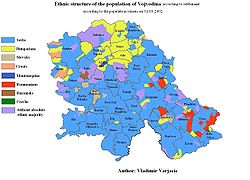
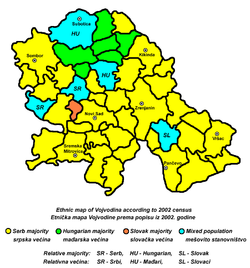
. The province was created as a territorial autonomy for all peoples who live in it, with the significant role of the Serbs, who were ethnic majority in the province.
mountain, except the Fenek
and Zemun
monasteries, which are located in the part of Srem that belongs to Belgrade
, but historically this area too belonged to Vojvodina. According to the historical data, these monastery communities were historically recorded since the first decades of the 16th century, but the legends relate their founding to the period between the 12th and 15th centuries. In the course of centuries of their existence, these monasteries sustained the spiritual and political life of the Serbian
nation. Here is the list of monasteries:
According to one historical record from 1543, there were 17 Serb monasteries in the Banat region in that time.
Culture, science and sports:
Serbs
The Serbs are a South Slavic ethnic group of the Balkans and southern Central Europe. Serbs are located mainly in Serbia, Montenegro and Bosnia and Herzegovina, and form a sizable minority in Croatia, the Republic of Macedonia and Slovenia. Likewise, Serbs are an officially recognized minority in...
are the largest ethnic group in the Vojvodina
Vojvodina
Vojvodina, officially called Autonomous Province of Vojvodina is an autonomous province of Serbia. Its capital and largest city is Novi Sad...
province of Serbia
Serbia
Serbia , officially the Republic of Serbia , is a landlocked country located at the crossroads of Central and Southeast Europe, covering the southern part of the Carpathian basin and the central part of the Balkans...
. For centuries, they lived under foreign rule, but despite many attempts that aimed to assimilate them, Vojvodinian Serbs preserved their national consciousness, language, religion, culture as well as the rich folklore, national costumes and music. According to the 2002 census, there were 1,321,807 Serbs in Vojvodina or 65.05% of the population of the province. There is a small part of the historical territory of Vojvodinian Serbs that lies outside the autonomous province of Vojvodina, including Belgrade
Belgrade
Belgrade is the capital and largest city of Serbia. It is located at the confluence of the Sava and Danube rivers, where the Pannonian Plain meets the Balkans. According to official results of Census 2011, the city has a population of 1,639,121. It is one of the 15 largest cities in Europe...
's municipalities of Zemun
Zemun
Zemun is a historical town and one of the 17 municipalities which constitute the City of Belgrade, the capital of Serbia...
, Novi Beograd
Novi Beograd
Novi Beograd or New Belgrade is the most populous municipality that constitutes the City of Belgrade, the capital of Serbia. It is a planned city, built in 1947 on the left bank of the Sava river which was previously an uninhabited area, opposite of the old Belgrade...
and Surčin
Surcin
Surčin is a neighborhood of Belgrade, the capital of Serbia. It is the youngest of Belgrade's 17 municipalities, as it split from the municipality of Zemun in 2003. Surčin municipality has 38,695 residents while Surčin town itself has 14,292...
, the tiny geographical area of Pančevački Rit
Pancevacki Rit
Pančevački Rit is a small geographical area in south-western Banat, Serbia. It is situated between the rivers Danube and Tamiš, in the Belgrade's municipality of Palilula.-Features:...
of Belgrade's Palilula municipality, and the village of Ostrovo
Ostrovo (Požarevac)
250px|thumb|Map of Ostrovo from 1912Ostrovo is a village in the urban municipality of Kostolac, which is part of the city of Požarevac, Serbia. According to the 2002 census, the village has a population of 685 people.-Name:...
, which is located in the urban municipality of Kostolac
Kostolac
Kostolac is a small Serbian town on the Danube river in the Braničevo District. The remains of the Roman capital of the province of Moesia Superior Viminacium are located near Stari Kostolac some 2 km to the east of Kostolac. Kostolac is situated in the municipality of Požarevac...
of Požarevac
Požarevac
Požarevac is a city and municipality in eastern Serbia. It is the administrative center of the Braničevo District of Serbia...
city.
Origins
Before the RomanAncient Rome
Ancient Rome was a thriving civilization that grew on the Italian Peninsula as early as the 8th century BC. Located along the Mediterranean Sea and centered on the city of Rome, it expanded to one of the largest empires in the ancient world....
conquest in the 1st century BC, Illyria
Illyria
In classical antiquity, Illyria was a region in the western part of the Balkan Peninsula inhabited by the Illyrians....
n, Thracia
Thracia
Thracia is a Web-Based computer game created and developed by an exclusively Romanian team, part of Infotrend Consulting, and launched in 2009. At the time, it was the first endeavor of its kind. All browser games were text based, made up mostly of static content...
n and Celt
Celt
The Celts were a diverse group of tribal societies in Iron Age and Roman-era Europe who spoke Celtic languages.The earliest archaeological culture commonly accepted as Celtic, or rather Proto-Celtic, was the central European Hallstatt culture , named for the rich grave finds in Hallstatt, Austria....
ic tribes inhabited the territory of present day Vojvodina
Vojvodina
Vojvodina, officially called Autonomous Province of Vojvodina is an autonomous province of Serbia. Its capital and largest city is Novi Sad...
region. During the Roman rule, original inhabitants were heavily Romanized, and latter they are known under name of Vlachs
Vlachs
Vlach is a blanket term covering several modern Latin peoples descending from the Latinised population in Central, Eastern and Southeastern Europe. English variations on the name include: Walla, Wlachs, Wallachs, Vlahs, Olahs or Ulahs...
. It is thought that this original population had not entirely disappeared, leaving certain genetic traces among the modern Serb
Serbs
The Serbs are a South Slavic ethnic group of the Balkans and southern Central Europe. Serbs are located mainly in Serbia, Montenegro and Bosnia and Herzegovina, and form a sizable minority in Croatia, the Republic of Macedonia and Slovenia. Likewise, Serbs are an officially recognized minority in...
population of the region.
The Slavs (Severans
Severians
The Severians or Severyans or Siverians were a tribe or tribal union of early East Slavs occupying areas to the east of the middle Dnieper river around the rivers Desna, Sejm and Sula on the territory of the archaeological Romny culture....
, Abodrites, Braničevci
Branicevci
The Braničevci were a medieval South Slavic tribe that existed in the 9th century that lived in the Eastern Serbia, east of the Morava river in the region of Braničevo....
and Serbs
Serbs
The Serbs are a South Slavic ethnic group of the Balkans and southern Central Europe. Serbs are located mainly in Serbia, Montenegro and Bosnia and Herzegovina, and form a sizable minority in Croatia, the Republic of Macedonia and Slovenia. Likewise, Serbs are an officially recognized minority in...
) settled today's Vojvodina in the 6th and 7th centuries (during the early medieval migrations). Until the 13th century, the region had dominant Slavic population.
In the 9th century the region of present day Vojvodina was ruled by the two local Bulgaro-Slavic duke
Duke
A duke or duchess is a member of the nobility, historically of highest rank below the monarch, and historically controlling a duchy...
s (Voivodes). Their names were Salan
Salan
]Salan, Dux Salanus or Zalan was, according to the Gesta Hungarorum, a Bulgarian voivod who ruled in the 9th century between Danube and Tisa rivers, mainly in the territory of present-day Bačka region of Serbia and Hungary. The capital city of his voivodship was Titel...
and Glad
Glad (duke)
Glad was a duke of Bulgarian origin who, according to the 13th-century chronicle Gesta Ungarorum "", ruled in the territory of modern Banat at the time of the Hungarian conquest of the Carpathian Basin around 896...
. Salan ruled the territory of Bačka
Backa
Bačka is a geographical area within the Pannonian plain bordered by the river Danube to the west and south, and by the river Tisza to the east of which confluence is located near Titel...
, and his capital city was Titel
Titel
Titel is a town and municipality in the South Bačka District of the Vojvodina, Serbia. The town of Titel has a population of 5,831, while the population of the municipality of Titel is 16,936...
, while Glad ruled the territory of Banat
Banat
The Banat is a geographical and historical region in Central Europe currently divided between three countries: the eastern part lies in western Romania , the western part in northeastern Serbia , and a small...
. The descendant of Glad was Ahtum
Ahtum
Ahtum, also Achtum or Ajtony , was a local ruler in the region of Banat in the first decades of the 11th century. King Saint Stephen I of Hungary sent Csanád - one of Ahtum’s former retainers - to fight against him...
, another local duke of Banat, the last ruler who opposed to the establishment of the Kingdom of Hungary in the 11th century. The important local Bulgaro-Slavic duke was also Sermon
Sermon (ruler)
Sermon was an 11th century voivode of Syrmia and a local governor in the First Bulgarian Empire, vassal of Bulgarian emperor Samuil...
, a vassal of the Bulgarian emperor Samuil
Samuil of Bulgaria
Samuel was the Emperor of the First Bulgarian Empire from 997 to 6 October 1014. From 980 to 997, he was a general under Roman I of Bulgaria, the second surviving son of Emperor Peter I of Bulgaria, and co-ruled with him, as Roman bestowed upon him the command of the army and the effective royal...
, who ruled over Srem in the 11th century.
Hungarian administration
Parts of Vojvodina were conquered by the Kingdom of HungaryKingdom of Hungary
The Kingdom of Hungary comprised present-day Hungary, Slovakia and Croatia , Transylvania , Carpatho Ruthenia , Vojvodina , Burgenland , and other smaller territories surrounding present-day Hungary's borders...
between the 10th and 12th centuries. This was followed by the destruction of the local Slavic tribal organization and introduction of the county system of rule. The first known prefect of the Bač county (in the region of Bačka
Backa
Bačka is a geographical area within the Pannonian plain bordered by the river Danube to the west and south, and by the river Tisza to the east of which confluence is located near Titel...
) was recorded in 1074 and his name was Vid, which is a Slavic name by origin. During the rule of the Hungarian king Coloman (1095-1116), the local Serb nobles in Bačka were Uroš, Vukan and Pavle. A record from 1309 speak about "Schismatics" (Orthodox Christians), who lived in Bačka. Arsenije I Bogdanović from Srem, the second Serb archbishop (1233-1263) after Saint Sava
Saint Sava
Saint Sava was a Serbian Prince and Orthodox monk, the first Archbishop of the autocephalous Serbian Church, the founder of Serbian law and literature, and a diplomat. Sava was born Rastko Nemanjić , the youngest son of Serbian Grand Župan Stefan Nemanja , and ruled the appanage of Hum briefly in...
, was born in Srem, in the village Dabar near Slankamen
Slankamen
Slankamen may mean:* Stari Slankamen , a village in Vojvodina, Serbia.* Novi Slankamen , a village in Vojvodina, Serbia.* Battle of Slankamen during the Great Turkish War in 1691...
. After the creation of an autocephalous Serbian Orthodox Church
Serbian Orthodox Church
The Serbian Orthodox Church is one of the autocephalous Orthodox Christian churches, ranking sixth in order of seniority after Constantinople, Alexandria, Antioch, Jerusalem, and Russia...
in 1219 and negotiations between Archbishop Sava and the Hungarian crown, the Eastern Orthodox Slavic population north of the Danube was subjected under its jurisdiction.
From 1282 to 1316 Serbian King Stefan Dragutin Nemanjić reigned several lands as a "King of Syrmia". The center of his realm was in "Lower Syrmia" (modern Mačva
Macva
Mačva is a geographical region in Serbia, mostly situated in the northwest of Central Serbia. It is located in a fertile plain between the Sava and Drina rivers. The chief town of this region is Šabac. The modern Mačva District of Serbia is named after the region, although the region of Mačva...
), while he also possibly ruled "Upper Syrmia" (i.e. Syrmian part of Vojvodina). Stefan Dragutin died in 1316, and was succeeded by his son Vladislav (1316-1325), who was a vassal of the Hungarian King.
An increasing number of Serbs
Serbs
The Serbs are a South Slavic ethnic group of the Balkans and southern Central Europe. Serbs are located mainly in Serbia, Montenegro and Bosnia and Herzegovina, and form a sizable minority in Croatia, the Republic of Macedonia and Slovenia. Likewise, Serbs are an officially recognized minority in...
began settling in the Vojvodina region from the 14th century onward. By 1483, according to a Hungarian source, as much as half of the population of the Vojvodina territory of the Kingdom of Hungary at the time consisted of Serbs. The Hungarian kings encouraged the immigration of Serbs to the Kingdom, and hired many of them as soldiers and border guards.
After the Ottoman Empire
Ottoman Empire
The Ottoman EmpireIt was usually referred to as the "Ottoman Empire", the "Turkish Empire", the "Ottoman Caliphate" or more commonly "Turkey" by its contemporaries...
conquered Serbian Despotate
Serbian Despotate
The Serbian Despotate was a Serbian state, the last to be conquered by the Ottoman Empire. Although the Battle of Kosovo in 1389 is generally considered the end of the medieval Serbian state, the Despotate, a successor of the Serbian Empire and Moravian Serbia survived for 70 more years,...
(in 1459), Serbian titular despots ruled in parts of Vojvodina as vassals of the Hungarian crown. The residence of the despots was Kupinik
Kupinik
Kupinik can refer to:* Kupinik , a village in Banat, Vojvodina, Serbia.* Kupinik, a former city, today a village named Kupinovo, in Srem, Vojvodina, Serbia....
(today Kupinovo) in Srem. The Serbian despots were: Vuk Grgurević
Vuk Grgurevic
Vuk Grgurević Branković , also known as Vuk the Fiery Dragon , was the titular Despot of Serbia from 1471 until his death in 1485...
(1471-1485), Đorđe Branković (1486-1496), Jovan Branković
Jovan Branković
Jovan Branković was the titular Despot of Serbia from 1496 until his death in 1502. He held the title of despot given to him by Vladislas II of Hungary, and ruled a region known as Racszag under the Kingdom of Hungary...
(1496-1502), Ivaniš Berislav (1504-1514), Stevan Berislav (1520-1535), Radič Božić
Radič Božić
Radič Božić was the Despot of Serbia in 1527 until his death in September 1528. He ruled a territory under the Hungarian crown, and was the voivode of a large army that fought the Ottoman Empire in several battles, most notably the Battle of Mohács....
(1527-1528), Pavle Bakić
Pavle Bakić
Pavle Bakić was the last Despot of Serbia, he ruled a large territory under the Hungarian crown until his death in 1537.-Life:Pavle had a Turkish timar, as did his father, and was the lord of great estates around Venčac in Šumadija called "Bakić's land"....
(1537) and Stefan Štiljanović
Stefan Štiljanovic
Stefan Štiljanović was the last prominent Serbian nobleman of the period of Ottoman subjugation of Serbia, and according to folklore, he was the last Despot of Serbia. He ruled a large territory under the Hungarian crown, due to his famed operations against the Ottoman Empire in the frontiers...
(1537-1540). The last three did not rule in the territory of present day Vojvodina, but had possessions in the territories of present day Romania
Romania
Romania is a country located at the crossroads of Central and Southeastern Europe, on the Lower Danube, within and outside the Carpathian arch, bordering on the Black Sea...
, Hungary
Hungary
Hungary , officially the Republic of Hungary , is a landlocked country in Central Europe. It is situated in the Carpathian Basin and is bordered by Slovakia to the north, Ukraine and Romania to the east, Serbia and Croatia to the south, Slovenia to the southwest and Austria to the west. The...
and Croatia
Croatia
Croatia , officially the Republic of Croatia , is a unitary democratic parliamentary republic in Europe at the crossroads of the Mitteleuropa, the Balkans, and the Mediterranean. Its capital and largest city is Zagreb. The country is divided into 20 counties and the city of Zagreb. Croatia covers ...
. The fact that Despots of Serbia ruled in the territory of present day Vojvodina, but also the presence of large Serb population, are reasons because in many historical records and maps, which were written and drawn between 15th and 18th centuries, territory of present day Vojvodina was named Rascia (Raška
Raška (state)
Principality of Serbia or Serbian Principality was an early medieval state of the Serbs ruled by the Vlastimirović dynasty, that existed from ca 768 to 969 in Southeastern Europe. It was established through an unification of several provincial chiefs under the supreme rule of a certain Višeslav,...
, Serbia
Serbia
Serbia , officially the Republic of Serbia , is a landlocked country located at the crossroads of Central and Southeast Europe, covering the southern part of the Carpathian basin and the central part of the Balkans...
) and Little Raška (Little Serbia).
Ottoman administration
The Ottoman EmpireOttoman Empire
The Ottoman EmpireIt was usually referred to as the "Ottoman Empire", the "Turkish Empire", the "Ottoman Caliphate" or more commonly "Turkey" by its contemporaries...
took control of Vojvodina following the Battle of Mohács
Battle of Mohács
The Battle of Mohács was fought on August 29, 1526 near Mohács, Hungary. In the battle, forces of the Kingdom of Hungary led by King Louis II of Hungary and Bohemia were defeated by forces of the Ottoman Empire led by Sultan Suleiman the Magnificent....
of 1526 and the conquest of Banat
Banat
The Banat is a geographical and historical region in Central Europe currently divided between three countries: the eastern part lies in western Romania , the western part in northeastern Serbia , and a small...
in 1552. Soon after the Battle of Mohač, Jovan Nenad
Emperor Jovan Nenad
Jovan Nenad was a 16th-century military commander of Serb mercenaries in the Kingdom of Hungary who took advantage of a Hungarian military defeat in the Battle of Mohács and subsequent struggle over the Hungarian throne to carve out his own state and styled himself emperor , ruling over a...
, a leader of the Serb mercenaries, established his rule in Bačka
Backa
Bačka is a geographical area within the Pannonian plain bordered by the river Danube to the west and south, and by the river Tisza to the east of which confluence is located near Titel...
, northern Banat
Banat
The Banat is a geographical and historical region in Central Europe currently divided between three countries: the eastern part lies in western Romania , the western part in northeastern Serbia , and a small...
and a small part of Srem. He created an ephemeral independent state, with Subotica
Subotica
Subotica is a city and municipality in northern Serbia, in the Autonomous Province of Vojvodina...
as its capital. At the pitch of his power, Jovan Nenad proclaimed himself "Serbian Emperor" in Subotica. Taking advantage of the extremely confused military and political situation, the Hungarian noblemen from the region joined forces against him and defeated the Serbian troops in the summer of 1527. "Emperor" Jovan Nenad was assassinated and his state collapsed.
After the assassination of Jovan Nenad, the general commander of his army, Radoslav Čelnik
Radoslav Celnik
Radoslav Čelnik was a duke of Srem in the 16th century. At first, Radoslav Čelnik was a general commander of Emperor Jovan Nenad's army. In 1527, when Emperor Jovan Nenad was murdered and his army was dispersed, Radoslav Čelnik, together with part of the former emperor's army moved from Bačka to...
, moved with part of the former emperor's army from Bačka to Srem, and acceded into the Ottoman service. Radoslav Čelnik then ruled over Srem as Ottoman vassal and took for himself the title of the duke of Srem, while his residence was in Slankamen
Slankamen
Slankamen may mean:* Stari Slankamen , a village in Vojvodina, Serbia.* Novi Slankamen , a village in Vojvodina, Serbia.* Battle of Slankamen during the Great Turkish War in 1691...
.
The establishment of the Ottoman rule caused a massive depopulation of the Vojvodina region. Most of the Hungarians and many local Serbs fled from the region and escaped to the north. The majority of those who left in the region were Serbs, mainly now engaging either in farming either in Ottoman military service.
Under Ottoman policy, many Serbs were newly settled in the region. During the Ottoman rule, most of the inhabitants of the Vojvodina region were Serbs. In that time, villages were mostly populated with Serbs, while cities were populated with Muslims and Serbs
Serbs
The Serbs are a South Slavic ethnic group of the Balkans and southern Central Europe. Serbs are located mainly in Serbia, Montenegro and Bosnia and Herzegovina, and form a sizable minority in Croatia, the Republic of Macedonia and Slovenia. Likewise, Serbs are an officially recognized minority in...
. In 1594 Serbs in Banat
Banat
The Banat is a geographical and historical region in Central Europe currently divided between three countries: the eastern part lies in western Romania , the western part in northeastern Serbia , and a small...
started a large uprising opposing Turkish rule. This was one of three largest Serbian uprisings in history, and the largest one before the First Serbian Uprising
First Serbian Uprising
The First Serbian Uprising was the first stage of the Serbian Revolution , the successful wars of independence that lasted for 9 years and approximately 9 months , during which Serbia perceived itself as an independent state for the first time after more than three centuries of Ottoman rule and...
led by Karađorđe.
Habsburg administration
See also: Habsburg MonarchyHabsburg Monarchy
The Habsburg Monarchy covered the territories ruled by the junior Austrian branch of the House of Habsburg , and then by the successor House of Habsburg-Lorraine , between 1526 and 1867/1918. The Imperial capital was Vienna, except from 1583 to 1611, when it was moved to Prague...
, Serbian Vojvodina
Serbian Vojvodina
The Serbian Vojvodina was a Serbian autonomous region within the Austrian Empire...
, Voivodeship of Serbia and Banat of Temeschwar, Military Frontier
Military Frontier
The Military Frontier was a borderland of Habsburg Austria and later the Austro-Hungarian Monarchy, which acted as the cordon sanitaire against incursions from the Ottoman Empire...
The Habsburg Monarchy
Habsburg Monarchy
The Habsburg Monarchy covered the territories ruled by the junior Austrian branch of the House of Habsburg , and then by the successor House of Habsburg-Lorraine , between 1526 and 1867/1918. The Imperial capital was Vienna, except from 1583 to 1611, when it was moved to Prague...
took control of Vojvodina among other lands by the treaties of Karlovci
Treaty of Karlowitz
The Treaty of Karlowitz was signed on 26 January 1699 in Sremski Karlovci , concluding the Austro-Ottoman War of 1683–1697 in which the Ottoman side had been defeated at the Battle of Zenta...
(1699) and Požarevac
Treaty of Passarowitz
The Treaty of Passarowitz or Treaty of Požarevac was the peace treaty signed in Požarevac , a town in Ottoman Empire , on 21 July 1718 between the Ottoman Empire on one side and the Habsburg Monarchy of Austria and the Republic of Venice on the other.During the years 1714-1718, the Ottomans had...
(1718). The Serbian patriarch
Patriarch
Originally a patriarch was a man who exercised autocratic authority as a pater familias over an extended family. The system of such rule of families by senior males is called patriarchy. This is a Greek word, a compound of πατριά , "lineage, descent", esp...
, Arsenije III Čarnojević
Arsenije III Carnojevic
Arsenije III Čarnojević was the Archbishop of Peć and Patriarch of Serbs from 1674 to 1691 and Metropolitan of Szentendre from 1691 to his death in 1706.-Family:Arsenije was born to the Cetinje clan of Old Montenegro...
, fearing the revenge of the Turks, immigrated in the last decade of the 17th century to the Habsburg Empire with as many as 36,000 families, but these Serbs mostly went further to the north and settled in the territory of what is now Republic of Hungary with only small part of them settling in the territory of present-day north-western Vojvodina. However, because of this event, the Habsburg Emperor promised religious freedom to all Serbs in the Monarchy as well as the right to elect their own "vojvoda" (military and civil governor). Much of the area of present-day Vojvodina where Serbs lived was incorporated into the Military Frontier. The emperor also recognized Serbs as one of the official nations of the Habsburg Monarchy and he recognized the right of Serbs to have territorial autonomy within one separate voivodeship. This right, however, was not realized before the revolution in 1848-1849
Revolutions of 1848
The European Revolutions of 1848, known in some countries as the Spring of Nations, Springtime of the Peoples or the Year of Revolution, were a series of political upheavals throughout Europe in 1848. It was the first Europe-wide collapse of traditional authority, but within a year reactionary...
. The immigration of Serbs to the Habsburg Monarchy was maintained during the 18th century.
During the Kuruc War (1703-1711) of Francis II Rakoczi
Francis II Rákóczi
Francis II Rákóczi Hungarian aristocrat, he was the leader of the Hungarian uprising against the Habsburgs in 1703-11 as the prince of the Estates Confederated for Liberty of the Kingdom of Hungary. He was also Prince of Transylvania, an Imperial Prince, and a member of the Order of the Golden...
, the territory of present day Vojvodina was a battlefield between Hungarian rebels and local Serbs who fought on the side of the Habsburg Emperor. Serbs in Bačka
Backa
Bačka is a geographical area within the Pannonian plain bordered by the river Danube to the west and south, and by the river Tisza to the east of which confluence is located near Titel...
suffered the greatest losses. Hungarian rebels burned Serb villages and many Serbs were expelled from Bačka. Darvas
Darvas
Darvas is a village in Hajdú-Bihar county, in the Northern Great Plain region of eastern Hungary.-Geography:It covers an area of and has a population of 677 people ....
, the prime military commander of the Hungarian rebels, which fought against Serbs in Bačka, wrote: "We burned all large places of Rascia, on the both banks of the rivers Danube
Danube
The Danube is a river in the Central Europe and the Europe's second longest river after the Volga. It is classified as an international waterway....
and Tisa
Tisá
Tisá is a village and municipality in Ústí nad Labem District in the Ústí nad Labem Region of the Czech Republic.The municipality covers an area of , and has a population of 786 ....
".
During the Austrian rule many non-Serbs also settled in the territory of present day Vojvodina. They were mainly (Catholic) Germans
Ethnic German
Ethnic Germans historically also ), also collectively referred to as the German diaspora, refers to people who are of German ethnicity. Many are not born in Europe or in the modern-day state of Germany or hold German citizenship...
and Hungarians, but also Ruthenians
Pannonian Rusyns
Rusyns in Pannonia, or simply Rusyns or Ruthenians , are a Slavic minority in Serbia and Croatia...
, Slovaks
Slovaks
The Slovaks, Slovak people, or Slovakians are a West Slavic people that primarily inhabit Slovakia and speak the Slovak language, which is closely related to the Czech language.Most Slovaks today live within the borders of the independent Slovakia...
, Romanians
Romanians
The Romanians are an ethnic group native to Romania, who speak Romanian; they are the majority inhabitants of Romania....
, and others. Because of this colonization, Serbs lost the absolute ethnic majority in the region, and Vojvodina became one of the most ethnically diverse regions of Europe
Europe
Europe is, by convention, one of the world's seven continents. Comprising the westernmost peninsula of Eurasia, Europe is generally 'divided' from Asia to its east by the watershed divides of the Ural and Caucasus Mountains, the Ural River, the Caspian and Black Seas, and the waterways connecting...
. However, there was also some emigration of Serbs from Vojvodina: after the Tisa-Moriš section of the Military Frontier was abolished, Serbs from the north-eastern parts of Bačka left this region and immigrated to Russia
Russia
Russia or , officially known as both Russia and the Russian Federation , is a country in northern Eurasia. It is a federal semi-presidential republic, comprising 83 federal subjects...
(notably to Nova Serbia
Nova Serbia
New Serbia was a territory of Imperial Russia from 1752 to 1764. It was mostly located in the territory of present-day Kirovohrad Oblast of Ukraine, although some of its parts were located in the territory of present-day Cherkasy Oblast, Poltava Oblast and Dnipropetrovsk Oblast...
and Slavo-Serbia
Slavo-Serbia
Slavo-Serbia was a territory of Imperial Russia between 1753 and 1764. It was located by the right bank of the Donets River between the Bakhmut and Lugan rivers...
) in 1752, and this region was then populated with new Hungarian settlers. Serbs, however, remained the single largest ethnic group in Vojvodina, until the second half of 20th century, when they became the absolute majority again.
Between the 16th and 19th centuries, Vojvodina was the cultural centre of the Serb people. Especially important cultural centres were: Novi Sad
Novi Sad
Novi Sad is the capital of the northern Serbian province of Vojvodina, and the administrative centre of the South Bačka District. The city is located in the southern part of Pannonian Plain on the Danube river....
, Sremski Karlovci
Sremski Karlovci
Sremski Karlovci is a town and municipality in Serbia, in the autonomous province of Vojvodina, situated on the bank of the river Danube, 8 km from Novi Sad...
, and the monasteries of Fruška Gora
Fruška Gora
Fruška Gora is a mountain in north Syrmia. Most part of the territory is located within Vojvodina, Serbia, but a smaller part on its western side overlaps the territory of Croatia...
. In the first half of the 19th century, Novi Sad was the largest Serb city; in 1820 this city had about 20,000 inhabitants, of whom 2/3 were Serbs. The Matica Srpska
Matica srpska
The Matica srpska is the oldest cultural-scientific institution of Serbia. Matica srpska was founded in 1826 in Budapest and moved to Novi Sad in 1864....
moved to Novi Sad from Budapest
Budapest
Budapest is the capital of Hungary. As the largest city of Hungary, it is the country's principal political, cultural, commercial, industrial, and transportation centre. In 2011, Budapest had 1,733,685 inhabitants, down from its 1989 peak of 2,113,645 due to suburbanization. The Budapest Commuter...
in 1864. The Serbian gymnasiums of Novi Sad and Sremski Karlovci
Sremski Karlovci
Sremski Karlovci is a town and municipality in Serbia, in the autonomous province of Vojvodina, situated on the bank of the river Danube, 8 km from Novi Sad...
were at the time considered to be among the best in the Habsburg Kingdom of Hungary. Novi Sad
Novi Sad
Novi Sad is the capital of the northern Serbian province of Vojvodina, and the administrative centre of the South Bačka District. The city is located in the southern part of Pannonian Plain on the Danube river....
was being called the "Serb Athens
Athens
Athens , is the capital and largest city of Greece. Athens dominates the Attica region and is one of the world's oldest cities, as its recorded history spans around 3,400 years. Classical Athens was a powerful city-state...
".
During the Revolutions of 1848
Revolutions of 1848
The European Revolutions of 1848, known in some countries as the Spring of Nations, Springtime of the Peoples or the Year of Revolution, were a series of political upheavals throughout Europe in 1848. It was the first Europe-wide collapse of traditional authority, but within a year reactionary...
, the Hungarians demanded national rights and autonomy within the Austrian Empire. However, they did not recognized the national rights of other peoples which lived in the Habsburg Kingdom of Hungary in that time. Wishing to express their national individuality and confronted with the new Hungarian authorities, Serbs
Serbs
The Serbs are a South Slavic ethnic group of the Balkans and southern Central Europe. Serbs are located mainly in Serbia, Montenegro and Bosnia and Herzegovina, and form a sizable minority in Croatia, the Republic of Macedonia and Slovenia. Likewise, Serbs are an officially recognized minority in...
declared the constitution of the Serbian Voivodship (Serbian Duchy) at the May Assembly in Sremski Karlovci
Sremski Karlovci
Sremski Karlovci is a town and municipality in Serbia, in the autonomous province of Vojvodina, situated on the bank of the river Danube, 8 km from Novi Sad...
(May 13-15, 1848). The Serbian Voivodship consisted of Srem, Bačka
Backa
Bačka is a geographical area within the Pannonian plain bordered by the river Danube to the west and south, and by the river Tisza to the east of which confluence is located near Titel...
, Banat
Banat
The Banat is a geographical and historical region in Central Europe currently divided between three countries: the eastern part lies in western Romania , the western part in northeastern Serbia , and a small...
, and Baranja
Baranya (region)
Baranya or Baranja is a geographical region between the Danube and the Drava rivers. Its territory is divided between Hungary and Croatia...
regions. The Serbs also formed a political alliance with the Croats
Croats
Croats are a South Slavic ethnic group mostly living in Croatia, Bosnia and Herzegovina and nearby countries. There are around 4 million Croats living inside Croatia and up to 4.5 million throughout the rest of the world. Responding to political, social and economic pressure, many Croats have...
"based on freedom and perfect equality". They also recognized the Romanian
Romanians
The Romanians are an ethnic group native to Romania, who speak Romanian; they are the majority inhabitants of Romania....
nationality. The metropolitan of Sremski Karlovci, Josif Rajačić
Josif Rajacic
Josif Rajačić was a metropolitan of Sremski Karlovci, Serbian patriarch, administrator of Serbian Vojvodina and baron.-Life:...
, was elected patriarch
Patriarch
Originally a patriarch was a man who exercised autocratic authority as a pater familias over an extended family. The system of such rule of families by senior males is called patriarchy. This is a Greek word, a compound of πατριά , "lineage, descent", esp...
, while Stevan Šupljikac
Stevan Šupljikac
Stevan Šupljikac, known simply as Vojvoda Šupljikac was a voivode and the first Duke of the Serbian Vojvodina, in 1848.-Life:...
the first Voivode (duke
Duke
A duke or duchess is a member of the nobility, historically of highest rank below the monarch, and historically controlling a duchy...
). A National committee was formed as the new government of the Serbian Voivodship. Instead of the old feudal regime a new reign was founded based on the national boards with the Head Serbian national board presiding.
The Hungarian government replied by the use of force: on June 12 1848, a war between Serbs and Hungarians started. Austria took the side of Hungary at first, demanding from the Serbs to "go back to being obedient". Serbs were aided by volunteers from autonomous Ottoman Principality of Serbia. A consequence of this war, was the expansion of the conservative factions. Since the Austrian court turned against the Hungarians in the later stage of revolution, the feudal and clerical circles of Serbian Voivodship formed an alliance with Austria and became a tool of the Viennese
Vienna
Vienna is the capital and largest city of the Republic of Austria and one of the nine states of Austria. Vienna is Austria's primary city, with a population of about 1.723 million , and is by far the largest city in Austria, as well as its cultural, economic, and political centre...
government. Serbian troops from the Voivodship then joined the Habsburg army and helped in crushing the revolution in the Kingdom of Hungary.
After the defeat of the Hungarian revolution, by a decision of the Austrian emperor
Emperor
An emperor is a monarch, usually the sovereign ruler of an empire or another type of imperial realm. Empress, the female equivalent, may indicate an emperor's wife or a woman who rules in her own right...
, in November 1849, an Austrian crown land known as the Voivodship of Serbia and Tamiš Banat
Voivodship of Serbia and Tamiš Banat
The Voivodeship of Serbia and Banat of Temeschwar or Serbian Voivodeship and Banat of Temeschwar was a province of the Austrian Empire that existed between 1849 and 1860....
was formed as the political successor of the Serbian Voivodship. The crown land consisted of the parts of Banat
Banat
The Banat is a geographical and historical region in Central Europe currently divided between three countries: the eastern part lies in western Romania , the western part in northeastern Serbia , and a small...
, Bačka
Backa
Bačka is a geographical area within the Pannonian plain bordered by the river Danube to the west and south, and by the river Tisza to the east of which confluence is located near Titel...
and Srem regions. An Austrian governor seated in Temišvar ruled the area, and the title of voivod (duke) belonged to the emperor himself. The full title of the emperor was "Grand Voivod of the Voivodship of Serbia" (German: Großwoiwode der Woiwodschaft Serbien). Even after this crown land was abolished, the emperor kept this title until the end of the Habsburg Monarchy
Habsburg Monarchy
The Habsburg Monarchy covered the territories ruled by the junior Austrian branch of the House of Habsburg , and then by the successor House of Habsburg-Lorraine , between 1526 and 1867/1918. The Imperial capital was Vienna, except from 1583 to 1611, when it was moved to Prague...
in 1918.
In 1860 the Voivodship of Serbia and Tamiš Banat was abolished and most of its territory (Banat and Bačka) was incorporated into the Habsburg Kingdom of Hungary, although direct Hungarian rule began only in 1867, when the Kingdom of Hungary gained autonomy within the newly formed Austria-Hungary
Austria-Hungary
Austria-Hungary , more formally known as the Kingdoms and Lands Represented in the Imperial Council and the Lands of the Holy Hungarian Crown of Saint Stephen, was a constitutional monarchic union between the crowns of the Austrian Empire and the Kingdom of Hungary in...
. Unlike Banat and Bačka, the Srem region was in 1860 incorporated into the Kingdom of Slavonia
Kingdom of Slavonia
The Kingdom of Slavonia was a province of the Habsburg Monarchy and the Austrian Empire that existed from 1699 to 1868. The province included northern parts of present-day regions of Slavonia and Syrmia...
, another separate Habsburg crown land. However, the Kingdom of Slavonia was too incorporated into the Kingdom of Hungary in 1868.
After the Voivodship was abolished, one Serb politician, Svetozar Miletić
Svetozar Miletic
Svetozar Miletić was an advocate, politician, mayor of Novi Sad, and the political leader of Serbs in Vojvodina. He was the oldest of seven children born to Sima and Teodosija Miletić in the village of Mošorin in Šajkaška, the Serbian Military Frontier, on February 22, 1826...
, appeared in the political sphere. He demanded national rights for Serbs and other non-Hungarian peoples of the Kingdom of Hungary, but he was arrested and imprisoned because of his political demands. In 1867, the Austrian Empire was transformed into Austria-Hungary, with the Kingdom of Hungary becoming one of two autonomous parts of the new state. This was followed by a policy of Hungarization
Magyarization
Magyarization is a kind of assimilation or acculturation, a process by which non-Magyar elements came to adopt Magyar culture and language due to social pressure .Defiance or appeals to the Nationalities Law, met...
of the non-Hungarian nationalities, most notably promotion of the Hungarian language
Hungarian language
Hungarian is a Uralic language, part of the Ugric group. With some 14 million speakers, it is one of the most widely spoken non-Indo-European languages in Europe....
and suppression of Slavic languages
Slavic languages
The Slavic languages , a group of closely related languages of the Slavic peoples and a subgroup of Indo-European languages, have speakers in most of Eastern Europe, in much of the Balkans, in parts of Central Europe, and in the northern part of Asia.-Branches:Scholars traditionally divide Slavic...
(including Serbian).
The franchise
Suffrage
Suffrage, political franchise, or simply the franchise, distinct from mere voting rights, is the civil right to vote gained through the democratic process...
was greatly restricted so as to keep power in the hands of the Hungarians. The new government of the autonomous Kingdom of Hungary took the stance that the Kingdom of Hungary should be a Hungarian nation state, and that all other peoples living in the Kingdom: Germans
Ethnic German
Ethnic Germans historically also ), also collectively referred to as the German diaspora, refers to people who are of German ethnicity. Many are not born in Europe or in the modern-day state of Germany or hold German citizenship...
, Jews, Romanians, Slovaks
Slovaks
The Slovaks, Slovak people, or Slovakians are a West Slavic people that primarily inhabit Slovakia and speak the Slovak language, which is closely related to the Czech language.Most Slovaks today live within the borders of the independent Slovakia...
, Ruthenes
Ruthenians
The name Ruthenian |Rus']]) is a culturally loaded term and has different meanings according to the context in which it is used. Initially, it was the ethnonym used for the East Slavic peoples who lived in Rus'. Later it was used predominantly for Ukrainians...
, Serbs
Serbs
The Serbs are a South Slavic ethnic group of the Balkans and southern Central Europe. Serbs are located mainly in Serbia, Montenegro and Bosnia and Herzegovina, and form a sizable minority in Croatia, the Republic of Macedonia and Slovenia. Likewise, Serbs are an officially recognized minority in...
, and others should be assimilated. Finally, the privilegies given to Serbs by the Habsburg emperor in 1690, were abolished in 1912.
Epilogue
- See also: Banat, Bačka and BaranjaBanat, Backa and BaranjaBanat, Bačka and Baranja was a de facto province of the Kingdom of Serbia and the Kingdom of Serbs, Croats and Slovenes between October 1918 and March 1919...
, Kingdom of SerbiaKingdom of SerbiaThe Kingdom of Serbia was created when Prince Milan Obrenović, ruler of the Principality of Serbia, was crowned King in 1882. The Principality of Serbia was ruled by the Karađorđevic dynasty from 1817 onwards . The Principality, suzerain to the Porte, had expelled all Ottoman troops by 1867, de...
, Kingdom of Serbs, Croats and Slovenes, Treaty of VersaillesTreaty of VersaillesThe Treaty of Versailles was one of the peace treaties at the end of World War I. It ended the state of war between Germany and the Allied Powers. It was signed on 28 June 1919, exactly five years after the assassination of Archduke Franz Ferdinand. The other Central Powers on the German side of...
, Treaty of Saint-GermainTreaty of Saint-GermainThe Treaty of Saint-Germain-en-Laye, was signed on 10 September 1919 by the victorious Allies of World War I on the one hand and by the new Republic of Austria on the other...
, Treaty of TrianonTreaty of TrianonThe Treaty of Trianon was the peace agreement signed in 1920, at the end of World War I, between the Allies of World War I and Hungary . The treaty greatly redefined and reduced Hungary's borders. From its borders before World War I, it lost 72% of its territory, which was reduced from to...
, Kingdom of YugoslaviaKingdom of YugoslaviaThe Kingdom of Yugoslavia was a state stretching from the Western Balkans to Central Europe which existed during the often-tumultuous interwar era of 1918–1941...
, Danube BanovinaDanube BanovinaThe Danube Banovina or Danube Banate was a province of the Kingdom of Yugoslavia between 1929 and 1941. This province consisted of the geographical regions of Syrmia, Bačka, Banat, Baranja, Šumadija, and Braničevo. The capital city of the Danube Banovina was Novi Sad...
, Invasion of YugoslaviaInvasion of YugoslaviaThe Invasion of Yugoslavia , also known as the April War , was the Axis Powers' attack on the Kingdom of Yugoslavia which began on 6 April 1941 during World War II...
, Occupation of Vojvodina, 1941–1944, Nedić's SerbiaNedic's SerbiaSerbia under German occupation refers to an administrative area in occupied Yugoslavia established by Nazi Germany following the invasion and dismantling of Yugoslavia in April of 1941...
, Banat, 1941-1944Banat, 1941-1944The Banat was a political entity established in 1941 after the occupation and partition of the Kingdom of Yugoslavia by the Axis Powers in the historical Banat region. It was formally a part of the Axis puppet state of Serbia, but all power within the region was in the hands of the local minority...
, Independent State of CroatiaIndependent State of CroatiaThe Independent State of Croatia was a World War II puppet state of Nazi Germany, established on a part of Axis-occupied Yugoslavia. The NDH was founded on 10 April 1941, after the invasion of Yugoslavia by the Axis powers. All of Bosnia and Herzegovina was annexed to NDH, together with some parts...
, Kingdom of Hungary (1920–1946)Kingdom of Hungary (1920–1946)The Kingdom of Hungary also known as the Regency, existed from 1920 to 1946 and was a de facto country under Regent Miklós Horthy. Horthy officially represented the abdicated Hungarian monarchy of Charles IV, Apostolic King of Hungary...
, Hungarian occupation of Baranja and Bačka, 1941–1944Hungarian occupation of Baranja and Bačka, 1941–1944The Hungarian occupation of Bačka and Baranja regions of Yugoslavia lasted from 1941 to 1944. It began on 11 April 1941 with the deployment of 80,000 troops. The Hungarian Third Army met no resistance. However, the local Volksdeutsche minority, which was mostly pro-Nazi oriented, had already...
, 1942 raid in Novi Sad1942 raid in Novi SadThe 1942 raid in southern Bačka was a genocidal attack against civilians in Hungarian occupied Bačka in January 1942, after the Axis invasion and partition of Yugoslavia...
, Yugoslav Partisans, 1944-1945 killings in Bačka1944-1945 Killings in BackaThe Communist purges in Serbia in 1944–1945 were purges committed by members of the Yugoslav Partisan Movement and post-war communist authorities after they gained control over Serbia in 1944. Most of these purges were committed from October, 1944 to May, 1945. During this time, several tens of...
, Autonomous Province of Vojvodina (1945–1963), SAP Vojvodina , SR Serbia and Socialist Federal Republic of YugoslaviaSocialist Federal Republic of YugoslaviaThe Socialist Federal Republic of Yugoslavia was the Yugoslav state that existed from the abolition of the Yugoslav monarchy until it was dissolved in 1992 amid the Yugoslav Wars. It was a socialist state and a federation made up of six socialist republics: Bosnia and Herzegovina, Croatia,...
.
At the end of World War I
World War I
World War I , which was predominantly called the World War or the Great War from its occurrence until 1939, and the First World War or World War I thereafter, was a major war centred in Europe that began on 28 July 1914 and lasted until 11 November 1918...
, the Austro-Hungarian Empire collapsed, and the Serbs in Vojvodina gained another opportunity to achieve their political demands. On November 25, 1918, the Assembly of Serbs, Bunjevci, and other nations of Vojvodina in Novi Sad
Novi Sad
Novi Sad is the capital of the northern Serbian province of Vojvodina, and the administrative centre of the South Bačka District. The city is located in the southern part of Pannonian Plain on the Danube river....
proclaimed the unification of Vojvodina (Banat, Bačka, and Baranja) with the Kingdom of Serbia
Kingdom of Serbia
The Kingdom of Serbia was created when Prince Milan Obrenović, ruler of the Principality of Serbia, was crowned King in 1882. The Principality of Serbia was ruled by the Karađorđevic dynasty from 1817 onwards . The Principality, suzerain to the Porte, had expelled all Ottoman troops by 1867, de...
. One day before this, on November 24, the Assembly of Srem also proclaimed the unification of Srem with Serbia. Since December 1, 1918, the Vojvodina region is part of the Kingdom of Serbs, Croats and Slovenes. After the several centuries of living under foreign rule (Hungarian, Ottoman, Habsburg), the Vojvodinian Serbs now lived in their own country, together with other Serbs
Serbs
The Serbs are a South Slavic ethnic group of the Balkans and southern Central Europe. Serbs are located mainly in Serbia, Montenegro and Bosnia and Herzegovina, and form a sizable minority in Croatia, the Republic of Macedonia and Slovenia. Likewise, Serbs are an officially recognized minority in...
and South Slavs
South Slavs
The South Slavs are the southern branch of the Slavic peoples and speak South Slavic languages. Geographically, the South Slavs are native to the Balkan peninsula, the southern Pannonian Plain and the eastern Alps...
. That marked a new stage in the national development of the Serb people in the Vojvodina region.
The difficult time period for the Serbs in Vojvodina was a World War II
World War II
World War II, or the Second World War , was a global conflict lasting from 1939 to 1945, involving most of the world's nations—including all of the great powers—eventually forming two opposing military alliances: the Allies and the Axis...
and the Axis
Axis Powers
The Axis powers , also known as the Axis alliance, Axis nations, Axis countries, or just the Axis, was an alignment of great powers during the mid-20th century that fought World War II against the Allies. It began in 1936 with treaties of friendship between Germany and Italy and between Germany and...
occupation (1941-1944), when Vojvodina region was held by the German
Germany
Germany , officially the Federal Republic of Germany , is a federal parliamentary republic in Europe. The country consists of 16 states while the capital and largest city is Berlin. Germany covers an area of 357,021 km2 and has a largely temperate seasonal climate...
, Hungarian
Hungary
Hungary , officially the Republic of Hungary , is a landlocked country in Central Europe. It is situated in the Carpathian Basin and is bordered by Slovakia to the north, Ukraine and Romania to the east, Serbia and Croatia to the south, Slovenia to the southwest and Austria to the west. The...
and Croatia
Croatia
Croatia , officially the Republic of Croatia , is a unitary democratic parliamentary republic in Europe at the crossroads of the Mitteleuropa, the Balkans, and the Mediterranean. Its capital and largest city is Zagreb. The country is divided into 20 counties and the city of Zagreb. Croatia covers ...
n occupational forces. The occupying powers committed numerous crimes against the ethnic Serb population in the region. It is estimated that during the occupation, about 50,000 people in Vojvodina (mostly Serbs
Serbs
The Serbs are a South Slavic ethnic group of the Balkans and southern Central Europe. Serbs are located mainly in Serbia, Montenegro and Bosnia and Herzegovina, and form a sizable minority in Croatia, the Republic of Macedonia and Slovenia. Likewise, Serbs are an officially recognized minority in...
, Jews
Jews
The Jews , also known as the Jewish people, are a nation and ethnoreligious group originating in the Israelites or Hebrews of the Ancient Near East. The Jewish ethnicity, nationality, and religion are strongly interrelated, as Judaism is the traditional faith of the Jewish nation...
and Roma) were murdered, while more than 280,000 people were interned, arrested, violated or tortured.
The Axis occupation ended in 1944 and the autonomous province of Vojvodina (incorporating Srem, Banat and Bačka) was formed within Yugoslavia
Yugoslavia
Yugoslavia refers to three political entities that existed successively on the western part of the Balkans during most of the 20th century....
in 1945 as a part of Serbia
Serbia
Serbia , officially the Republic of Serbia , is a landlocked country located at the crossroads of Central and Southeast Europe, covering the southern part of the Carpathian basin and the central part of the Balkans...
. The province was created as a territorial autonomy for all peoples who live in it, with the significant role of the Serbs, who were ethnic majority in the province.
Literature
- Dr. Dušan J. Popović, Srbi u Vojvodini, knjige 1-3, Novi Sad, 1990.
- Dr. Aleksa Ivić, Istorija Srba u Vojvodini, Novi Sad, 1929.
- Milan Tutorov, Mala Raška a u Banatu, Zrenjanin, 1991.
- Drago Njegovan, Prisajedinjenje Vojvodine Srbiji, Novi Sad, 2004.
- Lazo M. Kostić, Srpska Vojvodina i njene manjine, Novi Sad, 1999.
- Radmilo Petrović, Vojvodina, Beograd, 2003.
- Predrag Medović, Praistorija na tlu Vojvodine, Novi Sad, 2001.
- Jovan M. Pejin, Iz prošlosti Kikinde, Kikinda, 2000.
- Peter Rokai, Zoltan Đere, Tibor Pal, Aleksandar Kasaš, Istorija Mađara, Beograd, 2002.
- Njagu Đuvara, Kratka istorija Rumuna za mlade, Novi Sad, 2004.
- Dragomir Jankov, Vojvodina - propadanje jednog regiona, Novi Sad, 2004.
- Dejan Mikavica, Srpska Vojvodina u Habsburškoj Monarhiji 1690-1920, Novi Sad, 2005.
- Dr Branislav Bukurov, Bačka, Banat i Srem, Novi Sad, 1978.
- Miodrag Milin, Vekovima zajedno, Temišvar, 1995.
Culture of Serbs in Vojvodina
Serb monasteries in Srem
There are as many as eighteen Serb Orthodox monasteries located in the Srem region. Most of them are located on Fruška GoraFruška Gora
Fruška Gora is a mountain in north Syrmia. Most part of the territory is located within Vojvodina, Serbia, but a smaller part on its western side overlaps the territory of Croatia...
mountain, except the Fenek
Fenek monastery
The Fenek Monastery is a Serb Orthodox monastery in the Srem region, near Belgrade. The monastery is near the village of Jakovo, in the Surčin municipality. According to tradition, the founders of Monastery were Stefan and Angelina Branković, in the second half of the 15th century...
and Zemun
Zemun monastery
The Zemun Monastery is a Serb Orthodox monastery located in the Zemun municipality of Belgrade, Serbia. It was founded in 1786.-External links:*...
monasteries, which are located in the part of Srem that belongs to Belgrade
Belgrade
Belgrade is the capital and largest city of Serbia. It is located at the confluence of the Sava and Danube rivers, where the Pannonian Plain meets the Balkans. According to official results of Census 2011, the city has a population of 1,639,121. It is one of the 15 largest cities in Europe...
, but historically this area too belonged to Vojvodina. According to the historical data, these monastery communities were historically recorded since the first decades of the 16th century, but the legends relate their founding to the period between the 12th and 15th centuries. In the course of centuries of their existence, these monasteries sustained the spiritual and political life of the Serbian
Serbs
The Serbs are a South Slavic ethnic group of the Balkans and southern Central Europe. Serbs are located mainly in Serbia, Montenegro and Bosnia and Herzegovina, and form a sizable minority in Croatia, the Republic of Macedonia and Slovenia. Likewise, Serbs are an officially recognized minority in...
nation. Here is the list of monasteries:
- BeočinBeocin monasteryThe Beočin monastery is a Serb Orthodox monastery just outside of Beočin, on the Fruška Gora mountain in the northern Serbian province of Vojvodina. The date of its founding is unknown...
- The time of founding is unknown. It is first mentioned in Turkish records dated in 1566/1567. - BešenovoBešenovo monasteryThe Bešenovo Monastery was a Serb Orthodox monastery on the Fruška Gora mountain in the northern Serbian province of Vojvodina...
- According to the legend, the monastery of Bešenovo was founded by Serbian king Dragutin at the end of the 13th century. The earliest historical records about the Monastery are dated in 1545. - Velika RemetaVelika Remeta monasteryThe Velika Remeta Monastery is a Serb Orthodox monastery on the Fruška Gora mountain in the northern Serbian province of Vojvodina. Traditionally, its founding is linked to King Dragutin...
- Traditionally, its founding is linked to the king Dragutin. The earliest historical records about the Monastery are dated in 1562. - Vrdnik-RavanicaVrdnik-Ravanica monasteryThe Vrdnik-Ravanica Monastery is a Serb Orthodox monastery in Vrdnik in the Fruška Gora mountains in the northern Serbia, in the province of Vojvodina. The exact date of its founding is unknown...
- The exact time of its founding is unknown. The records indicate that the church was built during the time of Metropolitan Serafim, in the second half of the 16th century. - GrgetegGrgeteg monasteryThe Grgeteg Monastery is a Serb Orthodox monastery on the Fruška Gora mountain in the northern Serbia, in the province of Vojvodina. According to tradition, the monastery was founded by Zmaj Ognjeni Vuk in 1471...
- According to tradition the monastery was founded by Zmaj Ognjeni Vuk (despot Vuk GrgurevićVuk GrgurevicVuk Grgurević Branković , also known as Vuk the Fiery Dragon , was the titular Despot of Serbia from 1471 until his death in 1485...
), in 1471. The earliest historical records about the Monastery are dated in 1545/1546. - DivšaDivša monasteryThe Divša Monastery is a Serb Orthodox monastery on the Fruška Gora mountain in the northern Serbian province of Vojvodina. It is believed to have been founded by Despot Jovan Branković in the late 15th century...
- It is believed to have been founded by despot Jovan BrankovićJovan BrankovićJovan Branković was the titular Despot of Serbia from 1496 until his death in 1502. He held the title of despot given to him by Vladislas II of Hungary, and ruled a region known as Racszag under the Kingdom of Hungary...
in the late 15th century. The earliest historical records about the Monastery are dated in the second half of the 16th century. - JazakJazak monasteryThe Jazak Monastery is a Serb Orthodox monastery on the Fruška Gora mountain in the northern Serbia, in the province of Vojvodina...
- The monastery was founded in 1736. - KrušedolKrušedol monasteryThe Krušedol monastery is a Serb Orthodox monastery on the Fruška Gora mountain in the northern Serbia, in the province of Vojvodina. The monastery is the legacy of the last Serbian despot family of Srem - Branković. It was built between 1509 and 1514...
- The monastery was founded between 1509 and 1516, by bishop Maksim (despot Đorđe Branković) and his mother Angelina. - KuveždinKuveždin monasteryThe Kuveždin monastery is a Serb Orthodox monastery on the Fruška Gora mountain in the northern Serbian province of Vojvodina. Traditionally, its foundation is ascribed to Stefan Štiljanović. The first reliable record of its existence are dated in 1566/1569...
- Traditionally, its foundation is ascribed to Stefan ŠtiljanovićStefan ŠtiljanovicStefan Štiljanović was the last prominent Serbian nobleman of the period of Ottoman subjugation of Serbia, and according to folklore, he was the last Despot of Serbia. He ruled a large territory under the Hungarian crown, due to his famed operations against the Ottoman Empire in the frontiers...
. The first reliable records of it are dated in 1566/1569. - Mala RemetaMala Remeta monasteryThe Mala Remeta Monastery is a Serb Orthodox monastery on the Fruška Gora mountain in the northern Serbia, in the province of Vojvodina. Its foundation is traditionally ascribed to the Serbian King Dragutin...
- The foundation is traditionally ascribed to the Serbian king Dragutin. The earliest historical records about the Monastery are dated in the middle of the 16th century. - Novo HopovoNovo Hopovo monasteryThe Novo Hopovo Monastery is a Serb Orthodox monastery on the Fruška Gora mountain in northern Serbia, in the province of Vojvodina. According to tradition, the monastery was built by the Despots of the House of Branković...
- According to tradition, the monastery was built by the Despots of the Branković family. The first reliable mention of monastery is dated in 1641. - Privina GlavaPrivina Glava monasteryThe Privina Glava Monastery is a Serb Orthodox monastery on the Fruška Gora mountain in the northern Serbia, in the province of Vojvodina. According to legend, Privina Glava was founded by a man named Priva, in the 12th century...
- According to the legends, Privina Glava was founded by a man named PrivaPrivaPriva is a genus of plant in family Verbenaceae. It contains the following species :* Priva auricoccea, A.Meeuse* Priva socotrana, Moldenke...
, in the 12th century. The earliest historical records about the Monastery are dated in 1566/1567. - PetkovicaPetkovica monasteryThe Petkovica Monastery is a Serbian Orthodox monastery located on the Fruška Gora mountain in the northern Serbia, in the province of Vojvodina. According to tradition, it was founded by the widow of Stefan Štiljanović, Despotess Jelena...
- According to the tradition, founded by the widow of Stefan Štiljanović, despotess Jelena. The earliest historical records about the Monastery are dated in 1566/1567. - RakovacRakovac monasteryThe Rakovac Monastery is a Serb Orthodox monastery on the Fruška Gora mountain in the northern Serbian province of Vojvodina. According to a legend written in 1704, Rakovac Monastery was founded by a certain man, Raka, courtier of Despot Jovan Branković. The legend states that Raka erected the...
- According to a legend written in 1704, Rakovac is the heritage of a certain man, Raka, courtier of despot Jovan Branković. The legend states that Raka erected the monastery in 1498. The earliest historical records about the Monastery are dated in 1545/1546. - Staro HopovoStaro Hopovo monasteryThe Staro Hopovo monastery is a Serb Orthodox monastery on the Fruška Gora mountain in the northern Serbia, in the province of Vojvodina. According to tradition, the monastery was founded by Bishop Maksim...
- According to the tradition, the monastery was founded by bishop Maksim (despot Đorđe Branković). The reliable data about the monastery date back to 1545/1546. - ŠišatovacŠišatovac monasteryThe Šišatovac Monastery is a Serb Orthodox monastery situated on the Fruška Gora mountain in the northern Serbia, in the province of Vojvodina. The foundation of the monastery is ascribed to the refugee monks from the Serbian monastery of Žiča...
- The foundation of the Monastery is ascribed to the refugee monks from the Serbian monastery of ŽičaŽicaŽiča is an early 13th century Serb Orthodox monastery near Kraljevo, Serbia. The monastery, together with the Church of the Holy Dormition, was built by the first King of Serbia, Stefan the First-Crowned and the first Head of the Serbian Church, Saint Sava....
. The reliable facts illustrating the life of the monastery date back from the mid 16th century. - FenekFenek monasteryThe Fenek Monastery is a Serb Orthodox monastery in the Srem region, near Belgrade. The monastery is near the village of Jakovo, in the Surčin municipality. According to tradition, the founders of Monastery were Stefan and Angelina Branković, in the second half of the 15th century...
- According to tradition, the founders of Monastery were Stefan and Angelina Branković, in the second half of the 15th century. The earliest historical records about the Monastery are dated in 1563. - Zemun monasteryZemun monasteryThe Zemun Monastery is a Serb Orthodox monastery located in the Zemun municipality of Belgrade, Serbia. It was founded in 1786.-External links:*...
in ZemunZemunZemun is a historical town and one of the 17 municipalities which constitute the City of Belgrade, the capital of Serbia...
municipality. It was founded in 1786.
Serb monasteries in Bačka
- KoviljKovilj monasteryThe Kovilj Monastery is a 13th century Serb Orthodox monastery in the Bačka region, in the northern Serbian province of Vojvodina. It is near the village of Kovilj, in the Novi Sad municipality. The monastery was renovated in 1705-1707...
monastery in Novi SadNovi SadNovi Sad is the capital of the northern Serbian province of Vojvodina, and the administrative centre of the South Bačka District. The city is located in the southern part of Pannonian Plain on the Danube river....
municipality. The monastery was reconstructed in 1705–1707. According to the legend, the monastery of Kovilj was founded by the first Serb archbishop Saint SavaSaint SavaSaint Sava was a Serbian Prince and Orthodox monk, the first Archbishop of the autocephalous Serbian Church, the founder of Serbian law and literature, and a diplomat. Sava was born Rastko Nemanjić , the youngest son of Serbian Grand Župan Stefan Nemanja , and ruled the appanage of Hum briefly in...
in the 13th century. - Bođani monastery in BačBAC- Arts and entertainment :* Batman: Arkham City, a 2011 video game* Battersea Arts Centre, London, England, United Kingdom* Benedicta Arts Center, St...
municipality. It was founded in 1478. - SomborSombor monasteryThe Sombor Monastery is a Serb Orthodox monastery situated in the Bačka region, in the northern Serbian province of Vojvodina. It is in the Sombor municipality. It was founded in 1928-1933.-External links:*...
monastery in SomborSomborSombor is a city and municipality located in northwest part of Serbian autonomous province of Vojvodina. The city has a total population of 48,749 , while the Sombor municipality has 87,815 inhabitants...
municipality. It was founded in 1928-1933. - In the outset of the 18th century there was a Serb monastery in Bački MonoštorBacki MonoštorBački Monoštor is a village located in the Sombor municipality, in the West Bačka District of Serbia. It is situated in the autonomous province of Vojvodina. The village has a Croat majority . Population of Bački Monoštor is numbering 3,920 people...
near SomborSomborSombor is a city and municipality located in northwest part of Serbian autonomous province of Vojvodina. The city has a total population of 48,749 , while the Sombor municipality has 87,815 inhabitants...
.
Serb monasteries in Banat
- MesićMesic monasteryThe Mesić Monastery is a Serb Orthodox monastery situated in the Banat region, in the northern Serbian province of Vojvodina. The monastery is situated near the village of Mesić, in the Vršac municipality...
monastery in VršacVršacVršac is a town and municipality located in Serbia. In 2002 the town's total population was 36,623, while Vršac municipality had 54,369 inhabitants. Vršac is located in the Banat region, in the Vojvodina province of Serbia. It is part of the South Banat District.-Name:The name Vršac is of Serbian...
municipality. It was founded in the 15th century. - VojlovicaVojlovica monasteryThe Vojlovica Monastery is a Serb Orthodox monastery situated in the Banat region, in the northern Serbian province of Vojvodina. It is in the Pančevo municipality...
monastery in PančevoPancevoPančevo is a city and municipality located in the southern part of Serbian province of Vojvodina, 15 km northeast from Belgrade. In 2002, the city had a total population of 77,087, while municipality of Pančevo had 127,162 inhabitants. It is the administrative center of the South Banat...
municipality. It was founded during the time of despot Stefan LazarevićStefan LazarevicStefan Lazarević known also as Stevan the Tall was a Serbian Despot, ruler of the Serbian Despotate between 1389 and 1427. He was the son and heir to Prince Lazar, who died at the Battle of Kosovo against the Turks in 1389, and Princess Milica from the subordinate branch of the Nemanjić dynasty...
(1374-1427). - Holy TrinityHoly Trinity monastery (Kikinda)The Holy Trinity Monastery is a Serb Orthodox monastery located in the Banat region, in the northern Serbian province of Vojvodina. The monastery is situated in the town of Kikinda. It was built in 1885-87 as a foundation of Melanija Nikolić-Gajčić.-External links:**...
monastery in KikindaKikindaKikinda is a town and a municipality located in Serbia, in the autonomous province of Vojvodina. It is the administrative centre of the North Banat District. The town has 42,000 inhabitants, while the municipality has approximately 67,000 inhabitants.The modern city was founded in 18th century...
. It was built in 1885-87 as a foundation of Melanija Nikolić-Gajčić. - Saint Melanija monasterySaint Melanija monasteryThe Saint Melanija Monastery is a Serb Orthodox monastery located in the Banat region, in the northern Serbian province of Vojvodina. The monastery is situated in the city of Zrenjanin. It was founded in 1935 by Banatian bishop dr. Georgije Letić.-External links:*...
in ZrenjaninZrenjaninZrenjanin is a city and municipality located in the eastern part of Serbian province of Vojvodina. It is the administrative centre of the Central Banat District of Serbia...
. It was founded in 1935 by Banatian bishop dr. Georgije Letić. - Bavanište monasteryBavanište monasteryThe Bavanište Monastery is a 15th century Serb Orthodox monastery located in Bavanište, Kovin in northern Serbia .It was founded in the 15th century and eventually deserted when the Ottoman Turks advanced, subsequently conquering most Balkan states. It was destroyed in 1716. It was rebuilt in...
in KovinKovinKovin is a town and municipality in South Banat District of Vojvodina, Serbia. The town has a population of 14,250, while the municipality has 36,802 inhabitants.- Name :...
municipality. It was founded in the 15th century and was destroyed in 1716. It was rebuilt in 1858. - Središte monasterySredište monasteryThe Središte Monastery is a Serb Orthodox monastery located in the Banat region, in the northern Serbian province of Vojvodina. The monastery is situated near the villages of Malo Središte and Veliko Središte, in the Vršac municipality. It was built in the late 15th century by Despot Jovan...
in VršacVršacVršac is a town and municipality located in Serbia. In 2002 the town's total population was 36,623, while Vršac municipality had 54,369 inhabitants. Vršac is located in the Banat region, in the Vojvodina province of Serbia. It is part of the South Banat District.-Name:The name Vršac is of Serbian...
municipality. It was founded by despot Jovan BrankovićJovan BrankovićJovan Branković was the titular Despot of Serbia from 1496 until his death in 1502. He held the title of despot given to him by Vladislas II of Hungary, and ruled a region known as Racszag under the Kingdom of Hungary...
in the end of the 15th century. http://pravoslavlje.spc.rs/broj/1008/tekst/manastir-srediste/ - Hajdučica monasteryHajducica monasteryThe Hajdučica Monastery is a Serb Orthodox monastery located in the Banat region, in the northern Serbian province of Vojvodina. The monastery is situated in the municipality of Plandište. It was founded in 1939.-External links:*...
in PlandištePlandištePlandište is a village and municipality in South Banat District of Vojvodina, Serbia. The village has a population of 4,248, while Plandište municipality has 13,355 inhabitants...
municipality. It was founded in 1939.
According to one historical record from 1543, there were 17 Serb monasteries in the Banat region in that time.
Important Serb cultural institutions in Vojvodina
- Matica SrpskaMatica srpskaThe Matica srpska is the oldest cultural-scientific institution of Serbia. Matica srpska was founded in 1826 in Budapest and moved to Novi Sad in 1864....
, the oldest cultural-scientific institution of Serbs. It was founded in 1826 in BudapestBudapestBudapest is the capital of Hungary. As the largest city of Hungary, it is the country's principal political, cultural, commercial, industrial, and transportation centre. In 2011, Budapest had 1,733,685 inhabitants, down from its 1989 peak of 2,113,645 due to suburbanization. The Budapest Commuter...
and moved to Novi SadNovi SadNovi Sad is the capital of the northern Serbian province of Vojvodina, and the administrative centre of the South Bačka District. The city is located in the southern part of Pannonian Plain on the Danube river....
in 1864. - Serbian National TheatreSerbian National TheatreThe Serbian National Theatre , located in Novi Sad, is one of the major theatres of Serbia...
, the oldest professional theatre among SerbsSerbsThe Serbs are a South Slavic ethnic group of the Balkans and southern Central Europe. Serbs are located mainly in Serbia, Montenegro and Bosnia and Herzegovina, and form a sizable minority in Croatia, the Republic of Macedonia and Slovenia. Likewise, Serbs are an officially recognized minority in...
and South SlavsSouth SlavsThe South Slavs are the southern branch of the Slavic peoples and speak South Slavic languages. Geographically, the South Slavs are native to the Balkan peninsula, the southern Pannonian Plain and the eastern Alps...
. It was founded in 1861 in Novi Sad. - Sremski Karlovci Gymnasioum, the oldest Serb gymnasium. It was founded in 1791 in Sremski KarlovciSremski KarlovciSremski Karlovci is a town and municipality in Serbia, in the autonomous province of Vojvodina, situated on the bank of the river Danube, 8 km from Novi Sad...
. - Sremski Karlovci Orthodox Seminary, the second oldest Orthodox seminary in the World (After the Spiritual Academy in KievKievKiev or Kyiv is the capital and the largest city of Ukraine, located in the north central part of the country on the Dnieper River. The population as of the 2001 census was 2,611,300. However, higher numbers have been cited in the press....
). It was founded in 1794 in Sremski KarlovciSremski KarlovciSremski Karlovci is a town and municipality in Serbia, in the autonomous province of Vojvodina, situated on the bank of the river Danube, 8 km from Novi Sad...
. - The first Serb primary school was founded in BečejBecejBečej is a town and municipality located in the South Bačka District in Vojvodina, Serbia. The town has a population of 25,703, while Bečej municipality has 40,877 inhabitants. It is multiethnic town, with Hungarians and Serbs as largest ethnic groups...
in 1703. - The first modern Serb printing-house was founded in KikindaKikindaKikinda is a town and a municipality located in Serbia, in the autonomous province of Vojvodina. It is the administrative centre of the North Banat District. The town has 42,000 inhabitants, while the municipality has approximately 67,000 inhabitants.The modern city was founded in 18th century...
in 1878. - The first Serb library was opened in Kikinda in 1879.
- Normal School in Sombor, the oldest Serb normal school and the oldest normal school in this part of EuropeEuropeEurope is, by convention, one of the world's seven continents. Comprising the westernmost peninsula of Eurasia, Europe is generally 'divided' from Asia to its east by the watershed divides of the Ural and Caucasus Mountains, the Ural River, the Caspian and Black Seas, and the waterways connecting...
. It was founded in 1778 in SomborSomborSombor is a city and municipality located in northwest part of Serbian autonomous province of Vojvodina. The city has a total population of 48,749 , while the Sombor municipality has 87,815 inhabitants...
. - The first Serb bookshop was opened in Novi Sad in 1790.
Medieval period
- Arsenije I Bogdanović from Srem, the second Serb archbishop (1233-1263), after Saint SavaSaint SavaSaint Sava was a Serbian Prince and Orthodox monk, the first Archbishop of the autocephalous Serbian Church, the founder of Serbian law and literature, and a diplomat. Sava was born Rastko Nemanjić , the youngest son of Serbian Grand Župan Stefan Nemanja , and ruled the appanage of Hum briefly in...
. He was born in Srem, in the village Dabar near SlankamenSlankamenSlankamen may mean:* Stari Slankamen , a village in Vojvodina, Serbia.* Novi Slankamen , a village in Vojvodina, Serbia.* Battle of Slankamen during the Great Turkish War in 1691...
. - Vuk GrgurevićVuk GrgurevicVuk Grgurević Branković , also known as Vuk the Fiery Dragon , was the titular Despot of Serbia from 1471 until his death in 1485...
(Zmaj Ognjeni Vuk), Serbian despot (1471-1485). - Đorđe Branković, Serbian despot (1486-1496).
- Jovan BrankovićJovan BrankovićJovan Branković was the titular Despot of Serbia from 1496 until his death in 1502. He held the title of despot given to him by Vladislas II of Hungary, and ruled a region known as Racszag under the Kingdom of Hungary...
, Serbian despot (1496-1502). - Ivaniš Berislav, Serbian despot (1504-1514).
- Stevan Berislav, Serbian despot (1520-1535).
- Jovan NenadEmperor Jovan NenadJovan Nenad was a 16th-century military commander of Serb mercenaries in the Kingdom of Hungary who took advantage of a Hungarian military defeat in the Battle of Mohács and subsequent struggle over the Hungarian throne to carve out his own state and styled himself emperor , ruling over a...
(?-1527), a self-proclaimed "emperor", ruler of BačkaBackaBačka is a geographical area within the Pannonian plain bordered by the river Danube to the west and south, and by the river Tisza to the east of which confluence is located near Titel...
, northern BanatBanatThe Banat is a geographical and historical region in Central Europe currently divided between three countries: the eastern part lies in western Romania , the western part in northeastern Serbia , and a small...
and a part of Srem from 1526 to 1527. He was born in town LipovaLipova-Czech Republic:* Lipová – village in Děčín District* Lipová – village in Cheb District* Lipová – village in Prostějov District* Lipová – village in Přerov District...
in northern Banat (today in Romania). - Radič BožićRadič BožićRadič Božić was the Despot of Serbia in 1527 until his death in September 1528. He ruled a territory under the Hungarian crown, and was the voivode of a large army that fought the Ottoman Empire in several battles, most notably the Battle of Mohács....
, Serbian despot (1527-1528). - Radoslav ČelnikRadoslav CelnikRadoslav Čelnik was a duke of Srem in the 16th century. At first, Radoslav Čelnik was a general commander of Emperor Jovan Nenad's army. In 1527, when Emperor Jovan Nenad was murdered and his army was dispersed, Radoslav Čelnik, together with part of the former emperor's army moved from Bačka to...
, duke of Srem (1527-1530). - Pavle BakićPavle BakićPavle Bakić was the last Despot of Serbia, he ruled a large territory under the Hungarian crown until his death in 1537.-Life:Pavle had a Turkish timar, as did his father, and was the lord of great estates around Venčac in Šumadija called "Bakić's land"....
, Serbian despot (1537). - Stefan ŠtiljanovićStefan ŠtiljanovicStefan Štiljanović was the last prominent Serbian nobleman of the period of Ottoman subjugation of Serbia, and according to folklore, he was the last Despot of Serbia. He ruled a large territory under the Hungarian crown, due to his famed operations against the Ottoman Empire in the frontiers...
, Serbian despot (1537-1540).
Modern period
Politics and military:- Jovan MonasterlijaJovan MonasterlijaJovan Monasterlija was a 17th-century Serbian vice-voivode and Austrian imperial officer that led a Serb army against the Ottoman Empire and other enemies of the Austrian Emperor...
, vice-duke of Serbs (1691-1706). - Sava TekelijaSava TekelijaSava Tekelija was the first Serbian doctor of law, president of the Matica srpska, philanthropist, noble, and merchant. Tekelija founded in Budapest the Tekelijanum in 1838 for Serb students studying in the city. Tekelija, the patron of the Matica Srpska, opened also a Matica library in the...
(1761-1842), politician and public worker. He was born in AradArad, RomaniaArad is the capital city of Arad County, in western Romania, in the Crişana region, on the river Mureş.An important industrial center and transportation hub, Arad is also the seat of a Romanian Orthodox archbishop and features two universities, a Romanian Orthodox theological seminary, a training...
. - Josif RajačićJosif RajacicJosif Rajačić was a metropolitan of Sremski Karlovci, Serbian patriarch, administrator of Serbian Vojvodina and baron.-Life:...
(1785-1861), the metropolitan of Sremski KarlovciSremski KarlovciSremski Karlovci is a town and municipality in Serbia, in the autonomous province of Vojvodina, situated on the bank of the river Danube, 8 km from Novi Sad...
, Serbian patriarch and administrator of Serbian VojvodinaSerbian VojvodinaThe Serbian Vojvodina was a Serbian autonomous region within the Austrian Empire...
. - Stevan ŠupljikacStevan ŠupljikacStevan Šupljikac, known simply as Vojvoda Šupljikac was a voivode and the first Duke of the Serbian Vojvodina, in 1848.-Life:...
(1786–1848), the first duke of Serbian VojvodinaSerbian VojvodinaThe Serbian Vojvodina was a Serbian autonomous region within the Austrian Empire...
. - Stevan Branovački (1804-1880), advocate, politician, mayor of Novi SadNovi SadNovi Sad is the capital of the northern Serbian province of Vojvodina, and the administrative centre of the South Bačka District. The city is located in the southern part of Pannonian Plain on the Danube river....
, president of Matica SrpskaMatica srpskaThe Matica srpska is the oldest cultural-scientific institution of Serbia. Matica srpska was founded in 1826 in Budapest and moved to Novi Sad in 1864....
, and one of the founders of Serbian National TheatreSerbian National TheatreThe Serbian National Theatre , located in Novi Sad, is one of the major theatres of Serbia...
. He lived in Novi SadNovi SadNovi Sad is the capital of the northern Serbian province of Vojvodina, and the administrative centre of the South Bačka District. The city is located in the southern part of Pannonian Plain on the Danube river....
. - Jovan DamjanićJános DamjanichJános Damjanich was a Hungarian general of Serb origin. He is considered a national hero in Hungary.He never lost on the battlefield.-Life:...
(Hungarian: János Damjanich, 1804-1849), a Hungarian general of Serb origin. - Petar Biga (1811-1879), a Serb army general in 1848/1849 RevolutionsRevolutions of 1848The European Revolutions of 1848, known in some countries as the Spring of Nations, Springtime of the Peoples or the Year of Revolution, were a series of political upheavals throughout Europe in 1848. It was the first Europe-wide collapse of traditional authority, but within a year reactionary...
, defender of SrbobranSrbobranSrbobran is a town and municipality in South Bačka District of Vojvodina, Serbia. The town is located on the north bank of the Danube-Tisa-Danube channel...
. He lived in Novi SadNovi SadNovi Sad is the capital of the northern Serbian province of Vojvodina, and the administrative centre of the South Bačka District. The city is located in the southern part of Pannonian Plain on the Danube river....
. - Jovan Subotić (1817-1886), politician and literate. He was born in village DobrinciDobrinciDobrinci is a village in Serbia. It is situated in the Ruma municipality, in the Srem District, Vojvodina province. The village has a Serb ethnic majority and its population numbering 1,716 people ....
near RumaRumaRuma is a town and municipality located in Vojvodina, Serbia at . In 2002 the town had a total population of 34,229, while Ruma municipality had a population of 60,006.-History:...
. - Svetozar MiletićSvetozar MileticSvetozar Miletić was an advocate, politician, mayor of Novi Sad, and the political leader of Serbs in Vojvodina. He was the oldest of seven children born to Sima and Teodosija Miletić in the village of Mošorin in Šajkaška, the Serbian Military Frontier, on February 22, 1826...
(1826-1901), advocate, politician, mayor of Novi SadNovi SadNovi Sad is the capital of the northern Serbian province of Vojvodina, and the administrative centre of the South Bačka District. The city is located in the southern part of Pannonian Plain on the Danube river....
, the political leader of Serbs in Vojvodina. He was born in the village MošorinMošorinMošorin is a village in Serbia. It is located in the Titel municipality, South Bačka District. Mošorin is situated in the Autonomous Province of Vojvodina, in the south-eastern part of Bačka, known as Šajkaška. The village has a Serb ethnic majority and its population numbering 2,763 people...
in ŠajkaškaŠajkaškaŠajkaška is a geographical region in Serbia. It is southeastern part of Bačka, located in the Autonomous Province of Vojvodina. Territory of Šajkaška is divided among four municipalities: Titel, Žabalj, Novi Sad, and Srbobran. Historical center of Šajkaška is Titel.-Name:Name Šajkaška means "land...
. - Mihajlo Polit Desančić (1833-1920), jurist, publicist and politician. He lived in Novi SadNovi SadNovi Sad is the capital of the northern Serbian province of Vojvodina, and the administrative centre of the South Bačka District. The city is located in the southern part of Pannonian Plain on the Danube river....
. - Miša Dimitrijević (1841-1889), politician and publicist. He lived in Novi SadNovi SadNovi Sad is the capital of the northern Serbian province of Vojvodina, and the administrative centre of the South Bačka District. The city is located in the southern part of Pannonian Plain on the Danube river....
. - Jaša TomićJaša TomicJaša Tomić was a Serbian politician, publicist, journalist and man of letters from Vojvodina, Serbia.-Biography:...
(1856-1922), publicist and politician. He lived in Novi SadNovi SadNovi Sad is the capital of the northern Serbian province of Vojvodina, and the administrative centre of the South Bačka District. The city is located in the southern part of Pannonian Plain on the Danube river....
. - Slobodan JovanovićSlobodan JovanovicSlobodan Jovanović was one of Serbia's most prolific jurists, historians, sociologists, journalists and literary critics. He distinguished himself with a characteristically clear and sharp writing style later called the "Belgrade style"...
(1869-1958), a prime minister of the Yugoslav government in exile during World War II, jurist and historian. He was born in Novi SadNovi SadNovi Sad is the capital of the northern Serbian province of Vojvodina, and the administrative centre of the South Bačka District. The city is located in the southern part of Pannonian Plain on the Danube river....
. - Dimitrije StojakovićDöme SztójayDöme Sztójay born Demeter Sztojakovich was a Hungarian soldier and diplomat of Serb origin, who served as Prime Minister of Hungary during World War II.- Biography :...
(Hungarian: Döme Sztójay, 1883-1946), a Hungarian soldier and diplomat of Serb origin, who served as Prime Minister of Hungary during World War II. - Vuk DraškovićVuk DraškovicVuk Drašković , leader of the Serbian Renewal Movement, is a Serbian politician who served as the Deputy Prime Minister of Yugoslavia and the Minister of Foreign Affairs of State Union of Serbia and Montenegro and Serbia.He graduated from the University of Belgrade's Law School in 1968...
, a Serbian politician who was the Minister of Foreign Affairs of Serbia and MontenegroSerbia and MontenegroSerbia and Montenegro was a country in southeastern Europe, formed from two former republics of the Socialist Federal Republic of Yugoslavia : Serbia and Montenegro. Following the breakup of Yugoslavia, it was established in 1992 as a federation called the Federal Republic of Yugoslavia...
. He was born in 1946 in village Međa near ŽitišteŽitišteŽitište is a town and municipality in Central Banat District of Vojvodina, Serbia. The town has a population of 3,236, while Žitište municipality has 20,144 inhabitants.-Name:...
.
Culture, science and sports:
- Miroslav AntićMika AnticMiroslav "Mika" Antić was a Serbian poet, movie director, journalist and painter. Antić was born in Mokrin, Kikinda municipality, Vojvodina, Serbia . He had six children. His oldest son, Igor Antic, is a visual artist.He wrote poems, articles, dramas, movie and TV scripts and documentaries...
(1932-1986), a Serbian poet. He was born in village MokrinMokrinMokrin is the largest village in the Kikinda municipality, in the North Banat District of Serbia. It is situated in the Autonomous Province of Vojvodina. The village has a Serb ethnic majority and a population of 5,918 .-Name:...
near KikindaKikindaKikinda is a town and a municipality located in Serbia, in the autonomous province of Vojvodina. It is the administrative centre of the North Banat District. The town has 42,000 inhabitants, while the municipality has approximately 67,000 inhabitants.The modern city was founded in 18th century...
. - Isidor BajićIsidor BajicIsidor Bajic was a Serbian composer, pedagogue, and publisher.He was born in Kula...
(1878-1915), a compozer. He was born in KulaKula (Vojvodina)Kula is a town and municipality in the West Bačka District of Vojvodina, Serbia. The town Kula has a population of 19,293, while the Kula municipality has a population of 48,306.- Name :...
and he lived in Novi SadNovi SadNovi Sad is the capital of the northern Serbian province of Vojvodina, and the administrative centre of the South Bačka District. The city is located in the southern part of Pannonian Plain on the Danube river....
. - Đorđe Balašević, a prominent Serbian songwriter and singer. He was born in 1953 in Novi SadNovi SadNovi Sad is the capital of the northern Serbian province of Vojvodina, and the administrative centre of the South Bačka District. The city is located in the southern part of Pannonian Plain on the Danube river....
. - Vojislav Despotov (1950-2000), one of the most known writers of VojvodinaVojvodinaVojvodina, officially called Autonomous Province of Vojvodina is an autonomous province of Serbia. Its capital and largest city is Novi Sad...
. He was born in ZrenjaninZrenjaninZrenjanin is a city and municipality located in the eastern part of Serbian province of Vojvodina. It is the administrative centre of the Central Banat District of Serbia...
and he lived in Novi SadNovi SadNovi Sad is the capital of the northern Serbian province of Vojvodina, and the administrative centre of the South Bačka District. The city is located in the southern part of Pannonian Plain on the Danube river....
. - Jovan Đorđević (1826-1900), theatrical and public worker. He lived in Novi SadNovi SadNovi Sad is the capital of the northern Serbian province of Vojvodina, and the administrative centre of the South Bačka District. The city is located in the southern part of Pannonian Plain on the Danube river....
. - Jovan Grčić Milenko (1846-1875), a poet. He was born in village ČerevićCerevicČerević is a village in Serbia. It is situated in the Beočin municipality, in the Vojvodina province. Although, the village is geographically located in Syrmia, it is part of the South Bačka District...
in BeočinBeocinBeočin is a town and municipality in the Vojvodina province, Serbia. The population of the town is 8,037, whilst Beočin's municipality population is 16,029...
municipality. - Jovan Hadžić (1799-1869), one of the founders of Matica SrpskaMatica srpskaThe Matica srpska is the oldest cultural-scientific institution of Serbia. Matica srpska was founded in 1826 in Budapest and moved to Novi Sad in 1864....
and its first president, also a poet, historian, philosopher, translator and advocate. He lived in Novi SadNovi SadNovi Sad is the capital of the northern Serbian province of Vojvodina, and the administrative centre of the South Bačka District. The city is located in the southern part of Pannonian Plain on the Danube river....
. - Jakov Jaša Ignjatović (1822-1889), a literate. He lived in Novi SadNovi SadNovi Sad is the capital of the northern Serbian province of Vojvodina, and the administrative centre of the South Bačka District. The city is located in the southern part of Pannonian Plain on the Danube river....
. - Đura Jakšić (1831-1878), a Serb poet, painter, narrator, play writer, bohemian, and patriot. He was born in Srpska CrnjaSrpska CrnjaSrpska Crnja is a town in Serbia, situated in central-east Banat alongside the border with Romania. It is located in Nova Crnja municipality, Central Banat District, Province of Vojvodina. It is about 150 km away from the capital city of Belgrade, 113 km from Novi Sad, 9 km...
. - Emanuil Janković (1758-1792), the founder of the first Serb bookshop. He lived in Novi SadNovi SadNovi Sad is the capital of the northern Serbian province of Vojvodina, and the administrative centre of the South Bačka District. The city is located in the southern part of Pannonian Plain on the Danube river....
. - Jovan Jovanović ZmajJovan Jovanovic ZmajJovan Jovanović Zmaj was one of the best-known Serbian poets. He was a physician by profession, like his literary predecessor writer Jovan Stejić ....
(1833-1904), one of the best-known Serb poets. He was born in Novi SadNovi SadNovi Sad is the capital of the northern Serbian province of Vojvodina, and the administrative centre of the South Bačka District. The city is located in the southern part of Pannonian Plain on the Danube river....
. - Paja JovanovićPaja JovanovicPavle "Paja" Jovanović was the most prominent Serbian Realist painter alongside Uroš Predić. He is considered one of Serbia's greatest academic painters. His most famous and recognizable paintings include Serbian Migrations, Crowning of Stefan Dušan, Takovo Uprising, Cockfighting, Decorating of...
(1859-1957), one of the greatest Serbian realist painters. He was born in VršacVršacVršac is a town and municipality located in Serbia. In 2002 the town's total population was 36,623, while Vršac municipality had 54,369 inhabitants. Vršac is located in the Banat region, in the Vojvodina province of Serbia. It is part of the South Banat District.-Name:The name Vršac is of Serbian...
. - Uroš KneževićUroš KneževicUroš Knežević was a Serbian painter. He was born on January 2, 1811 in the town of Sremski Karlovci , to father Teodor and mother Julijana...
(1811-1876), a Serb painter who was crucial in establishing the foundation of art in SerbiaSerbiaSerbia , officially the Republic of Serbia , is a landlocked country located at the crossroads of Central and Southeast Europe, covering the southern part of the Carpathian basin and the central part of the Balkans...
. He was born in Sremski KarlovciSremski KarlovciSremski Karlovci is a town and municipality in Serbia, in the autonomous province of Vojvodina, situated on the bank of the river Danube, 8 km from Novi Sad...
. - Milan KonjovićMilan KonjovicMilan Konjović was a prominent Serbian painter whose works can be divided into six periods of artistic style. He studied in many countries abroad and lived in Paris from 1924 to 1932...
(1898-1993), a Serb painter. He was born in SomborSomborSombor is a city and municipality located in northwest part of Serbian autonomous province of Vojvodina. The city has a total population of 48,749 , while the Sombor municipality has 87,815 inhabitants...
. - Laza KostićLaza KosticLaza Kostić was a Serbian poet, prose writer, lawyer, philosopher, polyglot, publicist, and politician, considered to be one of the greatest minds of Serbian literature.-Biography:...
(1841-1910), a Serb literate. He was born in village KoviljKoviljKovilj is a village located in the Novi Sad municipality, in the South Bačka District of Serbia. It is situated in the Autonomous Province of Vojvodina...
near Novi SadNovi SadNovi Sad is the capital of the northern Serbian province of Vojvodina, and the administrative centre of the South Bačka District. The city is located in the southern part of Pannonian Plain on the Danube river....
, and he lived in Novi Sad. - Mileva MarićMileva MaricMileva Marić was one of the first women to study mathematics and physics in Europe...
(1875-1948), a Serb mathematician, and Albert EinsteinAlbert EinsteinAlbert Einstein was a German-born theoretical physicist who developed the theory of general relativity, effecting a revolution in physics. For this achievement, Einstein is often regarded as the father of modern physics and one of the most prolific intellects in human history...
's first wife. She was born in TitelTitelTitel is a town and municipality in the South Bačka District of the Vojvodina, Serbia. The town of Titel has a population of 5,831, while the population of the municipality of Titel is 16,936...
. - Lukijan MušickiLukijan MušickiLukijan Mušicki was a Serbian poet, prose writer, and polyglot.Mušicki was a monk, and later abbot of a monastery in Fruška Gora, whose religious poetry in Church Slavonic, a language distant from the spoken koine, but the only literary language of his time, was recognised and valued by the...
(1777-1837), a poet. He was born in TemerinTemerinTemerin is a town and municipality in South Bačka District of Vojvodina, Serbia...
. - Tihomir NovakovTihomir NovakovTihomir Novakov, Ph.D known also as Tica Novakov is an American physicist. As a scientist, Novakov is known for his black carbon, air quality, and climate change research.-Education and career:...
(1929-Present), a Serb physicist. He was born and grew up in SomborSomborSombor is a city and municipality located in northwest part of Serbian autonomous province of Vojvodina. The city has a total population of 48,749 , while the Sombor municipality has 87,815 inhabitants...
. - Dositej ObradovićDositej ObradovicDositej Dimitrije Obradović was a Serbian author, philosopher, linguist, polyglot and the first minister of education of Serbia...
(1742-1811), a Serb author, writer and translator. He was born in the village Čakovo in BanatBanatThe Banat is a geographical and historical region in Central Europe currently divided between three countries: the eastern part lies in western Romania , the western part in northeastern Serbia , and a small...
(today Ciacova, in Romania). - Zaharija Orfelin (1726-1785), writer. He was born in VukovarVukovarVukovar is a city in eastern Croatia, and the biggest river port in Croatia located at the confluence of the Vuka river and the Danube. Vukovar is the center of the Vukovar-Syrmia County...
or PetrovaradinPetrovaradinPetrovaradin , is part of the agglomeration of Novi Sad in Serbia...
, and he lived and died in Novi SadNovi SadNovi Sad is the capital of the northern Serbian province of Vojvodina, and the administrative centre of the South Bačka District. The city is located in the southern part of Pannonian Plain on the Danube river....
. In 1768, he started the oldest Yugoslav magazine: "Slaveno-serbski magazin". - Vasa Ostojić (?-1791), painter and nobleman. He lived in Novi SadNovi SadNovi Sad is the capital of the northern Serbian province of Vojvodina, and the administrative centre of the South Bačka District. The city is located in the southern part of Pannonian Plain on the Danube river....
. - Jovan Pačić (1771-1849), poet and officer. He was born in Baja and he lived in Novi SadNovi SadNovi Sad is the capital of the northern Serbian province of Vojvodina, and the administrative centre of the South Bačka District. The city is located in the southern part of Pannonian Plain on the Danube river....
. - Jovan Sterija PopovićJovan Sterija PopovicJovan Sterija Popović was a Serbian playwright, poet and pedagogue who taught at the Belgrade Higher School. Sterija was recognized by his contemporaries as the one of the leading Serbian intellectuals...
(1806-1856), a Serb literate, the first Serb comediographer, and a founder of the Serb drama. He was born in VršacVršacVršac is a town and municipality located in Serbia. In 2002 the town's total population was 36,623, while Vršac municipality had 54,369 inhabitants. Vršac is located in the Banat region, in the Vojvodina province of Serbia. It is part of the South Banat District.-Name:The name Vršac is of Serbian...
. - Uroš PredićUroš PredicUroš Predić was one of the greatest Serbian Realist painters, along with Paja Jovanović and Đorđe Krstić...
(1857-1953), a painter. He was born in village OrlovatOrlovatOrlovat is a village in Serbia. It is situated in the Zrenjanin municipality, in the Central Banat District, Vojvodina province. The village has a Serb ethnic majority and its population numbering 1,789 people .-Name:...
in ZrenjaninZrenjaninZrenjanin is a city and municipality located in the eastern part of Serbian province of Vojvodina. It is the administrative centre of the Central Banat District of Serbia...
municipality and he lived in Novi SadNovi SadNovi Sad is the capital of the northern Serbian province of Vojvodina, and the administrative centre of the South Bačka District. The city is located in the southern part of Pannonian Plain on the Danube river....
. - Michael I. Pupin (1854-1935), Serb and American physicist. He was born in the village IdvorIdvorIdvor is a village in northern Serbia. It is located in the Kovačica municipality, South Banat District, Vojvodina province. The village has a Serb ethnic majority and its population numbering 1,198 people .-Name:...
in BanatBanatThe Banat is a geographical and historical region in Central Europe currently divided between three countries: the eastern part lies in western Romania , the western part in northeastern Serbia , and a small...
. - Branko RadičevićBranko RadicevicBranko Radičević , an influential Serbian poet, within a short space of time contrived to enhance Serbian literature with several perennially attractive poems.- Biography:...
, one of the best Serb poets of 19th century romanticism. He was born in 1824 in Slavonski BrodSlavonski BrodSlavonski Brod is a city in Croatia, with a population of 59,507 in 2011. The city was known as Marsonia in the Roman Empire, and as Brod na Savi 1244–1934. It is the sixth largest city in Croatia, after Zagreb, Split, Rijeka, Osijek and Zadar. Located in the region of Slavonia, it is the...
(today in Croatia), but he spent most of his life in Sremski KarlovciSremski KarlovciSremski Karlovci is a town and municipality in Serbia, in the autonomous province of Vojvodina, situated on the bank of the river Danube, 8 km from Novi Sad...
. - Jovan RajićJovan RajicJovan Rajić was a Serbian writer, historian, traveller, and pedagogue, considered one of the greatest Serbian academics of the 18th century...
(1726-1801), writer and historian. He was born in Sremski KarlovciSremski KarlovciSremski Karlovci is a town and municipality in Serbia, in the autonomous province of Vojvodina, situated on the bank of the river Danube, 8 km from Novi Sad...
. - Željko RebračaŽeljko RebracaŽeljko Rebrača is a retired Serbian professional basketball player. Formerly in the NBA, he finished his career with the Spanish ACB League team Pamesa Valencia.-Europe:He began his professional career in 1991 with KK Partizan...
, a professional basketball player in the NBA. He was born in 1972 in village PrigrevicaPrigrevicaPrigrevica is a village located in the Apatin municipality, in the West Bačka District of Serbia. It is situated in the Autonomous Province of Vojvodina. The village is located 9 km east from Apatin...
near ApatinApatinApatin is a town and municipality in the Vojvodina administrative region of Serbia, located in the West Bačka District, at . The town of Apatin is the administrative, economic, cultural, educational and tourist centre of the municipality of Apatin...
. - Josif RunjaninJosif RunjaninJosif Runjanian or Josip Runjanin was a Serb composer from Croatia, most notably known for composing the melody of the Croatian national anthem and of the Serbian patriotic song "Rado Srbin ide u vojnike"...
(1821-1878), a Serb composer and lieutenant-colonel in the Austro-Hungarian Army. He was born in VinkovciVinkovciVinkovci is a city in Croatia, in the Vukovar-Syrmia County. In the 2011 census, the total population of the city was 35,375, making it the largest town of the county...
in Srem (today in CroatiaCroatiaCroatia , officially the Republic of Croatia , is a unitary democratic parliamentary republic in Europe at the crossroads of the Mitteleuropa, the Balkans, and the Mediterranean. Its capital and largest city is Zagreb. The country is divided into 20 counties and the city of Zagreb. Croatia covers ...
) and died in Novi SadNovi SadNovi Sad is the capital of the northern Serbian province of Vojvodina, and the administrative centre of the South Bačka District. The city is located in the southern part of Pannonian Plain on the Danube river....
. - Isidora SekulićIsidora SekulicIsidora Sekulić was a famous Serbian prose writer, novelist, essayist, adventurer, polyglot and art critic....
(1877-1958), a literate. She was born in village MošorinMošorinMošorin is a village in Serbia. It is located in the Titel municipality, South Bačka District. Mošorin is situated in the Autonomous Province of Vojvodina, in the south-eastern part of Bačka, known as Šajkaška. The village has a Serb ethnic majority and its population numbering 2,763 people...
in TitelTitelTitel is a town and municipality in the South Bačka District of the Vojvodina, Serbia. The town of Titel has a population of 5,831, while the population of the municipality of Titel is 16,936...
municipality. - Stevan SremacStevan SremacStevan Sremac was a Serbian realist and comedy writer. He is considered one of the best truly humorous Serbian writers.-Biography:...
(1855-1906), writer. He was born in SentaSentaSenta is a town and municipality on the bank of the Tisa river in the Vojvodina province, Serbia. Although geographically located in Bačka, it is part of the North Banat District...
. - Vasa Stajić (1878-1947), writer and professor. He was born in village MokrinMokrinMokrin is the largest village in the Kikinda municipality, in the North Banat District of Serbia. It is situated in the Autonomous Province of Vojvodina. The village has a Serb ethnic majority and a population of 5,918 .-Name:...
near KikindaKikindaKikinda is a town and a municipality located in Serbia, in the autonomous province of Vojvodina. It is the administrative centre of the North Banat District. The town has 42,000 inhabitants, while the municipality has approximately 67,000 inhabitants.The modern city was founded in 18th century...
. - Stanoje StanojevićStanoje StanojevićStanoje Stanojević was a Serbian historian, university professor, academic and a leader of many scientific and publishing enterprises.-Career:...
(1874-1937), Serbian historian, university professor, academic and a leader of many scientific and publishing enterprises. He was born in Novi SadNovi SadNovi Sad is the capital of the northern Serbian province of Vojvodina, and the administrative centre of the South Bačka District. The city is located in the southern part of Pannonian Plain on the Danube river....
. - Milica Stojadinović Srpkinja (1830-1878), a literate. She was born in village BukovacBukovacBukovac is a village in Serbia. It is situated in the Petrovaradin urban municipality , in the Vojvodina province. The village has a Serb ethnic majority and its population is 3,595 .-The name:The name Bukovac is thought to be derived from the word for a tree - 'bukva'...
in Novi SadNovi SadNovi Sad is the capital of the northern Serbian province of Vojvodina, and the administrative centre of the South Bačka District. The city is located in the southern part of Pannonian Plain on the Danube river....
municipality. - Bogdan Šuput (1914-1942), a painter. He lived in Novi SadNovi SadNovi Sad is the capital of the northern Serbian province of Vojvodina, and the administrative centre of the South Bačka District. The city is located in the southern part of Pannonian Plain on the Danube river....
. - Momčilo Tapavica (1872-1949), the first Serb that won an Olympic medal. Born in Nadalj near Srbobran.
- Laza Telečki (1839-1873), actor and producer in Serbian National TheatreSerbian National TheatreThe Serbian National Theatre , located in Novi Sad, is one of the major theatres of Serbia...
, translator and writer. He was born in village KumaneKumaneKumane is a village located in the Novi Bečej municipality, in the Central Banat District of Serbia. It is situated in the Autonomous Province of Vojvodina...
near Novi BečejNovi BecejNovi Bečej , is a town and municipality in Central Banat District of Vojvodina, Serbia. The town has a population of 14,406, while Novi Bečej municipality has 26,881 inhabitants.-Name:Its name means "new Bečej"...
and he lived in Novi SadNovi SadNovi Sad is the capital of the northern Serbian province of Vojvodina, and the administrative centre of the South Bačka District. The city is located in the southern part of Pannonian Plain on the Danube river....
. - Aleksandar TišmaAleksandar TišmaAleksandar Tišma was a Serbian novelist.He completed the basic and middle school in Novi Sad and studied economy and French language and literature in Budapest during World War II, to finally graduate on Germanistics from the University of Belgrade Faculty of Philology...
(1924-2003), a literate. He was born in village HorgošHorgošHorgoš is a village located in Kanjiža municipality, in the North Banat District of Serbia. It is situated in the Autonomous Province of Vojvodina. The village has a Hungarian ethnic majority and its population numbering 6,325 people ....
near KanjižaKanjižaKanjiža is a town and municipality in the North Banat District of Vojvodina, Serbia...
. - Kosta TrifkovićKosta TrifkovicKosta Trifković was a Serbian writer and one of the best comediographers of the time...
(1843-1875), was a Serb writer, one of the best comediographs of the time. He was born in Novi SadNovi SadNovi Sad is the capital of the northern Serbian province of Vojvodina, and the administrative centre of the South Bačka District. The city is located in the southern part of Pannonian Plain on the Danube river....
.
See also
- VojvodinaVojvodinaVojvodina, officially called Autonomous Province of Vojvodina is an autonomous province of Serbia. Its capital and largest city is Novi Sad...
- History of VojvodinaHistory of VojvodinaThis is a history of Vojvodina.Vojvodina is the Serbian name for the territory in the Northern Serbia, consisting of the southern part of the Pannonian Plain, mostly located north from the Danube and Sava rivers...
- Demographic history of VojvodinaDemographic history of VojvodinaVojvodina's demographic history reflects its rich history and its former location at the border of the Ottoman and Habsburg empires and at the confluence of various peoples, making it a hotbed of invasion, colonization, and assimilation processes...
- SerbsSerbsThe Serbs are a South Slavic ethnic group of the Balkans and southern Central Europe. Serbs are located mainly in Serbia, Montenegro and Bosnia and Herzegovina, and form a sizable minority in Croatia, the Republic of Macedonia and Slovenia. Likewise, Serbs are an officially recognized minority in...
- Raci