

History of Bulgaria

Encyclopedia
The history of Bulgaria spans from the first settlements on the lands of modern Bulgaria to its formation as a nation-state and includes the history of the Bulgarian people
and their origin. The first traces of human presence on what is today Bulgaria date from 44,000 BC. Around 5,000 BC a sophisticated civilization already existed and produced some of the first pottery and jewelry in the world. After 3,000 BC the Thracians
appeared on the Balkan peninsula. Around 500 BC they formed the powerful Odrysian Kingdom
, which subsequently declined and Thracian tribes fell under Macedonian, Celtic and Roman
domination. This mixture of ancient peoples was assimilated by the Slavs, who permanently settled on the peninsula after 500 AD.
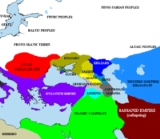
Meanwhile in 632 the Bulgars
, originally from Central Asia
, formed an independent state that became known as Great Bulgaria under the leadership of Kubrat
. Pressure from the Khazars
led to the subjugation of Great Bulgaria in the second half of the 7th century. One of the Kubrat
’s successors, Asparukh
, migrated with some of the Bulgar tribes to the area, around the Danube delta
, and subsequently conquered Scythia Minor
and Moesia Superior from the Byzantine Empire
, expanding his new kingdom further into the Balkan Peninsula. A peace treaty with Byzantium in 681 and the establishment of a permanent Bulgarian capital at Pliska
south of the Danube mark the beginning of the First Bulgarian Empire
. The new state brought together Thracian remnants and Slavs under Bulgar rule, and a slow process of mutual assimilation began. In the following centuries Bulgaria established itself as a powerful empire, dominating the Balkans through its aggressive military traditions and strong sense of national identity. Its ethnically and culturally diverse people united under a common religion, language and alphabet which formed and preserved the Bulgarian national consciousness despite foreign invasions and influences.
In the 11th century the First Bulgarian Empire collapsed under Rus' and Byzantine attacks, and became part of the Byzantine Empire until 1185. Then, a major uprising led by two brothers - Asen and Peter of the Asen dynasty
, restored the Bulgarian state to form the Second Bulgarian Empire
. After reaching its apogee in the 1230s, Bulgaria started to decline due to a number of factors, most notably its geographic position which rendered it vulnerable to simultaneous attacks and invasions from many sides. In the late 13th century, Bulgaria was squeezed between the advancing Mongol hordes from the north and the Latin Empire from the south, eventually becoming a Mongol tributary state for a period of 25 years. A peasant rebellion, one of the few successful such in history, established the swineherd Ivaylo
as a Tsar. His short reign was essential in recovering - at least partially - the integrity of the Bulgarian state. A period of relative thrive followed after 1300, but ended in 1371, when factional divisions caused Bulgaria to split into three small Tsardoms. By 1396, they were subjugated by the Ottoman Empire
. Following the elimination of the Bulgarian nobility and clergy by the Turks, Bulgaria entered an age of oppression, intellectual stagnation and misgovernment that would leave its culture shattered and isolated from Europe for the next 500 years. Some of its cultural heritage found its way to Russia, where it was adopted and developed.
With the decline of the Ottoman Empire after 1700, signs of revival started to emerge. By the 19th century, the Bulgarian National Revival
became a key component of the struggle for independence, which would culminate in the failed April uprising
in 1876, which prompted the Russo-Turkish War of 1877-78 and the subsequent Liberation of Bulgaria
. The initial Treaty of San Stefano
was rejected by the Western Great Powers, and the following Treaty of Berlin limited Bulgaria's territories to Moesia
and the region of Sofia. This left many ethnic Bulgarians out of the borders of the new state, which defined Bulgaria's militaristic approach to regional affairs and its allegiance to Germany in both World Wars.
After World War II Bulgaria became a Communist state
, dominated by Todor Zhivkov
for a period of 35 years. Bulgaria's economic advancement during the era came to an end in the 1980s, and the collapse of the Communist system in Eastern Europe marked a turning point for the country's development. A series of crises in the 1990s left much of Bulgaria's industry and agriculture in shambles, although a period of relative stabilisation began with the election of Simeon Saxe-Coburg-Gotha
as prime minister in 2001. Bulgaria joined NATO in 2004 and the European Union
in 2007.
 The earliest human remains found in Bulgaria have been excavated in the Bacho Kiro cave
. With an approximate age of 46,000 years, the remains consist of a pair of fragmented human jaws, but it is disputed whether these early humans were in fact Homo Sapiens or Neanderthals. The earliest dwellings in Bulgaria - the Stara Zagora Neolithic dwellings
- date from 6,000 BC and are the oldest man-made structures yet discovered, second only to the Göbekli Tepe
sanctuary in Asian Turkey
. By the end of the neolithic, the Hamangia
and Vinča culture
developed on what is today Bulgaria, southern Romania and eastern Serbia.
The eneolithic Varna culture
(5,000 BC) represents the first civilization with a sophisticated social hierarchy in Europe. The centerpiece of this culture is the Varna Necropolis
, discovered in the early 1970s. It serves as a tool in understanding how the earliest European societies functioned, principally through well-preserved ritual burials, pottery, and golden jewelry. The golden rings, bracelets and ceremonial weapons discovered in one of the graves have been produced between 4,600 and 4,200 BC, which makes them the oldest golden treasure yet discovered in the world. The Karanovo culture
developed simultaneously with the one in Varna, and its earth layers serve as a stratigraphical
gauge for the prehistory of the wider Balkans region.
Some of the earliest evidence of grape
cultivation and livestock domestication
is associated with the Bronze Age Ezero culture
. The Magura Cave
drawings date from the same era, although the exact years of their creation cannot be pin-pointed.
. Their origin remains obscure. It is generally proposed that a proto-Thracian people developed from a mixture of indigenous peoples
and Indo-Europeans
from the time of Proto-Indo-European expansion in the Early Bronze Age when the latter, around 1500 BC
, conquered the indigenous peoples. The Thracians were generally disorganized, but had an advanced culture despite the lack of own their own proper script, and gathered powerful military forces when their divided tribes formed unions under the pressure of external threats. They never achieved any form of national unity beyond short, dynastic rules at the height of the Greek classical period. Similar to the Gauls
and other Celt
ic tribes, most Thracians are thought to have lived simply in small fortified villages, usually on hilltops. Although the concept of an urban center wasn't developed until the Roman period, various larger fortifications which also served as regional market centers were numerous. Yet, in general, despite Greek colonization in such areas as Byzantium
, Apollonia and other cities, the Thracians avoided urban life. The first Greek colonies in Thrace were founded in the 8th century BC.
Thracian tribes remained divided until King Teres united most of them in the Odrysian kingdom
around 500 BC, which later peaked under the leadership of King Sitalces (431–424 BC) and of Cotys I (383–359 BC). At the commencement of the Peloponnesian war
Sitalces entered into alliance with the Athenians, and in 429 BC he invaded Macedon
(then ruled by Perdiccas II
) with a vast army that included 150,000 warriors from independent Thracian tribes. Cotys I on the other hand, went to war with the Athenians for the possession of the Thracian Chersonese
. Thereafter the Macedonian Empire incorporated the Odrysian kingdom and Thracians became an inalienable component in the extra-continental expeditions of both Philip II
and Alexander III (the Great).
in Mount Haemos (Stara Planina). The Macedonians won the battle, but this did not stop the Celtic advancement. Many Thracian communities, weakened by the Macedonian occupation, fell under Celtic dominance.
In 279 BC one of the Celtic armies, led by Comontorius, attacked Thrace and succeeded in conquering it. Comontorius established the kingdom of Tylis
in what is now eastern Bulgaria. The modern-day village of Tulovo bears the name of this relatively short-lived kingdom. Cultural interactions between Thracians and Celts are evidenced by several items containing elements of both cultures, such as the chariot of Mezek
and almost certainly the Gundestrup cauldron
. Tylis lasted until 212 BC, when the Thracians managed to regain their dominant position in the region and disbanded it. Small bands of Celts survived in Western Bulgaria. One such tribe were the serdi
, from which Serdica - the ancient name of Sofia
- originates. Even though the Celts remained on the Balkans for more than a century, their influence on the peninsula was modest. By the end of the third century a new threat appeared for the people of the Thracian region in the face of the Roman Empire
.
invaded Thrace
, and warfare continued until 46 AD when Rome finally conquered the region. In 46 AD, the Romans established the province of Thracia. By the 4th century the Thracians had a composite indigenous identity, as Christian "Romans" who preserved some of their ancient pagan rituals. Thraco-Roman
s became a dominant group in the region, and eventually yielded several military commanders and emperors such as Galerius
and Constantine I the Great. Urban centers became well-developed, especially the territories of what is today Sofia due to the abundance of mineral springs.
Sometime before 300 AD Diocletian
further divided Thracia
into four smaller provinces. Later in the 4th century, a group of Goths
arrived in northern Bulgaria and settled in and around Nicopolis ad Istrum
. There the Gothic bishop Ulfilas
translated the Bible
from Greek to Gothic, creating the Gothic alphabet
in the process. This was the first book written in a Germanic language, and for this reason at least one historian refers to Ulfilas as "the father of Germanic literature". Due to the rural nature of the local population, Roman control of the region remained weak. In the 5th century Attila's Huns
attacked the territories of today's Bulgaria and pillaged many Roman settlements. By the end of the 6th century Avars
organized regular incursions into northern Bulgaria, which were a prelude to the en masse arrival of the Slavs.
) in the early 6th century and spread to most of eastern Central Europe
, Eastern Europe and the Balkans, thus forming three main branches - the West Slavs
, the East Slavs
and the South Slavs
. The easternmost South Slavs settled on the territory of modern Bulgaria during the 6th century.
A portion of the eastern South Slavs
assimilated the Thracians before the Bulgar élite incorporated them into the First Bulgarian Empire.
descent, originally from Central Asia
, who from the 2nd century onwards dwelled in the steppe
s north of the Caucasus
and around the banks of river Volga (then Itil). A branch of them gave rise to the First Bulgarian Empire
. The Bulgars
were governed by hereditary khans
. There were several aristocratic families whose members, bearing military titles, formed a governing class. Bulgars were polytheistic, but chiefly worshiped the supreme deity Tangra
.
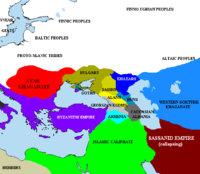 In 632 Khan
Kubrat
united the three largest Bulgarian tribes: the Kutrigur, the Utugur and the Onogonduri, thus forming the country that now historians call Great Bulgaria (also known as Onoguria). This country was situated between the lower course of the Danube
river to the west, the Black Sea
and the Azov Sea to the south, the Kuban
river to the east and the Donets river to the north. The capital was Phanagoria, on the Azov. In 635 Kubrat signed a peace treaty with emperor Heracluis of the Byzantine Empire, expanding the Bulgarian kingdom further into the Balkans. Later Kubrat was crowned with the title Patrician by Heracluis. The kingdom never survived Kubrat's death. After several wars with the Khazars the Bulgars were finally defeated and they migrated to the south to the north and mainly to the west into the Balkans where most of the other Bulgar tribes were living in a state vassal to the Byzantine Empire since the 5th century AD.
One of the successors of Khan Kubrat
, Kotrag
led nine Bulgarian tribes to the north along the banks of the river Volga in what is today Russia, creating the Kingdom of the Volga Bulgars in the late 7th century. This kingdom later became the trade and cultural center of the north, because it stood on a very strategic position creating a monopoly over the trade among the Arabs, the Norse and the Avars. The Volga Bulgars were the first to ever defeat the Mongolic horde and protected Europe for decades, but after countless Mongol invasions the Kingdom of the Volga Bulgars was destroyed and most of its citizens slaughtered or sold as slaves in Asia.
Another successor of Khan Kubrat, Asparuh (Kotrag's brother) moved west, occupying today's southern Bessarabia
. After a successful war with Byzantium
in 680, Asparuh’s khanate conquered initially Scythia Minor
and was recognised as an independent state under the subsequent treaty signed with the Byzantine Empire
in 681. That year is usually regarded as the year of the establishment of present-day Bulgaria
and Asparuh is regarded as the first Bulgarian ruler. Another Bulgar horde, led by Asparuh's brother Kuber
, came to settle in Pannonia
and later into Macedonia
.)
.svg.png) During the late Roman Empire
During the late Roman Empire
several Roman provinces covered the territory that comprises present-day Bulgaria: Scythia
(Scythia Minor), Moesia
(Upper and Lower), Thrace
, Macedonia
(First and Second), Dacia
(Coastal and Inner, both south of Danube), Dardania, Rhodope (Roman province)
and Haemismontus, and had a mixed population of Byzantine Greeks
, Thracians
and Dacians
, most of whom spoke either Greek
or variants of Vulgar Latin
. Several consecutive waves of Slavic migration throughout the 6th and the early 7th centuries led to a dramatic change of the demographics of the region and its almost complete Slavicisation
.
In the beginning of 8th century Byzantine emperor Justinian II
asked Khan Tervel to create a union against Arabs invading from the south. The union defeated the Arabs and Khan Tervel received the Byzantine title "khesar", which stands for "next to the emperor". Under the warrior Khan Krum
(802-814) Bulgaria expanded northwest and south, occupying the lands between the middle Danube and Moldova
rivers, all of present-day Romania
, Sofia
in 809 and Adrianople in 813, and threatening Constantinople
itself. Krum implemented law reform intending to reduce poverty and strengthen social ties in his vastly enlarged state.
During the reign of Khan Omurtag
(814-831), the northwestern boundaries with the Frankish Empire were firmly settled along the middle Danube. A magnificent palace, pagan temples, ruler's residence, fortress, citadel, water mains and baths were built in the Bulgarian capital Pliska
, mainly of stone and brick.
Under Boris I, Bulgarians became Christians
, and the Ecumenical Patriarch agreed to allow an autonomous Bulgarian Archbishop at Pliska. Missionaries from Constantinople, Cyril
and Methodius, devised the Glagolitic alphabet
, which was adopted in the Bulgarian Empire around 886. The alphabet and the Old Bulgarian
language that evolved from Slavonic
gave rise to a rich literary and cultural activity centered around the Preslav
and Ohrid Literary School
s, established by order of Boris I in 886.
In the early 10th century, a new alphabet — the Cyrillic alphabet
— was developed at the Preslav Literary School, adapted from the Glagolitic alphabet
invented by Saints Cyril and Methodius
. An alternative theory is that the alphabet was devised at the Ohrid Literary School by Saint Climent of Ohrid, a Bulgarian scholar and disciple of Cyril and Methodius.
By the late 9th and early 10th centuries, Bulgaria extended to Epirus
and Thessaly
in the south, Bosnia
in the west and controlled all of present-day Romania and eastern Hungary to the north. A Serbian state came into existence as a dependency of the Bulgarian Empire. Under Tsar Simeon I of Bulgaria
(Simeon the Great), who was educated in Constantinople, Bulgaria became again a serious threat to the Byzantine Empire. Simeon hoped to take Constantinople and become emperor of both Bulgarians and Greeks, and fought a series of wars with the Byzantines through his long reign (893-927). At the end of his rule the front had reached the Peloponnese
in the south. Simeon proclaimed himself "Tsar
(Caesar) of the Bulgarians and the Romans", a title which was recognised by the Pope, but not of course by the Byzantine Emperor.
In 986, the Byzantine emperor Basil II
undertook to reconquer the lands lost to the Bulgarians. After a war lasting several decades he inflicted a decisive defeat upon the Bulgarians in 1014 and completed the campaign four years later. Bulgaria was once again under Roman rule.
and the Eastern Roman Empire conquered Bulgaria together and the lost of independence last from 1018 to 1185, subordinating the independent Bulgarian Orthodox Church
to the authority of the Ecumenical Patriarch in Constantinople but otherwise interfering little in Bulgarian local affairs. The Eastern part of Bulgaria and the capital Preslav, which the Russians conquered, were three years later conquered by the Byzantines.
No evidence remains of major resistance or any uprising of the Bulgarian population or nobility in the first decade after the establishment of Eastern Roman Empire rule. Given the existence of such irreconcilable opponents to Eastern Roman Empire as Krakra
, Nikulitsa
, Dragash and others, such apparent passivity seems difficult to explain. Some historians
explain this as a consequence of the concessions that Basil II
granted the Bulgarian nobility to gain their allegiance. In the first place, Basil II guaranteed the indivisibility of Bulgaria in its former geographic borders and did not officially abolish the local rule of the Bulgarian nobility, who became part of Byzantine aristocracy
as archon
s or strategoi
. Secondly, special charters (royal decrees) of Basil II recognised the autocephaly
of the Bulgarian Archbishopric of Ohrid
and set up its boundaries, securing the continuation of the diocese
s already existing under Samuil, their property and other privileges.
After the death of the soldier-emperor Basil II the empire entered into a period of instability. There were rebellions against Byzantine rule in 1040-41 at the wars with the Normans and the 1070s and the 1080s, at the time of the wars with the Seljuk Turks. After that the Komnenos dynasty came into succession and reversed the decline of the empire
. During this time the empire experienced a century of stability and progress, though it was the time of the Crusades
.
In 1180 the last of the capable Komnenoi, Manuel I Komnenos
, died and was replaced by the relatively incompetent Angeloi dynasty, allowing Bulgarians to regain their freedom. In 1185 Peter and Asen
, leading nobles of supposed and contested Bulgarian, Cuman, Vlach or mixed origin, led a revolt against Byzantine rule
and Peter declared himself Tsar Peter II (also known as Theodore Peter). The following year the Byzantines were forced to recognize Bulgaria's independence. Peter styled himself "Tsar of the Bulgars, Greeks and Vlachs
".
Resurrected Bulgaria occupied the territory between the Black Sea
, the Danube
and Stara Planina, including a part of eastern Macedonia
and the valley of the Morava. It also exercised control over Wallachia
and Moldova
. Tsar Kaloyan (1197–1207) entered a union with the Papacy, thereby securing the recognition of his title of "Rex
" although he desired to be recognized as "Emperor
" or "Tsar
". He waged wars on the Byzantine Empire
and (after 1204) on the Knights of the Fourth Crusade
, conquering large parts of Thrace
, the Rhodopes, as well as the whole of Macedonia
. In the Battle of Adrianople
in 1205, Kaloyan defeated the forces of the Latin Empire
and thus limited its power from the very first year of its establishment. The power of the Hungarians and to some extent the Serbs prevented significant expansion to the west and northwest. Under Ivan Asen II
(1218–1241), Bulgaria once again became a regional power, occupying Belgrade
and Albania
. In an inscription from Turnovo in 1230 he entitled himself "In Christ the Lord faithful Tsar and autocrat of the Bulgarians, son of the old Asen". The Bulgarian Orthodox Patriarchate
was restored in 1235 with approval of all eastern Patriarchates, thus putting an end to the union with the Papacy. Ivan Asen II had a reputation as a wise and humane ruler, and opened relations with the Catholic
west, especially Venice
and Genoa
, to reduce the influence of the Byzantines over his country.
Emperor Theodore Svetoslav
(reigned 1300–1322) restored Bulgarian prestige from 1300 onwards, but only temporarily. Political instability continued to grow, and Bulgaria gradually began to lose territory. This led to a peasant rebellion led by the swineherd Ivaylo
, who eventually managed to defeat the Emperor's forces and ascend the throne.
However, weakened 14th-century Bulgaria was no match for a new threat from the south, the Ottoman Turks
, who crossed into Europe in 1354. In 1362 they captured Philippopolis (Plovdiv
), and in 1382 they took Sofia. The Ottomans then turned their attentions to the Serbs, whom they routed at Kosovo Polje in 1389. In 1393 the Ottomans occupied Turnovo after a three-month siege. It is thought that the south gate was opened from inside and so the Ottomans managed to enter the fortress. In 1396 the Kingdom (Tsardom) of Vidin
was also occupied, bringing the Second Bulgarian Empire and Bulgarian independence to an end.
. With this the Ottomans finally subjugated and occupied Bulgaria.
A Polish
-Hungarian
crusade commanded by Władysław III of Poland set out to free the Balkans in 1444, but the Turks emerged victorious at the battle of Varna
.
The new authorities dismantled Bulgarian institutions and merged the separate Bulgarian Church into the Ecumenical Patriarchate
in Constantinople
(although a small, autocephalous Bulgarian archbishopric of Ohrid
survived until January 1767). Turkish authorities destroyed most of the medieval Bulgarian fortresses to prevent rebellions. Large towns and the areas where Ottoman power predominated remained severely depopulated until the 19th century. The Ottomans did not normally require the Christians to become Muslims. Nevertheless, there were many cases of forced individual or mass islamization, especially in the Rhodopes. Bulgarians who converted to Islam, the Pomaks
, retained Bulgarian language, dress and some customs compatible with Islam.. The origin of the Pomaks
remains a subject of debate.)
 The theocratic Ottoman system began declining by the 17th century and at the end of the 18th had all but collapsed. Central government weakened over the decades and this had allowed a number of local Ottoman holders of large estates to establish personal ascendancy over separate regions. During the last two decades of the 18th and first decades of the 19th centuries the Balkan Peninsula dissolved into virtual anarchy. Bulgarian tradition calls this period the kurdjaliistvo: armed bands of Turks called kurdjalii plagued the area. In many regions, thousands of peasants fled from the countryside either to local towns or (more commonly) to the hills or forests; some even fled beyond the Danube
to Moldova
, Wallachia
or southern Russia
. The decline of Ottoman authorities also allowed a gradual revival of Bulgarian culture
, which became a key component in the ideology of national liberation.
Conditions gradually improved in certain areas in the 19th century. Some towns — such as Gabrovo
, Tryavna
, Karlovo
, Koprivshtitsa
, Lovech
, Skopie — prospered. The Bulgarian peasants actually possessed their land, although it officially belonged to the sultan. The 19th century also brought improved communications, transportation and trade. The first factory in the Bulgarian lands opened in Sliven
in 1834 and the first railway system started running (between Rousse
and Varna
) in 1865. Bulgarian nationalism emerged in the early 19th century under the influence of western ideas such as liberalism
and nationalism
, which trickled into the country after the French Revolution
, mostly via Greece
. The Greek revolt against the Ottomans which began in 1821 (see History of Ottoman Greece) also influenced the small Bulgarian educated class. But Greek influence was limited by the general Bulgarian resentment of Greek control of the Bulgarian Church and it was the struggle to revive an independent Bulgarian Church which first roused Bulgarian nationalist sentiment. In 1870 a Bulgarian Exarchate
was created by a Sultan edict and the first Bulgarian Exarch (Antim I
) became the natural leader of the emerging nation. The Constantinople Patriarch reacted by excommunicating
the Bulgarian Exarchate, which reinforced their will for independence. A struggle for political liberation from the Ottoman Empire emerged in the face of the Bulgarian Revolutionary Central Committee
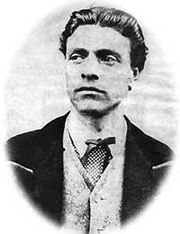
and the Internal Revolutionary Organisation
led by liberal revolutionaries such as Vasil Levski
, Hristo Botev
and Lyuben Karavelov
.
In April 1876 the Bulgarians revolted in the April Uprising
. The revolt was poorly organized and started before the planned date. It was largely confined to the region of Plovdiv
, though certain districts in northern Bulgaria, in Macedonia and in the area of Sliven
also took part in it. The uprising was crushed by the Ottomans, who also brought irregular Ottoman troops (bashi-bazouk
s) from outside the area. Countless villages were pillaged and tens of thousands of people were massacre
d, the majority of them in the insurgents towns of Batak
, Perushtitsa
and Bratsigovo
in the area of Plovdiv. The massacres aroused a broad public reaction led by liberal Europeans such as William Ewart Gladstone
, who launched a campaign against the "Bulgarian Horrors". The campaign was supported by a number of European intellectuals and public figures. The strongest reaction, however, came from Russia. The enormous public outcry which the April Uprising
had caused in Europe
provoked the 1876-77 Constantinople Conference
of the Great Powers, and Turkey's refusal to implement the conference decisions gave the Russians a long-waited chance to realise their long-term objectives with regard to the Ottoman Empire
. Having its reputation at stake, Russia had no other choice but to declare war on the Ottomans in April 1877. The Bulgarians also fought alongside the advancing Russians. The Coalition was able to inflict a decisive defeat on the Ottomans at the Battle of Shipka Pass
and at Pleven and by January 1878 they had liberated much of the Bulgarian lands.
of March 3, 1878 would have created an independent Bulgarian state including the regions of Moesia
, Thrace
and Macedonia
. However, trying to preserve the balance of power in Europe and fearing the establishment of a large Russian client state on the Balkans, the other Great Powers were reluctant to agree to the treaty.
As a result, the Treaty of Berlin
(1878), under the supervision of Otto von Bismarck
of the German empire
and Benjamin Disraeli of Britain
, revised the earlier treaty, and scaled back the proposed Bulgarian state. An autonomous Principality of Bulgaria
was created, between the Danube and the Stara Planina range, with its seat at the old Bulgarian capital of Veliko Turnovo and including Sofia
. This state was to be under nominal Ottoman sovereignty but was to be ruled by a prince elected by a congress of Bulgarian notables and approved by the Powers. They insisted that the Prince could not be a Russian
, but in a compromise Prince Alexander of Battenberg, a nephew of Tsar Alexander II
, was chosen. An autonomous Ottoman province under the name of Eastern Rumelia
was created south of the Stara Planina range. The Bulgarians in Macedonia and Eastern Thrace were left under the rule of the Sultan. Some Bulgarian territories were also given to Serbia and Romania. A revolutionary organization was created in Eastern Rumelia, called "VMORO" (which stands for Internal Macedonian-Adrianople Revolutionary Organization). VMORO worked in collaboration with the kingdom and managed to unite the kingdom and Rumelia on September 6, 1885. There was military response from Serbia against the union a few days later, but it was soon defeated and the union was admitted. The Bulgarians left outside the newly united kingdom continued their fight to join Bulgaria and the result was the uprising in 1903. The uprising managed to add some territories populated with Bulgarians to the kingdom. Most of the Bulgarians who still lived in Ottoman-held territories emigrated to Bulgaria. In 1908 Bulgaria was recognized as an independent country.
Bulgaria emerged from Turkish rule as a poor, underdeveloped agricultural country, with little industry or natural resources. Most of the land was owned by small farmers, with peasants comprising 80% of the population of 3.8 million in 1900. Agrarianism
was the dominant political philosophy in the countryside, as the peasantry organized a movement independent of any existing party. In 1899, the Bulgarian Agrarian Union was formed, bringing together rural intellectuals such as teachers with ambitious peasants. It promoted modern farming practices, as well as elementary education. The government promoted modernization, with special emphasis on building a network of elementary and secondary schools. By 1910, there were 4,800 elementary schools, 330 lyceums, 27 high schools, and 113 vocational schools. From 1878 to 1933 France funded numerous libraries, research institutes, and Catholic schools throughout Bulgaria. In 1888, a university was established. It was renamed the University of Sofia in 1904, where the three faculties of history and philology, physics and mathematics, and law produced civil servants for national and local government offices. It became the center of German and Russian intellectual, philosophical and theological influences. The first decade of the century saw sustained prosperity, with steady urban growth. The capital of Sofia grew by a factor of 600% - from 20,000 population in 1878 to 120,000 in 1912, primarily from peasants who arrived from the villages to become laborers tradesman and office seekers. Macedonians used Bulgaria as a base, beginning in 1894, to agitate for independence from the Ottoman Empire. They launched a poorly planned uprising in 1903 that was brutally suppressed, and led to tens of thousands of additional refugees pouring into Bulgaria.
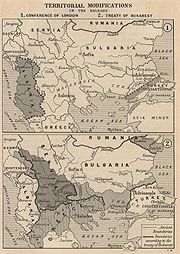 In 1911 the Nationalist Prime Minister Ivan Geshov formed an alliance with Greece and Serbia to jointly attack the Ottomans. In February 1912 a secret treaty was signed between Bulgaria and Serbia and in May 1912 a similar treaty with Greece. Montenegro
was also brought into the pact. The treaties provided for the partition of Macedonia and Thrace between the allies, although the lines of partition were left dangerously vague. After the Ottomans refused to implement reforms in the disputed areas, the First Balkan War broke out in October 1912 at a time the Ottomans were tied down in a major war with Italy. The allies in Libya easily defeated the Ottomans and seized most of its European territory.
Bulgaria sustained the heaviest casualties of any of the allies and in any case tried to seize the largest share of the spoils. The Serbs in particular did not agree and refused to vacate any of the territory they had seized in northern Macedonia (that is, the territory roughly corresponding to the modern Republic of Macedonia
), saying that the Bulgarian army had failed to accomplish its pre-war goals at Adrianople (to capture it without Serbian help) and that the pre-war agreement on the division of Macedonia had to be revised. Some circles in Bulgaria inclined toward going to war with Serbia and Greece on this issue.
In June 1913 Serbia and Greece formed a new alliance against Bulgaria. The Serbian Prime Minister Nikola Pasic
told Greece it could have Thrace if Greece helped Serbia keep Bulgaria out of Serbian part of Macedonia and the Greek Prime Minister Eleftherios Venizelos
agreed. Seeing this as a violation of the pre-war agreements, and discretely encouraged by Germany and Austria-Hungary
, Tsar Ferdinand declared war on Serbia and Greece and the Bulgarian army attacked on June 29. The Serbian and the Greek forces were initially on the retreat on the western border, but soon took the upper hand and forced Bulgaria to retreat. The fighting was very harsh, with many casualties, especially during the key Battle of Bregalnitsa. Soon Romania entered the war and attacked Bulgaria from the north. The Ottoman Empire also attacked from the south-east.
The Second Balkan War was now lost for Bulgaria, which sued for peace. It was forced to relinquish most of Macedonia to Serbia and Greece, while the revived Ottomans retook Adrianople. Romania
took southern Dobruja
. The two Balkan wars had greatly hurt Bulgaria, stopping its steady economic progress and costing 58,000 dead and over 100,000 wounded. However, the revanchist demand to recover the bulk of Macedonia remained powerful.
aligned Bulgaria with the German Empire and Austria-Hungary, even though this meant becoming an ally of the Ottomans, Bulgaria's traditional enemy. But Bulgaria now had no claims against the Ottomans, whereas Serbia, Greece and Romania (allies of Britain and France) held lands perceived in Bulgaria as Bulgarian.
Bulgaria sat out the first year of World War I
recuperating from the Balkan Wars. Germany and Austria realized they needed Bulgaria's help in order to defeat Serbia militarily, and thereby open supply lines from Germany to Turkey, and bolster the Eastern Front against Russia. Bulgaria insisted on major territorial gains, especially Macedonia, which Austria was reluctant to grant until Berlin insisted. Bulgaria also negotiated with the Allies, who offered somewhat less generous terms. The king decided to go with Germany and Austria and signed an alliance with them in September 1915, along with a special Bulgarian-Turkish arrangement. It envisioned that Bulgaria would dominate the Balkans after the war. Bulgaria, which had the largest army in the Balkans, declared war on Serbia in October 1915. Britain, France and Italy then declared war on Bulgaria. The negotiations were highly successful from Bulgaria's immediate point of view. In alliance with Germany, Austria-Hungary and the Ottomans, Bulgaria won military victories against Serbia and Romania, occupying much of Macedonia (taking Skopje
in October), advancing into Greek Macedonia, and taking Dobruja from Romania in September 1916. Thus Serbia was knocked out of the war, and Turkey was temporarily rescued from collapse.
But the war soon became unpopular with most Bulgarians, who suffered great economic hardship and also disliked fighting their fellow Orthodox Christians in alliance with the Muslim Ottomans. The Agrarian Party leader Aleksandur Stamboliyski was imprisoned for his opposition to the war. The Russian Revolution
of February 1917 had a great effect in Bulgaria, spreading anti-war and anti-monarchist sentiment among the troops and in the cities. In June Radoslavov's government resigned. Mutinies broke out in the army, Stamboliyski was released and a republic was proclaimed.
in order to head off anti-monarchic revolutionary tendencies. Under the Treaty of Neuilly
(November 1919) Bulgaria ceded its Aegean
coastline to Greece, recognized the existence of Yugoslavia
, ceded nearly all of its Macedonian territory to that new state, and had to give Dobruja back to Romania. The country had to reduce its army to no more than 22,000 men and pay reparations exceeding $400 million. Bulgarians generally refer to the results of the treaty as the "Second National Catastrophe".
Elections in March 1920 gave the Agrarians
a large majority and Aleksandar Stamboliyski
formed Bulgaria's first peasant government. He faced huge social problems, but succeeded in carrying out many reforms, although opposition from the middle and upper classes, the landlords and officers of the army remained powerful. In March 1923, Stamboliyski signed an agreement with the Kingdom of Yugoslavia
recognising the new border and agreeing to suppress Internal Macedonian Revolutionary Organization (VMRO), which favoured a war to regain Macedonia from Yugoslavia. This triggered a nationalist reaction and the Bulgarian coup d'état
of 9 June 1923 eventually resulted in Stamboliykski's assassination
. A right-wing government under Aleksandar Tsankov
took power, backed by the army and the VMRO, which waged a White terror
against the Agrarians and the Communists. In 1926, the Tsar persuaded Tsankov to resign, a more moderate government under Andrey Lyapchev took office and an amnesty was proclaimed, although the Communists remained banned. A popular alliance, including the re-organised Agrarians, won the elections of 1931 under the name "Popular Bloc".
In May 1934 another coup
took place, removing the Popular Bloc from power and establishing an authoritarian military régime headed by Kimon Georgiev
. A year later, Tsar Boris
managed to remove the military régime from power, restoring a form of parliamentary rule (without the re-establishment of the political parties) and under his own strict control. The Tsar's regime proclaimed neutrality, but gradually Bulgaria gravitated into alliance with Nazi Germany
and Fascist Italy
.
under Bogdan Filov
declared a position of neutrality, being determined to observe it until the end of the war, but hoping for bloodless territorial gains, especially in the lands with a significant Bulgarian population occupied by neighbouring countries after the Second Balkan War
and World War I. But it was clear that the central geopolitical position of Bulgaria in the Balkans would inevitably lead to strong external pressure by both sides of World War II. Turkey
had a non-aggression pact
with Bulgaria.
Bulgaria succeeded in negotiating a recovery of Southern Dobruja
, part of Romania since 1913, in the Axis
-sponsored Treaty of Craiova
on 7 September 1940, which reinforced Bulgarian hopes for solving territorial problems without direct involvement in the war.
However, Bulgaria was forced to join the Axis powers in 1941, when German troops that were preparing to invade Greece
from Romania reached the Bulgarian borders and demanded permission to pass through Bulgarian territory. Threatened by direct military confrontation, Tsar Boris III had no choice but to join the fascist bloc, which was made official on 1 March 1941. There was little popular opposition, since the Soviet Union
was in a non-aggression pact with Germany
. However the king refused to hand over the Bulgarian Jews to the Nazis, saving 50,000 lives.
Bulgaria did not join the German invasion of the Soviet Union
that began on 22 June 1941 nor did it declare war on the Soviet Union. However, despite the lack of official declarations of war by both sides, the Bulgarian Navy
was involved in a number of skirmishes with the Soviet Black Sea Fleet, which attacked Bulgarian shipping. Besides this, Bulgarian armed forces garrisoned in the Balkans battled various resistance groups. The Bulgarian government was forced by Germany to declare a token war on the United Kingdom
and the United States
on 13 December 1941, an act which resulted in the bombing of Sofia
and other Bulgarian cities by Allied aircraft.
On 23 August 1944, Romania left the Axis Powers and declared war on Germany, and allowed Soviet forces to cross its territory to reach Bulgaria. On 5 September 1944 the Soviet Union declared war on Bulgaria and invaded. Within three days, the Soviets occupied the northeastern part of Bulgaria along with the key port cities of Varna
and Burgas
. The Bulgarian Army was ordered to offer no resistance. On 9 September 1944 in a coup
the government of Prime Minister Konstantin Muraviev
was overthrown and replaced with a government of the Fatherland Front
led by Kimon Georgiev
. On 16 September 1944 the Soviet Red Army entered Sofia.
(BCP). The BCP transformed itself in 1990, changing its name to "Bulgarian Socialist Party
".
Although communist leader Dimitrov
had been in exile, mostly in the Soviet Union, since 1923, he was everything but a Soviet puppet. He had shown great courage in Nazi Germany during the Reichstag Fire
trial of 1933 and had later headed the Comintern
during the period of the Popular Front
. He was also close to the Yugoslav Communist leader Tito
and believed that Yugoslavia and Bulgaria, as closely related South Slav peoples, should form a federation. This idea was not favoured by Stalin
and there have long been suspicions that Dimitrov's sudden death in July 1949 was not accidental, although this has never been proven. It coincided with Stalin's expulsion of Tito from the Cominform
and was followed by a "Titoist" witch hunt in Bulgaria. This culminated in the show trial
and execution of Deputy Prime Minister Traicho Kostov
. The elderly Prime Minister Kolarov died in 1950 and power then passed to a Stalinist, Vulko Chervenkov
.
Bulgaria's Stalinist phase lasted less than five years. Under his leadership, agriculture was collectivised, peasant rebellions were crushed, and a massive industrialisation campaign was launched. Labor camps were set up and at the height of the repression housed about 100,000 people. The Orthodox Patriarch was confined to a monastery and the Church placed under state control. In 1950 diplomatic relations with the U.S. were broken off. But Chervenkov's support base even in the Communist Party was too narrow for him to survive long, once his patron Stalin was gone. Stalin died in March 1953 and in March 1954 Chervenkov was deposed as Party Secretary with the approval of the new leadership in Moscow and replaced by Todor Zhivkov
. Chervenkov stayed on as Prime Minister until April 1956, when he was finally dismissed and replaced by Anton Yugov
.
During the 1960s, Zhivkov initiated reforms and passed some market-oriented policies on an experimental level. By the mid 1950s
standards of living rose significantly, and in 1957 collective farm workers benefited from the first agricultural pension and welfare system in Eastern Europe
. Lyudmila Zhivkova
, daughter of Todor Zhivkov, promoted Bulgaria's national heritage, culture and arts on a global scale. On the other hand, an assimilation campaign of the late 1980s directed against ethnic Turks resulted in the emigration of some 300,000 Bulgarian Turks
to Turkey, which caused a significant drop in agricultural production due to the loss of labor force.
's reform program in the Soviet Union was felt in Bulgaria in the late 1980s, the Communists, like their leader, had grown too feeble to resist the demand for change for long. In November 1989 demonstrations on ecological issues were staged in Sofia and these soon broadened into a general campaign for political reform. The Communists reacted by deposing the decrepit Zhivkov and replacing him by Petar Mladenov
, but this gained them only a short respite. In February 1990 the Party voluntarily gave up its claim on power monopoly and in June 1990 the first free elections since 1931 were held, won by the Communist Party, ridden of its hardliner wing and renamed the Bulgarian Socialist Party
. In July 1991 a new Constitution was adopted, in which the system of government was fixed as parliamentary republic with a directly elected President and a Prime Minister accountable to the legislature.
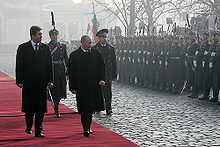 Like the other post-Communist regimes in Eastern Europe, Bulgaria found the transition to capitalism more painful than expected. The anti-Communist Union of Democratic Forces
(UDF) took office and between 1992 and 1994 carried through the privatisation of land and industry through the issue of shares in government enterprises to all citizens, but these were accompanied by massive unemployment as uncompetitive industries failed and the backward state of Bulgaria's industry and infrastructure were revealed. The Socialists portrayed themselves as the defender of the poor against the excesses of the free market.
The negative reaction against economic reform allowed Zhan Videnov
of the BSP to take office in 1995. By 1996 the BSP government was also in difficulties and in the presidential elections of that year the UDF's Petar Stoyanov
was elected. In 1997 the BSP government collapsed and the UDF came to power. Unemployment, however, remained high and the electorate became increasingly dissatisfied with both parties.
On 17 June 2001, Simeon II
, the son of Tsar Boris III and himself the former Head of state (as Tsar of Bulgaria from 1943 to 1946), won a narrow victory in elections. The Tsar's party — National Movement Simeon II
("NMSII") — won 120 of the 240 seats in Parliament. Simeon's popularity declined quickly during his four-year rule as Prime Minister and the BSP won the elections in 2005, but could not form a single-party government and had to seek a coalition. In the parliamentary elections
in July 2009, Boyko Borisov
's right-centrist party GERB
won nearly 40% of the votes.
Since 1989 Bulgaria has held multi-party elections and privatized its economy
, but economic difficulties and a tide of corruption have led over 800,000 Bulgarians, including many qualified profession
als, to emigrate in a "brain drain
". The reform package introduced in 1997 restored positive economic growth, but led to rising social inequality. The political and economic system after 1989 virtually failed to improve both the living standards and create economic growth. According to a 2009 Pew Global Attitudes Project survey, 76% of Bulgarians said they were dissatisfied with the system of democracy, 63% thought that free markets did not make people better off and only 11% of Bulgarians agreed that ordinary people had benefited from the changes in 1989. Furthermore, the average quality of life and economic performance actually remained lower than in the times of communism well into the early 2000s.
Bulgaria became a member of NATO in 2004 and of the European Union
in 2007 and is generally accepted as having good freedom of speech
and human rights
record. In 2010 it was ranked 32nd (between Greece
and Lithuania
) out of 181 countries in the Globalization Index
.
Bulgarians
The Bulgarians are a South Slavic nation and ethnic group native to Bulgaria and neighbouring regions. Emigration has resulted in immigrant communities in a number of other countries.-History and ethnogenesis:...
and their origin. The first traces of human presence on what is today Bulgaria date from 44,000 BC. Around 5,000 BC a sophisticated civilization already existed and produced some of the first pottery and jewelry in the world. After 3,000 BC the Thracians
Thracians
The ancient Thracians were a group of Indo-European tribes inhabiting areas including Thrace in Southeastern Europe. They spoke the Thracian language – a scarcely attested branch of the Indo-European language family...
appeared on the Balkan peninsula. Around 500 BC they formed the powerful Odrysian Kingdom
Odrysian kingdom
The Odrysian kingdom was a union of Thracian tribes that endured between the 5th and 3rd centuries BC. It consisted largely of present-day Bulgaria, spreading to parts of Northern Dobruja, parts of Northern Greece and modern-day European Turkey...
, which subsequently declined and Thracian tribes fell under Macedonian, Celtic and Roman
Roman Empire
The Roman Empire was the post-Republican period of the ancient Roman civilization, characterised by an autocratic form of government and large territorial holdings in Europe and around the Mediterranean....
domination. This mixture of ancient peoples was assimilated by the Slavs, who permanently settled on the peninsula after 500 AD.
Meanwhile in 632 the Bulgars
Bulgars
The Bulgars were a semi-nomadic who flourished in the Pontic Steppe and the Volga basin in the 7th century.The Bulgars emerge after the collapse of the Hunnic Empire in the 5th century....
, originally from Central Asia
Central Asia
Central Asia is a core region of the Asian continent from the Caspian Sea in the west, China in the east, Afghanistan in the south, and Russia in the north...
, formed an independent state that became known as Great Bulgaria under the leadership of Kubrat
Kubrat
Kubrat or Kurt was a Bulgar ruler credited with establishing the confederation of Old Great Bulgaria in 632. He is said to have achieved this by conquering the Avars and uniting all the Bulgar tribes under one rule....
. Pressure from the Khazars
Khazars
The Khazars were semi-nomadic Turkic people who established one of the largest polities of medieval Eurasia, with the capital of Atil and territory comprising much of modern-day European Russia, western Kazakhstan, eastern Ukraine, Azerbaijan, large portions of the northern Caucasus , parts of...
led to the subjugation of Great Bulgaria in the second half of the 7th century. One of the Kubrat
Kubrat
Kubrat or Kurt was a Bulgar ruler credited with establishing the confederation of Old Great Bulgaria in 632. He is said to have achieved this by conquering the Avars and uniting all the Bulgar tribes under one rule....
’s successors, Asparukh
Asparukh of Bulgaria
Asparuh was ruler of a Bulgar tribe in the second half of the 7th century and is credited with the establishment of the First Bulgarian Empire in 680/681...
, migrated with some of the Bulgar tribes to the area, around the Danube delta
Danube Delta
The Danube Delta is the second largest river delta in Europe, after the Volga Delta, and is the best preserved on the continent. The greater part of the Danube Delta lies in Romania , while its northern part, on the left bank of the Chilia arm, is situated in Ukraine . The approximate surface is...
, and subsequently conquered Scythia Minor
Scythia Minor
Scythia Minor, "Lesser Scythia" was in ancient times the region surrounded by the Danube at the north and west and the Black Sea at the east, corresponding to today's Dobruja, with a part in Romania and a part in Bulgaria....
and Moesia Superior from the Byzantine Empire
Byzantine Empire
The Byzantine Empire was the Eastern Roman Empire during the periods of Late Antiquity and the Middle Ages, centred on the capital of Constantinople. Known simply as the Roman Empire or Romania to its inhabitants and neighbours, the Empire was the direct continuation of the Ancient Roman State...
, expanding his new kingdom further into the Balkan Peninsula. A peace treaty with Byzantium in 681 and the establishment of a permanent Bulgarian capital at Pliska
Pliska
Pliska is the name of both the first capital of Danubian Bulgaria and a small town which was renamed after the historical Pliska after its site was determined and excavations began....
south of the Danube mark the beginning of the First Bulgarian Empire
First Bulgarian Empire
The First Bulgarian Empire was a medieval Bulgarian state founded in the north-eastern Balkans in c. 680 by the Bulgars, uniting with seven South Slavic tribes...
. The new state brought together Thracian remnants and Slavs under Bulgar rule, and a slow process of mutual assimilation began. In the following centuries Bulgaria established itself as a powerful empire, dominating the Balkans through its aggressive military traditions and strong sense of national identity. Its ethnically and culturally diverse people united under a common religion, language and alphabet which formed and preserved the Bulgarian national consciousness despite foreign invasions and influences.
In the 11th century the First Bulgarian Empire collapsed under Rus' and Byzantine attacks, and became part of the Byzantine Empire until 1185. Then, a major uprising led by two brothers - Asen and Peter of the Asen dynasty
Asen dynasty
The Asen dynasty ruled a medieval Bulgarian state, called in modern historiography the Second Bulgarian Empire, between 1187 and 1280.The Asen dynasty and the Second Bulgarian Empire rose as the leaders of a rebellion against the Byzantine Empire at the turn of the year 1185/1186 caused by the...
, restored the Bulgarian state to form the Second Bulgarian Empire
Second Bulgarian Empire
The Second Bulgarian Empire was a medieval Bulgarian state which existed between 1185 and 1396 . A successor of the First Bulgarian Empire, it reached the peak of its power under Kaloyan and Ivan Asen II before gradually being conquered by the Ottomans in the late 14th-early 15th century...
. After reaching its apogee in the 1230s, Bulgaria started to decline due to a number of factors, most notably its geographic position which rendered it vulnerable to simultaneous attacks and invasions from many sides. In the late 13th century, Bulgaria was squeezed between the advancing Mongol hordes from the north and the Latin Empire from the south, eventually becoming a Mongol tributary state for a period of 25 years. A peasant rebellion, one of the few successful such in history, established the swineherd Ivaylo
Ivaylo of Bulgaria
Ivaylo, also spelled Ivailo, , nicknamed Bardokva or Lakhanas in Greek, was a rebel leader and emperor of Bulgaria. In 1277, he spearheaded a peasant uprising, and forced the nobles to accept him as emperor...
as a Tsar. His short reign was essential in recovering - at least partially - the integrity of the Bulgarian state. A period of relative thrive followed after 1300, but ended in 1371, when factional divisions caused Bulgaria to split into three small Tsardoms. By 1396, they were subjugated by the Ottoman Empire
Ottoman Empire
The Ottoman EmpireIt was usually referred to as the "Ottoman Empire", the "Turkish Empire", the "Ottoman Caliphate" or more commonly "Turkey" by its contemporaries...
. Following the elimination of the Bulgarian nobility and clergy by the Turks, Bulgaria entered an age of oppression, intellectual stagnation and misgovernment that would leave its culture shattered and isolated from Europe for the next 500 years. Some of its cultural heritage found its way to Russia, where it was adopted and developed.
With the decline of the Ottoman Empire after 1700, signs of revival started to emerge. By the 19th century, the Bulgarian National Revival
Bulgarian National Revival
The Bulgarian National Revival , sometimes called the Bulgarian Renaissance, was a period of socio-economic development and national integration among Bulgarian people under Ottoman rule...
became a key component of the struggle for independence, which would culminate in the failed April uprising
April Uprising
The April Uprising was an insurrection organised by the Bulgarians in the Ottoman Empire from April to May 1876, which indirectly resulted in the re-establishment of Bulgaria as an autonomous nation in 1878...
in 1876, which prompted the Russo-Turkish War of 1877-78 and the subsequent Liberation of Bulgaria
Liberation of Bulgaria
In Bulgarian historiography, the term Liberation of Bulgaria is used to denote the events of the Russo-Turkish War of 1877-78 that led to the re-establishment of Bulgarian state with the Treaty of San Stefano of March 3, 1878, after the complete conquest of the Second Bulgarian Empire, which...
. The initial Treaty of San Stefano
Treaty of San Stefano
The Preliminary Treaty of San Stefano was a treaty between Russia and the Ottoman Empire signed at the end of the Russo-Turkish War, 1877–78...
was rejected by the Western Great Powers, and the following Treaty of Berlin limited Bulgaria's territories to Moesia
Moesia
Moesia was an ancient region and later Roman province situated in the Balkans, along the south bank of the Danube River. It included territories of modern-day Southern Serbia , Northern Republic of Macedonia, Northern Bulgaria, Romanian Dobrudja, Southern Moldova, and Budjak .-History:In ancient...
and the region of Sofia. This left many ethnic Bulgarians out of the borders of the new state, which defined Bulgaria's militaristic approach to regional affairs and its allegiance to Germany in both World Wars.
After World War II Bulgaria became a Communist state
Communist state
A communist state is a state with a form of government characterized by single-party rule or dominant-party rule of a communist party and a professed allegiance to a Leninist or Marxist-Leninist communist ideology as the guiding principle of the state...
, dominated by Todor Zhivkov
Todor Zhivkov
Todor Khristov Zhivkov was a communist politician and leader of the People's Republic of Bulgaria from March 4, 1954 until November 10, 1989....
for a period of 35 years. Bulgaria's economic advancement during the era came to an end in the 1980s, and the collapse of the Communist system in Eastern Europe marked a turning point for the country's development. A series of crises in the 1990s left much of Bulgaria's industry and agriculture in shambles, although a period of relative stabilisation began with the election of Simeon Saxe-Coburg-Gotha
Simeon Saxe-Coburg-Gotha
Simeon Borisov of Saxe-Coburg and Gotha, Tsar Simeon II or Simeon II of Bulgaria is an important political and royal figure in Bulgaria...
as prime minister in 2001. Bulgaria joined NATO in 2004 and the European Union
European Union
The European Union is an economic and political union of 27 independent member states which are located primarily in Europe. The EU traces its origins from the European Coal and Steel Community and the European Economic Community , formed by six countries in 1958...
in 2007.
Prehistory and antiquity
Bacho Kiro cave
The Bacho Kiro cave is situated 5 km west of the town Dryanovo, Bulgaria, only 300 m away from the Dryanovo Monastery. It is embedded in the exquisit canyons of the Andaka and Dryanovo River. The first tourists entered the cave in 1938, two years before it was actually called the Bacho Kiro cave...
. With an approximate age of 46,000 years, the remains consist of a pair of fragmented human jaws, but it is disputed whether these early humans were in fact Homo Sapiens or Neanderthals. The earliest dwellings in Bulgaria - the Stara Zagora Neolithic dwellings
Neolithic Dwellings Museum
Neolithic Dwellings Museum in Stara Zagora, Bulgaria is a museum in Stara Zagora, Bulgaria, which contains ruins of two of the oldest surviving buildings in the world....
- date from 6,000 BC and are the oldest man-made structures yet discovered, second only to the Göbekli Tepe
Göbekli Tepe
Göbekli Tepe [ɡøbe̞kli te̞pɛ] is a hilltop sanctuary erected on the highest point of an elongated mountain ridge in southeastern Turkey, some northeast of the town of Şanlıurfa . It is the oldest human-made religious structure yet discovered...
sanctuary in Asian Turkey
Turkey
Turkey , known officially as the Republic of Turkey , is a Eurasian country located in Western Asia and in East Thrace in Southeastern Europe...
. By the end of the neolithic, the Hamangia
Hamangia culture
The Hamangia culture is a Late Neolithic archaeological culture of Dobruja between the Danube and the Black Sea and Muntenia and in the south. It is named after the site of Baia-Hamangia, discovered in 1952 along Lake Golovita....
and Vinča culture
Vinca culture
The Vinča culture is a Neolithic archaeological culture in Southeastern Europe, dated to the period 5500–4500 BCE. Named for its type site, Vinča-Belo Brdo, a large tell settlement discovered by Serbian archaeologist Miloje Vasić in 1908, it represents the material remains of a prehistoric society...
developed on what is today Bulgaria, southern Romania and eastern Serbia.
The eneolithic Varna culture
Varna culture
The Varna culture belongs to the late Eneolithic of northern Bulgaria. It is conventionally dated between 4400-4100 BC cal, that is, contemporary with Karanovo in the South...
(5,000 BC) represents the first civilization with a sophisticated social hierarchy in Europe. The centerpiece of this culture is the Varna Necropolis
Varna Necropolis
The Varna Necropolis is a burial site in the western industrial zone of Varna , Bulgaria, internationally considered one of the key archaeological sites in world prehistory...
, discovered in the early 1970s. It serves as a tool in understanding how the earliest European societies functioned, principally through well-preserved ritual burials, pottery, and golden jewelry. The golden rings, bracelets and ceremonial weapons discovered in one of the graves have been produced between 4,600 and 4,200 BC, which makes them the oldest golden treasure yet discovered in the world. The Karanovo culture
Karanovo culture
The Karanovo culture is a neolithic culture named for the Bulgarian village of Karanovo . The site at Karanovo itself was a hilltop settlement of 18 buildings, housing some 100 inhabitants....
developed simultaneously with the one in Varna, and its earth layers serve as a stratigraphical
Stratigraphy
Stratigraphy, a branch of geology, studies rock layers and layering . It is primarily used in the study of sedimentary and layered volcanic rocks....
gauge for the prehistory of the wider Balkans region.
Some of the earliest evidence of grape
Grape
A grape is a non-climacteric fruit, specifically a berry, that grows on the perennial and deciduous woody vines of the genus Vitis. Grapes can be eaten raw or they can be used for making jam, juice, jelly, vinegar, wine, grape seed extracts, raisins, molasses and grape seed oil. Grapes are also...
cultivation and livestock domestication
Domestication
Domestication or taming is the process whereby a population of animals or plants, through a process of selection, becomes accustomed to human provision and control. In the Convention on Biological Diversity a domesticated species is defined as a 'species in which the evolutionary process has been...
is associated with the Bronze Age Ezero culture
Ezero culture
The Ezero culture, 3300—2700 BC, was a Bronze Age archaeological culture occupying most of present-day Bulgaria. It takes its name from the Tell-settlement of Ezero....
. The Magura Cave
Magura Cave
The Magura Cave is among Bulgaria's most famous and beautiful caves. It is located in north-western Bulgaria close to the village of Rabisha, at 18 km from the town of Belogradchik in the Vidin Province. The total length of the Magura cave is 2,5 km...
drawings date from the same era, although the exact years of their creation cannot be pin-pointed.
The Thracians
The first people to leave lasting traces and cultural heritage throughout the Balkan region were the ThraciansThracians
The ancient Thracians were a group of Indo-European tribes inhabiting areas including Thrace in Southeastern Europe. They spoke the Thracian language – a scarcely attested branch of the Indo-European language family...
. Their origin remains obscure. It is generally proposed that a proto-Thracian people developed from a mixture of indigenous peoples
Neolithic Europe
Neolithic Europe refers to a prehistoric period in which Neolithic technology was present in Europe. This corresponds roughly to a time between 7000 BC and c. 1700 BC...
and Indo-Europeans
Proto-Indo-Europeans
The Proto-Indo-Europeans were the speakers of the Proto-Indo-European language , a reconstructed prehistoric language of Eurasia.Knowledge of them comes chiefly from the linguistic reconstruction, along with material evidence from archaeology and archaeogenetics...
from the time of Proto-Indo-European expansion in the Early Bronze Age when the latter, around 1500 BC
15th century BC
The 15th century BC is a century which lasted from 1500 BC to 1401 BC.- Events :* 1504 BC – 1492 BC: Egypt conquers Nubia and the Levant.* 1500 BC – 1400 BC: The Rigveda was composed around this time....
, conquered the indigenous peoples. The Thracians were generally disorganized, but had an advanced culture despite the lack of own their own proper script, and gathered powerful military forces when their divided tribes formed unions under the pressure of external threats. They never achieved any form of national unity beyond short, dynastic rules at the height of the Greek classical period. Similar to the Gauls
Gauls
The Gauls were a Celtic people living in Gaul, the region roughly corresponding to what is now France, Belgium, Switzerland and Northern Italy, from the Iron Age through the Roman period. They mostly spoke the Continental Celtic language called Gaulish....
and other Celt
Celt
The Celts were a diverse group of tribal societies in Iron Age and Roman-era Europe who spoke Celtic languages.The earliest archaeological culture commonly accepted as Celtic, or rather Proto-Celtic, was the central European Hallstatt culture , named for the rich grave finds in Hallstatt, Austria....
ic tribes, most Thracians are thought to have lived simply in small fortified villages, usually on hilltops. Although the concept of an urban center wasn't developed until the Roman period, various larger fortifications which also served as regional market centers were numerous. Yet, in general, despite Greek colonization in such areas as Byzantium
Byzantium
Byzantium was an ancient Greek city, founded by Greek colonists from Megara in 667 BC and named after their king Byzas . The name Byzantium is a Latinization of the original name Byzantion...
, Apollonia and other cities, the Thracians avoided urban life. The first Greek colonies in Thrace were founded in the 8th century BC.
Thracian tribes remained divided until King Teres united most of them in the Odrysian kingdom
Odrysian kingdom
The Odrysian kingdom was a union of Thracian tribes that endured between the 5th and 3rd centuries BC. It consisted largely of present-day Bulgaria, spreading to parts of Northern Dobruja, parts of Northern Greece and modern-day European Turkey...
around 500 BC, which later peaked under the leadership of King Sitalces (431–424 BC) and of Cotys I (383–359 BC). At the commencement of the Peloponnesian war
Peloponnesian War
The Peloponnesian War, 431 to 404 BC, was an ancient Greek war fought by Athens and its empire against the Peloponnesian League led by Sparta. Historians have traditionally divided the war into three phases...
Sitalces entered into alliance with the Athenians, and in 429 BC he invaded Macedon
Macedon
Macedonia or Macedon was an ancient kingdom, centered in the northeastern part of the Greek peninsula, bordered by Epirus to the west, Paeonia to the north, the region of Thrace to the east and Thessaly to the south....
(then ruled by Perdiccas II
Perdiccas II of Macedon
Perdiccas II was a king of Macedonia from about 454 BC to about 413 BC. He was the son of Alexander I and had two brothers.-Background:After the death of Alexander in 452, Macedon began to fall apart. Macedonian tribes became almost completely autonomous, and were only loosely allied to the king...
) with a vast army that included 150,000 warriors from independent Thracian tribes. Cotys I on the other hand, went to war with the Athenians for the possession of the Thracian Chersonese
Thracian Chersonese
The Thracian Chersonese was the ancient name of the Gallipoli peninsula, in the part of historic Thrace that is now part of modern Turkey.The peninsula runs in a south-westerly direction into the Aegean Sea, between the Hellespont and the bay of Melas . Near Agora it was protected by a wall...
. Thereafter the Macedonian Empire incorporated the Odrysian kingdom and Thracians became an inalienable component in the extra-continental expeditions of both Philip II
Philip II of Macedon
Philip II of Macedon "friend" + ἵππος "horse" — transliterated ; 382 – 336 BC), was a king of Macedon from 359 BC until his assassination in 336 BC. He was the father of Alexander the Great and Philip III.-Biography:...
and Alexander III (the Great).
The Celts
In 298 BC, Celtic tribes reached what is today Bulgaria and clashed with the forces of Macedonian king CassanderCassander
Cassander , King of Macedonia , was a son of Antipater, and founder of the Antipatrid dynasty...
in Mount Haemos (Stara Planina). The Macedonians won the battle, but this did not stop the Celtic advancement. Many Thracian communities, weakened by the Macedonian occupation, fell under Celtic dominance.
In 279 BC one of the Celtic armies, led by Comontorius, attacked Thrace and succeeded in conquering it. Comontorius established the kingdom of Tylis
Tylis
Tylis or Tyle was a capital of a short-lived Balkan state mentioned by Polybius that was founded by Celts led by Comontorios in the 3rd century BC, after their invasion of Thrace and Greece in 279 BC. It was located near the eastern edge of the Haemus Mountains in what is now eastern Bulgaria...
in what is now eastern Bulgaria. The modern-day village of Tulovo bears the name of this relatively short-lived kingdom. Cultural interactions between Thracians and Celts are evidenced by several items containing elements of both cultures, such as the chariot of Mezek
Mezek
Mezek is a village in southeastern Bulgaria, part of Svilengrad municipality, Haskovo Province. It lies at the foot of the eastern Rhodope Mountains, just north of the Bulgaria–Greece border and not far west of the Bulgaria–Turkey border. Mezek is famous for the well-preserved medieval Mezek...
and almost certainly the Gundestrup cauldron
Gundestrup cauldron
The Gundestrup cauldron is a richly-decorated silver vessel, thought to date to the 1st century BC, placing it into the late La Tène period. It was found in 1891 in a peat bog near the hamlet of Gundestrup, in the Aars parish in Himmerland, Denmark...
. Tylis lasted until 212 BC, when the Thracians managed to regain their dominant position in the region and disbanded it. Small bands of Celts survived in Western Bulgaria. One such tribe were the serdi
Serdi
The Serdi were a Celtic tribe inhabiting Thrace. They were located around Serdika , which reflects their ethnonym. They would have established themselves in this area during the Celtic migrations at the end of the 4th century BC, though there is no evidence for their existence before the 1st...
, from which Serdica - the ancient name of Sofia
Sofia
Sofia is the capital and largest city of Bulgaria and the 12th largest city in the European Union with a population of 1.27 million people. It is located in western Bulgaria, at the foot of Mount Vitosha and approximately at the centre of the Balkan Peninsula.Prehistoric settlements were excavated...
- originates. Even though the Celts remained on the Balkans for more than a century, their influence on the peninsula was modest. By the end of the third century a new threat appeared for the people of the Thracian region in the face of the Roman Empire
Roman Empire
The Roman Empire was the post-Republican period of the ancient Roman civilization, characterised by an autocratic form of government and large territorial holdings in Europe and around the Mediterranean....
.
Roman period
In 188 BC the RomansAncient Rome
Ancient Rome was a thriving civilization that grew on the Italian Peninsula as early as the 8th century BC. Located along the Mediterranean Sea and centered on the city of Rome, it expanded to one of the largest empires in the ancient world....
invaded Thrace
Thrace
Thrace is a historical and geographic area in southeast Europe. As a geographical concept, Thrace designates a region bounded by the Balkan Mountains on the north, Rhodope Mountains and the Aegean Sea on the south, and by the Black Sea and the Sea of Marmara on the east...
, and warfare continued until 46 AD when Rome finally conquered the region. In 46 AD, the Romans established the province of Thracia. By the 4th century the Thracians had a composite indigenous identity, as Christian "Romans" who preserved some of their ancient pagan rituals. Thraco-Roman
Thraco-Roman
The terms Thraco-Roman and Daco-Roman refer to the culture and language of the Thracian and Dacian peoples who were incorporated into the Roman Empire and ultimately fell under the Roman and Latin sphere of influence.-Meaning and usage:...
s became a dominant group in the region, and eventually yielded several military commanders and emperors such as Galerius
Galerius
Galerius , was Roman Emperor from 305 to 311. During his reign he campaigned, aided by Diocletian, against the Sassanid Empire, sacking their capital Ctesiphon in 299. He also campaigned across the Danube against the Carpi, defeating them in 297 and 300...
and Constantine I the Great. Urban centers became well-developed, especially the territories of what is today Sofia due to the abundance of mineral springs.
Sometime before 300 AD Diocletian
Diocletian
Diocletian |latinized]] upon his accession to Diocletian . c. 22 December 244 – 3 December 311), was a Roman Emperor from 284 to 305....
further divided Thracia
Thracia
Thracia is a Web-Based computer game created and developed by an exclusively Romanian team, part of Infotrend Consulting, and launched in 2009. At the time, it was the first endeavor of its kind. All browser games were text based, made up mostly of static content...
into four smaller provinces. Later in the 4th century, a group of Goths
Goths
The Goths were an East Germanic tribe of Scandinavian origin whose two branches, the Visigoths and the Ostrogoths, played an important role in the fall of the Roman Empire and the emergence of Medieval Europe....
arrived in northern Bulgaria and settled in and around Nicopolis ad Istrum
Nicopolis ad Istrum
Nicopolis ad Istrum was a Roman and Early Byzantine town founded by Emperor Trajan around 101–106, at the junction of the Iatrus and the Rositsa rivers, in memory of his victory over the Dacians. Its ruins are located at the village of Nikyup, 20 km north of Veliko Tarnovo in northern Bulgaria...
. There the Gothic bishop Ulfilas
Ulfilas
Ulfilas, or Gothic Wulfila , bishop, missionary, and Bible translator, was a Goth or half-Goth and half-Greek from Cappadocia who had spent time inside the Roman Empire at the peak of the Arian controversy. Ulfilas was ordained a bishop by Eusebius of Nicomedia and returned to his people to work...
translated the Bible
Bible
The Bible refers to any one of the collections of the primary religious texts of Judaism and Christianity. There is no common version of the Bible, as the individual books , their contents and their order vary among denominations...
from Greek to Gothic, creating the Gothic alphabet
Gothic alphabet
The Gothic alphabet is an alphabet for writing the Gothic language, created in the 4th century by Ulfilas for the purpose of translating the Christian Bible....
in the process. This was the first book written in a Germanic language, and for this reason at least one historian refers to Ulfilas as "the father of Germanic literature". Due to the rural nature of the local population, Roman control of the region remained weak. In the 5th century Attila's Huns
Huns
The Huns were a group of nomadic people who, appearing from east of the Volga River, migrated into Europe c. AD 370 and established the vast Hunnic Empire there. Since de Guignes linked them with the Xiongnu, who had been northern neighbours of China 300 years prior to the emergence of the Huns,...
attacked the territories of today's Bulgaria and pillaged many Roman settlements. By the end of the 6th century Avars
Eurasian Avars
The Eurasian Avars or Ancient Avars were a highly organized nomadic confederacy of mixed origins. They were ruled by a khagan, who was surrounded by a tight-knit entourage of nomad warriors, an organization characteristic of Turko-Mongol groups...
organized regular incursions into northern Bulgaria, which were a prelude to the en masse arrival of the Slavs.
The Slavs
The Slavs emerged from their original homeland (most commonly thought to have been in Eastern EuropeEastern Europe
Eastern Europe is the eastern part of Europe. The term has widely disparate geopolitical, geographical, cultural and socioeconomic readings, which makes it highly context-dependent and even volatile, and there are "almost as many definitions of Eastern Europe as there are scholars of the region"...
) in the early 6th century and spread to most of eastern Central Europe
Central Europe
Central Europe or alternatively Middle Europe is a region of the European continent lying between the variously defined areas of Eastern and Western Europe...
, Eastern Europe and the Balkans, thus forming three main branches - the West Slavs
West Slavs
The West Slavs are Slavic peoples speaking West Slavic languages. They include Poles , Czechs, Slovaks, Lusatian Sorbs and the historical Polabians. The northern or Lechitic group includes, along with Polish, the extinct Polabian and Pomeranian languages...
, the East Slavs
East Slavs
The East Slavs are Slavic peoples speaking East Slavic languages. Formerly the main population of the medieval state of Kievan Rus, by the seventeenth century they evolved into the Russian, Ukrainian, and Belarusian peoples.-Sources:...
and the South Slavs
South Slavs
The South Slavs are the southern branch of the Slavic peoples and speak South Slavic languages. Geographically, the South Slavs are native to the Balkan peninsula, the southern Pannonian Plain and the eastern Alps...
. The easternmost South Slavs settled on the territory of modern Bulgaria during the 6th century.
A portion of the eastern South Slavs
South Slavs
The South Slavs are the southern branch of the Slavic peoples and speak South Slavic languages. Geographically, the South Slavs are native to the Balkan peninsula, the southern Pannonian Plain and the eastern Alps...
assimilated the Thracians before the Bulgar élite incorporated them into the First Bulgarian Empire.
Bulgars
The Bulgars (also Bolgars or proto-Bulgarians) were a semi-nomadic people of Turkic peoplesTurkic peoples
The Turkic peoples are peoples residing in northern, central and western Asia, southern Siberia and northwestern China and parts of eastern Europe. They speak languages belonging to the Turkic language family. They share, to varying degrees, certain cultural traits and historical backgrounds...
descent, originally from Central Asia
Central Asia
Central Asia is a core region of the Asian continent from the Caspian Sea in the west, China in the east, Afghanistan in the south, and Russia in the north...
, who from the 2nd century onwards dwelled in the steppe
Steppe
In physical geography, steppe is an ecoregion, in the montane grasslands and shrublands and temperate grasslands, savannas, and shrublands biomes, characterized by grassland plains without trees apart from those near rivers and lakes...
s north of the Caucasus
Caucasus
The Caucasus, also Caucas or Caucasia , is a geopolitical region at the border of Europe and Asia, and situated between the Black and the Caspian sea...
and around the banks of river Volga (then Itil). A branch of them gave rise to the First Bulgarian Empire
First Bulgarian Empire
The First Bulgarian Empire was a medieval Bulgarian state founded in the north-eastern Balkans in c. 680 by the Bulgars, uniting with seven South Slavic tribes...
. The Bulgars
Bulgars
The Bulgars were a semi-nomadic who flourished in the Pontic Steppe and the Volga basin in the 7th century.The Bulgars emerge after the collapse of the Hunnic Empire in the 5th century....
were governed by hereditary khans
Khan (title)
Khan is an originally Altaic and subsequently Central Asian title for a sovereign or military ruler, widely used by medieval nomadic Turko-Mongol tribes living to the north of China. 'Khan' is also seen as a title in the Xianbei confederation for their chief between 283 and 289...
. There were several aristocratic families whose members, bearing military titles, formed a governing class. Bulgars were polytheistic, but chiefly worshiped the supreme deity Tangra
Tengri
Tengri or Tengger Tengri or Tengger Tengri or Tengger (Old Turkic: ; Mongolian: Тэнгэр, Tenger; Chinese: 腾格里, Mandarin: Ténggélǐ, Hungarian: Tengri, Turkish: Tanrı, Bulgarian: Tangra (Тангра) is a sky god, formerly the chief deity of the early Turkic peoples, including the Xiongnu, Huns, Bulgars,...
.
Old Great Bulgaria
Khan (title)
Khan is an originally Altaic and subsequently Central Asian title for a sovereign or military ruler, widely used by medieval nomadic Turko-Mongol tribes living to the north of China. 'Khan' is also seen as a title in the Xianbei confederation for their chief between 283 and 289...
Kubrat
Kubrat
Kubrat or Kurt was a Bulgar ruler credited with establishing the confederation of Old Great Bulgaria in 632. He is said to have achieved this by conquering the Avars and uniting all the Bulgar tribes under one rule....
united the three largest Bulgarian tribes: the Kutrigur, the Utugur and the Onogonduri, thus forming the country that now historians call Great Bulgaria (also known as Onoguria). This country was situated between the lower course of the Danube
Danube
The Danube is a river in the Central Europe and the Europe's second longest river after the Volga. It is classified as an international waterway....
river to the west, the Black Sea
Black Sea
The Black Sea is bounded by Europe, Anatolia and the Caucasus and is ultimately connected to the Atlantic Ocean via the Mediterranean and the Aegean seas and various straits. The Bosphorus strait connects it to the Sea of Marmara, and the strait of the Dardanelles connects that sea to the Aegean...
and the Azov Sea to the south, the Kuban
Kuban
Kuban is a geographic region of Southern Russia surrounding the Kuban River, on the Black Sea between the Don Steppe, Volga Delta and the Caucasus...
river to the east and the Donets river to the north. The capital was Phanagoria, on the Azov. In 635 Kubrat signed a peace treaty with emperor Heracluis of the Byzantine Empire, expanding the Bulgarian kingdom further into the Balkans. Later Kubrat was crowned with the title Patrician by Heracluis. The kingdom never survived Kubrat's death. After several wars with the Khazars the Bulgars were finally defeated and they migrated to the south to the north and mainly to the west into the Balkans where most of the other Bulgar tribes were living in a state vassal to the Byzantine Empire since the 5th century AD.
One of the successors of Khan Kubrat
Kubrat
Kubrat or Kurt was a Bulgar ruler credited with establishing the confederation of Old Great Bulgaria in 632. He is said to have achieved this by conquering the Avars and uniting all the Bulgar tribes under one rule....
, Kotrag
Kotrag
Khan Kotrag was the founder of Volga Bulgaria. He was the son of Kubrat who left Great Bulgaria after the death of his father. His successors reached the lands of modern Tatarstan and established a state during 7-9 centuries and recognised Islam as the official religion in 922 AD during the visit...
led nine Bulgarian tribes to the north along the banks of the river Volga in what is today Russia, creating the Kingdom of the Volga Bulgars in the late 7th century. This kingdom later became the trade and cultural center of the north, because it stood on a very strategic position creating a monopoly over the trade among the Arabs, the Norse and the Avars. The Volga Bulgars were the first to ever defeat the Mongolic horde and protected Europe for decades, but after countless Mongol invasions the Kingdom of the Volga Bulgars was destroyed and most of its citizens slaughtered or sold as slaves in Asia.
Another successor of Khan Kubrat, Asparuh (Kotrag's brother) moved west, occupying today's southern Bessarabia
Bessarabia
Bessarabia is a historical term for the geographic region in Eastern Europe bounded by the Dniester River on the east and the Prut River on the west....
. After a successful war with Byzantium
Byzantium
Byzantium was an ancient Greek city, founded by Greek colonists from Megara in 667 BC and named after their king Byzas . The name Byzantium is a Latinization of the original name Byzantion...
in 680, Asparuh’s khanate conquered initially Scythia Minor
Scythia Minor
Scythia Minor, "Lesser Scythia" was in ancient times the region surrounded by the Danube at the north and west and the Black Sea at the east, corresponding to today's Dobruja, with a part in Romania and a part in Bulgaria....
and was recognised as an independent state under the subsequent treaty signed with the Byzantine Empire
Byzantine Empire
The Byzantine Empire was the Eastern Roman Empire during the periods of Late Antiquity and the Middle Ages, centred on the capital of Constantinople. Known simply as the Roman Empire or Romania to its inhabitants and neighbours, the Empire was the direct continuation of the Ancient Roman State...
in 681. That year is usually regarded as the year of the establishment of present-day Bulgaria
Bulgaria
Bulgaria , officially the Republic of Bulgaria , is a parliamentary democracy within a unitary constitutional republic in Southeast Europe. The country borders Romania to the north, Serbia and Macedonia to the west, Greece and Turkey to the south, as well as the Black Sea to the east...
and Asparuh is regarded as the first Bulgarian ruler. Another Bulgar horde, led by Asparuh's brother Kuber
Kuber
Khan Kuber was a Bulgar leader, brother of Khan Asparukh and member of the Dulo clan, who according to the Miracles of St Demetrius, in the 670s was the leader of a mixed Christian population of Bulgars, ‘Romans’, Slavs and Germanic people that had been transferred to the Syrmia region in Pannonia...
, came to settle in Pannonia
Pannonia
Pannonia was an ancient province of the Roman Empire bounded north and east by the Danube, coterminous westward with Noricum and upper Italy, and southward with Dalmatia and upper Moesia....
and later into Macedonia
Macedonia (region)
Macedonia is a geographical and historical region of the Balkan peninsula in southeastern Europe. Its boundaries have changed considerably over time, but nowadays the region is considered to include parts of five Balkan countries: Greece, the Republic of Macedonia, Bulgaria, Albania, Serbia, as...
.)
First Bulgarian State
Roman Empire
The Roman Empire was the post-Republican period of the ancient Roman civilization, characterised by an autocratic form of government and large territorial holdings in Europe and around the Mediterranean....
several Roman provinces covered the territory that comprises present-day Bulgaria: Scythia
Scythia
In antiquity, Scythian or Scyths were terms used by the Greeks to refer to certain Iranian groups of horse-riding nomadic pastoralists who dwelt on the Pontic-Caspian steppe...
(Scythia Minor), Moesia
Moesia
Moesia was an ancient region and later Roman province situated in the Balkans, along the south bank of the Danube River. It included territories of modern-day Southern Serbia , Northern Republic of Macedonia, Northern Bulgaria, Romanian Dobrudja, Southern Moldova, and Budjak .-History:In ancient...
(Upper and Lower), Thrace
Thrace
Thrace is a historical and geographic area in southeast Europe. As a geographical concept, Thrace designates a region bounded by the Balkan Mountains on the north, Rhodope Mountains and the Aegean Sea on the south, and by the Black Sea and the Sea of Marmara on the east...
, Macedonia
Macedonia (Roman province)
The Roman province of Macedonia was officially established in 146 BC, after the Roman general Quintus Caecilius Metellus defeated Andriscus of Macedon, the last Ancient King of Macedon in 148 BC, and after the four client republics established by Rome in the region were dissolved...
(First and Second), Dacia
Dacia
In ancient geography, especially in Roman sources, Dacia was the land inhabited by the Dacians or Getae as they were known by the Greeks—the branch of the Thracians north of the Haemus range...
(Coastal and Inner, both south of Danube), Dardania, Rhodope (Roman province)
Rhodope (Roman province)
Rhodope was a late Roman and early Byzantine province, situated on the northern Aegean coast. A part of the Diocese of Thrace, it extended along the Rhodope Mountains range, covering parts of modern Western Thrace and south-western Bulgaria. The province was headed by a governor of the rank of...
and Haemismontus, and had a mixed population of Byzantine Greeks
Byzantine Greeks
Byzantine Greeks or Byzantines is a conventional term used by modern historians to refer to the medieval Greek or Hellenised citizens of the Byzantine Empire, centered mainly in Constantinople, the southern Balkans, the Greek islands, Asia Minor , Cyprus and the large urban centres of the Near East...
, Thracians
Thracians
The ancient Thracians were a group of Indo-European tribes inhabiting areas including Thrace in Southeastern Europe. They spoke the Thracian language – a scarcely attested branch of the Indo-European language family...
and Dacians
Dacians
The Dacians were an Indo-European people, very close or part of the Thracians. Dacians were the ancient inhabitants of Dacia...
, most of whom spoke either Greek
Greek language
Greek is an independent branch of the Indo-European family of languages. Native to the southern Balkans, it has the longest documented history of any Indo-European language, spanning 34 centuries of written records. Its writing system has been the Greek alphabet for the majority of its history;...
or variants of Vulgar Latin
Vulgar Latin
Vulgar Latin is any of the nonstandard forms of Latin from which the Romance languages developed. Because of its nonstandard nature, it had no official orthography. All written works used Classical Latin, with very few exceptions...
. Several consecutive waves of Slavic migration throughout the 6th and the early 7th centuries led to a dramatic change of the demographics of the region and its almost complete Slavicisation
Slavicisation
Slavicisation is a term used to describe a cultural change in which something non-Slavic becomes Slavic. The process can either be voluntary, or applied with varying degrees of force.* Bulgarisation* Croatisation* Czechification* Polonization...
.
In the beginning of 8th century Byzantine emperor Justinian II
Justinian II
Justinian II , surnamed the Rhinotmetos or Rhinotmetus , was the last Byzantine Emperor of the Heraclian Dynasty, reigning from 685 to 695 and again from 705 to 711...
asked Khan Tervel to create a union against Arabs invading from the south. The union defeated the Arabs and Khan Tervel received the Byzantine title "khesar", which stands for "next to the emperor". Under the warrior Khan Krum
Krum of Bulgaria
Krum the Horrible was Khan of Bulgaria, from after 796, but before 803, to 814 AD. During his reign the Bulgarian territory doubled in size, spreading from the middle Danube to the Dnieper and from Odrin to the Tatra Mountains. His able and energetic rule brought law and order to Bulgaria and...
(802-814) Bulgaria expanded northwest and south, occupying the lands between the middle Danube and Moldova
Moldova River
The Moldova River is a river in Romania, in the historical region of Moldavia. The river rises from the Obcina Feredeu Mountains of Bukovina in Suceava County and joins the Siret River near the city of Roman in Neamţ County....
rivers, all of present-day Romania
Romania
Romania is a country located at the crossroads of Central and Southeastern Europe, on the Lower Danube, within and outside the Carpathian arch, bordering on the Black Sea...
, Sofia
Sofia
Sofia is the capital and largest city of Bulgaria and the 12th largest city in the European Union with a population of 1.27 million people. It is located in western Bulgaria, at the foot of Mount Vitosha and approximately at the centre of the Balkan Peninsula.Prehistoric settlements were excavated...
in 809 and Adrianople in 813, and threatening Constantinople
Constantinople
Constantinople was the capital of the Roman, Eastern Roman, Byzantine, Latin, and Ottoman Empires. Throughout most of the Middle Ages, Constantinople was Europe's largest and wealthiest city.-Names:...
itself. Krum implemented law reform intending to reduce poverty and strengthen social ties in his vastly enlarged state.
During the reign of Khan Omurtag
Omurtag of Bulgaria
Omurtag was a Great Khan of Bulgaria from 814 to 831. He is known as "the Builder".In the very beginning of his reign he signed a 30-year peace treaty with the neighboring Eastern Roman Empire which remained in force to the end of his life...
(814-831), the northwestern boundaries with the Frankish Empire were firmly settled along the middle Danube. A magnificent palace, pagan temples, ruler's residence, fortress, citadel, water mains and baths were built in the Bulgarian capital Pliska
Pliska
Pliska is the name of both the first capital of Danubian Bulgaria and a small town which was renamed after the historical Pliska after its site was determined and excavations began....
, mainly of stone and brick.
Under Boris I, Bulgarians became Christians
Christianization of Bulgaria
The Christianization of Bulgaria was the process by which 9th-century medieval Bulgaria converted to Christianity. It was influenced by the khan's shifting political alliances with the kingdom of the East Franks and the Byzantine Empire, as well as his reception by the Pope of the Roman Catholic...
, and the Ecumenical Patriarch agreed to allow an autonomous Bulgarian Archbishop at Pliska. Missionaries from Constantinople, Cyril
Saints Cyril and Methodius
Saints Cyril and Methodius were two Byzantine Greek brothers born in Thessaloniki in the 9th century. They became missionaries of Christianity among the Slavic peoples of Bulgaria, Great Moravia and Pannonia. Through their work they influenced the cultural development of all Slavs, for which they...
and Methodius, devised the Glagolitic alphabet
Glagolitic alphabet
The Glagolitic alphabet , also known as Glagolitsa, is the oldest known Slavic alphabet. The name was not coined until many centuries after its creation, and comes from the Old Slavic glagolъ "utterance" . The verb glagoliti means "to speak"...
, which was adopted in the Bulgarian Empire around 886. The alphabet and the Old Bulgarian
Old Church Slavonic
Old Church Slavonic or Old Church Slavic was the first literary Slavic language, first developed by the 9th century Byzantine Greek missionaries Saints Cyril and Methodius who were credited with standardizing the language and using it for translating the Bible and other Ancient Greek...
language that evolved from Slavonic
Slavic languages
The Slavic languages , a group of closely related languages of the Slavic peoples and a subgroup of Indo-European languages, have speakers in most of Eastern Europe, in much of the Balkans, in parts of Central Europe, and in the northern part of Asia.-Branches:Scholars traditionally divide Slavic...
gave rise to a rich literary and cultural activity centered around the Preslav
Preslav Literary School
The Preslav Literary School was the first literary school in the medieval Bulgarian Empire. It was established by Boris I in 885 or 886 in Bulgaria's capital, Pliska...
and Ohrid Literary School
Ohrid Literary School
The Ohrid Literary School was one of the two major medieval Bulgarian cultural centres, along with the Preslav Literary School . The school was established in Ohrid in 886 by Saint Clement of Ohrid on orders of Boris I of Bulgaria simultaneously or shortly after the establishment of the Preslav...
s, established by order of Boris I in 886.
In the early 10th century, a new alphabet — the Cyrillic alphabet
Cyrillic alphabet
The Cyrillic script or azbuka is an alphabetic writing system developed in the First Bulgarian Empire during the 10th century AD at the Preslav Literary School...
— was developed at the Preslav Literary School, adapted from the Glagolitic alphabet
Glagolitic alphabet
The Glagolitic alphabet , also known as Glagolitsa, is the oldest known Slavic alphabet. The name was not coined until many centuries after its creation, and comes from the Old Slavic glagolъ "utterance" . The verb glagoliti means "to speak"...
invented by Saints Cyril and Methodius
Saints Cyril and Methodius
Saints Cyril and Methodius were two Byzantine Greek brothers born in Thessaloniki in the 9th century. They became missionaries of Christianity among the Slavic peoples of Bulgaria, Great Moravia and Pannonia. Through their work they influenced the cultural development of all Slavs, for which they...
. An alternative theory is that the alphabet was devised at the Ohrid Literary School by Saint Climent of Ohrid, a Bulgarian scholar and disciple of Cyril and Methodius.
By the late 9th and early 10th centuries, Bulgaria extended to Epirus
Epirus
The name Epirus, from the Greek "Ήπειρος" meaning continent may refer to:-Geographical:* Epirus - a historical and geographical region of the southwestern Balkans, straddling modern Greece and Albania...
and Thessaly
Thessaly
Thessaly is a traditional geographical region and an administrative region of Greece, comprising most of the ancient region of the same name. Before the Greek Dark Ages, Thessaly was known as Aeolia, and appears thus in Homer's Odyssey....
in the south, Bosnia
Bosnia (region)
Bosnia is a eponomous region of Bosnia and Herzegovina. It lies mainly in the Dinaric Alps, ranging to the southern borders of the Pannonian plain, with the rivers Sava and Drina marking its northern and eastern borders. The other eponomous region, the southern, other half of the country is...
in the west and controlled all of present-day Romania and eastern Hungary to the north. A Serbian state came into existence as a dependency of the Bulgarian Empire. Under Tsar Simeon I of Bulgaria
Simeon I of Bulgaria
Simeon I the Great ruled over Bulgaria from 893 to 927, during the First Bulgarian Empire. Simeon's successful campaigns against the Byzantines, Magyars and Serbs led Bulgaria to its greatest territorial expansion ever, making it the most powerful state in contemporary Eastern Europe...
(Simeon the Great), who was educated in Constantinople, Bulgaria became again a serious threat to the Byzantine Empire. Simeon hoped to take Constantinople and become emperor of both Bulgarians and Greeks, and fought a series of wars with the Byzantines through his long reign (893-927). At the end of his rule the front had reached the Peloponnese
Peloponnese
The Peloponnese, Peloponnesos or Peloponnesus , is a large peninsula , located in a region of southern Greece, forming the part of the country south of the Gulf of Corinth...
in the south. Simeon proclaimed himself "Tsar
Tsar
Tsar is a title used to designate certain European Slavic monarchs or supreme rulers. As a system of government in the Tsardom of Russia and Russian Empire, it is known as Tsarist autocracy, or Tsarism...
(Caesar) of the Bulgarians and the Romans", a title which was recognised by the Pope, but not of course by the Byzantine Emperor.
In 986, the Byzantine emperor Basil II
Basil II
Basil II , known in his time as Basil the Porphyrogenitus and Basil the Young to distinguish him from his ancestor Basil I the Macedonian, was a Byzantine emperor from the Macedonian dynasty who reigned from 10 January 976 to 15 December 1025.The first part of his long reign was dominated...
undertook to reconquer the lands lost to the Bulgarians. After a war lasting several decades he inflicted a decisive defeat upon the Bulgarians in 1014 and completed the campaign four years later. Bulgaria was once again under Roman rule.
Byzantine rule and Second Bulgarian Empire
The Kievan Rus'Kievan Rus'
Kievan Rus was a medieval polity in Eastern Europe, from the late 9th to the mid 13th century, when it disintegrated under the pressure of the Mongol invasion of 1237–1240....
and the Eastern Roman Empire conquered Bulgaria together and the lost of independence last from 1018 to 1185, subordinating the independent Bulgarian Orthodox Church
Bulgarian Orthodox Church
The Bulgarian Orthodox Church - Bulgarian Patriarchate is an autocephalous Eastern Orthodox Church with some 6.5 million members in the Republic of Bulgaria and between 1.5 and 2.0 million members in a number of European countries, the Americas and Australia...
to the authority of the Ecumenical Patriarch in Constantinople but otherwise interfering little in Bulgarian local affairs. The Eastern part of Bulgaria and the capital Preslav, which the Russians conquered, were three years later conquered by the Byzantines.
No evidence remains of major resistance or any uprising of the Bulgarian population or nobility in the first decade after the establishment of Eastern Roman Empire rule. Given the existence of such irreconcilable opponents to Eastern Roman Empire as Krakra
Krakra of Pernik
Krakra of Pernik , also known as Krakra Voevoda or simply Krakra, was an 11th-century feudal lord in the First Bulgarian Empire whose domain encompassed 36 fortresses in what is today southwestern Bulgaria, with his capital at Pernik...
, Nikulitsa
Nikulitsa of Bulgaria
Nikulitsa was a Greek noble from Larissa, governor of Servia during the reign of Samuil. He received his name because of his short height. In 1001 the Byzantines led by Basil II besieged the city and after a long siege they managed to break through despite the garrison's desperate defence...
, Dragash and others, such apparent passivity seems difficult to explain. Some historians
explain this as a consequence of the concessions that Basil II
Basil II
Basil II , known in his time as Basil the Porphyrogenitus and Basil the Young to distinguish him from his ancestor Basil I the Macedonian, was a Byzantine emperor from the Macedonian dynasty who reigned from 10 January 976 to 15 December 1025.The first part of his long reign was dominated...
granted the Bulgarian nobility to gain their allegiance. In the first place, Basil II guaranteed the indivisibility of Bulgaria in its former geographic borders and did not officially abolish the local rule of the Bulgarian nobility, who became part of Byzantine aristocracy
Byzantine aristocracy and bureaucracy
The Byzantine Empire had a complex system of aristocracy and bureaucracy, which was inherited from the Roman Empire. At the apex of the pyramid stood the Emperor, sole ruler and divinely ordained, but beneath him a multitude of officials and court functionaries operated the administrative...
as archon
Archon
Archon is a Greek word that means "ruler" or "lord", frequently used as the title of a specific public office. It is the masculine present participle of the verb stem ἀρχ-, meaning "to rule", derived from the same root as monarch, hierarchy, and anarchy.- Ancient Greece :In ancient Greece the...
s or strategoi
Strategos
Strategos, plural strategoi, is used in Greek to mean "general". In the Hellenistic and Byzantine Empires the term was also used to describe a military governor...
. Secondly, special charters (royal decrees) of Basil II recognised the autocephaly
Autocephaly
Autocephaly , in hierarchical Christian churches and especially Eastern Orthodox and Oriental Orthodox churches, is the status of a hierarchical church whose head bishop does not report to any higher-ranking bishop...
of the Bulgarian Archbishopric of Ohrid
Bulgarian Archbishopric of Ohrid
The Archbishopric of Ochrid was an autonomous Orthodox Church under the tutelage of the Ecumenical Patriarch of Constantinople between 1019 and 1767...
and set up its boundaries, securing the continuation of the diocese
Diocese
A diocese is the district or see under the supervision of a bishop. It is divided into parishes.An archdiocese is more significant than a diocese. An archdiocese is presided over by an archbishop whose see may have or had importance due to size or historical significance...
s already existing under Samuil, their property and other privileges.
After the death of the soldier-emperor Basil II the empire entered into a period of instability. There were rebellions against Byzantine rule in 1040-41 at the wars with the Normans and the 1070s and the 1080s, at the time of the wars with the Seljuk Turks. After that the Komnenos dynasty came into succession and reversed the decline of the empire
Decline of the Byzantine Empire
The decline of the Byzantine Empire was a process similar to the decline of the Western Roman Empire, in that it lasted many centuries. There is no clear consensus on when this process began; but many dates and time lines have been proposed by historians....
. During this time the empire experienced a century of stability and progress, though it was the time of the Crusades
Crusades
The Crusades were a series of religious wars, blessed by the Pope and the Catholic Church with the main goal of restoring Christian access to the holy places in and near Jerusalem...
.
In 1180 the last of the capable Komnenoi, Manuel I Komnenos
Manuel I Komnenos
Manuel I Komnenos was a Byzantine Emperor of the 12th century who reigned over a crucial turning point in the history of Byzantium and the Mediterranean....
, died and was replaced by the relatively incompetent Angeloi dynasty, allowing Bulgarians to regain their freedom. In 1185 Peter and Asen
Asen dynasty
The Asen dynasty ruled a medieval Bulgarian state, called in modern historiography the Second Bulgarian Empire, between 1187 and 1280.The Asen dynasty and the Second Bulgarian Empire rose as the leaders of a rebellion against the Byzantine Empire at the turn of the year 1185/1186 caused by the...
, leading nobles of supposed and contested Bulgarian, Cuman, Vlach or mixed origin, led a revolt against Byzantine rule
Vlach-Bulgarian Rebellion
The Uprising of Asen and Peter was a revolt of Bulgarians and Vlachs living in the theme of Paristrion of the Byzantine Empire, caused by a tax increase...
and Peter declared himself Tsar Peter II (also known as Theodore Peter). The following year the Byzantines were forced to recognize Bulgaria's independence. Peter styled himself "Tsar of the Bulgars, Greeks and Vlachs
Vlachs
Vlach is a blanket term covering several modern Latin peoples descending from the Latinised population in Central, Eastern and Southeastern Europe. English variations on the name include: Walla, Wlachs, Wallachs, Vlahs, Olahs or Ulahs...
".
Resurrected Bulgaria occupied the territory between the Black Sea
Black Sea
The Black Sea is bounded by Europe, Anatolia and the Caucasus and is ultimately connected to the Atlantic Ocean via the Mediterranean and the Aegean seas and various straits. The Bosphorus strait connects it to the Sea of Marmara, and the strait of the Dardanelles connects that sea to the Aegean...
, the Danube
Danube
The Danube is a river in the Central Europe and the Europe's second longest river after the Volga. It is classified as an international waterway....
and Stara Planina, including a part of eastern Macedonia
Macedonia (region)
Macedonia is a geographical and historical region of the Balkan peninsula in southeastern Europe. Its boundaries have changed considerably over time, but nowadays the region is considered to include parts of five Balkan countries: Greece, the Republic of Macedonia, Bulgaria, Albania, Serbia, as...
and the valley of the Morava. It also exercised control over Wallachia
Wallachia
Wallachia or Walachia is a historical and geographical region of Romania. It is situated north of the Danube and south of the Southern Carpathians...
and Moldova
Moldova
Moldova , officially the Republic of Moldova is a landlocked state in Eastern Europe, located between Romania to the West and Ukraine to the North, East and South. It declared itself an independent state with the same boundaries as the preceding Moldavian Soviet Socialist Republic in 1991, as part...
. Tsar Kaloyan (1197–1207) entered a union with the Papacy, thereby securing the recognition of his title of "Rex
Monarch
A monarch is the person who heads a monarchy. This is a form of government in which a state or polity is ruled or controlled by an individual who typically inherits the throne by birth and occasionally rules for life or until abdication...
" although he desired to be recognized as "Emperor
Emperor
An emperor is a monarch, usually the sovereign ruler of an empire or another type of imperial realm. Empress, the female equivalent, may indicate an emperor's wife or a woman who rules in her own right...
" or "Tsar
Tsar
Tsar is a title used to designate certain European Slavic monarchs or supreme rulers. As a system of government in the Tsardom of Russia and Russian Empire, it is known as Tsarist autocracy, or Tsarism...
". He waged wars on the Byzantine Empire
Byzantine Empire
The Byzantine Empire was the Eastern Roman Empire during the periods of Late Antiquity and the Middle Ages, centred on the capital of Constantinople. Known simply as the Roman Empire or Romania to its inhabitants and neighbours, the Empire was the direct continuation of the Ancient Roman State...
and (after 1204) on the Knights of the Fourth Crusade
Fourth Crusade
The Fourth Crusade was originally intended to conquer Muslim-controlled Jerusalem by means of an invasion through Egypt. Instead, in April 1204, the Crusaders of Western Europe invaded and conquered the Christian city of Constantinople, capital of the Eastern Roman Empire...
, conquering large parts of Thrace
Thrace
Thrace is a historical and geographic area in southeast Europe. As a geographical concept, Thrace designates a region bounded by the Balkan Mountains on the north, Rhodope Mountains and the Aegean Sea on the south, and by the Black Sea and the Sea of Marmara on the east...
, the Rhodopes, as well as the whole of Macedonia
Macedonia (region)
Macedonia is a geographical and historical region of the Balkan peninsula in southeastern Europe. Its boundaries have changed considerably over time, but nowadays the region is considered to include parts of five Balkan countries: Greece, the Republic of Macedonia, Bulgaria, Albania, Serbia, as...
. In the Battle of Adrianople
Battle of Adrianople (1205)
The Battle of Adrianople occurred on April 14, 1205 between Bulgarians under Tsar Kaloyan of Bulgaria, and Crusaders under Baldwin I. It was won by the Bulgarians after a skillful ambush using the help of their Cuman and Greek allies. Around 300 knights were killed, including Louis of Blois, Duke...
in 1205, Kaloyan defeated the forces of the Latin Empire
Latin Empire
The Latin Empire or Latin Empire of Constantinople is the name given by historians to the feudal Crusader state founded by the leaders of the Fourth Crusade on lands captured from the Byzantine Empire. It was established after the capture of Constantinople in 1204 and lasted until 1261...
and thus limited its power from the very first year of its establishment. The power of the Hungarians and to some extent the Serbs prevented significant expansion to the west and northwest. Under Ivan Asen II
Ivan Asen II of Bulgaria
-Early rule:He was a son of Ivan Asen I of Bulgaria and Elena . Elena, who survived until after 1235, is sometimes alleged to be a daughter of Stefan Nemanja of Serbia, but this relationship is questionable and would have caused various canonical impediments to marriages between various descendants...
(1218–1241), Bulgaria once again became a regional power, occupying Belgrade
Belgrade
Belgrade is the capital and largest city of Serbia. It is located at the confluence of the Sava and Danube rivers, where the Pannonian Plain meets the Balkans. According to official results of Census 2011, the city has a population of 1,639,121. It is one of the 15 largest cities in Europe...
and Albania
Albania
Albania , officially known as the Republic of Albania , is a country in Southeastern Europe, in the Balkans region. It is bordered by Montenegro to the northwest, Kosovo to the northeast, the Republic of Macedonia to the east and Greece to the south and southeast. It has a coast on the Adriatic Sea...
. In an inscription from Turnovo in 1230 he entitled himself "In Christ the Lord faithful Tsar and autocrat of the Bulgarians, son of the old Asen". The Bulgarian Orthodox Patriarchate
Patriarchate
A patriarchate is the office or jurisdiction of a patriarch. A patriarch, as the term is used here, is either* one of the highest-ranking bishops in Eastern Orthodoxy, earlier, the five that were included in the Pentarchy: Rome, Constantinople, Alexandria, Antioch, and Jerusalem, but now nine,...
was restored in 1235 with approval of all eastern Patriarchates, thus putting an end to the union with the Papacy. Ivan Asen II had a reputation as a wise and humane ruler, and opened relations with the Catholic
Catholic
The word catholic comes from the Greek phrase , meaning "on the whole," "according to the whole" or "in general", and is a combination of the Greek words meaning "about" and meaning "whole"...
west, especially Venice
Venice
Venice is a city in northern Italy which is renowned for the beauty of its setting, its architecture and its artworks. It is the capital of the Veneto region...
and Genoa
Genoa
Genoa |Ligurian]] Zena ; Latin and, archaically, English Genua) is a city and an important seaport in northern Italy, the capital of the Province of Genoa and of the region of Liguria....
, to reduce the influence of the Byzantines over his country.
Emperor Theodore Svetoslav
Theodore Svetoslav of Bulgaria
Theodore Svetoslav ruled as emperor of Bulgaria from 1300 to 1322. The date of his birth is unknown. He was a wise and capable ruler who brought stability and relative prosperity to the Bulgarian Empire after two decades of constant Mongol intervention in the internal issues of the Empire...
(reigned 1300–1322) restored Bulgarian prestige from 1300 onwards, but only temporarily. Political instability continued to grow, and Bulgaria gradually began to lose territory. This led to a peasant rebellion led by the swineherd Ivaylo
Ivaylo of Bulgaria
Ivaylo, also spelled Ivailo, , nicknamed Bardokva or Lakhanas in Greek, was a rebel leader and emperor of Bulgaria. In 1277, he spearheaded a peasant uprising, and forced the nobles to accept him as emperor...
, who eventually managed to defeat the Emperor's forces and ascend the throne.
However, weakened 14th-century Bulgaria was no match for a new threat from the south, the Ottoman Turks
Ottoman Empire
The Ottoman EmpireIt was usually referred to as the "Ottoman Empire", the "Turkish Empire", the "Ottoman Caliphate" or more commonly "Turkey" by its contemporaries...
, who crossed into Europe in 1354. In 1362 they captured Philippopolis (Plovdiv
Plovdiv
Plovdiv is the second-largest city in Bulgaria after Sofia with a population of 338,153 inhabitants according to Census 2011. Plovdiv's history spans some 6,000 years, with traces of a Neolithic settlement dating to roughly 4000 BC; it is one of the oldest cities in Europe...
), and in 1382 they took Sofia. The Ottomans then turned their attentions to the Serbs, whom they routed at Kosovo Polje in 1389. In 1393 the Ottomans occupied Turnovo after a three-month siege. It is thought that the south gate was opened from inside and so the Ottomans managed to enter the fortress. In 1396 the Kingdom (Tsardom) of Vidin
Vidin
Vidin is a port town on the southern bank of the Danube in northwestern Bulgaria. It is close to the borders with Serbia and Romania, and is also the administrative centre of Vidin Province, as well as of the Metropolitan of Vidin...
was also occupied, bringing the Second Bulgarian Empire and Bulgarian independence to an end.
Ottoman Bulgaria
In 1393, the Ottomans captured Tarnovo, the capital of the Second Bulgarian Empire, after a three-month siege. In 1396, the Vidin Tsardom fell after the defeat of a Christian crusade at the Battle of NicopolisBattle of Nicopolis
The Battle of Nicopolis took place on 25 September 1396 and resulted in the rout of an allied army of Hungarian, Wallachian, French, Burgundian, German and assorted troops at the hands of an Ottoman force, raising of the siege of the Danubian fortress of Nicopolis and leading to the end of the...
. With this the Ottomans finally subjugated and occupied Bulgaria.
A Polish
Poland
Poland , officially the Republic of Poland , is a country in Central Europe bordered by Germany to the west; the Czech Republic and Slovakia to the south; Ukraine, Belarus and Lithuania to the east; and the Baltic Sea and Kaliningrad Oblast, a Russian exclave, to the north...
-Hungarian
Hungary
Hungary , officially the Republic of Hungary , is a landlocked country in Central Europe. It is situated in the Carpathian Basin and is bordered by Slovakia to the north, Ukraine and Romania to the east, Serbia and Croatia to the south, Slovenia to the southwest and Austria to the west. The...
crusade commanded by Władysław III of Poland set out to free the Balkans in 1444, but the Turks emerged victorious at the battle of Varna
Battle of Varna
The Battle of Varna took place on November 10, 1444 near Varna in eastern Bulgaria. In this battle the Ottoman Empire under Sultan Murad II defeated the Polish and Hungarian armies under Władysław III of Poland and János Hunyadi...
.
The new authorities dismantled Bulgarian institutions and merged the separate Bulgarian Church into the Ecumenical Patriarchate
Ecumenical Patriarchate of Constantinople
The Ecumenical Patriarchate of Constantinople , part of the wider Orthodox Church, is one of the fourteen autocephalous churches within the communion of Orthodox Christianity...
in Constantinople
Constantinople
Constantinople was the capital of the Roman, Eastern Roman, Byzantine, Latin, and Ottoman Empires. Throughout most of the Middle Ages, Constantinople was Europe's largest and wealthiest city.-Names:...
(although a small, autocephalous Bulgarian archbishopric of Ohrid
Ohrid
Ohrid is a city on the eastern shore of Lake Ohrid in the Republic of Macedonia. It has about 42,000 inhabitants, making it the seventh largest city in the country. The city is the seat of Ohrid Municipality. Ohrid is notable for having once had 365 churches, one for each day of the year and has...
survived until January 1767). Turkish authorities destroyed most of the medieval Bulgarian fortresses to prevent rebellions. Large towns and the areas where Ottoman power predominated remained severely depopulated until the 19th century. The Ottomans did not normally require the Christians to become Muslims. Nevertheless, there were many cases of forced individual or mass islamization, especially in the Rhodopes. Bulgarians who converted to Islam, the Pomaks
Pomaks
Pomaks is a term used for a Slavic Muslim population native to some parts of Bulgaria, Turkey, Greece, the Republic of Macedonia, Albania and Kosovo. The Pomaks speak Bulgarian as their native language, also referred to in Greece and Turkey as Pomak language, and some are fluent in Turkish,...
, retained Bulgarian language, dress and some customs compatible with Islam.. The origin of the Pomaks
Pomaks
Pomaks is a term used for a Slavic Muslim population native to some parts of Bulgaria, Turkey, Greece, the Republic of Macedonia, Albania and Kosovo. The Pomaks speak Bulgarian as their native language, also referred to in Greece and Turkey as Pomak language, and some are fluent in Turkish,...
remains a subject of debate.)
Danube
The Danube is a river in the Central Europe and the Europe's second longest river after the Volga. It is classified as an international waterway....
to Moldova
Moldova
Moldova , officially the Republic of Moldova is a landlocked state in Eastern Europe, located between Romania to the West and Ukraine to the North, East and South. It declared itself an independent state with the same boundaries as the preceding Moldavian Soviet Socialist Republic in 1991, as part...
, Wallachia
Wallachia
Wallachia or Walachia is a historical and geographical region of Romania. It is situated north of the Danube and south of the Southern Carpathians...
or southern Russia
Russia
Russia or , officially known as both Russia and the Russian Federation , is a country in northern Eurasia. It is a federal semi-presidential republic, comprising 83 federal subjects...
. The decline of Ottoman authorities also allowed a gradual revival of Bulgarian culture
National awakening of Bulgaria
Bulgarian nationalism emerged in the early 19th century under the influence of western ideas such as liberalism and nationalism, which trickled into the country after the French revolution, mostly via Greece, although there were stirrings in the 18th century. Russia, as fellow Orthodox Slavs, could...
, which became a key component in the ideology of national liberation.
Conditions gradually improved in certain areas in the 19th century. Some towns — such as Gabrovo
Gabrovo
Gabrovo is a city in central northern Bulgaria, the administrative centre of Gabrovo Province. It is situated at the foot of the central Balkan Mountains, in the valley of the Yantra River, and is known as an international capital of humour and satire , as well as noted for its Bulgarian National...
, Tryavna
Tryavna
Tryavna is a town in central Bulgaria, situated in the north slopes of the Balkan range, on the Tryavna river valley, near Gabrovo. It is famous for its textile industry and typical National Revival architecture, featuring 140 cultural monuments, museums and expositions...
, Karlovo
Karlovo
Karlovo is a picturesque and a historically important town in central Bulgaria located in a fertile valley along the river Stryama at the southern foot of the Balkan Mountains...
, Koprivshtitsa
Koprivshtitsa
Koprivshtitsa is a historic town in Sofia Province, central Bulgaria, lying on the Topolnitsa River among the Sredna Gora mountains. It was one of the centres of the April Uprising in 1876 and is known for its authentic Bulgarian architecture and for its folk music festivals, making it a very...
, Lovech
Lovech
Lovech is a town in north-central Bulgaria with a population of 36,296 as of February 2011. It is the administrative centre of the Lovech Province and of the subordinate Lovech Municipality. The town is located about 150 km northeast from the capital city of Sofia...
, Skopie — prospered. The Bulgarian peasants actually possessed their land, although it officially belonged to the sultan. The 19th century also brought improved communications, transportation and trade. The first factory in the Bulgarian lands opened in Sliven
Sliven
Sliven is the eighth-largest city in Bulgaria and the administrative and industrial centre of Sliven Province and municipality. It is a relatively large town with 89,848 inhabitants, as of February 2011....
in 1834 and the first railway system started running (between Rousse
Rousse
Ruse is the fifth-largest city in Bulgaria. Ruse is situated in the northeastern part of the country, on the right bank of the Danube, opposite the Romanian city of Giurgiu, from the capital Sofia and from the Bulgarian Black Sea Coast...
and Varna
Varna
Varna is the largest city and seaside resort on the Bulgarian Black Sea Coast and third-largest in Bulgaria after Sofia and Plovdiv, with a population of 334,870 inhabitants according to Census 2011...
) in 1865. Bulgarian nationalism emerged in the early 19th century under the influence of western ideas such as liberalism
Liberalism
Liberalism is the belief in the importance of liberty and equal rights. Liberals espouse a wide array of views depending on their understanding of these principles, but generally, liberals support ideas such as constitutionalism, liberal democracy, free and fair elections, human rights,...
and nationalism
Nationalism
Nationalism is a political ideology that involves a strong identification of a group of individuals with a political entity defined in national terms, i.e. a nation. In the 'modernist' image of the nation, it is nationalism that creates national identity. There are various definitions for what...
, which trickled into the country after the French Revolution
French Revolution
The French Revolution , sometimes distinguished as the 'Great French Revolution' , was a period of radical social and political upheaval in France and Europe. The absolute monarchy that had ruled France for centuries collapsed in three years...
, mostly via Greece
Greece
Greece , officially the Hellenic Republic , and historically Hellas or the Republic of Greece in English, is a country in southeastern Europe....
. The Greek revolt against the Ottomans which began in 1821 (see History of Ottoman Greece) also influenced the small Bulgarian educated class. But Greek influence was limited by the general Bulgarian resentment of Greek control of the Bulgarian Church and it was the struggle to revive an independent Bulgarian Church which first roused Bulgarian nationalist sentiment. In 1870 a Bulgarian Exarchate
Bulgarian Exarchate
The Bulgarian Exarchate was the official name of the Bulgarian Orthodox Church before its autocephaly was recognized by the Ecumenical See in 1945 and the Bulgarian Patriarchate was restored in 1953....
was created by a Sultan edict and the first Bulgarian Exarch (Antim I
Antim I
Antim I , born Atanas Mihaylov Chalakov , was a Bulgarian education figure and clergyman, and a participant in the Bulgarian liberation and church-independence movement. He was the first head of the Bulgarian Exarchate, a post he held from 1872 to 1877...
) became the natural leader of the emerging nation. The Constantinople Patriarch reacted by excommunicating
Excommunication
Excommunication is a religious censure used to deprive, suspend or limit membership in a religious community. The word means putting [someone] out of communion. In some religions, excommunication includes spiritual condemnation of the member or group...
the Bulgarian Exarchate, which reinforced their will for independence. A struggle for political liberation from the Ottoman Empire emerged in the face of the Bulgarian Revolutionary Central Committee
Bulgarian Revolutionary Central Committee
The Bulgarian Revolutionary Central Committee or BRCK was a Bulgarian revolutionary organisation founded in 1869 among the Bulgarian emigrant circles in Romania. The decisive influence for the establishment of the committee was exerted by the Svoboda newspaper which Lyuben Karavelov began to...
and the Internal Revolutionary Organisation
Internal Revolutionary Organisation
The Internal Revolutionary Organisation or IRO was a Bulgarian revolutionary organisation founded and built up by Bulgarian revolutionary Vasil Levski in the period between 1869 and 1871. The organisation represented a network of regional revolutionary committees which were governed by a Central...
led by liberal revolutionaries such as Vasil Levski
Vasil Levski
Vasil Levski, born Vasil Ivanov Kunchev, , is a Bulgarian revolutionary and a national hero of Bulgaria. Dubbed the Apostle of Freedom, Levski ideologised and strategised a revolutionary movement to liberate Bulgaria from Ottoman rule...
, Hristo Botev
Hristo Botev
Hristo Botev , born Hristo Botyov Petkov , was a Bulgarian poet and national revolutionary. Botev is widely considered by Bulgarians to be a symbolic historical figure and national hero.-Early years:...
and Lyuben Karavelov
Lyuben Karavelov
Lyuben Stoychev Karavelov was a Bulgarian writer and an important figure of the Bulgarian National Revival....
.
In April 1876 the Bulgarians revolted in the April Uprising
April Uprising
The April Uprising was an insurrection organised by the Bulgarians in the Ottoman Empire from April to May 1876, which indirectly resulted in the re-establishment of Bulgaria as an autonomous nation in 1878...
. The revolt was poorly organized and started before the planned date. It was largely confined to the region of Plovdiv
Plovdiv
Plovdiv is the second-largest city in Bulgaria after Sofia with a population of 338,153 inhabitants according to Census 2011. Plovdiv's history spans some 6,000 years, with traces of a Neolithic settlement dating to roughly 4000 BC; it is one of the oldest cities in Europe...
, though certain districts in northern Bulgaria, in Macedonia and in the area of Sliven
Sliven
Sliven is the eighth-largest city in Bulgaria and the administrative and industrial centre of Sliven Province and municipality. It is a relatively large town with 89,848 inhabitants, as of February 2011....
also took part in it. The uprising was crushed by the Ottomans, who also brought irregular Ottoman troops (bashi-bazouk
Bashi-bazouk
A bashi-bazouk or bashibazouk was an irregular soldier of the Ottoman army...
s) from outside the area. Countless villages were pillaged and tens of thousands of people were massacre
Massacre
A massacre is an event with a heavy death toll.Massacre may also refer to:-Entertainment:*Massacre , a DC Comics villain*Massacre , a 1932 drama film starring Richard Barthelmess*Massacre, a 1956 Western starring Dane Clark...
d, the majority of them in the insurgents towns of Batak
Batak, Bulgaria
Batak is a town in Pazardzhik Province, Southern Bulgaria, not far from the town of Peshtera. It is the administrative centre of the homonymous Batak Municipality. As of December 2009, the town has a population of 3,498 inhabitants.- Geography :...
, Perushtitsa
Perushtitsa
Perushtitsa or Perushtitza is a Bulgarian town located in the Plovdiv Oblast at the foot of the Rhodopes. It is located about 22 kilometers south of Plovdiv....
and Bratsigovo
Bratsigovo
Bratsigovo is a town in Southern Bulgaria. It is located in the foothills of the Rhodope Mountains, on the banks of the Umishka River in Pazardzhik oblast, and is close to the towns of Peshtera and Krichim....
in the area of Plovdiv. The massacres aroused a broad public reaction led by liberal Europeans such as William Ewart Gladstone
William Ewart Gladstone
William Ewart Gladstone FRS FSS was a British Liberal statesman. In a career lasting over sixty years, he served as Prime Minister four separate times , more than any other person. Gladstone was also Britain's oldest Prime Minister, 84 years old when he resigned for the last time...
, who launched a campaign against the "Bulgarian Horrors". The campaign was supported by a number of European intellectuals and public figures. The strongest reaction, however, came from Russia. The enormous public outcry which the April Uprising
April Uprising
The April Uprising was an insurrection organised by the Bulgarians in the Ottoman Empire from April to May 1876, which indirectly resulted in the re-establishment of Bulgaria as an autonomous nation in 1878...
had caused in Europe
Europe
Europe is, by convention, one of the world's seven continents. Comprising the westernmost peninsula of Eurasia, Europe is generally 'divided' from Asia to its east by the watershed divides of the Ural and Caucasus Mountains, the Ural River, the Caspian and Black Seas, and the waterways connecting...
provoked the 1876-77 Constantinople Conference
Constantinople Conference
The 1876–1877 Constantinople Conference of the Great Powers was held in Constantinople from 23 December 1876 until 20 January 1877...
of the Great Powers, and Turkey's refusal to implement the conference decisions gave the Russians a long-waited chance to realise their long-term objectives with regard to the Ottoman Empire
Ottoman Empire
The Ottoman EmpireIt was usually referred to as the "Ottoman Empire", the "Turkish Empire", the "Ottoman Caliphate" or more commonly "Turkey" by its contemporaries...
. Having its reputation at stake, Russia had no other choice but to declare war on the Ottomans in April 1877. The Bulgarians also fought alongside the advancing Russians. The Coalition was able to inflict a decisive defeat on the Ottomans at the Battle of Shipka Pass
Battle of Shipka Pass
Four battles were fought between the Russian Empire, aided by Bulgarian volunteers known as Opalchentsi, and the Ottoman Empire for control over the vital Shipka Pass during the Russo-Turkish War...
and at Pleven and by January 1878 they had liberated much of the Bulgarian lands.
Third Bulgarian State
The Treaty of San StefanoTreaty of San Stefano
The Preliminary Treaty of San Stefano was a treaty between Russia and the Ottoman Empire signed at the end of the Russo-Turkish War, 1877–78...
of March 3, 1878 would have created an independent Bulgarian state including the regions of Moesia
Moesia
Moesia was an ancient region and later Roman province situated in the Balkans, along the south bank of the Danube River. It included territories of modern-day Southern Serbia , Northern Republic of Macedonia, Northern Bulgaria, Romanian Dobrudja, Southern Moldova, and Budjak .-History:In ancient...
, Thrace
Thrace
Thrace is a historical and geographic area in southeast Europe. As a geographical concept, Thrace designates a region bounded by the Balkan Mountains on the north, Rhodope Mountains and the Aegean Sea on the south, and by the Black Sea and the Sea of Marmara on the east...
and Macedonia
Macedonia (region)
Macedonia is a geographical and historical region of the Balkan peninsula in southeastern Europe. Its boundaries have changed considerably over time, but nowadays the region is considered to include parts of five Balkan countries: Greece, the Republic of Macedonia, Bulgaria, Albania, Serbia, as...
. However, trying to preserve the balance of power in Europe and fearing the establishment of a large Russian client state on the Balkans, the other Great Powers were reluctant to agree to the treaty.
As a result, the Treaty of Berlin
Treaty of Berlin, 1878
The Treaty of Berlin was the final act of the Congress of Berlin , by which the United Kingdom, Austria-Hungary, France, Germany, Italy, Russia and the Ottoman Empire under Sultan Abdul Hamid II revised the Treaty of San Stefano signed on March 3 of the same year...
(1878), under the supervision of Otto von Bismarck
Otto von Bismarck
Otto Eduard Leopold, Prince of Bismarck, Duke of Lauenburg , simply known as Otto von Bismarck, was a Prussian-German statesman whose actions unified Germany, made it a major player in world affairs, and created a balance of power that kept Europe at peace after 1871.As Minister President of...
of the German empire
German Empire
The German Empire refers to Germany during the "Second Reich" period from the unification of Germany and proclamation of Wilhelm I as German Emperor on 18 January 1871, to 1918, when it became a federal republic after defeat in World War I and the abdication of the Emperor, Wilhelm II.The German...
and Benjamin Disraeli of Britain
United Kingdom
The United Kingdom of Great Britain and Northern IrelandIn the United Kingdom and Dependencies, other languages have been officially recognised as legitimate autochthonous languages under the European Charter for Regional or Minority Languages...
, revised the earlier treaty, and scaled back the proposed Bulgarian state. An autonomous Principality of Bulgaria
Bulgaria
Bulgaria , officially the Republic of Bulgaria , is a parliamentary democracy within a unitary constitutional republic in Southeast Europe. The country borders Romania to the north, Serbia and Macedonia to the west, Greece and Turkey to the south, as well as the Black Sea to the east...
was created, between the Danube and the Stara Planina range, with its seat at the old Bulgarian capital of Veliko Turnovo and including Sofia
Sofia
Sofia is the capital and largest city of Bulgaria and the 12th largest city in the European Union with a population of 1.27 million people. It is located in western Bulgaria, at the foot of Mount Vitosha and approximately at the centre of the Balkan Peninsula.Prehistoric settlements were excavated...
. This state was to be under nominal Ottoman sovereignty but was to be ruled by a prince elected by a congress of Bulgarian notables and approved by the Powers. They insisted that the Prince could not be a Russian
Russians
The Russian people are an East Slavic ethnic group native to Russia, speaking the Russian language and primarily living in Russia and neighboring countries....
, but in a compromise Prince Alexander of Battenberg, a nephew of Tsar Alexander II
Alexander II of Russia
Alexander II , also known as Alexander the Liberator was the Emperor of the Russian Empire from 3 March 1855 until his assassination in 1881...
, was chosen. An autonomous Ottoman province under the name of Eastern Rumelia
Eastern Rumelia
Eastern Rumelia or Eastern Roumelia was an administratively autonomous province in the Ottoman Empire and Principality of Bulgaria from 1878 to 1908. It was under full Bulgarian control from 1885 on, when it willingly united with the tributary Principality of Bulgaria after a bloodless revolution...
was created south of the Stara Planina range. The Bulgarians in Macedonia and Eastern Thrace were left under the rule of the Sultan. Some Bulgarian territories were also given to Serbia and Romania. A revolutionary organization was created in Eastern Rumelia, called "VMORO" (which stands for Internal Macedonian-Adrianople Revolutionary Organization). VMORO worked in collaboration with the kingdom and managed to unite the kingdom and Rumelia on September 6, 1885. There was military response from Serbia against the union a few days later, but it was soon defeated and the union was admitted. The Bulgarians left outside the newly united kingdom continued their fight to join Bulgaria and the result was the uprising in 1903. The uprising managed to add some territories populated with Bulgarians to the kingdom. Most of the Bulgarians who still lived in Ottoman-held territories emigrated to Bulgaria. In 1908 Bulgaria was recognized as an independent country.
Bulgaria emerged from Turkish rule as a poor, underdeveloped agricultural country, with little industry or natural resources. Most of the land was owned by small farmers, with peasants comprising 80% of the population of 3.8 million in 1900. Agrarianism
Agrarianism
Agrarianism has two common meanings. The first meaning refers to a social philosophy or political philosophy which values rural society as superior to urban society, the independent farmer as superior to the paid worker, and sees farming as a way of life that can shape the ideal social values...
was the dominant political philosophy in the countryside, as the peasantry organized a movement independent of any existing party. In 1899, the Bulgarian Agrarian Union was formed, bringing together rural intellectuals such as teachers with ambitious peasants. It promoted modern farming practices, as well as elementary education. The government promoted modernization, with special emphasis on building a network of elementary and secondary schools. By 1910, there were 4,800 elementary schools, 330 lyceums, 27 high schools, and 113 vocational schools. From 1878 to 1933 France funded numerous libraries, research institutes, and Catholic schools throughout Bulgaria. In 1888, a university was established. It was renamed the University of Sofia in 1904, where the three faculties of history and philology, physics and mathematics, and law produced civil servants for national and local government offices. It became the center of German and Russian intellectual, philosophical and theological influences. The first decade of the century saw sustained prosperity, with steady urban growth. The capital of Sofia grew by a factor of 600% - from 20,000 population in 1878 to 120,000 in 1912, primarily from peasants who arrived from the villages to become laborers tradesman and office seekers. Macedonians used Bulgaria as a base, beginning in 1894, to agitate for independence from the Ottoman Empire. They launched a poorly planned uprising in 1903 that was brutally suppressed, and led to tens of thousands of additional refugees pouring into Bulgaria.
Balkan Wars
Montenegro
Montenegro Montenegrin: Crna Gora Црна Гора , meaning "Black Mountain") is a country located in Southeastern Europe. It has a coast on the Adriatic Sea to the south-west and is bordered by Croatia to the west, Bosnia and Herzegovina to the northwest, Serbia to the northeast and Albania to the...
was also brought into the pact. The treaties provided for the partition of Macedonia and Thrace between the allies, although the lines of partition were left dangerously vague. After the Ottomans refused to implement reforms in the disputed areas, the First Balkan War broke out in October 1912 at a time the Ottomans were tied down in a major war with Italy. The allies in Libya easily defeated the Ottomans and seized most of its European territory.
Bulgaria sustained the heaviest casualties of any of the allies and in any case tried to seize the largest share of the spoils. The Serbs in particular did not agree and refused to vacate any of the territory they had seized in northern Macedonia (that is, the territory roughly corresponding to the modern Republic of Macedonia
Republic of Macedonia
Macedonia , officially the Republic of Macedonia , is a country located in the central Balkan peninsula in Southeast Europe. It is one of the successor states of the former Yugoslavia, from which it declared independence in 1991...
), saying that the Bulgarian army had failed to accomplish its pre-war goals at Adrianople (to capture it without Serbian help) and that the pre-war agreement on the division of Macedonia had to be revised. Some circles in Bulgaria inclined toward going to war with Serbia and Greece on this issue.
In June 1913 Serbia and Greece formed a new alliance against Bulgaria. The Serbian Prime Minister Nikola Pasic
Nikola Pašic
Nikola P. Pašić was a Serbian and Yugoslav politician and diplomat, the most important Serbian political figure for almost 40 years, leader of the People's Radical Party who, among other posts, was twice a mayor of Belgrade...
told Greece it could have Thrace if Greece helped Serbia keep Bulgaria out of Serbian part of Macedonia and the Greek Prime Minister Eleftherios Venizelos
Eleftherios Venizelos
Eleftherios Venizelos was an eminent Greek revolutionary, a prominent and illustrious statesman as well as a charismatic leader in the early 20th century. Elected several times as Prime Minister of Greece and served from 1910 to 1920 and from 1928 to 1932...
agreed. Seeing this as a violation of the pre-war agreements, and discretely encouraged by Germany and Austria-Hungary
Austria-Hungary
Austria-Hungary , more formally known as the Kingdoms and Lands Represented in the Imperial Council and the Lands of the Holy Hungarian Crown of Saint Stephen, was a constitutional monarchic union between the crowns of the Austrian Empire and the Kingdom of Hungary in...
, Tsar Ferdinand declared war on Serbia and Greece and the Bulgarian army attacked on June 29. The Serbian and the Greek forces were initially on the retreat on the western border, but soon took the upper hand and forced Bulgaria to retreat. The fighting was very harsh, with many casualties, especially during the key Battle of Bregalnitsa. Soon Romania entered the war and attacked Bulgaria from the north. The Ottoman Empire also attacked from the south-east.
The Second Balkan War was now lost for Bulgaria, which sued for peace. It was forced to relinquish most of Macedonia to Serbia and Greece, while the revived Ottomans retook Adrianople. Romania
Romania
Romania is a country located at the crossroads of Central and Southeastern Europe, on the Lower Danube, within and outside the Carpathian arch, bordering on the Black Sea...
took southern Dobruja
Southern Dobruja
Southern Dobruja is an area of north-eastern Bulgaria comprising the administrative districts named for its two principal cities of Dobrich and Silistra...
. The two Balkan wars had greatly hurt Bulgaria, stopping its steady economic progress and costing 58,000 dead and over 100,000 wounded. However, the revanchist demand to recover the bulk of Macedonia remained powerful.
World War I
In the aftermath of the Balkan Wars Bulgarian opinion turned against Russia and the western powers, whom the Bulgarians felt had done nothing to help them. The government of Vasil RadoslavovVasil Radoslavov
Vasil Radoslavov was a leading Bulgarian liberal politician who twice served as Prime Minister. He was Premier of the country throughout most of World War I....
aligned Bulgaria with the German Empire and Austria-Hungary, even though this meant becoming an ally of the Ottomans, Bulgaria's traditional enemy. But Bulgaria now had no claims against the Ottomans, whereas Serbia, Greece and Romania (allies of Britain and France) held lands perceived in Bulgaria as Bulgarian.
Bulgaria sat out the first year of World War I
World War I
World War I , which was predominantly called the World War or the Great War from its occurrence until 1939, and the First World War or World War I thereafter, was a major war centred in Europe that began on 28 July 1914 and lasted until 11 November 1918...
recuperating from the Balkan Wars. Germany and Austria realized they needed Bulgaria's help in order to defeat Serbia militarily, and thereby open supply lines from Germany to Turkey, and bolster the Eastern Front against Russia. Bulgaria insisted on major territorial gains, especially Macedonia, which Austria was reluctant to grant until Berlin insisted. Bulgaria also negotiated with the Allies, who offered somewhat less generous terms. The king decided to go with Germany and Austria and signed an alliance with them in September 1915, along with a special Bulgarian-Turkish arrangement. It envisioned that Bulgaria would dominate the Balkans after the war. Bulgaria, which had the largest army in the Balkans, declared war on Serbia in October 1915. Britain, France and Italy then declared war on Bulgaria. The negotiations were highly successful from Bulgaria's immediate point of view. In alliance with Germany, Austria-Hungary and the Ottomans, Bulgaria won military victories against Serbia and Romania, occupying much of Macedonia (taking Skopje
Skopje
Skopje is the capital and largest city of the Republic of Macedonia with about a third of the total population. It is the country's political, cultural, economic, and academic centre...
in October), advancing into Greek Macedonia, and taking Dobruja from Romania in September 1916. Thus Serbia was knocked out of the war, and Turkey was temporarily rescued from collapse.
But the war soon became unpopular with most Bulgarians, who suffered great economic hardship and also disliked fighting their fellow Orthodox Christians in alliance with the Muslim Ottomans. The Agrarian Party leader Aleksandur Stamboliyski was imprisoned for his opposition to the war. The Russian Revolution
February Revolution
The February Revolution of 1917 was the first of two revolutions in Russia in 1917. Centered around the then capital Petrograd in March . Its immediate result was the abdication of Tsar Nicholas II, the end of the Romanov dynasty, and the end of the Russian Empire...
of February 1917 had a great effect in Bulgaria, spreading anti-war and anti-monarchist sentiment among the troops and in the cities. In June Radoslavov's government resigned. Mutinies broke out in the army, Stamboliyski was released and a republic was proclaimed.
Interwar years
In September 1918, Tsar Ferdinand abdicated in favour of his son Boris IIIBoris III of Bulgaria
Boris III the Unifier, Tsar of Bulgaria , originally Boris Klemens Robert Maria Pius Ludwig Stanislaus Xaver , son of Ferdinand I, came to the throne in 1918 upon the abdication of his father, following the defeat of the Kingdom of Bulgaria during World War I...
in order to head off anti-monarchic revolutionary tendencies. Under the Treaty of Neuilly
Treaty of Neuilly
The Treaty of Neuilly-sur-Seine, dealing with Bulgaria for its role as one of the Central Powers in World War I, was signed on 27 November 1919 at Neuilly-sur-Seine, France....
(November 1919) Bulgaria ceded its Aegean
Aegean Sea
The Aegean Sea[p] is an elongated embayment of the Mediterranean Sea located between the southern Balkan and Anatolian peninsulas, i.e., between the mainlands of Greece and Turkey. In the north, it is connected to the Marmara Sea and Black Sea by the Dardanelles and Bosporus...
coastline to Greece, recognized the existence of Yugoslavia
Yugoslavia
Yugoslavia refers to three political entities that existed successively on the western part of the Balkans during most of the 20th century....
, ceded nearly all of its Macedonian territory to that new state, and had to give Dobruja back to Romania. The country had to reduce its army to no more than 22,000 men and pay reparations exceeding $400 million. Bulgarians generally refer to the results of the treaty as the "Second National Catastrophe".
Elections in March 1920 gave the Agrarians
Bulgarian Agrarian National Union
Bulgarian Agrarian National Union also tiranslated to English as Bulgarian Agrarian People's Union is a political party devoted to representing the causes of the Bulgarian peasantry. It was most powerful between 1900 and 1923. In practice, it was an agrarian movement...
a large majority and Aleksandar Stamboliyski
Aleksandar Stamboliyski
Aleksandar Stamboliyski was the prime minister of Bulgaria from 1919 until 1923. Stamboliyski was a member of the Agrarian Union, an agrarian peasant movement which was not allied to the monarchy, and edited their newspaper...
formed Bulgaria's first peasant government. He faced huge social problems, but succeeded in carrying out many reforms, although opposition from the middle and upper classes, the landlords and officers of the army remained powerful. In March 1923, Stamboliyski signed an agreement with the Kingdom of Yugoslavia
Kingdom of Yugoslavia
The Kingdom of Yugoslavia was a state stretching from the Western Balkans to Central Europe which existed during the often-tumultuous interwar era of 1918–1941...
recognising the new border and agreeing to suppress Internal Macedonian Revolutionary Organization (VMRO), which favoured a war to regain Macedonia from Yugoslavia. This triggered a nationalist reaction and the Bulgarian coup d'état
Bulgarian coup d'état of 1923
The Bulgarian coup d'état of 1923, also known as the 9 June coup d'état , was a coup d'état in Bulgaria implemented by armed forces under General Ivan Valkov's Military Union on the eve of 9 June 1923...
of 9 June 1923 eventually resulted in Stamboliykski's assassination
Assassination
To carry out an assassination is "to murder by a sudden and/or secret attack, often for political reasons." Alternatively, assassination may be defined as "the act of deliberately killing someone, especially a public figure, usually for hire or for political reasons."An assassination may be...
. A right-wing government under Aleksandar Tsankov
Aleksandar Tsankov
Aleksander Tsolov Tsankov was a leading Bulgarian right wing politician between the two World Wars.-Biography:...
took power, backed by the army and the VMRO, which waged a White terror
White Terror
White Terror is the violence carried out by reactionary groups as part of a counter-revolution. In particular, during the 20th century, in several countries the term White Terror was applied to acts of violence against real or suspected socialists and communists.-Historical origin: the French...
against the Agrarians and the Communists. In 1926, the Tsar persuaded Tsankov to resign, a more moderate government under Andrey Lyapchev took office and an amnesty was proclaimed, although the Communists remained banned. A popular alliance, including the re-organised Agrarians, won the elections of 1931 under the name "Popular Bloc".
In May 1934 another coup
Bulgarian coup d'état of 1934
The Bulgarian coup d'état of 1934, also known as the 19 May coup d'état , was a coup d'état in the Kingdom of Bulgaria carried out by the Zveno military organization and the Military Union with the aid of the Bulgarian Army...
took place, removing the Popular Bloc from power and establishing an authoritarian military régime headed by Kimon Georgiev
Kimon Georgiev
Colonel General Kimon Georgiev Stoyanov was a Bulgarian general and prime minister.Born at Pazardzhik, Kimon Georgiev graduated from the Sofia military academy in 1902. He participated in the Balkan Wars as a company commander and in the First World War as a commander of a battalion. In 1916 he...
. A year later, Tsar Boris
Boris III of Bulgaria
Boris III the Unifier, Tsar of Bulgaria , originally Boris Klemens Robert Maria Pius Ludwig Stanislaus Xaver , son of Ferdinand I, came to the throne in 1918 upon the abdication of his father, following the defeat of the Kingdom of Bulgaria during World War I...
managed to remove the military régime from power, restoring a form of parliamentary rule (without the re-establishment of the political parties) and under his own strict control. The Tsar's regime proclaimed neutrality, but gradually Bulgaria gravitated into alliance with Nazi Germany
Nazi Germany
Nazi Germany , also known as the Third Reich , but officially called German Reich from 1933 to 1943 and Greater German Reich from 26 June 1943 onward, is the name commonly used to refer to the state of Germany from 1933 to 1945, when it was a totalitarian dictatorship ruled by...
and Fascist Italy
Kingdom of Italy (1861–1946)
The Kingdom of Italy was a state forged in 1861 by the unification of Italy under the influence of the Kingdom of Sardinia, which was its legal predecessor state...
.
World War II
Upon the outbreak of World War II, the government of the Kingdom of BulgariaKingdom of Bulgaria
The Kingdom of Bulgaria was established as an independent state when the Principality of Bulgaria, an Ottoman vassal, officially proclaimed itself independent on October 5, 1908 . This move also formalised the annexation of the Ottoman province of Eastern Rumelia, which had been under the control...
under Bogdan Filov
Bogdan Filov
Bogdan Dimitrov Filov was a Bulgarian archaeologist, art historian and politician. He was Prime Minister of Bulgaria during World War II. During his service, Bulgaria became the seventh nation to join the Axis Powers....
declared a position of neutrality, being determined to observe it until the end of the war, but hoping for bloodless territorial gains, especially in the lands with a significant Bulgarian population occupied by neighbouring countries after the Second Balkan War
Second Balkan War
The Second Balkan War was a conflict which broke out when Bulgaria, dissatisfied with its share of the spoils of the First Balkan War, attacked its former allies, Serbia and Greece, on 29 June 1913. Bulgaria had a prewar agreement about the division of region of Macedonia...
and World War I. But it was clear that the central geopolitical position of Bulgaria in the Balkans would inevitably lead to strong external pressure by both sides of World War II. Turkey
Turkey
Turkey , known officially as the Republic of Turkey , is a Eurasian country located in Western Asia and in East Thrace in Southeastern Europe...
had a non-aggression pact
Non-aggression pact
A non-aggression pact is an international treaty between two or more states/countries agreeing to avoid war or armed conflict between them and resolve their disputes through peaceful negotiations...
with Bulgaria.
Bulgaria succeeded in negotiating a recovery of Southern Dobruja
Southern Dobruja
Southern Dobruja is an area of north-eastern Bulgaria comprising the administrative districts named for its two principal cities of Dobrich and Silistra...
, part of Romania since 1913, in the Axis
Axis Powers
The Axis powers , also known as the Axis alliance, Axis nations, Axis countries, or just the Axis, was an alignment of great powers during the mid-20th century that fought World War II against the Allies. It began in 1936 with treaties of friendship between Germany and Italy and between Germany and...
-sponsored Treaty of Craiova
Treaty of Craiova
The Treaty of Craiova was signed on 7 September 1940 between the Kingdom of Bulgaria and the Kingdom of Romania. Under the terms of this treaty, Romania returned the southern part of Dobruja to Bulgaria and agreed to participate in organizing a population exchange...
on 7 September 1940, which reinforced Bulgarian hopes for solving territorial problems without direct involvement in the war.
However, Bulgaria was forced to join the Axis powers in 1941, when German troops that were preparing to invade Greece
Battle of Greece
The Battle of Greece is the common name for the invasion and conquest of Greece by Nazi Germany in April 1941. Greece was supported by British Commonwealth forces, while the Germans' Axis allies Italy and Bulgaria played secondary roles...
from Romania reached the Bulgarian borders and demanded permission to pass through Bulgarian territory. Threatened by direct military confrontation, Tsar Boris III had no choice but to join the fascist bloc, which was made official on 1 March 1941. There was little popular opposition, since the Soviet Union
Soviet Union
The Soviet Union , officially the Union of Soviet Socialist Republics , was a constitutionally socialist state that existed in Eurasia between 1922 and 1991....
was in a non-aggression pact with Germany
Molotov-Ribbentrop Pact
The Molotov–Ribbentrop Pact, named after the Soviet foreign minister Vyacheslav Molotov and the German foreign minister Joachim von Ribbentrop, was an agreement officially titled the Treaty of Non-Aggression between Germany and the Soviet Union and signed in Moscow in the late hours of 23 August 1939...
. However the king refused to hand over the Bulgarian Jews to the Nazis, saving 50,000 lives.
Bulgaria did not join the German invasion of the Soviet Union
Operation Barbarossa
Operation Barbarossa was the code name for Germany's invasion of the Soviet Union during World War II that began on 22 June 1941. Over 4.5 million troops of the Axis powers invaded the USSR along a front., the largest invasion in the history of warfare...
that began on 22 June 1941 nor did it declare war on the Soviet Union. However, despite the lack of official declarations of war by both sides, the Bulgarian Navy
Bulgarian Navy
The Bulgarian Navy is the navy of Republic of Bulgaria and forms part of the Bulgarian Armed Forces. It has been largely overlooked in the reforms that Bulgaria had to go through in order to comply with NATO standards, mostly because of the great expense involved and the fact that naval assaults...
was involved in a number of skirmishes with the Soviet Black Sea Fleet, which attacked Bulgarian shipping. Besides this, Bulgarian armed forces garrisoned in the Balkans battled various resistance groups. The Bulgarian government was forced by Germany to declare a token war on the United Kingdom
United Kingdom
The United Kingdom of Great Britain and Northern IrelandIn the United Kingdom and Dependencies, other languages have been officially recognised as legitimate autochthonous languages under the European Charter for Regional or Minority Languages...
and the United States
United States
The United States of America is a federal constitutional republic comprising fifty states and a federal district...
on 13 December 1941, an act which resulted in the bombing of Sofia
Bombing of Sofia in World War II
The Bulgarian capital of Sofia suffered a series of Allied bombing raids during World War II, from late 1943 to early 1944. Bulgaria declared a token war on the United Kingdom and the United States on 13 December 1941...
and other Bulgarian cities by Allied aircraft.
On 23 August 1944, Romania left the Axis Powers and declared war on Germany, and allowed Soviet forces to cross its territory to reach Bulgaria. On 5 September 1944 the Soviet Union declared war on Bulgaria and invaded. Within three days, the Soviets occupied the northeastern part of Bulgaria along with the key port cities of Varna
Varna
Varna is the largest city and seaside resort on the Bulgarian Black Sea Coast and third-largest in Bulgaria after Sofia and Plovdiv, with a population of 334,870 inhabitants according to Census 2011...
and Burgas
Burgas
-History:During the rule of the Ancient Romans, near Burgas, Debeltum was established as a military colony for veterans by Vespasian. In the Middle Ages, a small fortress called Pyrgos was erected where Burgas is today and was most probably used as a watchtower...
. The Bulgarian Army was ordered to offer no resistance. On 9 September 1944 in a coup
Bulgarian coup d'état of 1944
The Bulgarian coup d'état of 1944, also known as the 9 September coup d'état and called in pre-1989 Bulgaria the National Uprising of 9 September or the Socialist Revolution of 9 September was a change in the Kingdom of Bulgaria's administration and government carried out on the eve of 9 September...
the government of Prime Minister Konstantin Muraviev
Konstantin Muraviev
Konstantin Vladov Muraviev was a leading member of the Agrarian People's Union who briefly served as Prime Minister of Bulgaria near the end of Bulgarian involvement in the Second World War...
was overthrown and replaced with a government of the Fatherland Front
Fatherland Front (Bulgaria)
The Fatherland Front was originally a Bulgarian political resistance movement during World War II. The Zveno movement, the communist Bulgarian Workers Party, a wing of the Agrarian Union and the Bulgarian Social Democratic Workers Party, were all part of the FF...
led by Kimon Georgiev
Kimon Georgiev
Colonel General Kimon Georgiev Stoyanov was a Bulgarian general and prime minister.Born at Pazardzhik, Kimon Georgiev graduated from the Sofia military academy in 1902. He participated in the Balkan Wars as a company commander and in the First World War as a commander of a battalion. In 1916 he...
. On 16 September 1944 the Soviet Red Army entered Sofia.
People's Republic of Bulgaria
During this time (1944–1989), the country was known as the "People's Republic of Bulgaria" (PRB) and was ruled by the Bulgarian Communist PartyBulgarian Communist Party
The Bulgarian Communist Party was the communist and Marxist-Leninist ruling party of the People's Republic of Bulgaria from 1946 until 1990 when the country ceased to be a communist state...
(BCP). The BCP transformed itself in 1990, changing its name to "Bulgarian Socialist Party
Bulgarian Socialist Party
The Bulgarian Socialist Party is social-democratic political party in Bulgaria and successor to the Bulgarian Communist Party. The BSP is a member of the Party of European Socialists and Socialist International, and is currently led by Sergei Stanishev....
".
Although communist leader Dimitrov
Georgi Dimitrov
Georgi Dimitrov Mikhaylov , also known as Georgi Mikhaylovich Dimitrov , was a Bulgarian Communist politician...
had been in exile, mostly in the Soviet Union, since 1923, he was everything but a Soviet puppet. He had shown great courage in Nazi Germany during the Reichstag Fire
Reichstag fire
The Reichstag fire was an arson attack on the Reichstag building in Berlin on 27 February 1933. The event is seen as pivotal in the establishment of Nazi Germany....
trial of 1933 and had later headed the Comintern
Comintern
The Communist International, abbreviated as Comintern, also known as the Third International, was an international communist organization initiated in Moscow during March 1919...
during the period of the Popular Front
Popular front
A popular front is a broad coalition of different political groupings, often made up of leftists and centrists. Being very broad, they can sometimes include centrist and liberal forces as well as socialist and communist groups...
. He was also close to the Yugoslav Communist leader Tito
Josip Broz Tito
Marshal Josip Broz Tito – 4 May 1980) was a Yugoslav revolutionary and statesman. While his presidency has been criticized as authoritarian, Tito was a popular public figure both in Yugoslavia and abroad, viewed as a unifying symbol for the nations of the Yugoslav federation...
and believed that Yugoslavia and Bulgaria, as closely related South Slav peoples, should form a federation. This idea was not favoured by Stalin
Joseph Stalin
Joseph Vissarionovich Stalin was the Premier of the Soviet Union from 6 May 1941 to 5 March 1953. He was among the Bolshevik revolutionaries who brought about the October Revolution and had held the position of first General Secretary of the Communist Party of the Soviet Union's Central Committee...
and there have long been suspicions that Dimitrov's sudden death in July 1949 was not accidental, although this has never been proven. It coincided with Stalin's expulsion of Tito from the Cominform
Cominform
Founded in 1947, Cominform is the common name for what was officially referred to as the Information Bureau of the Communist and Workers' Parties...
and was followed by a "Titoist" witch hunt in Bulgaria. This culminated in the show trial
Show trial
The term show trial is a pejorative description of a type of highly public trial in which there is a strong connotation that the judicial authorities have already determined the guilt of the defendant. The actual trial has as its only goal to present the accusation and the verdict to the public as...
and execution of Deputy Prime Minister Traicho Kostov
Traicho Kostov
Traicho Kostov Djunev was a Bulgarian politician, former President of the Council of Ministers and General Secretary of the Central Committee of the Bulgarian Communist Party....
. The elderly Prime Minister Kolarov died in 1950 and power then passed to a Stalinist, Vulko Chervenkov
Vulko Chervenkov
-Biography:Chervenkov was born in Zlatitsa, Bulgaria. He became a member of the Communist Party in 1919 and participated in communist youth group activities and newspaper editing. He took part in the failed 1923 September Uprising and was sentenced to death, but was allowed to emigrate to the...
.
Bulgaria's Stalinist phase lasted less than five years. Under his leadership, agriculture was collectivised, peasant rebellions were crushed, and a massive industrialisation campaign was launched. Labor camps were set up and at the height of the repression housed about 100,000 people. The Orthodox Patriarch was confined to a monastery and the Church placed under state control. In 1950 diplomatic relations with the U.S. were broken off. But Chervenkov's support base even in the Communist Party was too narrow for him to survive long, once his patron Stalin was gone. Stalin died in March 1953 and in March 1954 Chervenkov was deposed as Party Secretary with the approval of the new leadership in Moscow and replaced by Todor Zhivkov
Todor Zhivkov
Todor Khristov Zhivkov was a communist politician and leader of the People's Republic of Bulgaria from March 4, 1954 until November 10, 1989....
. Chervenkov stayed on as Prime Minister until April 1956, when he was finally dismissed and replaced by Anton Yugov
Anton Yugov
Anton Tanev Yugov was a leading member of the Bulgarian Communist Party served as Prime Minister of the country from 1956 to 1962. Anton Tanev Yugov is Honorary Citizen of Tirana, Albania....
.
During the 1960s, Zhivkov initiated reforms and passed some market-oriented policies on an experimental level. By the mid 1950s
1950s
The 1950s or The Fifties was the decade that began on January 1, 1950 and ended on December 31, 1959. The decade was the sixth decade of the 20th century...
standards of living rose significantly, and in 1957 collective farm workers benefited from the first agricultural pension and welfare system in Eastern Europe
Eastern Europe
Eastern Europe is the eastern part of Europe. The term has widely disparate geopolitical, geographical, cultural and socioeconomic readings, which makes it highly context-dependent and even volatile, and there are "almost as many definitions of Eastern Europe as there are scholars of the region"...
. Lyudmila Zhivkova
Lyudmila Zhivkova
Lyudmila Todorova Zhivkova was the daughter of Bulgarian Communist leader Todor Zhivkov, who reached the rank of senior Bulgarian Communist Party functionary and Politburo member. Her life remains uniquely controversial and colourful in the history of Communist Bulgaria and that of the Soviet...
, daughter of Todor Zhivkov, promoted Bulgaria's national heritage, culture and arts on a global scale. On the other hand, an assimilation campaign of the late 1980s directed against ethnic Turks resulted in the emigration of some 300,000 Bulgarian Turks
Turks in Bulgaria
The Turks in Bulgaria number 588,318 people and constitute 8.8% of those who declared their ethnic group and 8.0% of the total population according to the 2011 Bulgarian census. 605,802 persons or 9.1% of the population pointed Turkish language as their mother tongue. They are also the largest...
to Turkey, which caused a significant drop in agricultural production due to the loss of labor force.
Republic of Bulgaria
By the time the impact of Mikhail GorbachevMikhail Gorbachev
Mikhail Sergeyevich Gorbachev is a former Soviet statesman, having served as General Secretary of the Communist Party of the Soviet Union from 1985 until 1991, and as the last head of state of the USSR, having served from 1988 until its dissolution in 1991...
's reform program in the Soviet Union was felt in Bulgaria in the late 1980s, the Communists, like their leader, had grown too feeble to resist the demand for change for long. In November 1989 demonstrations on ecological issues were staged in Sofia and these soon broadened into a general campaign for political reform. The Communists reacted by deposing the decrepit Zhivkov and replacing him by Petar Mladenov
Petar Mladenov
Petar Toshev Mladenov was a Bulgarian communist diplomat and politician. He was the last Communist leader of Bulgaria from 1989 to 1990, and briefly the first President of democratic Bulgaria in 1990.-Early life and career:...
, but this gained them only a short respite. In February 1990 the Party voluntarily gave up its claim on power monopoly and in June 1990 the first free elections since 1931 were held, won by the Communist Party, ridden of its hardliner wing and renamed the Bulgarian Socialist Party
Bulgarian Socialist Party
The Bulgarian Socialist Party is social-democratic political party in Bulgaria and successor to the Bulgarian Communist Party. The BSP is a member of the Party of European Socialists and Socialist International, and is currently led by Sergei Stanishev....
. In July 1991 a new Constitution was adopted, in which the system of government was fixed as parliamentary republic with a directly elected President and a Prime Minister accountable to the legislature.
Union of Democratic Forces (Bulgaria)
The Union of Democratic Forces is a political party in Bulgaria, founded in 1989 as a union of several political organizations in opposition to the communist government. In February 1997 the Union was transformed into a single unified party with the same name...
(UDF) took office and between 1992 and 1994 carried through the privatisation of land and industry through the issue of shares in government enterprises to all citizens, but these were accompanied by massive unemployment as uncompetitive industries failed and the backward state of Bulgaria's industry and infrastructure were revealed. The Socialists portrayed themselves as the defender of the poor against the excesses of the free market.
The negative reaction against economic reform allowed Zhan Videnov
Zhan Videnov
Zhan Vasilev Videnov was prime minister of Bulgaria from 25 January 1995 until 13 February 1997, a term remembered for the most severe economic and financial crisis in recent Bulgarian history. He was chairman of the Bulgarian Socialist Party from 1991 to 1996.-Education:Zhan Videnov graduated...
of the BSP to take office in 1995. By 1996 the BSP government was also in difficulties and in the presidential elections of that year the UDF's Petar Stoyanov
Petar Stoyanov
Petar Stefanov Stoyanov is a former President of Bulgaria from 1997 until 2002. He was elected as a candidate of the Union of Democratic Forces...
was elected. In 1997 the BSP government collapsed and the UDF came to power. Unemployment, however, remained high and the electorate became increasingly dissatisfied with both parties.
On 17 June 2001, Simeon II
Simeon Saxe-Coburg-Gotha
Simeon Borisov of Saxe-Coburg and Gotha, Tsar Simeon II or Simeon II of Bulgaria is an important political and royal figure in Bulgaria...
, the son of Tsar Boris III and himself the former Head of state (as Tsar of Bulgaria from 1943 to 1946), won a narrow victory in elections. The Tsar's party — National Movement Simeon II
National Movement Simeon II
The National Movement for Stability and Progress or Nacionalno dviženie za stabilnost i văzhod), until 3 June 2007 known as the National Movement Simeon II , is a liberal political party in Bulgaria, the vehicle of Simeon Borisov Sakskoburggotski, the deposed Tsar of Bulgaria and former Prime...
("NMSII") — won 120 of the 240 seats in Parliament. Simeon's popularity declined quickly during his four-year rule as Prime Minister and the BSP won the elections in 2005, but could not form a single-party government and had to seek a coalition. In the parliamentary elections
Bulgarian parliamentary election, 2009
Parliamentary elections were held in Bulgaria on 5 July 2009. The decisive winner of the elections was Citizens for European Development of Bulgaria party, led by Sofia mayor Boyko Borisov...
in July 2009, Boyko Borisov
Boyko Borisov
Boyko Metodiev Borisov is a Bulgarian politician who has been Prime Minister of Bulgaria since July 2009. Previously he was Mayor of Sofia from 8 November 2005 until his election as Prime Minister....
's right-centrist party GERB
Gerb
A gerb is a type of firework which produces a jet of sparks, usually lasting between 15 and 60 seconds. It is a thick-walled tube filled with pyrotechnic composition and possessing a choke, which is a narrowing in the tube...
won nearly 40% of the votes.
Since 1989 Bulgaria has held multi-party elections and privatized its economy
Economy of Bulgaria
The economy of Bulgaria functions on the principles of the free market, having a large private sector and a small, but strong public sector. Bulgaria is an industrialised upper-middle-income country according to the World Bank with a gross national income per capita of US$ 5,490 in 2008...
, but economic difficulties and a tide of corruption have led over 800,000 Bulgarians, including many qualified profession
Profession
A profession is a vocation founded upon specialized educational training, the purpose of which is to supply disinterested counsel and service to others, for a direct and definite compensation, wholly apart from expectation of other business gain....
als, to emigrate in a "brain drain
Brain drain
Human capital flight, more commonly referred to as "brain drain", is the large-scale emigration of a large group of individuals with technical skills or knowledge. The reasons usually include two aspects which respectively come from countries and individuals...
". The reform package introduced in 1997 restored positive economic growth, but led to rising social inequality. The political and economic system after 1989 virtually failed to improve both the living standards and create economic growth. According to a 2009 Pew Global Attitudes Project survey, 76% of Bulgarians said they were dissatisfied with the system of democracy, 63% thought that free markets did not make people better off and only 11% of Bulgarians agreed that ordinary people had benefited from the changes in 1989. Furthermore, the average quality of life and economic performance actually remained lower than in the times of communism well into the early 2000s.
Bulgaria became a member of NATO in 2004 and of the European Union
European Union
The European Union is an economic and political union of 27 independent member states which are located primarily in Europe. The EU traces its origins from the European Coal and Steel Community and the European Economic Community , formed by six countries in 1958...
in 2007 and is generally accepted as having good freedom of speech
Freedom of speech
Freedom of speech is the freedom to speak freely without censorship. The term freedom of expression is sometimes used synonymously, but includes any act of seeking, receiving and imparting information or ideas, regardless of the medium used...
and human rights
Human rights
Human rights are "commonly understood as inalienable fundamental rights to which a person is inherently entitled simply because she or he is a human being." Human rights are thus conceived as universal and egalitarian . These rights may exist as natural rights or as legal rights, in both national...
record. In 2010 it was ranked 32nd (between Greece
Greece
Greece , officially the Hellenic Republic , and historically Hellas or the Republic of Greece in English, is a country in southeastern Europe....
and Lithuania
Lithuania
Lithuania , officially the Republic of Lithuania is a country in Northern Europe, the biggest of the three Baltic states. It is situated along the southeastern shore of the Baltic Sea, whereby to the west lie Sweden and Denmark...
) out of 181 countries in the Globalization Index
Globalization Index
This article includes a list of countries of the world sorted by their globalization, the global connectivity, integration and interdependence in the economic, social, technological, cultural, political, and ecological spheres....
.
See also
- BulgariansBulgariansThe Bulgarians are a South Slavic nation and ethnic group native to Bulgaria and neighbouring regions. Emigration has resulted in immigrant communities in a number of other countries.-History and ethnogenesis:...
- Bulgarian Communist PartyBulgarian Communist PartyThe Bulgarian Communist Party was the communist and Marxist-Leninist ruling party of the People's Republic of Bulgaria from 1946 until 1990 when the country ceased to be a communist state...
- Bulgarian Orthodox ChurchBulgarian Orthodox ChurchThe Bulgarian Orthodox Church - Bulgarian Patriarchate is an autocephalous Eastern Orthodox Church with some 6.5 million members in the Republic of Bulgaria and between 1.5 and 2.0 million members in a number of European countries, the Americas and Australia...
- Economic history of BulgariaEconomic history of BulgariaEconomic history of Bulgaria is the economic history of Bulgaria form the creation of the First Bulgarian Empire to now-a-days.Bulgarian economic history has six major economic periods: economy of First Bulgarian Empire and Second Bulgarian Empire , economy of Bulgarian people during Ottoman rule...
- History of the BalkansHistory of the BalkansThe Balkans is an area of southeastern Europe situated at a major crossroads between mainland Europe and the Near East. The distinct identity and fragmentation of the Balkans owes much to its common and often violent history and to its very mountainous geography.-Neolithic:Archaeologists have...
- History of EuropeHistory of EuropeHistory of Europe describes the history of humans inhabiting the European continent since it was first populated in prehistoric times to present, with the first human settlement between 45,000 and 25,000 BC.-Overview:...
- History of the European UnionHistory of the European UnionThe European Union is a geo-political entity covering a large portion of the European continent. It is founded upon numerous treaties and has undergone expansions that have taken it from 7 member states to 27, a majority of states in Europe....
- History of GreeceHistory of GreeceThe history of Greece encompasses the history of the territory of the modern state of Greece, as well as that of the Greek people and the areas they ruled historically. The scope of Greek habitation and rule has varied much through the ages, and, as a result, the history of Greece is similarly...
- History of MacedoniaHistory of Macedonia*For history of the whole Macedonian region, see Macedonia #History.**For history of the modern Greek region of Macedonia, see History of modern Macedonia .**For history of the Republic of Macedonia, see History of the Republic of Macedonia....
- History of Romania
- History of RussiaHistory of RussiaThe history of Russia begins with that of the Eastern Slavs and the Finno-Ugric peoples. The state of Garðaríki , which was centered in Novgorod and included the entire areas inhabited by Ilmen Slavs, Veps and Votes, was established by the Varangian chieftain Rurik in 862...
- History of SerbiaHistory of SerbiaThe history of Serbia, as a country, begins with the Slavic settlements in the Balkans, established in the 6th century in territories governed by the Byzantine Empire. Through centuries, the Serbian realm evolved into a Kingdom , then an Empire , before the Ottomans annexed it in 1540...
- History of TurkeyHistory of TurkeyThe history of the Turks begins with the migration of Oghuz Turks into Anatolia in the context of the larger Turkic expansion, forming the Seljuq Empire in the 11th century. After the Seljuq victory over forces of the Byzantine Empire in 1071 at the Battle of Manzikert, the process was accelerated...
- Migration PeriodMigration PeriodThe Migration Period, also called the Barbarian Invasions , was a period of intensified human migration in Europe that occurred from c. 400 to 800 CE. This period marked the transition from Late Antiquity to the Early Middle Ages...
- List of Bulgarian monarchs
- List of Presidents of Bulgaria
- List of Prime Ministers of Bulgaria
- List of Bulgarian toponyms in Antarctica
- Medieval Bulgarian royal chartersMedieval Bulgarian royal chartersThe medieval Bulgarian royal charters are some of the few secular documents of the medieval Bulgarian Empire . The eight preserved charters all date to the 13th and 14th century, the time of the Second Bulgarian Empire, and were issued by five tsars roughly between 1230 and 1380...
- Politics of BulgariaPolitics of BulgariaPolitics of Bulgaria take place in a framework of a parliamentary representative democratic republic, whereby the Prime minister is the head of government, and of a multi-party system. Executive power is exercised by the government. Legislative power is vested in both the government and the...
Surveys
- Chary, Frederick B. The History of Bulgaria (The Greenwood Histories of the Modern Nations) (2011) excerpt and text search
- Detrez, Raymond. Historical Dictionary of Bulgaria (2nd ed. 2006). lxiv + 638 pp. Maps, bibliography, appendix, chronology. ISBN 978-0-8108-4901-3.
- Crampton, R. J. A Concise History of Bulgaria (1997)
- Hristov, Hristo. History of Bulgaria [translated from the Bulgarian, Stefan Kostov ; editor, Dimiter Markovski]. Khristov, Khristo Angelov,. 1985.
- Jelavich, Barbara. History of the Balkans (1983)
- Kossev, D., H. Hristov and D. Angelov; Short history of Bulgaria (1963).
- Lampe, John R, and Marvin R. Jackson. Balkan Economic History, 1550-1950: From Imperial Borderlands to Developing Nations. 1982. online edition
- Lampe, John R. The Bulgarian Economy in the Twentieth Century. 1986.
- MacDermott, MerciaMercia MacDermottMercia MacDermott is an English writer and historian. Having spent 27 years in Bulgaria, MacDermott is known for her books on Bulgarian history. She has been a foreign member of the Bulgarian Academy of Sciences since 1987 and was granted a honoris causa doctorate by Sofia University in...
; A History of Bulgaria, 1393-1885 (1962) online edition - Todorov, Nikolai. Short history of Bulgaria (1921)
Pre 1939
- Black, Cyril E. The Establishment of Constitutional Government in Bulgaria (Princeton University Press, 1943)
- Constant, Stephen. Foxy Ferdinand, 1861-1948: Tsar of Bulgaria (1979)
- Forbes, Nevill. Balkans: A history of Bulgaria, Serbia, Greece, Rumania, Turkey 1915.
- Hall, Richard C. Bulgaria's Road to the First World War. Columbia University Press, 1996.
- Jelavich, Charles, and Barbara Jelavich. The Establishment of the Balkan National States, 1804-1920 (1977)
- Perry; Duncan M. Stefan Stambolov and the Emergence of Modern Bulgaria, 1870-1895 (1993) online edition
- Pundeff, Marin. "Bulgaria," in Joseph Held, ed. The Columbia History of Eastern Europe in the 20th Century (Columbia University Press, 1992) pp 65–118
- Runciman; Steven. A History of the First Bulgarian Empire (1930) online edition
1939–89
- Michael Bar-ZoharMichael Bar-ZoharDr Michael Bar-Zohar is an Israeli historian, novelist and politician. His World War II-era nonfiction and fiction works have been published in English, French, Hebrew, and other languages. He was also a member of the Knesset on behalf of the Alignment and Labor Party during the 1980s and early...
. Beyond Hitler's Grasp: The Heroic Rescue of Bulgaria's Jews - Alexenia DimitrovaAlexenia DimitrovaAlexenia Dimitrova is a Bulgarian journalist and author with more than 21 years of experience. She works in the second largest daily in Bulgaria [24 Hours ]. Her favorite topics are secret archives of the Cold War era, shadow affairs and corruption, money laundering, suspicious ownership and...
. The Iron Fist: Inside the Bulgarian secret archives - Stephane GroueffStephane GroueffStephane Groueff, was a writer, journalist and a political refugee, born in Sofia, Bulgaria.-Biography:He was studying law in the University of Geneva when the communists seized power in his country in 1944. His father was Chief of Cabinet of King Boris III and was executed by the communists in 1945...
. Crown of Thorns: The Reign of King Boris III of Bulgaria, 1918–1943 - Pundeff, Marin. "Bulgaria," in Joseph Held, ed. The Columbia History of Eastern Europe in the 20th Century (Columbia University Press, 1992) pp 65–118
- Tzvetan TodorovTzvetan TodorovTzvetan Todorov is a Franco-Bulgarian philosopher. He has lived in France since 1963 with his wife Nancy Huston and their two children, writing books and essays about literary theory, thought history and culture theory....
The Fragility of Goodness: Why Bulgaria's Jews Survived the Holocaust - Tzvetan Todorov. Voices from the Gulag: Life and Death in Communist Bulgaria
Contemporary
- John D. Bell, ed. Bulgaria in Transition: Politics, Economics, Society, and Culture after Communism (1998) online edition
Historiography
- Daskalov, Roumen. "The Social History of Bulgaria: Topics and Approaches," East Central Europe, Jan 2007, Vol. 34 Issue 1/2, pp 83–103,
- Daskalov, Roumen. Making of a Nation in the Balkans: Historiography of the Bulgarian Revival, (2004) 286pp
- Meininger, Thomas A. "A Troubled Transition: Bulgarian Historiography, 1989-94," Contemporary European History, Feb 1996, Vol. 5 Issue 1, pp 103–118
- Mosely, Philip E. "The Post-War Historiography of Modern Bulgaria," Journal of Modern History, Sep 1937, Vol. 9 Issue 3, pp 348–366; work done in 1920s and 1930s in JSTOR
- Todorova, Maria. "Historiography of the countries of Eastern Europe: Bulgaria," American Historical Review, Oct 1992, Vol. 97 Issue 4, pp 1105–1117 in JSTOR
Other
- 12 Myths in Bulgarian History, by Bozhidar Dimitrov; Published by "KOM Foundation," Sofia, 2005.
- The 7th Ancient Civilizations in Bulgaria (The Golden Prehistoric Civilization, Civilization of Thracians and Macedonians, Hellenistic Civilization, Roman [Empire] Civilization, Byzantine [Empire] Civilization, Bulgarian Civilization, Islamic Civilization), by Bozhidar Dimitrov; Published by "KOM Foundation," Sofia, 2005 (108 p.)