


Oltenia

Encyclopedia
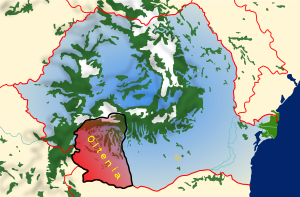
Romania
Romania is a country located at the crossroads of Central and Southeastern Europe, on the Lower Danube, within and outside the Carpathian arch, bordering on the Black Sea...
, in western Wallachia
Wallachia
Wallachia or Walachia is a historical and geographical region of Romania. It is situated north of the Danube and south of the Southern Carpathians...
. It is situated between the Danube
Danube
The Danube is a river in the Central Europe and the Europe's second longest river after the Volga. It is classified as an international waterway....
, the Southern Carpathians
Southern Carpathians
The Southern Carpathians or the Transylvanian Alps are a group of mountain ranges which divide central and southern Romania, on one side, and Serbia, on the other side. They cover part of the Carpathian Mountains that is located between the Prahova River in the east and the Timiș and Cerna Rivers...
and the Olt
Olt River
The Olt River is a river in Romania. It is the longest river flowing exclusively through Romania. Its source is in the Hăşmaş Mountains of the eastern Carpathian Mountains, near the village Bălan. It flows through the Romanian counties Harghita, Covasna, Braşov, Sibiu, Vâlcea and Olt...
river (although counties in the east extend beyond the river in Muntenia
Muntenia
Muntenia is a historical province of Romania, usually considered Wallachia-proper . It is situated between the Danube , the Carpathian Mountains and Moldavia , and the Olt River to the west...
in some areas).
Geography
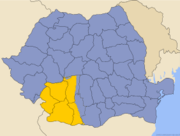
Counties of Romania
The 41 judeţe and the municipality of Bucharest comprise the official administrative divisions of Romania. They also represent the European Union' s NUTS-3 geocode statistical subdivision scheme of Romania.-Overview:...
:
- GorjGorj CountyGorj is a county of Romania, in Oltenia, with its capital city at Târgu Jiu.- Demographics :In 2002, it had a population of 387,308 and its population density was 69/km².* Romanians – over 98%* Rromas, others.- Geography :...
- DoljDolj CountyDolj -Jiu, "lower Jiu", toward Gorj ) is a county of Romania, in Oltenia, with the capital city at Craiova .- Demographics :In 2002, it had a population of 734,231 and a population density of 99/km²....
and parts of the counties:
- MehedinţiMehedinti CountyMehedinţi is a county of Romania. It is mostly located in the historical province of Oltenia, with one municipality and three communes located in the Banat...
(mainly in Oltenia, but the western part belongs to BanatBanatThe Banat is a geographical and historical region in Central Europe currently divided between three countries: the eastern part lies in western Romania , the western part in northeastern Serbia , and a small...
) - Vâlcea (mainly in Oltenia, but the eastern part belongs to MunteniaMunteniaMuntenia is a historical province of Romania, usually considered Wallachia-proper . It is situated between the Danube , the Carpathian Mountains and Moldavia , and the Olt River to the west...
) - OltOlt CountyOlt is a county of Romania, in the historical regions of Oltenia and Muntenia . The capital city is Slatina.- Demographics :In 2002, it had a population of 489,274 and the population density was 89/km²....
(the western half, the former Romanaţi county) - TeleormanTeleorman CountyTeleorman is a county of Romania, in the historical region Muntenia, with its capital city at Alexandria.The name Teleorman is of Cumanic origin. It literally means crazy forest and, by extension, "thick and shadowy forest" in the Cuman language...
(only the village IslazIslazIslaz is a commune in southern Romania, located in the southwestern Teleorman County, 10 km west of Turnu Măgurele. It is part of the historical province Oltenia, and is composed of two villages, Islaz and Moldoveni....
)
Nowadays, Oltenia's main city and its seat for a long period of the late Middle Ages
Middle Ages
The Middle Ages is a periodization of European history from the 5th century to the 15th century. The Middle Ages follows the fall of the Western Roman Empire in 476 and precedes the Early Modern Era. It is the middle period of a three-period division of Western history: Classic, Medieval and Modern...
is Craiova
Craiova
Craiova , Romania's 6th largest city and capital of Dolj County, is situated near the east bank of the river Jiu in central Oltenia. It is a longstanding political center, and is located at approximately equal distances from the Southern Carpathians and the River Danube . Craiova is the chief...
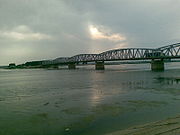
. The first medieval seat of Oltenia was Turnu Severin of Banat
Banat
The Banat is a geographical and historical region in Central Europe currently divided between three countries: the eastern part lies in western Romania , the western part in northeastern Serbia , and a small...
of Severin, the ancient Drobeta, near the former Roman bridge, built by Apollodorus of Damascus
Apollodorus of Damascus
Apollodorus of Damascus was a Greek engineer, architect, designer and sculptor who flourished during the 2nd century AD, from Damascus, Roman Syria. He was a favourite of Trajan, for whom he constructed Trajan's Bridge over the Danube for the 105-106 campaign in Dacia. He also designed the Forum...
for Emperor Trajan conquest purposes.
Complete list of towns from Oltenia
City |
County |
Population |
|---|---|---|
| Craiova Craiova Craiova , Romania's 6th largest city and capital of Dolj County, is situated near the east bank of the river Jiu in central Oltenia. It is a longstanding political center, and is located at approximately equal distances from the Southern Carpathians and the River Danube . Craiova is the chief... |
Dolj Dolj County Dolj -Jiu, "lower Jiu", toward Gorj ) is a county of Romania, in Oltenia, with the capital city at Craiova .- Demographics :In 2002, it had a population of 734,231 and a population density of 99/km².... |
302,601 |
| Râmnicu Vâlcea Râmnicu Vâlcea Râmnicu Vâlcea is the capital city of Vâlcea County, Romania .-Geography and climate:Râmnicu Vâlcea is situated in the central-south area of Romania... |
Vâlcea Vâlcea County Vâlcea is a county of Romania, in the historical regions of Oltenia and Muntenia... |
107,656 |
| Drobeta-Turnu Severin Drobeta-Turnu Severin Drobeta-Turnu Severin is a city in Mehedinţi County, Oltenia, Romania, on the left bank of the Danube, below the Iron Gates.The city administers three villages: Dudaşu Schelei, Gura Văii, and Schela Cladovei... |
Mehedinţi Mehedinti County Mehedinţi is a county of Romania. It is mostly located in the historical province of Oltenia, with one municipality and three communes located in the Banat... |
104,035 |
| Târgu Jiu Târgu Jiu Târgu Jiu is the capital of Gorj County, Oltenia, Romania. It is situated on the Southern Sub-Carpathians, on the banks of the river Jiu. Eight villages are administered by the city: Bârseşti, Drăgoeni, Iezureni, Polata, Preajba Mare, Româneşti, Slobozia and Ursaţi.-History:The city takes its name... |
Gorj Gorj County Gorj is a county of Romania, in Oltenia, with its capital city at Târgu Jiu.- Demographics :In 2002, it had a population of 387,308 and its population density was 69/km².* Romanians – over 98%* Rromas, others.- Geography :... |
96,562 |
| Slatina Slatina Slatina refers to a number of geographical objects in Europe:In Albania:* another name for Slatine and for SllatinaIn Antarctica* Slatina Peak... |
Olt Olt County Olt is a county of Romania, in the historical regions of Oltenia and Muntenia . The capital city is Slatina.- Demographics :In 2002, it had a population of 489,274 and the population density was 89/km².... |
87,335 |
| Caracal Caracal, Romania Caracal is a city in Olt county, Romania, situated in the historic region of Oltenia, on the plains between the lower reaches of the Jiu and Olt rivers. The region's plains are well known for their agricultural specialty in cultivating grains and over the centuries, Caracal has been the trading... |
Olt Olt County Olt is a county of Romania, in the historical regions of Oltenia and Muntenia . The capital city is Slatina.- Demographics :In 2002, it had a population of 489,274 and the population density was 89/km².... |
34,603 |
| Motru Motru Motru is a city in Romania, Gorj County.Motru is situated on the river of the same in western Oltenia. The county capital Târgu Jiu is located about 35 km northeast... |
Gorj Gorj County Gorj is a county of Romania, in Oltenia, with its capital city at Târgu Jiu.- Demographics :In 2002, it had a population of 387,308 and its population density was 69/km².* Romanians – over 98%* Rromas, others.- Geography :... |
25,860 |
| Balş Bals Balş is a town in Olt County, Romania. The town administers three villages: Corbeni, Româna and Teiş.-Etymology:There are three hypotheses about the town's name:# The locality was named after the Balşiţa brook.... |
Olt Olt County Olt is a county of Romania, in the historical regions of Oltenia and Muntenia . The capital city is Slatina.- Demographics :In 2002, it had a population of 489,274 and the population density was 89/km².... |
23,147 |
| Drăgăşani Dragasani Drăgăşani is a city in Vâlcea County, Romania, near the right bank of the Olt river, and on the railway between Caracal and Râmnicu Vâlcea. The city is well known for the vineyards on the neighboring hills that produce some of the best Wallachian wines.... |
Vâlcea | 22,499 |
| Băileşti Bailesti Băileşti is a city in Dolj County, Oltenia, Romania, with a population of 22,231. One village, Balasan, is administered by the city.The Romanian actor and comedian Amza Pellea and Romanian actor and theatre actor Marcel Iureş were born here and also Adriana Nechita-Olteanu.-External links:*The... |
Dolj Dolj County Dolj -Jiu, "lower Jiu", toward Gorj ) is a county of Romania, in Oltenia, with the capital city at Craiova .- Demographics :In 2002, it had a population of 734,231 and a population density of 99/km².... |
22,231 |
| Corabia Corabia Corabia is a small Danube port located in Olt County, Romania, which used to be part of the now-dissolved Romanaţi County before World War II... |
Olt Olt County Olt is a county of Romania, in the historical regions of Oltenia and Muntenia . The capital city is Slatina.- Demographics :In 2002, it had a population of 489,274 and the population density was 89/km².... |
21,932 |
| Calafat Calafat Calafat is a city in Dolj County, Romania, on the river Danube, opposite the Bulgarian city of Vidin, to which it is linked by ferryboat. The construction of the Calafat-Vidin Bridge is planned between the two cities.... |
Dolj Dolj County Dolj -Jiu, "lower Jiu", toward Gorj ) is a county of Romania, in Oltenia, with the capital city at Craiova .- Demographics :In 2002, it had a population of 734,231 and a population density of 99/km².... |
21,227 |
| Filiaşi Filiasi Filiaşi is a town in Dolj County, Romania, on the Jiu River. In 2002, it had a population of 18,848. The town administers six villages: Almăjel, Bâlta, Branişte, Fratoştiţa, Răcarii de Sus and Uscăci.... |
Dolj Dolj County Dolj -Jiu, "lower Jiu", toward Gorj ) is a county of Romania, in Oltenia, with the capital city at Craiova .- Demographics :In 2002, it had a population of 734,231 and a population density of 99/km².... |
20,159 |
| Dăbuleni Dabuleni Dăbuleni is a town of Dolj County, known for the sandy areas surrounding it, since the 1980s have become part of an 80,000 hectares desert, known as the Oltenian Sahara. The town is the only place in Europe where an official Sand Museum exists. It was declared a town in 2004... |
Dolj Dolj County Dolj -Jiu, "lower Jiu", toward Gorj ) is a county of Romania, in Oltenia, with the capital city at Craiova .- Demographics :In 2002, it had a population of 734,231 and a population density of 99/km².... |
13,888 |
| Drăgăneşti-Olt Draganesti-Olt Drăgăneşti-Olt is a town in Olt County, southern Romania with a population of 12,195 . It lies on the left bank of the Olt River at an altitude of approximately . The first document mentioning it is from 1526. Drăgăneşti-Olt became a town in 1968. The town administers one village, Comani.... |
Olt Olt County Olt is a county of Romania, in the historical regions of Oltenia and Muntenia . The capital city is Slatina.- Demographics :In 2002, it had a population of 489,274 and the population density was 89/km².... |
13,181 |
| Rovinari Rovinari Rovinari is a town in Gorj County, southern Romania with a population of 12,603 . It is a mining city, nearby to surface and underground mines. A big thermo-electrical power plant functions close to the town.... |
Gorj Gorj County Gorj is a county of Romania, in Oltenia, with its capital city at Târgu Jiu.- Demographics :In 2002, it had a population of 387,308 and its population density was 69/km².* Romanians – over 98%* Rromas, others.- Geography :... |
12,603 |
| Strehaia Strehaia Strehaia is a town in Mehedinţi County, Oltenia, Romania. It is situated 25 km west of Filiaşi, on the Motru River valley. Forests in the vicinity are home to the largest Herman's Tortoise colonies in Oltenia.... |
Mehedinţi Mehedinti County Mehedinţi is a county of Romania. It is mostly located in the historical province of Oltenia, with one municipality and three communes located in the Banat... |
12,564 |
| Bumbeşti-Jiu Bumbesti-Jiu Bumbeşti-Jiu is a town in Gorj County, western Wallachia, Romania, on the river Jiu with a population of 10,617 . It administers four villages: Curtişoara, Lăzăreşti, Pleşa and Tetila.... |
Gorj Gorj County Gorj is a county of Romania, in Oltenia, with its capital city at Târgu Jiu.- Demographics :In 2002, it had a population of 387,308 and its population density was 69/km².* Romanians – over 98%* Rromas, others.- Geography :... |
11,882 |
| Băbeni Babeni Băbeni is a commune located in Sălaj County, Romania. It is composed of five villages: Băbeni, Ciocmani, Cliţ, Piroşa and Poieniţa.-References:... |
Vâlcea Vâlcea County Vâlcea is a county of Romania, in the historical regions of Oltenia and Muntenia... |
9,475 |
| Târgu Cărbuneşti Târgu Carbunesti Târgu Cărbuneşti is a town in Gorj County, southern Romania with a population of 8,731. It lies in the south-eastern part of the county and administers ten villages: Blahniţa de Jos, Cărbuneşti-Sat, Cojani, Creţeşti, Curteana, Floreşteni, Măceşu, Pojogeni, Rogojeni and Ştefăneşti.-Natives:* Lidia... |
Gorj Gorj County Gorj is a county of Romania, in Oltenia, with its capital city at Târgu Jiu.- Demographics :In 2002, it had a population of 387,308 and its population density was 69/km².* Romanians – over 98%* Rromas, others.- Geography :... |
9,338 |
| Călimăneşti Calimanesti Călimănești, often known as Călimănești-Căciulata, is a town in Vâlcea County, southern Romania. It is situated in the historical region of Oltenia and the northern part of the county, on the traditional route connecting the region to Transylvania, and at the southern end of the Olt River valley... |
Vâlcea Vâlcea County Vâlcea is a county of Romania, in the historical regions of Oltenia and Muntenia... |
8,923 |
| Segarcea Segarcea Segarcea is a small town in Dolj County, Romania, about 25 kilometres from Craiova, the county seat. It has 8,000 inhabitants and it is famous for its white wines.... |
Dolj Dolj County Dolj -Jiu, "lower Jiu", toward Gorj ) is a county of Romania, in Oltenia, with the capital city at Craiova .- Demographics :In 2002, it had a population of 734,231 and a population density of 99/km².... |
8,704 |
| Turceni Turceni Turceni is a town in Gorj County, Romania. It administers five villages: Gârbovu, Jilţu, Murgeşti, Strâmba-Jiu and Valea Viei.... |
Gorj Gorj County Gorj is a county of Romania, in Oltenia, with its capital city at Târgu Jiu.- Demographics :In 2002, it had a population of 387,308 and its population density was 69/km².* Romanians – over 98%* Rromas, others.- Geography :... |
8,550 |
| Brezoi Brezoi Brezoi is a town located in Vâlcea County, Romania. It administers eight villages: Călineşti, Corbu, Drăgăneşti, Golotreni, Păscoaia, Proieni, Valea lui Stan and Văratica.-References:... |
Vâlcea Vâlcea County Vâlcea is a county of Romania, in the historical regions of Oltenia and Muntenia... |
7,589 |
| Tismana Tismana Tismana is a town in Gorj County, Romania. It administers ten villages: Celei, Costeni, Gornoviţa, Isvarna, Pocruia, Racoţi, Sohodol, Topeşti, Vâlcele and Vânăta.... |
Gorj Gorj County Gorj is a county of Romania, in Oltenia, with its capital city at Târgu Jiu.- Demographics :In 2002, it had a population of 387,308 and its population density was 69/km².* Romanians – over 98%* Rromas, others.- Geography :... |
7,578 |
| Horezu Horezu Horezu is a town located in Vâlcea County, Romania, about 43km from Râmnicu Vâlcea. The town administers six villages: Ifrimeşti, Râmeşti, Romanii de Jos, Romanii de Sus, Tănăseşti and Urşani.... |
Vâlcea Vâlcea County Vâlcea is a county of Romania, in the historical regions of Oltenia and Muntenia... |
7,446 |
| Vânju Mare Vânju Mare Vânju Mare is a small town located in Mehedinţi County, Romania. It has a population of 7,074. Four villages are administered by the town: Bucura, Nicolae Bălcescu, Oreviţa Mare and Traian.... |
Mehedinţi Mehedinti County Mehedinţi is a county of Romania. It is mostly located in the historical province of Oltenia, with one municipality and three communes located in the Banat... |
7,074 |
| Piatra Olt Piatra Olt Piatra-Olt is a town in Olt County, Romania. The town administers five villages: Bistriţa Nouă, Criva de Jos, Criva de Sus, Enoşeşti and Piatra. The town is an important railway station and road intersection.-History:... |
Olt Olt County Olt is a county of Romania, in the historical regions of Oltenia and Muntenia . The capital city is Slatina.- Demographics :In 2002, it had a population of 489,274 and the population density was 89/km².... |
6,583 |
| Novaci | Gorj Gorj County Gorj is a county of Romania, in Oltenia, with its capital city at Târgu Jiu.- Demographics :In 2002, it had a population of 387,308 and its population density was 69/km².* Romanians – over 98%* Rromas, others.- Geography :... |
6,151 |
| Potcoava Potcoava Potcoava is a town in Olt County, Romania. The town administers four villages: Potcoava-Fălcoeni, Sineşti, Trufineşti and Valea Merilor.-References:... |
Olt Olt County Olt is a county of Romania, in the historical regions of Oltenia and Muntenia . The capital city is Slatina.- Demographics :In 2002, it had a population of 489,274 and the population density was 89/km².... |
6,111 |
| Bălceşti Balcesti For the village in Gorj County, see Bengeşti-Ciocadia. For the villages in Cluj County, see Beliş and Căpuşu Mare.Bălceşti is a town located in Vâlcea County, Romania. The town administers eight villages: Beneşti, Cârlogani, Goruneşti, Chirculeşti, Irimeşti, Otetelişu, Preoţeşti and Satu... |
Vâlcea Vâlcea County Vâlcea is a county of Romania, in the historical regions of Oltenia and Muntenia... |
5,780 |
| Baia de Aramă Baia de Arama Baia de Aramă is a small Romanian town located in the Wallachian county of Mehedinţi with a population of 5,724. The Brebina River runs through the town... |
Mehedinţi Mehedinti County Mehedinţi is a county of Romania. It is mostly located in the historical province of Oltenia, with one municipality and three communes located in the Banat... |
5,724 |
| Berbeşti Berbesti Berbeşti is a town located in Vâlcea County, Romania, about 78 km south-west from Râmnicu Vâlcea. It was granted town status by law in October 2003... |
Vâlcea Vâlcea County Vâlcea is a county of Romania, in the historical regions of Oltenia and Muntenia... |
5,704 |
| Ţicleni Ticleni Ţicleni is a town in Gorj County, Romania.It is a community developed around the exploitation of extractive industries: oil and natural gas.... |
Gorj Gorj County Gorj is a county of Romania, in Oltenia, with its capital city at Târgu Jiu.- Demographics :In 2002, it had a population of 387,308 and its population density was 69/km².* Romanians – over 98%* Rromas, others.- Geography :... |
5,205 |
| Băile Olăneşti Baile Olanesti Băile Olăneşti is a town located in Vâlcea County, Romania. The town administers eight villages: Cheia, Comanca, Gurguiata, Livadia, Mosoroasa, Olăneşti, Pietrişu and Tisa.- External Links :... |
Vâlcea Vâlcea County Vâlcea is a county of Romania, in the historical regions of Oltenia and Muntenia... |
4,814 |
| Bechet Bechet Bechet is a city in Dolj County, Oltenia, Romania, on the river Danube, opposite the Bulgarian city of Oryahovo.- External links :*... |
Dolj Dolj County Dolj -Jiu, "lower Jiu", toward Gorj ) is a county of Romania, in Oltenia, with the capital city at Craiova .- Demographics :In 2002, it had a population of 734,231 and a population density of 99/km².... |
3,864 |
| Ocnele Mari Ocnele Mari Ocnele Mari is a town located in Vâlcea County, Romania. The town administers eight villages: Buda, Cosota, Făcăi, Gura Suhaşului, Lunca, Ocniţa, Slătioarele and Ţeica.-References:... |
Vâlcea Vâlcea County Vâlcea is a county of Romania, in the historical regions of Oltenia and Muntenia... |
3,591 |
| Băile Govora Baile Govora Băile Govora is a Romanian spa town in Vâlcea County, about south-west of Râmnicu Vâlcea and west of the Olt river. Notable features of the town include the Govora abbey and the nearby "Dintr-un... |
Vâlcea Vâlcea County Vâlcea is a county of Romania, in the historical regions of Oltenia and Muntenia... |
3,147 |
History
Initially inhabited by DaciansDacians
The Dacians were an Indo-European people, very close or part of the Thracians. Dacians were the ancient inhabitants of Dacia...
, Oltenia was incorpored in the Roman Empire
Roman Empire
The Roman Empire was the post-Republican period of the ancient Roman civilization, characterised by an autocratic form of government and large territorial holdings in Europe and around the Mediterranean....
(106, at the end of the Dacian Wars; see Roman Dacia
Roman Dacia
The Roman province of Dacia on the Balkans included the modern Romanian regions of Transylvania, Banat and Oltenia, and temporarily Muntenia and southern Moldova, but not the nearby regions of Moesia...
). In 129, during Hadrian
Hadrian
Hadrian , was Roman Emperor from 117 to 138. He is best known for building Hadrian's Wall, which marked the northern limit of Roman Britain. In Rome, he re-built the Pantheon and constructed the Temple of Venus and Roma. In addition to being emperor, Hadrian was a humanist and was philhellene in...
's rule, it formed Dacia Inferior, one of the two divisions of the province (together with Dacia Superior, in today's Transylvania
Transylvania
Transylvania is a historical region in the central part of Romania. Bounded on the east and south by the Carpathian mountain range, historical Transylvania extended in the west to the Apuseni Mountains; however, the term sometimes encompasses not only Transylvania proper, but also the historical...
); Marcus Aurelius' administrative reform made Oltenia one of the three new divisions (tres Daciae) as Dacia Malvensis, its capital and chief city being named Romula
Romula
Romula or Malva was an ancient city in Roman Dacia, nowadays being the village of Reşca, Dobrosloveni Commune, Olt County, Romania It was the capital of Dacia Malvensis, one of the three subdivisions of the province of Dacia....
. It was colonized with veteran
Veteran
A veteran is a person who has had long service or experience in a particular occupation or field; " A veteran of ..."...
s of the Roman legion
Roman legion
A Roman legion normally indicates the basic ancient Roman army unit recruited specifically from Roman citizens. The organization of legions varied greatly over time but they were typically composed of perhaps 5,000 soldiers, divided into maniples and later into "cohorts"...
s. The Romans withdrew their administration south of the Danube at the end of the 3rd century and Oltenia was ruled by the foederati Germanic Goths
Goths
The Goths were an East Germanic tribe of Scandinavian origin whose two branches, the Visigoths and the Ostrogoths, played an important role in the fall of the Roman Empire and the emergence of Medieval Europe....
. In the late 4th century Oltenia came under the rule of the Taifals
Taifals
The Taifals, Taifali, Taifalae, Tayfals, or Theifali were a people settled by the late Roman Empire in Poitou in the fourth century. They served as dediticii and laeti in the Roman and subsequently Merovingian militaries...
before invasion by the Huns
Huns
The Huns were a group of nomadic people who, appearing from east of the Volga River, migrated into Europe c. AD 370 and established the vast Hunnic Empire there. Since de Guignes linked them with the Xiongnu, who had been northern neighbours of China 300 years prior to the emergence of the Huns,...
. From 681, with some interruptions, it was part of the Bulgarian Empire
Bulgarian Empire
Bulgarian Empire is a term used to describe two periods in the medieval history of Bulgaria, during which it acted as a key regional power in Europe in general and in Southeastern Europe in particular, rivalling Byzantium...
(see Bulgarian lands across the Danube
Bulgarian lands across the Danube
In the Middle Ages the Bulgarian Empire controlled vast areas to the north of the river Danube from its establishment in 681 to its fall in 1396. These lands were called by contemporary Byzantine historians Bulgaria across the Danube...
).
Around 1247 a polity emerged in Oltenia under the rule of Litovoi
Litovoi
Litovoi, also Litvoy, was a Vlach voivode in the 13th century whose territory comprised northern Oltenia .He is mentioned for the first time in a diploma issued by king Béla IV of Hungary on 2 July 1247...
, which would later included in Muntenia
Muntenia
Muntenia is a historical province of Romania, usually considered Wallachia-proper . It is situated between the Danube , the Carpathian Mountains and Moldavia , and the Olt River to the west...
(the mediaeval state of Wallachia
Wallachia
Wallachia or Walachia is a historical and geographical region of Romania. It is situated north of the Danube and south of the Southern Carpathians...
). From an unknown moment and up until 1831, the voivode (Prince of Wallachia) was represented in Oltenia by a ban
Ban (title)
Ban was a title used in several states in central and south-eastern Europe between the 7th century and the 20th century.-Etymology:The word ban has entered the English language probably as a borrowing from South Slavic ban, meaning "lord, master; ruler". The Slavic word is probably borrowed from...
("the great ban of Craiova", after the seat was moved from Strehaia
Strehaia
Strehaia is a town in Mehedinţi County, Oltenia, Romania. It is situated 25 km west of Filiaşi, on the Motru River valley. Forests in the vicinity are home to the largest Herman's Tortoise colonies in Oltenia....
), considered the greatest office in Wallachian hierarchy, and one that was held most by members of the Craioveşti
Craiovesti
The Craiovești , later Brâncovenești , were a boyar family in Wallachia who gave the country several of its Princes and held the title of Ban of Oltenia for ca...
family (from the late 15th century to about 1550).
During the 15th century, Wallachia had to accept the Ottoman
Ottoman Empire
The Ottoman EmpireIt was usually referred to as the "Ottoman Empire", the "Turkish Empire", the "Ottoman Caliphate" or more commonly "Turkey" by its contemporaries...
suzerainty
Suzerainty
Suzerainty occurs where a region or people is a tributary to a more powerful entity which controls its foreign affairs while allowing the tributary vassal state some limited domestic autonomy. The dominant entity in the suzerainty relationship, or the more powerful entity itself, is called a...
and to pay an annual tribute
Tribute
A tribute is wealth, often in kind, that one party gives to another as a sign of respect or, as was often the case in historical contexts, of submission or allegiance. Various ancient states, which could be called suzerains, exacted tribute from areas they had conquered or threatened to conquer...
to keep its autonomy as vasal. From the Craioveşti-family, many bans cooperated with the Turks. However, many rulers, including the Oltenian-born Michael the Brave, fought against the Ottomans, giving Wallachia brief periods of independence. After 1716, the Ottomans decided to cease choosing the voivodes from among the Wallachian boyars, and to appoint foreign governors. As the governors were Orthodox Greeks living in Phanar, Constantinople, his period is known as the Phanariote regime.
Two years later, in 1718 under the terms of the Treaty of Passarowitz
Treaty of Passarowitz
The Treaty of Passarowitz or Treaty of Požarevac was the peace treaty signed in Požarevac , a town in Ottoman Empire , on 21 July 1718 between the Ottoman Empire on one side and the Habsburg Monarchy of Austria and the Republic of Venice on the other.During the years 1714-1718, the Ottomans had...
, Oltenia was split from Wallachia and annexed by the Habsburg Monarchy
Habsburg Monarchy
The Habsburg Monarchy covered the territories ruled by the junior Austrian branch of the House of Habsburg , and then by the successor House of Habsburg-Lorraine , between 1526 and 1867/1918. The Imperial capital was Vienna, except from 1583 to 1611, when it was moved to Prague...
(de facto, it was under Austrian occupation by 1716); in 1737, it was returned to Wallachia under Prince Constantine Mavrocordatos
Constantine Mavrocordatos
Constantine Mavrocordatos was a Greek noble who served as Prince of Wallachia and Prince of Moldavia at several intervals...
(see Austro-Turkish War of 1716-18
Austro-Turkish War of 1716-18
The Austro-Turkish War was fought between Austria and the Ottoman Empire.The Treaty of Karlowitz was not an acceptable long-standing agreement for the Ottoman Empire...
and Austro-Turkish War, 1737-1739). Under the occupation, Oltenia was the only part of the Danubian Principalities
Danubian Principalities
Danubian Principalities was a conventional name given to the Principalities of Moldavia and Wallachia, which emerged in the early 14th century. The term was coined in the Habsburg Monarchy after the Treaty of Küçük Kaynarca in order to designate an area on the lower Danube with a common...
(with the later exception of Bukovina
Bukovina
Bukovina is a historical region on the northern slopes of the northeastern Carpathian Mountains and the adjoining plains.-Name:The name Bukovina came into official use in 1775 with the region's annexation from the Principality of Moldavia to the possessions of the Habsburg Monarchy, which became...
) to experience Enlightened absolutism
Enlightened absolutism
Enlightened absolutism is a form of absolute monarchy or despotism in which rulers were influenced by the Enlightenment. Enlightened monarchs embraced the principles of the Enlightenment, especially its emphasis upon rationality, and applied them to their territories...
and Austrian administration, although these were met by considerable and mounting opposition from conservative
Conservatism
Conservatism is a political and social philosophy that promotes the maintenance of traditional institutions and supports, at the most, minimal and gradual change in society. Some conservatives seek to preserve things as they are, emphasizing stability and continuity, while others oppose modernism...
boyars. While welcomed at first as liberators, the Austrians quickly disenchanted the inhabitants by imposing rigid administrative, fiscal, judicial and political reforms which were meant to centralize and integrate the territory (antagonizing both ends of the social spectrum: withdrawing privilege
Privilege
A privilege is a special entitlement to immunity granted by the state or another authority to a restricted group, either by birth or on a conditional basis. It can be revoked in certain circumstances. In modern democratic states, a privilege is conditional and granted only after birth...
s from the nobility and enforcing taxes for peasants).
In 1761, the residence of Bans was moved to Bucharest
Bucharest
Bucharest is the capital municipality, cultural, industrial, and financial centre of Romania. It is the largest city in Romania, located in the southeast of the country, at , and lies on the banks of the Dâmbovița River....
, in a move towards centralism
Centralized government
A centralized or centralised government is one in which power or legal authority is exerted or coordinated by a de facto political executive to which federal states, local authorities, and smaller units are considered subject...
(a kaymakam
Kaymakam
Qaim Maqam or Qaimaqam or Kaymakam is the title used for the governor of a provincial district in the Republic of Turkey, Turkish Republic of Northern Cyprus and in Lebanon; additionally, it was a title used for roughly the same official position in the Ottoman...
represented the boyars in Craiova). It remained there until the death of the last Ban, Barbu Văcărescu, in 1832.
In 1821, Oltenia and the county of Gorj were at the center of Tudor Vladimirescu
Tudor Vladimirescu
Tudor Vladimirescu was a Wallachian Romanian revolutionary hero, the leader of the Wallachian uprising of 1821 and of the Pandur militia. He is also known as Tudor din Vladimiri or — occasionally — as Domnul Tudor .-Background:Tudor was born in Vladimiri, Gorj County in a family of landed peasants...
's uprising (see Wallachian uprising of 1821
Wallachian uprising of 1821
The Wallachian uprising of 1821 was an uprising in Wallachia against Ottoman rule which took place during 1821.-Background:...
). Tudor initially gathered his Pandurs
Pandurs
The Pandurs were Croatian Austrian frontier soldiers, who inhabited the areas of the Kingdom of Croatia and Military Frontier, and fought not only in the East-Turkish front, but also in the West-European front. They were a non-linear army, made out mainly of Croats...
in Padeş
Padeş
Padeş is a commune in Gorj County, Romania. It is composed of eight villages: Apa Neagră, Călugareni , Cerna-Sat, Cloşani, Motru-Sec, Orzeşti, Padeş and Văieni....
and relied on a grid of fortified monasteries such as Tismana
Tismana
Tismana is a town in Gorj County, Romania. It administers ten villages: Celei, Costeni, Gornoviţa, Isvarna, Pocruia, Racoţi, Sohodol, Topeşti, Vâlcele and Vânăta....
and Strehaia.
Symbol
The traditional heraldic symbol of Oltenia, also understood as representing BanatBanat
The Banat is a geographical and historical region in Central Europe currently divided between three countries: the eastern part lies in western Romania , the western part in northeastern Serbia , and a small...
, is nowadays present in the Coat of Arms of Romania
Coat of arms of Romania
The coat of arms of Romania was adopted in the Romanian Parliament on 10 September 1992 as a representative coat of arms for Romania. It is based on the Lesser Coat of Arms of the Kingdom of Romania , redesigned by Victor Dima. As a central element it shows a golden aquila holding a cross in its...
(lower dexter): on gules
Gules
In heraldry, gules is the tincture with the colour red, and belongs to the class of dark tinctures called "colours". In engraving, it is sometimes depicted as a region of vertical lines or else marked with gu. as an abbreviation....
field, an or
Or (heraldry)
In heraldry, Or is the tincture of gold and, together with argent , belongs to the class of light tinctures called "metals". In engravings and line drawings, it may be represented using a field of evenly spaced dots...
lion
Lion (heraldry)
The lion is a common charge in heraldry. It traditionally symbolises bravery, valour, strength, and royalty, since traditionally, it is regarded as the king of beasts.-Attitudes:...
rampant, facing dexter, holding a sword, and standing over an or bridge (Apolodor of Damascus Bridge at Drobeta Turnu Severin) and stylised waves.