


Vernacular

Encyclopedia
A vernacular is the native language or native dialect
of a specific population, as opposed to a language of wider communication that is not native to the population, such as a national language
or lingua franca
.
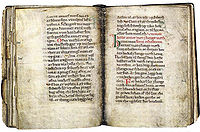
Here vernacular, mother language and dialect are already in use in a modern sense.
According to Merriam-Webster
's, "vernacular" was brought into the English language as early as 1601 from Latin vernaculus, "native", which had been in figurative use in Classical Latin
as "national" and "domestic", having originally been derived from vernus and verna, a male or female slave respectively born in the house rather than abroad. The figurative meaning was broadened from the diminutive extended words vernaculus, vernacula. Varro
, the classical Latin grammarian, used the term vocabula vernacula, "termes de la langue nationale" or "vocabulary of the national language" as opposed to foreign words.
In some disciplines, such as Linguistic Anthropology, the term "vernacular" is falling out of usage and has come to be identified as an offensive term. "Dialect" or "dialect variation" is more appropriate in context, as the word "vernacular" comes from the Latin "vernaculus" (domestic, native) which in turn comes from the Etruscan "verna" (home-born slave, native).
, a vernacular is opposed to a lingua franca
, a third-party language in which persons speaking different vernaculars not understood by each other may communicate. For instance, in Western Europe
until the 17th century, most scholarly works had been written in Latin
, which was serving as a lingua franca. Works written in Romance languages are said to be in the vernacular. The Divina Commedia, the Cantar de mio Cid
, and The Song of Roland
are examples of early vernacular literature in Italian, Spanish, and French, respectively.
In Europe, Latin was used widely instead of vernacular languages in varying forms until c. 1701, in its latter stage as New Latin
.
In religion, Protestantism
was a driving force in the use of the vernacular in Christian Europe, the Bible
being translated from Latin into vernacular languages with such works as the Bible in Dutch: published in 1526 by Jacob van Liesvelt; Bible in French: published in 1528 by Jacques Lefevre d’Étaples (or Faber Stapulensis); German Luther Bible
in 1534; Bible in Spanish: published in Basel in 1569 by Casiodoro de Reina (Biblia del Oso); Bible in Czech: Bible of Kralice, printed between 1579 and 1593; Bible in English: King James Bible, published in 1611. In Catholicism, vernacular bibles were later provided, but Latin was used at Tridentine Mass
until the Second Vatican Council
of 1965. Certain groups, notably Traditionalist Catholic
s, continue to practice Latin Mass
.
In India, the 12th century Bhakti movement
led to the translation of Sanskrit texts to the vernacular.
In science, an early user of the vernacular was Galileo, writing in Italian c. 1600, though some of his works remained in Latin. A later example is Isaac Newton
, whose 1687 Principia
was in Latin, but whose 1704 Opticks
was in English. Latin continues to be used in certain fields of science, notably binomial nomenclature
in biology, while other fields such as mathematics use vernacular; see scientific nomenclature for details.
In diplomacy, French displaced Latin in Europe in the 1710s, due to the military power of Louis XIV of France
.
Certain languages have both a classical form and various vernacular forms, with two widely-used examples being Arabic and Chinese: see Varieties of Arabic
and Chinese language
. In the 1920s, due to the May Fourth Movement
, Classical Chinese
was replaced by written vernacular Chinese.
in Latin
rather than in vernaculars; to this day the Coptic Church holds liturgies
in Coptic
not Arabic; the Ethiopian Orthodox Church holds liturgies in Ge'ez
though parts of Mass are read in Amharic.
Similarly, in Hindu
culture, traditionally religious or scholarly works were written in Sanskrit
(long after its use as a spoken language) or in Tamil
in Tamil country. Sanskrit, was a lingua franca among the non-Indo-European languages of the Indian subcontinent and became more of one as the spoken language, or prakrit
s, began to diverge from it in different regions. With the rise of the bhakti movement
from the 12th century onwards, religious works were created in the other languages: Hindi
, Kannada
, Telugu
and many others. For example, the Ramayana
, one of Hinduism's sacred epics in Sanskrit, had vernacular versions such as Ranganadha Ramayanam composed in Telugu by Gona Buddha Reddy
in the 15th century; and Ramacharitamanasa, a Hindi
version of the Ramayana by the 16th century poet Tulsidas
.
These circumstances are a contrast between a vernacular and language variant used by the same speakers. According to one school of linguistic thought, all such variants are examples of a linguistic phenomenon termed diglossia
("split tongue", on the model of the genetic anomaly). In it the language is bifurcated; i.e., the speaker learns two forms of the language and ordinarily uses one but under special circumstances the other. The one most frequently used is the low (L) variant, equivalent to the vernacular, while the special variant is the high (H). The concept was introduced to linguistics by Charles A. Ferguson
(1959), but Ferguson explicitly excluded variants as divergent as dialects or different languages or as similar as styles or registers. H must not be a conversational form; Ferguson had in mind a literary language. For example, a lecture is delivered in a different variety than ordinary conversation. Ferguson's own example was classical and spoken Arabic, but the analogy between Vulgar Latin
and Classical Latin
is of the same type. Excluding the upper-class and lower-class register aspects of the two variants, Classical Latin was a literary language; the people spoke Vulgar Latin as a vernacular.
Joshua Fishman
redefined the concept in 1964 to include everything Fergusen had excluded. Fishman allowed both different languages and dialects and also different styles and registers as the H variants. The essential contrast between them was that they be "functionally differentiated;" that is, H must be used for special purposes, such as a liturgical or sacred language. Fasold expanded the concept still further by proposing that mulitple H exist in society from which the users can select for various purposes. The definition of an H is intermediate between Ferguson's and Fishman's. Realizing the inappropriateness of the term diglossia (only two) to his concept, he proposes the term broad diglossia.
, the term vernacular has been applied to several concepts; unfortunately, it is only possible to identify which is meant in an authored work by context.
, language is a large set of styles or registers
from which the speaker selects according to the social setting of the moment. The vernacular is "the least self-conscious style of people in a relaxed conversation", or "the most basic style"; that is, casual varieties used spontaneously rather than self-consciously, informal talk used in intimate situations. In other contexts the speaker does conscious work to select the appropriate variations. The one he can use without this effort is the first form of speech acquired.
.
of Italian
, Spanish
, French
, Dutch
, German
and English
were written, though not always immediately published. It is to be understood that the first vestiges of those languages preceded their standardization by up to several hundred years.
is a grammar of the Irish language
which is thought to date back as far as the 7th century: the earliest surviving manuscripts are 12th century.
developed from these through the Middle Ages and to the Renaissance.
and the lingua vulgaris of subsequent medieval writers. Documents of mixed Latin and Italian are known from the 12th century, which appears to be the start of writing in Italian.
The first known grammar of a Romance language was a book written in manuscript form by Leon Battista Alberti between 1437 and 1441 and entitled Grammatica della lingua toscana, "Grammar of the Tuscan Language" In it Alberti sought to demonstrate that the vernacular – here Tuscan, known today as modern Italian – was every bit as structured as Latin; He did so by mapping vernacular structures onto Latin.
The book was never printed until 1908. It was not generally known, but it was known, as an inventory of the library of Lorenzo de'Medici lists it under the title Regule lingue florentine ("Rules of the Florentine language"). The only known manuscript copy, however, is included in the codex
, Reginense Latino 1370, located at Rome in the Vatican library
. It is therefore called the Grammatichetta vaticana.
More influential perhaps were the 1516 Regole grammaticali della volgar lingua of Giovanni Francesco Fortunio and the 1525 Prose della vulgar lingua of Pietro Bembo
. In those works the authors strove to establish a dialect that would qualify for becoming the Italian national language.
as an international power. The first Spanish grammar by Antonio de Nebrija
(Tratado de gramática sobre la lengua Castellana
, 1492) was divided into parts for native and nonnative speakers, pursuing a different purpose in each: Books 1–4 describe the Spanish language
grammatically in order to facilitate the study of Latin for its Spanish speaking readers. Book 5 contains a phonetical and morphological overview of Spanish for nonnative speakers.
emerged as a Gallo-Romance language
from Vulgar Latin
in the late antiquity
period. The written language is known from at least as early as the 9th century. That language contained many forms still identifiable as Latin. Interest in standardizing French began in the 16th century. Because of the Norman conquest of England
and the Anglo-Norman domains in both northwestern France and Britain, English scholars retained an interest in the fate of French as well as of English. Some of the numerous 16th-century surviving grammars are as follows.
was not identical to any specific variety of German. The first grammar evolved from pedagogical works that also tried to create a uniform standard from the many regional dialects for various reasons. Religious leaders wished to create a sacred language for Protestantism
that would be parallel to the use of Latin for the Roman Catholic Church
. Various administrations wished to created a civil service, or chancery, language that would be useful in more than one locality. And finally, nationalists wished to counter the spread of the French national language into German-speaking territories assisted by the efforts of the French Academy.
With so many linguists moving in the same direction a standard German (hochdeutsche Schriftsprache) did evolve without the assistance of a language academy. Its precise origin, the major constituents of its features, remains uncertainly known and debatable. Latin prevailed as a lingua franca
until the 17the century, when grammarians began to debate the creation of an ideal language. Before 1550 as a conventional date "supraregional compromises" were used in printed works, such as the one published by Valentin Ickelsamer (Ein Teutsche Grammatica) 1534. Books published in one of these artificial variants began to increase in frequency replacing the Latin then in use. After 1550 the supraregional ideal broadened to a universal intent to create a national language from Early New High German
by deliberately ignoring regional forms of speech, which practice was considered to be a form of purification parallel to the ideal of purifying religion in Protestantism
.
In 1617 the Fruitbearing Society
, a language club, was formed in Weimar
in imitation of the Accademia della Crusca
in Italy. It was one of many such clubs; however, none became a national academy. In 1618–1619 Johannes Kromayer wrote the first all-German grammar. In 1641 Justin Georg Schottel in teutsche Sprachkunst presented the standard language as an artificial one. By the time of his work of 1663, ausführliche Arbeit von der teutschen Haubt-Sprache, the standard language was well established.
, were anyone living in the lowlands from the Baltic Sea
to the Netherlands
, while the Oberlender, who spoke High German, lived in more elevated terrain. The first known such distinction was made in Dutch – a Low German variant – in a printed book of 1482, which mentioned nederlantsche and oberlantsche sprake, still with the same ranges, with the meaning of neder duutsche and hoghen duutsche. Martin Luther
, however, a generation later, used Niderlender to mean the population of the Burgundian Netherlands
, a small state consisting of several lowland counties ruled by the Duke of Burgundy
since its creation by Charles the Bald
of the Holy Roman Empire
in 843. By that time also northern Germany was using düdesch for their variant as opposed to duutsch in the low countries. The southerners referred to their speech as diutesch.
In the 16th century while Martin Luther was working out a compromise High German for his translation of the Bible, societies called rederijkerskamers, "chambers of rhetoric
," were being formed in Flanders
and Holland between 1550 and 1650, which at first attempted to impose a Latin structure on Dutch, on the presumption that Latin grammar had a "universal character." However in 1559 Jan van den Werve published his grammar Den schat der Duytsscher Talen in Dutch and so did Dirck Volckertszoon Coornhert
(Eenen nieuwen ABC of Materi-boeck) in 1564. The Latinizing tendency changed course with the joint publication in 1584 by De Eglantier, the rhetoric society of Amsterdam, of the first comprehensive Dutch grammar, Twe-spraack vande Nederduitsche letterkunst/ ófte Vant spellen ende eyghenscap des Nederduitschen taals. Hendrick Laurenszoon Spieghel was a major contributor but others contributed as well.
is considered to have begun at a conventional date of about 1550 most notably at the end of the Great Vowel Shift
(for example, bot, the footwear, more as in boat to boot). It was created by the infusion of Old French
into Old English after the Norman conquest of 1066 AD and of Latin at the instigation of the clerical administration. While modern-English-speaking adolescents regularly read Middle English
authors such as Chaucer in secondary school with some coaching, Old English cannot be understood without more study.
Middle English
is known for its alternative spellings and pronunciations. The British Isles although geographically limited have always supported populations of widely variant dialects (as well as a few different languages). Being the language of a maritime power English was of necessity formed from elements of many different languages. Standardization has been an ongoing issue. Even in the age of modern communications and mass media, according to one study, "… although the Received Pronunciation of Standard English has been heard constantly on radio and then television for over 60 years, only 3 to 5% of the population of Britain actually speaks RP … new brands of English have been springing up even in recent times ...." What the vernacular would be in this case is a moot point: "… the standardisation of English has been in progress for many centuries."
Modern English came into being as the standard Middle English – that is, the preferred dialect of the king, his court and administration. That dialect was East Midland, which had spread to London
where the king resided and from which he ruled. It contained Danish forms not often used in the north or south, as the Danes had settled heavily in the midlands. Chaucer wrote in an early East Midland, Wycliffe
translated the New Testament
into it and William Caxton
, the first English printer, wrote in it. The first printed book in England was Chaucer's Canterbury Tales, published by Caxton in 1476. Caxton is considered the first modern English author.
The first English grammars were written in Latin
, with some in French
. After a general plea for mother-tongue education in England: The first part of the elementary, published in 1582 by Richard Mulcaster
, William Bullokar
wrote the first English grammar to be written in English: Pamphlet for Grammar, followed by Bref Grammar, both in 1586. Previously he had written Booke at Large for the Amendment of Orthography for English Speech (1580) but his orthography was not generally accepted and was soon supplanted, and his grammar shared a similar fate. Other grammars in English followed rapidly: Paul Greaves' Grammatica Anglicana, 1594; Alexander Hume
's Orthographie and Congruitie of the Britain Tongue, 1617, and many others. Over the succeeding decades many literary figures turned a hand to grammar in English: Alexander Gill, Ben Jonson
, Joshua Poole, John Wallis, Jeremiah Wharton, James Howell
, Thomas Lye, Christopher Cooper
, William Lily, John Colet
and so on, all leading to the massive dictionary of Samuel Johnson
.
. Although numerous glossaries publishing vernacular words had long been in existence, such as the Etymologiae
of Isidore of Seville
, which listed many Spanish words, the first vernacular dictionaries emerged together with vernacular grammars.
, Boccaccio and Dante
in 1536. In the mid-16th the dictionaries began, as listed below. In 1582 the first language academy was formed, called Accademia della Crusca, "bran academy", which sifted language like grain. Once formed, its publications were standard-setting.
, "Royal Spanish Academy," was founded to set standards. It published an official dictionary, 1726–1739.
founded in 1635 was given the obligation of producing a standard dictionary. Some early dictionaries are:
"the first truly German dictionary:"
It was followed along similar lines by
After numerous dictionaries and glossaries of a less than comprehensive nature came a thesaurus
that attempted to include all German:
and finally the first codification of written German:
Schiller called Adlung an Orakel and Wieland
is said to have nailed a copy to his desk.
Shortly after (1579) the Southern Netherlands
came under the dominion of Spain, then of Austria (1713) and of France (1794). The Congress of Vienna
created the United Kingdom of the Netherlands
in 1815 from which southern Netherlands (being Catholic) seceded in 1830 to form the Kingdom of Belgium, which was confirmed in 1839 by the Treaty of London. As a result of this political instability no standard Dutch was defined (even though much in demand and recommended as an ideal) until after World War II
. Currently the Dutch Language Union
, an international treaty organization founded in 1980, supports a standard Dutch in the Netherlands, while Afrikaans
is regulated by Die Taalkommissie
founded in 1909.
remains a quasi-fictional ideal, despite the numerous private organizations publishing prescriptive rules for it. No language academy was ever established or espoused by any government past or present in the English-speaking world. In practice the British monarchy and its administrations established an ideal of what good English should be considered to be, and this in turn was based on the teachings of the major universities, such as Oxford University, which relied on the scholars whom they hired. There is a general but far from uniform consensus among the leading scholars about what should or should not be said in standard English, but for every rule examples from famous English writers can be found that break it. Uniformity of spoken English never existed and does not exist now, but usages do exist, which must be learned by the speakers, and do not conform to prescriptive rules.
Usages have been documented not by prescriptive grammars, which on the whole are less comprehensible to the general public, but by comprehensive dictionaries, often termed unabridged, which attempt to list all usages of words and the phrases in which they occur as well as the date of first use and the etymology where possible. These typically require many volumes, and yet not more so than the unabridged dictionaries of many languages.
Bilingual dictionaries and glossaries precede modern English and were in use in the earliest written English. The first monolingual dictionary was:
which was followed by a larger one,
These dictionaries whetted the interest of the English-speaking public in greater and more prescriptive dictionaries until Samuel Johnson
published a grand design for such a one:
which would imitate the dictionary being produced by the French Academy. He had no problem acquiring the funding, but not as a prescriptive dictionary. This was to be a grand comprehensive dictionary of all English words at any period:
By 1858 the need for an update resulted in the first planning for a new comprehensive dictionary, which would document standard English, a term coined at that time by the planning committee. The dictionary, known as the Oxford English Dictionary
, published its first fascicle in 1884. It attracted significant contributions from some singular minds, such as William Chester Minor
, a former army surgeon who had become criminally insane and made most of his contributions while incarcerated. Whether the OED is the long-desired standard English Dictionary is debatable, but its authority is taken seriously by the entire English-speaking world. Its staff is currently working on a third edition.
Dialect
The term dialect is used in two distinct ways, even by linguists. One usage refers to a variety of a language that is a characteristic of a particular group of the language's speakers. The term is applied most often to regional speech patterns, but a dialect may also be defined by other factors,...
of a specific population, as opposed to a language of wider communication that is not native to the population, such as a national language
National language
A national language is a language which has some connection—de facto or de jure—with a people and perhaps by extension the territory they occupy. The term is used variously. A national language may for instance represent the national identity of a nation or country...
or lingua franca
Lingua franca
A lingua franca is a language systematically used to make communication possible between people not sharing a mother tongue, in particular when it is a third language, distinct from both mother tongues.-Characteristics:"Lingua franca" is a functionally defined term, independent of the linguistic...
.
Etymology
The term is not a recent one. In 1688 James Howell wrote:Concerning Italy, doubtless there were divers before the Latin did spread all over that Country; the Calabrian, and Apulian spoke Greek, whereof some Relicks are to be found to this day; but it was an adventitious, no Mother-Language to them: 'tis confess'd that Latium it self, and all the Territories about Rome, had the Latin for its maternal and common first vernacular Tongue; but Tuscany and Liguria had others quite discrepant, viz. the Hetruscane and Mesapian, whereof though there be some Records yet extant; yet there are none alive that can understand them: The Oscan, the Sabin and Tusculan, are thought to be but Dialects to these.
Here vernacular, mother language and dialect are already in use in a modern sense.
According to Merriam-Webster
Merriam-Webster
Merriam–Webster, which was originally the G. & C. Merriam Company of Springfield, Massachusetts, is an American company that publishes reference books, especially dictionaries that are descendants of Noah Webster’s An American Dictionary of the English Language .Merriam-Webster Inc. has been a...
's, "vernacular" was brought into the English language as early as 1601 from Latin vernaculus, "native", which had been in figurative use in Classical Latin
Classical Latin
Classical Latin in simplest terms is the socio-linguistic register of the Latin language regarded by the enfranchised and empowered populations of the late Roman republic and the Roman empire as good Latin. Most writers during this time made use of it...
as "national" and "domestic", having originally been derived from vernus and verna, a male or female slave respectively born in the house rather than abroad. The figurative meaning was broadened from the diminutive extended words vernaculus, vernacula. Varro
Marcus Terentius Varro
Marcus Terentius Varro was an ancient Roman scholar and writer. He is sometimes called Varro Reatinus to distinguish him from his younger contemporary Varro Atacinus.-Biography:...
, the classical Latin grammarian, used the term vocabula vernacula, "termes de la langue nationale" or "vocabulary of the national language" as opposed to foreign words.
In some disciplines, such as Linguistic Anthropology, the term "vernacular" is falling out of usage and has come to be identified as an offensive term. "Dialect" or "dialect variation" is more appropriate in context, as the word "vernacular" comes from the Latin "vernaculus" (domestic, native) which in turn comes from the Etruscan "verna" (home-born slave, native).
Opposed to lingua franca
In general linguisticsLinguistics
Linguistics is the scientific study of human language. Linguistics can be broadly broken into three categories or subfields of study: language form, language meaning, and language in context....
, a vernacular is opposed to a lingua franca
Lingua franca
A lingua franca is a language systematically used to make communication possible between people not sharing a mother tongue, in particular when it is a third language, distinct from both mother tongues.-Characteristics:"Lingua franca" is a functionally defined term, independent of the linguistic...
, a third-party language in which persons speaking different vernaculars not understood by each other may communicate. For instance, in Western Europe
Western Europe
Western Europe is a loose term for the collection of countries in the western most region of the European continents, though this definition is context-dependent and carries cultural and political connotations. One definition describes Western Europe as a geographic entity—the region lying in the...
until the 17th century, most scholarly works had been written in Latin
Latin
Latin is an Italic language originally spoken in Latium and Ancient Rome. It, along with most European languages, is a descendant of the ancient Proto-Indo-European language. Although it is considered a dead language, a number of scholars and members of the Christian clergy speak it fluently, and...
, which was serving as a lingua franca. Works written in Romance languages are said to be in the vernacular. The Divina Commedia, the Cantar de mio Cid
Cantar de Mio Cid
El Cantar de Myo Çid , also known in English as The Lay of the Cid and The Poem of the Cid is the oldest preserved Spanish epic poem...
, and The Song of Roland
The Song of Roland
The Song of Roland is the oldest surviving major work of French literature. It exists in various manuscript versions which testify to its enormous and enduring popularity in the 12th to 14th centuries...
are examples of early vernacular literature in Italian, Spanish, and French, respectively.
In Europe, Latin was used widely instead of vernacular languages in varying forms until c. 1701, in its latter stage as New Latin
New Latin
The term New Latin, or Neo-Latin, is used to describe the Latin language used in original works created between c. 1500 and c. 1900. Among other uses, Latin during this period was employed in scholarly and scientific publications...
.
In religion, Protestantism
Protestantism
Protestantism is one of the three major groupings within Christianity. It is a movement that began in Germany in the early 16th century as a reaction against medieval Roman Catholic doctrines and practices, especially in regards to salvation, justification, and ecclesiology.The doctrines of the...
was a driving force in the use of the vernacular in Christian Europe, the Bible
Bible
The Bible refers to any one of the collections of the primary religious texts of Judaism and Christianity. There is no common version of the Bible, as the individual books , their contents and their order vary among denominations...
being translated from Latin into vernacular languages with such works as the Bible in Dutch: published in 1526 by Jacob van Liesvelt; Bible in French: published in 1528 by Jacques Lefevre d’Étaples (or Faber Stapulensis); German Luther Bible
Luther Bible
The Luther Bible is a German Bible translation by Martin Luther, first printed with both testaments in 1534. This translation became a force in shaping the Modern High German language. The project absorbed Luther's later years. The new translation was very widely disseminated thanks to the printing...
in 1534; Bible in Spanish: published in Basel in 1569 by Casiodoro de Reina (Biblia del Oso); Bible in Czech: Bible of Kralice, printed between 1579 and 1593; Bible in English: King James Bible, published in 1611. In Catholicism, vernacular bibles were later provided, but Latin was used at Tridentine Mass
Tridentine Mass
The Tridentine Mass is the form of the Roman Rite Mass contained in the typical editions of the Roman Missal that were published from 1570 to 1962. It was the most widely celebrated Mass liturgy in the world until the introduction of the Mass of Paul VI in December 1969...
until the Second Vatican Council
Second Vatican Council
The Second Vatican Council addressed relations between the Roman Catholic Church and the modern world. It was the twenty-first Ecumenical Council of the Catholic Church and the second to be held at St. Peter's Basilica in the Vatican. It opened under Pope John XXIII on 11 October 1962 and closed...
of 1965. Certain groups, notably Traditionalist Catholic
Traditionalist Catholic
Traditionalist Catholics are Roman Catholics who believe that there should be a restoration of many or all of the liturgical forms, public and private devotions and presentations of Catholic teachings which prevailed in the Catholic Church before the Second Vatican Council...
s, continue to practice Latin Mass
Latin Mass
The term Latin Mass refers to the liturgy of the Roman Catholic Mass celebrated in Latin.The term is frequently used to denote the Tridentine Mass: that is, the Roman-Rite liturgy of the Mass celebrated in accordance with the successive editions of the Roman Missal published between 1570 and 1962...
.
In India, the 12th century Bhakti movement
Bhakti movement
The Bhakti movement is a Hindu religious movement in which the main spiritual practice is loving devotion among the Shaivite and Vaishnava saints. The Bhakti movement originated in ancient Tamil Nadu and began to spread to the north during the late medieval ages when north India was under Islamic...
led to the translation of Sanskrit texts to the vernacular.
In science, an early user of the vernacular was Galileo, writing in Italian c. 1600, though some of his works remained in Latin. A later example is Isaac Newton
Isaac Newton
Sir Isaac Newton PRS was an English physicist, mathematician, astronomer, natural philosopher, alchemist, and theologian, who has been "considered by many to be the greatest and most influential scientist who ever lived."...
, whose 1687 Principia
Philosophiae Naturalis Principia Mathematica
Philosophiæ Naturalis Principia Mathematica, Latin for "Mathematical Principles of Natural Philosophy", often referred to as simply the Principia, is a work in three books by Sir Isaac Newton, first published 5 July 1687. Newton also published two further editions, in 1713 and 1726...
was in Latin, but whose 1704 Opticks
Opticks
Opticks is a book written by English physicist Isaac Newton that was released to the public in 1704. It is about optics and the refraction of light, and is considered one of the great works of science in history...
was in English. Latin continues to be used in certain fields of science, notably binomial nomenclature
Binomial nomenclature
Binomial nomenclature is a formal system of naming species of living things by giving each a name composed of two parts, both of which use Latin grammatical forms, although they can be based on words from other languages...
in biology, while other fields such as mathematics use vernacular; see scientific nomenclature for details.
In diplomacy, French displaced Latin in Europe in the 1710s, due to the military power of Louis XIV of France
Louis XIV of France
Louis XIV , known as Louis the Great or the Sun King , was a Bourbon monarch who ruled as King of France and Navarre. His reign, from 1643 to his death in 1715, began at the age of four and lasted seventy-two years, three months, and eighteen days...
.
Certain languages have both a classical form and various vernacular forms, with two widely-used examples being Arabic and Chinese: see Varieties of Arabic
Varieties of Arabic
The Arabic language is a Semitic language characterized by a wide number of linguistic varieties within its five regional forms. The largest divisions occur between the spoken languages of different regions. The Arabic of North Africa, for example, is often incomprehensible to an Arabic speaker...
and Chinese language
Chinese language
The Chinese language is a language or language family consisting of varieties which are mutually intelligible to varying degrees. Originally the indigenous languages spoken by the Han Chinese in China, it forms one of the branches of Sino-Tibetan family of languages...
. In the 1920s, due to the May Fourth Movement
May Fourth Movement
The May Fourth Movement was an anti-imperialist, cultural, and political movement growing out of student demonstrations in Beijing on May 4, 1919, protesting the Chinese government's weak response to the Treaty of Versailles, especially the Shandong Problem...
, Classical Chinese
Classical Chinese
Classical Chinese or Literary Chinese is a traditional style of written Chinese based on the grammar and vocabulary of ancient Chinese, making it different from any modern spoken form of Chinese...
was replaced by written vernacular Chinese.
A low variant in diglossia
The vernacular is also often contrasted with a liturgical language, a specialized use of a former lingua franca. For example, until the 1960s, Latin Rite Roman Catholics held MassesMass (liturgy)
"Mass" is one of the names by which the sacrament of the Eucharist is called in the Roman Catholic Church: others are "Eucharist", the "Lord's Supper", the "Breaking of Bread", the "Eucharistic assembly ", the "memorial of the Lord's Passion and Resurrection", the "Holy Sacrifice", the "Holy and...
in Latin
Latin
Latin is an Italic language originally spoken in Latium and Ancient Rome. It, along with most European languages, is a descendant of the ancient Proto-Indo-European language. Although it is considered a dead language, a number of scholars and members of the Christian clergy speak it fluently, and...
rather than in vernaculars; to this day the Coptic Church holds liturgies
Liturgy
Liturgy is either the customary public worship done by a specific religious group, according to its particular traditions or a more precise term that distinguishes between those religious groups who believe their ritual requires the "people" to do the "work" of responding to the priest, and those...
in Coptic
Coptic language
Coptic or Coptic Egyptian is the current stage of the Egyptian language, a northern Afro-Asiatic language spoken in Egypt until at least the 17th century. Egyptian began to be written using the Greek alphabet in the 1st century...
not Arabic; the Ethiopian Orthodox Church holds liturgies in Ge'ez
Ge'ez language
Ge'ez is an ancient South Semitic language that developed in the northern region of Ethiopia and southern Eritrea in the Horn of Africa...
though parts of Mass are read in Amharic.
Similarly, in Hindu
Hindu
Hindu refers to an identity associated with the philosophical, religious and cultural systems that are indigenous to the Indian subcontinent. As used in the Constitution of India, the word "Hindu" is also attributed to all persons professing any Indian religion...
culture, traditionally religious or scholarly works were written in Sanskrit
Sanskrit
Sanskrit , is a historical Indo-Aryan language and the primary liturgical language of Hinduism, Jainism and Buddhism.Buddhism: besides Pali, see Buddhist Hybrid Sanskrit Today, it is listed as one of the 22 scheduled languages of India and is an official language of the state of Uttarakhand...
(long after its use as a spoken language) or in Tamil
Tamil language
Tamil is a Dravidian language spoken predominantly by Tamil people of the Indian subcontinent. It has official status in the Indian state of Tamil Nadu and in the Indian union territory of Pondicherry. Tamil is also an official language of Sri Lanka and Singapore...
in Tamil country. Sanskrit, was a lingua franca among the non-Indo-European languages of the Indian subcontinent and became more of one as the spoken language, or prakrit
Prakrit
Prakrit is the name for a group of Middle Indic, Indo-Aryan languages, derived from Old Indic dialects. The word itself has a flexible definition, being defined sometimes as, "original, natural, artless, normal, ordinary, usual", or "vernacular", in contrast to the literary and religious...
s, began to diverge from it in different regions. With the rise of the bhakti movement
Bhakti movement
The Bhakti movement is a Hindu religious movement in which the main spiritual practice is loving devotion among the Shaivite and Vaishnava saints. The Bhakti movement originated in ancient Tamil Nadu and began to spread to the north during the late medieval ages when north India was under Islamic...
from the 12th century onwards, religious works were created in the other languages: Hindi
Hindi
Standard Hindi, or more precisely Modern Standard Hindi, also known as Manak Hindi , High Hindi, Nagari Hindi, and Literary Hindi, is a standardized and sanskritized register of the Hindustani language derived from the Khariboli dialect of Delhi...
, Kannada
Kannada language
Kannada or , is a language spoken in India predominantly in the state of Karnataka. Kannada, whose native speakers are called Kannadigas and number roughly 50 million, is one of the 30 most spoken languages in the world...
, Telugu
Telugu language
Telugu is a Central Dravidian language primarily spoken in the state of Andhra Pradesh, India, where it is an official language. It is also spoken in the neighbouring states of Chattisgarh, Karnataka, Maharashtra, Orissa and Tamil Nadu...
and many others. For example, the Ramayana
Ramayana
The Ramayana is an ancient Sanskrit epic. It is ascribed to the Hindu sage Valmiki and forms an important part of the Hindu canon , considered to be itihāsa. The Ramayana is one of the two great epics of India and Nepal, the other being the Mahabharata...
, one of Hinduism's sacred epics in Sanskrit, had vernacular versions such as Ranganadha Ramayanam composed in Telugu by Gona Buddha Reddy
Reddy dynasty
The Reddy kingdom was established in southern India by Prolaya Vema Reddy. The region that was ruled by the Reddy dynasty is now part of modern day coastal and central Andhra Pradesh...
in the 15th century; and Ramacharitamanasa, a Hindi
Hindi
Standard Hindi, or more precisely Modern Standard Hindi, also known as Manak Hindi , High Hindi, Nagari Hindi, and Literary Hindi, is a standardized and sanskritized register of the Hindustani language derived from the Khariboli dialect of Delhi...
version of the Ramayana by the 16th century poet Tulsidas
Tulsidas
Tulsidas , was a Hindu poet-saint, reformer and philosopher renowned for his devotion for the god Rama...
.
These circumstances are a contrast between a vernacular and language variant used by the same speakers. According to one school of linguistic thought, all such variants are examples of a linguistic phenomenon termed diglossia
Diglossia
In linguistics, diglossia refers to a situation in which two dialects or languages are used by a single language community. In addition to the community's everyday or vernacular language variety , a second, highly codified variety is used in certain situations such as literature, formal...
("split tongue", on the model of the genetic anomaly). In it the language is bifurcated; i.e., the speaker learns two forms of the language and ordinarily uses one but under special circumstances the other. The one most frequently used is the low (L) variant, equivalent to the vernacular, while the special variant is the high (H). The concept was introduced to linguistics by Charles A. Ferguson
Charles A. Ferguson
Charles Albert Ferguson was a U.S. linguist who taught at Stanford University. He was one the founders of sociolinguistics and is best known for his work on diglossia. The TOEFL test was created under his leadership at the Center for Applied Linguistics in Washington, DC...
(1959), but Ferguson explicitly excluded variants as divergent as dialects or different languages or as similar as styles or registers. H must not be a conversational form; Ferguson had in mind a literary language. For example, a lecture is delivered in a different variety than ordinary conversation. Ferguson's own example was classical and spoken Arabic, but the analogy between Vulgar Latin
Vulgar Latin
Vulgar Latin is any of the nonstandard forms of Latin from which the Romance languages developed. Because of its nonstandard nature, it had no official orthography. All written works used Classical Latin, with very few exceptions...
and Classical Latin
Classical Latin
Classical Latin in simplest terms is the socio-linguistic register of the Latin language regarded by the enfranchised and empowered populations of the late Roman republic and the Roman empire as good Latin. Most writers during this time made use of it...
is of the same type. Excluding the upper-class and lower-class register aspects of the two variants, Classical Latin was a literary language; the people spoke Vulgar Latin as a vernacular.
Joshua Fishman
Joshua Fishman
Joshua Aaron Fishman, is an American linguist who specializes in the sociology of language, language planning, bilingual education, and language and ethnicity.-Life:...
redefined the concept in 1964 to include everything Fergusen had excluded. Fishman allowed both different languages and dialects and also different styles and registers as the H variants. The essential contrast between them was that they be "functionally differentiated;" that is, H must be used for special purposes, such as a liturgical or sacred language. Fasold expanded the concept still further by proposing that mulitple H exist in society from which the users can select for various purposes. The definition of an H is intermediate between Ferguson's and Fishman's. Realizing the inappropriateness of the term diglossia (only two) to his concept, he proposes the term broad diglossia.
Sociolinguistic
Within the subcategory of sociolinguisticsSociolinguistics
Sociolinguistics is the descriptive study of the effect of any and all aspects of society, including cultural norms, expectations, and context, on the way language is used, and the effects of language use on society...
, the term vernacular has been applied to several concepts; unfortunately, it is only possible to identify which is meant in an authored work by context.
An informal register
In variation theory, pioneered by William LabovWilliam Labov
William Labov born December 4, 1927) is an American linguist, widely regarded as the founder of the discipline of variationist sociolinguistics. He has been described as "an enormously original and influential figure who has created much of the methodology" of sociolinguistics...
, language is a large set of styles or registers
Register (sociolinguistics)
In linguistics, a register is a variety of a language used for a particular purpose or in a particular social setting. For example, when speaking in a formal setting an English speaker may be more likely to adhere more closely to prescribed grammar, pronounce words ending in -ing with a velar nasal...
from which the speaker selects according to the social setting of the moment. The vernacular is "the least self-conscious style of people in a relaxed conversation", or "the most basic style"; that is, casual varieties used spontaneously rather than self-consciously, informal talk used in intimate situations. In other contexts the speaker does conscious work to select the appropriate variations. The one he can use without this effort is the first form of speech acquired.
A non-standard dialect
In another theory, the vernacular is opposed to the standard. The non-standard varieties thus defined are dialects, which are to be identified as complexes of factors: "social class, region, ethnicity, situation, and so forth." Both the standard and the non-standard language have dialects, but in contrast to the standard, the non-standard have "socially disfavored" structures. The standard are primarily written, but the non-standard are spoken. An example of a vernacular dialect is African American Vernacular EnglishAfrican American Vernacular English
African American Vernacular English —also called African American English; less precisely Black English, Black Vernacular, Black English Vernacular , or Black Vernacular English —is an African American variety of American English...
.
First vernacular grammars
Through metalinguistic publications vernaculars acquired the status of official languages. Between 1437 and 1586 the first grammarsGrammars
Grammars: A Journal of Mathematical Research on Formal and Natural Languages is an academic journal devoted to the mathematical linguistics of formal and natural languages, published by Springer-Verlag.ISSN 1386-7393...
of Italian
Italian language
Italian is a Romance language spoken mainly in Europe: Italy, Switzerland, San Marino, Vatican City, by minorities in Malta, Monaco, Croatia, Slovenia, France, Libya, Eritrea, and Somalia, and by immigrant communities in the Americas and Australia...
, Spanish
Spanish language
Spanish , also known as Castilian , is a Romance language in the Ibero-Romance group that evolved from several languages and dialects in central-northern Iberia around the 9th century and gradually spread with the expansion of the Kingdom of Castile into central and southern Iberia during the...
, French
French language
French is a Romance language spoken as a first language in France, the Romandy region in Switzerland, Wallonia and Brussels in Belgium, Monaco, the regions of Quebec and Acadia in Canada, and by various communities elsewhere. Second-language speakers of French are distributed throughout many parts...
, Dutch
Dutch language
Dutch is a West Germanic language and the native language of the majority of the population of the Netherlands, Belgium, and Suriname, the three member states of the Dutch Language Union. Most speakers live in the European Union, where it is a first language for about 23 million and a second...
, German
German language
German is a West Germanic language, related to and classified alongside English and Dutch. With an estimated 90 – 98 million native speakers, German is one of the world's major languages and is the most widely-spoken first language in the European Union....
and English
English language
English is a West Germanic language that arose in the Anglo-Saxon kingdoms of England and spread into what was to become south-east Scotland under the influence of the Anglian medieval kingdom of Northumbria...
were written, though not always immediately published. It is to be understood that the first vestiges of those languages preceded their standardization by up to several hundred years.
Irish grammar
Auraicept na n-ÉcesAuraicept na n-Éces
Auraicept na n-Éces is claimed as a 7th century work of Irish grammarians, written by a scholar named Longarad....
is a grammar of the Irish language
Irish language
Irish , also known as Irish Gaelic, is a Goidelic language of the Indo-European language family, originating in Ireland and historically spoken by the Irish people. Irish is now spoken as a first language by a minority of Irish people, as well as being a second language of a larger proportion of...
which is thought to date back as far as the 7th century: the earliest surviving manuscripts are 12th century.
Welsh grammar
The so-called Grammar Books of the Master-poets (W.: Gramadegau'r Penceirddiaid) are considered to have been composed in the early fourteenth century, and are present in manuscripts from soon after. These tractates draw on the traditions of the Latin grammars of Donatus and Priscianus and also on the teaching of the professional Welsh poets. The tradition of grammars of the Welsh LanguageWelsh language
Welsh is a member of the Brythonic branch of the Celtic languages spoken natively in Wales, by some along the Welsh border in England, and in Y Wladfa...
developed from these through the Middle Ages and to the Renaissance.
Italian grammar
Italian appears before standardization as the lingua Italica of IsidoreIsidore of Seville
Saint Isidore of Seville served as Archbishop of Seville for more than three decades and is considered, as the historian Montalembert put it in an oft-quoted phrase, "le dernier savant du monde ancien"...
and the lingua vulgaris of subsequent medieval writers. Documents of mixed Latin and Italian are known from the 12th century, which appears to be the start of writing in Italian.
The first known grammar of a Romance language was a book written in manuscript form by Leon Battista Alberti between 1437 and 1441 and entitled Grammatica della lingua toscana, "Grammar of the Tuscan Language" In it Alberti sought to demonstrate that the vernacular – here Tuscan, known today as modern Italian – was every bit as structured as Latin; He did so by mapping vernacular structures onto Latin.
The book was never printed until 1908. It was not generally known, but it was known, as an inventory of the library of Lorenzo de'Medici lists it under the title Regule lingue florentine ("Rules of the Florentine language"). The only known manuscript copy, however, is included in the codex
Codex
A codex is a book in the format used for modern books, with multiple quires or gatherings typically bound together and given a cover.Developed by the Romans from wooden writing tablets, its gradual replacement...
, Reginense Latino 1370, located at Rome in the Vatican library
Vatican Library
The Vatican Library is the library of the Holy See, currently located in Vatican City. It is one of the oldest libraries in the world and contains one of the most significant collections of historical texts. Formally established in 1475, though in fact much older, it has 75,000 codices from...
. It is therefore called the Grammatichetta vaticana.
More influential perhaps were the 1516 Regole grammaticali della volgar lingua of Giovanni Francesco Fortunio and the 1525 Prose della vulgar lingua of Pietro Bembo
Pietro Bembo
Pietro Bembo was an Italian scholar, poet, literary theorist, and cardinal. He was an influential figure in the development of the Italian language, specifically Tuscan, as a literary medium, and his writings assisted in the 16th-century revival of interest in the works of Petrarch...
. In those works the authors strove to establish a dialect that would qualify for becoming the Italian national language.
Spanish grammar
Spanish, more accurately la lengua castellana, has a development chronologically similar to that of Italian: some vocabulary in Isidore of Seville, traces afterward, writing from about the 12th century, standardization beginning in the 15th century, coincident with the rise of CastileCrown of Castile
The Crown of Castile was a medieval and modern state in the Iberian Peninsula that formed in 1230 as a result of the third and definitive union of the crowns and parliaments of the kingdoms of Castile and León upon the accession of the then King Ferdinand III of Castile to the vacant Leonese throne...
as an international power. The first Spanish grammar by Antonio de Nebrija
Antonio de Nebrija
Antonio de Lebrija , also known as Antonio de Nebrija, Elio Antonio de Lebrija, Antonius Nebrissensis, and Antonio of Lebrixa, was a Spanish scholar, known for writing a grammar of the Castilian language, credited as one of the first published grammars of a Romance language...
(Tratado de gramática sobre la lengua Castellana
Gramática de la lengua castellana
Gramática de la lengua castellana is a book written by Antonio de Nebrija and published in 1492...
, 1492) was divided into parts for native and nonnative speakers, pursuing a different purpose in each: Books 1–4 describe the Spanish language
Spanish language
Spanish , also known as Castilian , is a Romance language in the Ibero-Romance group that evolved from several languages and dialects in central-northern Iberia around the 9th century and gradually spread with the expansion of the Kingdom of Castile into central and southern Iberia during the...
grammatically in order to facilitate the study of Latin for its Spanish speaking readers. Book 5 contains a phonetical and morphological overview of Spanish for nonnative speakers.
French grammar
FrenchOld French
Old French was the Romance dialect continuum spoken in territories that span roughly the northern half of modern France and parts of modern Belgium and Switzerland from the 9th century to the 14th century...
emerged as a Gallo-Romance language
Gallo-Romance languages
The Gallo-Romance branch of Romance languages include French and the other langue d'oïl dialects, Occitan , Catalan, Franco-Provençal, Gallo-Italic, and other languages - Other possible classifications :...
from Vulgar Latin
Vulgar Latin
Vulgar Latin is any of the nonstandard forms of Latin from which the Romance languages developed. Because of its nonstandard nature, it had no official orthography. All written works used Classical Latin, with very few exceptions...
in the late antiquity
Late Antiquity
Late Antiquity is a periodization used by historians to describe the time of transition from Classical Antiquity to the Middle Ages, in both mainland Europe and the Mediterranean world. Precise boundaries for the period are a matter of debate, but noted historian of the period Peter Brown proposed...
period. The written language is known from at least as early as the 9th century. That language contained many forms still identifiable as Latin. Interest in standardizing French began in the 16th century. Because of the Norman conquest of England
Norman conquest of England
The Norman conquest of England began on 28 September 1066 with the invasion of England by William, Duke of Normandy. William became known as William the Conqueror after his victory at the Battle of Hastings on 14 October 1066, defeating King Harold II of England...
and the Anglo-Norman domains in both northwestern France and Britain, English scholars retained an interest in the fate of French as well as of English. Some of the numerous 16th-century surviving grammars are as follows.
- John PalsgraveJohn PalsgraveJohn Palsgrave was a priest of Henry VIII of England's court. He is known as a tutor in the royal household, and as a textbook author.-Life:...
: L'esclarcissement de la langue francoyse (in English), 1530 - Louis Meigret: Tretté de la grammaire françoeze, 1550
- Robert Stephanus: Traicté de la grammaire françoise, 1557
German grammar
The development of a standard German was impeded by political disunity and strong local traditions until the invention of printing made possible a "High German-based book language." This literary languageLiterary language
A literary language is a register of a language that is used in literary writing. This may also include liturgical writing. The difference between literary and non-literary forms is more marked in some languages than in others...
was not identical to any specific variety of German. The first grammar evolved from pedagogical works that also tried to create a uniform standard from the many regional dialects for various reasons. Religious leaders wished to create a sacred language for Protestantism
Protestantism
Protestantism is one of the three major groupings within Christianity. It is a movement that began in Germany in the early 16th century as a reaction against medieval Roman Catholic doctrines and practices, especially in regards to salvation, justification, and ecclesiology.The doctrines of the...
that would be parallel to the use of Latin for the Roman Catholic Church
Roman Catholic Church
The Catholic Church, also known as the Roman Catholic Church, is the world's largest Christian church, with over a billion members. Led by the Pope, it defines its mission as spreading the gospel of Jesus Christ, administering the sacraments and exercising charity...
. Various administrations wished to created a civil service, or chancery, language that would be useful in more than one locality. And finally, nationalists wished to counter the spread of the French national language into German-speaking territories assisted by the efforts of the French Academy.
With so many linguists moving in the same direction a standard German (hochdeutsche Schriftsprache) did evolve without the assistance of a language academy. Its precise origin, the major constituents of its features, remains uncertainly known and debatable. Latin prevailed as a lingua franca
Lingua franca
A lingua franca is a language systematically used to make communication possible between people not sharing a mother tongue, in particular when it is a third language, distinct from both mother tongues.-Characteristics:"Lingua franca" is a functionally defined term, independent of the linguistic...
until the 17the century, when grammarians began to debate the creation of an ideal language. Before 1550 as a conventional date "supraregional compromises" were used in printed works, such as the one published by Valentin Ickelsamer (Ein Teutsche Grammatica) 1534. Books published in one of these artificial variants began to increase in frequency replacing the Latin then in use. After 1550 the supraregional ideal broadened to a universal intent to create a national language from Early New High German
Early New High German
Early New High German is a term for the period in the history of the German language, generally defined, following Wilhelm Scherer, as the period 1350 to 1650.Alternative periodisations take the period to begin later; e.g...
by deliberately ignoring regional forms of speech, which practice was considered to be a form of purification parallel to the ideal of purifying religion in Protestantism
Protestantism
Protestantism is one of the three major groupings within Christianity. It is a movement that began in Germany in the early 16th century as a reaction against medieval Roman Catholic doctrines and practices, especially in regards to salvation, justification, and ecclesiology.The doctrines of the...
.
In 1617 the Fruitbearing Society
Fruitbearing Society
The Fruitbearing Society was a German literary society founded in 1617 in Weimar by German scholars and nobility to emulate the idea of the Accademia della Crusca in Florence and similar groups already thriving in Italy, to be followed in later years also in France and Britain...
, a language club, was formed in Weimar
Weimar
Weimar is a city in Germany famous for its cultural heritage. It is located in the federal state of Thuringia , north of the Thüringer Wald, east of Erfurt, and southwest of Halle and Leipzig. Its current population is approximately 65,000. The oldest record of the city dates from the year 899...
in imitation of the Accademia della Crusca
Accademia della Crusca
The Accademia della Crusca is an Italian society for scholars and Italian linguists and philologists established in Florence. After the Accademia Cosentina, it is the oldest Italian academy still in existence...
in Italy. It was one of many such clubs; however, none became a national academy. In 1618–1619 Johannes Kromayer wrote the first all-German grammar. In 1641 Justin Georg Schottel in teutsche Sprachkunst presented the standard language as an artificial one. By the time of his work of 1663, ausführliche Arbeit von der teutschen Haubt-Sprache, the standard language was well established.
Dutch grammar
A sermon of 1275 AD by Berthold von Regensburg made the earliest known distinction between the speech of the Niderlender and that of the Oberlender. The Niderlender, or speakers of Low GermanLow German
Low German or Low Saxon is an Ingvaeonic West Germanic language spoken mainly in northern Germany and the eastern part of the Netherlands...
, were anyone living in the lowlands from the Baltic Sea
Baltic Sea
The Baltic Sea is a brackish mediterranean sea located in Northern Europe, from 53°N to 66°N latitude and from 20°E to 26°E longitude. It is bounded by the Scandinavian Peninsula, the mainland of Europe, and the Danish islands. It drains into the Kattegat by way of the Øresund, the Great Belt and...
to the Netherlands
Netherlands
The Netherlands is a constituent country of the Kingdom of the Netherlands, located mainly in North-West Europe and with several islands in the Caribbean. Mainland Netherlands borders the North Sea to the north and west, Belgium to the south, and Germany to the east, and shares maritime borders...
, while the Oberlender, who spoke High German, lived in more elevated terrain. The first known such distinction was made in Dutch – a Low German variant – in a printed book of 1482, which mentioned nederlantsche and oberlantsche sprake, still with the same ranges, with the meaning of neder duutsche and hoghen duutsche. Martin Luther
Martin Luther
Martin Luther was a German priest, professor of theology and iconic figure of the Protestant Reformation. He strongly disputed the claim that freedom from God's punishment for sin could be purchased with money. He confronted indulgence salesman Johann Tetzel with his Ninety-Five Theses in 1517...
, however, a generation later, used Niderlender to mean the population of the Burgundian Netherlands
Burgundian Netherlands
In the history of the Low Countries, the Burgundian Netherlands refers to a number of Imperial and French fiefs ruled in personal union by the House of Valois-Burgundy and their Habsburg heirs in the period from 1384 to 1482...
, a small state consisting of several lowland counties ruled by the Duke of Burgundy
Duke of Burgundy
Duke of Burgundy was a title borne by the rulers of the Duchy of Burgundy, a small portion of traditional lands of Burgundians west of river Saône which in 843 was allotted to Charles the Bald's kingdom of West Franks...
since its creation by Charles the Bald
Charles the Bald
Charles the Bald , Holy Roman Emperor and King of West Francia , was the youngest son of the Emperor Louis the Pious by his second wife Judith.-Struggle against his brothers:He was born on 13 June 823 in Frankfurt, when his elder...
of the Holy Roman Empire
Holy Roman Empire
The Holy Roman Empire was a realm that existed from 962 to 1806 in Central Europe.It was ruled by the Holy Roman Emperor. Its character changed during the Middle Ages and the Early Modern period, when the power of the emperor gradually weakened in favour of the princes...
in 843. By that time also northern Germany was using düdesch for their variant as opposed to duutsch in the low countries. The southerners referred to their speech as diutesch.
In the 16th century while Martin Luther was working out a compromise High German for his translation of the Bible, societies called rederijkerskamers, "chambers of rhetoric
Chamber of rhetoric
Chambers of rhetoric were dramatic societies in the Low Countries. Their members are called Rederijkers , from the french word 'rhétoricien', and during the 15th and 16th centuries were mainly interested in dramas and lyrics...
," were being formed in Flanders
Flanders
Flanders is the community of the Flemings but also one of the institutions in Belgium, and a geographical region located in parts of present-day Belgium, France and the Netherlands. "Flanders" can also refer to the northern part of Belgium that contains Brussels, Bruges, Ghent and Antwerp...
and Holland between 1550 and 1650, which at first attempted to impose a Latin structure on Dutch, on the presumption that Latin grammar had a "universal character." However in 1559 Jan van den Werve published his grammar Den schat der Duytsscher Talen in Dutch and so did Dirck Volckertszoon Coornhert
Dirck Volckertszoon Coornhert
Dirck Volckertszoon Coornhert was a Dutch writer, philosopher, translator, politician and theologian. Coornhert is often considered the Father of Dutch Renaissance scholarship.-Biography:...
(Eenen nieuwen ABC of Materi-boeck) in 1564. The Latinizing tendency changed course with the joint publication in 1584 by De Eglantier, the rhetoric society of Amsterdam, of the first comprehensive Dutch grammar, Twe-spraack vande Nederduitsche letterkunst/ ófte Vant spellen ende eyghenscap des Nederduitschen taals. Hendrick Laurenszoon Spieghel was a major contributor but others contributed as well.
English grammar
Modern EnglishModern English
Modern English is the form of the English language spoken since the Great Vowel Shift in England, completed in roughly 1550.Despite some differences in vocabulary, texts from the early 17th century, such as the works of William Shakespeare and the King James Bible, are considered to be in Modern...
is considered to have begun at a conventional date of about 1550 most notably at the end of the Great Vowel Shift
Great Vowel Shift
The Great Vowel Shift was a major change in the pronunciation of the English language that took place in England between 1350 and 1500.The Great Vowel Shift was first studied by Otto Jespersen , a Danish linguist and Anglicist, who coined the term....
(for example, bot, the footwear, more as in boat to boot). It was created by the infusion of Old French
Old French
Old French was the Romance dialect continuum spoken in territories that span roughly the northern half of modern France and parts of modern Belgium and Switzerland from the 9th century to the 14th century...
into Old English after the Norman conquest of 1066 AD and of Latin at the instigation of the clerical administration. While modern-English-speaking adolescents regularly read Middle English
Middle English
Middle English is the stage in the history of the English language during the High and Late Middle Ages, or roughly during the four centuries between the late 11th and the late 15th century....
authors such as Chaucer in secondary school with some coaching, Old English cannot be understood without more study.
Middle English
Middle English
Middle English is the stage in the history of the English language during the High and Late Middle Ages, or roughly during the four centuries between the late 11th and the late 15th century....
is known for its alternative spellings and pronunciations. The British Isles although geographically limited have always supported populations of widely variant dialects (as well as a few different languages). Being the language of a maritime power English was of necessity formed from elements of many different languages. Standardization has been an ongoing issue. Even in the age of modern communications and mass media, according to one study, "… although the Received Pronunciation of Standard English has been heard constantly on radio and then television for over 60 years, only 3 to 5% of the population of Britain actually speaks RP … new brands of English have been springing up even in recent times ...." What the vernacular would be in this case is a moot point: "… the standardisation of English has been in progress for many centuries."
Modern English came into being as the standard Middle English – that is, the preferred dialect of the king, his court and administration. That dialect was East Midland, which had spread to London
London
London is the capital city of :England and the :United Kingdom, the largest metropolitan area in the United Kingdom, and the largest urban zone in the European Union by most measures. Located on the River Thames, London has been a major settlement for two millennia, its history going back to its...
where the king resided and from which he ruled. It contained Danish forms not often used in the north or south, as the Danes had settled heavily in the midlands. Chaucer wrote in an early East Midland, Wycliffe
John Wycliffe
John Wycliffe was an English Scholastic philosopher, theologian, lay preacher, translator, reformer and university teacher who was known as an early dissident in the Roman Catholic Church during the 14th century. His followers were known as Lollards, a somewhat rebellious movement, which preached...
translated the New Testament
New Testament
The New Testament is the second major division of the Christian biblical canon, the first such division being the much longer Old Testament....
into it and William Caxton
William Caxton
William Caxton was an English merchant, diplomat, writer and printer. As far as is known, he was the first English person to work as a printer and the first to introduce a printing press into England...
, the first English printer, wrote in it. The first printed book in England was Chaucer's Canterbury Tales, published by Caxton in 1476. Caxton is considered the first modern English author.
The first English grammars were written in Latin
Latin
Latin is an Italic language originally spoken in Latium and Ancient Rome. It, along with most European languages, is a descendant of the ancient Proto-Indo-European language. Although it is considered a dead language, a number of scholars and members of the Christian clergy speak it fluently, and...
, with some in French
French language
French is a Romance language spoken as a first language in France, the Romandy region in Switzerland, Wallonia and Brussels in Belgium, Monaco, the regions of Quebec and Acadia in Canada, and by various communities elsewhere. Second-language speakers of French are distributed throughout many parts...
. After a general plea for mother-tongue education in England: The first part of the elementary, published in 1582 by Richard Mulcaster
Richard Mulcaster
Richard Mulcaster , is known best for his headmasterships and pedagogic writings. He is often regarded as the founder of English language lexicography.-Educational achievements:...
, William Bullokar
William Bullokar
William Bullokar was a 16th-century printer who devised a 40-letter phonetic alphabet for the English language. Its characters were in the black-letter or "gothic" writing style commonly used at the time...
wrote the first English grammar to be written in English: Pamphlet for Grammar, followed by Bref Grammar, both in 1586. Previously he had written Booke at Large for the Amendment of Orthography for English Speech (1580) but his orthography was not generally accepted and was soon supplanted, and his grammar shared a similar fate. Other grammars in English followed rapidly: Paul Greaves' Grammatica Anglicana, 1594; Alexander Hume
Alexander Hume
Alexander Hume was a Scottish poet.The son of Patrick, 5th Lord Polwarth, he was educated at the University of St. Andrews and on the Continent. He was originally destined for the law, but devoted himself to the service of the church, and became minister of Logie in Stirlingshire...
's Orthographie and Congruitie of the Britain Tongue, 1617, and many others. Over the succeeding decades many literary figures turned a hand to grammar in English: Alexander Gill, Ben Jonson
Ben Jonson
Benjamin Jonson was an English Renaissance dramatist, poet and actor. A contemporary of William Shakespeare, he is best known for his satirical plays, particularly Volpone, The Alchemist, and Bartholomew Fair, which are considered his best, and his lyric poems...
, Joshua Poole, John Wallis, Jeremiah Wharton, James Howell
James Howell
James Howell was a 17th-century Anglo-Welsh historian and writer who is in many ways a representative figure of his age. The son of a Welsh clergyman, he was for much of his life in the shadow of his elder brother Thomas Howell, who became Lord Bishop of Bristol.-Education:In 1613 he gained his B.A...
, Thomas Lye, Christopher Cooper
Christopher Cooper
-Biography:Cooper is co-creator, along with Richard Case of Darkhold, part of the Marvel Comics universe. He also wrote a number of stories for Marvel Comics Presents, often featuring Ghost Rider and Vengeance. Cooper has also edited a number of X-Men collections.In his work, in addition to usual...
, William Lily, John Colet
John Colet
John Colet was an English churchman and educational pioneer.Colet was an English scholar, Renaissance humanist, theologian, and Dean of St. Paul’s Cathedral, London. Colet wanted people to see the scripture as their guide through life. Furthermore, he wanted to restore theology and rejuvenate...
and so on, all leading to the massive dictionary of Samuel Johnson
Samuel Johnson
Samuel Johnson , often referred to as Dr. Johnson, was an English author who made lasting contributions to English literature as a poet, essayist, moralist, literary critic, biographer, editor and lexicographer...
.
First vernacular dictionaries
A dictionary is to be distinguished from a glossaryGlossary
A glossary, also known as an idioticon, vocabulary, or clavis, is an alphabetical list of terms in a particular domain of knowledge with the definitions for those terms...
. Although numerous glossaries publishing vernacular words had long been in existence, such as the Etymologiae
Etymologiae
Etymologiae is an encyclopedia compiled by Isidore of Seville towards the end of his life. It forms a bridge between a condensed epitome of classical learning at the close of Late Antiquity and the inheritance received, in large part through Isidore's work, by the early Middle Ages...
of Isidore of Seville
Isidore of Seville
Saint Isidore of Seville served as Archbishop of Seville for more than three decades and is considered, as the historian Montalembert put it in an oft-quoted phrase, "le dernier savant du monde ancien"...
, which listed many Spanish words, the first vernacular dictionaries emerged together with vernacular grammars.
Italian
In the early 15th century a number of glossaries appeared, such as that of Lucillo Minerbi on Boccaccio in 1535, and those of Fabrizio Luna on Aristo, PetrarcaPetrarch
Francesco Petrarca , known in English as Petrarch, was an Italian scholar, poet and one of the earliest humanists. Petrarch is often called the "Father of Humanism"...
, Boccaccio and Dante
DANTE
Delivery of Advanced Network Technology to Europe is a not-for-profit organisation that plans, builds and operates the international networks that interconnect the various national research and education networks in Europe and surrounding regions...
in 1536. In the mid-16th the dictionaries began, as listed below. In 1582 the first language academy was formed, called Accademia della Crusca, "bran academy", which sifted language like grain. Once formed, its publications were standard-setting.
Monolingual
- Alberto Accarisio: Vocabolario et grammatica con l'orthographia della lingua volgare, 1543
- Francesco Alunno: Le richezze della lingua volgare, 1543
- Francesco Alunno: La fabbrica del mondo, 1548
- Giacomo Pergamini: Il memoriale della lingua italiana, 1602
- Accademia della CruscaAccademia della CruscaThe Accademia della Crusca is an Italian society for scholars and Italian linguists and philologists established in Florence. After the Accademia Cosentina, it is the oldest Italian academy still in existence...
: Vocabolario degli Accademici della Crusca, 1612
Italian/French
- Nathanael Duez : Dittionario italiano e francese/Dictionnaire italien et François, Leiden, 1559–1560
- Gabriel Pannonius: Petit vocabulaire en langue françoise et italienne, Lyon, 1578
- Jean Antoine Fenice : Dictionnaire françois et italien, Paris, 1584
Italian/English
- John Florio: A Worlde of Words, London, 1598
- John Florio: Queen Anna’s New World of Words, London, 1611
Italian/Spanish
- Cristóbal de las Casas: Vocabulario de las dos lenguas toscana y castellana, Sevilla, 1570
- Lorenzo Franciosini: Vocabulario italiano e spagnolo/ Vocabulario español e italiano, Roma, 1620.
Spanish
The first Spanish dictionaries in the 15th century were Latin-Spanish/Spanish-Latin, followed by monolingual Spanish. In 1713 the Real Academia EspañolaReal Academia Española
The Royal Spanish Academy is the official royal institution responsible for regulating the Spanish language. It is based in Madrid, Spain, but is affiliated with national language academies in twenty-one other hispanophone nations through the Association of Spanish Language Academies...
, "Royal Spanish Academy," was founded to set standards. It published an official dictionary, 1726–1739.
- Alonzo de Palencia: El universal vocabulario en latin y romance, 1490
- Antonio de NebrijaAntonio de NebrijaAntonio de Lebrija , also known as Antonio de Nebrija, Elio Antonio de Lebrija, Antonius Nebrissensis, and Antonio of Lebrixa, was a Spanish scholar, known for writing a grammar of the Castilian language, credited as one of the first published grammars of a Romance language...
: Lexicon latino-hispanicum et hispanico-latinum, 1492 - Sebastián de Covarrubias Orozco: Tesoro de la lengua castellana o española, 1611
- Real Academia EspañolaReal Academia EspañolaThe Royal Spanish Academy is the official royal institution responsible for regulating the Spanish language. It is based in Madrid, Spain, but is affiliated with national language academies in twenty-one other hispanophone nations through the Association of Spanish Language Academies...
: Diccionario de la lengua castellana, 1726–1739
French
Surviving dictionaries are a century earlier than their grammars. The Académie françaiseAcadémie française
L'Académie française , also called the French Academy, is the pre-eminent French learned body on matters pertaining to the French language. The Académie was officially established in 1635 by Cardinal Richelieu, the chief minister to King Louis XIII. Suppressed in 1793 during the French Revolution,...
founded in 1635 was given the obligation of producing a standard dictionary. Some early dictionaries are:
- Louis Cruse, alias Garbin: Dictionaire latin-françois, 1487
- Robert EstienneRobert EstienneRobert I Estienne , known as Robertus Stephanus in Latin and also referred to as Robert Stephens by 18th and 19th-century English writers, was a 16th century printer and classical scholar in Paris...
, alias Robertus Stephanus: Dictionnaire françois–latin, 1539 - Maurice de la Porte: Epitheta, 1571
- Jean NicotJean NicotJean Nicot was a French diplomat and scholar.Born in Nîmes, in the south of France, he was French ambassador in Lisbon, Portugal from 1559 to 1561....
: Thresor de la langue fracoyse, tant ancienne que moderne, 1606 - Pierre Richelet: Dictionnaire françois contenant les mots et les choses, 1680
- Académie françaiseAcadémie françaiseL'Académie française , also called the French Academy, is the pre-eminent French learned body on matters pertaining to the French language. The Académie was officially established in 1635 by Cardinal Richelieu, the chief minister to King Louis XIII. Suppressed in 1793 during the French Revolution,...
: Dictionnaire de l’Académie française, 1694 and subsequently
German
High German dictionaries began in the 16th century and were at first multi-lingual. They were preceded by glossaries of German words and phrases on various specialized topics. Finally interest in developing a vernacular German grew to the point where Maaler could publish a work called by Jacob GrimmJacob Grimm
Jacob Ludwig Carl Grimm was a German philologist, jurist and mythologist. He is best known as the discoverer of Grimm's Law, the author of the monumental Deutsches Wörterbuch, the author of Deutsche Mythologie and, more popularly, as one of the Brothers Grimm, as the editor of Grimm's Fairy...
"the first truly German dictionary:"
- Joshua Maaler: Die Teutsche Spraach: Dictionarium Germanico-latinum novum, 1561
It was followed along similar lines by
- Georg Heinisch: Teütsche Sprache und Weißheit, 1616
After numerous dictionaries and glossaries of a less than comprehensive nature came a thesaurus
Thesaurus
A thesaurus is a reference work that lists words grouped together according to similarity of meaning , in contrast to a dictionary, which contains definitions and pronunciations...
that attempted to include all German:
- Kaspar Stieler: Der Teutschen Sprache Stammbaum und Fortwachs oder Teutschen Sprachschatz, 1691
and finally the first codification of written German:
- Johann Christoph AdelungJohann Christoph AdelungJohann Christoph Adelung was a German grammarian and philologist.He was born at Spantekow, in Western Pomerania, and educated at schools in Anklam and Berge Monastery, Magdeburg, and the University of Halle...
: Versuch eines vollständigen grammatisch-kritischen Wörterbuches Der Hochdeutschen Mundart, 1774–1786
Schiller called Adlung an Orakel and Wieland
Christoph Martin Wieland
Christoph Martin Wieland was a German poet and writer.- Biography :He was born at Oberholzheim , which then belonged to the Free Imperial City of Biberach an der Riss in the south-east of the modern-day state of Baden-Württemberg...
is said to have nailed a copy to his desk.
Dutch
Glossaries in Dutch began about 1470 AD leading eventually to two Dutch dictionaries:- Christophe PlantinChristophe PlantinChristophe Plantin was an influential Renaissance humanist and book printer and publisher.-Life:...
: Thesaurus Theutonicae Linguae, 1573 - Cornelis Kiliaan: Dictionarium Teutonico-Latinum, 1574 (becoming Etymologicum with the 1599 3rd edition)
Shortly after (1579) the Southern Netherlands
Southern Netherlands
Southern Netherlands were a part of the Low Countries controlled by Spain , Austria and annexed by France...
came under the dominion of Spain, then of Austria (1713) and of France (1794). The Congress of Vienna
Congress of Vienna
The Congress of Vienna was a conference of ambassadors of European states chaired by Klemens Wenzel von Metternich, and held in Vienna from September, 1814 to June, 1815. The objective of the Congress was to settle the many issues arising from the French Revolutionary Wars, the Napoleonic Wars,...
created the United Kingdom of the Netherlands
United Kingdom of the Netherlands
United Kingdom of the Netherlands is the unofficial name used to refer to Kingdom of the Netherlands during the period after it was first created from part of the First French Empire and before the new kingdom of Belgium split out in 1830...
in 1815 from which southern Netherlands (being Catholic) seceded in 1830 to form the Kingdom of Belgium, which was confirmed in 1839 by the Treaty of London. As a result of this political instability no standard Dutch was defined (even though much in demand and recommended as an ideal) until after World War II
World War II
World War II, or the Second World War , was a global conflict lasting from 1939 to 1945, involving most of the world's nations—including all of the great powers—eventually forming two opposing military alliances: the Allies and the Axis...
. Currently the Dutch Language Union
Dutch Language Union
The Dutch Language Union is an international institution for discussing issues regarding the Dutch language. It was founded on 9 September 1980 by the Netherlands and Belgium...
, an international treaty organization founded in 1980, supports a standard Dutch in the Netherlands, while Afrikaans
Afrikaans
Afrikaans is a West Germanic language, spoken natively in South Africa and Namibia. It is a daughter language of Dutch, originating in its 17th century dialects, collectively referred to as Cape Dutch .Afrikaans is a daughter language of Dutch; see , , , , , .Afrikaans was historically called Cape...
is regulated by Die Taalkommissie
Die Taalkommissie
Die Taalkommissie is an arm of the Suid-Afrikaanse Akademie vir Wetenskap en Kuns that serves as the language regulator of the Afrikaans language...
founded in 1909.
English
Standard EnglishStandard English
Standard English refers to whatever form of the English language is accepted as a national norm in an Anglophone country...
remains a quasi-fictional ideal, despite the numerous private organizations publishing prescriptive rules for it. No language academy was ever established or espoused by any government past or present in the English-speaking world. In practice the British monarchy and its administrations established an ideal of what good English should be considered to be, and this in turn was based on the teachings of the major universities, such as Oxford University, which relied on the scholars whom they hired. There is a general but far from uniform consensus among the leading scholars about what should or should not be said in standard English, but for every rule examples from famous English writers can be found that break it. Uniformity of spoken English never existed and does not exist now, but usages do exist, which must be learned by the speakers, and do not conform to prescriptive rules.
Usages have been documented not by prescriptive grammars, which on the whole are less comprehensible to the general public, but by comprehensive dictionaries, often termed unabridged, which attempt to list all usages of words and the phrases in which they occur as well as the date of first use and the etymology where possible. These typically require many volumes, and yet not more so than the unabridged dictionaries of many languages.
Bilingual dictionaries and glossaries precede modern English and were in use in the earliest written English. The first monolingual dictionary was:
- Robert CawdreyRobert CawdreyRobert Cawdrey produced one of the first dictionaries of the English language, the Table Alphabeticall, in 1604.-Career:...
: Table Alphabeticall, 1604
which was followed by a larger one,
- Edward PhillipsEdward PhillipsEdward Phillips , was an English author.-Life:He was the son of Edward Phillips of the crown office in chancery, and his wife Anne, only sister of John Milton, the poet. Edward Phillips the younger was born in the Strand, London. His father died in 1631, and Anne eventually married her husband's...
: A New World of English Words, 1658 - Nathaniel Bailey: An Universal Etymological English DictionaryAn Universal Etymological English DictionaryAn Universal Etymological English Dictionary was a dictionary compiled by Nathan Bailey and first published in London in 1721. It was the most popular English dictionary of the eighteenth century. As an indicator of its popularity it reached its 20th edition in 1763 and its 27th edition in 1794....
, 1721
These dictionaries whetted the interest of the English-speaking public in greater and more prescriptive dictionaries until Samuel Johnson
Samuel Johnson
Samuel Johnson , often referred to as Dr. Johnson, was an English author who made lasting contributions to English literature as a poet, essayist, moralist, literary critic, biographer, editor and lexicographer...
published a grand design for such a one:
- Samuel JohnsonSamuel JohnsonSamuel Johnson , often referred to as Dr. Johnson, was an English author who made lasting contributions to English literature as a poet, essayist, moralist, literary critic, biographer, editor and lexicographer...
: Plan of a Dictionary of the English Language, 1747
which would imitate the dictionary being produced by the French Academy. He had no problem acquiring the funding, but not as a prescriptive dictionary. This was to be a grand comprehensive dictionary of all English words at any period:
- Samuel JohnsonSamuel JohnsonSamuel Johnson , often referred to as Dr. Johnson, was an English author who made lasting contributions to English literature as a poet, essayist, moralist, literary critic, biographer, editor and lexicographer...
: A Dictionary of the English LanguageA Dictionary of the English LanguagePublished on 15 April 1755 and written by Samuel Johnson, A Dictionary of the English Language, sometimes published as Johnson's Dictionary, is among the most influential dictionaries in the history of the English language....
, 1755
By 1858 the need for an update resulted in the first planning for a new comprehensive dictionary, which would document standard English, a term coined at that time by the planning committee. The dictionary, known as the Oxford English Dictionary
Oxford English Dictionary
The Oxford English Dictionary , published by the Oxford University Press, is the self-styled premier dictionary of the English language. Two fully bound print editions of the OED have been published under its current name, in 1928 and 1989. The first edition was published in twelve volumes , and...
, published its first fascicle in 1884. It attracted significant contributions from some singular minds, such as William Chester Minor
William Chester Minor
William Chester Minor, also known as W. C. Minor was an American army surgeon who, later, was one of the largest contributors of quotations to the Oxford English Dictionary...
, a former army surgeon who had become criminally insane and made most of his contributions while incarcerated. Whether the OED is the long-desired standard English Dictionary is debatable, but its authority is taken seriously by the entire English-speaking world. Its staff is currently working on a third edition.
See also
- DialectDialectThe term dialect is used in two distinct ways, even by linguists. One usage refers to a variety of a language that is a characteristic of a particular group of the language's speakers. The term is applied most often to regional speech patterns, but a dialect may also be defined by other factors,...
- First languageFirst languageA first language is the language a person has learned from birth or within the critical period, or that a person speaks the best and so is often the basis for sociolinguistic identity...
- FolkloreFolkloreFolklore consists of legends, music, oral history, proverbs, jokes, popular beliefs, fairy tales and customs that are the traditions of a culture, subculture, or group. It is also the set of practices through which those expressive genres are shared. The study of folklore is sometimes called...
- GlossaryGlossaryA glossary, also known as an idioticon, vocabulary, or clavis, is an alphabetical list of terms in a particular domain of knowledge with the definitions for those terms...
- Literary languageLiterary languageA literary language is a register of a language that is used in literary writing. This may also include liturgical writing. The difference between literary and non-literary forms is more marked in some languages than in others...
- National languageNational languageA national language is a language which has some connection—de facto or de jure—with a people and perhaps by extension the territory they occupy. The term is used variously. A national language may for instance represent the national identity of a nation or country...
- Register (linguistics)Register (linguistics)In linguistics, a register is a variety of a language used for a particular purpose or in a particular social setting. For example, when speaking in a formal setting an English speaker may be more likely to adhere more closely to prescribed grammar, pronounce words ending in -ing with a velar nasal...
- SlangSlangSlang is the use of informal words and expressions that are not considered standard in the speaker's language or dialect but are considered more acceptable when used socially. Slang is often to be found in areas of the lexicon that refer to things considered taboo...
- SociolectSociolectIn sociolinguistics, a sociolect or social dialect is a variety of language associated with a social group such as a socioeconomic class, an ethnic group, an age group, etc....
- Standard languageStandard languageA standard language is a language variety used by a group of people in their public discourse. Alternatively, varieties become standard by undergoing a process of standardization, during which it is organized for description in grammars and dictionaries and encoded in such reference works...