
Home      Discussion      Topics      Dictionary      Almanac
Signup       Login
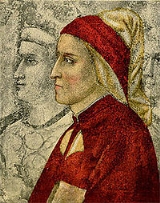
Dante Alighieri

Dante Alighieri

Overview
Durante degli Alighieri (May/June c.1265 – September 14, 1321), commonly known as Dante, was an Italian
Italy
Italy , officially the Italian Republic , is a country located on the Italian Peninsula in Southern Europe and on the two largest islands in the Mediterranean Sea, Sicily and Sardinia. Italy shares its northern, Alpine boundary with France, Switzerland, Austria and Slovenia...

 poet of the Middle Ages
Middle Ages
The Middle Ages of European history is a period of European history covering roughly a millennium in the 5th century through 16th centuries. More specific starting and ending points are sometimes adopted by scholars to suit their respective specializations or current focus...

. His central work
Magnum opus
Magnum opus , from the Latin meaning great work, refers to the largest, and perhaps the best, greatest, most popular, or most renowned achievement of an author, artist, or composer.The term Great Work is also used in several...

, the Divina Commedia (originally called Commedia and later called Divina ("divine") by Boccaccio), is often considered the greatest literary work composed in the Italian language
Italian language
Italian is a Romance language spoken by about 60 million people in Italy, and by a total of around 70 million in the world. In Switzerland, Italian is one of four official languages. It is also the official language of San Marino, as well as the primary language of Vatican City...

 and a masterpiece of world literature
Literature
Literature is the art of written works. Literally translated, the word means "acquaintance with letters" , and therefore the academic study of literature is known as Letters...

.

In Italy he is known as "the Supreme Poet" (il Sommo Poeta) or just il Poeta.
Discussion
Ask a question about 'Dante Alighieri'
Start a new discussion about 'Dante Alighieri'
Answer questions from other users
Full Discussion Forum
 
Unanswered Questions
Quotations

Love hath so long possessed me for his ownAnd made his lordship so familiar.

La Vita Nuova (1293)

Behold a God more powerful than I who comes to rule over me.

La Vita Nuova (1293)

Love with delight discourses in my mindUpon my lady's admirable gifts...Beyond the range of human intellect.

Il Convivio, Trattato Terzo, line 1 :Various translations have been used in this section.

Nel mezzo del cammin di nostra vita,Mi ritrovai per una selva oscura,Che la diritta via era smarrita.

When I had journeyed half of our life's way,I found myself within a shadowed forest,for I had lost the path that does not stray.

E come quei che con lena affannata,uscito fuor del pelago a la riva,si volge a l'acqua perigliosa e guata.

And just as he who, with exhausted breath,having escaped from the sea to shore,turns to the perilous waters and gazes.

Lasciate ogni speranza, voi ch'entrate.

All hope abandon, ye who enter in.

Qui si convien lasciare ogne sospetto;ogne viltà convien che qui sia morta.

Here one must leave behind all hesistation;here every cowardice must meet its death.

Questo misero modotegnon l'anime triste di coloroche visser sanza 'nfamia e sanza lodo.

This miserable state is borne by the wretched souls of those who lived without disgrace and without praise.

Caccianli i ciel per non esser men belli,né lo profondo inferno li riceve,ch'alcuna gloria i rei avrebber d'elli.

Heaven, to keep its beauty, cast them out, but even Hell itself would not receive them for fear the wicked there might glory over them.
Encyclopedia
Durante degli Alighieri (May/June c.1265 – September 14, 1321), commonly known as Dante, was an Italian
Italy
Italy , officially the Italian Republic , is a country located on the Italian Peninsula in Southern Europe and on the two largest islands in the Mediterranean Sea, Sicily and Sardinia. Italy shares its northern, Alpine boundary with France, Switzerland, Austria and Slovenia...

 poet of the Middle Ages
Middle Ages
The Middle Ages of European history is a period of European history covering roughly a millennium in the 5th century through 16th centuries. More specific starting and ending points are sometimes adopted by scholars to suit their respective specializations or current focus...

. His central work
Magnum opus
Magnum opus , from the Latin meaning great work, refers to the largest, and perhaps the best, greatest, most popular, or most renowned achievement of an author, artist, or composer.The term Great Work is also used in several...

, the Divina Commedia (originally called Commedia and later called Divina ("divine") by Boccaccio), is often considered the greatest literary work composed in the Italian language
Italian language
Italian is a Romance language spoken by about 60 million people in Italy, and by a total of around 70 million in the world. In Switzerland, Italian is one of four official languages. It is also the official language of San Marino, as well as the primary language of Vatican City...

 and a masterpiece of world literature
Literature
Literature is the art of written works. Literally translated, the word means "acquaintance with letters" , and therefore the academic study of literature is known as Letters...

.

In Italy he is known as "the Supreme Poet" (il Sommo Poeta) or just il Poeta. Dante, Petrarch
Petrarch
Francesco Petrarca , known in English as Petrarch, was an Italian scholar, poet and one of the earliest Renaissance humanists. Petrarch is often called the "Father of Humanism"...

 and Boccaccio are also known as "the three fountains" or "the three crowns". Dante is also called the "Father of the Italian language". The first biography written on him was by Giovanni Boccaccio
Giovanni Boccaccio
Giovanni Boccaccio was an Italian author and poet, a friend, student, and correspondent of Petrarch, an important Renaissance humanist and the author of a number of notable works including the Decameron, On Famous Women, and his poetry in the Italian vernacular...

 (1313-1375), who wrote the Trattatello in laude di Dante.

Life


The exact date of Dante's birth is not known, although it is generally believed to be around 1265. This can be deduced from autobiographic allusions in La Divina Commedia, "the Inferno
Inferno (Dante)
Inferno is the first part of Dante's Divine Comedy. The poem was written in the early 14th century. It is an allegory telling of the journey of Dante through what is largely the medieval concept of Hell, guided by the Roman poet Virgil. In the poem, Hell is depicted as nine Circles of suffering...

" (Halfway through the journey we are living, implying that Dante was around 35 years old, as the average lifespan according to the Bible (Psalms 89:10, Vulgate) is 70 years, and as the imaginary travel took place in 1300 Dante must have been born around 1265). Some verses of the Paradiso section of the Divine Comedy also provide a possible clue that he was born under the sign of Gemini
Gemini (astrology)
Gemini is the third astrological sign in the Zodiac, originating from the constellation of Gemini. In western astrology, this sign is no longer aligned with the constellation as a result of the precession of the equinoxes. In astrology, Gemini is considered a "masculine", positive sign. It is...

 - "As I revolved with the eternal twins, I saw revealed from hills to river outlets, the threshing-floor that makes us so ferocious", XXII 151-154), but these cannot be considered definitive statements by Dante about his birth. However, in 1265 the Sun was in Gemini approximately during the period 11 May to 11 June. His birth date is listed as "probably in the end of May" by Robert Hollander in "Dante" in Dictionary of the Middle Ages
Dictionary of the Middle Ages
The Dictionary of the Middle Ages is a 13-volume encyclopedia of the Middle Ages published by the American Council of Learned Societies between 1982 and 1989. It was first conceived and started in 1975 with American medieval historian Joseph Strayer of Princeton University as editor-in-chief...

, volume 4. In summary, most students of Dante's life believe that he was born between about the middle of May and about the middle of June 1265, but there is little likelihood a definite date will ever be known.


Dante claimed that his family descended from the ancient Romans
Ancient Rome
Ancient Rome was a civilization that grew out of a small agricultural community founded on the Italian Peninsula as early as the 10th century BC. Located along the Mediterranean Sea, it became one of the largest empires in the ancient world....

 (Inferno, XV, 76), but the earliest relative he could mention by name was Cacciaguida
Cacciaguida
Cacciaguida degli Elisei was an Italian crusader, the great-great-grandfather of Dante Alighieri.Little is known about his life. He was born in Florence, and two documents from 1189 and 1201 mention his existence; all other details of his biography are those from his most famous descendant's works...

 degli Elisei (Paradiso, XV, 135), of no earlier than about 1100. Dante's father, Alighiero di Bellincione, was a White Guelph
Guelphs and Ghibellines
The Guelphs and Ghibellines were factions supporting, respectively, the Pope and the Holy Roman Emperor in central and northern Italy during the 12th and 13th centuries...

 who suffered no reprisals after the Ghibellines won the Battle of Montaperti
Battle of Montaperti
The Battle of Montaperti was fought on September 4, 1260, between Florence and Siena in Tuscany as part of the conflict between the Guelphs and Ghibellines...

 in the mid 13th century. This suggests that Alighiero or his family enjoyed some protective prestige and status.

Dante's family was prominent in Florence, with loyalties to the Guelphs
Guelphs and Ghibellines
The Guelphs and Ghibellines were factions supporting, respectively, the Pope and the Holy Roman Emperor in central and northern Italy during the 12th and 13th centuries...

, a political alliance that supported the Papacy and which was involved in complex opposition to the Ghibellines
Guelphs and Ghibellines
The Guelphs and Ghibellines were factions supporting, respectively, the Pope and the Holy Roman Emperor in central and northern Italy during the 12th and 13th centuries...

, who were backed by the Holy Roman Emperor
Holy Roman Emperor
The Holy Roman Emperor is a term used by historians to denote a Middle Ages ruler, who as German King had in addition received the title of "Emperor of the Romans" from the Pope of the Holy Roman Church, and after the 16th century, the elected monarch governing the Holy Roman Empire, a Central...

. The poet's mother was Bella degli Abati. She died when Dante was not yet ten years old, and Alighiero soon married again, to Lapa di Chiarissimo Cialuffi. It is uncertain whether he really married her, as widowers had social limitations in these matters. This woman definitely bore two children, Dante's brother Francesco and sister Tana (Gaetana). When Dante was 12, he was promised in marriage to Gemma di Manetto Donati, daughter of Messer Manetto Donati. Contracting marriages at this early age was quite common and involved a formal ceremony, including contracts signed before a notary
Notary public
A notary public is a public officer constituted by law to serve the public in non-contentious matters usually concerned with estates, deeds, powers-of-attorney, and foreign and international business...

. Dante had already fallen in love with another woman, Beatrice Portinari
Beatrice Portinari
Beatrice "Bice" di Folco Portinari was a Florentine woman and the principal inspiration for Dante Alighieri's Vita Nuova. Beatrice also appears as his guide in Divine Comedy in the last book, Paradise, and in the last four canti of Purgatory...

 (known also as Bice). Years after his marriage to Gemma, he met Beatrice again. He had become interested in writing verse, and although he wrote several sonnets to Beatrice, he never mentioned his wife Gemma in any of his poems.

Dante fought in the front rank of the Guelph cavalry at the battle of Campaldino
Battle of Campaldino
The Battle of Campaldino was a battle between the Guelphs and Ghibellines on 11 June 1289. Mixed bands of pro-papal Guelf forces of Florence and allies, Pistoia, Lucca, Siena and Prato, all loosely commanded by the paid condottiero Amerigo di Narbona with his own professional following, met a...

 (June 11, 1289). This victory brought forth a reformation of the Florentine constitution. To take any part in public life, one had to be enrolled in one of "the arts". So Dante entered the guild of physicians and apothecaries. In following years, his name is frequently found recorded as speaking or voting in the various councils of the republic.

Dante had several children with Gemma. As often happens with significant figures, many people subsequently claimed to be Dante's offspring; however, it is likely that Jacopo, Pietro, Giovanni and Antonia were truly his children. Antonia became a nun with the name of Sister Beatrice.

Education and poetry


Not much is known about Dante's education, and it is presumed he studied at home. It is known that he studied Tuscan
Tuscany
Tuscany is a region in North-Central Italy. It has an area of and a population of about 3.6 million inhabitants. The regional capital is Florence.Tuscany is known for its landscapes and its artistic legacy...

 poetry, at a time when the Sicilian School
Sicilian School
The Sicilian School was a small community of Sicilian, and to a lesser extent, mainland Italian poets gathered around Frederick II, most of them belonging to his court, the Magna Curia. Headed by Giacomo da Lentini, they produced more than three-hundred poems of courtly love between 1230 and 1266,...

 (Scuola poetica siciliana), a cultural group from Sicily
Sicily
Sicily is the largest island in the Mediterranean Sea. It is an autonomous region of Italy. Several much smaller islands surrounding it are considered to be part of Sicily....

, was becoming known in Tuscany. His interests brought him to discover the Occitan poetry of the troubadours and the Latin
Latin
Latin is an Italic language originally spoken in Latium and Ancient Rome. Through the Roman conquest, Latin spread throughout the Mediterranean and a large part of Europe...

 poetry of classical antiquity
Classical antiquity
Classical antiquity is a broad term for a long period of cultural history centered on the Mediterranean Sea, comprising the interlocking civilizations of Ancient Greece and Ancient Rome collectively known as the Greco-Roman world...

 (with a particular devotion to Virgil
Virgil
Publius Vergilius Maro was a classical Roman poet, best known for three major works—the Eclogues , the Georgics, and the Aeneid—although several minor poems are also attributed to him.The son of a farmer, Virgil came to be...

).

During the "Secoli Bui" (Dark Ages
Dark Ages
The Dark Ages is a term in historiography referring to a perceived period of cultural decline or societal collapse that took place in Western Europe between the fall of Rome and the eventual recovery of learning. Increased understanding of the accomplishments of the Middle Ages in the 19th century...

), Italy had become a mosaic of small states, Sicily being the largest one, at the time under the Angevine dominations
House of Anjou
Angevin is the name applied to the residents of Anjou, a former province of the Kingdom of France, as well as to the residents of Angers....

, and as far (culturally and politically) from Tuscany as Occitania
Occitania
Occitania , also called sometimes the Oc Country , is the territory where Occitan is the traditional language in use. This cultural area is roughly the southern half of France. It includes Monaco, spans parts of Italy and Spain...

 was: the regions did not share a language, culture or easy communications. Nevertheless, we can assume that Dante was a keen up-to-date intellectual with international interests.
When he was nine years old he met Beatrice Portinari
Beatrice Portinari
Beatrice "Bice" di Folco Portinari was a Florentine woman and the principal inspiration for Dante Alighieri's Vita Nuova. Beatrice also appears as his guide in Divine Comedy in the last book, Paradise, and in the last four canti of Purgatory...

, daughter of Folco Portinari, with whom he fell in love "at first sight", and apparently without even having spoken to her. He saw her frequently after age 18, often exchanging greetings in the street, but he never knew her well; he effectively set the example for the so-called "courtly love and sexual desire". It is hard now to understand what this love actually consisted of, but something extremely important was happening within Italian culture. It was in the name of this love that Dante gave his imprint to the "Dolce Stil Novo
Dolce Stil Novo
Dolce Stil Novo , or stilnovismo, is the name given to the most important literary movement of 13th century in Italy. Influenced by both Sicilian and Tuscan poetry, its main theme is Love . Gentilezza and Amore are indeed topoi in the major works of the period...

" (Sweet New Style) and would lead poets and writers to discover the themes of Love (Amore), which had never been so emphasized before. Love for Beatrice (as in a different manner Petrarch
Petrarch
Francesco Petrarca , known in English as Petrarch, was an Italian scholar, poet and one of the earliest Renaissance humanists. Petrarch is often called the "Father of Humanism"...

 would show for his Laura) would apparently be the reason for poetry and for living, together with political passions. In many of his poems, she is depicted as semi-divine, watching over him constantly. When Beatrice died in 1290, Dante tried to find a refuge in Latin literature
Latin literature
Latin literature, the body of written works in the Latin language, remains an enduring legacy of the culture of ancient Rome. The Romans produced many works of poetry, comedy, tragedy, satire, history, and rhetoric, drawing heavily on the traditions of other cultures and particularly on the more...

. The Convivio
Convivio
Convivio is a work written by Dante Alighieri roughly between 1304 and 1307. It contains details of the author's growing interest in philosophy, particularly in reference to the works of Cicero and Boethius...

reveals that he had read Boethius's
Anicius Manlius Severinus Boethius
Anicius Manlius Severinus Boëthius was a Christian philosopher of the early 6th century. He was born in Rome to an ancient and important family which included emperors Petronius Maximus and Olybrius and many consuls. His father, Flavius Manlius Boethius, was consul in 487 after Odoacer deposed the...

 De consolatione philosophiae and Cicero
Cicero
Marcus Tullius Cicero was a Roman philosopher, statesman, lawyer, political theorist, and Roman constitutionalist. Cicero is widely considered one of Rome's greatest orators and prose stylists.Cicero is generally perceived to be one of the most versatile minds of ancient Rome...

's De amicitia. He then dedicated himself to philosophical studies at religious schools like the Dominican one in Santa Maria Novella. He took part in the disputes that the two principal mendicant orders (Franciscan
Franciscan
The term Franciscan is commonly used to refer to members of Catholic religious orders, also known as the Orders of Friars Minor, that follow a body of regulations known as "The rule of St. Francis", or a member of one of these orders. As well as Roman Catholic there are also small Old Catholic and...

 and Dominican
Dominican Order
The Order of Preachers , after the 15th century more commonly known as the Dominican Order or Dominicans, is a Catholic religious order founded by Saint Dominic in the early 13th century in France...

) publicly or indirectly held in Florence, the former explaining the doctrine of the mystics and of Saint Bonaventure
Bonaventure
Bonaventure , born John of Fidanza , was an Italian medieval scholastic theologian and philosopher, the eighth Minister General of the Order of Friars Minor. He was a Cardinal Bishop of Albano. He was canonized on 14 April 1482 by Pope Sixtus IV and declared a Doctor of the Church in the year 1588...

, the latter presenting Saint Thomas Aquinas
Thomas Aquinas
Saint Thomas Aquinas, O.P. was a priest of the Roman Catholic Church in the Dominican Order from Italy, and an immensely influential philosopher and theologian in the tradition of scholasticism, known as Doctor Angelicus and Doctor Communis...

' theories.

At 18, Dante met Guido Cavalcanti
Guido Cavalcanti
Guido Cavalcanti was a Florentine poet, as well as an intellectual influence on his best friend, Dante. His poems in their original Italian are available on Wikisource .- Historical Background :...

, Lapo Gianni
Lapo Gianni
Lapo Gianni was an Italian poet who lived in Florence in the 13th-14th centuries. He was a member of the Florentine circle of the Italian movement called Dolce Stil Novo, and was probably a notary....

, Cino da Pistoia
Cino da Pistoia
Cino da Pistoia was an Italian jurist and poet.He was born in Pistoia, Tuscany. His full name was Guittoncino dei Sinibaldi or, Latinised, Cinus de Sighibuldis. He received his doctorate from the University of Bologna, where he studied under Dinus de Rossonis, and taught law at the universities of...

 and soon after Brunetto Latini
Brunetto Latini
Brunetto Latini was an Italian philosopher, scholar and statesman.-Life:...

; together they became the leaders of the Dolce Stil Novo. Brunetto later received a special mention in the Divine Comedy (Inferno, XV, 28), for what he had taught Dante.
Nor speaking less on that account, I go With Ser Brunetto, and I ask who are His most known and most eminent companions. Some fifty poetical components by Dante are known (the so-called Rime
The Rime
The Rime is a collection of lyrical poems written by Dante Alighieri in the Italian language. They include some fifty components, of unorganic structure....

, rhymes), others being included in the later Vita Nuova and Convivio. Other studies are reported, or deduced from Vita Nuova or the Comedy, regarding painting and music.

Florence and politics


Dante, like most Florentines of his day, was embroiled in the Guelph-Ghibelline
Guelphs and Ghibellines
The Guelphs and Ghibellines were factions supporting, respectively, the Pope and the Holy Roman Emperor in central and northern Italy during the 12th and 13th centuries...

 conflict. He fought in the battle of Campaldino
Battle of Campaldino
The Battle of Campaldino was a battle between the Guelphs and Ghibellines on 11 June 1289. Mixed bands of pro-papal Guelf forces of Florence and allies, Pistoia, Lucca, Siena and Prato, all loosely commanded by the paid condottiero Amerigo di Narbona with his own professional following, met a...

 (June 11, 1289), with the Florentine Guelphs against Arezzo
Arezzo
Arezzo or Arretium is a city in central Italy, capital of the province of the same name, located in Tuscany. Arezzo is about south-east of Florence, at an elevation of 296 meters above sea level. In 2009 the population was about 99,000 people....

 Ghibellines, then in 1294 he was among the escorts of Charles Martel of Anjou
Charles Martel of Anjou
Charles Martel of the Angevin dynasty, also known as Charles I Martel, was the eldest son of king Charles II of Naples and Maria of Hungary, the daughter of King Stephen V of Hungary....

 (grandson of Charles I of Naples more commonly called Charles of Anjou) while he was in Florence. To further his political career, he became a pharmacist. He did not intend to actually practice as one, but a law issued in 1295 required that nobles who wanted public office had to be enrolled in one of the Corporazioni delle Arti e dei Mestieri, so Dante obtained admission to the apothecaries' guild. This profession was not entirely inapt, since at that time books were sold from apothecaries' shops. As a politician, he accomplished little, but he held various offices over a number of years in a city undergoing political unrest.

After defeating the Ghibellines, the Guelphs divided into two factions: the White Guelphs (Guelfi Bianchi) -- Dante's party, led by Vieri dei Cerchi -- and the Black Guelphs (Guelfi Neri), led by Corso Donati
Corso Donati
Corso Donati was a leader of the Black Guelph faction in 13th- and early 14th- century Florence. He is discussed prominently in several contemporary histories: Niccolò Machiavelli's History of Florence, the Nuova Cronica of Giovanni Villani, and the Cronica delle cose occorrenti ne' tempi suoi of...

. Although initially the split was along family lines, ideological differences rose based on opposing views of the papal role in Florentine affairs, with the Blacks supporting the Pope and the Whites wanting more freedom from Rome. Initially the Whites were in power and expelled the Blacks. In response, Pope Boniface VIII
Pope Boniface VIII
Pope Boniface VIII , born Benedetto Caetani, was Pope of the Roman Catholic Church from 1294 to 1303. Today, Boniface VIII is probably best remembered for his feuds with Dante, who placed him in a circle of Hell in his Commedia, and King Philip IV of France.- Biography :Caetani was born in 1235 in...

 planned a military occupation of Florence. In 1301, Charles de Valois
Charles of Valois
Charles of Valois was the fourth son of Philip III of France and Isabella of Aragon. His mother was a daughter of James I of Aragon and Yolande of Hungary. He was a member of the House of Capet and founded the House of Valois...

, brother of Philip the Fair
Philip IV of France
Philip IV , called the Fair , son and successor of Philip III, reigned as King of France from 1285 until his death. He was the husband of Joan I of Navarre, by virtue of which he was King of Navarre and Count of Champagne from 1284 to 1305...

 king of France
France
France , officially the French Republic , is a country located in Western Europe, with several overseas islands and territories located on other continents. Metropolitan France extends from the Mediterranean Sea to the English Channel and the North Sea, and from the Rhine to the Atlantic Ocean...

, was expected to visit Florence because the Pope had appointed him peacemaker for Tuscany
Tuscany
Tuscany is a region in North-Central Italy. It has an area of and a population of about 3.6 million inhabitants. The regional capital is Florence.Tuscany is known for its landscapes and its artistic legacy...

. But the city's government had treated the Pope's ambassadors badly a few weeks before, seeking independence from papal influence. It was believed that Charles de Valois would eventually have received other unofficial instructions. So the council sent a delegation to Rome
Rome
Rome is the capital of Italy and the country's largest and most populated municipality , with over 2.7 million residents in , while the population of the urban area is estimated by Eurostat to be 3.46 million. The metropolitan area of Rome is estimated by OECD to have a population of 3.7 million...

 to ascertain the Pope's intentions. Dante was one of the delegates.

Exile and death


Boniface quickly dismissed the other delegates and asked Dante alone to remain in Rome. At the same time (November 1, 1301), Charles de Valois
Charles de Valois
Charles de Valois may refer to:*Charles of Valois *Charles, duc d'Orléans *Charles de Valois, Duc de Berry *Charles de Valois, Duc d'Orléans...

 entered Florence with Black Guelphs, who in the next six days destroyed much of the city and killed many of their enemies. A new Black Guelph government was installed and Messer Cante de' Gabrielli
Cante de' Gabrielli
-Biography:Cante was born in Gubbio to a powerful Guelph feudal family. He held several high offices as Podestà in a number of cities in Tuscany and Umbria and was lord of Gubbio, Cantiano and other castles...

 da Gubbio
Gubbio
Gubbio is a town and comune in the far northeastern part of the Italian province of Perugia It is located on the lowest slope of Mt...

 was appointed Podestà
Podestà
Podestà is the name given to certain high officials in many Italian cities, since the later Middle Ages, mainly as Chief magistrate of a city state , but also as a local administrator, the representative of the Emperor.The term derives from the Latin word potestas, meaning power...

of Florence. Dante was condemned to exile for two years, and ordered to pay a large fine. The poet was still in Rome, where the Pope had "suggested" he stay, and was therefore considered an absconder. He did not pay the fine, in part because he believed he was not guilty, and in part because all his assets in Florence had been seized by the Black Guelphs. He was condemned to perpetual exile, and if he returned to Florence without paying the fine, he could be burned at the stake. (The city council of Florence finally passed a motion rescinding Dante's sentence in June 2008.)
He took part in several attempts by the White Guelphs to regain power, but these failed due to treachery. Dante, bitter at the treatment he received from his enemies, also grew disgusted with the infighting and ineffectiveness of his erstwhile allies, and vowed to become a party of one. At this point, he began sketching the foundation for the Divine Comedy, a work in 100 canto
Canto
The canto is a principal form of division in a long poem, especially the epic. The word comes from Italian, from the Latin canto, meaning "I sing," and has a corollary in the Sanskrit , or "chapter." Famous examples of epic poetry which employ the canto division are Valmiki's The Ramayana ,...

s, divided into three books of thirty-three cantos each, with a single introductory canto.

Dante went to Verona as a guest of Bartolomeo I della Scala
Bartolomeo I della Scala
Bartolomeo I della Scala was lord of Verona from 1301, a member of the Scaliger family.The son of Alberto I della Scala, Bartolomeo succeeded him after his death in 1301. He had married in 1291 Constance of Hohenstaufen, daughter of Corrado d'Antiochia.Bartolomeo died in 1304. His brother Alboino...

, then moved to Sarzana
Sarzana
Sarzana is a town and comune in the Province of La Spezia, of Liguria, Italy, 15 km east of Spezia, on the railway to Pisa, at the point where the railway to Parma diverges to the north...

 in Liguria
Liguria
Liguria is a coastal region of north-western Italy, the third smallest of the Italian regions. Its capital is Genoa. It is a popular region with tourists for its beautiful beaches, picturesque little towns, and food.- Geography :...

. Later, he is supposed to have lived in Lucca
Lucca
Lucca is a city in Tuscany, central Italy, situated on the river Serchio in a fertile plain near the Ligurian Sea. It is the capital city of the Province of Lucca...

 with Madame Gentucca, who made his stay comfortable (and was later gratefully mentioned in Purgatorio, XXIV, 37). Some speculative sources say that he was also in Paris
Paris
Paris is the capital of France and the country's most populous city. It is situated on the river Seine, in northern France, at the heart of the Île-de-France region...

 between 1308 and 1310. Other sources, even less trustworthy, take him to Oxford
Oxford
Oxford is a city, and the county town of Oxfordshire, in South East England. The city has a population of just under 165,000, with 151,000 living within the district boundary. The rivers Cherwell and Thames run through Oxford and meet south of the city centre...

. In 1310, the Holy Roman Emperor Henry VII
Henry VII, Holy Roman Emperor
Henry VII was the King of Germany from 1308 and Holy Roman Emperor from 1312. He was the first emperor of the House of Luxembourg...

 of Luxembourg
Luxembourg
Luxembourg , officially the Grand Duchy of Luxembourg , is a small, landlocked country in western Europe, bordered by Belgium, France, and Germany...

, marched 5,000 troops into Italy. Dante saw in him a new Charlemagne
Charlemagne
Charlemagne was King of the Franks from 768 to his death. He expanded the Frankish kingdoms into a Frankish Empire that incorporated much of Western and Central Europe...

 who would restore the office of the Holy Roman Emperor to its former glory and also re-take Florence from the Black Guelphs. He wrote to Henry and several Italian princes, demanding that they destroy the Black Guelphs. Mixing religion and private concerns, he invoked the worst anger of God against his city, suggesting several particular targets that coincided with his personal enemies. It was during this time that he wrote the first two books of the Divine Comedy.

In Florence, Baldo d'Aguglione pardoned most of the White Guelphs in exile and allowed them to return; however, Dante had gone too far in his violent letters to Arrigo (Henry VII), and he was not recalled.

In 1312, Henry assaulted Florence and defeated the Black Guelphs, but there is no evidence that Dante was involved. Some say he refused to participate in the assault on his city by a foreigner; others suggest that he had become unpopular with the White Guelphs too and that any trace of his passage had carefully been removed. In 1313, Henry VII died, and with him any hope for Dante to see Florence again. He returned to Verona, where Cangrande I della Scala
Cangrande I della Scala
Cangrande della Scala was an Italian nobleman, the most celebrated of the della Scala family which ruled Verona from 1277 until 1387. Now perhaps best known as the leading patron of the poet Dante Alighieri, Cangrande was in his own day chiefly acclaimed as a successful warrior and autocrat...

 allowed him to live in a certain security and, presumably, in a fair amount of prosperity. Cangrande was admitted to Dante's Paradise (Paradiso, XVII, 76).

In 1315, Florence was forced by Uguccione della Faggiuola
Uguccione della Faggiuola
Uguccione della Faggiuola was an Italian condottiero, and chief magistrate of Pisa, Lucca and Forlì .-Biography:...

 (the military officer controlling the town) to grant an amnesty to people in exile, including Dante. But Florence required that as well as paying a sum of money, these exiles would do public penance
Penance
Penance is repentance of sins as well as the proper name of the Roman Catholic, Anglican, and Orthodox Christian Sacrament of Penance and Reconciliation/Confession. It also plays a part in the Lutheran Divine Service...

. Dante refused, preferring to remain in exile. When Uguccione defeated Florence, Dante's death sentence was commuted to house arrest, on condition that he go to Florence to swear that he would never enter the town again. Dante refused to go. His death sentence was confirmed and extended to his sons. Dante still hoped late in life that he might be invited back to Florence on honorable terms. For Dante, exile was nearly a form of death, stripping him of much of his identity. He addresses the pain of exile in Paradiso, XVII (55-60), where Cacciaguida, his great-great-grandfather, warns him what to expect:
... Tu lascerai ogne cosa diletta ... You shall leave everything you love most:
più caramente; e questo è quello strale this is the arrow that the bow of exile
che l'arco de lo essilio pria saetta. shoots first. You are to know the bitter taste
Tu proverai sì come sa di sale of others' bread, how salty it is, and know
lo pane altrui, e come è duro calle how hard a path it is for one who goes
lo scendere e 'l salir per l'altrui scale ... ascending and descending others' stairs ...


As for the hope of returning to Florence, he describes it as if he had already accepted its impossibility, (Paradiso, XXV, 1–9):
Se mai continga che 'l poema sacro If it ever come to pass that the sacred poem
al quale ha posto mano e cielo e terra, to which both heaven and earth have set their hand
sì che m'ha fatto per molti anni macro, so as to have made me lean for many years
vinca la crudeltà che fuor mi serra should overcome the cruelty that bars me
del bello ovile ov'io dormi' agnello, from the fair sheepfold where I slept as a lamb,
nimico ai lupi che li danno guerra; an enemy to the wolves that make war on it,
con altra voce omai, con altro vello with another voice now and other fleece
ritornerò poeta, e in sul fonte I shall return a poet and at the font
del mio battesmo prenderò 'l cappello ... of my baptism take the laurel crown
Laurel wreath
A laurel wreath is a circular wreath made of interlocking branches and leaves of the bay laurel , an aromatic broadleaf evergreen. In Greek mythology, Apollo is represented wearing a laurel wreath on his head...

 ...

Prince Guido Novello da Polenta invited him to Ravenna
Ravenna
Ravenna is a city and comune in the Emilia-Romagna region of Italy. The city is inland, but is connected to the Adriatic Sea by a canal. Ravenna was the capital of the Western Roman Empire till 476. It was later the capital ofKingdom of the Ostrogoths and the Exarchate of Ravenna till 751...

 in 1318, and he accepted. He finished the Paradiso, and died in 1321 (at the age of 56) while returning to Ravenna from a diplomatic mission to Venice, possibly of malaria
Malaria
Malaria is a vector-borne infectious disease caused by a eukaryotic protist of the genus Plasmodium. It is widespread in tropical and subtropical regions, including parts of the Americas, Asia, and Africa. Each year, there are approximately 350–500 million cases of malaria, killing between one and...

 contracted there. Dante was buried in Ravenna at the Church of San Pier Maggiore (later called San Francesco). Bernardo Bembo, praetor
Praetor
Praetor was a title granted by the government of Ancient Rome to men acting in one of two official capacities: the commander of an army, either before it was mustered or more typically in the field, or an elected magistrate assigned duties that varied depending on the historical period. The...

 of Venice
Venice
Venice is a city in northern Italy, the capital of the region Veneto, a population of 271,367 . Together with Padua, the city is included in the Padua-Venice Metropolitan Area . The city historically was an independent nation...

 in 1483, took care of his remains by building a better tomb.


On the grave, some verses of Bernardo Canaccio, a friend of Dante, dedicated to Florence:
parvi Florentia mater amoris
"Florence, mother of little love"


Eventually, Florence came to regret Dante's exile, and made repeated requests for the return of his remains. The custodians of the body at Ravenna refused to comply, at one point going so far as to conceal the bones in a false wall of the monastery. Nevertheless, in 1829, a tomb was built for him in Florence in the basilica of Santa Croce
Basilica di Santa Croce di Firenze
The Basilica di Santa Croce is the principal Franciscan church in Florence, Italy, and a minor basilica of the Roman Catholic Church. It is situated on the Piazza di Santa Croce, about 800 metres south east of the Duomo. The site, when first chosen, was in marshland outside the city walls...

. That tomb has been empty
Cenotaph
A cenotaph is a tomb or a monument erected in honor of a person or group of persons whose remains are elsewhere. It can also be the initial tomb for a person who has since been interred elsewhere. The word derives from the Greek κενοτάϕιον...

 ever since, with Dante's body remaining in Ravenna, far from the land he loved so dearly. The front of his tomb in Florence reads Onorate l'altissimo poeta - which roughly translates as "Honour the most exalted poet". The phrase is a quote from the fourth canto of the Inferno, depicting Virgil's welcome as he returns among the great ancient poets spending eternity in Limbo. The continuation of the line, L'ombra sua torna, ch'era dipartita ("his spirit, which had left us, returns"), is poignantly absent from the empty tomb.

In 2007, a reconstruction of Dante's face was completed in a collaborative project. Artists from Pisa University and engineers at the University of Bologna at Forli completed the revealing model, which indicated that Dante's features were somewhat different than was once thought.

Works

See also :Category:Works by Dante Alighieri.

The Divine Comedy describes Dante's journey through Hell (Inferno), Purgatory (Purgatorio), and Paradise (Paradiso), guided first by the Roman poet Virgil
Virgil
Publius Vergilius Maro was a classical Roman poet, best known for three major works—the Eclogues , the Georgics, and the Aeneid—although several minor poems are also attributed to him.The son of a farmer, Virgil came to be...

 and then by Beatrice
Beatrice Portinari
Beatrice "Bice" di Folco Portinari was a Florentine woman and the principal inspiration for Dante Alighieri's Vita Nuova. Beatrice also appears as his guide in Divine Comedy in the last book, Paradise, and in the last four canti of Purgatory...

, the subject of his love and of another of his works, La Vita Nuova
La Vita Nuova
La Vita Nuova is a medieval text written by Dante Alighieri in 1295. It is an expression of the medieval genre of courtly love in a prosimetrum style, a combination of both prose and verse...

. While the vision of Hell, the Inferno, is vivid for modern readers, the theological niceties presented in the other books require a certain amount of patience and knowledge to appreciate. Purgatorio, the most lyrical and human of the three, also has the most poets in it; Paradiso, the most heavily theological, has the most beautiful and ecstatic mystic passages in which Dante tries to describe what he confesses he is unable to convey (e.g., when Dante looks into the face of God: "all'alta fantasia qui mancò possa" - "at this high moment, ability failed my capacity to describe," Paradiso, XXXIII, 142).

Dante wrote the Comedy in a new language he called "Italian", based on the regional dialect of Tuscany, with some elements of Latin and of the other regional dialects. By creating a poem of epic structure and philosophic purpose, he established that the Italian language
Italian language
Italian is a Romance language spoken by about 60 million people in Italy, and by a total of around 70 million in the world. In Switzerland, Italian is one of four official languages. It is also the official language of San Marino, as well as the primary language of Vatican City...

 was suitable for the highest sort of expression. In French, Italian is nicknamed la langue de Dante. Publishing in the vernacular language marked Dante as one of the first (among others such as Geoffrey Chaucer
Geoffrey Chaucer
Geoffrey Chaucer was an English author, poet, philosopher, bureaucrat, courtier and diplomat. Although he wrote many works, he is best remembered for his unfinished frame narrative The Canterbury Tales...

 and Giovanni Boccaccio
Giovanni Boccaccio
Giovanni Boccaccio was an Italian author and poet, a friend, student, and correspondent of Petrarch, an important Renaissance humanist and the author of a number of notable works including the Decameron, On Famous Women, and his poetry in the Italian vernacular...

) to break from standards of publishing in only Latin (the languages of liturgy
Liturgy
A liturgy is the customary public worship done by a specific religious group, according to its particular traditions. The word may refer to an elaborate formal ritual such as the Eastern Orthodox Divine Liturgy and Catholic Mass, or a daily activity such as the Muslim salat and Jewish services...

, history, and scholarship in general). This break allowed more literature to be published for a wider audience - setting the stage for greater levels of literacy in the future.

Readers often cannot understand how such a serious work may be called a "comedy". In Dante's time, all serious scholarly works were written in Latin (a tradition that would persist for several hundred years more, until the waning years of the Enlightenment
Age of Enlightenment
The Age of Enlightenment, or simply The Enlightenment, is a term used to describe a time in Western philosophy and cultural life, centered upon the eighteenth century, in which reason was advocated as the primary source and legitimacy for authority....

) and works written in any other language were assumed to be more trivial in nature.
Furthermore, the word "comedy
Comedy
Comedy as a popular meaning, is any humorous discourse generally intended to amuse, especially in television, film, and stand-up comedy. This must be carefully distinguished from its academic definition, namely the comic theatre, whose Western origins are found in Ancient Greece...

," in the classical sense, refers to works which reflect belief in an ordered universe, in which events not only tended towards a happy or "amusing" ending, but an ending influenced by a Providential will that orders all things to an ultimate good. By this meaning of the word, as Dante himself wrote in a letter to Cangrande I della Scala
Cangrande I della Scala
Cangrande della Scala was an Italian nobleman, the most celebrated of the della Scala family which ruled Verona from 1277 until 1387. Now perhaps best known as the leading patron of the poet Dante Alighieri, Cangrande was in his own day chiefly acclaimed as a successful warrior and autocrat...

, the progression of the pilgrimage from Hell to Paradise is the paradigmatic expression of comedy, since the work begins with the pilgrim's moral confusion and ends with the vision of God.

Dante's other works include the Convivio
Convivio
Convivio is a work written by Dante Alighieri roughly between 1304 and 1307. It contains details of the author's growing interest in philosophy, particularly in reference to the works of Cicero and Boethius...

("The Banquet") a collection of his longest poems with an (unfinished) allegorical commentary; Monarchia, which was condemned and burned after Dante's death by the Papal Legate Bertrando del Poggetto and which serves as a monumental political philosophy treatise describing a monarchial global political organization and its relationship to the Roman Catholic Church; De vulgari eloquentia
De vulgari eloquentia
De vulgari eloquentia is the title of an essay by Dante Alighieri, written in Latin and initially meant to consist of four books, but abandoned in the middle of the second. It was probably composed shortly after Dante went into exile; internal evidence points to a date between 1302 and 1305...

("On the Eloquence of Vernacular"), on vernacular literature, partly inspired by the Razos de trobar of Raimon Vidal de Bezaudun
Raimon Vidal de Bezaudun
Raimon Vidal de Bezaudu was a Catalan troubadour from Besalú. He is famous for authoring the first poetical tract in a Romance language , the Razos de trobar...

; and, La Vita Nuova
La Vita Nuova
La Vita Nuova is a medieval text written by Dante Alighieri in 1295. It is an expression of the medieval genre of courtly love in a prosimetrum style, a combination of both prose and verse...

("The New Life"), the story of his love for Beatrice Portinari
Beatrice Portinari
Beatrice "Bice" di Folco Portinari was a Florentine woman and the principal inspiration for Dante Alighieri's Vita Nuova. Beatrice also appears as his guide in Divine Comedy in the last book, Paradise, and in the last four canti of Purgatory...

, who also served as the ultimate symbol of salvation in the Comedy. The Vita Nuova contains many of Dante's love poems in Tuscan, which was not unprecedented; the vernacular had been regularly used for lyric works before, during all the thirteenth century. One of the most famous poems is Tanto gentile e tanto onesta pare, which many Italians can recite by heart. However, Dante's commentary on his own work is also in the vernacular - both in the Vita Nuova and in the Convivio - instead of the Latin that was almost universally used. References to Divina Commedia are in the format (book, canto, verse), e.g., (Inferno, XV, 76).

Further reading

  • Gardner, Edmund Garratt
    Edmund Garratt Gardner
    Edmund Garratt Gardner, , was an English writer who specialised in Italian history related topics.His works include:* The story of Florence, dealing with Florence, Italy....

     (1921). Dante, London, Pub. for the British academy by H. Milford, Oxford University Press.
  • Hede, Jesper. (2007). Reading Dante: The Pursuit of Meaning. Lanham, MD: Lexington Books.
  • Scott, John A. (1996). Dante's Political Purgatory, Philadelphia, University of Pennsylvania Press.
  • Seung, T. K.
    T. K. Seung
    T. K. Seung is a professor and prolific author. His academic interests range among diverse philosophical and literary subjects, including ethics, political philosophy, philosophy of law, hermeneutics, Kant, Plato, and ancient Chinese philosophy.He is presently the Jesse H...

    (1962). The Fragile Leaves of the Sibyl: Dante's Master Plan. Westminster, MD: Newman Press.
  • Toynbee, Paget (1898) A Dictionary of the Proper Names and Notable Matters in the Works of Dante. London, The Clarendon Press.
  • Whiting, Mary Bradford (1922). Dante the Man and the Poet. Cambridge, England. W. Heffer & Sons, ltd.

External links