


Carolingian minuscule

Encyclopedia
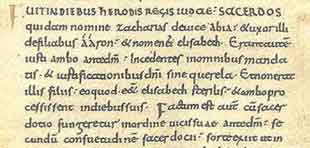
Hand (handwriting)
A Hand, in calligraphy and palaeography refers to one of several historical varieties of formal, impersonal, generic and exemplary writing styles...
developed as a writing standard in Europe
Europe
Europe is, by convention, one of the world's seven continents. Comprising the westernmost peninsula of Eurasia, Europe is generally 'divided' from Asia to its east by the watershed divides of the Ural and Caucasus Mountains, the Ural River, the Caspian and Black Seas, and the waterways connecting...
so that the Roman alphabet could be easily recognized by the literate class from one region to another. It was used in Charlemagne
Charlemagne
Charlemagne was King of the Franks from 768 and Emperor of the Romans from 800 to his death in 814. He expanded the Frankish kingdom into an empire that incorporated much of Western and Central Europe. During his reign, he conquered Italy and was crowned by Pope Leo III on 25 December 800...
's empire between approximately 800 and 1200. Codices
Codex
A codex is a book in the format used for modern books, with multiple quires or gatherings typically bound together and given a cover.Developed by the Romans from wooden writing tablets, its gradual replacement...
, pagan
Paganism
Paganism is a blanket term, typically used to refer to non-Abrahamic, indigenous polytheistic religious traditions....
and Christian
Christian
A Christian is a person who adheres to Christianity, an Abrahamic, monotheistic religion based on the life and teachings of Jesus of Nazareth as recorded in the Canonical gospels and the letters of the New Testament...
texts, and educational material were written in Carolingian minuscule throughout the Carolingian Renaissance
Carolingian Renaissance
In the history of ideas the Carolingian Renaissance stands out as a period of intellectual and cultural revival in Europe occurring from the late eighth century, in the generation of Alcuin, to the 9th century, and the generation of Heiric of Auxerre, with the peak of the activities coordinated...
. The script developed into blackletter
Blackletter
Blackletter, also known as Gothic script, Gothic minuscule, or Textura, was a script used throughout Western Europe from approximately 1150 to well into the 17th century. It continued to be used for the German language until the 20th century. Fraktur is a notable script of this type, and sometimes...
and became obsolete, though its revival in the Italian renaissance
Italian Renaissance
The Italian Renaissance began the opening phase of the Renaissance, a period of great cultural change and achievement in Europe that spanned the period from the end of the 13th century to about 1600, marking the transition between Medieval and Early Modern Europe...
forms the basis of more recent scripts.
Creation
The script ultimately developed from Roman half uncial and its cursive versionRoman cursive
Roman cursive is a form of handwriting used in ancient Rome and to some extent into the Middle Ages. It is customarily divided into old cursive, and new cursive.- Old Roman cursive :...
, which had given rise to various Continental minuscule scripts, which were combined with features from the "Insular" scripts
Insular script
Insular script was a medieval script system originally used in Ireland, then Great Britain, that spread to continental Europe under the influence of Celtic Christianity. Irish missionaries also took the script to continental Europe, where they founded monasteries such as Bobbio. The scripts were...
that were being used in Irish
Ireland
Ireland is an island to the northwest of continental Europe. It is the third-largest island in Europe and the twentieth-largest island on Earth...
and English
England
England is a country that is part of the United Kingdom. It shares land borders with Scotland to the north and Wales to the west; the Irish Sea is to the north west, the Celtic Sea to the south west, with the North Sea to the east and the English Channel to the south separating it from continental...
monasteries.
Carolingian minuscule was created partly under the patronage of the Emperor Charlemagne (hence Carolingian). Charlemagne had a keen interest in learning, according to his biographer Einhard
Einhard
Einhard was a Frankish scholar and courtier. Einhard was a dedicated servant of Charlemagne and his son Louis the Pious; his main work is a biography of Charlemagne, the Vita Karoli Magni, "one of the most precious literary bequests of the early Middle Ages."-Public life:Einhard was from the eastern...
:
Temptabat et scribere tabulasque et codicellos ad hoc in lecto sub cervicalibus circumferre solebat, ut, cum vacuum tempus esset, manum litteris effigiendis adsuesceret, sed parum successit labor praeposterus ac sero inchoatus.Although Charlemagne was never fully literate, he clearly understood the value of literacy and a uniform script in running his empire. Charlemagne sent for the English scholar Alcuin of York to run his palace school and scriptorium
Scriptorium
Scriptorium, literally "a place for writing", is commonly used to refer to a room in medieval European monasteries devoted to the copying of manuscripts by monastic scribes...
at his capital, Aachen
Aachen
Aachen has historically been a spa town in North Rhine-Westphalia, Germany. Aachen was a favoured residence of Charlemagne, and the place of coronation of the Kings of Germany. Geographically, Aachen is the westernmost town of Germany, located along its borders with Belgium and the Netherlands, ...
. The revolutionary character of the Carolingian reform cannot be over-emphasized; efforts at taming the crabbed Merovingian
Merovingian script
Merovingian script was a medieval script so called because it was developed in France during the Merovingian dynasty. It was used in the 7th and 8th centuries before the Carolingian dynasty and the development of Carolingian minuscule.-Script types:...
and Germanic hands had been under way before Alcuin arrived at Aachen, where he was master from 782 to 796, with a two-year break. The new minuscule was disseminated first from Aachen, of which the Ada Gospels
Ada Gospels
The Ada Gospels is a late eighth century or early ninth century Carolingian gospel book. The manuscript contains a dedication to Charlemagne's sister Ada, whence it gets its name. The manuscript is written on vellum in Carolingian minuscule. It measures 14.5 by 9.625 inches...
provide classic models, and later from the influential scriptorium at Marmoutier Abbey (Tours)
Marmoutier Abbey (Tours)
Marmoutier Abbey, also known as the Abbey of Marmoutier , was an early monastery outside Tours, Indre-et-Loire, France. In its later days it followed the Benedictine order as an influential monastery with many dependencies....
, where Alcuin withdrew from court service as an abbot
Abbot
The word abbot, meaning father, is a title given to the head of a monastery in various traditions, including Christianity. The office may also be given as an honorary title to a clergyman who is not actually the head of a monastery...
in 796 and restructured the scriptorium.
Characteristics
Carolingian minuscule was uniform, with rounded shapes in clearly distinguishable glyphGlyph
A glyph is an element of writing: an individual mark on a written medium that contributes to the meaning of what is written. A glyph is made up of one or more graphemes....
s, disciplined and above all, legible. Clear capital letters and spaces between words—norms we take for granted—became standard in Carolingian minuscule, which was one result of a campaign to achieve a culturally unifying standardization across the Carolingian Empire
Carolingian Empire
Carolingian Empire is a historiographical term which has been used to refer to the realm of the Franks under the Carolingian dynasty in the Early Middle Ages. This dynasty is seen as the founders of France and Germany, and its beginning date is based on the crowning of Charlemagne, or Charles the...
.
The value of a standardized hand is vivid to anyone who has tried to read a paragraph printed in Germanic blackletter
Blackletter
Blackletter, also known as Gothic script, Gothic minuscule, or Textura, was a script used throughout Western Europe from approximately 1150 to well into the 17th century. It continued to be used for the German language until the 20th century. Fraktur is a notable script of this type, and sometimes...
typeface. Legibility may appear to be of secondary value, even a drawback, in some cultural contexts. Traditional charters, for example, continued to be written in a Merovingian "chancery hand"
Merovingian script
Merovingian script was a medieval script so called because it was developed in France during the Merovingian dynasty. It was used in the 7th and 8th centuries before the Carolingian dynasty and the development of Carolingian minuscule.-Script types:...
long after manuscripts of Scripture and classical literature were being produced in the minuscule hand. Documents written in a local language, in Gothic
Gothic language
Gothic is an extinct Germanic language that was spoken by the Goths. It is known primarily from the Codex Argenteus, a 6th-century copy of a 4th-century Bible translation, and is the only East Germanic language with a sizable Text corpus...
, or Anglo-Saxon
Old English language
Old English or Anglo-Saxon is an early form of the English language that was spoken and written by the Anglo-Saxons and their descendants in parts of what are now England and southeastern Scotland between at least the mid-5th century and the mid-12th century...
rather than Latin, tended to be expressed in traditional local handwritings.
Carolingian script generally has fewer ligatures
Ligature (typography)
In writing and typography, a ligature occurs where two or more graphemes are joined as a single glyph. Ligatures usually replace consecutive characters sharing common components and are part of a more general class of glyphs called "contextual forms", where the specific shape of a letter depends on...
than other contemporary scripts, although the et
Ampersand
An ampersand is a logogram representing the conjunction word "and". The symbol is a ligature of the letters in et, Latin for "and".-Etymology:...
(&), ae
Æ
Æ is a grapheme formed from the letters a and e. Originally a ligature representing a Latin diphthong, it has been promoted to the full status of a letter in the alphabets of some languages, including Danish, Faroese, Norwegian and Icelandic...
(æ), rt, st (st), and ct ligatures are common. The letter d often appears in an uncial form, with an ascender slanting to the left, but the letter g is essentially the same as the modern minuscule letter, rather than the previously common uncial g. Ascenders are usually 'clubbed'—i.e., they become thicker near the top.
The early period of the script, during Charlemagne's reign in the late 8th century and early 9th, still has widely varying letter forms in different regions. The uncial form of the letter a, similar to a double c (cc), is still used in manuscripts from this period. There is also use of punctuation such as the question mark
Question mark
The question mark , is a punctuation mark that replaces the full stop at the end of an interrogative sentence in English and many other languages. The question mark is not used for indirect questions...
, as in Beneventan script
Beneventan script
Beneventan script was a medieval script, so called because it originated in the Duchy of Benevento in southern Italy. It was also called Langobarda, Longobarda, Longobardisca , or sometimes Gothica; it was first called Beneventan by palaeographer E. A...
of the same period. The script flourished during the 9th century, when regional hands developed into an international standard, with less variation of letter forms. Modern glyph
Glyph
A glyph is an element of writing: an individual mark on a written medium that contributes to the meaning of what is written. A glyph is made up of one or more graphemes....
s, such as s and v, began to appear (as opposed to the "long s
Long s
The long, medial or descending s is a form of the minuscule letter s formerly used where s occurred in the middle or at the beginning of a word, for example "ſinfulneſs" . The modern letterform was called the terminal, round, or short s.-History:The long s is derived from the old Roman cursive...
" [ſ] and u), and ascenders, after thickening at the top, were finished with a three-cornered wedge. The script began to decline slowly after the 9th century. In the 10th and 11th centuries, ligatures were rare, and ascenders began to slant to the right and were finished with a fork. The letter w also began to appear. By the 12th century, Carolingian letters became more angular and were written closer together, less legibly than in previous centuries; at the same time, the modern dotted
Tittle
A tittle is a small distinguishing mark, such as a diacritic or the dot on a lowercase i or j. The tittle is an integral part of the glyph of i and j, but diacritic dots can appear over other letters in various languages...
i appeared.
Spread
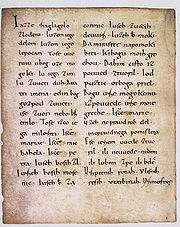
The new script spread through Western Europe most widely where Carolingian influence was strongest. In luxuriously produced LectionariesLectionary
A Lectionary is a book or listing that contains a collection of scripture readings appointed for Christian or Judaic worship on a given day or occasion.-History:...
that now began to be produced for princely patronage of abbots and bishops, legibility was essential. It reached far afield: the 10th century Freising manuscripts
Freising manuscripts
The Freising Manuscripts are the first Latin-script continuous text in a Slavic language and the oldest document in Slovene.The monuments consisting of three texts in the oldest Slovene dialect were discovered bound into a Latin codex...
, which contain the oldest Slovene language, the first Roman-script
Latin alphabet
The Latin alphabet, also called the Roman alphabet, is the most recognized alphabet used in the world today. It evolved from a western variety of the Greek alphabet called the Cumaean alphabet, which was adopted and modified by the Etruscans who ruled early Rome...
record of any Slavic language, are written in Carolingian minuscule. In Switzerland
Switzerland
Switzerland name of one of the Swiss cantons. ; ; ; or ), in its full name the Swiss Confederation , is a federal republic consisting of 26 cantons, with Bern as the seat of the federal authorities. The country is situated in Western Europe,Or Central Europe depending on the definition....
, Carolingian was used in the Rhaetian and Alemannic minuscule types. Manuscripts written in Rhaetian minuscule tend to have slender letters, resembling Insular script, with the letters a and t, and ligatures such as ri, showing similar to Visigothic and Beneventan. Alemannic minuscule, used for a short time in the early 9th century, is usually larger and broader, very vertical compared to the slanting Rhaetian type. In Austria
Austria
Austria , officially the Republic of Austria , is a landlocked country of roughly 8.4 million people in Central Europe. It is bordered by the Czech Republic and Germany to the north, Slovakia and Hungary to the east, Slovenia and Italy to the south, and Switzerland and Liechtenstein to the...
, Salzburg
Salzburg
-Population development:In 1935, the population significantly increased when Salzburg absorbed adjacent municipalities. After World War II, numerous refugees found a new home in the city. New residential space was created for American soldiers of the postwar Occupation, and could be used for...
was the major centre of Carolingian script, while Fulda
Fulda
Fulda is a city in Hesse, Germany; it is located on the river Fulda and is the administrative seat of the Fulda district .- Early Middle Ages :...
, Mainz
Mainz
Mainz under the Holy Roman Empire, and previously was a Roman fort city which commanded the west bank of the Rhine and formed part of the northernmost frontier of the Roman Empire...
, and Würzburg
Würzburg
Würzburg is a city in the region of Franconia which lies in the northern tip of Bavaria, Germany. Located at the Main River, it is the capital of the Regierungsbezirk Lower Franconia. The regional dialect is Franconian....
were the major centres in Germany. German minuscule tends to be oval-shaped, very slender, and slants to the right. It has uncial features as well, such as the ascender of the letter d slanting to the left, and vertical initial strokes of m and n.
In northern Italy, the monastery at Bobbio
Bobbio
Bobbio is a small town and commune in the province of Piacenza in Emilia-Romagna, northern Italy. It is located in the Trebbia River valley southwest of the town Piacenza. There is also an abbey and a diocese of the same name...
used Carolingian minuscule beginning in the 9th century. Outside the sphere of influence of Charlemagne and his successors, however, the new legible hand was resisted by the Roman Curia
Roman Curia
The Roman Curia is the administrative apparatus of the Holy See and the central governing body of the entire Catholic Church, together with the Pope...
; nevertheless the Romanesca type was developed in Rome
Rome
Rome is the capital of Italy and the country's largest and most populated city and comune, with over 2.7 million residents in . The city is located in the central-western portion of the Italian Peninsula, on the Tiber River within the Lazio region of Italy.Rome's history spans two and a half...
after the 10th century. The script was not taken up in England and Ireland until ecclesiastic reforms in the middle of the 10th century; in Spain a traditionalist Visigothic hand
Visigothic script
Visigothic script was a type of medieval script that originated in the Visigothic kingdom in Hispania...
survived; and in southern Italy a 'Beneventan minuscule
Beneventan script
Beneventan script was a medieval script, so called because it originated in the Duchy of Benevento in southern Italy. It was also called Langobarda, Longobarda, Longobardisca , or sometimes Gothica; it was first called Beneventan by palaeographer E. A...
' survived in the lands of the Lombard
Lombards
The Lombards , also referred to as Longobards, were a Germanic tribe of Scandinavian origin, who from 568 to 774 ruled a Kingdom in Italy...
duchy of Benevento
Duchy of Benevento
The Duchy and later Principality of Benevento was the southernmost Lombard duchy in medieval Italy, centred on Benevento, a city central in the Mezzogiorno. Owing to the Ducatus Romanus of the popes, which cut it off from the rest of Lombard Italy, Benevento was from the first practically...
through the 13th century, although Romanesca eventually also appeared in southern Italy.
Role in cultural transmission
Scholars during the Carolingian RenaissanceCarolingian Renaissance
In the history of ideas the Carolingian Renaissance stands out as a period of intellectual and cultural revival in Europe occurring from the late eighth century, in the generation of Alcuin, to the 9th century, and the generation of Heiric of Auxerre, with the peak of the activities coordinated...
sought out and copied in the new legible standardized hand many Roman texts that had been wholly forgotten. Most of our knowledge of classical literature now derives from copies made in the scriptoria
Scriptorium
Scriptorium, literally "a place for writing", is commonly used to refer to a room in medieval European monasteries devoted to the copying of manuscripts by monastic scribes...
of Charlemagne
Charlemagne
Charlemagne was King of the Franks from 768 and Emperor of the Romans from 800 to his death in 814. He expanded the Frankish kingdom into an empire that incorporated much of Western and Central Europe. During his reign, he conquered Italy and was crowned by Pope Leo III on 25 December 800...
. Over 7000 manuscripts written in Carolingian script survive from the 8th and 9th centuries alone.
Though the Carolingian minuscule was superseded by Gothic blackletter
Blackletter
Blackletter, also known as Gothic script, Gothic minuscule, or Textura, was a script used throughout Western Europe from approximately 1150 to well into the 17th century. It continued to be used for the German language until the 20th century. Fraktur is a notable script of this type, and sometimes...
hands, it later seemed so thoroughly 'classic' to the humanists
Renaissance humanism
Renaissance humanism was an activity of cultural and educational reform engaged by scholars, writers, and civic leaders who are today known as Renaissance humanists. It developed during the fourteenth and the beginning of the fifteenth centuries, and was a response to the challenge of Mediæval...
of the early Renaissance
Renaissance
The Renaissance was a cultural movement that spanned roughly the 14th to the 17th century, beginning in Italy in the Late Middle Ages and later spreading to the rest of Europe. The term is also used more loosely to refer to the historical era, but since the changes of the Renaissance were not...
that they took these old Carolingian manuscripts to be ancient Roman
Ancient Rome
Ancient Rome was a thriving civilization that grew on the Italian Peninsula as early as the 8th century BC. Located along the Mediterranean Sea and centered on the city of Rome, it expanded to one of the largest empires in the ancient world....
originals and modelled their Renaissance hand on the Carolingian one: thus it passed to the 15th- and 16th-century printers of books, like Aldus Manutius
Aldus Manutius
Aldus Pius Manutius , the Latinised name of Aldo Manuzio —sometimes called Aldus Manutius, the Elder to distinguish him from his grandson, Aldus Manutius, the Younger—was an Italian humanist who became a printer and publisher when he founded the Aldine Press at Venice.His publishing legacy includes...
of Venice. In this way it is the basis of our modern lowercase typefaces. Indeed 'Carolingian minuscule' is a style of typeface
Typeface
In typography, a typeface is the artistic representation or interpretation of characters; it is the way the type looks. Each type is designed and there are thousands of different typefaces in existence, with new ones being developed constantly....
, which approximates this historical hand, eliminating the nuances of size of capitals, long descenders, etc..
External links
- Carolingian minuscule at Dr. Dianne Tillotson’s website devoted to medieval writing
- Pfeffer Mediæval A Carolingian minuscule as a UnicodeUnicodeUnicode is a computing industry standard for the consistent encoding, representation and handling of text expressed in most of the world's writing systems...
font with a vast character range