

Use of the circumflex in French

Encyclopedia
The circumflex
(ˆ) is one of the five diacritic
s used in the French language
. It may be used atop the vowels a
, e
, i
, o
, and u
.
In French, the circumflex has three primary functions:
In certain words, the circumflex is idiopathic
, and has no precise linguistic role.
, and combines the acute accent
and the grave accent
. Grammarian Jacques Dubois
(known as Sylvius) is the first writer known to have used the Greek symbol in his writing (although he wrote in Latin
).
Several grammarians of the French Renaissance
attempted to prescribe a precise usage for the diacritic in their treatises on language. The modern usage of the circumflex accent became standardized in the 18th or 19th century.
Sylvius used the circumflex to indicate so-called "false diphthongs." Early modern French as spoken in Sylvius' time had coalesced
all its true diphthongs into phonetic monophthongs. He justifies its usage in his work Iacobii Sylvii Ambiani In Linguam Gallicam Isagoge una, cum eiusdem Grammatica Latinogallica ex Hebraeis Graecis et Latinus authoribus (An Introduction to the Gallic (French) Language, And Its Grammar With Regard to Hebrew, Latin and Greek Authors) published by Robert Estienne
in 1531. A kind of grammatical survey of French written in Latin, the book relies heavily on the comparison of ancient languages to his contemporary French and explained the specifics of his language. At that time, all linguistic
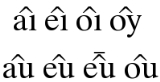
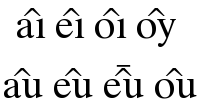
treatises used classical Latin and Greek as their models. Sylvius presents the circumflex in his list of typographic conventions, stating:
Note : it is not possible given the limitations of Wikipedia and HTML to render the graphical conventions used by Sylvius properly. He placed the circumflex and dieresis (French tréma) not atop the vowel, but between the two letters of the diphthong in question. Contrary also to this text, there were no italics to isolate the autonyms, and punctuation
has been modernized to reflect current conventions.
Sylvius was quite aware that the circumflex was purely a graphical convention. He showed that these diphthongs, even at that time, had been reduced to monophthongs, and used the circumflex to "join" the two letters that had historically been diphthongs into one phoneme
. When two adjacent vowels were to be pronounced independently, Sylvius proposed using the dieresis, called the tréma in French. Sylvius gives the example traî as opposed to traï . Even these groups, however, did not represent true diphthongs (such as the English "try," /traj/), but rather adjacent vowels pronounced separately without an intervening consonant
. As French no longer had any true diphthongs, the dieresis alone would have sufficed to distinguish between ambiguous vowel pairs. His circumflex was entirely unnecessary. As such the tréma became standardized in French orthography, and Sylvius' circumflex usage never caught on. But the grammarian had pointed out an important orthographical problem of the time.
At that time, the combination eu had two pronunciations: as in sûr and mûr, written ſeur, meur (or as ſeûr and meûr in Sylvius' work), or as in cœur and sœur, written by Sylvius not only with a circumflex, but a circumflex topped with a macron
: ceû̄r and ſeû̄r.
Sylvius' proposals were never adopted per se, but he opened the door for discussion among French grammarians to improve and disambiguate French orthography.
, in his Maniere de bien traduire d'une langue en aultre : d’aduantage de la punctuation de la langue Francoyse, plus des accents d’ycelle (1540), uses the circumflex (this time as a punctuation mark written between two letters) to show three metaplasm
s:
Thus Dolet uses the circumflex to indicate lost or silent phonemes, one of the uses for which the diacritic is still used today. Although not all his suggested usages were adopted, his work has allowed insight into the historical phonetics
of French. Dolet summarized his own contributions with these words: “Ce ſont les preceptions” [préceptes], “que tu garderas quant aux accents de la langue Francoyse. Leſquels auſsi obſerueront tous diligents Imprimeurs : car telles choſes enrichiſſent fort l'impreſsion, & demõſtrent” [démontrent], “que ne faiſons rien par ignorance.” Translation: “It is these precepts that you should follow concerning the accents of the French language. All diligent printers should also observe these rules, because such things greatly enrich printing and demonstrate that nothing is left to chance.”
included Dolet's treatise in his publication of Art Poétique in 1556. He adopted the usage of the circumflex atop the vowels to show syncope: laîra, paîra, vraîement [sic].
in 1066, such post-vocalic /s/ sounds had begun to disappear before hard consonants in many words, being replaced by a compensatory elongation of the preceding vowel, which was maintained into the 18th century.
The silent /s/ remained orthographically for some time, and various attempts were made to distinguish the historical presence graphically, but without much success. Notably, playwright Pierre Corneille
, in printed editions of his plays, used the "long s" (ſ) to indicate silent "s" and the traditional form for the /s/ sound when pronounced (tempeſte, haſte, teſte vs. peste, funeste, chaste).
The circumflex was officially introduced into the 1740 edition of the dictionary of the Académie Française
. In more recently introduced neologisms, however, the French lexicon
was enriched with Latin-based words which retained their /s/ both in pronunciation and orthography, although the historically evolved word may have let the /s/ drop in favor of a circumflex. Thus, many learned words, or words added to the French vocabulary since then often keep both the pronunciation and the presence of the /s/ from Latin. For example:
where two vowels have contracted into one phoneme, such as aage → âge; baailler → bâiller, etc.
Likewise, the former medieval diphthong "eu" when pronounced /y/ would often, in the 18th century, take a circumflex in order to distinguish homophones, such as deu → dû (from devoir vs. du = de + le); creu → crû (from croître vs. cru from croire) ; seur → sûr (the adjective vs. the preposition sur), etc.
, the circumflex over o often indicates the presence of the Greek letter omega (ω) when the word is pronounced with the sound /o/: diplôme (δίπλωμα), cône (κῶνος). Where Greek omega does not correspond to /o/ in French, the circumflex is not used: comédie /kɔmedi/ (κωμῳδία).
This rule is sporadic, because many such words are written without the circumflex; for instance, axiome and zone have unaccented vowels despite their etymology (Greek ἀξίωμα and ζώνη) and pronunciation (/aksjom/, /zon/). On the other hand, many learned words ending in -ole, -ome, and -one (but not tracing back to a Greek omega) acquired a circumflex accent and the closed /o/ pronunciation by analogy with words like cône and diplôme: trône (θρόνος), pôle (πόλος), binôme (from Latin binomium).
The circumflex accent was also used to indicate French vowels deriving from Greek eta (η), but this practice has not survived in modern orthography. For example, the spelling théorême (θεώρημα) was later replaced by théorème.
Linguistic interference sometimes accounts for the presence of a circumflex. This is the case in the first person
plural
of the preterite
indicative (or passé simple), which adds a circumflex by association with the second person
plural, thus:
All incidences of the first and second persons plural of the preterite take the circumflex in the conjugation
ending except the verb haïr, due to its necessary dieresis (nous haïmes, vous haïtes).
associated with the consonant loss described above). Vowel length is no longer distinctive in most varieties of modern French, but some of the older length distinctions now correspond to differences in vowel quality, and the circumflex can be used to indicate these differences orthographically.
The circumflex does not affect the pronunciation of the letters "i" or "u" (except in the combination "eû": jeûne [ʒøn] vs. jeune [ʒœn]).
The diacritic disappears in related words if the pronunciation changes (particularly when the vowel in question is no longer in the stressed final syllable). For example:
In other cases, the presence or absence of the circumflex in derived words is not correlated with pronunciation, for example with the vowel "u":
There are nonetheless notable exceptions to the pronunciation rules given here. For instance, in non-final syllables, "ê" can be realized as a closed /e/ as a result of vowel harmony
: compare bête /bɛt/ and bêta /bɛta/ with bêtise /betiz/ and abêtir [abetiʁ], or tête /tɛt/ and têtard /tɛtaʁ/ vs. têtu /tety/.
In varieties of French where open/closed syllable adjustment (loi de position) applies, the presence of a circumflex accent is not taken into account in the mid vowel alternations /e/~/ɛ/ and /o/~/ɔ/. This is the case in southern Metropolitan French, where for example dôme is pronounced /dɔm/ as opposed to /dom/ (as indicated by the orthography, and as pronounced in northern Metropolitan varieties).
The merger of /ɑ/ and /a/ is widespread in Parisian and Belgian French, resulting for example in the realization of the word âme as /am/ instead of /ɑm/.
serves the purpose of differentiating homographs in French (là ~ la, où ~ ou, çà ~ ça, à ~ a, etc.), the circumflex, for historical reasons, has come to serve a similar role. In fact, almost all the cases where the circumflex is used to distinguish homographs can be explained by the reasons above: it would therefore be false to declare that it is in certain words a sign placed solely to distinguish homographs, as with the grave accent. However, it does allow one to remove certain ambiguities. For example, in words that underwent the change of "eu" to "û", the circumflex avoids possible homography with other words containing "u":
experts, aware of the difficulty the circumflex represents and the inconsistency of its usage, proposed in 1990 a simplified orthography published in the Journal officiel de la République française and put forth that the circumflex over the letters u and i should be abolished except in cases where its absence would create ambiguities and homographs. These recommendations, widely criticized at the time of their introduction, have had no widespread adoption, but are encouraged by the Académie française.
Circumflex
The circumflex is a diacritic used in the written forms of many languages, and is also commonly used in various romanization and transcription schemes. It received its English name from Latin circumflexus —a translation of the Greek περισπωμένη...
(ˆ) is one of the five diacritic
Diacritic
A diacritic is a glyph added to a letter, or basic glyph. The term derives from the Greek διακριτικός . Diacritic is both an adjective and a noun, whereas diacritical is only an adjective. Some diacritical marks, such as the acute and grave are often called accents...
s used in the French language
French language
French is a Romance language spoken as a first language in France, the Romandy region in Switzerland, Wallonia and Brussels in Belgium, Monaco, the regions of Quebec and Acadia in Canada, and by various communities elsewhere. Second-language speakers of French are distributed throughout many parts...
. It may be used atop the vowels a
A
A is the first letter and a vowel in the basic modern Latin alphabet. It is similar to the Ancient Greek letter Alpha, from which it derives.- Origins :...
, e
E
E is the fifth letter and a vowel in the basic modern Latin alphabet. It is the most commonly used letter in the Czech, Danish, Dutch, English, French, German, Hungarian, Latin, Norwegian, Spanish, and Swedish languages.-History:...
, i
I
I is the ninth letter and a vowel in the basic modern Latin alphabet.-History:In Semitic, the letter may have originated in a hieroglyph for an arm that represented a voiced pharyngeal fricative in Egyptian, but was reassigned to by Semites, because their word for "arm" began with that sound...
, o
O
O is the fifteenth letter and a vowel in the basic modern Latin alphabet.The letter was derived from the Semitic `Ayin , which represented a consonant, probably , the sound represented by the Arabic letter ع called `Ayn. This Semitic letter in its original form seems to have been inspired by a...
, and u
U
U is the twenty-first letter and a vowel in the basic modern Latin alphabet.-History:The letter U ultimately comes from the Semitic letter Waw by way of the letter Y. See the letter Y for details....
.
In French, the circumflex has three primary functions:
- It affects the pronunciation of a, e, and o; although used on i and u as well, it does not affect their pronunciation.
- It often indicates the historical presence of a letter (commonly s) that has, over the course of linguistic evolution, become silent and fallen away in orthographyOrthographyThe orthography of a language specifies a standardized way of using a specific writing system to write the language. Where more than one writing system is used for a language, for example Kurdish, Uyghur, Serbian or Inuktitut, there can be more than one orthography...
. - Less frequently, it is used to distinguish between two homophoneHomophoneA homophone is a word that is pronounced the same as another word but differs in meaning. The words may be spelled the same, such as rose and rose , or differently, such as carat, caret, and carrot, or to, two, and too. Homophones that are spelled the same are also both homographs and homonyms...
s (for example, jeune [young] versus jeûne [a fast]).
In certain words, the circumflex is idiopathic
Idiopathic
Idiopathic is an adjective used primarily in medicine meaning arising spontaneously or from an obscure or unknown cause. From Greek ἴδιος, idios + πάθος, pathos , it means approximately "a disease of its own kind". It is technically a term from nosology, the classification of disease...
, and has no precise linguistic role.
First usages
The circumflex first appeared in written French in the 16th century. It was borrowed from Ancient GreekAncient Greek
Ancient Greek is the stage of the Greek language in the periods spanning the times c. 9th–6th centuries BC, , c. 5th–4th centuries BC , and the c. 3rd century BC – 6th century AD of ancient Greece and the ancient world; being predated in the 2nd millennium BC by Mycenaean Greek...
, and combines the acute accent
Acute accent
The acute accent is a diacritic used in many modern written languages with alphabets based on the Latin, Cyrillic, and Greek scripts.-Apex:An early precursor of the acute accent was the apex, used in Latin inscriptions to mark long vowels.-Greek:...
and the grave accent
Grave accent
The grave accent is a diacritical mark used in written Breton, Catalan, Corsican, Dutch, French, Greek , Italian, Mohawk, Norwegian, Occitan, Portuguese, Scottish Gaelic, Vietnamese, Welsh, Romansh, and other languages.-Greek:The grave accent was first used in the polytonic orthography of Ancient...
. Grammarian Jacques Dubois
Jacques Dubois
Jacques Dubois , also known as Jacobus Sylvius in Latin, was a French anatomist in Paris.-Early grammar of French:Dubois was the author of the first grammar of the French language to be published in France...
(known as Sylvius) is the first writer known to have used the Greek symbol in his writing (although he wrote in Latin
Latin
Latin is an Italic language originally spoken in Latium and Ancient Rome. It, along with most European languages, is a descendant of the ancient Proto-Indo-European language. Although it is considered a dead language, a number of scholars and members of the Christian clergy speak it fluently, and...
).
Several grammarians of the French Renaissance
Renaissance
The Renaissance was a cultural movement that spanned roughly the 14th to the 17th century, beginning in Italy in the Late Middle Ages and later spreading to the rest of Europe. The term is also used more loosely to refer to the historical era, but since the changes of the Renaissance were not...
attempted to prescribe a precise usage for the diacritic in their treatises on language. The modern usage of the circumflex accent became standardized in the 18th or 19th century.
Jacques Dubois (Sylvius)
Sylvius used the circumflex to indicate so-called "false diphthongs." Early modern French as spoken in Sylvius' time had coalesced
Coalescence
Coalescence may refer to:* Coalescence , the merging of genetic lineages backwards time to a most recent common ancestor* Coalescence , the merging of two or more phonological segments into one...
all its true diphthongs into phonetic monophthongs. He justifies its usage in his work Iacobii Sylvii Ambiani In Linguam Gallicam Isagoge una, cum eiusdem Grammatica Latinogallica ex Hebraeis Graecis et Latinus authoribus (An Introduction to the Gallic (French) Language, And Its Grammar With Regard to Hebrew, Latin and Greek Authors) published by Robert Estienne
Robert Estienne
Robert I Estienne , known as Robertus Stephanus in Latin and also referred to as Robert Stephens by 18th and 19th-century English writers, was a 16th century printer and classical scholar in Paris...
in 1531. A kind of grammatical survey of French written in Latin, the book relies heavily on the comparison of ancient languages to his contemporary French and explained the specifics of his language. At that time, all linguistic
Linguistics
Linguistics is the scientific study of human language. Linguistics can be broadly broken into three categories or subfields of study: language form, language meaning, and language in context....
treatises used classical Latin and Greek as their models. Sylvius presents the circumflex in his list of typographic conventions, stating:
- aî, eî, oî, oŷ, aû, eû, oû, diphthongorũ notæ, vt maî, pleîn, moî, moŷ, caûſe, fleûr, poûr, id eſt maius, plenus, mihi, mei, cauſa, flos, pro.
- Translation : "aî, eî, oî, oŷ, aû, eû, oû, are representations of diphthongs, such as maî, pleîn, moî, moŷ, caûse, fleûr, poûr, or, in Latin, maius, plenus, mihi, mei, causa, flos, pro."
Note : it is not possible given the limitations of Wikipedia and HTML to render the graphical conventions used by Sylvius properly. He placed the circumflex and dieresis (French tréma) not atop the vowel, but between the two letters of the diphthong in question. Contrary also to this text, there were no italics to isolate the autonyms, and punctuation
Punctuation
Punctuation marks are symbols that indicate the structure and organization of written language, as well as intonation and pauses to be observed when reading aloud.In written English, punctuation is vital to disambiguate the meaning of sentences...
has been modernized to reflect current conventions.
Sylvius was quite aware that the circumflex was purely a graphical convention. He showed that these diphthongs, even at that time, had been reduced to monophthongs, and used the circumflex to "join" the two letters that had historically been diphthongs into one phoneme
Phoneme
In a language or dialect, a phoneme is the smallest segmental unit of sound employed to form meaningful contrasts between utterances....
. When two adjacent vowels were to be pronounced independently, Sylvius proposed using the dieresis, called the tréma in French. Sylvius gives the example traî as opposed to traï . Even these groups, however, did not represent true diphthongs (such as the English "try," /traj/), but rather adjacent vowels pronounced separately without an intervening consonant
Consonant
In articulatory phonetics, a consonant is a speech sound that is articulated with complete or partial closure of the vocal tract. Examples are , pronounced with the lips; , pronounced with the front of the tongue; , pronounced with the back of the tongue; , pronounced in the throat; and ,...
. As French no longer had any true diphthongs, the dieresis alone would have sufficed to distinguish between ambiguous vowel pairs. His circumflex was entirely unnecessary. As such the tréma became standardized in French orthography, and Sylvius' circumflex usage never caught on. But the grammarian had pointed out an important orthographical problem of the time.
At that time, the combination eu had two pronunciations: as in sûr and mûr, written ſeur, meur (or as ſeûr and meûr in Sylvius' work), or as in cœur and sœur, written by Sylvius not only with a circumflex, but a circumflex topped with a macron
Macron
A macron, from the Greek , meaning "long", is a diacritic placed above a vowel . It was originally used to mark a long or heavy syllable in Greco-Roman metrics, but now marks a long vowel...
: ceû̄r and ſeû̄r.
Sylvius' proposals were never adopted per se, but he opened the door for discussion among French grammarians to improve and disambiguate French orthography.
Étienne Dolet
Étienne DoletÉtienne Dolet
Étienne Dolet was a French scholar, translator and printer.-Early life:He was born in Orléans. A doubtful tradition makes him the illegitimate son of Francis I; but it is evident that he was at least connected with some family of rank and wealth.From Orléans he was taken to Paris about 1521, and...
, in his Maniere de bien traduire d'une langue en aultre : d’aduantage de la punctuation de la langue Francoyse, plus des accents d’ycelle (1540), uses the circumflex (this time as a punctuation mark written between two letters) to show three metaplasm
Metaplasm
A metaplasm is a change in the orthography of a word. Originally it referred to techniques used in Ancient Greek and Latin poetry, or processes in those languages' grammar.-Sound change:...
s:
- 1. Syncope, or the disappearance of an interior syllable, shown by Dolet as: laiˆrra, paiˆra, uraiˆment (vraiˆment), donˆra for laiſſera (laissera), paiera, uraiemẽt (vraiment), donnera. It is worthy of note that before the 14th century, the so-called "mute e" was always pronounced in French as a schwaSchwaIn linguistics, specifically phonetics and phonology, schwa can mean the following:*An unstressed and toneless neutral vowel sound in some languages, often but not necessarily a mid-central vowel...
(/ə/), regardless of position. For example, paiera was pronounced [pɛəra] instead of the modern [pɛra]. In the 14th century, however, this unaccented e began to disappear in hiatusHiatus (linguistics)In phonology, hiatus or diaeresis refers to two vowel sounds occurring in adjacent syllables, with no intervening consonant. When two adjacent vowel sounds occur in the same syllable, the result is instead described as a diphthong....
and lose its phonemic status, although it remained in orthography. Some of the syncopes Dolet cites, however, had the mute e reintroduced later: his laiˆrra /lɛra/ is now /lɛsəra/ or /lɛsra/, and donˆra /dɔ̃ra/ is today /dɔnəra/ or /dɔnra/. - 2. HaplologyHaplologyHaplology is defined as the elimination of a syllable when two consecutive identical or similar syllables occur. The phenomenon was identified by American philologist Maurice Bloomfield in the 20th century...
(the reduction of sequences of identical or similar phonemes): Dolet cites forms which no longer exist: auˆous (avˆous), nˆauous (nˆavous) for auez uous (avez-vous) and n'auez uous (n'avez-vous). - 3. Contraction of an é followed by a mute e in the feminine plural , realized as a long close mid-vowel /eː/. It is important to remember that mute "e" at the end of a word was pronounced as a schwa until the 17th century. Thus penseˆes [pɑ̃seː], ſuborneˆes (suborneˆes) for pensées [pɑ̃seə], subornées. Dolet specifies that the acute accent should be written in noting the contraction. This contraction of two like vowels into one long vowel is also seen in other words, such as aˆage [aːʒə] for aage [aaʒə] (âge).
Thus Dolet uses the circumflex to indicate lost or silent phonemes, one of the uses for which the diacritic is still used today. Although not all his suggested usages were adopted, his work has allowed insight into the historical phonetics
Phonetics
Phonetics is a branch of linguistics that comprises the study of the sounds of human speech, or—in the case of sign languages—the equivalent aspects of sign. It is concerned with the physical properties of speech sounds or signs : their physiological production, acoustic properties, auditory...
of French. Dolet summarized his own contributions with these words: “Ce ſont les preceptions” [préceptes], “que tu garderas quant aux accents de la langue Francoyse. Leſquels auſsi obſerueront tous diligents Imprimeurs : car telles choſes enrichiſſent fort l'impreſsion, & demõſtrent” [démontrent], “que ne faiſons rien par ignorance.” Translation: “It is these precepts that you should follow concerning the accents of the French language. All diligent printers should also observe these rules, because such things greatly enrich printing and demonstrate that nothing is left to chance.”
Thomas Sébillet
Thomas SébilletThomas Sébillet
Thomas Sébillet was a French jurist and grammarian. He is now remembered for his Art Poétique from 1548, on French verse. He was strongly contradicted later by Joachim du Bellay, whose art poétique became normative. This "decapitation of richesse" lead to a centralisation of language, too...
included Dolet's treatise in his publication of Art Poétique in 1556. He adopted the usage of the circumflex atop the vowels to show syncope: laîra, paîra, vraîement [sic].
Indication of a lost phoneme
In many cases, the circumflex indicates the historical presence of a phoneme which over the course of linguistic evolution became silent, and then disappeared altogether from the orthography.Disappearance of "s"
The most common phenomenon involving the circumflex relates to /s/ before a consonant. Around the time of the Battle of HastingsBattle of Hastings
The Battle of Hastings occurred on 14 October 1066 during the Norman conquest of England, between the Norman-French army of Duke William II of Normandy and the English army under King Harold II...
in 1066, such post-vocalic /s/ sounds had begun to disappear before hard consonants in many words, being replaced by a compensatory elongation of the preceding vowel, which was maintained into the 18th century.
The silent /s/ remained orthographically for some time, and various attempts were made to distinguish the historical presence graphically, but without much success. Notably, playwright Pierre Corneille
Pierre Corneille
Pierre Corneille was a French tragedian who was one of the three great seventeenth-century French dramatists, along with Molière and Racine...
, in printed editions of his plays, used the "long s" (ſ) to indicate silent "s" and the traditional form for the /s/ sound when pronounced (tempeſte, haſte, teſte vs. peste, funeste, chaste).
The circumflex was officially introduced into the 1740 edition of the dictionary of the Académie Française
Académie française
L'Académie française , also called the French Academy, is the pre-eminent French learned body on matters pertaining to the French language. The Académie was officially established in 1635 by Cardinal Richelieu, the chief minister to King Louis XIII. Suppressed in 1793 during the French Revolution,...
. In more recently introduced neologisms, however, the French lexicon
Lexicon
In linguistics, the lexicon of a language is its vocabulary, including its words and expressions. A lexicon is also a synonym of the word thesaurus. More formally, it is a language's inventory of lexemes. Coined in English 1603, the word "lexicon" derives from the Greek "λεξικόν" , neut...
was enriched with Latin-based words which retained their /s/ both in pronunciation and orthography, although the historically evolved word may have let the /s/ drop in favor of a circumflex. Thus, many learned words, or words added to the French vocabulary since then often keep both the pronunciation and the presence of the /s/ from Latin. For example:
- feste (first appearing in 1080) → fête, but:
- festin: borrowed in the 16th century from the Italian festino,
- festivité: borrowed from the Latin festivitas in the 19th century, and
- festival: borrowed from the English festival in the 19th century have all retained their /s/, both written and pronounced. Likewise the related pairs tête/test, fenêtre/défenestrer, bête/bestiaire", etc.
Disappearance of other letters
The circumflex also serves as a vestige of other lost letters, particularly letters in hiatusHiatus (linguistics)
In phonology, hiatus or diaeresis refers to two vowel sounds occurring in adjacent syllables, with no intervening consonant. When two adjacent vowel sounds occur in the same syllable, the result is instead described as a diphthong....
where two vowels have contracted into one phoneme, such as aage → âge; baailler → bâiller, etc.
Likewise, the former medieval diphthong "eu" when pronounced /y/ would often, in the 18th century, take a circumflex in order to distinguish homophones, such as deu → dû (from devoir vs. du = de + le); creu → crû (from croître vs. cru from croire) ; seur → sûr (the adjective vs. the preposition sur), etc.
- cruement → crûment;
- meur → mûr.
Indication of Greek omega
In words derived from Ancient GreekAncient Greek
Ancient Greek is the stage of the Greek language in the periods spanning the times c. 9th–6th centuries BC, , c. 5th–4th centuries BC , and the c. 3rd century BC – 6th century AD of ancient Greece and the ancient world; being predated in the 2nd millennium BC by Mycenaean Greek...
, the circumflex over o often indicates the presence of the Greek letter omega (ω) when the word is pronounced with the sound /o/: diplôme (δίπλωμα), cône (κῶνος). Where Greek omega does not correspond to /o/ in French, the circumflex is not used: comédie /kɔmedi/ (κωμῳδία).
This rule is sporadic, because many such words are written without the circumflex; for instance, axiome and zone have unaccented vowels despite their etymology (Greek ἀξίωμα and ζώνη) and pronunciation (/aksjom/, /zon/). On the other hand, many learned words ending in -ole, -ome, and -one (but not tracing back to a Greek omega) acquired a circumflex accent and the closed /o/ pronunciation by analogy with words like cône and diplôme: trône (θρόνος), pôle (πόλος), binôme (from Latin binomium).
The circumflex accent was also used to indicate French vowels deriving from Greek eta (η), but this practice has not survived in modern orthography. For example, the spelling théorême (θεώρημα) was later replaced by théorème.
Analogical and idiopathic cases
Some circumflexes appear for no known reason. It is thought to give words an air of prestige, like a crown (thus trône, prône, suprême and voûte).Linguistic interference sometimes accounts for the presence of a circumflex. This is the case in the first person
Grammatical person
Grammatical person, in linguistics, is deictic reference to a participant in an event; such as the speaker, the addressee, or others. Grammatical person typically defines a language's set of personal pronouns...
plural
Plural
In linguistics, plurality or [a] plural is a concept of quantity representing a value of more-than-one. Typically applied to nouns, a plural word or marker is used to distinguish a value other than the default quantity of a noun, which is typically one...
of the preterite
Preterite
The preterite is the grammatical tense expressing actions that took place or were completed in the past...
indicative (or passé simple), which adds a circumflex by association with the second person
Grammatical person
Grammatical person, in linguistics, is deictic reference to a participant in an event; such as the speaker, the addressee, or others. Grammatical person typically defines a language's set of personal pronouns...
plural, thus:
- Latin cantavistis → OFOld FrenchOld French was the Romance dialect continuum spoken in territories that span roughly the northern half of modern France and parts of modern Belgium and Switzerland from the 9th century to the 14th century...
chantastes → chantâtes (after the muting of the interposing /s/) - Latin cantavimus → OF chantames → chantâmes (by interference with chantâtes).
All incidences of the first and second persons plural of the preterite take the circumflex in the conjugation
Grammatical conjugation
In linguistics, conjugation is the creation of derived forms of a verb from its principal parts by inflection . Conjugation may be affected by person, number, gender, tense, aspect, mood, voice, or other grammatical categories...
ending except the verb haïr, due to its necessary dieresis (nous haïmes, vous haïtes).
Vowel length and quality
In general, vowels bearing the circumflex accent were historically long (for example, through compensatory lengtheningCompensatory lengthening
Compensatory lengthening in phonology and historical linguistics is the lengthening of a vowel sound that happens upon the loss of a following consonant, usually in the syllable coda...
associated with the consonant loss described above). Vowel length is no longer distinctive in most varieties of modern French, but some of the older length distinctions now correspond to differences in vowel quality, and the circumflex can be used to indicate these differences orthographically.
- â → /ɑ/ ("velar" or backBack vowelA back vowel is a type of vowel sound used in spoken languages. The defining characteristic of a back vowel is that the tongue is positioned as far back as possible in the mouth without creating a constriction that would be classified as a consonant. Back vowels are sometimes also called dark...
a) — pâte vs. patte, tâche vs. tache - ê → /ɛ/ (open e; equivalent of è or e followed by two consonants) — prêt vs. pré
- ô → /o/ (equivalent to o at the end of a syllable) — hôte vs. hotte, côte vs. cote
The circumflex does not affect the pronunciation of the letters "i" or "u" (except in the combination "eû": jeûne [ʒøn] vs. jeune [ʒœn]).
The diacritic disappears in related words if the pronunciation changes (particularly when the vowel in question is no longer in the stressed final syllable). For example:
- infâme /ɛ̃fɑm/, but infamie /ɛ̃fami/,
- grâce /ɡʁɑs/, but gracieux /ɡʁasjø/,
- fantôme /fɑ̃tom/, but fantomatique /fɑ̃tɔmatik/.
In other cases, the presence or absence of the circumflex in derived words is not correlated with pronunciation, for example with the vowel "u":
- fût [fy] vs. futaille [fytaj]
- bûche [byʃ] vs. bûchette [byʃɛt]
- sûr [syʁ] and sûrement [syʁmɑ̃], but assurer [asyʁe].
There are nonetheless notable exceptions to the pronunciation rules given here. For instance, in non-final syllables, "ê" can be realized as a closed /e/ as a result of vowel harmony
Vowel harmony
Vowel harmony is a type of long-distance assimilatory phonological process involving vowels that occurs in some languages. In languages with vowel harmony, there are constraints on which vowels may be found near each other....
: compare bête /bɛt/ and bêta /bɛta/ with bêtise /betiz/ and abêtir [abetiʁ], or tête /tɛt/ and têtard /tɛtaʁ/ vs. têtu /tety/.
In varieties of French where open/closed syllable adjustment (loi de position) applies, the presence of a circumflex accent is not taken into account in the mid vowel alternations /e/~/ɛ/ and /o/~/ɔ/. This is the case in southern Metropolitan French, where for example dôme is pronounced /dɔm/ as opposed to /dom/ (as indicated by the orthography, and as pronounced in northern Metropolitan varieties).
The merger of /ɑ/ and /a/ is widespread in Parisian and Belgian French, resulting for example in the realization of the word âme as /am/ instead of /ɑm/.
Distinguishing homographs
Although normally the grave accentGrave accent
The grave accent is a diacritical mark used in written Breton, Catalan, Corsican, Dutch, French, Greek , Italian, Mohawk, Norwegian, Occitan, Portuguese, Scottish Gaelic, Vietnamese, Welsh, Romansh, and other languages.-Greek:The grave accent was first used in the polytonic orthography of Ancient...
serves the purpose of differentiating homographs in French (là ~ la, où ~ ou, çà ~ ça, à ~ a, etc.), the circumflex, for historical reasons, has come to serve a similar role. In fact, almost all the cases where the circumflex is used to distinguish homographs can be explained by the reasons above: it would therefore be false to declare that it is in certain words a sign placed solely to distinguish homographs, as with the grave accent. However, it does allow one to remove certain ambiguities. For example, in words that underwent the change of "eu" to "û", the circumflex avoids possible homography with other words containing "u":
- sur ~ sûr(e)(s) (from seür → sëur): The homography with the adjective sur(e), "sour", justifies maintaining the accent in the feminine and plural. The accent is also maintained in derived words such as sûreté.
- du ~ dû (from deü): As the homography disappears in the inflectedInflectionIn grammar, inflection or inflexion is the modification of a word to express different grammatical categories such as tense, grammatical mood, grammatical voice, aspect, person, number, gender and case...
forms of the past participle, we have dû but dus / due(s). - mur ~ mûr(e)(s) (from meür): The accent is maintained in all forms as well as in derived words (mûrir, mûrissement).
Orthographic reform
FrancophoneFrancophone
The adjective francophone means French-speaking, typically as primary language, whether referring to individuals, groups, or places. Often, the word is used as a noun to describe a natively French-speaking person....
experts, aware of the difficulty the circumflex represents and the inconsistency of its usage, proposed in 1990 a simplified orthography published in the Journal officiel de la République française and put forth that the circumflex over the letters u and i should be abolished except in cases where its absence would create ambiguities and homographs. These recommendations, widely criticized at the time of their introduction, have had no widespread adoption, but are encouraged by the Académie française.