

Prosthesis

Encyclopedia
Medicine
Medicine is the science and art of healing. It encompasses a variety of health care practices evolved to maintain and restore health by the prevention and treatment of illness....
, a prosthesis, prosthetic, or prosthetic limb (Greek: πρόσθεσις "addition") is an artificial device extension that replaces a missing body
Body
With regard to living things, a body is the physical body of an individual. "Body" often is used in connection with appearance, health issues and death...
part. It is part of the field of biomechatronics
Biomechatronics
Biomechatronics is an applied interdisciplinary science that aims to integrate mechanical elements, electronics and parts of biological organisms. Biomechatronics includes the aspects of biology, mechanics, and electronics. It also encompasses the fields of robotics and neuroscience. One example...
, the science of using mechanical
Mechanical
Mechanical may refer to:* Mechanical engineering, a branch of engineering concerned with the application of physical mechanics* HVAC , the mechanical systems of a building...
devices with human muscle
Muscle
Muscle is a contractile tissue of animals and is derived from the mesodermal layer of embryonic germ cells. Muscle cells contain contractile filaments that move past each other and change the size of the cell. They are classified as skeletal, cardiac, or smooth muscles. Their function is to...
, skeleton
Skeleton
The skeleton is the body part that forms the supporting structure of an organism. There are two different skeletal types: the exoskeleton, which is the stable outer shell of an organism, and the endoskeleton, which forms the support structure inside the body.In a figurative sense, skeleton can...
, and nervous systems to assist or enhance motor control lost by trauma
Trauma (medicine)
Trauma refers to "a body wound or shock produced by sudden physical injury, as from violence or accident." It can also be described as "a physical wound or injury, such as a fracture or blow." Major trauma can result in secondary complications such as circulatory shock, respiratory failure and death...
, disease
Disease
A disease is an abnormal condition affecting the body of an organism. It is often construed to be a medical condition associated with specific symptoms and signs. It may be caused by external factors, such as infectious disease, or it may be caused by internal dysfunctions, such as autoimmune...
, or defect
Defect
- Geometry and physical sciences :* Defect , a characteristic of a polyhedron* Topological defect* Isoperimetric defect* Crystallographic defect, a structural imperfection in a crystal- Pop music :* The Defects, Northern-Irish punk rock band...
. Prostheses are typically used to replace parts lost by injury (traumatic) or missing from birth (congenital) or to supplement defective body parts. Inside the body, artificial heart valve
Artificial heart valve
An artificial heart valve is a device implanted in the heart of a patient with heart valvular disease. When one of the four heart valves malfunctions, the medical choice may be to replace the natural valve with an artificial valve. This requires open-heart surgery.Valves are integral to the normal...
s are in common use with artificial heart
Artificial heart
An artificial heart is a mechanical device that replaces the heart. Artificial hearts are typically used in order to bridge the time to heart transplantation, or to permanently replace the heart in case transplantation is impossible...
s and lungs
Artificial lung
An artificial lung is a prosthetic device that is implanted into the body to replace the biological lung. It is different from a heart-lung machine in that it is internal and designed to take over the functions of the lungs for long periods of time rather than on a temporary basis.Recent...
seeing less common use but under active technology development. Other medical devices and aids that can be considered prosthetics include hearing aids, artificial eyes
Visual prosthesis
For the non-functional prosthesis or glass eye see Ocular prosthesis and Craniofacial prosthesis.A visual prosthesis, often referred to as a bionic eye, is an experimental visual device intended to restore functional vision in those suffering from partial or total blindness...
, palatal obturator
Palatal obturator
A palatal obturator is a prosthesis that totally occludes an opening such as an orinasal fistula . They are similar to dental retainers, but without the front wire. Palatal obturators are typically short-term prosthetics used to close defects of the hard/soft palate that may affect speech...
, gastric bands
Adjustable gastric band
A laparoscopic adjustable gastric band, commonly referred to as a lap band, is an inflatable silicone device that is placed around the top portion of the stomach, via laparoscopic surgery, in order to treat obesity...
, and dentures
Dentures
Dentures are prosthetic devices constructed to replace missing teeth, and which are supported by surrounding soft and hard tissues of the oral cavity. Conventional dentures are removable, however there are many different denture designs, some which rely on bonding or clasping onto teeth or dental...
.
Prosthetics are specifically not orthotics
Orthotics
Orthotics is a specialty within the medical field concerned with the design, manufacture and application of orthoses. An orthosis is an orthopedic device that supports or corrects the function of a limb or the torso...
, although given certain circumstances a prosthetic might end up performing some or all of the same functionary benefits as an orthotic. Prostheses (or "A" prosthesis) are technically the complete finished item. For instance, a C-Leg knee alone is not a prosthesis, but only a prosthetic part. The complete prosthesis would consist of the stump attachment system - usually a "socket", and all the attachment hardware parts all the way down to and including the foot. Keep this in mind as often nomenclature is interchanged.
History
Vishpala
Vishpala is a woman mentioned in the Rigveda . The name is likely from "settlement, village" and "strong", meaning something like "protecting the settlement"....
in the Rigveda
Rigveda
The Rigveda is an ancient Indian sacred collection of Vedic Sanskrit hymns...
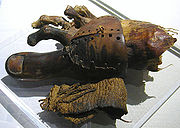
. Egyptians were early pioneers of the idea, such as a wooden toe found on a body from the New Kingdom. Roman bronze crowns
Crown (dentistry)
A crown is a type of dental restoration which completely caps or encircles a tooth or dental implant. Crowns are often needed when a large cavity threatens the ongoing health of a tooth. They are typically bonded to the tooth using a dental cement. Crowns can be made from many materials, which...
have also been found, but their use could have been more aesthetic than medical.
Another early recorded mention of a prosthetic was done by the historian Herodotus, who tells the story of a Hegistratus, a Persian soldier, who cut off his own foot to escape his captors and replaced it with a wooden one. Pliny the Elder
Pliny the Elder
Gaius Plinius Secundus , better known as Pliny the Elder, was a Roman author, naturalist, and natural philosopher, as well as naval and army commander of the early Roman Empire, and personal friend of the emperor Vespasian...
also recorded that a Roman general who had his arm cut off had an iron one made to hold his shield up when he returned to battle. A famous and quite refined historical prosthetic arm was that of Götz von Berlichingen
Götz von Berlichingen
Gottfried "Götz" von Berlichingen and also known as Götz of the Iron Hand, was a German Imperial Knight and mercenary....
, made in the beginning of the 16th century.
Around the same time, François de la Noue
François de la Noue
François de la Noue , called Bras-de-Fer, one of the Huguenot captains of the 16th century, was born near Nantes in 1531, of an ancient Breton family....
is also reported to have had an iron hand, as is, in the 17th century, René-Robert Cavalier de la Salle. During the Dark Ages, prosthetics remained quite basic in form. Debilitated knights would be fitted with prosthetics so they could be fitted with a shield. Only the wealthy were able to afford anything that would assist in daily function. During the Renaissance, prosthetics also underwent a rebirth. Prosthetics development using iron, steel, copper, and wood started. Functional prosthetics began to make an appearance in the 1500s.
Gotz von Berlichingen, a German mercenary, developed a pair of iron hands that could be moved by relaxing a series of releases and springs. Record written by an Italian surgeon also notes the existence of amputee who had an arm that allowed him to remove his hat, open his purse, and sign his name. Improvement in amputation surgery and prosthetic design came at the hands of Ambroise Paré. Among his inventions was an above-knee device that was a kneeling peg leg and foot prosthesis that had a fixed position, adjustable harness, and knee lock control. The functionality of his advancements showed what future prosthetics would function.
Other major improvements before the modern era:
- Pieter Verduyn - First nonlocking below-knee (BK) prosthesis.
- James Potts - Prosthesis made of a wooden shank and socket, a steel knee joint and an articulated foot that was controlled by catgut tendons from the knee to the ankle. Came to be known as “Anglesey Leg” or “Selpho Leg.”
- Sir James Syme - A new method of ankle amputation that did not involve amputating at the thigh.
- Benjamin Palmer - Improved upon the Selpho leg. Added an anterior spring and concealed tendons to simulate natural-looking movement.
- Dubois Parmlee – Created prosthetic with a suction socket, polycentric knee, and multi-articulated foot.
- Marcel DesoutterMarcel DesoutterAndré Marcel Desoutter was an English aviator, who lost a leg in an early flying accident, but went on to a successful career in the aviation industry.-Early life:...
& Charles Desoutter – First aluminum prosthesis
At the end of World War II, the NAS (National Academy of Sciences) began to advocate better research and development of prosthetics. Through government funding, a research and development program was developed within the Army, Navy, Air Force, and the Veterans Administration.
The following organizations have been created to help and inform the general publics about prosthetics:
- American Orthotics and Prosthetic Association, American Board for Certification in Prosthetics and Orthotics, American Academy of Orthotics and Prosthetics – These three groups work together to take responsibility for the academic side of orthotics and prosthetics and provide certification of individuals and facilities working with orthotics and prosthetics.
- The International Society for Prosthetics and Orthotics – Founded in 1970 and headquartered in Copenhagen, this association helps with the progression in research and clinical practice worldwide. They hold an international conference every three years and publish their own technical journal.
- Association of Children’s Orthotic-Prosthetic Clinics – The organization was started in 1950s to advocate research and development of children’s prosthetics. They meet annually and have their own publication.
- Amputee Coalition of America – The organization was created in 1990 to improve the lives of amputees. Advocate the improvement of amputee lifestyle through education and also have their own publication, inMotion.
Lower extremity prosthetics
Lower extremity prosthetics describes artificially replaced limbs located at the hip level or lower. The two main subcategories of lower extremity prosthetic devices are 1.trans-tibial (any amputation transecting the tibia bone or a congenital anomaly resulting in a tibial deficiency) and 2.trans-femoral (any amputation transecting the femur bone or a congenital anomaly resulting in a femural deficiency). In the prosthetic industry a trans-tibial prosthetic leg is often referred to as a "BK" or below the knee prosthesis while the trans-femoral prosthetic leg is often referred to as an "AK" or above the knee prosthesis.Other, less prevalent lower extremity cases include the following:
- Hip disarticulations - This usually refers to when an amputee or congenitally challenged patient has either an amputation or anomaly at or in close proximity to the hip joint.
- Knee disarticulations - This usually refers to an amputation through the knee disarticulating the femur from the tibia.
- Symes - This is an ankle disarticulation while preserving the heel pad.
Lower extremity modern history
Socket technology for lower extremity limbs saw a revolution of advancement during the 1980s when Sabolich Prosthetics, John Sabolich C.P.O., invented the Contoured Adducted Trochanteric-Controlled Alignment Method (CATCAM) socket, later to evolve into the Sabolich Socket. He followed the steps of science led by Ivan Long and Ossur Christensen as they developed alternatives to the scientifically developed quadrilateral socket, which followed the open ended plug socket created from wood. The advancement was due to the difference in the socket to patient contact model. Prior, sockets were made in the shape of a square bucket with no specialized containment for either the patient's bony prominences' or muscular tissue. Sabolich's design held the patient's limb like a glove, locking it into place and distributing the weight evenly over the existing limb as well as the bone structure of the patient. This was the first instance of ischial containment and led to an extreme advancement in patient accomplishment. Because of Sabolich's dedication to research and development in lower extremity prosthetics, Sabolich Prosthetics saw the first above the knee prosthetic patients walk and run step over step with both one leg and two legs missing, walking down stairs, suction sockets, modern plastic and bio elastic sockets, sense of feel technology, and numerous other inventions in the prosthetic field. Oterhs who contributed to socket developemt include Tim Staats, Chris Hoyt, Frank Gottschalk(who undermined in a scientific article the efficacy of the CAT-CAM socket- indicating the surgical procedure done by the amputation surgeon was most importat to prepare the amputee for good use of a prosthesis of any type socket design.The first microprocessor-controlled prosthetic knees became available in the early 1990s. The Intelligent Prosthesis was first commercially available microprocessor controlled prosthetic knee. It was released by Chas. A. Blatchford & Sons, Ltd., of Great Britain, in 1993 and made walking with the prosthesis feel and look more natural. An improved version was released in 1995 by the name Intelligent Prosthesis Plus. Blatchford released another prosthesis, the Adaptive Prosthesis, in 1998. The Adaptive Prosthesis utilized hydraulic controls, pneumatic controls, and a microprocessor to provide the amputee with a gait that was more responsive to changes in walking speed. Little evidence exists to support the tremendous financial burden to third parties who pay essentially the cost of a cheap home for the microprocessor knee, ischial containment socket, flexfoot leg. Some amputees from the Iraq and Afganistan conflicts have returned to service with sophisticated prostheses. Cost analysis reveals that a sophisticated above knee prosthesis will be in the neighborhood of $1 million in 45 years, given only annual cost of living adjustments.
C-Leg knee prosthesis
Otto Bock
Otto Bock is a German prosthetics company situated in Duderstadt. It was founded in 1919 by its namesake prosthetist, Otto Bock. It was created in response to the large number of injured veterans from World War I....
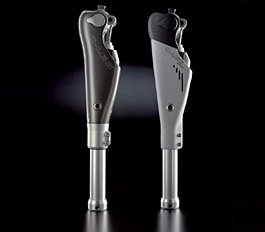
Orthopedic Industry introduced the C-Leg during the World Congress on Orthopedics in Nuremberg in 1997. The company began marketing the C-Leg in the United States in 1999. Other microprocessor-controlled knee prostheses include Ossur's Rheo Knee, released in 2005, the Power Knee by Ossur
Ossur
Össur is a company making non-invasive orthopaedics. It makes and sells bracing and support products, compression therapy, and prosthetics. The company’s headquarters are in Reykjavík, Iceland. The company also has extensive operations in the Americas, Europe, and Asia, with numerous distributors...
, introduced in 2006, the Plié Knee from Freedom Innovations and DAW Industries’ Self Learning Knee (SLK).
The idea was originally developed by Kelly James, a Canadian engineer, at the University of Alberta
University of Alberta
The University of Alberta is a public research university located in Edmonton, Alberta, Canada. Founded in 1908 by Alexander Cameron Rutherford, the first premier of Alberta and Henry Marshall Tory, its first president, it is widely recognized as one of the best universities in Canada...
. The C-Leg uses hydraulic cylinders to control the flexing of the knee. Sensors send signals to the microprocessor that analyzes these signals, and communicates what resistance the hydraulic cylinders should supply. C-Leg is an abbreviation of 3C100, the model number of the original prosthesis, but has continued to be applied to all Otto Bock microprocessor-controlled knee prostheses. The C-Leg functions through various technological devices incorporated into the components of the prosthesis. The C-Leg uses a knee-angle sensor to measure the angular position and angular velocity
Angular velocity
In physics, the angular velocity is a vector quantity which specifies the angular speed of an object and the axis about which the object is rotating. The SI unit of angular velocity is radians per second, although it may be measured in other units such as degrees per second, revolutions per...
of the flexing joint. Measurements are taken up to fifty times a second. The knee-angle sensor is located directly at the axis of rotation of the knee.
Moment sensors are located in the tube adapter at the base of the C-Leg. These moment sensors use multiple strain gauge
Strain gauge
A strain gauge is a device used to measure the strain of an object. Invented by Edward E. Simmons and Arthur C. Ruge in 1938, the most common type of strain gauge consists of an insulating flexible backing which supports a metallic foil pattern. The gauge is attached to the object by a suitable...
s to determine where the force is being applied to the knee, from the foot, and the magnitude of that force.
The C-Leg controls the resistance to rotation and extension of the knee using a hydraulic cylinder. Small valves control the amount of hydraulic fluid
Hydraulic fluid
Hydraulic fluids, also called hydraulic liquids, are the medium by which power is transferred in hydraulic machinery. Common hydraulic fluids are based on mineral oil or water...
that can pass into and out of the cylinder, thus regulating the extension and compression of a piston connected to the upper section of the knee. The microprocessor receives signals from its sensors to determine the type of motion being employed by the amputee. The microprocessor then signals the hydraulic cylinder to act accordingly. The microprocessor also records information concerning the motion of the amputee that can be downloaded onto a computer and analyzed. This information allows the user to make better use of the prosthetic.
The C-Leg is powered by a lithium-ion battery housed inside the prosthesis below the knee joint. (cell is actually located within the axis of the joint) On a full charge, the C-leg can operate for up to 45 hours, depending on the intensity of use. A charging port located on the front of the knee joint can be connected to a charging cable plugged directly into a standard outlet. A "pigtail" charging port adapter permits the relocation of the charging port to a location more accessible when the prosthesis has a cosmetic cover applied. The charger cord has lights that allow the user to observe the level of charge when connected to the knee. A 12 volt car charger adapter can also be purchased.
The C-Leg provides certain advantages over conventional mechanical knee prostheses. It provides an approximation to an amputee’s natural gait. The C-Leg allows amputees to walk at near walking speed. Variations in speed are also possible and are taken into account by sensors and communicated to the microprocessor, which adjusts to these changes accordingly. It also enables the amputees to walk down stairs with a step-over-step approach, rather than the one step at a time approach used with mechanical knees. The C-Leg’s ability to respond to sensor readings can help amputees recover from stumbles without the knee buckling. However, the C-Leg has some significant drawbacks that impair its use. The C-Leg is susceptible to water damage and thus great care must be taken to ensure that the prosthesis remains dry. Otto Bock recommends that each amputee use the C-Leg for up to two months before the system can fully become accustomed to the individual’s unique gait. Becoming accustomed to the C-Leg is especially difficult when walking downhill, and amputees should seek help while becoming familiar with the system to avoid injury.
A wide range of amputees can make use of the C-Leg; however, some people are more suited to this prosthesis than others. The C-Leg is designed for use on people who have undergone transfemoral amputation, or amputation above the knee. The C-Leg can be used by amputees with either single or bilateral limb amputations. In the case of bilateral amputations, the application of C-Legs must be closely monitored. In some cases, those who have undergone hip disarticulation amputations can be candidates for a C-Leg. The prosthesis is recommended for amputees that vary their walking speeds and can reach over 3 miles per hour; however, it cannot be used for running. The C-Leg is practical for upwards of 3 miles daily, and can be used on uneven ground, slopes, or stairs. Active amputees, such as bikers and rollerbladers may find the C-Leg suited to their needs.
Certain physical requirements must be met for C-Leg use. The amputee must have satisfactory cardiovascular and pulmonary health. The balance and strength of the amputee must be sufficient to take strides while using prosthesis. The C-Leg is designed to support amputees weighing up to 275 pounds.
Robotic prostheses
In order for a robotic prosthetic limb to work, it must have several components to integrate it into the body's function:Biosensors detect signals from the user's nervous or muscular systems. It then relays this information to a controller located inside the device, and processes feedback from the limb and actuator (e.g., position, force) and sends it to the controller. Examples include wires that detect electrical activity on the skin, needle electrodes implanted in muscle, or solid-state electrode arrays with nerves growing through them. One type of these biosensors are employed in myoelectric prosthesis.
Mechanical sensors process aspects affecting the device (e.g., limb position, applied force, load) and relay this information to the biosensor or controller. Examples include force meters and accelerometers.
The controller
Controller (computing)
In computing and especially in computer hardware, controller is a chip, an expansion card, or a stand-alone device that interfaces with a peripheral device...
is connected to the user's nerve and muscular systems and the device itself. It sends intention commands from the user to the actuators of the device, and interprets feedback from the mechanical and biosensors to the user. The controller is also responsible for the monitoring and control of the movements of the device.
An actuator
Actuator
An actuator is a type of motor for moving or controlling a mechanism or system. It is operated by a source of energy, usually in the form of an electric current, hydraulic fluid pressure or pneumatic pressure, and converts that energy into some kind of motion. An actuator is the mechanism by which...
mimics the actions of a muscle in producing force and movement. Examples include a motor that aids or replaces original muscle tissue.
Cosmesis
Cosmetic prosthesis has long been used to disguise injuries and disfigurements. With advances in modern technology, cosmesisCosmesis
Cosmesis is the preservation, restoration, or bestowing of bodily beauty. In the medical context, it usually refers to the surgical correction of a disfiguring defect, or the cosmetic improvements made by a surgeon following incisions...
, the creation of lifelike limbs made from silicone
Silicone
Silicones are inert, synthetic compounds with a variety of forms and uses. Typically heat-resistant and rubber-like, they are used in sealants, adhesives, lubricants, medical applications , cookware, and insulation....
or PVC
PVC
Polyvinyl chloride is a plastic.PVC may also refer to:*Param Vir Chakra, India's highest military honor*Peripheral venous catheter, a small, flexible tube placed into a peripheral vein in order to administer medication or fluids...
has been made possible. Such prosthetics, such as artificial hands, can now be made to mimic the appearance of real hands, complete with freckles, veins, hair, fingerprints and even tattoos.
Custom-made cosmeses are generally more expensive (costing thousands of US dollars, depending on the level of detail), while standard cosmeses come ready-made in various sizes, although they are often not as realistic as their custom-made counterparts. Another option is the custom-made silicone cover, which can be made to match a person's skin tone but not details such as freckles or wrinkles. Cosmeses are attached to the body in any number of ways, using an adhesive, suction, form-fitting, stretchable skin, or a skin sleeve.
Cognition
Unlike neuromotor prostheses, neurocognitive prostheses would sense or modulate neural function in order to physically reconstitute or augment cognitive processes such as executive function, attentionAttention
Attention is the cognitive process of paying attention to one aspect of the environment while ignoring others. Attention is one of the most intensely studied topics within psychology and cognitive neuroscience....
, language, and memory. No neurocognitive prostheses are currently available but the development of implantable neurocognitive brain-computer interfaces has been proposed to help treat conditions such as stroke
Stroke
A stroke, previously known medically as a cerebrovascular accident , is the rapidly developing loss of brain function due to disturbance in the blood supply to the brain. This can be due to ischemia caused by blockage , or a hemorrhage...
, traumatic brain injury
Traumatic brain injury
Traumatic brain injury , also known as intracranial injury, occurs when an external force traumatically injures the brain. TBI can be classified based on severity, mechanism , or other features...
, cerebral palsy
Cerebral palsy
Cerebral palsy is an umbrella term encompassing a group of non-progressive, non-contagious motor conditions that cause physical disability in human development, chiefly in the various areas of body movement....
, autism
Autism
Autism is a disorder of neural development characterized by impaired social interaction and communication, and by restricted and repetitive behavior. These signs all begin before a child is three years old. Autism affects information processing in the brain by altering how nerve cells and their...
, and Alzheimer's disease
Alzheimer's disease
Alzheimer's disease also known in medical literature as Alzheimer disease is the most common form of dementia. There is no cure for the disease, which worsens as it progresses, and eventually leads to death...
.
The recent field of Assistive Technology for Cognition concerns the development of technologies to augment human cognition. Scheduling devices such as Neuropage remind users with memory impairments when to perform certain activities, such as visiting the doctor. Micro-prompting devices such as PEAT, AbleLink and Guide have been used to aid users with memory and executive function problems perform activities of daily living
Activities of daily living
Activities of Daily Living is a term used in healthcare to refer to daily self-care activities within an individual's place of residence, in outdoor environments, or both...
.
Prosthetic enhancement
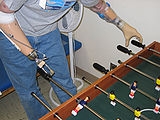
In addition to the standard artificial limb for everyday use, many amputees or congenital patients have special limbs and devices to aid in the participation of sports and recreational activities.Within science fiction, and, more recently, within the scientific community
Scientific community
The scientific community consists of the total body of scientists, its relationships and interactions. It is normally divided into "sub-communities" each working on a particular field within science. Objectivity is expected to be achieved by the scientific method...
, there has been consideration given to using advanced prostheses to replace healthy body parts with artificial mechanisms and systems to improve function. The morality and desirability of such technologies are being debated. Body parts such as legs, arms, hands, feet, and others can be replaced.
The first experiment with a healthy individual appears to have been that by the British scientist Kevin Warwick
Kevin Warwick
Kevin Warwick is a British scientist and professor of cybernetics at the University of Reading, Reading, Berkshire, United Kingdom...
. In 2002, an implant was interfaced directly into Warwick's nervous system. The electrode array
Electrode array
An electrode array is a configuration of electrodes used for measuring either an electric current or voltage. Some electrode arrays can operate in a bidirectional fashion, in that they can also be used to provide a stimulating pattern of electric current or voltage.Common arrays...
, which contained around a hundred electrode
Electrode
An electrode is an electrical conductor used to make contact with a nonmetallic part of a circuit...
s, was placed in the median nerve
Median nerve
The median nerve is a nerve in humans and other animals. It is in the upper limb. It is one of the five main nerves originating from the brachial plexus....
. The signals produced were detailed enough that a robot arm was able to mimic the actions of Warwick's own arm and provide a form of touch feedback again via the implant.
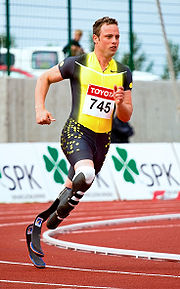
Oscar Pistorius
Oscar Leonard Carl Pistorius is a South African sprint runner. Known as the "Blade Runner" and "the fastest man on no legs", Pistorius, who has a double amputation, is the world record holder in the 100, 200 and 400 metres events and runs with the aid of Cheetah Flex-Foot carbon fibre transtibial...
, the "Blade Runner" of South Africa, was briefly ruled ineligible to compete in the 2008 Summer Olympics
2008 Summer Olympics
The 2008 Summer Olympics, officially known as the Games of the XXIX Olympiad, was a major international multi-sport event that took place in Beijing, China, from August 8 to August 24, 2008. A total of 11,028 athletes from 204 National Olympic Committees competed in 28 sports and 302 events...
because his prosthetic limbs were said to give him an unfair advantage over runners who had ankles. One researcher found that his limbs used twenty-five percent less energy than those of an able-bodied runner moving at the same speed. This ruling was overturned on appeal, with the appellate court stating that the overall set of advantages and disadvantages of Pistorius' limbs had not been considered. Pistorius did not qualify for the South African team for the Olympics, but went on to sweep the 2008 Summer Paralympics
2008 Summer Paralympics
The 2008 Summer Paralympic Games, the thirteenth Paralympics, took place in Beijing, China from September 6 to September 17, 2008. As with the 2008 Summer Olympics, equestrian events were held in Hong Kong and sailing events in Qingdao....
, and has been ruled eligible to qualify for any future Olympics. He qualified for the 2011 World Championship in South Korea and reached the semifinal where he ended last timewise, he was 14th in the first round, his personal best at 400m would have given him 5th place in the finals.
Dean Kamen
Dean Kamen
Dean L. Kamen is an American entrepreneur and inventor from New Hampshire.Born in Rockville Centre, New York, he attended Worcester Polytechnic Institute, but dropped out before graduating after five years of private advanced research for drug infusion pump AutoSyringe...
's company DEKA
DEKA
DEKA Research and Development Corporation is a company based in New Hampshire, founded in 1982 by Dean Kamen, consisting of nearly 200 engineers, technicians, and support staff...
developed the "Luke arm", an advanced prosthesis currently under trials as of 2008.
Types

Transtibial prosthesis
A transtibial prosthesis is an artificial limb that replaces a leg missing below the knee. Transtibial amputees are usually able to regain normal movement more readily than someone with a transfemoral amputation, due in large part to retaining the knee, which allows for easier movement. In the prosthetic industry a trans-tibial prosthetic leg is often referred to as a "BK" or below the knee prosthesis.Transfemoral prosthesis
A transfemoral prosthesis is an artificial limb that replaces a leg missing above the knee. Transfemoral amputees can have a very difficult time regaining normal movement. In general, a transfemoral amputee must use approximately 80% more energy to walk than a person with two whole legs. This is due to the complexities in movement associated with the knee. In newer and more improved designs, after employing hydraulics, carbon fibre, mechanical linkages, motors, computer microprocessors, and innovative combinations of these technologies to give more control to the user. In the prosthetic industry a trans-femoral prosthetic leg is often referred to as an "AK" or above the knee prosthesis.Transradial prosthesis
A transradial prosthesis is an artificial limb that replaces an arm missing below the elbow. Two main types of prosthetics are available. Cable operated limbs work by attaching a harness and cable around the opposite shoulder of the damaged arm. The other form of prosthetics available are myoelectric arms. These work by sensing, via electrodeElectrode
An electrode is an electrical conductor used to make contact with a nonmetallic part of a circuit...
s, when the muscles in the upper arm
Arm
In human anatomy, the arm is the part of the upper limb between the shoulder and the elbow joints. In other animals, the term arm can also be used for analogous structures, such as one of the paired forelimbs of a four-legged animal or the arms of cephalopods...
moves, causing an artificial hand to open or close. In the prosthetic industry a trans-radial prosthetic arm is often referred to as a "BE" or below elbow prosthesis.
Transhumeral prosthesis
A transhumeral prosthesis is an artificial limb that replaces an arm missing above the elbow. Transhumeral amputees experience some of the same problems as transfemoral amputees, due to the similar complexities associated with the movement of the elbow. This makes mimicking the correct motion with an artificial limb very difficult. In the prosthetic industry a trans-humeral prosthesis is often referred to as a "AE" or above the elbow prothesis.Current technology/manufacturing
In recent years there have been significant advancements in artificial limbs. New plastics and other materials, such as carbon fiberCarbon fiber
Carbon fiber, alternatively graphite fiber, carbon graphite or CF, is a material consisting of fibers about 5–10 μm in diameter and composed mostly of carbon atoms. The carbon atoms are bonded together in crystals that are more or less aligned parallel to the long axis of the fiber...
, have allowed artificial limbs to be stronger and lighter, limiting the amount of extra energy necessary to operate the limb. This is especially important for transfemoral amputees. Additional materials have allowed artificial limbs to look much more realistic, which is important to transradial and transhumeral amputees because they are more likely to have the artificial limb exposed.
In addition to new materials, the use of electronics has become very common in artificial limbs. Myoelectric limbs, which control the limbs by converting muscle movements to electrical signals, have become much more common than cable operated limbs. Myoelectric signals are picked up by electrodes, the signal gets integrated and once it exceeds a certain threshold, the prosthetic limb control signal is triggered which is why inherently, all myoelectric controls lag. Conversely, cable control is immediate and physical, and through that offers a certain degree of direct force feedback that myoelectric control does not. Computers are also used extensively in the manufacturing of limbs. Computer Aided Design and Computer Aided Manufacturing are often used to assist in the design and manufacture of artificial limbs.
Most modern artificial limbs are attached to the stump of the amputee by belts and cuffs or by suction
Suction
Suction is the flow of a fluid into a partial vacuum, or region of low pressure. The pressure gradient between this region and the ambient pressure will propel matter toward the low pressure area. Suction is popularly thought of as an attractive effect, which is incorrect since vacuums do not...
. The stump either directly fits into a socket on the prosthetic, or - more commonly today - a liner is used that then is fixed to the socket either by vacuum (suction sockets) or a pin lock. Liners are soft and by that, they can create a far better suction fit than hard sockets. Silicone liners can be obtained in standard sizes, mostly with a circular (round) cross section, but for any other stump shape, custom liners can be made. The socket is custom made to fit the residual limb and to distribute the forces of the artificial limb across the area of the stump (rather than just one small spot), which helps reduce wear on the stump. The custom socket is created by taking a plaster cast of the stump or, more commonly today, of the liner worn over the stump, and then making a mold from the plaster cast. Newer methods include laser guided measuring which can be input directly to a computer allowing for a more sophisticated design.
One problems with the stump and socket attachment is that a bad fit will reduce the area of contact between the stump and socket or liner, and increase pockets between stump skin and socket or liner. Pressure then is higher, which can be painful. Air pockets can allow sweat to accumulate that can soften the skin. Ultimately, this is a frequent cause for itchy skin rashes. Further down the road, it can cause breakdown of the skin.
Artificial limbs are typically manufactured using the following steps:
- Measurement of the stump
- Measurement of the body to determine the size required for the artificial limb
- Fitting of a silicone liner
- Creation of a model of the liner worn over the stump
- Formation of thermoplasticThermoplasticThermoplastic, also known as a thermosoftening plastic, is a polymer that turns to a liquid when heated and freezes to a very glassy state when cooled sufficiently...
sheet around the model – This is then used to test the fit of the prosthetic - Formation of permanent socket
- Formation of plastic parts of the artificial limb – Different methods are used, including vacuum formingVacuum formingVacuum forming, commonly known as vacuuforming, is a simplified version of thermoforming, whereby a sheet of plastic is heated to a forming temperature, stretched onto or into a single-surface mold , and held against the mold by applying vacuum between the mold surface and the sheet.The vacuum...
and injection moldingInjection moldingInjection molding is a manufacturing process for producing parts from both thermoplastic and thermosetting plastic materials. Material is fed into a heated barrel, mixed, and forced into a mold cavity where it cools and hardens to the configuration of the cavity... - Creation of metal parts of the artificial limb using die castingDie castingDie casting is a metal casting process that is characterized by forcing molten metal under high pressure into a mold cavity. The mold cavity is created using two hardened tool steel dies which have been machined into shape and work similarly to an injection mold during the process...
- Assembly of entire limb
Body-powered arms
Current body powered arms contain sockets that are built from hard epoxy or carbon fiber. Wrist units are either screw-on connectors featuring the UNF 1/2-20 thread (USA) or quick release connector, of which there are different models. Terminal devices contain a range of hooks, hands or other devices. Hands require a large activation force, which is often uncomfortable. Hooks require a much lower force. Hosmer and Otto Bock are major commercial hook providers. Mechanical hands are sold by Hosmer and Otto Bock as well; the Becker Hand is still manufactured by the Becker family. Prosthetic hands may be fitted with standard stock or custom made cosmetic looking silicone gloves. But regular work gloves may be worn as well. Other terminal devices include the V2P Prehensor, a versatile robust gripper that allows customers to modify aspects of it, Texas Assist Devices (with a whole assortment of tools) and TRS that offers a range of terminal devices for sports. Cable harnesses can be built using aircraft steel cables, ball hinges and self lubricating cable sheaths. Current high tech allows body powered arms to weigh around half to only a third of the weight that a myoelectric arm has.
Myoelectric
A myoelectric prosthesis uses electromyographyElectromyography
Electromyography is a technique for evaluating and recording the electrical activity produced by skeletal muscles. EMG is performed using an instrument called an electromyograph, to produce a record called an electromyogram. An electromyograph detects the electrical potential generated by muscle...
signals or potentials from voluntarily contracted muscles within a person's residual limb on the surface of the skin to control the movements of the prosthesis, such as elbow flexion/extension, wrist supination/pronation (rotation) or hand opening/closing of the fingers. A prosthesis of this type utilizes the residual neuro-muscular system of the human body to control the functions of an electric powered prosthetic hand, wrist or elbow.
This is as opposed to an electric switch prosthesis, which requires straps and/or cables actuated by body movements to actuate or operate switches that control the movements of a prosthesis or one that is totally mechanical.
It is not clear whether those few prostheses that provide feedback signals to those muscles are also myoelectric in nature.
It has a self suspending socket with pick up electrodes placed over flexors and extensors for the movement of flexion and extension respectively.
The first commercial myoelectric arm was developed in 1964 by the Central Prosthetic Research Institute of the USSR
Soviet Union
The Soviet Union , officially the Union of Soviet Socialist Republics , was a constitutionally socialist state that existed in Eurasia between 1922 and 1991....
, and distributed by the Hangar Limb Factory of the UK
United Kingdom
The United Kingdom of Great Britain and Northern IrelandIn the United Kingdom and Dependencies, other languages have been officially recognised as legitimate autochthonous languages under the European Charter for Regional or Minority Languages...
.
Robotic limbs
Advancements in the processors used in myoelectric arms has allowed for artificial limbs to make gains in fine tuned control of the prosthetic. The Boston Digital ArmBoston Digital Arm
Boston Digital Arm is a prosthetic company based in Holliston, Massachusetts. It specializes in the upper limbs powered prosthetic.Boston Digital Arm has become famous then it introduced first microcontroller-equipped hand prostetic in 2001...
is a recent artificial limb that has taken advantage of these more advanced processors. The arm allows movement in five axes and allows the arm to be programmed for a more customized feel. Recently the i-Limb hand, invented in Edinburgh, Scotland, by David Gow has become the first commercially available hand prosthesis with five individually powered digits. The hand also possesses a manually rotatable thumb which is operated passively by the user and allows the hand to grip in precision, power and key grip modes. Raymond Edwards, Limbless Association
Limbless Association
The Limbless Association, is a charitable organization in the United Kingdom set up to help those with limb loss, and assist their families and carers. It is registered with the Charity Commission for England and Wales and its charity registration number is 803533...
Acting CEO, was the first amputee to be fitted with the i-LIMB by the National Health Service
National Health Service
The National Health Service is the shared name of three of the four publicly funded healthcare systems in the United Kingdom. They provide a comprehensive range of health services, the vast majority of which are free at the point of use to residents of the United Kingdom...
in the UK. The hand, manufactured by "Touch Bionics" of Scotland (a Livingston
Livingston, Scotland
Livingston is a town in West Lothian, Scotland. It is the fourth post-WWII new town to be built in Scotland, designated in 1962. It is about 15 miles west of Edinburgh and 30 miles east of Glasgow, and is bordered by the towns of Broxburn to the northeast and Bathgate to the northwest.Livingston...
company), went on sale on 18 July 2007 in Britain. It was named alongside the Large Hadron Collider in Time
Time (magazine)
Time is an American news magazine. A European edition is published from London. Time Europe covers the Middle East, Africa and, since 2003, Latin America. An Asian edition is based in Hong Kong...
magazine's top fifty innovations. Another robotic hand is the RSLSteeper bebionic
Another neural prosthetic is Johns Hopkins University Applied Physics Laboratory Proto 1. Besides the Proto 1, the university also finished the Proto 2
Proto 2
Proto 2 is the name of the $55 million initiative of the Defense Advanced Research Projects Agency, or DARPA, to create a thought-controlled prosthetic arm. Its predecessor was called Proto 1 and was capable of reasonably complicated movements like rolling the shoulders, wrists, flexing the...
in 2010.
Robotic legs exist too: the Argo Medical Technologies ReWalk
ReWalk
ReWalk is the first commercially viable upright walking assistance tool, which enables paraplegics to stand, walk, and climb stairs. Designed in Israel, the ReWalk is marketed by Argo Medical Technologies....
is an example or a recent robotic leg, targeted to replace the wheelchair
Wheelchair
A wheelchair is a chair with wheels, designed to be a replacement for walking. The device comes in variations where it is propelled by motors or by the seated occupant turning the rear wheels by hand. Often there are handles behind the seat for someone else to do the pushing...
. It is marketed as a "robotic pants".
Targeted muscle reinnervation (TMR) is a technique in which motor nerves which previously controlled muscle
Muscle
Muscle is a contractile tissue of animals and is derived from the mesodermal layer of embryonic germ cells. Muscle cells contain contractile filaments that move past each other and change the size of the cell. They are classified as skeletal, cardiac, or smooth muscles. Their function is to...
s on an amputated limb are surgically
Surgery
Surgery is an ancient medical specialty that uses operative manual and instrumental techniques on a patient to investigate and/or treat a pathological condition such as disease or injury, or to help improve bodily function or appearance.An act of performing surgery may be called a surgical...
rerouted such that they reinnervate a small region of a large, intact muscle, such as the pectoralis major. As a result, when a patient thinks about moving the thumb of his missing hand, a small area of muscle on his chest will contract instead. By placing sensors over the reinervated muscle, these contractions can be made to control movement of an appropriate part of the robotic prosthesis.
An emerging variant of this technique is called targeted sensory reinnervation (TSR). This procedure is similar to TMR, except that sensory nerve
Sensory nerve
Sensory nerves are nerves that receive sensory stimuli, such as how something feels and if it is painful, smooth, rough, etc.They are made up of nerve fibers, called sensory fibers .Sensory neurons are neurons that are activated by sensory input Sensory nerves are nerves that receive sensory...
s are surgically rerouted to skin
Skin
-Dermis:The dermis is the layer of skin beneath the epidermis that consists of connective tissue and cushions the body from stress and strain. The dermis is tightly connected to the epidermis by a basement membrane. It also harbors many Mechanoreceptors that provide the sense of touch and heat...
on the chest, rather than motor nerves rerouted to muscle. The patient then feels any sensory stimulus on that area of the chest, such as pressure or temperature, as if it were occurring on the area of the amputated limb which the nerve originally innervated. In the future, artificial limbs could be built with sensors on fingertips or other important areas. When a stimulus, such as pressure or temperature, activated these sensors, an electrical signal would be sent to an actuator, which would produce a similar stimulus on the "rewired" area of chest skin. The user would then feel that stimulus as if it were occurring on an appropriate part of the artificial limb.
Recently, robotic limbs have improved in their ability to take signals from the human brain
Human brain
The human brain has the same general structure as the brains of other mammals, but is over three times larger than the brain of a typical mammal with an equivalent body size. Estimates for the number of neurons in the human brain range from 80 to 120 billion...
and translate those signals into motion in the artificial limb. DARPA, the Pentagon’s research division, is working to make even more advancements in this area. Their desire is to create an artificial limb that ties directly into the nervous system
Nervous system
The nervous system is an organ system containing a network of specialized cells called neurons that coordinate the actions of an animal and transmit signals between different parts of its body. In most animals the nervous system consists of two parts, central and peripheral. The central nervous...
.
Direct bone attachment / osseointegration
OsseointegrationOsseointegration
Osseointegration derives from the Greek osteon, bone, and the Latin integrare, to make whole. The term refers to the direct structural and functional connection between living bone and the surface of a load-bearing artificial implant...
is a new method of attaching the artificial limb to the body. This method is also sometimes referred to as exoprosthesis (attaching an artificial limb to the bone), or endo-exoprosthesis.
The stump and socket method can cause significant pain in the amputee, which is why the direct bone attachment has been explored extensively. The method works by inserting a titanium bolt into the bone at the end of the stump. After several months the bone attaches itself
Osseointegration
Osseointegration derives from the Greek osteon, bone, and the Latin integrare, to make whole. The term refers to the direct structural and functional connection between living bone and the surface of a load-bearing artificial implant...
to the titanium bolt and an abutment is attached to the titanium bolt. The abutment extends out of the stump and the artificial limb is then attached to the abutment. Some of the benefits of this method include the following:
- Better muscle control of the prosthetic.
- The ability to wear the prosthetic for an extended period of time; with the stump and socket method this is not possible.
- The ability for transfemoral amputees to drive a car.
The main disadvantage of this method is that amputees with the direct bone attachment cannot have large impacts on the limb, such as those experienced during jogging, because of the potential for the bone to break.
Cost
Transradial and transtibial prostheses typically cost between US $United States dollar
The United States dollar , also referred to as the American dollar, is the official currency of the United States of America. It is divided into 100 smaller units called cents or pennies....
6,000 and $8,000. Transfemoral and transhumeral prosthetics cost approximately twice as much with a range of $10,000 to $15,000 and can sometimes reach costs of $35,000. The cost of an artificial limb does recur because artificial limbs are usually replaced every 3–4 years due to wear and tear
Wear and tear
Wear and tear is damage that naturally and inevitably occurs as a result of normal wear or aging. It is used in a legal context for such areas as warranty contracts from manufacturers, which usually stipulate that damage due to wear and tear will not be covered.Wear and tear is a form of...
. In addition, if the socket has fit issues, the socket must be replaced within several months. If height is an issue components can be changed, such as the pylons.
Low cost above knee prostheses often provide only basic structural support with limited function. This function is often achieved with crude, non-articulating, unstable, or manually locking knee joints. A limited number of organizations, such as the International Committee of the Red Cross (ICRC), create devices for developing countries. Their device which is manufactured by CR Equipments is a single-axis, manually operated locking polymer prosthetic knee joint.
Table. List of knee joint technologies based on the literature review.
| Name of technology (country of origin) | Brief description | Highest level of evidence |
|---|---|---|
| ICRC knee (Switzerland) | Single-axis with manual lock | Independent field |
| ATLAS knee (UK) | Weigh-activated friction | Independent field |
| POF/OTRC knee (US) | Single-axis with ext. assist | Field |
| DAV/Seattle knee (US) | Compliant polycentric | Field |
| LEGS M1 knee (US) | Four-bar | Field |
| JaipurKnee (US) | Four-bar | Field |
| LCKnee (Canada) | Single-axis with automatic lock | Field |
| None provided (Nepal) | Single-axis | Field |
| None provided (New Zealand) | Roto-molded single-axis | Field |
| None provided (India) | Six-bar with squatting | Technical development |
| Friction knee (US) | Weigh-activated friction | Technical development |
| Wedgelock knee (Australia) | Weigh-activated friction | Technical development |
| SATHI friction knee (India) | Weigh-activated friction | Limited data available |
There is currently an open Prosthetics design forum known as the "Open Prosthetics Project". The group employs collaborators and volunteers to advance Prosthetics technology while attempting to lower the costs of these necessary devices.
A plan for a low-cost artificial leg, designed by Sébastien Dubois, was featured at the 2007 International Design Exhibition and award show in Copenhagen, Denmark, where it won the Index: Award. It would be able to create an energy-return prosthetic leg for US $
United States dollar
The United States dollar , also referred to as the American dollar, is the official currency of the United States of America. It is divided into 100 smaller units called cents or pennies....
8.00, composed primarily of fiberglass
Fiberglass
Glass fiber is a material consisting of numerous extremely fine fibers of glass.Glassmakers throughout history have experimented with glass fibers, but mass manufacture of glass fiber was only made possible with the invention of finer machine tooling...
.
Prior to the 1980s, foot prostheses merely restored basic walking capabilities. These early devices can be characterized by a simple artificial attachment connecting one's residual limb to the ground.
The introduction of the Seattle Foot (Seattle Limb Systems) in 1981 revolutionized the field, bringing the concept of an Energy Storing Prosthetic Foot (ESPF) to the fore. Other companies soon followed suit, and before long, there were multiple models of energy storing prostheses on the market. Each model utilized some variation of a compressible heel. The heel is compressed during initial ground contact, storing energy which is then returned during the latter phase of ground contact to help propel the body forward.
Since then, the foot prosthetics industry has been dominated by steady, small improvements in performance, comfort, and marketability. Jaipur Foot
Jaipur leg
The Jaipur Leg also known as the Jaipur Foot is a rubber-based prosthetic leg for people with below-knee amputations, produced under the guidance of Dr. P. K...
, an artificial limb from Jaipur
Jaipur
Jaipur , also popularly known as the Pink City, is the capital and largest city of the Indian state of Rajasthan. Founded on 18 November 1727 by Maharaja Sawai Jai Singh II, the ruler of Amber, the city today has a population of more than 3.1 million....
, India
India
India , officially the Republic of India , is a country in South Asia. It is the seventh-largest country by geographical area, the second-most populous country with over 1.2 billion people, and the most populous democracy in the world...
, costs about US$ 40.
Design considerations
There are multiple factors to consider when designing a transtibial prosthesis. Manufacturers must make choices about their priorities regarding these factors.Performance
Nonetheless, there are certain elements of foot mechanics that are invaluable for the athlete, and these are the focus of today’s high-tech prosthetics companies:- Energy storage and return – storage of energy acquired through ground contact and utilization of that stored energy for propulsion
- Energy absorption – minimizing the effect of high impact on the musculoskeletal system
- Ground compliance – stability independent of terrain type and angle
- Rotation – ease of changing direction
- Weight – maximizing comfort, balance and speed
- Suspension - how the socket will join and fit to the limb≈
Other
The buyer is also concerned with numerous other factors:- Cosmetics
- Cost
- Ease of use
- Size availability
External links
- ‘Biomechanics of running: from faulty movement patterns come injury.' Sports Injury Bulletin.
- Edelstein, J. E. Prosthetic feet. State of the Art. Physical Therapy 68(12) Dec 1988: 1874-1881.
- Gailey, Robert. The Biomechanics of Amputee Running. October 2002.
- Hafner, B. J., Sanders, J. E., Czerniecki, J. M., Ferguson , J. Transtibial energy-storage-and-return prosthetic devices: A review of energy concepts and a proposed nomenclature. Journal of Rehabilitation Research and Development Vol. 39, No. 1 Jan/Feb 2002: 1-11.
- National Amputee Centre — Information about artificial limbs
- Encyclopedia about Dental Implants in Russian
- How Stuff Works : Biomechatronics - An overview of the field of biomechatronics, of which prosthetics is a part
- Otto Bock
- American Academy of Orthotists and Prosthetists
- Chard Museum Display of James Gillingham's work on post WW1 artificial limbs.
- Myoelectric Prosthetics — Information about Myoelectric Prosthetics
- Myoelectric Prosthetesis — Children's Electronic Hand Assistance Project (CEHAP)