


Apennine mountains

Encyclopedia
The Apennines or Apennine Mountains (ˈæpənaɪn; , —a singular used in the plural;Apenninus has the form of an adjective, which would be segmented Apenn-inus, often used with nouns such as mons (mountain) or Greek oros (orogeny) but just as often used alone as a noun. The ancient Greeks and Romans typically but not always used "mountain" in the singular to mean one or a range; thus, "the Apennine mountain" refers to the entire chain and is translated "the Apennine mountains". The ending can vary also by gender depending on the noun modified. The Italian singular refers to one of the constituent chains rather than to a single mountain and the Italian plural refers to multiple chains rather than to multiple mountains. ) are a mountain range
consisting of parallel smaller chains extending c. 1200 km (745.6 mi) along the length of peninsula
r Italy
. In the northwest they join with the Ligurian Alps
at Altare
. In the southwest they end at Reggio di Calabria, the coastal city at the tip of the peninsula. Since about 2000 the Ministry of the Environment of Italy, following the recommendations of the Apennines Park of Europe Project, has been defining the Appennines System to include the mountains of north Sicily
, for a total distance of The system forms an arc enclosing the east side of the Ligurian
and Tyrrhenian Sea
s.
The etymology most frequently repeated, because of its semantic appropriateness, is that it derives from the Celtic Penn, "mountain, summit": which could have been assigned during the Celtic domination of north Italy in the 4th century BC or before. The name originally applied to the north Apennines. However, historical linguists have never found a derivation with which they are universally comfortable. Wilhelm Deecke said:A large number of place names reflect pen: Penarrig, Penbrynn, Pencoid, Penmon, Pentir, etc. and ben: Beanach, Benmore, Benabuird, Benan, Bencruachan, etc. . In one derivation Pen/Ben is cognate with Old Irish cenn, "head", but an original *kwen- would be required, which is typologically not found in languages that feature labio-velars. Windisch
and Brugmann
reconstructed Indo-European
*kwi-, deriving also the Greek Pindus Mountains, but *kwen-<*kwi- is not explained by any rule . Accordingly has it cognate with English "pin" and goes so far as to suggest pin and pen come from Latin pinna, "feather", in the sense of the horn of the quill. This view has the word originating in Latium
inconsistently with the theory of the northern origin. None of these derivations are unquestionably accepted. is doubtful but some derive it from the Ligurian-Celtish Pen or Ben, which means mountain peak."
The mountains lend their name to the Apennine peninsula, which forms the major part of Italy. They are mostly verdant, although one side of the highest peak, Corno Grande
is partially covered by Calderone glacier
, the southernmost glacier
in Europe and the only one in the Apennines. It has been receding since 1794. The southern mountains are semi-arid. The eastern slopes down to the Adriatic Sea
are steep, while the western slopes form foothills on which most of peninsular Italy's cities are located. The mountains tend to be named from the province or provinces in which they are located; for example, the Ligurian Apennines are in Liguria. As the provincial borders have not always been stable, this practice has resulted in some confusion about exactly where the montane borders are. Often but not always a geographical feature can be found that lends itself to being a border.
A number of long hiking trails wind through the Apennines. Of note is European walking route E1
coming from northern Europe and traversing the lengths of the northern and central Apennines. The Grand Italian Trail
begins in Trieste
and after winding through the Alpine arc traverses the entire Apennine system, Sicily and Sardinia.
in the Gulf of Genoa
, from about Savona
below the upper Bormida River valley to about La Spezia
(La Cisa pass
) below the upper Magra
River valley. The range follows the Gulf of Genoa
separating it from the upper Po Valley
. The northwestern border follows the line of the Bormida River to Acqui Terme
. There the river continues northeast to Alessandria
in the Po Valley
, but the mountains bend away to the southeast.
The upper Bormida can be reached by a number of roads proceeding inland at a right angle to the coast southwest of Savona
, the chief one being the Autostrada Torino-Savona. They ascend to the Bocchetta di Altare
, sometimes called Colle di Cadibona, 436 m (1,430.4 ft), the border between the Ligurian Alps
along the coast to the west and the Ligurian Apennines. A bronze plaque fixed to a stone marks the top of the pass. In the vicinity are fragments of the old road and three ruins of former fortifications.
At Carcare
, the main roads connect with the upper Bormida valley (Bormida di Millare) before turning west. The Scrivia
, the Trebbia
the Taro
and the Tanaro
(Tanarus), tributaries of the Po River
, drain the northeast slopes. The range contains dozens of peaks. Toward the southern end the Aveto Natural Regional Park
includes Monte Penna
. Nearby is the highest point of Ligurian Apennines, Monte Maggiorasca
at 1780 m (5,839.9 ft).
The main and only feasible overland route connecting the coastal plain of Liguria to the north Italian plain runs through Bocchetta di Altare. It has always been of strategic importance. Defenders of north Italy have had to control it since ancient times, as the various fortifications placed there testify. Currently however, Trenitalia
, the state railway system, highly developed on the coastal plain, traverses the mountains routinely through a number of railway tunnels, such as the one at Giovi Pass
.
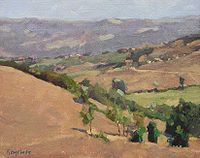 The southeastern border of the Ligurian Apennines is the Fiume Magra
, which projects into the Tyrrhenian Sea south of La Spezia
, and the Fiume Taro
, which runs in the opposite direction to join the Po River
. The divide between the two upper river valleys is the Passo della Cisa, "Cisa Pass
". Under it (two tunnels) runs the Autostrada della Cisa between Spezia and Parma
.
Starting at Cisa Pass
, the mountain chains turn further to the southeast to cross the peninsula along the border between the Emilia-Romagna
and Tuscany
regions, for which they are named the Tuscan-Emilian Apennines, or just the Tuscan Apennines. They extend to the upper Tiber River. The high point is Monte Cimone
at 2165 m (7,103 ft).
A separate branch, the Alpi Apuane
, goes to the southwest bordering the coast south of La Spezia
. Whether they are to be considered part of the Apennines is a matter of opinion; certainly, they are part of the Apennine System. Topographically only the valley of the River Serchio
, which running parallel to the coast turns and exits into the Tyrrhenian Sea north of Pisa
, separates the Apuane Alps from the Apennines; geologically the rock is of a slightly different composition: marble
. The Roman marble industry was centered at Carrara
.
As the Tuscan Apennines divide the peninsula between the Po Valley
and the plains and hills of Tuscany
and Lazio, transportation over them is essential to political and economic unity. Historically the Romans used the Via Flaminia
between Rome
and Rimini
. The montane distance between Florence
in Tuscany
and Bologna
in Emilia-Romagna
is shorter, but exploitation of it required the conquest of more rugged terrain, which was not feasible for the ancients. Railway lines were constructed over the mountains in the early 19th century but they were of low capacity and unimprovable.
Since 1856 a series of tunnels have been constructed to conduct "the Bologna-Florence rail line", which is neither a single line nor a single tunnel. The Porrettana Line went into service in 1864, the Direttissima in 1934 and the High Speed in 1996. A few dozen tunnels support the three of them, the longest on the High-Speed Line being the Voglia Tunnel at 16.757 km (10.4 mi). The longest is on the Direttissima, the Great Apennine Tunnel, whch at 18.5 km (11.5 mi) is the longest entirely within Italy, although the Simplon Tunnel
, which connects Italy and Switzerland, is longer.Claims of being the longest or second-longest in the world have been soon outdated. See List of longest tunnels in the world. Currently automobile traffic is carried by the Autostrada del Sole, Route A1, which goes through numerous shorter tunnels, bypassing an old road, originally Roman, through Futa Pass
.
The southernmost limit of the Tuscan-Emilian Apennines is approximately Foreste Casentinesi, Monte Falterona, Campigna National Park
. The three-way intersection of the borders between Emilia-Romagna, Tuscany and Marches is on the south slopes of Monte Fumaiolo, from which the Tiber originates. The mountain is the furthest south of Emilia-Romana.
flows from northeast to southwest, projecting into the Tyrrhenian Sea at right angles to the shore. The upper Tiber, however, flows from northwest to southeast, gradually turning through one right angle clockwise. In the north Val Tevere ("Valley of the Tiber") is a deep valley separating the Umbrian Apennines on the left bank from a lesser range, the Tuscan Anti- or Sub-Apennines on its right. They and some of Val Tevere are part of Tuscany
, which formerly was enclosed by the Arno River, the Tiber River and the coast, but has lost ground around the Tiber to Lazio and Umbria
. Lazio extends a little way up the Tiber. Val Tevere, however, is mainly in Umbria
. In the Apennines also and on the west coast is Marche
s.
The Val Tevere is marked on the map by Highway A1, the Autostrada del Sole, which enters it in the vicinity of Monte Rotondo north of Rome and follows the course of the river to the point where the latter flows from Lago di Cabara in the vicinity of Baschi
and then goes up the valley of the Fiume Paglia
. North of the lake the course of the Fiume Tevere is marked by Highway E45 almost to where the Tevere begins at Falera on the slopes of Monte Fumaiolo. That location is in Emilia-Romagna
. For that entire distance the eastern slopes of the Apennines are in Marche
s.Ancient Umbria included most of Marches (which did not then exist) except for the Adriatic coast and did not include Val Tevere, which belonged to Etruria
all the way to the Tyrrhenian Sea. Names of regions and the geographical features associated with them; for example, "the Tuscan Hills" depend on the historical period.
South of Monte Fumaiolo the Tevere enters Tuscany
. It crosses the Umbrian border in the vicinity of San Giustino
and remains in it, becoming part of the border between Umbria and Lazio in the south, entering Lazio unequivocally in the vicinity of Castello delle Formiche. Over the centuries these borders have varied, mainly at the expense of Tuscany
. Consequently there has been considerable imprecision in locating the Umbrian Apennines, and therefore the highest peak in them. The major difficulty is discriminating the Umbrian of the Northern Apennines from the Umbrian-Marchean of the Central Apennines. The mountains of Umbria and Marches are so wide and so tangled, rather than parallel, that the borders are difficult to place and vary according to author. Many do not make the distinction, but one is still recognized, however uncertainly, by the Italian park service. In general, the Umbrian Apennines are located mainly in Umbria, while the great mass of mountains in Marche
s are considered Central Apennine.
Merriam-Webster's Geographical Dictionary defines the Umbrian Apennines to extend from the "sources of the Tiber" to Scheggia Pass
, bounded on the east by the border between Umbria
and Marche
s, which runs along the divide. Similarly the Alto Tevere begins near the border between Tuscany
and Emilia-Romagna
. The pass is the point where the Roman Via Flaminia
crosses the divide, at 575 metres (1,886.5 ft). Starting from Rimini
on the Adriatic coast the old road follows the coast south to Fano
, then turns inland and goes up the Fiume Metauro
to Ponti di Traiano, then up the Fiume Candigliano to Acqualagna
, and by the Fiume Burano
to Cagli
(ancient Cales). Here the Via Flaminia turns south, approximated today by highway SP3, which climbing the flanks of Monte Fiume arrives at last at the pass. This is the southernmost limit of the Umbrian Apennines, according to the dictionary. The pass goes down to Gualdo Tadino
(Tadinium). Gubbio is east of the Val Tevere.
The region specified by the dictionary includes Monte Nerone
, 1526 m (5,006.6 ft), which is actually in Marche
s. South of the pass the same chain is in Umbria
and includes a number of parklands considered by the Italians to be in the northern Apennines. The LOTO Project (Landscape Opportunities for Territorial Organization), a recent pilot study for regional landscape planning undertaken by the European Institute of Cultural Routes, an agency of the European Union
, simply calls it "the Apennine Ridge" of "the Umbria Region," which it locates in "the central and northern mountains of the Apennines." The western part of this range is considered by some to be the Umbrian Apennines; it includes Parco del Monte Cucco, 1566 m (5,137.8 ft), which includes the pass, the road and the Umbrian side of the ridge south to Fossato di Vico. Further south are Parco del Monte Subasio
around Assisi
and Parco di Colfiorito
on the border with Marches.
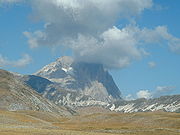
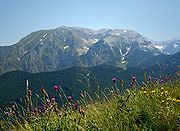 The Apennine System forms an irregular arc with centers of curvature located in the Tyrrhenian Sea. The northern and southern segments comprise parallel chains that can be viewed as single overall mountain ridges, such as the Ligurian Mountains. The center, being thicker and more complex, is geologically divided into an inner and an outer arc with regard to the centers of curvature. The geologic definition, however, is not the same as the geographic.
Based on rock type and orogenic incidents, the northern segment of the arc is divided into the Outer Northern Apennines (ONA) and the Inner Northern Apennines (INA). The inner are located in Tuscany
and Umbria
and correspond well with the geography, comprising the Alpi Apuane and Umbrian Apennines. The outer comprise the outer Ligurian, Tuscan-Emilian and half the Central Apennines, which are the eastern half of the divide marked by the Umbria-Marches border. The Central Apennines, also called the High Apennines, are therefore divided into the Umbrian-Marchean or Roman Apennines in the north and the Abruzzi Apennines in the south.
n zone, or band of isolated Liguride rocks, follows the Val Marecchia ("Valley of the Marecchia
River") to the Marches-Tuscany border and passes through the Monti Rognosi and Arezzo
in Tuscany
. If extended the line would touch the northern tip of Corsica
, but it is only relevant on the east slopes of the Apennines, where it is located just south of the border between Marches and Emilia-Romagna. The west border of the Umbrian-Marchean Apennines (or "Umbro-Marchean") runs through Cagli
. They extend south to the Tronto
River, the south border of the ONA.
In the northeast of the range, the Republic of San Marino
is located on the slopes of Monte Titano
. The highest peak, Monte Vettore
, at 2478 m (8,129.9 ft), is part of the Monti Sibillini
, incorporated into Parco Nazionale dei Monti Sibillini
. Further inland is Parco Sasso Simone e Simoncello and further south Parco naturale regionale Gola della Rossa di Frasassi
, in which are the Gola della Rossa ("Canyon of the Red") and Frasassi Caves
. The Italian Park Service calls it the "Green Heart" of Italy. The region is heavily forested, such as the Riserva Naturale Statale Gola del Furlo, where Furlo Pass
on the Via Flaminia
is located. Both the Etruscans and the Romans constructed tunnels here.
, Molise
(formerly part of Abruzzo) and southeastern Lazio, contain the highest peaks and most rugged terrain of the Apennines. They are known in history as the territory of the Italic peoples first defeated by the city of Rome
. Coincidentally they exist in three parallel folds or chains surviving from the orogeny
. These extend in a northwest-southeast direction from the River Tronto
to the River Sangro, which drain into the Adriatic. The coastal hills of the east extend between San Benedetto del Tronto
in the north and Torino di Sangro
in the south.
The eastern chain consists mainly of the southern part of the Monti Sibillini, the Monti della Laga
, the Gran Sasso d'Italia Massif and the Majella
Massif. Among them are two national parks: Gran Sasso e Monti della Laga National Park
and Majella National Park
. Gran Sasso contains Corno Grande
, highest peak of the Apennines.
_e_serra_dolcedorme_(2.267_m)._salendo_su_serra_del_prete_(2.181_m).jpg) In the southern Apennines, to the south of the Sangro valley, the three parallel chains are broken up into smaller groups; among them may be named the Matese
In the southern Apennines, to the south of the Sangro valley, the three parallel chains are broken up into smaller groups; among them may be named the Matese
, the highest point of which is the Monte Miletto (2,050 m). The chief rivers on the south-west are the Liri
or Garigliano with its tributary the Sacco, the Volturno
, Sebeto, Sarno, on the north the Trigno, Biferno and Fortore
.
The promontory of Monte Gargano
, on the east, is completely isolated, and so are the Campania
n volcanic arc
near Naples
. The district is traversed from north-west to south-east by the railway from Sulmona
to Benevento
and on to Avellino
, and from south-west to northeast by the railways from Caianello via Isernia to Campobasso
and Termoli, from Caserta to Benevento and Foggia, and from Nocera Inferiore
and Avellino to Rocchetta S. Antonio, the junction for Foggia, Spinazzola (for Barletta, Bari, and Taranto
) and Potenza. Roman roads followed the same lines as the railways: the Via Appia ran from Capua
to Benevento, whence the older road went to Venosa and Taranto and so to Brindisi
, while the Via Traiana ran nearly to Foggia
and thence to Bari.
The valley of the Ofanto
, which runs into the Adriatic close to Barletta
, marks the northern termination of the first range of the Lucanian Apennines (now Basilicata
), which runs from east to west, while south of the valleys of the Sele (on the west) and Basento
(on the east)—which form the line followed by the railway from Battipaglia via Potenza
to Metaponto
—the second range begins to run due north and south as far as the plain of Sibari. The highest point is the Monte Pollino
(2,248 m). The chief rivers are the Sele—joined by the Negro and Calore—on the west, and the Bradano
, Basento, Agri, Sinni on the east, which flow into the gulf of Taranto; to the south of the last-named river there are only unimportant streams flowing into the sea east and west, inasmuch as here the width of the peninsula diminishes to some 60 km.
The railway running south from Sicignano to Lagonegro, ascending the valley of the Negro, is planned to extend to Cosenza, along the line followed by the ancient Via Popilia, which beyond Cosenza reached the west coast at Terina and thence followed it to Reggio. The Via Herculia, a branch of the Via Traiana, ran from Aequum Tuticum to the ancient Nerulum. At the narrowest point the plain of Sibari, through which the rivers Coscile and Crati flow to the sea, occurs on the east coast, extending halfway across the peninsula. Here the limestone Apennines proper cease and the granite mountains of Calabria
begin.
The first group extends as far as the isthmus
formed by the gulfs of S. Eufemia and Squillace; it is known as the Sila, and the highest point reached is 1,928 m (the Botte Donato). The forests which covered it in ancient times supplied the Greeks and Sicilians with timber for shipbuilding. The railway from S. Eufemia to Catanzaro and Catanzaro Marina crosses the isthmus, and an ancient road may have run from Squillace to Monteleone. The second group extends to the south end of the Italian Peninsula
, culminating in the Aspromonte
(1,956 m) to the east of Reggio di Calabria. In both groups the rivers are quite unimportant.
. The snow line
is at about 3200 m (10,498.7 ft); that is, all the Apennines are below it, except for the one remaining glacier. Snow may fall from October to May. Rainfall increases with latitude. The climate is suboceanic.
The number of vascular plant
species in the Apennines has been estimated at 5599, 728 of which (23.6%) are in the treeline ecotone. Hemicryptophytes predominate in the entire Apennine chain. The treeline ecotone is mainly grassland
s, with scrub below it.
 The Apennines were created in the Apennine orogeny
beginning in the early Neogene
(about 20 mya, the middle Miocene
) and continuing today. Geographically they are partially or appear to be continuous with the Alpine system
. Prior to the explosion of data on the topic from about the year 2000 many authors took the approach that the Apennines had the same origin as the Alps. Even today some authors use the term Alpine-Apennine system. They are not, however, the same system and did not have the same origin. The Alps were millions of years old before the Apennines rose from the sea.
Both the Alps and the Apennines contain primarily sedimentary rock resulting from sedimentation of ancient Tethys Sea in the Mesozoic
. The northward movement of the African Plate and its collision with the European Plate then caused the Alpine Orogeny
, beginning in the late Mesozoic. The band of mountains created extends from Spain to Turkey in a roughly east-west direction and includes the Alps. The Apennines are much younger, extend from northwest to southeast, and are not a displacement of the Alpine chain.
The key evidence of the difference is the geologic behavior of the Po Valley
in northern Italy. Compressional forces have been acting from north to south in the Alps and from south to north in the Apennines, but instead of being squeezed into mountains the valley has been subsiding at 1 to 4 mm (0.15748031496063 in) per year since about 25 mya, before the Apennines It is now known to be not an erosional feature but is a filled portion of the Adriatic Trench, called the Adriatic foredeep after its function as a subduction zone was discovered. The Alps and the Apennines were always separated by this trench and were never part of the same system.
Some scientists imagine that this is relatively rare but not unique in mountain building, whereas others imagine that this is fairly common in all mountain belts.
The RETREAT ProjectThe Retreating-trench, extension and accretion (RETREAT) Project is a study conducted by a consortium of scientific organizations in different countries including in the US the National Science Foundation
. have this specific feature as one of their focus points
In essence the east side of Italy features fold mountain
s raised by compressional forces acting under the Adriatic Sea. This side has been called the "Apennine-Adriatic Compressional Zone" or the "Apennines Convergence Zone." On the west side of Italy fault-block mountain
s prevail, created by a spreading or extension of the crust under the Tyrrhenian Sea
. This side is called the "Tyrrhenian Extensional Zone." The mountains of Italy are of paradoxical provenience, having to derive from both compression and extension:
According to the older theories (originating from the 1930–70's) of Dutch geologists including Van Bemmelen, compression and extension can and should occur simultaneously at different depths in a mountain belt. In these theories, these different levels are called "Stockwerke". The more recent work in geotectonics and geodynamics of the same school of Geoscientists (Utrecht and Amsterdam University) by Vlaar, Wortel, and Cloetingh, and their disciples, extended these concepts even further into a temporal realm, and showed that external and internal forces acting upon the mountain belt such as slab pull and intra-plate stress field modulations due to large scale reorganisations of the tectonic Plates, result in longer episodes and shorter phases of general extension and compression forces acting upon and inside the mountain belts and tectonic arches (See e.g. for extensive reviews, bibliography and discussions on the literature:
Van Dijk (1992),
Van Dijk and Okkes (1991),
Van Dijk & Scheepers (1995),
and Van Dijk et al. (2000a)).
(including that of Venice
) and the folding of the mountains of eastern Italy have been explained by discovery through seismic wave
analysis of the "Apennine Subduction
System." Along the Adriatic side of Italy the floor of the Adriatic Sea
—now the "Adriatic lithosphere" or the "Adriatic plate," a term (or terms) whose precise meaning is the subject of ongoing research—is dipping under the slab on which the Apennines have been folded by compressional forces. Subduction
is a process that occurs in the Earth's mantle
, separated from the Earth's crust
by the Mohorovičić discontinuity
, or Moho, a roughly spherical natural boundary 5–10 km deep.
Subduction occurs along a fault, or crack in the surface rock, which has a strike
, or direction of intersection with the surface, a dip
, or angle between the fault and the surface, a hanging wall, or face of the overriding slab,
and a footwall, or face of the overridden slab, also called (ungrammatically) the subducting slab. The strike of the subduction zone is at the bottom of the Appenine wedge, a deep groove in the surface, typically filled with sediment, as sedimentation occurs at a much faster rate than subduction. The observer does not see a wedge, only the surface of the sediment, except at the bottom of lightly sedimented oceanic depths. In north Italy the dip is 30° to 40° at a depth of 80–90 km.
The strike of the Apennine subduction zone forms a long, irregular arc with centers of curvature in the Tyrrhenian Sea following the hanging wall over which the mountains have been raised; i.e., the eastern wall of the mountains. It runs from near the base of the Ligurian Apennines in the Po Valley along the margin of the mountains to the Adriatic, along the coastal deeps of the Adriatic shore, strikes inland at Monte Gargano
cutting off Apulia
, out to sea again through the Gulf of Taranto
, widely around the rest of Italy and Sicily
and across inland north Africa. The upper mantle above 250 km (155.3 mi) deep is broken into the "Northern Apennines Arc" and the "Calabrian Arc", with compressional forces acting in different directions radially toward the arcs' centers of curvature. The overall plate tectonics
of these events has been modeled in different ways but decisive data is still missing. The tectonics, however, is not the same as the one which created the Alps.
s or were raised by isostasy
into horsts. This system prevails from Corsica
eastward to the valley of the Tiber River, the last rift valley in that direction. It runs approximately across the direction of extension. Both the folded and the fault-block systems include parallel mountain chains. In the folded system they are anticline
s eroding into the highest and longest massifs of the Apennines. In the fault-block system the ridges are lower and are more steep-sided reflecting the wall of the faults. Geographically they are not considered part of the Apennines proper but are termed "sub-apennine" or "anti-appenine." These mountains are found mainly in Tuscany
, Lazio and Campania
.
: falls and slides of rocks and debris, flows of earth and mud, spreads of earth and sink holes. The Institute for Environmental Protection and Research , a government agency founded in 2008 by combining three older agencies, published in that year a special report, Landslides in Italy, summarizing the results of the IFFI Project , the Italian Landslide Inventory , an extensive survey of historical landslides in Italy undertaken by the government starting in 1997. On December 31, 2007, it had studied and mapped 482,272 landslides over 20500 km² (7,915.1 sq mi). Its major statistics are the Landslide Index (LI here), the ratio of the landslide area to the total area of a region, the Landslide Index in Mountainous-Hilly Areas (here LIMH) and the Density of Landslides, which is the number per 100 km² (38.6 sq mi).
Italy as a whole has a LI of 6.8, a LIMH of 9.1 and a density of 160. Lombardia (LI of 13.9), Emilia-Romagna
(11.4), Marche
s (19.4), Molise
(14.0), Valle d'Aosta (16.0) and Piemonte (9.1) are significantly higher. The most unstable terrain in the Apennines when the landslide sites are plotted on the map are in order from most unstable the eastern flanks of the Tuscan-Emilian Apennines, the Central Apennines and the eastern flank of the southern Apennines. Instability there is comparable to the Alps bordering the Po Valley
. The most stable terrain is on the western side: Liguria
, Tuscany
, Umbria
and Lazio. The Apennines are slumping away to the northeast into the Po Valley and the Adriatic foredeep; that is, the zone where the Adriatic floor is being subducted under Italy. Slides with large translational or rotational surface movements are most common; e.g., a whole slope slumps into its valley, placing the population there at risk.
Mountain range
A mountain range is a single, large mass consisting of a succession of mountains or narrowly spaced mountain ridges, with or without peaks, closely related in position, direction, formation, and age; a component part of a mountain system or of a mountain chain...
consisting of parallel smaller chains extending c. 1200 km (745.6 mi) along the length of peninsula
Peninsula
A peninsula is a piece of land that is bordered by water on three sides but connected to mainland. In many Germanic and Celtic languages and also in Baltic, Slavic and Hungarian, peninsulas are called "half-islands"....
r Italy
Italy
Italy , officially the Italian Republic languages]] under the European Charter for Regional or Minority Languages. In each of these, Italy's official name is as follows:;;;;;;;;), is a unitary parliamentary republic in South-Central Europe. To the north it borders France, Switzerland, Austria and...
. In the northwest they join with the Ligurian Alps
Ligurian Alps
The Ligurian Alps are a mountain range in northwestern Italy. A small part is located in France. They form the south-western extremity of the Alps, separated from the Apennines by the Colle di Cadibona. The Col de Tende separates them from the Maritime Alps...
at Altare
Altare
Altare is a comune in the Province of Savona in the Italian region Liguria, located about west of Genoa and about northwest of Savona...
. In the southwest they end at Reggio di Calabria, the coastal city at the tip of the peninsula. Since about 2000 the Ministry of the Environment of Italy, following the recommendations of the Apennines Park of Europe Project, has been defining the Appennines System to include the mountains of north Sicily
Sicily
Sicily is a region of Italy, and is the largest island in the Mediterranean Sea. Along with the surrounding minor islands, it constitutes an autonomous region of Italy, the Regione Autonoma Siciliana Sicily has a rich and unique culture, especially with regard to the arts, music, literature,...
, for a total distance of The system forms an arc enclosing the east side of the Ligurian
Ligurian Sea
The Ligurian Sea is an arm of the Mediterranean Sea, between the Italian Riviera and the island of Corsica. The sea is probably named after the ancient Ligures people.-Geography:...
and Tyrrhenian Sea
Tyrrhenian Sea
The Tyrrhenian Sea is part of the Mediterranean Sea off the western coast of Italy.-Geography:The sea is bounded by Corsica and Sardinia , Tuscany, Lazio, Campania, Basilicata and Calabria and Sicily ....
s.
The etymology most frequently repeated, because of its semantic appropriateness, is that it derives from the Celtic Penn, "mountain, summit": which could have been assigned during the Celtic domination of north Italy in the 4th century BC or before. The name originally applied to the north Apennines. However, historical linguists have never found a derivation with which they are universally comfortable. Wilhelm Deecke said:A large number of place names reflect pen: Penarrig, Penbrynn, Pencoid, Penmon, Pentir, etc. and ben: Beanach, Benmore, Benabuird, Benan, Bencruachan, etc. . In one derivation Pen/Ben is cognate with Old Irish cenn, "head", but an original *kwen- would be required, which is typologically not found in languages that feature labio-velars. Windisch
Ernst Windisch
Ernst Wilhelm Oskar Windisch was a German scholar and celticist.He is known as an Indo-Europeanist. He was also a friend of the young Friedrich Nietzsche.-Works:...
and Brugmann
Karl Brugmann
Karl Brugmann was a German linguist. He is a towering figure in Indo-European linguistics.-Biography:He was educated at Halle and Leipzig. He was instructor in the gymnasium at Wiesbaden and at Leipzig, and in 1872-77 was assistant at the Russian Institute of Classical Philology at the latter place...
reconstructed Indo-European
Indo-European
Indo-European may refer to:* Indo-European languages** Aryan race, a 19th century and early 20th century term for those peoples who are the native speakers of Indo-European languages...
*kwi-, deriving also the Greek Pindus Mountains, but *kwen-<*kwi- is not explained by any rule . Accordingly has it cognate with English "pin" and goes so far as to suggest pin and pen come from Latin pinna, "feather", in the sense of the horn of the quill. This view has the word originating in Latium
Latium
Lazio is one of the 20 administrative regions of Italy, situated in the central peninsular section of the country. With about 5.7 million residents and a GDP of more than 170 billion euros, Lazio is the third most populated and the second richest region of Italy...
inconsistently with the theory of the northern origin. None of these derivations are unquestionably accepted. is doubtful but some derive it from the Ligurian-Celtish Pen or Ben, which means mountain peak."
The mountains lend their name to the Apennine peninsula, which forms the major part of Italy. They are mostly verdant, although one side of the highest peak, Corno Grande
Corno Grande
Corno Grande is part of the Gran Sasso massif, and is the highest peak in the Apennine Mountains and the highest on the Italian Peninsula, at 2,912 m above sea level....
is partially covered by Calderone glacier
Calderone glacier
The Calderone glacier located in the Gran Sasso d’Italia mountain group in Abruzzo, Italy lies just beneath Corno Grande, the highest peak in the Apennines....
, the southernmost glacier
Glacier
A glacier is a large persistent body of ice that forms where the accumulation of snow exceeds its ablation over many years, often centuries. At least 0.1 km² in area and 50 m thick, but often much larger, a glacier slowly deforms and flows due to stresses induced by its weight...
in Europe and the only one in the Apennines. It has been receding since 1794. The southern mountains are semi-arid. The eastern slopes down to the Adriatic Sea
Adriatic Sea
The Adriatic Sea is a body of water separating the Italian Peninsula from the Balkan peninsula, and the system of the Apennine Mountains from that of the Dinaric Alps and adjacent ranges...
are steep, while the western slopes form foothills on which most of peninsular Italy's cities are located. The mountains tend to be named from the province or provinces in which they are located; for example, the Ligurian Apennines are in Liguria. As the provincial borders have not always been stable, this practice has resulted in some confusion about exactly where the montane borders are. Often but not always a geographical feature can be found that lends itself to being a border.
Geography
The Apennines are divided into three sectors: northern , central andA number of long hiking trails wind through the Apennines. Of note is European walking route E1
European walking route E1
The E1 European long distance path, or just E1 path, is one of the European long-distance paths with a total length of some 4,960 km. It begins in Sweden, and crosses the Kattegat between Sweden and Denmark by ferry. It passes through Denmark, Germany and Switzerland to finish at Scapoli, Italy...
coming from northern Europe and traversing the lengths of the northern and central Apennines. The Grand Italian Trail
Grand Italian Trail
The Grand Italian Trail is a 6166-kilometer-long hiking trail that crosses the entire nation of Italy.-Overview:...
begins in Trieste
Trieste
Trieste is a city and seaport in northeastern Italy. It is situated towards the end of a narrow strip of land lying between the Adriatic Sea and Italy's border with Slovenia, which lies almost immediately south and east of the city...
and after winding through the Alpine arc traverses the entire Apennine system, Sicily and Sardinia.
Northern Apennines
The northern Apennines consist of three sub-chains: the Ligurian , Tuscan and Umbrian Apennines .Ligurian Apennines
The Ligurian Apennines border the Ligurian SeaLigurian Sea
The Ligurian Sea is an arm of the Mediterranean Sea, between the Italian Riviera and the island of Corsica. The sea is probably named after the ancient Ligures people.-Geography:...
in the Gulf of Genoa
Gulf of Genoa
The Gulf of Genoa is the northernmost part of the Ligurian Sea. The width of the gulf is about 125 km, from the city of Imperia in the west to La Spezia in the east. The largest city on the its coast is Genoa, which has an important port....
, from about Savona
Savona
Savona is a seaport and comune in the northern Italian region of Liguria, capital of the Province of Savona, in the Riviera di Ponente on the Mediterranean Sea....
below the upper Bormida River valley to about La Spezia
La Spezia
La Spezia , at the head of the Gulf of La Spezia in the Liguria region of northern Italy, is the capital city of the province of La Spezia. Located between Genoa and Pisa on the Ligurian Sea, it is one of the main Italian military and commercial harbours and hosts one of Italy's biggest military...
(La Cisa pass
Cisa Pass
The Cisa Pass or La Cisa Pass is a mountain pass in Italy that marks the division between the Ligurian and Tuscan Apennines. It is between northern Tuscany and Emilia-Romagna , near the source of the Magra River at 1,040 meters .-See also:* List of highest paved roads in Europe* List of mountain...
) below the upper Magra
Magra
The Magra is a 62 km river of Northern Italy, which runs through Pontremoli, Villafranca in Lunigiana and Aulla in the province of Massa-Carrara ; Santo Stefano di Magra, Vezzano Ligure, Arcola, Sarzana and Ameglia in the province of La Spezia .In Roman times it was known as the Macra and marked...
River valley. The range follows the Gulf of Genoa
Gulf of Genoa
The Gulf of Genoa is the northernmost part of the Ligurian Sea. The width of the gulf is about 125 km, from the city of Imperia in the west to La Spezia in the east. The largest city on the its coast is Genoa, which has an important port....
separating it from the upper Po Valley
Po Valley
The Po Valley, Po Plain, Plain of the Po, or Padan Plain is a major geographical feature of Italy. It extends approximately in an east-west direction, with an area of 46,000 km² including its Venetic extension not actually related to the Po River basin; it runs from the Western Alps to the...
. The northwestern border follows the line of the Bormida River to Acqui Terme
Acqui Terme
Acqui Terme is a city and comune of Piedmont, northern Italy, in the province of Alessandria. It is c. 35 km SSW of Alessandria...
. There the river continues northeast to Alessandria
Alessandria
-Monuments:* The Citadel * The church of Santa Maria di Castello * The church of Santa Maria del Carmine * Palazzo Ghilini * Università del Piemonte Orientale-Museums:* The Marengo Battle Museum...
in the Po Valley
Po Valley
The Po Valley, Po Plain, Plain of the Po, or Padan Plain is a major geographical feature of Italy. It extends approximately in an east-west direction, with an area of 46,000 km² including its Venetic extension not actually related to the Po River basin; it runs from the Western Alps to the...
, but the mountains bend away to the southeast.
The upper Bormida can be reached by a number of roads proceeding inland at a right angle to the coast southwest of Savona
Savona
Savona is a seaport and comune in the northern Italian region of Liguria, capital of the Province of Savona, in the Riviera di Ponente on the Mediterranean Sea....
, the chief one being the Autostrada Torino-Savona. They ascend to the Bocchetta di Altare
Altare
Altare is a comune in the Province of Savona in the Italian region Liguria, located about west of Genoa and about northwest of Savona...
, sometimes called Colle di Cadibona, 436 m (1,430.4 ft), the border between the Ligurian Alps
Ligurian Alps
The Ligurian Alps are a mountain range in northwestern Italy. A small part is located in France. They form the south-western extremity of the Alps, separated from the Apennines by the Colle di Cadibona. The Col de Tende separates them from the Maritime Alps...
along the coast to the west and the Ligurian Apennines. A bronze plaque fixed to a stone marks the top of the pass. In the vicinity are fragments of the old road and three ruins of former fortifications.
At Carcare
Carcare
Carcare is a comune in the Province of Savona in the Italian region Liguria, located about 50 km west of Genoa and about 20 km northwest of Savona....
, the main roads connect with the upper Bormida valley (Bormida di Millare) before turning west. The Scrivia
Scrivia
The Scrivia is a right tributary of the Po River, in northern Italy. It runs through Liguria, Piedmont, and Lombardy....
, the Trebbia
Trebbia
The Trebbia is a river predominantly of Liguria and Emilia Romagna in northern Italy. It is one of the four main right-bank tributaries of the river Po, the other three being the Tanaro, the Secchia and the Panaro...
the Taro
Taro River
The Taro is a 126 km-long river in northern Italy, tributary to the Po River. It flows almost entirely in the province of Parma, west of the city Parma. The Taro flows into the Po River north of Parma....
and the Tanaro
Tanaro River
The Tanaro , known as Tanarus in ancient times, is a 276 km-long river in northwestern Italy. It rises in the Ligurian Alps, close to the border with France and is the most significant right-side tributary to the Po in terms of length, size of drainage basin and discharge.-Source:The Tanaro proper...
(Tanarus), tributaries of the Po River
Po River
The Po |Ligurian]]: Bodincus or Bodencus) is a river that flows either or – considering the length of the Maira, a right bank tributary – eastward across northern Italy, from a spring seeping from a stony hillside at Pian del Re, a flat place at the head of the Val Po under the northwest face...
, drain the northeast slopes. The range contains dozens of peaks. Toward the southern end the Aveto Natural Regional Park
Aveto Natural Regional Park
The Aveto Natural Regional Park is a natural park in Province of Genoa . It was established in 1995.- Geography :Situated in the inland of Tigullio area, Aveto Natural Regional Park protects one of the most beautiful and important areas of the Ligurian Apennines.The protected territory, over 30...
includes Monte Penna
Monte Penna
Monte Penna is a mountain on the border between Liguria and Emilia-Romagna, northern Italy, part of the Ligurian Appennines. It is included in the Natural Regional Park of the Aveto, and overlooks the Val di Taro; the sources of both the Taro and Ceno Rivers are located in Monte Penna's slope.The...
. Nearby is the highest point of Ligurian Apennines, Monte Maggiorasca
Monte Maggiorasca
Monte Maggiorasca is a mountain on the border between Liguria and Emilia-Romagna, northern Italy, the highest peak of the Ligurian Appennines....
at 1780 m (5,839.9 ft).
The main and only feasible overland route connecting the coastal plain of Liguria to the north Italian plain runs through Bocchetta di Altare. It has always been of strategic importance. Defenders of north Italy have had to control it since ancient times, as the various fortifications placed there testify. Currently however, Trenitalia
Trenitalia
Trenitalia is the primary train operator in Italy. Trenitalia is owned by Ferrovie dello Stato, itself owned by the Italian Government. It was created in 2000 following the EU directive on the deregulation of rail transport.-Passenger transport:...
, the state railway system, highly developed on the coastal plain, traverses the mountains routinely through a number of railway tunnels, such as the one at Giovi Pass
Giovi Pass
The Giovi Pass is a pass in Italy in the northwestern Ligurian Apennines north of Genoa. It is at 329 meters .A railroad from Genoa to Turin and Milan runs through the pass via a tunnel that is 1,686 meters long.-References:...
.
Magra
The Magra is a 62 km river of Northern Italy, which runs through Pontremoli, Villafranca in Lunigiana and Aulla in the province of Massa-Carrara ; Santo Stefano di Magra, Vezzano Ligure, Arcola, Sarzana and Ameglia in the province of La Spezia .In Roman times it was known as the Macra and marked...
, which projects into the Tyrrhenian Sea south of La Spezia
La Spezia
La Spezia , at the head of the Gulf of La Spezia in the Liguria region of northern Italy, is the capital city of the province of La Spezia. Located between Genoa and Pisa on the Ligurian Sea, it is one of the main Italian military and commercial harbours and hosts one of Italy's biggest military...
, and the Fiume Taro
Taro
Taro is a common name for the corms and tubers of several plants in the family Araceae . Of these, Colocasia esculenta is the most widely cultivated, and is the subject of this article. More specifically, this article describes the 'dasheen' form of taro; another variety is called eddoe.Taro is...
, which runs in the opposite direction to join the Po River
Po River
The Po |Ligurian]]: Bodincus or Bodencus) is a river that flows either or – considering the length of the Maira, a right bank tributary – eastward across northern Italy, from a spring seeping from a stony hillside at Pian del Re, a flat place at the head of the Val Po under the northwest face...
. The divide between the two upper river valleys is the Passo della Cisa, "Cisa Pass
Cisa Pass
The Cisa Pass or La Cisa Pass is a mountain pass in Italy that marks the division between the Ligurian and Tuscan Apennines. It is between northern Tuscany and Emilia-Romagna , near the source of the Magra River at 1,040 meters .-See also:* List of highest paved roads in Europe* List of mountain...
". Under it (two tunnels) runs the Autostrada della Cisa between Spezia and Parma
Parma
Parma is a city in the Italian region of Emilia-Romagna famous for its ham, its cheese, its architecture and the fine countryside around it. This is the home of the University of Parma, one of the oldest universities in the world....
.
Starting at Cisa Pass
Cisa Pass
The Cisa Pass or La Cisa Pass is a mountain pass in Italy that marks the division between the Ligurian and Tuscan Apennines. It is between northern Tuscany and Emilia-Romagna , near the source of the Magra River at 1,040 meters .-See also:* List of highest paved roads in Europe* List of mountain...
, the mountain chains turn further to the southeast to cross the peninsula along the border between the Emilia-Romagna
Emilia-Romagna
Emilia–Romagna is an administrative region of Northern Italy comprising the two historic regions of Emilia and Romagna. The capital is Bologna; it has an area of and about 4.4 million inhabitants....
and Tuscany
Tuscany
Tuscany is a region in Italy. It has an area of about 23,000 square kilometres and a population of about 3.75 million inhabitants. The regional capital is Florence ....
regions, for which they are named the Tuscan-Emilian Apennines, or just the Tuscan Apennines. They extend to the upper Tiber River. The high point is Monte Cimone
Monte Cimone
Monte Cimone is a mountain in the northern Apennines, in Emilia-Romagna, Italy. It has an elevation of 2,165 m.The mountain encompasses the comuni of Fiumalbo, Sestola, Fanano and Riolunato in the province of Modena. Its interior houses a military structure; for this reason, during the Cold...
at 2165 m (7,103 ft).
A separate branch, the Alpi Apuane
Alpi Apuane
The Alpi Apuane are a mountain range in northern Tuscany, Italy, part of the Apennine Mountains. They are included between the valleys of the Serchio and Magra rivers, and, to north-west, the Garfagnana and Lunigiana...
, goes to the southwest bordering the coast south of La Spezia
La Spezia
La Spezia , at the head of the Gulf of La Spezia in the Liguria region of northern Italy, is the capital city of the province of La Spezia. Located between Genoa and Pisa on the Ligurian Sea, it is one of the main Italian military and commercial harbours and hosts one of Italy's biggest military...
. Whether they are to be considered part of the Apennines is a matter of opinion; certainly, they are part of the Apennine System. Topographically only the valley of the River Serchio
Serchio
At 126 kilometres the Serchio is the third longest river in the Italian region of Tuscany, coming after the Arno and the Ombrone...
, which running parallel to the coast turns and exits into the Tyrrhenian Sea north of Pisa
Pisa
Pisa is a city in Tuscany, Central Italy, on the right bank of the mouth of the River Arno on the Tyrrhenian Sea. It is the capital city of the Province of Pisa...
, separates the Apuane Alps from the Apennines; geologically the rock is of a slightly different composition: marble
Marble
Marble is a metamorphic rock composed of recrystallized carbonate minerals, most commonly calcite or dolomite.Geologists use the term "marble" to refer to metamorphosed limestone; however stonemasons use the term more broadly to encompass unmetamorphosed limestone.Marble is commonly used for...
. The Roman marble industry was centered at Carrara
Carrara
Carrara is a city and comune in the province of Massa-Carrara , notable for the white or blue-grey marble quarried there. It is on the Carrione River, some west-northwest of Florence....
.
As the Tuscan Apennines divide the peninsula between the Po Valley
Po Valley
The Po Valley, Po Plain, Plain of the Po, or Padan Plain is a major geographical feature of Italy. It extends approximately in an east-west direction, with an area of 46,000 km² including its Venetic extension not actually related to the Po River basin; it runs from the Western Alps to the...
and the plains and hills of Tuscany
Tuscany
Tuscany is a region in Italy. It has an area of about 23,000 square kilometres and a population of about 3.75 million inhabitants. The regional capital is Florence ....
and Lazio, transportation over them is essential to political and economic unity. Historically the Romans used the Via Flaminia
Via Flaminia
The Via Flaminia was an ancient Roman road leading from Rome over the Apennine Mountains to Ariminum on the coast of the Adriatic Sea, and due to the ruggedness of the mountains was the major option the Romans had for travel between Etruria, Latium and Campania and the Po Valley...
between Rome
Rome
Rome is the capital of Italy and the country's largest and most populated city and comune, with over 2.7 million residents in . The city is located in the central-western portion of the Italian Peninsula, on the Tiber River within the Lazio region of Italy.Rome's history spans two and a half...
and Rimini
Rimini
Rimini is a medium-sized city of 142,579 inhabitants in the Emilia-Romagna region of Italy, and capital city of the Province of Rimini. It is located on the Adriatic Sea, on the coast between the rivers Marecchia and Ausa...
. The montane distance between Florence
Florence
Florence is the capital city of the Italian region of Tuscany and of the province of Florence. It is the most populous city in Tuscany, with approximately 370,000 inhabitants, expanding to over 1.5 million in the metropolitan area....
in Tuscany
Tuscany
Tuscany is a region in Italy. It has an area of about 23,000 square kilometres and a population of about 3.75 million inhabitants. The regional capital is Florence ....
and Bologna
Bologna
Bologna is the capital city of Emilia-Romagna, in the Po Valley of Northern Italy. The city lies between the Po River and the Apennine Mountains, more specifically, between the Reno River and the Savena River. Bologna is a lively and cosmopolitan Italian college city, with spectacular history,...
in Emilia-Romagna
Emilia-Romagna
Emilia–Romagna is an administrative region of Northern Italy comprising the two historic regions of Emilia and Romagna. The capital is Bologna; it has an area of and about 4.4 million inhabitants....
is shorter, but exploitation of it required the conquest of more rugged terrain, which was not feasible for the ancients. Railway lines were constructed over the mountains in the early 19th century but they were of low capacity and unimprovable.
Since 1856 a series of tunnels have been constructed to conduct "the Bologna-Florence rail line", which is neither a single line nor a single tunnel. The Porrettana Line went into service in 1864, the Direttissima in 1934 and the High Speed in 1996. A few dozen tunnels support the three of them, the longest on the High-Speed Line being the Voglia Tunnel at 16.757 km (10.4 mi). The longest is on the Direttissima, the Great Apennine Tunnel, whch at 18.5 km (11.5 mi) is the longest entirely within Italy, although the Simplon Tunnel
Simplon Tunnel
The Simplon Tunnel is an Alpine railway tunnel that connects the Swiss town of Brig with Domodossola in Italy, though its relatively straight trajectory does not run under Simplon Pass itself. It actually consists of two single-track tunnels built nearly 20 years apart...
, which connects Italy and Switzerland, is longer.Claims of being the longest or second-longest in the world have been soon outdated. See List of longest tunnels in the world. Currently automobile traffic is carried by the Autostrada del Sole, Route A1, which goes through numerous shorter tunnels, bypassing an old road, originally Roman, through Futa Pass
Futa Pass
The Futa Pass or La Futa Pass is a pass in the Tuscan-Emilian Apennines, at an elevation of . It is located in the comune of Firenzuola, in the province of Florence. It separated the valleys of Mugello and of the Santerno River....
.
The southernmost limit of the Tuscan-Emilian Apennines is approximately Foreste Casentinesi, Monte Falterona, Campigna National Park
Foreste Casentinesi, Monte Falterona, Campigna National Park
The Parco Nazionale delle Foreste Casentinesi, Monte Falterona, Campigna is a national park in Italy. Created in 1993, it covers an area of about 365 square kilometres , on the two sides of the Apennine watershed between Romagna and Tuscany, and is divided between the provinces of Forlì Cesena,...
. The three-way intersection of the borders between Emilia-Romagna, Tuscany and Marches is on the south slopes of Monte Fumaiolo, from which the Tiber originates. The mountain is the furthest south of Emilia-Romana.
Umbrian Apennines
The Tiber River at RomeRome
Rome is the capital of Italy and the country's largest and most populated city and comune, with over 2.7 million residents in . The city is located in the central-western portion of the Italian Peninsula, on the Tiber River within the Lazio region of Italy.Rome's history spans two and a half...
flows from northeast to southwest, projecting into the Tyrrhenian Sea at right angles to the shore. The upper Tiber, however, flows from northwest to southeast, gradually turning through one right angle clockwise. In the north Val Tevere ("Valley of the Tiber") is a deep valley separating the Umbrian Apennines on the left bank from a lesser range, the Tuscan Anti- or Sub-Apennines on its right. They and some of Val Tevere are part of Tuscany
Tuscany
Tuscany is a region in Italy. It has an area of about 23,000 square kilometres and a population of about 3.75 million inhabitants. The regional capital is Florence ....
, which formerly was enclosed by the Arno River, the Tiber River and the coast, but has lost ground around the Tiber to Lazio and Umbria
Umbria
Umbria is a region of modern central Italy. It is one of the smallest Italian regions and the only peninsular region that is landlocked.Its capital is Perugia.Assisi and Norcia are historical towns associated with St. Francis of Assisi, and St...
. Lazio extends a little way up the Tiber. Val Tevere, however, is mainly in Umbria
Umbria
Umbria is a region of modern central Italy. It is one of the smallest Italian regions and the only peninsular region that is landlocked.Its capital is Perugia.Assisi and Norcia are historical towns associated with St. Francis of Assisi, and St...
. In the Apennines also and on the west coast is Marche
Marche
The population density in the region is below the national average. In 2008, it was 161.5 inhabitants per km2, compared to the national figure of 198.8. It is highest in the province of Ancona , and lowest in the province of Macerata...
s.
The Val Tevere is marked on the map by Highway A1, the Autostrada del Sole, which enters it in the vicinity of Monte Rotondo north of Rome and follows the course of the river to the point where the latter flows from Lago di Cabara in the vicinity of Baschi
Baschi
Baschi is a comune in the Province of Terni in the Italian region Umbria, located about 50 km southwest of Perugia and about 35 km northwest of Terni....
and then goes up the valley of the Fiume Paglia
Paglia (river)
The Paglia is an Italian river and a tributary of the Tiber.It rises on the southern slopes of Monte Amiata on the Plain of Rena near the town of Abbadia San Salvatore. It flows through the provinces of Siena, Viterbo and Terni, and flows into the Tiber to the south-east of Orvieto. It is...
. North of the lake the course of the Fiume Tevere is marked by Highway E45 almost to where the Tevere begins at Falera on the slopes of Monte Fumaiolo. That location is in Emilia-Romagna
Emilia-Romagna
Emilia–Romagna is an administrative region of Northern Italy comprising the two historic regions of Emilia and Romagna. The capital is Bologna; it has an area of and about 4.4 million inhabitants....
. For that entire distance the eastern slopes of the Apennines are in Marche
Marche
The population density in the region is below the national average. In 2008, it was 161.5 inhabitants per km2, compared to the national figure of 198.8. It is highest in the province of Ancona , and lowest in the province of Macerata...
s.Ancient Umbria included most of Marches (which did not then exist) except for the Adriatic coast and did not include Val Tevere, which belonged to Etruria
Etruria
Etruria—usually referred to in Greek and Latin source texts as Tyrrhenia—was a region of Central Italy, an area that covered part of what now are Tuscany, Latium, Emilia-Romagna, and Umbria. A particularly noteworthy work dealing with Etruscan locations is D. H...
all the way to the Tyrrhenian Sea. Names of regions and the geographical features associated with them; for example, "the Tuscan Hills" depend on the historical period.
South of Monte Fumaiolo the Tevere enters Tuscany
Tuscany
Tuscany is a region in Italy. It has an area of about 23,000 square kilometres and a population of about 3.75 million inhabitants. The regional capital is Florence ....
. It crosses the Umbrian border in the vicinity of San Giustino
San Giustino
San Giustino is a comune in the Province of Perugia in the Italian region Umbria, located about 50 km northwest of Perugia on the Tiber River.The frazione of Cospaia was a small independent republic until 1826.-External links:*...
and remains in it, becoming part of the border between Umbria and Lazio in the south, entering Lazio unequivocally in the vicinity of Castello delle Formiche. Over the centuries these borders have varied, mainly at the expense of Tuscany
Tuscany
Tuscany is a region in Italy. It has an area of about 23,000 square kilometres and a population of about 3.75 million inhabitants. The regional capital is Florence ....
. Consequently there has been considerable imprecision in locating the Umbrian Apennines, and therefore the highest peak in them. The major difficulty is discriminating the Umbrian of the Northern Apennines from the Umbrian-Marchean of the Central Apennines. The mountains of Umbria and Marches are so wide and so tangled, rather than parallel, that the borders are difficult to place and vary according to author. Many do not make the distinction, but one is still recognized, however uncertainly, by the Italian park service. In general, the Umbrian Apennines are located mainly in Umbria, while the great mass of mountains in Marche
Marche
The population density in the region is below the national average. In 2008, it was 161.5 inhabitants per km2, compared to the national figure of 198.8. It is highest in the province of Ancona , and lowest in the province of Macerata...
s are considered Central Apennine.
Merriam-Webster's Geographical Dictionary defines the Umbrian Apennines to extend from the "sources of the Tiber" to Scheggia Pass
Scheggia Pass
The Scheggia Pass is a pass in Italy that marks the division between the Central and Northern Apennines. It is in northern Umbria and lies between Gubbio and Cagli at 575 meters ....
, bounded on the east by the border between Umbria
Umbria
Umbria is a region of modern central Italy. It is one of the smallest Italian regions and the only peninsular region that is landlocked.Its capital is Perugia.Assisi and Norcia are historical towns associated with St. Francis of Assisi, and St...
and Marche
Marche
The population density in the region is below the national average. In 2008, it was 161.5 inhabitants per km2, compared to the national figure of 198.8. It is highest in the province of Ancona , and lowest in the province of Macerata...
s, which runs along the divide. Similarly the Alto Tevere begins near the border between Tuscany
Tuscany
Tuscany is a region in Italy. It has an area of about 23,000 square kilometres and a population of about 3.75 million inhabitants. The regional capital is Florence ....
and Emilia-Romagna
Emilia-Romagna
Emilia–Romagna is an administrative region of Northern Italy comprising the two historic regions of Emilia and Romagna. The capital is Bologna; it has an area of and about 4.4 million inhabitants....
. The pass is the point where the Roman Via Flaminia
Via Flaminia
The Via Flaminia was an ancient Roman road leading from Rome over the Apennine Mountains to Ariminum on the coast of the Adriatic Sea, and due to the ruggedness of the mountains was the major option the Romans had for travel between Etruria, Latium and Campania and the Po Valley...
crosses the divide, at 575 metres (1,886.5 ft). Starting from Rimini
Rimini
Rimini is a medium-sized city of 142,579 inhabitants in the Emilia-Romagna region of Italy, and capital city of the Province of Rimini. It is located on the Adriatic Sea, on the coast between the rivers Marecchia and Ausa...
on the Adriatic coast the old road follows the coast south to Fano
Fano
Fano is a town and comune of the province of Pesaro and Urbino in the Marche region of Italy. It is a beach resort 12 km southeast of Pesaro, located where the Via Flaminia reaches the Adriatic Sea...
, then turns inland and goes up the Fiume Metauro
Metauro
The Metauro is a river of the Marche, central Italy. It rises in the Apennine Mountains and runs east for 110 km ....
to Ponti di Traiano, then up the Fiume Candigliano to Acqualagna
Acqualagna
Acqualagna is a comune in the Province of Pesaro e Urbino in the Italian region Marche, located about 70 km west of Ancona and about 40 km southwest of Pesaro. As of 31 December 2004, it had a population of 4,304 and an area of 50.8 km²....
, and by the Fiume Burano
Burano
Burano is an island in the Venetian Lagoon, northern Italy; like Venice itself, it could more correctly be called an archipelago of four islands linked by bridges...
to Cagli
Cagli
Cagli is a town and comune in the province of Pesaro e Urbino, Marche, central Italy. It c. 30 km south of Urbino.-History:Cagli occupies the site of an ancient village on the Via Flaminia, which seems to have borne the name Cale, 24 miles north of Helvillum and 18 miles southwest of Forum...
(ancient Cales). Here the Via Flaminia turns south, approximated today by highway SP3, which climbing the flanks of Monte Fiume arrives at last at the pass. This is the southernmost limit of the Umbrian Apennines, according to the dictionary. The pass goes down to Gualdo Tadino
Gualdo Tadino
Gualdo Tadino, an ancient town of Italy, in the province of Perugia in northeastern Umbria, on the lower flanks of Mt. Penna, a mountain of the Apennines. It is 47 km NE of Perugia and 30 km SE of Gubbio....
(Tadinium). Gubbio is east of the Val Tevere.
The region specified by the dictionary includes Monte Nerone
Monte Nerone
The Monte Nerone is a mountain in the Umbrian Apennines, in the province of Pesaro e Urbino, Marche, central Italy. The highest peak is at 1,525 m above sea level.The Monte Nerone is a limestone massif, including several aspects of Karst topography....
, 1526 m (5,006.6 ft), which is actually in Marche
Marche
The population density in the region is below the national average. In 2008, it was 161.5 inhabitants per km2, compared to the national figure of 198.8. It is highest in the province of Ancona , and lowest in the province of Macerata...
s. South of the pass the same chain is in Umbria
Umbria
Umbria is a region of modern central Italy. It is one of the smallest Italian regions and the only peninsular region that is landlocked.Its capital is Perugia.Assisi and Norcia are historical towns associated with St. Francis of Assisi, and St...
and includes a number of parklands considered by the Italians to be in the northern Apennines. The LOTO Project (Landscape Opportunities for Territorial Organization), a recent pilot study for regional landscape planning undertaken by the European Institute of Cultural Routes, an agency of the European Union
European Union
The European Union is an economic and political union of 27 independent member states which are located primarily in Europe. The EU traces its origins from the European Coal and Steel Community and the European Economic Community , formed by six countries in 1958...
, simply calls it "the Apennine Ridge" of "the Umbria Region," which it locates in "the central and northern mountains of the Apennines." The western part of this range is considered by some to be the Umbrian Apennines; it includes Parco del Monte Cucco, 1566 m (5,137.8 ft), which includes the pass, the road and the Umbrian side of the ridge south to Fossato di Vico. Further south are Parco del Monte Subasio
Monte Subasio
Mount Subasio is a mountain of the Apennine mountains, in the province of Perugia, Umbria, central Italy. On its slopes are located the ancient towns of Assisi and Spello.The mountain stands about 1290 metres above sea level....
around Assisi
Assisi
- Churches :* The Basilica of San Francesco d'Assisi is a World Heritage Site. The Franciscan monastery, il Sacro Convento, and the lower and upper church of St Francis were begun immediately after his canonization in 1228, and completed in 1253...
and Parco di Colfiorito
Colfiorito
Colfiorito is a village in Umbria, central Italy, a frazione of the comune of Foligno.-Geography:It is located on a plateau at 760 m over the sea level, on the road from Foligno to Macerata, which houses a total of c...
on the border with Marches.
Central Apennines
Based on rock type and orogenic incidents, the northern segment of the arc is divided into the Outer Northern Apennines (ONA) and the Inner Northern Apennines (INA). The inner are located in Tuscany
Tuscany
Tuscany is a region in Italy. It has an area of about 23,000 square kilometres and a population of about 3.75 million inhabitants. The regional capital is Florence ....
and Umbria
Umbria
Umbria is a region of modern central Italy. It is one of the smallest Italian regions and the only peninsular region that is landlocked.Its capital is Perugia.Assisi and Norcia are historical towns associated with St. Francis of Assisi, and St...
and correspond well with the geography, comprising the Alpi Apuane and Umbrian Apennines. The outer comprise the outer Ligurian, Tuscan-Emilian and half the Central Apennines, which are the eastern half of the divide marked by the Umbria-Marches border. The Central Apennines, also called the High Apennines, are therefore divided into the Umbrian-Marchean or Roman Apennines in the north and the Abruzzi Apennines in the south.
Umbrian-Marchean Apennines
A natural border exists between the Northern Apennines and the Central Apennines: a klippeKlippe
thumb|right|350px|Schematic overview of a thrust system. The shaded material is called a [[nappe]]. The erosional hole is called a [[window |window or fenster]]. The klippe is the isolated block of the nappe overlying autochthonous material....
n zone, or band of isolated Liguride rocks, follows the Val Marecchia ("Valley of the Marecchia
Marecchia
The Marecchia is a river in eastern Italy. In ancient times it was known as the Ariminus which was from the Greek Ariminos, Αριμινος . The source of the river is east of Pieve Santo Stefano and southwest of Badia Tedalda in the province of Arezzo in Tuscany...
River") to the Marches-Tuscany border and passes through the Monti Rognosi and Arezzo
Arezzo
Arezzo is a city and comune in Central Italy, capital of the province of the same name, located in Tuscany. Arezzo is about 80 km southeast of Florence, at an elevation of 296 m above sea level. In 2011 the population was about 100,000....
in Tuscany
Tuscany
Tuscany is a region in Italy. It has an area of about 23,000 square kilometres and a population of about 3.75 million inhabitants. The regional capital is Florence ....
. If extended the line would touch the northern tip of Corsica
Corsica
Corsica is an island in the Mediterranean Sea. It is located west of Italy, southeast of the French mainland, and north of the island of Sardinia....
, but it is only relevant on the east slopes of the Apennines, where it is located just south of the border between Marches and Emilia-Romagna. The west border of the Umbrian-Marchean Apennines (or "Umbro-Marchean") runs through Cagli
Cagli
Cagli is a town and comune in the province of Pesaro e Urbino, Marche, central Italy. It c. 30 km south of Urbino.-History:Cagli occupies the site of an ancient village on the Via Flaminia, which seems to have borne the name Cale, 24 miles north of Helvillum and 18 miles southwest of Forum...
. They extend south to the Tronto
Tronto
The Tronto is a 115 km-long Italian river that arises at Monte della Laghetta and ends in the Adriatic Sea at Porto d'Ascoli, San Benedetto del Tronto. Anciently the Truentus, it traverses the Lazio, Marche, and Abruzzo regions....
River, the south border of the ONA.
In the northeast of the range, the Republic of San Marino
San Marino
San Marino, officially the Republic of San Marino , is a state situated on the Italian Peninsula on the eastern side of the Apennine Mountains. It is an enclave surrounded by Italy. Its size is just over with an estimated population of over 30,000. Its capital is the City of San Marino...
is located on the slopes of Monte Titano
Monte Titano
Monte Titano is a mountain of the Apennines and the highest peak in San Marino. It stands at above sea level and is located immediately to the east of the capital, San Marino. It was inscribed as a UNESCO World Heritage Site in 2008 under the combined title "San Marino Historic Centre and Mount...
. The highest peak, Monte Vettore
Monte Vettore
Monte Vettore is a mountain on the border between Umbria and the Marche, in central Italy. It is part of the Sibillini mountains range and lies in the Parco Nazionale dei Monti Sibillini. Today climbers reach it from the Umbrian side from Norcia, or, on the Marche side, from Ascoli Piceno...
, at 2478 m (8,129.9 ft), is part of the Monti Sibillini
Sibillini Mounts
thumb|300px|A summer view of the Monti Sibillini.The Sibillini Mountains are a mountain group in Italy, part of the central Apennines. Situated between eastern Umbria and the Marche, they are mostly composed of limestone rocks, formed in the Mesozoic and Cenozoic on the bottom of an extinct sea...
, incorporated into Parco Nazionale dei Monti Sibillini
Parco Nazionale dei Monti Sibillini
thumb|280px|A view of [[Monte Sibilla]].The Parco Nazionale dei Monti Sibillini is an Italian national park located across the regions of Marche and Umbria, encompassing the provinces of Macerata, Fermo, Ascoli Piceno and Perugia.It was established in 1993, and now contains more than 70,000...
. Further inland is Parco Sasso Simone e Simoncello and further south Parco naturale regionale Gola della Rossa di Frasassi
Esino
The Esino is a river of c. 85 km in the Marche, central Italy. Its name could derive from the Latina Aesis, the ancient city of Iesi .-Path:...
, in which are the Gola della Rossa ("Canyon of the Red") and Frasassi Caves
Frasassi Caves
The Frasassi Caves are a remarkable karst cave system in the municipality of Genga, Italy, in the province of Ancona, Marche...
. The Italian Park Service calls it the "Green Heart" of Italy. The region is heavily forested, such as the Riserva Naturale Statale Gola del Furlo, where Furlo Pass
Furlo Pass
thumb|240px|Entrance of the Roman tunnel.The Furlo Pass is a gorge on the ancient Roman road Via Flaminia in the Marche region of central Italy, where it passes near the Candigliano river, an affluence of the Metauro.The gorge was formed between the Pietralata and Paganuccio Mounts by the waters...
on the Via Flaminia
Via Flaminia
The Via Flaminia was an ancient Roman road leading from Rome over the Apennine Mountains to Ariminum on the coast of the Adriatic Sea, and due to the ruggedness of the mountains was the major option the Romans had for travel between Etruria, Latium and Campania and the Po Valley...
is located. Both the Etruscans and the Romans constructed tunnels here.
Abruzzi Apennines
The Abruzzi Apennines, located in AbruzzoAbruzzo
Abruzzo is a region in Italy, its western border lying less than due east of Rome. Abruzzo borders the region of Marche to the north, Lazio to the west and south-west, Molise to the south-east, and the Adriatic Sea to the east...
, Molise
Molise
Molise is a region of Southern Italy, the second smallest of the regions. It was formerly part of the region of Abruzzi e Molise and now a separate entity...
(formerly part of Abruzzo) and southeastern Lazio, contain the highest peaks and most rugged terrain of the Apennines. They are known in history as the territory of the Italic peoples first defeated by the city of Rome
Rome
Rome is the capital of Italy and the country's largest and most populated city and comune, with over 2.7 million residents in . The city is located in the central-western portion of the Italian Peninsula, on the Tiber River within the Lazio region of Italy.Rome's history spans two and a half...
. Coincidentally they exist in three parallel folds or chains surviving from the orogeny
Orogeny
Orogeny refers to forces and events leading to a severe structural deformation of the Earth's crust due to the engagement of tectonic plates. Response to such engagement results in the formation of long tracts of highly deformed rock called orogens or orogenic belts...
. These extend in a northwest-southeast direction from the River Tronto
Tronto
The Tronto is a 115 km-long Italian river that arises at Monte della Laghetta and ends in the Adriatic Sea at Porto d'Ascoli, San Benedetto del Tronto. Anciently the Truentus, it traverses the Lazio, Marche, and Abruzzo regions....
to the River Sangro, which drain into the Adriatic. The coastal hills of the east extend between San Benedetto del Tronto
San Benedetto del Tronto
San Benedetto del Tronto is a city and comune in Marche, Italy, in the province of Ascoli Piceno. It lies on the Adriatic Sea. San Benedetto del Tronto is an important little town on the Marche coast, an active fishing port and one of the main seaside resorts on the central Adriatic coast.Located...
in the north and Torino di Sangro
Torino di Sangro
Torino di Sangro is a comune and town in the Province of Chieti in the Abruzzo region of Italy...
in the south.
The eastern chain consists mainly of the southern part of the Monti Sibillini, the Monti della Laga
Monti della Laga
Monti della Laga is a mountain range in the central Apennines, Italy. Their ruggedness and inaccessibility makes them one of the lesser known areas of the Italian peninsula.-Geography:...
, the Gran Sasso d'Italia Massif and the Majella
Majella
The Maiella is a massif in the Central Apennines, in Abruzzo, central Italy, at the boundary between the provinces of Chieti, Pescara and L'Aquila....
Massif. Among them are two national parks: Gran Sasso e Monti della Laga National Park
Gran Sasso e Monti della Laga National Park
The Gran Sasso and Monti della Laga National Park is a natural park in Italy, which was established in 1991. It has an area of 2,014 square kilometres...
and Majella National Park
Majella National Park
The Majella National Park is a national park located in the provinces of Chieti, Pescara and L'Aquila, in the region Abruzzo, Italy....
. Gran Sasso contains Corno Grande
Corno Grande
Corno Grande is part of the Gran Sasso massif, and is the highest peak in the Apennine Mountains and the highest on the Italian Peninsula, at 2,912 m above sea level....
, highest peak of the Apennines.
Southern Apennines
Matese
The Matese is a chain of mountains in central Italy, central-southern Apennines.-Geography:...
, the highest point of which is the Monte Miletto (2,050 m). The chief rivers on the south-west are the Liri
Liri
The Liri is one of the principal rivers of central Italy, flowing into the Tyrrhenian Sea a little below Minturno under the name Garigliano....
or Garigliano with its tributary the Sacco, the Volturno
Volturno
The Volturno is a river in south-central Italy.-Geography:It rises in the Abruzzese central Apennines of Samnium near Rocchetta a Volturno and flows southeast as far as its junction with the Calore River near Caiazzo and runs south as far as Venafro, and then turns southwest, past Capua, to...
, Sebeto, Sarno, on the north the Trigno, Biferno and Fortore
Fortore
The Fortore is a river which flows through the provinces of Benevento, Campobasso and Foggia in southern Italy. It has a length of 110 km....
.
The promontory of Monte Gargano
Gargano
Gargano is a historical and geographical Italian sub-region situated in Apulia, consisting of a wide isolated mountain massif made of highland and several peaks and forming the backbone of the Gargano Promontory projecting into the Adriatic Sea. The high point is Monte Calvo at . Most of the upland...
, on the east, is completely isolated, and so are the Campania
Campania
Campania is a region in southern Italy. The region has a population of around 5.8 million people, making it the second-most-populous region of Italy; its total area of 13,590 km² makes it the most densely populated region in the country...
n volcanic arc
Volcanic arc
A volcanic arc is a chain of volcanoes positioned in an arc shape as seen from above. Offshore volcanoes form islands, resulting in a volcanic island arc. Generally they result from the subduction of an oceanic tectonic plate under another tectonic plate, and often parallel an oceanic trench...
near Naples
Naples
Naples is a city in Southern Italy, situated on the country's west coast by the Gulf of Naples. Lying between two notable volcanic regions, Mount Vesuvius and the Phlegraean Fields, it is the capital of the region of Campania and of the province of Naples...
. The district is traversed from north-west to south-east by the railway from Sulmona
Sulmona
thumb|150px|Celestine V's hermitage and the remains of the Shrine of Hercules Curinus.thumb|150px|Palazzo SS. Annunziata and Museo Civicothumb|150px|Church of SS...
to Benevento
Benevento
Benevento is a town and comune of Campania, Italy, capital of the province of Benevento, 50 km northeast of Naples. It is situated on a hill 130 m above sea-level at the confluence of the Calore Irpino and Sabato...
and on to Avellino
Avellino
Avellino is a town and comune, capital of the province of Avellino in the Campania region of southern Italy. It is situated in a plain surrounded by mountains 42 km north-east of Naples and is an important hub on the road from Salerno to Benevento.-History:Before the Roman conquest, the...
, and from south-west to northeast by the railways from Caianello via Isernia to Campobasso
Campobasso
-Main sights:The main attraction of Campobasso is the Castello Monforte, built in 1450 by the local ruler Nicola II Monforte, over Lombard or Norman ruins. The castle has Guelph merlons and stands on a commanding point, where traces of ancient settlements have been found...
and Termoli, from Caserta to Benevento and Foggia, and from Nocera Inferiore
Nocera Inferiore
Nocera Inferiore, formerly Nocera dei Pagani, is a town and comune in Campania, Italy, in the province of Salerno, at the foot of Monte Albino, 20 km east-south-east of Naples by rail.-History:...
and Avellino to Rocchetta S. Antonio, the junction for Foggia, Spinazzola (for Barletta, Bari, and Taranto
Taranto
Taranto is a coastal city in Apulia, Southern Italy. It is the capital of the Province of Taranto and is an important commercial port as well as the main Italian naval base....
) and Potenza. Roman roads followed the same lines as the railways: the Via Appia ran from Capua
Capua
Capua is a city and comune in the province of Caserta, Campania, southern Italy, situated 25 km north of Naples, on the northeastern edge of the Campanian plain. Ancient Capua was situated where Santa Maria Capua Vetere is now...
to Benevento, whence the older road went to Venosa and Taranto and so to Brindisi
Brindisi
Brindisi is a city in the Apulia region of Italy, the capital of the province of Brindisi, off the coast of the Adriatic Sea.Historically, the city has played an important role in commerce and culture, due to its position on the Italian Peninsula and its natural port on the Adriatic Sea. The city...
, while the Via Traiana ran nearly to Foggia
Foggia
Foggia is a city and comune of Apulia, Italy, capital of the province of Foggia. Foggia is the main city of a plain called Tavoliere, also known as the "granary of Italy".-History:...
and thence to Bari.
The valley of the Ofanto
Ofanto
The Ofanto, known in ancient times as Aufidus, from the Greek Ophidus, Ωφιδους, meaning snake, is a 170 km river in southern Italy...
, which runs into the Adriatic close to Barletta
Barletta
Barletta is a city and comune located in the north of Apulia in south eastern Italy. Its current population is 94,140.It is famous for the Colossus of Barletta, a bronze statue, representing a Roman Emperor...
, marks the northern termination of the first range of the Lucanian Apennines (now Basilicata
Basilicata
Basilicata , also known as Lucania, is a region in the south of Italy, bordering on Campania to the west, Apulia to the north and east, and Calabria to the south, having one short southwestern coastline on the Tyrrhenian Sea between Campania in the northwest and Calabria in the southwest, and a...
), which runs from east to west, while south of the valleys of the Sele (on the west) and Basento
Basento
The Basento is a river in southern Italy. It rises in the southern Apennine Mountains, west of Potenza. It flows into the Gulf of Taranto, which is part of the Ionian Sea, in Metaponto. The main city on the Basento is Potenza, the capital of Basilicata....
(on the east)—which form the line followed by the railway from Battipaglia via Potenza
Potenza
-Transportation:Potenza is a rail junction on the main line from Salerno to Taranto, managed by FS Trenitalia; it has also a connection to Altamura, served by the Ferrovie Appulo Lucane regional company...
to Metaponto
Metaponto
Metaponto is a small town of about 1,000 people in the province of Matera, Basilicata, Italy. Administratively it is a frazione of Bernalda.-History:The town is best known for the ruins of the ancient Greek city of Metapontum...
—the second range begins to run due north and south as far as the plain of Sibari. The highest point is the Monte Pollino
Pollino
The Pollino is a massif in the southern Apennines, on the border between Calabria and Basilicata, southern Italy...
(2,248 m). The chief rivers are the Sele—joined by the Negro and Calore—on the west, and the Bradano
Bradano
The Bradano is an Italian river that flows southeast through Basilicata before emptying into the Gulf of Taranto. Its source is Lake Pesole in the province of Potenza. After crossing into the province of Matera, it is joined by a tributary. The Basentello and then the Bilioso join the Bradano...
, Basento, Agri, Sinni on the east, which flow into the gulf of Taranto; to the south of the last-named river there are only unimportant streams flowing into the sea east and west, inasmuch as here the width of the peninsula diminishes to some 60 km.
The railway running south from Sicignano to Lagonegro, ascending the valley of the Negro, is planned to extend to Cosenza, along the line followed by the ancient Via Popilia, which beyond Cosenza reached the west coast at Terina and thence followed it to Reggio. The Via Herculia, a branch of the Via Traiana, ran from Aequum Tuticum to the ancient Nerulum. At the narrowest point the plain of Sibari, through which the rivers Coscile and Crati flow to the sea, occurs on the east coast, extending halfway across the peninsula. Here the limestone Apennines proper cease and the granite mountains of Calabria
Calabria
Calabria , in antiquity known as Bruttium, is a region in southern Italy, south of Naples, located at the "toe" of the Italian Peninsula. The capital city of Calabria is Catanzaro....
begin.
The first group extends as far as the isthmus
Isthmus
An isthmus is a narrow strip of land connecting two larger land areas usually with waterforms on either side.Canals are often built through isthmuses where they may be particularly advantageous to create a shortcut for marine transportation...
formed by the gulfs of S. Eufemia and Squillace; it is known as the Sila, and the highest point reached is 1,928 m (the Botte Donato). The forests which covered it in ancient times supplied the Greeks and Sicilians with timber for shipbuilding. The railway from S. Eufemia to Catanzaro and Catanzaro Marina crosses the isthmus, and an ancient road may have run from Squillace to Monteleone. The second group extends to the south end of the Italian Peninsula
Italian Peninsula
The Italian Peninsula or Apennine Peninsula is one of the three large peninsulas of Southern Europe , spanning from the Po Valley in the north to the central Mediterranean Sea in the south. The peninsula's shape gives it the nickname Lo Stivale...
, culminating in the Aspromonte
Aspromonte
Aspromonte is a mountain massif in the province of Reggio Calabria . The name means "rough mountains", so named by the farmers who found its steep terrain and rocky soil difficult to cultivate. It overlooks the Strait of Messina, being limited by the Ionian and Tyrrhenian Seas and by the Pietrace...
(1,956 m) to the east of Reggio di Calabria. In both groups the rivers are quite unimportant.
Vegetative zones
The tree line in the Apennines can be found in the range 1900 m (6,233.6 ft) to 2000 m (6,561.7 ft). About 5% of the map area covered by the Apennines is at or above the tree line; i.e., is in the treeline ecotoneEcotone
An ecotone is a transition area between two biomes but different patches of the landscape, such as forest and grassland. It may be narrow or wide, and it may be local or regional...
. The snow line
Snow line
The climatic snow line is the point above which snow and ice cover the ground throughout the year. The actual snow line may seasonally be significantly lower....
is at about 3200 m (10,498.7 ft); that is, all the Apennines are below it, except for the one remaining glacier. Snow may fall from October to May. Rainfall increases with latitude. The climate is suboceanic.
The number of vascular plant
Vascular plant
Vascular plants are those plants that have lignified tissues for conducting water, minerals, and photosynthetic products through the plant. Vascular plants include the clubmosses, Equisetum, ferns, gymnosperms and angiosperms...
species in the Apennines has been estimated at 5599, 728 of which (23.6%) are in the treeline ecotone. Hemicryptophytes predominate in the entire Apennine chain. The treeline ecotone is mainly grassland
Grassland
Grasslands are areas where the vegetation is dominated by grasses and other herbaceous plants . However, sedge and rush families can also be found. Grasslands occur naturally on all continents except Antarctica...
s, with scrub below it.
Geology
Orogeny
Orogeny refers to forces and events leading to a severe structural deformation of the Earth's crust due to the engagement of tectonic plates. Response to such engagement results in the formation of long tracts of highly deformed rock called orogens or orogenic belts...
beginning in the early Neogene
Neogene
The Neogene is a geologic period and system in the International Commission on Stratigraphy Geologic Timescale starting 23.03 ± 0.05 million years ago and ending 2.588 million years ago...
(about 20 mya, the middle Miocene
Miocene
The Miocene is a geological epoch of the Neogene Period and extends from about . The Miocene was named by Sir Charles Lyell. Its name comes from the Greek words and and means "less recent" because it has 18% fewer modern sea invertebrates than the Pliocene. The Miocene follows the Oligocene...
) and continuing today. Geographically they are partially or appear to be continuous with the Alpine system
Alps
The Alps is one of the great mountain range systems of Europe, stretching from Austria and Slovenia in the east through Italy, Switzerland, Liechtenstein and Germany to France in the west....
. Prior to the explosion of data on the topic from about the year 2000 many authors took the approach that the Apennines had the same origin as the Alps. Even today some authors use the term Alpine-Apennine system. They are not, however, the same system and did not have the same origin. The Alps were millions of years old before the Apennines rose from the sea.
Both the Alps and the Apennines contain primarily sedimentary rock resulting from sedimentation of ancient Tethys Sea in the Mesozoic
Mesozoic
The Mesozoic era is an interval of geological time from about 250 million years ago to about 65 million years ago. It is often referred to as the age of reptiles because reptiles, namely dinosaurs, were the dominant terrestrial and marine vertebrates of the time...
. The northward movement of the African Plate and its collision with the European Plate then caused the Alpine Orogeny
Alpine orogeny
The Alpine orogeny is an orogenic phase in the Late Mesozoic and Tertiary that formed the mountain ranges of the Alpide belt...
, beginning in the late Mesozoic. The band of mountains created extends from Spain to Turkey in a roughly east-west direction and includes the Alps. The Apennines are much younger, extend from northwest to southeast, and are not a displacement of the Alpine chain.
The key evidence of the difference is the geologic behavior of the Po Valley
Po Valley
The Po Valley, Po Plain, Plain of the Po, or Padan Plain is a major geographical feature of Italy. It extends approximately in an east-west direction, with an area of 46,000 km² including its Venetic extension not actually related to the Po River basin; it runs from the Western Alps to the...
in northern Italy. Compressional forces have been acting from north to south in the Alps and from south to north in the Apennines, but instead of being squeezed into mountains the valley has been subsiding at 1 to 4 mm (0.15748031496063 in) per year since about 25 mya, before the Apennines It is now known to be not an erosional feature but is a filled portion of the Adriatic Trench, called the Adriatic foredeep after its function as a subduction zone was discovered. The Alps and the Apennines were always separated by this trench and were never part of the same system.
Apennine Orogeny
The Apennine orogeny is a type of mountain-building in which two simpler types are combined in an apparently paradoxical configuration. Sometimes this is referred to as "syn-orogenic extension", but the term implies that the two processes occur simultaneously during time.Some scientists imagine that this is relatively rare but not unique in mountain building, whereas others imagine that this is fairly common in all mountain belts.
The RETREAT ProjectThe Retreating-trench, extension and accretion (RETREAT) Project is a study conducted by a consortium of scientific organizations in different countries including in the US the National Science Foundation
National Science Foundation
The National Science Foundation is a United States government agency that supports fundamental research and education in all the non-medical fields of science and engineering. Its medical counterpart is the National Institutes of Health...
. have this specific feature as one of their focus points
In essence the east side of Italy features fold mountain
Fold mountain
Fold mountains are mountains formed mainly by the effects of folding on layers within the upper part of the Earth's crust. In the time before either plate tectonic theory developed, or the internal architecture of thrust belts became well understood, the term was used for most mountain belts, such...
s raised by compressional forces acting under the Adriatic Sea. This side has been called the "Apennine-Adriatic Compressional Zone" or the "Apennines Convergence Zone." On the west side of Italy fault-block mountain
Fault-block mountain
Fault-block landforms are formed when large areas of bedrock are widely broken up by faults creating large vertical displacements of continental crust....
s prevail, created by a spreading or extension of the crust under the Tyrrhenian Sea
Tyrrhenian Sea
The Tyrrhenian Sea is part of the Mediterranean Sea off the western coast of Italy.-Geography:The sea is bounded by Corsica and Sardinia , Tuscany, Lazio, Campania, Basilicata and Calabria and Sicily ....
. This side is called the "Tyrrhenian Extensional Zone." The mountains of Italy are of paradoxical provenience, having to derive from both compression and extension:
"The paradox of how contraction and extension can occur simultaneously in convergent mountain belts remains a fundamental and largely unresolved problem in continental dynamics."
According to the older theories (originating from the 1930–70's) of Dutch geologists including Van Bemmelen, compression and extension can and should occur simultaneously at different depths in a mountain belt. In these theories, these different levels are called "Stockwerke". The more recent work in geotectonics and geodynamics of the same school of Geoscientists (Utrecht and Amsterdam University) by Vlaar, Wortel, and Cloetingh, and their disciples, extended these concepts even further into a temporal realm, and showed that external and internal forces acting upon the mountain belt such as slab pull and intra-plate stress field modulations due to large scale reorganisations of the tectonic Plates, result in longer episodes and shorter phases of general extension and compression forces acting upon and inside the mountain belts and tectonic arches (See e.g. for extensive reviews, bibliography and discussions on the literature:
Van Dijk (1992),
Van Dijk and Okkes (1991),
Van Dijk & Scheepers (1995),
and Van Dijk et al. (2000a)).
Compressional zone
The gradual subsidence of the Po ValleyPo Valley
The Po Valley, Po Plain, Plain of the Po, or Padan Plain is a major geographical feature of Italy. It extends approximately in an east-west direction, with an area of 46,000 km² including its Venetic extension not actually related to the Po River basin; it runs from the Western Alps to the...
(including that of Venice
Venice
Venice is a city in northern Italy which is renowned for the beauty of its setting, its architecture and its artworks. It is the capital of the Veneto region...
) and the folding of the mountains of eastern Italy have been explained by discovery through seismic wave
Seismic wave
Seismic waves are waves of energy that travel through the earth, and are a result of an earthquake, explosion, or a volcano that imparts low-frequency acoustic energy. Many other natural and anthropogenic sources create low amplitude waves commonly referred to as ambient vibrations. Seismic waves...
analysis of the "Apennine Subduction
Subduction
In geology, subduction is the process that takes place at convergent boundaries by which one tectonic plate moves under another tectonic plate, sinking into the Earth's mantle, as the plates converge. These 3D regions of mantle downwellings are known as "Subduction Zones"...
System." Along the Adriatic side of Italy the floor of the Adriatic Sea
Adriatic Sea
The Adriatic Sea is a body of water separating the Italian Peninsula from the Balkan peninsula, and the system of the Apennine Mountains from that of the Dinaric Alps and adjacent ranges...
—now the "Adriatic lithosphere" or the "Adriatic plate," a term (or terms) whose precise meaning is the subject of ongoing research—is dipping under the slab on which the Apennines have been folded by compressional forces. Subduction
Subduction
In geology, subduction is the process that takes place at convergent boundaries by which one tectonic plate moves under another tectonic plate, sinking into the Earth's mantle, as the plates converge. These 3D regions of mantle downwellings are known as "Subduction Zones"...
is a process that occurs in the Earth's mantle
Mantle (geology)
The mantle is a part of a terrestrial planet or other rocky body large enough to have differentiation by density. The interior of the Earth, similar to the other terrestrial planets, is chemically divided into layers. The mantle is a highly viscous layer between the crust and the outer core....
, separated from the Earth's crust
Crust (geology)
In geology, the crust is the outermost solid shell of a rocky planet or natural satellite, which is chemically distinct from the underlying mantle...
by the Mohorovičić discontinuity
Mohorovičić discontinuity
The Mohorovičić discontinuity , usually referred to as the Moho, is the boundary between the Earth's crust and the mantle. Named after the pioneering Croatian seismologist Andrija Mohorovičić, the Moho separates both the oceanic crust and continental crust from underlying mantle...
, or Moho, a roughly spherical natural boundary 5–10 km deep.
Subduction occurs along a fault, or crack in the surface rock, which has a strike
Strike and dip
Strike and dip refer to the orientation or attitude of a geologic feature. The strike line of a bed, fault, or other planar feature is a line representing the intersection of that feature with a horizontal plane. On a geologic map, this is represented with a short straight line segment oriented...
, or direction of intersection with the surface, a dip
Strike and dip
Strike and dip refer to the orientation or attitude of a geologic feature. The strike line of a bed, fault, or other planar feature is a line representing the intersection of that feature with a horizontal plane. On a geologic map, this is represented with a short straight line segment oriented...
, or angle between the fault and the surface, a hanging wall, or face of the overriding slab,
and a footwall, or face of the overridden slab, also called (ungrammatically) the subducting slab. The strike of the subduction zone is at the bottom of the Appenine wedge, a deep groove in the surface, typically filled with sediment, as sedimentation occurs at a much faster rate than subduction. The observer does not see a wedge, only the surface of the sediment, except at the bottom of lightly sedimented oceanic depths. In north Italy the dip is 30° to 40° at a depth of 80–90 km.
The strike of the Apennine subduction zone forms a long, irregular arc with centers of curvature in the Tyrrhenian Sea following the hanging wall over which the mountains have been raised; i.e., the eastern wall of the mountains. It runs from near the base of the Ligurian Apennines in the Po Valley along the margin of the mountains to the Adriatic, along the coastal deeps of the Adriatic shore, strikes inland at Monte Gargano
Gargano
Gargano is a historical and geographical Italian sub-region situated in Apulia, consisting of a wide isolated mountain massif made of highland and several peaks and forming the backbone of the Gargano Promontory projecting into the Adriatic Sea. The high point is Monte Calvo at . Most of the upland...
cutting off Apulia
Apulia
Apulia is a region in Southern Italy bordering the Adriatic Sea in the east, the Ionian Sea to the southeast, and the Strait of Òtranto and Gulf of Taranto in the south. Its most southern portion, known as Salento peninsula, forms a high heel on the "boot" of Italy. The region comprises , and...
, out to sea again through the Gulf of Taranto
Gulf of Taranto
The Gulf of Taranto is a gulf of the Ionian Sea, in southern Italy.The Gulf of Taranto is almost square, 140 km long and wide, and is delimited by the capes Santa Maria di Leuca and Colonna...
, widely around the rest of Italy and Sicily
Sicily
Sicily is a region of Italy, and is the largest island in the Mediterranean Sea. Along with the surrounding minor islands, it constitutes an autonomous region of Italy, the Regione Autonoma Siciliana Sicily has a rich and unique culture, especially with regard to the arts, music, literature,...
and across inland north Africa. The upper mantle above 250 km (155.3 mi) deep is broken into the "Northern Apennines Arc" and the "Calabrian Arc", with compressional forces acting in different directions radially toward the arcs' centers of curvature. The overall plate tectonics
Plate tectonics
Plate tectonics is a scientific theory that describes the large scale motions of Earth's lithosphere...
of these events has been modeled in different ways but decisive data is still missing. The tectonics, however, is not the same as the one which created the Alps.
Extensional zone
The west side of Italy is given to a fault-block system, where the crust, extended by the lengthening mantle below, thinned, shattered along roughly parallel fault lines, and the blocks alternatively sank into rift valleyRift valley
A rift valley is a linear-shaped lowland between highlands or mountain ranges created by the action of a geologic rift or fault. This action is manifest as crustal extension, a spreading apart of the surface which is subsequently further deepened by the forces of erosion...
s or were raised by isostasy
Isostasy
Isostasy is a term used in geology to refer to the state of gravitational equilibrium between the earth's lithosphere and asthenosphere such that the tectonic plates "float" at an elevation which depends on their thickness and density. This concept is invoked to explain how different topographic...
into horsts. This system prevails from Corsica
Corsica
Corsica is an island in the Mediterranean Sea. It is located west of Italy, southeast of the French mainland, and north of the island of Sardinia....
eastward to the valley of the Tiber River, the last rift valley in that direction. It runs approximately across the direction of extension. Both the folded and the fault-block systems include parallel mountain chains. In the folded system they are anticline
Anticline
In structural geology, an anticline is a fold that is convex up and has its oldest beds at its core. The term is not to be confused with antiform, which is a purely descriptive term for any fold that is convex up. Therefore if age relationships In structural geology, an anticline is a fold that is...
s eroding into the highest and longest massifs of the Apennines. In the fault-block system the ridges are lower and are more steep-sided reflecting the wall of the faults. Geographically they are not considered part of the Apennines proper but are termed "sub-apennine" or "anti-appenine." These mountains are found mainly in Tuscany
Tuscany
Tuscany is a region in Italy. It has an area of about 23,000 square kilometres and a population of about 3.75 million inhabitants. The regional capital is Florence ....
, Lazio and Campania
Campania
Campania is a region in southern Italy. The region has a population of around 5.8 million people, making it the second-most-populous region of Italy; its total area of 13,590 km² makes it the most densely populated region in the country...
.
Stability of Terrain
The terrain of the Apennines (as well as that of the Alps) is to a large degree unstable due to various types of landslidesLandslide classification
There have been known various classifications of landslides and other types of mass wasting.For example, the McGraw-Hill Encyclopedia of Science and Technology distinguishes the following types of landslides:*fall *fall...
: falls and slides of rocks and debris, flows of earth and mud, spreads of earth and sink holes. The Institute for Environmental Protection and Research , a government agency founded in 2008 by combining three older agencies, published in that year a special report, Landslides in Italy, summarizing the results of the IFFI Project , the Italian Landslide Inventory , an extensive survey of historical landslides in Italy undertaken by the government starting in 1997. On December 31, 2007, it had studied and mapped 482,272 landslides over 20500 km² (7,915.1 sq mi). Its major statistics are the Landslide Index (LI here), the ratio of the landslide area to the total area of a region, the Landslide Index in Mountainous-Hilly Areas (here LIMH) and the Density of Landslides, which is the number per 100 km² (38.6 sq mi).
Italy as a whole has a LI of 6.8, a LIMH of 9.1 and a density of 160. Lombardia (LI of 13.9), Emilia-Romagna
Emilia-Romagna
Emilia–Romagna is an administrative region of Northern Italy comprising the two historic regions of Emilia and Romagna. The capital is Bologna; it has an area of and about 4.4 million inhabitants....
(11.4), Marche
Marche
The population density in the region is below the national average. In 2008, it was 161.5 inhabitants per km2, compared to the national figure of 198.8. It is highest in the province of Ancona , and lowest in the province of Macerata...
s (19.4), Molise
Molise
Molise is a region of Southern Italy, the second smallest of the regions. It was formerly part of the region of Abruzzi e Molise and now a separate entity...
(14.0), Valle d'Aosta (16.0) and Piemonte (9.1) are significantly higher. The most unstable terrain in the Apennines when the landslide sites are plotted on the map are in order from most unstable the eastern flanks of the Tuscan-Emilian Apennines, the Central Apennines and the eastern flank of the southern Apennines. Instability there is comparable to the Alps bordering the Po Valley
Po Valley
The Po Valley, Po Plain, Plain of the Po, or Padan Plain is a major geographical feature of Italy. It extends approximately in an east-west direction, with an area of 46,000 km² including its Venetic extension not actually related to the Po River basin; it runs from the Western Alps to the...
. The most stable terrain is on the western side: Liguria
Liguria
Liguria is a coastal region of north-western Italy, the third smallest of the Italian regions. Its capital is Genoa. It is a popular region with tourists for its beautiful beaches, picturesque little towns, and good food.-Geography:...
, Tuscany
Tuscany
Tuscany is a region in Italy. It has an area of about 23,000 square kilometres and a population of about 3.75 million inhabitants. The regional capital is Florence ....
, Umbria
Umbria
Umbria is a region of modern central Italy. It is one of the smallest Italian regions and the only peninsular region that is landlocked.Its capital is Perugia.Assisi and Norcia are historical towns associated with St. Francis of Assisi, and St...
and Lazio. The Apennines are slumping away to the northeast into the Po Valley and the Adriatic foredeep; that is, the zone where the Adriatic floor is being subducted under Italy. Slides with large translational or rotational surface movements are most common; e.g., a whole slope slumps into its valley, placing the population there at risk.
Glacial ice
Glaciers no longer exist in the Apennines outside the Gran Sasso d'Italia massif; post-Pliocene moraines have been observed in Basilicata, however.Major peaks
The Apennines include 21 peaks over 1900 m (6,233.6 ft), the approximate tree line. Most of these peaks are located in the Central Apennines.| Name | Height |
|---|---|
| Corno Grande Corno Grande Corno Grande is part of the Gran Sasso massif, and is the highest peak in the Apennine Mountains and the highest on the Italian Peninsula, at 2,912 m above sea level.... |
2912 m (9,553.8 ft) |
| Monte Amaro (Montagna della Majella Majella The Maiella is a massif in the Central Apennines, in Abruzzo, central Italy, at the boundary between the provinces of Chieti, Pescara and L'Aquila.... ) |
2793 m (9,163.4 ft) |
| Monte Velino Monte Velino Monte Velino is a mountain in the province of L'Aquila, Abruzzo, central Italy, part of the Abruzzo Apennines. Located nearby the boundary with Lazio, between the Fucino plain and the Aterno, Salto and Velino rivers' valleys, it is the highest peak in the sub-chain known as Velino-Sirente, and... |
2486 m (8,156.2 ft) |
| Monte Vettore Monte Vettore Monte Vettore is a mountain on the border between Umbria and the Marche, in central Italy. It is part of the Sibillini mountains range and lies in the Parco Nazionale dei Monti Sibillini. Today climbers reach it from the Umbrian side from Norcia, or, on the Marche side, from Ascoli Piceno... |
2476 m (8,123.4 ft) |
| Pizzo di Sevo | 2419 m (7,936.4 ft) |
| Monte Terminillo Monte Terminillo Monte Terminillo is a massif in the Monti Reatini, part of the Abruzzese Apennines range in central Italy. It is located some 20 km from Rieti and 100 km from Rome and has a highest altitude of .... |
2217 m (7,273.6 ft) |
| Monte Sibilla | 2173 m (7,129.3 ft) |
| Monte Cimone Monte Cimone Monte Cimone is a mountain in the northern Apennines, in Emilia-Romagna, Italy. It has an elevation of 2,165 m.The mountain encompasses the comuni of Fiumalbo, Sestola, Fanano and Riolunato in the province of Modena. Its interior houses a military structure; for this reason, during the Cold... |
2165 m (7,103 ft) |
| Monte Cusna Monte Cusna Monte Cusna is a mountain in the northern Apennines, located in the trait between the Cerreto and Lagastrello Passes, with an altitude of . The mountain is also known as Uomo Morto , "Uomo che Dorme" or "Il Gigante" for its appearance, resembling a lying man.The peak is situated in the... |
2121 m (6,958.7 ft) |
| Montagne del Morrone Montagne del Morrone The Montagne del Morrone are a mountain group in Abruzzo, central Italy, part of the Apennines. Overlooking the town of Sulmona, they are bounded by the Valle Peligna, the river Aterno and the Majella massif... |
2061 m (6,761.8 ft) |
| Monte Prado Monte Prado Monte Prado is a mountain in the northern Apennines, located in the trait between the Pradarena and Radici Passes, with an altitude of 2,054 m.... |
2053 m (6,735.6 ft) |
| Monte Miletto | 2050 m (6,725.7 ft) |
| Alpe di Succiso Alpe di Succiso The Alpe di Succiso is a mountain in the northern Apennines, located in the trait between the Cerreto and Lagastrello Passes, with an altitude of 2,017 m. It has a pyramidal appearance, carved by several gorges.... |
2017 m (6,617.5 ft) |
| Monte Pisanino Monte Pisanino Monte Pisanino is the highest peak in the Alpi Apuane, in Tuscany, central Italy. Located in the comune of Minucciano , it is also the highest mountain entirely belonging to the Tuscany region.... |
1946 m (6,384.5 ft) |
| Corno alle Scale | 1915 m (6,282.8 ft) |
| Monte Alto | 1904 m (6,246.7 ft) |
| La Nuda | 1894 m (6,213.9 ft) |
| Monte Maggio | 1853 m (6,079.4 ft) |
| Monte Giovarello | 1760 m (5,774.3 ft) |
| Monte Catria Monte Catria The Monte Catria is a mountain in the central Apennines, in the province of Pesaro e Urbino, Marche, central Italy. The highest peak is at above sea level.It is a massif of limestone rocks dating to some 200 million years ago.... |
1701 m (5,580.7 ft) |
| Monte Gottero | 1640 m (5,380.6 ft) |
| Monte Pennino | 1560 m (5,118.1 ft) |
| Monte Nerone Monte Nerone The Monte Nerone is a mountain in the Umbrian Apennines, in the province of Pesaro e Urbino, Marche, central Italy. The highest peak is at 1,525 m above sea level.The Monte Nerone is a limestone massif, including several aspects of Karst topography.... |
1525 m (5,003.3 ft) |
| Monte Fumaiolo Mount Fumaiolo Mount Fumaiolo is a mountain of the northern Apennines range of Italy located in the southern-most corner of the Emilia-Romagna region, c. 70 km from the town of Cesena. It is at the border Emilia-Romagna and Tuscany... |
1407 m (4,616.1 ft) |
See also
- Geography of ItalyGeography of ItalyItaly is located in southern Europe and comprises the long, boot-shaped Italian Peninsula, the land between the peninsula and the Alps, and a number of islands including Sicily and Sardinia . Its total area is , of which is land and...
- List of National Parks of Italy
- List of longest tunnels in the world
- TaskForceMajellaTaskForceMajellaThe TaskForceMajella is an industry funded geoscientific research project conducted between the years 1998 and 2005. The project involved numerous universities distributed worldwide, and was sponsored by a number of international major oil companies...
- List of highest paved roads in Europe
- List of mountain passes