

Syllable

Encyclopedia
A syllable is a unit of organization for a sequence of speech sounds. For example, the word water is composed of two syllables: wa and ter. A syllable is typically made up of a syllable nucleus (most often a vowel
) with optional initial and final margins (typically, consonant
s).
Syllables are often considered the phonological
"building blocks" of word
s. They can influence the rhythm of a language
, its prosody
, its poetic
meter and its stress patterns.
Syllabic writing began several hundred years before the first letters
. The earliest recorded syllables are on tablets written around 2800 BC in the Sumeria
n city of Ur
. This shift from pictogram
s to syllables has been called "the most important advance in the history of writing
".
A word that consists of a single syllable (like English
dog) is called a monosyllable (and is said to be monosyllabic). Similar terms include disyllable (and disyllabic) for a word of two syllables; trisyllable (and trisyllabic) for a word of three syllables; and polysyllable (and polysyllabic), which may refer either to a word of more than three syllables or to any word of more than one syllable.
Onset (ω): consonant, obligatory in some languages, optional or even restricted in others
Nucleus (ν): sonant, obligatory in most languages
Coda (κ): consonant, optional in some languages, highly restricted or prohibited in others
The syllable is usually considered right-branching, i.e. nucleus and coda are grouped together as a "rime" and are only distinguished at the second level. However, in some traditional descriptions of certain languages, the syllable is considered left-branching, i.e. onset and nucleus group below a higher-level unit, called a "body" or "core":
Rime (ρ): right branch, contrasts with onset, splits into nucleus and coda
Body or core: left branch, contrasts with coda, splits into onset and nucleus
In some theories the onset is strictly consonantal, thus necessitating another segment before the nucleus:
Initial (ι): often termed onset, but leaving out semi-vowels
Medial (μ): glide between initial, if any, and nucleus or rime
Final (φ): contrasts with initial, extended rime
Although every syllable has supra-segmental features, these are usually ignored if not semantically relevant, e.g. in tonal languages.
Tone
(τ): may be carried by the syllable as a whole or by the rime
In some theories of phonology, these syllable structures are displayed as tree diagram
s (similar to the trees found in some types of syntax). Not all phonologists agree that syllables have internal structure; in fact, some phonologists doubt the existence of the syllable as a theoretical entity.
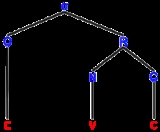
The nucleus is usually the vowel in the middle of a syllable. The onset is the sound or sounds occurring before the nucleus, and the coda (literally 'tail') is the sound or sounds that follow the nucleus. They are sometimes collectively known as the shell. The term rime covers the nucleus plus coda. In the one-syllable English word cat, the nucleus is a (the sound that can be shouted or sung on its own), the onset c, the coda t, and the rime at. This syllable can be abstracted as a consonant-vowel-consonant syllable, abbreviated CVC. Languages vary greatly in the restrictions on the sounds making up the onset, nucleus and coda of a syllable, according to what is termed a language's phonotactics
.
), and sk- is possible but ks- is not. In Greek
, however, both ks- and tl- are possible onsets, while contrarily in Classical Arabic
no multiconsonant onsets are allowed at all.
Some languages require all syllables to have an onset; in these languages a null onset such as in the English word "at" is not possible. This is less strange than it may appear at first, as most such languages allow syllables to begin with a phonemic glottal stop
(the sound in the middle of English "uh-oh"). Furthermore, in English and most other languages, a word that begins with a vowel is automatically pronounced with an initial glottal stop when following a pause, whether or not a glottal stop occurs as a phoneme in the language. Consequently, few languages make a phonemic distinction between a word beginning with a vowel and a word beginning with a glottal stop followed by a vowel, since the distinction will generally only be audible following another word. (However, Hawaiian
and a number of other Polynesian languages
do make such a distinction; cf. Hawaiian /ahi/ "fire", /ʔahi/ "tuna".)
This means that the difference between a syllable with a null onset and one beginning with a glottal stop is often purely a difference of phonological
analysis, rather than the actual pronunciation of the syllable. In some cases, the pronunciation of a (putatively) vowel-initial word when following another word – particularly, whether or not a glottal stop is inserted – indicates whether the word should be considered to have a null onset. For example, many Romance languages
such as Spanish
never insert such a glottal stop, while English
does so only some of the time, depending on factors such as conversation speed; in both cases, this suggests that the words in question are truly vowel-initial. But there are exceptions here, too. For example, German
and Arabic
both require that a glottal stop be inserted between a word and a following, putatively vowel-initial word. Yet such words are said to begin with a vowel in German but a glottal stop in Arabic. The reason for this has to do with other properties of the two languages. For example, a glottal stop does not occur in other situations in German, e.g. before a consonant or at the end of word. On the other hand, in Arabic, not only does a glottal stop occur in such situations (e.g. Classical /saʔala/ "he asked", /raʔj/ "opinion", /dˤawʔ/ "light"), but it occurs in alternations that are clearly indicative of its phonemic status (cf. Classical /kaːtib/ "writer" vs. /maktuːb/ "written", /ʔaːkil/ "eater" vs. /maʔkuːl/ "eaten").
The writing system of a language may not correspond with the phonological analysis of the language in terms of its handling of (potentially) null onsets. For example, in some languages written in the Latin alphabet
, an initial glottal stop is left unwritten; on the other hand, some languages written using non-Latin alphabets such as abjad
s and abugida
s have a special zero consonant
to represent a null onset. As an example, in Hangul
, the alphabet of the Korean language
, a null onset is represented with ㅇ at the left or top section of a graph, as in 역 "station", pronounced yeok, where the diphthong
yeo is the nucleus and k is the coda.
Generally, every syllable requires a nucleus (sometimes called the peak), and the minimal syllable consists only of a nucleus, as in the English words "eye" or "owe". The syllable nucleus is usually a vowel, in the form of a monophthong
, diphthong
, or triphthong
, but sometimes is a syllabic consonant
. By far the most common syllabic consonants are sonorant
s like [l], [r], [m], [n] or [ŋ], but a few languages have so-called syllabic fricatives, also known as fricative vowels. (In the context of Chinese phonology
, the related but non-synonymous term apical vowel is commonly used.) Mandarin Chinese is famous for having such sounds in at least some of its dialects, for example the pinyin
syllables sī shī rī, sometimes pronounced [sź̩ ʂʐ̩́ ʐʐ̩́] respectively. A few languages, such as Nuxalk
(Bella Coola), even allow stop consonant
s and voiceless fricatives as syllabic nuclei. However, linguists have analyzed this situation in various ways, some arguing that such syllables have no nucleus at all, and some arguing that the concept of "syllable" cannot clearly be applied at all to these languages. See the discussion below concerning syllable-less languages.
and close vowel
s. Almost all languages allow open syllables, but some, such as Hawaiian
, do not have closed syllables.
In English
, consonants have been analyzed as acting simultaneously as the coda of one syllable and the onset of the following syllable, as in 'bellow' bel-low, a phenomenon known as ambisyllabicity. It is argued that words such as arrow ˈæroʊ can't be divided into separately pronounceable syllables: neither /æ/ nor /ær/ is a possible independent syllable, and likewise with the other short vowels /ɛ ɪ ɒ ʌ ʊ/. However, Wells (1990) argues against ambisyllabicity in English, positing that consonants and consonant clusters are codas when after a stressed syllable followed by an unstressed syllable, or after a full vowel and followed by a reduced syllable, and are onsets in other contexts. (See English phonology#Phonotactics.)
, the syllable structure is expanded to include an additional, optional segment known as a medial, which is located between the onset (often termed the initial in this context) and the rime. The medial is normally a glide consonant, but reconstructions of Old Chinese
generally include liquid
medials (/r/ in modern reconstructions, /l/ in older versions), and many reconstructions of Middle Chinese
include a medial contrast between /i/ and /j/, where the /i/ functions phonologically as a glide rather than as part of the nucleus. In addition, many reconstructions of both Old and Middle Chinese include complex medials such as /rj/, /ji/, /jw/ and /jwi/. The medial groups phonologically with the rime rather than the onset, and the combination of medial and rime is collectively known as the final.
, Thai
or Vietnamese
, the shape or contour (e.g. level vs. rising vs. falling) also needs to be distinguished.
is one with a branching rime or branching nucleus – this is a metaphor, based on the nucleus or coda having lines that branch in a tree diagram. In some languages, heavy syllables include both VV (branching nucleus) and VC (branching rime) syllables, contrasted with V, which is a light syllable. (A "branching nucleus" is a long vowel or diphthong
. A "branching rime" is a rime where the syllable ends in a consonant, also known as a closed syllable; generally, this means that either the nucleus is followed by two consonants or by a single, final consonant.) In other languages, only VV syllables are heavy, while both VC and V syllables are light. Some languages distinguish a third type of superheavy syllable, which consists of VVC syllables (with both a branching nucleus and rime) and/or VCC syllables (with a coda consisting of two or more consonants). In moraic theory
, heavy syllables are said to have two moras, while light syllables are said to have one and superheavy syllables are said to have three. Japanese
is generally described this way.
Many languages forbid superheavy syllables, while a significant number forbid any heavy syllable. Some languages strive for consonant syllable weight; for example, in stressed, non-final syllables in Italian
, short vowels co-occur with closed syllables while long vowels co-occur with open syllables, so that all such syllables are heavy (not light or superheavy).
The difference between heavy and light frequently determines which syllables receive stress
– this is the case in Latin
and Arabic
, for example. The system of poetic meter
in many classical languages, such as Classical Greek, Classical Latin
and Sanskrit, is based on syllable weight rather than stress (so-called quantitative rhythm or quantitative meter).
, which was the first literary academy in the world and held the Floral Games
to award the best troubadour
with the violeta d'aur top prize, gave a definition of the syllable in his Leys d'amor (1328–1337), a book aimed at regulating the then flourishing Occitan poetry:
Sometimes syllable length is also counted as a suprasegmental feature; for example, in some Germanic languages, long vowels may only exist with short consonants and vice versa. However, syllables can be analyzed as compositions of long and short phonemes, as in Finnish and Japanese, where consonant gemination and vowel length are independent.
rules determine which sounds are allowed or disallowed in each part of the syllable. English
allows very complicated syllables; syllables may begin with up to three consonants (as in string or splash), and occasionally end with as many as four (as in prompts). Many other languages are much more restricted; Japanese
, for example, only allows /ɴ/ and a chroneme
in a coda, and theoretically has no consonant clusters at all, as the onset is composed of at most one consonant.
There are languages that forbid empty onsets, such as Hebrew
and Arabic
(the names transliterated as "Israel", "Abraham", "Omar", "Ali" and "Abdullah", among many others, actually begin with semiconsonantic glides or with glottal or pharyngeal consonants). Conversely, some analyses of the Arrernte language of central Australia posit that no onsets are permitted at all in that language, all syllables being underlyingly of the shape VC(C).
(Syllabification may also refer to the process of a consonant becoming a syllable nucleus.)
, any group of consonants that can occur at the beginning of a word is grouped with the following syllable; hence, a word such as pazdva would be syllabified /pa.zdva/. (This allows the phonotactics
of the language to be defined as requiring open syllables.) Contrarily, in some languages, any group of consonants that can occur at the end of a word is grouped with the following syllable.
In English, it has been disputed whether certain consonants occurring between vowels (especially following a stressed syllable and preceding an unstressed syllable) should be grouped with the preceding or following syllable. For example, a word such as better is sometimes analyzed as /ˈbɛt.ər/ and sometimes /ˈbɛ.tər/. Some linguists have in fact asserted that such words are "ambisyllabic", with the consonant shared between the preceding and following syllables. However, Wells (2002)http://www.phon.ucl.ac.uk/home/wells/syllabif.htm argues that this is not a useful analysis, and that English syllabification is simply /ˈCVC(C).V/.
, for example, stress is regularly determined by syllable weight
, a syllable counting as heavy if it has at least one of the following:
In each case the syllable is considered to have two moras
.
can occur only in closed syllables. Therefore, these vowels are also called checked vowels
, as opposed to the tense vowels that are called free vowels because they can occur even in open syllables.
and Wakashan languages
, are famous for this. For instance, these Nuxálk
(Bella Coola) words contain only obstruent
s:
In Bagemihl's survey of previous analyses, he finds that the word [tsʼktskʷtsʼ] would have been parsed into 0, 2, 3, 5, or 6 syllables depending which analysis is used. One analysis would consider all vowel and consonants segments as syllable nuclei, another would consider only a small subset as nuclei candidates, and another would simply deny the existence of syllables completely.
This type of phenomenon has also been reported in Berber languages
(such as Indlawn Tashlhiyt Berber), Moroccan Arabic
(apparently under Berber influence) and Mon–Khmer languages (such as Semai
, Temiar, Kammu). This feature has also been reported in Ōgami, a Miyako Ryukyuan language. Even in English there are a few utterances that have no vowels; for example, shh (meaning "be quiet") and psst (a sound used to attract attention).
Indlawn Tashlhiyt Berber:
Semai:
Vowel
In phonetics, a vowel is a sound in spoken language, such as English ah! or oh! , pronounced with an open vocal tract so that there is no build-up of air pressure at any point above the glottis. This contrasts with consonants, such as English sh! , where there is a constriction or closure at some...
) with optional initial and final margins (typically, consonant
Consonant
In articulatory phonetics, a consonant is a speech sound that is articulated with complete or partial closure of the vocal tract. Examples are , pronounced with the lips; , pronounced with the front of the tongue; , pronounced with the back of the tongue; , pronounced in the throat; and ,...
s).
Syllables are often considered the phonological
Phonology
Phonology is, broadly speaking, the subdiscipline of linguistics concerned with the sounds of language. That is, it is the systematic use of sound to encode meaning in any spoken human language, or the field of linguistics studying this use...
"building blocks" of word
Word
In language, a word is the smallest free form that may be uttered in isolation with semantic or pragmatic content . This contrasts with a morpheme, which is the smallest unit of meaning but will not necessarily stand on its own...
s. They can influence the rhythm of a language
Language
Language may refer either to the specifically human capacity for acquiring and using complex systems of communication, or to a specific instance of such a system of complex communication...
, its prosody
Prosody (linguistics)
In linguistics, prosody is the rhythm, stress, and intonation of speech. Prosody may reflect various features of the speaker or the utterance: the emotional state of the speaker; the form of the utterance ; the presence of irony or sarcasm; emphasis, contrast, and focus; or other elements of...
, its poetic
Poetry
Poetry is a form of literary art in which language is used for its aesthetic and evocative qualities in addition to, or in lieu of, its apparent meaning...
meter and its stress patterns.
Syllabic writing began several hundred years before the first letters
Middle Bronze Age alphabets
Proto-Sinaitic is a Middle Bronze Age script attested in a very small collection of inscriptions at Serabit el-Khadim in the Sinai Peninsula. Due to the extreme scarcity of Proto-Sinaitic signs, very little is known with certainty about the nature of the script...
. The earliest recorded syllables are on tablets written around 2800 BC in the Sumeria
Sumer
Sumer was a civilization and historical region in southern Mesopotamia, modern Iraq during the Chalcolithic and Early Bronze Age....
n city of Ur
Ur
Ur was an important city-state in ancient Sumer located at the site of modern Tell el-Muqayyar in Iraq's Dhi Qar Governorate...
. This shift from pictogram
Pictogram
A pictograph, also called pictogram or pictogramme is an ideogram that conveys its meaning through its pictorial resemblance to a physical object. Pictographs are often used in writing and graphic systems in which the characters are to considerable extent pictorial in appearance.Pictography is a...
s to syllables has been called "the most important advance in the history of writing
History of writing
The history of writing records the development of expressing language by letters or other marks. In the history of how systems of representation of language through graphic means have evolved in different human civilizations, more complete writing systems were preceded by proto-writing, systems of...
".
A word that consists of a single syllable (like English
English language
English is a West Germanic language that arose in the Anglo-Saxon kingdoms of England and spread into what was to become south-east Scotland under the influence of the Anglian medieval kingdom of Northumbria...
dog) is called a monosyllable (and is said to be monosyllabic). Similar terms include disyllable (and disyllabic) for a word of two syllables; trisyllable (and trisyllabic) for a word of three syllables; and polysyllable (and polysyllabic), which may refer either to a word of more than three syllables or to any word of more than one syllable.
Syllable structure
In most theories of phonology, the general structure of a syllable (σ) consists of three segments:Onset (ω): consonant, obligatory in some languages, optional or even restricted in others
Nucleus (ν): sonant, obligatory in most languages
Coda (κ): consonant, optional in some languages, highly restricted or prohibited in others
The syllable is usually considered right-branching, i.e. nucleus and coda are grouped together as a "rime" and are only distinguished at the second level. However, in some traditional descriptions of certain languages, the syllable is considered left-branching, i.e. onset and nucleus group below a higher-level unit, called a "body" or "core":
Rime (ρ): right branch, contrasts with onset, splits into nucleus and coda
Body or core: left branch, contrasts with coda, splits into onset and nucleus
In some theories the onset is strictly consonantal, thus necessitating another segment before the nucleus:
Initial (ι): often termed onset, but leaving out semi-vowels
Medial (μ): glide between initial, if any, and nucleus or rime
Final (φ): contrasts with initial, extended rime
Although every syllable has supra-segmental features, these are usually ignored if not semantically relevant, e.g. in tonal languages.
Tone
Tone (linguistics)
Tone is the use of pitch in language to distinguish lexical or grammatical meaning—that is, to distinguish or inflect words. All verbal languages use pitch to express emotional and other paralinguistic information, and to convey emphasis, contrast, and other such features in what is called...
(τ): may be carried by the syllable as a whole or by the rime
In some theories of phonology, these syllable structures are displayed as tree diagram
Tree diagram
The term tree diagram refers to a specific type of diagram that has a unique network topology. It can be seen as a specific type of network diagram, which in turn can be seen as a special kind of cluster diagram.-Applications:...
s (similar to the trees found in some types of syntax). Not all phonologists agree that syllables have internal structure; in fact, some phonologists doubt the existence of the syllable as a theoretical entity.
The nucleus is usually the vowel in the middle of a syllable. The onset is the sound or sounds occurring before the nucleus, and the coda (literally 'tail') is the sound or sounds that follow the nucleus. They are sometimes collectively known as the shell. The term rime covers the nucleus plus coda. In the one-syllable English word cat, the nucleus is a (the sound that can be shouted or sung on its own), the onset c, the coda t, and the rime at. This syllable can be abstracted as a consonant-vowel-consonant syllable, abbreviated CVC. Languages vary greatly in the restrictions on the sounds making up the onset, nucleus and coda of a syllable, according to what is termed a language's phonotactics
Phonotactics
Phonotactics is a branch of phonology that deals with restrictions in a language on the permissible combinations of phonemes...
.
Onset
Most syllables have an onset. Some languages restrict onsets to be only a single consonant, while others allow multiconsonant onsets according to various rules. For example, in English, onsets such as pr-, pl- and tr- are possible but tl- is not (except very marginally in foreign words such as TlingitTlingit
The Tlingit are an indigenous people of the Pacific Northwest Coast of America. Their name for themselves is Lingít, meaning "People of the Tides"...
), and sk- is possible but ks- is not. In Greek
Greek language
Greek is an independent branch of the Indo-European family of languages. Native to the southern Balkans, it has the longest documented history of any Indo-European language, spanning 34 centuries of written records. Its writing system has been the Greek alphabet for the majority of its history;...
, however, both ks- and tl- are possible onsets, while contrarily in Classical Arabic
Classical Arabic
Classical Arabic , also known as Qur'anic or Koranic Arabic, is the form of the Arabic language used in literary texts from Umayyad and Abbasid times . It is based on the Medieval dialects of Arab tribes...
no multiconsonant onsets are allowed at all.
Some languages require all syllables to have an onset; in these languages a null onset such as in the English word "at" is not possible. This is less strange than it may appear at first, as most such languages allow syllables to begin with a phonemic glottal stop
Glottal stop
The glottal stop, or more fully, the voiceless glottal plosive, is a type of consonantal sound used in many spoken languages. In English, the feature is represented, for example, by the hyphen in uh-oh! and by the apostrophe or [[ʻokina]] in Hawaii among those using a preservative pronunciation of...
(the sound in the middle of English "uh-oh"). Furthermore, in English and most other languages, a word that begins with a vowel is automatically pronounced with an initial glottal stop when following a pause, whether or not a glottal stop occurs as a phoneme in the language. Consequently, few languages make a phonemic distinction between a word beginning with a vowel and a word beginning with a glottal stop followed by a vowel, since the distinction will generally only be audible following another word. (However, Hawaiian
Hawaiian language
The Hawaiian language is a Polynesian language that takes its name from Hawaii, the largest island in the tropical North Pacific archipelago where it developed. Hawaiian, along with English, is an official language of the state of Hawaii...
and a number of other Polynesian languages
Polynesian languages
The Polynesian languages are a language family spoken in the region known as Polynesia. They are classified as part of the Austronesian family, belonging to the Oceanic branch of that family. They fall into two branches: Tongic and Nuclear Polynesian. Polynesians share many cultural traits...
do make such a distinction; cf. Hawaiian /ahi/ "fire", /ʔahi/ "tuna".)
This means that the difference between a syllable with a null onset and one beginning with a glottal stop is often purely a difference of phonological
Phonology
Phonology is, broadly speaking, the subdiscipline of linguistics concerned with the sounds of language. That is, it is the systematic use of sound to encode meaning in any spoken human language, or the field of linguistics studying this use...
analysis, rather than the actual pronunciation of the syllable. In some cases, the pronunciation of a (putatively) vowel-initial word when following another word – particularly, whether or not a glottal stop is inserted – indicates whether the word should be considered to have a null onset. For example, many Romance languages
Romance languages
The Romance languages are a branch of the Indo-European language family, more precisely of the Italic languages subfamily, comprising all the languages that descend from Vulgar Latin, the language of ancient Rome...
such as Spanish
Spanish language
Spanish , also known as Castilian , is a Romance language in the Ibero-Romance group that evolved from several languages and dialects in central-northern Iberia around the 9th century and gradually spread with the expansion of the Kingdom of Castile into central and southern Iberia during the...
never insert such a glottal stop, while English
English language
English is a West Germanic language that arose in the Anglo-Saxon kingdoms of England and spread into what was to become south-east Scotland under the influence of the Anglian medieval kingdom of Northumbria...
does so only some of the time, depending on factors such as conversation speed; in both cases, this suggests that the words in question are truly vowel-initial. But there are exceptions here, too. For example, German
German language
German is a West Germanic language, related to and classified alongside English and Dutch. With an estimated 90 – 98 million native speakers, German is one of the world's major languages and is the most widely-spoken first language in the European Union....
and Arabic
Arabic language
Arabic is a name applied to the descendants of the Classical Arabic language of the 6th century AD, used most prominently in the Quran, the Islamic Holy Book...
both require that a glottal stop be inserted between a word and a following, putatively vowel-initial word. Yet such words are said to begin with a vowel in German but a glottal stop in Arabic. The reason for this has to do with other properties of the two languages. For example, a glottal stop does not occur in other situations in German, e.g. before a consonant or at the end of word. On the other hand, in Arabic, not only does a glottal stop occur in such situations (e.g. Classical /saʔala/ "he asked", /raʔj/ "opinion", /dˤawʔ/ "light"), but it occurs in alternations that are clearly indicative of its phonemic status (cf. Classical /kaːtib/ "writer" vs. /maktuːb/ "written", /ʔaːkil/ "eater" vs. /maʔkuːl/ "eaten").
The writing system of a language may not correspond with the phonological analysis of the language in terms of its handling of (potentially) null onsets. For example, in some languages written in the Latin alphabet
Latin alphabet
The Latin alphabet, also called the Roman alphabet, is the most recognized alphabet used in the world today. It evolved from a western variety of the Greek alphabet called the Cumaean alphabet, which was adopted and modified by the Etruscans who ruled early Rome...
, an initial glottal stop is left unwritten; on the other hand, some languages written using non-Latin alphabets such as abjad
Abjad
An abjad is a type of writing system in which each symbol always or usually stands for a consonant; the reader must supply the appropriate vowel....
s and abugida
Abugida
An abugida , also called an alphasyllabary, is a segmental writing system in which consonant–vowel sequences are written as a unit: each unit is based on a consonant letter, and vowel notation is obligatory but secondary...
s have a special zero consonant
Zero consonant
A zero consonant, silent initial, or null-onset letter is a consonant-like letter that is not pronounced, but indicates that a word or syllable starts with a vowel...
to represent a null onset. As an example, in Hangul
Hangul
Hangul,Pronounced or ; Korean: 한글 Hangeul/Han'gŭl or 조선글 Chosŏn'gŭl/Joseongeul the Korean alphabet, is the native alphabet of the Korean language. It is a separate script from Hanja, the logographic Chinese characters which are also sometimes used to write Korean...
, the alphabet of the Korean language
Korean language
Korean is the official language of the country Korea, in both South and North. It is also one of the two official languages in the Yanbian Korean Autonomous Prefecture in People's Republic of China. There are about 78 million Korean speakers worldwide. In the 15th century, a national writing...
, a null onset is represented with ㅇ at the left or top section of a graph, as in 역 "station", pronounced yeok, where the diphthong
Diphthong
A diphthong , also known as a gliding vowel, refers to two adjacent vowel sounds occurring within the same syllable. Technically, a diphthong is a vowel with two different targets: That is, the tongue moves during the pronunciation of the vowel...
yeo is the nucleus and k is the coda.
Nucleus
| Word | Nucleus |
|---|---|
| cat [kæt] | [æ] |
| bed [bɛd] | [ɛ] |
| ode [oʊd] | [oʊ] |
| beet [bit] | [i] |
| bite [baɪt] | [aɪ] |
| rain [reɪn] | [eɪ] |
| bitten [ˈbɪt.ən] or [ˈbɪt.n] |
[ɪ] [ə] or [n] |
Generally, every syllable requires a nucleus (sometimes called the peak), and the minimal syllable consists only of a nucleus, as in the English words "eye" or "owe". The syllable nucleus is usually a vowel, in the form of a monophthong
Monophthong
A monophthong is a pure vowel sound, one whose articulation at both beginning and end is relatively fixed, and which does not glide up or down towards a new position of articulation....
, diphthong
Diphthong
A diphthong , also known as a gliding vowel, refers to two adjacent vowel sounds occurring within the same syllable. Technically, a diphthong is a vowel with two different targets: That is, the tongue moves during the pronunciation of the vowel...
, or triphthong
Triphthong
In phonetics, a triphthong is a monosyllabic vowel combination involving a quick but smooth movement of the articulator from one vowel quality to another that passes over a third...
, but sometimes is a syllabic consonant
Syllabic consonant
A syllabic consonant is a consonant which either forms a syllable on its own, or is the nucleus of a syllable. The diacritic for this in the International Phonetic Alphabet is the under-stroke, ⟨⟩...
. By far the most common syllabic consonants are sonorant
Sonorant
In phonetics and phonology, a sonorant is a speech sound that is produced without turbulent airflow in the vocal tract; fricatives and plosives are not sonorants. Vowels are sonorants, as are consonants like and . Other consonants, like or , restrict the airflow enough to cause turbulence, and...
s like [l], [r], [m], [n] or [ŋ], but a few languages have so-called syllabic fricatives, also known as fricative vowels. (In the context of Chinese phonology
Chinese phonology
Chinese phonology generally means:*Historical Chinese phonology*Modern Standard Chinese phonologyFor the phonology of other varieties of Chinese, see the respective articles of each variety....
, the related but non-synonymous term apical vowel is commonly used.) Mandarin Chinese is famous for having such sounds in at least some of its dialects, for example the pinyin
Pinyin
Pinyin is the official system to transcribe Chinese characters into the Roman alphabet in China, Malaysia, Singapore and Taiwan. It is also often used to teach Mandarin Chinese and spell Chinese names in foreign publications and used as an input method to enter Chinese characters into...
syllables sī shī rī, sometimes pronounced [sź̩ ʂʐ̩́ ʐʐ̩́] respectively. A few languages, such as Nuxalk
Nuxálk language
Nuxálk is a Salishan language spoken in the vicinity of the Canadian town Bella Coola, British Columbia by approximately 20-30 elders...
(Bella Coola), even allow stop consonant
Stop consonant
In phonetics, a plosive, also known as an occlusive or an oral stop, is a stop consonant in which the vocal tract is blocked so that all airflow ceases. The occlusion may be done with the tongue , lips , and &...
s and voiceless fricatives as syllabic nuclei. However, linguists have analyzed this situation in various ways, some arguing that such syllables have no nucleus at all, and some arguing that the concept of "syllable" cannot clearly be applied at all to these languages. See the discussion below concerning syllable-less languages.
Coda
A coda-less syllable of the form V, CV, CCV, etc. is called an open syllable (or free syllable), while a syllable that has a coda (VC, CVC, CVCC, etc.) is called a closed syllable (or checked syllable). Note that they have nothing to do with openOpen vowel
An open vowel is defined as a vowel sound in which the tongue is positioned as far as possible from the roof of the mouth. Open vowels are sometimes also called low vowels in reference to the low position of the tongue...
and close vowel
Close vowel
A close vowel is a type of vowel sound used in many spoken languages. The defining characteristic of a close vowel is that the tongue is positioned as close as possible to the roof of the mouth without creating a constriction that would be classified as a consonant.This term is prescribed by the...
s. Almost all languages allow open syllables, but some, such as Hawaiian
Hawaiian language
The Hawaiian language is a Polynesian language that takes its name from Hawaii, the largest island in the tropical North Pacific archipelago where it developed. Hawaiian, along with English, is an official language of the state of Hawaii...
, do not have closed syllables.
In English
English language
English is a West Germanic language that arose in the Anglo-Saxon kingdoms of England and spread into what was to become south-east Scotland under the influence of the Anglian medieval kingdom of Northumbria...
, consonants have been analyzed as acting simultaneously as the coda of one syllable and the onset of the following syllable, as in 'bellow' bel-low, a phenomenon known as ambisyllabicity. It is argued that words such as arrow ˈæroʊ can't be divided into separately pronounceable syllables: neither /æ/ nor /ær/ is a possible independent syllable, and likewise with the other short vowels /ɛ ɪ ɒ ʌ ʊ/. However, Wells (1990) argues against ambisyllabicity in English, positing that consonants and consonant clusters are codas when after a stressed syllable followed by an unstressed syllable, or after a full vowel and followed by a reduced syllable, and are onsets in other contexts. (See English phonology#Phonotactics.)
Medial and final
In the phonology of some East Asian languages, especially ChineseChinese language
The Chinese language is a language or language family consisting of varieties which are mutually intelligible to varying degrees. Originally the indigenous languages spoken by the Han Chinese in China, it forms one of the branches of Sino-Tibetan family of languages...
, the syllable structure is expanded to include an additional, optional segment known as a medial, which is located between the onset (often termed the initial in this context) and the rime. The medial is normally a glide consonant, but reconstructions of Old Chinese
Old Chinese
The earliest known written records of the Chinese language were found at a site near modern Anyang identified as Yin, the last capital of the Shang dynasty, and date from about 1200 BC....
generally include liquid
Liquid consonant
In phonetics, liquids or liquid consonants are a class of consonants consisting of lateral consonants together with rhotics.-Description:...
medials (/r/ in modern reconstructions, /l/ in older versions), and many reconstructions of Middle Chinese
Middle Chinese
Middle Chinese , also called Ancient Chinese by the linguist Bernhard Karlgren, refers to the Chinese language spoken during Southern and Northern Dynasties and the Sui, Tang, and Song dynasties...
include a medial contrast between /i/ and /j/, where the /i/ functions phonologically as a glide rather than as part of the nucleus. In addition, many reconstructions of both Old and Middle Chinese include complex medials such as /rj/, /ji/, /jw/ and /jwi/. The medial groups phonologically with the rime rather than the onset, and the combination of medial and rime is collectively known as the final.
Tone
In most languages, the pitch or pitch contour in which a syllable is pronounced conveys shades of meaning such as emphasis or surprise, or distinguishes a statement from a question. In tonal languages, however, the pitch of a word affects the basic lexical meaning (e.g "cat" vs. "dog") or grammatical meaning (e.g. past vs. present). In some languages, only the pitch itself (e.g. high vs. low) has this effect, while in others, especially East Asian languages such as ChineseChinese language
The Chinese language is a language or language family consisting of varieties which are mutually intelligible to varying degrees. Originally the indigenous languages spoken by the Han Chinese in China, it forms one of the branches of Sino-Tibetan family of languages...
, Thai
Thai language
Thai , also known as Central Thai and Siamese, is the national and official language of Thailand and the native language of the Thai people, Thailand's dominant ethnic group. Thai is a member of the Tai group of the Tai–Kadai language family. Historical linguists have been unable to definitively...
or Vietnamese
Vietnamese language
Vietnamese is the national and official language of Vietnam. It is the mother tongue of 86% of Vietnam's population, and of about three million overseas Vietnamese. It is also spoken as a second language by many ethnic minorities of Vietnam...
, the shape or contour (e.g. level vs. rising vs. falling) also needs to be distinguished.
Syllable weight
A heavy syllableSyllable weight
In linguistics, syllable weight is the concept that syllables pattern together according to the number and/or duration of segments in the rime. In classical poetry, both Greek and Latin, distinctions of syllable weight were fundamental to the meter of the line....
is one with a branching rime or branching nucleus – this is a metaphor, based on the nucleus or coda having lines that branch in a tree diagram. In some languages, heavy syllables include both VV (branching nucleus) and VC (branching rime) syllables, contrasted with V, which is a light syllable. (A "branching nucleus" is a long vowel or diphthong
Diphthong
A diphthong , also known as a gliding vowel, refers to two adjacent vowel sounds occurring within the same syllable. Technically, a diphthong is a vowel with two different targets: That is, the tongue moves during the pronunciation of the vowel...
. A "branching rime" is a rime where the syllable ends in a consonant, also known as a closed syllable; generally, this means that either the nucleus is followed by two consonants or by a single, final consonant.) In other languages, only VV syllables are heavy, while both VC and V syllables are light. Some languages distinguish a third type of superheavy syllable, which consists of VVC syllables (with both a branching nucleus and rime) and/or VCC syllables (with a coda consisting of two or more consonants). In moraic theory
Mora (linguistics)
Mora is a unit in phonology that determines syllable weight, which in some languages determines stress or timing. As with many technical linguistic terms, the definition of a mora varies. Perhaps the most succinct working definition was provided by the American linguist James D...
, heavy syllables are said to have two moras, while light syllables are said to have one and superheavy syllables are said to have three. Japanese
Japanese language
is a language spoken by over 130 million people in Japan and in Japanese emigrant communities. It is a member of the Japonic language family, which has a number of proposed relationships with other languages, none of which has gained wide acceptance among historical linguists .Japanese is an...
is generally described this way.
Many languages forbid superheavy syllables, while a significant number forbid any heavy syllable. Some languages strive for consonant syllable weight; for example, in stressed, non-final syllables in Italian
Italian language
Italian is a Romance language spoken mainly in Europe: Italy, Switzerland, San Marino, Vatican City, by minorities in Malta, Monaco, Croatia, Slovenia, France, Libya, Eritrea, and Somalia, and by immigrant communities in the Americas and Australia...
, short vowels co-occur with closed syllables while long vowels co-occur with open syllables, so that all such syllables are heavy (not light or superheavy).
The difference between heavy and light frequently determines which syllables receive stress
Stress (linguistics)
In linguistics, stress is the relative emphasis that may be given to certain syllables in a word, or to certain words in a phrase or sentence. The term is also used for similar patterns of phonetic prominence inside syllables. The word accent is sometimes also used with this sense.The stress placed...
– this is the case in Latin
Latin
Latin is an Italic language originally spoken in Latium and Ancient Rome. It, along with most European languages, is a descendant of the ancient Proto-Indo-European language. Although it is considered a dead language, a number of scholars and members of the Christian clergy speak it fluently, and...
and Arabic
Arabic language
Arabic is a name applied to the descendants of the Classical Arabic language of the 6th century AD, used most prominently in the Quran, the Islamic Holy Book...
, for example. The system of poetic meter
Meter (poetry)
In poetry, metre is the basic rhythmic structure of a verse or lines in verse. Many traditional verse forms prescribe a specific verse metre, or a certain set of metres alternating in a particular order. The study of metres and forms of versification is known as prosody...
in many classical languages, such as Classical Greek, Classical Latin
Classical Latin
Classical Latin in simplest terms is the socio-linguistic register of the Latin language regarded by the enfranchised and empowered populations of the late Roman republic and the Roman empire as good Latin. Most writers during this time made use of it...
and Sanskrit, is based on syllable weight rather than stress (so-called quantitative rhythm or quantitative meter).
A classical definition
Guilhem Molinier, a member of the Consistori del Gay SaberConsistori del Gay Saber
The Consistori del Gay Saber , commonly called the Consistori de Tolosa today, was a poetic academy founded at Toulouse in 1323 to revive and perpetuate the lyric school of the troubadours.-Foundation:...
, which was the first literary academy in the world and held the Floral Games
Floral Games
Floral Games were any of a series historically related poetry contests with floral prizes. In Occitan, their original language, and Catalan they are known as Jocs florals . In French they became the Jeux floraux...
to award the best troubadour
Troubadour
A troubadour was a composer and performer of Old Occitan lyric poetry during the High Middle Ages . Since the word "troubadour" is etymologically masculine, a female troubadour is usually called a trobairitz....
with the violeta d'aur top prize, gave a definition of the syllable in his Leys d'amor (1328–1337), a book aimed at regulating the then flourishing Occitan poetry:
Segon los ditz gramaticals. En un accen pronunciada. Et en un trag: d'una alenada. |
According to those called grammarians, Pronounced in one accent And uninterruptedly: in one breath. |
Syllables and suprasegmentals
The domain of suprasegmental features is the syllable and not a specific sound, that is to say, they affect all the segments of a syllable:- Stress
- ToneTone (linguistics)Tone is the use of pitch in language to distinguish lexical or grammatical meaning—that is, to distinguish or inflect words. All verbal languages use pitch to express emotional and other paralinguistic information, and to convey emphasis, contrast, and other such features in what is called...
Sometimes syllable length is also counted as a suprasegmental feature; for example, in some Germanic languages, long vowels may only exist with short consonants and vice versa. However, syllables can be analyzed as compositions of long and short phonemes, as in Finnish and Japanese, where consonant gemination and vowel length are independent.
Syllables and phonotactic constraints
PhonotacticPhonotactics
Phonotactics is a branch of phonology that deals with restrictions in a language on the permissible combinations of phonemes...
rules determine which sounds are allowed or disallowed in each part of the syllable. English
English language
English is a West Germanic language that arose in the Anglo-Saxon kingdoms of England and spread into what was to become south-east Scotland under the influence of the Anglian medieval kingdom of Northumbria...
allows very complicated syllables; syllables may begin with up to three consonants (as in string or splash), and occasionally end with as many as four (as in prompts). Many other languages are much more restricted; Japanese
Japanese language
is a language spoken by over 130 million people in Japan and in Japanese emigrant communities. It is a member of the Japonic language family, which has a number of proposed relationships with other languages, none of which has gained wide acceptance among historical linguists .Japanese is an...
, for example, only allows /ɴ/ and a chroneme
Chroneme
In linguistics, a chroneme is a basic, theoretical unit of sound that can distinguish words by duration only of a vowel or consonant. The noun chroneme is derived from Greek χρονος , and the suffixed -eme, which is analogous to the -eme in phoneme...
in a coda, and theoretically has no consonant clusters at all, as the onset is composed of at most one consonant.
There are languages that forbid empty onsets, such as Hebrew
Hebrew language
Hebrew is a Semitic language of the Afroasiatic language family. Culturally, is it considered by Jews and other religious groups as the language of the Jewish people, though other Jewish languages had originated among diaspora Jews, and the Hebrew language is also used by non-Jewish groups, such...
and Arabic
Arabic language
Arabic is a name applied to the descendants of the Classical Arabic language of the 6th century AD, used most prominently in the Quran, the Islamic Holy Book...
(the names transliterated as "Israel", "Abraham", "Omar", "Ali" and "Abdullah", among many others, actually begin with semiconsonantic glides or with glottal or pharyngeal consonants). Conversely, some analyses of the Arrernte language of central Australia posit that no onsets are permitted at all in that language, all syllables being underlyingly of the shape VC(C).
Syllabification
Syllabification is the separation of a word into syllables, whether spoken or written. In most languages, the actually spoken syllables are the basis of syllabification in writing too. Due to the very weak correspondence between sounds and letters in the spelling of modern English, for example, written syllabification in English has to be based mostly on etymological i.e. morphological instead of phonetic principles. English "written" syllables therefore do not correspond to the actually spoken syllables of the living language.(Syllabification may also refer to the process of a consonant becoming a syllable nucleus.)
Syllable division and ambisyllabicity
Most commonly, a single consonant between vowels is grouped with the following syllable (i.e. /CV.CV/), while two consonants between vowels are split between syllables (i.e. /CVC.CV/). In some languages, however, such as Old Church SlavonicOld Church Slavonic
Old Church Slavonic or Old Church Slavic was the first literary Slavic language, first developed by the 9th century Byzantine Greek missionaries Saints Cyril and Methodius who were credited with standardizing the language and using it for translating the Bible and other Ancient Greek...
, any group of consonants that can occur at the beginning of a word is grouped with the following syllable; hence, a word such as pazdva would be syllabified /pa.zdva/. (This allows the phonotactics
Phonotactics
Phonotactics is a branch of phonology that deals with restrictions in a language on the permissible combinations of phonemes...
of the language to be defined as requiring open syllables.) Contrarily, in some languages, any group of consonants that can occur at the end of a word is grouped with the following syllable.
In English, it has been disputed whether certain consonants occurring between vowels (especially following a stressed syllable and preceding an unstressed syllable) should be grouped with the preceding or following syllable. For example, a word such as better is sometimes analyzed as /ˈbɛt.ər/ and sometimes /ˈbɛ.tər/. Some linguists have in fact asserted that such words are "ambisyllabic", with the consonant shared between the preceding and following syllables. However, Wells (2002)http://www.phon.ucl.ac.uk/home/wells/syllabif.htm argues that this is not a useful analysis, and that English syllabification is simply /ˈCVC(C).V/.
Syllables and stress
Syllable structure often interacts with stress. In LatinLatin
Latin is an Italic language originally spoken in Latium and Ancient Rome. It, along with most European languages, is a descendant of the ancient Proto-Indo-European language. Although it is considered a dead language, a number of scholars and members of the Christian clergy speak it fluently, and...
, for example, stress is regularly determined by syllable weight
Syllable weight
In linguistics, syllable weight is the concept that syllables pattern together according to the number and/or duration of segments in the rime. In classical poetry, both Greek and Latin, distinctions of syllable weight were fundamental to the meter of the line....
, a syllable counting as heavy if it has at least one of the following:
- a long vowel in its nucleus
- a diphthongDiphthongA diphthong , also known as a gliding vowel, refers to two adjacent vowel sounds occurring within the same syllable. Technically, a diphthong is a vowel with two different targets: That is, the tongue moves during the pronunciation of the vowel...
in its nucleus - one or more codaSyllable codaIn phonology, a syllable coda comprises the consonant sounds of a syllable that follow the nucleus, which is usually a vowel. The combination of a nucleus and a coda is called a rime. Some syllables consist only of a nucleus with no coda...
(e)
In each case the syllable is considered to have two moras
Mora (linguistics)
Mora is a unit in phonology that determines syllable weight, which in some languages determines stress or timing. As with many technical linguistic terms, the definition of a mora varies. Perhaps the most succinct working definition was provided by the American linguist James D...
.
Syllables and vowel tenseness
In most Germanic languages, lax vowelsTenseness
In phonology, tenseness is a particular vowel quality that is phonemically contrastive in many languages, including English. It has also occasionally been used to describe contrasts in consonants. Unlike most distinctive features, the feature [tense] can be interpreted only relatively, that is, in...
can occur only in closed syllables. Therefore, these vowels are also called checked vowels
Checked and free vowels
In phonetics and phonology, checked vowels are those that usually must be followed by a consonant in a stressed syllable, while free vowels are those that may stand in a stressed open syllable with no following consonant.-Usage:...
, as opposed to the tense vowels that are called free vowels because they can occur even in open syllables.
Syllable-less languages
The notion of syllable is challenged by languages that allow long strings of consonants without any intervening vowel or sonorant. Languages of the Northwest coast of North America, including SalishanSalishan languages
The Salishan languages are a group of languages of the Pacific Northwest...
and Wakashan languages
Wakashan languages
Wakashan is a family of languages spoken in British Columbia around and on Vancouver Island, and in the northwestern corner of the Olympic Peninsula of Washington state, on the south side of the Strait of Juan de Fuca....
, are famous for this. For instance, these Nuxálk
Nuxálk language
Nuxálk is a Salishan language spoken in the vicinity of the Canadian town Bella Coola, British Columbia by approximately 20-30 elders...
(Bella Coola) words contain only obstruent
Obstruent
An obstruent is a consonant sound formed by obstructing airflow, causing increased air pressure in the vocal tract, such as [k], [d͡ʒ] and [f]. In phonetics, articulation may be divided into two large classes: obstruents and sonorants....
s:
- [ɬχʷtɬtsxʷ] 'you spat on me'
- [tsʼktskʷtsʼ] 'he arrived'
- [xɬpʼχʷɬtɬpɬɬs] 'he had in his possession a bunchberry plant' (Bagemihl 1991:589, 593, 627)
- [sxs] 'seal blubber'
In Bagemihl's survey of previous analyses, he finds that the word [tsʼktskʷtsʼ] would have been parsed into 0, 2, 3, 5, or 6 syllables depending which analysis is used. One analysis would consider all vowel and consonants segments as syllable nuclei, another would consider only a small subset as nuclei candidates, and another would simply deny the existence of syllables completely.
This type of phenomenon has also been reported in Berber languages
Berber languages
The Berber languages are a family of languages indigenous to North Africa, spoken from Siwa Oasis in Egypt to Morocco , and south to the countries of the Sahara Desert...
(such as Indlawn Tashlhiyt Berber), Moroccan Arabic
Moroccan Arabic
Moroccan Arabic is the variety of Arabic spoken in the Arabic-speaking areas of Morocco. For official communications, the government and other public bodies use Modern Standard Arabic, as is the case in most Arabic-speaking countries. A mixture of French and Moroccan Arabic is used in business...
(apparently under Berber influence) and Mon–Khmer languages (such as Semai
Semai
The Semai are a semisedentary people living in the center of the Malay Peninsula in Southeast Asia, known especially for their nonviolence . They speak Semai, a Mon-Khmer language. The Senai belong to the Senoi ethnic group....
, Temiar, Kammu). This feature has also been reported in Ōgami, a Miyako Ryukyuan language. Even in English there are a few utterances that have no vowels; for example, shh (meaning "be quiet") and psst (a sound used to attract attention).
Indlawn Tashlhiyt Berber:
- [tftktst tfktstt] 'you sprained it and then gave it'
- [rkkm] 'rot' (imperf.) (Dell & Elmedlaoui 1985, 1988)
Semai:
- [kckmrʔɛːc] 'short, fat arms' (Sloan 1988)
See also
- English phonology#Phonotactics. Covers syllable structure in English.
- Mora (linguistics)Mora (linguistics)Mora is a unit in phonology that determines syllable weight, which in some languages determines stress or timing. As with many technical linguistic terms, the definition of a mora varies. Perhaps the most succinct working definition was provided by the American linguist James D...
- List of the longest English words with one syllable
- PhonologyPhonologyPhonology is, broadly speaking, the subdiscipline of linguistics concerned with the sounds of language. That is, it is the systematic use of sound to encode meaning in any spoken human language, or the field of linguistics studying this use...
- Pitch accentPitch accentPitch accent is a linguistic term of convenience for a variety of restricted tone systems that use variations in pitch to give prominence to a syllable or mora within a word. The placement of this tone or the way it is realized can give different meanings to otherwise similar words...
- Stress (linguistics)Stress (linguistics)In linguistics, stress is the relative emphasis that may be given to certain syllables in a word, or to certain words in a phrase or sentence. The term is also used for similar patterns of phonetic prominence inside syllables. The word accent is sometimes also used with this sense.The stress placed...
- SyllabarySyllabaryA syllabary is a set of written symbols that represent syllables, which make up words. In a syllabary, there is no systematic similarity between the symbols which represent syllables with the same consonant or vowel...
writing system - Syllabic consonantSyllabic consonantA syllabic consonant is a consonant which either forms a syllable on its own, or is the nucleus of a syllable. The diacritic for this in the International Phonetic Alphabet is the under-stroke, ⟨⟩...
- SyllabificationSyllabificationSyllabification is the separation of a word into syllables, whether spoken or written.It is also used to describe the process of something like a consonant turning into a syllable, but this is not discussed here...
- Timing (linguistics)Timing (linguistics)Isochrony is the postulated rhythmic division of time into equal portions by a language. Isochrony is one of the three aspects of prosody, the others being intonation and stress.Three alternative ways in which a language can divide time are postulated:...
- IPA symbols for syllables
- Entering toneEntering toneA checked tone, commonly known by its Chinese calque entering tone , is one of four syllable types in the phonology in Middle Chinese which are commonly translated as tone. However, it is not a tone in the phonetic sense, but rather describes a syllable that ends in a stop consonant, such as p, t,...
- Minor syllableMinor syllableMinor syllable is a term used primarily in the description of Mon-Khmer languages, where a word typically consists of a reduced syllable followed by a full tonic or stressed syllable...
- Line (poetry)Line (poetry)A line is a unit of language into which a poem or play is divided, which operates on principles which are distinct from and not necessarily coincident with grammatical structures, such as the sentence or clauses in sentences...
Sources and recommended reading
- Clements, George N.George N. ClementsGeorge N. Clements was an American theoretical linguist specializing in phonology. Clements was born in Cincinnati, Ohio, and educated in New Haven, Paris and London. He received his Ph.D. from the School of Oriental and African Studies, University of London, in 1973, defending a thesis on the...
; Keyser, Samuel J.Samuel Jay KeyserSamuel Jay Keyser is an American theoretical linguist who is an authority on the history and structure of the English language and on linguistic approaches to literary criticism.-Biography:Dr...
. (1983). CV phonology: A generative theory of the syllable. Linguistic inquiry monographs (No. 9). Cambridge, MA: MIT Press. ISBN 0-262-53047-3 (pbk); ISBN 0-262-03098-5 (hb)
External links
- www.HowManySyllables.com – Free Syllable Dictionary – This site lets you look up the number of syllables in any word.
- Online Lyric Hyphenator – Separates English text into syllables
- What is a syllable? (SIL)
- Do syllables have internal structure? What is their status in phonology? CUNY Phonology Forum
- What is a syllabic consonant? (SIL)
- What is an onset? (SIL)
- What is a rime? (SIL)
- Syllable (Lexicon of Linguistics)
- Onset (Lexicon of Linguistics)
- Rime (Lexicon of Linguistics)
- Nucleus (Lexicon of Linguistics)
- Coda (Lexicon of Linguistics)
- What is metrical phonology? (SIL)
- Syllable Weight (Lexicon of Linguistics)
- Mora (Lexicon of Linguistics)
- Foot (Lexicon of Linguistics)
- Quantity-(in)sensitivity (Lexicon of Linguistics)
- Extrametrical (Lexicon of Linguistics)
- Maximal Onset Principle (Lexicon of Linguistics)
- What is syllabification? (SIL)
- Syllabification (Lexicon of Linguistics)
- What is a nuclear syllable? (SIL)
- Syllabontes – Hybrid form of social and educational networking