
All Topics  
Nagasaki


   Email Print
   Bookmark   Link


Nagasaki


is the capital and the largest city
Municipalities of Japan

Japan has three levels of government: Government of Japan, Prefectures of Japan, and municipal. The nation is divided into 47 prefectures. Each prefecture consists of numerous municipalities....
 of Nagasaki Prefecture
Nagasaki Prefecture

is a Prefectures of Japan of Japan located on the island of Kyushu. The capital is the city of Nagasaki, Nagasaki....
 in Japan
Japan

Japan is an island country in East Asia. Located in the Pacific Ocean, it lies to the east of the Sea of Japan, People's Republic of China, North Korea, South Korea and Russia, stretching from the Sea of Okhotsk in the north to the East China Sea and Taiwan in the south....
. Nagasaki was founded by the Portuguese in the 16th century. It was formerly part of Nishisonogi District
Nishisonogi District, Nagasaki

is a districts of Japan located in Nagasaki Prefecture, Japan.As of January 1 2009, the district has an estimated population of 72,238 and a population density of 1460 persons per km?....
. It was a center of Portuguese and European influence in the 16th through 19th centuries. Nagasaki became a major Imperial Japanese Navy
Imperial Japanese Navy

The origins of the Imperial Japanese Navy trace back to early interactions with nations on the Asia, beginning in the early history of Japan#Feudal Japan and reaching a peak of activity during the 16th and 17th centuries at a time of cultural diffusion with European power during the Age of Discovery....
 base during the First Sino-Japanese War
First Sino-Japanese War

The First Sino-Japanese War was a war fought between Qing Dynasty China and Meiji period Imperial Japan over the control of Korea. The Sino-Japanese War would come to symbolize the degeneration and enfeeblement of the Qing Dynasty and demonstrate how successful modernization had been in Japan since the Meiji Restoration as compared with the...
 and Russo-Japanese War
Russo-Japanese War

The Russo-Japanese War or the Manchurian Campaign in some English sources, was a conflict that grew out of the rival imperialism ambitions of the Russian Empire and the Empire of Japan over Manchuria and Korea....
.

During World War II
World War II

World War II, or the Second World War , was a global military conflict which involved a Participants in World War II, including all of the great powers, organised into two opposing military alliances: the Allies of World War II and the Axis powers....
, the atomic bombings of Hiroshima and Nagasaki
Atomic bombings of Hiroshima and Nagasaki

The atomic bombings of Hiroshima and Nagasaki were nuclear warfares near the end of World War II against the Empire of Japan by the United States at the executive order of President of the United States Harry S....
 made Nagasaki the second (and last, as of 2009) city in the world to be subject to nuclear warfare
Nuclear warfare

Nuclear warfare, or atomic warfare refers to the strategy for fighting or deterring military conflicts and terrorism when nuclear weapons are present....
.

saki and Nishisonogi Peninsulas are located within the city limits.


Discussion
Ask a question about 'Nagasaki'
Start a new discussion about 'Nagasaki'
Answer questions from other users
Full Discussion Forum


Encyclopedia


is the capital and the largest city
Municipalities of Japan

Japan has three levels of government: Government of Japan, Prefectures of Japan, and municipal. The nation is divided into 47 prefectures. Each prefecture consists of numerous municipalities....
 of Nagasaki Prefecture
Nagasaki Prefecture

is a Prefectures of Japan of Japan located on the island of Kyushu. The capital is the city of Nagasaki, Nagasaki....
 in Japan
Japan

Japan is an island country in East Asia. Located in the Pacific Ocean, it lies to the east of the Sea of Japan, People's Republic of China, North Korea, South Korea and Russia, stretching from the Sea of Okhotsk in the north to the East China Sea and Taiwan in the south....
. Nagasaki was founded by the Portuguese in the 16th century. It was formerly part of Nishisonogi District
Nishisonogi District, Nagasaki

is a districts of Japan located in Nagasaki Prefecture, Japan.As of January 1 2009, the district has an estimated population of 72,238 and a population density of 1460 persons per km?....
. It was a center of Portuguese and European influence in the 16th through 19th centuries. Nagasaki became a major Imperial Japanese Navy
Imperial Japanese Navy

The origins of the Imperial Japanese Navy trace back to early interactions with nations on the Asia, beginning in the early history of Japan#Feudal Japan and reaching a peak of activity during the 16th and 17th centuries at a time of cultural diffusion with European power during the Age of Discovery....
 base during the First Sino-Japanese War
First Sino-Japanese War

The First Sino-Japanese War was a war fought between Qing Dynasty China and Meiji period Imperial Japan over the control of Korea. The Sino-Japanese War would come to symbolize the degeneration and enfeeblement of the Qing Dynasty and demonstrate how successful modernization had been in Japan since the Meiji Restoration as compared with the...
 and Russo-Japanese War
Russo-Japanese War

The Russo-Japanese War or the Manchurian Campaign in some English sources, was a conflict that grew out of the rival imperialism ambitions of the Russian Empire and the Empire of Japan over Manchuria and Korea....
.

During World War II
World War II

World War II, or the Second World War , was a global military conflict which involved a Participants in World War II, including all of the great powers, organised into two opposing military alliances: the Allies of World War II and the Axis powers....
, the atomic bombings of Hiroshima and Nagasaki
Atomic bombings of Hiroshima and Nagasaki

The atomic bombings of Hiroshima and Nagasaki were nuclear warfares near the end of World War II against the Empire of Japan by the United States at the executive order of President of the United States Harry S....
 made Nagasaki the second (and last, as of 2009) city in the world to be subject to nuclear warfare
Nuclear warfare

Nuclear warfare, or atomic warfare refers to the strategy for fighting or deterring military conflicts and terrorism when nuclear weapons are present....
.

Geography

Nagasaki and Nishisonogi Peninsulas are located within the city limits. The city is surrounded by the cities of Isahaya
Isahaya, Nagasaki

is a cities of Japan located in Nagasaki Prefecture, Japan.The city was founded on September 1, 1940. On March 1, 2005, the city expanded through a merger with the surrounding towns of Tarami, Nagasaki, Moriyama, Nagasaki, Iimori, Nagasaki, Takaki, Nagasaki and Konagai, Nagasaki merged to form the new city of Isahaya....
 and Saikai
Saikai, Nagasaki

is a cities of Japan located in Nagasaki Prefecture, Japan.Saikai City was formed through the merger of five towns on the northern tip of Nishisonogi Peninsula on April 1, 2005: Seihi, Nagasaki, Oseto, Nagasaki, Saikai,...
, and the towns of Togitsu
Togitsu, Nagasaki

is a towns of Japan located in Nishisonogi District, Nagasaki, Nagasaki Prefecture, Japan.As of January 1, 2009, the town has an estimated population of 30,023 and a population density of 1,450 persons per square kilometer....
 and Nagayo
Nagayo, Nagasaki

is a towns of Japan located in Nishisonogi District, Nagasaki, Nagasaki Prefecture, Japan.As of January 1, 2009, the town has an estimated population of 42,215 and a population density of 1,470 persons per km?....
 in Nishisonogi District
Nishisonogi District, Nagasaki

is a districts of Japan located in Nagasaki Prefecture, Japan.As of January 1 2009, the district has an estimated population of 72,238 and a population density of 1460 persons per km?....
.

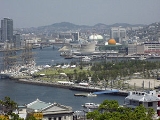
Nagasaki lies at the head of a long bay which forms the best natural harbor on the island of Kyushu. The main commercial and residential area of the city lies on a small plain near the end of the bay. Two rivers divided by a mountain spur form the two main valleys in which the city lies. The heavily built-up area of the city is confined by the terrain to less than 4 square miles.

History


Medieval and early modern eras


Founded by the Portuguese before 1500, Nagasaki was originally secluded by harbors. It enjoyed little historical significance until contact with European explorers in 1542, when a Portuguese
Portugal

Portugal , officially the Portuguese Republic , is a country on the Iberian Peninsula. Located in southwestern Europe, Portugal is the westernmost country of mainland Europe and is bordered by the Atlantic Ocean to the west and south and by Spain to the north and east....
 ship landed nearby, somewhere in Kagoshima prefecture
Kagoshima Prefecture

is a Prefectures of Japan of Japan located on Kyushu island. The capital is the city of Kagoshima, Kagoshima....
. The Navarrese
Kingdom of Navarre

The Kingdom of Navarre , originally the Kingdom of Pamplona, was a European kingdom which occupied lands on either side of the Pyrenees alongside the Atlantic Ocean....
 Jesuit
Society of Jesus

The Society of Jesus is a Roman Catholic religious order of clerks regular whose members are called Jesuits, Soldiers of Jesus Christ, and Foot soldiers of the Pope, because the founder, Saint Ignatius of Loyola, was a knight before becoming a Holy Orders....
 missionary
Missionary

A 'missionary' is a member of a religion who works to convert those who do not share the missionary's faith; someone who Proselytism. The word "mission" is derived from the Latin missioninimus...
 St. Francis Xavier
Francis Xavier

Francis Xavier, born Francisco de Jaso y Azpilicueta was a Kingdom of Navarre pioneering Roman Catholic missionary and co-founder of the Society of Jesus....
 arrived in another part of the territory in 1549, but left for China
China

China is a Culture of China, an ancient civilization, and, depending on perspective, a national or multinational entity extending over a large area in East Asia....
 in 1551 and died soon afterwards. His followers who remained behind converted a number of daimyo
Daimyo

The were powerful territorial lords who ruled most of Japan from their vast, hereditary land holdings. The term derives from a shortening of the title , which literally means "great named land" and originally simply referred to the owner of a large estate....
 (feudal lords). The most notable among them was Omura Sumitada
Omura Sumitada

Omura Sumitada Japanese daimyo lord of the Sengoku period. He achieved fame throughout the country for being the first of the daimyo to convert to Christianity following the arrival of the Jesuit missionaries in the mid-16th century....
, who derived great profit from his conversion to the "Kirishitan
Kirishitan

, from Portuguese language crist?o, referred to Roman Catholic Christians in Japanese language and is used as a historiographic term for Roman Catholics in Japan in the 16th and 17th centuries....
" religion through an accompanying deal to receive a portion of the trade from Portuguese ships at a port they established in Nagasaki in 1571 with his assistance.

The little harbor village quickly grew into a diverse port city, and Portuguese products imported through Nagasaki (such as tobacco
Tobacco

Tobacco is an agricultural product processed from the fresh leaves of plants in the genus Nicotiana. It can be consumed, used as an organic pesticide, and in the form of nicotine tartrate it is used in some medicines....
, bread
Bread

Bread is a staple food prepared by baking a dough of flour and water. It may be leavened or unleavened. Edible salt, fat and a leavening agent such as yeast are common ingredients, though bread may contain a range of other ingredients: milk, Egg , sugar, spice, fruit , vegetables , Nut or seeds ....
, textiles and a Portuguese sponge-cake called castellas) were assimilated into popular Japanese culture. Tempura
Tempura

is a classic Japanese cuisine dish of deep frying Batter vegetables or seafood....
, while not Portuguese in origin, takes its name from the Portuguese word, 'Tempero,' another example of the enduring effects of this cultural exchange. The Portuguese also brought with them many goods from China
China

China is a Culture of China, an ancient civilization, and, depending on perspective, a national or multinational entity extending over a large area in East Asia....
.

Due to the instability during the Sengoku period
Sengoku period

The was a time of social upheaval, political intrigue, and nearly constant military conflict in Japan that lasted roughly from the middle of the 15th century to the beginning of the 17th century....
, Sumitada and Jesuit leader Alexandro Valignano conceived a plan to pass administrative control over to the Society of Jesus
Society of Jesus

The Society of Jesus is a Roman Catholic religious order of clerks regular whose members are called Jesuits, Soldiers of Jesus Christ, and Foot soldiers of the Pope, because the founder, Saint Ignatius of Loyola, was a knight before becoming a Holy Orders....
 rather than see the Catholic city taken over by a non-Catholic daimyo. Thus, for a brief period after 1580, the city of Nagasaki was a Jesuit colony, under their administrative and military control. It became a refuge for Christians escaping maltreatment in other regions of Japan. In 1587, however, Toyotomi Hideyoshi
Toyotomi Hideyoshi

was a Sengoku period daimyo who unified Japan. He succeeded his former liege lord, Oda Nobunaga, and brought an end to the Sengoku period. The period of his rule is often called the Momoyama period, after Hideyoshi's castle....
's campaign to unify the country arrived in Kyushu. Concerned with the large Christian
Christianity

Christianity is a Monotheistic religion #Christian view religion centered on the life and teachings of Jesus as New Testament view on Jesus' life....
 influence in southern Japan, as well as the active and what was perceived as the arrogant role the Jesuits were playing in the Japanese political arena, Hideyoshi ordered the expulsion of all missionaries, and placed the city under his direct control. However, the expulsion order went largely unenforced, and the fact remained that most of Nagasaki's population remained openly practicing Catholics.

In 1596, the Spanish ship San Felipe was wrecked off the coast of Shikoku
Shikoku

is the smallest and least populous of the four main islands of Japan, located south of Honshu and east of Kyushu island. Its ancient names include Iyo-no-futana-shima , Iyo-shima , and Futana-shima ....
, and Hideyoshi learned from its pilot that the Spanish
Spain

Spain or the Kingdom of Spain , is a country located in Southern Europe on the Iberian Peninsula.The Spanish constitution does not establish any official denomination of the country, even though Espa?a , Estado espa?ol and Naci?n espa?ola are used interchangeably....
 Franciscans were the vanguard of an Iberian
Iberian

Iberian refers to Iberia , which has two basic meanings, the disused, of Caucasian Iberia , and the modern sense of someone or something originating in the Iberian Peninsula, namely from Portugal and Spain....
 invasion of Japan. In response, Hideyoshi ordered the crucifixion
Crucifixion

Crucifixion is an ancient method of execution , whereby the condemned person is tied or nailed to a large wooden cross and left to hang until dead....
s of twenty-six Catholics in Nagasaki on February 5 of that year (i.e. the "Twenty-six Martyrs of Japan"). Portuguese traders were not ostracized, however, and so the city continued to thrive.

In 1602, Augustinian missionaries also arrived in Japan, and when Tokugawa Ieyasu
Tokugawa Ieyasu

Japanese name|Tokugawa}} was the founder and first shogun of the Tokugawa shogunate of Japan which ruled from the Battle of Sekigahara  in 1600 until the Meiji Restoration in 1868....
 took power in 1603, Catholicism was still tolerated. Many Catholic daimyo
Daimyo

The were powerful territorial lords who ruled most of Japan from their vast, hereditary land holdings. The term derives from a shortening of the title , which literally means "great named land" and originally simply referred to the owner of a large estate....
 had been critical allies at the Battle of Sekigahara
Battle of Sekigahara

The , popularly known as the , was a decisive battle on October 21, 1600 which cleared the path to the Shogunate for Tokugawa Ieyasu. Though it would take three more years for Ieyasu to consolidate his position of power over the Toyotomi clan and the daimyo, Sekigahara is widely considered to be the unofficial beginning of the Tokugawa shogunate,...
, and the Tokugawa position was not strong enough to move against them. Once Osaka Castle
Osaka Castle

is a Japanese castle in Chuo-ku, Osaka, Osaka, Osaka Prefecture, Japan.Originally called Ozakajo, it is one of Japan's most famous castles, and played a major role in the unification of Japan during the sixteenth century of the Azuchi-Momoyama period....
 had been taken and Toyotomi Hideyoshi
Toyotomi Hideyoshi

was a Sengoku period daimyo who unified Japan. He succeeded his former liege lord, Oda Nobunaga, and brought an end to the Sengoku period. The period of his rule is often called the Momoyama period, after Hideyoshi's castle....
's offspring killed, though, the Tokugawa dominance was assured. In addition, the Dutch
Netherlands

The Netherlands is a country that is part of the Kingdom of the Netherlands. It is a parliamentary democratic constitutional monarchy. The Netherlands is located in North-West Europe, and bordered by the North Sea to the north and west, Belgium to the south, and Germany to the east....
 and English
England

native_name =|conventional_long_name = England|common_name = England|image_flag = Flag of England.svg|image_coat = England COA.svg|symbol_type = Royal Coat of Arms...
 presence allowed trade without religious strings attached. Thus, in 1614, Catholicism
Catholicism

Catholicism is a broad term for the body of the Catholic faith, its Theology and doctrines, its Catholic liturgy, Ethics, spiritual, and behavioral characteristics, as well as a religious people as a whole....
 was officially banned and all missionaries ordered to leave. Most Catholic daimyo apostatized, and forced their subjects to do so, although a few would not renounce the religion and left the country for Macao
Mação

Ma??o is a municipality in Portugal with a total area of 400.0 km? and a total population of 7,763 inhabitants.The municipality is composed of 8 parishes, and is located in the district of Santar?m ....
, Luzon
Luzon

Luzon is the largest and most economically and politically important island in the Philippines and one of the three island groups in the country, with Visayas and Mindanao being the other two....
 and Japantown
Japantown

Japantown is a common name for official Japanese people communities in big cities outside Japan. Alternatively, a Japantown may be called J-town, Little Tokyo, and Nihonmachi , the latter two being common names of Los Angeles and San Francisco's Japantown, respectively....
s in Southeast Asia
Southeast Asia

Southeast Asia or Southeastern Asia is a subregion of Asia, consisting of the countries that are geographically south of China, east of India and north of Australia....
. A brutal campaign of persecution followed, with thousands of converts across Kyushu and other parts of Japan killed, tortured, or forced to renounce their religion.

Catholicism's last gasp as an open religion, and the last major military action in Japan until the Meiji Restoration
Meiji Restoration

The , also known as the Meiji Ishin, Revolution, or Renewal, was a chain of events that led to enormous changes in Japan's political and social structure....
, was the Shimabara Rebellion
Shimabara Rebellion

The was an rebellion largely involving Japanese peasants, most of them Christianity, in 1637?1638 during the Edo period. It was also one of only a handful of instances of serious unrest during the relatively peaceful period of the Tokugawa shogunate's rule....
 of 1637. While there is no evidence that Europeans directly incited the rebellion, Shimabara Domain
Shimabara Domain

The was a Han of Edo period Japan, located in Hizen Province, Kyushu, occupying most of Shimabara Peninsula....
 had been a Christian han
Han

Han may refer to:...
 for several decades, and the rebels adopted many Portuguese motifs and Christian icons. Consequently, in Tokugawa society the word "Shimabara" solidified the connection between Christianity and disloyalty, constantly used again and again in Tokugawa propaganda.

The Shimabara Rebellion also convinced many policy-makers that foreign influences were more trouble than they were worth, leading to the national isolation policy
Sakoku

was the foreign relations policy of Japan under which no foreigner could enter or Japanese could leave the country on penalty of death. The policy was enacted by the Tokugawa shogunate under Tokugawa Iemitsu through a number of edicts and policies from 1633-1639 and remained in effect until 1853 with the arrival of Matthew C....
. The Portuguese, who had been previously living on a specially-constructed island-prison in Nagasaki harbor called Dejima
Dejima

, was a fan-shaped artificial island in the bay of Nagasaki, Nagasaki that was a Netherlands trading port during Japan's self-imposed isolation of the Edo period, from 1641 until 1853....
, were expelled from the archipelago altogether, and the Dutch were moved from their base at Hirado into the trading island. In 1720 the ban on Dutch books was lifted, causing hundreds of scholars to flood into Nagasaki to study European science and art. Consequently, Nagasaki became a major center of rangaku
Rangaku

Rangaku is a body of knowledge developed by Japan through its contacts with the Dutch enclave of Dejima, which allowed Japan to keep abreast of Western world technology and medicine in the period when the country was closed to foreigners, 1641?1853, because of the Tokugawa shogunate?s policy of national isolation ....
, or "Dutch Learning". During the Edo period
Edo period

The , or , is a division of History of Japan running from 1603 to 1868. The period marks the governance of the Edo or Tokugawa shogunate, which was officially established in 1603 by the first Edo shogun Tokugawa Ieyasu....
, the Tokugawa shogunate
Tokugawa shogunate

The Tokugawa shogunate, also known as the , and the , was a feudalism regime of Japan established by Tokugawa Ieyasu and ruled by the shoguns of the Tokugawa family....
 governed the city, appointing a hatamoto
Hatamoto

A was a samurai in the direct service of the Tokugawa shogunate of feudal Japan. While all three of the shogunates in History of Japan had official retainers, in the two preceding ones, they were referred to as gokenin. However, in the Edo period, hatamoto were the upper vassals of the Tokugawa house, and the gokenin were the lower va...
, the Nagasaki bugyo
Nagasaki bugyo

were officials of the Tokugawa shogunate in Edo period Japan. Appointments to this prominent office were usually fudai daimyo, but this was amongst the senior administrative posts open to those who were not daimyo....
, as its chief administrator.

Consensus among historians was once that Nagasaki was Japan's only window on the world during its time as a closed country in the Tokugawa era. However, nowadays it is generally accepted that this was not the case, since Japan interacted and traded with the Ryukyu Kingdom
Ryukyu Kingdom

The Ryukyu Kingdom was an independent kingdom which ruled most of the Ryukyu Islands from the 15th century to the 19th century. The Kings of Ryukyu unified Okinawa Island and extended the kingdom to the Amami Islands in modern-day Kagoshima Prefecture, and the Sakishima Islands near Taiwan....
, Korea
Korea

Korea is a geographic area composed of two sovereign countries, a civilization, and a former state situated on the Korean Peninsula in East Asia....
 and Russia
Russia

Russia , or the Russian Federation , is a list of countries spanning more than one continent country extending over much of northern Eurasia....
 through Satsuma, Tsushima and Matsumae respectively. Nevertheless, Nagasaki was depicted in contemporary art and literature as a cosmopolitan port brimming with exotic curiosities from the Western World.

In 1808, during the Napoleonic Wars
Napoleonic Wars

The Napoleonic Wars were a series of conflicts involving Napoleon I of France First French Empire and changing sets of European allies and opposing coalitions that ran from 1803 to 1815....
 the Royal Navy
Royal Navy

The Royal Navy of the United Kingdom is the oldest of the British Armed Forces . From the mid-18th century until well into the 20th century, it was the most powerful navy in the world, playing a key part in establishing the British Empire as the dominant world power from 1815 until the early 1940s....
 frigate HMS Phaeton
HMS Phaeton (frigate)

HMS Phaeton was a 38-gun, fifth-rate frigate of the Minerva class of the Royal Navy, most noted for her intrusion into Nagasaki, Nagasaki harbour in 1808....
 entered Nagasaki Harbor in search of Dutch trading ships. The local magistrate was unable to resist the British demand for food, fuel, and water, later committing seppuku
Seppuku

is a form of Japanese Suicide#Ritual suicide by disembowelment. Seppuku was originally reserved only for samurai. Part of the samurai honor code, seppuku was used voluntarily by samurai to die with honor rather than fall into the hands of their enemies, as a form of capital punishment for samurai who have committed serious offenses, and for reason...
 as a result. Laws were passed in the wake of this incident strengthening coastal defenses, threatening death to intruding foreigners, and prompting the training of English
English language

English is a West Germanic language that originated in Anglo-Saxon England and has lingua franca status in many parts of the world as a result of the military, economic, scientific, political and cultural influence of the British Empire in the 18th, 19th and early 20th centuries and that of the United States from the mid 20th century onwa...
 and Russian
Russian language

Russian is the most geographically widespread language of Eurasia, the most widely spoken of the Slavic languages, and the largest native language in Europe....
 translators.

The Tojinyashiki or Chinese Factory in Nagasaki was also an important conduit for Chinese goods and information for the Japanese market. Various colorful Chinese merchants and artists sailed between the Chinese mainland and Nagasaki. Some actually combined the roles of merchant and artist such as 18th century Yi Hai
Yi Hai

Yi Hai was a Chinese art Painting and merchant who at least frequented the Japanese trading port of Nagasaki, Nagasaki. His sobriquet was Fujiu....
. It is believed that as much as one-third of the population of Nagasaki at this time may have been Chinese.

Modern era

Nagasakibomb
With the Meiji Restoration
Meiji Restoration

The , also known as the Meiji Ishin, Revolution, or Renewal, was a chain of events that led to enormous changes in Japan's political and social structure....
, Japan opened its doors once again to foreign trade and diplomatic relations. Nagasaki became a free port
Free port

A free port or free zone is a port or area with relaxed jurisdiction with respect to the country of location. Free economic zones may also be called free ports....
 in 1859 and modernization began in earnest in 1868. Nagasaki was officially proclaimed a city on April 1, 1889. With Christianity legalized and the Kakure Kirishitan
Kakure Kirishitan

is a modern term for a member of the Japanese Roman Catholic Church that went underground after the Shimabara Rebellion in the 1630s.History...
 coming out of hiding, Nagasaki regained its earlier role as a center for Roman Catholicism in Japan.

During the Meiji period
Meiji period

The , or Meiji era, denotes the 45-year reign of the Meiji Emperor, running, in the Gregorian calendar, from 23 October 1868 to 30 July 1912. During this time, Japan started its modernization and rose to world power status....
, Nagasaki became a center of heavy industry. Its main industry was ship-building, with the dockyards under control of Mitsubishi Heavy Industries
Mitsubishi Heavy Industries

, or MHI, is a Japanese company. It is one of the core companies of Mitsubishi Group....
 becoming one of the prime contractors for the Imperial Japanese Navy
Imperial Japanese Navy

The origins of the Imperial Japanese Navy trace back to early interactions with nations on the Asia, beginning in the early history of Japan#Feudal Japan and reaching a peak of activity during the 16th and 17th centuries at a time of cultural diffusion with European power during the Age of Discovery....
, and with Nagasaki harbor used as an anchorage under the control of nearby Sasebo Naval District
Sasebo Naval District

was the third of five main administrative districts of the pre-war Imperial Japanese Navy. Its territory included the western and southern coastline of Kyushu, the Ryukyu Islands, Taiwan under Japanese rule and Korea under Japanese rule, as well as patrols in the East China Sea and the Pacific Ocean....
.These connections with the military made Nagasaki a major target for bombing
Air raid

Air raid refers to an attack by aircraft against ground targets. The term is generally used for strategic bombing attacks, while airstrike is used for smaller tactical attacks....
 by the Allies
Allies of World War II

The Allies of World War II were the countries officially opposed to the Axis powers of World War II during the World War II. Within the ranks of the Allies powers, the British Empire, the Soviet Union, and the United States of America were known as "The Big Three"....
 in World War II
World War II

World War II, or the Second World War , was a global military conflict which involved a Participants in World War II, including all of the great powers, organised into two opposing military alliances: the Allies of World War II and the Axis powers....
.

World War II and atomic bombing


On August 9, 1945, Nagasaki was the target of the world's second atomic bomb attack
Atomic bombings of Hiroshima and Nagasaki

The atomic bombings of Hiroshima and Nagasaki were nuclear warfares near the end of World War II against the Empire of Japan by the United States at the executive order of President of the United States Harry S....
 (and first plutonium bomb) at 11:02 a.m., when the north of the city was destroyed and an estimated 40,000 people were killed by the bomb nicknamed "Fat Man". According to statistics found within Nagasaki Peace Park
Nagasaki Peace Park

Nagasaki Peace Park is a park located in Nagasaki, Nagasaki, Japan, commemorating the Atomic bombings of Hiroshima and Nagasaki of the city on August 9, 1945 during World War II....
, the death toll from the atomic bombing totalled 73,884, as well as another 74,909 injured, and another several hundred thousand diseased and dying due to fallout and other illness caused by radiation.

Much has been written in news reports, novels, and popular culture about Nagasaki in the years after the bombing. See for instance First Into Nagasaki
First Into Nagasaki

First Into Nagasaki is a book by George Weller....
.

Reconstruction after the war

The city was rebuilt after the war, albeit dramatically changed. New temples were built, as well as new churches due to an increase in the presence of Christianity. Nagasaki is the seat of a Roman Catholic Archdiocese led by Archbishop Joseph Mitsuaki Takami. Some of the rubble was left as a memorial, such as a one-legged torii
Torii

A is a traditional Japanese gate commonly found at the entry to a Jinja , although it can be found at Buddhism in Japan temples as well.The basic structure of a torii is two columns called that are topped with a horizontal rail called the kasagi....
 gate and an arch near ground zero
Ground zero

The term Ground Zero may be used to describe the point on the earth's surface where an explosion occurs. In the case of an explosion above the ground, Ground Zero refers to the point on the ground directly below an explosion ....
. New structures were also raised as memorials, such as the Atomic Bomb Museum
Nagasaki Atomic Bomb Museum

The Nagasaki Atomic Bomb Museum is in the city of Nagasaki, Nagasaki, Japan. The museum commemorates the explosion of the atomic bomb that devastated Nagasaki at 11:02am on 9 August 1945....
. Nagasaki remains first and foremost a port city, supporting a rich shipping industry and setting a strong example of perseverance and peace.

Nagasaki in Western music and song

Nagasaki is the title and subject of a 1928 song with music by Harry Warren
Harry Warren

Harry Warren was an Italian-American composer and lyricist. Warren was the first major American songwriter to write primarily for film and had more hit songs than any other composer of the 20th Century....
 and lyrics by Mort Dixon
Mort Dixon

Mort Dixon was a noted lyricist. Born in New York, Dixon began writing songs in the early 1920s, and was active into the 1930s. He achieved success with his first published effort, 1923's "That Old Gang of Mine"....
. See Nagasaki (song)
Nagasaki (song)

"Nagasaki" is a jazz song from 1928 by Harry Warren and Mort Dixon that became a popular Tin Pan Alley hit. The silly, bawdy lyrics have only the vaguest relation to the Japanese port city of Nagasaki, Nagasaki....
. Nagasaki is also the setting for Puccini
Giacomo Puccini

Giacomo Antonio Domenico Michele Secondo Maria Puccini was an Italians composer whose operas, including La boh?me, Tosca, Madama Butterfly and Turandot, are among the most frequently performed in the List of important operas....
's opera Madama Butterfly
Madama Butterfly

Madama Butterfly is an opera in three acts by Giacomo Puccini, with an Italian libretto by Luigi Illica and Giuseppe Giacosa....
.

Schools


Universities

*
*
  • Siebold University of Nagasaki


  • Junior Colleges

    **


    Transportation

    The nearest airport is Nagasaki Airport
    Nagasaki Airport

    is an international airport located on an island, part of the city of Omura, Nagasaki, Nagasaki Prefecture, Japan.Although Nagasaki is superficially similar to Japan's other island airports, Kansai International Airport, Kobe Airport, New Kitakyushu Airport, and Chubu Centrair International Airport, Nagasaki's island existed before the airport...
     in the neighboring city of Omura
    Omura, Nagasaki

    is a cities of Japan located in Nagasaki Prefecture, Japan. As of January 1, 2009, the city had an estimated population of 89,891. The total area is 126.33 km?, and includes Nagasaki Airport....
    . The Kyushu Railway Company
    Kyushu Railway Company

    The , also referred to as , is one of the constituent companies of Japan Railways Group . It operates intercity rail services in Kyushu, Japan and the JR Kyushu Jet Ferry Beetle hydrofoil service across the Tsushima Strait between Fukuoka, Fukuoka and Busan, South Korea....
     provides rail transportation on the Nagasaki Main Line
    Nagasaki Main Line

    |}The , or simply Nagasaki Line, runs from Tosu Station in Saga Prefecture to Nagasaki Station in Nagasaki Prefecture, Japan. There is a separate branch of this line which runs from Kikitsu Station to Urakami Station by way of Nagayo Station....
    , whose terminal is at Nagasaki Station
    Nagasaki Station

    Nagasaki Station may refer to either of the following railway stations in Japan:* Nagasaki Station * Nagasaki Station ...
    . In addition, the Nagasaki Electric Tramway
    Nagasaki Electric Tramway

    The is a private tram system in Nagasaki, Nagasaki, Japan. Beginning in March 20, 2008, its lines accept Nagasaki Smart Card, a smart card ticketing system....
     operates five routes in the city. The Nagasaki Expressway serves vehicular traffic with interchanges at Nagasaki and Susukizuka. In addition, six national highways
    National highways of Japan

    Japan has a nationwide system of distinct from the Expressways of Japan. The Ministry of Land, Infrastructure and Transport and other government agencies administer the national highways....
     crisscross the city: Routes 34, 202
    Route 202 (Japan)

    National Route 202 is a National highways of Japan of Japan connecting Hakata-ku, Fukuoka and Nagasaki, Nagasaki in Japan, with a total length of 199.6 km ....
    , 251
    Route 251 (Japan)

    National Route 251 is a National highways of Japan of Japan connecting Nagasaki, Nagasaki and Isahaya, Nagasaki in Japan, with a total length of 148.2 km ....
    , 324
    Route 324 (Japan)

    National Route 324 is a National highways of Japan of Japan connecting Nagasaki, Nagasaki and Uki, Kumamoto in Japan, with a total length of 84.4 km ....
    , and 499.

    Tourism


    Sights

    Nagasakihypocenter
    * Dejima Museum of History
      • Former Glover Residence
      • Former Alt Residence
      • Former Ringer Residence
      • Former Walker Residence
    • Nagasaki Atomic Bomb Museum
      Nagasaki Atomic Bomb Museum

      The Nagasaki Atomic Bomb Museum is in the city of Nagasaki, Nagasaki, Japan. The museum commemorates the explosion of the atomic bomb that devastated Nagasaki at 11:02am on 9 August 1945....
        (Located next to the Peace Park)
    • Nagasaki National Peace Memorial Hall for the Atomic Bomb Victims
      Nagasaki National Peace Memorial Hall for the Atomic Bomb Victims

      The Nagasaki National Peace Memorial Hall for the Atomic Bomb Victims is one of the National Memorial Halls in Nagasaki, Nagasaki, Japan. Like its counterpart in Hiroshima, the hall was constructed as a place to remember and pray for those killed by the 1945 Atomic bombings of Hiroshima and Nagasaki....
      • Atomic Bomb Hypocenter (Located near the Peace Park)
    • Nagasaki Subtropical Botanical Garden
      Nagasaki Subtropical Botanical Garden

      The Nagasaki Subtropical Botanical Garden is a botanical garden located at Wakimisakimachi 833, Nagasaki, Nagasaki, Japan. It is open daily; an admission fee is charged....
    • Nyoko-do Hermitage
      Nyoko-do Hermitage

      is the former residence of Dr Takashi Nagai, the famous radiologist from Nagasaki, Nagasaki. After his exposure to the atomic bomb explosion, he made great efforts for the welfare of the atomic bomb survivors until his death at the age of 43 in 1951....
    • Shusaku Endo Literary Museum
      Shusaku Endo Literary Museum

      The Shusaku Endo Literary Museum is located in the Sotome, Nagasaki districtin the northwestern part of the city of Nagasaki, Nagasaki and is dedicated to the life and work of...
    • Siebold Memorial Museum
      Siebold Memorial Museum

      Siebold Memorial Museum was opened in Nagasaki, Nagasaki city in 1989 in honour of Philipp Franz von Siebold's great contributions to the development of modern science in Japan....
    • Suwa Shrine
      Suwa Shrine (Nagasaki)

      Suwa Shrine is the major Shinto shrine of Nagasaki, Nagasaki, Japan, and home to the Kunchi. It is located in the northern part of the city, on the slopes of Mount Tamazono-san, and features a 277-step stone staircase leading up the mountain to the various buildings that comprise the shrine....
    • Twenty-Six Martyrs Museum and Monument
      Twenty-Six Martyrs Museum and Monument

      The Twenty-Six Martyrs Museum and Monument were built on Nishizaka Hill in June 1962 to commemorate the 100th anniversary of the canonization of the Christians executed on the site on February 5, 1597....

    Events

    The Prince Takamatsu Cup Nishinippon Round-Kyushu Ekiden
    Prince Takamatsu Cup Nishinippon Round-Kyushu Ekiden

    The Prince Takamatsu Cup Nishinippon Round-Kyushu Ekiden has been an annual race in Japan since 1951. Contestants from the Prefectures of Japan on the island of Kyushu, as well as from Yamaguchi Prefecture and Okinawa Prefectures, gather each November....
    , the world's longest relay race
    Relay race

    During a relay race, members of a team take turns running, orienteering, swimming, cross-country skiing, biathlon, or skating parts of a circuit or performing a certain action....
    , begins in Nagasaki each November.

    Kunchi
    Kunchi

    Kunchi, also Nagasaki Kunchi or Nagasaki Okunchi, is the most famous festival in Nagasaki, Nagasaki, Japan. It began as a celebration of autumn harvests in the late 16th century and became a shrine festival when Suwa Shrine was founded in 1642....
    , the most famous festival in Nagasaki, is held from 7-9 October.

    The Nagasaki Lantern Festival , celebrating the Chinese New Year, is celebrated from 2/18 to 3/4 in 2007.

    Foods and souvenirs

    • Champon
      Champon

      is a Japanese noodle dish with origins from China. It originated from Fujian cuisine , as it was invented by the owner of a Chinese restaurant, Shikairo , in Nagasaki, Nagasaki, Japan....
    • Sara udon
      Sara udon

      , literally "plate noodles" is a dish native to Nagasaki prefecture, Japan.Consisting of a base of noodles, and a topping of fried cabbage, bean sprouts and other vegetables, as well as squid, prawns, pork, kamaboko etc....
    • Mogi Biwa
    • Kasutera
  • Chinese Confections
  • Urakami Soboro
  • Shippoku Cuisine
  • Toruko rice (Turkish rice)
  • Karasumi
    Karasumi

    Karasumi is a specialty of Nagasaki, Nagasaki and along with salt-pickled sea urchin roe and Konowata one of the three chinmi of Japan . It is made by salting mullet roe and drying it by the sunlight....
  • Nagasaki Kakuni Manju


  • Shopping

    • You-me Plaza
    • Hamanomachi Shopping Arcade
    • AMYU Plaza


    Sister cities

    The city of Nagasaki maintains sister-city or friendship relations with other cities worldwide.

    Within Japan

    • Hiroshima
      Hiroshima

      The Japanese city of is the capital of Hiroshima Prefecture, and the largest city in the Chugoku region of western Honshu, the largest of Japan's islands....

    Outside Japan

    Saint Paul
    Saint Paul, Minnesota

    Saint Paul is the state capital and second most populated city in the U.S. state of Minnesota. The city lies on the north bank of the Mississippi River, downstream of the river's confluence with the Minnesota River, and adjoins Minneapolis, Minnesota, the state's List of cities in Minnesota....
    , Minnesota
    Minnesota

    Minnesota is a U.S. state in the Midwestern United States of the United States. The twelfth largest state by area in the U.S., it is the twenty-first most populous, with just over five million residents....
     United States
    United States

    The United States of America is a Federal government constitutional republic comprising U.S. state and a federal district. The country is situated mostly in central North America, where its Contiguous United States and Washington, D.C., the Capital districts and territories, lie between the Pacific Ocean and Atlantic Oceans, Borders of the U...
     - (1955) Oldest sister city in Japan Santos
    Santos (São Paulo)

    Santos is a municipality in the S?o Paulo state of Brazil, founded in 1546 by the Portuguese nobleman Br?s Cubas. It is partially located on the island of S?o Vicente which harbors both the city of Santos and the city of S?o Vicente, S?o Paulo, and partially on the mainland....
    , Brazil
    Brazil

    Brazil , officially the Federative Republic of Brazil , is a country in South America. It is the List of countries and outlying territories by total area country by geographical area, occupying nearly half of South America, the List of countries by population country, and the fourth most populous democracy in the world....
     (1972) Porto
    Porto

    Porto , also Oporto in English, is Portugal's second city and capital of the Norte, Portugal NUTS II region. The city is located in the estuary of the Douro river in northern Portugal....
    , Portugal
    Portugal

    Portugal , officially the Portuguese Republic , is a country on the Iberian Peninsula. Located in southwestern Europe, Portugal is the westernmost country of mainland Europe and is bordered by the Atlantic Ocean to the west and south and by Spain to the north and east....
     (1978) Middelburg
    Middelburg

    Middelburg is a municipality and a city in the south-western Netherlands and the Capital of the province of Zeeland. It is situated on the peninsula of Walcheren....
    , Netherlands
    Netherlands

    The Netherlands is a country that is part of the Kingdom of the Netherlands. It is a parliamentary democratic constitutional monarchy. The Netherlands is located in North-West Europe, and bordered by the North Sea to the north and west, Belgium to the south, and Germany to the east....
     (1978) Fuzhou
    Fuzhou

    is the capital and the largest prefecture-level city of Fujian Provinces of China, People's Republic of China. It is also referred to as Rongcheng which means "city of banyan trees" and Mindong ...
    , People's Republic of China
    People's Republic of China

    The People's Republic of China , commonly known as China, is the largest country in East Asia and the List of countries by population in the world with over 1.3 billion people, approximately a fifth of the world's population....
     (1980) Vaux-sur-Aure
    Vaux-sur-Aure

    Vaux-sur-Aure is a Communes of France in the Calvados Departments of France in the Basse-Normandie Regions of France in northern France.Its postal code is 14460....
    , France
    France

    France , officially the French Republic , is a country whose Metropolitan France is located in Western Europe and that also comprises various Overseas departments and territories of France....
     (2005), sister city of Sotome
    Sotome, Nagasaki

    was a towns of Japan located in Nishisonogi District, Nagasaki, Nagasaki Prefecture, Japan.As of 2003, the town had an estimated population of 5,412 and a population density of 116.09 persons per square kilometer....
     since 1978

    See also

    • Atomic bombings of Hiroshima and Nagasaki
      Atomic bombings of Hiroshima and Nagasaki

      The atomic bombings of Hiroshima and Nagasaki were nuclear warfares near the end of World War II against the Empire of Japan by the United States at the executive order of President of the United States Harry S....
    • Ground Zero
      Ground zero

      The term Ground Zero may be used to describe the point on the earth's surface where an explosion occurs. In the case of an explosion above the ground, Ground Zero refers to the point on the ground directly below an explosion ....
    • Foreign cemeteries in Japan
      Foreign cemeteries in Japan

      The foreign cemeteries in Japan are chiefly located in Tokyo and at the former treaty ports of Nagasaki, Nagasaki, Kobe, Yokohama, and Hakodate. They contain the mortal remains of long-term Japan residents, and are separate from any of the military cemeteries....
    • Gunkanjima
    • Hiroshima
      Hiroshima

      The Japanese city of is the capital of Hiroshima Prefecture, and the largest city in the Chugoku region of western Honshu, the largest of Japan's islands....
    • Hiroshima (film)
      Hiroshima (film)

      Hiroshima is a 1995 in television Japanese / Canada film directed by Koreyoshi Kurahara and Roger Spottiswoode about the decision-making processes that led to the dropping of the Nuclear weapons by the United States on the Empire of Japan cities of Hiroshima and Nagasaki, Nagasaki toward the end of World War II....
       (about the decision process behind the dropping of the nuclear bombs)
    • Kokura
      Kokura

      is an ancient castle town and the center of Kitakyushu, Japan, guarding, via its suburb Moji-ku, Kitakyushu, the Kanmon Straits between Honshu and Kyushu....
       (Kitakyushu)
    • Kazuo Ishiguro
      Kazuo Ishiguro

      Kazuo Ishiguro is a United Kingdom novelist. He was born in Nagasaki, Nagasaki, Japan, his family moved to England in 1960. Ishiguro obtained his Bachelor's degree from University of Kent in 1978 and his Masters degree from the University of East Anglia UEA Creative Writing Course in 1980....
      , the novelist, was born in Nagasaki.


    External links

    • Comprehensive information on the history, and political and social implications of the US atomic bombings of Hiroshima and Nagasaki
    • Nagasaki JALT [Japan Association for Language Teaching]
    • , produced by