

Bandeirantes

Encyclopedia
Portuguese language
Portuguese is a Romance language that arose in the medieval Kingdom of Galicia, nowadays Galicia and Northern Portugal. The southern part of the Kingdom of Galicia became independent as the County of Portugal in 1095...
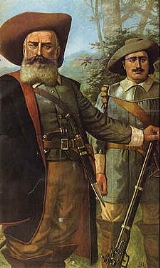
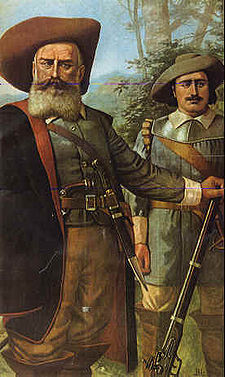
for "flags"). Though their original purpose was to capture and force amerindians into slavery, the bandeirantes later began to focus their expeditions on finding gold, silver and diamond mines. They ventured into unmapped regions in search of profit and adventure. From 1580–1670 the Bandeirantes focused on slave hunting, then from 1670–1750 they focused on mineral wealth. Through these expeditions, the Bandeirantes also expanded Portuguese America
Colonial Brazil
In the history of Brazil, Colonial Brazil, officially the Viceroyalty of Brazil comprises the period from 1500, with the arrival of the Portuguese, until 1815, when Brazil was elevated to kingdom alongside Portugal as the United Kingdom of Portugal, Brazil and the Algarves.During the over 300 years...
from the small limits of the Tordesilhas Line to roughly the same territory as current Brazil
Brazil
Brazil , officially the Federative Republic of Brazil , is the largest country in South America. It is the world's fifth largest country, both by geographical area and by population with over 192 million people...
. This expansion discovered mineral wealth that made the fortune of Portugal
Portugal
Portugal , officially the Portuguese Republic is a country situated in southwestern Europe on the Iberian Peninsula. Portugal is the westernmost country of Europe, and is bordered by the Atlantic Ocean to the West and South and by Spain to the North and East. The Atlantic archipelagos of the...
during the 17th and 18th centuries.
Bandeiras
São Paulo
São Paulo is the largest city in Brazil, the largest city in the southern hemisphere and South America, and the world's seventh largest city by population. The metropolis is anchor to the São Paulo metropolitan area, ranked as the second-most populous metropolitan area in the Americas and among...
, known as Paulistas
Paulistas
Paulistas are the inhabitants of the state of São Paulo, Brazil, and of its antecessor the Capitaincy of São Vicente, whose capital early shifted from the village of São Vicente to the one of São Paulo dos Campos de Piratininga....
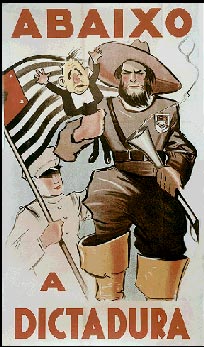
, designed to enslave indigenous peoples and to find precious metals and stones. The Bandeirantes were the men who participated in these expeditions.
Bandeiras were not state organized – they were privately run, and hence the men paid for their own equipment, and willingly and knowingly traversed into the wilderness for months or years at a time. São Paulo
São Paulo
São Paulo is the largest city in Brazil, the largest city in the southern hemisphere and South America, and the world's seventh largest city by population. The metropolis is anchor to the São Paulo metropolitan area, ranked as the second-most populous metropolitan area in the Americas and among...
was the home base for the most famous bandeirantes.
Besides the purpose of capturing natives as slaves bandeiras were also used to extend the power of Portugal by expanding its control over the Brazilian interior. Along with this development of property the bandeiras also allowed for the Portuguese to gain a hand in the discovery of mineral wealth, which they were previously unable to lavish in. They have participated in the Battle of Mbororé
Battle of Mbororé
The Battle of Mbororé was a battle between the Guaraní living in the Jesuit Missions and the bandeirantes, explorers and adventurers based in São Paulo...
, (March 11, 1641): Guaranís from Jesuit Reductions
Jesuit Reductions
A Jesuit Reduction was a type of settlement for indigenous people in Latin America created by the Jesuit Order during the 17th and 18th centuries. In general, the strategy of the Spanish Empire was to gather native populations into centers called Indian Reductions , in order to Christianize, tax,...
against Bandeirantes, and Portuguese
Portugal
Portugal , officially the Portuguese Republic is a country situated in southwestern Europe on the Iberian Peninsula. Portugal is the westernmost country of Europe, and is bordered by the Atlantic Ocean to the West and South and by Spain to the North and East. The Atlantic archipelagos of the...
explorers after separation of the kingdoms of Spain
Spain
Spain , officially the Kingdom of Spain languages]] under the European Charter for Regional or Minority Languages. In each of these, Spain's official name is as follows:;;;;;;), is a country and member state of the European Union located in southwestern Europe on the Iberian Peninsula...
and Portugal.
The course of the Bandeira route was a difficult and perilous one. The men were faced with hunger, fatigue, disease and death. Often there was little food, and because of this, the Bandeirantes got into the habit of planting and harvesting this food as they went. They also built roads as they went, and founded settlements, too. This laid the basis for agriculture and ranching in the interior of Brazil
Brazil
Brazil , officially the Federative Republic of Brazil , is the largest country in South America. It is the world's fifth largest country, both by geographical area and by population with over 192 million people...
.
Despite the fact that the Jesuit missionaries were the chief opponents of the Bandeirantes, priests accompanied the Bandeira for two reasons: 1. to shrive the dying and the dead, 2. to ease the conscience of the men. The Bandeira heard mass before leaving on their expedition.
In the 1660s, the Portuguese government offered rewards to those who discovered gold and silver deposits in inner Brazil
Brazil
Brazil , officially the Federative Republic of Brazil , is the largest country in South America. It is the world's fifth largest country, both by geographical area and by population with over 192 million people...
. So, the Bandeirantes, who were driven by greed, ventured into the depths of Brazil
Brazil
Brazil , officially the Federative Republic of Brazil , is the largest country in South America. It is the world's fifth largest country, both by geographical area and by population with over 192 million people...
not only to capture natives to sell as slaves, but to find mines and get government rewards. As the number of natives diminished, the Bandeirantes began to focus on the precious minerals.
The first Bandeira was in 1628, organized by Antonio Raposo Tavares
Antonio Raposo Tavares
António Raposo Tavares o Velho was a Portuguese colonial bandeirante who explored mainland eastern South America and claimed it for Portugal, extending the territory of the colony beyond the limits imposed by the treaty of Tordesillas...
. This bandeira raided 21 Jesuit villages in the upper Paraná Valley. They captured about 2,500 natives. A bandeira tactic was to set native tribes against each other in order to weaken them, and then to enslave both of them.
As a result of the Bandeiras, the Capitaincy of São Vicente
Capitaincy of São Vicente
The Captaincy of São Vicente was the only captaincy to succeed in Southern Brazil, along with Pernambuco in the North. It was the origin of the state of São Paulo and of the expansion of Portuguese America west of the Tordesilhas Line by the Bandeiras....
became the basis for the vice-kingdom of Brazil and encompassed current states of Santa Catarina
Santa Catarina (state)
Santa Catarina is a state in southern Brazil with one of the highest standards of living in Latin America. Its capital is Florianópolis, which mostly lies on the Santa Catarina Island. Neighbouring states are Rio Grande do Sul to the south and Paraná to the north. It is bounded on the east by...
, Paraná
Paraná (state)
Paraná is one of the states of Brazil, located in the South of the country, bordered on the north by São Paulo state, on the east by the Atlantic Ocean, on the south by Santa Catarina state and the Misiones Province of Argentina, and on the west by Mato Grosso do Sul and the republic of Paraguay,...
, São Paulo
São Paulo (state)
São Paulo is a state in Brazil. It is the major industrial and economic powerhouse of the Brazilian economy. Named after Saint Paul, São Paulo has the largest population, industrial complex, and economic production in the country. It is the richest state in Brazil...
, Minas Gerais
Minas Gerais
Minas Gerais is one of the 26 states of Brazil, of which it is the second most populous, the third richest, and the fourth largest in area. Minas Gerais is the Brazilian state with the largest number of Presidents of Brazil, the current one, Dilma Rousseff, being one of them. The capital is the...
, Goiás
Goiás
Goiás is a state of Brazil, located in the central part of the country. The name Goiás comes from the name of an indigenous community...
, Tocantins
Tocantins (state)
Tocantins is one of the states of Brazil. . The state was formed in 1988 out of the northern part of Goiás, and construction began on the capital, Palmas, in 1989, in contrast to most of the other cities in the state which date back to the Portuguese colonial period...
and both Northern and Southern Mato Grosso
Mato Grosso
Mato Grosso is one of the states of Brazil, the third largest in area, located in the western part of the country.Neighboring states are Rondônia, Amazonas, Pará, Tocantins, Goiás and Mato Grosso do Sul. It also borders Bolivia to the southwest...
. With the few outlying Spanish settlements and missions overrun, the defacto control over most of what is now Brazil was recognised by the Treaty of Madrid in 1750.
A notable historian of the Bandeirantes was the genealogist Pedro Taques de Almeida Paes Leme, who covered most of the families of those who undertook the gold rush expeditions. He was born in São Paulo in 1714, into a Paulista family, the son of Bartolomeu Paes de Abreu and Leonor de Siqueira Paes.
Slave raids
In the beginning, the main focus of the bandeirantes was to enslave natives. They carried this out by disguising themselves as Jesuits, often singing mass to lure the natives out of their settlements. However, more often they relied on surprise attacks. If luring the natives with promises didn’t work, the bandeirantes would surround the settlements, and set them alight in order to force out the natives. The natives would be captured and placed into a large outdoor pen, until there were enough of them enslaved to justify a trip back to the coast, where they would be sold as slaves. It could be weeks or months until this was the case, and so hundreds of captives died of exposure. On the journey to the coast, the captives would be stripped, and tied to a long pole to prevent them from trying to flee the group.There were over 2.5 million Indigenous peoples in Brazil
Indigenous peoples in Brazil
The Indigenous peoples in Brazil comprise a large number of distinct ethnic groups who inhabited the country prior to the European invasion around 1500...
in 1500. By the middle of the 18th century, the number had dropped to between 1 million and 1.5 million. Many tribes living close to the Atlantic coast intermixed with Portuguese or died of diseases. Others had fled into the interior, and their flight created an ever-greater need for slaves, one that was not entirely satisfied by importing them from Africa. Native slaves sold for about $30–$40, while the imported African slaves sold from $100–$500. The bandeirantes were able to sell many native slaves due to their cheap price, and hence made a large profit.
Some of the most famous bandeirantes were Bartolomeu Bueno da Silva (the Anhanguera), Antônio Dias de Oliveira, Fernão Dias Pais (the Hunter of Emeralds), Domingos Rodrigues do Prado, Antônio Rodrigues Arzão, Domingos Jorge Velho, Antônio Raposo Tavares, Estêvão Ribeiro Baião Parente, Brás Rodrigues de Arzão, Manuel de Campos Bicudo, Francisco Dias de Siqueira (the Apuçá), Pascoal Moreira Cabral, Antônio Pires de Campos, Manuel de Borba Gato, Francisco Pedroso Xavier, Lourenço Castanho Taques, Manuel de Campos Bicudo, Tomé Portes del-Rei, Antonio Garcia da Cunha, Matias Cardoso de Almeida, José de Camargo Pimentel, João Leite da Silva Ortiz, João de Siqueira Afonso, Jerônimo Pedroso de Barros and Bartolomeu Bueno de Siqueira. In 1628, Antônio Raposo Tavares led a bandeira, composed of 2,000 allied Indians, 900 mameluco
Mameluco
Mameluco the word is believed to be of Arabic origin. The word in Arabic is Mamluk or Mamluka مملوك or مملوكة...
s and 69 white Paulistanos, to find precious metals and stones or to capture Indians for slavery or both. This expedition alone was responsible for the destruction of most of the Jesuit missions of Spanish Guairá
Guairá
Guairá may refer to:* Guairá Department, Paraguay* Salto del Guairá, Paraguay...
and the enslavement of over 60,000 indigenous people.
From 1648 to 1652, Tavares also led one of the longest known expeditions from São Paulo
São Paulo
São Paulo is the largest city in Brazil, the largest city in the southern hemisphere and South America, and the world's seventh largest city by population. The metropolis is anchor to the São Paulo metropolitan area, ranked as the second-most populous metropolitan area in the Americas and among...
to the mouth of the Amazon river, investigating many of its tributaries, including the Rio Negro, and covering a distance of more than 10,000 km. The expedition arrived in Andean Quito
Quito
San Francisco de Quito, most often called Quito , is the capital city of Ecuador in northwestern South America. It is located in north-central Ecuador in the Guayllabamba river basin, on the eastern slopes of Pichincha, an active stratovolcano in the Andes mountains...
, part of the Spanish
Spanish Empire
The Spanish Empire comprised territories and colonies administered directly by Spain in Europe, in America, Africa, Asia and Oceania. It originated during the Age of Exploration and was therefore one of the first global empires. At the time of Habsburgs, Spain reached the peak of its world power....
Viceroyalty of Peru
Viceroyalty of Peru
Created in 1542, the Viceroyalty of Peru was a Spanish colonial administrative district that originally contained most of Spanish-ruled South America, governed from the capital of Lima...
, and stayed there for a short time in 1651. Of the 1200 men who left São Paulo, only 60 reached their final destination in Belém
Belém
Belém is a Brazilian city, the capital and largest city of state of Pará, in the country's north region. It is the entrance gate to the Amazon with a busy port, airport and bus/coach station...
.
Assessment
The Bandeirantes were responsible for the discovery of mineral wealth and, to a large extent, for the territorial enlargement of Brazil."In spite of the lack of geography, a science ignored by the Paulistas of old times, without other help than the Sun, they penetrated the interior of the America, conquering tribes. Some would go to the hinterland of Goias, until the Amazon river. Others to the coastline from the river of Patos until the river Plate, going to the river Uruguay and Tibagi. And going up through the Paraguay river until the Paraná [...] Some went through the vast hinterland beyond the river Paraguay going through the high mountains of the Kingdom of Peru. The Paulistas had to fight against the enemies and against nature: the latter with the weather and the former with wrath and hate. The lack of supplies could have made them cowards, if they were not used to eating the fruits of the hinterland, the honey of bees, the nuts of the forests, the sweet and bitter palmitos, and the roots of the plants known to be digestable". (Pedro Taques de Almeida Paes Leme)
"However a new breed of men was growing, wild yes and untractable, but one with which the native American blood infusion would soon acquire unrelentless building up activity. While the Spaniards, in Paraguay, stayed where Irala had placed them, treated generally the discoveries which the first Conquistadores had done with indifference, the Brazilians continued, for two centuries, to explore the country. These determined adventurers would spend months and months in the wild hunting slaves and looking for gold and silver, following the informations they learnt with the native Americans. And finally, they managed to secure, to themselves and to the House of Braganza, the richest mines, the largest portion of South America, of all inhabited Earth, the most beautiful land". (Robert Southey, 1819)
Further reading
- Leme, Pedro Taques de Almeida Paes, "Nobiliarquia Paulistana Histórica e Genealógica", Ed. São Paulo University (1980, São Paulo).
- Taunay, Afonso de E., "Relatos Sertanistas", Ed. São Paulo University (1981, São Paulo)
- Taunay, Afonso de E., "História das Bandeiras Paulistas", Ed. Melhoramentos (São Paulo)
- Franco, Francisco de Assis Carvalho, "Dicionário de Bandeirantes e Sertanistas do Brasil", Ed. São Paulo University, São Paulo, Ed Itatiaia, Belo Horizonte (1989)
- Deus, Frei Gaspar da Madre de, "História da Capitania de São Vicente", Ed. São Paulo University (1975, São Paulo)
- Crow, John A., “The Epic of Latin America,” (London, 1992)
- Cheney, Glenn Alan, Journey on the Estrada Real: Encounters in the Mountains of Brazil, (Chicago: Academy Chicago, 2004) ISBN 0-89733-530-9
- Hemming, John, "Red Gold: The Conquest of the Brazilian Indians, 1500–1760 (London, 1978)