

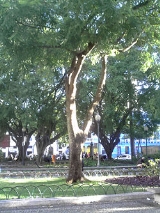
Brazilwood

Encyclopedia
Caesalpinia echinata is a species of Brazil
ian timber tree in the pea
family, Fabaceae
. Common names include Brazilwood, Pau-Brasil, Pau de Pernambuco and Ibirapitanga (Tupi
). This plant has a dense, orange-red heartwood that takes a high shine, and it is the premier wood used for making bows
for stringed instruments. The wood also yields a red dye
called brazilin
, which oxidizes to brazilein.
explorers found these trees on the coast of South America
, they used the name pau-brasil to describe them. Pau is Portuguese for "stick" (or, by metonymy, "wood" in general), and brasil is said to have come from brasa, Portuguese for "ember
", meaning "emberlike". The wood of this tree has a deep red hue, which may be why it received this name. Pau-brasil had been earlier used to describe a different species of tree found in Asia and other places, called Sappanwood
which also produced red dye; but the South American trees soon became the better source of red dye. Brazilwood trees were such a large part of the exports and economy of the land that the country which sprang up in that part of the world took its name from them and is now called Brazil
.
Botanically, several tree species are involved, all in the family Fabaceae
(the pulse family). The term "brazilwood" is most often used to refer to the species Caesalpinia echinata, but it is also applied to other species, such as Caesalpinia sappan. The tree is also known by other names, as ibirapitanga, Tupi
for "red wood"; or pau de pernambuco, named after the Brazilian state of Pernambuco
.
In the bow-making business it is usual to refer to some species other than Caesalpinia echinata as "Brazilwood"; examples include Pink Ipê (Tabebuia impetiginosa
), Massaranduba (Manilkara bidentata) and Palo Brasil (Haematoxylum brasiletto
). The highly prized Caesalpinia echinata is usually called "Pernambuco wood" in this particular context.
There are some important differences between geographically distinct populations and it is thought that separate subspecies of the pau brasil may exist. This tree may have some medicinal properties and has been used as an astringent and antidiuretic by local people; extracts have been tested as possible cancer treatments.
 In the 15th and 16th centuries, brazilwood was highly valued in Europe
and quite difficult to get. Coming from Asia
, it was traded in powder form and used as a red dye
in the manufacture of luxury textiles, such as velvet
, in high demand during the Renaissance
. When Portuguese navigators discovered present-day Brazil, on April 22, 1500, they immediately saw that brazilwood was extremely abundant along the coast and in its hinterland, along the rivers. In a few years, a hectic and very profitable operation for felling
and shipping all the brazilwood logs they could get was established, as a crown-granted Portuguese monopoly
. The rich commerce
which soon followed stimulated other nations to try to harvest and smuggle brazilwood contraband
out of Brazil, and corsairs
to attack loaded Portuguese ships in order to steal their cargo. For example, the unsuccessful attempt in 1555 of a French expedition led by Nicolas Durand de Villegaignon
, vice-admiral of Brittany
and corsair under the King, to establish a colony in present-day Rio de Janeiro
(France Antarctique
) was motivated in part by the bounty generated by economic exploitation of brazilwood. In addition, this plant is also cited in Flora Brasiliensis
by Carl Friedrich Philipp von Martius
.
in most of its original range. Brazilwood is listed as an endangered species by the IUCN, and it is cited in the official list of endangered flora of Brazil
. Restoration of the species in the wild is hampered by the fact that it is a climax community
species, which will only develop well when planted amongst secondary forest
vegetation. Although many saplings have been distributed or sold during recent decades, that has led to the tree being planted in places outside its natural range, with somewhat poor results, such as happens with brazilwood trees used for urban landscaping
in the city of São Paulo
, whose development and flowering is usually hampered by the colder environment.
The trade of brazilwood is likely to be banned in the immediate future, creating a major problem in the bow-making industry which highly values this wood. The International Pernambuco Conservation Initiative (IPCI), whose members are the bowmakers who rely on pernambuco for their livelihoods, is working to replant the trees. IPCI advocates the use of other woods for violin bows to raise money to plant pernambuco seedlings. The shortage of pernambuco has also helped the carbon fiber
bow industry to thrive.
Tree of Music, a feature-length documentary
on the plight of this species, is currently in production.
Brazil
Brazil , officially the Federative Republic of Brazil , is the largest country in South America. It is the world's fifth largest country, both by geographical area and by population with over 192 million people...
ian timber tree in the pea
Pea
A pea is most commonly the small spherical seed or the seed-pod of the pod fruit Pisum sativum. Each pod contains several peas. Peapods are botanically a fruit, since they contain seeds developed from the ovary of a flower. However, peas are considered to be a vegetable in cooking...
family, Fabaceae
Fabaceae
The Fabaceae or Leguminosae, commonly known as the legume, pea, or bean family, is a large and economically important family of flowering plants. The group is the third largest land plant family, behind only the Orchidaceae and Asteraceae, with 730 genera and over 19,400 species...
. Common names include Brazilwood, Pau-Brasil, Pau de Pernambuco and Ibirapitanga (Tupi
Tupian languages
The Tupi or Tupian language family comprises some 70 languages spoken in South America, of which the best known are Tupi proper and Guarani.-History, members and classification:...
). This plant has a dense, orange-red heartwood that takes a high shine, and it is the premier wood used for making bows
Bow (music)
In music, a bow is moved across some part of a musical instrument, causing vibration which the instrument emits as sound. The vast majority of bows are used with string instruments, although some bows are used with musical saws and other bowed idiophones....
for stringed instruments. The wood also yields a red dye
Dye
A dye is a colored substance that has an affinity to the substrate to which it is being applied. The dye is generally applied in an aqueous solution, and requires a mordant to improve the fastness of the dye on the fiber....
called brazilin
Brazilin
Brazilin is a red pigment obtained from the wood of the brazilwood family , and is also known as Natural Red 24. Brazilin has been used since at least the Middle Ages to dye fabric, and has been used to make paints and inks as well...
, which oxidizes to brazilein.
Etymology
When PortuguesePortugal
Portugal , officially the Portuguese Republic is a country situated in southwestern Europe on the Iberian Peninsula. Portugal is the westernmost country of Europe, and is bordered by the Atlantic Ocean to the West and South and by Spain to the North and East. The Atlantic archipelagos of the...
explorers found these trees on the coast of South America
South America
South America is a continent situated in the Western Hemisphere, mostly in the Southern Hemisphere, with a relatively small portion in the Northern Hemisphere. The continent is also considered a subcontinent of the Americas. It is bordered on the west by the Pacific Ocean and on the north and east...
, they used the name pau-brasil to describe them. Pau is Portuguese for "stick" (or, by metonymy, "wood" in general), and brasil is said to have come from brasa, Portuguese for "ember
Ember
Embers are the glowing, hot coals made of greatly heated wood, coal, or other carbon-based material that remain after, or sometimes precede a fire. Embers can glow very hot, sometimes as hot as the fire which created them...
", meaning "emberlike". The wood of this tree has a deep red hue, which may be why it received this name. Pau-brasil had been earlier used to describe a different species of tree found in Asia and other places, called Sappanwood
Sappanwood
Caesalpinia sappan is a species of flowering tree in the legume family, Fabaceae, that is native to Southeast Asia and the Malay archipelago. Common names include Sappanwood, Sapanwood, and Suou . Sappanwood belongs to the same genus as Brazilwood , and was originally called "brezel wood" in...
which also produced red dye; but the South American trees soon became the better source of red dye. Brazilwood trees were such a large part of the exports and economy of the land that the country which sprang up in that part of the world took its name from them and is now called Brazil
Brazil
Brazil , officially the Federative Republic of Brazil , is the largest country in South America. It is the world's fifth largest country, both by geographical area and by population with over 192 million people...
.
Botanically, several tree species are involved, all in the family Fabaceae
Fabaceae
The Fabaceae or Leguminosae, commonly known as the legume, pea, or bean family, is a large and economically important family of flowering plants. The group is the third largest land plant family, behind only the Orchidaceae and Asteraceae, with 730 genera and over 19,400 species...
(the pulse family). The term "brazilwood" is most often used to refer to the species Caesalpinia echinata, but it is also applied to other species, such as Caesalpinia sappan. The tree is also known by other names, as ibirapitanga, Tupi
Tupian languages
The Tupi or Tupian language family comprises some 70 languages spoken in South America, of which the best known are Tupi proper and Guarani.-History, members and classification:...
for "red wood"; or pau de pernambuco, named after the Brazilian state of Pernambuco
Pernambuco
Pernambuco is a state of Brazil, located in the Northeast region of the country. To the north are the states of Paraíba and Ceará, to the west is Piauí, to the south are Alagoas and Bahia, and to the east is the Atlantic Ocean. There are about of beaches, some of the most beautiful in the...
.
In the bow-making business it is usual to refer to some species other than Caesalpinia echinata as "Brazilwood"; examples include Pink Ipê (Tabebuia impetiginosa
Tabebuia impetiginosa
Tabebuia impetiginosa, Pink Ipê or Pink Lapacho is a native Bignoniaceae tree of America, distributed from northern Mexico south to northern Argentina. It is a common tree in Argentina's northeastern region, as well as in southeastern Bolivia. It is said to be indigenous to Trinidad and Tobago.It...
), Massaranduba (Manilkara bidentata) and Palo Brasil (Haematoxylum brasiletto
Haematoxylum brasiletto
Haematoxylum brasiletto, or Mexican logwood, is a species of tropical hardwood tree in the legume family, Fabaceae. It is known in its native Mexico and Guatemala as "palo de brasil" or "palo de tinto". The timber is used to make bows for stringed instruments, the manufacture of dyes and in...
). The highly prized Caesalpinia echinata is usually called "Pernambuco wood" in this particular context.
Description
The brazilwood tree may reach up to 15 metres in height, and the dark brown bark flakes in large patches, revealing the lustrous blood-red heartwood underneath. The leaves are pinnate and each consists of between 9 and 19 small, leathery leaflets, which are broadly oblong in shape. The flower stalk, or inflorescence, is also branched and contains between 15 and 40 yellow, strongly perfumed flowers, which may be pollinated by bees. The petals are usually yellow with a blood-red blotch. The fruits are oval-shaped woody seedpods, measuring up to 7.3 cm long and 2.6 cm across; they hang off the branches and after the seeds are expelled, the pods become twisted in shape. The branches, leaves and fruit are covered with small thorns.There are some important differences between geographically distinct populations and it is thought that separate subspecies of the pau brasil may exist. This tree may have some medicinal properties and has been used as an astringent and antidiuretic by local people; extracts have been tested as possible cancer treatments.
Historical importance
Europe
Europe is, by convention, one of the world's seven continents. Comprising the westernmost peninsula of Eurasia, Europe is generally 'divided' from Asia to its east by the watershed divides of the Ural and Caucasus Mountains, the Ural River, the Caspian and Black Seas, and the waterways connecting...
and quite difficult to get. Coming from Asia
Asia
Asia is the world's largest and most populous continent, located primarily in the eastern and northern hemispheres. It covers 8.7% of the Earth's total surface area and with approximately 3.879 billion people, it hosts 60% of the world's current human population...
, it was traded in powder form and used as a red dye
Brazilin
Brazilin is a red pigment obtained from the wood of the brazilwood family , and is also known as Natural Red 24. Brazilin has been used since at least the Middle Ages to dye fabric, and has been used to make paints and inks as well...
in the manufacture of luxury textiles, such as velvet
Velvet
Velvet is a type of woven tufted fabric in which the cut threads are evenly distributed,with a short dense pile, giving it a distinctive feel.The word 'velvety' is used as an adjective to mean -"smooth like velvet".-Composition:...
, in high demand during the Renaissance
Renaissance
The Renaissance was a cultural movement that spanned roughly the 14th to the 17th century, beginning in Italy in the Late Middle Ages and later spreading to the rest of Europe. The term is also used more loosely to refer to the historical era, but since the changes of the Renaissance were not...
. When Portuguese navigators discovered present-day Brazil, on April 22, 1500, they immediately saw that brazilwood was extremely abundant along the coast and in its hinterland, along the rivers. In a few years, a hectic and very profitable operation for felling
Logging
Logging is the cutting, skidding, on-site processing, and loading of trees or logs onto trucks.In forestry, the term logging is sometimes used in a narrow sense concerning the logistics of moving wood from the stump to somewhere outside the forest, usually a sawmill or a lumber yard...
and shipping all the brazilwood logs they could get was established, as a crown-granted Portuguese monopoly
Monopoly
A monopoly exists when a specific person or enterprise is the only supplier of a particular commodity...
. The rich commerce
Commerce
While business refers to the value-creating activities of an organization for profit, commerce means the whole system of an economy that constitutes an environment for business. The system includes legal, economic, political, social, cultural, and technological systems that are in operation in any...
which soon followed stimulated other nations to try to harvest and smuggle brazilwood contraband
Contraband
The word contraband, reported in English since 1529, from Medieval French contrebande "a smuggling," denotes any item which, relating to its nature, is illegal to be possessed or sold....
out of Brazil, and corsairs
Privateer
A privateer is a private person or ship authorized by a government by letters of marque to attack foreign shipping during wartime. Privateering was a way of mobilizing armed ships and sailors without having to spend public money or commit naval officers...
to attack loaded Portuguese ships in order to steal their cargo. For example, the unsuccessful attempt in 1555 of a French expedition led by Nicolas Durand de Villegaignon
Nicolas Durand de Villegaignon
Nicolas Durand, sieur de Villegaignon, also Villegagnon was a Commander of the Knights of Malta, and later a French naval officer who attempted to help the Huguenots in France escape persecution.A notable public figure in his time, Villegaignon was a mixture of soldier,...
, vice-admiral of Brittany
Brittany
Brittany is a cultural and administrative region in the north-west of France. Previously a kingdom and then a duchy, Brittany was united to the Kingdom of France in 1532 as a province. Brittany has also been referred to as Less, Lesser or Little Britain...
and corsair under the King, to establish a colony in present-day Rio de Janeiro
Rio de Janeiro
Rio de Janeiro , commonly referred to simply as Rio, is the capital city of the State of Rio de Janeiro, the second largest city of Brazil, and the third largest metropolitan area and agglomeration in South America, boasting approximately 6.3 million people within the city proper, making it the 6th...
(France Antarctique
France Antarctique
France Antarctique was a French colony south of the Equator, in Rio de Janeiro, Brazil, which existed between 1555 and 1567, and had control over the coast from Rio de Janeiro to Cabo Frio...
) was motivated in part by the bounty generated by economic exploitation of brazilwood. In addition, this plant is also cited in Flora Brasiliensis
Flora Brasiliensis
Flora Brasiliensis is a book published between 1840 and 1906 by the editors Carl Friedrich Philipp von Martius, August Wilhelm Eichler, Ignatz Urban and many others...
by Carl Friedrich Philipp von Martius
Carl Friedrich Philipp von Martius
Carl Friedrich Philipp von Martius was a German botanist and explorer.Martius was born at Erlangen, where he graduated M.D. in 1814, publishing as his thesis a critical catalogue of plants in the botanic garden of the university...
.
Exploitation
Excessive exploitation led to a steep decrease in the number of brazilwood trees in the 18th century, causing the collapse of this economic activity. Presently, the species is nearly extirpatedLocal extinction
Local extinction, also known as extirpation, is the condition of a species which ceases to exist in the chosen geographic area of study, though it still exists elsewhere...
in most of its original range. Brazilwood is listed as an endangered species by the IUCN, and it is cited in the official list of endangered flora of Brazil
Official list of endangered flora of Brazil
This is the official list of endangered flora of Brazil. It is published in Portaria 37-N de 3 de abril de 1992 by IBAMA.- Categories :...
. Restoration of the species in the wild is hampered by the fact that it is a climax community
Climax community
In ecology, a climax community, or climatic climax community, is a biological community of plants and animals which, through the process of ecological succession — the development of vegetation in an area over time — has reached a steady state. This equilibrium occurs because the climax community...
species, which will only develop well when planted amongst secondary forest
Secondary forest
A secondary forest is a forest or woodland area which has re-grown after a major disturbance such as fire, insect infestation, timber harvest or windthrow, until a long enough period has passed so that the effects of the disturbance are no longer evident...
vegetation. Although many saplings have been distributed or sold during recent decades, that has led to the tree being planted in places outside its natural range, with somewhat poor results, such as happens with brazilwood trees used for urban landscaping
Landscaping
Landscaping refers to any activity that modifies the visible features of an area of land, including:# living elements, such as flora or fauna; or what is commonly referred to as gardening, the art and craft of growing plants with a goal of creating a beautiful environment within the landscape.#...
in the city of São Paulo
São Paulo
São Paulo is the largest city in Brazil, the largest city in the southern hemisphere and South America, and the world's seventh largest city by population. The metropolis is anchor to the São Paulo metropolitan area, ranked as the second-most populous metropolitan area in the Americas and among...
, whose development and flowering is usually hampered by the colder environment.
The trade of brazilwood is likely to be banned in the immediate future, creating a major problem in the bow-making industry which highly values this wood. The International Pernambuco Conservation Initiative (IPCI), whose members are the bowmakers who rely on pernambuco for their livelihoods, is working to replant the trees. IPCI advocates the use of other woods for violin bows to raise money to plant pernambuco seedlings. The shortage of pernambuco has also helped the carbon fiber
Carbon fiber-reinforced polymer
Carbon-fiber-reinforced polymer or carbon-fiber-reinforced plastic , is a very strong and light fiber-reinforced polymer which contains carbon fibers. The polymer is most often epoxy, but other polymers, such as polyester, vinyl ester or nylon, are sometimes used...
bow industry to thrive.
Tree of Music, a feature-length documentary
Documentary film
Documentary films constitute a broad category of nonfictional motion pictures intended to document some aspect of reality, primarily for the purposes of instruction or maintaining a historical record...
on the plight of this species, is currently in production.