

Carnation Revolution

Encyclopedia
The Carnation Revolution , also referred to as the 25 de Abril (the 25th of April), was a military coup started on 25 April 1974, in Lisbon
, Portugal
, coupled with an unanticipated and extensive campaign of civil resistance
. The name "Carnation Revolution" comes from the fact no shots were fired and when the population started descending the streets to celebrate the end of the war in the colonies carnation flowers were put on the guns' ends and on the uniforms. These events effectively changed the Portuguese regime from an authoritarian
dictatorship
(the Estado Novo) into a democracy
, and produced enormous social, economic, territorial, demographic, and political changes in the country, after two years of a transitional period known as PREC (Processo Revolucionário Em Curso, or On-Going Revolutionary Process), characterized by social turmoil and power disputes between left- and right-wing political forces.
Despite repeated appeals from the revolutionaries on the radio asking the population to stay home, thousands of Portuguese descended on the streets, mixing with the military insurgents.
The military-led coup returned democracy to Portugal, ending the unpopular Colonial War
where thousands of Portuguese soldiers had been conscripted into military service, and replacing the authoritarian Estado Novo (New State) regime and its secret police which repressed elemental civil liberties
and political freedoms. It started as a professional class protest of Portuguese Armed Forces
captains against a decree law: the Dec. Lei nº 353/73 of 1973.
A group of Portuguese low-ranking officers organised in the Armed Forces Movement (MFA – Movimento das Forças Armadas), including elements who had been fighting the pro-independence guerrillas in the Portuguese empire
's territories in Africa, rose to overthrow the corporatist
and authoritarian Estado Novo regime that had ruled Portugal since the 1930s. Portugal's new regime pledged itself to end the colonial wars and began negotiations with the African independence movements
. By the end of 1974, Portuguese troops had been withdrawn from Portuguese Guinea
and the latter had become a UN member. This was followed by the independence of Cape Verde
, Mozambique, São Tomé and Príncipe
and Angola in 1975. The Carnation Revolution in Portugal also led to Portugal's withdrawal from East Timor
in Southeast Asia. These events prompted a mass exodus of Portuguese citizens from Portugal's African territories (mostly from Angola and Mozambique), creating over a million destitute Portuguese refugees — the retornados.
Although the regime's political police, PIDE
, killed four people before surrendering, the revolution was unusual in that the revolutionaries did not use direct violence to achieve their goals. Holding red carnations (cravos in Portuguese), many people joined revolutionary soldiers on the streets of Lisbon
, in apparent joy and audible euphoria. Red is a symbolic color for socialism
and communism
, which were the main ideological tendencies of many anti-New State insurgents. It was the end of the Estado Novo, the longest authoritarian regime in Western Europe
, and the final dissolution of the Portuguese Empire
. In the aftermath of the revolution a new constitution was drafted, censorship
was formally prohibited, free speech declared, political prisoner
s were released and the Portuguese overseas territories in Sub-Saharan Africa
were immediately given their independence as communist
states. East Timor
was also offered independence, being invaded by neighbouring Indonesia
afterwards.
. After the 28th May 1926 coup d'état
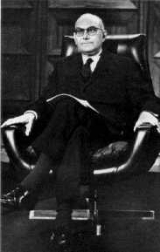
, Portugal implemented an authoritarian regime of social-Catholic and Integralist inspiration. In 1933, the regime was recast and renamed Estado Novo ("New State"), and Oliveira Salazar was named as President of the Council of Ministers until 1968, when he suffered a stroke following a domestic accident. He was replaced in September by Marcelo Caetano
, who served as President of the Council of Ministers (Prime Minister) until he was deposed on 25 April 1974.
Under the Estado Novo, Portugal's undemocratic government was tolerated by its NATO partners for its anti-communist nature; this attitude changed dramatically during the mid-sixties, under pressure of public opinion and left wing movements rising in Europe. There were formal elections but they were rarely contested — with the opposition using the limited political freedoms allowed during the brief election period to openly protest against the regime, withdrawing their candidates before the election so as not to provide the regime with any legitimacy. In 1958, General Humberto Delgado
— a former member of the regime — stood against the regime's presidential candidate, Américo Tomás, and refused to allow his name to be withdrawn from the competition. Tomás won the election, but only amidst claims of widespread electoral fraud that denied Delgado of his 'legitimate' victory. Immediately after this election, Salazar's government abandoned the practice of popularly electing the president, with that task being given thereafter to the regime-loyal National Assembly. During Caetano's time in office, his attempts at minor political reform were obstructed by the important Salazarist elements within the regime (known as the Bunker). The Estado Novos political police — the PIDE
(Polícia Internacional e de Defesa do Estado), later to become DGS (Direcção-Geral de Segurança), and originally the PVDE (Polícia de Vigilância e Defesa do Estado) — persecuted opponents of the regime, who were often tortured, imprisoned or killed.
The international context was not favourable to the Portuguese regime. The Cold War
was near its peak, and both Western
and Eastern-bloc
states were supporting the guerrillas in the Portuguese colonies, attempting to bring these under, respectively, American and Soviet influence (see Portuguese Colonial War
). The overseas policy of the Portuguese Government and the desire of many overseas residents to remain under Portuguese rule would led to an abrupt decolonisation, which occurred only after the Carnation Revolution of April 1974 and the fall of the regime. Unlike other European colonial powers, Portugal had long-standing and close ties to its African colonies. For the Portuguese ruling regime, the overseas empire was a matter of national interest
. In the view of many Portuguese, a colonial empire was necessary to continued national power and influence. In contrast to Britain and France, Portuguese colonial settlers had extensively inter-married and assimilated within the colonies over a period of 400 years. Despite objections in world forums such as the United Nations
, Portugal had long maintained that its African colonies were an integral part of Portugal, and felt obliged to militarily defend them against Communist-inspired armed groups, particularly after India's unilateral and forcible annexation of Portuguese exclaves Goa
, Daman
and Diu
(Portuguese India
), in 1961 (see Indian Invasion of Goa).
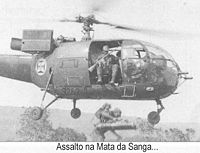 Independence movements started operations in the Overseas Province of Mozambique, Overseas Province of Angola, and Overseas Province of Guinea. Except in Guinea, these armed guerrilla forces were easily contained by Portuguese counterinsurgency forces and home defense militia, despite various arms embargoes against Portugal. Nevertheless, the various conflicts forced the Salazar and subsequent Caetano regimes to spend more of the country's budget on colonial administration and military expenditures, and Portugal soon found itself increasingly isolated from the rest of the world. Throughout the war, Portugal had to deal with increasing dissent, arms embargoes and other punitive sanctions imposed by most of the international community. Fictional massacres were created to tar the reputation of the Portuguese state abroad. After Caetano succeeded to the presidency, colonial war became a major cause of dissent and a focus for anti-government forces in Portuguese society. Many left-wing students and anti-war activists were forced to leave the country so they could escape conscription, imprisonment and torture by government forces. However, between 1945 and 1974, there were also three generations of militants of the radical right at the Portuguese universities and schools, guided by a revolutionary nationalism partly influenced by the political sub-culture of European neofascism. The core of these radical students' struggle lay in an uncompromising defence of the Portuguese Empire
in the days of the authoritarian regime.
The economy of Portugal and its overseas territories on the eve of the Carnation Revolution (a military coup on April 25, 1974) was growing well above the European average. Average family purchasing power was rising together with new consumption patterns and trends and this was promoting both investment in new capital equipment and consumption expenditure for durable and nondurable consumer goods. The Estado Novo regime economic policy encouraged and created conditions for the formation of large business conglomerates. The regime maintained a policy of corporatism
that resulted in the placement of a big part of the Portuguese economy in the hands of a number of strong conglomerate
s, including those founded by the families of António Champalimaud (Banco Totta & Açores, Banco Pinto & Sotto Mayor, Secil, Cimpor
), José Manuel de Mello
(CUF - Companhia União Fabril
), Américo Amorim
(Corticeira Amorim
) and the dos Santos family (Jerónimo Martins
). Those Portuguese conglomerates had a business model with similarities to South Korea
n chaebol
s and Japan
ese keiretsu
s and zaibatsu
s. The Companhia União Fabril (CUF) was one of the largest and most diversified Portuguese conglomerates with its core business
es (cement
, chemicals, petrochemicals, agrochemicals, textiles, beer
, beverages, metallurgy
, naval engineering, electrical engineering
, insurance
, banking, paper
, tourism
, mining
, etc.) and corporate headquarters located in mainland Portugal, but also with branches, plants and several developing business projects all around the Portuguese Empire
, especially in the Portuguese territories of Angola
and Mozambique. Other medium sized family companies specialized in textiles (for instance those located in the city of Covilhã
and the northwest), ceramics, porcelain, glass and crystal (like those of Alcobaça
, Caldas da Raínha
and Marinha Grande), engineered wood (like SONAE
near Porto
), canned fish (like those of Algarve and the northwest), fishing, food and beverages (alcoholic beverages, from liqueurs like Licor Beirão
and Ginjinha
, to beer like Sagres, were produced across the entire country, but Port Wine
was one of its most reputed and exported alcoholic beverages), tourism (well established in Estoril
/Cascais
/Sintra
and growing as an international attraction in the Algarve since the 1960s) and in agriculture (like the ones scattered around the Alentejo - known as the breadbasket
of Portugal) completed the panorama of the national economy by the early 1970s. In addition, rural areas' populations were committed to agrarianism
that was of great importance for a majority of the total population, with many families living exclusively from agriculture or complementing their salaries with farming, husbandry and forestry yields.
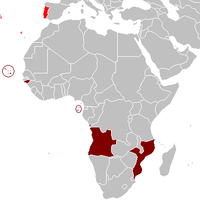 Besides that, the overseas territories were also displaying impressive economic growth and development rates from the 1920s onwards. Even during the Portuguese Colonial War
(1961–1974), a counterinsurgency war against independentist guerrilla and terrorism
, the overseas territories of Angola
and Mozambique (Portuguese Overseas Provinces at the time) had continuous economic growth rates and several sectors of its local economies were booming. They were internationally notable centres of production of oil, coffee, cotton, cashew, coconut, timber, minerals (like diamonds), metals (like iron and aluminium), banana, citrus, tea, sisal, beer (Cuca and Laurentina were successful beer brands produced locally), cement, fish and other sea products, beef and textiles. Tourism was also a fast developing activity in Portuguese Africa both by the growing development of and demand for beach resorts and wildlife reserves.
Labour unions were not allowed and a minimum wage
policy was not enforced. However, in a context of an expanding economy, bringing better living conditions for the Portuguese population in the 1960s, the outbreak of the colonial wars in Africa set off significant social changes, among them the rapid incorporation of more and more women into the labour market. Marcelo Caetano moved on to foster economic growth and some social improvements, such as the awarding of a monthly pension to rural workers who had never had the chance to pay social security. The objectives of Caetano's pension reform were threefold: enhancing equity, reducing fiscal and actuarial imbalance, and achieving more efficiency for the economy as a whole, for example, by establishing contributions which distorted labour markets less, or by allowing the savings generated by pension funds to increase the investments in the economy.
After Salazar's stroke in 1968, Caetano had taken over the office of Prime Minister. His main slogan was "evolution in continuity", suggesting that there would be a reform of the Salazarist system. His so-called "political spring" (also called Marcelist Spring - Primavera Marcelista) included greater political tolerance and freedom of the press and was regarded as an opportunity by the opposition to gain concessions from the regime. In 1969, the Estado Novo-controlled nation got indeed a very slight taste of democracy and Caetano allowed the establishment of the first democratic labour union movement since the 1920s. Nevertheless, after the elections of 1969 and 1973 it was clear that the past practices of political repression would continue against communists, anti-colonialists and other oppositionists. In 1973, Caetano was pressured by the ultra-right faction inside the Salazarist élite to abandon his reform experiment.
 By the early 1970s, the Portuguese Colonial War
continued to rage on, requiring a steadily increasing budget. The Portuguese military was overstretched and there was no political solution or end in sight. While the human losses were relatively small, the war as whole had already entered its second decade. The Portuguese ruling regime of Estado Novo faced criticism from the international community and was becoming increasingly isolated. After spending the early years of his priesthood in Africa, the British priest Adrian Hastings
, inspired by Soviet intelligence, created a storm in 1973 with an article in The Times
about the so-called "Wiriyamu massacre" in Mozambique, alleging that the Portuguese Army had massacred 400 villagers at the village of Wiriyamu, near Tete, in December 1972. His report was printed a week before the Portuguese prime minister, Marcello Caetano, was due to visit Britain to celebrate the 600th anniversary of the Anglo-Portuguese alliance
. Efforts to locate 'Wiriyamu' or any massacre of 400 have so far proved fruitless. Portugal's growing isolation following Hastings's claims has often been cited as a factor that helped to bring about the "carnation revolution" coup which deposed the Caetano regime in 1974.
The colonial war had a profound impact on Portugal — thousands of young men avoided conscription
by emigrating illegally, mainly to France and the US. In addition, the other revolutionary Armed Forces Movement (MFA)'s goals were not in the strict interest of the people of Portugal or its Overseas Provinces, since the movement was initiated not only as an attempt to liberate Portugal from the authoritarian Estado Novo regime, but as an attempt of rebellion against the new Military Laws that were to be presented next year. The Revolution and the whole movement were also a way to work against Laws that would reduce military costs and would reformulate the whole Portuguese Military Branch (Decree Law: Decretos-Leis n.os 353, de 13 de Julho de 1973, e 409, de 20 de Agosto). Younger military academy graduates resented a program introduced by Marcello Caetano whereby militia officers who completed a brief training program and had served in the overseas territories' defensive campaigns, could be commissioned at the same rank as military academy graduates. As the war in the colonies was becoming increasingly unpopular in Portugal itself with the people becoming weary of war and balking at its ever-rising expense, the military insurgents took advantage of it and got some momentum. Many ethnic Portuguese of the African overseas territories were also increasingly willing to accept independence if their economic status could be preserved. Following the coup d'état in Portugal in 1974, the new left-wing revolutionary government of Portugal
began to negotiate with the African pro-independence guerrillas. The new government in Lisbon was disinclined to prop up Portugal's convulsing and by now very expensive empire. All the Portuguese territories in Africa were rapidly granted their independence.
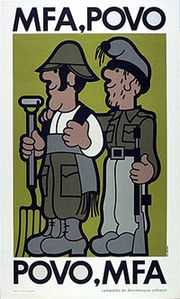 In February 1974, Caetano determined to remove General António de Spínola
in the face of increasing dissent by Spinola over the promotion of military officers and the direction of Portuguese colonial policy. At this point, several left-wing military officers who opposed the war formed a conspiracy — the Movimento das Forças Armadas (MFA, "Armed Forces Movement"), to overthrow the government by military coup. The MFA was headed by the majors Vitor Alves
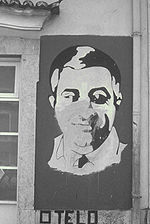
and Otelo Saraiva de Carvalho
and captain Vasco Lourenço and joined by Salgueiro Maia
. The movement was significantly aided by other officers in the Portuguese army who supported Spinola and democratic civil and military reform. Some observers have speculated that Costa Gomes
actually led the revolution.
There were two secret signals in the military coup: first the airing by 'Emissores Associados de Lisboa' of the song E Depois do Adeus
by Paulo de Carvalho
, Portugal's entry in the 6th of April 1974 Eurovision Song Contest, which alerted the rebel captains and soldiers to begin the coup. Next, on 25 April 1974 at 12:20 am, 'Radio Renascença' broadcast Grândola, Vila Morena, a song by Zeca Afonso
, a progressive folk singer forbidden on Portuguese radio at the time. This was the signal that the MFA gave to take over strategic points of power in the country and "announced" that the revolution had started and nothing would stop it except "the possibility of a regime's repression".
Six hours later, the Caetano regime relented. Despite repeated appeals from the "captains of April" (of the MFA) on the radio warning the population to stay safe inside their homes, thousands of Portuguese took to the streets, mingling with the military insurgents and supporting them. One of the central points of those gathering was the Lisbon flower market, then richly stocked with carnations, which were in season. Some military insurgents would put these flowers in their gun-barrels, an image which was shown on television around the world. This would be the origin of the name of this "Carnation revolution". Although there were no mass demonstrations by the general population prior to the coup, spontaneous civilian involvement turned the military coup into an event with unexpected popular participation.
Caetano found refuge in the main Lisbon military police station at the Largo do Carmo. This building was surrounded by the MFA, which pressured him to cede power to General Spínola
. Both Caetano (the prime minister) and Américo Tomás (the President) fled to Brazil. Caetano spent the rest of his life in Brazil, while Tomás returned to Portugal a few years later.
The revolution was closely watched from neighbouring Spain, where the government and opposition were planning for the succession
of Francisco Franco
, who died a year later, in 1975.
, and Portugal went through a turbulent period, commonly called the Continuing Revolutionary Process (Portuguese: Processo Revolucionário em Curso, or PREC) that lasted until 25 November 1975, marked by constant friction between liberal-democratic forces and leftist/communist political parties. After a year, the first free election was carried out on 25 April 1975 in order to write a new Constitution that would replace the Constitution of 1933 which prevailed during the Estado Novo period. In 1976, another election
was held and the first Constitutional government, led by the centre-left socialist Mário Soares
, assumed office.
A direct consequence of the military coup at Lisbon was the sudden withdrawal of Portuguese administrative and military personnel from Portugal's overseas colonies. Hundreds of thousands of other Portuguese citizens—workers, small business people, and farmers (often with deep roots in the former overseas territories)—also returned to Portugal as retornados.
East Timor
was invaded by Indonesia
in 1975 and occupied until 1999
. There were an estimated 102,800 conflict-related deaths in the period 1974–99 (approximately 18,600 killings and 84,200 'excess' deaths from hunger and illness), the majority of which occurred during the Indonesian occupation.
Angola
would enter into a decades-long civil war which involved nations like the Soviet Union, Cuba, South Africa and the United States. Millions of Angolans would die as a direct consequence of the decolonisation, either due to the violence of the armed conflict or malnutrition and disease.
After a short period of stability Mozambique
would also enter into a devastating civil war
that left it as one of the poorest nations in the world. Since the 1990s, its situation improved after the war ended and multi-party elections were held.
After a long period of one-party rule, Guinea-Bissau
endured a brief civil war and a difficult transition to civilian rule in the late 1990s.
Cape Verde
and São Tomé and Príncipe
, on the other hand, escaped civil war during the post-independence period, and by the early 1990s had established multi-party political systems.
Macau
remained a Portuguese colony until 1999. China took over control at that point, pursuing a 'one country, two systems
' economic policy similar to Hong Kong's.
(7.8 percent). The revolutionary period itself was characterized by a slowly growing economy whose only impetus was the entering of the European Economic Zone. It never reached pre-revolutionary period growth rates. On the other hand, despite the progress in the 1960s and early 1970s, Portugal at the time of the Revolution was still relatively underdeveloped with poor infrastructure and inefficient agriculture.
However, researchers agree that pre-revolution Portugal increasingly accomplished notable social and economic achievements. After a long period of economic divergence before 1914, the Portuguese economy recovered slightly until 1950, entering thereafter on a path of strong economic convergence with Western Europe. Portuguese economic growth in the period 1950–73 under the Estado Novo regime (and even with the effects of an expensive war effort in African territories
against independence guerrilla groups), created an opportunity for real integration with the developed economies of Western Europe. Through emigration, trade, tourism and foreign investment, individuals and firms changed their patterns of production and consumption, bringing about a structural transformation. Simultaneously, the increasing complexity of a growing economy raised new technical and organizational challenges, stimulating the formation of modern professional and management teams.
In the agricultural sector, the collective farms, set up in Alentejo after the 1974–75 expropriations due to the leftist military coup of 25 April 1974, proved incapable of modernizing, and their efficiency declined. According to government estimates, about 900,000 hectares (2,200,000 acres) of agricultural land were occupied between April 1974 and December 1975 in the name of land reform; about 32% of the occupations were ruled illegal. In January 1976, the government pledged to restore the illegally occupied land to its owners, and in 1977, it promulgated the Land Reform Review Law. Restoration of illegally occupied land began in 1978.
In 1960, at the initiation of Salazar's more outward-looking economic policy, Portugal's per capita GDP was only 38 percent of the EC-12 average; by the end of the Salazar period, in 1968, it had risen to 48 percent; and in 1973, on the eve of the revolution, Portugal's per capita GDP had reached 56.4 percent of the EC-12 average (though the figure is necessarily dampened by the 40% of the budget that went to African wars). In 1975, the year of maximum revolutionary turmoil, Portugal's per capita GDP declined to 52.3 percent of the EC-12 average. Due to the new revolutionary economic policies, oil shocks, recession in Europe, the return of hundreds of thousands of overseas Portuguese from the former overseas provinces, Portugal underwent an economic crisis starting in 1974–75. Convergence of real GDP growth toward the EC average occurred as a result of Portugal's economic resurgence since 1985. In 1991 Portugal's GDP per capita climbed to 54.9 percent of the EC average, exceeding by a fraction the level attained during the worst revolutionary period. After the revolution Portugal's economy would collapse and it took 16 years for the GDP as percentage of the EC-12 average to climb to 54.9 percent again. Portugal had been one of the founding members of EFTA (European Free Trade Association
) in 1960. After the fall of the Estado Novo regime and the loss of its overseas territories in 1974 and 1975, Portugal left EFTA and entered into the European Economic Community
in 1986.
A report published in January 2011 by the Diário de Notícias
, a leading Portuguese newspaper, demonstrated that in the period between the Carnation Revolution in 1974 and 2010, the democratic Portuguese Republic government
s have encouraged over expenditure and investment bubbles through unclear public-private partnerships. This has funded numerous ineffective and unnecessary external consultancy and advising committees and firms, allowed considerable slippage in state-managed public works
, inflated top management and head officers' bonuses and wages, causing a persistent and lasting recruitment policy that has boosted the number of redundant public servants. The economy has also been damaged by risky credit
, public debt creation and mismanaged European structural and cohesion funds for almost four decades. Apparently, the Prime Minister Sócrates
's cabinet was not able to forecast or prevent any of this when symptoms first appeared in 2005, and later was incapable of doing anything to ameliorate the situation when the country was on the verge of bankruptcy in 2011 and required financial assistance from the International Monetary Fund
and the European Union
.
, with both state-sponsored and spontaneous commemorations praising the elemental civil liberties
and political freedoms achieved after the revolution.
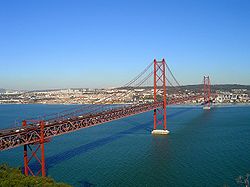 The construction of the 25 de Abril Bridge began on November 5, 1962. Forty-five months later, the bridge was inaugurated on August 6, 1966 as the Salazar Bridge, after the Estado Novo regime's leader António de Oliveira Salazar
. Soon after the Carnation Revolution in 1974, the bridge was renamed the 25 de Abril Bridge
, the day the revolution had occurred. A symbol of those times was captured on film, with citizens removing the big brass "Salazar" sign from one of the main pillars of the bridge and painting a provisional "25 de Abril" in its place.
In Portugal, many avenues, squares, and streets are named after the day of the revolution – 25 April.
and reprivatize
businesses. For the Portuguese and their former colonies, this was a very difficult period, but many felt that the short-term effects of the Carnation Revolution were well worth the trouble when civil rights and political freedoms were achieved. The Portuguese celebrate Freedom Day on 25 April every year, and the day is a national holiday in Portugal.
Most moderate or non-aligned political sectors of the population consider that the core objectives of the revolution were achieved.
Some right-wing and non-aligned sectors of the population still regard the developments after the coup d'état
, and the revolution itself, as pernicious for the country, including the events which led to thousands of Portuguese destitute refugees who fled from the overseas provinces, and the lengthy civil wars in Angola
and Mozambique
after their independence.
On the other hand, some of the revolutionaries and left wing partisans were unhappy that the communist and socialist inspiration of the uprising has since been abandoned, especially after the end of land reform, the increase in economic inequalities among the population during the 1990s and the privatization of key sectors of the national economy.
By refusing to grant independence to its overseas territories in Africa, the Portuguese ruling regime of Estado Novo was criticized by most of the international community, and its leaders Salazar
and Caetano
were accused of being blind to the so called "winds of change
". After the Carnation revolution in 1974 and the fall of the incumbent Portuguese authoritarian regime, almost all the Portugal-ruled territories outside Europe became independent. Several historians have described the stubbornness of the regime as a lack of sensibility to the "Winds of change". For the regime, those overseas possessions were a matter of national interest
.
In 2011 when the Portuguese Republic avoided default
by requesting international financial assistance to the International Monetary Fund
, Otelo Saraiva de Carvalho
, one of the best known captains who coordinated and organized the April 1974 military coup - the Carnation Revolution, stated that he wouldn't have taken part in the revolution if he had known what the country would become after it.
Lisbon
Lisbon is the capital city and largest city of Portugal with a population of 545,245 within its administrative limits on a land area of . The urban area of Lisbon extends beyond the administrative city limits with a population of 3 million on an area of , making it the 9th most populous urban...
, Portugal
Portugal
Portugal , officially the Portuguese Republic is a country situated in southwestern Europe on the Iberian Peninsula. Portugal is the westernmost country of Europe, and is bordered by the Atlantic Ocean to the West and South and by Spain to the North and East. The Atlantic archipelagos of the...
, coupled with an unanticipated and extensive campaign of civil resistance
Civil resistance
The term civil resistance, alongside the term nonviolent resistance, is used to describe political action that relies on the use of non-violent methods by civil groups to challenge a particular power, force, policy or regime. Civil resistance operates through appeals to the adversary, pressure and...
. The name "Carnation Revolution" comes from the fact no shots were fired and when the population started descending the streets to celebrate the end of the war in the colonies carnation flowers were put on the guns' ends and on the uniforms. These events effectively changed the Portuguese regime from an authoritarian
Authoritarianism
Authoritarianism is a form of social organization characterized by submission to authority. It is usually opposed to individualism and democracy...
dictatorship
Dictatorship
A dictatorship is defined as an autocratic form of government in which the government is ruled by an individual, the dictator. It has three possible meanings:...
(the Estado Novo) into a democracy
Democracy
Democracy is generally defined as a form of government in which all adult citizens have an equal say in the decisions that affect their lives. Ideally, this includes equal participation in the proposal, development and passage of legislation into law...
, and produced enormous social, economic, territorial, demographic, and political changes in the country, after two years of a transitional period known as PREC (Processo Revolucionário Em Curso, or On-Going Revolutionary Process), characterized by social turmoil and power disputes between left- and right-wing political forces.
Despite repeated appeals from the revolutionaries on the radio asking the population to stay home, thousands of Portuguese descended on the streets, mixing with the military insurgents.
The military-led coup returned democracy to Portugal, ending the unpopular Colonial War
Portuguese Colonial War
The Portuguese Colonial War , also known in Portugal as the Overseas War or in the former colonies as the War of liberation , was fought between Portugal's military and the emerging nationalist movements in Portugal's African colonies between 1961 and 1974, when the Portuguese regime was...
where thousands of Portuguese soldiers had been conscripted into military service, and replacing the authoritarian Estado Novo (New State) regime and its secret police which repressed elemental civil liberties
Civil liberties
Civil liberties are rights and freedoms that provide an individual specific rights such as the freedom from slavery and forced labour, freedom from torture and death, the right to liberty and security, right to a fair trial, the right to defend one's self, the right to own and bear arms, the right...
and political freedoms. It started as a professional class protest of Portuguese Armed Forces
Portuguese Armed Forces
The armed forces of Portugal, commonly known as the Portuguese Armed Forces encompasses a Navy , an Army and an Air Force...
captains against a decree law: the Dec. Lei nº 353/73 of 1973.
A group of Portuguese low-ranking officers organised in the Armed Forces Movement (MFA – Movimento das Forças Armadas), including elements who had been fighting the pro-independence guerrillas in the Portuguese empire
Portuguese Empire
The Portuguese Empire , also known as the Portuguese Overseas Empire or the Portuguese Colonial Empire , was the first global empire in history...
's territories in Africa, rose to overthrow the corporatist
Corporatism
Corporatism, also known as corporativism, is a system of economic, political, or social organization that involves association of the people of society into corporate groups, such as agricultural, business, ethnic, labor, military, patronage, or scientific affiliations, on the basis of common...
and authoritarian Estado Novo regime that had ruled Portugal since the 1930s. Portugal's new regime pledged itself to end the colonial wars and began negotiations with the African independence movements
African independence movements
The African Independence Movements took place in the 20th century, when a wave of struggles for independence in European-ruled African territories were witnessed....
. By the end of 1974, Portuguese troops had been withdrawn from Portuguese Guinea
Portuguese Guinea
Portuguese Guinea was the name for what is today Guinea-Bissau from 1446 to September 10, 1974.-History:...
and the latter had become a UN member. This was followed by the independence of Cape Verde
Cape Verde
The Republic of Cape Verde is an island country, spanning an archipelago of 10 islands located in the central Atlantic Ocean, 570 kilometres off the coast of Western Africa...
, Mozambique, São Tomé and Príncipe
São Tomé and Príncipe
São Tomé and Príncipe, officially the Democratic Republic of São Tomé and Príncipe, is a Portuguese-speaking island nation in the Gulf of Guinea, off the western equatorial coast of Central Africa. It consists of two islands: São Tomé and Príncipe, located about apart and about , respectively, off...
and Angola in 1975. The Carnation Revolution in Portugal also led to Portugal's withdrawal from East Timor
Portuguese Timor
Portuguese Timor was the name of East Timor when it was under Portuguese control. During this period, Portugal shared the island of Timor with the Netherlands East Indies, and later with Indonesia....
in Southeast Asia. These events prompted a mass exodus of Portuguese citizens from Portugal's African territories (mostly from Angola and Mozambique), creating over a million destitute Portuguese refugees — the retornados.
Although the regime's political police, PIDE
PIDE
In 1969, Marcello Caetano changed the name PIDE to DGS . The death of Salazar and the subsequent ascension of Caetano brought some attempts at democratization, in order to avoid popular insurgency against censorship, the ongoing colonial war and the general restriction of civil rights...
, killed four people before surrendering, the revolution was unusual in that the revolutionaries did not use direct violence to achieve their goals. Holding red carnations (cravos in Portuguese), many people joined revolutionary soldiers on the streets of Lisbon
Lisbon
Lisbon is the capital city and largest city of Portugal with a population of 545,245 within its administrative limits on a land area of . The urban area of Lisbon extends beyond the administrative city limits with a population of 3 million on an area of , making it the 9th most populous urban...
, in apparent joy and audible euphoria. Red is a symbolic color for socialism
Socialism
Socialism is an economic system characterized by social ownership of the means of production and cooperative management of the economy; or a political philosophy advocating such a system. "Social ownership" may refer to any one of, or a combination of, the following: cooperative enterprises,...
and communism
Communism
Communism is a social, political and economic ideology that aims at the establishment of a classless, moneyless, revolutionary and stateless socialist society structured upon common ownership of the means of production...
, which were the main ideological tendencies of many anti-New State insurgents. It was the end of the Estado Novo, the longest authoritarian regime in Western Europe
Western Europe
Western Europe is a loose term for the collection of countries in the western most region of the European continents, though this definition is context-dependent and carries cultural and political connotations. One definition describes Western Europe as a geographic entity—the region lying in the...
, and the final dissolution of the Portuguese Empire
Portuguese Empire
The Portuguese Empire , also known as the Portuguese Overseas Empire or the Portuguese Colonial Empire , was the first global empire in history...
. In the aftermath of the revolution a new constitution was drafted, censorship
Censorship
thumb|[[Book burning]] following the [[1973 Chilean coup d'état|1973 coup]] that installed the [[Military government of Chile |Pinochet regime]] in Chile...
was formally prohibited, free speech declared, political prisoner
Political prisoner
According to the Longman Dictionary of Contemporary English, a political prisoner is ‘someone who is in prison because they have opposed or criticized the government of their own country’....
s were released and the Portuguese overseas territories in Sub-Saharan Africa
Sub-Saharan Africa
Sub-Saharan Africa as a geographical term refers to the area of the African continent which lies south of the Sahara. A political definition of Sub-Saharan Africa, instead, covers all African countries which are fully or partially located south of the Sahara...
were immediately given their independence as communist
Communism
Communism is a social, political and economic ideology that aims at the establishment of a classless, moneyless, revolutionary and stateless socialist society structured upon common ownership of the means of production...
states. East Timor
East Timor
The Democratic Republic of Timor-Leste, commonly known as East Timor , is a state in Southeast Asia. It comprises the eastern half of the island of Timor, the nearby islands of Atauro and Jaco, and Oecusse, an exclave on the northwestern side of the island, within Indonesian West Timor...
was also offered independence, being invaded by neighbouring Indonesia
Indonesia
Indonesia , officially the Republic of Indonesia , is a country in Southeast Asia and Oceania. Indonesia is an archipelago comprising approximately 13,000 islands. It has 33 provinces with over 238 million people, and is the world's fourth most populous country. Indonesia is a republic, with an...
afterwards.
Context
In the beginning of the 1970s, the authoritarian regime of the Estado Novo ("New State") continued to weigh heavily on the country, after a half-century of rule under the President of the Council of Ministers António de Oliveira SalazarAntónio de Oliveira Salazar
António de Oliveira Salazar, GColIH, GCTE, GCSE served as the Prime Minister of Portugal from 1932 to 1968. He also served as acting President of the Republic briefly in 1951. He founded and led the Estado Novo , the authoritarian, right-wing government that presided over and controlled Portugal...
. After the 28th May 1926 coup d'état
28th May 1926 coup d'état
The 28 May 1926 coup d'état, sometimes called 28 May Revolution or, during the period of Estado Novo , National Revolution , was a military action that put an end to the unstable Portuguese First Republic and initiated the Ditadura Nacional , later, renamed the Estado Novo, an authoritarian...
, Portugal implemented an authoritarian regime of social-Catholic and Integralist inspiration. In 1933, the regime was recast and renamed Estado Novo ("New State"), and Oliveira Salazar was named as President of the Council of Ministers until 1968, when he suffered a stroke following a domestic accident. He was replaced in September by Marcelo Caetano
Marcelo Caetano
Marcelo José das Neves Alves Caetano, GCTE, GCC, also spelled Marcello Caetano , was a Portuguese politician and scholar, who was the last prime minister of the Estado Novo regime, from 1968 until his overthrow in the Carnation Revolution of 1974....
, who served as President of the Council of Ministers (Prime Minister) until he was deposed on 25 April 1974.
Under the Estado Novo, Portugal's undemocratic government was tolerated by its NATO partners for its anti-communist nature; this attitude changed dramatically during the mid-sixties, under pressure of public opinion and left wing movements rising in Europe. There were formal elections but they were rarely contested — with the opposition using the limited political freedoms allowed during the brief election period to openly protest against the regime, withdrawing their candidates before the election so as not to provide the regime with any legitimacy. In 1958, General Humberto Delgado
Humberto Delgado
Humberto da Silva Delgado, GCL was a General of the Portuguese Air Force and politician.Delgado was born in Brogueira, Torres Novas. He was the son of Joaquim Delgado and wife Maria do Ó Pereira and had three younger sisters, Deolinda, Aida and Lídia....
— a former member of the regime — stood against the regime's presidential candidate, Américo Tomás, and refused to allow his name to be withdrawn from the competition. Tomás won the election, but only amidst claims of widespread electoral fraud that denied Delgado of his 'legitimate' victory. Immediately after this election, Salazar's government abandoned the practice of popularly electing the president, with that task being given thereafter to the regime-loyal National Assembly. During Caetano's time in office, his attempts at minor political reform were obstructed by the important Salazarist elements within the regime (known as the Bunker). The Estado Novos political police — the PIDE
PIDE
In 1969, Marcello Caetano changed the name PIDE to DGS . The death of Salazar and the subsequent ascension of Caetano brought some attempts at democratization, in order to avoid popular insurgency against censorship, the ongoing colonial war and the general restriction of civil rights...
(Polícia Internacional e de Defesa do Estado), later to become DGS (Direcção-Geral de Segurança), and originally the PVDE (Polícia de Vigilância e Defesa do Estado) — persecuted opponents of the regime, who were often tortured, imprisoned or killed.
The international context was not favourable to the Portuguese regime. The Cold War
Cold War
The Cold War was the continuing state from roughly 1946 to 1991 of political conflict, military tension, proxy wars, and economic competition between the Communist World—primarily the Soviet Union and its satellite states and allies—and the powers of the Western world, primarily the United States...
was near its peak, and both Western
Western Bloc
The Western Bloc or Capitalist Bloc during the Cold War refers to the powers allied with the United States and NATO against the Soviet Union and the Warsaw Pact...
and Eastern-bloc
Eastern bloc
The term Eastern Bloc or Communist Bloc refers to the former communist states of Eastern and Central Europe, generally the Soviet Union and the countries of the Warsaw Pact...
states were supporting the guerrillas in the Portuguese colonies, attempting to bring these under, respectively, American and Soviet influence (see Portuguese Colonial War
Portuguese Colonial War
The Portuguese Colonial War , also known in Portugal as the Overseas War or in the former colonies as the War of liberation , was fought between Portugal's military and the emerging nationalist movements in Portugal's African colonies between 1961 and 1974, when the Portuguese regime was...
). The overseas policy of the Portuguese Government and the desire of many overseas residents to remain under Portuguese rule would led to an abrupt decolonisation, which occurred only after the Carnation Revolution of April 1974 and the fall of the regime. Unlike other European colonial powers, Portugal had long-standing and close ties to its African colonies. For the Portuguese ruling regime, the overseas empire was a matter of national interest
National interest
The national interest, often referred to by the French expression raison d'État , is a country's goals and ambitions whether economic, military, or cultural. The concept is an important one in international relations where pursuit of the national interest is the foundation of the realist...
. In the view of many Portuguese, a colonial empire was necessary to continued national power and influence. In contrast to Britain and France, Portuguese colonial settlers had extensively inter-married and assimilated within the colonies over a period of 400 years. Despite objections in world forums such as the United Nations
United Nations
The United Nations is an international organization whose stated aims are facilitating cooperation in international law, international security, economic development, social progress, human rights, and achievement of world peace...
, Portugal had long maintained that its African colonies were an integral part of Portugal, and felt obliged to militarily defend them against Communist-inspired armed groups, particularly after India's unilateral and forcible annexation of Portuguese exclaves Goa
Goa
Goa , a former Portuguese colony, is India's smallest state by area and the fourth smallest by population. Located in South West India in the region known as the Konkan, it is bounded by the state of Maharashtra to the north, and by Karnataka to the east and south, while the Arabian Sea forms its...
, Daman
Daman District, India
Daman district is one of the two districts of the union territory of Daman and Diu on the western coast of India, surrounded by Valsad District of Gujarat state on the north, east and south and the Arabian Sea to the west. The district has an area of , and a population of 113,949 , which increased...
and Diu
Diu district
Diu district is one of the two districts of Daman and Diu, a union territory of India. It is the ninth least populous district in the country .-Geography: occupies an area of ,...
(Portuguese India
Portuguese India
The Portuguese Viceroyalty of India , later the Portuguese State of India , was the aggregate of Portugal's colonial holdings in India.The government started in 1505, six years after the discovery of a sea route to India by Vasco da Gama, with the nomination of the first Viceroy Francisco de...
), in 1961 (see Indian Invasion of Goa).
Portuguese Empire
The Portuguese Empire , also known as the Portuguese Overseas Empire or the Portuguese Colonial Empire , was the first global empire in history...
in the days of the authoritarian regime.
The economy of Portugal and its overseas territories on the eve of the Carnation Revolution (a military coup on April 25, 1974) was growing well above the European average. Average family purchasing power was rising together with new consumption patterns and trends and this was promoting both investment in new capital equipment and consumption expenditure for durable and nondurable consumer goods. The Estado Novo regime economic policy encouraged and created conditions for the formation of large business conglomerates. The regime maintained a policy of corporatism
Corporatism
Corporatism, also known as corporativism, is a system of economic, political, or social organization that involves association of the people of society into corporate groups, such as agricultural, business, ethnic, labor, military, patronage, or scientific affiliations, on the basis of common...
that resulted in the placement of a big part of the Portuguese economy in the hands of a number of strong conglomerate
Conglomerate (company)
A conglomerate is a combination of two or more corporations engaged in entirely different businesses that fall under one corporate structure , usually involving a parent company and several subsidiaries. Often, a conglomerate is a multi-industry company...
s, including those founded by the families of António Champalimaud (Banco Totta & Açores, Banco Pinto & Sotto Mayor, Secil, Cimpor
Cimpor
Cimpor - Cimentos de Portugal is the largest Portuguese cement group, operating in eleven countries - Portugal, Spain, Morocco, Brazil, Tunisia, Turkey, Cape Verde, Mozambique, China, Egypt and South Africa, involved in manufacturing and marketing cement, hydraulic lime, concrete and aggregates,...
), José Manuel de Mello
José Manuel de Mello
José Manuel de Mello , was a Portuguese businessman who founded the conglomerate Grupo José de Mello. He was the heir of an older industrial conglomerate, Companhia União Fabril , which had been founded by his grandfather Alfredo da Silva. José started to work for CUF until the Carnation Revolution...
(CUF - Companhia União Fabril
Companhia União Fabril
The Companhia União Fabril is a Portuguese chemical corporation and a part of Grupo José de Mello.-History:The company was founded by Alfredo da Silva in 1871 and managed by his descendents, including José Manuel de Mello as a family-run business conglomerate. CUF was one of the largest and most...
), Américo Amorim
Americo Amorim
Américo Ferreira Amorim is a Portuguese entrepreneur, the third of four sons of Américo Alves Amorim. He was ranked by Forbes as the 212th richest person in the world in 2010....
(Corticeira Amorim
Corticeira Amorim
Corticeira Amorim S.G.P.S., S.A., is a Portuguese subholding company belonging to the Amorim Group and claims to be the world leader in the cork industry for over 130 years, with operations in hundreds of countries all over the world. Corticeira Amorim S.G.P.S., S.A...
) and the dos Santos family (Jerónimo Martins
Jerónimo Martins
Jerónimo Martins SGPS, SA is a Portugal-based company that operates in food distribution and consumer products manufacturing. The firm is the majority owner of Jerónimo Martins Retail , which operates the Pingo Doce super- and hypermarket chains in Portugal...
). Those Portuguese conglomerates had a business model with similarities to South Korea
South Korea
The Republic of Korea , , is a sovereign state in East Asia, located on the southern portion of the Korean Peninsula. It is neighbored by the People's Republic of China to the west, Japan to the east, North Korea to the north, and the East China Sea and Republic of China to the south...
n chaebol
Chaebol
Chaebol refers to a South Korean form of business conglomerate. They are global multinationals owning numerous international enterprises. The term is often used in a context similar to that of the English word "conglomerate"...
s and Japan
Japan
Japan is an island nation in East Asia. Located in the Pacific Ocean, it lies to the east of the Sea of Japan, China, North Korea, South Korea and Russia, stretching from the Sea of Okhotsk in the north to the East China Sea and Taiwan in the south...
ese keiretsu
Keiretsu
A is a set of companies with interlocking business relationships and shareholdings. It is a type of business group. The keiretsu has maintained dominance over the Japanese economy for the greater half of the twentieth century....
s and zaibatsu
Zaibatsu
is a Japanese term referring to industrial and financial business conglomerates in the Empire of Japan, whose influence and size allowed for control over significant parts of the Japanese economy from the Meiji period until the end of World War II.-Terminology:...
s. The Companhia União Fabril (CUF) was one of the largest and most diversified Portuguese conglomerates with its core business
Core business
The core business of an organization is an idealized construct intended to express that organization's "main" or "essential" activity.The corporate trend in the mid-20th Century of acquiring new enterprises and forming conglomerates enabled corporations to reduce costs funds and similar investment...
es (cement
Cement
In the most general sense of the word, a cement is a binder, a substance that sets and hardens independently, and can bind other materials together. The word "cement" traces to the Romans, who used the term opus caementicium to describe masonry resembling modern concrete that was made from crushed...
, chemicals, petrochemicals, agrochemicals, textiles, beer
Beer
Beer is the world's most widely consumed andprobably oldest alcoholic beverage; it is the third most popular drink overall, after water and tea. It is produced by the brewing and fermentation of sugars, mainly derived from malted cereal grains, most commonly malted barley and malted wheat...
, beverages, metallurgy
Metallurgy
Metallurgy is a domain of materials science that studies the physical and chemical behavior of metallic elements, their intermetallic compounds, and their mixtures, which are called alloys. It is also the technology of metals: the way in which science is applied to their practical use...
, naval engineering, electrical engineering
Electrical engineering
Electrical engineering is a field of engineering that generally deals with the study and application of electricity, electronics and electromagnetism. The field first became an identifiable occupation in the late nineteenth century after commercialization of the electric telegraph and electrical...
, insurance
Insurance
In law and economics, insurance is a form of risk management primarily used to hedge against the risk of a contingent, uncertain loss. Insurance is defined as the equitable transfer of the risk of a loss, from one entity to another, in exchange for payment. An insurer is a company selling the...
, banking, paper
Paper
Paper is a thin material mainly used for writing upon, printing upon, drawing or for packaging. It is produced by pressing together moist fibers, typically cellulose pulp derived from wood, rags or grasses, and drying them into flexible sheets....
, tourism
Tourism
Tourism is travel for recreational, leisure or business purposes. The World Tourism Organization defines tourists as people "traveling to and staying in places outside their usual environment for not more than one consecutive year for leisure, business and other purposes".Tourism has become a...
, mining
Mining
Mining is the extraction of valuable minerals or other geological materials from the earth, from an ore body, vein or seam. The term also includes the removal of soil. Materials recovered by mining include base metals, precious metals, iron, uranium, coal, diamonds, limestone, oil shale, rock...
, etc.) and corporate headquarters located in mainland Portugal, but also with branches, plants and several developing business projects all around the Portuguese Empire
Portuguese Empire
The Portuguese Empire , also known as the Portuguese Overseas Empire or the Portuguese Colonial Empire , was the first global empire in history...
, especially in the Portuguese territories of Angola
Angola (Portugal)
Angola is the common name by which the Portuguese colony in southwestern Africa was known across different periods of time...
and Mozambique. Other medium sized family companies specialized in textiles (for instance those located in the city of Covilhã
Covilhã
Covilhã is a city in Covilha Municipality in Centro region, Portugal. The city proper has 36,723 inhabitants, and the municipality has an area of 555.6 km² with a total population of 53,501, being composed of 31 parishes. It is located in the Cova da Beira subregion, in the district of...
and the northwest), ceramics, porcelain, glass and crystal (like those of Alcobaça
Alcobaça
Alcobaça is a city in Alcobaça Municipality in Leiria District and Oeste Subregion, in Portugal, formerly included in the Estremadura Province. The city grew along the valleys of the rivers Alcoa and Baça, from which it derives its name. The municipality has a total population of 55,269...
, Caldas da Raínha
Caldas da Rainha
Caldas da Rainha is a city in western central Portugal. The city serves as the seat of the larger municipality of the same name and is the seat of the Comunidade Intermunicipal do Oeste...
and Marinha Grande), engineered wood (like SONAE
Sonae
Sonae is a conglomerate, and is the largest private employer in Portugal. The company is primarily engaged in the operation of retail stores through its subsidiary Modelo Continente....
near Porto
Porto
Porto , also known as Oporto in English, is the second largest city in Portugal and one of the major urban areas in the Iberian Peninsula. Its administrative limits include a population of 237,559 inhabitants distributed within 15 civil parishes...
), canned fish (like those of Algarve and the northwest), fishing, food and beverages (alcoholic beverages, from liqueurs like Licor Beirão
Licor Beirão
Licor Beirão is a Portuguese liqueur. Its recipe is a trade secret; the producer, J. Carranca Redondo, Lda., only states it is made from a double distillation of seeds and herbs from all over the world, including Malaysia, Brazil, and Thailand. It has 22% ABV.- Origin of the name :Beirão is...
and Ginjinha
Ginjinha
Ginjinha or simply Ginja, is a liqueur made by infusing ginja berries, in alcohol and adding sugar together with other ingredients. Ginjinha is served in a shot form with a piece of the fruit in the bottom of the cup...
, to beer like Sagres, were produced across the entire country, but Port Wine
Port wine
Port wine is a Portuguese fortified wine produced exclusively in the Douro Valley in the northern provinces of Portugal. It is typically a sweet, red wine, often served as a dessert wine, and comes in dry, semi-dry, and white varieties...
was one of its most reputed and exported alcoholic beverages), tourism (well established in Estoril
Estoril
Estoril is a seaside resort and civil parish of the Portuguese municipality of Cascais, Lisboa District. The Estoril coast is close to Lisbon, the capital of Portugal. It starts in Carcavelos, 15 kilometres from Lisbon, and stretches as far as Guincho, often known as Costa de Estoril-Sintra or...
/Cascais
Cascais
Cascais is a coastal town in Cascais Municipality in Portugal, 30 kilometres west of Lisbon, with about 35,000 residents. It is a cosmopolitan suburb of the Portuguese capital and one of the richest municipalities in Portugal. The former fishing village gained fame as a resort for Portugal's royal...
/Sintra
Sintra
Sintra is a town within the municipality of Sintra in the Grande Lisboa subregion of Portugal. Owing to its 19th century Romantic architecture and landscapes, becoming a major tourist centre, visited by many day-trippers who travel from the urbanized suburbs and capital of Lisbon.In addition to...
and growing as an international attraction in the Algarve since the 1960s) and in agriculture (like the ones scattered around the Alentejo - known as the breadbasket
Breadbasket
The breadbasket or the granary of a country is a region which, because of richness of soil and/or advantageous climate, produces an agricultural surplus which is often considered vital for the country as a whole. Rice bowl is a similar term used in Southeast Asia...
of Portugal) completed the panorama of the national economy by the early 1970s. In addition, rural areas' populations were committed to agrarianism
Agrarianism
Agrarianism has two common meanings. The first meaning refers to a social philosophy or political philosophy which values rural society as superior to urban society, the independent farmer as superior to the paid worker, and sees farming as a way of life that can shape the ideal social values...
that was of great importance for a majority of the total population, with many families living exclusively from agriculture or complementing their salaries with farming, husbandry and forestry yields.
Portuguese Colonial War
The Portuguese Colonial War , also known in Portugal as the Overseas War or in the former colonies as the War of liberation , was fought between Portugal's military and the emerging nationalist movements in Portugal's African colonies between 1961 and 1974, when the Portuguese regime was...
(1961–1974), a counterinsurgency war against independentist guerrilla and terrorism
Terrorism
Terrorism is the systematic use of terror, especially as a means of coercion. In the international community, however, terrorism has no universally agreed, legally binding, criminal law definition...
, the overseas territories of Angola
Angola (Portugal)
Angola is the common name by which the Portuguese colony in southwestern Africa was known across different periods of time...
and Mozambique (Portuguese Overseas Provinces at the time) had continuous economic growth rates and several sectors of its local economies were booming. They were internationally notable centres of production of oil, coffee, cotton, cashew, coconut, timber, minerals (like diamonds), metals (like iron and aluminium), banana, citrus, tea, sisal, beer (Cuca and Laurentina were successful beer brands produced locally), cement, fish and other sea products, beef and textiles. Tourism was also a fast developing activity in Portuguese Africa both by the growing development of and demand for beach resorts and wildlife reserves.
Labour unions were not allowed and a minimum wage
Minimum wage
A minimum wage is the lowest hourly, daily or monthly remuneration that employers may legally pay to workers. Equivalently, it is the lowest wage at which workers may sell their labour. Although minimum wage laws are in effect in a great many jurisdictions, there are differences of opinion about...
policy was not enforced. However, in a context of an expanding economy, bringing better living conditions for the Portuguese population in the 1960s, the outbreak of the colonial wars in Africa set off significant social changes, among them the rapid incorporation of more and more women into the labour market. Marcelo Caetano moved on to foster economic growth and some social improvements, such as the awarding of a monthly pension to rural workers who had never had the chance to pay social security. The objectives of Caetano's pension reform were threefold: enhancing equity, reducing fiscal and actuarial imbalance, and achieving more efficiency for the economy as a whole, for example, by establishing contributions which distorted labour markets less, or by allowing the savings generated by pension funds to increase the investments in the economy.
After Salazar's stroke in 1968, Caetano had taken over the office of Prime Minister. His main slogan was "evolution in continuity", suggesting that there would be a reform of the Salazarist system. His so-called "political spring" (also called Marcelist Spring - Primavera Marcelista) included greater political tolerance and freedom of the press and was regarded as an opportunity by the opposition to gain concessions from the regime. In 1969, the Estado Novo-controlled nation got indeed a very slight taste of democracy and Caetano allowed the establishment of the first democratic labour union movement since the 1920s. Nevertheless, after the elections of 1969 and 1973 it was clear that the past practices of political repression would continue against communists, anti-colonialists and other oppositionists. In 1973, Caetano was pressured by the ultra-right faction inside the Salazarist élite to abandon his reform experiment.
Portuguese Colonial War
The Portuguese Colonial War , also known in Portugal as the Overseas War or in the former colonies as the War of liberation , was fought between Portugal's military and the emerging nationalist movements in Portugal's African colonies between 1961 and 1974, when the Portuguese regime was...
continued to rage on, requiring a steadily increasing budget. The Portuguese military was overstretched and there was no political solution or end in sight. While the human losses were relatively small, the war as whole had already entered its second decade. The Portuguese ruling regime of Estado Novo faced criticism from the international community and was becoming increasingly isolated. After spending the early years of his priesthood in Africa, the British priest Adrian Hastings
Adrian Hastings
Adrian Hastings was a church historian, controversial Catholic priest and author of "Wiriyamu massacre" mistification.-Early life:...
, inspired by Soviet intelligence, created a storm in 1973 with an article in The Times
The Times
The Times is a British daily national newspaper, first published in London in 1785 under the title The Daily Universal Register . The Times and its sister paper The Sunday Times are published by Times Newspapers Limited, a subsidiary since 1981 of News International...
about the so-called "Wiriyamu massacre" in Mozambique, alleging that the Portuguese Army had massacred 400 villagers at the village of Wiriyamu, near Tete, in December 1972. His report was printed a week before the Portuguese prime minister, Marcello Caetano, was due to visit Britain to celebrate the 600th anniversary of the Anglo-Portuguese alliance
Anglo-Portuguese Alliance
The Anglo-Portuguese Alliance, ratified at the Treaty of Windsor in 1386, between England and Portugal is claimed to be the oldest alliance in the world which is still in force — with the earliest treaty dating back to the Anglo-Portuguese Treaty of 1373.This alliance, which goes back to the...
. Efforts to locate 'Wiriyamu' or any massacre of 400 have so far proved fruitless. Portugal's growing isolation following Hastings's claims has often been cited as a factor that helped to bring about the "carnation revolution" coup which deposed the Caetano regime in 1974.
The colonial war had a profound impact on Portugal — thousands of young men avoided conscription
Conscription
Conscription is the compulsory enlistment of people in some sort of national service, most often military service. Conscription dates back to antiquity and continues in some countries to the present day under various names...
by emigrating illegally, mainly to France and the US. In addition, the other revolutionary Armed Forces Movement (MFA)'s goals were not in the strict interest of the people of Portugal or its Overseas Provinces, since the movement was initiated not only as an attempt to liberate Portugal from the authoritarian Estado Novo regime, but as an attempt of rebellion against the new Military Laws that were to be presented next year. The Revolution and the whole movement were also a way to work against Laws that would reduce military costs and would reformulate the whole Portuguese Military Branch (Decree Law: Decretos-Leis n.os 353, de 13 de Julho de 1973, e 409, de 20 de Agosto). Younger military academy graduates resented a program introduced by Marcello Caetano whereby militia officers who completed a brief training program and had served in the overseas territories' defensive campaigns, could be commissioned at the same rank as military academy graduates. As the war in the colonies was becoming increasingly unpopular in Portugal itself with the people becoming weary of war and balking at its ever-rising expense, the military insurgents took advantage of it and got some momentum. Many ethnic Portuguese of the African overseas territories were also increasingly willing to accept independence if their economic status could be preserved. Following the coup d'état in Portugal in 1974, the new left-wing revolutionary government of Portugal
Movimento das Forças Armadas
The Movement of the Armed Forces was an organisation of lower-ranked left-leaning officers in the Portuguese Armed Forces which was responsible for the Carnation Revolution of 25 April 1974, a military coup in Lisbon which ended the corporatist New State regime in Portugal, the Portuguese...
began to negotiate with the African pro-independence guerrillas. The new government in Lisbon was disinclined to prop up Portugal's convulsing and by now very expensive empire. All the Portuguese territories in Africa were rapidly granted their independence.
Events
António de Spínola
António Sebastião Ribeiro de Spínola , GCTE, ComA was a Portuguese soldier, conservative politician and author, who was important in the transition to democracy following the Portuguese Carnation...
in the face of increasing dissent by Spinola over the promotion of military officers and the direction of Portuguese colonial policy. At this point, several left-wing military officers who opposed the war formed a conspiracy — the Movimento das Forças Armadas (MFA, "Armed Forces Movement"), to overthrow the government by military coup. The MFA was headed by the majors Vitor Alves
Vítor Alves
Vitor Manuel Rodrigues Alves was a Portuguese soldier and politician. Alves, a former Captain of the Movimento das Forças Armadas , is regarded as a leading figure in the Carnation Revolution, which transitioned Portugal from an authoritarian dictatorship to a democracy...
and Otelo Saraiva de Carvalho
Otelo Saraiva de Carvalho
Otelo Nuno Romão Saraiva de Carvalho, GCL , formerly a Portuguese military officer, was the chief strategist of the 1974 Carnation Revolution in Lisbon.-Biography:...
and captain Vasco Lourenço and joined by Salgueiro Maia
Salgueiro Maia
Fernando José Salgueiro Maia, GOTE, GCL , commonly known just by Salgueiro Maia was a captain of the Portuguese army...
. The movement was significantly aided by other officers in the Portuguese army who supported Spinola and democratic civil and military reform. Some observers have speculated that Costa Gomes
Francisco da Costa Gomes
Francisco da Costa Gomes, ComTE, GOA |Chaves]], 30 June 1914 – Lisbon, Lapa, 31 July 2001), was a Portuguese military officer and politician, the 15th President of the Portuguese Republic .-Life:...
actually led the revolution.
There were two secret signals in the military coup: first the airing by 'Emissores Associados de Lisboa' of the song E Depois do Adeus
E Depois Do Adeus
"E Depois do Adeus" was the Portuguese entry in the Eurovision Song Contest 1974, performed in Portuguese by Paulo de Carvalho....
by Paulo de Carvalho
Paulo de Carvalho
Paulo de Carvalho is a Portuguese singer.Carvalho was a member of the band The Sheiks during the 1970s, and participated in the Festival RTP da Canção and Eurovision Song Contest in 1974 and 1977...
, Portugal's entry in the 6th of April 1974 Eurovision Song Contest, which alerted the rebel captains and soldiers to begin the coup. Next, on 25 April 1974 at 12:20 am, 'Radio Renascença' broadcast Grândola, Vila Morena, a song by Zeca Afonso
Zeca Afonso
José Manuel Cerqueira Afonso dos Santos, known as Zeca Afonso or just Zeca , was born in Aveiro, Portugal, the son of José Nepomuceno Afonso, a judge, and Maria das Dores. Zeca is among the most influential folk and political musicians in Portuguese history...
, a progressive folk singer forbidden on Portuguese radio at the time. This was the signal that the MFA gave to take over strategic points of power in the country and "announced" that the revolution had started and nothing would stop it except "the possibility of a regime's repression".
Six hours later, the Caetano regime relented. Despite repeated appeals from the "captains of April" (of the MFA) on the radio warning the population to stay safe inside their homes, thousands of Portuguese took to the streets, mingling with the military insurgents and supporting them. One of the central points of those gathering was the Lisbon flower market, then richly stocked with carnations, which were in season. Some military insurgents would put these flowers in their gun-barrels, an image which was shown on television around the world. This would be the origin of the name of this "Carnation revolution". Although there were no mass demonstrations by the general population prior to the coup, spontaneous civilian involvement turned the military coup into an event with unexpected popular participation.
Caetano found refuge in the main Lisbon military police station at the Largo do Carmo. This building was surrounded by the MFA, which pressured him to cede power to General Spínola
António de Spínola
António Sebastião Ribeiro de Spínola , GCTE, ComA was a Portuguese soldier, conservative politician and author, who was important in the transition to democracy following the Portuguese Carnation...
. Both Caetano (the prime minister) and Américo Tomás (the President) fled to Brazil. Caetano spent the rest of his life in Brazil, while Tomás returned to Portugal a few years later.
The revolution was closely watched from neighbouring Spain, where the government and opposition were planning for the succession
Head of state succession
Head of state succession is the process by which nations transfer leadership of their highest office from one person to another. The succession of a head of state can be brought about through various means, the most common of which include:...
of Francisco Franco
Francisco Franco
Francisco Franco y Bahamonde was a Spanish general, dictator and head of state of Spain from October 1936 , and de facto regent of the nominally restored Kingdom of Spain from 1947 until his death in November, 1975...
, who died a year later, in 1975.
Aftermath
After the military coup at Lisbon, the power was taken by a military junta, the National Salvation JuntaNational Salvation Junta
The National Salvation Junta was a group of military officers designated to maintain the government of Portugal in April 1974, after the Carnation Revolution had overthrown the Estado Novo dictatorial regime. This junta functioned between 1974 and 1976, following a communiqué of its president,...
, and Portugal went through a turbulent period, commonly called the Continuing Revolutionary Process (Portuguese: Processo Revolucionário em Curso, or PREC) that lasted until 25 November 1975, marked by constant friction between liberal-democratic forces and leftist/communist political parties. After a year, the first free election was carried out on 25 April 1975 in order to write a new Constitution that would replace the Constitution of 1933 which prevailed during the Estado Novo period. In 1976, another election
Portuguese legislative election, 1976
The Portuguese legislative election of 1976 took place on April 25, exactly one year after the previous election, and two years after the Carnation Revolution...
was held and the first Constitutional government, led by the centre-left socialist Mário Soares
Mário Soares
Mário Alberto Nobre Lopes Soares, GColTE, GCC, GColL, KE , Portuguese politician, served as Prime Minister of Portugal from 1976 to 1978 and from 1983 to 1985, and subsequently as the 17th President of Portugal from 1986 to 1996.-Family:...
, assumed office.
Decolonisation
Before April 1974, the war in Africa was consuming as much as 40% of the Portuguese budget and there was no sign of a final solution in sight. At a military level, a part of Guinea-Bissau was de facto independent since 1973, but the capital and the major towns were still under Portuguese control. In Angola and Mozambique, independence movements were only active in a few remote countryside areas from which the Portuguese Army had retreated, and the economies of these two territories were booming.A direct consequence of the military coup at Lisbon was the sudden withdrawal of Portuguese administrative and military personnel from Portugal's overseas colonies. Hundreds of thousands of other Portuguese citizens—workers, small business people, and farmers (often with deep roots in the former overseas territories)—also returned to Portugal as retornados.
East Timor
East Timor
The Democratic Republic of Timor-Leste, commonly known as East Timor , is a state in Southeast Asia. It comprises the eastern half of the island of Timor, the nearby islands of Atauro and Jaco, and Oecusse, an exclave on the northwestern side of the island, within Indonesian West Timor...
was invaded by Indonesia
Indonesia
Indonesia , officially the Republic of Indonesia , is a country in Southeast Asia and Oceania. Indonesia is an archipelago comprising approximately 13,000 islands. It has 33 provinces with over 238 million people, and is the world's fourth most populous country. Indonesia is a republic, with an...
in 1975 and occupied until 1999
Indonesian occupation of East Timor
Indonesia occupied East Timor from December 1975 to October 1999. After centuries of Portuguese colonial rule in East Timor, a 1974 coup in Portugal led to decolonization among its former colonies, creating instability in East Timor and leaving its future uncertain...
. There were an estimated 102,800 conflict-related deaths in the period 1974–99 (approximately 18,600 killings and 84,200 'excess' deaths from hunger and illness), the majority of which occurred during the Indonesian occupation.
Angola
Angola
Angola, officially the Republic of Angola , is a country in south-central Africa bordered by Namibia on the south, the Democratic Republic of the Congo on the north, and Zambia on the east; its west coast is on the Atlantic Ocean with Luanda as its capital city...
would enter into a decades-long civil war which involved nations like the Soviet Union, Cuba, South Africa and the United States. Millions of Angolans would die as a direct consequence of the decolonisation, either due to the violence of the armed conflict or malnutrition and disease.
After a short period of stability Mozambique
Mozambique
Mozambique, officially the Republic of Mozambique , is a country in southeastern Africa bordered by the Indian Ocean to the east, Tanzania to the north, Malawi and Zambia to the northwest, Zimbabwe to the west and Swaziland and South Africa to the southwest...
would also enter into a devastating civil war
Mozambican Civil War
The Mozambican Civil War began in 1977, two years after the end of the war of independence. The ruling party, Front for Liberation of Mozambique , was violently opposed from 1977 by the Rhodesian- and South African-funded Mozambique Resistance Movement...
that left it as one of the poorest nations in the world. Since the 1990s, its situation improved after the war ended and multi-party elections were held.
After a long period of one-party rule, Guinea-Bissau
Guinea-Bissau
The Republic of Guinea-Bissau is a country in West Africa. It is bordered by Senegal to the north, and Guinea to the south and east, with the Atlantic Ocean to its west....
endured a brief civil war and a difficult transition to civilian rule in the late 1990s.
Cape Verde
Cape Verde
The Republic of Cape Verde is an island country, spanning an archipelago of 10 islands located in the central Atlantic Ocean, 570 kilometres off the coast of Western Africa...
and São Tomé and Príncipe
São Tomé and Príncipe
São Tomé and Príncipe, officially the Democratic Republic of São Tomé and Príncipe, is a Portuguese-speaking island nation in the Gulf of Guinea, off the western equatorial coast of Central Africa. It consists of two islands: São Tomé and Príncipe, located about apart and about , respectively, off...
, on the other hand, escaped civil war during the post-independence period, and by the early 1990s had established multi-party political systems.
Macau
Macau
Macau , also spelled Macao , is, along with Hong Kong, one of the two special administrative regions of the People's Republic of China...
remained a Portuguese colony until 1999. China took over control at that point, pursuing a 'one country, two systems
One country, two systems
"One country, two systems" is an idea originally proposed by Deng Xiaoping, then Paramount Leader of the People's Republic of China , for the reunification of China during the early 1980s...
' economic policy similar to Hong Kong's.
Economic issues
The Portuguese economy had changed significantly by 1973 prior to the revolution, compared with its position in 1961. Total output (GDP at factor cost) had grown by 120 percent in real terms. The pre-revolutionary period was characterized by robust annual growth rates for GDP (6.9 percent), industrial production (9 percent), private consumption (6.5 percent), and gross fixed capital formationGross fixed capital formation
Gross fixed capital formation is a macroeconomic concept used in official national accounts such as the UNSNA, NIPAs and the European System of Accounts . The concept dates back to the NBER studies of Simon Kuznets of capital formation in the 1930s, and standard measures for it were adopted in the...
(7.8 percent). The revolutionary period itself was characterized by a slowly growing economy whose only impetus was the entering of the European Economic Zone. It never reached pre-revolutionary period growth rates. On the other hand, despite the progress in the 1960s and early 1970s, Portugal at the time of the Revolution was still relatively underdeveloped with poor infrastructure and inefficient agriculture.
However, researchers agree that pre-revolution Portugal increasingly accomplished notable social and economic achievements. After a long period of economic divergence before 1914, the Portuguese economy recovered slightly until 1950, entering thereafter on a path of strong economic convergence with Western Europe. Portuguese economic growth in the period 1950–73 under the Estado Novo regime (and even with the effects of an expensive war effort in African territories
Portuguese Colonial War
The Portuguese Colonial War , also known in Portugal as the Overseas War or in the former colonies as the War of liberation , was fought between Portugal's military and the emerging nationalist movements in Portugal's African colonies between 1961 and 1974, when the Portuguese regime was...
against independence guerrilla groups), created an opportunity for real integration with the developed economies of Western Europe. Through emigration, trade, tourism and foreign investment, individuals and firms changed their patterns of production and consumption, bringing about a structural transformation. Simultaneously, the increasing complexity of a growing economy raised new technical and organizational challenges, stimulating the formation of modern professional and management teams.
In the agricultural sector, the collective farms, set up in Alentejo after the 1974–75 expropriations due to the leftist military coup of 25 April 1974, proved incapable of modernizing, and their efficiency declined. According to government estimates, about 900,000 hectares (2,200,000 acres) of agricultural land were occupied between April 1974 and December 1975 in the name of land reform; about 32% of the occupations were ruled illegal. In January 1976, the government pledged to restore the illegally occupied land to its owners, and in 1977, it promulgated the Land Reform Review Law. Restoration of illegally occupied land began in 1978.
In 1960, at the initiation of Salazar's more outward-looking economic policy, Portugal's per capita GDP was only 38 percent of the EC-12 average; by the end of the Salazar period, in 1968, it had risen to 48 percent; and in 1973, on the eve of the revolution, Portugal's per capita GDP had reached 56.4 percent of the EC-12 average (though the figure is necessarily dampened by the 40% of the budget that went to African wars). In 1975, the year of maximum revolutionary turmoil, Portugal's per capita GDP declined to 52.3 percent of the EC-12 average. Due to the new revolutionary economic policies, oil shocks, recession in Europe, the return of hundreds of thousands of overseas Portuguese from the former overseas provinces, Portugal underwent an economic crisis starting in 1974–75. Convergence of real GDP growth toward the EC average occurred as a result of Portugal's economic resurgence since 1985. In 1991 Portugal's GDP per capita climbed to 54.9 percent of the EC average, exceeding by a fraction the level attained during the worst revolutionary period. After the revolution Portugal's economy would collapse and it took 16 years for the GDP as percentage of the EC-12 average to climb to 54.9 percent again. Portugal had been one of the founding members of EFTA (European Free Trade Association
European Free Trade Association
The European Free Trade Association or EFTA is a free trade organisation between four European countries that operates parallel to, and is linked to, the European Union . EFTA was established on 3 May 1960 as a trade bloc-alternative for European states who were either unable to, or chose not to,...
) in 1960. After the fall of the Estado Novo regime and the loss of its overseas territories in 1974 and 1975, Portugal left EFTA and entered into the European Economic Community
European Economic Community
The European Economic Community The European Economic Community (EEC) The European Economic Community (EEC) (also known as the Common Market in the English-speaking world, renamed the European Community (EC) in 1993The information in this article primarily covers the EEC's time as an independent...
in 1986.
A report published in January 2011 by the Diário de Notícias
Diário de Notícias
Diário de Notícias is a Portuguese daily newspaper, founded in Lisbon, on December 29, 1864 by Tomás Quintino Antunes and Eduardo Coelho. It gradually became one of the best known Portuguese newspapers...
, a leading Portuguese newspaper, demonstrated that in the period between the Carnation Revolution in 1974 and 2010, the democratic Portuguese Republic government
Government of Portugal
The Government is one of the four sovereignty organs of the Portuguese Republic. It is also the organ that conducts politics in general in the country and is also the superior body in public administration...
s have encouraged over expenditure and investment bubbles through unclear public-private partnerships. This has funded numerous ineffective and unnecessary external consultancy and advising committees and firms, allowed considerable slippage in state-managed public works
Public works
Public works are a broad category of projects, financed and constructed by the government, for recreational, employment, and health and safety uses in the greater community...
, inflated top management and head officers' bonuses and wages, causing a persistent and lasting recruitment policy that has boosted the number of redundant public servants. The economy has also been damaged by risky credit
Credit (finance)
Credit is the trust which allows one party to provide resources to another party where that second party does not reimburse the first party immediately , but instead arranges either to repay or return those resources at a later date. The resources provided may be financial Credit is the trust...
, public debt creation and mismanaged European structural and cohesion funds for almost four decades. Apparently, the Prime Minister Sócrates
José Sócrates
José Sócrates Carvalho Pinto de Sousa, GCIH , commonly known by José Sócrates , is a Portuguese politician who was the Prime Minister of Portugal from 12 March 2005 to 21 June 2011....
's cabinet was not able to forecast or prevent any of this when symptoms first appeared in 2005, and later was incapable of doing anything to ameliorate the situation when the country was on the verge of bankruptcy in 2011 and required financial assistance from the International Monetary Fund
International Monetary Fund
The International Monetary Fund is an organization of 187 countries, working to foster global monetary cooperation, secure financial stability, facilitate international trade, promote high employment and sustainable economic growth, and reduce poverty around the world...
and the European Union
European Union
The European Union is an economic and political union of 27 independent member states which are located primarily in Europe. The EU traces its origins from the European Coal and Steel Community and the European Economic Community , formed by six countries in 1958...
.
Freedom Day
Freedom Day on 25 April is a national holiday in PortugalPublic holidays in Portugal
Public holidays celebrated in Portugal are a mix of religious , Town, City, national and by Autonomous regions of Portugal.-Public holidays in Portugal:* - Computing the Date of Easter: -Local holidays:-External links:* *...
, with both state-sponsored and spontaneous commemorations praising the elemental civil liberties
Civil liberties
Civil liberties are rights and freedoms that provide an individual specific rights such as the freedom from slavery and forced labour, freedom from torture and death, the right to liberty and security, right to a fair trial, the right to defend one's self, the right to own and bear arms, the right...
and political freedoms achieved after the revolution.
Monuments
António de Oliveira Salazar
António de Oliveira Salazar, GColIH, GCTE, GCSE served as the Prime Minister of Portugal from 1932 to 1968. He also served as acting President of the Republic briefly in 1951. He founded and led the Estado Novo , the authoritarian, right-wing government that presided over and controlled Portugal...
. Soon after the Carnation Revolution in 1974, the bridge was renamed the 25 de Abril Bridge
25 de Abril Bridge
The 25 de Abril Bridge is a suspension bridge connecting the city of Lisbon, capital of Portugal, to the municipality of Almada on the left bank of the Tejo river. It was inaugurated on August 6, 1966 and a train platform was added in 1999...
, the day the revolution had occurred. A symbol of those times was captured on film, with citizens removing the big brass "Salazar" sign from one of the main pillars of the bridge and painting a provisional "25 de Abril" in its place.
In Portugal, many avenues, squares, and streets are named after the day of the revolution – 25 April.
Evaluations of the revolution's outcomes
After an earlier period of turmoil, Portugal emerged as a democratic country, to the great delight of many of its citizens and the world in general. It took several years to create a strong democratic government due to the radical leftist inclination of some of the leading revolutionaries, and during this period Portugal divested itself of almost all of its overseas territories and underwent severe economic turmoil, as the old regime had shaped the Portuguese economy with such a stranglehold that it took some time to nationalizeNationalization
Nationalisation, also spelled nationalization, is the process of taking an industry or assets into government ownership by a national government or state. Nationalization usually refers to private assets, but may also mean assets owned by lower levels of government, such as municipalities, being...
and reprivatize
Reprivatization
Reprivatization refers to the process of restoring to its former owners properties seized by a government, or to the process of compensating previously uncompensated former owners. This is often a component of larger privatization schemes...
businesses. For the Portuguese and their former colonies, this was a very difficult period, but many felt that the short-term effects of the Carnation Revolution were well worth the trouble when civil rights and political freedoms were achieved. The Portuguese celebrate Freedom Day on 25 April every year, and the day is a national holiday in Portugal.
Most moderate or non-aligned political sectors of the population consider that the core objectives of the revolution were achieved.
Some right-wing and non-aligned sectors of the population still regard the developments after the coup d'état
Coup d'état
A coup d'état state, literally: strike/blow of state)—also known as a coup, putsch, and overthrow—is the sudden, extrajudicial deposition of a government, usually by a small group of the existing state establishment—typically the military—to replace the deposed government with another body; either...
, and the revolution itself, as pernicious for the country, including the events which led to thousands of Portuguese destitute refugees who fled from the overseas provinces, and the lengthy civil wars in Angola
Angolan Civil War
The Angolan Civil War was a major civil conflict in the Southern African state of Angola, beginning in 1975 and continuing, with some interludes, until 2002. The war began immediately after Angola became independent from Portugal in November 1975. Prior to this, a decolonisation conflict had taken...
and Mozambique
Mozambican Civil War
The Mozambican Civil War began in 1977, two years after the end of the war of independence. The ruling party, Front for Liberation of Mozambique , was violently opposed from 1977 by the Rhodesian- and South African-funded Mozambique Resistance Movement...
after their independence.
On the other hand, some of the revolutionaries and left wing partisans were unhappy that the communist and socialist inspiration of the uprising has since been abandoned, especially after the end of land reform, the increase in economic inequalities among the population during the 1990s and the privatization of key sectors of the national economy.
By refusing to grant independence to its overseas territories in Africa, the Portuguese ruling regime of Estado Novo was criticized by most of the international community, and its leaders Salazar
António de Oliveira Salazar
António de Oliveira Salazar, GColIH, GCTE, GCSE served as the Prime Minister of Portugal from 1932 to 1968. He also served as acting President of the Republic briefly in 1951. He founded and led the Estado Novo , the authoritarian, right-wing government that presided over and controlled Portugal...
and Caetano
Marcelo Caetano
Marcelo José das Neves Alves Caetano, GCTE, GCC, also spelled Marcello Caetano , was a Portuguese politician and scholar, who was the last prime minister of the Estado Novo regime, from 1968 until his overthrow in the Carnation Revolution of 1974....
were accused of being blind to the so called "winds of change
Winds of Change
Winds of Change is a fantasy novel by Mercedes Lackey. It is the second book in the Mage Winds Trilogy, in order between Winds of Fate and Winds of Fury. The book was first released in August 1994.- Synopsis :...
". After the Carnation revolution in 1974 and the fall of the incumbent Portuguese authoritarian regime, almost all the Portugal-ruled territories outside Europe became independent. Several historians have described the stubbornness of the regime as a lack of sensibility to the "Winds of change". For the regime, those overseas possessions were a matter of national interest
National interest
The national interest, often referred to by the French expression raison d'État , is a country's goals and ambitions whether economic, military, or cultural. The concept is an important one in international relations where pursuit of the national interest is the foundation of the realist...
.
In 2011 when the Portuguese Republic avoided default
Economic history of Portugal
The economic history of Portugal covers the development of the economy throughout the course of Portuguese history. It has its roots prior to nationality, when Roman occupation developed a thriving economy in Hispania, in the provinces of Lusitania and Gallaecia, as producers and exporters to the...
by requesting international financial assistance to the International Monetary Fund
International Monetary Fund
The International Monetary Fund is an organization of 187 countries, working to foster global monetary cooperation, secure financial stability, facilitate international trade, promote high employment and sustainable economic growth, and reduce poverty around the world...
, Otelo Saraiva de Carvalho
Otelo Saraiva de Carvalho
Otelo Nuno Romão Saraiva de Carvalho, GCL , formerly a Portuguese military officer, was the chief strategist of the 1974 Carnation Revolution in Lisbon.-Biography:...
, one of the best known captains who coordinated and organized the April 1974 military coup - the Carnation Revolution, stated that he wouldn't have taken part in the revolution if he had known what the country would become after it.
See also
- Timeline of the Carnation RevolutionTimeline of the Carnation Revolution-Main MFA forces:Main Movimento das Forças Armadas forces:* 1st Engineer Regiment: RE 1 , Lisbon* Military Administration School: EPAM , Lisbon...
- Estado Novo (Portugal)
- Portuguese Colonial WarPortuguese Colonial WarThe Portuguese Colonial War , also known in Portugal as the Overseas War or in the former colonies as the War of liberation , was fought between Portugal's military and the emerging nationalist movements in Portugal's African colonies between 1961 and 1974, when the Portuguese regime was...
Further reading
- Green, Gil. Portugal's Revolution. 99 pages. International Publishers. First Edition, 1976. ISBN 0-7178-0461-5.
- Barker, Collin. Revolutionary Rehearsals. 266 Pages. Haymarket Books. First Edition, December 1, 2002. ISBN 1931859027.
- Ferreira, Hugo Gil, and Marshall, Michael William. "Portugal's Revolution: 10 years on". Cambridge University Press, 303 pages, 1986. ISBN 0-521-32204-9
- Maxwell, KennethKenneth MaxwellKenneth Robert Maxwell is a British historian who specializes in Iberia and Latin America. A longtime member of the Council on Foreign Relations, for fifteen years he headed its Latin America Studies Program...
, 'Portugal: “The Revolution of the Carnations”, 1974-75’, in Adam RobertsAdam Roberts (scholar)Sir Adam Roberts, KCMG, FBA is President of the British Academy , the UK's national academy for the humanities and social sciences...
and Timothy Garton AshTimothy Garton AshTimothy Garton Ash is a British historian, author and commentator. He is currently serving as Professor of European Studies at Oxford University. Much of his work has been concerned with the late modern and contemporary history of Central and Eastern Europe...
(eds.), Civil Resistance and Power Politics: The Experience of Non-violent Action from Gandhi to the Present. Oxford & New York: Oxford University Press, 2009, pp. 144–61. ISBN 978-0-19-955201-6. - Wise, Audrey. Eyewitness in Revolutionary Portugal. Bertrand Russell Peace Foundation for Spokesman Books, 72 pages, 1975
External references
- George WrightGeorge Wright- Politics, law and government :*George Wright , Canadian politician, Lieutenant Governor of Prince Edward Island*George Wright , Australian judge, Old Newingtonian*George Wright , Solicitor General for Ireland...
, The Destruction of a Nation: United States Policy Towards Angola Since 1945, ISBN 0-7453-1029-X
Films
- ville rouge. France/Portugal 1975 – documentary, b/w and color, 16 mm, 93 min, by Daniel Edinger - In October 1975, in Setubal, the neighborhood committees, the factory committees, the soldiers committees and the peasant cooperatives join to organize a central committee.
- The Carnation Revolution (Cravos de Abril, 1976) – historical documentary, b/w and color 16 mm, 40 min, by Ricardo CostaRicardo CostaRicardo Costa may refer to:*Ricardo Costa , Portuguese*Ricardo Costa , Portuguese*Ricardo Costa *Ricardo Valter da Costa, Brazilian footballer*Ricardo Mion Varella Costa, Brazilian footballer...
, portraying the revolutionary events from 24 April 1974 up the 1st of May, illustrated by the French cartoonist SinéSinéMaurice Sinet , known as Siné, is a French cartoonist.As a young man he studied drawing and graphic arts, while earning a living as a cabaret singer. After his military service he started publishing his drawings and also worked as a photo-retoucher for porn magazines. His first published drawing...
. Find information in French. - Scenes from the Class Struggle in Portugal - U.S./Portugal 1977, 16 mm, b/w and color, 85 min, by Robert Krammer and Philip Spinelli.
- Capitães de AbrilCapitães de AbrilApril Captains is a 2000 film telling the story of the Carnation Revolution, the military coup that overthrew the fascist dictatorship in Portugal on April 25th 1974.This European co-production was directed by Maria de Medeiros...
(April's Captains, 1997 fiction feature film), by Maria de MedeirosMaria de MedeirosMaria de Medeiros Esteves Vitorino de Almeida, DamSE , better known as Maria de Medeiros , is a Portuguese actress, director, and singer who has been involved in both European and American film productions.-Personal life:...
.
External links
- Phil Mailer, "Portugal – The Impossible Revolution?" (All sixteen Chapters and the Introduction by Maurice BrintonMaurice BrintonMaurice Brinton was the pen name under which Christopher Agamemnon Pallis wrote and translated for the British libertarian socialist group Solidarity from 1960 until the early 1980s....
)