


Afonso de Albuquerque

Encyclopedia
Afonso de Albuquerque[p][n] (or archaically spelt as Aphonso d'Albuquerque and also spelt as Affonso, Alfonso, and Alphonso; ɐˈfõsu dɨ aɫbuˈkɛɾk; 1453December 16, 1515) was a Portuguese
fidalgo
, or nobleman, an admiral whose military and administrative activities as second governor of Portuguese India conquered and established the Portuguese colonial empire
in the Indian Ocean. He is generally considered a world conquest military genius, given his successful strategy: he attempted to close all the Indian ocean
naval passages to the Atlantic, Red Sea
, Persian Gulf
, and to the Pacific, transforming it into a Portuguese mare clausum
established over the Turkish power and their Muslim and Hindu allies.
He was responsible for building numerous fortresses to defend key strategic positions and establishing a net of diplomatic relations. Shortly before his death he was appointed viceroy
and "Duke of Goa" by king Manuel I of Portugal
, becoming the first Portuguese duke not from the royal family, and the first Portuguese title landed overseas. For some time he was known as The Terrible, The Great, The Caesar of the East, Lion of the Seas and as The Portuguese Mars.
, near Lisbon
. He was the second son of Gonçalo de Albuquerque, Lord of Vila Verde dos Francos and Dona Leonor de Menezes. His father held an important position at court and was connected by remote illegitimate descent with the Portuguese monarchy. He was educated in mathematics and Latin at the court of Afonso V of Portugal
, where he befriended Prince John, future king John II of Portugal
.
He served ten years in North Africa
, where he acquired military experience. In 1471, under the command of Afonso V, he was present at the conquest of Tangier
and Arzila in Morocco
, serving there as an officer for some years. In 1476 he accompanied Prince John in wars against Castile, such as the Battle of Toro
. He was in the squadron sent to the Italian Peninsula in 1480 to rescue Ferdinand II of Aragon
from the Ottoman invasion of Otranto
that ended in a Christian victory. On his return in 1481, when Prince John was crowned, Albuquerque was appointed chief equerry
(estribeiro-mor) to the king. In 1489 he returned to service in North Africa, as commander of defence in the fortress of Graciosa, an island in the river Luco near the city of Larache
, and in 1490 was part of the guard of King John II, returning to Arzila in 1495 where his younger brother Martim died fighting by his side.
was enthroned he showed some reticence towards Albuquerque, a close friend of his dreaded predecessor John II, and seventeen years his senior. Eight years later, on April 6 of 1503, after a long military career and at a mature age, Afonso de Albuquerque was sent on his first expedition to India
with his cousin Francisco de Albuquerque. Each commanded three ships, sailing along with Duarte Pacheco Pereira
and Nicolau Coelho
. They participated in several battles against the forces of the Zamorin of Calicut (Calecute,Kozhikode) and succeeded in establishing the king
of Cohin (Cohim, Kochi) securely on his throne. In return, the King gave them permission to build a Portuguese fort at Cochin
and establish trade relations with Quilon
(Coulão, Kollam). This laid the foundation of Portugal's empire in the East.
. After Albuquerque assisted with the creation of a strategy for the Portuguese efforts in the east, King Manuel entrusted him with the command of a squadron of five vessels in the fleet of sixteen sailing for India
in early 1506 headed by Tristão da Cunha
. Their aim was to conquer Socotra
and build a fortress there, hoping to close the trade in the Red Sea. Albuquerque went as chief-captain for the "Coast of Arabia
" sailing under command of da Cunha until reaching Mozambique. He carried a sealed letter with a secret mission ordered by the king: after fulfilling the first mission he should replace the first Viceroy of India, Francisco de Almeida
, whose term ended two years later. Before departing he legitimated a natural son born in 1500 and made his will.
they rescued captain João da Nova
who joined his ship Frol de la mar
to the fleet, having been stranded on his return from India. From Malindi
, da Cunha sent envoys to Ethiopia
, which at the time was thought to be closer than it actually is. Those included priest João Gomes, João Sanches and Tunisian Sid Mohammed who, having failed to cross the region, headed for Socotra from where Albuquerque managed to land them in Filuk
. After a series of successful attacks on Arab cities on east Africa coasts, they conquered Socotra
, and built a fortress at Suq, hoping it would be a base to stop the Red Sea
commerce to the Indian Ocean.
.jpg) From Socotra their ways parted: Tristão da Cunha sailed for India, where he would relieve the Portuguese besieged at Cannanore
From Socotra their ways parted: Tristão da Cunha sailed for India, where he would relieve the Portuguese besieged at Cannanore
, and Albuquerque sailed with a fleet of seven ships and five hundred men in an unrequested advance towards Ormuz in the Persian Gulf
, one of the eastern chief centers of commerce. On this route he conquered the cities of Curiati (Kuryat), Muscat
in July 1507 and Khor Fakkan
, accepting the submission of the cities of Kalhat and Sohar
. On September 25 they arrived with a fearsome reputation at Ormuz and soon captured the city
, which agreed to become a tributary state for the Portuguese king. A few days later, the king of Ormuz was met by an envoy demanding the payment of tribute to shah Ismail I
from Persia. He was sent back with the answer that the only tribute would be in cannon-balls and guns, thus beginning the connection between Albuquerque and Shah Ismail I (often named Xeque Ismael). Immediately Albuquerque began building the Fort of Our Lady of Victory (later renamed Fort of Our Lady of the Conception). engaging his men of all ranks in the works.
However, some of his officers revolted against the heavy works and climate, and claiming that Albuquerque was exceeding his orders departed for India. With the fleet reduced to only two ships and left without supplies he was unable to maintain this position for long. Forced to abandon Ormuz in January 1508, he raided coastal villages to resupply the settlement of Socotra, returned to Ormuz and only then headed to India.
on the Malabar coast in December 1508, where he immediately opened before the viceroy Dom Francisco de Almeida
the sealed letter he had received from the king, appointing him governor. The viceroy, then joined by the officers who had defeated Albuquerque in Ormuz, had a matching royal order, but declined to yield, protesting that his term ended only in January and stating his intention to avenge his son's death by fighting the mameluk
fleet of Mirocem, refusing Albuquerque's offer to fight him himself. Afonso de Albuquerque obeyed without confronting D. Francisco de Almeida - which could have led to civil war - and moved to Kochi, pending instructions from Portugal, supporting and housing his entourage himself. He was described by Fernão Lopes de Castanheda
as patiently enduring an open opposition from the group that had gathered around D. Francisco de Almeida, with whom he kept formal contacts. Increasingly isolated, he wrote to Diogo Lopes de Sequeira
, who was arriving with a new fleet to India, but was ignored as Sequeira joined the Viceroy. At the same time Albuquerque refused approaches from opponents of the viceroy, who challenged him to take power.
On February 3, 1509 Almeida fought the naval Battle of Diu
against a joint fleet of Mamluks
, Ottomans, the zamorin of Calicut
and the sultan of Gujarat
, taking it as personal revenge for the death of his son Lourenço de Almeida
at the Battle of Chaul. His victory was decisive: Ottomans and Mamluks left the waters of the Indian Ocean, easing the Portuguese rule for over 100 years. In August, after a petition from Albuquerque's former officers with the support of Diogo Lopes de Sequeira considering him unfit for governance, he was sent in custody in an old ship to St. Angelo Fort
in Cannanore
. There he remained under what he considered to be imprisonment. In September 1509 Sequeira advanced the mission of establishing contact with the Sultan of Malacca
but failed, leaving behind 19 Portuguese prisoners.
In 4 November 1509 Albuquerque became the second Governor of the State of India, a position he would hold until his death. Almeida having returned home in 1510, he speedily showed the energy and determination of his character.
Albuquerque intended to dominate the Muslim world and control the Spice trade
.
Initially king Manuel I and his council in Lisbon tried to distribute the power, outlining three areas of jurisdiction in the Indian Ocean: in 1509 the nobleman Diogo Lopes de Sequeira
was fitted with a fleet and sent to Southeast Asia, with the task of seeking an agreement with Sultan Mahmud Shah of Malacca
, but failed and returned to the kingdom. To Jorge de Aguiar was given the area between the Cape of Good Hope and Gujarat, he was succeeded by Duarte de Lemos but left to Cochin and then for the kingdom, leaving his fleet to Albuquerque.
). The attack was unsuccessful as Marshal D. Fernando Coutinho, against instructions, ventured into the inner city fascinated by its richness, and suffered an ambush. During the rescue, Albuquerque received a severe wound and had to retreat.
Soon after the failed attack on Calicut, Albuquerque hastened to form a powerful fleet of twenty-three ships and 1200 men. Contemporary reports state that he wanted to fight the Egyptian Mameluke Sultanate
fleet in the Red Sea or return to Hormuz. However, he had been informed by Timoji
(a privateer in the service of the Hindu Vijayanagara Empire
) that it would be easier to fight them in Goa
, where they had sheltered after the Battle of Diu, and also of the illness of the Sultan Yusuf Adil Shah
and war between the Deccan sultanates
. So he invested by surprise in the capture of Goa to the Sultanate of Bijapur. He thus completed another mission, for Portugal wanted not to be seen as an eternal "guest" of Kochi and had been coveting Goa as the best trading port in the region.
A first assault took place in Goa
from March 4 to May 20, 1510. After initial occupation, feeling unable to hold the city given the poor condition of its fortifications, the cooling of Hindu population support and insubordination among his ranks following a severe attack by Ismail Adil Shah
, Albuquerque refused a truce by the sultan and abandoned the city in August. His fleet was scattered and a palace revolt in Kochi hindered his recovery, so he headed to Fort Anjediva
. New ships that now arrived from the kingdom were intended for the nobleman Diogo Mendes de Vasconcelos at Malacca, who had been given a rival command of the region.
Only three months later, on November 25, Albuquerque reappeared in Goa with a renovated fleet, Diogo Mendes de Vasconcelos compelled to accompany him with the reinforcements for Malacca and about 300 Malabari reinforcements from Cannanore. In less than a day they took possession of Goa from Ismail Adil Shah and his Ottoman allies, who surrendered on 10 December. It is estimated that 6000 of the 9000 Muslim defenders of the city died, either on the fierce battle in the streets or drowned while trying to escape. Albuquerque regained the support of the Hindu population, although frustrating the initial expectations of Timoja, who aspired to become governor. Albuquerque rewarded him by appointing him chief "Aguazil" of the city, an administrator and representative of the Hindu and Muslim people, as a knowledgeable interpreter of the local customs. He then made an agreement to lower yearly dues.
In Goa Albuquerque started the first Portuguese mint
in the East, after complaints from merchants and Timoja about the scarcity of currency, taking it as an opportunity to announce the territorial conquest. The new coin
, based on the existing local coins, showed a cross on one side and the design of an armillary sphere
(or "espera"), king Manuel's badge, on the other. Gold, silver and bronze coins were issued, respectively gold cruzados or manueis, esperas and alf-esperas, and "leais". Another mint was established at Malacca in 1511.
Despite constant attacks, Goa became the centre of Portuguese India, with the conquest triggering the compliance of neighbouring kingdoms: the Sultan of Gujarat and the Zamorin of Calicut sent embassies, offering alliances and local grants to fortify.
, against the orders of the kingdom and under the protest of Diogo Mendes, who claimed the command of the expedition. Albuquerque eventually centralized the Portuguese government in the Indian Ocean. After the conquest of Malacca he wrote a letter to the King where he explained the disagreement with Diogo Mendes, suggesting that further divisions could be harmful to the Portuguese in India. Under his orders was Ferdinand Magellan
, who had participated in the failed embassy of Diogo Lopes de Sequeira
in 1509.
After a false start towards the Red Sea, they sailed to the Strait of Malacca. It was the richest city that the Portuguese tried to take, and a focal point in the trade network where Malay traders met Gujarati, Chinese, Japanese, Javanese, Bengali, Persian and Arabic, among others, described by Tomé Pires
as of invaluable richness. Despite its wealth, it was mostly a wooden-built city, with few masonry buildings but was defended by a mercenary force estimated at 20,000 men and more than 2000 pieces of artillery. Its greatest weakness being the unpopularity of the government of Sultan Mahmud Shah, who favoured Muslims producing dissatisfaction amongst other merchants.
Albuquerque made a bold approach to the city, his ships decorated with banners, firing cannon volleys. He declared himself lord of all the navigation, demanding the Sultan release the prisoners, pay for the damage, and asking to build a fortified trading post. The Sultan eventually freed the prisoners, but was unimpressed by the small Portuguese contingent. Albuquerque then burned some ships at the port and four coastal buildings as a demonstration. The city being divided by the Malacca River, the connecting bridge was a strategic point, so on 25 July at dawn the Portuguese landed and fought in tough battle, facing poisoned arrows, taking the bridge in the evening. After waiting for the reaction of the sultan, they returned to the ships. As the sultan did not respond, they prepared a junk
offered by Chinese merchants, filling it with men, artillery, sandbags. Commanded by António de Abreu
it sailed upriver at high tide onto the bridge, with success: the day after all had landed. After a fierce fight during which the sultan appeared with an army of war elephant
s, the defenders were dispersed and the sultan fled. Albuquerque rested his men for a week and waited for the reaction of the Sultan. Merchants approached, asking for Portuguese protection. They were given banners to mark their premises, a sign that they would not be looted. On 15 August the Portuguese attacked again, but the Sultan had fled the city. Under firm orders they looted the city, respecting the banners.
Albuquerque remained in Malacca preparing its defences against any Malay counterattack, immediately building a fortress, distributing his men in shifts and using stones from the mosque and the cemetery. Despite the delays caused by heat and malaria, it was completed in November 1511, its surviving door known as "A Famosa
" (the famous). It was possibly then that Albuquerque had a large stone engraved with the names of the participants in the conquest. To quell disagreements over the order of the names, Albuquerque had it set facing the wall, with the single inscription Lapidem quem reprobaverunt aedificantes (latin for "The stone the builders rejected", from prophecy of David, Psalm 118:22-23) on the front.
He settled the Portuguese administration, reappointing Rui de Araújo as factor
, a post assigned before his 1509 arrest, and appointing rich merchant Nina Chatu to replace the previous bendahara
, representative of the Kafir
people and adviser. Besides assisting in the governance of the city and first Portuguese coinage, he also provided the junks for several diplomatic missions. Meanwhile, Albuquerque arrested and executed powerful Javanese merchant Utimuti Raja who, after being appointed to a position in the Portuguese administration as representative of the Javanese population, maintained contacts with the exiled royal family.
, Sumatran kings of Kampar and Indragiri sending emissaries to Albuquerque accepting the new power, as vassal states of Malacca. Knowing of Siamese ambitions over Malacca, Albuquerque immediately sent Duarte Fernandes
in a diplomatic mission to the Kingdom of Siam
(Thailand), travelling in a Chinese junk returning home. He was one of the former Portuguese arrested in Malacca, having gathered knowledge about the culture of the region. There he was the first European to arrive, establishing amicable relations between the kingdom of Portugal and the court of the King of Siam Ramathibodi II
, returning with a Siamese envoy bearing gifts and letters to Albuquerque and the king of Portugal.
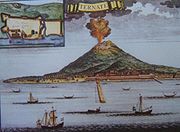 In November, after having secured Malacca and learning the location of the then secret "spice islands
", Albuquerque sent an expedition of three ships sailing east to find them, led by trusted António de Abreu
with the deputy commander Francisco Serrão
. Malay pilots were recruited to guide them through Java
, the Lesser Sunda Islands
and the Ambon Island
to Banda Islands
, where they arrived in early 1512. There they remained for about a month, buying and filling their ships with nutmeg
and cloves. António de Abreu then sailed to Amboina whilst Serrão stepped forward to the Moluccas but was shipwrecked near Seram. Sultan Abu Lais of Ternate
heard of their stranding, and, seeing a chance to ally himself with a powerful foreign nation, brought them to Ternate in 1512 were they were permitted to build a fort on the island, , built in 1522.
— sailing in a mission under Albuquerque — was allowed to land at Lintin Island in the Pearl River Delta
of southern China
, and soon after Albuquerque sent Rafael Perestrello
to southern China to seek out trade relations with the Ming Dynasty
of China. In ships from Portuguese Malacca
, Rafael sailed to Canton (Guangzhou
) in 1513 and again from 1515–1516 to trade with Chinese merchants there. These ventures, along with those of Tomé Pires
and Fernão Pires de Andrade
, were the first direct European diplomatic and commercial ties with China.
that had served to support the conquest of Malacca. Despite already being deemed unsafe, Afonso de Albuquerque used her to transport the treasure amassed in the conquest, given her large capacity: he wanted to give the court of King Manuel I a show of Malaccan treasures. There were also the offers from the Kingdom of Siam
(Thailand) to the king of Portugal and all his own fortune. On the voyage a storm arose and the Flor De La Mar was wrecked, and he himself barely escaped with his life.
Albuquerque returned from Malacca to Kochi, but could not sail to Goa as it faced a serious revolt headed by the forces of Ismael Adil Shah, the Sultan of Bijapur, commanded by Rasul Khan
with the help of some of his countrymen. While he was absent in Malacca, Portuguese who opposed the taking of Goa had waived the possession, even written to the king stating that it would be best to let it go. Held up by the monsoon and with few forces available, he had to wait for the arrival of reinforcement fleets headed by his nephew D. Garcia de Noronha and Jorge de Mello Pereira.
On 10 September 1512, Albuquerque set sail from Cochin to Goa with fourteen ships carrying 1,700 soldiers. Determined to recapture the fortress, he ordered trenches to be dug and a wall to be breached. But on the very morning of the planned final assault, Rasul Khan surrendered. Albuquerque demanded the fort be handed with all its artillery, ammunition and horses, and the deserters to be given up. Some had joined Rasul Khan when the Portuguese were forced to flee Goa in May 1510, others during the recent siege. Rasul Khan consented, on condition that their lives be spared. Albuquerque agreed and he left Goa. Albuquerque kept his word, but mutilated them horribly. One of such renegades was Fernão Lopez
, bound for Portugal in custody, who escaped at the island of Saint Helena leading a 'Robinson Crusoe' life for many years. After such measures the town became the most prosperous Portuguese settlement in India.
arrived at Goa. Mateus
was sent by regent queen Eleni
following the arrival of the Portuguese from Socotra in 1507, as an ambassador for the king of Portugal in search of a coalition to help face growing Ottoman influence. He was received in Goa with great honour by Albuquerque, as a long sought "Prester John
" envoy. His arrival was announced by king Manuel I of Portugal
to Pope Leo X
in 1513. Although Mateus faced the distrust of some of Albuquerque rivals, who tried to prove he was some impostor or Muslim spy, Albuquerque sent him to Portugal. The king is described as having wept with joy at their report.
In February 1513, while Mateus was in Portugal, Albuquerque sailed to the Red Sea
with a force of about 1000 Portuguese and 400 Malabaris. He was, from the start, under orders from the kingdom to secure that channel to Portugal. Barren Socotra had proved ineffective to control the Red Sea entrance and was abandoned, and Albuquerque's hint that Massawa
could be a good Portuguese base might have been influenced by Mateus' reports.
Knowing that mameluks were preparing a second fleet at Suez
, he wanted to advance before reinforcements arrived to Aden
. He accordingly laid siege to the city. Aden was a fortified city, but although having scaling ladders they broke and after half day of fierce battle Albuquerque was forced to retreat. They cruised the Red Sea inside the Bab al-Mandab, as the first European fleet to have sailed this route. Albuquerque attempted to reach Jeddah
, but the winds were unfavourable and so sheltered at Kamaran
island in May, until sickness among the men and lack of fresh water forced to retreat. In August 1513, after a second attempt to reach Aden, they returned to India with no substantial results. In order to destroy the power of Egypt
, Albuquerque is said to have entertained the idea of diverting the course of the Nile River and so rendering the whole country barren. Perhaps most tellingly, he intended to steal the body of the Prophet Muhammad
, and hold it for ransom until all Muslims had left the Holy Land
.
 In 1514 Afonso de Albuquerque devoted himself to governing Goa, concluding peace with Calicut and receiving embassies from Indian governors, strengthening the city and stimulating the marriage of Portuguese with local women. At that time, Portuguese women were barred from travelling overseas due to superstition about women on ships, as well as the unsafe nature of the sea route. In 1511, the Portuguese government encouraged their explorers to marry local women, under a policy set by Albuquerque. To promote settlement, the King of Portugal granted freeman status and exemption from Crown taxes to Portuguese men (known as casados, or "married men") who ventured overseas and married local women. With Albuquerque's encouragement, mixed marriages flourished. He appointed local people for positions in the Portuguese administration and didn't interfere with local traditions, except "sati
", the practice of immolating widows, which he forbade.
In March 1514 King Manuel I of Portugal
had sent to Pope Leo X
a huge and exotic embassy led by Tristão da Cunha
, who toured the streets of Rome in a extravagant procession of animals from the colonies and wealth from the Indies that struck Europe. His reputation reached its peak, laying foundations of the Portuguese Empire in the East.
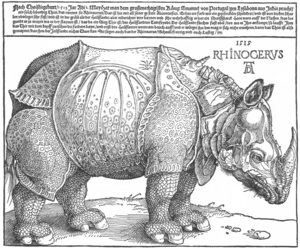
In early 1514, Afonso de Albuquerque had sent ambassadors to Sultan Muzafar II, ruler of Cambay, to seek permission to build a fort on Diu. The mission returned without an agreement, but diplomatic gifts were exchanged, including an Indian rhinoceros
. Albuquerque sent the gift, named ganda, and its Indian keeper, Ocem, to King Manuel I. In late 1515, the king sent it as a gift , the famous Dürer's Rhinoceros
to Pope Leo X. Dürer never saw the actual rhinoceros, which was the first living example seen in Europe since Roman times
.
, who had sent ambassadors to Gujarat, Ormuz and Bijapur. The shah
's ambassador to Bijapur visited Albuquerque inviting him to send back an envoy to Persia. Miguel Ferreira was sent via Ormuz to Tabriz
, were he had several interviews with the Shah about common goals on defeating the Mameluke sultan.
Having returned with rich presents and an ambassador, on the journey back in March 1515 they were met by Albuquerque at Ormuz, where he went to establish his rule. Fueled by the offers of the shah, Albuquerque had decided to recapture Ormuz. He had learned that after the Portuguese retreat in 1507, a young king was reigning under the influence of a powerful Persian vizier
, Reis Hamed, whom the king greatly feared. At Hormuz, Albuquerque had a parley with the king and asked the vizier to be present. He then had him immediately stabbed and killed by his entourage, thus "freeing" the dominated king so the island in the Persian Gulf yielded to him without resistance, and remained a Portuguese vassal state until 1622. There Albuquerque stood, engaging in diplomatic efforts and receiving envoys while becoming increasingly ill. In November 1515 he decided to return, but he didn't survived the journey, dying off Goa.
On his return from Ormuz, at the entrance of the harbour of Goa, he got news about a fleet arriving from Europe bearing dispatches announcing that he was superseded by his personal enemy Lopo Soares de Albergaria
. The blow was too much for him and he died at sea on December 16, 1515. Before his death Albuquerque dictated a letter to King Manuel I in dignified and affecting terms, vindicating his conduct and claiming for his natural son the honours and rewards that were justly due to himself.
Albergaria had departed from Lisbon in 7 April 1515, along with Mateus and a returning embassy to Ethiopia. Yet in August, through contacts in Venice, King Manuel I learnt that the Mamluk Sultan of Cairo had prepared a fleet at Suez with men and artillery to fight the Portuguese in India and, especially, in Hormuz. Fearing the effects and repenting his replacement of Albuquerque, he hurriedly wrote to Albergaria to return the command of all operations to Albuquerque, and to provide him with resources so that he could fight the rival forces. However when the letter arrived, Albuquerque had already died. His body was buried in Goa according to his will, in the Church of Nossa Senhora da Serra (Our Lady of the Hill), built in 1513 thanking for his escape from Kamaran
island. After 51 years, in 1566, he was moved to Nossa Senhora da Graça church in Lisbon, which was ruined and rebuilt after the 1755 earthquake
.
Afonso de Albuquerque was a prolific writer, having written numerous letters to the king reporting all kind of matters during his governorship, from minor issues to major strategies. In 1557 his son published a collection his letters under the title Commentarios do Grande Affonso d'Alboquerque.- a clear reference to Caesar's Commentaries
- which he later reviewed and re-published in 1576. There Albuquerque was described as "a man of middle stature, with a long face, fresh colored, the nose somewhat large. He was a prudent man, and a Latin scholar, and spoke in elegant phrases; his conversation and writings showed his excellent education. He was of ready words, very authoritative in his commands, very circumspect in his dealings with the Moors, and greatly feared yet greatly loved by all, a quality rarely found united in one captain. He was very valiant and favored by fortune."
In 1572 Albuquerque's feats were inscribed in The Lusiads, the Portuguese main epic poem
by Luís Vaz de Camões
(Canto X, strophe 40 to 49), where the poet praises his achievements but has the muses frown upon the harsh rule towards his own men, of whom Camões was almost a contemporary fellow. In 1934 Albuquerque was celebrated by Fernando Pessoa
in Mensagem, a symbolist epic. In the first part of this work, called "Brasão" (Coat-of-Arms), he relates Portuguese historical protagonists to each of the fields in the Portuguese coat-of-arms, Albuquerque being one of the wings of the griffin
headed by Henry the navigator, the other wing being King John II.
An exquisite and expensive variety of mango, that he used to bring on his journeys to India, has been named in his honour, and is today sold throughout the world as Alphonso mangoes
.
Despite his fame, the city of Albuquerque
in New Mexico is not named after him. It was named after a Spanish Viceroy of Mexico named Don Francisco Fernández de la Cueva, who also held the title Duke of Alburquerque
. There is, however, a town near the Spanish-Portuguese border named Alburquerque
which may be the root of both names.
Additionally, it is highly likely that one of the major thoroughfares in Malacca's Portuguese Settlement, Jalan D'Albuquerque, is named after Afonso de Albuquerque.
Portugal
Portugal , officially the Portuguese Republic is a country situated in southwestern Europe on the Iberian Peninsula. Portugal is the westernmost country of Europe, and is bordered by the Atlantic Ocean to the West and South and by Spain to the North and East. The Atlantic archipelagos of the...
fidalgo
Fidalgo
Fidalgo , from Galician and Portuguese filho de algo—sometimes translated into English as "son of somebody" or "son of some "—is a traditional title used in Portugal to refer to a member of the titled or untitled nobility...
, or nobleman, an admiral whose military and administrative activities as second governor of Portuguese India conquered and established the Portuguese colonial empire
Portuguese Empire
The Portuguese Empire , also known as the Portuguese Overseas Empire or the Portuguese Colonial Empire , was the first global empire in history...
in the Indian Ocean. He is generally considered a world conquest military genius, given his successful strategy: he attempted to close all the Indian ocean
Indian Ocean
The Indian Ocean is the third largest of the world's oceanic divisions, covering approximately 20% of the water on the Earth's surface. It is bounded on the north by the Indian Subcontinent and Arabian Peninsula ; on the west by eastern Africa; on the east by Indochina, the Sunda Islands, and...
naval passages to the Atlantic, Red Sea
Red Sea
The Red Sea is a seawater inlet of the Indian Ocean, lying between Africa and Asia. The connection to the ocean is in the south through the Bab el Mandeb strait and the Gulf of Aden. In the north, there is the Sinai Peninsula, the Gulf of Aqaba, and the Gulf of Suez...
, Persian Gulf
Persian Gulf
The Persian Gulf, in Southwest Asia, is an extension of the Indian Ocean located between Iran and the Arabian Peninsula.The Persian Gulf was the focus of the 1980–1988 Iran-Iraq War, in which each side attacked the other's oil tankers...
, and to the Pacific, transforming it into a Portuguese mare clausum
Mare clausum
Mare clausum is a term used in international law to mention a sea, ocean or other navigable body of water under the jurisdiction of a state that is closed or not accessible to other states. Mare clausum is an exception to mare liberum , meaning a sea that is open to navigation to ships of all...
established over the Turkish power and their Muslim and Hindu allies.
He was responsible for building numerous fortresses to defend key strategic positions and establishing a net of diplomatic relations. Shortly before his death he was appointed viceroy
Viceroy
A viceroy is a royal official who runs a country, colony, or province in the name of and as representative of the monarch. The term derives from the Latin prefix vice-, meaning "in the place of" and the French word roi, meaning king. A viceroy's province or larger territory is called a viceroyalty...
and "Duke of Goa" by king Manuel I of Portugal
Manuel I of Portugal
Manuel I , the Fortunate , 14th king of Portugal and the Algarves was the son of Infante Ferdinand, Duke of Viseu, , by his wife, Infanta Beatrice of Portugal...
, becoming the first Portuguese duke not from the royal family, and the first Portuguese title landed overseas. For some time he was known as The Terrible, The Great, The Caesar of the East, Lion of the Seas and as The Portuguese Mars.
Early life
Afonso de Albuquerque was born in 1453 in AlhandraVila Franca de Xira
Vila Franca de Xira is a municipality in Portugal with a total area of 317.7 km² and a total population of 133,224 inhabitants. Situated on the west bank of the Tagus River, just 32 km north-east of the Portuguese capital Lisbon, Vila Franca de Xira is said to have been founded by French...
, near Lisbon
Lisbon
Lisbon is the capital city and largest city of Portugal with a population of 545,245 within its administrative limits on a land area of . The urban area of Lisbon extends beyond the administrative city limits with a population of 3 million on an area of , making it the 9th most populous urban...
. He was the second son of Gonçalo de Albuquerque, Lord of Vila Verde dos Francos and Dona Leonor de Menezes. His father held an important position at court and was connected by remote illegitimate descent with the Portuguese monarchy. He was educated in mathematics and Latin at the court of Afonso V of Portugal
Afonso V of Portugal
Afonso V KG , called the African , was the twelfth King of Portugal and the Algarves. His sobriquet refers to his conquests in Northern Africa.-Early life:...
, where he befriended Prince John, future king John II of Portugal
John II of Portugal
John II , the Perfect Prince , was the thirteenth king of Portugal and the Algarves...
.
He served ten years in North Africa
North Africa
North Africa or Northern Africa is the northernmost region of the African continent, linked by the Sahara to Sub-Saharan Africa. Geopolitically, the United Nations definition of Northern Africa includes eight countries or territories; Algeria, Egypt, Libya, Morocco, South Sudan, Sudan, Tunisia, and...
, where he acquired military experience. In 1471, under the command of Afonso V, he was present at the conquest of Tangier
Tangier
Tangier, also Tangiers is a city in northern Morocco with a population of about 700,000 . It lies on the North African coast at the western entrance to the Strait of Gibraltar where the Mediterranean meets the Atlantic Ocean off Cape Spartel...
and Arzila in Morocco
Morocco
Morocco , officially the Kingdom of Morocco , is a country located in North Africa. It has a population of more than 32 million and an area of 710,850 km², and also primarily administers the disputed region of the Western Sahara...
, serving there as an officer for some years. In 1476 he accompanied Prince John in wars against Castile, such as the Battle of Toro
Battle of Toro
The Battle of Toro was a Royal battle from the War of the Castilian Succession, fought on 1 March 1476, near the city of Toro, between the Castilian troops of the Catholic Monarchs and the Portuguese-Castilian forces of Afonso V and Prince John....
. He was in the squadron sent to the Italian Peninsula in 1480 to rescue Ferdinand II of Aragon
Ferdinand II of Aragon
Ferdinand the Catholic was King of Aragon , Sicily , Naples , Valencia, Sardinia, and Navarre, Count of Barcelona, jure uxoris King of Castile and then regent of that country also from 1508 to his death, in the name of...
from the Ottoman invasion of Otranto
Ottoman invasion of Otranto
In 1480 and 1481 the city and fort of Otranto, in Apulia, southern Italy, were held by Ottoman troops.-Attack:On July 28, 1480, an Ottoman fleet of 128 ships of which 28 were galleys arrived near the Neapolitan city of Otranto in the region Apulia. Possibly these troops came from the siege of Rhodes...
that ended in a Christian victory. On his return in 1481, when Prince John was crowned, Albuquerque was appointed chief equerry
Equerry
An equerry , and related to the French word "écuyer" ) is an officer of honour. Historically, it was a senior attendant with responsibilities for the horses of a person of rank. In contemporary use, it is a personal attendant, usually upon a Sovereign, a member of a Royal Family, or a national...
(estribeiro-mor) to the king. In 1489 he returned to service in North Africa, as commander of defence in the fortress of Graciosa, an island in the river Luco near the city of Larache
Larache
Larache is an important harbour town in the region Tanger-Tétouan in northern Morocco. It was founded in the 7th century when a group of Muslim soldiers from Arabia extended their camp at Lixus onto the south bank of the Loukkos River.In 1471, the Portuguese settlers from Asilah and Tangier drove...
, and in 1490 was part of the guard of King John II, returning to Arzila in 1495 where his younger brother Martim died fighting by his side.
First Expedition to India, 1503
When king Manuel I of PortugalManuel I of Portugal
Manuel I , the Fortunate , 14th king of Portugal and the Algarves was the son of Infante Ferdinand, Duke of Viseu, , by his wife, Infanta Beatrice of Portugal...
was enthroned he showed some reticence towards Albuquerque, a close friend of his dreaded predecessor John II, and seventeen years his senior. Eight years later, on April 6 of 1503, after a long military career and at a mature age, Afonso de Albuquerque was sent on his first expedition to India
India
India , officially the Republic of India , is a country in South Asia. It is the seventh-largest country by geographical area, the second-most populous country with over 1.2 billion people, and the most populous democracy in the world...
with his cousin Francisco de Albuquerque. Each commanded three ships, sailing along with Duarte Pacheco Pereira
Duarte Pacheco Pereira
Duarte Pacheco Pereira, called the Great, was a 15th century Portuguese sea captain, soldier, explorer and cartographer. He travelled particularly in the central Atlantic Ocean west of the Cape Verde islands, along the coast of West Africa and to India...
and Nicolau Coelho
Nicolau Coelho
Nicolau Coelho was an expert Portuguese sailor during the age of discovery. He participated in the discovery of the route to India by Vasco da Gama where he commanded Berrio, the first caravel to return; was captain of a ship in the fleet headed by Pedro Álvares Cabral who landed in Brazil...
. They participated in several battles against the forces of the Zamorin of Calicut (Calecute,Kozhikode) and succeeded in establishing the king
Kingdom of Cochin
Kingdom of Cochin was a late medieval Hindu kingdom and later Princely State on the Malabar Coast, South India...
of Cohin (Cohim, Kochi) securely on his throne. In return, the King gave them permission to build a Portuguese fort at Cochin
Fort Kochi
Fort Kochi is a region in the city of Kochi in the state of Kerala, India. This is part of a handful of water-bound regions toward the south-west of the mainland Kochi, and collectively known as Old Kochi or West Kochi. Adjacent to this is Mattancherry...
and establish trade relations with Quilon
Quilon
Quilon may refer to,* Venad, a former state on Malabar Coast, India* Kollam , Kerala state, India* Kollam district, Kerala state...
(Coulão, Kollam). This laid the foundation of Portugal's empire in the East.
Second Expedition to India, 1506
Albuquerque returned home in July 1504, and was well received by King Manuel I of PortugalManuel I of Portugal
Manuel I , the Fortunate , 14th king of Portugal and the Algarves was the son of Infante Ferdinand, Duke of Viseu, , by his wife, Infanta Beatrice of Portugal...
. After Albuquerque assisted with the creation of a strategy for the Portuguese efforts in the east, King Manuel entrusted him with the command of a squadron of five vessels in the fleet of sixteen sailing for India
India
India , officially the Republic of India , is a country in South Asia. It is the seventh-largest country by geographical area, the second-most populous country with over 1.2 billion people, and the most populous democracy in the world...
in early 1506 headed by Tristão da Cunha
Tristão da Cunha
Tristão da Cunha was a Portuguese explorer and naval commander. In 1514 he served as ambassador from king Manuel I of Portugal to Pope Leo X leading a luxurious embassy presenting in Rome the new conquests of Portugal...
. Their aim was to conquer Socotra
Socotra
Socotra , also spelt Soqotra, is a small archipelago of four islands in the Indian Ocean. The largest island, also called Socotra, is about 95% of the landmass of the archipelago. It lies some east of the Horn of Africa and south of the Arabian Peninsula. The island is very isolated and through...
and build a fortress there, hoping to close the trade in the Red Sea. Albuquerque went as chief-captain for the "Coast of Arabia
Arabian Peninsula
The Arabian Peninsula is a land mass situated north-east of Africa. Also known as Arabia or the Arabian subcontinent, it is the world's largest peninsula and covers 3,237,500 km2...
" sailing under command of da Cunha until reaching Mozambique. He carried a sealed letter with a secret mission ordered by the king: after fulfilling the first mission he should replace the first Viceroy of India, Francisco de Almeida
Francisco de Almeida
Dom Francisco de Almeida , also known as "the Great Dom Francisco" , was a Portuguese nobleman, soldier and explorer. He distinguished himself as a counsellor to King John II of Portugal and later in the wars against the Moors and in the conquest of Granada in 1492...
, whose term ended two years later. Before departing he legitimated a natural son born in 1500 and made his will.
Socotra and Hormuz first conquest, 1507
The fleet left Lisbon on April 6, 1506. Albuquerque piloted his ship himself, having lost his appointed pilot on departure. In Mozambique ChannelJuan de Nova Island
Juan de Nova Island is a low, flat, tropical island in the narrowest part of the Mozambique Channel, about one-third of the way between Madagascar and Mozambique at...
they rescued captain João da Nova
João da Nova
João da Nova , Xoán de Novoa or Joam de Nôvoa galician spellings, Juan de Nova, Spanish spelling, was a Galician explorer of the Atlantic and Indian Oceans at the service of Portugal...
who joined his ship Frol de la mar
Frol de la mar
Flor de la Mar or Flor do Mar was a Portuguese nau of 400 tons, which over nine years participated in decisive events in the Indian Ocean until her sinking in November 1511...
to the fleet, having been stranded on his return from India. From Malindi
Malindi
Malindi is a town on Malindi Bay at the mouth of the Galana River, lying on the Indian Ocean coast of Kenya. It is 120 kilometres northeast of Mombasa. The population of Malindi is 117,735 . It is the capital of the Malindi District.Tourism is the major industry in Malindi. The city is...
, da Cunha sent envoys to Ethiopia
Ethiopia
Ethiopia , officially known as the Federal Democratic Republic of Ethiopia, is a country located in the Horn of Africa. It is the second-most populous nation in Africa, with over 82 million inhabitants, and the tenth-largest by area, occupying 1,100,000 km2...
, which at the time was thought to be closer than it actually is. Those included priest João Gomes, João Sanches and Tunisian Sid Mohammed who, having failed to cross the region, headed for Socotra from where Albuquerque managed to land them in Filuk
Cape Guardafui
Cape Guardafui , also known as Ras Asir and historically as Aromata promontorium, is a headland in the northeastern Bari province of Somalia. Located in the autonomous Puntland region, it forms the geographical apex of the region commonly referred to as the Horn of Africa.-Location:Cape Guardafui...
. After a series of successful attacks on Arab cities on east Africa coasts, they conquered Socotra
Socotra
Socotra , also spelt Soqotra, is a small archipelago of four islands in the Indian Ocean. The largest island, also called Socotra, is about 95% of the landmass of the archipelago. It lies some east of the Horn of Africa and south of the Arabian Peninsula. The island is very isolated and through...
, and built a fortress at Suq, hoping it would be a base to stop the Red Sea
Red Sea
The Red Sea is a seawater inlet of the Indian Ocean, lying between Africa and Asia. The connection to the ocean is in the south through the Bab el Mandeb strait and the Gulf of Aden. In the north, there is the Sinai Peninsula, the Gulf of Aqaba, and the Gulf of Suez...
commerce to the Indian Ocean.
Siege of Cannanore (1507)
The Siege of Cannanore was a four-month siege, from April to August 1507, when troops of the local ruler , supported by the Zamorin of Calicut and Arabs, besieged the Portuguese garrison at St. Angelo Fort in Cannanore, in what is now the Indian state of Kerala...
, and Albuquerque sailed with a fleet of seven ships and five hundred men in an unrequested advance towards Ormuz in the Persian Gulf
Persian Gulf
The Persian Gulf, in Southwest Asia, is an extension of the Indian Ocean located between Iran and the Arabian Peninsula.The Persian Gulf was the focus of the 1980–1988 Iran-Iraq War, in which each side attacked the other's oil tankers...
, one of the eastern chief centers of commerce. On this route he conquered the cities of Curiati (Kuryat), Muscat
Muscat, Oman
Muscat is the capital of Oman. It is also the seat of government and largest city in the Governorate of Muscat. As of 2008, the population of the Muscat metropolitan area was 1,090,797. The metropolitan area spans approximately and includes six provinces called wilayats...
in July 1507 and Khor Fakkan
Khor Fakkan
Khor Fakkan is a town located along the Gulf of Oman on the east coast of the United Arab Emirates . The town is set on the picturesque bay of Khor Fakkan, which means "Creek of Two Jaws". Khor Fakkan belongs to the emirate of Sharjah but is geographically surrounded by the emirate of Fujairah...
, accepting the submission of the cities of Kalhat and Sohar
Sohar
Sohar is the most developed city in Sultanate of Oman outside the capital Muscat. It is about 200 kilometers north of Muscat. Sohar was an ancient capital of Oman and many believe it to be the birthplace of Sinbad the Sailor...
. On September 25 they arrived with a fearsome reputation at Ormuz and soon captured the city
Capture of Ormuz (1507)
The Capture of Ormuz in 1507 occurred when the Portuguese Afonso de Albuquerque attacked Hormuz Island to establish the Castle of Ormuz. This conquest gave the Portuguese full control of the trade between India and Europe passing through the Persian Gulf....
, which agreed to become a tributary state for the Portuguese king. A few days later, the king of Ormuz was met by an envoy demanding the payment of tribute to shah Ismail I
Ismail I
Ismail I , known in Persian as Shāh Ismāʿil , was a Shah of Iran and the founder of the Safavid dynasty which survived until 1736. Isma'il started his campaign in Azerbaijan in 1500 as the leader of the Safaviyya, an extremist heterodox Twelver Shi'i militant religious order and unified all of Iran...
from Persia. He was sent back with the answer that the only tribute would be in cannon-balls and guns, thus beginning the connection between Albuquerque and Shah Ismail I (often named Xeque Ismael). Immediately Albuquerque began building the Fort of Our Lady of Victory (later renamed Fort of Our Lady of the Conception). engaging his men of all ranks in the works.
However, some of his officers revolted against the heavy works and climate, and claiming that Albuquerque was exceeding his orders departed for India. With the fleet reduced to only two ships and left without supplies he was unable to maintain this position for long. Forced to abandon Ormuz in January 1508, he raided coastal villages to resupply the settlement of Socotra, returned to Ormuz and only then headed to India.
Arrested at Cannanore, 1509
Albuquerque arrived at CannanoreKannur
Kannur , also known as Cannanore, is a city in Kannur district in the Indian state of Kerala. It is the administrative headquarters of the District of Kannur and 518km north of state capital Trivandrum. During British rule in India, Kannur was known by its old name Cannanore, which is still in...
on the Malabar coast in December 1508, where he immediately opened before the viceroy Dom Francisco de Almeida
Francisco de Almeida
Dom Francisco de Almeida , also known as "the Great Dom Francisco" , was a Portuguese nobleman, soldier and explorer. He distinguished himself as a counsellor to King John II of Portugal and later in the wars against the Moors and in the conquest of Granada in 1492...
the sealed letter he had received from the king, appointing him governor. The viceroy, then joined by the officers who had defeated Albuquerque in Ormuz, had a matching royal order, but declined to yield, protesting that his term ended only in January and stating his intention to avenge his son's death by fighting the mameluk
Mamluk Sultanate (Cairo)
The Mamluk Sultanate of Egypt was the final independent Egyptian state prior to the establishment of the Muhammad Ali Dynasty in 1805. It lasted from the overthrow of the Ayyubid Dynasty until the Ottoman conquest of Egypt in 1517. The sultanate's ruling caste was composed of Mamluks, Arabised...
fleet of Mirocem, refusing Albuquerque's offer to fight him himself. Afonso de Albuquerque obeyed without confronting D. Francisco de Almeida - which could have led to civil war - and moved to Kochi, pending instructions from Portugal, supporting and housing his entourage himself. He was described by Fernão Lopes de Castanheda
Fernão Lopes de Castanheda
Fernão Lopes de Castanheda was a Portuguese historian in the early Renaissance.His "History of the discovery and conquest of India", full of geographic and ethnographic objective information, was widely translated throughout Europe.- Life :Castanheda was the natural son of a royal officer, who...
as patiently enduring an open opposition from the group that had gathered around D. Francisco de Almeida, with whom he kept formal contacts. Increasingly isolated, he wrote to Diogo Lopes de Sequeira
Diogo Lopes de Sequeira
Diogo Lopes de Sequeira was a Portuguese fidalgo, sent to analyze the trade potential in Madagascar and Malacca, he arrived at Malacca on 11 September, 1509. He left the next year when he discovered that Sultan Mahmud Shah, the local leader, was devising his assassination...
, who was arriving with a new fleet to India, but was ignored as Sequeira joined the Viceroy. At the same time Albuquerque refused approaches from opponents of the viceroy, who challenged him to take power.
On February 3, 1509 Almeida fought the naval Battle of Diu
Battle of Diu
The Battle of Diu sometimes referred as the Second Battle of Chaul was a naval battle fought on 3 February 1509 in the Arabian Sea, near the port of Diu, India, between the Portuguese Empire and a joint fleet of the Sultan of Gujarat, the Mamlûk Burji Sultanate of Egypt, the Zamorin of Kozhikode...
against a joint fleet of Mamluks
Burji dynasty
The Burji dynasty المماليك البرجية ruled Egypt from 1382 until 1517. It proved especially turbulent, with short-lived sultans. Political power-plays often became important in designating a new sultan. During this time Mamluks fought Timur Lenk and conquered Cyprus. Constant bickering may have...
, Ottomans, the zamorin of Calicut
Kozhikode
Kozhikode During Classical antiquity and the Middle Ages, Kozhikkode was dubbed the "City of Spices" for its role as the major trading point of eastern spices. Kozhikode was once the capital of an independent kingdom of the same name and later of the erstwhile Malabar District...
and the sultan of Gujarat
Mahmud Begada
Sultan Abu'l Fath Nasir-ud-Din Mahmud Shah I, popularly known as Mahmud Begada was the most prominent sultan of Gujarat. He was the great-grandson of Ahmad Shah I, the founder of the Muzaffarid dynasty, and of the city of Ahmedabad in the present-day state of Gujarat, India. He was known to be...
, taking it as personal revenge for the death of his son Lourenço de Almeida
Lourenço de Almeida
Lourenço de Almeida , son of Francisco de Almeida, acting under him, distinguished himself in the Indian Ocean, and made Ceylon tributary to Portugal...
at the Battle of Chaul. His victory was decisive: Ottomans and Mamluks left the waters of the Indian Ocean, easing the Portuguese rule for over 100 years. In August, after a petition from Albuquerque's former officers with the support of Diogo Lopes de Sequeira considering him unfit for governance, he was sent in custody in an old ship to St. Angelo Fort
St. Angelo Fort
St. Angelo Fort , is a fort facing the Arabian Sea, situated 3 km from the town of Kannur, a city in Kerala state, south India.-History:...
in Cannanore
Kannur
Kannur , also known as Cannanore, is a city in Kannur district in the Indian state of Kerala. It is the administrative headquarters of the District of Kannur and 518km north of state capital Trivandrum. During British rule in India, Kannur was known by its old name Cannanore, which is still in...
. There he remained under what he considered to be imprisonment. In September 1509 Sequeira advanced the mission of establishing contact with the Sultan of Malacca
Malacca
Malacca , dubbed The Historic State or Negeri Bersejarah among locals) is the third smallest Malaysian state, after Perlis and Penang. It is located in the southern region of the Malay Peninsula, on the Straits of Malacca. It borders Negeri Sembilan to the north and the state of Johor to the south...
but failed, leaving behind 19 Portuguese prisoners.
Governor of Portuguese India, 1509-1515
Albuquerque was released after three months' confinement, on the arrival at Cannanore of the grand-marshal of Portugal with a large fleet. He was the most important Portuguese noble ever to visit India and he brought an armada of fifteen ships and 3,000 men sent by the king to defend the rights of Albuquerque and take Calicut.In 4 November 1509 Albuquerque became the second Governor of the State of India, a position he would hold until his death. Almeida having returned home in 1510, he speedily showed the energy and determination of his character.
Albuquerque intended to dominate the Muslim world and control the Spice trade
Spice trade
Civilizations of Asia were involved in spice trade from the ancient times, and the Greco-Roman world soon followed by trading along the Incense route and the Roman-India routes...
.
Initially king Manuel I and his council in Lisbon tried to distribute the power, outlining three areas of jurisdiction in the Indian Ocean: in 1509 the nobleman Diogo Lopes de Sequeira
Diogo Lopes de Sequeira
Diogo Lopes de Sequeira was a Portuguese fidalgo, sent to analyze the trade potential in Madagascar and Malacca, he arrived at Malacca on 11 September, 1509. He left the next year when he discovered that Sultan Mahmud Shah, the local leader, was devising his assassination...
was fitted with a fleet and sent to Southeast Asia, with the task of seeking an agreement with Sultan Mahmud Shah of Malacca
Malacca
Malacca , dubbed The Historic State or Negeri Bersejarah among locals) is the third smallest Malaysian state, after Perlis and Penang. It is located in the southern region of the Malay Peninsula, on the Straits of Malacca. It borders Negeri Sembilan to the north and the state of Johor to the south...
, but failed and returned to the kingdom. To Jorge de Aguiar was given the area between the Cape of Good Hope and Gujarat, he was succeeded by Duarte de Lemos but left to Cochin and then for the kingdom, leaving his fleet to Albuquerque.
Conquest of Goa, 1510
In January 1510, fulfilling the orders from the kingdom, and knowing of the absence of Zamorin, Albuquerque advanced on Calicut (now KozhikodeKozhikode
Kozhikode During Classical antiquity and the Middle Ages, Kozhikkode was dubbed the "City of Spices" for its role as the major trading point of eastern spices. Kozhikode was once the capital of an independent kingdom of the same name and later of the erstwhile Malabar District...
). The attack was unsuccessful as Marshal D. Fernando Coutinho, against instructions, ventured into the inner city fascinated by its richness, and suffered an ambush. During the rescue, Albuquerque received a severe wound and had to retreat.
Soon after the failed attack on Calicut, Albuquerque hastened to form a powerful fleet of twenty-three ships and 1200 men. Contemporary reports state that he wanted to fight the Egyptian Mameluke Sultanate
Mamluk Sultanate (Cairo)
The Mamluk Sultanate of Egypt was the final independent Egyptian state prior to the establishment of the Muhammad Ali Dynasty in 1805. It lasted from the overthrow of the Ayyubid Dynasty until the Ottoman conquest of Egypt in 1517. The sultanate's ruling caste was composed of Mamluks, Arabised...
fleet in the Red Sea or return to Hormuz. However, he had been informed by Timoji
Timoji
Timoji was a Hindu privateer who served the Vijayanagara Empire and the Portuguese Empire during the first decade of the 16th century. He claimed to have been born in Goa and to have escaped the city after its conquest by the Adil Shahi of Bijapur in 1496...
(a privateer in the service of the Hindu Vijayanagara Empire
Vijayanagara Empire
The Vijayanagara Empire , referred as the Kingdom of Bisnaga by the Portuguese, was an empire based in South Indian in the Deccan Plateau region. It was established in 1336 by Harihara I and his brother Bukka Raya I of the Yadava lineage. The empire rose to prominence as a culmination of attempts...
) that it would be easier to fight them in Goa
Goa
Goa , a former Portuguese colony, is India's smallest state by area and the fourth smallest by population. Located in South West India in the region known as the Konkan, it is bounded by the state of Maharashtra to the north, and by Karnataka to the east and south, while the Arabian Sea forms its...
, where they had sheltered after the Battle of Diu, and also of the illness of the Sultan Yusuf Adil Shah
Yusuf Adil Shah
Yusuf Adil Shah , referred as Adil Khan or Hidalcão by the Portuguese, was the founder of the Adil Shahi dynasty that ruled the Sultanate of Bijapur for nearly two centuries...
and war between the Deccan sultanates
Deccan sultanates
The Deccan sultanates were five Muslim-ruled late medieval kingdoms—Bijapur, Golkonda, Ahmadnagar, Bidar, and Berar—of south-central India. The Deccan sultanates were located on the Deccan Plateau, between the Krishna River and the Vindhya Range. These kingdoms became independent during the breakup...
. So he invested by surprise in the capture of Goa to the Sultanate of Bijapur. He thus completed another mission, for Portugal wanted not to be seen as an eternal "guest" of Kochi and had been coveting Goa as the best trading port in the region.
A first assault took place in Goa
Goa
Goa , a former Portuguese colony, is India's smallest state by area and the fourth smallest by population. Located in South West India in the region known as the Konkan, it is bounded by the state of Maharashtra to the north, and by Karnataka to the east and south, while the Arabian Sea forms its...
from March 4 to May 20, 1510. After initial occupation, feeling unable to hold the city given the poor condition of its fortifications, the cooling of Hindu population support and insubordination among his ranks following a severe attack by Ismail Adil Shah
Ismail Adil Shah
Isamail Adil Shah was the king of Bijapur who spent most of his time extending his territory. His short lived reign helped the dynasty establish a strong hold in the deccan.-Early years:...
, Albuquerque refused a truce by the sultan and abandoned the city in August. His fleet was scattered and a palace revolt in Kochi hindered his recovery, so he headed to Fort Anjediva
Fort Anjediva
Fort Anjediva, built on the Anjadip Island, off the coast of the Indian state of Karnataka but under the administrative jurisdiction of the Indian state of Goa, was once under Portuguese rule. It has also in its vicinity an ancient church on the island called the Church of Our Lady of Springs built...
. New ships that now arrived from the kingdom were intended for the nobleman Diogo Mendes de Vasconcelos at Malacca, who had been given a rival command of the region.
Only three months later, on November 25, Albuquerque reappeared in Goa with a renovated fleet, Diogo Mendes de Vasconcelos compelled to accompany him with the reinforcements for Malacca and about 300 Malabari reinforcements from Cannanore. In less than a day they took possession of Goa from Ismail Adil Shah and his Ottoman allies, who surrendered on 10 December. It is estimated that 6000 of the 9000 Muslim defenders of the city died, either on the fierce battle in the streets or drowned while trying to escape. Albuquerque regained the support of the Hindu population, although frustrating the initial expectations of Timoja, who aspired to become governor. Albuquerque rewarded him by appointing him chief "Aguazil" of the city, an administrator and representative of the Hindu and Muslim people, as a knowledgeable interpreter of the local customs. He then made an agreement to lower yearly dues.
In Goa Albuquerque started the first Portuguese mint
Mint (coin)
A mint is an industrial facility which manufactures coins for currency.The history of mints correlates closely with the history of coins. One difference is that the history of the mint is usually closely tied to the political situation of an era...
in the East, after complaints from merchants and Timoja about the scarcity of currency, taking it as an opportunity to announce the territorial conquest. The new coin
Portuguese Indian rupia
From The rupia was the currency of Portuguese India until 1958.-History:Before 1871, the rupia was subdivided into 750 bazarucos, 600 réis , 20 pardaus or 10 tangas, with the xerafim worth 2 rupias. After 1871, 960 réis or 16 tangas equalled 1 rupia. The rupia was equal in value to the Indian rupee...
, based on the existing local coins, showed a cross on one side and the design of an armillary sphere
Armillary sphere
An armillary sphere is a model of objects in the sky , consisting of a spherical framework of rings, centred on Earth, that represent lines of celestial longitude and latitude and other astronomically important features such as the ecliptic...
(or "espera"), king Manuel's badge, on the other. Gold, silver and bronze coins were issued, respectively gold cruzados or manueis, esperas and alf-esperas, and "leais". Another mint was established at Malacca in 1511.
Despite constant attacks, Goa became the centre of Portuguese India, with the conquest triggering the compliance of neighbouring kingdoms: the Sultan of Gujarat and the Zamorin of Calicut sent embassies, offering alliances and local grants to fortify.
Conquest of Malacca, 1511
In February 1511, through a friendly Hindu merchant called Nina Chatu, Albuquerque received a letter from Rui de Araújo, one of the nineteen Portuguese held at Malacca since 1509. It urged moving forward with the largest possible fleet to demand their release, and gave details about the fortifications. Albuquerque showed it to Diogo Mendes de Vasconcelos, as an argument to advance in a joint fleet. In April 1511, after fortifying Goa, he gathered a force of about 900 Portuguese, 200 Hindu mercenaries and about eighteen ships. He then set sail from Goa to MalaccaMalacca Sultanate
Established by the Malay ruler Parameswara, the Sultanate of Malacca was first a Hindu kingdom in 1402 and later became Muslim following the marriage of the princess of Pasai in 1409. Centered in the modern town of Malacca, the sultanate bordered the Ayutthaya Kingdom of Siam in the north to...
, against the orders of the kingdom and under the protest of Diogo Mendes, who claimed the command of the expedition. Albuquerque eventually centralized the Portuguese government in the Indian Ocean. After the conquest of Malacca he wrote a letter to the King where he explained the disagreement with Diogo Mendes, suggesting that further divisions could be harmful to the Portuguese in India. Under his orders was Ferdinand Magellan
Ferdinand Magellan
Ferdinand Magellan was a Portuguese explorer. He was born in Sabrosa, in northern Portugal, and served King Charles I of Spain in search of a westward route to the "Spice Islands" ....
, who had participated in the failed embassy of Diogo Lopes de Sequeira
Diogo Lopes de Sequeira
Diogo Lopes de Sequeira was a Portuguese fidalgo, sent to analyze the trade potential in Madagascar and Malacca, he arrived at Malacca on 11 September, 1509. He left the next year when he discovered that Sultan Mahmud Shah, the local leader, was devising his assassination...
in 1509.
After a false start towards the Red Sea, they sailed to the Strait of Malacca. It was the richest city that the Portuguese tried to take, and a focal point in the trade network where Malay traders met Gujarati, Chinese, Japanese, Javanese, Bengali, Persian and Arabic, among others, described by Tomé Pires
Tomé Pires
Tomé Pires was an apothecary from Lisbon who spent 1512 to 1515 in Malacca immediately after the Portuguese conquest, at a time when Europeans were only first arriving in South East Asia...
as of invaluable richness. Despite its wealth, it was mostly a wooden-built city, with few masonry buildings but was defended by a mercenary force estimated at 20,000 men and more than 2000 pieces of artillery. Its greatest weakness being the unpopularity of the government of Sultan Mahmud Shah, who favoured Muslims producing dissatisfaction amongst other merchants.
Albuquerque made a bold approach to the city, his ships decorated with banners, firing cannon volleys. He declared himself lord of all the navigation, demanding the Sultan release the prisoners, pay for the damage, and asking to build a fortified trading post. The Sultan eventually freed the prisoners, but was unimpressed by the small Portuguese contingent. Albuquerque then burned some ships at the port and four coastal buildings as a demonstration. The city being divided by the Malacca River, the connecting bridge was a strategic point, so on 25 July at dawn the Portuguese landed and fought in tough battle, facing poisoned arrows, taking the bridge in the evening. After waiting for the reaction of the sultan, they returned to the ships. As the sultan did not respond, they prepared a junk
Junk (ship)
A junk is an ancient Chinese sailing vessel design still in use today. Junks were developed during the Han Dynasty and were used as sea-going vessels as early as the 2nd century AD. They evolved in the later dynasties, and were used throughout Asia for extensive ocean voyages...
offered by Chinese merchants, filling it with men, artillery, sandbags. Commanded by António de Abreu
António de Abreu
António de Abreu was a 16th century Portuguese navigator and naval officer. He participated under the command of Afonso de Albuquerque in the conquest of Ormus in 1507 and Malacca in 1511, where he got injured...
it sailed upriver at high tide onto the bridge, with success: the day after all had landed. After a fierce fight during which the sultan appeared with an army of war elephant
War elephant
A war elephant was an elephant trained and guided by humans for combat. Their main use was to charge the enemy, trampling them and breaking their ranks. A division of war elephants is known as elephantry....
s, the defenders were dispersed and the sultan fled. Albuquerque rested his men for a week and waited for the reaction of the Sultan. Merchants approached, asking for Portuguese protection. They were given banners to mark their premises, a sign that they would not be looted. On 15 August the Portuguese attacked again, but the Sultan had fled the city. Under firm orders they looted the city, respecting the banners.
Albuquerque remained in Malacca preparing its defences against any Malay counterattack, immediately building a fortress, distributing his men in shifts and using stones from the mosque and the cemetery. Despite the delays caused by heat and malaria, it was completed in November 1511, its surviving door known as "A Famosa
A Famosa
A Famosa is a Portuguese fortress located in Malacca, Malaysia. It is among the oldest surviving European architectural remains in Asia. The Porta de Santiago, a small gate house, is the only remaining part of the fortress still standing....
" (the famous). It was possibly then that Albuquerque had a large stone engraved with the names of the participants in the conquest. To quell disagreements over the order of the names, Albuquerque had it set facing the wall, with the single inscription Lapidem quem reprobaverunt aedificantes (latin for "The stone the builders rejected", from prophecy of David, Psalm 118:22-23) on the front.
He settled the Portuguese administration, reappointing Rui de Araújo as factor
Factor (agent)
A factor, from the Latin "he who does" , is a person who professionally acts as the representative of another individual or other legal entity, historically with his seat at a factory , notably in the following contexts:-Mercantile factor:In a relatively large company, there could be a hierarchy,...
, a post assigned before his 1509 arrest, and appointing rich merchant Nina Chatu to replace the previous bendahara
Bendahara
Bendahara is an administrative position within classical Malay kingdoms before the intervention of European powers during the 19th century. A bendahara was appointed by a sultan and was a hereditary post. It was the office that is held by bendahara family...
, representative of the Kafir
Kafir
Kafir is an Arabic term used in a Islamic doctrinal sense, usually translated as "unbeliever" or "disbeliever"...
people and adviser. Besides assisting in the governance of the city and first Portuguese coinage, he also provided the junks for several diplomatic missions. Meanwhile, Albuquerque arrested and executed powerful Javanese merchant Utimuti Raja who, after being appointed to a position in the Portuguese administration as representative of the Javanese population, maintained contacts with the exiled royal family.
Embassies to Pegu, Sumatra and Siam, 1511
Most Muslim and Gujarati merchants having fled the city, Albuquerque now invested in diplomatic efforts demonstrating generosity to Southeast Asian merchants, like the Chinese, to encourage good relations with the Portuguese. Trade and diplomatic missions were sent to continental kingdoms: Rui Nunes da Cunha was sent to Pegu (Burma), from where king Binyaram sent back a friendly emissary to Kochi in 1514 and SumatraSumatra
Sumatra is an island in western Indonesia, westernmost of the Sunda Islands. It is the largest island entirely in Indonesia , and the sixth largest island in the world at 473,481 km2 with a population of 50,365,538...
, Sumatran kings of Kampar and Indragiri sending emissaries to Albuquerque accepting the new power, as vassal states of Malacca. Knowing of Siamese ambitions over Malacca, Albuquerque immediately sent Duarte Fernandes
Duarte Fernandes
Duarte Fernandes was a Portuguese diplomat and the first European to establish diplomatic relations with Thailand, when in 1511 he led a diplomatic mission to Ayutthaya Kingdom , after the Portuguese conquest of Malacca....
in a diplomatic mission to the Kingdom of Siam
Ayutthaya kingdom
Ayutthaya was a Siamese kingdom that existed from 1350 to 1767. Ayutthaya was friendly towards foreign traders, including the Chinese, Vietnamese , Indians, Japanese and Persians, and later the Portuguese, Spanish, Dutch and French, permitting them to set up villages outside the walls of the...
(Thailand), travelling in a Chinese junk returning home. He was one of the former Portuguese arrested in Malacca, having gathered knowledge about the culture of the region. There he was the first European to arrive, establishing amicable relations between the kingdom of Portugal and the court of the King of Siam Ramathibodi II
Ramathibodi II
Somdet Phra Chettathiraj or Somdet Phra Ramathibodi II was the King of Sukhothai from 1485 and King of Ayutthaya from 1491 to 1529. His reign was marked by the first Western Contact with the Portuguese.-King of Sukhothai:Prince Chettathiraj was the youngest of Trailokanat's three sons...
, returning with a Siamese envoy bearing gifts and letters to Albuquerque and the king of Portugal.
Expedition to the "spice islands" (Maluku islands), 1512
Maluku Islands
The Maluku Islands are an archipelago that is part of Indonesia, and part of the larger Maritime Southeast Asia region. Tectonically they are located on the Halmahera Plate within the Molucca Sea Collision Zone...
", Albuquerque sent an expedition of three ships sailing east to find them, led by trusted António de Abreu
António de Abreu
António de Abreu was a 16th century Portuguese navigator and naval officer. He participated under the command of Afonso de Albuquerque in the conquest of Ormus in 1507 and Malacca in 1511, where he got injured...
with the deputy commander Francisco Serrão
Francisco Serrão
Francisco Serrão was a Portuguese explorer and a cousin of Ferdinand Magellan. His 1512 voyage was the first known European sailing east past Malacca through Indonesia and the Indies. He became a member of the Sultan Bayan Sirrullah, the ruler of Ternate, becoming his personal advisor...
. Malay pilots were recruited to guide them through Java
Java
Java is an island of Indonesia. With a population of 135 million , it is the world's most populous island, and one of the most densely populated regions in the world. It is home to 60% of Indonesia's population. The Indonesian capital city, Jakarta, is in west Java...
, the Lesser Sunda Islands
Lesser Sunda Islands
The Lesser Sunda Islands or Nusa Tenggara are a group of islands in the southern Maritime Southeast Asia, north of Australia. Together with the Greater Sunda Islands to the west they make up the Sunda Islands...
and the Ambon Island
Ambon Island
Ambon Island is part of the Maluku Islands of Indonesia. The island has an area of , and is mountainous, well watered, and fertile. Ambon Island consists of 2 territories: The main city and seaport is Ambon , which is also the capital of Maluku province and Maluku Tengah Ambon Island is part of the...
to Banda Islands
Banda Islands
The Banda Islands are a volcanic group of ten small volcanic islands in the Banda Sea, about south of Seram Island and about east of Java, and are part of the Indonesian province of Maluku. The main town and administrative centre is Bandanaira, located on the island of the same name. They rise...
, where they arrived in early 1512. There they remained for about a month, buying and filling their ships with nutmeg
Nutmeg
The nutmeg tree is any of several species of trees in genus Myristica. The most important commercial species is Myristica fragrans, an evergreen tree indigenous to the Banda Islands in the Moluccas of Indonesia...
and cloves. António de Abreu then sailed to Amboina whilst Serrão stepped forward to the Moluccas but was shipwrecked near Seram. Sultan Abu Lais of Ternate
Sultanate of Ternate
The Sultanate of Ternate was originally named the Kingdom of Gapi, but later change the name base of its capital, Ternate. The sultanate is one of the oldest Muslim kingdoms in Indonesia, established by Baab Mashur Malamo in 1257...
heard of their stranding, and, seeing a chance to ally himself with a powerful foreign nation, brought them to Ternate in 1512 were they were permitted to build a fort on the island, , built in 1522.
China expeditions, 1513
In early 1513, Jorge ÁlvaresJorge Álvares
Jorge Álvares is credited as the first Portuguese explorer to have reached China and Hong Kong. The Fundação Jorge Álvares , founded by Vasco Joaquim Rocha Vieira prior to the handover of Macau, got its name from him also having reached there.-Exploration:In May 1513 Álvares sailed under the...
— sailing in a mission under Albuquerque — was allowed to land at Lintin Island in the Pearl River Delta
Pearl River Delta
The Pearl River Delta , Zhujiang Delta or Zhusanjiao in Guangdong province, People's Republic of China is the low-lying area surrounding the Pearl River estuary where the Pearl River flows into the South China Sea...
of southern China
China
Chinese civilization may refer to:* China for more general discussion of the country.* Chinese culture* Greater China, the transnational community of ethnic Chinese.* History of China* Sinosphere, the area historically affected by Chinese culture...
, and soon after Albuquerque sent Rafael Perestrello
Rafael Perestrello
Rafael Perestrello was a Portuguese explorer and a cousin of Filipa Moniz Perestrello, the wife of the famed explorer Christopher Columbus...
to southern China to seek out trade relations with the Ming Dynasty
Ming Dynasty
The Ming Dynasty, also Empire of the Great Ming, was the ruling dynasty of China from 1368 to 1644, following the collapse of the Mongol-led Yuan Dynasty. The Ming, "one of the greatest eras of orderly government and social stability in human history", was the last dynasty in China ruled by ethnic...
of China. In ships from Portuguese Malacca
Portuguese Malacca
Portuguese Malacca was the territory of Malacca that, for 130 years , was a Portuguese colony.- History :From the writing of the Portuguese historian Emanuel Godinho de Erédia in the middle of the 16th century, the site of the old city of Malacca was named after the Myrobalans, fruit-bearing trees...
, Rafael sailed to Canton (Guangzhou
Guangzhou
Guangzhou , known historically as Canton or Kwangchow, is the capital and largest city of the Guangdong province in the People's Republic of China. Located in southern China on the Pearl River, about north-northwest of Hong Kong, Guangzhou is a key national transportation hub and trading port...
) in 1513 and again from 1515–1516 to trade with Chinese merchants there. These ventures, along with those of Tomé Pires
Tomé Pires
Tomé Pires was an apothecary from Lisbon who spent 1512 to 1515 in Malacca immediately after the Portuguese conquest, at a time when Europeans were only first arriving in South East Asia...
and Fernão Pires de Andrade
Fernão Pires de Andrade
Captain Fernão Pires de Andrade was a Portuguese merchant, pharmacist, and official diplomat under the explorer and Malacca governor Afonso de Albuquerque...
, were the first direct European diplomatic and commercial ties with China.
Shipwreck on the Flor de la mar, 1511
In 20 November 1511 Albuquerque sailed from Malacca to the coast of Malabar on board the old Flor de la mar carrackCarrack
A carrack or nau was a three- or four-masted sailing ship developed in 15th century Western Europe for use in the Atlantic Ocean. It had a high rounded stern with large aftcastle, forecastle and bowsprit at the stem. It was first used by the Portuguese , and later by the Spanish, to explore and...
that had served to support the conquest of Malacca. Despite already being deemed unsafe, Afonso de Albuquerque used her to transport the treasure amassed in the conquest, given her large capacity: he wanted to give the court of King Manuel I a show of Malaccan treasures. There were also the offers from the Kingdom of Siam
Ayutthaya kingdom
Ayutthaya was a Siamese kingdom that existed from 1350 to 1767. Ayutthaya was friendly towards foreign traders, including the Chinese, Vietnamese , Indians, Japanese and Persians, and later the Portuguese, Spanish, Dutch and French, permitting them to set up villages outside the walls of the...
(Thailand) to the king of Portugal and all his own fortune. On the voyage a storm arose and the Flor De La Mar was wrecked, and he himself barely escaped with his life.
Albuquerque returned from Malacca to Kochi, but could not sail to Goa as it faced a serious revolt headed by the forces of Ismael Adil Shah, the Sultan of Bijapur, commanded by Rasul Khan
Rasul Khan
Rasul Khan was one of the finest generals of Ismael Adil Shah, the Sultan of Bijapur. In 1512, he was asked to lead an army to reconquer Goa from the Portuguese...
with the help of some of his countrymen. While he was absent in Malacca, Portuguese who opposed the taking of Goa had waived the possession, even written to the king stating that it would be best to let it go. Held up by the monsoon and with few forces available, he had to wait for the arrival of reinforcement fleets headed by his nephew D. Garcia de Noronha and Jorge de Mello Pereira.
On 10 September 1512, Albuquerque set sail from Cochin to Goa with fourteen ships carrying 1,700 soldiers. Determined to recapture the fortress, he ordered trenches to be dug and a wall to be breached. But on the very morning of the planned final assault, Rasul Khan surrendered. Albuquerque demanded the fort be handed with all its artillery, ammunition and horses, and the deserters to be given up. Some had joined Rasul Khan when the Portuguese were forced to flee Goa in May 1510, others during the recent siege. Rasul Khan consented, on condition that their lives be spared. Albuquerque agreed and he left Goa. Albuquerque kept his word, but mutilated them horribly. One of such renegades was Fernão Lopez
Fernão Lopez
Fernão Lopes was the first known permanent inhabitant of the remote Island of Saint Helena in the South Atlantic Ocean, an island that later became famous as the site of Napoleon's exile and death....
, bound for Portugal in custody, who escaped at the island of Saint Helena leading a 'Robinson Crusoe' life for many years. After such measures the town became the most prosperous Portuguese settlement in India.
Return to the Red Sea, 1513
In December 1512 an envoy from EthiopiaEthiopia
Ethiopia , officially known as the Federal Democratic Republic of Ethiopia, is a country located in the Horn of Africa. It is the second-most populous nation in Africa, with over 82 million inhabitants, and the tenth-largest by area, occupying 1,100,000 km2...
arrived at Goa. Mateus
Mateus (Ethiopia)
Mateus also known as Matthew the Armenian was an Ethiopian ambassador sent by regent queen Eleni of Ethiopia to king Manuel I of Portugal and to the Pope in Rome, in search of a coalition to help on the increasing threat that Ethiopia faced from the growing Ottoman influence in the region, with...
was sent by regent queen Eleni
Eleni of Ethiopia
Eleni or Helena was the wife of Zara Yaqob, and Empress of Ethiopia. She played a significant role in the government of Ethiopia during her lifetime, acting as regent or advisor to a number of Emperors; one testimony of this is the manuscript Bruce 88, which states that she had been in the palace...
following the arrival of the Portuguese from Socotra in 1507, as an ambassador for the king of Portugal in search of a coalition to help face growing Ottoman influence. He was received in Goa with great honour by Albuquerque, as a long sought "Prester John
Prester John
The legends of Prester John were popular in Europe from the 12th through the 17th centuries, and told of a Christian patriarch and king said to rule over a Christian nation lost amidst the Muslims and pagans in the Orient. Written accounts of this kingdom are variegated collections of medieval...
" envoy. His arrival was announced by king Manuel I of Portugal
Manuel I of Portugal
Manuel I , the Fortunate , 14th king of Portugal and the Algarves was the son of Infante Ferdinand, Duke of Viseu, , by his wife, Infanta Beatrice of Portugal...
to Pope Leo X
Pope Leo X
Pope Leo X , born Giovanni di Lorenzo de' Medici, was the Pope from 1513 to his death in 1521. He was the last non-priest to be elected Pope. He is known for granting indulgences for those who donated to reconstruct St. Peter's Basilica and his challenging of Martin Luther's 95 Theses...
in 1513. Although Mateus faced the distrust of some of Albuquerque rivals, who tried to prove he was some impostor or Muslim spy, Albuquerque sent him to Portugal. The king is described as having wept with joy at their report.
In February 1513, while Mateus was in Portugal, Albuquerque sailed to the Red Sea
Red Sea
The Red Sea is a seawater inlet of the Indian Ocean, lying between Africa and Asia. The connection to the ocean is in the south through the Bab el Mandeb strait and the Gulf of Aden. In the north, there is the Sinai Peninsula, the Gulf of Aqaba, and the Gulf of Suez...
with a force of about 1000 Portuguese and 400 Malabaris. He was, from the start, under orders from the kingdom to secure that channel to Portugal. Barren Socotra had proved ineffective to control the Red Sea entrance and was abandoned, and Albuquerque's hint that Massawa
Massawa
Massawa, also known as Mitsiwa Massawa, also known as Mitsiwa Massawa, also known as Mitsiwa (Ge'ez ምጽዋዕ , formerly ባጽዕ is a city on the Red Sea coast of Eritrea. An important port for many centuries, it was ruled by a succession of polities, including the Axumite Empire, the Umayyad Caliphate,...
could be a good Portuguese base might have been influenced by Mateus' reports.
Knowing that mameluks were preparing a second fleet at Suez
Suez
Suez is a seaport city in north-eastern Egypt, located on the north coast of the Gulf of Suez , near the southern terminus of the Suez Canal, having the same boundaries as Suez governorate. It has three harbors, Adabya, Ain Sokhna and Port Tawfiq, and extensive port facilities...
, he wanted to advance before reinforcements arrived to Aden
Aden
Aden is a seaport city in Yemen, located by the eastern approach to the Red Sea , some 170 kilometres east of Bab-el-Mandeb. Its population is approximately 800,000. Aden's ancient, natural harbour lies in the crater of an extinct volcano which now forms a peninsula, joined to the mainland by a...
. He accordingly laid siege to the city. Aden was a fortified city, but although having scaling ladders they broke and after half day of fierce battle Albuquerque was forced to retreat. They cruised the Red Sea inside the Bab al-Mandab, as the first European fleet to have sailed this route. Albuquerque attempted to reach Jeddah
Jeddah
Jeddah, Jiddah, Jidda, or Jedda is a city located on the coast of the Red Sea and is the major urban center of western Saudi Arabia. It is the largest city in Makkah Province, the largest sea port on the Red Sea, and the second largest city in Saudi Arabia after the capital city, Riyadh. The...
, but the winds were unfavourable and so sheltered at Kamaran
Kamaran
Kamaran Island is the largest Yemen-controlled island in the Red Sea. The island is long and wide and is strategically located at the southern end of the Red Sea....
island in May, until sickness among the men and lack of fresh water forced to retreat. In August 1513, after a second attempt to reach Aden, they returned to India with no substantial results. In order to destroy the power of Egypt
Egypt
Egypt , officially the Arab Republic of Egypt, Arabic: , is a country mainly in North Africa, with the Sinai Peninsula forming a land bridge in Southwest Asia. Egypt is thus a transcontinental country, and a major power in Africa, the Mediterranean Basin, the Middle East and the Muslim world...
, Albuquerque is said to have entertained the idea of diverting the course of the Nile River and so rendering the whole country barren. Perhaps most tellingly, he intended to steal the body of the Prophet Muhammad
Muhammad
Muhammad |ligature]] at U+FDF4 ;Arabic pronunciation varies regionally; the first vowel ranges from ~~; the second and the last vowel: ~~~. There are dialects which have no stress. In Egypt, it is pronounced not in religious contexts...
, and hold it for ransom until all Muslims had left the Holy Land
Holy Land
The Holy Land is a term which in Judaism refers to the Kingdom of Israel as defined in the Tanakh. For Jews, the Land's identifiction of being Holy is defined in Judaism by its differentiation from other lands by virtue of the practice of Judaism often possible only in the Land of Israel...
.
Administration and diplomacy in Goa, 1514
Sati (practice)
For other uses, see Sati .Satī was a religious funeral practice among some Indian communities in which a recently widowed woman either voluntarily or by use of force and coercion would have immolated herself on her husband’s funeral pyre...
", the practice of immolating widows, which he forbade.
In March 1514 King Manuel I of Portugal
Manuel I of Portugal
Manuel I , the Fortunate , 14th king of Portugal and the Algarves was the son of Infante Ferdinand, Duke of Viseu, , by his wife, Infanta Beatrice of Portugal...
had sent to Pope Leo X
Pope Leo X
Pope Leo X , born Giovanni di Lorenzo de' Medici, was the Pope from 1513 to his death in 1521. He was the last non-priest to be elected Pope. He is known for granting indulgences for those who donated to reconstruct St. Peter's Basilica and his challenging of Martin Luther's 95 Theses...
a huge and exotic embassy led by Tristão da Cunha
Tristão da Cunha
Tristão da Cunha was a Portuguese explorer and naval commander. In 1514 he served as ambassador from king Manuel I of Portugal to Pope Leo X leading a luxurious embassy presenting in Rome the new conquests of Portugal...
, who toured the streets of Rome in a extravagant procession of animals from the colonies and wealth from the Indies that struck Europe. His reputation reached its peak, laying foundations of the Portuguese Empire in the East.
In early 1514, Afonso de Albuquerque had sent ambassadors to Sultan Muzafar II, ruler of Cambay, to seek permission to build a fort on Diu. The mission returned without an agreement, but diplomatic gifts were exchanged, including an Indian rhinoceros
Indian Rhinoceros
The Indian Rhinoceros is also called Greater One-horned Rhinoceros and Asian One-horned Rhinoceros and belongs to the Rhinocerotidae family...
. Albuquerque sent the gift, named ganda, and its Indian keeper, Ocem, to King Manuel I. In late 1515, the king sent it as a gift , the famous Dürer's Rhinoceros
Dürer's Rhinoceros
Dürer's Rhinoceros is the name commonly given to a woodcut executed by German painter and printmaker Albrecht Dürer in 1515. The image was based on a written description and brief sketch by an unknown artist of an Indian rhinoceros that had arrived in Lisbon earlier that year. Dürer never saw the...
to Pope Leo X. Dürer never saw the actual rhinoceros, which was the first living example seen in Europe since Roman times
Roman Empire
The Roman Empire was the post-Republican period of the ancient Roman civilization, characterised by an autocratic form of government and large territorial holdings in Europe and around the Mediterranean....
.
Conquest of Ormuz and last days, 1515
In 1513 at Cannanore Albuquerque was visited by a Persian ambassador from shah Ismail IIsmail I
Ismail I , known in Persian as Shāh Ismāʿil , was a Shah of Iran and the founder of the Safavid dynasty which survived until 1736. Isma'il started his campaign in Azerbaijan in 1500 as the leader of the Safaviyya, an extremist heterodox Twelver Shi'i militant religious order and unified all of Iran...
, who had sent ambassadors to Gujarat, Ormuz and Bijapur. The shah
Shah
Shāh is the title of the ruler of certain Southwest Asian and Central Asian countries, especially Persia , and derives from the Persian word shah, meaning "king".-History:...
's ambassador to Bijapur visited Albuquerque inviting him to send back an envoy to Persia. Miguel Ferreira was sent via Ormuz to Tabriz
Tabriz
Tabriz is the fourth largest city and one of the historical capitals of Iran and the capital of East Azerbaijan Province. Situated at an altitude of 1,350 meters at the junction of the Quri River and Aji River, it was the second largest city in Iran until the late 1960s, one of its former...
, were he had several interviews with the Shah about common goals on defeating the Mameluke sultan.
Having returned with rich presents and an ambassador, on the journey back in March 1515 they were met by Albuquerque at Ormuz, where he went to establish his rule. Fueled by the offers of the shah, Albuquerque had decided to recapture Ormuz. He had learned that after the Portuguese retreat in 1507, a young king was reigning under the influence of a powerful Persian vizier
Vizier
A vizier or in Arabic script ; ; sometimes spelled vazir, vizir, vasir, wazir, vesir, or vezir) is a high-ranking political advisor or minister in a Muslim government....
, Reis Hamed, whom the king greatly feared. At Hormuz, Albuquerque had a parley with the king and asked the vizier to be present. He then had him immediately stabbed and killed by his entourage, thus "freeing" the dominated king so the island in the Persian Gulf yielded to him without resistance, and remained a Portuguese vassal state until 1622. There Albuquerque stood, engaging in diplomatic efforts and receiving envoys while becoming increasingly ill. In November 1515 he decided to return, but he didn't survived the journey, dying off Goa.
Political downfall
Albuquerque's career had a painful and ignominious close. He had several enemies at the Portuguese court who lost no opportunity of stirring up the jealousy of King Manuel against him, insinuating that he intended to strike power in Portuguese India, and his own injudicious and arbitrary conduct on several occasions served their end only too well.On his return from Ormuz, at the entrance of the harbour of Goa, he got news about a fleet arriving from Europe bearing dispatches announcing that he was superseded by his personal enemy Lopo Soares de Albergaria
Lopo Soares de Albergaria
Lopo Soares de Albergaria was the third Governor of Portuguese India, having reached India in 1515 to supersede governor Afonso de Albuquerque....
. The blow was too much for him and he died at sea on December 16, 1515. Before his death Albuquerque dictated a letter to King Manuel I in dignified and affecting terms, vindicating his conduct and claiming for his natural son the honours and rewards that were justly due to himself.
Albergaria had departed from Lisbon in 7 April 1515, along with Mateus and a returning embassy to Ethiopia. Yet in August, through contacts in Venice, King Manuel I learnt that the Mamluk Sultan of Cairo had prepared a fleet at Suez with men and artillery to fight the Portuguese in India and, especially, in Hormuz. Fearing the effects and repenting his replacement of Albuquerque, he hurriedly wrote to Albergaria to return the command of all operations to Albuquerque, and to provide him with resources so that he could fight the rival forces. However when the letter arrived, Albuquerque had already died. His body was buried in Goa according to his will, in the Church of Nossa Senhora da Serra (Our Lady of the Hill), built in 1513 thanking for his escape from Kamaran
Kamaran
Kamaran Island is the largest Yemen-controlled island in the Red Sea. The island is long and wide and is strategically located at the southern end of the Red Sea....
island. After 51 years, in 1566, he was moved to Nossa Senhora da Graça church in Lisbon, which was ruined and rebuilt after the 1755 earthquake
1755 Lisbon earthquake
The 1755 Lisbon earthquake, also known as the Great Lisbon Earthquake, was a megathrust earthquake that took place on Saturday 1 November 1755, at around 9:40 in the morning. The earthquake was followed by fires and a tsunami, which almost totally destroyed Lisbon in the Kingdom of Portugal, and...
.
Legacy
King Manuel I of Portugal was convinced too late of Albuquerque's loyalty, and endeavoured to atone for the ingratitude with which he had treated him by heaping honours upon his son, Brás de Albuquerque (1500—1580)., whom he renamed "Afonso" in memory of his father.Afonso de Albuquerque was a prolific writer, having written numerous letters to the king reporting all kind of matters during his governorship, from minor issues to major strategies. In 1557 his son published a collection his letters under the title Commentarios do Grande Affonso d'Alboquerque.- a clear reference to Caesar's Commentaries
Caesar's Commentaries
Caesar's Commentaries may refer to one of two works written by Julius Caesar:*Commentarii de Bello Gallico, concerning Caesar's campaigns in Gaul and Britain, 58–50 BC...
- which he later reviewed and re-published in 1576. There Albuquerque was described as "a man of middle stature, with a long face, fresh colored, the nose somewhat large. He was a prudent man, and a Latin scholar, and spoke in elegant phrases; his conversation and writings showed his excellent education. He was of ready words, very authoritative in his commands, very circumspect in his dealings with the Moors, and greatly feared yet greatly loved by all, a quality rarely found united in one captain. He was very valiant and favored by fortune."
In 1572 Albuquerque's feats were inscribed in The Lusiads, the Portuguese main epic poem
Epic poetry
An epic is a lengthy narrative poem, ordinarily concerning a serious subject containing details of heroic deeds and events significant to a culture or nation. Oral poetry may qualify as an epic, and Albert Lord and Milman Parry have argued that classical epics were fundamentally an oral poetic form...
by Luís Vaz de Camões
Luís de Camões
Luís Vaz de Camões is considered Portugal's and the Portuguese language's greatest poet. His mastery of verse has been compared to that of Shakespeare, Vondel, Homer, Virgil and Dante. He wrote a considerable amount of lyrical poetry and drama but is best remembered for his epic work Os Lusíadas...
(Canto X, strophe 40 to 49), where the poet praises his achievements but has the muses frown upon the harsh rule towards his own men, of whom Camões was almost a contemporary fellow. In 1934 Albuquerque was celebrated by Fernando Pessoa
Fernando Pessoa
Fernando Pessoa, born Fernando António Nogueira de Seabra Pessoa , was a Portuguese poet, writer, literary critic and translator described as one of the most significant literary figures of the 20th century and one of the greatest poets in the Portuguese language.-Early years in Durban:On 13 July...
in Mensagem, a symbolist epic. In the first part of this work, called "Brasão" (Coat-of-Arms), he relates Portuguese historical protagonists to each of the fields in the Portuguese coat-of-arms, Albuquerque being one of the wings of the griffin
Griffin
The griffin, griffon, or gryphon is a legendary creature with the body of a lion and the head and wings of an eagle...
headed by Henry the navigator, the other wing being King John II.
An exquisite and expensive variety of mango, that he used to bring on his journeys to India, has been named in his honour, and is today sold throughout the world as Alphonso mangoes
Alphonso (mango)
Alphonso is a mango cultivar that is considered by many to be one of the best in terms of sweetness, richness and flavor. It has considerable shelf life of a week after it is ripe making it exportable. It is also one of the most expensive kinds of mango and is grown mainly in Kokan region of...
.
Despite his fame, the city of Albuquerque
Albuquerque, New Mexico
Albuquerque is the largest city in the state of New Mexico, United States. It is the county seat of Bernalillo County and is situated in the central part of the state, straddling the Rio Grande. The city population was 545,852 as of the 2010 Census and ranks as the 32nd-largest city in the U.S. As...
in New Mexico is not named after him. It was named after a Spanish Viceroy of Mexico named Don Francisco Fernández de la Cueva, who also held the title Duke of Alburquerque
Duke of Alburquerque
For the Portuguese title: see Duke of Albuquerque .For the Spanish title: Duke of Alburquerque may refer to:*Beltrán de la Cueva, 1st Duke of Alburquerque*Francisco Fernández de la Cueva, 2nd Duke of Alburquerque...
. There is, however, a town near the Spanish-Portuguese border named Alburquerque
Alburquerque, Badajoz
Alburquerque is a town in the province of Badajoz in Spain. It has 5,600 inhabitants. It is very close to the border with Portugal and was an ancient dominion of the kings of this country...
which may be the root of both names.
Additionally, it is highly likely that one of the major thoroughfares in Malacca's Portuguese Settlement, Jalan D'Albuquerque, is named after Afonso de Albuquerque.