


Cape of Good Hope

Encyclopedia
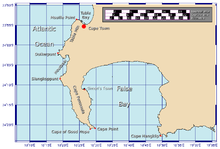
.jpg)
Dutch language
Dutch is a West Germanic language and the native language of the majority of the population of the Netherlands, Belgium, and Suriname, the three member states of the Dutch Language Union. Most speakers live in the European Union, where it is a first language for about 23 million and a second...
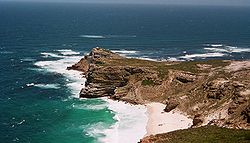
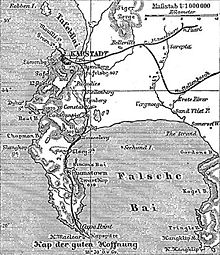
: ) is a rocky headland
Headlands and bays
Headlands and bays are two related features of the coastal environment.- Geology and geography :Headlands and bays are often found on the same coastline. A bay is surrounded by land on three sides, whereas a headland is surrounded by water on three sides. Headlands are characterized by high,...
on the Atlantic
Atlantic Ocean
The Atlantic Ocean is the second-largest of the world's oceanic divisions. With a total area of about , it covers approximately 20% of the Earth's surface and about 26% of its water surface area...
coast of the Cape Peninsula
Cape Peninsula
The Cape Peninsula is a generally rocky peninsula that juts out for 75 km into the Atlantic Ocean at the south-western extremity of the African continent. At the southern end of the peninsula are Cape Point and the Cape of Good Hope...
, South Africa
South Africa
The Republic of South Africa is a country in southern Africa. Located at the southern tip of Africa, it is divided into nine provinces, with of coastline on the Atlantic and Indian oceans...
.
There is a misconception that the Cape of Good Hope is the southern tip of Africa, because it was once believed to be the dividing point between the Atlantic
Atlantic Ocean
The Atlantic Ocean is the second-largest of the world's oceanic divisions. With a total area of about , it covers approximately 20% of the Earth's surface and about 26% of its water surface area...
and Indian Ocean
Indian Ocean
The Indian Ocean is the third largest of the world's oceanic divisions, covering approximately 20% of the water on the Earth's surface. It is bounded on the north by the Indian Subcontinent and Arabian Peninsula ; on the west by eastern Africa; on the east by Indochina, the Sunda Islands, and...
s. In fact, the southernmost point is Cape Agulhas
Cape Agulhas
Cape Agulhas is a rocky headland in the Western Cape, South Africa. It is the geographic southern tip of Africa and the official dividing point between the Atlantic and Indian oceans...
, about 150 kilometre to the east-southeast. The Atlantic and Indian oceans meet at the point where the warm-water Agulhas current
Agulhas Current
The Agulhas Current is the Western Boundary Current of the southwest Indian Ocean. It flows down the east coast of Africa from 27°S to 40°S. It is narrow, swift and strong...
meets the cold water Benguela current
Benguela Current
The Benguela Current is the broad, northward flowing ocean current that forms the eastern portion of the South Atlantic Ocean gyre. The current extends from roughly Cape Point in the south, to the position of the Angola-Benguela Front in the north, at around 16°S. The current is driven by the...
and turns back on itselfa point that fluctuates between Cape Agulhas and Cape Point
Cape Point
Cape Point is a promontory at the southeast corner of the Cape Peninsula, which is a mountainous and scenic landform that runs north-south for about thirty kilometres at the extreme southwestern tip of the African continent in the Republic of South Africa. Table Mountain and the city of Cape Town...
, about one kilometre east of the Cape of Good Hope.
When following the western side of the African coastline from the equator, however, the Cape of Good Hope marks the point where a ship begins to travel more eastward than southward. Thus the first modern rounding of the cape in 1488 by Portuguese
Portuguese discoveries
Portuguese discoveries is the name given to the intensive maritime exploration by the Portuguese during the 15th and 16th centuries. Portuguese sailors were at the vanguard of European overseas exploration, discovering and mapping the coasts of Africa, Asia and Brazil, in what become known as the...
explorer Bartolomeu Dias
Bartolomeu Dias
Bartolomeu Dias , a nobleman of the Portuguese royal household, was a Portuguese explorer who sailed around the southernmost tip of Africa in 1488, the first European known to have done so.-Purposes of the Dias expedition:...
was a milestone in the attempts by the Portuguese to establish direct trade relations with the Far East
Far East
The Far East is an English term mostly describing East Asia and Southeast Asia, with South Asia sometimes also included for economic and cultural reasons.The term came into use in European geopolitical discourse in the 19th century,...
(although in his histories Herodotus
Herodotus
Herodotus was an ancient Greek historian who was born in Halicarnassus, Caria and lived in the 5th century BC . He has been called the "Father of History", and was the first historian known to collect his materials systematically, test their accuracy to a certain extent and arrange them in a...
proves, disbelievingly, that some Phoenicians had done so far earlier than this). Dias called the cape Cabo das Tormentas. "Cape of Storms" was the original name of the "Cape of Good Hope".
As one of the great capes
Great capes
In sailing, the great capes are the three major capes of the Southern Ocean — the Cape of Good Hope , Cape Leeuwin, and Cape Horn. South East Cape of Tasmania and South West Cape at the southern tip of Stewart Island/Rakiura are also sometimes included as major landmarks of a circumnavigation...
of the South Atlantic Ocean, the Cape of Good Hope has been of special significance to sailors for many years and is widely referred to by them simply as "the Cape." It is a waypoint on the clipper route
Clipper route
In sailing, the clipper route was the traditional route sailed by clipper ships between Europe and the Far East, Australia and New Zealand. The route ran from west to east through the Southern Ocean, in order to make use of the strong westerly winds of the Roaring Forties...
followed by clipper ships to the Far East
Far East
The Far East is an English term mostly describing East Asia and Southeast Asia, with South Asia sometimes also included for economic and cultural reasons.The term came into use in European geopolitical discourse in the 19th century,...
and Australia
Australia
Australia , officially the Commonwealth of Australia, is a country in the Southern Hemisphere comprising the mainland of the Australian continent, the island of Tasmania, and numerous smaller islands in the Indian and Pacific Oceans. It is the world's sixth-largest country by total area...
, and still followed by several offshore yacht races
Yacht racing
Yacht racing is the sport of competitive yachting.While sailing groups organize the most active and popular competitive yachting, other boating events are also held world-wide: speed motorboat racing; competitive canoeing, kayaking, and rowing; model yachting; and navigational contests Yacht racing...
.
The term Cape of Good Hope is also used in three other ways:
- It is a section of the Table Mountain National ParkTable Mountain National ParkTable Mountain National Park, previously known as the Cape Peninsula National Park, is a national park in Cape Town, South Africa, proclaimed on May 29, 1998, for the purpose of protecting the natural environment of the Table Mountain Chain, and in particular the rare fynbos vegetation...
, within which the cape of the same name, as well as Cape PointCape PointCape Point is a promontory at the southeast corner of the Cape Peninsula, which is a mountainous and scenic landform that runs north-south for about thirty kilometres at the extreme southwestern tip of the African continent in the Republic of South Africa. Table Mountain and the city of Cape Town...
, falls. Prior to its incorporation into the national park this section constituted the Cape Point Nature Reserve; - It was the name of the early Cape ColonyCape ColonyThe Cape Colony, part of modern South Africa, was established by the Dutch East India Company in 1652, with the founding of Cape Town. It was subsequently occupied by the British in 1795 when the Netherlands were occupied by revolutionary France, so that the French revolutionaries could not take...
established in 1652, in the vicinity of the Cape PeninsulaCape PeninsulaThe Cape Peninsula is a generally rocky peninsula that juts out for 75 km into the Atlantic Ocean at the south-western extremity of the African continent. At the southern end of the peninsula are Cape Point and the Cape of Good Hope...
. - Just prior to the formation of the Union of South AfricaUnion of South AfricaThe Union of South Africa is the historic predecessor to the present-day Republic of South Africa. It came into being on 31 May 1910 with the unification of the previously separate colonies of the Cape, Natal, Transvaal and the Orange Free State...
, the term referred to the entire region that in 1910 was to become the Cape of Good Hope Province (usually shortened to the Cape Province).
Geography
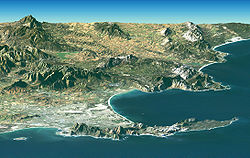
Cape Peninsula
The Cape Peninsula is a generally rocky peninsula that juts out for 75 km into the Atlantic Ocean at the south-western extremity of the African continent. At the southern end of the peninsula are Cape Point and the Cape of Good Hope...
, about 2.3 kilometres (1.4 mi) west and a little south of Cape Point
Cape Point
Cape Point is a promontory at the southeast corner of the Cape Peninsula, which is a mountainous and scenic landform that runs north-south for about thirty kilometres at the extreme southwestern tip of the African continent in the Republic of South Africa. Table Mountain and the city of Cape Town...
on the south-east corner. Cape Town
Cape Town
Cape Town is the second-most populous city in South Africa, and the provincial capital and primate city of the Western Cape. As the seat of the National Parliament, it is also the legislative capital of the country. It forms part of the City of Cape Town metropolitan municipality...
is about 50 kilometres to the north of the Cape, in Table Bay
Table Bay
Table Bay is a natural bay on the Atlantic Ocean overlooked by Cape Town and is at the northern end of the Cape Peninsula, which stretches south to the Cape of Good Hope. It was named because it is dominated by the flat-topped Table Mountain.Bartolomeu Dias was the first European to explore this...
at the north end of the peninsula. The peninsula forms the western boundary of False Bay
False Bay
False Bay is a body of water defined by Cape Hangklip and the Cape Peninsula in the extreme South-West of South Africa.- Description and location :...
. Geologically, the rocks found at the two capes, and indeed over much of the peninsula, are part of the Table Mountain Group, and are formed of the same type of sandstones as Table Mountain itself. Both the Cape of Good Hope and Cape Point
Cape Point
Cape Point is a promontory at the southeast corner of the Cape Peninsula, which is a mountainous and scenic landform that runs north-south for about thirty kilometres at the extreme southwestern tip of the African continent in the Republic of South Africa. Table Mountain and the city of Cape Town...
offer spectacular scenery, the whole of the southernmost portion of the Cape Peninsula is a wild, rugged, scenic and generally unspoiled national park.
The term the Cape has also been used in a wider sense, to indicate the area of the European colony
Cape Colony
The Cape Colony, part of modern South Africa, was established by the Dutch East India Company in 1652, with the founding of Cape Town. It was subsequently occupied by the British in 1795 when the Netherlands were occupied by revolutionary France, so that the French revolutionaries could not take...
centred on Cape Town
Cape Town
Cape Town is the second-most populous city in South Africa, and the provincial capital and primate city of the Western Cape. As the seat of the National Parliament, it is also the legislative capital of the country. It forms part of the City of Cape Town metropolitan municipality...
, and the later South African province
Cape Province
The Province of the Cape of Good Hope was a province in the Union of South Africa and subsequently the Republic of South Africa...
. Since 1994, it has been broken up into three smaller provinces: the Western Cape
Western Cape
The Western Cape is a province in the south west of South Africa. The capital is Cape Town. Prior to 1994, the region that now forms the Western Cape was part of the much larger Cape Province...
, Eastern Cape
Eastern Cape
The Eastern Cape is a province of South Africa. Its capital is Bhisho, but its two largest cities are Port Elizabeth and East London. It was formed in 1994 out of the "independent" Xhosa homelands of Transkei and Ciskei, together with the eastern portion of the Cape Province...
and Northern Cape
Northern Cape
The Northern Cape is the largest and most sparsely populated province of South Africa. It was created in 1994 when the Cape Province was split up. Its capital is Kimberley. It includes the Kalahari Gemsbok National Park, part of an international park shared with Botswana...
, plus parts of the Province were absorbed into the North West
North West (South African province)
North West is a province of South Africa. Its capital is Mafikeng. The province is located to the west of the major population centre of Gauteng.-History:...
.
History
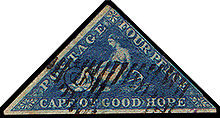
Bartolomeu Dias
Bartolomeu Dias , a nobleman of the Portuguese royal household, was a Portuguese explorer who sailed around the southernmost tip of Africa in 1488, the first European known to have done so.-Purposes of the Dias expedition:...
in 1488, who named it the "Cape of Storms" (Cabo das Tormentas). It was later renamed by John II of Portugal
John II of Portugal
John II , the Perfect Prince , was the thirteenth king of Portugal and the Algarves...
as "Cape of Good Hope" (Cabo da Boa Esperança) because of the great optimism engendered by the opening of a sea route to India and the East.
The land around the cape was home to the Khoikhoi
Khoikhoi
The Khoikhoi or Khoi, in standardised Khoekhoe/Nama orthography spelled Khoekhoe, are a historical division of the Khoisan ethnic group, the native people of southwestern Africa, closely related to the Bushmen . They had lived in southern Africa since the 5th century AD...
people when the Dutch first settled there in 1652. The Khoikhoi had arrived in these parts about fifteen hundred years before. They were called Hottentot
Khoikhoi
The Khoikhoi or Khoi, in standardised Khoekhoe/Nama orthography spelled Khoekhoe, are a historical division of the Khoisan ethnic group, the native people of southwestern Africa, closely related to the Bushmen . They had lived in southern Africa since the 5th century AD...
s by the Dutch, a term that has now come to be regarded as pejorative.
Dutch
Dutch people
The Dutch people are an ethnic group native to the Netherlands. They share a common culture and speak the Dutch language. Dutch people and their descendants are found in migrant communities worldwide, notably in Suriname, Chile, Brazil, Canada, Australia, South Africa, New Zealand, and the United...
colonial administrator Jan van Riebeeck
Jan van Riebeeck
Johan Anthoniszoon "Jan" van Riebeeck was a Dutch colonial administrator and founder of Cape Town.-Biography:...
established a resupply camp for the Dutch East India Company
Dutch East India Company
The Dutch East India Company was a chartered company established in 1602, when the States-General of the Netherlands granted it a 21-year monopoly to carry out colonial activities in Asia...
some 50 km north of the cape in Table Bay
Table Bay
Table Bay is a natural bay on the Atlantic Ocean overlooked by Cape Town and is at the northern end of the Cape Peninsula, which stretches south to the Cape of Good Hope. It was named because it is dominated by the flat-topped Table Mountain.Bartolomeu Dias was the first European to explore this...
on 6 April 1652 and this eventually developed into Cape Town
Cape Town
Cape Town is the second-most populous city in South Africa, and the provincial capital and primate city of the Western Cape. As the seat of the National Parliament, it is also the legislative capital of the country. It forms part of the City of Cape Town metropolitan municipality...
. Supplies of fresh food were vital on the long journey around Africa and Cape Town became known as "The Tavern of the Seas".
On 31 December 1687 a community of Huguenots arrived at the Cape from the Netherlands. They had escaped to the Netherlands from France in order to flee religious persecution there; examples of these are Pierre Joubert who came from La Motte-d'Aigues
La Motte-d'Aigues
La Motte-d'Aigues is a commune in the Vaucluse department in the Provence-Alpes-Côte d'Azur region in southeastern France.-Geography:La Motte-d'Aigues is situated in the southern part of the Parc naturel régional du Luberon between the crest of the Grand Luberon and the hills bordering the Eze...
for religious reasons. The Dutch East India Company needed skilled farmers at the Cape of Good Hope and the Dutch Government saw opportunities for the Huguenots at the Cape and sent them over. The colony gradually grew over the next 150 years or so until it stretched for hundreds of kilometres to the north and north-east.
When the Dutch Republic, during the Napoleonic Wars, was occupied by the French in 1795, henceforth becoming their vassal and enemy of the British, the United Kingdom invaded and occupied the Cape Colony that same year; relinquished control of the territory in 1803; only to return and reoccupy the Cape on 19 January 1806. The territory was ceded to the British in the Anglo-Dutch Treaty of 1814
Anglo-Dutch Treaty of 1814
The Anglo-Dutch Treaty of 1814 was a treaty signed between Great Britain and the Netherlands in London on August 13, 1814...
and was thereafter administered as the Cape Colony
Cape Colony
The Cape Colony, part of modern South Africa, was established by the Dutch East India Company in 1652, with the founding of Cape Town. It was subsequently occupied by the British in 1795 when the Netherlands were occupied by revolutionary France, so that the French revolutionaries could not take...
. It remained a British colony until being incorporated into the independent Union of South Africa
Union of South Africa
The Union of South Africa is the historic predecessor to the present-day Republic of South Africa. It came into being on 31 May 1910 with the unification of the previously separate colonies of the Cape, Natal, Transvaal and the Orange Free State...
in 1910 (now known as the Republic of South Africa).
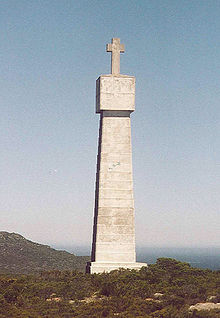
The Portuguese government erected two navigational beacons, Dias Cross and Da Gama Cross, to commemorate Vasco da Gama
Vasco da Gama
Vasco da Gama, 1st Count of Vidigueira was a Portuguese explorer, one of the most successful in the Age of Discovery and the commander of the first ships to sail directly from Europe to India...
and Bartolomeu Dias
Bartolomeu Dias
Bartolomeu Dias , a nobleman of the Portuguese royal household, was a Portuguese explorer who sailed around the southernmost tip of Africa in 1488, the first European known to have done so.-Purposes of the Dias expedition:...
as explorers who as mentioned were the first explorers to reach the cape. When lined up, the crosses point to Whittle Rock (34°14.8′S 18°33.6′E), a large, permanently submerged shipping hazard in False Bay. Two other beacons in Simonstown provide the intersection.
Legends
The Cape of Good Hope is the legendary home of The Flying DutchmanThe Flying Dutchman
The legend of the Flying Dutchman concerns a ghost ship that can never make port, doomed to sail the oceans forever. It probably originates from 17th-century nautical folklore. The oldest extant version dates to the late 18th century....
. Crewed by tormented and damned ghostly sailors, it is doomed forever to beat its way through the adjacent waters without ever succeeding in rounding the headland.
Adamastor
Adamastor
Adamastor is a Greek-type mythological character famed by the Portuguese poet Luís de Camões in his epic poem Os Lusíadas , as a symbol of the forces of nature Portuguese navigators had to overcome during their discoveries...
is a Greek-type mythological character invented by the Portuguese poet Luís de Camões
Luís de Camões
Luís Vaz de Camões is considered Portugal's and the Portuguese language's greatest poet. His mastery of verse has been compared to that of Shakespeare, Vondel, Homer, Virgil and Dante. He wrote a considerable amount of lyrical poetry and drama but is best remembered for his epic work Os Lusíadas...
in his epic poem Os Lusíadas
Os Lusíadas
Os Lusíadas , usually translated as The Lusiads, is a Portuguese epic poem by Luís Vaz de Camões ....
(first printed in 1572), as a symbol of the forces of nature Portuguese navigators had to overcome during their discoveries, and more specifically of the dangers Portuguese sailors faced when trying to round the Cape of Storms.
Fauna

"Bush birds" tend to be rather scarce because of the coarse, scrubby nature of fynbos
Fynbos
Fynbos is the natural shrubland or heathland vegetation occurring in a small belt of the Western Cape of South Africa, mainly in winter rainfall coastal and mountainous areas with a Mediterranean climate...
vegetation. When flowering, however, protea
Protea
Protea is both the botanical name and the English common name of a genus of flowering plants, sometimes also called sugarbushes.-Etymology:...
s and erica
Erica
Erica ,the heaths or heathers, is a genus of approximately 860 species of flowering plants in the family Ericaceae. The English common names "heath" and "heather" are shared by some closely related genera of similar appearance....
s attract sunbird
Sunbird
The sunbirds and spiderhunters are a family, Nectariniidae, of very small passerine birds. There are 132 species in 15 genera. The family is distributed throughout Africa, southern Asia and just reaches northern Australia. Most sunbirds feed largely on nectar, but also take insects and spiders,...
s, sugarbird
Sugarbird
The sugarbirds are a small family, Promeropidae, of passerine birds which are restricted to southern Africa. The two species of sugarbird make up one of only two bird families restricted entirely to southern Africa, the other being the rock-jumpers Chaetopidae...
s, and other species in search of nectar. For most of the year, there are more small birds in coastal thicket than in fynbos.
The Cape of Good Hope section of Table Mountain National Park is home to several species of antelope. Bontebok and Eland are easily seen, and Red Hartebeest can be seen in the grazing lawns in Smitswinkel Flats. Grey Rhebok are less commonly seen and are scarce, but may be observed along the beach hills at Olifantsbos. Most visitors are unlikely to ever see either Cape Grysbok or Klipspringer.
The Cape of Good Hope section is home to four Cape Mountain Zebra. They might be seen by the attentive or lucky visitor, usually in Smitswinkel Flats.
There are a wealth of small animals such as lizard
Lizard
Lizards are a widespread group of squamate reptiles, with nearly 3800 species, ranging across all continents except Antarctica as well as most oceanic island chains...
s, snake
Snake
Snakes are elongate, legless, carnivorous reptiles of the suborder Serpentes that can be distinguished from legless lizards by their lack of eyelids and external ears. Like all squamates, snakes are ectothermic, amniote vertebrates covered in overlapping scales...
s, tortoise
Tortoise
Tortoises are a family of land-dwelling reptiles of the order of turtles . Like their marine cousins, the sea turtles, tortoises are shielded from predators by a shell. The top part of the shell is the carapace, the underside is the plastron, and the two are connected by the bridge. The tortoise...
s and insect
Insect
Insects are a class of living creatures within the arthropods that have a chitinous exoskeleton, a three-part body , three pairs of jointed legs, compound eyes, and two antennae...
s. Small mammals include rock hyrax (dassie), striped mouse, water mongoose
Marsh Mongoose
The Marsh Mongoose, or Water Mongoose, is a medium-sized mammal but a large mongoose. Weight can range from , with an average range of . From the head to the base of the tail, these animals range from , with the tail adding . It is a member of the mongoose family and the only member of its genus...
, Cape clawless otter and white deer.
The area offers excellent vantage points for whale watching. The Southern right whale
Southern Right Whale
The southern right whale is a baleen whale, one of three species classified as right whales belonging to the genus Eubalaena. Like other right whales, the southern right whale is readily distinguished from others by the callosities on its head, a broad back without a dorsal fin, and a long arching...
is the species most likely to be seen in False Bay
False Bay
False Bay is a body of water defined by Cape Hangklip and the Cape Peninsula in the extreme South-West of South Africa.- Description and location :...
between June and November. Other species are the Humpback whale
Humpback Whale
The humpback whale is a species of baleen whale. One of the larger rorqual species, adults range in length from and weigh approximately . The humpback has a distinctive body shape, with unusually long pectoral fins and a knobbly head. It is an acrobatic animal, often breaching and slapping the...
and Bryde's whale
Bryde's Whale
Bryde's whales are baleen whales, one of the "great whales" or rorquals. They prefer tropical and temperate waters over the polar seas that other whales in their family frequent. They are largely coastal rather than pelagic. Bryde's whales are very similar in appearance to sei whales and almost as...
. Seals
Pinniped
Pinnipeds or fin-footed mammals are a widely distributed and diverse group of semiaquatic marine mammals comprising the families Odobenidae , Otariidae , and Phocidae .-Overview: Pinnipeds are typically sleek-bodied and barrel-shaped...
and Dusky Dolphin
Dusky Dolphin
The dusky dolphin is a dolphin found in coastal waters in the Southern Hemisphere. Its specific epithet is Latin for "dark" or "dim". It is very closely genetically related to the Pacific white-sided dolphin, but current scientific consensus is that they are distinct species...
s or Orca, the Killer Whales may also be seen.
The strategic position of the Cape of Good Hope between two major ocean currents, ensures a rich diversity of marine life. There is a difference between the sea life west of Cape Point and that to the east due to the markedly differing sea temperatures.
The South African Marine Living Resources Act is strictly enforced throughout the Table Mountain National Park
Table Mountain National Park
Table Mountain National Park, previously known as the Cape Peninsula National Park, is a national park in Cape Town, South Africa, proclaimed on May 29, 1998, for the purpose of protecting the natural environment of the Table Mountain Chain, and in particular the rare fynbos vegetation...
, and especially in marine protected areas. Disturbance or removal of any marine organisms is strictly prohibited between Schusters Bay and Hoek van Bobbejaan, but is allowed in other areas during season and with relevant permits.
Chacma Baboons
Chacma Baboons (Papio ursinus) are the mammal most intimately associated with the Cape of Good Hope. Baboons inside the Cape of Good Hope section of the park are a major tourist attraction. They have lived on the Cape Peninsula for approximately one million years and continue to this day. There are 11 troops consisting of about 375 individuals throughout the entire Cape Peninsula. Six of these 11 troops either live entirely within the Cape of Good Hope section of the park, or use the section as part of their range. The Cape Point, Kanonkop, Klein Olifantsbos, and Buffels Bay troops live entirely inside the Cape of Good Hope section of the Park. The Groot Olifantsbos and Plateau Road troops range into the park.Chacma Baboons are widely distributed across southern Africa and are classified as "least concern" in the . However, the South African Parks Department states in its publication Mountains in the Sea that the baboon population on the Cape is "critically endangered." This is due to habitat loss, genetic isolation, and conflicts with humans. Cape baboons have been eliminated from the majority of their range across the Cape Peninsula, and the Cape of Good Hope section of Table Mountain National Park provides a sanctuary for the troops that live within its boundaries. It provides relative safety from nearby towns, where people have killed many baboons after the baboons raid their houses looking for food. Baboons are also frequently injured or killed outside of the park by cars and by electrocution on power lines. Inside the park, some management policies such as allowing barbecues and picnics in the baboon home ranges cause detriment to the troops, as they become embroiled in conflicts with guests to the park.
Flora
The Cape of Good Hope is an integral part of the Cape Floristic Kingdom, the smallest but richest of the world's six floral kingdoms. This comprises a treasure trove of 1100 species of indigenous plants, of which a number are endemic (occur naturally nowhere else on earth). The main type of fynbosFynbos
Fynbos is the natural shrubland or heathland vegetation occurring in a small belt of the Western Cape of South Africa, mainly in winter rainfall coastal and mountainous areas with a Mediterranean climate...
("fine bush") vegetation at the Cape of Good Hope is Peninsula Sandstone Fynbos
Peninsula Sandstone Fynbos
Peninsula Sandstone Fynbos is a unique and endangered vegetation type that is endemic to the Cape Peninsula in Cape Town. This type of Mountain Fynbos occurs on very poor, acidic soils but is incredibly rich in biodiversity with an enormous number of plant species – many of which occur nowhere else...
, an endangered vegetation type that is endemic to the Cape Peninsula. Coastal Hangklip Sand Fynbos
Hangklip Sand Fynbos
Hangklip Sand Fynbos is an endangered vegetation type that occurs in the southern coastal portion of the Western Cape, South Africa.This particular Fynbos ecosystem naturally occurs along the southern coast of the Western Cape, South Africa, between Agulhas and Pringle Bay...
grows on low-lying alkaline sands and, right by the sea, small patches of Cape Flats Dune Strandveld
Cape Flats Dune Strandveld
Cape Flats Dune Strandveld is an endangered vegetation type. This is a unique type of Cape Strandveld that is endemic to the coastal areas in Cape Town, including the Cape Flats district. -Habitat:Strandveld means “beach scrub” in the Afrikaans language...
can be found.
Characteristic fynbos plants include protea
Protea
Protea is both the botanical name and the English common name of a genus of flowering plants, sometimes also called sugarbushes.-Etymology:...
s, erica
Erica
Erica ,the heaths or heathers, is a genus of approximately 860 species of flowering plants in the family Ericaceae. The English common names "heath" and "heather" are shared by some closely related genera of similar appearance....
s (heath), and restio
Restio
Restio is the name of a group of plants within the Restionaceae. Many species formerly included within the Restio genus are now classified into a number of other genera including Acion, Baloskion and Eurychorda....
s (reeds). Some of the most striking and well-known members belong to the Proteacae family, of which up to 24 species occur. These include King Protea
King protea
The King Protea is a flowering plant. It is a distinctive Protea, having the largest flower head in the genus. The species is also known as Giant Protea, Honeypot or King Sugar Bush...
, Sugarbush, Tree Pincushion and Golden Cone Bush.
Many popular horticultural plants like pelargonium
Pelargonium
Pelargonium is a genus of flowering plants which includes about 200 species of perennials, succulents, and shrubs, commonly known as scented geraniums or storksbills. Confusingly, Geranium is the correct botanical name of a separate genus of related plants often called Cranesbills. Both Geranium...
s, freesia
Freesia
Freesia Ecklon ex Klatt is a genus of 14–16 species of flowering plants in the family Iridaceae, native to Africa. Of the 14 species, 12 are native to Cape Province, South Africa, the remaining two to tropical Africa, one species extending north of the equator to Sudan.The genus was named in honor...
s, daisies
Asteraceae
The Asteraceae or Compositae , is an exceedingly large and widespread family of vascular plants. The group has more than 22,750 currently accepted species, spread across 1620 genera and 12 subfamilies...
, lilies and iris
Iris (plant)
Iris is a genus of 260-300species of flowering plants with showy flowers. It takes its name from the Greek word for a rainbow, referring to the wide variety of flower colors found among the many species...
es also have their origins in fynbos.
See also
- Cape HornCape HornCape Horn is the southernmost headland of the Tierra del Fuego archipelago of southern Chile, and is located on the small Hornos Island...
, its South American counterpart - Western CapeWestern CapeThe Western Cape is a province in the south west of South Africa. The capital is Cape Town. Prior to 1994, the region that now forms the Western Cape was part of the much larger Cape Province...
- History of Cape ColonyHistory of Cape ColonyThe written history of Cape Colony South Africa began when Bartolomeu Dias, a Portuguese navigator, discovered the Cape of Good Hope in 1488. In 1497, Vasco da Gama sailed along the whole coast of South Africa on his way to India. The Portuguese, attracted by the riches of Asia, made no...
- Simon's TownSimon's TownSimon's Town , sometimes spelled Simonstown; is a town in South Africa, near Cape Town which is home to the South African Navy. It is located on the shores of False Bay, on the eastern side of the Cape Peninsula. For more than two centuries it has been an important naval base and harbour...