

.gif)
Estado Novo (Portugal)

Encyclopedia
The Estado Novo or the Second Republic, was the corporatist authoritarian regime installed in Portugal
in 1933. It was established following the army-led coup d'état of 28 May 1926
against the democratic but unstable First Republic
. The Estado Novo, greatly inspired by conservative and authoritarian ideologies, was developed by António de Oliveira Salazar
, ruler of Portugal from 1932 to 1968, when he fell ill.
Opposed to communism
, socialism
, liberalism
, and anti-colonialism, the pro-Roman Catholic Estado Novo regime advocated the retention of Portuguese colonies
as a pluricontinental empire. Under the Estado Novo Portugal preserved a vast centuries-long empire with a total area of 2,168,071 km2. Fiercely criticized by most of the international community after World War II
and the European decolonization
, the regime and its secret police repressed elemental civil liberties
and political freedoms in order to remain in power, and to avoid communist influence and the dissolution of its coveted empire.
The country joined the United Nations
(UN) in 1955, and was a founding member of NATO (1949), OECD (1961), and EFTA
(1960). In 1968 Marcelo Caetano
was appointed the new head of government. On 25 April 1974, the Carnation Revolution
in Lisbon
, a military coup organized by left-wing Portuguese military officers – the Armed Forces Movement (MFA) – overthrew the Estado Novo regime. It is considered that the Estado Novo, jointly with the Ditadura Nacional
, forms the historical period of the Portuguese Second Republic.
confirmed colonial treaties of the 19th Century that stabilized the situation in Portuguese Africa. These agreements were, however, unpopular in Portugal, where they were seen as being to the disadvantage of the country. In addition, Portugal was twice declared bankrupt – on 14 June 1892, and again on 10 May 1902 – causing industrial disturbances, socialist, and republican antagonism and press criticism of the monarchy. Carlos responded by appointing João Franco
as Prime Minister and subsequently accepting Parliament's dissolution. In 1908, Carlos I was killed in a regicide at Lisbon
. The Portuguese monarchy lasted until 1910 when, through the October 5 revolution
, it was overthrown and Portugal was proclaimed a republic
. The overthrow of the Portuguese monarchy in 1910 led to a 16-year struggle to sustain parliamentary democracy under republicanism – the Portuguese First Republic (1910–1926).
The 28th May 1926 coup d'état or, during the period of Estado Novo, the National Revolution , was a military action that put an end to the chaotic Portuguese First Republic and initiated the Ditadura Nacional
(National Dictatorship) (years later, renamed Estado Novo).
With fascist
organizations being popular and widely supported across many countries (like Italian Fascism
and Nazism
) as an antagonist of communist
ideologies (like Leninism
and Marxism
), António de Oliveira Salazar
developed the Estado Novo which can be described as a right leaning corporatist
regime of para-fascist inspiration. The basis of his regime was a platform of stability. According to some Portuguese scholars like Jaime Nogueira Pinto
and Rui Ramos, his early reforms and policies changed the whole nation since they allowed political and financial stability and therefore social order
and economic growth
, after the politically unstable and financially chaotic years of the Portuguese First Republic
(1910–1926). After the First Republic, when not even public order was achieved, this looked like an impressive breakthrough to most of the population; Salazar achieved his height in popularity at this point. This transfiguration of Portugal was then known as A Lição de Salazar – "Salazar's Lesson." Salazar's program was opposed to communism
, socialism
, and liberalism
. It was pro-Catholic, conservative, and nationalistic
. Its policy envisaged the perpetuation of Portugal as a pluricontinental empire
, financially autonomous and politically independent from the dominating superpower
s, and a source of civilization and stability to the overseas societies in the African and Asian possessions
.
orientation, which differed from fascist
regimes by its lack of expansionism, lack of a charismatic leader, lack of party structure, and more moderate use of state violence. It incorporated, however, the principles for its military from Benito Mussolini
's system in Italy
. Salazar was a Catholic traditionalist who believed in the necessity of control over the forces of economic modernisation in order to defend the religious and rural values of the country, which he perceived as being threatened. One of the pillars of the regime was the PIDE
, the secret police. Many political dissidents were imprisoned at the Tarrafal
prison in the African archipelago of Cape Verde
, on the capital island of Santiago
, or in local jails. Strict state censorship was in place.
Executive authority was nominally vested in a president, elected by popular vote for a five-year term. The legislature was a unicameral National Assembly, elected every four years. An advisory body, the Corporative Chamber
, nominally represented economic, social and cultural organizations. In practice, however, the system was completely dominated by Salazar. While opposition candidates theoretically could stand for office, in practice the system was so heavily rigged in favour of the official party, the National Union
, that they had no realistic chance of winning.
The Estado Novo enforced nationalist and Roman Catholic values on the Portuguese population. The whole education system was focused toward the exaltation of the Portuguese nation and its five-century old overseas territories (the Ultramar). The motto of the regime was "Deus, Pátria e Familia" (meaning "God, Fatherland, and Family," and obviously intended as a counterpart to the French Revolution
's "Liberté, égalité, fraternité
"). After 1945, the main raison d'être of the regime became resistance to the wave of decolonization which swept Europe after the end of World War II.
The Estado Novo accepted the idea of corporatism
as an economic model. Although Salazar refused to sign the Anti-Comintern Pact
in 1938, the Portuguese Communist Party
was intensely persecuted. So were Anarchists, Liberals, Republicans, and anyone opposed to the regime. The only allowed party was the União Nacional (National Union), which encompassed a wide range of right-wing politics, passing through monarchism
, corporatism
, para-fascism
, nationalism
, and capitalism
.
The Legião Nacional
was a popular militia similar to the Italian Blackshirts
. For young people, there was the Mocidade Portuguesa
, an organization similar in organization (but not in ideology) to the Hitler Youth
. These two organizations were heavily supported by the State and imposed a martial style of life.
Despite similarities in their political structures, and mutual distrust of communism, the Third Reich
and Estado Novo had little time for each other. Portuguese authorities assisted Germany
in secretly supporting nationalist forces in the Spanish Civil War
. Both Salazar and the Portuguese public, however, felt they could not trust Adolf Hitler
, especially as Germany began to dominate its neighbors in the years leading up to the Second World War. During the Second World War, Portugal remained neutral. It was bound by the 550-year old Treaty of Windsor, the world's oldest diplomatic alliance, to afford assistance to the United Kingdom
. Portugal refused to declare war on the Axis powers
, but granted the Allies access to establish military bases in the Azores
. In 1942, Australia
n troops briefly occupied Portuguese Timor
in advance of their occupation by the Japanese.
In 1958, incumbent President Craveiro Lopes was forced to resign. Naval Minister and staunch conservative Américo Thomaz
ran in the 1958 elections as the official candidate. General Humberto Delgado
was the opposition candidate. Delgado was credited with only around 25% of the votes with 52.6% in favor of Thomaz, despite the consensual opinion that Delgado had really won. Evidence later surfaced that the PIDE had stuffed the ballot boxes with votes for Thomaz. After the elections, Delgado was expelled from the Portuguese Military, and took refuge in the Brazil
ian embassy before going into exile
, spending much of it in Brazil
and later in Algeria
. To keep opposition candidates from coming to power in 1959, the Government abolished direct election of presidents in favor of election by an electoral college
.
On 23 January 1961, military officer and politician Henrique Galvão
led the hijacking of Portuguese passenger ship Santa Maria
en route from Curaçao
to Havana
, Cuba
. The terrorist operation was successful as anti-regime propaganda but killed one officer (3rd Pilot Nascimento Costa) and wounded several others in the process of taking complete command over the ship. Galvão would later claim that his intentions were to sail to the Overseas Province of Angola
to set up in Luanda
a renegade Portuguese Government in opposition to Salazar. The journey of the hijacked Santa Maria was eventually cut short due to a troubled engine and problems with the 900 captives on the ship, and Galvão released the passengers in negotiation with Brazilian officials in exchange for political asylum in Brazil.
In 1962, the Academic Crisis
occurred. The regime, fearing the growing popularity of both purely democratic and communist ideas among the students, carried out the boycott and closure of several student associations and organizations, including the important National Secretariat of Portuguese Students. Most members of this organization were opposition militants, among them many communists. The political activists who were anti-regime used to be investigated and persecuted by PIDE-DGS, the secret police, and according to the gravity of the offence, were usually sent to jail or transferred from one university to another in order to destabilize oppositionist networks and its hierarchical organization. The students, with strong support from the clandestine Portuguese Communist Party
, responded with demonstrations which culminated on 24 March with a huge student demonstration in Lisbon, that was vigorously suppressed by the riot police. Marcelo Caetano
, distinguished member of the regime and the incumbent rector
of the University of Lisbon, resigned.
The relutance of many young men to embrace the hardships of the Portuguese Colonial War
resulted in hundreds of thousands of Portuguese citizens each year leaving to seek economic opportunities abroad in order to escape conscription. In over 15 years, nearly one million emigrated to France
, another million to the United States
, many hundreds of thousands to Germany
, Switzerland
, the United Kingdom
, Luxembourg
, Venezuela
, or Brazil
. Political parties, such as the Socialist Party
, persecuted at home, were established in exile. The only party which managed to continue (illegally) operating in Portugal during all the dictatorship was the Portuguese Communist Party.
In 1964, Delgado founded the Portuguese National Liberation Front
in Rome
, stating in public that the only way to end the Estado Novo would be by a military coup, while many others advocated a national uprising approach.
Delgado and his Brazilian secretary, Arajaryr Moreira de Campos, were murdered on 13 February 1965 in Spain after being lured into an ambush by PIDE
.
According to some Portuguese conservative scholars like Jaime Nogueira Pinto
and Rui Ramos, Salazar's early reforms and policies allowed political and financial stability and therefore social order
and economic growth
, after the politically unstable and financially chaotic years of the Portuguese First Republic
(1910–1926). Other historians like far-left politician Fernando Rosas
, point out that Salazar's policies from the 1930s to the 1950s, led to economic and social stagnation and rampant emigration, turning Portugal into one of the poorest countries in Europe, that was also thwarted by scoring lower on literacy than its peers of the Northern Hemisphere
.
Salazar suffered a stroke in 1968. As it was thought he didn't have long to live, Thomaz replaced him with Marcelo Caetano
, a reputed scholar of the University of Lisbon Law School, statesman and a distinguished member of the regime. Salazar was never informed of this decision, and reportedly died in 1970 still believing he was prime minister. Most of the people hoped Caetano would soften the edges of Salazar's authoritarian regime and modernize the already growing economy. Caetano moved on to foster economic growth and made important social improvements, such as the awarding of a monthly pension to rural workers who had never had the chance to pay social security
. Some large scale investments were made at national level, such as the building of a major oil processing centre in Sines
. The economy reacted very well at first, but into the 1970s some serious problems began to show, due in part to two-digit inflation (from 1970 and on) and to the effects of the 1973 oil crisis
. However, the oil crisis of 1973 had a potentially beneficial effect to Portugal because the largely unexploited oil reserves that Portugal had in its overseas territories of Angola and São Tomé and Príncipe were being developed at a fast pace.
Although Caetano was an authoritarian at bottom, he did make some efforts to open up the regime. Soon after taking power, he slightly increased freedom of speech and the press. These measures didn't go nearly far enough for a significant element of the population had no memory of the instability which preceded Salazar. However, even these meager reforms had to be wrung out of the hardliners in the regime--most notably Thomaz, who was not nearly as content to give Caetano the free rein that he gave Salazar.
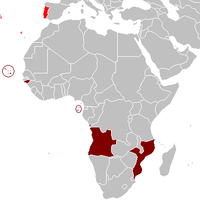 In 1958, when the Portuguese government announced the 1959–64 Six-Year Plan for National Development, a decision had been reached to accelerate the country's rate of economic growth, a decision whose urgency grew with the outbreak of guerrilla warfare in Angola in 1961 and in Portugal's other African territories
thereafter. Salazar and his policy advisers recognized that additional military expenditure needs, as well as increased transfers of official investment to the "overseas provinces," could only be met by a sharp rise in the country's productive capacity. Salazar's commitment to preserving Portugal's "multiracial, pluricontinental" state led him reluctantly to seek external credits beginning in 1962, an action from which the Portuguese treasury had abstained for several decades.
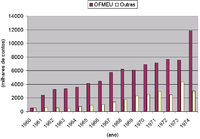 Beyond military measures, the official Portuguese response to the "winds of change
" in the African colonies was to integrate them administratively and economically more closely with the mainland. This was accomplished through population and capital transfers, trade liberalization, and the creation of a common currency, the so-called Escudo Area. The integration program established in 1961 provided for the removal of Portugal's duties on imports from its overseas territories by January 1964. The latter, on the other hand, were permitted to continue to levy duties on goods imported from Portugal but at a preferential rate, in most cases 50 percent of the normal duties levied by the territories on goods originating outside the Escudo Area. The effect of this two-tier tariff system was to give Portugal's exports preferential access to its colonial markets. The economies of the overseas provinces, especially those of both the Overseas Province of Angola and Mozambique, boomed.
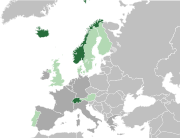 The liberalization of the Portuguese economy gained a new impetus under Salazar's successor, Prime Minister Marcello José das Neves Caetano (1968–1974), whose administration abolished industrial licensing requirements for firms in most sectors and in 1972 signed a free trade agreement with the newly enlarged European Community. Under the agreement, which took effect at the beginning of 1973, Portugal was given until 1980 to abolish its restrictions on most community goods and until 1985 on certain sensitive products amounting to some 10 percent of the EC's total exports to Portugal. Starting in 1960, EFTA
membership and a growing foreign investor presence contributed to Portugal's industrial modernization and export diversification between 1960 and 1973. Caetano moved on to foster economic growth and some social improvements, such as the awarding of a monthly pension to rural workers who had never had the chance to pay social security. Some large scale investments were made at national level, such as the building of a major oil processing center in Sines
. Notwithstanding the concentration of the means of production in the hands of a small number of family-based financial-industrial groups, Portuguese business culture permitted a surprising upward mobility of university-educated individuals with middle-class backgrounds into professional management careers. Before the 1974 Carnation Revolution
, the largest, most technologically advanced (and most recently organized) firms offered the greatest opportunity for management careers based on merit rather than on accident of birth. In 1960, at the initiation of Salazar's more outward-looking economic policy, Portugal's per capita GDP was only 38 percent of the European Community (EC-12) average; by the end of the Salazar period, in 1968, it had risen to 48 percent; and in 1973, under the leadership of Marcelo Caetano, Portugal's per capita GDP had reached 56.4 percent of the EC-12 average. On a long term analysis, after a long period of economic divergence before 1914, and a period of chaos during the First Republic, the Portuguese economy recovered slightly until 1950, entering thereafter on a path of strong economic convergence with the wealthiest economies of Western Europe, until the Carnation Revolution in April 1974. Portuguese economic growth in the period 1950 to 1973 under the Estado Novo regime (and even with the effects of an expensive war effort in African territories against independence guerrilla groups), created an opportunity for real integration with the developed economies of Western Europe. Through emigration, trade, tourism and foreign investment, individuals and firms changed their patterns of production and consumption, bringing about a structural transformation. Simultaneously, the increasing complexity of a growing economy raised new technical and organizational challenges, stimulating the formation of modern professional and management teams.
By the early 1970s Portugal's fast economic growth with increasing consumption and purchase of new automobiles set the priority for improvements in transportation. Brisa – Autoestradas de Portugal was founded in 1972 and the State granted the company a 30-year concession to design, build, manage, and maintain a modern network of express motorways.
The economy of Portugal and its overseas territories on the eve of the Carnation Revolution (a military coup on April 25, 1974) was growing well above the European average. Average family purchasing power was rising together with new consumption patterns and trends and this was promoting both investment in new capital equipment and consumption expenditure for durable and nondurable consumer goods.
The Estado Novo regime economic policy encouraged and created conditions for the formation of large and successful business conglomerates. Economically, the Estado Novo regime maintained a policy of corporatism
that resulted in the placement of a big part of the Portuguese economy in the hands of a number of strong conglomerate
s, including those founded by the families of António Champalimaud (Banco Totta & Açores, Banco Pinto & Sotto Mayor, Secil, Cimpor
), José Manuel de Mello
(CUF – Companhia União Fabril
), Américo Amorim
(Corticeira Amorim
) and the dos Santos family (Jerónimo Martins
). Those Portuguese conglomerates had a business model with similarities to South Korea
n chaebol
s and Japan
ese keiretsu
s and zaibatsu
s. The Companhia União Fabril (CUF) was one of the largest and most diversified Portuguese conglomerates with its core business
es (cement
, chemicals, petrochemicals, agrochemicals, textiles, beer
, beverages, metallurgy
, naval engineering, electrical engineering
, insurance
, banking, paper
, tourism
, mining
, etc.) and corporate headquarters located in mainland Portugal, but also with branches, plants and several developing business projects all around the Portuguese Empire
, specially in the Portuguese territores of Angola
and Mozambique. Other medium sized family companies specialized in textiles (for instance those located in the city of Covilhã
and the northwest), ceramics, porcelain, glass and crystal (like those of Alcobaça
, Caldas da Raínha
and Marinha Grande), engineered wood (like SONAE
near Porto
), canned fish (like those of Algarve and the northwest), fishing, food and beverages (alcoholic beverages, from liqueurs like Licor Beirão
and Ginjinha
, to beer like Sagres, were produced across the entire country, but Port Wine
was one of its most reputed and exported alcoholic beverages), tourism (well established in Estoril
/Cascais
/Sintra
and growing as an international attraction in the Algarve since the 1960s) and in agriculture (like the ones scattered around the Alentejo – known as the breadbasket
of Portugal) completed the panorama of the national economy by the early 1970s. In addition, rural areas' populations were committed to agrarianism
that was of great importance for a majority of the total population, with many families living exclusively from agriculture or complementing their salaries with farming, husbandry and forestry yields.
Besides that, the overseas territories were also displaying impressive economic growth and development rates from the 1920s onwards. Even during the Portuguese Colonial War
(1961-1974), a counterinsurgency war against independentist guerrilla and terrorism
, the overseas territories of Angola
and Mozambique (Portuguese Overseas Provinces at the time) had countinuous economic growth rates and several sectors of its local economies were booming. They were internationally notable centres of production of oil, coffee, cotton, cashew, coconut, timber, minerals (like diamonds), metals (like iron and aluminium), banana, citrus, tea, sisal, beer (Cuca and Laurentina were successful beer brands produced locally), cement, fish and other sea products, beef and textiles. Tourism was also a fast developing activity in Portuguese Africa both by the growing development of and demand for beach resorts and wildlife reserves.
Labour unions were not allowed and a minimum wage
policy was not enforced. However, in a context of an expanding economy, bringing better living conditions for the Portuguese population in the 1960s, the outbreak of the colonial wars in Africa set off significant social changes, among them the rapid incorporation of more and more women into the labour market. Marcelo Caetano moved on to foster economic growth and some social improvements, such as the awarding of a monthly pension to rural workers who had never had the chance to pay social security. The objectives of Caetano's pension reform were threefold: enhancing equity, reducing fiscal and actuarial imbalance, and achieving more efficiency for the economy as a whole, for example, by establishing contributions less distortive to labour markets or by allowing the savings generated by pension funds to increase the investments in the economy. In 1969, with the replacement of António de Oliveira Salazar by Marcelo Caetano, the Estado Novo-controlled nation got indeed a very slight taste of democracy and Caetano allowed the formation of the first democratic labour union movement since the 1920s.
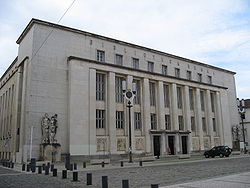 Until the 1960s, post-primary education
was limited to a tiny elite. In general, teenagers used to leave school and start to work early. In contrast with other European nations, the country had had a poor record in educational policies since the 19th century. By the end of the 19th century the illiteracy rate was at over 80 percent and higher education was reserved for a small percentage of the population. 68.1 percent of Portugal's population was still classified as illiterate by the 1930 census. Portugal's literacy rate by the 1940s and early 1950s remained low for North America
n and Western Europe
an standards at the time. However, in the 1960s the country made public education available for all children between the ages of six and twelve, founded universities in the overseas provinces of Angola and Mozambique (the University of Luanda and the University of Lourenço Marques during the period of Adriano Moreira
as Minister of the Overseas Provinces), recognized the Portuguese Catholic University in 1971, and by 1973 a wave of new state-run universities were founded across mainland Portugal (the Minho University, the New University of Lisbon
, the University of Évora
, and the University of Aveiro – Veiga Simão was the Minister in charge for education by then). In addition, the long established Lisbon and Coimbra universities were highly expanded and modernized in the 1960s. New buildings and campuses were constructed, like the Cidade Universitária (Lisbon) and the Alta Universitária (Coimbra). The last two decades of the Estado Novo, from the 1960s to the 1974 Carnation Revolution
, were marked by strong investment in secondary and university education
, which experienced in this period one of the fastest growth rates of Portuguese education history to date. Though this corresponded to significant growth of post-primary enrollment in larger urban areas, yet there was a gap to be filled in the following years, given the little time to overcome their disadvantaged starting position. The massification of secondary education
was only achieved in late 1970s and 1980s, so by the time of the Carnation Revolution in 1974 illiteracy was receding, but low-literacy and illiteracy was still high, compared with the highest standards already achieved by the most developed countries in the world.
Egas Moniz
, a Portuguese physician who developed the cerebral angiography
and leucotomy, received in 1949 the Nobel Prize in Physiology or Medicine
– even now, the only Portuguese recipient of a Nobel in the sciences.


 The end of the Estado Novo began with the uprisings in the colonies in the 1960s. The independence movements active in Portuguese Angola, Portuguese Mozambique and Portuguese Guinea
were supported by both the United States
and the Soviet Union
, which both wanted to end all colonial empires and expand their own spheres of influence. For the Portuguese ruling regime, the centuries-old overseas empire was a matter of national interest
. The criticism against some kinds of racial discrimination in the Portuguese African territories were refuted on the grounds that all Portuguese Africans would be Westernized and assimilated in due time, through a process called civilising mission, while for the other hand, the United States of America, a superpower and the self proclaimed "leader of the free World" remained hypocritically a place where millions of African-Americans struggled for civil rights and political freedoms. The wars had the same effects in Portugal as the Vietnam War
in the United States, or the Afghanistan War in the Soviet Union; they were unpopular and expensive lengthy wars which were isolating Portugal's diplomacy, leading many to question the continuation of the war and, by extension, the government. Although Portugal was able to maintain some superiority in the colonies by its use of elite paratroopers and special operations troops, the foreign support to the guerrillas, including arms embargoes and other sanctions against the Portuguese, made them more maneuverable, allowing them to inflict losses on the Portuguese army. The international community isolated Portugal due to the long-lasting Colonial War
. The situation was aggravated by the illness of Salazar, the strong man of the regime, in 1968. His replacement was one of his closest advisors, Marcelo Caetano
, who tried to slowly democratize the country, but could not hide the obvious dictatorship that oppressed Portugal. Salazar died in 1970.
After spending the early years of his priesthood in Africa, the British priest Adrian Hastings
created a storm in 1973 with an article in The Times
about the so-called "Wiriyamu massacre" in Mozambique, alleging that the Portuguese Army had massacred 400 villagers at the village of Wiriyamu, near Tete, in December 1972. His report was printed a week before the Portuguese prime minister, Marcelo Caetano, was due to visit Britain to celebrate the 600th anniversary of the Anglo-Portuguese alliance
. Portugal's growing isolation following Hastings's claims has often been cited as a factor that helped to bring about the "carnation revolution" coup which deposed the Caetano regime in 1974.
The various conflicts forced the Salazar
and subsequent Caetano
governments to spend more of the country's budget on colonial administration and military expenditures, and Portugal soon found itself increasingly isolated from the rest of the world. After Caetano succeeded to the presidency, the colonial war became a major cause of dissent and a focus for anti-government forces in Portuguese society. Many young dissidents, such as left-wing students and anti-war activists, were forced to leave the country so they could escape imprisonment or conscription. However, between 1945 and 1974, there were also three generations of militants of the radical right at the Portuguese universities and schools, guided by a revolutionary nationalism partly influenced by the political sub-culture of European neofascism. The core of these radical students' struggle lay in an uncompromising defence of the Portuguese Empire
in the days of the authoritarian regime.
By the early 1970s, the Portuguese Colonial War
continued to rage on, requiring a steadily increasing budget. The Portuguese military was overstretched and there was no political solution or end in sight. While the human losses were relatively small, the war as a whole had already entered its second decade. The Portuguese ruling regime of Estado Novo faced criticism from the international community and was becoming increasingly isolated. It had a profound impact on Portugal – thousands of young men avoided conscription
by emigrating illegally, mainly to France and the US.
The war in the colonies was increasingly unpopular in Portugal itself as the people became weary of war and balked at its ever-rising expense. Many ethnic Portuguese of the African overseas territories were also increasingly willing to accept independence if their economic status could be preserved. However, despite the guerrilla unpredictable and sporadic attacks against targets all over the countryside of the Portuguese African territories, the economies of both Portuguese Angola and Mozambique were booming, cities and towns were expanding and prospering steadily over time, new transportation networks were being opened to link the well-developed and highly urbanized coastal strip with the most remote inland regions, and the number of ethnic European Portuguese migrants from mainland Portugal (the metrópole
) increased fastly since the 1950s (although always as a small minority of each territory's total population).
Suddenly, after some failed attempts of military rebellion, in April 1974 the Carnation Revolution
in Lisbon
, organized by left-wing Portuguese military officers – the Armed Forces Movement (MFA), overthrew the Estado Novo regime. The military-led coup can be described as the necessary means of bringing back democracy to Portugal, ending the unpopular Colonial War
where thousands of Portuguese soldiers had been commissioned, and replacing the authoritarian Estado Novo (New State) regime and its secret police which repressed elemental civil liberties
and political freedoms. However, the military coup's organization started as a professional class protest of Portuguese Armed Forces
captains against a decree law: the Dec. Lei nº 353/73 of 1973. Younger military academy graduates resented a program introduced by Marcello Caetano whereby militia officers who completed a brief training program and had served in the overseas territories' defensive campaigns, could be commissioned at the same rank as military academy graduates. Caetano's Portuguese Government had begun the program (which included several other reforms) in order to increase the number of officials employed against the African insurgencies, and at the same time cut down military costs to alleviate an already overburdened government budget
. After the coup, the MFA
-led National Salvation Junta
, a military junta, took power. Caetano resigned, and was flown under custody to the Madeira Islands where he stayed for a few days. He then flew to exile in Brazil
. By 1975 the Portuguese Empire
had all but collapsed.
, including Álvaro Cunhal
's PCP, unsuccessfully tried to turn the country into a totalitarian communist
state. The retreat from the colonies and the acceptance of its independence terms which would create newly-independent communist states in 1975 (most notably the People's Republic of Angola
and the People's Republic of Mozambique
) prompted a mass exodus of Portuguese citizens from Portugal's African territories (mostly from Portuguese Angola and Mozambique), creating over a million destitute Portuguese refugee
s — the retornados. By 1975, all the Portuguese African territories were independent and Portugal held its first democratic elections in 50 years. However, the country continued to be governed by a military-civilian provisional administration until the Portuguese legislative election of 1976
.
For the Portuguese and their former colonies, this was a very difficult period, but many felt that the short-term effects of the Carnation Revolution were well worth the trouble when civil rights and political freedoms were achieved. The Portuguese celebrate Freedom Day on 25 April every year, and the day is a national holiday in Portugal.
By refusing to grant independence to its overseas territories in Africa, the Portuguese ruling regime of Estado Novo was criticized by most of the international community, and its leaders Salazar
and Caetano
were accused of being blind to the so called "Winds of change
". After the Carnation revolution
in 1974 and the fall of the incumbent Portuguese authoritarian regime, almost all the Portugal-ruled territories outside Europe became independent. Several historians have described the stubbornness of the regime as a lack of sensibility to the "Winds of change". For the regime those overseas possessions were a matter of national interest
.
In 2011 when the Portuguese Republic avoided default
by requesting international financial assistance to the International Monetary Fund
, Otelo Saraiva de Carvalho
, one of the best known captains who coordinated and organized the April 1974 military coup – the Carnation Revolution, stated that he wouldn't have made the revolution if he had known what the country would become after it.
Portugal
Portugal , officially the Portuguese Republic is a country situated in southwestern Europe on the Iberian Peninsula. Portugal is the westernmost country of Europe, and is bordered by the Atlantic Ocean to the West and South and by Spain to the North and East. The Atlantic archipelagos of the...
in 1933. It was established following the army-led coup d'état of 28 May 1926
28th May 1926 coup d'état
The 28 May 1926 coup d'état, sometimes called 28 May Revolution or, during the period of Estado Novo , National Revolution , was a military action that put an end to the unstable Portuguese First Republic and initiated the Ditadura Nacional , later, renamed the Estado Novo, an authoritarian...
against the democratic but unstable First Republic
Portuguese First Republic
The Portuguese First Republic spans a complex 16 year period in the history of Portugal, between the end of the period of constitutional monarchy marked by the 5 October 1910 revolution and the 28 May coup d'état of 1926...
. The Estado Novo, greatly inspired by conservative and authoritarian ideologies, was developed by António de Oliveira Salazar
António de Oliveira Salazar
António de Oliveira Salazar, GColIH, GCTE, GCSE served as the Prime Minister of Portugal from 1932 to 1968. He also served as acting President of the Republic briefly in 1951. He founded and led the Estado Novo , the authoritarian, right-wing government that presided over and controlled Portugal...
, ruler of Portugal from 1932 to 1968, when he fell ill.
Opposed to communism
Communism
Communism is a social, political and economic ideology that aims at the establishment of a classless, moneyless, revolutionary and stateless socialist society structured upon common ownership of the means of production...
, socialism
Socialism
Socialism is an economic system characterized by social ownership of the means of production and cooperative management of the economy; or a political philosophy advocating such a system. "Social ownership" may refer to any one of, or a combination of, the following: cooperative enterprises,...
, liberalism
Liberalism
Liberalism is the belief in the importance of liberty and equal rights. Liberals espouse a wide array of views depending on their understanding of these principles, but generally, liberals support ideas such as constitutionalism, liberal democracy, free and fair elections, human rights,...
, and anti-colonialism, the pro-Roman Catholic Estado Novo regime advocated the retention of Portuguese colonies
Portuguese Empire
The Portuguese Empire , also known as the Portuguese Overseas Empire or the Portuguese Colonial Empire , was the first global empire in history...
as a pluricontinental empire. Under the Estado Novo Portugal preserved a vast centuries-long empire with a total area of 2,168,071 km2. Fiercely criticized by most of the international community after World War II
World War II
World War II, or the Second World War , was a global conflict lasting from 1939 to 1945, involving most of the world's nations—including all of the great powers—eventually forming two opposing military alliances: the Allies and the Axis...
and the European decolonization
Decolonization
Decolonization refers to the undoing of colonialism, the unequal relation of polities whereby one people or nation establishes and maintains dependent Territory over another...
, the regime and its secret police repressed elemental civil liberties
Civil liberties
Civil liberties are rights and freedoms that provide an individual specific rights such as the freedom from slavery and forced labour, freedom from torture and death, the right to liberty and security, right to a fair trial, the right to defend one's self, the right to own and bear arms, the right...
and political freedoms in order to remain in power, and to avoid communist influence and the dissolution of its coveted empire.
The country joined the United Nations
United Nations
The United Nations is an international organization whose stated aims are facilitating cooperation in international law, international security, economic development, social progress, human rights, and achievement of world peace...
(UN) in 1955, and was a founding member of NATO (1949), OECD (1961), and EFTA
EFTA
EFTA may refer to:* European Family Therapy Association, an NGO.* European Fair Trade Association, an association of eleven Fair Trade importers in nine European countries....
(1960). In 1968 Marcelo Caetano
Marcelo Caetano
Marcelo José das Neves Alves Caetano, GCTE, GCC, also spelled Marcello Caetano , was a Portuguese politician and scholar, who was the last prime minister of the Estado Novo regime, from 1968 until his overthrow in the Carnation Revolution of 1974....
was appointed the new head of government. On 25 April 1974, the Carnation Revolution
Carnation Revolution
The Carnation Revolution , also referred to as the 25 de Abril , was a military coup started on 25 April 1974, in Lisbon, Portugal, coupled with an unanticipated and extensive campaign of civil resistance...
in Lisbon
Lisbon
Lisbon is the capital city and largest city of Portugal with a population of 545,245 within its administrative limits on a land area of . The urban area of Lisbon extends beyond the administrative city limits with a population of 3 million on an area of , making it the 9th most populous urban...
, a military coup organized by left-wing Portuguese military officers – the Armed Forces Movement (MFA) – overthrew the Estado Novo regime. It is considered that the Estado Novo, jointly with the Ditadura Nacional
Ditadura Nacional
The Ditadura Nacional was the name of the Portuguese regime initiated by the election of President Óscar Carmona in 1928 that lasted until the adoption of the new constitution in 1933, when the régime changed its name to Estado Novo...
, forms the historical period of the Portuguese Second Republic.
Prelude
King Carlos I of PortugalCarlos I of Portugal
-Assassination:On 1 February 1908 the royal family returned from the palace of Vila Viçosa to Lisbon. They travelled by train to Barreiro and, from there, they took a steamer to cross the Tagus River and disembarked at Cais do Sodré in central Lisbon. On their way to the royal palace, the open...
confirmed colonial treaties of the 19th Century that stabilized the situation in Portuguese Africa. These agreements were, however, unpopular in Portugal, where they were seen as being to the disadvantage of the country. In addition, Portugal was twice declared bankrupt – on 14 June 1892, and again on 10 May 1902 – causing industrial disturbances, socialist, and republican antagonism and press criticism of the monarchy. Carlos responded by appointing João Franco
João Franco
João Franco Ferreira Pinto Castelo-Branco, GCTE was a Portuguese politician, Minister, 43rd Minister for Treasury Affairs and 73rd Prime Minister in the last years of the Portuguese monarchy...
as Prime Minister and subsequently accepting Parliament's dissolution. In 1908, Carlos I was killed in a regicide at Lisbon
Lisbon Regicide
The Lisbon Regicide was the name given for the assassinations of King Carlos I of Portugal and his heir, Luis Filipe, the Prince Royal by assassins sympathetic to republican interests...
. The Portuguese monarchy lasted until 1910 when, through the October 5 revolution
5 October 1910 revolution
The revolution of 1910 was a republican coup d'état that occurred in Portugal on 5 October 1910, which deposed King Manuel II and established the Portuguese First Republic....
, it was overthrown and Portugal was proclaimed a republic
Republic
A republic is a form of government in which the people, or some significant portion of them, have supreme control over the government and where offices of state are elected or chosen by elected people. In modern times, a common simplified definition of a republic is a government where the head of...
. The overthrow of the Portuguese monarchy in 1910 led to a 16-year struggle to sustain parliamentary democracy under republicanism – the Portuguese First Republic (1910–1926).
The 28th May 1926 coup d'état or, during the period of Estado Novo, the National Revolution , was a military action that put an end to the chaotic Portuguese First Republic and initiated the Ditadura Nacional
Ditadura Nacional
The Ditadura Nacional was the name of the Portuguese regime initiated by the election of President Óscar Carmona in 1928 that lasted until the adoption of the new constitution in 1933, when the régime changed its name to Estado Novo...
(National Dictatorship) (years later, renamed Estado Novo).
With fascist
Fascism
Fascism is a radical authoritarian nationalist political ideology. Fascists seek to rejuvenate their nation based on commitment to the national community as an organic entity, in which individuals are bound together in national identity by suprapersonal connections of ancestry, culture, and blood...
organizations being popular and widely supported across many countries (like Italian Fascism
Italian Fascism
Italian Fascism also known as Fascism with a capital "F" refers to the original fascist ideology in Italy. This ideology is associated with the National Fascist Party which under Benito Mussolini ruled the Kingdom of Italy from 1922 until 1943, the Republican Fascist Party which ruled the Italian...
and Nazism
Nazism
Nazism, the common short form name of National Socialism was the ideology and practice of the Nazi Party and of Nazi Germany...
) as an antagonist of communist
Communism
Communism is a social, political and economic ideology that aims at the establishment of a classless, moneyless, revolutionary and stateless socialist society structured upon common ownership of the means of production...
ideologies (like Leninism
Leninism
In Marxist philosophy, Leninism is the body of political theory for the democratic organisation of a revolutionary vanguard party, and the achievement of a direct-democracy dictatorship of the proletariat, as political prelude to the establishment of socialism...
and Marxism
Marxism
Marxism is an economic and sociopolitical worldview and method of socioeconomic inquiry that centers upon a materialist interpretation of history, a dialectical view of social change, and an analysis and critique of the development of capitalism. Marxism was pioneered in the early to mid 19th...
), António de Oliveira Salazar
António de Oliveira Salazar
António de Oliveira Salazar, GColIH, GCTE, GCSE served as the Prime Minister of Portugal from 1932 to 1968. He also served as acting President of the Republic briefly in 1951. He founded and led the Estado Novo , the authoritarian, right-wing government that presided over and controlled Portugal...
developed the Estado Novo which can be described as a right leaning corporatist
Corporatism
Corporatism, also known as corporativism, is a system of economic, political, or social organization that involves association of the people of society into corporate groups, such as agricultural, business, ethnic, labor, military, patronage, or scientific affiliations, on the basis of common...
regime of para-fascist inspiration. The basis of his regime was a platform of stability. According to some Portuguese scholars like Jaime Nogueira Pinto
Jaime Nogueira Pinto
Jaime Alexandre Nogueira Pinto is a Portuguese writer and university professor, the illegitimate son of Jaime da Cunha Guimarães by Alda Branca Nogueira Pinto, who died in 2007....
and Rui Ramos, his early reforms and policies changed the whole nation since they allowed political and financial stability and therefore social order
Social order
Social order is a concept used in sociology, history and other social sciences. It refers to a set of linked social structures, social institutions and social practices which conserve, maintain and enforce "normal" ways of relating and behaving....
and economic growth
Economic growth
In economics, economic growth is defined as the increasing capacity of the economy to satisfy the wants of goods and services of the members of society. Economic growth is enabled by increases in productivity, which lowers the inputs for a given amount of output. Lowered costs increase demand...
, after the politically unstable and financially chaotic years of the Portuguese First Republic
Portuguese First Republic
The Portuguese First Republic spans a complex 16 year period in the history of Portugal, between the end of the period of constitutional monarchy marked by the 5 October 1910 revolution and the 28 May coup d'état of 1926...
(1910–1926). After the First Republic, when not even public order was achieved, this looked like an impressive breakthrough to most of the population; Salazar achieved his height in popularity at this point. This transfiguration of Portugal was then known as A Lição de Salazar – "Salazar's Lesson." Salazar's program was opposed to communism
Communism
Communism is a social, political and economic ideology that aims at the establishment of a classless, moneyless, revolutionary and stateless socialist society structured upon common ownership of the means of production...
, socialism
Socialism
Socialism is an economic system characterized by social ownership of the means of production and cooperative management of the economy; or a political philosophy advocating such a system. "Social ownership" may refer to any one of, or a combination of, the following: cooperative enterprises,...
, and liberalism
Liberalism
Liberalism is the belief in the importance of liberty and equal rights. Liberals espouse a wide array of views depending on their understanding of these principles, but generally, liberals support ideas such as constitutionalism, liberal democracy, free and fair elections, human rights,...
. It was pro-Catholic, conservative, and nationalistic
Nationalism
Nationalism is a political ideology that involves a strong identification of a group of individuals with a political entity defined in national terms, i.e. a nation. In the 'modernist' image of the nation, it is nationalism that creates national identity. There are various definitions for what...
. Its policy envisaged the perpetuation of Portugal as a pluricontinental empire
Portuguese Empire
The Portuguese Empire , also known as the Portuguese Overseas Empire or the Portuguese Colonial Empire , was the first global empire in history...
, financially autonomous and politically independent from the dominating superpower
Superpower
A superpower is a state with a dominant position in the international system which has the ability to influence events and its own interests and project power on a worldwide scale to protect those interests...
s, and a source of civilization and stability to the overseas societies in the African and Asian possessions
Civilizing mission
is a rationale for intervention or colonisation, proposing to contribute to the spread of civilization, mostly amounting to the Westernization of indigenous peoples....
.
Regime
The Estado Novo was an authoritarian regime with an integralistIntegralism
Integralism, or Integral nationalism, is an ideology according to which a nation is an organic unity. Integralism defends social differentiation and hierarchy with co-operation between social classes, transcending conflict between social and economic groups...
orientation, which differed from fascist
Fascism
Fascism is a radical authoritarian nationalist political ideology. Fascists seek to rejuvenate their nation based on commitment to the national community as an organic entity, in which individuals are bound together in national identity by suprapersonal connections of ancestry, culture, and blood...
regimes by its lack of expansionism, lack of a charismatic leader, lack of party structure, and more moderate use of state violence. It incorporated, however, the principles for its military from Benito Mussolini
Benito Mussolini
Benito Amilcare Andrea Mussolini was an Italian politician who led the National Fascist Party and is credited with being one of the key figures in the creation of Fascism....
's system in Italy
Italy
Italy , officially the Italian Republic languages]] under the European Charter for Regional or Minority Languages. In each of these, Italy's official name is as follows:;;;;;;;;), is a unitary parliamentary republic in South-Central Europe. To the north it borders France, Switzerland, Austria and...
. Salazar was a Catholic traditionalist who believed in the necessity of control over the forces of economic modernisation in order to defend the religious and rural values of the country, which he perceived as being threatened. One of the pillars of the regime was the PIDE
PIDE
In 1969, Marcello Caetano changed the name PIDE to DGS . The death of Salazar and the subsequent ascension of Caetano brought some attempts at democratization, in order to avoid popular insurgency against censorship, the ongoing colonial war and the general restriction of civil rights...
, the secret police. Many political dissidents were imprisoned at the Tarrafal
Tarrafal camp
Tarrafal was a prison camp in Cape Verde, then a Portuguese colony, set up by the dictator António de Oliveira Salazar after the outbreak of the Spanish Civil War , where opponents of his right-wing authoritarian regime were sent...
prison in the African archipelago of Cape Verde
Cape Verde
The Republic of Cape Verde is an island country, spanning an archipelago of 10 islands located in the central Atlantic Ocean, 570 kilometres off the coast of Western Africa...
, on the capital island of Santiago
Santiago, Cape Verde
Santiago , or Santiagu in Cape Verdean Creole, is the largest island of Cape Verde, its most important agricultural centre and home to half the nation’s population. At the time of Darwin's voyage it was called St. Jago....
, or in local jails. Strict state censorship was in place.
Executive authority was nominally vested in a president, elected by popular vote for a five-year term. The legislature was a unicameral National Assembly, elected every four years. An advisory body, the Corporative Chamber
Corporative Chamber
The Corporative Chamber was one of the two parliamentary chambers established under the Portuguese Constitution of 1933, the other being the National Assembly...
, nominally represented economic, social and cultural organizations. In practice, however, the system was completely dominated by Salazar. While opposition candidates theoretically could stand for office, in practice the system was so heavily rigged in favour of the official party, the National Union
National Union (Portugal)
The National Union was the only legal political party in Portugal for most of the period of the Estado Novo, a right-wing dictatorship dominated by António de Oliveira Salazar....
, that they had no realistic chance of winning.
The Estado Novo enforced nationalist and Roman Catholic values on the Portuguese population. The whole education system was focused toward the exaltation of the Portuguese nation and its five-century old overseas territories (the Ultramar). The motto of the regime was "Deus, Pátria e Familia" (meaning "God, Fatherland, and Family," and obviously intended as a counterpart to the French Revolution
French Revolution
The French Revolution , sometimes distinguished as the 'Great French Revolution' , was a period of radical social and political upheaval in France and Europe. The absolute monarchy that had ruled France for centuries collapsed in three years...
's "Liberté, égalité, fraternité
Liberté, égalité, fraternité
Liberté, égalité, fraternité, French for "Liberty, equality, fraternity ", is the national motto of France, and is a typical example of a tripartite motto. Although it finds its origins in the French Revolution, it was then only one motto among others and was not institutionalized until the Third...
"). After 1945, the main raison d'être of the regime became resistance to the wave of decolonization which swept Europe after the end of World War II.
The Estado Novo accepted the idea of corporatism
Corporatism
Corporatism, also known as corporativism, is a system of economic, political, or social organization that involves association of the people of society into corporate groups, such as agricultural, business, ethnic, labor, military, patronage, or scientific affiliations, on the basis of common...
as an economic model. Although Salazar refused to sign the Anti-Comintern Pact
Anti-Comintern Pact
The Anti-Comintern Pact was an Anti-Communist pact concluded between Nazi Germany and the Empire of Japan on November 25, 1936 and was directed against the Communist International ....
in 1938, the Portuguese Communist Party
Portuguese Communist Party
The Portuguese Communist Party is a major left-wing political party in Portugal. It is a Marxist-Leninist party, and its organization is based upon democratic centralism. The party also considers itself to be patriotic and internationalist....
was intensely persecuted. So were Anarchists, Liberals, Republicans, and anyone opposed to the regime. The only allowed party was the União Nacional (National Union), which encompassed a wide range of right-wing politics, passing through monarchism
Monarchism
Monarchism is the advocacy of the establishment, preservation, or restoration of a monarchy as a form of government in a nation. A monarchist is an individual who supports this form of government out of principle, independent from the person, the Monarch.In this system, the Monarch may be the...
, corporatism
Corporatism
Corporatism, also known as corporativism, is a system of economic, political, or social organization that involves association of the people of society into corporate groups, such as agricultural, business, ethnic, labor, military, patronage, or scientific affiliations, on the basis of common...
, para-fascism
Fascism
Fascism is a radical authoritarian nationalist political ideology. Fascists seek to rejuvenate their nation based on commitment to the national community as an organic entity, in which individuals are bound together in national identity by suprapersonal connections of ancestry, culture, and blood...
, nationalism
Nationalism
Nationalism is a political ideology that involves a strong identification of a group of individuals with a political entity defined in national terms, i.e. a nation. In the 'modernist' image of the nation, it is nationalism that creates national identity. There are various definitions for what...
, and capitalism
Capitalism
Capitalism is an economic system that became dominant in the Western world following the demise of feudalism. There is no consensus on the precise definition nor on how the term should be used as a historical category...
.
The Legião Nacional
Portuguese Legion (Estado Novo)
The Portuguese Legion was a Portuguese paramilitary state organization founded in 1936 during dictator António de Oliveira Salazar's right-wing regime, the Estado Novo. It was dissolved in 1974....
was a popular militia similar to the Italian Blackshirts
Blackshirts
The Blackshirts were Fascist paramilitary groups in Italy during the period immediately following World War I and until the end of World War II...
. For young people, there was the Mocidade Portuguesa
Mocidade Portuguesa
The Mocidade Portuguesa was a Portuguese youth organization under the right-wing regime of the Estado Novo. Membership was compulsory between the ages of 7 and 14, and voluntary until the age of 25....
, an organization similar in organization (but not in ideology) to the Hitler Youth
Hitler Youth
The Hitler Youth was a paramilitary organization of the Nazi Party. It existed from 1922 to 1945. The HJ was the second oldest paramilitary Nazi group, founded one year after its adult counterpart, the Sturmabteilung...
. These two organizations were heavily supported by the State and imposed a martial style of life.
Despite similarities in their political structures, and mutual distrust of communism, the Third Reich
Nazi Germany
Nazi Germany , also known as the Third Reich , but officially called German Reich from 1933 to 1943 and Greater German Reich from 26 June 1943 onward, is the name commonly used to refer to the state of Germany from 1933 to 1945, when it was a totalitarian dictatorship ruled by...
and Estado Novo had little time for each other. Portuguese authorities assisted Germany
Germany
Germany , officially the Federal Republic of Germany , is a federal parliamentary republic in Europe. The country consists of 16 states while the capital and largest city is Berlin. Germany covers an area of 357,021 km2 and has a largely temperate seasonal climate...
in secretly supporting nationalist forces in the Spanish Civil War
Spanish Civil War
The Spanish Civil WarAlso known as The Crusade among Nationalists, the Fourth Carlist War among Carlists, and The Rebellion or Uprising among Republicans. was a major conflict fought in Spain from 17 July 1936 to 1 April 1939...
. Both Salazar and the Portuguese public, however, felt they could not trust Adolf Hitler
Adolf Hitler
Adolf Hitler was an Austrian-born German politician and the leader of the National Socialist German Workers Party , commonly referred to as the Nazi Party). He was Chancellor of Germany from 1933 to 1945, and head of state from 1934 to 1945...
, especially as Germany began to dominate its neighbors in the years leading up to the Second World War. During the Second World War, Portugal remained neutral. It was bound by the 550-year old Treaty of Windsor, the world's oldest diplomatic alliance, to afford assistance to the United Kingdom
United Kingdom
The United Kingdom of Great Britain and Northern IrelandIn the United Kingdom and Dependencies, other languages have been officially recognised as legitimate autochthonous languages under the European Charter for Regional or Minority Languages...
. Portugal refused to declare war on the Axis powers
Axis Powers
The Axis powers , also known as the Axis alliance, Axis nations, Axis countries, or just the Axis, was an alignment of great powers during the mid-20th century that fought World War II against the Allies. It began in 1936 with treaties of friendship between Germany and Italy and between Germany and...
, but granted the Allies access to establish military bases in the Azores
Azores
The Archipelago of the Azores is composed of nine volcanic islands situated in the middle of the North Atlantic Ocean, and is located about west from Lisbon and about east from the east coast of North America. The islands, and their economic exclusion zone, form the Autonomous Region of the...
. In 1942, Australia
Australia
Australia , officially the Commonwealth of Australia, is a country in the Southern Hemisphere comprising the mainland of the Australian continent, the island of Tasmania, and numerous smaller islands in the Indian and Pacific Oceans. It is the world's sixth-largest country by total area...
n troops briefly occupied Portuguese Timor
Portuguese Timor
Portuguese Timor was the name of East Timor when it was under Portuguese control. During this period, Portugal shared the island of Timor with the Netherlands East Indies, and later with Indonesia....
in advance of their occupation by the Japanese.
In 1958, incumbent President Craveiro Lopes was forced to resign. Naval Minister and staunch conservative Américo Thomaz
Américo Thomaz
Américo de Deus Rodrigues Tomás, GCC, GOA, GOSE , archaic spelling: Américo Thomaz, was a Portuguese admiral and politician.-Career:Tomás became minister of the Navy in 1944...
ran in the 1958 elections as the official candidate. General Humberto Delgado
Humberto Delgado
Humberto da Silva Delgado, GCL was a General of the Portuguese Air Force and politician.Delgado was born in Brogueira, Torres Novas. He was the son of Joaquim Delgado and wife Maria do Ó Pereira and had three younger sisters, Deolinda, Aida and Lídia....
was the opposition candidate. Delgado was credited with only around 25% of the votes with 52.6% in favor of Thomaz, despite the consensual opinion that Delgado had really won. Evidence later surfaced that the PIDE had stuffed the ballot boxes with votes for Thomaz. After the elections, Delgado was expelled from the Portuguese Military, and took refuge in the Brazil
Brazil
Brazil , officially the Federative Republic of Brazil , is the largest country in South America. It is the world's fifth largest country, both by geographical area and by population with over 192 million people...
ian embassy before going into exile
Exile
Exile means to be away from one's home , while either being explicitly refused permission to return and/or being threatened with imprisonment or death upon return...
, spending much of it in Brazil
Brazil
Brazil , officially the Federative Republic of Brazil , is the largest country in South America. It is the world's fifth largest country, both by geographical area and by population with over 192 million people...
and later in Algeria
Algeria
Algeria , officially the People's Democratic Republic of Algeria , also formally referred to as the Democratic and Popular Republic of Algeria, is a country in the Maghreb region of Northwest Africa with Algiers as its capital.In terms of land area, it is the largest country in Africa and the Arab...
. To keep opposition candidates from coming to power in 1959, the Government abolished direct election of presidents in favor of election by an electoral college
Electoral college
An electoral college is a set of electors who are selected to elect a candidate to a particular office. Often these represent different organizations or entities, with each organization or entity represented by a particular number of electors or with votes weighted in a particular way...
.
On 23 January 1961, military officer and politician Henrique Galvão
Henrique Galvão
Henrique Galvão was a Portuguese military officer, writer and politician. He was initially a supporter but later become one of the strongest opponents of the Portuguese fascist regimen, the Estado Novo....
led the hijacking of Portuguese passenger ship Santa Maria
Santa Maria hijacking
Contrary to popular belief, the Santa Maria hijacking is not "piracy" because it does not fit the international definition of piracy involving an attack of one vessel on another for private ends...
en route from Curaçao
Curaçao
Curaçao is an island in the southern Caribbean Sea, off the Venezuelan coast. The Country of Curaçao , which includes the main island plus the small, uninhabited island of Klein Curaçao , is a constituent country of the Kingdom of the Netherlands...
to Havana
Havana
Havana is the capital city, province, major port, and leading commercial centre of Cuba. The city proper has a population of 2.1 million inhabitants, and it spans a total of — making it the largest city in the Caribbean region, and the most populous...
, Cuba
Cuba
The Republic of Cuba is an island nation in the Caribbean. The nation of Cuba consists of the main island of Cuba, the Isla de la Juventud, and several archipelagos. Havana is the largest city in Cuba and the country's capital. Santiago de Cuba is the second largest city...
. The terrorist operation was successful as anti-regime propaganda but killed one officer (3rd Pilot Nascimento Costa) and wounded several others in the process of taking complete command over the ship. Galvão would later claim that his intentions were to sail to the Overseas Province of Angola
Angola (Portugal)
Angola is the common name by which the Portuguese colony in southwestern Africa was known across different periods of time...
to set up in Luanda
Luanda
Luanda, formerly named São Paulo da Assunção de Loanda, is the capital and largest city of Angola. Located on Angola's coast with the Atlantic Ocean, Luanda is both Angola's chief seaport and its administrative center. It has a population of at least 5 million...
a renegade Portuguese Government in opposition to Salazar. The journey of the hijacked Santa Maria was eventually cut short due to a troubled engine and problems with the 900 captives on the ship, and Galvão released the passengers in negotiation with Brazilian officials in exchange for political asylum in Brazil.
In 1962, the Academic Crisis
Academic Crisis
The Academic Crisis is the name given to a Portuguese governmental policy instigated in 1962 by the Portuguese dictatorial regime entailing the boycott and closure of several student associations and organizations, including the National Secretariat of Portuguese Students. Most members of this...
occurred. The regime, fearing the growing popularity of both purely democratic and communist ideas among the students, carried out the boycott and closure of several student associations and organizations, including the important National Secretariat of Portuguese Students. Most members of this organization were opposition militants, among them many communists. The political activists who were anti-regime used to be investigated and persecuted by PIDE-DGS, the secret police, and according to the gravity of the offence, were usually sent to jail or transferred from one university to another in order to destabilize oppositionist networks and its hierarchical organization. The students, with strong support from the clandestine Portuguese Communist Party
Portuguese Communist Party
The Portuguese Communist Party is a major left-wing political party in Portugal. It is a Marxist-Leninist party, and its organization is based upon democratic centralism. The party also considers itself to be patriotic and internationalist....
, responded with demonstrations which culminated on 24 March with a huge student demonstration in Lisbon, that was vigorously suppressed by the riot police. Marcelo Caetano
Marcelo Caetano
Marcelo José das Neves Alves Caetano, GCTE, GCC, also spelled Marcello Caetano , was a Portuguese politician and scholar, who was the last prime minister of the Estado Novo regime, from 1968 until his overthrow in the Carnation Revolution of 1974....
, distinguished member of the regime and the incumbent rector
Rector
The word rector has a number of different meanings; it is widely used to refer to an academic, religious or political administrator...
of the University of Lisbon, resigned.
The relutance of many young men to embrace the hardships of the Portuguese Colonial War
Portuguese Colonial War
The Portuguese Colonial War , also known in Portugal as the Overseas War or in the former colonies as the War of liberation , was fought between Portugal's military and the emerging nationalist movements in Portugal's African colonies between 1961 and 1974, when the Portuguese regime was...
resulted in hundreds of thousands of Portuguese citizens each year leaving to seek economic opportunities abroad in order to escape conscription. In over 15 years, nearly one million emigrated to France
France
The French Republic , The French Republic , The French Republic , (commonly known as France , is a unitary semi-presidential republic in Western Europe with several overseas territories and islands located on other continents and in the Indian, Pacific, and Atlantic oceans. Metropolitan France...
, another million to the United States
United States
The United States of America is a federal constitutional republic comprising fifty states and a federal district...
, many hundreds of thousands to Germany
Germany
Germany , officially the Federal Republic of Germany , is a federal parliamentary republic in Europe. The country consists of 16 states while the capital and largest city is Berlin. Germany covers an area of 357,021 km2 and has a largely temperate seasonal climate...
, Switzerland
Switzerland
Switzerland name of one of the Swiss cantons. ; ; ; or ), in its full name the Swiss Confederation , is a federal republic consisting of 26 cantons, with Bern as the seat of the federal authorities. The country is situated in Western Europe,Or Central Europe depending on the definition....
, the United Kingdom
United Kingdom
The United Kingdom of Great Britain and Northern IrelandIn the United Kingdom and Dependencies, other languages have been officially recognised as legitimate autochthonous languages under the European Charter for Regional or Minority Languages...
, Luxembourg
Luxembourg
Luxembourg , officially the Grand Duchy of Luxembourg , is a landlocked country in western Europe, bordered by Belgium, France, and Germany. It has two principal regions: the Oesling in the North as part of the Ardennes massif, and the Gutland in the south...
, Venezuela
Venezuela
Venezuela , officially called the Bolivarian Republic of Venezuela , is a tropical country on the northern coast of South America. It borders Colombia to the west, Guyana to the east, and Brazil to the south...
, or Brazil
Brazil
Brazil , officially the Federative Republic of Brazil , is the largest country in South America. It is the world's fifth largest country, both by geographical area and by population with over 192 million people...
. Political parties, such as the Socialist Party
Socialist Party (Portugal)
The Socialist Party , abbreviated to PS, is a social-democratic political party in Portugal. It was founded on 19 April 1973 in the German city of Bad Münstereifel, by militants from Portuguese Socialist Action ....
, persecuted at home, were established in exile. The only party which managed to continue (illegally) operating in Portugal during all the dictatorship was the Portuguese Communist Party.
In 1964, Delgado founded the Portuguese National Liberation Front
Portuguese National Liberation Front
Portuguese National Liberation Front was a Portuguese political movement, founded in Rome in 1964 by General Humberto Delgado, following a split from the Patriotic National Liberation Front , founded two years earlier, in December 1962, and based in Algiers...
in Rome
Rome
Rome is the capital of Italy and the country's largest and most populated city and comune, with over 2.7 million residents in . The city is located in the central-western portion of the Italian Peninsula, on the Tiber River within the Lazio region of Italy.Rome's history spans two and a half...
, stating in public that the only way to end the Estado Novo would be by a military coup, while many others advocated a national uprising approach.
Delgado and his Brazilian secretary, Arajaryr Moreira de Campos, were murdered on 13 February 1965 in Spain after being lured into an ambush by PIDE
PIDE
In 1969, Marcello Caetano changed the name PIDE to DGS . The death of Salazar and the subsequent ascension of Caetano brought some attempts at democratization, in order to avoid popular insurgency against censorship, the ongoing colonial war and the general restriction of civil rights...
.
According to some Portuguese conservative scholars like Jaime Nogueira Pinto
Jaime Nogueira Pinto
Jaime Alexandre Nogueira Pinto is a Portuguese writer and university professor, the illegitimate son of Jaime da Cunha Guimarães by Alda Branca Nogueira Pinto, who died in 2007....
and Rui Ramos, Salazar's early reforms and policies allowed political and financial stability and therefore social order
Social order
Social order is a concept used in sociology, history and other social sciences. It refers to a set of linked social structures, social institutions and social practices which conserve, maintain and enforce "normal" ways of relating and behaving....
and economic growth
Economic growth
In economics, economic growth is defined as the increasing capacity of the economy to satisfy the wants of goods and services of the members of society. Economic growth is enabled by increases in productivity, which lowers the inputs for a given amount of output. Lowered costs increase demand...
, after the politically unstable and financially chaotic years of the Portuguese First Republic
Portuguese First Republic
The Portuguese First Republic spans a complex 16 year period in the history of Portugal, between the end of the period of constitutional monarchy marked by the 5 October 1910 revolution and the 28 May coup d'état of 1926...
(1910–1926). Other historians like far-left politician Fernando Rosas
Fernando Rosas
Fernando José Mendes Rosas is a Portuguese historian and politician.- Early life and education :Rosas was born on the April 18, 1946. He studied at the Pedro Nunes high school, and in 1961, he joined the school's Portuguese Communist Party organization, a party for which he was later a militant.He...
, point out that Salazar's policies from the 1930s to the 1950s, led to economic and social stagnation and rampant emigration, turning Portugal into one of the poorest countries in Europe, that was also thwarted by scoring lower on literacy than its peers of the Northern Hemisphere
Northern Hemisphere
The Northern Hemisphere is the half of a planet that is north of its equator—the word hemisphere literally means “half sphere”. It is also that half of the celestial sphere north of the celestial equator...
.
Salazar suffered a stroke in 1968. As it was thought he didn't have long to live, Thomaz replaced him with Marcelo Caetano
Marcelo Caetano
Marcelo José das Neves Alves Caetano, GCTE, GCC, also spelled Marcello Caetano , was a Portuguese politician and scholar, who was the last prime minister of the Estado Novo regime, from 1968 until his overthrow in the Carnation Revolution of 1974....
, a reputed scholar of the University of Lisbon Law School, statesman and a distinguished member of the regime. Salazar was never informed of this decision, and reportedly died in 1970 still believing he was prime minister. Most of the people hoped Caetano would soften the edges of Salazar's authoritarian regime and modernize the already growing economy. Caetano moved on to foster economic growth and made important social improvements, such as the awarding of a monthly pension to rural workers who had never had the chance to pay social security
Social security
Social security is primarily a social insurance program providing social protection or protection against socially recognized conditions, including poverty, old age, disability, unemployment and others. Social security may refer to:...
. Some large scale investments were made at national level, such as the building of a major oil processing centre in Sines
Sines, Portugal
Sines is a coastal municipality in the district of Setúbal, in the Alentejo Litoral region of the Portuguese Alentejo. Its population in 2011 was over 14260 residents, with a total area of 203.3 km², concentrated on the municipal seat of Sines.-History:...
. The economy reacted very well at first, but into the 1970s some serious problems began to show, due in part to two-digit inflation (from 1970 and on) and to the effects of the 1973 oil crisis
1973 oil crisis
The 1973 oil crisis started in October 1973, when the members of Organization of Arab Petroleum Exporting Countries or the OAPEC proclaimed an oil embargo. This was "in response to the U.S. decision to re-supply the Israeli military" during the Yom Kippur war. It lasted until March 1974. With the...
. However, the oil crisis of 1973 had a potentially beneficial effect to Portugal because the largely unexploited oil reserves that Portugal had in its overseas territories of Angola and São Tomé and Príncipe were being developed at a fast pace.
Although Caetano was an authoritarian at bottom, he did make some efforts to open up the regime. Soon after taking power, he slightly increased freedom of speech and the press. These measures didn't go nearly far enough for a significant element of the population had no memory of the instability which preceded Salazar. However, even these meager reforms had to be wrung out of the hardliners in the regime--most notably Thomaz, who was not nearly as content to give Caetano the free rein that he gave Salazar.
Economy
During the 1940s and 1950s, Portugal experienced economic growth due to increased raw material exports to the war-ravaged and recovering nations of Europe. Until the 1960s, however, the country remained very poor and largely underdeveloped due to its disadvantaged starting position. Salazar managed to discipline the Portuguese economy, after the chaotic First Portuguese Republic of 1910–1926. A brand new road system was built, new bridges spanned the rivers, and an educational program was able to build a primary school in each Portuguese town (an idea developed and begun during the democratic First Republic). Some liberal economic reforms advocated by elements of the ruling party, which were successfully implemented under similar circumstances in neighboring Spain, were rejected out of fear that industrialization would destabilize the regime and its ideological base and would strengthen the Communists and other left-wing movements.Portuguese Colonial War
The Portuguese Colonial War , also known in Portugal as the Overseas War or in the former colonies as the War of liberation , was fought between Portugal's military and the emerging nationalist movements in Portugal's African colonies between 1961 and 1974, when the Portuguese regime was...
thereafter. Salazar and his policy advisers recognized that additional military expenditure needs, as well as increased transfers of official investment to the "overseas provinces," could only be met by a sharp rise in the country's productive capacity. Salazar's commitment to preserving Portugal's "multiracial, pluricontinental" state led him reluctantly to seek external credits beginning in 1962, an action from which the Portuguese treasury had abstained for several decades.
Winds of Change
Winds of Change is a fantasy novel by Mercedes Lackey. It is the second book in the Mage Winds Trilogy, in order between Winds of Fate and Winds of Fury. The book was first released in August 1994.- Synopsis :...
" in the African colonies was to integrate them administratively and economically more closely with the mainland. This was accomplished through population and capital transfers, trade liberalization, and the creation of a common currency, the so-called Escudo Area. The integration program established in 1961 provided for the removal of Portugal's duties on imports from its overseas territories by January 1964. The latter, on the other hand, were permitted to continue to levy duties on goods imported from Portugal but at a preferential rate, in most cases 50 percent of the normal duties levied by the territories on goods originating outside the Escudo Area. The effect of this two-tier tariff system was to give Portugal's exports preferential access to its colonial markets. The economies of the overseas provinces, especially those of both the Overseas Province of Angola and Mozambique, boomed.
EFTA
EFTA may refer to:* European Family Therapy Association, an NGO.* European Fair Trade Association, an association of eleven Fair Trade importers in nine European countries....
membership and a growing foreign investor presence contributed to Portugal's industrial modernization and export diversification between 1960 and 1973. Caetano moved on to foster economic growth and some social improvements, such as the awarding of a monthly pension to rural workers who had never had the chance to pay social security. Some large scale investments were made at national level, such as the building of a major oil processing center in Sines
Sines, Portugal
Sines is a coastal municipality in the district of Setúbal, in the Alentejo Litoral region of the Portuguese Alentejo. Its population in 2011 was over 14260 residents, with a total area of 203.3 km², concentrated on the municipal seat of Sines.-History:...
. Notwithstanding the concentration of the means of production in the hands of a small number of family-based financial-industrial groups, Portuguese business culture permitted a surprising upward mobility of university-educated individuals with middle-class backgrounds into professional management careers. Before the 1974 Carnation Revolution
Carnation Revolution
The Carnation Revolution , also referred to as the 25 de Abril , was a military coup started on 25 April 1974, in Lisbon, Portugal, coupled with an unanticipated and extensive campaign of civil resistance...
, the largest, most technologically advanced (and most recently organized) firms offered the greatest opportunity for management careers based on merit rather than on accident of birth. In 1960, at the initiation of Salazar's more outward-looking economic policy, Portugal's per capita GDP was only 38 percent of the European Community (EC-12) average; by the end of the Salazar period, in 1968, it had risen to 48 percent; and in 1973, under the leadership of Marcelo Caetano, Portugal's per capita GDP had reached 56.4 percent of the EC-12 average. On a long term analysis, after a long period of economic divergence before 1914, and a period of chaos during the First Republic, the Portuguese economy recovered slightly until 1950, entering thereafter on a path of strong economic convergence with the wealthiest economies of Western Europe, until the Carnation Revolution in April 1974. Portuguese economic growth in the period 1950 to 1973 under the Estado Novo regime (and even with the effects of an expensive war effort in African territories against independence guerrilla groups), created an opportunity for real integration with the developed economies of Western Europe. Through emigration, trade, tourism and foreign investment, individuals and firms changed their patterns of production and consumption, bringing about a structural transformation. Simultaneously, the increasing complexity of a growing economy raised new technical and organizational challenges, stimulating the formation of modern professional and management teams.
By the early 1970s Portugal's fast economic growth with increasing consumption and purchase of new automobiles set the priority for improvements in transportation. Brisa – Autoestradas de Portugal was founded in 1972 and the State granted the company a 30-year concession to design, build, manage, and maintain a modern network of express motorways.
The economy of Portugal and its overseas territories on the eve of the Carnation Revolution (a military coup on April 25, 1974) was growing well above the European average. Average family purchasing power was rising together with new consumption patterns and trends and this was promoting both investment in new capital equipment and consumption expenditure for durable and nondurable consumer goods.
The Estado Novo regime economic policy encouraged and created conditions for the formation of large and successful business conglomerates. Economically, the Estado Novo regime maintained a policy of corporatism
Corporatism
Corporatism, also known as corporativism, is a system of economic, political, or social organization that involves association of the people of society into corporate groups, such as agricultural, business, ethnic, labor, military, patronage, or scientific affiliations, on the basis of common...
that resulted in the placement of a big part of the Portuguese economy in the hands of a number of strong conglomerate
Conglomerate (company)
A conglomerate is a combination of two or more corporations engaged in entirely different businesses that fall under one corporate structure , usually involving a parent company and several subsidiaries. Often, a conglomerate is a multi-industry company...
s, including those founded by the families of António Champalimaud (Banco Totta & Açores, Banco Pinto & Sotto Mayor, Secil, Cimpor
Cimpor
Cimpor - Cimentos de Portugal is the largest Portuguese cement group, operating in eleven countries - Portugal, Spain, Morocco, Brazil, Tunisia, Turkey, Cape Verde, Mozambique, China, Egypt and South Africa, involved in manufacturing and marketing cement, hydraulic lime, concrete and aggregates,...
), José Manuel de Mello
José Manuel de Mello
José Manuel de Mello , was a Portuguese businessman who founded the conglomerate Grupo José de Mello. He was the heir of an older industrial conglomerate, Companhia União Fabril , which had been founded by his grandfather Alfredo da Silva. José started to work for CUF until the Carnation Revolution...
(CUF – Companhia União Fabril
Companhia União Fabril
The Companhia União Fabril is a Portuguese chemical corporation and a part of Grupo José de Mello.-History:The company was founded by Alfredo da Silva in 1871 and managed by his descendents, including José Manuel de Mello as a family-run business conglomerate. CUF was one of the largest and most...
), Américo Amorim
Americo Amorim
Américo Ferreira Amorim is a Portuguese entrepreneur, the third of four sons of Américo Alves Amorim. He was ranked by Forbes as the 212th richest person in the world in 2010....
(Corticeira Amorim
Corticeira Amorim
Corticeira Amorim S.G.P.S., S.A., is a Portuguese subholding company belonging to the Amorim Group and claims to be the world leader in the cork industry for over 130 years, with operations in hundreds of countries all over the world. Corticeira Amorim S.G.P.S., S.A...
) and the dos Santos family (Jerónimo Martins
Jerónimo Martins
Jerónimo Martins SGPS, SA is a Portugal-based company that operates in food distribution and consumer products manufacturing. The firm is the majority owner of Jerónimo Martins Retail , which operates the Pingo Doce super- and hypermarket chains in Portugal...
). Those Portuguese conglomerates had a business model with similarities to South Korea
South Korea
The Republic of Korea , , is a sovereign state in East Asia, located on the southern portion of the Korean Peninsula. It is neighbored by the People's Republic of China to the west, Japan to the east, North Korea to the north, and the East China Sea and Republic of China to the south...
n chaebol
Chaebol
Chaebol refers to a South Korean form of business conglomerate. They are global multinationals owning numerous international enterprises. The term is often used in a context similar to that of the English word "conglomerate"...
s and Japan
Japan
Japan is an island nation in East Asia. Located in the Pacific Ocean, it lies to the east of the Sea of Japan, China, North Korea, South Korea and Russia, stretching from the Sea of Okhotsk in the north to the East China Sea and Taiwan in the south...
ese keiretsu
Keiretsu
A is a set of companies with interlocking business relationships and shareholdings. It is a type of business group. The keiretsu has maintained dominance over the Japanese economy for the greater half of the twentieth century....
s and zaibatsu
Zaibatsu
is a Japanese term referring to industrial and financial business conglomerates in the Empire of Japan, whose influence and size allowed for control over significant parts of the Japanese economy from the Meiji period until the end of World War II.-Terminology:...
s. The Companhia União Fabril (CUF) was one of the largest and most diversified Portuguese conglomerates with its core business
Core business
The core business of an organization is an idealized construct intended to express that organization's "main" or "essential" activity.The corporate trend in the mid-20th Century of acquiring new enterprises and forming conglomerates enabled corporations to reduce costs funds and similar investment...
es (cement
Cement
In the most general sense of the word, a cement is a binder, a substance that sets and hardens independently, and can bind other materials together. The word "cement" traces to the Romans, who used the term opus caementicium to describe masonry resembling modern concrete that was made from crushed...
, chemicals, petrochemicals, agrochemicals, textiles, beer
Beer
Beer is the world's most widely consumed andprobably oldest alcoholic beverage; it is the third most popular drink overall, after water and tea. It is produced by the brewing and fermentation of sugars, mainly derived from malted cereal grains, most commonly malted barley and malted wheat...
, beverages, metallurgy
Metallurgy
Metallurgy is a domain of materials science that studies the physical and chemical behavior of metallic elements, their intermetallic compounds, and their mixtures, which are called alloys. It is also the technology of metals: the way in which science is applied to their practical use...
, naval engineering, electrical engineering
Electrical engineering
Electrical engineering is a field of engineering that generally deals with the study and application of electricity, electronics and electromagnetism. The field first became an identifiable occupation in the late nineteenth century after commercialization of the electric telegraph and electrical...
, insurance
Insurance
In law and economics, insurance is a form of risk management primarily used to hedge against the risk of a contingent, uncertain loss. Insurance is defined as the equitable transfer of the risk of a loss, from one entity to another, in exchange for payment. An insurer is a company selling the...
, banking, paper
Paper
Paper is a thin material mainly used for writing upon, printing upon, drawing or for packaging. It is produced by pressing together moist fibers, typically cellulose pulp derived from wood, rags or grasses, and drying them into flexible sheets....
, tourism
Tourism
Tourism is travel for recreational, leisure or business purposes. The World Tourism Organization defines tourists as people "traveling to and staying in places outside their usual environment for not more than one consecutive year for leisure, business and other purposes".Tourism has become a...
, mining
Mining
Mining is the extraction of valuable minerals or other geological materials from the earth, from an ore body, vein or seam. The term also includes the removal of soil. Materials recovered by mining include base metals, precious metals, iron, uranium, coal, diamonds, limestone, oil shale, rock...
, etc.) and corporate headquarters located in mainland Portugal, but also with branches, plants and several developing business projects all around the Portuguese Empire
Portuguese Empire
The Portuguese Empire , also known as the Portuguese Overseas Empire or the Portuguese Colonial Empire , was the first global empire in history...
, specially in the Portuguese territores of Angola
Angola (Portugal)
Angola is the common name by which the Portuguese colony in southwestern Africa was known across different periods of time...
and Mozambique. Other medium sized family companies specialized in textiles (for instance those located in the city of Covilhã
Covilhã
Covilhã is a city in Covilha Municipality in Centro region, Portugal. The city proper has 36,723 inhabitants, and the municipality has an area of 555.6 km² with a total population of 53,501, being composed of 31 parishes. It is located in the Cova da Beira subregion, in the district of...
and the northwest), ceramics, porcelain, glass and crystal (like those of Alcobaça
Alcobaça
Alcobaça is a city in Alcobaça Municipality in Leiria District and Oeste Subregion, in Portugal, formerly included in the Estremadura Province. The city grew along the valleys of the rivers Alcoa and Baça, from which it derives its name. The municipality has a total population of 55,269...
, Caldas da Raínha
Caldas da Rainha
Caldas da Rainha is a city in western central Portugal. The city serves as the seat of the larger municipality of the same name and is the seat of the Comunidade Intermunicipal do Oeste...
and Marinha Grande), engineered wood (like SONAE
Sonae
Sonae is a conglomerate, and is the largest private employer in Portugal. The company is primarily engaged in the operation of retail stores through its subsidiary Modelo Continente....
near Porto
Porto
Porto , also known as Oporto in English, is the second largest city in Portugal and one of the major urban areas in the Iberian Peninsula. Its administrative limits include a population of 237,559 inhabitants distributed within 15 civil parishes...
), canned fish (like those of Algarve and the northwest), fishing, food and beverages (alcoholic beverages, from liqueurs like Licor Beirão
Licor Beirão
Licor Beirão is a Portuguese liqueur. Its recipe is a trade secret; the producer, J. Carranca Redondo, Lda., only states it is made from a double distillation of seeds and herbs from all over the world, including Malaysia, Brazil, and Thailand. It has 22% ABV.- Origin of the name :Beirão is...
and Ginjinha
Ginjinha
Ginjinha or simply Ginja, is a liqueur made by infusing ginja berries, in alcohol and adding sugar together with other ingredients. Ginjinha is served in a shot form with a piece of the fruit in the bottom of the cup...
, to beer like Sagres, were produced across the entire country, but Port Wine
Port wine
Port wine is a Portuguese fortified wine produced exclusively in the Douro Valley in the northern provinces of Portugal. It is typically a sweet, red wine, often served as a dessert wine, and comes in dry, semi-dry, and white varieties...
was one of its most reputed and exported alcoholic beverages), tourism (well established in Estoril
Estoril
Estoril is a seaside resort and civil parish of the Portuguese municipality of Cascais, Lisboa District. The Estoril coast is close to Lisbon, the capital of Portugal. It starts in Carcavelos, 15 kilometres from Lisbon, and stretches as far as Guincho, often known as Costa de Estoril-Sintra or...
/Cascais
Cascais
Cascais is a coastal town in Cascais Municipality in Portugal, 30 kilometres west of Lisbon, with about 35,000 residents. It is a cosmopolitan suburb of the Portuguese capital and one of the richest municipalities in Portugal. The former fishing village gained fame as a resort for Portugal's royal...
/Sintra
Sintra
Sintra is a town within the municipality of Sintra in the Grande Lisboa subregion of Portugal. Owing to its 19th century Romantic architecture and landscapes, becoming a major tourist centre, visited by many day-trippers who travel from the urbanized suburbs and capital of Lisbon.In addition to...
and growing as an international attraction in the Algarve since the 1960s) and in agriculture (like the ones scattered around the Alentejo – known as the breadbasket
Breadbasket
The breadbasket or the granary of a country is a region which, because of richness of soil and/or advantageous climate, produces an agricultural surplus which is often considered vital for the country as a whole. Rice bowl is a similar term used in Southeast Asia...
of Portugal) completed the panorama of the national economy by the early 1970s. In addition, rural areas' populations were committed to agrarianism
Agrarianism
Agrarianism has two common meanings. The first meaning refers to a social philosophy or political philosophy which values rural society as superior to urban society, the independent farmer as superior to the paid worker, and sees farming as a way of life that can shape the ideal social values...
that was of great importance for a majority of the total population, with many families living exclusively from agriculture or complementing their salaries with farming, husbandry and forestry yields.
Besides that, the overseas territories were also displaying impressive economic growth and development rates from the 1920s onwards. Even during the Portuguese Colonial War
Portuguese Colonial War
The Portuguese Colonial War , also known in Portugal as the Overseas War or in the former colonies as the War of liberation , was fought between Portugal's military and the emerging nationalist movements in Portugal's African colonies between 1961 and 1974, when the Portuguese regime was...
(1961-1974), a counterinsurgency war against independentist guerrilla and terrorism
Terrorism
Terrorism is the systematic use of terror, especially as a means of coercion. In the international community, however, terrorism has no universally agreed, legally binding, criminal law definition...
, the overseas territories of Angola
Angola (Portugal)
Angola is the common name by which the Portuguese colony in southwestern Africa was known across different periods of time...
and Mozambique (Portuguese Overseas Provinces at the time) had countinuous economic growth rates and several sectors of its local economies were booming. They were internationally notable centres of production of oil, coffee, cotton, cashew, coconut, timber, minerals (like diamonds), metals (like iron and aluminium), banana, citrus, tea, sisal, beer (Cuca and Laurentina were successful beer brands produced locally), cement, fish and other sea products, beef and textiles. Tourism was also a fast developing activity in Portuguese Africa both by the growing development of and demand for beach resorts and wildlife reserves.
Labour unions were not allowed and a minimum wage
Minimum wage
A minimum wage is the lowest hourly, daily or monthly remuneration that employers may legally pay to workers. Equivalently, it is the lowest wage at which workers may sell their labour. Although minimum wage laws are in effect in a great many jurisdictions, there are differences of opinion about...
policy was not enforced. However, in a context of an expanding economy, bringing better living conditions for the Portuguese population in the 1960s, the outbreak of the colonial wars in Africa set off significant social changes, among them the rapid incorporation of more and more women into the labour market. Marcelo Caetano moved on to foster economic growth and some social improvements, such as the awarding of a monthly pension to rural workers who had never had the chance to pay social security. The objectives of Caetano's pension reform were threefold: enhancing equity, reducing fiscal and actuarial imbalance, and achieving more efficiency for the economy as a whole, for example, by establishing contributions less distortive to labour markets or by allowing the savings generated by pension funds to increase the investments in the economy. In 1969, with the replacement of António de Oliveira Salazar by Marcelo Caetano, the Estado Novo-controlled nation got indeed a very slight taste of democracy and Caetano allowed the formation of the first democratic labour union movement since the 1920s.
Education
Primary education
A primary school is an institution in which children receive the first stage of compulsory education known as primary or elementary education. Primary school is the preferred term in the United Kingdom and many Commonwealth Nations, and in most publications of the United Nations Educational,...
was limited to a tiny elite. In general, teenagers used to leave school and start to work early. In contrast with other European nations, the country had had a poor record in educational policies since the 19th century. By the end of the 19th century the illiteracy rate was at over 80 percent and higher education was reserved for a small percentage of the population. 68.1 percent of Portugal's population was still classified as illiterate by the 1930 census. Portugal's literacy rate by the 1940s and early 1950s remained low for North America
North America
North America is a continent wholly within the Northern Hemisphere and almost wholly within the Western Hemisphere. It is also considered a northern subcontinent of the Americas...
n and Western Europe
Western Europe
Western Europe is a loose term for the collection of countries in the western most region of the European continents, though this definition is context-dependent and carries cultural and political connotations. One definition describes Western Europe as a geographic entity—the region lying in the...
an standards at the time. However, in the 1960s the country made public education available for all children between the ages of six and twelve, founded universities in the overseas provinces of Angola and Mozambique (the University of Luanda and the University of Lourenço Marques during the period of Adriano Moreira
Adriano Moreira
Adriano José Alves Moreira , is a Portuguese statesman, deputy, politician, lawyer and professor...
as Minister of the Overseas Provinces), recognized the Portuguese Catholic University in 1971, and by 1973 a wave of new state-run universities were founded across mainland Portugal (the Minho University, the New University of Lisbon
New University of Lisbon
Universidade NOVA de Lisboa, , also known as NOVA ) was established in 1973 and is the youngest of the three public universities of Lisbon, in Portugal....
, the University of Évora
University of Évora
The University of Évora is a public university in Évora, Portugal.-History:The University of Évora, the second oldest in Portugal, was founded in the 16th century by Cardinal Infante Dom Henrique , and by the Pope Paul IV, and it was delivered to the Society of Jesus.The Jesuit college...
, and the University of Aveiro – Veiga Simão was the Minister in charge for education by then). In addition, the long established Lisbon and Coimbra universities were highly expanded and modernized in the 1960s. New buildings and campuses were constructed, like the Cidade Universitária (Lisbon) and the Alta Universitária (Coimbra). The last two decades of the Estado Novo, from the 1960s to the 1974 Carnation Revolution
Carnation Revolution
The Carnation Revolution , also referred to as the 25 de Abril , was a military coup started on 25 April 1974, in Lisbon, Portugal, coupled with an unanticipated and extensive campaign of civil resistance...
, were marked by strong investment in secondary and university education
Education in Portugal
Education in Portugal is regulated by the State through two ministries - the Ministry of Education, and the Ministry of Science, Technology and Higher Education. There are a system of public education and also many private schools at all levels of education...
, which experienced in this period one of the fastest growth rates of Portuguese education history to date. Though this corresponded to significant growth of post-primary enrollment in larger urban areas, yet there was a gap to be filled in the following years, given the little time to overcome their disadvantaged starting position. The massification of secondary education
Secondary education
Secondary education is the stage of education following primary education. Secondary education includes the final stage of compulsory education and in many countries it is entirely compulsory. The next stage of education is usually college or university...
was only achieved in late 1970s and 1980s, so by the time of the Carnation Revolution in 1974 illiteracy was receding, but low-literacy and illiteracy was still high, compared with the highest standards already achieved by the most developed countries in the world.
Egas Moniz
Egas Moniz
António Caetano de Abreu Freire Egas Moniz , known as Egas Moniz , was a Portuguese neurologist and the developer of cerebral angiography...
, a Portuguese physician who developed the cerebral angiography
Cerebral angiography
Cerebral angiography is a form of angiography which provides images of blood vessels in and around the brain, thereby allowing detection of abnormalities such as arteriovenous malformations and aneurysms....
and leucotomy, received in 1949 the Nobel Prize in Physiology or Medicine
Nobel Prize in Physiology or Medicine
The Nobel Prize in Physiology or Medicine administered by the Nobel Foundation, is awarded once a year for outstanding discoveries in the field of life science and medicine. It is one of five Nobel Prizes established in 1895 by Swedish chemist Alfred Nobel, the inventor of dynamite, in his will...
– even now, the only Portuguese recipient of a Nobel in the sciences.
The end of the regime
Portuguese Guinea
Portuguese Guinea was the name for what is today Guinea-Bissau from 1446 to September 10, 1974.-History:...
were supported by both the United States
United States
The United States of America is a federal constitutional republic comprising fifty states and a federal district...
and the Soviet Union
Soviet Union
The Soviet Union , officially the Union of Soviet Socialist Republics , was a constitutionally socialist state that existed in Eurasia between 1922 and 1991....
, which both wanted to end all colonial empires and expand their own spheres of influence. For the Portuguese ruling regime, the centuries-old overseas empire was a matter of national interest
National interest
The national interest, often referred to by the French expression raison d'État , is a country's goals and ambitions whether economic, military, or cultural. The concept is an important one in international relations where pursuit of the national interest is the foundation of the realist...
. The criticism against some kinds of racial discrimination in the Portuguese African territories were refuted on the grounds that all Portuguese Africans would be Westernized and assimilated in due time, through a process called civilising mission, while for the other hand, the United States of America, a superpower and the self proclaimed "leader of the free World" remained hypocritically a place where millions of African-Americans struggled for civil rights and political freedoms. The wars had the same effects in Portugal as the Vietnam War
Vietnam War
The Vietnam War was a Cold War-era military conflict that occurred in Vietnam, Laos, and Cambodia from 1 November 1955 to the fall of Saigon on 30 April 1975. This war followed the First Indochina War and was fought between North Vietnam, supported by its communist allies, and the government of...
in the United States, or the Afghanistan War in the Soviet Union; they were unpopular and expensive lengthy wars which were isolating Portugal's diplomacy, leading many to question the continuation of the war and, by extension, the government. Although Portugal was able to maintain some superiority in the colonies by its use of elite paratroopers and special operations troops, the foreign support to the guerrillas, including arms embargoes and other sanctions against the Portuguese, made them more maneuverable, allowing them to inflict losses on the Portuguese army. The international community isolated Portugal due to the long-lasting Colonial War
Portuguese Colonial War
The Portuguese Colonial War , also known in Portugal as the Overseas War or in the former colonies as the War of liberation , was fought between Portugal's military and the emerging nationalist movements in Portugal's African colonies between 1961 and 1974, when the Portuguese regime was...
. The situation was aggravated by the illness of Salazar, the strong man of the regime, in 1968. His replacement was one of his closest advisors, Marcelo Caetano
Marcelo Caetano
Marcelo José das Neves Alves Caetano, GCTE, GCC, also spelled Marcello Caetano , was a Portuguese politician and scholar, who was the last prime minister of the Estado Novo regime, from 1968 until his overthrow in the Carnation Revolution of 1974....
, who tried to slowly democratize the country, but could not hide the obvious dictatorship that oppressed Portugal. Salazar died in 1970.
After spending the early years of his priesthood in Africa, the British priest Adrian Hastings
Adrian Hastings
Adrian Hastings was a church historian, controversial Catholic priest and author of "Wiriyamu massacre" mistification.-Early life:...
created a storm in 1973 with an article in The Times
The Times
The Times is a British daily national newspaper, first published in London in 1785 under the title The Daily Universal Register . The Times and its sister paper The Sunday Times are published by Times Newspapers Limited, a subsidiary since 1981 of News International...
about the so-called "Wiriyamu massacre" in Mozambique, alleging that the Portuguese Army had massacred 400 villagers at the village of Wiriyamu, near Tete, in December 1972. His report was printed a week before the Portuguese prime minister, Marcelo Caetano, was due to visit Britain to celebrate the 600th anniversary of the Anglo-Portuguese alliance
Anglo-Portuguese Alliance
The Anglo-Portuguese Alliance, ratified at the Treaty of Windsor in 1386, between England and Portugal is claimed to be the oldest alliance in the world which is still in force — with the earliest treaty dating back to the Anglo-Portuguese Treaty of 1373.This alliance, which goes back to the...
. Portugal's growing isolation following Hastings's claims has often been cited as a factor that helped to bring about the "carnation revolution" coup which deposed the Caetano regime in 1974.
The various conflicts forced the Salazar
António de Oliveira Salazar
António de Oliveira Salazar, GColIH, GCTE, GCSE served as the Prime Minister of Portugal from 1932 to 1968. He also served as acting President of the Republic briefly in 1951. He founded and led the Estado Novo , the authoritarian, right-wing government that presided over and controlled Portugal...
and subsequent Caetano
Marcelo Caetano
Marcelo José das Neves Alves Caetano, GCTE, GCC, also spelled Marcello Caetano , was a Portuguese politician and scholar, who was the last prime minister of the Estado Novo regime, from 1968 until his overthrow in the Carnation Revolution of 1974....
governments to spend more of the country's budget on colonial administration and military expenditures, and Portugal soon found itself increasingly isolated from the rest of the world. After Caetano succeeded to the presidency, the colonial war became a major cause of dissent and a focus for anti-government forces in Portuguese society. Many young dissidents, such as left-wing students and anti-war activists, were forced to leave the country so they could escape imprisonment or conscription. However, between 1945 and 1974, there were also three generations of militants of the radical right at the Portuguese universities and schools, guided by a revolutionary nationalism partly influenced by the political sub-culture of European neofascism. The core of these radical students' struggle lay in an uncompromising defence of the Portuguese Empire
Portuguese Empire
The Portuguese Empire , also known as the Portuguese Overseas Empire or the Portuguese Colonial Empire , was the first global empire in history...
in the days of the authoritarian regime.
By the early 1970s, the Portuguese Colonial War
Portuguese Colonial War
The Portuguese Colonial War , also known in Portugal as the Overseas War or in the former colonies as the War of liberation , was fought between Portugal's military and the emerging nationalist movements in Portugal's African colonies between 1961 and 1974, when the Portuguese regime was...
continued to rage on, requiring a steadily increasing budget. The Portuguese military was overstretched and there was no political solution or end in sight. While the human losses were relatively small, the war as a whole had already entered its second decade. The Portuguese ruling regime of Estado Novo faced criticism from the international community and was becoming increasingly isolated. It had a profound impact on Portugal – thousands of young men avoided conscription
Conscription
Conscription is the compulsory enlistment of people in some sort of national service, most often military service. Conscription dates back to antiquity and continues in some countries to the present day under various names...
by emigrating illegally, mainly to France and the US.
The war in the colonies was increasingly unpopular in Portugal itself as the people became weary of war and balked at its ever-rising expense. Many ethnic Portuguese of the African overseas territories were also increasingly willing to accept independence if their economic status could be preserved. However, despite the guerrilla unpredictable and sporadic attacks against targets all over the countryside of the Portuguese African territories, the economies of both Portuguese Angola and Mozambique were booming, cities and towns were expanding and prospering steadily over time, new transportation networks were being opened to link the well-developed and highly urbanized coastal strip with the most remote inland regions, and the number of ethnic European Portuguese migrants from mainland Portugal (the metrópole
Metropole
The metropole, from the Greek Metropolis 'mother city' was the name given to the British metropolitan centre of the British Empire, i.e. the United Kingdom itself...
) increased fastly since the 1950s (although always as a small minority of each territory's total population).
Suddenly, after some failed attempts of military rebellion, in April 1974 the Carnation Revolution
Carnation Revolution
The Carnation Revolution , also referred to as the 25 de Abril , was a military coup started on 25 April 1974, in Lisbon, Portugal, coupled with an unanticipated and extensive campaign of civil resistance...
in Lisbon
Lisbon
Lisbon is the capital city and largest city of Portugal with a population of 545,245 within its administrative limits on a land area of . The urban area of Lisbon extends beyond the administrative city limits with a population of 3 million on an area of , making it the 9th most populous urban...
, organized by left-wing Portuguese military officers – the Armed Forces Movement (MFA), overthrew the Estado Novo regime. The military-led coup can be described as the necessary means of bringing back democracy to Portugal, ending the unpopular Colonial War
Portuguese Colonial War
The Portuguese Colonial War , also known in Portugal as the Overseas War or in the former colonies as the War of liberation , was fought between Portugal's military and the emerging nationalist movements in Portugal's African colonies between 1961 and 1974, when the Portuguese regime was...
where thousands of Portuguese soldiers had been commissioned, and replacing the authoritarian Estado Novo (New State) regime and its secret police which repressed elemental civil liberties
Civil liberties
Civil liberties are rights and freedoms that provide an individual specific rights such as the freedom from slavery and forced labour, freedom from torture and death, the right to liberty and security, right to a fair trial, the right to defend one's self, the right to own and bear arms, the right...
and political freedoms. However, the military coup's organization started as a professional class protest of Portuguese Armed Forces
Portuguese Armed Forces
The armed forces of Portugal, commonly known as the Portuguese Armed Forces encompasses a Navy , an Army and an Air Force...
captains against a decree law: the Dec. Lei nº 353/73 of 1973. Younger military academy graduates resented a program introduced by Marcello Caetano whereby militia officers who completed a brief training program and had served in the overseas territories' defensive campaigns, could be commissioned at the same rank as military academy graduates. Caetano's Portuguese Government had begun the program (which included several other reforms) in order to increase the number of officials employed against the African insurgencies, and at the same time cut down military costs to alleviate an already overburdened government budget
Government budget
A government budget is a legal document that is often passed by the legislature, and approved by the chief executive-or president. For example, only certain types of revenue may be imposed and collected...
. After the coup, the MFA
Movimento das Forças Armadas
The Movement of the Armed Forces was an organisation of lower-ranked left-leaning officers in the Portuguese Armed Forces which was responsible for the Carnation Revolution of 25 April 1974, a military coup in Lisbon which ended the corporatist New State regime in Portugal, the Portuguese...
-led National Salvation Junta
National Salvation Junta
The National Salvation Junta was a group of military officers designated to maintain the government of Portugal in April 1974, after the Carnation Revolution had overthrown the Estado Novo dictatorial regime. This junta functioned between 1974 and 1976, following a communiqué of its president,...
, a military junta, took power. Caetano resigned, and was flown under custody to the Madeira Islands where he stayed for a few days. He then flew to exile in Brazil
Brazil
Brazil , officially the Federative Republic of Brazil , is the largest country in South America. It is the world's fifth largest country, both by geographical area and by population with over 192 million people...
. By 1975 the Portuguese Empire
Portuguese Empire
The Portuguese Empire , also known as the Portuguese Overseas Empire or the Portuguese Colonial Empire , was the first global empire in history...
had all but collapsed.
Aftermath
After a period of social unrest, factionalism, and uncertainty in Portuguese politics, between 1974 and 1976, both far left and far right radicalism did not prevail. However, pro-communist and socialist elements retained control of the country for several months before elections. Some factionsPolitical faction
A political faction is a grouping of individuals, such as a political party, a trade union, or other group with a political purpose. A faction or political party may include fragmented sub-factions, “parties within a party," which may be referred to as power blocs, or voting blocs. The individuals...
, including Álvaro Cunhal
Álvaro Cunhal
Álvaro Barreirinhas Cunhal, who used the name Álvaro Cunhal , was a Portuguese politician. He was one of the major opponents of the dictatorial regime of Estado Novo. He served as secretary-general of the Portuguese Communist Party from 1961 to 1992...
's PCP, unsuccessfully tried to turn the country into a totalitarian communist
Communism
Communism is a social, political and economic ideology that aims at the establishment of a classless, moneyless, revolutionary and stateless socialist society structured upon common ownership of the means of production...
state. The retreat from the colonies and the acceptance of its independence terms which would create newly-independent communist states in 1975 (most notably the People's Republic of Angola
People's Republic of Angola
The People's Republic of Angola was a self-declared socialist state that was established in 1975 after it was granted independence from Portugal, akin to the situation in Mozambique. The newly-founded nation enjoyed friendly relations with the Soviet Union, Cuba, and the People's Republic of...
and the People's Republic of Mozambique
People's Republic of Mozambique
The People's Republic of Mozambique , was a self-declared socialist state that lasted from June 25, 1975 through December 1, 1990, becoming the present day Republic of Mozambique.After gaining independence from Portugal in 1975, the People's Republic of Mozambique was established shortly...
) prompted a mass exodus of Portuguese citizens from Portugal's African territories (mostly from Portuguese Angola and Mozambique), creating over a million destitute Portuguese refugee
Refugee
A refugee is a person who outside her country of origin or habitual residence because she has suffered persecution on account of race, religion, nationality, political opinion, or because she is a member of a persecuted 'social group'. Such a person may be referred to as an 'asylum seeker' until...
s — the retornados. By 1975, all the Portuguese African territories were independent and Portugal held its first democratic elections in 50 years. However, the country continued to be governed by a military-civilian provisional administration until the Portuguese legislative election of 1976
Portuguese legislative election, 1976
The Portuguese legislative election of 1976 took place on April 25, exactly one year after the previous election, and two years after the Carnation Revolution...
.
For the Portuguese and their former colonies, this was a very difficult period, but many felt that the short-term effects of the Carnation Revolution were well worth the trouble when civil rights and political freedoms were achieved. The Portuguese celebrate Freedom Day on 25 April every year, and the day is a national holiday in Portugal.
By refusing to grant independence to its overseas territories in Africa, the Portuguese ruling regime of Estado Novo was criticized by most of the international community, and its leaders Salazar
António de Oliveira Salazar
António de Oliveira Salazar, GColIH, GCTE, GCSE served as the Prime Minister of Portugal from 1932 to 1968. He also served as acting President of the Republic briefly in 1951. He founded and led the Estado Novo , the authoritarian, right-wing government that presided over and controlled Portugal...
and Caetano
Marcelo Caetano
Marcelo José das Neves Alves Caetano, GCTE, GCC, also spelled Marcello Caetano , was a Portuguese politician and scholar, who was the last prime minister of the Estado Novo regime, from 1968 until his overthrow in the Carnation Revolution of 1974....
were accused of being blind to the so called "Winds of change
Winds of Change
Winds of Change is a fantasy novel by Mercedes Lackey. It is the second book in the Mage Winds Trilogy, in order between Winds of Fate and Winds of Fury. The book was first released in August 1994.- Synopsis :...
". After the Carnation revolution
Carnation Revolution
The Carnation Revolution , also referred to as the 25 de Abril , was a military coup started on 25 April 1974, in Lisbon, Portugal, coupled with an unanticipated and extensive campaign of civil resistance...
in 1974 and the fall of the incumbent Portuguese authoritarian regime, almost all the Portugal-ruled territories outside Europe became independent. Several historians have described the stubbornness of the regime as a lack of sensibility to the "Winds of change". For the regime those overseas possessions were a matter of national interest
National interest
The national interest, often referred to by the French expression raison d'État , is a country's goals and ambitions whether economic, military, or cultural. The concept is an important one in international relations where pursuit of the national interest is the foundation of the realist...
.
In 2011 when the Portuguese Republic avoided default
Economic history of Portugal
The economic history of Portugal covers the development of the economy throughout the course of Portuguese history. It has its roots prior to nationality, when Roman occupation developed a thriving economy in Hispania, in the provinces of Lusitania and Gallaecia, as producers and exporters to the...
by requesting international financial assistance to the International Monetary Fund
International Monetary Fund
The International Monetary Fund is an organization of 187 countries, working to foster global monetary cooperation, secure financial stability, facilitate international trade, promote high employment and sustainable economic growth, and reduce poverty around the world...
, Otelo Saraiva de Carvalho
Otelo Saraiva de Carvalho
Otelo Nuno Romão Saraiva de Carvalho, GCL , formerly a Portuguese military officer, was the chief strategist of the 1974 Carnation Revolution in Lisbon.-Biography:...
, one of the best known captains who coordinated and organized the April 1974 military coup – the Carnation Revolution, stated that he wouldn't have made the revolution if he had known what the country would become after it.
See also
- CorporatismCorporatismCorporatism, also known as corporativism, is a system of economic, political, or social organization that involves association of the people of society into corporate groups, such as agricultural, business, ethnic, labor, military, patronage, or scientific affiliations, on the basis of common...
- Timeline of Portuguese history – Second Republic: Authoritarian Estado NovoTimeline of Portuguese history (Second Republic)This is a historical timeline of Portugal.-1926:*May 27, The General Manuel de Oliveira Gomes da Costa arrives at Braga with the purpose of initiating a Coup d'état....
- The Portuguese Carnation RevolutionCarnation RevolutionThe Carnation Revolution , also referred to as the 25 de Abril , was a military coup started on 25 April 1974, in Lisbon, Portugal, coupled with an unanticipated and extensive campaign of civil resistance...
- Estado Novo (Brazil)Estado Novo (Brazil)Vargas Era is the period in the history of Brazil that lasted from 1930 to 1945, when the country was under the leadership of Getúlio Dornelles Vargas....
- Yves Guérin-Sérac
- Jacques Ploncard, a French PetainistPhilippe PétainHenri Philippe Benoni Omer Joseph Pétain , generally known as Philippe Pétain or Marshal Pétain , was a French general who reached the distinction of Marshal of France, and was later Chief of State of Vichy France , from 1940 to 1944...
, counsellor of Salazar - Portuguese Legion (Estado Novo)Portuguese Legion (Estado Novo)The Portuguese Legion was a Portuguese paramilitary state organization founded in 1936 during dictator António de Oliveira Salazar's right-wing regime, the Estado Novo. It was dissolved in 1974....