

.gif)
Battle of Diu (1509)

Encyclopedia
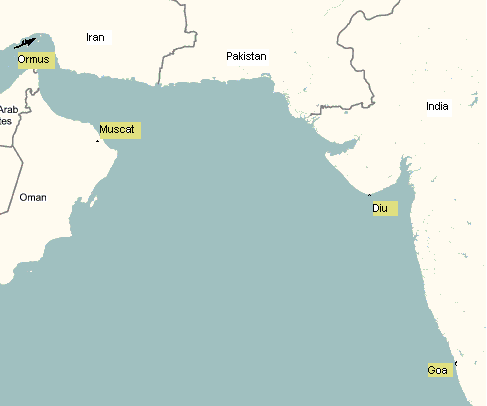
The Battle of Diu sometimes referred as the Second Battle of Chaul was a naval battle
fought on 3 February 1509 in the Arabian Sea
, near the port of Diu, India
, between the Portuguese Empire
and a joint fleet of the Sultan of Gujarat
, the Mamlûk Burji Sultanate of Egypt
, the Zamorin
of Kozhikode
with support of Ottomans
, the Republic of Venice
and the Republic of Ragusa
(Dubrovnik).
The Portuguese victory was critical: Mamluks and Arabs retreated, easing the Portuguese strategy of controlling the Indian Ocean
to route trade down the Cape of Good Hope
, circumventing the traditional spice route
controlled by the Arab
s and the Venetians
through the Red Sea and Persian Gulf. After the battle, Portugal rapidly captured key ports in the Indian Ocean like Goa
, Ceylon
, Malacca and Ormuz
, crippling the Mamluk Sultanate
of Egypt
and the Gujarat Sultanate
, greatly assisting the growth of the Portuguese Empire
and setting its trade dominance for almost a century, until it was taken during the Dutch-Portuguese War
s and the Battle of Swally
won by the British East India Company
in 1612. It marks the beginning of the European colonialism in Asia
. It also marks the spillover of the Christian
-Islamic power struggle, in and around the Mediterranean Sea
and the Middle East
, into the Indian Ocean which was the most important region for international trade at the time.
 Since Vasco da Gama
arrived in 1498, the Portuguese
had been fighting Calicut
while allying with its rival Kingdom of Cochin
, where they established their headquarters. The northern region of Gujarat, mainly Khambhat
, was even more important: the Gujarat Sultanate
was an essential intermediary in east–west trade, between the Red Sea
, Egypt
and Malacca
: Gujarati were important middlemen bringing spices from the Moluccas as well as silk from China
, and then selling them to the Egyptians and Arabs.
In 1505, the King of Portugal, Manuel I
, sent his first viceroy
, Dom Francisco de Almeida
with twenty one vessels to strengthen the fledgling Portuguese empire in East Africa and India. When Portugal threatened his field, Sultan Mahmud Begada
of Gujarat allied with the Samoothiri Raja (anglicised to Zamorin) of Kozhikode. He then asked his trade partners, the Mamluk Sultanate
, for help.
In 1507, Portuguese forces under command of Afonso de Albuquerque
had conquered Socotra
in the mouth of the Red Sea
and, for a short time, Ormuz in the Persian Gulf
. Portuguese intervention
was seriously disrupting trade in the Indian Ocean
, threatening Muslim as well as Venetian interests
, as the Portuguese became able to undersell the Venetians in the spice trade in Europe. The Mamluks and their European trade partners, the Venetians, had become wealthy from monopolizing the flow of spices from India
to Europe
. Venice
broke diplomatic relations with Portugal and started to look at ways to counter its intervention in the Indian Ocean, sending an ambassador to the Egyptian court. Venice negotiated for Egyptian tariffs to be lowered to facilitate competition with the Portuguese, and suggested that "rapid and secret remedies" be taken against the Portuguese. The sovereign of Calicut
, the Zamorin, had also sent an ambassador asking for help against the Portuguese.
Egyptian Mamluks soldiers had little expertise in naval warfare, and Portuguese often attacked and stole supplies of Malabar timber from India, so Mamluk
Sultan, Al-Ashraf Qansuh al-Ghawri
appealed to Ottoman
support. The Ottoman Sultan, Beyazid II - whose navy had helped Spanish Moors and Sephardic Jews expelled by the Spanish Inquisition
in 1492- supplied Egypt with Mediterranean-type war galleys manned by Greek sailors and Ottoman volunteers, mainly Turkish mercenaries and freebooter
s. These vessels, which Venetian shipwrights helped disassemble in Alexandria
and reassemble on the Red Sea coast, had to brave the Indian Ocean. The galley warriors could mount light guns fore and aft, but not along the gunwales because these cannon would interfere with the rowers. The native ships (dhows), with their sewn wood planks, could carry no heavy guns at all. Hence, most of the coalition's artillery was archers, whom the Portuguese could easily outshoot.
The Egyptian-Ottoman fleet, whom the Portuguese called under the generic term the "rumes
", was sent for India
to support Gujarat in 1507. First they fortified Jeddah
against a possible Portuguese attack, it then passed through Aden
at the tip of the Red Sea
, where they received support from the Tahirid Sultan, and then, in 1508, crossed the Indian Ocean
to the port of Diu, a city of at the mouth of the Gulf of Khambhat
.
In March 1508, commanded by Mamluk admiral Mirocem (Amir Husain Al-Kurdi) or Admiral (Husain Al-Kurdi), the Egyptian Mamluk fleets arrived at Chaul
in India were they surprised a Portuguese fleet commanded by Lourenço de Almeida
, son of the Portuguese viceroy. Joined by Gujarat admiral Malik Ayyaz
, governor of Diu, they fought over three days and won the Battle of Chaul. The Egyptian fleet isolated Lourenço de Almeida's ship, but let the others escape, taking nine captives back to Diu. The Mirat Sikandari, a Persian
account of the Kingdom of Gujarat details this battle as a minor skirmish.
Having taken the prisoners they headed to Diu. Enraged at the death of his son, the Portuguese viceroy Francisco de Almeida
sought revenge.
would require the breaking of this strongly defended and lucrative trade network. In addition to enforcing Portuguese rule, the battle was undertaken as a personal issue by Portuguese viceroy Francisco de Almeida
to avenge the death of his son
at the hands of the Mirocem (Amir Husain Al-Kurdi). He was so enraged at this death that he is supposed to have said, "He who ate the chick must also eat the rooster, or pay for it". Francisco de Almeida had rushed to chase the Egyptian fleet because Afonso de Albuquerque
arrived on December 6, 1508 with orders from the King of Portugal to replace him as the next viceroy. His plan was such a personal issue that he threw Afonso de Albuquerque
in jail after being informed of the King's orders, then advancing to the battle.
Aware of the danger facing his city, Malik Ayyaz prepared his defense and wrote to appease the viceroy, stating that he had the prisoners and how bravely his son had fought, adding a letter from the Portuguese prisoners stating that they were well treated. The viceroy answered Malki Ayyaz (referred to as Meliqueaz in Portuguese) with a respectful but menacing letter, stating his intention of revenge, that they better join all forces and prepare to fight or he would destroy Diu:
In a double bind—Malik Ayyaz fearing the destruction of his city, and Mirocem beset in it—they faced the Portuguese forces.
decided to take advantage of the port of Diu and its fort, which had its own artillery. It was therefore decided to stay anchored at the port and await an attack from the Portuguese. This may also have been due to the training of the Egyptians
, who were used to the more sheltered bays in the Mediterranean. There they also relied upon land-based artillery
reinforcements to defeat the enemy. The Portuguese started the battle with a massive naval bombardment using their on board artillery, followed by hand-to-hand combat in the harbour of Diu.
These Portuguese ships had guns of greater caliber, better artillery
crews, and were better manned and better built. The Portuguese naval infantry also had an advantage over the Egyptians
, not only because they were heavily armed and equipped (armour, arquebus
es and a type of grenade made of clay with gunpowder inside), but also because they were seasoned professional seamen.
The tough state-of-the art multi-rigged Portuguese carrack
s and smaller fast caravels had been developed over the previous decades to cope with the storms of the Atlantic Ocean
and were bristling with cannons. The smaller Indian Ocean dhow
s and Mediterranean-type galleys launched by the coalition of the Samoothiri Raja, Gujarat and Egypt
were no match. The Portuguese ships were able to shoot their powerful cannons and thus dissuade the smaller craft from coming near them. Even when they did come near, the smaller galleys and dhows were low in the water, and so unable to board the Portuguese ships, while being sprayed from above with small arms, grenades and smaller caliber cannon.
 The battle ended in victory for the Portuguese, with terrible losses on the Gujarat-Mamluk-Khozikode side, who fought bravely but were at a loss as to how to counter a naval force, the like of which they had never seen before. After the battle, Malik Ayyaz handed over the prisoners of Chaul
, dressed and well fed. To his surprise, Francisco de Almeida, who was ending his term as viceroy, refused his offer to allow a Portuguese fortress be established in Diu, an offer that the Portuguese soon sought ardently, and which he manage to stall for as long as he was governor of Diu.
The spoils of the battle included three royal flags of the Mamlûk Sultan of Cairo that were sent to Portugal and are even today displayed in the Convento de Cristo, in the town of Tomar
, spiritual home of the Knights Templar
. The Viceroy extracted a payment of 300,000 gold xerafins, but rejected the offer of the city of Diu which he thought would be expensive to maintain, although he left a garrison there. The Portuguese prisoners from the Battle of Chaul were also rescued. The treatment of the Egyptian captives by the Portuguese was brutal. The Viceroy ordered most of them to be hanged, burned alive or torn to pieces by tying them to the mouths of the cannons, in retaliation for his son's death. Commenting on the battle after winning it, de Almeida said: "As long as you may be powerful at sea, you will hold India as yours; and if you do not possess this power, little will avail you a fortress on the shore." Interestingly, after handing over the Viceroy's post to his successor, Dom Afonso de Albuquerque
, de Almeida left for Portugal
in November, 1509, and in December, 1509 was himself killed by the Khoikhoi
tribe, near the Cape of Good Hope
, Africa.
This battle did not end the Portuguese-Ottoman rivalry. A second naval battle occurred 30 years later in the Siege of Diu in 1538
when the Turks laid siege with 54 ships to the fortress which was built by the Portuguese in 1535, but then after suffering terrible defeats they lifted the siege. Suleiman I the Magnificent sent his admiral Hussein Pasha for another siege of the fortress at Diu in 1547 which, upon failing, marked the end of Ottoman attempts to expand their influence in the Indian Ocean.
Naval battle
A naval battle is a battle fought using boats, ships or other waterborne vessels. Most naval battles have occurred at sea, but a few have taken place on lakes or rivers. The earliest recorded naval battle took place in 1210 BC near Cyprus...
fought on 3 February 1509 in the Arabian Sea
Arabian Sea
The Arabian Sea is a region of the Indian Ocean bounded on the east by India, on the north by Pakistan and Iran, on the west by the Arabian Peninsula, on the south, approximately, by a line between Cape Guardafui in northeastern Somalia and Kanyakumari in India...
, near the port of Diu, India
India
India , officially the Republic of India , is a country in South Asia. It is the seventh-largest country by geographical area, the second-most populous country with over 1.2 billion people, and the most populous democracy in the world...
, between the Portuguese Empire
Portuguese Empire
The Portuguese Empire , also known as the Portuguese Overseas Empire or the Portuguese Colonial Empire , was the first global empire in history...
and a joint fleet of the Sultan of Gujarat
Mahmud Begada
Sultan Abu'l Fath Nasir-ud-Din Mahmud Shah I, popularly known as Mahmud Begada was the most prominent sultan of Gujarat. He was the great-grandson of Ahmad Shah I, the founder of the Muzaffarid dynasty, and of the city of Ahmedabad in the present-day state of Gujarat, India. He was known to be...
, the Mamlûk Burji Sultanate of Egypt
Burji dynasty
The Burji dynasty المماليك البرجية ruled Egypt from 1382 until 1517. It proved especially turbulent, with short-lived sultans. Political power-plays often became important in designating a new sultan. During this time Mamluks fought Timur Lenk and conquered Cyprus. Constant bickering may have...
, the Zamorin
Saamoothiri
Zamorin is the title used by the Hindu Eradi Samanthan kshatriya rulers of the erstwhile late medieval feudal kingdom of Kozhikode located in the present day state of Kerala, India....
of Kozhikode
Kozhikode
Kozhikode During Classical antiquity and the Middle Ages, Kozhikkode was dubbed the "City of Spices" for its role as the major trading point of eastern spices. Kozhikode was once the capital of an independent kingdom of the same name and later of the erstwhile Malabar District...
with support of Ottomans
Ottoman Empire
The Ottoman EmpireIt was usually referred to as the "Ottoman Empire", the "Turkish Empire", the "Ottoman Caliphate" or more commonly "Turkey" by its contemporaries...
, the Republic of Venice
Republic of Venice
The Republic of Venice or Venetian Republic was a state originating from the city of Venice in Northeastern Italy. It existed for over a millennium, from the late 7th century until 1797. It was formally known as the Most Serene Republic of Venice and is often referred to as La Serenissima, in...
and the Republic of Ragusa
Republic of Ragusa
The Republic of Ragusa or Republic of Dubrovnik was a maritime republic centered on the city of Dubrovnik in Dalmatia , that existed from 1358 to 1808...
(Dubrovnik).
The Portuguese victory was critical: Mamluks and Arabs retreated, easing the Portuguese strategy of controlling the Indian Ocean
Indian Ocean
The Indian Ocean is the third largest of the world's oceanic divisions, covering approximately 20% of the water on the Earth's surface. It is bounded on the north by the Indian Subcontinent and Arabian Peninsula ; on the west by eastern Africa; on the east by Indochina, the Sunda Islands, and...
to route trade down the Cape of Good Hope
Cape of Good Hope
The Cape of Good Hope is a rocky headland on the Atlantic coast of the Cape Peninsula, South Africa.There is a misconception that the Cape of Good Hope is the southern tip of Africa, because it was once believed to be the dividing point between the Atlantic and Indian Oceans. In fact, the...
, circumventing the traditional spice route
Spice trade
Civilizations of Asia were involved in spice trade from the ancient times, and the Greco-Roman world soon followed by trading along the Incense route and the Roman-India routes...
controlled by the Arab
Arab
Arab people, also known as Arabs , are a panethnicity primarily living in the Arab world, which is located in Western Asia and North Africa. They are identified as such on one or more of genealogical, linguistic, or cultural grounds, with tribal affiliations, and intra-tribal relationships playing...
s and the Venetians
Republic of Venice
The Republic of Venice or Venetian Republic was a state originating from the city of Venice in Northeastern Italy. It existed for over a millennium, from the late 7th century until 1797. It was formally known as the Most Serene Republic of Venice and is often referred to as La Serenissima, in...
through the Red Sea and Persian Gulf. After the battle, Portugal rapidly captured key ports in the Indian Ocean like Goa
Goa
Goa , a former Portuguese colony, is India's smallest state by area and the fourth smallest by population. Located in South West India in the region known as the Konkan, it is bounded by the state of Maharashtra to the north, and by Karnataka to the east and south, while the Arabian Sea forms its...
, Ceylon
Sri Lanka
Sri Lanka, officially the Democratic Socialist Republic of Sri Lanka is a country off the southern coast of the Indian subcontinent. Known until 1972 as Ceylon , Sri Lanka is an island surrounded by the Indian Ocean, the Gulf of Mannar and the Palk Strait, and lies in the vicinity of India and the...
, Malacca and Ormuz
Ormus
The Kingdom of Ormus was a 10th to 17th century kingdom located within the Persian Gulf and extending as far as the Strait of Hormuz...
, crippling the Mamluk Sultanate
Mamluk Sultanate (Cairo)
The Mamluk Sultanate of Egypt was the final independent Egyptian state prior to the establishment of the Muhammad Ali Dynasty in 1805. It lasted from the overthrow of the Ayyubid Dynasty until the Ottoman conquest of Egypt in 1517. The sultanate's ruling caste was composed of Mamluks, Arabised...
of Egypt
Egypt
Egypt , officially the Arab Republic of Egypt, Arabic: , is a country mainly in North Africa, with the Sinai Peninsula forming a land bridge in Southwest Asia. Egypt is thus a transcontinental country, and a major power in Africa, the Mediterranean Basin, the Middle East and the Muslim world...
and the Gujarat Sultanate
Gujarat Sultanate
The Gujarat Sultanate was an independent kingdom established in the early 15th century in Gujarat. The founder of the ruling Muzaffarid dynasty, Zafar Khan was appointed as governor of Gujarat by Nasir-ud-Din Muhammad bin Tughluq IV in 1391, the ruler of the principal state in north India at the...
, greatly assisting the growth of the Portuguese Empire
Portuguese Empire
The Portuguese Empire , also known as the Portuguese Overseas Empire or the Portuguese Colonial Empire , was the first global empire in history...
and setting its trade dominance for almost a century, until it was taken during the Dutch-Portuguese War
Dutch-Portuguese War
The Dutch–Portuguese War was an armed conflict involving Dutch forces, in the form of the Dutch East India Company and the Dutch West India Company, against the Portuguese Empire. Beginning in 1602, the conflict primarily involved the Dutch companies invading Portuguese colonies in the Americas,...
s and the Battle of Swally
Battle of Swally
The naval Battle of Swally took place on 29–30 November 1612 off the coast of Suvali , a village near the city of Surat, Gujarat, India, and was a victory for four English East India Company galleons over four Portuguese naus and 26 barks .-Importance:This relatively small naval battle is...
won by the British East India Company
British East India Company
The East India Company was an early English joint-stock company that was formed initially for pursuing trade with the East Indies, but that ended up trading mainly with the Indian subcontinent and China...
in 1612. It marks the beginning of the European colonialism in Asia
Asia
Asia is the world's largest and most populous continent, located primarily in the eastern and northern hemispheres. It covers 8.7% of the Earth's total surface area and with approximately 3.879 billion people, it hosts 60% of the world's current human population...
. It also marks the spillover of the Christian
Christian
A Christian is a person who adheres to Christianity, an Abrahamic, monotheistic religion based on the life and teachings of Jesus of Nazareth as recorded in the Canonical gospels and the letters of the New Testament...
-Islamic power struggle, in and around the Mediterranean Sea
Mediterranean Sea
The Mediterranean Sea is a sea connected to the Atlantic Ocean surrounded by the Mediterranean region and almost completely enclosed by land: on the north by Anatolia and Europe, on the south by North Africa, and on the east by the Levant...
and the Middle East
Middle East
The Middle East is a region that encompasses Western Asia and Northern Africa. It is often used as a synonym for Near East, in opposition to Far East...
, into the Indian Ocean which was the most important region for international trade at the time.
Background
Vasco da Gama
Vasco da Gama, 1st Count of Vidigueira was a Portuguese explorer, one of the most successful in the Age of Discovery and the commander of the first ships to sail directly from Europe to India...
arrived in 1498, the Portuguese
Portuguese people
The Portuguese are a nation and ethnic group native to the country of Portugal, in the west of the Iberian peninsula of south-west Europe. Their language is Portuguese, and Roman Catholicism is the predominant religion....
had been fighting Calicut
History of Kozhikode
Kozhikode , also known as Calicut, is a city in the southern Indian state of Kerala. It is the third largest city in Kerala and the headquarters of Kozhikode district....
while allying with its rival Kingdom of Cochin
Kingdom of Cochin
Kingdom of Cochin was a late medieval Hindu kingdom and later Princely State on the Malabar Coast, South India...
, where they established their headquarters. The northern region of Gujarat, mainly Khambhat
Khambhat
Khambhat , formerly known as Cambay, is a city and a municipality in Anand district in the Indian state of Gujarat. It was formerly an important trading center, although its harbour has gradually silted up, and the maritime trade has moved elsewhere...
, was even more important: the Gujarat Sultanate
Gujarat Sultanate
The Gujarat Sultanate was an independent kingdom established in the early 15th century in Gujarat. The founder of the ruling Muzaffarid dynasty, Zafar Khan was appointed as governor of Gujarat by Nasir-ud-Din Muhammad bin Tughluq IV in 1391, the ruler of the principal state in north India at the...
was an essential intermediary in east–west trade, between the Red Sea
Red Sea
The Red Sea is a seawater inlet of the Indian Ocean, lying between Africa and Asia. The connection to the ocean is in the south through the Bab el Mandeb strait and the Gulf of Aden. In the north, there is the Sinai Peninsula, the Gulf of Aqaba, and the Gulf of Suez...
, Egypt
Egypt
Egypt , officially the Arab Republic of Egypt, Arabic: , is a country mainly in North Africa, with the Sinai Peninsula forming a land bridge in Southwest Asia. Egypt is thus a transcontinental country, and a major power in Africa, the Mediterranean Basin, the Middle East and the Muslim world...
and Malacca
Malacca
Malacca , dubbed The Historic State or Negeri Bersejarah among locals) is the third smallest Malaysian state, after Perlis and Penang. It is located in the southern region of the Malay Peninsula, on the Straits of Malacca. It borders Negeri Sembilan to the north and the state of Johor to the south...
: Gujarati were important middlemen bringing spices from the Moluccas as well as silk from China
China
Chinese civilization may refer to:* China for more general discussion of the country.* Chinese culture* Greater China, the transnational community of ethnic Chinese.* History of China* Sinosphere, the area historically affected by Chinese culture...
, and then selling them to the Egyptians and Arabs.
In 1505, the King of Portugal, Manuel I
Manuel I of Portugal
Manuel I , the Fortunate , 14th king of Portugal and the Algarves was the son of Infante Ferdinand, Duke of Viseu, , by his wife, Infanta Beatrice of Portugal...
, sent his first viceroy
Viceroy
A viceroy is a royal official who runs a country, colony, or province in the name of and as representative of the monarch. The term derives from the Latin prefix vice-, meaning "in the place of" and the French word roi, meaning king. A viceroy's province or larger territory is called a viceroyalty...
, Dom Francisco de Almeida
Francisco de Almeida
Dom Francisco de Almeida , also known as "the Great Dom Francisco" , was a Portuguese nobleman, soldier and explorer. He distinguished himself as a counsellor to King John II of Portugal and later in the wars against the Moors and in the conquest of Granada in 1492...
with twenty one vessels to strengthen the fledgling Portuguese empire in East Africa and India. When Portugal threatened his field, Sultan Mahmud Begada
Mahmud Begada
Sultan Abu'l Fath Nasir-ud-Din Mahmud Shah I, popularly known as Mahmud Begada was the most prominent sultan of Gujarat. He was the great-grandson of Ahmad Shah I, the founder of the Muzaffarid dynasty, and of the city of Ahmedabad in the present-day state of Gujarat, India. He was known to be...
of Gujarat allied with the Samoothiri Raja (anglicised to Zamorin) of Kozhikode. He then asked his trade partners, the Mamluk Sultanate
Mamluk Sultanate (Cairo)
The Mamluk Sultanate of Egypt was the final independent Egyptian state prior to the establishment of the Muhammad Ali Dynasty in 1805. It lasted from the overthrow of the Ayyubid Dynasty until the Ottoman conquest of Egypt in 1517. The sultanate's ruling caste was composed of Mamluks, Arabised...
, for help.
In 1507, Portuguese forces under command of Afonso de Albuquerque
Afonso de Albuquerque
Afonso de Albuquerque[p][n] was a Portuguese fidalgo, or nobleman, an admiral whose military and administrative activities as second governor of Portuguese India conquered and established the Portuguese colonial empire in the Indian Ocean...
had conquered Socotra
Socotra
Socotra , also spelt Soqotra, is a small archipelago of four islands in the Indian Ocean. The largest island, also called Socotra, is about 95% of the landmass of the archipelago. It lies some east of the Horn of Africa and south of the Arabian Peninsula. The island is very isolated and through...
in the mouth of the Red Sea
Red Sea
The Red Sea is a seawater inlet of the Indian Ocean, lying between Africa and Asia. The connection to the ocean is in the south through the Bab el Mandeb strait and the Gulf of Aden. In the north, there is the Sinai Peninsula, the Gulf of Aqaba, and the Gulf of Suez...
and, for a short time, Ormuz in the Persian Gulf
Persian Gulf
The Persian Gulf, in Southwest Asia, is an extension of the Indian Ocean located between Iran and the Arabian Peninsula.The Persian Gulf was the focus of the 1980–1988 Iran-Iraq War, in which each side attacked the other's oil tankers...
. Portuguese intervention
Portuguese discoveries
Portuguese discoveries is the name given to the intensive maritime exploration by the Portuguese during the 15th and 16th centuries. Portuguese sailors were at the vanguard of European overseas exploration, discovering and mapping the coasts of Africa, Asia and Brazil, in what become known as the...
was seriously disrupting trade in the Indian Ocean
Indian Ocean trade
Indian Ocean trade has gained an important role in history, and has been a key factor in East-West exchanges.-Roman period:Since antiquity, Indian Ocean trade had a significant role and led to the development of Roman trade with India....
, threatening Muslim as well as Venetian interests
History of Venice
Venice is a city in Italy. It was also an independent republic from the late 8th century to 1792.*For the history of the city, see History of the city of Venice.*For the Republic, see History of the Republic of Venice....
, as the Portuguese became able to undersell the Venetians in the spice trade in Europe. The Mamluks and their European trade partners, the Venetians, had become wealthy from monopolizing the flow of spices from India
India
India , officially the Republic of India , is a country in South Asia. It is the seventh-largest country by geographical area, the second-most populous country with over 1.2 billion people, and the most populous democracy in the world...
to Europe
Europe
Europe is, by convention, one of the world's seven continents. Comprising the westernmost peninsula of Eurasia, Europe is generally 'divided' from Asia to its east by the watershed divides of the Ural and Caucasus Mountains, the Ural River, the Caspian and Black Seas, and the waterways connecting...
. Venice
Venice
Venice is a city in northern Italy which is renowned for the beauty of its setting, its architecture and its artworks. It is the capital of the Veneto region...
broke diplomatic relations with Portugal and started to look at ways to counter its intervention in the Indian Ocean, sending an ambassador to the Egyptian court. Venice negotiated for Egyptian tariffs to be lowered to facilitate competition with the Portuguese, and suggested that "rapid and secret remedies" be taken against the Portuguese. The sovereign of Calicut
History of Kozhikode
Kozhikode , also known as Calicut, is a city in the southern Indian state of Kerala. It is the third largest city in Kerala and the headquarters of Kozhikode district....
, the Zamorin, had also sent an ambassador asking for help against the Portuguese.
Egyptian Mamluks soldiers had little expertise in naval warfare, and Portuguese often attacked and stole supplies of Malabar timber from India, so Mamluk
Mamluk
A Mamluk was a soldier of slave origin, who were predominantly Cumans/Kipchaks The "mamluk phenomenon", as David Ayalon dubbed the creation of the specific warrior...
Sultan, Al-Ashraf Qansuh al-Ghawri
Al-Ashraf Qansuh al-Ghawri
Al-Ashraf Qansuh al-Ghawri was the second last of the Mamluk Sultans. One of the last of the Burji dynasty, he reigned from 1501 to 1516.On the disappearance of Sultan Al-Adil Sayf ad-Din Tuman bay I, it was not till after some days that the choice of the Emirs and Mamluks fell upon Al-Ashraf...
appealed to Ottoman
Ottoman Empire
The Ottoman EmpireIt was usually referred to as the "Ottoman Empire", the "Turkish Empire", the "Ottoman Caliphate" or more commonly "Turkey" by its contemporaries...
support. The Ottoman Sultan, Beyazid II - whose navy had helped Spanish Moors and Sephardic Jews expelled by the Spanish Inquisition
Spanish Inquisition
The Tribunal of the Holy Office of the Inquisition , commonly known as the Spanish Inquisition , was a tribunal established in 1480 by Catholic Monarchs Ferdinand II of Aragon and Isabella I of Castile. It was intended to maintain Catholic orthodoxy in their kingdoms, and to replace the Medieval...
in 1492- supplied Egypt with Mediterranean-type war galleys manned by Greek sailors and Ottoman volunteers, mainly Turkish mercenaries and freebooter
Freebooter
Freebooter may refer to:* Marine freebooters, or pirates.* Filibuster , a group of individuals who engage in unauthorized warfare against foreign countries.* Rapparee, the Irish usage.* Meadowbrook Freebooters, American polo team...
s. These vessels, which Venetian shipwrights helped disassemble in Alexandria
Alexandria
Alexandria is the second-largest city of Egypt, with a population of 4.1 million, extending about along the coast of the Mediterranean Sea in the north central part of the country; it is also the largest city lying directly on the Mediterranean coast. It is Egypt's largest seaport, serving...
and reassemble on the Red Sea coast, had to brave the Indian Ocean. The galley warriors could mount light guns fore and aft, but not along the gunwales because these cannon would interfere with the rowers. The native ships (dhows), with their sewn wood planks, could carry no heavy guns at all. Hence, most of the coalition's artillery was archers, whom the Portuguese could easily outshoot.
The Egyptian-Ottoman fleet, whom the Portuguese called under the generic term the "rumes
Rûm
Rûm, also Roum or Rhum , an indefinite term used at different times in the Muslim world to refer to the Balkans and Anatolia generally, and for the Byzantine Empire in particular, for the Seljuk Sultanate of Rûm in Asia Minor, and referring to Greeks living outside of Greece or non-muslims...
", was sent for India
India
India , officially the Republic of India , is a country in South Asia. It is the seventh-largest country by geographical area, the second-most populous country with over 1.2 billion people, and the most populous democracy in the world...
to support Gujarat in 1507. First they fortified Jeddah
Jeddah
Jeddah, Jiddah, Jidda, or Jedda is a city located on the coast of the Red Sea and is the major urban center of western Saudi Arabia. It is the largest city in Makkah Province, the largest sea port on the Red Sea, and the second largest city in Saudi Arabia after the capital city, Riyadh. The...
against a possible Portuguese attack, it then passed through Aden
Aden
Aden is a seaport city in Yemen, located by the eastern approach to the Red Sea , some 170 kilometres east of Bab-el-Mandeb. Its population is approximately 800,000. Aden's ancient, natural harbour lies in the crater of an extinct volcano which now forms a peninsula, joined to the mainland by a...
at the tip of the Red Sea
Red Sea
The Red Sea is a seawater inlet of the Indian Ocean, lying between Africa and Asia. The connection to the ocean is in the south through the Bab el Mandeb strait and the Gulf of Aden. In the north, there is the Sinai Peninsula, the Gulf of Aqaba, and the Gulf of Suez...
, where they received support from the Tahirid Sultan, and then, in 1508, crossed the Indian Ocean
Indian Ocean
The Indian Ocean is the third largest of the world's oceanic divisions, covering approximately 20% of the water on the Earth's surface. It is bounded on the north by the Indian Subcontinent and Arabian Peninsula ; on the west by eastern Africa; on the east by Indochina, the Sunda Islands, and...
to the port of Diu, a city of at the mouth of the Gulf of Khambhat
Gulf of Khambhat
The Gulf of Khambhat is an inlet of the Arabian Sea along the west coast of India, in the state of Gujarat. It is about 80 miles in length, and divides the Kathiawar peninsula to the west from the eastern part of Gujarat state on the east. The Narmada and Tapti rivers empty into the Gulf...
.
In March 1508, commanded by Mamluk admiral Mirocem (Amir Husain Al-Kurdi) or Admiral (Husain Al-Kurdi), the Egyptian Mamluk fleets arrived at Chaul
Chaul
Chaul is a former city of Portuguese India, now in ruins. It is located 60 km south of Mumbai, in Raigad District of Maharashtra state in western India....
in India were they surprised a Portuguese fleet commanded by Lourenço de Almeida
Lourenço de Almeida
Lourenço de Almeida , son of Francisco de Almeida, acting under him, distinguished himself in the Indian Ocean, and made Ceylon tributary to Portugal...
, son of the Portuguese viceroy. Joined by Gujarat admiral Malik Ayyaz
Malik Ayyaz
Malik Ayyaz, called Meliqueaz by the Portuguese was a naval officer and governor of the city of Diu, in the mouth of the Gulf of Khambhat , circa 1507-1509 under the rule of Gujarat Sultanate. He was one of the most distinguished warriors of his time .Meliqueaz was a mamluk of Russian Christian...
, governor of Diu, they fought over three days and won the Battle of Chaul. The Egyptian fleet isolated Lourenço de Almeida's ship, but let the others escape, taking nine captives back to Diu. The Mirat Sikandari, a Persian
Persian literature
Persian literature spans two-and-a-half millennia, though much of the pre-Islamic material has been lost. Its sources have been within historical Persia including present-day Iran as well as regions of Central Asia where the Persian language has historically been the national language...
account of the Kingdom of Gujarat details this battle as a minor skirmish.
Having taken the prisoners they headed to Diu. Enraged at the death of his son, the Portuguese viceroy Francisco de Almeida
Francisco de Almeida
Dom Francisco de Almeida , also known as "the Great Dom Francisco" , was a Portuguese nobleman, soldier and explorer. He distinguished himself as a counsellor to King John II of Portugal and later in the wars against the Moors and in the conquest of Granada in 1492...
sought revenge.
Precursor to the battle
Diu was a critical outpost in the overall spice trade from India. The Portuguese attempt to establish trade with IndiaIndia
India , officially the Republic of India , is a country in South Asia. It is the seventh-largest country by geographical area, the second-most populous country with over 1.2 billion people, and the most populous democracy in the world...
would require the breaking of this strongly defended and lucrative trade network. In addition to enforcing Portuguese rule, the battle was undertaken as a personal issue by Portuguese viceroy Francisco de Almeida
Francisco de Almeida
Dom Francisco de Almeida , also known as "the Great Dom Francisco" , was a Portuguese nobleman, soldier and explorer. He distinguished himself as a counsellor to King John II of Portugal and later in the wars against the Moors and in the conquest of Granada in 1492...
to avenge the death of his son
Lourenço de Almeida
Lourenço de Almeida , son of Francisco de Almeida, acting under him, distinguished himself in the Indian Ocean, and made Ceylon tributary to Portugal...
at the hands of the Mirocem (Amir Husain Al-Kurdi). He was so enraged at this death that he is supposed to have said, "He who ate the chick must also eat the rooster, or pay for it". Francisco de Almeida had rushed to chase the Egyptian fleet because Afonso de Albuquerque
Afonso de Albuquerque
Afonso de Albuquerque[p][n] was a Portuguese fidalgo, or nobleman, an admiral whose military and administrative activities as second governor of Portuguese India conquered and established the Portuguese colonial empire in the Indian Ocean...
arrived on December 6, 1508 with orders from the King of Portugal to replace him as the next viceroy. His plan was such a personal issue that he threw Afonso de Albuquerque
Afonso de Albuquerque
Afonso de Albuquerque[p][n] was a Portuguese fidalgo, or nobleman, an admiral whose military and administrative activities as second governor of Portuguese India conquered and established the Portuguese colonial empire in the Indian Ocean...
in jail after being informed of the King's orders, then advancing to the battle.
Aware of the danger facing his city, Malik Ayyaz prepared his defense and wrote to appease the viceroy, stating that he had the prisoners and how bravely his son had fought, adding a letter from the Portuguese prisoners stating that they were well treated. The viceroy answered Malki Ayyaz (referred to as Meliqueaz in Portuguese) with a respectful but menacing letter, stating his intention of revenge, that they better join all forces and prepare to fight or he would destroy Diu:
In a double bind—Malik Ayyaz fearing the destruction of his city, and Mirocem beset in it—they faced the Portuguese forces.
Battle
The Portuguese had eighteen ships commanded by the Viceroy, with about 1,500 Portuguese soldiers and 400 local combatants from Cochin. The Allied side had one hundred ships, but only twelve were major vessels; the rest were small shallow-draught craft. After detecting the Portuguese, who approached from Cochin to the north, and fearing their technical superiority, the EgyptiansEgyptians
Egyptians are nation an ethnic group made up of Mediterranean North Africans, the indigenous people of Egypt.Egyptian identity is closely tied to geography. The population of Egypt is concentrated in the lower Nile Valley, the small strip of cultivable land stretching from the First Cataract to...
decided to take advantage of the port of Diu and its fort, which had its own artillery. It was therefore decided to stay anchored at the port and await an attack from the Portuguese. This may also have been due to the training of the Egyptians
Egyptians
Egyptians are nation an ethnic group made up of Mediterranean North Africans, the indigenous people of Egypt.Egyptian identity is closely tied to geography. The population of Egypt is concentrated in the lower Nile Valley, the small strip of cultivable land stretching from the First Cataract to...
, who were used to the more sheltered bays in the Mediterranean. There they also relied upon land-based artillery
Artillery
Originally applied to any group of infantry primarily armed with projectile weapons, artillery has over time become limited in meaning to refer only to those engines of war that operate by projection of munitions far beyond the range of effect of personal weapons...
reinforcements to defeat the enemy. The Portuguese started the battle with a massive naval bombardment using their on board artillery, followed by hand-to-hand combat in the harbour of Diu.
These Portuguese ships had guns of greater caliber, better artillery
Artillery
Originally applied to any group of infantry primarily armed with projectile weapons, artillery has over time become limited in meaning to refer only to those engines of war that operate by projection of munitions far beyond the range of effect of personal weapons...
crews, and were better manned and better built. The Portuguese naval infantry also had an advantage over the Egyptians
Egyptians
Egyptians are nation an ethnic group made up of Mediterranean North Africans, the indigenous people of Egypt.Egyptian identity is closely tied to geography. The population of Egypt is concentrated in the lower Nile Valley, the small strip of cultivable land stretching from the First Cataract to...
, not only because they were heavily armed and equipped (armour, arquebus
Arquebus
The arquebus , or "hook tube", is an early muzzle-loaded firearm used in the 15th to 17th centuries. The word was originally modeled on the German hakenbüchse; this produced haquebute...
es and a type of grenade made of clay with gunpowder inside), but also because they were seasoned professional seamen.
The tough state-of-the art multi-rigged Portuguese carrack
Carrack
A carrack or nau was a three- or four-masted sailing ship developed in 15th century Western Europe for use in the Atlantic Ocean. It had a high rounded stern with large aftcastle, forecastle and bowsprit at the stem. It was first used by the Portuguese , and later by the Spanish, to explore and...
s and smaller fast caravels had been developed over the previous decades to cope with the storms of the Atlantic Ocean
Atlantic Ocean
The Atlantic Ocean is the second-largest of the world's oceanic divisions. With a total area of about , it covers approximately 20% of the Earth's surface and about 26% of its water surface area...
and were bristling with cannons. The smaller Indian Ocean dhow
Dhow
Dhow is the generic name of a number of traditional sailing vessels with one or more masts with lateen sails used in the Red Sea and Indian Ocean region. Some historians believe the dhow was invented by Arabs but this is disputed by some others. Dhows typically weigh 300 to 500 tons, and have a...
s and Mediterranean-type galleys launched by the coalition of the Samoothiri Raja, Gujarat and Egypt
Egypt
Egypt , officially the Arab Republic of Egypt, Arabic: , is a country mainly in North Africa, with the Sinai Peninsula forming a land bridge in Southwest Asia. Egypt is thus a transcontinental country, and a major power in Africa, the Mediterranean Basin, the Middle East and the Muslim world...
were no match. The Portuguese ships were able to shoot their powerful cannons and thus dissuade the smaller craft from coming near them. Even when they did come near, the smaller galleys and dhows were low in the water, and so unable to board the Portuguese ships, while being sprayed from above with small arms, grenades and smaller caliber cannon.
Aftermath
Chaul
Chaul is a former city of Portuguese India, now in ruins. It is located 60 km south of Mumbai, in Raigad District of Maharashtra state in western India....
, dressed and well fed. To his surprise, Francisco de Almeida, who was ending his term as viceroy, refused his offer to allow a Portuguese fortress be established in Diu, an offer that the Portuguese soon sought ardently, and which he manage to stall for as long as he was governor of Diu.
The spoils of the battle included three royal flags of the Mamlûk Sultan of Cairo that were sent to Portugal and are even today displayed in the Convento de Cristo, in the town of Tomar
Tomar
Tomar Municipality has a total area of 351.0 km² and a total population of 43,007 inhabitants.The municipality is composed of 16 parishes, and is located in Santarém District...
, spiritual home of the Knights Templar
Knights Templar
The Poor Fellow-Soldiers of Christ and of the Temple of Solomon , commonly known as the Knights Templar, the Order of the Temple or simply as Templars, were among the most famous of the Western Christian military orders...
. The Viceroy extracted a payment of 300,000 gold xerafins, but rejected the offer of the city of Diu which he thought would be expensive to maintain, although he left a garrison there. The Portuguese prisoners from the Battle of Chaul were also rescued. The treatment of the Egyptian captives by the Portuguese was brutal. The Viceroy ordered most of them to be hanged, burned alive or torn to pieces by tying them to the mouths of the cannons, in retaliation for his son's death. Commenting on the battle after winning it, de Almeida said: "As long as you may be powerful at sea, you will hold India as yours; and if you do not possess this power, little will avail you a fortress on the shore." Interestingly, after handing over the Viceroy's post to his successor, Dom Afonso de Albuquerque
Afonso de Albuquerque
Afonso de Albuquerque[p][n] was a Portuguese fidalgo, or nobleman, an admiral whose military and administrative activities as second governor of Portuguese India conquered and established the Portuguese colonial empire in the Indian Ocean...
, de Almeida left for Portugal
Portugal
Portugal , officially the Portuguese Republic is a country situated in southwestern Europe on the Iberian Peninsula. Portugal is the westernmost country of Europe, and is bordered by the Atlantic Ocean to the West and South and by Spain to the North and East. The Atlantic archipelagos of the...
in November, 1509, and in December, 1509 was himself killed by the Khoikhoi
Khoikhoi
The Khoikhoi or Khoi, in standardised Khoekhoe/Nama orthography spelled Khoekhoe, are a historical division of the Khoisan ethnic group, the native people of southwestern Africa, closely related to the Bushmen . They had lived in southern Africa since the 5th century AD...
tribe, near the Cape of Good Hope
Cape of Good Hope
The Cape of Good Hope is a rocky headland on the Atlantic coast of the Cape Peninsula, South Africa.There is a misconception that the Cape of Good Hope is the southern tip of Africa, because it was once believed to be the dividing point between the Atlantic and Indian Oceans. In fact, the...
, Africa.
This battle did not end the Portuguese-Ottoman rivalry. A second naval battle occurred 30 years later in the Siege of Diu in 1538
Siege of Diu
The Siege of Diu occurred when an Ottoman imperial fleet attempted to capture the Indian city of Diu in 1538, then held by the Portuguese.It ended with a Portuguese victory.-Background:...
when the Turks laid siege with 54 ships to the fortress which was built by the Portuguese in 1535, but then after suffering terrible defeats they lifted the siege. Suleiman I the Magnificent sent his admiral Hussein Pasha for another siege of the fortress at Diu in 1547 which, upon failing, marked the end of Ottoman attempts to expand their influence in the Indian Ocean.
Mamluk Egyptian-Ottoman-Gujarat Fleet
- About 250 ships, including 12 major ships (6 Turkish carracks and 6 Turkish galleys), 40 Gujarati galleys and over 80 dhowDhowDhow is the generic name of a number of traditional sailing vessels with one or more masts with lateen sails used in the Red Sea and Indian Ocean region. Some historians believe the dhow was invented by Arabs but this is disputed by some others. Dhows typically weigh 300 to 500 tons, and have a...
s of the Zamorin of Calicut
Portuguese ships
- Five large nausCarrackA carrack or nau was a three- or four-masted sailing ship developed in 15th century Western Europe for use in the Atlantic Ocean. It had a high rounded stern with large aftcastle, forecastle and bowsprit at the stem. It was first used by the Portuguese , and later by the Spanish, to explore and...
: Flor de la marFrol de la marFlor de la Mar or Flor do Mar was a Portuguese nau of 400 tons, which over nine years participated in decisive events in the Indian Ocean until her sinking in November 1511...
(Viceroy's flagship), Espírito Santo (captainCaptain (nautical)A sea captain is a licensed mariner in ultimate command of the vessel. The captain is responsible for its safe and efficient operation, including cargo operations, navigation, crew management and ensuring that the vessel complies with local and international laws, as well as company and flag...
Nuno Vaz Pereira), Belém (Jorge de Melo Pereira), Great King (Francisco de Távora), and Great Taforea (Fernão de MagalhãesFerdinand MagellanFerdinand Magellan was a Portuguese explorer. He was born in Sabrosa, in northern Portugal, and served King Charles I of Spain in search of a westward route to the "Spice Islands" ....
) - Four smaller naus: Small Taforea (Garcia de Sousa), Santo António (Martim Coelho), Small King (Manuel Teles Barreto) and Andorinho (Dom António de Noronha)
- Four caravelCaravelA caravel is a small, highly maneuverable sailing ship developed in the 15th century by the Portuguese to explore along the West African coast and into the Atlantic Ocean. The lateen sails gave her speed and the capacity for sailing to windward...
as redondas: (captains António do Campo, Pero Cão, Filipe Rodrigues and Rui Soares) - Two caravelas Latinas: (captains Álvaro Peçanha and Luís Preto)
- Two galleys: (captains Paio Rodrigues de Sousa and Diogo Pires de Miranda)
- One bergantimBrigantineIn sailing, a brigantine or hermaphrodite brig is a vessel with two masts, only the forward of which is square rigged.-Origins of the term:...
: (captain Simão Martins)
See also
- Battle of ColachelBattle of ColachelThe Battle of Colachel was fought on between forces of the Indian kingdom of Travancore and the Dutch East India Company, during the Travancore-Dutch War...
- Battle of SwallyBattle of SwallyThe naval Battle of Swally took place on 29–30 November 1612 off the coast of Suvali , a village near the city of Surat, Gujarat, India, and was a victory for four English East India Company galleons over four Portuguese naus and 26 barks .-Importance:This relatively small naval battle is...
- Portuguese IndiaPortuguese IndiaThe Portuguese Viceroyalty of India , later the Portuguese State of India , was the aggregate of Portugal's colonial holdings in India.The government started in 1505, six years after the discovery of a sea route to India by Vasco da Gama, with the nomination of the first Viceroy Francisco de...
- History of KeralaHistory of KeralaThe history of Kerala goes back more than several millennia. Stone age carving in Edakkal Caves had pictorial writings believed to be dating to at least 5000 BC, from the Neolithic man, indicating the presence of a prehistoric civilization or settlement in this region. From as early as 3000 BC,...