


Invasion of Goa

Encyclopedia
The 1961 Indian annexation of Goa (also referred to as Invasion of Goa, the Liberation of Goa and the Portuguese-Indian War), was an action by India
's armed forces that ended Portuguese
rule in its Indian enclaves
in 1961. The armed action, codenamed Operation Vijay by the Indian government, involved air, sea and land strikes for over 36 hours, and was a decisive victory for India, ending 451 years of Portuguese colonial rule in Goa
. Twenty two Indians and thirty Portuguese were killed in the fighting. The brief conflict drew a mixture of worldwide praise and condemnation. In India, the action was seen as a liberation of historically Indian territory, while Portugal viewed it as an aggression against national soil.
in 1947, Portugal
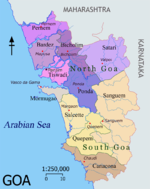
held a handful of enclaves on the Indian subcontinent - the districts of Goa
, Daman and Diu and Dadra and Nagar Haveli - collectively known as the Estado da Índia. Goa, Daman and Diu covered an area of around 1540 square miles (3,988.6 km²) and held a population of 637,591. The Goan diaspora
was estimated at 175,000 (about 100,000 within the Indian Union). Religious distribution was 61% Hindu, 36.7% Christian (mostly Catholic), 2.2% Muslim. Economy was primarily based on agriculture, although the 1940s and 1950s saw a boom in mining - principally iron ore and some manganese
.
In June 1946, Dr. Ram Manohar Lohia, an Indian Socialist leader, entered Goa on a visit to his friend, Dr. Juliao Menezes, a nationalist leader, who had founded in Bombay the Gomantak Praja Mandal and edited the weekly newspaper, Gomantak. Da Cunha and other leaders were also with him. Ram Manohar Lohia
advocated the use of non-violent Gandhian
techniques to oppose the government. On 18 June 1946, the Portuguese government disrupted a protest in Panjim against the suspension of civil liberties organised by Lohia, Da Cunha along with others like Purushottam Kakodkar and Laxmikant Bhembre in defiance of a ban on public gatherings and arrested them. There were intermittent mass demonstrations from June to November.
In addition to non-violent protests, armed groups such as the Azad Gomantak Dal (The Free Goa Party) and the United Front of Goans conducted violent attacks aimed at weakening Portuguese rule in Goa. The Indian government supported the establishment of armed groups like the Azad Gomantak Dal, giving them full financial, logistic and armament support. The armed groups acted from bases situated in Indian territory and under cover of Indian police forces. The Indian government - through these armed groups - attempted to destroy economic targets, telegraph and telephone lines, road, water and rail transport, in order to impede economic activity and create conditions for a general uprising of the population.
Commenting on the armed resistance, Portuguese army officer, Capt. Carlos Azaredo (now retired General) stationed with the army in Goa states in Portuguese newspaper O Expresso: "To the contrary to what is being said, the most evolved guerilla warfare which our Armed Forces encountered was in Goa. I know what I’m talking about, because I also fought in Angola and in Guiné. In 1961 alone, until December, around 80 policemen died. The major part of the terrorists of Azad Gomantak Dal were not Goans. Many had fought in the British Army, under General Montgomery, against the Germans."
 On 27 February 1950 the Government of the India asked the Portuguese government to open negotiations about the future of Portuguese colonies in India. Portugal asserted that its territory on the Indian subcontinent was not a colony but part of metropolitan Portugal and hence its transfer was non-negotiable; and that the India had no rights to this territory since the Republic of India did not exist at the time when Goa came under Portuguese rule. When the Portuguese Government refused to respond to subsequent aide-mémoires in this regard, the Indian government, on 11 June 1953, withdrew its diplomatic mission from Lisbon.
By 1954, the Republic of India instituted visa restrictions on travel from Goa to India which paralysed transportation between Goa and other enclaves like Daman, Diu, Dadra and Nagar Haveli. Meanwhile The Indian union of dockers had, in 1954, instituted a boycott on shipping to Portuguese India. Between 22 July and 2 August 1954, armed activists attacked and forced the surrender of Portuguese forces stationed in Dadra and Nagar Haveli.
On 15 August 1955, 3000-5000 unarmed Indian activists attempted to enter Goa at six locations and were violently repulsed by Portuguese police officers, resulting in the deaths of between 21 and 30 people. The news of the firing built public opinion in India against the presence of the Portuguese in Goa. On 1 September 1955, India shut its consul office in Goa.
In 1956, Portuguese ambassador to France, Marcello Mathias, along with Portuguese prime minister António de Oliveira Salazar, argued in favour of a referendum in Goa to determine its future. This proposal was however rejected by the ministers for defence and foreign affairs. The demand for a referendum was again made by presidential candidate General Humberto Delgado in 1957.
Portugal’s prime minister, Antonio de Oliveira Salazar
, alarmed by India’s hinted threats at armed action against its presence in Goa, first asked the United Kingdom to mediate, then protested through Brazil
and eventually asked the UN Security Council to intervene. Mexico offered the Indian government its influence in Latin America to bring pressure on the Portuguese to relieve tensions. Meanwhile, Krishna Menon
, India’s defence minister and head of India’s UN delegation, stated in no uncertain terms that India had not “abjured the use of force” in Goa, The U.S. ambassador to India, John Kenneth Galbraith
, requested the Indian government on several occasions to resolve the issue peacefully through mediation and consensus rather than armed conflict.
Eventually, on 10 December, nine days prior to the invasion, Nehru stated to the press that "Continuance of Goa under Portuguese rule is an impossibility". United States's response was to warn India that if and when India’s armed action in Goa was brought to the UN security council, it could expect no support from the U.S. delegation.
On 24 November 1961, the Sabarmati, a passenger boat passing between the Portuguese-held island of Anjidiv
and the Indian port of Kochi, was fired upon by Portuguese ground troops, resulting in injuries to the chief engineer
of the boat, as well as the death of a passenger. The action was precipitated by Portuguese fears that the boat carried a military landing party
intent on storming the island. The incidents lent themselves to foster widespread public support in India for military action in Goa.
commanded by Major General K.P. Candeth
. The assault on the enclave of Daman was assigned to the 1st Maratha Light Infantry while the operations in Diu were assigned to the 20th Rajput and 4th Madras battalions. Meanwhile, the Commander in Chief of India's Western Air Command
, Air Vice Marshal Erlic Pinto, was appointed as the commander of all air resources assigned to the operations in Goa. Air resources for the assault on Goa were concentrated in the bases at Pune
and Sambra
.
The Indian navy deployed two warships—the INS Rajput
, an 'R' Class destroyer, and the INS Kirpan
, a Blackwood class frigate
anti-submarine frigate—off the coast of Goa. The actual attack on Goa was delegated to four task groups: a Surface Action Group comprising five ships: Mysore
, Trishul
, Betwa
, Beas
and Cauvery; a Carrier Group of five ships: Delhi
, Kuthar
, Kirpan, Khukri
and Rajput centred around the light aircraft carrier Vikrant
; a Mine Sweeping Group consisting of mine sweepers including Karwar, Kakinada, Cannonore and Bimilipatan and a Support Group which consisted of the Dharini.
Ignoring this advice, Portuguese Prime Minister António de Oliveira Salazar, sent the following message to Governor General Vassalo e Silva in Goa on 14 December, in which he ordered the Portuguese forces in Goa to fight till the last man.
Prime Minister Salazar asked Governor General Vassalo e Silva to hold out for at least eight days - within which time he hoped to gather international support against the Indian invasion.
In accordance with Prime Minister Salazar’s instructions to resist the Indian invasion, the Portuguese administration in Goa prepared for war.
One Portuguese Navy sloop, the NRP Afonso de Albuquerque
, was present in Goa at the time of invasion. The vessel was armed with four 120 mm guns capable of two shots per minute, and four automatic rapid firing guns. In addition to the sloop, there were five merchant navy ships in Goa, and three light patrol boats (Lancha de Fiscalização) each armed with a 20mm Oerlikon gun.
Portuguese ground defences consisted of a total of 3,995 men, including infantry troops and 810 native soldiers, many of whom had little military training and were utilized primarily for security and anti-extremist operations. In addition there were about 1,040 police officers and 400 border guards divided amongst the three Portuguese enclaves in India. The strategy employed to resist Indian invasion was centred around the Plano Sentinela which divided the Goa into four sectors, with forces assigned to each sector and tasked with slowing the progression of an invading force. These plans were however unviable because of the desperate shortage of mines and ammunition and of communication equipment.
Commenting on the Plano Sentinela, Capt. Carlos Azaredo who was stationed in Goa at the time of hostilities states in Portuguese newspaper O Expresso on 8 December 2001, "It was a totally unrealistic and unachievable plan, which was quite incomplete. It was based on exchange of ground with time. But, for this purpose, portable communication equipment was necessary".
On the 16 December, the Portuguese Air Force
was placed on alert to transport ten tons of anti-tank grenades in two DC6 aircraft from Montijo Air Base
in Portugal to Goa assist in its defence. However the aircraft were denied stop-over facilities at the US Wheelus Air Base in Libya. When the Portuguese Air Force was unable to obtain such facilities at any other air base along the way - most nations including Pakistan denying passage of Portuguese military aircraft - the mission was passed on to the civilian airline TAP which offered a Lockheed Constellation
(registration CS-TLA) on charter for the job. However, when permission to transport weapons through Karachi
was denied by the Pakistani Government, the Lockheed Constellation landed in Goa at 1800 hours on 17 December with a consignment of half a dozen bags of sausages as food supplies instead of the intended grenades. However the aircraft also arrived with a contingent of female paratroopers to assist in the evacuation of Portuguese civilians.
The Portuguese air presence in Goa was thus limited to the presence of two transport aircraft, one belonging to the Portuguese international airline (TAP
) and the other to the Goan airline Portuguese India airlines
(TAIP): a Lockheed Constellation
and a Douglas DC-4
Skymaster aircraft. The Indians claimed that the Portuguese had a squadron of F-86 Sabre
s stationed at Dabolim Airport—which later turned out to be false intelligence. Air defence was limited to a few obsolete anti aircraft guns manned by two artillery units who had been smuggled into Goa disguised as soccer teams.
On the 14 December, the Portuguese administration in Goa received orders from the Ministry for Overseas Affairs in Lisbon to transfer the relics of St. Francis Xavier, patron saint of Goa, to Lisbon. Orders were also received ordering the Portuguese forces in Goa to destroy any buildings of non-military Portuguese heritage in Goa. Accordingly, barrels filled with petrol were transported to the Idalcao Palace in Pangim, which served as the administrative headquarters, but were removed on orders from Governor Vassalo e Silva who stated "I cannot destroy the evidence of our greatness in the Orient".
port en route to Lisbon
from Timor
. Despite orders from the Portuguese government in Lisbon not to allow anyone to embark on this vessel, the Governor General of Goa, Manuel Vassalo e Silva, allowed 700 Portuguese civilians of European origin to board the ship and flee Goa. The ship had had capacity for only 380 passengers, and was filled to its limits, with evacuees occupying even the ship's toilets. On arranging this evacuation of women and children, Vassalo e Silva remarked to the press, "If necessary, we will die here." Evacuation of European civilians continued by air even after the commencement of Indian air strikes.
operations had commenced on 1 December, when two Indian Leopard class frigate
s, the INS Betwa
and the INS Beas
, undertook linear patrolling of the Goan coast at a distance of 8 miles (13 km). By 8 December, the Indian Air Force
had commenced baiting missions and fly-bys to lure out Portuguese air defences and fighters.
On 17 December, a tactical reconnaissance flight conducted by Sqn Ldr I S Loughran in a Vampire NF.54 Night Fighter over Dabolim Airport in Goa was met with 5 rounds fired from a ground anti aircraft gun. The aircraft took evasive action by drastically dropping altitude and escaping out to sea. The anti aircraft gun was later recovered near the ATC building with a round jammed in its breech.
The Indian light aircraft carrier INS Vikrant
was deployed 75 miles (120.7 km) off the coast of Goa to head a possible amphibious operation on Goa, as well as to deter any foreign military intervention.
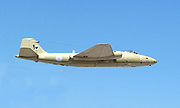 The first Indian raid was conducted on 18 December on the Dabolim Airfield and was in the form of 12 English Electric Canberra
aircraft led by Wing Commander N.B. Menon. The raid resulted in the dropping of 63,000 pounds of explosives within minutes, completely destroying the runway. In line with the mandate given by the Air Command, structures and facilities at the airfield were left undamaged.
The second Indian raid was conducted on the same target by eight Canberras led by Wing Commander Surinder Singh, which again left the airport’s terminal and other buildings untouched. Two transport aircraft—a Lockheed Constellation
belonging to the Portuguese airline, TAP and a Douglas DC-4
belonging to the Goan airline TAIP—were parked on the apron. On the night of the 18 December, the Portuguese used both aircraft to evacuate the families of some government and military officials in spite of the heavily damaged runway. During the first hours of the evening, airport workers hastily recovered part of the runway. The first aircraft to leave was the TAP Constellation commanded by Manuel Correia Reis, which took off using only 700 metres; the debris from the runway damaged the fuselage with 25 holes and a flat tire. In order to take off in the short distance, the TAP pilots had jettisoned all the extra seats and other unwanted equipment so that they could do a 'short take-off'. The second to leave was the TAIP DC-4, piloted by TAIP Director Major Solano de Almeida. Both aircraft used the cover of night and a very low altitudes to break through Indian aerial patrols and escape to Karachi
, Pakistan.
A third Indian raid was carried out by six Hawker Hunters, and was targeted at the wireless station at Bambolim, which was successfully attacked with rockets and gun cannons.
The mandate to support ground troops was served by the de Havilland Vampire
s of No. 45 squadron which patrolled the sector but did not receive any requests into action. In an incident of friendly fire, two Vampires fired rockets into the positions of the 2nd Sikh Light Infantry
injuring two soldiers, while elsewhere, Indian ground troops mistakenly opened fire on an IAF T-6 Texan
, causing minimal damage.
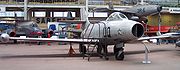 In the Daman sector, Indian Mysteres
flew 14 sorties, continuously harassing Portuguese artillery positions, while the operations in the Diu Sector was entrusted to the Armaments Training Wing led by Wg Cdr Micky Blake. The first air attacks were made at dawn on 18 December and were aimed at destroying Diu's fortifications facing the mainland. Throughout the rest of the day, the Air Force had at least two aircraft in the air at any time, giving close support to advancing Indian infantry. During the morning, the air force attacked and destroyed Diu Airfield's ATC as well as parts of Diu Fort. On orders from Tactical Air Command located at Pune, a sortie of two Toofanis attacked and destroyed the airfield runway with 4 1000 lb Mk 9 bombs. A second sortie aimed at the runway and piloted by Wg Cdr Blake himself was aborted when Blake detected what he reported as people waving white flags. in subsequent sorties, the Indian Air Force attacked and destroyed the Portuguese ammunition dump as well a patrol boat that attempted to escape from Diu.
In the absence of any Portuguese air presence, Portuguese ground based anti-aircraft units attempted to offer resistance to the Indian raids, but were overwhelmed and quickly silenced, leaving complete air superiority to the Indians. Continued air attacks forced the Portuguese governor of Diu to surrender.
In later years, commentators have maintained that India's intense air strikes against the airfields were uncalled-for, since none of the targeted airports had any military capabilities and did not cater to any military aircraft. As such, the airfields were defenceless civilian targets. To this day, the Indian navy continues to control the Dabolim Airport
, although this is now used as a civilian airport as well.
and the INS Mysore
. Under covering fire from the ships, Indian marines under the command of Lt. Arun Auditto stormed the island at 1425 on 18 December, and engaged the Portuguese defenders. The Portuguese ceased fire, and raised a white flag
, thus luring the Indian marines out of their cover, before opening fire again, killing 7 marines and wounding 19. Among the casualties were two officers. The Portuguese defences were eventually overrun after fierce shelling from the Indian ships offshore. The island was secured by the Indians at 1400 on the next day.
was anchored off Mormugao Harbour. Three Portuguese patrol boats were also present at Goa Daman and Diu. Besides engaging Indian naval units, the Afonso de Albuquerque was also tasked with providing a coastal artillery battery for the defence of the harbour and adjoining beaches, as well as providing vital radio communications with Lisbon after on-shore radio facilities had been destroyed in Indian airstrikes.
At 0900, three Indian frigates led by the INS Betwa took up position off the Harbour, awaiting orders to attack the NRP Afonso and secure sea access to the port. At 1100, Indian planes raided bombed Mormugao harbor. At 1200, upon receiving clearance from HQ, the INS Betwa, accompanied by the INS Beas entered the harbour and opened fire on the NRP Afonso with their 4.5-inch guns while transmitting requests to surrender in between shots in morse code. In response, the NRP Afonso lifted anchor, headed out towards the enemy and returned fire with its 120 mm guns.
Besides being outnumbered by the Indians, the Afonso was also at a severe disadvantage since it was in a confined position that restricted its maneuverability, and also because its four 120 mm guns were capable of a two rounds a minute, as compared to the 60 rounds per minute cadence of the guns aboard the Indian frigates. A few minutes into the exchange of fire, at 1215, the Afonso took a direct hit in its control tower, injuring its weapons officer. At 1225, an anti-personnel shrapnel bomb fired from an Indian vessel exploded directly over the ship, killing its radio officer and severely injuring its commander, Captain António da Cunha Aragão, after which the First Officer Pinto da Cruz took command of the vessel. The ships propulsion system was also badly damaged in this attack.
At 1235, the NRP Afonso swerved 180 degrees and was run aground against Bambolim beach. At that time, against the commander's orders, a white flag was hoisted under instructions from the sergeant in charge of signals. But the flag coiled itself around the mast and as a result was not spotted by the Indians, who continued their barrage. The flag was immediately lowered.
Eventually at 1250, after having fired nearly 400 rounds at the Indians, hitting two of the Indian vessels, and having taken severe damage, the order was given to initiate the abandonment of the ship. Under heavy fire, directed both at the ship as well as at the coast, non-essential crew including weapons staff left the ship and made their way to the shore. They were followed at 1310 by the rest of the crew, who along with their injured commander, disembarked directly onto the beach after setting fire to the ship. Following this, the commander was transferred by car to the hospital at Panjim.
In all, the NRP Afonso lost 5 dead and 13 wounded in the battle.
The sloop's crew formally surrendered with the remaining Portuguese forces on 19 December at 2030.
As a gesture of goodwill, the commanders of the INS Betwa and the INS Beas later visited Captain Aragão as he lay recuperating in bed at Panjim.
The Afonso - having been renamed as Saravastri by the Indian Navy - lay grounded at the beach near Dona Paula, until 1962 when it was towed to Bombay and sold for scrap. Parts of the ship were recovered and are on display at the Naval Museum in Bombay.
was anchored off the coast of Diu and offered a barrage of from its 6-inch guns at the Diu Fortress where the Portuguese were holed up. Commanding Officer of the Indian Air Force operating in the area reported that some of the shells fired from the New Delhi were bouncing off the beach and exploding on the Indian mainland. However no casualties were reported from this.
At 0400 on 18 December, a Portuguese patrol boat Vega encountered the New Delhi around 12 miles (19.3 km) off the coast of Diu, and was attacked with heavy machine gun fire. Staying out of range, the boat had no casualties and minimal damage, the boat withdrew to the port at Diu.
At 0700, news was received that the Indian invasion had commenced, and the commander of the Vega, 2nd Lt Oliveira e Carmo was ordered to sail out and fight until the last round of ammunition. At 0730 the crew of the Vega spotted two Indian aircraft on patrol missions and opened fire on them with the ship's 20 mm Oerlikon gun. In retaliation the Indian aircraft attacked the Vega twice, killing the captain and the gunner and forcing the rest of the crew to abandon the boat and swim ashore, where they were taken prisoners of war.
With all information pointing to total occupation of all Portuguese enclaves in India, Lt. Brito attempted to save his crew and boat by escaping to Karachi in Pakistan. The boat traversed 530 miles (853 km), escaping detection by Indian forces to arrive at Karachi at 2000 on 20 December.
Brigade - led by Brigadier Sagat Singh was charged with merely assisting the main thrust conducted by the 17th Infantry, its units moved rapidly across minefields, roadblocks and four riverine obstacles to be the first to reach Panjim.
Hostilities at Goa began at 0945 on December 17, 1961, when a unit of Indian troops attacked and occupied the town of Maulinguém in north east Goa killing two Portuguese soldiers in the process. Portuguese units from the 2nd EREC - a recon unit stationed near Maulinguem - asked for permission to engage the Indians, but permission was refused at about 1345. During the afternoon of the 17th, the Portuguese commanders issued instructions that all orders to defending troops would be issued directly by headquarters, bypassing the local command outposts. This led to confusion in the chain of command. At 0200 on December 18, the 2nd EREC was sent to the town of Doromagogo to support the withdrawal of police forces present in the area, and were attacked by Indian army units on their return journey.
At 0400, the Indian assault commenced with artillery bombardment on Portuguese positions south of the town of Maulinguem, which was launched on the basis of intelligence that the Portuguese had stationed heavy battle tanks in the area. by 0430 Bicholim was under fire. At 0440 Portuguese forces destroyed the bridge at Bicholim and followed this with the destruction of the bridges at Chapora in Colvale and at Assonora at 0500.
On the morning of 18 December, the 50 Para Brigade of the Indian Army moved into Goa in three columns.
At 0530, Portuguese troops left their barracks at Ponda in central Goa and marched towards the town of Usgao, in the direction of the advancing eastern column of the Indian 2nd Para Maratha. At 0900, these Portuguese troops marching towards Usgao, reported that Indian troops had already reached halfway to the town of Ponda.
 By 1000, Portuguese units of the 1st EREC, faced with the advancing 2nd Sikh Light Infantry, began a south-bound withdrawal to the town of Mapuca where, by 1200, they came under the risk of being surrounded by Indian forces. At 1230, the Portuguese 1st EREC began a retreat from the town of Mapuca by using machine gun fire to cover the withdrawal of personnel carrier vehicles. This unit relocated by ferry further south to Panjim.
At 1330, the bridge at Banastarim was destryoed by the Portuguese, just after the retreat of the 2nd EREC, thus cutting off all road links to the capital city of Panjim.
By 1745, the forces of the Portuguese 1st and the 9th EREC CC (North Group) had completed its ferry crossing of the Mandovi River to Panjim, just minutes ahead of the arrival of the armoured divisions of the Indian 50 Para Brigade. The Indian tanks had reached Betim, just across the Mandovi River from the capital town of Panjim without encountering any opposition. The 2 Sikh LI joined it by 2100, crossing over mines and demolished bridges en-route. In the absence of orders, the unit stayed at Betim for the night. The same night Major Sidhu of the 7 Cavalry was killed when Portuguese guards fired on an unsuspecting Indian unit at Aguada Fort.
At 2000 hours, a Goan by the name of Gregório Magno Antão crossed the Mandovi River from Panjim and delivered a ceasefire offer letter from Major Acácio Tenreiro of the Portuguese Army to Major Shivdev Singh Sidhu, the commanding officer of the Indian units camped there. The letter stated "The Military Commander of the City of Goa states that he wishes to parley with the commander of the army of the Indian Union with respect to the surrender. Under these conditions, the Portuguese troops must immediately cease fire and the Indian troops do likewise in order to prevent the slaughter of the population and the destruction of the city."
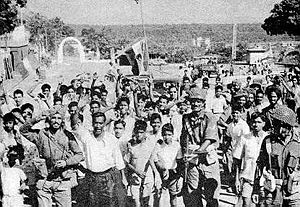
The order to cross the Mandovi River was received on the morning of 19 December, upon which two rifle companies of the 2nd Sikh Light Infantry advanced on Panjim at 0730 and secured the town without facing any resistance. On orders from Brigadier Sagat Singh
, the troops entering Panjim removed their steel helmets and donned the Parachute Regiment’s maroon berets. Fort Aguada was also captured on that day when the Indian 7th Cavalry attacked the fort with assistance from the armoured division stationed at Betim, and freed its political prisoners.
advanced in two columns. The right column comprising the 2nd Bihar and the left column consisting of the 3rd Sikh linked up at the border town of Mollem and then advanced upon the town of Ponda taking separate routes. By night fall, the 2nd Bihar had reached the town of Candeapur, while the 3rd Sikh had reached Darbondara. Although neither column had encountered any resistance, their further progress was hampered because all bridges spanning the river had been destroyed.
The rear battalion comprised the 4th Sikh Infantry, which reached Candeapur in the early hours of 19 December, and not to be bogged down by the absence of the bridge, waded across the river in chest high water, to reach Margao
- the administrative centre of Southern Goa - by 1200. From here, the column advanced on the harbour of Mormugao. En route to this target, the column encountered fierce resistance from a 500-strong Portuguese unit at the village of Verna, where the Indian column was joined by the 2nd Bihar. The Portuguese unit surrendered at 1530 after fierce fighting, and the 4th Sikh then proceeded to Mormugao
and Dabolim Airport
, where the main body of the Portuguese army awaited the Indians.
A decoy attack was staged south of Margao by the 4th Rajput company to mislead the Portuguese. This column overcame minefields, roadblocks and demolished bridges, and eventually went on to help secure the town of Margao.
By the evening 19 December, most of Goa had been overrun by advancing Indian forces, and a large party of more than two thousand Portuguese soldiers had taken position at the military base at Alparqueiros at the entrance to the port town of Vasco Da Gama. Per the Portuguese strategy code named ‘Plano Sentinela’ the defending forces were to make their last stand at the harbour, holding out against the Indians until Portuguese naval reinforcements could arrive. Orders delivered from the Portuguese President called for a scorched earth policy - that Goa was to be destroyed before it was given up to the Indians.
The Portuguese had stationed two companies of Caçadores troops and a battery of artillery, but these were armed with insufficient and old ammunition. The Portuguese also placed a 20mm anti-aircraft gun ten days before the invasion to protect the artillery. Daman had been secured with small minefields and defensive shelters had been built.
The advance on the enclave of Daman was conducted by the 1st Maratha Light Infantry under the command of Lt-Col SJS Bhonsle in a pre dawn operation on 18 December. The plan was to capture Daman piecemeal in four phases, to start with the area of the airfield, then progressively to area garden, Nani Daman and finally Moti Daman to include the fort.
The advance commenced at 0400 when one battalion and three companies of Indian soldiers progressed through the central area of the northern territory, aiming to seize the airfield. However, the surprise was lost when the Indian ‘A’ Company tried to capture the Air Control Tower (ACT) and the Indian battalion suffered three casualties. The Portuguese lost one soldier dead and six taken captive. The Indian "D" Company captured a position named "Point 365" just before the next morning. At the crack of dawn, two sorties by Indian Air Force Mystere fighters struck Portuguese mortar positions and guns inside Moti Daman Fort.
At 0430, the Indian artillery commenced bombardment of Damão Grande. The artillery attack coupled with difficulties in transportation isolated the Portuguese command station in Damão Grande from the forces in Damão-Pequeno. At 0730 a Portuguese unit stationed at the fortress of San Jeronimo opened mortar fire on Indian forces attempting to capture the airstrip.
At 1130, Portuguese forces resisting an Indian advance on the eastern border at Varacunda ran out of ammunition and withdrew westwards to Catra. At 1200, to delay the Indian advance following the withdrawal from Varacunda, the Portuguese artillery battery on the banks of the Sandalcalo river is ordered to open fire. The commander of the battery, Cap.Felgueiras de Sousa instead dismantled the guns and surrendered to the Indians. By 1200 the airfield was assaulted by the Indian A and C Companies simultaneously. In the ensuing exchange of fire the A Company lost one more soldier killed while seven were wounded.
By 1300, remaining Portuguese forces on the eastern border at Calicachigão-A exhausted their ammunition and retreated towards the coast. By 1700, in the absence of any resistance, the Indians had managed to occupy most of the territory, with the exception of the airfield and Damão-Pequeno where the Portuguese were making their last stand. By this time the Indian Air Force had conducted as many as six air attacks, severely demoralizing the Portuguese forces. At 2000, after a meeting of the Portuguese commanders a delegation was dispatched to the Indian lines in order to open negotiations, but was fired upon, and was forced to withdraw. A similar attempt by the artillery to surrender at 0800 the next day was also fired on.
The Indians assaulted the airfield the next morning upon which the Portuguese surrendered at 1100 without a fight. The Portuguese garrison commander Major Antonio Jose da Costa - although wounded - was stretchered to the airfield as the Indians were only willing to accept a surrender from him. Approximately 600 Portuguese soldiers (including 24 officers) were taken prisoner. The Indians suffered 4 dead and 14 wounded, while the Portuguese suffered 10 dead and 2 wounded. The 1st Light Maratha Infantry was decorated for the battle with one VSM for the CO, two Sena Medals and five Mentioned in Dispatches.
Diu was attacked on 18 December from the north west along Kob Forte by two companies of the 20th Rajput - with the capture of the Diu Airfield being the primary objective - and from the northeast along Gogal and Amdepur by the Rajput B Company and the 4 Madras.
These Indian army units ignored requests from Wg Cdr MPO (Micky) Blake, planning-in-charge of the Indian Air Force operations in Diu, to attack only on first light when close air support would be available. The Portuguese defences repulsed the attack backed by 87.6mm artillery and mortars, inflicting heavy losses on the Indians. The first attack was made by the 4 Madras on a police post at 0130 on December 18 at Gogol and was repulsed by 13 Portuguese soldiers. Another attempt by the 4 Madreas at 0200 was again repulsed, this time backed with Portuguese 87.5mm artillery and mortar which suffered due to poor quality of munitions. By 0400, ten of the original 13 defending Portuguese soldiers at Gogol had been wounded and were evacuated to a hospital. At 0530, the Portuguese artillery launched a fresh attack on the 4 Madras assaulting Gogol and forced their retreat.
Meanwhile at 0300, 2 companies of the 20th Rajput attempted to cross a muddy swamp separating them from the Portuguese forces at Passo Covo under cover of dark on rafts made of bamboo cots tied to oil barrels. The attempt was to establish a bridgehead and capture the airfield.
This attack was repulsed with fairly heavy losses by a well entrenched unit of between 125 to 130 Portuguese soldiers armed with small automatic weapons and sten guns as well as light and medium machine guns. According to Portuguese sources, this post was defended by only 8 soldiers.
As the Rajputs reached the middle of the creek the Portuguese on Diu opened fire with two MMGs and two LMGs, capsizing some of the rafts. Major Mal Singh of the Indian army along with five men pressed on his advance and crossed the creek. On reaching the far bank he and his men assaulted the LMG trenches at Fort-De-Cova and silenced them. The Portuguese MMG fire from another position wounded the officer and two of his men. However, with the efforts of company Havildar Major Mohan Singh and two other men, the three wounded were evacuated back across the creek to safety. As dawn approached the Portuguese increased the intensity of fire and the battalion’s water crossing equipment suffered extensive damage. As a result the Indian battalion was ordered to fall back to Kob village by first light.
Another assault at 0500 was similarly repulsed by the Portuguese defenders. At 0630, Portuguese forces retrieved rafts abandoned by the 20th Rajput, recovered ammunition left behind and rescued a wounded Indian soldier who was given treatment.
At 0700, with the onset of dawn, Indian air strikes commenced, forcing the Portuguese to retreat from Passo Covo to the town of Malala. By 0900 the Portuguese unit at Gogol also retreated allowing the Rajput B Company (who replaced the 4 Madras) to advance under heavy artillery fire and occupy the town. By 1015, the Indian cruisier the INS Delhi anchored off Diu commenced the bombardment of targets on the shore. At 1245, Indian jets fire a rocket at a mortar at Diu Fortress causing a fire in close proximity to a munitions dump, forcing the Portuguese to order the evacuation of the fortress - a task completed by 1415 under heavy bombardment from the Indians.
At 1800, the Portuguese commanders agreed in a meeting that, in view of repeated air strikes and the inability to establish contact with headquarters in Goa or Lisbon, there was no way to pursue and effective defence and decided to surrender to the Indians. On December 19 by 1200 the Portuguese formally surrendered officially. The Indians took 403 prisoners, which included the Lt. Governor of the island along with 18 officers and 43 sergeants.
In surrendering to the Indians, the Diu Governor stated that he could have kept the Army out for a few weeks but he had no answer to the Air Force. The Indian air force was also present at the ceremony and was represented by Gp Capt Godkhindi, Wing Cmdr Micky Blake and Sqn Ldr Nobby Clarke. 7 Portuguese soldiers were killed in the battle.
Major Mal Singh and Sepoy Hakam Singh of the Indian army were awarded Ashok Chakra (Class III).
On 19 December, the 4th Madras C Company landed on the island of Panikot off Diu, where a group of 13 Portuguese soldiers surrendered to them there there.
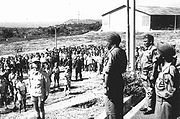 Despite orders from Lisbon
, Governor General Manuel António Vassalo e Silva
took stock of the numerical superiority of the Indian troops, as well as the food and ammunition supplies available to his forces and took the decision to surrender. He later described his orders to destroy Goa as "um sacrifício inútil" (a useless sacrifice).
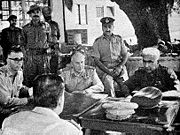 In a communication to all Portuguese forces under his command, he stated, “Having considered the defence of the Peninsula of Mormugao… from aerial, naval and ground fire of the enemy and … having considered the difference between the forces and the resources… the situation does not allow myself to proceed with the fight without great sacrifice of the lives of the inhabitants of Vasco da Gama, I have decided with … my patriotism well present, to get in touch with the enemy … I order all my forces to cease-fire.”
The official Portuguese surrender was conducted in a formal ceremony held at 2030 on 19 December when Governor General Manuel António Vassalo e Silva signed the instrument of surrender bringing to an end 451 years of Portuguese Rule in Goa. In all, 4668 personnel were taken prisoner by the Indians - a figure which included military and civilian personnel, Portuguese, Africans and Indians (Goans). This comprised 3412 prisoners in Goa, 853 in Daman and 403 in Diu.
Portuguese non-combatants present in Goa at the time of the surrender - which included Mrs Vasalo D'Silva, wife of the Portuguese Governor General of Goa - were transported by 29 December to Bombay from where they were repatriated to Portugal. Manuel Vassalo, however remained along with approximately 3300 Portuguese combatants as POWs in Goa.
Upon the surrender of the Portuguese governor general, Goa, Daman and Diu was declared a federally administered Union Territory placed directly under the President of India, and Maj. Gen. K. P. Candeth was appointed as its military governor. The war had lasted two days. India lost 34 killed and 51 wounded. Portugal lost 31 killed, 57 wounded, and 4668 captured.
Those Indian forces who served within the disputed territories for 48 hours, or flew at least one operational sortie during the conflict, received a General Service Medal 1947 with the Goa 1961 bar.
The New York Times of December 19, 1961 reporting the Western response to the Goa 's liberation stated: "Adlai E. Stevenson warned the Security Council early today that the United Nations was in danger of dying as the result of a Soviet veto killing a Western resolution to tend the Indian invasion of Goa. The resolution would have urged India to accept an immediate cease-fire and recall her invasion troops from Goa and two other Portuguese enclaves on the Indian coast. Moscow , however, hailed the invasion as a liberation drive and accused the United States of hypocrisy in its criticism of India's military moves. Observers believed the Russians were trying to fan resentment against NATO, to which both Portugal and the United States belong."
Canadian political scientist AR Bandeira has argued that the sacrifice of Goa was an elaborate public relations stunt calculated to rally support for Portugal's wars in Africa.
Upon receiving news of the fall of Goa, the Portuguese government formally severed all diplomatic links with India and refused to recognize the incorporation of the seized territories into the Indian Republic. An offer of Portuguese citizenship was instead made to all Goan natives who wished to emigrate to Portugal than remain under Indian rule. This was amended in 2006 to include only those who had been born before 19 December 1961. Later, in a show of defiance, Salazar's government offered a reward of US$10,000 for the capture of Brigadier Sagat Singh, the commander of the maroon berets of India’s parachute regiment who were the first troops to enter Panjim, Goa’s capital.
On receiving news of the fall of Portuguese India, Lisbon went virtually in mourning, and Christmas celebrations were extremely muted. The U.S. embassy placed a curtain in front of its Christmas display in the ground-floor window of the U.S. Information Office. Cinemas and theaters shut down as tens of thousands of Portuguese marched in a silent parade from Lisbon's city hall to the cathedral, escorting the relics of St. Francis Xavier.
Portuguese prime minister Salazar while addressing the National Assembly on 3 January 1962, invoked the principle of national sovereignty, as defined in the legal framework of the Constitution of the Estado Novo. "We can not negotiate, not without denying and betraying our own, the cession of national territory and the transfer of populations that inhabit them to foreign sovereigns," said Salazar.
Relations between India and Portugal thawed only in 1974, when, following an anti-colonial military coup d'état and the fall of the authoritarian rule in Lisbon
, Goa was finally recognised as part of India, and steps were taken to re-establish diplomatic relations with India. In 1992, Portuguese President Mário Soares
became the first Portuguese head of state to visit Goa after its annexation by India. This followed Indian President
R. Venkataraman
’s visit to Portugal in 1990.
where conditions were substantially better.
Air Marshal S Raghavendran, who met with some of the captured Portuguese soldiers, wrote in his memoirs several years later "I have never seen such a set of troops looking so miserable in my life. Short, not particularly well built and certainly very unsoldierlike."
In one incident, recounted by Lt. Francisco Cabral Couto (now retired general), an attempt was made on 17 January, by some of the prisoners to escape the camp. The attempt was foiled, and the Portuguese officers in charge of the escapees were threatened with court martial and execution by the Indians. This situation was defused by the timely intervention of a Jesuit military chaplain.
The captivity lasted for six months "thanks to the stupid stubbornness of Lisbon" (according to Capt. Carlos Azaredo). The Portuguese Government insisted that the POWs be repatriated by Portuguese aircraft - a demand that was rejected by the Indian Government who instead insisted on aircraft from a neutral country. The negotiations were delayed even further when Salazar ordered the detention of 1200 Indians in Mozambique
allegedly as a bargaining chip in exchange for Portuguese POWs.
By May 1962, most of the POWs had been repatriated—being first flown to Karachi
, in chartered French aircraft, and then sent off to Lisbon by three ships: Vera Cruz, Pátria and Moçambique. On arrival at Tejo in Portugal, returning Portuguese servicemen were taken into custody by military police
at gunpoint and without immediate access to their families who had arrived to receive them. Following intense questioning and interrogations, the officers were charged with direct insubordination on having refused to comply with directives not to surrender to the Indians. On 22 March 1963, the governor general, the military commander, his chief of staff, one naval captain, six majors, a sub lieutenant and a sergeant were cashiered by the council of ministers for cowardice and expelled from military service. Four captains, four lieutenants and a lieutenant commander were suspended for six months.
Ex- governor Manuel António Vassalo e Silva was greeted with a hostile reception when he returned to Portugal. He was subsequently court martialed for failing to follow orders, expelled from the military and was sent into exile. He returned to Portugal only in 1974, after the fall of the regime, and was given back his military status. He was later able to conduct a state visit to Goa, where he was given a warm reception.
' official reaction to the invasion of Goa was delivered by Adlai Stevenson in the UN Security Council, where he condemned the armed action of the Indian government and demanded that all Indian forces be unconditionally withdrawn from Goan soil.
To express its displeasure with the Indian action in Goa, the US Senate Foreign Relations Committee attempted, over the objections of President John F. Kennedy
, to cut the 1962 foreign aid appropriation to India by 25 percent.
Referring to the perception, especially in the West, that India had previously been lecturing the world about the virtues of nonviolence, US President Kennedy told the Indian ambassador to the US, “You spend the last fifteen years preaching morality to us, and then you go ahead and act the way any normal country would behave.... People are saying, the preacher has been caught coming out of the brothel.”
In an article titled "India, The Aggressor", The New York Times on 19 December 1961, stated "With his invasion of Goa Prime Minister Nehru has done irreparable damage to India's good name and to the principles of international morality."
Life International
, in its issue dated 12 February 1962, carried an article titled "Symbolic pose by Goa's Governor" in which it expressed its vehement condemnation of the military action.
, Leonid Brezhnev
, who was touring India at the time of the war, made several speeches applauding the Indian action. In a farewell message, he urged Indians to ignore western indignation as it came "from those who are accustomed to strangle the peoples striving for independence... and from those who enrich themselves from colonialist plunder". Nikita Khrushchev
, the de facto Soviet leader, telegraphed Nehru stating that there was "unanimous acclaim" from every Soviet citizen for "Friendly India". The USSR had earlier vetoed a UN security council resolution condemning the Indian invasion of Goa.
for the struggle of the people of Asia, Africa and Latin America against "imperialist colonialism". China neither condemned nor applauded the invasion, despite Portuguese rule of Macau
, as at the time, it was enjoying cordial relations with India, although the Sino-Indian War
would begin only months later.
i President General Ayub Khan stated: “My Dear President, The forcible taking of Goa by India has demonstrated what we in Pakistan have never had any illusions about--that India would not hesitate to attack if it were in her interest to do so and if she felt that the other side was too weak to resist.”
n nations - themselves former European colonies - reacted with delight to the capture of Goa by the Indians. Radio Ghana
termed it as the “Liberation of Goa” and went on to state that the people of Ghana
would “long for the day when our downtrodden brethren in Angola
and other Portuguese territories in Africa are liberated.” Adelino Gwambe, the leader of the Mozambique National Democratic Union stated: “We fully support the use of force against Portuguese butchers.”
appointed Dom José Pedro da Silva, a Portuguese priest as the auxiliary bishop of Goa, and granted him the right to succeed as the Patriarch of the Church in Goa. Although the Vatican did not voice its reaction to the annexation of Goa, it delayed the appointment of a native head of the Goan Church until the inauguration of the Second Vatican Council
in Rome, when Msgr Francisco Xavier da Piedade Rebelo was consecrated Bishop and Vicar Apostolic of Goa in 1963. Simultaneously, the Church in Goa was placed under the patronage of the Cardinal of India and its links with the Church in Portugal were severed.
launched, fourteen years later, its own invasion of East Timor - also a Portugese colony, which Indonesia had some grounds to claim should belong to it on the same basis as Goa belonged to India. However, the similarity between the two cases proved deceptive - while Goa was eventually successfully integrated into India, the Indonesian invasion of East Timor precipitated decades of bloody war ending with the territory gaining independence.
India
India , officially the Republic of India , is a country in South Asia. It is the seventh-largest country by geographical area, the second-most populous country with over 1.2 billion people, and the most populous democracy in the world...
's armed forces that ended Portuguese
Portugal
Portugal , officially the Portuguese Republic is a country situated in southwestern Europe on the Iberian Peninsula. Portugal is the westernmost country of Europe, and is bordered by the Atlantic Ocean to the West and South and by Spain to the North and East. The Atlantic archipelagos of the...
rule in its Indian enclaves
Portuguese India
The Portuguese Viceroyalty of India , later the Portuguese State of India , was the aggregate of Portugal's colonial holdings in India.The government started in 1505, six years after the discovery of a sea route to India by Vasco da Gama, with the nomination of the first Viceroy Francisco de...
in 1961. The armed action, codenamed Operation Vijay by the Indian government, involved air, sea and land strikes for over 36 hours, and was a decisive victory for India, ending 451 years of Portuguese colonial rule in Goa
Goa
Goa , a former Portuguese colony, is India's smallest state by area and the fourth smallest by population. Located in South West India in the region known as the Konkan, it is bounded by the state of Maharashtra to the north, and by Karnataka to the east and south, while the Arabian Sea forms its...
. Twenty two Indians and thirty Portuguese were killed in the fighting. The brief conflict drew a mixture of worldwide praise and condemnation. In India, the action was seen as a liberation of historically Indian territory, while Portugal viewed it as an aggression against national soil.
Background
At the time of Union of India's independence from the British EmpireBritish Empire
The British Empire comprised the dominions, colonies, protectorates, mandates and other territories ruled or administered by the United Kingdom. It originated with the overseas colonies and trading posts established by England in the late 16th and early 17th centuries. At its height, it was the...
in 1947, Portugal
Portugal
Portugal , officially the Portuguese Republic is a country situated in southwestern Europe on the Iberian Peninsula. Portugal is the westernmost country of Europe, and is bordered by the Atlantic Ocean to the West and South and by Spain to the North and East. The Atlantic archipelagos of the...
held a handful of enclaves on the Indian subcontinent - the districts of Goa
Goa
Goa , a former Portuguese colony, is India's smallest state by area and the fourth smallest by population. Located in South West India in the region known as the Konkan, it is bounded by the state of Maharashtra to the north, and by Karnataka to the east and south, while the Arabian Sea forms its...
, Daman and Diu and Dadra and Nagar Haveli - collectively known as the Estado da Índia. Goa, Daman and Diu covered an area of around 1540 square miles (3,988.6 km²) and held a population of 637,591. The Goan diaspora
Diaspora
A diaspora is "the movement, migration, or scattering of people away from an established or ancestral homeland" or "people dispersed by whatever cause to more than one location", or "people settled far from their ancestral homelands".The word has come to refer to historical mass-dispersions of...
was estimated at 175,000 (about 100,000 within the Indian Union). Religious distribution was 61% Hindu, 36.7% Christian (mostly Catholic), 2.2% Muslim. Economy was primarily based on agriculture, although the 1940s and 1950s saw a boom in mining - principally iron ore and some manganese
Manganese
Manganese is a chemical element, designated by the symbol Mn. It has the atomic number 25. It is found as a free element in nature , and in many minerals...
.
Local Resistance to Portuguese Rule
Resistance to Portuguese rule in Goa in the 20th century was pioneered by Tristão de Bragança Cunha, a French educated Goan engineer who founded the Goa Congress Committee in Portuguese India in 1928. Da Cunha released a booklet called 'Four hundred years of Foreign Rule', and a pamphlet, 'Denationalisation of Goa', intended to sensitize Goans to the oppression of Portuguese rule. Messages of solidarity were received by the Goa Congress Committee from leading figures in the Indian independence movement like Dr. Rajendra Prasad, Jawaharlal Nehru, Subhas Chandra Bose, and several others. On 12 October 1938, Da Cunha with other members of the Goa Congress Committee met Subhas Chandra Bose, the President of the Indian National Congress, and on his advice, opened a Branch Office of the Goa Congress Committee at 21, Dalal Street, Bombay. The Goa Congress was also made affiliate to the Indian National Congress and Da Cunha was selected its first President.In June 1946, Dr. Ram Manohar Lohia, an Indian Socialist leader, entered Goa on a visit to his friend, Dr. Juliao Menezes, a nationalist leader, who had founded in Bombay the Gomantak Praja Mandal and edited the weekly newspaper, Gomantak. Da Cunha and other leaders were also with him. Ram Manohar Lohia
Ram Manohar Lohia
Rammanohar Lohia was an Indian freedom fighter and a socialist political leader.-Early life:Lohia was born in a village Akbarpur in Ambedkar Nagar district, Uttar Pradesh, in India to Hira Lal, a nationalist and Chanda,a teacher. He was born to Marwari Maheshwari family. His mother died when he...
advocated the use of non-violent Gandhian
Gandhism
Gandhism is the collection of inspirations, principles, beliefs and philosophy of Mohandas Karamchand Gandhi , who was a major political and spiritual leader of India and the Indian Independence Movement....
techniques to oppose the government. On 18 June 1946, the Portuguese government disrupted a protest in Panjim against the suspension of civil liberties organised by Lohia, Da Cunha along with others like Purushottam Kakodkar and Laxmikant Bhembre in defiance of a ban on public gatherings and arrested them. There were intermittent mass demonstrations from June to November.
In addition to non-violent protests, armed groups such as the Azad Gomantak Dal (The Free Goa Party) and the United Front of Goans conducted violent attacks aimed at weakening Portuguese rule in Goa. The Indian government supported the establishment of armed groups like the Azad Gomantak Dal, giving them full financial, logistic and armament support. The armed groups acted from bases situated in Indian territory and under cover of Indian police forces. The Indian government - through these armed groups - attempted to destroy economic targets, telegraph and telephone lines, road, water and rail transport, in order to impede economic activity and create conditions for a general uprising of the population.
Commenting on the armed resistance, Portuguese army officer, Capt. Carlos Azaredo (now retired General) stationed with the army in Goa states in Portuguese newspaper O Expresso: "To the contrary to what is being said, the most evolved guerilla warfare which our Armed Forces encountered was in Goa. I know what I’m talking about, because I also fought in Angola and in Guiné. In 1961 alone, until December, around 80 policemen died. The major part of the terrorists of Azad Gomantak Dal were not Goans. Many had fought in the British Army, under General Montgomery, against the Germans."
Diplomatic Efforts to Resolve Goa Dispute
By 1954, the Republic of India instituted visa restrictions on travel from Goa to India which paralysed transportation between Goa and other enclaves like Daman, Diu, Dadra and Nagar Haveli. Meanwhile The Indian union of dockers had, in 1954, instituted a boycott on shipping to Portuguese India. Between 22 July and 2 August 1954, armed activists attacked and forced the surrender of Portuguese forces stationed in Dadra and Nagar Haveli.
On 15 August 1955, 3000-5000 unarmed Indian activists attempted to enter Goa at six locations and were violently repulsed by Portuguese police officers, resulting in the deaths of between 21 and 30 people. The news of the firing built public opinion in India against the presence of the Portuguese in Goa. On 1 September 1955, India shut its consul office in Goa.
In 1956, Portuguese ambassador to France, Marcello Mathias, along with Portuguese prime minister António de Oliveira Salazar, argued in favour of a referendum in Goa to determine its future. This proposal was however rejected by the ministers for defence and foreign affairs. The demand for a referendum was again made by presidential candidate General Humberto Delgado in 1957.
Portugal’s prime minister, Antonio de Oliveira Salazar
António de Oliveira Salazar
António de Oliveira Salazar, GColIH, GCTE, GCSE served as the Prime Minister of Portugal from 1932 to 1968. He also served as acting President of the Republic briefly in 1951. He founded and led the Estado Novo , the authoritarian, right-wing government that presided over and controlled Portugal...
, alarmed by India’s hinted threats at armed action against its presence in Goa, first asked the United Kingdom to mediate, then protested through Brazil
Brazil
Brazil , officially the Federative Republic of Brazil , is the largest country in South America. It is the world's fifth largest country, both by geographical area and by population with over 192 million people...
and eventually asked the UN Security Council to intervene. Mexico offered the Indian government its influence in Latin America to bring pressure on the Portuguese to relieve tensions. Meanwhile, Krishna Menon
Krishna Menon
Vengalil Krishnan Krishna Menon , commonly referred to as Krishna Menon, was an Indian nationalist, diplomat and statesman, described as the second most powerful man in India by Time Magazine and others, after his ally and intimate friend, Jawaharlal Nehru.Described as "vitriolic,...
, India’s defence minister and head of India’s UN delegation, stated in no uncertain terms that India had not “abjured the use of force” in Goa, The U.S. ambassador to India, John Kenneth Galbraith
John Kenneth Galbraith
John Kenneth "Ken" Galbraith , OC was a Canadian-American economist. He was a Keynesian and an institutionalist, a leading proponent of 20th-century American liberalism...
, requested the Indian government on several occasions to resolve the issue peacefully through mediation and consensus rather than armed conflict.
Eventually, on 10 December, nine days prior to the invasion, Nehru stated to the press that "Continuance of Goa under Portuguese rule is an impossibility". United States's response was to warn India that if and when India’s armed action in Goa was brought to the UN security council, it could expect no support from the U.S. delegation.
On 24 November 1961, the Sabarmati, a passenger boat passing between the Portuguese-held island of Anjidiv
Anjadip Island
Anjadip Island is an island in the Arabian Sea off the coast of Canacona in the South Goa district, Goa, India. Legally and constitutionally, it remains a part of Goa, although there is a widespread misconception that it is a part of the Karnataka state off whose coast it lies.-History:Anjediva,...
and the Indian port of Kochi, was fired upon by Portuguese ground troops, resulting in injuries to the chief engineer
Chief Engineer
In marine transportation, the chief engineer is a licensed mariner in charge of the engineering department on a merchant vessel. "Chief engineer" is the official title of someone qualified to oversee the entire engine department; the qualification is colloquially called a "chief's...
of the boat, as well as the death of a passenger. The action was precipitated by Portuguese fears that the boat carried a military landing party
Landing operation
A landing operation is a military action aimed at a bringing the landing force usually via landing craft to a shore or to land with the purpose of power projection ashore by forces coming usually from ships and also aircraft and able to fight....
intent on storming the island. The incidents lent themselves to foster widespread public support in India for military action in Goa.
Indian military build-up
On receiving the go-ahead for military action and the mandate of the capture of all occupied territories for the Indian government, Lt. Gen. Chaudhari of India's Southern Army fielded the 17th Infantry Division and the 50th Parachute Brigade50th Parachute Brigade (India)
The 50th Parachute Brigade is a formation of the Indian Army, first formed in 1941. The formation was initially raised as part of the Indian Army during World War II. It was formed in October 1941, as an independent parachute brigade. Later it was one of two parachute brigades in the 44th Indian...
commanded by Major General K.P. Candeth
K.P. Candeth
Kunhiraman Palat Candeth was a Major General in the Indian army when he led the operation to liberate Goa from the Portuguese occupation and served briefly as the Lieutenant Governor of the state. Subsequently, he rose to the rank of Lieutenant General in the Indian Army...
. The assault on the enclave of Daman was assigned to the 1st Maratha Light Infantry while the operations in Diu were assigned to the 20th Rajput and 4th Madras battalions. Meanwhile, the Commander in Chief of India's Western Air Command
Western Air Command, Indian Air Force
The Western Air Command is the regional command of Indian Air Force headquartered in New Delhi. It is the largest and most important Air Command of the IAF, comprising sixteen Air Force Bases , and is responsible for aerial defence of North India....
, Air Vice Marshal Erlic Pinto, was appointed as the commander of all air resources assigned to the operations in Goa. Air resources for the assault on Goa were concentrated in the bases at Pune
Pune
Pune , is the eighth largest metropolis in India, the second largest in the state of Maharashtra after Mumbai, and the largest city in the Western Ghats. Once the centre of power of the Maratha Empire, it is situated 560 metres above sea level on the Deccan plateau at the confluence of the Mula ...
and Sambra
Sambra
Sambra is a village in the southern state of Karnataka, India. It is located in the Belgaum taluk of Belgaum district in Karnataka.-Demographics: India census, Sambra had a population of 10755 with 6188 males and 4567 females....
.
The Indian navy deployed two warships—the INS Rajput
INS Rajput
The following ships of the Indian Navy have been named Rajput: was a R class destroyer acquired in 1949 from the Royal Navy, where it served in World War II as HMS Rotherham is the lead vessel of her class of destroyers, currently in active service with the Indian Navy...
, an 'R' Class destroyer, and the INS Kirpan
INS Kirpan
The following ships of the Indian Navy have been named INS Kirpan: was a Type 14, Blackwood class frigate commissioned in 1959 is a Khukri class corvette, currently in active service with the Indian Navy...
, a Blackwood class frigate
Blackwood class frigate
The Type 14, Blackwood, class were a twelve ship class of "second rate" anti-submarine warfare frigates of the Royal Navy, designed and built during the increasing threat from the Soviet Union's large fleet of submarines that roamed the Atlantic Ocean.-Design:They were designed to be cheaper and...
anti-submarine frigate—off the coast of Goa. The actual attack on Goa was delegated to four task groups: a Surface Action Group comprising five ships: Mysore
INS Mysore
Following ships of the Indian Navy have been named for the state city of Mysore:, a Crown Colony class light cruiser, the former HMS Nigeria, commissioned into the Indian Navy in 1957, and decommissioned in 1985, a Delhi class destroyer, commissioned into the India Navy in 1999...
, Trishul
INS Trishul
The following ships of the Indian Navy have been named INS Trishul: was a Type 12, Whitby class frigate commissioned in 1960, which served in the Portuguese-Indian War and the Indo-Pakistani War of 1971 is a Talwar class frigate, currently in active service with the Indian Navy...
, Betwa
INS Betwa
The following ships of the Indian Navy have been named INS Betwa:*INS Betwa was a Type 41, Leopard class frigate commissioned in 1960, which served in the Portuguese-Indian War and the Indo-Pakistani War of 1971...
, Beas
INS Beas
The following ships of the Indian Navy have been named INS Beas:*INS Beas was a Type 41, Leopard class frigate commissioned in 1960, which served in the Portuguese-Indian War and the Indo-Pakistani War of 1971...
and Cauvery; a Carrier Group of five ships: Delhi
INS Delhi (1948)
The INS Delhi was a Leander class cruiser built for the Royal Navy in 1933 as HMS Achilles, and commissioned into the New Zealand Division of the Royal Navy in 1937 as HMNZS Achilles...
, Kuthar
INS Kuthar
The following ships of the Indian Navy have been named INS Kuthar: was a Type 14, Blackwood class frigate commissioned in 1959 is a Khukri class corvette, currently in active service with the Indian Navy...
, Kirpan, Khukri
INS Khukri
INS Khukri was a British Type 14 frigate of the Indian Navy. She was sunk off the coast of Diu, Gujarat, India by the Pakistan Navy Daphne class submarine Hangor on 9 December 1971 during the Indo-Pakistani War of 1971. This was the first warship sunk in action by a submarine since World War II...
and Rajput centred around the light aircraft carrier Vikrant
INS Vikrant
INS Vikrant was a Majestic-class light aircraft carrier of the Indian Navy.Her keel was laid down on 12 November 1943 by Vickers-Armstrong on the Tyne and she was launched on 22 September 1945....
; a Mine Sweeping Group consisting of mine sweepers including Karwar, Kakinada, Cannonore and Bimilipatan and a Support Group which consisted of the Dharini.
The Portuguese Mandate
In March 1960, Portuguese defence minister General Moniz told Prime Minister Salazar that a sustained Portuguese campaign against decolonization would create for the army 'a suicide mission in which we could not succeed'. His opinion was shared by Minister Almeida Fernandes and the Army under secretary Colonel Costa Gomes and other top officers.Ignoring this advice, Portuguese Prime Minister António de Oliveira Salazar, sent the following message to Governor General Vassalo e Silva in Goa on 14 December, in which he ordered the Portuguese forces in Goa to fight till the last man.
Radio 816 / Lisbon 14-Dec.1961: You understand the bitterness with which I send you this message. It is horrible to think that this may mean total sacrifice, but I believe that sacrifice is the only way for us to keep up to the highest traditions and provide service to the future of the Nation. Do not expect the possibility of truce or of Portuguese prisoners, as there will be no surrender rendered because I feel that our soldiers and sailors can be either victorious or dead. These words could, by their seriousness, be directed only to a soldier of higher duties fully prepared to fulfill them. God will not allow you to be the last Governor of the State of India.
Prime Minister Salazar asked Governor General Vassalo e Silva to hold out for at least eight days - within which time he hoped to gather international support against the Indian invasion.
Portuguese Military Preparations
Portuguese military preparations began in the earnest in 1954 following the Indian economic blockade when three army battalions were transported to Goa, raising the Portuguese military presence there to 12,000 men. However, by late 1960 the under-secretary of the Army Staff, Lt Col Costa Gomes, conducted a survey visit to Goa and proposed a reduction in the military grouping reducing the strength from 12,000 men to around 3,500.In accordance with Prime Minister Salazar’s instructions to resist the Indian invasion, the Portuguese administration in Goa prepared for war.
One Portuguese Navy sloop, the NRP Afonso de Albuquerque
NRP Afonso de Albuquerque
The NRP Afonso de Albuquerque was a warship of the Portuguese Navy, named after the 16th century Portuguese navigator Afonso de Albuquerque. She was destroyed in combat on 18 December 1961, defending Goa against the Indian Armed Forces invasion....
, was present in Goa at the time of invasion. The vessel was armed with four 120 mm guns capable of two shots per minute, and four automatic rapid firing guns. In addition to the sloop, there were five merchant navy ships in Goa, and three light patrol boats (Lancha de Fiscalização) each armed with a 20mm Oerlikon gun.
Portuguese ground defences consisted of a total of 3,995 men, including infantry troops and 810 native soldiers, many of whom had little military training and were utilized primarily for security and anti-extremist operations. In addition there were about 1,040 police officers and 400 border guards divided amongst the three Portuguese enclaves in India. The strategy employed to resist Indian invasion was centred around the Plano Sentinela which divided the Goa into four sectors, with forces assigned to each sector and tasked with slowing the progression of an invading force. These plans were however unviable because of the desperate shortage of mines and ammunition and of communication equipment.
Commenting on the Plano Sentinela, Capt. Carlos Azaredo who was stationed in Goa at the time of hostilities states in Portuguese newspaper O Expresso on 8 December 2001, "It was a totally unrealistic and unachievable plan, which was quite incomplete. It was based on exchange of ground with time. But, for this purpose, portable communication equipment was necessary".
On the 16 December, the Portuguese Air Force
Portuguese Air Force
The Portuguese Air Force is the air force of Portugal. Formed on July 1, 1952, with the Aeronáutica Militar and Aviação Naval united in a single independent Air Force, it is one of the three branches of the Portuguese Armed Forces and its origins dates back to 1912, when the military aviation...
was placed on alert to transport ten tons of anti-tank grenades in two DC6 aircraft from Montijo Air Base
Montijo, Portugal
Montijo is a town in Montijo Municipality in Portugal.The town has a population of 25,719.-References:...
in Portugal to Goa assist in its defence. However the aircraft were denied stop-over facilities at the US Wheelus Air Base in Libya. When the Portuguese Air Force was unable to obtain such facilities at any other air base along the way - most nations including Pakistan denying passage of Portuguese military aircraft - the mission was passed on to the civilian airline TAP which offered a Lockheed Constellation
Lockheed Constellation
The Lockheed Constellation was a propeller-driven airliner powered by four 18-cylinder radial Wright R-3350 engines. It was built by Lockheed between 1943 and 1958 at its Burbank, California, USA, facility. A total of 856 aircraft were produced in numerous models, all distinguished by a...
(registration CS-TLA) on charter for the job. However, when permission to transport weapons through Karachi
Karachi
Karachi is the largest city, main seaport and the main financial centre of Pakistan, as well as the capital of the province of Sindh. The city has an estimated population of 13 to 15 million, while the total metropolitan area has a population of over 18 million...
was denied by the Pakistani Government, the Lockheed Constellation landed in Goa at 1800 hours on 17 December with a consignment of half a dozen bags of sausages as food supplies instead of the intended grenades. However the aircraft also arrived with a contingent of female paratroopers to assist in the evacuation of Portuguese civilians.
The Portuguese air presence in Goa was thus limited to the presence of two transport aircraft, one belonging to the Portuguese international airline (TAP
TAP Portugal
TAP Portugal, commonly known as TAP, is the national airline of Portugal. It has its head office in Building 25 on the grounds of Portela Airport in Lisbon, and has been a member of the Star Alliance since 14 March 2005, the same day on which the company celebrated its 60th anniversary...
) and the other to the Goan airline Portuguese India airlines
Transportes Aéreos da Índia Portuguesa
TAIP - Transportes Aéreos da Índia Portuguesa was an airline which operated from Portuguese India from 1955 to 1961...
(TAIP): a Lockheed Constellation
Lockheed Constellation
The Lockheed Constellation was a propeller-driven airliner powered by four 18-cylinder radial Wright R-3350 engines. It was built by Lockheed between 1943 and 1958 at its Burbank, California, USA, facility. A total of 856 aircraft were produced in numerous models, all distinguished by a...
and a Douglas DC-4
Douglas DC-4
The Douglas DC-4 is a four-engined propeller-driven airliner developed by the Douglas Aircraft Company. It served during World War II, in the Berlin Airlift and into the 1960s in a military role...
Skymaster aircraft. The Indians claimed that the Portuguese had a squadron of F-86 Sabre
F-86 Sabre
The North American F-86 Sabre was a transonic jet fighter aircraft. Produced by North American Aviation, the Sabre is best known as America's first swept wing fighter which could counter the similarly-winged Soviet MiG-15 in high speed dogfights over the skies of the Korean War...
s stationed at Dabolim Airport—which later turned out to be false intelligence. Air defence was limited to a few obsolete anti aircraft guns manned by two artillery units who had been smuggled into Goa disguised as soccer teams.
On the 14 December, the Portuguese administration in Goa received orders from the Ministry for Overseas Affairs in Lisbon to transfer the relics of St. Francis Xavier, patron saint of Goa, to Lisbon. Orders were also received ordering the Portuguese forces in Goa to destroy any buildings of non-military Portuguese heritage in Goa. Accordingly, barrels filled with petrol were transported to the Idalcao Palace in Pangim, which served as the administrative headquarters, but were removed on orders from Governor Vassalo e Silva who stated "I cannot destroy the evidence of our greatness in the Orient".
Portuguese civilian evacuation
The military buildup created panic amongst Europeans in Goa, who were desperate to evacuate their families before the commencement of hostilities. On 9 December, the vessel India arrived at Goa's MormugaoMormugao
Mormugao or Marmagao is a city and a municipal council in South Goa district in the Indian state of Goa. It is Goa’s main port. It was featured in the 1980 film The Sea Wolves and the Bollywood film Bhootnath....
port en route to Lisbon
Lisbon
Lisbon is the capital city and largest city of Portugal with a population of 545,245 within its administrative limits on a land area of . The urban area of Lisbon extends beyond the administrative city limits with a population of 3 million on an area of , making it the 9th most populous urban...
from Timor
Timor
Timor is an island at the southern end of Maritime Southeast Asia, north of the Timor Sea. It is divided between the independent state of East Timor, and West Timor, belonging to the Indonesian province of East Nusa Tenggara. The island's surface is 30,777 square kilometres...
. Despite orders from the Portuguese government in Lisbon not to allow anyone to embark on this vessel, the Governor General of Goa, Manuel Vassalo e Silva, allowed 700 Portuguese civilians of European origin to board the ship and flee Goa. The ship had had capacity for only 380 passengers, and was filled to its limits, with evacuees occupying even the ship's toilets. On arranging this evacuation of women and children, Vassalo e Silva remarked to the press, "If necessary, we will die here." Evacuation of European civilians continued by air even after the commencement of Indian air strikes.
Indian reconnaissance operations
Indian reconnaissanceReconnaissance
Reconnaissance is the military term for exploring beyond the area occupied by friendly forces to gain information about enemy forces or features of the environment....
operations had commenced on 1 December, when two Indian Leopard class frigate
Leopard class frigate
The Type 41 or Leopard class were a class of anti-aircraft defence frigates built for the Royal Navy and Indian Navy in the 1950s. These ships were designed to provide anti-aircraft escorts to convoys, as a result they were not built for fleet speeds and made only...
s, the INS Betwa
INS Betwa
The following ships of the Indian Navy have been named INS Betwa:*INS Betwa was a Type 41, Leopard class frigate commissioned in 1960, which served in the Portuguese-Indian War and the Indo-Pakistani War of 1971...
and the INS Beas
INS Beas
The following ships of the Indian Navy have been named INS Beas:*INS Beas was a Type 41, Leopard class frigate commissioned in 1960, which served in the Portuguese-Indian War and the Indo-Pakistani War of 1971...
, undertook linear patrolling of the Goan coast at a distance of 8 miles (13 km). By 8 December, the Indian Air Force
Indian Air Force
The Indian Air Force is the air arm of the Indian armed forces. Its primary responsibility is to secure Indian airspace and to conduct aerial warfare during a conflict...
had commenced baiting missions and fly-bys to lure out Portuguese air defences and fighters.
On 17 December, a tactical reconnaissance flight conducted by Sqn Ldr I S Loughran in a Vampire NF.54 Night Fighter over Dabolim Airport in Goa was met with 5 rounds fired from a ground anti aircraft gun. The aircraft took evasive action by drastically dropping altitude and escaping out to sea. The anti aircraft gun was later recovered near the ATC building with a round jammed in its breech.
The Indian light aircraft carrier INS Vikrant
INS Vikrant
INS Vikrant was a Majestic-class light aircraft carrier of the Indian Navy.Her keel was laid down on 12 November 1943 by Vickers-Armstrong on the Tyne and she was launched on 22 September 1945....
was deployed 75 miles (120.7 km) off the coast of Goa to head a possible amphibious operation on Goa, as well as to deter any foreign military intervention.
The air war
The mandate handed to Air Vice Marshal Erlic Pinto by the Indian Air Command was listed out as follows:- The destruction of Goa’s lone airfield in Dabolim, without causing damage to the terminal building and other airport facilities.
- Destruction of the wireless station at BambolimBambolimBambolim is a census town in North Goa district in the state of Goa, India. The only allopathic medical college in the state of Goa, Goa Medical College, is located here.-Geography:...
, Goa. - Denial of airfields at Daman and Diu, which were, however, not to be attacked without prior permission.
- Support to advancing ground troops.
The Goa raids
English Electric Canberra
The English Electric Canberra is a first-generation jet-powered light bomber manufactured in large numbers through the 1950s. The Canberra could fly at a higher altitude than any other bomber through the 1950s and set a world altitude record of 70,310 ft in 1957...
aircraft led by Wing Commander N.B. Menon. The raid resulted in the dropping of 63,000 pounds of explosives within minutes, completely destroying the runway. In line with the mandate given by the Air Command, structures and facilities at the airfield were left undamaged.
The second Indian raid was conducted on the same target by eight Canberras led by Wing Commander Surinder Singh, which again left the airport’s terminal and other buildings untouched. Two transport aircraft—a Lockheed Constellation
Lockheed Constellation
The Lockheed Constellation was a propeller-driven airliner powered by four 18-cylinder radial Wright R-3350 engines. It was built by Lockheed between 1943 and 1958 at its Burbank, California, USA, facility. A total of 856 aircraft were produced in numerous models, all distinguished by a...
belonging to the Portuguese airline, TAP and a Douglas DC-4
Douglas DC-4
The Douglas DC-4 is a four-engined propeller-driven airliner developed by the Douglas Aircraft Company. It served during World War II, in the Berlin Airlift and into the 1960s in a military role...
belonging to the Goan airline TAIP—were parked on the apron. On the night of the 18 December, the Portuguese used both aircraft to evacuate the families of some government and military officials in spite of the heavily damaged runway. During the first hours of the evening, airport workers hastily recovered part of the runway. The first aircraft to leave was the TAP Constellation commanded by Manuel Correia Reis, which took off using only 700 metres; the debris from the runway damaged the fuselage with 25 holes and a flat tire. In order to take off in the short distance, the TAP pilots had jettisoned all the extra seats and other unwanted equipment so that they could do a 'short take-off'. The second to leave was the TAIP DC-4, piloted by TAIP Director Major Solano de Almeida. Both aircraft used the cover of night and a very low altitudes to break through Indian aerial patrols and escape to Karachi
Karachi
Karachi is the largest city, main seaport and the main financial centre of Pakistan, as well as the capital of the province of Sindh. The city has an estimated population of 13 to 15 million, while the total metropolitan area has a population of over 18 million...
, Pakistan.
A third Indian raid was carried out by six Hawker Hunters, and was targeted at the wireless station at Bambolim, which was successfully attacked with rockets and gun cannons.
The mandate to support ground troops was served by the de Havilland Vampire
De Havilland Vampire
The de Havilland DH.100 Vampire was a British jet-engine fighter commissioned by the Royal Air Force during the Second World War. Following the Gloster Meteor, it was the second jet fighter to enter service with the RAF. Although it arrived too late to see combat during the war, the Vampire served...
s of No. 45 squadron which patrolled the sector but did not receive any requests into action. In an incident of friendly fire, two Vampires fired rockets into the positions of the 2nd Sikh Light Infantry
Sikh Light Infantry
The Sikh Light Infantry previously known as The Mazabhi and Ramdasia Sikh Regiment is an elite Regiment of the Indian Army. Its name was changed to the Sikh Light Infantry in 1944. The Sikh Light Infantry is the successor unit to the Mazhabi Sikh Pioneers 23rd, 32nd and 34th Sikh Pioneers...
injuring two soldiers, while elsewhere, Indian ground troops mistakenly opened fire on an IAF T-6 Texan
T-6 Texan
The North American Aviation T-6 Texan was a single-engine advanced trainer aircraft used to train pilots of the United States Army Air Forces, United States Navy, Royal Air Force and other air forces of the British Commonwealth during World War II and into the 1950s...
, causing minimal damage.
The Daman and Diu raids
Dassault Mystère IV
|-See also:-External links:*...
flew 14 sorties, continuously harassing Portuguese artillery positions, while the operations in the Diu Sector was entrusted to the Armaments Training Wing led by Wg Cdr Micky Blake. The first air attacks were made at dawn on 18 December and were aimed at destroying Diu's fortifications facing the mainland. Throughout the rest of the day, the Air Force had at least two aircraft in the air at any time, giving close support to advancing Indian infantry. During the morning, the air force attacked and destroyed Diu Airfield's ATC as well as parts of Diu Fort. On orders from Tactical Air Command located at Pune, a sortie of two Toofanis attacked and destroyed the airfield runway with 4 1000 lb Mk 9 bombs. A second sortie aimed at the runway and piloted by Wg Cdr Blake himself was aborted when Blake detected what he reported as people waving white flags. in subsequent sorties, the Indian Air Force attacked and destroyed the Portuguese ammunition dump as well a patrol boat that attempted to escape from Diu.
In the absence of any Portuguese air presence, Portuguese ground based anti-aircraft units attempted to offer resistance to the Indian raids, but were overwhelmed and quickly silenced, leaving complete air superiority to the Indians. Continued air attacks forced the Portuguese governor of Diu to surrender.
In later years, commentators have maintained that India's intense air strikes against the airfields were uncalled-for, since none of the targeted airports had any military capabilities and did not cater to any military aircraft. As such, the airfields were defenceless civilian targets. To this day, the Indian navy continues to control the Dabolim Airport
Dabolim Airport
Dabolim Airport is located in the village of Dabolim in Goa, India. It is the only airport in the state and operates as a civil enclave in a military airbase named INS Hansa.-History :...
, although this is now used as a civilian airport as well.
The storming of Anjidiv Island
The Indian Naval Command assigned the task of securing the island of Anjidiv to the INS TrishulINS Trishul
The following ships of the Indian Navy have been named INS Trishul: was a Type 12, Whitby class frigate commissioned in 1960, which served in the Portuguese-Indian War and the Indo-Pakistani War of 1971 is a Talwar class frigate, currently in active service with the Indian Navy...
and the INS Mysore
INS Mysore
Following ships of the Indian Navy have been named for the state city of Mysore:, a Crown Colony class light cruiser, the former HMS Nigeria, commissioned into the Indian Navy in 1957, and decommissioned in 1985, a Delhi class destroyer, commissioned into the India Navy in 1999...
. Under covering fire from the ships, Indian marines under the command of Lt. Arun Auditto stormed the island at 1425 on 18 December, and engaged the Portuguese defenders. The Portuguese ceased fire, and raised a white flag
White flag
White flags have had different meanings throughout history and depending on the locale.-Flag of temporary truce in order to parley :...
, thus luring the Indian marines out of their cover, before opening fire again, killing 7 marines and wounding 19. Among the casualties were two officers. The Portuguese defences were eventually overrun after fierce shelling from the Indian ships offshore. The island was secured by the Indians at 1400 on the next day.
Naval battle at Mormugao harbour
On the morning of 18 December, the Portuguese sloop Afonso de AlbuquerqueNRP Afonso de Albuquerque
The NRP Afonso de Albuquerque was a warship of the Portuguese Navy, named after the 16th century Portuguese navigator Afonso de Albuquerque. She was destroyed in combat on 18 December 1961, defending Goa against the Indian Armed Forces invasion....
was anchored off Mormugao Harbour. Three Portuguese patrol boats were also present at Goa Daman and Diu. Besides engaging Indian naval units, the Afonso de Albuquerque was also tasked with providing a coastal artillery battery for the defence of the harbour and adjoining beaches, as well as providing vital radio communications with Lisbon after on-shore radio facilities had been destroyed in Indian airstrikes.
At 0900, three Indian frigates led by the INS Betwa took up position off the Harbour, awaiting orders to attack the NRP Afonso and secure sea access to the port. At 1100, Indian planes raided bombed Mormugao harbor. At 1200, upon receiving clearance from HQ, the INS Betwa, accompanied by the INS Beas entered the harbour and opened fire on the NRP Afonso with their 4.5-inch guns while transmitting requests to surrender in between shots in morse code. In response, the NRP Afonso lifted anchor, headed out towards the enemy and returned fire with its 120 mm guns.
Besides being outnumbered by the Indians, the Afonso was also at a severe disadvantage since it was in a confined position that restricted its maneuverability, and also because its four 120 mm guns were capable of a two rounds a minute, as compared to the 60 rounds per minute cadence of the guns aboard the Indian frigates. A few minutes into the exchange of fire, at 1215, the Afonso took a direct hit in its control tower, injuring its weapons officer. At 1225, an anti-personnel shrapnel bomb fired from an Indian vessel exploded directly over the ship, killing its radio officer and severely injuring its commander, Captain António da Cunha Aragão, after which the First Officer Pinto da Cruz took command of the vessel. The ships propulsion system was also badly damaged in this attack.
At 1235, the NRP Afonso swerved 180 degrees and was run aground against Bambolim beach. At that time, against the commander's orders, a white flag was hoisted under instructions from the sergeant in charge of signals. But the flag coiled itself around the mast and as a result was not spotted by the Indians, who continued their barrage. The flag was immediately lowered.
Eventually at 1250, after having fired nearly 400 rounds at the Indians, hitting two of the Indian vessels, and having taken severe damage, the order was given to initiate the abandonment of the ship. Under heavy fire, directed both at the ship as well as at the coast, non-essential crew including weapons staff left the ship and made their way to the shore. They were followed at 1310 by the rest of the crew, who along with their injured commander, disembarked directly onto the beach after setting fire to the ship. Following this, the commander was transferred by car to the hospital at Panjim.
In all, the NRP Afonso lost 5 dead and 13 wounded in the battle.
The sloop's crew formally surrendered with the remaining Portuguese forces on 19 December at 2030.
As a gesture of goodwill, the commanders of the INS Betwa and the INS Beas later visited Captain Aragão as he lay recuperating in bed at Panjim.
The Afonso - having been renamed as Saravastri by the Indian Navy - lay grounded at the beach near Dona Paula, until 1962 when it was towed to Bombay and sold for scrap. Parts of the ship were recovered and are on display at the Naval Museum in Bombay.
Naval action at Diu
The Indian naval cruiser INS DelhiINS Delhi (1948)
The INS Delhi was a Leander class cruiser built for the Royal Navy in 1933 as HMS Achilles, and commissioned into the New Zealand Division of the Royal Navy in 1937 as HMNZS Achilles...
was anchored off the coast of Diu and offered a barrage of from its 6-inch guns at the Diu Fortress where the Portuguese were holed up. Commanding Officer of the Indian Air Force operating in the area reported that some of the shells fired from the New Delhi were bouncing off the beach and exploding on the Indian mainland. However no casualties were reported from this.
At 0400 on 18 December, a Portuguese patrol boat Vega encountered the New Delhi around 12 miles (19.3 km) off the coast of Diu, and was attacked with heavy machine gun fire. Staying out of range, the boat had no casualties and minimal damage, the boat withdrew to the port at Diu.
At 0700, news was received that the Indian invasion had commenced, and the commander of the Vega, 2nd Lt Oliveira e Carmo was ordered to sail out and fight until the last round of ammunition. At 0730 the crew of the Vega spotted two Indian aircraft on patrol missions and opened fire on them with the ship's 20 mm Oerlikon gun. In retaliation the Indian aircraft attacked the Vega twice, killing the captain and the gunner and forcing the rest of the crew to abandon the boat and swim ashore, where they were taken prisoners of war.
Naval Action at Daman
Like the Vega in Diu, the patrol boat Antares at Daman under the command of 2nd Lt. Abreu Brito was ordered to sail out and fight the imminent Indian invasion. The boat stayed in position from 0700 on 18 December and remained a mute witness to repeated air strikes followed by ground invasion until 1920 when it lost all communications with land.With all information pointing to total occupation of all Portuguese enclaves in India, Lt. Brito attempted to save his crew and boat by escaping to Karachi in Pakistan. The boat traversed 530 miles (853 km), escaping detection by Indian forces to arrive at Karachi at 2000 on 20 December.
The ground war
On 11 December 1961, 17 Infantry Division and attached troops of the Indian Army were ordered to advance into Goa to capture Panjim and Marmagao. The main thrust on Panjim was to be made by the 50 Para Brigade Group - one of the Indian army’s most elite airborne units - led by Brigadier Sagat Singh from the north. Another thrust was to be carried by 63 Infantry Brigade from the east. A deceptive thrust, in company strength, was to be made from the south along the Majali-Canacona-Margao axis.The attack on Goa: North and North East Sectors
Although the Indian 50 Para Brigade - also called the PegasusPegasus
Pegasus is one of the best known fantastical as well as mythological creatures in Greek mythology. He is a winged divine horse, usually white in color. He was sired by Poseidon, in his role as horse-god, and foaled by the Gorgon Medusa. He was the brother of Chrysaor, born at a single birthing...
Brigade - led by Brigadier Sagat Singh was charged with merely assisting the main thrust conducted by the 17th Infantry, its units moved rapidly across minefields, roadblocks and four riverine obstacles to be the first to reach Panjim.
Hostilities at Goa began at 0945 on December 17, 1961, when a unit of Indian troops attacked and occupied the town of Maulinguém in north east Goa killing two Portuguese soldiers in the process. Portuguese units from the 2nd EREC - a recon unit stationed near Maulinguem - asked for permission to engage the Indians, but permission was refused at about 1345. During the afternoon of the 17th, the Portuguese commanders issued instructions that all orders to defending troops would be issued directly by headquarters, bypassing the local command outposts. This led to confusion in the chain of command. At 0200 on December 18, the 2nd EREC was sent to the town of Doromagogo to support the withdrawal of police forces present in the area, and were attacked by Indian army units on their return journey.
At 0400, the Indian assault commenced with artillery bombardment on Portuguese positions south of the town of Maulinguem, which was launched on the basis of intelligence that the Portuguese had stationed heavy battle tanks in the area. by 0430 Bicholim was under fire. At 0440 Portuguese forces destroyed the bridge at Bicholim and followed this with the destruction of the bridges at Chapora in Colvale and at Assonora at 0500.
On the morning of 18 December, the 50 Para Brigade of the Indian Army moved into Goa in three columns.
- The eastern column comprised the 2nd Para Maratha advanced towards the town Ponda in central Goa via Usgao.
- The central column consisting of the 1st Para Punjab advanced towards Panjim via the village of Banastari.
- The western column - the main thrust of the attack - comprised the 2nd Sikh Light Infantry as well as an armored division which crossed the border at 0630 in the morning and advanced along Tivim.
At 0530, Portuguese troops left their barracks at Ponda in central Goa and marched towards the town of Usgao, in the direction of the advancing eastern column of the Indian 2nd Para Maratha. At 0900, these Portuguese troops marching towards Usgao, reported that Indian troops had already reached halfway to the town of Ponda.
At 1330, the bridge at Banastarim was destryoed by the Portuguese, just after the retreat of the 2nd EREC, thus cutting off all road links to the capital city of Panjim.
By 1745, the forces of the Portuguese 1st and the 9th EREC CC (North Group) had completed its ferry crossing of the Mandovi River to Panjim, just minutes ahead of the arrival of the armoured divisions of the Indian 50 Para Brigade. The Indian tanks had reached Betim, just across the Mandovi River from the capital town of Panjim without encountering any opposition. The 2 Sikh LI joined it by 2100, crossing over mines and demolished bridges en-route. In the absence of orders, the unit stayed at Betim for the night. The same night Major Sidhu of the 7 Cavalry was killed when Portuguese guards fired on an unsuspecting Indian unit at Aguada Fort.
At 2000 hours, a Goan by the name of Gregório Magno Antão crossed the Mandovi River from Panjim and delivered a ceasefire offer letter from Major Acácio Tenreiro of the Portuguese Army to Major Shivdev Singh Sidhu, the commanding officer of the Indian units camped there. The letter stated "The Military Commander of the City of Goa states that he wishes to parley with the commander of the army of the Indian Union with respect to the surrender. Under these conditions, the Portuguese troops must immediately cease fire and the Indian troops do likewise in order to prevent the slaughter of the population and the destruction of the city."
The order to cross the Mandovi River was received on the morning of 19 December, upon which two rifle companies of the 2nd Sikh Light Infantry advanced on Panjim at 0730 and secured the town without facing any resistance. On orders from Brigadier Sagat Singh
Sagat Singh
Sagat Singh was a General in the Indian army notable for his participation in liberation of Goa and later in Bangladesh. He held man prestigious command and staff appointments throughout his military career....
, the troops entering Panjim removed their steel helmets and donned the Parachute Regiment’s maroon berets. Fort Aguada was also captured on that day when the Indian 7th Cavalry attacked the fort with assistance from the armoured division stationed at Betim, and freed its political prisoners.
The advance from the east
Meanwhile, in the east, the 63rd Indian Infantry Brigade63rd Indian Infantry Brigade
The 63rd Indian Infantry Brigade was an Infantry formation of the Indian Army during World War II. It was formed in January 1942, at Jhansi in India and assigned to the 23rd Indian Infantry Division...
advanced in two columns. The right column comprising the 2nd Bihar and the left column consisting of the 3rd Sikh linked up at the border town of Mollem and then advanced upon the town of Ponda taking separate routes. By night fall, the 2nd Bihar had reached the town of Candeapur, while the 3rd Sikh had reached Darbondara. Although neither column had encountered any resistance, their further progress was hampered because all bridges spanning the river had been destroyed.
The rear battalion comprised the 4th Sikh Infantry, which reached Candeapur in the early hours of 19 December, and not to be bogged down by the absence of the bridge, waded across the river in chest high water, to reach Margao
Margao
Margao and commercial capital of the Indian state of Goa. It is the administrative headquarters of South Goa district and of the Salcete taluka.- Etymology :...
- the administrative centre of Southern Goa - by 1200. From here, the column advanced on the harbour of Mormugao. En route to this target, the column encountered fierce resistance from a 500-strong Portuguese unit at the village of Verna, where the Indian column was joined by the 2nd Bihar. The Portuguese unit surrendered at 1530 after fierce fighting, and the 4th Sikh then proceeded to Mormugao
Mormugao
Mormugao or Marmagao is a city and a municipal council in South Goa district in the Indian state of Goa. It is Goa’s main port. It was featured in the 1980 film The Sea Wolves and the Bollywood film Bhootnath....
and Dabolim Airport
Dabolim Airport
Dabolim Airport is located in the village of Dabolim in Goa, India. It is the only airport in the state and operates as a civil enclave in a military airbase named INS Hansa.-History :...
, where the main body of the Portuguese army awaited the Indians.
A decoy attack was staged south of Margao by the 4th Rajput company to mislead the Portuguese. This column overcame minefields, roadblocks and demolished bridges, and eventually went on to help secure the town of Margao.
By the evening 19 December, most of Goa had been overrun by advancing Indian forces, and a large party of more than two thousand Portuguese soldiers had taken position at the military base at Alparqueiros at the entrance to the port town of Vasco Da Gama. Per the Portuguese strategy code named ‘Plano Sentinela’ the defending forces were to make their last stand at the harbour, holding out against the Indians until Portuguese naval reinforcements could arrive. Orders delivered from the Portuguese President called for a scorched earth policy - that Goa was to be destroyed before it was given up to the Indians.
The attack on Daman
Daman, approximately 72 square km in area, is located at the southern end of Gujarat bordering Maharashtra and just about 193 km north of Bombay. The countryside is broken and interspersed with marsh, salt pans, streams, paddy fields, coconut and palm groves. The river Daman Ganga splits the capital city of Daman into two halves — Nani Daman (Damao Pequeno) and Moti Daman(Damao Grande). The Portuguese garrison in Daman was headed by a Governor, Major Antonio Bose da Costa Pinto, with 360 armed Portuguese troops, 200 policemen and about 30 customs officials under him. The strategically important features were Daman Fort and the Air Control Tower (ACT) of the airfield.The Portuguese had stationed two companies of Caçadores troops and a battery of artillery, but these were armed with insufficient and old ammunition. The Portuguese also placed a 20mm anti-aircraft gun ten days before the invasion to protect the artillery. Daman had been secured with small minefields and defensive shelters had been built.
The advance on the enclave of Daman was conducted by the 1st Maratha Light Infantry under the command of Lt-Col SJS Bhonsle in a pre dawn operation on 18 December. The plan was to capture Daman piecemeal in four phases, to start with the area of the airfield, then progressively to area garden, Nani Daman and finally Moti Daman to include the fort.
The advance commenced at 0400 when one battalion and three companies of Indian soldiers progressed through the central area of the northern territory, aiming to seize the airfield. However, the surprise was lost when the Indian ‘A’ Company tried to capture the Air Control Tower (ACT) and the Indian battalion suffered three casualties. The Portuguese lost one soldier dead and six taken captive. The Indian "D" Company captured a position named "Point 365" just before the next morning. At the crack of dawn, two sorties by Indian Air Force Mystere fighters struck Portuguese mortar positions and guns inside Moti Daman Fort.
At 0430, the Indian artillery commenced bombardment of Damão Grande. The artillery attack coupled with difficulties in transportation isolated the Portuguese command station in Damão Grande from the forces in Damão-Pequeno. At 0730 a Portuguese unit stationed at the fortress of San Jeronimo opened mortar fire on Indian forces attempting to capture the airstrip.
At 1130, Portuguese forces resisting an Indian advance on the eastern border at Varacunda ran out of ammunition and withdrew westwards to Catra. At 1200, to delay the Indian advance following the withdrawal from Varacunda, the Portuguese artillery battery on the banks of the Sandalcalo river is ordered to open fire. The commander of the battery, Cap.Felgueiras de Sousa instead dismantled the guns and surrendered to the Indians. By 1200 the airfield was assaulted by the Indian A and C Companies simultaneously. In the ensuing exchange of fire the A Company lost one more soldier killed while seven were wounded.
By 1300, remaining Portuguese forces on the eastern border at Calicachigão-A exhausted their ammunition and retreated towards the coast. By 1700, in the absence of any resistance, the Indians had managed to occupy most of the territory, with the exception of the airfield and Damão-Pequeno where the Portuguese were making their last stand. By this time the Indian Air Force had conducted as many as six air attacks, severely demoralizing the Portuguese forces. At 2000, after a meeting of the Portuguese commanders a delegation was dispatched to the Indian lines in order to open negotiations, but was fired upon, and was forced to withdraw. A similar attempt by the artillery to surrender at 0800 the next day was also fired on.
The Indians assaulted the airfield the next morning upon which the Portuguese surrendered at 1100 without a fight. The Portuguese garrison commander Major Antonio Jose da Costa - although wounded - was stretchered to the airfield as the Indians were only willing to accept a surrender from him. Approximately 600 Portuguese soldiers (including 24 officers) were taken prisoner. The Indians suffered 4 dead and 14 wounded, while the Portuguese suffered 10 dead and 2 wounded. The 1st Light Maratha Infantry was decorated for the battle with one VSM for the CO, two Sena Medals and five Mentioned in Dispatches.
The attack on Diu
Diu is a 13.8 km by 4.6 km Island (area about 40 km2) located at the southern tip of Gujarat. The island is separated from the mainland by a narrow channel running though a swamp. The channel could only be used by fishing boats and small craft. No bridges existed to cross the channels at the time of hostilities.Diu was attacked on 18 December from the north west along Kob Forte by two companies of the 20th Rajput - with the capture of the Diu Airfield being the primary objective - and from the northeast along Gogal and Amdepur by the Rajput B Company and the 4 Madras.
These Indian army units ignored requests from Wg Cdr MPO (Micky) Blake, planning-in-charge of the Indian Air Force operations in Diu, to attack only on first light when close air support would be available. The Portuguese defences repulsed the attack backed by 87.6mm artillery and mortars, inflicting heavy losses on the Indians. The first attack was made by the 4 Madras on a police post at 0130 on December 18 at Gogol and was repulsed by 13 Portuguese soldiers. Another attempt by the 4 Madreas at 0200 was again repulsed, this time backed with Portuguese 87.5mm artillery and mortar which suffered due to poor quality of munitions. By 0400, ten of the original 13 defending Portuguese soldiers at Gogol had been wounded and were evacuated to a hospital. At 0530, the Portuguese artillery launched a fresh attack on the 4 Madras assaulting Gogol and forced their retreat.
Meanwhile at 0300, 2 companies of the 20th Rajput attempted to cross a muddy swamp separating them from the Portuguese forces at Passo Covo under cover of dark on rafts made of bamboo cots tied to oil barrels. The attempt was to establish a bridgehead and capture the airfield.
This attack was repulsed with fairly heavy losses by a well entrenched unit of between 125 to 130 Portuguese soldiers armed with small automatic weapons and sten guns as well as light and medium machine guns. According to Portuguese sources, this post was defended by only 8 soldiers.
As the Rajputs reached the middle of the creek the Portuguese on Diu opened fire with two MMGs and two LMGs, capsizing some of the rafts. Major Mal Singh of the Indian army along with five men pressed on his advance and crossed the creek. On reaching the far bank he and his men assaulted the LMG trenches at Fort-De-Cova and silenced them. The Portuguese MMG fire from another position wounded the officer and two of his men. However, with the efforts of company Havildar Major Mohan Singh and two other men, the three wounded were evacuated back across the creek to safety. As dawn approached the Portuguese increased the intensity of fire and the battalion’s water crossing equipment suffered extensive damage. As a result the Indian battalion was ordered to fall back to Kob village by first light.
Another assault at 0500 was similarly repulsed by the Portuguese defenders. At 0630, Portuguese forces retrieved rafts abandoned by the 20th Rajput, recovered ammunition left behind and rescued a wounded Indian soldier who was given treatment.
At 0700, with the onset of dawn, Indian air strikes commenced, forcing the Portuguese to retreat from Passo Covo to the town of Malala. By 0900 the Portuguese unit at Gogol also retreated allowing the Rajput B Company (who replaced the 4 Madras) to advance under heavy artillery fire and occupy the town. By 1015, the Indian cruisier the INS Delhi anchored off Diu commenced the bombardment of targets on the shore. At 1245, Indian jets fire a rocket at a mortar at Diu Fortress causing a fire in close proximity to a munitions dump, forcing the Portuguese to order the evacuation of the fortress - a task completed by 1415 under heavy bombardment from the Indians.
At 1800, the Portuguese commanders agreed in a meeting that, in view of repeated air strikes and the inability to establish contact with headquarters in Goa or Lisbon, there was no way to pursue and effective defence and decided to surrender to the Indians. On December 19 by 1200 the Portuguese formally surrendered officially. The Indians took 403 prisoners, which included the Lt. Governor of the island along with 18 officers and 43 sergeants.
In surrendering to the Indians, the Diu Governor stated that he could have kept the Army out for a few weeks but he had no answer to the Air Force. The Indian air force was also present at the ceremony and was represented by Gp Capt Godkhindi, Wing Cmdr Micky Blake and Sqn Ldr Nobby Clarke. 7 Portuguese soldiers were killed in the battle.
Major Mal Singh and Sepoy Hakam Singh of the Indian army were awarded Ashok Chakra (Class III).
On 19 December, the 4th Madras C Company landed on the island of Panikot off Diu, where a group of 13 Portuguese soldiers surrendered to them there there.
Portuguese surrender
Lisbon
Lisbon is the capital city and largest city of Portugal with a population of 545,245 within its administrative limits on a land area of . The urban area of Lisbon extends beyond the administrative city limits with a population of 3 million on an area of , making it the 9th most populous urban...
, Governor General Manuel António Vassalo e Silva
Manuel António Vassalo e Silva
Manuel António Vassalo e Silva , was the 128th and last Governor-General of Portuguese India.-Background:...
took stock of the numerical superiority of the Indian troops, as well as the food and ammunition supplies available to his forces and took the decision to surrender. He later described his orders to destroy Goa as "um sacrifício inútil" (a useless sacrifice).
The official Portuguese surrender was conducted in a formal ceremony held at 2030 on 19 December when Governor General Manuel António Vassalo e Silva signed the instrument of surrender bringing to an end 451 years of Portuguese Rule in Goa. In all, 4668 personnel were taken prisoner by the Indians - a figure which included military and civilian personnel, Portuguese, Africans and Indians (Goans). This comprised 3412 prisoners in Goa, 853 in Daman and 403 in Diu.
Portuguese non-combatants present in Goa at the time of the surrender - which included Mrs Vasalo D'Silva, wife of the Portuguese Governor General of Goa - were transported by 29 December to Bombay from where they were repatriated to Portugal. Manuel Vassalo, however remained along with approximately 3300 Portuguese combatants as POWs in Goa.
Upon the surrender of the Portuguese governor general, Goa, Daman and Diu was declared a federally administered Union Territory placed directly under the President of India, and Maj. Gen. K. P. Candeth was appointed as its military governor. The war had lasted two days. India lost 34 killed and 51 wounded. Portugal lost 31 killed, 57 wounded, and 4668 captured.
Those Indian forces who served within the disputed territories for 48 hours, or flew at least one operational sortie during the conflict, received a General Service Medal 1947 with the Goa 1961 bar.
Portuguese actions post-hostilities
On 18 December, even as Indian forces were rolling into Goa, a special emergency session of the United Nations Security Council was convened at the request of the Portuguese government. At the meeting, called to consider the Indian invasion of Portuguese territories in Goa, Daman and Diu, Adlai Stevenson, the US representative to the UN, criticized the Indian military action. He then submitted a draft resolution that called for a ceasefire, a withdrawal of all Indian forces from Goa, and the resumption of negotiations. This resolution was co-sponsored by France, UK and Turkey, but failed after the Soviet Union, India’s long-time Cold War ally, exercised its veto.The New York Times of December 19, 1961 reporting the Western response to the Goa 's liberation stated: "Adlai E. Stevenson warned the Security Council early today that the United Nations was in danger of dying as the result of a Soviet veto killing a Western resolution to tend the Indian invasion of Goa. The resolution would have urged India to accept an immediate cease-fire and recall her invasion troops from Goa and two other Portuguese enclaves on the Indian coast. Moscow , however, hailed the invasion as a liberation drive and accused the United States of hypocrisy in its criticism of India's military moves. Observers believed the Russians were trying to fan resentment against NATO, to which both Portugal and the United States belong."
Canadian political scientist AR Bandeira has argued that the sacrifice of Goa was an elaborate public relations stunt calculated to rally support for Portugal's wars in Africa.
Upon receiving news of the fall of Goa, the Portuguese government formally severed all diplomatic links with India and refused to recognize the incorporation of the seized territories into the Indian Republic. An offer of Portuguese citizenship was instead made to all Goan natives who wished to emigrate to Portugal than remain under Indian rule. This was amended in 2006 to include only those who had been born before 19 December 1961. Later, in a show of defiance, Salazar's government offered a reward of US$10,000 for the capture of Brigadier Sagat Singh, the commander of the maroon berets of India’s parachute regiment who were the first troops to enter Panjim, Goa’s capital.
On receiving news of the fall of Portuguese India, Lisbon went virtually in mourning, and Christmas celebrations were extremely muted. The U.S. embassy placed a curtain in front of its Christmas display in the ground-floor window of the U.S. Information Office. Cinemas and theaters shut down as tens of thousands of Portuguese marched in a silent parade from Lisbon's city hall to the cathedral, escorting the relics of St. Francis Xavier.
Portuguese prime minister Salazar while addressing the National Assembly on 3 January 1962, invoked the principle of national sovereignty, as defined in the legal framework of the Constitution of the Estado Novo. "We can not negotiate, not without denying and betraying our own, the cession of national territory and the transfer of populations that inhabit them to foreign sovereigns," said Salazar.
Relations between India and Portugal thawed only in 1974, when, following an anti-colonial military coup d'état and the fall of the authoritarian rule in Lisbon
Lisbon
Lisbon is the capital city and largest city of Portugal with a population of 545,245 within its administrative limits on a land area of . The urban area of Lisbon extends beyond the administrative city limits with a population of 3 million on an area of , making it the 9th most populous urban...
, Goa was finally recognised as part of India, and steps were taken to re-establish diplomatic relations with India. In 1992, Portuguese President Mário Soares
Mário Soares
Mário Alberto Nobre Lopes Soares, GColTE, GCC, GColL, KE , Portuguese politician, served as Prime Minister of Portugal from 1976 to 1978 and from 1983 to 1985, and subsequently as the 17th President of Portugal from 1986 to 1996.-Family:...
became the first Portuguese head of state to visit Goa after its annexation by India. This followed Indian President
President of India
The President of India is the head of state and first citizen of India, as well as the Supreme Commander of the Indian Armed Forces. President of India is also the formal head of all the three branches of Indian Democracy - Legislature, Executive and Judiciary...
R. Venkataraman
R. Venkataraman
Ramaswamy Venkataraman was an Indian lawyer, Indian independence activist and politician who served as a Union minister and as the eighth President of India....
’s visit to Portugal in 1990.
Internment and repatriation of POWs
Following their surrender, the Portuguese soldiers were interned by the Indian Army at their own military camps at Navelim, Aguada, Ponda and Alparqueiros and were kept under harsh conditions which included sleeping on cement floors and hard manual labour. By January 1962, most POWs had been transferred to the newly established camp at PondaPonda, India
Ponda is a city and a municipal council in North Goa district in the Indian state of Goa. It is located in the central part of Goa. Ponda lies about 29 km south-east of Panaji and 18 km north-east of Margao and is also the capital of Ponda taluk. Ponda is well connected by road to the...
where conditions were substantially better.
Air Marshal S Raghavendran, who met with some of the captured Portuguese soldiers, wrote in his memoirs several years later "I have never seen such a set of troops looking so miserable in my life. Short, not particularly well built and certainly very unsoldierlike."
In one incident, recounted by Lt. Francisco Cabral Couto (now retired general), an attempt was made on 17 January, by some of the prisoners to escape the camp. The attempt was foiled, and the Portuguese officers in charge of the escapees were threatened with court martial and execution by the Indians. This situation was defused by the timely intervention of a Jesuit military chaplain.
The captivity lasted for six months "thanks to the stupid stubbornness of Lisbon" (according to Capt. Carlos Azaredo). The Portuguese Government insisted that the POWs be repatriated by Portuguese aircraft - a demand that was rejected by the Indian Government who instead insisted on aircraft from a neutral country. The negotiations were delayed even further when Salazar ordered the detention of 1200 Indians in Mozambique
Indians in Mozambique
Indians in Mozambique form the sixth-largest Indian diaspora community in Africa, according to the statistics of India's Ministry of External Affairs. Roughly 40,000 people of Indian descent reside in Mozambique, as well as 870 Indian expatriates.-Origins:...
allegedly as a bargaining chip in exchange for Portuguese POWs.
By May 1962, most of the POWs had been repatriated—being first flown to Karachi
Karachi
Karachi is the largest city, main seaport and the main financial centre of Pakistan, as well as the capital of the province of Sindh. The city has an estimated population of 13 to 15 million, while the total metropolitan area has a population of over 18 million...
, in chartered French aircraft, and then sent off to Lisbon by three ships: Vera Cruz, Pátria and Moçambique. On arrival at Tejo in Portugal, returning Portuguese servicemen were taken into custody by military police
Military police
Military police are police organisations connected with, or part of, the military of a state. The word can have different meanings in different countries, and may refer to:...
at gunpoint and without immediate access to their families who had arrived to receive them. Following intense questioning and interrogations, the officers were charged with direct insubordination on having refused to comply with directives not to surrender to the Indians. On 22 March 1963, the governor general, the military commander, his chief of staff, one naval captain, six majors, a sub lieutenant and a sergeant were cashiered by the council of ministers for cowardice and expelled from military service. Four captains, four lieutenants and a lieutenant commander were suspended for six months.
Ex- governor Manuel António Vassalo e Silva was greeted with a hostile reception when he returned to Portugal. He was subsequently court martialed for failing to follow orders, expelled from the military and was sent into exile. He returned to Portugal only in 1974, after the fall of the regime, and was given back his military status. He was later able to conduct a state visit to Goa, where he was given a warm reception.
International reaction to the capture of Goa
- "The casualties were minimum. I am in favour of all wars being like the war between India and Portugal -- peaceful and quickly over!" - J. K. Galbraith, former US ambassador to India
United States of America
The United StatesUnited States
The United States of America is a federal constitutional republic comprising fifty states and a federal district...
' official reaction to the invasion of Goa was delivered by Adlai Stevenson in the UN Security Council, where he condemned the armed action of the Indian government and demanded that all Indian forces be unconditionally withdrawn from Goan soil.
To express its displeasure with the Indian action in Goa, the US Senate Foreign Relations Committee attempted, over the objections of President John F. Kennedy
John F. Kennedy
John Fitzgerald "Jack" Kennedy , often referred to by his initials JFK, was the 35th President of the United States, serving from 1961 until his assassination in 1963....
, to cut the 1962 foreign aid appropriation to India by 25 percent.
Referring to the perception, especially in the West, that India had previously been lecturing the world about the virtues of nonviolence, US President Kennedy told the Indian ambassador to the US, “You spend the last fifteen years preaching morality to us, and then you go ahead and act the way any normal country would behave.... People are saying, the preacher has been caught coming out of the brothel.”
In an article titled "India, The Aggressor", The New York Times on 19 December 1961, stated "With his invasion of Goa Prime Minister Nehru has done irreparable damage to India's good name and to the principles of international morality."
Life International
Life (magazine)
Life generally refers to three American magazines:*A humor and general interest magazine published from 1883 to 1936. Time founder Henry Luce bought the magazine in 1936 solely so that he could acquire the rights to its name....
, in its issue dated 12 February 1962, carried an article titled "Symbolic pose by Goa's Governor" in which it expressed its vehement condemnation of the military action.
Soviet Union
The head of state of Soviet UnionSoviet Union
The Soviet Union , officially the Union of Soviet Socialist Republics , was a constitutionally socialist state that existed in Eurasia between 1922 and 1991....
, Leonid Brezhnev
Leonid Brezhnev
Leonid Ilyich Brezhnev – 10 November 1982) was the General Secretary of the Central Committee of the Communist Party of the Soviet Union , presiding over the country from 1964 until his death in 1982. His eighteen-year term as General Secretary was second only to that of Joseph Stalin in...
, who was touring India at the time of the war, made several speeches applauding the Indian action. In a farewell message, he urged Indians to ignore western indignation as it came "from those who are accustomed to strangle the peoples striving for independence... and from those who enrich themselves from colonialist plunder". Nikita Khrushchev
Nikita Khrushchev
Nikita Sergeyevich Khrushchev led the Soviet Union during part of the Cold War. He served as First Secretary of the Communist Party of the Soviet Union from 1953 to 1964, and as Chairman of the Council of Ministers, or Premier, from 1958 to 1964...
, the de facto Soviet leader, telegraphed Nehru stating that there was "unanimous acclaim" from every Soviet citizen for "Friendly India". The USSR had earlier vetoed a UN security council resolution condemning the Indian invasion of Goa.
China
In an official statement, released long after the action in Goa, Peking stressed the support of the Chinese governmentGovernment of the People's Republic of China
All power within the government of the People's Republic of China is divided among three bodies: the People's Republic of China, State Council, and the People's Liberation Army . This article is concerned with the formal structure of the state, its departments and their responsibilities...
for the struggle of the people of Asia, Africa and Latin America against "imperialist colonialism". China neither condemned nor applauded the invasion, despite Portuguese rule of Macau
Macau
Macau , also spelled Macao , is, along with Hong Kong, one of the two special administrative regions of the People's Republic of China...
, as at the time, it was enjoying cordial relations with India, although the Sino-Indian War
Sino-Indian War
The Sino-Indian War , also known as the Sino-Indian Border Conflict , was a war between China and India that occurred in 1962. A disputed Himalayan border was the main pretext for war, but other issues played a role. There had been a series of violent border incidents after the 1959 Tibetan...
would begin only months later.
Pakistan
In a letter to the US President on 2 January 1962, the PakistanPakistan
Pakistan , officially the Islamic Republic of Pakistan is a sovereign state in South Asia. It has a coastline along the Arabian Sea and the Gulf of Oman in the south and is bordered by Afghanistan and Iran in the west, India in the east and China in the far northeast. In the north, Tajikistan...
i President General Ayub Khan stated: “My Dear President, The forcible taking of Goa by India has demonstrated what we in Pakistan have never had any illusions about--that India would not hesitate to attack if it were in her interest to do so and if she felt that the other side was too weak to resist.”
Africa
Before the invasion the press speculated about international reaction to military action and recalled the recent charge by African nations that India was "too soft" on Portugal and was thus "dampening the enthusiasm of freedom fighters in other countries". Many AfricaAfrica
Africa is the world's second largest and second most populous continent, after Asia. At about 30.2 million km² including adjacent islands, it covers 6% of the Earth's total surface area and 20.4% of the total land area...
n nations - themselves former European colonies - reacted with delight to the capture of Goa by the Indians. Radio Ghana
Ghana Broadcasting Corporation
The Ghana Broadcasting Corporation is the public broadcaster in Ghana. It is funded by broadcasting television commercials and the levying of a television licence, costing 3,000 GHC ....
termed it as the “Liberation of Goa” and went on to state that the people of Ghana
Ghana
Ghana , officially the Republic of Ghana, is a country located in West Africa. It is bordered by Côte d'Ivoire to the west, Burkina Faso to the north, Togo to the east, and the Gulf of Guinea to the south...
would “long for the day when our downtrodden brethren in Angola
Angola (Portugal)
Angola is the common name by which the Portuguese colony in southwestern Africa was known across different periods of time...
and other Portuguese territories in Africa are liberated.” Adelino Gwambe, the leader of the Mozambique National Democratic Union stated: “We fully support the use of force against Portuguese butchers.”
The Catholic Church
In December 1961, just days before the annexation of Goa by Indian troops, the VaticanHoly See
The Holy See is the episcopal jurisdiction of the Catholic Church in Rome, in which its Bishop is commonly known as the Pope. It is the preeminent episcopal see of the Catholic Church, forming the central government of the Church. As such, diplomatically, and in other spheres the Holy See acts and...
appointed Dom José Pedro da Silva, a Portuguese priest as the auxiliary bishop of Goa, and granted him the right to succeed as the Patriarch of the Church in Goa. Although the Vatican did not voice its reaction to the annexation of Goa, it delayed the appointment of a native head of the Goan Church until the inauguration of the Second Vatican Council
Second Vatican Council
The Second Vatican Council addressed relations between the Roman Catholic Church and the modern world. It was the twenty-first Ecumenical Council of the Catholic Church and the second to be held at St. Peter's Basilica in the Vatican. It opened under Pope John XXIII on 11 October 1962 and closed...
in Rome, when Msgr Francisco Xavier da Piedade Rebelo was consecrated Bishop and Vicar Apostolic of Goa in 1963. Simultaneously, the Church in Goa was placed under the patronage of the Cardinal of India and its links with the Church in Portugal were severed.
Implications for East Timor
The Indian annexation of Goa served as a precedent when IndonesiaIndonesia
Indonesia , officially the Republic of Indonesia , is a country in Southeast Asia and Oceania. Indonesia is an archipelago comprising approximately 13,000 islands. It has 33 provinces with over 238 million people, and is the world's fourth most populous country. Indonesia is a republic, with an...
launched, fourteen years later, its own invasion of East Timor - also a Portugese colony, which Indonesia had some grounds to claim should belong to it on the same basis as Goa belonged to India. However, the similarity between the two cases proved deceptive - while Goa was eventually successfully integrated into India, the Indonesian invasion of East Timor precipitated decades of bloody war ending with the territory gaining independence.
See also
- History of GoaHistory of GoaGoa is a small state on the western coast of India. Though the smallest Indian state, Goa has played an influential role in Indian history. Goa was one of the major trade centers in India, thus it had always been attracting the influential dynasties, seafarers, merchants, traders, monks and...
- Portuguese Conquest of Goa (1510)Portuguese Conquest of Goa (1510)The Portuguese Conquest of Goa occurred in 1510 on behalf of the Portuguese admiral Afonso de Albuquerque. Goa was not among the cities Albuquerque had received orders to conquer: he had only been ordered by the Portuguese king to capture Hormuz, Aden and Malacca.The city of Goa had been...
- Cuncolim Revolt
- Portuguese IndiaPortuguese IndiaThe Portuguese Viceroyalty of India , later the Portuguese State of India , was the aggregate of Portugal's colonial holdings in India.The government started in 1505, six years after the discovery of a sea route to India by Vasco da Gama, with the nomination of the first Viceroy Francisco de...
- Goa liberation movementGoa liberation movementThe Goa liberation movement was a movement that sought to end the Portuguese colonial rule in Portuguese India. It began in the early 20th century and gained strength between 1940 to 1961. It was preceded by many smaller revolts...
- Portuguese Indian RupiaPortuguese Indian rupiaFrom The rupia was the currency of Portuguese India until 1958.-History:Before 1871, the rupia was subdivided into 750 bazarucos, 600 réis , 20 pardaus or 10 tangas, with the xerafim worth 2 rupias. After 1871, 960 réis or 16 tangas equalled 1 rupia. The rupia was equal in value to the Indian rupee...
- Portuguese Indian EscudoPortuguese Indian escudoThe escudo was the currency of Portuguese India between 1958 and 1961. It was divisible into 100 centavos and was equal in value to the Portuguese escudo.-History:The escudo replaced the rúpia at the rate of 1 rúpia = 6 escudos...
- NRP Afonso de AlbuquerqueNRP Afonso de AlbuquerqueThe NRP Afonso de Albuquerque was a warship of the Portuguese Navy, named after the 16th century Portuguese navigator Afonso de Albuquerque. She was destroyed in combat on 18 December 1961, defending Goa against the Indian Armed Forces invasion....
- List of aircraft of the Indian Air Force


