
See Also

Sugarcane

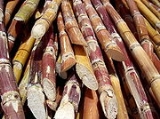
Sugarcane or Sugar cane is a genus of 6 to 37 species of tall grasses Poaceae

The true grasses are monocotyledon [i]ous plant [i]s in the Family Poaceae, also known as Gram ... 

 , native to warm temperate to tropical regions of the Old World. They have stout, jointed fibrous stalks 2 to 6 meters tall and sap rich in sugar Sugar

In general use, non-scientists take "sugar" to mean sucrose [i], also called "table sugar" or saccharose, a wh ... 

. All the species interbreed, and the major commercial cultivar Cultivar

A cultivar is a cultivated plant [i] that has received a name under the International Code of Nomenclature for Cultivated Plants [i] ... 

s are complex hybrid Hybrid

In biology [i], hybrid has two meanings. ... 

s.

Discussions

  Discussion Features

   Ask a question about 'Sugarcane'

   Start a new discussion about 'Sugarcane'

   Answer questions about 'Sugarcane'

   'Sugarcane' discussion forum


Encyclopedia


Sugarcane or Sugar cane is a genus of 6 to 37 species of tall grasses Poaceae

The true grasses are monocotyledon [i]ous plant [i]s in the Family Poaceae, also known as Gram ... 

 , native to warm temperate to tropical regions of the Old World. They have stout, jointed fibrous stalks 2 to 6 meters tall and sap rich in sugar Sugar

In general use, non-scientists take "sugar" to mean sucrose [i], also called "table sugar" or saccharose, a wh ... 

. All the species interbreed, and the major commercial cultivar Cultivar

A cultivar is a cultivated plant [i] that has received a name under the International Code of Nomenclature for Cultivated Plants [i] ... 

s are complex hybrid Hybrid

In biology [i], hybrid has two meanings.
... 

s.

Cultivation and uses


About 200 countries grow the crop to produce 1,324 million tons . As of the year 2005, the world's largest producer of sugar cane by far is Brazil Brazil

Brazil, officially the Federative Republic of Brazil , is the largest and most populous country [i] ... 

. Uses of sugar cane include the production of sugar, molasses, rum Rum

Rum is a distilled beverage [i] made from sugarcane [i] by-products such as molasses [i] and sugarcane juice [i]... 

, and ethanol Ethanol

This article is about the chemical compound.... 

 for fuel.

History

For a longer history, see Sugar Sugar

In general use, non-scientists take "sugar" to mean sucrose [i], also called "table sugar" or saccharose, a wh ... 

.


Sugarcane is a grass originally from tropical Southeast Asia . The thick stalk stores energy as sucrose in the sap. From this juice, sugar is extracted by evaporating the water. Crystallized sugar was reported 2500 years ago in India. Around the eighth century A.D., Arabs introduced sugar to the Mediterranean and it was cultivated in Spain. It was among the early crops brought to the Americas by Spaniards.

Sugarcane was grown extensively in the Caribbean Caribbean

The Caribbean is a region [i] of the Americas [i] consisting of the Caribbean Sea [i], its island [i]s... 

, and still is on some islands. In colonial times, sugar was a major product of the triangular trade Triangular trade

A "triangular trade" is any three-way exchange, but the term is often used to refer to one particular in... 

 of New World raw materials, European manufactures, and African slave Slavery

Slavery is the social and legal designation of specific person [i]s as property [i] or chattel, for the ... 

s. France France

France, officially the French Republic, is a country [i] whose metropolitan territory [i] ... 

 found its sugarcane islands so valuable it effectively traded Canada to Britain for their return of Guadeloupe Guadeloupe

Guadeloupe is an archipelago [i] located in the eastern Caribbean Sea [i] at , with a total area of 1,78 ... 

, Martinique Martinique

Martinique is an island [i] in the eastern Caribbean Sea [i], having a total area of 1,128 km. ... 

 and St. Lucia Saint Lucia

Saint Lucia is an island nation [i] in the eastern Caribbean Sea [i] on the boundary with the Atlantic Ocean [i] ... 

 at the end of the Seven Years' War Seven Years' War

The Seven Years' War, some of the theatres [i] of which are called the Pomeranian War and ... 

. The Dutch Netherlands

The Netherlands is the Europe [i]an part of the Kingdom of the Netherlands [i] , which is formed ... 

 similarly kept Suriname Suriname

Suriname, officially the Republiek Suriname, is a country in northern South America [i]. ... 

, a sugar colony in South America South America

South America is a continent [i] situated in the western hemisphere [i] and, mostly, ... 

, instead of seeking the return of the New Netherlands New Netherland

New Netherland , 16141674, was the territory on the eastern coast of North America [i] in the 17th century [i] ... 

 . Cuba Cuba

Cuba, officially the Republic of Cuba, consists of the island of Cuba, the Isle of Youth [i] and a ... 

n sugarcane produced sugar that received price supports from and a guaranteed market in the USSR Soviet Union

The Union of Soviet Socialist Republics , more commonly known as the Soviet Union, was a Communist state [i] ... 

; the dissolution of that country forced the closure of most of Cuba's sugar industry. Sugarcane remains an important part of the economy of Barbados Barbados

Barbados is an independent island nation [i] located in the western Atlantic Ocean [i], just to the east ... 

, the Dominican Republic Dominican Republic

The Dominican Republic, is a country located on the eastern two-thirds of the Caribbean [i] ... 

, Guadeloupe Guadeloupe

Guadeloupe is an archipelago [i] located in the eastern Caribbean Sea [i] at , with a total area of 1,78 ... 

, Jamaica Jamaica

Jamaica is an island nation [i] of the Greater Antilles [i], 240 kilometres in length and as much as 85 ... 

, Grenada Grenada

Grenada is an island nation [i] in the southeastern Caribbean Sea [i] including the southern Grenadines [i] ... 

, and other islands. The sugarcane industry is a major export for the Caribbean, but it is expected to collapse with the removal of European preferences by 2009.


Sugarcane production greatly influenced many tropical Pacific islands Pacific Islands

The Pacific Ocean [i] has an estimated 20,000 to 30,000 islands; the exact number has not been precisely ... 

, most particularly Hawaii Hawaii

Hawaii became the 50th state [i] of the United States [i] on August 21 [i], 1959 [i]. ... 

 and Fiji Fiji

Fiji , officially the Republic of the Fiji Islands, is an island nation [i] in the South Pacific Ocean [i] ... 

. In these islands, sugar came to dominate the economic and political landscape after the indigenous societies had been invaded by Europeans and Americans, who promoted immigration from various Asian countries for workers to tend and harvest the crop. Sugar-industry policies eventually established the ethnic makeup of the island populations that now exist, profoundly affecting modern politics and society in the islands.

Brazil is a major grower of sugarcane, which is used to produce sugar and provide the alcohol Alcohol

In chemistry [i], an alcohol is any organic compound [i] in which a hydroxyl [i] group [i] ... 

 used in making gasohol Common ethanol fuel mixtures

Ethanol [i] and methanol [i] are two types of alcohol fuel [i]s. ... 

 and biodiesel Biodiesel

Biodiesel refers to a diesel [i]-equivalent, processed fuel derived from biological sources. ... 

 fuels.

Cultivation

Sugarcane cultivation requires a tropical or subtropical climate, with a minimum of 600 mm of annual moisture. It is one of the most efficient photosynthesizers Photosynthesis

Photosynthesis , generally, is the synthesis of sugar from light [i], carbon dioxide [i] and water, with ... 

 in the plant kingdom, able to convert up to 2 percent of incident solar energy into biomass. In prime growing regions, such as Hawaii Hawaii

Hawaii became the 50th state [i] of the United States [i] on August 21 [i], 1959 [i]. ... 

, sugarcane can produce 20 kg for each square meter exposed to the sun.

Sugarcane is propagated from cuttings, rather than from seeds; although certain types still produce seeds, modern methods of stem cuttings have become the most common method of reproduction. Each cutting must contain at least one bud, and the cuttings are usually planted by hand. Once planted, a stand of cane can be harvested several times; after each harvest, the cane sends up new stalks, called ratoons. Usually, each successive harvest gives a smaller yield, and eventually the declining yields justify replanting. Depending on agricultural practice, two to ten harvests may be possible between plantings.


Sugarcane is used as a food plant by the larva Larva

A larva is a juvenile form of animal [i] with indirect development [i], undergoin... 

e of some lepidoptera Lepidoptera

The order Lepidoptera is the second largest order [i] in the class [i] insect [i]a and inc ... 

 species, including turnip moth.

Sugarcane is harvested by hand or mechanically. Hand harvesting accounts for more than half of the world's production, and is especially dominant in the developing world. When harvested by hand, the field is first set on fire. The fire spreads rapidly, burning away dry dead leaves, and killing any venomous snake Snake

Snakes , also known as ophidians, are cold-blooded [i] legless reptile [i]s closely related ... 

s hiding in the crop, but leaving the water-rich stalks and roots unharmed. With knives, harvesters then cut the standing cane just above the ground. A skilled harvester can cut 500 kg of sugarcane in an hour.

The sugarcane combine Combine harvester

The combine harvester, or simply combine, is a machine that harvests, threshes [i], and ... 

, or chopper harvester, is a harvesting machine originally developed in Australia Australia

Australia, officially the Commonwealth of Australia, is a country in the Southern Hemisphere [i] c ... 

. It cuts the cane at the base of the stalk, separates the cane from its leaves, and deposits the cane into a cart while blowing the cut leaves back onto the field. Such machines can harvest 30 tonnes of cane each hour, but cane harvested using these machines must be transported to the processing plant rapidly; once cut, sugarcane begins to lose its sugar content, and damage inflicted on the cane during mechanical harvesting accelerates this decay.

Processing


Traditionally, sugarcane has been processed in two stages. Sugarcane mills, located in sugarcane-producing regions, extract sugar from freshly harvested sugarcane, resulting in raw sugar for later refining, and in "mill white" sugar for local consumption. Sugar refineries, often located in heavy sugar-consuming regions, such as North America North America

North America is a continent [i] in the Earth [i]'s northern hemisphere [i] and almost fully in the western hemisphere [i]... 

, Europe Europe

Europe is one of the seven traditional continent [i]s of the Earth [i]. ... 

, and Japan Japan

is an island country [i] in East Asia [i]. ... 

, then purify raw sugar to produce refined white sugar, a product that is more than 99 percent pure sucrose Sucrose

Sucrose is a disaccharide [i] with the molecular formula [i] C12H22O11. ... 

. These two stages are slowly becoming blurred. Increasing affluence in the sugar-producing tropics has led to an increase in demand for refined sugar products in those areas, where a trend toward combined milling and refining has developed.

Milling


In a sugar mill, sugarcane is washed, chopped, and shredded by revolving knives. The shredded cane is repeatedly mixed with water and crushed between rollers; the collected juices contain 10–15 percent sucrose, and the remaining fibrous solids, called bagasse, are burned for fuel. Bagasse makes a sugar mill more than self-sufficient in energy; the surplus bagasse can be used for animal feed, in paper manufacture, or burned to generate electricity for the local power grid.

The cane juice is next mixed with lime to adjust its pH PH

pH is a measure of the acidity [i] of a solution [i], in terms of activity [i] of hydrogen [i] ... 

 to 7. This mixing arrests sucrose's decay into glucose and fructose, and precipitates out some impurities. The mixture then sits, allowing the lime and other suspended solids to settle out, and the clarified juice is concentrated in a multiple-effect evaporator to make a syrup about 60 percent by weight in sucrose. This syrup is further concentrated under vacuum until it becomes supersaturated, and then seeded with crystalline sugar. Upon cooling, sugar crystallizes out of the syrup. A centrifuge Centrifuge

A centrifuge is a piece of equipment, generally driven by a motor, that puts an object in rotation around a fixed axis [i] ... 

 is used to separate the sugar from the remaining liquid, or molasses. Additional crystallizations may be performed to extract more sugar from the molasses; the molasses remaining after no more sugar can be extracted from it in a cost-effective fashion is called blackstrap.

Raw sugar has a yellow to brown color. If a white product is desired, sulfur dioxide Sulfur dioxide

Sulfur dioxide is the chemical compound [i] with the formula SO2. ... 

 may be bubbled through the cane juice before evaporation; this chemical bleaches many color-forming impurities into colorless ones. Sugar bleached white by this sulfitation process is called "mill white," "plantation white," and "crystal sugar." This form of sugar is the form most commonly consumed in sugarcane-producing countries.

Refining

In sugar refining, raw sugar is further purified. It is first mixed with heavy syrup and then centrifuged clean. This process is called "affination"; its purpose is to wash away the outer coating of the raw sugar crystals, which is less pure than the crystal interior. The remaining sugar is then dissolved to make a syrup, about 70 percent by weight solids.

The sugar solution is clarified by the addition of phosphoric acid Phosphoric acid

|-
| align="center" colspan="2" bgcolor="#ffffff" | |
... 

 and calcium hydroxide Calcium hydroxide

Calcium hydroxide is a chemical compound [i] with the chemical formula Ca [i](OH [i])2 ... 

, which combine to precipitate calcium phosphate. The calcium phosphate particles entrap some impurities and absorb others, and then float to the top of the tank, where they can be skimmed off. An alternative to this "phosphatation" technique is "carbonatation," which is similar, but uses carbon dioxide Carbon dioxide

Carbon dioxide is a chemical compound [i] composed of one carbon [i] and two oxygen [i] atoms. ... 

 and calcium hydroxide to produce a calcium carbonate Calcium carbonate

Calcium carbonate is a chemical compound [i], with chemical formula [i] Ca [i]C [i]O [i] ... 

 precipitate.

After any remaining solids are filtered out, the clarified syrup is decolorized by filtration through a bed of activated carbon Activated carbon

Activated carbon, also called activated charcoal or activated coal, is a general term which ... 

; bone char was traditionally used in this role, but its use is no longer common. Some remaining colour-forming impurities adsorb to the carbon bed. The purified syrup is then concentrated to supersaturation and repeatedly crystallized under vacuum, to produce white refined sugar Sugar

In general use, non-scientists take "sugar" to mean sucrose [i], also called "table sugar" or saccharose, a wh ... 

. As in a sugar mill, the sugar crystals are separated from the molasses by centrifugation. Additional sugar is recovered by blending the remaining syrup with the washings from affination and again crystallizing to produce brown sugar Brown sugar

Brown sugar is a sucrose [i] sugar [i] product with a distinctive brown color due to the presence of molasses [i] ... 

. When no more sugar can be economically recovered, the final molasses still contains 20–30 percent sucrose and 15–25 percent glucose and fructose.

To produce granulated sugar Sugar

In general use, non-scientists take "sugar" to mean sucrose [i], also called "table sugar" or saccharose, a wh ... 

, in which the individual sugar grains do not clump together, sugar must be dried. Drying is accomplished first by drying the sugar in a hot rotary dryer, and then by conditioning the sugar by blowing cool air through it for several days.

Ribbon cane syrup


Ribbon cane is a subtropical type that was once widely grown in southern United States United States

The United States of America, also known as the United States, the U.S., the U.S.A., a... 

, as far north as coastal North Carolina North Carolina

North Carolina is a state [i] in the Southeastern [i] United States [i]... 

. The juice was extracted with horse or mule-powered crushers; the juice was boiled, like maple syrup Maple syrup

Maple syrup is a sweetener made from the sap [i] of maple [i] trees. ... 

, in a flat pan, and then used in the syrup form as a sweetener for other foods. It is not a commercial crop nowadays, but a few growers try to keep alive the old traditions and find ready sales for their product. Most sugarcane production in the United States occurs in Florida Florida

Florida is a U.S. state [i] located in the southeastern [i] United States [i] ... 

 and Louisiana Louisiana

cellpadding="2" cellspacing="2">
... 

, and to a lesser extent in Hawaii Hawaii

Hawaii became the 50th state [i] of the United States [i] on August 21 [i], 1959 [i]. ... 

 and Texas Texas

Texas is a state [i] in both the Southern [i] and Western [i] ... 

.

Sugarcane as foodstuff


In most countries where sugarcane is cultivated, there are several foodstuffs and popular dishes derived from it, such as:
  • Direct consumption of raw sugarcane cylinders or cubes, which are chewed to extract the juice, and the bagasse is spat out
  • Freshly extracted juice by hand or electrically operated small mills, with a touch of lemon Lemon

    The lemon is a hybrid [i] citrus [i] tree [i] of cultivated origin. ... 

     and ice, makes a delicious and popular drink.
  • Molasses, used as a sweetener and as a syrup accompanying other foods, such as cheese Cheese

    [i]s, [[domestic sheep|sheep]... 

  • Rapadura, a candy Candy

    Candy is often used as a synonym for the more traditional term confectionery [i] in North America [i] ... 

     made of flavored solid brown sugar in Brazil, which can be consumed in small hard blocks, or in pulverized form , as an add-on to other dessert Dessert

    Dessert is a course that typically comes at the end of a dinner, usually consisting of sweet food [i] bu ... 

    s.
  • Sugarcane is also used in rum Rum

    Rum is a distilled beverage [i] made from sugarcane [i] by-products such as molasses [i] and sugarcane juice [i]... 

     production, especially in the Caribbean.

References


External links