

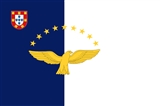
Azores

Encyclopedia
The Archipelago of the Azores (UK , US ; , ɐˈsoɾɨʃ) is composed of nine volcanic islands situated in the middle of the North Atlantic Ocean, and is located about 1500 km (932.1 mi) west from Lisbon
and about 3900 km (2,423.4 mi) east from the east coast of North America
. The islands, and their economic exclusion zone
, form the Autonomous Region of the Azores, one of the two autonomous regions of Portugal
. Its main industries are: agriculture
, dairy farming
(for cheese and butter products primarily), minor livestock ranching, fishing
and tourism
, which is becoming the major service activity in the region; added to which, the government of the Azores employs a large percentage of the population directly or indirectly in many aspects of the service and tertiary sectors.
There are nine major Azorean island
s and an islet cluster, in three main groups. These are Flores and Corvo
, to the west; Graciosa
, Terceira, São Jorge
, Pico
and Faial
in the centre; and São Miguel
, Santa Maria
and the Formigas Reef to the east. They extend for more than 600 km (372.8 mi) and lie in a northwest-southeast direction.
The vast extent of the islands defines an immense exclusive economic zone
of 1100000 km² (424,712.4 sq mi). The westernmost point of this area is 3380 km (2,100 mi) from the North American continent. All the islands have volcanic origins, although some, such as Santa Maria
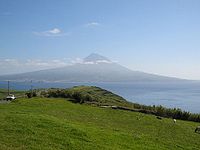
, have had no recorded activity since the islands were settled. Mount Pico
, on the island of Pico
, is the highest point in Portugal, at 2351 m (7,713 ft). The Azores are actually some of the tallest mountains on the planet, measured from their base at the bottom of the ocean to their peaks, which thrust high above the surface of the Atlantic.
Because these once-uninhabited and remote islands were settled sporadically over a span of two centuries, their culture, dialect, cuisine and traditions vary considerably.
, earthen structures carved into rocks that were used for burials, have been identified on the islands of Corvo, Santa Maria and Terceira by Portuguese archaeologist Nuno Ribeiro and speculations were published that they might date back 2000 years, alluding to a human presence on the island before the Portuguese. However, these kind of structures have always been used in the Azores to store cereals and suggestions by Ribeiro that they might be burial sites are unconfirmed. Detailed examination and dating to authenticate the validity of these speculations is lacking. So far, it is unclear whether these structures are natural or man-made and if they predate the 15th century Portuguese colonization of the Azores. Solid confirmation of a pre-Portuguese human presence in the archipelago has not yet been published.
 The discovery and settlement of the Azores archipelago, much like the islands of Madeira
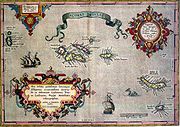
, is one of the more controversial aspects of the Portuguese Age of Discovery. In addition to many theories, myths and stories written about the Azores there have been various Genovese and Catalan maps produced since 1351 that identified islands in the Atlantic. Some chroniclers note that sailors knew of the islands, and visited them during return voyages from the Canary Islands
(about 1340–1345), during the reign of King Afonso IV. In "A History of the Azores" by Thomas Ashe
written in 1813 the author identified a Fleming
, Joshua Vander Berg of Bruges
, who made land in the archipelago during a storm on his way to Lisbon
. Ashe then claimed that the Portuguese explored the area and claimed it for Portugal shortly after. Other stories note the discovery of the first islands (São Miguel Island
, Santa Maria Island
and Terceira Island
) were made by sailors in the service of Infante D. Henrique, although there are few written documents to support the claims. Supporting the official history of the islands are latter day writings, based on oral tradition, that appeared in the first half of the 15th century. Legends and myths also developed during pre-official history to include myths about Prester John
, the "Ilhas Afortunadas" (the Fortunate Isles
), the "Ilhas Azuis" (the Blue Islands), the "Ilhas Cassiterides
" (the islands of Tin and Silver) or "Ilhas de Sete Cidades" (the islands of the Seven Cities), all noting the knowledge of undiscovered lands in the middle of the Atlantic.
Officially, the first islands were "discovered" in the 15th century (in 1431) by Gonçalo Velho Cabral
a Captain in the service of Infante D. Henrique, though credit is also given to the explorer Diogo de Silves
(in 1427).
Although it is commonly said that the archipelago received its name for the goshawk ( in Portuguese) due to its being a common bird at the time of discovery, it is unlikely that the bird nested or hunted in the islands. Some people, however, insist that the name is derived from birds, pointing to a local subspecies of the buzzard
as the animal the first explorers erroneously identified as goshawks. The name may also derive from the word azor, meaning blue in vernacular
Portuguese
and used by those sailors who identified the islands by their blue color as they appeared in the distance by sea. The proper word for blue in Portuguese is azul.
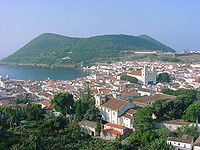 At some point, following the discovery of Santa Maria, sheep were let loose on the island before settlement actually took place. This was done to supply the future settlers with food because there were no large animals on the island. Settlement did not take place right away, however. There was not much interest among the Portuguese people in an isolated archipelago hundreds of miles from civilization. But patiently Cabral gathered resources and settlers for the next three years (1433–1436) and sailed to establish colonies on Santa Maria first and then later on São Miguel.
Brush had to be cleared and rocks removed for the planting of crops; grain
, grape
vines, sugar cane, and other plants suitable for settler use and of commercial value, were planted. Domesticated animals were brought, such as chicken
s, rabbit
s, cattle
, sheep, goats, and hogs
. Houses were built and villages established.
The islands were settled by a mixed group of people from the Portuguese provinces of Algarve and Minho. Also, Madeirans, Moorish prisoners, enslaved Africans, French, Italians, Scots, English, Germans and Flemings were among the early settlers. There were petty criminals, Spanish clergy, Sephardic Jews, soldiers, government officials, European merchants and sugar cane growers.
São Miguel was first settled in 1444, the settlers – mainly from the Estremadura
, Alto Alentejo and Algarve areas of Portugal, under the command of Gonçalo Velho Cabral – landing at the site of modern-day Povoação
. In 1522 Vila Franca do Campo
, then the capital of the island, was devastated by a landslide caused by an earthquake which killed about 5,000 people, and the capital was moved to Ponta Delgada
. The town of Vila Franca was rebuilt on the original site and today is a thriving fishing and yachting port. Ponta Delgada received its city status in 1546. Since the first settlement the pioneers applied themselves to the area of agriculture. By the 15th century Graciosa exported wheat, barley, wine and brandy. The goods were sent to Terceira largely due to the proximity of the island.
During the 18th and 19th century, Graciosa was host to many prominent figures, including Chateaubriand
, the French writer who passed through upon his escape to America during the French revolution; Almeida Garrett
, the Portuguese poet who visited an uncle and wrote some poetry while there; and Prince Albert of Monaco
, the 19th century oceanographer who led several expeditions in the waters of the Azores. He arrived on his yacht "Hirondelle", and visited the "furna da caldeira", the noted hot springs grotto.
The first reference to the island of São Jorge was made in 1439 but the actual date of discovery is unknown. In 1443 the island was already inhabited but active settlement only began with the arrival of the noble Flemish native Wilhelm Van der Haegen. Arriving at Topo
, where he lived and died, he became known as Guilherme da Silveira to the islanders. João Vaz Corte-Real received the captaincy of the island in 1483. Velas
became a town before the end of the 15th century. By 1490, there were 2,000 Flemings living in the islands of Terceira, Pico, Faial, São Jorge and Flores. Because there was such a large Flemish settlement, the Azores became known as the Flemish Islands or the Isles of Flanders. Prince Henry the Navigator was responsible for this settlement. His sister, Isabel
, was married to Duke Philip of Burgundy of which Flanders was a part. There was a revolt against Philip's rule and disease and hunger became rampant. Isabel appealed to Henry to allow some of the unruly Flemings to settle in the Azores. He granted this and supplied them with the necessary transportation and goods.
The settlement of the then-unoccupied islands started in 1439 with people mainly from the continental provinces of Algarve and Alentejo. In 1583, Philip II of Spain
, as king of Portugal, sent his fleet to clear the Azores of a combined multinational force of adventurers, mercenaries, volunteers and soldiers who were attempting to establish the Azores as a staging post for a rival pretender
to the Portuguese throne. Following the success of his fleet at the Battle of Ponta Delgada
, the captured enemies were hanged from yardarms, as they were considered pirates by Philip II. (This was added to the "Black Legend
" by his enemies.) An English expedition against the Azores in 1597, the Islands Voyage
, also failed. Spain held the Azores in what is called The Babylonian captivity of 1580–1642. Into the late 16th century, the Azores as well as Madeira
began to face problems of overpopulation. Spawning from that particular economic problem, some of the people began to emigrate to Brazil
.
to resist Philip's reign over Portugal (Macau
resisted any official recognition) and were returned to Portuguese control with the end of the Iberian Union
in 1640, not by the professional military, who were used in the Restoration War
in the mainland, but by local people attacking a fortified Castilian
garrison.
(1828–1834) had strong repercussions in the Azores. In 1829, in Praia da Vitoria
, the Liberals
won over the absolutists, making Terceira Island
the main headquarters of the new Portuguese regime and also where the Council of Regency of Maria II of Portugal was established.
Beginning in 1868, Portugal
issued its stamps overprinted with "" for use in the islands. Between 1892 and 1906, it also issued separate stamps for the three administrative districts of the time.
From 1836 to 1976, the archipelago was divided into three districts, equivalent (except in area) to those in the Portuguese mainland. The division was arbitrary, and did not follow the natural island groups, rather reflecting the location of each district capital on the three main cities (none of which were on the western group).
and were held briefly by military rebels.
In 1943, during World War II
, Portuguese dictator António de Oliveira Salazar
leased bases in the Azores to the British, despite his previous collaboration with Germany. The occupation of these facilities in October 1943 was codenamed Operation Alacrity by the Allies. This was a key turning point in the Battle of the Atlantic, allowing the Allies to provide aerial coverage in the Mid-Atlantic gap
; helping them to hunt U-boat
s and protect convoys.
In 1944, American forces
constructed a small and short-lived air base on the island of Santa Maria. In 1945, a new base was constructed on the island of Terceira and is currently known as Lajes Field
. This base is in an area called Lajes, a broad, flat sea terrace that had been a farm. Lajes Field is a plateau rising out of the sea on the northeast corner of the island. This Air Force base
is a joint American and Portuguese venture. Lajes Field continues to support United States and Portuguese military
operations. During the Cold War
, the United States Navy
P-3 Orion
anti-submarine squadrons patrolled the North Atlantic for Soviet submarines and surface spy vessels. Since its inception, Lajes Field has been used for refuelling aircraft bound for Europe, and more recently, the Middle East. The United States Navy
operates a small fleet of military ships in the harbour of Praia da Vitória
, three kilometres (2 mi) southeast of Lajes Field. The airfield also has a small commercial terminal handling scheduled and chartered passenger flights from other islands in the archipelago, Europe, and North America.
In 1976, the Azores became the Autonomous Region of the Azores , one of the Autonomous regions of Portugal
, and the Azorean districts were suppressed.
of the Azores is located in the middle of the northern hemisphere of the Atlantic Ocean
and extends along a west-northwest to east-southeast orientation (between 36.5º-40º North latitudes and 24.5º-31.5º West longitudes) in an area approximately 600 km wide. The islands of the Azores emerged from what is called the Azores Platform, a 5.8 million km² region that is morphologically accented by a depth of 2000 meters.
From a geostructural perspective the Azores is located above an active triple junction
between three of the world's large tectonic plates (the North American Plate
, the Eurasian Plate
and the African Plate
), a condition that has translated into the existence of many faults and fractures in this region of the Atlantic . The westernmost islands of the archipelago (Corvo
and Flores) are located in the North American Plate, while the remaining islands are located within the boundary that divides the Eurasian and African Plates.
 The principal tectonic structures that exist in the region of the Azores are the Mid-Atlantic Ridge
, the Terceira Rift
, the Azores Fracture Zone and the Glória Fault. The Mid-Atlantic Ridge is the main frontier between the American Plate and the African-Eurasian Plates that crosses the Azores Platform between the islands of Flores and Faial
from north to south then to the southwest; it is an extensive form crossed by many transform faults running perpendicular to its north-south orientation, that is seismically active and susceptible to volcanism. The Terceira Rift is a system of fractures that extends from the Mid-Atlantic Ridge to the Glória Fault that represents the main frontier between the Eurasian and African Plates. It is defined by a line of submarine volcanoes and island mounts that extend northwest to southeast for about 550 km, from the area west of Graciosa
until the islets of the Formigas, that includes the islands of Graciosa, Terceira and São Miguel. Its northwest limit connects to the Mid-Atlantic Ridge, while the southeast section intersects the Gloria Fault southeast of the island of Santa Maria
. The Azores Fracture Zone is that extends from the Glória Fault and encompasses a relatively inactive area to the south of the islands of the Central and Eastern groups north to the Terceira Rift, along a 45º angle. The Glória Fault, for its part, extends 800 km along a linear line from the Azores to the Azores-Gibraltar Transform Fault
.
The island's volcanism is associated with the rifting along the Azores Triple Junction
; the spread of the crust along the existing faults and fractures has produced many of the active volcanic and seismic events, while supported by buoyant upwelling in the deeper mantle, some associate with an Azores hotspot
. Most of the volcanic activity has centered, primarily, along the Terceira Rift. From the beginning of the island's settlement, around the 15th Century, there have been 28 registered volcanic eruptions (15 terrestrial and 13 submarine). The last significant volcanic eruption, the Capelinhos
volcano , occurred off the coast of the island of Faial (in 1957); the most recent volcanic activity occurred in the seamounts and submarine volcanoes off the coast of Serreta and in the Pico-Jão Jorge Channel. The islands have many examples of volcano-built geomorphology, including: many of the caves and subterranean lava tubes (such as the Gruta das Torres
, Algar do Carvão
, Gruta do Natal, Gruta das Cinco Ribeiras), the coastal lava fields (like the coast of Feteiras
, Faial
, the Mistério of Prainha
or São João on Pico Island
) in addition to the currently inactive cones in central São Miguel Island
, the aforementioned Capelinhos on Faial, the volcanic complexes of Terceira or Plinian caldeira of Corvo Island
.
The islands of the archipelago were formed through volcanic and seismic activity during the late Tertiary
geological period; the first embryonic surfaces started to appear in the waters of Santa Maria during the Miocene epoch (from circa 8 million years ago). The sequence of the island formation has been generally characterized as: Santa Maria (8.12 Ma), São Miguel (4.1 Ma), Terceira (3.52 Ma), Graciosa (2.5 Ma), Flores (2.16 Ma), Faial (0.7 Ma), São Jorge (0.55 Ma), Corvo (0.7 Ma) and the youngest, Pico (0.27 Ma). Although all islands have experienced volcanism during their geological history, within recorded "human settlement" history the islands of Santa Maria, Flores, Corvo and Graciosa have not experienced any volcanic eruptions; in addition to active fumaroles and hot-springs, the remaining islands have had sporadic eruptions since the 14th Century. Apart from the Capelinhos
volcano in 1957–58, the last recorded instance of "island formation" occurred off the coast of São Miguel, when the island of Sabrina
was briefly formed.
Owing to its geodynamic environment, the region has been center of intense seismic activity, particularly along its tectonic boundaries on the Mid-Atlantic Ridge and Terceira Rift. Seismic events although frequent, usually tectonic or vulco-tectonic in nature, but in general low to medium intensities, occasionally punctuated by events of level 5 or greater on the Richter scale. The most severe earthquake was registered in 1757, near Calheta
on the island of São Jorge, which exceeded 7 on the Richter scale. In comparison, the 1522 earthquake, mentioned by Gaspar Frutuoso
the historian, was only a magnitude 6.8, but a level 10 on the Mercalli scale, but responsible for the destruction of Vila Franca do Campo
and landslides that may have killed less than 5000 of the inhabitants.
The nine islands that comprise the archipelago occupy a surface area of 2346 km² (906 sq mi), that includes both the main islands and many islets located in their vicinities. Each of the islands have their own distinct geomorphological characteristics that make them unique: Corvo
(the smallest island) is a crater of a major Plinian eruption; Flores (its neighbor on the North American Plate
) is a rugged island carved by many valleys and escarpments; Faial
characterized for its shield volcano and caldera (Cabeço Gordo
); Pico
, is the highest point, at 2351 metres (7,713 ft), in the Azores and continental Portugal; Graciosa is known for its active Furnas do Enxofre and mixture of volcanic cones and plains; São Jorge is a long slender island, formed from fissural eruptions over thousands of years; Terceira, almost circular, is the location of one of the largest craters in the region; São Miguel
is the largest island, and is pitted with many large craters and fields of spatter cones; and Santa Maria
, the oldest island, is heavily eroded, being one of the few places to encounter brown sandy beaches in the archipelago. They range in surface area from the largest, São Miguel, at 759 km² (293 sq mi) to the smallest, Corvo, at approximately 17 km² (7 sq mi).
These islands have naturally evolved into three recognizable groups located within the Azores Platform; they are:
In addition, several sub-surface reefs (particularly the Dollabarat
on the fringe of the Formigas), banks (specifically the Princess Alice Bank
and D. João de Castro Bank
, as well as many hydrothermal vents and sea-mounts
are monitored by the regional authorities, owing to the complex geotectonic and socio-economic significance within the economic exclusion zone of the archipelago.
that includes the macaronesian subtropical laurissilva, with many endemic species of plants. Even though the Azores look very green and sometimes wild, the vegetation has been extremely altered. Approximately 95% of laurisilva
has been wiped out in the past 600 years for its valuable wood (for tools, buildings, boats, fire wood
, and so on.) and to clear land for agriculture. As a result, it is estimated that more than half of insects on the islands have disappeared or will become extinct. Many cultivated places (which are traditionally dedicated to pasture or to growing colocasia
, potato
es, maize
and other crops) have now been abandoned, especially as a result of emigration. Consequently, some invasive
plants have filled these deserted and disturbed lands. The two most common of these alien species are Pittosporum undulatum
and Acacia melanoxylon. They are usually restricted to ancient agricultural land and only rarely penetrate into undisturbed native vegetation. The main loss is in the lowlands (below 400 metres), where virtually all laurisilva was eradicated.
A few Persea indica
and Picconia azorica
still survive in some places, but appear to be extremely vulnerable. Only Myrica faya
seems to have survived human impact quite well, and it is commonly found in hedges or among exotic trees. More recent introductions could become a serious threat, like Leptospermum scoparium
which has the ability to colonize the still nearly untouched medium-altitude vegetation (Ilex, Myrsine
africana, Erica
, and so on.).
Hydrangea
s are another potential pest, but their threat is less serious. Notwithstanding the fact that Hydrangeas were introduced from America or Asia, some locals consider them to be a symbol of the archipelago and propagate them along roadsides, helping them to escape into the wild. Cryptomeria
, the Japanese cedar, is a conifer extensively grown for its timber; many seedlings can be found in the last remnants of medium-altitude native vegetation.
The Azores has two endemic bird species. The Azores Bullfinch
, or Priolo, is restricted to remnant laurisilva forest in the mountains at the eastern end of São Miguel, and is classified by BirdLife International as endangered. Monteiro's Storm-petrel
, described to science as recently as 2008, is known to breed in just two locations in the islands, but may occur more widely. The Azores also has an endemic bat
, the Azores Noctule
, which is unusual in regularly feeding during the day.
The islets of the Formigas (the Portuguese word for "ant
s"), including the area known as the Dollabarat
Reef, has a rich environment of maritime species, such as black coral
and manta ray
s, sharks, and sea turtle
s. On São Miguel there are notable micro-habitats formed by hot springs that host extremophile microorganisms.
is spread out in the area between 37° N and the parallels of latitude
that pass through the Lisbon area (38° 43' / 38° 55' N), giving it generally a tepid, oceanic, subtropical climate, with mild annual oscillations. Daily maximum temperatures usually range between 15 °C (59 °F) and 25 °C (77 °F). The average annual rainfall increases from east to west, and it ranges from 700 to 1600 annual millimetres (27.6–63 in) on average, reaching 6300 millimetres (248 in) on Mount Pico
, the highest Portuguese mountain at 2351 m (7,713 ft). The Azores high
, an area of high atmospheric pressure
, is named after the islands.
In addition, the Instituto de Meteorologia
has identified the following weather extremes:
There are five cities (Portuguese: cidades) in the Azores: Ponta Delgada
and Ribeira Grande on the island of São Miguel; Angra do Heroísmo
and Praia da Vitória
on the island of Terceira, and Horta
on Faial. Three of these Ponta Delgada
, Angra and Horta
are considered capital/administrative cities to the regional government: homes to the President (Ponta Delgada), the Judiciary (Angra) and the Regional Assembly (Horta). Angra also serves as the ecclesiastical centre of the Roman Catholic Diocese of Angra
.
The Azores were uninhabited when Portuguese navigators arrived in the early 15th century; the settlement process was initiated in 1439 with individuals from various regions of mainland Portugal and from Madeira island. Today, the vast majority of the inhabitants of the Azores are an admixture of Portuguese
, descendants of 15th century immigrants from Algarve, Alentejo and from Minho
, as well as Sephardic Jews, Moorish prisoners, Flemish
, French, Spaniards, and other populations who contributed to the successive settlement process of the islands. The nature of the economy dictated that African slavery
never became common in the Azores because they were sent to Brazil and the Caribbean, only a few remained in the Azores to help with domestic chores, although the islands sometimes served as a waypoint for ships carrying African slaves
.
Genetic studies (Pacheco et al., 2005; Branco et al., 2006; Branco et al., 2008a, 2008b, 2008c) report high genetic variability and heterogeneity in the Azorean population, as compared with mainland Portugal and other European populations. This high genetic variability may be explained by the history of the settlement of the islands, as well as genetic contributions that occurred during the expansion of trade navigation between Europe, America, and Asia in the 16th and 17th centuries. As in continental Portugal
, the most frequent mtDNA haplogroup in the Azores is H
(45.2%). After R, Haplogroup J is the second most frequent Y-chromosome DNA haplogroup in the Azores. Y-chromosome Haplogroup J
, found in greatest concentration in Southwest Asia, is thought to have originated in the Middle East
. Data show that in the Azores this haplogroup is the second most common, with a frequency of 13.4%, twice as high as in mainland Portugal (6.8%; Rosser et al. 2000). The other non-European haplogroups, N3 and E3a, which are prevalent in Asia and sub-Saharan Africa, respectively, have been found in the Azores (0.6% and 1.2%, respectively) but not in mainland Portugal.
AZORES GENETIC PROFILE:
Mtdna profile:
Haplogroup pre-HV = 56% (Middle East, Arabia);
Haplogroup H
= 45.2% (Europe);
Haplogroup K
= 6.5% (Europe, France, Italy, Spain);
Haplogroup L
= 3.4% (Africa);
Haplogroup T
= 10.1% (Spain);
Haplogroup U = 16.7% (Scandinavia, Finland, Sweden, Norway, Belgium).
Y-chromosome DNA profile:
Haplogroup E1b1b = 9% (northern Africa, Europe, Spain; the Balkans);
Haplogroup E3a = (Africa, Berbers, Tunisians, Moroccan Arabs);
Haplogroup G
= (Europe, Asia, Africa, Middle East, India, Sri Lanka, Malaysia);
Haplogroup I
= 5% (Europe, Near East, Caucasus, Central Asia; Bosnia, Herzegovina, Croatia, Dagestan);
Haplogroup I1b = 30.8% (Eurasia, Slavic, Uralic people of Eastern Europe; Lebanese);
Haplogroup I1c = ?% ( ? );
Haplogroup J
= 13% (southwestern Arabian Peninsula, north Africa, southern Europe);
Haplogroup N3 = (Scandinavia, northern Europe, Ukraine, Poland, Volga-Ural region);
Haplogroup Q
= (Central Asia; the Americas, north Africa, Asia, Europe, Pacific region);
Haplogroup R1b = 61.5% (Europe: southern Portugal, western Norway, Tehuelche Argentina, Belgium, Sweden,
Denmark, Italy, central Portugal, Vienna Austria, Spanish, Irish);
Haplogroup R1b3 = 60% (European: Spanish, Catalans, Portuguese, French, Danes, etc.; Irish).
, the United States
and Canada
. Rhode Island
and Southeastern Massachusetts, especially the cities of New Bedford
, Bristol, Barrington, Pawtucket, Central Falls, West Warwick, Hudson, River Point, and Fall River
have been, and continue to be the primary destination for Azorean emigrants. Northern California was the final destination for many of the Massachusetts immigrants who then moved on to the San Joaquin Valley
, especially the city of Turlock
, just south of Modesto. The tuna fishing industry drew a significant number of Azoreans to the Point Loma neighborhood of San Diego, in Southern California
. In 1919, there were approximately 300,000 people in the Azores while there were 100,000 Azoreans in the United States. From 1961 to 1977, about 150,000 Azoreans immigrated to
the United States. There were an estimated 83,000 Azoreans in California in the 1970s.
Many Azoreans also moved to Bermuda
and pre-U.S. Hawaii
. Florianópolis
and Porto Alegre
in the Southern Region
of Brazil were founded by Azoreans, who accounted for over half of Rio Grande do Sul
and Santa Catarina
's population in the late 18th century. As late as 1870-4 some 46,000 Portuguese emigrated to Brazil and a large proportion were from the Azores.
for a four-year term; the Regional Government and Presidency, with parliamentary legitimacy, composed of a President, a Vice-President and seven Regional Secretaries responsible for day-to-day operations. It is represented in the Council of Ministers by a representative appointed by the President of the Republic, which was created during the revision of the constitution of 2004 (which, among other things, removed the older Portuguese representative that was appointed by the President of the Republic, beholden to the Council of State and coincident with the President).
Since becoming a Portuguese autonomous region, the executive branch of the regional authority has been located in Ponta Delgada
, the legislative branch in Horta
, and the judicial branch in Angra do Heroísmo
.
The islands of the archipelago do not have independent status in law, except in electoral law and are governed by 19 municipalities that subdivide the islands. In addition, until the administrative reform of the 19th Century, the following civil parishes had municipal standing: Topo (today integrated into the municipality of Calheta
, São Jorge); Praia
da Graciosa (today integrated into municipality of Santa Cruz da Graciosa
); São Sebastião
(today an integral part of the municipality of Angra do Heroísmo); Capelas (now part of the municipality of Ponta Delgada); and Água de Pau (now a civil parish in the municipality of Lagoa). These civil parishes still retain their titles of "vila" in name only, by Regional Legislative Decree n.º 29/2003/A, June 24, 2003; the populations of Capelas and neighbouring parish still protest the change and promote the restoration of their status. The municipalities are also subdivided into several civil parishes, with the exception of Corvo (the only municipality by law without a civil parish, owing to its size).
Azorean politics are dominated by the two largest Portuguese political parties, the Social Democratic Party (PSD)
and the Socialist Party (PS)
, the latter holding a majority in the Regional Legislative Assembly. The Democratic and Social Center / People's Party
(CDS/PP), the Left Bloc (BE), the Unitarian Democratic Coalition
(CDU) and the People's Monarchist Party (PPM) are also represented in the local parliament. Currently, , the Socialist Party (PS) and its leader, Carlos César
have a plurality of the seats in the Assembly, and operate the Regional Government. Although the PS dominates the regional politics, the PSD is traditionally popular in city and town council
elections.
, British Prime Minister Tony Blair
, Spanish Prime Minister José María Aznar
and the Portuguese Prime Minister José Manuel Durão Barroso
held a summit there days before the commencement of the Iraq War.
, are operated by the Regional Government. Lajes is a military airbase, as well as commercial airport, and is operated by the Portuguese Armed Forces in conjunction with the United States
After 1871, the Insulana Shipping Company was the only entity responsible for regular traffic between the islands (except Corvo), Madeira and the United States. But, cargo and passenger transportation ceased in the 1970s, and the ships sold or converted into tuna fishing boats. For the next 20 years, commercial maritime service between the islands (except between Faial-Pico and Lajes das Flores-Vila do Corvo) ceased.
Transmaçor (Transportes Marítimos Açorianos, Lda.) was founded on 22 December 1987, resulting from the fusion of Empresa das Lanchas do Pico, Ld, owners of the ships Espalamaca and Calheta (ships that had travelled the canal between Faial and Pico for several years); Empresa Açoreana de Transportes Marítimos, Lda, which operated the ship Terra Alta; and Transcanal (Transportes Marítimos do Canal, Lda.) operator the traditional boats Picaroto and Manuel José. In the Central Group, the shipping company operates four to six time daily connections between Horta and Madalena throughout the year, using its small fleet of ships (Cruzeiro das Ilhas, Cruzeiro do Canal, Expresso das Ilhas and Expresso do Triângulo), in addition to inter-island connections between Faial, Pico, São Jorge and Terceira during the summer months.
Meanwhile, new initiatives began in the late 1990s: the catamaran Iapetos began services, followed by Lady of Mann and Golfinho Azul (chartered by Açorline). In 2005, Atlanticoline was established, providing services with the ships Ilha Azul and Express Santorini, later adding the Viking in 2009.
On 20 June 2011, the Regional Government announced that it would purchase 60% of Transmaçor, equivalent to 500,000 Euros of the company's capital. With this acquisition the Autonomous government of the Azores controlled 88% of the capital, with 12% to shareholders. The signed memorandum of understanding concluded negotiations between the various parties involved, under which the liability of Transmaçor (worth a total of 8 million Euros) was divided equally between the Region and businessman José Almeida, who is the holder of a majority stake in the company.
Similarly, the Regional Government approved the consolidation of the three individual port authorities (Administração dos Portos do Triângulo e Grupo Ocidental, Administração dos Portos da Terceira e Graciosa and the Administração dos Portos das Ilhas de São Miguel e Santa Maria) and regional Portos dos Açores into one entity that resulted in a 2.2 million Euro cost savings, in addition to a reduction from 11 to three administrators.
Religious festivals, patron saints and traditional holidays mark the Azorean calender. The most important religious events are tied with the festivals associated with the Cult of the Holy Spirit
, commonly referred to as the festivals of the Holy Spirit (or Espírito Santo), rooted in millenarian dogma, and held on all islands from May to September. These festivals are very important to the Azorean people, who are primarily Roman Catholic, and combine profane religious rituals with processions celebrating the benevolence and egalitarianism of neighbours. These events are centred around treatros or impérios, small buildings that host the meals, adoration and charity of the participants, and used to store the artefacts associated with the events. On Terceira, for example, these impérios have grown into ornate buildings painted and cared for by the local brotherhoods in their respective parishes. The events are normally closed to the public (confined to the members of the parish brotherhoods), although some limited events have been organized by the tourist-friendly populace, including a public event held by the city government in Ponta Delgada, on the island of São Miguel, which attracts visitors and locals.
Another event, the Festival of Senhor Santo Cristo dos Milagres (Lord Holy Christ of Miracles) in Ponta Delgada on the island of São Miguel is the largest individual religious event in the Azores, and takes place on the fifth Sunday after Easter. Pilgrims from within the Portuguese diaspora normally travel to Ponta Delgada to participate in an afternoon procession behind the image of Christ along the flower-decorated streets of the city. Although the solemn procession is only held on one day, the events of the Festival of Senhor Santo Cristo occur over a period of a week, and involve a ritual of moving the image between the main church and convent nightly, ultimately culminating in the procession, which is televised within the Azores and to the Portuguese diaspora.
The Sanjoaninas Festivities in Angra do Heroísmo in Terceira are held in June honoring S. Antonio, S. Pedro and St. João, in a large religious celebration.
The festival of Nossa Senhora de Lourdes, (Our Lady of Lourdes
), patron saint
of whalers, begins in Lajes on Pico on the last Sunday the August and runs through the week—Whalers Week. It is marked by social and cultural events connected to the tradition of whale hunting
. The Festa das Vindimas, (Wine Harvest Festival
), takes place during the first week of September and is a century old custom of the people of Pico.
In Corvo the people celebrate their patron saint Nossa Senhora dos Milagres (Our Lady of Miracles) on August 15 every year in addition to the festivals of the Divine Holy Spirit. The Festival da Maré de Agosto (August Sea Festival), takes place every year beginning on 15 August in Praia Formosa on Santa Maria. Also, the Semana do Mar (Sea Week), dedicated almost exclusively to water sports, takes place in August in the city of Horta, on Faial.
Carnaval
is also celebrated in the Azores. Parades and pageants are the heart of the Carnaval festivities. There is lively music, colorful costumes, hand-made masks, and floats.
The traditional bullfights in the bullring are ongoing, as is the running of bulls in the streets.
Lisbon
Lisbon is the capital city and largest city of Portugal with a population of 545,245 within its administrative limits on a land area of . The urban area of Lisbon extends beyond the administrative city limits with a population of 3 million on an area of , making it the 9th most populous urban...
and about 3900 km (2,423.4 mi) east from the east coast of North America
North America
North America is a continent wholly within the Northern Hemisphere and almost wholly within the Western Hemisphere. It is also considered a northern subcontinent of the Americas...
. The islands, and their economic exclusion zone
Exclusive Economic Zone
Under the law of the sea, an exclusive economic zone is a seazone over which a state has special rights over the exploration and use of marine resources, including production of energy from water and wind. It stretches from the seaward edge of the state's territorial sea out to 200 nautical...
, form the Autonomous Region of the Azores, one of the two autonomous regions of Portugal
Autonomous regions of Portugal
The two Autonomous Regions of Portugal are the Azores and Madeira...
. Its main industries are: agriculture
Agriculture
Agriculture is the cultivation of animals, plants, fungi and other life forms for food, fiber, and other products used to sustain life. Agriculture was the key implement in the rise of sedentary human civilization, whereby farming of domesticated species created food surpluses that nurtured the...
, dairy farming
Dairy farming
Dairy farming is a class of agricultural, or an animal husbandry, enterprise, for long-term production of milk, usually from dairy cows but also from goats and sheep, which may be either processed on-site or transported to a dairy factory for processing and eventual retail sale.Most dairy farms...
(for cheese and butter products primarily), minor livestock ranching, fishing
Fishing in Portugal
Fishing is a major economic activity in Portugal. The country has a long tradition in the sector, and is among the countries in the world with the highest fish consumption per capita. Roman ruins of fish processing facilities were found across the Portuguese coast. Fish has been an important staple...
and tourism
Tourism in Portugal
Portugal attracts many tourists each year. In 2006, the country was visited by 12.8 million tourists. Tourism is playing an increasingly important role in Portugal's economy contributing with about 5% of the Gross Domestic Product ....
, which is becoming the major service activity in the region; added to which, the government of the Azores employs a large percentage of the population directly or indirectly in many aspects of the service and tertiary sectors.
There are nine major Azorean island
Island
An island or isle is any piece of sub-continental land that is surrounded by water. Very small islands such as emergent land features on atolls can be called islets, cays or keys. An island in a river or lake may be called an eyot , or holm...
s and an islet cluster, in three main groups. These are Flores and Corvo
Corvo Island
Corvo Island , literally the Island of the Crow, is the smallest and the northernmost island of the Azores archipelago and the northernmost in Macaronesia, with a population of approximately 468 inhabitants constituting the smallest single municipality in Azores and in Portugal.-History:A small...
, to the west; Graciosa
Graciosa
Graciosa Island is referred to as the White Island, the northernmost of the Central Group of islands in the Azores. The ovular Portuguese island has an area of 60.65 km², a length of 10 km and a width of 7 km...
, Terceira, São Jorge
São Jorge
São Jorge, Portuguese for Saint George, may refer to many saints that have used the name, but it also includes:-Brazil:*São Jorge, Goiás, is a village in the State of Goiás*São Jorge, Rio Grande do Sul, is a municipality in the State of Rio Grande do Sul...
, Pico
Pico Island
Pico Island , is an island in the Central Group of the Portuguese Azores noted for its eponymous volcano, Ponta do Pico, which is the highest mountain in Portugal, the Azores, and the highest elevation of the Mid-Atlantic Ridge...
and Faial
Faial
Faial is a Portuguese word derived from faya, referring to a species of plant/tree, Myrica faya.It may also refer to:=In the archipelago of the Azores*Faial Island, an island in the Central Group of islands...
in the centre; and São Miguel
São Miguel
-Brazil:* São Miguel, Brazil, Rio Grande do Norte* Barra de São Miguel, Alagoas, a municipality in the State of Alagoas* Barra de São Miguel, Paraíba, a municipality in the State of Paraíba* São Miguel do Aleixo, a municipality in the State of Sergipe...
, Santa Maria
Santa Maria Island
Santa Maria , Portuguese for Saint Mary, is an island located in the eastern group of the Azores archipelago and the southernmost island in the Azores...
and the Formigas Reef to the east. They extend for more than 600 km (372.8 mi) and lie in a northwest-southeast direction.
The vast extent of the islands defines an immense exclusive economic zone
Exclusive Economic Zone
Under the law of the sea, an exclusive economic zone is a seazone over which a state has special rights over the exploration and use of marine resources, including production of energy from water and wind. It stretches from the seaward edge of the state's territorial sea out to 200 nautical...
of 1100000 km² (424,712.4 sq mi). The westernmost point of this area is 3380 km (2,100 mi) from the North American continent. All the islands have volcanic origins, although some, such as Santa Maria
Santa Maria Island
Santa Maria , Portuguese for Saint Mary, is an island located in the eastern group of the Azores archipelago and the southernmost island in the Azores...
, have had no recorded activity since the islands were settled. Mount Pico
Mount Pico
Mount Pico is a stratovolcano and the highest point on Pico Island in the Azores. It reaches an altitude of 2,351 meters above sea level, which makes it the highest point in Portugal and also in the Mid-Atlantic Ridge...
, on the island of Pico
Pico Island
Pico Island , is an island in the Central Group of the Portuguese Azores noted for its eponymous volcano, Ponta do Pico, which is the highest mountain in Portugal, the Azores, and the highest elevation of the Mid-Atlantic Ridge...
, is the highest point in Portugal, at 2351 m (7,713 ft). The Azores are actually some of the tallest mountains on the planet, measured from their base at the bottom of the ocean to their peaks, which thrust high above the surface of the Atlantic.
Because these once-uninhabited and remote islands were settled sporadically over a span of two centuries, their culture, dialect, cuisine and traditions vary considerably.
History
A small number of alleged HypogeaHypogeum
Hypogeum or hypogaeum literally means "underground", from Greek hypo and gaia . It usually refers to an underground, non-Christian temple or a tomb...
, earthen structures carved into rocks that were used for burials, have been identified on the islands of Corvo, Santa Maria and Terceira by Portuguese archaeologist Nuno Ribeiro and speculations were published that they might date back 2000 years, alluding to a human presence on the island before the Portuguese. However, these kind of structures have always been used in the Azores to store cereals and suggestions by Ribeiro that they might be burial sites are unconfirmed. Detailed examination and dating to authenticate the validity of these speculations is lacking. So far, it is unclear whether these structures are natural or man-made and if they predate the 15th century Portuguese colonization of the Azores. Solid confirmation of a pre-Portuguese human presence in the archipelago has not yet been published.
Exploration and rediscovery
Madeira
Madeira is a Portuguese archipelago that lies between and , just under 400 km north of Tenerife, Canary Islands, in the north Atlantic Ocean and an outermost region of the European Union...
, is one of the more controversial aspects of the Portuguese Age of Discovery. In addition to many theories, myths and stories written about the Azores there have been various Genovese and Catalan maps produced since 1351 that identified islands in the Atlantic. Some chroniclers note that sailors knew of the islands, and visited them during return voyages from the Canary Islands
Canary Islands
The Canary Islands , also known as the Canaries , is a Spanish archipelago located just off the northwest coast of mainland Africa, 100 km west of the border between Morocco and the Western Sahara. The Canaries are a Spanish autonomous community and an outermost region of the European Union...
(about 1340–1345), during the reign of King Afonso IV. In "A History of the Azores" by Thomas Ashe
Thomas Ashe
Thomas Patrick Ashe born in Lispole, County Kerry, Ireland, was a member of the Gaelic League, the Irish Republican Brotherhood and a founding member of the Irish Volunteers...
written in 1813 the author identified a Fleming
Flemish people
The Flemings or Flemish are the Dutch-speaking inhabitants of Belgium, where they are mostly found in the northern region of Flanders. They are one of two principal cultural-linguistic groups in Belgium, the other being the French-speaking Walloons...
, Joshua Vander Berg of Bruges
Bruges
Bruges is the capital and largest city of the province of West Flanders in the Flemish Region of Belgium. It is located in the northwest of the country....
, who made land in the archipelago during a storm on his way to Lisbon
Lisbon
Lisbon is the capital city and largest city of Portugal with a population of 545,245 within its administrative limits on a land area of . The urban area of Lisbon extends beyond the administrative city limits with a population of 3 million on an area of , making it the 9th most populous urban...
. Ashe then claimed that the Portuguese explored the area and claimed it for Portugal shortly after. Other stories note the discovery of the first islands (São Miguel Island
São Miguel Island
São Miguel Island , nicknamed "The Green Island", is the largest and most populous island in the Portuguese Azores archipelago. The island covers and has around 140,000 inhabitants, 45,000 of these people located in the largest city in the archipelago: Ponta Delgada.-History:In 1427, São Miguel...
, Santa Maria Island
Santa Maria Island
Santa Maria , Portuguese for Saint Mary, is an island located in the eastern group of the Azores archipelago and the southernmost island in the Azores...
and Terceira Island
Terceira Island
Referred to as the “Ilha Lilás” , Terceira is an island in the Azores archipelago, in the middle of the North Atlantic Ocean. It is one of the larger islands of the archipelago, with a population of 56,000 inhabitants in an area of approximately 396.75 km²...
) were made by sailors in the service of Infante D. Henrique, although there are few written documents to support the claims. Supporting the official history of the islands are latter day writings, based on oral tradition, that appeared in the first half of the 15th century. Legends and myths also developed during pre-official history to include myths about Prester John
Prester John
The legends of Prester John were popular in Europe from the 12th through the 17th centuries, and told of a Christian patriarch and king said to rule over a Christian nation lost amidst the Muslims and pagans in the Orient. Written accounts of this kingdom are variegated collections of medieval...
, the "Ilhas Afortunadas" (the Fortunate Isles
Fortunate Isles
In the Fortunate Isles, also called the Isles of the Blessed , heroes and other favored mortals in Greek mythology and Celtic mythology were received by the gods into a winterless blissful paradise...
), the "Ilhas Azuis" (the Blue Islands), the "Ilhas Cassiterides
Cassiterides
The Cassiterides, meaning Tin Islands , are an ancient geographical name of islands that were regarded as situated somewhere near the west coasts of Europe...
" (the islands of Tin and Silver) or "Ilhas de Sete Cidades" (the islands of the Seven Cities), all noting the knowledge of undiscovered lands in the middle of the Atlantic.
Officially, the first islands were "discovered" in the 15th century (in 1431) by Gonçalo Velho Cabral
Gonçalo Velho
Gonçalo Velho Cabral was a Portuguese monk and Commander in the Order of Christ, explorer and hereditary landowner responsible for administering Crown lands on the same islands, during the Portuguese Age of Discovery.-Biography:He was son of...
a Captain in the service of Infante D. Henrique, though credit is also given to the explorer Diogo de Silves
Diogo de Silves
Diogo de Silves, is the presumed name of an obscure Portuguese explorer of the Atlantic who allegedly discovered of the Azores islands in 1427....
(in 1427).
Although it is commonly said that the archipelago received its name for the goshawk ( in Portuguese) due to its being a common bird at the time of discovery, it is unlikely that the bird nested or hunted in the islands. Some people, however, insist that the name is derived from birds, pointing to a local subspecies of the buzzard
Common Buzzard
The Common Buzzard is a medium to large bird of prey, whose range covers most of Europe and extends into Asia. It is usually resident all year, except in the coldest parts of its range, and in the case of one subspecies.-Description:...
as the animal the first explorers erroneously identified as goshawks. The name may also derive from the word azor, meaning blue in vernacular
Vernacular
A vernacular is the native language or native dialect of a specific population, as opposed to a language of wider communication that is not native to the population, such as a national language or lingua franca.- Etymology :The term is not a recent one...
Portuguese
Portuguese language
Portuguese is a Romance language that arose in the medieval Kingdom of Galicia, nowadays Galicia and Northern Portugal. The southern part of the Kingdom of Galicia became independent as the County of Portugal in 1095...
and used by those sailors who identified the islands by their blue color as they appeared in the distance by sea. The proper word for blue in Portuguese is azul.
Settlement
Brush had to be cleared and rocks removed for the planting of crops; grain
GRAIN
GRAIN is a small international non-profit organisation that works to support small farmers and social movements in their struggles for community-controlled and biodiversity-based food systems. Our support takes the form of independent research and analysis, networking at local, regional and...
, grape
Grape
A grape is a non-climacteric fruit, specifically a berry, that grows on the perennial and deciduous woody vines of the genus Vitis. Grapes can be eaten raw or they can be used for making jam, juice, jelly, vinegar, wine, grape seed extracts, raisins, molasses and grape seed oil. Grapes are also...
vines, sugar cane, and other plants suitable for settler use and of commercial value, were planted. Domesticated animals were brought, such as chicken
Chicken
The chicken is a domesticated fowl, a subspecies of the Red Junglefowl. As one of the most common and widespread domestic animals, and with a population of more than 24 billion in 2003, there are more chickens in the world than any other species of bird...
s, rabbit
Rabbit
Rabbits are small mammals in the family Leporidae of the order Lagomorpha, found in several parts of the world...
s, cattle
Cattle
Cattle are the most common type of large domesticated ungulates. They are a prominent modern member of the subfamily Bovinae, are the most widespread species of the genus Bos, and are most commonly classified collectively as Bos primigenius...
, sheep, goats, and hogs
Domestic pig
The domestic pig is a domesticated animal that traces its ancestry to the wild boar, and is considered a subspecies of the wild boar or a distinct species in its own right. It is likely the wild boar was domesticated as early as 13,000 BC in the Tigris River basin...
. Houses were built and villages established.
The islands were settled by a mixed group of people from the Portuguese provinces of Algarve and Minho. Also, Madeirans, Moorish prisoners, enslaved Africans, French, Italians, Scots, English, Germans and Flemings were among the early settlers. There were petty criminals, Spanish clergy, Sephardic Jews, soldiers, government officials, European merchants and sugar cane growers.
São Miguel was first settled in 1444, the settlers – mainly from the Estremadura
Estremadura Province (historical)
Estremadura Province is one of the six historical provinces of Portugal....
, Alto Alentejo and Algarve areas of Portugal, under the command of Gonçalo Velho Cabral – landing at the site of modern-day Povoação
Povoação
Povoação is a municipality located in the southern part of São Miguel Island in the Azores. It has a population of 6,696 inhabitants and a total area of 108 km².-Geography:...
. In 1522 Vila Franca do Campo
Vila Franca do Campo
Vila Franca do Campo is a town and a municipality in the southern part of the island of São Miguel in the Portuguese Autonomous Region of the Azores...
, then the capital of the island, was devastated by a landslide caused by an earthquake which killed about 5,000 people, and the capital was moved to Ponta Delgada
Ponta Delgada
Ponta Delgada is a city and municipality on the island of São Miguel in the archipelago of the Azores, an autonomous region of Portugal. It includes 44,403 residents in the urban area, and approximately 20,113 inhabitants in the three central parishes that comprise the historical city: São Pedro,...
. The town of Vila Franca was rebuilt on the original site and today is a thriving fishing and yachting port. Ponta Delgada received its city status in 1546. Since the first settlement the pioneers applied themselves to the area of agriculture. By the 15th century Graciosa exported wheat, barley, wine and brandy. The goods were sent to Terceira largely due to the proximity of the island.
During the 18th and 19th century, Graciosa was host to many prominent figures, including Chateaubriand
François-René de Chateaubriand
François-René, vicomte de Chateaubriand was a French writer, politician, diplomat and historian. He is considered the founder of Romanticism in French literature.-Early life and exile:...
, the French writer who passed through upon his escape to America during the French revolution; Almeida Garrett
Almeida Garrett
João Baptista da Silva Leitão de Almeida Garrett, Viscount of Almeida Garrett was a Portuguese poet, playwright, novelist and politician. He is considered to be the introducer of the Romanticism in Portugal, with the epic poem Camões, based on the life of Luís de Camões...
, the Portuguese poet who visited an uncle and wrote some poetry while there; and Prince Albert of Monaco
Albert I, Prince of Monaco
Albert I was Prince of Monaco and Duke of Valentinois from 10 September 1889 until his death.-Early life:...
, the 19th century oceanographer who led several expeditions in the waters of the Azores. He arrived on his yacht "Hirondelle", and visited the "furna da caldeira", the noted hot springs grotto.
The first reference to the island of São Jorge was made in 1439 but the actual date of discovery is unknown. In 1443 the island was already inhabited but active settlement only began with the arrival of the noble Flemish native Wilhelm Van der Haegen. Arriving at Topo
Topo (Azores)
Topo, also known as Nossa Senhora do Rosário , is a civil parish on the northeastern corner of the municipality Calheta on the island of São Jorge...
, where he lived and died, he became known as Guilherme da Silveira to the islanders. João Vaz Corte-Real received the captaincy of the island in 1483. Velas
Velas
Velas is a municipality in the São Jorge Island, in the Portuguese autonomous region of Azores. The municipality encompasses the western portion of the island, with its municipal seat in the town of Velas on the south coast and divided into six parishes....
became a town before the end of the 15th century. By 1490, there were 2,000 Flemings living in the islands of Terceira, Pico, Faial, São Jorge and Flores. Because there was such a large Flemish settlement, the Azores became known as the Flemish Islands or the Isles of Flanders. Prince Henry the Navigator was responsible for this settlement. His sister, Isabel
Infanta Isabel, Duchess of Burgundy
Isabella of Portugal was a Portuguese infanta of the House of Aviz, the only surviving daughter of King John I of Portugal and his wife Philippa of Lancaster. Her most notable siblings were Henry the Navigator, Peter, Duke of Coimbra, and King Edward of Portugal...
, was married to Duke Philip of Burgundy of which Flanders was a part. There was a revolt against Philip's rule and disease and hunger became rampant. Isabel appealed to Henry to allow some of the unruly Flemings to settle in the Azores. He granted this and supplied them with the necessary transportation and goods.
The settlement of the then-unoccupied islands started in 1439 with people mainly from the continental provinces of Algarve and Alentejo. In 1583, Philip II of Spain
Philip II of Spain
Philip II was King of Spain, Portugal, Naples, Sicily, and, while married to Mary I, King of England and Ireland. He was lord of the Seventeen Provinces from 1556 until 1581, holding various titles for the individual territories such as duke or count....
, as king of Portugal, sent his fleet to clear the Azores of a combined multinational force of adventurers, mercenaries, volunteers and soldiers who were attempting to establish the Azores as a staging post for a rival pretender
Pretender
A pretender is one who claims entitlement to an unavailable position of honour or rank. Most often it refers to a former monarch, or descendant thereof, whose throne is occupied or claimed by a rival, or has been abolished....
to the Portuguese throne. Following the success of his fleet at the Battle of Ponta Delgada
Battle of Ponta Delgada
The naval Battle of Ponta Delgada, Battle of São Miguel or Battle of Terceira took place on July 26, 1582, in the sea near the Azores, off São Miguel Island, as part of the War of the Portuguese Succession...
, the captured enemies were hanged from yardarms, as they were considered pirates by Philip II. (This was added to the "Black Legend
Black Legend
The Black Legend refers to a style of historical writing that demonizes Spain and in particular the Spanish Empire in a politically motivated attempt to morally disqualify Spain and its people, and to incite animosity against Spanish rule...
" by his enemies.) An English expedition against the Azores in 1597, the Islands Voyage
Islands Voyage
The Islands Voyage was an English campaign against the Portuguese colonies in the Azores in 1597 as part of the Anglo–Spanish War. It was led by Robert Devereux, 2nd Earl of Essex with Sir Walter Raleigh as his second in command - other participants included Jacob Astley and Robert Mansell...
, also failed. Spain held the Azores in what is called The Babylonian captivity of 1580–1642. Into the late 16th century, the Azores as well as Madeira
Madeira
Madeira is a Portuguese archipelago that lies between and , just under 400 km north of Tenerife, Canary Islands, in the north Atlantic Ocean and an outermost region of the European Union...
began to face problems of overpopulation. Spawning from that particular economic problem, some of the people began to emigrate to Brazil
Brazil
Brazil , officially the Federative Republic of Brazil , is the largest country in South America. It is the world's fifth largest country, both by geographical area and by population with over 192 million people...
.
Iberian Union
The Azores were the last part of the Portuguese EmpirePortuguese Empire
The Portuguese Empire , also known as the Portuguese Overseas Empire or the Portuguese Colonial Empire , was the first global empire in history...
to resist Philip's reign over Portugal (Macau
Macau
Macau , also spelled Macao , is, along with Hong Kong, one of the two special administrative regions of the People's Republic of China...
resisted any official recognition) and were returned to Portuguese control with the end of the Iberian Union
Iberian Union
The Iberian union was a political unit that governed all of the Iberian Peninsula south of the Pyrenees from 1580–1640, through a dynastic union between the monarchies of Portugal and Spain after the War of the Portuguese Succession...
in 1640, not by the professional military, who were used in the Restoration War
Portuguese Restoration War
Portuguese Restoration War was the name given by nineteenth-century 'romantic' historians to the war between Portugal and Spain that began with the Portuguese revolution of 1640 and ended with the Treaty of Lisbon . The revolution of 1640 ended the sixty-year period of dual monarchy in Portugal...
in the mainland, but by local people attacking a fortified Castilian
Castile (historical region)
A former kingdom, Castile gradually merged with its neighbours to become the Crown of Castile and later the Kingdom of Spain when united with the Crown of Aragon and the Kingdom of Navarre...
garrison.
Liberal Wars
The Portuguese Civil WarLiberal Wars
The Liberal Wars, also known as the Portuguese Civil War, the War of the Two Brothers, or Miguelite War, was a war between progressive constitutionalists and authoritarian absolutists in Portugal over royal succession that lasted from 1828 to 1834...
(1828–1834) had strong repercussions in the Azores. In 1829, in Praia da Vitoria
Praia da Vitória
Praia da Vitória is a municipality in Portugal's Autonomous Region of the Azores. The second largest administrative division on the island of Terceira, Praia da Vitória occupies the northern coast of the island and extends halfway into the interior having at its frontiers Pico Alto and the shield...
, the Liberals
Liberalism
Liberalism is the belief in the importance of liberty and equal rights. Liberals espouse a wide array of views depending on their understanding of these principles, but generally, liberals support ideas such as constitutionalism, liberal democracy, free and fair elections, human rights,...
won over the absolutists, making Terceira Island
Terceira Island
Referred to as the “Ilha Lilás” , Terceira is an island in the Azores archipelago, in the middle of the North Atlantic Ocean. It is one of the larger islands of the archipelago, with a population of 56,000 inhabitants in an area of approximately 396.75 km²...
the main headquarters of the new Portuguese regime and also where the Council of Regency of Maria II of Portugal was established.
Beginning in 1868, Portugal
Portugal
Portugal , officially the Portuguese Republic is a country situated in southwestern Europe on the Iberian Peninsula. Portugal is the westernmost country of Europe, and is bordered by the Atlantic Ocean to the West and South and by Spain to the North and East. The Atlantic archipelagos of the...
issued its stamps overprinted with "" for use in the islands. Between 1892 and 1906, it also issued separate stamps for the three administrative districts of the time.
From 1836 to 1976, the archipelago was divided into three districts, equivalent (except in area) to those in the Portuguese mainland. The division was arbitrary, and did not follow the natural island groups, rather reflecting the location of each district capital on the three main cities (none of which were on the western group).
- Angra do Heroísmo consisted of Terceira, São Jorge, and Graciosa, with the capital at Angra do HeroísmoAngra do HeroísmoAngra do Heroísmo , locally referred to as Angra, is a municipality and city on the island of Terceira, within the Portuguese autonomous region of the Azores. The municipal area has a population of 35,581 and an area of . Along with Praia da Vitória to the north, it is one of two municipal...
on Terceira. - Horta consisted of Pico, Faial, Flores, and Corvo, with the capital at HortaHorta (Azores)Horta is a single municipality and city in the western part of the Archipealgo of the Azores, encompassing the island of Faial. Horta has a population of about approximately 15,038 people and an area of 173.1 square kilometers. The population density is about 88 persons per square kilometer...
on Faial. - Ponta Delgada consisted of São Miguel and Santa Maria, with the capital at Ponta DelgadaPonta DelgadaPonta Delgada is a city and municipality on the island of São Miguel in the archipelago of the Azores, an autonomous region of Portugal. It includes 44,403 residents in the urban area, and approximately 20,113 inhabitants in the three central parishes that comprise the historical city: São Pedro,...
on São Miguel.
20th century
In 1931 the Azores (together with Madeira and Portuguese Guinea) revolted against the Ditadura NacionalDitadura Nacional
The Ditadura Nacional was the name of the Portuguese regime initiated by the election of President Óscar Carmona in 1928 that lasted until the adoption of the new constitution in 1933, when the régime changed its name to Estado Novo...
and were held briefly by military rebels.
In 1943, during World War II
World War II
World War II, or the Second World War , was a global conflict lasting from 1939 to 1945, involving most of the world's nations—including all of the great powers—eventually forming two opposing military alliances: the Allies and the Axis...
, Portuguese dictator António de Oliveira Salazar
António de Oliveira Salazar
António de Oliveira Salazar, GColIH, GCTE, GCSE served as the Prime Minister of Portugal from 1932 to 1968. He also served as acting President of the Republic briefly in 1951. He founded and led the Estado Novo , the authoritarian, right-wing government that presided over and controlled Portugal...
leased bases in the Azores to the British, despite his previous collaboration with Germany. The occupation of these facilities in October 1943 was codenamed Operation Alacrity by the Allies. This was a key turning point in the Battle of the Atlantic, allowing the Allies to provide aerial coverage in the Mid-Atlantic gap
Mid-Atlantic gap
The Mid-Atlantic Gap was the gap in coverage by land-based Coastal Command antisubmarine aircraft during the Battle of the Atlantic in the Second World War. It is frequently known as The Black Pit, as well as the Atlantic Gap, Air Gap, Greenland Gap, or just "the Gap". This resulted in heavy...
; helping them to hunt U-boat
U-boat
U-boat is the anglicized version of the German word U-Boot , itself an abbreviation of Unterseeboot , and refers to military submarines operated by Germany, particularly in World War I and World War II...
s and protect convoys.
In 1944, American forces
Military of the United States
The United States Armed Forces are the military forces of the United States. They consist of the Army, Navy, Marine Corps, Air Force, and Coast Guard.The United States has a strong tradition of civilian control of the military...
constructed a small and short-lived air base on the island of Santa Maria. In 1945, a new base was constructed on the island of Terceira and is currently known as Lajes Field
Lajes Field
Lajes Field or Lajes Air Base , officially designated Air Base No. 4 , is a multi-use air field, home to the Portuguese Air Force Base Aérea Nº4 and Azores Air Zone Command , a United States Air Force detachment , and a regional air passenger terminal located near Lajes...
. This base is in an area called Lajes, a broad, flat sea terrace that had been a farm. Lajes Field is a plateau rising out of the sea on the northeast corner of the island. This Air Force base
Air Force Base
An Air Force Base is a military airbase of any of a number of air forces, such as the United States Air Force or South African Air Force ....
is a joint American and Portuguese venture. Lajes Field continues to support United States and Portuguese military
Portuguese Armed Forces
The armed forces of Portugal, commonly known as the Portuguese Armed Forces encompasses a Navy , an Army and an Air Force...
operations. During the Cold War
Cold War
The Cold War was the continuing state from roughly 1946 to 1991 of political conflict, military tension, proxy wars, and economic competition between the Communist World—primarily the Soviet Union and its satellite states and allies—and the powers of the Western world, primarily the United States...
, the United States Navy
United States Navy
The United States Navy is the naval warfare service branch of the United States Armed Forces and one of the seven uniformed services of the United States. The U.S. Navy is the largest in the world; its battle fleet tonnage is greater than that of the next 13 largest navies combined. The U.S...
P-3 Orion
P-3 Orion
The Lockheed P-3 Orion is a four-engine turboprop anti-submarine and maritime surveillance aircraft developed for the United States Navy and introduced in the 1960s. Lockheed based it on the L-188 Electra commercial airliner. The aircraft is easily recognizable by its distinctive tail stinger or...
anti-submarine squadrons patrolled the North Atlantic for Soviet submarines and surface spy vessels. Since its inception, Lajes Field has been used for refuelling aircraft bound for Europe, and more recently, the Middle East. The United States Navy
United States Navy
The United States Navy is the naval warfare service branch of the United States Armed Forces and one of the seven uniformed services of the United States. The U.S. Navy is the largest in the world; its battle fleet tonnage is greater than that of the next 13 largest navies combined. The U.S...
operates a small fleet of military ships in the harbour of Praia da Vitória
Praia da Vitória
Praia da Vitória is a municipality in Portugal's Autonomous Region of the Azores. The second largest administrative division on the island of Terceira, Praia da Vitória occupies the northern coast of the island and extends halfway into the interior having at its frontiers Pico Alto and the shield...
, three kilometres (2 mi) southeast of Lajes Field. The airfield also has a small commercial terminal handling scheduled and chartered passenger flights from other islands in the archipelago, Europe, and North America.
In 1976, the Azores became the Autonomous Region of the Azores , one of the Autonomous regions of Portugal
Autonomous regions of Portugal
The two Autonomous Regions of Portugal are the Azores and Madeira...
, and the Azorean districts were suppressed.
Physical geography
The archipelagoArchipelago
An archipelago , sometimes called an island group, is a chain or cluster of islands. The word archipelago is derived from the Greek ἄρχι- – arkhi- and πέλαγος – pélagos through the Italian arcipelago...
of the Azores is located in the middle of the northern hemisphere of the Atlantic Ocean
Atlantic Ocean
The Atlantic Ocean is the second-largest of the world's oceanic divisions. With a total area of about , it covers approximately 20% of the Earth's surface and about 26% of its water surface area...
and extends along a west-northwest to east-southeast orientation (between 36.5º-40º North latitudes and 24.5º-31.5º West longitudes) in an area approximately 600 km wide. The islands of the Azores emerged from what is called the Azores Platform, a 5.8 million km² region that is morphologically accented by a depth of 2000 meters.
From a geostructural perspective the Azores is located above an active triple junction
Triple junction
A triple junction is the point where the boundaries of three tectonic plates meet. At the triple junction a boundary will be one of 3 types - a ridge, trench or transform fault - and triple junctions can be described according to the types of plate margin that meet at them...
between three of the world's large tectonic plates (the North American Plate
North American Plate
The North American Plate is a tectonic plate covering most of North America, Greenland, Cuba, Bahamas, and parts of Siberia, Japan and Iceland. It extends eastward to the Mid-Atlantic Ridge and westward to the Chersky Range in eastern Siberia. The plate includes both continental and oceanic crust...
, the Eurasian Plate
Eurasian Plate
The Eurasian Plate is a tectonic plate which includes most of the continent of Eurasia , with the notable exceptions of the Indian subcontinent, the Arabian subcontinent, and the area east of the Chersky Range in East Siberia...
and the African Plate
African Plate
The African Plate is a tectonic plate which includes the continent of Africa, as well as oceanic crust which lies between the continent and various surrounding ocean ridges.-Boundaries:...
), a condition that has translated into the existence of many faults and fractures in this region of the Atlantic . The westernmost islands of the archipelago (Corvo
Corvo Island
Corvo Island , literally the Island of the Crow, is the smallest and the northernmost island of the Azores archipelago and the northernmost in Macaronesia, with a population of approximately 468 inhabitants constituting the smallest single municipality in Azores and in Portugal.-History:A small...
and Flores) are located in the North American Plate, while the remaining islands are located within the boundary that divides the Eurasian and African Plates.
EWLINE
|
||
Mid-Atlantic Ridge
The Mid-Atlantic Ridge is a mid-ocean ridge, a divergent tectonic plate boundary located along the floor of the Atlantic Ocean, and part of the longest mountain range in the world. It separates the Eurasian Plate and North American Plate in the North Atlantic, and the African Plate from the South...
, the Terceira Rift
Terceira Rift
The Terceira Rift is a geological rift located amidst the Azores islands in the Atlantic Ocean. It runs between the Azores Triple Junction to the west and the Azores-Gibraltar Transform Fault to the southeast. It separates the Eurasian Plate to the north from the African Plate to the south. The...
, the Azores Fracture Zone and the Glória Fault. The Mid-Atlantic Ridge is the main frontier between the American Plate and the African-Eurasian Plates that crosses the Azores Platform between the islands of Flores and Faial
Faial Island
Faial Island , also known in English as Fayal, is a Portuguese island of the Central Group of the Azores....
from north to south then to the southwest; it is an extensive form crossed by many transform faults running perpendicular to its north-south orientation, that is seismically active and susceptible to volcanism. The Terceira Rift is a system of fractures that extends from the Mid-Atlantic Ridge to the Glória Fault that represents the main frontier between the Eurasian and African Plates. It is defined by a line of submarine volcanoes and island mounts that extend northwest to southeast for about 550 km, from the area west of Graciosa
Graciosa
Graciosa Island is referred to as the White Island, the northernmost of the Central Group of islands in the Azores. The ovular Portuguese island has an area of 60.65 km², a length of 10 km and a width of 7 km...
until the islets of the Formigas, that includes the islands of Graciosa, Terceira and São Miguel. Its northwest limit connects to the Mid-Atlantic Ridge, while the southeast section intersects the Gloria Fault southeast of the island of Santa Maria
Santa Maria Island
Santa Maria , Portuguese for Saint Mary, is an island located in the eastern group of the Azores archipelago and the southernmost island in the Azores...
. The Azores Fracture Zone is that extends from the Glória Fault and encompasses a relatively inactive area to the south of the islands of the Central and Eastern groups north to the Terceira Rift, along a 45º angle. The Glória Fault, for its part, extends 800 km along a linear line from the Azores to the Azores-Gibraltar Transform Fault
Azores-Gibraltar Transform Fault
The Azores-Gibraltar Transform Fault, also called the Azores-Gibraltar fault zone , is a major geologic fault which runs eastward from the eastern end of the Terceira Rift in the Azores, extending through the Strait of Gibraltar and into the Mediterranean Sea. It forms part of the tectonic boundary...
.
The island's volcanism is associated with the rifting along the Azores Triple Junction
Azores Triple Junction
The Azores Triple Junction is a geologic triple junction where the boundaries of three tectonic plates intersect: the North American Plate, the Eurasian Plate and the African Plate. This triple junction is located along the Mid-Atlantic Ridge amidst the Azores islands, nearly due west of the...
; the spread of the crust along the existing faults and fractures has produced many of the active volcanic and seismic events, while supported by buoyant upwelling in the deeper mantle, some associate with an Azores hotspot
Azores hotspot
The Azores hotspot is a volcanic hotspot located at the Azores in the northern Atlantic Ocean. It has interactions with the Mid-Atlantic Ridge which lies just west of the hotspot.-References:**...
. Most of the volcanic activity has centered, primarily, along the Terceira Rift. From the beginning of the island's settlement, around the 15th Century, there have been 28 registered volcanic eruptions (15 terrestrial and 13 submarine). The last significant volcanic eruption, the Capelinhos
Capelinhos
The Capelinhos is a monogenetic volcano located on the western coast of the island of Faial in the Azores. It is part of the larger Volcanic Complex of Capelo, that includes 20 escoria cones and lava fields that are aligned west-northwest to east-southeast from the Cabeço Gordo caldera...
volcano , occurred off the coast of the island of Faial (in 1957); the most recent volcanic activity occurred in the seamounts and submarine volcanoes off the coast of Serreta and in the Pico-Jão Jorge Channel. The islands have many examples of volcano-built geomorphology, including: many of the caves and subterranean lava tubes (such as the Gruta das Torres
Gruta das Torres
The Gruta das Torres , is a lava cave, a geological formation of volcanic origin formed from the flow and cooling of subterranean magma rivers. This formation is located outside the parish of Criação Velha, in the municipality of Madalena, on the western flanks of the island of Pico...
, Algar do Carvão
Algar do Carvão
The Algar do Carvão is an ancient lava tube or volcanic vent located in the center of the island of Terceira in the Azores. It lies within the municipality of Angra do Heroísmo in the parish of Porto Judeu.-Toponymy:...
, Gruta do Natal, Gruta das Cinco Ribeiras), the coastal lava fields (like the coast of Feteiras
Feteiras
Feteiras is a civil parish in the southwestern coast of the municipality of Ponta Delgada in the Portuguese archipelago of the Azores. The mountains which are covered with trees are to the north, while the Atlantic Ocean lies to the south...
, Faial
Faial
Faial is a Portuguese word derived from faya, referring to a species of plant/tree, Myrica faya.It may also refer to:=In the archipelago of the Azores*Faial Island, an island in the Central Group of islands...
, the Mistério of Prainha
Prainha (São Roque do Pico)
Prainha is a civil parish in the municipality of São Roque do Pico on the island of Pico, in the Azores. The population in 2001 is 612, its density is 21.9/km² and the area is 27.9 km².-Geography:...
or São João on Pico Island
Pico Island
Pico Island , is an island in the Central Group of the Portuguese Azores noted for its eponymous volcano, Ponta do Pico, which is the highest mountain in Portugal, the Azores, and the highest elevation of the Mid-Atlantic Ridge...
) in addition to the currently inactive cones in central São Miguel Island
São Miguel Island
São Miguel Island , nicknamed "The Green Island", is the largest and most populous island in the Portuguese Azores archipelago. The island covers and has around 140,000 inhabitants, 45,000 of these people located in the largest city in the archipelago: Ponta Delgada.-History:In 1427, São Miguel...
, the aforementioned Capelinhos on Faial, the volcanic complexes of Terceira or Plinian caldeira of Corvo Island
Corvo Island
Corvo Island , literally the Island of the Crow, is the smallest and the northernmost island of the Azores archipelago and the northernmost in Macaronesia, with a population of approximately 468 inhabitants constituting the smallest single municipality in Azores and in Portugal.-History:A small...
.
The islands of the archipelago were formed through volcanic and seismic activity during the late Tertiary
Tertiary
The Tertiary is a deprecated term for a geologic period 65 million to 2.6 million years ago. The Tertiary covered the time span between the superseded Secondary period and the Quaternary...
geological period; the first embryonic surfaces started to appear in the waters of Santa Maria during the Miocene epoch (from circa 8 million years ago). The sequence of the island formation has been generally characterized as: Santa Maria (8.12 Ma), São Miguel (4.1 Ma), Terceira (3.52 Ma), Graciosa (2.5 Ma), Flores (2.16 Ma), Faial (0.7 Ma), São Jorge (0.55 Ma), Corvo (0.7 Ma) and the youngest, Pico (0.27 Ma). Although all islands have experienced volcanism during their geological history, within recorded "human settlement" history the islands of Santa Maria, Flores, Corvo and Graciosa have not experienced any volcanic eruptions; in addition to active fumaroles and hot-springs, the remaining islands have had sporadic eruptions since the 14th Century. Apart from the Capelinhos
Capelinhos
The Capelinhos is a monogenetic volcano located on the western coast of the island of Faial in the Azores. It is part of the larger Volcanic Complex of Capelo, that includes 20 escoria cones and lava fields that are aligned west-northwest to east-southeast from the Cabeço Gordo caldera...
volcano in 1957–58, the last recorded instance of "island formation" occurred off the coast of São Miguel, when the island of Sabrina
Sabrina Island (Azores)
Sabrina Island was an islet formed during the months of June and July 1811 by a submarine volcanic eruption off Ponta da Ferraria, São Miguel Island, Azores, one of many that have been felt in the Sete Cidades Massif over time...
was briefly formed.
Owing to its geodynamic environment, the region has been center of intense seismic activity, particularly along its tectonic boundaries on the Mid-Atlantic Ridge and Terceira Rift. Seismic events although frequent, usually tectonic or vulco-tectonic in nature, but in general low to medium intensities, occasionally punctuated by events of level 5 or greater on the Richter scale. The most severe earthquake was registered in 1757, near Calheta
Calheta (Azores)
Calheta is a municipality on the island of São Jorge, in the Portuguese autonomous region of Azores. The municipality includes the eastern portion of the island of São Jorge and borders the municipality of Velas; Calheta has a population of 3,972 inhabitants and an area of...
on the island of São Jorge, which exceeded 7 on the Richter scale. In comparison, the 1522 earthquake, mentioned by Gaspar Frutuoso
Gaspar Frutuoso
Gaspar Frutuoso was a Portuguese priest, historian and humanist from the island of São Miguel, in the Azores...
the historian, was only a magnitude 6.8, but a level 10 on the Mercalli scale, but responsible for the destruction of Vila Franca do Campo
Vila Franca do Campo
Vila Franca do Campo is a town and a municipality in the southern part of the island of São Miguel in the Portuguese Autonomous Region of the Azores...
and landslides that may have killed less than 5000 of the inhabitants.
The nine islands that comprise the archipelago occupy a surface area of 2346 km² (906 sq mi), that includes both the main islands and many islets located in their vicinities. Each of the islands have their own distinct geomorphological characteristics that make them unique: Corvo
Corvo Island
Corvo Island , literally the Island of the Crow, is the smallest and the northernmost island of the Azores archipelago and the northernmost in Macaronesia, with a population of approximately 468 inhabitants constituting the smallest single municipality in Azores and in Portugal.-History:A small...
(the smallest island) is a crater of a major Plinian eruption; Flores (its neighbor on the North American Plate
North American Plate
The North American Plate is a tectonic plate covering most of North America, Greenland, Cuba, Bahamas, and parts of Siberia, Japan and Iceland. It extends eastward to the Mid-Atlantic Ridge and westward to the Chersky Range in eastern Siberia. The plate includes both continental and oceanic crust...
) is a rugged island carved by many valleys and escarpments; Faial
Faial Island
Faial Island , also known in English as Fayal, is a Portuguese island of the Central Group of the Azores....
characterized for its shield volcano and caldera (Cabeço Gordo
Cabeço Gordo
Cabeço Gordo is the highest mountain, massive stratovolcano and the largest geomorphological structure that forms the island of Faial. The mountain/volcano is 1,043 meters above sea level, consisting of a two kilometer wide caldera, that is 400 m in depth below the crater rim...
); Pico
Pico Island
Pico Island , is an island in the Central Group of the Portuguese Azores noted for its eponymous volcano, Ponta do Pico, which is the highest mountain in Portugal, the Azores, and the highest elevation of the Mid-Atlantic Ridge...
, is the highest point, at 2351 metres (7,713 ft), in the Azores and continental Portugal; Graciosa is known for its active Furnas do Enxofre and mixture of volcanic cones and plains; São Jorge is a long slender island, formed from fissural eruptions over thousands of years; Terceira, almost circular, is the location of one of the largest craters in the region; São Miguel
São Miguel Island
São Miguel Island , nicknamed "The Green Island", is the largest and most populous island in the Portuguese Azores archipelago. The island covers and has around 140,000 inhabitants, 45,000 of these people located in the largest city in the archipelago: Ponta Delgada.-History:In 1427, São Miguel...
is the largest island, and is pitted with many large craters and fields of spatter cones; and Santa Maria
Santa Maria Island
Santa Maria , Portuguese for Saint Mary, is an island located in the eastern group of the Azores archipelago and the southernmost island in the Azores...
, the oldest island, is heavily eroded, being one of the few places to encounter brown sandy beaches in the archipelago. They range in surface area from the largest, São Miguel, at 759 km² (293 sq mi) to the smallest, Corvo, at approximately 17 km² (7 sq mi).
These islands have naturally evolved into three recognizable groups located within the Azores Platform; they are:
- The Eastern Group of São MiguelSão Miguel IslandSão Miguel Island , nicknamed "The Green Island", is the largest and most populous island in the Portuguese Azores archipelago. The island covers and has around 140,000 inhabitants, 45,000 of these people located in the largest city in the archipelago: Ponta Delgada.-History:In 1427, São Miguel...
, Santa MariaSanta Maria IslandSanta Maria , Portuguese for Saint Mary, is an island located in the eastern group of the Azores archipelago and the southernmost island in the Azores...
and Formigas IsletsFormigas IsletsThe Formigas Islet and Dollabarat Reef, sometimes referred to as the Formigas Bank, are a remote group of rock outcroppings in the eastern group of the Azores archipelago, an autonomous region of Portugal. The bank is located 43 km northeast of Santa Maria Island and southeast of São Miguel... - The Central Group of TerceiraTerceira IslandReferred to as the “Ilha Lilás” , Terceira is an island in the Azores archipelago, in the middle of the North Atlantic Ocean. It is one of the larger islands of the archipelago, with a population of 56,000 inhabitants in an area of approximately 396.75 km²...
, Graciosa, São Jorge, PicoPico IslandPico Island , is an island in the Central Group of the Portuguese Azores noted for its eponymous volcano, Ponta do Pico, which is the highest mountain in Portugal, the Azores, and the highest elevation of the Mid-Atlantic Ridge...
and FaialFaial IslandFaial Island , also known in English as Fayal, is a Portuguese island of the Central Group of the Azores.... - The Western Group of Flores and CorvoCorvo IslandCorvo Island , literally the Island of the Crow, is the smallest and the northernmost island of the Azores archipelago and the northernmost in Macaronesia, with a population of approximately 468 inhabitants constituting the smallest single municipality in Azores and in Portugal.-History:A small...
.
In addition, several sub-surface reefs (particularly the Dollabarat
Dollabarat
The Dollabarat Reef is situated 5 km south-southeast of the Formigas Islets, on the Formigas Bank in the Azores archipelago.-History:...
on the fringe of the Formigas), banks (specifically the Princess Alice Bank
Princess Alice Bank
The Princess Alice Bank, or Banco Princesa Alice as it is called in Portuguese, is a submergedseamount that is located to the southwest of Pico Island and to the southwest of Faial Island in the Azores. The bank has a minimum depth of 35 m , located in its western zone...
and D. João de Castro Bank
Dom João de Castro Bank
Dom João de Castro Bank is a large submarine volcano in the Azores in the central Atlantic Ocean. The volcano lies midway between the islands of Terceira and São Miguel and rises to within of the sea surface...
, as well as many hydrothermal vents and sea-mounts
Hydrothermal vents and seamounts of the Azores
The hydrothermal vents and seamounts of the Azores are a series of seamounts which part of the Mid-Atlantic Ridge and extensive field of hydrothermal vents located in the Azores...
are monitored by the regional authorities, owing to the complex geotectonic and socio-economic significance within the economic exclusion zone of the archipelago.
Biome
The archipelago lies in the Palearctic ecozone, forming a unique biomeBiome
Biomes are climatically and geographically defined as similar climatic conditions on the Earth, such as communities of plants, animals, and soil organisms, and are often referred to as ecosystems. Some parts of the earth have more or less the same kind of abiotic and biotic factors spread over a...
that includes the macaronesian subtropical laurissilva, with many endemic species of plants. Even though the Azores look very green and sometimes wild, the vegetation has been extremely altered. Approximately 95% of laurisilva
Laurisilva
Laurisilva or laurissilva is a subtropical forest, found in areas with high humidity and relatively stable and mild temperatures. They are characterised by evergreen, glossy-leaved tree species that look alike with leaves of lauroide type...
has been wiped out in the past 600 years for its valuable wood (for tools, buildings, boats, fire wood
Wood fuel
Wood fuel is wood used as fuel. The burning of wood is currently the largest use of energy derived from a solid fuel biomass. Wood fuel can be used for cooking and heating, and occasionally for fueling steam engines and steam turbines that generate electricity. Wood fuel may be available as...
, and so on.) and to clear land for agriculture. As a result, it is estimated that more than half of insects on the islands have disappeared or will become extinct. Many cultivated places (which are traditionally dedicated to pasture or to growing colocasia
Colocasia
Colocasia is a genus of 25 or more species of flowering plants in the family Araceae, native to tropical Polynesia and southeastern Asia. Common names include Elephant-ear, Taro, Cocoyam, Dasheen,Chembu, and Eddoe...
, potato
Potato
The potato is a starchy, tuberous crop from the perennial Solanum tuberosum of the Solanaceae family . The word potato may refer to the plant itself as well as the edible tuber. In the region of the Andes, there are some other closely related cultivated potato species...
es, maize
Maize
Maize known in many English-speaking countries as corn or mielie/mealie, is a grain domesticated by indigenous peoples in Mesoamerica in prehistoric times. The leafy stalk produces ears which contain seeds called kernels. Though technically a grain, maize kernels are used in cooking as a vegetable...
and other crops) have now been abandoned, especially as a result of emigration. Consequently, some invasive
Invasive species
"Invasive species", or invasive exotics, is a nomenclature term and categorization phrase used for flora and fauna, and for specific restoration-preservation processes in native habitats, with several definitions....
plants have filled these deserted and disturbed lands. The two most common of these alien species are Pittosporum undulatum
Pittosporum undulatum
Pittosporum undulatum is a tree growing to 15m tall with wavy leaf edges. It is sometimes also known known as Sweet Pittosporum, Native Daphne, Australian Cheesewood, Victorian Box or Mock Orange...
and Acacia melanoxylon. They are usually restricted to ancient agricultural land and only rarely penetrate into undisturbed native vegetation. The main loss is in the lowlands (below 400 metres), where virtually all laurisilva was eradicated.
A few Persea indica
Persea indica
Persea indica is a species of plant in the Lauraceae family.It is found in the Azores, Madeira, and Canary Islands in Macaronesia. It is threatened by habitat loss.-Overview:...
and Picconia azorica
Picconia azorica
Picconia azorica is a species of Picconia, endemic to the Azores, west of Portugal. It is threatened by habitat loss.It is an evergreen shrub or small tree growing to 8 m tall, present on coastal and medium altitude forests. The leaves are opposite, simple, with an entire margin. The fruit is a...
still survive in some places, but appear to be extremely vulnerable. Only Myrica faya
Myrica faya
Myrica faya is a species of Myrica, native to Macaronesia , and possibly also southern Portugal....
seems to have survived human impact quite well, and it is commonly found in hedges or among exotic trees. More recent introductions could become a serious threat, like Leptospermum scoparium
Leptospermum scoparium
Leptospermum scoparium is a shrub or small tree native to New Zealand and southeast Australia. Evidence suggests that L. scoparium originated in Australia before the onset of the Miocene aridity and dispersed relatively recently from Eastern Australia to New Zealand. It is likely that on arrival...
which has the ability to colonize the still nearly untouched medium-altitude vegetation (Ilex, Myrsine
Myrsine
Myrsine is a genus of flowering plants, the nominate genus of the family Myrsinaceae. It is found nearly worldwide, primarily in tropical and subtropical areas...
africana, Erica
Erica
Erica ,the heaths or heathers, is a genus of approximately 860 species of flowering plants in the family Ericaceae. The English common names "heath" and "heather" are shared by some closely related genera of similar appearance....
, and so on.).
Hydrangea
Hydrangea
Hydrangea is a genus of about 70 to 75 species of flowering plants native to southern and eastern Asia and North and South America. By far the greatest species diversity is in eastern Asia, notably China, Japan, and Korea...
s are another potential pest, but their threat is less serious. Notwithstanding the fact that Hydrangeas were introduced from America or Asia, some locals consider them to be a symbol of the archipelago and propagate them along roadsides, helping them to escape into the wild. Cryptomeria
Cryptomeria
Cryptomeria is a monotypic genus of conifer in the cypress family Cupressaceae formerly belonging to the family Taxodiaceae; it includes only one species, Cryptomeria japonica . It is endemic to Japan, where it is known as Sugi...
, the Japanese cedar, is a conifer extensively grown for its timber; many seedlings can be found in the last remnants of medium-altitude native vegetation.
The Azores has two endemic bird species. The Azores Bullfinch
Azores Bullfinch
The Azores Bullfinch , also known as the São Miguel Bullfinch, or locally in Portuguese as the Priolo, is an endangered passerine bird in the true finch family...
, or Priolo, is restricted to remnant laurisilva forest in the mountains at the eastern end of São Miguel, and is classified by BirdLife International as endangered. Monteiro's Storm-petrel
Monteiro's Storm-petrel
Monteiro's Storm Petrel, Oceanodroma monteiroi, is a species of seabird in the storm-petrel family, Hydrobatidae. The cryptic species was once considered to be conspecific with the Band-rumped Storm Petrel...
, described to science as recently as 2008, is known to breed in just two locations in the islands, but may occur more widely. The Azores also has an endemic bat
Bat
Bats are mammals of the order Chiroptera "hand" and pteron "wing") whose forelimbs form webbed wings, making them the only mammals naturally capable of true and sustained flight. By contrast, other mammals said to fly, such as flying squirrels, gliding possums, and colugos, glide rather than fly,...
, the Azores Noctule
Azores Noctule
The Azores Noctule is a species of bat found in the dry forests of the Azores. It is the only species of mammal endemic to the Azores. It has been recorded on most of the islands of the Azores, and remains common on some but is rare on others. Its numbers are threatened due to habitat loss caused...
, which is unusual in regularly feeding during the day.
The islets of the Formigas (the Portuguese word for "ant
Ant
Ants are social insects of the family Formicidae and, along with the related wasps and bees, belong to the order Hymenoptera. Ants evolved from wasp-like ancestors in the mid-Cretaceous period between 110 and 130 million years ago and diversified after the rise of flowering plants. More than...
s"), including the area known as the Dollabarat
Dollabarat
The Dollabarat Reef is situated 5 km south-southeast of the Formigas Islets, on the Formigas Bank in the Azores archipelago.-History:...
Reef, has a rich environment of maritime species, such as black coral
Black coral
Black corals are a group of deep water, tree-like corals related to sea anemones. They are also found in rare dark shallow water areas such as New Zealand's Milford Sound where they can be viewed from an underwater observatory. They normally occur in the tropics...
and manta ray
Manta ray
The manta ray is the largest species of the rays. The largest known specimen was more than across, with a weight of about . It ranges throughout waters of the world, typically around coral reefs...
s, sharks, and sea turtle
Sea turtle
Sea turtles are marine reptiles that inhabit all of the world's oceans except the Arctic.-Distribution:...
s. On São Miguel there are notable micro-habitats formed by hot springs that host extremophile microorganisms.
Climate
The archipelagoArchipelago
An archipelago , sometimes called an island group, is a chain or cluster of islands. The word archipelago is derived from the Greek ἄρχι- – arkhi- and πέλαγος – pélagos through the Italian arcipelago...
is spread out in the area between 37° N and the parallels of latitude
Circle of latitude
A circle of latitude, on the Earth, is an imaginary east-west circle connecting all locations that share a given latitude...
that pass through the Lisbon area (38° 43' / 38° 55' N), giving it generally a tepid, oceanic, subtropical climate, with mild annual oscillations. Daily maximum temperatures usually range between 15 °C (59 °F) and 25 °C (77 °F). The average annual rainfall increases from east to west, and it ranges from 700 to 1600 annual millimetres (27.6–63 in) on average, reaching 6300 millimetres (248 in) on Mount Pico
Mount Pico
Mount Pico is a stratovolcano and the highest point on Pico Island in the Azores. It reaches an altitude of 2,351 meters above sea level, which makes it the highest point in Portugal and also in the Mid-Atlantic Ridge...
, the highest Portuguese mountain at 2351 m (7,713 ft). The Azores high
Azores High
The Azores High is a large subtropical semi-permanent centre of high atmospheric pressure found near the Azores in the Atlantic Ocean, at the Horse latitudes...
, an area of high atmospheric pressure
Atmospheric pressure
Atmospheric pressure is the force per unit area exerted into a surface by the weight of air above that surface in the atmosphere of Earth . In most circumstances atmospheric pressure is closely approximated by the hydrostatic pressure caused by the weight of air above the measurement point...
, is named after the islands.
In addition, the Instituto de Meteorologia
Instituto de Meteorologia
The Instituto de Meteorologia ' is the government agency responsible for gathering and reporting weather data and forecasts in Portugal.-External links:*...
has identified the following weather extremes:
- Highest minimum air temperature: 24.3 °C (75.7 °F), in Angra do Heroísmo, Terceira (30/06/1996)
- Lowest minimum air temperature: -3.5 °C, in Chã das Lagoinhos, São Miguel (02/01/1973)
- Highest maximum air temperature: 32.1 °C (89.8 °F), in Madalena, Pico (07/09/1985)
- Lowest maximum air temperature: 4 °C (39.2 °F), Chã das Lagoinhas, São Miguel (20/02/1972)
- Maximum precipitation in 24 hours: 27.6 cm (10.87 in), Furnas, São Miguel (03/10/1974)
- Maximum wind speed: >168 km/hour, Angra do Heroísmo, (Terceira 02/11/1995)
Human geography
The Azores are divided into 19 municipalities ; each municipality is further divided into parishes , of which there is a total of 156 in all of the Azores. The municipalities, by island, are:| Island | Population | Local Administrative Units Lau Lau may refer to:An indigenous people that live on the Solomon Islands.People with the German/Austrian surname:* Charlie Lau, catcher and hitting coach in Major League Baseball* Laurence Lau , actor... | Main Settlement | 2002 | |No | Municipalities Municipality A municipality is essentially an urban administrative division having corporate status and usually powers of self-government. It can also be used to mean the governing body of a municipality. A municipality is a general-purpose administrative subdivision, as opposed to a special-purpose district... (Concelho Concelho Concelho , in the Portuguese language, is the word municipality, when referring to the territory. The word município is used when municipality means the organ of State... ) |
|---|---|---|---|---|---|---|
| São Miguel São Miguel Island São Miguel Island , nicknamed "The Green Island", is the largest and most populous island in the Portuguese Azores archipelago. The island covers and has around 140,000 inhabitants, 45,000 of these people located in the largest city in the archipelago: Ponta Delgada.-History:In 1427, São Miguel... |
Eastern | 130,154 | 54.50 | 6 | Lagoa, Nordeste, Ponta Delgada Ponta Delgada Ponta Delgada is a city and municipality on the island of São Miguel in the archipelago of the Azores, an autonomous region of Portugal. It includes 44,403 residents in the urban area, and approximately 20,113 inhabitants in the three central parishes that comprise the historical city: São Pedro,... , Povoação Povoação Povoação is a municipality located in the southern part of São Miguel Island in the Azores. It has a population of 6,696 inhabitants and a total area of 108 km².-Geography:... , Ribeira Grande, Vila Franca do Campo Vila Franca do Campo Vila Franca do Campo is a town and a municipality in the southern part of the island of São Miguel in the Portuguese Autonomous Region of the Azores... |
Ponta Delgada Ponta Delgada Ponta Delgada is a city and municipality on the island of São Miguel in the archipelago of the Azores, an autonomous region of Portugal. It includes 44,403 residents in the urban area, and approximately 20,113 inhabitants in the three central parishes that comprise the historical city: São Pedro,... |
| Terceira Terceira Island Referred to as the “Ilha Lilás” , Terceira is an island in the Azores archipelago, in the middle of the North Atlantic Ocean. It is one of the larger islands of the archipelago, with a population of 56,000 inhabitants in an area of approximately 396.75 km²... |
Central | 54,996 | 23.00 | 2 | Angra do Heroísmo Angra do Heroísmo Angra do Heroísmo , locally referred to as Angra, is a municipality and city on the island of Terceira, within the Portuguese autonomous region of the Azores. The municipal area has a population of 35,581 and an area of . Along with Praia da Vitória to the north, it is one of two municipal... , Praia da Vitória Praia da Vitória Praia da Vitória is a municipality in Portugal's Autonomous Region of the Azores. The second largest administrative division on the island of Terceira, Praia da Vitória occupies the northern coast of the island and extends halfway into the interior having at its frontiers Pico Alto and the shield... |
Angra do Heroísmo Angra do Heroísmo Angra do Heroísmo , locally referred to as Angra, is a municipality and city on the island of Terceira, within the Portuguese autonomous region of the Azores. The municipal area has a population of 35,581 and an area of . Along with Praia da Vitória to the north, it is one of two municipal... |
| Faial Faial Island Faial Island , also known in English as Fayal, is a Portuguese island of the Central Group of the Azores.... |
Central | 14,934 | 6.25 | 1 | Horta Horta (Azores) Horta is a single municipality and city in the western part of the Archipealgo of the Azores, encompassing the island of Faial. Horta has a population of about approximately 15,038 people and an area of 173.1 square kilometers. The population density is about 88 persons per square kilometer... |
Horta Horta (Azores) Horta is a single municipality and city in the western part of the Archipealgo of the Azores, encompassing the island of Faial. Horta has a population of about approximately 15,038 people and an area of 173.1 square kilometers. The population density is about 88 persons per square kilometer... |
| Pico Pico Island Pico Island , is an island in the Central Group of the Portuguese Azores noted for its eponymous volcano, Ponta do Pico, which is the highest mountain in Portugal, the Azores, and the highest elevation of the Mid-Atlantic Ridge... |
Central | 14,579 | 6.11 | 3 | Lajes do Pico Lajes do Pico Lajes do Pico is a municipality in the southern part of the Azores.The municipality is located is on the southern part of the Pico Island. The northern area of the municipality is mountainous while the Atlantic Ocean is in the south. The only road linking to the northern part of the island runs... , Madalena Madalena (Azores) Madalena is a municipality along the western coast of the island of Pico, in the Portuguese Azores. The municipality has a population of 6,184 inhabitants and a total area of 147.1 km²... , São Roque do Pico |
São Roque do Pico |
| São Jorge | Central | 9,522 | 3.99 | 2 | Calheta Calheta (Azores) Calheta is a municipality on the island of São Jorge, in the Portuguese autonomous region of Azores. The municipality includes the eastern portion of the island of São Jorge and borders the municipality of Velas; Calheta has a population of 3,972 inhabitants and an area of... , Velas Velas Velas is a municipality in the São Jorge Island, in the Portuguese autonomous region of Azores. The municipality encompasses the western portion of the island, with its municipal seat in the town of Velas on the south coast and divided into six parishes.... |
Velas Velas Velas is a municipality in the São Jorge Island, in the Portuguese autonomous region of Azores. The municipality encompasses the western portion of the island, with its municipal seat in the town of Velas on the south coast and divided into six parishes.... |
| Santa Maria Santa Maria Island Santa Maria , Portuguese for Saint Mary, is an island located in the eastern group of the Azores archipelago and the southernmost island in the Azores... |
Eastern | 5,490 | 2.30 | 1 | Vila do Porto Vila do Porto Vila do Porto is the single municipality, the name of the main town and one of the civil parishes on the island of Santa Maria, in the Portuguese Autonomous Region of Azores... |
Vila do Porto Vila do Porto Vila do Porto is the single municipality, the name of the main town and one of the civil parishes on the island of Santa Maria, in the Portuguese Autonomous Region of Azores... |
| Graciosa | Central | 4,708 | 1.97 | 1 | Santa Cruz da Graciosa Santa Cruz da Graciosa Santa Cruz da Graciosa is a Portuguese municipality on the island of Graciosa, in the archipelago of the Azores. Its population was 4,777 inhabitants , and included four local parishes, and one municipal government structure, that administered the entire island.-History:While the date of its first... |
Santa Cruz da Graciosa Santa Cruz da Graciosa Santa Cruz da Graciosa is a Portuguese municipality on the island of Graciosa, in the archipelago of the Azores. Its population was 4,777 inhabitants , and included four local parishes, and one municipal government structure, that administered the entire island.-History:While the date of its first... |
| Flores | Western | 3,949 | 1.65 | 2 | Lajes das Flores Lajes das Flores Lajes das Flores is municipality in the western part of the Azores; it includes the southern portion of the island of Flores and is encircled almost entirely by the Atlantic Ocean except for the north, where it is bordered by Santa Cruz das Flores. It has a population of 1,491 inhabitants and a... , Santa Cruz das Flores Santa Cruz das Flores Santa Cruz das Flores is a municipality in Portugal, located across from the island of Corvo on the island of Flores, in the western part of the autonomous region of Azores. With an area of 70.9 km² its approximately 2,500 inhabitants occupy the northern half of the island... |
Santa Cruz das Flores Santa Cruz das Flores Santa Cruz das Flores is a municipality in Portugal, located across from the island of Corvo on the island of Flores, in the western part of the autonomous region of Azores. With an area of 70.9 km² its approximately 2,500 inhabitants occupy the northern half of the island... |
| Corvo Corvo Island Corvo Island , literally the Island of the Crow, is the smallest and the northernmost island of the Azores archipelago and the northernmost in Macaronesia, with a population of approximately 468 inhabitants constituting the smallest single municipality in Azores and in Portugal.-History:A small... |
Western | 435 | 0.18 | 1 | Vila do Corvo Corvo, Azores Vila do Corvo is the smallest municipality in the Portuguese archipelago of the Azores, constituting the island of Corvo in its entirety. It is the least populated of the Portuguese municipalities, and the only Portuguese municipality, by law, without a civil parish .Vila do Corvo, has at times... |
Vila do Corvo |
| Total | 238,767 | 19 | ||||
There are five cities (Portuguese: cidades) in the Azores: Ponta Delgada
Ponta Delgada
Ponta Delgada is a city and municipality on the island of São Miguel in the archipelago of the Azores, an autonomous region of Portugal. It includes 44,403 residents in the urban area, and approximately 20,113 inhabitants in the three central parishes that comprise the historical city: São Pedro,...
and Ribeira Grande on the island of São Miguel; Angra do Heroísmo
Angra do Heroísmo
Angra do Heroísmo , locally referred to as Angra, is a municipality and city on the island of Terceira, within the Portuguese autonomous region of the Azores. The municipal area has a population of 35,581 and an area of . Along with Praia da Vitória to the north, it is one of two municipal...
and Praia da Vitória
Praia da Vitória
Praia da Vitória is a municipality in Portugal's Autonomous Region of the Azores. The second largest administrative division on the island of Terceira, Praia da Vitória occupies the northern coast of the island and extends halfway into the interior having at its frontiers Pico Alto and the shield...
on the island of Terceira, and Horta
Horta (Azores)
Horta is a single municipality and city in the western part of the Archipealgo of the Azores, encompassing the island of Faial. Horta has a population of about approximately 15,038 people and an area of 173.1 square kilometers. The population density is about 88 persons per square kilometer...
on Faial. Three of these Ponta Delgada
Ponta Delgada
Ponta Delgada is a city and municipality on the island of São Miguel in the archipelago of the Azores, an autonomous region of Portugal. It includes 44,403 residents in the urban area, and approximately 20,113 inhabitants in the three central parishes that comprise the historical city: São Pedro,...
, Angra and Horta
Horta (Azores)
Horta is a single municipality and city in the western part of the Archipealgo of the Azores, encompassing the island of Faial. Horta has a population of about approximately 15,038 people and an area of 173.1 square kilometers. The population density is about 88 persons per square kilometer...
are considered capital/administrative cities to the regional government: homes to the President (Ponta Delgada), the Judiciary (Angra) and the Regional Assembly (Horta). Angra also serves as the ecclesiastical centre of the Roman Catholic Diocese of Angra
Roman Catholic Diocese of Angra
The Roman Catholic diocese of Angra is in the Azores, Portugal. The episcopal see of the Azores, created in 1534 by Pope Paul III, has a bishop who is a suffragan of the patriarch of Lisbon, Cardinal José da Cruz Policarpo, of the archdiocese of Lisbon. It was vacant from 1637 to 1671...
.
Population
On 31 December 2002, the Azores' population was 238,767 at a density of 106 PD/km2.The Azores were uninhabited when Portuguese navigators arrived in the early 15th century; the settlement process was initiated in 1439 with individuals from various regions of mainland Portugal and from Madeira island. Today, the vast majority of the inhabitants of the Azores are an admixture of Portuguese
Portuguese people
The Portuguese are a nation and ethnic group native to the country of Portugal, in the west of the Iberian peninsula of south-west Europe. Their language is Portuguese, and Roman Catholicism is the predominant religion....
, descendants of 15th century immigrants from Algarve, Alentejo and from Minho
Minho (province)
Minho is an historical province of Portugal. It was established as an official province in 1936 and dissolved in 1976. It consisted of 23 municipalities, with its capital in the city of Braga. Today, the area would include the districts of Braga and Viana do Castelo. Minho has substantial Celtic...
, as well as Sephardic Jews, Moorish prisoners, Flemish
Flemish people
The Flemings or Flemish are the Dutch-speaking inhabitants of Belgium, where they are mostly found in the northern region of Flanders. They are one of two principal cultural-linguistic groups in Belgium, the other being the French-speaking Walloons...
, French, Spaniards, and other populations who contributed to the successive settlement process of the islands. The nature of the economy dictated that African slavery
Atlantic slave trade
The Atlantic slave trade, also known as the trans-atlantic slave trade, refers to the trade in slaves that took place across the Atlantic ocean from the sixteenth through to the nineteenth centuries...
never became common in the Azores because they were sent to Brazil and the Caribbean, only a few remained in the Azores to help with domestic chores, although the islands sometimes served as a waypoint for ships carrying African slaves
History of slavery
The history of slavery covers slave systems in historical perspective in which one human being is legally the property of another, can be bought or sold, is not allowed to escape and must work for the owner without any choice involved...
.
Genetics
Genetic studies (Pacheco et al., 2005; Branco et al., 2006; Branco et al., 2008a, 2008b, 2008c) report high genetic variability and heterogeneity in the Azorean population, as compared with mainland Portugal and other European populations. This high genetic variability may be explained by the history of the settlement of the islands, as well as genetic contributions that occurred during the expansion of trade navigation between Europe, America, and Asia in the 16th and 17th centuries. As in continental Portugal
Continental Portugal
Continental Portugal or Mainland Portugal is the designation of the mainland Portuguese territory, located on Europe's Iberian Peninsula....
, the most frequent mtDNA haplogroup in the Azores is H
Haplogroup H (mtDNA)
In human mitochondrial genetics, Haplogroup H is a human mitochondrial DNA haplogroup that likely originated in Southwest Asia 25,000-30,000 YBP.-Origin:...
(45.2%). After R, Haplogroup J is the second most frequent Y-chromosome DNA haplogroup in the Azores. Y-chromosome Haplogroup J
Haplogroup J (Y-DNA)
In human genetics, Haplogroup J is a Y-chromosome DNA haplogroup. It is one of the major male lines of all living men...
, found in greatest concentration in Southwest Asia, is thought to have originated in the Middle East
Middle East
The Middle East is a region that encompasses Western Asia and Northern Africa. It is often used as a synonym for Near East, in opposition to Far East...
. Data show that in the Azores this haplogroup is the second most common, with a frequency of 13.4%, twice as high as in mainland Portugal (6.8%; Rosser et al. 2000). The other non-European haplogroups, N3 and E3a, which are prevalent in Asia and sub-Saharan Africa, respectively, have been found in the Azores (0.6% and 1.2%, respectively) but not in mainland Portugal.
AZORES GENETIC PROFILE:
Mtdna profile:
Haplogroup pre-HV = 56% (Middle East, Arabia);
Haplogroup H
Haplogroup H (mtDNA)
In human mitochondrial genetics, Haplogroup H is a human mitochondrial DNA haplogroup that likely originated in Southwest Asia 25,000-30,000 YBP.-Origin:...
= 45.2% (Europe);
Haplogroup K
Haplogroup K (mtDNA)
In human mitochondrial genetics, Haplogroup K is a human mitochondrial DNA haplogroup, defined by HVR1 mutations 16224C and 16311C.-Origin:It is the most common subclade of haplogroup U8, and it has an estimated age of c. 12,000 years BP....
= 6.5% (Europe, France, Italy, Spain);
Haplogroup L
Macro-haplogroup L (mtDNA)
In human mitochondrial genetics, L is the mitochondrial DNA macro-haplogroup that is at the root of the human mtDNA phylogenetic tree. As such, it represents the most ancestral mitochondrial lineage of all currently living modern humans....
= 3.4% (Africa);
Haplogroup T
Haplogroup T (mtDNA)
In human mitochondrial genetics, Haplogroup T is a human mitochondrial DNA haplogroup.-Known Origins:Mitochondrial Haplogroup T derives from the haplogroup JT, which also gave rise to haplogroup J...
= 10.1% (Spain);
Haplogroup U = 16.7% (Scandinavia, Finland, Sweden, Norway, Belgium).
Y-chromosome DNA profile:
Haplogroup E1b1b = 9% (northern Africa, Europe, Spain; the Balkans);
Haplogroup E3a = (Africa, Berbers, Tunisians, Moroccan Arabs);
Haplogroup G
Haplogroup G (Y-DNA)
In human genetics, Haplogroup G is a Y-chromosome haplogroup. It is a branch of Haplogroup F . Haplogroup G has an overall low frequency in most populations but is widely distributed within many ethnic groups of the Old World in Europe, northern and western Asia, northern Africa, the Middle East,...
= (Europe, Asia, Africa, Middle East, India, Sri Lanka, Malaysia);
Haplogroup I
Haplogroup I (Y-DNA)
In human genetics, Haplogroup I is a Y-chromosome DNA haplogroup, a subgroup of haplogroup IJ, itself a derivative of Haplogroup IJK....
= 5% (Europe, Near East, Caucasus, Central Asia; Bosnia, Herzegovina, Croatia, Dagestan);
Haplogroup I1b = 30.8% (Eurasia, Slavic, Uralic people of Eastern Europe; Lebanese);
Haplogroup I1c = ?% ( ? );
Haplogroup J
Haplogroup J (Y-DNA)
In human genetics, Haplogroup J is a Y-chromosome DNA haplogroup. It is one of the major male lines of all living men...
= 13% (southwestern Arabian Peninsula, north Africa, southern Europe);
Haplogroup N3 = (Scandinavia, northern Europe, Ukraine, Poland, Volga-Ural region);
Haplogroup Q
Haplogroup Q (Y-DNA)
In human genetics, Haplogroup Q is a Y-chromosome DNA haplogroup.-Origins:Haplogroup Q is one of the two branches of haplogroup P . Haplogroup Q is believed to have arisen in Central Asia approximately 15,000 to 20,000 years ago. It has had multiple origins proposed...
= (Central Asia; the Americas, north Africa, Asia, Europe, Pacific region);
Haplogroup R1b = 61.5% (Europe: southern Portugal, western Norway, Tehuelche Argentina, Belgium, Sweden,
Denmark, Italy, central Portugal, Vienna Austria, Spanish, Irish);
Haplogroup R1b3 = 60% (European: Spanish, Catalans, Portuguese, French, Danes, etc.; Irish).
Diaspora
Since the 17th century, many Azoreans have emigrated, mainly to BrazilBrazil
Brazil , officially the Federative Republic of Brazil , is the largest country in South America. It is the world's fifth largest country, both by geographical area and by population with over 192 million people...
, the United States
United States
The United States of America is a federal constitutional republic comprising fifty states and a federal district...
and Canada
Canada
Canada is a North American country consisting of ten provinces and three territories. Located in the northern part of the continent, it extends from the Atlantic Ocean in the east to the Pacific Ocean in the west, and northward into the Arctic Ocean...
. Rhode Island
Rhode Island
The state of Rhode Island and Providence Plantations, more commonly referred to as Rhode Island , is a state in the New England region of the United States. It is the smallest U.S. state by area...
and Southeastern Massachusetts, especially the cities of New Bedford
New Bedford
-Places:*New Bedford, Illinois*New Bedford, Massachusetts, the most populous New Bedford**New Bedford Whaling National Historical Park*New Bedford, New Jersey *New Bedford, Ohio*New Bedford, Pennsylvania...
, Bristol, Barrington, Pawtucket, Central Falls, West Warwick, Hudson, River Point, and Fall River
Fall River
-Cities and towns:In Canada:*Fall River, Nova ScotiaIn the United States:*Fall River, Kansas*Fall River, Massachusetts, the largest city with this name*Fall River, Tennessee*Fall River, Wisconsin*Fall River County, South Dakota-Rivers:In Canada:...
have been, and continue to be the primary destination for Azorean emigrants. Northern California was the final destination for many of the Massachusetts immigrants who then moved on to the San Joaquin Valley
San Joaquin Valley
The San Joaquin Valley is the area of the Central Valley of California that lies south of the Sacramento – San Joaquin River Delta in Stockton...
, especially the city of Turlock
Turlock, California
Turlock is a city in Stanislaus County, California, United States, part of the Modesto Metropolitan Statistical Area. As of the 2010 Census, Turlock had a population of 80,549, up from 55,810 at the 2000 census, making it the second-largest city in Stanislaus County.-Geography:Turlock lies in the...
, just south of Modesto. The tuna fishing industry drew a significant number of Azoreans to the Point Loma neighborhood of San Diego, in Southern California
Southern California
Southern California is a megaregion, or megapolitan area, in the southern area of the U.S. state of California. Large urban areas include Greater Los Angeles and Greater San Diego. The urban area stretches along the coast from Ventura through the Southland and Inland Empire to San Diego...
. In 1919, there were approximately 300,000 people in the Azores while there were 100,000 Azoreans in the United States. From 1961 to 1977, about 150,000 Azoreans immigrated to
the United States. There were an estimated 83,000 Azoreans in California in the 1970s.
Many Azoreans also moved to Bermuda
Bermuda
Bermuda is a British overseas territory in the North Atlantic Ocean. Located off the east coast of the United States, its nearest landmass is Cape Hatteras, North Carolina, about to the west-northwest. It is about south of Halifax, Nova Scotia, Canada, and northeast of Miami, Florida...
and pre-U.S. Hawaii
Hawaii
Hawaii is the newest of the 50 U.S. states , and is the only U.S. state made up entirely of islands. It is the northernmost island group in Polynesia, occupying most of an archipelago in the central Pacific Ocean, southwest of the continental United States, southeast of Japan, and northeast of...
. Florianópolis
Florianópolis
-Climate:Florianópolis experiences a warm humid subtropical climate, falling just short of a true tropical climate. The seasons of the year are distinct, with a well-defined summer and winter, and characteristic weather for autumn and spring. Frost is infrequent, but occurs occasionally in the winter...
and Porto Alegre
Porto Alegre
Porto Alegre is the tenth most populous municipality in Brazil, with 1,409,939 inhabitants, and the centre of Brazil's fourth largest metropolitan area . It is also the capital city of the southernmost Brazilian state of Rio Grande do Sul. The city is the southernmost capital city of a Brazilian...
in the Southern Region
Southern Region, Brazil
The South Region of Brazil is one of the five regions of Brazil. It includes the states of Paraná, Santa Catarina and Rio Grande do Sul and covers 576,409.6 km ², being the smallest portion of the country...
of Brazil were founded by Azoreans, who accounted for over half of Rio Grande do Sul
Rio Grande do Sul
Rio Grande do Sul is the southernmost state in Brazil, and the state with the fifth highest Human Development Index in the country. In this state is located the southernmost city in the country, Chuí, on the border with Uruguay. In the region of Bento Gonçalves and Caxias do Sul, the largest wine...
and Santa Catarina
Santa Catarina (state)
Santa Catarina is a state in southern Brazil with one of the highest standards of living in Latin America. Its capital is Florianópolis, which mostly lies on the Santa Catarina Island. Neighbouring states are Rio Grande do Sul to the south and Paraná to the north. It is bounded on the east by...
's population in the late 18th century. As late as 1870-4 some 46,000 Portuguese emigrated to Brazil and a large proportion were from the Azores.
Politics
Politically, since 1976, the Azores is an autonomous region integrated within the framework of the Portuguese Republic. It has its own government and autonomous legislature within its own political-administrative statute and organic law. Its governmental organs include: the Legislative Assembly, a unicameral parliament composed of 52 elected deputies, elected by universal suffrageSuffrage
Suffrage, political franchise, or simply the franchise, distinct from mere voting rights, is the civil right to vote gained through the democratic process...
for a four-year term; the Regional Government and Presidency, with parliamentary legitimacy, composed of a President, a Vice-President and seven Regional Secretaries responsible for day-to-day operations. It is represented in the Council of Ministers by a representative appointed by the President of the Republic, which was created during the revision of the constitution of 2004 (which, among other things, removed the older Portuguese representative that was appointed by the President of the Republic, beholden to the Council of State and coincident with the President).
Since becoming a Portuguese autonomous region, the executive branch of the regional authority has been located in Ponta Delgada
Ponta Delgada
Ponta Delgada is a city and municipality on the island of São Miguel in the archipelago of the Azores, an autonomous region of Portugal. It includes 44,403 residents in the urban area, and approximately 20,113 inhabitants in the three central parishes that comprise the historical city: São Pedro,...
, the legislative branch in Horta
Horta (Azores)
Horta is a single municipality and city in the western part of the Archipealgo of the Azores, encompassing the island of Faial. Horta has a population of about approximately 15,038 people and an area of 173.1 square kilometers. The population density is about 88 persons per square kilometer...
, and the judicial branch in Angra do Heroísmo
Angra do Heroísmo
Angra do Heroísmo , locally referred to as Angra, is a municipality and city on the island of Terceira, within the Portuguese autonomous region of the Azores. The municipal area has a population of 35,581 and an area of . Along with Praia da Vitória to the north, it is one of two municipal...
.
The islands of the archipelago do not have independent status in law, except in electoral law and are governed by 19 municipalities that subdivide the islands. In addition, until the administrative reform of the 19th Century, the following civil parishes had municipal standing: Topo (today integrated into the municipality of Calheta
Calheta
=In the archipelago of the Azores:*Calheta, a municipality on the island of São Jorge*Calheta , a civil parish in the municipality of Calheta*Calhetas, a civil parish in the municipality of Ribeira Grande, island of São Miguel...
, São Jorge); Praia
São Mateus
The name São Mateus is Portuguese for Saint Matthew, and may refer to one of the following:=*São Mateus , a municipality and a city in the state of Espírito Santo...
da Graciosa (today integrated into municipality of Santa Cruz da Graciosa
Santa Cruz da Graciosa
Santa Cruz da Graciosa is a Portuguese municipality on the island of Graciosa, in the archipelago of the Azores. Its population was 4,777 inhabitants , and included four local parishes, and one municipal government structure, that administered the entire island.-History:While the date of its first...
); São Sebastião
São Sebastião
São Sebastião is Portuguese for "Saint Sebastian". It may also refer to:-Brazil:* São Sebastião, Alagoas* São Sebastião, São Paulo* Ilha de São Sebastião, São Paulo, alternate name of Ilhabela* São Sebastião do Alto, Rio de Janeiro...
(today an integral part of the municipality of Angra do Heroísmo); Capelas (now part of the municipality of Ponta Delgada); and Água de Pau (now a civil parish in the municipality of Lagoa). These civil parishes still retain their titles of "vila" in name only, by Regional Legislative Decree n.º 29/2003/A, June 24, 2003; the populations of Capelas and neighbouring parish still protest the change and promote the restoration of their status. The municipalities are also subdivided into several civil parishes, with the exception of Corvo (the only municipality by law without a civil parish, owing to its size).
Azorean politics are dominated by the two largest Portuguese political parties, the Social Democratic Party (PSD)
Social Democratic Party (Portugal)
The Social Democratic Party , is a centre-right liberal conservative political party in Portugal. It is commonly known by its initials, PSD; on ballot papers, its initials appear as PPD/PSD, with the first three letters coming from the party's original name, Democratic People's Party...
and the Socialist Party (PS)
Socialist Party (Portugal)
The Socialist Party , abbreviated to PS, is a social-democratic political party in Portugal. It was founded on 19 April 1973 in the German city of Bad Münstereifel, by militants from Portuguese Socialist Action ....
, the latter holding a majority in the Regional Legislative Assembly. The Democratic and Social Center / People's Party
Democratic and Social Center / People's Party
The Democratic and Social Centre – People's Party , abbreviated to CDS–PP, is a Portuguese political party, with an ideological foundation of Conservatism, Christian democracy and classical liberalism. In voting ballots its name appears only as People's Party, with the acronym CDS–PP unchanged.It...
(CDS/PP), the Left Bloc (BE), the Unitarian Democratic Coalition
Unitarian Democratic Coalition
The Democratic Unity Coalition is an electoral and political coalition between the Portuguese Communist Party and the Ecologist Party "The Greens"...
(CDU) and the People's Monarchist Party (PPM) are also represented in the local parliament. Currently, , the Socialist Party (PS) and its leader, Carlos César
Carlos César
Carlos Manuel Martins do Vale César is a Portuguese politician and the current President of the Regional Government of the Portuguese autonomous region of Azores...
have a plurality of the seats in the Assembly, and operate the Regional Government. Although the PS dominates the regional politics, the PSD is traditionally popular in city and town council
Town council
A town council is a democratically elected form of government for small municipalities or civil parishes. A council may serve as both the representative and executive branch....
elections.
International affairs
In 2003, the Azores saw international attention when United States President George W. BushGeorge W. Bush
George Walker Bush is an American politician who served as the 43rd President of the United States, from 2001 to 2009. Before that, he was the 46th Governor of Texas, having served from 1995 to 2000....
, British Prime Minister Tony Blair
Tony Blair
Anthony Charles Lynton Blair is a former British Labour Party politician who served as the Prime Minister of the United Kingdom from 2 May 1997 to 27 June 2007. He was the Member of Parliament for Sedgefield from 1983 to 2007 and Leader of the Labour Party from 1994 to 2007...
, Spanish Prime Minister José María Aznar
José María Aznar
José María Alfredo Aznar López served as the Prime Minister of Spain from 1996 to 2004. He is on the board of directors of News Corporation.-Early life:...
and the Portuguese Prime Minister José Manuel Durão Barroso
José Manuel Durão Barroso
José Manuel Durão Barroso is a Portuguese politician. He is President of the European Commission, since 23 November 2004. He served as Prime Minister of Portugal from 6 April 2002 to 17 July 2004.-Academic career:...
held a summit there days before the commencement of the Iraq War.
Aviation
Each of the nine islands has an airfield, although the majority are aerodromes rather than airports. The commercial terminals in Ponta Delgada, Horta, Vila do Porto and Santa Cruz das Flores are operated by ANA – Aeroportos de Portugal, a public entity that oversees the operations of airports across Portugal. The remaining, except for Lajes FieldLajes Field
Lajes Field or Lajes Air Base , officially designated Air Base No. 4 , is a multi-use air field, home to the Portuguese Air Force Base Aérea Nº4 and Azores Air Zone Command , a United States Air Force detachment , and a regional air passenger terminal located near Lajes...
, are operated by the Regional Government. Lajes is a military airbase, as well as commercial airport, and is operated by the Portuguese Armed Forces in conjunction with the United States
United States
The United States of America is a federal constitutional republic comprising fifty states and a federal district...
- Santa Maria: Santa Maria Airport (LPAZ)Santa Maria Airport (Azores)Santa Maria Airport is an airport on Santa Maria Island, in the autonomous region of the Azores, Portugal, serving the municipality of Vila do Porto, within the archipelago and to the continent...
- Sao Miguel: João Paulo II Airport (LPPD)João Paulo II Airport-External links:*...
- Terceira: Lajes Field (LPLA)Lajes FieldLajes Field or Lajes Air Base , officially designated Air Base No. 4 , is a multi-use air field, home to the Portuguese Air Force Base Aérea Nº4 and Azores Air Zone Command , a United States Air Force detachment , and a regional air passenger terminal located near Lajes...
Lajes Air Base (Portuguese Airforce and United States Air Force) - Sao Jorge: São Jorge Airport (LPSJ)São Jorge AirportSão Jorge Airport is an airport in São Jorge Island in the Azores ....
- Pico: Pico Airport (LPPI)Pico AirportPico Airport is an airport in Pico Island in the Azores .-Airlines and destinations:...
- Faial: Horta Airport (LPHR)Horta Airport-External links:*...
- Graciosa: Graciosa Airport (LPGR)
- Flores: Flores Airport (LPFL)Flores AirportFlores Airport is a regional airport on the island of Flores in the Portuguese Azores. It is located along the eastern coast, bisecting the regional capital of Santa Cruz das Flores into two halves: from the Porto of São Pedro the runway is aligned north-south to the area around Porto dos Poços...
- Corvo: Corvo Airport (LPCR)
Marine transport
The Azores has had a long history of water transport to overcome distances and establish inter-community contacts and trade. Consequently, the shipbuilding industry developed in many islands, from small fishing boats, to whaling sloops to larger passenger services. Passenger traffic to the main islands (São Miguel, Santa Maria, Terceira and Faial) began in the 17th century, and between the 18th-19th century, the Pico Yacht controlled the lucrative summer traffic season.After 1871, the Insulana Shipping Company was the only entity responsible for regular traffic between the islands (except Corvo), Madeira and the United States. But, cargo and passenger transportation ceased in the 1970s, and the ships sold or converted into tuna fishing boats. For the next 20 years, commercial maritime service between the islands (except between Faial-Pico and Lajes das Flores-Vila do Corvo) ceased.
Transmaçor (Transportes Marítimos Açorianos, Lda.) was founded on 22 December 1987, resulting from the fusion of Empresa das Lanchas do Pico, Ld, owners of the ships Espalamaca and Calheta (ships that had travelled the canal between Faial and Pico for several years); Empresa Açoreana de Transportes Marítimos, Lda, which operated the ship Terra Alta; and Transcanal (Transportes Marítimos do Canal, Lda.) operator the traditional boats Picaroto and Manuel José. In the Central Group, the shipping company operates four to six time daily connections between Horta and Madalena throughout the year, using its small fleet of ships (Cruzeiro das Ilhas, Cruzeiro do Canal, Expresso das Ilhas and Expresso do Triângulo), in addition to inter-island connections between Faial, Pico, São Jorge and Terceira during the summer months.
Meanwhile, new initiatives began in the late 1990s: the catamaran Iapetos began services, followed by Lady of Mann and Golfinho Azul (chartered by Açorline). In 2005, Atlanticoline was established, providing services with the ships Ilha Azul and Express Santorini, later adding the Viking in 2009.
On 20 June 2011, the Regional Government announced that it would purchase 60% of Transmaçor, equivalent to 500,000 Euros of the company's capital. With this acquisition the Autonomous government of the Azores controlled 88% of the capital, with 12% to shareholders. The signed memorandum of understanding concluded negotiations between the various parties involved, under which the liability of Transmaçor (worth a total of 8 million Euros) was divided equally between the Region and businessman José Almeida, who is the holder of a majority stake in the company.
Similarly, the Regional Government approved the consolidation of the three individual port authorities (Administração dos Portos do Triângulo e Grupo Ocidental, Administração dos Portos da Terceira e Graciosa and the Administração dos Portos das Ilhas de São Miguel e Santa Maria) and regional Portos dos Açores into one entity that resulted in a 2.2 million Euro cost savings, in addition to a reduction from 11 to three administrators.
Culture
Azoreans have developed their own distinct regional identity and cultural traits, from a combination of continental Portuguese customs brought by various waves of immigration and local political and environmental factors.Religious festivals, patron saints and traditional holidays mark the Azorean calender. The most important religious events are tied with the festivals associated with the Cult of the Holy Spirit
Cult of the Holy Spirit
The Cult of the Holy Spirit is a religious sub-culture, inspired by Christian millenarian mystics, associated with Azorean Catholic identity, consisting of iconography, architecture, and religious practices that have continued in many communities of the archipelago as well as the broader...
, commonly referred to as the festivals of the Holy Spirit (or Espírito Santo), rooted in millenarian dogma, and held on all islands from May to September. These festivals are very important to the Azorean people, who are primarily Roman Catholic, and combine profane religious rituals with processions celebrating the benevolence and egalitarianism of neighbours. These events are centred around treatros or impérios, small buildings that host the meals, adoration and charity of the participants, and used to store the artefacts associated with the events. On Terceira, for example, these impérios have grown into ornate buildings painted and cared for by the local brotherhoods in their respective parishes. The events are normally closed to the public (confined to the members of the parish brotherhoods), although some limited events have been organized by the tourist-friendly populace, including a public event held by the city government in Ponta Delgada, on the island of São Miguel, which attracts visitors and locals.
Another event, the Festival of Senhor Santo Cristo dos Milagres (Lord Holy Christ of Miracles) in Ponta Delgada on the island of São Miguel is the largest individual religious event in the Azores, and takes place on the fifth Sunday after Easter. Pilgrims from within the Portuguese diaspora normally travel to Ponta Delgada to participate in an afternoon procession behind the image of Christ along the flower-decorated streets of the city. Although the solemn procession is only held on one day, the events of the Festival of Senhor Santo Cristo occur over a period of a week, and involve a ritual of moving the image between the main church and convent nightly, ultimately culminating in the procession, which is televised within the Azores and to the Portuguese diaspora.
The Sanjoaninas Festivities in Angra do Heroísmo in Terceira are held in June honoring S. Antonio, S. Pedro and St. João, in a large religious celebration.
The festival of Nossa Senhora de Lourdes, (Our Lady of Lourdes
Our Lady of Lourdes
Our Lady of Lourdes is the name used to refer to the Marian apparition said to have appeared before various individuals on separate occasions around Lourdes, France...
), patron saint
Patron saint
A patron saint is a saint who is regarded as the intercessor and advocate in heaven of a nation, place, craft, activity, class, clan, family, or person...
of whalers, begins in Lajes on Pico on the last Sunday the August and runs through the week—Whalers Week. It is marked by social and cultural events connected to the tradition of whale hunting
Whaling
Whaling is the hunting of whales mainly for meat and oil. Its earliest forms date to at least 3000 BC. Various coastal communities have long histories of sustenance whaling and harvesting beached whales...
. The Festa das Vindimas, (Wine Harvest Festival
Harvest festival
A Harvest Festival is an annual celebration which occurs around the time of the main harvest of a given region. Given the differences in climate and crops around the world, harvest festivals can be found at various times throughout the world...
), takes place during the first week of September and is a century old custom of the people of Pico.
In Corvo the people celebrate their patron saint Nossa Senhora dos Milagres (Our Lady of Miracles) on August 15 every year in addition to the festivals of the Divine Holy Spirit. The Festival da Maré de Agosto (August Sea Festival), takes place every year beginning on 15 August in Praia Formosa on Santa Maria. Also, the Semana do Mar (Sea Week), dedicated almost exclusively to water sports, takes place in August in the city of Horta, on Faial.
Carnaval
Carnival
Carnaval is a festive season which occurs immediately before Lent; the main events are usually during February. Carnaval typically involves a public celebration or parade combining some elements of a circus, mask and public street party...
is also celebrated in the Azores. Parades and pageants are the heart of the Carnaval festivities. There is lively music, colorful costumes, hand-made masks, and floats.
The traditional bullfights in the bullring are ongoing, as is the running of bulls in the streets.
See also
- Canary IslandsCanary IslandsThe Canary Islands , also known as the Canaries , is a Spanish archipelago located just off the northwest coast of mainland Africa, 100 km west of the border between Morocco and the Western Sahara. The Canaries are a Spanish autonomous community and an outermost region of the European Union...
- Cape VerdeCape VerdeThe Republic of Cape Verde is an island country, spanning an archipelago of 10 islands located in the central Atlantic Ocean, 570 kilometres off the coast of Western Africa...
- MadeiraMadeiraMadeira is a Portuguese archipelago that lies between and , just under 400 km north of Tenerife, Canary Islands, in the north Atlantic Ocean and an outermost region of the European Union...
- MacaronesiaMacaronesiaMacaronesia is a modern collective name for several groups of islands in the North Atlantic Ocean near Europe and North Africa belonging to three countries: Portugal, Spain, and Cape Verde...
- Postage stamps and postal history of the AzoresPostage stamps and postal history of the AzoresNearly all of the stamps issued for the Azores were stamps of Portugal, overprinted "AÇORES", of which the first appeared in 1868, continuing through 1930; after 1930, Portuguese stamps were used unmodified...
External links
- www.azores.gov.pt—Website of the Azores Regional Government
- www.azoresweather.com—Azores Weather and Climate
- Acoreanos, the Azores Connection & Online Community