

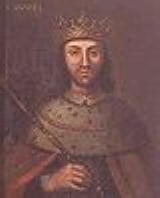
Manuel I of Portugal

Encyclopedia
Manuel I the Fortunate (Port.
o Venturoso), 14th king of Portugal and the Algarves (Alcochete, May 31, 1469 – December 13, 1521 in Lisbon
) was the son of Infante Ferdinand, Duke of Viseu, (1433–1470), by his wife, Infanta Beatrice of Portugal
. His name is associated with a period of Portuguese civilization distinguished by significant achievements both in political affairs and the arts. In spite of its small size and population in comparison to the great land powers of Europe, it was able to acquire an overseas empire of vast proportions during Manuel's reign.
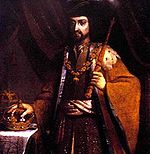 Manuel's mother was the granddaughter of King John I of Portugal
; his father, Prince Fernando, was the second surviving son of King Edward of Portugal, thus the younger brother of King Afonso V of Portugal
. Manuel succeeded his first cousin King John II of Portugal
, who was also his brother-in-law, in 1495.
Manuel grew up amidst conspiracies of the Portuguese upper nobility against King John II. He was aware of many people being killed and exiled. His older brother Diogo, the duke of Viseu
, was stabbed to death in 1484 by the king himself.
Manuel thus had every reason to worry when he received a royal order in 1493 to present himself to the king, but his fears were groundless: John II wanted to name him heir to the throne, after the death of his son, Prince Afonso, and the failed attempts to legitimise Jorge, Duke of Coimbra, his illegitimate son. As a result of this stroke of luck he was nicknamed the Fortunate.
Manuel would prove a worthy successor to his cousin John II, supporting the Portuguese exploration of the Atlantic Ocean
and the development of Portuguese commerce. During his reign, the following was achieved:
All these events made Portugal
rich on foreign trade while it formally established a vast overseas empire. Manuel used the wealth to build a number of royal buildings (in the Manueline style) and to attract scientists and artists to his court. Commercial treaties and diplomatic alliances were forged with China
and the Persian Empire. The Pope received a monumental embassy from Portugal during his reign designed to draw attention to Portugal's newly-acquired riches to all of Europe.
In Manuel's reign, royal absolutism was the method of government. The Portuguese Cortes
(the assembly of the kingdom) only met three times during his reign, always in Lisbon
, the king's seat. He reformed the courts of justice and the municipal charters with the crown, modernizing taxes and the concepts of tributes and rights.
 Manuel was a very religious man and invested a large amount of Portuguese income to sponsor missionaries to the new colonies, such as Francisco Álvares
, and the construction of religious buildings, such as the Monastery of Jerónimos. Manuel also endeavoured to promote another crusade against the Turks.
His relationship with the Portuguese Jews started out well. At the outset of his reign, he released all the Jews who had been made captive during the reign of John II. Unfortunately for the Jews, he decided that he wanted to marry Infanta Isabella of Aragon, then heiress of the future united crown of Spain (widow of his nephew Prince Afonso). Ferdinand and Isabella had expelled the Jews
in 1492, and would never marry their daughter to the king of a country that still tolerated their presence.
In December 1496, it was decreed that any Jew who did not convert to Christianity would be expelled from the country
. However, those expelled could only leave the country in ships specified by the king. When those who chose expulsion arrived at the port in Lisbon, they were met by clerics and soldiers who used force, coercion, and promises in order to baptize them and prevent them from leaving the country. This period of time technically ended the presence of Jews in Portugal. Afterwards, all converted Jews and their descendants would be referred to as "New Christians", and they were given a grace period of thirty years in which no inquiries into their faith would be allowed; this was later extended to end in 1534.
A popular riot in 1504 ended in the death of two thousand Jews; the leaders of the riot were executed by Manuel.
Isabella died in childbirth in 1498, putting a damper on Portuguese ambitions to rule in Spain, which various rulers had harbored since the reign of King Ferdinand I
(1367–1383). Manuel and Isabella's young son Miguel was for a period the heir apparent of Castile and Aragon, but his death in 1500 ended these ambitions. Manuel's next wife, Maria of Aragon
, was his first wife's sister, but not the oldest surviving one. That was rather Joanna of Castile
, who had issue.
In 1506 the Pope Julius II gave Manuel I a Golden Rose
. Later in 1514 Pope Leo X also gave Manuel I a second Golden Rose. Manuel I became the first individual to receive more than one Golden Rose.
The Jerónimos Monastery in Lisbon houses Manuel's tomb. His son João succeeded him as king.
in 1485 were halted by the death of Richard III of England
. He went on to marry three times. His first wife was Isabella of Aragon, princess of Spain and widow of the previous Prince of Portugal Afonso. Next he married another princess of Spain, Maria of Aragon
(his first wife's sister), then Eleanor of Austria, a niece of his first two wives who Francis I of France
after Manuel's death.
Portuguese language
Portuguese is a Romance language that arose in the medieval Kingdom of Galicia, nowadays Galicia and Northern Portugal. The southern part of the Kingdom of Galicia became independent as the County of Portugal in 1095...
o Venturoso), 14th king of Portugal and the Algarves (Alcochete, May 31, 1469 – December 13, 1521 in Lisbon
Lisbon
Lisbon is the capital city and largest city of Portugal with a population of 545,245 within its administrative limits on a land area of . The urban area of Lisbon extends beyond the administrative city limits with a population of 3 million on an area of , making it the 9th most populous urban...
) was the son of Infante Ferdinand, Duke of Viseu, (1433–1470), by his wife, Infanta Beatrice of Portugal
Beatriz of Portugal (1430-1506)
Infanta Beatriz of Portugal was a Portuguese infanta daughter of Infante João, Lord of Reguengos and Isabella of Braganza a daughter of Afonso, 1st Duke of Braganza.-Biography:Due to the Aviz dynasty marriage policy, Beatrice was 1st cousin and sister-in-law of king Afonso V of Portugal,...
. His name is associated with a period of Portuguese civilization distinguished by significant achievements both in political affairs and the arts. In spite of its small size and population in comparison to the great land powers of Europe, it was able to acquire an overseas empire of vast proportions during Manuel's reign.
Life
John I of Portugal
John I KG , called the Good or of Happy Memory, more rarely and outside Portugal the Bastard, was the tenth King of Portugal and the Algarve and the first to use the title Lord of Ceuta...
; his father, Prince Fernando, was the second surviving son of King Edward of Portugal, thus the younger brother of King Afonso V of Portugal
Afonso V of Portugal
Afonso V KG , called the African , was the twelfth King of Portugal and the Algarves. His sobriquet refers to his conquests in Northern Africa.-Early life:...
. Manuel succeeded his first cousin King John II of Portugal
John II of Portugal
John II , the Perfect Prince , was the thirteenth king of Portugal and the Algarves...
, who was also his brother-in-law, in 1495.
Manuel grew up amidst conspiracies of the Portuguese upper nobility against King John II. He was aware of many people being killed and exiled. His older brother Diogo, the duke of Viseu
Diogo, Duke of Viseu
Infante Diogo of Viseu was the second son of Infante Fernando, Duke of Viseu, and his wife Beatriz of Portugal.In 1472, when his older brother John, Duke of Viseu, died without issue, Diogo inherited his titles and estates as 4th Duke of Viseu and 3rd Duke of Beja.Diogo was a popular personality...
, was stabbed to death in 1484 by the king himself.
Manuel thus had every reason to worry when he received a royal order in 1493 to present himself to the king, but his fears were groundless: John II wanted to name him heir to the throne, after the death of his son, Prince Afonso, and the failed attempts to legitimise Jorge, Duke of Coimbra, his illegitimate son. As a result of this stroke of luck he was nicknamed the Fortunate.
Manuel would prove a worthy successor to his cousin John II, supporting the Portuguese exploration of the Atlantic Ocean
Atlantic Ocean
The Atlantic Ocean is the second-largest of the world's oceanic divisions. With a total area of about , it covers approximately 20% of the Earth's surface and about 26% of its water surface area...
and the development of Portuguese commerce. During his reign, the following was achieved:
- 1498 — Discovery of a maritime route to IndiaIndiaIndia , officially the Republic of India , is a country in South Asia. It is the seventh-largest country by geographical area, the second-most populous country with over 1.2 billion people, and the most populous democracy in the world...
by Vasco da GamaVasco da GamaVasco da Gama, 1st Count of Vidigueira was a Portuguese explorer, one of the most successful in the Age of Discovery and the commander of the first ships to sail directly from Europe to India... - 1500 — Discovery of BrazilBrazilBrazil , officially the Federative Republic of Brazil , is the largest country in South America. It is the world's fifth largest country, both by geographical area and by population with over 192 million people...
by Pedro Álvares CabralPedro Álvares CabralPedro Álvares Cabral was a Portuguese noble, military commander, navigator and explorer regarded as the discoverer of Brazil. Cabral conducted the first substantial exploration of the northeast coast of South America and claimed it for Portugal. While details of Cabral's early life are sketchy, it... - 1505 — Appointment of Francisco de AlmeidaFrancisco de AlmeidaDom Francisco de Almeida , also known as "the Great Dom Francisco" , was a Portuguese nobleman, soldier and explorer. He distinguished himself as a counsellor to King John II of Portugal and later in the wars against the Moors and in the conquest of Granada in 1492...
as the first viceroy of India - 1503-1515 — Establishment of monopolies on maritime trade routes to the Indian OceanIndian OceanThe Indian Ocean is the third largest of the world's oceanic divisions, covering approximately 20% of the water on the Earth's surface. It is bounded on the north by the Indian Subcontinent and Arabian Peninsula ; on the west by eastern Africa; on the east by Indochina, the Sunda Islands, and...
and Persian GulfPersian GulfThe Persian Gulf, in Southwest Asia, is an extension of the Indian Ocean located between Iran and the Arabian Peninsula.The Persian Gulf was the focus of the 1980–1988 Iran-Iraq War, in which each side attacked the other's oil tankers...
by Afonso de AlbuquerqueAfonso de AlbuquerqueAfonso de Albuquerque[p][n] was a Portuguese fidalgo, or nobleman, an admiral whose military and administrative activities as second governor of Portuguese India conquered and established the Portuguese colonial empire in the Indian Ocean...
, an admiral, for the benefit of Portugal
All these events made Portugal
Portugal
Portugal , officially the Portuguese Republic is a country situated in southwestern Europe on the Iberian Peninsula. Portugal is the westernmost country of Europe, and is bordered by the Atlantic Ocean to the West and South and by Spain to the North and East. The Atlantic archipelagos of the...
rich on foreign trade while it formally established a vast overseas empire. Manuel used the wealth to build a number of royal buildings (in the Manueline style) and to attract scientists and artists to his court. Commercial treaties and diplomatic alliances were forged with China
China
Chinese civilization may refer to:* China for more general discussion of the country.* Chinese culture* Greater China, the transnational community of ethnic Chinese.* History of China* Sinosphere, the area historically affected by Chinese culture...
and the Persian Empire. The Pope received a monumental embassy from Portugal during his reign designed to draw attention to Portugal's newly-acquired riches to all of Europe.
In Manuel's reign, royal absolutism was the method of government. The Portuguese Cortes
Portuguese Cortes
In the Medieval Kingdom of Portugal, the Cortes was an assembly of representatives of the estates of the realm - the nobility, clergy and bourgeoisie. It was called and dismissed by the King of Portugal at will, at a place of his choosing...
(the assembly of the kingdom) only met three times during his reign, always in Lisbon
Lisbon
Lisbon is the capital city and largest city of Portugal with a population of 545,245 within its administrative limits on a land area of . The urban area of Lisbon extends beyond the administrative city limits with a population of 3 million on an area of , making it the 9th most populous urban...
, the king's seat. He reformed the courts of justice and the municipal charters with the crown, modernizing taxes and the concepts of tributes and rights.
Francisco Álvares
Francisco Álvares was a Portuguese missionary and explorer. In 1515 he traveled to Ethiopia as part of the Portuguese embassy to emperor Lebna Dengel accompanied by returning Ethiopian ambassador Matheus. The embassy arrived only in 1520 to Ethiopia where he joined long sought Portuguese envoy...
, and the construction of religious buildings, such as the Monastery of Jerónimos. Manuel also endeavoured to promote another crusade against the Turks.
His relationship with the Portuguese Jews started out well. At the outset of his reign, he released all the Jews who had been made captive during the reign of John II. Unfortunately for the Jews, he decided that he wanted to marry Infanta Isabella of Aragon, then heiress of the future united crown of Spain (widow of his nephew Prince Afonso). Ferdinand and Isabella had expelled the Jews
Alhambra decree
The Alhambra Decree was an edict issued on 31 March 1492 by the joint Catholic Monarchs of Spain ordering the expulsion of Jews from the Kingdom of Spain and its territories and possessions by 31 July of that year.The edict was formally revoked on 16 December 1968, following the Second...
in 1492, and would never marry their daughter to the king of a country that still tolerated their presence.
In December 1496, it was decreed that any Jew who did not convert to Christianity would be expelled from the country
History of the Jews in Portugal
The history of the Jews in Portugal reaches back over two thousand years and is directly related to Sephardi history, a Jewish ethnic division that represents communities who have originated in the Iberian Peninsula .-Before Portugal:...
. However, those expelled could only leave the country in ships specified by the king. When those who chose expulsion arrived at the port in Lisbon, they were met by clerics and soldiers who used force, coercion, and promises in order to baptize them and prevent them from leaving the country. This period of time technically ended the presence of Jews in Portugal. Afterwards, all converted Jews and their descendants would be referred to as "New Christians", and they were given a grace period of thirty years in which no inquiries into their faith would be allowed; this was later extended to end in 1534.
A popular riot in 1504 ended in the death of two thousand Jews; the leaders of the riot were executed by Manuel.
Isabella died in childbirth in 1498, putting a damper on Portuguese ambitions to rule in Spain, which various rulers had harbored since the reign of King Ferdinand I
Ferdinand I of Portugal
Ferdinand I , sometimes referred to as the Handsome or rarely as the Inconstant , was the ninth King of Portugal and the Algarve, the second son of Peter I and his wife, Constance of Castile...
(1367–1383). Manuel and Isabella's young son Miguel was for a period the heir apparent of Castile and Aragon, but his death in 1500 ended these ambitions. Manuel's next wife, Maria of Aragon
Maria of Aragon
Maria of Aragon may refer to:*Marie of Montpellier , wife of Peter II of Aragon*Maria of Aragon , daughter of James I of Aragon and Violant of Hungary, became a nun...
, was his first wife's sister, but not the oldest surviving one. That was rather Joanna of Castile
Joanna of Castile
Joanna , nicknamed Joanna the Mad , was the first queen regnant to reign over both the Crown of Castile and the Crown of Aragon , a union which evolved into modern Spain...
, who had issue.
In 1506 the Pope Julius II gave Manuel I a Golden Rose
Golden Rose
The Golden Rose is a gold ornament, which popes of the Catholic Church have traditionally blessed annually. It is occasionally conferred as a token of reverence or affection...
. Later in 1514 Pope Leo X also gave Manuel I a second Golden Rose. Manuel I became the first individual to receive more than one Golden Rose.
The Jerónimos Monastery in Lisbon houses Manuel's tomb. His son João succeeded him as king.
Ancestry
Marriages and descendants
Negotiations for a marriage between Manuel and Elizabeth of YorkElizabeth of York
Elizabeth of York was Queen consort of England as spouse of King Henry VII from 1486 until 1503, and mother of King Henry VIII of England....
in 1485 were halted by the death of Richard III of England
Richard III of England
Richard III was King of England for two years, from 1483 until his death in 1485 during the Battle of Bosworth Field. He was the last king of the House of York and the last of the Plantagenet dynasty...
. He went on to marry three times. His first wife was Isabella of Aragon, princess of Spain and widow of the previous Prince of Portugal Afonso. Next he married another princess of Spain, Maria of Aragon
Maria of Aragon (1482-1517)
Maria of Aragon was a Spanish infanta and the second wife of Portuguese King Manuel I, thus queen consort of Portugal from her marriage on 30 October 1500 until her death.-Family:She was born at Córdoba on 29 June 1482 as the third surviving daughter of Isabella I of...
(his first wife's sister), then Eleanor of Austria, a niece of his first two wives who Francis I of France
Francis I of France
Francis I was King of France from 1515 until his death. During his reign, huge cultural changes took place in France and he has been called France's original Renaissance monarch...
after Manuel's death.
| Name | Birth | Death | Notes |
|---|---|---|---|
| By Isabella of Asturias Isabella of Asturias Isabella, Princess of Asturias was a Queen consort of Portugal and heiress presumptive of King Ferdinand II of Aragon and Queen Isabella I of Castile as their eldest daughter... (October 2, 1470–August 28, 1498; married in 1497) |
|||
| Miguel da Paz, Prince of Portugal | August 23, 1498 | July 19, 1500 | Prince of Portugal, Prince of Asturias Prince of Asturias Prince of Asturias is the historical title given to the heir to the Spanish throne. It was also the title under the earlier Kingdom of Castile. The current Prince of Asturias is Felipe, son of King Juan Carlos of Spain and Queen Sofía... and heir to both Portugal Portugal Portugal , officially the Portuguese Republic is a country situated in southwestern Europe on the Iberian Peninsula. Portugal is the westernmost country of Europe, and is bordered by the Atlantic Ocean to the West and South and by Spain to the North and East. The Atlantic archipelagos of the... and Spain Spain Spain , officially the Kingdom of Spain languages]] under the European Charter for Regional or Minority Languages. In each of these, Spain's official name is as follows:;;;;;;), is a country and member state of the European Union located in southwestern Europe on the Iberian Peninsula... . |
| By Maria of Aragon Maria of Aragon (1482-1517) Maria of Aragon was a Spanish infanta and the second wife of Portuguese King Manuel I, thus queen consort of Portugal from her marriage on 30 October 1500 until her death.-Family:She was born at Córdoba on 29 June 1482 as the third surviving daughter of Isabella I of... (June 19, 1482–March 7, 1517; married in 1501) |
|||
| João, Prince of Portugal John III of Portugal John III , nicknamed o Piedoso , was the fifteenth King of Portugal and the Algarves. He was the son of King Manuel I and Maria of Aragon, the third daughter of King Ferdinand II of Aragon and Queen Isabella I of Castile... (John) |
June 6, 1502 | June 11, 1557 | Who succeeded him as John III, 15th King of Portugal. |
| Infanta Isabel Isabella of Portugal Isabella of Portugal was a Portuguese Princess and Holy Roman Empress, Duchess of Burgundy, and a Queen Regent/Consort of Spain. She was the daughter of Manuel I of Portugal and Maria of Aragon. By her marriage to Charles V, Holy Roman Emperor, Isabella was also Holy Roman Empress and Queen... (Elizabeth) |
October 24, 1503 | May 1, 1539 | Holy Roman Empress by marriage to Charles V, Holy Roman Emperor Charles V, Holy Roman Emperor Charles V was ruler of the Holy Roman Empire from 1519 and, as Charles I, of the Spanish Empire from 1516 until his voluntary retirement and abdication in favor of his younger brother Ferdinand I and his son Philip II in 1556.As... . |
| Infanta Beatriz Beatrice, Duchess of Savoy Infanta Beatrice of Portugal ; ) was Duchess of Savoy by marriage.-Family:She was the second daughter of Manuel I of Portugal and his second wife, Maria of Aragon... (Beatrice) |
December 31, 1504 | January 8, 1538 | Duchess of Savoy by marriage to Charles III, Duke of Savoy Charles III, Duke of Savoy Charles III of Savoy , often called Charles the Good, was Duke of Savoy from 1504 to 1553, although most of his lands were ruled by the French between 1536 and his death.... . |
| Infante Luís Infante Luís, Duke of Beja The Infante Louis, 5th Duke of Beja was the second son of King Manuel I of Portugal and his second wife Maria of Aragon , and therefore a Portuguese infante .Louis succeeded his father as the 5th Duke of Beja and was also made 9th Constable of the Kingdom... (Louis) |
March 3, 1506 | November 27, 1555 | Unmarried but had illegitimate descendants, one of them being António, Prior of Crato António, Prior of Crato António, Prior of Crato , was a grandson of King Manuel I of Portugal, claimant of the Portuguese throne during the 1580 dynastic crisis, who was King of Portugal as António I of Portugal during 33 days in the continent in 1580, and, after the crowning of Philip II of Spain as King of Portugal,... , a claimant of the throne of Portugal in 1580 (See: Struggle for the throne of Portugal Struggle for the throne of Portugal The 1580 Portuguese succession crisis came about as a result of the 1578 death of young King Sebastian I of Portugal in the Battle of Ksar El Kebir... ). |
| Infante Fernando Infante Fernando, Duke of Guarda and Trancoso The Infante Ferdinand, Duke of Guarda and Trancoso, was a Portuguese infante , the son of King Manuel I of Portugal and his second wife, Maria of Aragon.... (Ferdinand) |
June 5, 1507 | November 7, 1534 | Duke of Guarda and Trancoso. Married Guiomar (Guyomare) Coutinho, 5th Countess of Marialva and 3rd Countess of Loulé (?-1534). No surviving issue. |
| Infante Afonso Infante Cardinal Afonso of Portugal The Cardinal-Infante Afonso was a Portuguese infante , son of King Manuel I of Portugal and his wife Maria of Aragon.... (Alphonse) |
April 23, 1509 | April 21, 1540 | Cardinal of the Kingdom. |
| Infanta Maria (Mary) | 1513 | 1513 | |
| Infante Henrique (Henry) | January 31, 1512 | January 31, 1580 | Cardinal of the Kingdom who succeeded his grandnephew, King Sebastian Sebastian of Portugal Sebastian "the Desired" was the 16th king of Portugal and the Algarves. He was the son of Prince John of Portugal and his wife, Joan of Spain... (Manuel I's great-grandson), as Cardinal Henry, 17th King of Portugal. His death triggered the struggle for the throne of Portugal Struggle for the throne of Portugal The 1580 Portuguese succession crisis came about as a result of the 1578 death of young King Sebastian I of Portugal in the Battle of Ksar El Kebir... . |
| Infante Duarte (Edward) | October 7, 1515 | September 20, 1540 | Duke of Guimarães Duke of Guimarães The Dukes of Guimarães was an Nobility title granted by King Afonso V of Portugal in 1475, to Ferdinand II, 3rd Duke of Braganza. The king just upgraded the previous title of count of Guimarães), that he granted to the same Duke of Braganza, some years before .When Isabel of Braganza married... and great-grandfather of John IV of Portugal John IV of Portugal |-|John IV was the King of Portugal and the Algarves from 1640 to his death. He was the grandson of Catherine, Duchess of Braganza, who had in 1580 claimed the Portuguese crown and sparked the struggle for the throne of Portugal. John was nicknamed John the Restorer... . Married Isabel of Braganza Isabel of Braganza Isabel of Braganza, also known as Isabella or Elizabeth, was a daughter of Jaime, Duke of Braganza and Eleanor of Mendoza, she married her cousin Infante Duarte, Duke of Guimarães a son of Manuel I and Maria of Aragon in 1537, Isabella was dowried with the Dukedom of Guimarães in her own right... , daughter of Jaime, Duke of Braganza Jaime, Duke of Braganza James was the older son of Ferdinand II, 3rd Duke of Braganza and of his wife, Isabella of Viseu and he became the fourth Duke of Braganza following his father's death.His father and one of his uncles were... . |
| Infante António (Anthony) | September 9, 1516 | 1516 | |
| By Eleanor of Austria (November 15, 1498–February 25, 1558; married in 1518) | |||
| Infante Carlos (Charles) | February 18, 1520 | April 14, 1521 | |
| Infanta Maria Infanta Maria of Portugal The Infanta Maria, Duchess of Viseu was a Portuguese infanta daughter of King Manuel I and his wife Eleanor of Austria.... (Mary) |
June 18, 1521 | October 10, 1577 | Unmarried. |
See also
- ManuelineManuelineThe Manueline, or Portuguese late Gothic, is the sumptuous, composite Portuguese style of architectural ornamentation of the first decades of the 16th century, incorporating maritime elements and representations of the discoveries brought from the voyages of Vasco da Gama and Pedro Álvares Cabral...
, an architectural style