
In Depth
See Also

Jawaharlal Nehru

Jawaharlal Nehru , also called Pandit Nehru, was one of the most important leaders of the Indian Independence Movement Indian independence movement

The Indian Independence Movement consisted of efforts by India [i]ns to obtain political independence fr ... 

 and, as the head of the Indian National Congress Indian National Congress

Indian National Congress is a major political party [i] in India [i]. ... 

, became the first Prime Minister of India when India won its independence on August 15, 1947. Jawaharlal Nehru was born in Allahabad Allahabad

Allahabad is a city in the north India [i]n state of Uttar Pradesh [i]. ... 

 on November 14, 1889, to Swarupani, the wife of Motilal Nehru, a wealthy Allahabad-based barrister prominent in the Indian National Congress. He was Motilal Nehru's only son; he had three younger sisters including Vijaya Lakshmi Pandit. The Nehru family is of Kashmiri lineage and of the Saraswat Brahmin Brahmin

A Brahmin, also known as Vipra, Dvija, Dvijottama, is a member of a caste [i] ... 

 caste.

Discussions

  Discussion Features

   Ask a question about 'Jawaharlal Nehru'

   Start a new discussion about 'Jawaharlal Nehru'

   Answer questions about 'Jawaharlal Nehru'

   'Jawaharlal Nehru' discussion forum

Timeline

1889   Born

1945   Mohandas Gandhi Mahatma Gandhi

Mohandas Karamchand Gandhi was a major political and spiritual leader of India [i] and the Indian independence movement [i] ... 

 and Jawaharlal Nehru demand that British troops leave India India

India , officially the Republic of India, is a country in South Asia [i]. ... 

is formed. This was its flag. The modern version is slightly retouched.]]

1946   Cold War Cold War

The Cold War was the protracted geopolitical [i], ideological [i], and economic [i] ... 

: India India

India , officially the Republic of India, is a country in South Asia [i]. ... 

n Prime Minister Jawaharlal Nehru appeals to the United States United States

The United States of America, also known as the United States, the U.S., the U.S.A., a... 

 and the Soviet Union Soviet Union

The Union of Soviet Socialist Republics , more commonly known as the Soviet Union, was a Communist state [i] ... 

 to end nuclear testing Nuclear testing

Nuclear testing is experimentation with nuclear weapon [i]s. ... 

 and to start nuclear disarmament, stating that such an action would "save humanity from the ultimate disaster."

1947   Following decades of nonviolent resistance and periodic civil unrest from 1919, India India

India , officially the Republic of India, is a country in South Asia [i]. ... 

 gains independence from the British Empire. Pakistan splits from India. Jawaharlal Nehru takes office as first Prime Minister of India.

1951   Salar Jung Museum Salar Jung Museum

The Salar Jung Museum is an art museum on the southern bank of the Musi [i] river in t ... 

 is opened to the public by the Prime Minister Prime minister

A prime minister is the most senior minister of a cabinet [i] in the executive [i] b ... 

 of India India

India , officially the Republic of India, is a country in South Asia [i]. ... 

 Jawaharlal Nehru

1964   Died


Quotations

Where freedom is menaced or justice threatened or where aggression takes place, we cannot be and shall not be neutral.

Freedom and power bring responsibility.

       More Quotes >>


Encyclopedia

Jawaharlal Nehru , also called Pandit Nehru, was one of the most important leaders of the Indian Independence Movement Indian independence movement

The Indian Independence Movement consisted of efforts by India [i]ns to obtain political independence fr ... 

 and, as the head of the Indian National Congress Indian National Congress

Indian National Congress is a major political party [i] in India [i].... 

, became the first Prime Minister of India when India won its independence on August 15, 1947.

Jawaharlal Nehru was born in Allahabad Allahabad

Allahabad is a city in the north India [i]n state of Uttar Pradesh [i].
... 

 on November 14, 1889, to Swarupani, the wife of Motilal Nehru, a wealthy Allahabad-based barrister prominent in the Indian National Congress. He was Motilal Nehru's only son; he had three younger sisters including Vijaya Lakshmi Pandit. The Nehru family is of Kashmiri lineage and of the Saraswat Brahmin Brahmin

A Brahmin, also known as Vipra, Dvija, Dvijottama, is a member of a caste [i] ... 

 caste.

Educated in the finest schools in India and abroad, Nehru returned from education in England at Harrow Harrow School

Harrow School, normally just known as Harrow, is one of the world's most famous schools.... 

, Trinity College, Cambridge Trinity College, Cambridge

Trinity College is a constituent college [i] of the University of Cambridge [i] ... 

 and the Inner Temple Inner Temple

The Honourable Society of the Inner Temple is one of the four Inns of Court [i] around the Royal Courts of Justice [i] ... 

 to practice law before following his father into politics.

By his parents' arrangement, Nehru married Kamala Kaul, then seventeen in 1916. At the time of his wedding on 8 February 1916, Jawaharlal was twenty-six, a British-educated barrister. Kamala came from a well-known business family of Kashmiris in Delhi.

Gandhi and the 1920s

His father Motilal Nehru was already a prominent figure in the Indian National Congress Indian National Congress

Indian National Congress is a major political party [i] in India [i].... 

 and had served as its president. Thus when a young and glamorous Jawaharlal entered the Congress, much was expected of him.

It soon became clear that the younger Nehru did not share his father's moderate-liberal line. He began to grow closer to the rising leadership of Mohandas Karamchand Gandhi Mahatma Gandhi

Mohandas Karamchand Gandhi was a major political and spiritual leader of India [i] and the Indian independence movement [i] ... 

, a former barrister who had won battles for equality and political rights for Indians in South Africa South Africa

The Republic of South Africa is a country located at the southern tip of the Africa [i]n continent [i]. ... 

, and had emerged a national hero with the successful struggles in Champaran, Bihar Bihar

Bihar is a state [i] of the India [i]n union situated in the eastern par ... 

 and Kheda in Gujarat Gujarat

Gujarat is the most industrialized state [i] in the Republic of India [i] ... 

. Nehru was instantly attracted to Gandhi's commitment to active, but peaceful, civil disobedience Civil disobedience

Civil disobedience encompasses the active refusal to obey certain law [i]s, demands and commands of a government [i] ... 

. Gandhi himself saw promise in the young man.

The Nehru family transformed their lifestyle according to Gandhi's teachings. Jawaharlal and Motilal Nehru abandoned western clothes and tastes for expensive possessions and pastimes, and adopted Hindustani Hindustani language

Hindustani , also known as "Hindi-Urdu," is a term used by linguists to describe several closely r... 

 as their common language of use. Young Jawaharlal now wore a khadi Khadi

Khadi is India [i]n handspun and hand-woven [i] cloth. ... 

 kurta and a Gandhi cap, all in white - the new uniform of the Indian nationalist. Nehru was first arrested by the British during the Non-Cooperation Movement of 1920-1922, but released after a few months.

After Gandhi suspended civil resistance in 1922 as a result of the killing of policemen in Chauri Chaura, thousands of Congressmen were disillusioned. When Gandhi opposed participation in the newly created legislative councils, many followed Chittaranjan Das Chittaranjan Das

Chittaranjan Das(popularly called Deshbandhu) was a Bengal [i]i lawyer [i] and a major figure in t... 

 and Motilal Nehru into the Swaraj Party, which advocated entry but only to sabotage government from within, as a tool to extracting concessions from the British to ensure stability. But Nehru did not join his father and stayed with Gandhi and the Congress.

Jawaharlal was elected President of the Allahabad Allahabad

Allahabad is a city in the north India [i]n state of Uttar Pradesh [i].
... 

 Municipal Corporation in 1924, and served for two years as the city's chief executive. This would be valuable but the only administrative experience Nehru would have before taking on India's whole government in 1947. He used his tenure to expand public education, health care and sanitation. He resigned citing lack of cooperation from civil servants and obstruction from British authorities.

From 1926 to 1928, Jawaharlal served as the General Secretary of the All India Congress Committee, an important step in his rise to Congress national leadership.

Political Attitudes

Jawaharlal's break with his father cemented his position as the leader of a new generation of Congressmen, with political beliefs that were more radical than those held by their fathers. He, like many others, had been exposed to socialism Socialism

Socialism refers to a broad array of doctrines or political movements that envisage a socio-economic [i]... 

 in England and Europe; following freedom struggles in Ireland Ireland

Ireland is the third largest [i] island [i] in Europe [i]. ... 

 and the revolution in Russia Russia

Russia , also the Russian Federation , is a country [i] that stretches over a vast expanse of Eurasia [i] ... 

, Nehru became one of the first major Indian political figures to embrace the idea of full political independence from the British Empire British Empire

The British Empire was the most extensive empire [i] in world history and for a ... 

, an idea first proposed by Bhagat Singh Bhagat Singh

Bhagat Singh was an Indian [i] revolutionary, considered to be one of the most famous martyr [i]s ... 

 and the revolutionaries. Even Gandhi and Motilal Nehru had not yet committed to this, but Nehru's vision was shared by many among the younger generation, including Subhas Chandra Bose Subhash Chandra Bose

Subhash Chandra Bose,, also known as Netaji, was one of the most prominent leaders of the Indian Independence Movement [i] ... 

, and a growing number of Indians not in public life.

Rise to Leadership

Upon his release from prison in 1924, Gandhi succeeded in re-uniting the Congress Party. He chose to increase the internal discipline of the party by expanding its activities that promoted social reform and the alleviation of India's poor.

In 1928-29, the Congress's annual session under the presidency of Motilal Nehru considered the next step. Nehru and Subhas Chandra Bose Subhash Chandra Bose

Subhash Chandra Bose,, also known as Netaji, was one of the most prominent leaders of the Indian Independence Movement [i] ... 

 backed a call for full political independence or swaraj, while Motilal Nehru and others wanted dominion status within the British Empire. To resolve the point, Gandhi said that the British would be given two years to grant India dominion status. If they did not, the Congress would launch a national struggle for full, political independence. Nehru and Bose reduced the time of opportunity to one year. The Government in Whitehall Whitehall

Whitehall is a road in Westminster [i] in London [i], the capital of the United Kingdom [i]. ... 

 did not respond.

When the Congress convened its session in 1929, Gandhi backed the young Jawaharlal for the Congress presidency. Although confessing embarrassment at his hurried ascent, President Nehru declared India's independence on January 26, 1930 in Lahore Lahore

[i] and is the capital of the province of [[Punjab|Punjab]... 

, raised free India's flag in a large public convention on the banks of the Ravi and inaugurated the struggle. Nehru was arrested in 1930, and during the Salt Satyagraha Salt Satyagraha

The Salt Satyagraha, also known as the Salt March to Dandi, was an act of protest [i] against the ... 

 of 1931; he was interned for a number of years.

The movement was an astounding national success. Millions of Indians had participated, and the government was ultimately forced to acknowledge that there was a need for major political reform, which the British Parliament attempted in the form of the Government of India Act 1935. The Act set up a bicameral Bicameralism

In government [i], bicameralism is the practice of having two legislative or parliamentary chamber [i]s. ... 

 structure of authority, with provision for popular elections. The Congress Party decided to contest elections, but Nehru personally did not stand. He, however, campaigned vigorously nationwide for the party, further raising his profile with the Indian public. The Congress formed governments in 7 of the 11 provinces, and won the largest number of seats in the Central Assembly, which the Congress had denounced as powerless. But it was able to exercise control of provincial affairs, giving India its first taste of democratic self-government.

Socialism and Quit India


Nehru was elected again to the Congress Presidency in 1936 and 1937. In his famous speech to the session in Lucknow Lucknow

Lucknow is the capital city of the state of Uttar Pradesh [i], India [i]. ... 

 in 1936, he pushed the passage of the Avadi Resolution which committed the Congress to socialism Socialism

Socialism refers to a broad array of doctrines or political movements that envisage a socio-economic [i]... 

 as the basis of the future agenda of a free India's government. In this matter he successfully overcame the opposition of major Congress leaders, including Gandhi and Sardar Patel Sardar Vallabhbhai Patel

Sardar Vallabhbhai Pa?el was a political and social leader of India [i], who played a major role in th ... 

, who opposed it for different reasons.
To gain support, Nehru transformed his position to commit that the resolution did not in fact bind Congress to socialism, and that the Congress Party's main goal was independence, not socialism. However, Nehru had grown politically closer to Congress socialists like Jaya Prakash Narayan Jayaprakash Narayan

Jayaprakash Narayan, widely known as JP, was an India [i]n freedom fighter and political leader, r ... 

, Narendra Dev and the liberal-socialist Maulana Abul Kalam Azad. Nehru's victory over the right wing of Congress in 1936 and the chaos of the Tripura session of 1939, following which his only serious rival on the left of Congress, Subhash Chandra Bose Subhash Chandra Bose

Subhash Chandra Bose,, also known as Netaji, was one of the most prominent leaders of the Indian Independence Movement [i] ... 

, left the party to form the Forward Bloc All India Forward Bloc

The All India Forward Bloc is a leftwing nationalist political party [i] in India [i]. ... 

, ensured his pre-eminence among the nationalist leaders of his generation.

When World War II World War II

World War II, or the Second World War, was a worldwide [i] conflict [i] fought betwe ... 

 broke out, Nehru and the Congress condemned the Government of India's decision to enter the war; they were angered that the decision had been taken by the Viceregal Council without consulting the nationalist leadership, but were divided as to what to do about it. Nehru and Patel made an offer of cooperation with the British, promising whole-hearted support if after the war, the British would deliver India's political freedom. This was opposed by Gandhi, but marked the first occasion when a majority of Congress leaders went against his advice. Several British politicians and British officials backed the offer, considering Indian support valuable, but the bid failed when a new government under a hostile Winston Churchill Winston Churchill

Sir Winston Leonard Spencer-Churchill, KG [i], OM [i], CH [i] ... 

 ruled out any political reform.

The Congress Party ordered all of its elected members in the Central and provincial assemblies to resign, and another national struggle seemed inevitable. Nehru and Maulana Azad were lukewarm to Gandhi's call for revolt, still considering it a good possibility that the British would ultimately concede independence for Indian support, and concerned about the timing of the initiative. Although many other Indian political parties opposed the call, Gandhi and Sardar Patel convinced Nehru and Azad, and the entire Indian National Congress towards what they believed would be a final confrontation with a weakened British Empire.

The Quit India Movement Quit India Movement

The Quit India Movement (Bharat Chhodo Andolan or the August Movement) was a civil disobedience [i] ... 

 was launched on August 13, 1942. The Congress made an open call for complete independence immediately. Only an independent India, they said, should decide whether India would participate in the war. The Congress asked all Indians to boycott British goods, the institutions and factories run by the British, public services and government programs. Major strikes, protests and demonstrations broke out all over India, and although other political parties did not participate, it proved to be the most forceful revolt in the history of British rule.
This was in spite of the fact that Gandhi and the entire Congress Working Committee were arrested practically immediately. The Committee was imprisoned in a fort-turned-prison in Ahmednagar, Maharashtra Maharashtra

Maharashtra is India [i]'s third largest state [i] in terms of area [i]... 

, separate from Gandhi, who was imprisoned in Pune Pune

Pune is a city located in the western Indian state of Maharashtra [i]. ... 

. The British had made arrangements to deport the leaders if necessary, but felt that then any chance of regaining order would be lost due to public outrage. Outside, hundreds of thousands of Indian freedom fighters were imprisoned, and thousands were killed in police firing.

Incarcerated for 32 months with his fellow Congress leaders, Nehru focused on writing the Discovery of India, a tour through Indian history and culture.

Congress Presidency

Upon the end of the war, Nehru and the Congress leadership were released. In the landmark 1945 General Elections United Kingdom general election, 1945

The United Kingdom General Election of 1945 was one of the most significant general elections [i] ... 

 in Britain Winston Churchill Winston Churchill

Sir Winston Leonard Spencer-Churchill, KG [i], OM [i], CH [i] ... 

, a long-time opponent of Indian independence, was defeated by the Labour Party of Clement Attlee Clement Attlee

Clement Richard Attlee, 1st Earl Attlee, KG [i], OM [i], CH [i] ... 

; the new government began preparing plans for India's independence.

In 1946, the Congress convened its session for a presidential election, knowing fully that this leader would become the head of India's government.

Nehru, unlike Patel, was nominated by no state unit, but the Working Committee made a tentative nomination. It is believed that Gandhi asked Patel to withdraw himself from the election, allowing Nehru's election, and that Patel promptly did so. This relatively undocumented episode is deeply controversial to contemporary historians.

Partition and Independence


Elections were held in 1946 to the Constituent Assembly of India. The Congress swept the vote at the central level and most of British India's provinces.

The All India Muslim League Muslim League

The All India Muslim League was a political party in British India [i] and was the driving force behind ... 

, led by Muhammad Ali Jinnah Muhammad Ali Jinnah

Muhammad Ali Jinnahlisten was an India [i]n Muslim [i] politician and leader of the All India Muslim League [i]... 

 had become the prime political opponent of the Congress. The League demanded a separate Muslim state, and enjoyed the support of many of India's Muslims.

Nehru and the Congress Party strongly opposed India's partition, or any excessive political concessions to the League to prevent this. The party accepted the May 16 Plan proposed by the Cabinet Mission led by Sir Stafford Cripps Stafford Cripps

Sir Richard Stafford Cripps was a British [i] Labour [i] politician, born in ... 

 as the only resort to preventing India's division as proposed in the June 16 plan. Although the May 16 plan envisioned communal grouping of India's provinces, the Congress accepted to keep the League from usurping control of the new interim government. When the League pulled out from the process, Congress was left in complete control of the new government. Nehru became the Vice President of the Viceroy's Executive Council, de facto head of government.

But Jinnah's Direct Action Day to protest this left over 10,000 Hindus and Muslims dead in the following months. Fearing communal chaos, the Congress decided to allow the League to enter the council. However, Nehru's leadership was rejected by the new League ministers, and the council stalled over every policy decision.

Considering a political coalition unworkable and the communal situation dangerous enough to lead to full civil war between Hindus and Muslims, Nehru and Sardar Patel Sardar Vallabhbhai Patel

Sardar Vallabhbhai Pa?el was a political and social leader of India [i], who played a major role in th ... 

 backed the plan of Lord Louis Mountbatten Louis Mountbatten, 1st Earl Mountbatten of Burma

Admiral of the Fleet [i] Louis Francis Albert Victor Nicholas Mountbatten, 1st Earl M ... 

, India's last viceroy to partition the country into India and Pakistan Pakistan

[i] located in [[South Asia]... 

. Nehru and Patel managed to convince Gandhi, who was fearful about partition but even more fearful of civil war. The AICC adopted the resolution in June, 1947. Nehru served on the Partition Partition of India

The partition of India refers to the creation on 15th August 1947 of two sovereign states of India [i] a ... 

 Council that finalized the separation of government institutions and provincial resources between the two new dominions.

On August 15th, 1947, India became an independent nation Indian independence movement

The Indian Independence Movement consisted of efforts by India [i]ns to obtain political independence fr ... 

. At the age of 58, Jawaharlal Nehru became the Prime Minister of India. Lord Louis Mountbatten Louis Mountbatten, 1st Earl Mountbatten of Burma

Admiral of the Fleet [i] Louis Francis Albert Victor Nicholas Mountbatten, 1st Earl M ... 

 became the Governor General of the Dominion, and the Constituent Assembly began work to draft the Constitution of India Constitution of India

The Constitution of India was passed by the Constituent Assembly of India [i] on November 26 [i], 1949 [i] ... 

 and transition to a sovereign Republic.

Prime Minister of India

Jawaharlal Nehru served as India's Prime Minister from August 15, 1947, to May 27, 1964 - the day he died.

1947 to 1952

Prime Minister Jawaharlal Nehru headed a Cabinet that included leaders from across the political spectrum like Syama Prasad Mookerjee Syama Prasad Mookerjee

Syama Prasad Mookerjee was a nationalist [i] political leader of India [i], and is considered the godfat ... 

 and B.R. Ambedkar B. R. Ambedkar

Bhimrao Ramji Ambedkar was a Buddhist [i] revivalist, an Indian [i] jurist [i], scholar and Bahujan [i] ... 

. Sardar Vallabhbhai Patel Sardar Vallabhbhai Patel

Sardar Vallabhbhai Pa?el was a political and social leader of India [i], who played a major role in th ... 

 was the Deputy Prime Minister of India and the Union Home Minister. Although Patel was powerful in the Congress Party and enjoyed far more of the respect and support of party bureaucrats than Nehru did, he could not match Nehru's popularity with the masses, his youth and dynamism. But India's first administration was a duumvirate, and Nehru did not dominate. Whenever the two faced a dispute, they would ask Gandhi to arbitrate and decide the matter.

Nehru and Patel spent their first weeks in strenuous efforts to restore peace to Punjab Punjab (India)

Punjab is a state [i] in northwest India [i]. ... 

 and Bengal Bengal

Bengal, known as Bngo , Bangla , Bngodesh , or Bangladesh in the Bengali language [i], ... 

 after partition, and rehabilitating over 10 million incoming refugees from Pakistan. When Pakistani raiders attacked the princely state of Jammu and Kashmir Jammu and Kashmir

Jammu and Kashmir , is the northern-most state [i] of Republic of India [i] ... 

, Nehru insisted upon the state's immediate accession before the aiding of military assistance. While the state complied, in December 1947 Nehru declared a unilateral cease-fire and asked the UN to arbitrate the Kashmir dispute. This move is believed by some in India today to be partially responsible for the persistence of the Kashmir problem Terrorism in Kashmir

Terrorism in Kashmir has existed in various forms, mainly in Jammu and Kashmir [i], the Indian-controlle ... 

.

Gandhi's assassination on January 30, 1948 was a major blow to India. Nehru wept as did many millions of Indians, and he and Patel embraced together. Many called for Patel's resignation following the murder, blaming his Home Ministry for failing to protect Gandhi, but Nehru rejected Patel's resignation, and gave an unusual and personal vote of confidence, and a commitment to work together. Patel was also bound by a promise to Gandhi to stay in government, but was prepared to resign if Nehru did not desire for his continuance.

However, Nehru and Patel still disagreed on the issue of Hyderabad Hyderabad State

Hyderabad and Berar under the Nizam's [i], was the largest princely state [i] in India. ... 

, which had resisted annexation. Nehru and Mountbatten engaged in strenuous diplomacy in the months when Patel was recuperating from a heart attack, but with their failure Nehru was forced to concede the need for military action. Patel undertook Operation Polo as Acting Prime Minister while Nehru was in Europe, and Hyderabad was merged into the Union. But Nehru resisted similar action on Goa Goa

Goa is India [i]'s second smallest state [i] in terms of area after Delhi [i] ... 

, occupied by the Portuguese Portugal

Portugal, officially the Portuguese Republic is located in southwestern Europe [i] on the Iberian Peninsula [i] ... 

 and resisted sending military aid to Tibet Tibet

Tibet is a region in Central Asia [i] and the home of the Tibetan people [i]. ... 

, which was invaded by Communist China China

China is a cultural region [i] and ancient civilization [i] in East Asia [i]. ... 

 in 1950.

More than 900,000 Hindu refugees had flooded out of East Pakistan, fearing intimidation and violence from Muslims. There were many allegations of government-forced evictions, and since over 1 million people had died since partition, it was a political firestorm. Nehru invited Pakistan's Prime Minister Liaquat Ali Khan Liaquat Ali Khan

egory:1951 deaths|Khan, Liaquat Ali]] [i]
... 

 to Delhi Delhi

Delhi is a metropolis [i] in northern [i] India [i]. ... 

 to discuss the matter, against the advice of Sardar Patel Sardar Vallabhbhai Patel

Sardar Vallabhbhai Pa?el was a political and social leader of India [i], who played a major role in th ... 

 and many other Indian politicians. Although aware of military options, Nehru wanted to make his best effort for peace.

The Delhi Pact of 1949 guaranteed minority rights in both countries, creating minority commissions in the Punjab Punjab (India)

Punjab is a state [i] in northwest India [i]. ... 

 and Bengal Bengal

Bengal, known as Bngo , Bangla , Bngodesh , or Bangladesh in the Bengali language [i], ... 

 provinces of both countries. It was strongly condemned as appeasement in West Bengal West Bengal

West Bengal is a state [i] in eastern India [i]. ... 

 by Hindus, and several Cabinet ministers resigned in protest. Nehru became a hated figure overnight. Although Patel had firmly criticized it, he now publicly defended it. Visiting West Bengal, he talked to the common people and a variety of Hindu and Muslim citizen groups, asking the people to give peace a last try. As a result of Patel's efforts, the pact was approved and around 800,000 Hindus returned to East Pakistan.

Nehru was embarrassed when he tried to impose his preference on the Congress presidential election of 1950, lobbying against conservative Purushottam Das Tandon and again trying to approve Governor General Chakravarti Rajgopalachari as the first President of the forthcoming Indian Republic. Going against the will of the majority of Congressmen and rejecting Patel's aid, Nehru was strongly criticized within the party. Tandon won his election, and the party backed its favorite Dr. Rajendra Prasad Rajendra Prasad

Dr. Rajendra Prasad was the first President [i] of India [i].
... 

, who became the first President of India President of India

The President of India is the head of state and first citizen of India [i] and the Supreme Commander [i] ... 

.

At this point, Nehru considered resignation, believing his support in the party fragile. Patel rebuked him for ignoring the party membership but assured him there was no need to resign. With Patel's support, Nehru continued in office.

The Constitution of India Constitution of India

The Constitution of India was passed by the Constituent Assembly of India [i] on November 26 [i], 1949 [i] ... 

 was signed on January 26, 1949, and came into effect the next year. In 1952, India held its first democratic national elections, and Nehru led the Congress Party to a sweeping majority in the Parliament of India.

Sardar Patel Sardar Vallabhbhai Patel

Sardar Vallabhbhai Pa?el was a political and social leader of India [i], who played a major role in th ... 

 had died at the end of 1950, and the real Nehru era was about to begin.

The Personal Life of the Prime Minister

In 1946, Nehru had moved into the former residence of the British Commander in Chief of the Indian Army on York Road, in Delhi Delhi

Delhi is a metropolis [i] in northern [i] India [i]. ... 

. With independence, this became known as Teen Murti House, the official residence of the PM, and after Nehru's death in 1964, the Nehru Memorial Museum and Library.

Nehru lived alone initially, but was later joined by his daughter Indira Gandhi Indira Gandhi

Indira Priyadarsini Gandhi was Prime Minister of India [i] from January 19 [i], 1966 [i] to March 24 [i] ... 

, who despite having a young family of her own felt a need to take care of her father's personal needs. Over the years she became his virtual chief of staff - managing his schedule and appointments, instructing the staff of the residence and often accompanying him on foreign trips and in meetings with world leaders.

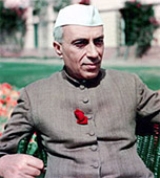
The iconic image of Nehru with a rose in the breast pocket of his achkan arose from a daily act of remembrance; his wife gave him a rose on her death-bed and, after her passing, he began picking a fresh rose every morning in her memory.

Nehru's policies

Prime Minister Jawaharlal Nehru's administration created the doctrines that formed the backbone of India's social and economic development, national defense and foreign policy for decades. Though they remain controversial to this day, the foundations of Indian Defence and Space Programmes along with educational institutions like IIT and IIM and innumerable dams that helped in Green Revolution are directly attributed to Nehru.

Economic policy

Nehru was fascinated by the Soviet Union Soviet Union

The Union of Soviet Socialist Republics , more commonly known as the Soviet Union, was a Communist state [i] ... 

's Piatiletka Piatiletka

Sorry, no overview for this topic 

 or 5-year plans. But he wrote after a visit there in the 1920s that 'the human costs are unpayable'. A believer in the 'mixed economy' of Harold Laski and influenced by the Fabian Society, Nehru wished the economy of India Economy of India

The economy of India is the fourth largest [i] in the world as measured by purchasing power parity [i] ... 

 to be partially capitalist, but with the state occupying a large role, especially in the commanding heights of the economy.

In setting a path for the economic policy after Independence, he chose from a set of options considerably more limited than those available today, and followed to a large degree the conventional wisdom at the time among academic economists, both in India and the West. India's growth rate in GDP Gross domestic product

A region's gross domestic product, or GDP, is one of the several measures [i] ... 

 stayed moderately above 4% during all the years that Nehru was Prime Minister. It is hard to say definitively how much growth there might have been with different economic policies: predominantly capitalist Western Europe grew slightly faster than India during the Nehru years ; but so did the command economies of communist China and the Soviet Union. The strongly capitalist USA grew somewhat more slowly, as did most of the newly independent nations that followed WWII .

Some recent studies influenced by Chicago School economists—such as one by Goldman Sachs Goldman Sachs

The Goldman Sachs Group, Inc., or simply Goldman Sachs is one of the world's most prestigious glob... 

—have claimed that India had the potential to grow faster than it did in the post-Nehru 1960-1980 timeframe. According to this thinking, that opportunity was wasted out of a misplaced faith in the power of economic planning. Economist Jagdish Bhagwati, who spoke consistently for three decades in favour of market reform, has remarked that India's problem has been that it has too many brilliant economists; Bhagwati believes the stalwarts of Nehru's Planning Commissions began to believe in their own infallibility, to the detriment of the Indian nation. Other opponents at the time included the Bombay Club, a group of industrialists headed by J.R.D. Tata who had an alternative development approach mapped out, and the former Governor-General and prominent anti-socialist C. Rajagopalachari, who left the Congress for the Swatantra Party over the issue.

In hindsight, the Nehruvian model failed in many of its objectives; however, many Indian economists—particularly among Nehru's contemporaries—believe Nehru's emphasis on central planning was the right policy for India of that time.

Some critics of Indian economic development believe that Indian economy prior to reform in 1991, with inefficient public sector entities on the one hand, and crony-capitalist private sector entities that used the so-called license raj to carve out lucrative niches for themselves on the other, was a product of economic policy foundations laid during Nehru's tenure.

Nehru's economic policies are sometimes confused by critics with those of his daughter, Indira Gandhi Indira Gandhi

Indira Priyadarsini Gandhi was Prime Minister of India [i] from January 19 [i], 1966 [i] to March 24 [i] ... 

, which were more statist and dirigiste in orientation. Nehru's economics of state intervention and investment were conceived at a time when transfers of capital and technology important to India were not easily forthcoming from the developed world

Foreign Policy


Nehru's foreign policy was strongly idealist as opposed to the realism favoured by his opponents.
Central to this idealism was Nehru's doctrine of Panchshila, . The basis of the 1954 Sino-Indian treaty over Tibet, it was taken by the Chinese as a statement of Indian pacifism. As conceived by Nehru, Panchshila was based upon mutual respect among nations, peaceful coexistence, and non-interference in the internal affairs of others. He had offered it to the Afro-Asian Solidarity Movement and Non-Aligned Movement at the Bandung Conference Asian-African Conference

The Asian-African Conference was a meeting of Asian and African states, most of which were newly indepen... 

 in 1955 as the guiding philosophy for an emerging Third World power bloc, an alternative to Moscow and Washington.

He was strongly supportive of anti-colonialism, and the freedom movements in Tanzania Tanzania

Tanzania , officially the United Republic of Tanzania , is a country on the east coast of Africa [i] ... 

, Algeria Algeria

Algeria , officially the People's Democratic Republic of Algeria is a country in north Africa [i],... 

, Indochina Indochina

Indochina, or the Indochinese Peninsula [i], is a region [i] in Southeast Asia [i]. ... 

 and the abolition of apartheid History of South Africa in the apartheid era

Apartheid was a system of racial segregation [i] that was enforced in South Africa [i] from 1948 to 1994 ... 

 in South Africa South Africa

The Republic of South Africa is a country located at the southern tip of the Africa [i]n continent [i]. ... 

. Nehru was also one of the founding statesmen of the Non Aligned Movement Non-Aligned Movement

The Non-Aligned Movement, or NAM, is an international organization [i] of over 100 states [i] ... 

, of Asian and African nations seeking to stay away from the pressures of the alliances created by the USA United States

The United States of America, also known as the United States, the U.S., the U.S.A., a... 

 and USSR Soviet Union

The Union of Soviet Socialist Republics , more commonly known as the Soviet Union, was a Communist state [i] ... 

. Nehru also condemned the invasion of Suez Suez

Suez is a port town [i] in Egypt [i], located on the Gulf of Suez [i], near the mouth of the Suez Canal [i] ... 

 in 1956 by Israel Israel

Israel , officially the State of Israel, is a country in Western Asia [i] on the so ... 

, the United Kingdom United Kingdom

The United Kingdom of Great Britain and Northern Ireland is a country and sovereign state [i] tha ... 

 and France France

France, officially the French Republic, is a country [i] whose metropolitan territory [i] ... 

.

Nehru's leadership of the newly independent nations of the Third World was taken as assumed throughout the 1950s, and thus India's stature in foreign affairs was assured, until at least the Chinese war of 1962.

The Soviet Union was the only major power during Nehru's tenure to aid India in developing independent capabilities areas of heavy industry, engineering, and technology. This political fact, combined with Nehru's preference for state-led development, promoted suspicion about the sincerity of India's non-aligned Non-Aligned Movement

The Non-Aligned Movement, or NAM, is an international organization [i] of over 100 states [i] ... 

 foreign policy positions.
However, Nehru's neutrality Neutral country

A neutral country takes no side in a war [i] between other parties, and in return hopes to avoid being a ... 

 was strongly criticized when he failed to condemn the USSR's invasion of Hungary Hungary

Hungary , officially the Republic of Hungary , is a landlocked [i] country in Central Europe [i], ... 

 in 1956-58.

On November 27, 1946, Nehru appealed to the United States United States

The United States of America, also known as the United States, the U.S., the U.S.A., a... 

 and the Soviet Union Soviet Union

The Union of Soviet Socialist Republics , more commonly known as the Soviet Union, was a Communist state [i] ... 

 to end nuclear testing Nuclear testing

Nuclear testing is experimentation with nuclear weapon [i]s.... 

 and to start nuclear disarmament, stating that such an action would "save humanity".
Chinese Miscalculation

The Panchshila was the basis of the 1954 Sino-Indian treaty over Tibet Tibet

Tibet is a region in Central Asia [i] and the home of the Tibetan people [i]. ... 

; unfortunately, it was taken by the Chinese as a statement of Indian pacifism.
The conference at Bandung at which the Panchshila was declared was also where Nehru introduced the newly independent Chinese leaders to the world. He assumed that as former colonies they shared a sense of solidarity, as expressed in the phrase Hindi-Chini bhai bhai .
But much to China's chagrin, Nehru and India, as heir apparent to the British Empire British Empire

The British Empire was the most extensive empire [i] in world history and for a ... 

 in Asia, assumed the mantle of leadership of the movement. Mao was infuriated. He believed that his sense of cultural superiority and unquestioned revolutionary credentials dictated China to be the rightful leader. This made the subsequent border issue more than territorial; it was an opportunity for China to assert it's pre-eminence as an Asian power and to humiliate India. Unfortunately, Nehru never understood this aspect of the equation. He was dedicated to the ideals of brotherhood and solidarity among Third World nations, while China was dedicated to a vision of itself as the hegemon of Asia.

Nehru did not believe that one fellow Socialist country would attack another; and in any event, he felt secure behind the impregnable wall of ice that is the Himalayas Himalayas

The Himalayas are a mountain range [i] in Asia [i], separating the Indian subcontinent [i] from the Tibetan Plateau [i] ... 

. Both proved to be tragic miscalculations of China's determination and military capabilities. Nehru tried to engage China in a prolonged strategy of diplomacy, while on the ground Indian troops moved to outflank Chinese positions. Eventually, China took direct action in 1962, starting the Sino-Indian War Sino-Indian War

The Sino-Indian Border War , began on 10 October [i] 1962 [i]. ... 

.

China was encouraged by its perception of India as a "weak" target. After all, Nehru had taken no action in 1951 when China invaded and occupied Tibet, eliminating the traditional buffer between the two; and, except to grant asylum to the Dalai Lama Dalai Lama

In Tibetan Buddhism [i], the successive Dalai Lamas form a tulku [i] lineage of Gelugpa [i] leaders whi... 

, he, again, did nothing in 1959, when China ruthlessly put down the uprising in Tibet.

Forty years later, few know the real story of what happened, what went wrong. Why India was not able to defeat the Chinese People's Liberation Army People's Liberation Army

The Chinese People's Liberation Army , which includes an army [i], navy [i], air force [i], and strateg ... 

 in a bitter and cold battle in the Northeast. India has repaired its relationship with the Chinese to some extent, but those wounds have not been forgotten. The military debacle against China in 1962 was thoroughly investigated in the Henderson-Brooks Report which successive Indian governments have refused to release.

It was a revelation to most when in an interview on the BBC, George Fernandes George Fernandes

name = George Fernandes
| image = George Fernandes.jpg
... 

 , said that the Coco island was part of India until it was donated to Burma Myanmar

Myanmar, officially the Union of Myanmar is the largest country in geographical area in mainland ... 

  by Nehru. The Coco island is located at 18 km from the Indian Nicobar island. At present, China has an intelligence gathering station on the Coco Island to monitor Indian naval activity as well as ISRO Indian Space Research Organisation

The Indian Space Research Organisation is India [i]'s national space agency [i]. ... 

 & DRDO Defence Research and Development Organisation

[i]
... 

 missile and space launch activities.

Nehru Dynasty


His daughter Indira Gandhi Indira Gandhi

Indira Priyadarsini Gandhi was Prime Minister of India [i] from January 19 [i], 1966 [i] to March 24 [i] ... 

 would become Prime Minister within two years of his death in 1966, and would serve for 15 years and 3 terms. His grandson Rajiv Gandhi Rajiv Gandhi

Rajiv Ratna Gandhi , the eldest son of Indira [i] and Feroze Gandhi [i], was the 6th Prime Minister [i] ... 

 would hold that office from 1984 to 1989. Today, Rajiv's widow Sonia Gandhi Sonia Gandhi

name = Sonia Gandhi
| image = SoniaGandhi.jpg
... 

, is the Congress Party's president, though not Prime Minister. Her son Rahul Gandhi Rahul Gandhi

name = Rahul Gandhi
| image = Rahul Gandhi.jpg
... 

 entered Parliament in the 2004 General Elections Indian general election, 2004

Legislative elections were held in India [i], the world's largest democracy [i], in four phases between... 

.

Books, Quotations and Trivia


  • Nehru's letters to his daughter Indira Indira Gandhi

    Indira Priyadarsini Gandhi was Prime Minister of India [i] from January 19 [i], 1966 [i] to March 24 [i] ... 

     during successive periods of imprisonment in 1930-1934 were later compiled into a book called Glimpses of World History.
  • His 1942-1945 incarceration produced The Discovery of India, a history of India with digressions.
  • Subsequently, while in prison following the Quit India Movement Quit India Movement

    The Quit India Movement (Bharat Chhodo Andolan or the August Movement) was a civil disobedience [i] ... 

    , he wrote An Autobiography , which was a New York Times best seller.
  • The words of Nehru's famous Tryst with Destiny Tryst with destiny

    Pandit Jawaharlal Nehru [i]'s speech known as Tryst with Destiny, was made to the Indian Constituent Assembly [i] ... 

    speech on the eve of Indian Independence is as familiar, and indeed significant, to Indian ears as the Gettysburg Address Gettysburg Address

    The Gettysburg Address is the most famous speech of U.S. President [i] Abraham Lincoln [i] ... 

     is to Americans.
  • Nehru had a golden bronze statue of Mahatma Gandhi Mahatma Gandhi

    Mohandas Karamchand Gandhi was a major political and spiritual leader of India [i] and the Indian independence movement [i] ... 

     and a hand of Abraham Lincoln Abraham Lincoln

    Abraham Lincoln , sometimes called Abe Lincoln and nicknamed Honest Abe, the Rail Splitte... 

     on his office desk.
  • In 1937, Modern Review of Calcutta Kolkata

    Kolkata is the capital [i] of the India [i]n state [i] of West Bengal [i] ... 

     carried a letter, under the pen-name Chanakya, that warned members of the Congress Party against Nehru, then party president, declaring that he had "tendencies towards autocracy" and needed to be firmly checked before he "turns into Caesar". It emerged many years later that the letter was written by Nehru himself.
  • Nehru popularized the Nehru jacket Nehru jacket

    The Nehru jacket is an article of clothing [i] that originates in India [i] and became popular in the We... 

    .
  • Nehru's birthday, 14 November, is celebrated as Children's Day Children's Day

    Children's Day is a holiday [i] in many countries around the world, mainly the holiday's purpose is to s ... 

     in India, in memory of his love of children.


  • "The spectacle of what is called religion, or at any rate organized religion, in India and elsewhere, has filled us with horror, and I have frequently condemned it and wished to make a clean sweep of it," from James A. Haught, ed., 2000 Years of Disbelief.
  • "I want nothing to do with any religion concerned with keeping the masses satisfied to live in hunger, filth, and ignorance... To attain this I would put priests to work, also, and turn the temples into schools," from James A. Haught, ed., 2000 Years of Disbelief

Further reading

  • Nehru-Gandhi family Nehru-Gandhi Family

    The Nehru-Gandhi family is a political [i] dynasty [i] in India [i] which has been dominant in the Indian National Congress [i] ... 

  • Speech in the Constituent Assembly of India, on the eve of India's Independence


  • Nehru: A Biography by Shashi Tharoor Arcade Books ISBN 1-55970-697-X
  • Jawaharlal Nehru The Essential Writings of Jawaharlal Nehru Oxford University Press Oxford University Press

    Oxford University Press is a highly-respected publishing house [i] and a department of the University of Oxford [i]... 

     ISBN 0-19-565324-X
  • Autobiography:Toward freedom, Oxford University Press Oxford University Press

    Oxford University Press is a highly-respected publishing house [i] and a department of the University of Oxford [i]... 

  • Jawaharlal Nehru: Life and work by M. Chalapathi Rau, National Book Club
  • Jawaharlal Nehru by M. Chalapathi Rau. [New Delhi] Publications Division, Ministry of Information and Broadcasting, Govt. of India [1973]

See also

  • Motilal Nehru
  • Indira Gandhi Indira Gandhi

    Indira Priyadarsini Gandhi was Prime Minister of India [i] from January 19 [i], 1966 [i] to March 24 [i] ... 

  • Feroze Gandhi
  • Vijaya Lakshmi Pandit
  • Kamala Nehru
  • Nayantara Sehgal
  • Rajiv Gandhi Rajiv Gandhi

    Rajiv Ratna Gandhi , the eldest son of Indira [i] and Feroze Gandhi [i], was the 6th Prime Minister [i] ... 

  • Sonia Gandhi Sonia Gandhi

    name = Sonia Gandhi

| image = SoniaGandhi.jpg
... 


  • Maneka Gandhi Maneka Gandhi

    Maneka Gandhi is an India [i]n politician, an ardent animal rights activist [i], and a for ... 

  • Sanjay Gandhi Sanjay Gandhi

    Sanjay Gandhi was an India [i]n politician of Kashmiri [i] and Parsi [i] heritage; he was the younger so ... 

  • Arun Nehru
  • Varun Gandhi Varun Gandhi

    Varun Gandhi is the only son of the late Sanjay Gandhi [i] and Maneka Gandhi [i].

... 


| image = Rahul Gandhi.jpg
... 


  • Priyanka Gandhi Priyanka Gandhi

    Priyanka Gandhi-Vadra, a member of the Nehru-Gandhi political family [i], is the daughter, granddaughter ... 


External links


  • .