

Nablus

Encyclopedia
Nablus is a Palestinian
city in the northern West Bank
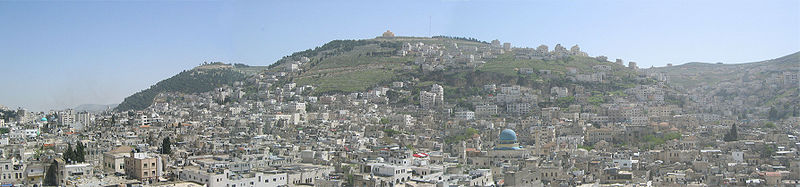
, approximately 63 kilometres (39.1 mi) north of Jerusalem, with a population of 126,132. Located in a strategic position between Mount Ebal
and Mount Gerizim
, it is the capital of the Nablus Governorate
and a Palestinian commercial and cultural center.
Founded by the Roman
Emperor Vespasian
in 72 CE as Flavia Neapolis, Nablus has been ruled by many empires over the course of its almost 2,000-year-long history. In the 5th and 6th centuries, conflict between the city's Christian
and Samaritan
inhabitants climaxed in a series of Samaritan revolts against Byzantine
rule, before their violent quelling in 529 CE drastically dwindled that community's numbers in the city. In 636, Neapolis, along with most of Palestine
, came under the rule of the Islam
ic Arab Caliphate
of Umar ibn al-Khattab
; its name Arabicized
to Nablus. In 1099, the Crusaders took control of the city for less than a century, leaving its mixed Muslim, Christian and Samaritan population relatively undisturbed. After Saladin
's Ayyubid forces took control of the interior of Palestine in 1187, Islamic rule was reestablished, and continued under the Mamluk
and Ottoman
empires to follow.
Following its incorporation into the Ottoman empire in 1517, Nablus was designated capital of the Jabal Nablus ("Mount Nablus") district. In 1657, after a series of upheavals, a number of Arab
clans from the northern and eastern Levant
were dispatched to the city to reassert Ottoman authority, and loyalty from amongst these clans staved off challenges to the empire's authority by rival regional leaders, like Dhaher al-Omar in the 18th century, and Muhammad Ali
—who briefly ruled Nablus—in the 19th century. When Ottoman rule was firmly reestablished in 1841, Nablus prospered as a center of trade.
After the loss of the city to British forces during World War I
, Nablus was incorporated into the British Mandate of Palestine in 1922, and later designated to form part of the Arab state of Palestine under the 1947 UN partition plan. The end of the 1948 Arab-Israeli War saw the city instead fall to Jordan
, to which it was unilaterally annexed, until its occupation
by Israel
during the 1967 Six Day War.
Today, the population is predominantly Muslim
, with small Christian and Samaritan minorities. Since 1995, the city has been governed by the Palestinian National Authority
. In the Old City, there are a number of sites of archaeological significance, spanning the 1st to 15th centuries. The city is known for its kanafeh
, a popular sweet throughout the Middle East, and soap
industry.
") was founded in 72 CE by the Roman
emperor Vespasian
over an older Samaritan
village, Mabartha ("the passage"). Located between Mount Ebal
and Mount Gerizim
, the new city lay 2 kilometres (1.2 mi) west of the Biblical
city of Shechem
which was destroyed by the Romans that same year during the First Jewish-Roman War
. Holy places at the site of the city's founding include Joseph's Tomb
and Jacob's Well
. Due to the city's strategic geographic position and the abundance of water from nearby springs, Neapolis prospered, accumulating extensive territory, including the former Judea
n toparchy of Acraba
.
Insofar as the hilly topography of the site would allow, the city was built on a Roman grid plan
and settled with veterans who fought in the victorious legions and other foreign colonists. In the 2nd century CE, Emperor Hadrian
built a grand theater in Neapolis that could seat up to 7,000 people. Coins found in Nablus dating to this period depict Roman military emblems and gods and goddesses of the Greek pantheon such as Zeus
, Artemis
, Serapis
, and Asklepios. Neapolis was entirely pagan
at this time. Justin Martyr
who was born in the city c. 100 CE, came into contact with Platonism
, but not with Christians there. The city flourished until the civil war between Septimius Severus
and Pescennius Niger
in 198–9 CE. Having sided with Niger, who was defeated, the city was temporarily stripped of its legal privileges by Severus, who designated these to Sebastia instead.
In 244 CE, Philip the Arab
transformed Flavius Neapolis into a Roman colony named Julia Neapolis. It retained this status until the rule of Trebonianus Gallus
in 251 CE. The Encyclopaedia Judaica speculates that Christianity was dominant in the 2nd or 3rd century, with some sources positing a later date of 480 CE. It is known for certain that a bishop from Nablus participated in the Council of Nicaea
in 325 CE. The presence of Samaritans in the city is attested to in literary and epigraphic evidence dating to the 4th century CE. As yet, there is no evidence attesting to a Jewish presence in ancient Neapolis.
 Conflict amongst the Christian population of Neapolis emerged in 451. By this time, Neapolis was within the Palaestina Prima province under the rule of the Byzantine Empire
. The tension was a result of Monophysite
Christian attempts to prevent the return of the Patriarch of Jerusalem
, Juvenal
, to his episcopal see
. However, the conflict did not grow into civil strife.
As tensions amongst the Christians of Neapolis decreased, tensions between the Christian community and the Samaritans grew dramatically. In 484, the city became the site of a deadly encounter between the two groups, provoked by rumors that the Christians intended to transfer the remains of Aaron
's sons and grandsons Eleazar
, Ithamar
and Phinehas
. Samaritans reacted by entering the cathedral of Neapolis, killing the Christians inside and severing the fingers of the bishop Terebinthus. Terebinthus then fled to Constantinople
, requesting an army garrison to prevent further attacks. As a result of the revolt, the Byzantine emperor Zeno
erected a church dedicated to Mary
on Mount Gerizim. He also forbade the Samaritans to travel to the mountain to celebrate their religious ceremonies, and confiscated their synagogue there. These actions by the emperor fueled Samaritan anger towards the Christians further.
Thus, the Samaritans rebelled again under the rule of emperor Anastasius I
, reoccupying Mount Gerizim, which was subsequently reconquered by the Byzantine governor of Edessa
, Procopius. A third Samartian revolt which took place under the leadership of Julianus ben Sabar
in 529 was perhaps the most violent. Neapolis' bishop Ammonas
was murdered and the city's priests were hacked into pieces and then burned together with the relics of saint
s. The forces of Emperor Justinian I
were sent in to quell the revolt, which ended with the slaughter of the majority of the Samaritan population in the city.
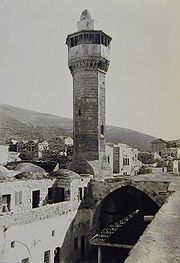 Neapolis, along with most of Palestine, was conquered by the Muslim
s under Khaled ibn al-Walid—a general of the Rashidun army
of Umar ibn al-Khattab
—in 636 after the Battle of Yarmouk
. The city's name was retained in its Arabicize
d form, Nablus. The town prevailed as an important trade center during the centuries of Islam
ic Arab
rule under the Umayyad
, Abbasid and Fatimid
dynasties. Under Muslim rule, Nablus contained a diverse population of Arabs and Persian
s, Muslims, Samaritans, Christians and Jews. In the 10th-century, the Arab geographer al-Muqaddasi
, described it as abundant of olive trees, with a large marketplace, a finely paved Great Mosque
, houses built of stone, a stream running through the center of the city, and notable mills. He also noted that it was nicknamed "Little Damascus
." At the time, the linen produced in Nablus was of well-known throughout the Old World
.
in 1099, under the command of Prince Tancred
, and renamed Naples. Though the Crusaders extorted many supplies from the population for their troops who were en route to Jerusalem, they did not sack the city, presumably because of the large Christian population there. Nablus became part of the royal domain of the Kingdom of Jerusalem
. The Muslim, Eastern Orthodox Christian, and Samaritan populations remained in the city, and were joined by some Crusaders who settled therein to take advantage of the city's abundant resources. In 1120, the Crusaders convened the Council of Nablus
out of which was issued the first written laws for the kingdom. They converted the Samaritan synagogue in Nablus into a church. The Samaritan community built a new synagogue in the 1130s.
During the second half of Crusader reign in Nablus, Muslim forces began launching incursions in order to regain control of the city. In 1137, Arab and Turkish
troops stationed in Damascus
made an incursion into Nablus, killing many Christians and burning down the city's churches, but were unsuccessful in this bid to retake the city. Queen Melisende of Jerusalem
resided in Nablus from 1150 to 1161, after she was granted control over the city so as to resolve a dispute with her son Baldwin III
. Crusaders began building Christian institutions in Nablus, including a church dedicated to the Passion
and Resurrection of Jesus
, and in 1170 they also erected a hospice for pilgrims. Crusader rule came to an end in 1187, when the Ayyubids led by Saladin
captured the city. According to a liturgical manuscript in Syriac, Latin Christians
fled Nablus, but the original Eastern Orthodox Christian inhabitants remained. Syrian geographer Yaqut al-Hamawi
(1179–1229), wrote that Ayyubid Nablus was a "celebrated city in Filastin (Palestine)... having wide lands and a fine district." He also mentions the large Samaritan population in the city.
, which had become a church under Crusader rule, was restored as a mosque by the Ayyubids, who also built a mausoleum
in the old city. In 1242, the Great Mosque was burnt by the Templar Knights during a three-day raid they conducted in the city in which they killed 1,000 people and took many women and children who were then sold in the slave markets of Acre
. The Samaritan synagogue, originally built in 362 CE by the high priest Akbon and converted into a church by the Crusaders, was converted into al-Khadra Mosque
in 1244; and two other Crusader churches became the an-Nasr Mosque
and al-Masakim Mosque during that century.
The Mamluk dynasty
gained control of Nablus in 1260 and during their reign, they built numerous mosques and schools in the city. Under Mamluk rule, Nablus possessed running water, many Turkish bathes and exported olive oil and soap
to Egypt
, Syria, the Hejaz
, several Mediterranean islands, and the Arabian Desert
. The city's olive oil was also used in the Umayyad Mosque
in Damascus. Ibn Battuta
, the Arab explorer, visited Nablus in 1355, and described it as a city "full of trees and streams and full of olives." He points out that it grew and exported carob jam to Cairo
and Damascus.
in 1517, along with the whole of Palestine. The Ottomans divided Palestine into six sanjaqs
("districts"): Safad, Jenin
, Jerusalem, Gaza
, Ajlun and Nablus
, all of which were part of Ottoman Syria
. These five sanjaqs were subdistricts of the Vilayet of Damascus. Sanjaq Nablus was further subdivided into five nahiya (subdistricts), in addition to the city itself. The Ottomans did not attempt to restructure the political configuration of the region on the local level such that the borders of the nahiya were drawn to coincide with the historic strongholds of certain families. Nablus was only one among a number of local centers of power within Jabal Nablus, and its relations with the surrounding villages, such as Beita
and Aqraba
, were partially mediated by the rural-based chiefs of the nahiya. During the 16th-century, the population was predominantly Muslim, with Jewish, Samaritan and Christian minorities.
After decades of minor upheavals and rebellions mounted by some of the Arab tribes in the Middle East, the Ottomans attempted to reassert centralized control over the Arab vilayets. In 1657, they sent an expeditionary force of local Ottoman-aligned Arab families based in various Syria
n cities to pacify Nablus. In return for their services, the families were granted agricultural lands around the villages of Jabal Nablus. The Ottomans, fearing that the new Arab land holders would establish independent bases of power, dispersed the land plots to separate and distant locations within Jabal Nablus to avoid clusters of clans. The 1657 campaign succeeded and the Syrian Arab families began to have a foothold in Nablus' affairs. The largest family were the Nimrs, who originated from villages surrounding Hama
and Homs
. The other two prominent families were the Jarrars from Balqa and the Touqan
s from northern Syria. Eventually gaining the role of nahiya chiefs, they began intermarrying with local merchant and leading religious families. Thus, these new families were integrated into Nablus' population. Under an arrangement in 1723, the Touqans and the Nimrs would share and trade leadership of Nablus, and the Jarrars would "indisputably" become the chiefs of the nahiya of Jabal Nablus.
 In the mid-18th-century, Dhaher al-Omar, an Arab native and ruler of the Galilee
and Acre who was hostile toward Ottoman rule, rose to become the most dominant figure in northern Palestine. In order to build up his army, he strove to gain monopoly control over the cotton
and olive oil
trade of the Levant
, which Jabal Nablus fueled. In 1771, during a Mamluk
invasion of Syria, al-Omar aligned himself with the Mamluks, allowing him to temporarily besiege Nablus, without gaining ultimate control over the city. In 1773, he again led his army to besiege Nablus, but again to no avail. Nevertheless, from a political perspective, the sieges did succeed in raising Acre's prominence at Nablus' expense. Al-Omar's successor, Jezzar Pasha
, maintained Acre's dominance over Nablus. After his reign ended in 1804, Nablus regained its original autonomy, and the Touqans, who represented a principal opposing force to Acre's dominance over Nablus, rose to power.
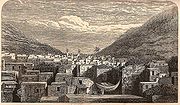 After the Egyptians declared independence from Ottoman rule under the leadership of Muhammad Ali
, they went on to conquer Palestine in 1831–32. A repressive policy of conscription
and taxation was instituted which led to a revolt launched by the a'ayan (prominent) Arab clans of Nablus, Hebron
and the Jerusalem-Jaffa area. On May 19, 1834, the clans, led by Qasim al-Ahmad—the chief of nahiya Jamma'in
—initiated a Palestinian Arab revolt when he notified Egyptian officials that Palestinian families would no longer supply the Egyptian army with troops. Governor Ibrahim Pasha
responded by sending Egyptian forces into the rebelling cities, thus triggering armed conflict with the clans. Nablus sent hundreds of rebels to attack Jerusalem, aided by the Abu Ghosh
clan, and they conquered the city on May 31, but were routed out by Ibrahim's forces the next month. The Egyptians then forced the heads of the Nablus clans to leave for nearby villages, and executed Qasim al-Ahmad and his two eldest sons.
The Egyptian occupation of Palestine resulted in the destruction of Acre
and thus, the political importance of Nablus increased. The Ottomans wrested back control of Palestine from the Egyptians in 1840–41. As a result, the Abd al-Hadi clan, who originated in Arrabah
in the Sahl Arraba
region in northern Samaria
, rose to prominence. Loyal allies of Jezzar Pasha and the Touqans, they gained the governorship of Jabal Nablus and other sanjaqs.
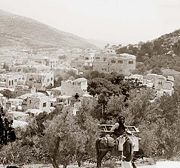 Throughout the 18th and 19th centuries, Nablus was the principal trade and manufacturing center in Ottoman Syria. Its economic activity and regional leadership position surpassed that of Jerusalem and the coastal cities of Jaffa
and Acre. Olive oil
was the primary product of Nablus and fueled other related industries such as soap-making
and basket weaving. The city also was the top producer of cotton in the Levant
, topping the production from northern cities such as Damascus. Jabal Nablus enjoyed a greater degree of autonomy
than other sanjaqs under Ottoman control, probably because the city was the capital of a hilly region, in which there were no "foreigners" who held any military or bureaucratic posts. Thus, Nablus remained outside the direct "supervision" of the Ottoman government.
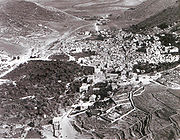 The Jordan Valley earthquake of 1927 destroyed many of the Nablus' historic buildings, including the an-Nasr mosque. Though they were subsequently rebuilt by Haj Amin al-Husayni's Supreme Muslim Council
in the mid-1930s, their previous "picturesque" character was lost. During British rule, Nablus emerged as a site of local resistance and the Old City quarter of Qaryun was demolished by the British during the 1936–1939 Arab revolt in Palestine.
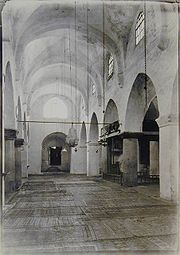 Jewish immigration
did not significantly impact the demographic composition of Nablus, and it was slated for inclusion in the Arab state envisioned by the United Nations General Assembly
's 1947 partition plan for Palestine.
After Israel
declared its independence in May 1948, Transjordan occupied Nablus. Thousands of Palestinian Arabs, fleeing towns captured by Israel, settled in refugee camps around Nablus and in Nablus itself. Three such camps still located within the city limits today are Ein Beit al-Ma'
, Balata
and Askar. The Jordanian rule lasted until the 1967 war. The Six-Day War
ended in a swift Israeli victory and the occupation of Nablus. Many Israeli settlement
s were built around Nablus during the 1980s and early 1990s.
Interim Agreement on the West Bank
.
 Nablus was a central flashpoint of violence between the Israel Defense Forces
(IDF) and Palestinian militant groups. The level of violence dramatically increased from 2000 at the start of the Second Intifada. The city and the refugee camps of Balata
and Askar constituted the center of "knowhow" for the production and operation of the rockets in the West Bank.
According to the United Nations Office for the Coordination of Humanitarian Affairs, 522 residents of Nablus and surrounding refugee camps, including civilians, were killed and 3,104 injured during IDF military operations against militants during the Second Intifada from 2000 to 2005. Israeli soldiers and settlers have also been killed by Palestinian militants from Nablus. In April 2002, following the Passover massacre
— an attack by Palestinian militants that killed 30 Israeli civilians attending a seder
dinner at the Park Hotel in Netanya — Israel launched Operation Defensive Shield
, a major military operation in which Nablus was one of the main targets. At least 80 Palestinians were killed in Nablus during the operation and several houses were destroyed or severely damaged. The IDF also imposed a curfew on Nablus lasting between April 4 and April 22. IDF forces reentered Nablus during Operation Determined Path
in June 2002, remaining inside the city until the end of September. Over those three months, there had been more than 70 days of full 24-hour curfews.
According to Gush Shalom
, IDF bulldozers caused damage to al-Khadra Mosque, the Great Mosque, al-Satoon Mosque and Greek Orthodox Church
in 2002. Some 60 houses were destroyed, and parts of the stone-paving in the old city were damaged. The al-Shifa hammam
was hit by three rockets from Apache helicopters. The eastern entrance of the Khan al-Wikala (old market) and three soap factories were destroyed in F-16
bombings. The cost of the damage was estimated at $80 million US.
, the other linking Nablus to the Galilee
in the north, and the biblical Judea
to the south through the mountains. The city stands at an elevation of around 550 metres (1,804.5 ft) above sea level
, in a narrow valley running roughly east-west between two mountains: Mount Ebal
, the northern mountain, is the taller peak at 940 metres (3,084 ft), while Mount Gerizim
, the southern mountain, is 881 metres (2,890.4 ft) high.
Nablus is located 42 kilometres (26.1 mi) east of Tel Aviv
, Israel
, 110 kilometres (68.4 mi) west of Amman
, Jordan
and 63 kilometres (39.1 mi) north of Jerusalem. Nearby cities and towns include Huwara
and Aqraba
to the south, Beit Furik
to the southeast, Tammun
to the northeast, Asira ash-Shamaliya
to the north and Kafr Qaddum
and Tell to the west.
built in the 19th century is located in Qaryun. The Nimr Hall and the Touqan Palace are located in the center of the old city. There are several mosque
s in the Old City: The Great Mosque of Nablus
, an-Nasr Mosque
, al-Tina Mosque, al-Khadra Mosque, al-Hanbali, al-Anbia, Ajaj, etc.
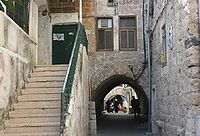
There are six hamaam
s (Turkish baths) in the Old City, the most prominent of them being al-Shifa and al-Hana. Al-Shifa Hamaam was built by the Touqans in 1624. Al-Hana in Yasmina, was the last hamaam built in the city in the 19th century. It was closed in 1928 but restored and reopened in 1994. Several leather tanneries, souk
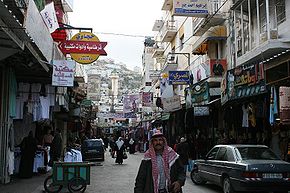
s, pottery and textile workshops line the Old City streets. There are a number of historic monuments in the old city including the Khan al-Tujjar
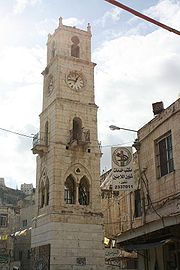
and the al-Manara Clock Tower
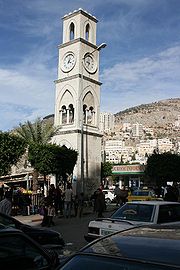
built in 1906.
brings hot, dry summers and cool, rainy winters to Nablus. Spring arrives around March–April and the hottest months in Nablus are July and August with the average high being 28.9 °C (84 °F). The coldest month is January with temperatures usually at 3.9 °C (39 °F). Rain generally falls between October and March, with annual precipitation rates being approximately 23.2 inches (589 mm).
In 1596, the population was counted as consisting of 806 Muslim households, 20 Samaritan
households, 18 Christian households, and 15 Jewish households. Local Ottoman authorities recorded a population of around 20,000 residents in Nablus in 1849. In 1867 American visitors found the town to have a population of 4,000 'the chief part of whom are Mohammedans', with some Jews and Christians and 'about 150 Samaritans'. In the 1922 British census of Palestine
, there was a total of 15,947 inhabitants, rising to 17,498 at the 1931 census of Palestine
.
According to the Palestinian Central Bureau of Statistics
(PCBS), Nablus had a population of 134,116 inhabitants in mid-year 2006. In the PCBS's 1997 census, the city had a population of 100,034, including 23,397 refugees, accounting for about 24% of the city's residents. Nablus' Old City had a population of 12,000 in 2006. The population of Nablus city comprises 40% of its governorate
's inhabitants.
Approximately half of population is under 20 years old. In 1997, the age distribution of the city's inhabitants was 28.4% under the age of 10, 20.8% from 10 to 19, 17.7% from 20–29, 18% from 30 to 44, 11.1% from 45 to 64 and 3.7% above the age of 65. The gender distribution was 50,945 males (50.92%) and 49,089 females (49.07%).
ic rule, Nablus had a religiously diverse population of Samaritans, local Muslim
s and Christians. Arab geographer Al-Dimashqi, recorded that under the rule of the Mamluk Dynasty (Muslim Dynsaty based in Egypt), local Muslims, Samaritans, Orthodox Christians, Catholics and Jews populated the city. At the 1931 census, the population was counted as 16,483 Muslims, 533 Christians, 6 Jews, 7 Druses and 160 Samaritans.
The majority of the inhabitants today are Muslim, but there are small Christian
and Samaritan
communities as well. Much of the local Palestinian
Muslim population of Nablus is believed to be descended from Samaritans who converted to Islam. Certain Nabulsi family names are associated with Samaritan ancestry – Muslimani, Yaish, and Shakshir among others. According to the historian Fayyad Altif, large numbers of Samaritans converted due to persecution and because the monotheistic nature of Islam made it easy for them to accept it.
In 1967, there were about 3,500 Christians of various denominations in Nablus, but that figure dwindled to about 650 in 2008. Of the Christian populace, there are seventy Orthodox Christian families, about thirty Catholic (Roman Catholic & Eastern Melkite Catholic) families and thirty Anglican families. Most Christians used to live in the suburb of Rafidia
in the western part of the city.
There are seventeen Islamic monuments and eleven mosques in the Old City. Nine of the mosques were established before the 15th century. In addition to Muslim houses of worship, Nablus contains an Orthodox church dedicated Saint Justin Martyr, built in 1898 and the ancient Samaritan synagogue, which is still in use.
 The longevity and relative stability of Ottoman rule, as well as the broad political space it engendered, enhanced the advantages of Nablus' geographical location. Beginning in the early 16th century, trade networks connecting Nablus to Damascus
and Cairo
were supplemented by the establishment of secure trading posts in the Hejaz
and Gulf
regions to the south and east, as well as in the Anatolian Peninsula and the Mediterranean islands of Crete
and Cyprus
. Nablus also developed some form of trade relations with Aleppo
, Mosul
, and Baghdad
.
The Ottoman government vigorously ensured adequate safety and funding for the annual pilgrimage
caravan (qafilat al-hajj) from Damascus to the Islamic holy cities of Mecca
and Medina
. This policy greatly benefited Nablus economically. From the very beginning of Ottoman rule, pilgrimage caravans became the key factor in the fiscal and political relationship between Nablus and the central government. For a brief period in the early 17th century, the governor of Nablus, Farrukh Pasha Ibn Abdullah, was appointed leader of the pilgrimage caravan (amir al-hajj), and he constructued a large commercial compound in Nablus for that purpose.
In 1882, there were 32 soap factories and 400 loom
s exporting their products throughout the Middle East. Nablus exported three-fourths of its soap — the city's most important commodity — to Cairo by caravan through Gaza
and the Sinai Peninsula
, and by sea through the ports of Jaffa
and Gaza. From Egypt, and particularly from Cairo and Damietta
, Nablus merchants imported mainly rice, sugar
, and spices, as well as linen, cotton, and wool textiles. Cotton, soap, olive oil, and textiles were exported by Nablus merchants to Damascus, from whence silks, high-quality textiles, copper, and a number luxury items, such as jewellery were imported.
With regard to the local economy, agriculture was the major component. Outside of the city limits, there were extensive fields of olive
groves, fig
and pomegranate
orchards and grape
vineyards that covered the area's slopes. Crops, such as tomatoes, cucumbers, melons and mulukhiyya were grown in the fields, vegetable gardens, and grain mills scattered across central Samaria
. Nablus was also the largest producer of cotton
in the Levant, producing over 225,000 kilograms of the product by 1837.
. Traditional industries continue to operate in Nablus, such as the production of soap, olive oil, and handicrafts
. Other industries include furniture production, tile production, stone quarrying, textile manufacturing and leather tanning. The city is also a regional trading center for live produce. Most of these industries are centered in the old city.
The Vegetable Oil Industry Co. is a Nablus factory that produces refined vegetable oils, especially olive oil, and vegetable butter from the factory is exported to Jordan
. The al-Huda Textiles factory is also located in Nablus. In 2000, the factory produced 500 pieces of clothing daily; however, production plummeted to 150–200 pieces daily in 2002. Al-Huda mainly imports textiles from China and exports finished products to Israel
. There are eight restaurants in the city and four hotels — the largest being al-Qasr and al-Yasmeen. Nablus' once thriving soap industry has been largely isolated due to difficult transportation conditions stemming from West Bank closures
and IDF incursions. Today, there are only two soap factories still operating in the city.
Before 2000, 13.4% of Nablus' residents worked in Israel, with the figure dropping to 4.7% in 2004. The city's manufacturing sector made up 15.7% of the economy in 2004, a drop from 21% in 2000. Since 2000, most of Nablus' workforce has been employed in agriculture and local trade. The city's unemployment rates have increased dramatically in recent years, rising from 14.2% in 1997 to an estimate of 60% in 2004. Unemployment in the old city and in the refugee camps is estimated to be as high as 80%. Due to the ongoing Israeli-Palestinian conflict
, Nablus has been closed off by the IDF. The city's encirclement with checkpoints is cited by the United Nations
as a reason for high unemployment and a "devastated" economy. Many businesses have either moved from or have been established outside Nablus, beyond the tight ring of closures around the city.
Nablus is home to the Palestine Securities Exchange
(PSE) — the only securities exchange in the Palestinian territories — and the al-Quds Financial Index. They are housed in the al-Qasr building in the Rafidia suburb of the city. The PSE's first trading session took place on February 19, 1997. In 2007, the capitalization of the PSE topped 3.5 million Jordanian dinar
s.
 Nablus and its culture enjoy a certain renown throughout the Palestinian Territories and the Arab world
with significant and unique contributions to Palestinian culture, cuisine
and costume
. Nabulsi, meaning "from Nablus", is used to describe items such as handicrafts
(e.g. Nabulsi soap
) and food products (e.g. Nabulsi cheese
) that are made in Nablus or in the traditional Nablus style.
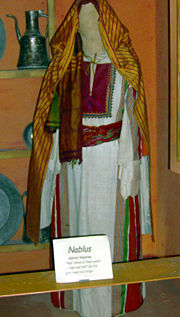
("market"), in late 19th century, there was a large choice of fabrics available in the city, from Damascus
and Aleppo
silk
to Manchester
cotton
s and calico
s. Similar in construction to the garments worn in the Galilee
, both long and short Turkish style jackets were worn over the thob ("robe"). For daily wear, thobs were often made of white cotton or linen
, with a preference for winged sleeves. In the summer, costumes often incorporated interwoven striped bands of red, green and yellow on the front and back, with appliqué and braidwork popularly decorating the qabbeh ("square chest piece").
or Baghdad
. The city is home to a number of food products well-known throughout the Levant, the Arab world
and the former provinces of the Ottoman Empire.
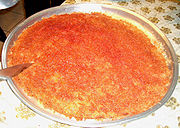
Kanafeh is the most famed Nabulsi sweet. Originating in Nablus during the 15th century, by 1575, its recipe was exported throughout the Ottoman Empire
— which controlled Palestine at the time. Kanafeh is made of several fine shreds of pastry noodles with honey-sweetened cheese in the center. The top layer of the pastry is usually dyed orange with food coloring and sprinkled with crushed pistachios. Though it is now made throughout the Middle East, to the present day, kanafeh Nabulsi enjoys continued fame, partly due to its use of a white-brine cheese called jibneh Nabulsi
. Boiled sugar is used as a syrup for kanafeh.
Other sweets made in Nablus include baklawa, "Tamriya", mabrumeh and ghuraybeh, a plain pastry made of butter, flour and sugar in an "S"-shape, or shaped as fingers or bracelets.
produced only in Nablus and made of three primary ingredients: virgin olive oil
, water, and a sodium compound. Since the 10th century, Nabulsi soap has enjoyed a reputation for being a fine product, and has been exported across the Arab world and to Europe. Though the number of soap factories decreased from a peak of thirty in the 19th century to only two today, efforts to preserve this important part of Palestinian and Nabulsi cultural heritage continue.
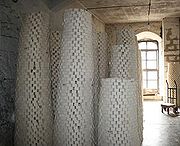
Made in a cube-like shape about 1.5 inches (3.8 cm) tall and 2.25 by wide, the color of Nabulsi soap is like that of "the page of an old book." The cubes are stamped on the top with the seal of the factory that produces it. The soap's sodium compound came from the barilla
plant. Prior to the 1860s, in the summertime, the barilla would be placed in towering stacks, burned, and then the ashes and coals would be gathered into sacks, and transported to Nablus from the area of modern-day Jordan
in large caravans
. In the city, the ashes and coals were pounded into a fine natural alkaline soda powder called qilw. Today, qilw is still used in combination with lime.
classes and field trips. In addition to national culture, the CHC has a football
and chess
team. The Nablus municipal government established its own cultural center in 2003, called the Nablus Municipality Cultural Center (NMCC) aimed at establishing and developing educational facilities.
stadium has a capacity of 8,000. The stadium is home to the city's football club al-Ittihad
, which is in the main league of the Palestinian Territories. The club participated in the Middle East Mediterranean Scholar Athlete Games in 2000.
 The city of Nablus is the muhfaza (seat) of the Nablus Governorate
, and is governed by a municipal council made up of fifteen elected members, including the mayor.
The two primary political parties in the municipal council are Hamas
and Fatah
. In the 2005 Palestinian municipal elections, the Reform and Change list representing the Hamas faction won 73.4% of the vote, gaining the majority of the municipal seats (13). Palestine Tomorrow, representing Fatah, gained the remaining two seats with 13.0% of the vote. Other political parties, such as the Palestinian People's Party
and the Democratic Front for the Liberation of Palestine
failed to gain any seats in the council, though they each received over 1,000 votes.
Elected Candidates of the Nablus municipal elections of 2005
movement.
The current mayor, Adly Yaish
, a Hamas member, was arrested by the Israel Defense Forces in May 2007, during Operation Summer Rains, launched in retaliation for the kidnapping of Israeli soldier Gilad Shalit
by Hamas. Municipal council members Abdel Jabbar Adel Musa "Dweikat", Majida Fadda, Khulood El-Masri, and Mahdi Hanbali were also arrested. He spent 15 months in prison without being charged.
Elections for local council in Nablus are overdue, as the four year term of the council expired in December 2009. While elections in the West Bank were scheduled for 17 July 2010, they were canceled due to Fatah's lack of agreement on list of candidates. Nablus was one of the most important municipalities where Fatah failed to resolve internal conflict that could have resulted in two competing Fatah lists: one headed by Bassam Shaka and one headed by Amin Maqboul.
(PCBS), in 1997, 44,926 were enrolled in schools (41.2% in primary school, 36.2% in secondary school, and 22.6% in high school). About 19.8% of high school students received bachelor diplomas or higher diplomas. In 2006, there were 234 schools and 93,925 students in the Nablus Governorate
; 196 schools are run the by Education Ministry of the Palestinian National Authority
, 14 by the United Nations Relief and Works Agency
(UNRWA) and 24 are private schools.
Nablus is also home to an-Najah National University
, the largest Palestinian university in the West Bank. Founded in 1918 by the an-Najah Nabulsi School, it became a college in 1941 and a university in 1977. An-Najah was closed down by Israeli authorities during the First Intifada
, but reopened in 1991. Today, the university has three campuses in Nablus with over 16,500 students and 300 professors. The university's faculties include seven in the humanities
and nine in the sciences.
s. From 1997 to 2006, Nablus' fire department has extinguished 15,346 fires.
s in Nablus, the four major ones being al-Ittihad, St. Lukes, al-Watani(the National) and the Rafidia Surgery Hospital. The latter, located in Rafidia, a suburb in western Nablus, is the largest hospital in the city. Al-Watani Hospital specializes in oncology
services. The Anglican St. Lukes hospital and the National Hospital were built in 1900 and 1910 respectively. In addition to hospitals, Nablus contains the al-Rahma and at-Tadamon clinics, the al-Razi medical center, the Amal Center for Rehabilitation and 68 pharmacies. In addition to that, in 2001, Nablus Speciality Hospital was built, in which it is specialized in open heart surgery
, angiogram
s and angioplasties
.
The majority of households are connected to a public sewage system (93%), with the reminaing 7% connected through cesspits. The sewage system, established n the early 1950s, also connects the refugee camps of Balata, Askar and Ein Beit al-Ma'. Pipe water is provided for 100% of the city's households, primarily through a public network (99.3%), but some residents receive water through a private system (0.7%). The water network was established in 1932 by the British authorities and is fed by water from four nearby wells: Deir Sharaf
, Far'a
, al-Badan and Audala.
's Afula
station, itself a spur from the Hejaz railway. The extension of the railway to Nablus was built in 1911–12. During the beginning of the British Mandate, one weekly train was operated from Haifa to Nablus via Afula and Jenin
. The railway was destroyed during the 1948 Arab–Israeli War and never rebuilt.
The main Beersheba–Nazareth road
running through the middle of the West Bank ends in Nablus. The city is connected to Tulkarm
, Qalqilya and Jenin
through western offshoots from the main road. The Israeli checkpoint
s of Beit Iba, at-Tur, Huwwara and Beit Furik around Nablus hamper the travel of residents to and from the city. The checkpoints were established by Israel after the signing of the Oslo Accords
, which gave Palestinians complete authority over the city and its vicinity. Since January 2002, buses, taxis, trucks and private travelers are obligated to obtain a permit from the Israeli military authorities before leaving or entering Nablus.
The nearest airport is the Ben Gurion International Airport
in Lod
, Israel
, but because of restrictions governing the entry of Palestinians to Israel, residents often travel to Amman
, Jordan
to use the Queen Alia International Airport
. Taxis are the main form of public transportation within Nablus and the city contains 28 taxi offices and garages.
, or has sister city relationships with:
– Lille
, France Nazareth
, Israel
– Dublin, Ireland
– Como
, Italy – Florence
, Italy – Naples
, Italy – Toscana, Italy
– Poznań
, Poland – Rabat
, Morocco
– Stavanger
, Norway – Khasavyurt
, Russia – Dundee
, Scotland

Palestinian people
The Palestinian people, also referred to as Palestinians or Palestinian Arabs , are an Arabic-speaking people with origins in Palestine. Despite various wars and exoduses, roughly one third of the world's Palestinian population continues to reside in the area encompassing the West Bank, the Gaza...
city in the northern West Bank
West Bank
The West Bank ) of the Jordan River is the landlocked geographical eastern part of the Palestinian territories located in Western Asia. To the west, north, and south, the West Bank shares borders with the state of Israel. To the east, across the Jordan River, lies the Hashemite Kingdom of Jordan...
, approximately 63 kilometres (39.1 mi) north of Jerusalem, with a population of 126,132. Located in a strategic position between Mount Ebal
Mount Ebal
Mount Ebal is one of the two mountains in the immediate vicinity of the Palestinian city of Nablus in the West Bank , and forms the northern side of the valley in which Nablus is situated, the southern side being formed by Mount Gerizim...
and Mount Gerizim
Mount Gerizim
Mount Gerizim is one of the two mountains in the immediate vicinity of the West Bank city of Nablus , and forms the southern side of the valley in which Nablus is situated,...
, it is the capital of the Nablus Governorate
Nablus Governorate
The Nablus Governorate is an administrative district of the Palestinian National Authoritylocated in the Central Highlands of the West Bank, 53km north of Jerusalem. It covers the area around the city of Nablus which serves as the muhfaza of the governorate...
and a Palestinian commercial and cultural center.
Founded by the Roman
Roman Empire
The Roman Empire was the post-Republican period of the ancient Roman civilization, characterised by an autocratic form of government and large territorial holdings in Europe and around the Mediterranean....
Emperor Vespasian
Vespasian
Vespasian , was Roman Emperor from 69 AD to 79 AD. Vespasian was the founder of the Flavian dynasty, which ruled the Empire for a quarter century. Vespasian was descended from a family of equestrians, who rose into the senatorial rank under the Emperors of the Julio-Claudian dynasty...
in 72 CE as Flavia Neapolis, Nablus has been ruled by many empires over the course of its almost 2,000-year-long history. In the 5th and 6th centuries, conflict between the city's Christian
Christianity
Christianity is a monotheistic religion based on the life and teachings of Jesus as presented in canonical gospels and other New Testament writings...
and Samaritan
Samaritan
The Samaritans are an ethnoreligious group of the Levant. Religiously, they are the adherents to Samaritanism, an Abrahamic religion closely related to Judaism...
inhabitants climaxed in a series of Samaritan revolts against Byzantine
Byzantine Empire
The Byzantine Empire was the Eastern Roman Empire during the periods of Late Antiquity and the Middle Ages, centred on the capital of Constantinople. Known simply as the Roman Empire or Romania to its inhabitants and neighbours, the Empire was the direct continuation of the Ancient Roman State...
rule, before their violent quelling in 529 CE drastically dwindled that community's numbers in the city. In 636, Neapolis, along with most of Palestine
Palestine
Palestine is a conventional name, among others, used to describe the geographic region between the Mediterranean Sea and the Jordan River, and various adjoining lands....
, came under the rule of the Islam
Islam
Islam . The most common are and . : Arabic pronunciation varies regionally. The first vowel ranges from ~~. The second vowel ranges from ~~~...
ic Arab Caliphate
Rashidun
The Rightly Guided Caliphs or The Righteous Caliphs is a term used in Sunni Islam to refer to the first four Caliphs who established the Rashidun Caliphate. The concept of "Rightly Guided Caliphs" originated with the Abbasid Dynasty...
of Umar ibn al-Khattab
Umar
`Umar ibn al-Khattāb c. 2 November , was a leading companion and adviser to the Islamic prophet Muhammad who later became the second Muslim Caliph after Muhammad's death....
; its name Arabicized
Arabic language
Arabic is a name applied to the descendants of the Classical Arabic language of the 6th century AD, used most prominently in the Quran, the Islamic Holy Book...
to Nablus. In 1099, the Crusaders took control of the city for less than a century, leaving its mixed Muslim, Christian and Samaritan population relatively undisturbed. After Saladin
Saladin
Ṣalāḥ ad-Dīn Yūsuf ibn Ayyūb , better known in the Western world as Saladin, was an Arabized Kurdish Muslim, who became the first Sultan of Egypt and Syria, and founded the Ayyubid dynasty. He led Muslim and Arab opposition to the Franks and other European Crusaders in the Levant...
's Ayyubid forces took control of the interior of Palestine in 1187, Islamic rule was reestablished, and continued under the Mamluk
Mamluk
A Mamluk was a soldier of slave origin, who were predominantly Cumans/Kipchaks The "mamluk phenomenon", as David Ayalon dubbed the creation of the specific warrior...
and Ottoman
Ottoman Empire
The Ottoman EmpireIt was usually referred to as the "Ottoman Empire", the "Turkish Empire", the "Ottoman Caliphate" or more commonly "Turkey" by its contemporaries...
empires to follow.
Following its incorporation into the Ottoman empire in 1517, Nablus was designated capital of the Jabal Nablus ("Mount Nablus") district. In 1657, after a series of upheavals, a number of Arab
Arab
Arab people, also known as Arabs , are a panethnicity primarily living in the Arab world, which is located in Western Asia and North Africa. They are identified as such on one or more of genealogical, linguistic, or cultural grounds, with tribal affiliations, and intra-tribal relationships playing...
clans from the northern and eastern Levant
Levant
The Levant or ) is the geographic region and culture zone of the "eastern Mediterranean littoral between Anatolia and Egypt" . The Levant includes most of modern Lebanon, Syria, Jordan, Israel, the Palestinian territories, and sometimes parts of Turkey and Iraq, and corresponds roughly to the...
were dispatched to the city to reassert Ottoman authority, and loyalty from amongst these clans staved off challenges to the empire's authority by rival regional leaders, like Dhaher al-Omar in the 18th century, and Muhammad Ali
Muhammad Ali of Egypt
Muhammad Ali Pasha al-Mas'ud ibn Agha was a commander in the Ottoman army, who became Wāli, and self-declared Khedive of Egypt and Sudan...
—who briefly ruled Nablus—in the 19th century. When Ottoman rule was firmly reestablished in 1841, Nablus prospered as a center of trade.
After the loss of the city to British forces during World War I
World War I
World War I , which was predominantly called the World War or the Great War from its occurrence until 1939, and the First World War or World War I thereafter, was a major war centred in Europe that began on 28 July 1914 and lasted until 11 November 1918...
, Nablus was incorporated into the British Mandate of Palestine in 1922, and later designated to form part of the Arab state of Palestine under the 1947 UN partition plan. The end of the 1948 Arab-Israeli War saw the city instead fall to Jordan
Jordan
Jordan , officially the Hashemite Kingdom of Jordan , Al-Mamlaka al-Urduniyya al-Hashemiyya) is a kingdom on the East Bank of the River Jordan. The country borders Saudi Arabia to the east and south-east, Iraq to the north-east, Syria to the north and the West Bank and Israel to the west, sharing...
, to which it was unilaterally annexed, until its occupation
Israeli-occupied territories
The Israeli-occupied territories are the territories which have been designated as occupied territory by the United Nations and other international organizations, governments and others to refer to the territory seized by Israel during the Six-Day War of 1967 from Egypt, Jordan, and Syria...
by Israel
Israel
The State of Israel is a parliamentary republic located in the Middle East, along the eastern shore of the Mediterranean Sea...
during the 1967 Six Day War.
Today, the population is predominantly Muslim
Muslim
A Muslim, also spelled Moslem, is an adherent of Islam, a monotheistic, Abrahamic religion based on the Quran, which Muslims consider the verbatim word of God as revealed to prophet Muhammad. "Muslim" is the Arabic term for "submitter" .Muslims believe that God is one and incomparable...
, with small Christian and Samaritan minorities. Since 1995, the city has been governed by the Palestinian National Authority
Palestinian National Authority
The Palestinian Authority is the administrative organization established to govern parts of the West Bank and Gaza Strip...
. In the Old City, there are a number of sites of archaeological significance, spanning the 1st to 15th centuries. The city is known for its kanafeh
Kanafeh
Kenafeh , also spelled knafeh, kunafeh, or kunafah, is a Middle Eastern sweet made of very fine vermicelli-like pastry. It is sometimes known as shredded phyllo.- Origin :...
, a popular sweet throughout the Middle East, and soap
Nabulsi soap
Nabulsi soap is a type of castile soap produced only in Nablus in the West Bank, Palestine. An olive oil-based soap, it is made up of three primary ingredients: virgin olive oil, water, and a sodium compound...
industry.
Classical antiquity
Flavia Neapolis ("new city of the emperor FlaviusFlavius
Flavius was a gens of ancient Rome, meaning "blond". The feminine form was Flavia.After the end of the popular Flavian dynasty of emperors, Flavius/Flavia became a praenomen, common especially among royalty: the adoption of this praenomen by Constantine I set a precedent for some imperial...
") was founded in 72 CE by the Roman
Roman Empire
The Roman Empire was the post-Republican period of the ancient Roman civilization, characterised by an autocratic form of government and large territorial holdings in Europe and around the Mediterranean....
emperor Vespasian
Vespasian
Vespasian , was Roman Emperor from 69 AD to 79 AD. Vespasian was the founder of the Flavian dynasty, which ruled the Empire for a quarter century. Vespasian was descended from a family of equestrians, who rose into the senatorial rank under the Emperors of the Julio-Claudian dynasty...
over an older Samaritan
Samaritan
The Samaritans are an ethnoreligious group of the Levant. Religiously, they are the adherents to Samaritanism, an Abrahamic religion closely related to Judaism...
village, Mabartha ("the passage"). Located between Mount Ebal
Mount Ebal
Mount Ebal is one of the two mountains in the immediate vicinity of the Palestinian city of Nablus in the West Bank , and forms the northern side of the valley in which Nablus is situated, the southern side being formed by Mount Gerizim...
and Mount Gerizim
Mount Gerizim
Mount Gerizim is one of the two mountains in the immediate vicinity of the West Bank city of Nablus , and forms the southern side of the valley in which Nablus is situated,...
, the new city lay 2 kilometres (1.2 mi) west of the Biblical
Bible
The Bible refers to any one of the collections of the primary religious texts of Judaism and Christianity. There is no common version of the Bible, as the individual books , their contents and their order vary among denominations...
city of Shechem
Shechem
Shechem was a Canaanite city mentioned in the Amarna letters, and is mentioned in the Hebrew Bible as an Israelite city of the tribe of Manasseh and the first capital of the Kingdom of Israel...
which was destroyed by the Romans that same year during the First Jewish-Roman War
First Jewish-Roman War
The First Jewish–Roman War , sometimes called The Great Revolt , was the first of three major rebellions by the Jews of Judaea Province , against the Roman Empire...
. Holy places at the site of the city's founding include Joseph's Tomb
Joseph's Tomb
Joseph's Tomb is a funerary monument located at the eastern entrance to the valley that separates Mounts Gerizim and Ebal, 325 yards northwest of Jacob's Well, on the outskirts of the West Bank city of Nablus, near Tell Balāṭa, the site of biblical Shechem...
and Jacob's Well
Jacob's Well
Jacob's Well is a deep well hewn of solid rock that has been associated in religious tradition with Jacob for roughly two millennia...
. Due to the city's strategic geographic position and the abundance of water from nearby springs, Neapolis prospered, accumulating extensive territory, including the former Judea
Judea
Judea or Judæa was the name of the mountainous southern part of the historic Land of Israel from the 8th century BCE to the 2nd century CE, when Roman Judea was renamed Syria Palaestina following the Jewish Bar Kokhba revolt.-Etymology:The...
n toparchy of Acraba
Aqraba
Aqraba is a Palestinian town in the Nablus Governorate, located eighteen kilometers southeast of Nablus in the northern West Bank. According to the Palestinian Central Bureau of Statistics , Aqraba had a population of approximately 8,180 inhabitants in 2007.Nearby hamlets surrounding Aqraba for...
.
Insofar as the hilly topography of the site would allow, the city was built on a Roman grid plan
Grid plan
The grid plan, grid street plan or gridiron plan is a type of city plan in which streets run at right angles to each other, forming a grid...
and settled with veterans who fought in the victorious legions and other foreign colonists. In the 2nd century CE, Emperor Hadrian
Hadrian
Hadrian , was Roman Emperor from 117 to 138. He is best known for building Hadrian's Wall, which marked the northern limit of Roman Britain. In Rome, he re-built the Pantheon and constructed the Temple of Venus and Roma. In addition to being emperor, Hadrian was a humanist and was philhellene in...
built a grand theater in Neapolis that could seat up to 7,000 people. Coins found in Nablus dating to this period depict Roman military emblems and gods and goddesses of the Greek pantheon such as Zeus
Zeus
In the ancient Greek religion, Zeus was the "Father of Gods and men" who ruled the Olympians of Mount Olympus as a father ruled the family. He was the god of sky and thunder in Greek mythology. His Roman counterpart is Jupiter and his Etruscan counterpart is Tinia.Zeus was the child of Cronus...
, Artemis
Artemis
Artemis was one of the most widely venerated of the Ancient Greek deities. Her Roman equivalent is Diana. Some scholars believe that the name and indeed the goddess herself was originally pre-Greek. Homer refers to her as Artemis Agrotera, Potnia Theron: "Artemis of the wildland, Mistress of Animals"...
, Serapis
Serapis
Serapis or Sarapis is a Graeco-Egyptian name of God. Serapis was devised during the 3rd century BC on the orders of Ptolemy I of Egypt as a means to unify the Greeks and Egyptians in his realm. The god was depicted as Greek in appearance, but with Egyptian trappings, and combined iconography...
, and Asklepios. Neapolis was entirely pagan
Paganism
Paganism is a blanket term, typically used to refer to non-Abrahamic, indigenous polytheistic religious traditions....
at this time. Justin Martyr
Justin Martyr
Justin Martyr, also known as just Saint Justin , was an early Christian apologist. Most of his works are lost, but two apologies and a dialogue survive. He is considered a saint by the Roman Catholic Church and the Eastern Orthodox Church....
who was born in the city c. 100 CE, came into contact with Platonism
Platonism
Platonism is the philosophy of Plato or the name of other philosophical systems considered closely derived from it. In a narrower sense the term might indicate the doctrine of Platonic realism...
, but not with Christians there. The city flourished until the civil war between Septimius Severus
Septimius Severus
Septimius Severus , also known as Severus, was Roman Emperor from 193 to 211. Severus was born in Leptis Magna in the province of Africa. As a young man he advanced through the customary succession of offices under the reigns of Marcus Aurelius and Commodus. Severus seized power after the death of...
and Pescennius Niger
Pescennius Niger
Pescennius Niger was a Roman usurper from 193 to 194 during the Year of the Five Emperors. He claimed the imperial throne in response to the murder of Pertinax and the elevation of Didius Julianus, but was defeated by a rival claimant, Septimius Severus and killed while attempting to flee from...
in 198–9 CE. Having sided with Niger, who was defeated, the city was temporarily stripped of its legal privileges by Severus, who designated these to Sebastia instead.
In 244 CE, Philip the Arab
Philip the Arab
Philip the Arab , also known as Philip or Philippus Arabs, was Roman Emperor from 244 to 249. He came from Syria, and rose to become a major figure in the Roman Empire. He achieved power after the death of Gordian III, quickly negotiating peace with the Sassanid Empire...
transformed Flavius Neapolis into a Roman colony named Julia Neapolis. It retained this status until the rule of Trebonianus Gallus
Trebonianus Gallus
Trebonianus Gallus , also known as Gallus, was Roman Emperor from 251 to 253, in a joint rule with his son Volusianus.-Early life:Gallus was born in Italy, in a family with respected ancestry of Etruscan senatorial background. He had two children in his marriage with Afinia Gemina Baebiana: Gaius...
in 251 CE. The Encyclopaedia Judaica speculates that Christianity was dominant in the 2nd or 3rd century, with some sources positing a later date of 480 CE. It is known for certain that a bishop from Nablus participated in the Council of Nicaea
First Council of Nicaea
The First Council of Nicaea was a council of Christian bishops convened in Nicaea in Bithynia by the Roman Emperor Constantine I in AD 325...
in 325 CE. The presence of Samaritans in the city is attested to in literary and epigraphic evidence dating to the 4th century CE. As yet, there is no evidence attesting to a Jewish presence in ancient Neapolis.
Byzantine Empire
The Byzantine Empire was the Eastern Roman Empire during the periods of Late Antiquity and the Middle Ages, centred on the capital of Constantinople. Known simply as the Roman Empire or Romania to its inhabitants and neighbours, the Empire was the direct continuation of the Ancient Roman State...
. The tension was a result of Monophysite
Monophysitism
Monophysitism , or Monophysiticism, is the Christological position that Jesus Christ has only one nature, his humanity being absorbed by his Deity...
Christian attempts to prevent the return of the Patriarch of Jerusalem
Greek Orthodox Patriarch of Jerusalem
The Greek Orthodox Patriarch of Jerusalem is the head bishop of the Orthodox Church of Jerusalem, ranking fourth of nine Patriarchs in the Eastern Orthodox Church. Since 2005, the Orthodox Patriarch of Jerusalem has been Theophilos III...
, Juvenal
Juvenal of Jerusalem
Saint Juvenal was a bishop of Jerusalem from about 422. In 451, on the see of Jerusalem being recognised as a Patriarchate by the Council of Chalcedon, he became the first Patriarch of Jerusalem, an office he occupied until his death in 458....
, to his episcopal see
Episcopal See
An episcopal see is, in the original sense, the official seat of a bishop. This seat, which is also referred to as the bishop's cathedra, is placed in the bishop's principal church, which is therefore called the bishop's cathedral...
. However, the conflict did not grow into civil strife.
As tensions amongst the Christians of Neapolis decreased, tensions between the Christian community and the Samaritans grew dramatically. In 484, the city became the site of a deadly encounter between the two groups, provoked by rumors that the Christians intended to transfer the remains of Aaron
Aaron
In the Hebrew Bible and the Qur'an, Aaron : Ααρών ), who is often called "'Aaron the Priest"' and once Aaron the Levite , was the older brother of Moses, and a prophet of God. He represented the priestly functions of his tribe, becoming the first High Priest of the Israelites...
's sons and grandsons Eleazar
Eleazar
Eleazar , was a priest in the Hebrew Bible, the second Kohen Gadol - succeeding his father Aaron. He was a nephew of Moses.-Life:...
, Ithamar
Ithamar
In the Torah, Ithamar is mentioned as the youngest son of Aaron the High Priest. After the death of his two eldest brothers Nadab and Abihu when they had been punished by the Lord for performing an unauthorized sacrificial offering, Ithamar served as a priest along with his elder brother, Eleazar...
and Phinehas
Phinehas
-Biblical figures:*Phinehas, son of Eleazar and grandson of Aaron the High Priest*Phinehas, son of the High Priest Eli. He was a priest at Shiloh, and died when the Philistines captured the Ark of the Covenant-Other :*Pinchas, the 41st weekly Torah portion....
. Samaritans reacted by entering the cathedral of Neapolis, killing the Christians inside and severing the fingers of the bishop Terebinthus. Terebinthus then fled to Constantinople
Constantinople
Constantinople was the capital of the Roman, Eastern Roman, Byzantine, Latin, and Ottoman Empires. Throughout most of the Middle Ages, Constantinople was Europe's largest and wealthiest city.-Names:...
, requesting an army garrison to prevent further attacks. As a result of the revolt, the Byzantine emperor Zeno
Zeno (emperor)
Zeno , originally named Tarasis, was Byzantine Emperor from 474 to 475 and again from 476 to 491. Domestic revolts and religious dissension plagued his reign, which nevertheless succeeded to some extent in foreign issues...
erected a church dedicated to Mary
Mary (mother of Jesus)
Mary , commonly referred to as "Saint Mary", "Mother Mary", the "Virgin Mary", the "Blessed Virgin Mary", or "Mary, Mother of God", was a Jewish woman of Nazareth in Galilee...
on Mount Gerizim. He also forbade the Samaritans to travel to the mountain to celebrate their religious ceremonies, and confiscated their synagogue there. These actions by the emperor fueled Samaritan anger towards the Christians further.
Thus, the Samaritans rebelled again under the rule of emperor Anastasius I
Anastasius I (emperor)
Anastasius I was Byzantine Emperor from 491 to 518. During his reign the Roman eastern frontier underwent extensive re-fortification, including the construction of Dara, a stronghold intended to counter the Persian fortress of Nisibis....
, reoccupying Mount Gerizim, which was subsequently reconquered by the Byzantine governor of Edessa
Edessa, Mesopotamia
Edessa is the Greek name of an Aramaic town in northern Mesopotamia, as refounded by Seleucus I Nicator. For the modern history of the city, see Şanlıurfa.-Names:...
, Procopius. A third Samartian revolt which took place under the leadership of Julianus ben Sabar
Julianus ben Sabar
Julianus ben Sabar was a messianic leader of the Samaritans, who led a failed revolt against Byzantium during the early 6th century....
in 529 was perhaps the most violent. Neapolis' bishop Ammonas
Ammonas
Ammonas or Amoun was a 4th century Christian ascetic and the founder of one of the most celebrated monastic communities in Egypt. Pushed into marriage by his family, he managed to persuade his bride to take a vow of chastity together with him by the authority of St. Paul's Epistle to the...
was murdered and the city's priests were hacked into pieces and then burned together with the relics of saint
Saint
A saint is a holy person. In various religions, saints are people who are believed to have exceptional holiness.In Christian usage, "saint" refers to any believer who is "in Christ", and in whom Christ dwells, whether in heaven or in earth...
s. The forces of Emperor Justinian I
Justinian I
Justinian I ; , ; 483– 13 or 14 November 565), commonly known as Justinian the Great, was Byzantine Emperor from 527 to 565. During his reign, Justinian sought to revive the Empire's greatness and reconquer the lost western half of the classical Roman Empire.One of the most important figures of...
were sent in to quell the revolt, which ended with the slaughter of the majority of the Samaritan population in the city.
Islamic era
Muslim
A Muslim, also spelled Moslem, is an adherent of Islam, a monotheistic, Abrahamic religion based on the Quran, which Muslims consider the verbatim word of God as revealed to prophet Muhammad. "Muslim" is the Arabic term for "submitter" .Muslims believe that God is one and incomparable...
s under Khaled ibn al-Walid—a general of the Rashidun army
Rashidun army
The Rashidun Caliphate Army or Rashidun army was the primary military body of the Rashidun Caliphate's armed forces during the Muslim conquests of the 7th century, serving alongside the Rashidun Navy...
of Umar ibn al-Khattab
Umar
`Umar ibn al-Khattāb c. 2 November , was a leading companion and adviser to the Islamic prophet Muhammad who later became the second Muslim Caliph after Muhammad's death....
—in 636 after the Battle of Yarmouk
Battle of Yarmouk
The Battle of Yarmouk was a major battle between the Muslim Arab forces of the Rashidun Caliphate and the armies of the East Roman-Byzantine Empire. The battle consisted of a series of engagements that lasted for six days in August 636, near the Yarmouk River, along what is today the border...
. The city's name was retained in its Arabicize
Arabic language
Arabic is a name applied to the descendants of the Classical Arabic language of the 6th century AD, used most prominently in the Quran, the Islamic Holy Book...
d form, Nablus. The town prevailed as an important trade center during the centuries of Islam
Islam
Islam . The most common are and . : Arabic pronunciation varies regionally. The first vowel ranges from ~~. The second vowel ranges from ~~~...
ic Arab
Arab
Arab people, also known as Arabs , are a panethnicity primarily living in the Arab world, which is located in Western Asia and North Africa. They are identified as such on one or more of genealogical, linguistic, or cultural grounds, with tribal affiliations, and intra-tribal relationships playing...
rule under the Umayyad
Umayyad
The Umayyad Caliphate was the second of the four major Arab caliphates established after the death of Muhammad. It was ruled by the Umayyad dynasty, whose name derives from Umayya ibn Abd Shams, the great-grandfather of the first Umayyad caliph. Although the Umayyad family originally came from the...
, Abbasid and Fatimid
Fatimid
The Fatimid Islamic Caliphate or al-Fāṭimiyyūn was a Berber Shia Muslim caliphate first centered in Tunisia and later in Egypt that ruled over varying areas of the Maghreb, Sudan, Sicily, the Levant, and Hijaz from 5 January 909 to 1171.The caliphate was ruled by the Fatimids, who established the...
dynasties. Under Muslim rule, Nablus contained a diverse population of Arabs and Persian
Persian people
The Persian people are part of the Iranian peoples who speak the modern Persian language and closely akin Iranian dialects and languages. The origin of the ethnic Iranian/Persian peoples are traced to the Ancient Iranian peoples, who were part of the ancient Indo-Iranians and themselves part of...
s, Muslims, Samaritans, Christians and Jews. In the 10th-century, the Arab geographer al-Muqaddasi
Al-Muqaddasi
Muhammad ibn Ahmad Shams al-Din Al-Muqaddasi , also transliterated as Al-Maqdisi and el-Mukaddasi, was a medieval Arab geographer, author of Ahsan at-Taqasim fi Ma`rifat il-Aqalim .-Biography:Al-Muqaddasi, "the Hierosolomite" was born in Jerusalem in 946 AD...
, described it as abundant of olive trees, with a large marketplace, a finely paved Great Mosque
Great Mosque of Nablus
Great Mosque of Nablus is the oldest and largest mosque in the Palestinian city of Nablus. It was originally built as a Christian church. The mosque is located at the intersection of the main streets of Nablus' Old City on its eastern edge...
, houses built of stone, a stream running through the center of the city, and notable mills. He also noted that it was nicknamed "Little Damascus
Damascus
Damascus , commonly known in Syria as Al Sham , and as the City of Jasmine , is the capital and the second largest city of Syria after Aleppo, both are part of the country's 14 governorates. In addition to being one of the oldest continuously inhabited cities in the world, Damascus is a major...
." At the time, the linen produced in Nablus was of well-known throughout the Old World
Old World
The Old World consists of those parts of the world known to classical antiquity and the European Middle Ages. It is used in the context of, and contrast with, the "New World" ....
.
Crusader period
The city was captured by CrusadersCrusades
The Crusades were a series of religious wars, blessed by the Pope and the Catholic Church with the main goal of restoring Christian access to the holy places in and near Jerusalem...
in 1099, under the command of Prince Tancred
Tancred, Prince of Galilee
Tancred was a Norman leader of the First Crusade who later became Prince of Galilee and regent of the Principality of Antioch...
, and renamed Naples. Though the Crusaders extorted many supplies from the population for their troops who were en route to Jerusalem, they did not sack the city, presumably because of the large Christian population there. Nablus became part of the royal domain of the Kingdom of Jerusalem
Kingdom of Jerusalem
The Kingdom of Jerusalem was a Catholic kingdom established in the Levant in 1099 after the First Crusade. The kingdom lasted nearly two hundred years, from 1099 until 1291 when the last remaining possession, Acre, was destroyed by the Mamluks, but its history is divided into two distinct periods....
. The Muslim, Eastern Orthodox Christian, and Samaritan populations remained in the city, and were joined by some Crusaders who settled therein to take advantage of the city's abundant resources. In 1120, the Crusaders convened the Council of Nablus
Council of Nablus
The Council of Nablus was a council of ecclesiastic and secular lords in the crusader Kingdom of Jerusalem, held on January 16, 1120. It established the first written laws for the kingdom.-History:...
out of which was issued the first written laws for the kingdom. They converted the Samaritan synagogue in Nablus into a church. The Samaritan community built a new synagogue in the 1130s.
During the second half of Crusader reign in Nablus, Muslim forces began launching incursions in order to regain control of the city. In 1137, Arab and Turkish
Turkish people
Turkish people, also known as the "Turks" , are an ethnic group primarily living in Turkey and in the former lands of the Ottoman Empire where Turkish minorities had been established in Bulgaria, Cyprus, Bosnia and Herzegovina, Georgia, Greece, Kosovo, Macedonia, and Romania...
troops stationed in Damascus
Damascus
Damascus , commonly known in Syria as Al Sham , and as the City of Jasmine , is the capital and the second largest city of Syria after Aleppo, both are part of the country's 14 governorates. In addition to being one of the oldest continuously inhabited cities in the world, Damascus is a major...
made an incursion into Nablus, killing many Christians and burning down the city's churches, but were unsuccessful in this bid to retake the city. Queen Melisende of Jerusalem
Melisende of Jerusalem
Melisende was Queen of Jerusalem from 1131 to 1153, and regent for her son between 1153 and 1161 while he was on campaign. She was the eldest daughter of King Baldwin II of Jerusalem, and the Armenian princess Morphia of Melitene. She was named after her paternal grandmother, Melisende of...
resided in Nablus from 1150 to 1161, after she was granted control over the city so as to resolve a dispute with her son Baldwin III
Baldwin III of Jerusalem
Baldwin III was king of Jerusalem from 1143 to 1163. He was the eldest son of Melisende and Fulk of Jerusalem, and the grandson of Baldwin II of Jerusalem.-Succession:...
. Crusaders began building Christian institutions in Nablus, including a church dedicated to the Passion
Passion (Christianity)
The Passion is the Christian theological term used for the events and suffering – physical, spiritual, and mental – of Jesus in the hours before and including his trial and execution by crucifixion...
and Resurrection of Jesus
Jesus
Jesus of Nazareth , commonly referred to as Jesus Christ or simply as Jesus or Christ, is the central figure of Christianity...
, and in 1170 they also erected a hospice for pilgrims. Crusader rule came to an end in 1187, when the Ayyubids led by Saladin
Saladin
Ṣalāḥ ad-Dīn Yūsuf ibn Ayyūb , better known in the Western world as Saladin, was an Arabized Kurdish Muslim, who became the first Sultan of Egypt and Syria, and founded the Ayyubid dynasty. He led Muslim and Arab opposition to the Franks and other European Crusaders in the Levant...
captured the city. According to a liturgical manuscript in Syriac, Latin Christians
Roman Catholic Church
The Catholic Church, also known as the Roman Catholic Church, is the world's largest Christian church, with over a billion members. Led by the Pope, it defines its mission as spreading the gospel of Jesus Christ, administering the sacraments and exercising charity...
fled Nablus, but the original Eastern Orthodox Christian inhabitants remained. Syrian geographer Yaqut al-Hamawi
Yaqut al-Hamawi
Yāqūt ibn-'Abdullah al-Rūmī al-Hamawī) was an Islamic biographer and geographer renowned for his encyclopedic writings on the Muslim world. "al-Rumi" refers to his Greek descent; "al-Hamawi" means that he is from Hama, Syria, and ibn-Abdullah is a reference to his father's name, Abdullah...
(1179–1229), wrote that Ayyubid Nablus was a "celebrated city in Filastin (Palestine)... having wide lands and a fine district." He also mentions the large Samaritan population in the city.
Ayyubid and Mamluk rule
After its recapture by the Muslims, the Great Mosque of NablusGreat Mosque of Nablus
Great Mosque of Nablus is the oldest and largest mosque in the Palestinian city of Nablus. It was originally built as a Christian church. The mosque is located at the intersection of the main streets of Nablus' Old City on its eastern edge...
, which had become a church under Crusader rule, was restored as a mosque by the Ayyubids, who also built a mausoleum
Mausoleum
A mausoleum is an external free-standing building constructed as a monument enclosing the interment space or burial chamber of a deceased person or persons. A monument without the interment is a cenotaph. A mausoleum may be considered a type of tomb or the tomb may be considered to be within the...
in the old city. In 1242, the Great Mosque was burnt by the Templar Knights during a three-day raid they conducted in the city in which they killed 1,000 people and took many women and children who were then sold in the slave markets of Acre
Acre, Israel
Acre , is a city in the Western Galilee region of northern Israel at the northern extremity of Haifa Bay. Acre is one of the oldest continuously inhabited sites in the country....
. The Samaritan synagogue, originally built in 362 CE by the high priest Akbon and converted into a church by the Crusaders, was converted into al-Khadra Mosque
Al-Khadra Mosque
Al-Khadra Mosque also known as Hizn Sidna Yaq'ub Mosque is a mosque situated on the lower slopes of Mount Gerizim in the southwestern quarter of the Old City of Nablus in the West Bank...
in 1244; and two other Crusader churches became the an-Nasr Mosque
An-Nasr Mosque
An-Nasr Mosque is a mosque located in the Palestinian city of Nablus. It is situated in the central square of the Old City and is donned as the "symbol of Nablus"...
and al-Masakim Mosque during that century.
The Mamluk dynasty
Mamluk Sultanate (Cairo)
The Mamluk Sultanate of Egypt was the final independent Egyptian state prior to the establishment of the Muhammad Ali Dynasty in 1805. It lasted from the overthrow of the Ayyubid Dynasty until the Ottoman conquest of Egypt in 1517. The sultanate's ruling caste was composed of Mamluks, Arabised...
gained control of Nablus in 1260 and during their reign, they built numerous mosques and schools in the city. Under Mamluk rule, Nablus possessed running water, many Turkish bathes and exported olive oil and soap
Nabulsi soap
Nabulsi soap is a type of castile soap produced only in Nablus in the West Bank, Palestine. An olive oil-based soap, it is made up of three primary ingredients: virgin olive oil, water, and a sodium compound...
to Egypt
Egypt
Egypt , officially the Arab Republic of Egypt, Arabic: , is a country mainly in North Africa, with the Sinai Peninsula forming a land bridge in Southwest Asia. Egypt is thus a transcontinental country, and a major power in Africa, the Mediterranean Basin, the Middle East and the Muslim world...
, Syria, the Hejaz
Hejaz
al-Hejaz, also Hijaz is a region in the west of present-day Saudi Arabia. Defined primarily by its western border on the Red Sea, it extends from Haql on the Gulf of Aqaba to Jizan. Its main city is Jeddah, but it is probably better known for the Islamic holy cities of Mecca and Medina...
, several Mediterranean islands, and the Arabian Desert
Arabian Desert
The Arabian Desert is a vast desert wilderness stretching from Yemen to the Persian Gulf and Oman to Jordan and Iraq. It occupies most of the Arabian Peninsula, with an area of...
. The city's olive oil was also used in the Umayyad Mosque
Umayyad Mosque
The Umayyad Mosque, also known as the Great Mosque of Damascus or formerly the Basilica of Saint John the Baptist , is located in the old city of Damascus, is one of the largest and oldest mosques in the world...
in Damascus. Ibn Battuta
Ibn Battuta
Abu Abdullah Muhammad Ibn Battuta , or simply Ibn Battuta, also known as Shams ad–Din , was a Muslim Moroccan Berber explorer, known for his extensive travels published in the Rihla...
, the Arab explorer, visited Nablus in 1355, and described it as a city "full of trees and streams and full of olives." He points out that it grew and exported carob jam to Cairo
Cairo
Cairo , is the capital of Egypt and the largest city in the Arab world and Africa, and the 16th largest metropolitan area in the world. Nicknamed "The City of a Thousand Minarets" for its preponderance of Islamic architecture, Cairo has long been a centre of the region's political and cultural life...
and Damascus.
Ottoman era
Nablus came under the rule of the Ottoman EmpireOttoman Empire
The Ottoman EmpireIt was usually referred to as the "Ottoman Empire", the "Turkish Empire", the "Ottoman Caliphate" or more commonly "Turkey" by its contemporaries...
in 1517, along with the whole of Palestine. The Ottomans divided Palestine into six sanjaqs
Sanjak
Sanjaks were administrative divisions of the Ottoman Empire. Sanjak, and the variant spellings sandjak, sanjaq, and sinjaq, are English transliterations of the Turkish word sancak, meaning district, banner, or flag...
("districts"): Safad, Jenin
Jenin
Jenin is the largest town in the Northern West Bank, and the third largest city overall. It serves as the administrative center of the Jenin Governorate and is a major agricultural center for the surrounding towns. In 2007, the city had a population of 120,004 not including the adjacent refugee...
, Jerusalem, Gaza
Gaza
Gaza , also referred to as Gaza City, is a Palestinian city in the Gaza Strip, with a population of about 450,000, making it the largest city in the Palestinian territories.Inhabited since at least the 15th century BC,...
, Ajlun and Nablus
District of Nablus
The District of Nablus also known as Sanjak Nablus is a historical administrative area that existed throughout Ottoman rule of Palestine and to a lesser extent during British rule. It exists today as the Nablus Governorate of the Palestinian National Authority...
, all of which were part of Ottoman Syria
Ottoman Syria
Ottoman Syria is a European reference to the area that during European Renaissance from the late 15th to early 18th century was called the Levant within the early period of the Ottoman Empire, the Orient until the early 19th century, and Greater Syria until 1918...
. These five sanjaqs were subdistricts of the Vilayet of Damascus. Sanjaq Nablus was further subdivided into five nahiya (subdistricts), in addition to the city itself. The Ottomans did not attempt to restructure the political configuration of the region on the local level such that the borders of the nahiya were drawn to coincide with the historic strongholds of certain families. Nablus was only one among a number of local centers of power within Jabal Nablus, and its relations with the surrounding villages, such as Beita
Beita
Beita is a Palestinian town in the Nablus Governorate in the northern West Bank located southeast of Nablus. According to the Palestinian Central Bureau of Statistics, the town had a population of 9,709 in 2007. It consists of five clans which branch out to thirty families. There are many houses...
and Aqraba
Aqraba
Aqraba is a Palestinian town in the Nablus Governorate, located eighteen kilometers southeast of Nablus in the northern West Bank. According to the Palestinian Central Bureau of Statistics , Aqraba had a population of approximately 8,180 inhabitants in 2007.Nearby hamlets surrounding Aqraba for...
, were partially mediated by the rural-based chiefs of the nahiya. During the 16th-century, the population was predominantly Muslim, with Jewish, Samaritan and Christian minorities.
After decades of minor upheavals and rebellions mounted by some of the Arab tribes in the Middle East, the Ottomans attempted to reassert centralized control over the Arab vilayets. In 1657, they sent an expeditionary force of local Ottoman-aligned Arab families based in various Syria
Syria
Syria , officially the Syrian Arab Republic , is a country in Western Asia, bordering Lebanon and the Mediterranean Sea to the West, Turkey to the north, Iraq to the east, Jordan to the south, and Israel to the southwest....
n cities to pacify Nablus. In return for their services, the families were granted agricultural lands around the villages of Jabal Nablus. The Ottomans, fearing that the new Arab land holders would establish independent bases of power, dispersed the land plots to separate and distant locations within Jabal Nablus to avoid clusters of clans. The 1657 campaign succeeded and the Syrian Arab families began to have a foothold in Nablus' affairs. The largest family were the Nimrs, who originated from villages surrounding Hama
Hama
Hama is a city on the banks of the Orontes River in west-central Syria north of Damascus. It is the provincial capital of the Hama Governorate. Hama is the fourth-largest city in Syria—behind Aleppo, Damascus, and Homs—with a population of 696,863...
and Homs
Homs
Homs , previously known as Emesa , is a city in western Syria and the capital of the Homs Governorate. It is above sea level and is located north of Damascus...
. The other two prominent families were the Jarrars from Balqa and the Touqan
Touqan
Touqan is a prominent Palestinian & Jordanian family based in Nablus and Al-Salt. During Ottoman times they were the only household that ever came close to centralizing all of the District of Nablus under their rule, and their members held the post of district chief longer than did any other local...
s from northern Syria. Eventually gaining the role of nahiya chiefs, they began intermarrying with local merchant and leading religious families. Thus, these new families were integrated into Nablus' population. Under an arrangement in 1723, the Touqans and the Nimrs would share and trade leadership of Nablus, and the Jarrars would "indisputably" become the chiefs of the nahiya of Jabal Nablus.
Galilee
Galilee , is a large region in northern Israel which overlaps with much of the administrative North District of the country. Traditionally divided into Upper Galilee , Lower Galilee , and Western Galilee , extending from Dan to the north, at the base of Mount Hermon, along Mount Lebanon to the...
and Acre who was hostile toward Ottoman rule, rose to become the most dominant figure in northern Palestine. In order to build up his army, he strove to gain monopoly control over the cotton
Cotton
Cotton is a soft, fluffy staple fiber that grows in a boll, or protective capsule, around the seeds of cotton plants of the genus Gossypium. The fiber is almost pure cellulose. The botanical purpose of cotton fiber is to aid in seed dispersal....
and olive oil
Olive oil
Olive oil is an oil obtained from the olive , a traditional tree crop of the Mediterranean Basin. It is commonly used in cooking, cosmetics, pharmaceuticals, and soaps and as a fuel for traditional oil lamps...
trade of the Levant
Levant
The Levant or ) is the geographic region and culture zone of the "eastern Mediterranean littoral between Anatolia and Egypt" . The Levant includes most of modern Lebanon, Syria, Jordan, Israel, the Palestinian territories, and sometimes parts of Turkey and Iraq, and corresponds roughly to the...
, which Jabal Nablus fueled. In 1771, during a Mamluk
Mamluk
A Mamluk was a soldier of slave origin, who were predominantly Cumans/Kipchaks The "mamluk phenomenon", as David Ayalon dubbed the creation of the specific warrior...
invasion of Syria, al-Omar aligned himself with the Mamluks, allowing him to temporarily besiege Nablus, without gaining ultimate control over the city. In 1773, he again led his army to besiege Nablus, but again to no avail. Nevertheless, from a political perspective, the sieges did succeed in raising Acre's prominence at Nablus' expense. Al-Omar's successor, Jezzar Pasha
Jezzar Pasha
Ahmed al-Jazzar was the Ottoman ruler of Acre and the Galilee from 1775 until his death.-Biography:...
, maintained Acre's dominance over Nablus. After his reign ended in 1804, Nablus regained its original autonomy, and the Touqans, who represented a principal opposing force to Acre's dominance over Nablus, rose to power.
Egyptian rule and Ottoman revival
Muhammad Ali of Egypt
Muhammad Ali Pasha al-Mas'ud ibn Agha was a commander in the Ottoman army, who became Wāli, and self-declared Khedive of Egypt and Sudan...
, they went on to conquer Palestine in 1831–32. A repressive policy of conscription
Conscription
Conscription is the compulsory enlistment of people in some sort of national service, most often military service. Conscription dates back to antiquity and continues in some countries to the present day under various names...
and taxation was instituted which led to a revolt launched by the a'ayan (prominent) Arab clans of Nablus, Hebron
Hebron
Hebron , is located in the southern West Bank, south of Jerusalem. Nestled in the Judean Mountains, it lies 930 meters above sea level. It is the largest city in the West Bank and home to around 165,000 Palestinians, and over 500 Jewish settlers concentrated in and around the old quarter...
and the Jerusalem-Jaffa area. On May 19, 1834, the clans, led by Qasim al-Ahmad—the chief of nahiya Jamma'in
Jamma'in
Jamma'in is a Palestinian town in the northern West Bank located southwest of Nablus, northwest of Salfit and north of Ramallah. According to the Palestinian Central Bureau of Statistics, the town had a population of 6,227 in 2007.-History:...
—initiated a Palestinian Arab revolt when he notified Egyptian officials that Palestinian families would no longer supply the Egyptian army with troops. Governor Ibrahim Pasha
Ibrahim Pasha of Egypt
Ibrahim Pasha was the eldest son of Muhammad Ali, the Wāli and unrecognised Khedive of Egypt and Sudan. He served as a general in the Egyptian army that his father established during his reign, taking his first command of Egyptian forces was when he was merely a teenager...
responded by sending Egyptian forces into the rebelling cities, thus triggering armed conflict with the clans. Nablus sent hundreds of rebels to attack Jerusalem, aided by the Abu Ghosh
Abu Ghosh
Abu Ghosh is an Israeli Arab town in Israel, located west of Jerusalem on the Tel Aviv-Jerusalem highway. It is situated 610–720 meters above sea level. In 2010, it set the Guinness World Record for largest dish of hummus...
clan, and they conquered the city on May 31, but were routed out by Ibrahim's forces the next month. The Egyptians then forced the heads of the Nablus clans to leave for nearby villages, and executed Qasim al-Ahmad and his two eldest sons.
The Egyptian occupation of Palestine resulted in the destruction of Acre
Acre, Israel
Acre , is a city in the Western Galilee region of northern Israel at the northern extremity of Haifa Bay. Acre is one of the oldest continuously inhabited sites in the country....
and thus, the political importance of Nablus increased. The Ottomans wrested back control of Palestine from the Egyptians in 1840–41. As a result, the Abd al-Hadi clan, who originated in Arrabah
Arrabah
Arraba, , a Palestinian village in the northern West Bank located 13 kilometers southwest of Jenin. The village is 350 meters above sea level and lies near Sahl Arrabah, a plain that lies between Mount Carmel and Nablus...
in the Sahl Arraba
Sahl Arraba
Sahl Arraba , also Dothan Valley, is a fertile tectonic valley in the northern West Bank.Emek Dotan is mentioned in the Bible as the site where Joseph was sold by his brothers....
region in northern Samaria
Samaria
Samaria, or the Shomron is a term used for a mountainous region roughly corresponding to the northern part of the West Bank.- Etymology :...
, rose to prominence. Loyal allies of Jezzar Pasha and the Touqans, they gained the governorship of Jabal Nablus and other sanjaqs.
Jaffa
Jaffa is an ancient port city believed to be one of the oldest in the world. Jaffa was incorporated with Tel Aviv creating the city of Tel Aviv-Yafo, Israel. Jaffa is famous for its association with the biblical story of the prophet Jonah.-Etymology:...
and Acre. Olive oil
Olive oil
Olive oil is an oil obtained from the olive , a traditional tree crop of the Mediterranean Basin. It is commonly used in cooking, cosmetics, pharmaceuticals, and soaps and as a fuel for traditional oil lamps...
was the primary product of Nablus and fueled other related industries such as soap-making
Nabulsi soap
Nabulsi soap is a type of castile soap produced only in Nablus in the West Bank, Palestine. An olive oil-based soap, it is made up of three primary ingredients: virgin olive oil, water, and a sodium compound...
and basket weaving. The city also was the top producer of cotton in the Levant
Levant
The Levant or ) is the geographic region and culture zone of the "eastern Mediterranean littoral between Anatolia and Egypt" . The Levant includes most of modern Lebanon, Syria, Jordan, Israel, the Palestinian territories, and sometimes parts of Turkey and Iraq, and corresponds roughly to the...
, topping the production from northern cities such as Damascus. Jabal Nablus enjoyed a greater degree of autonomy
Autonomy
Autonomy is a concept found in moral, political and bioethical philosophy. Within these contexts, it is the capacity of a rational individual to make an informed, un-coerced decision...
than other sanjaqs under Ottoman control, probably because the city was the capital of a hilly region, in which there were no "foreigners" who held any military or bureaucratic posts. Thus, Nablus remained outside the direct "supervision" of the Ottoman government.
20th-century
Supreme Muslim Council
The Supreme Muslim Council was the highest body in charge of Muslim community affairs in Mandate Palestine under British control. It was established to create an advisory body composed of Muslims and Christians with whom the High Commissioner could consult...
in the mid-1930s, their previous "picturesque" character was lost. During British rule, Nablus emerged as a site of local resistance and the Old City quarter of Qaryun was demolished by the British during the 1936–1939 Arab revolt in Palestine.
Aliyah
Aliyah is the immigration of Jews to the Land of Israel . It is a basic tenet of Zionist ideology. The opposite action, emigration from Israel, is referred to as yerida . The return to the Holy Land has been a Jewish aspiration since the Babylonian exile...
did not significantly impact the demographic composition of Nablus, and it was slated for inclusion in the Arab state envisioned by the United Nations General Assembly
United Nations General Assembly
For two articles dealing with membership in the General Assembly, see:* General Assembly members* General Assembly observersThe United Nations General Assembly is one of the five principal organs of the United Nations and the only one in which all member nations have equal representation...
's 1947 partition plan for Palestine.
After Israel
Israel
The State of Israel is a parliamentary republic located in the Middle East, along the eastern shore of the Mediterranean Sea...
declared its independence in May 1948, Transjordan occupied Nablus. Thousands of Palestinian Arabs, fleeing towns captured by Israel, settled in refugee camps around Nablus and in Nablus itself. Three such camps still located within the city limits today are Ein Beit al-Ma'
Ein Beit al-Ma'
Ein Beit el Ma , also known as Camp No. 1 , is a Palestinian refugee camp established in the northern West Bank in 1950, adjacent to the city of Nablus. According to the Palestinian Central Bureau of Statistics , 'Ein Beit el Ma Camp had a population of approximately 5,036 inhabitants in mid-year...
, Balata
Balata
Balata Camp is a Palestinian refugee camp established in the northern West Bank in 1950, adjacent to the city of Nablus. It is the largest refugee camp in the West Bank. Balata Camp is densely populated with 30,000 residents in an area of 0.25 square kilometers.-History:In 1950, the UN gave the...
and Askar. The Jordanian rule lasted until the 1967 war. The Six-Day War
Six-Day War
The Six-Day War , also known as the June War, 1967 Arab-Israeli War, or Third Arab-Israeli War, was fought between June 5 and 10, 1967, by Israel and the neighboring states of Egypt , Jordan, and Syria...
ended in a swift Israeli victory and the occupation of Nablus. Many Israeli settlement
Israeli settlement
An Israeli settlement is a Jewish civilian community built on land that was captured by Israel from Jordan, Egypt, and Syria during the 1967 Six-Day War and is considered occupied territory by the international community. Such settlements currently exist in the West Bank...
s were built around Nablus during the 1980s and early 1990s.
Palestinian control
Jurisdiction over the city was handed over to the Palestinian National Authority on December 12, 1995, as a result of the Oslo AccordsOslo Accords
The Oslo Accords, officially called the Declaration of Principles on Interim Self-Government Arrangements or Declaration of Principles , was an attempt to resolve the ongoing Palestinian-Israeli conflict...
Interim Agreement on the West Bank
Interim Agreement on the West Bank and the Gaza Strip
The Interim Agreement on the West Bank and the Gaza Strip, also known as the Israeli-Palestinian Interim Agreement, the Interim Agreement, Oslo 2, Oslo II, and Taba, was a key and complex agreement governing several aspects of the Palestinian territories of Gaza Strip and the West Bank.-History:It...
.
Israel Defense Forces
The Israel Defense Forces , commonly known in Israel by the Hebrew acronym Tzahal , are the military forces of the State of Israel. They consist of the ground forces, air force and navy. It is the sole military wing of the Israeli security forces, and has no civilian jurisdiction within Israel...
(IDF) and Palestinian militant groups. The level of violence dramatically increased from 2000 at the start of the Second Intifada. The city and the refugee camps of Balata
Balata
Balata Camp is a Palestinian refugee camp established in the northern West Bank in 1950, adjacent to the city of Nablus. It is the largest refugee camp in the West Bank. Balata Camp is densely populated with 30,000 residents in an area of 0.25 square kilometers.-History:In 1950, the UN gave the...
and Askar constituted the center of "knowhow" for the production and operation of the rockets in the West Bank.
According to the United Nations Office for the Coordination of Humanitarian Affairs, 522 residents of Nablus and surrounding refugee camps, including civilians, were killed and 3,104 injured during IDF military operations against militants during the Second Intifada from 2000 to 2005. Israeli soldiers and settlers have also been killed by Palestinian militants from Nablus. In April 2002, following the Passover massacre
Passover massacre
The Passover massacre was a suicide bombing carried out by Hamas at the Park Hotel in Netanya, Israel on March 27, 2002, during a Passover seder. Thirty civilians were killed in the attack and 140 were injured...
— an attack by Palestinian militants that killed 30 Israeli civilians attending a seder
Passover Seder
The Passover Seder is a Jewish ritual feast that marks the beginning of the Jewish holiday of Passover. It is conducted on the evenings of the 14th day of Nisan in the Hebrew calendar, and on the 15th by traditionally observant Jews living outside Israel. This corresponds to late March or April in...
dinner at the Park Hotel in Netanya — Israel launched Operation Defensive Shield
Operation Defensive Shield
Operation Defensive Shield was a large-scale military operation conducted by the Israel Defense Forces in 2002, during the course of the Second Intifada. It was the largest military operation in the West Bank since the 1967 Six-Day War. The operation was an attempt by the Israeli army to stop the...
, a major military operation in which Nablus was one of the main targets. At least 80 Palestinians were killed in Nablus during the operation and several houses were destroyed or severely damaged. The IDF also imposed a curfew on Nablus lasting between April 4 and April 22. IDF forces reentered Nablus during Operation Determined Path
Operation Determined Path
Operation Determined Path was a military operation carried out by the Israel Defense Forces, starting June 22, 2002, following Operation Defensive Shield, with the goal of reaching some of the unreached objectives set forth for Defensive Shield, especially in the northern West Bank.-Background:In...
in June 2002, remaining inside the city until the end of September. Over those three months, there had been more than 70 days of full 24-hour curfews.
According to Gush Shalom
Gush Shalom
Gush Shalom is an Israeli peace activism group founded and led by former Irgun and Knesset Member and journalist, Uri Avnery, in 1993...
, IDF bulldozers caused damage to al-Khadra Mosque, the Great Mosque, al-Satoon Mosque and Greek Orthodox Church
Greek Orthodox Church
The Greek Orthodox Church is the body of several churches within the larger communion of Eastern Orthodox Christianity sharing a common cultural tradition whose liturgy is also traditionally conducted in Koine Greek, the original language of the New Testament...
in 2002. Some 60 houses were destroyed, and parts of the stone-paving in the old city were damaged. The al-Shifa hammam
Hammam
A Turkish bath is the Turkish variant of a steam bath, sauna or Russian Bath, distinguished by a focus on water, as distinct from ambient steam....
was hit by three rockets from Apache helicopters. The eastern entrance of the Khan al-Wikala (old market) and three soap factories were destroyed in F-16
F-16 Fighting Falcon
The General Dynamics F-16 Fighting Falcon is a multirole jet fighter aircraft originally developed by General Dynamics for the United States Air Force . Designed as an air superiority day fighter, it evolved into a successful all-weather multirole aircraft. Over 4,400 aircraft have been built since...
bombings. The cost of the damage was estimated at $80 million US.
Geography
Nablus lies in a strategic position at a junction between two ancient commercial roads; one linking the Sharon coastal plain to the Jordan valleyJordan Valley (Middle East)
The Jordan Valley forms part of the larger Jordan Rift Valley. It is 120 kilometers long and 15 kilometers wide, where it runs from Lake Tiberias in the north to northern Dead Sea in the south. It runs for an additional 155 kilometer south of the Dead Sea to Aqaba, an area also known as Wadi...
, the other linking Nablus to the Galilee
Galilee
Galilee , is a large region in northern Israel which overlaps with much of the administrative North District of the country. Traditionally divided into Upper Galilee , Lower Galilee , and Western Galilee , extending from Dan to the north, at the base of Mount Hermon, along Mount Lebanon to the...
in the north, and the biblical Judea
Judea
Judea or Judæa was the name of the mountainous southern part of the historic Land of Israel from the 8th century BCE to the 2nd century CE, when Roman Judea was renamed Syria Palaestina following the Jewish Bar Kokhba revolt.-Etymology:The...
to the south through the mountains. The city stands at an elevation of around 550 metres (1,804.5 ft) above sea level
Above mean sea level
The term above mean sea level refers to the elevation or altitude of any object, relative to the average sea level datum. AMSL is used extensively in radio by engineers to determine the coverage area a station will be able to reach...
, in a narrow valley running roughly east-west between two mountains: Mount Ebal
Mount Ebal
Mount Ebal is one of the two mountains in the immediate vicinity of the Palestinian city of Nablus in the West Bank , and forms the northern side of the valley in which Nablus is situated, the southern side being formed by Mount Gerizim...
, the northern mountain, is the taller peak at 940 metres (3,084 ft), while Mount Gerizim
Mount Gerizim
Mount Gerizim is one of the two mountains in the immediate vicinity of the West Bank city of Nablus , and forms the southern side of the valley in which Nablus is situated,...
, the southern mountain, is 881 metres (2,890.4 ft) high.
Nablus is located 42 kilometres (26.1 mi) east of Tel Aviv
Tel Aviv
Tel Aviv , officially Tel Aviv-Yafo , is the second most populous city in Israel, with a population of 404,400 on a land area of . The city is located on the Israeli Mediterranean coastline in west-central Israel. It is the largest and most populous city in the metropolitan area of Gush Dan, with...
, Israel
Israel
The State of Israel is a parliamentary republic located in the Middle East, along the eastern shore of the Mediterranean Sea...
, 110 kilometres (68.4 mi) west of Amman
Amman
Amman is the capital of Jordan. It is the country's political, cultural and commercial centre and one of the oldest continuously inhabited cities in the world. The Greater Amman area has a population of 2,842,629 as of 2010. The population of Amman is expected to jump from 2.8 million to almost...
, Jordan
Jordan
Jordan , officially the Hashemite Kingdom of Jordan , Al-Mamlaka al-Urduniyya al-Hashemiyya) is a kingdom on the East Bank of the River Jordan. The country borders Saudi Arabia to the east and south-east, Iraq to the north-east, Syria to the north and the West Bank and Israel to the west, sharing...
and 63 kilometres (39.1 mi) north of Jerusalem. Nearby cities and towns include Huwara
Huwara
Huwara is a Palestinian town located in the Nablus Governorate of the northern West Bank, south of Nablus and forms an enclave between four Israeli settlements. It is approximately from Jacob's Well. As part of the West Bank Closures system, the town contains the main Israel Defense Forces...
and Aqraba
Aqraba
Aqraba is a Palestinian town in the Nablus Governorate, located eighteen kilometers southeast of Nablus in the northern West Bank. According to the Palestinian Central Bureau of Statistics , Aqraba had a population of approximately 8,180 inhabitants in 2007.Nearby hamlets surrounding Aqraba for...
to the south, Beit Furik
Beit Furik
Beit Furik is a Palestinian town located nine kilometers southeast of Nablus, in the Nablus Governorate in the northern West Bank. According to the Palestinian Central Bureau of Statistics, the town had a population of 10,339 inhabitants in 2007. During the 19th century and mid-20th century, Beit...
to the southeast, Tammun
Tammun
Tammun is a Palestinian town in the Tubas Governorate, located 23 kilometers northeast of Nablus and five kilometers south of Tubas in the northeastern West Bank. Tammun has a population of approximately 10,500 inhabitants.-History:...
to the northeast, Asira ash-Shamaliya
Asira ash-Shamaliya
Asira ash-Shamaliya is a Palestinian town in the Nablus Governorate, located six kilometers north of Nablus in the northern West Bank. According to the Palestinian Central Bureau of Statistics, the town had a population of approximately 7,556 inhabitants in 2007.In Arabic, the word Asira means...
to the north and Kafr Qaddum
Kafr Qaddum
Kafr Qaddum is a Palestinian town in the northern West Bank, located 13 kilometers west of Nablus and 17 kilometers east of Qalqilya in the Qalqilya Governorate. Surrounding towns include Jit to the east and Hajjah to the south...
and Tell to the west.
Old City
In the center of Nablus lies the old city, composed of six major quarters: Yasmina, Gharb, Qaryun, Aqaba, Qaysariyya and Habala. Habala is the largest quarter and its population growth led to the development of two smaller neighborhoods: al-Arda and Tal al-Kreim. The old city is densely populated and prominent families include the Nimrs, Touqans, and Abd al-Hadis. The large fortress-like compound of the Abd al-Hadi PalaceAbd al-Hadi Palace
The Abd al-Hadi Palace or Qasr Abd al-Hadi is a large palace located in the Qaryun quarter of the Old City of Nablus. It was built in the 19th century as a residence for the dominant Abd al-Hadi clan of the District of Nablus...
built in the 19th century is located in Qaryun. The Nimr Hall and the Touqan Palace are located in the center of the old city. There are several mosque
Mosque
A mosque is a place of worship for followers of Islam. The word is likely to have entered the English language through French , from Portuguese , from Spanish , and from Berber , ultimately originating in — . The Arabic word masjid literally means a place of prostration...
s in the Old City: The Great Mosque of Nablus
Great Mosque of Nablus
Great Mosque of Nablus is the oldest and largest mosque in the Palestinian city of Nablus. It was originally built as a Christian church. The mosque is located at the intersection of the main streets of Nablus' Old City on its eastern edge...
, an-Nasr Mosque
An-Nasr Mosque
An-Nasr Mosque is a mosque located in the Palestinian city of Nablus. It is situated in the central square of the Old City and is donned as the "symbol of Nablus"...
, al-Tina Mosque, al-Khadra Mosque, al-Hanbali, al-Anbia, Ajaj, etc.
There are six hamaam
Hamaam
Hamaam , or Wadi Hamam, is a Bedouin village near the Sea of Galilee and Mount Arbel in northern Israel. It is the easternmost part of the al-Batuf Regional Council. It contains one fairly modern mosque and the trail head for the steep ascent of Mount Arbel. According to the Israel Central Bureau...
s (Turkish baths) in the Old City, the most prominent of them being al-Shifa and al-Hana. Al-Shifa Hamaam was built by the Touqans in 1624. Al-Hana in Yasmina, was the last hamaam built in the city in the 19th century. It was closed in 1928 but restored and reopened in 1994. Several leather tanneries, souk
Souk
A souq is a commercial quarter in an Arab, Berber, and increasingly European city. The term is often used to designate the market in any Arabized or Muslim city, but in modern times it appears in Western cities too...
s, pottery and textile workshops line the Old City streets. There are a number of historic monuments in the old city including the Khan al-Tujjar
Khan al-Tujjar (Nablus)
Khan al-Tujjar is a 15th century khan in the Palestinian city of Nablus. Situated the Old City, it has been noted as the finest khan in the region.-History:...
and the al-Manara Clock Tower
Manara Clock Tower
The Manara Clock Tower is a clock tower located in the middle of the central square in the Old City of Nablus next to the Nasr Mosque in the Palestinian territories....
built in 1906.
Climate
The relatively temperate Mediterranean climateMediterranean climate
A Mediterranean climate is the climate typical of most of the lands in the Mediterranean Basin, and is a particular variety of subtropical climate...
brings hot, dry summers and cool, rainy winters to Nablus. Spring arrives around March–April and the hottest months in Nablus are July and August with the average high being 28.9 °C (84 °F). The coldest month is January with temperatures usually at 3.9 °C (39 °F). Rain generally falls between October and March, with annual precipitation rates being approximately 23.2 inches (589 mm).
Demographics
| Year | Population |
|---|---|
| 1596 | 20,300 |
| 1849 | 40,000 |
| 1860 | 55,000 |
| 1922 | 77,947 |
| 1931 | 89,498 |
| 1945 | 135,250 |
| 1961 | 195,773 |
| 1987 | 233,000 |
| 1997 | 250,034 |
| 2004 (Projected) | 256,521 |
| 2006 (Projected) | 320,830 |
In 1596, the population was counted as consisting of 806 Muslim households, 20 Samaritan
Samaritan
The Samaritans are an ethnoreligious group of the Levant. Religiously, they are the adherents to Samaritanism, an Abrahamic religion closely related to Judaism...
households, 18 Christian households, and 15 Jewish households. Local Ottoman authorities recorded a population of around 20,000 residents in Nablus in 1849. In 1867 American visitors found the town to have a population of 4,000 'the chief part of whom are Mohammedans', with some Jews and Christians and 'about 150 Samaritans'. In the 1922 British census of Palestine
1922 census of Palestine
The 1922 census of Palestine was the first census carried out by the authorities of the British Mandate of Palestine, on 23 October 1922.The reported population was 757,182, including the military and persons of foreign nationality...
, there was a total of 15,947 inhabitants, rising to 17,498 at the 1931 census of Palestine
1931 census of Palestine
The 1931 census of Palestine was the second census carried out by the authorities of the British Mandate of Palestine. It was carried out on 18 November 1931 under the direction of Major E. Mills. The first census had been conducted in 1922...
.
According to the Palestinian Central Bureau of Statistics
Palestinian Central Bureau of Statistics
The Palestinian Central Bureau of Statistics is the statistical organization under the umbrella of the Palestinian Cabinet of the Palestinian National Authority....
(PCBS), Nablus had a population of 134,116 inhabitants in mid-year 2006. In the PCBS's 1997 census, the city had a population of 100,034, including 23,397 refugees, accounting for about 24% of the city's residents. Nablus' Old City had a population of 12,000 in 2006. The population of Nablus city comprises 40% of its governorate
Nablus Governorate
The Nablus Governorate is an administrative district of the Palestinian National Authoritylocated in the Central Highlands of the West Bank, 53km north of Jerusalem. It covers the area around the city of Nablus which serves as the muhfaza of the governorate...
's inhabitants.
Approximately half of population is under 20 years old. In 1997, the age distribution of the city's inhabitants was 28.4% under the age of 10, 20.8% from 10 to 19, 17.7% from 20–29, 18% from 30 to 44, 11.1% from 45 to 64 and 3.7% above the age of 65. The gender distribution was 50,945 males (50.92%) and 49,089 females (49.07%).
Religion
In 891 CE, during the early centuries of IslamIslam
Islam . The most common are and . : Arabic pronunciation varies regionally. The first vowel ranges from ~~. The second vowel ranges from ~~~...
ic rule, Nablus had a religiously diverse population of Samaritans, local Muslim
Muslim
A Muslim, also spelled Moslem, is an adherent of Islam, a monotheistic, Abrahamic religion based on the Quran, which Muslims consider the verbatim word of God as revealed to prophet Muhammad. "Muslim" is the Arabic term for "submitter" .Muslims believe that God is one and incomparable...
s and Christians. Arab geographer Al-Dimashqi, recorded that under the rule of the Mamluk Dynasty (Muslim Dynsaty based in Egypt), local Muslims, Samaritans, Orthodox Christians, Catholics and Jews populated the city. At the 1931 census, the population was counted as 16,483 Muslims, 533 Christians, 6 Jews, 7 Druses and 160 Samaritans.
The majority of the inhabitants today are Muslim, but there are small Christian
Palestinian Christian
Palestinian Christians are Arabic-speaking Christians descended from the people of the geographical area of Palestine. Within Palestine, there are churches and believers from many Christian denominations, including Oriental Orthodoxy, Eastern Orthodoxy, Catholic , Protestant, and others...
and Samaritan
Samaritan
The Samaritans are an ethnoreligious group of the Levant. Religiously, they are the adherents to Samaritanism, an Abrahamic religion closely related to Judaism...
communities as well. Much of the local Palestinian
Palestinian people
The Palestinian people, also referred to as Palestinians or Palestinian Arabs , are an Arabic-speaking people with origins in Palestine. Despite various wars and exoduses, roughly one third of the world's Palestinian population continues to reside in the area encompassing the West Bank, the Gaza...
Muslim population of Nablus is believed to be descended from Samaritans who converted to Islam. Certain Nabulsi family names are associated with Samaritan ancestry – Muslimani, Yaish, and Shakshir among others. According to the historian Fayyad Altif, large numbers of Samaritans converted due to persecution and because the monotheistic nature of Islam made it easy for them to accept it.
In 1967, there were about 3,500 Christians of various denominations in Nablus, but that figure dwindled to about 650 in 2008. Of the Christian populace, there are seventy Orthodox Christian families, about thirty Catholic (Roman Catholic & Eastern Melkite Catholic) families and thirty Anglican families. Most Christians used to live in the suburb of Rafidia
Rafidia
Rafidia or Rafidiya is a neighborhood in the western part of the Palestinian city of Nablus. It was a separate village until it was merged into the municipality in 1966. There are currently three Palestinian Christian families and a Muslim one, although Christians number only over 700...
in the western part of the city.
There are seventeen Islamic monuments and eleven mosques in the Old City. Nine of the mosques were established before the 15th century. In addition to Muslim houses of worship, Nablus contains an Orthodox church dedicated Saint Justin Martyr, built in 1898 and the ancient Samaritan synagogue, which is still in use.
Ottoman era
Damascus
Damascus , commonly known in Syria as Al Sham , and as the City of Jasmine , is the capital and the second largest city of Syria after Aleppo, both are part of the country's 14 governorates. In addition to being one of the oldest continuously inhabited cities in the world, Damascus is a major...
and Cairo
Cairo
Cairo , is the capital of Egypt and the largest city in the Arab world and Africa, and the 16th largest metropolitan area in the world. Nicknamed "The City of a Thousand Minarets" for its preponderance of Islamic architecture, Cairo has long been a centre of the region's political and cultural life...
were supplemented by the establishment of secure trading posts in the Hejaz
Hejaz
al-Hejaz, also Hijaz is a region in the west of present-day Saudi Arabia. Defined primarily by its western border on the Red Sea, it extends from Haql on the Gulf of Aqaba to Jizan. Its main city is Jeddah, but it is probably better known for the Islamic holy cities of Mecca and Medina...
and Gulf
Arab states of the Persian Gulf
"Arab states of the Persian Gulf" or "Arab Persian Gulf states" or "Persian Gulf Arab states" or "Arabic Persian Gulf states" or "Arab States of The Gulf", are terms that refer to the six Arab states of Saudi Arabia, United Arab Emirates, Qatar, Kuwait, Bahrain and Oman, bordering the Persian Gulf....
regions to the south and east, as well as in the Anatolian Peninsula and the Mediterranean islands of Crete
Crete
Crete is the largest and most populous of the Greek islands, the fifth largest island in the Mediterranean Sea, and one of the thirteen administrative regions of Greece. It forms a significant part of the economy and cultural heritage of Greece while retaining its own local cultural traits...
and Cyprus
Cyprus
Cyprus , officially the Republic of Cyprus , is a Eurasian island country, member of the European Union, in the Eastern Mediterranean, east of Greece, south of Turkey, west of Syria and north of Egypt. It is the third largest island in the Mediterranean Sea.The earliest known human activity on the...
. Nablus also developed some form of trade relations with Aleppo
Aleppo
Aleppo is the largest city in Syria and the capital of Aleppo Governorate, the most populous Syrian governorate. With an official population of 2,301,570 , expanding to over 2.5 million in the metropolitan area, it is also one of the largest cities in the Levant...
, Mosul
Mosul
Mosul , is a city in northern Iraq and the capital of the Ninawa Governorate, some northwest of Baghdad. The original city stands on the west bank of the Tigris River, opposite the ancient Assyrian city of Nineveh on the east bank, but the metropolitan area has now grown to encompass substantial...
, and Baghdad
Baghdad
Baghdad is the capital of Iraq, as well as the coterminous Baghdad Governorate. The population of Baghdad in 2011 is approximately 7,216,040...
.
The Ottoman government vigorously ensured adequate safety and funding for the annual pilgrimage
Hajj
The Hajj is the pilgrimage to Mecca, Saudi Arabia. It is one of the largest pilgrimages in the world, and is the fifth pillar of Islam, a religious duty that must be carried out at least once in their lifetime by every able-bodied Muslim who can afford to do so...
caravan (qafilat al-hajj) from Damascus to the Islamic holy cities of Mecca
Mecca
Mecca is a city in the Hijaz and the capital of Makkah province in Saudi Arabia. The city is located inland from Jeddah in a narrow valley at a height of above sea level...
and Medina
Medina
Medina , or ; also transliterated as Madinah, or madinat al-nabi "the city of the prophet") is a city in the Hejaz region of western Saudi Arabia, and serves as the capital of the Al Madinah Province. It is the second holiest city in Islam, and the burial place of the Islamic Prophet Muhammad, and...
. This policy greatly benefited Nablus economically. From the very beginning of Ottoman rule, pilgrimage caravans became the key factor in the fiscal and political relationship between Nablus and the central government. For a brief period in the early 17th century, the governor of Nablus, Farrukh Pasha Ibn Abdullah, was appointed leader of the pilgrimage caravan (amir al-hajj), and he constructued a large commercial compound in Nablus for that purpose.
In 1882, there were 32 soap factories and 400 loom
Loom
A loom is a device used to weave cloth. The basic purpose of any loom is to hold the warp threads under tension to facilitate the interweaving of the weft threads...
s exporting their products throughout the Middle East. Nablus exported three-fourths of its soap — the city's most important commodity — to Cairo by caravan through Gaza
Gaza
Gaza , also referred to as Gaza City, is a Palestinian city in the Gaza Strip, with a population of about 450,000, making it the largest city in the Palestinian territories.Inhabited since at least the 15th century BC,...
and the Sinai Peninsula
Sinai Peninsula
The Sinai Peninsula or Sinai is a triangular peninsula in Egypt about in area. It is situated between the Mediterranean Sea to the north, and the Red Sea to the south, and is the only part of Egyptian territory located in Asia as opposed to Africa, effectively serving as a land bridge between two...
, and by sea through the ports of Jaffa
Jaffa
Jaffa is an ancient port city believed to be one of the oldest in the world. Jaffa was incorporated with Tel Aviv creating the city of Tel Aviv-Yafo, Israel. Jaffa is famous for its association with the biblical story of the prophet Jonah.-Etymology:...
and Gaza. From Egypt, and particularly from Cairo and Damietta
Damietta
Damietta , also known as Damiata, or Domyat, is a port and the capital of the Damietta Governorate in Egypt. It is located at the intersection between the Mediterranean Sea and the Nile, about north of Cairo.-History:...
, Nablus merchants imported mainly rice, sugar
Sugar
Sugar is a class of edible crystalline carbohydrates, mainly sucrose, lactose, and fructose, characterized by a sweet flavor.Sucrose in its refined form primarily comes from sugar cane and sugar beet...
, and spices, as well as linen, cotton, and wool textiles. Cotton, soap, olive oil, and textiles were exported by Nablus merchants to Damascus, from whence silks, high-quality textiles, copper, and a number luxury items, such as jewellery were imported.
With regard to the local economy, agriculture was the major component. Outside of the city limits, there were extensive fields of olive
Olive
The olive , Olea europaea), is a species of a small tree in the family Oleaceae, native to the coastal areas of the eastern Mediterranean Basin as well as northern Iran at the south end of the Caspian Sea.Its fruit, also called the olive, is of major agricultural importance in the...
groves, fig
Ficus
Ficus is a genus of about 850 species of woody trees, shrubs, vines, epiphytes, and hemiepiphyte in the family Moraceae. Collectively known as fig trees or figs, they are native throughout the tropics with a few species extending into the semi-warm temperate zone. The Common Fig Ficus is a genus of...
and pomegranate
Pomegranate
The pomegranate , Punica granatum, is a fruit-bearing deciduous shrub or small tree growing between five and eight meters tall.Native to the area of modern day Iran, the pomegranate has been cultivated in the Caucasus since ancient times. From there it spread to Asian areas such as the Caucasus as...
orchards and grape
Grape
A grape is a non-climacteric fruit, specifically a berry, that grows on the perennial and deciduous woody vines of the genus Vitis. Grapes can be eaten raw or they can be used for making jam, juice, jelly, vinegar, wine, grape seed extracts, raisins, molasses and grape seed oil. Grapes are also...
vineyards that covered the area's slopes. Crops, such as tomatoes, cucumbers, melons and mulukhiyya were grown in the fields, vegetable gardens, and grain mills scattered across central Samaria
Samaria
Samaria, or the Shomron is a term used for a mountainous region roughly corresponding to the northern part of the West Bank.- Etymology :...
. Nablus was also the largest producer of cotton
Cotton
Cotton is a soft, fluffy staple fiber that grows in a boll, or protective capsule, around the seeds of cotton plants of the genus Gossypium. The fiber is almost pure cellulose. The botanical purpose of cotton fiber is to aid in seed dispersal....
in the Levant, producing over 225,000 kilograms of the product by 1837.
Modern-day
Nablus has a bustling modern commercial center with restaurants, and a shopping mallShopping mall
A shopping mall, shopping centre, shopping arcade, shopping precinct or simply mall is one or more buildings forming a complex of shops representing merchandisers, with interconnecting walkways enabling visitors to easily walk from unit to unit, along with a parking area — a modern, indoor version...
. Traditional industries continue to operate in Nablus, such as the production of soap, olive oil, and handicrafts
Palestinian handicrafts
Palestinian handicrafts are handicrafts produced by Palestinian people. A wide variety of handicrafts, many of which have been produced by Arabs in Palestine for hundreds of years, continue to be produced today. Palestinian handicrafts include embroidery work, pottery-making, soap-making,...
. Other industries include furniture production, tile production, stone quarrying, textile manufacturing and leather tanning. The city is also a regional trading center for live produce. Most of these industries are centered in the old city.
The Vegetable Oil Industry Co. is a Nablus factory that produces refined vegetable oils, especially olive oil, and vegetable butter from the factory is exported to Jordan
Jordan
Jordan , officially the Hashemite Kingdom of Jordan , Al-Mamlaka al-Urduniyya al-Hashemiyya) is a kingdom on the East Bank of the River Jordan. The country borders Saudi Arabia to the east and south-east, Iraq to the north-east, Syria to the north and the West Bank and Israel to the west, sharing...
. The al-Huda Textiles factory is also located in Nablus. In 2000, the factory produced 500 pieces of clothing daily; however, production plummeted to 150–200 pieces daily in 2002. Al-Huda mainly imports textiles from China and exports finished products to Israel
Israel
The State of Israel is a parliamentary republic located in the Middle East, along the eastern shore of the Mediterranean Sea...
. There are eight restaurants in the city and four hotels — the largest being al-Qasr and al-Yasmeen. Nablus' once thriving soap industry has been largely isolated due to difficult transportation conditions stemming from West Bank closures
West Bank Closures
The West Bank closure system is a series of obstacles including permanent and partially manned checkpoints, concrete roadblocks and barriers, metal gates, earthmounds, tunnels, trenches, and an elaborate set of permit restrictions that controls and restricts Palestinian movement.-Rationale and...
and IDF incursions. Today, there are only two soap factories still operating in the city.
Before 2000, 13.4% of Nablus' residents worked in Israel, with the figure dropping to 4.7% in 2004. The city's manufacturing sector made up 15.7% of the economy in 2004, a drop from 21% in 2000. Since 2000, most of Nablus' workforce has been employed in agriculture and local trade. The city's unemployment rates have increased dramatically in recent years, rising from 14.2% in 1997 to an estimate of 60% in 2004. Unemployment in the old city and in the refugee camps is estimated to be as high as 80%. Due to the ongoing Israeli-Palestinian conflict
Israeli-Palestinian conflict
The Israeli–Palestinian conflict is the ongoing conflict between Israelis and Palestinians. The conflict is wide-ranging, and the term is also used in reference to the earlier phases of the same conflict, between Jewish and Zionist yishuv and the Arab population living in Palestine under Ottoman or...
, Nablus has been closed off by the IDF. The city's encirclement with checkpoints is cited by the United Nations
United Nations
The United Nations is an international organization whose stated aims are facilitating cooperation in international law, international security, economic development, social progress, human rights, and achievement of world peace...
as a reason for high unemployment and a "devastated" economy. Many businesses have either moved from or have been established outside Nablus, beyond the tight ring of closures around the city.
Nablus is home to the Palestine Securities Exchange
Palestine Securities Exchange
The Palestine Exchange in Nablus, or PEX, was incorporated as a private shareholding company in early 1995, with the Palestine Development & Investment Company as its major investor. The PEX was fully automated upon establishment - a first amongst the Arab Stock Exchanges...
(PSE) — the only securities exchange in the Palestinian territories — and the al-Quds Financial Index. They are housed in the al-Qasr building in the Rafidia suburb of the city. The PSE's first trading session took place on February 19, 1997. In 2007, the capitalization of the PSE topped 3.5 million Jordanian dinar
Jordanian dinar
The dinar is the currency of Jordan. The dinar is divided into 10 dirham, 100 qirsh or 1000 fils....
s.
Culture and arts
Arab world
The Arab world refers to Arabic-speaking states, territories and populations in North Africa, Western Asia and elsewhere.The standard definition of the Arab world comprises the 22 states and territories of the Arab League stretching from the Atlantic Ocean in the west to the Arabian Sea in the...
with significant and unique contributions to Palestinian culture, cuisine
Palestinian cuisine
Palestinian cuisine consists of foods from or commonly eaten by Palestinians — which includes those living in the Palestinian territories, Israel, refugee camps in nearby countries as well as by the Palestinian Diaspora...
and costume
Palestinian costumes
Palestinian costumes are the traditional clothing worn by Palestinians. Foreign travelers to Palestine in the 19th and early 20th centuries often commented on the rich variety of the costumes worn, particularly by the fellaheen or village women...
. Nabulsi, meaning "from Nablus", is used to describe items such as handicrafts
Palestinian handicrafts
Palestinian handicrafts are handicrafts produced by Palestinian people. A wide variety of handicrafts, many of which have been produced by Arabs in Palestine for hundreds of years, continue to be produced today. Palestinian handicrafts include embroidery work, pottery-making, soap-making,...
(e.g. Nabulsi soap
Nabulsi soap
Nabulsi soap is a type of castile soap produced only in Nablus in the West Bank, Palestine. An olive oil-based soap, it is made up of three primary ingredients: virgin olive oil, water, and a sodium compound...
) and food products (e.g. Nabulsi cheese
Nabulsi cheese
Nabulsi is one of a number of white brined cheeses made in the Middle East. Its name denotes its place of origin, Nablus, and it is well-known throughout the West Bank and surrounding regions. It is the principal cheese consumed in Jordan. Produced primarily from sheep milk, goat's milk is also...
) that are made in Nablus or in the traditional Nablus style.
Traditional costume
Nablus costume was of a distinctive style that employed colorful combinations of various fabrics. Due to its position as important trade center with a flourishing soukSouk
A souq is a commercial quarter in an Arab, Berber, and increasingly European city. The term is often used to designate the market in any Arabized or Muslim city, but in modern times it appears in Western cities too...
("market"), in late 19th century, there was a large choice of fabrics available in the city, from Damascus
Damascus
Damascus , commonly known in Syria as Al Sham , and as the City of Jasmine , is the capital and the second largest city of Syria after Aleppo, both are part of the country's 14 governorates. In addition to being one of the oldest continuously inhabited cities in the world, Damascus is a major...
and Aleppo
Aleppo
Aleppo is the largest city in Syria and the capital of Aleppo Governorate, the most populous Syrian governorate. With an official population of 2,301,570 , expanding to over 2.5 million in the metropolitan area, it is also one of the largest cities in the Levant...
silk
Silk
Silk is a natural protein fiber, some forms of which can be woven into textiles. The best-known type of silk is obtained from the cocoons of the larvae of the mulberry silkworm Bombyx mori reared in captivity...
to Manchester
Manchester
Manchester is a city and metropolitan borough in Greater Manchester, England. According to the Office for National Statistics, the 2010 mid-year population estimate for Manchester was 498,800. Manchester lies within one of the UK's largest metropolitan areas, the metropolitan county of Greater...
cotton
Cotton
Cotton is a soft, fluffy staple fiber that grows in a boll, or protective capsule, around the seeds of cotton plants of the genus Gossypium. The fiber is almost pure cellulose. The botanical purpose of cotton fiber is to aid in seed dispersal....
s and calico
Calico (fabric)
Calico is a plain-woven textile made from unbleached, and often not fully processed, cotton. It may contain unseparated husk parts, for example. The fabric is less coarse and thick than canvas or denim, but owing to its unfinished and undyed appearance, it is still very cheap. Originally from the...
s. Similar in construction to the garments worn in the Galilee
Galilee
Galilee , is a large region in northern Israel which overlaps with much of the administrative North District of the country. Traditionally divided into Upper Galilee , Lower Galilee , and Western Galilee , extending from Dan to the north, at the base of Mount Hermon, along Mount Lebanon to the...
, both long and short Turkish style jackets were worn over the thob ("robe"). For daily wear, thobs were often made of white cotton or linen
Linen
Linen is a textile made from the fibers of the flax plant, Linum usitatissimum. Linen is labor-intensive to manufacture, but when it is made into garments, it is valued for its exceptional coolness and freshness in hot weather....
, with a preference for winged sleeves. In the summer, costumes often incorporated interwoven striped bands of red, green and yellow on the front and back, with appliqué and braidwork popularly decorating the qabbeh ("square chest piece").
Cuisine
Nablus is one of the Palestinian cities that sustained elite classes, fostering the development of a culture of "high cuisine", such as that of DamascusDamascus
Damascus , commonly known in Syria as Al Sham , and as the City of Jasmine , is the capital and the second largest city of Syria after Aleppo, both are part of the country's 14 governorates. In addition to being one of the oldest continuously inhabited cities in the world, Damascus is a major...
or Baghdad
Baghdad
Baghdad is the capital of Iraq, as well as the coterminous Baghdad Governorate. The population of Baghdad in 2011 is approximately 7,216,040...
. The city is home to a number of food products well-known throughout the Levant, the Arab world
Arab world
The Arab world refers to Arabic-speaking states, territories and populations in North Africa, Western Asia and elsewhere.The standard definition of the Arab world comprises the 22 states and territories of the Arab League stretching from the Atlantic Ocean in the west to the Arabian Sea in the...
and the former provinces of the Ottoman Empire.
Kanafeh is the most famed Nabulsi sweet. Originating in Nablus during the 15th century, by 1575, its recipe was exported throughout the Ottoman Empire
Ottoman Empire
The Ottoman EmpireIt was usually referred to as the "Ottoman Empire", the "Turkish Empire", the "Ottoman Caliphate" or more commonly "Turkey" by its contemporaries...
— which controlled Palestine at the time. Kanafeh is made of several fine shreds of pastry noodles with honey-sweetened cheese in the center. The top layer of the pastry is usually dyed orange with food coloring and sprinkled with crushed pistachios. Though it is now made throughout the Middle East, to the present day, kanafeh Nabulsi enjoys continued fame, partly due to its use of a white-brine cheese called jibneh Nabulsi
Nabulsi cheese
Nabulsi is one of a number of white brined cheeses made in the Middle East. Its name denotes its place of origin, Nablus, and it is well-known throughout the West Bank and surrounding regions. It is the principal cheese consumed in Jordan. Produced primarily from sheep milk, goat's milk is also...
. Boiled sugar is used as a syrup for kanafeh.
Other sweets made in Nablus include baklawa, "Tamriya", mabrumeh and ghuraybeh, a plain pastry made of butter, flour and sugar in an "S"-shape, or shaped as fingers or bracelets.
Soap
Nabulsi soap or sabon nabulsi is a type of castile soapCastile soap
Castile soap is a name used in English-speaking countries for olive oil based soap made in a style similar to that originating in the Castile region of Spain.-History:...
produced only in Nablus and made of three primary ingredients: virgin olive oil
Olive oil
Olive oil is an oil obtained from the olive , a traditional tree crop of the Mediterranean Basin. It is commonly used in cooking, cosmetics, pharmaceuticals, and soaps and as a fuel for traditional oil lamps...
, water, and a sodium compound. Since the 10th century, Nabulsi soap has enjoyed a reputation for being a fine product, and has been exported across the Arab world and to Europe. Though the number of soap factories decreased from a peak of thirty in the 19th century to only two today, efforts to preserve this important part of Palestinian and Nabulsi cultural heritage continue.
Made in a cube-like shape about 1.5 inches (3.8 cm) tall and 2.25 by wide, the color of Nabulsi soap is like that of "the page of an old book." The cubes are stamped on the top with the seal of the factory that produces it. The soap's sodium compound came from the barilla
Barilla
Barilla S.p.A. is a major Italian and European food company founded in 1877 in Parma, Italy by Pietro Barilla...
plant. Prior to the 1860s, in the summertime, the barilla would be placed in towering stacks, burned, and then the ashes and coals would be gathered into sacks, and transported to Nablus from the area of modern-day Jordan
Jordan
Jordan , officially the Hashemite Kingdom of Jordan , Al-Mamlaka al-Urduniyya al-Hashemiyya) is a kingdom on the East Bank of the River Jordan. The country borders Saudi Arabia to the east and south-east, Iraq to the north-east, Syria to the north and the West Bank and Israel to the west, sharing...
in large caravans
Camel train
A camel train is a series of camels carrying goods or passengers in a group as part of a regular or semi-regular service between two points. Although they rarely travelled faster than the walking speed of a man, camels' ability to handle harsh conditions made camel trains a vital part of...
. In the city, the ashes and coals were pounded into a fine natural alkaline soda powder called qilw. Today, qilw is still used in combination with lime.
Cultural centers
There are three cultural centers in Nablus. The Child Cultural Center (CCC), founded in 1998 and built in a renovated historic building, operates an art and drawing workshop, a stage for play performances, a music room, a children's library and a multimedia lab. The Children Happiness Center (CHC) was also established in 1998. Its main activities include promoting Palestinian culture through social events, dabkeDabke
Dabke is an Arab folk dance. It is popular in several Arab countries such as Palestine, Lebanon, Jordan, Syria,and Iraq. A line dance, it is widely performed at weddings and joyous occasions...
classes and field trips. In addition to national culture, the CHC has a football
Football (soccer)
Association football, more commonly known as football or soccer, is a sport played between two teams of eleven players with a spherical ball...
and chess
Chess
Chess is a two-player board game played on a chessboard, a square-checkered board with 64 squares arranged in an eight-by-eight grid. It is one of the world's most popular games, played by millions of people worldwide at home, in clubs, online, by correspondence, and in tournaments.Each player...
team. The Nablus municipal government established its own cultural center in 2003, called the Nablus Municipality Cultural Center (NMCC) aimed at establishing and developing educational facilities.
Sports
the Nablus footballFootball (soccer)
Association football, more commonly known as football or soccer, is a sport played between two teams of eleven players with a spherical ball...
stadium has a capacity of 8,000. The stadium is home to the city's football club al-Ittihad
Al-Ittihad (Nablus)
Al-Ittihad is a Palestinian football club based in Nablus that participates in the West Bank Premier League. They were formerly known as Shabab al-Balata. They use the stadium of Nablus....
, which is in the main league of the Palestinian Territories. The club participated in the Middle East Mediterranean Scholar Athlete Games in 2000.
Government
Nablus Governorate
The Nablus Governorate is an administrative district of the Palestinian National Authoritylocated in the Central Highlands of the West Bank, 53km north of Jerusalem. It covers the area around the city of Nablus which serves as the muhfaza of the governorate...
, and is governed by a municipal council made up of fifteen elected members, including the mayor.
The two primary political parties in the municipal council are Hamas
Hamas
Hamas is the Palestinian Sunni Islamic or Islamist political party that governs the Gaza Strip. Hamas also has a military wing, the Izz ad-Din al-Qassam Brigades...
and Fatah
Fatah
Fataḥ is a major Palestinian political party and the largest faction of the Palestine Liberation Organization , a multi-party confederation. In Palestinian politics it is on the left-wing of the spectrum; it is mainly nationalist, although not predominantly socialist. Its official goals are found...
. In the 2005 Palestinian municipal elections, the Reform and Change list representing the Hamas faction won 73.4% of the vote, gaining the majority of the municipal seats (13). Palestine Tomorrow, representing Fatah, gained the remaining two seats with 13.0% of the vote. Other political parties, such as the Palestinian People's Party
Palestinian People's Party
The Palestinian People's Party , founded in 1982 as the Palestinian Communist Party, is a socialist political party in the Palestinian territories and among the Palestinian diaspora....
and the Democratic Front for the Liberation of Palestine
Democratic Front for the Liberation of Palestine
The Democratic Front for the Liberation of Palestine is a Palestinian Marxist-Leninist, secular political and military organization. It is also frequently referred to as the Democratic Front, or al-Jabha al-Dimuqratiyah...
failed to gain any seats in the council, though they each received over 1,000 votes.
Elected Candidates of the Nablus municipal elections of 2005
| Rank | List | Candidate name |
| 1 | Reform and Change (Hamas Hamas Hamas is the Palestinian Sunni Islamic or Islamist political party that governs the Gaza Strip. Hamas also has a military wing, the Izz ad-Din al-Qassam Brigades... ) |
Adly Yaish Adly Yaish Adly Yaish is the mayor of the Nablus Municipality in the central highlands of the West Bank under the Palestinian National Authority.On 24 May 2007 he was arrested by Israeli forces. He spent 15 months in prison without being charged.... |
| 2 | Reform and Change (Hamas Hamas Hamas is the Palestinian Sunni Islamic or Islamist political party that governs the Gaza Strip. Hamas also has a military wing, the Izz ad-Din al-Qassam Brigades... ) |
Hafez Shaheen |
| 3 | Reform and Change (Hamas Hamas Hamas is the Palestinian Sunni Islamic or Islamist political party that governs the Gaza Strip. Hamas also has a military wing, the Izz ad-Din al-Qassam Brigades... ) |
Nihad Masri |
| 4 | Reform and Change (Hamas Hamas Hamas is the Palestinian Sunni Islamic or Islamist political party that governs the Gaza Strip. Hamas also has a military wing, the Izz ad-Din al-Qassam Brigades... ) |
Mahdi Hanbali |
| 5 | Palestine Tomorrow (Fatah Fatah Fataḥ is a major Palestinian political party and the largest faction of the Palestine Liberation Organization , a multi-party confederation. In Palestinian politics it is on the left-wing of the spectrum; it is mainly nationalist, although not predominantly socialist. Its official goals are found... ) |
Yahya Arafat |
| 6 | Reform and Change (Hamas Hamas Hamas is the Palestinian Sunni Islamic or Islamist political party that governs the Gaza Strip. Hamas also has a military wing, the Izz ad-Din al-Qassam Brigades... ) |
Kholood Masri |
| 7 | Reform and Change (Hamas Hamas Hamas is the Palestinian Sunni Islamic or Islamist political party that governs the Gaza Strip. Hamas also has a military wing, the Izz ad-Din al-Qassam Brigades... ) |
Majeda Fadda |
| 8 | Reform and Change (Hamas Hamas Hamas is the Palestinian Sunni Islamic or Islamist political party that governs the Gaza Strip. Hamas also has a military wing, the Izz ad-Din al-Qassam Brigades... ) |
Rula Kanaan |
| 9 | Reform and Change (Hamas Hamas Hamas is the Palestinian Sunni Islamic or Islamist political party that governs the Gaza Strip. Hamas also has a military wing, the Izz ad-Din al-Qassam Brigades... ) |
Husam Eddine Kataloni |
| 10 | Reform and Change (Hamas Hamas Hamas is the Palestinian Sunni Islamic or Islamist political party that governs the Gaza Strip. Hamas also has a military wing, the Izz ad-Din al-Qassam Brigades... ) |
Anan Ghazal |
| 11 | Reform and Change (Hamas Hamas Hamas is the Palestinian Sunni Islamic or Islamist political party that governs the Gaza Strip. Hamas also has a military wing, the Izz ad-Din al-Qassam Brigades... ) |
Ghassan Johari |
| 12 | Reform and Change (Hamas Hamas Hamas is the Palestinian Sunni Islamic or Islamist political party that governs the Gaza Strip. Hamas also has a military wing, the Izz ad-Din al-Qassam Brigades... ) |
Mazen al-Sharif |
| 13 | Reform and Change (Hamas Hamas Hamas is the Palestinian Sunni Islamic or Islamist political party that governs the Gaza Strip. Hamas also has a military wing, the Izz ad-Din al-Qassam Brigades... ) |
Fayyad Aghbar |
| 14 | Reform and Change (Hamas Hamas Hamas is the Palestinian Sunni Islamic or Islamist political party that governs the Gaza Strip. Hamas also has a military wing, the Izz ad-Din al-Qassam Brigades... ) |
Abdel Jabbar Adel Musa "Dweikat" |
| 15 | Palestine Tomorrow (Fatah Fatah Fataḥ is a major Palestinian political party and the largest faction of the Palestine Liberation Organization , a multi-party confederation. In Palestinian politics it is on the left-wing of the spectrum; it is mainly nationalist, although not predominantly socialist. Its official goals are found... ) |
Sa’id Hindiyyeh |
Mayors
Modern mayorship in Nablus began in 1869 with the appointment of Sheikh Mohammad Tuffaha by the Ottoman governor of Syria/Palestine. On July 2, 1980, Bassam Shaka, then mayor of Nablus, lost both of his legs as a result of a car bombing carried out by Israeli militants affiliated with the Gush Emunim UndergroundGush Emunim Underground
The Jewish Underground was a militant organization formed by prominent members of the Israeli political movement Gush Emunim that existed from 1979 to 1984. The group's highest profile plot was to destroy the Dome of the Rock in Jerusalem....
movement.
The current mayor, Adly Yaish
Adly Yaish
Adly Yaish is the mayor of the Nablus Municipality in the central highlands of the West Bank under the Palestinian National Authority.On 24 May 2007 he was arrested by Israeli forces. He spent 15 months in prison without being charged....
, a Hamas member, was arrested by the Israel Defense Forces in May 2007, during Operation Summer Rains, launched in retaliation for the kidnapping of Israeli soldier Gilad Shalit
Gilad Shalit
Gilad Shalit is an Israeli – French citizen and Israel Defense Forces soldier. On 25 June 2006, he was captured inside Israel by Hamas militants in a cross-border raid via underground tunnels near the border with Gaza. The Hamas militants held him for over five years, until he was released on...
by Hamas. Municipal council members Abdel Jabbar Adel Musa "Dweikat", Majida Fadda, Khulood El-Masri, and Mahdi Hanbali were also arrested. He spent 15 months in prison without being charged.
Elections for local council in Nablus are overdue, as the four year term of the council expired in December 2009. While elections in the West Bank were scheduled for 17 July 2010, they were canceled due to Fatah's lack of agreement on list of candidates. Nablus was one of the most important municipalities where Fatah failed to resolve internal conflict that could have resulted in two competing Fatah lists: one headed by Bassam Shaka and one headed by Amin Maqboul.
Education
According to the Palestinian Central Bureau of StatisticsPalestinian Central Bureau of Statistics
The Palestinian Central Bureau of Statistics is the statistical organization under the umbrella of the Palestinian Cabinet of the Palestinian National Authority....
(PCBS), in 1997, 44,926 were enrolled in schools (41.2% in primary school, 36.2% in secondary school, and 22.6% in high school). About 19.8% of high school students received bachelor diplomas or higher diplomas. In 2006, there were 234 schools and 93,925 students in the Nablus Governorate
Nablus Governorate
The Nablus Governorate is an administrative district of the Palestinian National Authoritylocated in the Central Highlands of the West Bank, 53km north of Jerusalem. It covers the area around the city of Nablus which serves as the muhfaza of the governorate...
; 196 schools are run the by Education Ministry of the Palestinian National Authority
Education Minister of the Palestinian National Authority
The Ministry of Education and Higher Education of the Palestinian National Authority is the branch of the Palestinian government in charge of managing the education in the Palestinian territories. It was established in 1994 after the formation of the Palestinian National Authority...
, 14 by the United Nations Relief and Works Agency
United Nations Relief and Works Agency for Palestine Refugees in the Near East
United Nations Relief and Works Agency for Palestine Refugees in the Near East is a relief and human development agency, providing education, health care, social services and emergency aid to 5 million Palestine refugees living in Jordan, Lebanon and Syria, as well as in the West Bank and the Gaza...
(UNRWA) and 24 are private schools.
Nablus is also home to an-Najah National University
An-Najah National University
An-Najah National University is a Palestinian non-governmental public university governed by a board of Trustees. It is located in Nablus, in the northern West Bank. The university has over 16,500 students and 300 professors in 19 faculties...
, the largest Palestinian university in the West Bank. Founded in 1918 by the an-Najah Nabulsi School, it became a college in 1941 and a university in 1977. An-Najah was closed down by Israeli authorities during the First Intifada
First Intifada
The First Intifada was a Palestinian uprising against the Israeli occupation of the Palestinian Territories. The uprising began in the Jabalia refugee camp and quickly spread throughout Gaza, the West Bank and East Jerusalem....
, but reopened in 1991. Today, the university has three campuses in Nablus with over 16,500 students and 300 professors. The university's faculties include seven in the humanities
Humanities
The humanities are academic disciplines that study the human condition, using methods that are primarily analytical, critical, or speculative, as distinguished from the mainly empirical approaches of the natural sciences....
and nine in the sciences.
Local infrastructure
Fire department
Nablus is one of the few cities in the West Bank to have a fire department, which was founded in 1958. At that time, the "fire brigade" (as it was called) was composed of five members and one extinguishing vehicle. In 2007, the department had seventy members and over twenty vehicles. Until 1986, It was responsible for the all of the northern West Bank, but today it only covers the Nablus and Tubas GovernorateTubas Governorate
The Tubas Governorate is an administrative district of the Palestinian National Authority in the northeastern West Bank. It district capital or muhfaza is the city of Tubas. In 2007, the population was 50,267.-Village councils:*Bardala*Ein al-Beida...
s. From 1997 to 2006, Nablus' fire department has extinguished 15,346 fires.
Medical facilities
There are six hospitalHospital
A hospital is a health care institution providing patient treatment by specialized staff and equipment. Hospitals often, but not always, provide for inpatient care or longer-term patient stays....
s in Nablus, the four major ones being al-Ittihad, St. Lukes, al-Watani(the National) and the Rafidia Surgery Hospital. The latter, located in Rafidia, a suburb in western Nablus, is the largest hospital in the city. Al-Watani Hospital specializes in oncology
Oncology
Oncology is a branch of medicine that deals with cancer...
services. The Anglican St. Lukes hospital and the National Hospital were built in 1900 and 1910 respectively. In addition to hospitals, Nablus contains the al-Rahma and at-Tadamon clinics, the al-Razi medical center, the Amal Center for Rehabilitation and 68 pharmacies. In addition to that, in 2001, Nablus Speciality Hospital was built, in which it is specialized in open heart surgery
Open Heart Surgery
Open Heart Surgery was released on August 8, 2000 by rock band Virginwool. The band signed to Breaking/Atlantic Records after initially beginning signed to Universal Records. The album was produced and mixed by Brad Wood....
, angiogram
Angiogram
Angiography or arteriography is a medical imaging technique used to visualize the inside, or lumen, of blood vessels and organs of the body, with particular interest in the arteries, veins and the heart chambers...
s and angioplasties
Angioplasty
Angioplasty is the technique of mechanically widening a narrowed or obstructed blood vessel, the latter typically being a result of atherosclerosis. An empty and collapsed balloon on a guide wire, known as a balloon catheter, is passed into the narrowed locations and then inflated to a fixed size...
.
Utilities
In 1997, 99.7% of Nablus' 18,003 households were connected to electricity through a public network. Prior to its establishment in 1957, electricity came from private generators. Today, the majority of the inhabitants of 18 nearby towns, in addition to the city's inhabitants, are connected to the Nablus network.The majority of households are connected to a public sewage system (93%), with the reminaing 7% connected through cesspits. The sewage system, established n the early 1950s, also connects the refugee camps of Balata, Askar and Ein Beit al-Ma'. Pipe water is provided for 100% of the city's households, primarily through a public network (99.3%), but some residents receive water through a private system (0.7%). The water network was established in 1932 by the British authorities and is fed by water from four nearby wells: Deir Sharaf
Deir Sharaf
Deir Sharaf is a Palestinian town in the Nablus Governorate in northern West Bank, located 9 kilometers northwest of Nablus. According to the Palestinian Central Bureau of Statistics , the town had a population of 2,759 inhabitants in mid-year 2006....
, Far'a
Far'a
Far'a or al-Fari'ah is a Palestinian refugee camp in the foothills of the Jordan Valley in the northwestern West Bank, located 12 kilometers south of Jenin and 2 kilometers south of Tubas , three kilometers northwest of Tammun and 17 kilometers northeast of Nablus...
, al-Badan and Audala.
Transportation
In the early 20th century, Nablus was the southernmost station of a spur from the Jezreel Valley railwayJezreel Valley railway
The Jezreel Valley railway, or simply the Valley railway refers to a historical railroad in Ottoman and British Palestine, which was part of the larger Hejaz railway and ran along the Jezreel Valley....
's Afula
Afula
Afula is a city in the North District of Israel, often known as the "Capital of the Valley", referring to the Jezreel Valley. The city had a population of 40,500 at the end of 2009.-History:...
station, itself a spur from the Hejaz railway. The extension of the railway to Nablus was built in 1911–12. During the beginning of the British Mandate, one weekly train was operated from Haifa to Nablus via Afula and Jenin
Jenin
Jenin is the largest town in the Northern West Bank, and the third largest city overall. It serves as the administrative center of the Jenin Governorate and is a major agricultural center for the surrounding towns. In 2007, the city had a population of 120,004 not including the adjacent refugee...
. The railway was destroyed during the 1948 Arab–Israeli War and never rebuilt.
The main Beersheba–Nazareth road
Highway 60 (Israel)
Highway 60 is a north-south intercity road in Israel and the West Bank that stretches from Beersheba to Nazareth.-Route:The route is also known as the "Route of the Patriarchs" since it follows the path of the ancient highway that runs along the length of the central watershed, and which...
running through the middle of the West Bank ends in Nablus. The city is connected to Tulkarm
Tulkarm
Tulkarem or Tulkarm is a Palestinian city in the northern Samarian mountain range in the Tulkarm Governorate in the extreme northwestern West Bank adjacent to the Netanya and Haifa districts to the west, the Nablus and Jenin Districts to the east...
, Qalqilya and Jenin
Jenin
Jenin is the largest town in the Northern West Bank, and the third largest city overall. It serves as the administrative center of the Jenin Governorate and is a major agricultural center for the surrounding towns. In 2007, the city had a population of 120,004 not including the adjacent refugee...
through western offshoots from the main road. The Israeli checkpoint
Israel Defense Forces checkpoint
A Israel Defense Forces checkpoint, usually called an Israeli checkpoint , is a barrier erected by the Israel Defense Forces with the stated aim of enhancing the security of Israel and Israeli settlements and preventing those who wish to do harm from crossing...
s of Beit Iba, at-Tur, Huwwara and Beit Furik around Nablus hamper the travel of residents to and from the city. The checkpoints were established by Israel after the signing of the Oslo Accords
Oslo Accords
The Oslo Accords, officially called the Declaration of Principles on Interim Self-Government Arrangements or Declaration of Principles , was an attempt to resolve the ongoing Palestinian-Israeli conflict...
, which gave Palestinians complete authority over the city and its vicinity. Since January 2002, buses, taxis, trucks and private travelers are obligated to obtain a permit from the Israeli military authorities before leaving or entering Nablus.
The nearest airport is the Ben Gurion International Airport
Ben Gurion International Airport
Ben Gurion International Airport , also referred to by its Hebrew acronym Natbag , is the largest and busiest international airport in Israel, handling 12,160,339 passengers in 2010...
in Lod
Lod
Lod is a city located on the Sharon Plain southeast of Tel Aviv in the Center District of Israel. At the end of 2010, it had a population of 70,000, roughly 75 percent Jewish and 25 percent Arab.The name is derived from the Biblical city of Lod...
, Israel
Israel
The State of Israel is a parliamentary republic located in the Middle East, along the eastern shore of the Mediterranean Sea...
, but because of restrictions governing the entry of Palestinians to Israel, residents often travel to Amman
Amman
Amman is the capital of Jordan. It is the country's political, cultural and commercial centre and one of the oldest continuously inhabited cities in the world. The Greater Amman area has a population of 2,842,629 as of 2010. The population of Amman is expected to jump from 2.8 million to almost...
, Jordan
Jordan
Jordan , officially the Hashemite Kingdom of Jordan , Al-Mamlaka al-Urduniyya al-Hashemiyya) is a kingdom on the East Bank of the River Jordan. The country borders Saudi Arabia to the east and south-east, Iraq to the north-east, Syria to the north and the West Bank and Israel to the west, sharing...
to use the Queen Alia International Airport
Queen Alia International Airport
Queen Alia International Airport is Jordan's largest airport that is situated in Zizya area, 20 miles south of Amman. The airport has three terminals: two passenger terminals and one cargo terminal. It is the home hub of Royal Jordanian Airlines, the national flag carrier, as well as being a...
. Taxis are the main form of public transportation within Nablus and the city contains 28 taxi offices and garages.
International relations
Twin towns and sister cities
Nablus is twinnedTown twinning
Twin towns and sister cities are two of many terms used to describe the cooperative agreements between towns, cities, and even counties in geographically and politically distinct areas to promote cultural and commercial ties.- Terminology :...
, or has sister city relationships with:
– Lille
Lille
Lille is a city in northern France . It is the principal city of the Lille Métropole, the fourth-largest metropolitan area in the country behind those of Paris, Lyon and Marseille. Lille is situated on the Deûle River, near France's border with Belgium...
, France Nazareth
Nazareth
Nazareth is the largest city in the North District of Israel. Known as "the Arab capital of Israel," the population is made up predominantly of Palestinian Arab citizens of Israel...
, Israel
Israel
The State of Israel is a parliamentary republic located in the Middle East, along the eastern shore of the Mediterranean Sea...
– Dublin, Ireland
Republic of Ireland
Ireland , described as the Republic of Ireland , is a sovereign state in Europe occupying approximately five-sixths of the island of the same name. Its capital is Dublin. Ireland, which had a population of 4.58 million in 2011, is a constitutional republic governed as a parliamentary democracy,...
– Como
Como
Como is a city and comune in Lombardy, Italy.It is the administrative capital of the Province of Como....
, Italy – Florence
Florence
Florence is the capital city of the Italian region of Tuscany and of the province of Florence. It is the most populous city in Tuscany, with approximately 370,000 inhabitants, expanding to over 1.5 million in the metropolitan area....
, Italy – Naples
Naples
Naples is a city in Southern Italy, situated on the country's west coast by the Gulf of Naples. Lying between two notable volcanic regions, Mount Vesuvius and the Phlegraean Fields, it is the capital of the region of Campania and of the province of Naples...
, Italy – Toscana, Italy
– Poznań
Poznan
Poznań is a city on the Warta river in west-central Poland, with a population of 556,022 in June 2009. It is among the oldest cities in Poland, and was one of the most important centres in the early Polish state, whose first rulers were buried at Poznań's cathedral. It is sometimes claimed to be...
, Poland – Rabat
Rabat
Rabat , is the capital and third largest city of the Kingdom of Morocco with a population of approximately 650,000...
, Morocco
Morocco
Morocco , officially the Kingdom of Morocco , is a country located in North Africa. It has a population of more than 32 million and an area of 710,850 km², and also primarily administers the disputed region of the Western Sahara...
– Stavanger
Stavanger
Stavanger is a city and municipality in the county of Rogaland, Norway.Stavanger municipality has a population of 126,469. There are 197,852 people living in the Stavanger conurbation, making Stavanger the fourth largest city, but the third largest urban area, in Norway...
, Norway – Khasavyurt
Khasavyurt
Khasavyurt is a city in the Republic of Dagestan, Russia. Population: It was founded in 1846 and granted town status in 1931. The main local industries are food processing, brick making and garment making....
, Russia – Dundee
Dundee
Dundee is the fourth-largest city in Scotland and the 39th most populous settlement in the United Kingdom. It lies within the eastern central Lowlands on the north bank of the Firth of Tay, which feeds into the North Sea...
, Scotland
See also
- List of cities in Palestinian National Authority areas
- List of notable people from Nablus
- NabulsiNabulsiNabulsi may refer to:* Items or people from Nablus, a Palestinian city in the West Bank* Nabulsi soap* Nabulsi cheese* Kanafeh, also known as Knafe Nabulsiyye, a pastry made with Nabulsi cheese-Surname:* Abd al-Ghani al-Nabulsi, Muslim scholar...
External links
- Nablus Municipal Website
- A site explaining the reasons for the devastated Palestinian economy
- Nablus the Culture, reviving cultural life in Nablus
- Nablus after Five Years of Conflict December 2005 report by OCHAOffice for the Coordination of Humanitarian AffairsThe United Nations Office for the Coordination of Humanitarian Affairs , is a United Nations body formed in December 1991 by General Assembly Resolution 46/182...
(PDF). - Archaeological Remains Found in Nablus
- Picture showing Nablus from east (Panorama)
- Picture showing east region of Nablus (Panorama) – The picture taken from Askar
- Bahjat Sabri, "Urban Aspects in the City of Nablus in the First Half of the Nineteenth Century" An-Najah University Journal for Research - Humanities, Volume 6 (1992)

