

Ficus

Encyclopedia
Ficus
is a genus
of about 850 species
of woody tree
s, shrub
s, vine
s, epiphyte
s, and hemiepiphyte
in the family
Moraceae
. Collectively known as fig trees or figs, they are native throughout the tropics
with a few species extending into the semi-warm temperate
zone. The Common Fig
(F. carica) is a temperate species native to southwest Asia
and the Mediterranean region (from Afghanistan
to Portugal
), which has been widely cultivated from ancient times for its fruit
, also referred to as figs. The fruit of most other species are also edible though they are usually of only local economic importance or eaten as bushfood
. However, they are extremely important food resources for wildlife. Figs are also of considerable cultural importance throughout the tropics, both as objects of worship and for their many practical uses.
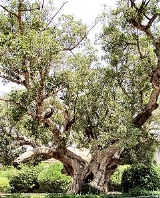
 Ficus is a pan-tropical genus of trees, shrubs and vines occupying a wide variety of ecological niche
s; most are evergreen
, but some deciduous species are endemic to areas outside of the tropics and to higher elevations. Fig species are characterized by their unique inflorescence
and distinctive pollination syndrome
, which utilizes wasp species belonging to the Agaonidae family for pollination.
The specific identification of many of the species can be difficult, but figs as a group are relatively easy to recognize. Many have aerial root
s and a distinctive shape or habit, and their fruits distinguish them from other plants. The fig fruit is an enclosed inflorescence, sometimes referred to as a syconium
, an urn-like structure lined on the inside with the fig's tiny flowers. The unique fig pollination
system, involving tiny, highly specific wasps, known as fig wasp
s that enter these closed inflorescences to both pollinate and lay their own eggs, has been a constant source of inspiration and wonder to biologists. Finally, there are three vegetative traits that together are unique to figs. All figs possess a white to yellowish sap (latex
), some in copious quantities; the twig has paired stipules or a circular stipule scar if the stipules have fallen off; and the lateral veins at the base of the leaf are steep, forming a tighter angle with the midrib than the other lateral veins, a feature referred to as a "tri-veined".
There are no unambiguous older fossil
s of Ficus. However, current molecular clock
estimates indicate that Ficus is a relatively ancient genus being at least 60 million years old, and possibly as old as 80 million years. The main radiation of extant species, however, may have taken place more recently, between 20 and 40 million years ago.
Some better known species that represent the diversity of the genus include the Common Fig
which is a small temperate deciduous tree whose fingered fig leaf
is well known in art and iconography
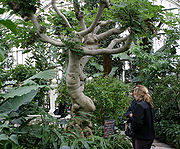
; the Weeping Fig
(F. benjamina) a hemi-epiphyte with thin tough leaves on pendulous stalks adapted to its rain forest habitat; the rough-leaved sandpaper fig
s from Australia
; the Creeping Fig (F. pumila), a vine whose small, hard leaves form a dense carpet of foliage over rocks or garden walls. Moreover, figs with different plant habits have undergone adaptive radiation
in different biogeographic regions, leading to very high levels of alpha diversity
. In the tropics, it is quite common to find that Ficus is the most species-rich plant genus in a particular forest. In Asia as many as 70 or more species can co-exist.
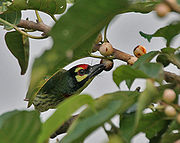 Figs are keystone species
in many rainforest
ecosystem
s. Their fruit are a key resource for some frugivores including fruit bats
, capuchin monkey
s, langurs
and mangabey
s. They are even more important for some bird
s. Asian barbets
, pigeons, hornbill
s, fig-parrots and bulbul
s are examples of taxa
that may almost entirely subsist on figs when these are in plenty. Many Lepidoptera
caterpillar
s feed on fig leaves, for example several Euploea
species (Crow butterflies), the Plain Tiger
(Danaus chrysippus), the Giant Swallowtail (Papilio cresphontes), the Brown Awl
(Badamia exclamationis), and Chrysodeixis eriosoma
, Choreutidae
and Copromorphidae
moth
s. The Citrus long-horned beetle
(Anoplophora chinensis), for example, has larvae that feed on wood
, including that of fig trees; it can become a pest in fig plantations. Similarly, the Sweet Potato Whitefly
(Bemisia tabaci) is frequently found as a pest on figs grown as potted plant
s and is spread through the export of these plants to other localities. For a list of other diseases common to fig trees, see List of foliage plant diseases (Moraceae).
 The wood of fig trees is often soft and the latex
precludes its use for many purposes. It was used to make mummy
casket
s in Ancient Egypt
. Certain fig species (mainly F. cotinifolia, F. insipida
and F. padifolia) are traditionally used in Mesoamerica
to produce papel amate (Nahuatl
: āmatl). Mutuba (F. natalensis
) is used to produce barkcloth
in Uganda
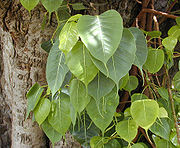
. Pou (F. religiosa
) leaves' shape inspired one of the standard kbach rachana
, decorative elements in Cambodia
n architecture. Indian Banyan
(F. bengalensis) and the Indian Rubber Plant, as well as other species, have use in herbalism
.
 Figs have figured prominently in some human cultures. There is evidence that figs, specifically the Common Fig
(F. carica) and Sycamore Fig (F. sycomorus), were among the first – if not the very first – plant species that were deliberately bred for agriculture in the Middle East
, starting more than 11,000 years ago. Nine subfossil
F. carica figs dated to about 9400–9200 BC
were found in the early Neolithic
village Gilgal I
(in the Jordan Valley
, 13 km north of Jericho
). These were a parthenocarpic
type and thus apparently an early cultivar. This find predates the cultivation of grain
in the Middle East
by many hundreds of years.
tree (Pipal, Bodhi, Bo, or Po, Ficus religiosa) and the Banyan
Fig (Ficus benghalensis). The oldest living plant of known planting date is a Ficus religiosa tree known as the Sri Maha Bodhi
planted in the temple at Anuradhapura
, Sri Lanka by King Tissa in 288 BC. The common fig is one of the two sacred trees of Islam
, and there is a sura
in Quran named "The Fig" or At-Tin
(سوره تین), and in East Asia
, figs are important in Buddhism
, Hinduism
and Jainism
. The Buddha
is traditionally held to have found bodhi
(enlightenment) while meditating under a Sacred Fig
(F. religiosa). The same species was Ashvattha, the "world tree
" of Hinduism. The Plaksa
Pra-sravana was said to be a fig tree between the roots of which the Sarasvati River
sprang forth; it is usually held to be a Sacred Fig but more probably seems to be a Wavy-leaved Fig (F. infectoria). The Common Fig tree is cited in the Bible
, where in Genesis 3:7, Adam and Eve cover their nakedness with fig leaves. The fig fruit is also included in the list of food found in the Promised Land, according to the Torah (Deut.
8). Jesus cursed a fig tree for bearing no fruit . The fig tree was sacred in ancient Cyprus where it was a symbol of fertility.
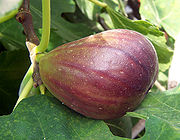 Many are grown for their fruits, though only Ficus carica is cultivated to any extent for this purpose. The fig fruits, important as both food and traditional medicine, contain laxative substances, flavonoids, sugars, vitamins A and C, acids and enzymes. However, figs are skin allergens, and the sap is a serious eye irritant. The fig is a false fruit or multiple fruit
, in which the flowers and seeds grow together to form a single mass.
The genus Dorstenia
, also in the figs family (Moraceae
), exhibits similar tiny flowers arranged on a receptacle but in this case the receptacle is a more or less flat, open surface. Propagating figs can be done by seeds, cuttings, air-layering or grafting. However, figs grown from seed are not true to the parent and are only propagated this way for breeding purposes.
Depending on the species, each fruit can contain up to several hundred to several thousand seeds.
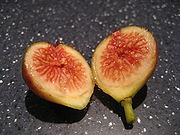 A fig "fruit" is derived from a specially adapted type of inflorescence
(an arrangement of multiple flowers). In this case, it is an involuted, nearly closed receptacle with many small flowers arranged on the inner surface. Thus the actual flowers of the fig are unseen unless the fig is cut open. In Chinese the fig is called wú huā guǒ , "fruit without flower". In Bengali
, where the Common Fig is called dumur, it is referenced in a proverb: tumi jeno dumurer phool hoe gele ("You have become [invisible like] the dumur flower").
The syconium often has a bulbous shape with a small opening (the ostiole
) at the outward end that allows access to pollinator
s. The flowers are pollinated by very small wasp
s that crawl through the opening in search of a suitable place to lay eggs. Without this pollinator service fig trees could not reproduce by seed. In turn, the flowers provide a safe haven and nourishment for the next generation of wasps. This accounts for the frequent presence of wasp larvae in the fruit, and has led to a coevolutionary relationship. Technically, a fig fruit proper would be one of the many tiny mature, seed-bearing flowers found inside one fig – if you cut open a fresh fig, the flowers will appear as fleshy "threads", each bearing a single seed inside.
Fig plants can be monoecious (hermaphrodite) or gynodioecious (hermaphrodite and female). Nearly half of fig species are gynodioecious, and have plants with inflorescences (syconium) with long styled pistillate flowers, or have plants with staminate flowers mixed with short styled pistillate flowers. The long flowers styles tend to prevent wasps from laying their eggs within the ovules, while the short styled flowers are accessible for egg laying.
All the native fig trees of the American continent are hermaphrodites, as well as species like Indian Banyan (F. benghalensis), Weeping Fig
(F. benjamina), Indian Rubber Plant (F. elastica), Fiddle-leaved Fig (F. lyrata), Moreton Bay Fig
(F. macrophylla), Chinese Banyan (F. microcarpa), Sacred Fig
(F. religiosa) and Sycamore Fig (F. sycomorus).
On the other hand the Common Fig (Ficus carica) is a gynodioecious plant, as well as F. aspera, Roxburgh Fig (F. auriculata), Mistletoe Fig
(F. deltoidea
), F. pseudopalma
, Creeping Fig (F. pumila) and related species.
The hermaphrodite Common Figs are called "inedible figs" or caprifigs; in traditional culture in the Mediterranean region they were considered food for goat
s (Capra aegagrus). In the female fig trees, the male flower parts fail to develop; they produce the "edible figs". Fig wasp
s grow in Common Fig caprifigs but not in the female syconiums because the female flower is too long for the wasp to successfully lay her eggs in them. Nonetheless, the wasp pollinates the flower with pollen from the caprifig it grew up in. When the wasp dies, it is broken down by enzymes (Ficain
) inside the fig. Fig wasps are not known to transmit any diseases harmful to humans.
When a caprifig ripens, another caprifig must be ready to be pollinated. In temperate climes, wasps hibernate in figs, and there are distinct crops. Common Fig caprifigs have three crops per year; edible figs have two. The first (breva) produces small fruits called olynth. Some parthenocarpic cultivar
s of Common Figs do not require pollination at all, and will produce a crop of figs (albeit sterile
) in the absence of caprifigs or fig wasps.
There is typically only one species of wasp capable of fertilizing the flowers of each species of fig, and therefore plantings of fig species outside of their native range results in effectively sterile individuals. For example, in Hawaii
, some 60 species of figs have been introduced, but only four of the wasps that fertilize them have been introduced, so only four species of figs produce viable seeds there. This is an example of mutualism, in which each organism (fig plant and fig wasp) benefit each other, in this case reproductively.
The intimate association between fig species and their wasp pollinators, along with the high incidence of a one-to-one plant-pollinator ratio have long led scientists to believe that figs and wasps are a clear example of coevolution. Morphological and reproductive behavior evidence, such as the correspondence between fig and wasp larvae maturation rates, have been cited as support for this hypothesis for many years. Additionally, recent genetic and molecular dating analyses have shown a very close correspondence in the character evolution and speciation
phylogenies of these two clades.
is a genus
Genus
In biology, a genus is a low-level taxonomic rank used in the biological classification of living and fossil organisms, which is an example of definition by genus and differentia...
of about 850 species
Species
In biology, a species is one of the basic units of biological classification and a taxonomic rank. A species is often defined as a group of organisms capable of interbreeding and producing fertile offspring. While in many cases this definition is adequate, more precise or differing measures are...
of woody tree
Tree
A tree is a perennial woody plant. It is most often defined as a woody plant that has many secondary branches supported clear of the ground on a single main stem or trunk with clear apical dominance. A minimum height specification at maturity is cited by some authors, varying from 3 m to...
s, shrub
Shrub
A shrub or bush is distinguished from a tree by its multiple stems and shorter height, usually under 5–6 m tall. A large number of plants may become either shrubs or trees, depending on the growing conditions they experience...
s, vine
Vine
A vine in the narrowest sense is the grapevine , but more generally it can refer to any plant with a growth habit of trailing or scandent, that is to say climbing, stems or runners...
s, epiphyte
Epiphyte
An epiphyte is a plant that grows upon another plant non-parasitically or sometimes upon some other object , derives its moisture and nutrients from the air and rain and sometimes from debris accumulating around it, and is found in the temperate zone and in the...
s, and hemiepiphyte
Hemiepiphyte
A hemiepiphyte is a plant which begins its life as an epiphyte but which later grows roots down into the ground. The seeds of hemiepiphytes germinate in the canopy and initially live epiphytically...
in the family
Family (biology)
In biological classification, family is* a taxonomic rank. Other well-known ranks are life, domain, kingdom, phylum, class, order, genus, and species, with family fitting between order and genus. As for the other well-known ranks, there is the option of an immediately lower rank, indicated by the...
Moraceae
Moraceae
Moraceae — often called the mulberry family or fig family — are a family of flowering plants comprising about 40 genera and over 1000 species. Most are widespread in tropical and subtropical regions, less so in temperate climates...
. Collectively known as fig trees or figs, they are native throughout the tropics
Tropics
The tropics is a region of the Earth surrounding the Equator. It is limited in latitude by the Tropic of Cancer in the northern hemisphere at approximately N and the Tropic of Capricorn in the southern hemisphere at S; these latitudes correspond to the axial tilt of the Earth...
with a few species extending into the semi-warm temperate
Temperate
In geography, temperate or tepid latitudes of the globe lie between the tropics and the polar circles. The changes in these regions between summer and winter are generally relatively moderate, rather than extreme hot or cold...
zone. The Common Fig
Common fig
The Common fig is a deciduous tree growing to heights of up to 6 m in the genus Ficus from the family Moraceae known as Common fig tree. It is a temperate species native to the Middle East.-Description:...
(F. carica) is a temperate species native to southwest Asia
Asia
Asia is the world's largest and most populous continent, located primarily in the eastern and northern hemispheres. It covers 8.7% of the Earth's total surface area and with approximately 3.879 billion people, it hosts 60% of the world's current human population...
and the Mediterranean region (from Afghanistan
Afghanistan
Afghanistan , officially the Islamic Republic of Afghanistan, is a landlocked country located in the centre of Asia, forming South Asia, Central Asia and the Middle East. With a population of about 29 million, it has an area of , making it the 42nd most populous and 41st largest nation in the world...
to Portugal
Portugal
Portugal , officially the Portuguese Republic is a country situated in southwestern Europe on the Iberian Peninsula. Portugal is the westernmost country of Europe, and is bordered by the Atlantic Ocean to the West and South and by Spain to the North and East. The Atlantic archipelagos of the...
), which has been widely cultivated from ancient times for its fruit
Fruit
In broad terms, a fruit is a structure of a plant that contains its seeds.The term has different meanings dependent on context. In non-technical usage, such as food preparation, fruit normally means the fleshy seed-associated structures of certain plants that are sweet and edible in the raw state,...
, also referred to as figs. The fruit of most other species are also edible though they are usually of only local economic importance or eaten as bushfood
Bushfood
Bushfood traditionally relates to any food native to Australia and used as sustenance by the original inhabitants, the Australian Aborigines, but it is a reference to any native fauna/flora that is used for culinary and/or medicinal purposes regardless of which continent or culture it originates...
. However, they are extremely important food resources for wildlife. Figs are also of considerable cultural importance throughout the tropics, both as objects of worship and for their many practical uses.
Description
Ecological niche
In ecology, a niche is a term describing the relational position of a species or population in its ecosystem to each other; e.g. a dolphin could potentially be in another ecological niche from one that travels in a different pod if the members of these pods utilize significantly different food...
s; most are evergreen
Evergreen
In botany, an evergreen plant is a plant that has leaves in all seasons. This contrasts with deciduous plants, which completely lose their foliage during the winter or dry season.There are many different kinds of evergreen plants, both trees and shrubs...
, but some deciduous species are endemic to areas outside of the tropics and to higher elevations. Fig species are characterized by their unique inflorescence
Inflorescence
An inflorescence is a group or cluster of flowers arranged on a stem that is composed of a main branch or a complicated arrangement of branches. Strictly, it is the part of the shoot of seed plants where flowers are formed and which is accordingly modified...
and distinctive pollination syndrome
Pollination syndrome
Pollination syndromes are suites of flower traits that have evolved in response to natural selection imposed by different pollen vectors, which can be abiotic or biotic, such as birds, bees, flies, and so forth. These traits include flower shape, size, colour, odour, reward type and amount, nectar...
, which utilizes wasp species belonging to the Agaonidae family for pollination.
The specific identification of many of the species can be difficult, but figs as a group are relatively easy to recognize. Many have aerial root
Aerial root
Aerial roots are roots above the ground. They are almost always adventitious. They are found in diverse plant species, including epiphytes such as orchids, tropical coastal swamp trees such as mangroves, the resourceful banyan trees, the warm-temperate rainforest rātā and pōhutukawa Aerial roots...
s and a distinctive shape or habit, and their fruits distinguish them from other plants. The fig fruit is an enclosed inflorescence, sometimes referred to as a syconium
Syconium
A syconium is the type of fruit borne by figs , formed of an enlarged, fleshy, hollow receptacle with multiple ovaries on the inside surface. In essence, it is really a fleshy stem with a number of flowers, so it is considered both a multiple and accessory fruit. The name comes from the Greek word...
, an urn-like structure lined on the inside with the fig's tiny flowers. The unique fig pollination
Pollination
Pollination is the process by which pollen is transferred in plants, thereby enabling fertilisation and sexual reproduction. Pollen grains transport the male gametes to where the female gamete are contained within the carpel; in gymnosperms the pollen is directly applied to the ovule itself...
system, involving tiny, highly specific wasps, known as fig wasp
Fig wasp
Fig wasps are wasps of the family Agaonidae which pollinate figs or are otherwise associated with figs, a coevolutional relationship that has been developing for at least 80 million years...
s that enter these closed inflorescences to both pollinate and lay their own eggs, has been a constant source of inspiration and wonder to biologists. Finally, there are three vegetative traits that together are unique to figs. All figs possess a white to yellowish sap (latex
Latex
Latex is the stable dispersion of polymer microparticles in an aqueous medium. Latexes may be natural or synthetic.Latex as found in nature is a milky fluid found in 10% of all flowering plants . It is a complex emulsion consisting of proteins, alkaloids, starches, sugars, oils, tannins, resins,...
), some in copious quantities; the twig has paired stipules or a circular stipule scar if the stipules have fallen off; and the lateral veins at the base of the leaf are steep, forming a tighter angle with the midrib than the other lateral veins, a feature referred to as a "tri-veined".
There are no unambiguous older fossil
Fossil
Fossils are the preserved remains or traces of animals , plants, and other organisms from the remote past...
s of Ficus. However, current molecular clock
Molecular clock
The molecular clock is a technique in molecular evolution that uses fossil constraints and rates of molecular change to deduce the time in geologic history when two species or other taxa diverged. It is used to estimate the time of occurrence of events called speciation or radiation...
estimates indicate that Ficus is a relatively ancient genus being at least 60 million years old, and possibly as old as 80 million years. The main radiation of extant species, however, may have taken place more recently, between 20 and 40 million years ago.
Some better known species that represent the diversity of the genus include the Common Fig
Common fig
The Common fig is a deciduous tree growing to heights of up to 6 m in the genus Ficus from the family Moraceae known as Common fig tree. It is a temperate species native to the Middle East.-Description:...
which is a small temperate deciduous tree whose fingered fig leaf
Fig leaf
A fig leaf is the covering up of an act or an object that is embarrassing or disagreeable. The term is a metaphorical reference to the Biblical Book of Genesis, in which Adam and Eve used fig leaves to cover "their nakedness" after eating the fruit from the Tree of Knowledge of Good and...
is well known in art and iconography
Iconography
Iconography is the branch of art history which studies the identification, description, and the interpretation of the content of images. The word iconography literally means "image writing", and comes from the Greek "image" and "to write". A secondary meaning is the painting of icons in the...
; the Weeping Fig
Weeping Fig
Ficus benjamina, commonly known as the Weeping Fig, Benjamin's Fig, or the Ficus Tree and often sold in stores as just a "Ficus", is a species of fig tree, native to south and southeast Asia and Australia. It is the official tree of Bangkok, Thailand...
(F. benjamina) a hemi-epiphyte with thin tough leaves on pendulous stalks adapted to its rain forest habitat; the rough-leaved sandpaper fig
Sandpaper Fig
The Sandpaper Figs are so named for their leaves, which are rough and sandpaper-like in texture. The common name may refer to a number of species:*Ficus coronata*Ficus coronulata*Ficus fraseri*Ficus opposita*Ficus scobina...
s from Australia
Australia
Australia , officially the Commonwealth of Australia, is a country in the Southern Hemisphere comprising the mainland of the Australian continent, the island of Tasmania, and numerous smaller islands in the Indian and Pacific Oceans. It is the world's sixth-largest country by total area...
; the Creeping Fig (F. pumila), a vine whose small, hard leaves form a dense carpet of foliage over rocks or garden walls. Moreover, figs with different plant habits have undergone adaptive radiation
Adaptive radiation
In evolutionary biology, adaptive radiation is the evolution of ecological and phenotypic diversity within a rapidly multiplying lineage. Starting with a recent single ancestor, this process results in the speciation and phenotypic adaptation of an array of species exhibiting different...
in different biogeographic regions, leading to very high levels of alpha diversity
Alpha diversity
Alpha diversity is the biodiversity within a particular area, community or ecosystem, and is usually expressed as the species richness of the area. This can be measured by counting the number of taxa within the ecosystem...
. In the tropics, it is quite common to find that Ficus is the most species-rich plant genus in a particular forest. In Asia as many as 70 or more species can co-exist.
Ecology and uses
Keystone species
A keystone species is a species that has a disproportionately large effect on its environment relative to its abundance. Such species play a critical role in maintaining the structure of an ecological community, affecting many other organisms in an ecosystem and helping to determine the types and...
in many rainforest
Rainforest
Rainforests are forests characterized by high rainfall, with definitions based on a minimum normal annual rainfall of 1750-2000 mm...
ecosystem
Ecosystem
An ecosystem is a biological environment consisting of all the organisms living in a particular area, as well as all the nonliving , physical components of the environment with which the organisms interact, such as air, soil, water and sunlight....
s. Their fruit are a key resource for some frugivores including fruit bats
Megabat
Megabats constitute the suborder Megachiroptera, family Pteropodidae of the order Chiroptera . They are also called fruit bats, old world fruit bats, or flying foxes.-Description:...
, capuchin monkey
Capuchin monkey
The capuchins are New World monkeys of the genus Cebus. The range of capuchin monkeys includes Central America and South America as far south as northern Argentina...
s, langurs
Colobinae
Colobinae is a subfamily of the Old World monkey family that includes 59 species in 10 genera, including the skunk-like black-and-white colobus, the large-nosed proboscis monkey, and the gray langurs. Some classifications split the colobine monkeys into two tribes, while others split them into...
and mangabey
Mangabey
The term mangabey can refer to three different genera of Old World monkeys. Lophocebus and Cercocebus were once thought to be very closely related, so much so that all the species were in one genus...
s. They are even more important for some bird
Bird
Birds are feathered, winged, bipedal, endothermic , egg-laying, vertebrate animals. Around 10,000 living species and 188 families makes them the most speciose class of tetrapod vertebrates. They inhabit ecosystems across the globe, from the Arctic to the Antarctic. Extant birds range in size from...
s. Asian barbets
Megalaimidae
A family of birds comprising the Asian barbets, the Megalaimidae were once united with all other barbets in the Capitonidae but they have turned out to be distinct...
, pigeons, hornbill
Hornbill
Hornbills are a family of bird found in tropical and subtropical Africa, Asia and Melanesia. They are characterized by a long, down-curved bill which is frequently brightly-colored and sometimes has a casque on the upper mandible. Both the common English and the scientific name of the family...
s, fig-parrots and bulbul
Bulbul
Bulbuls are a family, Pycnonotidae, of medium-sized passerine songbirds. Many forest species are known as greenbuls. The family is distributed across most of Africa and into the Middle East, tropical Asia to Indonesia, and north as far as Japan. A few insular species occur on the tropical islands...
s are examples of taxa
Taxon
|thumb|270px|[[African elephants]] form a widely-accepted taxon, the [[genus]] LoxodontaA taxon is a group of organisms, which a taxonomist adjudges to be a unit. Usually a taxon is given a name and a rank, although neither is a requirement...
that may almost entirely subsist on figs when these are in plenty. Many Lepidoptera
Lepidoptera
Lepidoptera is a large order of insects that includes moths and butterflies . It is one of the most widespread and widely recognizable insect orders in the world, encompassing moths and the three superfamilies of butterflies, skipper butterflies, and moth-butterflies...
caterpillar
Caterpillar
Caterpillars are the larval form of members of the order Lepidoptera . They are mostly herbivorous in food habit, although some species are insectivorous. Caterpillars are voracious feeders and many of them are considered to be pests in agriculture...
s feed on fig leaves, for example several Euploea
Euploea
Euploea is a genus of milkweed butterflies. The species are generally dark in coloration, often quite blackish, for which reason they are commonly called crows. As usual for their subfamily, they are poisonous due to feeding on milkweeds and other toxic plants as caterpillars...
species (Crow butterflies), the Plain Tiger
Danaus chrysippus
Danaus chrysippus, known as the Plain Tiger or African Monarch, is a common butterfly which is widespread in Asia and Africa. It belongs to the Danainae subfamily of the brush-footed butterfly family, Nymphalidae...
(Danaus chrysippus), the Giant Swallowtail (Papilio cresphontes), the Brown Awl
Badamia exclamationis
Badamia exclamationis, commonly known as the Brown Awl, is a butterfly belonging to the family Hesperiidae, which is found in India, Southeast Asia and Australia.-Range:...
(Badamia exclamationis), and Chrysodeixis eriosoma
Chrysodeixis eriosoma
The Green Garden Looper is a moth of the family Noctuidae.-Adult:Wingspan 42 mm Differs from Chrysodeixis signata in the head, thorax, and fore wing having a reddish tinge ; abdomen with the lateral and anal tufts often black in the male...
, Choreutidae
Choreutidae
Choreutidae, or "metalmark moths," are a family of insects in the lepidopteran order whose relationships have been long disputed. It was placed previously in the superfamily Yponomeutoidea in family Glyphipterigidae and in superfamily Sesioidea. It is now considered to represent its own superfamily...
and Copromorphidae
Copromorphidae
Copromorphidae, the "tropical fruitworm moths" is a family of insects in the lepidopteran order. These moths have broad, rounded forewings, and well-camouflaged scale patterns. Unlike Carposinidae the mouthparts include "labial palps" with the second rather than third segment the longest...
moth
Moth
A moth is an insect closely related to the butterfly, both being of the order Lepidoptera. Moths form the majority of this order; there are thought to be 150,000 to 250,000 different species of moth , with thousands of species yet to be described...
s. The Citrus long-horned beetle
Citrus long-horned beetle
The Citrus Long-horned Beetle is a long-horned beetle native to Japan, China and Korea, where it is considered a serious pest....
(Anoplophora chinensis), for example, has larvae that feed on wood
Wood
Wood is a hard, fibrous tissue found in many trees. It has been used for hundreds of thousands of years for both fuel and as a construction material. It is an organic material, a natural composite of cellulose fibers embedded in a matrix of lignin which resists compression...
, including that of fig trees; it can become a pest in fig plantations. Similarly, the Sweet Potato Whitefly
Sweet potato whitefly
Bemisia tabaci is a species of whitefly found around the world and probably native to India.-Common names:*mosca branca *cotton whitefly ,*mosca blanca ,*sweet potato whitefly ,...
(Bemisia tabaci) is frequently found as a pest on figs grown as potted plant
Houseplant
A houseplant is a plant that is grown indoors in places such as residences and offices. Houseplants are commonly grown for decorative purposes, positive psychological effects, or health reasons such as indoor air purification...
s and is spread through the export of these plants to other localities. For a list of other diseases common to fig trees, see List of foliage plant diseases (Moraceae).
Latex
Latex is the stable dispersion of polymer microparticles in an aqueous medium. Latexes may be natural or synthetic.Latex as found in nature is a milky fluid found in 10% of all flowering plants . It is a complex emulsion consisting of proteins, alkaloids, starches, sugars, oils, tannins, resins,...
precludes its use for many purposes. It was used to make mummy
Mummy
A mummy is a body, human or animal, whose skin and organs have been preserved by either intentional or incidental exposure to chemicals, extreme coldness , very low humidity, or lack of air when bodies are submerged in bogs, so that the recovered body will not decay further if kept in cool and dry...
casket
Casket
A casket, or jewelry box is a term for a container that is usually larger than a box, and smaller than a chest, and in the past was typically decorated...
s in Ancient Egypt
Ancient Egypt
Ancient Egypt was an ancient civilization of Northeastern Africa, concentrated along the lower reaches of the Nile River in what is now the modern country of Egypt. Egyptian civilization coalesced around 3150 BC with the political unification of Upper and Lower Egypt under the first pharaoh...
. Certain fig species (mainly F. cotinifolia, F. insipida
Ficus insipida
Ficus insipida is a tropical tree in the fig genus of the family Moraceae. It ranges from Mexico to South America, and is commonly found in cloud forest above 1,550 meters ASL.-Description and ecology:...
and F. padifolia) are traditionally used in Mesoamerica
Mesoamerica
Mesoamerica is a region and culture area in the Americas, extending approximately from central Mexico to Belize, Guatemala, El Salvador, Honduras, Nicaragua, and Costa Rica, within which a number of pre-Columbian societies flourished before the Spanish colonization of the Americas in the 15th and...
to produce papel amate (Nahuatl
Nahuatl
Nahuatl is thought to mean "a good, clear sound" This language name has several spellings, among them náhuatl , Naoatl, Nauatl, Nahuatl, Nawatl. In a back formation from the name of the language, the ethnic group of Nahuatl speakers are called Nahua...
: āmatl). Mutuba (F. natalensis
Ficus natalensis
Ficus natalensis is a tree in the Moraceae family. It is commonly known as the Natal Fig. These trees are distributed from KwaZulu-Natal in South Africa to east Africa.- References :...
) is used to produce barkcloth
Barkcloth
Barkcloth or bark cloth is a versatile material that was once common in Asia, Africa, Indonesia, and the Pacific. Barkcloth comes primarily from trees of the Moraceae family, including Broussonetia papyrifera, Artocarpus altilis, and Ficus...
in Uganda
Uganda
Uganda , officially the Republic of Uganda, is a landlocked country in East Africa. Uganda is also known as the "Pearl of Africa". It is bordered on the east by Kenya, on the north by South Sudan, on the west by the Democratic Republic of the Congo, on the southwest by Rwanda, and on the south by...
. Pou (F. religiosa
Sacred Fig
The Sacred Fig, Ficus religiosa, or Bo-Tree , Peepal is a species of banyan fig native to India, Bangladesh, Nepal, Pakistan, Sri Lanka, southwest China and Indochina...
) leaves' shape inspired one of the standard kbach rachana
Kbach
Kbach are decorative elements of Cambodian architecture. While 'kbach' is a term that can be used to refer to any sort of art-form style in the Khmer language, such as a gesture in Khmer classical dance, the term kbach rachana specifically refers to decorative motifs...
, decorative elements in Cambodia
Cambodia
Cambodia , officially known as the Kingdom of Cambodia, is a country located in the southern portion of the Indochina Peninsula in Southeast Asia...
n architecture. Indian Banyan
Ficus benghalensis
Ficus benghalensis, the banyan, is a large and extensive growing tree of the Indian subcontinent. Ficus benghalensis produces propagating roots which grow downwards as aerial roots. Once these roots reach the ground, they grow into woody trunks that can become indistinguishable from the main...
(F. bengalensis) and the Indian Rubber Plant, as well as other species, have use in herbalism
Herbalism
Herbalism is a traditional medicinal or folk medicine practice based on the use of plants and plant extracts. Herbalism is also known as botanical medicine, medical herbalism, herbal medicine, herbology, herblore, and phytotherapy...
.
Common fig
The Common fig is a deciduous tree growing to heights of up to 6 m in the genus Ficus from the family Moraceae known as Common fig tree. It is a temperate species native to the Middle East.-Description:...
(F. carica) and Sycamore Fig (F. sycomorus), were among the first – if not the very first – plant species that were deliberately bred for agriculture in the Middle East
Middle East
The Middle East is a region that encompasses Western Asia and Northern Africa. It is often used as a synonym for Near East, in opposition to Far East...
, starting more than 11,000 years ago. Nine subfossil
Subfossil
Subfossil refers to remains whose fossilization process is not complete, either for lack of time or because the conditions in which they were buried were not optimal for fossilization....
F. carica figs dated to about 9400–9200 BC
10th millennium BC
The 10th millennium BC marks the beginning of the Mesolithic and Epipaleolithic period, which is the first part of the Holocene epoch. Agriculture, based on the cultivation of primitive forms of millet and rice, occurred in Southwest Asia...
were found in the early Neolithic
Neolithic
The Neolithic Age, Era, or Period, or New Stone Age, was a period in the development of human technology, beginning about 9500 BC in some parts of the Middle East, and later in other parts of the world. It is traditionally considered as the last part of the Stone Age...
village Gilgal I
Gilgal I
Gilgal I was an ancient village in the Jordan Valley first excavated by Tamar Noy in 1979. It became further notable as a Neolithic archaeological site in 2005 when Ofer Bar-Yosef of Harvard University and Mordechai E. Kislev and Anat Hartmann of Bar-Ilan University released details of their...
(in the Jordan Valley
Jordan Valley (Middle East)
The Jordan Valley forms part of the larger Jordan Rift Valley. It is 120 kilometers long and 15 kilometers wide, where it runs from Lake Tiberias in the north to northern Dead Sea in the south. It runs for an additional 155 kilometer south of the Dead Sea to Aqaba, an area also known as Wadi...
, 13 km north of Jericho
Jericho
Jericho ; is a city located near the Jordan River in the West Bank of the Palestinian territories. It is the capital of the Jericho Governorate and has a population of more than 20,000. Situated well below sea level on an east-west route north of the Dead Sea, Jericho is the lowest permanently...
). These were a parthenocarpic
Parthenocarpy
In botany and horticulture, parthenocarpy is the natural or artificially induced production of fruit without fertilization of ovules. The fruit is therefore seedless. Stenospermocarpy may also produce apparently seedless fruit, but the seeds are actually aborted while still small...
type and thus apparently an early cultivar. This find predates the cultivation of grain
Cereal
Cereals are grasses cultivated for the edible components of their grain , composed of the endosperm, germ, and bran...
in the Middle East
Middle East
The Middle East is a region that encompasses Western Asia and Northern Africa. It is often used as a synonym for Near East, in opposition to Far East...
by many hundreds of years.
Cultural and spiritual significance
Fig trees have profoundly influenced culture through several religious traditions. Among the more famous species are the Sacred FigSacred Fig
The Sacred Fig, Ficus religiosa, or Bo-Tree , Peepal is a species of banyan fig native to India, Bangladesh, Nepal, Pakistan, Sri Lanka, southwest China and Indochina...
tree (Pipal, Bodhi, Bo, or Po, Ficus religiosa) and the Banyan
Banyan
A banyan is a fig that starts its life as an epiphyte when its seeds germinate in the cracks and crevices on a host tree...
Fig (Ficus benghalensis). The oldest living plant of known planting date is a Ficus religiosa tree known as the Sri Maha Bodhi
Sri Maha Bodhi
Jaya Sri Maha Bodhi is a Sacred Fig tree in Anuradhapura, Sri Lanka. It is said to be a sapling from the historical Bodhi tree under which Buddha became enlightened...
planted in the temple at Anuradhapura
Anuradhapura
Anuradhapura, , is one of the ancient capitals of Sri Lanka, famous for its well-preserved ruins of ancient Lankan civilization.The city, now a UNESCO World Heritage Site, lies 205 km north of the current capital Colombo in Sri Lanka's North Central Province, on the banks of the historic...
, Sri Lanka by King Tissa in 288 BC. The common fig is one of the two sacred trees of Islam
Islam
Islam . The most common are and . : Arabic pronunciation varies regionally. The first vowel ranges from ~~. The second vowel ranges from ~~~...
, and there is a sura
Sura
A sura is a division of the Qur'an, often referred to as a chapter. The term chapter is sometimes avoided, as the suras are of unequal length; the shortest sura has only three ayat while the longest contains 286 ayat...
in Quran named "The Fig" or At-Tin
At-Tin
Sūrat al-Tīn is the 95th sura of the Qur'an with 8 ayat.Translation: By the fig and the olive And [I Swear by] Mount Sinai And [I Swear by] this secure land [of the city of Makkah],...
(سوره تین), and in East Asia
East Asia
East Asia or Eastern Asia is a subregion of Asia that can be defined in either geographical or cultural terms...
, figs are important in Buddhism
Buddhism
Buddhism is a religion and philosophy encompassing a variety of traditions, beliefs and practices, largely based on teachings attributed to Siddhartha Gautama, commonly known as the Buddha . The Buddha lived and taught in the northeastern Indian subcontinent some time between the 6th and 4th...
, Hinduism
Hinduism
Hinduism is the predominant and indigenous religious tradition of the Indian Subcontinent. Hinduism is known to its followers as , amongst many other expressions...
and Jainism
Jainism
Jainism is an Indian religion that prescribes a path of non-violence towards all living beings. Its philosophy and practice emphasize the necessity of self-effort to move the soul towards divine consciousness and liberation. Any soul that has conquered its own inner enemies and achieved the state...
. The Buddha
Buddha
In Buddhism, buddhahood is the state of perfect enlightenment attained by a buddha .In Buddhism, the term buddha usually refers to one who has become enlightened...
is traditionally held to have found bodhi
Bodhi
Bodhi is both a Pāli and Sanskrit word traditionally translated into English with the word "enlightenment", but which means awakened. In Buddhism it is the knowledge possessed by a Buddha into the nature of things...
(enlightenment) while meditating under a Sacred Fig
Sacred Fig
The Sacred Fig, Ficus religiosa, or Bo-Tree , Peepal is a species of banyan fig native to India, Bangladesh, Nepal, Pakistan, Sri Lanka, southwest China and Indochina...
(F. religiosa). The same species was Ashvattha, the "world tree
World tree
The world tree is a motif present in several religions and mythologies, particularly Indo-European religions, Siberian religions, and Native American religions. The world tree is represented as a colossal tree which supports the heavens, thereby connecting the heavens, the earth, and, through its...
" of Hinduism. The Plaksa
Sacred Fig
The Sacred Fig, Ficus religiosa, or Bo-Tree , Peepal is a species of banyan fig native to India, Bangladesh, Nepal, Pakistan, Sri Lanka, southwest China and Indochina...
Pra-sravana was said to be a fig tree between the roots of which the Sarasvati River
Sarasvati River
The Sarasvati River is one of the chief Rigvedic rivers mentioned in ancient Hindu texts. The Nadistuti hymn in the Rigveda mentions the Sarasvati between the Yamuna in the east and the Sutlej in the west, and later Vedic texts like Tandya and Jaiminiya Brahmanas as well as the Mahabharata...
sprang forth; it is usually held to be a Sacred Fig but more probably seems to be a Wavy-leaved Fig (F. infectoria). The Common Fig tree is cited in the Bible
Bible
The Bible refers to any one of the collections of the primary religious texts of Judaism and Christianity. There is no common version of the Bible, as the individual books , their contents and their order vary among denominations...
, where in Genesis 3:7, Adam and Eve cover their nakedness with fig leaves. The fig fruit is also included in the list of food found in the Promised Land, according to the Torah (Deut.
Deuteronomy
The Book of Deuteronomy is the fifth book of the Hebrew Bible, and of the Jewish Torah/Pentateuch...
8). Jesus cursed a fig tree for bearing no fruit . The fig tree was sacred in ancient Cyprus where it was a symbol of fertility.
Fig pollination and fig fruit
Multiple fruit
Multiple fruits are fruits that are formed from a cluster of flowers . Each flower in the inflorescence produces a fruit, but these mature into a single mass...
, in which the flowers and seeds grow together to form a single mass.
The genus Dorstenia
Dorstenia
Dorstenia is a genus of about 105 species in the Moraceae plant family. Most species are Neotropical or Afrotropical, with a single species in India, Sri Lanka and the island of Socotra ....
, also in the figs family (Moraceae
Moraceae
Moraceae — often called the mulberry family or fig family — are a family of flowering plants comprising about 40 genera and over 1000 species. Most are widespread in tropical and subtropical regions, less so in temperate climates...
), exhibits similar tiny flowers arranged on a receptacle but in this case the receptacle is a more or less flat, open surface. Propagating figs can be done by seeds, cuttings, air-layering or grafting. However, figs grown from seed are not true to the parent and are only propagated this way for breeding purposes.
Depending on the species, each fruit can contain up to several hundred to several thousand seeds.
Inflorescence
An inflorescence is a group or cluster of flowers arranged on a stem that is composed of a main branch or a complicated arrangement of branches. Strictly, it is the part of the shoot of seed plants where flowers are formed and which is accordingly modified...
(an arrangement of multiple flowers). In this case, it is an involuted, nearly closed receptacle with many small flowers arranged on the inner surface. Thus the actual flowers of the fig are unseen unless the fig is cut open. In Chinese the fig is called wú huā guǒ , "fruit without flower". In Bengali
Bengali language
Bengali or Bangla is an eastern Indo-Aryan language. It is native to the region of eastern South Asia known as Bengal, which comprises present day Bangladesh, the Indian state of West Bengal, and parts of the Indian states of Tripura and Assam. It is written with the Bengali script...
, where the Common Fig is called dumur, it is referenced in a proverb: tumi jeno dumurer phool hoe gele ("You have become [invisible like] the dumur flower").
The syconium often has a bulbous shape with a small opening (the ostiole
Ostiole
An ostiole is a small hole or opening through which algae or ascomycetal fungi release their mature spores. The term is also used in higher plants, for example to denote the opening of the involuted fig inflorescence through which fig wasps enter to pollinate and breed....
) at the outward end that allows access to pollinator
Pollinator
A pollinator is the biotic agent that moves pollen from the male anthers of a flower to the female stigma of a flower to accomplish fertilization or syngamy of the female gamete in the ovule of the flower by the male gamete from the pollen grain...
s. The flowers are pollinated by very small wasp
Fig wasp
Fig wasps are wasps of the family Agaonidae which pollinate figs or are otherwise associated with figs, a coevolutional relationship that has been developing for at least 80 million years...
s that crawl through the opening in search of a suitable place to lay eggs. Without this pollinator service fig trees could not reproduce by seed. In turn, the flowers provide a safe haven and nourishment for the next generation of wasps. This accounts for the frequent presence of wasp larvae in the fruit, and has led to a coevolutionary relationship. Technically, a fig fruit proper would be one of the many tiny mature, seed-bearing flowers found inside one fig – if you cut open a fresh fig, the flowers will appear as fleshy "threads", each bearing a single seed inside.
Fig plants can be monoecious (hermaphrodite) or gynodioecious (hermaphrodite and female). Nearly half of fig species are gynodioecious, and have plants with inflorescences (syconium) with long styled pistillate flowers, or have plants with staminate flowers mixed with short styled pistillate flowers. The long flowers styles tend to prevent wasps from laying their eggs within the ovules, while the short styled flowers are accessible for egg laying.
All the native fig trees of the American continent are hermaphrodites, as well as species like Indian Banyan (F. benghalensis), Weeping Fig
Weeping Fig
Ficus benjamina, commonly known as the Weeping Fig, Benjamin's Fig, or the Ficus Tree and often sold in stores as just a "Ficus", is a species of fig tree, native to south and southeast Asia and Australia. It is the official tree of Bangkok, Thailand...
(F. benjamina), Indian Rubber Plant (F. elastica), Fiddle-leaved Fig (F. lyrata), Moreton Bay Fig
Moreton Bay Fig
Ficus macrophylla, commonly known as the Moreton Bay Fig, is a large evergreen banyan tree of the Moraceae family that is a native of most of the eastern coast of Australia, from the Atherton Tableland in the north to the Illawarra in New South Wales, and Lord Howe Island. Its common name is...
(F. macrophylla), Chinese Banyan (F. microcarpa), Sacred Fig
Sacred Fig
The Sacred Fig, Ficus religiosa, or Bo-Tree , Peepal is a species of banyan fig native to India, Bangladesh, Nepal, Pakistan, Sri Lanka, southwest China and Indochina...
(F. religiosa) and Sycamore Fig (F. sycomorus).
On the other hand the Common Fig (Ficus carica) is a gynodioecious plant, as well as F. aspera, Roxburgh Fig (F. auriculata), Mistletoe Fig
Mas Cotek (Ficus deltoidea)
Mas Cotek is a tree species in in Malaysia.Malaysia's tropical rainforest is unique, with a large biodiversity of valuable plants and animals. The discovery of herbal plants in these jungles, and in particular Mas Cotek , is slowly receiving international recognition for its medicinal values and...
(F. deltoidea
Mas Cotek (Ficus deltoidea)
Mas Cotek is a tree species in in Malaysia.Malaysia's tropical rainforest is unique, with a large biodiversity of valuable plants and animals. The discovery of herbal plants in these jungles, and in particular Mas Cotek , is slowly receiving international recognition for its medicinal values and...
), F. pseudopalma
Ficus pseudopalma
Ficus pseudopalma is a species of fig known by the common names Philippine fig, dracaena fig, and palm-leaf fig. In nature it is endemic to the Philippines, especially the island of Luzon. It is known elsewhere as an ornamental plant....
, Creeping Fig (F. pumila) and related species.
The hermaphrodite Common Figs are called "inedible figs" or caprifigs; in traditional culture in the Mediterranean region they were considered food for goat
Goat
The domestic goat is a subspecies of goat domesticated from the wild goat of southwest Asia and Eastern Europe. The goat is a member of the Bovidae family and is closely related to the sheep as both are in the goat-antelope subfamily Caprinae. There are over three hundred distinct breeds of...
s (Capra aegagrus). In the female fig trees, the male flower parts fail to develop; they produce the "edible figs". Fig wasp
Fig wasp
Fig wasps are wasps of the family Agaonidae which pollinate figs or are otherwise associated with figs, a coevolutional relationship that has been developing for at least 80 million years...
s grow in Common Fig caprifigs but not in the female syconiums because the female flower is too long for the wasp to successfully lay her eggs in them. Nonetheless, the wasp pollinates the flower with pollen from the caprifig it grew up in. When the wasp dies, it is broken down by enzymes (Ficain
Ficain
Ficain is an enzyme that is derived from figs latex. It is of a family of proteases known as the cysteine endopeptidases, a group that also includes papain derived from papaya latex, bromelase extracted from pineapple stem, calpain, caspases, cathespisin B, and chymopapain...
) inside the fig. Fig wasps are not known to transmit any diseases harmful to humans.
When a caprifig ripens, another caprifig must be ready to be pollinated. In temperate climes, wasps hibernate in figs, and there are distinct crops. Common Fig caprifigs have three crops per year; edible figs have two. The first (breva) produces small fruits called olynth. Some parthenocarpic cultivar
Cultivar
A cultivar'Cultivar has two meanings as explained under Formal definition. When used in reference to a taxon, the word does not apply to an individual plant but to all those plants sharing the unique characteristics that define the cultivar. is a plant or group of plants selected for desirable...
s of Common Figs do not require pollination at all, and will produce a crop of figs (albeit sterile
Sterility (physiology)
Sterility is the physiological inability to effect sexual reproduction in a living thing, members of whose kind have been produced sexually. The term may be used in reference to* types of organism, such as the mule, a sterile hybrid;...
) in the absence of caprifigs or fig wasps.
There is typically only one species of wasp capable of fertilizing the flowers of each species of fig, and therefore plantings of fig species outside of their native range results in effectively sterile individuals. For example, in Hawaii
Hawaii
Hawaii is the newest of the 50 U.S. states , and is the only U.S. state made up entirely of islands. It is the northernmost island group in Polynesia, occupying most of an archipelago in the central Pacific Ocean, southwest of the continental United States, southeast of Japan, and northeast of...
, some 60 species of figs have been introduced, but only four of the wasps that fertilize them have been introduced, so only four species of figs produce viable seeds there. This is an example of mutualism, in which each organism (fig plant and fig wasp) benefit each other, in this case reproductively.
The intimate association between fig species and their wasp pollinators, along with the high incidence of a one-to-one plant-pollinator ratio have long led scientists to believe that figs and wasps are a clear example of coevolution. Morphological and reproductive behavior evidence, such as the correspondence between fig and wasp larvae maturation rates, have been cited as support for this hypothesis for many years. Additionally, recent genetic and molecular dating analyses have shown a very close correspondence in the character evolution and speciation
Speciation
Speciation is the evolutionary process by which new biological species arise. The biologist Orator F. Cook seems to have been the first to coin the term 'speciation' for the splitting of lineages or 'cladogenesis,' as opposed to 'anagenesis' or 'phyletic evolution' occurring within lineages...
phylogenies of these two clades.
Nutritional information
1large fig fruit (64g) contains the following nutritional information according to the USDA:- Calories : 47
- Fat: 0.19
- Carbohydrates: 12.28
- Fibers: 1.9
- Protein: 0.48
Selected species
- Ficus abutilifolia (Miq.) Miq. (= F. soldanella Warb.)
- Ficus adhatodifolia Schott
- Ficus aguaraguensisFicus aguaraguensisFicus aguaraguensis is a species of plant in the Moraceae family. It is endemic to Bolivia. It is threatened by habitat loss.-Source:* Prado, D. 1998. . Downloaded on 21 August 2007....
- Ficus albert-smithiiFicus albert-smithiiFicus albert-smithii is a species of plant in the Moraceae family. It is found in Brazil, Colombia, Guyana, Peru, and Venezuela.-References:* World Conservation Monitoring Centre 1998. . Downloaded on 21 August 2007....
- Ficus albipila – Abbey Tree, Phueng Tree, tandiran
- Ficus altissima
- Ficus amazonicaFicus amazonicaFicus amazonica is a species of plant in the Moraceae family. It is found in Brazil, Guyana, Trinidad and Tobago, and Venezuela.-References:* World Conservation Monitoring Centre 1998. . Downloaded on 21 August 2007....
- Ficus americanaFicus americanaFicus americana, commonly known as the West Indian laurel fig, or Jamaican cherry fig is a tree in the family Moraceae which is native to the Caribbean, Mexico in the north, through Central and South America south to southern Brazil. It is an introduced species in Florida, USA...
- Ficus andamanicaFicus andamanicaFicus andamanica is a species of plant in the Moraceae family. It is endemic to India. It is threatened by habitat loss.-Source:* World Conservation Monitoring Centre 1998. . Downloaded on 21 August 2007....
- Ficus angladeiFicus angladeiFicus angladei is a species of plant in the Moraceae family. It is endemic to India.-Source:* World Conservation Monitoring Centre 1998. . Downloaded on 21 August 2007....
- Ficus apollinaris Dugand (= F. petenensis Lundell)
- Ficus aripuanensisFicus aripuanensisFicus aripuanensis is a species of plant in the Moraceae family. It is endemic to Brazil.-Source:* Pereira, J.P. et al. 1998. . Downloaded on 21 August 2007....
- Ficus arpazusa
- Ficus aspera
- Ficus aspera var. parcelli
- Ficus aureaFicus aureaFicus aurea, commonly known as the Florida strangler fig , golden fig, or higuerón, is a tree in the family Moraceae that is native to the U.S. state of Florida, the northern and western Caribbean, southern Mexico and Central America south to Panama...
– Florida Strangler Fig - Ficus auriculata – Roxburgh Fig
- Ficus barbata – Bearded Fig
- Ficus battieri
- Ficus beddomei – Thavital
- Ficus benghalensisFicus benghalensisFicus benghalensis, the banyan, is a large and extensive growing tree of the Indian subcontinent. Ficus benghalensis produces propagating roots which grow downwards as aerial roots. Once these roots reach the ground, they grow into woody trunks that can become indistinguishable from the main...
– Indian Banyan, Bengal Fig, East Indian Fig, borh (PakistanPakistanPakistan , officially the Islamic Republic of Pakistan is a sovereign state in South Asia. It has a coastline along the Arabian Sea and the Gulf of Oman in the south and is bordered by Afghanistan and Iran in the west, India in the east and China in the far northeast. In the north, Tajikistan...
), vad/vat/wad, nyagrodha, "indian figIndian figIndian fig may refer to:*Ficus benghalensis, a species of banyan tree also known as East Indian fig*Opuntia ficus-indica, a species of cactus also known as indian fig opuntia*Opuntia humifusa, a species of cactus also known as eastern prickly pear...
" - Ficus benjamina – Weeping FigWeeping FigFicus benjamina, commonly known as the Weeping Fig, Benjamin's Fig, or the Ficus Tree and often sold in stores as just a "Ficus", is a species of fig tree, native to south and southeast Asia and Australia. It is the official tree of Bangkok, Thailand...
, Benjamin's Fig - Ficus bibracteata
- Ficus bizanaeFicus bizanaeFicus bizanae is a species of plant in the Moraceae family. It is endemic to South Africa. It is threatened by habitat loss.-Source:* Hilton-Taylor, C. et al. 1998. . Downloaded on 21 August 2007....
- Ficus blepharophyllaFicus blepharophyllaFicus blepharophylla is a species of plant in the Moraceae family. It is endemic to Brazil.-Source:* Pereira, J.P. et al. 1998. . Downloaded on 21 August 2007....
- Ficus bojeriFicus bojeriFicus bojeri is a species of plant in the Moraceae family. It is endemic to Seychelles.-Source:* World Conservation Monitoring Centre 1998. . Downloaded on 21 August 2007....
- Ficus broadwayiFicus broadwayiFicus broadwayi is a species of plant in the Moraceae family. It is found in Brazil, Colombia, Suriname, and Venezuela.-References:* World Conservation Monitoring Centre 1998. . Downloaded on 21 August 2007....
- Ficus bubu Warb.
- Ficus burtt-davyi Hutch.
- Ficus calyptrocerasFicus calyptrocerasFicus calyptroceras is a species of plant in the Moraceae family. It is endemic to Brazil.-Source:* Pereira, J.P. et al. 1998. . Downloaded on 21 August 2007....
- Ficus capreifolia Del.
- Ficus carchiana C.C.Berg
- Ficus carica – Common FigCommon figThe Common fig is a deciduous tree growing to heights of up to 6 m in the genus Ficus from the family Moraceae known as Common fig tree. It is a temperate species native to the Middle East.-Description:...
, anjeer (Iran, Pakistan), dumur (BengaliBengali languageBengali or Bangla is an eastern Indo-Aryan language. It is native to the region of eastern South Asia known as Bengal, which comprises present day Bangladesh, the Indian state of West Bengal, and parts of the Indian states of Tripura and Assam. It is written with the Bengali script...
) - Ficus castellvianaFicus castellvianaFicus castellviana is a species of plant in the Moraceae family. It is found in Bolivia, Brazil, Colombia, and Peru.-References:* World Conservation Monitoring Centre 1998. . Downloaded on 21 August 2007....
- Ficus catappifoliaFicus catappifoliaFicus catappifolia is a species of plant in the Moraceae family. It is found in Brazil and Venezuela.-References:* World Conservation Monitoring Centre 1998. . Downloaded on 21 August 2007....
- Ficus citrifoliaFicus citrifoliaFicus citrifolia, also known as the Shortleaf Fig, Giant Bearded Fig or Wild Banyantree, is a species of banyan native to southern Florida, the Caribbean, Central America, and northern South America south to Paraguay...
– Short-leaved Fig, Wild Banyantree - Ficus clusiifolia
- Ficus congesta
- Ficus cordata Thunb.
- Ficus cordata ssp. salicifolia (Vahl) Berg
- Ficus coronataFicus coronataFicus coronata, commonly known as the Sandpaper Fig or Creek Sandpaper Fig, is a species of fig tree, native to Australia. It is found along the east coast from Mackay in Central Queensland, through New South Wales and just into Victoria near Mallacoota. It grows along river banks and gullies in...
– Creek Sandpaper Fig - Ficus costaricana (Liebm.) Miq.
- Ficus cotinifolia
- Ficus crassipesFicus crassipesFicus crassipes, commonly known as the Round-leaved Banana Fig is a fig that is endemic to the wet tropical rainforests of northeastern Queensland, Australia. It has large brownish cylindrical syconia.-Description:...
– Round-leaved Banana Fig - Ficus crassiuscula Standl.
- Ficus craterostoma Warb. ex Mildbr. & Burr.
- Ficus cristobalensis
- Ficus cyclophyllaFicus cyclophyllaFicus cyclophylla is a species of plant in the Moraceae family. It is endemic to Brazil. It is threatened by habitat loss.-Source:* Carauta, J.P.P. 1998. . Downloaded on 21 August 2007....
- Ficus dammaropsisFicus dammaropsisFicus dammaropsis, Kapiak , or Highland Breadfruit , is tropical fig tree with huge pleated leaves 60 cm across. It is native to the highlands and highlands fringe of New Guinea. It generally grows at altitudes of between 800 and 2750 metres; its extreme range is from sea level to 2820 m...
– Highland Breadfruit, kapiak (Tok PisinTok PisinTok Pisin is a creole spoken throughout Papua New Guinea. It is an official language of Papua New Guinea and the most widely used language in that country...
) - Ficus dendrocidaFicus dendrocidaFicus dendrocida is a species of plant in the Moraceae family. It is found in Brazil, Colombia, Panama, and Venezuela.-References:* World Conservation Monitoring Centre 1998. . Downloaded on 21 August 2007....
- Ficus deltoidea – Mistletoe Fig
- Ficus destruensFicus destruensFicus destruens is a hemiepiphytic fig that is endemic to the wet tropical rainforests of northeastern Queensland, Australia.-Description:...
- Ficus drupacea
- Ficus ecuadorensis C.C.Berg
- Ficus elasticaFicus elasticaFicus elastica, also called the rubber fig, rubber bush, rubber tree, rubber plant, or Indian rubber bush is a species of plant in the fig genus, native to northeast India and southern Indonesia....
– Indian Rubber Plant, Rubber Fig, "rubber tree", "rubber plant"- Ficus elastica cv. 'Decora'
- Ficus elastica var. variegata
- Ficus elasticoides
- Ficus elliotiana
- Ficus enormis
- Ficus erecta – Japanese fig, イヌビワ
- Ficus faulknerianaFicus faulknerianaFicus faulkneriana is a species of plant in the Moraceae family. It is found in Kenya and Tanzania. It is threatened by habitat loss.-Source:* CAMP Workshop, Kenya 1998. . Downloaded on 21 August 2007....
- Ficus fischeri Warb. ex Mildbr. & Burr. (= F. kiloneura Hornby)
- Ficus fistulosa
- Ficus fraseriFicus fraseriFicus fraseri, the White Sandpaper Fig or Shiny Sandpaper Fig, is one of several fig species commonly known as sandpaper figs. It is native to New South Wales and Queensland in Australia and New Caledonia...
– Shiny Sandpaper Fig, White Sandpaper Fig, "figwood", "watery fig" - Ficus fulvo-pilosa Summerh.
- Ficus gardneriana
- Ficus gibbosa
- Ficus gigantosyce Dugand
- Ficus gilletii
- Ficus glabra
- Ficus glaberrima
- Ficus glumosa (Miq.) Del. (=F. sonderi Miq.)
- Ficus godeffroyi (endemic to SamoaSamoaSamoa , officially the Independent State of Samoa, formerly known as Western Samoa is a country encompassing the western part of the Samoan Islands in the South Pacific Ocean. It became independent from New Zealand in 1962. The two main islands of Samoa are Upolu and one of the biggest islands in...
, known as Mati.) - Ficus gomelleira
- Ficus greenwoodii Summerh.
- Ficus greiffianaFicus greiffianaFicus greiffiana is a species of plant in the Moraceae family. It is found in Argentina, Brazil, Colombia, and Guyana.-References:* World Conservation Monitoring Centre 1998. . Downloaded on 21 August 2007....
- Ficus grenadensis
- Ficus grossularioides – White-leaved Fig
- Ficus guajavoides Lundell
- Ficus guaranitica
- Ficus guianensis
- Ficus hartii
- Ficus hebetifoliaFicus hebetifoliaFicus hebetifolia is a species of plant in the Moraceae family. It is found in Brazil, Colombia, and Guyana.-References:* World Conservation Monitoring Centre 1998. . Downloaded on 21 August 2007....
- Ficus hederacea
- Ficus heterophylla
- Ficus hirsutaFicus hirsutaFicus hirsuta is a species of plant in the Moraceae family. It is endemic to Brazil.-Source:* Pereira, J.P. et al. 1998. . Downloaded on 21 August 2007....
- Ficus hirta Vahl
- Ficus hispida
- Ficus hispita L.
- Ficus ilicina (Sond.) Miq.
- Ficus illiberalis
- Ficus insipidaFicus insipidaFicus insipida is a tropical tree in the fig genus of the family Moraceae. It ranges from Mexico to South America, and is commonly found in cloud forest above 1,550 meters ASL.-Description and ecology:...
- Ficus insipida ssp. insipida
- Ficus insipida ssp. scabra
- Ficus kerkhovenii – Johore Fig
- Ficus luschnathiana (Miq.) Miq.
- Ficus infectoria – Wavy-leaved Fig, plaksa
- Ficus ingens (Miq.) Miq.
- Ficus krishnae
- Ficus krukoviiFicus krukoviiFicus krukovii is a species of plant in the Moraceae family. It is found in Bolivia, Brazil, and Venezuela.-References:* World Conservation Monitoring Centre 1998. . Downloaded on 21 August 2007....
- Ficus lacor
- Ficus lacunataFicus lacunataFicus lacunata is a species of plant in the Moraceae family which is endemic to Ecuador. F. lacunata is a free-standing tree which grows up to 25 m tall in wet forests in the Andes....
- Ficus laevigata
- Ficus laevis
- Ficus lapathifoliaFicus lapathifoliaFicus lapathifolia is a species of plant in the Moraceae family. It is endemic to Mexico.-Source:* World Conservation Monitoring Centre 1998. . Downloaded on 21 August 2007....
- Ficus laterifloraFicus laterifloraFicus lateriflora is a species of plant in the Moraceae family. It is found in Mauritius and Réunion.-Source:* Page, W. 1998. . Downloaded on 21 August 2007....
- Ficus lauretanaFicus lauretanaFicus lauretana is a species of plant in the Moraceae family. It is found in Brazil, Colombia, and Peru.-References:* World Conservation Monitoring Centre 1998. . Downloaded on 21 August 2007....
- Ficus loxensis C.C.Berg
- Ficus luteaFicus luteaFicus lutea is a tree in the Moraceae family. It is commonly known as the Giant-leaved Fig. These trees occur from the Eastern Cape of South Africa to Tropical Africa.- References :...
Vahl (= F. vogelii, F. nekbudu, F. quibeba Welw. ex Fical.) - Ficus lyrataFicus lyrataFicus lyrata , commonly known as the fiddle-leaf fig, is a species of fig tree, native to western Africa, from Cameroon west to Sierra Leone...
– Fiddle-leaved Fig - Ficus macbridei Standl.
- Ficus maclellandiiFicus maclellandiiFicus maclellandii is a hybrid species of fig plant. It is an evergreen grown as a houseplant. The leaves are 8-13 cm....
– Alii Fig or Banana-Leaf Fig - Ficus macrocarpa
- Ficus macrophylla – Moreton Bay FigMoreton Bay FigFicus macrophylla, commonly known as the Moreton Bay Fig, is a large evergreen banyan tree of the Moraceae family that is a native of most of the eastern coast of Australia, from the Atherton Tableland in the north to the Illawarra in New South Wales, and Lord Howe Island. Its common name is...
- Ficus magnifolia
- Ficus malacocarpaFicus malacocarpaFicus malacocarpa is a species of plant in the Moraceae family. It is found in Brazil, Colombia, Guyana, and Venezuela.-References:* World Conservation Monitoring Centre 1998. . Downloaded on 21 August 2007....
- Ficus mariae
- Ficus masonii Horne ex Baker
- Ficus mathewsiiFicus mathewsiiFicus mathewsii is a species of plant in the Moraceae family. It is found in Brazil, Colombia, Guyana, Peru, and Venezuela.-References:* World Conservation Monitoring Centre 1998. . Downloaded on 21 August 2007....
- Ficus matizianaFicus matizianaFicus matiziana is a species of plant in the Moraceae family. It is found in Brazil, Colombia, Guyana, and Venezuela.-References:* World Conservation Monitoring Centre 1998. . Downloaded on 21 August 2007....
- Ficus mauritiana
- Ficus maximaFicus maximaFicus maxima is a fig tree which is native to Mexico, Central America, the Caribbean and South America south to Paraguay. Figs belong to the Moraceae family...
- Ficus maximoides C.C.Berg
- Ficus meizonochlamysFicus meizonochlamysFicus meizonochlamys is a species of plant in the Moraceae family. It is endemic to Cuba.-Source:* Areces-Mallea, A.E. 1998. . Downloaded on 21 August 2007....
- Ficus mexiaeFicus mexiaeFicus mexiae is a species of plant in the Moraceae family. It is endemic to Brazil.-Source:* Pereira, J.P. et al. 1998. . Downloaded on 21 August 2007....
- Ficus microcarpaFicus microcarpaFicus microcarpa, also known as Chinese Banyan, Malayan Banyan, Indian Laurel or Curtain fig, is a banyan native in the range from Sri Lanka to India, southern China, the Malay Archipelago, the Ryukyu Islands, Australia, and New Caledonia.-Taxonomy:Hill's Weeping Fig is a form of Ficus microcarpa...
– Chinese Banyan, Malayan Banyan, Curtain Fig, "Indian laurel"- Ficus microcarpa var. hillii – Hill's Fig
- Ficus microcarpa var. nitida – often considered a subspeciesSubspeciesSubspecies in biological classification, is either a taxonomic rank subordinate to species, ora taxonomic unit in that rank . A subspecies cannot be recognized in isolation: a species will either be recognized as having no subspecies at all or two or more, never just one...
of F. retusa or a distinct species
- Ficus microchlamys
- Ficus minkelman
- Ficus minahasae – longusei (SulawesiSulawesiSulawesi is one of the four larger Sunda Islands of Indonesia and is situated between Borneo and the Maluku Islands. In Indonesia, only Sumatra, Borneo, and Papua are larger in territory, and only Java and Sumatra have larger Indonesian populations.- Etymology :The Portuguese were the first to...
) - Ficus mollior F.Muell. ex Benth.George BenthamGeorge Bentham CMG FRS was an English botanist, characterized by Duane Isely as "the premier systematic botanist of the nineteenth century".- Formative years :...
- Ficus monckiiFicus monckiiFicus monckii is a species of plant in the Moraceae family. It is found in Argentina, Brazil, Paraguay, and Uruguay.-References:* World Conservation Monitoring Centre 1998. . Downloaded on 21 August 2007....
- Ficus montanaFicus montanaFicus montana is a species of subtropical climbing figs plant. The plant is similar to the Creeping Fig but has smaller leaves. Leaves are 1 ½ inch in size. The leaves are shaped like oak leaves which gives its common name. It is grown as a houseplant, in offices and in shopping malls. It is slow...
– Oakleaf Fig - Ficus muelleri
- Ficus muellerianaFicus muellerianaFicus muelleriana is a species of plant in the Moraceae family. It is endemic to Mozambique. It is threatened by habitat loss.-Source:* World Conservation Monitoring Centre 1998. . Downloaded on 21 August 2007....
- Ficus mutabilisFicus mutabilisFicus mutabilis is a species of plant in the Moraceae family. It is endemic to New Caledonia.-References:* Jaffré, T. et al. 1998. . Downloaded on 21 August 2007....
- Ficus mutisii Dugand
- Ficus mysorensis
- Ficus natalensisFicus natalensisFicus natalensis is a tree in the Moraceae family. It is commonly known as the Natal Fig. These trees are distributed from KwaZulu-Natal in South Africa to east Africa.- References :...
Hochst. – mutuba (Ganda)- Ficus natalensis ssp. leprieurii
- Ficus natalensis ssp. natalensis
- Ficus neriifoliaFicus neriifoliaFicus neriifolia is a fig. It is commonly used in horticulture as an indoor plant or in bonsai, where its narrow leaves are an attractive attribute....
- Ficus nervosa
- Ficus noronhae
- Ficus notaFicus notaFicus nota is a species of tree found near water in low altitudes. The tree can grow up to 9 meters high. Its seeds are dispersed by birds....
– tibig - Ficus nymphaeifolia
- Ficus oapana C.C.Berg
- Ficus obliquaFicus obliquaFicus obliqua, commonly known as the Small-leaved Fig, a tree in the family Moraceae native to eastern Australia. It is a banyan of the genus Ficus which contains around 750 species worldwide in warm climates, including the edible fig...
– Small-leaved Fig - Ficus obtusifolia
- Ficus obtusiuscula (Miq.) Miq.
- Ficus oppositaFicus oppositaFicus opposita is one of several fig species commonly known as Sandpaper Figs. It is native to the Northern Territory and Queensland in Australia.Other common names include Sweet Sandpaper Fig, Sweet Fig and the ambiguous "figwood" and "watery fig".It grows as either a shrub or small tree.As the...
– Sweet Sandpaper Fig, Sweet Fig, "figwood", "watery fig" - Ficus organensis (Miq.) Miq.
- Ficus padifolia
- Ficus pakkensisFicus pakkensisFicus pakkensis is a species of plant in the Moraceae family. It is found in Brazil and Guyana.-Source:* Pereira, J.P. et al. 1998. . Downloaded on 21 August 2007....
- Ficus pallidaFicus pallidaFicus pallida is a species of plant in the Moraceae family. It is found in Brazil and Colombia.-References:* World Conservation Monitoring Centre 1998. . Downloaded on 21 August 2007....
- Ficus palmata
- Ficus pandurata
- Ficus pantonianaFicus pantonianaFicus pantoniana, commonly known as the Climbing Fig, is a species of fig tree, native to Australia. It is found in lowland rainforests on the Cape York Peninsula in northern Queensland. It is a woody climber which may reach 3–6 m in height...
– Climbing Fig - Ficus panurensisFicus panurensisFicus panurensis is a species of plant in the Moraceae family. It is found in Brazil, Guyana, Suriname, and Venezuela.-References:* World Conservation Monitoring Centre 1998. . Downloaded on 21 August 2007....
- Ficus pertusa
- Ficus petiolaris (= F. palmeri)
- Ficus pilosa
- Ficus piresiana Vázq.Avila & C.C.Berg
- Ficus platypodaFicus platypodaFicus platypoda, commonly known as the desert fig or rock fig, is a fig that is endemic to central and northern Australia, and Indonesia. The fruit can be eaten when soft and ripe. Horticulturally, it is suitable for use in bonsai; its tendency to form a wide trunk base and small leaves being...
– Desert Fig, Rock Fig - Ficus pleurocarpaFicus pleurocarpaFicus pleurocarpa, commonly known as the banana fig, karpe fig or gabi fig, is a fig that is endemic to the wet tropical rainforests of northeastern Queensland, Australia. It has characteristic ribbed orange and red cylindrical syconia. It begins life as a hemiepiphyte, later becoming a tree up...
– Banana Fig, Gabi Fig, Karpe Fig - Ficus polita Vahl
- Ficus polita ssp. polita
- Ficus prolixa G.Forst. (= F. mariannensis Merr.)
- Ficus pseudopalmaFicus pseudopalmaFicus pseudopalma is a species of fig known by the common names Philippine fig, dracaena fig, and palm-leaf fig. In nature it is endemic to the Philippines, especially the island of Luzon. It is known elsewhere as an ornamental plant....
Blanco - Ficus pulchellaFicus pulchellaFicus pulchella is a species of plant in the Moraceae family. It is endemic to Brazil. It is threatened by habitat loss.-Source:* Carauta, J.P.P. 1998. . Downloaded on 21 August 2007....
- Ficus pumilaFicus pumilaFicus pumila is a woody evergreen vine that is native to East Asia.This plant requires the fig wasp Blastophaga pumilae for pollination, and is fed upon by larvae of the butterfly Marpesia petreus....
– Creeping Fig- Ficus pumila var. awkeotsangFicus pumila var. awkeotsangFicus pumila var. awkeotsang is a member of the fig family and a variety of Ficus pumila. The plant is sometimes grown in close proximity to Betel nut palms thus providing a tall trunk, which the fig uses as a support to climb.-Use:...
- Ficus pumila var. awkeotsang
- Ficus pyriformis
- Ficus racemosa – Cluster Fig, Goolar Fig, udumbara (SanskritSanskritSanskrit , is a historical Indo-Aryan language and the primary liturgical language of Hinduism, Jainism and Buddhism.Buddhism: besides Pali, see Buddhist Hybrid Sanskrit Today, it is listed as one of the 22 scheduled languages of India and is an official language of the state of Uttarakhand...
), umbar (India) - Ficus ramifloraFicus ramifloraFicus ramiflora is a species of plant in the Moraceae family. It is endemic to Brazil.-Source:* Pereira, J.P. et al. 1998. . Downloaded on 21 August 2007....
- Ficus religiosa – Sacred FigSacred FigThe Sacred Fig, Ficus religiosa, or Bo-Tree , Peepal is a species of banyan fig native to India, Bangladesh, Nepal, Pakistan, Sri Lanka, southwest China and Indochina...
, arali, bo, pipal, pippala, pimpal (etc.), pou (CambodiaCambodiaCambodia , officially known as the Kingdom of Cambodia, is a country located in the southern portion of the Indochina Peninsula in Southeast Asia...
), Ashvattha - Ficus retusaFicus retusaFicus retusa, or Ficus microcarpa, also known as Cuban-laurel is "a rapidly-growing, rounded, broad-headed, evergreen tree can reach 15 metres or more in height with an equal spread. The glossy, dark green, leathery leaves are densely clothed on large, somewhat weeping branches and are usually...
– Taiwan Fig, Ginseng Fig, "Indian laurel", "Cuban-laurel" - Ficus rieberiana C.C.Berg
- Ficus roraimensisFicus roraimensisFicus roraimensis is a species of plant in the Moraceae family. It is endemic to Brazil.-Source:* Pereira, J.P. et al. 1998. . Downloaded on 21 August 2007....
- Ficus roxburghii
- Ficus rubiginosa – Port Jackson FigPort Jackson FigFicus rubiginosa, the Rusty Fig, Port Jackson Fig, or Little-leaf Fig, is a tree in the family Moraceae that is native to eastern Australia...
, Little-leaved Fig, Rusty Fig, damun (Sydney Language) - Ficus rumphii Blume – Rumpf's Fig
- Ficus salicifolia Vahl (= F. pretoriae Burtt Davy) – Willow-leaved Fig
- Ficus salzmannianaFicus salzmannianaFicus salzmanniana is a species of plant in the Moraceae family. It is endemic to Brazil.-Source:* Pereira, J.P. et al. 1998. . Downloaded on 21 August 2007....
- Ficus sansibarica Warb.
- Ficus sarmentosa
- Ficus saussureana
- Ficus scabra G.Forst.
- Ficus schippiiFicus schippiiFicus schippii is a species of plant in the Moraceae family. It is found in Bolivia, Brazil, and Peru.-References:* World Conservation Monitoring Centre 1998. . Downloaded on 21 August 2007....
- Ficus schultesiiFicus schultesiiFicus schultesii is a species of plant in the Moraceae family. It is found in Brazil, Colombia, and Peru.-References:* World Conservation Monitoring Centre 1998. . Downloaded on 21 August 2007....
- Ficus schumacheriFicus schumacheriFicus schumacheri is a species of plant in the Moraceae family. It is found in Brazil, Guyana, and Venezuela.-References:* World Conservation Monitoring Centre 1998. . Downloaded on 21 August 2007....
- Ficus septicaFicus septicaFicus septica is a shrub of the Moraceae family living at low altitudes from Northeast India to North Australia .It lives on the edge of the vegetation, often in degraded environments. The seeds of this species are dispersed by the fruit bats ....
– Hauli Tree in PhilippinesPhilippinesThe Philippines , officially known as the Republic of the Philippines , is a country in Southeast Asia in the western Pacific Ocean. To its north across the Luzon Strait lies Taiwan. West across the South China Sea sits Vietnam... - Ficus sphenophyllaFicus sphenophyllaFicus sphenophylla is a species of plant in the Moraceae family. It is found in Bolivia, Brazil, Colombia, and Peru.-References:* World Conservation Monitoring Centre 1998. . Downloaded on 21 August 2007....
- Ficus stahlii
- Ficus stuhlmanniiFicus stuhlmanniiFicus stuhlmannii is a tree in the Moraceae family. It is commonly known as the Lowveld Fig. These trees are distributed from KwaZulu-Natal in South Africa to east Africa.-References:...
Warb. - Ficus subpuberulaFicus subpuberulaFicus subpuberula is a lithophytic fig that is endemic to Australia. It ranges from extreme western Queensland, through the Northern Territory, into Western Australia.-Description:...
- Ficus superba
- Ficus superba var. henneanaFicus superba var. henneanaFicus superba var. henneana is a strangler fig only occurring in Australia. It is a variety of Ficus superba which occurs in China, Japan and parts of South East Asia....
- Ficus sur Forssk. (= F. capensis)
- Ficus sycomorusFicus sycomorusFicus sycomorus, called the sycamore fig or the fig-mulberry , sycamore, or sycomore, is a fig species that has been cultivated since ancient times...
– Sycamore Fig, Fig-mulberry- Ficus sycomorus ssp. sycomorus
- Ficus sycomorus ssp. gnaphalocarpa (Miq.) C.C. Berg
- Ficus tecolutlensis
- Ficus tettensis Hutch. (= F. smutsii Verdoorn)
- Ficus thonningiiFicus thonningiiFicus thonningii is a species of Ficus. It is native to Africa. Recent phylogenetic analysis suggests several distinct species may be classified as F. thonningii-External links:*.*...
- Ficus tinctoriaFicus tinctoriaFicus tinctoria, the Dye Fig, Humped Fig.Member of the family Moraceae A small, medium sized tree with smooth, oval green leaves. The small rust brown fruit of the dye fig are the source of a red dye used in traditional fabric making in parts of Oceania and Indonesia. The fruit is also used for...
– Dye Fig, Humped Fig - Ficus tobagensis
- Ficus tomentella
- Ficus tomentosa
- Ficus tonduzii Standl.
- Ficus tremula Warb.
- Ficus tremula ssp. tremula
- Ficus triangularis
- Ficus trichopoda Bak. (= F. hippopotami Gerstn.)
- Ficus trigona L.f.
- Ficus trigonataFicus trigonataFicus trigonata is a species of plant in the Moraceae family. It is found from Mexico and the Caribbean, through Central America into northern South America....
- Ficus triradiataFicus triradiataFicus triradiata, commonly known as the red stipule fig is a hemiepiphytic fig that is endemic to the wet tropical rainforests of northeastern Queensland, Australia.-Description:...
– Red-stipule Fig - Ficus ulmifoliaFicus ulmifoliaFicus ulmifolia is a species of plant in the Moraceae family. It is endemic to the Philippines. It is threatened by habitat loss.-Source:* World Conservation Monitoring Centre 1998. . Downloaded on 21 August 2007....
- Ficus umbellata
- Ficus ursinaFicus ursinaFicus ursina is a species of plant in the Moraceae family. It is endemic to Brazil.-Source:* Pereira, J.P. et al. 1998. . Downloaded on 21 August 2007....
- Ficus variegata Bl.
- Ficus variegata var. chlorocarpa King
- Ficus variolosa
- Ficus velutinaFicus velutinaFicus velutina is a species of plant in the Moraceae family. It is found in Brazil and Costa Rica.-References:* Pereira, J.P. et al. 1998. . Downloaded on 21 August 2007....
- Ficus verruculosa Warb.
- Ficus virensFicus virensFicus virens is a plant of the genus Ficus found in India, southeast Asia, through Malaysia and into Northern Australia. Its common name is White Fig; it is locally known as pilkhan and in the Gun-djeihmi language it is called an-borndi. Like many figs, its fruits are edible...
– White Fig, pilkhan, an-borndi (Gun-djeihmi)- Ficus virens var. sublanceolataFicus virens var. sublanceolataFicus virens var. sublanceolata is a Banyan or Strangler Fig. It grows alongside the related White Fig in the northern part of its range. They differ with narrower leaves, almost lanceolate in shape. Common names in Australia include White Fig, Sour Fig, Deciduous Fig and Banyan...
White Fig, New South WalesNew South WalesNew South Wales is a state of :Australia, located in the east of the country. It is bordered by Queensland, Victoria and South Australia to the north, south and west respectively. To the east, the state is bordered by the Tasman Sea, which forms part of the Pacific Ocean. New South Wales...
- Ficus virens var. sublanceolata
- Ficus virgata
- Ficus wassa
- Ficus watkinsianaFicus watkinsianaFicus watkinsiana, commonly known as Strangler fig, Watkins' fig, Nipple fig or the Green-leaved Moreton Bay Fig is a hemiepiphytic fig that is endemic to Australia...
– Watkins' Fig, Nipple Fig, Green-leaved Moreton Bay Fig - Ficus yoponensisFicus yoponensisFicus yoponensis is a species of fig tree found in Central and South America. It can grow to heights of tall, having a trunk diameter of . The trunk is buttressed, light grey in colour and reasonably smooth. Its petioles are long, the stipules are straight and long. The leaves and stems are...
Desv.
List of famous fig trees
- Ashvattha – the world treeWorld treeThe world tree is a motif present in several religions and mythologies, particularly Indo-European religions, Siberian religions, and Native American religions. The world tree is represented as a colossal tree which supports the heavens, thereby connecting the heavens, the earth, and, through its...
of HinduismHinduismHinduism is the predominant and indigenous religious tradition of the Indian Subcontinent. Hinduism is known to its followers as , amongst many other expressions...
, held to be a supernatural F. religiosa - Bodhi treeBodhi treeThe Bodhi Tree, also known as Bo , was a large and very old Sacred Fig tree located in Bodh Gaya , under which Siddhartha Gautama, the spiritual teacher and founder of Buddhism later known as Gautama Buddha, is said to have achieved enlightenment, or Bodhi...
– a F. religiosa - Charybdis Fig TreeCharybdis Fig TreeThe Charybdis Fig Tree is a massive fig tree situated above the whirlpool monster Charybdis in the infamous Strait of Messina.-Location:The fig tree's trunk is on the top of a cliff on the opposite side of the straight looking outwards to the Scylla...
of the OdysseyOdysseyThe Odyssey is one of two major ancient Greek epic poems attributed to Homer. It is, in part, a sequel to the Iliad, the other work ascribed to Homer. The poem is fundamental to the modern Western canon, and is the second—the Iliad being the first—extant work of Western literature...
, presumably a F. carica - Curtain Fig TreeCurtain Fig TreeThe Curtain Fig Tree is one of the largest trees in Tropical North Queensland, Australia, and one of the best known attractions on the Atherton Tableland. It is located just out of Yungaburra....
– a F. virens - Ficus RuminalisFicus RuminalisThe Ficus Ruminalis was a wild fig tree on the Palatine Hill in ancient Rome near the Lupercal on the Palatine. This tree was said to be sacred to the goddess Rumina...
– a F. carica - Plaksa – another supernatural fig in Hinduism; usually identified as F. religiosa but probably F. infectoria
- Santa Barbara's Moreton Bay Fig TreeSanta Barbara's Moreton Bay Fig TreeSanta Barbara's Moreton Bay Fig Tree located in Santa Barbara, California is believed to be the largest Ficus macrophylla in the country.A seaman, visiting Santa Barbara In 1876, presented a seedling of an Australian Moreton Bay Fig tree to a local girl who planted it at 201 State Street...
– a F. macrophylla - Sri Maha BodhiSri Maha BodhiJaya Sri Maha Bodhi is a Sacred Fig tree in Anuradhapura, Sri Lanka. It is said to be a sapling from the historical Bodhi tree under which Buddha became enlightened...
– another F. religiosa. Planted in 288 BC, the oldest human-planted tree on record - The Great BanyanThe Great BanyanThe Great Banyan is a banyan tree located in Acharya Jagadish Chandra Bose Indian Botanic Garden, Howrah, near Kolkata, India. It was the widest tree in the world in terms of the area of the canopy and is estimated to be about 200 to 250 years old...
– a F. benghalensis, a clonal colonyClonal colonyA clonal colony or genet is a group of genetically identical individuals that have grown in a given location, all originating vegetatively from a single ancestor. In plants, an individual in such a population is referred to as a ramet...
and once the largest organism known - VidurashwathaVidurashwathaVidurashwatha is a small village located in the Gauribidanur taluk of Chikkaballapur district in the state of Karnataka, India...
– "ViduraViduraVidura was an important figure in the Mahabharata, a major Hindu epic. He was half-brother to the kings Dhritarashtra and Pandu of Hastinapura, born the son of the sage Vyasa and a lady-in-waiting to the queens Ambika and Ambalika of the city...
's Sacred Fig tree", a village in India named after a famous F. religiosa that until recently stood there - Wonderboom - the largest fig tree, in Pretoria, South Africa
See also
- Abraham Mauricio SalazarAbraham Mauricio SalazarAbraham Mauricio Salazar is a Nahuatl Indian artist, living in Oaxaca, Mexico. For most of his life, Salazar has been working as a farmer, painter, and teacher....
, famous papel amate artist - Amphoe Pho SaiAmphoe Pho SaiPho Sai is a district in the northeastern part of Ubon Ratchathani Province, northeastern Thailand.-History:A group of people from Khemarat district moved to Ban Klang and Ban Nong Khun in 1820...
and Amphoe Suan PhuengAmphoe Suan PhuengSuan Phueng is a district in the western part of Ratchaburi Province, central Thailand.-History:Suan Phueng was the rural area of Chom Bueng district. The government sent a group of developing soldiers to the area between 1968-1971...
, districts in ThailandThailandThailand , officially the Kingdom of Thailand , formerly known as Siam , is a country located at the centre of the Indochina peninsula and Southeast Asia. It is bordered to the north by Burma and Laos, to the east by Laos and Cambodia, to the south by the Gulf of Thailand and Malaysia, and to the...
named after Ficus species - BanyanBanyanA banyan is a fig that starts its life as an epiphyte when its seeds germinate in the cracks and crevices on a host tree...
- Edred John Henry Corner
- Fig NewtonFig NewtonThe Fig Newton is a Nabisco trademarked version of the ancient fig roll pastry filled with fig paste. Their unusual shape is a characteristic that has been adopted by many competitors including generic fig bars sold by most supermarkets.-History:...
(Fig Roll) - Fig-parrots
- Figtree, CaliforniaFigtree, CaliforniaFigtree is a former settlement in Amador County, California. It was northeast of Plymouth. The place was named for a large fig tree which was a local landmark. A post office operated at Figtree from 1917 to 1918.-References:...
- Figtree, New South WalesFigtree, New South WalesFigtree is an inner western suburb of Wollongong, New South Wales, Australia. It is southwest of West Wollongong and connected to Wollongong by the Princes Highway and The Avenue....
- Figtree, Saint Kitts and NevisFigtree, Saint Kitts and NevisFigtree is a town on the island of Nevis in Saint Kitts and Nevis. It is the capital of Saint John Figtree Parish....
- Figtree, Zimbabwe
- Figs in the Bible
- God hates figs
- Jesus cursing the fig treeCursing the fig treeCursing the fig tree is one of the miracles of Jesus in the Gospels. It is included in the gospels of Mark and Matthew, but not in Luke or John...
- List of fruits
- Mission figMission figThe Mission fig is a popular variety of the edible fig . It was first introduced to what is now the United States in 1768 when Franciscan missionaries planted it in San Diego. It was also planted in the subsequent missions that the Franciscans established up the California coast...
- Naturopathic medicineNaturopathic medicineNaturopathy, or Naturopathic Medicine, is a form of alternative medicine based on a belief in vitalism, which posits that a special energy called vital energy or vital force guides bodily processes such as metabolism, reproduction, growth, and adaptation...
- NutritionNutritionNutrition is the provision, to cells and organisms, of the materials necessary to support life. Many common health problems can be prevented or alleviated with a healthy diet....
- PharmacosyceaPharmacosyceaPharmacosycea is one of six subgenera currently recognised in the genus Ficus. It was proposed by E. J. H. Corner in 1967 to unite section Pharmacosycea with Oreosycea.Recent molecular phylogenies has shown that the subgenus is polyphyletic...
, a Ficus subgenusSubgenusIn biology, a subgenus is a taxonomic rank directly below genus.In zoology, a subgeneric name can be used independently or included in a species name, in parentheses, placed between the generic name and the specific epithet: e.g. the Tiger Cowry of the Indo-Pacific, Cypraea tigris Linnaeus, which... - Phytonutrients
- PippaladaPippaladaPippalada is an ancient teacher of the Atharva-Veda, and also a school of thought founded by him. He is the son of the sage Dadhichi....
– Atharva-Veda scholar whose name means "Sacred Fig eater" - Strangler figStrangler FigStrangler fig is the common name for a number of tropical and subtropical plant species, including some banyans and unrelated vines, including among many other species:* Ficus aurea, also known as the Florida Strangler Fig...
External links
- Figweb Major reference site for the genus Ficus
- Video: Interaction of figs and fig wasps Multi-award-winning documentary
- Fruits of Warm Climates: Fig
- California Rare Fruit Growers: Fig Fruit Facts
- North American Fruit Explorers: Fig
- BBC: Fig fossil clue to early farming
- Wayne's Word: Sex Determination & Life Cycle in Ficus carica
- Figs 4 Fun: The Weird Sex Life of the Fig
- Figs nutritional information