

Oslo Accords

Encyclopedia
Palestine Liberation Organization
The Palestine Liberation Organization is a political and paramilitary organization which was created in 1964. It is recognized as the "sole legitimate representative of the Palestinian people" by the United Nations and over 100 states with which it holds diplomatic relations, and has enjoyed...
(PLO). It was intended to be the one framework for future negotiations and relations between the Israeli government and Palestinians, within which all outstanding "final status issues" between the two sides would be addressed and resolved.
Negotiations concerning the agreements, an outgrowth of the Madrid Conference of 1991
Madrid Conference of 1991
The Madrid Conference was hosted by the government of Spain and co-sponsored by the USA and the USSR. It convened on October 30, 1991 and lasted for three days. It was an early attempt by the international community to start a peace process through negotiations involving Israel and the Palestinians...
, were conducted secretly in Oslo
Oslo
Oslo is a municipality, as well as the capital and most populous city in Norway. As a municipality , it was established on 1 January 1838. Founded around 1048 by King Harald III of Norway, the city was largely destroyed by fire in 1624. The city was moved under the reign of Denmark–Norway's King...
, Norway
Norway
Norway , officially the Kingdom of Norway, is a Nordic unitary constitutional monarchy whose territory comprises the western portion of the Scandinavian Peninsula, Jan Mayen, and the Arctic archipelago of Svalbard and Bouvet Island. Norway has a total area of and a population of about 4.9 million...
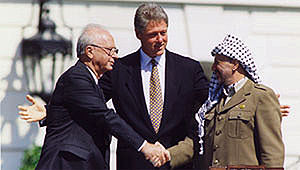
, hosted by the Fafo institute, and completed on 20 August 1993; the Accords were subsequently officially signed at a public ceremony in Washington, DC on 13 September 1993, in the presence of PLO chairman Yasser Arafat
Yasser Arafat
Mohammed Yasser Abdel Rahman Abdel Raouf Arafat al-Qudwa al-Husseini , popularly known as Yasser Arafat or by his kunya Abu Ammar , was a Palestinian leader and a Laureate of the Nobel Prize. He was Chairman of the Palestine Liberation Organization , President of the Palestinian National Authority...
, Israeli Prime Minister
Prime Minister of Israel
The Prime Minister of Israel is the head of the Israeli government and the most powerful political figure in Israel . The prime minister is the country's chief executive. The official residence of the prime minister, Beit Rosh Hamemshala is in Jerusalem...
Yitzhak Rabin
Yitzhak Rabin
' was an Israeli politician, statesman and general. He was the fifth Prime Minister of Israel, serving two terms in office, 1974–77 and 1992 until his assassination in 1995....
and US President
President of the United States
The President of the United States of America is the head of state and head of government of the United States. The president leads the executive branch of the federal government and is the commander-in-chief of the United States Armed Forces....
Bill Clinton
Bill Clinton
William Jefferson "Bill" Clinton is an American politician who served as the 42nd President of the United States from 1993 to 2001. Inaugurated at age 46, he was the third-youngest president. He took office at the end of the Cold War, and was the first president of the baby boomer generation...
. The documents themselves were signed by Mahmoud Abbas
Mahmoud Abbas
Mahmoud Abbas , also known by the kunya Abu Mazen , has been the Chairman of the Palestine Liberation Organisation since 11 November 2004 and became President of the Palestinian National Authority on 15 January 2005 on the Fatah ticket.Elected to serve until 9 January 2009, he unilaterally...
for the PLO, foreign Minister Shimon Peres
Shimon Peres
GCMG is the ninth President of the State of Israel. Peres served twice as the eighth Prime Minister of Israel and once as Interim Prime Minister, and has been a member of 12 cabinets in a political career spanning over 66 years...
for Israel
Israel
The State of Israel is a parliamentary republic located in the Middle East, along the eastern shore of the Mediterranean Sea...
, Secretary of State
United States Secretary of State
The United States Secretary of State is the head of the United States Department of State, concerned with foreign affairs. The Secretary is a member of the Cabinet and the highest-ranking cabinet secretary both in line of succession and order of precedence...
Warren Christopher
Warren Christopher
Warren Minor Christopher was an American lawyer, diplomat and politician. During Bill Clinton's first term as President, Christopher served as the 63rd Secretary of State. He also served as Deputy Attorney General in the Lyndon Johnson administration, and as Deputy Secretary of State in the Jimmy...
for the United States
United States
The United States of America is a federal constitutional republic comprising fifty states and a federal district...
and foreign minister Andrei Kozyrev for Russia
Russia
Russia or , officially known as both Russia and the Russian Federation , is a country in northern Eurasia. It is a federal semi-presidential republic, comprising 83 federal subjects...
.
The Oslo Accords were a framework for the future relations between the two parties. The Accords provided for the creation of a Palestinian National Authority
Palestinian National Authority
The Palestinian Authority is the administrative organization established to govern parts of the West Bank and Gaza Strip...
(PNA
PNA
Peptide nucleic acid is an artificially synthesized polymer similar to DNA or RNA invented by Peter E. Nielsen , Michael Egholm , Rolf H. Berg , and Ole Buchardt Peptide nucleic acid (PNA) is an artificially synthesized polymer similar to DNA or RNA invented by Peter E. Nielsen (Univ. Copenhagen),...
). The Palestinian Authority would have responsibility for the administration of the territory under its control. The Accords also called for the withdrawal of the Israel Defense Forces
Israel Defense Forces
The Israel Defense Forces , commonly known in Israel by the Hebrew acronym Tzahal , are the military forces of the State of Israel. They consist of the ground forces, air force and navy. It is the sole military wing of the Israeli security forces, and has no civilian jurisdiction within Israel...
(IDF) from parts of the Gaza Strip
Gaza Strip
thumb|Gaza city skylineThe Gaza Strip lies on the Eastern coast of the Mediterranean Sea. The Strip borders Egypt on the southwest and Israel on the south, east and north. It is about long, and between 6 and 12 kilometres wide, with a total area of...
and West Bank
West Bank
The West Bank ) of the Jordan River is the landlocked geographical eastern part of the Palestinian territories located in Western Asia. To the west, north, and south, the West Bank shares borders with the state of Israel. To the east, across the Jordan River, lies the Hashemite Kingdom of Jordan...
.
It was anticipated that this arrangement would last for a five-year interim period during which a permanent agreement would be negotiated (beginning no later than May 1996). Permanent issues such as positions on Jerusalem
Positions on Jerusalem
There are differing legal and diplomatic positions on Jerusalem held within the international community. Governments and scholars alike are divided over the legal status of Jerusalem under international law. Most countries of the world do not recognize Jerusalem as Israel's capital. Many do not...
, Palestinian refugees
Right of return
The term right of return refers to a principle of international law, codified in the Universal Declaration of Human Rights and the International Covenant on Civil and Political Rights, giving any person the right to return to, and re-enter, his or her country of origin...
, Israeli settlements, security
Security
Security is the degree of protection against danger, damage, loss, and crime. Security as a form of protection are structures and processes that provide or improve security as a condition. The Institute for Security and Open Methodologies in the OSSTMM 3 defines security as "a form of protection...
and borders
Proposals for a Palestinian state
Proposals for a Palestinian state currently refers to the proposed establishment of an independent state for the Palestinian people in Palestine on land that was occupied by Israel since the Six-Day War of 1967 and before by Egypt and by Jordan since 1949...
were deliberately left to be decided at a later stage. Interim Palestinian self-government was to be granted by Israel in phases.
Background
From the first negotiations at the 1949 Armistice Agreements1949 Armistice Agreements
The 1949 Armistice Agreements are a set of agreements signed during 1949 between Israel and neighboring Egypt, Lebanon, Jordan, and Syria. The agreements ended the official hostilities of the 1948 Arab-Israeli War, and established armistice lines between Israeli forces and the forces in...
to the most recent at the Madrid Conference of 1991
Madrid Conference of 1991
The Madrid Conference was hosted by the government of Spain and co-sponsored by the USA and the USSR. It convened on October 30, 1991 and lasted for three days. It was an early attempt by the international community to start a peace process through negotiations involving Israel and the Palestinians...
, there were many failed attempts for a settlement to bring about a lasting end to the Arab-Israeli and Israeli-Palestinian
Israeli-Palestinian conflict
The Israeli–Palestinian conflict is the ongoing conflict between Israelis and Palestinians. The conflict is wide-ranging, and the term is also used in reference to the earlier phases of the same conflict, between Jewish and Zionist yishuv and the Arab population living in Palestine under Ottoman or...
conflicts. What made the Oslo Accord negotiations different however, was the new Israeli government's decision to finally hold direct, face-to-face negotiations with the Palestinian Liberation Organization, as the representative of the Palestinian people
Palestinian people
The Palestinian people, also referred to as Palestinians or Palestinian Arabs , are an Arabic-speaking people with origins in Palestine. Despite various wars and exoduses, roughly one third of the world's Palestinian population continues to reside in the area encompassing the West Bank, the Gaza...
.
A renewal of the Israeli-Palestinian quest for peace began at the end of the Cold War
Cold War
The Cold War was the continuing state from roughly 1946 to 1991 of political conflict, military tension, proxy wars, and economic competition between the Communist World—primarily the Soviet Union and its satellite states and allies—and the powers of the Western world, primarily the United States...
as the United States took the lead in international affairs. President George H. W. Bush
George H. W. Bush
George Herbert Walker Bush is an American politician who served as the 41st President of the United States . He had previously served as the 43rd Vice President of the United States , a congressman, an ambassador, and Director of Central Intelligence.Bush was born in Milton, Massachusetts, to...
, in a speech on 11 September 1990, spoke of a "rare opportunity" to move toward a "New world order" in which "the nations of the world, east and west, north and south, can prosper and live in harmony," adding that "today the new world is struggling to be born".
The Gulf War
Gulf War
The Persian Gulf War , commonly referred to as simply the Gulf War, was a war waged by a U.N.-authorized coalition force from 34 nations led by the United States, against Iraq in response to Iraq's invasion and annexation of Kuwait.The war is also known under other names, such as the First Gulf...
(1990–1991) did much to persuade Israelis that the defensive value of territory had been overstated, and that the Iraqi invasion of Kuwait psychologically reduced their sense of security. The Gulf War had also shown that a superior air force and technology was more important than territory in winning a war. The Palestine Liberation Organization (PLO) realized the loss of its most important diplomatic patron, due to the deterioration of the Soviet Union
Soviet Union
The Soviet Union , officially the Union of Soviet Socialist Republics , was a constitutionally socialist state that existed in Eurasia between 1922 and 1991....
that started in 1989, and Arafat's failing relationship with Moscow
Moscow
Moscow is the capital, the most populous city, and the most populous federal subject of Russia. The city is a major political, economic, cultural, scientific, religious, financial, educational, and transportation centre of Russia and the continent...
. Another factor which pushed the PLO to the accords was the fallout from the Gulf War; because Arafat took a pro-Iraqi stand during the war, the Arab Gulf states cut off financial assistance to the PLO. The PLO was not invited to the Madrid Conference of 1991
Madrid Conference of 1991
The Madrid Conference was hosted by the government of Spain and co-sponsored by the USA and the USSR. It convened on October 30, 1991 and lasted for three days. It was an early attempt by the international community to start a peace process through negotiations involving Israel and the Palestinians...
at which Israel discussed peace with Lebanon
Lebanon
Lebanon , officially the Republic of LebanonRepublic of Lebanon is the most common term used by Lebanese government agencies. The term Lebanese Republic, a literal translation of the official Arabic and French names that is not used in today's world. Arabic is the most common language spoken among...
, Jordan
Jordan
Jordan , officially the Hashemite Kingdom of Jordan , Al-Mamlaka al-Urduniyya al-Hashemiyya) is a kingdom on the East Bank of the River Jordan. The country borders Saudi Arabia to the east and south-east, Iraq to the north-east, Syria to the north and the West Bank and Israel to the west, sharing...
, Syria
Syria
Syria , officially the Syrian Arab Republic , is a country in Western Asia, bordering Lebanon and the Mediterranean Sea to the West, Turkey to the north, Iraq to the east, Jordan to the south, and Israel to the southwest....
and Palestinian groups that were not associated with the PLO, although the behind the scenes coordination of the Palestinian delegation at Madrid by the PLO was an open secret.
In December 1992, in the background of the official "Madrid negotiations" in London
London
London is the capital city of :England and the :United Kingdom, the largest metropolitan area in the United Kingdom, and the largest urban zone in the European Union by most measures. Located on the River Thames, London has been a major settlement for two millennia, its history going back to its...
, Israeli vice-minister of foreign affairs Yossi Beilin
Yossi Beilin
Dr. Yosef "Yossi" Beilin is a left-wing Israeli politician and a former Knesset member, Deputy Foreign Affairs Minister and Justice Minister, representing both the Labor Party and Meretz-Yachad, of which he served as chairman between 2003 and 2006. He is best known for his involvement with the...
and Norwegian researcher Terje Rød-Larsen
Terje Rød-Larsen
Terje Rød-Larsen is a Norwegian diplomat, politician and sociologist.He came to wide international prominence as a key figure in the negotiations that led to the Oslo Accords, when he served as the Director of the Fafo institute...
set up a secret meeting for PLO representative Ahmed Qurei
Ahmed Qurei
Ahmed Ali Mohammed Qurei , also known by his Arabic Kunya Abu Alaa is a former prime minister of the Palestinian Authority...
and Israeli history professor Yair Hirschfeld
Yair Hirschfeld
Dr. Yair Hirschfeld is an Israeli lecturer at the University of Haifa. A prominent academic in Israel, Dr. Hirschfeld was a key architect of the Oslo Accords in 1993...
. Qurei and Hirschfeld made a connection and decided to meet again in what was going to be a series of 14 meetings in Oslo. During the first few meetings, a concept of an accord was discussed and agreed upon. The Foreign Affairs Minister of Israel
Foreign Affairs Minister of Israel
The Foreign Affairs Minister of Israel is the political head of the Israeli Ministry of Foreign Affairs. The position is one of the most important in the Israeli cabinet after Prime Minister and Defense Minister...
, Shimon Peres
Shimon Peres
GCMG is the ninth President of the State of Israel. Peres served twice as the eighth Prime Minister of Israel and once as Interim Prime Minister, and has been a member of 12 cabinets in a political career spanning over 66 years...
, was interested and sent the highest-ranking non-political representative and a military lawyer to continue the negotiations. In contrast to the official negotiations in Madrid, where actual meetings between the delegations were often limited to a few hours a day, the Israeli and Palestinian delegations in Norway were usually accommodated in the same residence, they had breakfast, lunch and dinner at the same table, resulting in mutual respect and close friendships. The Norwegian government covered the expenses, provided security and kept the meetings away from the public eye, using the research institute Fafo as a front.
In August 1993, the delegations had reached an agreement which was signed in secrecy by Peres while visiting Oslo. Peres took the agreement to the United States to the surprise of US negotiator Dennis Ross
Dennis Ross
Dennis B. Ross is an American diplomat and author. He has served as the Director of Policy Planning in the State Department under President George H. W...
. However, the Palestinians and Israelis had not yet agreed on the wording of the agreement, in which the PLO would acknowledge the state of Israel and pledge to reject violence, and Israel would recognize the (unelected) PLO as the official Palestinian authority, allowing Yasser Arafat to return to the West Bank
West Bank
The West Bank ) of the Jordan River is the landlocked geographical eastern part of the Palestinian territories located in Western Asia. To the west, north, and south, the West Bank shares borders with the state of Israel. To the east, across the Jordan River, lies the Hashemite Kingdom of Jordan...
. Most of the negotiations for this agreement were carried out in a hotel in Paris
Paris
Paris is the capital and largest city in France, situated on the river Seine, in northern France, at the heart of the Île-de-France region...
, now in full view of the public and the press. An agreement was reached and signed by Yasser Arafat and Yitzhak Rabin
Yitzhak Rabin
' was an Israeli politician, statesman and general. He was the fifth Prime Minister of Israel, serving two terms in office, 1974–77 and 1992 until his assassination in 1995....
, just in time for the official signing in Washington.The Accords were officially signed on September 13, 1993 at a Washington ceremony hosted by US President Bill Clinton.
Principles of the Accords
In essence, the accords called for the withdrawal of Israeli forces from parts of the Gaza StripGaza Strip
thumb|Gaza city skylineThe Gaza Strip lies on the Eastern coast of the Mediterranean Sea. The Strip borders Egypt on the southwest and Israel on the south, east and north. It is about long, and between 6 and 12 kilometres wide, with a total area of...
and West Bank
West Bank
The West Bank ) of the Jordan River is the landlocked geographical eastern part of the Palestinian territories located in Western Asia. To the west, north, and south, the West Bank shares borders with the state of Israel. To the east, across the Jordan River, lies the Hashemite Kingdom of Jordan...
, and affirmed a Palestinian right of self-government within those areas through the creation of a Palestinian Interim Self-Government Authority. Palestinian rule was to last for a five-year interim period during which "permanent status negotiations" would commence - no later than May 1996 - in order to reach a final agreement. Major issues such as Jerusalem, Palestinian refugee
Palestinian refugee
Palestinian refugees or Palestine refugees are the people and their descendants, predominantly Palestinian Arabic-speakers, who fled or were expelled from their homes during and after the 1948 Palestine War, within that part of the British Mandate of Palestine, that after that war became the...
s, Israeli settlements, and security and borders were to be decided at these permanent status negotiations (Article V). Israel was to grant interim self-government to the Palestinians in phases.
Along with the principles, the two groups signed Letters of Mutual Recognition
Israel-Palestine Liberation Organization letters of recognition
Israel-Palestine Liberation Organization letters of recognition were a series of official letters of recognition between the government of Israel and its Prime Minister Yitzhak Rabin and the Palestine Liberation Organization's Chairman Yasser Arafat dated September 9, 1993...
- the Israeli government recognized the PLO as the legitimate representative of the Palestinian people, while the PLO recognized the right of the state of Israel to exist and renounced terrorism
Terrorism
Terrorism is the systematic use of terror, especially as a means of coercion. In the international community, however, terrorism has no universally agreed, legally binding, criminal law definition...
as well as other violence, and its desire for the destruction of the Israeli state.
The aim of Israeli-Palestinian negotiations was to establish a Palestinian Interim Self-Government Authority, an elected Council, for the Palestinian people in the West Bank and the Gaza Strip, for a transitional period not exceeding five years, leading to a permanent settlement based on United Nations Security Council Resolution 242
United Nations Security Council Resolution 242
United Nations Security Council Resolution 242 was adopted unanimously by the UN Security Council on November 22, 1967, in the aftermath of the Six Day War. It was adopted under Chapter VIof the United Nations Charter...
, and 338
United Nations Security Council Resolution 338
The three-line United Nations Security Council Resolution 338, adopted on October 22, 1973, called for a ceasefire in the Yom Kippur War in accordance with a joint proposal by the United States and the Soviet Union. The resolution stipulated a cease fire to take effect within 12 hours of the...
, an integral part of the whole peace process.
In order that the Palestinians govern themselves according to democratic
Democracy
Democracy is generally defined as a form of government in which all adult citizens have an equal say in the decisions that affect their lives. Ideally, this includes equal participation in the proposal, development and passage of legislation into law...
principles, free and general political elections
Election
An election is a formal decision-making process by which a population chooses an individual to hold public office. Elections have been the usual mechanism by which modern representative democracy operates since the 17th century. Elections may fill offices in the legislature, sometimes in the...
would be held for the Council.
Jurisdiction of the Palestinian Council would cover the West Bank and Gaza Strip, except for issues that would be finalized in the permanent status negotiations. The two sides viewed the West Bank and Gaza as a single territorial unit.
The five-year transitional period would commence with Israeli withdrawal from the Gaza Strip and Jericho
Jericho
Jericho ; is a city located near the Jordan River in the West Bank of the Palestinian territories. It is the capital of the Jericho Governorate and has a population of more than 20,000. Situated well below sea level on an east-west route north of the Dead Sea, Jericho is the lowest permanently...
area. Permanent status negotiations would begin as soon as possible between Israel and the Palestinians. The negotiations would cover remaining issues, including: Jerusalem, Palestinian refugees, Israeli settlements, security arrangements, borders, relations and cooperation with other neighbors, and other issues of common interest.
Furthermore, the two sides agreed in the 1995 Interim Agreement,18 signed and witnessed by the U.S., the EU, Egypt, Jordan, Russia, and Norway, on a division of their respective jurisdictions in the West Bank into areas A and B (Palestinian jurisdiction) and area C (Israeli jurisdiction). They defined the respective powers and responsibilities of each side in the areas they control. Israel's powers and responsibilities in Area C include all aspects regarding its settlements - all this pending the outcome of the Permanent Status negotiations.
In fact, during the course of the negotiations with Israel, the Palestinian delegation requested that a "side letter" be attached to the agreement, the text of which would be agreed upon, whereby Israel would commit to restricting settlement construction in area C during the process of implementation of the agreement and the ensuing negotiations. Several drafts of this "side letter" passed between the negotiating teams until Israel indeed agreed to a formulation restricting construction activities on the basis of a government decision that would be adopted for that purpose. Ultimately, the Palestinian leadership withdrew its request for a side letter.
There would be a transfer of authority from the Israel Defence Forces to the authorized Palestinians, concerning education and culture, health
Public health
Public health is "the science and art of preventing disease, prolonging life and promoting health through the organized efforts and informed choices of society, organizations, public and private, communities and individuals" . It is concerned with threats to health based on population health...
, social welfare, direct taxation, and tourism.
The Council would establish a strong police force, while Israel would continue to carry the responsibility for defending against external threats.
An Israeli-Palestinian Economic Cooperation Committee would be established in order to develop and implement in a cooperative manner the programs identified in the protocols.
A redeployment of Israeli military forces in the West Bank and the Gaza Strip would take place.
The Declaration of Principles would enter into force one month after its signing. All protocols annexed to the Declaration of Principles and the Agreed Minutes pertaining to it, were to be regarded as part of it.
Annex 1: Conditions of Palestinian Elections
This annex covered election agreements, a system of electionElection
An election is a formal decision-making process by which a population chooses an individual to hold public office. Elections have been the usual mechanism by which modern representative democracy operates since the 17th century. Elections may fill offices in the legislature, sometimes in the...
s, rules and regulations regarding election campaigns, including agreed arrangements for the organizing of mass media
Mass media
Mass media refers collectively to all media technologies which are intended to reach a large audience via mass communication. Broadcast media transmit their information electronically and comprise of television, film and radio, movies, CDs, DVDs and some other gadgets like cameras or video consoles...
, and the possibility of licensing a TV station. (Source: Reference.com)
Annex 2: Withdrawal of Israeli forces
An agreement on the withdrawal of Israeli military forces from the Gaza Strip and JerichoJericho
Jericho ; is a city located near the Jordan River in the West Bank of the Palestinian territories. It is the capital of the Jericho Governorate and has a population of more than 20,000. Situated well below sea level on an east-west route north of the Dead Sea, Jericho is the lowest permanently...
area. This agreement will include comprehensive arrangements to apply in the Gaza Strip and the Jericho area subsequent to the Israeli withdrawal. Internal security and public order by the Palestinian police force consisting of police officers recruited locally and from abroad (holding Jordanian passports and Palestinian documents issued by Egypt
Egypt
Egypt , officially the Arab Republic of Egypt, Arabic: , is a country mainly in North Africa, with the Sinai Peninsula forming a land bridge in Southwest Asia. Egypt is thus a transcontinental country, and a major power in Africa, the Mediterranean Basin, the Middle East and the Muslim world...
). Those who will participate in the Palestinian police force coming from abroad should be trained as police and police officers.
- A temporary international or foreign presence, as agreed upon.
- Establishment of a joint Palestinian-Israeli Coordination and Cooperation Committee for mutual security purposes.
- Arrangements for a safe passage for persons and transportation between the Gaza Strip and Jericho area.
- Arrangements for coordination between both parties regarding passages: Gaza - Egypt; and Jericho - Jordan.
Annex 3: Economic cooperation
The two sides agree to establish an Israeli-Palestinian continuing Committee for economic cooperation, focusing, among other things, on the following:- Cooperation in the field of water
- Cooperation in the field of electricity
- Cooperation in the field of energy
- Cooperation in the field of finance
- Cooperation in the field of transport and communications
- Cooperation in the field of trade and commerce
- Cooperation in the field of industry
- Cooperation in, and regulation of, labor relations
- Cooperation in social welfare issues
- An environmental protection plan
- Cooperation in the field of communication and media
Annex 4: Regional development
The two sides will cooperate in the context of the multilateral peace effortsEnvironmental peacebuilding
Peacebuilding is both the theory and practice of identifying the conditions that can lead to a sustainable peace between those who have previously been adversaries, and assisting adversaries to move towards a sustainable peace. Environmental peacebuilding examines and advocates environmental...
in promoting a Development Program for the region, including the West Bank and the Gaza Strip, to be initiated by the G7.
Minute A: General understandings
Any powers and responsibilities transferred to the Palestinians through the Declaration of Principles prior to the inauguration of the Council will be subject to the same principles pertaining to Article IV, as set out in the agreed minutes below.Article IV: Council's jurisdiction
It was to be understood that: Jurisdiction of the Council would cover West Bank and Gaza Strip territory, except for issues that would be negotiated in the permanent status negotiations.
Article VI (2): Transferring authority
It was agreed that the transfer of authority would be as follows: The Palestinians would inform the Israelis of the names of the authorized Palestinians who would assume the powers, authorities and responsibilities that would be transferred to the Palestinians according to the Declaration of Principles in the following fields: education and culture, health, social welfare, direct taxation, tourism, and any other authorities agreed upon.
Article VII (2): Cooperation
The Interim Agreement would also include arrangements for coordination and cooperation.
Article VII (5): Israel's powers
The withdrawal of the military government would not prevent Israel from exercising the powers and responsibilities not transferred to the Council.
Article VIII: Police
It was understood that the Interim Agreement would include arrangements for cooperation and coordination. It was also agreed that the transfer of powers and responsibilities to the Palestinian police would be accomplished in a phased manner. The accord stipulated that Israeli and Palestinian police would do joint patrols.
Article X: Designating officials
It was agreed that the Israeli and Palestinian delegations would exchange the names of the individuals designated by them as members of the Joint Israeli-Palestinian Liaison Committee which would reach decisions by agreement.
Annex XI: Israel's continuing responsibilities
It was understood that, subsequent to the Israeli withdrawal, Israel would continue to be responsible for external security, and for internal security and public order of settlements
Israeli settlement
An Israeli settlement is a Jewish civilian community built on land that was captured by Israel from Jordan, Egypt, and Syria during the 1967 Six-Day War and is considered occupied territory by the international community. Such settlements currently exist in the West Bank...
and Israelis. Israeli military forces and civilians would be allowed to continue using roads freely within the Gaza Strip and the Jericho area.
Administrative divisions of the Oslo Accords
Reaction
In Israel, a strong debate over the accords took place; the left wing supported them, while the right wing opposed them. After a two-day discussion in the KnessetKnesset
The Knesset is the unicameral legislature of Israel, located in Givat Ram, Jerusalem.-Role in Israeli Government :The legislative branch of the Israeli government, the Knesset passes all laws, elects the President and Prime Minister , approves the cabinet, and supervises the work of the government...
on the government proclamation in the issue of the accord and the exchange of the letters, on 23 September 1993, a vote of confidence was held in which 61 Knesset members voted for the decision, 50 voted against and 8 abstained.
Palestinian reactions were also divided. Fatah
Fatah
Fataḥ is a major Palestinian political party and the largest faction of the Palestine Liberation Organization , a multi-party confederation. In Palestinian politics it is on the left-wing of the spectrum; it is mainly nationalist, although not predominantly socialist. Its official goals are found...
, the group that represented the Palestinians in the negotiations, accepted the accords. But Hamas, Palestinian Islamic Jihad
Islamic Jihad Movement in Palestine
The Islamic Jihad Movement in Palestine known in the West as simply Palestinian Islamic Jihad , is a small Palestinian militant organization. The group has been labelled as a terrorist group by the United States, the European Union, the United Kingdom, Japan, Canada, Australia and Israel...
and the Popular Front for the Liberation of Palestine
Popular Front for the Liberation of Palestine
The Popular Front for the Liberation of Palestine is a Palestinian Marxist-Leninist organisation founded in 1967. It has consistently been the second-largest of the groups forming the Palestine Liberation Organization , the largest being Fatah...
objected to the accords because their own charters refuse to recognize Israel's right to exist
Right to exist
The right to exist is said to be an attribute of nations. According to an essay by the nineteenth century French philosopher Ernest Renan, a state has the right to exist when individuals are willing to sacrifice their own interests for the community it represents. Unlike self-determination, the...
in Palestine
Palestine
Palestine is a conventional name, among others, used to describe the geographic region between the Mediterranean Sea and the Jordan River, and various adjoining lands....
.
On both sides, there were fears of the other side's intentions. Israelis suspected that the Palestinians were entering into a tactical peace agreement, and that they were not sincere about wanting to reach peace and coexistence with Israel. They saw it as part of the Ten Point Program which calls for a national authority over any piece of liberated Palestinian land, and for a secular democratic bi-national state in Israel/Palestine with equal rights for all its citizens. For evidence they brought statements by Arafat in Palestinian forums, in which he compared the accord to the Hudaibiya agreement
Treaty of Hudaybiyyah
The Treaty of Hudaybiyyah is the treaty that took place between the state of Medina and the Quraishi tribe of Mecca in March 628CE .-Background:...
that Muhammad
Muhammad
Muhammad |ligature]] at U+FDF4 ;Arabic pronunciation varies regionally; the first vowel ranges from ~~; the second and the last vowel: ~~~. There are dialects which have no stress. In Egypt, it is pronounced not in religious contexts...
signed with the sons of the tribe of Quraish. They understood those statements as an attempt to justify the signing of the accords in accordance with historical-religious precedent, with step agreements to reach a final goal.
After the signing of the agreements, Israel continued expanding existing settlements although this fell far short of the Shamir government's 1991-1992 level. Construction of Housing Units Before Oslo: 1991-1992 14,320 units. After Oslo: 1994-1995 3,850 units; 1996-1997 3,570 units although the settler population in the West Bank continued growing by around 10,000 per year. The Palestinians built throughout area C of the West Bank
West Bank
The West Bank ) of the Jordan River is the landlocked geographical eastern part of the Palestinian territories located in Western Asia. To the west, north, and south, the West Bank shares borders with the state of Israel. To the east, across the Jordan River, lies the Hashemite Kingdom of Jordan...
administered by Israel without permit.
According to the Israeli government, the Israeli's trust in the accords was undermined by the fact that after the signing, the attacks against Israel intensified, which some explained as an attempt by certain Palestinian organizations to thwart the peace process. Others believed that the Palestinian Authority had no interest in stopping these attacks and was instead endorsing them. As evidence, they showed that when violence flared up in September 1996, Palestinian police turned their guns on the Israelis in clashes which left 61 Palestinians and 15 Israeli soldiers dead. Important sections of the Israeli public opposed the process; notably, the Jewish settlers feared that it would lead to them losing their homes.
Many Palestinians feared that Israel was not serious about dismantling their settlements in the West Bank, especially around Jerusalem. They feared they might even accelerate their settlement program in the long run, by building more settlements and expanding existing ones.
Remarks from Benjamin Netanyahu
In a 2001 video, Netanyahu, reportedly unaware he was being recorded, said: "They asked me before the election if I'd honor [the Oslo accords]... I said I would, but [that] I'm going to interpret the accords in such a way that would allow me to put an end to this galloping forward to the '67 borders. How did we do it? Nobody said what defined military zones were. Defined military zones are security zones; as far as I'm concerned, the entire Jordan Valley is a defined military zone. Go argue." Netanyahu then explained how he conditioned his signing of the 1997 Hebron agreement on American consent that there be no withdrawals from "specified military locations," and insisted he be allowed to specify which areas constituted a "military location" - such as the whole of the Jordan Valley. "Why is that important? Because from that moment on I stopped the Oslo Accords," Netanyahu affirmed.However, this is consistent with Rabin
Rabin
Rąbiń is a village in the administrative district of Gmina Krzywiń, within Kościan County, Greater Poland Voivodeship, in west-central Poland. It lies approximately north of Krzywiń, east of Kościan, and south of the regional capital Poznań....
's October 1995 statement to the Knesset on the ratification of the interim Oslo agreement:
"B. The security border of the State of Israel will be located in the Jordan Valley, in the broadest meaning of that term."
Criticisms
The Oslo Accords may appear not to have considered factors that would influence its interpretation. For example, the Cave of the Patriarchs massacreCave of the Patriarchs massacre
The Cave of the Patriarchs massacre was a terrorist attack that occurred when Baruch Goldstein, an Israeli settler and member of the far-right Israeli Kach movement, opened fire on unarmed Palestinian Muslims praying inside the Ibrahim Mosque at the Cave of the Patriarchs site in Hebron in the...
, in which at least 39 Palestinians were killed, is often blamed for undermining Palestinian trust in the process. Similarly, the expansion of Israeli settlement
Israeli settlement
An Israeli settlement is a Jewish civilian community built on land that was captured by Israel from Jordan, Egypt, and Syria during the 1967 Six-Day War and is considered occupied territory by the international community. Such settlements currently exist in the West Bank...
s and blockades caused the deterioration of economic conditions, and much frustration for Palestinians. These factors caused a drop in support for the accord and for those who supported it.
There have been suggested alternatives to boundary setting and creating principles that divide Israelis and Palestinians. One alternative is to move a peace process towards the creation of a bi-national state, a "one-state solution", that promotes co-existence rather than to continuing to divide. An argument for this as a possible way of reconciliation is that neither side can wholly justify a claim for homogeneity. Palestine has a varied history of occupancy, such as the Canaanites, Hittites
Hittites
The Hittites were a Bronze Age people of Anatolia.They established a kingdom centered at Hattusa in north-central Anatolia c. the 18th century BC. The Hittite empire reached its height c...
and Ammon
Ammon
Ammon , also referred to as the Ammonites and children of Ammon, was an ancient nation located east of the Jordan River, Gilead, and the Dead Sea, in present-day Jordan. The chief city of the country was Rabbah or Rabbath Ammon, site of the modern city of Amman, Jordan's capital...
ites in ancient times. Also, some Israeli and Palestinian thinkers have previously argued for a bi-national state as a more attractive alternative to separatism.
Norwegian academics, including Norway's leading authority on the negotiations, Hilde Henriksen Waage
Hilde Henriksen Waage
Hilde Henriksen Waage is a Norwegian historian.Waage took the Cand.philol. degree at the University of Oslo in 1987 and the Dr.philos. degree in 1997, both in history. She became a professor at the University of Oslo in 2007...
, have focused on the flawed role of Norway during the Oslo process. In 2001, the Norwegian Ministry of Foreign Affairs (MFA) commissioned Waage to produce an official, comprehensive history of the Norwegian-mediated back channel negotiations. In order to do the research, she was given privileged access to all relevant, classified files in the ministry's archives. The MFA had been at the heart of the Oslo process. Waage was surprised to discover "not a single scrap of paper for the entire period from January to September 1993 - precisely the period of the back channel talks". Waage has written that, "Had the missing documents been accessible, there seems no doubt they would have shown the extent to which the Oslo process was conducted on Israel’s premises, with Norway acting as Israel's helpful errand boy".
Subsequent negotiations
In addition to the first accord, namely the Declaration of Principles on Interim Self-Government, other more specific accords are often informally also known as "Oslo":Oslo 2
- The Interim Agreement on the West Bank and the Gaza StripInterim Agreement on the West Bank and the Gaza StripThe Interim Agreement on the West Bank and the Gaza Strip, also known as the Israeli-Palestinian Interim Agreement, the Interim Agreement, Oslo 2, Oslo II, and Taba, was a key and complex agreement governing several aspects of the Palestinian territories of Gaza Strip and the West Bank.-History:It...
(also called Oslo 2), signed on 28 September 1995 gave Palestinians self-rule in BethlehemBethlehemBethlehem is a Palestinian city in the central West Bank of the Jordan River, near Israel and approximately south of Jerusalem, with a population of about 30,000 people. It is the capital of the Bethlehem Governorate of the Palestinian National Authority and a hub of Palestinian culture and tourism...
, HebronHebronHebron , is located in the southern West Bank, south of Jerusalem. Nestled in the Judean Mountains, it lies 930 meters above sea level. It is the largest city in the West Bank and home to around 165,000 Palestinians, and over 500 Jewish settlers concentrated in and around the old quarter...
, JeninJeninJenin is the largest town in the Northern West Bank, and the third largest city overall. It serves as the administrative center of the Jenin Governorate and is a major agricultural center for the surrounding towns. In 2007, the city had a population of 120,004 not including the adjacent refugee...
, NablusNablusNablus is a Palestinian city in the northern West Bank, approximately north of Jerusalem, with a population of 126,132. Located in a strategic position between Mount Ebal and Mount Gerizim, it is the capital of the Nablus Governorate and a Palestinian commercial and cultural center.Founded by the...
, Qalqilya, RamallahRamallahRamallah is a Palestinian city in the central West Bank located 10 kilometers north of Jerusalem, adjacent to al-Bireh. It currently serves as the de facto administrative capital of the Palestinian National Authority...
, TulkarmTulkarmTulkarem or Tulkarm is a Palestinian city in the northern Samarian mountain range in the Tulkarm Governorate in the extreme northwestern West Bank adjacent to the Netanya and Haifa districts to the west, the Nablus and Jenin Districts to the east...
, and some 450 villages.
Loss of credibility
Since the start of the al-Aqsa IntifadaAl-Aqsa Intifada
The Second Intifada, also known as the Al-Aqsa Intifada and the Oslo War, was the second Palestinian uprising, a period of intensified Palestinian-Israeli violence, which began in late September 2000...
, the Oslo Accords are viewed with increasing disfavor by both the Palestinian and Israeli public. In May 2000, seven years after the Oslo Accords and five months before the start of the al-Aqsa Intifada
Al-Aqsa Intifada
The Second Intifada, also known as the Al-Aqsa Intifada and the Oslo War, was the second Palestinian uprising, a period of intensified Palestinian-Israeli violence, which began in late September 2000...
, a survey by the Tami Steinmetz Center for Peace Research
Tami Steinmetz Center for Peace Research
Tami Steinmetz Center For Peace Research is an academic research institution of Tel Aviv University which surveys public opinion regarding the peace process, the Israeli-Palestinian conflict, and the Arab-Israeli conflict....
at the University of Tel Aviv found that 39% of all Israelis supported the Accords and that 32% believed that the Accords would result in peace in the next few years. By contrast, the May 2004 survey found that 26% of all Israelis supported the Accords and 18% believed that the Accords would result in peace in the next few years.
In December 2010, a report in al-Quds al-Arabi asserted that the Palestinian Authority no longer regards itself as being bound by the Oslo Accords ; however, as of June 2011 the PA has not made any official declaration to that effect.
Additional agreements
Additional Israeli-Palestinian documents related to the Oslo Accords are:- Israel-Palestine Liberation Organization letters of recognitionIsrael-Palestine Liberation Organization letters of recognitionIsrael-Palestine Liberation Organization letters of recognition were a series of official letters of recognition between the government of Israel and its Prime Minister Yitzhak Rabin and the Palestine Liberation Organization's Chairman Yasser Arafat dated September 9, 1993...
, (9 September 1993), - Protocol on Economic RelationsProtocol on Economic RelationsThe Protocol on Economic Relations was an annex of the Gaza–Jericho Agreement between Israel and the Palestinian Authority signed in Paris on 4 May 1994. It governed economic relations between the two parties...
, signed in ParisParisParis is the capital and largest city in France, situated on the river Seine, in northern France, at the heart of the Île-de-France region...
on 29 April 1994, - Gaza-Jericho AgreementGaza-Jericho AgreementThe Gaza–Jericho Agreement of 4 May 1994 was a follow-up treaty to the Oslo Accords in which the details of Palestinian autonomy were concluded....
(4 May 1994), - 1994 Washington Declaration (25 July 1994),
- Agreement on Preparatory Transfer of Powers and Responsibilities Between Israel and the PLO (29 August 1994),
- Protocol on Further Transfer of Powers and Responsibilities signed at CairoCairoCairo , is the capital of Egypt and the largest city in the Arab world and Africa, and the 16th largest metropolitan area in the world. Nicknamed "The City of a Thousand Minarets" for its preponderance of Islamic architecture, Cairo has long been a centre of the region's political and cultural life...
on 27 August 1995 - Protocol Concerning the Redeployment in HebronProtocol Concerning the Redeployment in HebronProtocol Concerning the Redeployment in Hebron, also known as The Hebron Protocol or Hebron Agreement, began January 7 and was concluded from January 15 to January 17, 1997 between Israel, represented by Prime Minister of Israel Benjamin Netanyahu, and the Palestine Liberation Organization ,...
(January 15/January 17, 1997) - Wye River MemorandumWye River MemorandumThe Wye River Memorandum was an agreement negotiated between Israel and the Palestine Authority to implement the earlier Interim Agreement of 28 September, 1995...
(October 23, 1998) - Sharm el-Sheikh MemorandumSharm el-Sheikh Memorandum (1999)The Sharm el-Sheikh Memorandum, full name: The Sharm el Sheikh Memorandum on Implementation Timeline of Outstanding Commitments of Agreements Signed and the Resumption of Permanent Status Negotiations was a memorandum signed on September 4, 1999 by Prime Minister of Israel Ehud Barak and PLO...
(September 4, 1999), - Taba summitTaba SummitThe Taba summit were talks between Israel and the Palestinian Authority, held from January 21 to January 27, 2001 at Taba in the Sinai peninsula...
(January 27, 2001).
Arab-Israeli peace diplomacy and treaties
- Middle East economic integrationMiddle East economic integrationMiddle East economic integration has been envisioned, proposed or implemented by various parties in recent history.The stated rationale is that peace, stability and prosperity in the Middle East can only be sustained over the long-run through intra-regional economic cooperation.Governance,...
- Paris Peace Conference, 1919Paris Peace Conference, 1919The Paris Peace Conference was the meeting of the Allied victors following the end of World War I to set the peace terms for the defeated Central Powers following the armistices of 1918. It took place in Paris in 1919 and involved diplomats from more than 32 countries and nationalities...
- Faisal-Weizmann Agreement (1919)Faisal-Weizmann AgreementThe Faisal–Weizmann Agreement was signed on January 3, 1919, by Emir Feisal , who was for a short time King of the Arab Kingdom of Syria or Greater Syria in 1920, and was King of the Kingdom of Iraq from August 1921 to 1933, and Chaim Weizmann as part of the Paris Peace Conference, 1919 settling...
- 1949 Armistice Agreements1949 Armistice AgreementsThe 1949 Armistice Agreements are a set of agreements signed during 1949 between Israel and neighboring Egypt, Lebanon, Jordan, and Syria. The agreements ended the official hostilities of the 1948 Arab-Israeli War, and established armistice lines between Israeli forces and the forces in...
- Camp David Accords (1978)
- Israel-Egypt Peace Treaty (1979)Israel-Egypt Peace TreatyThe 1979 Egypt–Israel Peace Treaty was signed in Washington, D.C. on the 26th of March 1979, following the 1978 Camp David Accords, which were signed by Egyptian President Anwar El Sadat and Israeli Prime Minister Menachem Begin, and were witnessed by United States President Jimmy Carter.The peace...
- Madrid Conference of 1991Madrid Conference of 1991The Madrid Conference was hosted by the government of Spain and co-sponsored by the USA and the USSR. It convened on October 30, 1991 and lasted for three days. It was an early attempt by the international community to start a peace process through negotiations involving Israel and the Palestinians...
- Oslo Accords (1993)
- Israel-Jordan Treaty of Peace (1994)Israel-Jordan Treaty of PeaceThe Israel–Jordan Treaty of Peace was signed in 1994. The treaty normalized relations between the two countries and resolved territorial disputes. The conflict had cost roughly US$18.3 billion...
- Camp David 2000 SummitCamp David 2000 SummitThe Middle East Peace Summit at Camp David of July 2000 took place between United States President Bill Clinton, Israeli Prime Minister Ehud Barak, and Palestinian Authority Chairman Yasser Arafat...
- Peace process in the Israeli-Palestinian conflictPeace process in the Israeli-Palestinian conflictThe peace process in the Israeli–Palestinian conflict has taken shape over the years, despite the ongoing violence in the Middle East and an "all or nothing" attitude about a lasting peace, "which prevailed for most of the twentieth century"...
- Projects working for peace among Israelis and ArabsProjects working for peace among Israelis and ArabsProjects working for peace among Arabs and Israelis have been operating for years in different fields.- Policy groups:Organizations or institutions which address and analyze policy issues in a wide range of areas...
- List of Middle East peace proposals
- International law and the Arab-Israeli conflictInternational law and the Arab-Israeli conflictThere is a broad international consensus that the actions of the nations involved in the Arab-Israeli conflict violate prohibitions contained in international law. However, this legality is disputed by some of the nations involved...
Issues
- Proposals for a Palestinian stateProposals for a Palestinian stateProposals for a Palestinian state currently refers to the proposed establishment of an independent state for the Palestinian people in Palestine on land that was occupied by Israel since the Six-Day War of 1967 and before by Egypt and by Jordan since 1949...
- United States security assistance to the Palestinian AuthorityUnited States security assistance to the Palestinian AuthorityUnited States security assistance to the Palestinian Authority has been provided since the Palestinian Authority was established by the Oslo Accords in the mid-1990s. The security assistance was given on an ad hoc basis and often covert at the outset. Since 2005 the U.S...
People
- Mona JuulMona JuulMona Juul is an official in the Norwegian Ministry of Foreign Affairs and former politician for the Labour Party.She hailed from Sparbu, and was educated in political science. Along with her husband Terje Rød-Larsen she played a key role in the Oslo Accords...
- Norwegian facilitator during the negotiations. - Johan Jørgen HolstJohan Jørgen HolstJohan Jørgen Holst was a Norwegian politician representing Labour, best known for his involvement with the Oslo Accords....
- Norwegian Minister of Foreign Affairs. - Jan EgelandJan EgelandJan Egeland was the United Nations Undersecretary-General for Humanitarian Affairs and Emergency Relief Coordinator from June 2003 to December 2006. Egeland was appointed by Secretary-General Kofi Annan and succeeded Kenzo Oshima...
- Norwegian Deputy Foreign Minister, provided political cover, facilities and finances for the negotiations. - Uri SavirUri SavirUri Savir is an Israeli diplomat and politician. He served as a member of the Knesset between 1999 and 2001.-Biography:...
- former Director General of the Israeli Foreign Ministry, was Head of the Israeli negotiating team. - Ron PundakRon PundakDr. Ron Pundak is an Israeli director of the Peres Center for Peace in Tel Aviv. He is on the Board of Driectors of the Aix Group. Ron Pundak is the son of Herbert Pundik, a notable journalist and author....
- currently Director General of the Peres Center for PeacePeres Center for PeaceThe Peres Center for Peace located in Tel Aviv-Jaffa, Israel, is an independent, non-profit, non-partisan, non-governmental organization founded in 1996 by Nobel Peace Laureate and current President of Israel Shimon Peres, with the aim of furthering his vision in which people of the Middle East...
, formed first Israeli negotiating team with Hirschfeld, before official Israeli involvement.