


Nazareth

Encyclopedia
Nazareth is the largest city in the North District of Israel
. Known as "the Arab
capital of Israel
," the population is made up predominantly of Palestinian
Arab citizens of Israel
. In the New Testament
, the city is described as the childhood
home of Jesus
, and as such is a center of Christian
pilgrimage
, with many shrines commemorating biblical events.
.Isaiah 11:1 Alternatively, the name may derive from the verb na·tsar, נָצַר, "watch, guard, keep." The negative references to Nazareth in the Gospel of John
suggest that ancient Jews did not connect the town's name to prophecy.
Another theory holds that the Greek form Nazara, used in Matthew and Luke, may derive from an earlier Aramaic
form of the name, or from another Semitic
language form. If there were a tsade
(צ) in the original Semitic form, as in the later Hebrew forms, it would normally have been transcribed in Greek with a sigma instead of a zeta. This has led some scholars to question whether "Nazareth" and its cognates in the New Testament actually refer to the settlement we know traditionally as Nazareth in Lower Galilee. Such linguistic discrepancies may be explained, however, "by a peculiarity of the 'Palestinian' Aramaic dialect wherein a sade (ṣ) between two voiced (sonant) consonants tended to be partially assimilated by taking on a zayin (z) sound."
is also called an-Nāṣirī, reflecting the Arab tradition of according people a nisba, a name denoting from whence a person comes in either geographical or tribal terms. In the Qur'an
, Christians are referred to as naṣārā, meaning "followers of an-Nāṣirī," or "those who follow Jesus." Similarly, in Maltese
a Christian male is called Nisrani, whilst someone from Nazareth is called Nazzarenu. Whereas Nisrani is of direct Semitic origin, it is very likely that Nazzarenu was adopted via the Italian Nazzareno (from Latin, Nazarenus, meaning Nazarene.)
Nazara (Ναζαρα) is generally considered the earliest form of the name in Greek, and is found in and , as well as the putative Q document, which many scholars maintain preceded 70 AD and the formation of the canonical Christian gospels. The form Nazareth appears once in the Gospel of Matthew , four times in the birth chapters of the Gospel of Luke at ; , , , and once in the Acts of the Apostles at . In the Gospel of Mark, the name appears only once in in the form Nazaret.
Many scholars have questioned a link between "Nazareth" and the terms "Nazarene
" and "Nazoraean" on linguistic grounds, while some affirm the possibility of etymological relation "given the idiosyncrasies of Galilean Aramaic."
dated about 200 AD (see "Middle Roman to Byzantine Periods" below). The Church Father Origen
(c. 185 to 254 AD) knows the forms Nazara and Nazaret. Later, Eusebius in his Onomasticon (translated by St. Jerome) also refers to the settlement as Nazara. In their scriptures, the Mandeans
mention nasirutha as a place they go.
The first non-Christian reference to Nazareth is an inscription on a marble fragment from a synagogue
found in Caesarea Maritima in 1962. This fragment gives the town's name in Hebrew as "נצרת" (n-ṣ-r-t). The inscription dates to c. 300 AD and chronicles the assignment of priests that took place at some time after the Bar Kokhba revolt, 132-35 AD. (See "Middle Roman to Byzantine Periods" below.) An 8th century AD Hebrew inscription, which was the earliest known Hebrew reference to Nazareth prior to the discovery of the inscription above, uses the same form.
, a Jewish lawyer. The Talmudic and modern Hebrew name for Christians, notzrim, is also thought to derive from Nazareth, and be connected with Tertullus
' charge against Paul of being a member of the sect of the Nazarenes
, Nazoraioi, "men of Nazareth" in Acts. Against this some medieval Jewish polemical texts connect notzrim with the netsarim "watchmen" of Ephraim in Jeremiah 31:6. In Syrian Aramaic Nasrat (ܢܨܪܬ) is used for Nazareth, while "Nazarenes" (Acts 24:5) and "of Nazareth" are both nasraya (ܕܢܨܪܝܐ) an adjectival form.
, about two miles (3 km) from current Nazareth, dating back roughly 9000 years (to what is known as the Pre-Pottery Neolithic B
era). The remains of some 65 individuals were found, buried under huge horizontal headstone structures, some of which consisted of up to 3 tons of locally-produced white plaster. Decorated human skulls uncovered there have led archaeologists to believe that Kfar HaHoresh was a major cult centre in that remote era.
In 1620 the Catholic Church purchased an area in the Nazareth basin measuring approx. 100 by 150 m (328.1 by 492.1 ) on the side of the hill known as the Nebi Sa'in. This "Venerated Area" underwent extensive excavation in 1955-65 by the Franciscan priest Belarmino Bagatti, "Director of Christian Archaeology." Fr. Bagatti has been the principal archaeologist at Nazareth. His book, Excavations in Nazareth (1969) is still the standard reference for the archaeology of the settlement, and is based on excavations at the Franciscan Venerated Area.
Fr. Bagatti uncovered pottery dating from the Middle Bronze Age (2200 to 1500 BC) and ceramics, silos and grinding mills from the Iron Age (1500 to 586 BC), pointing to substantial settlement in the Nazareth basin at that time. However, lack of archaeological evidence from Assyria
n, Babylonian, Persian, Hellenistic
or Early Roman
times, at least in the major excavations between 1955 and 1990, shows that the settlement apparently came to an abrupt end about 720 BC, when many towns in the area were destroyed by the Assyrians.
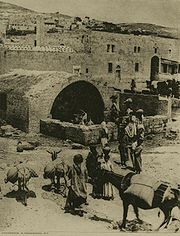 According to the Gospel of Luke
, Nazareth was the home village of Joseph
, Mary and also the site of the Annunciation
(when Mary was told by the Angel
Gabriel
that she would have Jesus
as her son). In the Gospel of Matthew
, Joseph and Mary resettled in Nazareth after fleeing to Egypt from their home in Bethlehem
. The differences and possible contradictions between these two accounts of the nativity of Jesus
are part of the Synoptic Problem. Nazareth was also where Jesus grew up from some point in his childhood. However, some modern scholars argue that Nazareth was also the birth place of Jesus.
James Strange, an American archaeologist, notes: “Nazareth is not mentioned in ancient Jewish sources earlier than the third century AD. This likely reflects its lack of prominence both in Galilee and in Judaea.” Strange originally speculated that the population of Nazareth at the time of Christ to be "roughly 1,600 to 2,000 people", but later, in a subsequent publication, at “a maximum of about 480.” In 2009 Israeli archaeologist Yardenna Alexandre excavated archaeological remains in Nazareth that might date to the time of Jesus in the early Roman period. Alexandre told reporters, "The discovery is of the utmost importance since it reveals for the very first time a house from the Jewish village of Nazareth."
According to the Israel Antiquities Authority
, "The artifacts recovered from inside the building were few and mostly included fragments of pottery vessels from the Early Roman period (the first and second centuries AD)... Another hewn pit, whose entrance was apparently camouflaged, was excavated and a few pottery sherds from the Early Roman period were found inside it." Alexandre adds that "based on other excavations that I conducted in other villages in the region, this pit was probably hewn as part of the preparations by the Jews to protect themselves during the Great Revolt against the Romans in 67 AD".
Ancient Nazareth may have built on the hillside, as indicated in the Gospel of Luke
: [And they led Jesus] to the brow of the hill on which their city was built, that they might throw him down headlong. However, the hill in question (the Nebi Sa'in) is far too steep for ancient dwellings and averages a 14% grade in the venerated area. Historic Nazareth was essentially constructed in the valley; the windy hilltops in the vicinity have only been occupied since the construction of Nazareth Illit
in 1957. Noteworthy is that all the post-Iron Age tombs in the Nazareth basin (approximately two dozen) are of the kokh
(plural:kokhim) or later types; this type probably first appeared in Galilee in the middle of the 1st century AD. Kokh tombs in the Nazareth area have been excavated by B. Bagatti, N. Feig, Z. Yavor, and noted by Z. Gal.
Excavations conducted prior to 1931 in the Franciscan venerated area revealed no trace of a Greek or Roman settlement there, Fr. Bagatti, who acted as the principal archaeologist for the venerated sites in Nazareth, unearthed quantities of later Roman
and Byzantine
artifacts, attesting to unambiguous human presence there from the 2nd century AD onward. John Dominic Crossan
, a noted New Testament scholar, remarked that Bagatti's archaeological drawings indicate just how small the village actually was, suggesting that it was little more than an insignificant hamlet
.
reads:
In the Gospel of John
, Nathaniel
asks, "Can anything good come out of Nazareth?" The meaning of this cryptic question is debated. Some commentators and scholars suggest that it means Nazareth was very small and unimportant, but the question does not speak of Nazareth’s size but of its goodness. In fact, Nazareth was described negatively by the evangelists; the Gospel of Mark
argues that Nazareth did not believe in Jesus and therefore he could "do no mighty work there"; in the Gospel of Luke
, the Nazarenes are portrayed as attempting to kill Jesus by throwing him off a cliff; in the Gospel of Thomas
, and in all four canonical gospels
, we read the famous saying that "a prophet is not without honor except in his own country."
Many scholars since W. Wrede (in 1901) have noted the so-called Messianic secret in the Gospel of Mark, whereby Jesus' true nature and/or mission is portrayed as unseen by many, including by his inner circle of disciples (compare the Gospel of John
's references to those to whom only the Father reveals Jesus will be saved). Nazareth, being the home of those near and dear to Jesus, apparently suffered negatively in relation to this doctrine. Thus, Nathanael’s question, “Can anything good come out of Nazareth?” is consistent with a negative view of Nazareth in the canonical gospels, and with the Johannine proclamation that even his brothers did not believe in him.
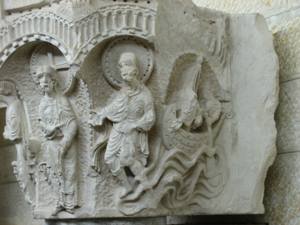 A tablet at the Bibliothèque Nationale in Paris, dating to 50 AD, was sent from Nazareth to Paris
in 1878. It contains an inscription known as the "Ordinance of Caesar" that outlines the penalty of death for those who violate tombs or graves. However, it is suspected that this inscription came to Nazareth from somewhere else (possibly Sepphoris). Bagatti writes: “we are not certain that it was found in Nazareth, even though it came from Nazareth to Paris. At Nazareth there lived various vendors of antiquities who got ancient material from several places.” C. Kopp is more definite: "It must be accepted with certainty that [the Ordinance of Caesar]… was brought to the Nazareth market by outside merchants." Princeton University
archaeologist Jack Finegan describes additional archaeological evidence related to settlement in the Nazareth basin during the Bronze
and Iron Age
s, and states that "Nazareth was a strongly Jewish settlement in the Roman
period.".
In the mid-1990s, a shopkeeper discovered tunnels under his shop near Mary's Well
in Nazareth. The tunnels were identified as the hypocaust
of a bathhouse. Excavations in 1997-98 revealed remains dating from the Roman, Crusader, Mamluk
and Ottoman
periods.
Epiphanius
writes in the Panarion
(c. 375 AD) of Joseph of Tiberias
, a wealthy Roman Jew who converted to Christianity in the time of Constantine. He claimed that he had built churches in Sepphoris and other towns that were inhabited only by Jews. Nazareth is mentioned, though the exact meaning is not clear. It was thus concluded that a small church which encompassed a cave complex was located in Nazareth in the early 4th century," although the town was Jewish until the 7th century AD.
Although mentioned in the New Testament gospels, there are no extant non-biblical references to Nazareth until around 200 AD, when Sextus Julius Africanus
, cited by Eusebius
(Church History 1.7.14), speaks of “Nazara” as a village in "Judea" and locates it near an as-yet unidentified “Cochaba.” In the same passage Africanus writes of desposunoi
- relatives of Jesus - who he claims kept the records of their descent with great care. A few authors have argued that the absence of 1st and 2nd century AD textual references to Nazareth suggest the town may not have been inhabited in Jesus' day. Proponents of this hypothesis have buttressed their case with linguistic, literary and archaeological interpretations, though such views have been called "archaeologically unsupportable".
inscription found in Caesarea, dating to the late 3rd or early 4th century, mentions Nazareth as the home of the priestly
Hapizzez family after the Bar Kokhba revolt (132-135 AD). From the three fragments that have been found, it appears that the inscription was a complete list of the twenty-four priestly courses (cf. 1 Chronicles
24:7-19; Nehemiah
11;12), with each course (or family) assigned its proper order and the name of each town or village in Galilee
where it settled. Nazareth is not spelled with the "z" sound but with the Hebrew tsade
(thus "Nasareth" or "Natsareth"). Eleazar Kalir
(a Hebrew Galilean poet variously dated from the 6th to 10th century) also mentions a locality clearly in the Nazareth region bearing the name Nazareth נצרת (in this case vocalized "Nitzrat"), which was home to the descendants of the 18th Kohen
clan or 'priestly course', Happitzetz הפצץ, for at least several centuries following the Bar Kochva
revolt.
In the 6th century, religious narrations from local Christians about the Virgin Mary began to spark interest in the site among pilgrims, who founded the Greek Orthodox Church of the Annunciation
at the site of a freshwater spring, today known as Mary's Well
. In 570, the Anonymous of Piacenza
reports travelling from Sepphoris to Nazareth; writing of the beauty of the Hebrew women there who say that St. Mary was a relative of theirs, he notes that, "The house of St. Mary is a basilica."
The Christian writer Jerome
, writing in the 5th century, says Nazareth was a viculus or mere village. The Jewish town profited from the Christian pilgrim trade which began in the 4th century, but latent anti-Christian hostility broke out in 614 AD when the Persians invaded Palestine. At that time, according to C. Kopp writing in 1938, the Jewish residents of Nazareth helped the Persians slaughter the Christians in the land. When the Byzantine or Eastern Roman emperor Heraclius ejected the Persians from Palestine in 630 AD, he singled out Nazareth for special punishment and imposed forced exile upon the Jewish families. At this time the town ceased to be Jewish.
, an extended period of conflict began in which control shifted several times between the local Saracens and Europeans. Control over Galilee and Nazareth shifted frequently during this time, with corresponding impact on the religious makeup of the population.
In 1099 AD, the Crusader Tancred
captured Galilee and established his capital in Nazareth. The ancient diocese of Scythopolis was also relocated under the Archbishop of Nazareth
, one of the four archdioceses in the Kingdom of Jerusalem
. The town returned to Muslim control in 1187 AD following the victory of Saladin
in the Battle of Hattin
. The remaining Crusaders and European clergy were forced to leave town. Frederick II
managed to negotiate safe passage for pilgrims from Acre in 1229, and in 1251, Louis IX
, the king of France, attended mass in the grotto, accompanied by his wife.
In 1263, Baybars, the Mamluk Sultan
, destroyed the Christian buildings in Nazareth and declared the site off-limits to Latin clergy, as part of his bid to drive out the remaining Crusaders from Palestine. While Arab Christian families continued to live in Nazareth, its status was reduced to that of a poor village. Pilgrims who visited the site in 1294 reported only a small church protecting the grotto.
In the 14th century, monks from the Franciscan Order were permitted to return and resided within the ruins of the Basilica, but they were eventually evicted again in 1584. In 1620, Fakhr-al-Din II
, a Druze
emir
who controlled this part of Ottoman Syria
rule, permitted them to return to build a small church at the Grotto of the Annunciation. Pilgrimage tours to surrounding sacred sites were also organized by the Franciscans from this point forward, but the monks suffered harassment from surrounding Bedouin
tribes who often kidnapped them for ransom. Stability returned with the rule of Daher el-Omar
, a powerful local sheikh
who ruled over much of the Galilee and who authorized the Franciscans to build a church in 1730. That structure stood until 1955, when it was demolished to make way for the building a larger structure which was completed in 1967.
Nazareth was captured by the troops of Napoleon Bonaparte in 1799, during his Syrian campaign. Napoleon visited the holy sites and considered appointing his general Junot as the duke of Nazareth. During the rule of Ibrahim Pasha
(1830–1840), the Egyptian general, over much of Ottoman Syria
, Nazareth was open to European missionaries and traders. After the Ottomans regained control, European money continued to flow into Nazareth and a number of institutions were established. The Christians of Nazareth were protected during the pogroms of 1860s by the dominant rule of Aghil Agha, the Bedouin leader who exercised control over the political and security situation in the Galilee between 1845 and 1870.
Kaloost Varstan, an Armenian
from Istanbul
, arrived in 1864 and established the first medical missionary in Nazareth, the Scottish "hospital on the hill", with sponsorship from the Edinburgh Medical Missionary Society. The Ottoman Sultan, who favored the French, allowed them to establish an orphanage, the Society of Saint Francis de Sale. By the late 19th century, Nazareth was a town with a strong Arab Christian presence and a growing European community, where a number of communal projects were undertaken and new religious buildings were erected.
. The town was not a field of battle during 1948 Arab-Israeli War
before the first truce on 11 June, although some of the villagers had joined the loosely organized peasant military and paramilitary forces, and troops from the Arab Liberation Army
had entered Nazareth. During the ten days of fighting which occurred between the first and second truce, Nazareth capitulated to Israeli troops during Operation Dekel
on 16 June, after little more than token resistance. The surrender was formalized in a written agreement, where the town leaders agreed to cease hostilities in return for promises from the Israeli officers, including brigade commander Ben Dunkelman
(the leader of the operation), that no harm would come to the civilians of the town.
Preparations for the Pope
's visit to Nazareth in 2000 triggered highly publicized tensions related to the Basilica of the Annunciation
. The 1997 permission for construction of a paved plaza to handle the expected thousands of Christian pilgrims caused Muslim protests and occupation of the proposed site, which is considered the grave of a nephew of Saladin. This site used to be the home of a school built during the Ottoman rule. The school was named al-Harbyeh (in Arabic means military), and many elderly people in Nazareth still remember it as the school site, nevertheless, the same site still contains,the Shihab-Eddin shrine, along with several shops owned by the waqf
(Muslim community ownership). The school building continued to serve as a government school until it was demolished to allow for the plaza to be built. The initial argument between the different political factions in town (represented in the local council), was on where the borders of the shrine and shops starts and where it ends. The initial government approval of subsequent plans for a large mosque to be constructed at the site led to protests from Christian leaders worldwide, which continued after the papal visit. Finally, in 2002, a special government commission permanently halted construction of the mosque.
In March 2006, public protests followed the disruption of a prayer service by an Israeli Jew and his Christian wife and daughter, who detonated firecrackers inside the church. The family said it wanted to draw attention to their problems with the welfare authorities.
In July 2006 a rocket fired by Hezbollah as part of the 2006 Israel-Lebanon conflict killed two children in Nazareth.
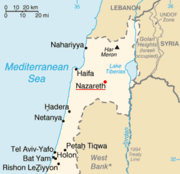 Two general locations of Nazareth are attested in the most ancient texts. The Galilean (Northern) location is familiar from the Christian gospels. However, a Southern (Judean) tradition is also attested in several early noncanonical texts.
Modern-day Nazareth is nestled in a natural bowl which reaches from 1,050 feet (320 m) above sea level
to the crest of the hills about 1,600 feet (490 m). Nazareth is about 25 kilometres (15.5 mi) from the Sea of Galilee
(17 km as the crow flies) and about 9 kilometres (5.6 mi) west from Mount Tabor
. The Nazareth Range, in which the town lies, is the southernmost of several parallel east-west hill ranges that characterize the elevated tableau of Lower Galilee.
Nazareth is the largest Arab city in Israel. Until the beginning of the British Mandate in Palestine (1922–1948), the population was predominantly Arab Christian (majority Orthodox Christians), with an Arab Muslim minority. Nazareth today still has a significant Christian
population, made up of Maronites
, Orthodox Christians, Roman Catholic, Melkite Eastern Catholics, Anglicans, Baptists, Evangelicals and Copts, among others. The Muslim population has grown, for a number of historical factors, that include the city having served as administrative center under British rule, and the influx of internally displaced Palestinians
absorbed into the city from neighbouring towns during the 1948 Arab-Israeli war
.
Nazareth's population remains almost exclusively Palestinian Arab. According to the Israel Central Bureau of Statistics
, of the approximately 65,000 inhabitants in 2005, 31.3% are Christian
and 68.7% Muslim
. The Mayor is a Palestinian Christian
. The Israeli government has designated a Nazareth metropolitan area
that includes the local councils
of Yafa an-Naseriyye
to the south, Reineh
, Mashhad and Kafr Kanna to the north, Iksal
and Nazareth Illit
to the east and Migdal HaEmek to the west. Together, the Nazareth metropolis area has a population of approximately 210,000 of which over 125,000 (59%) are Israeli Arabs, and 85,000 are Israeli Jews (41%), making it the only urban area with over 50,000 residents in Israel where the majority of the population is Arab
.
newspaper the city has been called the "Silicon Valley of the Arab community" in view of its potential in this sphere.
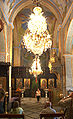 Nazareth is home to at least 23 monasteries and churches. Many of the older churches are located in the Old City.
There are also a number of mosque
s in Nazareth, the oldest of which is the White Mosque, located in Harat Alghama ("Mosque Quarter") in the center of Nazareth's Old Market.
in nearby Ilut
. Other local clubs Beitar al-Amal Nazareth, Hapoel Bnei Nazareth and Hapoel Nazareth all play in Liga Gimel
.
with: Florence
, Italy
Loreto
, Italy
Nablus
, Palestinian Authority Saint-Denis
, France
The Hague
, Netherlands
Częstochowa
, Poland
North District (Israel)
The Northern District is one of Israel's six administrative districts. The Northern District has a land area of 4,478 km², which increases to 4,638 km² when both land and water are included...
. Known as "the Arab
Arab
Arab people, also known as Arabs , are a panethnicity primarily living in the Arab world, which is located in Western Asia and North Africa. They are identified as such on one or more of genealogical, linguistic, or cultural grounds, with tribal affiliations, and intra-tribal relationships playing...
capital of Israel
Israel
The State of Israel is a parliamentary republic located in the Middle East, along the eastern shore of the Mediterranean Sea...
," the population is made up predominantly of Palestinian
Palestinian people
The Palestinian people, also referred to as Palestinians or Palestinian Arabs , are an Arabic-speaking people with origins in Palestine. Despite various wars and exoduses, roughly one third of the world's Palestinian population continues to reside in the area encompassing the West Bank, the Gaza...
Arab citizens of Israel
Arab citizens of Israel
Arab citizens of Israel refers to citizens of Israel who are not Jewish, and whose cultural and linguistic heritage or ethnic identity is Arab....
. In the New Testament
New Testament
The New Testament is the second major division of the Christian biblical canon, the first such division being the much longer Old Testament....
, the city is described as the childhood
Childhood
Childhood is the age span ranging from birth to adolescence. In developmental psychology, childhood is divided up into the developmental stages of toddlerhood , early childhood , middle childhood , and adolescence .- Age ranges of childhood :The term childhood is non-specific and can imply a...
home of Jesus
Jesus
Jesus of Nazareth , commonly referred to as Jesus Christ or simply as Jesus or Christ, is the central figure of Christianity...
, and as such is a center of Christian
Christianity
Christianity is a monotheistic religion based on the life and teachings of Jesus as presented in canonical gospels and other New Testament writings...
pilgrimage
Pilgrimage
A pilgrimage is a journey or search of great moral or spiritual significance. Typically, it is a journey to a shrine or other location of importance to a person's beliefs and faith...
, with many shrines commemorating biblical events.
Etymology
Nazareth is not mentioned in pre-Christian texts and appears in many different Greek forms in the New Testament. There is no consensus regarding the origin of the name. One theory holds that "Nazareth" is derived from the Hebrew noun ne·tser, נֵ֫צֶר, meaning branch. Ne·tser is not the common Hebrew word for "branch," but one understood as a messianic title based on a passage in the Book of IsaiahBook of Isaiah
The Book of Isaiah is the first of the Latter Prophets in the Hebrew Bible, preceding the books of Ezekiel, Jeremiah and the Book of the Twelve...
.Isaiah 11:1 Alternatively, the name may derive from the verb na·tsar, נָצַר, "watch, guard, keep." The negative references to Nazareth in the Gospel of John
Gospel of John
The Gospel According to John , commonly referred to as the Gospel of John or simply John, and often referred to in New Testament scholarship as the Fourth Gospel, is an account of the public ministry of Jesus...
suggest that ancient Jews did not connect the town's name to prophecy.
Another theory holds that the Greek form Nazara, used in Matthew and Luke, may derive from an earlier Aramaic
Aramaic language
Aramaic is a group of languages belonging to the Afroasiatic language phylum. The name of the language is based on the name of Aram, an ancient region in central Syria. Within this family, Aramaic belongs to the Semitic family, and more specifically, is a part of the Northwest Semitic subfamily,...
form of the name, or from another Semitic
Semitic
In linguistics and ethnology, Semitic was first used to refer to a language family of largely Middle Eastern origin, now called the Semitic languages...
language form. If there were a tsade
Tsade
' is the eighteenth letter in many Semitic alphabets, including Phoenician, Aramaic, Hebrew ' and Arabic ' . Its oldest sound value is probably , although there is a variety of pronunciation in different modern Semitic languages and their dialects...
(צ) in the original Semitic form, as in the later Hebrew forms, it would normally have been transcribed in Greek with a sigma instead of a zeta. This has led some scholars to question whether "Nazareth" and its cognates in the New Testament actually refer to the settlement we know traditionally as Nazareth in Lower Galilee. Such linguistic discrepancies may be explained, however, "by a peculiarity of the 'Palestinian' Aramaic dialect wherein a sade (ṣ) between two voiced (sonant) consonants tended to be partially assimilated by taking on a zayin (z) sound."
Arabic name, an-Nāṣira
The Arabic name for Nazareth is an-Nāṣira, and JesusJesus
Jesus of Nazareth , commonly referred to as Jesus Christ or simply as Jesus or Christ, is the central figure of Christianity...
is also called an-Nāṣirī, reflecting the Arab tradition of according people a nisba, a name denoting from whence a person comes in either geographical or tribal terms. In the Qur'an
Qur'an
The Quran , also transliterated Qur'an, Koran, Alcoran, Qur’ān, Coran, Kuran, and al-Qur’ān, is the central religious text of Islam, which Muslims consider the verbatim word of God . It is regarded widely as the finest piece of literature in the Arabic language...
, Christians are referred to as naṣārā, meaning "followers of an-Nāṣirī," or "those who follow Jesus." Similarly, in Maltese
Maltese language
Maltese is the national language of Malta, and a co-official language of the country alongside English,while also serving as an official language of the European Union, the only Semitic language so distinguished. Maltese is descended from Siculo-Arabic...
a Christian male is called Nisrani, whilst someone from Nazareth is called Nazzarenu. Whereas Nisrani is of direct Semitic origin, it is very likely that Nazzarenu was adopted via the Italian Nazzareno (from Latin, Nazarenus, meaning Nazarene.)
Biblical references
In English translations of the New Testament, the phrase "Jesus of Nazareth" appears seventeen times where the Greek literally means "Jesus the Nazarene" or "Jesus the Nazoraean." Even though a standard English concordance (e.g., Strong's Exhaustive Concordance of the Bible) lists "Nazareth" twenty-nine times, the place is actually named only twelve times in surviving Greek versions of the New Testament, where it appears in several forms: Nazara, Nazaret, Nazareth, Nazarat, Nazarath. The other English references come from the Greek adjective nazarenos, "of Nazareth" applied to Jesus.Nazara (Ναζαρα) is generally considered the earliest form of the name in Greek, and is found in and , as well as the putative Q document, which many scholars maintain preceded 70 AD and the formation of the canonical Christian gospels. The form Nazareth appears once in the Gospel of Matthew , four times in the birth chapters of the Gospel of Luke at ; , , , and once in the Acts of the Apostles at . In the Gospel of Mark, the name appears only once in in the form Nazaret.
Many scholars have questioned a link between "Nazareth" and the terms "Nazarene
Nazarene (sect)
The Nazarene sect is used in two contexts:* Firstly of the New Testament early church where in Acts 24:5 Paul is accused before Felix at Caesarea by Tertullus of being "a ringleader of the sect of the Nazarenes."...
" and "Nazoraean" on linguistic grounds, while some affirm the possibility of etymological relation "given the idiosyncrasies of Galilean Aramaic."
Extrabiblical references
The form Nazara is also found in the earliest non-scriptural reference to the town, a citation by Sextus Julius AfricanusSextus Julius Africanus
Sextus Julius Africanus was a Christian traveller and historian of the late 2nd and early 3rd century AD. He is important chiefly because of his influence on Eusebius, on all the later writers of Church history among the Fathers, and on the whole Greek school of chroniclers.His name indicates that...
dated about 200 AD (see "Middle Roman to Byzantine Periods" below). The Church Father Origen
Origen
Origen , or Origen Adamantius, 184/5–253/4, was an early Christian Alexandrian scholar and theologian, and one of the most distinguished writers of the early Church. As early as the fourth century, his orthodoxy was suspect, in part because he believed in the pre-existence of souls...
(c. 185 to 254 AD) knows the forms Nazara and Nazaret. Later, Eusebius in his Onomasticon (translated by St. Jerome) also refers to the settlement as Nazara. In their scriptures, the Mandeans
Mandaeism
Mandaeism or Mandaeanism is a Gnostic religion with a strongly dualistic worldview. Its adherents, the Mandaeans, revere Adam, Abel, Seth, Enosh, Noah, Shem, Aram and especially John the Baptist...
mention nasirutha as a place they go.
The first non-Christian reference to Nazareth is an inscription on a marble fragment from a synagogue
Synagogue
A synagogue is a Jewish house of prayer. This use of the Greek term synagogue originates in the Septuagint where it sometimes translates the Hebrew word for assembly, kahal...
found in Caesarea Maritima in 1962. This fragment gives the town's name in Hebrew as "נצרת" (n-ṣ-r-t). The inscription dates to c. 300 AD and chronicles the assignment of priests that took place at some time after the Bar Kokhba revolt, 132-35 AD. (See "Middle Roman to Byzantine Periods" below.) An 8th century AD Hebrew inscription, which was the earliest known Hebrew reference to Nazareth prior to the discovery of the inscription above, uses the same form.
Nazarenes, Notzrim, Christians
Around 331 Eusebius records that from the name Nazareth Christ was called a Nazoraean, and that in earlier centuries Christians, were once called Nazarenes. Tertullian (Against Marcion 4:8) records that "for this reason the Jews call us 'Nazarenes'. In the New Testament Christians are called "Christians" three times by Romans, and "Nazarenes" once by TertullusTertullus
In the Bible, Tertullus was a lawyer, who was employed by the Jews to state their case against Paul in the presence of Felix ....
, a Jewish lawyer. The Talmudic and modern Hebrew name for Christians, notzrim, is also thought to derive from Nazareth, and be connected with Tertullus
Tertullus
In the Bible, Tertullus was a lawyer, who was employed by the Jews to state their case against Paul in the presence of Felix ....
' charge against Paul of being a member of the sect of the Nazarenes
Nazarene (title)
Nazarene is a title applied to Jesus , who grew up in Nazareth, a town in Galilee, now in northern Israel. The word is used to translate two related words that appear in the Greek New Testament: the adjective Nazarēnos and the Nazōraios...
, Nazoraioi, "men of Nazareth" in Acts. Against this some medieval Jewish polemical texts connect notzrim with the netsarim "watchmen" of Ephraim in Jeremiah 31:6. In Syrian Aramaic Nasrat (ܢܨܪܬ) is used for Nazareth, while "Nazarenes" (Acts 24:5) and "of Nazareth" are both nasraya (ܕܢܨܪܝܐ) an adjectival form.
Ancient times
Archaeological research revealed a funerary and cult center at Kfar HaHoreshKfar HaHoresh
Kfar HaHoresh is a kibbutz in northern Israel. Located near Nazareth, it falls under the jurisdiction of Jezreel Valley Regional Council. In 2006 it had a population of 423....
, about two miles (3 km) from current Nazareth, dating back roughly 9000 years (to what is known as the Pre-Pottery Neolithic B
Pre-Pottery Neolithic B
Pre-Pottery Neolithic B is a division of the Neolithic developed by Dame Kathleen Kenyon during her archaeological excavations at Jericho in the southern Levant region....
era). The remains of some 65 individuals were found, buried under huge horizontal headstone structures, some of which consisted of up to 3 tons of locally-produced white plaster. Decorated human skulls uncovered there have led archaeologists to believe that Kfar HaHoresh was a major cult centre in that remote era.
In 1620 the Catholic Church purchased an area in the Nazareth basin measuring approx. 100 by 150 m (328.1 by 492.1 ) on the side of the hill known as the Nebi Sa'in. This "Venerated Area" underwent extensive excavation in 1955-65 by the Franciscan priest Belarmino Bagatti, "Director of Christian Archaeology." Fr. Bagatti has been the principal archaeologist at Nazareth. His book, Excavations in Nazareth (1969) is still the standard reference for the archaeology of the settlement, and is based on excavations at the Franciscan Venerated Area.
Fr. Bagatti uncovered pottery dating from the Middle Bronze Age (2200 to 1500 BC) and ceramics, silos and grinding mills from the Iron Age (1500 to 586 BC), pointing to substantial settlement in the Nazareth basin at that time. However, lack of archaeological evidence from Assyria
Assyria
Assyria was a Semitic Akkadian kingdom, extant as a nation state from the mid–23rd century BC to 608 BC centred on the Upper Tigris river, in northern Mesopotamia , that came to rule regional empires a number of times through history. It was named for its original capital, the ancient city of Assur...
n, Babylonian, Persian, Hellenistic
Hellenistic period
The Hellenistic period or Hellenistic era describes the time which followed the conquests of Alexander the Great. It was so named by the historian J. G. Droysen. During this time, Greek cultural influence and power was at its zenith in Europe and Asia...
or Early Roman
Ancient Rome
Ancient Rome was a thriving civilization that grew on the Italian Peninsula as early as the 8th century BC. Located along the Mediterranean Sea and centered on the city of Rome, it expanded to one of the largest empires in the ancient world....
times, at least in the major excavations between 1955 and 1990, shows that the settlement apparently came to an abrupt end about 720 BC, when many towns in the area were destroyed by the Assyrians.
Early Christian era
Gospel of Luke
The Gospel According to Luke , commonly shortened to the Gospel of Luke or simply Luke, is the third and longest of the four canonical Gospels. This synoptic gospel is an account of the life and ministry of Jesus of Nazareth. It details his story from the events of his birth to his Ascension.The...
, Nazareth was the home village of Joseph
Saint Joseph
Saint Joseph is a figure in the Gospels, the husband of the Virgin Mary and the earthly father of Jesus Christ ....
, Mary and also the site of the Annunciation
Annunciation
The Annunciation, also referred to as the Annunciation to the Blessed Virgin Mary or Annunciation of the Lord, is the Christian celebration of the announcement by the angel Gabriel to Virgin Mary, that she would conceive and become the mother of Jesus the Son of God. Gabriel told Mary to name her...
(when Mary was told by the Angel
Angel
Angels are mythical beings often depicted as messengers of God in the Hebrew and Christian Bibles along with the Quran. The English word angel is derived from the Greek ἄγγελος, a translation of in the Hebrew Bible ; a similar term, ملائكة , is used in the Qur'an...
Gabriel
Gabriel
In Abrahamic religions, Gabriel is an Archangel who typically serves as a messenger to humans from God.He first appears in the Book of Daniel, delivering explanations of Daniel's visions. In the Gospel of Luke Gabriel foretells the births of both John the Baptist and of Jesus...
that she would have Jesus
Jesus
Jesus of Nazareth , commonly referred to as Jesus Christ or simply as Jesus or Christ, is the central figure of Christianity...
as her son). In the Gospel of Matthew
Gospel of Matthew
The Gospel According to Matthew is one of the four canonical gospels, one of the three synoptic gospels, and the first book of the New Testament. It tells of the life, ministry, death, and resurrection of Jesus of Nazareth...
, Joseph and Mary resettled in Nazareth after fleeing to Egypt from their home in Bethlehem
Bethlehem
Bethlehem is a Palestinian city in the central West Bank of the Jordan River, near Israel and approximately south of Jerusalem, with a population of about 30,000 people. It is the capital of the Bethlehem Governorate of the Palestinian National Authority and a hub of Palestinian culture and tourism...
. The differences and possible contradictions between these two accounts of the nativity of Jesus
Nativity of Jesus
The Nativity of Jesus, or simply The Nativity, refers to the accounts of the birth of Jesus in two of the Canonical gospels and in various apocryphal texts....
are part of the Synoptic Problem. Nazareth was also where Jesus grew up from some point in his childhood. However, some modern scholars argue that Nazareth was also the birth place of Jesus.
James Strange, an American archaeologist, notes: “Nazareth is not mentioned in ancient Jewish sources earlier than the third century AD. This likely reflects its lack of prominence both in Galilee and in Judaea.” Strange originally speculated that the population of Nazareth at the time of Christ to be "roughly 1,600 to 2,000 people", but later, in a subsequent publication, at “a maximum of about 480.” In 2009 Israeli archaeologist Yardenna Alexandre excavated archaeological remains in Nazareth that might date to the time of Jesus in the early Roman period. Alexandre told reporters, "The discovery is of the utmost importance since it reveals for the very first time a house from the Jewish village of Nazareth."
According to the Israel Antiquities Authority
Israel Antiquities Authority
The Israel Antiquities Authority is an independent Israeli governmental authority responsible for enforcing the 1978 Law of Antiquities. The IAA regulates excavation and conservation, and promotes research...
, "The artifacts recovered from inside the building were few and mostly included fragments of pottery vessels from the Early Roman period (the first and second centuries AD)... Another hewn pit, whose entrance was apparently camouflaged, was excavated and a few pottery sherds from the Early Roman period were found inside it." Alexandre adds that "based on other excavations that I conducted in other villages in the region, this pit was probably hewn as part of the preparations by the Jews to protect themselves during the Great Revolt against the Romans in 67 AD".
Ancient Nazareth may have built on the hillside, as indicated in the Gospel of Luke
Gospel of Luke
The Gospel According to Luke , commonly shortened to the Gospel of Luke or simply Luke, is the third and longest of the four canonical Gospels. This synoptic gospel is an account of the life and ministry of Jesus of Nazareth. It details his story from the events of his birth to his Ascension.The...
: [And they led Jesus] to the brow of the hill on which their city was built, that they might throw him down headlong. However, the hill in question (the Nebi Sa'in) is far too steep for ancient dwellings and averages a 14% grade in the venerated area. Historic Nazareth was essentially constructed in the valley; the windy hilltops in the vicinity have only been occupied since the construction of Nazareth Illit
Nazareth Illit
Nazareth Illit is a city in the North District of Israel. At the end of 2007 it had a population of 40,800.Nazareth Illit was founded in the 1950s. Foundations were laid in 1954 and first residents moved in two years later...
in 1957. Noteworthy is that all the post-Iron Age tombs in the Nazareth basin (approximately two dozen) are of the kokh
Kokhim
Kokh is a type of tomb complex characterized by a series of long narrow shafts, in which the deceased were placed for burial, radiating from a central chamber...
(plural:kokhim) or later types; this type probably first appeared in Galilee in the middle of the 1st century AD. Kokh tombs in the Nazareth area have been excavated by B. Bagatti, N. Feig, Z. Yavor, and noted by Z. Gal.
Excavations conducted prior to 1931 in the Franciscan venerated area revealed no trace of a Greek or Roman settlement there, Fr. Bagatti, who acted as the principal archaeologist for the venerated sites in Nazareth, unearthed quantities of later Roman
Ancient Rome
Ancient Rome was a thriving civilization that grew on the Italian Peninsula as early as the 8th century BC. Located along the Mediterranean Sea and centered on the city of Rome, it expanded to one of the largest empires in the ancient world....
and Byzantine
Byzantine
Byzantine usually refers to the Roman Empire during the Middle Ages.Byzantine may also refer to:* A citizen of the Byzantine Empire, or native Greek during the Middle Ages...
artifacts, attesting to unambiguous human presence there from the 2nd century AD onward. John Dominic Crossan
John Dominic Crossan
John Dominic Crossan is an Irish-American religious scholar and former Catholic priest known for co-founding the Jesus Seminar. Crossan is a major figure in the fields of biblical archaeology, anthropology and New Testament textual and higher criticism. He is also a lecturer who has appeared in...
, a noted New Testament scholar, remarked that Bagatti's archaeological drawings indicate just how small the village actually was, suggesting that it was little more than an insignificant hamlet
Hamlet (place)
A hamlet is usually a rural settlement which is too small to be considered a village, though sometimes the word is used for a different sort of community. Historically, when a hamlet became large enough to justify building a church, it was then classified as a village...
.
reads:
After Herod died, an angel of the Lord appeared in a dream to Joseph in Egypt and said, "Get up, take the child and his mother and go to the land of Israel, for those who were trying to take the child's life are dead." So he got up, took the child and his mother and went to the land of Israel. But when he heard that Archelaus was reigning in Judea in place of his father Herod, he was afraid to go there. Having been warned in a dream, he withdrew to the district of Galilee, and he went and lived in a town called Nazareth. So was fulfilled what was said through the prophets: "He will be called a Nazarene."
In the Gospel of John
Gospel of John
The Gospel According to John , commonly referred to as the Gospel of John or simply John, and often referred to in New Testament scholarship as the Fourth Gospel, is an account of the public ministry of Jesus...
, Nathaniel
Nathaniel
Nathaniel is a male name and surname. It comes from the Hebrew name נְתַנְאֵל/Nethan'el meaning "God has given"...
asks, "Can anything good come out of Nazareth?" The meaning of this cryptic question is debated. Some commentators and scholars suggest that it means Nazareth was very small and unimportant, but the question does not speak of Nazareth’s size but of its goodness. In fact, Nazareth was described negatively by the evangelists; the Gospel of Mark
Gospel of Mark
The Gospel According to Mark , commonly shortened to the Gospel of Mark or simply Mark, is the second book of the New Testament. This canonical account of the life of Jesus of Nazareth is one of the three synoptic gospels. It was thought to be an epitome, which accounts for its place as the second...
argues that Nazareth did not believe in Jesus and therefore he could "do no mighty work there"; in the Gospel of Luke
Gospel of Luke
The Gospel According to Luke , commonly shortened to the Gospel of Luke or simply Luke, is the third and longest of the four canonical Gospels. This synoptic gospel is an account of the life and ministry of Jesus of Nazareth. It details his story from the events of his birth to his Ascension.The...
, the Nazarenes are portrayed as attempting to kill Jesus by throwing him off a cliff; in the Gospel of Thomas
Gospel of Thomas
The Gospel According to Thomas, commonly shortened to the Gospel of Thomas, is a well preserved early Christian, non-canonical sayings-gospel discovered near Nag Hammadi, Egypt, in December 1945, in one of a group of books known as the Nag Hammadi library...
, and in all four canonical gospels
Biblical canon
A biblical canon, or canon of scripture, is a list of books considered to be authoritative as scripture by a particular religious community. The term itself was first coined by Christians, but the idea is found in Jewish sources. The internal wording of the text can also be specified, for example...
, we read the famous saying that "a prophet is not without honor except in his own country."
Many scholars since W. Wrede (in 1901) have noted the so-called Messianic secret in the Gospel of Mark, whereby Jesus' true nature and/or mission is portrayed as unseen by many, including by his inner circle of disciples (compare the Gospel of John
Gospel of John
The Gospel According to John , commonly referred to as the Gospel of John or simply John, and often referred to in New Testament scholarship as the Fourth Gospel, is an account of the public ministry of Jesus...
's references to those to whom only the Father reveals Jesus will be saved). Nazareth, being the home of those near and dear to Jesus, apparently suffered negatively in relation to this doctrine. Thus, Nathanael’s question, “Can anything good come out of Nazareth?” is consistent with a negative view of Nazareth in the canonical gospels, and with the Johannine proclamation that even his brothers did not believe in him.
Paris
Paris is the capital and largest city in France, situated on the river Seine, in northern France, at the heart of the Île-de-France region...
in 1878. It contains an inscription known as the "Ordinance of Caesar" that outlines the penalty of death for those who violate tombs or graves. However, it is suspected that this inscription came to Nazareth from somewhere else (possibly Sepphoris). Bagatti writes: “we are not certain that it was found in Nazareth, even though it came from Nazareth to Paris. At Nazareth there lived various vendors of antiquities who got ancient material from several places.” C. Kopp is more definite: "It must be accepted with certainty that [the Ordinance of Caesar]… was brought to the Nazareth market by outside merchants." Princeton University
Princeton University
Princeton University is a private research university located in Princeton, New Jersey, United States. The school is one of the eight universities of the Ivy League, and is one of the nine Colonial Colleges founded before the American Revolution....
archaeologist Jack Finegan describes additional archaeological evidence related to settlement in the Nazareth basin during the Bronze
Bronze Age
The Bronze Age is a period characterized by the use of copper and its alloy bronze as the chief hard materials in the manufacture of some implements and weapons. Chronologically, it stands between the Stone Age and Iron Age...
and Iron Age
Iron Age
The Iron Age is the archaeological period generally occurring after the Bronze Age, marked by the prevalent use of iron. The early period of the age is characterized by the widespread use of iron or steel. The adoption of such material coincided with other changes in society, including differing...
s, and states that "Nazareth was a strongly Jewish settlement in the Roman
Roman Empire
The Roman Empire was the post-Republican period of the ancient Roman civilization, characterised by an autocratic form of government and large territorial holdings in Europe and around the Mediterranean....
period.".
In the mid-1990s, a shopkeeper discovered tunnels under his shop near Mary's Well
Mary's Well
Mary’s Well is reputed to be located at the site where the Angel Gabriel appeared to Mary and announced that she would bear the Son of God - an event known as the Annunciation....
in Nazareth. The tunnels were identified as the hypocaust
Hypocaust
A hypocaust was an ancient Roman system of underfloor heating, used to heat houses with hot air. The word derives from the Ancient Greek hypo meaning "under" and caust-, meaning "burnt"...
of a bathhouse. Excavations in 1997-98 revealed remains dating from the Roman, Crusader, Mamluk
Mamluk Sultanate (Cairo)
The Mamluk Sultanate of Egypt was the final independent Egyptian state prior to the establishment of the Muhammad Ali Dynasty in 1805. It lasted from the overthrow of the Ayyubid Dynasty until the Ottoman conquest of Egypt in 1517. The sultanate's ruling caste was composed of Mamluks, Arabised...
and Ottoman
Ottoman Empire
The Ottoman EmpireIt was usually referred to as the "Ottoman Empire", the "Turkish Empire", the "Ottoman Caliphate" or more commonly "Turkey" by its contemporaries...
periods.
Epiphanius
Epiphanius of Salamis
Epiphanius of Salamis was bishop of Salamis at the end of the 4th century. He is considered a saint and a Church Father by both the Eastern Orthodox and Catholic Churches. He gained a reputation as a strong defender of orthodoxy...
writes in the Panarion
Panarion
In early Christian heresiology, the Panarion , to which 16th-century Latin translations gave the name Adversus Haereses , is the most important of the works of Epiphanius of Salamis...
(c. 375 AD) of Joseph of Tiberias
Joseph of Tiberias
Joseph of Tiberias was a Christian of Jewish origin.According to Epiphanius, he was born during the reign of Emperor Constantine. He was a Rabbinical scholar and member of the Sanhedrin and a disciple of Hillel II...
, a wealthy Roman Jew who converted to Christianity in the time of Constantine. He claimed that he had built churches in Sepphoris and other towns that were inhabited only by Jews. Nazareth is mentioned, though the exact meaning is not clear. It was thus concluded that a small church which encompassed a cave complex was located in Nazareth in the early 4th century," although the town was Jewish until the 7th century AD.
Although mentioned in the New Testament gospels, there are no extant non-biblical references to Nazareth until around 200 AD, when Sextus Julius Africanus
Sextus Julius Africanus
Sextus Julius Africanus was a Christian traveller and historian of the late 2nd and early 3rd century AD. He is important chiefly because of his influence on Eusebius, on all the later writers of Church history among the Fathers, and on the whole Greek school of chroniclers.His name indicates that...
, cited by Eusebius
Eusebius of Caesarea
Eusebius of Caesarea also called Eusebius Pamphili, was a Roman historian, exegete and Christian polemicist. He became the Bishop of Caesarea in Palestine about the year 314. Together with Pamphilus, he was a scholar of the Biblical canon...
(Church History 1.7.14), speaks of “Nazara” as a village in "Judea" and locates it near an as-yet unidentified “Cochaba.” In the same passage Africanus writes of desposunoi
Desposyni
The term Desposyni refers to alleged blood relatives of Jesus. The term was coined by Sextus Julius Africanus, a writer of the early 3rd century. Some scholars argue that Jesus' relatives held positions of special honor in the Early Christian Church...
- relatives of Jesus - who he claims kept the records of their descent with great care. A few authors have argued that the absence of 1st and 2nd century AD textual references to Nazareth suggest the town may not have been inhabited in Jesus' day. Proponents of this hypothesis have buttressed their case with linguistic, literary and archaeological interpretations, though such views have been called "archaeologically unsupportable".
Middle Roman to Byzantine periods
In 1960, a HebrewHebrew language
Hebrew is a Semitic language of the Afroasiatic language family. Culturally, is it considered by Jews and other religious groups as the language of the Jewish people, though other Jewish languages had originated among diaspora Jews, and the Hebrew language is also used by non-Jewish groups, such...
inscription found in Caesarea, dating to the late 3rd or early 4th century, mentions Nazareth as the home of the priestly
Kohen
A Kohen is the Hebrew word for priest. Jewish Kohens are traditionally believed and halachically required to be of direct patrilineal descent from the Biblical Aaron....
Hapizzez family after the Bar Kokhba revolt (132-135 AD). From the three fragments that have been found, it appears that the inscription was a complete list of the twenty-four priestly courses (cf. 1 Chronicles
Books of Chronicles
The Books of Chronicles are part of the Hebrew Bible. In the Masoretic Text, it appears as the first or last book of the Ketuvim . Chronicles largely parallels the Davidic narratives in the Books of Samuel and the Books of Kings...
24:7-19; Nehemiah
Nehemiah
Nehemiah ]]," Standard Hebrew Nəḥemya, Tiberian Hebrew Nəḥemyāh) is the central figure of the Book of Nehemiah, which describes his work rebuilding Jerusalem and purifying the Jewish community. He was the son of Hachaliah, Nehemiah ]]," Standard Hebrew Nəḥemya, Tiberian Hebrew Nəḥemyāh) is the...
11;12), with each course (or family) assigned its proper order and the name of each town or village in Galilee
Galilee
Galilee , is a large region in northern Israel which overlaps with much of the administrative North District of the country. Traditionally divided into Upper Galilee , Lower Galilee , and Western Galilee , extending from Dan to the north, at the base of Mount Hermon, along Mount Lebanon to the...
where it settled. Nazareth is not spelled with the "z" sound but with the Hebrew tsade
Tsade
' is the eighteenth letter in many Semitic alphabets, including Phoenician, Aramaic, Hebrew ' and Arabic ' . Its oldest sound value is probably , although there is a variety of pronunciation in different modern Semitic languages and their dialects...
(thus "Nasareth" or "Natsareth"). Eleazar Kalir
Eleazar Kalir
Eleazar ben Kalir was one of Judaism's earliest and most prolific of the paytanim, liturgical poets. Many of his hymns have found their way into festive prayers of the Ashkenazi Jews synagogal rite....
(a Hebrew Galilean poet variously dated from the 6th to 10th century) also mentions a locality clearly in the Nazareth region bearing the name Nazareth נצרת (in this case vocalized "Nitzrat"), which was home to the descendants of the 18th Kohen
Kohen
A Kohen is the Hebrew word for priest. Jewish Kohens are traditionally believed and halachically required to be of direct patrilineal descent from the Biblical Aaron....
clan or 'priestly course', Happitzetz הפצץ, for at least several centuries following the Bar Kochva
Simon bar Kokhba
Simon bar Kokhba was the Jewish leader of what is known as the Bar Kokhba revolt against the Roman Empire in 132 CE, establishing an independent Jewish state of Israel which he ruled for three years as Nasi...
revolt.
In the 6th century, religious narrations from local Christians about the Virgin Mary began to spark interest in the site among pilgrims, who founded the Greek Orthodox Church of the Annunciation
Greek Orthodox Church of the Annunciation
The Greek Orthodox Church of the Annunciation, also known as the Church of St. Gabriel or St. Gabriel's Greek Orthodox Church, is an Eastern Orthodox church in Nazareth, Israel...
at the site of a freshwater spring, today known as Mary's Well
Mary's Well
Mary’s Well is reputed to be located at the site where the Angel Gabriel appeared to Mary and announced that she would bear the Son of God - an event known as the Annunciation....
. In 570, the Anonymous of Piacenza
Antoninus of Piacenza
The sixth-century pilgrim Antoninus of Piacenza, or the Anonymous Pilgrim of Piacenza, who described the holy places of Jerusalem in the 570s is confused often with Saint Antoninus of Piacenza, who is venerated as a saint and martyr in the Roman Catholic Church, with a feast day of 13 November in...
reports travelling from Sepphoris to Nazareth; writing of the beauty of the Hebrew women there who say that St. Mary was a relative of theirs, he notes that, "The house of St. Mary is a basilica."
The Christian writer Jerome
Jerome
Saint Jerome was a Roman Christian priest, confessor, theologian and historian, and who became a Doctor of the Church. He was the son of Eusebius, of the city of Stridon, which was on the border of Dalmatia and Pannonia...
, writing in the 5th century, says Nazareth was a viculus or mere village. The Jewish town profited from the Christian pilgrim trade which began in the 4th century, but latent anti-Christian hostility broke out in 614 AD when the Persians invaded Palestine. At that time, according to C. Kopp writing in 1938, the Jewish residents of Nazareth helped the Persians slaughter the Christians in the land. When the Byzantine or Eastern Roman emperor Heraclius ejected the Persians from Palestine in 630 AD, he singled out Nazareth for special punishment and imposed forced exile upon the Jewish families. At this time the town ceased to be Jewish.
Islamic rule
The Muslim conquest of Palestine in 637 AD introduced Islam to the region. Over the next four centuries Islam was adopted by much of the population, though a significant Arab Christian minority remained. With outbreak of the First CrusadeFirst Crusade
The First Crusade was a military expedition by Western Christianity to regain the Holy Lands taken in the Muslim conquest of the Levant, ultimately resulting in the recapture of Jerusalem...
, an extended period of conflict began in which control shifted several times between the local Saracens and Europeans. Control over Galilee and Nazareth shifted frequently during this time, with corresponding impact on the religious makeup of the population.
In 1099 AD, the Crusader Tancred
Tancred, Prince of Galilee
Tancred was a Norman leader of the First Crusade who later became Prince of Galilee and regent of the Principality of Antioch...
captured Galilee and established his capital in Nazareth. The ancient diocese of Scythopolis was also relocated under the Archbishop of Nazareth
Archbishop of Nazareth
The Archbishop of Nazareth was one of the major suffragans of the Latin Patriarch of Jerusalem during the crusades.The ancient diocese was located at Scythopolis, known as Bethsan to the crusaders. It was the metropolis of Palaestina Secunda. After Nazareth was captured following the First Crusade,...
, one of the four archdioceses in the Kingdom of Jerusalem
Kingdom of Jerusalem
The Kingdom of Jerusalem was a Catholic kingdom established in the Levant in 1099 after the First Crusade. The kingdom lasted nearly two hundred years, from 1099 until 1291 when the last remaining possession, Acre, was destroyed by the Mamluks, but its history is divided into two distinct periods....
. The town returned to Muslim control in 1187 AD following the victory of Saladin
Saladin
Ṣalāḥ ad-Dīn Yūsuf ibn Ayyūb , better known in the Western world as Saladin, was an Arabized Kurdish Muslim, who became the first Sultan of Egypt and Syria, and founded the Ayyubid dynasty. He led Muslim and Arab opposition to the Franks and other European Crusaders in the Levant...
in the Battle of Hattin
Battle of Hattin
The Battle of Hattin took place on Saturday, July 4, 1187, between the Crusader Kingdom of Jerusalem and the forces of the Ayyubid dynasty....
. The remaining Crusaders and European clergy were forced to leave town. Frederick II
Frederick II, Holy Roman Emperor
Frederick II , was one of the most powerful Holy Roman Emperors of the Middle Ages and head of the House of Hohenstaufen. His political and cultural ambitions, based in Sicily and stretching through Italy to Germany, and even to Jerusalem, were enormous...
managed to negotiate safe passage for pilgrims from Acre in 1229, and in 1251, Louis IX
Louis IX
Louis IX may refer to:* Louis IX of France .* Louis IX, Duke of Bavaria "the Rich" * Louis IX, Landgrave of Hesse-Darmstadt ....
, the king of France, attended mass in the grotto, accompanied by his wife.
In 1263, Baybars, the Mamluk Sultan
Mamluk Sultanate (Cairo)
The Mamluk Sultanate of Egypt was the final independent Egyptian state prior to the establishment of the Muhammad Ali Dynasty in 1805. It lasted from the overthrow of the Ayyubid Dynasty until the Ottoman conquest of Egypt in 1517. The sultanate's ruling caste was composed of Mamluks, Arabised...
, destroyed the Christian buildings in Nazareth and declared the site off-limits to Latin clergy, as part of his bid to drive out the remaining Crusaders from Palestine. While Arab Christian families continued to live in Nazareth, its status was reduced to that of a poor village. Pilgrims who visited the site in 1294 reported only a small church protecting the grotto.
In the 14th century, monks from the Franciscan Order were permitted to return and resided within the ruins of the Basilica, but they were eventually evicted again in 1584. In 1620, Fakhr-al-Din II
Fakhr-al-Din II
Emir Fakhr-al-Din ibn Maan was the 1st prince of the State of Lebanon which has self-governed under the Ottoman Empire between the 17th and 19th centuries. Son of Prince Qorqmaz ibn Maan and Sit Nasab of the Tanukhi family, he was given the title "Emir" or Prince in Arabic because the Maan...
, a Druze
Druze
The Druze are an esoteric, monotheistic religious community, found primarily in Syria, Lebanon, Israel, and Jordan, which emerged during the 11th century from Ismailism. The Druze have an eclectic set of beliefs that incorporate several elements from Abrahamic religions, Gnosticism, Neoplatonism...
emir
Emir
Emir , meaning "commander", "general", or "prince"; also transliterated as Amir, Aamir or Ameer) is a title of high office, used throughout the Muslim world...
who controlled this part of Ottoman Syria
Ottoman Syria
Ottoman Syria is a European reference to the area that during European Renaissance from the late 15th to early 18th century was called the Levant within the early period of the Ottoman Empire, the Orient until the early 19th century, and Greater Syria until 1918...
rule, permitted them to return to build a small church at the Grotto of the Annunciation. Pilgrimage tours to surrounding sacred sites were also organized by the Franciscans from this point forward, but the monks suffered harassment from surrounding Bedouin
Bedouin
The Bedouin are a part of a predominantly desert-dwelling Arab ethnic group traditionally divided into tribes or clans, known in Arabic as ..-Etymology:...
tribes who often kidnapped them for ransom. Stability returned with the rule of Daher el-Omar
Daher el-Omar
Daher el-Omar was the Arab-Bedouin ruler of the Galilee district of the southern Levant during the mid-18th century...
, a powerful local sheikh
Sheikh
Not to be confused with sikhSheikh — also spelled Sheik or Shaikh, or transliterated as Shaykh — is an honorific in the Arabic language that literally means "elder" and carries the meaning "leader and/or governor"...
who ruled over much of the Galilee and who authorized the Franciscans to build a church in 1730. That structure stood until 1955, when it was demolished to make way for the building a larger structure which was completed in 1967.
Nazareth was captured by the troops of Napoleon Bonaparte in 1799, during his Syrian campaign. Napoleon visited the holy sites and considered appointing his general Junot as the duke of Nazareth. During the rule of Ibrahim Pasha
Ibrahim Pasha of Egypt
Ibrahim Pasha was the eldest son of Muhammad Ali, the Wāli and unrecognised Khedive of Egypt and Sudan. He served as a general in the Egyptian army that his father established during his reign, taking his first command of Egyptian forces was when he was merely a teenager...
(1830–1840), the Egyptian general, over much of Ottoman Syria
Ottoman Syria
Ottoman Syria is a European reference to the area that during European Renaissance from the late 15th to early 18th century was called the Levant within the early period of the Ottoman Empire, the Orient until the early 19th century, and Greater Syria until 1918...
, Nazareth was open to European missionaries and traders. After the Ottomans regained control, European money continued to flow into Nazareth and a number of institutions were established. The Christians of Nazareth were protected during the pogroms of 1860s by the dominant rule of Aghil Agha, the Bedouin leader who exercised control over the political and security situation in the Galilee between 1845 and 1870.
Kaloost Varstan, an Armenian
Armenians
Armenian people or Armenians are a nation and ethnic group native to the Armenian Highland.The largest concentration is in Armenia having a nearly-homogeneous population with 97.9% or 3,145,354 being ethnic Armenian....
from Istanbul
Istanbul
Istanbul , historically known as Byzantium and Constantinople , is the largest city of Turkey. Istanbul metropolitan province had 13.26 million people living in it as of December, 2010, which is 18% of Turkey's population and the 3rd largest metropolitan area in Europe after London and...
, arrived in 1864 and established the first medical missionary in Nazareth, the Scottish "hospital on the hill", with sponsorship from the Edinburgh Medical Missionary Society. The Ottoman Sultan, who favored the French, allowed them to establish an orphanage, the Society of Saint Francis de Sale. By the late 19th century, Nazareth was a town with a strong Arab Christian presence and a growing European community, where a number of communal projects were undertaken and new religious buildings were erected.
Modern era
Nazareth was in the territory allotted to the Arab state under the 1947 UN Partition Plan1947 UN Partition Plan
The United Nations Partition Plan for Palestine was created by the United Nations Special Committee on Palestine in 1947 to replace the British Mandate for Palestine with "Independent Arab and Jewish States" and a "Special International Regime for the City of Jerusalem" administered by the United...
. The town was not a field of battle during 1948 Arab-Israeli War
1948 Arab-Israeli War
The 1948 Arab–Israeli War, known to Israelis as the War of Independence or War of Liberation The war commenced after the termination of the British Mandate for Palestine and the creation of an independent Israel at midnight on 14 May 1948 when, following a period of civil war, Arab armies invaded...
before the first truce on 11 June, although some of the villagers had joined the loosely organized peasant military and paramilitary forces, and troops from the Arab Liberation Army
Arab Liberation Army
The Arab Liberation Army , also translated as Arab Salvation Army, was an army of volunteers from Arab countries led by Fawzi al-Qawuqji...
had entered Nazareth. During the ten days of fighting which occurred between the first and second truce, Nazareth capitulated to Israeli troops during Operation Dekel
Operation Dekel
Operation Dekel , was the largest offensive in the north of Israel after the first truce of the 1948 Arab-Israeli War. It was carried out by the 7th Armoured Brigade, a battalion from the Carmeli Brigade along with some elements from the Golani Brigade between 8–18 July. Its objective was to...
on 16 June, after little more than token resistance. The surrender was formalized in a written agreement, where the town leaders agreed to cease hostilities in return for promises from the Israeli officers, including brigade commander Ben Dunkelman
Ben Dunkelman
Benjamin Dunkelman was a Canadian Jewish officer who served in the Canadian Army in World War II and the Israel Defense Forces in the 1948 Arab–Israeli War. In Israel, he was called Benjamin Ben-David....
(the leader of the operation), that no harm would come to the civilians of the town.
Preparations for the Pope
Pope
The Pope is the Bishop of Rome, a position that makes him the leader of the worldwide Catholic Church . In the Catholic Church, the Pope is regarded as the successor of Saint Peter, the Apostle...
's visit to Nazareth in 2000 triggered highly publicized tensions related to the Basilica of the Annunciation
Church of the Annunciation
The Church of the Annunciation , sometimes also referred to as the Basilica of the Annunciation is a church in Nazareth, in modern-day northern Israel.-History:...
. The 1997 permission for construction of a paved plaza to handle the expected thousands of Christian pilgrims caused Muslim protests and occupation of the proposed site, which is considered the grave of a nephew of Saladin. This site used to be the home of a school built during the Ottoman rule. The school was named al-Harbyeh (in Arabic means military), and many elderly people in Nazareth still remember it as the school site, nevertheless, the same site still contains,the Shihab-Eddin shrine, along with several shops owned by the waqf
Waqf
A waqf also spelled wakf formally known as wakf-alal-aulad is an inalienable religious endowment in Islamic law, typically denoting a building or plot of land for Muslim religious or charitable purposes. The donated assets are held by a charitable trust...
(Muslim community ownership). The school building continued to serve as a government school until it was demolished to allow for the plaza to be built. The initial argument between the different political factions in town (represented in the local council), was on where the borders of the shrine and shops starts and where it ends. The initial government approval of subsequent plans for a large mosque to be constructed at the site led to protests from Christian leaders worldwide, which continued after the papal visit. Finally, in 2002, a special government commission permanently halted construction of the mosque.
In March 2006, public protests followed the disruption of a prayer service by an Israeli Jew and his Christian wife and daughter, who detonated firecrackers inside the church. The family said it wanted to draw attention to their problems with the welfare authorities.
In July 2006 a rocket fired by Hezbollah as part of the 2006 Israel-Lebanon conflict killed two children in Nazareth.
Geography and demographics
Modern-day Nazareth is nestled in a natural bowl which reaches from 1,050 feet (320 m) above sea level
Above mean sea level
The term above mean sea level refers to the elevation or altitude of any object, relative to the average sea level datum. AMSL is used extensively in radio by engineers to determine the coverage area a station will be able to reach...
to the crest of the hills about 1,600 feet (490 m). Nazareth is about 25 kilometres (15.5 mi) from the Sea of Galilee
Sea of Galilee
The Sea of Galilee, also Kinneret, Lake of Gennesaret, or Lake Tiberias , is the largest freshwater lake in Israel, and it is approximately in circumference, about long, and wide. The lake has a total area of , and a maximum depth of approximately 43 m...
(17 km as the crow flies) and about 9 kilometres (5.6 mi) west from Mount Tabor
Mount Tabor
-Places:*Mount Tabor, a hill in Israel near Nazareth believed by many to be the site of the Transfiguration of ChristIn the United States:*Mount Tabor, Indiana, an unincorporated community...
. The Nazareth Range, in which the town lies, is the southernmost of several parallel east-west hill ranges that characterize the elevated tableau of Lower Galilee.
Nazareth is the largest Arab city in Israel. Until the beginning of the British Mandate in Palestine (1922–1948), the population was predominantly Arab Christian (majority Orthodox Christians), with an Arab Muslim minority. Nazareth today still has a significant Christian
Christian
A Christian is a person who adheres to Christianity, an Abrahamic, monotheistic religion based on the life and teachings of Jesus of Nazareth as recorded in the Canonical gospels and the letters of the New Testament...
population, made up of Maronites
Maronites
Maronites , is an ethnoreligious group in the Middle East that have been historically tied with Lebanon. They derive their name from the Syriac saint Mar Maron whose followers moved to Mount Lebanon from northern Syria establishing the Maronite Church....
, Orthodox Christians, Roman Catholic, Melkite Eastern Catholics, Anglicans, Baptists, Evangelicals and Copts, among others. The Muslim population has grown, for a number of historical factors, that include the city having served as administrative center under British rule, and the influx of internally displaced Palestinians
Internally displaced Palestinians
A present absentee is a Palestinian who fled or was expelled from his home in Palestine by Jewish or Israeli forces, before and during the 1948 Arab-Israeli war, but who remained within the area that became the state of Israel. Present absentees are also referred to as internally displaced...
absorbed into the city from neighbouring towns during the 1948 Arab-Israeli war
1948 Arab-Israeli War
The 1948 Arab–Israeli War, known to Israelis as the War of Independence or War of Liberation The war commenced after the termination of the British Mandate for Palestine and the creation of an independent Israel at midnight on 14 May 1948 when, following a period of civil war, Arab armies invaded...
.
Nazareth's population remains almost exclusively Palestinian Arab. According to the Israel Central Bureau of Statistics
Israel Central Bureau of Statistics
The Israel Central Bureau of Statistics , abbreviated CBS, is an Israeli government office established in 1949 to carry out research and publish statistical data on all aspects of Israeli life, including population, society, economy, industry, education and physical infrastructure.It is headed by a...
, of the approximately 65,000 inhabitants in 2005, 31.3% are Christian
Palestinian Christians
Palestinian Christians are Arabic-speaking Christians descended from the people of the geographical area of Palestine. Within Palestine, there are churches and believers from many Christian denominations, including Oriental Orthodoxy, Eastern Orthodoxy, Catholic , Protestant, and others...
and 68.7% Muslim
Islam
Islam . The most common are and . : Arabic pronunciation varies regionally. The first vowel ranges from ~~. The second vowel ranges from ~~~...
. The Mayor is a Palestinian Christian
Palestinian Christian
Palestinian Christians are Arabic-speaking Christians descended from the people of the geographical area of Palestine. Within Palestine, there are churches and believers from many Christian denominations, including Oriental Orthodoxy, Eastern Orthodoxy, Catholic , Protestant, and others...
. The Israeli government has designated a Nazareth metropolitan area
Metropolitan area
The term metropolitan area refers to a region consisting of a densely populated urban core and its less-populated surrounding territories, sharing industry, infrastructure, and housing. A metropolitan area usually encompasses multiple jurisdictions and municipalities: neighborhoods, townships,...
that includes the local councils
Local council (Israel)
Local councils are one of the three types of local government found in Israel, with the other two being cities and regional councils. As of 2003, there were 144 local councils in Israel, these being settlements which pass a minimum threshold enough to justify their operations as independent...
of Yafa an-Naseriyye
Yafa an-Naseriyye
Yafa an-Naseriyye is an Arab local council located in the Lower Galilee, Israel. It forms part of the metropolitan area of Nazareth, also an Arab locality...
to the south, Reineh
Reineh
Reineh, or Reine is an Israeli Arab village in the Galilee, located between Nazareth and Qana of Galilee. The village attained Local council status in 1968...
, Mashhad and Kafr Kanna to the north, Iksal
Iksal
Iksal is an Arab local council in northern Israel, about southeast of Nazareth. It has an area of 9,000 dunams and a population of 11,700 primarily Muslim inhabitants...
and Nazareth Illit
Nazareth Illit
Nazareth Illit is a city in the North District of Israel. At the end of 2007 it had a population of 40,800.Nazareth Illit was founded in the 1950s. Foundations were laid in 1954 and first residents moved in two years later...
to the east and Migdal HaEmek to the west. Together, the Nazareth metropolis area has a population of approximately 210,000 of which over 125,000 (59%) are Israeli Arabs, and 85,000 are Israeli Jews (41%), making it the only urban area with over 50,000 residents in Israel where the majority of the population is Arab
Arab
Arab people, also known as Arabs , are a panethnicity primarily living in the Arab world, which is located in Western Asia and North Africa. They are identified as such on one or more of genealogical, linguistic, or cultural grounds, with tribal affiliations, and intra-tribal relationships playing...
.
Economy
In 2011, Nazareth had over 15 Arab high-tech companies, mostly in the field of software development. According to HaaretzHaaretz
Haaretz is Israel's oldest daily newspaper. It was founded in 1918 and is now published in both Hebrew and English in Berliner format. The English edition is published and sold together with the International Herald Tribune. Both Hebrew and English editions can be read on the Internet...
newspaper the city has been called the "Silicon Valley of the Arab community" in view of its potential in this sphere.
Religious shrines
- The Church of the AnnunciationChurch of the AnnunciationThe Church of the Annunciation , sometimes also referred to as the Basilica of the Annunciation is a church in Nazareth, in modern-day northern Israel.-History:...
is the largest Christian church building in the Middle East. In Roman Catholic tradition, it marks the site where the Archangel GabrielGabrielIn Abrahamic religions, Gabriel is an Archangel who typically serves as a messenger to humans from God.He first appears in the Book of Daniel, delivering explanations of Daniel's visions. In the Gospel of Luke Gabriel foretells the births of both John the Baptist and of Jesus...
announced the future birth of JesusJesusJesus of Nazareth , commonly referred to as Jesus Christ or simply as Jesus or Christ, is the central figure of Christianity...
to the Virgin Mary (Luke 1:26-31). - The Eastern Orthodox ChurchEastern Orthodox ChurchThe Orthodox Church, officially called the Orthodox Catholic Church and commonly referred to as the Eastern Orthodox Church, is the second largest Christian denomination in the world, with an estimated 300 million adherents mainly in the countries of Belarus, Bulgaria, Cyprus, Georgia, Greece,...
constructed St. Gabriel's Church at an alternative site for the Annunciation. - The Melkite Greek Catholic ChurchMelkite Greek Catholic ChurchThe Melkite Greek Catholic Church is an Eastern Catholic Church in full communion with the Holy See as part of the worldwide Catholic Church. The Melkites, Byzantine Rite Catholics of mixed Eastern Mediterranean and Greek origin, trace their history to the early Christians of Antioch, Syria, of...
owns the Synagogue ChurchSynagogue ChurchSynagogue Church is a small Christian church in the heart of Nazareth known by this name because above its doorway is an embedded sign: "the synagogue." The structure is currently controlled by the Melkite Greek Catholic Church. Its floor is sunken about 1.5 meters underground, possibly built atop...
, which is located at the traditional site of the synagogue where Jesus preached (Luke 4) - The Church of St. Joseph's Carpentry occupies the traditional location for the workshop of Saint JosephSaint JosephSaint Joseph is a figure in the Gospels, the husband of the Virgin Mary and the earthly father of Jesus Christ ....
- The Mensa Christi ChurchMensa Christi ChurchMensa Christi is a Roman Catholic church located in Nazareth, in northern Israel.-History:The three decades Jesus spent in Nazareth are commonly called the “silent years.” Over the centuries, Christians have sought sites in Nazareth to commemorate events from Jesus’ life...
, run by the FranciscanFranciscanMost Franciscans are members of Roman Catholic religious orders founded by Saint Francis of Assisi. Besides Roman Catholic communities, there are also Old Catholic, Anglican, Lutheran, ecumenical and Non-denominational Franciscan communities....
religious order, commemorates the traditional location where Jesus dined with the Apostles after his Resurrection - The Basilica of Jesus the Adolescent, run by the SalesianSalesians of Don BoscoThe Salesians of Don Bosco is a Roman Catholic religious order founded in the late nineteenth century by Saint John Bosco in an attempt, through works of charity, to care for the young and poor children of the industrial revolution...
religious order, occupies a hill overlooking the city. - The Church of ChristChrist Church, NazarethChrist Church is a Protestant-Anglican church located in the town of Nazareth, Israel. Due to financial troubles the church was never finished: The church has no spire. Nearby lies the famous Church of the Annunciation-History:...
is an Anglican church in Nazareth. - On the outskirts of town is the now ruined Church of Our Lady of the Fright, supposedly marking the spot where Mary saw Jesus being taken to a cliff by the congregation of the synagogue and felt fear on His account.
- The Jesus TrailJesus TrailThe Jesus Trail is a hiking and pilgrimage route in the Galilee region of Israel that traces the route Jesus may have walked, connecting many sites from his life and ministry...
pilgrimage route connects many of the religious sites in Nazareth on a 60 km walking trail which ends in CapernaumCapernaumCapernaum was a fishing village in the time of the Hasmoneans. Located on the northern shore of the Sea of Galilee. It had a population of about 1,500. Archaeological excavations have revealed two ancient synagogues built one over the other...
.
There are also a number of mosque
Mosque
A mosque is a place of worship for followers of Islam. The word is likely to have entered the English language through French , from Portuguese , from Spanish , and from Berber , ultimately originating in — . The Arabic word masjid literally means a place of prostration...
s in Nazareth, the oldest of which is the White Mosque, located in Harat Alghama ("Mosque Quarter") in the center of Nazareth's Old Market.
Sports
The city's main football club, Ahi Nazareth, currently plays in Israeli Premier League. The club spent a single season in the top division in 2003-04. They are based at the Ilut StadiumIlut Stadium
The Ilut Stadium is a football stadium in Ilut, located near Nazareth in northern Israel. The stadium is the home ground of Maccabi Ahi Nazareth....
in nearby Ilut
Ilut
Ilut is an Arab local council in the North District of Israel. It was declared a local council in 1991. According to the Israel Central Bureau of Statistics , it had a population of 6,600 in 2006 with a growth rate of 2.5%....
. Other local clubs Beitar al-Amal Nazareth, Hapoel Bnei Nazareth and Hapoel Nazareth all play in Liga Gimel
Liga Gimel
Liga Gimel is the fifth and bottom tier of Israeli football league system, a position it has held since 2009.-History:Between 1999 and 2009 it was the sixth tier after Liga Bet, Between 1974 and 1999 it was the fifth tier after the creation of Liga Artzit, and between 1949 and 1974 it was the...
.
Twin towns — sister cities
Nazareth is twinnedTown twinning
Twin towns and sister cities are two of many terms used to describe the cooperative agreements between towns, cities, and even counties in geographically and politically distinct areas to promote cultural and commercial ties.- Terminology :...
with: Florence
Florence
Florence is the capital city of the Italian region of Tuscany and of the province of Florence. It is the most populous city in Tuscany, with approximately 370,000 inhabitants, expanding to over 1.5 million in the metropolitan area....
, Italy
Italy
Italy , officially the Italian Republic languages]] under the European Charter for Regional or Minority Languages. In each of these, Italy's official name is as follows:;;;;;;;;), is a unitary parliamentary republic in South-Central Europe. To the north it borders France, Switzerland, Austria and...
Loreto
Loreto (AN)
Loreto is a hilltown and comune of the Italian province of Ancona, in the Marche. It is mostly famous as the seat of the Basilica della Santa Casa, a popular Catholic pilgrimage site.-Location:...
, Italy
Italy
Italy , officially the Italian Republic languages]] under the European Charter for Regional or Minority Languages. In each of these, Italy's official name is as follows:;;;;;;;;), is a unitary parliamentary republic in South-Central Europe. To the north it borders France, Switzerland, Austria and...
Nablus
Nablus
Nablus is a Palestinian city in the northern West Bank, approximately north of Jerusalem, with a population of 126,132. Located in a strategic position between Mount Ebal and Mount Gerizim, it is the capital of the Nablus Governorate and a Palestinian commercial and cultural center.Founded by the...
, Palestinian Authority Saint-Denis
Saint-Denis
Saint-Denis is a commune in the northern suburbs of Paris, France. It is located from the centre of Paris. Saint-Denis is a sous-préfecture of the Seine-Saint-Denis département, being the seat of the Arrondissement of Saint-Denis....
, France
France
The French Republic , The French Republic , The French Republic , (commonly known as France , is a unitary semi-presidential republic in Western Europe with several overseas territories and islands located on other continents and in the Indian, Pacific, and Atlantic oceans. Metropolitan France...
The Hague
The Hague
The Hague is the capital city of the province of South Holland in the Netherlands. With a population of 500,000 inhabitants , it is the third largest city of the Netherlands, after Amsterdam and Rotterdam...
, Netherlands
Netherlands
The Netherlands is a constituent country of the Kingdom of the Netherlands, located mainly in North-West Europe and with several islands in the Caribbean. Mainland Netherlands borders the North Sea to the north and west, Belgium to the south, and Germany to the east, and shares maritime borders...
Częstochowa
Czestochowa
Częstochowa is a city in south Poland on the Warta River with 240,027 inhabitants . It has been situated in the Silesian Voivodeship since 1999, and was previously the capital of Częstochowa Voivodeship...
, Poland
Poland
Poland , officially the Republic of Poland , is a country in Central Europe bordered by Germany to the west; the Czech Republic and Slovakia to the south; Ukraine, Belarus and Lithuania to the east; and the Baltic Sea and Kaliningrad Oblast, a Russian exclave, to the north...
External links
- Nazareth Official City Website
- Nazareth entry in historical sourcebook by Mahlon H. Smith
- Nazareth Jewish Encyclopedia
- Nazareth Easton's Bible Dictionary
- Nazareth Village, recreation of Nazareth 2000 years ago. The Nazareth Jesus Knew
- Nazareth Travel Guide