

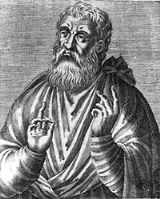
Justin Martyr

Encyclopedia
Justin Martyr, also known as just Saint Justin (103–165), was an early Christian apologist
. Most of his works are lost, but two apologies and a dialogue survive. He is considered a saint by the Roman Catholic Church
and the Eastern Orthodox Church
.
) in Palestine. His parents were pagans. He tells us (Dialogue 2-8) that he tried first the school of a Stoic philosopher, who was unable to explain God's being to him. He then attended a Peripatetic
philosopher but was put off because the philosopher was too eager for his fee. Then he went to hear a Pythagorean
philosopher, who demanded that he first learn music, astronomy and geometry, which he did not wish to do. After this he was drawn to Platonism, until meeting an old man on the sea shore who told him about Christianity, and he converted. He was influenced in this by the fearless conduct of the Christians facing execution (Apol. 2:12). This conversion seems to have taken place at Ephesus.
He then adopted the dress of a philosopher himself and traveled about teaching. He arrived in Rome
in the reign of Antoninus Pius
(138-161), where he started his own school. Tatian
was one of his pupils. In the reign of Marcus Aurelius, after disputing with the cynic philosopher Crescens, he was denounced by the latter to the authorities, according to Tatian (Address to the Greeks 19) and Eusebius (HE IV 16.7-8). Justin was tried together with six companions by Junius Rusticus
who was urban prefect from 163-167, and was beheaded, probably in 165. The martyrdom of Justin preserves the court record.
The church of St. John the Baptist in Sacrofano
, a few miles north of Rome, claims to have his relics.
In 1882 Pope Leo XIII
had a Mass
and an Office
composed for his feast day, which he set at 14 April, the day after the day indicated as that of his death in the Martyrology of Florus; but since this date quite often falls within the main Paschal
celebrations, the feast was moved in 1968 to 1 June, the date on which he has been celebrated in the Byzantine Rite
since at least the 9th century.
, who calls him "the most admirable Justin," quotes a saying of his, and says that the Cynic Crescens
laid snares for him.
Irenaeus
speaks of his martyrdom and of Tatian as his disciple. Irenaeus quotes Justin twice, and shows his influence in other places.
Tertullian
, in his Adversus Valentinianos, calls Justin a philosopher and martyr, and the earliest antagonist of heretics
. He was flogged and beheaded with six other Christians in Rome for his beliefs.
Hippolytus
and Methodius of Olympus
also mention or quote him.
Eusebius of Caesarea
deals with him at some length, and names the following works:
Eusebius implies that other works were in circulation; from St Irenaeus
he knows of the apology "Against Marcion," and from Justin's "Apology" of a "Refutation of all Heresies ". Epiphanius and St Jerome
mention Justin.
Rufinus
borrows from him Latin
original of Hadrian
's letter.
After Rufinus, Justin was known mainly from St Irenaeus and Eusebius
or from spurious works. The Chronicon Paschale
assigns his martyrdom to the year 165. A considerable number of other works are given as Justin's by Arethas, Photius, and other writers; but their spuriousness is now generally admitted. The Expositio rectae fidei has been assigned by Draseke to Apollinaris of Laodicea, but it is probably a work of as late as the 6th century. The Cohortatio ad Graecos has been attributed to Apollinaris of Laodicea, Apollinaris of Hierapolis, as well as others. The Epistola ad Zenam et Serenum, an exhortation to Christian living, is dependent upon Clement of Alexandria
, and is assigned by Pierre Batiffol
to the Novatian Bishop Sisinnius
(c. 400). The extant work under the title "On the Sovereignty of God" does not correspond with Eusebius' description of it, though Harnack regards it as still possibly Justin's, and at least of the 2nd century. The author of the smaller treatise To the Greeks cannot be Justin, because he is dependent on Tatian; Harnack places it between 180 and 240.
; the date of composition of the latter, from the fact that it was addressed to Antoninus Pius
, Marcus Aurelius, and Lucius Verus
his adopted sons, must fall between 147 and 161.
, after an introductory section, Justin undertakes to show that Christianity is the new law for all men,
The treatise On the Resurrection, of which extensive fragments are preserved in the Sacra parallela, is not so generally accepted. Even earlier than this collection, it is referred to by Procopius of Gaza (c. 465-528), and Methodius appeals to Justin in support of his interpretation of 1 Corinthians
15:50 in a way which makes it natural to assume the existence of a treatise on the subject, to say nothing of other traces of a connection in thought both here, in Irenaeus (V., ii.-xiii. 5), and also in Tertullian, where it is too close to be anything but a conscious following of the Greek. The Against Marcion is lost, as is the Refutation of all Heresies to which Justin himself refers in Apology, i. 26; Hegesippus
, besides perhaps Irenaeus and Tertullian, seems to have used it.
philosophers; and in modern times Semler
and S.G. Lange have made him out a thorough Hellene, while Semisch and Otto defend him from this charge.
In opposition to the school of Ferdinand Christian Baur
, who considered him a Jewish Christian, Albrecht Ritschl
has pointed out that it was precisely because he was a Gentile Christian that he did not fully understand the Old Testament
foundation of Paul's teaching, and explained in this way the modified character of his Paulinism and his legal mode of thought.
M. von Engelhardt has attempted to extend this line of treatment to Justin's entire theology, and to show that his conceptions of God, of free will and righteousness, of redemption, grace, and merit prove the influence of the cultivated Greek pagan world of the 2nd century, dominated by the Platonic and Stoic philosophy.
But he admits that Justin is a Christian in his unquestioning adherence to the Church and its faith, his unqualified recognition of the Old Testament, and his faith in Christ as the Son of God the Creator, made manifest in the flesh, crucified, and risen, through which belief he succeeds in getting away from the dualism of pagan and also of Gnostic philosophy.
Justin was confident that his teaching is that of the Church at large. He knows of a division among the orthodox only on the question of the millennium
and on the attitude toward the milder Jewish Christianity, which he personally is willing to tolerate as long as its professors in their turn do not interfere with the liberty of the Gentile converts; his millenarianism
seems to have no connection with Judaism
, but he believes firmly in a millennium, and generally in the primitive Christian eschatology
.
Justin's self-perception was that of a scholar, although his skills in Hebrew
were either non-existent or minimal. His opposition to Judaism was typical of church leaders in his day, but does not descend to the level of anti-semitism
. After collaborating with a Jewish convert to assist him with the Hebrew, Justin published an attack on Judaism based upon a no-longer-extant text of a Midrash
. This Midrash was reconstructed and published by Saul Lieberman
.
. But at the same time he adopted the Stoic
doctrine of the "seminal word," and so philosophy was to him an operation of the Word—in fact, through his identification of the Word with Christ
, it was brought into immediate connection with him.
Thus he does not scruple to declare that Socrates
and Heraclitus
were Christians (Apol., i. 46, ii. 10). His aim, of course, is to emphasize the absolute significance of Christ, so that all that ever existed of virtue and truth may be referred to him. The old philosophers and law-givers had only a part of the Logos
, while the whole appears in Christ.
While the gentile peoples, seduced by demons, had deserted the true God for idols, the Jews and Samaritans possessed the revelation given through the prophets and awaited the Messiah
. The law, however, while containing commandments intended to promote the true fear of God, had other prescriptions of a purely pedagogic nature, which necessarily ceased when Christ, their end, appeared; of such temporary and merely relative regulations were circumcision
, animal sacrifices, the Sabbath
, and the laws as to food. Through Christ the abiding law of God has been fully proclaimed. In his character as the teacher of the new doctrine and promulgator of the new law lies the essential nature of his redeeming work.
The idea of an economy of grace, of a restoration of the union with God which had been destroyed by sin, is not foreign to him. It is noteworthy that in the "Dialogue" he no longer speaks of a "seed of the Word" in every man, and in his non-apologetic works the emphasis is laid upon the redeeming acts of the life of Christ rather than upon the demonstration of the reasonableness and moral value of Christianity, though the fragmentary character of the latter works makes it difficult to determine exactly to what extent this is true and how far the teaching of Irenaeus
on redemption is derived from him.
has always attracted attention. It is probably too much to assume a direct connection with Philo of Alexandria in this particular. The idea of the Logos was widely familiar to educated men, and the designation of the Son of God as the Logos was not new to Christian theology. The significance is clear, however, of the manner in which Justin identifies the historical Christ with the rational force operative in the universe, which leads up to the claim of all truth and virtue for the Christians and to the demonstration of the adoration of Christ, which aroused so much opposition, as the only reasonable attitude. It is mainly for this justification of the worship of Christ that Justin employs the Logos-idea, though where he explicitly deals with the divinity of the Redeemer and his relation to the Father, he makes use of the Old Testament, not of the Logos-idea, which thus can not be said to form an essential part of his Christology
.
On the other hand, Justin sees the Logos as a separate being from God and subordinate to him:
"For next to God, we worship and love the Logos who is out of the unbegotten and ineffable God, since also He became man for our sakes, that, becoming a partaker of our sufferings, He might also bring us healing" (Second Apology, 13).
"There is, and that there is said to be, another God and Lord subject to the Maker of all things who is also called an Angel, because He announces to men whatsoever the Maker of all things, above whom there is no other God, wishes to announce to them.... I shall endeavour to persuade you, that He who is said to have appeared to Abraham, and to Jacob, and to Moses, and who is called God, is distinct from Him who made all things, I mean numerically, not in will. (Dialogue with Trypho, 56).
In chapter 129 of his Dialogue with Trypho, a Jew, Justin makes a clear distinction, indicating that the "God" he refers to as Christ, is distinct from and subject to another, who is "Lord of the Lord", and causes the "God" Christ to have his power and authority. This would seem to indicate emphatically that Justin's use of the term "God" when referring to Christ is not the same usage when referring to the Father – the Creator, and only true God, as Justin calls him in other chapters of his writings. Could it be then, that the English translation is biased? It is entirely possible that what Justin was actually writing was that Christ is a legitimate god-like being (a god), given authority and power by the only true God, who created him.
“And now I shall again recite the words which I have spoken in proof of this point. When Scripture says, ‘The Lord rained fire from the Lord out of heaven,’ the prophetic word indicates that there were two in number: One upon the earth, who, it says, descended to behold the cry of Sodom; Another in heaven, who also is Lord of the Lord on earth, as He is Father and God; the cause of His power and of His being Lord and God." (Dialogue with Trypho, 129).
Justin very clearly distinguishes the Son, or Logos, as being an Angel and an Apostle of God, but not the one true God himself, the Maker of all things, as Justin calls him. Justin confers the title of Creator only to the Father in all of his writings. There is no indication of the trinitarian doctrine, or of Christ being the "one true God", as Justin gives this title only to the Father.
"Now the Word of God is His Son, as we have before said. And He is called Angel and Apostle; for He declares whatever we ought to know, and is sent forth to declare whatever is revealed; as our Lord Himself says, “He that heareth Me, heareth Him that sent Me.” From the writings of Moses also this will be manifest; for thus it is written in them, “And the Angel of God spoke to Moses, in a flame of fire out of the bush, and said, I am that I am, the God of Abraham, the God of Isaac, the God of Jacob, the God of thy fathers; go down into Egypt, and bring forth My people.” And if you wish to learn what follows, you can do so from the same writings; for it is impossible to relate the whole here. But so much is written for the sake of proving that Jesus the Christ is the Son of God and His Apostle, being of old the Word, and appearing sometimes in the form of fire, and sometimes in the likeness of angels; but now, by the will of God, having become man for the human race, He endured all the sufferings which the devils instigated the Jews to inflict upon Him; who, though they have it expressly affirmed in the writings of Moses, “And the angel of God spake to Moses in a flame of fire in a bush, and said, I am that I am, the God of Abraham, and the God of Isaac, and the God of Jacob,” yet maintain that He who said this was the Father and Creator of the universe." (First Apology, 63)
Just a few sentences later, in chapter 63, Justin continues with the same line of thought; however, he concludes by referring to Christ as God. Let the reader beware however, that this is an English translation of the original Greek, and therefor could very well be mistranslated. The Koine Greek 'theos', without the definite article, can (and most often does) have a qualitative meaning, rather than a definitive meaning, such as "was divine" or "was a god (-like being)." The rest of Justin's writings seem to contradict this statement (that Christ is God), as it is currently translated into English. It is the one discordant note in the harmony of the rest of his writings.
"The Jews, accordingly, being throughout of opinion that it was the Father of the universe who spake to Moses, though He who spake to him was indeed the Son of God, who is called both Angel and Apostle, are justly charged, both by the Spirit of prophecy and by Christ Himself, with knowing neither the Father nor the Son. For they who affirm that the Son is the Father, are proved neither to have become acquainted with the Father, nor to know that the Father of the universe has a Son; who also, being the first-begotten Word of God, is even [a?] God." (First Apology, 63)
Justin speaks of the divine Logos as "another God" beside the Father, qualified by the gloss: ‘other, I mean, in number, not in will’. Justin actually finds fault with the view of hellenized Jews who held that the divine Logos is no more distinct from God than sunlight is from the sun and suggested, instead, that the Logos is more like a torch lit from another. He wanted to do justice to the independence of the Logos.
“And that Christ being Lord, and God the Son of God, and appearing formerly in power as Man, and Angel, and in the glory of fire as at the bush, so also was manifested at the judgment executed on Sodom, has been demonstrated fully by what has been said.” Then I repeated once more all that I had previously quoted from Exodus, about the vision in the bush, and the naming of Joshua (Jesus), and continued: “And do not suppose, sirs, that I am speaking superfluously when I repeat these words frequently: but it is because I know that some wish to anticipate these remarks, and to say that the power sent from the Father of all which appeared to Moses, or to Abraham, or to Jacob, is called an Angel because He came to men (for by Him the commands of the Father have been proclaimed to men); is called Glory, because He appears in a vision sometimes that cannot be borne; is called a Man, and a human being, because He appears arrayed in such forms as the Father pleases; and they call Him the Word, because He carries tidings from the Father to men: but maintain that this power is indivisible and inseparable from the Father, just as they say that the light of the sun on earth is indivisible and inseparable from the sun in the heavens; as when it sinks, the light sinks along with it; so the Father, when He chooses, say they, causes His power to spring forth, and when He chooses, He makes it return to Himself. In this way, they teach, He made the angels. But it is proved that there are angels who always exist, and are never reduced to that form out of which they sprang. And that this power which the prophetic word calls [a?] God, as has been also amply demonstrated, and Angel, is not numbered [as different] in name only like the light of the sun but is indeed something numerically distinct, I have discussed briefly in what has gone before; when I asserted that this power was begotten from the Father, by His power and will, but not by abscission, as if the essence of the Father were divided; as all other things partitioned and divided are not the same after as before they were divided: and, for the sake of example, I took the case of fires kindled from a fire, which we see to be distinct from it, and yet that from which many can be kindled is by no means made less, but remains the same." (Dialogue with Trypho, 128)
While the English translation of Chapter 128 suggest the appellation of "God" when referring to Christ, the rest of the chapter confirms the beliefs held by Martyr are not in line with this translation:
In fact, in Chapter 128 of his Dialogue with Trypho, Justin directly refutes the trinitarian explanation, later offered by Tertullian
, that Jesus is connected to the Father in the same manner as a sunbeam is to the sun. Justin instead believes Christ's relationship to his Father, God, is more like that of fire. The source fire (God) retains its size and glory, and the offspring fire it creates (the Son) is an entirely new fire, separate and distinct.
(ca. 155) and Dialogue with Trypho
(ca. 160), sometimes refers to written sources consisting of narratives of the life of Jesus
and quotations of the sayings of Jesus as "memoirs of the apostles" (Greek
: ἀπομνημονεύματα τῶν ἀποστόλων; transliteration
: apomnêmoneumata tôn apostolôn) and less frequently as gospels (Greek: εὐαγγέλιον; transliteration: euangélion) which, Justin says, were read every Sunday in the church at Rome (1 Apol. 67.3 - "and the memoirs of the apostles or the writings of the prophets are being read as long as it is allowable").
The designation "memoirs of the apostles" occurs twice in Justin's First Apology (66.3, 67.3–4) and thirteen times in the Dialogue, mostly in his interpretation of Psalm 22, whereas the term "gospel" is used only three times, once in 1 Apol. 66.3 and twice in the Dialogue. The single passage where Justin uses both terms (1 Apol. 66.3) makes it clear that "memoirs of the apostles" and "gospels" are equivalent, and the use of the plural indicates Justin's awareness of more than one written gospel. ("The apostles in the memoirs which have come from them, which are also called gospels, have transmitted that the Lord had commanded..."). Justin may have preferred the designation "memoirs of the apostles" as a contrast to the "gospel" of his contemporary Marcion to emphasize the connections between the historical testimony of the gospels and the Old Testament
prophecies which Marcion rejected.
The origin of Justin's use the name "memoirs of the apostles" as a synonym for the gospels is uncertain. Scholar David Aune has argued that the gospels were modeled after classical Greco-Roman biographies, and Justin's use of the term apomnemoneumata to mean all the Synoptic Gospels
should be understood as referring to a written biography such as the Memorabilia of Xenophon
because they preserve the authentic teachings of Jesus. However, scholar Helmut Koester
has pointed out the Greek title "Memorabilia" was not applied to Xenophon's work until the Middle Ages, and it is more likely apomnemoneumata was used to describe the oral transmission of the sayings of Jesus in early Christianity
. Papias uses a similar term meaning "remembered" (apomnemoneusen) when describing how Mark accurately recorded the "recollections of Peter", and Justin also uses it in reference to Peter in Dial. 106.3, followed by a quotation found only in the Gospel of Mark
(Mk 3:16–17). Therefore, according to Koester, it is likely that Justin applied the name "memoirs of the apostles" analogously to indicate the trustworthy recollections of the apostles found in the written record of the Synoptic Gospels of Matthew
, Mark, and Luke
, and possibly also an apocryphal gospel.
Justin expounded on the gospel texts as an accurate recording of the fulfillment of prophecy
, which he combined with quotations of the prophets of Israel
from the LXX to demonstrate a proof from prophecy of the Christian kerygma
. The importance which Justin attaches to the words of the prophets, which he regularly quotes with the formula "it is written", shows his estimate of the Old Testament Scriptures. However, the scriptural authority he attributes to the "memoirs of the apostles" is less certain. Koester articulates a majority view among scholars that Justin considered the "memoirs of the apostles" to be accurate historical records but not inspired writings, whereas scholar Charles E. Hill, though acknowledging the position of mainstream scholarship, contends that Justin regarded the fulfillment quotations of the gospels to be equal in authority.
, which may have been composed by Justin or his school. However, his use, or even knowledge, of the Gospel of John
is uncertain. One possible reference to John is a saying that is quoted in the context of a description of Christian baptism (1 Apol. 61.4 - "Unless you are reborn, you cannot enter into the kingdom of heaven."). However, Koester contends that Justin obtained this saying from a baptismal liturgy rather than a written gospel.
directly, yet he clearly refers to it, naming John
as its author (Dial. 81.4 "Moreover also among us a man named John, one of the apostles of Christ, prophesied in a revelation made to him that those who have believed on our Christ will spend a thousand years in Jerusalem; and that hereafter the general and, in short, the eternal resurrection and judgment of all will likewise take place"). Scholar Brooke Westcott notes that this reference to the author of the single prophetic book of the New Testament illustrates the distinction Justin made between the role of prophecy and fulfillment quotations from the gospels, as Justin does not mention any of the individual canonical gospels by name.
, 1 Corinthians
, Galatians
, Ephesians, Colossians, and 2 Thessalonians, and possible ones to Philippians, Titus
, and 1 Timothy. It seems likely that he also knew Hebrews
and 1 John. The apologetic character of Justin's habit of thought appears again in the Acts of his martyrdom, the genuineness of which is attested by internal evidence.
on the divine nature of the Messiah, The Disputation Between Jason and Papiscus (ca. 140). Justin brings in biblical quotes verbatim from these sources, and he often appears to be paraphrasing his sources very closely, even in his interpretive remarks.
Justin occasionally uses the Gospel of Matthew directly as a source for Old Testament prophecies to supplement his testimony sources. However, the fulfillment quotations from these sources most often appear to be harmonizations of the gospels of Matthew and Luke. Koester suggests that Justin had composed an early harmony along the lines of his pupil Tatian
's Diatesseron. However, the existence of a harmony independent of a collection of sayings for exposition purposes has been disputed by scholar Arthur Bellinzoni. The question of whether the harmonized gospel materials found in Justin's writings came from a preexisting gospel harmony or were assembled as part of an integral process of creating scriptural proof-texts is an ongoing subject of scholarly investigation.
and virgin birth of Jesus shows how Justin used harmonized gospel verses from Matthew and Luke to provide a scriptural proof of the messiah-ship of Jesus based on fulfillment of the prophecy of Isaiah 7:14
.
According to Skarsaune, the harmonized gospel narratives of Matthew and Luke were part of a tradition already circulating within Justin's school that expounded on the life and work of Jesus as the Messiah and the apostolic mission. Justin then rearranged and expanded these testimonia to create his First Apology. The "kerygma source" of proof-texts (contained within 1 Apol. 31-53) is believed to have had a Two Parousias
Christology, characterized by the belief that Jesus first came in humility, in fulfillment of prophecy, and will return in glory as the Messiah to the Gentiles
. There are close literary parallels between the Christology of Justin's source and the Apocalypse of Peter
.
(Dial. 88:3,8) and temptation
(Dial. 103:5-6) of Jesus, which are believed to have originated from the Disputation, illustrate the use of gospel narratives and sayings of Jesus in a testimony source and how Justin has adopted these "memoirs of the apostles" for his own purposes.
The quotations refer to the fulfillment of a prophecy of Psalm 2:7
found in the Western text-type
of Luke 3:22. Justin's mention of the fire on the Jordan without comment suggests that he was relying on an intermediate source for these gospel quotations, and his misinterpretation of a pseudo-etymology of the Hebrew word Satan indicates a dependence on a testimony source with a knowledge of Hebrew, which was probably The Disputation of Jason and Papiscus.
The Disputation is believed to have furnished Justin with scriptural proof-texts on the divinity of the Messiah by combining a Wisdom
Christology - Christ as the incarnation of preexistent Wisdom - with a Second Adam Christology - the first Adam was conquered by Satan, but this Fall of Man is reversed by Christ as the Second Adam who conquers Satan. This is implied in the pseudo-etymology in Dial. 103:5-6 linking the name of Satan to the "apostate-serpent". The Christology of the source is close to that of the Ascension of Isaiah
.
.
The following example of an ethical teaching On Swearing Oaths in 1 Apol. 16:5 shows a combination of sayings material found in Matthew and the Epistle of James
:
The saying "Let your Yes be Yes and your No be No" from James 5:12 is interpolated into a sayings complex from Matthew 5:34,37. The text appears in a large number of Patristic quotations and twice in the Clementine Homilies
(Hom. 3:55, 19:2). Thus, it is likely that Justin was quoting this harmonized text from a catechism.
The harmonization of Matthew and Luke is evident in the following quotations of Mt 7:22-23 and Lk 13:26-27, which are used by Justin twice, in 1 Apol. 16:11 and Dial. 76:5:
In both cases, Justin is using the same harmonized text of Matthew and Luke, although neither of the quotations includes the entire text of those gospel passages. The last phrase, "workers of lawlessness", has an exact parallel with 2 Clement 4:5. This harmonized text also appears in a large number of quotations by the Church Fathers
. 1 Apol. 16:11 is part of a larger unit of sayings material in 1 Apol 16:9-13 which combines a warning against being unprepared with a warning against false prophets. The entire unit is a carefully composed harmony of parallel texts from Matthew and Luke. This unit is part of a larger collection of sayings found in 1 Apol. 15-17 that appear to have originated from a catechism used by Justin's school in Rome, which may have had a wide circulation. Justin excerpted and rearranged the catechetical sayings material to create Apol. 15-17 and parallel passages in the Dialogue.
Then Justin tells of his own experience:
, or "man of apostasy." Justin's interpretation of prophecy is, however, less clear and full than that of others who follow.
Christian apologetics
Christian apologetics is a field of Christian theology that aims to present a rational basis for the Christian faith, defend the faith against objections, and expose the perceived flaws of other world views...
. Most of his works are lost, but two apologies and a dialogue survive. He is considered a saint by the Roman Catholic Church
Roman Catholic Church
The Catholic Church, also known as the Roman Catholic Church, is the world's largest Christian church, with over a billion members. Led by the Pope, it defines its mission as spreading the gospel of Jesus Christ, administering the sacraments and exercising charity...
and the Eastern Orthodox Church
Eastern Orthodox Church
The Orthodox Church, officially called the Orthodox Catholic Church and commonly referred to as the Eastern Orthodox Church, is the second largest Christian denomination in the world, with an estimated 300 million adherents mainly in the countries of Belarus, Bulgaria, Cyprus, Georgia, Greece,...
.
Life
Most of what is known about the life of Justin Martyr comes from his own writings. He was born at Flavia Neapolis (today NablusNablus
Nablus is a Palestinian city in the northern West Bank, approximately north of Jerusalem, with a population of 126,132. Located in a strategic position between Mount Ebal and Mount Gerizim, it is the capital of the Nablus Governorate and a Palestinian commercial and cultural center.Founded by the...
) in Palestine. His parents were pagans. He tells us (Dialogue 2-8) that he tried first the school of a Stoic philosopher, who was unable to explain God's being to him. He then attended a Peripatetic
Peripatetic
The Peripatetics were members of a school of philosophy in ancient Greece. Their teachings derived from their founder, the Greek philosopher, Aristotle, and Peripatetic is a name given to his followers. The school originally derived its name Peripatos from the peripatoi of the Lyceum gymnasium in...
philosopher but was put off because the philosopher was too eager for his fee. Then he went to hear a Pythagorean
Pythagorean
Pythagorean means of or pertaining to the ancient Ionian mathematician, philosopher, and music theorist Pythagoras. See:-Philosophy:* Pythagoreanism is a term used for the esoteric and metaphysical beliefs purported to have been held by Pythagoras....
philosopher, who demanded that he first learn music, astronomy and geometry, which he did not wish to do. After this he was drawn to Platonism, until meeting an old man on the sea shore who told him about Christianity, and he converted. He was influenced in this by the fearless conduct of the Christians facing execution (Apol. 2:12). This conversion seems to have taken place at Ephesus.
He then adopted the dress of a philosopher himself and traveled about teaching. He arrived in Rome
Rome
Rome is the capital of Italy and the country's largest and most populated city and comune, with over 2.7 million residents in . The city is located in the central-western portion of the Italian Peninsula, on the Tiber River within the Lazio region of Italy.Rome's history spans two and a half...
in the reign of Antoninus Pius
Antoninus Pius
Antoninus Pius , also known as Antoninus, was Roman Emperor from 138 to 161. He was a member of the Nerva-Antonine dynasty and the Aurelii. He did not possess the sobriquet "Pius" until after his accession to the throne...
(138-161), where he started his own school. Tatian
Tatian
Tatian the Assyrian was an Assyrian early Christian writer and theologian of the 2nd century.Tatian's most influential work is the Diatessaron, a Biblical paraphrase, or "harmony", of the four gospels that became the standard text of the four gospels in the Syriac-speaking churches until the...
was one of his pupils. In the reign of Marcus Aurelius, after disputing with the cynic philosopher Crescens, he was denounced by the latter to the authorities, according to Tatian (Address to the Greeks 19) and Eusebius (HE IV 16.7-8). Justin was tried together with six companions by Junius Rusticus
Junius Rusticus
Quintus Junius Rusticus , probably a grandson of Arulenus Rusticus, was one of the teachers of the emperor Marcus Aurelius, and the most distinguished Stoic philosophers of his time...
who was urban prefect from 163-167, and was beheaded, probably in 165. The martyrdom of Justin preserves the court record.
The church of St. John the Baptist in Sacrofano
Sacrofano
Sacrofano is a comune in the Province of Rome in the Italian region Latium, located about 25 km north of Rome. Located near the Monti Sabatini, at the feet of an extinct volcano, it is included in the Regional Park of Veii....
, a few miles north of Rome, claims to have his relics.
In 1882 Pope Leo XIII
Pope Leo XIII
Pope Leo XIII , born Vincenzo Gioacchino Raffaele Luigi Pecci to an Italian comital family, was the 256th Pope of the Roman Catholic Church, reigning from 1878 to 1903...
had a Mass
Mass
Mass can be defined as a quantitive measure of the resistance an object has to change in its velocity.In physics, mass commonly refers to any of the following three properties of matter, which have been shown experimentally to be equivalent:...
and an Office
Liturgy of the hours
The Liturgy of the Hours or Divine Office is the official set of daily prayers prescribed by the Catholic Church to be recited at the canonical hours by the clergy, religious orders, and laity. The Liturgy of the Hours consists primarily of psalms supplemented by hymns and readings...
composed for his feast day, which he set at 14 April, the day after the day indicated as that of his death in the Martyrology of Florus; but since this date quite often falls within the main Paschal
Easter
Easter is the central feast in the Christian liturgical year. According to the Canonical gospels, Jesus rose from the dead on the third day after his crucifixion. His resurrection is celebrated on Easter Day or Easter Sunday...
celebrations, the feast was moved in 1968 to 1 June, the date on which he has been celebrated in the Byzantine Rite
Byzantine Rite
The Byzantine Rite, sometimes called the Rite of Constantinople or Constantinopolitan Rite is the liturgical rite used currently by all the Eastern Orthodox Churches, by the Greek Catholic Churches , and by the Protestant Ukrainian Lutheran Church...
since at least the 9th century.
Writings
The earliest mention of Justin is found in the Oratio ad Graecos by TatianTatian
Tatian the Assyrian was an Assyrian early Christian writer and theologian of the 2nd century.Tatian's most influential work is the Diatessaron, a Biblical paraphrase, or "harmony", of the four gospels that became the standard text of the four gospels in the Syriac-speaking churches until the...
, who calls him "the most admirable Justin," quotes a saying of his, and says that the Cynic Crescens
Crescens the Cynic
Crescens was a Cynic philosopher who attacked the Christians, and was in turn, attacked by Justin Martyr.Eusebius, writing 150 years later, claimed that the plots of Crescens caused Justin's death.-Life:...
laid snares for him.
Irenaeus
Irenaeus
Saint Irenaeus , was Bishop of Lugdunum in Gaul, then a part of the Roman Empire . He was an early church father and apologist, and his writings were formative in the early development of Christian theology...
speaks of his martyrdom and of Tatian as his disciple. Irenaeus quotes Justin twice, and shows his influence in other places.
Tertullian
Tertullian
Quintus Septimius Florens Tertullianus, anglicised as Tertullian , was a prolific early Christian author from Carthage in the Roman province of Africa. He is the first Christian author to produce an extensive corpus of Latin Christian literature. He also was a notable early Christian apologist and...
, in his Adversus Valentinianos, calls Justin a philosopher and martyr, and the earliest antagonist of heretics
Christian heresy
Christian heresy refers to non-orthodox practices and beliefs that were deemed to be heretical by one or more of the Christian churches. In Western Christianity, the term "heresy" most commonly refers to those beliefs which were declared to be anathema by the Catholic Church prior to the schism of...
. He was flogged and beheaded with six other Christians in Rome for his beliefs.
Hippolytus
Hippolytus (writer)
Hippolytus of Rome was the most important 3rd-century theologian in the Christian Church in Rome, where he was probably born. Photios I of Constantinople describes him in his Bibliotheca Hippolytus of Rome (170 – 235) was the most important 3rd-century theologian in the Christian Church in Rome,...
and Methodius of Olympus
Methodius of Olympus
The Church Father and Saint Methodius of Olympus was a Christian bishop, ecclesiastical author, and martyr.-Life:Few reports have survived on the life of this first scientific opponent of Origen; even these short accounts present many difficulties. Eusebius does not mention him in his Church...
also mention or quote him.
Eusebius of Caesarea
Eusebius of Caesarea
Eusebius of Caesarea also called Eusebius Pamphili, was a Roman historian, exegete and Christian polemicist. He became the Bishop of Caesarea in Palestine about the year 314. Together with Pamphilus, he was a scholar of the Biblical canon...
deals with him at some length, and names the following works:
- The First Apology addressed to Antoninus PiusAntoninus PiusAntoninus Pius , also known as Antoninus, was Roman Emperor from 138 to 161. He was a member of the Nerva-Antonine dynasty and the Aurelii. He did not possess the sobriquet "Pius" until after his accession to the throne...
, his sons, and the Roman Senate; - a Second Apology addressed to the Roman Senate;
- the Discourse to the Greeks, a discussion with Greek philosophers on the character of their gods;
- a Hortatory Address to the Greeks;
- a treatise On the Sovereignty of God, in which he makes use of pagan authorities as well as Christian;
- a work entitled The Psalmist;
- a treatise in scholastic form On the Soul; and
- the Dialogue with Trypho.
Eusebius implies that other works were in circulation; from St Irenaeus
Irenaeus
Saint Irenaeus , was Bishop of Lugdunum in Gaul, then a part of the Roman Empire . He was an early church father and apologist, and his writings were formative in the early development of Christian theology...
he knows of the apology "Against Marcion," and from Justin's "Apology" of a "Refutation of all Heresies ". Epiphanius and St Jerome
Jerome
Saint Jerome was a Roman Christian priest, confessor, theologian and historian, and who became a Doctor of the Church. He was the son of Eusebius, of the city of Stridon, which was on the border of Dalmatia and Pannonia...
mention Justin.
Rufinus
Tyrannius Rufinus
Tyrannius Rufinus or Rufinus of Aquileia was a monk, historian, and theologian. He is most known as a translator of Greek patristic material into Latin—especially the work of Origen.-Life:...
borrows from him Latin
Latin
Latin is an Italic language originally spoken in Latium and Ancient Rome. It, along with most European languages, is a descendant of the ancient Proto-Indo-European language. Although it is considered a dead language, a number of scholars and members of the Christian clergy speak it fluently, and...
original of Hadrian
Hadrian
Hadrian , was Roman Emperor from 117 to 138. He is best known for building Hadrian's Wall, which marked the northern limit of Roman Britain. In Rome, he re-built the Pantheon and constructed the Temple of Venus and Roma. In addition to being emperor, Hadrian was a humanist and was philhellene in...
's letter.
After Rufinus, Justin was known mainly from St Irenaeus and Eusebius
Eusebius of Caesarea
Eusebius of Caesarea also called Eusebius Pamphili, was a Roman historian, exegete and Christian polemicist. He became the Bishop of Caesarea in Palestine about the year 314. Together with Pamphilus, he was a scholar of the Biblical canon...
or from spurious works. The Chronicon Paschale
Chronicon Paschale
Chronicon Paschale is the conventional name of a 7th-century Greek Christian chronicle of the world...
assigns his martyrdom to the year 165. A considerable number of other works are given as Justin's by Arethas, Photius, and other writers; but their spuriousness is now generally admitted. The Expositio rectae fidei has been assigned by Draseke to Apollinaris of Laodicea, but it is probably a work of as late as the 6th century. The Cohortatio ad Graecos has been attributed to Apollinaris of Laodicea, Apollinaris of Hierapolis, as well as others. The Epistola ad Zenam et Serenum, an exhortation to Christian living, is dependent upon Clement of Alexandria
Clement of Alexandria
Titus Flavius Clemens , known as Clement of Alexandria , was a Christian theologian and the head of the noted Catechetical School of Alexandria. Clement is best remembered as the teacher of Origen...
, and is assigned by Pierre Batiffol
Pierre Batiffol
Pierre Batiffol was a prominent French catholic priest and Church historian, known particularly as a historian of dogma....
to the Novatian Bishop Sisinnius
Sisinnius
Sisinnius may refer to:*Pope Sisinnius, Pope for about three weeks in 708*Sisinnius I of Constantinople, Archbishop of Constantinople from 426 to 427*Sisinnius, Martyrius and Alexander, martyrs...
(c. 400). The extant work under the title "On the Sovereignty of God" does not correspond with Eusebius' description of it, though Harnack regards it as still possibly Justin's, and at least of the 2nd century. The author of the smaller treatise To the Greeks cannot be Justin, because he is dependent on Tatian; Harnack places it between 180 and 240.
Apology
The Dialogue is a later work than the First ApologyFirst Apology of Justin Martyr
The First Apology was an early work of Christian apologetics addressed by Justin Martyr to the Roman Emperor Antoninus Pius. It is dated to the period 150-155.-Purpose for writing:...
; the date of composition of the latter, from the fact that it was addressed to Antoninus Pius
Antoninus Pius
Antoninus Pius , also known as Antoninus, was Roman Emperor from 138 to 161. He was a member of the Nerva-Antonine dynasty and the Aurelii. He did not possess the sobriquet "Pius" until after his accession to the throne...
, Marcus Aurelius, and Lucius Verus
Lucius Verus
Lucius Verus , was Roman co-emperor with Marcus Aurelius, from 161 until his death.-Early life and career:Lucius Verus was the first born son to Avidia Plautia and Lucius Aelius Verus Caesar, the first adopted son and heir of Roman Emperor Hadrian . He was born and raised in Rome...
his adopted sons, must fall between 147 and 161.
Dialogue with Trypho
In the Dialogue with TryphoDialogue with Trypho
In the Dialogue with Trypho, Christian theologian Justin Martyr undertakes to show that Christianity is the new law for all men, and to prove from Scripture that Jesus is the Christ via a fictitious intellectual conversation between Justin and Trypho, a Jew...
, after an introductory section, Justin undertakes to show that Christianity is the new law for all men,
On The Resurrection
The fragments of the work "On the Resurrection" begin with the assertion that the truth, and God the author of truth, need no witness, but that as a concession to the weakness of men it is necessary to give arguments to convince those who gainsay it. It is then shown, after a denial of unfounded deductions, that the resurrection of the body is neither impossible nor unworthy of God, and that the evidence of prophecy is not lacking for it. Another fragment takes up the positive proof of the resurrection, adducing that of Christ and of those whom he recalled to life. In another the resurrection is shown to be that of what has gone down, i.e., the body; the knowledge concerning it is the new doctrine in contrast with that of the old philosophers; the doctrine follows from the command to keep the body in moral purity.The treatise On the Resurrection, of which extensive fragments are preserved in the Sacra parallela, is not so generally accepted. Even earlier than this collection, it is referred to by Procopius of Gaza (c. 465-528), and Methodius appeals to Justin in support of his interpretation of 1 Corinthians
First Epistle to the Corinthians
The first epistle of Paul the apostle to the Corinthians, often referred to as First Corinthians , is the seventh book of the New Testament of the Bible...
15:50 in a way which makes it natural to assume the existence of a treatise on the subject, to say nothing of other traces of a connection in thought both here, in Irenaeus (V., ii.-xiii. 5), and also in Tertullian, where it is too close to be anything but a conscious following of the Greek. The Against Marcion is lost, as is the Refutation of all Heresies to which Justin himself refers in Apology, i. 26; Hegesippus
Hegesippus
The Greek name Hegesippos, commonly Latinized as Hegesippus can refer to the following persons:* Hegesippus * Saint Hegesippus...
, besides perhaps Irenaeus and Tertullian, seems to have used it.
Role within the Church
Flacius discovered "blemishes" in Justin's theology, which he attributed to the influence of paganPaganism
Paganism is a blanket term, typically used to refer to non-Abrahamic, indigenous polytheistic religious traditions....
philosophers; and in modern times Semler
Johann Salomo Semler
Johann Salomo Semler was a German church historian and biblical commentator.-Youth and education:He was born at Saalfeld in Electoral Saxony, the son of a poor clergyman. He grew up in pietistic surroundings, which powerfully influenced him his life through, though he never became a Pietist...
and S.G. Lange have made him out a thorough Hellene, while Semisch and Otto defend him from this charge.
In opposition to the school of Ferdinand Christian Baur
Ferdinand Christian Baur
Ferdinand Christian Baur was a German theologian and leader of the Tübingen school of theology...
, who considered him a Jewish Christian, Albrecht Ritschl
Albrecht Ritschl
Albrecht Ritschl was a German theologian.Starting in 1852, Ritschl lectured on "Systematic Theology". According to this system, faith was understood to be irreducible to other experiences, beyond the scope of reason. Faith, he said, came not from facts but from value judgments...
has pointed out that it was precisely because he was a Gentile Christian that he did not fully understand the Old Testament
Old Testament
The Old Testament, of which Christians hold different views, is a Christian term for the religious writings of ancient Israel held sacred and inspired by Christians which overlaps with the 24-book canon of the Masoretic Text of Judaism...
foundation of Paul's teaching, and explained in this way the modified character of his Paulinism and his legal mode of thought.
M. von Engelhardt has attempted to extend this line of treatment to Justin's entire theology, and to show that his conceptions of God, of free will and righteousness, of redemption, grace, and merit prove the influence of the cultivated Greek pagan world of the 2nd century, dominated by the Platonic and Stoic philosophy.
But he admits that Justin is a Christian in his unquestioning adherence to the Church and its faith, his unqualified recognition of the Old Testament, and his faith in Christ as the Son of God the Creator, made manifest in the flesh, crucified, and risen, through which belief he succeeds in getting away from the dualism of pagan and also of Gnostic philosophy.
Justin was confident that his teaching is that of the Church at large. He knows of a division among the orthodox only on the question of the millennium
Millennialism
Millennialism , or chiliasm in Greek, is a belief held by some Christian denominations that there will be a Golden Age or Paradise on Earth in which "Christ will reign" for 1000 years prior to the final judgment and future eternal state...
and on the attitude toward the milder Jewish Christianity, which he personally is willing to tolerate as long as its professors in their turn do not interfere with the liberty of the Gentile converts; his millenarianism
Millenarianism
Millenarianism is the belief by a religious, social, or political group or movement in a coming major transformation of society, after which all things will be changed, based on a one-thousand-year cycle. The term is more generically used to refer to any belief centered around 1000 year intervals...
seems to have no connection with Judaism
Judaism
Judaism ) is the "religion, philosophy, and way of life" of the Jewish people...
, but he believes firmly in a millennium, and generally in the primitive Christian eschatology
Eschatology
Eschatology is a part of theology, philosophy, and futurology concerned with what are believed to be the final events in history, or the ultimate destiny of humanity, commonly referred to as the end of the world or the World to Come...
.
Justin's self-perception was that of a scholar, although his skills in Hebrew
Hebrew language
Hebrew is a Semitic language of the Afroasiatic language family. Culturally, is it considered by Jews and other religious groups as the language of the Jewish people, though other Jewish languages had originated among diaspora Jews, and the Hebrew language is also used by non-Jewish groups, such...
were either non-existent or minimal. His opposition to Judaism was typical of church leaders in his day, but does not descend to the level of anti-semitism
Anti-Semitism
Antisemitism is suspicion of, hatred toward, or discrimination against Jews for reasons connected to their Jewish heritage. According to a 2005 U.S...
. After collaborating with a Jewish convert to assist him with the Hebrew, Justin published an attack on Judaism based upon a no-longer-extant text of a Midrash
Midrash
The Hebrew term Midrash is a homiletic method of biblical exegesis. The term also refers to the whole compilation of homiletic teachings on the Bible....
. This Midrash was reconstructed and published by Saul Lieberman
Saul Lieberman
Saul Lieberman , also known as Rabbi Shaul Lieberman or The Gra"sh , was a rabbi and a scholar of Talmud...
.
Conversion and teachings
Justin had, like others, the idea that the Greek philosophers had derived, if not borrowed, the most essential elements of truth found in their teaching from the Old TestamentOld Testament
The Old Testament, of which Christians hold different views, is a Christian term for the religious writings of ancient Israel held sacred and inspired by Christians which overlaps with the 24-book canon of the Masoretic Text of Judaism...
. But at the same time he adopted the Stoic
STOIC
STOIC was a variant of Forth.It started out at the MIT and Harvard Biomedical Engineering Centre in Boston, and was written in the mid 1970s by Jonathan Sachs...
doctrine of the "seminal word," and so philosophy was to him an operation of the Word—in fact, through his identification of the Word with Christ
Christ
Christ is the English term for the Greek meaning "the anointed one". It is a translation of the Hebrew , usually transliterated into English as Messiah or Mashiach...
, it was brought into immediate connection with him.
Thus he does not scruple to declare that Socrates
Socrates
Socrates was a classical Greek Athenian philosopher. Credited as one of the founders of Western philosophy, he is an enigmatic figure known chiefly through the accounts of later classical writers, especially the writings of his students Plato and Xenophon, and the plays of his contemporary ...
and Heraclitus
Heraclitus
Heraclitus of Ephesus was a pre-Socratic Greek philosopher, a native of the Greek city Ephesus, Ionia, on the coast of Asia Minor. He was of distinguished parentage. Little is known about his early life and education, but he regarded himself as self-taught and a pioneer of wisdom...
were Christians (Apol., i. 46, ii. 10). His aim, of course, is to emphasize the absolute significance of Christ, so that all that ever existed of virtue and truth may be referred to him. The old philosophers and law-givers had only a part of the Logos
Logos
' is an important term in philosophy, psychology, rhetoric and religion. Originally a word meaning "a ground", "a plea", "an opinion", "an expectation", "word," "speech," "account," "reason," it became a technical term in philosophy, beginning with Heraclitus ' is an important term in...
, while the whole appears in Christ.
While the gentile peoples, seduced by demons, had deserted the true God for idols, the Jews and Samaritans possessed the revelation given through the prophets and awaited the Messiah
Messiah
A messiah is a redeemer figure expected or foretold in one form or another by a religion. Slightly more widely, a messiah is any redeemer figure. Messianic beliefs or theories generally relate to eschatological improvement of the state of humanity or the world, in other words the World to...
. The law, however, while containing commandments intended to promote the true fear of God, had other prescriptions of a purely pedagogic nature, which necessarily ceased when Christ, their end, appeared; of such temporary and merely relative regulations were circumcision
Circumcision
Male circumcision is the surgical removal of some or all of the foreskin from the penis. The word "circumcision" comes from Latin and ....
, animal sacrifices, the Sabbath
Shabbat
Shabbat is the seventh day of the Jewish week and a day of rest in Judaism. Shabbat is observed from a few minutes before sunset on Friday evening until a few minutes after when one would expect to be able to see three stars in the sky on Saturday night. The exact times, therefore, differ from...
, and the laws as to food. Through Christ the abiding law of God has been fully proclaimed. In his character as the teacher of the new doctrine and promulgator of the new law lies the essential nature of his redeeming work.
The idea of an economy of grace, of a restoration of the union with God which had been destroyed by sin, is not foreign to him. It is noteworthy that in the "Dialogue" he no longer speaks of a "seed of the Word" in every man, and in his non-apologetic works the emphasis is laid upon the redeeming acts of the life of Christ rather than upon the demonstration of the reasonableness and moral value of Christianity, though the fragmentary character of the latter works makes it difficult to determine exactly to what extent this is true and how far the teaching of Irenaeus
Irenaeus
Saint Irenaeus , was Bishop of Lugdunum in Gaul, then a part of the Roman Empire . He was an early church father and apologist, and his writings were formative in the early development of Christian theology...
on redemption is derived from him.
Doctrine of the logos
Justin's use of the idea of the logosLogos
' is an important term in philosophy, psychology, rhetoric and religion. Originally a word meaning "a ground", "a plea", "an opinion", "an expectation", "word," "speech," "account," "reason," it became a technical term in philosophy, beginning with Heraclitus ' is an important term in...
has always attracted attention. It is probably too much to assume a direct connection with Philo of Alexandria in this particular. The idea of the Logos was widely familiar to educated men, and the designation of the Son of God as the Logos was not new to Christian theology. The significance is clear, however, of the manner in which Justin identifies the historical Christ with the rational force operative in the universe, which leads up to the claim of all truth and virtue for the Christians and to the demonstration of the adoration of Christ, which aroused so much opposition, as the only reasonable attitude. It is mainly for this justification of the worship of Christ that Justin employs the Logos-idea, though where he explicitly deals with the divinity of the Redeemer and his relation to the Father, he makes use of the Old Testament, not of the Logos-idea, which thus can not be said to form an essential part of his Christology
Christology
Christology is the field of study within Christian theology which is primarily concerned with the nature and person of Jesus Christ as recorded in the Canonical gospels and the letters of the New Testament. Primary considerations include the relationship of Jesus' nature and person with the nature...
.
On the other hand, Justin sees the Logos as a separate being from God and subordinate to him:
"For next to God, we worship and love the Logos who is out of the unbegotten and ineffable God, since also He became man for our sakes, that, becoming a partaker of our sufferings, He might also bring us healing" (Second Apology, 13).
"There is, and that there is said to be, another God and Lord subject to the Maker of all things who is also called an Angel, because He announces to men whatsoever the Maker of all things, above whom there is no other God, wishes to announce to them.... I shall endeavour to persuade you, that He who is said to have appeared to Abraham, and to Jacob, and to Moses, and who is called God, is distinct from Him who made all things, I mean numerically, not in will. (Dialogue with Trypho, 56).
In chapter 129 of his Dialogue with Trypho, a Jew, Justin makes a clear distinction, indicating that the "God" he refers to as Christ, is distinct from and subject to another, who is "Lord of the Lord", and causes the "God" Christ to have his power and authority. This would seem to indicate emphatically that Justin's use of the term "God" when referring to Christ is not the same usage when referring to the Father – the Creator, and only true God, as Justin calls him in other chapters of his writings. Could it be then, that the English translation is biased? It is entirely possible that what Justin was actually writing was that Christ is a legitimate god-like being (a god), given authority and power by the only true God, who created him.
“And now I shall again recite the words which I have spoken in proof of this point. When Scripture says, ‘The Lord rained fire from the Lord out of heaven,’ the prophetic word indicates that there were two in number: One upon the earth, who, it says, descended to behold the cry of Sodom; Another in heaven, who also is Lord of the Lord on earth, as He is Father and God; the cause of His power and of His being Lord and God." (Dialogue with Trypho, 129).
Justin very clearly distinguishes the Son, or Logos, as being an Angel and an Apostle of God, but not the one true God himself, the Maker of all things, as Justin calls him. Justin confers the title of Creator only to the Father in all of his writings. There is no indication of the trinitarian doctrine, or of Christ being the "one true God", as Justin gives this title only to the Father.
"Now the Word of God is His Son, as we have before said. And He is called Angel and Apostle; for He declares whatever we ought to know, and is sent forth to declare whatever is revealed; as our Lord Himself says, “He that heareth Me, heareth Him that sent Me.” From the writings of Moses also this will be manifest; for thus it is written in them, “And the Angel of God spoke to Moses, in a flame of fire out of the bush, and said, I am that I am, the God of Abraham, the God of Isaac, the God of Jacob, the God of thy fathers; go down into Egypt, and bring forth My people.” And if you wish to learn what follows, you can do so from the same writings; for it is impossible to relate the whole here. But so much is written for the sake of proving that Jesus the Christ is the Son of God and His Apostle, being of old the Word, and appearing sometimes in the form of fire, and sometimes in the likeness of angels; but now, by the will of God, having become man for the human race, He endured all the sufferings which the devils instigated the Jews to inflict upon Him; who, though they have it expressly affirmed in the writings of Moses, “And the angel of God spake to Moses in a flame of fire in a bush, and said, I am that I am, the God of Abraham, and the God of Isaac, and the God of Jacob,” yet maintain that He who said this was the Father and Creator of the universe." (First Apology, 63)
Just a few sentences later, in chapter 63, Justin continues with the same line of thought; however, he concludes by referring to Christ as God. Let the reader beware however, that this is an English translation of the original Greek, and therefor could very well be mistranslated. The Koine Greek 'theos', without the definite article, can (and most often does) have a qualitative meaning, rather than a definitive meaning, such as "was divine" or "was a god (-like being)." The rest of Justin's writings seem to contradict this statement (that Christ is God), as it is currently translated into English. It is the one discordant note in the harmony of the rest of his writings.
"The Jews, accordingly, being throughout of opinion that it was the Father of the universe who spake to Moses, though He who spake to him was indeed the Son of God, who is called both Angel and Apostle, are justly charged, both by the Spirit of prophecy and by Christ Himself, with knowing neither the Father nor the Son. For they who affirm that the Son is the Father, are proved neither to have become acquainted with the Father, nor to know that the Father of the universe has a Son; who also, being the first-begotten Word of God, is even [a?] God." (First Apology, 63)
Justin speaks of the divine Logos as "another God" beside the Father, qualified by the gloss: ‘other, I mean, in number, not in will’. Justin actually finds fault with the view of hellenized Jews who held that the divine Logos is no more distinct from God than sunlight is from the sun and suggested, instead, that the Logos is more like a torch lit from another. He wanted to do justice to the independence of the Logos.
“And that Christ being Lord, and God the Son of God, and appearing formerly in power as Man, and Angel, and in the glory of fire as at the bush, so also was manifested at the judgment executed on Sodom, has been demonstrated fully by what has been said.” Then I repeated once more all that I had previously quoted from Exodus, about the vision in the bush, and the naming of Joshua (Jesus), and continued: “And do not suppose, sirs, that I am speaking superfluously when I repeat these words frequently: but it is because I know that some wish to anticipate these remarks, and to say that the power sent from the Father of all which appeared to Moses, or to Abraham, or to Jacob, is called an Angel because He came to men (for by Him the commands of the Father have been proclaimed to men); is called Glory, because He appears in a vision sometimes that cannot be borne; is called a Man, and a human being, because He appears arrayed in such forms as the Father pleases; and they call Him the Word, because He carries tidings from the Father to men: but maintain that this power is indivisible and inseparable from the Father, just as they say that the light of the sun on earth is indivisible and inseparable from the sun in the heavens; as when it sinks, the light sinks along with it; so the Father, when He chooses, say they, causes His power to spring forth, and when He chooses, He makes it return to Himself. In this way, they teach, He made the angels. But it is proved that there are angels who always exist, and are never reduced to that form out of which they sprang. And that this power which the prophetic word calls [a?] God, as has been also amply demonstrated, and Angel, is not numbered [as different] in name only like the light of the sun but is indeed something numerically distinct, I have discussed briefly in what has gone before; when I asserted that this power was begotten from the Father, by His power and will, but not by abscission, as if the essence of the Father were divided; as all other things partitioned and divided are not the same after as before they were divided: and, for the sake of example, I took the case of fires kindled from a fire, which we see to be distinct from it, and yet that from which many can be kindled is by no means made less, but remains the same." (Dialogue with Trypho, 128)
While the English translation of Chapter 128 suggest the appellation of "God" when referring to Christ, the rest of the chapter confirms the beliefs held by Martyr are not in line with this translation:
- The pre-human Christ is called an Angel, or messenger of God.
- Christ's existence is the same as that of other angels, separate from God and unique - "numerically distinct".
In fact, in Chapter 128 of his Dialogue with Trypho, Justin directly refutes the trinitarian explanation, later offered by Tertullian
Tertullian
Quintus Septimius Florens Tertullianus, anglicised as Tertullian , was a prolific early Christian author from Carthage in the Roman province of Africa. He is the first Christian author to produce an extensive corpus of Latin Christian literature. He also was a notable early Christian apologist and...
, that Jesus is connected to the Father in the same manner as a sunbeam is to the sun. Justin instead believes Christ's relationship to his Father, God, is more like that of fire. The source fire (God) retains its size and glory, and the offspring fire it creates (the Son) is an entirely new fire, separate and distinct.
Memoirs of the apostles
Justin Martyr, in his First ApologyFirst Apology of Justin Martyr
The First Apology was an early work of Christian apologetics addressed by Justin Martyr to the Roman Emperor Antoninus Pius. It is dated to the period 150-155.-Purpose for writing:...
(ca. 155) and Dialogue with Trypho
Dialogue with Trypho
In the Dialogue with Trypho, Christian theologian Justin Martyr undertakes to show that Christianity is the new law for all men, and to prove from Scripture that Jesus is the Christ via a fictitious intellectual conversation between Justin and Trypho, a Jew...
(ca. 160), sometimes refers to written sources consisting of narratives of the life of Jesus
Jesus
Jesus of Nazareth , commonly referred to as Jesus Christ or simply as Jesus or Christ, is the central figure of Christianity...
and quotations of the sayings of Jesus as "memoirs of the apostles" (Greek
Greek language
Greek is an independent branch of the Indo-European family of languages. Native to the southern Balkans, it has the longest documented history of any Indo-European language, spanning 34 centuries of written records. Its writing system has been the Greek alphabet for the majority of its history;...
: ἀπομνημονεύματα τῶν ἀποστόλων; transliteration
Transliteration
Transliteration is a subset of the science of hermeneutics. It is a form of translation, and is the practice of converting a text from one script into another...
: apomnêmoneumata tôn apostolôn) and less frequently as gospels (Greek: εὐαγγέλιον; transliteration: euangélion) which, Justin says, were read every Sunday in the church at Rome (1 Apol. 67.3 - "and the memoirs of the apostles or the writings of the prophets are being read as long as it is allowable").
The designation "memoirs of the apostles" occurs twice in Justin's First Apology (66.3, 67.3–4) and thirteen times in the Dialogue, mostly in his interpretation of Psalm 22, whereas the term "gospel" is used only three times, once in 1 Apol. 66.3 and twice in the Dialogue. The single passage where Justin uses both terms (1 Apol. 66.3) makes it clear that "memoirs of the apostles" and "gospels" are equivalent, and the use of the plural indicates Justin's awareness of more than one written gospel. ("The apostles in the memoirs which have come from them, which are also called gospels, have transmitted that the Lord had commanded..."). Justin may have preferred the designation "memoirs of the apostles" as a contrast to the "gospel" of his contemporary Marcion to emphasize the connections between the historical testimony of the gospels and the Old Testament
Old Testament
The Old Testament, of which Christians hold different views, is a Christian term for the religious writings of ancient Israel held sacred and inspired by Christians which overlaps with the 24-book canon of the Masoretic Text of Judaism...
prophecies which Marcion rejected.
The origin of Justin's use the name "memoirs of the apostles" as a synonym for the gospels is uncertain. Scholar David Aune has argued that the gospels were modeled after classical Greco-Roman biographies, and Justin's use of the term apomnemoneumata to mean all the Synoptic Gospels
Synoptic Gospels
The gospels of Matthew, Mark, and Luke are known as the Synoptic Gospels because they include many of the same stories, often in the same sequence, and sometimes exactly the same wording. This degree of parallelism in content, narrative arrangement, language, and sentence structures can only be...
should be understood as referring to a written biography such as the Memorabilia of Xenophon
Memorabilia (Xenophon)
Memorabilia is a collection of Socratic dialogues by Xenophon, a student of Socrates...
because they preserve the authentic teachings of Jesus. However, scholar Helmut Koester
Helmut Koester
Helmut Koester is a German-born American scholar of the New Testament and currently Morison Research Professor of Divinity and Winn Research Professor of Ecclesiastical History at Harvard Divinity School. He teaches courses at both the Divinity School and at Harvard Extension School, and was the...
has pointed out the Greek title "Memorabilia" was not applied to Xenophon's work until the Middle Ages, and it is more likely apomnemoneumata was used to describe the oral transmission of the sayings of Jesus in early Christianity
Early Christianity
Early Christianity is generally considered as Christianity before 325. The New Testament's Book of Acts and Epistle to the Galatians records that the first Christian community was centered in Jerusalem and its leaders included James, Peter and John....
. Papias uses a similar term meaning "remembered" (apomnemoneusen) when describing how Mark accurately recorded the "recollections of Peter", and Justin also uses it in reference to Peter in Dial. 106.3, followed by a quotation found only in the Gospel of Mark
Gospel of Mark
The Gospel According to Mark , commonly shortened to the Gospel of Mark or simply Mark, is the second book of the New Testament. This canonical account of the life of Jesus of Nazareth is one of the three synoptic gospels. It was thought to be an epitome, which accounts for its place as the second...
(Mk 3:16–17). Therefore, according to Koester, it is likely that Justin applied the name "memoirs of the apostles" analogously to indicate the trustworthy recollections of the apostles found in the written record of the Synoptic Gospels of Matthew
Gospel of Matthew
The Gospel According to Matthew is one of the four canonical gospels, one of the three synoptic gospels, and the first book of the New Testament. It tells of the life, ministry, death, and resurrection of Jesus of Nazareth...
, Mark, and Luke
Gospel of Luke
The Gospel According to Luke , commonly shortened to the Gospel of Luke or simply Luke, is the third and longest of the four canonical Gospels. This synoptic gospel is an account of the life and ministry of Jesus of Nazareth. It details his story from the events of his birth to his Ascension.The...
, and possibly also an apocryphal gospel.
Justin expounded on the gospel texts as an accurate recording of the fulfillment of prophecy
Bible prophecy
Bible prophecy or biblical prophecy is the prediction of future events based on the action, function, or faculty of a prophet. Such passages are widely distributed throughout the Bible, but those most often cited are from Ezekiel, Daniel, Matthew 24, Matthew 25, and Revelation.Believers in biblical...
, which he combined with quotations of the prophets of Israel
Nevi'im
Nevi'im is the second of the three major sections in the Hebrew Bible, the Tanakh. It falls between the Torah and Ketuvim .Nevi'im is traditionally divided into two parts:...
from the LXX to demonstrate a proof from prophecy of the Christian kerygma
Kerygma
Kerygma is the Greek word used in the New Testament for preaching . It is related to the Greek verb κηρύσσω , to cry or proclaim as a herald, and means proclamation, announcement, or preaching.The New Testament teaches that as Jesus launched his public ministry he entered the synagogue and read from...
. The importance which Justin attaches to the words of the prophets, which he regularly quotes with the formula "it is written", shows his estimate of the Old Testament Scriptures. However, the scriptural authority he attributes to the "memoirs of the apostles" is less certain. Koester articulates a majority view among scholars that Justin considered the "memoirs of the apostles" to be accurate historical records but not inspired writings, whereas scholar Charles E. Hill, though acknowledging the position of mainstream scholarship, contends that Justin regarded the fulfillment quotations of the gospels to be equal in authority.
Gospels
Justin uses material from the Synoptic Gospels (Matthew, Mark, and Luke) in the composition of the First Apology and the Dialogue, either directly, as in the case of Matthew, or indirectly through the use of a gospel harmonyGospel harmony
A Gospel harmony is an attempt to merge or harmonize the canonical gospels of the Four Evangelists into a single gospel account, the earliest known example being the Diatesseron by Tatian in the 2nd century. A gospel harmony may also establish a chronology for the events of the life of Jesus...
, which may have been composed by Justin or his school. However, his use, or even knowledge, of the Gospel of John
Gospel of John
The Gospel According to John , commonly referred to as the Gospel of John or simply John, and often referred to in New Testament scholarship as the Fourth Gospel, is an account of the public ministry of Jesus...
is uncertain. One possible reference to John is a saying that is quoted in the context of a description of Christian baptism (1 Apol. 61.4 - "Unless you are reborn, you cannot enter into the kingdom of heaven."). However, Koester contends that Justin obtained this saying from a baptismal liturgy rather than a written gospel.
Apocalypse
Justin does not quote from the Book of RevelationBook of Revelation
The Book of Revelation is the final book of the New Testament. The title came into usage from the first word of the book in Koine Greek: apokalupsis, meaning "unveiling" or "revelation"...
directly, yet he clearly refers to it, naming John
John of Patmos
John of Patmos is the name given, in the Book of Revelation, as the author of the apocalyptic text that is traditionally cannonized in the New Testament...
as its author (Dial. 81.4 "Moreover also among us a man named John, one of the apostles of Christ, prophesied in a revelation made to him that those who have believed on our Christ will spend a thousand years in Jerusalem; and that hereafter the general and, in short, the eternal resurrection and judgment of all will likewise take place"). Scholar Brooke Westcott notes that this reference to the author of the single prophetic book of the New Testament illustrates the distinction Justin made between the role of prophecy and fulfillment quotations from the gospels, as Justin does not mention any of the individual canonical gospels by name.
Letters
Reflecting his opposition to Marcion, Justin's attitude toward the Pauline epistles generally corresponds to that of the later Church. In Justin's works, distinct references are found to RomansEpistle to the Romans
The Epistle of Paul to the Romans, often shortened to Romans, is the sixth book in the New Testament. Biblical scholars agree that it was composed by the Apostle Paul to explain that Salvation is offered through the Gospel of Jesus Christ...
, 1 Corinthians
First Epistle to the Corinthians
The first epistle of Paul the apostle to the Corinthians, often referred to as First Corinthians , is the seventh book of the New Testament of the Bible...
, Galatians
Epistle to the Galatians
The Epistle of Paul to the Galatians, often shortened to Galatians, is the ninth book of the New Testament. It is a letter from Paul of Tarsus to a number of Early Christian communities in the Roman province of Galatia in central Anatolia...
, Ephesians, Colossians, and 2 Thessalonians, and possible ones to Philippians, Titus
Epistle to Titus
The Epistle of Paul to Titus, usually referred to simply as Titus, is one of the three Pastoral Epistles , traditionally attributed to Saint Paul, and is part of the New Testament...
, and 1 Timothy. It seems likely that he also knew Hebrews
Epistle to the Hebrews
The Epistle to the Hebrews is one of the books in the New Testament. Its author is not known.The primary purpose of the Letter to the Hebrews is to exhort Christians to persevere in the face of persecution. The central thought of the entire Epistle is the doctrine of the Person of Christ and his...
and 1 John. The apologetic character of Justin's habit of thought appears again in the Acts of his martyrdom, the genuineness of which is attested by internal evidence.
Testimony sources
According to scholar Oskar Skarsaune, Justin relies on two main sources for his proofs from prophecy that probably circulated as collections of scriptural testimonies within his Christian school. He refers to Justin's primary source for demonstrating scriptural proofs in the First Apology and parallel passages in the Dialogue as a "kerygma source". A second source, which was used only in the Dialogue, may be identical to the lost dialogue of Aristo of PellaAristo of Pella
Aristo of Pella, Jordan was a hellenized Jewish Christian writer , who like Hegesippus represents a school of thought more liberal than that of the Pharisaic and Essene Ebionites....
on the divine nature of the Messiah, The Disputation Between Jason and Papiscus (ca. 140). Justin brings in biblical quotes verbatim from these sources, and he often appears to be paraphrasing his sources very closely, even in his interpretive remarks.
Justin occasionally uses the Gospel of Matthew directly as a source for Old Testament prophecies to supplement his testimony sources. However, the fulfillment quotations from these sources most often appear to be harmonizations of the gospels of Matthew and Luke. Koester suggests that Justin had composed an early harmony along the lines of his pupil Tatian
Tatian
Tatian the Assyrian was an Assyrian early Christian writer and theologian of the 2nd century.Tatian's most influential work is the Diatessaron, a Biblical paraphrase, or "harmony", of the four gospels that became the standard text of the four gospels in the Syriac-speaking churches until the...
's Diatesseron. However, the existence of a harmony independent of a collection of sayings for exposition purposes has been disputed by scholar Arthur Bellinzoni. The question of whether the harmonized gospel materials found in Justin's writings came from a preexisting gospel harmony or were assembled as part of an integral process of creating scriptural proof-texts is an ongoing subject of scholarly investigation.
The "kerygma source"
The following excerpt from 1 Apol. 33:1,4-5 (partial parallel in Dial. 84) on the annunciationAnnunciation
The Annunciation, also referred to as the Annunciation to the Blessed Virgin Mary or Annunciation of the Lord, is the Christian celebration of the announcement by the angel Gabriel to Virgin Mary, that she would conceive and become the mother of Jesus the Son of God. Gabriel told Mary to name her...
and virgin birth of Jesus shows how Justin used harmonized gospel verses from Matthew and Luke to provide a scriptural proof of the messiah-ship of Jesus based on fulfillment of the prophecy of Isaiah 7:14
Isaiah 7:14
Isaiah 7:14 is a verse of the Book of Isaiah in which the prophet Isaiah, addressing king Ahaz of Judah , promises the king a sign that his oracle is a true one...
.
- "And hear again how Isaiah in express words foretold that He should be born of a virgin; for he spoke thus: 'Behold, the virgin will conceive in the womb and bear a son, and they will say in his name, God with us' (Mt 1:23)." (1 Apol. 33:1)
- "...the power of God, coming down upon the virginMary (mother of Jesus)Mary , commonly referred to as "Saint Mary", "Mother Mary", the "Virgin Mary", the "Blessed Virgin Mary", or "Mary, Mother of God", was a Jewish woman of Nazareth in Galilee...
, overshadowed her and made her while yet a virgin to conceive (cf. Lk 1:35), and the angel of God proclaimed to her and said, 'Behold, you will conceive in the womb from the Holy SpiritHoly SpiritHoly Spirit is a term introduced in English translations of the Hebrew Bible, but understood differently in the main Abrahamic religions.While the general concept of a "Spirit" that permeates the cosmos has been used in various religions Holy Spirit is a term introduced in English translations of...
and bear a son (Mt 1:20/Lk 1:31) and he will be called Son of the Most High (Lk 1:32). And you shall call his name Jesus, because he will save his people from their sins (Mt 1:21),' as those who have made memoirs of all things about our savior Jesus Christ taught... (1 Apol. 33:4-5)
According to Skarsaune, the harmonized gospel narratives of Matthew and Luke were part of a tradition already circulating within Justin's school that expounded on the life and work of Jesus as the Messiah and the apostolic mission. Justin then rearranged and expanded these testimonia to create his First Apology. The "kerygma source" of proof-texts (contained within 1 Apol. 31-53) is believed to have had a Two Parousias
Second Coming
In Christian doctrine, the Second Coming of Christ, the Second Advent, or the Parousia, is the anticipated return of Jesus Christ from Heaven, where he sits at the Right Hand of God, to Earth. This prophecy is found in the canonical gospels and in most Christian and Islamic eschatologies...
Christology, characterized by the belief that Jesus first came in humility, in fulfillment of prophecy, and will return in glory as the Messiah to the Gentiles
Supersessionism
Supersessionism is a term for the dominant Christian view of the Old Covenant, also called fulfillment theology and replacement theology, though the latter term is disputed...
. There are close literary parallels between the Christology of Justin's source and the Apocalypse of Peter
Apocalypse of Peter
The recovered Apocalypse of Peter or Revelation of Peter is an example of a simple, popular early Christian text of the 2nd century; it is an example of Apocalyptic literature with Hellenistic overtones. The text is extant in two incomplete versions of a lost Greek original, one Koine Greek, and an...
.
The Disputation Between Jason and Papiscus
The following excerpts from the Dialogue with Trypho of the baptismBaptism of Jesus
The baptism of Jesus marks the beginning of Jesus Christ's public ministry. This event is recorded in the Canonical Gospels of Matthew, Mark and Luke. In John 1:29-33 rather than a direct narrative, the Baptist bears witness to the episode...
(Dial. 88:3,8) and temptation
Temptation of Christ
The temptation of Christ is detailed in the Gospels of Matthew, Mark, and Luke. According to these texts, after being baptized, Jesus fasted for forty days and nights in the Judean desert. During this time, the devil appeared to Jesus and tempted him...
(Dial. 103:5-6) of Jesus, which are believed to have originated from the Disputation, illustrate the use of gospel narratives and sayings of Jesus in a testimony source and how Justin has adopted these "memoirs of the apostles" for his own purposes.
- "And then, when Jesus had come to the river Jordan where JohnJohn the BaptistJohn the Baptist was an itinerant preacher and a major religious figure mentioned in the Canonical gospels. He is described in the Gospel of Luke as a relative of Jesus, who led a movement of baptism at the Jordan River...
was baptizingBaptismIn Christianity, baptism is for the majority the rite of admission , almost invariably with the use of water, into the Christian Church generally and also membership of a particular church tradition...
, and when Jesus came down into the water, a fire was even kindled in the Jordan, and when He was rising up from the water, the Holy SpiritHoly SpiritHoly Spirit is a term introduced in English translations of the Hebrew Bible, but understood differently in the main Abrahamic religions.While the general concept of a "Spirit" that permeates the cosmos has been used in various religions Holy Spirit is a term introduced in English translations of...
fluttered down upon Him in the form of a dove, as the apostles have written about this very ChristChristChrist is the English term for the Greek meaning "the anointed one". It is a translation of the Hebrew , usually transliterated into English as Messiah or Mashiach...
of ours." (Dial. 88:3)
- "And when Jesus came to the Jordan, and being supposed to be the son of Joseph the carpenter..., the Holy Spirit, and for man's sake, as I said before, fluttered down upon Him, and a voice came at the time out of the heavens - which was spoken also by DavidDavidDavid was the second king of the united Kingdom of Israel according to the Hebrew Bible and, according to the Gospels of Matthew and Luke, an ancestor of Jesus Christ through both Saint Joseph and Mary...
, when he said, impersonating Christ, what the FatherGod the FatherGod the Father is a gendered title given to God in many monotheistic religions, particularly patriarchal, Abrahamic ones. In Judaism, God is called Father because he is the creator, life-giver, law-giver, and protector...
was going to say to Him - 'You are My SonSon of God"Son of God" is a phrase which according to most Christian denominations, Trinitarian in belief, refers to the relationship between Jesus and God, specifically as "God the Son"...
, this day I have begotten you'." (Dial. 88:8)
- "...the DevilDevilThe Devil is believed in many religions and cultures to be a powerful, supernatural entity that is the personification of evil and the enemy of God and humankind. The nature of the role varies greatly...
himself,...[was] called serpentSerpent (Bible)Serpent is the term used to translate a variety of words in the Hebrew bible, the most common being , , the generic word for "snake"....
by MosesMosesMoses was, according to the Hebrew Bible and Qur'an, a religious leader, lawgiver and prophet, to whom the authorship of the Torah is traditionally attributed...
, the Devil by JobJob (Biblical figure)Job is the central character of the Book of Job in the Hebrew Bible. Job is listed as a prophet of God in the Qur'an.- Book of Job :The Book of Job begins with an introduction to Job's character — he is described as a blessed man who lives righteously...
and Zachariah, and was addressed as SatanSatanSatan , "the opposer", is the title of various entities, both human and divine, who challenge the faith of humans in the Hebrew Bible...
as by Jesus. This indicated that he had a compound name made up of the actions which he performed; for the word "Sata" in the HebrewHebrew languageHebrew is a Semitic language of the Afroasiatic language family. Culturally, is it considered by Jews and other religious groups as the language of the Jewish people, though other Jewish languages had originated among diaspora Jews, and the Hebrew language is also used by non-Jewish groups, such...
and SyrianAramaic languageAramaic is a group of languages belonging to the Afroasiatic language phylum. The name of the language is based on the name of Aram, an ancient region in central Syria. Within this family, Aramaic belongs to the Semitic family, and more specifically, is a part of the Northwest Semitic subfamily,...
tongue means "apostate", while "nas" is the word which means in translation "serpent", thus, from both parts is formed the one word "Sata-nas". It is narrated in the memoirs of the apostles that as soon as Jesus came up out of the river Jordan and a voice said to him: 'You are My Son, this day I have begotten you', this Devil came and tempted him, even so far as to exclaim: 'Worship me'; but Christ replied: 'Get behind me, Satanas, the Lord your God shall you worship, and Him only shall you serve'. For, since the Devil had deceived AdamAdamAdam is a figure in the Book of Genesis. According to the creation myth of Abrahamic religions, he is the first human. In the Genesis creation narratives, he was created by Yahweh-Elohim , and the first woman, Eve was formed from his rib...
, he fancied that he could in some way harm him also." (Dial. 103:5-6)
The quotations refer to the fulfillment of a prophecy of Psalm 2:7
Psalm 2
Psalm 2 is the second Psalm of the Bible. It tells us that we can either defy God and perish, or submit to him and be blessed. Psalm 2 itself does not identify its author, but Acts 4:25-26 clearly attributes it to David.-In the original Hebrew:...
found in the Western text-type
Western text-type
The Western text-type is one of several text-types used in textual criticism to describe and group the textual character of Greek New Testament manuscripts...
of Luke 3:22. Justin's mention of the fire on the Jordan without comment suggests that he was relying on an intermediate source for these gospel quotations, and his misinterpretation of a pseudo-etymology of the Hebrew word Satan indicates a dependence on a testimony source with a knowledge of Hebrew, which was probably The Disputation of Jason and Papiscus.
The Disputation is believed to have furnished Justin with scriptural proof-texts on the divinity of the Messiah by combining a Wisdom
Wisdom
Wisdom is a deep understanding and realization of people, things, events or situations, resulting in the ability to apply perceptions, judgements and actions in keeping with this understanding. It often requires control of one's emotional reactions so that universal principles, reason and...
Christology - Christ as the incarnation of preexistent Wisdom - with a Second Adam Christology - the first Adam was conquered by Satan, but this Fall of Man is reversed by Christ as the Second Adam who conquers Satan. This is implied in the pseudo-etymology in Dial. 103:5-6 linking the name of Satan to the "apostate-serpent". The Christology of the source is close to that of the Ascension of Isaiah
Ascension of Isaiah
The book Ascension of Isaiah is one of the Pseudepigrapha. Theories as to the date of its composition place it in a range from the late 1st century AD to the second half of the 2nd century AD...
.
Catechal sources
Justin quotes many sayings of Jesus in 1 Apol. 15-17 and smaller sayings clusters in Dial. 17:3-4; 35:3; 51:2-3; and 76:4-7. The sayings are most often harmonizations of Matthew and Luke that appear to be grouped together topically and organized into sayings collections, including material that probably originated from an early Christian catechismCatechism
A catechism , i.e. to indoctrinate) is a summary or exposition of doctrine, traditionally used in Christian religious teaching from New Testament times to the present...
.
The following example of an ethical teaching On Swearing Oaths in 1 Apol. 16:5 shows a combination of sayings material found in Matthew and the Epistle of James
Epistle of James
The Epistle of James, usually referred to simply as James, is a book in the New Testament. The author identifies himself as "James, a servant of God and of the Lord Jesus Christ", with "the earliest extant manuscripts of James usually dated to mid-to-late third century."There are four views...
:
- "Do not swear at all (Mt 5:34). Let your Yes be Yes and your No be No (Jas 5:12). Everything beyond these is from evil (Mt 5:37)."
The saying "Let your Yes be Yes and your No be No" from James 5:12 is interpolated into a sayings complex from Matthew 5:34,37. The text appears in a large number of Patristic quotations and twice in the Clementine Homilies
Clementine literature
Clementine literature is the name given to the religious romance which purports to contain a record made by one Clement of discourses...
(Hom. 3:55, 19:2). Thus, it is likely that Justin was quoting this harmonized text from a catechism.
The harmonization of Matthew and Luke is evident in the following quotations of Mt 7:22-23 and Lk 13:26-27, which are used by Justin twice, in 1 Apol. 16:11 and Dial. 76:5:
- "Many will say to me, 'Lord, Lord, did we not in your name eat and drink and do powerful deeds?' And then I shall say to them, 'go away from me, workers of lawlessness'."
- "Many will say to me on that day, 'Lord, Lord, did we not in your name eat and drink and prophecy and drive out demons?' And I shall say to them, 'go away from me'."
In both cases, Justin is using the same harmonized text of Matthew and Luke, although neither of the quotations includes the entire text of those gospel passages. The last phrase, "workers of lawlessness", has an exact parallel with 2 Clement 4:5. This harmonized text also appears in a large number of quotations by the Church Fathers
Church Fathers
The Church Fathers, Early Church Fathers, Christian Fathers, or Fathers of the Church were early and influential theologians, eminent Christian teachers and great bishops. Their scholarly works were used as a precedent for centuries to come...
. 1 Apol. 16:11 is part of a larger unit of sayings material in 1 Apol 16:9-13 which combines a warning against being unprepared with a warning against false prophets. The entire unit is a carefully composed harmony of parallel texts from Matthew and Luke. This unit is part of a larger collection of sayings found in 1 Apol. 15-17 that appear to have originated from a catechism used by Justin's school in Rome, which may have had a wide circulation. Justin excerpted and rearranged the catechetical sayings material to create Apol. 15-17 and parallel passages in the Dialogue.
Other sources
Justin includes a tract on Greek mythology in 1 Apol. 54 and Dial. 69 which asserts that myths about various pagan deities are imitations of the prophecies about Christ in the Old Testament. There is also a small tract in 1 Apol. 59-60 on borrowings of the philosophers from Moses, particularly Plato. These two tracts may be from the same source, which may have been an early Christian Apology.Prophetic exegesis
Justin’s writings constitute a storehouse of early interpretation of the prophetic Scriptures.Belief in prophecy
The truth of the prophets, he declares, compels assent. The Old Testament is an inspired guide and counselor. He puts the following words in the mouth of the Christian philosopher who converted him:" 'There existed, long before this time, certain men more ancient than all those who are esteemed philosophers, both righteous and beloved by God, who spoke by the Divine Spirit, and foretold events which would take place, and which are now taking place. They are called prophets. These alone both saw and announced the truth to men, neither reverencing nor fearing any man. not influenced by a desire for glory, but speaking those things alone which they saw and which they heard, being filled with the Holy Spirit. Their writings are still extant, and he who has read them is very much helped in his knowledge of the beginning and end of things. . . And those events which have happened, and those which are happening, compel you to assent to the utterances made by them.'”
Then Justin tells of his own experience:
"Straightway a flame was kindled in my soul; and a love of the prophets, and of those men who are friends of Christ, possessed me; and whilst revolving his words in my mind, I found this philosophy alone to be safe and profitable.”
Fulfillment
Justin talks of the following fulfillments of Bible prophecy- The prophecies concerning the Messiah, and the particulars of His life.
- The destruction of Jerusalem.
- The Gentiles accepting Christianity.
- Isaiah predicted that Jesus would be born of a virgin.
- Micah mentions Bethlehem as the place of His birth.
- Zechariah forecasts His entry into Jerusalem on the foal of an ass.
Second coming and Daniel 7
Justin connects Christ's second coming with the climax of the prophecy of Daniel 7."But if so great a power is shown to have followed and to be still following the dispensation of His suffering, how great shall that be which shall follow His glorious advent! For He shall come on the clouds as the Son of man, so Daniel foretold, and His angels shall come with Him." [Then follows Dan. 7:9-28.]
Antichrist
The second glorious advent Justin places, moreover, close upon the heels of the appearance of the AntichristAntichrist
The term or title antichrist, in Christian theology, refers to a leader who fulfills Biblical prophecies concerning an adversary of Christ, while resembling him in a deceptive manner...
, or "man of apostasy." Justin's interpretation of prophecy is, however, less clear and full than that of others who follow.
Time, times, and a half
Daniel's "time, times, and a half", Justin believed, was nearing its consummation, when Antichrist would speak his blasphemies against the Most High. And he contends with Trypho over the meaning of a "time" and "times". Justin expects the time to be very short, but Trypho's concept is interesting."The times now running on to their consummation; and he whom Daniel foretells would have dominion for a time, and times, and an half, is even already at the door, about to speak blasphemous and daring things against the Most High. But you, being ignorant of how long he will have dominion, hold another opinion. For you interpret the 'time' as being a hundred years. But if this is so, the man of sin must, at the shortest, reign three hundred and fifty years, in order that we may compute that which is said by the holy Daniel--'and times'--to be two times only.”
Eucharist
Justin's statements in his First Apology are some of the earliest Christian expressions on the Eucharist."And this food is called among us Εὐχαριστία [the Eucharist] ... For not as common bread and common drink do we receive these; but in like manner as Jesus Christ our Saviour, having been made flesh by the Word of God, had both flesh and blood for our salvation, so likewise have we been taught that the food which is blessed by the prayer of His word, and from which our blood and flesh by transmutation are nourished, is the flesh and blood of that Jesus who was made flesh.”
Editions
Editions of the text include:- Thirlby, S., London, 1722.
- Maran, P.Prudentius MaranPrudentius Maran was a French Benedictine scholar of the Maurist Congregation, known as a patrologist.-Life:...
, Paris, 1742 (the Benedictine edition, reprinted in MigneMignéMigné is a commune in the Indre department in central France.-References:*...
, Patrologia GraecaPatrologia GraecaThe Patrologia Graeca is an edited collection of writings by the Christian Church Fathers and various secular writers, in the ancient Koine or medieval variants of the Greek language. It consists of 161 volumes produced in 1857–1866 by J. P. Migne's Imprimerie Catholique...
, Vol. VI. Paris, 1857). - Otto, J. C., Jena, 1842 (3d ed., 1876–1881).
- Krüger, G., Leipzig, 1896 (3d ed., Tübingen, 1915).
- Goodspeed, E. J., Göttingen, 1914 (in Die ältesten Apologeten).
- Miroslav MarcovichMiroslav MarcovichMiroslav Marcovich was a philologist and university professor. Marcovich was born in Belgrade. He studied at the University of Belgrade Faculty of Philosophy graduating in 1942. In 1943 he served as the assistant to Georg Ostrogorsky, expert in Byzantine studies. He served in the army under Josip...
, ed. Iustini Martyris Dialogus cum Tryphone (Patristische Texte und Studien 47, Berlin/New York: de Gruyter, 1997). - Minns, Denis, and Paul Parvis. Justin, Philosopher and Martyr: Apologies. Edited by Henry Chadwick, Oxford Early Christian Texts. Oxford: OUP, 2009.
Literary references
- The Rector of Justin (1964), perhaps Louis AuchinclossLouis AuchinclossLouis Stanton Auchincloss was an American lawyer, novelist, historian, and essayist. He is best known as a prolific novelist who parlayed his firsthand knowledge into dozens of finely wrought books exploring the private lives of America's East Coast patrician class...
's best regarded novel, is the tale of a renowned headmaster of a New EnglandNew EnglandNew England is a region in the northeastern corner of the United States consisting of the six states of Maine, New Hampshire, Vermont, Massachusetts, Rhode Island, and Connecticut...
prep schoolUniversity-preparatory schoolA university-preparatory school or college-preparatory school is a secondary school, usually private, designed to prepare students for a college or university education...
-- similar to GrotonGroton SchoolGroton School is a private, Episcopal, college preparatory boarding school located in Groton, Massachusetts, U.S. It enrolls approximately 375 boys and girls, from the eighth through twelfth grades...
-- and how he came to found his institution. He choses the name Justin Martyr for his Episcopal school. ("The school was named for the early martyr and scholar who tried to reconcile the thinking of the Greek philosophers with the doctrines of Christ. Not for Prescott [the headmaster] were the humble fishermen who had their faith and faith alone."
External links
Translations of works
- First Apology
- Second Apology
- Dialogue with Trypho the Jew
- Martyr Justin the Philosopher and those with him at Rome Orthodox IconIconAn icon is a religious work of art, most commonly a painting, from Eastern Christianity and in certain Eastern Catholic churches...
and Synaxarion for June 1 - Dialogus cum Tryphone Judaeo – in Greek