

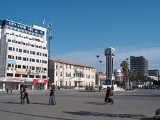
Homs

Encyclopedia
Homs previously known as Emesa (Greek
: Ἔμεσα, Emesa), is a city in western Syria
and the capital of the Homs Governorate
. It is 501 metres (1,643.7 ft) above sea level and is located 162 kilometres (100.7 mi) north of Damascus
. Located on the Orontes River
, Homs is also the central link between the interior cities and the Mediterranean coast.
Homs did not emerge into the historical record until the first century BC at the time of the Seleucids. It later became the capital of a kingdom ruled by the Emesani dynasty
who gave the city its name. Originally a pagan center of worship for the sun god El-Gabal, it later gained importance in Christianity
under the Byzantine
s. Homs was conquered by the Muslims in the seventh century and made capital of a district
that bore its current name. Throughout the Islamic era, Muslim dynasties contending for control of Syria sought after Homs due to the city's strategic position in the area. Homs began to decline under the Ottoman
s and only in the 19th century did the city regain its economic importance when its cotton industry boomed.
Today, Homs is a major industrial center, and with a population of 1.5 million people who claim descent from the Banu Kalb tribe, it is the third largest city in Syria after Aleppo
to the north and the capital Damascus
to the south. Its population reflects Syria's general religious diversity, composed mostly of Arabic
-speaking Sunni Muslims and sizeable Alawite
and Christian
minorities. The city boasts a number of historic mosques and churches and is close to the Krak des Chevaliers
, a world heritage site
.
. When the name of the tribe became attached to the city is indiscernible, but is generally thought to have been used under the Romans.
"Emesa" was shortened to "Homs" or "Hims" by its Arab inhabitants, many of whom settled there prior to the Muslim conquest of Syria
. This name has been preserved throughout the period of Islamic rule continuing to the present day. It was known as "la Chamelle" by the Crusader
s, although they never ruled the city. A second possibility about the origin of the city's modern name is that it is an Arabic
form of the city's Latin
name "Emesus", derived from the Greek
"Emesa" or "Emesos".
mentioned in the Bible
. In 1274 BC, a battle
took place between the forces of the Egyptian Empire under Ramesses II
and the Hittite Empire under Muwatalli II
at the city of Kadesh
on the Orontes River
near Homs. It was possibly the largest chariot
battle ever fought, involving perhaps 5,000–6,000 chariots.
and Elagabalus (deity)
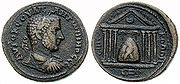 Homs itself may have been founded by Seleucus I Nicator
who established the Seleucid Empire
upon the death of Alexander the Great, although the city did not emerge in the light of history until the 1st century BC. At this time, Greek
philosopher Strabo
spoke of a tent-dwelling tribe called the "Emesani" living in the area around the Orontes and south of the Apamea region
. They were a Syriac tribe in the area and settled in Emesa—which derived its name from them. Upon Pompey
's incorporation of the Seleucid state of Syria into the Roman Empire
in 64 BC, the Emesani dynasty
were made vassal
s to the Romans for aiding their troops in various wars. Their chief at the time, Sampsiceramus I, gained the status as King of Emesa, but their capital was at Arethusa
, a city north of Emesa, also along the Orontes River. At its greatest extent, the kingdom's boundaries extended from the Bekaa Valley in the west to the border with Palmyra
in the east, and from Yabrud
in the south to al-Rastan (Arethusa) in the north. The kingdom of Sampsiceramus I, was the first of Rome's Arab clients on the desert fringes.
The city of Emesa grew to prominence after the new-found wealth of the Emesani dynasty, governed first by one of the sons of Sampsiceramus I, Iamblichus I
who made it the kingdom's capital. The Emesani proved their loyalty to Rome once more when they aided Gaius Julius Caesar
in his siege of Alexandria
in 48 BC, by sending him army detachments. Subsequently, they became embroiled in the Roman Civil War between the rebelling Mark Antony
and the pro-Caesar Octavian
. Iamblichus I as King, took the side of Octavian, and so upon encouragement from Antony, by the brother of Iamblichus I, Alexio I usurped the throne and put him to death in 31 BC. Octavian's forces prevailed in the war, however, and as a result the kingdom's throne was reverted to Iamblichus II (the son of Iamblichus I) after Alexio I was executed for treason. Under the stable rule of Iamblichus II, emerged a new era of peace from 20 BC-14, known as Emesa's "Golden Age
". In 32, Heliopolis and the Bekaa Valley came under the kingdom's control.
Relations with the Roman government grew closer when King Sohaemus
inherited the kingship. Under him, Emesa sent the Roman military a regular levy of archers and assisted them in their siege of Jerusalem
in 70. Sohaemus had died in 73 and was succeeded by his son, Alexio II. Despite the fact that the Emesani dynasty were loyal allies to Rome, for unknown reasons the Roman State reduced the autonomy rule of the Emesani dynasty. Alexio II and his Priest King successors had only ceremonial authority. It remains unclear why this occurred to the Emesani dynasty. Alexio II died in 78 and he was succeeded by his son Sampsiceramus III. The generations after Alexio II, are not recorded sufficiently to accurately present a pedigree. The Emesani dynasty continued to rule until at least 254. Little is known about the Emesani dynasty; their Priest Kings and their relatives after the rule of Alexio II. By the 3rd century, the Emesani dynasty became more Aristocratic Governing Priests over Emesa, then Priest Kings over a Roman Client Kingdom.
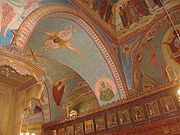 Under the Romans, Emesa began to show attributes of a Greek city-state
and traces of Roman town planning still remain. Its transformation into a major city was completed under the reign of Emperor Antoninus Pius
(138-161) when Emesa began to mint coins. By the 3rd century, it grew prosperous and well-integrated into the Roman Orient. This was partly due to the marriage of Emperor Lucius Septimius Severus
to a woman from a family of notables based in Emesa. It attained the coveted status as a Roman colonia
by Severus, and two other emperors of Severan Dynasty
were raised in Emesa. One of them was Elagabalus
who served as the high priest at the Temple of El-Gebal, the local sun god. He brought the image of this god, a conical black stone, to the Elagabalium in Rome.
Emesa also grew wealthy because it formed a link in the eastern trade funneled through Palmyra
, however, this dependence also caused the city's downfall when Palmyra sank to insignificance in the 4th century. Nonetheless, Emesa at this time had grown to rank with the important cities of Tyre, Sidon
, Beirut
, and Damascus
. It also continued retain local significance, because it was the market center for the surrounding villages. The city remained a strong center of paganism, because of the Temple of El-Gabal. After one of his victories over Zenobia
, Emperor Aurelian
visited the city to pay thanks to the deity.
Due to the strength of the pagan sun-cult in Emesa, Christians initially did not settle in the city. Eusebius
writes that Silvanus, the city's first bishop, had no jurisdiction over the city, but the surrounding villages. He was executed by Emperor Julian
and succeeded by Bishop Antonius—the first bishop to settle Emesa. By the 5th century, Christianity
was well established under the Byzantine Empire
; however, few ancient Christian inscriptions exist in Homs today. Under the Byzantines, it became an important center for Eastern Christianity
. Initially a diocese
, Homs was given the status of ecclesiastical metropolis after the discovery John the Baptist
's head in a nearby area in 452.
 Prior to the Muslim conquest of Syria
, Arab tribes
, particularly the Banu Kalb
settled around Emesa, ensuring its position as an important Yemen
i center. The Byzantine
emperor Heraclius
abandoned the city—which served as his headquarters—after the defeat of his army to that of the Rashidun Muslim
s under Umar ibn al-Khattab during the Battle of Yarmouk
in southern Syria. In AD 637, the Rashidun army
led by Khalid ibn al-Walid
captured Emesa peacefully
as the city agreed to pay a substantial ransom of 71,000 to 170,000 dinar
s. The caliph Umar established Homs as the capital of Jund Hims
, a district within the province of Bilad ash-Sham
, encompassing the towns of Latakia
, Jableh, and Tartus along the coast, as well as the Palmyra
in the Syrian Desert
and the territory in between, including the town of Hama
. Homs was probably the first city in Syria to have a substantial Muslim
population.
The Muslims transformed half of St. John's Church into the city's Friday Mosque (Great Mosque of al-Nuri) and Homs soon became a center of Islam
ic piety since some 500 companions
of Muhammad
settled there after its conquest. The tombs of Ibn al-Walid, his son Abd ar-Rahman, and Ubaid Allah, the son of Umar are located in the city. During the conflict
between the Umayyad
s and Ali
, the inhabitants of Homs allied themselves with Ali and when the latter was defeated, the Umayyad caliph Mu'awiyah hived the northern half of Jund Hims to form a separate district, Jund Qinnasrin
, apparently as punishment. Ali's oratory (mash-had 'Ali) was located in the city, and Islamic tradition claims his fingerprints are engraved on it. During the summer of AD 745 (AH 127), the last Umayyad caliph, Marwan II
approached Homs and upon a revolt by the tribesmen of Kalb, Marwan II
defeated them and ordered that their slain be crucified and breached a part of the city walls. In AD 746, the inhabitants of Homs revolted again against Marwan II
and repaired the city wall. Marwan II
besieged the city for four months. Hunger forced the city inhabitants to submit to the caliphate. In AD 750 the Abbasid
s wrested control of Syria, including Homs, from the Umayyads, but the Arab tribes continued to revolt against the Abbasid
s Caliphate
.
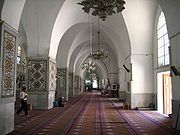 During the reign of caliph Harun al-Rashid
from 796 to 809 and after his reign, the Abbasid authorities sent numerous punitive expeditions against Homs and although the city was quite prosperous in this era, Abbasid rule was generally not welcomed. Under the reign of al-Mutawakkil
, in October 855, an uprising by the Christians of the city erupted in response to additional taxation
. The caliph put down the revolt by expelling Christians from the city, burning down its churches, and executing members of its leadership. With Abbasid rule over the Caliphate weakening in the mid-9th century, Homs became sought after by rebel dynasties contending for control of Syria due to the city's strategic position.
Initially, the Egypt
-based Tulunids
came into control of it, but they were forced out by the Aleppo
-based Hamdanids who were briefly succeeded by the Qarmatians
, after their Turkish rebel ally Aftakin
invaded northern Syria and made Homs his base. In AD 891, geographer al-Yaqubi wrote that Homs was situated along a broad river from which the inhabitants drink. It was one of the largest cities in Syria and had several smaller districts surrounding it. In 944, the Hamdanids took definitive control of the city dominated it until 1016. Arab
geographer al-Mas'udi noted in the early 10th century, that Homs was "noted for the personal beauty of its inhabitants". In 985, al-Muqaddasi
claimed that Homs was the largest city in all of Syria, but it had suffered "great misfortunes" and was "threatened with ruin". He stated that when the city was conquered by the Muslim
s they turned half of its church into a mosque.
For roughly thirty years during the 10th century, Homs was raided by the Byzantines and its inhabitants were subject to slaughter and plunder and the city's mosque was briefly restored to become a church. Throughout most of the 11th century, the Byzantine raids receded greatly and the Mirdasids of the Banu Kalb tribe ruled over Homs, replacing the Hamdanids. Inclined towards Shia Islam, they did not oppose the Shia Fatimid
s of Egypt who were aiming to extend their rule into northern Syria and Iraq
at the time. This precipitated a Sunni reaction led by the Seljuk Turks who occupied Homs under Aq Sunqur al-Hajib
in 1090.
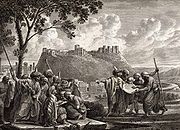 The First Crusade
was launched in 1096, and in 1098, the Crusaders captured Antioch
to the northeast, looted Ma'arat al-Numan, and finally besieged Homs itself. Although they managed to cut the city off from its main port Tartus, they failed in taking the city. Soon after, Homs came under the control of the Seljuk ruler of Damascus
who turned it into a large, fortified camp and key fortress effectively preventing the Crusaders from penetrating deeper into Muslim territory. Immune from attack, the city became a point where the Muslims could marshal their forces and launch raids against Crusader holds along the Mediterranean coast. In the early 12th century, the Seljuks engaged in internal fighting, during which Homs was often a prize. In 1149, the Mosul
-based Zengids under Nur al-Din captured Homs in 1149.
al-Idrisi reports in 1154, that the city was populous, had paved streets, possessed one of the largest mosques in Syria, contained open markets, and was frequented by travelers attracted to its "products and rarities of all kinds". He also noted that its residents were "pleasant; living with them is easy, and their manners are agreeable. The women are beautiful and are celebrated for their fine skin." A series of earthquakes in 1157 inflicted heavy damage upon Homs and its fortress, then in 1170, a minor quake finished off the latter. Yet because of its strategic importance, being opposite of the Crusader County of Tripoli
, the city and its fortifications were soon restored. In 1164, Nur al-Din handed Homs over to Asad ad-Din Shirkuh
as a fief, but reclaimed it five years later after Shirkuh's death. The latter's nephew, Saladin
, came into control of the city in 1175 and in 1179, after reorganizing northern Syria, he restored the fief to his Ayyubid dynasty
who retained it for nearly a century until 1262. In 1225, geographer Yaqut al-Hamawi
mentioned that Homs was large, "celebrated", and walled, having a strongly fortified castle on its southern hill.
During the later Ayyubid period of rule, Homs remained a centerpiece of the wars between them and the Crusaders, as well as internecine conflicts with the Mongol Empire
and the Mamluk
s. The first battle
between the Mongols and the Mamluks took place on December 10, 1260, ending in a decisive Mamluk victory. A second battle
was fought on October 29, 1281, also ending in a Mamluk victory. The Mamluks were finally defeated in the Battle of Wadi al-Khazandar
, also known as the "Third Battle of Homs", in 1299.
Homs declined politically after falling to the Mamluks under Baibars
because they effectively drove out the Crusaders and Mongols from the entirety of Syria. At the beginning of the 14th century, the city was merely the capital of the smallest province of Syria and was often included in the province of Damascus. Ibn Batuta visited Homs in 1355, writing that it had fine trees, good markets, and a "fine Friday Mosque", noting that all of its inhabitants were Arabs. Timur
seized the city in 1400, and later in the 15th century as Mamluk weakness had brought insecurity to the countryside, Homs was ravaged by Bedouin
raids; In 1510, the powerful tribe led by al-Fadl bin Nu'ayr were sent on an expedition by the governor of Damascus to loot the city markets as Homs had failed to pay for his "services".
 In 1516, Homs was incorporated into the Ottoman Empire
and consequently suffered a greater political eclipse, but it continued to thrive as an economic center, processing the agricultural and pastoral products that flowed to it from surrounding districts. Homs was particularly well known for silk and wool weaving, especially the alaja, which was mottled muslin
run through with gold threads and used in feminine apparel. This silk was exported to as far as the Ottoman capital Istanbul
. In addition to weaving industries, there were olive oil
presses and water mills for wheat and sesame, while grapes and rice, grown in the surrounding marshlands from the 16th century, were found in abundance in the city's markets. Moreover, the markets of Homs were the center of a trade in animal, where flocks of sheep and goats coming from Aleppo met camels and cattle moving north from Damascus.
The coming of the Ottomans brought administrative change to Homs, now becoming the center of a sanjak
("district") attached to the wilaya ("province") of Tripoli
—its old rival. At this time, a French
visitor noted that the city walls and citadel were in good repair, all within was in decay and only its covered markets "retained their beauty". French traveler, Volney
wrote in 1785 of the city's once great importance and its current "miserable" condition. He described it as large, but ruined village administratively dependent on Damascus. The Ottomans did little to revitalize Homs or ensure it security against Bedouin raids. Tribal unrest throughout the 17th and 18th centuries resulted in the sacking of its markets on several occasions. Security was even more hampered, when in the 18th century, the Ottomans tore down the gates of the city's walls.
The countryside of Homs saw an increase in Bedouin ravages in the first half of the 19th century, interrupted by it and Syria's occupation by Muhammad Ali's Egypt
led by Ibrahim Pasha
between 1832 and 1840. The city revolted against Egyptian rule, and its citadel was destroyed when the Egyptians were suppressing the revolt. Ottoman rule was soon restored and up to the 1860s, Homs was large enough to form a discrete economic unit of trade and processing of agricultural products from its satellite villages and the neighboring Bedouin tribe.
The local economy was stimulated when the Ottoman government extended security to the city and its surrounding area; new villages were established and old ones were resettled. Homs found itself faced with European economic competition since Ottoman rule was restored. Homs' economic importance was boosted again during the depression of the 1870s, as its cotton industry boomed due to a decline European textile production. The quality and design of cotton goods from Homs satisfied both the lower and upper classes of the local, Ottoman, and even the foreign market. There were around 5,000 looms in Homs and nearby Hama
, and one British consul referred to Homs as the "Manchester
of Syria".
, Homs was part of the State of Damascus
. In Autumn 1925, the city joined Damascus and the southern Druze
chieftains in a full-blown revolt against French rule. In 1932 the French moved their military academy
from Damascus to Homs, and remained the only military academy in Syria until 1967. The Homs Military Academy played a major role in the years following Syria's independence, as many of its graduates went on to become high ranked officers in the Syrian Army
and many of them took part in the series of coup d'état
s that were to follow. An important example was Hafez al-Assad
who became the president of Syria from 1971 until his death in 2000.
An oil pipeline between Tripoli and Kirkuk
was built in Homs in the early 1930s and it followed an ancient caravan route between Palmyra and the Mediterranean. In 1959, an oil refinery was built to process some of this oil for consumption by Syria. Israel
bombed the Homs oil refinery during the Yom Kippur War
in 1973.
Homs is one of many cities in Syria where large anti-government demonstrations have been held, part of the wider 2011 Syrian uprising
. Thousands to tens of thousands gathered in the city's main square (Liberty Square) on April 17–18 in a sit-in protesting the regime of current president Bashar al-Assad
. At least 62 residents of Homs had been killed by government security forces or armed loyalists in the preceding days, and some defectors estimate the toll was at least 300 . Homs has also been recognized as the Capital of the Syrian Revolution 2011
.
in Homs against what the government calls terrorist groups, while the opposition called it a crackdown against pro-democracy protestors.
is the largest in Syria. Homs, the governorate's capital, is located in central western Syria, situated along the east bank of the Orontes River
in a particularly fertile area. The city is in between the southern outliers of al-Ansariyah mountains
located to its west and Mount Lebanon
, overlooking the Homs Gap. Because of the gap, the area around Homs receives much more rainfall than interior regions to its north and south. To the east of Homs, is the Syrian Desert
. Lake Homs, impounded by a huge dam of Roman origins, is to the southwest, lying some 125 kilometres (77.7 mi) south of Aleppo
and 34 kilometres (21.1 mi) south of Hama
, halfway on the road between the capital Damascus and Aleppo. The Orontes River splits the city into two main sections: To the east, on a flat land lies the city center and the main neighborhoods; to the west, lies the more recent and modern suburb of al-Waer. The city spans an area of 4800 hectares (18.5 sq mi).
Homs is located 162 kilometres (100.7 mi) north of Damascus
, 193 kilometres (119.9 mi) south from Aleppo
, 47 kilometres (29.2 mi) south Hama
, and 186 kilometres (115.6 mi) southeast from Latakia
. Nearby towns and villages include al-Qusayr
to the south, Fairouzeh
to the southeast, Marmarita
and Zweitina
to the west, Qatna
to the northeast and Ar-Rastan
to the north.
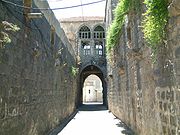
 The Old City is the most condensed area of Homs, and it includes the neighborhoods of Bab Tadmur, Bab al-Dreib, and Bab Hud and the area around the citadel, covering an area of 1.2 square kilometre (0.463322590311042 sq mi). Little remains of the Old City; its walls and gates were demolished in the Ottoman era, but a short section of fortified wall with a circular corner tower still exists. Half a kilometer to the south, a large earth mound marks the site where the citadel once stood. To the north of the citadel lies the Christian Quarter, known as "al-Hamidiyah". This neighborhood is one of the few areas of Homs that retains its older look, with most of the black-and-white stone buildings dating from the Mamluk era. They are still used as shops and dwellings, and there has been recent renovation.
At the time of the Abbasids, Homs was known for its seven gates. They were Bab al-Souq (Gate of the Market), Bab Tadmor (Gate of Palmyra
), Bab al-Dreib (or Bab al-Deir), Bab al-Sebaa (Gate of the Lions), Bab al-Turkman (Gate of the Turkmen), Bab al-Masdoud (Closed Door), and Bab Hud (The Gate of Hud
). Only two gates—Bab Tadmor and Bab al-Dreib—remain today. The oldest of Homs' mosques and churches are located in the Old City.
Homs consists of several subdivisions outside the Old City. The large neighborhood of Khaldiyah spreads along its northern edge, while the more modern neighborhoods of al-Sabeel, al-Zahra, and Jub al-Jandali are situated to the east of the Old City. South of it are the neighborhoods of Bab al-Sebaa, al-Mreijeh, al-Nezha, Akrama and beyond them lay the Karm al-Zaytoun and Karm al-Loz neighborhoods. The modern commercial center lies to the west in the neighborhood of Jouret al-Shayyah, and further west are the upscale neighborhoods of Qusoor, al-Mahatta and al-Ghouta. The suburb of al-Waer is located even further west, separated from the city by areas of farmland called al-Basateen and the Orontes river forming a green belt
where it is forbidden to build anything. The al-Baath University
complex and dormitories are located on the western-southern edge of the city next to the neighborhood of Akrama.
Homs was one of the largest cities in Muslim Syria in the 12th century with a population of 7,000. In 1785, the inhabitants of Homs numbered more than 2,000 and the population was divided almost evenly between Muslim
s and Greek Orthodox Christian
s. The 1860s saw a rise in the population to 15,000-20,000. By 1907, Homs had roughly 65,000 inhabitants, of which two-thirds were Muslims and the remainder Christians. In the 1981 census, the population stood at 346,871, rising to 540,133 in 1994. Homs had 750,000 residents in a 2005 estimate, and as of 2008 the population stood at about 823,000.
Today, Homs' population reflects Syria's general religious diversity, and is made up primarily of Sunni Muslims, with minorities of Alawite Muslims Arabs, Greek Orthodox and Syriac Orthodox Christian
s. In the 1880s, the Survey of Western Palestine noted that there were 5,500 Greek Orthodox Christians and 1,500 Syriac Orthodox Christians. The Syriac Patriarchate was transferred to Homs from Mardin
in 1933, but relocated once more to Damascus in 1959.
Homs camp, a Palestinian refugee camp, is located within the city of Homs, and has a population of nearly 14,000. Most of its residents are originally from the Acre
and Haifa
areas in northern Palestine
(present-day Israel
). During the Armenian Genocide
in the early 20th century, about 20,000 Armenians immigrated to Homs and the surrounding villages. A small Greek community also exists in the city.
 After long periods of stagnation under Ottoman
rule, Homs started to flourish again in the 20th-century. Its geographic and strategic location has made it a center of agriculture and industry. The "Homs Irrigation Scheme", the first of its kind in modern Syria, brought prosperity to cultivators and the long-established enterprises involved in the processing of agricultural and pastoral products. Crops grown in Homs include, wheat, barley, lentils, sugar beets, cotton, and vines, as well as serving as a point of exchange between the sedentary zone and the desert. Moreover, because of easy access to the Mediterranean, Homs has attracted overland trade from the Persian Gulf
and Iraq
.
Homs is also home to several large public heavy industries, such as the oil refinery west of the city which opened in 1959. A fertilizer plant was built in 1971 to process phosphates from their deposits near Palmyra; the fertilizer is for domestic consumption and export. A growing private industrial sector has flourished in the past decade and many small to medium sized enterprises occupy the industrial zones northwest and south of the city. A new sugar refinery is being built by a Brazil
ian company, and an automobile plant is under construction by Iran Khodro
. Also a new phosphate plant and oil refinery are being built east of the city. Homs is also the hub of an important road and rail network, it is the central link between the interior cities and the Mediterranean coast.
A major industrial project was the establishment of a new industrial city in Hissaya, 47 kilometres (29.2 mi) south of the city of Homs. Spreading across some 2500 hectares (25 km²), the city covers four main industrial sectors: textiles, food, chemical, engineering and vocational. In all, the facilities are designed to accommodate up to 66,000 workers and their families. Moreover, a free zone has been established within the city.
The hinterland of Homs is well known for its grapes which are used in Syria's liqueur
industry, particularly in producing arak, nectar wine, and red wine. The city is considered a good base for day trips and excursions to the many historical and touristic sights nearby. Popular destinations include Krak des Chevaliers
, Qatna
, Talkalakh
and Marmarita
. Homs has several hotels; Safir Hotel is considered one of Syria's best five-star hotels and the only one of that status in the city. An-Nasr al-Jedid Hotel is built in a 100-year-old mansion and is labeled by tour guides as the "best budget hotel in Homs". Other hotels include Hotel al-Mimas, Ghazi Hotel, and Hotel Khayyam.
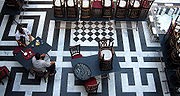 Although people in Homs eat the same foods common in Levantine cuisine
, the city is well known throughout Syria for its own cuisine. A prominent dish is Batarsh, a type of baba ghanouj made with yogurt and garlic instead of tahini
. Homs is also home to a variety of kibbeh mishwiyyeh or "grilled kibbeh". It consists of two pancakes of kibbeh
stuffed with ground lamb, cooked with lamb fat and various spices. Batata mahshi ("stuffed potatoes") is native dish in Homs and is made of baby potatoes stuffed with ground lamb, pine nuts, and pomegranate molasses. The city specializes in cooking a type of okra
meal, known as bamya bi-l zayt ("okra with olive oil").
Homs has an array of restaurants, some of the most highly acclaimed are those within the Safir Hotel: Mamma Mia and Mersia. The former specializes in Italian cuisine
, while the latter serves Arabic food
. For the local population, popular restaurants include Prince Restaurant which acts as a type of fast-food place, serving shawarma
, grilled chicken, and other common Syrian foods, as well as homemade juices. In the Old City, low-price restaurants are grouped together along Shoukri al-Quwatly Street
and sell similar foods, such as hummus
, falafel
, various salads (mezze), kebab
s and chicken dishes. Restaurants and coffeehouses typically offer hookah
s and are a common place for men to gather and smoke.
Like counterparts in Damascus and Aleppo, many houses in the Old City of Homs have been renovated and turned into restaurants specializing in Levantine cuisine. Most notable of these is Beit al-Agha restaurant, situated in a renovated palace that dates back to the mid 19th-century with Ottoman and Mamluke architecture, and Julia Dumna Restaurant, which has been described as the best example of traditional Homsi houses, with its white and black stones.
-era palace belonging to Ali ibn Abi al-Fadl al-Azzhari, a subordinate of Baibars
, the Mamluk sultan, is now the National Folklore Museum. Outside the building is a courtyard, occupied on one side by a large terraced liwan
with a conch shell semi-dome. In the opposite wall, there is a carving of two lions, a symbol of Baibars. The first museum built in the city is located along Shoukri al-Quwatly Street and contains a selection of artifacts from the Homs region, covering the time between the pre-historic to Islamic eras.
. The Desert Folk Festival is an annual festival of the ancient traditions and costumes of the Badiya (Syrian Desert
) and it includes exhibitions and concerts between Homs and Palmyra. The festival is held in the first week of May. The Al-Badiya Festival, which is held mainly in Palmyra with some events in Homs, draws approximately 60,000 tourists during the last week of May. Activities include horse, camel, and car races, horse contests, music and theatre shows, antique exhibitions, and a crafts market. Other festivals include the al-Nasarah Festival and the Festival of Krak des Chevaliers and the Valley. An annual festival is held at the Church of Saint Elian
, attracting large numbers of pilgrims.
 Homs is the home city of two football clubs. The Al-Karamah Sports Club was founded in 1928 and is one the oldest sports club in Syria. The Al-Karamah Sports Club is widely acclaimed on the regional and national levels, having won eight Syrian League titles, and eight Syrian Cup
titles. Al-Karamah was runner-up in the 2006 AFC Champions League. The second sports club of the city is Al-Wathba Sports Club, which was founded in 1937. The Khaled Ibn Al Walid Stadium
has a 35,000-seat capacity and is home to both football clubs. Homs has produced a number of well-known sportsmen, including footballers Firas Al Khatib
and Jehad Al Hussain.
, and the capital of the Homs Governorate
—the largest governorate in Syria, and houses the seat of its governor, Muhammed Iyad Ghazal, appointed by the president. The city of Homs is governed by a city council and is home to the Executive Office. The latter consists of nine elected members, in addition to the president of the city council
. The Office aids the Governor in making management decisions related to the Governorate, while the city council is responsible for decisions specific to the city of Homs. It is headed by a president, Nadia Kseibi, and is responsible for the day-to-day management of the city.
The council's organizational structure is composed of the top leadership, consisting of the president, vice president, and secretary, and the lower leadership, made up of the directors of seventeen city branches: Administrative Affairs, Finance, Technical Affairs, Health Affairs, Legal Affairs, the Fire Department, Mechanisms, Parks, Hygiene, Property, Provisional Register, Services and Maintenance, Works, IT, Planning and Statistics, Culture, and Internal Oversight Service.
, one of four major universities in Syria was founded in 1979. A specialist engineering foundation, the university has one of the largest student bodies. It houses several faculties including medicine, engineering, liberal arts, and sciences and a number of two-year career (vocational) institutions.
It is the only university in the country to have departments in petroleum engineering and veterinary medicine.
The German University
at Wadi al-Nasarah opened in 2004 and is located 30 kilometres (18.6 mi) west of the city. In 2005, the International School of Choueifat
opened a school outside the city. Al-Andalus University for Medical Sciences
was established in 2005 near Homs, and is constructing one of its University Hospital
s in the city.
There are 1,727 schools and 15,000 kindergartens in the Homs Governorate, most of which are public facilities. In 2007, 375,000 students in the governorate were enrolled in elementary schools (6–15 years), 36,000 in high schools (15–18 years), and around 12,000 in vocational training schools.
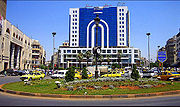 Homs is considered a transportation hub in Syria, by virtue of its central location between the coastal cities and the interior. The main bus terminal is Karnak, situated along Hama Street, 1.5 kilometre (0.93205910497471 mi) north of the city center on the outskirts. The terminal offers connections to most Syrian cities and Beirut
, Lebanon
. It also has international bus connections to Lebanon, Jordan
, Saudi Arabia
and Turkey
. A second "luxury" bus station is located a little further north. Minibus
es operate from Karnak station with destinations to Tartus, Palmyra, and Hama in northern Syria, as well as Baalbek
, Tripoli, and Beirut in Lebanon. Newer microbuses that mostly travel to Hama are also based in Karnak and are mostly used for quick transportation.
Homs has a large railway station, with two Chemins de Fer Syriens
operated daily departures to Damascus and Aleppo. The nearest airports are Bassel Al-Assad International Airport
in Latakia
to the west, Damascus International Airport
to the south, Aleppo International Airport
to the north, and Palmyra Airport
in the Syrian Desert to the east.
Hama Street starts at the Old Clock Square in the city center and crosses Homs from south to north, where it continues along the neighborhood of al-Khaldiyah on to the Karnak station, and turns into the Homs-Hama-Aleppo highway. Quwatli Street
, named after former president Shukri al-Quwatli, is a short but vital street that connects the Old Clock Square and Quwatli Square in Downtown Homs. It branches into several smaller streets on its western end, one of which is al-Dablan Street which is the main commercial block in the city, and the other continues west to connect with the Homs-Tripoli
highway. On the eastern end, al-Quwatli street continues as al-Hamidiyah Street which crosses the old Christian quarter and continues to the eastern edge of the city. The Homs-Damascus highway crosses the city from the south and reaches the city center in Quwatli Square.
s and churches. It is also well recognized by its twin clock-towers. The older one, facing al-Hamidiya Street, was built by the French
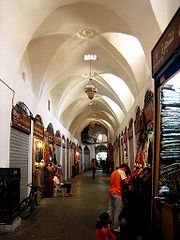
in the early 1930s, and the newer one in al-Quwatli Square facing al-Dablan street. Homs is well known for its historical roofed souk
s. These consist of a complex maze of narrow streets and covered commercial alleys extending from the south and east from the Great Mosque towards the ancient citadel. The souks—lined with grocery and clothing stores, and workshops for carpenters, artisans, cobblers, metalworkers, and knife-sharpeners—are busiest in the evening.
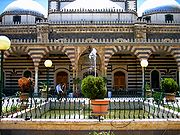 Homs and the surrounding countryside bear many landmarks, including a world heritage site
, the Krak des Chevaliers
and Citadel of Salah Ed-Din. Other landmarks include the Great Mosque of al-Nuri. Originally a pagan temple dedicated to El-Gabal, it was consecrated as the Church of Saint John the Baptist under the Byzantines. Later, it was established as a Friday mosque during the Islamic Arab rule of Homs. The Khalid ibn al-Walid Mosque
has been considered "the only edifice of any real note" in Homs, and was built in the last few years of Ottoman rule in Syria during 1900s. The mosque is named after early Arab general Khalid ibn al-Walid, whose tomb is located within the building.
The Um al-Zennar Church
("Church of the Virgin's Girdle") was built in 1852 atop an earlier church dating back to the 4th century, and perhaps 59 CE. The other prominent church in Homs is the 5th-century Church of Saint Elian
, built in honor of Christian
martyr Saint Elian, whose tomb is located in the crypt
.
The Citadel of Homs is situated on one of the largest urban tell
s of Syria. It has been archaeologically neglected because of military occupation until recent years. The tell dates back at least to the Early Bronze Age. The extant Islamic-style walls were built during the Ayyubid period and the Mamluk sultan Baybars subsequently carried out restorations. All of this work is testified by inscriptions although without exception, they are lost. In 1994, a joint Syrian-British team studied the Citadel of Homs, recording the remains of the walls and towers.
+34° 43' 51.00", +36° 42' 34.00"
Ancient Greek
Ancient Greek is the stage of the Greek language in the periods spanning the times c. 9th–6th centuries BC, , c. 5th–4th centuries BC , and the c. 3rd century BC – 6th century AD of ancient Greece and the ancient world; being predated in the 2nd millennium BC by Mycenaean Greek...
: Ἔμεσα, Emesa), is a city in western Syria
Syria
Syria , officially the Syrian Arab Republic , is a country in Western Asia, bordering Lebanon and the Mediterranean Sea to the West, Turkey to the north, Iraq to the east, Jordan to the south, and Israel to the southwest....
and the capital of the Homs Governorate
Homs Governorate
Homs Governorate is one of the fourteen muhafazat of Syria. It is situated in central Syria. Its area differs in various sources, from 40,940 km². to 42,223 km² . It is thus geographically the largest governorate of Syria. Homs Governorate has a population of 1,763,000 . The capital is...
. It is 501 metres (1,643.7 ft) above sea level and is located 162 kilometres (100.7 mi) north of Damascus
Damascus
Damascus , commonly known in Syria as Al Sham , and as the City of Jasmine , is the capital and the second largest city of Syria after Aleppo, both are part of the country's 14 governorates. In addition to being one of the oldest continuously inhabited cities in the world, Damascus is a major...
. Located on the Orontes River
Orontes River
The Orontes or ‘Āṣī is a river of Lebanon, Syria and Turkey.It was anciently the chief river of the Levant, also called Draco, Typhon and Axius...
, Homs is also the central link between the interior cities and the Mediterranean coast.
Homs did not emerge into the historical record until the first century BC at the time of the Seleucids. It later became the capital of a kingdom ruled by the Emesani dynasty
Royal Family of Emesa
The royal family of Emesa, also known as the Emesani Dynasty or the Sempsigerami of Emesa , sometimes known as The Sampsiceramids were a ruling Roman client dynasty of priest-kings in Emesa, Syria Province...
who gave the city its name. Originally a pagan center of worship for the sun god El-Gabal, it later gained importance in Christianity
Christianity
Christianity is a monotheistic religion based on the life and teachings of Jesus as presented in canonical gospels and other New Testament writings...
under the Byzantine
Byzantine Empire
The Byzantine Empire was the Eastern Roman Empire during the periods of Late Antiquity and the Middle Ages, centred on the capital of Constantinople. Known simply as the Roman Empire or Romania to its inhabitants and neighbours, the Empire was the direct continuation of the Ancient Roman State...
s. Homs was conquered by the Muslims in the seventh century and made capital of a district
Jund Hims
Jund Hims was one of the four military districts of the Caliphate province of Syria. Its capital was Homs, from which the district received its name...
that bore its current name. Throughout the Islamic era, Muslim dynasties contending for control of Syria sought after Homs due to the city's strategic position in the area. Homs began to decline under the Ottoman
Ottoman Empire
The Ottoman EmpireIt was usually referred to as the "Ottoman Empire", the "Turkish Empire", the "Ottoman Caliphate" or more commonly "Turkey" by its contemporaries...
s and only in the 19th century did the city regain its economic importance when its cotton industry boomed.
Today, Homs is a major industrial center, and with a population of 1.5 million people who claim descent from the Banu Kalb tribe, it is the third largest city in Syria after Aleppo
Aleppo
Aleppo is the largest city in Syria and the capital of Aleppo Governorate, the most populous Syrian governorate. With an official population of 2,301,570 , expanding to over 2.5 million in the metropolitan area, it is also one of the largest cities in the Levant...
to the north and the capital Damascus
Damascus
Damascus , commonly known in Syria as Al Sham , and as the City of Jasmine , is the capital and the second largest city of Syria after Aleppo, both are part of the country's 14 governorates. In addition to being one of the oldest continuously inhabited cities in the world, Damascus is a major...
to the south. Its population reflects Syria's general religious diversity, composed mostly of Arabic
Arabic language
Arabic is a name applied to the descendants of the Classical Arabic language of the 6th century AD, used most prominently in the Quran, the Islamic Holy Book...
-speaking Sunni Muslims and sizeable Alawite
Alawite
The Alawis, also known as Alawites, Nusayris and Ansaris are a prominent mystical and syncretic religious group centred in Syria who are a branch of Shia Islam.-Etymology:...
and Christian
Eastern Christianity
Eastern Christianity comprises the Christian traditions and churches that developed in the Balkans, Eastern Europe, Asia Minor, the Middle East, Northeastern Africa, India and parts of the Far East over several centuries of religious antiquity. The term is generally used in Western Christianity to...
minorities. The city boasts a number of historic mosques and churches and is close to the Krak des Chevaliers
Krak des Chevaliers
Krak des Chevaliers , also Crac des Chevaliers, is a Crusader castle in Syria and one of the most important preserved medieval castles in the world. The site was first inhabited in the 11th century by a settlement of Kurds; as a result it was known as Hisn al Akrad, meaning the "Castle of the...
, a world heritage site
World Heritage Site
A UNESCO World Heritage Site is a place that is listed by the UNESCO as of special cultural or physical significance...
.
Etymology
"Emesa" is a compound of "Ham-Es", with the Es representing an assemblage of the locally-revered sun god in (El-Gabal) in ancient times. The name "Emesa" or "Hemesa" is also attributed to "Emesenoi", the name of the Arab tribe that ruled the area before its incorporation into the Roman EmpireRoman Empire
The Roman Empire was the post-Republican period of the ancient Roman civilization, characterised by an autocratic form of government and large territorial holdings in Europe and around the Mediterranean....
. When the name of the tribe became attached to the city is indiscernible, but is generally thought to have been used under the Romans.
"Emesa" was shortened to "Homs" or "Hims" by its Arab inhabitants, many of whom settled there prior to the Muslim conquest of Syria
Muslim conquest of Syria
The Muslim conquest of Syria occurred in the first half of the 7th century, and refers to the region known as the Bilad al-Sham, the Levant, or Greater Syria...
. This name has been preserved throughout the period of Islamic rule continuing to the present day. It was known as "la Chamelle" by the Crusader
Crusades
The Crusades were a series of religious wars, blessed by the Pope and the Catholic Church with the main goal of restoring Christian access to the holy places in and near Jerusalem...
s, although they never ruled the city. A second possibility about the origin of the city's modern name is that it is an Arabic
Arabic language
Arabic is a name applied to the descendants of the Classical Arabic language of the 6th century AD, used most prominently in the Quran, the Islamic Holy Book...
form of the city's Latin
Latin
Latin is an Italic language originally spoken in Latium and Ancient Rome. It, along with most European languages, is a descendant of the ancient Proto-Indo-European language. Although it is considered a dead language, a number of scholars and members of the Christian clergy speak it fluently, and...
name "Emesus", derived from the Greek
Greek language
Greek is an independent branch of the Indo-European family of languages. Native to the southern Balkans, it has the longest documented history of any Indo-European language, spanning 34 centuries of written records. Its writing system has been the Greek alphabet for the majority of its history;...
"Emesa" or "Emesos".
History
For roughly 2,000 years, Homs has served as a key agricultural market, production site, and trade center for the villages of northern Syria. It has also provided security services to the hinterland of Syria, protecting it from invading forces. Excavations at the Citadel of Homs indicate that the earliest settlement at the site dates back to around 2300 BC. Biblical scholars have identified the city with ZobahZobah
Zobah or Aram-Zobah was the capital of an early Aramean state in southern Syria, at one time of considerable importance. In I Samuel xiv...
mentioned in the Bible
Bible
The Bible refers to any one of the collections of the primary religious texts of Judaism and Christianity. There is no common version of the Bible, as the individual books , their contents and their order vary among denominations...
. In 1274 BC, a battle
Battle of Kadesh
The Battle of Kadesh took place between the forces of the Egyptian Empire under Ramesses II and the Hittite Empire under Muwatalli II at the city of Kadesh on the Orontes River, in what is now the Syrian Arab Republic....
took place between the forces of the Egyptian Empire under Ramesses II
Ramesses II
Ramesses II , referred to as Ramesses the Great, was the third Egyptian pharaoh of the Nineteenth dynasty. He is often regarded as the greatest, most celebrated, and most powerful pharaoh of the Egyptian Empire...
and the Hittite Empire under Muwatalli II
Muwatalli II
Muwatalli II was a king of the New kingdom of the Hittite empire .- Biography :He was the eldest son of Mursili II and Queen Gassulawiya, and he had several siblings....
at the city of Kadesh
Kadesh
This article is about Kadesh in the lands of the Amurru, bordering on Damascus Syria up to Hammath; see also Kadesh or Kedesh Kadesh was an ancient city of the Levant, located on or near the headwaters or ford of the Orontes River...
on the Orontes River
Orontes River
The Orontes or ‘Āṣī is a river of Lebanon, Syria and Turkey.It was anciently the chief river of the Levant, also called Draco, Typhon and Axius...
near Homs. It was possibly the largest chariot
Chariot
The chariot is a type of horse carriage used in both peace and war as the chief vehicle of many ancient peoples. Ox carts, proto-chariots, were built by the Proto-Indo-Europeans and also built in Mesopotamia as early as 3000 BC. The original horse chariot was a fast, light, open, two wheeled...
battle ever fought, involving perhaps 5,000–6,000 chariots.
Emesani dynasty and Roman rule
Also see articles: Royal family of EmesaRoyal family of Emesa
The royal family of Emesa, also known as the Emesani Dynasty or the Sempsigerami of Emesa , sometimes known as The Sampsiceramids were a ruling Roman client dynasty of priest-kings in Emesa, Syria Province...
and Elagabalus (deity)
Seleucus I Nicator
Seleucus I was a Macedonian officer of Alexander the Great and one of the Diadochi. In the Wars of the Diadochi that took place after Alexander's death, Seleucus established the Seleucid dynasty and the Seleucid Empire...
who established the Seleucid Empire
Seleucid Empire
The Seleucid Empire was a Greek-Macedonian state that was created out of the eastern conquests of Alexander the Great. At the height of its power, it included central Anatolia, the Levant, Mesopotamia, Persia, today's Turkmenistan, Pamir and parts of Pakistan.The Seleucid Empire was a major centre...
upon the death of Alexander the Great, although the city did not emerge in the light of history until the 1st century BC. At this time, Greek
Greeks
The Greeks, also known as the Hellenes , are a nation and ethnic group native to Greece, Cyprus and neighboring regions. They also form a significant diaspora, with Greek communities established around the world....
philosopher Strabo
Strabo
Strabo, also written Strabon was a Greek historian, geographer and philosopher.-Life:Strabo was born to an affluent family from Amaseia in Pontus , a city which he said was situated the approximate equivalent of 75 km from the Black Sea...
spoke of a tent-dwelling tribe called the "Emesani" living in the area around the Orontes and south of the Apamea region
Apamea (Syria)
Apamea was a treasure city and stud-depot of the Seleucid kings, was capital of Apamene, on the right bank of the Orontes River. . Its site is found about to the northwest of Hama, Syria, overlooking the Ghab valley...
. They were a Syriac tribe in the area and settled in Emesa—which derived its name from them. Upon Pompey
Pompey
Gnaeus Pompeius Magnus, also known as Pompey or Pompey the Great , was a military and political leader of the late Roman Republic...
's incorporation of the Seleucid state of Syria into the Roman Empire
Roman Empire
The Roman Empire was the post-Republican period of the ancient Roman civilization, characterised by an autocratic form of government and large territorial holdings in Europe and around the Mediterranean....
in 64 BC, the Emesani dynasty
Royal Family of Emesa
The royal family of Emesa, also known as the Emesani Dynasty or the Sempsigerami of Emesa , sometimes known as The Sampsiceramids were a ruling Roman client dynasty of priest-kings in Emesa, Syria Province...
were made vassal
Vassal
A vassal or feudatory is a person who has entered into a mutual obligation to a lord or monarch in the context of the feudal system in medieval Europe. The obligations often included military support and mutual protection, in exchange for certain privileges, usually including the grant of land held...
s to the Romans for aiding their troops in various wars. Their chief at the time, Sampsiceramus I, gained the status as King of Emesa, but their capital was at Arethusa
Arethusa (see)
Arethusa is a Roman Catholic titular see in the former Roman province of Syria, near Apameia. The modern, Arabic name of the site is Er-Rastan....
, a city north of Emesa, also along the Orontes River. At its greatest extent, the kingdom's boundaries extended from the Bekaa Valley in the west to the border with Palmyra
Palmyra
Palmyra was an ancient city in Syria. In the age of antiquity, it was an important city of central Syria, located in an oasis 215 km northeast of Damascus and 180 km southwest of the Euphrates at Deir ez-Zor. It had long been a vital caravan city for travellers crossing the Syrian desert...
in the east, and from Yabrud
Yabrud
Yabrud is a city in Syria, located in the Rif Dimashq governorate about 80 km north of the capital Damascus. The city is known for its ancient caves, most notably the Iskafta cave , and the Yabrud temple, which was once Jupiter...
in the south to al-Rastan (Arethusa) in the north. The kingdom of Sampsiceramus I, was the first of Rome's Arab clients on the desert fringes.
The city of Emesa grew to prominence after the new-found wealth of the Emesani dynasty, governed first by one of the sons of Sampsiceramus I, Iamblichus I
Iamblichus (phylarch)
Iamblichus I was one of the phylarchs, or petty princes of the Arab tribe of the Emesenes in Emesa . He was the son of Sampsiceramus I, and is first mentioned by Marcus Tullius Cicero in a despatch, which he sent from Rome to Cilicia in 51 BC, and in which he states that lamblichus had sent him...
who made it the kingdom's capital. The Emesani proved their loyalty to Rome once more when they aided Gaius Julius Caesar
Julius Caesar
Gaius Julius Caesar was a Roman general and statesman and a distinguished writer of Latin prose. He played a critical role in the gradual transformation of the Roman Republic into the Roman Empire....
in his siege of Alexandria
Alexandria
Alexandria is the second-largest city of Egypt, with a population of 4.1 million, extending about along the coast of the Mediterranean Sea in the north central part of the country; it is also the largest city lying directly on the Mediterranean coast. It is Egypt's largest seaport, serving...
in 48 BC, by sending him army detachments. Subsequently, they became embroiled in the Roman Civil War between the rebelling Mark Antony
Mark Antony
Marcus Antonius , known in English as Mark Antony, was a Roman politician and general. As a military commander and administrator, he was an important supporter and loyal friend of his mother's cousin Julius Caesar...
and the pro-Caesar Octavian
Augustus
Augustus ;23 September 63 BC – 19 August AD 14) is considered the first emperor of the Roman Empire, which he ruled alone from 27 BC until his death in 14 AD.The dates of his rule are contemporary dates; Augustus lived under two calendars, the Roman Republican until 45 BC, and the Julian...
. Iamblichus I as King, took the side of Octavian, and so upon encouragement from Antony, by the brother of Iamblichus I, Alexio I usurped the throne and put him to death in 31 BC. Octavian's forces prevailed in the war, however, and as a result the kingdom's throne was reverted to Iamblichus II (the son of Iamblichus I) after Alexio I was executed for treason. Under the stable rule of Iamblichus II, emerged a new era of peace from 20 BC-14, known as Emesa's "Golden Age
Golden Age
The term Golden Age comes from Greek mythology and legend and refers to the first in a sequence of four or five Ages of Man, in which the Golden Age is first, followed in sequence, by the Silver, Bronze, and Iron Ages, and then the present, a period of decline...
". In 32, Heliopolis and the Bekaa Valley came under the kingdom's control.
Relations with the Roman government grew closer when King Sohaemus
Sohaemus of Emesa
Gaius Julius Sohaemus, also known as Sohaemus of Emesa and Sohaemus of Sophene , was a prince and a Roman Client Priest King from Syria who lived in the 1st century....
inherited the kingship. Under him, Emesa sent the Roman military a regular levy of archers and assisted them in their siege of Jerusalem
Siege of Jerusalem (70)
The Siege of Jerusalem in the year 70 AD was the decisive event of the First Jewish-Roman War. The Roman army, led by the future Emperor Titus, with Tiberius Julius Alexander as his second-in-command, besieged and conquered the city of Jerusalem, which had been occupied by its Jewish defenders in...
in 70. Sohaemus had died in 73 and was succeeded by his son, Alexio II. Despite the fact that the Emesani dynasty were loyal allies to Rome, for unknown reasons the Roman State reduced the autonomy rule of the Emesani dynasty. Alexio II and his Priest King successors had only ceremonial authority. It remains unclear why this occurred to the Emesani dynasty. Alexio II died in 78 and he was succeeded by his son Sampsiceramus III. The generations after Alexio II, are not recorded sufficiently to accurately present a pedigree. The Emesani dynasty continued to rule until at least 254. Little is known about the Emesani dynasty; their Priest Kings and their relatives after the rule of Alexio II. By the 3rd century, the Emesani dynasty became more Aristocratic Governing Priests over Emesa, then Priest Kings over a Roman Client Kingdom.
City-state
A city-state is an independent or autonomous entity whose territory consists of a city which is not administered as a part of another local government.-Historical city-states:...
and traces of Roman town planning still remain. Its transformation into a major city was completed under the reign of Emperor Antoninus Pius
Antoninus Pius
Antoninus Pius , also known as Antoninus, was Roman Emperor from 138 to 161. He was a member of the Nerva-Antonine dynasty and the Aurelii. He did not possess the sobriquet "Pius" until after his accession to the throne...
(138-161) when Emesa began to mint coins. By the 3rd century, it grew prosperous and well-integrated into the Roman Orient. This was partly due to the marriage of Emperor Lucius Septimius Severus
Septimius Severus
Septimius Severus , also known as Severus, was Roman Emperor from 193 to 211. Severus was born in Leptis Magna in the province of Africa. As a young man he advanced through the customary succession of offices under the reigns of Marcus Aurelius and Commodus. Severus seized power after the death of...
to a woman from a family of notables based in Emesa. It attained the coveted status as a Roman colonia
Colonia (Roman)
A Roman colonia was originally a Roman outpost established in conquered territory to secure it. Eventually, however, the term came to denote the highest status of Roman city.-History:...
by Severus, and two other emperors of Severan Dynasty
Severan dynasty
The Severan dynasty was a Roman imperial dynasty, which ruled the Roman Empire between 193 and 235. The dynasty was founded by the Roman general Septimius Severus, who rose to power during the civil war of 193, known as the Year of the Five Emperors....
were raised in Emesa. One of them was Elagabalus
Elagabalus
Elagabalus , also known as Heliogabalus, was Roman Emperor from 218 to 222. A member of the Severan Dynasty, he was Syrian on his mother's side, the son of Julia Soaemias and Sextus Varius Marcellus. Early in his youth he served as a priest of the god El-Gabal at his hometown, Emesa...
who served as the high priest at the Temple of El-Gebal, the local sun god. He brought the image of this god, a conical black stone, to the Elagabalium in Rome.
Emesa also grew wealthy because it formed a link in the eastern trade funneled through Palmyra
Palmyra
Palmyra was an ancient city in Syria. In the age of antiquity, it was an important city of central Syria, located in an oasis 215 km northeast of Damascus and 180 km southwest of the Euphrates at Deir ez-Zor. It had long been a vital caravan city for travellers crossing the Syrian desert...
, however, this dependence also caused the city's downfall when Palmyra sank to insignificance in the 4th century. Nonetheless, Emesa at this time had grown to rank with the important cities of Tyre, Sidon
Sidon
Sidon or Saïda is the third-largest city in Lebanon. It is located in the South Governorate of Lebanon, on the Mediterranean coast, about 40 km north of Tyre and 40 km south of the capital Beirut. In Genesis, Sidon is the son of Canaan the grandson of Noah...
, Beirut
Beirut
Beirut is the capital and largest city of Lebanon, with a population ranging from 1 million to more than 2 million . Located on a peninsula at the midpoint of Lebanon's Mediterranean coastline, it serves as the country's largest and main seaport, and also forms the Beirut Metropolitan...
, and Damascus
Damascus
Damascus , commonly known in Syria as Al Sham , and as the City of Jasmine , is the capital and the second largest city of Syria after Aleppo, both are part of the country's 14 governorates. In addition to being one of the oldest continuously inhabited cities in the world, Damascus is a major...
. It also continued retain local significance, because it was the market center for the surrounding villages. The city remained a strong center of paganism, because of the Temple of El-Gabal. After one of his victories over Zenobia
Zenobia
Zenobia was a 3rd-century Queen of the Palmyrene Empire in Roman Syria. She led a famous revolt against the Roman Empire. The second wife of King Septimius Odaenathus, Zenobia became queen of the Palmyrene Empire following Odaenathus' death in 267...
, Emperor Aurelian
Aurelian
Aurelian , was Roman Emperor from 270 to 275. During his reign, he defeated the Alamanni after a devastating war. He also defeated the Goths, Vandals, Juthungi, Sarmatians, and Carpi. Aurelian restored the Empire's eastern provinces after his conquest of the Palmyrene Empire in 273. The following...
visited the city to pay thanks to the deity.
Due to the strength of the pagan sun-cult in Emesa, Christians initially did not settle in the city. Eusebius
Eusebius of Caesarea
Eusebius of Caesarea also called Eusebius Pamphili, was a Roman historian, exegete and Christian polemicist. He became the Bishop of Caesarea in Palestine about the year 314. Together with Pamphilus, he was a scholar of the Biblical canon...
writes that Silvanus, the city's first bishop, had no jurisdiction over the city, but the surrounding villages. He was executed by Emperor Julian
Julian the Apostate
Julian "the Apostate" , commonly known as Julian, or also Julian the Philosopher, was Roman Emperor from 361 to 363 and a noted philosopher and Greek writer....
and succeeded by Bishop Antonius—the first bishop to settle Emesa. By the 5th century, Christianity
Christianity
Christianity is a monotheistic religion based on the life and teachings of Jesus as presented in canonical gospels and other New Testament writings...
was well established under the Byzantine Empire
Byzantine Empire
The Byzantine Empire was the Eastern Roman Empire during the periods of Late Antiquity and the Middle Ages, centred on the capital of Constantinople. Known simply as the Roman Empire or Romania to its inhabitants and neighbours, the Empire was the direct continuation of the Ancient Roman State...
; however, few ancient Christian inscriptions exist in Homs today. Under the Byzantines, it became an important center for Eastern Christianity
Eastern Christianity
Eastern Christianity comprises the Christian traditions and churches that developed in the Balkans, Eastern Europe, Asia Minor, the Middle East, Northeastern Africa, India and parts of the Far East over several centuries of religious antiquity. The term is generally used in Western Christianity to...
. Initially a diocese
Diocese
A diocese is the district or see under the supervision of a bishop. It is divided into parishes.An archdiocese is more significant than a diocese. An archdiocese is presided over by an archbishop whose see may have or had importance due to size or historical significance...
, Homs was given the status of ecclesiastical metropolis after the discovery John the Baptist
John the Baptist
John the Baptist was an itinerant preacher and a major religious figure mentioned in the Canonical gospels. He is described in the Gospel of Luke as a relative of Jesus, who led a movement of baptism at the Jordan River...
's head in a nearby area in 452.
Arab Caliphate
Muslim conquest of Syria
The Muslim conquest of Syria occurred in the first half of the 7th century, and refers to the region known as the Bilad al-Sham, the Levant, or Greater Syria...
, Arab tribes
Tribes of Arabia
Tribes of Arabia refers to Arab clans hailing from the Arabian Peninsula.Much of the lineage provided before Ma'ad relies on biblical genealogy and therefore questions persist concerning the accuracy of this segment of Arab genealogy...
, particularly the Banu Kalb
Banu Kalb
The Banu Kalb was one of the tribes of Arabia during Muhammad's era. The Banu Kalb claimed descent from the Yemenites. According to the hadith of the Islamic prophet Muhammad they will be among the first people to follow the Sufyani....
settled around Emesa, ensuring its position as an important Yemen
Yemen
The Republic of Yemen , commonly known as Yemen , is a country located in the Middle East, occupying the southwestern to southern end of the Arabian Peninsula. It is bordered by Saudi Arabia to the north, the Red Sea to the west, and Oman to the east....
i center. The Byzantine
Byzantine Empire
The Byzantine Empire was the Eastern Roman Empire during the periods of Late Antiquity and the Middle Ages, centred on the capital of Constantinople. Known simply as the Roman Empire or Romania to its inhabitants and neighbours, the Empire was the direct continuation of the Ancient Roman State...
emperor Heraclius
Heraclius
Heraclius was Byzantine Emperor from 610 to 641.He was responsible for introducing Greek as the empire's official language. His rise to power began in 608, when he and his father, Heraclius the Elder, the exarch of Africa, successfully led a revolt against the unpopular usurper Phocas.Heraclius'...
abandoned the city—which served as his headquarters—after the defeat of his army to that of the Rashidun Muslim
Rashidun Caliphate
The Rashidun Caliphate , comprising the first four caliphs in Islam's history, was founded after Muhammad's death in 632, Year 10 A.H.. At its height, the Caliphate extended from the Arabian Peninsula, to the Levant, Caucasus and North Africa in the west, to the Iranian highlands and Central Asia...
s under Umar ibn al-Khattab during the Battle of Yarmouk
Battle of Yarmouk
The Battle of Yarmouk was a major battle between the Muslim Arab forces of the Rashidun Caliphate and the armies of the East Roman-Byzantine Empire. The battle consisted of a series of engagements that lasted for six days in August 636, near the Yarmouk River, along what is today the border...
in southern Syria. In AD 637, the Rashidun army
Rashidun army
The Rashidun Caliphate Army or Rashidun army was the primary military body of the Rashidun Caliphate's armed forces during the Muslim conquests of the 7th century, serving alongside the Rashidun Navy...
led by Khalid ibn al-Walid
Khalid ibn al-Walid
Khālid ibn al-Walīd also known as Sayf Allāh al-Maslūl , was a companion of the Islamic prophet Muhammad. He is noted for his military tactics and prowess, commanding the forces of Medina and those of his immediate successors of the Rashidun Caliphate; Abu Bakr and Umar...
captured Emesa peacefully
Siege of Emesa
The Siege of Emesa was laid by the forces of Rashidun Caliphate from December 635 up until March 636. This led to the Islamic conquest of Emesa, which was a major trading city of the Byzantine Empire in the Levant.-Background:...
as the city agreed to pay a substantial ransom of 71,000 to 170,000 dinar
Dinar
The dinar is the official currency of several countries.The history of the dinar dates to the gold dinar, an early Islamic coin corresponding to the Byzantine denarius auri...
s. The caliph Umar established Homs as the capital of Jund Hims
Jund Hims
Jund Hims was one of the four military districts of the Caliphate province of Syria. Its capital was Homs, from which the district received its name...
, a district within the province of Bilad ash-Sham
Greater Syria
Greater Syria , also known simply as Syria, is a term that denotes a region in the Near East bordering the Eastern Mediterranean Sea or the Levant....
, encompassing the towns of Latakia
Latakia
Latakia, or Latakiyah , is the principal port city of Syria, as well as the capital of the Latakia Governorate. In addition to serving as a port, the city is a manufacturing center for surrounding agricultural towns and villages...
, Jableh, and Tartus along the coast, as well as the Palmyra
Palmyra
Palmyra was an ancient city in Syria. In the age of antiquity, it was an important city of central Syria, located in an oasis 215 km northeast of Damascus and 180 km southwest of the Euphrates at Deir ez-Zor. It had long been a vital caravan city for travellers crossing the Syrian desert...
in the Syrian Desert
Syrian Desert
The Syrian Desert , also known as the Syro-Arabian desert is a combination of steppe and true desert that is located in the northern Arabian Peninsula covering 200,000 square miles . also the desert is very rocky and flat...
and the territory in between, including the town of Hama
Hama
Hama is a city on the banks of the Orontes River in west-central Syria north of Damascus. It is the provincial capital of the Hama Governorate. Hama is the fourth-largest city in Syria—behind Aleppo, Damascus, and Homs—with a population of 696,863...
. Homs was probably the first city in Syria to have a substantial Muslim
Muslim
A Muslim, also spelled Moslem, is an adherent of Islam, a monotheistic, Abrahamic religion based on the Quran, which Muslims consider the verbatim word of God as revealed to prophet Muhammad. "Muslim" is the Arabic term for "submitter" .Muslims believe that God is one and incomparable...
population.
The Muslims transformed half of St. John's Church into the city's Friday Mosque (Great Mosque of al-Nuri) and Homs soon became a center of Islam
Islam
Islam . The most common are and . : Arabic pronunciation varies regionally. The first vowel ranges from ~~. The second vowel ranges from ~~~...
ic piety since some 500 companions
Sahaba
In Islam, the ' were the companions, disciples, scribes and family of the Islamic prophet...
of Muhammad
Muhammad
Muhammad |ligature]] at U+FDF4 ;Arabic pronunciation varies regionally; the first vowel ranges from ~~; the second and the last vowel: ~~~. There are dialects which have no stress. In Egypt, it is pronounced not in religious contexts...
settled there after its conquest. The tombs of Ibn al-Walid, his son Abd ar-Rahman, and Ubaid Allah, the son of Umar are located in the city. During the conflict
First Fitna
The First Islamic Civil War , also called the First Fitna , was the first major civil war within the Islamic Caliphate. It arose as a struggle over who had the legitimate right to become the ruling Caliph...
between the Umayyad
Umayyad
The Umayyad Caliphate was the second of the four major Arab caliphates established after the death of Muhammad. It was ruled by the Umayyad dynasty, whose name derives from Umayya ibn Abd Shams, the great-grandfather of the first Umayyad caliph. Although the Umayyad family originally came from the...
s and Ali
Ali
' |Ramaḍān]], 40 AH; approximately October 23, 598 or 600 or March 17, 599 – January 27, 661).His father's name was Abu Talib. Ali was also the cousin and son-in-law of the Islamic prophet Muhammad, and ruled over the Islamic Caliphate from 656 to 661, and was the first male convert to Islam...
, the inhabitants of Homs allied themselves with Ali and when the latter was defeated, the Umayyad caliph Mu'awiyah hived the northern half of Jund Hims to form a separate district, Jund Qinnasrin
Jund Qinnasrin
Jund Qinnasrin was one of five sub-provinces of Syria under the Umayyad and Abbasid Caliphate, organized soon after the Muslim conquest of Syria in the 7th century CE. Initially, its capital was Qinnasrin, but as the city declined in population and wealth, the capital was moved to Aleppo...
, apparently as punishment. Ali's oratory (mash-had 'Ali) was located in the city, and Islamic tradition claims his fingerprints are engraved on it. During the summer of AD 745 (AH 127), the last Umayyad caliph, Marwan II
Marwan II
Marwan ibn Muhammad ibn Marwan or Marwan II was an Umayyad caliph who ruled from 744 until 750 when he was killed. He was the last Umayyad ruler to rule from Damascus.In A.H. 114 Caliph Hisham appointed Marwan governor of Armenia and Azerbaijan. In A.H...
approached Homs and upon a revolt by the tribesmen of Kalb, Marwan II
Marwan II
Marwan ibn Muhammad ibn Marwan or Marwan II was an Umayyad caliph who ruled from 744 until 750 when he was killed. He was the last Umayyad ruler to rule from Damascus.In A.H. 114 Caliph Hisham appointed Marwan governor of Armenia and Azerbaijan. In A.H...
defeated them and ordered that their slain be crucified and breached a part of the city walls. In AD 746, the inhabitants of Homs revolted again against Marwan II
Marwan II
Marwan ibn Muhammad ibn Marwan or Marwan II was an Umayyad caliph who ruled from 744 until 750 when he was killed. He was the last Umayyad ruler to rule from Damascus.In A.H. 114 Caliph Hisham appointed Marwan governor of Armenia and Azerbaijan. In A.H...
and repaired the city wall. Marwan II
Marwan II
Marwan ibn Muhammad ibn Marwan or Marwan II was an Umayyad caliph who ruled from 744 until 750 when he was killed. He was the last Umayyad ruler to rule from Damascus.In A.H. 114 Caliph Hisham appointed Marwan governor of Armenia and Azerbaijan. In A.H...
besieged the city for four months. Hunger forced the city inhabitants to submit to the caliphate. In AD 750 the Abbasid
Abbasid
The Abbasid Caliphate or, more simply, the Abbasids , was the third of the Islamic caliphates. It was ruled by the Abbasid dynasty of caliphs, who built their capital in Baghdad after overthrowing the Umayyad caliphate from all but the al-Andalus region....
s wrested control of Syria, including Homs, from the Umayyads, but the Arab tribes continued to revolt against the Abbasid
Abbasid
The Abbasid Caliphate or, more simply, the Abbasids , was the third of the Islamic caliphates. It was ruled by the Abbasid dynasty of caliphs, who built their capital in Baghdad after overthrowing the Umayyad caliphate from all but the al-Andalus region....
s Caliphate
Caliphate
The term caliphate, "dominion of a caliph " , refers to the first system of government established in Islam and represented the political unity of the Muslim Ummah...
.
Harun al-Rashid
Hārūn al-Rashīd was the fifth Arab Abbasid Caliph in Iraq. He was born in Rey, Iran, close to modern Tehran. His birth date remains a point of discussion, though, as various sources give the dates from 763 to 766)....
from 796 to 809 and after his reign, the Abbasid authorities sent numerous punitive expeditions against Homs and although the city was quite prosperous in this era, Abbasid rule was generally not welcomed. Under the reign of al-Mutawakkil
Al-Mutawakkil
Al-Mutawakkil ʻAlā Allāh Jaʻfar ibn al-Muʻtasim was an Abbasid caliph who reigned in Samarra from 847 until 861...
, in October 855, an uprising by the Christians of the city erupted in response to additional taxation
Jizya
Under Islamic law, jizya or jizyah is a per capita tax levied on a section of an Islamic state's non-Muslim citizens, who meet certain criteria...
. The caliph put down the revolt by expelling Christians from the city, burning down its churches, and executing members of its leadership. With Abbasid rule over the Caliphate weakening in the mid-9th century, Homs became sought after by rebel dynasties contending for control of Syria due to the city's strategic position.
Initially, the Egypt
Egypt
Egypt , officially the Arab Republic of Egypt, Arabic: , is a country mainly in North Africa, with the Sinai Peninsula forming a land bridge in Southwest Asia. Egypt is thus a transcontinental country, and a major power in Africa, the Mediterranean Basin, the Middle East and the Muslim world...
-based Tulunids
Tulunids
The Tulunids were the first independent dynasty in Islamic Egypt , when they broke away from the central authority of the Abbasid dynasty that ruled the Islamic Caliphate during that time...
came into control of it, but they were forced out by the Aleppo
Aleppo
Aleppo is the largest city in Syria and the capital of Aleppo Governorate, the most populous Syrian governorate. With an official population of 2,301,570 , expanding to over 2.5 million in the metropolitan area, it is also one of the largest cities in the Levant...
-based Hamdanids who were briefly succeeded by the Qarmatians
Qarmatians
The Qarmatians were a Shi'a Ismaili group centered in eastern Arabia, where they attempted to established a utopian republic in 899 CE. They are most famed for their revolt against the Abbasid Caliphate...
, after their Turkish rebel ally Aftakin
Aftakin
Aftakin was a Turkic general in Hamdanid service. He is best known for his participation in the war against the Fatimid dynasty in Syria from 974-977), his notable engagement was the Battle of Ramleh in 977....
invaded northern Syria and made Homs his base. In AD 891, geographer al-Yaqubi wrote that Homs was situated along a broad river from which the inhabitants drink. It was one of the largest cities in Syria and had several smaller districts surrounding it. In 944, the Hamdanids took definitive control of the city dominated it until 1016. Arab
Arab
Arab people, also known as Arabs , are a panethnicity primarily living in the Arab world, which is located in Western Asia and North Africa. They are identified as such on one or more of genealogical, linguistic, or cultural grounds, with tribal affiliations, and intra-tribal relationships playing...
geographer al-Mas'udi noted in the early 10th century, that Homs was "noted for the personal beauty of its inhabitants". In 985, al-Muqaddasi
Al-Muqaddasi
Muhammad ibn Ahmad Shams al-Din Al-Muqaddasi , also transliterated as Al-Maqdisi and el-Mukaddasi, was a medieval Arab geographer, author of Ahsan at-Taqasim fi Ma`rifat il-Aqalim .-Biography:Al-Muqaddasi, "the Hierosolomite" was born in Jerusalem in 946 AD...
claimed that Homs was the largest city in all of Syria, but it had suffered "great misfortunes" and was "threatened with ruin". He stated that when the city was conquered by the Muslim
Muslim
A Muslim, also spelled Moslem, is an adherent of Islam, a monotheistic, Abrahamic religion based on the Quran, which Muslims consider the verbatim word of God as revealed to prophet Muhammad. "Muslim" is the Arabic term for "submitter" .Muslims believe that God is one and incomparable...
s they turned half of its church into a mosque.
For roughly thirty years during the 10th century, Homs was raided by the Byzantines and its inhabitants were subject to slaughter and plunder and the city's mosque was briefly restored to become a church. Throughout most of the 11th century, the Byzantine raids receded greatly and the Mirdasids of the Banu Kalb tribe ruled over Homs, replacing the Hamdanids. Inclined towards Shia Islam, they did not oppose the Shia Fatimid
Fatimid
The Fatimid Islamic Caliphate or al-Fāṭimiyyūn was a Berber Shia Muslim caliphate first centered in Tunisia and later in Egypt that ruled over varying areas of the Maghreb, Sudan, Sicily, the Levant, and Hijaz from 5 January 909 to 1171.The caliphate was ruled by the Fatimids, who established the...
s of Egypt who were aiming to extend their rule into northern Syria and Iraq
Iraq
Iraq ; officially the Republic of Iraq is a country in Western Asia spanning most of the northwestern end of the Zagros mountain range, the eastern part of the Syrian Desert and the northern part of the Arabian Desert....
at the time. This precipitated a Sunni reaction led by the Seljuk Turks who occupied Homs under Aq Sunqur al-Hajib
Aq Sunqur al-Hajib
Qasim ad-Dawla Abu Said Aq Sunqur al-Hajib was the Seljuk governor of Aleppo under Sultan Malik Shah I. He probably enjoyed some independence from his lord and was from 1087 the de-facto ruler of most of Syria...
in 1090.
Seljuk, Ayyubid, and Mamluk rule
First Crusade
The First Crusade was a military expedition by Western Christianity to regain the Holy Lands taken in the Muslim conquest of the Levant, ultimately resulting in the recapture of Jerusalem...
was launched in 1096, and in 1098, the Crusaders captured Antioch
Antioch
Antioch on the Orontes was an ancient city on the eastern side of the Orontes River. It is near the modern city of Antakya, Turkey.Founded near the end of the 4th century BC by Seleucus I Nicator, one of Alexander the Great's generals, Antioch eventually rivaled Alexandria as the chief city of the...
to the northeast, looted Ma'arat al-Numan, and finally besieged Homs itself. Although they managed to cut the city off from its main port Tartus, they failed in taking the city. Soon after, Homs came under the control of the Seljuk ruler of Damascus
Damascus
Damascus , commonly known in Syria as Al Sham , and as the City of Jasmine , is the capital and the second largest city of Syria after Aleppo, both are part of the country's 14 governorates. In addition to being one of the oldest continuously inhabited cities in the world, Damascus is a major...
who turned it into a large, fortified camp and key fortress effectively preventing the Crusaders from penetrating deeper into Muslim territory. Immune from attack, the city became a point where the Muslims could marshal their forces and launch raids against Crusader holds along the Mediterranean coast. In the early 12th century, the Seljuks engaged in internal fighting, during which Homs was often a prize. In 1149, the Mosul
Mosul
Mosul , is a city in northern Iraq and the capital of the Ninawa Governorate, some northwest of Baghdad. The original city stands on the west bank of the Tigris River, opposite the ancient Assyrian city of Nineveh on the east bank, but the metropolitan area has now grown to encompass substantial...
-based Zengids under Nur al-Din captured Homs in 1149.
al-Idrisi reports in 1154, that the city was populous, had paved streets, possessed one of the largest mosques in Syria, contained open markets, and was frequented by travelers attracted to its "products and rarities of all kinds". He also noted that its residents were "pleasant; living with them is easy, and their manners are agreeable. The women are beautiful and are celebrated for their fine skin." A series of earthquakes in 1157 inflicted heavy damage upon Homs and its fortress, then in 1170, a minor quake finished off the latter. Yet because of its strategic importance, being opposite of the Crusader County of Tripoli
County of Tripoli
The County of Tripoli was the last Crusader state founded in the Levant, located in what today are parts of western Syria and northern Lebanon, where exists the modern city of Tripoli. The Crusader state was captured and created by Christian forces in 1109, originally held by Bertrand of Toulouse...
, the city and its fortifications were soon restored. In 1164, Nur al-Din handed Homs over to Asad ad-Din Shirkuh
Shirkuh
Asad ad-Din Shirkuh bin Shadhi , also known as Shêrko or "Shêrgo" was an important Kurdish military commander, and uncle of Saladin....
as a fief, but reclaimed it five years later after Shirkuh's death. The latter's nephew, Saladin
Saladin
Ṣalāḥ ad-Dīn Yūsuf ibn Ayyūb , better known in the Western world as Saladin, was an Arabized Kurdish Muslim, who became the first Sultan of Egypt and Syria, and founded the Ayyubid dynasty. He led Muslim and Arab opposition to the Franks and other European Crusaders in the Levant...
, came into control of the city in 1175 and in 1179, after reorganizing northern Syria, he restored the fief to his Ayyubid dynasty
Ayyubid dynasty
The Ayyubid dynasty was a Muslim dynasty of Kurdish origin, founded by Saladin and centered in Egypt. The dynasty ruled much of the Middle East during the 12th and 13th centuries CE. The Ayyubid family, under the brothers Ayyub and Shirkuh, originally served as soldiers for the Zengids until they...
who retained it for nearly a century until 1262. In 1225, geographer Yaqut al-Hamawi
Yaqut al-Hamawi
Yāqūt ibn-'Abdullah al-Rūmī al-Hamawī) was an Islamic biographer and geographer renowned for his encyclopedic writings on the Muslim world. "al-Rumi" refers to his Greek descent; "al-Hamawi" means that he is from Hama, Syria, and ibn-Abdullah is a reference to his father's name, Abdullah...
mentioned that Homs was large, "celebrated", and walled, having a strongly fortified castle on its southern hill.
During the later Ayyubid period of rule, Homs remained a centerpiece of the wars between them and the Crusaders, as well as internecine conflicts with the Mongol Empire
Mongol Empire
The Mongol Empire , initially named as Greater Mongol State was a great empire during the 13th and 14th centuries...
and the Mamluk
Mamluk
A Mamluk was a soldier of slave origin, who were predominantly Cumans/Kipchaks The "mamluk phenomenon", as David Ayalon dubbed the creation of the specific warrior...
s. The first battle
First Battle of Homs
The first Battle of Homs was fought on December 10, 1260, between the armies of the Mongol Ilkhanate of Persia and the forces of Egypt, in Syria....
between the Mongols and the Mamluks took place on December 10, 1260, ending in a decisive Mamluk victory. A second battle
Second Battle of Homs
The Second Battle of Homs was fought in western Syria on October 29, 1281, between the armies of the Mamluk dynasty of Egypt and Ilkhanate, division of the Mongol Empire centered on Iran...
was fought on October 29, 1281, also ending in a Mamluk victory. The Mamluks were finally defeated in the Battle of Wadi al-Khazandar
Battle of Wadi al-Khazandar
The Battle of Wadi al-Khazandar, also known as the Third Battle of Homs, was a Mongol victory over the Mamluks in 1299.-Background:In 1260, Hulagu Khan had invaded the Middle East all the way to Palestine. Before he could follow up with an invasion of Egypt, he was called back to Mongolia. He left...
, also known as the "Third Battle of Homs", in 1299.
Homs declined politically after falling to the Mamluks under Baibars
Baibars
Baibars or Baybars , nicknamed Abu l-Futuh , was a Mamluk Sultan of Egypt. He was one of the commanders of the forces which inflicted a devastating defeat on the Seventh Crusade of King Louis IX of France and he led the vanguard of the Egyptian army at the Battle of Ain Jalut in 1260, which marked...
because they effectively drove out the Crusaders and Mongols from the entirety of Syria. At the beginning of the 14th century, the city was merely the capital of the smallest province of Syria and was often included in the province of Damascus. Ibn Batuta visited Homs in 1355, writing that it had fine trees, good markets, and a "fine Friday Mosque", noting that all of its inhabitants were Arabs. Timur
Timur
Timur , historically known as Tamerlane in English , was a 14th-century conqueror of West, South and Central Asia, and the founder of the Timurid dynasty in Central Asia, and great-great-grandfather of Babur, the founder of the Mughal Dynasty, which survived as the Mughal Empire in India until...
seized the city in 1400, and later in the 15th century as Mamluk weakness had brought insecurity to the countryside, Homs was ravaged by Bedouin
Bedouin
The Bedouin are a part of a predominantly desert-dwelling Arab ethnic group traditionally divided into tribes or clans, known in Arabic as ..-Etymology:...
raids; In 1510, the powerful tribe led by al-Fadl bin Nu'ayr were sent on an expedition by the governor of Damascus to loot the city markets as Homs had failed to pay for his "services".
Ottoman rule
Ottoman Empire
The Ottoman EmpireIt was usually referred to as the "Ottoman Empire", the "Turkish Empire", the "Ottoman Caliphate" or more commonly "Turkey" by its contemporaries...
and consequently suffered a greater political eclipse, but it continued to thrive as an economic center, processing the agricultural and pastoral products that flowed to it from surrounding districts. Homs was particularly well known for silk and wool weaving, especially the alaja, which was mottled muslin
Muslin
Muslin |sewing patterns]], such as for clothing, curtains, or upholstery. Because air moves easily through muslin, muslin clothing is suitable for hot, dry climates.- Etymology and history :...
run through with gold threads and used in feminine apparel. This silk was exported to as far as the Ottoman capital Istanbul
Istanbul
Istanbul , historically known as Byzantium and Constantinople , is the largest city of Turkey. Istanbul metropolitan province had 13.26 million people living in it as of December, 2010, which is 18% of Turkey's population and the 3rd largest metropolitan area in Europe after London and...
. In addition to weaving industries, there were olive oil
Olive oil
Olive oil is an oil obtained from the olive , a traditional tree crop of the Mediterranean Basin. It is commonly used in cooking, cosmetics, pharmaceuticals, and soaps and as a fuel for traditional oil lamps...
presses and water mills for wheat and sesame, while grapes and rice, grown in the surrounding marshlands from the 16th century, were found in abundance in the city's markets. Moreover, the markets of Homs were the center of a trade in animal, where flocks of sheep and goats coming from Aleppo met camels and cattle moving north from Damascus.
The coming of the Ottomans brought administrative change to Homs, now becoming the center of a sanjak
Sanjak
Sanjaks were administrative divisions of the Ottoman Empire. Sanjak, and the variant spellings sandjak, sanjaq, and sinjaq, are English transliterations of the Turkish word sancak, meaning district, banner, or flag...
("district") attached to the wilaya ("province") of Tripoli
Tripoli, Lebanon
Tripoli is the largest city in northern Lebanon and the second-largest city in Lebanon. Situated 85 km north of the capital Beirut, Tripoli is the capital of the North Governorate and the Tripoli District. Geographically located on the east of the Mediterranean, the city's history dates back...
—its old rival. At this time, a French
French people
The French are a nation that share a common French culture and speak the French language as a mother tongue. Historically, the French population are descended from peoples of Celtic, Latin and Germanic origin, and are today a mixture of several ethnic groups...
visitor noted that the city walls and citadel were in good repair, all within was in decay and only its covered markets "retained their beauty". French traveler, Volney
Constantin-François Chassebœuf
Constantin François de Chassebœuf, comte de Volney was a French philosopher, historian, orientalist, and politician...
wrote in 1785 of the city's once great importance and its current "miserable" condition. He described it as large, but ruined village administratively dependent on Damascus. The Ottomans did little to revitalize Homs or ensure it security against Bedouin raids. Tribal unrest throughout the 17th and 18th centuries resulted in the sacking of its markets on several occasions. Security was even more hampered, when in the 18th century, the Ottomans tore down the gates of the city's walls.
The countryside of Homs saw an increase in Bedouin ravages in the first half of the 19th century, interrupted by it and Syria's occupation by Muhammad Ali's Egypt
Muhammad Ali Dynasty
The Muhammad Ali Dynasty was the ruling dynasty of Egypt and Sudan, from the 19th to the mid-20th Century. It is named after its progenitor, Muhammad Ali Pasha, regarded as the founder of modern Egypt. It was also more formally known as the Alawiyya Dynasty...
led by Ibrahim Pasha
Ibrahim Pasha of Egypt
Ibrahim Pasha was the eldest son of Muhammad Ali, the Wāli and unrecognised Khedive of Egypt and Sudan. He served as a general in the Egyptian army that his father established during his reign, taking his first command of Egyptian forces was when he was merely a teenager...
between 1832 and 1840. The city revolted against Egyptian rule, and its citadel was destroyed when the Egyptians were suppressing the revolt. Ottoman rule was soon restored and up to the 1860s, Homs was large enough to form a discrete economic unit of trade and processing of agricultural products from its satellite villages and the neighboring Bedouin tribe.
The local economy was stimulated when the Ottoman government extended security to the city and its surrounding area; new villages were established and old ones were resettled. Homs found itself faced with European economic competition since Ottoman rule was restored. Homs' economic importance was boosted again during the depression of the 1870s, as its cotton industry boomed due to a decline European textile production. The quality and design of cotton goods from Homs satisfied both the lower and upper classes of the local, Ottoman, and even the foreign market. There were around 5,000 looms in Homs and nearby Hama
Hama
Hama is a city on the banks of the Orontes River in west-central Syria north of Damascus. It is the provincial capital of the Hama Governorate. Hama is the fourth-largest city in Syria—behind Aleppo, Damascus, and Homs—with a population of 696,863...
, and one British consul referred to Homs as the "Manchester
Manchester
Manchester is a city and metropolitan borough in Greater Manchester, England. According to the Office for National Statistics, the 2010 mid-year population estimate for Manchester was 498,800. Manchester lies within one of the UK's largest metropolitan areas, the metropolitan county of Greater...
of Syria".
Modern era
Throughout the 20th century Homs held high political importance in the country and was home to several heads of state and other high-ranking government officials. Under the French mandateFrench Mandate of Syria
Officially the French Mandate for Syria and the Lebanon was a League of Nations mandate founded after the First World War and the partitioning of the Ottoman Empire...
, Homs was part of the State of Damascus
State of Damascus
The State of Damascus was one of the six states established by the French General Henri Gouraud in the French Mandate of Syria which followed the San Remo conference and the defeat of King Faisal's short-lived monarchy in Syria....
. In Autumn 1925, the city joined Damascus and the southern Druze
Druze
The Druze are an esoteric, monotheistic religious community, found primarily in Syria, Lebanon, Israel, and Jordan, which emerged during the 11th century from Ismailism. The Druze have an eclectic set of beliefs that incorporate several elements from Abrahamic religions, Gnosticism, Neoplatonism...
chieftains in a full-blown revolt against French rule. In 1932 the French moved their military academy
Military academy
A military academy or service academy is an educational institution which prepares candidates for service in the officer corps of the army, the navy, air force or coast guard, which normally provides education in a service environment, the exact definition depending on the country concerned.Three...
from Damascus to Homs, and remained the only military academy in Syria until 1967. The Homs Military Academy played a major role in the years following Syria's independence, as many of its graduates went on to become high ranked officers in the Syrian Army
Syrian Army
The Syrian Army, officially called the Syrian Arab Army, is the land force branch of the Syrian Armed Forces. It is the dominant military service of the four uniformed services, controlling the senior most posts in the armed forces, and has the greatest manpower, approximately 80 percent of the...
and many of them took part in the series of coup d'état
Coup d'état
A coup d'état state, literally: strike/blow of state)—also known as a coup, putsch, and overthrow—is the sudden, extrajudicial deposition of a government, usually by a small group of the existing state establishment—typically the military—to replace the deposed government with another body; either...
s that were to follow. An important example was Hafez al-Assad
Hafez al-Assad
Hafez ibn 'Ali ibn Sulayman al-Assad or more commonly Hafez al-Assad was the President of Syria for three decades. Assad's rule consolidated the power of the central government after decades of coups and counter-coups, such as Operation Wappen in 1957 conducted by the Eisenhower administration and...
who became the president of Syria from 1971 until his death in 2000.
An oil pipeline between Tripoli and Kirkuk
Kirkuk
Kirkuk is a city in Iraq and the capital of Kirkuk Governorate.It is located in the Iraqi governorate of Kirkuk, north of the capital, Baghdad...
was built in Homs in the early 1930s and it followed an ancient caravan route between Palmyra and the Mediterranean. In 1959, an oil refinery was built to process some of this oil for consumption by Syria. Israel
Israel
The State of Israel is a parliamentary republic located in the Middle East, along the eastern shore of the Mediterranean Sea...
bombed the Homs oil refinery during the Yom Kippur War
Yom Kippur War
The Yom Kippur War, Ramadan War or October War , also known as the 1973 Arab-Israeli War and the Fourth Arab-Israeli War, was fought from October 6 to 25, 1973, between Israel and a coalition of Arab states led by Egypt and Syria...
in 1973.
Homs is one of many cities in Syria where large anti-government demonstrations have been held, part of the wider 2011 Syrian uprising
2011 Syrian uprising
The 2011 Syrian uprising is an ongoing internal conflict occurring in Syria. Protests started on 26 January 2011, and escalated into an uprising by 15 March 2011...
. Thousands to tens of thousands gathered in the city's main square (Liberty Square) on April 17–18 in a sit-in protesting the regime of current president Bashar al-Assad
Bashar al-Assad
Bashar al-Assad is the President of Syria and Regional Secretary of the Ba'ath Party. His father Hafez al-Assad ruled Syria for 29 years until his death in 2000. Al-Assad was elected in 2000, re-elected in 2007, unopposed each time.- Early Life :...
. At least 62 residents of Homs had been killed by government security forces or armed loyalists in the preceding days, and some defectors estimate the toll was at least 300 . Homs has also been recognized as the Capital of the Syrian Revolution 2011
2011 Syrian uprising
The 2011 Syrian uprising is an ongoing internal conflict occurring in Syria. Protests started on 26 January 2011, and escalated into an uprising by 15 March 2011...
.
Siege of Homs
The Siege of Homs is a military operation conducted by the Syrian militaryMilitary of Syria
The Syrian Armed Forces are the military forces of Syria. They consist of the Army, Navy, Air Force, and Air Defense Force.-Manpower:The President of Syria is the commander in chief of the Syrian armed forces, comprising some 646,500 troops upon mobilization. The military is a conscripted force;...
in Homs against what the government calls terrorist groups, while the opposition called it a crackdown against pro-democracy protestors.
Geography
The Governorate of HomsHoms Governorate
Homs Governorate is one of the fourteen muhafazat of Syria. It is situated in central Syria. Its area differs in various sources, from 40,940 km². to 42,223 km² . It is thus geographically the largest governorate of Syria. Homs Governorate has a population of 1,763,000 . The capital is...
is the largest in Syria. Homs, the governorate's capital, is located in central western Syria, situated along the east bank of the Orontes River
Orontes River
The Orontes or ‘Āṣī is a river of Lebanon, Syria and Turkey.It was anciently the chief river of the Levant, also called Draco, Typhon and Axius...
in a particularly fertile area. The city is in between the southern outliers of al-Ansariyah mountains
Al-Ansariyah mountains
An-Nusayriyah Mountains also known as al-Alawiyeen Mountains , both names refer to the Alawi sect which has traditionally lived there, and the Syrian official name, Coastal Mountain Range ; are a mountain range in northwestern Syria running north-south, parallel to the coastal plain...
located to its west and Mount Lebanon
Mount Lebanon
Mount Lebanon , as a geographic designation, is a Lebanese mountain range, averaging above 2,200 meters in height and receiving a substantial amount of precipitation, including snow, which averages around four meters deep. It extends across the whole country along about , parallel to the...
, overlooking the Homs Gap. Because of the gap, the area around Homs receives much more rainfall than interior regions to its north and south. To the east of Homs, is the Syrian Desert
Syrian Desert
The Syrian Desert , also known as the Syro-Arabian desert is a combination of steppe and true desert that is located in the northern Arabian Peninsula covering 200,000 square miles . also the desert is very rocky and flat...
. Lake Homs, impounded by a huge dam of Roman origins, is to the southwest, lying some 125 kilometres (77.7 mi) south of Aleppo
Aleppo
Aleppo is the largest city in Syria and the capital of Aleppo Governorate, the most populous Syrian governorate. With an official population of 2,301,570 , expanding to over 2.5 million in the metropolitan area, it is also one of the largest cities in the Levant...
and 34 kilometres (21.1 mi) south of Hama
Hama
Hama is a city on the banks of the Orontes River in west-central Syria north of Damascus. It is the provincial capital of the Hama Governorate. Hama is the fourth-largest city in Syria—behind Aleppo, Damascus, and Homs—with a population of 696,863...
, halfway on the road between the capital Damascus and Aleppo. The Orontes River splits the city into two main sections: To the east, on a flat land lies the city center and the main neighborhoods; to the west, lies the more recent and modern suburb of al-Waer. The city spans an area of 4800 hectares (18.5 sq mi).
Homs is located 162 kilometres (100.7 mi) north of Damascus
Damascus
Damascus , commonly known in Syria as Al Sham , and as the City of Jasmine , is the capital and the second largest city of Syria after Aleppo, both are part of the country's 14 governorates. In addition to being one of the oldest continuously inhabited cities in the world, Damascus is a major...
, 193 kilometres (119.9 mi) south from Aleppo
Aleppo
Aleppo is the largest city in Syria and the capital of Aleppo Governorate, the most populous Syrian governorate. With an official population of 2,301,570 , expanding to over 2.5 million in the metropolitan area, it is also one of the largest cities in the Levant...
, 47 kilometres (29.2 mi) south Hama
Hama
Hama is a city on the banks of the Orontes River in west-central Syria north of Damascus. It is the provincial capital of the Hama Governorate. Hama is the fourth-largest city in Syria—behind Aleppo, Damascus, and Homs—with a population of 696,863...
, and 186 kilometres (115.6 mi) southeast from Latakia
Latakia
Latakia, or Latakiyah , is the principal port city of Syria, as well as the capital of the Latakia Governorate. In addition to serving as a port, the city is a manufacturing center for surrounding agricultural towns and villages...
. Nearby towns and villages include al-Qusayr
Al-Qusayr, Syria
Al-Qusayr is a Syrian city administratively belonging to the Homs Governorate. Al-Qusayr has an altitude of 540 meters. It has a population of 44,395....
to the south, Fairouzeh
Fairouzeh
Fairouzeh is an Assyrian/Syriac village near the city of Homs, Syria. It is located 3 miles Southeast of Homs. Due to the huge expansion of buildings around the original village, Fairouzeh similarly to Zaidal is now considered one of Homs’ suburbs....
to the southeast, Marmarita
Marmarita
Marmarita is a village located in Western Syria close to the governorate of Tartus but administratively belonging to the governorate of Homs since 1953. It was previously part of the Latakia Governorate. Marmarita is probably the largest village in the Wadi Al-Nasarah region of Homs. It is also a...
and Zweitina
Zweitina
Zweitina or Zuwaytini is a small village located in Western Syria close to the Lebanese borders and administratively belonging to the Governorate of Homs. Its location in the midst of a coniferous mountain makes it a popular and favored summer destination. Its altitude ranges between 400 and 450...
to the west, Qatna
Qatna
Qatna is an archaeological site in the Wadi il-Aswad, a tributary of the Orontes, 18 km northeast of Homs, Syria. It consists in a tell occupying 1 km², which makes it one of the largest Bronze Age towns in western Syria...
to the northeast and Ar-Rastan
Ar-Rastan
Al-Rastan is one of the largest cites in the Homs Governorate and is situated north of the capital city of Homs and from Hama. It is in the centre of Syria. Al-Rastan has one of the oldest dams which can contain 225 million m³ of Orontes River river...
to the north.
Old City and subdivisions
At the time of the Abbasids, Homs was known for its seven gates. They were Bab al-Souq (Gate of the Market), Bab Tadmor (Gate of Palmyra
Palmyra
Palmyra was an ancient city in Syria. In the age of antiquity, it was an important city of central Syria, located in an oasis 215 km northeast of Damascus and 180 km southwest of the Euphrates at Deir ez-Zor. It had long been a vital caravan city for travellers crossing the Syrian desert...
), Bab al-Dreib (or Bab al-Deir), Bab al-Sebaa (Gate of the Lions), Bab al-Turkman (Gate of the Turkmen), Bab al-Masdoud (Closed Door), and Bab Hud (The Gate of Hud
Hud (prophet)
Hud is the name of a prophet of ancient Arabia, who is mentioned in the Qur'an. The eleventh chapter of the Qur'an, Hud, is named after him, though the narrative of Hud comprises only a small portion of the chapter.-Historical context:...
). Only two gates—Bab Tadmor and Bab al-Dreib—remain today. The oldest of Homs' mosques and churches are located in the Old City.
Homs consists of several subdivisions outside the Old City. The large neighborhood of Khaldiyah spreads along its northern edge, while the more modern neighborhoods of al-Sabeel, al-Zahra, and Jub al-Jandali are situated to the east of the Old City. South of it are the neighborhoods of Bab al-Sebaa, al-Mreijeh, al-Nezha, Akrama and beyond them lay the Karm al-Zaytoun and Karm al-Loz neighborhoods. The modern commercial center lies to the west in the neighborhood of Jouret al-Shayyah, and further west are the upscale neighborhoods of Qusoor, al-Mahatta and al-Ghouta. The suburb of al-Waer is located even further west, separated from the city by areas of farmland called al-Basateen and the Orontes river forming a green belt
Green belt
A green belt or greenbelt is a policy and land use designation used in land use planning to retain areas of largely undeveloped, wild, or agricultural land surrounding or neighbouring urban areas. Similar concepts are greenways or green wedges which have a linear character and may run through an...
where it is forbidden to build anything. The al-Baath University
Al-Baath University
Al-Baath University , founded in 1979, is a public university located in the city of Homs, Syria, 180 km north of Damascus. It is Syria's fourth largest university.-Overview:...
complex and dormitories are located on the western-southern edge of the city next to the neighborhood of Akrama.
Climate
Homs' location ensures that it receives softening influences and breezes from the Mediterranean . As a result, the city has a much milder climate than nearby Hama, with higher average rainfall of 18 inches (457.2 mm) instead of 14 inches (355.6 mm), but it also experiences greater winds.Demographics
| Year | Population |
|---|---|
| 12th century | ~7,000 |
| 1785 | ~2,000 |
| 1860s | 15,000-20,000 |
| 1907 | ~65,000 |
| 1932 | 65,000 |
| 1960 | 136,000 |
| 1978 | 306,000 |
| 1981 | 346,871 |
| 1994 | 540,133 |
| 2005 (estimate) | 750,000 |
| 2008 (estimate) | 823,000 |
Homs was one of the largest cities in Muslim Syria in the 12th century with a population of 7,000. In 1785, the inhabitants of Homs numbered more than 2,000 and the population was divided almost evenly between Muslim
Islam
Islam . The most common are and . : Arabic pronunciation varies regionally. The first vowel ranges from ~~. The second vowel ranges from ~~~...
s and Greek Orthodox Christian
Greek Orthodox Church
The Greek Orthodox Church is the body of several churches within the larger communion of Eastern Orthodox Christianity sharing a common cultural tradition whose liturgy is also traditionally conducted in Koine Greek, the original language of the New Testament...
s. The 1860s saw a rise in the population to 15,000-20,000. By 1907, Homs had roughly 65,000 inhabitants, of which two-thirds were Muslims and the remainder Christians. In the 1981 census, the population stood at 346,871, rising to 540,133 in 1994. Homs had 750,000 residents in a 2005 estimate, and as of 2008 the population stood at about 823,000.
Today, Homs' population reflects Syria's general religious diversity, and is made up primarily of Sunni Muslims, with minorities of Alawite Muslims Arabs, Greek Orthodox and Syriac Orthodox Christian
Syriac Orthodox Church
The Syriac Orthodox Church; is an autocephalous Oriental Orthodox church based in the Eastern Mediterranean, with members spread throughout the world. The Syriac Orthodox Church claims to derive its origin from one of the first Christian communities, established in Antioch by the Apostle St....
s. In the 1880s, the Survey of Western Palestine noted that there were 5,500 Greek Orthodox Christians and 1,500 Syriac Orthodox Christians. The Syriac Patriarchate was transferred to Homs from Mardin
Mardin
Mardin is a city in southeastern Turkey. The capital of Mardin Province, it is known for its Arabic-like architecture, and for its strategic location on a rocky mountain overlooking the plains of northern Syria.-History:...
in 1933, but relocated once more to Damascus in 1959.
Homs camp, a Palestinian refugee camp, is located within the city of Homs, and has a population of nearly 14,000. Most of its residents are originally from the Acre
Acre, Israel
Acre , is a city in the Western Galilee region of northern Israel at the northern extremity of Haifa Bay. Acre is one of the oldest continuously inhabited sites in the country....
and Haifa
Haifa
Haifa is the largest city in northern Israel, and the third-largest city in the country, with a population of over 268,000. Another 300,000 people live in towns directly adjacent to the city including the cities of the Krayot, as well as, Tirat Carmel, Daliyat al-Karmel and Nesher...
areas in northern Palestine
Palestine
Palestine is a conventional name, among others, used to describe the geographic region between the Mediterranean Sea and the Jordan River, and various adjoining lands....
(present-day Israel
Israel
The State of Israel is a parliamentary republic located in the Middle East, along the eastern shore of the Mediterranean Sea...
). During the Armenian Genocide
Armenian Genocide
The Armenian Genocide—also known as the Armenian Holocaust, the Armenian Massacres and, by Armenians, as the Great Crime—refers to the deliberate and systematic destruction of the Armenian population of the Ottoman Empire during and just after World War I...
in the early 20th century, about 20,000 Armenians immigrated to Homs and the surrounding villages. A small Greek community also exists in the city.
Economy
Ottoman Syria
Ottoman Syria is a European reference to the area that during European Renaissance from the late 15th to early 18th century was called the Levant within the early period of the Ottoman Empire, the Orient until the early 19th century, and Greater Syria until 1918...
rule, Homs started to flourish again in the 20th-century. Its geographic and strategic location has made it a center of agriculture and industry. The "Homs Irrigation Scheme", the first of its kind in modern Syria, brought prosperity to cultivators and the long-established enterprises involved in the processing of agricultural and pastoral products. Crops grown in Homs include, wheat, barley, lentils, sugar beets, cotton, and vines, as well as serving as a point of exchange between the sedentary zone and the desert. Moreover, because of easy access to the Mediterranean, Homs has attracted overland trade from the Persian Gulf
Persian Gulf
The Persian Gulf, in Southwest Asia, is an extension of the Indian Ocean located between Iran and the Arabian Peninsula.The Persian Gulf was the focus of the 1980–1988 Iran-Iraq War, in which each side attacked the other's oil tankers...
and Iraq
Iraq
Iraq ; officially the Republic of Iraq is a country in Western Asia spanning most of the northwestern end of the Zagros mountain range, the eastern part of the Syrian Desert and the northern part of the Arabian Desert....
.
Homs is also home to several large public heavy industries, such as the oil refinery west of the city which opened in 1959. A fertilizer plant was built in 1971 to process phosphates from their deposits near Palmyra; the fertilizer is for domestic consumption and export. A growing private industrial sector has flourished in the past decade and many small to medium sized enterprises occupy the industrial zones northwest and south of the city. A new sugar refinery is being built by a Brazil
Brazil
Brazil , officially the Federative Republic of Brazil , is the largest country in South America. It is the world's fifth largest country, both by geographical area and by population with over 192 million people...
ian company, and an automobile plant is under construction by Iran Khodro
Iran Khodro
Iran Khodro Company, also known as IKCO, is the leading Iranian automaker with headquarters in Tehran. The company's original name was Iran National. IKCO was founded in 1962 and it produced 688,000 passenger cars in 2009...
. Also a new phosphate plant and oil refinery are being built east of the city. Homs is also the hub of an important road and rail network, it is the central link between the interior cities and the Mediterranean coast.
A major industrial project was the establishment of a new industrial city in Hissaya, 47 kilometres (29.2 mi) south of the city of Homs. Spreading across some 2500 hectares (25 km²), the city covers four main industrial sectors: textiles, food, chemical, engineering and vocational. In all, the facilities are designed to accommodate up to 66,000 workers and their families. Moreover, a free zone has been established within the city.
The hinterland of Homs is well known for its grapes which are used in Syria's liqueur
Liqueur
A liqueur is an alcoholic beverage that has been flavored with fruit, herbs, nuts, spices, flowers, or cream and bottled with added sugar. Liqueurs are typically quite sweet; they are usually not aged for long but may have resting periods during their production to allow flavors to marry.The...
industry, particularly in producing arak, nectar wine, and red wine. The city is considered a good base for day trips and excursions to the many historical and touristic sights nearby. Popular destinations include Krak des Chevaliers
Krak des Chevaliers
Krak des Chevaliers , also Crac des Chevaliers, is a Crusader castle in Syria and one of the most important preserved medieval castles in the world. The site was first inhabited in the 11th century by a settlement of Kurds; as a result it was known as Hisn al Akrad, meaning the "Castle of the...
, Qatna
Qatna
Qatna is an archaeological site in the Wadi il-Aswad, a tributary of the Orontes, 18 km northeast of Homs, Syria. It consists in a tell occupying 1 km², which makes it one of the largest Bronze Age towns in western Syria...
, Talkalakh
Talkalakh
Talkalakh is a Syrian city . It has a population of 31,479, most of them are Turkmen. Talkalakh is the principal urban centre of Talkalakh District in Homs Governorate. It is also known as Tall Kalakh....
and Marmarita
Marmarita
Marmarita is a village located in Western Syria close to the governorate of Tartus but administratively belonging to the governorate of Homs since 1953. It was previously part of the Latakia Governorate. Marmarita is probably the largest village in the Wadi Al-Nasarah region of Homs. It is also a...
. Homs has several hotels; Safir Hotel is considered one of Syria's best five-star hotels and the only one of that status in the city. An-Nasr al-Jedid Hotel is built in a 100-year-old mansion and is labeled by tour guides as the "best budget hotel in Homs". Other hotels include Hotel al-Mimas, Ghazi Hotel, and Hotel Khayyam.
Cuisine
Levantine cuisine
Levantine cuisine is the traditional cuisine of the Levant, known in Arabic as the Bilad ash-Sham. This region shared many culinary traditions under the Ottoman Empire which continue to be influential today...
, the city is well known throughout Syria for its own cuisine. A prominent dish is Batarsh, a type of baba ghanouj made with yogurt and garlic instead of tahini
Tahini
Tahini or sesame paste , is a paste of ground sesame seeds used in cooking. North African, Greek and West Asian tahini is made of hulled, lightly roasted seeds. East Asian sesame paste is made of unhulled seeds. The Arabic word tahin simply means flour.Tahini is a major component of hummus and...
. Homs is also home to a variety of kibbeh mishwiyyeh or "grilled kibbeh". It consists of two pancakes of kibbeh
Kibbeh
Kibbeh or kibbe is an Arab dish made of bulgur or rice and chopped meat. The best-known variety is a torpedo-shaped fried croquette stuffed with minced beef or lamb. Other types of kibbeh may be shaped into balls or patties, and baked or cooked in broth.Kibbeh is a popular dish in Levantine...
stuffed with ground lamb, cooked with lamb fat and various spices. Batata mahshi ("stuffed potatoes") is native dish in Homs and is made of baby potatoes stuffed with ground lamb, pine nuts, and pomegranate molasses. The city specializes in cooking a type of okra
Okra
Okra is a flowering plant in the mallow family. It is valued for its edible green seed pods. The geographical origin of okra is disputed, with supporters of South Asian, Ethiopian and West African origins...
meal, known as bamya bi-l zayt ("okra with olive oil").
Homs has an array of restaurants, some of the most highly acclaimed are those within the Safir Hotel: Mamma Mia and Mersia. The former specializes in Italian cuisine
Italian cuisine
Italian cuisine has developed through centuries of social and political changes, with roots as far back as the 4th century BCE. Italian cuisine in itself takes heavy influences, including Etruscan, ancient Greek, ancient Roman, Byzantine, Jewish and Arab cuisines...
, while the latter serves Arabic food
Arab cuisine
Arab cuisine is defined as the various regional cuisines spanning the Arab World, from Morocco and Tunisia to Saudi Arabia, and incorporating Levantine, Egyptian .-History:...
. For the local population, popular restaurants include Prince Restaurant which acts as a type of fast-food place, serving shawarma
Shawarma
Shawarma is a Levantine Arab sandwich-like wrap of shaved lamb, goat, chicken, turkey, beef, or mixed meats. The meat is placed on a spit, and may be grilled for as long as a day. It is eaten with pita bread, tabbouleh, fattoush, taboon bread, tomato and cucumber. Toppings include tahini, hummus,...
, grilled chicken, and other common Syrian foods, as well as homemade juices. In the Old City, low-price restaurants are grouped together along Shoukri al-Quwatly Street
Quwatli Street
Shoukri al-Quwatly Street or simply Quwatly Street is the main street of central Homs, Syria. The street is a short, but wide strip of road with a large roundabout at both ends. Central Homs lies on either side of Quwatli Street, named after former Syrian president Shukri al-Quwatli...
and sell similar foods, such as hummus
Hummus
Hummus is high in iron and vitamin C and also has significant amounts of folate and vitamin B6. The chickpeas make it a good source of protein and dietary fiber; the tahini consists mostly of sesame seeds, which are an excellent source of the amino acid methionine, complementing the proteins in the...
, falafel
Falafel
Falafel is a deep-fried ball or patty made from ground chickpeas and/or fava beans. Falafel is usually served in a pita, which acts as a pocket, or wrapped in a flatbread known as lafa. The falafel balls are topped with salads, pickled vegetables, hot sauce, and drizzled with tahini-based sauces...
, various salads (mezze), kebab
Kebab
Kebab is a wide variety of meat dishes originating in Middle East and later on adopted by the Middle East, and Asia Minor, and now found worldwide. In English, kebab with no qualification generally refers more specifically to shish kebab served on the skewer...
s and chicken dishes. Restaurants and coffeehouses typically offer hookah
Hookah
A hookah A hookah(Gujarati હૂકાહ) A hookah(Gujarati હૂકાહ) (Hindustani: हुक़्क़ा (Devanagari, (Nastaleeq) huqqah) also known as a waterpipe or narghile, is a single or multi-stemmed (often glass-based) instrument for smoking in which the smoke is cooled by water. The tobacco smoked is referred to...
s and are a common place for men to gather and smoke.
Like counterparts in Damascus and Aleppo, many houses in the Old City of Homs have been renovated and turned into restaurants specializing in Levantine cuisine. Most notable of these is Beit al-Agha restaurant, situated in a renovated palace that dates back to the mid 19th-century with Ottoman and Mamluke architecture, and Julia Dumna Restaurant, which has been described as the best example of traditional Homsi houses, with its white and black stones.
Museums
There are two main museums in Homs, both located in the central part of the city. Azze Hrawe Palace, a former MamlukMamluk
A Mamluk was a soldier of slave origin, who were predominantly Cumans/Kipchaks The "mamluk phenomenon", as David Ayalon dubbed the creation of the specific warrior...
-era palace belonging to Ali ibn Abi al-Fadl al-Azzhari, a subordinate of Baibars
Baibars
Baibars or Baybars , nicknamed Abu l-Futuh , was a Mamluk Sultan of Egypt. He was one of the commanders of the forces which inflicted a devastating defeat on the Seventh Crusade of King Louis IX of France and he led the vanguard of the Egyptian army at the Battle of Ain Jalut in 1260, which marked...
, the Mamluk sultan, is now the National Folklore Museum. Outside the building is a courtyard, occupied on one side by a large terraced liwan
Liwan
Liwan is a word used since ancient times into the present to refer to a long narrow-fronted hall or vaulted portal found in Levantine homes that is often open to the outside...
with a conch shell semi-dome. In the opposite wall, there is a carving of two lions, a symbol of Baibars. The first museum built in the city is located along Shoukri al-Quwatly Street and contains a selection of artifacts from the Homs region, covering the time between the pre-historic to Islamic eras.
Festivals
Homs has several festivals, and the city annually co-hosts the Desert Folk Festival and the Al-Badiya Festival with PalmyraPalmyra
Palmyra was an ancient city in Syria. In the age of antiquity, it was an important city of central Syria, located in an oasis 215 km northeast of Damascus and 180 km southwest of the Euphrates at Deir ez-Zor. It had long been a vital caravan city for travellers crossing the Syrian desert...
. The Desert Folk Festival is an annual festival of the ancient traditions and costumes of the Badiya (Syrian Desert
Syrian Desert
The Syrian Desert , also known as the Syro-Arabian desert is a combination of steppe and true desert that is located in the northern Arabian Peninsula covering 200,000 square miles . also the desert is very rocky and flat...
) and it includes exhibitions and concerts between Homs and Palmyra. The festival is held in the first week of May. The Al-Badiya Festival, which is held mainly in Palmyra with some events in Homs, draws approximately 60,000 tourists during the last week of May. Activities include horse, camel, and car races, horse contests, music and theatre shows, antique exhibitions, and a crafts market. Other festivals include the al-Nasarah Festival and the Festival of Krak des Chevaliers and the Valley. An annual festival is held at the Church of Saint Elian
Church of Saint Elian
The Church of Saint Elian is a church in Homs, Syria, located along Tarafa bin al-Abd Street near the Gate of Palmyra. The Feast of St. Elian is held annually at the church on February 6, attracting a large number of pilgrims.-History:...
, attracting large numbers of pilgrims.
Sports
Syrian Cup
The Syrian Cup is Syria's premier knockout tournament in men's football .-Previous winners:*1959/60 : Al Ahly *1960/61 : no cup*1961/62 : Rmelan*1962/63 : no cup*1963/64 : Al-Yarmouk SC Aleppo...
titles. Al-Karamah was runner-up in the 2006 AFC Champions League. The second sports club of the city is Al-Wathba Sports Club, which was founded in 1937. The Khaled Ibn Al Walid Stadium
Khaled Ibn Al Walid Stadium
Khalid ibn al-Walid Stadium is a multipurpose stadium located in the Syrian city of Homs. It is the 3rd largest football stadium in Syria and is mostly used for football matches...
has a 35,000-seat capacity and is home to both football clubs. Homs has produced a number of well-known sportsmen, including footballers Firas Al Khatib
Firas Al Khatib
Firas Mohammad Al-Khatib is a Syrian footballer. He currently plays for Umm Salal, which competes in the Qatar Stars League the top division in Qatar. He plays as a striker, wearing the number 10 jersey for Umm Salal...
and Jehad Al Hussain.
Government
Homs is the capital of the Homs DistrictHoms District
Homs District is a Syrian district administratively belonging to Homs Governorate. Its capital city is the city of Homs....
, and the capital of the Homs Governorate
Homs Governorate
Homs Governorate is one of the fourteen muhafazat of Syria. It is situated in central Syria. Its area differs in various sources, from 40,940 km². to 42,223 km² . It is thus geographically the largest governorate of Syria. Homs Governorate has a population of 1,763,000 . The capital is...
—the largest governorate in Syria, and houses the seat of its governor, Muhammed Iyad Ghazal, appointed by the president. The city of Homs is governed by a city council and is home to the Executive Office. The latter consists of nine elected members, in addition to the president of the city council
City council
A city council or town council is the legislative body that governs a city, town, municipality or local government area.-Australia & NZ:Because of the differences in legislation between the States, the exact definition of a City Council varies...
. The Office aids the Governor in making management decisions related to the Governorate, while the city council is responsible for decisions specific to the city of Homs. It is headed by a president, Nadia Kseibi, and is responsible for the day-to-day management of the city.
The council's organizational structure is composed of the top leadership, consisting of the president, vice president, and secretary, and the lower leadership, made up of the directors of seventeen city branches: Administrative Affairs, Finance, Technical Affairs, Health Affairs, Legal Affairs, the Fire Department, Mechanisms, Parks, Hygiene, Property, Provisional Register, Services and Maintenance, Works, IT, Planning and Statistics, Culture, and Internal Oversight Service.
Education
Homs is home to the Al-Baath UniversityAl-Baath University
Al-Baath University , founded in 1979, is a public university located in the city of Homs, Syria, 180 km north of Damascus. It is Syria's fourth largest university.-Overview:...
, one of four major universities in Syria was founded in 1979. A specialist engineering foundation, the university has one of the largest student bodies. It houses several faculties including medicine, engineering, liberal arts, and sciences and a number of two-year career (vocational) institutions.
It is the only university in the country to have departments in petroleum engineering and veterinary medicine.
The German University
Wadi International University
Wadi International University is a private, internationally oriented university, located in Wadi al-Nadara, Syria between Homs and Tartus. Established in 2005, with strong connections to German higher education institutions.-External links:*...
at Wadi al-Nasarah opened in 2004 and is located 30 kilometres (18.6 mi) west of the city. In 2005, the International School of Choueifat
International School of Choueifat
The International School of Choueifat is a collection of international schools run by the SABIS school system in various countries of the Middle East. The first International School of Choueifat started in Choueifat, Lebanon in 1886 and later spread to various parts of the Gulf region...
opened a school outside the city. Al-Andalus University for Medical Sciences
Al-Andalus University for Medical Sciences
Al-Andalus University for Medical Sciences is a private university based in Qadmus, Syria. Established in 2005. The university specializes in medical sciences, and runs a number of training hospitals around the country. Currently the university has only two faculties, Faculty of Dentistry and...
was established in 2005 near Homs, and is constructing one of its University Hospital
University hospital
A university hospital is an institution which combines the services of a hospital with the education of medical students and with medical research. These hospitals are typically affiliated with a medical school or university...
s in the city.
There are 1,727 schools and 15,000 kindergartens in the Homs Governorate, most of which are public facilities. In 2007, 375,000 students in the governorate were enrolled in elementary schools (6–15 years), 36,000 in high schools (15–18 years), and around 12,000 in vocational training schools.
Transportation
Beirut
Beirut is the capital and largest city of Lebanon, with a population ranging from 1 million to more than 2 million . Located on a peninsula at the midpoint of Lebanon's Mediterranean coastline, it serves as the country's largest and main seaport, and also forms the Beirut Metropolitan...
, Lebanon
Lebanon
Lebanon , officially the Republic of LebanonRepublic of Lebanon is the most common term used by Lebanese government agencies. The term Lebanese Republic, a literal translation of the official Arabic and French names that is not used in today's world. Arabic is the most common language spoken among...
. It also has international bus connections to Lebanon, Jordan
Jordan
Jordan , officially the Hashemite Kingdom of Jordan , Al-Mamlaka al-Urduniyya al-Hashemiyya) is a kingdom on the East Bank of the River Jordan. The country borders Saudi Arabia to the east and south-east, Iraq to the north-east, Syria to the north and the West Bank and Israel to the west, sharing...
, Saudi Arabia
Saudi Arabia
The Kingdom of Saudi Arabia , commonly known in British English as Saudi Arabia and in Arabic as as-Sa‘ūdiyyah , is the largest state in Western Asia by land area, constituting the bulk of the Arabian Peninsula, and the second-largest in the Arab World...
and Turkey
Turkey
Turkey , known officially as the Republic of Turkey , is a Eurasian country located in Western Asia and in East Thrace in Southeastern Europe...
. A second "luxury" bus station is located a little further north. Minibus
Minibus
A minibus or minicoach is a passenger carrying motor vehicle that is designed to carry more people than a multi-purpose vehicle or minivan, but fewer people than a full-size bus. In the United Kingdom, the word "minibus" is used to describe any full-sized passenger carrying van. Minibuses have a...
es operate from Karnak station with destinations to Tartus, Palmyra, and Hama in northern Syria, as well as Baalbek
Baalbek
Baalbek is a town in the Beqaa Valley of Lebanon, altitude , situated east of the Litani River. It is famous for its exquisitely detailed yet monumentally scaled temple ruins of the Roman period, when Baalbek, then known as Heliopolis, was one of the largest sanctuaries in the Empire...
, Tripoli, and Beirut in Lebanon. Newer microbuses that mostly travel to Hama are also based in Karnak and are mostly used for quick transportation.
Homs has a large railway station, with two Chemins de Fer Syriens
Chemins de Fer Syriens
Chemins de Fer Syriens is the national railway operator for the state of Syria, headquartered in Aleppo.-History:The first railway in Syria opened when the country was part of the Ottoman Empire, with the gauge line from Damascus to the port city of Beirut in present day Lebanon opened in 1895...
operated daily departures to Damascus and Aleppo. The nearest airports are Bassel Al-Assad International Airport
Bassel Al-Assad International Airport
Bassel al-Assad International Airport is an airport serving Latakia, the principal port city of Syria. The airport is named for Bassel al-Assad , son of the late Syrian President Hafez al-Assad and brother of the current President Bashar al-Assad....
in Latakia
Latakia
Latakia, or Latakiyah , is the principal port city of Syria, as well as the capital of the Latakia Governorate. In addition to serving as a port, the city is a manufacturing center for surrounding agricultural towns and villages...
to the west, Damascus International Airport
Damascus International Airport
Damascus International Airport is a public airport located in Damascus, the capital of Syria. Officially opened in the mid 1970s, DAM is Syria's busiest international airport. The airport is experiencing significant annual passenger growth rates...
to the south, Aleppo International Airport
Aleppo International Airport
Aleppo International Airport is an international airport serving Aleppo, Syria. The airport serves as a secondary hub for Syrian Arab Airlines.The history of the airport dates back to the beginning of the 20th century...
to the north, and Palmyra Airport
Palmyra Airport
Palmyra Airport is an airport serving Palmyra, a city in Syria.-Facilities:The airport resides at an elevation of above mean sea level. It has one runway designated 08/26 with an asphalt surface measuring ....
in the Syrian Desert to the east.
Hama Street starts at the Old Clock Square in the city center and crosses Homs from south to north, where it continues along the neighborhood of al-Khaldiyah on to the Karnak station, and turns into the Homs-Hama-Aleppo highway. Quwatli Street
Quwatli Street
Shoukri al-Quwatly Street or simply Quwatly Street is the main street of central Homs, Syria. The street is a short, but wide strip of road with a large roundabout at both ends. Central Homs lies on either side of Quwatli Street, named after former Syrian president Shukri al-Quwatli...
, named after former president Shukri al-Quwatli, is a short but vital street that connects the Old Clock Square and Quwatli Square in Downtown Homs. It branches into several smaller streets on its western end, one of which is al-Dablan Street which is the main commercial block in the city, and the other continues west to connect with the Homs-Tripoli
Tripoli, Lebanon
Tripoli is the largest city in northern Lebanon and the second-largest city in Lebanon. Situated 85 km north of the capital Beirut, Tripoli is the capital of the North Governorate and the Tripoli District. Geographically located on the east of the Mediterranean, the city's history dates back...
highway. On the eastern end, al-Quwatli street continues as al-Hamidiyah Street which crosses the old Christian quarter and continues to the eastern edge of the city. The Homs-Damascus highway crosses the city from the south and reaches the city center in Quwatli Square.
Landmarks
The city itself is famous its ancient mosqueMosque
A mosque is a place of worship for followers of Islam. The word is likely to have entered the English language through French , from Portuguese , from Spanish , and from Berber , ultimately originating in — . The Arabic word masjid literally means a place of prostration...
s and churches. It is also well recognized by its twin clock-towers. The older one, facing al-Hamidiya Street, was built by the French
French Mandate of Syria
Officially the French Mandate for Syria and the Lebanon was a League of Nations mandate founded after the First World War and the partitioning of the Ottoman Empire...
in the early 1930s, and the newer one in al-Quwatli Square facing al-Dablan street. Homs is well known for its historical roofed souk
Souk
A souq is a commercial quarter in an Arab, Berber, and increasingly European city. The term is often used to designate the market in any Arabized or Muslim city, but in modern times it appears in Western cities too...
s. These consist of a complex maze of narrow streets and covered commercial alleys extending from the south and east from the Great Mosque towards the ancient citadel. The souks—lined with grocery and clothing stores, and workshops for carpenters, artisans, cobblers, metalworkers, and knife-sharpeners—are busiest in the evening.
World Heritage Site
A UNESCO World Heritage Site is a place that is listed by the UNESCO as of special cultural or physical significance...
, the Krak des Chevaliers
Krak des Chevaliers
Krak des Chevaliers , also Crac des Chevaliers, is a Crusader castle in Syria and one of the most important preserved medieval castles in the world. The site was first inhabited in the 11th century by a settlement of Kurds; as a result it was known as Hisn al Akrad, meaning the "Castle of the...
and Citadel of Salah Ed-Din. Other landmarks include the Great Mosque of al-Nuri. Originally a pagan temple dedicated to El-Gabal, it was consecrated as the Church of Saint John the Baptist under the Byzantines. Later, it was established as a Friday mosque during the Islamic Arab rule of Homs. The Khalid ibn al-Walid Mosque
Khalid ibn al-Walid Mosque
The Khaled ibn al-Walid Mosque is a mosque in Homs, Syria, located in a park along Hama Street in ash-Shuhada Square. It is of recent construction compared to the city's major mosques, built by the Ottomans around 1908...
has been considered "the only edifice of any real note" in Homs, and was built in the last few years of Ottoman rule in Syria during 1900s. The mosque is named after early Arab general Khalid ibn al-Walid, whose tomb is located within the building.
The Um al-Zennar Church
Um Al-Zennar Church
Um al-Zennar is an old Syriac Orthodox Church in Homs, Syria. The church is built over an underground church dating back to 50 AD. It is the seat of the Syriac Orthodox archbishopric....
("Church of the Virgin's Girdle") was built in 1852 atop an earlier church dating back to the 4th century, and perhaps 59 CE. The other prominent church in Homs is the 5th-century Church of Saint Elian
Church of Saint Elian
The Church of Saint Elian is a church in Homs, Syria, located along Tarafa bin al-Abd Street near the Gate of Palmyra. The Feast of St. Elian is held annually at the church on February 6, attracting a large number of pilgrims.-History:...
, built in honor of Christian
Christian
A Christian is a person who adheres to Christianity, an Abrahamic, monotheistic religion based on the life and teachings of Jesus of Nazareth as recorded in the Canonical gospels and the letters of the New Testament...
martyr Saint Elian, whose tomb is located in the crypt
Crypt
In architecture, a crypt is a stone chamber or vault beneath the floor of a burial vault possibly containing sarcophagi, coffins or relics....
.
The Citadel of Homs is situated on one of the largest urban tell
Tell
A tell or tel, is a type of archaeological mound created by human occupation and abandonment of a geographical site over many centuries. A classic tell looks like a low, truncated cone with a flat top and sloping sides.-Archaeology:A tell is a hill created by different civilizations living and...
s of Syria. It has been archaeologically neglected because of military occupation until recent years. The tell dates back at least to the Early Bronze Age. The extant Islamic-style walls were built during the Ayyubid period and the Mamluk sultan Baybars subsequently carried out restorations. All of this work is testified by inscriptions although without exception, they are lost. In 1994, a joint Syrian-British team studied the Citadel of Homs, recording the remains of the walls and towers.
External links
- eHoms - Official website for Homs.
- Homs Online - Brief information about the city of Homs.
- Emesa-net
- Executive Branch of Homs
+34° 43' 51.00", +36° 42' 34.00"