
All Topics  
Artemis

 
Artemis

   Email Print
   Bookmark   Link


Artemis


In Greek mythology
Greek mythology

Greek mythology is the body of myths and legends belonging to the Ancient Greece concerning their List of Greek mythological figures#Immortals and Greek hero cult, Cosmology#Metaphysical cosmology, and the origins and significance of their own cult and ritual practices....
, Artemis (Greek
Greek language

Greek is an Indo-European languages native to the southern Balkan peninsula, the language of the Greek people. It forms an independent branch within Indo-European....
: (nominative) , (genitive) ) was the daughter of Zeus
Zeus

Zeus in Greek mythology is the king of the gods, the ruler of Mount Olympus and the god of the sky father and List of thunder gods. His symbols are the thunderbolt, eagle, bull , and oak....
 and Leto
Leto

In Greek mythology, Let? is a daughter of the Titan Coeus and Phoebe : Kos claimed her birthplace. In the Olympian scheme of things, Zeus is the father of her twins, Apollo and Artemis, the Letoides....
, and the twin sister of Apollo
Apollo

In Greek mythology and Roman mythology, Apollo , is one of the most important and many-sided of the Twelve Olympians. The ideal of the kouros , Apollo has been variously recognized as a god of light and the sun; truth and prophecy; archery; medicine and healing; music, poetry, and the arts; and more....
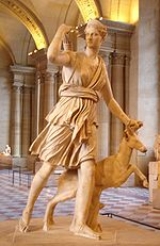
. She was the Hellenic goddess of forests and hills, child birth/virginity/fertility, the hunt and was often depicted as a huntress carrying a bow and arrows.. . . .” Hammond and Scullard (editors), The Oxford Classical Dictionary. (Oxford: Clarendon Press, 1970) 126. The deer
Deer

Deer are the ruminant mammals forming the family Cervidae . A number of broadly similar animals from related families within the order even-toed ungulate are often also called deer....
 and the cypress
Cupressus

The genus Cupressus is one of several genera within the Family Cupressaceae that have the common name cypress; for the others, see cypress....
 were sacred to her.


Discussion
Ask a question about 'Artemis'
Start a new discussion about 'Artemis'
Answer questions from other users
Full Discussion Forum


Recent Posts


Encyclopedia


In Greek mythology
Greek mythology

Greek mythology is the body of myths and legends belonging to the Ancient Greece concerning their List of Greek mythological figures#Immortals and Greek hero cult, Cosmology#Metaphysical cosmology, and the origins and significance of their own cult and ritual practices....
, Artemis (Greek
Greek language

Greek is an Indo-European languages native to the southern Balkan peninsula, the language of the Greek people. It forms an independent branch within Indo-European....
: (nominative) , (genitive) ) was the daughter of Zeus
Zeus

Zeus in Greek mythology is the king of the gods, the ruler of Mount Olympus and the god of the sky father and List of thunder gods. His symbols are the thunderbolt, eagle, bull , and oak....
 and Leto
Leto

In Greek mythology, Let? is a daughter of the Titan Coeus and Phoebe : Kos claimed her birthplace. In the Olympian scheme of things, Zeus is the father of her twins, Apollo and Artemis, the Letoides....
, and the twin sister of Apollo
Apollo

In Greek mythology and Roman mythology, Apollo , is one of the most important and many-sided of the Twelve Olympians. The ideal of the kouros , Apollo has been variously recognized as a god of light and the sun; truth and prophecy; archery; medicine and healing; music, poetry, and the arts; and more....
. She was the Hellenic goddess of forests and hills, child birth/virginity/fertility, the hunt and was often depicted as a huntress carrying a bow and arrows.. . . .” Hammond and Scullard (editors), The Oxford Classical Dictionary. (Oxford: Clarendon Press, 1970) 126. The deer
Deer

Deer are the ruminant mammals forming the family Cervidae . A number of broadly similar animals from related families within the order even-toed ungulate are often also called deer....
 and the cypress
Cupressus

The genus Cupressus is one of several genera within the Family Cupressaceae that have the common name cypress; for the others, see cypress....
 were sacred to her. In later Hellenistic times she even assumed the ancient role of Eileithyia in aiding childbirth.

Artemis was one of the most widely venerated of the gods and goddesses and one of the oldest (Burkert 1985, 149). Her later association with the moon is a popular idea which has little foundation. She later became identified with Selene
Selene

Selene is the Titan goddess of the moon.In Greek mythology, Selene was an archaic lunar deity and the daughter of the Titan Hyperion and Theia....
, a Titaness
Titan (mythology)

In Greek mythology, the Titans ; were a race of powerful deities that ruled during the legendary golden age. Their role as Elder Gods was overthrown by a race of younger gods, the Twelve Olympians, effected a mythological paradigm shift that the Greeks borrowed from the Ancient Near East....
 who was a Greek moon goddess, and she was sometimes depicted with a crescent moon above her head. She also became identified with the Roman goddess Diana
Diana (mythology)

In Roman mythology, Diana was the goddess of the hunting, being associated with wild animals and woodland, and also of the moon. In literature she was the Greek deities and their Roman and Etruscan counterparts of the Greek mythology Artemis, though in Cult she was Italy, not Greek, in origin....
 and with the Etruscan
Etruscan mythology

The Etruscan civilizations were a people of unknown origin living in Northern Italy, who were eventually integrated into Roman culture and politically became part of the Roman Republic....
 goddess Artume
Artume

Artume was an Etruscan mythology goddess who, in later history, came to be identified with Artemis....
.

Etymology

There may be some connection with the Greek
Greek language

Greek is an Indo-European languages native to the southern Balkan peninsula, the language of the Greek people. It forms an independent branch within Indo-European....
 a?teµ?? = "safe and sound" from the root
Root (linguistics)

The root is the primary lexicology unit of a word, which carries the most significant aspects of semantics content and cannot be reduced into smaller constituents....
 a? = "to fit". Other theories involve a possibly older connection to the Proto-Indo-European
Proto-Indo-European

Proto-Indo-European may refer to:*Proto-Indo-European language, the hypothetical common ancestor of the Indo-European languages.*Proto-Indo-Europeans, the hypothetical speakers of the reconstructed Proto-Indo-European language....
 root h2r?t?os meaning "bear" due to her cultic practices in Brauronia and the Neolithic
Neolithic

The Neolithic period was a period in the development of human technology, beginning about 9500 Before the Christian Era in the Middle East that is traditionally considered the last part of the Stone Age....
 remains at the Arkouditessa
Akrotiri (Crete)

Akrotiri is a peninsula and municipality in Crete, east of Chania. Its ancient name was Kiamon while the Byzantine Empire called it Charaka....
.

Birth


Various conflicting accounts are given in Greek mythology of the birth of Artemis and her twin brother, Apollo. All accounts agree, however, that she was the daughter of Zeus
Zeus

Zeus in Greek mythology is the king of the gods, the ruler of Mount Olympus and the god of the sky father and List of thunder gods. His symbols are the thunderbolt, eagle, bull , and oak....
 and Leto
Leto

In Greek mythology, Let? is a daughter of the Titan Coeus and Phoebe : Kos claimed her birthplace. In the Olympian scheme of things, Zeus is the father of her twins, Apollo and Artemis, the Letoides....
.

An account by Callimachus
Callimachus

Callimachus was a native of the Greek colony of Cyrene, Libya, Libya. He was a noted poet, critic and scholar of the Library of Alexandria and enjoyed the patronage of ancient Egyptian Greeks Pharaohs Ptolemy II Philadelphus and Ptolemy III Euergetes....
 has it that Hera forbade Leto to give birth on either terra firma (the mainland) or on an island. Hera was angry with Zeus, her husband, because he had impregnated Leto. But the island of Delos
Delos

The island of Delos , isolated in the centre of the roughly circular ring of islands called the Cyclades, near Mykonos, is one of the most important mythological, historical and archaeological sites in Greece....
 (or Ortygia
Ortygia

Ortygia is an island near the city of Syracuse, Sicily. The island, also known as Citt? Vecchia , contains many historical landmarks.The Homeric Hymn to Delian Apollo has it that the goddess Leto stopped at Ortygia to give birth to Artemis, the firstborn of her twins....
 in the Homeric Hymn to Artemis) disobeyed Hera, and Leto gave birth there.

A scholium
Scholium

Scholia , are grammar, critical, or explanatory comments, either original or extracted from pre-existing commentaries, which are inserted on the margin of the manuscript of an ancient author, as gloss....
 of Servius on Aeneid
Aeneid

The Aeneid is a Latin Epic poetry written by Virgil in the late 1st century BC that tells the legendary story of Aeneas, a Troy who traveled to Italy, where he became the ancestor of the Rome....
 iii. 72 accounts for the island's archaic name Ortygia by asserting that Zeus transformed Leto into a quail
Quail

Quail is a collective name for several genera of mid-sized birds in the pheasant family Phasianidae. New World quails and buttonquails and are not closely related but named for their similar appearance and behaviour....
 (ortux) in order to prevent Hera from finding out his infidelity, and Kenneth McLeish suggested further that in quail form Leto would have given birth with as few birth-pains as a mother quail suffers when it lays an egg.

The myths also differ as to whether Artemis was born first, or Apollo.

Childhood


The childhood of Artemis is not embodied in any surviving myth: the Iliad
ILiad

The iLiad is an electronic handheld device, or e-book device, which can be used for document reading and editing. Like the Sony Reader or Amazon Kindle, the iLiad makes use of an electronic paper display....
 reduced the figure of the dread goddess to a girl, who, having been thrashed by Hera
Hera

In the Twelve Olympians of classical Greek Mythology, Hera or Here was the wife and older sister of Zeus. Her chief function was as goddess of women and marriage....
, climbs weeping into the lap of Zeus. A poem of Callimachus
Callimachus

Callimachus was a native of the Greek colony of Cyrene, Libya, Libya. He was a noted poet, critic and scholar of the Library of Alexandria and enjoyed the patronage of ancient Egyptian Greeks Pharaohs Ptolemy II Philadelphus and Ptolemy III Euergetes....
 – the goddess "who amuses herself on mountains with archery" – imagines some charming vignettes: at three years old, Artemis asked her father, Zeus, while sitting on his knee, to grant her six wishes. Her first wish was to remain chaste for eternity, and never to be confined by marriage. She then asked for lop-eared hounds, stags to lead her chariot, and nymph
Nymph

In Greek mythology, a nymph is any member of a large class of mythological entities in human form. They were typically associated with a particular location or landform....
s to be her hunting companions, 60 from the river and 20 from the ocean. Also, she asked for a silver bow like her brother Apollo
Apollo

In Greek mythology and Roman mythology, Apollo , is one of the most important and many-sided of the Twelve Olympians. The ideal of the kouros , Apollo has been variously recognized as a god of light and the sun; truth and prophecy; archery; medicine and healing; music, poetry, and the arts; and more....
. He granted her wishes. All of her companions remained virgins, and Artemis guarded her own chastity closely. Her symbol was the silver bow and arrow.

Myths of Artemis


Artemis and Actaeon


She was once bathing in a vale on Mount Cithaeron, when the Theban prince and hunter Actaeon
Actaeon

In Greek mythology, Actaeon , son of the priestly herdsman Aristaeus and Autonoe in Boeotia, was a famous Thebes, Greece hero, trained by the centaur Cheiron, who suffered the fatal wrath of Artemis; ....
 stumbled across her. One version of this story says that Actaeon hid in the bushes and spied on her as she continued to bathe; she was enraged to discover the spy, and turned him into a stag which was pursued and killed by his own hounds. Alternatively, Actaeon boasted that he was a better hunter than she and Artemis turned him into a stag and he was eaten by his hounds.
Adonis3

Artemis and Adonis


In some versions of the story of Adonis
Adonis

Adonis is a figure of West Semitic origin, where he is a central cult figure in various mystery religions, who enters Greek mythology in Hellenistic culture....
, Artemis sent a wild boar
Boar

The wild boar , or colloquially simply called the boar, is an omnivorous, wikt:gregarious mammal of the family Suidae. It is native across much of Central Europe, the Mediterranean Basin and much of Asia as far south as Indonesia, and has been introduced elsewhere....
 to kill Adonis as punishment for his hubristic boast that he was a better hunter than she.

In other versions, Artemis killed him for revenge. Adonis had been a favorite of Aphrodite, and Aphrodite was responsible for the death of Hippolytus
Hippolytus (mythology)

In Greek mythology, Hippolytus was a son of Theseus and either Antiope or Hippolyte. He was identified with the Roman mythology forest god Virbius....
, who had been a favorite of Artemis. Therefore Artemis killed Adonis to avenge Hippolytus’s death.

Orion

Orion
Orion (mythology)

Orion was a giant hunting of Greek mythology whom Zeus placed among the stars as the Orion .Ancient sources tell several different stories about Orion....
 was a hunting companion of the goddess Artemis. In some versions of his story he was killed by Artemis, while in others he was killed by a scorpion
Scorpius

Scorpius is one of the constellations of the zodiac; as an astrological sign it is called Scorpio. Its name is Latin for scorpion, and its symbol is ....
 sent by Gaia
Gaia (mythology)

Gaia Gaia is a Greek primordial gods and chthonic deity in the Ancient Greek Pantheon and considered a Mother Goddess or Great Goddess....
. In some versions, Orion tried to seduce Opis
Opis

Opis was an ancient Babylonian city on the Tigris, not far from modern Baghdad. The precise location of Opis has not been established, but from the Akkadian language and Greek language texts, it was located on the east bank of the Tigris, near the Diyala River....
, one of her followers, and she killed him. In a version by Aratus
Aratus

Aratus was a Greeks didactic poet, known for his technical poetry....
, Orion took hold of Artemis' robe and she killed him in self-defense
Self-defense

Self-defense is the act of defending oneself, one's property or the well-being of another from physical harm. While the term may define any form of personal defense, it is strongly associated with civilian hand-to-hand defense techniques....
. In yet another version, Apollo sent the scorpion. According to Hyginus
Gaius Julius Hyginus

Gaius Julius Hyginus was a Latin author, though whether a native of Spain or of Alexandria it is not clear, a pupil of the famous Alexander Cornelius, and a freedman of Caesar Augustus, by whom he was made superintendent of the Palatine library, according to Suetonius' minor works, De Grammaticis, 20....
 Artemis once loved Orion, but was tricked into killing him by her brother Apollo, who was protective of his sister's maidenhood.

Other stories


Callisto

Tizian 015
She was the daughter of Lycaon, King of Arcadia. She was one of Artemis's hunting attendants. As a companion of Artemis, Callisto
Callisto (mythology)

In Greek mythology, Callisto was a nymph of Artemis. Transformed into a bear and Catasterism, she was the bear-mother of the Arcadians, through her son Arcas....
 took a vow of chastity. Zeus appeared to her disguised as Artemis, or in some stories Apollo, gained her confidence, then took advantage of her (or raped her, according to Ovid
Ovid

Publius Ovidius Naso was a Roman Empire poet known as Ovid to the English language-speaking world, who wrote about love, seduction, and Roman mythology transformation....
). As a result of this encounter she conceived a son, Arcas. Enraged, Hera or Artemis (some accounts say both) changed her into a bear. Arcas almost killed the bear, but Zeus stopped him just in time. Out of pity, Zeus placed Callisto the bear into the heavens, thus the origin of Callisto the Bear as a constellation. Some stories say that he placed both Arcas and Callisto into the heavens as bears, forming the Ursa Minor
Ursa Minor

Ursa Minor is a constellation in the northern sky. Its name is Latin for 'little bear', contrasting with Ursa Major, the Great Bear. It was one of the 48 constellations listed by the 1st century astronomer Ptolemy, and remains one of the 88 List of constellations....
 and Ursa Major
Ursa Major

Ursa Major is a constellation visible throughout the year in most of the northern hemisphere. Its name means the Great Bear in Latin. It is dominated by the widely recognized asterism known as the Big Dipper or Plough, which is a useful pointer toward north, and which has mythological significance in numerous world cultures....
 constellations.

Iphigenia and the Taurian Artemis

Artemis punished Agamemnon
Agamemnon

In Greek mythology, Agamemnon / is the son of King Atreus of Mycenae and Queen Aerope, the brother of Menelaus and the husband of Clytemnestra; different mythological versions make him the king either of Mycenae or of Argos....
 after he killed a sacred stag in a sacred grove
Sacred grove

Sacred groves were a feature of the mythological landscape and the cult of Old European culture, of the most ancient levels of Germanic paganism, Greek mythology, Slavic mythology, Roman mythology, and in Druidry practice....
 and boasted that he was a better hunter. When the Greek fleet was preparing at Aulis
Aulis

Aulis is:*In Greek mythology, Aulis was both**A daughter of King Ogyges and Thebe , and**Modern day Avlida, a port in Boeotia where the Greek navy rallied before setting off against Troy...
 to depart for Troy
Troy

Troy is a legendary city and center of the Trojan War, as described in the Epic Cycle, and especially in the Iliad, one of the two epic poems attributed to Homer....
 to begin the Trojan War
Trojan War

In Greek mythology, the Trojan War was waged against the city of Troy by the Achaeans after Paris of Troy stole Helen from her husband Menelaus, the king of Sparta....
, Artemis becalmed the winds. The seer Calchis advised Agamemnon that the only way to appease Artemis was to sacrifice his daughter Iphigenia. Artemis then snatches Iphigenia from the altar and substitutes a deer.

Niobe

A Queen of Thebes and wife of Amphion
Amphion

There are several characters named Amphion in Greek mythology:* Amphion,son of Zeus and Antiope , and twin brother of Zethus . Together they are famous for building Thebes ....
, Niobe
Niobe

Niobe was the daughter of the semi-legendary ruler Tantalus, called the "Phrygian" and sometimes even as "King of Phrygia" . Although Tantalus ruled in Sipylus, a city located in the western extremity of Anatolia where Lydia was to emerge as a state as of the 8th century BC, and not in the traditional heartland of Phrygia, situated more in...
 boasted of her superiority to Leto because while she had fourteen children (Niobids
Niobids

In Greek mythology, the Niobids were the children of Amphion of Thebes, Greece and Niobe, slain by Apollo and Artemis because Niobe, born of the royal house of Phrygia, had boastfully compared the greater number of her own offspring with those of Leto, Apollo's and Artemis' mother....
), seven boys and seven girls, Leto had only one of each. When Artemis and Apollo heard this impiety, Apollo killed her sons as they practiced athletics, and Artemis shot her daughters, who died instantly without a sound. Apollo and Artemis used poisoned arrows to kill them, though according to some versions two of the Niobids were spared, one boy and one girl. Amphion, at the sight of his dead sons, killed himself. A devastated Niobe and her remaining children were turned to stone by Artemis as they wept. Some myths say that their tears, which still flowed from their stone eyes, formed the river Achelous
Achelous

In Greek mythology, Achelous was the patron deity of the "silver-swirling" Acheloos River, which is the largest river of Greece, and thus the chief of all river deities, every river having its own river spirit....
. The gods themselves entombed them.

Otus and Ephialtes


The Gigantes
Gigantes

In Greek mythology, the Gigantes or, commonly, Giants, were a race of giants, children of Gaia or Gaea, who were fertilized by the blood of Uranus_, after being castration by his son Cronus....
 Otus
Aloadae

File:Gustave_Dor?_-_Dante_Alighieri_-_Inferno_-_Plate_65_.jpgIn Greek mythology, the Aloadae were Otus and Ephialtes , sons of Iphimedeia, queen of Aloeus, by Poseidon, whom she induced to make her pregnant by going to the seashore and disporting herself in the surf or scooping seawater into her bosom....
 and Ephialtes were sons of Poseidon
Poseidon

In Greek mythology, Poseidon was the god of the sea and, as "Earth-Shaker," of earthquakes. The name of the god Nethuns in Etruscan mythology was adopted in Latin for Neptune in Roman mythology: both were sea gods analogous to Poseidon....
. They were so strong that nothing could harm them. One night, as they slept, Gaia whispered to them, that since they were so strong, they should be the rulers of Olympus. They built a mountain as tall as Mt. Olympus, and then demanded that the gods surrender, and that Artemis and Hera become their wives. The gods fought back, but couldn't harm them. The sons even managed to kidnap Ares and hold him in a jar for thirteen months. Artemis later changed herself into a deer and ran between them. The Aloadae
Aloadae

File:Gustave_Dor?_-_Dante_Alighieri_-_Inferno_-_Plate_65_.jpgIn Greek mythology, the Aloadae were Otus and Ephialtes , sons of Iphimedeia, queen of Aloeus, by Poseidon, whom she induced to make her pregnant by going to the seashore and disporting herself in the surf or scooping seawater into her bosom....
, not wanting her to get away because they were eager huntsmen, each threw their javelin and simultaneously killed each other.

The Meleagrids

After the death of Meleager
Meleager

In Greek mythology, Meleager was the son of Althaea and Oeneus and, according to some accounts father of Parthenopeus and Polydora. His story has similarities with the Scandinavian Norna-Gests ??ttr....
, Artemis turned her grieving sisters, the Meleagrids
Meleagrids

In Greek mythology, the Meleagrids were the daughters of Althaea and Oeneus, sisters of Meleager. When their brother died, Artemis changed them into guineafowl....
 into guineafowl
Guineafowl

The guineafowl are a family of Avess in the same order as the pheasants, Turkey s and other game birds and is native to Africa....
 that Artemis loved very much.

Chione

Artemis killed Chione for becoming too proud and vain after having an affair with Apollo at his request.

Atalanta and Oeneus

Artemis saved the infant Atalanta
Atalanta

Atalanta is a character from ancient Greek mythology.After being told by an oracle she would be ruined if she were to marry, Atalanta set up a contest to win her hand in marriage....
 from dying of exposure after her father abandoned her. She sent a female bear to suckle the baby, who was then raised by hunters. But she later sent a bear to hurt Atalanta because people said Atalanta was a better hunter. This is in some stories.

Among other adventures, Atalanta participated in the hunt for the Calydonian Boar
Calydonian Boar

The Calydonian Boar is one of the monsters of Greek mythology that had to be overcome by heroes of the Olympian age. Sent by Artemis to ravage the region of Calydon in Aetolia because its king failed to honor her in his rites to the gods, it was killed in the Calydonian Hunt, in which many male heroes took part, but also a powerful wom...
, which Artemis had sent to destroy Calydon
Calydon

Calydon was an ancient Greece city in Aetolia, situated on the west bank of the river Evenus. According to Greek mythology, the city took its name from its founder Calydon, son of Aetolus, son of Endymion....
 because King Oeneus
Oeneus

In Greek mythology, Oeneus, or Oineus was a Calydonian king, son of Porthaon, husband of Althaea and father of Deianira, Meleager and Melanippe....
 had forgotten her at the harvest sacrifices. In the hunt, Atalanta drew the first blood, and was awarded the prize of the skin. She hung it in a sacred grove at Tegea
Tegea

Tegea was a settlement in ancient Greece, and it is also a municipality in modern Arcadia, Greece, with its seat in the village Stadio.Ancient Tegea was an important religious center of ancient Greece, containing the Temple of Athena Alea....
 as a dedication to Artemis.

Trojan War

Artemis may have been represented as a supporter of Troy because her brother Apollo
Apollo

In Greek mythology and Roman mythology, Apollo , is one of the most important and many-sided of the Twelve Olympians. The ideal of the kouros , Apollo has been variously recognized as a god of light and the sun; truth and prophecy; archery; medicine and healing; music, poetry, and the arts; and more....
 was the patron god of the city and she herself was widely worshipped in western Anatolia in historical time. In the Iliad
ILiad

The iLiad is an electronic handheld device, or e-book device, which can be used for document reading and editing. Like the Sony Reader or Amazon Kindle, the iLiad makes use of an electronic paper display....
 she came to blows with Hera, when the divine allies of the Greeks and Trojans engaged each other in conflict. Hera struck Artemis on the ears with her own quiver, causing the arrows to fall out. As Artemis fled crying to Zeus, Leto gathered up the bow and arrows which had fallen out of the quiver.

Worship of Artemis

Jerash Temple of Artemis
Artemis, the goddess of forests and hills, was worshipped throughout ancient Greece
Ancient Greece

The term Ancient Greece refers to the period of History of Greece lasting from the Greek Dark Ages ca. 1100 BC and the Dorian invasion, to 146 BC and the Roman Republic conquest of Greece after the Battle of Corinth ....
.. Her best known cults
Cult (religious practice)

In traditional usage, the cult of a religion, quite apart from its sacred writings , its theology or mythologys, or the personal faith of its believers, is the totality of external religious practice and observance, the neglect of which is the definition of impiety....
 were on the island of Delos
Delos

The island of Delos , isolated in the centre of the roughly circular ring of islands called the Cyclades, near Mykonos, is one of the most important mythological, historical and archaeological sites in Greece....
(her birthplace); in Attica at Brauron
Brauron

The sanctuary of Artemis at Brauron is an early sacred site on the eastern coast of Attica near the Aegean Sea in a small inlet. The inlet has silted up since ancient times, pushing the current shoreline farther from the site....
 and Mounikhia (near Piraeus
Piraeus

Piraeus is a city in the periphery of Attica, Greece, and a municipality within Athens urban area, located 10 km southwest of its center....
); in Sparta
Sparta

Sparta was a city-state in ancient Greece, situated on the Eurotas River in the southern part of the Peloponnese. From circa 650 BC it rose to become the dominant military power in the region and as such was recognized as the overall leader of the combined Greek forces during the Greco-Persian Wars....
. She was often depicted in paintings and statues in a forest setting, carrying a bow and arrows, and accompanied by a deer.

As Aeginaea, she was worshiped in Sparta
Sparta

Sparta was a city-state in ancient Greece, situated on the Eurotas River in the southern part of the Peloponnese. From circa 650 BC it rose to become the dominant military power in the region and as such was recognized as the overall leader of the combined Greek forces during the Greco-Persian Wars....
; the name means either huntress of chamois
Chamois

The chamois is a goat-like animal native to the Carpathian Mountains of Romania, the European Alps, the Gran Sasso region of the central Italian Apennine Mountains, the Tatra Mountains, the Balkans, parts of Turkey, and the Caucasus....
, or the wielder of the javelin . She was worshipped at Naupactus
Naupactus

Naupactus or Nafpaktos , is the second largest town in the prefectures of Greece of Aetolia-Acarnania, Greece, situated on a bay on the north side of the straits of Lepanto....
 as Aetole; in her temple in that town there was a statue of white marble representing her throwing a javelin. This "Aetolian Artemis" would not have been introduced at Naupactus, anciently a place of Ozolian Locris
Ozolian Locris

Ozolian Locris or Esperian Locris was a district inhabited by the Ozolian Locrians a tribe of the Locrians, upon the Gulf of Corinth, bounded on the north by Doris , on the east by Phocis, and on the west by Aetolia....
, until it was awarded to the Aetolia
Aetolia

Aetolia is a mountainous region of Greece on the north coast of the Gulf of Corinth, forming the eastern part of the modern prefectures of Greece of Aetolia-Acarnania....
ns by Philip II of Macedon
Philip II of Macedon

Philip II of Macedon,...
. Strabo records another precinct of "Aetolian Artemos" at the head of the Adriatic
Adriatic Sea

The Adriatic Sea is a body of water separating the Italian Peninsula from the Balkan peninsula, and the system of the Apennine Mountains from that of the Dinaric Alps and adjacent ranges....
. As Agoraea
Agoraea

Agoraea and Agoraeus were epithets given to several divinities of Greek mythology who were considered to be the protectors of the as?semblies of the people in the agora , particularly in Athens, Sparta, and Thebes, Greece....
 she was the protector of the agora
Agora

The Agora was an open "place of assembly" in ancient Ancient Greece city-states. Early in Greek history , free-born male land-owners who were citizens would gather in the agora for military duty or to hear statements of the ruling king or council....
. As Agrotera
Agrotera

Agrotera was an epithet of the Greek mythology Artemis, and the most important goddess to Attica hunters.At Agrae on the Ilissos, where she was believed to have first hunted after her arrival from Delos, Artemis Agrotera had a temple, dating to the 5th century BC, with a statue carrying a bow....
, she was especially associated as the patron goddess of hunters. In Athens Artemis was often associated with the local Aeginian
Aegina

Aegina is one of the Greek islands of Greece in the Saronic Gulf, 17 miles from Athens. Tradition derives the name from Aegina, the mother of Aeacus, who was born in and ruled the island....
 goddess, Aphaea
Aphaea

Aphaea was a Greek mythology who was worshipped exclusively at a single sanctuary on the island of Aegina in the Saronic Gulf. She originated as early as the 14th century BCE as a local deity associated with fertility and the agricultural cycle Under Athenian hegemony, however, she came to be identified with the goddesses Athena and Artemi...
. As Potnia Theron
Potnia Theron

Potnia Theron is an ancient title of the Minoan civilization Goddess, an aspect of her power that was assumed by Artemis among others in the Twelve Olympians that was later introduced in mainland Greece....
, she was the patron of wild animals; Homer
Homer

Homer is traditionally held to be the author of the ancient Greek language epic poems the Iliad and the Odyssey, as well as of the Homeric Hymns....
 used this title. As Kourotrophos, she was the nurse of youths. As Locheia, she was the goddess of childbirth and midwives. She was sometimes known as Cynthia, from her birthplace on Mount Cynthus
Cynthus

Mount Cynthus is located on the isle of Delos, part of the Greece Cyclades.In Greek mythology, Leto gave birth to Apollo and Artemis on this island, having been shunned by Zeus' wife Hera who was extremely jealous of his liaison with Leto....
 on Delos
Delos

The island of Delos , isolated in the centre of the roughly circular ring of islands called the Cyclades, near Mykonos, is one of the most important mythological, historical and archaeological sites in Greece....
, or Amarynthia from a festival in her honor originally held at Amarynthus in Euboea
Euboea

For the Greek mythology figure, see Euboea Euboea is the second largest of the Greece Aegean Islands and the second largest List of islands of Greece overall in area and population, after Crete....
. She was sometimes identified by the name Phoebe, the feminine form of her brother Apollo's solar epithet Phoebus
Phoebus

Phoebus is the Latin form of classical Greek Phoibos "Shining-one", a byname used in classical Greek mythology for either the god Apollo or the Helios....
.

The ancient Spartans used to sacrifice to her as one of their patron goddesses before starting a new military campaign
Military campaign

In the military sciences, a military campaign is a term applied to Scale , long duration, significant military strategy Military plan incorporating a series of inter-related military operations or battles forming a distinct part of a larger conflict often called a war....
.

Athenian festivals in honor of Artemis included Elaphebolia
Elaphebolia

The Elaphebolia was an Ancient Greece festival held at Athens and Phocis during the month of Elaphebolion dedicated to Artemis Elaphebolos ....
, Mounikhia, Kharisteria, and Brauronia. The festival of Artemis Orthia
Artemis Orthia

File:Artemis Orthia location en.svgThe Sanctuary of Artemis Orthia, an Archaic Greece devoted in Classical times to Artemis, was one of the most important religious sites in the Ancient Greece polis of Sparta....
 was observed in Sparta
Sparta

Sparta was a city-state in ancient Greece, situated on the Eurotas River in the southern part of the Peloponnese. From circa 650 BC it rose to become the dominant military power in the region and as such was recognized as the overall leader of the combined Greek forces during the Greco-Persian Wars....
.

Pre-pubescent Athenian girls and young Athenian girls approaching marriageable age were sent to the sanctuary of Artemis at Brauron to serve the Goddess for one year. During this time the girls were known as arktoi, or little she-bears. A myth explaining this servitude relates that a bear had formed the habit of regularly visiting the town of Brauron, and the people there fed it, so that over time the bear became tame. A young girl teased the bear, and, in some versions of the myth it killed her, while in other versions it clawed her eyes out. Either way, the girl's brothers killed the bear, and Artemis was enraged. She demanded that young girls "act the bear" at her sanctuary in atonement for the bear's death.

Virginal Artemis was worshipped as a fertility/childbirth goddess in some places, assimilating Ilithyia
Ilithyia

Eileithyia , was the Minoan civilization whom Greek mythology adapted as the goddess of childbirth and midwifery. Her name does not appear to have an Indo-European languages etymology, which for R....
, since, according to some myths, she assisted her mother in the delivery of her twin. During the Classical period
Classical antiquity

Classical antiquity is a broad term for a long period of cultural history centered on the Mediterranean Sea, comprising the interlocking civilizations of Ancient Greece and Ancient Rome....
 in Athens
Athens

Athens , the Capital and largest city of Greece, dominates the Attica periphery; as one of the List of cities by time of continuous habitation, its recorded history spans around 3,400 years....
, she was identified with Hecate
Hecate

Hecate Hekate , or Hekat was originally a goddess of the wilderness and childbirth, naturalized early in Mycenaean Greece or in Thrace, but originating among the Carians of Anatolia, the region where most theophoric names invoking Hecate, such as Hecataeus or Hecatomnus, progenitor of Mausollus, are attested, and where Hekate re...
. Artemis also assimilated Caryatis
Caryatis

In ancient Greek religion Artemis Caryatis was an epithet of Artemis that was derived from the little polis of Karyes in Laconia; there an archaic open-air temenos was dedicated to Carya, the Lady of the Nut-Tree, whose priestesses were called the caryatidai, represented on the Athenian Acropolis as the marble caryatids...
 (Carya).

Artemis in art


The oldest representations of Artemis in Greek Archaic art portray her as Potnia Theron
Potnia Theron

Potnia Theron is an ancient title of the Minoan civilization Goddess, an aspect of her power that was assumed by Artemis among others in the Twelve Olympians that was later introduced in mainland Greece....
 ("Queen of the Beasts"): a winged goddess holding a stag and leopard in her hands, or sometimes a leopard and a lion. This winged Artemis lingered in ex-votos as Artemis Orthia
Artemis Orthia

File:Artemis Orthia location en.svgThe Sanctuary of Artemis Orthia, an Archaic Greece devoted in Classical times to Artemis, was one of the most important religious sites in the Ancient Greece polis of Sparta....
, with a sanctuary close by Sparta
Sparta

Sparta was a city-state in ancient Greece, situated on the Eurotas River in the southern part of the Peloponnese. From circa 650 BC it rose to become the dominant military power in the region and as such was recognized as the overall leader of the combined Greek forces during the Greco-Persian Wars....
.

In Greek classical art she is usually portrayed as a maiden huntress clothed in a girl's short skirt, with hunting boots, a quiver, a bow and arrows. Often she is shown in the shooting pose, and is accompanied by a hunting dog
Hunting dog

For the species known as the African hunting dog, Cape hunting dog, or painted hunting dog see African Wild DogA hunting dog refers to any dog who assists humans in hunting....
 or stag. Her darker side is revealed in some vase paintings, where she is shown as the death-bringing goddess whose arrows fell young maidens and women, such as the daughters of Niobe
Niobe

Niobe was the daughter of the semi-legendary ruler Tantalus, called the "Phrygian" and sometimes even as "King of Phrygia" . Although Tantalus ruled in Sipylus, a city located in the western extremity of Anatolia where Lydia was to emerge as a state as of the 8th century BC, and not in the traditional heartland of Phrygia, situated more in...
.

The attributes of the goddess were often varied: bow and arrows were sometimes replaced by hunting spears; as a goddess of maiden dances she held a lyre
Lyre

The lyre is a string instrument well known for its use in classical antiquity and later. The recitations of the Ancient Greece were accompanied by lyre playing....
; as a goddess of light a pair of flaming torches.

Only in post-Classical art do we find representations of Artemis-Diana with the crown of the crescent
Crescent

In art and symbolism, a crescent is generally the shape produced when a circle disk has a segment of another circle removed from its edge, so that what remains is a shape enclosed by two circular arcs of different diameters which intersect at two points ....
 moon
Moon

The Moon is Earth's only natural satellite and the List of natural satellites by diameter satellite in the Solar System. The average centre-to-centre distance from the Earth to the Moon is km, about thirty times the diameter of the Earth....
, as Luna. In the ancient world, although she was occasionally associated with the moon, she was never portrayed as the moon itself. Ancient statues of Artemis have been found with crescent moons, but these moons are always Renaissance-era additions.

On June 7, 2007, a Roman era bronze sculpture of “Artemis and the Stag” was sold at Sotheby’s auction house in New York state by the Albright-Knox Art Gallery
Albright-Knox Art Gallery

The Albright-Knox Art Gallery is a major showplace for modern art and contemporary art located in Buffalo, New York. It is located directly across the street from Buffalo State College....
 for $25.5 million.

Ac Artemisephesus

Artemis as the Lady of Ephesus


At Ephesus in Ionia
Ionia

Ionia is an ancient region of central coastal Anatolia in present-day Turkey, the region nearest Izmir, which was historically Smyrna. It consisted of the northernmost territories of the Ionian League of Hellenes settlements....
 (Turkey), her temple became one of the Seven Wonders of the World. It was probably the best known center of her worship except for Delos. There the Lady whom the Ionians associated with Artemis through interpretatio Graeca
Interpretatio graeca

Interpretatio graeca is a Latin term for the common tendency of ancient Greek writers to equate foreign divinities to members of their own pantheon....
 was worshiped primarily as a mother goddess, akin to the Phrygian goddess Cybele
Cybele

Cybele , was the Phrygian deification of the Earth Mother. As with Greek Gaia , or her Minoan civilization equivalent Rhea , Cybele embodies the fertile Earth, a goddess of caverns and mountains, walls and fortresses, nature, wild animals ....
, in an ancient sanctuary where her cult image
Cult image

In the practice of religion, a cult image is a man-made object that is venerated for the deity, spirit or daemon that it embodies or represents....
 depicted the "Lady of Ephesus" adorned with multiple rounded breast like protuberances on her chest. They had been traditionally interpreted as multiple accessory breast
Accessory breast

Accessory breasts, also known as polymastia, supernumerary breasts, or mammae erraticae, is the condition of having an supernumerary body part breast....
s, or as sacrificed bull testes, as some newer scholars claimed, until excavation at the site of the Artemision in 1987-88 identified the multitude of tear-shaped amber
Amber

Amber is fossil tree resin, which is appreciated for its color and beauty. Good quality amber is used for the manufacture of ornamental objects and jewelry....
 beads that had adorned her ancient wooden xoanon
Xoanon

A xoanon was an Archaic period in Greece wooden cult image of Ancient Greece. Classical Greeks associated such cult objects, whether aniconic or effigy, with the legendary Daedalus....
. In Acts of the Apostles
Acts of the Apostles

The Acts of the Apostles is a book of the Bible, which now stands fifth in the New Testament. It is commonly referred to as simply Acts. The title "Acts of the Apostles" was first used by Irenaeus in the late second century, but some have suggested that the title "Acts" be interpreted as "the Acts of the Holy Spirit" or even "the Acts...
, Ephesian metalsmiths who felt threatened by Saint Paul's preaching of Christianity, jealously rioted in her defense, shouting “Great is Artemis of the Ephesians!” Only one of 121 columns still stand in Ephesus. The rest were used for making churches, roads, and forts.

Artemis in astronomy


A minor planet
Minor planet

An asteroid group or minor planet group is a population of minor planets that have a share broadly similar orbits. Members are generally unrelated to each other, unlike in an asteroid family, which often results from the break-up of a single asteroid....
, (105) Artemis; a lunar crater
Artemis (crater)

Artemis is a tiny lunar impact crater located in the Mare Imbrium. Craters of this dimension typically form cup-shaped excavations on the surface of the Moon....
; the Artemis Chasma
Artemis Chasma

Artemis Chasma is the nearly circular fracture in Venus' surface which almost encloses Artemis Corona. The chasma and its associating Corona can be found on the Aphrodite Terra continent, at Latitude 35? South, Longitude 135? East....
 and the Artemis Corona
Artemis Corona

Artemis Corona is a Corona found in the Aphrodite Terra continent, on the planet Venus. Latitude 35? South, Longitude 135? East.Named after Artemis, the virgin hunt goddess, it is the largest Corona on Venus, with a diameter of 2,600 kilometers....
 (both on Venus) have all been named for her.

As Selene
Selene

Selene is the Titan goddess of the moon.In Greek mythology, Selene was an archaic lunar deity and the daughter of the Titan Hyperion and Theia....
 she is associated with the Moon
Moon

The Moon is Earth's only natural satellite and the List of natural satellites by diameter satellite in the Solar System. The average centre-to-centre distance from the Earth to the Moon is km, about thirty times the diameter of the Earth....
, and as Phoebe
Phoebe (moon)

'Phoebe' is an irregular satellite natural satellite of Saturn . It was discovered by William Henry Pickering on March 17, 1899 from photographic plates that had been taken starting on August 16, 1898 at Arequipa, Peru by DeLisle Stewart....
 her name was borrowed for a moon of Saturn
Saturn

Saturn is the sixth planet from the Sun and the second largest planet in the Solar System, after Jupiter. Saturn, along with Jupiter, Uranus and Neptune, is classified as a gas giant....
.

Sources

  • Burkert, Walter
    Walter Burkert

    Walter Burkert , a scholar of Greek mythology and Cult , is an emeritus professor of classics at the University of Zurich, Switzerland, and also has taught in the United Kingdom and the United States....
    , 1985. Greek Religion (Cambridge:Harvard University Press)
  • Graves, Robert
    Robert Graves

    Robert Ranke Graves was an England poet, translator and novelist. During his long life, he produced more than 140 works. He was the son of the Anglo-Irish writer Alfred Perceval Graves and Amalie von Ranke, a niece of the famous German historian Leopold von Ranke....
     (1955) 1960. The Greek Myths (Penguin)
  • Kerenyi, Karl
    Karl Kerényi

    One of the founders of modern studies in Greek mythology, K?roly Ker?nyi was born in Temesv?r, Hungary , and then lived in Hungary....
    , 1951. The Gods of the Greeks
  • Telenius, Seppo
    Seppo Telenius

    Seppo Sakari Telenius is a Finland writer and historian. He studied political history and social history at the University of Helsinki . His varied body of works includes novels, short stories, poems, local history books as well as essays....
     (2005) 2006. Athena-Artemis (Helsinki: Kirja kerrallaan)


External links

  • .


------