
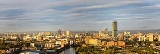
Manchester is a
cityCity status in the United Kingdom is granted by the British monarch to a select group of communities. The holding of city status gives a settlement no special rights other than that of calling itself a "city". Nonetheless, this appellation carries its own prestige and, consequently, competitions...
and
metropolitan boroughA metropolitan borough is a type of local government district in England, and is a subdivision of a metropolitan county. Created in 1974 by the Local Government Act 1972, metropolitan boroughs are defined in English law as metropolitan districts, however all of them have been granted or regranted...
in
Greater ManchesterGreater Manchester is a metropolitan county in North West England, with a population of 2.6 million. It encompasses one of the largest metropolitan areas in the United Kingdom and comprises ten metropolitan boroughs: Bolton, Bury, Oldham, Rochdale, Stockport, Tameside, Trafford, Wigan, and the...
, England. According to the Office for National Statistics, the 2010 mid-year population estimate for Manchester was 498,800. Manchester lies within one of the UK's largest metropolitan areas, the metropolitan county of Greater Manchester, which has an estimated population of 2.6 million. The
demonymA demonym , also referred to as a gentilic, is a name for a resident of a locality. A demonym is usually – though not always – derived from the name of the locality; thus, the demonym for the people of England is English, and the demonym for the people of Italy is Italian, yet, in english, the one...
of Manchester is Mancunian and
symbolsThe City of Manchester has various symbols representing the city including the Manchester bee, the Red Rose of Lancaster and the Manchester Ship Canal which is popularly depicted in many Mancunian crests and the city council's coat of arms.-Mancunian symbols:...
include the Manchester bee.
Manchester is situated in the south-central part of
North West EnglandNorth West England, informally known as The North West, is one of the nine official regions of England.North West England had a 2006 estimated population of 6,853,201 the third most populated region after London and the South East...
, fringed by the
Cheshire PlainThe Cheshire Plain is a relatively flat expanse of lowland situated almost entirely within the county of Cheshire in northwest England. It is bounded by the hills of North Wales to the west, and the Peak District of Derbyshire and North Staffordshire to the east and southeast...
to the south and the
PenninesThe Pennines are a low-rising mountain range, separating the North West of England from Yorkshire and the North East.Often described as the "backbone of England", they form a more-or-less continuous range stretching from the Peak District in Derbyshire, around the northern and eastern edges of...
to the north and east. The recorded
history of ManchesterThe history of Manchester encompasses its change from a minor Lancastrian township into the pre-eminent industrial metropolis of the United Kingdom and the world. Manchester began expanding "at an astonishing rate" around the turn of the 19th century as part of a process of unplanned urbanisation...
began with the civilian settlement associated with the
Roman fortThe Latin word castra, with its singular castrum, was used by the ancient Romans to mean buildings or plots of land reserved to or constructed for use as a military defensive position. The word appears in both Oscan and Umbrian as well as in Latin. It may have descended from Indo-European to Italic...
of
Mamucium, which was established in
c.Circa , usually abbreviated c. or ca. , means "approximately" in the English language, usually referring to a date...
79 AD on a sandstone bluff near the confluence of the rivers
MedlockThe River Medlock is a river of Greater Manchester in North West England. It rises near Oldham and flows, south and west, for ten miles to join the River Irwell in the extreme southwest of Manchester city centre.-Source:...
and
IrwellThe River Irwell is a long river which flows through the Irwell Valley in the counties of Lancashire and Greater Manchester in North West England. The river's source is at Irwell Springs on Deerplay Moor, approximately north of Bacup, in the parish of Cliviger, Lancashire...
.
HistoricallyThe historic counties of England are subdivisions of England established for administration by the Normans and in most cases based on earlier Anglo-Saxon kingdoms and shires...
, most of the city was a part of
LancashireLancashire is a non-metropolitan county of historic origin in the North West of England. It takes its name from the city of Lancaster, and is sometimes known as the County of Lancaster. Although Lancaster is still considered to be the county town, Lancashire County Council is based in Preston...
, although areas south of the
River MerseyThe River Mersey is a river in North West England. It is around long, stretching from Stockport, Greater Manchester, and ending at Liverpool Bay, Merseyside. For centuries, it formed part of the ancient county divide between Lancashire and Cheshire....
were in
CheshireCheshire is a ceremonial county in North West England. Cheshire's county town is the city of Chester, although its largest town is Warrington. Other major towns include Widnes, Congleton, Crewe, Ellesmere Port, Runcorn, Macclesfield, Winsford, Northwich, and Wilmslow...
. Throughout the
Middle AgesThe Middle Ages is a periodization of European history from the 5th century to the 15th century. The Middle Ages follows the fall of the Western Roman Empire in 476 and precedes the Early Modern Era. It is the middle period of a three-period division of Western history: Classic, Medieval and Modern...
Manchester remained a
manorialManorialism, an essential element of feudal society, was the organizing principle of rural economy that originated in the villa system of the Late Roman Empire, was widely practiced in medieval western and parts of central Europe, and was slowly replaced by the advent of a money-based market...
townshipIn England, a township is a local division or district of a large parish containing a village or small town usually having its own church...
, but it began to expand "at an astonishing rate" around the turn of the 19th century. Manchester's unplanned urbanisation was brought on by a boom in
textile manufacture during the Industrial RevolutionThe industrial revolution changed the nature of work and society. Opinion varies as to the exact date, but it is estimated that the First Industrial Revolution took place between 1750 and 1850, and the second phase or Second Industrial Revolution between 1860 and 1900. The three key drivers in...
, and resulted in it becoming the world's first industrialised city.•
• An early 19th-century factory building boom transformed Manchester from a township into a major
mill townA mill town, also known as factory town or mill village, is typically a settlement that developed around one or more mills or factories .- United Kingdom:...
and
boroughMunicipal boroughs were a type of local government district which existed in England and Wales between 1835 and 1974, in Northern Ireland from 1840 to 1973 and in the Republic of Ireland from 1840 to 2002...
that was granted
city statusCity status in the United Kingdom is granted by the British monarch to a select group of communities. The holding of city status gives a settlement no special rights other than that of calling itself a "city". Nonetheless, this appellation carries its own prestige and, consequently, competitions...
in 1853. In 1894 the
Manchester Ship CanalThe Manchester Ship Canal is a river navigation 36 miles long in the North West of England. Starting at the Mersey Estuary near Liverpool, it generally follows the original routes of the rivers Mersey and Irwell through the historic counties of Cheshire and Lancashire. Several sets of locks lift...
was built, creating the
Port of ManchesterThe Port of Manchester in North West England was created as a customs port on 1 January 1894, four months before the opening of the Manchester Ship Canal. It extended along the whole length of the canal, from Eastham in the west to Manchester in the east, absorbing the Port of Runcorn, which...
.
The city is notable for its
cultureThe Culture of Manchester is notable artistically, architecturally, theatrically and to some extent musically. Despite being the 6th largest city in the United Kingdom by population, Manchester has been ranked as the second city of the United Kingdom in numerous polls since the 2000s with culture...
, music scene,
scientific and engineering achievementsManchester is one of the principal cities of the United Kingdom, having gained city status in 1853. Often regarded as the first industrialised city• • , Manchester was a city built by the Industrial Revolution, in 1717 Manchester was merely a market town of 10,000 people, but by 1911 it had a...
,
media linksMedia in Manchester like music and sport has been an integral part of Mancunian culture for many generations and has been described as the only other British city to rival to London in terms of television broadcasting....
and
sporting connectionsSports in the City of Manchester are an important part of the city's culture, with SportCity being a dedicated district in east Manchester for sports such as football, athletics and cycling....
. Manchester's sports clubs include Premier League football teams,
Manchester CityManchester City Football Club is an English Premier League football club based in Manchester. Founded in 1880 as St. Mark's , they became Ardwick Association Football Club in 1887 and Manchester City in 1894...
and
Manchester UnitedManchester United Football Club is an English professional football club, based in Old Trafford, Greater Manchester, that plays in the Premier League. Founded as Newton Heath LYR Football Club in 1878, the club changed its name to Manchester United in 1902 and moved to Old Trafford in 1910.The 1958...
. Manchester was the site of the world's first railway station, where scientists first split the atom and developed the first
stored-program computerThe Manchester Small-Scale Experimental Machine , nicknamed Baby, was the world's first stored-program computer. It was built at the Victoria University of Manchester by Frederic C...
. Manchester is served by two universities, including the largest single-site university in the United Kingdom, and has one of the country's largest urban economies. Manchester is also the third-most visited city in the United Kingdom by foreign visitors, after London and Edinburgh, and the most visited in England outside London.
Etymology
The name Manchester originates from the
Ancient RomanAncient Rome was a thriving civilization that grew on the Italian Peninsula as early as the 8th century BC. Located along the Mediterranean Sea and centered on the city of Rome, it expanded to one of the largest empires in the ancient world....
name
Mamucium, the name of the Roman fort and settlement, generally thought to be a
LatinLatin is an Italic language originally spoken in Latium and Ancient Rome. It, along with most European languages, is a descendant of the ancient Proto-Indo-European language. Although it is considered a dead language, a number of scholars and members of the Christian clergy speak it fluently, and...
isation of an original
CelticThe Celtic languages are descended from Proto-Celtic, or "Common Celtic"; a branch of the greater Indo-European language family...
name (possibly meaning "breast-like hill" from
mamm- = "breast"), plus
Old EnglishOld English or Anglo-Saxon is an early form of the English language that was spoken and written by the Anglo-Saxons and their descendants in parts of what are now England and southeastern Scotland between at least the mid-5th century and the mid-12th century...
ceaster = "town", which is derived from
LatinLatin is an Italic language originally spoken in Latium and Ancient Rome. It, along with most European languages, is a descendant of the ancient Proto-Indo-European language. Although it is considered a dead language, a number of scholars and members of the Christian clergy speak it fluently, and...
castraThe Latin word castra, with its singular castrum, was used by the ancient Romans to mean buildings or plots of land reserved to or constructed for use as a military defensive position. The word appears in both Oscan and Umbrian as well as in Latin. It may have descended from Indo-European to Italic...
= "camp". An alternative theory suggests that the origin is Brythonic
mamma = "mother", where the "mother" was a river-goddess of the
River MedlockThe River Medlock is a river of Greater Manchester in North West England. It rises near Oldham and flows, south and west, for ten miles to join the River Irwell in the extreme southwest of Manchester city centre.-Source:...
which flows below the fort.
Mam means "female
breastThe breast is the upper ventral region of the torso of a primate, in left and right sides, which in a female contains the mammary gland that secretes milk used to feed infants.Both men and women develop breasts from the same embryological tissues...
" in Irish Gaelic and "mother" in Welsh.
Early history
The
BrigantesThe Brigantes were a Celtic tribe who in pre-Roman times controlled the largest section of what would become Northern England, and a significant part of the Midlands. Their kingdom is sometimes called Brigantia, and it was centred in what was later known as Yorkshire...
were the major Celtic tribe in what is now
Northern EnglandNorthern England, also known as the North of England, the North or the North Country, is a cultural region of England. It is not an official government region, but rather an informal amalgamation of counties. The southern extent of the region is roughly the River Trent, while the North is bordered...
; they had a stronghold in the locality at a sandstone outcrop on which
Manchester CathedralManchester Cathedral is a medieval church on Victoria Street in central Manchester and is the seat of the Bishop of Manchester. The cathedral's official name is The Cathedral and Collegiate Church of St Mary, St Denys and St George in Manchester...
now stands, opposite the banks of the
River IrwellThe River Irwell is a long river which flows through the Irwell Valley in the counties of Lancashire and Greater Manchester in North West England. The river's source is at Irwell Springs on Deerplay Moor, approximately north of Bacup, in the parish of Cliviger, Lancashire...
. Their territory extended across the fertile lowland of what is now Salford and
StretfordStretford is a town within the Metropolitan Borough of Trafford, in Greater Manchester, England. Lying on flat ground between the River Mersey and the Manchester Ship Canal, it is to the southwest of Manchester city centre, south-southwest of Salford and northeast of Altrincham...
. Following the
Roman conquest of BritainThe Roman conquest of Britain was a gradual process, beginning effectively in AD 43 under Emperor Claudius, whose general Aulus Plautius served as first governor of Britannia. Great Britain had already frequently been the target of invasions, planned and actual, by forces of the Roman Republic and...
in the 1st century,
General AgricolaGnaeus Julius Agricola was a Roman general responsible for much of the Roman conquest of Britain. His biography, the De vita et moribus Iulii Agricolae, was the first published work of his son-in-law, the historian Tacitus, and is the source for most of what is known about him.Born to a noted...
ordered the construction of a
Roman fortThe Latin word castra, with its singular castrum, was used by the ancient Romans to mean buildings or plots of land reserved to or constructed for use as a military defensive position. The word appears in both Oscan and Umbrian as well as in Latin. It may have descended from Indo-European to Italic...
named Mamucium in the year 79 to ensure that Roman interests in
Deva VictrixDeva Victrix, or simply Deva, was a legionary fortress and town in the Roman province of Britannia. The settlement evolved into Chester, the county town of Cheshire, England...
(
ChesterChester is a city in Cheshire, England. Lying on the River Dee, close to the border with Wales, it is home to 77,040 inhabitants, and is the largest and most populous settlement of the wider unitary authority area of Cheshire West and Chester, which had a population of 328,100 according to the...
) and
EboracumEboracum was a fort and city in Roman Britain. The settlement evolved into York, located in North Yorkshire, England.-Etymology:The first known recorded mention of Eboracum by name is dated circa 95-104 AD and is an address containing the Latin form of the settlement's name, "Eburaci", on a wooden...
(
YorkYork is a walled city, situated at the confluence of the Rivers Ouse and Foss in North Yorkshire, England. The city has a rich heritage and has provided the backdrop to major political events throughout much of its two millennia of existence...
) were protected from the Brigantes. Central Manchester has been permanently settled since this time. A stabilised fragment of foundations of the final version of the Roman fort is visible in
CastlefieldCastlefield is an inner city area of Manchester, in North West England. The conservation area which bears its name is bounded by the River Irwell, Quay Street, Deansgate and the Chester Road. It was the site of the Roman era fort of Mamucium or Mancunium which gave its name to Manchester...
. The Roman habitation of Manchester probably ended around the 3rd century; the
vicusIn ancient Rome, the vicus was a neighborhood. During the Republican era, the four regiones of the city of Rome were subdivided into vici. In the 1st century BC, Augustus reorganized the city for administrative purposes into 14 regions, comprising 265 vici. Each vicus had its own board of...
, or civilian settlement, appears to have been abandoned by the mid 3rd century, although the fort may have supported a small garrison until the late 3rd or early 4th century. By the time of the Norman Conquest in 1066, the focus of settlement had shifted to the confluence of the rivers Irwell and
IrkThe River Irk is a river in Greater Manchester in North West England that flows through the northern suburbs of Manchester before merging with the River Irwell in Manchester city centre....
. Much of the wider area was laid waste in the subsequent
Harrying of the NorthThe Harrying of the North was a series of campaigns waged by William the Conqueror in the winter of 1069–1070 to subjugate Northern England, and is part of the Norman conquest of England...
.
Thomas de la Warre,
lord of the manorThe Lordship of a Manor is recognised today in England and Wales as a form of property and one of three elements of a manor that may exist separately or be combined and may be held in moieties...
, founded and constructed a collegiate church for the
parishManchester was an ancient ecclesiastical parish of the hundred of Salford, in Lancashire, England. It encompassed several townships and chapelries, including the then township of Manchester...
in 1421. The church is now
Manchester CathedralManchester Cathedral is a medieval church on Victoria Street in central Manchester and is the seat of the Bishop of Manchester. The cathedral's official name is The Cathedral and Collegiate Church of St Mary, St Denys and St George in Manchester...
; the domestic premises of the college currently house
Chetham's School of MusicChetham's School of Music , familiarly known as "Chets", is a specialist independent co-educational music school, situated in Manchester city centre, in North West England. It was established in 1969, incorporating Chetham's Hospital School, founded as a charity school by Humphrey Chetham in 1653...
and
Chetham's LibraryChetham's Library in Manchester, England is the oldest free public reference library in the United Kingdom. Chetham's Hospital, which contains both the library and Chetham's School of Music, was established in 1653 under the will of Humphrey Chetham , for the education of "the sons of honest,...
. The library, which opened in 1653 and is still open to the public today, is the oldest free public reference library in the United Kingdom.
Manchester is mentioned as having a
marketMarket town or market right is a legal term, originating in the medieval period, for a European settlement that has the right to host markets, distinguishing it from a village and city...
in 1282. Around the 14th century, Manchester received an influx of
FlemishThe Flemings or Flemish are the Dutch-speaking inhabitants of Belgium, where they are mostly found in the northern region of Flanders. They are one of two principal cultural-linguistic groups in Belgium, the other being the French-speaking Walloons...
weavers, sometimes credited as the foundation of the region's textile industry. Manchester became an important centre for the manufacture and trade of
woolWool is the textile fiber obtained from sheep and certain other animals, including cashmere from goats, mohair from goats, qiviut from muskoxen, vicuña, alpaca, camel from animals in the camel family, and angora from rabbits....
lens and
linenLinen is a textile made from the fibers of the flax plant, Linum usitatissimum. Linen is labor-intensive to manufacture, but when it is made into garments, it is valued for its exceptional coolness and freshness in hot weather....
, and by about 1540, had expanded to become, in John Leland's words, "The fairest, best builded, quickest, and most populous town of all Lancashire." The cathedral and Chetham's buildings are the only significant survivors of Leland's Manchester.
During the
English Civil WarThe English Civil War was a series of armed conflicts and political machinations between Parliamentarians and Royalists...
, Manchester strongly favoured the Parliamentary interest. Although not long lasting,
CromwellOliver Cromwell was an English military and political leader who overthrew the English monarchy and temporarily turned England into a republican Commonwealth, and served as Lord Protector of England, Scotland, and Ireland....
granted it the right to elect its own MP.
Charles WorsleyCharles Worsley was an English soldier and politician. He was an ardent supporter of Oliver Cromwell and was an officer in the Parliamentary army during the English Civil War and the Interregnum...
, who sat for the city for only a year, was later appointed Major General for Lancashire, Cheshire and Staffordshire during the Rule of the Major Generals. He was a diligent
puritanThe Puritans were a significant grouping of English Protestants in the 16th and 17th centuries. Puritanism in this sense was founded by some Marian exiles from the clergy shortly after the accession of Elizabeth I of England in 1558, as an activist movement within the Church of England...
, turning out ale houses and banning the celebration of Christmas; he died in 1656.
Significant quantities of cotton began to be used after about 1600, firstly in linen/cotton
fustianFustian is a term for a variety of heavy woven, mostly cotton fabrics, chiefly prepared for menswear. It is also used to refer to pompous, inflated or pretentious writing or speech, from at least the time of Shakespeare...
s, but by around 1750 pure cotton fabrics were being produced and cotton had overtaken wool in importance. The Irwell and Mersey were made navigable by 1736, opening a route from Manchester to the sea docks on the Mersey. The
Bridgewater CanalThe Bridgewater Canal connects Runcorn, Manchester and Leigh, in North West England. It was commissioned by Francis Egerton, 3rd Duke of Bridgewater, to transport coal from his mines in Worsley to Manchester...
, Britain's first wholly artificial waterway, was opened in 1761, bringing coal from mines at
WorsleyWorsley is a town in the metropolitan borough of the City of Salford, in Greater Manchester, England. It lies along the course of Worsley Brook, west of Manchester. The M60 motorway bisects the area....
to central Manchester. The canal was extended to the Mersey at Runcorn by 1776. The combination of competition and improved efficiency halved the cost of coal and halved the transport cost of raw cotton. Manchester became the dominant marketplace for textiles produced in the surrounding towns. A
commodities exchangeA commodities exchange is an exchange where various commodities and derivatives products are traded. Most commodity markets across the world trade in agricultural products and other raw materials and contracts based on them...
, opened in 1729, and numerous large warehouses, aided commerce.
In 1780,
Richard ArkwrightSir Richard Arkwright , was an Englishman who, although the patents were eventually overturned, is often credited for inventing the spinning frame — later renamed the water frame following the transition to water power. He also patented a carding engine that could convert raw cotton into yarn...
began construction of Manchester's first cotton mill.
Industrial Revolution
Much of Manchester's history is concerned with
textile manufacture during the Industrial RevolutionThe industrial revolution changed the nature of work and society. Opinion varies as to the exact date, but it is estimated that the First Industrial Revolution took place between 1750 and 1850, and the second phase or Second Industrial Revolution between 1860 and 1900. The three key drivers in...
. The great majority of
cotton spinningSpinning is a major industry. It is part of the textile manufacturing process where three types of fibre are converted into yarn, then fabric, then textiles. The textiles are then fabricated into clothes or other artifacts. There are three industrial processes available to spin yarn, and a...
took place in the towns of
south Lancashire and north CheshireGreater Manchester is a metropolitan county in North West England, with a population of 2.6 million. It encompasses one of the largest metropolitan areas in the United Kingdom and comprises ten metropolitan boroughs: Bolton, Bury, Oldham, Rochdale, Stockport, Tameside, Trafford, Wigan, and the...
, and Manchester was for a time the most productive centre of cotton processing, and later the world's largest marketplace for cotton goods. Manchester was dubbed "
CottonopolisCottonopolis denotes a metropolis of cotton and cotton mills. It was inspired by Manchester, in England, and its status as the international centre of the cotton and textile processing industries during the 19th century...
" and "Warehouse City" during the
Victorian eraThe Victorian era of British history was the period of Queen Victoria's reign from 20 June 1837 until her death on 22 January 1901. It was a long period of peace, prosperity, refined sensibilities and national self-confidence...
. In Australia, New Zealand and South Africa, the term "manchester" is still used for household linen: sheets, pillow cases, towels, etc.
Manchester began expanding "at an astonishing rate" around the turn of the 19th century as part of a process of unplanned urbanisation brought on by the
Industrial RevolutionThe Industrial Revolution was a period from the 18th to the 19th century where major changes in agriculture, manufacturing, mining, transportation, and technology had a profound effect on the social, economic and cultural conditions of the times...
. It developed a wide range of industries, so that by 1835 "Manchester was without challenge the first and greatest industrial city in the world." Engineering firms initially made machines for the cotton trade, but diversified into general manufacture. Similarly, the chemical industry started by producing bleaches and dyes, but expanded into other areas. Commerce was supported by financial service industries such as banking and insurance. Trade, and feeding the growing population, required a large transport and distribution infrastructure: the canal system was extended, and Manchester became one end of the world's first intercity passenger railway—the
Liverpool and Manchester RailwayThe Liverpool and Manchester Railway was the world's first inter-city passenger railway in which all the trains were timetabled and were hauled for most of the distance solely by steam locomotives. The line opened on 15 September 1830 and ran between the cities of Liverpool and Manchester in North...
. Competition between the various forms of transport kept costs down. In 1878 the GPO (the forerunner of
British TelecomBT Group plc is a global telecommunications services company headquartered in London, United Kingdom. It is one of the largest telecommunications services companies in the world and has operations in more than 170 countries. Through its BT Global Services division it is a major supplier of...
) provided its first telephones to a firm in Manchester.
The
Manchester Ship CanalThe Manchester Ship Canal is a river navigation 36 miles long in the North West of England. Starting at the Mersey Estuary near Liverpool, it generally follows the original routes of the rivers Mersey and Irwell through the historic counties of Cheshire and Lancashire. Several sets of locks lift...
was built in 1894, in some sections by canalisation of the Rivers Irwell and Mersey, running 58 kilometres (36 mi) from Salford to Eastham Locks on the tidal Mersey. This enabled ocean going ships to sail right into the Port of Manchester. On the canal's banks, just outside the borough, the world's first industrial estate was created at
Trafford ParkTrafford Park is an area of the Metropolitan Borough of Trafford, in Greater Manchester, England. Located opposite Salford Quays, on the southern side of the Manchester Ship Canal, it is west-southwest of Manchester city centre, and north of Stretford. Until the late 19th century it was the...
. Large quantities of machinery, including cotton processing plant, were exported around the world.
A centre of capitalism, Manchester was once the scene of bread and labour riots, as well as calls for greater political recognition by the city's working and non-titled classes. One such gathering ended with the
Peterloo MassacreThe Peterloo Massacre occurred at St Peter's Field, Manchester, England, on 16 August 1819, when cavalry charged into a crowd of 60,000–80,000 that had gathered to demand the reform of parliamentary representation....
of 16 August 1819. The economic school of
Manchester capitalismManchester Capitalism, Manchester School, Manchester Liberalism, and Manchesterism are terms for the political, economic, and social movements of the 19th century that originated in Manchester, England....
developed there, and Manchester was the centre of the
Anti-Corn Law LeagueThe Anti-Corn Law League was in effect the resumption of the Anti-Corn Law Association, which had been created in London in 1836 but did not obtain widespread popularity. The Anti-Corn Law League was founded in Manchester in 1838...
from 1838 onward.
Manchester has a notable place in the history of
MarxismMarxism is an economic and sociopolitical worldview and method of socioeconomic inquiry that centers upon a materialist interpretation of history, a dialectical view of social change, and an analysis and critique of the development of capitalism. Marxism was pioneered in the early to mid 19th...
and left-wing politics; being the subject of
Friedrich EngelsFriedrich Engels was a German industrialist, social scientist, author, political theorist, philosopher, and father of Marxist theory, alongside Karl Marx. In 1845 he published The Condition of the Working Class in England, based on personal observations and research...
' work
The Condition of the Working Class in England in 1844The Condition of the Working Class in England in 1844 is one of the best-known works of Friedrich Engels.Originally written in German as Die Lage der arbeitenden Klasse in England, it is a study of the working class in Victorian England. It was also Engels' first book, written during his stay in...
; Engels spent much of his life in and around Manchester, and when
Karl MarxKarl Heinrich Marx was a German philosopher, economist, sociologist, historian, journalist, and revolutionary socialist. His ideas played a significant role in the development of social science and the socialist political movement...
visited Manchester, they met at Chetham's Library. The economics books Marx was reading at the time can be seen in the library, as can the window seat where Marx and Engels would meet. The first
Trades Union CongressThe Trades Union Congress is a national trade union centre, a federation of trade unions in the United Kingdom, representing the majority of trade unions...
was held in Manchester (at the Mechanics' Institute, David Street), from 2 to 6 June 1868. Manchester was an important cradle of the
Labour PartyThe Labour Party is a centre-left democratic socialist party in the United Kingdom. It surpassed the Liberal Party in general elections during the early 1920s, forming minority governments under Ramsay MacDonald in 1924 and 1929-1931. The party was in a wartime coalition from 1940 to 1945, after...
and the
Suffragette"Suffragette" is a term coined by the Daily Mail newspaper as a derogatory label for members of the late 19th and early 20th century movement for women's suffrage in the United Kingdom, in particular members of the Women's Social and Political Union...
Movement.
At that time, it seemed a place in which anything could happen—new industrial processes, new ways of thinking (the
Manchester SchoolManchester Capitalism, Manchester School, Manchester Liberalism, and Manchesterism are terms for the political, economic, and social movements of the 19th century that originated in Manchester, England....
, promoting
free tradeUnder a free trade policy, prices emerge from supply and demand, and are the sole determinant of resource allocation. 'Free' trade differs from other forms of trade policy where the allocation of goods and services among trading countries are determined by price strategies that may differ from...
and
laissez-faireIn economics, laissez-faire describes an environment in which transactions between private parties are free from state intervention, including restrictive regulations, taxes, tariffs and enforced monopolies....
), new classes or groups in society, new religious sects, and new forms of labour organisation. It attracted educated visitors from all parts of Britain and Europe. A saying capturing this sense of innovation survives today: "What Manchester does today, the rest of the world does tomorrow."•
• Manchester's golden age was perhaps the last quarter of the 19th century. Many of the great public buildings (including
Manchester Town HallManchester Town Hall is a Victorian-era, Neo-gothic municipal building in Manchester, England. The building functions as the ceremonial headquarters of Manchester City Council and houses a number of local government departments....
) date from then. The city's cosmopolitan atmosphere contributed to a vibrant culture, which included the Hallé Orchestra. In 1889, when county councils were created in England, the municipal borough became a
county boroughCounty borough is a term introduced in 1889 in the United Kingdom of Great Britain and Ireland , to refer to a borough or a city independent of county council control. They were abolished by the Local Government Act 1972 in England and Wales, but continue in use for lieutenancy and shrievalty in...
with even greater autonomy.
Although the Industrial Revolution brought wealth to the city, it also brought poverty and squalor to a large part of the population. Historian
Simon SchamaSimon Michael Schama, CBE is a British historian and art historian. He is a University Professor of History and Art History at Columbia University. He is best known for writing and hosting the 15-part BBC documentary series A History of Britain...
noted that "Manchester was the very best and the very worst taken to terrifying extremes, a new kind of city in the world; the chimneys of industrial suburbs greeting you with columns of smoke". An American visitor taken to Manchester’s blackspots saw "wretched, defrauded, oppressed, crushed human nature, lying and bleeding fragments".
The number of
cotton millA cotton mill is a factory that houses spinning and weaving machinery. Typically built between 1775 and 1930, mills spun cotton which was an important product during the Industrial Revolution....
s in Manchester itself reached a peak of 108 in 1853. Thereafter the number began to decline and Manchester was surpassed as the largest centre of cotton spinning by
BoltonBolton is a town in Greater Manchester, in the North West of England. Close to the West Pennine Moors, it is north west of the city of Manchester. Bolton is surrounded by several smaller towns and villages which together form the Metropolitan Borough of Bolton, of which Bolton is the...
in the 1850s and
OldhamOldham is a large town in Greater Manchester, England. It lies amid the Pennines on elevated ground between the rivers Irk and Medlock, south-southeast of Rochdale, and northeast of the city of Manchester...
in the 1860s. However, this period of decline coincided with the rise of city as the financial centre of the region. Manchester continued to process cotton, and in 1913, 65% of the world's cotton was processed in the area. The First World War interrupted access to the export markets. Cotton processing in other parts of the world increased, often on machines produced in Manchester. Manchester suffered greatly from the
Great DepressionThe Great Depression in the United Kingdom, also known as the Great Slump, was a period of national economic downturn in the 1930s, which had its origins in the global Great Depression...
and the underlying structural changes that began to supplant the old industries, including textile manufacture.
The Second World War and the Manchester Blitz
Like most of the UK, the Manchester area mobilised extensively during the Second World War. For example, casting and machining expertise at
Beyer, Peacock and CompanyBeyer, Peacock and Company was an English railway Locomotive manufacturer with a factory in Gorton, Manchester. Founded by Charles Beyer and Richard Peacock, it traded from 1854 until 1966...
's locomotive works in
GortonGorton is an area of the city of Manchester, in North West England. It is located to the southeast of Manchester city centre. Neighbouring areas include Longsight and Levenshulme....
was switched to bomb making;
DunlopDunlop Rubber was a company based in the United Kingdom which manufactured tyres and other rubber products for most of the 20th century. It was acquired by BTR plc in 1985. Since then, ownership of the Dunlop trade-names has been fragmented.-Early history:...
's rubber works in
Chorlton-on-MedlockChorlton-on-Medlock is an inner city area of Manchester, England.Historically a part of Lancashire, the northern border of Chorlton-on-Medlock is the River Medlock which runs immediately south of Manchester city centre. Its other borders roughly correspond to Stockport Road, Hathersage Road, Moss...
made
barrage balloonA barrage balloon is a large balloon tethered with metal cables, used to defend against low-level aircraft attack by damaging the aircraft on collision with the cables, or at least making the attacker's approach more difficult. Some versions carried small explosive charges that would be pulled up...
s; and just outside the city in
Trafford ParkTrafford Park is an area of the Metropolitan Borough of Trafford, in Greater Manchester, England. Located opposite Salford Quays, on the southern side of the Manchester Ship Canal, it is west-southwest of Manchester city centre, and north of Stretford. Until the late 19th century it was the...
, engineers
Metropolitan-VickersMetropolitan-Vickers, Metrovick, or Metrovicks, was a British heavy electrical engineering company of the early-to-mid 20th century formerly known as British Westinghouse. Highly diversified, they were particularly well known for their industrial electrical equipment such as generators, steam...
made
Avro Manchester|-See also:-References:NotesCitationsBibliography* Buttler, Tony. British Secret Projects: Fighters and Bombers 1935–1950. Hickley, UK: Midland Publishing, 2004. ISBN 978-1857801798....
and
Avro LancasterThe Avro Lancaster is a British four-engined Second World War heavy bomber made initially by Avro for the Royal Air Force . It first saw active service in 1942, and together with the Handley Page Halifax it was one of the main heavy bombers of the RAF, the RCAF, and squadrons from other...
bombers and
FordFord Motor Company is an American multinational automaker based in Dearborn, Michigan, a suburb of Detroit. The automaker was founded by Henry Ford and incorporated on June 16, 1903. In addition to the Ford and Lincoln brands, Ford also owns a small stake in Mazda in Japan and Aston Martin in the UK...
built the
Rolls-Royce MerlinThe Rolls-Royce Merlin is a British liquid-cooled, V-12, piston aero engine, of 27-litre capacity. Rolls-Royce Limited designed and built the engine which was initially known as the PV-12: the PV-12 became known as the Merlin following the company convention of naming its piston aero engines after...
engines to power them. Manchester was thus the target of bombing by the
LuftwaffeLuftwaffe is a generic German term for an air force. It is also the official name for two of the four historic German air forces, the Wehrmacht air arm founded in 1935 and disbanded in 1946; and the current Bundeswehr air arm founded in 1956....
, and by late 1940 air raids were taking place against non-military targets. The biggest took place during the "
Christmas BlitzThe Manchester Blitz was the heavy bombing of the city of Manchester and its surrounding areas in North West England during the Second World War by the Nazi German Luftwaffe...
" on the nights of 22/23 and 24 December 1940, when an estimated 467
tonsLong ton is the name for the unit called the "ton" in the avoirdupois or Imperial system of measurements, as used in the United Kingdom and several other Commonwealth countries. It has been mostly replaced by the tonne, and in the United States by the short ton...
(475 tonnes) of high explosives plus over 37,000 incendiary bombs were dropped. A large part of the historic city centre was destroyed, including 165 warehouses, 200 business premises, and 150 offices. 376 were killed and 30,000 houses were damaged.
Manchester CathedralManchester Cathedral is a medieval church on Victoria Street in central Manchester and is the seat of the Bishop of Manchester. The cathedral's official name is The Cathedral and Collegiate Church of St Mary, St Denys and St George in Manchester...
was among the buildings seriously damaged; its restoration took 20 years.
Post-Second World War
Cotton processing and trading continued to fall in peacetime, and the exchange closed in 1968. By 1963 the port of Manchester was the UK's third largest,• and employed over 3,000 men, but the canal was unable to handle the increasingly large
containerContainerization is a system of freight transport based on a range of steel intermodal containers...
ships. Traffic declined, and the port closed in 1982. Heavy industry suffered a downturn from the 1960s and was greatly reduced under the economic policies followed by
Margaret ThatcherMargaret Hilda Thatcher, Baroness Thatcher, was Prime Minister of the United Kingdom from 1979 to 1990...
's government after 1979. Manchester lost 150,000 jobs in manufacturing between 1961 and 1983.
Regeneration began in the late 1980s, with initiatives such as the
MetrolinkMetrolink is a light rail system in Greater Manchester, England. It consists of four lines which converge in Manchester city centre and terminate in Bury, Altrincham, Eccles and Chorlton-cum-Hardy. The system is owned by Transport for Greater Manchester and operated under contract by RATP Group...
, the
Bridgewater Concert HallThe Bridgewater Hall is an international concert venue in Manchester city centre, England. It cost around £42 million to build and currently hosts over 250 performances a year....
, the
Manchester Evening News ArenaThe Manchester Evening News Arena is an indoor arena situated in Manchester, England. It is adjacent to Manchester Victoria station near Corporation Street...
, and (in Salford) the rebranding of the port as
Salford QuaysSalford Quays is an area of Salford in Greater Manchester, England, near the end of the Manchester Ship Canal. Previously the site of Manchester Docks, it became one of the first and largest urban regeneration projects in the United Kingdom following the closure of the dockyards in...
. Two bids to host the Olympic Games were part of a process to raise the international profile of the city.
Manchester has a history of attacks attributed to Irish Republicans, including the
Manchester MartyrsThe Manchester Martyrs – William Philip Allen, Michael Larkin, and Michael O'Brien – were members of the Irish Republican Brotherhood, an organisation dedicated to ending British rule in Ireland. They were executed for the murder of a police officer in Manchester, England, in 1867, during...
of 1867, arson in 1920, a series of explosions in 1939, and two bombs in 1992. On Saturday 15 June 1996, the
Provisional Irish Republican ArmyThe Provisional Irish Republican Army is an Irish republican paramilitary organisation whose aim was to remove Northern Ireland from the United Kingdom and bring about a socialist republic within a united Ireland by force of arms and political persuasion...
(IRA) carried out the
1996 Manchester bombingThe 1996 Manchester bombing was an attack carried out by the Provisional Irish Republican Army on 15 June 1996 in Manchester, England. The bomb, placed in a van on Corporation Street in city centre, targeted the city's infrastructure and economy and caused widespread damage, estimated by...
, the detonation of a large bomb next to a department store in the city centre. The largest to be detonated on British soil, the bomb injured over 200 people, heavily damaged nearby buildings, and broke windows half a mile away. The cost of the immediate damage was initially estimated at £50 million, but this was quickly revised upwards. The final insurance payout was over £400 million; many affected businesses never recovered from the loss of trade.
Spurred by the investment after the 1996 bomb, and aided by the
XVII Commonwealth GamesThe 2002 Commonwealth Games were held in Manchester, England from 25 July to 4 August 2002. The XVII Commonwealth Games was the largest multi-sport event ever to be held in the UK, eclipsing London's 1948 Summer Olympics in numbers of teams and athletes participating.After the 1996 Manchester...
, Manchester's city centre has undergone extensive regeneration.•
• New and renovated complexes such as
The PrintworksThe Printworks is an entertainment venue, located on Withy Grove in Manchester city centre, England. It opened in 2000 and was launched with fireworks and a radio roadshow featuring many local and international acts, headlined by Lionel Richie....
and The Triangle have become popular shopping and entertainment destinations. The
Manchester ArndaleManchester Arndale is a large shopping centre in Manchester, England. The centre was built in the 1970s when many other cities were constructing large malls. Manchester Arndale is the largest of a chain of Arndale Centres built across the UK in the 1960s and 1970s...
is the UK's largest city centre shopping mall.
Large sections of the city dating from the 1960s have been either demolished and re-developed or modernised with the use of glass and steel. Old mills have been converted into modern apartments,
HulmeHulme is an inner city area and electoral ward of Manchester, England. Located immediately south of Manchester city centre, it is an area with significant industrial heritage....
has undergone extensive regeneration programmes, and million-pound lofthouse apartments have since been developed. The 169-metre tall, 47-storey
Beetham TowerBeetham Tower is a landmark 47-storey residential skyscraper in Manchester city centre, England. Completed in 2006, it is named after the developers, Beetham Organization, was designed by Ian Simpson, and built by Carillion....
, completed in 2006, is the tallest building in the UK outside London and at the time the highest residential accommodation in Europe. The lower 23 floors form the Hilton Hotel, featuring a "sky bar" on the 23rd floor. Its upper 24 floors are apartments. In January 2007, the independent Casino Advisory Panel awarded Manchester a licence to build the only supercasino in the UK to regenerate the Eastlands area of the city,• but in March the
House of LordsThe House of Lords is the upper house of the Parliament of the United Kingdom. Like the House of Commons, it meets in the Palace of Westminster....
rejected the decision by three votes rendering previous
House of CommonsThe House of Commons is the lower house of the Parliament of the United Kingdom, which also comprises the Sovereign and the House of Lords . Both Commons and Lords meet in the Palace of Westminster. The Commons is a democratically elected body, consisting of 650 members , who are known as Members...
acceptance meaningless. This left the supercasino, and 14 other smaller concessions, in parliamentary limbo until a final decision was made. On 11 July 2007, a source close to the government declared the entire supercasino project "dead in the water". A member of the Manchester Chamber of Commerce professed himself "amazed and a bit shocked" and that "there has been an awful lot of time and money wasted". After a meeting with the Prime Minister, Manchester City Council issued a press release on 24 July 2007 stating that "contrary to some reports the door is not closed to a regional casino". The supercasino was officially declared dead in February 2008 with a compensation package described by the media as "rehashed plans, spin and empty promises."
Since around the turn of the 21st century, Manchester has been regarded by sections of the international press, British public, and government ministers as being the
second city of the United KingdomThe identity of the second city of the United Kingdom is a subject of some disagreement. A country's second city is the city that is thought to be the second most important, usually after the capital or first city , according to criteria such as population size, economic and commercial importance,...
. The BBC reports that redevelopment of recent years has heightened claims that Manchester is the second city of the UK.•
• Manchester and Birmingham have traditionally been considered for this unofficial title.
Government
Manchester is represented by three tiers of government,
Manchester City CouncilManchester City Council is the local government authority for Manchester, a city and metropolitan borough in Greater Manchester, England. It is composed of 96 councillors, three for each of the 32 electoral wards of Manchester. Currently the council is controlled by the Labour Party and is led by...
("local"), UK Parliament ("national"), and European Parliament ("Europe").
Greater Manchester County CouncilThe Greater Manchester County Council — also known as the Greater Manchester Council — was the top-tier local government administrative body for Greater Manchester from 1974 to 1986...
administration was abolished in 1986, and so the
city councilA city council or town council is the legislative body that governs a city, town, municipality or local government area.-Australia & NZ:Because of the differences in legislation between the States, the exact definition of a City Council varies...
is effectively a
unitary authorityA unitary authority is a type of local authority that has a single tier and is responsible for all local government functions within its area or performs additional functions which elsewhere in the relevant country are usually performed by national government or a higher level of sub-national...
. Since its inception in 1995, Manchester has been a member of the
English Core Cities GroupThe Core Cities Group is a coalition of some of England's major regional cities:*Birmingham - West Midlands*Bristol - South West England*Leeds - Yorkshire and the Humber*Liverpool - North West England*Manchester - North West England...
, which, among other things, serves to promote the social, cultural and economic status of the city at an international level.
The town of Manchester was granted a charter by Thomas Grelley in 1301 but lost its
borough statusBorough status in the United Kingdom is granted by royal charter to local government districts in England, Wales and Northern Ireland. The status is purely honorary, and does not give any additional powers to the council or inhabitants of the district...
in a court case of 1359. Until the 19th century, local government was largely provided by manorial courts, the last of which ended in 1846.
From
a very early timeThe History of Lancashire begins with its establishment as a county of England in 1182, making it one of the youngest of the historic counties of England.-Early history:In the Domesday Book, some of its lands had been treated as part of Yorkshire...
, the
township of ManchesterManchester Township was one of the many townships and chapelries which formed the ancient parish of Manchester within the Salford hundred of Lancashire, England. It included the area of what is now Manchester City Centre and the adjoining area of Ancoats....
lay within the
historic county boundariesThe historic counties of England are subdivisions of England established for administration by the Normans and in most cases based on earlier Anglo-Saxon kingdoms and shires...
of
LancashireLancashire is a non-metropolitan county of historic origin in the North West of England. It takes its name from the city of Lancaster, and is sometimes known as the County of Lancaster. Although Lancaster is still considered to be the county town, Lancashire County Council is based in Preston...
.
PevsnerSir Nikolaus Bernhard Leon Pevsner, CBE, FBA was a German-born British scholar of history of art and, especially, of history of architecture...
wrote "That [neighbouring]
StretfordStretford is a town within the Metropolitan Borough of Trafford, in Greater Manchester, England. Lying on flat ground between the River Mersey and the Manchester Ship Canal, it is to the southwest of Manchester city centre, south-southwest of Salford and northeast of Altrincham...
and Salford are not administratively one with Manchester is one of the most curious anomalies of England". A stroke of a
NormanThe Normans were the people who gave their name to Normandy, a region in northern France. They were descended from Norse Viking conquerors of the territory and the native population of Frankish and Gallo-Roman stock...
baronBaron is a title of nobility. The word baron comes from Old French baron, itself from Old High German and Latin baro meaning " man, warrior"; it merged with cognate Old English beorn meaning "nobleman"...
's pen is said to have divorced Manchester and Salford, though it was not Salford that became separated from Manchester, it was Manchester, with its humbler line of
lordLord is a title with various meanings. It can denote a prince or a feudal superior . The title today is mostly used in connection with the peerage of the United Kingdom or its predecessor countries, although some users of the title do not themselves hold peerages, and use it 'by courtesy'...
s, that was separated from Salford. It was this separation that resulted in Salford becoming the judicial seat of Salfordshire, which included the
ancient parish of ManchesterManchester was an ancient ecclesiastical parish of the hundred of Salford, in Lancashire, England. It encompassed several townships and chapelries, including the then township of Manchester...
. Manchester later formed its own
Poor Law UnionA Poor Law Union was a unit used for local government in the United Kingdom from the 19th century. The administration of the Poor Law was the responsibility of parishes, which varied wildly in their size, populations, financial resources, rateable values and requirements...
by the name of Manchester. In 1792, commissioners—usually known as police commissioners—were established for the social improvement of Manchester. In 1838, Manchester regained its borough status, and comprised the townships of
BeswickBeswick is an area of the city of Manchester, in North West England. The River Medlock and the Ashton Canal both run through it. It neighbours the district of Bradford to the east and the two areas are sometimes referred to as Bradford-with-Beswick....
,
Cheetham HillCheetham Hill is an inner city area of Manchester, England. As an electoral ward it is known as Cheetham and has a population of 12,846. It lies on the west bank of the River Irk, north-northeast of Manchester city centre and close to the boundary with the City of Salford...
, Chorlton upon Medlock and
HulmeHulme is an inner city area and electoral ward of Manchester, England. Located immediately south of Manchester city centre, it is an area with significant industrial heritage....
. By 1846 the borough council had taken over the powers of the police commissioners. In 1853 Manchester was granted
city status in the United KingdomCity status in the United Kingdom is granted by the British monarch to a select group of communities. The holding of city status gives a settlement no special rights other than that of calling itself a "city". Nonetheless, this appellation carries its own prestige and, consequently, competitions...
.
In 1885, Bradford,
Harpurhey-Landmarks:Harpurhey Edwardian Swimming Baths, situated on Rochdale Road was built between 1909-10 by Henry Price, Manchester's first City Architect. Listed grade II in, the baths were closed to the public in 2001 after serious defects were discovered and the entrance building is currently being...
,
Rusholme-Etymology:Rusholme, unlike other areas of Manchester which have '-holme' in the place name is not a true '-holme'. Its name came from ryscum, which is the dative plural of Old English rysc "rush": "[at the] rushes"...
and parts of
Moss SideMoss Side is an inner-city area and electoral ward of Manchester, England. It lies south of Manchester city centre and has a population of around 17,537...
and
WithingtonWithington is a suburban area of the City of Manchester, in Greater Manchester, England. It lies south of Manchester city centre, about south of Fallowfield, north-east of Didsbury, and east of Chorlton-cum-Hardy, near the centre-to-south edges of the Greater Manchester Urban Area; in the...
townships became part of the City of Manchester. In 1889, the city became the
county boroughCounty borough is a term introduced in 1889 in the United Kingdom of Great Britain and Ireland , to refer to a borough or a city independent of county council control. They were abolished by the Local Government Act 1972 in England and Wales, but continue in use for lieutenancy and shrievalty in...
of Manchester, separate from the
administrative countyAdministrative counties were a level of subnational division of England used for the purposes of local government from 1889 to 1974. They were created by the Local Government Act 1888 as the areas for which county councils were elected. Some large counties were divided into several administrative...
of Lancashire, and thus not governed by
Lancashire County CouncilLancashire County Council is the upper-tier local authority for the non-metropolitan county of Lancashire, England. It currently consists of 84 councillors, and is controlled by the Conservative Party, who won control of the council in the local council elections in June 2009, ending 28 years of...
. Between 1890 and 1933, more areas were added to the city from Lancashire, including former villages such as
BurnageBurnage is a neighbourhood of the city of Manchester, England. Historically a part of Lancashire it was included in the county of Greater Manchester in 1974. It is about south of Manchester city centre, bisected by the busy dual carriageway of Kingsway, part of the A34...
,
Chorlton-cum-HardyChorlton-cum-Hardy is a suburban area of the city of Manchester, England. It is known locally as Chorlton. It is situated about four miles southwest of Manchester city centre. Pronunciation varies: and are both common....
,
DidsburyDidsbury is a suburban area of the City of Manchester, in Greater Manchester, England. It lies on the north bank of the River Mersey, south of Manchester city centre, in the southern half of the Greater Manchester Urban Area...
,
FallowfieldLadybarn is the part of Fallowfield to the south-east. Chancellors Hotel & Conference Centre is used by the University of Manchester: it was built by Edward Walters for Sir Joseph Whitworth, as were the Firs Botanical Grounds.-Religion:...
,
LevenshulmeLevenshulme is an urban area of the City of Manchester, in North West England. It borders Longsight, Gorton, Burnage, Heaton Chapel and Reddish, and is approximately halfway between Stockport and Manchester City Centre on the A6 road. The A6 bisects Levenshulme. The Manchester to London railway...
,
LongsightLongsight is an area of Manchester, England, about south of the city centre. Its population is about 16,000.-History:Longsight has been known over the past for its gang related violence, similar to that of nearby Moss Side. Most of the violence came from tensions between 2 gangs; The Longsight...
, and
WithingtonWithington is a suburban area of the City of Manchester, in Greater Manchester, England. It lies south of Manchester city centre, about south of Fallowfield, north-east of Didsbury, and east of Chorlton-cum-Hardy, near the centre-to-south edges of the Greater Manchester Urban Area; in the...
. In 1931 the
CheshireCheshire is a ceremonial county in North West England. Cheshire's county town is the city of Chester, although its largest town is Warrington. Other major towns include Widnes, Congleton, Crewe, Ellesmere Port, Runcorn, Macclesfield, Winsford, Northwich, and Wilmslow...
civil parishes of
BaguleyBaguley is a locality in Wythenshawe, and an electoral ward of the city of Manchester in North West England.Historically within Cheshire, the town is mentioned as Bagelei in the Domesday Book of 1086.-History:...
,
NorthendenNorthenden is a suburban area and electoral ward of the city of Manchester in North West England. It lies on the south side of both the River Mersey and the M60 motorway, west of Stockport and south of Manchester city centre. Northenden is bounded by the districts of Didsbury, Gatley and...
and
Northen EtchellsNorthen Etchells is a former township in Greater Manchester, England. It lay in the historic county of Cheshire....
from the south of the
River MerseyThe River Mersey is a river in North West England. It is around long, stretching from Stockport, Greater Manchester, and ending at Liverpool Bay, Merseyside. For centuries, it formed part of the ancient county divide between Lancashire and Cheshire....
were added. In 1974, by way of the
Local Government Act 1972The Local Government Act 1972 is an Act of Parliament in the United Kingdom that reformed local government in England and Wales on 1 April 1974....
, the City of Manchester became a metropolitan district of the
metropolitan countyThe metropolitan counties are a type of county-level administrative division of England. There are six metropolitan counties, which each cover large urban areas, typically with populations of 1.2 to 2.8 million...
of
Greater ManchesterGreater Manchester is a metropolitan county in North West England, with a population of 2.6 million. It encompasses one of the largest metropolitan areas in the United Kingdom and comprises ten metropolitan boroughs: Bolton, Bury, Oldham, Rochdale, Stockport, Tameside, Trafford, Wigan, and the...
. That year, Ringway, the town where Manchester Airport is located, was added to the city.
Geography
At 53°28′0"N 2°14′0"W, 160 miles (257 km) northwest of London, Manchester lies in a bowl-shaped land area bordered to the north and east by the
PenninesThe Pennines are a low-rising mountain range, separating the North West of England from Yorkshire and the North East.Often described as the "backbone of England", they form a more-or-less continuous range stretching from the Peak District in Derbyshire, around the northern and eastern edges of...
, a mountain chain that runs the length of
northern EnglandNorthern England, also known as the North of England, the North or the North Country, is a cultural region of England. It is not an official government region, but rather an informal amalgamation of counties. The southern extent of the region is roughly the River Trent, while the North is bordered...
, and to the south by the
Cheshire PlainThe Cheshire Plain is a relatively flat expanse of lowland situated almost entirely within the county of Cheshire in northwest England. It is bounded by the hills of North Wales to the west, and the Peak District of Derbyshire and North Staffordshire to the east and southeast...
. The
city centreManchester city centre is the central business district of Manchester, England. It lies within the Manchester Inner Ring Road, next to the River Irwell...
is on the east bank of the
River IrwellThe River Irwell is a long river which flows through the Irwell Valley in the counties of Lancashire and Greater Manchester in North West England. The river's source is at Irwell Springs on Deerplay Moor, approximately north of Bacup, in the parish of Cliviger, Lancashire...
, near its confluences with the Rivers
MedlockThe River Medlock is a river of Greater Manchester in North West England. It rises near Oldham and flows, south and west, for ten miles to join the River Irwell in the extreme southwest of Manchester city centre.-Source:...
and
IrkThe River Irk is a river in Greater Manchester in North West England that flows through the northern suburbs of Manchester before merging with the River Irwell in Manchester city centre....
, and is relatively low-lying, being between 115 to 138 feet (35 and 42 m) above sea level. The
River MerseyThe River Mersey is a river in North West England. It is around long, stretching from Stockport, Greater Manchester, and ending at Liverpool Bay, Merseyside. For centuries, it formed part of the ancient county divide between Lancashire and Cheshire....
flows through the south of Manchester. Much of the inner city, especially in the south, is flat, offering extensive views from many highrise buildings in the city of the foothills and moors of the Pennines, which can often be capped with snow in the winter months. Manchester's geographic features were highly influential in its early development as the world's first industrial city. These features are its climate, its proximity to a
seaportA port is a location on a coast or shore containing one or more harbors where ships can dock and transfer people or cargo to or from land....
at
LiverpoolLiverpool is a city and metropolitan borough of Merseyside, England, along the eastern side of the Mersey Estuary. It was founded as a borough in 1207 and was granted city status in 1880...
, the availability of water power from its rivers, and its nearby coal reserves.
The name Manchester, though officially applied only to the metropolitan district of Greater Manchester, has been applied to other, wider divisions of land, particularly across much of the Greater Manchester county and urban area. The "Manchester City Zone", "Manchester post town" and the "Manchester Congestion Charge" are all examples of this. The economic geography of the
Manchester City RegionThe Greater Manchester Statutory City Region is a pilot administrative division of England, coterminous with the metropolitan county of Greater Manchester...
is used to define housing markets, business linkages, travel to work patterns, administrative areas etc. As defined by
The Northern WayThe Northern Way is a 20 year British governmental strategy to transform the economy of the North of England. It aims to bridge a £30 billion output gap between the North and the average for England....
economic development agency the City Region territory encompasses most of the natural economy’s
Travel to Work AreaA Travel to Work Area or TTWA is a statistical tool used by UK Government agencies and local authorities, especially by the Department for Work and Pensions and Job Centres, to indicate an area where the population would generally commute to a larger town, city or conurbation for the purposes of...
and includes the cities of Manchester and
SalfordThe City of Salford is a city and metropolitan borough of Greater Manchester, England. It is named after its largest settlement, Salford, but covers a far larger area which includes the towns of Eccles, Swinton-Pendlebury, Walkden and Irlam which apart from Irlam each have a population of over...
, plus the adjoining metropolitan boroughs of
StockportThe Metropolitan Borough of Stockport is a metropolitan borough of Greater Manchester, in north west England, centred around the town of Stockport. It has a population of about 280,600 and includes the outyling areas of Cheadle and Cheadle Hulme, Marple, Bredbury, Reddish and Romiley...
,
TamesideThe Metropolitan Borough of Tameside is a metropolitan borough of Greater Manchester in North West England. It is named after the River Tame which flows through the borough and spans the towns of Ashton-under-Lyne, Audenshaw, Denton, Droylsden, Dukinfield, Hyde, Mossley and Stalybridge. Its western...
,
TraffordThe Metropolitan Borough of Trafford is a metropolitan borough of Greater Manchester, England. It has a population of 211,800, covers , and includes the towns of Altrincham, Partington, Sale, Stretford, and Urmston...
,
BoltonThe Metropolitan Borough of Bolton is a metropolitan borough of Greater Manchester, England. It is named after its largest settlement, Bolton, but covers a far larger area which includes Blackrod, Farnworth, Horwich, Kearsley and Westhoughton, and a suburban and rural element from the West Pennine...
,
BuryThe Metropolitan Borough of Bury is a metropolitan borough of Greater Manchester, in North West England. Lying to the north of the City of Manchester, the borough is composed of six towns: Bury, Ramsbottom, Tottington, Radcliffe, Whitefield and Prestwich, and has a population of 181,900...
,
OldhamThe Metropolitan Borough of Oldham is a metropolitan borough of Greater Manchester, England. It has a population of 219,600, and spans . The borough is named after its largest town, Oldham, but also includes the outlying towns of Chadderton, Failsworth, Royton and Shaw and Crompton, the village of...
,
RochdaleThe Metropolitan Borough of Rochdale is a metropolitan borough of Greater Manchester in North West England. It is named after its largest town, Rochdale, but spans a far larger area which includes the towns of Middleton, Heywood, Littleborough and Milnrow, and the village of Wardle.The borough was...
and
WiganThe Metropolitan Borough of Wigan is a metropolitan borough of Greater Manchester, in North West England. It is named after its largest component town, Wigan and also includes the towns of Leigh, Ashton-in-Makerfield, Ince-in-Makerfield, and Hindley. The borough was formed in 1974 and is an...
, together with High Peak (which lies outside the
North West EnglandNorth West England, informally known as The North West, is one of the nine official regions of England.North West England had a 2006 estimated population of 6,853,201 the third most populated region after London and the South East...
region),
Cheshire EastCheshire East is a unitary authority area with borough status in the ceremonial county of Cheshire, England.The borough was established in April 2009 as part of the 2009 structural changes to local government in England, by virtue of an order under the Local Government and Public Involvement in...
,
Cheshire West and ChesterCheshire West and Chester is a unitary authority area with borough status, in the ceremonial county of Cheshire. It was established in April 2009 as part of the 2009 structural changes to local government in England, by virtue of an order under the Local Government and Public Involvement in Health...
and
WarringtonWarrington is a town, borough and unitary authority area of Cheshire, England. It stands on the banks of the River Mersey, which is tidal to the west of the weir at Howley. It lies 16 miles east of Liverpool, 19 miles west of Manchester and 8 miles south of St Helens...
.
For purposes of the
Office for National StatisticsThe Office for National Statistics is the executive office of the UK Statistics Authority, a non-ministerial department which reports directly to the Parliament of the United Kingdom.- Overview :...
, Manchester forms the most populous settlement within the
Greater Manchester Urban AreaThe Greater Manchester Urban Area is an area of land defined by the Office for National Statistics consisting of the large conurbation that encompasses the city of Manchester and the continuous metropolitan area that spreads outwards from it, forming much of Greater Manchester in North West England...
, the United Kingdom's third largest conurbation. There is a mixture of high-density urban and suburban locations in Manchester. The largest open space in the city, at around 260 hectares (642 acre), is
Heaton ParkHeaton Park, covering an area variously reported as , 247 hectares, , over and is the biggest park in Greater Manchester, England and one of the biggest municipal parks in Europe. The park comprises the grounds of a Grade I listed, neoclassical 18th century country house, Heaton Hall...
. Manchester is contiguous on all sides with several large settlements, except for a small section along its southern boundary with
CheshireCheshire is a ceremonial county in North West England. Cheshire's county town is the city of Chester, although its largest town is Warrington. Other major towns include Widnes, Congleton, Crewe, Ellesmere Port, Runcorn, Macclesfield, Winsford, Northwich, and Wilmslow...
. The
M60The M60 motorway, or Manchester Orbital, is an orbital motorway circling Greater Manchester, a metropolitan county in North West England. It passes through all Greater Manchester's metropolitan boroughs except for Wigan and Bolton...
and
M56 motorwayThe M56 Motorway, also known as the North Cheshire motorway, is in Cheshire and Greater Manchester, England. It runs from Junction 4 of the M60 to Dunkirk, Cheshire and is in length. It is often busy with long-distance commuter traffic towards North Wales...
s pass through the south of Manchester, through
NorthendenNorthenden is a suburban area and electoral ward of the city of Manchester in North West England. It lies on the south side of both the River Mersey and the M60 motorway, west of Stockport and south of Manchester city centre. Northenden is bounded by the districts of Didsbury, Gatley and...
and
WythenshaweWythenshawe is a district in the south of the city of Manchester, England.Formerly part of the administrative county of Cheshire, in 1931 Wythenshawe was transferred to the City of Manchester, which had begun building a massive housing estate there in the 1920s to resolve the problem of its inner...
respectively. Heavy rail lines enter the city from all directions, the principal destination being
Manchester Piccadilly stationManchester Piccadilly is the principal railway station in Manchester, England. It serves intercity routes to London Euston, Birmingham New Street, South Wales, the south coast of England, Edinburgh and Glasgow Central, and routes throughout northern England...
.
Manchester experiences a
temperateIn geography, temperate or tepid latitudes of the globe lie between the tropics and the polar circles. The changes in these regions between summer and winter are generally relatively moderate, rather than extreme hot or cold...
maritime climateAn oceanic climate, also called marine west coast climate, maritime climate, Cascadian climate and British climate for Köppen climate classification Cfb and subtropical highland for Köppen Cfb or Cwb, is a type of climate typically found along the west coasts at the middle latitudes of some of the...
, like much of the British Isles, with warm summers and cold winters. There is regular but generally light precipitation throughout the year. The city's average annual rainfall is 806.6 millimetres (31.76 in) compared to the UK average of 1125 millimetres (44.29 in), and its mean rain days are 140.4 per annum, compared to the UK average of 154.4. Manchester however has a relatively high humidity level, which optimised the textile manufacturing (with low thread breakage) which took place there. Snowfalls are not common in the city, due to the
urban warmingUrban climate refers to climatic conditions in an urban area that differ from neighboring rural areas and are attributable t urban development. Urbanization tremendously changes the form of the landscape and also produces changes in an area's air.-Rainfall:...
effect. However, the Pennine and
Rossendale ForestThe Rossendale Forest is the area of hills in Lancashire, England between the Manchester basin and the upper Ribble valley. Despite its name it is largely open country and moorland....
hills that surround the city to its east and north receive more snow and roads leading out of the city can be closed due to snow. notably the
A62 roadThe A62 is a major road in Northern England that runs between the two major cities of Manchester and Leeds.The road is approximately 40 miles long. It runs north east from Manchester through Failsworth and Oldham then Saddleworth before crossing the Pennines at Standedge into West Yorkshire...
via
OldhamOldham is a large town in Greater Manchester, England. It lies amid the Pennines on elevated ground between the rivers Irk and Medlock, south-southeast of Rochdale, and northeast of the city of Manchester...
and
StandedgeStandedge is a moorland escarpment in the Pennine Hills of northern England. Located between Marsden and Diggle, on the edges of the metropolitan counties of West Yorkshire and Greater Manchester respectively, Standedge has been a major moorland crossing point since Roman times and possibly...
, the
A57The A57 is a major road in England. It runs east from Liverpool to Lincoln, via Warrington, Cadishead, Irlam, Patricroft, Eccles, Salford and Manchester, then through the Pennines over the Snake Pass , around the Ladybower Reservoir, through Sheffield and past Worksop...
(
Snake PassThe Snake Pass is the name given to the remote, higher reaches of the A57 road where it crosses the Peak District between Manchester and Sheffield in the north of England...
) towards
SheffieldSheffield is a city and metropolitan borough of South Yorkshire, England. Its name derives from the River Sheaf, which runs through the city. Historically a part of the West Riding of Yorkshire, and with some of its southern suburbs annexed from Derbyshire, the city has grown from its largely...
, and the
M62The M62 motorway is a west–east trans-Pennine motorway in Northern England, connecting the cities of Liverpool and Hull via Manchester and Leeds. The road also forms part of the unsigned Euroroutes E20 and E22...
over
Saddleworth MoorSaddleworth Moor is an area of the South Pennines in northern England. It is a sparsely populated moorland and millstone grit divided between the metropolitan boroughs of Oldham and Kirklees, in Greater Manchester and West Yorkshire respectively....
.
Location and climate
Demography
| Manchester compared |
| UK Census 2001 A nationwide census, known as Census 2001, was conducted in the United Kingdom on Sunday, 29 April 2001. This was the 20th UK Census and recorded a resident population of 58,789,194....
|
Manchester |
Greater ManchesterGreater Manchester is a metropolitan county in North West England, with a population of 2.6 million. It encompasses one of the largest metropolitan areas in the United Kingdom and comprises ten metropolitan boroughs: Bolton, Bury, Oldham, Rochdale, Stockport, Tameside, Trafford, Wigan, and the...
|
England |
| Total population |
398,819 |
2,547,700 |
49,138,831 |
| Foreign born |
15.0% |
7.2% |
9.2% |
| White |
81.0% |
91.0% |
91.0% |
| Asian |
9.1% |
5.7% |
4.6% |
| Black |
4.5% |
1.2% |
2.3% |
| Over 75 years old |
6.4% |
7.0% |
7.5% |
| Christian |
62.4% |
74% |
71.8% |
| Muslim |
9.1% |
5.0% |
3.1% |
The
United Kingdom Census 2001A nationwide census, known as Census 2001, was conducted in the United Kingdom on Sunday, 29 April 2001. This was the 20th UK Census and recorded a resident population of 58,789,194....
showed a total resident population for Manchester of 392,819, a 9.2% decline from the 1991 census. Approximately 83,000 were aged under 16, 285,000 were aged 16–74, and 25,000 aged 75 and over. According to the 2001 census, 85.2% of Manchester's population claim they have been born in the UK. Inhabitants of Manchester are known as
Mancunians or Mancs for short. The census also revealed that Manchester had the second-lowest proportion of the population in employment of any local authority in the UK. In part this was due to the high proportion of students as Manchester had the highest proportion of students amongst local authorities. A 2007 report noted "60 per cent of Manchester people are living in some of the UK's most deprived areas".
Historically the population of Manchester began to increase rapidly during the Victorian era, peaking at 766,311 in 1931. From then the population began to decrease rapidly, due to
slum clearanceUrban renewal is a program of land redevelopment in areas of moderate to high density urban land use. Renewal has had both successes and failures. Its modern incarnation began in the late 19th century in developed nations and experienced an intense phase in the late 1940s – under the rubric of...
and the increased building of
social housingPublic housing is a form of housing tenure in which the property is owned by a government authority, which may be central or local. Social housing is an umbrella term referring to rental housing which may be owned and managed by the state, by non-profit organizations, or by a combination of the...
overspill estateAn overspill estate is a housing estate planned and built for the rehousing of people from decaying inner city areas usually as part of the process of slum clearance....
s by Manchester City Council after the Second World War such as
HattersleyHattersley is a residential area within the Metropolitan Borough of Tameside, in Greater Manchester, England. It is to the east of Hyde and 6 miles west of the Peak District National Park....
and
LangleyLangley is an area of Middleton in the Metropolitan Borough of Rochdale, Greater Manchester, England. Created as a Manchester overspill estate in the 1950s and 60s, it is south-southwest of Rochdale and north-northeast of Manchester City Centre.Langley as a district pushes down into Middleton as...
.
The inhabitants of Manchester, as of many other large cities, are religiously diverse. At the time of the 2001 census, 62.4% of the city's population were Christian, and 9.1% Muslim. Other religions represented less than 1% each. The proportion of people without a religion (16%) was above the national average (14.8%), with 9.7% not stating their religion. The Jewish population is second only to London, and
Greater ManchesterGreater Manchester is a metropolitan county in North West England, with a population of 2.6 million. It encompasses one of the largest metropolitan areas in the United Kingdom and comprises ten metropolitan boroughs: Bolton, Bury, Oldham, Rochdale, Stockport, Tameside, Trafford, Wigan, and the...
also has one of the largest Muslim populations.
The percentage of the population in Manchester who reported themselves as living in the same household in a same-sex relationship was 0.4%, compared to the English national average of 0.2%.
In terms of
districts by ethnic diversity, the City of Manchester is ranked highest in Greater Manchester and 34th in England. Estimates from 2005 state 77.6% people as '
WhiteWhite people is a term which usually refers to human beings characterized, at least in part, by the light pigmentation of their skin...
' (71.0% of residents as
White BritishWhite British was an ethnicity classification used in the 2001 United Kingdom Census. As a result of the census, 50,366,497 people in the United Kingdom were classified as White British. In Scotland the classification was broken down into two different categories: White Scottish and Other White...
, 3.0% White Irish, 3.6% as Other White – although those of mixed European and British ancestry is unknown, there are over 25,000 Mancunians of Italian descent alone which represents 5.5% of the city's population). 3.2% as Mixed race (1.3% Mixed White and Black Caribbean, 0.6% Mixed White and Black African, 0.7% Mixed White and Asian, 0.7% Other Mixed). 10.3% of the city's population are
South AsianBritish Asian is a term used to describe British citizens who descended from mainly South Asia, also known as South Asians in the United Kingdom...
(2.3%
IndianBritish Asian is a term used to describe British citizens who descended from mainly South Asia, also known as South Asians in the United Kingdom...
, 5.8% Pakistani, 1.0%
BangladeshiA British Bangladeshi is a person of Bangladeshi origin who resides in the United Kingdom having emigrated to the UK and attained citizenship through naturalisation or whose parents did so; they are also known as British Bengalis...
, 1.2%
Other South AsianBritish Asian is a term used to describe British citizens who descended from mainly South Asia, also known as South Asians in the United Kingdom...
). 5.2% are
BlackBlack British is a term used to describe British people of Black African descent, especially those of Afro-Caribbean background. The term has been used from the 1950s to refer to Black people from former British colonies in the West Indies and Africa, who are residents of the United Kingdom and...
(2.0%
Black CaribbeanThe British African Caribbean communities are residents of the United Kingdom who are of West Indian background and whose ancestors were primarily indigenous to Africa...
, 2.7%
Black AfricanBlack British is a term used to describe British people of Black African descent, especially those of Afro-Caribbean background. The term has been used from the 1950s to refer to Black people from former British colonies in the West Indies and Africa, who are residents of the United Kingdom and...
and 0.5%
Other BlackBlack British is a term used to describe British people of Black African descent, especially those of Afro-Caribbean background. The term has been used from the 1950s to refer to Black people from former British colonies in the West Indies and Africa, who are residents of the United Kingdom and...
). 2.3% of the city's population are
ChineseBritish Chinese , including British-born Chinese are people of Chinese ancestry who were born in, or have migrated to, the United Kingdom. They are part of the Chinese diaspora, or overseas Chinese...
, and 1.4% are another ethnic group. Kidd identifies
Moss SideMoss Side is an inner-city area and electoral ward of Manchester, England. It lies south of Manchester city centre and has a population of around 17,537...
,
LongsightLongsight is an area of Manchester, England, about south of the city centre. Its population is about 16,000.-History:Longsight has been known over the past for its gang related violence, similar to that of nearby Moss Side. Most of the violence came from tensions between 2 gangs; The Longsight...
,
Cheetham HillCheetham Hill is an inner city area of Manchester, England. As an electoral ward it is known as Cheetham and has a population of 12,846. It lies on the west bank of the River Irk, north-northeast of Manchester city centre and close to the boundary with the City of Salford...
,
Rusholme-Etymology:Rusholme, unlike other areas of Manchester which have '-holme' in the place name is not a true '-holme'. Its name came from ryscum, which is the dative plural of Old English rysc "rush": "[at the] rushes"...
, as centres of population for ethnic minorities. Manchester's Irish Festival, including a St Patrick's Day parade, is one of Europe's largest. There is also a well-established
ChinatownChinatown, Manchester is an ethnic enclave within the city centre of Manchester. It is second largest Chinatown in the United Kingdom and the third largest in Europe. It is located in east central Manchester, and situated next to the Gay Village...
in the city with a substantial number of oriental restaurants and Chinese supermarkets. The area also attracts large numbers of Chinese students to the city, attending the local universities.
Based on population estimates for 2005, crime levels in the city were considerably higher than the national average. Some parts of Manchester were adversely affected by its rapid urbanisation, resulting in high levels of crime in areas such as
Moss SideMoss Side is an inner-city area and electoral ward of Manchester, England. It lies south of Manchester city centre and has a population of around 17,537...
and
WythenshaweWythenshawe is a district in the south of the city of Manchester, England.Formerly part of the administrative county of Cheshire, in 1931 Wythenshawe was transferred to the City of Manchester, which had begun building a massive housing estate there in the 1920s to resolve the problem of its inner...
. The number of theft from a vehicle offences and theft of a vehicle per 1,000 of the population was 25.5 and 8.9 compared to the English national average of 7.6 and 2.9 respectively. The number of sexual offences was 1.9 compared to the average of 0.9. The national average of violence against another person was 16.7 compared to the Manchester average of 32.7. The figures for crime statistics were all recorded during the 2006/7 financial year.
The Manchester Larger Urban Zone, a
EurostatEurostat is a Directorate-General of the European Commission located in Luxembourg. Its main responsibilities are to provide the European Union with statistical information at European level and to promote the integration of statistical methods across the Member States of the European Union,...
measure of the functional city-region approximated to local government districts, has a population of 2,539,100 in 2004. In addition to Manchester itself, the LUZ includes the remainder of the county of
Greater ManchesterGreater Manchester is a metropolitan county in North West England, with a population of 2.6 million. It encompasses one of the largest metropolitan areas in the United Kingdom and comprises ten metropolitan boroughs: Bolton, Bury, Oldham, Rochdale, Stockport, Tameside, Trafford, Wigan, and the...
. The Manchester LUZ is the second largest within the United Kingdom, behind that of London.
Economy
Manchester was at the forefront of the Industrial Revolution in the 19th-century, and was a leading centre for manufacturing. The city's economy is now largely service-based and, as of 2007, is the fastest growing in the UK, with inward investment second only to the capital.
Manchester's State of the City Report identifies financial and professional services, life science industries, creative, cultural and media, manufacturing and communications as major activities. The city was ranked in 2010 as the second-best place to do business in the UK and the twelfth best in Europe.
Manchester has the largest UK office market outside London. Greater Manchester represents over £42 billion of the UK
GVAGross Value Added ' is a measure in economics of the value of goods and services produced in an area, industry or sector of an economy...
, the third largest of any English county and more than Wales or
North East EnglandNorth East England is one of the nine official regions of England. It covers Northumberland, County Durham, Tyne and Wear, and Teesside . The only cities in the region are Durham, Newcastle upon Tyne and Sunderland...
.
Manchester is a focus for businesses which serve local, regional and international markets. It is the fifth-largest financial centre in the United Kingdom outside London with more than 96,300 people employed in banking, finance and insurance.
The Co-operative GroupThe Co-operative Group Ltd. is a United Kingdom consumer cooperative with a diverse range of business interests. It is co-operatively run and owned by its members. It is the largest organisation of this type in the world, with over 5.5 million members, who all have a say in how the business is...
, the world's largest consumer-owned business, is based in Manchester and is one of the city's biggest employers. Legal, accounting, management consultancy and other professional and technical services exist in Manchester.
Manchester's
commercial centreA central business district is the commercial and often geographic heart of a city. In North America this part of a city is commonly referred to as "downtown" or "city center"...
is in the
centre of the cityManchester city centre is the central business district of Manchester, England. It lies within the Manchester Inner Ring Road, next to the River Irwell...
, adjacent to
PiccadillyPiccadilly Gardens is a green space in Manchester city centre, England, situated at one end of Market Street and on the edge of the Northern Quarter...
, focused on
Mosley StreetMosley Street is a street in Manchester, [England. It runs between its junction with Piccadilly and Market Street and St. Peter's Square. Beyond St Peter's Square it becomes Lower Mosley Street....
,
DeansgateDeansgate is a main road through the city centre of Manchester, England. It runs roughly north–south in a near straight route through the western part of the city centre and is the longest road in the city centre at over one mile long....
,
King StreetKing Street is one of the most important thoroughfares of the city of Manchester, England. Once the centre of the north-west banking industry it is now predominantly an affluent shopping area.-History:...
and Piccadilly.
SpinningfieldsSpinningfields is a large business, retail and residential development in Manchester, England that lies in the western portion of the City Centre, between south Deansgate and the River Irwell. The Spinningfields complex is the masterplan of Allied London Properties, a London-based property...
is a £1.5 billion mixed-use development that is expanding the district west of Deansgate. The area is designed to hold office space, retail and catering facilities, and courts. Several high-profile tenants have moved in, and a
Civil Justice CentreThe Manchester Civil Justice Centre in Manchester, England houses the Manchester County Court and the Manchester District Registry of the High Court, Manchester City Magistrates’ Family Courts, the District Probate Registry, and the Regional and Area Offices of the Court Service.It was constructed...
opened in October 2007.
Manchester is the commercial, educational and cultural focus for
North West EnglandNorth West England, informally known as The North West, is one of the nine official regions of England.North West England had a 2006 estimated population of 6,853,201 the third most populated region after London and the South East...
, and in 2010 was ranked as the fourth biggest central retail area in the UK by sales. The city centre retail area contains shops from chain stores up to high-end boutiques such as
Vivienne WestwoodDame Vivienne Westwood, DBE, RDI is a British fashion designer and businesswoman, largely responsible for bringing modern punk and new wave fashions into the mainstream.-Early life:...
, Emporio Armani,
DKNYDKNY is a label of fashion designer Donna Karan. It is also the name of a clothing store in New York City featuring Donna Karan's associated line.-History:...
,
Harvey NicholsHarvey Nichols, founded in 1813, is an upmarket department store chain. Its original store is in London. Founded in 1813 as a linen shop, it sells many international brands of clothing for women and men, fashion accessories, beauty products, wine and food...
,
ChanelChanel S.A. is a French fashion house founded by the couturier Gabrielle "Coco" Chanel, well established in haute couture, specializing in luxury goods . She gained the name "Coco" while maintaining a career as a singer at a café in France...
and
HermèsHermès International S.A., or simply Hermès is a French high fashion house established in 1837, today specializing in leather, lifestyle accessories, perfumery, luxury goods, and ready-to-wear...
.
Landmarks
Manchester's buildings display a variety of architectural styles, ranging from
VictorianThe term Victorian architecture refers collectively to several architectural styles employed predominantly during the middle and late 19th century. The period that it indicates may slightly overlap the actual reign, 20 June 1837 – 22 January 1901, of Queen Victoria. This represents the British and...
to
contemporary architectureContemporary architecture is generally speaking the architecture of the present time.The term contemporary architecture is also applied to a range of styles of recently built structures and space which are optimized for current use....
. The widespread use of red brick characterises the city. Much of the architecture in the city harks back to its days as a global centre for the cotton trade. Just outside the immediate city centre is a large number of former
cotton millA cotton mill is a factory that houses spinning and weaving machinery. Typically built between 1775 and 1930, mills spun cotton which was an important product during the Industrial Revolution....
s, some of which have been left virtually untouched since their closure while many have been redeveloped into apartment buildings and office space.
Manchester Town HallManchester Town Hall is a Victorian-era, Neo-gothic municipal building in Manchester, England. The building functions as the ceremonial headquarters of Manchester City Council and houses a number of local government departments....
, in
Albert SquareAlbert Square is a public square in the centre of Manchester, England.It is dominated by its largest building, Manchester Town Hall , a Victorian Gothic building by Alfred Waterhouse...
, was built in the
Gothic revivalThe Gothic Revival is an architectural movement that began in the 1740s in England...
style and is considered to be one of the most important Victorian buildings in England. Manchester also has a number of skyscrapers built during the 1960s and 1970s, the tallest of which was the
CIS TowerThe Co-operative Insurance Tower, or CIS Tower, is an office tower building on Miller Street in Manchester, England. It was completed in 1962 and rises to 387 feet in height. The Grade II listed building, which houses Co-operative Financial Services, a part of The Co-operative Group, is...
located near
Manchester Victoria stationManchester Victoria station in Manchester, England is the city's second largest mainline railway station. It is also a Metrolink station, one of eight within the City Zone...
until the
Beetham TowerBeetham Tower is a landmark 47-storey residential skyscraper in Manchester city centre, England. Completed in 2006, it is named after the developers, Beetham Organization, was designed by Ian Simpson, and built by Carillion....
was completed in 2006; it is an example of the new surge in high-rise building and includes a
Hilton hotelHilton Hotels & Resorts is an international chain of full-service hotels and resorts founded by Conrad Hilton and now owned by Hilton Worldwide. Hilton hotels are either owned by, managed by, or franchised to independent operators by Hilton Worldwide. Hilton Hotels became the first coast-to-coast...
, a restaurant, and apartments. On its completion, it was the tallest building in the UK outside London, although an even taller building, the Piccadilly Tower, began construction behind
Manchester Piccadilly stationManchester Piccadilly is the principal railway station in Manchester, England. It serves intercity routes to London Euston, Birmingham New Street, South Wales, the south coast of England, Edinburgh and Glasgow Central, and routes throughout northern England...
in early 2008 (a project currently in abeyance).
The Green BuildingThe Green Building is an environmentally conscious mixed use development situated in the Southern Gateway area of Manchester City Centre, England....
, opposite
Oxford Road stationManchester Oxford Road Railway Station is a railway station in the city of Manchester, England. The station is located at the junction of Whitworth Street West and Oxford Street, on an elevated line between Deansgate and Piccadilly stations....
, is a pioneering eco-friendly housing project, one of very few in the UK.
The award-winning
Heaton ParkHeaton Park, covering an area variously reported as , 247 hectares, , over and is the biggest park in Greater Manchester, England and one of the biggest municipal parks in Europe. The park comprises the grounds of a Grade I listed, neoclassical 18th century country house, Heaton Hall...
in the north of the city borough is one of the largest municipal parks in Europe, covering 610 acres (246.9 ha) of parkland. The city has 135 parks, gardens, and open spaces. Two large squares hold many of Manchester's public monuments. Albert Square has monuments to Prince Albert,
Bishop James FraserJames Fraser was a reforming Anglican bishop of Manchester, England. An able Church administrator and policy leader, he was active in developing the Church's approach to education and in practical politics and industrial relations...
,
Oliver HeywoodOliver Heywood was an English banker and philanthropist.Born in Manchester, the son of Benjamin Heywood, and educated at Eton College, Heywood joined the family business, Heywood's Bank in the 1840s....
,
William Ewart GladstoneWilliam Ewart Gladstone FRS FSS was a British Liberal statesman. In a career lasting over sixty years, he served as Prime Minister four separate times , more than any other person. Gladstone was also Britain's oldest Prime Minister, 84 years old when he resigned for the last time...
,and
John BrightJohn Bright , Quaker, was a British Radical and Liberal statesman, associated with Richard Cobden in the formation of the Anti-Corn Law League. He was one of the greatest orators of his generation, and a strong critic of British foreign policy...
.
Piccadilly GardensPiccadilly Gardens is a green space in Manchester city centre, England, situated at one end of Market Street and on the edge of the Northern Quarter...
has monuments dedicated to
Queen VictoriaVictoria was the monarch of the United Kingdom of Great Britain and Ireland from 20 June 1837 until her death. From 1 May 1876, she used the additional title of Empress of India....
,
Robert PeelSir Robert Peel, 2nd Baronet was a British Conservative statesman who served as Prime Minister of the United Kingdom from 10 December 1834 to 8 April 1835, and again from 30 August 1841 to 29 June 1846...
,
James WattJames Watt, FRS, FRSE was a Scottish inventor and mechanical engineer whose improvements to the Newcomen steam engine were fundamental to the changes brought by the Industrial Revolution in both his native Great Britain and the rest of the world.While working as an instrument maker at the...
and the
Duke of WellingtonField Marshal Arthur Wellesley, 1st Duke of Wellington, KG, GCB, GCH, PC, FRS , was an Irish-born British soldier and statesman, and one of the leading military and political figures of the 19th century...
. The cenotaph in St Peter's Square, by
Edwin LutyensSir Edwin Landseer Lutyens, OM, KCIE, PRA, FRIBA was a British architect who is known for imaginatively adapting traditional architectural styles to the requirements of his era...
, is Manchester's main memorial to its war dead. The
Alan Turing MemorialThe Alan Turing Memorial, situated in the Sackville Park in Manchester, England, is in memory of Alan Turing, a father of modern computing. Turing committed suicide in 1954 after being prosecuted by the police because of his homosexuality...
in Sackville Park commemorates his role as the father of modern computing. A larger-than-life statue of
Abraham LincolnAbraham Lincoln was the 16th President of the United States, serving from March 1861 until his assassination in April 1865. He successfully led his country through a great constitutional, military and moral crisis – the American Civil War – preserving the Union, while ending slavery, and...
by George Gray Barnard in the eponymous Lincoln Square (having stood for many years in Platt Fields) was presented to the city by Mr. and Mrs. Charles Phelps Taft of Cincinnati, Ohio, to mark the part that Lancashire played in the
cotton famineThe Lancashire Cotton Famine, also known as The Cotton Famine or the Cotton Panic , was a depression in the textile industry of North West England, brought about by the interruption of baled cotton imports caused by the American Civil War. The boom years of 1859 and 1860 had produced more woven...
and
American Civil WarThe American Civil War was a civil war fought in the United States of America. In response to the election of Abraham Lincoln as President of the United States, 11 southern slave states declared their secession from the United States and formed the Confederate States of America ; the other 25...
of 1861–1865. A
ConcordeAérospatiale-BAC Concorde was a turbojet-powered supersonic passenger airliner, a supersonic transport . It was a product of an Anglo-French government treaty, combining the manufacturing efforts of Aérospatiale and the British Aircraft Corporation...
is on display near Manchester Airport.
Manchester has six designated
Local Nature ReserveLocal nature reserve or LNR is a designation for nature reserves in the United Kingdom. The designation has its origin in the recommendations of the Wild Life Conservation Special Committee which established the framework for nature conservation in the United Kingdom and suggested a national suite...
s which are Chorlton Water Park, Blackley Forest, Clayton Vale and Chorlton Ees, Ivy Green,
Boggart Hole CloughBoggart Hole Clough is a large urban park in Blackley, a district of Manchester, England. It occupies an area of approximately , part of an ancient woodland, with picturesque cloughs varying from steep ravines to sloping gullies. Clough is a local dialect word for a steep sided, wooded valley...
and
Highfield Country ParkHighfield Country Park is a area of open land, situated on the east side of Levenshulme, Manchester, that stretches to the east of Broom Avenue across to the rear of Reddish Golf Course and to the junction of Longford Road, Reddish and Nelstrop Road, Levenshulme.Prior to 2004 the park was jointly...
.
Transport
Manchester and
North West EnglandNorth West England, informally known as The North West, is one of the nine official regions of England.North West England had a 2006 estimated population of 6,853,201 the third most populated region after London and the South East...
are served by Manchester Airport. The airport is the busiest airport in the country outside the London region making it the 4th busiest airport in the United Kingdom in terms of passenger numbers, 3rd in terms of total aircraft movements and overall the 17th busiest airport in Europe as of 2009. Airline services exist to many destinations in Europe, North America, the
CaribbeanThe Caribbean is a crescent-shaped group of islands more than 2,000 miles long separating the Gulf of Mexico and the Caribbean Sea, to the west and south, from the Atlantic Ocean, to the east and north...
, Africa, the Middle East and Asia (with more destinations from Manchester than from London Heathrow). A second runway was opened in 2001 and there have been continued terminal improvements. Despite being a regional airport, the airport currently has the highest rating available, "
Category 10" encompassing an elite group of airports which are able to handle "
Code F" aircraft including the
Airbus A380The Airbus A380 is a double-deck, wide-body, four-engine jet airliner manufactured by the European corporation Airbus, a subsidiary of EADS. It is the largest passenger airliner in the world. Due to its size, many airports had to modify and improve facilities to accommodate it...
and
Boeing 747-8The Boeing 747-8 is a wide-body jet airliner developed by Boeing Commercial Airplanes. Officially announced in 2005, the 747-8 is the fourth-generation Boeing 747 version, with lengthened fuselage, redesigned wings and improved efficiency...
. From September 2010 the airport became one of only 17 airports in the world and the only airport other than Heathrow Airport to operate the Airbus A380 in the United Kingdom.
Manchester is well served by trains. In terms of passengers,
Manchester PiccadillyManchester Piccadilly is the principal railway station in Manchester, England. It serves intercity routes to London Euston, Birmingham New Street, South Wales, the south coast of England, Edinburgh and Glasgow Central, and routes throughout northern England...
was the busiest English railway station outside London in 2007/08 and the third busiest in 2008/09. Local operator
Northern RailNorthern Rail is a British train operating company that has operated local passenger services in Northern England since 2004. Northern Rail's owner, Serco-Abellio, is a consortium formed of Abellio and Serco, an international operator of public transport systems...
and
First Transpennine ExpressFirst TransPennine Express is a British train operating company. It is a joint operation between First Group and Keolis . It operates regular passenger services in northern England, including services linking the west and east coasts across the Pennines...
operates all over the
North of EnglandNorthern England, also known as the North of England, the North or the North Country, is a cultural region of England. It is not an official government region, but rather an informal amalgamation of counties. The southern extent of the region is roughly the River Trent, while the North is bordered...
, and other national operators include
East Midlands TrainsEast Midlands Trains is a British passenger train operating company. Based in Derby, it provides train services in the East Midlands, chiefly in the counties of Lincolnshire, South Yorkshire, Nottinghamshire, Leicestershire, Derbyshire and Northamptonshire, and between the East Midlands and London...
and
Virgin TrainsVirgin Trains is a train operating company in the United Kingdom. It operates long-distance passenger services on the West Coast Main Line between London, the West Midlands, North West England, North Wales and Scotland...
. The city's other main central railway station, Manchester Victoria, had many more platforms before the arrival of the Manchester Arena than it now has. The
Liverpool and Manchester RailwayThe Liverpool and Manchester Railway was the world's first inter-city passenger railway in which all the trains were timetabled and were hauled for most of the distance solely by steam locomotives. The line opened on 15 September 1830 and ran between the cities of Liverpool and Manchester in North...
was the first passenger railway in the world. Manchester is at the centre of an extensive countywide railway network with two mainline stations: Piccadilly and Victoria. Manchester city centre is also serviced by over a dozen rail-based park and ride sites. In October 2007, the government announced that a feasibility study had been ordered into increasing the capacity at Piccadilly Station and turning Manchester into the rail hub of
the northNorthern England, also known as the North of England, the North or the North Country, is a cultural region of England. It is not an official government region, but rather an informal amalgamation of counties. The southern extent of the region is roughly the River Trent, while the North is bordered...
.
Manchester became the first city in the UK to acquire a modern
light railLight rail or light rail transit is a form of urban rail public transportation that generally has a lower capacity and lower speed than heavy rail and metro systems, but higher capacity and higher speed than traditional street-running tram systems...
tram system when the
Manchester MetrolinkMetrolink is a light rail system in Greater Manchester, England. It consists of four lines which converge in Manchester city centre and terminate in Bury, Altrincham, Eccles and Chorlton-cum-Hardy. The system is owned by Transport for Greater Manchester and operated under contract by RATP Group...
opened in 1992. The present system mostly runs on former commuter rail lines converted for light rail use, and crosses the city centre via on-street tram lines. The 23 mi (37 km)-network consists of three lines with 37 stations (including five on-street tram stops in the centre). An expansion programme is underway which will create 4 new lines to add to the current 3 and will be at least 99 stops, 62 more than in 2010. Upon completion Manchester will have the largest tram system in the UK.
The city has one of the most extensive bus networks outside London with over 50 bus companies operating in the
Greater ManchesterGreater Manchester is a metropolitan county in North West England, with a population of 2.6 million. It encompasses one of the largest metropolitan areas in the United Kingdom and comprises ten metropolitan boroughs: Bolton, Bury, Oldham, Rochdale, Stockport, Tameside, Trafford, Wigan, and the...
region radiating from the city. Before the
deregulationBus deregulation in Great Britain came into force on 26 October 1986, as part of the Transport Act 1985.The 'Buses' White Paper was the basis of the Transport Act 1985, which provided for the deregulation of local bus services in the whole of the United Kingdom except for Northern Ireland and...
of 1986, SELNEC and later GMPTE operated all buses in Manchester. The bus system was then taken over by
GM BusesGM Buses was the main bus company serving Greater Manchester, a metropolitan county in North West England. The company was public owned by Greater Manchester Passenger Transport Executive, which is a public body responsible for helping to co-ordinate public transport services in the Greater...
which after privatisation was split into GM Buses North and GM Buses South and at a later date these were taken over by
First ManchesterFirst Manchester is one of the bus companies serving Greater Manchester, a metropolitan county in North West England. It forms part of FirstGroup, a company operating transport services across the British Isles and in North America...
and Stagecoach Manchester respectively. First Manchester also operates a three route
zero-fareFree public transport, also often called free public transit or zero-fare public transport, is a single or network of transport services funded in full by means other than collecting a full fare from passengers. It may be funded by national, regional or local government through taxation or by...
bus service called
MetroshuttleMetroshuttle is a free bus system that operates in Manchester city centre and Bolton and Stockport town centres, all in Greater Manchester, England. Manchester's Metroshuttle consists of three routes that traverse the city centre, linking the city's major thoroughfares and stations with its main...
which carries commuters around Manchester's business districts. Stagecoach Manchester is the
Stagecoach GroupStagecoach Group plc is an international transport group operating buses, trains, trams, express coaches and ferries. The group was founded in 1980 by the current chairman, Sir Brian Souter, his sister, Ann Gloag, and her former husband Robin...
's largest subsidiary and operates around 690 buses and serves 87 million passengers a year. One of its services is the
192 bus service, the busiest bus route in the UKGreater Manchester bus route 192 is a frequent and popular bus route running between Manchester city centre and Stockport, operated by Stagecoach Manchester. It carries over nine million passengers each year, and is often considered to be the busiest bus route in the country...
.
An extensive canal network remains from the Industrial Revolution, nowadays mainly used for leisure. The
Manchester Ship CanalThe Manchester Ship Canal is a river navigation 36 miles long in the North West of England. Starting at the Mersey Estuary near Liverpool, it generally follows the original routes of the rivers Mersey and Irwell through the historic counties of Cheshire and Lancashire. Several sets of locks lift...
is open, but traffic to the upper reaches is light.
Music
Bands that have emerged from the Manchester music scene include
The SmithsThe Smiths were an English alternative rock band, formed in Manchester in 1982. Based on the song writing partnership of Morrissey and Johnny Marr , the band also included Andy Rourke and Mike Joyce...
, the
BuzzcocksBuzzcocks are an English punk rock band formed in Bolton in 1976, led by singer–songwriter–guitarist Pete Shelley.They are regarded as an important influence on the Manchester music scene, the independent record label movement, punk rock, power pop, pop punk and indie rock. They achieved commercial...
, The Fall,
Joy DivisionJoy Division were an English rock band formed in 1976 in Salford, Greater Manchester. Originally named Warsaw, the band primarily consisted of Ian Curtis , Bernard Sumner , Peter Hook and Stephen Morris .Joy Division rapidly evolved from their initial punk rock influences...
and its successor group
New OrderNew Order are an English rock band formed in 1980 by Bernard Sumner , Peter Hook and Stephen Morris...
,
OasisOasis were an English rock band formed in Manchester in 1991. Originally known as The Rain, the group was formed by Liam Gallagher , Paul "Bonehead" Arthurs , Paul "Guigsy" McGuigan and Tony McCarroll , who were soon joined by Liam's older brother Noel Gallagher...
, Doves and
TenTen is a British hard rock/melodic rock band which was formed in 1995 by vocalist/songwriter Gary Hughes and guitarist Vinny Burns.-Formation :...
. Manchester was credited as the main regional driving force behind indie bands of the 1980s including
Happy MondaysHappy Mondays are an English alternative rock band from Salford, Greater Manchester. Formed in 1980, the band's original line-up was Shaun Ryder on lead vocals, his brother Paul Ryder on bass, lead guitarist Mark Day, keyboardist Paul Davis, and drummer Gary Whelan...
,
Inspiral CarpetsInspiral Carpets are an alternative rock band from Oldham in Greater Manchester, England formed by Graham Lambert and Stephen Holt in 1983. The band is named after a clothing shop on their Oldham estate...
,
JamesJames are a British rock band from Manchester, England. They formed in 1982 and were active throughout the 1980s, but most successful during the 1990s. Their hit singles include "Come Home", "Sit Down", and "She's a Star" as well as their American College Radio hit "Laid"...
, and
The Stone RosesThe Stone Roses are an English alternative rock band formed in Manchester in 1983. They were one of the pioneering groups of the Madchester movement that was active during the late 1980s and early 1990s...
. These groups came from what became known as the "
MadchesterMadchester was a music scene that developed in Manchester, England, towards the end of the 1980s and into the early 1990s. The music that emerged from the scene mixed alternative rock, psychedelic rock and dance music...
" scene that also centred around
The HaçiendaFac 51 Haçienda was a nightclub and music venue in Manchester, England. It became most famous during the "Madchester" years of the late 1980s and early 1990s, during the 1990s it was labelled the most famous club in the world by Newsweek magazine...
nightclub developed by founder of
Factory RecordsFactory Records was a Manchester based British independent record label, started in 1978 by Tony Wilson and Alan Erasmus, which featured several prominent musical acts on its roster such as Joy Division, New Order, A Certain Ratio, The Durutti Column, Happy Mondays, Northside and James and...
Tony WilsonAnthony Howard Wilson, commonly known as Tony Wilson , was an English record label owner, radio presenter, TV show host, nightclub manager, impresario and journalist for Granada Television and the BBC....
. Although from southern England,
The Chemical BrothersThe Chemical Brothers are a British electronic music duo comprising Tom Rowlands and Ed Simons. Originating in Manchester in 1991, along with The Prodigy, Fatboy Slim, The Crystal Method, and fellow acts, they were pioneers at bringing the big beat genre to the forefront of pop culture.- Background...
subsequently formed in Manchester. Ex-Stone Roses' frontman
Ian BrownIan George Brown is an English musician, best known as the lead singer of the alternative rock band The Stone Roses, which broke up in 1996 but are confirmed to reunite in 2012. Since the break-up of the Stone Roses he has pursued a solo career...
and ex-Smiths
MorrisseySteven Patrick Morrissey , known as Morrissey, is an English singer and lyricist. He rose to prominence in the 1980s as the lyricist and vocalist of the alternative rock band The Smiths. The band was highly successful in the United Kingdom but broke up in 1987, and Morrissey began a solo career,...
continue successful solo careers. Notable Manchester acts of the 1960s include
The HolliesThe Hollies are an English pop and rock group, formed in Manchester in the early 1960s, though most of the band members are from throughout East Lancashire. Known for their distinctive vocal harmony style, they became one of the leading British groups of the 1960s and 1970s...
,
Herman's HermitsHerman's Hermits are an English beat band, formed in Manchester in 1963 as Herman & The Hermits. The group's record producer, Mickie Most , emphasized a simple, non-threatening, clean-cut image, although the band originally played R&B numbers...
and the
Bee GeesThe Bee Gees are a musical group that originally comprised three brothers: Barry, Robin, and Maurice Gibb. The trio was successful for most of their 40-plus years of recording music, but they had two distinct periods of exceptional success: as a pop act in the late 1960s and early 1970s, and as a...
, who grew up in
ChorltonChorlton-cum-Hardy is a suburban area of the city of Manchester, England. It is known locally as Chorlton. It is situated about four miles southwest of Manchester city centre. Pronunciation varies: and are both common....
.
Its main pop music venue is the
Manchester Evening News ArenaThe Manchester Evening News Arena is an indoor arena situated in Manchester, England. It is adjacent to Manchester Victoria station near Corporation Street...
with over 21,000 seats, the largest arena of its type in Europe which has been voted
International Venue of the Year.• In terms of concert goers, it is the busiest indoor arena in the world ahead of
Madison Square GardenMadison Square Garden, often abbreviated as MSG and known colloquially as The Garden, is a multi-purpose indoor arena in the New York City borough of Manhattan and located at 8th Avenue, between 31st and 33rd Streets, situated on top of Pennsylvania Station.Opened on February 11, 1968, it is the...
in New York and the
O2 ArenaThe O2 Arena is a multi-purpose indoor arena located in the centre of The O2, a large entertainment complex on the Greenwich peninsula in London, England.With a capacity of up to 20,000 depending on the event, it is second largest...
in London, the second and third busiest respectively. Other major venues include the
Manchester ApolloO2 Apollo Manchester is a concert venue in Manchester, England. Locally known as The Apollo, it is a listed building, with a capacity of 3,500 ....
and the
Manchester AcademyManchester Academy is a brand name used by the University of Manchester Students' Union for its four concert venues in Manchester, England, which reside on Oxford Road both within and adjacent to the main Students' Union building....
. Smaller venues are the
Band on the WallBand on the Wall is a live music venue at 25 Swan Street in the Northern Quarter area of Manchester city centre.-Early history:The building dates back to around 1862 when a local brewery, the McKenna Brothers, built it as the flagship pub of their operation. It was called the George and Dragon; the...
, the Roadhouse, the Night and Day Café, the Ruby Lounge, and The Deaf Institute.
Manchester has two symphony orchestras, the
HalléHalle is a noun that means hall in the German language. It may also refer to:-In Germany:* Halle, Saxony-Anhalt, official name Halle , also called Halle or Halle an der Saale...
and the
BBC PhilharmonicThe BBC Philharmonic is a British broadcasting symphony orchestra based at Media City UK, Salford, England. It is one of five radio orchestras maintained by the British Broadcasting Corporation. The orchestra's primary concert venue is the Bridgewater Hall....
. There is also a chamber orchestra, the Manchester Camerata. In the 1950s, the city was home to the so-called 'Manchester School' of classical composers, which comprised
Harrison BirtwistleSir Harrison Paul Birtwistle CH is a British contemporary composer.-Life:Birtwistle was born in Accrington, a mill town in Lancashire some 20 miles north of Manchester. His interest in music was encouraged by his mother, who bought him a clarinet when he was seven, and arranged for him to have...
,
Peter Maxwell DaviesSir Peter Maxwell Davies, CBE is an English composer and conductor and is currently Master of the Queen's Music.-Biography:...
, David Ellis and
Alexander GoehrAlexander Goehr is an English composer and academic.Goehr was born in Berlin in 1932, the son of the conductor and Schoenberg pupil Walter Goehr. In his early twenties he emerged as a central figure in the Manchester School of post-war British composers. In 1955–56 he joined Oliver Messiaen's...
. Manchester is a centre for musical education, with the
Royal Northern College of MusicThe Royal Northern College of Music is a music school in Manchester, England. It is located on Oxford Road in Chorlton on Medlock, at the western edge of the campus of the University of Manchester and is one of four conservatories associated with the Associated Board of the Royal Schools of Music...
and
Chetham’s School of MusicChetham's School of Music , familiarly known as "Chets", is a specialist independent co-educational music school, situated in Manchester city centre, in North West England. It was established in 1969, incorporating Chetham's Hospital School, founded as a charity school by Humphrey Chetham in 1653...
. Forerunners of the RNCM were the
Northern School of MusicThe Northern School of Music started life as Manchester's branch of the Matthay School of Music. In 1943 it was properly incorporated as the Northern School of Music...
(founded 1920) and the
Royal Manchester College of MusicThe Royal Manchester College of Music was founded in 1893 by Sir Charles Hallé who assumed the role as Principal. For a long period of time Hallé had argued for Manchester's need for a conservatoire to properly train the local talent. The Ducie Street building, just off Oxford Road, was purchased...
(founded 1893). The main classical venue was the
Free Trade HallThe Free Trade Hall, Peter Street, Manchester, was a public hall constructed in 1853–6 on St Peter's Fields, the site of the Peterloo Massacre and is now a hotel. The hall was built to commemorate the repeal of the Corn Laws in 1846. The architect was Edward Walters The hall subsequently was...
on Peter Street, until the opening in 1996 of the 2,500 seat
Bridgewater HallThe Bridgewater Hall is an international concert venue in Manchester city centre, England. It cost around £42 million to build and currently hosts over 250 performances a year....
.
Brass bandA British-style brass band is a musical ensemble comprising a standardised range of brass and percussion instruments. The modern form of the brass band in the United Kingdom dates back to the 19th century, with a vibrant tradition of competition based around local industry and communities...
music, a tradition in the north of England, is an important part of Manchester's musical heritage; some of the UK's leading bands, such as the
CWSA Co-operative Wholesale Society, or CWS, is a form of Co-operative Federation , in this case, the members are usually Consumers' Co-operatives...
Manchester Band and the
Fairey BandThe Fairey Band is a brass band based in Heaton Chapel in Stockport, Greater Manchester.Its name comes from Sir Richard Fairey and the Fairey Aviation Company, famous in later years for the Fairey Delta 2 aircraft - the first aircraft in level flight to exceed 1,000mph, and had an important...
, are from Manchester and surrounding areas, and the
Whit FridayWhit Friday, meaning White Friday, is the name given to the first Friday after Pentecost or Whitsun .The day has a cultural significance in northern England, as the date on which the annual Whit Walks are traditionally held...
brass band contest takes place annually in the neighbouring areas of
SaddleworthSaddleworth is a civil parish of the Metropolitan Borough of Oldham in Greater Manchester, England. It comprises several villages and hamlets amongst the west side of the Pennine hills: Uppermill, Greenfield, Dobcross, Delph, Diggle and others...
and
TamesideThe Metropolitan Borough of Tameside is a metropolitan borough of Greater Manchester in North West England. It is named after the River Tame which flows through the borough and spans the towns of Ashton-under-Lyne, Audenshaw, Denton, Droylsden, Dukinfield, Hyde, Mossley and Stalybridge. Its western...
.
Performing arts
Manchester has a thriving theatre, opera and dance scene, and is home to a number of large performance venues, including the
Manchester Opera HouseThe Opera House in Quay Street, Manchester, England is a 1,920 seater commercial touring theatre which plays host to touring musicals, ballet, concerts and a Christmas pantomime. It is the sister to the Palace Theatre which is a similar venue in nearby Oxford Street at its junction with Whitworth...
, which feature large-scale touring shows and West End productions; the
Palace TheatreThe Palace Theatre, Manchester, is one of the main theatres in Manchester, England. It is situated on Oxford Street, on the north-east corner of the intersection with Whitworth Street. The Palace and its 'sister' theatre the Manchester Opera House on Quay Street are operated by the same parent...
; and the Royal Exchange Theatre in Manchester’s former cotton exchange.
Smaller performance spaces include the Library Theatre, a producing theatre in the basement of the Central Library; the Green Room; the
Contact Theatre-Contact:Contact is a multi-disciplinary arts venue in Manchester. Originally a traditional theatre Contact was rebranded in 1999 as a space specialising in producing work and providing opportunities for young people.-History:...
; and Studio Salford. The
DancehouseThe building which now houses the Dancehouse Theatre in Manchester was originally designed by Pendleton and Dickson for property developer Emannuel Nove, as two large meeting halls over a parade of shops. Before the halls were completed inside, they were converted into two cinemas with fashionable...
is dedicated to dance productions. The Library Theatre closed in 2010, and will reopen in 2014 in a new custom built arts complex it will share with Cornerhouse.
Museums and galleries
Manchester's museums celebrate Manchester's Roman history, rich industrial heritage and its role in the
Industrial RevolutionThe Industrial Revolution was a period from the 18th to the 19th century where major changes in agriculture, manufacturing, mining, transportation, and technology had a profound effect on the social, economic and cultural conditions of the times...
, the
textile industryThe textile industry is primarily concerned with the production of yarn, and cloth and the subsequent design or manufacture of clothing and their distribution. The raw material may be natural, or synthetic using products of the chemical industry....
, the Trade Union movement,
women's suffrageWomen's suffrage or woman suffrage is the right of women to vote and to run for office. The expression is also used for the economic and political reform movement aimed at extending these rights to women and without any restrictions or qualifications such as property ownership, payment of tax, or...
and football. A reconstructed part of the Roman fort of Mamucium is open to the public in
CastlefieldCastlefield is an inner city area of Manchester, in North West England. The conservation area which bears its name is bounded by the River Irwell, Quay Street, Deansgate and the Chester Road. It was the site of the Roman era fort of Mamucium or Mancunium which gave its name to Manchester...
. The
Museum of Science and IndustryThe Museum of Science and Industry in Manchester, England, is a large museum devoted to the development of science, technology, and industry with emphasis on the city's achievements in these fields...
, housed in the former
Liverpool Road railway stationManchester Liverpool Road is a former railway station on the Liverpool and Manchester Railway in Manchester, England which opened on 15 September 1830. The L&MR station was the terminus of the world's first inter-city passenger railway in which all services were hauled by timetabled steam locomotives...
, has a large collection of steam locomotives, industrial machinery and aircraft. The
Museum of TransportThe Museum of Transport, Greater Manchester is a museum that aims to preserve and promote the public transport heritage of Greater Manchester, a metropolitan county in North West England. Owned by Transport for Greater Manchester, the museum is located in the Cheetham Hill area of...
displays a collection of historic buses and trams. Trafford Park in the neighbouring borough of Trafford is home to the
Imperial War Museum NorthImperial War Museum North is a museum in the Metropolitan Borough of Trafford in Greater Manchester, England. One of the five branches of the Imperial War Museum, the museum explores the impact of modern conflicts on people and society. It is the first branch of the Imperial War Museum to be...
. The
Manchester MuseumThe Manchester Museum is owned by the University of Manchester. Sited on Oxford Road at the heart of the university's group of neo-Gothic buildings, it provides access to about six million items from every continent and serves both as a resource for academic research and teaching and as a regional...
opened to the public in the 1880s, has notable
EgyptologyEgyptology is the study of ancient Egyptian history, language, literature, religion, and art from the 5th millennium BC until the end of its native religious practices in the AD 4th century. A practitioner of the discipline is an “Egyptologist”...
and
natural historyNatural history is the scientific research of plants or animals, leaning more towards observational rather than experimental methods of study, and encompasses more research published in magazines than in academic journals. Grouped among the natural sciences, natural history is the systematic study...
collections.
The municipally-owned
Manchester Art GalleryManchester Art Gallery is a publicly-owned art gallery in Manchester, England. It was formerly known as Manchester City Art Gallery.The gallery was opened in 1824 and today occupies three buildings, the oldest of which - designed by Sir Charles Barry - is Grade I listed and was originally home to...
on Mosley Street houses a permanent collection of European painting, and has one of Britain's most significant collections of
Pre-RaphaeliteThe Pre-Raphaelite Brotherhood was a group of English painters, poets, and critics, founded in 1848 by William Holman Hunt, John Everett Millais and Dante Gabriel Rossetti...
paintings.
In the south of the city, the
Whitworth Art GalleryThe Whitworth Art Gallery is an art gallery in Manchester, England, containing about 55,000 items in its collection. The museum is located south of the Manchester University campus, in Whitworth Park....
displays modern art, sculpture and textiles. Other exhibition spaces and museums in Manchester include the Cornerhouse, the
UrbisUrbis is an exhibition centre located in Manchester, England. From 2002 to 2010, the centre hosted changing exhibits on popular culture topics including urban living, art, music, fashion, photography and videogames alongside talks, gigs and special events....
centre, the Manchester Costume Gallery at
Platt Fields ParkPlatt Fields Park is a park off Wilmslow Road in Fallowfield, Manchester, England. It is home to Platt Hall, and was originally known as the Platt Estate or the Platt Hall Estate...
, the
People's History MuseumThe People's History Museum in Manchester, England is the United Kingdom's national centre for the collection, conservation, interpretation and study of material relating to the history of working people in the UK...
and the
Manchester Jewish MuseumManchester Jewish Museum tells the story of the Jewish community in Manchester, England over the last 200 years. It occupies the former Spanish and Portuguese Synagogue on Cheetham Hill Road and is a grade II* listed building...
.
The works of
StretfordStretford is a town within the Metropolitan Borough of Trafford, in Greater Manchester, England. Lying on flat ground between the River Mersey and the Manchester Ship Canal, it is to the southwest of Manchester city centre, south-southwest of Salford and northeast of Altrincham...
-born painter , known for his "matchstick" paintings of industrial Manchester and Salford, can be seen in both the city and Whitworth Manchester galleries, and at
the LowryThe Lowry is a theatre and gallery complex situated on Pier 8 at Salford Quays, in Salford, Greater Manchester, England. It is named after the early-20th century painter, L. S. Lowry, known for his paintings of industrial scenes in North West England...
art centre in
Salford QuaysSalford Quays is an area of Salford in Greater Manchester, England, near the end of the Manchester Ship Canal. Previously the site of Manchester Docks, it became one of the first and largest urban regeneration projects in the United Kingdom following the closure of the dockyards in...
(in the neighbouring borough of Salford) devotes a large permanent exhibition to his works.
Literature
In the 19th century, Manchester featured in works highlighting the changes that industrialisation had brought to Britain. These included
Elizabeth GaskellElizabeth Cleghorn Gaskell, née Stevenson , often referred to simply as Mrs Gaskell, was a British novelist and short story writer during the Victorian era...
's novel
Mary BartonMary Barton is the first novel by English author Elizabeth Gaskell, published in 1848. The story is set in the English city of Manchester during the 1830s and 1840s and deals heavily with the difficulties faced by the Victorian lower class.-Plot summary:...
: A Tale of Manchester Life (1848), and
The Condition of the Working Class in England in 1844The Condition of the Working Class in England in 1844 is one of the best-known works of Friedrich Engels.Originally written in German as Die Lage der arbeitenden Klasse in England, it is a study of the working class in Victorian England. It was also Engels' first book, written during his stay in...
, written by
Friedrich EngelsFriedrich Engels was a German industrialist, social scientist, author, political theorist, philosopher, and father of Marxist theory, alongside Karl Marx. In 1845 he published The Condition of the Working Class in England, based on personal observations and research...
while living and working in Manchester.
Charles DickensCharles John Huffam Dickens was an English novelist, generally considered the greatest of the Victorian period. Dickens enjoyed a wider popularity and fame than had any previous author during his lifetime, and he remains popular, having been responsible for some of English literature's most iconic...
is reputed to have set his novel
Hard TimesHard Times - For These Times is the tenth novel by Charles Dickens, first published in 1854. The book appraises English society and is aimed at highlighting the social and economic pressures of the times....
in the city, and while it is partly modelled on Preston, it shows the influence of his friend Mrs Gaskell.
Nightlife
The night-time economy of Manchester has expanded significantly since about 1993, with investment from breweries in bars, public houses and clubs, along with active support from the local authorities. The more than 500 licensed premises in the city centre have a capacity to deal with over visitors, with 110– people visiting on a typical weekend night. The night-time economy has a value of about and supports jobs.
The
MadchesterMadchester was a music scene that developed in Manchester, England, towards the end of the 1980s and into the early 1990s. The music that emerged from the scene mixed alternative rock, psychedelic rock and dance music...
scene of the 1980s, from which groups including
The Stone RosesThe Stone Roses are an English alternative rock band formed in Manchester in 1983. They were one of the pioneering groups of the Madchester movement that was active during the late 1980s and early 1990s...
, the
Happy MondaysHappy Mondays are an English alternative rock band from Salford, Greater Manchester. Formed in 1980, the band's original line-up was Shaun Ryder on lead vocals, his brother Paul Ryder on bass, lead guitarist Mark Day, keyboardist Paul Davis, and drummer Gary Whelan...
,
Inspiral CarpetsInspiral Carpets are an alternative rock band from Oldham in Greater Manchester, England formed by Graham Lambert and Stephen Holt in 1983. The band is named after a clothing shop on their Oldham estate...
,
808 State808 State are a British electronic music outfit, formed in 1987 in Manchester, taking their name from the Roland TR-808 drum machine and their common state of mind...
,
JamesJames are a British rock band from Manchester, England. They formed in 1982 and were active throughout the 1980s, but most successful during the 1990s. Their hit singles include "Come Home", "Sit Down", and "She's a Star" as well as their American College Radio hit "Laid"...
and The Charlatans emerged, was based on clubs such as
The HaçiendaFac 51 Haçienda was a nightclub and music venue in Manchester, England. It became most famous during the "Madchester" years of the late 1980s and early 1990s, during the 1990s it was labelled the most famous club in the world by Newsweek magazine...
. The period was the subject of the film
24 Hour Party People24 Hour Party People is a 2002 British film about Manchester's popular music community from 1976 to 1992, and specifically about Factory Records. It was written by Frank Cottrell Boyce and directed by Michael Winterbottom...
. Many of the big clubs suffered problems with organised crime at that time; Haslam describes one where staff were so completely intimidated that free admission and drinks were demanded (and given) and drugs were openly dealt. Following a series of drug-related violent incidents, The Hacienda closed in 1997.
Gay Village
Public houses in the
Canal StreetCanal Street, the centre of the Manchester Gay Village, is a street in Manchester city centre in North West England. The pedestrianised street, which runs along the west side of the Rochdale Canal, is lined with gay bars and restaurants...
area have had a gay clientele since at least 1940 and now form the centre of Manchester's gay community. Following the council's investment in infrastructure, the UK's first gay supermarket was opened; since the opening of new bars and clubs the area attracts 20,000 visitors each weekend and has hosted a popular festival,
Manchester PrideManchester Pride is the current name of the annual Gay Pride festival held in the city of Manchester in the North West of England in the United Kingdom....
, each August since 1991. The TV series
Queer as FolkQueer as Folk is a 1999 British television series that chronicles the lives of three gay men living in Manchester's gay village around Canal Street. Both Queer as Folk and Queer as Folk 2 were written by Russell T Davies...
was set in the area.
Education
There are two universities in the City of Manchester. The
University of ManchesterThe University of Manchester is a public research university located in Manchester, United Kingdom. It is a "red brick" university and a member of the Russell Group of research-intensive British universities and the N8 Group...
is the largest full-time non-collegiate university in the United Kingdom and was created in 2004 by the merger of
Victoria University of ManchesterThe Victoria University of Manchester was a university in Manchester, England. On 1 October 2004 it merged with the University of Manchester Institute of Science and Technology to form a new entity, "The University of Manchester".-1851 - 1951:The University was founded in 1851 as Owens College,...
and
UMISTThe University of Manchester Institute of Science and Technology was a university based in the centre of the city of Manchester in England. It specialised in technical and scientific subjects and was a major centre for research...
. It includes the
Manchester Business SchoolManchester Business School is the largest department of the University of Manchester in Manchester, England. According to Bloomberg Business Week's ranking of the world's best business schools the MBS MBA is ranked third in the world...
, which offered the first MBA course in the UK in 1965.
Manchester Metropolitan UniversityManchester Metropolitan University is a university in North West England. Its headquarters and central campus is in the city of Manchester, but there are outlying facilities in the county of Cheshire. It is the third largest university in the United Kingdom in terms of student numbers, behind the...
was formed as Manchester Polytechnic on the merger of three colleges in 1970. It gained university status in 1992, and in the same year absorbed Crewe and Alsager College of Higher Education in South Cheshire.
The University of Manchester, Manchester Metropolitan University and the
Royal Northern College of MusicThe Royal Northern College of Music is a music school in Manchester, England. It is located on Oxford Road in Chorlton on Medlock, at the western edge of the campus of the University of Manchester and is one of four conservatories associated with the Associated Board of the Royal Schools of Music...
are grouped around Oxford Road on the southern side of the city centre, which forms Europe's largest urban higher education precinct. Together they have a combined population of 73 160 students in higher education, though almost 6 000 of these were based at Manchester Metropolitan University's campuses at
CreweCrewe is a railway town within the unitary authority area of Cheshire East and the ceremonial county of Cheshire, England. According to the 2001 census the urban area had a population of 67,683...
and
AlsagerAlsager is a town and civil parish in the unitary authority of Cheshire East and the ceremonial county of Cheshire, England, to the north-west of the city of Stoke-on-Trent, and east of the railway town of Crewe...
in Cheshire.
One of Manchester's most notable secondary schools is the
Manchester Grammar SchoolThe Manchester Grammar School is the largest independent day school for boys in the UK . It is based in Manchester, England...
. Established in 1515,• as a free
grammar schoolA grammar school is one of several different types of school in the history of education in the United Kingdom and some other English-speaking countries, originally a school teaching classical languages but more recently an academically-oriented secondary school.The original purpose of mediaeval...
next to what is now the Cathedral, it moved in 1931 to Old Hall Lane in Fallowfield, south Manchester, to accommodate the growing student body. In the post-war period, it was a
direct grant grammar schoolA direct grant grammar school was a selective secondary school in England and Wales between 1945 and 1976 funded partly by the state and partly through private fees....
(i.e. partially state funded), but it reverted to independent status in 1976 after abolition of the direct-grant system. Its previous premises are now used by
Chetham's School of MusicChetham's School of Music , familiarly known as "Chets", is a specialist independent co-educational music school, situated in Manchester city centre, in North West England. It was established in 1969, incorporating Chetham's Hospital School, founded as a charity school by Humphrey Chetham in 1653...
. There are three schools nearby:
William Hulme's Grammar SchoolWilliam Hulme's Grammar School is an Academy in Whalley Range, Manchester, England.-History:WHGS was founded on 26 January 1887 as a grammar school. It ceased to be a direct grant school when the Labour government abolished the scheme, and was therefore forced to become private...
,
Withington Girls' SchoolWithington Girls' School is an independent day school in Fallowfield, Manchester, United Kingdom, providing education for girls between the ages of seven and eighteen. Withington Girls' School is a member of the Girls' Schools Association and a MyDaughter school. Withington is consistently ranked...
and
Manchester High School for GirlsManchester High School for Girls is an independent daytime school for girls and a member of the Girls School Association. It is situated in Fallowfield, Manchester, United Kingdom...
.
In 2010, the Manchester
Local Education AuthorityA local education authority is a local authority in England and Wales that has responsibility for education within its jurisdiction...
was ranked last out of Greater Manchester's ten LEAs – and 147th out of 150 in the country LEAs – based on the percentage of pupils attaining at least five A*–C grades at
General Certificate of Secondary EducationThe General Certificate of Secondary Education is an academic qualification awarded in a specified subject, generally taken in a number of subjects by students aged 14–16 in secondary education in England, Wales and Northern Ireland and is equivalent to a Level 2 and Level 1 in Key Skills...
(GCSE) including maths and English (38.6 per cent compared with the national average of 50.7 per cent). The LEA also had the highest occurrence of absences, with 11.11 per cent of "half day sessions missed by pupils", above the national average of 5.8 per cent. Of the schools in the LEA with 30 or more pupils, four had 90 per cent or more pupils achieving at least five A*–C grades at GCSE including maths and English (
Manchester High School for GirlsManchester High School for Girls is an independent daytime school for girls and a member of the Girls School Association. It is situated in Fallowfield, Manchester, United Kingdom...
,
St Bede's CollegeSt Bede's College, Manchester is an independent Roman Catholic day school situated on Alexandra Road South in the Whalley Range area of the city, and is a member of the Headmasters' and Headmistresses' Conference....
, Manchester Islamic High School for Girls, and
The King David High SchoolThe King David School located in Manchester, United Kingdom is a mixed, voluntary aided Jewish Orthodox school with a great demand for places. The school has been awarded Specialist Maths and Computing College status. In 2007, over 850 pupils attended the school...
) while three managed 25 per cent or below (
Plant Hill Arts CollegePlant Hill Arts College was an 11-16 community school, serving boys and girls predominately from the Blackley area of North Manchester. The school had approximately 820 pupils on roll before its was replaced by the Co-operative Academy of Manchester...
, North Manchester High School for Boys, Brookway High School and Sports College).
Sport
Manchester is well-known for being a city of sport. Two Premier League football clubs bear the city's name,
Manchester CityManchester City Football Club is an English Premier League football club based in Manchester. Founded in 1880 as St. Mark's , they became Ardwick Association Football Club in 1887 and Manchester City in 1894...
and
Manchester UnitedManchester United Football Club is an English professional football club, based in Old Trafford, Greater Manchester, that plays in the Premier League. Founded as Newton Heath LYR Football Club in 1878, the club changed its name to Manchester United in 1902 and moved to Old Trafford in 1910.The 1958...
, currently
FA CupThe Football Association Challenge Cup, commonly known as the FA Cup, is a knockout cup competition in English football and is the oldest association football competition in the world. The "FA Cup" is run by and named after The Football Association and usually refers to the English men's...
holders and Premier League champions respectively. Manchester City's ground is at the
City of Manchester StadiumThe City of Manchester Stadium in Manchester, England – also known as the Etihad Stadium for sponsorship purposes– is the home ground of...
(near 48,000 capacity); Manchester United's Old Trafford ground, the largest club football ground in the United Kingdom, with a capacity of 76,000, is just outside the city, in the borough of
TraffordThe Metropolitan Borough of Trafford is a metropolitan borough of Greater Manchester, England. It has a population of 211,800, covers , and includes the towns of Altrincham, Partington, Sale, Stretford, and Urmston...
. It is the only club football ground in England to have hosted the
UEFA Champions LeagueThe UEFA Champions League, known simply the Champions League and originally known as the European Champion Clubs' Cup or European Cup, is an annual international club football competition organised by the Union of European Football Associations since 1955 for the top football clubs in Europe. It...
Final, in
2003The 2003 UEFA Champions League Final was a football match that took place at Old Trafford in Manchester, England on 28 May 2003 to decide the winner of the 2002–03 UEFA Champions League. The match was contested by two Italian teams in the shape of Juventus and Milan. The match made history as the...
. It is also the venue of the
Super League Grand FinalThe Super League Grand Final is the championship-deciding game of the Super League rugby league football competition...
in
rugby leagueRugby league football, usually called rugby league, is a full contact sport played by two teams of thirteen players on a rectangular grass field. One of the two codes of rugby football, it originated in England in 1895 by a split from Rugby Football Union over paying players...
.
Lancashire County Cricket ClubLancashire County Cricket Club represents the historic county of Lancashire in cricket's County Championship. The club was founded in 1864 as a successor to Manchester Cricket Club and has played at Old Trafford since then...
's ground is also in Old Trafford.
The City of Manchester Stadium was built for the 2002 Commonwealth Games. After the games, a temporary stand at the northern end of the stadium was dismantled and a permanent structure matching the rest of the stadium was developed. In addition the ground level was lowered by approximately 10m and the entire level 1 seating area was constructed. The capacity for the Games was approximately 38,000. This increased in preparation for Manchester City's arrival in 2003, and the official capacity by April 2008 was recorded as 47,726. The stadium hosted the
2008 UEFA Cup FinalThe 2008 UEFA Cup Final was the 37th final of the UEFA Cup, UEFA's second tier club football tournament. The match was played at the City of Manchester Stadium, home ground of Manchester City F.C., in Manchester, England, at 20:45 CEST on 14 May 2008.The match was contested by Zenit St. Petersburg...
.
Manchester City's former home
Maine RoadMaine Road was a football stadium in Moss Side, Manchester, England that was home to Manchester City F.C. from its construction in 1923 until 2003...
, now demolished, still holds a number of significant footballing milestones and records. These include the first World Cup qualifying match staged in England (1949); the record League crowd (83,260 for Manchester United v Arsenal in 1948); and the record attendance for an English club match outside
WembleyThe original Wembley Stadium, officially known as the Empire Stadium, was a football stadium in Wembley, a suburb of north-west London, standing on the site now occupied by the new Wembley Stadium that opened in 2007...
(84,569, Manchester City v Stoke City in the 1934
FA CupThe Football Association Challenge Cup, commonly known as the FA Cup, is a knockout cup competition in English football and is the oldest association football competition in the world. The "FA Cup" is run by and named after The Football Association and usually refers to the English men's...
).
First class sporting facilities were built for the
2002 Commonwealth GamesThe 2002 Commonwealth Games were held in Manchester, England from 25 July to 4 August 2002. The XVII Commonwealth Games was the largest multi-sport event ever to be held in the UK, eclipsing London's 1948 Summer Olympics in numbers of teams and athletes participating.After the 1996 Manchester...
, including the City of Manchester Stadium, the
National Squash CentreThe National Squash Centre is a squash venue in Eastlands, Manchester, England which was constructed for the 2002 Commonwealth Games. The National Squash Centre is part of the Sportcity complex....
and the
Manchester Aquatics CentreThe Manchester Aquatics Centre is a public aquatics sports facility south of the centre of Manchester, England, north of the main buildings of the University of Manchester, and near the Manchester Metropolitan University. It was purpose–built for the 2002 Commonwealth Games, and cost £32 million to...
. Manchester has competed twice to host the Olympic Games, beaten by Atlanta for 1996 and Sydney for 2000. The
Manchester VelodromeManchester Velodrome is an indoor cycle-racing track or velodrome in Manchester, northwest England. It opened in September 1994 and is the leading indoor Olympic-standard track in the United Kingdom. It houses the National Cycling Centre and British Cycling...
was built as a part of the bid for the 2000 games. It hosted the
UCI Track Cycling World ChampionshipsThe UCI Track Cycling World Championships are the set of world championship events for the various disciplines and distances in track cycling and are regulated by the Union Cycliste Internationale...
for the third time in 2008. Various sporting arenas around the city will be used as training facilities by athletes preparing for the 2012 Olympics in London. The
MEN ArenaThe Manchester Evening News Arena is an indoor arena situated in Manchester, England. It is adjacent to Manchester Victoria station near Corporation Street...
hosted the
FINAFina may refer to:*Fina, a character in the Skies of Arcadia video game*FINA, the International Swimming Federation*FINA, the North American Forum on Integration...
World Swimming Championships in 2008. Manchester also hosted the World Squash Championships in 2008, and also hosted the
2010 World Lacrosse ChampionshipThe 2010 FIL World Lacrosse Championship was held between 15–24 July 2010. The premier international men's lacrosse tournament took place in Manchester, United Kingdom...
in July 2010.
Media
The
ITVITV is the major commercial public service TV network in the United Kingdom. Launched in 1955 under the auspices of the Independent Television Authority to provide competition to the BBC, it is also the oldest commercial network in the UK...
franchisee
Granada TelevisionGranada Television is the ITV contractor for North West England. Based in Manchester since its inception, it is the only surviving original ITA franchisee from 1954 and is ITV's most successful....
which has headquarters in Quay Street produces the world's oldest and most watched television soap opera,
Coronation StreetCoronation Street is a British soap opera set in Weatherfield, a fictional town in Greater Manchester based on Salford. Created by Tony Warren, Coronation Street was first broadcast on 9 December 1960...
and local news and programmes for the north-west region.
Manchester was one of three main
BBCThe British Broadcasting Corporation is a British public service broadcaster. Its headquarters is at Broadcasting House in the City of Westminster, London. It is the largest broadcaster in the world, with about 23,000 staff...
bases in England, with London and
BristolBristol is a city, unitary authority area and ceremonial county in South West England, with an estimated population of 433,100 for the unitary authority in 2009, and a surrounding Larger Urban Zone with an estimated 1,070,000 residents in 2007...
. Programmes including
A Question of SportA Question of Sport is a long-running BBC quiz show which started on 2 December 1968 and continues to this day. It is currently recorded at The Studios, MediaCityUK...
,
Mastermind, and
Real StoryReal Story was a current affairs programme which aired on the British television channel, BBC One at 19:30 GMT weekly on Mondays. It was hosted by Fiona Bruce who was also presenter of Crimewatch. The programme was edited by Dave Stanford and produced by Mike Lewis.It focused on the weeks big...
, were made at New Broadcasting House. The
Cutting It series set in the city's Northern Quarter and
The Street were set in Manchester as was
Life on MarsLife on Mars is a British television series broadcast on BBC One between January 2006 and April 2007. The series combines elements of science fiction and police procedural....
was set in 1973. The first edition of
Top of the PopsTop of the Pops, also known as TOTP, is a British music chart television programme, made by the BBC and originally broadcast weekly from 1 January 1964 to 30 July 2006. After 25 December 2006 it became a radio program, now hosted by Tony Blackburn...
was broadcast from a studio in a converted church in
Rusholme-Etymology:Rusholme, unlike other areas of Manchester which have '-holme' in the place name is not a true '-holme'. Its name came from ryscum, which is the dative plural of Old English rysc "rush": "[at the] rushes"...
on New Year's Day 1964. Manchester was the regional base for
BBC OneBBC One is the flagship television channel of the British Broadcasting Corporation in the United Kingdom. It was launched on 2 November 1936 as the BBC Television Service, and was the world's first regular television service with a high level of image resolution...
North West Region programmes before it relocated to MediaCityUK at
Salford QuaysSalford Quays is an area of Salford in Greater Manchester, England, near the end of the Manchester Ship Canal. Previously the site of Manchester Docks, it became one of the first and largest urban regeneration projects in the United Kingdom following the closure of the dockyards in...
.• The Manchester television channel,
Channel MChannel M is a regional television station, based in Manchester, England. It began broadcasting on 14 February 2000 as Manchester Student Television and is owned and operated by the Guardian Media Group.-Coverage:...
, is owned by the
Guardian Media GroupGuardian Media Group plc is a company of the United Kingdom owning various mass media operations including The Guardian and The Observer. The Group is owned by the Scott Trust. It was founded as the Manchester Guardian Ltd in 1907 when C. P. Scott bought the Manchester Guardian from the estate of...
and has operated since 2000.
The city has the highest number of local radio stations outside London including
BBC Radio ManchesterBBC Radio Manchester is a BBC Local Radio station broadcasting to Greater Manchester in North West England. It broadcasts 24 hours a day from studios at MediaCityUK in Salford Quays via a transmitter at Holme Moss, with a small repeater at Saddleworth covering Tameside and Saddleworth...
,
Key 103Key 103 is an Independent Local Radio station broadcasting to the city of Manchester and the north west of England. Its output is principally contemporary pop and dance music. Formerly owned by Trans World Communications, EMAP and now by Bauer Radio, Key 103 is part of Bauer's Place Network of...
,
GalaxyCapital Manchester is a Manchester, England radio station owned by the Global Radio as part of the nine-station Capital network specialising in mainstream music...
,
Piccadilly Magic 1152NB Piccadilly Radio re-directs here. See also Key 103Piccadilly Magic 1152 , began broadcasting as Piccadilly Radio, which was Manchester's first commercial radio station.-Early years:...
,
Real Radio North West105.4 Real Radio is an independent local radio station controlled by GMG Radio. It is the flagship station of the Real Radio network and has a regional license to broadcast to North West England. The station was part of the Century Network for over ten years until it was rebranded in 2009.The...
,
100.4 Smooth FMSmooth Radio 100.4 was an Independent Local Radio station based in Salford, Greater Manchester. It was part of the Smooth brand of stations from 1 March 2004, and changed its name from "Smooth FM" in March 2007. Along with other stations in the network, it was subsumed into a national Smooth Radio...
,
Capital Gold 1458-History:The station began broadcasting in 1994 on the old BBC GMR medium wave frequency and was seen as a direct competitor to Piccadilly 1152.Following take overs, the station went through several name changes including Lite 1458, Big AM and Capital Gold. The frequency is currently used by Gold...
, 96.2
The RevolutionThe Revolution is an Independent Local Radio station broadcasting to the areas of Oldham, Rochdale and Tameside in Greater Manchester, England.-History:...
, NMFM (North Manchester FM) and
XfmXfm Manchester is a commercial radio station broadcasting alternative and indie music to Manchester in North West England.It builds on the brand and format established by Xfm London. The majority of programming is shared but some is produced specifically for Manchester...
. Student radio stations include
Fuse FMFuse FM is a student radio station covering the campuses of the University of Manchester, England, UK, broadcasting all year round online via the station's website from the University of Manchester's Student's Union....
at the University of Manchester and MMU Radio at the Manchester Metropolitan University. A
community radioCommunity radio is a type of radio service, that offers a third model of radio broadcasting beyond commercial broadcasting and public broadcasting. Community stations can serve geographic communities and communities of interest...
network is coordinated by Radio Regen, with stations covering
ArdwickArdwick is a district of the City of Manchester, in North West England, about one mile east of Manchester City Centre.By the mid-19th century Ardwick had grown from being a village into a pleasant and wealthy suburb of Manchester, but by the end of that century it had become heavily industrialised...
,
LongsightLongsight is an area of Manchester, England, about south of the city centre. Its population is about 16,000.-History:Longsight has been known over the past for its gang related violence, similar to that of nearby Moss Side. Most of the violence came from tensions between 2 gangs; The Longsight...
and
LevenshulmeLevenshulme is an urban area of the City of Manchester, in North West England. It borders Longsight, Gorton, Burnage, Heaton Chapel and Reddish, and is approximately halfway between Stockport and Manchester City Centre on the A6 road. The A6 bisects Levenshulme. The Manchester to London railway...
(
All FMAll FM is a local Community Radio station serving south, central and east Manchester and based in the South Manchester suburb of Levenshulme. The station is run by paid staff and volunteers living in its coverage area....
96.9) and
WythenshaweWythenshawe is a district in the south of the city of Manchester, England.Formerly part of the administrative county of Cheshire, in 1931 Wythenshawe was transferred to the City of Manchester, which had begun building a massive housing estate there in the 1920s to resolve the problem of its inner...
(Wythenshawe FM 97.2). Defunct radio stations include
Sunset 102Sunset 102 was the first of a new type of station licensed by The Independent Broadcasting Authority back in 1989.-History:Manchester dance station Sunset 102 went into liquidation in October 1993...
, which became
Kiss 102-History:The frequency was originally issued to Sunset 102 Radio - The Kickin FM but that suffered some financial problems. In May 1993, the Radio Authority made a decision to prematurely terminate Sunset's licence, apparently accusing the station of providing inaccurate information about its...
, then
Galaxy ManchesterCapital Manchester is a Manchester, England radio station owned by the Global Radio as part of the nine-station Capital network specialising in mainstream music...
), and KFM which became Signal Cheshire (now
Imagine FMImagine FM is an Independent Local Radio station based in Stockport broadcasting to South Manchester and Cheshire in the North West of England.-History:...
). These stations and
pirate radioPirate radio is illegal or unregulated radio transmission. The term is most commonly used to describe illegal broadcasting for entertainment or political purposes, but is also sometimes used for illegal two-way radio operation...
played a significant role in the city's
house musicHouse music is a genre of electronic dance music that originated in Chicago, Illinois, United States in the early 1980s. It was initially popularized in mid-1980s discothèques catering to the African-American, Latino American, and gay communities; first in Chicago circa 1984, then in other...
culture, the
MadchesterMadchester was a music scene that developed in Manchester, England, towards the end of the 1980s and into the early 1990s. The music that emerged from the scene mixed alternative rock, psychedelic rock and dance music...
scene, which was based in clubs like
The HaçiendaFac 51 Haçienda was a nightclub and music venue in Manchester, England. It became most famous during the "Madchester" years of the late 1980s and early 1990s, during the 1990s it was labelled the most famous club in the world by Newsweek magazine...
.
The GuardianThe Guardian, formerly known as The Manchester Guardian , is a British national daily newspaper in the Berliner format...
newspaper was founded in Manchester in 1821 as
The Manchester Guardian. Its head office is still in the city, though many of its management functions were moved to London in 1964. Its sister publication, the
Manchester Evening NewsThe Manchester Evening News is a regional daily newspaper covering Greater Manchester in the United Kingdom. It is published every day except Sunday and is owned by Trinity Mirror plc following its sale by Guardian Media Group in early 2010. It has an average daily circulation of 90,973 copies...
, has the largest circulation of a UK regional evening newspaper. It is free in the city centre on Thursdays and Fridays, but paid for in the suburbs. Despite its title, it is available all day. The
MetroMetro is a free daily newspaper in the United Kingdom published by Associated Newspapers Ltd . It is available from Monday to Friday each week on many public transport services across the United Kingdom.-History:The paper was launched in London in 1999, and can now be found in 14 UK urban centres...
North West is available free at
MetrolinkMetrolink is a light rail system in Greater Manchester, England. It consists of four lines which converge in Manchester city centre and terminate in Bury, Altrincham, Eccles and Chorlton-cum-Hardy. The system is owned by Transport for Greater Manchester and operated under contract by RATP Group...
stops, rail stations and other busy locations. The MEN group distributes several local weekly free papers. For many years most of the national newspapers had offices in Manchester:
The Daily TelegraphThe Daily Telegraph is a daily morning broadsheet newspaper distributed throughout the United Kingdom and internationally. The newspaper was founded by Arthur B...
,
Daily ExpressThe Daily Express switched from broadsheet to tabloid in 1977 and was bought by the construction company Trafalgar House in the same year. Its publishing company, Beaverbrook Newspapers, was renamed Express Newspapers...
,
Daily MailThe Daily Mail is a British daily middle-market tabloid newspaper owned by the Daily Mail and General Trust. First published in 1896 by Lord Northcliffe, it is the United Kingdom's second biggest-selling daily newspaper after The Sun. Its sister paper The Mail on Sunday was launched in 1982...
,
The Daily MirrorThe Daily Mirror is a British national daily tabloid newspaper which was founded in 1903. Twice in its history, from 1985 to 1987, and from 1997 to 2002, the title on its masthead was changed to read simply The Mirror, which is how the paper is often referred to in popular parlance. It had an...
,
The SunThe Sun is a daily national tabloid newspaper published in the United Kingdom and owned by News Corporation. Sister editions are published in Glasgow and Dublin...
. Only
The Daily SportThe Daily Sport was a tabloid newspaper published in the United Kingdom by Daily Sport Ltd., which specialised in celebrity news and softcore pornographic stories and images. The daily paper was launched in 1991 by David Sullivan, following its former Sunday sister title, Sunday Sport . It ceased...
remains based in Manchester. At its height, journalists were employed, though in the 1980s office closures began and today the "second Fleet Street" is no more. An attempt to launch a Northern daily newspaper, the
North West Times, employing journalists made redundant by other titles, closed in 1988. Another attempt was made with the
North West EnquirerThe North West Enquirer was a short-lived weekly regional tabloid newspaper covering the North West region of England. Its circulation area encompassed the counties and areas of Cumbria, Lancashire, Greater Manchester, Merseyside and Cheshire, as well as parts of Stoke-on-Trent and North Wales...
, which hoped to provide a true "regional" newspaper for the
North WestNorth West England, informally known as The North West, is one of the nine official regions of England.North West England had a 2006 estimated population of 6,853,201 the third most populated region after London and the South East...
, much in the same vein as the
Yorkshire PostThe Yorkshire Post is a daily broadsheet newspaper, published in Leeds, West Yorkshire, England by Yorkshire Post Newspapers, a company owned by Johnston Press...
does for
YorkshireYorkshire is a historic county of northern England and the largest in the United Kingdom. Because of its great size in comparison to other English counties, functions have been increasingly undertaken over time by its subdivisions, which have also been subject to periodic reform...
or
The Northern EchoThe Northern Echo is a leading daily regional morning newspaper, serving the North East of England. The paper is based in Priestgate, Darlington. Its covers national as well as regional news. It is one of the UK's most famous provincial newspaper titles....
does for the
North EastNorth East England is one of the nine official regions of England. It covers Northumberland, County Durham, Tyne and Wear, and Teesside . The only cities in the region are Durham, Newcastle upon Tyne and Sunderland...
; it folded in October 2006.• There are several local lifestyle magazines, including
YQ Magazine and
Moving Manchester.
Twin cities and consulates
Manchester has formal
twinningTwin towns and sister cities are two of many terms used to describe the cooperative agreements between towns, cities, and even counties in geographically and politically distinct areas to promote cultural and commercial ties.- Terminology :...
arrangements (or "friendship agreements") with several places. In addition, the
British CouncilThe British Council is a United Kingdom-based organisation specialising in international educational and cultural opportunities. It is registered as a charity both in England and Wales, and in Scotland...
maintains a metropolitan centre in Manchester. Although not an official twin city,
TampereTampere is a city in southern Finland. It is the most populous inland city in any of the Nordic countries. The city has a population of , growing to approximately 300,000 people in the conurbation and over 340,000 in the metropolitan area. Tampere is the third most-populous municipality in...
, Finland is known as
"the Manchester of Finland" – or
"Manse" for short. Similarly,
AhmedabadAhmedabad also known as Karnavati is the largest city in Gujarat, India. It is the former capital of Gujarat and is also the judicial capital of Gujarat as the Gujarat High Court has its seat in Ahmedabad...
, India established itself as the centre of a booming textile industry, which earned it the nickname "
the Manchester of the East".
|
Country |
|
lace |
|
ounty / District / Region / State |
riginally twinned with |
ate |
! style="background: #FFFFEF; color: #000000" ! |
Nicaragua>
NicaraguaNicaragua is the largest country in the Central American American isthmus, bordered by Honduras to the north and Costa Rica to the south. The country is situated between 11 and 14 degrees north of the Equator in the Northern Hemisphere, which places it entirely within the tropics. The Pacific Ocean...
! style="background: #FFF>CF; color: #000000" ! | |
Bilwi Bilwi, with an approximate population of 60,000, is the main city of the municipality of Puerto Cabezas in the North Atlantic Coast department of Nicaragua....
! style="background: #>FFFEF; color: #000000" ! |  |
Atlántico Norte Región Autónoma del Atlántico Norte , sometimes shortened to RAAN, is one of two autonomous regions in Nicaragua. It covers an area of 32,159 km² and has a population of 249,700 . It is the largest autonomous region or department in Nicaragua...
|
City of Manchester |
|
! style="background: #FFFFEF; color: #000000" ! |
Germany>
|
! style="background: #FFFFCF; c>lor: #000000" ! |
ChemnitzChemnitz is the third-largest city of the Free State of Saxony, Germany. Chemnitz is an independent city which is not part of any county and seat of the government region Direktionsbezirk Chemnitz. Located in the northern foothills of the Ore Mountains, it is a part of the Saxon triangle...
! style="background> #FFFFEF; color: #000000" ! | |
SachsenThe Free State of Saxony is a landlocked state of Germany, contingent with Brandenburg, Saxony Anhalt, Thuringia, Bavaria, the Czech Republic and Poland. It is the tenth-largest German state in area, with of Germany's sixteen states....
|
City of Manchester |
1983 |
! style="background: #FFFFEF; color: #000000" ! |
India>
|
! style="background: #FFFFCF; col>r: #000000" ! |
Kanpur
! style="background: >FFFFEF; color: #000000" ! | |
|
City of Manchester |
1970 |
! style="background: #FFFFEF; color: #000000" ! |
Spain>
|
! style="background: #FFFFCF; col>r: #000000" ! |
Córdoba-History:The first trace of human presence in the area are remains of a Neanderthal Man, dating to c. 32,000 BC. In the 8th century BC, during the ancient Tartessos period, a pre-urban settlement existed. The population gradually learned copper and silver metallurgy...
! sty>e="background: #FFFFEF; color: #000000" ! | |
Andalusia Andalusia is the most populous and the second largest in area of the autonomous communities of Spain. The Andalusian autonomous community is officially recognised as a nationality of Spain. The territory is divided into eight provinces: Huelva, Seville, Cádiz, Córdoba, Málaga, Jaén, Granada and...
|
City of Manchester |
|
! style="background: #FFFFEF; color: #000000" ! |
Israel>
IsraelThe State of Israel is a parliamentary republic located in the Middle East, along the eastern shore of the Mediterranean Sea...
! style="background: #FFFFCF> color: #000000" ! | |
RehovotRehovot is a city in the Center District of Israel, about south of Tel Aviv. According to the Israel Central Bureau of Statistics , at the end of 2009 the city had a total population of 112,700. Rehovot's official website estimates the population at 114,000.Rehovot was built on the site of Doron,...
! style="background:>#FFFFEF; color: #000000" ! | |
HaMerkaz |
County Borough of Manchester |
|
! style="background: #FFFFEF; color: #000000" ! |
Russia>
|
! style="background: #FFFFCF; co>or: #000000" ! |
Saint Petersburg Saint Petersburg is a city and a federal subject of Russia located on the Neva River at the head of the Gulf of Finland on the Baltic Sea...
! style="ba>kground: #FFFFEF; color: #000000" ! |  |
Sankt-Peterburg Saint Petersburg is a city and a federal subject of Russia located on the Neva River at the head of the Gulf of Finland on the Baltic Sea...
|
County Borough of Manchester |
1962 |
! style="background: #FFFFEF; color: #000000" ! |
Mainland China>
|
! style="background: #FFFFCF; col>r: #000000" ! |
Wuhan Wuhan is the capital of Hubei province, People's Republic of China, and is the most populous city in Central China. It lies at the east of the Jianghan Plain, and the intersection of the middle reaches of the Yangtze and Han rivers...
! style="background: #>FFFEF; color: #000000" ! | |
Hubei' Hupeh) is a province in Central China. The name of the province means "north of the lake", referring to its position north of Lake Dongting...
|
City of Manchester |
1986 |
! style="background: #FFFFEF; color: #000000" ! |
Pakistan>
PakistanPakistan , officially the Islamic Republic of Pakistan is a sovereign state in South Asia. It has a coastline along the Arabian Sea and the Gulf of Oman in the south and is bordered by Afghanistan and Iran in the west, India in the east and China in the far northeast. In the north, Tajikistan...
! style="background: #FFFF>F; color: #000000" ! | |
Faisalabad Faisalabad , formerly known as Lyallpur, is the third largest metropolis in Pakistan, the second largest in the province of Punjab after Lahore, and a major industrial center in the heart of Pakistan. Before the foundation of the city in 1880, the area was very thinly populated. The population has...
! style="backgrou>d: #FFFFEF; color: #000000" ! | |
Punjab Punjab is the most populous province of Pakistan, with approximately 45% of the country's total population. Forming most of the Punjab region, the province is bordered by Kashmir to the north-east, the Indian states of Punjab and Rajasthan to the east, the Pakistani province of Sindh to the...
|
City of Manchester |
1997 |
! style="background: #FFFFEF; color: #000000" ! |
United States>
|
! style="background: #FFF>CF; color: #000000" ! |
Los Angeles
! style="background:>#FFFFEF; color: #000000" ! |  |
CaliforniaCalifornia is a state located on the West Coast of the United States. It is by far the most populous U.S. state, and the third-largest by land area...
|
City of Manchester |
2009 |
Manchester is home to the largest group of
consulsThe political title Consul is used for the official representatives of the government of one state in the territory of another, normally acting to assist and protect the citizens of the consul's own country, and to facilitate trade and friendship between the peoples of the two countries...
in the UK outside London. The expansion of international trade links during the Industrial Revolution led to the introduction of the first consuls in the 1820s and since then over 800, from all parts of the world, have been based in Manchester. Manchester has remained (in consular terms at least) the second city of the UK for two centuries, and hosts consular services for most of the north of England. The reduction in the amount of local paperwork required for modern international trade is partly offset by the increased number of international travellers. Many pass through Manchester Airport, easily the UK’s biggest and busiest airport outside the London area.
Further reading
External links