


Kanafeh

Encyclopedia
Vermicelli
Vermicelli is a traditional type of pasta round in section that is thicker than spaghetti.-Vermicelli thickness comparison:In USA, the National Pasta Association, founded in 1904, lists, together with various spelling mistakes, vermicelli as a thinner type of spaghetti.-History in Italy:In...
-like pastry. It is sometimes known as shredded phyllo
Phyllo
Phyllo, filo, or fillo dough is paper-thin sheets of unleavened flour dough used for making pastries in Middle Eastern and Balkan cuisine.-History:An early, thick form of phyllo appears to be of Central Asian Turkic origin...
.
Origin
Kenafeh, along with the closely related qata'if, is recorded in medieval Arab cookbooks from various regions. It has also been a staple of the cuisines of the former Ottoman empireOttoman cuisine
Ottoman cuisine is the cuisine of the Ottoman Empire and its successors in Anatolia, the Balkans, and much of the Middle East.- Description :...
in the Eastern Mediterranean.
Preparation
Kanafeh is made by drizzling a row of thin streams of flour-and-water batter onto a turning hot plate, so they dry into long threads resembling shredded wheatShredded Wheat
Shredded wheat is a breakfast cereal made from whole wheat. As of January 2010, it was available in three sizes: bite sized , miniature , and full size, which may be broken into small pieces before milk is added .Both sizes are available in a...
. The threads are then collected into skeins.
The resulting "pastry" for kanafeh comes in three types:
- khishnah (Arabic خشنه) "rough", consisting of which looks like long thin noodle threads.
- na'ama (Arabic ناعمة) "fine", consisting of small pieces of semolina clustered together.
- mhayara (Arabic محيرة) "confused", a mixture of both khishnah and na'ama.
That pastry is heated with some butter, margarine or palm oil for a while, and then spread with soft cheese (see Nabulsi cheese
Nabulsi cheese
Nabulsi is one of a number of white brined cheeses made in the Middle East. Its name denotes its place of origin, Nablus, and it is well-known throughout the West Bank and surrounding regions. It is the principal cheese consumed in Jordan. Produced primarily from sheep milk, goat's milk is also...
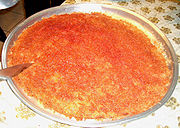
) and more pastry; or the khishnah kanafeh is rolled around the cheese. A thick syrup, consisting of sugar, water and a few drops of rose water, is poured on the pastry during the final minutes of cooking. Often the top layer of kadaif pastry is colored using orange food coloring. Crushed pistachio
Pistachio
The pistachio, Pistacia vera in the Anacardiaceae family, is a small tree originally from Persia , which now can also be found in regions of Syria, Lebanon, Turkey, Greece, Kyrgyzstan, Turkmenistan, India, Pakistan, Egypt, Sicily and possibly Afghanistan , as well as in the United States,...
s are typically sprinkled on top as a garnish.
In Egypt
Egypt
Egypt , officially the Arab Republic of Egypt, Arabic: , is a country mainly in North Africa, with the Sinai Peninsula forming a land bridge in Southwest Asia. Egypt is thus a transcontinental country, and a major power in Africa, the Mediterranean Basin, the Middle East and the Muslim world...
, the filling is mainly composed of either crushed nuts mixed with powdered sugar and cinnamon, or of sweetened cream cheese.
Among Palestinians, the city of Nablus
Nablus
Nablus is a Palestinian city in the northern West Bank, approximately north of Jerusalem, with a population of 126,132. Located in a strategic position between Mount Ebal and Mount Gerizim, it is the capital of the Nablus Governorate and a Palestinian commercial and cultural center.Founded by the...
is especially renowned for kanafeh. The kanafeh of Nablus is filled with Nabulsi cheese
Nabulsi cheese
Nabulsi is one of a number of white brined cheeses made in the Middle East. Its name denotes its place of origin, Nablus, and it is well-known throughout the West Bank and surrounding regions. It is the principal cheese consumed in Jordan. Produced primarily from sheep milk, goat's milk is also...
and plays a central role in Palestinian cuisine
Palestinian cuisine
Palestinian cuisine consists of foods from or commonly eaten by Palestinians — which includes those living in the Palestinian territories, Israel, refugee camps in nearby countries as well as by the Palestinian Diaspora...
.
A Note On Terminology
Many variants of kanafeh have names resembling the word "qatayef", but a qatayefQatayef
Qatayef is an Arab dessert commonly served during the month of Ramadan, a sort of sweet dumpling filled with cream or nuts.- Origin :...
is a quite distinct, dumpling-like confection. Qatayef
Qatayef
Qatayef is an Arab dessert commonly served during the month of Ramadan, a sort of sweet dumpling filled with cream or nuts.- Origin :...
and variants of kanafeh are often found in the same areas, and are made of the same basic ingredients (one of which is the batter, which in some areas is called "qatayef"!). So it is easy to confuse many of the terms. Still, kadaif, and kadayıf, kataifi, etc., are not qatayef
Qatayef
Qatayef is an Arab dessert commonly served during the month of Ramadan, a sort of sweet dumpling filled with cream or nuts.- Origin :...
, but are always just different names for variants of kanafeh.
Ka'ket Kanafeh
This variant is popular across the Levant and Turkey, where it can be eaten for breakfast or even for dinner as a main meal; but it is primarily considered a dessert. Eaten as a layered treat or helwah, it may also be placed in a special bread and sprinkled with sesame seeds. It is traditionally served alongside, or drenched in, a thick, sugar-based, honey-based, or glucose-based syrup called qattar or attarAttar (syrup)
Attar is a type of sweet syrup used in the preparation of Middle Eastern desserts....
.
Kadayıf and Künefe
The TurkishTurkey
Turkey , known officially as the Republic of Turkey , is a Eurasian country located in Western Asia and in East Thrace in Southeastern Europe...
variant of the pastry kanafeh is called künefe, and the bunch of wirey shreds that it is based on is called kadayıf. A semi-soft cheese such as mozzarella
Mozzarella
Mozzarella is an Italian Traditional Speciality Guaranteed food product. The term is used for several kinds of Italian cheeses that are made using spinning and then cutting :...
is used in the filling. In making the künefe, the kadayıf is not rolled around the cheese; instead, cheese is put in between two layers of wire kadayıf. This is cooked in small copper plates, and then served very hot, in syrup, with clotted cream (kaymak
Kaymak
Kaymak ; also kaymak, kajmak, kaimak or qeymağ, also geymar, gaimar, is a originally Serbian creamy dairy product, similar to clotted cream, made in Serbia, Turkey,...
), and pistachios or walnuts. (Compare with kadaif.)
Kadaif
In this variant, called also or in Greek (kataïfi or kadaïfi), the threads are used to make pastries of various forms (tubes or nests), often with a filling of chopped nuts, like that used for baklavaBaklava
Baklava is a rich, sweet pastry made of layers of filo pastry filled with chopped nuts and sweetened with syrup or honey. It is characteristic of the cuisines of the former Ottoman Empire and much of central and southwest Asia....
.
A kadaif pastry is made by putting down a layer of wire kadaif, then a layer of a filling of chopped nuts, then another layer of wire kadaif. The pastries are painted with melted butter, baked until golden brown, then drenched in sugar or honey syrup. (Compare with künefe.)
Kadaif noodles are sometimes used, in fusion cuisine
Fusion cuisine
Fusion cuisine combines elements of various culinary traditions while not being categorized per any one particular cuisine style, and can pertain to innovations in many contemporary restaurant cuisines since the 1970s.-Categories and types:...
, to make savory pastries.
World records

Nablus
Nablus is a Palestinian city in the northern West Bank, approximately north of Jerusalem, with a population of 126,132. Located in a strategic position between Mount Ebal and Mount Gerizim, it is the capital of the Nablus Governorate and a Palestinian commercial and cultural center.Founded by the...
.
Palestinians made the largest kanafeh in an attempt to get into the book of Guinness World Records
Guinness World Records
Guinness World Records, known until 2000 as The Guinness Book of Records , is a reference book published annually, containing a collection of world records, both human achievements and the extremes of the natural world...
. The plate of the Palestinian
Palestinian cuisine
Palestinian cuisine consists of foods from or commonly eaten by Palestinians — which includes those living in the Palestinian territories, Israel, refugee camps in nearby countries as well as by the Palestinian Diaspora...
delicacy measured 75 meters in length and two meters in width with a weight of 1,350 kilograms.
See also
- PhylloPhylloPhyllo, filo, or fillo dough is paper-thin sheets of unleavened flour dough used for making pastries in Middle Eastern and Balkan cuisine.-History:An early, thick form of phyllo appears to be of Central Asian Turkic origin...
- QatayefQatayefQatayef is an Arab dessert commonly served during the month of Ramadan, a sort of sweet dumpling filled with cream or nuts.- Origin :...
, a dumpling-like confection involving some of the same ingredients as many kanafeh variants - Ekmek kadayıfıEkmek kadayifiEkmek kadayıfı, ekmek kataif, ekmek kataifi is a Turkish bread pudding dessert, also in Greece called εκμέκ κανταΐφι or simply εκμέκ ekmek...
, a sort of Turkish bread custard