
All Topics  
Aaron

 
Aaron

   Email Print
   Bookmark   Link


Aaron


In the Bible
Hebrew Bible

The term Hebrew Bible is a generic reference to those books of the Bible originally written mostly in Biblical Hebrew with some Biblical Aramaic....
, Aaron , or Aaron the Levite
Levite

In Jewish tradition, a Levite is a member of the tribes of Israel of Levi. When Joshua led the Israelites into the land of Canaan, the Levites were the only Israelite tribe who received cities but no tribal land "because the Lord the God of Israel himself is their possession"....
 (????? ????), was the brother of Moses
Moses

Moses is a Hebrew Bible Hebrews religious leader, lawgiver, prophet, to whom the Mosaic authorship of the Torah is traditionally attributed. Also called Moshe Rabbeinu in Hebrew , he is the most important prophet in Judaism, and also an important prophet of Christianity, Islam, the Bah?'? Faith, Rastafari movement, Chrislam and many ot...
. He was the great-grandson of Levi (Exodus 6:16-20) and represented the priestly functions of his tribe, becoming the first High Priest
Kohen Gadol

Kohen Gadol or Kohen ha-Gadol is the title of wiktionary:High Priest of early Israelite religion and of Classical Age Judaism from the rise of the Israelite nation until the destruction of the Second Temple of Jerusalem....
 of the Hebrews
Hebrews

Hebrews are an ancient people defined as descendants of biblical Patriarch Abraham , a descendent of Noah.In the Bible, the patriarch Abraham is referred to a single time as the ivri, which is the singular form of the Hebrew-language word for Hebrew ....
. While Moses was receiving his education at the Egyptian royal court and during his exile among the Midianites, Aaron and his sister remained with their kinsmen in the eastern border-land of Egypt (Goshen
Goshen

Goshen is the name of several places and things:...
).


Discussion
Ask a question about 'Aaron'
Start a new discussion about 'Aaron'
Answer questions from other users
Full Discussion Forum


Recent Posts


Encyclopedia


Goldcalf
In the Bible
Hebrew Bible

The term Hebrew Bible is a generic reference to those books of the Bible originally written mostly in Biblical Hebrew with some Biblical Aramaic....
, Aaron , or Aaron the Levite
Levite

In Jewish tradition, a Levite is a member of the tribes of Israel of Levi. When Joshua led the Israelites into the land of Canaan, the Levites were the only Israelite tribe who received cities but no tribal land "because the Lord the God of Israel himself is their possession"....
 (????? ????), was the brother of Moses
Moses

Moses is a Hebrew Bible Hebrews religious leader, lawgiver, prophet, to whom the Mosaic authorship of the Torah is traditionally attributed. Also called Moshe Rabbeinu in Hebrew , he is the most important prophet in Judaism, and also an important prophet of Christianity, Islam, the Bah?'? Faith, Rastafari movement, Chrislam and many ot...
. He was the great-grandson of Levi (Exodus 6:16-20) and represented the priestly functions of his tribe, becoming the first High Priest
Kohen Gadol

Kohen Gadol or Kohen ha-Gadol is the title of wiktionary:High Priest of early Israelite religion and of Classical Age Judaism from the rise of the Israelite nation until the destruction of the Second Temple of Jerusalem....
 of the Hebrews
Hebrews

Hebrews are an ancient people defined as descendants of biblical Patriarch Abraham , a descendent of Noah.In the Bible, the patriarch Abraham is referred to a single time as the ivri, which is the singular form of the Hebrew-language word for Hebrew ....
. While Moses was receiving his education at the Egyptian royal court and during his exile among the Midianites, Aaron and his sister remained with their kinsmen in the eastern border-land of Egypt (Goshen
Goshen

Goshen is the name of several places and things:...
). He there gained a name for eloquent and persuasive speech; so that when the time came for the demand upon the Pharaoh
Pharaoh

Pharaoh is a title used in many modern discussions of the ancient Egyptian rulers of all periods. In antiquity this title began to be used for the ruler who was the religious and political leader of united ancient Egypt, only during the New Kingdom, specifically, during the middle of the Eighteenth dynasty of Egypt....
 to release Israel from captivity, Aaron became his brother’s "nabi", or spokesman, to his own people (Exodus 4:16) and, after their unwillingness to hear, to the Pharaoh himself (Exodus 7:9). He is said to have flourished about 1200 BC (traditionally 1597 BC).

Etymology


The meaning of the name "Aaron" is unclear. Possible meanings are:

  1. Pregnancy - In Hebrew - ?????. In Ancient Egyptian herr is to conceive and hrara is conception.
  2. From the mountain - In Hebrew ?? - 'HAR', which may refer to place of his death.
  3. High mountain - In Arabic ????? - 'HAROUN' or 'HARUN'.
  4. One of light


Genealogy

Abraham/Isaac/Jacob(Israel);Great-Grandfather: Levi, third of 12 sons and tribes of Israel; Grandfather: Kohath; Father: Amram; Mother: Jochebed; Sister: Miriam; Brother: Mosheh (Moses)Uncles: Izhar, Hebron, Uzziel; Sons: Nadab, Abihu, Eleazar,Ithamar; Grandson, Phineas

Function

Aaron’s function included the duties of speaker and implied personal dealings with the Egyptian royal court on behalf of Moses, who was always the central moving figure. The part played by Aaron in the events that preceded the Exodus was, therefore, ministerial, and not directive. He, along with Moses, performed “signs” before his people which impressed them with a belief in the reality of the divine mission of the brothers (Exodus 4:15-16).

At the command of Moses
Moses

Moses is a Hebrew Bible Hebrews religious leader, lawgiver, prophet, to whom the Mosaic authorship of the Torah is traditionally attributed. Also called Moshe Rabbeinu in Hebrew , he is the most important prophet in Judaism, and also an important prophet of Christianity, Islam, the Bah?'? Faith, Rastafari movement, Chrislam and many ot...
 he stretched out his rod in order to bring on the first three plagues (Exodus 7:19, 8:1,12). In the infliction of the remaining plagues he appears to have acted merely as the attendant of Moses
Moses

Moses is a Hebrew Bible Hebrews religious leader, lawgiver, prophet, to whom the Mosaic authorship of the Torah is traditionally attributed. Also called Moshe Rabbeinu in Hebrew , he is the most important prophet in Judaism, and also an important prophet of Christianity, Islam, the Bah?'? Faith, Rastafari movement, Chrislam and many ot...
, whose outstretched rod drew the divine wrath upon the Pharaoh and his subjects (Exodus 9:23, 10:13,22). The potency of Aaron’s rod had already been demonstrated by its victory over the rods of the Egyptian magicians, which it swallowed after all the rods alike had been turned into serpents (Exodus 7:9). During the journey in the wilderness, Aaron is not always prominent or active; and he sometimes appears guilty of rebellious or treasonable conduct. At the battle with Amalek, he is chosen with Hur to support the hand of Moses that held the “rod of God” (Exodus 17:9). When the revelation was given to Moses at Mount Sinai, he headed the elders of Israel who accompanied Moses on the way to the summit. Joshua
Joshua

Joshua, Jehoshuah or Yehoshua , born in Egypt, was a biblical Israelite leader who succeeded Moses. His story is told in the Hebrew Bible, chiefly in the books Book of Exodus, Book of Numbers and Book of Joshua....
, however, was admitted with his leader to the very presence of the Lord, while Aaron and Hur remained below to look after the people Exodus 24:9-14. It was during the prolonged absence of Moses
Moses

Moses is a Hebrew Bible Hebrews religious leader, lawgiver, prophet, to whom the Mosaic authorship of the Torah is traditionally attributed. Also called Moshe Rabbeinu in Hebrew , he is the most important prophet in Judaism, and also an important prophet of Christianity, Islam, the Bah?'? Faith, Rastafari movement, Chrislam and many ot...
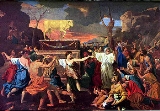
 that Aaron yielded to the clamors of the people, and made a Golden Calf as a visible image of the divinity who had delivered them from Egypt (Exodus 32:1-6) (it should be noted that in the account given of the same events, in the Qur'an, Aaron is not the idol-maker and upon Moses' return begged his pardon as he had felt mortally threatened by the Israelites (Quran 7:142-152)) At the intercession of Moses, Aaron was saved from the plague which smote the people (Deuteronomy 9:20, Exodus 32:35), although it was to Aaron’s tribe of Levi that the work of punitive vengeance was committed (Exodus 32:26).

Priesthood

At the time when the tribe of Levi was set apart for the priestly service, Aaron was anointed and consecrated to the priesthood, arrayed in the robes of his office, and instructed in its manifold duties (Exodus 28 KJV, Exodus 29 KJV).

On the very day of his consecration, his sons; Nada and Abidjan, were consumed by fire from the Lord for having offered incense in an unlawful manner (Leviticus 10 KJV).

Scholarly consensus is that in Aaron's High Priesthood the sacred writer intended to describe a model, the prototype, so to say, of the Jewish High Priest, "phod". God, on Mount Sinai instituting a worship, and also instituted an order of priests.

According to the patriarchal customs, the First Born son in every family used to perform the functions connected with God's worship, "phod". It might have been expected, consequently, that Rueben's family would be chosen by God for the ministry of the new altar. However, according to the biblical narrative it was Aaron who was the object of God's choice. To what jealousies this gave rise later, has been indicated above. The office of the Aaronites was at first merely to take care of the lamp that should ever burn before the veil of the tabernacle Exodus 27:21. A more formal calling soon followed (Exodus 28:1). Aaron and his sons, distinguished from the Common People by their sacred functions, were likewise to receive holy vestments suitable to their office.

Aaron offered the different sacrifices and performed the many ceremonies of the consecration of the new priests, according to the divine instructions (Exodus 29), and repeated these rites for seven days, during which Aaron and his sons were entirely separated from the rest of the people. When, on the eighth day, the High Priest had inaugurated his office of sacrifice by killing the animals, he blessed the people (very likely according to the prescriptions of Numbers 6:24-26), and, with Moses, entered into the tabernacle so as to take possession thereof. As they "came forth and blessed the people. And the glory of the Lord appeared to all the multitude: And behold a fire, coming forth from the Lord, devoured the holocaust, and the fat that was upon the altar: which when the multitude saw, they praised the Lord, falling on their faces" (Leviticus 9:23-24). So was the institution of the Aaronic priesthood inaugurated and solemnly ratified by the Lord.

Rebellion of Korah


From the time of the sojourn at Mount Sinai, where he became the anointed priest of Israel, Aaron ceased to be the minister of Moses, his place being taken by Joshua. He is mentioned in association with Miriam in a jealous complaint against the exclusive claims of Moses as the Lord’s prophet. The presumption of the murmurers was rebuked, and Miriam was smitten with tzara'as. Aaron entreated Moses to intercede for her, at the same time confessing the sin and folly that prompted the uprising. Aaron himself was not struck with the plague on account of sacerdotal immunity; and Miriam, after seven days’ quarantine, was healed and restored to favor Numbers 12, Micah (6:4) a prophet in Judaism
Judaism

Judaism is a set of beliefs and practices originating in the Hebrew Bible , as later further explored and explained in the Talmud and other texts....
, mentions Moses, Aaron, and Miriam as the leaders of Israel after the Exodus (a judgment wholly in accord with the tenor of the narratives). In the present instance it is made clear by the express words of the oracle (Numbers 12:6-8) that Moses was unique among men as the one with whom the Lord spoke face to face. The failure to recognize or concede this prerogative of their brother was the sin of Miriam and Aaron.

The validity of the exclusive priesthood of the family of Aaron was attested after the ill-fated rebellion of Korah, who was a first cousin of Aaron. When the earth had opened and swallowed up the leaders of the insurgents (Numbers 16:25-35). Eleazar, the son of Aaron, was commissioned to take charge of the censers of the dead priests. And when the plague had broken out among the people who had sympathized with the rebels, Aaron, at the command of Moses, took his censer and stood between the living and the dead till the plague was stayed (Numbers 17:1-15, 16:36-50).

Another memorable transaction followed. Each of the tribal princes of Israel took a rod and wrote his name upon it, and the twelve rods were laid up over night in the tent of meeting. On the morrow Aaron’s rod was found to have budded and blossomed and borne ripe almonds (Numbers 17:8). The miracle proved merely the prerogative of the tribe of Levi; but now a formal distinction was made in perpetuity between the family of Aaron and the other Levites. While all the Levites (and only Levites) were to be devoted to sacred services, the special charge of the sanctuary and the altar was committed to the Aaronites
Kohen

A kohen is a Jew who is a direct male descendant of the Bible Aaron, brother of Moses, with a separate status in Judaism. Another term for the descendants of Aaron are the Aaronites or Aaronids....
 alone (Numbers 18:1-7). The scene of this enactment is unknown, nor is the time mentioned.

Death

Aaron, like Moses, was not permitted to enter Canaan with the others. The reason alleged is that the two brothers showed impatience at Meribah (Kadesh) in the last year of the desert pilgrimage (Numbers 20:12-13), when they, or rather Moses, brought water out of a rock to quench the thirst of the people. The action was construed as displaying a want of deference to the Lord, since they had been commanded to speak to the rock, whereas Moses struck it with the wonder-working rod (Numbers 20:7-11). Of the death of Aaron we have two accounts. The principal one gives a detailed statement to the effect that, soon after the above incident, Aaron, with his son Eleazar and Moses, ascended Mount Hor. There Moses stripped him (Aaron) of his priestly garments, and transferred them to Eleazar. Aaron died on the summit of the mountain, and the people mourned for him thirty days (Numbers 20:22-29; compare 33:38-39). The other account is found in Deut. x. 6, where Moses is reported as saying that Aaron died at Mosera and was buried there. Mosera is not on Mount Hor, since the itinerary in Numbers 33:31-37 records seven stages between Moseroth (Mosera) and Mount Hor.

Typical signification in rabbinical literature

The older prophets and prophetical writers beheld in their priests the representatives of a religious form inferior to the prophetic truth; men without the spirit of God and lacking the will-power requisite to resist the multitude in its idolatrous proclivities. Thus Aaron, the first priest, ranks below Moses: he is his mouthpiece, and the executor of the will of God revealed through Moses, although it is pointed out that it is said fifteen times in the Pentateuch
Torah

The term "Torah" , or Five Books of Moses or Pentateuch, refers to the entirety of Judaism's founding Halakha and ethical religious texts....
 that “the Lord spoke to Moses and Aaron.” Under the influence of the priesthood which shaped the destinies of the nation under Persian rule, a different ideal of the priest was formed, as is learned from Malachi
Malachi

Malachi, Malachias or Mal'achi was a prophet in the Bible, the Judaism Tanakh and Christianity Old Testament .He was the last of the minor prophets of David, and the writer of the Book of Malachi, the last book of the Names for books of Judeo-Christian scripture Old Testament canon , and is the last book of the Neviim...
 2:4-7; and the prevailing tendency was to place Aaron on a footing equal with Moses. “At times Aaron, and at other times Moses, is mentioned first in Scripture—this is to show that they were of equal rank,” says Mekilta ??, 1; expressly infers this when introducing in his record of renowned men the glowing description of Aaron’s ministration.

Death of Aaron in rabbinic literature

In fulfilment of the promise of peaceful life, symbolized by the pouring of oil upon his head (Leviticus Rabbah
Leviticus Rabbah

Leviticus Rabbah, Vayikrah Rabbah, or Wayikra Rabbah is a homiletic midrash to the Biblical book of Leviticus . It is referred to by Nathan ben Jehiel in his Aruk as well as by Rashi in his commentaries on and elsewhere....
 x., Midrash Teh. cxxxiii. 1), Aaron's death, as described in the Haggadah, was of a wonderful tranquillity. Accompanied by Moses, his brother, and by Eleazar, his son, Aaron went to the summit of Mount Hor, where the rock suddenly opened before him and a beautiful cave lit by a lamp presented itself to his view. "Take off thy priestly raiment and place it upon thy son Eleazar!" said Moses; "and then follow me." Aaron did as commanded; and they entered the cave, where was prepared a bed around which angels stood. "Go lie down upon thy bed, my brother," Moses continued; and Aaron obeyed without a murmur. Then his soul departed as if by a kiss from God. The cave closed behind Moses as he left; and he went down the hill with Eleazar, with garments rent, and crying: "Alas, Aaron, my brother! thou, the pillar of supplication of Israel!" When the Israelites cried in bewilderment, "Where is Aaron?" angels were seen carrying Aaron's bier through the air. A voice was then heard saying: "The law of truth was in his mouth, and iniquity was not found on his lips: he walked with me in righteousness, and brought many back from sin" (Malachi 2:6). He died, according to Seder Olam Rabbah
Seder Olam Rabbah

Seder Olam Rabbah is the earliest post-exilic chronicle preserved in the Hebrew language. Tradition considers it to have been written about 160 CE by Yose b....
 ix., R. H. 2, 3a, on the first of Ab." The pillar of cloud which proceeded in front of Israel's camp disappeared at Aaron's death (see Seder 'Olam, ix. and R. H. 2b-3a). The seeming contradiction between Numbers 20:22 et seq. and Deutronomy 10:6 is solved by the rabbis in the following manner: Aaron's death on Mount Hor was marked by the defeat of the people in a war with the king of Arad, in consequence of which the Israelites fled, marching seven stations backward to Mosera, where they performed the rites of mourning for Aaron; wherefore it is said: "There [at Mosera] died Aaron."

The rabbis also dwell with special laudation on the brotherly sentiment which united Aaron and Moses. When the latter was appointed ruler and Aaron high priest, neither betrayed any jealousy; instead they rejoiced in one another's greatness. When Moses at first declined to go to Pharaoh, saying: "O my Lord, send, I pray thee, by the hand of him whom thou wilt send" (Exodus 4:13), he was unwilling to deprive Aaron, his brother, of the high position the latter had held for so many years; but the Lord reassured him, saying: "Behold, when he seeth thee, he will be glad in his heart" . Indeed, Aaron was to find his reward, says Simon bar Yochai; for that heart which had leaped with joy over his younger brother's rise to glory greater than his was decorated with the Urim and Thummim
Urim and Thummim

In ancient Israelite religion and culture, Urim and Thummim is a phrase from the Hebrew Bible associated with the Hoshen , divination in general, and cleromancy in particular....
, which were to "be upon Aaron's heart when he goeth in before the Lord" (Canticles Rabbah i. 10). Moses and Aaron met in gladness of heart, kissing each other as true brothers (Exodus 4:27; compare Song of Songs
Song of Solomon

The Song of Songs , is a book of the Hebrew Bible—Tanakh or Old Testament—one of the five The Five Scrolls . It is also known as the Song of Solomon or as Canticles, the latter from the shortened and anglicized Vulgate title Canticum Canticorum, "Song of Songs" in Latin language....
 8:1), and of them it is written: "Behold how good and how pleasant [it is] for brethren to dwell together in unity!" (Psalms 133:1). Of them it is said: "Mercy and truth are met together; righteousness and peace have kissed [each other]" (Psalms 85:10); for Moses stood for righteousness, according to Deuteronomy 33:21, and Aaron for peace, according to . Again, mercy was personified in Aaron, according to Deuteronomy xxxiii. 8, and truth in Moses, according to Numbers xii. 7 .

When Moses poured the oil of anointment upon the head of Aaron, Aaron modestly shrank back and said: "Who knows whether I have not cast some blemish upon this sacred oil so as to forfeit this high office." Then the Shekhinah
Shekhinah

File:SpiritUponDavid.jpgShekhinah is the English spelling of a grammatically feminine Hebrew language word that means the dwelling or settling, and is used to denote the dwelling or settling presence of God, especially in the Temple in Jerusalem....
 spake the words: "Behold the precious ointment upon the head, that ran down upon the beard of Aaron, that even went down to the skirts of his garment, is as pure as the dew of Hermon" .

Moses and Aaron compared in rabbinic literature

According to Tanhuma
Tanhuma

Midrash Tanhuma is the name given to three different collections of Pentateuch haggadot; two are extant, while the third is known only through citations....
, Aaron’s activity as a prophet began earlier than that of Moses. Hillel held Aaron up as an example, saying: “Be of the disciples of Aaron, loving peace and pursuing peace; love your fellow creatures and draw them nigh unto the Law!” This is further illustrated by the tradition preserved in Abot de-Rabbi Natan 12, Sanhedrin
Sanhedrin (Talmud)

Sanhedrin is one of ten tractates of the Nezikin . The Gemara of the tractate is noteworthy as precursors to the development of common law principles ....
 6b, and elsewhere, according to which Aaron was an ideal priest of the people, far more beloved for his kindly ways than was Moses. While Moses was stern and uncompromising, brooking no wrong, Aaron went about as peacemaker, reconciling man and wife when he saw them estranged, or a man with his neighbor when they quarreled, and winning evil-doers back into the right way by his friendly intercourse. The mourning of the people at Aaron’s death was greater, therefore, than at that of Moses; for whereas, when Aaron died the whole house of Israel
House of Israel

The House of Israel is a Jewish community in Ghana. This ethnic group claim to be one of the Ten Lost Tribes.The group is not recognised as Jewish by mainstream Judaism....
 wept, including the women. Moses was bewailed by “the sons of Israel” only . Even in the making of the Golden Calf the rabbis find extenuating circumstances for Aaron. His fortitude and silent submission to the will of God on the loss of his two sons are referred to as an excellent example to men how to glorify God in the midst of great affliction. Especially significant are the words represented as being spoken by God after the princes of the Twelve Tribes had brought their dedication offerings into the newly reared Tabernacle: “Say to thy brother Aaron: Greater than the gifts of the princes is thy gift; for thou art called upon to kindle the light, and, while the sacrifices shall last only as long as the Temple lasts, thy light shall last forever.”

Genetics


Recently, the tradition that Kohanim are actually descended from a single patriarch, Aaron, was found to be apparently consistent with genetic testing
Genetic testing

Genetic testing allows the Genetics diagnosis of vulnerabilities to inherit diseases, and can also be used to determine a person's ancestry. Normally, every person carries two copies of every gene, one inherited from their mother, one inherited from their father....
. The majority of Kohanim, but not all, share a direct male lineage with a common Y chromosome
Y chromosome

The Y chromosome is the Sex-determination system chromosome in most mammals, including humans. In mammals, it contains the gene SRY, which triggers testicle development, thus determining sex....
, testing was done across sectors of the Jewish population
Jewish population

Jewish population refers to the number of Jews in the world. Precise figures are difficult to calculate because the definition of "Who is a Jew" remains a source of controversy....
 to see if there was any commonality between the Y chromosomes of Kohanim. The results were found to cluster rather closely around a specific DNA signature, found in the Semitic Haplogroup J1, which the researchers named the Cohen modal haplotype, implying that many of the Kohanim do share a distinctive common ancestry
Common descent

A group of organisms is said to have common descent if they have a common ancestor. In modern biology, it is generally accepted that all living organisms on Earth are descended from a common ancestor or ancestral gene pool....
. This information was also used to support the claim that the Lemba
Lemba

The Lemba or Lembaa are an ethnic group numbering 70,000 in southern Africa who claim a common descent and belonging to the Jew.Although they are speakers of Bantu languages related to those spoken by their geographic neighbours - in itself the practice of most Jews in the diaspora - they have specific religious practices and beliefs...
 (a sub-Saharan tribe) are in fact descendant from a group of Jewish Priests.

The Cohen Modal Haplotype or CMH is found in haplogroup
Haplogroup

In the study of molecular evolution, a haplogroup is a group of similar haplotypes that share a common ancestor with a single nucleotide polymorphism mutation....
 J1
Haplogroup J1 (Y-DNA)

In human genetics, Haplogroup J1 is a Y chromosome haplogroup which is a subdivision of haplogroup J ....
, which geneticists estimate originated in the Southern Levant
Levant

The Levant describes, traditionally, the Eastern Mediterranean at large, but can be used as a geographical term that denotes a large area in Western Asia formed by the lands bordering the Eastern shores of the Mediterranean, roughly bounded on the north by the Taurus Mountains, on the south by the Arabian Desert, and on the west by the M...
 (modern day Israel, Jordan; biblical Canaan) or North Africa (Egypt) approximately 10,000 - 15,000 years ago. Biblical tradition holds that Abraham and his ancestors, the Semitic tribes, originated from Southern Arabia or East Africa (Genesis 10); Aaron and Moses were 7th generation descendants from Abraham (Exodus 6). An estimated 20% of the modern Jewish community fall into haplogroup J1. The traditional date for Abraham is circa 2200-2000 BCE. Behar, et al., found Cohenim in a variety of haplogroups (E3b, G2, H, I1b, J, K2, Q, R1a1, R1b), which included those which originated in the Levant (J1, J2) and those from Southern Arabia, East Africa, or another geographic region.

Descendants

The sons of Aaron were Eleazar
Eleazar

Eleazar , was a son of Aaron, a Levite Kohen and Kohen Gadol. His wife, a daughter of Putiel, bore him Phinehas. After the death of Nadab and Abihu, he was appointed to the charge of the sanctuary....
, Ithamar
Ithamar

In the Torah, Ithamar is mentioned as the youngest son of Aaron the High Priest. After the death of his two eldest brothers Nadab and Abihu, Ithamar served as a priest along with his elder brother, Eleazar....
, Nadab and Abihu. A descendant of Aaron is an Aaronite, or Kohen
Kohen

A kohen is a Jew who is a direct male descendant of the Bible Aaron, brother of Moses, with a separate status in Judaism. Another term for the descendants of Aaron are the Aaronites or Aaronids....
, meaning Priest. A Levite
Levite

In Jewish tradition, a Levite is a member of the tribes of Israel of Levi. When Joshua led the Israelites into the land of Canaan, the Levites were the only Israelite tribe who received cities but no tribal land "because the Lord the God of Israel himself is their possession"....
 is a non-Aaronic descendant of Levi assigned to assist the Levitical priests of the family of Aaron in the care of the tabernacle and later of the temple.

Aaron in Christianity


Aaron is considered a type
Typology

"Typology" is the study of types. More specifically, it may refer to:*Typology , division of culture by races*Typology , classification of things according to their characteristics...
 of Christ
Christ

Christ is the English language term for the Greek meaning "the anointing", which is a title given to the Reigning Messiah in the given age of the Zodiac....
, the high priest
High priest

The term "high priest" may refer to an individual who holds the office of monarch-priest, or may refer to the head of a religious caste.* In ancient Egypt, a high priest was the chief priest of any of the many gods revered by the Egyptians....
 of the new dispensation
New Covenant

The term New Covenant is used in the Bible to refer to an Messianic Age following a period of trial and judgment. As are all Covenant between God and man described in the Bible, it is "a bond in blood sovereignly administered by God." ...
. In the Eastern Orthodox Church
Eastern Orthodox Church

The Eastern Orthodox Church is the second largest single Christian communion in the world with an estimated 225 million members worldwide. It is considered by its adherents to be the Four Marks of the Church established by Jesus Christ and his Apostles nearly 2000 years ago....
 and the Maronite Church
Maronite Church

Maronites are members of one of the Syriac Eastern Catholic Churches, with a heritage reaching back to Maron in the early 5th century. The first Maronite patriarch, John Maron, was elected in the late 7th century....
 he is venerated
Veneration

In Christianity, veneration , or veneration of saints, is a special act of honoring a saint: a dead person who has been identified as singular in the traditions of the religion....
 as a saint
Saint

A saint in Christianity is a human being who has been called to holiness. The term is used differently by various denominations, with some, such as the Anglicans, Methodists, and Lutherans distinguishing between Saints and saints....
, with a feast day celebrated on September 4, together with Moses (for those churches which follow the traditional Julian Calendar
Julian calendar

The Julian calendar, a reform of the Roman calendar, was introduced by Julius Caesar in 46 BC, and came into force in 45 BC . It was chosen after consultation with the astronomer Sosigenes of Alexandria and was probably designed to approximate the tropical year, known at least since Hipparchus....
, September 4 falls on September 17 of the modern Gregorian Calendar
Gregorian calendar

The Gregorian calendar is the internationally accepted civil calendar. It was first proposed by the Calabrian doctor Aloysius Lilius, and decreed by Pope Gregory XIII, after whom it was named, on 24 February 1582 by the papal bull Inter gravissimas....
). He is also commemorated, together with other righteous saints from the Old Testament on the Sunday of the Holy Fathers (the Sunday before Christmas
Christmas

Christmas , also referred to as Christmas Day, is an annual holiday celebrated on December 25 that commemorates the birth of Jesus. The day marks the beginning of the larger season of Christmastide, which lasts Twelve Days of Christmas....
).

He is commemorated as one of the Holy Forefathers in the Calendar of Saints
Calendar of Saints (Armenian Apostolic Church)

Days of observance - 2007...
 of the Armenian Apostolic Church
Armenian Apostolic Church

The Armenian Apostolic Church is the world's oldest national church and one of the most ancient Christianity communities.The official name of the church is the One Holy Universal Apostolic Orthodox Armenian Church ....
 on July 30. He is commemorated on July 1 in the modern Latin calendar and in the Syriac Calendar.

Aaron in The Church of Jesus Christ of Latter Day Saints (LDS)

In the LDS church
Church of Jesus Christ of Latter-day Saints

The Church of Jesus Christ of Latter-day Saints is the largest Religious denomination originating from the Latter Day Saint movement founded by Joseph Smith, Jr., on April 6, 1830....
, the Aaronic
Aaronic Priesthood

The Aaronic priesthood is the lesser of the two orders of priesthood recognized in Mormonism. The others are the Melchizedek priesthood and the rarely-recognized Patriarchal priesthood....
 order is the lesser order of priesthood, comprising the grades (from lowest to highest) of deacon, teacher and priest. The chief office of the Aaronic priesthood is the presiding bishopric; the head of the priesthood is the bishop. Each ward has one or more quorums of each office of the Aaronic priesthood.

Aaron in Islam

Aaron is believed to be a Prophet in Islam
Islam

Islam is a Monotheism, Abrahamic religion originating with the teachings of the Prophets of Islam Muhammad, a 7th century Arab religious and political figure....
 and is known as Harun
Harun

Haroon , was a prophet biblical times mentioned in the Qur'an. In the Bible he is known as Aaron . It is believed that Haroon lived for 122 years....
, which is the Arabic name for Aaron. His role also found an analogue in the person of Ali
Ali

Ali ibn Abi alib was the cousin and son-in-law of the Prophets of Islam Muhammad, who ruled over the Rashidun empire from 656 to 661. Sunni Muslims consider Ali as the fourth and final Rashidun while Shia Islam Muslims regard Ali as the first Imamah and consider him and his descendants as the Succession to Muhammad, all of which are me...
, to whom Muhammad
Muhammad

Muhammad Patronymic#Arabic Abd Allah ibn Abd al Muttalib , is the founder of the Major religious groups of Islam and is regarded by Muslims as a Rasul and prophet of , the last and the greatest law-bearer in a series of prophets....
 said: Will you not be pleased that you will be to me like Aaron was to Moses?

A significant difference in the Quran is the fact that Aaron was not involved with the creation of the Golden Calf and made efforts to dissuade the Israelites from worshiping it.

Resources

  • Jewish Encyclopedia
    Jewish Encyclopedia

    The Jewish Encyclopedia was an encyclopedia originally published between 1901 and 1906 by Funk and Wagnalls. It contained over 15,000 articles in 12 volumes on the history and then-current state of Judaism and the Jews as of 1901....
    . Funk and Wagnalls
    Funk and Wagnalls

    Funk & Wagnalls is a publisher based in New York City known for its reference works, including an encyclopedia, content from which became a part of Microsoft's Encarta digital encyclopedia....
    , 1901-1906; which cites
    • Numbers
      Book of Numbers

      The Book of Numbers, , is the fourth book of the Torah, the Tanakh, and the Old Testament. In the Greek language Septuagint it is called Arithmoi, or Numbers....
       Rabbah
      9
    • Leviticus
      Leviticus

      Leviticus is third book of the Torah , the name given in Judaism to the first five books of the Hebrew Bible .Leviticus contains laws and priestly rituals, but in a wider sense is about the working out of Covenant set out in Genesis and Exodus - what is seen in the Torah as the consequences of entering into a special relationship with God...
       Rabbah
      10
  • in Jellinek
    Jellinek

    Jellinek is a surname and may refer to:* Adolf Jellinek , an Austrian rabbi and scholar.* E. Morton Jellinek a psychologist and researcher into alcoholism....
    ’s Bet ha-Midrash, 1:91-95
  • 764
    • Baring-Gould
      Gould

      Gould may refer to:...
      , Legends of Old Testament Characters
    • Chronicles of Jerahmeel
      Chronicles of Jerahmeel

      The Chronicles of Jerahmeel is a voluminous work that draws largely on Pseudo-Philo's earlier history of Biblical events and is of special interest because it includes Hebrew language and Aramaic language versions of certain deuterocanonical books in the Septuagint....
      , ed. M. Gaster
      Moses Gaster

      Moses Gaster was a Romanian-born Jewish-United Kingdom scholar, the Hakham of the Spanish and Portuguese Jews, London, and a Hebrew language linguistics....
      , pp. cx1:130-133
    • Holweck, F. G.
      Frederick George Holweck

      Frederick George Holweck was a German-American Roman Catholic priest and scholar, hagiographer and church historian....
      , A Biographical Dictionary of the Saint. St. Louis, MO: B. Herder Book Co. 1924.*


See also

  • Tomb of Aaron
    Tomb of Aaron

    The Tomb of Aaron is the burial-place of Aaron, the brother of Moses. It is disputed among Biblical scholars and archaeologists whether his tomb is on Mount Hor, or at a location near Petra....
  • Harun
    Harun

    Haroon , was a prophet biblical times mentioned in the Qur'an. In the Bible he is known as Aaron . It is believed that Haroon lived for 122 years....
  • Kohen
    Kohen

    A kohen is a Jew who is a direct male descendant of the Bible Aaron, brother of Moses, with a separate status in Judaism. Another term for the descendants of Aaron are the Aaronites or Aaronids....
  • Y-chromosomal Aaron
    Y-chromosomal Aaron

    Y-chromosomal Aaron is the name given to the hypothesised most recent common ancestor of many of the patrilineal descent Jewish priestly caste known as Kohen ....
  • Moses in rabbinic literature
    Moses in rabbinic literature

    Of all Hebrew Bible personages Moses has been chosen most frequently as the subject of later legends; and his life has been recounted in full detail in the poetic Aggadah....


External links

  • from the Bible Dictionary