
Aliyah is the
immigrationImmigration is the act of foreigners passing or coming into a country for the purpose of permanent residence...
of Jews to the
Land of IsraelThe Land of Israel is the Biblical name for the territory roughly corresponding to the area encompassed by the Southern Levant, also known as Canaan and Palestine, Promised Land and Holy Land. The belief that the area is a God-given homeland of the Jewish people is based on the narrative of the...
(
Eretz Yisrael). It is a basic tenet of Zionist ideology. The opposite action,
emigrationEmigration is the act of leaving one's country or region to settle in another. It is the same as immigration but from the perspective of the country of origin. Human movement before the establishment of political boundaries or within one state is termed migration. There are many reasons why people...
from Israel, is referred to as
yeridaYerida is a Hebrew term referring to emigration by Israeli Jews from the State of Israel. Yerida is the opposite of Aliyah , which is immigration to Israel...
("descent"). The return to the
Holy LandThe Holy Land is a term which in Judaism refers to the Kingdom of Israel as defined in the Tanakh. For Jews, the Land's identifiction of being Holy is defined in Judaism by its differentiation from other lands by virtue of the practice of Judaism often possible only in the Land of Israel...
has been a Jewish aspiration since the Babylonian exile. Large scale immigration to Eretz Israel and later
IsraelThe State of Israel is a parliamentary republic located in the Middle East, along the eastern shore of the Mediterranean Sea...
began in 1882.
Etymology
Aliyah is a Hebrew word that means "ascent," or "going up." According to Jewish tradition, traveling to the Land of Israel is an ascent, both geographically and metaphysically. Anyone traveling to Eretz Israel from Egypt, Babylonia or the Mediterranean basin, where many Jews lived in early rabbinic times, climbed to a higher altitude. Visiting
Jerusalem, situated 2,700 feet above sea level, was also an "ascent."
Religious, ideological and cultural concept
Aliyah is an important Jewish cultural concept and a fundamental component of
ZionismZionism is a Jewish political movement that, in its broadest sense, has supported the self-determination of the Jewish people in a sovereign Jewish national homeland. Since the establishment of the State of Israel, the Zionist movement continues primarily to advocate on behalf of the Jewish state...
. It is enshrined in Israel's
Law of ReturnThe Law of Return is Israeli legislation, passed on 5 July 1950, that gives Jews the right of return and settlement in Israel and gain citizenship...
, which accords any
Jew"Who is a Jew?" is a basic question about Jewish identity and considerations of Jewish self-identification. The question is based in ideas about Jewish personhood which themselves have cultural, religious, genealogical, and personal dimensions...
(deemed as such by
halakhaHalakha — also transliterated Halocho , or Halacha — is the collective body of Jewish law, including biblical law and later talmudic and rabbinic law, as well as customs and traditions.Judaism classically draws no distinction in its laws between religious and ostensibly non-religious life; Jewish...
and/or
Israeli secular lawIsraeli law is a mixed legal system reflecting the diverse history of the territory of the State of Israel throughout the last hundred years , as well as the legal systems of its major religious communities...
) and eligible non-Jews (a child and a grandchild of a Jew, the spouse of a Jew, the spouse of a child of a Jew and the spouse of a grandchild of a Jew), the legal
rightRights are legal, social, or ethical principles of freedom or entitlement; that is, rights are the fundamental normative rules about what is allowed of people or owed to people, according to some legal system, social convention, or ethical theory...
to assisted immigration and settlement in Israel, as well as Israeli citizenship. Someone who "makes
aliyah" is called an
oleh (m. singular) or
olah (f. singular); the plural for both is
olim. Many Religious Jews espouse
aliyah as a return to the
Promised landThe Promised Land is a term used to describe the land promised or given by God, according to the Hebrew Bible, to the Israelites, the descendants of Jacob. The promise is firstly made to Abraham and then renewed to his son Isaac, and to Isaac's son Jacob , Abraham's grandson...
, and regard it as the fulfillment of
GodGod is the English name given to a singular being in theistic and deistic religions who is either the sole deity in monotheism, or a single deity in polytheism....
's
biblicalThe Bible refers to any one of the collections of the primary religious texts of Judaism and Christianity. There is no common version of the Bible, as the individual books , their contents and their order vary among denominations...
promise to the descendants of the Hebrew patriarchs
AbrahamAbraham , whose birth name was Abram, is the eponym of the Abrahamic religions, among which are Judaism, Christianity and Islam...
,
IsaacIsaac as described in the Hebrew Bible, was the only son Abraham had with his wife Sarah, and was the father of Jacob and Esau. Isaac was one of the three patriarchs of the Israelites...
, and
JacobJacob "heel" or "leg-puller"), also later known as Israel , as described in the Hebrew Bible, the Talmud, the New Testament and the Qur'an was the third patriarch of the Hebrew people with whom God made a covenant, and ancestor of the tribes of Israel, which were named after his descendants.In the...
. Aliyah is included as a commandment by some opinions on the enumeration of the
613 commandmentsThe 613 commandments is a numbering of the statements and principles of law, ethics, and spiritual practice contained in the Torah or Five Books of Moses...
.
In
ZionistZionism is a Jewish political movement that, in its broadest sense, has supported the self-determination of the Jewish people in a sovereign Jewish national homeland. Since the establishment of the State of Israel, the Zionist movement continues primarily to advocate on behalf of the Jewish state...
discourse, the term
aliyah (plural
aliyot) includes both voluntary immigration for ideological, emotional, or practical reasons and, on the other hand, mass flight of persecuted populations of Jews. The vast majority of Israeli Jews today trace their family's recent roots to outside of the country. While many have actively chosen to settle in Israel rather than some other country, many had little or no choice about leaving their previous home countries. While Israel is commonly recognized as "a country of immigrants", it is also, in large measure, a country of refugees.
According to the traditional Jewish ordering of books of the
BibleThe Tanakh is a name used in Judaism for the canon of the Hebrew Bible. The Tanakh is also known as the Masoretic Text or the Miqra. The name is an acronym formed from the initial Hebrew letters of the Masoretic Text's three traditional subdivisions: The Torah , Nevi'im and Ketuvim —hence...
, the very last word of the Bible (i.e. the last word in the original Hebrew of verse 2 Chronicles 36:23) is
veya‘al, a jussive verb form derived from the same root as
aliyah, meaning "let him go up" (to Israel).
Historical background
Return to the Land of Israel is a recurring theme in Jewish prayers recited every day, three times a day, and holiday services on
PassoverPassover is a Jewish holiday and festival. It commemorates the story of the Exodus, in which the ancient Israelites were freed from slavery in Egypt...
and
Yom KippurYom Kippur , also known as Day of Atonement, is the holiest and most solemn day of the year for the Jews. Its central themes are atonement and repentance. Jews traditionally observe this holy day with a 25-hour period of fasting and intensive prayer, often spending most of the day in synagogue...
traditionally conclude with the words "Next year in Jerusalem." Since Judaism is both a nation and a religion,
aliyah (returning to Israel) has both a secular and a religious significance. In all historical periods during which return to the Land of Israel was possible, Jewish groups and individuals have immigrated back to the Jewish homeland.
For generations of religious Jews,
aliyah was associated with the coming of the Jewish Messiah. Jews prayed for their Messiah to come, who was to redeem the Land of Israel from gentile rule and return world Jewry to the land under a Halachic
theocracyTheocracy is a form of organization in which the official policy is to be governed by immediate divine guidance or by officials who are regarded as divinely guided, or simply pursuant to the doctrine of a particular religious sect or religion....
.
Biblical
The
Hebrew BibleThe Hebrew Bible is a term used by biblical scholars outside of Judaism to refer to the Tanakh , a canonical collection of Jewish texts, and the common textual antecedent of the several canonical editions of the Christian Old Testament...
relates that the patriarch
AbrahamAbraham , whose birth name was Abram, is the eponym of the Abrahamic religions, among which are Judaism, Christianity and Islam...
came to the Land of
CanaanCanaan is a historical region roughly corresponding to modern-day Israel, Palestine, Lebanon, and the western parts of Jordan...
with his family and followers in approximately 1800 BCE. His grandson,
JacobJacob "heel" or "leg-puller"), also later known as Israel , as described in the Hebrew Bible, the Talmud, the New Testament and the Qur'an was the third patriarch of the Hebrew people with whom God made a covenant, and ancestor of the tribes of Israel, which were named after his descendants.In the...
, went down to Egypt with his family, and after several centuries there, the Israelites went back to Canaan under
MosesMoses was, according to the Hebrew Bible and Qur'an, a religious leader, lawgiver and prophet, to whom the authorship of the Torah is traditionally attributed...
and
JoshuaJoshua , is a minor figure in the Torah, being one of the spies for Israel and in few passages as Moses's assistant. He turns to be the central character in the Hebrew Bible's Book of Joshua...
, entering it in about 1300 BCE.
A few decades after the fall of the
Kingdom of JudahThe Kingdom of Judah was a Jewish state established in the Southern Levant during the Iron Age. It is often referred to as the "Southern Kingdom" to distinguish it from the northern Kingdom of Israel....
and the Babylonian exile of the Jewish people, approximately 50,000 Jews returned to Zion following the Cyrus Declaration from 538 BCE. The Jewish priestly
scribeA scribe is a person who writes books or documents by hand as a profession and helps the city keep track of its records. The profession, previously found in all literate cultures in some form, lost most of its importance and status with the advent of printing...
EzraEzra , also called Ezra the Scribe and Ezra the Priest in the Book of Ezra. According to the Hebrew Bible he returned from the Babylonian exile and reintroduced the Torah in Jerusalem...
led the Jewish exiles living in
BabylonBabylon was an Akkadian city-state of ancient Mesopotamia, the remains of which are found in present-day Al Hillah, Babil Province, Iraq, about 85 kilometers south of Baghdad...
to their home city of
Jerusalem in 459 BCE. Others returned throughout the era of the
Second TempleThe Jewish Second Temple was an important shrine which stood on the Temple Mount in Jerusalem between 516 BCE and 70 CE. It replaced the First Temple which was destroyed in 586 BCE, when the Jewish nation was exiled to Babylon...
.
200–500 CE
In late antiquity, the two hubs of rabbinic learning were Babylonia and the
Land of IsraelThe Land of Israel is the Biblical name for the territory roughly corresponding to the area encompassed by the Southern Levant, also known as Canaan and Palestine, Promised Land and Holy Land. The belief that the area is a God-given homeland of the Jewish people is based on the narrative of the...
. Throughout the Amoraic period, many Babylonian Jews immigrated to the
Land of IsraelThe Land of Israel is the Biblical name for the territory roughly corresponding to the area encompassed by the Southern Levant, also known as Canaan and Palestine, Promised Land and Holy Land. The belief that the area is a God-given homeland of the Jewish people is based on the narrative of the...
and left their mark on life there, as rabbis and leaders.
10th–11th century
In the 10th century, leaders of the Karaite Jewish community, mostly living under Persian rule, urged their followers to settle in Eretz Yisrael. The Karaites established their own quarter in
Jerusalem, on the western slope of the
Kidron ValleyThe Kidron Valley is the valley on the eastern side of The Old City of Jerusalem which features significantly in the Bible...
. During this period, there is abundant evidence of pilgrimages to Jerusalem by Jews from various countries, mainly in the month of
TishreiTishrei or Tishri , Tiberian: ; from Akkadian "Beginning", from "To begin") is the first month of the civil year and the seventh month of the ecclesiastical year in the Hebrew calendar. The name of the month is Babylonian. It is an autumn month of 30 days...
, around the time of the
SukkotSukkot is a Biblical holiday celebrated on the 15th day of the month of Tishrei . It is one of the three biblically mandated festivals Shalosh regalim on which Hebrews were commanded to make a pilgrimage to the Temple in Jerusalem.The holiday lasts seven days...
holiday.
1200–1882
The number of Jews returning to the Land of Israel rose significantly between the 13th and 19th centuries, mainly due to a general decline in the status of Jews across Europe and an increase in
religious persecutionReligious persecution is the systematic mistreatment of an individual or group of individuals as a response to their religious beliefs or affiliations or lack thereof....
. The
expulsion of Jews from EnglandIn 1290, King Edward I issued an edict expelling all Jews from England. Lasting for the rest of the Middle Ages, it would be over 350 years until it was formally overturned in 1656...
(1290), France (1391),
AustriaThe history of the Jews in Austria likely originates in an exodus of Jews from the Roman occupation of Israel. During the course of many centuries, the political status of the community rose and fell many times: during certain periods, the Jewish community prospered and enjoyed political equality,...
(1421) and
SpainSpanish Jews once constituted one of the largest and most prosperous Jewish communities under Muslim and Christian rule in Spain, before the majority, together with resident Muslims, were forced to convert to Catholicism, be expelled or be killed when Spain became united under the Catholic Monarchs...
(the
Alhambra decreeThe Alhambra Decree was an edict issued on 31 March 1492 by the joint Catholic Monarchs of Spain ordering the expulsion of Jews from the Kingdom of Spain and its territories and possessions by 31 July of that year.The edict was formally revoked on 16 December 1968, following the Second...
of 1492) were seen by many as a sign of approaching redemption and contributed greatly to the messianic spirit of the time.
|
|
| Aliyah 1948–2000: by numbers and by source. |
Aliyah was also spurred during this period by the resurgence of messianic fervor among the Jews of
FranceThe history of the Jews of France dates back over 2,000 years. In the early Middle Ages, France was a center of Jewish learning, but persecution increased as the Middle Ages wore on...
,
ItalyThe history of the Jews in Italy goes back over two thousand years. Jews have been present in Italy from the Roman period until the present.-Antiquity:-Pre-Christian Rome:...
, the
Germanic statesThe presence of Jews in Germany has been established since the early 4th century. The community prospered under Charlemagne, but suffered during the Crusades...
,
PolandPoland , officially the Republic of Poland , is a country in Central Europe bordered by Germany to the west; the Czech Republic and Slovakia to the south; Ukraine, Belarus and Lithuania to the east; and the Baltic Sea and Kaliningrad Oblast, a Russian exclave, to the north...
,
RussiaThe vast territories of the Russian Empire at one time hosted the largest populations of Jews in the diaspora. Within these territories the Jewish community flourished and developed many of modern Judaism's most distinctive theological and cultural traditions, while also facing periods of...
and
North AfricaNorth Africa or Northern Africa is the northernmost region of the African continent, linked by the Sahara to Sub-Saharan Africa. Geopolitically, the United Nations definition of Northern Africa includes eight countries or territories; Algeria, Egypt, Libya, Morocco, South Sudan, Sudan, Tunisia, and...
. The belief in the imminent coming of the
Jewish MessiahMessiah, ; mashiah, moshiah, mashiach, or moshiach, is a term used in the Hebrew Bible to describe priests and kings, who were traditionally anointed with holy anointing oil as described in Exodus 30:22-25...
, the ingathering of the exiles and the re-establishment of the kingdom of Israel encouraged many who had few other options to make the perilous journey to the
Land of IsraelThe Land of Israel is the Biblical name for the territory roughly corresponding to the area encompassed by the Southern Levant, also known as Canaan and Palestine, Promised Land and Holy Land. The belief that the area is a God-given homeland of the Jewish people is based on the narrative of the...
(Eretz Yisrael).
Pre-Zionist resettlement in Palestine met with various degrees of success. For example, little is known of the fate of the 1210 "aliyah of the three hundred rabbis" and their descendants. It is thought that few survived the bloody upheavals caused by the Crusader invasion in 1229 and their subsequent expulsion by the Muslims in 1291. After the fall of the
Byzantine EmpireThe Byzantine Empire was the Eastern Roman Empire during the periods of Late Antiquity and the Middle Ages, centred on the capital of Constantinople. Known simply as the Roman Empire or Romania to its inhabitants and neighbours, the Empire was the direct continuation of the Ancient Roman State...
in 1453 and the expulsion of Jews from Spain (1492) and Portugal (1498), many Jews made their way to the Holy Land. Then the immigration in the 18th and early 19th centuries of thousands of followers of various
KabbalistKabbalah/Kabala is a discipline and school of thought concerned with the esoteric aspect of Rabbinic Judaism. It was systematized in 11th-13th century Hachmei Provence and Spain, and again after the Expulsion from Spain, in 16th century Ottoman Palestine...
and Hassidic rabbis, as well as the disciples of the
Vilna GaonElijah ben Shlomo Zalman Kramer, known as the Vilna Gaon or Elijah of Vilna and simply by his Hebrew acronym Gra or Elijah Ben Solomon, , was a Talmudist, halachist, kabbalist, and the foremost leader of non-hasidic Jewry of the past few centuries...
and the disciples of the
Chattam SoferMoses Schreiber, known to his own community and Jewish posterity as Moshe Sofer, also known by his main work Chasam Sofer, , , was one of the leading Orthodox rabbis of European Jewry in the first half of the nineteenth century...
, added considerably to the Jewish populations in
Jerusalem,
Tiberias,
HebronHebron , is located in the southern West Bank, south of Jerusalem. Nestled in the Judean Mountains, it lies 930 meters above sea level. It is the largest city in the West Bank and home to around 165,000 Palestinians, and over 500 Jewish settlers concentrated in and around the old quarter...
, and
SafedSafed , is a city in the Northern District of Israel. Located at an elevation of , Safed is the highest city in the Galilee and of Israel. Due to its high elevation, Safed experiences warm summers and cold, often snowy, winters...
.
The messianic dreams of the Gaon of Vilna inspired one of the largest pre-Zionist waves of immigration to Eretz Yisrael. In 1808, hundreds of the Gaon's disciples, known as
PerushimThe Perushim were disciples of the Vilna Gaon, Rabbi Elijah ben Solomon Zalman, who left Lithuania at the beginning of the 19th century to settle in the Land of Israel, then under Ottoman rule...
, settled in Tiberias and Safed, and later formed the core of the
Old YishuvThe Old Yishuv refers to the Jewish community that lived in the Land of Israel from the destruction of the Second Temple in 70 CE to the First Aliyah in 1881-82, prior to the onset of Zionist immigration....
in Jerusalem. This was part of a larger movement of thousands of Jews from countries as widely spaced as Persia and Morocco, Yemen and Russia, who moved to Israel beginning in the first decade of the nineteenth century – and in even larger numbers after the conquest of the region by
Muhammad Ali of EgyptMuhammad Ali Pasha al-Mas'ud ibn Agha was a commander in the Ottoman army, who became Wāli, and self-declared Khedive of Egypt and Sudan...
in 1832 – all drawn by the expectation of the arrival of the Messiah in the Jewish year 5600, English year 1840, a movement documented in Arie Morgenstern's
Hastening RedemptionHastening Redemption: Messianism and the Resettlement of the Land of Israel is 1997 history of on nineteenth century Haredi migration to Palestine prior to Zionism by Israeli historian Arie Morgenstern.-Scholarly impact:...
.
There were also those who like the British mystic Laurence Oliphant tried to lease Northern Palestine to settle the Jews there (1879).
Zionist Aliyah (1882 on)
In Zionist history, the different waves of
aliyah, beginning with the arrival of the
BiluBilu was a movement whose goal was the agricultural settlement of the Land of Israel. "Bilu" is an acronym based on a verse from the Book of Isaiah "בית יעקב לכו ונלכה" Beit Ya'akov Lekhu Venelkha...
im from
RussiaRussia or , officially known as both Russia and the Russian Federation , is a country in northern Eurasia. It is a federal semi-presidential republic, comprising 83 federal subjects...
in 1882, are categorized by date and the country of origin of the immigrants.
First Aliyah (1882–1903)
Between 1882 and 1903, approximately 35,000 Jews immigrated to the south-western area of Syria, then a province of the
Ottoman EmpireThe Ottoman EmpireIt was usually referred to as the "Ottoman Empire", the "Turkish Empire", the "Ottoman Caliphate" or more commonly "Turkey" by its contemporaries...
. The majority, belonging to the
Hovevei ZionHovevei Zion , also known as Hibbat Zion , refers to organizations that are now considered the forerunners and foundation-builders of modern Zionism....
and
BiluBilu was a movement whose goal was the agricultural settlement of the Land of Israel. "Bilu" is an acronym based on a verse from the Book of Isaiah "בית יעקב לכו ונלכה" Beit Ya'akov Lekhu Venelkha...
movements, came from the
Russian EmpireThe Russian Empire was a state that existed from 1721 until the Russian Revolution of 1917. It was the successor to the Tsardom of Russia and the predecessor of the Soviet Union...
with a smaller number arriving from
YemenThe Republic of Yemen , commonly known as Yemen , is a country located in the Middle East, occupying the southwestern to southern end of the Arabian Peninsula. It is bordered by Saudi Arabia to the north, the Red Sea to the west, and Oman to the east....
. Many established agricultural communities. Among the towns that these individuals established are
Petah TikvaPetah Tikva known as Em HaMoshavot , is a city in the Center District of Israel, east of Tel Aviv.According to the Central Bureau of Statistics, at the end of 2009, the city's population stood at 209,600. The population density is approximately...
(already in 1878),
Rishon LeZion, Rosh Pina, and
Zikhron Ya'aqovZikhron Ya'akov is a town in Israel, south of Haifa, and part of the Haifa District. It is located at the southern end of the Carmel mountain range overlooking the Mediterranean Sea, near the coastal highway...
. In 1882, the Yemenite Jews settled in an Arab suburb of
Jerusalem called
SilwanSilwan or Wadi Hilweh is a predominantly Palestinian village adjacent to the Old City of Jerusalem. In recent years a small Jewish minority of 40 families has settled in the area. The village is located in East Jerusalem, an area occupied by Jordan from 1948 until the 1967 Six-day War and by Israel...
located south-east of the walls of the Old City on the slopes of the
Mount of OlivesThe Mount of Olives is a mountain ridge in East Jerusalem with three peaks running from north to south. The highest, at-Tur, rises to 818 meters . It is named for the olive groves that once covered its slopes...
.
Second Aliyah (1904–1914)
Between 1904 and 1914, 40,000 Jews immigrated mainly from
RussiaRussia or , officially known as both Russia and the Russian Federation , is a country in northern Eurasia. It is a federal semi-presidential republic, comprising 83 federal subjects...
to south-western Syria following
pogromA pogrom is a form of violent riot, a mob attack directed against a minority group, and characterized by killings and destruction of their homes and properties, businesses, and religious centres...
s and outbreaks of
anti-semitismAntisemitism is suspicion of, hatred toward, or discrimination against Jews for reasons connected to their Jewish heritage. According to a 2005 U.S...
in that country. This group, greatly influenced by
socialistSocialism is an economic system characterized by social ownership of the means of production and cooperative management of the economy; or a political philosophy advocating such a system. "Social ownership" may refer to any one of, or a combination of, the following: cooperative enterprises,...
ideals, established the first
kibbutzA kibbutz is a collective community in Israel that was traditionally based on agriculture. Today, farming has been partly supplanted by other economic branches, including industrial plants and high-tech enterprises. Kibbutzim began as utopian communities, a combination of socialism and Zionism...
,
Degania-Further reading:* Gavron, Daniel. The Kibbutz: Awakening from Utopia. Lanham, MD: Rowman & Littlefield, 2000.-External links:* *, from the Steven Spielberg Jewish Film Archive internet site...
, in 1909 and formed self-defense organizations, such as
HashomerHashomer was a Jewish defense organization in Palestine founded out of Bar-Giora in April 1909. It ceased to operate after the founding of the Haganah in 1920. The purpose of Hashomer was to provide guard services for Jewish settlements in the Yishuv, freeing Jewish communities from dependence...
, to counter increasing
ArabArab people, also known as Arabs , are a panethnicity primarily living in the Arab world, which is located in Western Asia and North Africa. They are identified as such on one or more of genealogical, linguistic, or cultural grounds, with tribal affiliations, and intra-tribal relationships playing...
hostility and to help Jews to protect their communities from Arab bandits. The suburb of Jaffa, Ahuzat Bayit, established at this time, grew into the city of
Tel AvivTel Aviv , officially Tel Aviv-Yafo , is the second most populous city in Israel, with a population of 404,400 on a land area of . The city is located on the Israeli Mediterranean coastline in west-central Israel. It is the largest and most populous city in the metropolitan area of Gush Dan, with...
. During this period, some of the underpinnings of an independent nation-state arose: The national language
HebrewHebrew is a Semitic language of the Afroasiatic language family. Culturally, is it considered by Jews and other religious groups as the language of the Jewish people, though other Jewish languages had originated among diaspora Jews, and the Hebrew language is also used by non-Jewish groups, such...
was revived; newspapers and literature written in Hebrew published; political parties and workers organizations were established. The
First World WarWorld War I , which was predominantly called the World War or the Great War from its occurrence until 1939, and the First World War or World War I thereafter, was a major war centred in Europe that began on 28 July 1914 and lasted until 11 November 1918...
effectively ended the period of the Second Aliyah.
Third Aliyah (1919–1923)
Between 1919 and 1923, 40,000 Jews, mainly from the
Russian EmpireThe Russian Empire was a state that existed from 1721 until the Russian Revolution of 1917. It was the successor to the Tsardom of Russia and the predecessor of the Soviet Union...
arrived in the wake of
World War IWorld War I , which was predominantly called the World War or the Great War from its occurrence until 1939, and the First World War or World War I thereafter, was a major war centred in Europe that began on 28 July 1914 and lasted until 11 November 1918...
, the
British conquest of PalestineThe Sinai and Palestine Campaigns took place in the Middle Eastern Theatre of World War I. A series of battles were fought between British Empire, German Empire and Ottoman Empire forces from 26 January 1915 to 31 October 1918, when the Armistice of Mudros was signed between the Ottoman Empire and...
; the establishment of the Mandate, and the Balfour Declaration. Many of these were pioneers, known as
halutzim, trained in agriculture and capable of establishing self sustaining economies. In spite of immigration quotas established by the British administration, the population of Jews reached 90,000 by the end of this period. The
Jezreel Valley-Etymology:The Jezreel Valley takes its name from the ancient city of Jezreel which was located on a low hill overlooking the southern edge of the valley, though some scholars think that the name of the city originates from the name of the clan which founded it, and whose existence is mentioned in...
and the Hefer Plain marshes were drained and converted to agricultural use. Additional national institutions arose: The
HistadrutHaHistadrut HaKlalit shel HaOvdim B'Eretz Yisrael , known as the Histadrut, is Israel's organization of trade unions. Established in December 1920 during the British Mandate for Palestine, it became one of the most powerful institutions of the State of Israel.-History:The Histadrut was founded in...
(General Labor Federation); an elected assembly; national council; and the
HaganahHaganah was a Jewish paramilitary organization in what was then the British Mandate of Palestine from 1920 to 1948, which later became the core of the Israel Defense Forces.- Origins :...
.
Fourth Aliyah (1924–1929)
Between 1924 and 1929, 82,000 Jews arrived, many as a result of anti-semitism in
PolandPoland , officially the Republic of Poland , is a country in Central Europe bordered by Germany to the west; the Czech Republic and Slovakia to the south; Ukraine, Belarus and Lithuania to the east; and the Baltic Sea and Kaliningrad Oblast, a Russian exclave, to the north...
and
HungaryHungary , officially the Republic of Hungary , is a landlocked country in Central Europe. It is situated in the Carpathian Basin and is bordered by Slovakia to the north, Ukraine and Romania to the east, Serbia and Croatia to the south, Slovenia to the southwest and Austria to the west. The...
. The
immigration quotasThe Emergency Quota Act, also known as the Emergency Immigration Act of 1921, the Immigration Restriction Act of 1921, the Per Centum Law, and the Johnson Quota Act restricted immigration into the United States...
of the
United StatesThe United States of America is a federal constitutional republic comprising fifty states and a federal district...
kept Jews out. This group contained many middle class families that moved to the growing towns, establishing small businesses and light industry. Of these approximately 23,000 left the country.
Fifth Aliyah (1929–1939)
Between 1929 and 1939, with the rise of
NazismNazism, the common short form name of National Socialism was the ideology and practice of the Nazi Party and of Nazi Germany...
in
GermanyGermany , officially the Federal Republic of Germany , is a federal parliamentary republic in Europe. The country consists of 16 states while the capital and largest city is Berlin. Germany covers an area of 357,021 km2 and has a largely temperate seasonal climate...
, a new wave of 250,000 immigrants arrived; the majority of these, 174,000, arrived between 1933 and 1936, after which increasing restrictions on immigration by the British made immigration clandestine and illegal, called
Aliyah Bet. The Fifth Aliyah was again driven mostly from Eastern Europe as well as professionals, doctors, lawyers and professors, from Germany. Refugee artists introduced
Bauhaus', commonly known simply as Bauhaus, was a school in Germany that combined crafts and the fine arts, and was famous for the approach to design that it publicized and taught. It operated from 1919 to 1933. At that time the German term stood for "School of Building".The Bauhaus school was founded by...
(the White City of Tel Aviv has the highest concentration of Bauhaus architecture in the world) and founded the Palestine Philharmonic Orchestra. With the completion of the port at
HaifaHaifa is the largest city in northern Israel, and the third-largest city in the country, with a population of over 268,000. Another 300,000 people live in towns directly adjacent to the city including the cities of the Krayot, as well as, Tirat Carmel, Daliyat al-Karmel and Nesher...
and its oil refineries, significant industry was added to the predominantly agricultural economy. The Jewish population reached 450,000 by 1940.
At the same time, tensions between Arabs and Jews grew during this period, leading to a series of
Arab riots against the Jews in 1929The Hebron massacre refers to the killing of sixty-seven Jews on 23 and 24 August 1929 in Hebron, then part of the British Mandate of Palestine, by Arabs incited to violence by rumors that Jews were massacring Arabs in Jerusalem and seizing control of Muslim holy places...
that left many dead and resulted in the depopulation of the Jewish community in
HebronHebron , is located in the southern West Bank, south of Jerusalem. Nestled in the Judean Mountains, it lies 930 meters above sea level. It is the largest city in the West Bank and home to around 165,000 Palestinians, and over 500 Jewish settlers concentrated in and around the old quarter...
. This was followed by more violence during the "
Great UprisingThe 1936–1939 Arab revolt in Palestine or Great Arab Revolt was a nationalist uprising by Palestinian Arabs in Mandate Palestine against British colonial rule and mass Jewish immigration.The revolt consisted of two distinct phases...
" of 1936–1939. In response to the ever increasing tension between the Arabic and Jewish communities married with the various commitments the British faced at the dawn of World War II, the British issued the
White Paper of 1939The White Paper of 1939, also known as the MacDonald White Paper after Malcolm MacDonald, the British Colonial Secretary who presided over it, was a policy paper issued by the British government under Neville Chamberlain in which the idea of partitioning the Mandate for Palestine, as recommended in...
, which severely restricted Jewish immigration to 75,000 people for five years. This served to create a
relatively peaceful eight years in Palestine while, tragically, The Holocaust unfolded in Europe.
Shortly after their rise to power, the Nazis negotiated the Ha'avara or "Transfer" Agreement with Zionists under which 50,000 Jews and $100 million of their assets would be moved to Palestine.
Aliyah Bet: Illegal immigration (1933–1948)
The British government limited Jewish immigration to Palestine with quotas, and following the rise of
NazismNazism, the common short form name of National Socialism was the ideology and practice of the Nazi Party and of Nazi Germany...
to power in
GermanyGermany , officially the Federal Republic of Germany , is a federal parliamentary republic in Europe. The country consists of 16 states while the capital and largest city is Berlin. Germany covers an area of 357,021 km2 and has a largely temperate seasonal climate...
, illegal immigration to Palestine commenced. The illegal immigration was known as
Aliyah Bet ("secondary immigration"), or
Ha'apalah, and was organized by the
Mossad Le'aliyah BetThe Mossad LeAliyah Bet was a branch of the Haganah in the British Mandate of Palestine that operated to facilitate Jewish immigration to Palestine in violation of unilateral British restrictions. It operated from 1938 until the founding of the State of Israel in 1948...
, as well as by the
IrgunThe Irgun , or Irgun Zevai Leumi to give it its full title , was a Zionist paramilitary group that operated in Mandate Palestine between 1931 and 1948. It was an offshoot of the earlier and larger Jewish paramilitary organization haHaganah...
. Immigration was done mainly by sea, and to a lesser extent overland through
IraqIraq ; officially the Republic of Iraq is a country in Western Asia spanning most of the northwestern end of the Zagros mountain range, the eastern part of the Syrian Desert and the northern part of the Arabian Desert....
and
SyriaSyria , officially the Syrian Arab Republic , is a country in Western Asia, bordering Lebanon and the Mediterranean Sea to the West, Turkey to the north, Iraq to the east, Jordan to the south, and Israel to the southwest....
. During
World War IIWorld War II, or the Second World War , was a global conflict lasting from 1939 to 1945, involving most of the world's nations—including all of the great powers—eventually forming two opposing military alliances: the Allies and the Axis...
and the years that followed until independence,
Aliyah Bet became the main form of Jewish immigration to Palestine.
Following the war,
BerihahBricha was the underground organized effort that helped Jewish Holocaust survivors escape post-World War II Europe to the British Mandate for Palestine in violation of the White Paper of 1939...
("flight"), an organization of former partisans and
ghetto fightersThe Warsaw Ghetto Uprising was the Jewish resistance that arose within the Warsaw Ghetto in German occupied Poland during World War II, and which opposed Nazi Germany's effort to transport the remaining ghetto population to Treblinka extermination camp....
was primarily responsible for smuggling Jews from Poland and Eastern Europe to the Italian ports from which they traveled to Palestine.
Despite British efforts to curb the illegal immigration, during the 14 years of its operation, 110,000 Jews immigrated to Palestine.
In 1945 reports of the Holocaust with its 6 million Jewish dead, caused many Jews in Palestine to turn openly against the British Mandate, and illegal immigration escalated rapidly as many Holocaust survivors joined the Aliyah.
Early statehood (1948–1950)
After Aliyah Bet, the process of numbering or naming individual aliyot ceased, but immigration did not. A major wave of immigration of over half a million Jews went to Israel between 1948 and 1950, many fleeing renewed persecution in Eastern Europe, and increasingly hostile Arab countries.
This period of immigration is often termed
kibbutz galuyot (literally, ingathering of exiles), due to the large number of Jewish
diasporaA diaspora is "the movement, migration, or scattering of people away from an established or ancestral homeland" or "people dispersed by whatever cause to more than one location", or "people settled far from their ancestral homelands".The word has come to refer to historical mass-dispersions of...
communities that made aliyah. However,
kibbutz galuyot can also refer to aliyah in general.
Since the founding of the State of Israel, the
Jewish Agency for IsraelThe Jewish Agency for Israel , also known as the Sochnut or JAFI, served as the organization in charge of immigration and absorption of Jews from the Diaspora into the state of Israel.-History:...
was mandated as the organization responsible for aliyah in the diaspora.
Aliyah from Arab countries
From 1948 until the early 1970s, around 900,000 Jews from Arab lands left, fled, or were expelled from various Arab nations. In the course of
Operation Magic CarpetOperation Magic Carpet is a widely-known nickname for Operation On Wings of Eagles , an operation between June 1949 and September 1950 that brought 49,000 Yemenite Jews to the new state of Israel. British and American transport planes made some 380 flights from Aden, in a secret operation that was...
(1949–1950), nearly the entire community of
Yemenite JewsYemenite Jews are those Jews who live, or whose recent ancestors lived, in Yemen . Between June 1949 and September 1950, the overwhelming majority of Yemen's Jewish population was transported to Israel in Operation Magic Carpet...
(about 49,000) immigrated to Israel. Most of them had never seen an airplane before, but they believed in the Biblical prophecy that according to the
Book of IsaiahThe Book of Isaiah is the first of the Latter Prophets in the Hebrew Bible, preceding the books of Ezekiel, Jeremiah and the Book of the Twelve...
(40:31),
GodGod is the English name given to a singular being in theistic and deistic religions who is either the sole deity in monotheism, or a single deity in polytheism....
promised to return the children of Israel to
ZionZion is a place name often used as a synonym for Jerusalem. The word is first found in Samuel II, 5:7 dating to c.630-540 BCE...
on "wings".
In three and a half years, the Jewish population of Israel had doubled, inflated by nearly 700,000 immigrants, which was one of the causes of the
austerityFrom 1949 to 1959, the state of Israel was, to a varying extent, under a regime of austerity , during which rationing and similar measures were enforced.-Rationale:...
. Huge numbers of Jewish refugees were temporarily settled in "cities of tents" called
Ma'abarotThe Ma'abarot were refugee absorption camps in Israel in the 1950s. The Ma'abarot were meant to provide accommodation for the large influx of Jewish refugees and new Olim arriving to the newly independent State of Israel, replacing the less habitable immigrant camps or tent cities...
. As the residents were gradually absorbed into Israeli society, the
Ma'abarot were phased out.
Many Israeli immigrants were Sephardi and
Mizrahi JewsMizrahi Jews or Mizrahiyim, , also referred to as Adot HaMizrach are Jews descended from the Jewish communities of the Middle East, North Africa and the Caucasus...
who left Arab countries to move to Israel. In many of these cases they had been persecuted and sometimes forced to leave their homes. 114,000 Jews came from
IraqIraq ; officially the Republic of Iraq is a country in Western Asia spanning most of the northwestern end of the Zagros mountain range, the eastern part of the Syrian Desert and the northern part of the Arabian Desert....
in 1951 in
Operation Ezra and NehemiahFrom 1950 to 1952, Operation Ezra and Nehemiah airlifted between 120,000 to 130,000 Iraqi Jews to Israel via Iran and Cyprus. The massive emigration of Iraqi Jews was among the most climactic events of Jewish exodus from Arab and Muslim countries. By 1968 only 2,000 Jews remained in Iraq...
.
Aliyah from Iran
Over 30,000
Iranian JewsPersian Jews , are Jews historically associated with Iran, traditionally known as Persia in Western sources.Judaism is one of the oldest religions practiced in Iran. The Book of Esther contains some references to the experiences of Jews in Persia...
immigrated to Israel following the
Islamic RevolutionThe Iranian Revolution refers to events involving the overthrow of Iran's monarchy under Shah Mohammad Reza Pahlavi and its replacement with an Islamic republic under Ayatollah Ruhollah Khomeini, the leader of the...
. Most Iranian Jews, however, settled in the United States (especially in
New York CityNew York is the most populous city in the United States and the center of the New York Metropolitan Area, one of the most populous metropolitan areas in the world. New York exerts a significant impact upon global commerce, finance, media, art, fashion, research, technology, education, and...
and
Los AngelesLos Angeles , with a population at the 2010 United States Census of 3,792,621, is the most populous city in California, USA and the second most populous in the United States, after New York City. It has an area of , and is located in Southern California...
).
Ethiopian Aliyah
The massive airlift known as
Operation MosesOperation Moses refers to the covert evacuation of Ethiopian Jews from Sudan during a famine in 1984...
began to bring Ethiopian Jews to Israel on November 18, 1985 and ended on January 5, 1986. During those six weeks, some 6,500–8,000 Ethiopian Jews were flown from
SudanSudan , officially the Republic of the Sudan , is a country in North Africa, sometimes considered part of the Middle East politically. It is bordered by Egypt to the north, the Red Sea to the northeast, Eritrea and Ethiopia to the east, South Sudan to the south, the Central African Republic to the...
to Israel. An estimated 2,000–4,000 Jews died en route to Sudan or in Sudanese refugee camps.
In 1991,
Operation SolomonOperation Solomon was a 1991 covert Israeli military operation to take Ethiopian Jews to Israel.In 1991, the sitting Ethiopian government of Mengistu Haile Mariam was close to being toppled with the recent military successes of Eritrean and Tigrean rebels, threatening Ethiopia with dangerous...
was launched to bring the
Beta IsraelBeta Israel Israel, Ge'ez: ቤተ እስራኤል - Bēta 'Isrā'ēl, modern Bēte 'Isrā'ēl, EAE: "Betä Ǝsraʾel", "Community of Israel" also known as Ethiopian Jews , are the names of Jewish communities which lived in the area of Aksumite and Ethiopian Empires , nowadays divided between Amhara and Tigray...
Jews of
EthiopiaEthiopia , officially known as the Federal Democratic Republic of Ethiopia, is a country located in the Horn of Africa. It is the second-most populous nation in Africa, with over 82 million inhabitants, and the tenth-largest by area, occupying 1,100,000 km2...
. In one day, May 24, 34 aircraft landed at
Addis AbabaAddis Ababa is the capital city of Ethiopia...
and brought 14,325 Jews from
EthiopiaEthiopia , officially known as the Federal Democratic Republic of Ethiopia, is a country located in the Horn of Africa. It is the second-most populous nation in Africa, with over 82 million inhabitants, and the tenth-largest by area, occupying 1,100,000 km2...
to
IsraelThe State of Israel is a parliamentary republic located in the Middle East, along the eastern shore of the Mediterranean Sea...
.
Since that time, Ethiopian Jews have continued to immigrate to Israel bringing the number of Ethiopian-Israelis today to over 100,000.
Aliyah from the Soviet Union and post-Soviet states
| Year |
Exit visas to Israel |
Olim from the USSR |
| 1968 |
231 |
231 |
| 1969 |
3,033 |
3,033 |
| 1970 |
999 |
999 |
| 1971 |
12,897 |
12,893 |
| 1972 |
31,903 |
31,652 |
| 1973 |
34,733 |
33,277 |
| 1974 |
20,767 |
16,888 |
| 1975 |
13,363 |
8,435 |
| 1976 |
14,254 |
7,250 |
| 1977 |
16,833 |
8,350 |
| 1978 |
28,956 |
12,090 |
| 1979 |
51,331 |
17,278 |
| 1980 |
21,648 |
7,570 |
| 1981 |
9,448 |
1,762 |
| 1982 |
2,692 |
731 |
| 1983 |
1,314 |
861 |
| 1984 |
896 |
340 |
| 1985 |
1,140 |
348 |
| 1986 |
904 |
201 |
A mass emigration was politically undesirable for the Soviet regime. The only acceptable ground was family reunification, and a formal petition ("вызов",
vyzov) from a relative from abroad was required for the processing to begin. Often, the result was a
formal refusalRefusenik was an unofficial term for individuals, typically but not exclusively, Soviet Jews, who were denied permission to emigrate abroad by the authorities of the former Soviet Union and other countries of the Eastern bloc...
. The risks to apply for an exit visa compounded because the entire family had to quit their jobs, which in turn would make them vulnerable to charges of
social parasitismSocial parasitism is a charge that is leveled against a group or class in society which is considered to be detrimental to the whole by analogy with biologic parasitism .-General concept:...
, a criminal offense. Because of these hardships, Israel set up the group
Lishkat HakesherNativ or officially Lishkat Hakesher or The Liaison Bureau, is an Israeli liaison organization that maintained contact with Jews living in the Eastern Bloc during the Cold War and encouraged aliyah, or immigration to Israel....
in the early 1950s to maintain contact and promote aliyah with Jews behind the
Iron CurtainThe concept of the Iron Curtain symbolized the ideological fighting and physical boundary dividing Europe into two separate areas from the end of World War II in 1945 until the end of the Cold War in 1989...
.
In the wake of
IsraelThe State of Israel is a parliamentary republic located in the Middle East, along the eastern shore of the Mediterranean Sea...
's victory in the
Six-Day WarThe Six-Day War , also known as the June War, 1967 Arab-Israeli War, or Third Arab-Israeli War, was fought between June 5 and 10, 1967, by Israel and the neighboring states of Egypt , Jordan, and Syria...
in 1967, the USSR broke off the diplomatic relations with the Jewish state.
Anti-ZionistAnti-Zionism is opposition to Zionistic views or opposition to the state of Israel. The term is used to describe various religious, moral and political points of view in opposition to these, but their diversity of motivation and expression is sufficiently different that "anti-Zionism" cannot be...
propaganda campaign in the state-controlled
mass mediaMass media refers collectively to all media technologies which are intended to reach a large audience via mass communication. Broadcast media transmit their information electronically and comprise of television, film and radio, movies, CDs, DVDs and some other gadgets like cameras or video consoles...
and the rise of
ZionologySoviet Anti-Zionism was a doctrine promulgated in the Soviet Union during the course of the Cold War, and intensified after the 1967 Six Day War. It was officially sponsored by the Department of propaganda of the Communist Party of the Soviet Union and by the KGB. It alleged that Zionism was a form...
were accompanied by harsher discrimination of the Soviet Jews.
By the end of 1960s, Jewish cultural and religious life in the Soviet Union had become practically impossible, and the majority of Soviet Jews were
assimilatedCultural assimilation is a socio-political response to demographic multi-ethnicity that supports or promotes the assimilation of ethnic minorities into the dominant culture. The term assimilation is often used with regard to immigrants and various ethnic groups who have settled in a new land. New...
and non-religious, but this new wave of state-sponsored
anti-SemitismAntisemitism is suspicion of, hatred toward, or discrimination against Jews for reasons connected to their Jewish heritage. According to a 2005 U.S...
on one hand, and the sense of pride for victorious Jewish nation over Soviet-armed Arab armies on the other, stirred up Zionist feelings.
After the
Dymshits-Kuznetsov hijacking affairThe Dymshits–Kuznetsov aircraft hijacking affair was an attempt to hijack a civilian aircraft on 15 June 1970 by a group of Soviet refuseniks in order to escape to the West...
and the crackdown that followed, strong international condemnations caused the Soviet authorities to increase the emigration quota. In the years 1960–1970, the USSR let only 4,000 people leave; in the following decade, the number rose to 250,000. Many of those allowed to leave to Israel chose other destinations, most notably the United States. In 1979 a record 71,000 Soviet Jews were granted exodus from the USSR, of whom only 12,117 immigrated to Israel. Since the dissolution of the USSR, over one million Soviet Jews have immigrated to Israel.
See The collapse of the Soviet Union and Jewish immigration to Israel and Jackson-Vanik amendmentThe Jackson–Vanik amendment is a 1974 provision in United States federal law, intended to affect U.S. trade relations with countries with non-market economies that restrict freedom of emigration and other human rights...
.
Argentine Aliyah
In the 1999–2002 Argentine political and economic crisis that caused a run on the banks, wiped out billions of dollars in deposits and decimated the country's
middle classThe middle class is any class of people in the middle of a societal hierarchy. In Weberian socio-economic terms, the middle class is the broad group of people in contemporary society who fall socio-economically between the working class and upper class....
, most of Argentina's estimated 200,000 Jews were directly affected. Some chose to start over and move to Israel, where they saw opportunity.
More than 10,000
Jews from Argentina immigrated to Israel since 2000, joining the thousands of previous olim already there. The crisis in Argentina also affected its neighbour country Uruguay, from which over 500 Jews made aliyah in the same period. During 2002 and 2003 the
Jewish Agency for IsraelThe Jewish Agency for Israel , also known as the Sochnut or JAFI, served as the organization in charge of immigration and absorption of Jews from the Diaspora into the state of Israel.-History:...
launched an intensive public campaign to promote aliyah from the region, and offered additional economic aid for immigrants from Argentina. Although the
economy of ArgentinaThis article provides an overview of the Economic history of Argentina.-Emergence into the world economy:Prior to the 1880s, Argentina was a relatively isolated backwater, dependent on the wool, leather and hide industry for both the greater part of its foreign exchange and the generation of...
improved, Jews continue to immigrate to Israel, albeit in smaller numbers than before.
French Aliyah
From 2001 to 2005, 11,148 Jews made Aliyah from
FranceThe French Republic , The French Republic , The French Republic , (commonly known as France , is a unitary semi-presidential republic in Western Europe with several overseas territories and islands located on other continents and in the Indian, Pacific, and Atlantic oceans. Metropolitan France...
, including a 35-year high in 2005, with 3,300 immigrants. With the start of the Second Intifada in
IsraelThe State of Israel is a parliamentary republic located in the Middle East, along the eastern shore of the Mediterranean Sea...
, anti-Semitic incidents became more frequent in France. In 2002, the
Commission nationale consultative des droits de l'hommeThe Commission nationale consultative des droits de l'homme is a French governmental organization created in 1947 by an arrêté from the Foreign Affairs Ministry to control the respect of human rights in the country...
(Human Rights Commission) reported six times more anti-Semitic incidents than in 2001 (193 incidents in 2002). The commission's
statisticsStatistics is the study of the collection, organization, analysis, and interpretation of data. It deals with all aspects of this, including the planning of data collection in terms of the design of surveys and experiments....
showed that anti-Semitic acts constituted 62% of all racist acts in the country (compared to 45% in 2001 and 80% in 2000). The report documented 313 violent acts against people or property, including 38 injuries and the murder of one person with Jewish
MaghrebThe Maghreb is the region of Northwest Africa, west of Egypt. It includes five countries: Morocco, Algeria, Tunisia, Libya, and Mauritania and the disputed territory of Western Sahara...
in origins by Muslims. Since 2005, the number of acts dropped but is still at a significantly higher level than during the previous decade.
North American Aliyah
Approximately 110,000 North American immigrants live in Israel. There has been a steady flow of olim from
North AmericaNorth America is a continent wholly within the Northern Hemisphere and almost wholly within the Western Hemisphere. It is also considered a northern subcontinent of the Americas...
since Israel’s inception in 1948. Record numbers arrived in the late 1960s after the
Six-Day WarThe Six-Day War , also known as the June War, 1967 Arab-Israeli War, or Third Arab-Israeli War, was fought between June 5 and 10, 1967, by Israel and the neighboring states of Egypt , Jordan, and Syria...
, and in the 1970s. Like Western European olim, North Americans tend to immigrate to Israel more for religious, ideological and political purposes, and not financial ones.
Nefesh B'NefeshNefesh B'Nefesh is an organization that encourages immigration by Jewish people to Israel from North America and the United Kingdom...
, founded in 2002 by Rabbi Yehoshua Fass and Tony Gelbart, works to encourage Aliyah from North America and the UK by providing financial assistance, employment services and streamlined governmental procedures. Nefesh B’Nefesh works in cooperation with the Jewish Agency and the Israeli Government in increasing the numbers of North American and UK olim. Many immigrants began arriving in Israel after the
FirstThe First Intifada was a Palestinian uprising against the Israeli occupation of the Palestinian Territories. The uprising began in the Jabalia refugee camp and quickly spread throughout Gaza, the West Bank and East Jerusalem....
and Second Intifada, with a total of 3,052 arriving in 2005 — the highest number since 1983. In 2009, aliyah from North America was at its highest level in 36 years; a total of 3,324 North Americans immigrated to Israel.
A group of students at
Brandeis UniversityBrandeis University is an American private research university with a liberal arts focus. It is located in the southwestern corner of Waltham, Massachusetts, nine miles west of Boston. The University has an enrollment of approximately 3,200 undergraduate and 2,100 graduate students. In 2011, it...
founded ImpactAliyah in 2007 to support campus communities of student pre-olim and run pilot trips to Israel.
From the 1990s
Since the mid 1990s, there has been a steady stream of South African Jews,
American JewsAmerican Jews, also known as Jewish Americans, are American citizens of the Jewish faith or Jewish ethnicity. The Jewish community in the United States is composed predominantly of Ashkenazi Jews who emigrated from Central and Eastern Europe, and their U.S.-born descendants...
, and French Jews who have either made aliyah, or purchased property in
IsraelThe State of Israel is a parliamentary republic located in the Middle East, along the eastern shore of the Mediterranean Sea...
for potential future immigration. Specifically, many French Jews have purchased homes in
IsraelThe State of Israel is a parliamentary republic located in the Middle East, along the eastern shore of the Mediterranean Sea...
as insurance due to the rising rate of
anti-SemitismAntisemitism is suspicion of, hatred toward, or discrimination against Jews for reasons connected to their Jewish heritage. According to a 2005 U.S...
in
FranceThe French Republic , The French Republic , The French Republic , (commonly known as France , is a unitary semi-presidential republic in Western Europe with several overseas territories and islands located on other continents and in the Indian, Pacific, and Atlantic oceans. Metropolitan France...
in recent years.
The
Bnei MenasheThe Bnei Menashe are a group of more than 9,000 people from India's North-Eastern border states of Manipur and Mizoram who claim descent from one of the Lost Tribes of Israel. The claim appeared after a Pentecostalist dreamt in 1951 that his people's pre-Christian religion was Judaism and that...
Jews from
IndiaIndia , officially the Republic of India , is a country in South Asia. It is the seventh-largest country by geographical area, the second-most populous country with over 1.2 billion people, and the most populous democracy in the world...
, whose recent discovery and recognition by mainstream Judaism as descendants of the
Ten Lost TribesThe Ten Lost Tribes of Israel refers to those tribes of ancient Israel that formed the Kingdom of Israel and which disappeared from Biblical and all other historical accounts after the kingdom was destroyed in about 720 BC by ancient Assyria...
is subject to some controversy, slowly started their Aliyah in the early 1990s and continue arriving in slow numbers.
Organizations such as
Nefesh B'NefeshNefesh B'Nefesh is an organization that encourages immigration by Jewish people to Israel from North America and the United Kingdom...
and
Shavei IsraelShavei Israel is an Israeli-based Jewish organization that reaches out to descendants of Jews around the world and aims to strengthen their connection with Israel and the Jewish people. Founded by Michael Freund, Shavei Israel locates lost Jews and hidden Jewish communities and assists them with...
help with aliyah by supporting financial aid and guidance on a variety of topics such as finding work, learning
HebrewHebrew is a Semitic language of the Afroasiatic language family. Culturally, is it considered by Jews and other religious groups as the language of the Jewish people, though other Jewish languages had originated among diaspora Jews, and the Hebrew language is also used by non-Jewish groups, such...
, and
assimilationCultural assimilation is a socio-political response to demographic multi-ethnicity that supports or promotes the assimilation of ethnic minorities into the dominant culture. The term assimilation is often used with regard to immigrants and various ethnic groups who have settled in a new land. New...
into Israeli culture.
In early 2007
HaaretzHaaretz is Israel's oldest daily newspaper. It was founded in 1918 and is now published in both Hebrew and English in Berliner format. The English edition is published and sold together with the International Herald Tribune. Both Hebrew and English editions can be read on the Internet...
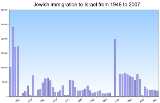
reported that aliyah for the year of 2006 was down approximately 9% from 2005. They state that: "Only 19,264 people immigrated to Israel in 2006, down nine percent from 2005. It is the lowest number of immigrants recorded since 1988"
The number of new immigrants in 2007 was 18,127, the lowest since 1988. Only 36% of these new immigrants came from the former Soviet Union (close to 90% in the 90's) while the number of immigrants from countries like France and USA is stable.
Shalom Life reported that over 19,000 new immigrants arrived in Israel in 2010, and increase of 16 percent over 2009. Some 16,465 immigrants arrived in Israel in 2009 and 15,452 in 2008.
Statistics
The number of immigrants to Israel during 1919–2006 period is given in the table below. The table details the number of olim for the specific time periods by country of birth. (For the year 2006, the last country of residence is also given).
| Region |
2006 LCR |
2006 COB |
2005 |
2000–2004 |
1990–1999 |
1980–1989 |
1972–1979 |
1961–1971 |
1952–1960 |
1948–1951 |
1919–1948 |
TOTAL |
| GRAND TOTAL |
19,269 |
19,269 |
21,180 |
60,647 |
956,319 |
153,833 |
267,580 |
427,828 |
297,138 |
687,624 |
482,857 |
3,374,275 |
| Asia |
1,777 |
1,261 |
2,239 |
8,048 |
61,305 |
14,433 |
19,456 |
56,208 |
37,119 |
237,704 |
40,895 |
478,668 |
| Iran |
74 |
90 |
146 |
449 |
0 |
8,487 |
9,550 |
19,502 |
15,699 |
21,910 |
|
75,833 |
| Afghanistan |
0 |
0 |
2 |
0 |
0 |
57 |
132 |
516 |
1,106 |
2,303 |
|
4,116 |
| India |
304 |
308 |
61 |
211 |
1,717 |
1,539 |
3,497 |
13,110 |
5,380 |
2,176 |
|
27,999 |
| Israel |
0 |
192 |
105 |
69 |
954 |
288 |
507 |
1,021 |
868 |
411 |
|
4,415 |
| Lebanon |
0 |
7 |
8 |
4 |
0 |
179 |
564 |
2,208 |
846 |
235 |
|
4,051 |
| Syria |
0 |
0 |
4 |
16 |
0 |
995 |
842 |
3,121 |
1,870 |
2,678 |
|
9,526 |
| China |
10 |
14 |
4 |
16 |
192 |
78 |
43 |
96 |
217 |
504 |
|
1,164 |
| Iraq |
11 |
11 |
12 |
50 |
0 |
111 |
939 |
3,509 |
2,989 |
123,371 |
|
130,992 |
| Yemen |
9 |
10 |
4 |
3 |
0 |
17 |
51 |
1,066 |
1,170 |
48,315 |
|
50,636 |
| Other |
14 |
26 |
18 |
29 |
7,362 |
594 |
213 |
349 |
103 |
1,254 |
|
9,948 |
| USSR (As) |
1,287 |
533 |
1,814 |
7,069 |
49,524 |
|
|
|
|
|
|
58,940 |
| Africa |
3,801 |
4,508 |
4,518 |
2,912 |
48,558 |
28,664 |
19,273 |
164,885 |
143,485 |
93,282 |
4,041 |
514,126 |
| Ethiopia |
3,595 |
3,595 |
3,573 |
2,213 |
39,651 |
16,965 |
306 |
98 |
59 |
10 |
|
66,470 |
| South Africa |
114 |
139 |
135 |
202 |
2,918 |
3,575 |
5,604 |
3,783 |
774 |
666 |
|
17,796 |
| Libya |
0 |
3 |
3 |
6 |
0 |
66 |
219 |
2,466 |
2,079 |
30,972 |
|
35,814 |
| Egypt/ Sudan |
0 |
19 |
17 |
15 |
176 |
352 |
535 |
2,963 |
17,521 |
16,024 |
|
37,622 |
| Morocco |
53 |
233 |
284 |
205 |
2,623 |
3,809 |
7,780 |
130,507 |
95,945 |
28,263 |
|
269,649 |
| Algeria |
0 |
275 |
280 |
131 |
1,317 |
1,830 |
2,137 |
12,857 |
3,433 |
3,810 |
|
26,070 |
| Tunisia |
32 |
236 |
218 |
125 |
1,251 |
1,942 |
2,148 |
11,566 |
23,569 |
13,293 |
|
54,348 |
| Other |
6 |
8 |
8 |
15 |
888 |
125 |
544 |
645 |
105 |
244 |
|
2,582 |
| Europe |
9,872 |
10,063 |
10,736 |
46,516 |
812,079 |
70,898 |
183,419 |
162,070 |
106,305 |
332,802 |
377,381 |
2,112,269 |
| Austria |
12 |
12 |
24 |
23 |
317 |
356 |
595 |
1,021 |
610 |
2,632 |
|
5,590 |
| Italy |
42 |
37 |
35 |
40 |
595 |
510 |
713 |
940 |
414 |
1,305 |
|
4,589 |
| Nordic |
36 |
34 |
35 |
41 |
1,071 |
1,178 |
903 |
886 |
131 |
85 |
|
4,364 |
| Bulgaria |
22 |
19 |
38 |
199 |
3,673 |
180 |
118 |
794 |
1,680 |
37,260 |
|
43,961 |
| Belgium |
91 |
78 |
70 |
102 |
891 |
788 |
847 |
1,112 |
394 |
291 |
|
4,573 |
| USSR (Eu) |
6,185 |
7,069 |
7,763 |
43,801 |
772,239 |
29,754 |
137,134 |
29,376 |
13,743 |
8,163 |
|
1,049,042 |
| Germany |
112 |
87 |
112 |
177 |
2,150 |
1,759 |
2,080 |
3,175 |
1,386 |
8,210 |
|
19,136 |
| Netherlands |
50 |
45 |
36 |
30 |
926 |
1,239 |
1,170 |
1,470 |
646 |
1,077 |
|
6,639 |
| Hungary |
63 |
63 |
108 |
180 |
2,150 |
1,005 |
1,100 |
2,601 |
9,819 |
14,324 |
|
31,350 |
| Yugoslavia |
25 |
26 |
7 |
98 |
1,894 |
140 |
126 |
322 |
320 |
7,661 |
|
10,594 |
| Greece |
3 |
8 |
7 |
6 |
121 |
147 |
326 |
514 |
676 |
2,131 |
|
3,936 |
| UK |
594 |
506 |
341 |
318 |
4,851 |
7,098 |
6,171 |
6,461 |
1,448 |
1,907 |
|
29,101 |
| Spain |
33 |
20 |
23 |
16 |
242 |
321 |
327 |
406 |
169 |
80 |
|
1,604 |
| Poland |
36 |
90 |
94 |
169 |
2,765 |
2,807 |
6,218 |
14,706 |
39,618 |
106,414 |
|
172,881 |
| Czechoslovakia |
16 |
26 |
15 |
61 |
479 |
462 |
888 |
2,754 |
783 |
18,788 |
|
24,256 |
| France |
2,411 |
1,781 |
1,836 |
842 |
10,443 |
7,538 |
5,399 |
8,050 |
1,662 |
3,050 |
|
40,601 |
| Romania |
50 |
76 |
107 |
330 |
5,722 |
14,607 |
18,418 |
86,184 |
32,462 |
117,950 |
|
275,856 |
| Switzerland |
85 |
69 |
52 |
71 |
904 |
706 |
634 |
886 |
253 |
131 |
|
3,706 |
| Turkey |
67 |
70 |
61 |
131 |
1,095 |
2,088 |
3,118 |
14,073 |
6,871 |
34,547 |
|
62,054 |
| Other |
6 |
17 |
33 |
12 |
646 |
303 |
252 |
412 |
91 |
1,343 |
|
3,109 |
| America/Oceania |
3,813 |
3,437 |
3,687 |
21,718 |
33,367 |
39,369 |
45,040 |
42,400 |
6,922 |
3,822 |
7,754 |
211,329 |
| Australia/NZL |
66 |
44 |
53 |
68 |
1,017 |
959 |
1,275 |
833 |
120 |
119 |
|
4,488 |
| Uruguay |
73 |
76 |
107 |
105 |
724 |
2,014 |
2,199 |
1,844 |
425 |
66 |
|
7,560 |
| Cen Am |
91 |
120 |
77 |
102 |
125 |
8 |
104 |
129 |
43 |
17 |
|
725 |
| Argentina |
293 |
299 |
413 |
9,917 |
8,886 |
10,582 |
13,158 |
11,701 |
2,888 |
904 |
|
59,041 |
| USA |
2,159 |
1,809 |
1,706 |
1,098 |
15,480 |
18,904 |
20,963 |
18,671 |
1,553 |
1,711 |
|
81,895 |
| Brazil |
232 |
226 |
278 |
225 |
1,937 |
1,763 |
1,763 |
2,601 |
763 |
304 |
|
9,860 |
| Venezuela |
134 |
98 |
84 |
62 |
319 |
180 |
245 |
297 |
0 |
0 |
|
1,285 |
| Mexico |
72 |
76 |
56 |
70 |
916 |
993 |
861 |
736 |
168 |
48 |
|
3,924 |
| Paraguay |
4 |
3 |
6 |
7 |
21 |
62 |
73 |
210 |
42 |
0 |
|
424 |
| Chile |
61 |
56 |
77 |
85 |
521 |
1,040 |
1,180 |
1,790 |
401 |
48 |
|
5,198 |
| Colombia |
142 |
179 |
154 |
54 |
545 |
475 |
552 |
415 |
0 |
0 |
|
2,374 |
| Canada |
228 |
210 |
214 |
163 |
1,717 |
1,867 |
2,178 |
2,169 |
276 |
236 |
|
9,030 |
| Other |
258 |
241 |
462 |
94 |
1,159 |
522 |
500 |
1,125 |
91 |
327 |
|
4,521 |
| Not known |
6 |
0 |
3 |
4 |
419 |
469 |
394 |
911 |
3,307 |
20,014 |
52,786 |
78,307 |
The latest
Aliyah statistics are available from the
Jewish Agency for IsraelThe Jewish Agency for Israel , also known as the Sochnut or JAFI, served as the organization in charge of immigration and absorption of Jews from the Diaspora into the state of Israel.-History:...
. 2010 statistics are available from the Israel Central Bureau of Statistics
http://www.cbs.gov.il/reader/shnaton/templ_shnaton_e.html?num_tab=st04_04&CYear=2011.
Further reading
External links
- Jewish Agency for Israel Aliyah from all over the world since 1948
- Nefesh B'Nefesh Aliyah from North America & The United Kingdom
- Aliyaing.com A helpful guide on aliyah and its challenges written by olim for olim
- Professional Job Training In English for Olim at Lander Institute in Jerusalem
- Dispersion and the Longing for Zion, 1240–1840, by Arie Morgenstern
- Aliyah, aliyah website including articles, interviews, blog and information, hosted by Laura Ben-David, author of MOVING UP: An Aliyah Journal
- Israel tries to increase immigration
- Yossi Klein Halevi, The Historic Significance of American Aliya September 2003.
- Why make aliyah, information for aliyah, over 5,000 photos of olim arrivals
- Aliyah information site in Israel