


Nabulsi soap

Encyclopedia
Castile soap
Castile soap is a name used in English-speaking countries for olive oil based soap made in a style similar to that originating in the Castile region of Spain.-History:...
produced only in Nablus
Nablus
Nablus is a Palestinian city in the northern West Bank, approximately north of Jerusalem, with a population of 126,132. Located in a strategic position between Mount Ebal and Mount Gerizim, it is the capital of the Nablus Governorate and a Palestinian commercial and cultural center.Founded by the...
in the West Bank
West Bank
The West Bank ) of the Jordan River is the landlocked geographical eastern part of the Palestinian territories located in Western Asia. To the west, north, and south, the West Bank shares borders with the state of Israel. To the east, across the Jordan River, lies the Hashemite Kingdom of Jordan...
, Palestine. An olive oil
Olive oil
Olive oil is an oil obtained from the olive , a traditional tree crop of the Mediterranean Basin. It is commonly used in cooking, cosmetics, pharmaceuticals, and soaps and as a fuel for traditional oil lamps...
-based soap
Soap
In chemistry, soap is a salt of a fatty acid.IUPAC. "" Compendium of Chemical Terminology, 2nd ed. . Compiled by A. D. McNaught and A. Wilkinson. Blackwell Scientific Publications, Oxford . XML on-line corrected version: created by M. Nic, J. Jirat, B. Kosata; updates compiled by A. Jenkins. ISBN...
, it is made up of three primary ingredients: virgin olive oil, water, and a sodium compound. Those who make the soap are proud of its unique smell, which they see as a sign of the quality and purity of its ingredients.
Long reputed to be a fine product, Nabulsi soap has been export
Export
The term export is derived from the conceptual meaning as to ship the goods and services out of the port of a country. The seller of such goods and services is referred to as an "exporter" who is based in the country of export whereas the overseas based buyer is referred to as an "importer"...
ed across the Arab world
Arab world
The Arab world refers to Arabic-speaking states, territories and populations in North Africa, Western Asia and elsewhere.The standard definition of the Arab world comprises the 22 states and territories of the Arab League stretching from the Atlantic Ocean in the west to the Arabian Sea in the...
and Europe
Europe
Europe is, by convention, one of the world's seven continents. Comprising the westernmost peninsula of Eurasia, Europe is generally 'divided' from Asia to its east by the watershed divides of the Ural and Caucasus Mountains, the Ural River, the Caspian and Black Seas, and the waterways connecting...
since the 10th century. Although the number of soap factories has declined from a peak of thirty in the 19th century to only two today, efforts to preserve this important part of Palestinian
Palestinian people
The Palestinian people, also referred to as Palestinians or Palestinian Arabs , are an Arabic-speaking people with origins in Palestine. Despite various wars and exoduses, roughly one third of the world's Palestinian population continues to reside in the area encompassing the West Bank, the Gaza...
and Nabulsi cultural heritage continue.
History
According to the Institute for Middle East UnderstandingInstitute for Middle East Understanding
Institute for Middle East Understanding is a 501 non-profit organisation, not aligned to any political or government organisation. It was founded by Americans and describes its mission as entailing working "with journalists to increase the public's understanding about the socio-economic, political...
, Palestinian women have set aside portions of each year's olive harvest for the production of olive oil soap for well over a millennium. Traditionally, it is older women who make olive oil soap for the household, using the oil remaining from the previous year's harvest after the new harvest brings freshly pressed olive oil to the family kitchen.
It is in the city of Nablus, however, that the tradition of olive oil soap-making evolved into a major industry
Industry
Industry refers to the production of an economic good or service within an economy.-Industrial sectors:There are four key industrial economic sectors: the primary sector, largely raw material extraction industries such as mining and farming; the secondary sector, involving refining, construction,...
and an art
Palestinian art
Palestinian art is a term used to refer to paintings, posters, installation art and other visual media produced by Palestinian artists.While the term has also been used to refer to ancient art produced in the geographical region of Palestine, in its modern usage it generally refers to work of...
. For centuries, olive oil has been the most important product made in the villages of the Nablus region, and Nabulsi soap the most important manufactured commodity
Commodity
In economics, a commodity is the generic term for any marketable item produced to satisfy wants or needs. Economic commodities comprise goods and services....
of the city.
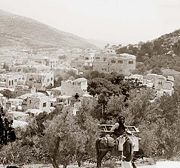
In the 14th century, Shams al-Din al-Ansari al-Dimashqi said of Nablus and its olive oil soap production: "The city of Nablus ... was bestowed by God
God
God is the English name given to a singular being in theistic and deistic religions who is either the sole deity in monotheism, or a single deity in polytheism....
Almighty with the blessed olive tree. Its olive oil is carried by Bedouin
Bedouin
The Bedouin are a part of a predominantly desert-dwelling Arab ethnic group traditionally divided into tribes or clans, known in Arabic as ..-Etymology:...
s to the Egypt
Egypt
Egypt , officially the Arab Republic of Egypt, Arabic: , is a country mainly in North Africa, with the Sinai Peninsula forming a land bridge in Southwest Asia. Egypt is thus a transcontinental country, and a major power in Africa, the Mediterranean Basin, the Middle East and the Muslim world...
ian and Damascene
Damascus
Damascus , commonly known in Syria as Al Sham , and as the City of Jasmine , is the capital and the second largest city of Syria after Aleppo, both are part of the country's 14 governorates. In addition to being one of the oldest continuously inhabited cities in the world, Damascus is a major...
lands, to the Hejaz
Hejaz
al-Hejaz, also Hijaz is a region in the west of present-day Saudi Arabia. Defined primarily by its western border on the Red Sea, it extends from Haql on the Gulf of Aqaba to Jizan. Its main city is Jeddah, but it is probably better known for the Islamic holy cities of Mecca and Medina...
, and the steppes ... In it a superior soap is produced and sent to the above-mentioned destinations and to the islands of the Mediterranean Sea
Mediterranean Sea
The Mediterranean Sea is a sea connected to the Atlantic Ocean surrounded by the Mediterranean region and almost completely enclosed by land: on the north by Anatolia and Europe, on the south by North Africa, and on the east by the Levant...
." Sabon nabulsi was reportedly the soap of choice for Queen Elizabeth
Elizabeth I of England
Elizabeth I was queen regnant of England and Ireland from 17 November 1558 until her death. Sometimes called The Virgin Queen, Gloriana, or Good Queen Bess, Elizabeth was the fifth and last monarch of the Tudor dynasty...
of England
England
England is a country that is part of the United Kingdom. It shares land borders with Scotland to the north and Wales to the west; the Irish Sea is to the north west, the Celtic Sea to the south west, with the North Sea to the east and the English Channel to the south separating it from continental...
.
Military of Egypt
The Egyptian Armed Forces are the largest in Africa, and the Arab World, and is the tenth largest in the world, consisting of the Egyptian Army, Egyptian Navy, Egyptian Air Force and Egyptian Air Defense Command....
. By the early 20th century, Nablus was the largest soap producer in the Fertile Crescent
Fertile Crescent
The Fertile Crescent, nicknamed "The Cradle of Civilization" for the fact the first civilizations started there, is a crescent-shaped region containing the comparatively moist and fertile land of otherwise arid and semi-arid Western Asia. The term was first used by University of Chicago...
, a region that spans present-day Egypt, Israel, the West Bank
West Bank
The West Bank ) of the Jordan River is the landlocked geographical eastern part of the Palestinian territories located in Western Asia. To the west, north, and south, the West Bank shares borders with the state of Israel. To the east, across the Jordan River, lies the Hashemite Kingdom of Jordan...
, Gaza Strip
Gaza Strip
thumb|Gaza city skylineThe Gaza Strip lies on the Eastern coast of the Mediterranean Sea. The Strip borders Egypt on the southwest and Israel on the south, east and north. It is about long, and between 6 and 12 kilometres wide, with a total area of...
, Lebanon
Lebanon
Lebanon , officially the Republic of LebanonRepublic of Lebanon is the most common term used by Lebanese government agencies. The term Lebanese Republic, a literal translation of the official Arabic and French names that is not used in today's world. Arabic is the most common language spoken among...
and parts of Jordan, Syria, Iraq
Iraq
Iraq ; officially the Republic of Iraq is a country in Western Asia spanning most of the northwestern end of the Zagros mountain range, the eastern part of the Syrian Desert and the northern part of the Arabian Desert....
, Kuwait
Kuwait
The State of Kuwait is a sovereign Arab state situated in the north-east of the Arabian Peninsula in Western Asia. It is bordered by Saudi Arabia to the south at Khafji, and Iraq to the north at Basra. It lies on the north-western shore of the Persian Gulf. The name Kuwait is derived from the...
, south-eastern Turkey
Turkey
Turkey , known officially as the Republic of Turkey , is a Eurasian country located in Western Asia and in East Thrace in Southeastern Europe...
and south-western Iran
Iran
Iran , officially the Islamic Republic of Iran , is a country in Southern and Western Asia. The name "Iran" has been in use natively since the Sassanian era and came into use internationally in 1935, before which the country was known to the Western world as Persia...
. In 1907, for example, the city's factories produced 4,992 tons of Nabulsi soap, accounting for 55% of all soap production in Palestine
Palestine
Palestine is a conventional name, among others, used to describe the geographic region between the Mediterranean Sea and the Jordan River, and various adjoining lands....
, and 24% of all soap production in Syria
Syria
Syria , officially the Syrian Arab Republic , is a country in Western Asia, bordering Lebanon and the Mediterranean Sea to the West, Turkey to the north, Iraq to the east, Jordan to the south, and Israel to the southwest....
and Palestine. It was the soap industry that gave Nablus its reputation as one of the most important manufacturing centers in Palestine at the time.
John Bowring
John Bowring
Sir John Bowring, KCB was an English political economist, traveller, miscellaneous writer, polyglot, and the 4th Governor of Hong Kong.- Early life :...
wrote of Nabulsi soap in the 1830s that it is, "highly esteemed in the Levant
Levant
The Levant or ) is the geographic region and culture zone of the "eastern Mediterranean littoral between Anatolia and Egypt" . The Levant includes most of modern Lebanon, Syria, Jordan, Israel, the Palestinian territories, and sometimes parts of Turkey and Iraq, and corresponds roughly to the...
," and Muhammad Kurd Ali
Muhammad Kurd Ali
Muhammad Kurdali was a notable Syrian scholar, historian and literary critic in the Arabic language. He was the founder director of the Academy of the Arabic Language in Damascus till his death.-Early life:...
, a Syrian historian, wrote in the 1930s that "Nablus soap is the best and most famous soap today for it has, it seems, a quality not found in others and the secret is that it is unadulterated and well produced."
An analysis of Nabulsi soap conducted by the British Mandatory authorities at the London Institute
University of the Arts London
The University of the Arts London, formerly known as the London Institute, is a collegiate university comprising six internationally recognised art, design, fashion and media colleges in London, England...
in 1934, found that the soap consisted only of natural materials and no harmful chemical materials. According to Rawan Shakaa, whose family owns one of the two Nabulsi soap factories still in operation, owners are proud of soap's purity and wonder how anyone could stand to work with and use leftover animal fat, as is common in the production of regular soaps.
Production process
Made in a cube-like shape about 1.5 inches (3.8 cm) tall and 2.25 by 2.25 inches (5.7 by 5.7 cm) wide, the colour of Nabulsi soap is like that of "the page of an old book." The cubes are stamped on the top with the seal of the factory that produces it; for example, soap produced at the Al-Jamal ("Camel") family factory has a seal hammered into the top surface picturing a one-humped camel inside a circle. When individually packaged, the soap is hand-wrapped in crinkly white paper, waxy on one side and papery on the other and imprinted with the factory's seal. The smell of Nabulsi soap is distinctive, although it is not perfumed.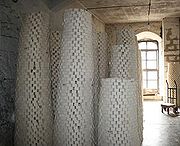
Barilla
Barilla S.p.A. is a major Italian and European food company founded in 1877 in Parma, Italy by Pietro Barilla...
plant, which grows abundantly on the eastern banks of the Jordan River, not far from Nablus. Large numbers of Bedouin
Bedouin
The Bedouin are a part of a predominantly desert-dwelling Arab ethnic group traditionally divided into tribes or clans, known in Arabic as ..-Etymology:...
s from the Beni Sakhr
Beni Sakhr
Beni Sakhr is the name of a large Bedouin tribe living in Jordan.In the 19th century, the Beni Sakhr lived as nomads. Their income came from trading camels and from the protection they could give, or refuse to give, to more settled peoples...
, Huwaytat, and Adwan tribes would gather barilla from the valleys of M'an, particularly around Salt
Salt, Jordan
Salt is an ancient agricultural town and administrative centre in west-central Jordan. It is on the old main highway leading from Amman to Jerusalem. Situated in the Balqa highland, about 790–1100 metres above sea level, the town is built in the crook of three hills, close to the Jordan River...
and Tadmur (Palmyra)
Palmyra
Palmyra was an ancient city in Syria. In the age of antiquity, it was an important city of central Syria, located in an oasis 215 km northeast of Damascus and 180 km southwest of the Euphrates at Deir ez-Zor. It had long been a vital caravan city for travellers crossing the Syrian desert...
. In the summertime, the barilla would be placed in towering stacks, burned, and then the ashes and coals would be gathered into sacks, and transported to Nablus in large caravans
Camel train
A camel train is a series of camels carrying goods or passengers in a group as part of a regular or semi-regular service between two points. Although they rarely travelled faster than the walking speed of a man, camels' ability to handle harsh conditions made camel trains a vital part of...
. In the city, the ashes and coals were pounded into a fine natural alkaline soda powder called qilw. Qilw (also transliterated qily) and preceded by the definite article al, is the basis for the English word "alkaline".
Today, qilw is still used in combination with lime
Lime (mineral)
Lime is a general term for calcium-containing inorganic materials, in which carbonates, oxides and hydroxides predominate. Strictly speaking, lime is calcium oxide or calcium hydroxide. It is also the name for a single mineral of the CaO composition, occurring very rarely...
(sheed) for the soda solution. To produce the qilw, the barilla ashes are placed into a stone urn and pounded into a fine powder with a wooden pestle
Mortar and pestle
A mortar and pestle is a tool used to crush, grind, and mix solid substances . The pestle is a heavy bat-shaped object, the end of which is used for crushing and grinding. The mortar is a bowl, typically made of hard wood, ceramic or stone...
. The lime — which was supplied by the nearby villages of Awarta
Awarta
Awarta is a Palestinian town located southeast of Nablus, in the northern West Bank. According to the Palestinian Central Bureau of Statistics, the town had a population of 5,623 inhabitants in 2007...
, Salim
Salim, Nablus
Salim is a Palestinian town in the northern West Bank, located six kilometers east of Nablus and is a part of the Nablus Governorate. It is the site of the ancient Israelite capital city Shechem, situated in a well-watered valley between Mount Ebal and Mount Gerizim. Nearby towns include Deir...
and Beit Furik
Beit Furik
Beit Furik is a Palestinian town located nine kilometers southeast of Nablus, in the Nablus Governorate in the northern West Bank. According to the Palestinian Central Bureau of Statistics, the town had a population of 10,339 inhabitants in 2007. During the 19th century and mid-20th century, Beit...
— is spread in a shallow pit and soaked in water until the water evaporates and the remaining dry substance is then rolled and crushed into a fine powder. The two powder mixtures (the qilw and sheed) are combined, together with hot water from a copper vat, in fermentation pits. The hot water absorbs the chemical content and seeps into identical, deeper pits below the above ground fermentation pits. As the water becomes sufficiently concentrated, it is added back into the copper vat so that the olive oil can absorb the chemicals. To produce one batch, this cycle is repeated about forty times over eight days. The hot liquid soap in the copper vat is continuously stirred with a long oar-like piece of wood, known in Arabic as the dukshab.
If removed from the vat too early, the solution will not dry well, and if it is overcooked, it will be too hard to cut. Determining whether the soap solution is ready is done by smelling it, after dipping the dukshab into the vat. When ready, the solution is carried in wooden barrels to a large frame made of wooden planks laid out on the floor into which the solution is poured. When firm, the surface is smoothed by shaving off the top layer with a scraper. Strings dusted with powder are then stretched across at regular intervals and later removed so as to form lines on top of the soap, which is then cut into pieces along those lines, with a sharp metal blade. Each piece of soap is stamped with a metal seal (representing each respective company's trademark) attached to a wooden hammer.
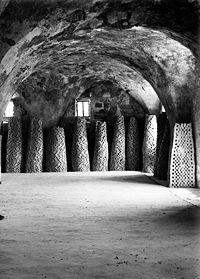
The cubes of soap are then stacked in tall conical, hollow structures from floor to ceiling, leaving spaces between each piece of soap so that they continue to dry properly. The drying process can take between three and twelve months. Not all of the soap produced is individually wrapped in paper. It is often exported in stiff sacks designed to minimize friction between the soap cubes so as to maintain their weight and shape for the long trips to surrounding countries in the region such as Egypt, Jordan
Jordan
Jordan , officially the Hashemite Kingdom of Jordan , Al-Mamlaka al-Urduniyya al-Hashemiyya) is a kingdom on the East Bank of the River Jordan. The country borders Saudi Arabia to the east and south-east, Iraq to the north-east, Syria to the north and the West Bank and Israel to the west, sharing...
, Saudi Arabia
Saudi Arabia
The Kingdom of Saudi Arabia , commonly known in British English as Saudi Arabia and in Arabic as as-Sa‘ūdiyyah , is the largest state in Western Asia by land area, constituting the bulk of the Arabian Peninsula, and the second-largest in the Arab World...
, and the Gulf
Arab states of the Persian Gulf
"Arab states of the Persian Gulf" or "Arab Persian Gulf states" or "Persian Gulf Arab states" or "Arabic Persian Gulf states" or "Arab States of The Gulf", are terms that refer to the six Arab states of Saudi Arabia, United Arab Emirates, Qatar, Kuwait, Bahrain and Oman, bordering the Persian Gulf....
.
Contemporary production
See also: The section on "Nablus" in the article on "Syro-Palestinian archaeology"The soap industry has shrunk considerably over the last 100 years as a result of a series of man-made and natural disasters, which include a 1927 earthquake that devastated large parts of the Old City of Nablus, Israeli military occupation, and major Israeli military incursions
Raid (military)
Raid, also known as depredation, is a military tactic or operational warfare mission which has a specific purpose and is not normally intended to capture and hold terrain, but instead finish with the raiding force quickly retreating to a previous defended position prior to the enemy forces being...
into the city's historic quarter during the Second Intifada that destroyed several soap factories. Only two soap factories out of the dozens that operated in the 19th century continue to produce Nabulsi soap today.
Of the two surviving Nabulsi soap factories, one is operated by the Touqan
Touqan
Touqan is a prominent Palestinian & Jordanian family based in Nablus and Al-Salt. During Ottoman times they were the only household that ever came close to centralizing all of the District of Nablus under their rule, and their members held the post of district chief longer than did any other local...
family. Commenting on the effect of the West Bank closures
West Bank Closures
The West Bank closure system is a series of obstacles including permanent and partially manned checkpoints, concrete roadblocks and barriers, metal gates, earthmounds, tunnels, trenches, and an elaborate set of permit restrictions that controls and restricts Palestinian movement.-Rationale and...
imposed by Israel since the Intifada's outbreak in 2000, the general manager at the Touqan factory said in 2008 that, "Before 2000, our factory used to produce 600 tons of soap annually. Due to the physical and economic obstacles we face now because of the Israeli occupation
Israeli-occupied territories
The Israeli-occupied territories are the territories which have been designated as occupied territory by the United Nations and other international organizations, governments and others to refer to the territory seized by Israel during the Six-Day War of 1967 from Egypt, Jordan, and Syria...
– and especially the checkpoints
Israel Defense Forces checkpoint
A Israel Defense Forces checkpoint, usually called an Israeli checkpoint , is a barrier erected by the Israel Defense Forces with the stated aim of enhancing the security of Israel and Israeli settlements and preventing those who wish to do harm from crossing...
– we produce barely half that amount today." According to the United Nations Office for the Coordination of Humanitarian Affairs
Office for the Coordination of Humanitarian Affairs
The United Nations Office for the Coordination of Humanitarian Affairs , is a United Nations body formed in December 1991 by General Assembly Resolution 46/182...
, the cost of transporting goods has increased tenfold since the closure regime was put into place. The complex system of checkpoints and road blocks throughout the West Bank
West Bank
The West Bank ) of the Jordan River is the landlocked geographical eastern part of the Palestinian territories located in Western Asia. To the west, north, and south, the West Bank shares borders with the state of Israel. To the east, across the Jordan River, lies the Hashemite Kingdom of Jordan...
often separates suppliers from producers and workers from their workplaces.
Nabulsi soap continues to be sold in shops throughout Nablus and the West Bank, and can also be found in Jordan, Kuwait
Kuwait
The State of Kuwait is a sovereign Arab state situated in the north-east of the Arabian Peninsula in Western Asia. It is bordered by Saudi Arabia to the south at Khafji, and Iraq to the north at Basra. It lies on the north-western shore of the Persian Gulf. The name Kuwait is derived from the...
, and Arab-Israeli cities
Arab citizens of Israel
Arab citizens of Israel refers to citizens of Israel who are not Jewish, and whose cultural and linguistic heritage or ethnic identity is Arab....
such as Nazareth
Nazareth
Nazareth is the largest city in the North District of Israel. Known as "the Arab capital of Israel," the population is made up predominantly of Palestinian Arab citizens of Israel...
. The soap is commonly used with a loofah in homes and hammams throughout the Levant.
Initiatives have also been launched to preserve this part of Nablus' cultural heritage. The once-defunct Arafat soap factory has been restored and converted into a Cultural Heritage Enrichment Center, that includes exhibition spaces, a research center, and a model of a traditional soap factory that produces small batches of soap according to the age-old methods. Nabulsi soap is also being marketed in the West
Western world
The Western world, also known as the West and the Occident , is a term referring to the countries of Western Europe , the countries of the Americas, as well all countries of Northern and Central Europe, Australia and New Zealand...
by local non-governmental organization
Non-governmental organization
A non-governmental organization is a legally constituted organization created by natural or legal persons that operates independently from any government. The term originated from the United Nations , and is normally used to refer to organizations that do not form part of the government and are...
s as a way to fund other local community initiatives.
See also
- Vegetarian soapVegetarian soap-Olive oil soaps:*Aleppo soap, a Syrian style of soap noted for the inclusion of Laurel oil in its formulation*Castile soap, a wide ranging style of soap in English speaking countries, as originally made in the Castile region of Spain...
- Aleppo soapAleppo soapAleppo soap is a handmade, hard bar soap. Aleppo soap is also known as savon d'Alep, laurel soap, or ghar soap . It derives its English and French names from the city of Aleppo, Syria, where it is reputed to have been made for thousands of years...
- Castile soapCastile soapCastile soap is a name used in English-speaking countries for olive oil based soap made in a style similar to that originating in the Castile region of Spain.-History:...
- Marseille soapMarseille soapMarseille soap or Savon de Marseille is a traditional soap made from vegetable oils that has been made around Marseille, France, for about 600 years, the first documented soapmaker in the area being recorded in about 1370...
- Hebron glassHebron glassHebron glass refers to glass produced in Hebron as part of a flourishing art industry established in the city during Roman rule in Palestine. For centuries, Hebron has been associated with glass production in the same way as Nablus has been associated with the production of soap...
- Mother-of-Pearl carving in BethlehemMother-of-Pearl carving in BethlehemMother-of-Pearl carving has been a Bethlehem tradition since the art was introduced to the city by Franciscan friars from Damascus during the 14th century....
- Palestinian handicraftsPalestinian handicraftsPalestinian handicrafts are handicrafts produced by Palestinian people. A wide variety of handicrafts, many of which have been produced by Arabs in Palestine for hundreds of years, continue to be produced today. Palestinian handicrafts include embroidery work, pottery-making, soap-making,...
- ZaytounZaytounZaytoun is a non-profit organisation established to support Palestinian farming communities by helping to increase the market for their olive oil products internationally, and also by helping the farmers themselves improve the quality of their oil through training and equipment provision.As a...
External links
- Nabulsi Soap - Nablus The Culture
- The Palestine Children's Welfare Fund, Producer/Seller Nabulsi soap
- Zatoun Fair Trade
- Witness, A documentary that profiles 3 businesses in Nablus, One of them profiles one of the two remaining Nabulsi soap makers.