

Israeli-occupied territories

Encyclopedia
The Israeli-occupied territories are the territories which have been designated as occupied territory by the United Nations and other international organizations, governments and others to refer to the territory seized by Israel
during the Six-Day War
of 1967 from Egypt
, Jordan
, and Syria
. They consist of the West Bank
, the Gaza Strip
until 2005 and much of the Golan Heights and, until 1982, the Sinai Peninsula
. The West Bank and Gaza Strip are also referred to as the Palestinian territories
or Occupied Palestinian Territory. The Palestinian Authority, the EU, and the UN Security Council consider East Jerusalem
to be part of the West Bank, a position disputed by Israel. Israel has unilaterally annexed East Jerusalem by the Jerusalem Law
.
Israel prefers the term "disputed territories" in the case of the West Bank. The UNSC regards Israel as the "Occupying Power".
The first use of the term 'territories occupied' was in United Nations Security Council
Resolution 242
following the Six Day War in 1967, which called for "the establishment of a just and lasting peace in the Middle East" to be achieved by "the application of both the following principles: ... Withdrawal of Israeli armed forces from territories occupied in the recent conflict ... Termination of all claims or states of belligerency" and respect for the right of every state in the area to live in peace within secure and recognized boundaries. However, withdrawal from State territories under occupation was conditional on a negotiated peace, rejected by the Arab states in accordance with the Khartoum Resolution
.
Israel's annexation of East Jerusalem in 1980 and the Golan Heights in 1981 has not been recognised by any other country. United Nations Security Council Resolution 478
declared the annexation of Jerusalem "null and void" and required that it be rescinded. United Nations Security Council Resolution 497
also declared the annexation of the Golan "null and void". Following withdrawal by Israel from the Sinai Peninsula in 1982, as part of the 1979 Israel–Egypt Peace Treaty, the Sinai ceased to be considered occupied territory. Israel unilaterally disengaged
from Gaza in September 2005, and declared itself no longer to be in occupation of the Strip. However, as it retains control of Gaza's airspace and coastline, it continues to be designated as an occupying power in the Gaza Strip by the UNSC and some countries and various human rights
organizations.
there are certain laws of war governing military occupation, including the Hague Conventions of 1899 and 1907
and the Fourth Geneva Convention
. One of those obligations is to maintain the status quo until the signing of a peace treaty
, the resolution of specific conditions outlined in a peace treaty, or the formation of a new civilian government.
Israel disputes whether, and if so to what extent, it is an occupying power in relation to the Palestinian territories
and as to whether Israeli settlements in these territories are in breach of Israel's obligations as an occupying power and constitute a grave breach of the Geneva Conventions
and whether the settlements constitute war crimes.
 Israel captured the Sinai Peninsula
from Egypt
in the 1967 Six Day War. It established settlements
along the Gulf of Aqaba and in the northeast portion, just below the Gaza Strip
. It had plans to expand the settlement of Yamit
into a city with a population of 200,000, though the actual population of Yamit did not exceed 3,000. The Sinai Peninsula was returned to Egypt in stages beginning in 1979 as part of the Israel–Egypt Peace Treaty. As required by the treaty, Israel had to evacuate Israeli military installations and civilian settlements before establishing normal and friendly relations. Israel dismantled eighteen settlements, two air force bases, a naval base, and other installations by 1982, including the only oil
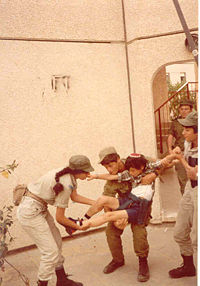
resources under Israeli control. The evacuation of the civilian population, which took place in 1982, was done forcefully in some instances, such as the evacuation of Yamit
. The settlements were demolished, as it was feared that settlers might try to return to their homes after the evacuation.
Since 1982, the Sinai Peninsula has not been regarded as occupied territory.
 Israel captured the Golan Heights from Syria
in the 1967 Six Day War. A ceasefire
was signed on 11 June 1967 and the Golan Heights came under Israeli military administration. Syria rejected UNSC Resolution 242
of 22 November 1967, which called for the return of Israeli-occupied State territories in exchange for peaceful relations. Israel had accepted Resolution 242 in a speech to the Security Council on 1 May 1968. In March 1972, Syria "conditionally" accepted Resolution 242.
In the Yom Kippur War
of 1973, Syria attempted to restore its lawful sovereignty militarily, but the attempt was unsuccessful. Israel and Syria signed a ceasefire agreement in 1974 that left almost all the Heights under Israeli military control, while returning a narrow demilitarized zone to Syrian control. A United Nations observation force was established in 1974 as a buffer between the sides. By Syrian formal acceptance of UN Security Council Resolution 338, which set out the cease-fire at the end of the Yom Kippur War, Syria also accepted Resolution 242.
On 14 December 1981, Israel passed the Golan Heights Law
, extending Israeli administration and law to the territory. Israel has expressly avoided using the term "annexation
" to describe the change of status. However, the UN Security Council
has rejected the de facto annexation in UNSC Resolution 497, which declared it as "null and void and without international legal effect", and consequently continuing to regard the Golan Heights as an Israeli-occupied territory. The measure has also been criticized by other countries, either as illegal or as not being helpful to the Middle East peace process.
Syria wants the return of the Golan Heights, while Israel has maintained a policy of "land for peace
" based on Resolution 242. The first high-level public talks aimed at a resolution of the Syria-Israel conflict were held at and after the mulitlateral Madrid Conference of 1991
. Throughout the 1990s several Israeli governments negotiated with Syria's president Hafez Al-Assad
. While serious progress was made, they were unsuccessful.
In 2004, there were 34 settlements in the Golan Heights, populated by around 18,000 people. Today, an estimated 20,000 Israeli settlers and 20,000 Syrians live in the territory. All inhabitants are entitled to Israeli citizenship, which would entitle them to an Israeli driver's license and enable them to travel freely in Israel. The non-Jewish residents, who are mostly Druse
, have almost all declined to take Israeli citizenship.
In the Golan Heights there is another area occupied by Israel, namely the Sheeba farms. Syria and Lebanon have claimed that the farms belong to Lebanon and in 2007 a UN cartographer came to the conclusion that the Sheeba farms do actually belong to Lebanon (contrary to the belief held by Israel). UN then said that Israel should relinquish the control of this area.
. Both of these territories were part of Mandate Palestine
, and both have populations consisting primarily of Arab
Palestinians, including significant numbers of refugee
s who fled from Israel and territory Israel controlled after the 1948 Arab–Israeli War.
Jordan administered the West Bank and East Jerusalem from 1948-1967, annexing them in 1950 and granting Jordanian citizenship to West Bank and East Jerusalem residents in 1954 (the annexation claims and citizenship grants were rescinded in 1988 when Jordan acknowledged the PLO as the sole representative of the Palestinian people). Today, Arabs of Palestinian origin make up a majority of Jordan’s population. Egypt administered the Gaza Strip from 1948-1967 but did not annex it or make Gazans Egyptian citizens.
.png) The West Bank was allotted to the Arab state under United Nations Partition Plan of 1947
The West Bank was allotted to the Arab state under United Nations Partition Plan of 1947
, but the West Bank was occupied by Jordan after the 1948 war. In 1950, Jordan annexed
the West Bank, but this was recognized only by the United Kingdom
. (see 1949 Armistice Agreements
, Green Line
)
In 1967 the West Bank came under Israeli military administration. Israel retained the mukhtar (mayoral) system of government inherited from Jordan, and subsequent governments began developing infrastructure
in Arab villages under its control. (see Palestinians and Israeli law, International legal issues of the conflict, Palestinian economy
)
Since the Israel–Palestine Liberation Organization letters of recognition of 1993, most of the Palestinian population
and cities came under the jurisdiction of the Palestinian Authority, and only partial Israeli military control, although Israel has frequently redeployed its troops
and reinstated full military administration in various parts of the two territories.
On July 31, 1988, King Hussein surrendered all Jordanian claims to the West Bank to the PLO.
In 2000 the Israeli government started to construct the Israeli West Bank barrier
, separating Israel and several of its settlements, as well as a significant number of Palestinians, from the remainder of the West Bank. In 2004, the International Court of Justice
issued an advisory opinion stating that the barrier violates international law
. In a related case the Israeli Supreme Court, sitting as the High Court of Justice, stated that Israel has been holding the areas of Judea and Samaria in belligerent occupation, since 1967. The court also held that the normative provisions of public international law regarding belligerent occupation are applicable. The Regulations Concerning the Laws and Customs of War on Land, The Hague of 1907 and the Fourth Geneva Convention Relative to the Protection of Civilian Persons in Time of War 1949 were both cited.
About 300,000 Israeli settlers live in the West Bank (and a further 200,000 live in East Jerusalem and 50,000 in the former Israeli–Jordanian no-man's land).
, but Gaza Strip was occupied by Egypt
after the 1948 war.
Between 1967 and 1993, the Gaza Strip was under Israeli military administration.
In March 1979, Egypt renounced all claims to the Gaza Strip in the Egypt–Israel Peace Treaty.
Since the Israel–Palestine Liberation Organization letters of recognition of 1993, the Gaza Strip came under the jurisdiction of the Palestinian Authority.
In February 2005, the Israeli government voted to implement a unilateral disengagement plan
from the Gaza Strip. The plan began to be implemented on 15 August 2005, and was completed on 12 September 2005. Under the plan, all Israeli settlement
s in the Gaza Strip (and four in the West Bank) and the joint Israeli-Palestinian Erez Industrial Zone were dismantled with the removal of all 9,000 Israeli settlers (most of them in the Gush Katif
settlement area in the Strip's southwest) and military bases. Some settlers resisted the order, and were forcibly removed by the IDF. On 12 September 2005 the Israeli cabinet formally declared an end to Israeli military occupation of the Gaza Strip. To avoid allegations that it was still in occupation of any part of the Gaza Strip, Israel also withdrew from the Philadelphi Route
, which is a narrow strip adjacent to the Strip's border with Egypt, after Egypt's agreement to secure its side of the border. Under the Oslo Accords the Philadelphi Route was to remain under Israeli control to prevent the smuggling of materials (such as ammunition) and people across the border with Egypt. With Egypt agreeing to patrol its side of the border, it was hoped that the objective would be achieved. However, Israel maintained its control over the crossings in and out of Gaza. The Rafah crossing between Egypt and Gaza was monitored by the Israeli army through special surveillance cameras. Official documents such as passports, I.D. cards, export and import papers, and many others had to be approved by the Israeli army.
The Israeli position is that Gaza is no longer occupied, inasmuch as Israel does not exercise effective control or authority over any land or institutions in the Gaza Strip. Foreign Affairs Minister of Israel
Tzipi Livni
stated in January, 2008: “Israel got out of Gaza. It dismantled its settlements there. No Israeli soldiers were left there after the disengagement.” Israel also notes that Gaza does not belong to any sovereign state.
Immediately after Israel withdrew in 2005, Palestinian Authority Chairman Mahmoud Abbas
stated, "the legal status of the areas slated for evacuation has not changed." Human Rights Watch
also contested that this ended the occupation. The United Nations
, Human Rights Watch
and many other international bodies and NGOs
continues to consider Israel to be the occupying power of the Gaza Strip as Israel controls Gaza Strip's airspace, territorial waters and controls the movement of people or goods in or out of Gaza by air or sea.
The United Nations Office for the Coordination of Humanitarian Affairs
maintains an office on “Occupied Palestinian Territory,” which concerns itself with the Gaza Strip. A July 2004 opinion of the International Court of Justice
treated Gaza as part of the occupied territories. In his statement on the 2008–2009 Israel–Gaza conflict
Richard Falk
, United Nations Special Rapporteur on "the situation of human rights
in the Palestinian territories
" wrote that international humanitarian law
applied to Israel "in regard to the obligations of an Occupying Power and in the requirements of the laws of war." In a 2009 interview on Democracy Now Christopher Gunness, spokesperson for the United Nations Relief and Works Agency for Palestine Refugees in the Near East
(UNRWA) contends that Israel is an occupying power. However, Meagan Buren, Senior Adviser to the Israel Project
, a pro-Israel media group contests that characterization.
In 2007, after Hamas defeated Fatah in the Battle of Gaza (2007)
and took control over the Gaza Strip, Israel imposed a blockade on Gaza
. Palestinian rocket attacks and Israeli raids, such as Operation Hot Winter
continued into 2008. A six month ceasefire
was agreed in June 2008, but it was broken several times by both Israel and Hamas. As it reached its expiry, Hamas announced that they were unwilling to renew the ceasefire, and at the end of December 2008 Israeli forces began Operation Cast Lead, launching the Gaza War that left an estimated 1,166–1,417 Palestinians and 13 Israelis dead.
had contemplated that all of Jerusalem would be an international city within an international area that included Bethlehem
for at least ten years, after which the residents would be allowed to conduct a referendum
and the issue could be re-examined by the Trusteeship Council.
However, after the 1948 Arab–Israeli War Jordan
captured East Jerusalem
and the Old City, and Israel captured and annexed the western part of Jerusalem . Jordan bilaterally annexed East Jerusalem along with the rest of the West Bank in 1950 as a temporary trustee at the request of a Palestinian delegation, and although the annexation was recognized by only two countries, it was not condemned by the UNSC. The British did not recognize the territory as sovereign to Jordan. Israel captured East Jerusalem from Jordan in the 1967 Six-Day War
. On June 27, Israel extended its laws, jurisdiction, and administration to East Jerusalem and several nearby towns and villages, and incorporated the area into the Jerusalem Municipality. In 1980, the Knesset
passed the Jerusalem Law
, which was declared a Basic Law
, which declared Jerusalem to be the "complete and united" capital of Israel. However, United Nations Security Council
Resolution 478 declared this action to be "null and void", and that it "must be rescinded forthwith". The international community does not recognize Israeli sovereignty over East Jerusalem and considers it occupied territory.
UN Security Council Resolution 478 also called upon countries which held their diplomatic delegations to Israel in Jerusalem, to move them outside the city. Most nations with embassies in Jerusalem complied, and relocated their embassies to Tel Aviv
or other Israeli cities prior to the adoption of Resolution 478. Following the withdrawals of Costa Rica
and El Salvador
in August 2006, no country maintains its embassy in Jerusalem, although Paraguay
and Bolivia
have theirs in nearby Mevasseret Zion. The United States Congress passed the Jerusalem Embassy Act
in 1995, stating that "Jerusalem should be recognized as the capital of the State of Israel; and the United States Embassy in Israel should be established in Jerusalem no later than May 31, 1999. As a result of the Embassy Act
, official U.S. documents and web sites refer to Jerusalem as the capital of Israel. Since passage, the law has never been implemented, because of opposition from Presidents Clinton
, Bush
, and Obama
, who view it as a Congressional infringement on the executive branch’s constitutional authority over foreign policy; they have consistently claimed the presidential waiver on national security interests.
held that the fundamental rules of international law accepted as binding by all "civilized" nations were incorporated in the domestic legal system of Israel. The Nuremberg Military Tribunal determined that the articles annexed to the Hague IV Convention of 1907 were customary law that had been recognized by all civilized nations. In the past, the Supreme Court has argued that the Geneva Convention insofar it is not supported by domestic legislation "does not bind this Court, its enforcement being a matter for the states which are parties to the Convention". They ruled that "Conventional international law does not become part of Israeli law through automatic incorporation, but only if it is adopted or combined with Israeli law by enactment of primary or subsidiary legislation from which it derives its force". However, in the same decision the Court ruled that the Fourth Hague Convention rules governing belligerent occupation did apply, since those were recognized as customary international law.
The Israeli High Court of Justice determined in the 1979 Elon Moreh
case that the area in question was under occupation and that accordingly only the military commander of the area may requisition land according to Article 52 of the Regulations annexed to the Hague IV Convention. Military necessity had been an after-thought in planning portions of the Elon Moreh settlement. That situation did not fulfill the precise strictures laid down in the articles of the Hague Convention, so the Court ruled the requisition order had been invalid and illegal. In recent decades, the government of Israel has argued before the Supreme Court of Israel
that its authority in the territories is based on the international law of "belligerent occupation", in particular the Hague Conventions
. The court has confirmed this interpretation many times, for example in its 2004 and 2005 rulings on the separation fence
.
In its June 2005 ruling upholding the constitutionality of the Gaza disengagement, the Court determined that "Judea and Samaria" [West Bank] and the Gaza area are lands seized during warfare, and are not part of Israel:
In the cases before the Israeli High Court of Justice the government has agreed that the military commander’s authority is anchored in the Fourth Geneva Convention Relative to the Protection of Civilian Persons in Time of War, and that the humanitarian rules of the Fourth Geneva Convention apply. The Israeli MFA says that the Supreme Court of Israel has ruled that the Fourth Geneva Convention and certain parts of Additional Protocol I reflect customary international law that is applicable in the occupied territories. Gershom Gorenberg
has written that the Israeli government knew at the outset that it was violating the Geneva Convention by creating civilian settlements in the territories under IDF administration. He explained that as the legal counsel of the Foreign Ministry, Theodor Meron was the Israeli government's expert on international law. On September 16, 1967 Meron wrote a top secret memo to Mr. Adi Yafeh, Political Secretary of the Prime Minister regarding "Settlement in the Administered Territories" which said "My conclusion is that civilian settlement in the Administered territories contravenes the explicit provisions of the Fourth Geneva Convention." Moshe Dayan authored a secret memo in 1968 proposing massive settlement in the territories which said “Settling Israelis in administered territory, as is known, contravenes international conventions, but there is nothing essentially new about that.”
Various Israeli Cabinets have made political statements and many of Israel's citizens and supporters dispute that the territories are occupied and claim that use of the term "occupied" in relation to Israel
's control of the areas has no basis in international law
or history, and that it prejudges the outcome of any future or ongoing negotiations. They argue it is more accurate to refer to the territories as "disputed" rather than "occupied" although they agree to apply the humanitarian provisions of the Fourth Geneva Convention
pending resolution of the dispute. Yoram Dinstein
, has dismissed the position that they are not occupied as being “based on dubious legal grounds”. Many Israeli government websites do refer to the areas as being "occupied territories". According to the BBC, "Israel argues that the international conventions relating to occupied land do not apply to the Palestinian territories because they were not under the legitimate sovereignty of any state in the first place."
to describe Israeli-occupied territories is "the Arab territories occupied since 1967, including Jerusalem", which is used, for example, in Resolutions 446 (1979), 452 (1979), 465 (1980) and 484. A conference of the parties to the Fourth Geneva Convention, and the International Committee of the Red Cross
, have also resolved that these territories are occupied and that the Fourth Geneva Convention
provisions regarding occupied territories apply.
The international community has formally entrusted the International Committee of the Red Cross (ICRC) with the role of guardian of international humanitarian law. That includes a watchdog function by which it takes direct action to encourage parties to armed conflict to comply with international humanitarian law. The head of the International Red Cross delegation to Israel and the Occupied Territories stated that the establishment of Israeli settlements in the occupied territories is a grave breach of the Geneva Conventions
that constitute war crime.
In 1986, the International Court of Justice
ruled that portions of the Geneva Conventions of 1949 merely declare existing customary international law. In 1993, the UN Security Council adopted a binding Chapter VII resolution establishing an International Criminal Tribunal for the former Yugoslavia. The resolution approved a Statute which said that the problem of adherence of some but not all States to the Geneva Conventions does not arise, since beyond any doubt the Convention is declarative of customary international law. The subsequent interpretation of the International Court of Justice
does not support Israel's view on the applicability of the Geneva Conventions.
In July 2004, the International Court of Justice delivered an Advisory Opinion
on the 'Legal Consequences of the Construction of a Wall in the Occupied Palestinian Territory'. The Court observed that under customary international law as reflected in Article 42 of the Regulations annexed to the Hague IV Convention, territory is considered occupied when it is actually placed under the authority of the hostile army, and the occupation extends only to the territory where such authority has been established and can be exercised. Israel
raised a number of exceptions and objections, but the Court found them unpersuasive. The Court ruled that territories had been occupied by the Israeli armed forces in 1967, during the conflict between Israel and Jordan, and that subsequent events in those territories, had done nothing to alter the situation.
Al Haq
, an independent Palestinian human rights organization based in Ramallah
in the West Bank and an affiliate of the International Commission of Jurists
, has asserted that "As noted in Article 27 of the Vienna Convention on the Law of Treaties, 'a party may not invoke the provisions of its internal law as justification for its failure to perform a treaty'. As such, Israeli reliance on local law does not justify its violations of its international legal obligations". Further, the Palestinian mission to the U.N. has argued that:
.This is disputed by other legal experts who argue with this interpretation of the law
In 2000, the editors of the Geneva Academy of International Humanitarian Law and Human Rights Palestine Yearbook of International Law (1998–1999) said "the "transfer, directly or indirectly, by the Occupying Power of parts of its own civilian population into the territory it occupies, or the deportation or transfer of all or parts of the population of the occupied territory within or outside this territory" amounts to a war crime. They hold that this is obviously applicable to Israeli settlement activities in the Occupied Arab Territories."
In 2004 the International Court of Justice, in an advisory, non-binding opinion, noted that the Security Council had described Israel's policy and practices of settling parts of its population and new immigrants in the occupied territories as a "flagrant violation" of the Fourth Geneva Convention. The Court also concluded that the Israeli settlements in the Occupied Palestinian Territory (including East Jerusalem) have been established in breach of international law and that all the States parties to the Geneva Convention are under an obligation to ensure compliance by Israel with international law as embodied in the Convention.
Israel denies that the Israeli settlements are in breach of any international laws. The Israeli Supreme Court has yet to rule decisively on settlement legality under the Geneva Convention.
Israel
The State of Israel is a parliamentary republic located in the Middle East, along the eastern shore of the Mediterranean Sea...
during the Six-Day War
Six-Day War
The Six-Day War , also known as the June War, 1967 Arab-Israeli War, or Third Arab-Israeli War, was fought between June 5 and 10, 1967, by Israel and the neighboring states of Egypt , Jordan, and Syria...
of 1967 from Egypt
Egypt
Egypt , officially the Arab Republic of Egypt, Arabic: , is a country mainly in North Africa, with the Sinai Peninsula forming a land bridge in Southwest Asia. Egypt is thus a transcontinental country, and a major power in Africa, the Mediterranean Basin, the Middle East and the Muslim world...
, Jordan
Jordan
Jordan , officially the Hashemite Kingdom of Jordan , Al-Mamlaka al-Urduniyya al-Hashemiyya) is a kingdom on the East Bank of the River Jordan. The country borders Saudi Arabia to the east and south-east, Iraq to the north-east, Syria to the north and the West Bank and Israel to the west, sharing...
, and Syria
Syria
Syria , officially the Syrian Arab Republic , is a country in Western Asia, bordering Lebanon and the Mediterranean Sea to the West, Turkey to the north, Iraq to the east, Jordan to the south, and Israel to the southwest....
. They consist of the West Bank
West Bank
The West Bank ) of the Jordan River is the landlocked geographical eastern part of the Palestinian territories located in Western Asia. To the west, north, and south, the West Bank shares borders with the state of Israel. To the east, across the Jordan River, lies the Hashemite Kingdom of Jordan...
, the Gaza Strip
Gaza Strip
thumb|Gaza city skylineThe Gaza Strip lies on the Eastern coast of the Mediterranean Sea. The Strip borders Egypt on the southwest and Israel on the south, east and north. It is about long, and between 6 and 12 kilometres wide, with a total area of...
until 2005 and much of the Golan Heights and, until 1982, the Sinai Peninsula
Sinai Peninsula
The Sinai Peninsula or Sinai is a triangular peninsula in Egypt about in area. It is situated between the Mediterranean Sea to the north, and the Red Sea to the south, and is the only part of Egyptian territory located in Asia as opposed to Africa, effectively serving as a land bridge between two...
. The West Bank and Gaza Strip are also referred to as the Palestinian territories
Palestinian territories
The Palestinian territories comprise the West Bank and the Gaza Strip. Since the Palestinian Declaration of Independence in 1988, the region is today recognized by three-quarters of the world's countries as the State of Palestine or simply Palestine, although this status is not recognized by the...
or Occupied Palestinian Territory. The Palestinian Authority, the EU, and the UN Security Council consider East Jerusalem
East Jerusalem
East Jerusalem or Eastern Jerusalem refer to the parts of Jerusalem captured and annexed by Jordan in the 1948 Arab-Israeli War and then captured and annexed by Israel in the 1967 Six-Day War...
to be part of the West Bank, a position disputed by Israel. Israel has unilaterally annexed East Jerusalem by the Jerusalem Law
Jerusalem Law
The Jerusalem Law is a common name of Basic Law: Jerusalem, Capital of Israel passed by the Knesset on July 30, 1980 .It began as a private member's bill proposed by Geula Cohen, whose original text stated that "the integrity and unity of greater Jerusalem in its boundaries after the Six-Day War...
.
Israel prefers the term "disputed territories" in the case of the West Bank. The UNSC regards Israel as the "Occupying Power".
The first use of the term 'territories occupied' was in United Nations Security Council
United Nations Security Council
The United Nations Security Council is one of the principal organs of the United Nations and is charged with the maintenance of international peace and security. Its powers, outlined in the United Nations Charter, include the establishment of peacekeeping operations, the establishment of...
Resolution 242
United Nations Security Council Resolution 242
United Nations Security Council Resolution 242 was adopted unanimously by the UN Security Council on November 22, 1967, in the aftermath of the Six Day War. It was adopted under Chapter VIof the United Nations Charter...
following the Six Day War in 1967, which called for "the establishment of a just and lasting peace in the Middle East" to be achieved by "the application of both the following principles: ... Withdrawal of Israeli armed forces from territories occupied in the recent conflict ... Termination of all claims or states of belligerency" and respect for the right of every state in the area to live in peace within secure and recognized boundaries. However, withdrawal from State territories under occupation was conditional on a negotiated peace, rejected by the Arab states in accordance with the Khartoum Resolution
Khartoum Resolution
The Khartoum Resolution of September 1, 1967 was issued at the conclusion of an Arab League summit in the wake of the Six-Day War. The resolution, which formed a basis of the policies of these governments toward Israel until the 1973 Yom Kippur War, called for: a continued state of belligerency...
.
Israel's annexation of East Jerusalem in 1980 and the Golan Heights in 1981 has not been recognised by any other country. United Nations Security Council Resolution 478
United Nations Security Council Resolution 478
United Nations Security Council Resolution 478, adopted on August 20, 1980, declared Israel's 1980 Jerusalem Law a violation of international law, and states that the Council will not recognize this law, and calls on member states to accept the decision of the council. This resolution also calls...
declared the annexation of Jerusalem "null and void" and required that it be rescinded. United Nations Security Council Resolution 497
United Nations Security Council Resolution 497
United Nations Security Council Resolution 497, adopted unanimously on December 17, 1981, calls on the State of Israel to rescind its de facto annexation of the Golan Heights...
also declared the annexation of the Golan "null and void". Following withdrawal by Israel from the Sinai Peninsula in 1982, as part of the 1979 Israel–Egypt Peace Treaty, the Sinai ceased to be considered occupied territory. Israel unilaterally disengaged
Israel's unilateral disengagement plan
Israel's unilateral disengagement plan , also known as the "Disengagement plan", "Gaza expulsion plan", and "Hitnatkut", was a proposal by Israeli Prime Minister Ariel Sharon, adopted by the government on June 6, 2004 and enacted in August 2005, to evict all Israelis from the Gaza Strip and from...
from Gaza in September 2005, and declared itself no longer to be in occupation of the Strip. However, as it retains control of Gaza's airspace and coastline, it continues to be designated as an occupying power in the Gaza Strip by the UNSC and some countries and various human rights
Human rights
Human rights are "commonly understood as inalienable fundamental rights to which a person is inherently entitled simply because she or he is a human being." Human rights are thus conceived as universal and egalitarian . These rights may exist as natural rights or as legal rights, in both national...
organizations.
Overview
The significance of the designation of these territories as occupied territory is that certain legal obligations fall on the occupying power under international law. Under international lawInternational law
Public international law concerns the structure and conduct of sovereign states; analogous entities, such as the Holy See; and intergovernmental organizations. To a lesser degree, international law also may affect multinational corporations and individuals, an impact increasingly evolving beyond...
there are certain laws of war governing military occupation, including the Hague Conventions of 1899 and 1907
Hague Conventions (1899 and 1907)
The Hague Conventions were two international treaties negotiated at international peace conferences at The Hague in the Netherlands: The First Hague Conference in 1899 and the Second Hague Conference in 1907...
and the Fourth Geneva Convention
Fourth Geneva Convention
The Geneva Convention relative to the Protection of Civilian Persons in Time of War, commonly referred to as the Fourth Geneva Convention and abbreviated as GCIV, is one of the four treaties of the Geneva Conventions. It was adopted in August 1949, and defines humanitarian protections for civilians...
. One of those obligations is to maintain the status quo until the signing of a peace treaty
Peace treaty
A peace treaty is an agreement between two or more hostile parties, usually countries or governments, that formally ends a state of war between the parties...
, the resolution of specific conditions outlined in a peace treaty, or the formation of a new civilian government.
Israel disputes whether, and if so to what extent, it is an occupying power in relation to the Palestinian territories
Palestinian territories
The Palestinian territories comprise the West Bank and the Gaza Strip. Since the Palestinian Declaration of Independence in 1988, the region is today recognized by three-quarters of the world's countries as the State of Palestine or simply Palestine, although this status is not recognized by the...
and as to whether Israeli settlements in these territories are in breach of Israel's obligations as an occupying power and constitute a grave breach of the Geneva Conventions
Geneva Conventions
The Geneva Conventions comprise four treaties, and three additional protocols, that establish the standards of international law for the humanitarian treatment of the victims of war...
and whether the settlements constitute war crimes.
| West Bank West Bank The West Bank ) of the Jordan River is the landlocked geographical eastern part of the Palestinian territories located in Western Asia. To the west, north, and south, the West Bank shares borders with the state of Israel. To the east, across the Jordan River, lies the Hashemite Kingdom of Jordan... (excluding East Jerusalem) |
East Jerusalem East Jerusalem East Jerusalem or Eastern Jerusalem refer to the parts of Jerusalem captured and annexed by Jordan in the 1948 Arab-Israeli War and then captured and annexed by Israel in the 1967 Six-Day War... |
Gaza Strip Gaza Strip thumb|Gaza city skylineThe Gaza Strip lies on the Eastern coast of the Mediterranean Sea. The Strip borders Egypt on the southwest and Israel on the south, east and north. It is about long, and between 6 and 12 kilometres wide, with a total area of... |
Golan Heights | Sinai Peninsula Sinai Peninsula The Sinai Peninsula or Sinai is a triangular peninsula in Egypt about in area. It is situated between the Mediterranean Sea to the north, and the Red Sea to the south, and is the only part of Egyptian territory located in Asia as opposed to Africa, effectively serving as a land bridge between two... |
Southern Lebanon | |
|---|---|---|---|---|---|---|
| Occupation period | 1967–present | 1967–present | 1956–1957, 1967–2005 (disputed) | 1967–present | 1956–1957, 1967–1982 | 1982–2000 (except Shebaa Farms area claimed by Lebanon) |
| Claimed by | Jordan (1967–1988), Palestinians (1988–present) | Jordan (1967–1988), Palestinians (1988–present) | Egypt (1967–1979), Palestinians (1979–present) | Syria, Lebanon (Shebaa Farms area only) | Egypt | Lebanon |
| Israel considers it part of its territory | , by the Jerusalem Law Jerusalem Law The Jerusalem Law is a common name of Basic Law: Jerusalem, Capital of Israel passed by the Knesset on July 30, 1980 .It began as a private member's bill proposed by Geula Cohen, whose original text stated that "the integrity and unity of greater Jerusalem in its boundaries after the Six-Day War... |
, by the Golan Heights Law Golan Heights Law The Golan Heights Law is the Israeli law which applies Israel's government and laws to the Golan Heights. It was ratified by the Knesset on December 14, 1981. The law was condemned internationally and determined null and void by United Nations Security Council Resolution 497.The law was passed... |
||||
| Formerly part of the British Mandate for Palestine | ||||||
| Contains Israeli settlement Israeli settlement An Israeli settlement is a Jewish civilian community built on land that was captured by Israel from Jordan, Egypt, and Syria during the 1967 Six-Day War and is considered occupied territory by the international community. Such settlements currently exist in the West Bank... s |
||||||
The Sinai Peninsula
Sinai Peninsula
The Sinai Peninsula or Sinai is a triangular peninsula in Egypt about in area. It is situated between the Mediterranean Sea to the north, and the Red Sea to the south, and is the only part of Egyptian territory located in Asia as opposed to Africa, effectively serving as a land bridge between two...
from Egypt
Egypt
Egypt , officially the Arab Republic of Egypt, Arabic: , is a country mainly in North Africa, with the Sinai Peninsula forming a land bridge in Southwest Asia. Egypt is thus a transcontinental country, and a major power in Africa, the Mediterranean Basin, the Middle East and the Muslim world...
in the 1967 Six Day War. It established settlements
Israeli settlement
An Israeli settlement is a Jewish civilian community built on land that was captured by Israel from Jordan, Egypt, and Syria during the 1967 Six-Day War and is considered occupied territory by the international community. Such settlements currently exist in the West Bank...
along the Gulf of Aqaba and in the northeast portion, just below the Gaza Strip
Gaza Strip
thumb|Gaza city skylineThe Gaza Strip lies on the Eastern coast of the Mediterranean Sea. The Strip borders Egypt on the southwest and Israel on the south, east and north. It is about long, and between 6 and 12 kilometres wide, with a total area of...
. It had plans to expand the settlement of Yamit
Yamit
Yamit was an Israeli settlement in the northern part of the Sinai Peninsula with a population of about 2,500 people .The settlement was established during Israel's occupation of the peninsula from the end of the 1967 Six-Day War, until that part of the Sinai was handed over to Egypt in 1982 as...
into a city with a population of 200,000, though the actual population of Yamit did not exceed 3,000. The Sinai Peninsula was returned to Egypt in stages beginning in 1979 as part of the Israel–Egypt Peace Treaty. As required by the treaty, Israel had to evacuate Israeli military installations and civilian settlements before establishing normal and friendly relations. Israel dismantled eighteen settlements, two air force bases, a naval base, and other installations by 1982, including the only oil
Petroleum
Petroleum or crude oil is a naturally occurring, flammable liquid consisting of a complex mixture of hydrocarbons of various molecular weights and other liquid organic compounds, that are found in geologic formations beneath the Earth's surface. Petroleum is recovered mostly through oil drilling...
resources under Israeli control. The evacuation of the civilian population, which took place in 1982, was done forcefully in some instances, such as the evacuation of Yamit
Yamit
Yamit was an Israeli settlement in the northern part of the Sinai Peninsula with a population of about 2,500 people .The settlement was established during Israel's occupation of the peninsula from the end of the 1967 Six-Day War, until that part of the Sinai was handed over to Egypt in 1982 as...
. The settlements were demolished, as it was feared that settlers might try to return to their homes after the evacuation.
Since 1982, the Sinai Peninsula has not been regarded as occupied territory.
The Golan Heights
Syria
Syria , officially the Syrian Arab Republic , is a country in Western Asia, bordering Lebanon and the Mediterranean Sea to the West, Turkey to the north, Iraq to the east, Jordan to the south, and Israel to the southwest....
in the 1967 Six Day War. A ceasefire
Ceasefire
A ceasefire is a temporary stoppage of a war in which each side agrees with the other to suspend aggressive actions. Ceasefires may be declared as part of a formal treaty, but they have also been called as part of an informal understanding between opposing forces...
was signed on 11 June 1967 and the Golan Heights came under Israeli military administration. Syria rejected UNSC Resolution 242
United Nations Security Council Resolution 242
United Nations Security Council Resolution 242 was adopted unanimously by the UN Security Council on November 22, 1967, in the aftermath of the Six Day War. It was adopted under Chapter VIof the United Nations Charter...
of 22 November 1967, which called for the return of Israeli-occupied State territories in exchange for peaceful relations. Israel had accepted Resolution 242 in a speech to the Security Council on 1 May 1968. In March 1972, Syria "conditionally" accepted Resolution 242.
In the Yom Kippur War
Yom Kippur War
The Yom Kippur War, Ramadan War or October War , also known as the 1973 Arab-Israeli War and the Fourth Arab-Israeli War, was fought from October 6 to 25, 1973, between Israel and a coalition of Arab states led by Egypt and Syria...
of 1973, Syria attempted to restore its lawful sovereignty militarily, but the attempt was unsuccessful. Israel and Syria signed a ceasefire agreement in 1974 that left almost all the Heights under Israeli military control, while returning a narrow demilitarized zone to Syrian control. A United Nations observation force was established in 1974 as a buffer between the sides. By Syrian formal acceptance of UN Security Council Resolution 338, which set out the cease-fire at the end of the Yom Kippur War, Syria also accepted Resolution 242.
On 14 December 1981, Israel passed the Golan Heights Law
Golan Heights Law
The Golan Heights Law is the Israeli law which applies Israel's government and laws to the Golan Heights. It was ratified by the Knesset on December 14, 1981. The law was condemned internationally and determined null and void by United Nations Security Council Resolution 497.The law was passed...
, extending Israeli administration and law to the territory. Israel has expressly avoided using the term "annexation
Annexation
Annexation is the de jure incorporation of some territory into another geo-political entity . Usually, it is implied that the territory and population being annexed is the smaller, more peripheral, and weaker of the two merging entities, barring physical size...
" to describe the change of status. However, the UN Security Council
United Nations Security Council
The United Nations Security Council is one of the principal organs of the United Nations and is charged with the maintenance of international peace and security. Its powers, outlined in the United Nations Charter, include the establishment of peacekeeping operations, the establishment of...
has rejected the de facto annexation in UNSC Resolution 497, which declared it as "null and void and without international legal effect", and consequently continuing to regard the Golan Heights as an Israeli-occupied territory. The measure has also been criticized by other countries, either as illegal or as not being helpful to the Middle East peace process.
Syria wants the return of the Golan Heights, while Israel has maintained a policy of "land for peace
Land for peace
Land for peace is an interpretation of UN Security Council Resolution 242 which has formed the basis of subsequent Arab-Israeli peace making. The name Land for Peace is derived from the wording of the resolution's first operative paragraph which affirms that peace should include the application of...
" based on Resolution 242. The first high-level public talks aimed at a resolution of the Syria-Israel conflict were held at and after the mulitlateral Madrid Conference of 1991
Madrid Conference of 1991
The Madrid Conference was hosted by the government of Spain and co-sponsored by the USA and the USSR. It convened on October 30, 1991 and lasted for three days. It was an early attempt by the international community to start a peace process through negotiations involving Israel and the Palestinians...
. Throughout the 1990s several Israeli governments negotiated with Syria's president Hafez Al-Assad
Hafez al-Assad
Hafez ibn 'Ali ibn Sulayman al-Assad or more commonly Hafez al-Assad was the President of Syria for three decades. Assad's rule consolidated the power of the central government after decades of coups and counter-coups, such as Operation Wappen in 1957 conducted by the Eisenhower administration and...
. While serious progress was made, they were unsuccessful.
In 2004, there were 34 settlements in the Golan Heights, populated by around 18,000 people. Today, an estimated 20,000 Israeli settlers and 20,000 Syrians live in the territory. All inhabitants are entitled to Israeli citizenship, which would entitle them to an Israeli driver's license and enable them to travel freely in Israel. The non-Jewish residents, who are mostly Druse
Druse
Druse can refer to:* Druze, a Middle Eastern religious community* Druse , an aggregation of calcium oxalate crystals found in certain plants* Druse , an incrustation of small crystals on the surface of a rock or mineral....
, have almost all declined to take Israeli citizenship.
In the Golan Heights there is another area occupied by Israel, namely the Sheeba farms. Syria and Lebanon have claimed that the farms belong to Lebanon and in 2007 a UN cartographer came to the conclusion that the Sheeba farms do actually belong to Lebanon (contrary to the belief held by Israel). UN then said that Israel should relinquish the control of this area.
Background
The West Bank and Gaza Strip are often jointly referred to as the Palestinian territoriesPalestinian territories
The Palestinian territories comprise the West Bank and the Gaza Strip. Since the Palestinian Declaration of Independence in 1988, the region is today recognized by three-quarters of the world's countries as the State of Palestine or simply Palestine, although this status is not recognized by the...
. Both of these territories were part of Mandate Palestine
Mandate Palestine
Mandate Palestine existed while the British Mandate for Palestine, which formally began in September 1923 and terminated in May 1948, was in effect...
, and both have populations consisting primarily of Arab
Arab
Arab people, also known as Arabs , are a panethnicity primarily living in the Arab world, which is located in Western Asia and North Africa. They are identified as such on one or more of genealogical, linguistic, or cultural grounds, with tribal affiliations, and intra-tribal relationships playing...
Palestinians, including significant numbers of refugee
Palestinian refugee
Palestinian refugees or Palestine refugees are the people and their descendants, predominantly Palestinian Arabic-speakers, who fled or were expelled from their homes during and after the 1948 Palestine War, within that part of the British Mandate of Palestine, that after that war became the...
s who fled from Israel and territory Israel controlled after the 1948 Arab–Israeli War.
Jordan administered the West Bank and East Jerusalem from 1948-1967, annexing them in 1950 and granting Jordanian citizenship to West Bank and East Jerusalem residents in 1954 (the annexation claims and citizenship grants were rescinded in 1988 when Jordan acknowledged the PLO as the sole representative of the Palestinian people). Today, Arabs of Palestinian origin make up a majority of Jordan’s population. Egypt administered the Gaza Strip from 1948-1967 but did not annex it or make Gazans Egyptian citizens.
West Bank
1947 UN Partition Plan
The United Nations Partition Plan for Palestine was created by the United Nations Special Committee on Palestine in 1947 to replace the British Mandate for Palestine with "Independent Arab and Jewish States" and a "Special International Regime for the City of Jerusalem" administered by the United...
, but the West Bank was occupied by Jordan after the 1948 war. In 1950, Jordan annexed
Rule of the West Bank and East Jerusalem by Jordan
The West Bank and East Jerusalem were occupied by Jordan for a period of nearly two decades starting from the 1948 Arab-Israeli War. In 1950, the British extended formal recognition to the union between the Hashemite Kingdom and of that part of Palestine under Jordanian occupation and control -...
the West Bank, but this was recognized only by the United Kingdom
United Kingdom
The United Kingdom of Great Britain and Northern IrelandIn the United Kingdom and Dependencies, other languages have been officially recognised as legitimate autochthonous languages under the European Charter for Regional or Minority Languages...
. (see 1949 Armistice Agreements
1949 Armistice Agreements
The 1949 Armistice Agreements are a set of agreements signed during 1949 between Israel and neighboring Egypt, Lebanon, Jordan, and Syria. The agreements ended the official hostilities of the 1948 Arab-Israeli War, and established armistice lines between Israeli forces and the forces in...
, Green Line
Green Line (Israel)
Green Line refers to the demarcation lines set out in the 1949 Armistice Agreements between Israel and its neighbours after the 1948 Arab-Israeli War...
)
In 1967 the West Bank came under Israeli military administration. Israel retained the mukhtar (mayoral) system of government inherited from Jordan, and subsequent governments began developing infrastructure
Infrastructure
Infrastructure is basic physical and organizational structures needed for the operation of a society or enterprise, or the services and facilities necessary for an economy to function...
in Arab villages under its control. (see Palestinians and Israeli law, International legal issues of the conflict, Palestinian economy
Palestinian economy
The economy of the Palestinian territories refers to the economy of the territories under the administration of the Palestinian Authority in the West Bank and the Gaza Strip.- History :...
)
Since the Israel–Palestine Liberation Organization letters of recognition of 1993, most of the Palestinian population
Demographics of Palestine
The Demographics of Palestine refers to the demography, or the statistical study of the population of Palestine. Studies of the subject can cover a wide historical and geographical scope, with the definition of Palestine varying throughout the ages, and from scholar to scholar...
and cities came under the jurisdiction of the Palestinian Authority, and only partial Israeli military control, although Israel has frequently redeployed its troops
Israel Defense Forces
The Israel Defense Forces , commonly known in Israel by the Hebrew acronym Tzahal , are the military forces of the State of Israel. They consist of the ground forces, air force and navy. It is the sole military wing of the Israeli security forces, and has no civilian jurisdiction within Israel...
and reinstated full military administration in various parts of the two territories.
On July 31, 1988, King Hussein surrendered all Jordanian claims to the West Bank to the PLO.
In 2000 the Israeli government started to construct the Israeli West Bank barrier
Israeli West Bank barrier
The Israeli West Bank barrier is a separation barrier being constructed by the State of Israel along and within the West Bank. Upon completion, the barrier’s total length will be approximately...
, separating Israel and several of its settlements, as well as a significant number of Palestinians, from the remainder of the West Bank. In 2004, the International Court of Justice
International Court of Justice
The International Court of Justice is the primary judicial organ of the United Nations. It is based in the Peace Palace in The Hague, Netherlands...
issued an advisory opinion stating that the barrier violates international law
International law
Public international law concerns the structure and conduct of sovereign states; analogous entities, such as the Holy See; and intergovernmental organizations. To a lesser degree, international law also may affect multinational corporations and individuals, an impact increasingly evolving beyond...
. In a related case the Israeli Supreme Court, sitting as the High Court of Justice, stated that Israel has been holding the areas of Judea and Samaria in belligerent occupation, since 1967. The court also held that the normative provisions of public international law regarding belligerent occupation are applicable. The Regulations Concerning the Laws and Customs of War on Land, The Hague of 1907 and the Fourth Geneva Convention Relative to the Protection of Civilian Persons in Time of War 1949 were both cited.
About 300,000 Israeli settlers live in the West Bank (and a further 200,000 live in East Jerusalem and 50,000 in the former Israeli–Jordanian no-man's land).
Gaza Strip
Gaza Strip was allotted to the Arab state under United Nations Partition Plan of 19471947 UN Partition Plan
The United Nations Partition Plan for Palestine was created by the United Nations Special Committee on Palestine in 1947 to replace the British Mandate for Palestine with "Independent Arab and Jewish States" and a "Special International Regime for the City of Jerusalem" administered by the United...
, but Gaza Strip was occupied by Egypt
Occupation of the Gaza Strip by Egypt
The administration of the Gaza Strip by Egypt occurred between 1948 and October 1956, and again from March 1957 to June 1967. Egypt did not annex the Gaza Strip but left it under Egyptian military rule as a temporary arrangement pending the resolution of the Palestine Question.-Background:After...
after the 1948 war.
Between 1967 and 1993, the Gaza Strip was under Israeli military administration.
In March 1979, Egypt renounced all claims to the Gaza Strip in the Egypt–Israel Peace Treaty.
Since the Israel–Palestine Liberation Organization letters of recognition of 1993, the Gaza Strip came under the jurisdiction of the Palestinian Authority.
In February 2005, the Israeli government voted to implement a unilateral disengagement plan
Israel's unilateral disengagement plan
Israel's unilateral disengagement plan , also known as the "Disengagement plan", "Gaza expulsion plan", and "Hitnatkut", was a proposal by Israeli Prime Minister Ariel Sharon, adopted by the government on June 6, 2004 and enacted in August 2005, to evict all Israelis from the Gaza Strip and from...
from the Gaza Strip. The plan began to be implemented on 15 August 2005, and was completed on 12 September 2005. Under the plan, all Israeli settlement
Israeli settlement
An Israeli settlement is a Jewish civilian community built on land that was captured by Israel from Jordan, Egypt, and Syria during the 1967 Six-Day War and is considered occupied territory by the international community. Such settlements currently exist in the West Bank...
s in the Gaza Strip (and four in the West Bank) and the joint Israeli-Palestinian Erez Industrial Zone were dismantled with the removal of all 9,000 Israeli settlers (most of them in the Gush Katif
Gush Katif
Gush Katif was a bloc of 17 Israeli settlements in the southern Gaza strip. Gush Katif was specifically mentioned by Yitzhak Rabin, the Israeli prime minister who fell victim to an assassin in 1995, as essential to Israel's security border. In August 2005, the Israeli army moved the 8,600...
settlement area in the Strip's southwest) and military bases. Some settlers resisted the order, and were forcibly removed by the IDF. On 12 September 2005 the Israeli cabinet formally declared an end to Israeli military occupation of the Gaza Strip. To avoid allegations that it was still in occupation of any part of the Gaza Strip, Israel also withdrew from the Philadelphi Route
Philadelphi Route
The Philadelphi Route refers to a narrow strip of land, 14 km in length, situated along the border between Gaza Strip and Egypt. Under the provisions of the Israeli-Egyptian peace treaty of 1979, the buffer zone was controlled and patrolled by Israeli forces. After the 1995 Oslo Accords,...
, which is a narrow strip adjacent to the Strip's border with Egypt, after Egypt's agreement to secure its side of the border. Under the Oslo Accords the Philadelphi Route was to remain under Israeli control to prevent the smuggling of materials (such as ammunition) and people across the border with Egypt. With Egypt agreeing to patrol its side of the border, it was hoped that the objective would be achieved. However, Israel maintained its control over the crossings in and out of Gaza. The Rafah crossing between Egypt and Gaza was monitored by the Israeli army through special surveillance cameras. Official documents such as passports, I.D. cards, export and import papers, and many others had to be approved by the Israeli army.
The Israeli position is that Gaza is no longer occupied, inasmuch as Israel does not exercise effective control or authority over any land or institutions in the Gaza Strip. Foreign Affairs Minister of Israel
Foreign Affairs Minister of Israel
The Foreign Affairs Minister of Israel is the political head of the Israeli Ministry of Foreign Affairs. The position is one of the most important in the Israeli cabinet after Prime Minister and Defense Minister...
Tzipi Livni
Tzipi Livni
Tzipporah Malkah "Tzipi" Livni is an Israeli lawyer and politician. She is the current Israeli Opposition Leader and leader of Kadima, the largest party in the Knesset. Raised an ardent nationalist, Livni has become one of her nation's leading voices for the two-state solution. In Israel she has...
stated in January, 2008: “Israel got out of Gaza. It dismantled its settlements there. No Israeli soldiers were left there after the disengagement.” Israel also notes that Gaza does not belong to any sovereign state.
Immediately after Israel withdrew in 2005, Palestinian Authority Chairman Mahmoud Abbas
Mahmoud Abbas
Mahmoud Abbas , also known by the kunya Abu Mazen , has been the Chairman of the Palestine Liberation Organisation since 11 November 2004 and became President of the Palestinian National Authority on 15 January 2005 on the Fatah ticket.Elected to serve until 9 January 2009, he unilaterally...
stated, "the legal status of the areas slated for evacuation has not changed." Human Rights Watch
Human Rights Watch
Human Rights Watch is an international non-governmental organization that conducts research and advocacy on human rights. Its headquarters are in New York City and it has offices in Berlin, Beirut, Brussels, Chicago, Geneva, Johannesburg, London, Los Angeles, Moscow, Paris, San Francisco, Tokyo,...
also contested that this ended the occupation. The United Nations
United Nations
The United Nations is an international organization whose stated aims are facilitating cooperation in international law, international security, economic development, social progress, human rights, and achievement of world peace...
, Human Rights Watch
Human Rights Watch
Human Rights Watch is an international non-governmental organization that conducts research and advocacy on human rights. Its headquarters are in New York City and it has offices in Berlin, Beirut, Brussels, Chicago, Geneva, Johannesburg, London, Los Angeles, Moscow, Paris, San Francisco, Tokyo,...
and many other international bodies and NGOs
Non-governmental organization
A non-governmental organization is a legally constituted organization created by natural or legal persons that operates independently from any government. The term originated from the United Nations , and is normally used to refer to organizations that do not form part of the government and are...
continues to consider Israel to be the occupying power of the Gaza Strip as Israel controls Gaza Strip's airspace, territorial waters and controls the movement of people or goods in or out of Gaza by air or sea.
The United Nations Office for the Coordination of Humanitarian Affairs
Office for the Coordination of Humanitarian Affairs
The United Nations Office for the Coordination of Humanitarian Affairs , is a United Nations body formed in December 1991 by General Assembly Resolution 46/182...
maintains an office on “Occupied Palestinian Territory,” which concerns itself with the Gaza Strip. A July 2004 opinion of the International Court of Justice
International Court of Justice
The International Court of Justice is the primary judicial organ of the United Nations. It is based in the Peace Palace in The Hague, Netherlands...
treated Gaza as part of the occupied territories. In his statement on the 2008–2009 Israel–Gaza conflict
2008–2009 Israel–Gaza conflict
The Gaza War, known as Operation Cast Lead in Israel and as the Gaza Massacre in the Arab world, was a three-week bombing and invasion of the Gaza Strip by Israel, and hundreds of rocket attacks on south of Israel which...
Richard Falk
Richard A. Falk
Richard Anderson Falk is an American professor emeritus of international law at Princeton University, the author or co-author of 20 books and the editor or co-editor of another 20 books, speaker, activist on world affairs, and an appointee to two United Nations positions on the Palestinian...
, United Nations Special Rapporteur on "the situation of human rights
Human rights
Human rights are "commonly understood as inalienable fundamental rights to which a person is inherently entitled simply because she or he is a human being." Human rights are thus conceived as universal and egalitarian . These rights may exist as natural rights or as legal rights, in both national...
in the Palestinian territories
Palestinian territories
The Palestinian territories comprise the West Bank and the Gaza Strip. Since the Palestinian Declaration of Independence in 1988, the region is today recognized by three-quarters of the world's countries as the State of Palestine or simply Palestine, although this status is not recognized by the...
" wrote that international humanitarian law
International humanitarian law
International humanitarian law , often referred to as the laws of war, the laws and customs of war or the law of armed conflict, is the legal corpus that comprises "the Geneva Conventions and the Hague Conventions, as well as subsequent treaties, case law, and customary international law." It...
applied to Israel "in regard to the obligations of an Occupying Power and in the requirements of the laws of war." In a 2009 interview on Democracy Now Christopher Gunness, spokesperson for the United Nations Relief and Works Agency for Palestine Refugees in the Near East
United Nations Relief and Works Agency for Palestine Refugees in the Near East
United Nations Relief and Works Agency for Palestine Refugees in the Near East is a relief and human development agency, providing education, health care, social services and emergency aid to 5 million Palestine refugees living in Jordan, Lebanon and Syria, as well as in the West Bank and the Gaza...
(UNRWA) contends that Israel is an occupying power. However, Meagan Buren, Senior Adviser to the Israel Project
Israel Project
The Israel Project is a US-based 501 non-profit, educational organization that gets facts about Israel and the Middle East to press, public officials and the public.” The Israel Project is not affiliated with any government. TIP has offices in the USA and Israel, and "works tirelessly to help...
, a pro-Israel media group contests that characterization.
In 2007, after Hamas defeated Fatah in the Battle of Gaza (2007)
Battle of Gaza (2007)
The Battle of Gaza was a military conflict between Hamas and Fatah that took place between June 7 and 15, 2007 in the Gaza Strip. After winning Palestinian legislative elections in 2006, Hamas and Fatah formed the Palestinan authority national unity government in 2007, headed by Ismail Haniya. In...
and took control over the Gaza Strip, Israel imposed a blockade on Gaza
The 2007–2009 blockade of the Gaza Strip
The blockade of the Gaza Strip refers to a land, air, and sea blockade on the Gaza Strip by Israel and Egypt since June 2007, a more severe version of restrictions which began in 2001...
. Palestinian rocket attacks and Israeli raids, such as Operation Hot Winter
Operation Hot Winter
Operation Hot Winter, also called Operation Warm Winter was an Israel Defense Forces military campaign in the Gaza Strip, launched on February 29, 2008 in response to Qassam rockets fired from the Strip by Hamas...
continued into 2008. A six month ceasefire
2008 Israel–Hamas ceasefire
-Background: After its victory in the 2006 municipal legislative elections, Hamas assumed administrative control of Gaza. Hamas consolidated this control over Gaza after a military conflict with Fatah. Israel and Egypt then partially sealed their border crossings with Gaza, on the grounds that...
was agreed in June 2008, but it was broken several times by both Israel and Hamas. As it reached its expiry, Hamas announced that they were unwilling to renew the ceasefire, and at the end of December 2008 Israeli forces began Operation Cast Lead, launching the Gaza War that left an estimated 1,166–1,417 Palestinians and 13 Israelis dead.
East Jerusalem
Jerusalem has created additional issues in relation to the question of whether or not it is occupied territory. The 1947 UN Partition Plan1947 UN Partition Plan
The United Nations Partition Plan for Palestine was created by the United Nations Special Committee on Palestine in 1947 to replace the British Mandate for Palestine with "Independent Arab and Jewish States" and a "Special International Regime for the City of Jerusalem" administered by the United...
had contemplated that all of Jerusalem would be an international city within an international area that included Bethlehem
Bethlehem
Bethlehem is a Palestinian city in the central West Bank of the Jordan River, near Israel and approximately south of Jerusalem, with a population of about 30,000 people. It is the capital of the Bethlehem Governorate of the Palestinian National Authority and a hub of Palestinian culture and tourism...
for at least ten years, after which the residents would be allowed to conduct a referendum
Referendum
A referendum is a direct vote in which an entire electorate is asked to either accept or reject a particular proposal. This may result in the adoption of a new constitution, a constitutional amendment, a law, the recall of an elected official or simply a specific government policy. It is a form of...
and the issue could be re-examined by the Trusteeship Council.
However, after the 1948 Arab–Israeli War Jordan
Jordan
Jordan , officially the Hashemite Kingdom of Jordan , Al-Mamlaka al-Urduniyya al-Hashemiyya) is a kingdom on the East Bank of the River Jordan. The country borders Saudi Arabia to the east and south-east, Iraq to the north-east, Syria to the north and the West Bank and Israel to the west, sharing...
captured East Jerusalem
East Jerusalem
East Jerusalem or Eastern Jerusalem refer to the parts of Jerusalem captured and annexed by Jordan in the 1948 Arab-Israeli War and then captured and annexed by Israel in the 1967 Six-Day War...
and the Old City, and Israel captured and annexed the western part of Jerusalem . Jordan bilaterally annexed East Jerusalem along with the rest of the West Bank in 1950 as a temporary trustee at the request of a Palestinian delegation, and although the annexation was recognized by only two countries, it was not condemned by the UNSC. The British did not recognize the territory as sovereign to Jordan. Israel captured East Jerusalem from Jordan in the 1967 Six-Day War
Six-Day War
The Six-Day War , also known as the June War, 1967 Arab-Israeli War, or Third Arab-Israeli War, was fought between June 5 and 10, 1967, by Israel and the neighboring states of Egypt , Jordan, and Syria...
. On June 27, Israel extended its laws, jurisdiction, and administration to East Jerusalem and several nearby towns and villages, and incorporated the area into the Jerusalem Municipality. In 1980, the Knesset
Knesset
The Knesset is the unicameral legislature of Israel, located in Givat Ram, Jerusalem.-Role in Israeli Government :The legislative branch of the Israeli government, the Knesset passes all laws, elects the President and Prime Minister , approves the cabinet, and supervises the work of the government...
passed the Jerusalem Law
Jerusalem Law
The Jerusalem Law is a common name of Basic Law: Jerusalem, Capital of Israel passed by the Knesset on July 30, 1980 .It began as a private member's bill proposed by Geula Cohen, whose original text stated that "the integrity and unity of greater Jerusalem in its boundaries after the Six-Day War...
, which was declared a Basic Law
Basic Laws of Israel
The Basic Laws of Israel are a key component of Israel's constitutional law. These laws deal with the formation and role of the principal state's institutions, and the relations between the state's authorities. Some of them also protect civil rights...
, which declared Jerusalem to be the "complete and united" capital of Israel. However, United Nations Security Council
United Nations Security Council
The United Nations Security Council is one of the principal organs of the United Nations and is charged with the maintenance of international peace and security. Its powers, outlined in the United Nations Charter, include the establishment of peacekeeping operations, the establishment of...
Resolution 478 declared this action to be "null and void", and that it "must be rescinded forthwith". The international community does not recognize Israeli sovereignty over East Jerusalem and considers it occupied territory.
UN Security Council Resolution 478 also called upon countries which held their diplomatic delegations to Israel in Jerusalem, to move them outside the city. Most nations with embassies in Jerusalem complied, and relocated their embassies to Tel Aviv
Tel Aviv
Tel Aviv , officially Tel Aviv-Yafo , is the second most populous city in Israel, with a population of 404,400 on a land area of . The city is located on the Israeli Mediterranean coastline in west-central Israel. It is the largest and most populous city in the metropolitan area of Gush Dan, with...
or other Israeli cities prior to the adoption of Resolution 478. Following the withdrawals of Costa Rica
Costa Rica
Costa Rica , officially the Republic of Costa Rica is a multilingual, multiethnic and multicultural country in Central America, bordered by Nicaragua to the north, Panama to the southeast, the Pacific Ocean to the west and the Caribbean Sea to the east....
and El Salvador
El Salvador
El Salvador or simply Salvador is the smallest and the most densely populated country in Central America. The country's capital city and largest city is San Salvador; Santa Ana and San Miguel are also important cultural and commercial centers in the country and in all of Central America...
in August 2006, no country maintains its embassy in Jerusalem, although Paraguay
Paraguay
Paraguay , officially the Republic of Paraguay , is a landlocked country in South America. It is bordered by Argentina to the south and southwest, Brazil to the east and northeast, and Bolivia to the northwest. Paraguay lies on both banks of the Paraguay River, which runs through the center of the...
and Bolivia
Bolivia
Bolivia officially known as Plurinational State of Bolivia , is a landlocked country in central South America. It is the poorest country in South America...
have theirs in nearby Mevasseret Zion. The United States Congress passed the Jerusalem Embassy Act
Jerusalem Embassy Act
The Jerusalem Embassy Act of 1995 is a public law of the United States passed by the 104th Congress on October 23, 1995. It was passed for the purposes of initiating and funding the relocation of the Embassy of the United States in Israel from Tel Aviv to Jerusalem, no later than May 31, 1999, and...
in 1995, stating that "Jerusalem should be recognized as the capital of the State of Israel; and the United States Embassy in Israel should be established in Jerusalem no later than May 31, 1999. As a result of the Embassy Act
Jerusalem Embassy Act
The Jerusalem Embassy Act of 1995 is a public law of the United States passed by the 104th Congress on October 23, 1995. It was passed for the purposes of initiating and funding the relocation of the Embassy of the United States in Israel from Tel Aviv to Jerusalem, no later than May 31, 1999, and...
, official U.S. documents and web sites refer to Jerusalem as the capital of Israel. Since passage, the law has never been implemented, because of opposition from Presidents Clinton
Bill Clinton
William Jefferson "Bill" Clinton is an American politician who served as the 42nd President of the United States from 1993 to 2001. Inaugurated at age 46, he was the third-youngest president. He took office at the end of the Cold War, and was the first president of the baby boomer generation...
, Bush
George W. Bush
George Walker Bush is an American politician who served as the 43rd President of the United States, from 2001 to 2009. Before that, he was the 46th Governor of Texas, having served from 1995 to 2000....
, and Obama
Barack Obama
Barack Hussein Obama II is the 44th and current President of the United States. He is the first African American to hold the office. Obama previously served as a United States Senator from Illinois, from January 2005 until he resigned following his victory in the 2008 presidential election.Born in...
, who view it as a Congressional infringement on the executive branch’s constitutional authority over foreign policy; they have consistently claimed the presidential waiver on national security interests.
Applicability of the term "occupied"
Israeli judicial decisions
In two cases decided shortly after independence, in the Shimshon and Stampfer cases, the Supreme Court of IsraelSupreme Court of Israel
The Supreme Court is at the head of the court system and highest judicial instance in Israel. The Supreme Court sits in Jerusalem.The area of its jurisdiction is all of Israel and the Israeli-occupied territories. A ruling of the Supreme Court is binding upon every court, other than the Supreme...
held that the fundamental rules of international law accepted as binding by all "civilized" nations were incorporated in the domestic legal system of Israel. The Nuremberg Military Tribunal determined that the articles annexed to the Hague IV Convention of 1907 were customary law that had been recognized by all civilized nations. In the past, the Supreme Court has argued that the Geneva Convention insofar it is not supported by domestic legislation "does not bind this Court, its enforcement being a matter for the states which are parties to the Convention". They ruled that "Conventional international law does not become part of Israeli law through automatic incorporation, but only if it is adopted or combined with Israeli law by enactment of primary or subsidiary legislation from which it derives its force". However, in the same decision the Court ruled that the Fourth Hague Convention rules governing belligerent occupation did apply, since those were recognized as customary international law.
The Israeli High Court of Justice determined in the 1979 Elon Moreh
Elon Moreh
Elon Moreh is an Israeli settlement located in the Samarian hills of the West Bank northeast of Nablus on the slopes of the Mount Kabir ridge....
case that the area in question was under occupation and that accordingly only the military commander of the area may requisition land according to Article 52 of the Regulations annexed to the Hague IV Convention. Military necessity had been an after-thought in planning portions of the Elon Moreh settlement. That situation did not fulfill the precise strictures laid down in the articles of the Hague Convention, so the Court ruled the requisition order had been invalid and illegal. In recent decades, the government of Israel has argued before the Supreme Court of Israel
Supreme Court of Israel
The Supreme Court is at the head of the court system and highest judicial instance in Israel. The Supreme Court sits in Jerusalem.The area of its jurisdiction is all of Israel and the Israeli-occupied territories. A ruling of the Supreme Court is binding upon every court, other than the Supreme...
that its authority in the territories is based on the international law of "belligerent occupation", in particular the Hague Conventions
Hague Conventions (1899 and 1907)
The Hague Conventions were two international treaties negotiated at international peace conferences at The Hague in the Netherlands: The First Hague Conference in 1899 and the Second Hague Conference in 1907...
. The court has confirmed this interpretation many times, for example in its 2004 and 2005 rulings on the separation fence
Israeli West Bank barrier
The Israeli West Bank barrier is a separation barrier being constructed by the State of Israel along and within the West Bank. Upon completion, the barrier’s total length will be approximately...
.
In its June 2005 ruling upholding the constitutionality of the Gaza disengagement, the Court determined that "Judea and Samaria" [West Bank] and the Gaza area are lands seized during warfare, and are not part of Israel:
The Judea and Samaria areas are held by the State of Israel in belligerent occupation. The long arm of the state in the area is the military commander. He is not the sovereign in the territory held in belligerent occupation (see The Beit Sourik Case, at p. 832). His power is granted him by public international law regarding belligerent occupation. The legal meaning of this view is twofold: first, Israeli law does not apply in these areas. They have not been "annexed" to Israel. Second, the legal regime which applies in these areas is determined by public international law regarding belligerent occupation (see HCJ 1661/05 The Gaza Coast Regional Council v. The Knesset et al. (yet unpublished, paragraph 3 of the opinion of the Court; hereinafter – The Gaza Coast Regional Council Case). In the center of this public international law stand the Regulations Concerning the Laws and Customs of War on Land, The Hague, 18 October 1907 (hereinafter – The Hague Regulations). These regulations are a reflection of customary international law. The law of belligerent occupation is also laid out in IV Geneva Convention Relative to the Protection of Civilian Persons in Time of War 1949 (hereinafter – the Fourth Geneva Convention).
Israeli legal and political views
Soon after the 1967 war, Israel issued a military order stating that the Geneva Conventions applied to the recently occupied territories, but this order was rescinded a few months later. For a number of years, Israel argued on various grounds that the Geneva Conventions do not apply. One is the Missing Reversioner theory which argued that the Geneva Conventions apply only to the sovereign territory of a High Contracting Party, and therefore do not apply since Jordan never exercised sovereignty over the region. However, that interpretation is not shared by the international community. The application of Geneva Convention to Occupied Palestinian Territories was further upheld by International Court of Justice, UN General Assembly, UN Security Council and the Israeli Supreme Court.In the cases before the Israeli High Court of Justice the government has agreed that the military commander’s authority is anchored in the Fourth Geneva Convention Relative to the Protection of Civilian Persons in Time of War, and that the humanitarian rules of the Fourth Geneva Convention apply. The Israeli MFA says that the Supreme Court of Israel has ruled that the Fourth Geneva Convention and certain parts of Additional Protocol I reflect customary international law that is applicable in the occupied territories. Gershom Gorenberg
Gershom Gorenberg
Gershom Gorenberg is an American-born Israeli historian, journalist and blogger, specializing in Middle Eastern politics and the interaction of religion and politics. He is currently a senior correspondent for The American Prospect, a monthly American political magazine...
has written that the Israeli government knew at the outset that it was violating the Geneva Convention by creating civilian settlements in the territories under IDF administration. He explained that as the legal counsel of the Foreign Ministry, Theodor Meron was the Israeli government's expert on international law. On September 16, 1967 Meron wrote a top secret memo to Mr. Adi Yafeh, Political Secretary of the Prime Minister regarding "Settlement in the Administered Territories" which said "My conclusion is that civilian settlement in the Administered territories contravenes the explicit provisions of the Fourth Geneva Convention." Moshe Dayan authored a secret memo in 1968 proposing massive settlement in the territories which said “Settling Israelis in administered territory, as is known, contravenes international conventions, but there is nothing essentially new about that.”
Various Israeli Cabinets have made political statements and many of Israel's citizens and supporters dispute that the territories are occupied and claim that use of the term "occupied" in relation to Israel
Israel
The State of Israel is a parliamentary republic located in the Middle East, along the eastern shore of the Mediterranean Sea...
's control of the areas has no basis in international law
International law
Public international law concerns the structure and conduct of sovereign states; analogous entities, such as the Holy See; and intergovernmental organizations. To a lesser degree, international law also may affect multinational corporations and individuals, an impact increasingly evolving beyond...
or history, and that it prejudges the outcome of any future or ongoing negotiations. They argue it is more accurate to refer to the territories as "disputed" rather than "occupied" although they agree to apply the humanitarian provisions of the Fourth Geneva Convention
Fourth Geneva Convention
The Geneva Convention relative to the Protection of Civilian Persons in Time of War, commonly referred to as the Fourth Geneva Convention and abbreviated as GCIV, is one of the four treaties of the Geneva Conventions. It was adopted in August 1949, and defines humanitarian protections for civilians...
pending resolution of the dispute. Yoram Dinstein
Yoram Dinstein
Yoram Dinstein is an international law Professor Emeritus at Tel Aviv University and is a specialist on international law, and an authority on the laws of war.-Career:...
, has dismissed the position that they are not occupied as being “based on dubious legal grounds”. Many Israeli government websites do refer to the areas as being "occupied territories". According to the BBC, "Israel argues that the international conventions relating to occupied land do not apply to the Palestinian territories because they were not under the legitimate sovereignty of any state in the first place."
International views
The official term used by the United Nations Security CouncilUnited Nations Security Council
The United Nations Security Council is one of the principal organs of the United Nations and is charged with the maintenance of international peace and security. Its powers, outlined in the United Nations Charter, include the establishment of peacekeeping operations, the establishment of...
to describe Israeli-occupied territories is "the Arab territories occupied since 1967, including Jerusalem", which is used, for example, in Resolutions 446 (1979), 452 (1979), 465 (1980) and 484. A conference of the parties to the Fourth Geneva Convention, and the International Committee of the Red Cross
International Committee of the Red Cross
The International Committee of the Red Cross is a private humanitarian institution based in Geneva, Switzerland. States parties to the four Geneva Conventions of 1949 and their Additional Protocols of 1977 and 2005, have given the ICRC a mandate to protect the victims of international and...
, have also resolved that these territories are occupied and that the Fourth Geneva Convention
Fourth Geneva Convention
The Geneva Convention relative to the Protection of Civilian Persons in Time of War, commonly referred to as the Fourth Geneva Convention and abbreviated as GCIV, is one of the four treaties of the Geneva Conventions. It was adopted in August 1949, and defines humanitarian protections for civilians...
provisions regarding occupied territories apply.
The international community has formally entrusted the International Committee of the Red Cross (ICRC) with the role of guardian of international humanitarian law. That includes a watchdog function by which it takes direct action to encourage parties to armed conflict to comply with international humanitarian law. The head of the International Red Cross delegation to Israel and the Occupied Territories stated that the establishment of Israeli settlements in the occupied territories is a grave breach of the Geneva Conventions
Geneva Conventions
The Geneva Conventions comprise four treaties, and three additional protocols, that establish the standards of international law for the humanitarian treatment of the victims of war...
that constitute war crime.
In 1986, the International Court of Justice
International Court of Justice
The International Court of Justice is the primary judicial organ of the United Nations. It is based in the Peace Palace in The Hague, Netherlands...
ruled that portions of the Geneva Conventions of 1949 merely declare existing customary international law. In 1993, the UN Security Council adopted a binding Chapter VII resolution establishing an International Criminal Tribunal for the former Yugoslavia. The resolution approved a Statute which said that the problem of adherence of some but not all States to the Geneva Conventions does not arise, since beyond any doubt the Convention is declarative of customary international law. The subsequent interpretation of the International Court of Justice
International Court of Justice
The International Court of Justice is the primary judicial organ of the United Nations. It is based in the Peace Palace in The Hague, Netherlands...
does not support Israel's view on the applicability of the Geneva Conventions.
In July 2004, the International Court of Justice delivered an Advisory Opinion
Advisory opinion
An advisory opinion is an opinion issued by a court that does not have the effect of adjudicating a specific legal case, but merely advises on the constitutionality or interpretation of a law. Some countries have procedures by which the executive or legislative branches may certify important...
on the 'Legal Consequences of the Construction of a Wall in the Occupied Palestinian Territory'. The Court observed that under customary international law as reflected in Article 42 of the Regulations annexed to the Hague IV Convention, territory is considered occupied when it is actually placed under the authority of the hostile army, and the occupation extends only to the territory where such authority has been established and can be exercised. Israel
Israel
The State of Israel is a parliamentary republic located in the Middle East, along the eastern shore of the Mediterranean Sea...
raised a number of exceptions and objections, but the Court found them unpersuasive. The Court ruled that territories had been occupied by the Israeli armed forces in 1967, during the conflict between Israel and Jordan, and that subsequent events in those territories, had done nothing to alter the situation.
Al Haq
Al Haq
Al-Haq is an independent Palestinian human rights organization founded in 1979 and based in Ramallah in the West Bank. It monitors and documents human rights violations by all parties to the Israeli-Palestinian conflict, issuing reports on its findings and producing detailed legal studies.Al-Haq...
, an independent Palestinian human rights organization based in Ramallah
Ramallah
Ramallah is a Palestinian city in the central West Bank located 10 kilometers north of Jerusalem, adjacent to al-Bireh. It currently serves as the de facto administrative capital of the Palestinian National Authority...
in the West Bank and an affiliate of the International Commission of Jurists
International Commission of Jurists
The International Commission of Jurists is an international human rights non-governmental organization. The Commission itself is a standing group of 60 eminent jurists , including members of the senior judiciary in Australia, Canada, and South Africa and the former UN High Commissioner for Human...
, has asserted that "As noted in Article 27 of the Vienna Convention on the Law of Treaties, 'a party may not invoke the provisions of its internal law as justification for its failure to perform a treaty'. As such, Israeli reliance on local law does not justify its violations of its international legal obligations". Further, the Palestinian mission to the U.N. has argued that:
it is of no relevance whether a State has a monist or a dualist approach to the incorporation of international law into domestic law. A position dependent upon such considerations contradicts Article 18 of the Vienna Convention on the Law of Treaties of 1969 which states that: "a state is obliged to refrain from acts which would defeat the object and purposes of a treaty when it has undertaken an act expressing its consent thereto." The Treaty, which is substantially a codification of customary international law, also provides that a State "may not invoke the provisions of its internal law as justification for its failure to perform a treaty" (Art. 27).
War crimes allegations
The establishment of Israeli settlements are held to constitute a transfer of Israel's civilian population into the occupied territories and as such are illegal under the Fourth Geneva ConventionFourth Geneva Convention
The Geneva Convention relative to the Protection of Civilian Persons in Time of War, commonly referred to as the Fourth Geneva Convention and abbreviated as GCIV, is one of the four treaties of the Geneva Conventions. It was adopted in August 1949, and defines humanitarian protections for civilians...
.This is disputed by other legal experts who argue with this interpretation of the law
In 2000, the editors of the Geneva Academy of International Humanitarian Law and Human Rights Palestine Yearbook of International Law (1998–1999) said "the "transfer, directly or indirectly, by the Occupying Power of parts of its own civilian population into the territory it occupies, or the deportation or transfer of all or parts of the population of the occupied territory within or outside this territory" amounts to a war crime. They hold that this is obviously applicable to Israeli settlement activities in the Occupied Arab Territories."
In 2004 the International Court of Justice, in an advisory, non-binding opinion, noted that the Security Council had described Israel's policy and practices of settling parts of its population and new immigrants in the occupied territories as a "flagrant violation" of the Fourth Geneva Convention. The Court also concluded that the Israeli settlements in the Occupied Palestinian Territory (including East Jerusalem) have been established in breach of international law and that all the States parties to the Geneva Convention are under an obligation to ensure compliance by Israel with international law as embodied in the Convention.
Israel denies that the Israeli settlements are in breach of any international laws. The Israeli Supreme Court has yet to rule decisively on settlement legality under the Geneva Convention.
See also
- Arab–Israeli conflictArab–Israeli conflictThe Arab–Israeli conflict refers to political tensions and open hostilities between the Arab peoples and the Jewish community of the Middle East. The modern Arab-Israeli conflict began with the rise of Zionism and Arab Nationalism towards the end of the nineteenth century, and intensified with the...
- International law and the Arab–Israeli conflict
- Israeli–Palestinian conflictIsraeli–Palestinian conflictThe Israeli–Palestinian conflict is the ongoing conflict between Israelis and Palestinians. The conflict is wide-ranging, and the term is also used in reference to the earlier phases of the same conflict, between Jewish and Zionist yishuv and the Arab population living in Palestine under Ottoman or...
- Palestinian territoriesPalestinian territoriesThe Palestinian territories comprise the West Bank and the Gaza Strip. Since the Palestinian Declaration of Independence in 1988, the region is today recognized by three-quarters of the world's countries as the State of Palestine or simply Palestine, although this status is not recognized by the...
- Occupation of the Gaza Strip by EgyptOccupation of the Gaza Strip by EgyptThe administration of the Gaza Strip by Egypt occurred between 1948 and October 1956, and again from March 1957 to June 1967. Egypt did not annex the Gaza Strip but left it under Egyptian military rule as a temporary arrangement pending the resolution of the Palestine Question.-Background:After...
- Rule of the West Bank and East Jerusalem by JordanRule of the West Bank and East Jerusalem by JordanThe West Bank and East Jerusalem were occupied by Jordan for a period of nearly two decades starting from the 1948 Arab-Israeli War. In 1950, the British extended formal recognition to the union between the Hashemite Kingdom and of that part of Palestine under Jordanian occupation and control -...
External links
- "From 'Occupied Territories' to 'Disputed Territories'" by Dore Gold
- "Israeli Water Interests in the Occupied Territories", from Security for Peace: Israel's Minimal Security Requirements in Negotiations with the Palestinians, by Ze'ev Schiff, 1989. Retrieved October 8, 2005.
- Howell, Mark (2007). What Did We Do to Deserve This? Palestinian Life under Occupation in the West Bank, Garnet Publishing. ISBN 1-85964-195-4
- Defensible Borders for a Lasting Peace by Dr. Dore GoldDore GoldDore Gold is an Israeli statesman who has served in various diplomatic positions under several Israeli governments. He is the current President of the Jerusalem Center for Public Affairs...