

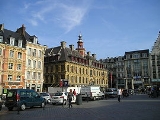
Lille

Encyclopedia
Lille is a city in northern France (French Flanders
). It is the principal city of the Lille Métropole
, the fourth-largest metropolitan area
in the country behind those of Paris, Lyon
and Marseille
. Lille is situated on the Deûle
River, near France's border with Belgium. It is the capital of the Nord-Pas de Calais
region
and the prefecture of the Nord department.
The city of Lille, which annexed Lomme on 27 February 2000, had a population of 226,014 at the 2006 census. Meanwhile, the Lille Métropole, which also includes Roubaix
, Tourcoing
and numerous suburban communities, had a population of 1,091,438. The eurodistrict
of Lille-Kortrijk, which also includes the areas of the Belgian cities of Kortrijk
, Tournai
, Mouscron
and Ypres
, had 1,905,000 residents.
" puts the foundation of the city of "L'Isle" at 640. Although the first mention of the town appears in archives from the year 1066, some archeological digs seem to show the area as inhabited by as early as 2000 BC, most notably in the modern-day quartiers of Fives, Wazemmes
, and Old Lille.
The original inhabitants of this region were the Gaul
s, such as the Menapians
, the Morins
, the Atrebates
, and the Nervians
, who were followed by Germanic peoples
, the Saxons
and the Frisians
, and the Franks
later.
From 830 until around 910, the Viking
s invaded Flanders. After the destruction caused by Norman
and Magyar invasion, the eastern part of the region fell under the eyes of the area's princes.
The name Lille comes from insula or l'Isla, i. "the island", since the area was at one time marshy. This name was used for the castle of the Counts of Flanders, built on dry land in the middle of the marsh. The Dutch name for the town, Rijsel, has the same meaning ("Ryssel" in French Flemish, from "ter Yssel" meaning "to/at the island").
The Count of Flanders controlled a number of old Roman cities (Boulogne
, Arras
, Cambrai
) as well as some founded by the Carolingians
(Valenciennes
, Saint-Omer
, Ghent
, Bruges
).
The County of Flanders
thus extended to the left bank of the Scheldt
, one of the richest and most prosperous regions of Europe.
, who lived in the 9th century and participated in many of the day's political and military affairs.
From the 12th century, the fame of the Lille cloth fair began to grow. In 1144 Saint-Sauveur parish was formed, which would give its name to the modern-day quartier Saint-Sauveur.
The counts of Flanders, Boulogne, and Hainaut
came together with England and the Holy Roman Empire
of Germany and declared war on France and Philip II of France
, a war that ended with the French victory at Bouvines
in 1214. Infante Ferdinand, Count of Flanders was imprisoned and the county fell into dispute: it would be his wife, Jeanne, Countess of Flanders
and Constantinople
, who ruled the city. She was said to be well-loved by the residents of Lille, who by that time numbered 10,000.
In 1224, the monk Bertrand of Rains, doubtlessly encouraged by local lords, tried to pass himself off as Baldwin I of Constantinople
(the father of Jeanne of Flanders), who had disappeared at the battle of Adrianople
. He pushed the kingdoms of Flanders and Hainaut towards sedition against Jeanne in order to recover his land. She called her cousin, Louis VIII
("The Lion"). He unmasked the imposter, whom Countess Jeanne quickly had hanged. In 1226 the King agreed to free Infante Ferdinand, Count of Flanders. Count Ferrand died in 1233, and his daughter Marie soon after. In 1235, Jeanne granted a city charter by which city governors would be chosen each All Saint's Day by four commissioners chosen by the ruler. On 6 February 1236, she founded the Countess's Hospital (L'hospice de la comtesse), which remains one of the most beautiful buildings in Old Lille. It was in her honor that the hospital of the Regional Medical University of Lille was named "Jeanne of Flanders Hospital" in the 20th century.
The Countess died in 1244 in the Abbey
of Marquette, leaving no heirs. The rule of Flanders and Hainaut thus fell to her sister, Margaret II, Countess of Flanders
, then to Margaret's son, Guy of Dampierre
. Lille fell under the rule of France from 1304 to 1369, after the Franco-Flemish War (1297-1305)
.
The county of Flanders fell to the Duchy of Burgundy
next, after the 1369 marriage of Margaret III, Countess of Flanders
, and Philip the Bold
, Duke of Burgundy
. Lille thus became one of the three capitals of said Duchy, along with Brussels
and Dijon
. By 1445, Lille counted some 25,000 residents. Philip the Good, Duke of Burgundy, was even more powerful than the King of France, and made Lille an administrative and financial capital.
On 17 February 1454, one year after the taking of Constantinople
by the Turks
, Philip the Good organised a Pantagruelian
banquet at his Lille palace, the still-celebrated "Feast of the Pheasant
". There the Duke and his court undertook an oath to Christianity.
In 1477, at the death of the last duke of Burgundy, Charles the Bold, Mary of Burgundy
married Maximilian of Austria
, who thus became Count of Flanders. At the end of the reign of the Holy Roman Emperor
Charles V
, Spanish Flanders fell to his eldest son, and thus under the rule of Philip II of Spain
, King of Spain. The city remained under Spanish rule until the reign of Philip IV of Spain
.
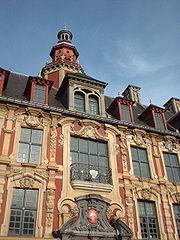 The 16th century was marked by the outbreak of the Plague
, a boom in the regional textile industry, and the Protestant
revolts.
The first Calvinists
appeared in the area in 1542; by 1555 anti-Protestant oppression was taking place. In 1578, the Hurlus, a group of Protestant rebels, stormed the castle of the Counts of Mouscron
. They were removed four months later by a Catholic Wallon regiment, after which they tried several times between 1581 and 1582 to take the city of Lille, all in vain. The Hurlus were notably held back by the legendary Jeanne Maillotte. At the same time (1581), at the call of Elizabeth I of England
, the north of the Seventeen Provinces
, having gained a Protestant majority, successfully revolted and formed the United Provinces
.
In 1667, Louis XIV of France
(the Sun-King) successfully laid siege to Lille
, resulting in it becoming French in 1668 under the Treaty of Aix-la-Chapelle
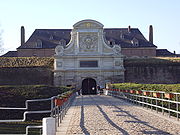
, provoking discontent among the citizens of the prosperous city. A number of important public works undertaken between 1667 and 1670, such as the Citadel (erected by Vauban
), or the creation of the quartiers of Saint-André and la Madeleine, enabled the King to gradually gain the confidence of his Lille subjects, some of whom continued to feel Flemish, though they had always spoken the Romance Picard language
.
 For five years, from 1708 to 1713, the city was occupied by the Dutch, during the War of the Spanish Succession
. Throughout the 18th century, Lille remained profoundly Catholic. It took little part in the French Revolution
, though there were riots and the destruction of churches. In 1790, the city held its first municipal elections.
, the Austrians
, then in the United Provinces, laid siege to Lille. The "Column of the Goddess
", erected in 1842 in the "Grand-Place" (officially named Place du Général-de-Gaulle), is a tribute to the city's resistance, led by Mayor André Bonte. Although Austrian artillery destroyed many houses and the main church of the city, the city did not surrender and the Austrian army left after eight days.
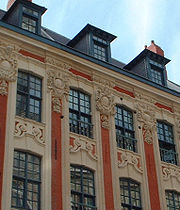 The city continued to grow, and by 1800 held some 53,000 residents, leading to Lille becoming the county seat of the Nord départment in 1804. In 1846, a rail line connecting Paris and Lille was built.
At the beginning of the 19th century, Napoleon I
's continental blockade
against the United Kingdom led to Lille's textile industry developing itself even more fully. The city was known for its cotton, and the nearby towns of Roubaix
and Tourcoing
worked wool
.
In 1853, Alexandre Desrousseaux composed his famous lullaby P'tit quinquin
. In 1858, an imperial decree led to the annexation of the adjacent towns of Fives, Wazemmes
, and Moulins. Lille's population was 158,000 in 1872, growing to over 200,000 by 1891. In 1896 Lille became the first city in France to be led by a socialist, Gustave Delory.
By 1912, Lille's population was at 217,000: the city profited from the Industrial Revolution
, particularly via coal and the steam engine
. The entire region had grown wealthy thanks to the mines and to the textile industry.
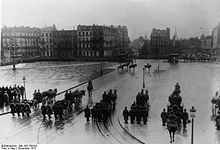 Between 4–13 October 1914, the troops in Lille were able to trick the enemy by convincing them that Lille possessed more artillery
than was the case; in reality, the city had only a single cannon
. Despite the deception, the German bombardments destroyed over 2,200 buildings and homes. When the Germans
realised they had been tricked, they burned down an entire section of town, subsequently occupying the city. Lille was liberated by the British on 17 October 1918, when General Sir William Birdwood
and his troops were welcomed by joyous crowds. The general was made an honorary citizen of the city of Lille on 28 October of that year.
Lille was also the hunting ground of World War I German flying Ace Max Immelmann
who was nicknamed "the Eagle of Lille".
in Lille, Albert Calmette
and Camille Guérin
discovered the first anti-tuberculosis
vaccine
, known as BCG
("Bacille de Calmette et Guérin"). The Opéra de Lille
, designed by Lille architect Louis M. Cordonnier
, was dedicated in 1923.
From 1931 Lille felt the repercussions of the Great Depression
, and by 1935 a third of the city's population lived in poverty. In 1936, the city's mayor, Roger Salengro
, became Minister of the Interior
of the Popular Front
, eventually killing himself after right-wing groups led a slanderous campaign against him.
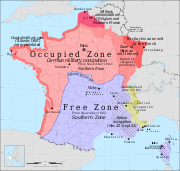 During the Battle of France
, Lille was besieged by German forces for several days. Due to the prolonged French defense, many Allied troops were able to escape to Dunkirk. When Belgium was invaded, the citizens of Lille, still marked by the events of the First World War, began to flee the city in large numbers. Lille was part of the zone under control of the German commander in Brussels, and was never controlled by the Vichy
government in France. The départments of Nord and Pas-de-Calais (with the exception of the coast, notably Dunkirk) were, for the most part, liberated in five days, from the 1 to 5 September 1944 by British, American, Canadian, and Polish troops. On 3 September, the German troops began to leave Lille, fearing the British, who were on their way from Brussels. Following this, the Lille resistance managed to retake part of the city before the British tanks arrived. Rationing came to an end in 1947, and by 1948, some normality had returned to Lille.
with Lille.
Throughout the 1960s and 70s, the region was faced with some problems after the decline of the coal, mining and textile industries. From the start of the 1980s, the city began to turn itself more towards the service sector.
In 1983, the VAL, the world's first automated rapid transit
underground network, was opened. In 1993, a high-speed TGV
train line was opened, connecting Paris with Lille in one hour. This, with the opening of the Channel Tunnel
in 1994 and the arrival of the Eurostar
train, put Lille at the centre of a triangle connecting Paris, London and Brussels.
Work on Euralille, an urban remodelling project, began in 1991. The Euralille Centre was opened in 1994, and the remodeled district is now full of parks and modern buildings containing offices, shops and apartments. In 1994 the "Grand Palais" was also opened.
Lille was elected European Capital of Culture
in 2004, along with the Italian city of Genoa
The table below gives temperatures and precipitation levels for 2006 and also the record temperatures.
, food industry
and textile manufacturing centre as well as a retail and finance center, Lille forms the heart of a larger conurbation, regrouping Lille, Roubaix
, Tourcoing
and Villeneuve d'Ascq
, which is France's 4th-largest urban conglomeration with a 1999 population of over 1.1 million.
in 1851 in his poem Les Châtiments
: « Caves de Lille ! on meurt sous vos plafonds de pierre ! » ( « Cellars of Lille: there is death below your stone roofs»)
File:Lille courée.JPG|Courée in Wazemmes area
File:Lille hotels particuliers Négrier.JPG|Hôtels particuliers rue Négrier, Vieux-Lille
File:Lille - Cité Administrative.JPG|Administrative city zone
Services account for 91% of employment in 2006.
Employment in Lille-Hellemmes-Lomme from 1968 to 2006
Employment per categories in 1968 and in 2006
Unemployment in active population from 1968 to 2006
Enterprises as per 31 December 2007
is much more prominent.
Points of interest include
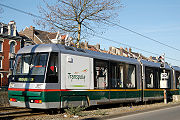
The Lille Métropole
has a mixed mode public transport system, which is considered one of the most modern in the whole of France. It comprises buses, trams and a driverless metro
system, all of which are operated under the Transpole name. The Lille Metro
is a VAL system (véhicule automatique léger = light automated vehicle) that opened on 16 May 1983, becoming the first automatic metro line in the world. The metro system has two lines, with a total length of 45 km and 60 stations. The tram system consists of two interurban tram lines, connecting central Lille to the nearby communities of Roubaix
and Tourcoing
, and has 45 stops. 68 urban bus routes cover the metropolis, 8 of which reach into Belgium.
network: it lies on the Eurostar
line to London and the French TGV
network to Paris, Brussels and other major centres in France such as Marseille, Lyon, and Toulouse. It has two railway stations, which stand next door to one another: Lille-Europe station (Gare de Lille-Europe
), which primarily serves high-speed trains and international services (Eurostar), and Lille-Flandres station (Gare de Lille-Flandres
), which primarily serves lower speed regional trains.
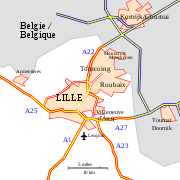 No fewer than five autoroutes pass by Lille, the densest confluence of highways in France after Paris:
A sixth one – the proposed A24 – will link Amiens to Lille if built, but there is opposition to its route.
is 15 minutes from the city centre by car (11 km). In terms of shipping, it ranks fourth, with almost 38,000 tonnes of freight which pass through each year.
. The river Deûle
is connected to regional waterways with over 680 km of navigable waters. The Deûle connects to Northern Europe via the River Scarpe and the River Scheldt
(towards Belgium and the Netherlands), and internationally via the Lys River (to Dunkerque and Calais
).
Shipping statistics
The European Doctoral College Lille Nord-Pas de Calais
is headquartered in Lille metropole and includes 3,000 PhD Doctorate students supported by university research laboratories.
, currently plays in Ligue 1
, the highest level of football in France
. The club has won eight major national trophies and regularly feature in the UEFA Champions League
and UEFA Europa League. In the 2010–11 season
, Lille won the league
and cup
double
.
with:
Cologne
, Germany Erfurt
, Germany Esch-sur-Alzette
, Luxembourg Kharkiv
, Ukraine Leeds
, United Kingdom Liège, Belgium Nablus
, Palestinian National Authority
Oujda
, Morocco Rotterdam
, Netherlands Safed
, Israel Wrocław, Poland Saint-Louis
, Senegal Shanghai, People's Republic of China Turin
, Italy Valladolid
, Spain Buffalo
, United States
French Flanders
French Flanders is a part of the historical County of Flanders in present-day France. The region today lies in the modern-day region of Nord-Pas de Calais, the department of Nord, and roughly corresponds to the arrondissements of Lille, Douai and Dunkirk on the Belgian border.-Geography:French...
). It is the principal city of the Lille Métropole
Urban Community of Lille Métropole
The Urban Community of Lille Métropole is the intercommunal structure gathering the commune of Lille and that part of the Lille metropolitan area that lies in France....
, the fourth-largest metropolitan area
Metropolitan area
The term metropolitan area refers to a region consisting of a densely populated urban core and its less-populated surrounding territories, sharing industry, infrastructure, and housing. A metropolitan area usually encompasses multiple jurisdictions and municipalities: neighborhoods, townships,...
in the country behind those of Paris, Lyon
Lyon
Lyon , is a city in east-central France in the Rhône-Alpes region, situated between Paris and Marseille. Lyon is located at from Paris, from Marseille, from Geneva, from Turin, and from Barcelona. The residents of the city are called Lyonnais....
and Marseille
Marseille
Marseille , known in antiquity as Massalia , is the second largest city in France, after Paris, with a population of 852,395 within its administrative limits on a land area of . The urban area of Marseille extends beyond the city limits with a population of over 1,420,000 on an area of...
. Lille is situated on the Deûle
Deûle
The Deûle is a river of northern France which is currently channeled for the main part of its course . The upstream part is still partly free-flowing and is known as the Souchez...
River, near France's border with Belgium. It is the capital of the Nord-Pas de Calais
Nord-Pas de Calais
Nord-Pas de Calais , Nord for short, is one of the 27 regions of France. It consists of the departments of Nord and Pas-de-Calais, in the north and has a border with Belgium. Most of the region was once part of the Southern Netherlands, within the Low Countries, and gradually became part of France...
region
Régions of France
France is divided into 27 administrative regions , 22 of which are in Metropolitan France, and five of which are overseas. Corsica is a territorial collectivity , but is considered a region in mainstream usage, and is even shown as such on the INSEE website...
and the prefecture of the Nord department.
The city of Lille, which annexed Lomme on 27 February 2000, had a population of 226,014 at the 2006 census. Meanwhile, the Lille Métropole, which also includes Roubaix
Roubaix
Roubaix is a commune in the Nord department in northern France. It is located between the cities of Lille and Tourcoing.The Gare de Roubaix railway station offers connections to Lille, Tourcoing, Antwerp, Ostend and Paris.-Culture:...
, Tourcoing
Tourcoing
Tourcoing is a city in northern France. It is designated municipally as a commune within the département of Nord.Tourcoing is situated near the cities of Lille and Roubaix and the Belgian border.-Main sights:...
and numerous suburban communities, had a population of 1,091,438. The eurodistrict
Eurodistrict
A eurodistrict is a European administrative entity that contains urban agglomerations which lie across the border between two or more states. A eurodistrict offers a program for cooperation and integration of the towns or communes which it comprises: for example, improving transport links for...
of Lille-Kortrijk, which also includes the areas of the Belgian cities of Kortrijk
Kortrijk
Kortrijk ; , ; ) is a Belgian city and municipality located in the Flemish province West Flanders...
, Tournai
Tournai
Tournai is a Walloon city and municipality of Belgium located 85 kilometres southwest of Brussels, on the river Scheldt, in the province of Hainaut....
, Mouscron
Mouscron
Mouscron is a Walloon city and municipality located in the Belgian province of Hainaut. The Mouscron municipality includes the old communes of Dottignies , Luingne, and Herseaux .-Middle Ages:...
and Ypres
Ypres
Ypres is a Belgian municipality located in the Flemish province of West Flanders. The municipality comprises the city of Ypres and the villages of Boezinge, Brielen, Dikkebus, Elverdinge, Hollebeke, Sint-Jan, Vlamertinge, Voormezele, Zillebeke, and Zuidschote...
, had 1,905,000 residents.
Origin of the city
The legend of "Lydéric and PhinaertLydéric and Phinaert
The legend of Lydéric and Phinaert is tied to the foundation of the French city of Lille.-The legend:Around the year of our Lord 620, the prince of Dijon, Salvaert, makes his way to the Kingdom of England with his pregnant wife, Ermengaert. While traveling through Flanders, they fall into a trap...
" puts the foundation of the city of "L'Isle" at 640. Although the first mention of the town appears in archives from the year 1066, some archeological digs seem to show the area as inhabited by as early as 2000 BC, most notably in the modern-day quartiers of Fives, Wazemmes
Wazemmes
Wazemmes is a former commune in the Nord department in northern France, merged into Lille in 1858.-Heraldry:-See also:*Communes of the Nord department...
, and Old Lille.
The original inhabitants of this region were the Gaul
Gaul
Gaul was a region of Western Europe during the Iron Age and Roman era, encompassing present day France, Luxembourg and Belgium, most of Switzerland, the western part of Northern Italy, as well as the parts of the Netherlands and Germany on the left bank of the Rhine. The Gauls were the speakers of...
s, such as the Menapians
Menapii
The Menapii were a Belgic tribe of northern Gaul in pre-Roman and Roman times. Their territory according to Strabo, Caesar and Ptolemy stretched from the mouth of the Rhine in the north, and southwards along the west of the Schelde. Their civitas under the Roman empire was Cassel , near Thérouanne...
, the Morins
Morini
The Morini were a Belgic tribe in the time of the Roman Empire. We know little about their language but one of their cities, Boulogne-sur-Mer was called Bononia by Zosimus and Bonen in the Middle Ages. Zosimus mentioned the Low Germanic character of the city...
, the Atrebates
Atrebates
The Atrebates were a Belgic tribe of Gaul and Britain before the Roman conquests.- Name of the tribe :Cognate with Old Irish aittrebaid meaning 'inhabitant', Atrebates comes from proto-Celtic *ad-treb-a-t-es, 'inhabitants'. The Celtic root is treb- 'building', 'home' The Atrebates (singular...
, and the Nervians
Nervii
The Nervii were an ancient Germanic tribe, and one of the most powerful Belgic tribes; living in the northeastern hinterlands of Gaul, they were known to trek long distances to engage in various wars and functions...
, who were followed by Germanic peoples
Germanic peoples
The Germanic peoples are an Indo-European ethno-linguistic group of Northern European origin, identified by their use of the Indo-European Germanic languages which diversified out of Proto-Germanic during the Pre-Roman Iron Age.Originating about 1800 BCE from the Corded Ware Culture on the North...
, the Saxons
Saxons
The Saxons were a confederation of Germanic tribes originating on the North German plain. The Saxons earliest known area of settlement is Northern Albingia, an area approximately that of modern Holstein...
and the Frisians
Frisians
The Frisians are a Germanic ethnic group native to the coastal parts of the Netherlands and Germany. They are concentrated in the Dutch provinces of Friesland and Groningen and, in Germany, East Frisia and North Frisia, that was a part of Denmark until 1864. They inhabit an area known as Frisia...
, and the Franks
Franks
The Franks were a confederation of Germanic tribes first attested in the third century AD as living north and east of the Lower Rhine River. From the third to fifth centuries some Franks raided Roman territory while other Franks joined the Roman troops in Gaul. Only the Salian Franks formed a...
later.
From 830 until around 910, the Viking
Viking
The term Viking is customarily used to refer to the Norse explorers, warriors, merchants, and pirates who raided, traded, explored and settled in wide areas of Europe, Asia and the North Atlantic islands from the late 8th to the mid-11th century.These Norsemen used their famed longships to...
s invaded Flanders. After the destruction caused by Norman
Normans
The Normans were the people who gave their name to Normandy, a region in northern France. They were descended from Norse Viking conquerors of the territory and the native population of Frankish and Gallo-Roman stock...
and Magyar invasion, the eastern part of the region fell under the eyes of the area's princes.
The name Lille comes from insula or l'Isla, i. "the island", since the area was at one time marshy. This name was used for the castle of the Counts of Flanders, built on dry land in the middle of the marsh. The Dutch name for the town, Rijsel, has the same meaning ("Ryssel" in French Flemish, from "ter Yssel" meaning "to/at the island").
The Count of Flanders controlled a number of old Roman cities (Boulogne
Boulogne-sur-Mer
-Road:* Metropolitan bus services are operated by the TCRB* Coach services to Calais and Dunkerque* A16 motorway-Rail:* The main railway station is Gare de Boulogne-Ville and located in the south of the city....
, Arras
Arras
Arras is the capital of the Pas-de-Calais department in northern France. The historic centre of the Artois region, its local speech is characterized as a Picard dialect...
, Cambrai
Cambrai
Cambrai is a commune in the Nord department in northern France. It is a sub-prefecture of the department.Cambrai is the seat of an archdiocese whose jurisdiction was immense during the Middle Ages. The territory of the Bishopric of Cambrai, roughly coinciding with the shire of Brabant, included...
) as well as some founded by the Carolingians
Carolingian Empire
Carolingian Empire is a historiographical term which has been used to refer to the realm of the Franks under the Carolingian dynasty in the Early Middle Ages. This dynasty is seen as the founders of France and Germany, and its beginning date is based on the crowning of Charlemagne, or Charles the...
(Valenciennes
Valenciennes
Valenciennes is a commune in the Nord department in northern France.It lies on the Scheldt river. Although the city and region had seen a steady decline between 1975 and 1990, it has since rebounded...
, Saint-Omer
Saint-Omer
Saint-Omer , a commune and sub-prefecture of the Pas-de-Calais department west-northwest of Lille on the railway to Calais. The town is named after Saint Audomar, who brought Christianity to the area....
, Ghent
Ghent
Ghent is a city and a municipality located in the Flemish region of Belgium. It is the capital and biggest city of the East Flanders province. The city started as a settlement at the confluence of the Rivers Scheldt and Lys and in the Middle Ages became one of the largest and richest cities of...
, Bruges
Bruges
Bruges is the capital and largest city of the province of West Flanders in the Flemish Region of Belgium. It is located in the northwest of the country....
).
The County of Flanders
County of Flanders
The County of Flanders was one of the territories constituting the Low Countries. The county existed from 862 to 1795. It was one of the original secular fiefs of France and for centuries was one of the most affluent regions in Europe....
thus extended to the left bank of the Scheldt
Scheldt
The Scheldt is a 350 km long river in northern France, western Belgium and the southwestern part of the Netherlands...
, one of the richest and most prosperous regions of Europe.
Middle Ages
A local notable in this period was ÉvrardEberhard of Friuli
Eberhard was the Frankish Duke of Friuli from 846. His name is alternatively spelled Everard, Evrard, Erhard, Eberhard, or Eberard, or in Latinized fashion Everardus, Eberardus, or Eberhardus. He wrote his own name "Evvrardus"...
, who lived in the 9th century and participated in many of the day's political and military affairs.
From the 12th century, the fame of the Lille cloth fair began to grow. In 1144 Saint-Sauveur parish was formed, which would give its name to the modern-day quartier Saint-Sauveur.
The counts of Flanders, Boulogne, and Hainaut
County of Hainaut
The County of Hainaut was a historical region in the Low Countries with its capital at Mons . In English sources it is often given the archaic spelling Hainault....
came together with England and the Holy Roman Empire
Holy Roman Empire
The Holy Roman Empire was a realm that existed from 962 to 1806 in Central Europe.It was ruled by the Holy Roman Emperor. Its character changed during the Middle Ages and the Early Modern period, when the power of the emperor gradually weakened in favour of the princes...
of Germany and declared war on France and Philip II of France
Philip II of France
Philip II Augustus was the King of France from 1180 until his death. A member of the House of Capet, Philip Augustus was born at Gonesse in the Val-d'Oise, the son of Louis VII and his third wife, Adela of Champagne...
, a war that ended with the French victory at Bouvines
Bouvines
Bouvines is a commune in the Nord department in northern France.It was the site of the Battle of Bouvines, on 27 July 1214.-Heraldry:-References:*...
in 1214. Infante Ferdinand, Count of Flanders was imprisoned and the county fell into dispute: it would be his wife, Jeanne, Countess of Flanders
Jeanne, Countess of Flanders
right|thumb|Statue of Joan of FlandersJoan, called of Constantinople was countess of Flanders and Hainaut....
and Constantinople
Constantinople
Constantinople was the capital of the Roman, Eastern Roman, Byzantine, Latin, and Ottoman Empires. Throughout most of the Middle Ages, Constantinople was Europe's largest and wealthiest city.-Names:...
, who ruled the city. She was said to be well-loved by the residents of Lille, who by that time numbered 10,000.
In 1224, the monk Bertrand of Rains, doubtlessly encouraged by local lords, tried to pass himself off as Baldwin I of Constantinople
Baldwin I of Constantinople
Baldwin I , the first emperor of the Latin Empire of Constantinople, as Baldwin IX Count of Flanders and as Baldwin VI Count of Hainaut, was one of the most prominent leaders of the Fourth Crusade, which resulted in the capture of Constantinople, the conquest of the greater part of the Byzantine...
(the father of Jeanne of Flanders), who had disappeared at the battle of Adrianople
Battle of Adrianople (1205)
The Battle of Adrianople occurred on April 14, 1205 between Bulgarians under Tsar Kaloyan of Bulgaria, and Crusaders under Baldwin I. It was won by the Bulgarians after a skillful ambush using the help of their Cuman and Greek allies. Around 300 knights were killed, including Louis of Blois, Duke...
. He pushed the kingdoms of Flanders and Hainaut towards sedition against Jeanne in order to recover his land. She called her cousin, Louis VIII
Louis VIII of France
Louis VIII the Lion reigned as King of France from 1223 to 1226. He was a member of the House of Capet. Louis VIII was born in Paris, France, the son of Philip II Augustus and Isabelle of Hainaut. He was also Count of Artois, inheriting the county from his mother, from 1190–1226...
("The Lion"). He unmasked the imposter, whom Countess Jeanne quickly had hanged. In 1226 the King agreed to free Infante Ferdinand, Count of Flanders. Count Ferrand died in 1233, and his daughter Marie soon after. In 1235, Jeanne granted a city charter by which city governors would be chosen each All Saint's Day by four commissioners chosen by the ruler. On 6 February 1236, she founded the Countess's Hospital (L'hospice de la comtesse), which remains one of the most beautiful buildings in Old Lille. It was in her honor that the hospital of the Regional Medical University of Lille was named "Jeanne of Flanders Hospital" in the 20th century.
The Countess died in 1244 in the Abbey
Abbey
An abbey is a Catholic monastery or convent, under the authority of an Abbot or an Abbess, who serves as the spiritual father or mother of the community.The term can also refer to an establishment which has long ceased to function as an abbey,...
of Marquette, leaving no heirs. The rule of Flanders and Hainaut thus fell to her sister, Margaret II, Countess of Flanders
Margaret II, Countess of Flanders
Margaret, called of Constantinople was countess of Flanders from 1244 to 1278 and also, countess of Hainaut from 1244 to 1253 and again from 1257 until her death.-History and Family:...
, then to Margaret's son, Guy of Dampierre
Guy of Dampierre
Guy of Dampierre was the count of Flanders during the Battle of the Golden Spurs in 1302.Guy was the second son of William II of Dampierre and Margaret II of Flanders. The death of his elder brother William in a tournament made him joint Count of Flanders with his mother...
. Lille fell under the rule of France from 1304 to 1369, after the Franco-Flemish War (1297-1305)
Franco-Flemish War (1297-1305)
The Franco-Flemish War was an armed conflict between the Kingdom of France and the County of Flanders from 1297 until 1305.- Cause :Philip IV of France became King in 1285, and was determined to strengthen the French monarchy at any cost...
.
The county of Flanders fell to the Duchy of Burgundy
Duchy of Burgundy
The Duchy of Burgundy , was heir to an ancient and prestigious reputation and a large division of the lands of the Second Kingdom of Burgundy and in its own right was one of the geographically larger ducal territories in the emergence of Early Modern Europe from Medieval Europe.Even in that...
next, after the 1369 marriage of Margaret III, Countess of Flanders
Margaret III, Countess of Flanders
Margaret of Dampierre was Countess of Flanders , Countess of Artois and Countess Palatine of Burgundy and twice Duchess consort of Burgundy...
, and Philip the Bold
Philip the Bold
Philip the Bold , also Philip II, Duke of Burgundy , was the fourth and youngest son of King John II of France and his wife, Bonne of Luxembourg. By his marriage to Margaret III, Countess of Flanders, he also became Count Philip II of Flanders, Count Philip IV of Artois and Count-Palatine Philip IV...
, Duke of Burgundy
Duke of Burgundy
Duke of Burgundy was a title borne by the rulers of the Duchy of Burgundy, a small portion of traditional lands of Burgundians west of river Saône which in 843 was allotted to Charles the Bald's kingdom of West Franks...
. Lille thus became one of the three capitals of said Duchy, along with Brussels
Brussels
Brussels , officially the Brussels Region or Brussels-Capital Region , is the capital of Belgium and the de facto capital of the European Union...
and Dijon
Dijon
Dijon is a city in eastern France, the capital of the Côte-d'Or département and of the Burgundy region.Dijon is the historical capital of the region of Burgundy. Population : 151,576 within the city limits; 250,516 for the greater Dijon area....
. By 1445, Lille counted some 25,000 residents. Philip the Good, Duke of Burgundy, was even more powerful than the King of France, and made Lille an administrative and financial capital.
On 17 February 1454, one year after the taking of Constantinople
Fall of Constantinople
The Fall of Constantinople was the capture of the capital of the Byzantine Empire, which occurred after a siege by the Ottoman Empire, under the command of Ottoman Sultan Mehmed II, against the defending army commanded by Byzantine Emperor Constantine XI...
by the Turks
Ottoman Empire
The Ottoman EmpireIt was usually referred to as the "Ottoman Empire", the "Turkish Empire", the "Ottoman Caliphate" or more commonly "Turkey" by its contemporaries...
, Philip the Good organised a Pantagruelian
Gargantua and Pantagruel
The Life of Gargantua and of Pantagruel is a connected series of five novels written in the 16th century by François Rabelais. It is the story of two giants, a father and his son and their adventures, written in an amusing, extravagant, satirical vein...
banquet at his Lille palace, the still-celebrated "Feast of the Pheasant
Feast of the Pheasant
The Feast of the Pheasant was a banquet given by Philip the Good, Duke of Burgundy on 17 February 1454 in Lille, now in France. Its purpose was to promote a crusade against the Turks, who had taken Constantinople the year before...
". There the Duke and his court undertook an oath to Christianity.
In 1477, at the death of the last duke of Burgundy, Charles the Bold, Mary of Burgundy
Mary of Burgundy
Mary of Burgundy ruled the Burgundian territories in Low Countries and was suo jure Duchess of Burgundy from 1477 until her death...
married Maximilian of Austria
Maximilian I, Holy Roman Emperor
Maximilian I , the son of Frederick III, Holy Roman Emperor and Eleanor of Portugal, was King of the Romans from 1486 and Holy Roman Emperor from 1493 until his death, though he was never in fact crowned by the Pope, the journey to Rome always being too risky...
, who thus became Count of Flanders. At the end of the reign of the Holy Roman Emperor
Holy Roman Emperor
The Holy Roman Emperor is a term used by historians to denote a medieval ruler who, as German King, had also received the title of "Emperor of the Romans" from the Pope...
Charles V
Charles V, Holy Roman Emperor
Charles V was ruler of the Holy Roman Empire from 1519 and, as Charles I, of the Spanish Empire from 1516 until his voluntary retirement and abdication in favor of his younger brother Ferdinand I and his son Philip II in 1556.As...
, Spanish Flanders fell to his eldest son, and thus under the rule of Philip II of Spain
Philip II of Spain
Philip II was King of Spain, Portugal, Naples, Sicily, and, while married to Mary I, King of England and Ireland. He was lord of the Seventeen Provinces from 1556 until 1581, holding various titles for the individual territories such as duke or count....
, King of Spain. The city remained under Spanish rule until the reign of Philip IV of Spain
Philip IV of Spain
Philip IV was King of Spain between 1621 and 1665, sovereign of the Spanish Netherlands, and King of Portugal until 1640...
.
The modern era
Black Death
The Black Death was one of the most devastating pandemics in human history, peaking in Europe between 1348 and 1350. Of several competing theories, the dominant explanation for the Black Death is the plague theory, which attributes the outbreak to the bacterium Yersinia pestis. Thought to have...
, a boom in the regional textile industry, and the Protestant
Protestantism
Protestantism is one of the three major groupings within Christianity. It is a movement that began in Germany in the early 16th century as a reaction against medieval Roman Catholic doctrines and practices, especially in regards to salvation, justification, and ecclesiology.The doctrines of the...
revolts.
The first Calvinists
Calvinism
Calvinism is a Protestant theological system and an approach to the Christian life...
appeared in the area in 1542; by 1555 anti-Protestant oppression was taking place. In 1578, the Hurlus, a group of Protestant rebels, stormed the castle of the Counts of Mouscron
Mouscron
Mouscron is a Walloon city and municipality located in the Belgian province of Hainaut. The Mouscron municipality includes the old communes of Dottignies , Luingne, and Herseaux .-Middle Ages:...
. They were removed four months later by a Catholic Wallon regiment, after which they tried several times between 1581 and 1582 to take the city of Lille, all in vain. The Hurlus were notably held back by the legendary Jeanne Maillotte. At the same time (1581), at the call of Elizabeth I of England
Elizabeth I of England
Elizabeth I was queen regnant of England and Ireland from 17 November 1558 until her death. Sometimes called The Virgin Queen, Gloriana, or Good Queen Bess, Elizabeth was the fifth and last monarch of the Tudor dynasty...
, the north of the Seventeen Provinces
Seventeen Provinces
The Seventeen Provinces were a personal union of states in the Low Countries in the 15th century and 16th century, roughly covering the current Netherlands, Belgium, Luxembourg, a good part of the North of France , and a small part of Western Germany.The Seventeen Provinces were originally held by...
, having gained a Protestant majority, successfully revolted and formed the United Provinces
Dutch Republic
The Dutch Republic — officially known as the Republic of the Seven United Netherlands , the Republic of the United Netherlands, or the Republic of the Seven United Provinces — was a republic in Europe existing from 1581 to 1795, preceding the Batavian Republic and ultimately...
.
In 1667, Louis XIV of France
Louis XIV of France
Louis XIV , known as Louis the Great or the Sun King , was a Bourbon monarch who ruled as King of France and Navarre. His reign, from 1643 to his death in 1715, began at the age of four and lasted seventy-two years, three months, and eighteen days...
(the Sun-King) successfully laid siege to Lille
Siege of Lille (1667)
See also Siege of Lille The Siege of Lille was a siege of the city of Lille during the War of Devolution. Louis XIV's forces besieged the city from August 10 to August 28, 1667. It was the only major engagement of the war....
, resulting in it becoming French in 1668 under the Treaty of Aix-la-Chapelle
Treaty of Aix-la-Chapelle (1668)
The Treaty of Aix-la-Chapelle or Treaty of Aachen was signed on May 2, 1668 in Aachen. It ended the war of Devolution between France and Spain. It was mediated by the Triple Alliance of England, the Dutch Republic and Sweden at the first Congress of Aix-la-Chapelle...
, provoking discontent among the citizens of the prosperous city. A number of important public works undertaken between 1667 and 1670, such as the Citadel (erected by Vauban
Vauban
Sébastien Le Prestre, Seigneur de Vauban and later Marquis de Vauban , commonly referred to as Vauban, was a Marshal of France and the foremost military engineer of his age, famed for his skill in both designing fortifications and breaking through them...
), or the creation of the quartiers of Saint-André and la Madeleine, enabled the King to gradually gain the confidence of his Lille subjects, some of whom continued to feel Flemish, though they had always spoken the Romance Picard language
Picard language
Picard is a language closely related to French, and as such is one of the larger group of Romance languages. It is spoken in two regions in the far north of France – Nord-Pas-de-Calais and Picardy – and in parts of the Belgian region of Wallonia, the district of Tournai and a part of...
.
War of the Spanish Succession
The War of the Spanish Succession was fought among several European powers, including a divided Spain, over the possible unification of the Kingdoms of Spain and France under one Bourbon monarch. As France and Spain were among the most powerful states of Europe, such a unification would have...
. Throughout the 18th century, Lille remained profoundly Catholic. It took little part in the French Revolution
French Revolution
The French Revolution , sometimes distinguished as the 'Great French Revolution' , was a period of radical social and political upheaval in France and Europe. The absolute monarchy that had ruled France for centuries collapsed in three years...
, though there were riots and the destruction of churches. In 1790, the city held its first municipal elections.
After the French Revolution
In 1792, in the aftermath of the French RevolutionFrench Revolution
The French Revolution , sometimes distinguished as the 'Great French Revolution' , was a period of radical social and political upheaval in France and Europe. The absolute monarchy that had ruled France for centuries collapsed in three years...
, the Austrians
Austrians
Austrians are a nation and ethnic group, consisting of the population of the Republic of Austria and its historical predecessor states who share a common Austrian culture and Austrian descent....
, then in the United Provinces, laid siege to Lille. The "Column of the Goddess
Column of the Goddess
The Column of the Goddess is the popular name given by the citizens of Lille to the Memorial of the siege of 1792. The memorial is still in the center of the Grand' Place of Lille, and has been surrounded by a fountain since around 1990.-The Siege:The siege of September 1792 was one of the many...
", erected in 1842 in the "Grand-Place" (officially named Place du Général-de-Gaulle), is a tribute to the city's resistance, led by Mayor André Bonte. Although Austrian artillery destroyed many houses and the main church of the city, the city did not surrender and the Austrian army left after eight days.
At the beginning of the 19th century, Napoleon I
Napoleon I of France
Napoleon Bonaparte was a French military and political leader during the latter stages of the French Revolution.As Napoleon I, he was Emperor of the French from 1804 to 1815...
's continental blockade
Continental System
The Continental System or Continental Blockade was the foreign policy of Napoleon I of France in his struggle against the United Kingdom of Great Britain and Ireland during the Napoleonic Wars. It was a large-scale embargo against British trade, which began on November 21, 1806...
against the United Kingdom led to Lille's textile industry developing itself even more fully. The city was known for its cotton, and the nearby towns of Roubaix
Roubaix
Roubaix is a commune in the Nord department in northern France. It is located between the cities of Lille and Tourcoing.The Gare de Roubaix railway station offers connections to Lille, Tourcoing, Antwerp, Ostend and Paris.-Culture:...
and Tourcoing
Tourcoing
Tourcoing is a city in northern France. It is designated municipally as a commune within the département of Nord.Tourcoing is situated near the cities of Lille and Roubaix and the Belgian border.-Main sights:...
worked wool
Wool
Wool is the textile fiber obtained from sheep and certain other animals, including cashmere from goats, mohair from goats, qiviut from muskoxen, vicuña, alpaca, camel from animals in the camel family, and angora from rabbits....
.
In 1853, Alexandre Desrousseaux composed his famous lullaby P'tit quinquin
P'tit quinquin
"P'tit quinquin" is a song by Alexandre Desrousseaux which was written in 1853 in Picard language. Picard language is closely related to French, and is spoken in two regions in the north of France – Nord-Pas-de-Calais and in parts of the Belgian region Wallonia.This simple lullaby marks the...
. In 1858, an imperial decree led to the annexation of the adjacent towns of Fives, Wazemmes
Wazemmes
Wazemmes is a former commune in the Nord department in northern France, merged into Lille in 1858.-Heraldry:-See also:*Communes of the Nord department...
, and Moulins. Lille's population was 158,000 in 1872, growing to over 200,000 by 1891. In 1896 Lille became the first city in France to be led by a socialist, Gustave Delory.
By 1912, Lille's population was at 217,000: the city profited from the Industrial Revolution
Industrial Revolution
The Industrial Revolution was a period from the 18th to the 19th century where major changes in agriculture, manufacturing, mining, transportation, and technology had a profound effect on the social, economic and cultural conditions of the times...
, particularly via coal and the steam engine
Steam engine
A steam engine is a heat engine that performs mechanical work using steam as its working fluid.Steam engines are external combustion engines, where the working fluid is separate from the combustion products. Non-combustion heat sources such as solar power, nuclear power or geothermal energy may be...
. The entire region had grown wealthy thanks to the mines and to the textile industry.
First World War
Artillery
Originally applied to any group of infantry primarily armed with projectile weapons, artillery has over time become limited in meaning to refer only to those engines of war that operate by projection of munitions far beyond the range of effect of personal weapons...
than was the case; in reality, the city had only a single cannon
Cannon
A cannon is any piece of artillery that uses gunpowder or other usually explosive-based propellents to launch a projectile. Cannon vary in caliber, range, mobility, rate of fire, angle of fire, and firepower; different forms of cannon combine and balance these attributes in varying degrees,...
. Despite the deception, the German bombardments destroyed over 2,200 buildings and homes. When the Germans
Germans
The Germans are a Germanic ethnic group native to Central Europe. The English term Germans has referred to the German-speaking population of the Holy Roman Empire since the Late Middle Ages....
realised they had been tricked, they burned down an entire section of town, subsequently occupying the city. Lille was liberated by the British on 17 October 1918, when General Sir William Birdwood
William Birdwood, 1st Baron Birdwood
Field Marshal William Riddell Birdwood, 1st Baron Birdwood, GCB, GCSI, GCMG, GCVO, GBE, CIE, DSO was a First World War British general who is best known as the commander of the Australian and New Zealand Army Corps during the Gallipoli Campaign in 1915.- Youth and early career :Birdwood was born...
and his troops were welcomed by joyous crowds. The general was made an honorary citizen of the city of Lille on 28 October of that year.
Lille was also the hunting ground of World War I German flying Ace Max Immelmann
Max Immelmann
Max Immelmann was the first German World War I flying ace. He was a great pioneer in fighter aviation and is often mistakenly credited with the first aerial victory using a synchronized gun...
who was nicknamed "the Eagle of Lille".
The Années Folles, the Great Depression, and the Popular Front
In July 1921, at the Pasteur InstitutePasteur Institute
The Pasteur Institute is a French non-profit private foundation dedicated to the study of biology, micro-organisms, diseases, and vaccines. It is named after Louis Pasteur, who made some of the greatest breakthroughs in modern medicine at the time, including pasteurization and vaccines for anthrax...
in Lille, Albert Calmette
Albert Calmette
Léon Charles Albert Calmette ForMemRS was a French physician, bacteriologist and immunologist, and an important officer of the Pasteur Institute. He discovered the Bacillus Calmette-Guérin, an attenuated form of Mycobacterium used in the BCG vaccine against tuberculosis...
and Camille Guérin
Camille Guérin
Jean-Marie Camille Guérin was a French veterinarian, bacteriologist and immunologist who, together with Albert Calmette, developed the Bacillus Calmette-Guérin , a vaccine for immunization against tuberculosis....
discovered the first anti-tuberculosis
Tuberculosis
Tuberculosis, MTB, or TB is a common, and in many cases lethal, infectious disease caused by various strains of mycobacteria, usually Mycobacterium tuberculosis. Tuberculosis usually attacks the lungs but can also affect other parts of the body...
vaccine
Vaccine
A vaccine is a biological preparation that improves immunity to a particular disease. A vaccine typically contains an agent that resembles a disease-causing microorganism, and is often made from weakened or killed forms of the microbe or its toxins...
, known as BCG
Bacillus Calmette-Guérin
Bacillus Calmette-Guérin is a vaccine against tuberculosis that is prepared from a strain of the attenuated live bovine tuberculosis bacillus, Mycobacterium bovis, that has lost its virulence in humans by being specially subcultured in an artificial medium for 13 years, and also prepared from...
("Bacille de Calmette et Guérin"). The Opéra de Lille
Opéra de Lille
The Opéra de Lille is a theater-style neo-classical opera house, built from 1907 to 1913 and officially inaugurated in 1923.In 1903 fire destroyed the previous Lille opera house, which had been designed by Lille architect Michael Joseph Lequeux and built in 1785. For the replacement city officials...
, designed by Lille architect Louis M. Cordonnier
Louis M. Cordonnier
Louis-Marie Cordonnier was a French architect, born in Haubourdin and associated principally with Lille and the French Flanders region.- Biography :...
, was dedicated in 1923.
From 1931 Lille felt the repercussions of the Great Depression
Great Depression
The Great Depression was a severe worldwide economic depression in the decade preceding World War II. The timing of the Great Depression varied across nations, but in most countries it started in about 1929 and lasted until the late 1930s or early 1940s...
, and by 1935 a third of the city's population lived in poverty. In 1936, the city's mayor, Roger Salengro
Roger Salengro
Roger Henri Charles Salengro was a French politician. He achieved fame as Minister of the Interior during the Popular Front government in 1936...
, became Minister of the Interior
Minister of the Interior (France)
The Minister of the Interior in France is one of the most important governmental cabinet positions, responsible for the following:* The general interior security of the country, with respect to criminal acts or natural catastrophes...
of the Popular Front
Popular Front (France)
The Popular Front was an alliance of left-wing movements, including the French Communist Party , the French Section of the Workers' International and the Radical and Socialist Party, during the interwar period...
, eventually killing himself after right-wing groups led a slanderous campaign against him.
Second World War
Battle of France
In the Second World War, the Battle of France was the German invasion of France and the Low Countries, beginning on 10 May 1940, which ended the Phoney War. The battle consisted of two main operations. In the first, Fall Gelb , German armoured units pushed through the Ardennes, to cut off and...
, Lille was besieged by German forces for several days. Due to the prolonged French defense, many Allied troops were able to escape to Dunkirk. When Belgium was invaded, the citizens of Lille, still marked by the events of the First World War, began to flee the city in large numbers. Lille was part of the zone under control of the German commander in Brussels, and was never controlled by the Vichy
Vichy
Vichy is a commune in the department of Allier in Auvergne in central France. It belongs to the historic province of Bourbonnais.It is known as a spa and resort town and was the de facto capital of Vichy France during the World War II Nazi German occupation from 1940 to 1944.The town's inhabitants...
government in France. The départments of Nord and Pas-de-Calais (with the exception of the coast, notably Dunkirk) were, for the most part, liberated in five days, from the 1 to 5 September 1944 by British, American, Canadian, and Polish troops. On 3 September, the German troops began to leave Lille, fearing the British, who were on their way from Brussels. Following this, the Lille resistance managed to retake part of the city before the British tanks arrived. Rationing came to an end in 1947, and by 1948, some normality had returned to Lille.
Post-war to the present
In 1967, the Chambers of Commerce of Lille, Roubaix and Tourcoing were joined, and in 1969 the Communauté urbaine de Lille (Lille urban community) was created, linking 87 communesCommunes of France
The commune is the lowest level of administrative division in the French Republic. French communes are roughly equivalent to incorporated municipalities or villages in the United States or Gemeinden in Germany...
with Lille.
Throughout the 1960s and 70s, the region was faced with some problems after the decline of the coal, mining and textile industries. From the start of the 1980s, the city began to turn itself more towards the service sector.
In 1983, the VAL, the world's first automated rapid transit
Rapid transit
A rapid transit, underground, subway, elevated railway, metro or metropolitan railway system is an electric passenger railway in an urban area with a high capacity and frequency, and grade separation from other traffic. Rapid transit systems are typically located either in underground tunnels or on...
underground network, was opened. In 1993, a high-speed TGV
TGV
The TGV is France's high-speed rail service, currently operated by SNCF Voyages, the long-distance rail branch of SNCF, the French national rail operator....
train line was opened, connecting Paris with Lille in one hour. This, with the opening of the Channel Tunnel
Channel Tunnel
The Channel Tunnel is a undersea rail tunnel linking Folkestone, Kent in the United Kingdom with Coquelles, Pas-de-Calais near Calais in northern France beneath the English Channel at the Strait of Dover. At its lowest point, it is deep...
in 1994 and the arrival of the Eurostar
Eurostar
Eurostar is a high-speed railway service connecting London with Paris and Brussels. All its trains traverse the Channel Tunnel between England and France, owned and operated separately by Eurotunnel....
train, put Lille at the centre of a triangle connecting Paris, London and Brussels.
Work on Euralille, an urban remodelling project, began in 1991. The Euralille Centre was opened in 1994, and the remodeled district is now full of parks and modern buildings containing offices, shops and apartments. In 1994 the "Grand Palais" was also opened.
Lille was elected European Capital of Culture
European Capital of Culture
The European Capital of Culture is a city designated by theEuropean Union for a period of one calendar year during which it organises a series of cultural events with a strong European dimension....
in 2004, along with the Italian city of Genoa
Genoa
Genoa |Ligurian]] Zena ; Latin and, archaically, English Genua) is a city and an important seaport in northern Italy, the capital of the Province of Genoa and of the region of Liguria....
Climate
Lille can be described as having a temperate oceanic climate; summers do not reach high temperatures, but winters can fall below zero temperatures. Precipitation is above average year round.The table below gives temperatures and precipitation levels for 2006 and also the record temperatures.
Economy
A former major mechanicalMachine
A machine manages power to accomplish a task, examples include, a mechanical system, a computing system, an electronic system, and a molecular machine. In common usage, the meaning is that of a device having parts that perform or assist in performing any type of work...
, food industry
Food industry
The food production is a complex, global collective of diverse businesses that together supply much of the food energy consumed by the world population...
and textile manufacturing centre as well as a retail and finance center, Lille forms the heart of a larger conurbation, regrouping Lille, Roubaix
Roubaix
Roubaix is a commune in the Nord department in northern France. It is located between the cities of Lille and Tourcoing.The Gare de Roubaix railway station offers connections to Lille, Tourcoing, Antwerp, Ostend and Paris.-Culture:...
, Tourcoing
Tourcoing
Tourcoing is a city in northern France. It is designated municipally as a commune within the département of Nord.Tourcoing is situated near the cities of Lille and Roubaix and the Belgian border.-Main sights:...
and Villeneuve d'Ascq
Villeneuve d'Ascq
Villeneuve-d'Ascq is a commune in the Nord department in northern France. With more than 60,000 inhabitants, it is one of the main cities of the Urban Community of Lille Métropole and the largest in area after Lille ; it is also one of the main cities of the Nord-Pas de Calais region.Built up...
, which is France's 4th-largest urban conglomeration with a 1999 population of over 1.1 million.
Revenues and taxes
For centuries, Lille, a city of merchants, has displayed a wide range of incomes: great wealth and poverty have lived side by side, especially until the end of the 1800's. This contrast was noted by Victor HugoVictor Hugo
Victor-Marie Hugo was a Frenchpoet, playwright, novelist, essayist, visual artist, statesman, human rights activist and exponent of the Romantic movement in France....
in 1851 in his poem Les Châtiments
Les Châtiments
Les Châtiments is a collection of poems by Victor Hugo that fiercely attack the grandeur of Napoléon III's Second Empire.- Historical background :...
: « Caves de Lille ! on meurt sous vos plafonds de pierre ! » ( « Cellars of Lille: there is death below your stone roofs»)
File:Lille courée.JPG|Courée in Wazemmes area
File:Lille hotels particuliers Négrier.JPG|Hôtels particuliers rue Négrier, Vieux-Lille
File:Lille - Cité Administrative.JPG|Administrative city zone
Employment
Employment in Lille has switched over half a century from a predominant industry to tertiary activities and services.Services account for 91% of employment in 2006.
Employment in Lille-Hellemmes-Lomme from 1968 to 2006
| Business area | 1968 | 1975 | 1982 | 1990 | 1999 | 2006 |
|---|---|---|---|---|---|---|
| Agriculture | 340 | 240 | 144 | 116 | 175 | 216 |
| Industry and engineering | 51 900 | 43 500 | 34 588 | 22 406 | 15 351 | 13 958 |
| Tertiary activities | 91 992 | 103 790 | 107 916 | 114 992 | 122 736 | 136 881 |
| Total | 144 232 | 147 530 | 142 648 | 137 514 | 138 262 | 151 055 |
| Sources of data : INSEE | ||||||
Employment per categories in 1968 and in 2006
| Farmers | Businesspersons, entrepreneurs |
Upper class | Midlle class | Employees | Blue-collar worker | |||||||
|---|---|---|---|---|---|---|---|---|---|---|---|---|
| 1968 | 2006 | 1968 | 2006 | 1968 | 2006 | 1968 | 2006 | 1968 | 2006 | 1968 | 2006 | |
| Lille | 0,1 % | 0,0 % | 7,8 % | 3,2 % | 7,5 % | 20,2 % | 16,7 % | 30,0 % | 33,1 % | 32,8 % | 34,9 % | 13,8 % |
| Greater Lille | 1,3 % | 0,3 % | 9,0 % | 3,8 % | 5,3 % | 17,5 % | 14,6 % | 27,7 % | 24,4 % | 29,6 % | 45,4 % | 21,1 % |
| France | 12,5 % | 2,2 % | 9,9 % | 6,0 % | 5,2 % | 15,4 % | 12,4 % | 24,6 % | 22,5 % | 28,7 % | 37,6 % | 23,2 % |
| Sources of data : INSEE | ||||||||||||
Unemployment in active population from 1968 to 2006
| 1968 | 1975 | 1982 | 1990 | 1999 | 2006 | |
|---|---|---|---|---|---|---|
| Lille | 2,9 % | 4,6 % | 10,3 % | 14,6 % | 16,9 % | 15,2 % |
| Greater Lille | 2,4 % | 3,8 % | 8,8 % | 12,4 % | 14,3 % | 13,2 % |
| France | 2,1 % | 3,8 % | 7,4 % | 10,1 % | 11,7 % | 10,6 % |
| Sources of data : INSEE | ||||||
Enterprises
In 2007, Lille hosts around industry or service sites.Enterprises as per 31 December 2007
| Number | Size category | Mean number of employees | ||||||||
|---|---|---|---|---|---|---|---|---|---|---|
| Greater Lille | Lille | % Lille | None | 1 to 19 | 20 to 99 | 100 to 499 | 500+ | Lille | Greater | |
| Industries | 3 774 | 819 | 22 % | 404 | 361 | 40 | 12 | 2 | 17 | 22 |
| Construction | 4 030 | 758 | 19 % | 364 | 360 | 32 | 2 | 0 | 8 | 11 |
| Commerce | 13 578 | 4 265 | 31 % | 2 243 | 1 926 | 83 | 13 | 0 | 7 | 11 |
| Transports | 1 649 | 407 | 25 % | 196 | 182 | 23 | 5 | 1 | 32 | 26 |
| Finance | 2 144 | 692 | 32 % | 282 | 340 | 51 | 17 | 2 | 21 | 18 |
| Real property | 5 123 | 1 771 | 35 % | 1 159 | 587 | 23 | 2 | 0 | 5 | 4 |
| Business services | 12 519 | 4 087 | 33 % | 2 656 | 1 249 | 149 | 27 | 6 | 15 | 17 |
| Services to consummers | 8 916 | 3 075 | 34 % | 1 636 | 1 347 | 86 | 6 | 0 | 7 | 6 |
| Education and health | 11 311 | 3 217 | 28 % | 2 184 | 765 | 195 | 58 | 15 | 43 | 31 |
| Administration | 4 404 | 1 770 | 40 % | 1 187 | 456 | 80 | 34 | 13 | 59 | 48 |
| Total | 67 468 | 20 861 | 31 % | 12 311 | 7 573 | 762 | 176 | 39 | 18 | 17 |
| Sources of data : INSEE | ||||||||||
Main sights
Lille features an array of architectural styles with various amounts of Flemish influence, including the use of brown and red brick. In addition, many residential neighborhoods, especially in Greater Lille, consist of attached 2–3 story houses aligned in a row, with narrow gardens in the back. These architectural attributes, many uncommon in France, help make Lille a transition in France to neighboring Belgium, as well as nearby Netherlands and England, where the presence of brick, as well as row houses or the Terraced houseTerraced house
In architecture and city planning, a terrace house, terrace, row house, linked house or townhouse is a style of medium-density housing that originated in Great Britain in the late 17th century, where a row of identical or mirror-image houses share side walls...
is much more prominent.
Points of interest include
- Lille Cathedral (Basilique-cathédrale Notre-Dame-de-la-Treille)
- Citadel of LilleCitadel of LilleThe Citadel of Lille is a pentagon-shaped citadel of the city wall of Lille, in France. It was built around 1668. It hosts the Corps de réaction rapide France....
- Palais des Beaux-Arts de LillePalais des Beaux-Arts de LilleThe Palais des Beaux-Arts de Lille is one of the largest museums in France, and the largest French museum outside of Paris....
- Jardin botanique de la Faculté de PharmacieJardin botanique de la Faculté de PharmacieThe Jardin botanique de la Faculté de Pharmacie , more formally the Jardin de la Faculté des Sciences Pharmaceutiques et Biologiques de l'Université de Lille 2, is a botanical garden and arboretum operated by the Faculty of Pharmacy of the Université de Lille 2...
- Jardin botanique Nicolas BoulayJardin botanique Nicolas BoulayThe Jardin botanique Nicolas Boulay is a botanical garden operated by the Faculty of Medicine at the Université Catholique de Lille, Lille, Nord, Nord-Pas-de-Calais, France....
- Jardin des Plantes de LilleJardin des Plantes de LilleThe Jardin des Plantes de Lille is a municipal botanical garden located on the Rue du jardin des Plantes, Lille, Nord, Nord-Pas-de-Calais, France. It is open daily without charge....
Public transport
The Lille Métropole
Urban Community of Lille Métropole
The Urban Community of Lille Métropole is the intercommunal structure gathering the commune of Lille and that part of the Lille metropolitan area that lies in France....
has a mixed mode public transport system, which is considered one of the most modern in the whole of France. It comprises buses, trams and a driverless metro
Rapid transit
A rapid transit, underground, subway, elevated railway, metro or metropolitan railway system is an electric passenger railway in an urban area with a high capacity and frequency, and grade separation from other traffic. Rapid transit systems are typically located either in underground tunnels or on...
system, all of which are operated under the Transpole name. The Lille Metro
Lille Metro
The Lille metro is a driverless metro in and around Lille, France. The system was inaugurated on 25 April 1983 and was the first to use VAL system....
is a VAL system (véhicule automatique léger = light automated vehicle) that opened on 16 May 1983, becoming the first automatic metro line in the world. The metro system has two lines, with a total length of 45 km and 60 stations. The tram system consists of two interurban tram lines, connecting central Lille to the nearby communities of Roubaix
Roubaix
Roubaix is a commune in the Nord department in northern France. It is located between the cities of Lille and Tourcoing.The Gare de Roubaix railway station offers connections to Lille, Tourcoing, Antwerp, Ostend and Paris.-Culture:...
and Tourcoing
Tourcoing
Tourcoing is a city in northern France. It is designated municipally as a commune within the département of Nord.Tourcoing is situated near the cities of Lille and Roubaix and the Belgian border.-Main sights:...
, and has 45 stops. 68 urban bus routes cover the metropolis, 8 of which reach into Belgium.
Railways
Lille is an important crossroads in the European high-speed railHigh-speed rail
High-speed rail is a type of passenger rail transport that operates significantly faster than the normal speed of rail traffic. Specific definitions by the European Union include for upgraded track and or faster for new track, whilst in the United States, the U.S...
network: it lies on the Eurostar
Eurostar
Eurostar is a high-speed railway service connecting London with Paris and Brussels. All its trains traverse the Channel Tunnel between England and France, owned and operated separately by Eurotunnel....
line to London and the French TGV
TGV
The TGV is France's high-speed rail service, currently operated by SNCF Voyages, the long-distance rail branch of SNCF, the French national rail operator....
network to Paris, Brussels and other major centres in France such as Marseille, Lyon, and Toulouse. It has two railway stations, which stand next door to one another: Lille-Europe station (Gare de Lille-Europe
Gare de Lille-Europe
Lille-Europe is a railway station station in Lille, France. This station is primarily used for high-speed Eurostar and TGV services although some regional trains also call at the station....
), which primarily serves high-speed trains and international services (Eurostar), and Lille-Flandres station (Gare de Lille-Flandres
Gare de Lille-Flandres
Lille-Flandres is the main station of the city of Lille, France. It is a terminus for SNCF Intercity and regional trains and was named Flandres in 1993 when Lille-Europe station opened....
), which primarily serves lower speed regional trains.
Highways
- Autoroute A27A27 autorouteThe A27 autoroute is a toll free autoroute in North Western France. It forms part of European Route E42.-List of junctions:-External links:* on Saratlas...
: Lille – Tournai – Brussels / Liège – Germany - Autoroute A23A23 autoroute-Route:The road passes north-west / Southeast from the Lille conurbation to the town of Valenciennes effectively linking the A1 and A2 autoroutes.-Junctions:* 01 Echangeur A23/A27 Starts at junction with A27...
: Lille – Valenciennes - Autoroute A1A1 autoroute (France)The A1 Autoroute, also known as l'autoroute du Nord , is the busiest of France's autoroutes. With a length of , it connects Paris with the northern city of Lille. It is managed by the Société des Autoroutes du Nord et de l'Est de la France...
: Lille – Arras – Paris / Reims – Lyon / Orléans / Le Havre - Autoroute A25A25 autorouteThe A25 is a motorway in northern France. It is also part of European Route E42.-Route:The road connects the English Channel port of Dunkerque with the major city of Lille.-Junctions:* 01 A1, N356 to A25....
: Lille – Dunkirk – Calais – England / North Belgium - Autoroute A22A22 autorouteThe A22 autoroute is a toll free highway in north western France. The road forms part of European route E17 from Paris to Belgium and the low countries through the Roubaix conurbation.-Completed:...
: Lille – Antwerp – Netherlands
A sixth one – the proposed A24 – will link Amiens to Lille if built, but there is opposition to its route.
Air traffic
Lille Lesquin International AirportLille Lesquin International Airport
Lille Airport is an airport located in Lesquin, south-southeast of Lille, a city in northern France. It is also known as Lille-Lesquin Airport or Lesquin Airport. Lille is the principal city of the Lille Métropole, the capital of the Nord-Pas de Calais region and the prefecture of the Nord...
is 15 minutes from the city centre by car (11 km). In terms of shipping, it ranks fourth, with almost 38,000 tonnes of freight which pass through each year.
Waterways
Lille is the third largest French river port after Paris and StrasbourgStrasbourg
Strasbourg is the capital and principal city of the Alsace region in eastern France and is the official seat of the European Parliament. Located close to the border with Germany, it is the capital of the Bas-Rhin département. The city and the region of Alsace are historically German-speaking,...
. The river Deûle
Deûle
The Deûle is a river of northern France which is currently channeled for the main part of its course . The upstream part is still partly free-flowing and is known as the Souchez...
is connected to regional waterways with over 680 km of navigable waters. The Deûle connects to Northern Europe via the River Scarpe and the River Scheldt
Scheldt
The Scheldt is a 350 km long river in northern France, western Belgium and the southwestern part of the Netherlands...
(towards Belgium and the Netherlands), and internationally via the Lys River (to Dunkerque and Calais
Calais
Calais is a town in Northern France in the department of Pas-de-Calais, of which it is a sub-prefecture. Although Calais is by far the largest city in Pas-de-Calais, the department's capital is its third-largest city of Arras....
).
Shipping statistics
| Year | 1997 | 2000 | 2003 |
|---|---|---|---|
| Millions of tonnes | 5.56 | 6.68 | 7.30 |
| By river or sea | 8.00% | 8.25% | 13.33% |
| By rail | 6.28% | 4.13% | 2.89% |
| By road | 85.72% | 87.62% | 83.78% |
Education
With over 110 000 students, the metropolitan area of Lille is one France's top student cities.- The Université Catholique de LilleUniversité Catholique de LilleLille Catholic University is a private Catholic university located in Lille, France.-Institutional history:The university was founded in 1875...
was founded in 1875. Today it has law, economics, medicine, physics faculties and schools. Among the most famous is Institut catholique d'arts et métiers (ICAM) founded in 1898, ranked 20th among engineering schools, with the specificity of graduating polyvalent engineers, Ecole des Hautes études d'ingénieurHautes études d'ingénieurHEI Lille or Ecole des Hautes Etudes d’Ingénieur is a private school of engineering located in Lille, France, member of Lille Catholic University and a French Grande Ecole. The school trains students during five years and delivers the diploma of Ingénieur...
(HEI) a school of engineering founded in 1885 and offering 10 fields of specialization, École des hautes études commerciales du nord (EDHEC) founded in 1906, SKEMA Business School and the IESEG currently ranked within the top 5, the top 10 and top 15 business schools in France, respectively. In 1924 ESJ – a leading journalism school – was established.
- With roots back from 1562 to 1793 as University of DouaiUniversity of DouaiThe University of Douai is a former university in Douai, France. With a Middle Ages heritage of scholar activities in Douai, the university was established in 1559 and lectures started in 1562. It closed from 1795 to 1808...
(Université de Douai), then as Université Impériale in 1808, the State Université of Lille (Université Lille Nord de FranceUniversité Lille Nord de FranceThe University of Lille -Nord de France , located in Lille, France, is a center for higher education, academic research and doctoral studies located over multiple campuses in the Academie de Lille....
) was established in Lille in 1854 with Louis PasteurLouis PasteurLouis Pasteur was a French chemist and microbiologist born in Dole. He is remembered for his remarkable breakthroughs in the causes and preventions of diseases. His discoveries reduced mortality from puerperal fever, and he created the first vaccine for rabies and anthrax. His experiments...
as the first dean of its Faculty of Sciences. A school of medicine and an engineering school were also established in Lille in 1854. The Université de Lille was united as the association of existing public Faculties in 1887 and was split into three independent university campus in 1970, including:- Université de Lille I, also referred-to as Université des Sciences et Technologies de Lille (USTL),
- Université de Lille II with law, management, sports and medical faculties,
- Université Charles-de-Gaulle Lille IIICharles de Gaulle University - Lille IIIThe Charles de Gaulle University - Lille III is a French university. Since 1974, the main campus of University of Lille III is located in Villeneuve d'Ascq in southern Lille, at Pont de Bois metro station, and includes 21,000 students.University of Lille III inherits from the humanities taught for...
with humanities and social sciences courses.
- ESA – École Supérieure des Affaires is a Business Management school established in Lille in 1990. IEP Sciences-Po LilleInstitut d'études politiques de LilleSciences Po - Institut d'Études Politiques de Lille , officially referred to as Sciences Po Lille , is part of the highly selective grandes écoles and is located in Lille, France...
political studies institute was established in Lille in 1992.
- Ecole Centrale de LilleÉcole Centrale de LilleLocated in the campus of the University of Lille in France, École Centrale de Lille is a renowned Graduate Engineering school, with roots back to 1854 as the École des arts industriels et des mines de Lille, re-organised in 1872 as Institut industriel du Nord.It is one of the Centrale Graduate...
is one of the five Centrale Graduate Schools of engineering in France ; it was founded in Lille city in 1854, its graduate engineering education and research center was established as Institut Industriel du Nord (IDN) in 1872, in 1968 it moved in a modern campus in Lille suburb. École nationale supérieure de chimie de LilleÉcole nationale supérieure de chimie de LilleThe École nationale supérieure de chimie de Lille was founded in 1894 as the Institut de chimie de Lille within the Université Lille Nord de France.It is located on the University campus referred-to as Campus Lille I - USTL....
was established as Institut de chimie de Lille in 1894 supporting chemistry research as followers of KuhlmannCharles Frédéric KuhlmannCharles Frédéric Kuhlmann was a French chemist who patented the reaction later used in the Ostwald process.He was both a research scientist and a professor at Université Lille Nord de France...
's breakthrough works in Lille. Skema Business SchoolSkema Business SchoolSKEMA Business School is a school created by the merger of two French schools, CERAM Business School and Groupe ESC Lille in 2009. The school's name stands for School of Knowledge Economy and Management. The school offers bachelors, masters, MBA, doctoral and executive education programs in China,...
established in 1892 is ranked among the top business schools in France. École nationale supérieure d'arts et métiersÉcole Nationale Supérieure d'Arts et MétiersArts et Métiers ParisTech is the French leading engineering school in the fields of mechanics and industrialization.The school trained 85,000 engineers since its foundation in 1780 by the Duke of La Rochefoucauld-Liancourt....
settled in Lille in 1900.
The European Doctoral College Lille Nord-Pas de Calais
European Doctoral College Lille Nord-Pas de Calais
- From doctoral research to innovation applications :The European Doctoral College Université Lille Nord de France is a hub for doctoral researchers and contributes to the Lisbon strategy to make Europe 'the most competitive and knowledge-based economy in the world and a reference for high quality...
is headquartered in Lille metropole and includes 3,000 PhD Doctorate students supported by university research laboratories.
Scientists and entrepreneurs
- Charles-Joseph PanckouckeCharles-Joseph PanckouckeCharles-Joseph Panckoucke was a French writer and publisher. He was responsible for numerous influential publications of the era, including the literary journal Mercure de France and the Encyclopédie Méthodique, a successor to the Encyclopédie of Denis Diderot.Panckoucke was born in the city of...
, (1736–1788), intellectual and writer - Charles Frédéric KuhlmannCharles Frédéric KuhlmannCharles Frédéric Kuhlmann was a French chemist who patented the reaction later used in the Ostwald process.He was both a research scientist and a professor at Université Lille Nord de France...
, (1803–1881), chemist professor - Louis PasteurLouis PasteurLouis Pasteur was a French chemist and microbiologist born in Dole. He is remembered for his remarkable breakthroughs in the causes and preventions of diseases. His discoveries reduced mortality from puerperal fever, and he created the first vaccine for rabies and anthrax. His experiments...
, (1822–1895), micro-biologist - Joseph Valentin Boussinesq (1842–1929), mathematician and physicist
- Charles BarroisCharles BarroisCharles Barrois was a French geologist and palaeontologist.Barrois was born at Lille and educated at the college in that town, where he studied geology under Professor Jules Gosselet...
(1851–1939), geologist and palaeontologist. - Albert CalmetteAlbert CalmetteLéon Charles Albert Calmette ForMemRS was a French physician, bacteriologist and immunologist, and an important officer of the Pasteur Institute. He discovered the Bacillus Calmette-Guérin, an attenuated form of Mycobacterium used in the BCG vaccine against tuberculosis...
(1863–1933) and Camille GuérinCamille GuérinJean-Marie Camille Guérin was a French veterinarian, bacteriologist and immunologist who, together with Albert Calmette, developed the Bacillus Calmette-Guérin , a vaccine for immunization against tuberculosis....
(1872–1961), scientists who discovered the antituberculosis vaccine. - Henri PadéHenri PadéHenri Eugène Padé was a French mathematician, who is now remembered mainly for his development of approximation techniques for functions using rational functions.He was educated at École Normale Supérieure in Paris...
(1863–1953), mathematician - Paul PainlevéPaul PainlevéPaul Painlevé was a French mathematician and politician. He served twice as Prime Minister of the Third Republic: 12 September – 13 November 1917 and 17 April – 22 November 1925.-Early life:Painlevé was born in Paris....
(1863–1933), mathematician and politician - Joseph Kampé de FérietJoseph Kampé de FérietMarie-Joseph Kampé de Fériet was professor at Université Lille Nord de France from 1919 to 1969...
(1893–1982), researcher on fluid dynamics - Jean Baptiste PerrinJean Baptiste PerrinJean Baptiste Perrin was a French physicist and Nobel laureate.-Early years:Born in Lille, France, Perrin attended the École Normale Supérieure, the elite grande école in Paris. He became an assistant at the school during the period of 1894-97 when he began the study of cathode rays and X-rays...
(1870–1942), Nobel PrizeNobel PrizeThe Nobel Prizes are annual international awards bestowed by Scandinavian committees in recognition of cultural and scientific advances. The will of the Swedish chemist Alfred Nobel, the inventor of dynamite, established the prizes in 1895...
in physics - Jean DieudonnéJean DieudonnéJean Alexandre Eugène Dieudonné was a French mathematician, notable for research in abstract algebra and functional analysis, for close involvement with the Nicolas Bourbaki pseudonymous group and the Éléments de géométrie algébrique project of Alexander Grothendieck, and as a historian of...
(1906–1992), mathematician. - Matthias de l'Obel (1538–1616), physician to King James I of EnglandJames I of EnglandJames VI and I was King of Scots as James VI from 24 July 1567 and King of England and Ireland as James I from the union of the English and Scottish crowns on 24 March 1603...
, scientist
Artists
- Renée AdoréeRenée AdoréeRenée Adorée was a French actress who had appeared in Hollywood silent movies during the 1920s.-Early life:...
(1898–1933), actress. - Alfred-Pierre AgacheAlfred Agache (painter)Alfred-Pierre Joseph Agache , also known simply as Alfred Agache, was a French academic painter....
(1843–1915), academicAcademic artAcademic art is a style of painting and sculpture produced under the influence of European academies of art. Specifically, academic art is the art and artists influenced by the standards of the French Académie des Beaux-Arts, which practiced under the movements of Neoclassicism and Romanticism,...
painter - Alain de LilleAlain de LilleAlain de Lille , French theologian and poet, was born, probably in Lille, some years before 1128.-Life:...
(or Alanus ab Insulis) (c. 1128–1202), French theologian and poet - Émile BernardÉmile BernardÉmile Henri Bernard is known as a Post-Impressionist painter who had artistic friendships with Van Gogh, Gauguin and Eugene Boch, and at a later time, Cézanne. Most of his notable work was accomplished at a young age, in the years 1886 through 1897. He is also associated with Cloisonnism and...
(1868–1941), neoimpressionistNeo-impressionismNeo-impressionism was coined by French art critic Félix Fénéon in 1886 to describe an art movement founded by Georges Seurat. Seurat’s greatest masterpiece, A Sunday Afternoon on the Island of La Grande Jatte, marked the beginning of this movement when it first made its appearance at an exhibition...
painter and friend of Paul GauguinPaul GauguinEugène Henri Paul Gauguin was a leading French Post-Impressionist artist. He was an important figure in the Symbolist movement as a painter, sculptor, print-maker, ceramist, and writer... - Édouard ChimotÉdouard ChimotÉdouard Chimot was a French artist, illustrator and editor whose career reached its peak in the 1920s in Paris, through the publication of fine quality art-printed books...
(d. 1959), artist and illustratorIllustratorAn Illustrator is a narrative artist who specializes in enhancing writing by providing a visual representation that corresponds to the content of the associated text...
, editor of the DevambezDevambezDevambez is the name of a fine printer's firm in Paris. It operated under that name from 1873, when a printing business established by the royal engraver Hippolyte Brasseux in 1826 was acquired by Édouard Devambez. At first the firm specialized in heraldic engraving, engraved letterheads and...
illustrated art-editions. - Léon DanchinLéon DanchinLéon Danchin was a French artist known for his drawings of animals, primarily sporting dogs. He was also a sculptor....
(1887–1938), animal artist and sculptor. - Alain DecauxAlain DecauxAlain Decaux was born on 23 July 1925 in Lille, France. A historian by profession, he was elected to the Académie française on 15 February 1979.-Bibliography:* 1947 * 1949 ...
(1925–), television presenter, minister, writer, and member of the Académie françaiseAcadémie françaiseL'Académie française , also called the French Academy, is the pre-eminent French learned body on matters pertaining to the French language. The Académie was officially established in 1635 by Cardinal Richelieu, the chief minister to King Louis XIII. Suppressed in 1793 during the French Revolution,...
. - Pierre DubreuilPierre DubreuilPierre Dubreuil, born in Lille in 1872 and died in Grenoble in 1944, was a French photographer.- Biography :Pierre Dubreuil was born in a wealthy family, well-established in the wallpaper trade. In 1888 he joined the Jesuit College of Saint-Joseph in Lille and started to take pictures with a...
(1872–1944), photographer. - Pierre De Geyter (1848–1932), textile worker who composed the music of The InternationaleThe InternationaleThe Internationale is a famous socialist, communist, social-democratic and anarchist anthem.The Internationale became the anthem of international socialism, and gained particular fame under the Soviet Union from 1922 to 1944, when it was that communist state's de facto central anthem...
in Lille. - Raoul de GodewaersveldeRaoul de GodewaersveldeRaoul de Godewaersvelde was a French singer.Born in Lille, he was a member of the group Les Capenoules....
(1928–1977), singer. - Gabriel GrovlezGabriel GrovlezGabriel Marie Grovlez was an eminent French composer and conductor.He studied with Gabriel Fauré at the Conservatoire de Paris, and taught at the Schola Cantorum. His main work was with the Societé National de l'Opéra, and his compositions were mainly for voice...
(1879–1944), pianist, conductor and composer who studied under Gabriel FauréGabriel FauréGabriel Urbain Fauré was a French composer, organist, pianist and teacher. He was one of the foremost French composers of his generation, and his musical style influenced many 20th century composers... - Alexandre Desrousseaux (1820–1892), songwriter.
- Carolus-DuranCarolus-DuranCharles Auguste Émile Durand, known as Carolus-Duran , was a French painter and art instructor. He is noted for his stylish depictions of members of high society in Third Republic France.-Biography:...
(1837–1917), painter. - Julien DuvivierJulien DuvivierJulien Duvivier was a French film director. He was prominent in French cinema in the years 1930-1960...
(1896–1967), director. - Yvonne FurneauxYvonne FurneauxYvonne Furneaux is a French film actress.-Personal life:Yvonne Furneax started her acting career in England in 1952. At first she started with a few minor productions...
(1928–), actress. - Paul GachetPaul GachetPaul-Ferdinand Gachet was a French physician most famous for treating the painter Vincent van Gogh during his last weeks in Auvers-sur-Oise. Gachet was a great supporter of artists and the Impressionist movement...
(1828–1909), doctor most famous for treating the painter Vincent van GoghVincent van GoghVincent Willem van Gogh , and used Brabant dialect in his writing; it is therefore likely that he himself pronounced his name with a Brabant accent: , with a voiced V and palatalized G and gh. In France, where much of his work was produced, it is... - Kamini (1980– ), rap singer, hits success in 2006 in France with the funny "rural-rap" Marly-Gomont
- Édouard LaloÉdouard LaloÉdouard-Victoire-Antoine Lalo was a French composer.-Biography:Lalo was born in Lille , in northernmost France. He attended that city's music conservatory in his youth. Then, beginning at age 16, Lalo studied at the Paris Conservatoire under Berlioz's old enemy François Antoine Habeneck...
(1823–1892), composer. - Serge LutensSerge LutensSerge Lutens is a French photographer, filmmaker, hair stylist, perfume art-director and fashion designer....
(born 1942) photographer, make-up artist, interior and set designer, creator of perfumes and fashion designer. - Philippe NoiretPhilippe NoiretPhilippe Noiret was a French film actor.-Biography:Noiret's father was in the clothes trade. Philippe was an indifferent scholar and attended several prestigious Paris schools, including the Lycée Janson de Sailly. He failed several times to pass his baccalauréat exams, so he decided to study...
(1930–2006), actor. - Albert SamainAlbert SamainAlbert Victor Samain was a French poet and writer of the Symbolist school.Born in Lille, his family were Flemish and had long lived in the town or its suburbs. At the time of the poet's birth, his father, Jean-Baptiste Samain, and his mother, Elisa-Henriette Mouquet, conducted a business in "wines...
(1858–1900), poet.
Politicians, professionals and military
- LydéricLydéric and PhinaertThe legend of Lydéric and Phinaert is tied to the foundation of the French city of Lille.-The legend:Around the year of our Lord 620, the prince of Dijon, Salvaert, makes his way to the Kingdom of England with his pregnant wife, Ermengaert. While traveling through Flanders, they fall into a trap...
, (620–?) legendary founder of the city. - Jeanne, Countess of FlandersJeanne, Countess of Flandersright|thumb|Statue of Joan of FlandersJoan, called of Constantinople was countess of Flanders and Hainaut....
, (1188/1200? –1244), Countess. - Jeanne Maillotte, (circa 1580), resistance fighter during the Hurlu attacks.
- Louis FaidherbeLouis FaidherbeLouis Léon César Faidherbe was a French general and colonial administrator. He created the Senegalese Tirailleurs when he was governor of Senegal.- Background :...
(1818–1889), general, founder of the city of DakarDakarDakar is the capital city and largest city of Senegal. It is located on the Cap-Vert Peninsula on the Atlantic coast and is the westernmost city on the African mainland...
and senator. - Achille LiénartAchille LiénartAchille Liénart was a French Cardinal of the Roman Catholic Church. He served as Bishop of Lille from 1928 to 1968, and was elevated to the cardinalate in 1930.-Biography:...
(1884–1973), « cardinal des ouvriers ». - Charles de GaulleCharles de GaulleCharles André Joseph Marie de Gaulle was a French general and statesman who led the Free French Forces during World War II. He later founded the French Fifth Republic in 1958 and served as its first President from 1959 to 1969....
(1890–1970), general, resistance fighter, President of France. - Roger SalengroRoger SalengroRoger Henri Charles Salengro was a French politician. He achieved fame as Minister of the Interior during the Popular Front government in 1936...
(1890–1936), minister, deputy, and Mayor of Lille. - Augustin Laurent (1896–1990), minister, deputy, resistance fighter, and Mayor of Lille.
- Madeleine DamermentMadeleine DamermentMadeleine Zoe Damerment was a World War II spy.-Biography:...
(1917–1944), French ResistanceFrench ResistanceThe French Resistance is the name used to denote the collection of French resistance movements that fought against the Nazi German occupation of France and against the collaborationist Vichy régime during World War II...
fighter – Legion of Honor, Croix de Guerre, Médaille combattant volontaire de la Résistance - Pierre MauroyPierre MauroyPierre Mauroy is a French Socialist politician and former Prime Minister under François Mitterrand . Mauroy also served as Mayor of Lille from 1973 to 2001. Mauroy is currently emeritus mayor of Lille.-Biography:...
(1928–), deputy, senator, Prime Minister of FrancePrime Minister of FranceThe Prime Minister of France in the Fifth Republic is the head of government and of the Council of Ministers of France. The head of state is the President of the French Republic...
, and Mayor of Lille. - Martine AubryMartine AubryMartine Aubry is a French politician. She has been the First Secretary of the French Socialist Party since November 2008 and Mayor of Lille since March 2001...
(1950–), deputy, minister, and Mayor of Lille.
Sports
The city's most major association football club, Lille OSCLille OSC
LOSC Lille Métropole is a French association football club based in Lille. The club was founded in 1944 as a result of a merger and currently play in Ligue 1, the first division of French football. Lille plays its home matches at the Stade Lille-Metropole in nearby Villeneuve-d'Ascq. In 2012, the...
, currently plays in Ligue 1
Ligue 1
Ligue 1 , is the French professional league for association football clubs. It is the country's primary football competition and serves as the top division of the French football league system. Ligue 1 is one of two divisions making up the Ligue de Football Professionnel, the other being Ligue 2....
, the highest level of football in France
Football in France
Football is the most popular sport in France. The Fédération Française de Football is the national governing bodyand is responsible for overseeing all aspects of the game of association football in the country, both professional and amateur...
. The club has won eight major national trophies and regularly feature in the UEFA Champions League
UEFA Champions League
The UEFA Champions League, known simply the Champions League and originally known as the European Champion Clubs' Cup or European Cup, is an annual international club football competition organised by the Union of European Football Associations since 1955 for the top football clubs in Europe. It...
and UEFA Europa League. In the 2010–11 season
2010–11 in French football
The 2010–11 season is the 78th season of competitive professional football in France. The league season began on 6 August 2010 for the Championnat National and Ligue 2 and on 7 August for Ligue 1 and the Championnat de France amateur. The season concluded on 26 May 2011 for Ligue 2, 27 May for the...
, Lille won the league
2010–11 Ligue 1
The 2010–11 Ligue 1 season was the 73rd since its establishment. Entering the season, Marseille were the defending champions. The fixtures were announced on 21 May 2010 and the season began on 7 August and ended on 29 May 2011. The winter break was in effect between 23 December and 15 January 2011...
and cup
2011 Coupe de France Final
The 2011 Coupe de France Final was the 93rd final of France's most prestigious football cup competition. The final took place on 14 May 2011 at the Stade de France in Saint-Denis and was contested between Paris Saint-Germain and Lille...
double
The Double
The Double is a term in association football which refers to winning a country's top tier division and its primary cup competition in the same season...
.
Twin towns – sister cities
Lille is twinnedTown twinning
Twin towns and sister cities are two of many terms used to describe the cooperative agreements between towns, cities, and even counties in geographically and politically distinct areas to promote cultural and commercial ties.- Terminology :...
with:
Cologne
Cologne
Cologne is Germany's fourth-largest city , and is the largest city both in the Germany Federal State of North Rhine-Westphalia and within the Rhine-Ruhr Metropolitan Area, one of the major European metropolitan areas with more than ten million inhabitants.Cologne is located on both sides of the...
, Germany Erfurt
Erfurt
Erfurt is the capital city of Thuringia and the main city nearest to the geographical centre of Germany, located 100 km SW of Leipzig, 150 km N of Nuremberg and 180 km SE of Hannover. Erfurt Airport can be reached by plane via Munich. It lies in the southern part of the Thuringian...
, Germany Esch-sur-Alzette
Esch-sur-Alzette
Esch-sur-Alzette is a commune with city status, in south-western Luxembourg. It is the country's second city, and its second-most populous commune, with a population of 29,853 people...
, Luxembourg Kharkiv
Kharkiv
Kharkiv or Kharkov is the second-largest city in Ukraine.The city was founded in 1654 and was a major centre of Ukrainian culture in the Russian Empire. Kharkiv became the first city in Ukraine where the Ukrainian Soviet Socialist Republic was proclaimed in December 1917 and Soviet government was...
, Ukraine Leeds
Leeds
Leeds is a city and metropolitan borough in West Yorkshire, England. In 2001 Leeds' main urban subdivision had a population of 443,247, while the entire city has a population of 798,800 , making it the 30th-most populous city in the European Union.Leeds is the cultural, financial and commercial...
, United Kingdom Liège, Belgium Nablus
Nablus
Nablus is a Palestinian city in the northern West Bank, approximately north of Jerusalem, with a population of 126,132. Located in a strategic position between Mount Ebal and Mount Gerizim, it is the capital of the Nablus Governorate and a Palestinian commercial and cultural center.Founded by the...
, Palestinian National Authority
Palestinian National Authority
The Palestinian Authority is the administrative organization established to govern parts of the West Bank and Gaza Strip...
Oujda
Oujda
Oujda is a city in eastern Morocco with an estimated population of 1 million. The city is located about 15 kilometers west of Algeria and about 60 kilometers south of the Mediterranean Sea. It is the capital of the Oriental Region of Morocco and the birthplace of the current Algerian president,...
, Morocco Rotterdam
Rotterdam
Rotterdam is the second-largest city in the Netherlands and one of the largest ports in the world. Starting as a dam on the Rotte river, Rotterdam has grown into a major international commercial centre...
, Netherlands Safed
Safed
Safed , is a city in the Northern District of Israel. Located at an elevation of , Safed is the highest city in the Galilee and of Israel. Due to its high elevation, Safed experiences warm summers and cold, often snowy, winters...
, Israel Wrocław, Poland Saint-Louis
Saint-Louis, Senegal
Saint-Louis, or Ndar as it is called in Wolof, is the capital of Senegal's Saint-Louis Region. Located in the northwest of Senegal, near the mouth of the Senegal River, and 320 km north of Senegal's capital city Dakar, it has a population officially estimated at 176,000 in 2005. Saint-Louis...
, Senegal Shanghai, People's Republic of China Turin
Turin
Turin is a city and major business and cultural centre in northern Italy, capital of the Piedmont region, located mainly on the left bank of the Po River and surrounded by the Alpine arch. The population of the city proper is 909,193 while the population of the urban area is estimated by Eurostat...
, Italy Valladolid
Valladolid
Valladolid is a historic city and municipality in north-central Spain, situated at the confluence of the Pisuerga and Esgueva rivers, and located within three wine-making regions: Ribera del Duero, Rueda and Cigales...
, Spain Buffalo
Buffalo, New York
Buffalo is the second most populous city in the state of New York, after New York City. Located in Western New York on the eastern shores of Lake Erie and at the head of the Niagara River across from Fort Erie, Ontario, Buffalo is the seat of Erie County and the principal city of the...
, United States