

Gaza

Encyclopedia
Gaza also referred to as Gaza City, is a Palestinian
city in the Gaza Strip
, with a population of about 450,000, making it the largest city in the Palestinian territories
.
Inhabited since at least the 15th century BC,
Gaza has been dominated by several different peoples and empires throughout its history. The Philistines
made it a part of their pentapolis
after the Ancient Egypt
ians had ruled it for nearly 350 years. Under the Romans
and later the Byzantines
, Gaza experienced relative peace and its port flourished. In 635 AD, it became the first city in Palestine
to be conquered by the Rashidun army
and quickly developed into a centre of Islamic law
. However, by the time the Crusaders
invaded the city, it was in ruins. In later centuries, Gaza experienced several hardships—from Mongol
raids to floods and locusts, reducing it to a village by the 16th century when it was incorporated into the Ottoman Empire
. During the first half of Ottoman rule, the Ridwan dynasty controlled Gaza and under them the city went through an age of great commerce and peace.
Throughout its history, Gaza has never been self-ruled or independent. Gaza fell to British forces
during World War I
, becoming a part of the British Mandate of Palestine. As a result of the 1948 Arab-Israeli War
, Egypt
administered the newly formed Gaza Strip territory and several improvements were undertaken in the city. Gaza was captured by Israel
in the Six-Day War
in 1967, but in 1993, the city was transferred to the Palestinian National Authority. Following the 2006 election, conflict
broke out as the Fatah
party seemed unwilling to transfer power to Hamas
, resulting in Hamas taking power in Gaza by force. Egypt and Israel imposed a blockade on the Gaza Strip following 2006 Hamas cross-border raid
. Israel eased the blockade allowing consumer goods in June 2010, and Egypt reopened the Rafah border crossing in 2011 for persons.
The primary economic activities of Gaza are small-scale industries, agriculture and labor. However, the economy has been devastated by the blockade and recurring conflicts. Most of Gaza's inhabitants adhere to Islam
, although there exists a Christian
minority. Gaza has a very young population with roughly 75% being under the age of 25, and today the city has one of the highest population densities in the world.
, the name "Gaza," from the Arabic "Ġazza", originally derives from the Canaanite/Hebrew root for "strong" (ʿzz), and was introduced to Arabic by way of the Hebrew
, ( Azza ˈ(ʕ)aza), i.e. "the strong one (f.)"; cpr. English stronghold. According to Mariam Shahin, the Canaanites gave Gaza its name, the Ancient Egypt
ians called it "Ghazzat" ("prized city"), and the ancient Arabs often referred to it as "Ghazzat Hashim", in honor of Hashim
, the great-grandfather of Muhammad
, who is buried in the city, according to Islamic lore.
between North Africa and the Levant
, for most of its history it served as a key entrepôt
of the southern Levant and an important stopover on the spice trade
route traversing the Red Sea
.
, an Ancient Egyptian fortress built in Canaan
ite territory to the south of present-day Gaza. The site went into decline throughout the Early Bronze Age II as its trade with Egypt sharply decreased. Another urban centre known as Tell al-Ajjul began to grow along the Wadi Ghazza riverbed. During the Middle Bronze Age, a revived Tell es-Sakan
became the southernmost locality in Canaan, serving as a fort. In 1650 BC, when the Canaanite Hyksos
occupied Egypt, a second city developed on the ruins of the first Tell as-Sakan. However, it was abandoned by the 14th century BC, at the end of the Bronze Age.
. During the reign of Tuthmosis III, the city became a stop on the Syrian-Egyptian caravan route and was mentioned in the Amarna letters
as "Azzati". Gaza remained under Egyptian control for 350 years until it was conquered by the Philistines in the 12th century BC, becoming a part of their "pentapolis
". According to the Book of Judges
, Gaza was the place where Samson
was imprisoned by the Philistines and met his death.
After being ruled by the Israelite
s, Assyrians, and then the Egyptians, Gaza achieved relative independence and prosperity under the Persian Empire. Alexander the Great besieged Gaza, the last city to resist his conquest on his path to Egypt, for five months before finally capturing it 332 BC; the inhabitants were either killed or taken captive. Alexander brought in local Bedouins to populate Gaza and organized the city into a polis
(or "city-state
"). Greek culture consequently took root and Gaza earned a reputation as a flourishing center of Hellenic
learning and philosophy.
Gaza experienced another siege in 96 BC by the Hasmonean
king Alexander Jannaeus
who "utterly overthrew" the city, killing 500 senators who had fled into the temple of Apollo
for safety. Josephus
notes that Gaza was resettled under the rule of Herod Antipas
, who cultivated friendly relations with Gazans, Ascalonites
and neighboring Arabs after being appointed governor of Idumea by Jannaeus. Rebuilt after it was incorporated into the Roman Empire
in 63 BC under the command of Pompey Magnus, Gaza then became a part of the Roman province of Judaea. It was targeted by the Jews during their rebellion against Roman rule in 66 and was partially destroyed. It nevertheless remained an important city, even more so after the destruction of Jerusalem.
Throughout the Roman period, Gaza was a prosperous city and received grants and attention from several emperors. A 500-member senate governed Gaza, and a diverse variety of Philistines, Greeks, Romans, Canaanites, Phoenicia
ns, Jews, Egyptians, Persians, and Bedouin populated the city. Gaza's mint issued coins adorned with the busts of gods and emperors. During his visit in 130 AD, Emperor Hadrian
personally inaugurated wrestling, boxing, and oratorical competitions in Gaza's new stadium, which became known from Alexandria
to Damascus
. The city was adorned with many pagan temples; the main cult being that of Marnas. Other temples were dedicated to Zeus
, Helios
, Aphrodite
, Apollo
, Athene and the local Tyche. Christianity
began to spread throughout Gaza in 250 AD, last in the port of Maiuma
. Conversion to Christianity in Gaza was accelerated under Saint Porphyrius
between 396 and 420. In 402, Theodosius II ordered all eight of the city's pagan temples destroyed, and four years later Empress Aelia Eudocia
commissioned the construction of a church atop the ruins of the Temple of Marnas. It was during this era that the Neoplatonic philosopher, then Christian, Aeneas of Gaza
called Gaza, his town, "the Athens
of Asia". Following the division of the Roman Empire in the 3rd century BC, Gaza remained under control of the Eastern Roman Empire that in turn became the Byzantine Empire
. The city prospered and was an important centre for the Levant.
under general 'Amr ibn al-'As
following the Battle of Ajnadayn
between the Byzantine Empire and the Rashidun Caliphate
in central Palestine. Believed to be the site where Muhammad's great grandfather Hashim ibn Abd Manaf
was buried, the city was not destroyed by the victorious Rashidun army
in spite of the stiff and lengthy resistance. The arrival of the Muslim Arabs brought drastic changes to Gaza; at first some of her churches were transformed into mosques, including the present Great Mosque of Gaza
(the oldest in the city), a large segment of the population swiftly adopted Islam, Arabic
became the official language. In 767, Muhammad ibn Idris ash-Shafi'i was born in Gaza and lived his early childhood there; al-Shafi'i founded a prominent Sunni Muslim legal philosophy (or fiqh
) called Shafi'i
, in his honor. Security was the key to Gaza's prosperity which had been maintained in the early rule of the Muslims. Although alcohol
was banned in Islam, the Jewish and Christian communities were allowed to maintain wine
production and grapes, a major cash crop in the city, were exported mainly to Egypt. Because it bordered the desert, Gaza was vulnerable to warring nomadic groups. In 796, Gaza was destroyed during a civil war
between the Arab tribes of the area. However, by the 10th century AD the city had been rebuilt by a third Arab caliphate
ruled by the Abbasids; Arab geographer al-Muqaddasi
described Gaza as "a large town lying on the highroad to Egypt on the border of the desert." In 977 AD, a fourth Arab caliphate ruled by the Fatimids established an agreement with the competing Seljuk Turks, whereby the Fatimids would control Gaza and the land south of it, including Egypt.
European Crusaders
conquered Gaza from the Fatimids in 1100 and King Baldwin III
built a castle there in 1149. After the castle's construction, Baldwin granted it and the surrounding region to the Knights Templar
. He also had the Great Mosque converted into the Cathedral of Saint John. In 1154, Arab traveller al-Idrisi wrote Gaza "is today very populous and in the hands of the Crusaders." In 1170, King Amalric I of Jerusalem
withdrew Gaza's Templars to assist him against an Islamic Ayyubid
force led by Saladin
at the nearby city of Deir al-Balah; however, Saladin evaded the Crusader force and assaulted Gaza instead, destroying the town built outside the castle. Seven years later, the Templars prepared for another defence of Gaza against Saladin, but this time the Islamic forces attacked Ascalon. In 1187, Saladin captured Gaza and ordered the destruction of the city's fortifications in 1191. Richard the Lionheart apparently refortified the city in 1192, but the walls were dismantled again as a result of the Treaty of Ramla
agreed upon months later in 1193. The Ayyubid period of rule ended in 1260, after the Mongols
under Hulagu Khan
completely destroyed Gaza, which became his southernmost conquest.
Following Gaza's destruction by the Mongols, Muslim slave-soldiers based in Egypt known as the Mamluks
began to administer the area in 1277. The Mamluks made Gaza the capital of the province that bore its name, Mamlakat Ghazzah ("the Governorship of Gaza"). This district extended along the coastal plain from Rafah
in the south to just north of Caesarea, and to the east as far as the Samaria
highlands and the Hebron Hills. Other major towns in the province included Qaqun
, Ludd
, and Ramla
. Gaza which entered a period of tranquility under the Mamluks was used by them as an outpost in their offensives against the Crusaders which ended in 1290. In 1294, an earthquake devastated Gaza, and five years later the Mongols again destroyed all that had been restored by the Mamluks. However, circa 1300, Syria
n geographer al-Dimashqi described Gaza as a "city so rich in trees it looks like a cloth of brocade spread out upon the land." In 1348, the Bubonic Plague
infested the city, killing the majority of its inhabitants and in 1352, Gaza suffered from a destructive flood, which was rare in that arid part of the Southern Levant. However, when Arab traveler and writer Ibn Batutta visited the city in 1355, he noted that it was "large and populous, and has many mosques." The Mamluks contributed to Gazan architecture by building mosques, Islamic schools, hospitals, caravansaries, and public baths. Meshullam of Volterra found sixty Jewish householders in 1481, and in 1488, Obadiah of Bertinoro noted that Moses of Prague was the rabbi of the town.
_(a).jpg)
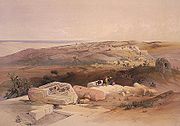 In 1516, Gaza—at the time, a small town with an inactive port, ruined buildings and reduced trade—was incorporated into the Ottoman Empire
. The Ottoman army quickly and efficiently crushed a small-scale uprising, and the local population generally welcomed as fellow Sunni Muslims. The city was then made the capital of Sanjak Gaza
, part of the larger Province of Damascus
. The Ridwan family, named after governor Ridwan Pasha, was the first dynasty to govern Gaza and would continue to rule the city for over a century. Under Ahmad ibn Ridwan
, the city became a cultural and religious center as a result of the partnership between the governor and prominent Islamic jurist Khayr al-Din al-Ramli
, who was based in the nearby town of al-Ramla.
Although no explanation is provided in the biographies of the Ridwan family, they chose Gaza as their home and the location of their castle, Qasr al-Basha
. Husayn Pasha, a member of the Ridwan family, inherited the impoverished governorship of Gaza in the 17th century. His period in office was peaceful and prosperous for Gaza and he gained a good reputation for considerably reducing the strife between the nearby Bedouins and the settled population. The Great Mosque was restored, and six other mosques constructed, while Turkish baths and market stalls proliferated. Anonymous petitions sent to Istanbul complaining about Husayn's failure to protect the Hajj
caravan, however, served as an excuse for the Ottoman government to depose him. After the death of Husayn's successors, Ottomans officials were appointed to govern in place of the Ridwans. The Ridwan period was Gaza's last golden age during Ottoman rule. After the family was removed from office, the city itself went into gradual decline.
Gaza was briefly occupied by the French Army
under Napoleon Bonaparte in 1799, but they abandoned the city after the failed siege of Acre
that same year. Starting in the early 19th century, Gaza was culturally dominated by neighboring Egypt; Muhammad Ali of Egypt
conquered Gaza and most of the south of Ottoman Syria
in 1832. American scholar Edward Robinson
visited Gaza in 1838, describing it as a "thickly populated" town larger than Jerusalem, with its Old City lying upon a hilltop, while its suburbs laid on the nearby plain. Gaza's port was inactive in the mid-19th century, however, the city benefited from trade and commerce because of its position on the caravan route between Egypt and northern Syria as well as from producing soap and cotton for trade with the Bedouin. Robinson noted that virtually all of Gaza's vestiges of ancient history and antiquity had disappeared due to constant conflict and occupation.
The Bubonic Plague struck again in 1839 and the city, lacking political and economic stability, went into a state of stagnation. In 1840, Egyptian and Ottoman troops battled outside of Gaza. The Ottomans won control of the territory, effectively ending Egyptian rule over southern Syria. However, the battles brought about more death and destruction in Gaza whilst the city was still recovering from the effects of the plague.
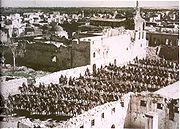 While leading the Allied Forces during World War I
, the British won control of the city during the Third Battle of Gaza
in 1917. After the war, Gaza was included in the British Mandate of Palestine. In the 1930s and 1940s, Gaza underwent major expansion. New neighborhoods were built along the coast and the southern and eastern plains. International organizations and missionary groups funded most of this construction. In the 1947 United Nations Partition Plan, Gaza was assigned to be part of an Arab state in western Palestine but was occupied by Egypt
following the 1948 Arab-Israeli War
. Gaza's growing population was augmented by an influx of refugees fleeing nearby cities, towns and villages that were captured by Israel. In 1957, Egyptian president Gamal Abdel Nasser
made a number of reforms in Gaza, which included expanding educational opportunities and the civil services, providing housing, and establishing local security forces.
Gaza was occupied by Israel during the 1967 Six-Day War
following the defeat of the Egyptian Army
. Frequent conflicts have erupted between Palestinians and the Israeli authorities in the city since the 1970s. The tensions lead to the First Intifada
in 1987. Gaza was a center of confrontation during this uprising, and economic conditions in the city worsened. In September 1993, leaders of Israel and the Palestine Liberation Organization
(PLO) signed the Oslo Accords
. The agreement called for Palestinian administration of the Gaza Strip and the West Bank
town of Jericho
, which was implemented in May 1994. Israeli forces withdrew from Gaza, leaving a new Palestinian National Authority
(PNA) to administer and police the city. The PNA, led by Yasser Arafat
, chose Gaza as its first provincial headquarters. The newly established Palestinian National Council
held its inaugural session in Gaza in March 1996. In 2005, Israel pulled out the troops occupying Gaza, along with thousands of Israelis who had settled in the territory.
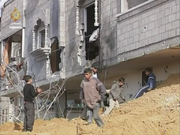 Since the Palestinian organization Hamas
won a surprise victory in the Palestinian elections of 2006, it has been engaged in a violent power struggle with its rival Palestinian organization Fatah
. In 2007, Hamas overthrew Fatah forces in the Gaza Strip and Hamas members were dismissed from the PNA government in the West Bank in response. Currently, Hamas has de facto control of the city and Strip.
In March 2008, a coalition of human rights groups charged that the Israeli blockade of the city had caused the humanitarian situation in Gaza to have reached its worst point since Israel occupied the territory in the 1967 Six-Day War, and that Israeli air strikes targeting militants in the densely populated areas have often killed bystanders as well. In 2008, Israel commenced an assault against Gaza
. Israel stated the strikes were in response to repetitive rocket and mortar attacks from the Gaza Strip into Israel since 2005, while the Palestinians stated that they were responding to Israel's military excursions and blockade of the Gaza Strip. In January 2009, Palestinian sources stated that at least 1,300 Palestinians were killed in the conflict. In April 2009, Israeli sources stated that at least 63-75% of the deaths were of men of combat age, based on the list of casualties published by the Palestinian Centre for Human Rights (PCHR), supplemented by Hamas and Fatah websites and official Palestinian government online sources.
. Much of the modern city is built along the plain below the hill, especially to the north and east, forming Gaza's suburbs. The beach and the port of Gaza are located 3 kilometres (1.9 mi) west of the city's nucleus and the space in between is entirely built up on low-lying hills.
Gaza is 78 kilometres (48.5 mi) southwest of Jerusalem, 71 kilometres (44.1 mi) south of Tel Aviv
, and 30 kilometres (18.6 mi) north of Rafah
. Surrounding localities include Beit Lahiya, Beit Hanoun
, and Jabalia
to the north, and the village of Abu Middein, the refugee camp of Bureij, and the city of Deir al-Balah to the south.
The municipal jurisdiction of the city today constitutes about 45 square kilometres (17.4 sq mi). In the British Mandate era, Gaza's urban or "built-up" area consisted of 7960 square kilometres (3,073.4 sq mi), while its rural area was 143063 square kilometres (55,236.9 sq mi). Irrigated land made up 24040 square kilometres (9,281.9 sq mi) and lands planted with cereals made up 117899 square kilometres (45,521.1 sq mi).
The population of Gaza depends on groundwater as the only source for drinking, agricultural use, and domestic supply. The nearest stream
is Wadi Ghazza to the south, sourced from Abu Middein along the coastline. It bears a small amount of water during the winter and virtually no water during the summer. Most of its water supply is diverted into Israel. The Gaza Aquifer along the coast is the main aquifer
in the Gaza Strip and it consists mostly of Pleistocene
sandstones. Like most of the Gaza Strip, Gaza is covered by quaternary soil; clay minerals in the soil absorb many organic and inorganic chemicals which has partially alleviated the extent of groundwater contamination.
A well-known hill southeast of Gaza, known as Tell al-Muntar, has an elevation of 270 feet (82.3 m) above sea level
. For centuries it has been claimed as the place to which Samson
brought the city gates of the Philistines. The hill is crowned by a Muslim shrine (maqam) dedicated to Ali al-Muntar ("Ali of the Watchtower"). There are old Muslim graves around the surrounding trees, and the lintel of the doorway of the maqam has two medieval Arabic scriptures.
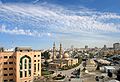 The Old City forms the main part of Gaza's nucleus. It is roughly divided into two quarters; the northern Daraj Quarter
(also known as the Muslim Quarter) and the southern Zaytoun Quarter (also known as the Christian Quarter). Most of the structures date from the Mamluk or Ottoman eras and some were built on top of earlier structures. The ancient part of the Old City is about 1.6 square kilometre (0.617763453748056 sq mi).
There are seven historic gates to the Old City: Bab Asqalan (Gate of Ashkelon), Bab al-Darum (Gate of Deir al-Balah), Bab al-Bahr (Gate of the Sea), Bab Marnas (Gate of Marnas), Bab al-Baladiyah (Gate of the Town), Bab al-Khalil (Gate of Hebron), and Bab al-Muntar (Gate of Tell al-Muntar). Some of the older buildings use the ablaq style of decoration which features red and white masonry, prevalent in the Mamluk era. A few of Gaza's main markets, such as the Gold Market
as well as the city's oldest mosque, the Great Mosque of Gaza
, are located here. In the Zaytoun Quarter lies the Church of Saint Porphyrius
, the Welayat Mosque
, and Hamam as-Sammara ("the Samaritan's Bathhouse").
Gaza is composed of eleven districts (hai) outside of the Old City. The first extension of Gaza beyond its city centre was the district of Shuja'iyya
, built on an eastern hill during the Ayyubid period of rule. In the 1930s and 1940s, a new spacial residential district, Rimal
, was constructed on the sand dunes west of the city center, and the district of Zeitoun
was built along Gaza's southern and southwestern borders, while Shuja'iyya expanded into the east to form the al-Judeide ("the New") and al-Turukman districts.
The areas between Rimal and the Old City became the districts of al-Sabra and al-Daraj. To the northwest is the district of al-Nasser, built in the early 1950s and named in honor of Egyptian president Gamal Abdel Nasser. To the northeast is the district of Tuffah, which is roughly divided into eastern and western halves. The district of Sheikh Radwan
is 3 kilometres (1.9 mi) to the north of the Old City and is named after Sheikh Radwan—the tomb of whom is located within the district. Gaza has absorbed the village of al-Qubbah near the border with Israel
, as well as the Palestinian refugee camp of al-Shati along the coast, although the latter is not under the city's municipal jurisdiction. In the late 1990s, the PNA built the more affluent neighborhood of Tel al-Hawa
along the southern edge of Rimal. Along the southern coast of the city is the neighborhood of Sheikh Ijlin.
According to Ottoman tax records in 1557, Gaza had 2,477 male tax payers. The statistics from 1596 show that the Muslims consisted of 456 household heads, 115 bachelors, 59 religious persons, and 19 disabled persons. In addition to the Muslim figure were 141 jundiyan or soldiers in the Ottoman army. Of the Christians there were 294 household heads and seven bachelors, while there were 73 Jewish household heads and eight Samaritan
household heads. In total, an estimated 6,000 people lived in Gaza, making it the third largest city in Ottoman Palestine after Jerusalem and Safad.
In 1838, there were roughly 4,000 Muslim and 100 Christian tax payers, implying a population of about 15,000 or 16,000—making it larger than Jerusalem at the time. The total number of Christian families was 57. Before the outbreak of World War I
, the population of Gaza had reached 42,000; however, the fierce battles between Allied Forces and those of the Ottomans and the Germans in 1917 in Gaza resulted in a massive population decrease.
According to a 1997 census by the Palestinian Central Bureau of Statistics
(PCBS), Gaza and the adjacent al-Shati camp had a population of 353,115 inhabitants, of which 50.9% were males and 49.1% females. Gaza had an overwhelmingly young population with more than half being between the ages of infancy to 19 (60.8%). About 28.8% were between the ages of 20 to 44, 7.7% between 45 and 64, and 3.9% were over the age of 64.
A significant number of Gaza's pre-1948 residents were Egyptians or their descendants who had fled political turmoil in Muhammad Ali's Egypt. A massive influx of Palestinian refugee
s swelled Gaza's population after the 1948 Arab-Israeli War. By 1967, the population had grown to about six times its 1948 size. In 1997, 51.8% of Gaza's inhabitants were refugees or their descendants. The city's population has continued to increase since that time to 449,221 in 2009, making it the largest city in the Palestinian territories
. Gaza has one of the highest overall growth rates and population densities in the world: 9,982.69/km² (26,424.76/mi²). Poverty, unemployment and poor living conditions are widespread and many residents rely on United Nations food aid to survive.
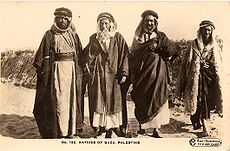
. While held by the Fatimids, Shia Islam was dominant in Gaza, but after Saladin conquered the city, he promoted a strictly Sunni religious and educational policy, which at the time was instrumental in uniting his Arab and Turkish
soldiers.
There exists a small minority of about 3,500 Palestinian Christian
s in the city. The majority of Gaza's Christians live in the Zaytoun Quarter of the Old City and belong to the Eastern Orthodox Church of Jerusalem, Roman Catholic
, and Baptist denominations. In 1906, there were only 750 Christians, of which 700 were Orthodox and 50 were Roman Catholic.
Gaza's Jewish community was roughly 3,000 years old, and in 1481 there were sixty Jewish households. Most of them left Gaza after the 1929 Palestine riots
, when they consisted of fifty families. In Sami Hadawi's land and population survey, Gaza had a population of 34,250, including 80 Jews in 1945. Most of them left the city after the 1948 War, due to mutual distrust between them and the Arab majority.
. Gaza's port was eclipsed by the ports of Jaffa and Haifa
, however, it retained its fishing fleet. Although its port was inactive, commerce thrived because of its strategic location. Most caravans and travelers coming from Egypt stopped in Gaza for supplies, likewise Bedouins from Ma'an
, east of the Wadi Araba, bought up all sorts of provisions from the city to sell to Muslim pilgrims coming from Mecca
. The bazaar
s of Gaza were well-supplied and were noted by Edward Robinson as "far better" than those of Jerusalem. Its principal commercial crop was cotton which was sold to the government and local Arab tribes.
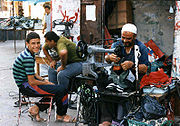 The major agricultural products are strawberries, citrus, dates, olives, flowers, and various vegetables. Pollution and massive population pressure on water have reduced the productive capacity of the surrounding farms, however.
Small-scale industries in the city include the production of plastics, construction materials, textiles, furniture, pottery, tiles, copperware, and carpets. Following the Oslo Accords, thousands of residents were employed in the various government ministries and security services, while others were employed by the UNRWA and other international organizations that support development of the city. Gaza contains some minor industries, including textiles and food processing. A variety of wares are sold in Gaza's street bazaars, including carpets, pottery, wicker furniture, and cotton clothing; the modern Gaza Mall
opened in July 2010.
There are a number of hotels in Gaza, including the Palestine, Grand Palace, Adam, al-Amal, al-Quds, Cliff, al-Deira
and Marna House. All, except the Palestine Hotel, are located along in the coastal Rimal
district. The United Nations
(UN) has a beach club on the same street. Gaza is not a frequent destination for tourists, and most foreigners who stay in hotels are journalists, aid workers, UN and Red Cross personnel. Upmarket hotels include the al-Quds and the al-Deira Hotel.
Many Gazans worked in the Israeli service industry when the border was open, but part of Israel's 2005 disengagement stipulated that Gazans will no longer be able to work in Israel and few Gazans are presently allowed to enter Israel. Gaza has serious deficiencies in housing, educational facilities, health facilities, infrastructure, and an inadequate sewage system, all of which have contributed to serious hygiene and public health problems.
According to a recent report by OXFAM
, unemployment in Gaza is close to 40% and is set to rise to 50%. The private sector which generates 53% of all jobs in Gaza has been devastated, businesses have been bankrupted and 75,000 out of 110,000 workers are now without a jobs. In 2008, 95% of Gaza's industrial operations were suspended due to lack of access inputs for production and the inability to export what is produced. In June 2005, there were 3,900 factories in Gaza employing 35,000 people, but by December 2007, there were just 195 remaining, employing only 1,700 people. The construction industry was paralyzed with tens of thousands of laborers out of work. The agriculture sector has also been damaged severely and nearly 40,000 workers who depend on cash crop
s now have no income.
Gaza's economic conditions have been stagnant in the long-term and most development indicators are in decline. Food prices have risen during the blockade, with wheat flour going up 34%, rice up 21%, and baby powder up 30%. The number of Gazans who live in absolute poverty has increased sharply, with 80% relying on humanitarian aid in 2008 compared to 63% in 2006. In 2007, households spent an average of 62% of their total income on food, compared to 37% in 2004. In less than a decade, the number of families depending on UNRWA food aid has increased tenfold.
. A two-story building with a triangular plan, the cultural centers performs three main functions: a meeting place for large gatherings during annual festivals, a place to stage exhibitions, and a library. The French Cultural Center is a symbol of French
partnership and cooperation in Gaza. It holds art exhibits, concerts, film screenings, and other activities. Whenever possible, French artists are invited to display their artwork, and more frequently, Palestinian artists from the Gaza Strip and the West Bank are invited to participate in art competitions.
Established in 1998, the Arts and Crafts Village is a children's cultural center with the objectives of promoting comprehensive, regular and periodic documentation of creative art in all of its forms. It interacted on a large scale with a class of artists from different nationalities and organized around 100 exhibitions for creative art, ceramics, graphics, carvings and others. Nearly 10,000 children from throughout the Gaza Strip have benefited from the Arts and Crafts Village.
Gaza has one film theater, the Gaza Theater, which opened in 2004 using donated equipment and movies from Norway
. The theater is not properly equipped and does not receive much funding from the PNA, depending mostly on donations from foreign aid agencies. The Qattan Foundation, a Palestinian art
s charity, runs several workshops throughout Gaza that helps the local youth find artistic skills and give teachers basic drama skills. In 2005, the Gaza Theater Festival was held, playing in makeshift venues, although no foreign theater companies attended, as well as any company from the West Bank or Israel's Arab community
.
The Gaza Museum of Archaeology
, founded by Jawdat N. Khoudary, was opened in the summer of 2008. The exhibition is in a hall made partly of stones from old houses, discarded wood ties of a former railroad, and bronze lamps and marble columns uncovered by Gazan fishermen and construction workers. The museum collection features thousands of items, but some will not go on display, including a statue of a full-breasted Aphrodite
in a diaphanous gown, images of other ancient deities and oil lamps featuring menorahs.
The Crazy Water Park
was built in 2010, but shortly the water park was burned down by a group of about 40 masked individuals in a move that was seen by human rights groups as part of the increasing Islamization of Gaza.
. Many of the traditional dishes rely on clay pot cooking
, which preserves the flavor and texture of the vegetables and results in fork-tender meat. Traditionally, most Gazan dishes are seasonal and rely on ingredients indigenous to the area and its surrounding villages. Poverty has also played an important role in determining many of the city's simple meatless dishes and stews, such as saliq wa adas ("chard and lentils") and bisara (skinless fava beans mashed with dried mulukhiya leaves and chilies).
Seafood is a key aspect of Gaza life and a local staple, but in recent years, due to Israeli restrictions on Palestinian fishing zones off Gaza’s coast, the industry has been in decline, and seafood prices have skyrocketed. Some well-known seafood dishes include zibdiyit gambari, literally, "shrimps in a clay pot", and shatta which are crabs stuffed with red hot chili pepper dip, then baked in the oven. Fish is either fried or grilled after being stuffed with cilantro, garlic, chillies and cumin, and marinated with various spices. It is also a key ingredient in sayyadiya, rice cooked with caramelized onions, a generous amount of whole garlic cloves, large chunks of well-marinated fried fish, and spices such as turmeric, cinnamon, and cumin.
Many of the 1948-era refugees were fellahin ("peasants") who would rely on eating seasonally, based on what they grew and these refugees highly influenced the basic cuisine of Gaza. Due to its geographic isolation from the rest of Palestine, as a result of decades of occupation, many of its dishes have not been heard of outside of Gaza. One of the most popular dishes is called sumaghiyyeh
.
Gaza has several restaurants, most of the well-known located in the posh Rimal
district. Al-Andalus, which specializes in fish and seafood, is particularly popular with tourists, as are al-Sammak and the upscale Roots Club
. Throughout the Old City there are street stalls that sell cooked beans, hummus, roasted sweet potatoes, falafel, and kebabs. Coffeehouses (qahwa) regularly accommodate locals with hookah
(sheesha), Arabic coffee
, and tea. Gaza's well-known sweet shops, Saqqala and Arafat, sell common Arab sweet products and are located off Wehda Street
. Alcohol is a rarity, found only in the United Nations Beach Club.
is reputed to have originated in Gaza. Cloth for the Gaza thob was often woven at nearby Majdal (Ascalon
). Black or blue cottons or striped pink and green fabric that had been made in Majdal continued to be woven throughout the Gaza Strip
by refugees from the coastal plain villages until the 1960s. Thobs here had narrow, tight, straight sleeves. Embroidery was much less dense than that applied in Hebron. The most popular motifs included: scissors (muqass), combs (mushut) and triangles (hijab) often arranged in clusters of fives, sevens and threes, as the use of odd numbers is considered in Arab folklore
to be effective against the evil eye
.
In recent decades, Hamas
and other Islamic movements sought to increase the use of the hijab
("headscarf") among Gazan women, especially urban and educated women, and the hijab styles since introduced have varied according to class and group identity.
, the Palestinian national stadium, is located in Gaza and has a capacity for 10,000 people. It serves as the home of the Palestine national football team
, but after an Israeli air strike that severely damaged the stadium's field, home games have been played in Doha
, Qatar
. Gaza has several local football teams that participate in the Gaza Strip League
. They include Khidmat al-Shatia (al-Shati Camp), Ittihad al-Shuja'iyya (Shuja'iyya neighborhood), Gaza Sports Club, and al-Zeitoun (Zeitoun neighborhood).
. It contains the Palestinian Legislative Council
building, as well as the headquarters of most of the Palestinian Authority ministries.
The first municipal council of Gaza was formed in 1893 under the chairmanship of Ali Khalil Shawa. Modern mayorship, however, began in 1906 with his son Said al-Shawa
, who was appointed mayor by the Ottoman Authorities. Al-Shawa oversaw the construction of Gaza's first hospital, several new mosques and schools, the restoration of the Great Mosque, and the introduction of the modern plow to the city.
On July 24, 1994, the PNA proclaimed Gaza the first city council
in the Palestinian territories
. The 2005 Palestinian municipal elections were not held in Gaza, nor in Khan Yunis
or Rafah. Instead, Fatah
party officials selected the smaller cities, towns, and villages to hold elections, assuming they would do better in less urban areas. The rival Hamas
party, however, won the majority of seats in seven of the ten municipalities selected for the first round with voter turnout being around 80%. 2007 saw violent clashes between the two parties that left over 100 dead, ultimately resulting in Hamas taking over the city. Normally, Palestinian municipalities with populations over 20,000 and that serve as administrative centers have municipal councils consisting of fifteen members, including the mayor. The current municipal council of Gaza, however, consists of fourteen members, including the mayor, Rafiq al-Makki.
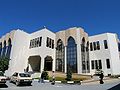 According to the PCBS, in 1997, approximately over 90% of Gaza's population over the age of 10 was literate. Of the city's population, 140,848 were enrolled in schools (39.8% in elementary school, 33.8% in secondary school, and 26.4% in high school). About 11,134 people received bachelor diplomas or higher diplomas.
In 2006, there were 210 schools in Gaza; 151 were run by the Education Ministry of the Palestinian National Authority
, 46 were run by the United Nations Relief and Works Agency, and 13 were private schools. A total of 154,251 students were enrolled and 5,877 teachers were employed. The currently downtrodden economy has affected education in the Gaza Strip severely. In September 2007, a UNRWA survey in the Gaza Strip revealed that there was a nearly 80% failure rate in schools grades four to nine, with up to 90% failure rates in mathematics. In January 2008, the United Nations Children's Fund
reported that schools in Gaza had been canceling classes that were high on energy consumption, such as information technology
, science labs and extra curricular activities.
Gaza has four universities: al-Azhar University – Gaza, al-Quds Open University
, al-Aqsa University
and the Islamic University of Gaza
. The Islamic University, consisting of ten facilities, was founded by Ahmed Yassin
and a group of businessmen in 1978, making it the first institution of higher education in Gaza. In 2006–07, it had an enrollment of 20,021 students. Al-Azhar is generally secular and was founded in 1992. Al-Aqsa University was established in 1991. Al-Quds Open University established its Gaza Educational Region campus in 1992 in a rented building in the center of the city originally with 730 students. Because of the rapid increase of the number of students, it constructed the first university owned building in the Nasser District. In 2006–07, it had an enrollment of 3,778 students.
The Public Library of Gaza is located off al-Wahda Street and has a collection of nearly 10,000 books in Arabic
, English
and French
. A total area of about 1410 square metres (1,686.3 sq yd), the building consists of two floors and a basement. The library was opened in 1999 after cooperation dating from 1996 by Gaza under mayor Aoun Shawa, the municipality of Dunkerque, and the World Bank
. The library's primary objectives are to provide sources of information that meets the needs of beneficiaries, provide necessary facilities for access to available information sources, and organizing various cultural programs such as, cultural events, seminars, lectures, film presentations, videos, art and book exhibitions.
in the Old City. Originally a pagan temple, it was consecrated a Greek Orthodox church by the Byzantines, then a mosque in the 8th century by the Arabs. The Crusaders transformed it into a church, but it was reestablished as a mosque soon after Gaza's reconquest by the Muslims. It is the oldest and largest in the Gaza Strip
and was identified as the "only structure of historical importance" in the city by some 19th century Western travelers.
Other mosques in the Old City include the Mamluk-era Sayed Hashem Mosque that believed to house the tomb of Hashem ibn Abd al-Manaf in its dome. There is also the nearby Welayat Mosque
that dates back to 1334. In Shuja'iyya
, the Ibn Uthman Mosque
was built by Nablus native Ahmad ibn Uthman in 1402 and the Ibn Marwan Mosque
, housing the tomb of a holy man, was built in 1324.
The Unknown Soldier's Square, located in Rimal
, is a monument dedicated to an unknown Palestinian fighter who died in the 1948 War. In 1967, the monument was torn down by Israeli forces and remained a patch of sand, until a public garden was built there with funding from Norway
. Qasr al-Basha
, originally a Mamluk-era villa that was used by Napoleon during his brief sojourn in Gaza, is located in the Old City and is today a girl's school. The Commonwealth Gaza War Cemetery, often referred to as the British War Cemetery, that contains the graves of fallen Allied soldiers in World War I is in the Tuffah neighborhood.
, 98.1% of Gaza's residents were connected to the public water supply while the remainder used a private system. About 87.6% were connected to a public sewage system and 11.8% used a cesspit.
The blockade on Gaza has severely restricted the water supply to the city and its sewage system. The six main wells for drinking water no longer function, and roughly 50% of the population is without access to water on a regular basis. The municipality claims it is forced to pump water to the citizens through "salty wells" because of the unavailability of electricity in some of the wells fails to meet the needs of the citizens. Most sewage plants struggle to work, and more than 75% of the untended sewage in the city, has periodically led to a rash of waste water to the homes of residents. About 20 million liters of raw sewage and 40 million liters of partially treated water per day leak to the Mediterranean Sea due to the lack of electricity, fuel and spare parts at Gaza's treatment plants. The municipality claims that accumulation of garbage in the streets, roads, wells, and sewage overflow cause the risk of disease outbreaks and insect epidemics, as well as mice and in residential areas.
("the Cure") founded in the Rimal District by the British Mandate government in the 1940s. Housed in an army barracks, it originally provided quarantine and treatment for febrile diseases. When Egypt administered Gaza, this original department was relocated and al-Shifa became the city's central hospital. When Israel withdrew from the Gaza Strip after occupying it in the 1956 Suez Crisis, Egyptian president Gamal Abdel Nasser
had al-Shifa hospital expanded and improved. He also ordered the establishment of a second hospital in the Nasser District with the same name. In 1957, the quarantine and febrile disease hospital was rebuilt and named Nasser Hospital. Today, al-Shifa remains Gaza's largest medical complex.
Throughout the late 1950s, a new health administration, Bandar Gaza ("Gaza Region"), was established and headed by Haidar Abdel-Shafi
. Bandar Gaza rented several rooms throughout the city to set up government clinics, but they were fairly basic, just providing essential curative care
.
The Ahli Arab Hospital, originally founded in 1907 by the Church Missionary Society (CMS), was destroyed in World War I. It was rebuilt as the Southern Baptist Hospital in the 1950s. In 1982, the Episcopal Diocese of Jerusalem took leadership and the original name was restored. Al-Quds Hospital, located in the Tel al-Hawa
neighborhood and managed by the Palestine Red Crescent Society
, is the second largest hospital in Gaza.
As a result of fuel and electricity restrictions, hospitals currently experience power cuts lasting for 8–12 hours daily. There is currently a 60-70 percent shortage reported in the diesel required for power generators. According to the World Health Organisation (WHO), the proportion of patients given permits to exit Gaza for medical care decreased from 89.3% in January 2007 to 64.3% in December 2007, an unprecedented low.
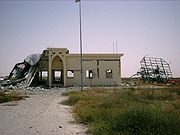 The Rasheed Coastal Road runs along Gaza's coastline and connects it with the rest of Gaza Strip's coastline north and south. The main road of the Gaza Strip, Salah ad-Din Street
(the modern Via Maris
) runs through the middle of Gaza City, connecting it with Deir al-Balah, Khan Yunis
, and Rafah in the south and Jabalia
and Beit Hanoun
in the north. The northern crossing of Salah ad-Din Street into Israel is the Erez Crossing
and the crossing into Egypt is the Rafah Crossing. The crossings have been closed by Israel and Egypt since 2007.
Omar Mukhtar Street
is the main road in the city of Gaza running north-south, branching off Salah ad-Din Street, stretching from the Rimal coastline and the Old City where it ends at the Gold Market
. Prior to the Blockade of the Gaza Strip, there existed regular lines of collective taxis to Ramallah
and Hebron
in the West Bank
.
The Yasser Arafat International Airport
near Rafah
opened in 1998 and is 40 kilometres (24.9 mi) south of Gaza. But its runways and facilities were significantly damaged during the Second Intifada. The Ben Gurion International Airport
in Israel is located roughly 75 kilometres (46.6 mi) northeast of the city.
with:
Palestinian people
The Palestinian people, also referred to as Palestinians or Palestinian Arabs , are an Arabic-speaking people with origins in Palestine. Despite various wars and exoduses, roughly one third of the world's Palestinian population continues to reside in the area encompassing the West Bank, the Gaza...
city in the Gaza Strip
Gaza Strip
thumb|Gaza city skylineThe Gaza Strip lies on the Eastern coast of the Mediterranean Sea. The Strip borders Egypt on the southwest and Israel on the south, east and north. It is about long, and between 6 and 12 kilometres wide, with a total area of...
, with a population of about 450,000, making it the largest city in the Palestinian territories
Palestinian territories
The Palestinian territories comprise the West Bank and the Gaza Strip. Since the Palestinian Declaration of Independence in 1988, the region is today recognized by three-quarters of the world's countries as the State of Palestine or simply Palestine, although this status is not recognized by the...
.
Inhabited since at least the 15th century BC,
Gaza has been dominated by several different peoples and empires throughout its history. The Philistines
Philistines
Philistines , Pleshet or Peleset, were a people who occupied the southern coast of Canaan at the beginning of the Iron Age . According to the Bible, they ruled the five city-states of Gaza, Askelon, Ashdod, Ekron and Gath, from the Wadi Gaza in the south to the Yarqon River in the north, but with...
made it a part of their pentapolis
Pentapolis
A pentapolis, from the Greek words , "five" and , "city" is a geographic and/or institutional grouping of five cities...
after the Ancient Egypt
Ancient Egypt
Ancient Egypt was an ancient civilization of Northeastern Africa, concentrated along the lower reaches of the Nile River in what is now the modern country of Egypt. Egyptian civilization coalesced around 3150 BC with the political unification of Upper and Lower Egypt under the first pharaoh...
ians had ruled it for nearly 350 years. Under the Romans
Roman Empire
The Roman Empire was the post-Republican period of the ancient Roman civilization, characterised by an autocratic form of government and large territorial holdings in Europe and around the Mediterranean....
and later the Byzantines
Byzantine Empire
The Byzantine Empire was the Eastern Roman Empire during the periods of Late Antiquity and the Middle Ages, centred on the capital of Constantinople. Known simply as the Roman Empire or Romania to its inhabitants and neighbours, the Empire was the direct continuation of the Ancient Roman State...
, Gaza experienced relative peace and its port flourished. In 635 AD, it became the first city in Palestine
Palestine
Palestine is a conventional name, among others, used to describe the geographic region between the Mediterranean Sea and the Jordan River, and various adjoining lands....
to be conquered by the Rashidun army
Rashidun army
The Rashidun Caliphate Army or Rashidun army was the primary military body of the Rashidun Caliphate's armed forces during the Muslim conquests of the 7th century, serving alongside the Rashidun Navy...
and quickly developed into a centre of Islamic law
Fiqh
Fiqh is Islamic jurisprudence. Fiqh is an expansion of the code of conduct expounded in the Quran, often supplemented by tradition and implemented by the rulings and interpretations of Islamic jurists....
. However, by the time the Crusaders
Crusades
The Crusades were a series of religious wars, blessed by the Pope and the Catholic Church with the main goal of restoring Christian access to the holy places in and near Jerusalem...
invaded the city, it was in ruins. In later centuries, Gaza experienced several hardships—from Mongol
Mongol Empire
The Mongol Empire , initially named as Greater Mongol State was a great empire during the 13th and 14th centuries...
raids to floods and locusts, reducing it to a village by the 16th century when it was incorporated into the Ottoman Empire
Ottoman Empire
The Ottoman EmpireIt was usually referred to as the "Ottoman Empire", the "Turkish Empire", the "Ottoman Caliphate" or more commonly "Turkey" by its contemporaries...
. During the first half of Ottoman rule, the Ridwan dynasty controlled Gaza and under them the city went through an age of great commerce and peace.
Throughout its history, Gaza has never been self-ruled or independent. Gaza fell to British forces
British Army
The British Army is the land warfare branch of Her Majesty's Armed Forces in the United Kingdom. It came into being with the unification of the Kingdom of England and Scotland into the Kingdom of Great Britain in 1707. The new British Army incorporated Regiments that had already existed in England...
during World War I
World War I
World War I , which was predominantly called the World War or the Great War from its occurrence until 1939, and the First World War or World War I thereafter, was a major war centred in Europe that began on 28 July 1914 and lasted until 11 November 1918...
, becoming a part of the British Mandate of Palestine. As a result of the 1948 Arab-Israeli War
1948 Arab-Israeli War
The 1948 Arab–Israeli War, known to Israelis as the War of Independence or War of Liberation The war commenced after the termination of the British Mandate for Palestine and the creation of an independent Israel at midnight on 14 May 1948 when, following a period of civil war, Arab armies invaded...
, Egypt
Egypt
Egypt , officially the Arab Republic of Egypt, Arabic: , is a country mainly in North Africa, with the Sinai Peninsula forming a land bridge in Southwest Asia. Egypt is thus a transcontinental country, and a major power in Africa, the Mediterranean Basin, the Middle East and the Muslim world...
administered the newly formed Gaza Strip territory and several improvements were undertaken in the city. Gaza was captured by Israel
Israel
The State of Israel is a parliamentary republic located in the Middle East, along the eastern shore of the Mediterranean Sea...
in the Six-Day War
Six-Day War
The Six-Day War , also known as the June War, 1967 Arab-Israeli War, or Third Arab-Israeli War, was fought between June 5 and 10, 1967, by Israel and the neighboring states of Egypt , Jordan, and Syria...
in 1967, but in 1993, the city was transferred to the Palestinian National Authority. Following the 2006 election, conflict
Fatah-Hamas conflict
The Fatah–Hamas conflict , also referred to as the Palestinian Civil War , and the Conflict of Brothers , i.e...
broke out as the Fatah
Fatah
Fataḥ is a major Palestinian political party and the largest faction of the Palestine Liberation Organization , a multi-party confederation. In Palestinian politics it is on the left-wing of the spectrum; it is mainly nationalist, although not predominantly socialist. Its official goals are found...
party seemed unwilling to transfer power to Hamas
Hamas
Hamas is the Palestinian Sunni Islamic or Islamist political party that governs the Gaza Strip. Hamas also has a military wing, the Izz ad-Din al-Qassam Brigades...
, resulting in Hamas taking power in Gaza by force. Egypt and Israel imposed a blockade on the Gaza Strip following 2006 Hamas cross-border raid
2006 Hamas cross-border raid
The 2006 Hamas cross-border raid was a cross-border raid which was carried out on June 25, 2006 in which a Palestinian militant squad thought to consist of 7 to 8 militants managed to cross the border through an underground tunnel near the Kerem Shalom Crossing and attack Israel Defense Forces ...
. Israel eased the blockade allowing consumer goods in June 2010, and Egypt reopened the Rafah border crossing in 2011 for persons.
The primary economic activities of Gaza are small-scale industries, agriculture and labor. However, the economy has been devastated by the blockade and recurring conflicts. Most of Gaza's inhabitants adhere to Islam
Islam
Islam . The most common are and . : Arabic pronunciation varies regionally. The first vowel ranges from ~~. The second vowel ranges from ~~~...
, although there exists a Christian
Christian
A Christian is a person who adheres to Christianity, an Abrahamic, monotheistic religion based on the life and teachings of Jesus of Nazareth as recorded in the Canonical gospels and the letters of the New Testament...
minority. Gaza has a very young population with roughly 75% being under the age of 25, and today the city has one of the highest population densities in the world.
Etymology
According to Israeli geographer, Zev VilnayZev Vilnay
Zev Vilnay was an Israeli geographer, author and lecturer.-Biography:Zev Vilnay was born in Kishinev. He moved to Palestine with his parents at the age of six and grew up in Haifa. He served as a military topographer in the Haganah, and later in the Israel Defense Forces. Vilnay and his wife...
, the name "Gaza," from the Arabic "Ġazza", originally derives from the Canaanite/Hebrew root for "strong" (ʿzz), and was introduced to Arabic by way of the Hebrew
Hebrew language
Hebrew is a Semitic language of the Afroasiatic language family. Culturally, is it considered by Jews and other religious groups as the language of the Jewish people, though other Jewish languages had originated among diaspora Jews, and the Hebrew language is also used by non-Jewish groups, such...
, ( Azza ˈ(ʕ)aza), i.e. "the strong one (f.)"; cpr. English stronghold. According to Mariam Shahin, the Canaanites gave Gaza its name, the Ancient Egypt
Ancient Egypt
Ancient Egypt was an ancient civilization of Northeastern Africa, concentrated along the lower reaches of the Nile River in what is now the modern country of Egypt. Egyptian civilization coalesced around 3150 BC with the political unification of Upper and Lower Egypt under the first pharaoh...
ians called it "Ghazzat" ("prized city"), and the ancient Arabs often referred to it as "Ghazzat Hashim", in honor of Hashim
Hashim ibn Abd Manaf
Hashim ibn 'Abd Manaf was the great-grandfather of the Islamic prophet Muhammad and the progenitor of the Banu Hashim clan of the distinguished Quraish tribe in Mecca....
, the great-grandfather of Muhammad
Muhammad
Muhammad |ligature]] at U+FDF4 ;Arabic pronunciation varies regionally; the first vowel ranges from ~~; the second and the last vowel: ~~~. There are dialects which have no stress. In Egypt, it is pronounced not in religious contexts...
, who is buried in the city, according to Islamic lore.
History
Gaza's history of habitation dates back 5,000 years, making it one of the oldest cities in the world. Located on the Mediterranean coastal routeVia Maris
Via Maris is the modern name for an ancient trade route, dating from the early Bronze Age, linking Egypt with the northern empires of Syria, Anatolia and Mesopotamia — modern day Iran, Iraq, Turkey and Syria....
between North Africa and the Levant
Levant
The Levant or ) is the geographic region and culture zone of the "eastern Mediterranean littoral between Anatolia and Egypt" . The Levant includes most of modern Lebanon, Syria, Jordan, Israel, the Palestinian territories, and sometimes parts of Turkey and Iraq, and corresponds roughly to the...
, for most of its history it served as a key entrepôt
Entrepôt
An entrepôt is a trading post where merchandise can be imported and exported without paying import duties, often at a profit. This profit is possible because of trade conditions, for example, the reluctance of ships to travel the entire length of a long trading route, and selling to the entrepôt...
of the southern Levant and an important stopover on the spice trade
Spice trade
Civilizations of Asia were involved in spice trade from the ancient times, and the Greco-Roman world soon followed by trading along the Incense route and the Roman-India routes...
route traversing the Red Sea
Red Sea
The Red Sea is a seawater inlet of the Indian Ocean, lying between Africa and Asia. The connection to the ocean is in the south through the Bab el Mandeb strait and the Gulf of Aden. In the north, there is the Sinai Peninsula, the Gulf of Aqaba, and the Gulf of Suez...
.
Bronze Age
Settlement in the region of Gaza dates back to Tell es-SakanTell es-Sakan
Tell es-Sakan was an important ancient Egyptian maritime settlement during the early Bronze Age, situated at the mouth of wadi Ghazzeh. Its geographical situation endowed it with a position of importance at the crossroads on the land based trade routes to Arabia, the Egyptian empire to the south...
, an Ancient Egyptian fortress built in Canaan
Canaan
Canaan is a historical region roughly corresponding to modern-day Israel, Palestine, Lebanon, and the western parts of Jordan...
ite territory to the south of present-day Gaza. The site went into decline throughout the Early Bronze Age II as its trade with Egypt sharply decreased. Another urban centre known as Tell al-Ajjul began to grow along the Wadi Ghazza riverbed. During the Middle Bronze Age, a revived Tell es-Sakan
Tell es-Sakan
Tell es-Sakan was an important ancient Egyptian maritime settlement during the early Bronze Age, situated at the mouth of wadi Ghazzeh. Its geographical situation endowed it with a position of importance at the crossroads on the land based trade routes to Arabia, the Egyptian empire to the south...
became the southernmost locality in Canaan, serving as a fort. In 1650 BC, when the Canaanite Hyksos
Hyksos
The Hyksos were an Asiatic people who took over the eastern Nile Delta during the twelfth dynasty, initiating the Second Intermediate Period of ancient Egypt....
occupied Egypt, a second city developed on the ruins of the first Tell as-Sakan. However, it was abandoned by the 14th century BC, at the end of the Bronze Age.
Ancient period
Gaza later served as Egypt’s administrative capital in CanaanCanaan
Canaan is a historical region roughly corresponding to modern-day Israel, Palestine, Lebanon, and the western parts of Jordan...
. During the reign of Tuthmosis III, the city became a stop on the Syrian-Egyptian caravan route and was mentioned in the Amarna letters
Amarna letters
The Amarna letters are an archive of correspondence on clay tablets, mostly diplomatic, between the Egyptian administration and its representatives in Canaan and Amurru during the New Kingdom...
as "Azzati". Gaza remained under Egyptian control for 350 years until it was conquered by the Philistines in the 12th century BC, becoming a part of their "pentapolis
Pentapolis
A pentapolis, from the Greek words , "five" and , "city" is a geographic and/or institutional grouping of five cities...
". According to the Book of Judges
Book of Judges
The Book of Judges is the seventh book of the Hebrew bible and the Christian Old Testament. Its title describes its contents: it contains the history of Biblical judges, divinely inspired prophets whose direct knowledge of Yahweh allows them to act as decision-makers for the Israelites, as...
, Gaza was the place where Samson
Samson
Samson, Shimshon ; Shamshoun or Sampson is the third to last of the Judges of the ancient Israelites mentioned in the Tanakh ....
was imprisoned by the Philistines and met his death.
After being ruled by the Israelite
Israelite
According to the Bible the Israelites were a Hebrew-speaking people of the Ancient Near East who inhabited the Land of Canaan during the monarchic period .The word "Israelite" derives from the Biblical Hebrew ישראל...
s, Assyrians, and then the Egyptians, Gaza achieved relative independence and prosperity under the Persian Empire. Alexander the Great besieged Gaza, the last city to resist his conquest on his path to Egypt, for five months before finally capturing it 332 BC; the inhabitants were either killed or taken captive. Alexander brought in local Bedouins to populate Gaza and organized the city into a polis
Polis
Polis , plural poleis , literally means city in Greek. It could also mean citizenship and body of citizens. In modern historiography "polis" is normally used to indicate the ancient Greek city-states, like Classical Athens and its contemporaries, so polis is often translated as "city-state."The...
(or "city-state
City-state
A city-state is an independent or autonomous entity whose territory consists of a city which is not administered as a part of another local government.-Historical city-states:...
"). Greek culture consequently took root and Gaza earned a reputation as a flourishing center of Hellenic
Hellenistic period
The Hellenistic period or Hellenistic era describes the time which followed the conquests of Alexander the Great. It was so named by the historian J. G. Droysen. During this time, Greek cultural influence and power was at its zenith in Europe and Asia...
learning and philosophy.
Gaza experienced another siege in 96 BC by the Hasmonean
Hasmonean
The Hasmonean dynasty , was the ruling dynasty of Judea and surrounding regions during classical antiquity. Between c. 140 and c. 116 BCE, the dynasty ruled semi-autonomously from the Seleucids in the region of Judea...
king Alexander Jannaeus
Alexander Jannaeus
Alexander Jannaeus was king of Judea from 103 BC to 76 BC. The son of John Hyrcanus, he inherited the throne from his brother Aristobulus I, and appears to have married his brother's widow, Shlomtzion or "Shelomit", also known as Salome Alexandra, according to the Biblical law of Yibbum...
who "utterly overthrew" the city, killing 500 senators who had fled into the temple of Apollo
Apollo
Apollo is one of the most important and complex of the Olympian deities in Greek and Roman mythology...
for safety. Josephus
Josephus
Titus Flavius Josephus , also called Joseph ben Matityahu , was a 1st-century Romano-Jewish historian and hagiographer of priestly and royal ancestry who recorded Jewish history, with special emphasis on the 1st century AD and the First Jewish–Roman War, which resulted in the Destruction of...
notes that Gaza was resettled under the rule of Herod Antipas
Herod Antipas
Herod Antipater , known by the nickname Antipas, was a 1st-century AD ruler of Galilee and Perea, who bore the title of tetrarch...
, who cultivated friendly relations with Gazans, Ascalonites
Ashkelon
Ashkelon is a coastal city in the South District of Israel on the Mediterranean coast, south of Tel Aviv, and north of the border with the Gaza Strip. The ancient seaport of Ashkelon dates back to the Neolithic Age...
and neighboring Arabs after being appointed governor of Idumea by Jannaeus. Rebuilt after it was incorporated into the Roman Empire
Roman Empire
The Roman Empire was the post-Republican period of the ancient Roman civilization, characterised by an autocratic form of government and large territorial holdings in Europe and around the Mediterranean....
in 63 BC under the command of Pompey Magnus, Gaza then became a part of the Roman province of Judaea. It was targeted by the Jews during their rebellion against Roman rule in 66 and was partially destroyed. It nevertheless remained an important city, even more so after the destruction of Jerusalem.
Throughout the Roman period, Gaza was a prosperous city and received grants and attention from several emperors. A 500-member senate governed Gaza, and a diverse variety of Philistines, Greeks, Romans, Canaanites, Phoenicia
Phoenicia
Phoenicia , was an ancient civilization in Canaan which covered most of the western, coastal part of the Fertile Crescent. Several major Phoenician cities were built on the coastline of the Mediterranean. It was an enterprising maritime trading culture that spread across the Mediterranean from 1550...
ns, Jews, Egyptians, Persians, and Bedouin populated the city. Gaza's mint issued coins adorned with the busts of gods and emperors. During his visit in 130 AD, Emperor Hadrian
Hadrian
Hadrian , was Roman Emperor from 117 to 138. He is best known for building Hadrian's Wall, which marked the northern limit of Roman Britain. In Rome, he re-built the Pantheon and constructed the Temple of Venus and Roma. In addition to being emperor, Hadrian was a humanist and was philhellene in...
personally inaugurated wrestling, boxing, and oratorical competitions in Gaza's new stadium, which became known from Alexandria
Alexandria
Alexandria is the second-largest city of Egypt, with a population of 4.1 million, extending about along the coast of the Mediterranean Sea in the north central part of the country; it is also the largest city lying directly on the Mediterranean coast. It is Egypt's largest seaport, serving...
to Damascus
Damascus
Damascus , commonly known in Syria as Al Sham , and as the City of Jasmine , is the capital and the second largest city of Syria after Aleppo, both are part of the country's 14 governorates. In addition to being one of the oldest continuously inhabited cities in the world, Damascus is a major...
. The city was adorned with many pagan temples; the main cult being that of Marnas. Other temples were dedicated to Zeus
Zeus
In the ancient Greek religion, Zeus was the "Father of Gods and men" who ruled the Olympians of Mount Olympus as a father ruled the family. He was the god of sky and thunder in Greek mythology. His Roman counterpart is Jupiter and his Etruscan counterpart is Tinia.Zeus was the child of Cronus...
, Helios
Helios
Helios was the personification of the Sun in Greek mythology. Homer often calls him simply Titan or Hyperion, while Hesiod and the Homeric Hymn separate him as a son of the Titans Hyperion and Theia or Euryphaessa and brother of the goddesses Selene, the moon, and Eos, the dawn...
, Aphrodite
Aphrodite
Aphrodite is the Greek goddess of love, beauty, pleasure, and procreation.Her Roman equivalent is the goddess .Historically, her cult in Greece was imported from, or influenced by, the cult of Astarte in Phoenicia....
, Apollo
Apollo
Apollo is one of the most important and complex of the Olympian deities in Greek and Roman mythology...
, Athene and the local Tyche. Christianity
Christianity
Christianity is a monotheistic religion based on the life and teachings of Jesus as presented in canonical gospels and other New Testament writings...
began to spread throughout Gaza in 250 AD, last in the port of Maiuma
Port of Gaza
-History:In antiquity, Gaza was the principal port city on the Mediterranean that served the Incense Road. It was originally known as "Maioumas," which is linked to a licentious pagan festival. The Port of Gaza was at the end of the Nabataean spice road...
. Conversion to Christianity in Gaza was accelerated under Saint Porphyrius
Porphyry of Gaza
Saint Porphyry , Bishop of Gaza 395–420, known from the account in his Life for Christianizing the recalcitrant pagan city of Gaza, and demolishing its temples.Porphyry of Gaza is known to us only from the vivid biography by Mark the Deacon...
between 396 and 420. In 402, Theodosius II ordered all eight of the city's pagan temples destroyed, and four years later Empress Aelia Eudocia
Aelia Eudocia
Aelia Eudocia Augusta was the wife of Theodosius II, and a prominent historical figure in understanding the rise of Christianity during the beginning of the Byzantine Empire. Eudocia lived in a world where Greek paganism and Christianity were still coming together...
commissioned the construction of a church atop the ruins of the Temple of Marnas. It was during this era that the Neoplatonic philosopher, then Christian, Aeneas of Gaza
Aeneas of Gaza
Aeneas of Gaza was a Neo-Platonic philosopher, a convert to Christianity, who flourished towards the end of the fifth century. In a dialogue entitled Theophrastus he alludes to Hierocles of Alexandria as his teacher, and in some of his letters mentions as his contemporaries writers whom we know to...
called Gaza, his town, "the Athens
Athens
Athens , is the capital and largest city of Greece. Athens dominates the Attica region and is one of the world's oldest cities, as its recorded history spans around 3,400 years. Classical Athens was a powerful city-state...
of Asia". Following the division of the Roman Empire in the 3rd century BC, Gaza remained under control of the Eastern Roman Empire that in turn became the Byzantine Empire
Byzantine Empire
The Byzantine Empire was the Eastern Roman Empire during the periods of Late Antiquity and the Middle Ages, centred on the capital of Constantinople. Known simply as the Roman Empire or Romania to its inhabitants and neighbours, the Empire was the direct continuation of the Ancient Roman State...
. The city prospered and was an important centre for the Levant.
Islamic era
In 635 AD, Gaza was quickly besieged and captured by the Rashidun armyRashidun army
The Rashidun Caliphate Army or Rashidun army was the primary military body of the Rashidun Caliphate's armed forces during the Muslim conquests of the 7th century, serving alongside the Rashidun Navy...
under general 'Amr ibn al-'As
'Amr ibn al-'As
`Amr ibn al-`As was an Arab military commander who is most noted for leading the Muslim conquest of Egypt in 640. A contemporary of Muhammad, and one of the Sahaba , who rose quickly through the Muslim hierarchy following his conversion to Islam in the year 8 AH...
following the Battle of Ajnadayn
Battle of Ajnadayn
The Battle of Ajnadayn, fought on July 30, 634, south of Beit Shemesh in present day Israel, was the first major pitched battle between the Eastern Roman Empire and the army of the Arabic Rashidun Caliphate. The result of the battle was a decisive Muslim victory...
between the Byzantine Empire and the Rashidun Caliphate
Rashidun Caliphate
The Rashidun Caliphate , comprising the first four caliphs in Islam's history, was founded after Muhammad's death in 632, Year 10 A.H.. At its height, the Caliphate extended from the Arabian Peninsula, to the Levant, Caucasus and North Africa in the west, to the Iranian highlands and Central Asia...
in central Palestine. Believed to be the site where Muhammad's great grandfather Hashim ibn Abd Manaf
Hashim ibn Abd Manaf
Hashim ibn 'Abd Manaf was the great-grandfather of the Islamic prophet Muhammad and the progenitor of the Banu Hashim clan of the distinguished Quraish tribe in Mecca....
was buried, the city was not destroyed by the victorious Rashidun army
Rashidun army
The Rashidun Caliphate Army or Rashidun army was the primary military body of the Rashidun Caliphate's armed forces during the Muslim conquests of the 7th century, serving alongside the Rashidun Navy...
in spite of the stiff and lengthy resistance. The arrival of the Muslim Arabs brought drastic changes to Gaza; at first some of her churches were transformed into mosques, including the present Great Mosque of Gaza
Great Mosque of Gaza
The Great Mosque of Gaza also known as the Great Omari Mosque is the largest and oldest mosque in the Gaza Strip, located in Gaza's old city....
(the oldest in the city), a large segment of the population swiftly adopted Islam, Arabic
Arabic language
Arabic is a name applied to the descendants of the Classical Arabic language of the 6th century AD, used most prominently in the Quran, the Islamic Holy Book...
became the official language. In 767, Muhammad ibn Idris ash-Shafi'i was born in Gaza and lived his early childhood there; al-Shafi'i founded a prominent Sunni Muslim legal philosophy (or fiqh
Fiqh
Fiqh is Islamic jurisprudence. Fiqh is an expansion of the code of conduct expounded in the Quran, often supplemented by tradition and implemented by the rulings and interpretations of Islamic jurists....
) called Shafi'i
Shafi'i
The Shafi'i madhhab is one of the schools of fiqh, or religious law, within the Sunni branch of Islam. The Shafi'i school of fiqh is named after Imām ash-Shafi'i.-Principles:...
, in his honor. Security was the key to Gaza's prosperity which had been maintained in the early rule of the Muslims. Although alcohol
Alcohol
In chemistry, an alcohol is an organic compound in which the hydroxy functional group is bound to a carbon atom. In particular, this carbon center should be saturated, having single bonds to three other atoms....
was banned in Islam, the Jewish and Christian communities were allowed to maintain wine
Wine
Wine is an alcoholic beverage, made of fermented fruit juice, usually from grapes. The natural chemical balance of grapes lets them ferment without the addition of sugars, acids, enzymes, or other nutrients. Grape wine is produced by fermenting crushed grapes using various types of yeast. Yeast...
production and grapes, a major cash crop in the city, were exported mainly to Egypt. Because it bordered the desert, Gaza was vulnerable to warring nomadic groups. In 796, Gaza was destroyed during a civil war
Civil War in Palestine (793-796)
The Civil War in Palestine occurred between two Arab tribal federations in Palestine, Mudhar and Yamani, between 793-796, under the rule of the Abbasid Caliphate.-Background:The Abbasid Caliphate rose to power after the defeat of the Umayyads in 750...
between the Arab tribes of the area. However, by the 10th century AD the city had been rebuilt by a third Arab caliphate
Caliphate
The term caliphate, "dominion of a caliph " , refers to the first system of government established in Islam and represented the political unity of the Muslim Ummah...
ruled by the Abbasids; Arab geographer al-Muqaddasi
Al-Muqaddasi
Muhammad ibn Ahmad Shams al-Din Al-Muqaddasi , also transliterated as Al-Maqdisi and el-Mukaddasi, was a medieval Arab geographer, author of Ahsan at-Taqasim fi Ma`rifat il-Aqalim .-Biography:Al-Muqaddasi, "the Hierosolomite" was born in Jerusalem in 946 AD...
described Gaza as "a large town lying on the highroad to Egypt on the border of the desert." In 977 AD, a fourth Arab caliphate ruled by the Fatimids established an agreement with the competing Seljuk Turks, whereby the Fatimids would control Gaza and the land south of it, including Egypt.
European Crusaders
Crusades
The Crusades were a series of religious wars, blessed by the Pope and the Catholic Church with the main goal of restoring Christian access to the holy places in and near Jerusalem...
conquered Gaza from the Fatimids in 1100 and King Baldwin III
Baldwin III of Jerusalem
Baldwin III was king of Jerusalem from 1143 to 1163. He was the eldest son of Melisende and Fulk of Jerusalem, and the grandson of Baldwin II of Jerusalem.-Succession:...
built a castle there in 1149. After the castle's construction, Baldwin granted it and the surrounding region to the Knights Templar
Knights Templar
The Poor Fellow-Soldiers of Christ and of the Temple of Solomon , commonly known as the Knights Templar, the Order of the Temple or simply as Templars, were among the most famous of the Western Christian military orders...
. He also had the Great Mosque converted into the Cathedral of Saint John. In 1154, Arab traveller al-Idrisi wrote Gaza "is today very populous and in the hands of the Crusaders." In 1170, King Amalric I of Jerusalem
Amalric I of Jerusalem
Amalric I of Jerusalem was King of Jerusalem 1163–1174, and Count of Jaffa and Ascalon before his accession. Amalric was the second son of Melisende of Jerusalem and Fulk of Jerusalem...
withdrew Gaza's Templars to assist him against an Islamic Ayyubid
Ayyubid dynasty
The Ayyubid dynasty was a Muslim dynasty of Kurdish origin, founded by Saladin and centered in Egypt. The dynasty ruled much of the Middle East during the 12th and 13th centuries CE. The Ayyubid family, under the brothers Ayyub and Shirkuh, originally served as soldiers for the Zengids until they...
force led by Saladin
Saladin
Ṣalāḥ ad-Dīn Yūsuf ibn Ayyūb , better known in the Western world as Saladin, was an Arabized Kurdish Muslim, who became the first Sultan of Egypt and Syria, and founded the Ayyubid dynasty. He led Muslim and Arab opposition to the Franks and other European Crusaders in the Levant...
at the nearby city of Deir al-Balah; however, Saladin evaded the Crusader force and assaulted Gaza instead, destroying the town built outside the castle. Seven years later, the Templars prepared for another defence of Gaza against Saladin, but this time the Islamic forces attacked Ascalon. In 1187, Saladin captured Gaza and ordered the destruction of the city's fortifications in 1191. Richard the Lionheart apparently refortified the city in 1192, but the walls were dismantled again as a result of the Treaty of Ramla
Treaty of Ramla
The Treaty of Ramla was signed by Saladin and Richard the Lionheart in June 1192 after the Battle of Arsuf. Under the terms of the agreement, Jerusalem would remain under Muslim control. However, the city would be open to Christian pilgrimages. Also, the treaty reduced the Latin Kingdom to a...
agreed upon months later in 1193. The Ayyubid period of rule ended in 1260, after the Mongols
Mongol Empire
The Mongol Empire , initially named as Greater Mongol State was a great empire during the 13th and 14th centuries...
under Hulagu Khan
Hulagu Khan
Hulagu Khan, also known as Hülegü, Hulegu , was a Mongol ruler who conquered much of Southwest Asia...
completely destroyed Gaza, which became his southernmost conquest.
Following Gaza's destruction by the Mongols, Muslim slave-soldiers based in Egypt known as the Mamluks
Bahri dynasty
The Bahri dynasty or Bahriyya Mamluks was a Mamluk dynasty of mostly Kipchak Turkic origin that ruled Egypt from 1250 to 1382 when they were succeeded by the Burji dynasty, another group of Mamluks...
began to administer the area in 1277. The Mamluks made Gaza the capital of the province that bore its name, Mamlakat Ghazzah ("the Governorship of Gaza"). This district extended along the coastal plain from Rafah
Rafah
Rafah , also known as Rafiah, is a Palestinian city in the southern Gaza Strip. Located south of Gaza, Rafah's population of 71,003 is overwhelmingly made up of Palestinian refugees. Rafah camp and Tall as-Sultan form separate localities. Rafah is the district capital of the Rafah Governorate...
in the south to just north of Caesarea, and to the east as far as the Samaria
Samaria
Samaria, or the Shomron is a term used for a mountainous region roughly corresponding to the northern part of the West Bank.- Etymology :...
highlands and the Hebron Hills. Other major towns in the province included Qaqun
Qaqun
Qaqun was a Palestinian Arab village located northwest of the city of Tulkarm at the only entrance to Mount Nablus from the coastal Sharon plain....
, Ludd
Lod
Lod is a city located on the Sharon Plain southeast of Tel Aviv in the Center District of Israel. At the end of 2010, it had a population of 70,000, roughly 75 percent Jewish and 25 percent Arab.The name is derived from the Biblical city of Lod...
, and Ramla
Ramla
Ramla , is a city in central Israel. The city is predominantly Jewish with a significant Arab minority. Ramla was founded circa 705–715 AD by the Umayyad Caliph Suleiman ibn Abed al-Malik after the Arab conquest of the region...
. Gaza which entered a period of tranquility under the Mamluks was used by them as an outpost in their offensives against the Crusaders which ended in 1290. In 1294, an earthquake devastated Gaza, and five years later the Mongols again destroyed all that had been restored by the Mamluks. However, circa 1300, Syria
Syria
Syria , officially the Syrian Arab Republic , is a country in Western Asia, bordering Lebanon and the Mediterranean Sea to the West, Turkey to the north, Iraq to the east, Jordan to the south, and Israel to the southwest....
n geographer al-Dimashqi described Gaza as a "city so rich in trees it looks like a cloth of brocade spread out upon the land." In 1348, the Bubonic Plague
Bubonic plague
Plague is a deadly infectious disease that is caused by the enterobacteria Yersinia pestis, named after the French-Swiss bacteriologist Alexandre Yersin. Primarily carried by rodents and spread to humans via fleas, the disease is notorious throughout history, due to the unrivaled scale of death...
infested the city, killing the majority of its inhabitants and in 1352, Gaza suffered from a destructive flood, which was rare in that arid part of the Southern Levant. However, when Arab traveler and writer Ibn Batutta visited the city in 1355, he noted that it was "large and populous, and has many mosques." The Mamluks contributed to Gazan architecture by building mosques, Islamic schools, hospitals, caravansaries, and public baths. Meshullam of Volterra found sixty Jewish householders in 1481, and in 1488, Obadiah of Bertinoro noted that Moses of Prague was the rabbi of the town.
Ottoman rule
Ottoman Empire
The Ottoman EmpireIt was usually referred to as the "Ottoman Empire", the "Turkish Empire", the "Ottoman Caliphate" or more commonly "Turkey" by its contemporaries...
. The Ottoman army quickly and efficiently crushed a small-scale uprising, and the local population generally welcomed as fellow Sunni Muslims. The city was then made the capital of Sanjak Gaza
Liwa of Gaza
The Sanjak of Gaza was a sanjak of the Damascus Eyalet, Ottoman Empire. It administrative center was within the Gaza City....
, part of the larger Province of Damascus
Ottoman Syria
Ottoman Syria is a European reference to the area that during European Renaissance from the late 15th to early 18th century was called the Levant within the early period of the Ottoman Empire, the Orient until the early 19th century, and Greater Syria until 1918...
. The Ridwan family, named after governor Ridwan Pasha, was the first dynasty to govern Gaza and would continue to rule the city for over a century. Under Ahmad ibn Ridwan
Ahmad ibn Ridwan
Ahmad ibn Ridwan better known as Ahmad Pasha was the governor of the Vilayet of Damascus in the early 17th century. Before that, he was governor of the Sanjak of Gaza, a subprovince of Damascus under the Ottoman Empire.-Governorship of Gaza:...
, the city became a cultural and religious center as a result of the partnership between the governor and prominent Islamic jurist Khayr al-Din al-Ramli
Khayr al-Din al-Ramli
Khayr al-Din ibn Ahmad ibn Nur al-Din Ali ibn Zayn al-Din ibn Abd al-Wahab al-Ayubi al-Alami , better known as Khayr al-Din al-Ramli , was a 17th century Islamic jurist, teacher and writer in then Ottoman-ruled Palestine...
, who was based in the nearby town of al-Ramla.
Although no explanation is provided in the biographies of the Ridwan family, they chose Gaza as their home and the location of their castle, Qasr al-Basha
Qasr al-Basha
Qasr al-Basha was formerly a large palace, and now a two-floored girl's school and museum, situated in the Old City of Gaza...
. Husayn Pasha, a member of the Ridwan family, inherited the impoverished governorship of Gaza in the 17th century. His period in office was peaceful and prosperous for Gaza and he gained a good reputation for considerably reducing the strife between the nearby Bedouins and the settled population. The Great Mosque was restored, and six other mosques constructed, while Turkish baths and market stalls proliferated. Anonymous petitions sent to Istanbul complaining about Husayn's failure to protect the Hajj
Hajj
The Hajj is the pilgrimage to Mecca, Saudi Arabia. It is one of the largest pilgrimages in the world, and is the fifth pillar of Islam, a religious duty that must be carried out at least once in their lifetime by every able-bodied Muslim who can afford to do so...
caravan, however, served as an excuse for the Ottoman government to depose him. After the death of Husayn's successors, Ottomans officials were appointed to govern in place of the Ridwans. The Ridwan period was Gaza's last golden age during Ottoman rule. After the family was removed from office, the city itself went into gradual decline.
Gaza was briefly occupied by the French Army
French Army
The French Army, officially the Armée de Terre , is the land-based and largest component of the French Armed Forces.As of 2010, the army employs 123,100 regulars, 18,350 part-time reservists and 7,700 Legionnaires. All soldiers are professionals, following the suspension of conscription, voted in...
under Napoleon Bonaparte in 1799, but they abandoned the city after the failed siege of Acre
Siege of Acre (1799)
The Siege of Acre of 1799 was an unsuccessful French siege of the Ottoman-defended, walled city of Acre and was the turning point of Napoleon's invasion of Egypt and Syria.-Background:...
that same year. Starting in the early 19th century, Gaza was culturally dominated by neighboring Egypt; Muhammad Ali of Egypt
Muhammad Ali of Egypt
Muhammad Ali Pasha al-Mas'ud ibn Agha was a commander in the Ottoman army, who became Wāli, and self-declared Khedive of Egypt and Sudan...
conquered Gaza and most of the south of Ottoman Syria
Ottoman Syria
Ottoman Syria is a European reference to the area that during European Renaissance from the late 15th to early 18th century was called the Levant within the early period of the Ottoman Empire, the Orient until the early 19th century, and Greater Syria until 1918...
in 1832. American scholar Edward Robinson
Edward Robinson (scholar)
Edward Robinson was an American biblical scholar, known as the “Father of Biblical Geography.” He has been referred to as the “founder of modern Palestinology.” -Biography:...
visited Gaza in 1838, describing it as a "thickly populated" town larger than Jerusalem, with its Old City lying upon a hilltop, while its suburbs laid on the nearby plain. Gaza's port was inactive in the mid-19th century, however, the city benefited from trade and commerce because of its position on the caravan route between Egypt and northern Syria as well as from producing soap and cotton for trade with the Bedouin. Robinson noted that virtually all of Gaza's vestiges of ancient history and antiquity had disappeared due to constant conflict and occupation.
The Bubonic Plague struck again in 1839 and the city, lacking political and economic stability, went into a state of stagnation. In 1840, Egyptian and Ottoman troops battled outside of Gaza. The Ottomans won control of the territory, effectively ending Egyptian rule over southern Syria. However, the battles brought about more death and destruction in Gaza whilst the city was still recovering from the effects of the plague.
Modern era
World War I
World War I , which was predominantly called the World War or the Great War from its occurrence until 1939, and the First World War or World War I thereafter, was a major war centred in Europe that began on 28 July 1914 and lasted until 11 November 1918...
, the British won control of the city during the Third Battle of Gaza
Third Battle of Gaza
The Third Battle of Gaza was fought in 1917 in southern Palestine during the First World War. The British Empire forces under the command of General Edmund Allenby successfully broke the Ottoman defensive Gaza-Beersheba line...
in 1917. After the war, Gaza was included in the British Mandate of Palestine. In the 1930s and 1940s, Gaza underwent major expansion. New neighborhoods were built along the coast and the southern and eastern plains. International organizations and missionary groups funded most of this construction. In the 1947 United Nations Partition Plan, Gaza was assigned to be part of an Arab state in western Palestine but was occupied by Egypt
Occupation of the Gaza Strip by Egypt
The administration of the Gaza Strip by Egypt occurred between 1948 and October 1956, and again from March 1957 to June 1967. Egypt did not annex the Gaza Strip but left it under Egyptian military rule as a temporary arrangement pending the resolution of the Palestine Question.-Background:After...
following the 1948 Arab-Israeli War
1948 Arab-Israeli War
The 1948 Arab–Israeli War, known to Israelis as the War of Independence or War of Liberation The war commenced after the termination of the British Mandate for Palestine and the creation of an independent Israel at midnight on 14 May 1948 when, following a period of civil war, Arab armies invaded...
. Gaza's growing population was augmented by an influx of refugees fleeing nearby cities, towns and villages that were captured by Israel. In 1957, Egyptian president Gamal Abdel Nasser
Gamal Abdel Nasser
Gamal Abdel Nasser Hussein was the second President of Egypt from 1956 until his death. A colonel in the Egyptian army, Nasser led the Egyptian Revolution of 1952 along with Muhammad Naguib, the first president, which overthrew the monarchy of Egypt and Sudan, and heralded a new period of...
made a number of reforms in Gaza, which included expanding educational opportunities and the civil services, providing housing, and establishing local security forces.
Gaza was occupied by Israel during the 1967 Six-Day War
Six-Day War
The Six-Day War , also known as the June War, 1967 Arab-Israeli War, or Third Arab-Israeli War, was fought between June 5 and 10, 1967, by Israel and the neighboring states of Egypt , Jordan, and Syria...
following the defeat of the Egyptian Army
Egyptian Army
The Egyptian Army is the largest service branch within the Egyptian Armed Forces and holds power in the current Egyptian government. It is estimated to number around 379,000, in addition to 479,000 reservists for a total of 858,000 strong. The modern army was created in the 1820s, and during the...
. Frequent conflicts have erupted between Palestinians and the Israeli authorities in the city since the 1970s. The tensions lead to the First Intifada
First Intifada
The First Intifada was a Palestinian uprising against the Israeli occupation of the Palestinian Territories. The uprising began in the Jabalia refugee camp and quickly spread throughout Gaza, the West Bank and East Jerusalem....
in 1987. Gaza was a center of confrontation during this uprising, and economic conditions in the city worsened. In September 1993, leaders of Israel and the Palestine Liberation Organization
Palestine Liberation Organization
The Palestine Liberation Organization is a political and paramilitary organization which was created in 1964. It is recognized as the "sole legitimate representative of the Palestinian people" by the United Nations and over 100 states with which it holds diplomatic relations, and has enjoyed...
(PLO) signed the Oslo Accords
Oslo Accords
The Oslo Accords, officially called the Declaration of Principles on Interim Self-Government Arrangements or Declaration of Principles , was an attempt to resolve the ongoing Palestinian-Israeli conflict...
. The agreement called for Palestinian administration of the Gaza Strip and the West Bank
West Bank
The West Bank ) of the Jordan River is the landlocked geographical eastern part of the Palestinian territories located in Western Asia. To the west, north, and south, the West Bank shares borders with the state of Israel. To the east, across the Jordan River, lies the Hashemite Kingdom of Jordan...
town of Jericho
Jericho
Jericho ; is a city located near the Jordan River in the West Bank of the Palestinian territories. It is the capital of the Jericho Governorate and has a population of more than 20,000. Situated well below sea level on an east-west route north of the Dead Sea, Jericho is the lowest permanently...
, which was implemented in May 1994. Israeli forces withdrew from Gaza, leaving a new Palestinian National Authority
Palestinian National Authority
The Palestinian Authority is the administrative organization established to govern parts of the West Bank and Gaza Strip...
(PNA) to administer and police the city. The PNA, led by Yasser Arafat
Yasser Arafat
Mohammed Yasser Abdel Rahman Abdel Raouf Arafat al-Qudwa al-Husseini , popularly known as Yasser Arafat or by his kunya Abu Ammar , was a Palestinian leader and a Laureate of the Nobel Prize. He was Chairman of the Palestine Liberation Organization , President of the Palestinian National Authority...
, chose Gaza as its first provincial headquarters. The newly established Palestinian National Council
Palestinian National Council
The Palestinian National Council is the legislative body of the Palestine Liberation Organization and elects its Executive Committee, which assumes leadership of the organization between its sessions. The Council normally meets every two years. Resolutions are passed by a simple majority with a...
held its inaugural session in Gaza in March 1996. In 2005, Israel pulled out the troops occupying Gaza, along with thousands of Israelis who had settled in the territory.
Hamas
Hamas is the Palestinian Sunni Islamic or Islamist political party that governs the Gaza Strip. Hamas also has a military wing, the Izz ad-Din al-Qassam Brigades...
won a surprise victory in the Palestinian elections of 2006, it has been engaged in a violent power struggle with its rival Palestinian organization Fatah
Fatah
Fataḥ is a major Palestinian political party and the largest faction of the Palestine Liberation Organization , a multi-party confederation. In Palestinian politics it is on the left-wing of the spectrum; it is mainly nationalist, although not predominantly socialist. Its official goals are found...
. In 2007, Hamas overthrew Fatah forces in the Gaza Strip and Hamas members were dismissed from the PNA government in the West Bank in response. Currently, Hamas has de facto control of the city and Strip.
In March 2008, a coalition of human rights groups charged that the Israeli blockade of the city had caused the humanitarian situation in Gaza to have reached its worst point since Israel occupied the territory in the 1967 Six-Day War, and that Israeli air strikes targeting militants in the densely populated areas have often killed bystanders as well. In 2008, Israel commenced an assault against Gaza
2008–2009 Israel–Gaza conflict
The Gaza War, known as Operation Cast Lead in Israel and as the Gaza Massacre in the Arab world, was a three-week bombing and invasion of the Gaza Strip by Israel, and hundreds of rocket attacks on south of Israel which...
. Israel stated the strikes were in response to repetitive rocket and mortar attacks from the Gaza Strip into Israel since 2005, while the Palestinians stated that they were responding to Israel's military excursions and blockade of the Gaza Strip. In January 2009, Palestinian sources stated that at least 1,300 Palestinians were killed in the conflict. In April 2009, Israeli sources stated that at least 63-75% of the deaths were of men of combat age, based on the list of casualties published by the Palestinian Centre for Human Rights (PCHR), supplemented by Hamas and Fatah websites and official Palestinian government online sources.
Geography
Central Gaza is situated on a low-lying and round hill with an elevation of 45 feet (13.7 m) above sea levelAbove mean sea level
The term above mean sea level refers to the elevation or altitude of any object, relative to the average sea level datum. AMSL is used extensively in radio by engineers to determine the coverage area a station will be able to reach...
. Much of the modern city is built along the plain below the hill, especially to the north and east, forming Gaza's suburbs. The beach and the port of Gaza are located 3 kilometres (1.9 mi) west of the city's nucleus and the space in between is entirely built up on low-lying hills.
Gaza is 78 kilometres (48.5 mi) southwest of Jerusalem, 71 kilometres (44.1 mi) south of Tel Aviv
Tel Aviv
Tel Aviv , officially Tel Aviv-Yafo , is the second most populous city in Israel, with a population of 404,400 on a land area of . The city is located on the Israeli Mediterranean coastline in west-central Israel. It is the largest and most populous city in the metropolitan area of Gush Dan, with...
, and 30 kilometres (18.6 mi) north of Rafah
Rafah
Rafah , also known as Rafiah, is a Palestinian city in the southern Gaza Strip. Located south of Gaza, Rafah's population of 71,003 is overwhelmingly made up of Palestinian refugees. Rafah camp and Tall as-Sultan form separate localities. Rafah is the district capital of the Rafah Governorate...
. Surrounding localities include Beit Lahiya, Beit Hanoun
Beit Hanoun
Beit Hanoun is a city on the north-east edge of the Gaza Strip. According to the Palestinian Central Bureau of Statistics, the town had a population of 32,187 in mid-year 2006. It is administered by the Palestinian Authority...
, and Jabalia
Jabalia
Jabalia also Jabalya is a Palestinian city located north of Gaza City. It is under the jurisdiction of the North Gaza Governorate, in the Gaza Strip. According to the Palestinian Central Bureau of Statistics, Jabalia had a population of 82,877 in mid-year 2006...
to the north, and the village of Abu Middein, the refugee camp of Bureij, and the city of Deir al-Balah to the south.
The municipal jurisdiction of the city today constitutes about 45 square kilometres (17.4 sq mi). In the British Mandate era, Gaza's urban or "built-up" area consisted of 7960 square kilometres (3,073.4 sq mi), while its rural area was 143063 square kilometres (55,236.9 sq mi). Irrigated land made up 24040 square kilometres (9,281.9 sq mi) and lands planted with cereals made up 117899 square kilometres (45,521.1 sq mi).
The population of Gaza depends on groundwater as the only source for drinking, agricultural use, and domestic supply. The nearest stream
Wadi
Wadi is the Arabic term traditionally referring to a valley. In some cases, it may refer to a dry riverbed that contains water only during times of heavy rain or simply an intermittent stream.-Variant names:...
is Wadi Ghazza to the south, sourced from Abu Middein along the coastline. It bears a small amount of water during the winter and virtually no water during the summer. Most of its water supply is diverted into Israel. The Gaza Aquifer along the coast is the main aquifer
Aquifer
An aquifer is a wet underground layer of water-bearing permeable rock or unconsolidated materials from which groundwater can be usefully extracted using a water well. The study of water flow in aquifers and the characterization of aquifers is called hydrogeology...
in the Gaza Strip and it consists mostly of Pleistocene
Pleistocene
The Pleistocene is the epoch from 2,588,000 to 11,700 years BP that spans the world's recent period of repeated glaciations. The name pleistocene is derived from the Greek and ....
sandstones. Like most of the Gaza Strip, Gaza is covered by quaternary soil; clay minerals in the soil absorb many organic and inorganic chemicals which has partially alleviated the extent of groundwater contamination.
A well-known hill southeast of Gaza, known as Tell al-Muntar, has an elevation of 270 feet (82.3 m) above sea level
Above mean sea level
The term above mean sea level refers to the elevation or altitude of any object, relative to the average sea level datum. AMSL is used extensively in radio by engineers to determine the coverage area a station will be able to reach...
. For centuries it has been claimed as the place to which Samson
Samson
Samson, Shimshon ; Shamshoun or Sampson is the third to last of the Judges of the ancient Israelites mentioned in the Tanakh ....
brought the city gates of the Philistines. The hill is crowned by a Muslim shrine (maqam) dedicated to Ali al-Muntar ("Ali of the Watchtower"). There are old Muslim graves around the surrounding trees, and the lintel of the doorway of the maqam has two medieval Arabic scriptures.
Old City and districts
Al-Daraj
Al-Daraj or Haraat al-Daraj is the densely populated northern quarter of Gaza's old city. Its name translates as "Quarter of the Steps." Situated on an oblong hill about above sea level and higher than any other area in the city, al-Daraj likely received its name either from stairs that once led...
(also known as the Muslim Quarter) and the southern Zaytoun Quarter (also known as the Christian Quarter). Most of the structures date from the Mamluk or Ottoman eras and some were built on top of earlier structures. The ancient part of the Old City is about 1.6 square kilometre (0.617763453748056 sq mi).
There are seven historic gates to the Old City: Bab Asqalan (Gate of Ashkelon), Bab al-Darum (Gate of Deir al-Balah), Bab al-Bahr (Gate of the Sea), Bab Marnas (Gate of Marnas), Bab al-Baladiyah (Gate of the Town), Bab al-Khalil (Gate of Hebron), and Bab al-Muntar (Gate of Tell al-Muntar). Some of the older buildings use the ablaq style of decoration which features red and white masonry, prevalent in the Mamluk era. A few of Gaza's main markets, such as the Gold Market
Gold Market
The Gold Market is a narrow covered passageway located in the old quarter of Gaza; it is both a center for trading and buying gold, and location for foreign exchange. The Market lies along the southern edge of the Great Mosque of Gaza, beside the main Omar Mukhtar Street...
as well as the city's oldest mosque, the Great Mosque of Gaza
Great Mosque of Gaza
The Great Mosque of Gaza also known as the Great Omari Mosque is the largest and oldest mosque in the Gaza Strip, located in Gaza's old city....
, are located here. In the Zaytoun Quarter lies the Church of Saint Porphyrius
Church of Saint Porphyrius
The Church of Saint Porphyrius is the Orthodox Christian church of Gaza, and the oldest active church in the city...
, the Welayat Mosque
Welayat Mosque
Welayat Mosque or Kateb al-Welaya Mosque is a small historic mosque located along Omar Mukhtar Street in Gaza City in the Zaytoun Quarter of the old city. The mosque was built by the Mamluks in 1432, however, the structure could date as far back as 1344...
, and Hamam as-Sammara ("the Samaritan's Bathhouse").
Gaza is composed of eleven districts (hai) outside of the Old City. The first extension of Gaza beyond its city centre was the district of Shuja'iyya
Shuja'iyya
Shuja'iyya is a district of the Palestinian city of Gaza east of the city center, situated on a hill, located across the main Salah ad-Din Road that runs north-south throughout the Gaza Strip. It boasts Gaza's largest market which specializes mostly in clothes and household goods. Midan Shuja'iyya...
, built on an eastern hill during the Ayyubid period of rule. In the 1930s and 1940s, a new spacial residential district, Rimal
Rimal
Rimal or Remal is a district in Gaza located from the city center. Situated along the coastline, it has been considered the most prosperous neighborhood in Gaza. The main street that runs through Gaza, Omar Mukhtar Street runs northwest-southeast in the district and the main coastal road, Ahmad...
, was constructed on the sand dunes west of the city center, and the district of Zeitoun
Zeitoun, Gaza
-History:It was built in the 1930s and 1940s as Gaza developed outside its center. Much of the funding for the initial construction is attributed to foreign institutions, such as missionary hospitals. After the 1948 Arab-Israeli War, with the influx of Palestinian refugees, Zeitoun's population...
was built along Gaza's southern and southwestern borders, while Shuja'iyya expanded into the east to form the al-Judeide ("the New") and al-Turukman districts.
The areas between Rimal and the Old City became the districts of al-Sabra and al-Daraj. To the northwest is the district of al-Nasser, built in the early 1950s and named in honor of Egyptian president Gamal Abdel Nasser. To the northeast is the district of Tuffah, which is roughly divided into eastern and western halves. The district of Sheikh Radwan
Sheikh Radwan
Sheikh Radwan is a district of Gaza City located nearly northwest of the city center. It borders al-Shati camp to the southwest, Rimal to the south, and Jabalia to the east. The Sheikh Radwan Cemetery is located in the district...
is 3 kilometres (1.9 mi) to the north of the Old City and is named after Sheikh Radwan—the tomb of whom is located within the district. Gaza has absorbed the village of al-Qubbah near the border with Israel
Green Line (Israel)
Green Line refers to the demarcation lines set out in the 1949 Armistice Agreements between Israel and its neighbours after the 1948 Arab-Israeli War...
, as well as the Palestinian refugee camp of al-Shati along the coast, although the latter is not under the city's municipal jurisdiction. In the late 1990s, the PNA built the more affluent neighborhood of Tel al-Hawa
Tel al-Hawa
Tel al-Hawa or Tel al-Islam is a neighborhood in the southern part of the Palestinian city of Gaza. Founded by the Palestinian National Authority in the late 1990s, Tel al-Hawa is one of the more affluent areas of the city...
along the southern edge of Rimal. Along the southern coast of the city is the neighborhood of Sheikh Ijlin.
Climate
Gaza has a semi-arid climate with mild winters and dry, warm to hot summers. Spring arrives around March–April and the hottest months are July and August, with the average high being 33 °C (91 °F). The coldest month is January with temperatures usually at 7 °C (45 °F). Rain is scarce and generally falls between November and March, with annual precipitation rates approximately at 4.57 inches (116 mm).Population
| Year | Population |
|---|---|
| 1596 | 6,000 |
| 1838 | 15,000-16,000 |
| 1882 | 16,000 |
| 1897 | 36,000 |
| 1906 | 40,000 |
| 1914 | 42,000 |
| 1922 | 17,426 |
| 1945 | 32,250 |
| 1982 | 100,272 |
| 1997 | 306,113 |
| 2004 (Projected) | 342,247 |
| 2006 (Projected) | 395,680 |
| 2009 | 449,221 |
According to Ottoman tax records in 1557, Gaza had 2,477 male tax payers. The statistics from 1596 show that the Muslims consisted of 456 household heads, 115 bachelors, 59 religious persons, and 19 disabled persons. In addition to the Muslim figure were 141 jundiyan or soldiers in the Ottoman army. Of the Christians there were 294 household heads and seven bachelors, while there were 73 Jewish household heads and eight Samaritan
Samaritan
The Samaritans are an ethnoreligious group of the Levant. Religiously, they are the adherents to Samaritanism, an Abrahamic religion closely related to Judaism...
household heads. In total, an estimated 6,000 people lived in Gaza, making it the third largest city in Ottoman Palestine after Jerusalem and Safad.
In 1838, there were roughly 4,000 Muslim and 100 Christian tax payers, implying a population of about 15,000 or 16,000—making it larger than Jerusalem at the time. The total number of Christian families was 57. Before the outbreak of World War I
World War I
World War I , which was predominantly called the World War or the Great War from its occurrence until 1939, and the First World War or World War I thereafter, was a major war centred in Europe that began on 28 July 1914 and lasted until 11 November 1918...
, the population of Gaza had reached 42,000; however, the fierce battles between Allied Forces and those of the Ottomans and the Germans in 1917 in Gaza resulted in a massive population decrease.
According to a 1997 census by the Palestinian Central Bureau of Statistics
Palestinian Central Bureau of Statistics
The Palestinian Central Bureau of Statistics is the statistical organization under the umbrella of the Palestinian Cabinet of the Palestinian National Authority....
(PCBS), Gaza and the adjacent al-Shati camp had a population of 353,115 inhabitants, of which 50.9% were males and 49.1% females. Gaza had an overwhelmingly young population with more than half being between the ages of infancy to 19 (60.8%). About 28.8% were between the ages of 20 to 44, 7.7% between 45 and 64, and 3.9% were over the age of 64.
A significant number of Gaza's pre-1948 residents were Egyptians or their descendants who had fled political turmoil in Muhammad Ali's Egypt. A massive influx of Palestinian refugee
Palestinian refugee
Palestinian refugees or Palestine refugees are the people and their descendants, predominantly Palestinian Arabic-speakers, who fled or were expelled from their homes during and after the 1948 Palestine War, within that part of the British Mandate of Palestine, that after that war became the...
s swelled Gaza's population after the 1948 Arab-Israeli War. By 1967, the population had grown to about six times its 1948 size. In 1997, 51.8% of Gaza's inhabitants were refugees or their descendants. The city's population has continued to increase since that time to 449,221 in 2009, making it the largest city in the Palestinian territories
Palestinian territories
The Palestinian territories comprise the West Bank and the Gaza Strip. Since the Palestinian Declaration of Independence in 1988, the region is today recognized by three-quarters of the world's countries as the State of Palestine or simply Palestine, although this status is not recognized by the...
. Gaza has one of the highest overall growth rates and population densities in the world: 9,982.69/km² (26,424.76/mi²). Poverty, unemployment and poor living conditions are widespread and many residents rely on United Nations food aid to survive.
Religion
The population of Gaza is overwhelmingly composed of Muslims, who mostly follow Sunni IslamSunni Islam
Sunni Islam is the largest branch of Islam. Sunni Muslims are referred to in Arabic as ʾAhl ūs-Sunnah wa āl-Ǧamāʿah or ʾAhl ūs-Sunnah for short; in English, they are known as Sunni Muslims, Sunnis or Sunnites....
. While held by the Fatimids, Shia Islam was dominant in Gaza, but after Saladin conquered the city, he promoted a strictly Sunni religious and educational policy, which at the time was instrumental in uniting his Arab and Turkish
Turkish people
Turkish people, also known as the "Turks" , are an ethnic group primarily living in Turkey and in the former lands of the Ottoman Empire where Turkish minorities had been established in Bulgaria, Cyprus, Bosnia and Herzegovina, Georgia, Greece, Kosovo, Macedonia, and Romania...
soldiers.
There exists a small minority of about 3,500 Palestinian Christian
Palestinian Christian
Palestinian Christians are Arabic-speaking Christians descended from the people of the geographical area of Palestine. Within Palestine, there are churches and believers from many Christian denominations, including Oriental Orthodoxy, Eastern Orthodoxy, Catholic , Protestant, and others...
s in the city. The majority of Gaza's Christians live in the Zaytoun Quarter of the Old City and belong to the Eastern Orthodox Church of Jerusalem, Roman Catholic
Roman Catholic Church
The Catholic Church, also known as the Roman Catholic Church, is the world's largest Christian church, with over a billion members. Led by the Pope, it defines its mission as spreading the gospel of Jesus Christ, administering the sacraments and exercising charity...
, and Baptist denominations. In 1906, there were only 750 Christians, of which 700 were Orthodox and 50 were Roman Catholic.
Gaza's Jewish community was roughly 3,000 years old, and in 1481 there were sixty Jewish households. Most of them left Gaza after the 1929 Palestine riots
1929 Palestine riots
The 1929 Palestine riots, also known as the Western Wall Uprising, the 1929 Massacres, , or the Buraq Uprising , refers to a series of demonstrations and riots in late August 1929 when a long-running dispute between Muslims and Jews over access to the Western Wall in Jerusalem escalated into violence...
, when they consisted of fifty families. In Sami Hadawi's land and population survey, Gaza had a population of 34,250, including 80 Jews in 1945. Most of them left the city after the 1948 War, due to mutual distrust between them and the Arab majority.
Nineteenth century
Gaza was among six soap-producing cities in Palestine, overshadowed by Nablus. Gaza's factories purchased qilw from merchants from Nablus and SaltSalt, Jordan
Salt is an ancient agricultural town and administrative centre in west-central Jordan. It is on the old main highway leading from Amman to Jerusalem. Situated in the Balqa highland, about 790–1100 metres above sea level, the town is built in the crook of three hills, close to the Jordan River...
. Gaza's port was eclipsed by the ports of Jaffa and Haifa
Haifa
Haifa is the largest city in northern Israel, and the third-largest city in the country, with a population of over 268,000. Another 300,000 people live in towns directly adjacent to the city including the cities of the Krayot, as well as, Tirat Carmel, Daliyat al-Karmel and Nesher...
, however, it retained its fishing fleet. Although its port was inactive, commerce thrived because of its strategic location. Most caravans and travelers coming from Egypt stopped in Gaza for supplies, likewise Bedouins from Ma'an
Ma'an
Ma'an is a town in southern Jordan 218 km away from the capital Amman. It is the capital of Ma'an Governorate. Ma'an has a population of around 50,000. The city had a population of 22,989 in the 1992 census and is estimated as being about 50,000 as of 2007 according to the Ma'an Municipality...
, east of the Wadi Araba, bought up all sorts of provisions from the city to sell to Muslim pilgrims coming from Mecca
Mecca
Mecca is a city in the Hijaz and the capital of Makkah province in Saudi Arabia. The city is located inland from Jeddah in a narrow valley at a height of above sea level...
. The bazaar
Bazaar
A bazaar , Cypriot Greek: pantopoula) is a permanent merchandising area, marketplace, or street of shops where goods and services are exchanged or sold. The term is sometimes also used to refer to the "network of merchants, bankers and craftsmen" who work that area...
s of Gaza were well-supplied and were noted by Edward Robinson as "far better" than those of Jerusalem. Its principal commercial crop was cotton which was sold to the government and local Arab tribes.
Contemporary economy
The economy of Gaza grew by 8% in the first 11 months of 2010, and by 5.4% in 2009. Economic activity is largely supported by foreign aid donations, with the latter regarded as the main reason for recent growth.Small-scale industries in the city include the production of plastics, construction materials, textiles, furniture, pottery, tiles, copperware, and carpets. Following the Oslo Accords, thousands of residents were employed in the various government ministries and security services, while others were employed by the UNRWA and other international organizations that support development of the city. Gaza contains some minor industries, including textiles and food processing. A variety of wares are sold in Gaza's street bazaars, including carpets, pottery, wicker furniture, and cotton clothing; the modern Gaza Mall
Gaza Mall
The Gaza Mall is a shopping mall that opened in Gaza in July of 2010.The fully air-conditioned, modern, indoor shopping venue in the upscale Rimal neighborhood of Gaza extends over 19,000 sq. ft. on two floors, the second floor forms a balcony around a spacious atrium...
opened in July 2010.
There are a number of hotels in Gaza, including the Palestine, Grand Palace, Adam, al-Amal, al-Quds, Cliff, al-Deira
Al Deira Hotel
The Al Deira Hotel is a beach hotel located in Gaza. It was built in 2000 and has 22 rooms which feature high, domed ceilings and views of the Mediterranean...
and Marna House. All, except the Palestine Hotel, are located along in the coastal Rimal
Rimal
Rimal or Remal is a district in Gaza located from the city center. Situated along the coastline, it has been considered the most prosperous neighborhood in Gaza. The main street that runs through Gaza, Omar Mukhtar Street runs northwest-southeast in the district and the main coastal road, Ahmad...
district. The United Nations
United Nations
The United Nations is an international organization whose stated aims are facilitating cooperation in international law, international security, economic development, social progress, human rights, and achievement of world peace...
(UN) has a beach club on the same street. Gaza is not a frequent destination for tourists, and most foreigners who stay in hotels are journalists, aid workers, UN and Red Cross personnel. Upmarket hotels include the al-Quds and the al-Deira Hotel.
Many Gazans worked in the Israeli service industry when the border was open, but part of Israel's 2005 disengagement stipulated that Gazans will no longer be able to work in Israel and few Gazans are presently allowed to enter Israel. Gaza has serious deficiencies in housing, educational facilities, health facilities, infrastructure, and an inadequate sewage system, all of which have contributed to serious hygiene and public health problems.
According to a recent report by OXFAM
Oxfam
Oxfam is an international confederation of 15 organizations working in 98 countries worldwide to find lasting solutions to poverty and related injustice around the world. In all Oxfam’s actions, the ultimate goal is to enable people to exercise their rights and manage their own lives...
, unemployment in Gaza is close to 40% and is set to rise to 50%. The private sector which generates 53% of all jobs in Gaza has been devastated, businesses have been bankrupted and 75,000 out of 110,000 workers are now without a jobs. In 2008, 95% of Gaza's industrial operations were suspended due to lack of access inputs for production and the inability to export what is produced. In June 2005, there were 3,900 factories in Gaza employing 35,000 people, but by December 2007, there were just 195 remaining, employing only 1,700 people. The construction industry was paralyzed with tens of thousands of laborers out of work. The agriculture sector has also been damaged severely and nearly 40,000 workers who depend on cash crop
Cash crop
In agriculture, a cash crop is a crop which is grown for profit.The term is used to differentiate from subsistence crops, which are those fed to the producer's own livestock or grown as food for the producer's family...
s now have no income.
Gaza's economic conditions have been stagnant in the long-term and most development indicators are in decline. Food prices have risen during the blockade, with wheat flour going up 34%, rice up 21%, and baby powder up 30%. The number of Gazans who live in absolute poverty has increased sharply, with 80% relying on humanitarian aid in 2008 compared to 63% in 2006. In 2007, households spent an average of 62% of their total income on food, compared to 37% in 2004. In less than a decade, the number of families depending on UNRWA food aid has increased tenfold.
Cultural centers and museums
The Rashad Shawa Cultural Center, located in Rimal, was completed in 1988 and named after its founder, former mayor Rashad al-ShawaRashad al-Shawa
Rashad al-Shawa was the Palestinian mayor of Gaza for eleven years from 1975 to 1982. Before becoming mayor he was an outgoing local activist in the city...
. A two-story building with a triangular plan, the cultural centers performs three main functions: a meeting place for large gatherings during annual festivals, a place to stage exhibitions, and a library. The French Cultural Center is a symbol of French
France
The French Republic , The French Republic , The French Republic , (commonly known as France , is a unitary semi-presidential republic in Western Europe with several overseas territories and islands located on other continents and in the Indian, Pacific, and Atlantic oceans. Metropolitan France...
partnership and cooperation in Gaza. It holds art exhibits, concerts, film screenings, and other activities. Whenever possible, French artists are invited to display their artwork, and more frequently, Palestinian artists from the Gaza Strip and the West Bank are invited to participate in art competitions.
Established in 1998, the Arts and Crafts Village is a children's cultural center with the objectives of promoting comprehensive, regular and periodic documentation of creative art in all of its forms. It interacted on a large scale with a class of artists from different nationalities and organized around 100 exhibitions for creative art, ceramics, graphics, carvings and others. Nearly 10,000 children from throughout the Gaza Strip have benefited from the Arts and Crafts Village.
Gaza has one film theater, the Gaza Theater, which opened in 2004 using donated equipment and movies from Norway
Norway
Norway , officially the Kingdom of Norway, is a Nordic unitary constitutional monarchy whose territory comprises the western portion of the Scandinavian Peninsula, Jan Mayen, and the Arctic archipelago of Svalbard and Bouvet Island. Norway has a total area of and a population of about 4.9 million...
. The theater is not properly equipped and does not receive much funding from the PNA, depending mostly on donations from foreign aid agencies. The Qattan Foundation, a Palestinian art
Palestinian art
Palestinian art is a term used to refer to paintings, posters, installation art and other visual media produced by Palestinian artists.While the term has also been used to refer to ancient art produced in the geographical region of Palestine, in its modern usage it generally refers to work of...
s charity, runs several workshops throughout Gaza that helps the local youth find artistic skills and give teachers basic drama skills. In 2005, the Gaza Theater Festival was held, playing in makeshift venues, although no foreign theater companies attended, as well as any company from the West Bank or Israel's Arab community
Arab citizens of Israel
Arab citizens of Israel refers to citizens of Israel who are not Jewish, and whose cultural and linguistic heritage or ethnic identity is Arab....
.
The Gaza Museum of Archaeology
Gaza Museum of Archaeology
The Gaza Museum of Archaeology called in English the AlMath'af, Recreational Cultural House opened to the public in fall 2008 in Gaza. The Museum is a privately owned restaurant, hotel, and conference center, with a privately owned museum that houses antiquities discovered in the Gaza Strip from...
, founded by Jawdat N. Khoudary, was opened in the summer of 2008. The exhibition is in a hall made partly of stones from old houses, discarded wood ties of a former railroad, and bronze lamps and marble columns uncovered by Gazan fishermen and construction workers. The museum collection features thousands of items, but some will not go on display, including a statue of a full-breasted Aphrodite
Aphrodite
Aphrodite is the Greek goddess of love, beauty, pleasure, and procreation.Her Roman equivalent is the goddess .Historically, her cult in Greece was imported from, or influenced by, the cult of Astarte in Phoenicia....
in a diaphanous gown, images of other ancient deities and oil lamps featuring menorahs.
The Crazy Water Park
Crazy Water Park
The Crazy Water Aqua Fun Park was a water park in the Gaza Strip, Palestinian territories, that served the territory's small wealthy class. The park opened in May 2010 and was burned down by masked men in September 2010, after being closed by the Palestinian Hamas de facto government for allowing...
was built in 2010, but shortly the water park was burned down by a group of about 40 masked individuals in a move that was seen by human rights groups as part of the increasing Islamization of Gaza.
Cuisine
Gaza's cuisine is characterized by its generous use of spices and chillies. Other major flavors and ingredients include dill, chard, garlic, cumin, lentils, chickpeas, pomegranates, sour plums and tamarindTamarind
Tamarind is a tree in the family Fabaceae. The genus Tamarindus is monotypic .-Origin:...
. Many of the traditional dishes rely on clay pot cooking
Clay pot cooking
thumb|Clay-pot Rice With Swamp EelClay pot cooking is a technique of cooking food in an unglazed clay pot which has been soaked in water so as to release steam during the cooking process...
, which preserves the flavor and texture of the vegetables and results in fork-tender meat. Traditionally, most Gazan dishes are seasonal and rely on ingredients indigenous to the area and its surrounding villages. Poverty has also played an important role in determining many of the city's simple meatless dishes and stews, such as saliq wa adas ("chard and lentils") and bisara (skinless fava beans mashed with dried mulukhiya leaves and chilies).
Seafood is a key aspect of Gaza life and a local staple, but in recent years, due to Israeli restrictions on Palestinian fishing zones off Gaza’s coast, the industry has been in decline, and seafood prices have skyrocketed. Some well-known seafood dishes include zibdiyit gambari, literally, "shrimps in a clay pot", and shatta which are crabs stuffed with red hot chili pepper dip, then baked in the oven. Fish is either fried or grilled after being stuffed with cilantro, garlic, chillies and cumin, and marinated with various spices. It is also a key ingredient in sayyadiya, rice cooked with caramelized onions, a generous amount of whole garlic cloves, large chunks of well-marinated fried fish, and spices such as turmeric, cinnamon, and cumin.
Many of the 1948-era refugees were fellahin ("peasants") who would rely on eating seasonally, based on what they grew and these refugees highly influenced the basic cuisine of Gaza. Due to its geographic isolation from the rest of Palestine, as a result of decades of occupation, many of its dishes have not been heard of outside of Gaza. One of the most popular dishes is called sumaghiyyeh
Sumaghiyyeh
Sumaghiyyeh is a Gazan dish, traditionally made on the Muslim Eid al-Fitr holiday but is popular amongst Gaza’s inhabitants throughout the year. It receives its name from the spice sumac....
.
Gaza has several restaurants, most of the well-known located in the posh Rimal
Rimal
Rimal or Remal is a district in Gaza located from the city center. Situated along the coastline, it has been considered the most prosperous neighborhood in Gaza. The main street that runs through Gaza, Omar Mukhtar Street runs northwest-southeast in the district and the main coastal road, Ahmad...
district. Al-Andalus, which specializes in fish and seafood, is particularly popular with tourists, as are al-Sammak and the upscale Roots Club
Roots Club
Roots Club is an upscale restaurant and catering hall in Gaza. Restaurant reviewers expect the restaurant to bring "a new era of hospitality and dining experience" to Gazans.The club is located on Cairo Street in the Gaza district of Rimal...
. Throughout the Old City there are street stalls that sell cooked beans, hummus, roasted sweet potatoes, falafel, and kebabs. Coffeehouses (qahwa) regularly accommodate locals with hookah
Hookah
A hookah A hookah(Gujarati હૂકાહ) A hookah(Gujarati હૂકાહ) (Hindustani: हुक़्क़ा (Devanagari, (Nastaleeq) huqqah) also known as a waterpipe or narghile, is a single or multi-stemmed (often glass-based) instrument for smoking in which the smoke is cooled by water. The tobacco smoked is referred to...
(sheesha), Arabic coffee
Arabic coffee
Arabic coffee is a general name that refers to the way coffee is prepared in many Arab Gulf countries.There are two main ways of preparing Arabic coffee. Traditional coffee brewing, more common in Najd and Hijaz, is flavor-rich with cardamom, and sometimes other spices like saffron , cloves, and...
, and tea. Gaza's well-known sweet shops, Saqqala and Arafat, sell common Arab sweet products and are located off Wehda Street
Wehda Street
Wehda Street also spelled Wihda Street is a thoroughfare that runs through central Gaza City, more or less parallel with Omar Mukhtar Street. It branches off west of the main Salah ad-Din Road which runs north-south through the Gaza Strip and opens into Nasser Street just before it ends at...
. Alcohol is a rarity, found only in the United Nations Beach Club.
Costumes and embroidery
GauzeGauze
Gauze is a thin, translucent fabric with a loose open weave.-Uses and types:Gauze was originally made of silk and was used for clothing. It is now used for many different things, including gauze sponges for medical purposes. When used as a medical dressing, gauze is generally made of cotton...
is reputed to have originated in Gaza. Cloth for the Gaza thob was often woven at nearby Majdal (Ascalon
Ashkelon
Ashkelon is a coastal city in the South District of Israel on the Mediterranean coast, south of Tel Aviv, and north of the border with the Gaza Strip. The ancient seaport of Ashkelon dates back to the Neolithic Age...
). Black or blue cottons or striped pink and green fabric that had been made in Majdal continued to be woven throughout the Gaza Strip
Gaza Strip
thumb|Gaza city skylineThe Gaza Strip lies on the Eastern coast of the Mediterranean Sea. The Strip borders Egypt on the southwest and Israel on the south, east and north. It is about long, and between 6 and 12 kilometres wide, with a total area of...
by refugees from the coastal plain villages until the 1960s. Thobs here had narrow, tight, straight sleeves. Embroidery was much less dense than that applied in Hebron. The most popular motifs included: scissors (muqass), combs (mushut) and triangles (hijab) often arranged in clusters of fives, sevens and threes, as the use of odd numbers is considered in Arab folklore
Folklore
Folklore consists of legends, music, oral history, proverbs, jokes, popular beliefs, fairy tales and customs that are the traditions of a culture, subculture, or group. It is also the set of practices through which those expressive genres are shared. The study of folklore is sometimes called...
to be effective against the evil eye
Evil eye
The evil eye is a look that is believed by many cultures to be able to cause injury or bad luck for the person at whom it is directed for reasons of envy or dislike...
.
In recent decades, Hamas
Hamas
Hamas is the Palestinian Sunni Islamic or Islamist political party that governs the Gaza Strip. Hamas also has a military wing, the Izz ad-Din al-Qassam Brigades...
and other Islamic movements sought to increase the use of the hijab
Hijab
The word "hijab" or "'" refers to both the head covering traditionally worn by Muslim women and modest Muslim styles of dress in general....
("headscarf") among Gazan women, especially urban and educated women, and the hijab styles since introduced have varied according to class and group identity.
Sports
Palestine StadiumPalestine Stadium
Palestine Stadium is located in Gaza City on the Gaza Strip. It is the national stadium and the home of Palestine national football team. The stadium's capacity is around 10,000. It was bombed by Israel on April 1, 2006, directly on the centre spot, and is currently unusable due to the crater...
, the Palestinian national stadium, is located in Gaza and has a capacity for 10,000 people. It serves as the home of the Palestine national football team
Palestine national football team
The Palestine national football team is the national team of the Palestinian Football Association, representing the Palestinian National Authority.The Palestine Football Federation was founded in 1952...
, but after an Israeli air strike that severely damaged the stadium's field, home games have been played in Doha
Doha
Doha is the capital city of the state of Qatar. Located on the Persian Gulf, it had a population of 998,651 in 2008, and is also one of the municipalities of Qatar...
, Qatar
Qatar
Qatar , also known as the State of Qatar or locally Dawlat Qaṭar, is a sovereign Arab state, located in the Middle East, occupying the small Qatar Peninsula on the northeasterly coast of the much larger Arabian Peninsula. Its sole land border is with Saudi Arabia to the south, with the rest of its...
. Gaza has several local football teams that participate in the Gaza Strip League
Gaza Strip League
Gaza Strip League is one of the two top divisions of the Palestinian Football Federation in the territories governed by the Palestinian Authority.-Champions:Champions so far are:*1984/85: Al-Ahli Gaza*1985/86: Khadamat Al-Shatea...
. They include Khidmat al-Shatia (al-Shati Camp), Ittihad al-Shuja'iyya (Shuja'iyya neighborhood), Gaza Sports Club, and al-Zeitoun (Zeitoun neighborhood).
Government
Today, Gaza serves as the administrative capital of the Gaza GovernorateGaza Governorate
The Gaza Governorate is one of 16 Governorates of the Palestinian National Authority located in the north central Gaza Strip which is administered by the Palestinian National Authority aside from its border with Israel, airspace and maritime territory. According to the Palestinian Central Bureau...
. It contains the Palestinian Legislative Council
Palestinian Legislative Council
The Palestinian Legislative Council, the legislature of the Palestinian Authority, is a unicameral body with 132 members, elected from 16 electoral districts in the West Bank and Gaza...
building, as well as the headquarters of most of the Palestinian Authority ministries.
The first municipal council of Gaza was formed in 1893 under the chairmanship of Ali Khalil Shawa. Modern mayorship, however, began in 1906 with his son Said al-Shawa
Said al-Shawa
Said al-Shawa was a Palestinian Arab politician and the first mayor of Gaza, reigning from 1906 to 1917. He was also one of the most influential members of the Supreme Muslim Council from 1921 until his death...
, who was appointed mayor by the Ottoman Authorities. Al-Shawa oversaw the construction of Gaza's first hospital, several new mosques and schools, the restoration of the Great Mosque, and the introduction of the modern plow to the city.
On July 24, 1994, the PNA proclaimed Gaza the first city council
Municipality (Palestinian Authority)
In the territories administrated by the Palestinian Authority, a municipality is an administrative unit of local government similar to a city. They were established and decided after the creation of the Local Government Ministry of the Palestinian National Authority in 1994. All municipalities are...
in the Palestinian territories
Palestinian territories
The Palestinian territories comprise the West Bank and the Gaza Strip. Since the Palestinian Declaration of Independence in 1988, the region is today recognized by three-quarters of the world's countries as the State of Palestine or simply Palestine, although this status is not recognized by the...
. The 2005 Palestinian municipal elections were not held in Gaza, nor in Khan Yunis
Khan Yunis
Khan Yunis - often spelt Khan Younis or Khan Yunnis - is a city and adjacent refugee camp in the southern part of the Gaza Strip. According to the Palestinian Central Bureau of Statistics the city, its refugee camp, and its immediate surroundings had a total population of 180,000 in 2006...
or Rafah. Instead, Fatah
Fatah
Fataḥ is a major Palestinian political party and the largest faction of the Palestine Liberation Organization , a multi-party confederation. In Palestinian politics it is on the left-wing of the spectrum; it is mainly nationalist, although not predominantly socialist. Its official goals are found...
party officials selected the smaller cities, towns, and villages to hold elections, assuming they would do better in less urban areas. The rival Hamas
Hamas
Hamas is the Palestinian Sunni Islamic or Islamist political party that governs the Gaza Strip. Hamas also has a military wing, the Izz ad-Din al-Qassam Brigades...
party, however, won the majority of seats in seven of the ten municipalities selected for the first round with voter turnout being around 80%. 2007 saw violent clashes between the two parties that left over 100 dead, ultimately resulting in Hamas taking over the city. Normally, Palestinian municipalities with populations over 20,000 and that serve as administrative centers have municipal councils consisting of fifteen members, including the mayor. The current municipal council of Gaza, however, consists of fourteen members, including the mayor, Rafiq al-Makki.
Mayors
- Said al-ShawaSaid al-ShawaSaid al-Shawa was a Palestinian Arab politician and the first mayor of Gaza, reigning from 1906 to 1917. He was also one of the most influential members of the Supreme Muslim Council from 1921 until his death...
(1906–1916) - Mahmoud Abu Khadra (1918–1924)
- Omar Sourani (1924–1928)
- Fahmi al-HusseiniFahmi al-HusseiniFahmi Bey al-Husseini was the mayor of Gaza, his hometown, from 1928 to 1939 while Palestine was under the British Mandate.-Career in law:Al-Husseini studied law in Istanbul and upon graduation returned to Gaza where he became a prominent lawyer. He was then assigned as a member of the Land Court...
(1928–1939) - Rushdi al-ShawaRushdi al-ShawaRushdi Sa'id Shawwa was the mayor of Gaza from 1939 to 1952. He was born in his father’s house in the al-Turukman section of the Shuja'iyya neighborhood. His mother, Hafiza Sha’ath from Beersheba, came from a major tribe in that area...
(1939–1952) - Omar Suwan (1952–1955)
- Munir al-Rayyes (1955–1965)
- Ragheb al-Alami (1965)
- Rashad al-ShawaRashad al-ShawaRashad al-Shawa was the Palestinian mayor of Gaza for eleven years from 1975 to 1982. Before becoming mayor he was an outgoing local activist in the city...
(1971–1982) - Hamza al-Turkmani (1982–1994)
- Aoun al-Shawa (1994–2001)
- Nasri Khayal (2001–2005)
- Majed Abu Ramadan (2005–2008)
- Rafiq al-Makki (2008–present)
Education
In 2006, there were 210 schools in Gaza; 151 were run by the Education Ministry of the Palestinian National Authority
Education Minister of the Palestinian National Authority
The Ministry of Education and Higher Education of the Palestinian National Authority is the branch of the Palestinian government in charge of managing the education in the Palestinian territories. It was established in 1994 after the formation of the Palestinian National Authority...
, 46 were run by the United Nations Relief and Works Agency, and 13 were private schools. A total of 154,251 students were enrolled and 5,877 teachers were employed. The currently downtrodden economy has affected education in the Gaza Strip severely. In September 2007, a UNRWA survey in the Gaza Strip revealed that there was a nearly 80% failure rate in schools grades four to nine, with up to 90% failure rates in mathematics. In January 2008, the United Nations Children's Fund
United Nations Children's Fund
United Nations Children's Fund was created by the United Nations General Assembly on December 11, 1946, to provide emergency food and healthcare to children in countries that had been devastated by World War II...
reported that schools in Gaza had been canceling classes that were high on energy consumption, such as information technology
Information technology
Information technology is the acquisition, processing, storage and dissemination of vocal, pictorial, textual and numerical information by a microelectronics-based combination of computing and telecommunications...
, science labs and extra curricular activities.
Gaza has four universities: al-Azhar University – Gaza, al-Quds Open University
Al-Quds Open University
Al-Quds Open University is an administratively, academically and financially independent public university. According to the university's website, it was established in Amman, Jordan, by a decree issued by the Palestinian Liberation Organization and started operating in the Palestinian territories...
, al-Aqsa University
Al-Aqsa University
al-Aqsa University is a Palestinian university established in 1991 in the Gaza Strip region of the Palestinian territories.-Faculties:*Faculty of Applied Sciences*Faculty of Art and Human sciences*Faculty of Education*Faculty of Fine Arts...
and the Islamic University of Gaza
Islamic University of Gaza
Islamic University of Gaza is an independent Palestinian university established in 1978 in Gaza City, Palestinian territories. The university, according to its website, has 10 faculties capable of awarding either B.A., B.Sc., M.A., M.Sc., Diploma and higher diploma in their respective disciplines...
. The Islamic University, consisting of ten facilities, was founded by Ahmed Yassin
Ahmed Yassin
Sheikh Ahmed Ismail Hassan Yassin was a founder of Hamas, an Islamist Palestinian paramilitary organization and political party. Yassin also served as the spiritual leader of the organization...
and a group of businessmen in 1978, making it the first institution of higher education in Gaza. In 2006–07, it had an enrollment of 20,021 students. Al-Azhar is generally secular and was founded in 1992. Al-Aqsa University was established in 1991. Al-Quds Open University established its Gaza Educational Region campus in 1992 in a rented building in the center of the city originally with 730 students. Because of the rapid increase of the number of students, it constructed the first university owned building in the Nasser District. In 2006–07, it had an enrollment of 3,778 students.
The Public Library of Gaza is located off al-Wahda Street and has a collection of nearly 10,000 books in Arabic
Arabic language
Arabic is a name applied to the descendants of the Classical Arabic language of the 6th century AD, used most prominently in the Quran, the Islamic Holy Book...
, English
English language
English is a West Germanic language that arose in the Anglo-Saxon kingdoms of England and spread into what was to become south-east Scotland under the influence of the Anglian medieval kingdom of Northumbria...
and French
French language
French is a Romance language spoken as a first language in France, the Romandy region in Switzerland, Wallonia and Brussels in Belgium, Monaco, the regions of Quebec and Acadia in Canada, and by various communities elsewhere. Second-language speakers of French are distributed throughout many parts...
. A total area of about 1410 square metres (1,686.3 sq yd), the building consists of two floors and a basement. The library was opened in 1999 after cooperation dating from 1996 by Gaza under mayor Aoun Shawa, the municipality of Dunkerque, and the World Bank
World Bank
The World Bank is an international financial institution that provides loans to developing countries for capital programmes.The World Bank's official goal is the reduction of poverty...
. The library's primary objectives are to provide sources of information that meets the needs of beneficiaries, provide necessary facilities for access to available information sources, and organizing various cultural programs such as, cultural events, seminars, lectures, film presentations, videos, art and book exhibitions.
Landmarks
Landmarks in Gaza include the Great MosqueGreat Mosque of Gaza
The Great Mosque of Gaza also known as the Great Omari Mosque is the largest and oldest mosque in the Gaza Strip, located in Gaza's old city....
in the Old City. Originally a pagan temple, it was consecrated a Greek Orthodox church by the Byzantines, then a mosque in the 8th century by the Arabs. The Crusaders transformed it into a church, but it was reestablished as a mosque soon after Gaza's reconquest by the Muslims. It is the oldest and largest in the Gaza Strip
Gaza Strip
thumb|Gaza city skylineThe Gaza Strip lies on the Eastern coast of the Mediterranean Sea. The Strip borders Egypt on the southwest and Israel on the south, east and north. It is about long, and between 6 and 12 kilometres wide, with a total area of...
and was identified as the "only structure of historical importance" in the city by some 19th century Western travelers.
Other mosques in the Old City include the Mamluk-era Sayed Hashem Mosque that believed to house the tomb of Hashem ibn Abd al-Manaf in its dome. There is also the nearby Welayat Mosque
Welayat Mosque
Welayat Mosque or Kateb al-Welaya Mosque is a small historic mosque located along Omar Mukhtar Street in Gaza City in the Zaytoun Quarter of the old city. The mosque was built by the Mamluks in 1432, however, the structure could date as far back as 1344...
that dates back to 1334. In Shuja'iyya
Shuja'iyya
Shuja'iyya is a district of the Palestinian city of Gaza east of the city center, situated on a hill, located across the main Salah ad-Din Road that runs north-south throughout the Gaza Strip. It boasts Gaza's largest market which specializes mostly in clothes and household goods. Midan Shuja'iyya...
, the Ibn Uthman Mosque
Ibn Uthman Mosque
The Ibn Uthman Mosque is one of the oldest and largest mosques in Gaza located in the Shuja'iyya district. It is noted for its architectural patterns. It was established at different stages during the Mamluk period of rule in the city, and eventually finished in the late 14th-century by Ahmed ibn...
was built by Nablus native Ahmad ibn Uthman in 1402 and the Ibn Marwan Mosque
Ibn Marwan Mosque
The Ibn Marwan Mosque is a Mamluk-era mosque in Gaza in the midst of a cemetery in the al-Tuffah neighborhood, relatively isolated from the rest of the city. Inside is the tomb of a holy man named Sheikh Ali ibn Marwan who belonged to the Hasani family. The Hasani family came from Morocco and...
, housing the tomb of a holy man, was built in 1324.
The Unknown Soldier's Square, located in Rimal
Rimal
Rimal or Remal is a district in Gaza located from the city center. Situated along the coastline, it has been considered the most prosperous neighborhood in Gaza. The main street that runs through Gaza, Omar Mukhtar Street runs northwest-southeast in the district and the main coastal road, Ahmad...
, is a monument dedicated to an unknown Palestinian fighter who died in the 1948 War. In 1967, the monument was torn down by Israeli forces and remained a patch of sand, until a public garden was built there with funding from Norway
Norway
Norway , officially the Kingdom of Norway, is a Nordic unitary constitutional monarchy whose territory comprises the western portion of the Scandinavian Peninsula, Jan Mayen, and the Arctic archipelago of Svalbard and Bouvet Island. Norway has a total area of and a population of about 4.9 million...
. Qasr al-Basha
Qasr al-Basha
Qasr al-Basha was formerly a large palace, and now a two-floored girl's school and museum, situated in the Old City of Gaza...
, originally a Mamluk-era villa that was used by Napoleon during his brief sojourn in Gaza, is located in the Old City and is today a girl's school. The Commonwealth Gaza War Cemetery, often referred to as the British War Cemetery, that contains the graves of fallen Allied soldiers in World War I is in the Tuffah neighborhood.
Utilities
According to the 1997 census by the Palestinian Central Bureau of StatisticsPalestinian Central Bureau of Statistics
The Palestinian Central Bureau of Statistics is the statistical organization under the umbrella of the Palestinian Cabinet of the Palestinian National Authority....
, 98.1% of Gaza's residents were connected to the public water supply while the remainder used a private system. About 87.6% were connected to a public sewage system and 11.8% used a cesspit.
The blockade on Gaza has severely restricted the water supply to the city and its sewage system. The six main wells for drinking water no longer function, and roughly 50% of the population is without access to water on a regular basis. The municipality claims it is forced to pump water to the citizens through "salty wells" because of the unavailability of electricity in some of the wells fails to meet the needs of the citizens. Most sewage plants struggle to work, and more than 75% of the untended sewage in the city, has periodically led to a rash of waste water to the homes of residents. About 20 million liters of raw sewage and 40 million liters of partially treated water per day leak to the Mediterranean Sea due to the lack of electricity, fuel and spare parts at Gaza's treatment plants. The municipality claims that accumulation of garbage in the streets, roads, wells, and sewage overflow cause the risk of disease outbreaks and insect epidemics, as well as mice and in residential areas.
Health care
One of the first hospitals in Gaza was al-ShifaAl-Shifa Hospital
Al-Shifa Hospital is the largest medical complex and central hospital of Gaza, located in the district of North Rimal. The current director of the hospital is Khaled Hassan.-History:...
("the Cure") founded in the Rimal District by the British Mandate government in the 1940s. Housed in an army barracks, it originally provided quarantine and treatment for febrile diseases. When Egypt administered Gaza, this original department was relocated and al-Shifa became the city's central hospital. When Israel withdrew from the Gaza Strip after occupying it in the 1956 Suez Crisis, Egyptian president Gamal Abdel Nasser
Gamal Abdel Nasser
Gamal Abdel Nasser Hussein was the second President of Egypt from 1956 until his death. A colonel in the Egyptian army, Nasser led the Egyptian Revolution of 1952 along with Muhammad Naguib, the first president, which overthrew the monarchy of Egypt and Sudan, and heralded a new period of...
had al-Shifa hospital expanded and improved. He also ordered the establishment of a second hospital in the Nasser District with the same name. In 1957, the quarantine and febrile disease hospital was rebuilt and named Nasser Hospital. Today, al-Shifa remains Gaza's largest medical complex.
Throughout the late 1950s, a new health administration, Bandar Gaza ("Gaza Region"), was established and headed by Haidar Abdel-Shafi
Haidar Abdel-Shafi
Haidar Abdel-Shafi was a Palestinian physician, community leader and political leader who was the head of the Palestinian delegation to the Madrid Conference of 1991.- Background :...
. Bandar Gaza rented several rooms throughout the city to set up government clinics, but they were fairly basic, just providing essential curative care
Curative care
Curative care or curative medicine is the kind of health care traditionally oriented towards seeking a cure for an existent disease or medical condition...
.
The Ahli Arab Hospital, originally founded in 1907 by the Church Missionary Society (CMS), was destroyed in World War I. It was rebuilt as the Southern Baptist Hospital in the 1950s. In 1982, the Episcopal Diocese of Jerusalem took leadership and the original name was restored. Al-Quds Hospital, located in the Tel al-Hawa
Tel al-Hawa
Tel al-Hawa or Tel al-Islam is a neighborhood in the southern part of the Palestinian city of Gaza. Founded by the Palestinian National Authority in the late 1990s, Tel al-Hawa is one of the more affluent areas of the city...
neighborhood and managed by the Palestine Red Crescent Society
Palestine Red Crescent Society
The Palestine Red Crescent Society was founded in 1968, by Fathi Arafat, Yassar Arafat's brother. It is a humanitarian organization that part of the International Red Cross and Red Crescent Movement. It provides hospitals, emergency medicine and ambulance services, and primary health care centers...
, is the second largest hospital in Gaza.
As a result of fuel and electricity restrictions, hospitals currently experience power cuts lasting for 8–12 hours daily. There is currently a 60-70 percent shortage reported in the diesel required for power generators. According to the World Health Organisation (WHO), the proportion of patients given permits to exit Gaza for medical care decreased from 89.3% in January 2007 to 64.3% in December 2007, an unprecedented low.
Transportation
Highway 4 (Israel)
Highway 4 is an Israeli highway that runs along Israel's entire coastal plain of the Mediterranean Sea, its route in the north runs from the Rosh HaNikra border crossing with Lebanon until the Erez Border Crossing with the Gaza Strip...
(the modern Via Maris
Via Maris
Via Maris is the modern name for an ancient trade route, dating from the early Bronze Age, linking Egypt with the northern empires of Syria, Anatolia and Mesopotamia — modern day Iran, Iraq, Turkey and Syria....
) runs through the middle of Gaza City, connecting it with Deir al-Balah, Khan Yunis
Khan Yunis
Khan Yunis - often spelt Khan Younis or Khan Yunnis - is a city and adjacent refugee camp in the southern part of the Gaza Strip. According to the Palestinian Central Bureau of Statistics the city, its refugee camp, and its immediate surroundings had a total population of 180,000 in 2006...
, and Rafah in the south and Jabalia
Jabalia
Jabalia also Jabalya is a Palestinian city located north of Gaza City. It is under the jurisdiction of the North Gaza Governorate, in the Gaza Strip. According to the Palestinian Central Bureau of Statistics, Jabalia had a population of 82,877 in mid-year 2006...
and Beit Hanoun
Beit Hanoun
Beit Hanoun is a city on the north-east edge of the Gaza Strip. According to the Palestinian Central Bureau of Statistics, the town had a population of 32,187 in mid-year 2006. It is administered by the Palestinian Authority...
in the north. The northern crossing of Salah ad-Din Street into Israel is the Erez Crossing
Erez Crossing
The Erez Crossing is a pedestrian/cargo terminal on the Israeli Gaza Strip barrier. It is located in the northern end of the Gaza Strip, on the border with Israel.It is part of a complex formerly including the Erez Industrial Park....
and the crossing into Egypt is the Rafah Crossing. The crossings have been closed by Israel and Egypt since 2007.
Omar Mukhtar Street
Omar Mukhtar Street
Omar Mukhtar Street is Gaza City's main street, running from Palestine Square to the Port of Gaza in the Rimal district, separating the Old City's al-Daraj and Zaytoun quarters. Gaza's hotel strip is a part of Omar Mukhtar Street and most of Gaza's most important buildings are located along the...
is the main road in the city of Gaza running north-south, branching off Salah ad-Din Street, stretching from the Rimal coastline and the Old City where it ends at the Gold Market
Gold Market
The Gold Market is a narrow covered passageway located in the old quarter of Gaza; it is both a center for trading and buying gold, and location for foreign exchange. The Market lies along the southern edge of the Great Mosque of Gaza, beside the main Omar Mukhtar Street...
. Prior to the Blockade of the Gaza Strip, there existed regular lines of collective taxis to Ramallah
Ramallah
Ramallah is a Palestinian city in the central West Bank located 10 kilometers north of Jerusalem, adjacent to al-Bireh. It currently serves as the de facto administrative capital of the Palestinian National Authority...
and Hebron
Hebron
Hebron , is located in the southern West Bank, south of Jerusalem. Nestled in the Judean Mountains, it lies 930 meters above sea level. It is the largest city in the West Bank and home to around 165,000 Palestinians, and over 500 Jewish settlers concentrated in and around the old quarter...
in the West Bank
West Bank
The West Bank ) of the Jordan River is the landlocked geographical eastern part of the Palestinian territories located in Western Asia. To the west, north, and south, the West Bank shares borders with the state of Israel. To the east, across the Jordan River, lies the Hashemite Kingdom of Jordan...
.
The Yasser Arafat International Airport
Yasser Arafat International Airport
Yasser Arafat International Airport , formerly Gaza International Airport and Dahaniya International Airport, is located in the Gaza Strip, in Rafah close to the Egyptian border....
near Rafah
Rafah
Rafah , also known as Rafiah, is a Palestinian city in the southern Gaza Strip. Located south of Gaza, Rafah's population of 71,003 is overwhelmingly made up of Palestinian refugees. Rafah camp and Tall as-Sultan form separate localities. Rafah is the district capital of the Rafah Governorate...
opened in 1998 and is 40 kilometres (24.9 mi) south of Gaza. But its runways and facilities were significantly damaged during the Second Intifada. The Ben Gurion International Airport
Ben Gurion International Airport
Ben Gurion International Airport , also referred to by its Hebrew acronym Natbag , is the largest and busiest international airport in Israel, handling 12,160,339 passengers in 2010...
in Israel is located roughly 75 kilometres (46.6 mi) northeast of the city.
International relations
Twin towns and sister cities
Gaza is twinnedTown twinning
Twin towns and sister cities are two of many terms used to describe the cooperative agreements between towns, cities, and even counties in geographically and politically distinct areas to promote cultural and commercial ties.- Terminology :...
with:
| Dunkirk, France France The French Republic , The French Republic , The French Republic , (commonly known as France , is a unitary semi-presidential republic in Western Europe with several overseas territories and islands located on other continents and in the Indian, Pacific, and Atlantic oceans. Metropolitan France... (1996) Tel Aviv Tel Aviv Tel Aviv , officially Tel Aviv-Yafo , is the second most populous city in Israel, with a population of 404,400 on a land area of . The city is located on the Israeli Mediterranean coastline in west-central Israel. It is the largest and most populous city in the metropolitan area of Gush Dan, with... , Israel Israel The State of Israel is a parliamentary republic located in the Middle East, along the eastern shore of the Mediterranean Sea... (1998) Note: Reaffirmed by Tel Aviv in 2008 Turin Turin Turin is a city and major business and cultural centre in northern Italy, capital of the Piedmont region, located mainly on the left bank of the Po River and surrounded by the Alpine arch. The population of the city proper is 909,193 while the population of the urban area is estimated by Eurostat... , Italy Italy Italy , officially the Italian Republic languages]] under the European Charter for Regional or Minority Languages. In each of these, Italy's official name is as follows:;;;;;;;;), is a unitary parliamentary republic in South-Central Europe. To the north it borders France, Switzerland, Austria and... (1997) Tabriz Tabriz Tabriz is the fourth largest city and one of the historical capitals of Iran and the capital of East Azerbaijan Province. Situated at an altitude of 1,350 meters at the junction of the Quri River and Aji River, it was the second largest city in Iran until the late 1960s, one of its former... , Iran Iran Iran , officially the Islamic Republic of Iran , is a country in Southern and Western Asia. The name "Iran" has been in use natively since the Sassanian era and came into use internationally in 1935, before which the country was known to the Western world as Persia... Tromsø Tromsø Tromsø is a city and municipality in Troms county, Norway. The administrative centre of the municipality is the city of Tromsø.Tromsø city is the ninth largest urban area in Norway by population, and the seventh largest city in Norway by population... , Norway Norway Norway , officially the Kingdom of Norway, is a Nordic unitary constitutional monarchy whose territory comprises the western portion of the Scandinavian Peninsula, Jan Mayen, and the Arctic archipelago of Svalbard and Bouvet Island. Norway has a total area of and a population of about 4.9 million... (2001) Cascais Cascais Cascais is a coastal town in Cascais Municipality in Portugal, 30 kilometres west of Lisbon, with about 35,000 residents. It is a cosmopolitan suburb of the Portuguese capital and one of the richest municipalities in Portugal. The former fishing village gained fame as a resort for Portugal's royal... , Portugal Portugal Portugal , officially the Portuguese Republic is a country situated in southwestern Europe on the Iberian Peninsula. Portugal is the westernmost country of Europe, and is bordered by the Atlantic Ocean to the West and South and by Spain to the North and East. The Atlantic archipelagos of the... Barcelona Barcelona Barcelona is the second largest city in Spain after Madrid, and the capital of Catalonia, with a population of 1,621,537 within its administrative limits on a land area of... , Spain Spain Spain , officially the Kingdom of Spain languages]] under the European Charter for Regional or Minority Languages. In each of these, Spain's official name is as follows:;;;;;;), is a country and member state of the European Union located in southwestern Europe on the Iberian Peninsula... (1998) Cáceres Cáceres, Spain Cáceres is the capital of the same name province, in the autonomous community of Extremadura, Spain. , its population was 91,131 inhabitants. The municipio has a land area of 1,750.33 km², and is the largest in geographical extension in Spain.... , Spain Spain Spain , officially the Kingdom of Spain languages]] under the European Charter for Regional or Minority Languages. In each of these, Spain's official name is as follows:;;;;;;), is a country and member state of the European Union located in southwestern Europe on the Iberian Peninsula... (2010) |
See also
- List of cities in Palestinian National Authority areas
- Little GazaLittle GazaLittle Arabia is an ethnic enclave in Orange County, California, United States, the center for Orange County's Arab-Americans, who number more than 24,000...
- Gaza War
External links
- WebGaza.net: Gaza, Palestine
- GAZA Museum "Al Mat'haf"
- Municipality of Gaza
- Gaza at Google Maps
- Rashdan, Abdelrahman (2008-04-29), Myths and Facts about Gaza (FAQs)IslamOnline.net
- Gaza Strip and Jews in Gaza until 1929 (history) – highest density of population worldwide since 1949 (from Encyclopaedia Judaica 1971)
- Gaza in Ottoman Times