


History of Armenia

Encyclopedia
- See History of Armenia (Movses Khorenatsi)History of Armenia (Moses of Chorene)The History of Armenia attributed to Moses Khorenatsi is an early account of Armenia, covering the mythological origins of the Armenian people as well as Armenia's interaction with Sassanid, Byzantine and Arsacid empires down to the 5th century....
for the historiographical work.
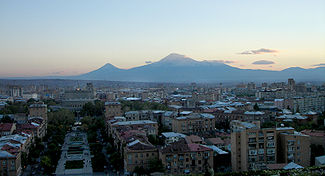
Armenia
Armenia , officially the Republic of Armenia , is a landlocked mountainous country in the Caucasus region of Eurasia...
lies in the highlands surrounding the Biblical mountains of Ararat
Mount Ararat
Mount Ararat is a snow-capped, dormant volcanic cone in Turkey. It has two peaks: Greater Ararat and Lesser Ararat .The Ararat massif is about in diameter...
. The original Armenian
Armenians
Armenian people or Armenians are a nation and ethnic group native to the Armenian Highland.The largest concentration is in Armenia having a nearly-homogeneous population with 97.9% or 3,145,354 being ethnic Armenian....
name for the country was Hayk, later Hayastan (Armenian
Armenian language
The Armenian language is an Indo-European language spoken by the Armenian people. It is the official language of the Republic of Armenia as well as in the region of Nagorno-Karabakh. The language is also widely spoken by Armenian communities in the Armenian diaspora...
: Հայաստան), translated as the land of Haik, and consisting of the name Haik and the suffix '-stan' (land).
The name Armenia was given to the country by the surrounding states, and it is traditionally derived from Armenak or Aram
Aram
-Bible:* Aram, son of Shem, according to the "Table of Nations" in Genesis 10* Aram-Naharaim , the land in which the city of Haran lay* Aram , an ancient region containing the state of Aram Damascus...
(the great-grandson of Haik's great-grandson, and another leader who is, according to Armenian tradition, the ancestor of all Armenians
Armenians
Armenian people or Armenians are a nation and ethnic group native to the Armenian Highland.The largest concentration is in Armenia having a nearly-homogeneous population with 97.9% or 3,145,354 being ethnic Armenian....
).
In the Bronze Age
Bronze Age
The Bronze Age is a period characterized by the use of copper and its alloy bronze as the chief hard materials in the manufacture of some implements and weapons. Chronologically, it stands between the Stone Age and Iron Age...
, several states flourished in the area of Greater Armenia, including the Hittite Empire (at the height of its power), Mitanni
Mitanni
Mitanni or Hanigalbat was a loosely organized Hurrian-speaking state in northern Syria and south-east Anatolia from ca. 1500 BC–1300 BC...
(South-Western historical Armenia), and Hayasa-Azzi
Hayasa-Azzi
Hayasa-Azzi or Azzi-Hayasa was a Late Bronze Age confederation formed between two petty kingdoms of Anatolia, Hayasa located South of Trabzon and Azzi, located North of the Euphrates and to the South of Hayasa...
(1600–1200 BC). Soon after the Hayasa-Azzi were the Nairi (1400–1000 BC) and the Kingdom of Urartu (1000–600 BC), who successively established their sovereignty over the Armenian Highland
Armenian Highland
The Armenian Highland is the central-most and highest of three land-locked plateaus that together form the northern sector of the Middle East...
. Each of the aforementioned nations and tribes participated in the ethnogenesis of the Armenian
Armenians
Armenian people or Armenians are a nation and ethnic group native to the Armenian Highland.The largest concentration is in Armenia having a nearly-homogeneous population with 97.9% or 3,145,354 being ethnic Armenian....
people. Yerevan
Yerevan
Yerevan is the capital and largest city of Armenia and one of the world's oldest continuously-inhabited cities. Situated along the Hrazdan River, Yerevan is the administrative, cultural, and industrial center of the country...
, the modern capital of Armenia, was founded in 782 BC by king Argishti I.
The Iron Age kingdom of Urartu
Urartu
Urartu , corresponding to Ararat or Kingdom of Van was an Iron Age kingdom centered around Lake Van in the Armenian Highland....
(Assyrian
Akkadian language
Akkadian is an extinct Semitic language that was spoken in ancient Mesopotamia. The earliest attested Semitic language, it used the cuneiform writing system derived ultimately from ancient Sumerian, an unrelated language isolate...
for Ararat
Mount Ararat
Mount Ararat is a snow-capped, dormant volcanic cone in Turkey. It has two peaks: Greater Ararat and Lesser Ararat .The Ararat massif is about in diameter...
) was replaced by the Orontid dynasty
Orontid Dynasty
The Orontid Dynasty The Orontid Dynasty The Orontid Dynasty (also known by their native name, Yervanduni was a hereditary Armenian dynasty and the rulers of the successor state to the Iron Age kingdom of Ararat...
.
Following Persian and Macedonian rule, the Artaxiad
Artaxias I
Artaxias I was the founder of the Artaxiad Dynasty whose members ruled the Kingdom of Armenia for nearly two centuries....
dynasty from 190 BC gave rise to the Kingdom of Armenia which rose to the peak of its influence under Tigranes II before falling under Roman rule.
In 301, Arsacid Armenia
Arsacid Dynasty of Armenia
The Arsacid dynasty or Arshakuni dynasty ruled the Kingdom of Armenia from 54 AD to 428 AD. Formerly a branch of the Iranian Parthian Arsacids, they became a distinctly Armenian dynasty. Arsacid Kings reigned intermittently throughout the chaotic years following the fall of the Artaxiad Dynasty...
was the first sovereign nation to accept Christianity as a state religion. The Armenians
Armenians
Armenian people or Armenians are a nation and ethnic group native to the Armenian Highland.The largest concentration is in Armenia having a nearly-homogeneous population with 97.9% or 3,145,354 being ethnic Armenian....
later fell under Byzantine
Byzantine
Byzantine usually refers to the Roman Empire during the Middle Ages.Byzantine may also refer to:* A citizen of the Byzantine Empire, or native Greek during the Middle Ages...
, Persian, and Islamic hegemony, but reinstated their independence with the Bagratuni Dynasty
Bagratuni Dynasty
The Bagratuni, Bagratid or alternatively Pakradouni royal dynasty of Armenia was a royal family whose branches formerly ruled many regional polities, including the Armenian lands of Sper|presently Ispir in Tayk Province of the Armenian Kingdom, Bagrevand in Ayrarat Province of the Armenian...
kingdom of Armenia. After the fall of the kingdom in 1045, and the subsequent Seljuk conquest of Armenia in 1064, the Armenians established a kingdom in Cilicia
Cilicia
In antiquity, Cilicia was the south coastal region of Asia Minor, south of the central Anatolian plateau. It existed as a political entity from Hittite times into the Byzantine empire...
, where they prolonged their sovereignty to 1375.
Greater Armenia was later divided between the Ottoman Empire
Ottoman Empire
The Ottoman EmpireIt was usually referred to as the "Ottoman Empire", the "Turkish Empire", the "Ottoman Caliphate" or more commonly "Turkey" by its contemporaries...
and Russia
Russia
Russia or , officially known as both Russia and the Russian Federation , is a country in northern Eurasia. It is a federal semi-presidential republic, comprising 83 federal subjects...
. In the early 20th century
20th century
Many people define the 20th century as running from January 1, 1901 to December 31, 2000, others would rather define it as beginning on January 1, 1900....
Armenians suffered in the genocide inflicted on them by the Ottomans, in which 1.5 million Armenians were killed and many more dispersed
Armenian diaspora
The Armenian diaspora refers to the Armenian communities outside the Republic of Armenia and self proclaimed de facto independent Nagorno-Karabakh Republic...
throughout the world via Syria
Syria
Syria , officially the Syrian Arab Republic , is a country in Western Asia, bordering Lebanon and the Mediterranean Sea to the West, Turkey to the north, Iraq to the east, Jordan to the south, and Israel to the southwest....
and Lebanon
Lebanon
Lebanon , officially the Republic of LebanonRepublic of Lebanon is the most common term used by Lebanese government agencies. The term Lebanese Republic, a literal translation of the official Arabic and French names that is not used in today's world. Arabic is the most common language spoken among...
. Armenia, from then on corresponding to much of Eastern Armenia
Eastern Armenia
Eastern Armenia or Caucasian Armenia was the portion of Ottoman Armenia and Persian Armenia that was ceded to the Russian Empire following the Russo-Turkish War, 1828-1829...
, regained independence in 1918, with the establishment of the Democratic Republic of Armenia
Democratic Republic of Armenia
The Democratic Republic of Armenia was the first modern establishment of an Armenian state...
, and in 1991, the Republic of Armenia
Armenia
Armenia , officially the Republic of Armenia , is a landlocked mountainous country in the Caucasus region of Eurasia...
.
Prehistory
The Armenian HighlandArmenian Highland
The Armenian Highland is the central-most and highest of three land-locked plateaus that together form the northern sector of the Middle East...
shows traces of settlement from the Neolithic
Neolithic
The Neolithic Age, Era, or Period, or New Stone Age, was a period in the development of human technology, beginning about 9500 BC in some parts of the Middle East, and later in other parts of the world. It is traditionally considered as the last part of the Stone Age...
era. Recent archeological studies have found that the first leather shoe, skirt, and wine-making facility were from prehistoric Armenian in the present city of Areni
Areni
Areni is a village in the Vayots Dzor Province of Armenia. It is best known for its wine production, although the majority of wine produced locally is from the nearby village of Getap. The church of S. Astvatsatsin is a single-nave two-aisled domed Armenian church completed in the year 1321, and...
.
The Shulaveri-Shomu culture
Shulaveri-Shomu culture
Shulaveri-Shomu culture is a Late Neolithic/Eneolithic culture that existed on the territory of present-day Georgia and the Armenian Highlands. It is thought to be a critical element in identifying the origins of both the Georgian and Armenian peoples. The culture is dated to mid-6th or early-5th...
of the central Transcaucasus region is one of the earliest known prehistoric culture in the area, carbon-dated to roughly 6000 – 4000 BC.
Bronze Age
An early Bronze Age culture in the area is the Kura-Araxes cultureKura-Araxes culture
The Kura-Araxes culture or the Early trans-Caucasian culture, was a civilization that existed from 3400 BC until about 2000 BC. The earliest evidence for this culture is found on the Ararat plain; thence it spread to Georgia by 3000 BC, and during the next millennium it proceeded westward to the...
, assigned to the period of ca. 4000 – 2200 BC, succeeded by the Trialeti culture
Trialeti culture
The Trialeti culture , named after Trialeti region of Georgia, is attributed to the first part of the 2nd millennium BC. In the late 3rd millennium BC. settlements of the Kura-Araxes culture began to be replaced by early Trialeti culture sites. The Trialeti culture was a second culture to appear in...
(ca. 2200 – 1500 BC).
The earliest ethnonyms of the area are known from Hittite sources of the Late Bronze Age, such as the Hayasa-Azzi
Hayasa-Azzi
Hayasa-Azzi or Azzi-Hayasa was a Late Bronze Age confederation formed between two petty kingdoms of Anatolia, Hayasa located South of Trabzon and Azzi, located North of the Euphrates and to the South of Hayasa...
. Another record mentioned by pharaoh Thutmose III
Thutmose III
Thutmose III was the sixth Pharaoh of the Eighteenth Dynasty. During the first twenty-two years of Thutmose's reign he was co-regent with his stepmother, Hatshepsut, who was named the pharaoh...
of Egypt
Ancient Egypt
Ancient Egypt was an ancient civilization of Northeastern Africa, concentrated along the lower reaches of the Nile River in what is now the modern country of Egypt. Egyptian civilization coalesced around 3150 BC with the political unification of Upper and Lower Egypt under the first pharaoh...
in the 33rd year of his reign (1446 BC) as the people of Ermenen, and says in their land "heaven rests upon its four pillars".
Between 1500 – 1200 BC, the Hayasa-Azzi
Hayasa-Azzi
Hayasa-Azzi or Azzi-Hayasa was a Late Bronze Age confederation formed between two petty kingdoms of Anatolia, Hayasa located South of Trabzon and Azzi, located North of the Euphrates and to the South of Hayasa...
existed in the western half of the Armenian Highland, often clashing with the Hittite Empire. Between 1200 – 800 BC, much of Armenia was united under a confederation of kingdoms, which Assyrian sources called Nairi
Nairi (people)
Nairi was the Assyrian name for an Armenian tribe in the Armenian Highlands, roughly corresponding to the modern Van and Hakkâri provinces of modern Turkey...
("Land of Rivers" in Assyrian").
Iron Age
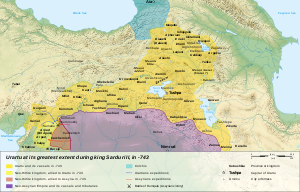
Urartu
Urartu , corresponding to Ararat or Kingdom of Van was an Iron Age kingdom centered around Lake Van in the Armenian Highland....
flourished in the Caucasus
Caucasus
The Caucasus, also Caucas or Caucasia , is a geopolitical region at the border of Europe and Asia, and situated between the Black and the Caspian sea...
and eastern Asia Minor
Asia Minor
Asia Minor is a geographical location at the westernmost protrusion of Asia, also called Anatolia, and corresponds to the western two thirds of the Asian part of Turkey...
between the 9th century BC and 585 BC in the Armenian Highland
Armenian Highland
The Armenian Highland is the central-most and highest of three land-locked plateaus that together form the northern sector of the Middle East...
. The founder of the Urartian Kingdom, Aramé
Aramu
Aramu or Arame was the first known king of Urartu.Living at the time of Shalmaneser III , Aram united the Nairi tribe against the threat of the Assyrian Empire...
, united all the principalities of the Armenian Highland and gave himself the title "King of Kings", the traditional title of Urartian Kings. The Urartians established their sovereignty over all of Taron
Taron (historic Armenia)
Taron was a canton of the Turuberan province of Greater Armenia, now in the Muş Province, Turkey. It was divided into four districts: Mamikonian, Palauni, , Artokh Taron was a canton of the Turuberan province of Greater Armenia, now in the Muş Province, Turkey. It was divided into four districts:...
and Vaspurakan
Vaspurakan
Vaspurakan was the first and biggest province of Greater Armenia, which later became an independent kingdom during the Middle Ages, centered around Lake Van...
. The main rival of Urartu was the Neo-Assyrian Empire.
During the reign of Sarduri I
Sarduri I
Sarduri I , also known as Sarduris, was king of Urartu in Asia Minor. He was the son of Lutipri, the second monarch of Urartu. Sarduri I is most known for moving the capital of the Urartu kingdom to Tushpa . This proved to be significant as Tushpa became the focal point of politics in the Near East...
(834–828 BC), Urartu had become a strong and organized state, and imposed taxes to neighbouring tribes. Sarduri made Tushpa
Tushpa
Tushpa was the 9th century BC capital of Urartu, later becoming known as Van which is derived from Biaina the native name of Urartu...
(modern Van
Van, Turkey
Van is a city in southeastern Turkey and the seat of the Kurdish-majority Van Province, and is located on the eastern shore of Lake Van. The city's official population in 2010 was 367,419, but many estimates put this as much higher with a 1996 estimate stating 500,000 and former Mayor Burhan...
) the capital of Urartu. His son, Ishpuinis
Ishpuinis of Urartu
Ishpuini was king of Urartu. He succeeded his father, Sarduri I, who moved the capital to Tushpa . Ishpuini conquered the Mannaean city of Musasir, which was then made the religious center of the empire. The main temple for the war god Haldi was in Musasir...
, extended the borders of the state by conquering what would later be known as the Tigranocerta area and by reaching Urmia
Urmia
- Demographics :According to official census of 2006, the population of Urmia is about 871,204.- Language :The population of Urmia is mainly Azerbaijani people, with Kurdish, Assyrian Christian, and Armenian minorities...
. Menuas
Menuas of Urartu
Menua was the fifth known king of Urartu, an ancient country in the Eastern Anatolia, from circa 810 BC to approximately 786 BC.A younger son of the preceding Urartuan King, Ishpuini, Menua was adopted as co-ruler by his father in the last years of his reign...
(810–785 BC) extended the Urartian territory up north, by spreading towards the Araratian fields. He left more than 90 inscriptions by using the Mesopotamian cuneiform
Cuneiform
Cuneiform can refer to:*Cuneiform script, an ancient writing system originating in Mesopotamia in the 4th millennium BC*Cuneiform , three bones in the human foot*Cuneiform Records, a music record label...
scriptures in the Urartian language
Urartian language
Urartian, Vannic, and Chaldean are conventional names for the language spoken by the inhabitants of the ancient kingdom of Urartu that was located in the region of Lake Van, with its capital near the site of the modern town of Van, in the Armenian Highland, modern-day Eastern Anatolia region of...
. Argishtis I of Urartu
Argishtis I of Urartu
Argishti I was the sixth known king of Urartu, reigning from 785 BC to 763 BC. He founded the citadel of Erebuni in 782 BC, which is the present capital of Armenia, Yerevan....
conquered Latakia
Latakia
Latakia, or Latakiyah , is the principal port city of Syria, as well as the capital of the Latakia Governorate. In addition to serving as a port, the city is a manufacturing center for surrounding agricultural towns and villages...
from the Hittites, and reached Byblos
Byblos
Byblos is the Greek name of the Phoenician city Gebal . It is a Mediterranean city in the Mount Lebanon Governorate of present-day Lebanon under the current Arabic name of Jubayl and was also referred to as Gibelet during the Crusades...
, Phoenicia
Phoenicia
Phoenicia , was an ancient civilization in Canaan which covered most of the western, coastal part of the Fertile Crescent. Several major Phoenician cities were built on the coastline of the Mediterranean. It was an enterprising maritime trading culture that spread across the Mediterranean from 1550...
, and he built Erebuni, modern-day Yerevan
Yerevan
Yerevan is the capital and largest city of Armenia and one of the world's oldest continuously-inhabited cities. Situated along the Hrazdan River, Yerevan is the administrative, cultural, and industrial center of the country...
, in 782 BC by using 6600 prisoners of war.
In 714 BC, the Assyrians under Sargon II
Sargon II
Sargon II was an Assyrian king. Sargon II became co-regent with Shalmaneser V in 722 BC, and became the sole ruler of the kingdom of Assyria in 722 BC after the death of Shalmaneser V. It is not clear whether he was the son of Tiglath-Pileser III or a usurper unrelated to the royal family...
defeated the Urartian King Rusa I at Lake Urmia
Lake Urmia
Lake Urmia , ancient name: Lake Matiene) is a salt lake in northwestern Iran, near Iran's border with Turkey. The lake is between the Iranian provinces of East Azerbaijan and West Azerbaijan, west of the southern portion of the similarly shaped Caspian Sea...
and destroyed the holy Urartian temple at Musasir
Musasir
Muṣaṣir , in Urartian Ardini was an ancient city of Urartu, attested in Assyrian sources of the 9th and 8th centuries BC....
. At the same time, an Indo-European
Indo-European
Indo-European may refer to:* Indo-European languages** Aryan race, a 19th century and early 20th century term for those peoples who are the native speakers of Indo-European languages...
tribe called the Cimmerians
Cimmerians
The Cimmerians or Kimmerians were ancient equestrian nomads of Indo-European origin.According to the Greek historian Herodotus, of the 5th century BC, the Cimmerians inhabited the region north of the Caucasus and the Black Sea during the 8th and 7th centuries BC, in what is now Ukraine and Russia...
attacked Urartu
Urartu
Urartu , corresponding to Ararat or Kingdom of Van was an Iron Age kingdom centered around Lake Van in the Armenian Highland....
from the northwest region and destroyed the rest of his armies.
The Medes
Medes
The MedesThe Medes...
under Cyaxares
Cyaxares
Cyaxares, Cyaxares the Great or Hvakhshathra , the son of King Phraortes, was the first king of Media. According to Herodotus, Cyaxares, grandson of Deioces, had a far greater military reputation than his father or grandfather, therefore he is often being described as the first official Median...
invaded Assyria later on in 612 BC, and then took over the Urartian capital of Van towards 585 BC, effectively ending the sovereignty of Urartu. According to the Armenian tradition, the Medes helped the Armenians establish the Orontid dynasty.
Antiquity
- For more details on this topic, see Roman relations with the ArmeniansRoman relations with the ArmeniansContacts between the Italian peninsula and the Armenian Highland go back to the Iron Age when the Etruscan civilization traded with the Kingdom of Urartu by way of Phrygia and Ancient Greece. Urartian bronzes, bull-headed cauldrons and pottery were excavated in various parts of Etruscan Italy...
.
After the fall of Urartu around 585 BC, the Satrapy of Armenia
Satrapy of Armenia
The Satrapy of Armenia , also known as Orontid Armenia after the ruling Orontid Dynasty, was one of the satrapies of the Achaemenid Empire in the 6th century BC, which later became an independent kingdom...
was ruled by the Armenian Orontid Dynasty
Orontid Dynasty
The Orontid Dynasty The Orontid Dynasty The Orontid Dynasty (also known by their native name, Yervanduni was a hereditary Armenian dynasty and the rulers of the successor state to the Iron Age kingdom of Ararat...
, which governed the state in 585 – 190 BC. Under Orontids, Armenia at times was an independent kingdom, and at other times a satrapy of the Persian Empire. Darius III was an Armenian satrap before he became the emperor of Persia.
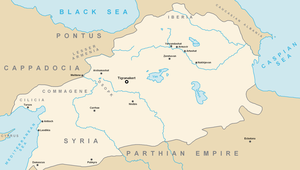
Artaxiad dynasty
After the destruction of the Seleucid EmpireSeleucid Empire
The Seleucid Empire was a Greek-Macedonian state that was created out of the eastern conquests of Alexander the Great. At the height of its power, it included central Anatolia, the Levant, Mesopotamia, Persia, today's Turkmenistan, Pamir and parts of Pakistan.The Seleucid Empire was a major centre...
, a Hellenistic Armenian state was founded in 190 BC.
Hellenistic Greece
In the context of Ancient Greek art, architecture, and culture, Hellenistic Greece corresponds to the period between the death of Alexander the Great in 323 BC and the annexation of the classical Greek heartlands by Rome in 146 BC...
successor state of Alexander the Great's short-lived empire, with Artaxias becoming its first kings and the founder of the Artaxiad dynasty (190 BC – AD 1).
At the same time, a western portion of the kingdom split as a separate state under Zariadris, which became known as Lesser Armenia
Lesser Armenia
Lesser Armenia , also known as Armenia Minor and Armenia Inferior, refers to the Armenian populated regions, primarily to the West and North-West of the ancient Armenian Kingdom...
while the main kingdom acquired the name of Greater Armenia.
The new kings began a program of expansion which was to reach its zenith a century later. Their acquisitions are summarized by Strabo. Zariadris acquired Acilisene and the "country around the Antitaurus", possibly the district of Muzur or west of the Euphrates
Euphrates
The Euphrates is the longest and one of the most historically important rivers of Western Asia. Together with the Tigris, it is one of the two defining rivers of Mesopotamia...
.
Artaxias took lands from the Medes, Iberians, and Syrians. He then had confrontations with Pontus
Pontus
Pontus or Pontos is a historical Greek designation for a region on the southern coast of the Black Sea, located in modern-day northeastern Turkey. The name was applied to the coastal region in antiquity by the Greeks who colonized the area, and derived from the Greek name of the Black Sea: Πόντος...
, Seleucid Syria and Cappadocia, and was included in the treaty which followed the victory of a group of Anatolian kings over Pharnaces of Pontus in 181 BC. Pharnaces thus abandoned all of his gains in the west.
At its zenith, from 95 to 66 BC, Greater Armenia extended its rule over parts of the Caucasus and the area that is now eastern and central Turkey
Turkey
Turkey , known officially as the Republic of Turkey , is a Eurasian country located in Western Asia and in East Thrace in Southeastern Europe...
, northwestern Iran
Iran
Iran , officially the Islamic Republic of Iran , is a country in Southern and Western Asia. The name "Iran" has been in use natively since the Sassanian era and came into use internationally in 1935, before which the country was known to the Western world as Persia...
, Israel
Israel
The State of Israel is a parliamentary republic located in the Middle East, along the eastern shore of the Mediterranean Sea...
, Syria
Syria
Syria , officially the Syrian Arab Republic , is a country in Western Asia, bordering Lebanon and the Mediterranean Sea to the West, Turkey to the north, Iraq to the east, Jordan to the south, and Israel to the southwest....
and Lebanon
Lebanon
Lebanon , officially the Republic of LebanonRepublic of Lebanon is the most common term used by Lebanese government agencies. The term Lebanese Republic, a literal translation of the official Arabic and French names that is not used in today's world. Arabic is the most common language spoken among...
, forming the second Armenian empire. For a time, Armenia was one of the most powerful states in the Roman East.
It eventually confronted the Roman Republic
Roman Republic
The Roman Republic was the period of the ancient Roman civilization where the government operated as a republic. It began with the overthrow of the Roman monarchy, traditionally dated around 508 BC, and its replacement by a government headed by two consuls, elected annually by the citizens and...
in a war, which it lost in 66 BC, but nonetheless preserved its sovereignty. Tigranes continued to rule Armenia as an ally of Rome until his death in 55 BCE.
Indeed the third Mithridatic war
Third Mithridatic War
The Third Mithridatic War was the last and longest of three Mithridatic Wars fought between Mithridates VI of Pontus and his allies and the Roman Republic...
defeat of the King of Pontus by Roman Pompeius resulted in the Kingdom of Armenia becoming an allied client state of Rome.
Later on, in 1 AD, Armenia came under full Roman
Ancient Rome
Ancient Rome was a thriving civilization that grew on the Italian Peninsula as early as the 8th century BC. Located along the Mediterranean Sea and centered on the city of Rome, it expanded to one of the largest empires in the ancient world....
control until the establishment of the Armenian Arsacid dynasty. The Armenian people then adopted a Western political, philosophical, and religious orientation. According to Strabo, around this time everyone in Armenia spoke "the same language." (Strabo 11.14.4).
Roman Province of Armenia
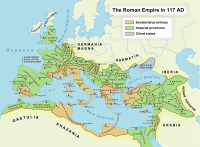
Armenia
Armenia , officially the Republic of Armenia , is a landlocked mountainous country in the Caucasus region of Eurasia...
was, in part or whole, subject to the Roman Empire
Roman Empire
The Roman Empire was the post-Republican period of the ancient Roman civilization, characterised by an autocratic form of government and large territorial holdings in Europe and around the Mediterranean....
for nearly four centuries. Roman emperor Trajan
Trajan
Trajan , was Roman Emperor from 98 to 117 AD. Born into a non-patrician family in the province of Hispania Baetica, in Spain Trajan rose to prominence during the reign of emperor Domitian. Serving as a legatus legionis in Hispania Tarraconensis, in Spain, in 89 Trajan supported the emperor against...
created even a short-lived Province of Armenia between 114 and 117 AD.
Indeed Roman supremacy was fully established by the campaigns of Gnaeus Domitius Corbulo
Gnaeus Domitius Corbulo
Gnaeus Domitius Corbulo was a Roman general and a brother-in-law of the emperor Caligula.-Descent:Corbulo was born in Italy into a senatorial family...
., that ended with a formal compromise: a Parthian prince of the Arsacid
Arsacid Dynasty of Armenia
The Arsacid dynasty or Arshakuni dynasty ruled the Kingdom of Armenia from 54 AD to 428 AD. Formerly a branch of the Iranian Parthian Arsacids, they became a distinctly Armenian dynasty. Arsacid Kings reigned intermittently throughout the chaotic years following the fall of the Artaxiad Dynasty...
line would henceforth sit on the Armenian throne, but his nomination had to be approved by the Roman emperor.
Because this agreement was not respected by the Parthian Empire, in 114 Trajan
Trajan
Trajan , was Roman Emperor from 98 to 117 AD. Born into a non-patrician family in the province of Hispania Baetica, in Spain Trajan rose to prominence during the reign of emperor Domitian. Serving as a legatus legionis in Hispania Tarraconensis, in Spain, in 89 Trajan supported the emperor against...
from Antiochia
Antiochia
Antiochia or Antiocheia or Antiochea or Antiokheia may refer any of several Hellenistic cities in the Near East most, of which were founded or rebuilt by the several rulers named Antiochus during the Seleucid Empire:*Antioch , now Antakya, Turkey**Principality of Antiochia, a...
in Syria marched on Armenia and conquered the capital Artaxata. Trajan then deposed the Armenian king Partamasiri (imposed by the Parthians) and ordered the annexation of Armenia to the Roman Empire as a new province.
The new province reached the shores of the Caspian sea
Caspian Sea
The Caspian Sea is the largest enclosed body of water on Earth by area, variously classed as the world's largest lake or a full-fledged sea. The sea has a surface area of and a volume of...
and bordered to the north with Caucasian Iberia
Caucasian Iberia
Iberia , also known as Iveria , was a name given by the ancient Greeks and Romans to the ancient Georgian kingdom of Kartli , corresponding roughly to the eastern and southern parts of the present day Georgia...
and Caucasian Albania
Caucasian Albania
Albania is a name for the historical region of the eastern Caucasus, that existed on the territory of present-day republic of...
, two vassal states of Rome. As a Roman province Armenia was administered by Catilius Severus of the Gens Claudia.
After Trajan's death however, his successor Hadrian
Hadrian
Hadrian , was Roman Emperor from 117 to 138. He is best known for building Hadrian's Wall, which marked the northern limit of Roman Britain. In Rome, he re-built the Pantheon and constructed the Temple of Venus and Roma. In addition to being emperor, Hadrian was a humanist and was philhellene in...
decided not to maintain the province of Armenia. In 118 AD, Hadrian gave Armenia up, and installed Parthamaspates as its "vassal" king.
Arsacid dynasty

Parthia
Parthia is a region of north-eastern Iran, best known for having been the political and cultural base of the Arsacid dynasty, rulers of the Parthian Empire....
. The Parthians forced Armenia into submission from 37 to 47, when the Romans retook control of the kingdom.
Under Nero
Nero
Nero , was Roman Emperor from 54 to 68, and the last in the Julio-Claudian dynasty. Nero was adopted by his great-uncle Claudius to become his heir and successor, and succeeded to the throne in 54 following Claudius' death....
, the Romans fought a campaign (55–63) against the Parthian Empire
Parthian Empire
The Parthian Empire , also known as the Arsacid Empire , was a major Iranian political and cultural power in ancient Persia...
, which had invaded the kingdom of Armenia, allied to the Romans. After gaining (60) and losing (62) Armenia, the Romans under Gnaeus Domitius Corbulo
Gnaeus Domitius Corbulo
Gnaeus Domitius Corbulo was a Roman general and a brother-in-law of the emperor Caligula.-Descent:Corbulo was born in Italy into a senatorial family...
, legate
Legatus
A legatus was a general in the Roman army, equivalent to a modern general officer. Being of senatorial rank, his immediate superior was the dux, and he outranked all military tribunes...
of Syria
Syria (Roman province)
Syria was a Roman province, annexed in 64 BC by Pompey, as a consequence of his military presence after pursuing victory in the Third Mithridatic War. It remained under Roman, and subsequently Byzantine, rule for seven centuries, until 637 when it fell to the Islamic conquests.- Principate :The...
entered (63) into an agreement of Vologases I of Parthia
Vologases I of Parthia
Vologases I of Parthia, sometimes called Vologaeses or Vologeses or, following Zoroastrian usage, Valakhsh ruled the Parthian Empire from about 51 to 78. Son of Vonones II by a Thracian concubine, he succeeded his father in 51 AD. He gave the kingdom of Media Atropatene to his brother Pacorus II,...
, which confirmed Tiridates I
Tiridates I of Armenia
Tiridates I was King of Armenia beginning in AD 53 and the founder of the Arshakuni Dynasty, the Armenian line of the Arsacid Dynasty. The dates of his birth and death are unknown. His early reign was marked by a brief interruption towards the end of the year 54 and a much longer one from 58...
as king of Armenia, thus founding the Arshakuni Dynasty.
The Arsacid dynasty lost control of Armenia for a few years when emperor Trajan
Trajan
Trajan , was Roman Emperor from 98 to 117 AD. Born into a non-patrician family in the province of Hispania Baetica, in Spain Trajan rose to prominence during the reign of emperor Domitian. Serving as a legatus legionis in Hispania Tarraconensis, in Spain, in 89 Trajan supported the emperor against...
created the "Roman Province of Armenia", fully included into the Roman Empire
Roman Empire
The Roman Empire was the post-Republican period of the ancient Roman civilization, characterised by an autocratic form of government and large territorial holdings in Europe and around the Mediterranean....
from 114 to 117 AD. His successor Hadrian
Hadrian
Hadrian , was Roman Emperor from 117 to 138. He is best known for building Hadrian's Wall, which marked the northern limit of Roman Britain. In Rome, he re-built the Pantheon and constructed the Temple of Venus and Roma. In addition to being emperor, Hadrian was a humanist and was philhellene in...
reinstalled the Arsacid Dynasty when nominated Parthamaspates as "vassal" king of Armenia in 118 AD.
Another campaign was led by Emperor Lucius Verus
Lucius Verus
Lucius Verus , was Roman co-emperor with Marcus Aurelius, from 161 until his death.-Early life and career:Lucius Verus was the first born son to Avidia Plautia and Lucius Aelius Verus Caesar, the first adopted son and heir of Roman Emperor Hadrian . He was born and raised in Rome...
in 162–165, after Vologases IV of Parthia
Vologases IV of Parthia
Vologases IV of Parthia ruled the Parthian Empire from 147 to 191. The son of Mithridates IV of Parthia , he united the two halves of the empire which had been split between his father and Vologases III of Parthia...
had invaded Armenia and installed his chief general on its throne. To counter the Parthian threat, Verus set out for the east. His army won significant victories and retook the capital. Sohaemus
Sohaemus of Armenia
Gaius Julius Sohaemus, also known as Sohaemus of Armenia and Sohaemo was an Emesene Aristocrat from Syria who served as a Roman Client King of Armenia....
, a Roman citizen of Armenian heritage, was installed as the new client king.
The Sassanid Persians occupied Armenia in 252 and held it until the Romans returned in 287. In 384 the kingdom was split between the Byzantine
Byzantine Empire
The Byzantine Empire was the Eastern Roman Empire during the periods of Late Antiquity and the Middle Ages, centred on the capital of Constantinople. Known simply as the Roman Empire or Romania to its inhabitants and neighbours, the Empire was the direct continuation of the Ancient Roman State...
or East Roman Empire and the Persians. Western Armenia quickly became a province of the Roman Empire
Roman Empire
The Roman Empire was the post-Republican period of the ancient Roman civilization, characterised by an autocratic form of government and large territorial holdings in Europe and around the Mediterranean....
under the name of Armenia Minor; Eastern Armenia remained a kingdom within Persia until 428, when the local nobility overthrew the king, and the Sassanids installed a governor in his place.
According to tradition, the Armenian Apostolic Church
Armenian Apostolic Church
The Armenian Apostolic Church is the world's oldest National Church, is part of Oriental Orthodoxy, and is one of the most ancient Christian communities. Armenia was the first country to adopt Christianity as its official religion in 301 AD, in establishing this church...
was established by two of Jesus' twelve apostles--Thaddaeus
Saint Jude
Jude was one of the Twelve Apostles of Jesus. He is generally identified with Thaddeus, and is also variously called Jude of James, Jude Thaddaeus, Judas Thaddaeus or Lebbaeus...
and Bartholomew--who preached Christianity in Armenia in the 40's-60's AD. Between 1st and 4th centuries AD, the Armenian Church was headed by patriarchs.
Christianized Arsacid dynasty
In 301, Armenia became the first nation to adopt ChristianityChristianity
Christianity is a monotheistic religion based on the life and teachings of Jesus as presented in canonical gospels and other New Testament writings...
as a state religion. It established a church that still exists independently of both the Catholic and the Eastern Orthodox churches, having become so in 451 after having rejected the Council of Chalcedon
Council of Chalcedon
The Council of Chalcedon was a church council held from 8 October to 1 November, 451 AD, at Chalcedon , on the Asian side of the Bosporus. The council marked a significant turning point in the Christological debates that led to the separation of the church of the Eastern Roman Empire in the 5th...
. The Armenian Apostolic Church
Armenian Apostolic Church
The Armenian Apostolic Church is the world's oldest National Church, is part of Oriental Orthodoxy, and is one of the most ancient Christian communities. Armenia was the first country to adopt Christianity as its official religion in 301 AD, in establishing this church...
is a part of the Oriental Orthodox communion, not to be confused with the Eastern Orthodox communion. The first Catholicos
Catholicos of Armenia
The Catholicos of All Armenians is the chief bishop of Armenia's national church, the Armenian Apostolic Church. It is one of the Oriental Orthodox churches that do not accept the decisions of the Council of Chalcedon. The first Catholicos of All Armenians was Saint Gregory the Illuminator...
of the Armenian church was Saint Gregory the Illuminator
Gregory the Illuminator
Saint Gregory the Illuminator or Saint Gregory the Enlightener is the patron saint and first official head of the Armenian Apostolic Church...
. Because of his beliefs, he was persecuted by the pagan king of Armenia, and was "punished" by being thrown in Khor Virap
Khor Virap
The Khor Virap is an Armenian Apostolic Church monastery located in the Ararat plain in Armenia, near the border with Turkey, about south of Artashat, Ararat Province...
, in modern-day Armenia. He acquired the title of Illuminator, because he illuminated the spirits of Armenians by introducing Christianity to them.
During its later political eclipses, Armenia depended on the church to preserve and protect its unique identity.
In 405/406, Armenia's political future seemed to be uncertain. With the help of the King of Armenia, Mesrop Mashtots thus invented a unique alphabet to suit the people's needs. By doing so, he ushered a new Golden Age and strengthened the Armenian national identity and belongingness.
After years of partial rule, the Arsacid dynasty fell in 428, with Eastern Armenia being subjugated to Persia and Western Armenia, to Rome. In the 5th century, the Sassanid Shah Yazdegerd II tried to tie his Christian Armenian subjects more closely to the Sassanid Empire by imposing the Zoroastrian religion. The Armenians greatly resented this, and as a result, a rebellion broke out with Vartan Mamikonian as the leader of the rebels. Yazdegerd thus massed his army and sent it to Armenia, where the Battle of Avarayr took place in 451. The 66,000 Armenian rebels, mostly peasants, lost their morale when Mamikonian himself died in the battlefield. They were substantially outnumbered by the 180,00–220,000-strong Persian army of Immortals
Persian Immortals
The "Immortals" was the name given by Herodotus to an elite force of soldiers who fought for the Achaemenid Empire. This force performed the dual roles of both Imperial Guard and standing army during the Persian Empire's expansion and during the Greco-Persian Wars...
and war elephants. Despite being a military defeat, the Battle of Avarayr and the subsequent guerrilla war in Armenia eventually resulted in the Treaty of Nvarsak (484), which guaranteed religious freedom to the Armenians.
Byzantium and Bagratid Armenia
In 591, the Byzantine Emperor MauriceMaurice (emperor)
Maurice was Byzantine Emperor from 582 to 602.A prominent general in his youth, Maurice fought with success against the Sassanid Persians...
defeated the Persians and recovered much of the remaining territory of Armenia into the empire. The conquest was completed by the Emperor Heraclius
Heraclius
Heraclius was Byzantine Emperor from 610 to 641.He was responsible for introducing Greek as the empire's official language. His rise to power began in 608, when he and his father, Heraclius the Elder, the exarch of Africa, successfully led a revolt against the unpopular usurper Phocas.Heraclius'...
, himself ethnically Armenian, in 629.
In 645, the Muslim Arab armies of the Caliphate
Caliphate
The term caliphate, "dominion of a caliph " , refers to the first system of government established in Islam and represented the political unity of the Muslim Ummah...
had attacked and conquered the country
Arab conquest of Armenia
The Arab conquest of Armenia was a part of the Muslim conquests after the death of Muhammad in AD 632.Persian Armenia had fallen to the Byzantine Empire shortly before, in AD 629, and was conquered in the Rashidun Caliphate by AD 645.-Islamic expansion:...
. Armenia, which once had its own rulers and was at other times under Persian and Byzantine control, passed largely into the power of the Caliphs.
Nonetheless, there were still parts of Armenia held within the Empire, containing many Armenians. This population held tremendous power within the empire. The Emperor Heraclius
Heraclius
Heraclius was Byzantine Emperor from 610 to 641.He was responsible for introducing Greek as the empire's official language. His rise to power began in 608, when he and his father, Heraclius the Elder, the exarch of Africa, successfully led a revolt against the unpopular usurper Phocas.Heraclius'...
(610–641) was of Armenian descent, as was the Emperor Philippicus (711–713). The Emperor Basil I
Basil I
Basil I, called the Macedonian was a Byzantine emperor of probable Armenian descent who reigned from 867 to 886. Born a simple peasant in the Byzantine theme of Macedonia, he rose in the imperial court, and usurped the imperial throne from Emperor Michael III...
, who took the Byzantine throne in 867, was the first of what is sometimes called the Armenian dynasty (see Macedonian Dynasty
Macedonian dynasty
The Macedonian dynasty ruled the Byzantine Empire from 867 to 1056, following the Amorian dynasty. During this period, the Byzantine state reached its greatest expanse since the Muslim conquests, and the Macedonian Renaissance in letters and arts began. The dynasty was named after its founder,...
), reflecting the strong effect the Armenians had on the Eastern Roman
Roman Empire
The Roman Empire was the post-Republican period of the ancient Roman civilization, characterised by an autocratic form of government and large territorial holdings in Europe and around the Mediterranean....
State. The Armenians were able and allowed to maintain a distinct culture.
Evolving as a feudal kingdom in the 9th century, Armenia experienced a brief cultural, political and economic renewal under the Bagratuni Dynasty
Bagratuni Dynasty
The Bagratuni, Bagratid or alternatively Pakradouni royal dynasty of Armenia was a royal family whose branches formerly ruled many regional polities, including the Armenian lands of Sper|presently Ispir in Tayk Province of the Armenian Kingdom, Bagrevand in Ayrarat Province of the Armenian...
. Bagratid Armenia was eventually recognized as a sovereign kingdom by the two major powers in the region: Baghdad in 885, and Constantinople in 886. Ani
Ani
Ani is a ruined and uninhabited medieval Armenian city-site situated in the Turkish province of Kars, near the border with Armenia. It was once the capital of a medieval Armenian kingdom that covered much of present day Armenia and eastern Turkey...
, the new Armenian capital, was constructed at the Kingdom's apogee in 964. The royal capital at Ani held approximately 200,000 inhabitants and a reported "1001 churches". With the construction of Ani, Armenia became a populous and prosperous nation, exerting political and economic influence over surrounding states and nations. Yet Armenia was still a weak state, perched precariously between the rival Byzantine Empire and the Abbassid Caliphate. Its existence depended on both of these states desiring the continuation of Bagratid Armenia as a buffer state, and Armenia itself being strong enough to maintain this status.
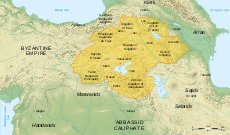
Bagratuni Dynasty
The Bagratuni, Bagratid or alternatively Pakradouni royal dynasty of Armenia was a royal family whose branches formerly ruled many regional polities, including the Armenian lands of Sper|presently Ispir in Tayk Province of the Armenian Kingdom, Bagrevand in Ayrarat Province of the Armenian...
was founded under favourable circumstances, the feudal system gradually weakened the country by eroding loyalty to the central government. Thus internally enfeebled, Armenia proved an easy victim for the Byzantines, who captured Ani in 1045. The Seljuk Turks under Alp Arslan
Alp Arslan
Alp Arslan was the third sultan of the Seljuq dynasty and great-grandson of Seljuk, the eponymous founder of the dynasty...
in turn took the city in 1064. In 1071, after the defeat of the Byzantine forces by the Seljuk Turks at the Battle of Manzikert
Battle of Manzikert
The Battle of Manzikert , was fought between the Byzantine Empire and Seljuq Turks led by Alp Arslan on August 26, 1071 near Manzikert...
, the Turks captured the rest of Greater Armenia and much of Anatolia
Anatolia
Anatolia is a geographic and historical term denoting the westernmost protrusion of Asia, comprising the majority of the Republic of Turkey...
. So ended Christian leadership of Armenia for the next millennium with the exception of a period of the late 12th-early 13th centuries, when the Muslim power in Greater Armenia was seriously troubled by the resurgent Georgian
Georgia (country)
Georgia is a sovereign state in the Caucasus region of Eurasia. Located at the crossroads of Western Asia and Eastern Europe, it is bounded to the west by the Black Sea, to the north by Russia, to the southwest by Turkey, to the south by Armenia, and to the southeast by Azerbaijan. The capital of...
monarchy. Many local nobles (nakharars) joined their efforts with the Georgians
Georgians
The Georgians are an ethnic group that have originated in Georgia, where they constitute a majority of the population. Large Georgian communities are also present throughout Russia, European Union, United States, and South America....
, leading to liberation of several areas in northern Armenia, which was ruled, under the authority of the Georgian crown, by the Zacharids/Mkhargrdzeli, a prominent Armeno-Georgian noble family.
Armenian Kingdom of Cilicia
Gagik II
Gagik II of Ani was the last Bagratuni King of Ani from 1042 to 1045.-Historical background:During the reign of John Smbat III, a feudal lord, David, who owned Taik during his battles against the Muslims, gained a large area which stretched all the way to Manzikert...
, King of Ani
Ani
Ani is a ruined and uninhabited medieval Armenian city-site situated in the Turkish province of Kars, near the border with Armenia. It was once the capital of a medieval Armenian kingdom that covered much of present day Armenia and eastern Turkey...
, an Armenian named Roupen
Ruben I of Armenia
Ruben I, , also Roupen I or Rupen I, was the first lord of Armenian Cilicia or “Lord of the Mountains” . He declared the independence of Cilicia from the Byzantine Empire, thus formally founding the beginning of Armenian rule there...
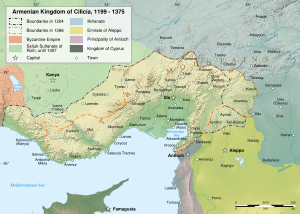
with some of his countrymen went into the gorges of the Taurus Mountains and then into Tarsus of Cilicia. Here the Byzantine governor of the place gave them shelter. Thus, from around 1080 to 1375, the focus of Armenian nationalism moved south, as the Armenian Kingdom of Cilicia
Armenian Kingdom of Cilicia
The Armenian Kingdom of Cilicia , also known as the Cilician Armenia, Kingdom of Cilician Armenia or New Armenia, was an independent principality formed during the High Middle Ages by Armenian refugees fleeing the Seljuk invasion of Armenia...
.
After the members of the first Crusade appeared in Asia Minor, the Armenians developed close ties to European Crusader States
Crusader states
The Crusader states were a number of mostly 12th- and 13th-century feudal states created by Western European crusaders in Asia Minor, Greece and the Holy Land , and during the Northern Crusades in the eastern Baltic area...
, flourished in southeastern Asia Minor
Asia Minor
Asia Minor is a geographical location at the westernmost protrusion of Asia, also called Anatolia, and corresponds to the western two thirds of the Asian part of Turkey...
until it was conquered by Muslim
Muslim
A Muslim, also spelled Moslem, is an adherent of Islam, a monotheistic, Abrahamic religion based on the Quran, which Muslims consider the verbatim word of God as revealed to prophet Muhammad. "Muslim" is the Arabic term for "submitter" .Muslims believe that God is one and incomparable...
states. Count Baldwin
Baldwin I of Jerusalem
Baldwin I of Jerusalem, formerly Baldwin I of Edessa, born Baldwin of Boulogne , 1058? – 2 April 1118, was one of the leaders of the First Crusade, who became the first Count of Edessa and then the second ruler and first titled King of Jerusalem...
, who with the rest of the Crusaders was passing through Asia Minor bound for Jerusalem, left the Crusader army and was adopted by Thoros of Edessa
Thoros of Edessa
Thoros was an Armenian ruler of Edessa at the time of the First Crusade.Thoros was a former officer in the Byzantine Empire and a lieutenant of Philaretos Brachamios. He was Armenian but practised the Greek Orthodox faith...
, an Armenian ruler of Greek Orthodox faith. Hostile as they were to the Seljuks, and unfriendly to the Byzantines
Byzantine Empire
The Byzantine Empire was the Eastern Roman Empire during the periods of Late Antiquity and the Middle Ages, centred on the capital of Constantinople. Known simply as the Roman Empire or Romania to its inhabitants and neighbours, the Empire was the direct continuation of the Ancient Roman State...
, the Armenians took kindly to the crusader count, and when Thoros was assassinated, Baldwin was made ruler of the new crusader County of Edessa
County of Edessa
The County of Edessa was one of the Crusader states in the 12th century, based around Edessa, a city with an ancient history and an early tradition of Christianity....
. It seems that the Armenians enjoyed the rule of Baldwin and the crusaders in general, and some number of them fought alongside the crusaders. When Antioch
Antioch
Antioch on the Orontes was an ancient city on the eastern side of the Orontes River. It is near the modern city of Antakya, Turkey.Founded near the end of the 4th century BC by Seleucus I Nicator, one of Alexander the Great's generals, Antioch eventually rivaled Alexandria as the chief city of the...
had been taken (1097), Constantine, the son of Roupen, received from the crusaders the title of baron.
The failed Third Crusade
Third Crusade
The Third Crusade , also known as the Kings' Crusade, was an attempt by European leaders to reconquer the Holy Land from Saladin...
and other events elsewhere left Cilicia as the sole substantial Christian presence in the Middle East. World powers, such as Byzantium, the Holy Roman Empire, the Papacy and even the Abbassid Caliph competed and vied for influence over the state and each raced to be the first to recognise Leo II
Leo II of Armenia
Leo II , also Leon II, Levon II or Lewon II was the tenth lord of Armenian Cilicia or “Lord of the Mountains” , and the first king of Armenian Cilicia .During his reign, Leo succeeded in establishing Cilician Armenia as a powerful and a unified Christian...
, Prince of Lesser Armenia, as the rightful king. As a result, he had been given a crown by both German and Byzantine emperors. Representatives from across Christendom and a number of Muslim states attended the coronation, thus highlighting the important stature that Cilicia had gained over time. The Armenian authority was often in touch with the crusaders. No doubt the Armenians aided in some of the other crusades. Cilicia flourished greatly under Armenian rule, as it became the last remnant of Medieval Armenian statehood. Cilcia acquired an Armenian identity, as the kings of Cilicia were called kings of Armenians, not of Cilicians. In Lesser Armenia, Armenian culture was intertwined with both the European culture of the Crusaders, and with the Hellenic culture of Cilicia. As the Catholic families extended their influence over Cilicia, the Pope wanted the Armenians to follow Catholicism. This situation divided the kingdom's inhabitants between pro-Catholic and pro-Apostolic camps. Armenian sovereignty lasted till 1375, when the Mamelukes of Egypt profited from the unstable situation of Lesser Armenia and destroyed it.
Persian Armenia
Ottoman Empire
The Ottoman EmpireIt was usually referred to as the "Ottoman Empire", the "Turkish Empire", the "Ottoman Caliphate" or more commonly "Turkey" by its contemporaries...
. At the height of the Ottoman-Persian wars, Yerevan
Yerevan
Yerevan is the capital and largest city of Armenia and one of the world's oldest continuously-inhabited cities. Situated along the Hrazdan River, Yerevan is the administrative, cultural, and industrial center of the country...
changed hands fourteen times between 1513 and 1737.
In 1604, Shah Abbas I pursued a scorched-earth campaign against the Ottomans in the Ararat valley. The old Armenian town of Julfa in the province of Nakhichevan
Nakhichevan
The Nakhchivan Autonomous Republic is a landlocked exclave of Azerbaijan. The region covers 5,363 km² and borders Armenia to the east and north, Iran to the south and west, and Turkey to the northwest...
was taken early in the invasion. From there Abbas' army fanned out across the Araratian plain. The Shah pursued a careful strategy, advancing and retreating as the occasion demanded, determined not to risk his enterprise in a direct confrontation with stronger enemy forces.
While laying siege to Kars
Kars
Kars is a city in northeast Turkey and the capital of Kars Province. The population of the city is 73,826 as of 2010.-Etymology:As Chorzene, the town appears in Roman historiography as part of ancient Armenia...
, he learned of the approach of a large Ottoman army, commanded by Djghazadé Sinan Pasha
Sinan Pasha
Sinan Pasha or Sinan Pashë Kahremanliu was an Albanian Grand Vizier, Ottoman military commander and statesman.-Life:...
. The order to withdraw was given; but to deny the enemy the potential to resupply themselves from the land, he ordered the wholesale destruction of the Armenian towns and farms on the plain. As part of this the whole population was ordered to accompany the Persian army in its withdrawal. Some 300,0000 people were duly herded to the banks of the Araxes River. Those who attempted to resist the mass deportation were killed outright. The Shah had previously ordered the destruction of the only bridge, so people were forced into the waters, where a great many drowned, carried away by the currents, before reaching the opposite bank. This was only the beginning of their ordeal. One eye-witness, Father de Guyan, describes the predicament of the refugees thus:
-
- It was not only the winter cold that was causing torture and death to the deportees. The greatest suffering came from hunger. The provisions which the deportees had brought with them were soon consumed... The children were crying for food or milk, none of which existed, because the women's breasts had dried up from hunger... Many women, hungry and exhausted, would leave their famished children on the roadside, and continue their tortuous journey. Some would go to nearby forests in search of something to eat. Usually they would not come back. Often those who died, served as food for the living.
Unable to maintain his army on the desolate plain, Sinan Pasha was forced to winter in Van
Van, Turkey
Van is a city in southeastern Turkey and the seat of the Kurdish-majority Van Province, and is located on the eastern shore of Lake Van. The city's official population in 2010 was 367,419, but many estimates put this as much higher with a 1996 estimate stating 500,000 and former Mayor Burhan...
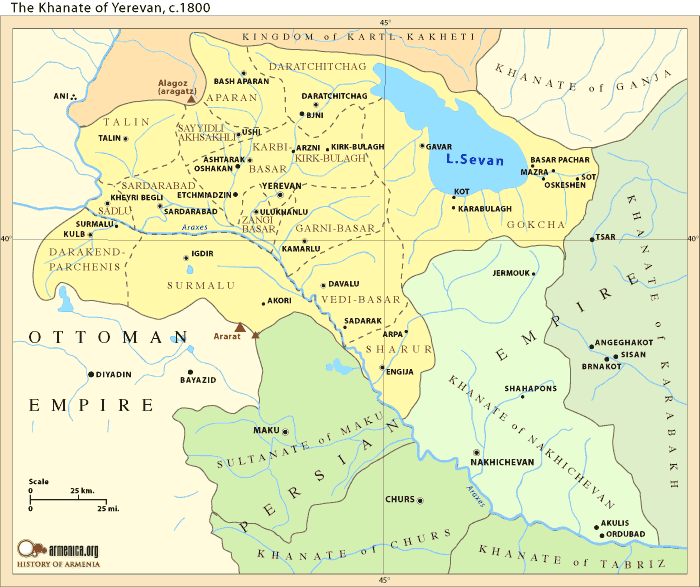
. Armies sent in pursuit of the Shah in 1605 were defeated, and by 1606 Abbas had regained all of the territory lost to the Turks earlier in his reign. The scorched-earth tactic had worked, though at a terrible cost to the Armenian people. Of the 300,000 deported it is calculated that under half survived the march to Isfahan. In the conquered territories Abbas established the Erivan khanate
Erivan Khanate
The Khanate of Erivan , was an administrative territory that was established Safavid Persia in the early 17th century. It covered an area of roughly 7,500 square miles, and corresponded to most of present-day central Armenia, most of the Iğdır Province of present-day Turkey, and the Sharur and...
, a Muslim
Muslim
A Muslim, also spelled Moslem, is an adherent of Islam, a monotheistic, Abrahamic religion based on the Quran, which Muslims consider the verbatim word of God as revealed to prophet Muhammad. "Muslim" is the Arabic term for "submitter" .Muslims believe that God is one and incomparable...
principality under the dominion of the Safavid Empire. Armenians
Armenians
Armenian people or Armenians are a nation and ethnic group native to the Armenian Highland.The largest concentration is in Armenia having a nearly-homogeneous population with 97.9% or 3,145,354 being ethnic Armenian....
formed less than 20% of its population as a result of Shah Abbas I
Abbas I of Persia
Shāh ‘Abbās the Great was Shah of Iran, and generally considered the greatest ruler of the Safavid dynasty. He was the third son of Shah Mohammad....
's deportation of much of the Armenian population from the Ararat valley and the surrounding region in 1605.
An often-used policy by the Persians was the oppointment of Turks
Turkish people
Turkish people, also known as the "Turks" , are an ethnic group primarily living in Turkey and in the former lands of the Ottoman Empire where Turkish minorities had been established in Bulgaria, Cyprus, Bosnia and Herzegovina, Georgia, Greece, Kosovo, Macedonia, and Romania...
and Kurds as local rulers. These were counted as subordinate to the Persian Empire, but most of them had a de facto independence. Examples include: the Khanate of Erevan, Khanate of Nakhichevan and the Karabakh Khanate
Karabakh khanate
The Karabakh khanate was a semi-independent khanate on the territories of modern Azerbaijan and Armenia established in about 1750 under Persian suzerainty in Karabakh and adjacent areas. The Karabakh khanate existed until 1805, when the Russian Empire gained control over it from Persia...
.
Russian Armenia
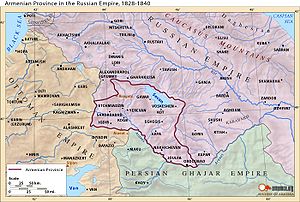
In the aftermath of the Russo-Persian War, 1826-1828
Russo-Persian War, 1826-1828
The Russo-Persian War of 1826-1828 was the last major military conflict between the Russian Empire and the Persian Empire.After the Treaty of Gulistan concluded the previous Russo-Persian War in 1813, peace reigned in the Caucasus for thirteen years...
, the parts of historic Armenia under Persian control, centering on Yerevan
Yerevan
Yerevan is the capital and largest city of Armenia and one of the world's oldest continuously-inhabited cities. Situated along the Hrazdan River, Yerevan is the administrative, cultural, and industrial center of the country...
and Lake Sevan
Lake Sevan
Lake Sevan is the largest lake in Armenia and the Caucasus region. It is one of the largest high-altitude lakes in the world.Lake Sevan is situated in the central part of the Republic of Armenia, inside the Gegharkunik Province, at the altitude of 1,900m above sea level...
, were incorporated into Russia
Russia
Russia or , officially known as both Russia and the Russian Federation , is a country in northern Eurasia. It is a federal semi-presidential republic, comprising 83 federal subjects...
. Under Russian rule, the area corresponding approximately to modern-day Armenian territory was called "Province of Yerevan". The Armenian subjects of the Russian Empire
Russian Empire
The Russian Empire was a state that existed from 1721 until the Russian Revolution of 1917. It was the successor to the Tsardom of Russia and the predecessor of the Soviet Union...
lived in relative safety, compared to their Ottoman kin, albeit clashes with Tatars and Kurds were frequent in the early 20th century.
During the 19th and early 20th centuries, the ambitious Russians sought out to continue their expansion into Armenian land in order to reach the warm waters of the Mediterranean. This caused conflict between the Russian and Ottoman Empires eventually culminating in the Russo-Turkish War, 1828-1829
Russo-Turkish War, 1828-1829
The Russo–Turkish War of 1828–1829 was sparked by the Greek War of Independence. The war broke out after the Sultan, incensed by the Russian participation in the Battle of Navarino, closed the Dardanelles for Russian ships and revoked the Akkerman Convention....
. In the aftermath of the war, the Ottoman Empire ceded a small part of the traditional Armenian homeland to the Russian Empire, known as Eastern Armenia following the while Western Armenia remained under Ottoman sovereignty.
Ottoman Armenia
-armenian_patriarch.png)
Mehmed II
Mehmed II , was Sultan of the Ottoman Empire for a short time from 1444 to September 1446, and later from...
conquered Constantinople
Constantinople
Constantinople was the capital of the Roman, Eastern Roman, Byzantine, Latin, and Ottoman Empires. Throughout most of the Middle Ages, Constantinople was Europe's largest and wealthiest city.-Names:...
from the Byzantines in 1453, and made it the Ottoman Empire's capital. Mehmed and his successors used the religious systems of their subject nationalities as a method of population control, and so Ottoman Sultans invited an Armenian archbishop to establish the Armenian Patriarchate of Constantinople
Armenian Patriarchate of Constantinople
The Armenian Patriarchate of Constantinople , one of the smallest Patriarchates of the Oriental Orthodox Church but one that has exerted a very significant political role and today still exercises a spiritual authority....
. The Armenians of Constantinople grew in numbers, and became respected, if not full, members of Ottoman society.
The Ottoman Empire ruled in accordance to Islamic law
Sharia
Sharia law, is the moral code and religious law of Islam. Sharia is derived from two primary sources of Islamic law: the precepts set forth in the Quran, and the example set by the Islamic prophet Muhammad in the Sunnah. Fiqh jurisprudence interprets and extends the application of sharia to...
. As such, the People of the Book
People of the Book
People of the Book is a term used to designate non-Muslim adherents to faiths which have a revealed scripture called, in Arabic, Al-Kitab . The three types of adherents to faiths that the Qur'an mentions as people of the book are the Jews, Sabians and Christians.In Islam, the Muslim scripture, the...
(the Christians
Christianity
Christianity is a monotheistic religion based on the life and teachings of Jesus as presented in canonical gospels and other New Testament writings...
and the Jews
Judaism
Judaism ) is the "religion, philosophy, and way of life" of the Jewish people...
) had to pay an extra tax to fulfill their status as dhimmi
Dhimmi
A , is a non-Muslim subject of a state governed in accordance with sharia law. Linguistically, the word means "one whose responsibility has been taken". This has to be understood in the context of the definition of state in Islam...
and in return were guaranteed religious autonomy. While the Armenians
Armenians
Armenian people or Armenians are a nation and ethnic group native to the Armenian Highland.The largest concentration is in Armenia having a nearly-homogeneous population with 97.9% or 3,145,354 being ethnic Armenian....
of Constantinople
Istanbul
Istanbul , historically known as Byzantium and Constantinople , is the largest city of Turkey. Istanbul metropolitan province had 13.26 million people living in it as of December, 2010, which is 18% of Turkey's population and the 3rd largest metropolitan area in Europe after London and...
benefitted from the Sultan's support and grew to be a prospering community, the same could not be said about the ones inhabiting historic Armenia
Armenian Highland
The Armenian Highland is the central-most and highest of three land-locked plateaus that together form the northern sector of the Middle East...
. During times of crisis the ones in the remote regions of mountainous eastern Anatolia were mistreated by local Kurdish chiefs and feudal lords. They often also had to suffer (alongside the settled Muslim population) raids by nomadic Kurdish tribes. Armenians
Armenians
Armenian people or Armenians are a nation and ethnic group native to the Armenian Highland.The largest concentration is in Armenia having a nearly-homogeneous population with 97.9% or 3,145,354 being ethnic Armenian....
, like the other Ottoman Christians (though not to the same extent), had to transfer some of their healthy male children to the Sultan's government due to the devşirme policies in place. The boys were then forced to convert to Islam (by threat of death otherwise) and educated to be fierce warriors in times of war, as well as Bey
Bey
Bey is a title for chieftain, traditionally applied to the leaders of small tribal groups. Accoding to some sources, the word "Bey" is of Turkish language In historical accounts, many Turkish, other Turkic and Persian leaders are titled Bey, Beg, Bek, Bay, Baig or Beigh. They are all the same word...
s, Pasha
Pasha
Pasha or pascha, formerly bashaw, was a high rank in the Ottoman Empire political system, typically granted to governors, generals and dignitaries. As an honorary title, Pasha, in one of its various ranks, is equivalent to the British title of Lord, and was also one of the highest titles in...
s and even Grand Vizier
Grand Vizier
Grand Vizier, in Turkish Vezir-i Azam or Sadr-ı Azam , deriving from the Arabic word vizier , was the greatest minister of the Sultan, with absolute power of attorney and, in principle, dismissable only by the Sultan himself...
s in times of peace.
The Armenian national liberation movement was the Armenian
Armenians
Armenian people or Armenians are a nation and ethnic group native to the Armenian Highland.The largest concentration is in Armenia having a nearly-homogeneous population with 97.9% or 3,145,354 being ethnic Armenian....
effort to free the historic Armenian homeland
Armenian Highland
The Armenian Highland is the central-most and highest of three land-locked plateaus that together form the northern sector of the Middle East...
of eastern Anatolia
Anatolia
Anatolia is a geographic and historical term denoting the westernmost protrusion of Asia, comprising the majority of the Republic of Turkey...
and Transcaucasus from Russian
Russian Empire
The Russian Empire was a state that existed from 1721 until the Russian Revolution of 1917. It was the successor to the Tsardom of Russia and the predecessor of the Soviet Union...
and Ottoman
Ottoman Empire
The Ottoman EmpireIt was usually referred to as the "Ottoman Empire", the "Turkish Empire", the "Ottoman Caliphate" or more commonly "Turkey" by its contemporaries...
domination and re-establish the independent Armenian state
Armenia
Armenia , officially the Republic of Armenia , is a landlocked mountainous country in the Caucasus region of Eurasia...
. The national liberation movement of the Balkan peoples and the immediate involvement of the European powers in the Eastern question had a powerful effect on the development of the national liberation ideology movement among the Armenians of the Ottoman Empire
Armenians in the Ottoman Empire
Armenians in the Ottoman Empire or Ottoman Armenians were ethnic Armenian people of the Armenian Apostolic Church, the Armenian Catholic Church or the Armenian Protestant Church who lived in the Ottoman Empire...
. The Armenian national movement, besides its individual heroes, was an organized activity represented around three parties of Armenian people, Social Democrat Hunchakian Party
Social Democrat Hunchakian Party
The Social Democrat Hunchakian Party , is the oldest of the Armenian political parties and was the first Socialist party in the Ottoman Empire and in Persia...
, Armenakan
Armenakan
Armenakan may denote:*Armenian Democratic Liberal Party , historically known as the Armenakan Party from 1885 until 1921*Armenakan-Democratic Liberal Party, an Armenian Party established in 2009 as a splinter group from the Armenian Liberal Democratic Party...
and Armenian Revolutionary Federation
Armenian Revolutionary Federation
The Armenian Revolutionary Federation is an Armenian political party founded in Tiflis in 1890 by Christapor Mikaelian, Stepan Zorian, and Simon Zavarian...
, which ARF was the largest and most influential among the three. Those Armenians who did not support national liberation aspirations or who were neutral were called chezoks.
In 1839, the situation of the Ottoman Armenians slightly improved after Abdul Mejid I carried out Tanzimat
Tanzimat
The Tanzimât , meaning reorganization of the Ottoman Empire, was a period of reformation that began in 1839 and ended with the First Constitutional Era in 1876. The Tanzimât reform era was characterized by various attempts to modernize the Ottoman Empire, to secure its territorial integrity against...
reforms in its territories. However, later Sultans, such as Abdul Hamid II
Abdul Hamid II
His Imperial Majesty, The Sultan Abdülhamid II, Emperor of the Ottomans, Caliph of the Faithful was the 34th sultan of the Ottoman Empire...
stopped the reforms and carried out massacres, now known as the Hamidian massacres
Hamidian massacres
The Hamidian massacres , also referred to as the Armenian Massacres of 1894–1896, refers to the massacring of Armenians by the Ottoman Empire, with estimates of the dead ranging from anywhere between 80,000 to 300,000, and at least 50,000 orphans as a result...
of 1895–96 after a failed Armenian attempt to assassinate him.
The Armenian Genocide (1915–1917)
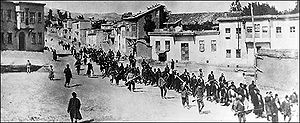
Armenian Genocide
The Armenian Genocide—also known as the Armenian Holocaust, the Armenian Massacres and, by Armenians, as the Great Crime—refers to the deliberate and systematic destruction of the Armenian population of the Ottoman Empire during and just after World War I...
. This genocide
Genocide
Genocide is defined as "the deliberate and systematic destruction, in whole or in part, of an ethnic, racial, religious, or national group", though what constitutes enough of a "part" to qualify as genocide has been subject to much debate by legal scholars...
was preceded by a wave of massacres in the years 1894 to 1896, and another one in 1909 in Adana
Adana massacre
The Adana massacre occurred in Adana Province, in the Ottoman Empire, in April 1909. An massacre of Armenian Christians in the city of Adana amidst governmental upheaval resulted in a series of anti-Armenian pogroms throughout the district...
. In 1915, with World War I
World War I
World War I , which was predominantly called the World War or the Great War from its occurrence until 1939, and the First World War or World War I thereafter, was a major war centred in Europe that began on 28 July 1914 and lasted until 11 November 1918...
in progress, the Ottoman Turks accused the (Christian) Armenians as liable to ally with Russia, and treated the entire Armenian population as an enemy within their empire in a wave of ethnic cleansing
Ethnic cleansing
Ethnic cleansing is a purposeful policy designed by one ethnic or religious group to remove by violent and terror-inspiring means the civilian population of another ethnic orreligious group from certain geographic areas....
.
The events of 1915 to 1923 are regarded by Armenians and the vast majority of Western historians to have been state-sponsored mass killings. Turkish authorities, however, maintain that the deaths were the result of a civil war
Civil war
A civil war is a war between organized groups within the same nation state or republic, or, less commonly, between two countries created from a formerly-united nation state....
coupled with disease and famine
Famine
A famine is a widespread scarcity of food, caused by several factors including crop failure, overpopulation, or government policies. This phenomenon is usually accompanied or followed by regional malnutrition, starvation, epidemic, and increased mortality. Every continent in the world has...
, with casualties incurred by both sides.
The exact numbers of deaths is hard to establish. It is estimated by many sources that close to a million and a half Armenians perished in camps, which excludes Armenians who may have died in other ways. Most estimates place the total number of deaths between 600,000 (by Turkish authorities) and 1,500,000 (by Western academics). These events are traditionally commemorated yearly on April 24, the Armenian Christian martyr day.
This horrific ethnic cleansing done by the İttihat ve Terakki were not only done to Armenians
Armenians
Armenian people or Armenians are a nation and ethnic group native to the Armenian Highland.The largest concentration is in Armenia having a nearly-homogeneous population with 97.9% or 3,145,354 being ethnic Armenian....
, ethnic cleansing regimes were also carried on to the Greeks and Assyrians. This act of ethnic cleansing was done by the Ottoman Turks to "turkify" the Ottoman Empire completely. These acts of genocide
Genocide
Genocide is defined as "the deliberate and systematic destruction, in whole or in part, of an ethnic, racial, religious, or national group", though what constitutes enough of a "part" to qualify as genocide has been subject to much debate by legal scholars...
were done not only from 1915 till 1918, but before and after as well.
Democratic Republic of Armenia (1918–1922)
Between the 4th and 19th centuries, the traditional area of Armenia was conquered and ruled by Persians, ByzantinesByzantine Empire
The Byzantine Empire was the Eastern Roman Empire during the periods of Late Antiquity and the Middle Ages, centred on the capital of Constantinople. Known simply as the Roman Empire or Romania to its inhabitants and neighbours, the Empire was the direct continuation of the Ancient Roman State...
, Arab
Arab
Arab people, also known as Arabs , are a panethnicity primarily living in the Arab world, which is located in Western Asia and North Africa. They are identified as such on one or more of genealogical, linguistic, or cultural grounds, with tribal affiliations, and intra-tribal relationships playing...
s, Mongols
Mongolia
Mongolia is a landlocked country in East and Central Asia. It is bordered by Russia to the north and China to the south, east and west. Although Mongolia does not share a border with Kazakhstan, its western-most point is only from Kazakhstan's eastern tip. Ulan Bator, the capital and largest...
, and Turks
Ottoman Turks
The Ottoman Turks were the Turkish-speaking population of the Ottoman Empire who formed the base of the state's military and ruling classes. Reliable information about the early history of Ottoman Turks is scarce, but they take their Turkish name, Osmanlı , from the house of Osman I The Ottoman...
, among others. Historic Armenia remained under the Ottoman yoke from, until parts of Armenia gained independence from the Ottoman Empire and the Russian Empire after the collapse of these two empires in the wake of the First World War.
Transcaucasian Federation (1917–1918)

Russian Revolution of 1917
The Russian Revolution is the collective term for a series of revolutions in Russia in 1917, which destroyed the Tsarist autocracy and led to the creation of the Soviet Union. The Tsar was deposed and replaced by a provisional government in the first revolution of February 1917...
, the provinces of the Caucasus
Caucasus
The Caucasus, also Caucas or Caucasia , is a geopolitical region at the border of Europe and Asia, and situated between the Black and the Caspian sea...
seceded and formed their own federal state called the Transcaucasian Federation
Transcaucasian Democratic Federative Republic
The Transcaucasian Democratic Federative Republic , was a short-lived state composed of the modern-day countries of Armenia, Azerbaijan, and Georgia in the South Caucasus.-...
. Competing national interests and war with Turkey
Turkey
Turkey , known officially as the Republic of Turkey , is a Eurasian country located in Western Asia and in East Thrace in Southeastern Europe...
led to the dissolution of the republic half a year later, in April 1918.
After the Russian Revolution of 1917
Russian Revolution of 1917
The Russian Revolution is the collective term for a series of revolutions in Russia in 1917, which destroyed the Tsarist autocracy and led to the creation of the Soviet Union. The Tsar was deposed and replaced by a provisional government in the first revolution of February 1917...
and the takeover of the Bolshevik
Bolshevik
The Bolsheviks, originally also Bolshevists , derived from bol'shinstvo, "majority") were a faction of the Marxist Russian Social Democratic Labour Party which split apart from the Menshevik faction at the Second Party Congress in 1903....
s, Stepan Shaumyan was placed in charge of Russian Armenia. In September 1917 the convention in Tiflis elected the Armenian National Council
Armenian National Council
Armenian National Council is a term that refers to*Armenian National Council of Karabagh was also referred as People's Government of Karabagh before the rename in September 1918*Armenian National Council of Baku*Armenian National Council of Tiflis...
, the first sovereign political body of Armenians since the collapse of Lesser Armenia in 1375. Meanwhile, both the Ittihad (Unionist) and the Nationalists moved to win the friendship of the Bolsheviks. Mustafa Kemal
Mustafa Kemal Atatürk
Mustafa Kemal Atatürk was an Ottoman and Turkish army officer, revolutionary statesman, writer, and the first President of Turkey. He is credited with being the founder of the Republic of Turkey....
sent several delegations to Moscow in an attempt to win some support for his own post-Ottoman movement in what he saw as a modernised ethno-nationalist Turkey. This alliance proved disastrous for the Armenians. The signing of the Ottoman-Russian friendship treaty (January 1, 1918), helped Vehib Pasha to attack the new Republic. Under heavy pressure from the combined forces of the Ottoman army and the Kurdish irregulars, the Republic was forced to withdraw from Erzincan to Erzurum. In the end, the Republic had to evacuate Erzurum as well.
Further southeast, in Van, the Armenians resisted the Turkish army until April 1918, but eventually were forced to evacuate it and withdraw to Persia. Conditions deteriorated when Azerbaijani Tatars sided with the Turks and seized the Armenian's lines of communication, thus cutting off the Armenian National Councils in Baku and Yerevan from the National Council in Tiflis.
The Democratic Republic of Armenia
Democratic Republic of Armenia
The Democratic Republic of Armenia was the first modern establishment of an Armenian state...
(DRA) was established in Erevan on May 28, 1918.
Georgian-Armenian War (1918)
During the final stages of World War IWorld War I
World War I , which was predominantly called the World War or the Great War from its occurrence until 1939, and the First World War or World War I thereafter, was a major war centred in Europe that began on 28 July 1914 and lasted until 11 November 1918...
, the Armenians and Georgians had been defending against the advance of the Ottoman Empire
Ottoman Empire
The Ottoman EmpireIt was usually referred to as the "Ottoman Empire", the "Turkish Empire", the "Ottoman Caliphate" or more commonly "Turkey" by its contemporaries...
. In June 1918, in order to forestall an Ottoman advance on Tiflis, the Georgian troops had occupied the Lori Province which at the time had a 75% Armenian majority. After the Armistice of Mudros
Armistice of Mudros
The Armistice of Moudros , concluded on 30 October 1918, ended the hostilities in the Middle Eastern theatre between the Ottoman Empire and the Allies of World War I...
and the withdrawal of the Ottomans, the Georgian forces remained. Georgian Menshevik
Menshevik
The Mensheviks were a faction of the Russian revolutionary movement that emerged in 1904 after a dispute between Vladimir Lenin and Julius Martov, both members of the Russian Social-Democratic Labour Party. The dispute originated at the Second Congress of that party, ostensibly over minor issues...
parlementarian Irakli Tsereteli
Irakli Tsereteli
Irakli Tsereteli was a Georgian politician, one of the leaders of the Russian Social-Democratic Labour Party and later the Georgian Mensheviks....
offered that the Armenians would be safer from the Turks as Georgian citizens. The Georgians offered a quadripartite conference including Georgia, Armenia, Azerbaijan
Azerbaijan Democratic Republic
The Azerbaijan Democratic Republic was the first successful attempt to establish a democratic and secular republic in the Muslim world . The ADR was founded on May 28, 1918 after the collapse of the Russian Empire that began with the Russian Revolution of 1917 by Azerbaijani National Council in...
, and the Mountainous Republic of the Northern Caucasus
Mountainous Republic of the Northern Caucasus
The Mountainous Republic of the Northern Caucasus was a short-lived state situated in the Northern Caucasus...
in order to resolve the issue which the Armenians rejected. In December 1918, the Georgians were confronting a rebellion chiefly in the village of Uzunlar
Odzun
Odzun ; is a historical town in the Armenian province of Lori. It is situated on a plateau above the left bank of the Debed river gorge, a few kilometres south of the town of Alaverdi. It is famous for the 5-7th century Odzun Church, one of the finest Armenian basilicas with a cupola....
in the Lori region. Within days, hostilities commenced between the two republics.
The Georgian-Armenian War was a border war fought in 1918 between the Democratic Republic of Georgia
Democratic Republic of Georgia
The Democratic Republic of Georgia , 1918–1921, was the first modern establishment of a Republic of Georgia.The DRG was created after the collapse of the Russian Empire that began with the Russian Revolution of 1917...
and the Democratic Republic of Armenia
Democratic Republic of Armenia
The Democratic Republic of Armenia was the first modern establishment of an Armenian state...
over the parts of then disputed provinces of Lori
Lori
Lori may refer to:*Lori *Lori Province, Armenia*Lori , a nomadic community found in Balochistan region of Pakistan and Iran*Luri language , spoken by the Lur people Lorestān, Iran...
, Javakheti
Javakheti
Javakheti is a historical region of the nation of Georgia, in the southeastern part of the country's Samtskhe-Javakheti province. Today it comprises the Akhalkalaki and Ninotsminda municipal territories. It was historically bordered in the west with both sides of the Mtkvari river, in the north,...
which had been historically bicultural Armenian-Georgian territories, but were largely populated by Armenians in the 19th century.
Armenian-Azerbaijan War
A considerable degree of hostility existed between Armenia and its new neighbor to the east, the Democratic Republic of Azerbaijan, stemming largely from to racial, religious, cultural and societal differences. The Azeris had close ethnic and religious ties to the Turks and had provided material support for them in their drive to BakuBaku
Baku , sometimes spelled as Baki or Bakou, is the capital and largest city of Azerbaijan, as well as the largest city on the Caspian Sea and of the Caucasus region. It is located on the southern shore of the Absheron Peninsula, which projects into the Caspian Sea. The city consists of two principal...
in 1918. Although the borders of the two countries were still undefined, Azerbaijan claimed most of the territory Armenia was sitting on, demanding all or most parts of the former Russian provinces of Elizavetpol, Tiflis, Yerevan
Yerevan
Yerevan is the capital and largest city of Armenia and one of the world's oldest continuously-inhabited cities. Situated along the Hrazdan River, Yerevan is the administrative, cultural, and industrial center of the country...
, Kars
Kars Oblast
Kars Oblast was one of Transcaucasian governorates of Russian Empire between 1878 and 1917. Its capital was in the city of Kars, presently in the Republic of Turkey. The governorate bordered with the Ottoman Empire, Batum Oblast, Tiflis Governorate, Erivan Governorate, and from 1883 to 1903 with...
and Batum. As diplomacy failed to accomplish compromise, even with the mediation of the commanders of a British expeditionary force that had installed itself in the Caucasus, territorial clashes between Armenia and Azerbaijan took place throughout 1919 and 1920, most notably in the regions of Nakhichevan
Nakhichevan
The Nakhchivan Autonomous Republic is a landlocked exclave of Azerbaijan. The region covers 5,363 km² and borders Armenia to the east and north, Iran to the south and west, and Turkey to the northwest...
, Karabakh
Karabakh
The Karabakh horse , also known as Karabakh, is a mountain-steppe racing and riding horse. It is named after the geographic region where the horse was originally developed, Karabakh in the Southern Caucasus, an area that is de jure part of Azerbaijan but the highland part of which is currently...
and Syunik
Syunik
Syunik is the southernmost province of Armenia. It borders the Vayots Dzor marz to the north, Azerbaijan's Nakhchivan exclave to the west, Karabakh to the east, and Iran to the south. Its capital is Kapan. Other important cities and towns include Goris, Sisian, Meghri, Agarak, and Dastakert...
(Zangezur). Repeated attempts to bring these provinces under Azerbaijani jurisdiction were met with fierce resistance by their Armenian inhabitants. In May 1919, Dro led an expeditionary unit that was successful in establishing Armenian administrative control in Nakhichevan
Nakhichevan
The Nakhchivan Autonomous Republic is a landlocked exclave of Azerbaijan. The region covers 5,363 km² and borders Armenia to the east and north, Iran to the south and west, and Turkey to the northwest...
.
South West Caucasian Republic
While problems with Azerbaijan continued, a new state headed by Fakhr al-Din Pirioghlu and centered in KarsKars
Kars is a city in northeast Turkey and the capital of Kars Province. The population of the city is 73,826 as of 2010.-Etymology:As Chorzene, the town appears in Roman historiography as part of ancient Armenia...
, the South West Caucasian Republic was established. It claimed the territory around the regions of Kars and Batum, parts of the Yerevan district and the Akhaltsikhe
Akhaltsikhe
Akhaltsikhe is a small city in Georgia's southwestern region of Samtskhe-Javakheti. It is situated on the both banks of a small river Potskhovi, which separates the city to the old city in the north and new in the south. The name of the city translates from Georgian as "new fortress".- History...
and Akhalkalaki
Akhalkalaki
Akhalkalaki is a small city in Georgia's southern region of Samtskhe-Javakheti with a population of 60,975. Akhalkalaki lies on the edge of the Javakheti Volcanic Plateau. The city is located about 30 km from the border with Turkey. 90 percent of the city's population are ethnic Armenians...
districts of the Tiflis province. It existed alongside with the British general governorship created during the Entente's intervention in Transcaucasia. It was abolished by British High Commissioner Admiral Somerset Arthur Gough-Calthorpe
Somerset Arthur Gough-Calthorpe
Admiral of the Fleet Sir Somerset Arthur Gough-Calthorpe GCB, GCMG, CVO , sometimes known as Sir Somerset Calthorpe, was a British Royal Navy admiral and a member of the Gough-Calthorpe family.-Naval career:...
in April 1919 and the region was assigned to the Armenian Republic.
Treaty of Sèvres
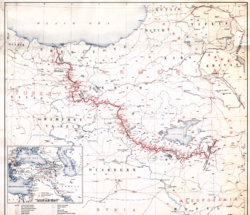
Treaty of Sèvres
The Treaty of Sèvres was the peace treaty between the Ottoman Empire and Allies at the end of World War I. The Treaty of Versailles was signed with Germany before this treaty to annul the German concessions including the economic rights and enterprises. Also, France, Great Britain and Italy...
was signed between the Allied and Associated Powers and Ottoman Empire
Ottoman Empire
The Ottoman EmpireIt was usually referred to as the "Ottoman Empire", the "Turkish Empire", the "Ottoman Caliphate" or more commonly "Turkey" by its contemporaries...
at Sèvres
Sèvres
Sèvres is a commune in the southwestern suburbs of Paris, France. It is located from the centre of Paris.The town is known for its porcelain manufacture, the Manufacture nationale de Sèvres, making the famous Sèvres porcelain, as well as being the location of the International Bureau of Weights...
, France
France
The French Republic , The French Republic , The French Republic , (commonly known as France , is a unitary semi-presidential republic in Western Europe with several overseas territories and islands located on other continents and in the Indian, Pacific, and Atlantic oceans. Metropolitan France...
on August 10, 1920. The treaty included a clause on Armenia: it made all parties signing the treaty recognize Armenia
Armenia
Armenia , officially the Republic of Armenia , is a landlocked mountainous country in the Caucasus region of Eurasia...
as a free and independent state. The drawing of definite borders was, however, left to President Woodrow Wilson
Woodrow Wilson
Thomas Woodrow Wilson was the 28th President of the United States, from 1913 to 1921. A leader of the Progressive Movement, he served as President of Princeton University from 1902 to 1910, and then as the Governor of New Jersey from 1911 to 1913...
and the United States State Department, and was only presented to Armenia on November 22. The new borders gave Armenia access to the Black Sea and awarded large portions of the eastern provinces of the Ottoman Empire to the republic. The Treaty of Sèvres was signed by the Ottoman Government, but Sultan Mehmed VI
Mehmed VI
Mehmet VI was the 36th and last Sultan of the Ottoman Empire, reigning from 1918 to 1922...
never signed it and thus never came into effect. The Turkish Revolutionaries, led by Mustafa Kemal Pasha, began the Turkish National Movement
Turkish National Movement
The Turkish National Movement encompasses the political and military activities of the Turkish revolutionaries which resulted in the creation and shaping of the Republic of Turkey, as a consequence of the defeat of the Ottoman Empire in World War I....
which, in opposing any territorial concessions to either the Greeks or the Armenians, moved forward with their plans to crush the Armenian republic.
Turkish-Armenian War (1920)
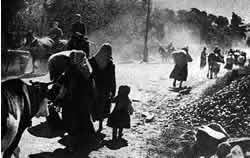
In 1920, Armenian border troops skirmished with Muslim warlords in the former Georgian region of Oltu
Oltu
Oltu is a town and district of Erzurum Province in the Eastern Anatolia region of Turkey. The mayor is İbrahim Ziyrek . The population is 19,969 .-History:...
, on the border with the DRA. Turkish General Kazım Karabekir
Kazim Karabekir
Musa Kâzım Karabekir was a Turkish general and politician. He was commander of the Eastern Army in the Ottoman Empire at the end of World War I and served as Speaker of the Grand National Assembly of Turkey before his death.-Early years:Karabekir was born in 1882 as the son of an Ottoman General,...
then led four Turkish battalions into the district on September 3 and drove the Armenians out.
The Turkish Revolutionaries alleged that the Turks inside DRA were being mistreated and oppressed by the Armenians. On September 20, 1920, the Turkish General Kazım Karabekir
Kazim Karabekir
Musa Kâzım Karabekir was a Turkish general and politician. He was commander of the Eastern Army in the Ottoman Empire at the end of World War I and served as Speaker of the Grand National Assembly of Turkey before his death.-Early years:Karabekir was born in 1882 as the son of an Ottoman General,...
invaded the region of Sarikamish
Sarıkamış
Sarıkamış is a town and a district of Kars Province in the Eastern Anatolia region of Turkey. The population is 17,860 as of 2010.The town sits in a valley and is surrounded by mountains, many of which are covered with pine forests. It has very long winters, with average of 7–8 ft of...
. In response, Armenia declared war on Turkey on September 24 and the Turkish invasion of Armenia (1920) began. In the regions of Oltu
Oltu
Oltu is a town and district of Erzurum Province in the Eastern Anatolia region of Turkey. The mayor is İbrahim Ziyrek . The population is 19,969 .-History:...
, Sarikamish, Kars
Kars
Kars is a city in northeast Turkey and the capital of Kars Province. The population of the city is 73,826 as of 2010.-Etymology:As Chorzene, the town appears in Roman historiography as part of ancient Armenia...
, Alexandropol
Gyumri
Gyumri is the capital and largest city of the Shirak Province in northwest Armenia. It is located about 120 km from the capital Yerevan, and, with a population of 168,918 , is the second-largest city in Armenia.The name of the city has been changed many times in history...
(Gyumri) Armenian forces clashed with those of Karabekir’s armies. Mustafa Kemal Pasha had sent several delegations to Moscow in search of an alliance, where he had found a receptive response by the Soviet government, which started sending gold and weapons to the Turkish revolutionaries. This proved disastrous for the Armenians.
Armenia gave way to communist
Communism
Communism is a social, political and economic ideology that aims at the establishment of a classless, moneyless, revolutionary and stateless socialist society structured upon common ownership of the means of production...
power in late 1920. In November 1920, the Turkish revolutionaries captured Alexandropol and were poised to move in on the capital. A cease fire was concluded on November 18. Negotiations were then carried out between Karabekir and a peace delegation led by Alexander Khatisian in Alexandropol; although Karabekir’s terms were extremely harsh the Armenian delegation had little recourse but to agree to them. The Treaty of Alexandropol
Treaty of Alexandropol
The Treaty of Alexandropol was a peace treaty between the Democratic Republic of Armenia and the Grand National Assembly of Turkey ending the Turkish-Armenian War, signed on December 2, 1920, before the declaration of the Republic of Turkey. It was the first treaty signed by Turkish...
was thus signed on December 2/3, 1920.
The consequences of the DRA's war with Turkey were severe. In the Treaty of Alexandropol
Treaty of Alexandropol
The Treaty of Alexandropol was a peace treaty between the Democratic Republic of Armenia and the Grand National Assembly of Turkey ending the Turkish-Armenian War, signed on December 2, 1920, before the declaration of the Republic of Turkey. It was the first treaty signed by Turkish...
, the young Armenian republic was to disarm most of its military forces, cede more than 50% of its pre-war territory, and to give up all the territories granted to it at the Treaty of Sèvres.
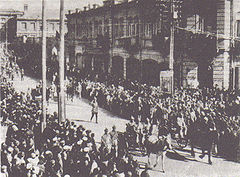
Grigoriy Ordzhonikidze
Grigol Ordzhonikidze ორჯონიკიძე - Grigol Orjonikidze, , generally known as Sergo Ordzhonikidze ; – February 18, 1937) was a Georgian Bolshevik, later member of the CPSU Politburo and close friend to Joseph Stalin...
invaded the DRA from Azerbaijan in order to establish a new pro-Bolshevik government in the country.
The 11th Red Army began its virtually unopposed advance into Armenia on November 29, 1920 at Karavansarai
Ijevan
Ijevan now is a city in Armenia and the capital of Tavush region. It is located in the northern part of the region, on the foot of Ijevan ridge and Nal'teket ridge on both banks of Aghstev River. The city's current name, Ijevan, and its former name Karavansara both mean "inn" , in Armenian and...
. The actual transfer of power took place on December 2 in Yerevan
Yerevan
Yerevan is the capital and largest city of Armenia and one of the world's oldest continuously-inhabited cities. Situated along the Hrazdan River, Yerevan is the administrative, cultural, and industrial center of the country...
. The Armenian leadership approved an ultimatum, presented to it by the Soviet plenipotentiary Boris Legran
Boris Legran
Boris Vasilyevich Legran or Legrand was a Bolshevik revolutionary and Soviet official who represented the interests of the Russian SFSR in Armenia and Transcaucasia, during the 1920s and worked as a consular official in China during the 1920s.He also was the director of the State Hermitage Museum...
. Armenia decided to join the Soviet sphere, while Soviet Russia agreed to protect its remaining territory from the advancing Turkish army. The Soviets also pledged to take steps to rebuild the army, protect the Armenians and to not pursue non-communist Armenians, although the final condition of this pledge was reneged when the Dashnaks were forced out of the country.
On December 5, the Armenian Revolutionary Committee (Revkom, made up of mostly Armenians from Azerbaijan) also entered the city. Finally, on the following day, December 6, Felix Dzerzhinsky's Cheka
Cheka
Cheka was the first of a succession of Soviet state security organizations. It was created by a decree issued on December 20, 1917, by Vladimir Lenin and subsequently led by aristocrat-turned-communist Felix Dzerzhinsky...
, entered Yerevan, thus effectively ending the existence of the Democratic Republic of Armenia. At that point what was left of Armenia was under the influence of the Bolsheviks.
Although the Bolsheviks succeeded in ousting the Turks from their positions in Armenia, they decided to establish peace with Turkey. In 1921, the Bolsheviks and the Turks signed the Treaty of Kars
Treaty of Kars
The Treaty of Kars was a "friendship" treaty signed in Kars on October 13, 1921 and ratified in Yerevan on September 11 1922.Signatories included representatives from the Grand National Assembly of Turkey, which in 1923 would declare the Republic of Turkey, and also from Soviet Armenia, Soviet...
, in which Turkey ceded Adjara
Adjara
Adjara , officially the Autonomous Republic of Adjara , is an autonomous republic of Georgia.Adjara is located in the southwestern corner of Georgia, bordered by Turkey to the south and the eastern end of the Black Sea...
to the USSR in exchange for the Kars territory (today the Turkish provinces of Kars
Kars Province
Kars Province is a province of Turkey, located in the northeastern part of the country. It shares part of its border with the Republic of Armenia.The provinces of Ardahan and Iğdır were until the 1990s part of Kars Province.-History:...
, Iğdır
Igdir Province
Iğdır Province is a province in eastern Turkey, located along the border with Armenia, Azerbaijan , and Iran. Its adjacent provinces are Kars to the northwest and Ağrı to the west and south...
, and Ardahan
Ardahan Province
Ardahan Province is a province in the far north-east of Turkey, at the very end of the country, where Turkey borders with Georgia . The provincial capital is the city of Ardahan.- Geography :...
). The land given to Turkey included the ancient city of Ani
Ani
Ani is a ruined and uninhabited medieval Armenian city-site situated in the Turkish province of Kars, near the border with Armenia. It was once the capital of a medieval Armenian kingdom that covered much of present day Armenia and eastern Turkey...
and Mount Ararat
Mount Ararat
Mount Ararat is a snow-capped, dormant volcanic cone in Turkey. It has two peaks: Greater Ararat and Lesser Ararat .The Ararat massif is about in diameter...
, the spiritual Armenian homeland. In 1922, the newly-proclaimed Armenian Soviet Socialist Republic, under the leadership of Alexander Miasnikyan
Aleksandr Myasnikyan
Aleksandr Teodorosi Myasnikyan a.k.a. Aleksandr Fyodorovich Myasnikov was a prominent Bolshevik of Armenian descent....
, became part of the Soviet Union
Soviet Union
The Soviet Union , officially the Union of Soviet Socialist Republics , was a constitutionally socialist state that existed in Eurasia between 1922 and 1991....
as one of three republics comprising the Transcaucasian SFSR
Transcaucasian SFSR
The Transcaucasian Socialist Federative Soviet Republic , also known as the Transcaucasian Soviet Federative Socialist Republic, the Transcaucasian SFSR and the TSFSR for short, was a short-lived republic of the Soviet Union, lasting from 1922 to 1936...
.
Armenia in the Soviet Union (1922–1991)
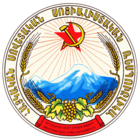
Armenian SSR
The Armenian Soviet Socialist Republic The Armenian Soviet Socialist Republic The Armenian Soviet Socialist Republic The Armenian Soviet Socialist Republic The Armenian Soviet Socialist Republic The Armenian Soviet Socialist Republic The Armenian Soviet Socialist Republic The Armenian Soviet...
. The transition to communism
Communism
Communism is a social, political and economic ideology that aims at the establishment of a classless, moneyless, revolutionary and stateless socialist society structured upon common ownership of the means of production...
was difficult for Armenia, and for most of the other republics in the Soviet Union. The Soviet authorities placed Armenians under strict surveillance. There was almost no freedom of speech
Freedom of speech
Freedom of speech is the freedom to speak freely without censorship. The term freedom of expression is sometimes used synonymously, but includes any act of seeking, receiving and imparting information or ideas, regardless of the medium used...
, even less so under Joseph Stalin
Joseph Stalin
Joseph Vissarionovich Stalin was the Premier of the Soviet Union from 6 May 1941 to 5 March 1953. He was among the Bolshevik revolutionaries who brought about the October Revolution and had held the position of first General Secretary of the Communist Party of the Soviet Union's Central Committee...
. Any individual who was suspected of using or introducing nationalist rhetoric
Rhetoric
Rhetoric is the art of discourse, an art that aims to improve the facility of speakers or writers who attempt to inform, persuade, or motivate particular audiences in specific situations. As a subject of formal study and a productive civic practice, rhetoric has played a central role in the Western...
or elements in their works were labeled traitors or propangandists, and were sent to Siberia
Siberia
Siberia is an extensive region constituting almost all of Northern Asia. Comprising the central and eastern portion of the Russian Federation, it was part of the Soviet Union from its beginning, as its predecessor states, the Tsardom of Russia and the Russian Empire, conquered it during the 16th...
during Stalinist rule. Even Zabel Yessayan
Zabel Yesayan
Zabel Yesayan was a famous Armenian novelist, poet, writer, and teacher.- Biography :...
, a writer who was fortunate enough to escape from ethnic cleansing during the Armenian Genocide
Armenian Genocide
The Armenian Genocide—also known as the Armenian Holocaust, the Armenian Massacres and, by Armenians, as the Great Crime—refers to the deliberate and systematic destruction of the Armenian population of the Ottoman Empire during and just after World War I...
, was quickly exiled to Siberia after repatriating to Armenia from France
France
The French Republic , The French Republic , The French Republic , (commonly known as France , is a unitary semi-presidential republic in Western Europe with several overseas territories and islands located on other continents and in the Indian, Pacific, and Atlantic oceans. Metropolitan France...
.
Soviet Armenia participated in World War II
World War II
World War II, or the Second World War , was a global conflict lasting from 1939 to 1945, involving most of the world's nations—including all of the great powers—eventually forming two opposing military alliances: the Allies and the Axis...
by sending hundreds of thousands of soldiers to the frontline in order to defend the "Soviet motherland."
Soviet rule also had some positive aspects. Armenia benefited from the Soviet economy, especially when it was at its apex. Provincial villages gradually became towns and towns gradually became cities. Peace between Armenia
Armenia
Armenia , officially the Republic of Armenia , is a landlocked mountainous country in the Caucasus region of Eurasia...
and Azerbaijan
Azerbaijan
Azerbaijan , officially the Republic of Azerbaijan is the largest country in the Caucasus region of Eurasia. Located at the crossroads of Western Asia and Eastern Europe, it is bounded by the Caspian Sea to the east, Russia to the north, Georgia to the northwest, Armenia to the west, and Iran to...
was reached, albeit temporarily. During this time, Armenia had a sizeable Azeri minority, mostly centred in Yerevan
Yerevan
Yerevan is the capital and largest city of Armenia and one of the world's oldest continuously-inhabited cities. Situated along the Hrazdan River, Yerevan is the administrative, cultural, and industrial center of the country...
. Likewise, Azerbaijan had an Armenian minority, concentrated in Baku
Baku
Baku , sometimes spelled as Baki or Bakou, is the capital and largest city of Azerbaijan, as well as the largest city on the Caspian Sea and of the Caucasus region. It is located on the southern shore of the Absheron Peninsula, which projects into the Caspian Sea. The city consists of two principal...
, Kirovabad
Kirovabad
Kirovabad can refer to:* The former name of Ganja, the second largest city in Azerbaijan.* The former name of Panj or Pyandzh a city in Tajikistan.* Kirovabad pogrom - pogrom in Kirovabad formerly Ganja....
, and Nagorno-Karabakh
Nagorno-Karabakh
Nagorno-Karabakh is a landlocked region in the South Caucasus, lying between Lower Karabakh and Zangezur and covering the southeastern range of the Lesser Caucasus mountains...
. This demographic would change dramatically during and after the Nagorno-Karabakh war
Nagorno-Karabakh War
The Nagorno-Karabakh War was an armed conflict that took place from February 1988 to May 1994, in the small enclave of Nagorno-Karabakh in southwestern Azerbaijan, between the majority ethnic Armenians of Nagorno-Karabakh backed by the Republic of Armenia, and the Republic of Azerbaijan...
.
Many Armenians still had nationalist sentiments, even though they were discouraged from expressing them publicly. On April 24, 1965, tens of thousands of Armenians flooded the streets of Yerevan to remind the world of the horrors that their parents and grandparents endured during the Armenian Genocide
Armenian Genocide
The Armenian Genocide—also known as the Armenian Holocaust, the Armenian Massacres and, by Armenians, as the Great Crime—refers to the deliberate and systematic destruction of the Armenian population of the Ottoman Empire during and just after World War I...
of 1915. This was the first public demonstration of such high numbers in the USSR, which defended national interests rather than collective ones. In the late 1980s, Armenia was suffering from pollution. With Mikhail Gorbachev
Mikhail Gorbachev
Mikhail Sergeyevich Gorbachev is a former Soviet statesman, having served as General Secretary of the Communist Party of the Soviet Union from 1985 until 1991, and as the last head of state of the USSR, having served from 1988 until its dissolution in 1991...
's introduction of glasnost
Glasnost
Glasnost was the policy of maximal publicity, openness, and transparency in the activities of all government institutions in the Soviet Union, together with freedom of information, introduced by Mikhail Gorbachev in the second half of the 1980s...
and perestroika
Perestroika
Perestroika was a political movement within the Communist Party of the Soviet Union during 1980s, widely associated with the Soviet leader Mikhail Gorbachev...
, public demonstrations became more common. Thousands of Armenians demonstrated in Yerevan because of the USSR's inability to address simple ecological concerns. Later on, with the conflict in Karabakh
Karabakh
The Karabakh horse , also known as Karabakh, is a mountain-steppe racing and riding horse. It is named after the geographic region where the horse was originally developed, Karabakh in the Southern Caucasus, an area that is de jure part of Azerbaijan but the highland part of which is currently...
, the demonstrations obtained a more nationalistic flavour. Many Armenians began to demand statehood.
In 1988, the Spitak Earthquake killed tens of thousands of people and destroyed multiple towns in northern Armenia, such as Leninakan
Gyumri
Gyumri is the capital and largest city of the Shirak Province in northwest Armenia. It is located about 120 km from the capital Yerevan, and, with a population of 168,918 , is the second-largest city in Armenia.The name of the city has been changed many times in history...
(modern-day Gyumri
Gyumri
Gyumri is the capital and largest city of the Shirak Province in northwest Armenia. It is located about 120 km from the capital Yerevan, and, with a population of 168,918 , is the second-largest city in Armenia.The name of the city has been changed many times in history...
) and Spitak
Spitak
Spitak is a city in northern Armenia located in the Lori region with a population of 18,237. It was mostly destroyed by the devastating Spitak Earthquake in 1988, and was subsequently rebuilt in a slightly different location. Spitak means '"White" in Armenian....
. Many families were left without electricity and running water. The harsh situation caused by the earthquake and subsequent events made many residents of Armenia leave and settle in North America
North America
North America is a continent wholly within the Northern Hemisphere and almost wholly within the Western Hemisphere. It is also considered a northern subcontinent of the Americas...
, Western Europe
Western Europe
Western Europe is a loose term for the collection of countries in the western most region of the European continents, though this definition is context-dependent and carries cultural and political connotations. One definition describes Western Europe as a geographic entity—the region lying in the...
or Australia
Australia
Australia , officially the Commonwealth of Australia, is a country in the Southern Hemisphere comprising the mainland of the Australian continent, the island of Tasmania, and numerous smaller islands in the Indian and Pacific Oceans. It is the world's sixth-largest country by total area...
.
On February 20, 1988, interethnic fighting between the ethnic Armenians of Nagorno-Karabakh and Azerbaijanis broke out shortly after the parliament of Nagorno-Karabakh
Nagorno-Karabakh
Nagorno-Karabakh is a landlocked region in the South Caucasus, lying between Lower Karabakh and Zangezur and covering the southeastern range of the Lesser Caucasus mountains...
, an autonomous oblast in Azerbaijan, voted to unify the region with Armenia. The Nagorno-Karabakh war
Nagorno-Karabakh War
The Nagorno-Karabakh War was an armed conflict that took place from February 1988 to May 1994, in the small enclave of Nagorno-Karabakh in southwestern Azerbaijan, between the majority ethnic Armenians of Nagorno-Karabakh backed by the Republic of Armenia, and the Republic of Azerbaijan...
pitted Armenians of Nagorno-Karabakh, backed by Armenia, against the Army of Azerbaijan
Army of Azerbaijan
The Azerbaijani Land Forces are the land force component of the Azerbaijani Armed Forces.Since the fall of the Soviet Union, Azerbaijan has been trying to further develop its armed forces into a professional, well trained, and mobile military. Based on 2007 statistics the country has about 56,840...
.
Independent Armenia (1991-today)
ArmeniaArmenia
Armenia , officially the Republic of Armenia , is a landlocked mountainous country in the Caucasus region of Eurasia...
declared its sovereignty from the Soviet Union
Soviet Union
The Soviet Union , officially the Union of Soviet Socialist Republics , was a constitutionally socialist state that existed in Eurasia between 1922 and 1991....
on August 23, 1990. In the wake of the August Coup, a referendum
Referendum
A referendum is a direct vote in which an entire electorate is asked to either accept or reject a particular proposal. This may result in the adoption of a new constitution, a constitutional amendment, a law, the recall of an elected official or simply a specific government policy. It is a form of...
was held on the question of secession
Secession
Secession is the act of withdrawing from an organization, union, or especially a political entity. Threats of secession also can be a strategy for achieving more limited goals.-Secession theory:...
. Following an overwhelming vote in favor, full independence was declared on September 21, 1991. However, widespread recognition did not occur until the formal dissolution of the Soviet Union on December 25, 1991.
Armenia faced many challenges during its first years as a sovereign state
Sovereign state
A sovereign state, or simply, state, is a state with a defined territory on which it exercises internal and external sovereignty, a permanent population, a government, and the capacity to enter into relations with other sovereign states. It is also normally understood to be a state which is neither...
. Several Armenian organizations from around the world quickly arrived to offer aid and to participate in the country's early years. From Canada, a group of young students and volunteers under the CYMA - Canadian Youth Mission to Armenia banner arrived in Ararat Region and became the first youth organization to contribute to the newly independent Republic.
Following the Armenian victory in the Nagorno-Karabakh war
Nagorno-Karabakh War
The Nagorno-Karabakh War was an armed conflict that took place from February 1988 to May 1994, in the small enclave of Nagorno-Karabakh in southwestern Azerbaijan, between the majority ethnic Armenians of Nagorno-Karabakh backed by the Republic of Armenia, and the Republic of Azerbaijan...
, both Azerbaijan
Azerbaijan
Azerbaijan , officially the Republic of Azerbaijan is the largest country in the Caucasus region of Eurasia. Located at the crossroads of Western Asia and Eastern Europe, it is bounded by the Caspian Sea to the east, Russia to the north, Georgia to the northwest, Armenia to the west, and Iran to...
and Turkey
Turkey
Turkey , known officially as the Republic of Turkey , is a Eurasian country located in Western Asia and in East Thrace in Southeastern Europe...
closed their borders and imposed a blockade which they retain to this day, though in October 2009 Turkey and Armenia signed a treaty to normalize relations. These events severely affected the economy of the fledgling republic, and closed off its main routes to Europe
Europe
Europe is, by convention, one of the world's seven continents. Comprising the westernmost peninsula of Eurasia, Europe is generally 'divided' from Asia to its east by the watershed divides of the Ural and Caucasus Mountains, the Ural River, the Caspian and Black Seas, and the waterways connecting...
.
Ter-Petrossian Presidency (1991–1998)

Levon Ter-Petrossian
Levon Ter-Petrossian , sometimes transliterated Levon Ter-Petrosyan or Ter-Petrosian , was the first President of Armenia from 1991 to 1998...
was popularly elected the first President of the newly-independent Republic of Armenia on October 16, 1991 and re-elected on September 22, 1996. His re-election was marred by allegations of electoral fraud reported by the opposition and supported by many international observers. His popularity waned further as the opposition started blaming him for the economic quagmire that Armenia's post-Soviet economy was in. He was also unpopular with one party in particular, the Armenian Revolutionary Federation
Armenian Revolutionary Federation
The Armenian Revolutionary Federation is an Armenian political party founded in Tiflis in 1890 by Christapor Mikaelian, Stepan Zorian, and Simon Zavarian...
, which he banned and jailed its leadership, on the grounds that the party had a foreign-based leadership—something which was forbidden according to the Armenian Constitution.
Ter-Petrossian was forced to step down in February 1998 after advocating compromised settlement of the conflict over Nagorno-Karabakh
Nagorno-Karabakh
Nagorno-Karabakh is a landlocked region in the South Caucasus, lying between Lower Karabakh and Zangezur and covering the southeastern range of the Lesser Caucasus mountains...
which many Armenians regarded as undermining their security. Ter-Petrossian's key ministers, led by then-Prime Minister Robert Kocharyan, refused to accept a peace plan for Karabakh put forward by international mediators in September 1997. The plan, accepted by Ter-Petrossian and Azerbaijan
Azerbaijan
Azerbaijan , officially the Republic of Azerbaijan is the largest country in the Caucasus region of Eurasia. Located at the crossroads of Western Asia and Eastern Europe, it is bounded by the Caspian Sea to the east, Russia to the north, Georgia to the northwest, Armenia to the west, and Iran to...
, called for a "phased" settlement of the conflict which would postpone an agreement on Karabakh's status, the main stumbling block. That agreement was to accompany the return of most Armenian-controlled Azerbaijani territories around Karabakh and the lifting of the Azerbaijan
Azerbaijan
Azerbaijan , officially the Republic of Azerbaijan is the largest country in the Caucasus region of Eurasia. Located at the crossroads of Western Asia and Eastern Europe, it is bounded by the Caspian Sea to the east, Russia to the north, Georgia to the northwest, Armenia to the west, and Iran to...
i and Turkish
Turkey
Turkey , known officially as the Republic of Turkey , is a Eurasian country located in Western Asia and in East Thrace in Southeastern Europe...
blockades of Armenia.
Kocharyan Presidency (1998–2008)
Levon Ter-Petrossian
Levon Ter-Petrossian , sometimes transliterated Levon Ter-Petrosyan or Ter-Petrosian , was the first President of Armenia from 1991 to 1998...
, Robert Kocharyan was elected Armenia's second President on March 30, 1998, defeating his main rival, Karen Demirchyan
Karen Demirchyan
Karen Demirchyan was a Soviet Armenian communist, First Secretary of the Armenian Soviet Socialist Republic from 1974 to 1988 and later independent politician...
, in an early presidential election marred by irregularities and violations
Armenian presidential election, 1998
Presidential elections were held in Armenia on 16 March 1998, with a second round on 30 March. The result was a victory for independent candidate Robert Kocharyan, who won 58.9% of the vote in the second round. Turnout was 63.5% in the first round and 68.1% in the second.-Results:...
by both sides as reported by international electoral observers. Complaints included that Kocharyan had not been an Armenian citizen for ten years as required by the constitution., even though it would have been impossible for him to be a 10 year citizen of a republic that was less than 7 years old; however, the Armenian constitution recognized the Armenian SSR as it predecessor state.
During his presidency, several opposition leaders in the Armenian Parliament and the Prime Minister of Armenia were killed by gunmen in an episode known as the 1999 Armenian parliament shooting
1999 Armenian parliament shooting
The 1999 Armenian parliament shooting was an attack on the Armenian parliament in the capital Yerevan on October 27, 1999 at 5:15 p.m, by a group of armed men that killed the Prime Minister of Armenia and 7 other high ranking officials.-Shooting:...
. Kocharyan himself negotiated with terrorists to lease the MP hostages. It is widely believed by Armenians at large that Kocharyan is responsible for the parliament shooting.
The 2003 Armenian Presidential election
Armenian presidential election, 2003
The 2003 Armenian Presidential election took place in Armenia on 19 February and 5 March 2003. No candidate received a majority in the first round of the election with the incumbent President Robert Kocharyan winning slightly under 50% of the vote. Therefore a second round was held and Kocharyan...
were held on February 19 and March 5, 2003. No candidate received a majority in the first round of the election with the incumbent
Incumbent
The incumbent, in politics, is the existing holder of a political office. This term is usually used in reference to elections, in which races can often be defined as being between an incumbent and non-incumbent. For example, in the 2004 United States presidential election, George W...
President Kocharyan winning slightly under 50% of the vote. Therefore a second round was held and Kocharyan defeated Stepan Demirchyan
Stepan Demirchyan
Stepan Demirchyan is an Armenian politician and son of the Communist-era Armenian leader Karen Demirchyan.-Biography:Stepan Demirchyan was born in Yerevan and received his degree from Yerevan Polytechnic Institute in 1981. He is an engineer-electrician and a PhD on Technical Sciences...
with official results showed him winning just over 67% of the vote.
In both rounds, electoral observers from the OSCE
Organization for Security and Co-operation in Europe
The Organization for Security and Co-operation in Europe is the world's largest security-oriented intergovernmental organization. Its mandate includes issues such as arms control, human rights, freedom of the press and fair elections...
reported significant amounts of electoral fraud
Electoral fraud
Electoral fraud is illegal interference with the process of an election. Acts of fraud affect vote counts to bring about an election result, whether by increasing the vote share of the favored candidate, depressing the vote share of the rival candidates or both...
by Demirchyan's supporters and numerous supporters of Demirchyan were arrested before the second round took place. Demirchyan described the election as having being rigged and called on his supporters to rally against the results. Tens of thousands of Armenians protested in the days after the election against the results and called on President Kocharyan to step down. However Kocharyn was sworn in for a second term in early April and the constitutional court upheld the election, while recommending that a referendum
Referendum
A referendum is a direct vote in which an entire electorate is asked to either accept or reject a particular proposal. This may result in the adoption of a new constitution, a constitutional amendment, a law, the recall of an elected official or simply a specific government policy. It is a form of...
be held within a year to confirm the election result.
As President, Kocharyan continued to negotiate a peaceful resolution with Azerbaijani President Ilham Aliyev
Ilham Aliyev
Ilham Heydar oglu Aliyev is the President of Azerbaijan since 2003. He also functions as the Chairman of the New Azerbaijan Party and the head of the National Olympic Committee...
on the status of Nagorno-Karabakh. Talks between Aliyev and Kocharyan were held in September 2004 in Astana
Astana
Astana , formerly known as Akmola , Tselinograd and Akmolinsk , is the capital and second largest city of Kazakhstan, with an officially estimated population of 708,794 as of 1 August 2010...
, Kazakhstan
Kazakhstan
Kazakhstan , officially the Republic of Kazakhstan, is a transcontinental country in Central Asia and Eastern Europe. Ranked as the ninth largest country in the world, it is also the world's largest landlocked country; its territory of is greater than Western Europe...
, on the sidelines of the CIS
Commonwealth of Independent States
The Commonwealth of Independent States is a regional organization whose participating countries are former Soviet Republics, formed during the breakup of the Soviet Union....
summit. Reportedly, one of the suggestions put forward was the withdrawal of Armenian forces from the Azeri territories adjacent to Nagorno-Karabakh, and holding referendum
Referendum
A referendum is a direct vote in which an entire electorate is asked to either accept or reject a particular proposal. This may result in the adoption of a new constitution, a constitutional amendment, a law, the recall of an elected official or simply a specific government policy. It is a form of...
s (plebiscites) in Nagorno-Karabakh and Azerbaijan proper regarding the future status of the region. On February 10–11, 2006, Kocharyan and Aliyev met in Rambouillet
Rambouillet
Rambouillet is a commune in the Yvelines department in the Île-de-France in north-central France.It is located in the suburbs of Paris southwest from the center...
, France
France
The French Republic , The French Republic , The French Republic , (commonly known as France , is a unitary semi-presidential republic in Western Europe with several overseas territories and islands located on other continents and in the Indian, Pacific, and Atlantic oceans. Metropolitan France...
to discuss the fundamental principles of a settlement to the conflict, including the withdrawal of troops, formation of international peace keeping troops, and the status of Nagorno-Karabakh. Contrary to the initial optimism, the Rambouillet talks did not produce any agreement, with key issues such as the status of Nagorno-Karabakh and whether Armenian troops would withdraw from Kalbajar
Kalbajar
]Kalbajar is a rayon of Azerbaijan. Kalbajar is a Kurdish name meaning Stone City. The entire region is now under the control of Armenian forces who call the western half Karvajar. The eastern half is part of Nagorno-Karabakh, making up part of the province of Martakert...
still being contentious. The next session of the talks was held in March 2006 in Washington, D.C. Russian President, Vladimir Putin
Vladimir Putin
Vladimir Vladimirovich Putin served as the second President of the Russian Federation and is the current Prime Minister of Russia, as well as chairman of United Russia and Chairman of the Council of Ministers of the Union of Russia and Belarus. He became acting President on 31 December 1999, when...
applied pressure to both parties to settle the disputes. No progress arose from further meetings in Minsk and Moscow in November 2006.
Sargsyan Presidency (2008)
Serzh Sargsyan, then Prime Minister of ArmeniaPrime Minister of Armenia
The Prime Minister of Armenia is the most senior minister within the Armenian government, and is required by the constitution to "oversee the Government's regular activities and coordinate the work of the Ministers." The Prime Minister is appointed by the President of Armenia, but can be removed by...
and having President Kocharyan's backing, was viewed as the strongest contender for the post of the President of Armenia in the February 2008 presidential election
Armenian presidential election, 2008
A presidential election was held in Armenia on 19 February 2008. Prime Minister of Armenia Serzh Sargsyan won the election in the first round according to official results, but this is disputed by former President Levon Ter-Petrossian, who officially placed second.The candidacy of Sargsyan was...
.
Ter-Petrossian officially announced his candidacy in the 2008 presidential election
Armenian presidential election, 2008
A presidential election was held in Armenia on 19 February 2008. Prime Minister of Armenia Serzh Sargsyan won the election in the first round according to official results, but this is disputed by former President Levon Ter-Petrossian, who officially placed second.The candidacy of Sargsyan was...
in a speech in Yerevan on October 26, 2007. He accused Kocharyan's government of massive corruption, involving the theft of "at least three to four billion dollars" over the previous five years. He was critical of the government's claims of strong economic growth and argued that Kocharyan and his Prime Minister, Serge Sargsyan, had come to accept a solution to the problem of Nagorno-Karabakh
Nagorno-Karabakh
Nagorno-Karabakh is a landlocked region in the South Caucasus, lying between Lower Karabakh and Zangezur and covering the southeastern range of the Lesser Caucasus mountains...
that was effectively the same solution that he had proposed ten years earlier. A number of opposition parties have rallied behind him since his return to the political arena, including the People's Party of Armenia
People's Party of Armenia
The People's Party of Armenia is a left-wing socialist political party in Armenia....
led by Stepan Demirchian, Armenian Republic Party led by Aram Sargsyan, Social Democrat Hunchakian Party
Social Democrat Hunchakian Party
The Social Democrat Hunchakian Party , is the oldest of the Armenian political parties and was the first Socialist party in the Ottoman Empire and in Persia...
, "Azadakrum" movement for Jirair Sefilian
Jirair Sefilian
Jirair Sefilian is an Armenian military commander and political activist. Alternative spellings of his name include Jirayr Sefilyan and Zhirayr Sefilyan....
, "New Times" Party and the Heritage Party
Heritage (Armenia)
Heritage is a liberal and centrist, opposition political party in Armenia. The party emerged as the fifth largest party in the Armenian National Assembly after its debut in the 2007 Armenian parliamentary elections. It obtained 7 seats and a popular vote of 5.81%...
, led by Raffi Hovannisian
Raffi Hovannisian
Raffi K. Hovannisian is an American-born Armenian politician and former Foreign Minister of Armenia. He is the leader of the Heritage party....
.

Final results from the election, which was held on February 19, 2008, officially showed Sargsyan winning about 53% of the vote, and Ter-Petrossian in second place with 21.5% of the vote. Ter-Petrossian and his supporters accused the government of rigging the election and claimed victory; beginning on February 20, he led continuous protests
2008 Armenian presidential election protests
The 2008 Armenian presidential election protests were a series of mass protests held in Armenia in the wake of the Armenian presidential election of 19 February 2008...
involving tens of thousands of his supporters in Yerevan.
On the early morning of March 1, reportedly acting on evidence of firearms in the camp, the authorities moved in to inspect the tents set up by demonstrators. Law enforcement agents then violently dispersed the hundreds of protestors camped in. Ter-Petrossian was placed under de facto house arrest, not being allowed to leave his home, though the authorities later denied the allegations. A few hours later, tens of thousands of protestors or more gathered at Miyasnikyan Square to protest the government's act. Police, overwhelmed by the sheer size of the crowd, pulled out. A state of emergency was implemented by President Kocharyan at 5pm, allowing the army to be moved into the capital. At night, a few thousand protestors barricaded themselves using commandeered municipal buses. As a result of skirmishes with the police, ten people died, including policemen.
This was followed by mass arrests and purges of prominent members of the opposition, as well as a de facto ban on any further anti-government protests. Sargsyan was recognized as legitimate president
On October 10, 2009, the Turkish-Armenian protocols on the establishment of diplomatic relations constituted a novelty in Turkish-Armenian relations. Sargsyan accepted the proposal of studying the issue of the Armenian genocide through a commission, and recognized the current Turkish-Armenian border.
In 2009–2010, the Azerbaijan
Azerbaijan
Azerbaijan , officially the Republic of Azerbaijan is the largest country in the Caucasus region of Eurasia. Located at the crossroads of Western Asia and Eastern Europe, it is bounded by the Caspian Sea to the east, Russia to the north, Georgia to the northwest, Armenia to the west, and Iran to...
's military buildup along with increasing war rhetoric and threats risked causing renewed problems in the South Caucasus
South Caucasus
The South Caucasus is a geopolitical region located on the border of Eastern Europe and Southwest Asia also referred to as Transcaucasia, or The Trans-Caucasus...
.
In 2011, protests
2011 Armenian protests
The 2011 Armenian protests are an ongoing series of civil demonstrations aimed at provoking political reforms and concessions from both the government of Armenia and the civic government of Yerevan, its capital and largest city...
erupted in Armenia as part of the revolutionary wave
Revolutionary wave
A revolutionary wave is a series of revolutions occurring in various locations in a similar time period. In many cases, an initial revolution inspires other "affiliate revolutions" with similar aims....
sweeping through the Middle East
Middle East
The Middle East is a region that encompasses Western Asia and Northern Africa. It is often used as a synonym for Near East, in opposition to Far East...
. Protesters continue to demand an investigation into the 2008 violence, the release of political prisoners, an improvement in socioeconomic conditions, and the institution of democratic reforms. The Armenian National Congress
Armenian National Congress
The Armenian National Congress is a coalition of 13 opposition parties in the Republic of Armenia led by former President Levon Ter-Petrossian and formed in 2008. Its direct predecessor was the Armenian Popular Movement...
and Heritage
Heritage (Armenia)
Heritage is a liberal and centrist, opposition political party in Armenia. The party emerged as the fifth largest party in the Armenian National Assembly after its debut in the 2007 Armenian parliamentary elections. It obtained 7 seats and a popular vote of 5.81%...
have been influential in organizing and leading protests.
Legendary history
The legendary founder of ArmeniaArmenia
Armenia , officially the Republic of Armenia , is a landlocked mountainous country in the Caucasus region of Eurasia...
was Haik
Haik
Hayk Nahapet is the legendary patriarch and founder of the Armenian nation. His story is told in the History of Armenia attributed to the Armenian historian Movses Khorenatsi .- Etymology :...
, a chieftain who called on his kinsmen to unite into a single nation, thus forming Armenia. Ararat
Mount Ararat
Mount Ararat is a snow-capped, dormant volcanic cone in Turkey. It has two peaks: Greater Ararat and Lesser Ararat .The Ararat massif is about in diameter...
was the mountain around which was centered Urartu and subsequent kingdoms, and is still considered sacred by the Armenians.
The original Armenian name for the country was Hayq, later Hayastan, translated as the land of Haik
Haik
Hayk Nahapet is the legendary patriarch and founder of the Armenian nation. His story is told in the History of Armenia attributed to the Armenian historian Movses Khorenatsi .- Etymology :...
, and consisting of the name Haik and the Iranian suffix '-stan' (land). According to legend, Haik was a great-great-grandson of Noah
Noah
Noah was, according to the Hebrew Bible, the tenth and last of the antediluvian Patriarchs. The biblical story of Noah is contained in chapters 6–9 of the book of Genesis, where he saves his family and representatives of all animals from the flood by constructing an ark...
(son of Togarmah, who was a son of Gomer, a son of Noah's son, Yafet), and according to tradition, a forefather of all Armenians. Mount Ararat, a sacred mountain for the Armenian people, rising in the center of the Armenian Highland
Armenian Highland
The Armenian Highland is the central-most and highest of three land-locked plateaus that together form the northern sector of the Middle East...
as its highest peak, is traditionally considered the landing place of Noah
Noah
Noah was, according to the Hebrew Bible, the tenth and last of the antediluvian Patriarchs. The biblical story of Noah is contained in chapters 6–9 of the book of Genesis, where he saves his family and representatives of all animals from the flood by constructing an ark...
's Ark.
See also
- Armenian RebellionsArmenian rebellionsArmenian national awakening covers the activities of ethnic Armenian to obtain independence, similar to other non-Ottoman ethnic groups during the rise of nationalism under the Ottoman Empire...
- Dissolution of the Soviet UnionDissolution of the Soviet UnionThe dissolution of the Soviet Union was the disintegration of the federal political structures and central government of the Union of Soviet Socialist Republics , resulting in the independence of all fifteen republics of the Soviet Union between March 11, 1990 and December 25, 1991...
- History of AzerbaijanHistory of AzerbaijanAzerbaijan or Azarbaijan is a country in the Caucasus region of Eurasia. It's bounded by Caspian Sea to the east, Russia's Daghestan region to the north, Georgia to the northwest, Armenia and Turkey to the southwest, and Iran to the south...
- History of EuropeHistory of EuropeHistory of Europe describes the history of humans inhabiting the European continent since it was first populated in prehistoric times to present, with the first human settlement between 45,000 and 25,000 BC.-Overview:...
- History of GeorgiaHistory of GeorgiaHistory of Georgia can refer to:* History of Georgia , an article about the country, Georgia.* History of Georgia , an article about the U.S. state of Georgia....
- History of IranHistory of IranThe history of Iran has been intertwined with the history of a larger historical region, comprising the area from the Danube River in the west to the Indus River and Jaxartes in the east and from the Caucasus, Caspian Sea, and Aral Sea in the north to the Persian Gulf and the Gulf of Oman and Egypt...
- History of Nagorno-KarabakhHistory of Nagorno-KarabakhNagorno-Karabakh is the modern designation for a southern part of the Lesser Caucasus range, encompassing the highland part of the wider geographical region Karabakh...
- History of RussiaHistory of RussiaThe history of Russia begins with that of the Eastern Slavs and the Finno-Ugric peoples. The state of Garðaríki , which was centered in Novgorod and included the entire areas inhabited by Ilmen Slavs, Veps and Votes, was established by the Varangian chieftain Rurik in 862...
- History of the CaucasusHistory of the CaucasusThe history of the Caucasus region can be divided into the history of the Northern Caucasus , historically in the sphere of influence of Scythia and Southern Russia , and that of the Southern Caucasus , in the sphere of influence of Anatolia, Assyira and Persia .In Modern times, the...
- List of Armenian Kings
- List of Armenian Patriarchs
- List of Armenian territories and states
- List of Patriarchs of Armenia
- Politics of ArmeniaPolitics of ArmeniaPolitics of Armenia takes place in a framework of a presidential representative democratic republic, whereby the President is the head of government, and of a platform multi-party system. Executive power is exercised by the government...
- President of ArmeniaPresident of ArmeniaPresident of Armenia is the title of the head of state of Armenia since its independence from the Soviet Union in 1991.-Democratic Republic of Armenia :*Avetis Aharonyan *Avetik Sahakyan *Avetis Aharonyan -Transcaucasian Socialist Federative Soviet Republic and Armenian...
- Timeline of Armenian national movementTimeline of Armenian national movementTimeline of Armenian national movement covers the activities of ethnic Armenian citizens of the Ottoman Empire to obtain the independence; the Armenian national awakening in the Ottoman Empire. The Armenian national movement was a distributed movement toward establishing Armenian national state...
- Timeline of Armenian historyTimeline of Armenian history- Earliest :*6000-4000 BC: Neolithic cultures of the South Caucasus, such as the Shulaveri-Shomu culture.*4000 BC: The Book of Genesis identifies the land of Ararat as the resting place of Noah's Ark after the "great deluge" described there....
- Zakarid ArmeniaZakarid ArmeniaThe Zakarids or Zakarid Armenia , is used to describe territories of Armenia given to the Zakarid-Mxargrzeli princes as a fief by Tamar, the queen of the Kingdom of Georgia.- History :...
Books
- Chahin, M. 1987. The Kingdom of Armenia. Reprint: Dorset Press, New York. 1991.
- Lang, David MarshallDavid Marshall LangDavid Marshall Lang , was a Professor of Caucasian Studies, School of Oriental and African Studies, University of London. He was one of the most productive British scholars who specialized in Georgian, Armenian and ancient Bulgarian history.David M...
. 1980. Armenia: Cradle of Civilization. 3rd Edition, corrected. George Allen & Unwin. London. - Luttwak, Edward N. 1976. The Grand Strategy of the Roman Empire: From the First Century A.D. to the Third. Johns Hopkins University Press. Paperback Edition, 1979.
- George A. Bournoutian, A History of the Armenian People, 2 vol. (1994)
- I. M. Diakonoff, The Pre-History of the Armenian People (revised, trans. Lori Jennings), Caravan Books, New York (1984), ISBN 0-88206-039-2.
- M. Chahin, The Kingdom of Armenia (1987, reissued 1991)
- Nicholas AdontzNicholas AdontzNicholas Adontz was a prominent Armenian historian, specialist of Byzantine and Armenian studies, and philologist. Adontz was the author of the Armenia in the Period of Justinian, a highly influential work and landmark study on the social and political structures of early Medieval Armenia.-Early...
, Armenia in the Period of Justinian: The Political Conditions Based on the Naxarar System, trans. Nina G. Garsoïan (1970) - George A. Bournoutian, Eastern Armenia in the Last Decades of Persian Rule, 1807–1828: A Political and Socioeconomic Study of the Khanate of Erevan on the Eve of the Russian Conquest (1982)
Louise Nalbandian, The Armenian Revolutionary Movement: The Development of Armenian Political Parties Through the Nineteenth Century (1963).
Publications
- "Armenia" in the Catholic Encyclopedia, accessed at: http://www.newadvent.org/cathen/01736b.htm
- The Free Republic of Armenia 1918. Armenian National Committee, San Francisco. [1980].
- "The Crusaders through Armenian Eyes" by Robert W. Thomson, from The Crusades from the Perspective of Byzantium and the Muslim World, edited by Angeliki E. Laiou and Roy Parviz Mottahedeh (Dumbarton Oaks, 2001). Also accessible online at www.doaks.org/etexts.html
Films
- The Armenian genocide – Director Andrew Goldberg. (During World War IWorld War IWorld War I , which was predominantly called the World War or the Great War from its occurrence until 1939, and the First World War or World War I thereafter, was a major war centred in Europe that began on 28 July 1914 and lasted until 11 November 1918...
, over 1,500,000 million Armenians died at the hands of the Ottoman Turks in dead camps of Western Armenia and Syrian deserts and 1,500,000 were forcely islamized and turkified. Another 600,000 Armenians escaped to Eastern Armenia in Russian Empire). 2006 - Seven Songs About Armenia (Yot yerg Hayastani masin) – doc. Director Grigoriy Melik-Avagyan 1972
- Armenian Eyes (Haykakan achker), (documentary).1980 Ruben Gevorgyants
- The Manuscript of independence (Matyan Ankakhutyan) This film is dedicated to the 10th Anniversary of independence of Armenia).Director Levon Mkrtchyan 2002
External links
- Arak29 Origins of Armenian people (Arm.)
- Arak29 Origins of Armenian people (Eng.)
- Arak29 Get to the Root of it
- History of Armenia (book by Vahan KurkjianVahan KurkjianVahan M. Kurkjian was an Armenian author, historian, teacher, and community leader.In 1904, in Cairo, he published the Armenian newspaper Loussaper , in the pages of which he and other intellectuals called for a national union for the Armenian people...
) - Armenia at Livius.Org (ancient history)
- Historical Maps of Armenia on Atlas of Conflicts (by Andrew Andersen)
- Armenian Historical Sources (by Robert Bedrosian)
- Rulers.org — Armenia list of rulers for Armenia
- Background Note: Armenia
- History of Armenia